v
MedTech’s got talent
MPR Group
• Business accounting and advisory for innovators
– Accounting tax compliance
– Director and board services
– Capital raising
– R&D and other grants
– Start up services
• Will it employ staff?
• Will it raise capital?
• Will it list on the ASX?
• Will you sell it and when?
• How is the company owned?
• Have you considered succession planning?
What does the future of your business
look like?
Obligations of companies
• Company tax rate for entities with turnover under
$10M is 28.5%
• Requirement to register and manage GST
withholding and reporting to the ATO (if income will
be over $75,000 per year). Small business can report
on a cash basis.
• Completion and lodgment of annual company tax
return.
• Appointment of a company director.
Employing staff
• Paying staff, payroll tax (if monthly salary of $47,916
or higher).
• Superannuation withholding obligations for staff.
• Opportunities to renumerate employees or investors
with shares through ESOPs
• Fringe benefits tax on non cash benefits provided to
staff
• Possible R&D tax incentive rebate on salaries
Seeking investors
• Business angels vs venture capital
• Sophisticated investors – no prospectus required for
share issue
• Follow on share issues need shareholder approval
• Early stage innovation company – tax benefits for
investors
• Putting investors on the board
• Level of commercial opportunities available
• Likelihood of litigation
• Effects on possible grants (R&D and EMDG)
• Trust structure to hold shares
Separate IP company
considerations
Cash management
• Liquidity ratio – the assessment of the ability
to pay debts as and when they become due
• current assets/current liabilities
• A ratio of less than 1 would indicate that the
business is not in a position to pay its debts as
and when they fall due and therefore
technically insolvent
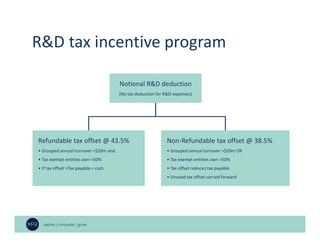
R&D tax incentive program
Notional R&D deduction
(No tax deduction for R&D expenses)
Refundable tax offset @ 43.5%
• Grouped annual turnover <$20m and
• Tax exempt entities own <50%
• If tax offset >Tax payable = cash
Non-Refundable tax offset @ 38.5%
• Grouped annual turnover >$20m OR
• Tax exempt entities own >50%
• Tax offset reduces tax payable
• Unused tax offset carried forward
Eligible activities
Core Activities
• Experimental Activities
• Core Activities tests
– Outcome can not be known in advance (knowledge gap)
– Experimental activities must be carried out using the scientific basis and
method
– Purpose of activity is to generate new knowledge (ie improved materials,
products, devices, processes or services)
• Example Core Activities
– Software or prototype testing
– Development of new algorithms
What is not a core activity?
• Activities are not core R&D activities if a competent
professional in the field is able to deduce in advance how to
achieve the outcome, on the basis of current knowledge,
information or experience.
• Developing, modifying or customising computer software for
the dominant purpose of use by any of the following entities
for their internal administration (including the internal
administration of their business functions):
– the entity (the developer) for which the software is developed,
modified or customised;
– an entity connected with the developer;
– an affiliate of the developer, or an entity of which the developer is an
affiliate.
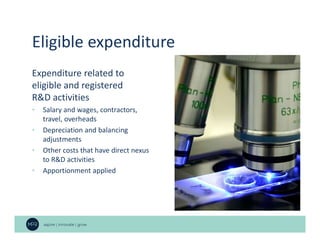
Expenditure related to
eligible and registered
R&D activities
• Salary and wages, contractors,
travel, overheads
• Depreciation and balancing
adjustments
• Other costs that have direct nexus
to R&D activities
• Apportionment applied
Eligible expenditure
Eligible activities
Supporting Activities
• Attending conferences for preliminary research
• Researching methods to conduct experiments
• Prior art searches
• Activities monitoring and feedback
• Project planning, management and administration
• Documentation
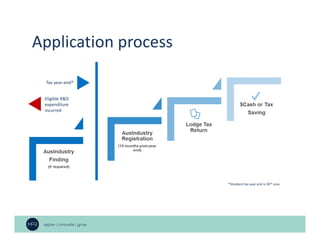
Application process
Tax year-end*
*Standard tax year end is 30th June.
Eligible R&D
expenditure
incurred
Export Market Development
Grant
• Encourages small and medium sized Australian
businesses to develop export markets
• Reimburses up to 50% of eligible export
promotion expenses above $5,000 provided that
the total expenses are at least $15,000
• Annual application process
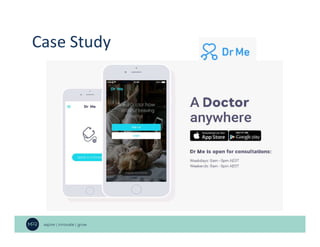
Case Study
Level 19, HWT Tower
40 City Road, Southbank, Australia, 3006
Simone Quin – Director
simoneq@mprgroup.com.au
www.mprgroup.com.au
03-9869-5936

MPR's MedTech's Got Talent accelerator workshop slides, hosted by Simone Quinn

  • 1.
  • 2.
    MPR Group • Businessaccounting and advisory for innovators – Accounting tax compliance – Director and board services – Capital raising – R&D and other grants – Start up services
  • 3.
    • Will itemploy staff? • Will it raise capital? • Will it list on the ASX? • Will you sell it and when? • How is the company owned? • Have you considered succession planning? What does the future of your business look like?
  • 4.
    Obligations of companies •Company tax rate for entities with turnover under $10M is 28.5% • Requirement to register and manage GST withholding and reporting to the ATO (if income will be over $75,000 per year). Small business can report on a cash basis. • Completion and lodgment of annual company tax return. • Appointment of a company director.
  • 5.
    Employing staff • Payingstaff, payroll tax (if monthly salary of $47,916 or higher). • Superannuation withholding obligations for staff. • Opportunities to renumerate employees or investors with shares through ESOPs • Fringe benefits tax on non cash benefits provided to staff • Possible R&D tax incentive rebate on salaries
  • 6.
    Seeking investors • Businessangels vs venture capital • Sophisticated investors – no prospectus required for share issue • Follow on share issues need shareholder approval • Early stage innovation company – tax benefits for investors • Putting investors on the board
  • 7.
    • Level ofcommercial opportunities available • Likelihood of litigation • Effects on possible grants (R&D and EMDG) • Trust structure to hold shares Separate IP company considerations
  • 8.
    Cash management • Liquidityratio – the assessment of the ability to pay debts as and when they become due • current assets/current liabilities • A ratio of less than 1 would indicate that the business is not in a position to pay its debts as and when they fall due and therefore technically insolvent
  • 9.
    R&D tax incentiveprogram Notional R&D deduction (No tax deduction for R&D expenses) Refundable tax offset @ 43.5% • Grouped annual turnover <$20m and • Tax exempt entities own <50% • If tax offset >Tax payable = cash Non-Refundable tax offset @ 38.5% • Grouped annual turnover >$20m OR • Tax exempt entities own >50% • Tax offset reduces tax payable • Unused tax offset carried forward
  • 10.
    Eligible activities Core Activities •Experimental Activities • Core Activities tests – Outcome can not be known in advance (knowledge gap) – Experimental activities must be carried out using the scientific basis and method – Purpose of activity is to generate new knowledge (ie improved materials, products, devices, processes or services) • Example Core Activities – Software or prototype testing – Development of new algorithms
  • 11.
    What is nota core activity? • Activities are not core R&D activities if a competent professional in the field is able to deduce in advance how to achieve the outcome, on the basis of current knowledge, information or experience. • Developing, modifying or customising computer software for the dominant purpose of use by any of the following entities for their internal administration (including the internal administration of their business functions): – the entity (the developer) for which the software is developed, modified or customised; – an entity connected with the developer; – an affiliate of the developer, or an entity of which the developer is an affiliate.
  • 12.
    Expenditure related to eligibleand registered R&D activities • Salary and wages, contractors, travel, overheads • Depreciation and balancing adjustments • Other costs that have direct nexus to R&D activities • Apportionment applied Eligible expenditure
  • 13.
    Eligible activities Supporting Activities •Attending conferences for preliminary research • Researching methods to conduct experiments • Prior art searches • Activities monitoring and feedback • Project planning, management and administration • Documentation
  • 14.
    Application process Tax year-end* *Standardtax year end is 30th June. Eligible R&D expenditure incurred
  • 15.
    Export Market Development Grant •Encourages small and medium sized Australian businesses to develop export markets • Reimburses up to 50% of eligible export promotion expenses above $5,000 provided that the total expenses are at least $15,000 • Annual application process
  • 16.
  • 17.
    Level 19, HWTTower 40 City Road, Southbank, Australia, 3006 Simone Quin – Director simoneq@mprgroup.com.au www.mprgroup.com.au 03-9869-5936