Comparison of Top CMS Systems

        Presented by Ryan Street
      rstreet@crownpartners.com
           www.coolryan.com
              @ryanstreet
We become what we behold. We shape our tools and then our tools
                         shape us.
                    -Marshall McLuhan
Objective
•   Define the Top 3 CMS Systems
•   Features
•   Strengths and Weaknesses
•   Scenarios
A Word of Caution
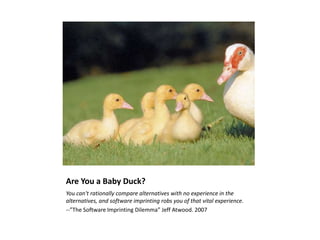
Are You a Baby Duck?
You can't rationally compare alternatives with no experience in the
alternatives, and software imprinting robs you of that vital experience.
--”The Software Imprinting Dilemma” Jeff Atwood. 2007
Top 3 CMS Systems
• WordPress
• Joomla
• Drupal
Honorable Mentions
•   DotNetNuke
•   ExpressionEngine
•   MediaWiki
•   Concrete5
•   TYPO3
•   LifeRay
•   Adobe CQ
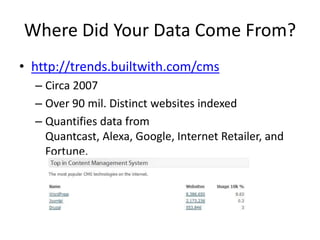
Where Did Your Data Come From?
• http://trends.builtwith.com/cms
  – Circa 2007
  – Over 90 mil. Distinct websites indexed
  – Quantifies data from
    Quantcast, Alexa, Google, Internet Retailer, and
    Fortune.
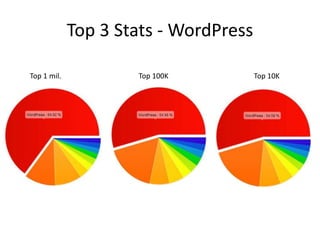
Top 3 Stats - WordPress

Top 1 mil.           Top 100K          Top 10K
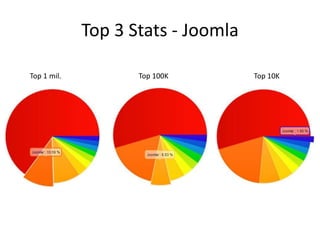
Top 3 Stats - Joomla

Top 1 mil.          Top 100K        Top 10K
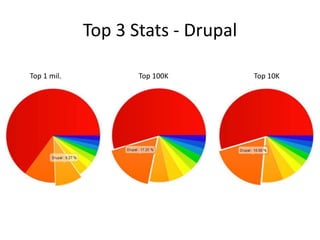
Top 3 Stats - Drupal

Top 1 mil.          Top 100K        Top 10K
WordPress
History
• First Released in 2003
• Matt Mullenweg and Mike Little
• Fork of b2/cafelog
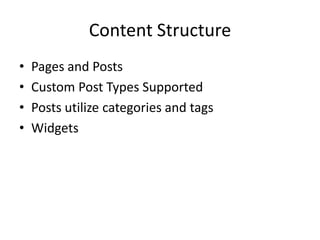
Content Structure
•   Pages and Posts
•   Custom Post Types Supported
•   Posts utilize categories and tags
•   Widgets
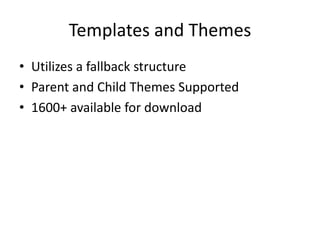
Templates and Themes
• Utilizes a fallback structure
• Parent and Child Themes Supported
• 1600+ available for download
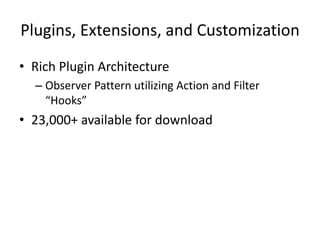
Plugins, Extensions, and Customization
• Rich Plugin Architecture
  – Observer Pattern utilizing Action and Filter
    “Hooks”
• 23,000+ available for download
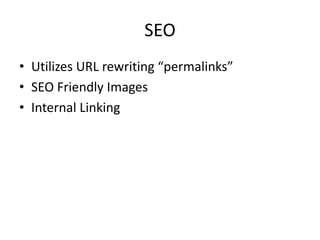
SEO
• Utilizes URL rewriting “permalinks”
• SEO Friendly Images
• Internal Linking
Support and Community
•   Good Documentation
•   WordPress.tv, learn.wordPress.com, etc.
•   Guided Tutorials Built In
•   60+ WordCamps per year
•   ~500 WordPress Meetups
Other Features
• Multi-Site Capable
• 5 Different Native Mobile Apps
• Free WordPress Blogs hosted at
  WordPress.com
• WordPress VIP
• Sister Projects called
  BuddyPress, BBPress, PollDaddy, Askismet, etc
  .
Strengths
•   Ease of Use
•   Backward Compatibility
•   Number of Plugins and Themes Available
•   Developer Following and Ease of
    Customization
Weaknesses
• Inflexible (Easy to Outgrow)
• Security
Joomla
History
• Forked Off of Mambo Project in 2005
• Won Numerous Awards including Packt Open
  Source Content Management System Award 3
  Times
Content Structure
• Utilizes Article and Component Structure
• Leverages Menus To Drive Content Curation
  and Display
• Extendible through downloadable
  components
Templates and Themes
• Robust and Flexible
• Utilize a Fallback Structure
• Parent and Child Structure
Plugins, Extensions, and Customization
• 5 Different Extensions Available
  – Components, Modules, Plugins, Templates, &
    Languages
• Components are ‘mini-applications’
• Modules add functionality (ex: login/search)
• Plugins Extend or modify functionality of
  Joomla through use of events
• Templates drive the look and feel
• Languages allow for internationalization
SEO
• SEO Friendly URLS
• Customizable Suffixes
• Robots Information on the Menu/Content
  Level
Support and Community
•   Good Documentation
•   Thriving Forums
•   Joomla Resource Directory
•   Joomla Magazine
•   Joomla Connect
Other Features
• Multi-Site Compatible
• MVC Architecture
• More Functionality Out of the Box
Strengths
• Community
• Flexibility
Weaknesses
• Security
• Administration is Unintuitive
• Code Bloat
Drupal
History
• Released in 2001
• Created By Dries Buytaert
• Current Version: 7
Content Structure
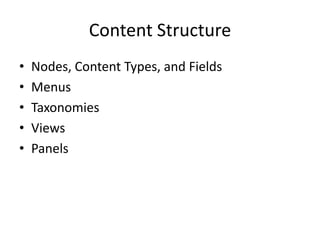
•   Nodes, Content Types, and Fields
•   Menus
•   Taxonomies
•   Views
•   Panels
Templates and Themes
• Robust and Flexible
• Fallback Structure
• Parent and Child Themes
Plugins, Extensions, and Customization
• Modules
• Themes
• Distributions
SEO
• Clean URLs
• Paths and Redirects (Canonicalization)
• Meta Information
Support and Community
•   Good Documentation
•   913,000 User Accounts
•   22,600 Developer Accounts
•   19,000+ Modules Available
•   DrupalCon, DrupalCamp, and DrupalGangers
Other Features
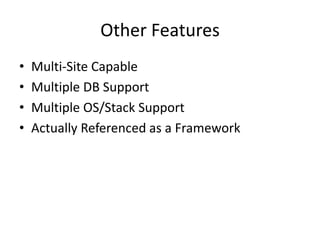
•   Multi-Site Capable
•   Multiple DB Support
•   Multiple OS/Stack Support
•   Actually Referenced as a Framework
Strengths
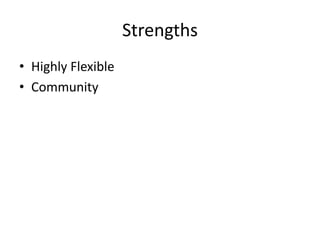
• Highly Flexible
• Community
Weaknesses
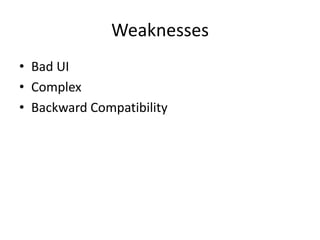
• Bad UI
• Complex
• Backward Compatibility
When Should You Use Each One?
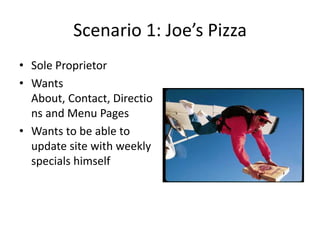
Scenario 1: Joe’s Pizza
• Sole Proprietor
• Wants
  About, Contact, Directio
  ns and Menu Pages
• Wants to be able to
  update site with weekly
  specials himself
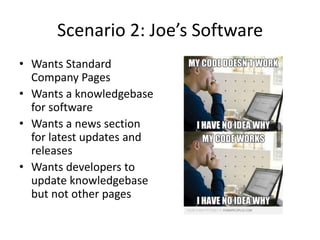
Scenario 2: Joe’s Software
• Wants Standard
  Company Pages
• Wants a knowledgebase
  for software
• Wants a news section
  for latest updates and
  releases
• Wants developers to
  update knowledgebase
  but not other pages
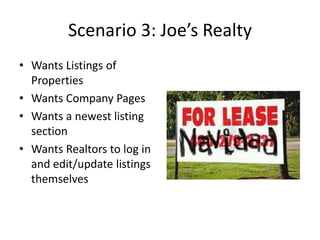
Scenario 3: Joe’s Realty
• Wants Listings of
  Properties
• Wants Company Pages
• Wants a newest listing
  section
• Wants Realtors to log in
  and edit/update listings
  themselves
Questions?

Comparison of Top CMS Systems

  • 1.
    Comparison of TopCMS Systems Presented by Ryan Street rstreet@crownpartners.com www.coolryan.com @ryanstreet
  • 2.
    We become whatwe behold. We shape our tools and then our tools shape us. -Marshall McLuhan
  • 3.
    Objective • Define the Top 3 CMS Systems • Features • Strengths and Weaknesses • Scenarios
  • 4.
    A Word ofCaution
  • 5.
    Are You aBaby Duck? You can't rationally compare alternatives with no experience in the alternatives, and software imprinting robs you of that vital experience. --”The Software Imprinting Dilemma” Jeff Atwood. 2007
  • 6.
    Top 3 CMSSystems • WordPress • Joomla • Drupal
  • 7.
    Honorable Mentions • DotNetNuke • ExpressionEngine • MediaWiki • Concrete5 • TYPO3 • LifeRay • Adobe CQ
  • 8.
    Where Did YourData Come From? • http://trends.builtwith.com/cms – Circa 2007 – Over 90 mil. Distinct websites indexed – Quantifies data from Quantcast, Alexa, Google, Internet Retailer, and Fortune.
  • 9.
    Top 3 Stats- WordPress Top 1 mil. Top 100K Top 10K
  • 10.
    Top 3 Stats- Joomla Top 1 mil. Top 100K Top 10K
  • 11.
    Top 3 Stats- Drupal Top 1 mil. Top 100K Top 10K
  • 12.
  • 13.
    History • First Releasedin 2003 • Matt Mullenweg and Mike Little • Fork of b2/cafelog
  • 14.
    Content Structure • Pages and Posts • Custom Post Types Supported • Posts utilize categories and tags • Widgets
  • 15.
    Templates and Themes •Utilizes a fallback structure • Parent and Child Themes Supported • 1600+ available for download
  • 16.
    Plugins, Extensions, andCustomization • Rich Plugin Architecture – Observer Pattern utilizing Action and Filter “Hooks” • 23,000+ available for download
  • 17.
    SEO • Utilizes URLrewriting “permalinks” • SEO Friendly Images • Internal Linking
  • 18.
    Support and Community • Good Documentation • WordPress.tv, learn.wordPress.com, etc. • Guided Tutorials Built In • 60+ WordCamps per year • ~500 WordPress Meetups
  • 19.
    Other Features • Multi-SiteCapable • 5 Different Native Mobile Apps • Free WordPress Blogs hosted at WordPress.com • WordPress VIP • Sister Projects called BuddyPress, BBPress, PollDaddy, Askismet, etc .
  • 20.
    Strengths • Ease of Use • Backward Compatibility • Number of Plugins and Themes Available • Developer Following and Ease of Customization
  • 21.
    Weaknesses • Inflexible (Easyto Outgrow) • Security
  • 22.
  • 23.
    History • Forked Offof Mambo Project in 2005 • Won Numerous Awards including Packt Open Source Content Management System Award 3 Times
  • 24.
    Content Structure • UtilizesArticle and Component Structure • Leverages Menus To Drive Content Curation and Display • Extendible through downloadable components
  • 25.
    Templates and Themes •Robust and Flexible • Utilize a Fallback Structure • Parent and Child Structure
  • 26.
    Plugins, Extensions, andCustomization • 5 Different Extensions Available – Components, Modules, Plugins, Templates, & Languages • Components are ‘mini-applications’ • Modules add functionality (ex: login/search) • Plugins Extend or modify functionality of Joomla through use of events • Templates drive the look and feel • Languages allow for internationalization
  • 27.
    SEO • SEO FriendlyURLS • Customizable Suffixes • Robots Information on the Menu/Content Level
  • 28.
    Support and Community • Good Documentation • Thriving Forums • Joomla Resource Directory • Joomla Magazine • Joomla Connect
  • 29.
    Other Features • Multi-SiteCompatible • MVC Architecture • More Functionality Out of the Box
  • 30.
  • 31.
    Weaknesses • Security • Administrationis Unintuitive • Code Bloat
  • 32.
  • 33.
    History • Released in2001 • Created By Dries Buytaert • Current Version: 7
  • 34.
    Content Structure • Nodes, Content Types, and Fields • Menus • Taxonomies • Views • Panels
  • 35.
    Templates and Themes •Robust and Flexible • Fallback Structure • Parent and Child Themes
  • 36.
    Plugins, Extensions, andCustomization • Modules • Themes • Distributions
  • 37.
    SEO • Clean URLs •Paths and Redirects (Canonicalization) • Meta Information
  • 38.
    Support and Community • Good Documentation • 913,000 User Accounts • 22,600 Developer Accounts • 19,000+ Modules Available • DrupalCon, DrupalCamp, and DrupalGangers
  • 39.
    Other Features • Multi-Site Capable • Multiple DB Support • Multiple OS/Stack Support • Actually Referenced as a Framework
  • 40.
  • 41.
    Weaknesses • Bad UI •Complex • Backward Compatibility
  • 42.
    When Should YouUse Each One?
  • 43.
    Scenario 1: Joe’sPizza • Sole Proprietor • Wants About, Contact, Directio ns and Menu Pages • Wants to be able to update site with weekly specials himself
  • 44.
    Scenario 2: Joe’sSoftware • Wants Standard Company Pages • Wants a knowledgebase for software • Wants a news section for latest updates and releases • Wants developers to update knowledgebase but not other pages
  • 45.
    Scenario 3: Joe’sRealty • Wants Listings of Properties • Wants Company Pages • Wants a newest listing section • Wants Realtors to log in and edit/update listings themselves
  • 46.