Comparing Beveridge
Model and Pakistan’s Health
Care System
Group 1
5th Batch of PGD Hospital Management
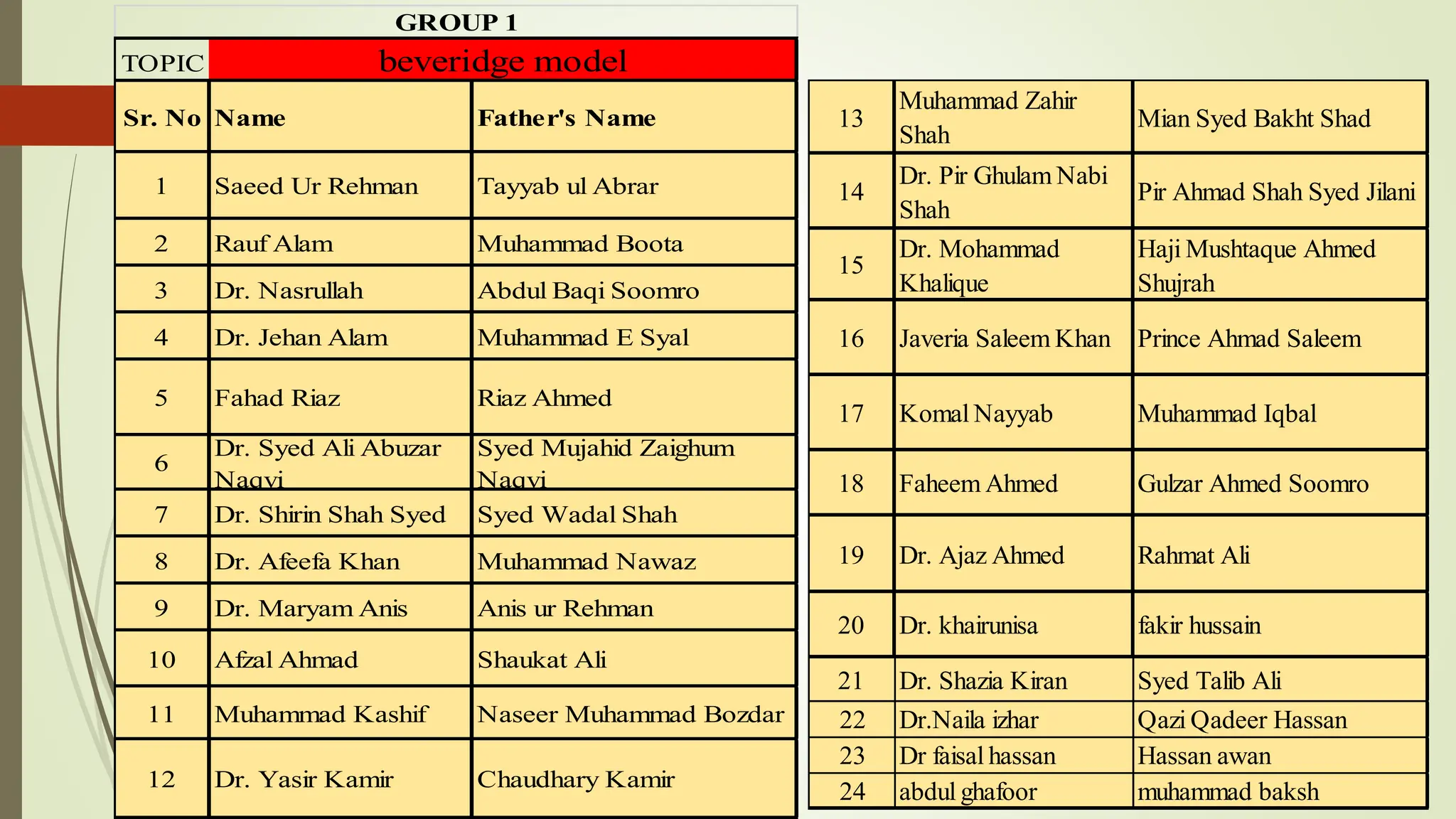
TOPIC
Sr. No Name Father's Name
1 Saeed Ur Rehman Tayyab ul Abrar
2 Rauf Alam Muhammad Boota
3 Dr. Nasrullah Abdul Baqi Soomro
4 Dr. Jehan Alam Muhammad E Syal
5 Fahad Riaz Riaz Ahmed
6
Dr. Syed Ali Abuzar
Naqvi
Syed Mujahid Zaighum
Naqvi
7 Dr. Shirin Shah Syed Syed Wadal Shah
8 Dr. Afeefa Khan Muhammad Nawaz
9 Dr. Maryam Anis Anis ur Rehman
10 Afzal Ahmad Shaukat Ali
11 Muhammad Kashif Naseer Muhammad Bozdar
12 Dr. Yasir Kamir Chaudhary Kamir
GROUP 1
beveridge model
13
Muhammad Zahir
Shah
Mian Syed Bakht Shad
14
Dr. Pir Ghulam Nabi
Shah
Pir Ahmad Shah Syed Jilani
15
Dr. Mohammad
Khalique
Haji Mushtaque Ahmed
Shujrah
16 Javeria Saleem Khan Prince Ahmad Saleem
17 Komal Nayyab Muhammad Iqbal
18 Faheem Ahmed Gulzar Ahmed Soomro
19 Dr. Ajaz Ahmed Rahmat Ali
20 Dr. khairunisa fakir hussain
21 Dr. Shazia Kiran Syed Talib Ali
22 Dr.Naila izhar Qazi Qadeer Hassan
23 Dr faisal hassan Hassan awan
24 abdul ghafoor muhammad baksh
Introduction
 The Beveridge Model is one of the prominent health care frameworks used
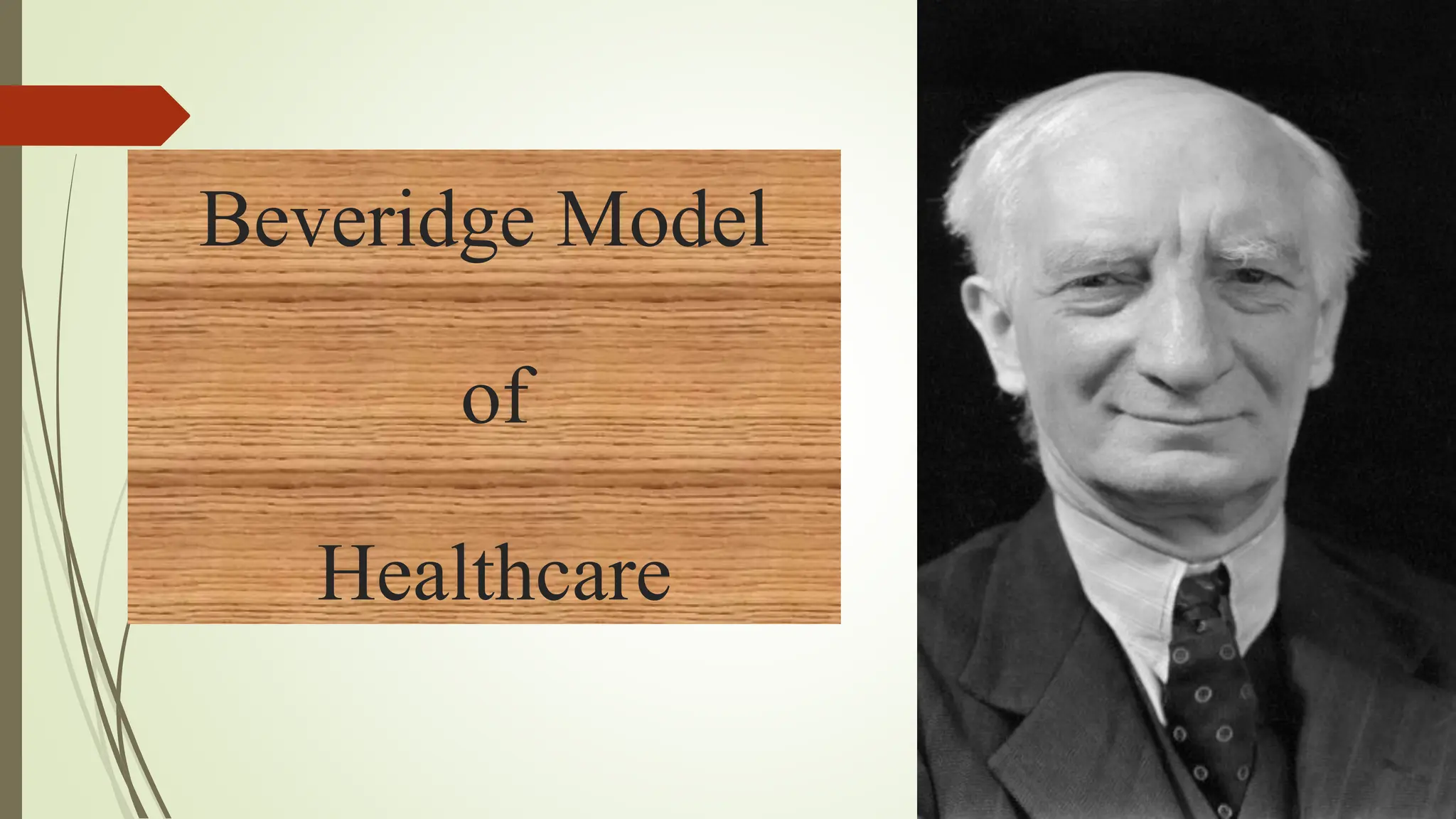
globally, named after Sir William Beveridge.
 It emphasizes health care funded and provided by the government through
taxation, aiming to offer universal coverage at no direct cost at the point of use.
 Pakistan’s health care system, however, is a hybrid model incorporating elements
from various frameworks.
 We will discuss comparative analysis between the Beveridge Model and
Pakistan’s health care system, highlighting key similarities, differences, and
implications for health care delivery and policy.
Types of Health
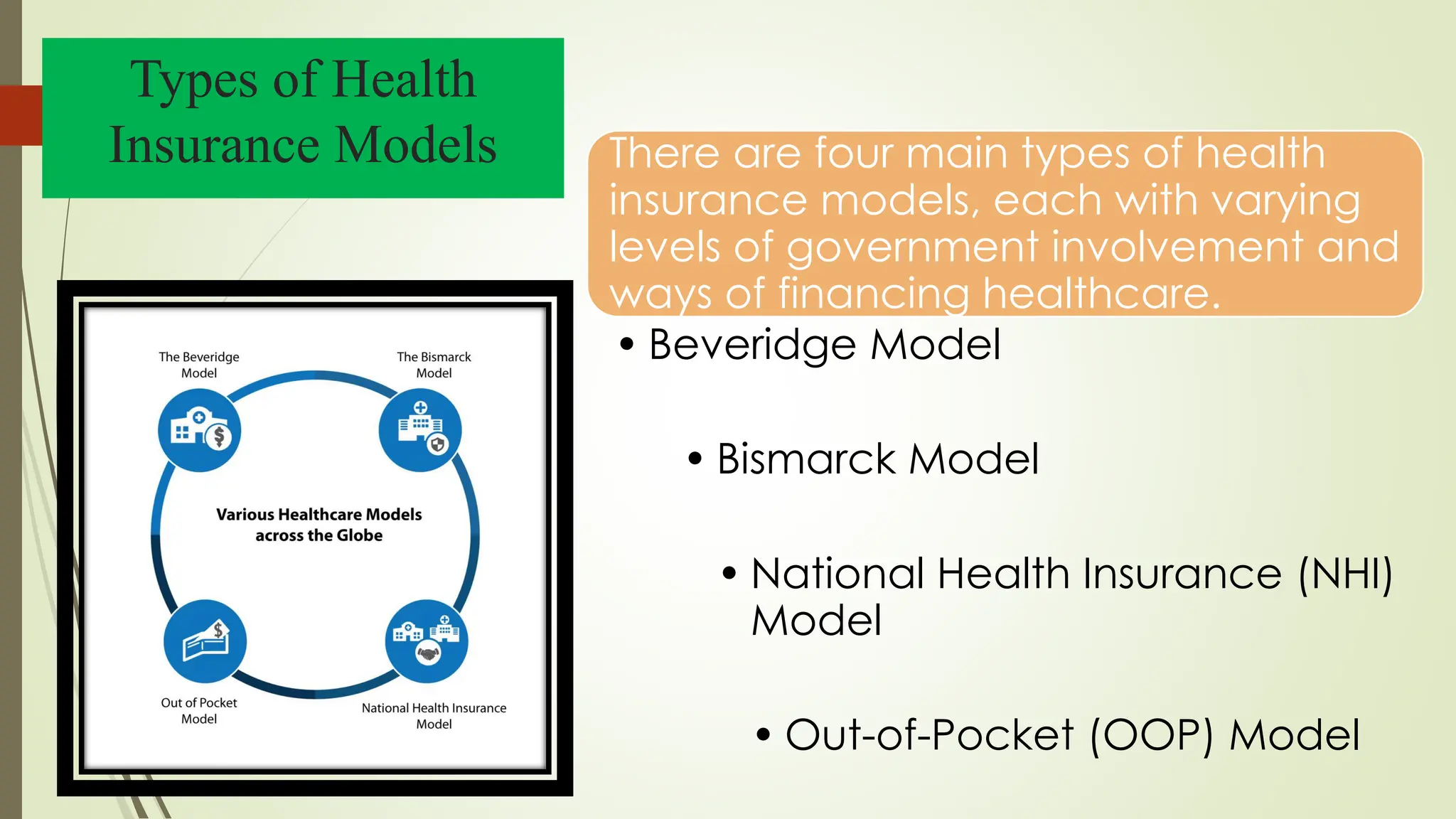
Insurance Models There are four main types of health
insurance models, each with varying
levels of government involvement and
ways of financing healthcare.
• Beveridge Model
• Bismarck Model
• National Health Insurance (NHI)
Model
• Out-of-Pocket (OOP) Model
Beveridge
Model
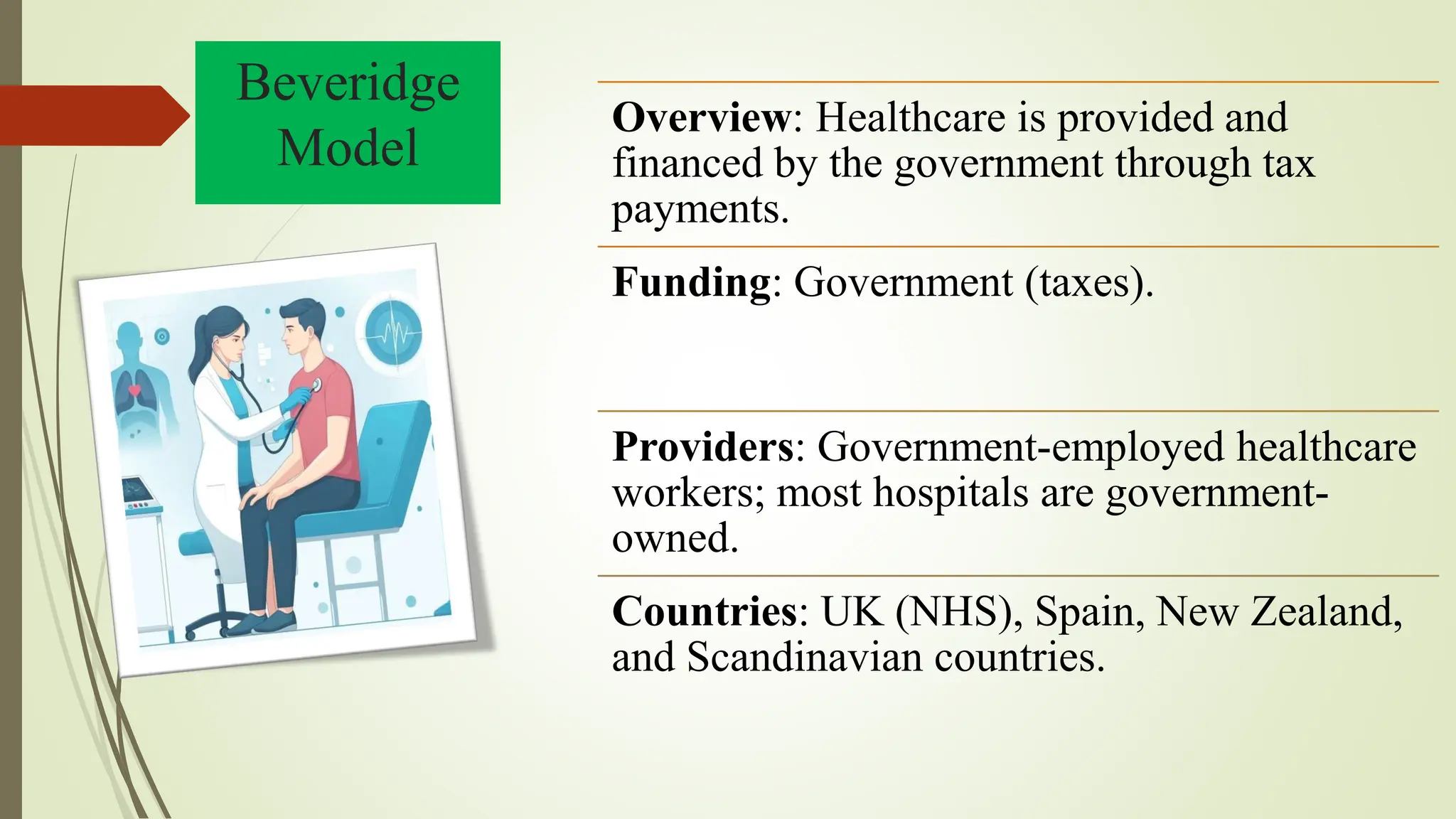
Overview: Healthcare is provided and
financed by the government through tax
payments.
Funding: Government (taxes).
Providers: Government-employed healthcare
workers; most hospitals are government-
owned.
Countries: UK (NHS), Spain, New Zealand,
and Scandinavian countries.
Beveridge Model
of
Healthcare
Historical Background
Before the Beveridge Model, healthcare in the
UK was fragmented, with services provided by
a combination of private doctors, charitable
organizations, and local governments.
Access to healthcare depended largely on an
individual's ability to pay, leaving many
without necessary care.
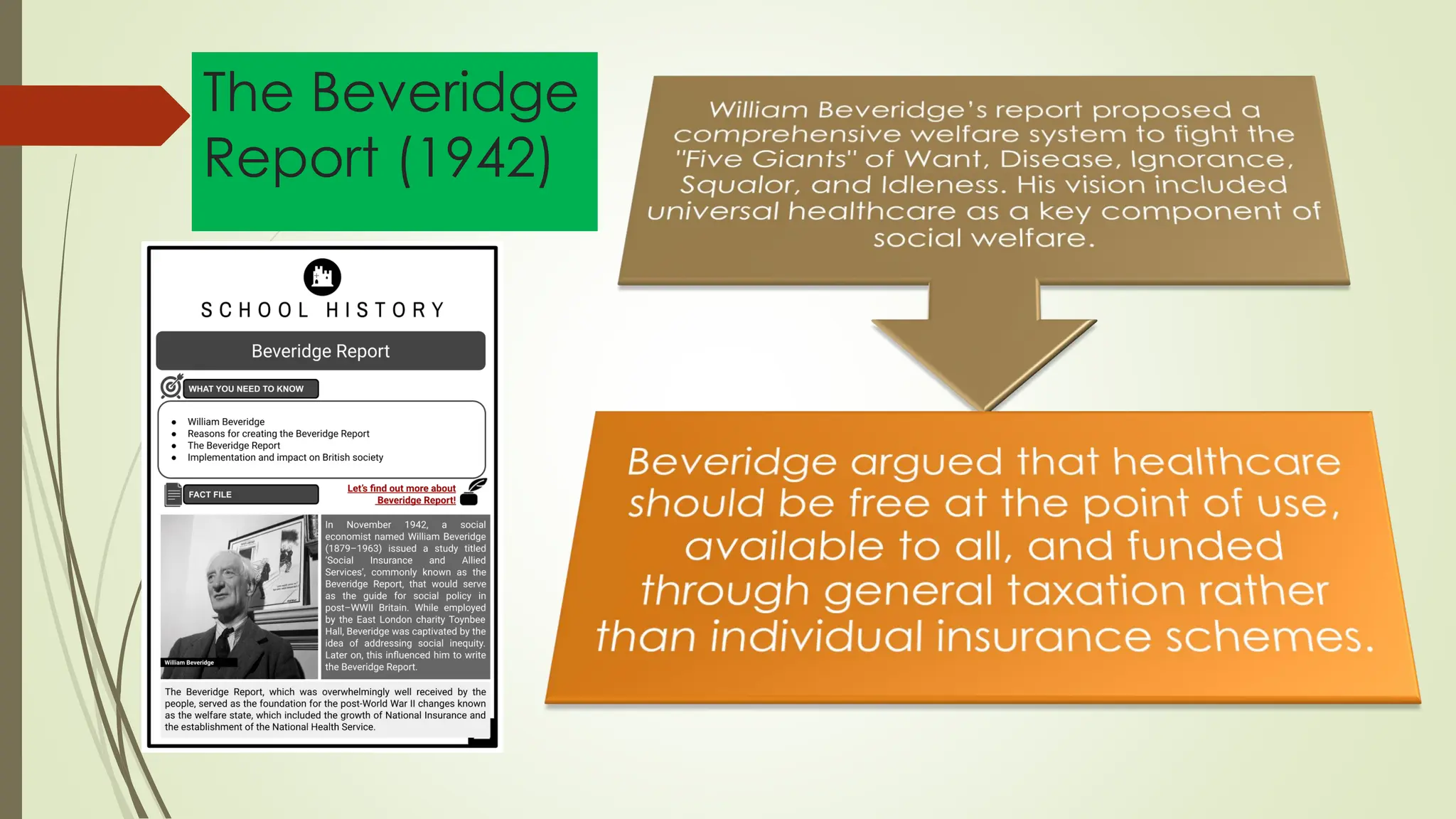
The Beveridge
Report (1942)
Post-War
Implementation
(1948)
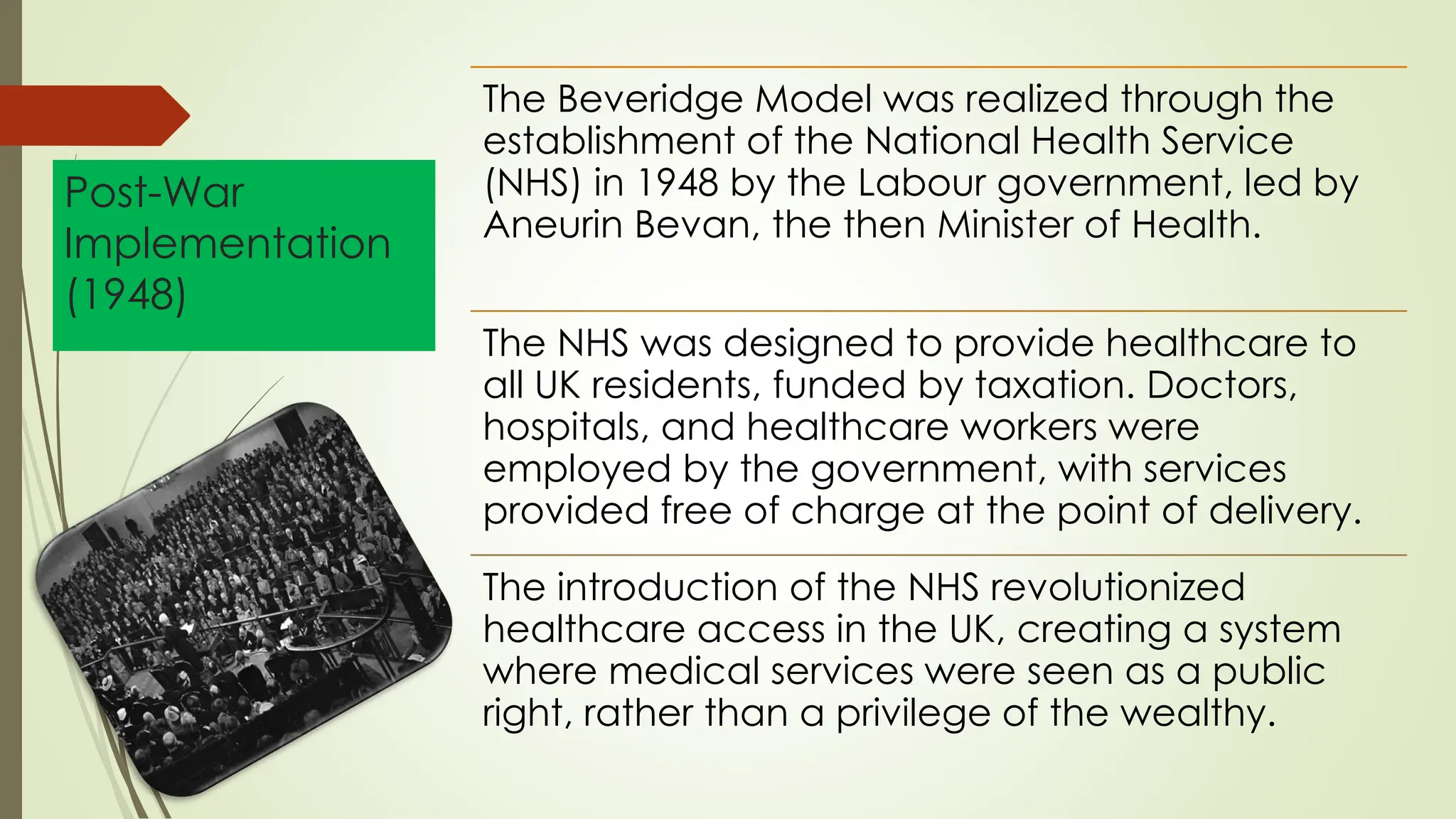
The Beveridge Model was realized through the
establishment of the National Health Service
(NHS) in 1948 by the Labour government, led by
Aneurin Bevan, the then Minister of Health.
The NHS was designed to provide healthcare to
all UK residents, funded by taxation. Doctors,
hospitals, and healthcare workers were
employed by the government, with services
provided free of charge at the point of delivery.
The introduction of the NHS revolutionized
healthcare access in the UK, creating a system
where medical services were seen as a public
right, rather than a privilege of the wealthy.
Beveridge Model
and
Pakistan’s Health Care System
Similarities
Government Funding and Public Health
Services
Beveridge Model
 In this model, health care services are
funded primarily through general
taxation.
 The government finances and
provides health care, ensuring that it
is free at the point of use.
Pakistan’s System
 Pakistan operates a network of public health
facilities funded by the government.
 Hospitals and clinics such as those under the
Ministry of National Health Services,
Regulation, and Coordination offer services
with minimal or no direct charges to patients.
 This reflects a Beveridge like aspect of
government funded care.
Universal Health Coverage Goals
Beveridge Model
 A key feature is the provision of
universal health coverage, aiming to
ensure that all citizens have access to
necessary health services without
financial barriers.
Pakistan’s System
 The Pakistani government aims to
provide universal health coverage
through public health facilities and
various health programs.
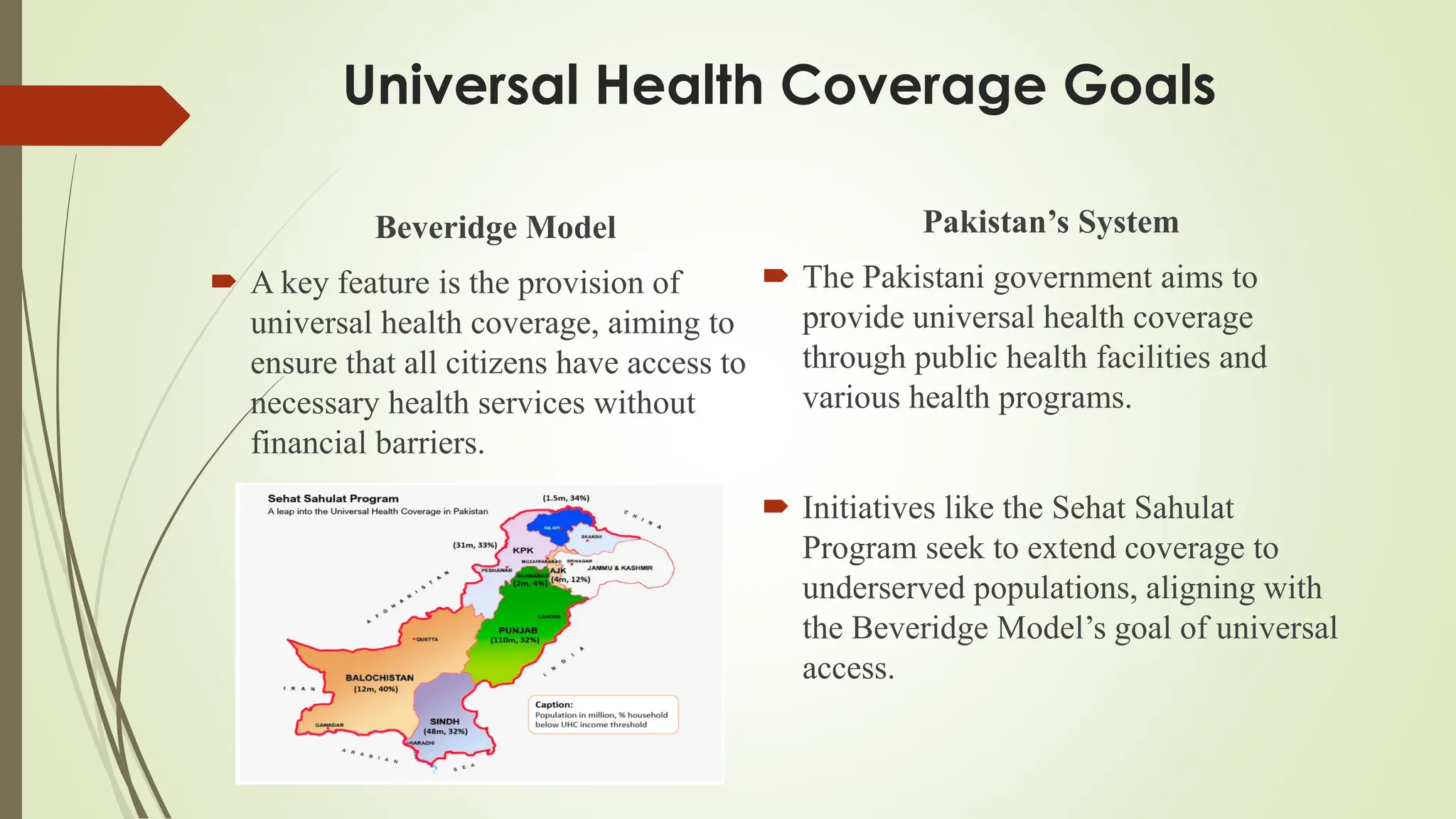
 Initiatives like the Sehat Sahulat
Program seek to extend coverage to
underserved populations, aligning with
the Beveridge Model’s goal of universal
access.
Differences
Private Sector Involvement
Beveridge Model
 Health care services are
predominantly provided by the
government.
 The private sector plays a minor
role, if any, in the direct
provision of health care services.
Pakistan’s System
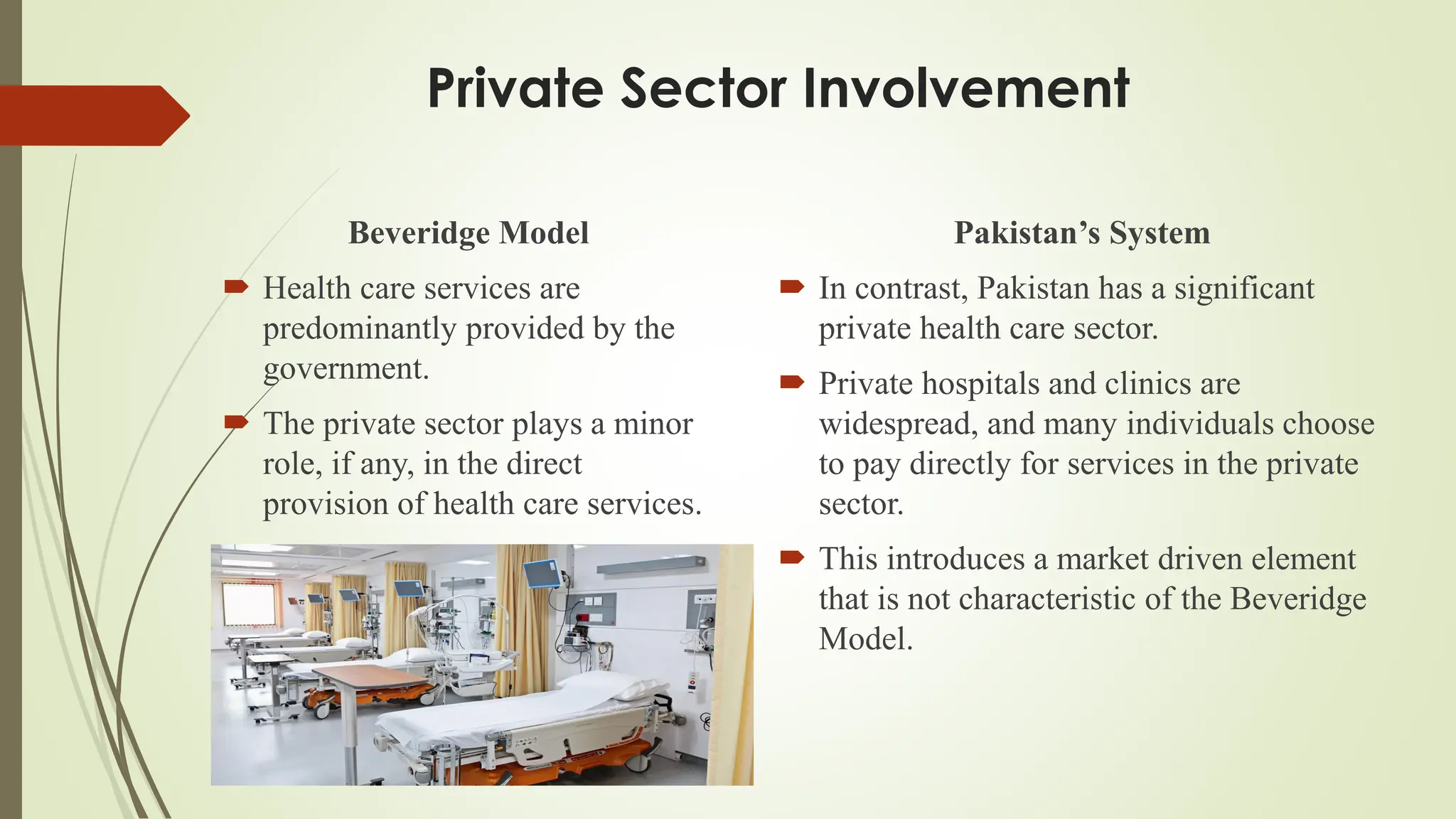
 In contrast, Pakistan has a significant
private health care sector.
 Private hospitals and clinics are
widespread, and many individuals choose
to pay directly for services in the private
sector.
 This introduces a market driven element
that is not characteristic of the Beveridge
Model.
Funding Mechanisms
Beveridge Model
 Entirely funded through taxation,
ensuring that all health services are
covered without additional costs to
patients at the point of use.
Pakistan’s System
 While public health services are funded
through taxes, the private sector
operates on a fee for service basis.
 Additionally, out-of-pocket payments
are common, which is contrary to the
Beveridge Model’s principle of no direct
charges for health care services.
Health Insurance
Beveridge Model
 Typically, health insurance is not a
major component as health services
are funded directly by the
government.
Pakistan’s System
 Private health insurance exists but is not
universal.
 Health insurance coverage is often limited
to those who can afford it, and many rely on
out-of-pocket payments or seek government
funded services, resulting in a fragmented
system.
Implications for Health Care Delivery
 Equity and Access
Quality of Care
Sustainability and Efficiency
Public vs. Private Health Expenditure
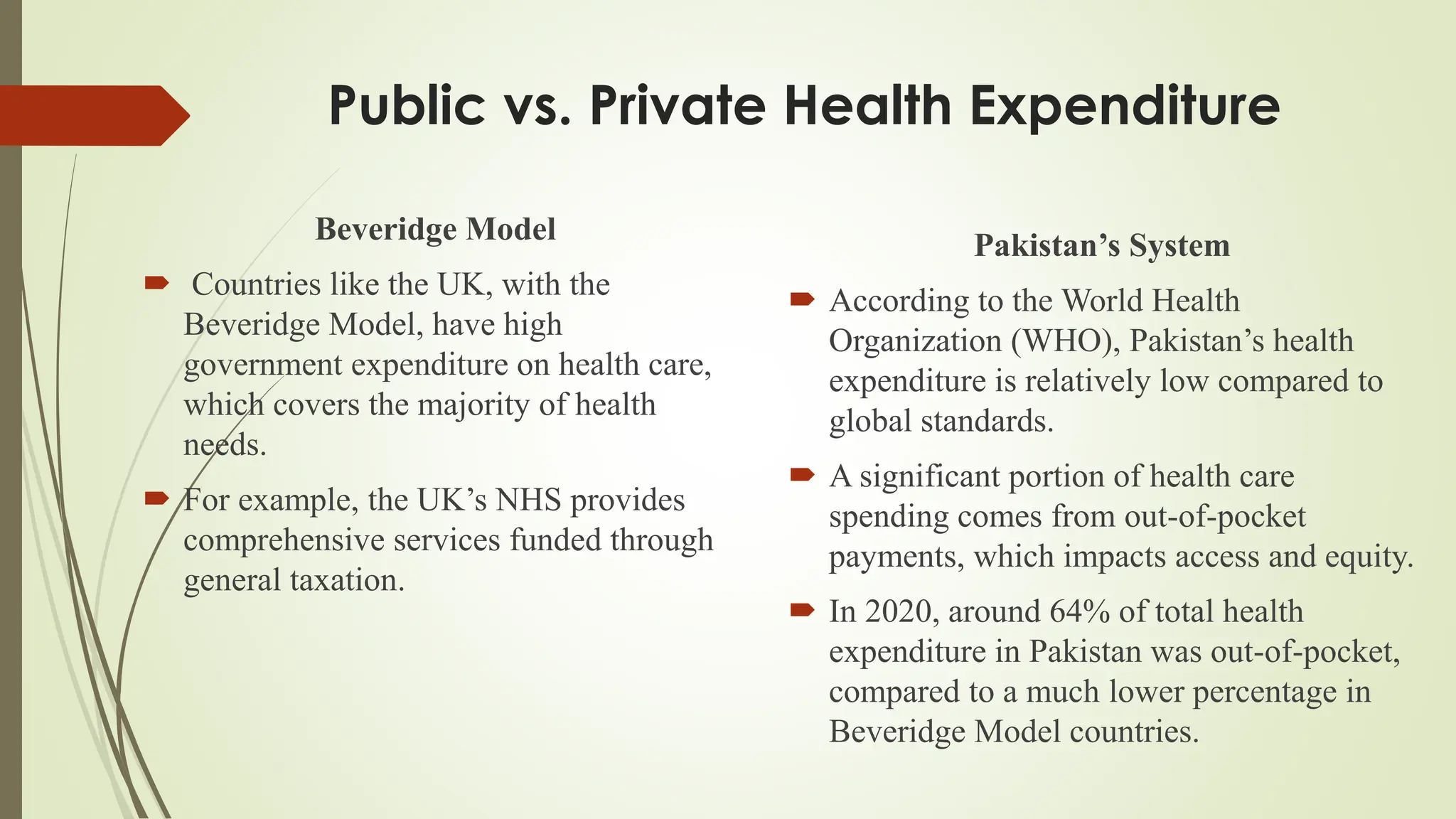
Beveridge Model
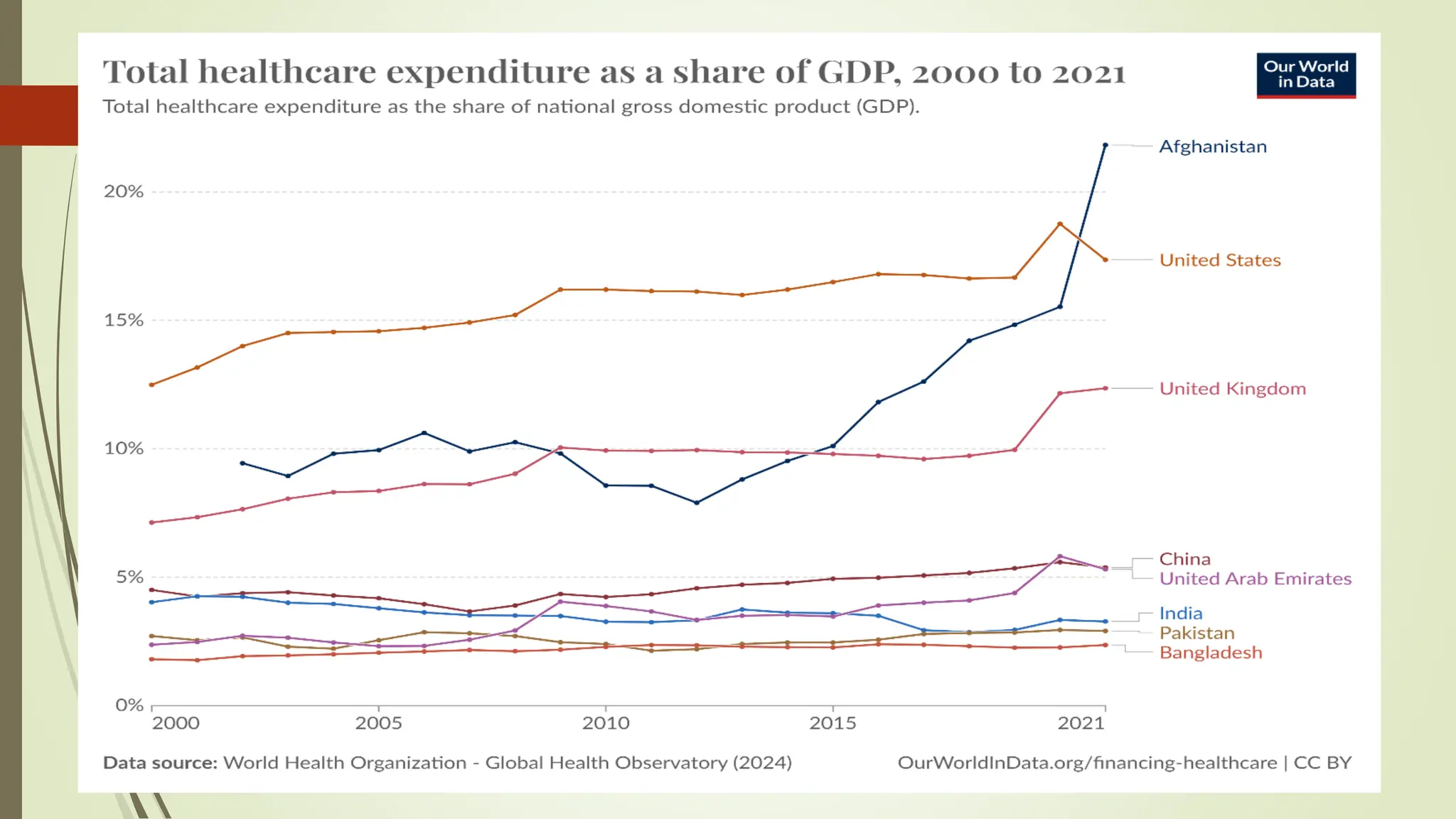
 Countries like the UK, with the
Beveridge Model, have high
government expenditure on health care,
which covers the majority of health
needs.
 For example, the UK’s NHS provides
comprehensive services funded through
general taxation.
Pakistan’s System
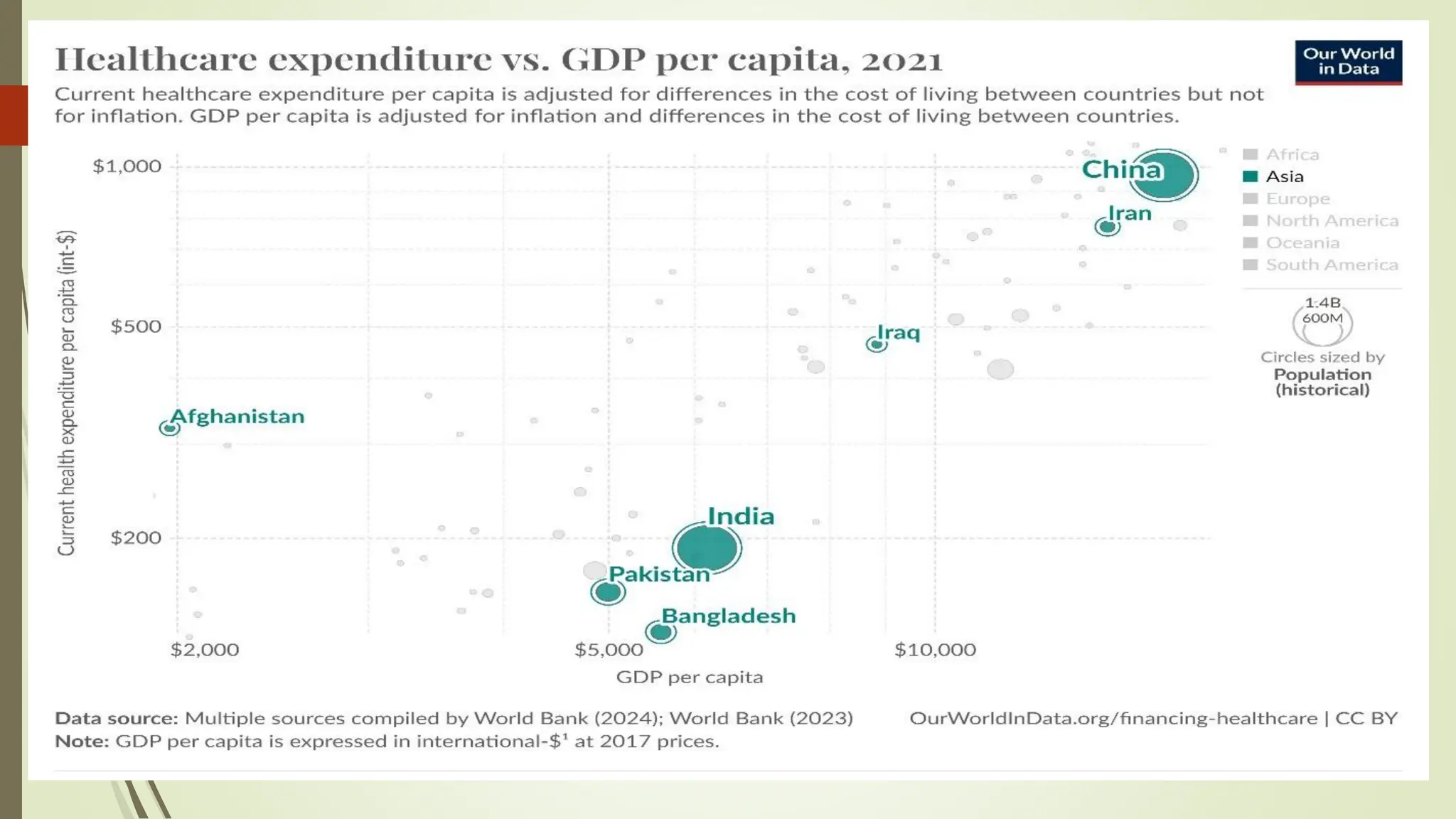
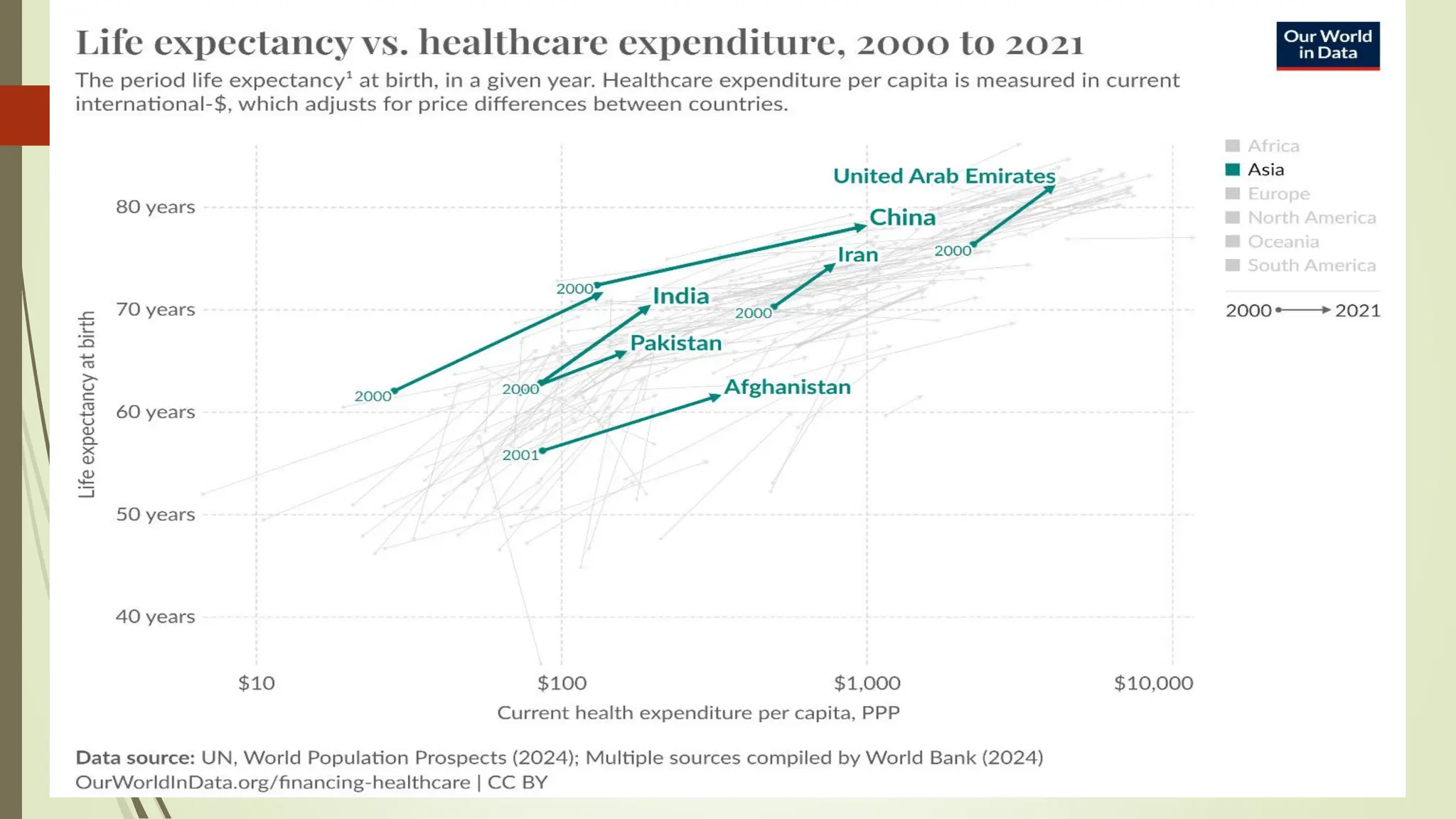
 According to the World Health
Organization (WHO), Pakistan’s health
expenditure is relatively low compared to
global standards.
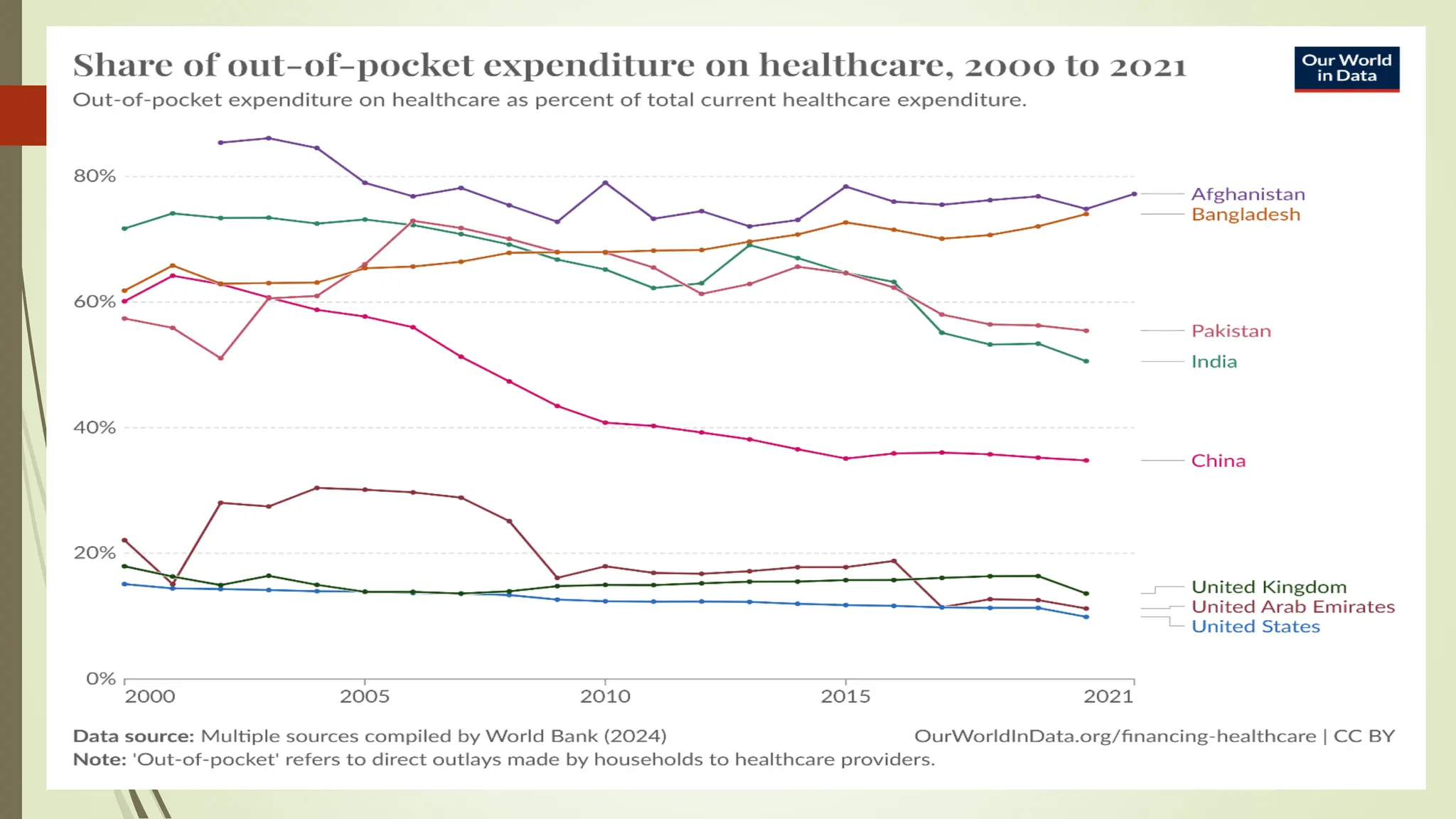
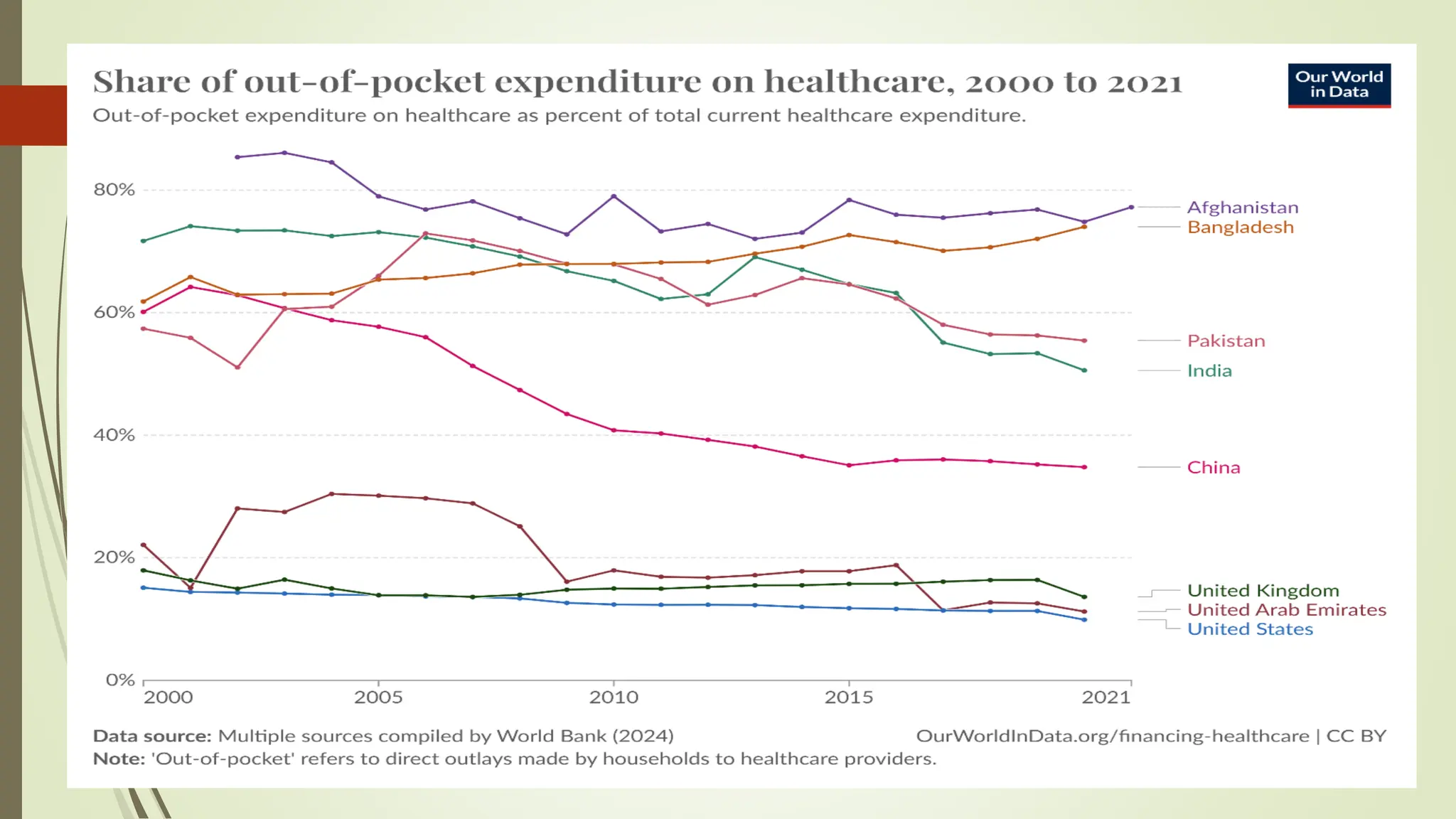
 A significant portion of health care
spending comes from out-of-pocket
payments, which impacts access and equity.
 In 2020, around 64% of total health
expenditure in Pakistan was out-of-pocket,
compared to a much lower percentage in
Beveridge Model countries.
Health Outcomes
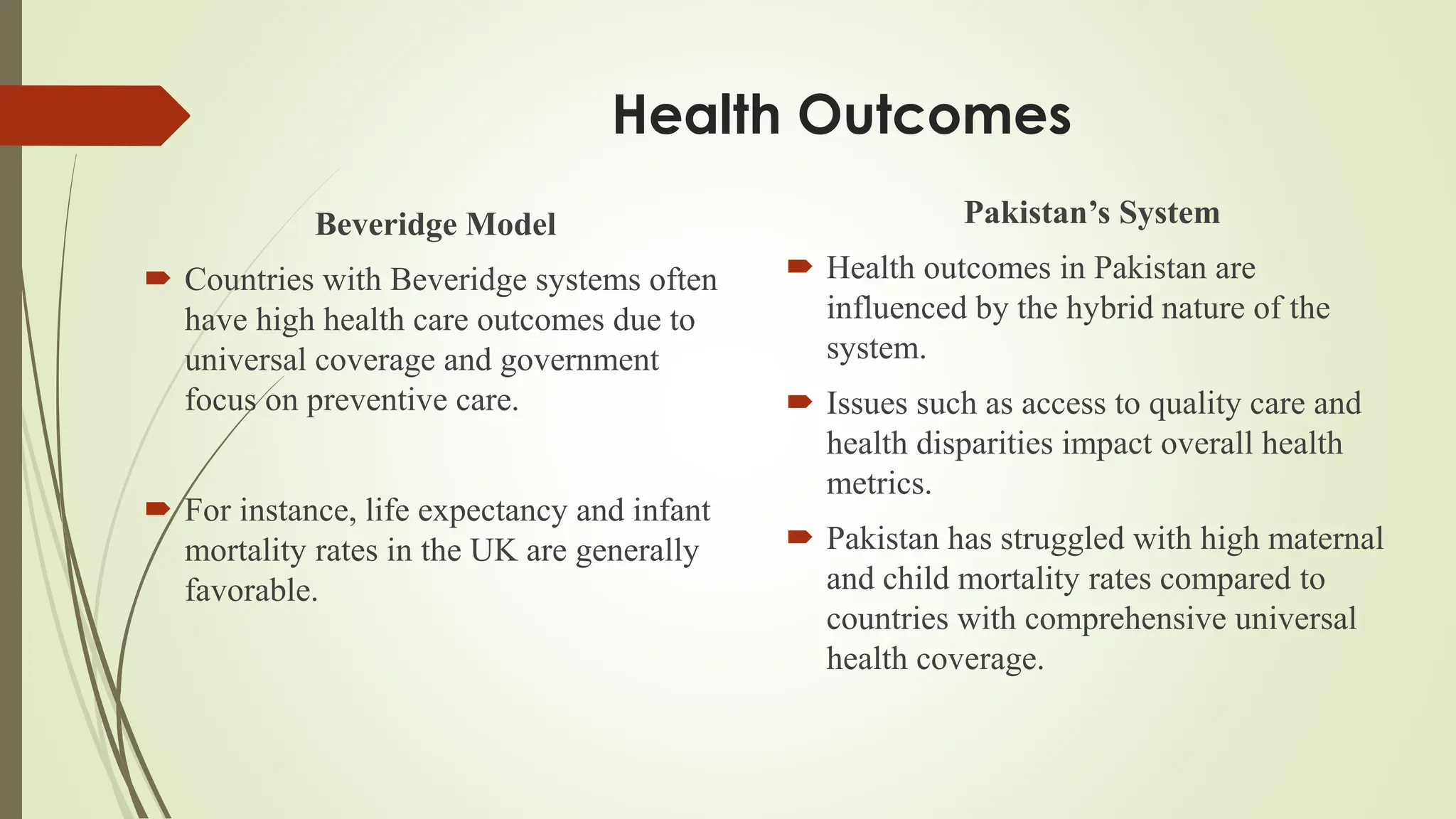
Beveridge Model
 Countries with Beveridge systems often
have high health care outcomes due to
universal coverage and government
focus on preventive care.
 For instance, life expectancy and infant
mortality rates in the UK are generally
favorable.
Pakistan’s System
 Health outcomes in Pakistan are
influenced by the hybrid nature of the
system.
 Issues such as access to quality care and
health disparities impact overall health
metrics.
 Pakistan has struggled with high maternal
and child mortality rates compared to
countries with comprehensive universal
health coverage.
Conclusion
The comparison between the Beveridge Model and Pakistan’s health care system highlights
both similarities and significant differences.
While Pakistan incorporates elements of the Beveridge Model through its public health
services and universal coverage goals, the hybrid nature of its system introduces challenges
related to private sector involvement, funding mechanisms, and health equity.
Addressing these challenges requires a nuanced approach that leverages the strengths of
various models to improve overall health care delivery and outcomes.
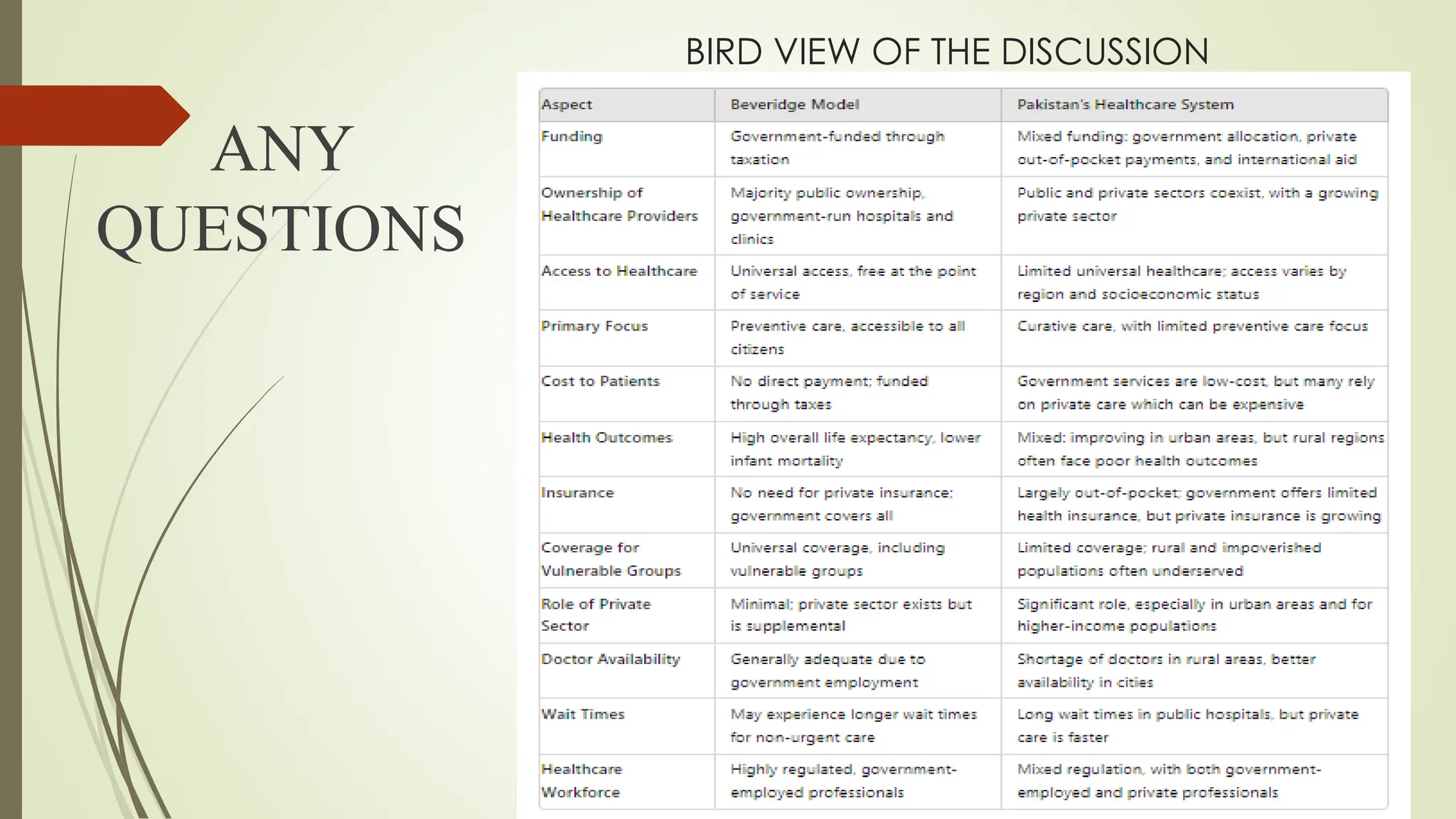
BIRD VIEW OF THE DISCUSSION
ANY
QUESTIONS
Comparing Beveridge Model and Pakistan’s Health Care System.pdf

Comparing Beveridge Model and Pakistan’s Health Care System.pdf

  • 1.
    Comparing Beveridge Model andPakistan’s Health Care System Group 1 5th Batch of PGD Hospital Management
  • 2.
    TOPIC Sr. No NameFather's Name 1 Saeed Ur Rehman Tayyab ul Abrar 2 Rauf Alam Muhammad Boota 3 Dr. Nasrullah Abdul Baqi Soomro 4 Dr. Jehan Alam Muhammad E Syal 5 Fahad Riaz Riaz Ahmed 6 Dr. Syed Ali Abuzar Naqvi Syed Mujahid Zaighum Naqvi 7 Dr. Shirin Shah Syed Syed Wadal Shah 8 Dr. Afeefa Khan Muhammad Nawaz 9 Dr. Maryam Anis Anis ur Rehman 10 Afzal Ahmad Shaukat Ali 11 Muhammad Kashif Naseer Muhammad Bozdar 12 Dr. Yasir Kamir Chaudhary Kamir GROUP 1 beveridge model 13 Muhammad Zahir Shah Mian Syed Bakht Shad 14 Dr. Pir Ghulam Nabi Shah Pir Ahmad Shah Syed Jilani 15 Dr. Mohammad Khalique Haji Mushtaque Ahmed Shujrah 16 Javeria Saleem Khan Prince Ahmad Saleem 17 Komal Nayyab Muhammad Iqbal 18 Faheem Ahmed Gulzar Ahmed Soomro 19 Dr. Ajaz Ahmed Rahmat Ali 20 Dr. khairunisa fakir hussain 21 Dr. Shazia Kiran Syed Talib Ali 22 Dr.Naila izhar Qazi Qadeer Hassan 23 Dr faisal hassan Hassan awan 24 abdul ghafoor muhammad baksh
  • 3.
    Introduction  The BeveridgeModel is one of the prominent health care frameworks used globally, named after Sir William Beveridge.  It emphasizes health care funded and provided by the government through taxation, aiming to offer universal coverage at no direct cost at the point of use.  Pakistan’s health care system, however, is a hybrid model incorporating elements from various frameworks.  We will discuss comparative analysis between the Beveridge Model and Pakistan’s health care system, highlighting key similarities, differences, and implications for health care delivery and policy.
  • 4.
    Types of Health InsuranceModels There are four main types of health insurance models, each with varying levels of government involvement and ways of financing healthcare. • Beveridge Model • Bismarck Model • National Health Insurance (NHI) Model • Out-of-Pocket (OOP) Model
  • 5.
    Beveridge Model Overview: Healthcare isprovided and financed by the government through tax payments. Funding: Government (taxes). Providers: Government-employed healthcare workers; most hospitals are government- owned. Countries: UK (NHS), Spain, New Zealand, and Scandinavian countries.
  • 6.
  • 7.
    Historical Background Before theBeveridge Model, healthcare in the UK was fragmented, with services provided by a combination of private doctors, charitable organizations, and local governments. Access to healthcare depended largely on an individual's ability to pay, leaving many without necessary care.
  • 8.
  • 9.
    Post-War Implementation (1948) The Beveridge Modelwas realized through the establishment of the National Health Service (NHS) in 1948 by the Labour government, led by Aneurin Bevan, the then Minister of Health. The NHS was designed to provide healthcare to all UK residents, funded by taxation. Doctors, hospitals, and healthcare workers were employed by the government, with services provided free of charge at the point of delivery. The introduction of the NHS revolutionized healthcare access in the UK, creating a system where medical services were seen as a public right, rather than a privilege of the wealthy.
  • 10.
  • 11.
  • 12.
    Government Funding andPublic Health Services Beveridge Model  In this model, health care services are funded primarily through general taxation.  The government finances and provides health care, ensuring that it is free at the point of use. Pakistan’s System  Pakistan operates a network of public health facilities funded by the government.  Hospitals and clinics such as those under the Ministry of National Health Services, Regulation, and Coordination offer services with minimal or no direct charges to patients.  This reflects a Beveridge like aspect of government funded care.
  • 14.
    Universal Health CoverageGoals Beveridge Model  A key feature is the provision of universal health coverage, aiming to ensure that all citizens have access to necessary health services without financial barriers. Pakistan’s System  The Pakistani government aims to provide universal health coverage through public health facilities and various health programs.  Initiatives like the Sehat Sahulat Program seek to extend coverage to underserved populations, aligning with the Beveridge Model’s goal of universal access.
  • 16.
  • 17.
    Private Sector Involvement BeveridgeModel  Health care services are predominantly provided by the government.  The private sector plays a minor role, if any, in the direct provision of health care services. Pakistan’s System  In contrast, Pakistan has a significant private health care sector.  Private hospitals and clinics are widespread, and many individuals choose to pay directly for services in the private sector.  This introduces a market driven element that is not characteristic of the Beveridge Model.
  • 18.
    Funding Mechanisms Beveridge Model Entirely funded through taxation, ensuring that all health services are covered without additional costs to patients at the point of use. Pakistan’s System  While public health services are funded through taxes, the private sector operates on a fee for service basis.  Additionally, out-of-pocket payments are common, which is contrary to the Beveridge Model’s principle of no direct charges for health care services.
  • 19.
    Health Insurance Beveridge Model Typically, health insurance is not a major component as health services are funded directly by the government. Pakistan’s System  Private health insurance exists but is not universal.  Health insurance coverage is often limited to those who can afford it, and many rely on out-of-pocket payments or seek government funded services, resulting in a fragmented system.
  • 21.
    Implications for HealthCare Delivery  Equity and Access Quality of Care Sustainability and Efficiency
  • 22.
    Public vs. PrivateHealth Expenditure Beveridge Model  Countries like the UK, with the Beveridge Model, have high government expenditure on health care, which covers the majority of health needs.  For example, the UK’s NHS provides comprehensive services funded through general taxation. Pakistan’s System  According to the World Health Organization (WHO), Pakistan’s health expenditure is relatively low compared to global standards.  A significant portion of health care spending comes from out-of-pocket payments, which impacts access and equity.  In 2020, around 64% of total health expenditure in Pakistan was out-of-pocket, compared to a much lower percentage in Beveridge Model countries.
  • 24.
    Health Outcomes Beveridge Model Countries with Beveridge systems often have high health care outcomes due to universal coverage and government focus on preventive care.  For instance, life expectancy and infant mortality rates in the UK are generally favorable. Pakistan’s System  Health outcomes in Pakistan are influenced by the hybrid nature of the system.  Issues such as access to quality care and health disparities impact overall health metrics.  Pakistan has struggled with high maternal and child mortality rates compared to countries with comprehensive universal health coverage.
  • 26.
    Conclusion The comparison betweenthe Beveridge Model and Pakistan’s health care system highlights both similarities and significant differences. While Pakistan incorporates elements of the Beveridge Model through its public health services and universal coverage goals, the hybrid nature of its system introduces challenges related to private sector involvement, funding mechanisms, and health equity. Addressing these challenges requires a nuanced approach that leverages the strengths of various models to improve overall health care delivery and outcomes.
  • 27.
    BIRD VIEW OFTHE DISCUSSION ANY QUESTIONS