NetApp Competitive Advantage Team
Olli Walsdorf
Last Updated: 19 June 2012
EMC Symmetrix
VMAX
CAT Presentation
1
Note: Many slides in this slide set are marked ‘NetApp Confidential – Internal Use Only’. Be sure and
delete marked slides before using for customer or other public engagements.
NetApp Confidential - Limited Use Only
Intent of this Document
 Use this document to gain a product level understanding of EMC
Symmetrix VMAX, sales strategies and tactics, and how to
compete effectively. These slides contain
sales/market/competitive strategies, most common FUD and
how to respond, how to make NetApp easy for the customer to
justify and purchase, and lists available resources such as
additional collateral, training, tools, etc.
 Slides marked ‘ ’ are for NetApp
and NetApp Partner use only.
 Slides NOT marked ‘NetApp Confidential – Internal Use Only’
can be presented as-is for customer facing engagements at your
discretion.
2
NetApp Confidential – Internal Use Only
NetApp Confidential - Limited Use Only
• Executive Summary
• EMC Symmetrix VMAX Overview
• NetApp Competitive Strategy vs. EMC
Symmetrix VMAX
• Why NetApp?
• Resources
• CAT OnDemand Presentation
3
Agenda
NetApp Confidential - Limited Use Only
Executive Summary
 NetApp Offense:
– Attack Symmetrix VMAX by highlighting NetApp’s
storage efficiency
 Use Cluster-Mode as an alternative
– Demo the simplicity of NetApp
– Talk about features VMAX doesn’t have
 NetApp Defense:
– Show NetApp’s high availability with IDC’s 5 9’s
report and by using customer references
– Don’t be impressed by competing against VMAX.
It’s just another EMC array and a dead end storage
for customers
4NetApp Confidential - Limited Use Only
Bottom-line: VMAX is built for high enterprise environments but
expensive to purchase and complex to maintain
NetApp Confidential – Internal Use Only
• EMC Symmetrix VMAX Portfolio
• EMC Symmetrix VMAX Services Offerings
• Market Strategy
• EMC Symmetrix VMAX Positioning
• EMC’s Competitive Strategy & Tactics
Against NetApp
• Customer Challenges
5
EMC Symmetrix
VMAX Overview
NetApp Confidential - Limited Use Only
EMC Symmetrix VMAX Overview
 EMC High-End Model with strong increase (62%)
over four rolling quarters
 45% higher $/GB price per IDC Storage Tracker
compared to NetApp FAS6200 series
 Only 9% of VMAX are sold for Mainframe
6NetApp Confidential - Limited Use Only
0
200
400
600
800
1000
1200
1400
1600
2011Q1 2011Q2 2011Q3 2011Q4 2012Q1
IDC Storage Tracker Sold Units
VMAX FAS6200
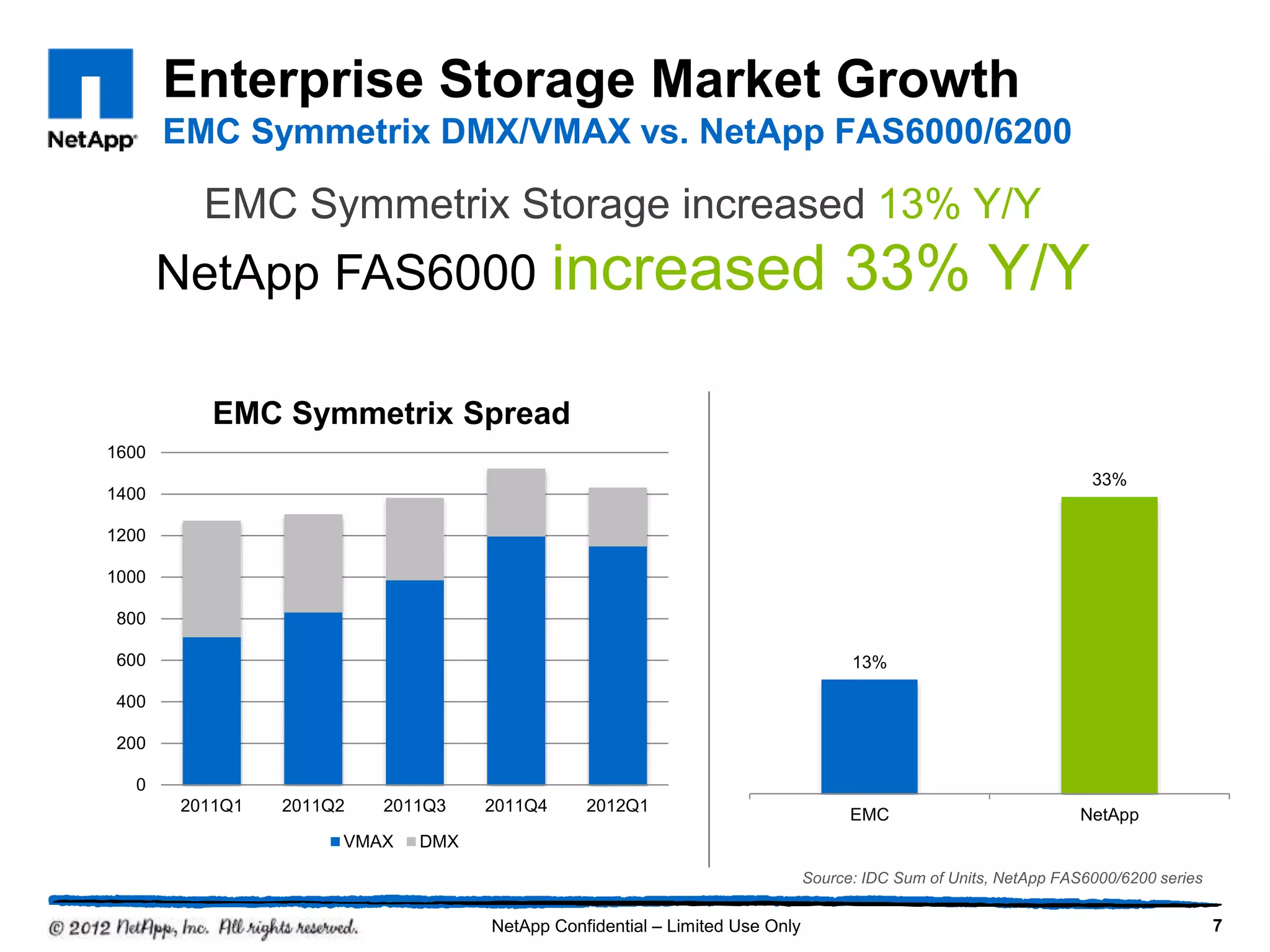
NetApp FAS6000 increased 33% Y/Y
Enterprise Storage Market Growth
EMC Symmetrix DMX/VMAX vs. NetApp FAS6000/6200
7NetApp Confidential – Limited Use Only
EMC Symmetrix Storage increased 13% Y/Y
Source: IDC Sum of Units, NetApp FAS6000/6200 series
0
200
400
600
800
1000
1200
1400
1600
2011Q1 2011Q2 2011Q3 2011Q4 2012Q1
EMC Symmetrix Spread
VMAX DMX
13%
33%
EMC NetApp
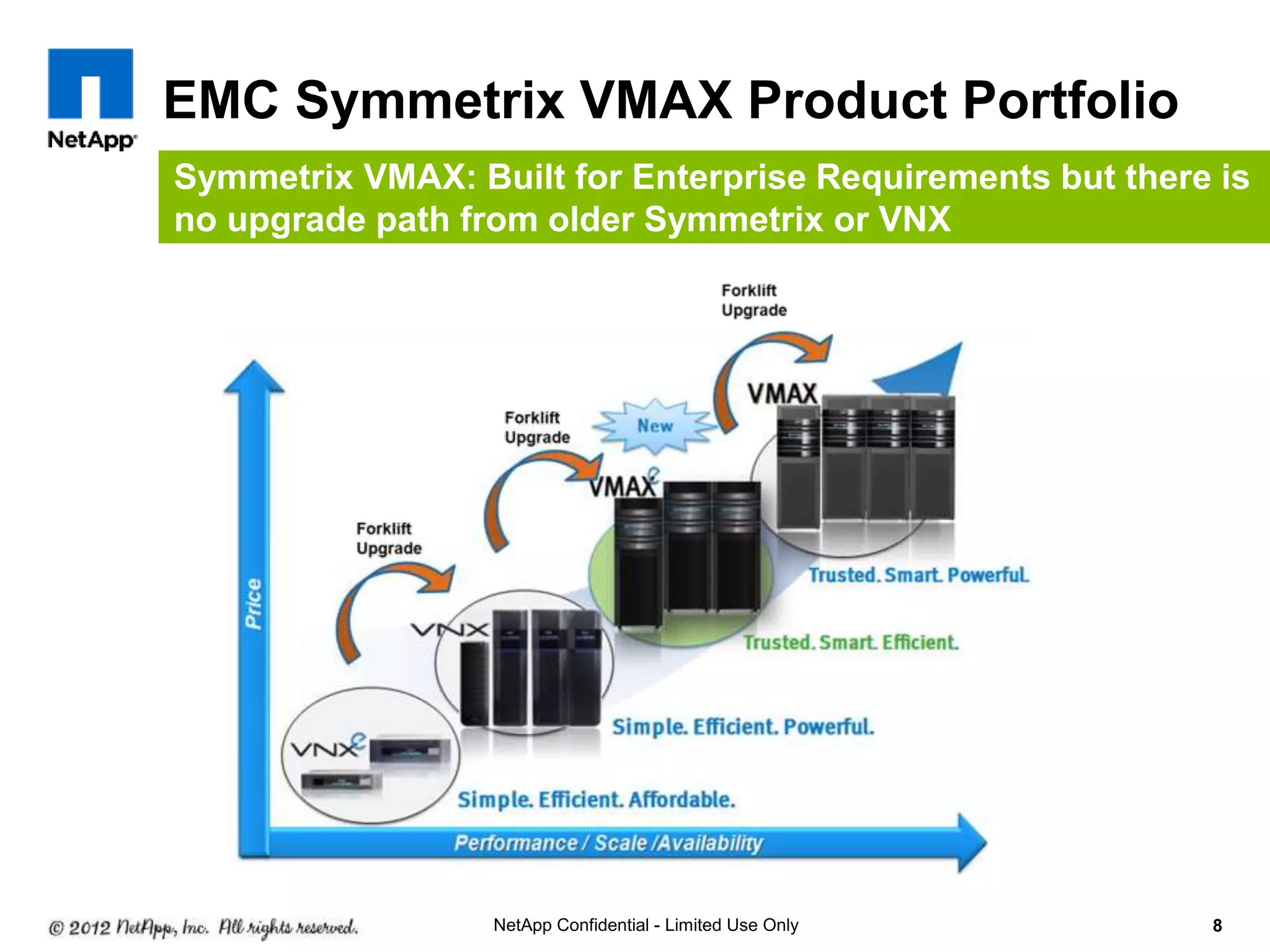
EMC Symmetrix VMAX Product Portfolio
8
Symmetrix VMAX: Built for Enterprise Requirements but there is
no upgrade path from older Symmetrix or VNX
NetApp Confidential - Limited Use Only
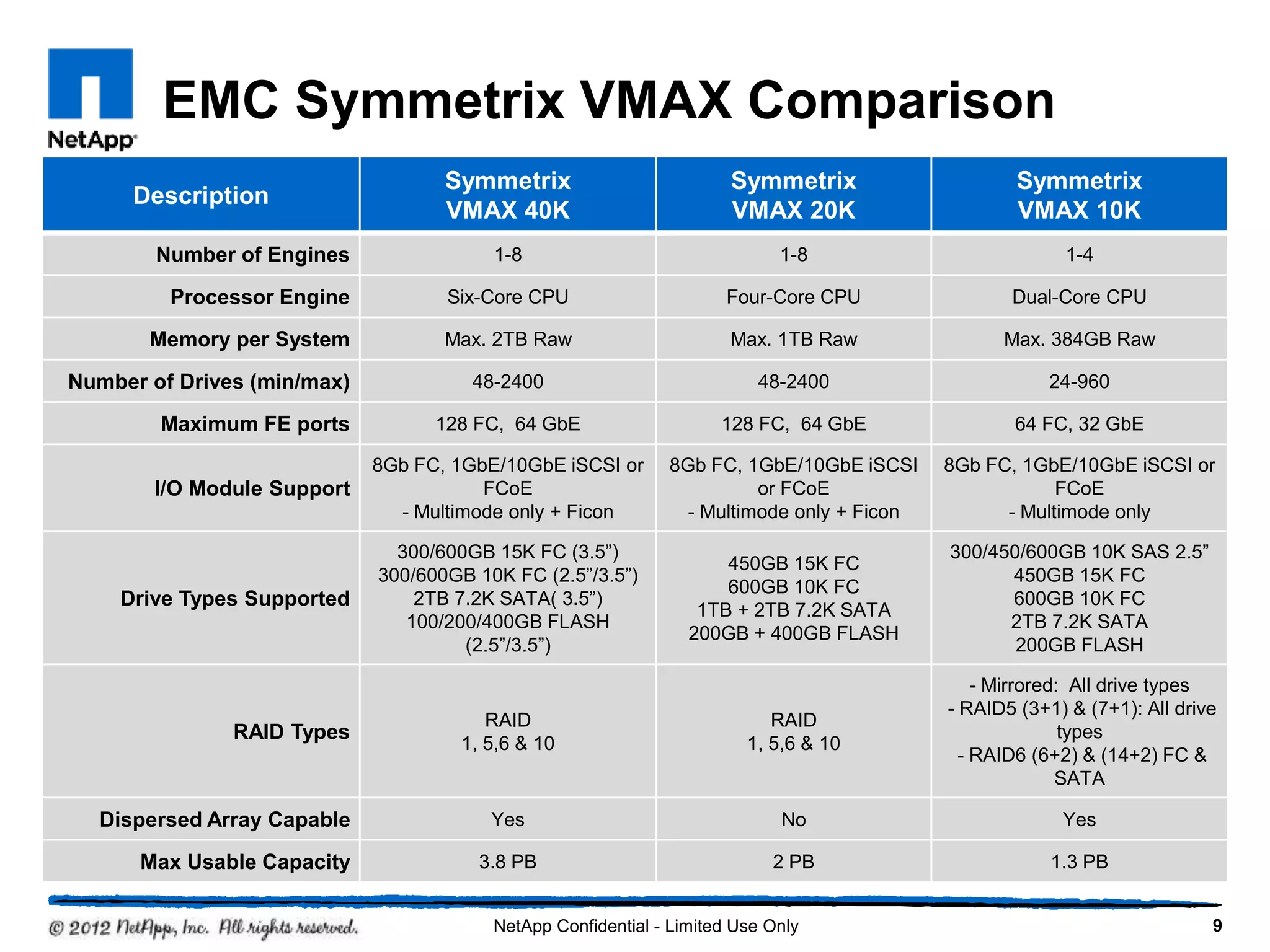
EMC Symmetrix VMAX Comparison
9
Description
Symmetrix
VMAX 40K
Symmetrix
VMAX 20K
Symmetrix
VMAX 10K
Number of Engines 1-8 1-8 1-4
Processor Engine Six-Core CPU Four-Core CPU Dual-Core CPU
Memory per System Max. 2TB Raw Max. 1TB Raw Max. 384GB Raw
Number of Drives (min/max) 48-2400 48-2400 24-960
Maximum FE ports 128 FC, 64 GbE 128 FC, 64 GbE 64 FC, 32 GbE
I/O Module Support
8Gb FC, 1GbE/10GbE iSCSI or
FCoE
- Multimode only + Ficon
8Gb FC, 1GbE/10GbE iSCSI
or FCoE
- Multimode only + Ficon
8Gb FC, 1GbE/10GbE iSCSI or
FCoE
- Multimode only
Drive Types Supported
300/600GB 15K FC (3.5”)
300/600GB 10K FC (2.5”/3.5”)
2TB 7.2K SATA( 3.5”)
100/200/400GB FLASH
(2.5”/3.5”)
450GB 15K FC
600GB 10K FC
1TB + 2TB 7.2K SATA
200GB + 400GB FLASH
300/450/600GB 10K SAS 2.5”
450GB 15K FC
600GB 10K FC
2TB 7.2K SATA
200GB FLASH
RAID Types
RAID
1, 5,6 & 10
RAID
1, 5,6 & 10
- Mirrored: All drive types
- RAID5 (3+1) & (7+1): All drive
types
- RAID6 (6+2) & (14+2) FC &
SATA
Dispersed Array Capable Yes No Yes
Max Usable Capacity 3.8 PB 2 PB 1.3 PB
NetApp Confidential - Limited Use Only
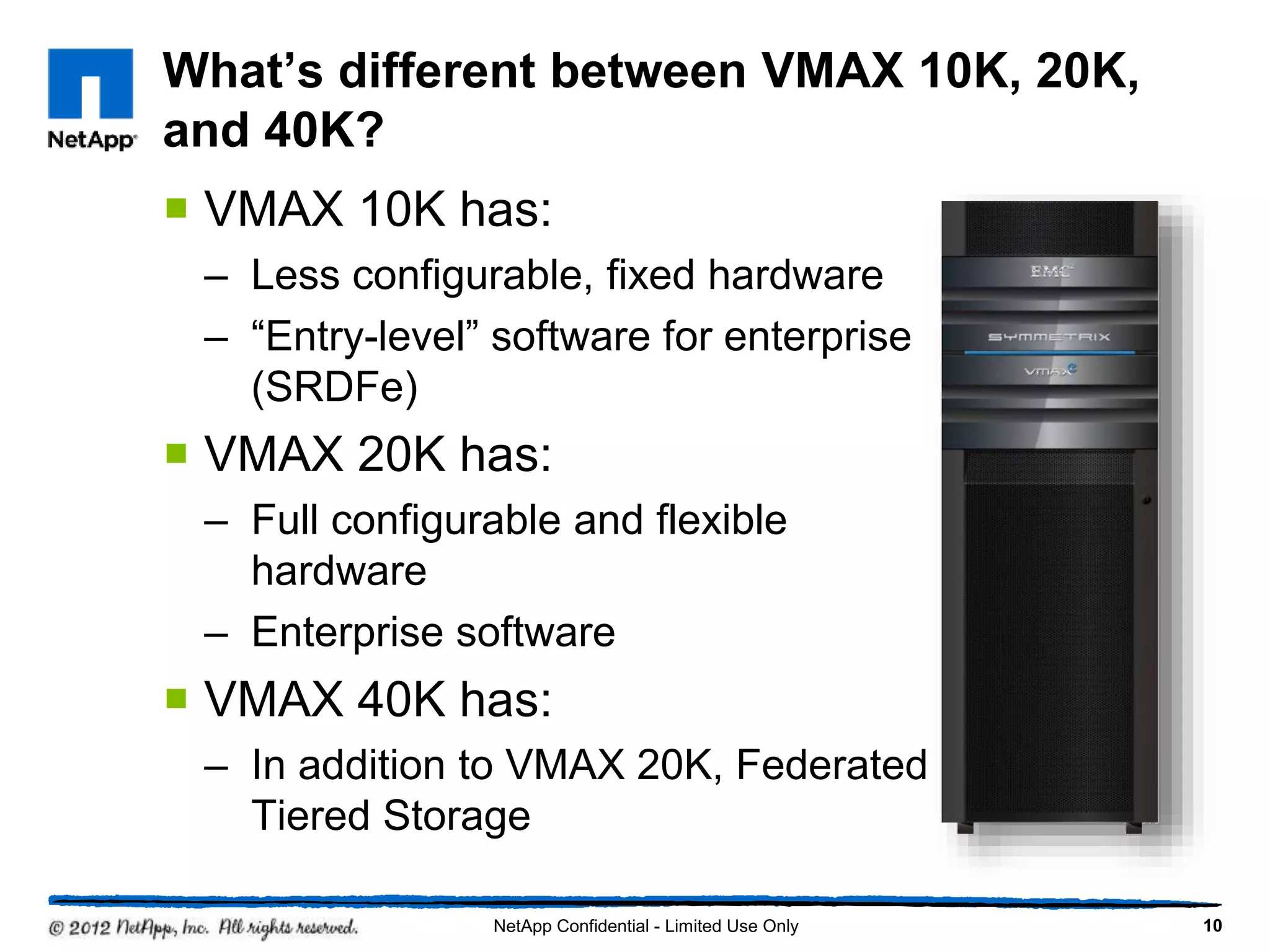
What’s different between VMAX 10K, 20K,
and 40K?
 VMAX 10K has:
– Less configurable, fixed hardware
– “Entry-level” software for enterprise
(SRDFe)
 VMAX 20K has:
– Full configurable and flexible
hardware
– Enterprise software
 VMAX 40K has:
– In addition to VMAX 20K, Federated
Tiered Storage
NetApp Confidential - Limited Use Only 10
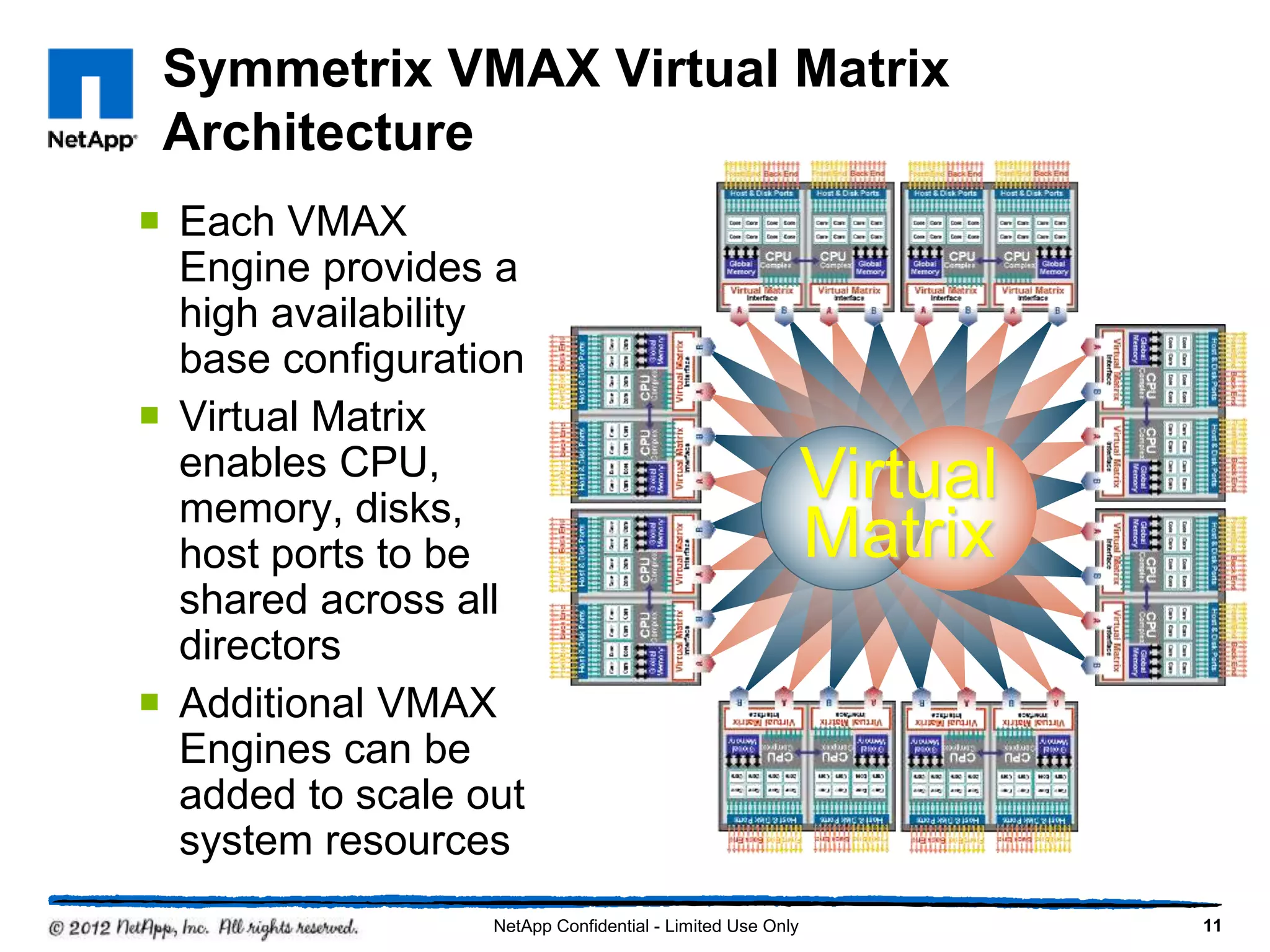
Symmetrix VMAX Virtual Matrix
Architecture
 Each VMAX
Engine provides a
high availability
base configuration
 Virtual Matrix
enables CPU,
memory, disks,
host ports to be
shared across all
directors
 Additional VMAX
Engines can be
added to scale out
system resources
11
Virtual
Matrix
NetApp Confidential - Limited Use Only
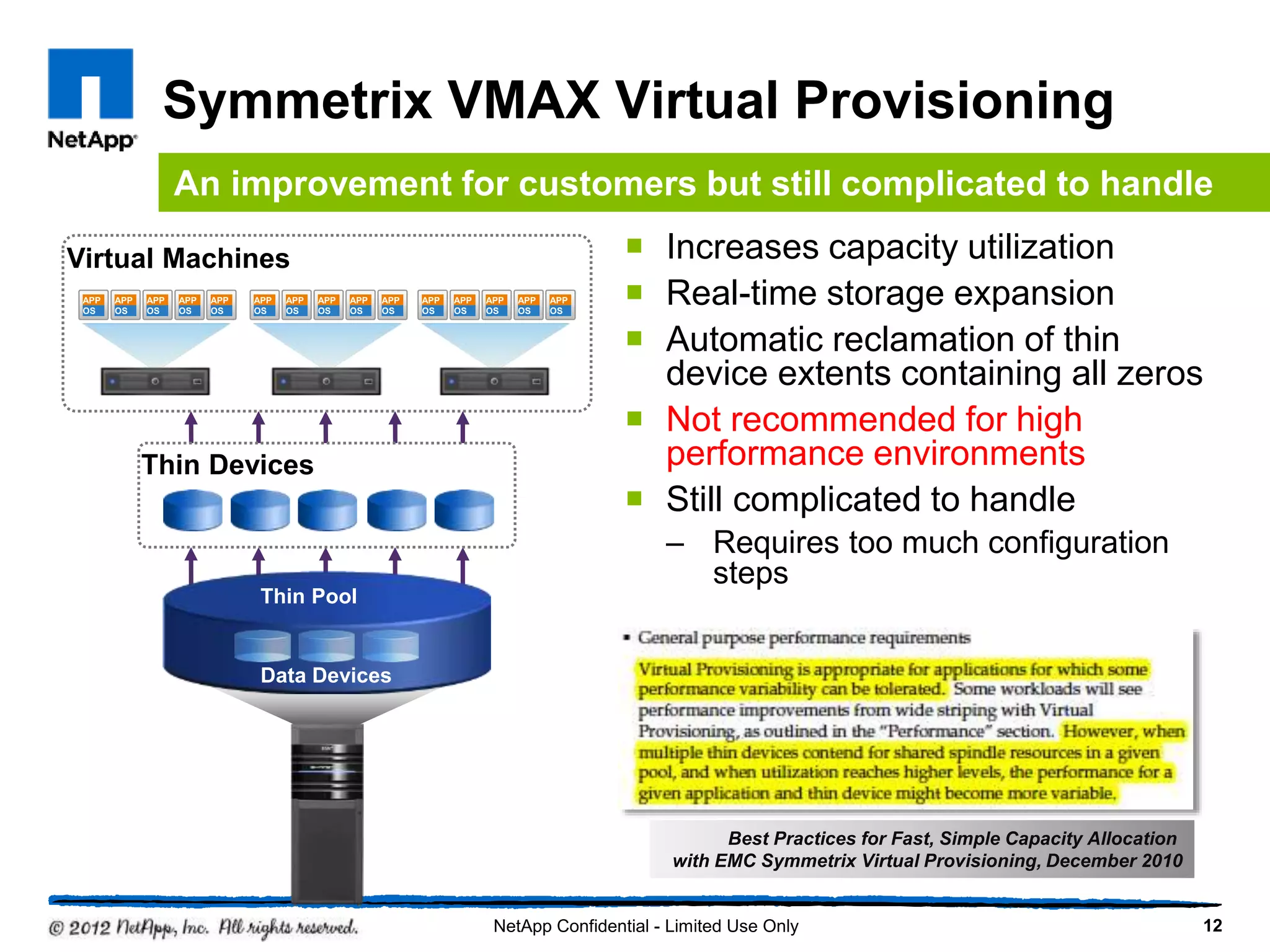
Symmetrix VMAX Virtual Provisioning
 Increases capacity utilization
 Real-time storage expansion
 Automatic reclamation of thin
device extents containing all zeros
 Not recommended for high
performance environments
 Still complicated to handle
– Requires too much configuration
steps
12
An improvement for customers but still complicated to handle
Thin Pool
Data Devices
Virtual Machines
Thin Devices
APP
OS
APP
OS
APP
OS
APP
OS
APP
OS
APP
OS
APP
OS
APP
OS
APP
OS
APP
OS
APP
OS
APP
OS
APP
OS
APP
OS
APP
OS
Best Practices for Fast, Simple Capacity Allocation
with EMC Symmetrix Virtual Provisioning, December 2010
NetApp Confidential - Limited Use Only
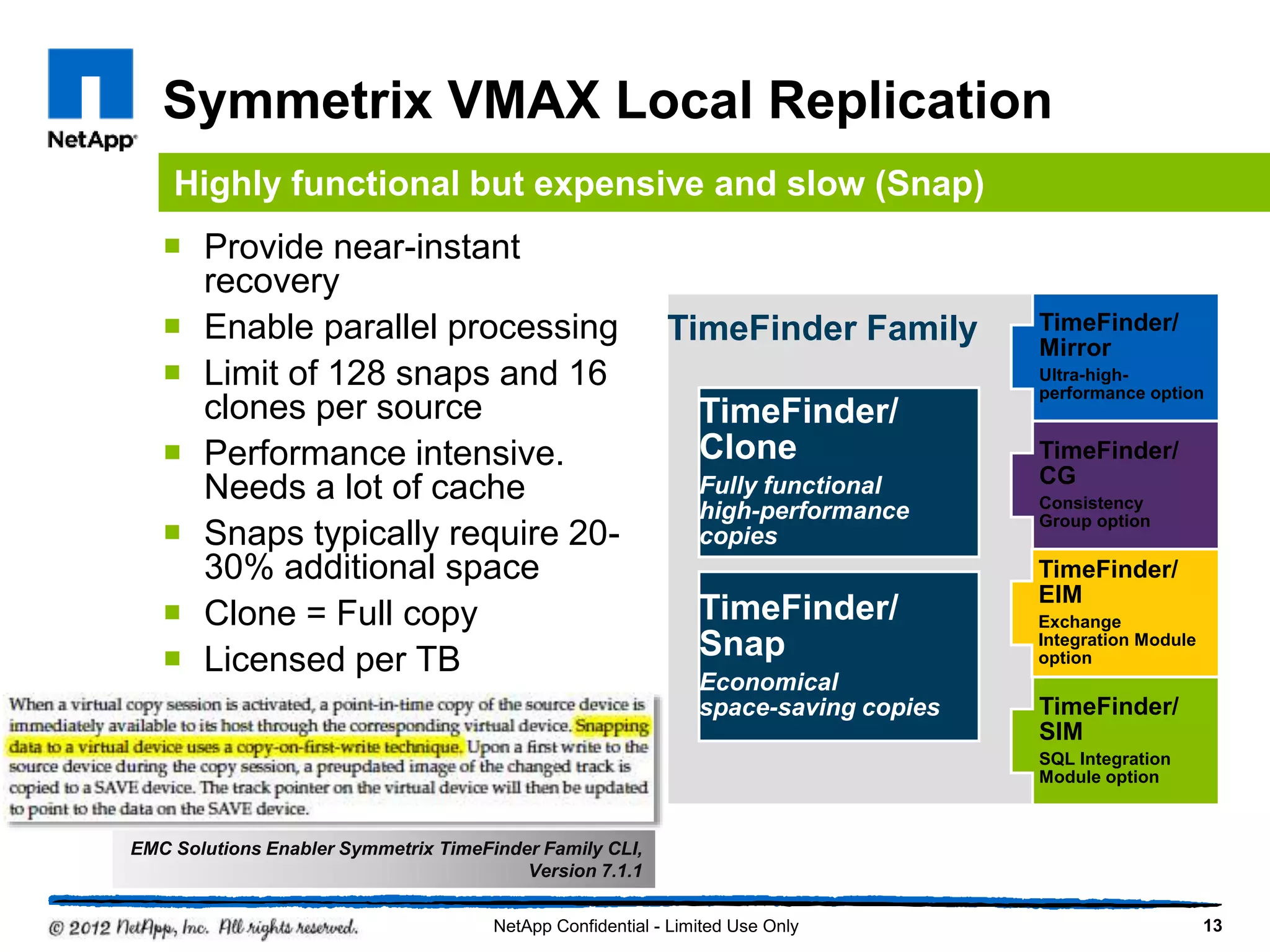
Symmetrix VMAX Local Replication
 Provide near-instant
recovery
 Enable parallel processing
 Limit of 128 snaps and 16
clones per source
 Performance intensive.
Needs a lot of cache
 Snaps typically require 20-
30% additional space
 Clone = Full copy
 Licensed per TB
13NetApp Confidential - Limited Use Only
Highly functional but expensive and slow (Snap)
TimeFinder Family TimeFinder/
Mirror
Ultra-high-
performance option
TimeFinder/
EIM
Exchange
Integration Module
option
TimeFinder/
CG
Consistency
Group option
TimeFinder/
SIM
SQL Integration
Module option
TimeFinder/
Clone
Fully functional
high-performance
copies
TimeFinder/
Snap
Economical
space-saving copies
EMC Solutions Enabler Symmetrix TimeFinder Family CLI,
Version 7.1.1
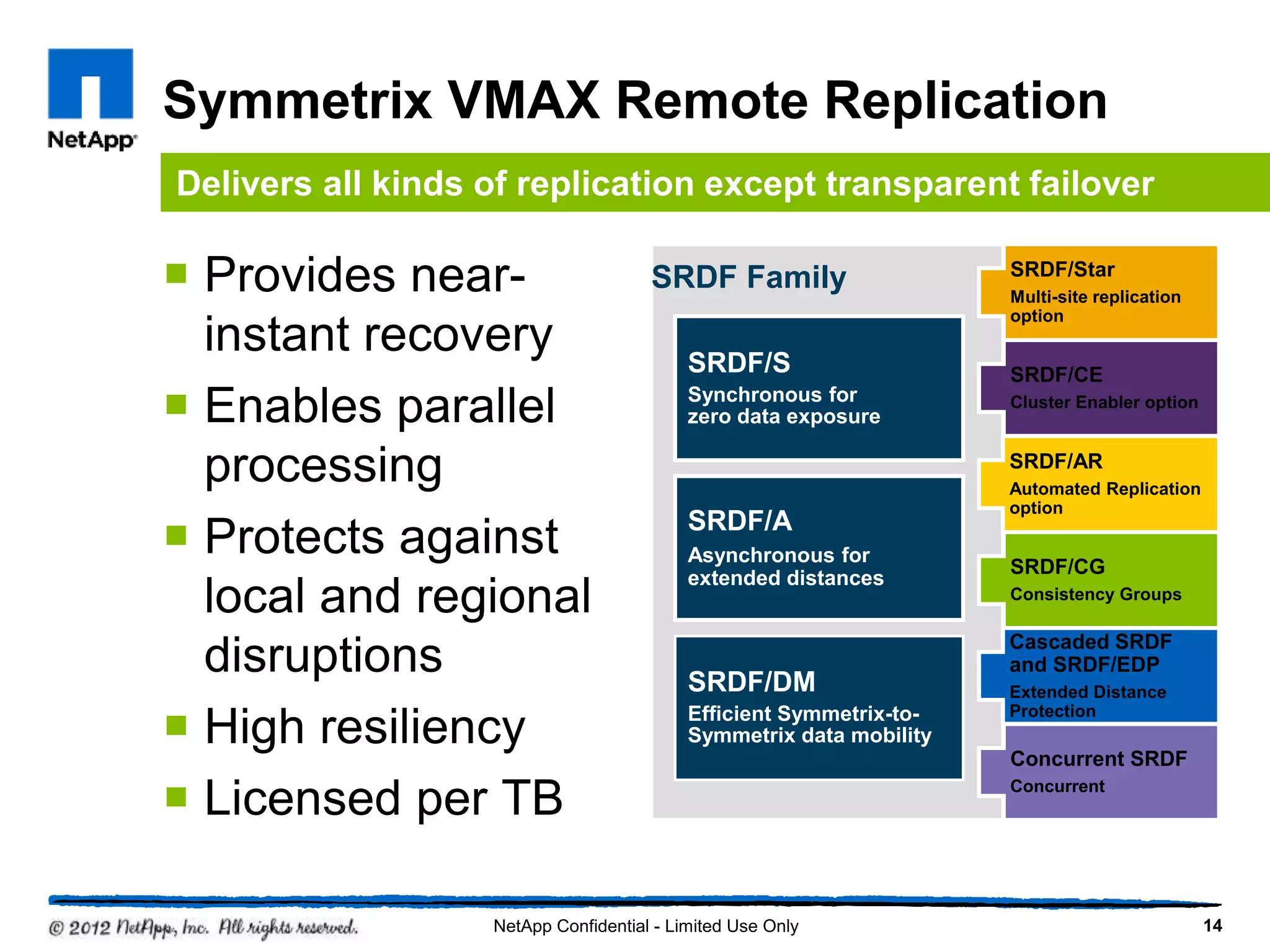
Symmetrix VMAX Remote Replication
 Provides near-
instant recovery
 Enables parallel
processing
 Protects against
local and regional
disruptions
 High resiliency
 Licensed per TB
14NetApp Confidential - Limited Use Only
Delivers all kinds of replication except transparent failover
SRDF Family SRDF/Star
Multi-site replication
option
SRDF/AR
Automated Replication
option
SRDF/CE
Cluster Enabler option
SRDF/CG
Consistency Groups
SRDF/S
Synchronous for
zero data exposure
SRDF/A
Asynchronous for
extended distances
SRDF/DM
Efficient Symmetrix-to-
Symmetrix data mobility
Cascaded SRDF
and SRDF/EDP
Extended Distance
Protection
Concurrent SRDF
Concurrent
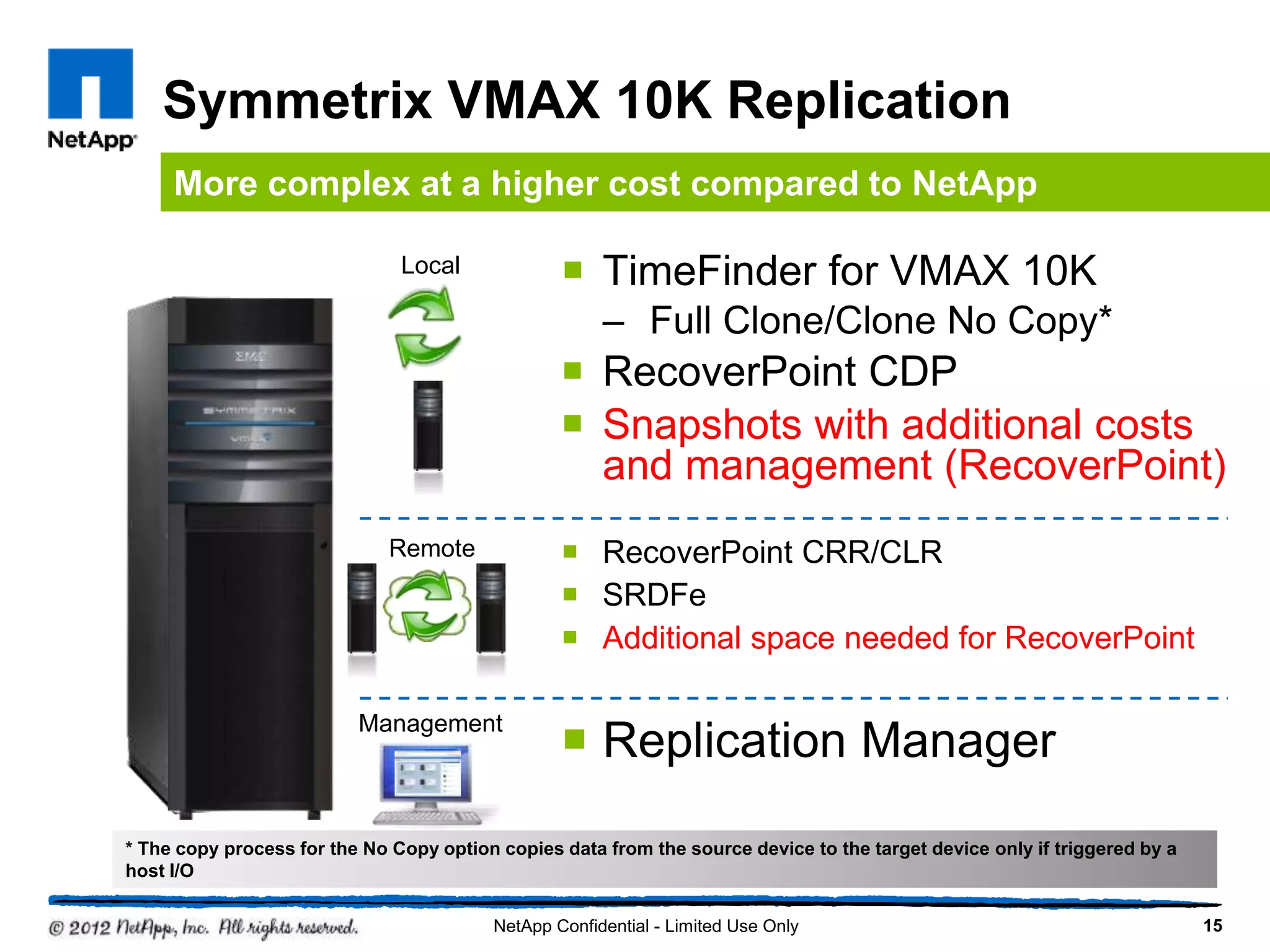
Symmetrix VMAX 10K Replication
 TimeFinder for VMAX 10K
– Full Clone/Clone No Copy*
 RecoverPoint CDP
 Snapshots with additional costs
and management (RecoverPoint)
15
More complex at a higher cost compared to NetApp
Remote
Local
Management
* The copy process for the No Copy option copies data from the source device to the target device only if triggered by a
host I/O
 RecoverPoint CRR/CLR
 SRDFe
 Additional space needed for RecoverPoint
 Replication Manager
NetApp Confidential - Limited Use Only
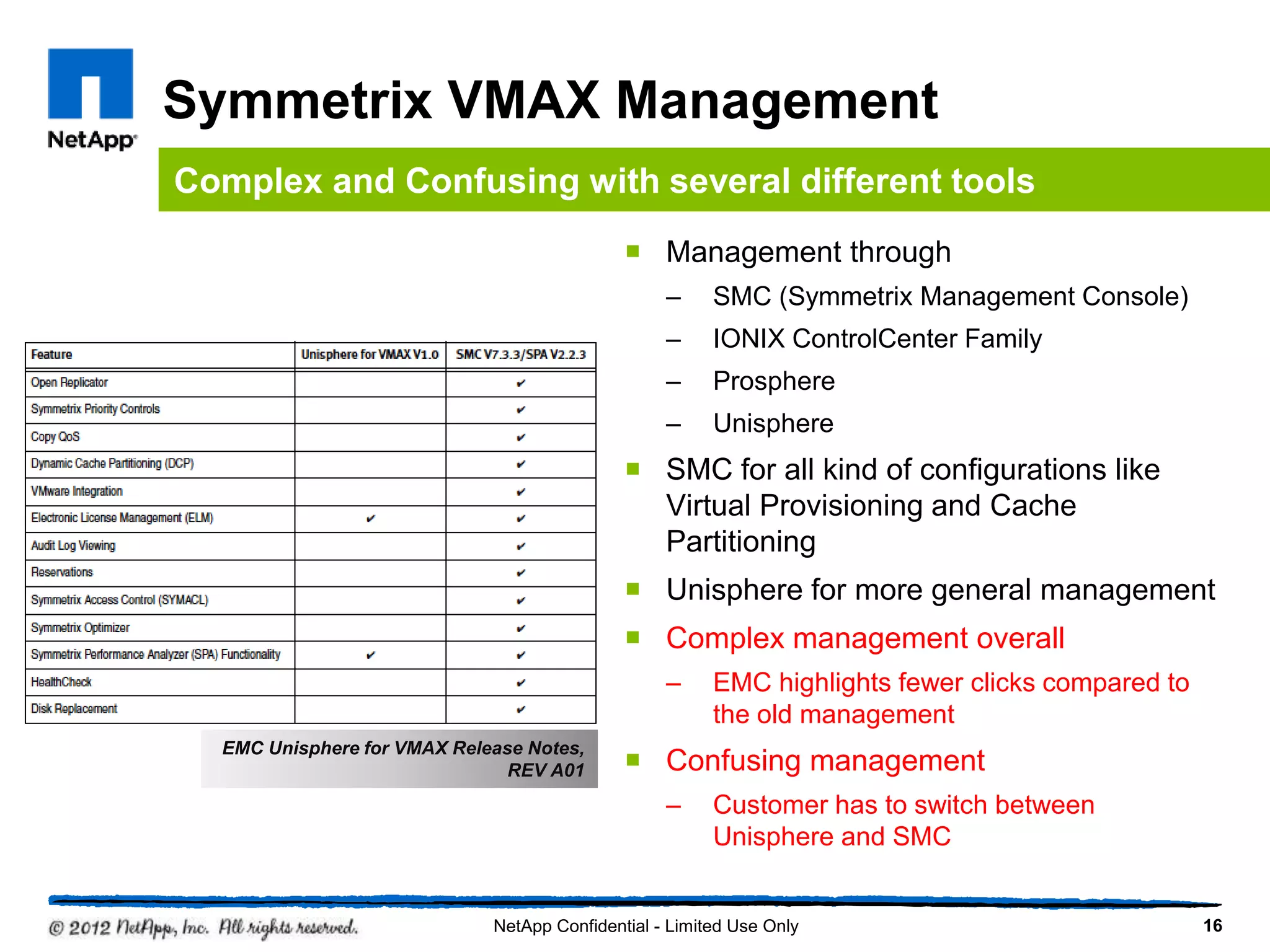
Symmetrix VMAX Management
 Management through
– SMC (Symmetrix Management Console)
– IONIX ControlCenter Family
– Prosphere
– Unisphere
 SMC for all kind of configurations like
Virtual Provisioning and Cache
Partitioning
 Unisphere for more general management
 Complex management overall
– EMC highlights fewer clicks compared to
the old management
 Confusing management
– Customer has to switch between
Unisphere and SMC
16NetApp Confidential - Limited Use Only
Complex and Confusing with several different tools
EMC Unisphere for VMAX Release Notes,
REV A01
17
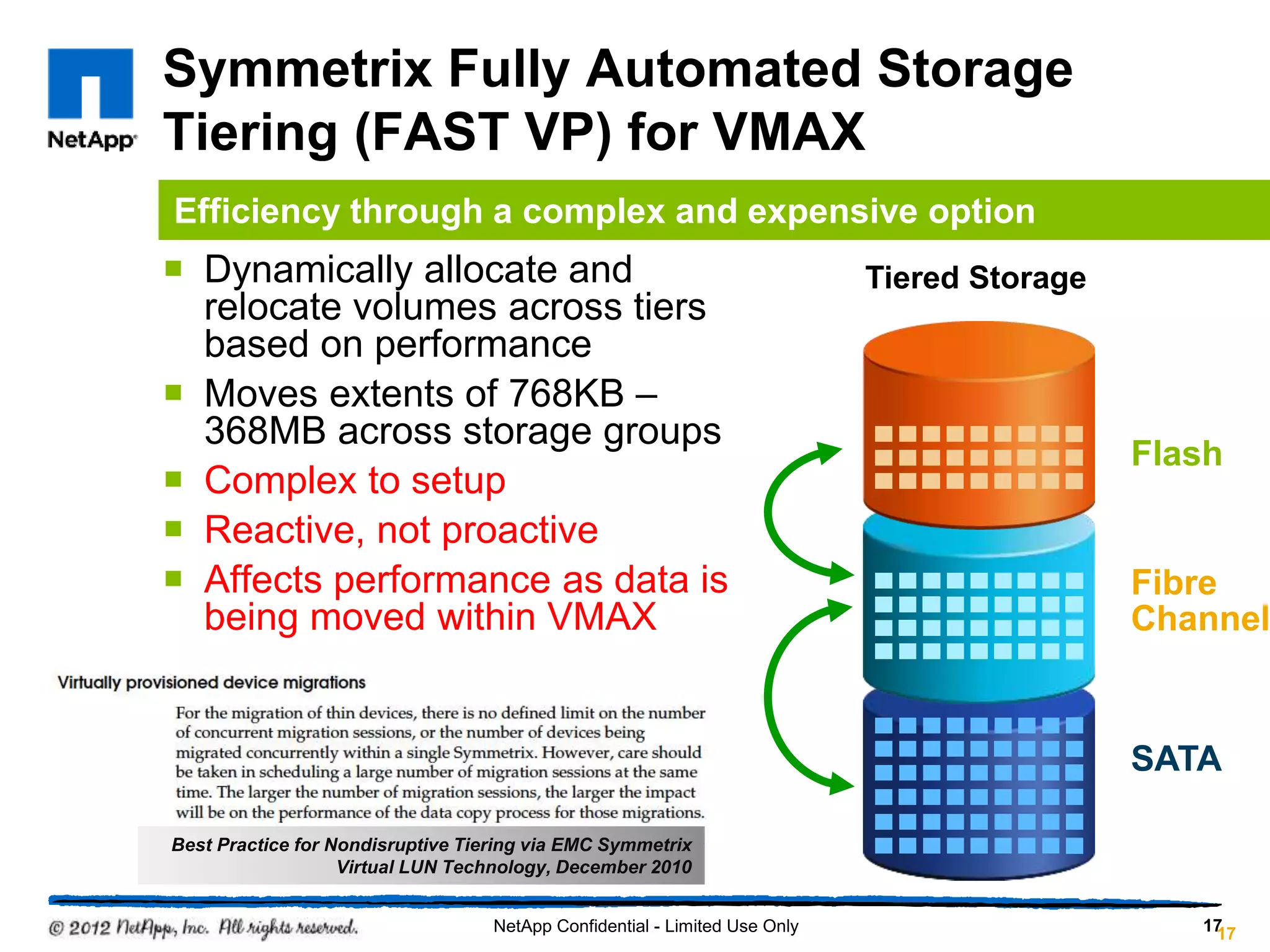
Symmetrix Fully Automated Storage
Tiering (FAST VP) for VMAX
 Dynamically allocate and
relocate volumes across tiers
based on performance
 Moves extents of 768KB –
368MB across storage groups
 Complex to setup
 Reactive, not proactive
 Affects performance as data is
being moved within VMAX
17NetApp Confidential - Limited Use Only
Efficiency through a complex and expensive option
SATA
Fibre
Channel
Flash
Tiered Storage
Best Practice for Nondisruptive Tiering via EMC Symmetrix
Virtual LUN Technology, December 2010
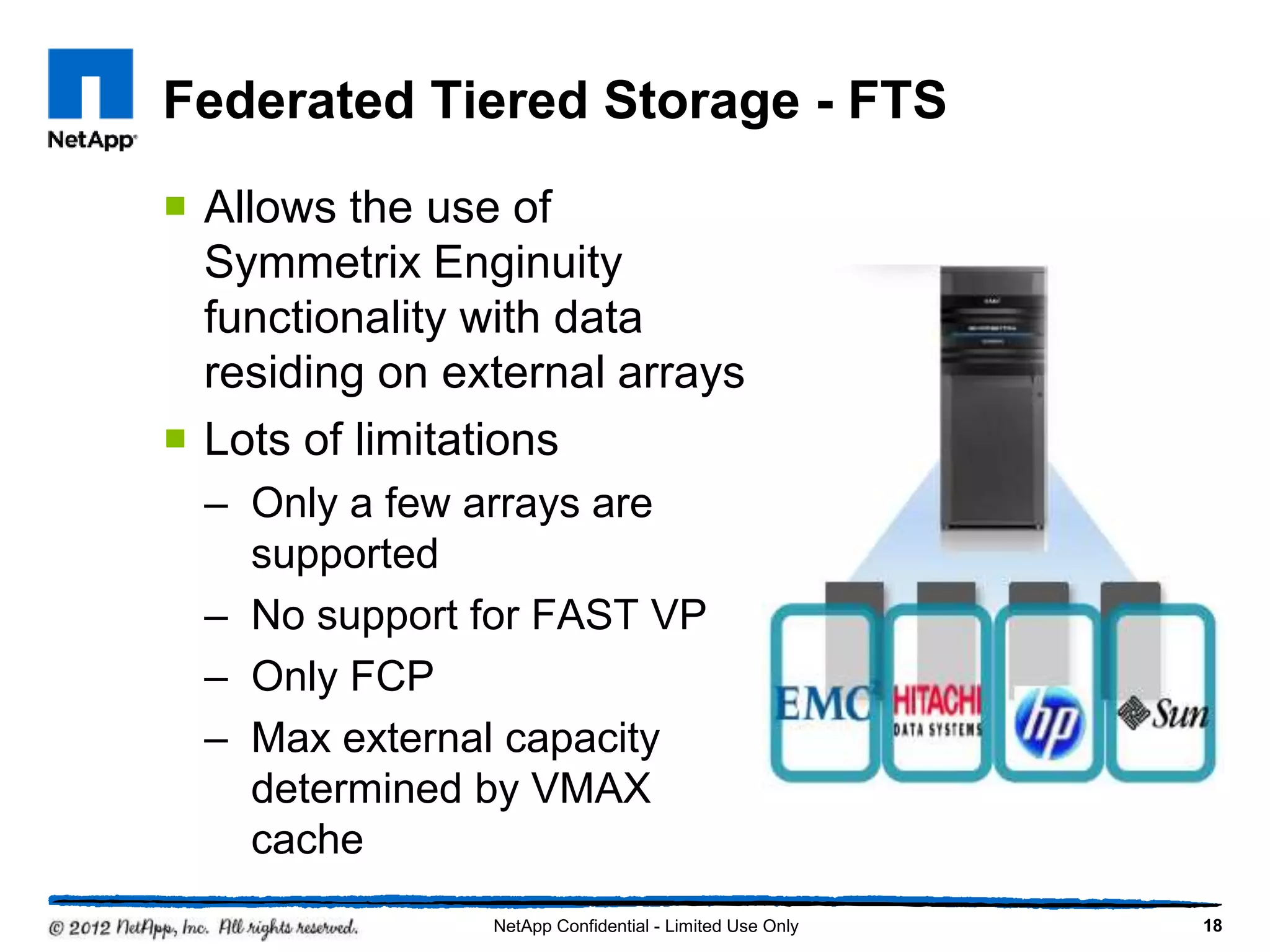
Federated Tiered Storage - FTS
 Allows the use of
Symmetrix Enginuity
functionality with data
residing on external arrays
 Lots of limitations
– Only a few arrays are
supported
– No support for FAST VP
– Only FCP
– Max external capacity
determined by VMAX
cache
18NetApp Confidential - Limited Use Only
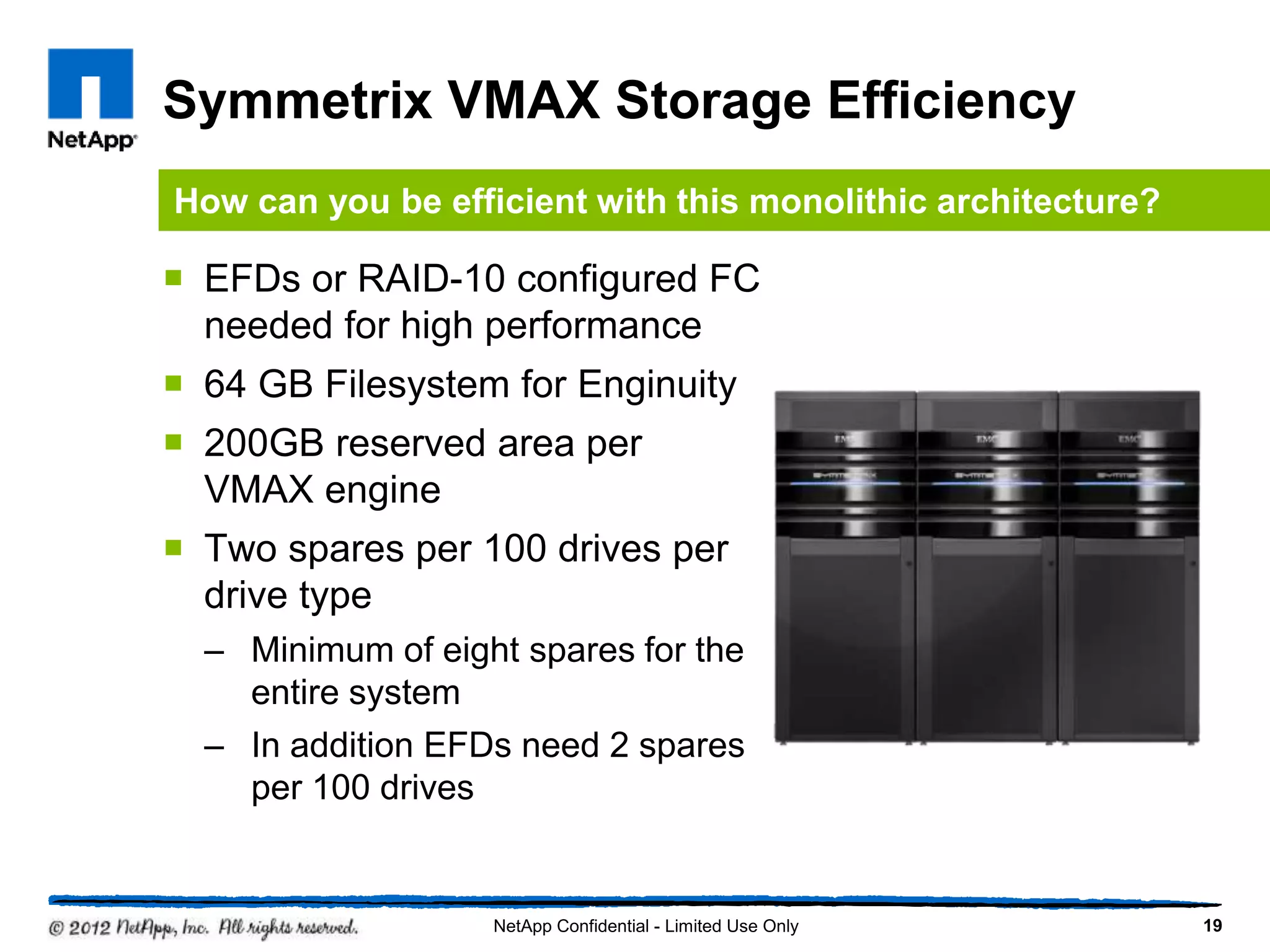
Symmetrix VMAX Storage Efficiency
 EFDs or RAID-10 configured FC
needed for high performance
 64 GB Filesystem for Enginuity
 200GB reserved area per
VMAX engine
 Two spares per 100 drives per
drive type
– Minimum of eight spares for the
entire system
– In addition EFDs need 2 spares
per 100 drives
19NetApp Confidential - Limited Use Only
How can you be efficient with this monolithic architecture?
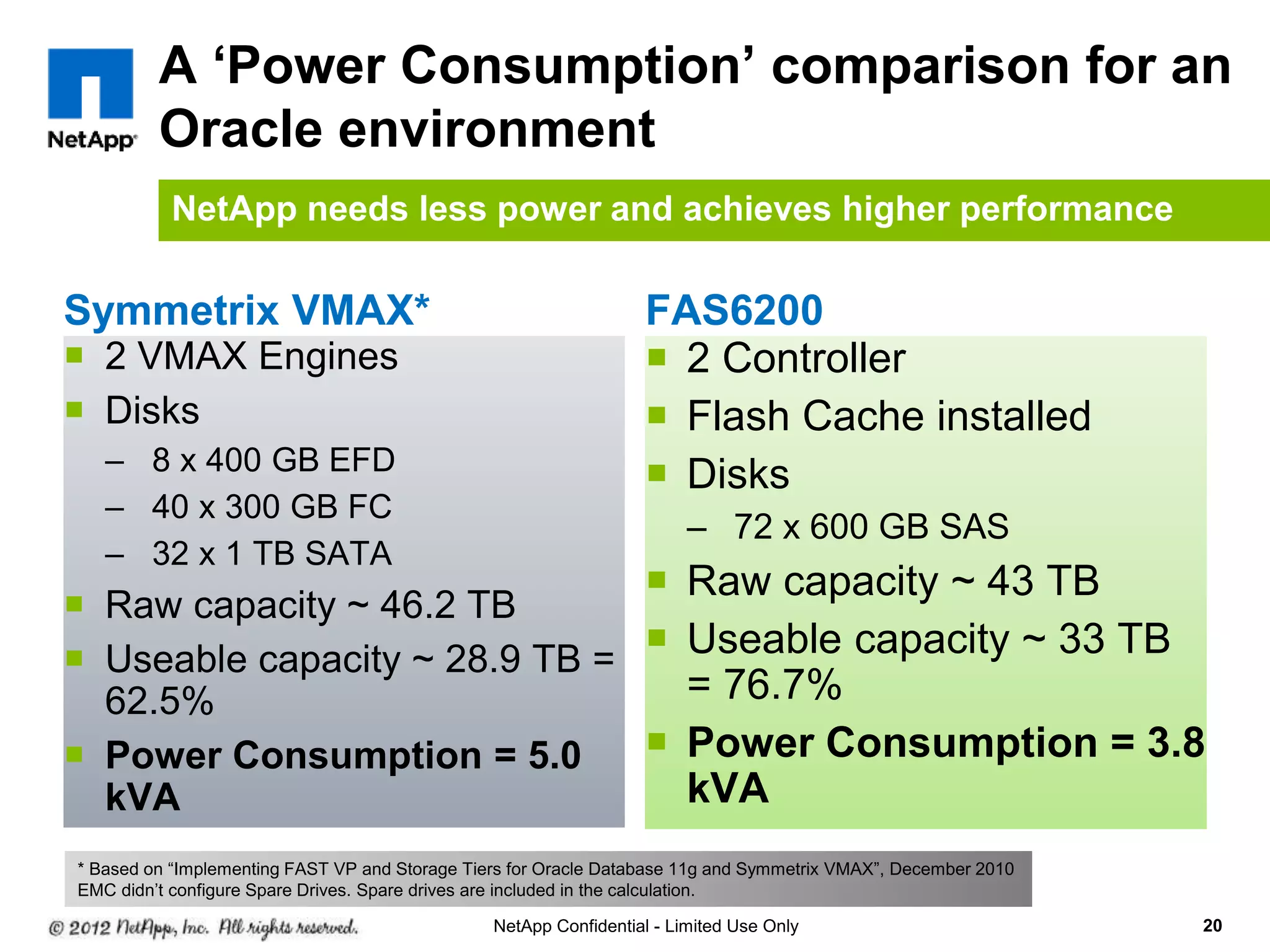
Symmetrix VMAX*
 2 VMAX Engines
 Disks
– 8 x 400 GB EFD
– 40 x 300 GB FC
– 32 x 1 TB SATA
 Raw capacity ~ 46.2 TB
 Useable capacity ~ 28.9 TB =
62.5%
 Power Consumption = 5.0
kVA
FAS6200
 2 Controller
 Flash Cache installed
 Disks
– 72 x 600 GB SAS
 Raw capacity ~ 43 TB
 Useable capacity ~ 33 TB
= 76.7%
 Power Consumption = 3.8
kVA
20
A ‘Power Consumption’ comparison for an
Oracle environment
* Based on “Implementing FAST VP and Storage Tiers for Oracle Database 11g and Symmetrix VMAX”, December 2010
EMC didn’t configure Spare Drives. Spare drives are included in the calculation.
NetApp needs less power and achieves higher performance
NetApp Confidential - Limited Use Only
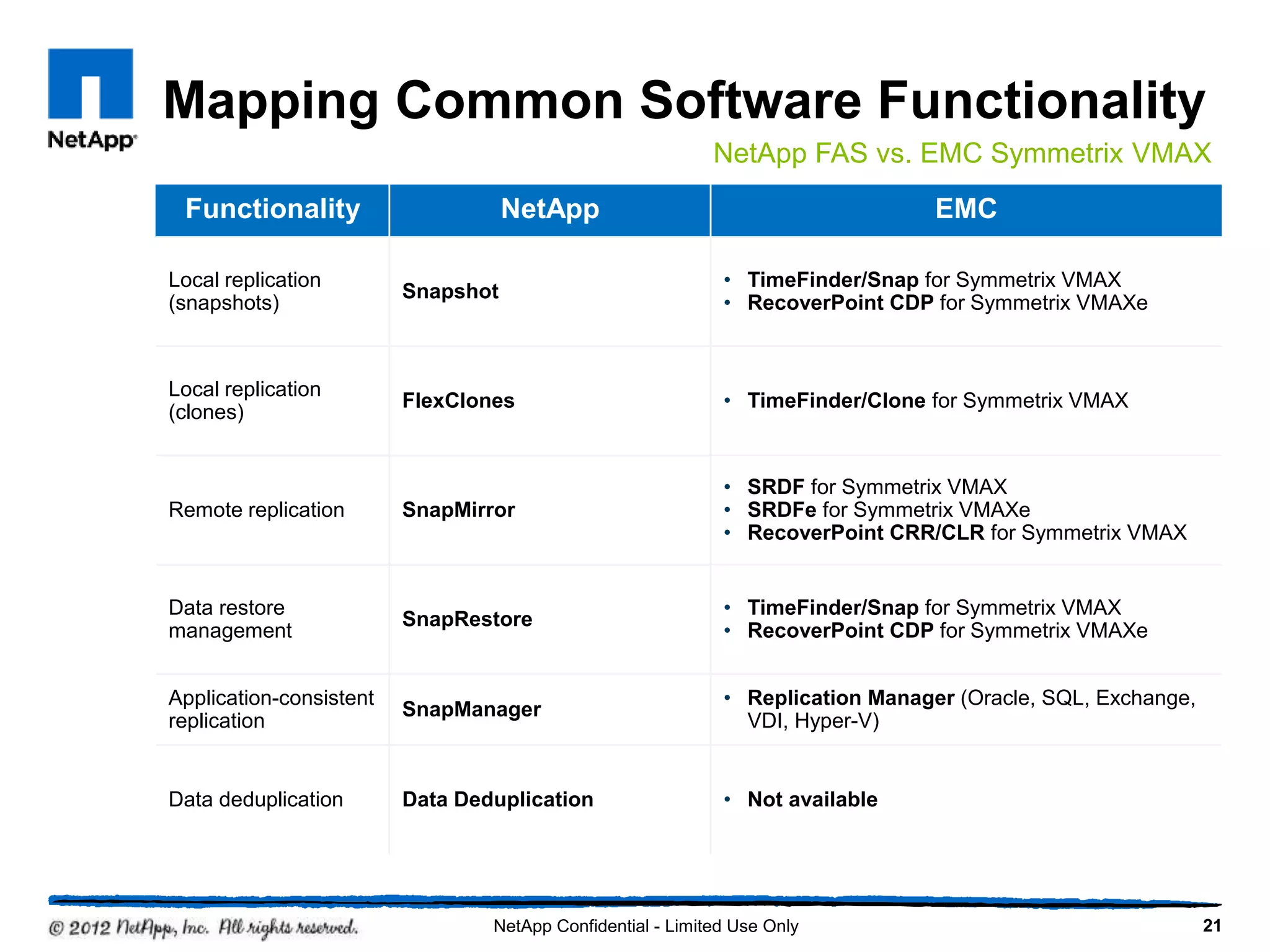
Mapping Common Software Functionality
Functionality NetApp EMC
Local replication
(snapshots)
Snapshot
• TimeFinder/Snap for Symmetrix VMAX
• RecoverPoint CDP for Symmetrix VMAXe
Local replication
(clones)
FlexClones • TimeFinder/Clone for Symmetrix VMAX
Remote replication SnapMirror
• SRDF for Symmetrix VMAX
• SRDFe for Symmetrix VMAXe
• RecoverPoint CRR/CLR for Symmetrix VMAX
Data restore
management
SnapRestore
• TimeFinder/Snap for Symmetrix VMAX
• RecoverPoint CDP for Symmetrix VMAXe
Application-consistent
replication
SnapManager
• Replication Manager (Oracle, SQL, Exchange,
VDI, Hyper-V)
Data deduplication Data Deduplication • Not available
NetApp FAS vs. EMC Symmetrix VMAX
21NetApp Confidential - Limited Use Only
EMC Symmetrix VMAX Services Offerings
 Standard three-year 7x24 onsite warranty on
hardware. The Enginuity storage operating
environment has a 90-day warranty on the
software.
 EMC Global Services or Authorized Services
Network (ASN) partners can download
microcode directly to the customer’s
Symmetrix Management Console. Customers
can also update their own Service Processors
directly from the microcode on Symmetrix
Management Console.
22NetApp Confidential - Limited Use Only
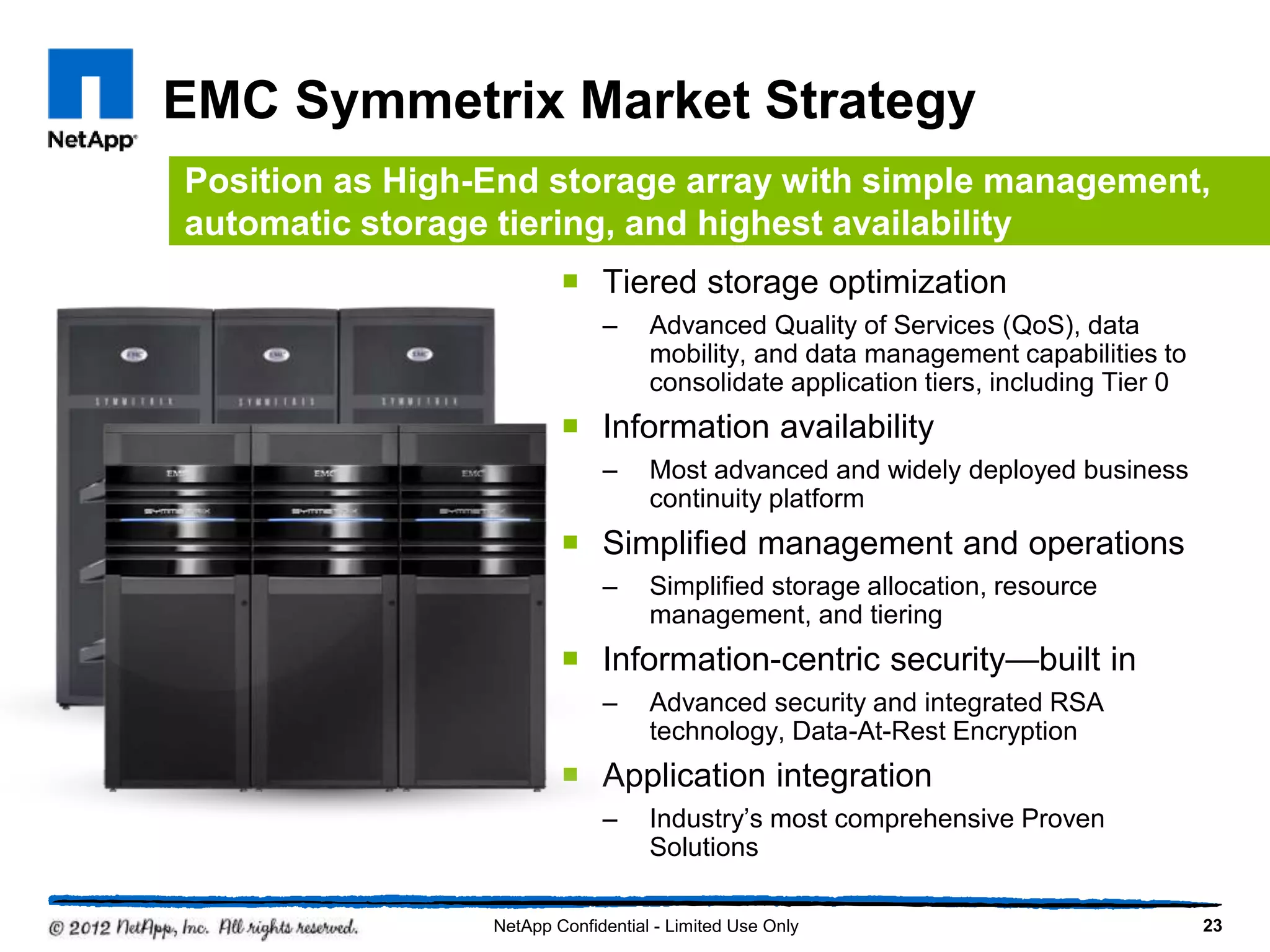
EMC Symmetrix Market Strategy
 Tiered storage optimization
– Advanced Quality of Services (QoS), data
mobility, and data management capabilities to
consolidate application tiers, including Tier 0
 Information availability
– Most advanced and widely deployed business
continuity platform
 Simplified management and operations
– Simplified storage allocation, resource
management, and tiering
 Information-centric security—built in
– Advanced security and integrated RSA
technology, Data-At-Rest Encryption
 Application integration
– Industry’s most comprehensive Proven
Solutions
23NetApp Confidential - Limited Use Only
Position as High-End storage array with simple management,
automatic storage tiering, and highest availability
EMC Symmetrix Market Strategy
 Why Symmetrix VMAX Series?
– Purpose-built for virtual environments
– Lowest cost of ownership
– Automatically optimized performance
– Unprecedented performance and scale
– Unmatched application availability
 With Symmetrix VMAX You Can
– Deliver Five 9s (99.999%) availability to support
mission-critical applications
– Support fully non-disruptive operations, including
code (OS) and configuration changes
– Provide multi-site recovery and restart to prevent
site and/or regional outages (VMAX)
24NetApp Confidential - Limited Use Only
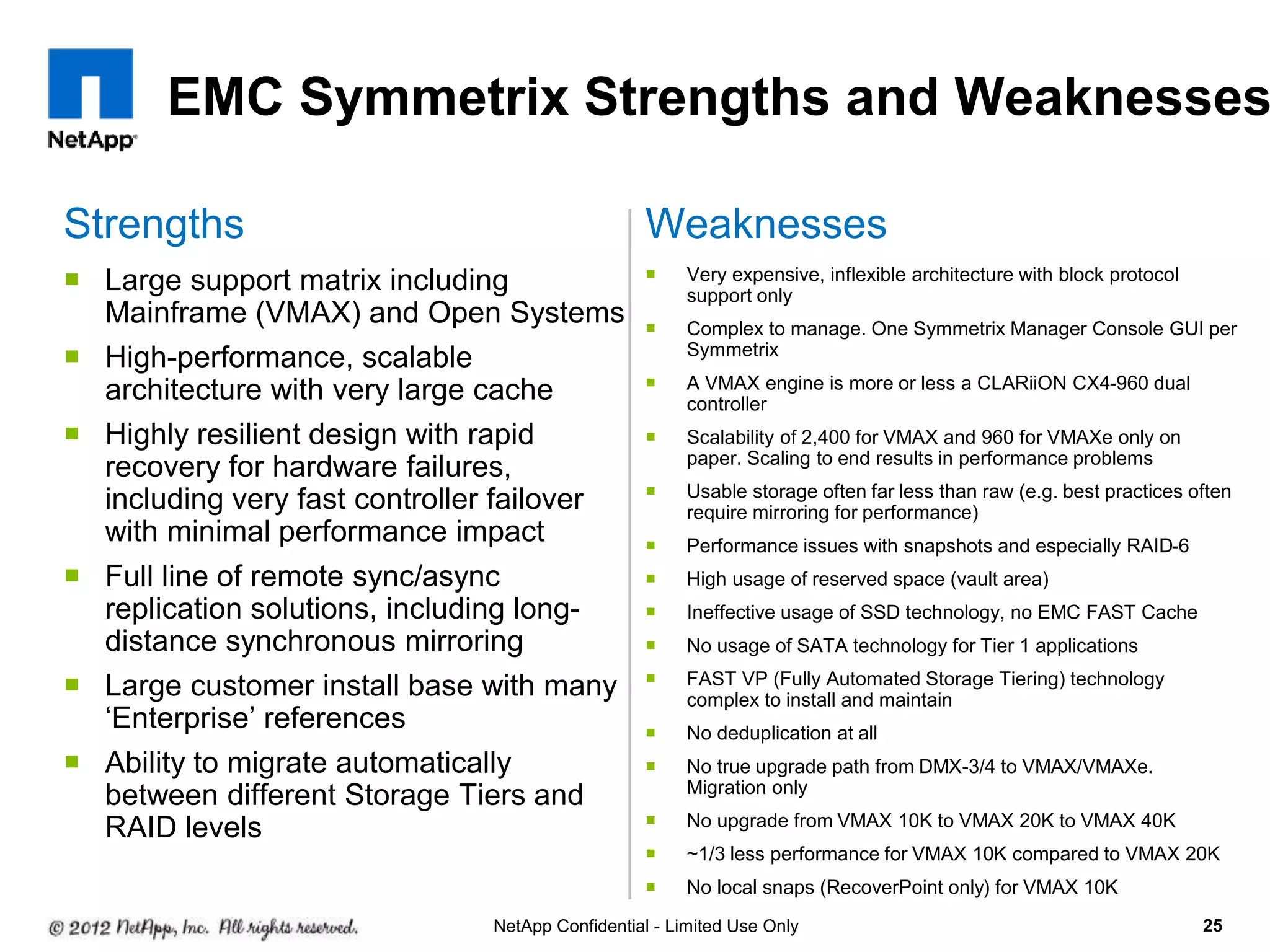
Strengths
 Large support matrix including
Mainframe (VMAX) and Open Systems
 High-performance, scalable
architecture with very large cache
 Highly resilient design with rapid
recovery for hardware failures,
including very fast controller failover
with minimal performance impact
 Full line of remote sync/async
replication solutions, including long-
distance synchronous mirroring
 Large customer install base with many
‘Enterprise’ references
 Ability to migrate automatically
between different Storage Tiers and
RAID levels
Weaknesses
 Very expensive, inflexible architecture with block protocol
support only
 Complex to manage. One Symmetrix Manager Console GUI per
Symmetrix
 A VMAX engine is more or less a CLARiiON CX4-960 dual
controller
 Scalability of 2,400 for VMAX and 960 for VMAXe only on
paper. Scaling to end results in performance problems
 Usable storage often far less than raw (e.g. best practices often
require mirroring for performance)
 Performance issues with snapshots and especially RAID-6
 High usage of reserved space (vault area)
 Ineffective usage of SSD technology, no EMC FAST Cache
 No usage of SATA technology for Tier 1 applications
 FAST VP (Fully Automated Storage Tiering) technology
complex to install and maintain
 No deduplication at all
 No true upgrade path from DMX-3/4 to VMAX/VMAXe.
Migration only
 No upgrade from VMAX 10K to VMAX 20K to VMAX 40K
 ~1/3 less performance for VMAX 10K compared to VMAX 20K
 No local snaps (RecoverPoint only) for VMAX 10K
25
EMC Symmetrix Strengths and Weaknesses
NetApp Confidential - Limited Use Only
EMC Symmetrix Competitive Strategy
& Tactics Against NetApp
 Main competitors are HDS (VSP), HP 3PAR
and IBM (DS8800/XIV)
 If they compete against NetApp they
– Use common FUD against NetApp
 Not a SAN player
 Not “Enterprise Storage”
 Lower availability than VMAX
 Low useable capacity compared to EMC
 Less performance with RAID-DP
 Position VMAX as the best-in-class storage
 ‘Low-Ball’ the price at the end of EMC/NTAP
sales quarters
26NetApp Confidential - Limited Use Only
NetApp Confidential – Internal Use Only
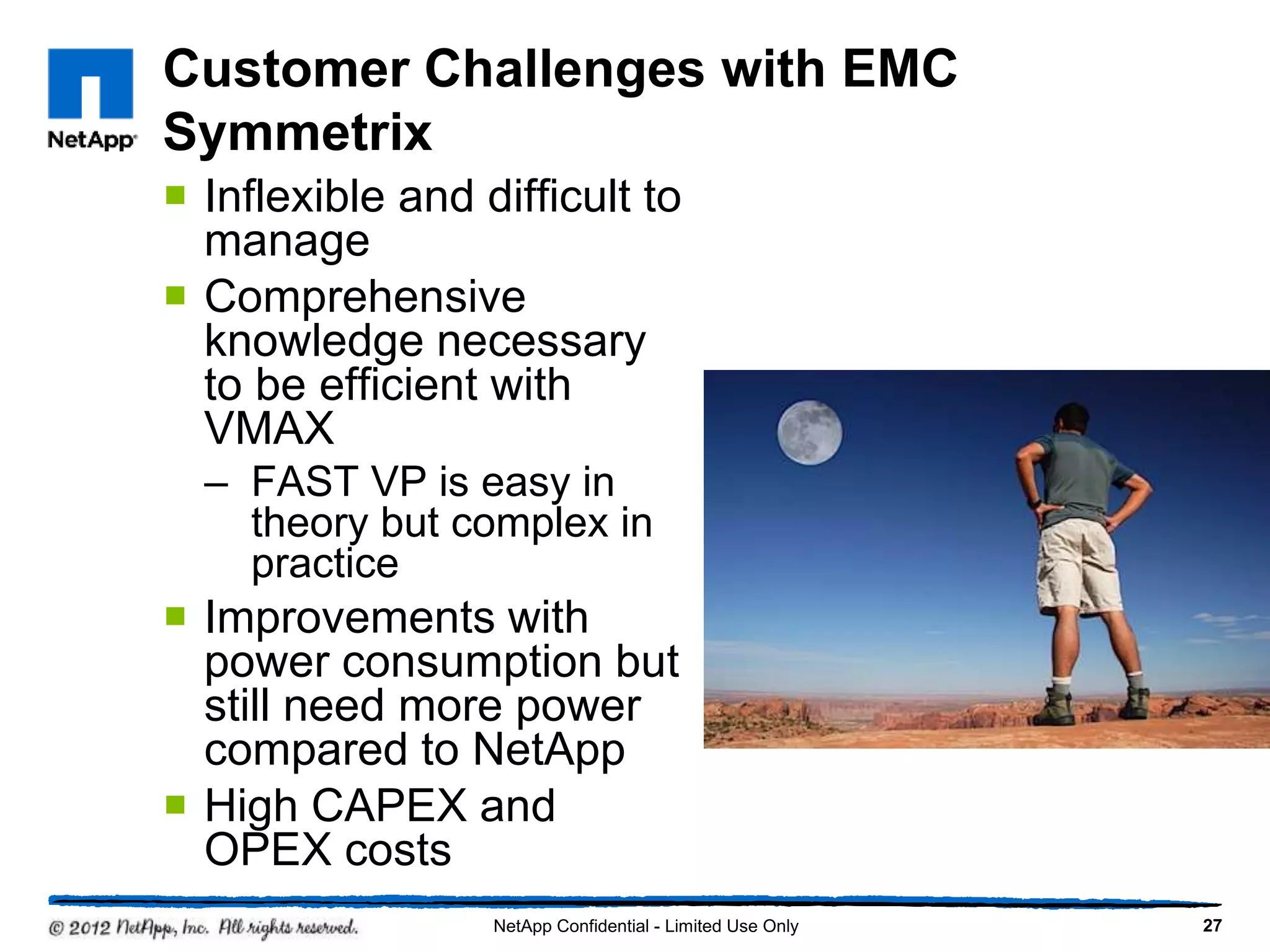
Customer Challenges with EMC
Symmetrix
 Inflexible and difficult to
manage
 Comprehensive
knowledge necessary
to be efficient with
VMAX
– FAST VP is easy in
theory but complex in
practice
 Improvements with
power consumption but
still need more power
compared to NetApp
 High CAPEX and
OPEX costs
27NetApp Confidential - Limited Use Only
• Our Value Proposition
• NetApp Competitive
Positioning/Mapping
• Winning Strategies for NetApp
• Overcoming Objections / FUD
28
NetApp Competitive
Strategy vs. EMC
NetApp Confidential - Limited Use Only
NetApp Value Proposition
 True Unified Storage with a long history
– 150,000 systems since 2002
(http://www.netapp.com/us/company/news/news-
rel-20100331.html)
 Higher Storage Efficiency
– NetApp crushed Exabyte with deduplication
(http://www.netapp.com/us/company/news/news-
rel-20100511.html)
 Performance leader compared to EMC
– Higher Performance combined with higher
efficiency (no SPC-1 benchmark published by
EMC)
(http://www.storageperformance.org/results/bench
mark_results_spc1)
29NetApp Confidential - Limited Use Only
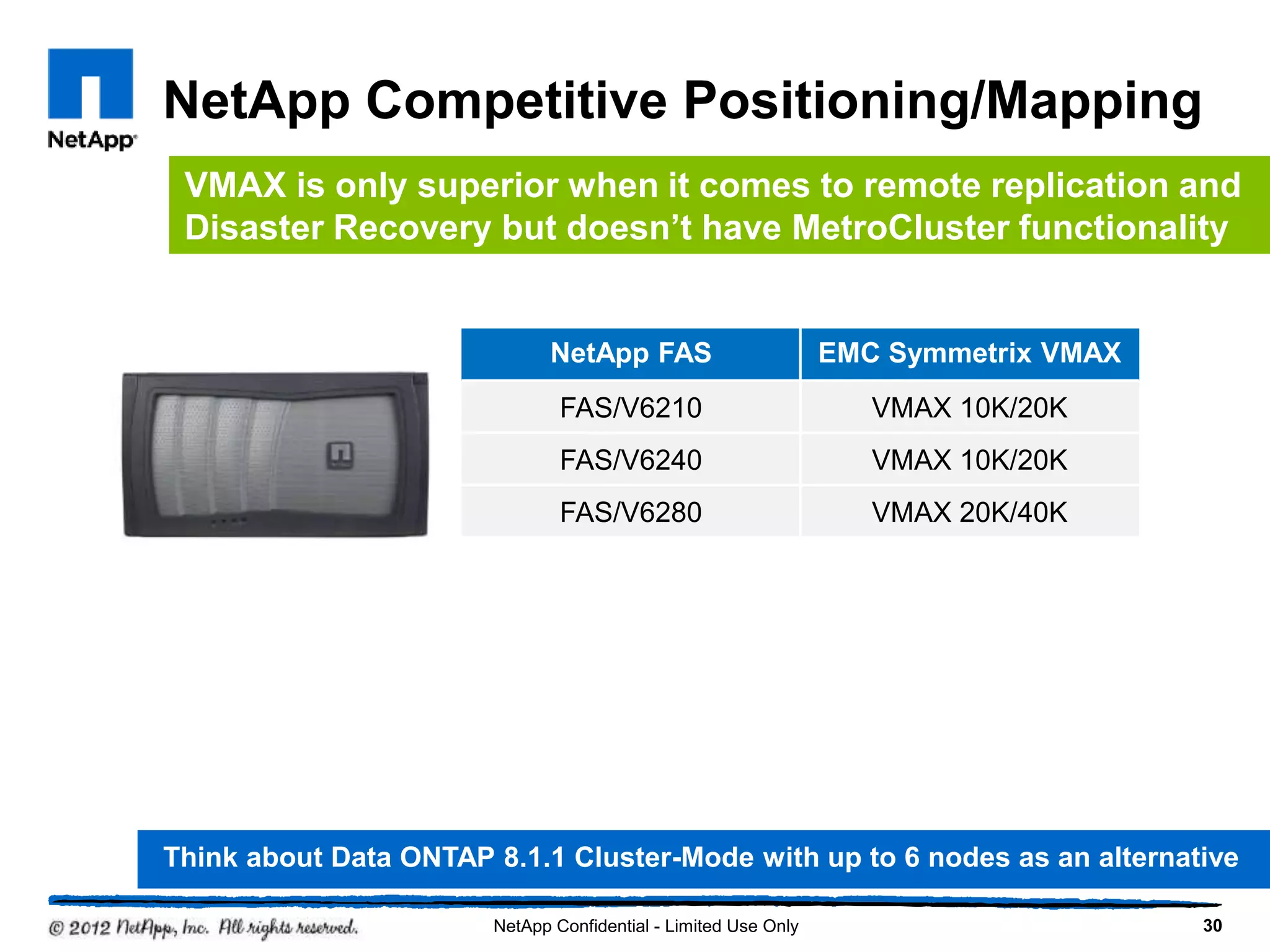
NetApp Competitive Positioning/Mapping
30NetApp Confidential - Limited Use Only
VMAX is only superior when it comes to remote replication and
Disaster Recovery but doesn’t have MetroCluster functionality
NetApp FAS EMC Symmetrix VMAX
FAS/V6210 VMAX 10K/20K
FAS/V6240 VMAX 10K/20K
FAS/V6280 VMAX 20K/40K
Think about Data ONTAP 8.1.1 Cluster-Mode with up to 6 nodes as an alternative
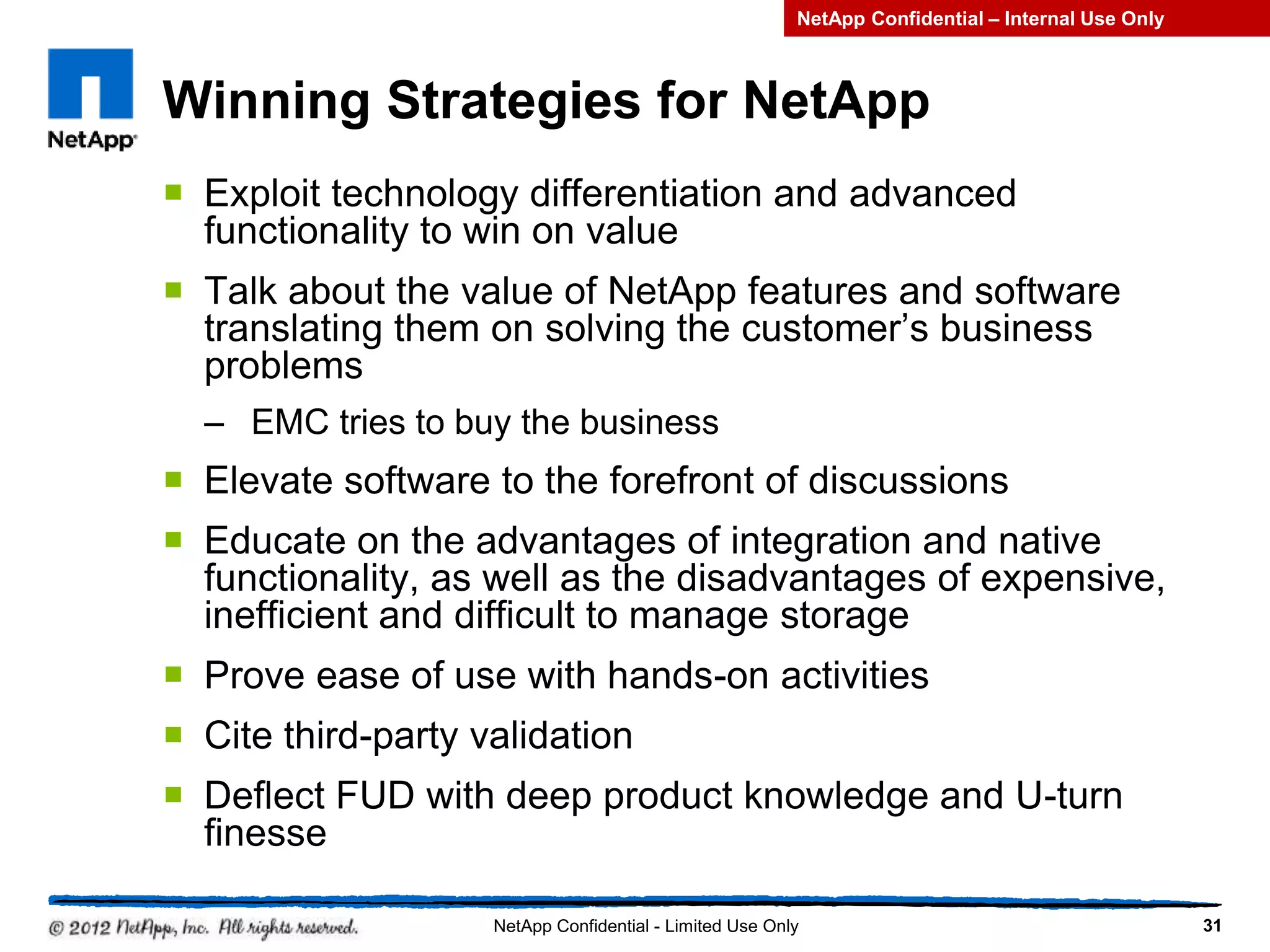
Winning Strategies for NetApp
 Exploit technology differentiation and advanced
functionality to win on value
 Talk about the value of NetApp features and software
translating them on solving the customer’s business
problems
– EMC tries to buy the business
 Elevate software to the forefront of discussions
 Educate on the advantages of integration and native
functionality, as well as the disadvantages of expensive,
inefficient and difficult to manage storage
 Prove ease of use with hands-on activities
 Cite third-party validation
 Deflect FUD with deep product knowledge and U-turn
finesse
31NetApp Confidential - Limited Use Only
NetApp Confidential – Internal Use Only
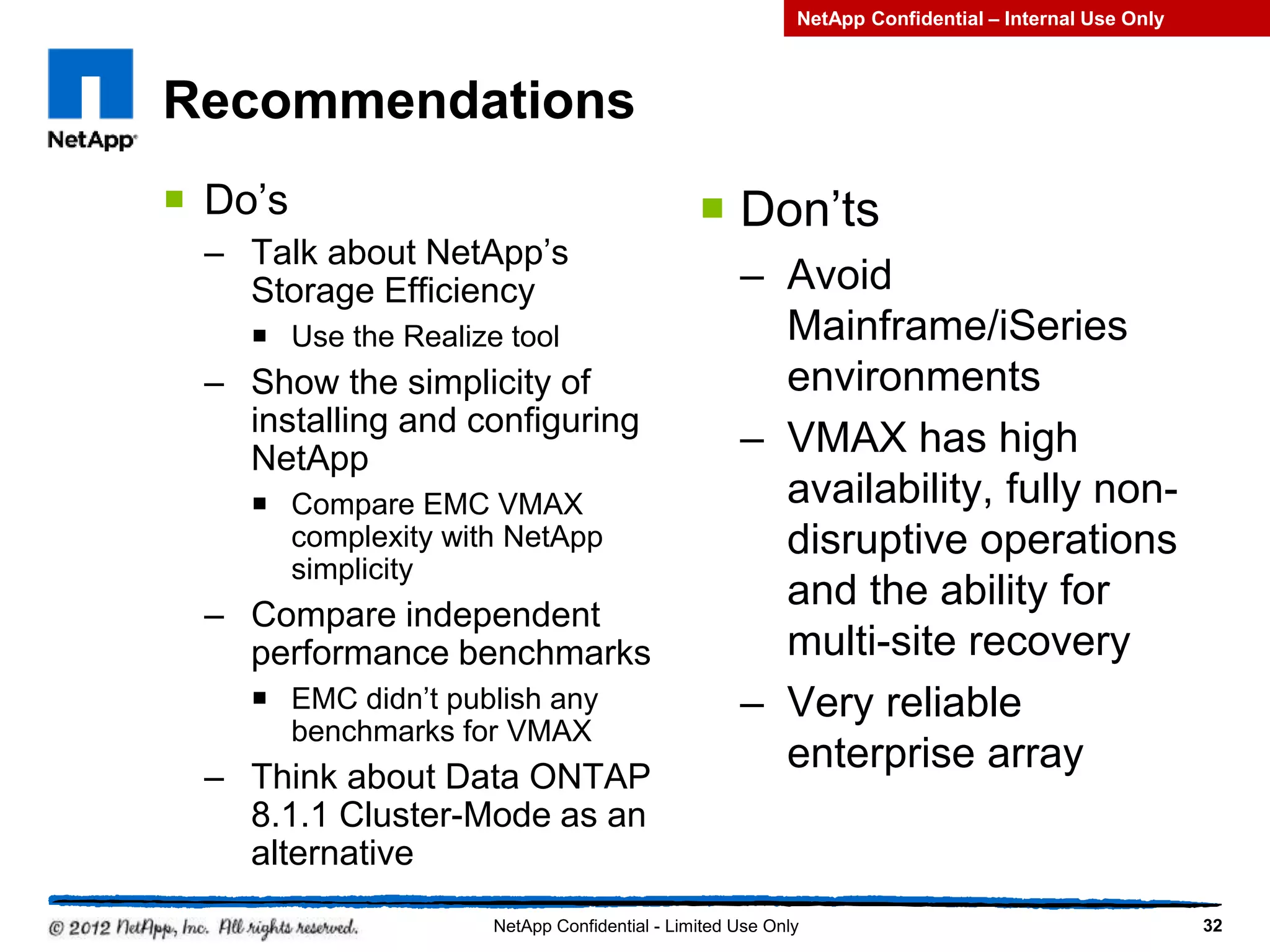
Recommendations
 Do’s
– Talk about NetApp’s
Storage Efficiency
 Use the Realize tool
– Show the simplicity of
installing and configuring
NetApp
 Compare EMC VMAX
complexity with NetApp
simplicity
– Compare independent
performance benchmarks
 EMC didn’t publish any
benchmarks for VMAX
– Think about Data ONTAP
8.1.1 Cluster-Mode as an
alternative
 Don’ts
– Avoid
Mainframe/iSeries
environments
– VMAX has high
availability, fully non-
disruptive operations
and the ability for
multi-site recovery
– Very reliable
enterprise array
32NetApp Confidential - Limited Use Only
NetApp Confidential – Internal Use Only
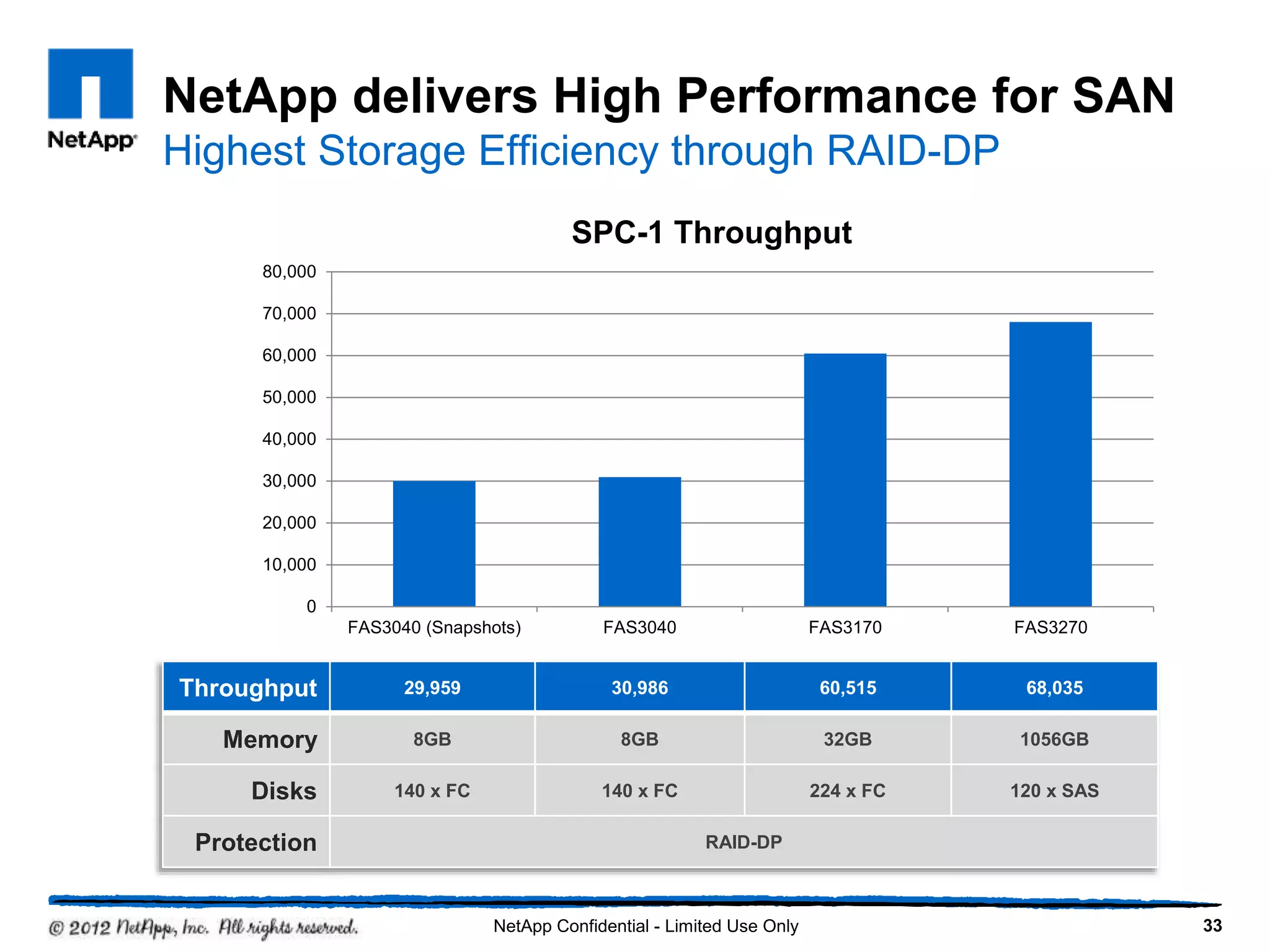
NetApp delivers High Performance for SAN
Highest Storage Efficiency through RAID-DP
33NetApp Confidential - Limited Use Only
Throughput 29,959 30,986 60,515 68,035
Memory 8GB 8GB 32GB 1056GB
Disks 140 x FC 140 x FC 224 x FC 120 x SAS
Protection RAID-DP
0
10,000
20,000
30,000
40,000
50,000
60,000
70,000
80,000
FAS3040 (Snapshots) FAS3040 FAS3170 FAS3270
SPC-1 Throughput
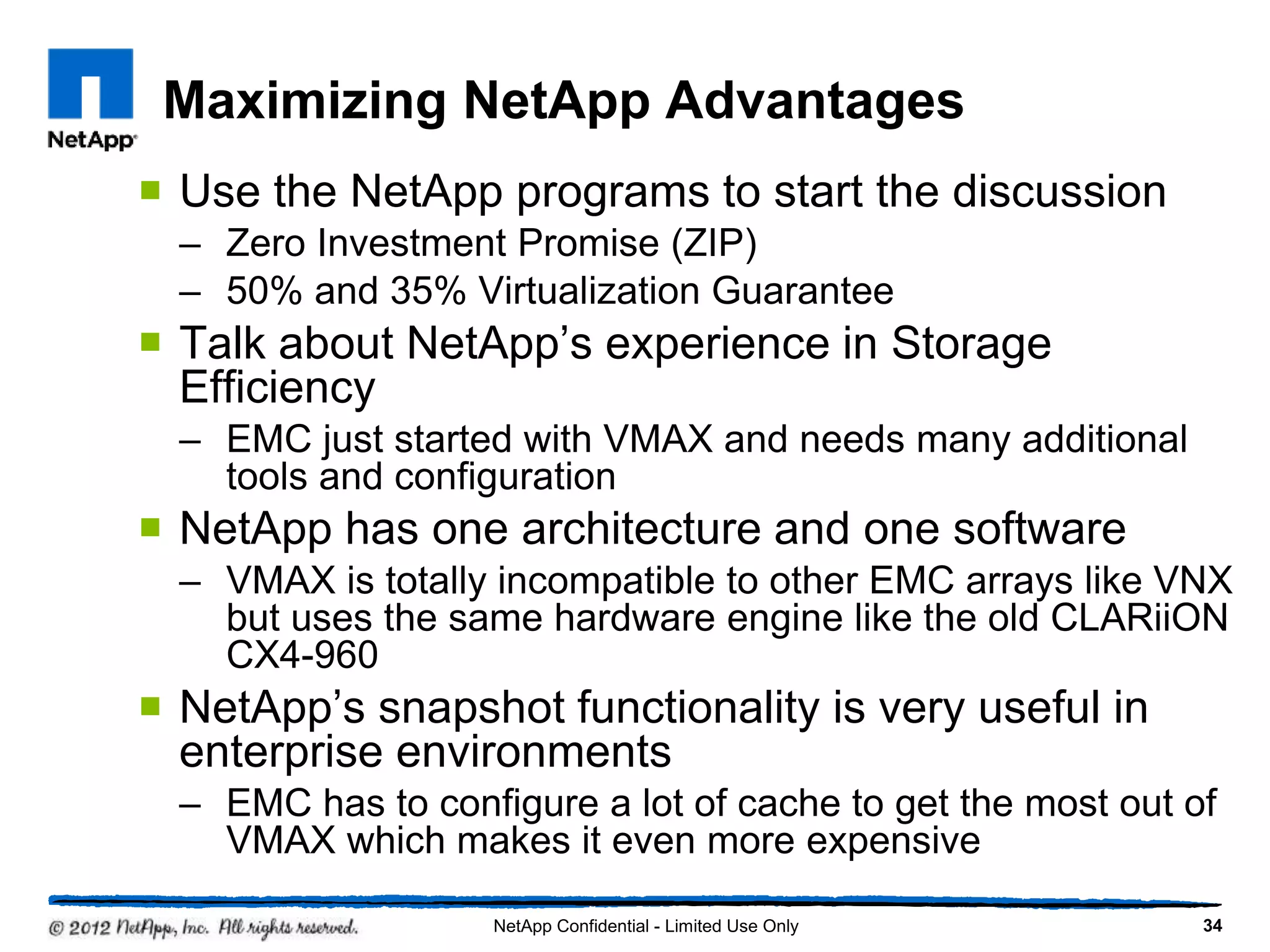
Maximizing NetApp Advantages
 Use the NetApp programs to start the discussion
– Zero Investment Promise (ZIP)
– 50% and 35% Virtualization Guarantee
 Talk about NetApp’s experience in Storage
Efficiency
– EMC just started with VMAX and needs many additional
tools and configuration
 NetApp has one architecture and one software
– VMAX is totally incompatible to other EMC arrays like VNX
but uses the same hardware engine like the old CLARiiON
CX4-960
 NetApp’s snapshot functionality is very useful in
enterprise environments
– EMC has to configure a lot of cache to get the most out of
VMAX which makes it even more expensive
34NetApp Confidential - Limited Use Only
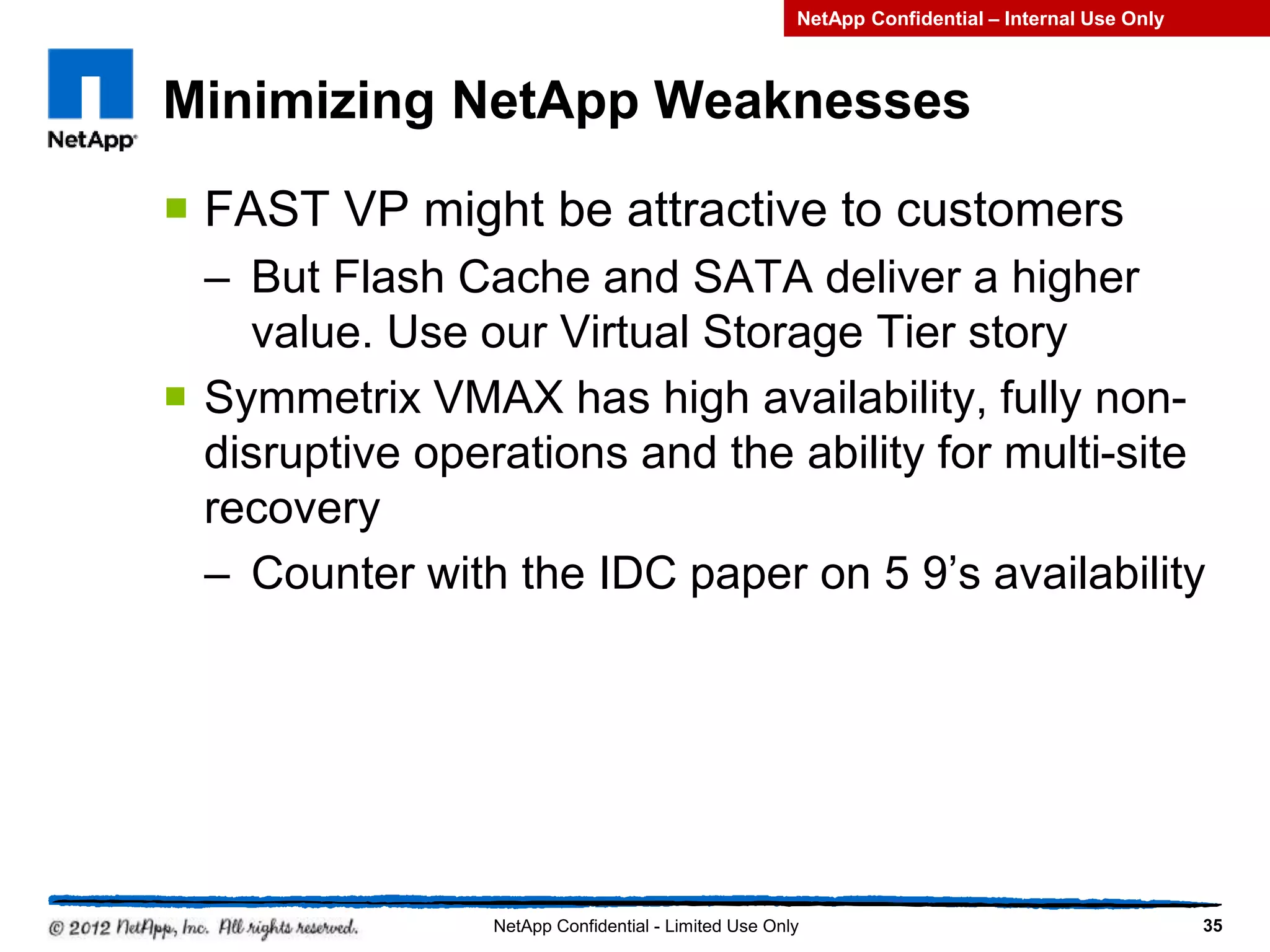
Minimizing NetApp Weaknesses
 FAST VP might be attractive to customers
– But Flash Cache and SATA deliver a higher
value. Use our Virtual Storage Tier story
 Symmetrix VMAX has high availability, fully non-
disruptive operations and the ability for multi-site
recovery
– Counter with the IDC paper on 5 9’s availability
35NetApp Confidential - Limited Use Only
NetApp Confidential – Internal Use Only
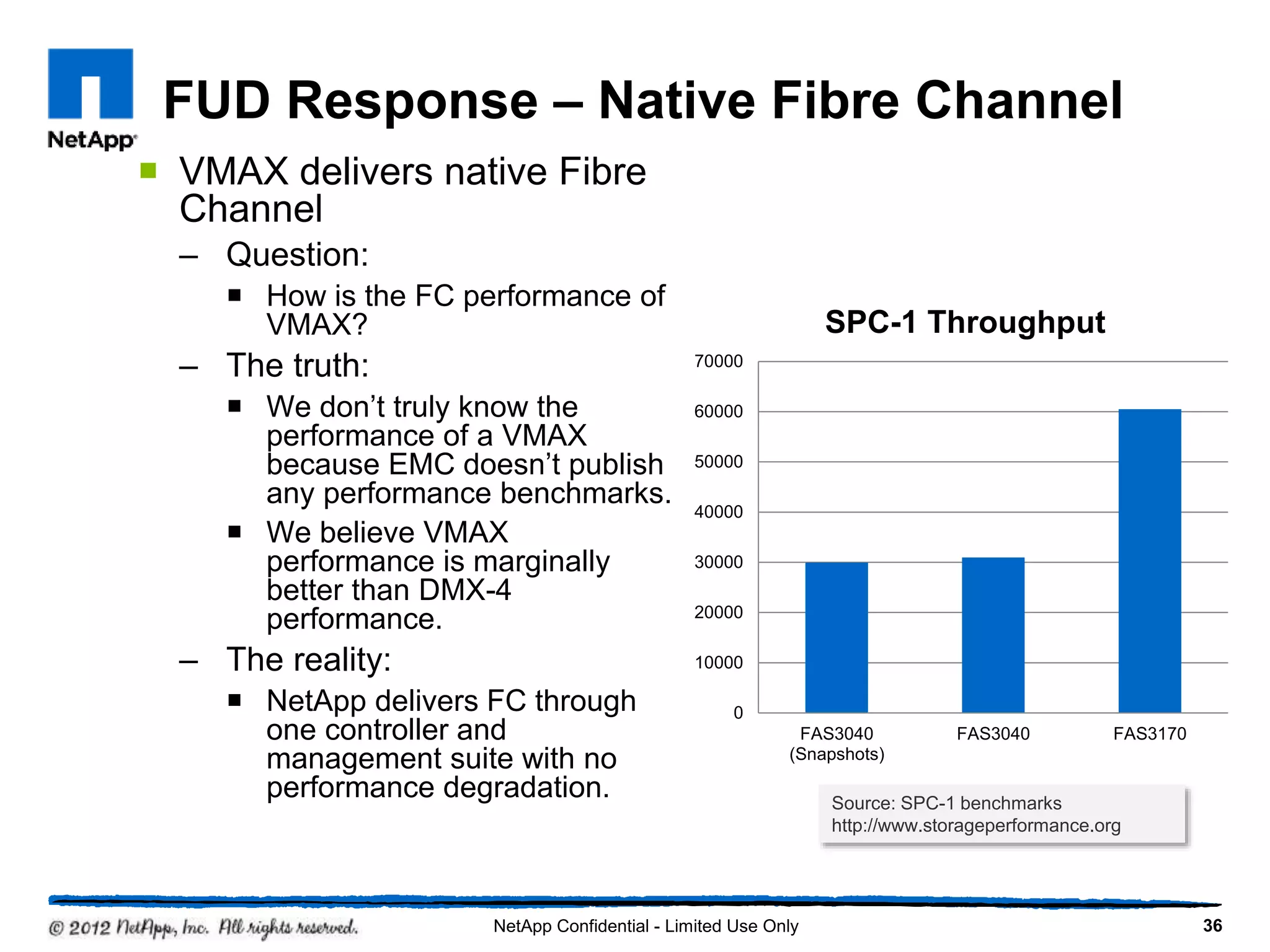
FUD Response – Native Fibre Channel
 VMAX delivers native Fibre
Channel
– Question:
 How is the FC performance of
VMAX?
– The truth:
 We don’t truly know the
performance of a VMAX
because EMC doesn’t publish
any performance benchmarks.
 We believe VMAX
performance is marginally
better than DMX-4
performance.
– The reality:
 NetApp delivers FC through
one controller and
management suite with no
performance degradation. Source: SPC-1 benchmarks
http://www.storageperformance.org
0
10000
20000
30000
40000
50000
60000
70000
FAS3040
(Snapshots)
FAS3040 FAS3170
SPC-1 Throughput
36NetApp Confidential - Limited Use Only
FUD Response – Flash Drives
 VMAX delivers EFD
(Enterprise Flash Drives) for
high performance
– Question:
 Can you use EFD for more than
one application? How many can
you configure?
– The truth:
 VMAX can use it only for specific
applications. They are expensive
and need FAST VP to be
efficient.
– The reality:
 With ‘Flash Cache’ NetApp can
help customers achieve better
performance for all applications.
Combining SATA helps
customers to reduce their TCO.
37NetApp Confidential - Limited Use Only
• NetApp Financial, Operational,
Business Impacts
38
Why NetApp?
NetApp Confidential - Limited Use Only
Why NetApp (1)
 More comprehensive consolidation—
customer advantage: unmatched flexibility
and value; reduced capital outlay
 More flexible and efficient—customer
advantage: most agile and cost-effective for
dynamic, growing environments
 Easier to manage and protect data—customer
advantage: greater operational efficiency and
improved access to data
39NetApp Confidential - Limited Use Only
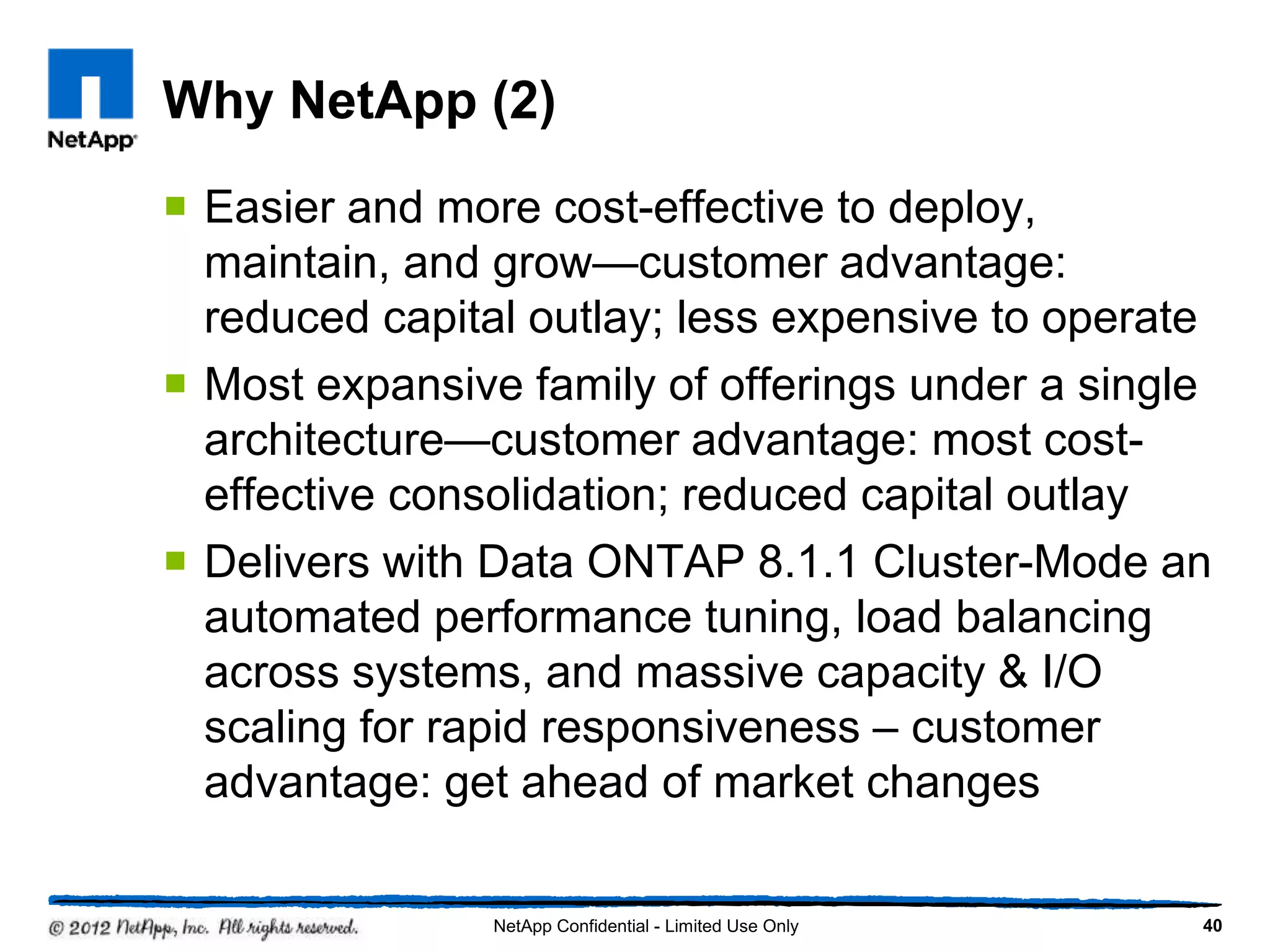
Why NetApp (2)
 Easier and more cost-effective to deploy,
maintain, and grow—customer advantage:
reduced capital outlay; less expensive to operate
 Most expansive family of offerings under a single
architecture—customer advantage: most cost-
effective consolidation; reduced capital outlay
 Delivers with Data ONTAP 8.1.1 Cluster-Mode an
automated performance tuning, load balancing
across systems, and massive capacity & I/O
scaling for rapid responsiveness – customer
advantage: get ahead of market changes
40NetApp Confidential - Limited Use Only
Resources
 Partner facing
– Competitive One-Pager
https://fieldportal.netapp.com/ci_displayfile.asp?fileid=2
8478
 Customer facing
– SPC-1 benchmark
http://www.storageperformance.org/results/benchmark_
results_spc1
 NetApp Virtual Storage Tier
– https://fieldportal.netapp.com/myre_viewbinder.asp?id=
2707
 Tools
– Storage Efficiency Calculator http://www.secalc.com/
– Synergy http://synergy.netapp.com/
– NetApp Realize
41NetApp Confidential - Limited Use Only
NetApp Confidential – Internal Use Only
NetApp Confidential - Limited Use Only 42
NOTICE
As of the issue date of this document, to the best of our knowledge,
the information contained herein is an accurate result of our
research and/or effort to obtain information. This information is
provided "AS-IS" with no warranties of any kind. We offer no
warranty that this information has not changed since this document
was issued, nor do we undertake to update this document.
© 2012 NetApp, Inc. All rights reserved. Specifications subject to
change without notice. NetApp, the NetApp logo and other NetApp
brands are registered trademarks or trademarks of NetApp, Inc. in
the U.S. and other countries. All other brands or products are
trademarks or registered trademarks of their respective holders and
should be treated as such.
43NetApp Confidential - Limited Use Only

Compare emc symmetrix vmax cat presentation

  • 1.
    NetApp Competitive AdvantageTeam Olli Walsdorf Last Updated: 19 June 2012 EMC Symmetrix VMAX CAT Presentation 1 Note: Many slides in this slide set are marked ‘NetApp Confidential – Internal Use Only’. Be sure and delete marked slides before using for customer or other public engagements. NetApp Confidential - Limited Use Only
  • 2.
    Intent of thisDocument  Use this document to gain a product level understanding of EMC Symmetrix VMAX, sales strategies and tactics, and how to compete effectively. These slides contain sales/market/competitive strategies, most common FUD and how to respond, how to make NetApp easy for the customer to justify and purchase, and lists available resources such as additional collateral, training, tools, etc.  Slides marked ‘ ’ are for NetApp and NetApp Partner use only.  Slides NOT marked ‘NetApp Confidential – Internal Use Only’ can be presented as-is for customer facing engagements at your discretion. 2 NetApp Confidential – Internal Use Only NetApp Confidential – Internal Use Only NetApp Confidential - Limited Use Only
  • 3.
    • Executive Summary •EMC Symmetrix VMAX Overview • NetApp Competitive Strategy vs. EMC Symmetrix VMAX • Why NetApp? • Resources • CAT OnDemand Presentation 3 Agenda NetApp Confidential - Limited Use Only
  • 4.
    Executive Summary  NetAppOffense: – Attack Symmetrix VMAX by highlighting NetApp’s storage efficiency  Use Cluster-Mode as an alternative – Demo the simplicity of NetApp – Talk about features VMAX doesn’t have  NetApp Defense: – Show NetApp’s high availability with IDC’s 5 9’s report and by using customer references – Don’t be impressed by competing against VMAX. It’s just another EMC array and a dead end storage for customers 4NetApp Confidential - Limited Use Only Bottom-line: VMAX is built for high enterprise environments but expensive to purchase and complex to maintain NetApp Confidential – Internal Use Only
  • 5.
    • EMC SymmetrixVMAX Portfolio • EMC Symmetrix VMAX Services Offerings • Market Strategy • EMC Symmetrix VMAX Positioning • EMC’s Competitive Strategy & Tactics Against NetApp • Customer Challenges 5 EMC Symmetrix VMAX Overview NetApp Confidential - Limited Use Only
  • 6.
    EMC Symmetrix VMAXOverview  EMC High-End Model with strong increase (62%) over four rolling quarters  45% higher $/GB price per IDC Storage Tracker compared to NetApp FAS6200 series  Only 9% of VMAX are sold for Mainframe 6NetApp Confidential - Limited Use Only 0 200 400 600 800 1000 1200 1400 1600 2011Q1 2011Q2 2011Q3 2011Q4 2012Q1 IDC Storage Tracker Sold Units VMAX FAS6200
  • 7.
    NetApp FAS6000 increased33% Y/Y Enterprise Storage Market Growth EMC Symmetrix DMX/VMAX vs. NetApp FAS6000/6200 7NetApp Confidential – Limited Use Only EMC Symmetrix Storage increased 13% Y/Y Source: IDC Sum of Units, NetApp FAS6000/6200 series 0 200 400 600 800 1000 1200 1400 1600 2011Q1 2011Q2 2011Q3 2011Q4 2012Q1 EMC Symmetrix Spread VMAX DMX 13% 33% EMC NetApp
  • 8.
    EMC Symmetrix VMAXProduct Portfolio 8 Symmetrix VMAX: Built for Enterprise Requirements but there is no upgrade path from older Symmetrix or VNX NetApp Confidential - Limited Use Only
  • 9.
    EMC Symmetrix VMAXComparison 9 Description Symmetrix VMAX 40K Symmetrix VMAX 20K Symmetrix VMAX 10K Number of Engines 1-8 1-8 1-4 Processor Engine Six-Core CPU Four-Core CPU Dual-Core CPU Memory per System Max. 2TB Raw Max. 1TB Raw Max. 384GB Raw Number of Drives (min/max) 48-2400 48-2400 24-960 Maximum FE ports 128 FC, 64 GbE 128 FC, 64 GbE 64 FC, 32 GbE I/O Module Support 8Gb FC, 1GbE/10GbE iSCSI or FCoE - Multimode only + Ficon 8Gb FC, 1GbE/10GbE iSCSI or FCoE - Multimode only + Ficon 8Gb FC, 1GbE/10GbE iSCSI or FCoE - Multimode only Drive Types Supported 300/600GB 15K FC (3.5”) 300/600GB 10K FC (2.5”/3.5”) 2TB 7.2K SATA( 3.5”) 100/200/400GB FLASH (2.5”/3.5”) 450GB 15K FC 600GB 10K FC 1TB + 2TB 7.2K SATA 200GB + 400GB FLASH 300/450/600GB 10K SAS 2.5” 450GB 15K FC 600GB 10K FC 2TB 7.2K SATA 200GB FLASH RAID Types RAID 1, 5,6 & 10 RAID 1, 5,6 & 10 - Mirrored: All drive types - RAID5 (3+1) & (7+1): All drive types - RAID6 (6+2) & (14+2) FC & SATA Dispersed Array Capable Yes No Yes Max Usable Capacity 3.8 PB 2 PB 1.3 PB NetApp Confidential - Limited Use Only
  • 10.
    What’s different betweenVMAX 10K, 20K, and 40K?  VMAX 10K has: – Less configurable, fixed hardware – “Entry-level” software for enterprise (SRDFe)  VMAX 20K has: – Full configurable and flexible hardware – Enterprise software  VMAX 40K has: – In addition to VMAX 20K, Federated Tiered Storage NetApp Confidential - Limited Use Only 10
  • 11.
    Symmetrix VMAX VirtualMatrix Architecture  Each VMAX Engine provides a high availability base configuration  Virtual Matrix enables CPU, memory, disks, host ports to be shared across all directors  Additional VMAX Engines can be added to scale out system resources 11 Virtual Matrix NetApp Confidential - Limited Use Only
  • 12.
    Symmetrix VMAX VirtualProvisioning  Increases capacity utilization  Real-time storage expansion  Automatic reclamation of thin device extents containing all zeros  Not recommended for high performance environments  Still complicated to handle – Requires too much configuration steps 12 An improvement for customers but still complicated to handle Thin Pool Data Devices Virtual Machines Thin Devices APP OS APP OS APP OS APP OS APP OS APP OS APP OS APP OS APP OS APP OS APP OS APP OS APP OS APP OS APP OS Best Practices for Fast, Simple Capacity Allocation with EMC Symmetrix Virtual Provisioning, December 2010 NetApp Confidential - Limited Use Only
  • 13.
    Symmetrix VMAX LocalReplication  Provide near-instant recovery  Enable parallel processing  Limit of 128 snaps and 16 clones per source  Performance intensive. Needs a lot of cache  Snaps typically require 20- 30% additional space  Clone = Full copy  Licensed per TB 13NetApp Confidential - Limited Use Only Highly functional but expensive and slow (Snap) TimeFinder Family TimeFinder/ Mirror Ultra-high- performance option TimeFinder/ EIM Exchange Integration Module option TimeFinder/ CG Consistency Group option TimeFinder/ SIM SQL Integration Module option TimeFinder/ Clone Fully functional high-performance copies TimeFinder/ Snap Economical space-saving copies EMC Solutions Enabler Symmetrix TimeFinder Family CLI, Version 7.1.1
  • 14.
    Symmetrix VMAX RemoteReplication  Provides near- instant recovery  Enables parallel processing  Protects against local and regional disruptions  High resiliency  Licensed per TB 14NetApp Confidential - Limited Use Only Delivers all kinds of replication except transparent failover SRDF Family SRDF/Star Multi-site replication option SRDF/AR Automated Replication option SRDF/CE Cluster Enabler option SRDF/CG Consistency Groups SRDF/S Synchronous for zero data exposure SRDF/A Asynchronous for extended distances SRDF/DM Efficient Symmetrix-to- Symmetrix data mobility Cascaded SRDF and SRDF/EDP Extended Distance Protection Concurrent SRDF Concurrent
  • 15.
    Symmetrix VMAX 10KReplication  TimeFinder for VMAX 10K – Full Clone/Clone No Copy*  RecoverPoint CDP  Snapshots with additional costs and management (RecoverPoint) 15 More complex at a higher cost compared to NetApp Remote Local Management * The copy process for the No Copy option copies data from the source device to the target device only if triggered by a host I/O  RecoverPoint CRR/CLR  SRDFe  Additional space needed for RecoverPoint  Replication Manager NetApp Confidential - Limited Use Only
  • 16.
    Symmetrix VMAX Management Management through – SMC (Symmetrix Management Console) – IONIX ControlCenter Family – Prosphere – Unisphere  SMC for all kind of configurations like Virtual Provisioning and Cache Partitioning  Unisphere for more general management  Complex management overall – EMC highlights fewer clicks compared to the old management  Confusing management – Customer has to switch between Unisphere and SMC 16NetApp Confidential - Limited Use Only Complex and Confusing with several different tools EMC Unisphere for VMAX Release Notes, REV A01
  • 17.
    17 Symmetrix Fully AutomatedStorage Tiering (FAST VP) for VMAX  Dynamically allocate and relocate volumes across tiers based on performance  Moves extents of 768KB – 368MB across storage groups  Complex to setup  Reactive, not proactive  Affects performance as data is being moved within VMAX 17NetApp Confidential - Limited Use Only Efficiency through a complex and expensive option SATA Fibre Channel Flash Tiered Storage Best Practice for Nondisruptive Tiering via EMC Symmetrix Virtual LUN Technology, December 2010
  • 18.
    Federated Tiered Storage- FTS  Allows the use of Symmetrix Enginuity functionality with data residing on external arrays  Lots of limitations – Only a few arrays are supported – No support for FAST VP – Only FCP – Max external capacity determined by VMAX cache 18NetApp Confidential - Limited Use Only
  • 19.
    Symmetrix VMAX StorageEfficiency  EFDs or RAID-10 configured FC needed for high performance  64 GB Filesystem for Enginuity  200GB reserved area per VMAX engine  Two spares per 100 drives per drive type – Minimum of eight spares for the entire system – In addition EFDs need 2 spares per 100 drives 19NetApp Confidential - Limited Use Only How can you be efficient with this monolithic architecture?
  • 20.
    Symmetrix VMAX*  2VMAX Engines  Disks – 8 x 400 GB EFD – 40 x 300 GB FC – 32 x 1 TB SATA  Raw capacity ~ 46.2 TB  Useable capacity ~ 28.9 TB = 62.5%  Power Consumption = 5.0 kVA FAS6200  2 Controller  Flash Cache installed  Disks – 72 x 600 GB SAS  Raw capacity ~ 43 TB  Useable capacity ~ 33 TB = 76.7%  Power Consumption = 3.8 kVA 20 A ‘Power Consumption’ comparison for an Oracle environment * Based on “Implementing FAST VP and Storage Tiers for Oracle Database 11g and Symmetrix VMAX”, December 2010 EMC didn’t configure Spare Drives. Spare drives are included in the calculation. NetApp needs less power and achieves higher performance NetApp Confidential - Limited Use Only
  • 21.
    Mapping Common SoftwareFunctionality Functionality NetApp EMC Local replication (snapshots) Snapshot • TimeFinder/Snap for Symmetrix VMAX • RecoverPoint CDP for Symmetrix VMAXe Local replication (clones) FlexClones • TimeFinder/Clone for Symmetrix VMAX Remote replication SnapMirror • SRDF for Symmetrix VMAX • SRDFe for Symmetrix VMAXe • RecoverPoint CRR/CLR for Symmetrix VMAX Data restore management SnapRestore • TimeFinder/Snap for Symmetrix VMAX • RecoverPoint CDP for Symmetrix VMAXe Application-consistent replication SnapManager • Replication Manager (Oracle, SQL, Exchange, VDI, Hyper-V) Data deduplication Data Deduplication • Not available NetApp FAS vs. EMC Symmetrix VMAX 21NetApp Confidential - Limited Use Only
  • 22.
    EMC Symmetrix VMAXServices Offerings  Standard three-year 7x24 onsite warranty on hardware. The Enginuity storage operating environment has a 90-day warranty on the software.  EMC Global Services or Authorized Services Network (ASN) partners can download microcode directly to the customer’s Symmetrix Management Console. Customers can also update their own Service Processors directly from the microcode on Symmetrix Management Console. 22NetApp Confidential - Limited Use Only
  • 23.
    EMC Symmetrix MarketStrategy  Tiered storage optimization – Advanced Quality of Services (QoS), data mobility, and data management capabilities to consolidate application tiers, including Tier 0  Information availability – Most advanced and widely deployed business continuity platform  Simplified management and operations – Simplified storage allocation, resource management, and tiering  Information-centric security—built in – Advanced security and integrated RSA technology, Data-At-Rest Encryption  Application integration – Industry’s most comprehensive Proven Solutions 23NetApp Confidential - Limited Use Only Position as High-End storage array with simple management, automatic storage tiering, and highest availability
  • 24.
    EMC Symmetrix MarketStrategy  Why Symmetrix VMAX Series? – Purpose-built for virtual environments – Lowest cost of ownership – Automatically optimized performance – Unprecedented performance and scale – Unmatched application availability  With Symmetrix VMAX You Can – Deliver Five 9s (99.999%) availability to support mission-critical applications – Support fully non-disruptive operations, including code (OS) and configuration changes – Provide multi-site recovery and restart to prevent site and/or regional outages (VMAX) 24NetApp Confidential - Limited Use Only
  • 25.
    Strengths  Large supportmatrix including Mainframe (VMAX) and Open Systems  High-performance, scalable architecture with very large cache  Highly resilient design with rapid recovery for hardware failures, including very fast controller failover with minimal performance impact  Full line of remote sync/async replication solutions, including long- distance synchronous mirroring  Large customer install base with many ‘Enterprise’ references  Ability to migrate automatically between different Storage Tiers and RAID levels Weaknesses  Very expensive, inflexible architecture with block protocol support only  Complex to manage. One Symmetrix Manager Console GUI per Symmetrix  A VMAX engine is more or less a CLARiiON CX4-960 dual controller  Scalability of 2,400 for VMAX and 960 for VMAXe only on paper. Scaling to end results in performance problems  Usable storage often far less than raw (e.g. best practices often require mirroring for performance)  Performance issues with snapshots and especially RAID-6  High usage of reserved space (vault area)  Ineffective usage of SSD technology, no EMC FAST Cache  No usage of SATA technology for Tier 1 applications  FAST VP (Fully Automated Storage Tiering) technology complex to install and maintain  No deduplication at all  No true upgrade path from DMX-3/4 to VMAX/VMAXe. Migration only  No upgrade from VMAX 10K to VMAX 20K to VMAX 40K  ~1/3 less performance for VMAX 10K compared to VMAX 20K  No local snaps (RecoverPoint only) for VMAX 10K 25 EMC Symmetrix Strengths and Weaknesses NetApp Confidential - Limited Use Only
  • 26.
    EMC Symmetrix CompetitiveStrategy & Tactics Against NetApp  Main competitors are HDS (VSP), HP 3PAR and IBM (DS8800/XIV)  If they compete against NetApp they – Use common FUD against NetApp  Not a SAN player  Not “Enterprise Storage”  Lower availability than VMAX  Low useable capacity compared to EMC  Less performance with RAID-DP  Position VMAX as the best-in-class storage  ‘Low-Ball’ the price at the end of EMC/NTAP sales quarters 26NetApp Confidential - Limited Use Only NetApp Confidential – Internal Use Only
  • 27.
    Customer Challenges withEMC Symmetrix  Inflexible and difficult to manage  Comprehensive knowledge necessary to be efficient with VMAX – FAST VP is easy in theory but complex in practice  Improvements with power consumption but still need more power compared to NetApp  High CAPEX and OPEX costs 27NetApp Confidential - Limited Use Only
  • 28.
    • Our ValueProposition • NetApp Competitive Positioning/Mapping • Winning Strategies for NetApp • Overcoming Objections / FUD 28 NetApp Competitive Strategy vs. EMC NetApp Confidential - Limited Use Only
  • 29.
    NetApp Value Proposition True Unified Storage with a long history – 150,000 systems since 2002 (http://www.netapp.com/us/company/news/news- rel-20100331.html)  Higher Storage Efficiency – NetApp crushed Exabyte with deduplication (http://www.netapp.com/us/company/news/news- rel-20100511.html)  Performance leader compared to EMC – Higher Performance combined with higher efficiency (no SPC-1 benchmark published by EMC) (http://www.storageperformance.org/results/bench mark_results_spc1) 29NetApp Confidential - Limited Use Only
  • 30.
    NetApp Competitive Positioning/Mapping 30NetAppConfidential - Limited Use Only VMAX is only superior when it comes to remote replication and Disaster Recovery but doesn’t have MetroCluster functionality NetApp FAS EMC Symmetrix VMAX FAS/V6210 VMAX 10K/20K FAS/V6240 VMAX 10K/20K FAS/V6280 VMAX 20K/40K Think about Data ONTAP 8.1.1 Cluster-Mode with up to 6 nodes as an alternative
  • 31.
    Winning Strategies forNetApp  Exploit technology differentiation and advanced functionality to win on value  Talk about the value of NetApp features and software translating them on solving the customer’s business problems – EMC tries to buy the business  Elevate software to the forefront of discussions  Educate on the advantages of integration and native functionality, as well as the disadvantages of expensive, inefficient and difficult to manage storage  Prove ease of use with hands-on activities  Cite third-party validation  Deflect FUD with deep product knowledge and U-turn finesse 31NetApp Confidential - Limited Use Only NetApp Confidential – Internal Use Only
  • 32.
    Recommendations  Do’s – Talkabout NetApp’s Storage Efficiency  Use the Realize tool – Show the simplicity of installing and configuring NetApp  Compare EMC VMAX complexity with NetApp simplicity – Compare independent performance benchmarks  EMC didn’t publish any benchmarks for VMAX – Think about Data ONTAP 8.1.1 Cluster-Mode as an alternative  Don’ts – Avoid Mainframe/iSeries environments – VMAX has high availability, fully non- disruptive operations and the ability for multi-site recovery – Very reliable enterprise array 32NetApp Confidential - Limited Use Only NetApp Confidential – Internal Use Only
  • 33.
    NetApp delivers HighPerformance for SAN Highest Storage Efficiency through RAID-DP 33NetApp Confidential - Limited Use Only Throughput 29,959 30,986 60,515 68,035 Memory 8GB 8GB 32GB 1056GB Disks 140 x FC 140 x FC 224 x FC 120 x SAS Protection RAID-DP 0 10,000 20,000 30,000 40,000 50,000 60,000 70,000 80,000 FAS3040 (Snapshots) FAS3040 FAS3170 FAS3270 SPC-1 Throughput
  • 34.
    Maximizing NetApp Advantages Use the NetApp programs to start the discussion – Zero Investment Promise (ZIP) – 50% and 35% Virtualization Guarantee  Talk about NetApp’s experience in Storage Efficiency – EMC just started with VMAX and needs many additional tools and configuration  NetApp has one architecture and one software – VMAX is totally incompatible to other EMC arrays like VNX but uses the same hardware engine like the old CLARiiON CX4-960  NetApp’s snapshot functionality is very useful in enterprise environments – EMC has to configure a lot of cache to get the most out of VMAX which makes it even more expensive 34NetApp Confidential - Limited Use Only
  • 35.
    Minimizing NetApp Weaknesses FAST VP might be attractive to customers – But Flash Cache and SATA deliver a higher value. Use our Virtual Storage Tier story  Symmetrix VMAX has high availability, fully non- disruptive operations and the ability for multi-site recovery – Counter with the IDC paper on 5 9’s availability 35NetApp Confidential - Limited Use Only NetApp Confidential – Internal Use Only
  • 36.
    FUD Response –Native Fibre Channel  VMAX delivers native Fibre Channel – Question:  How is the FC performance of VMAX? – The truth:  We don’t truly know the performance of a VMAX because EMC doesn’t publish any performance benchmarks.  We believe VMAX performance is marginally better than DMX-4 performance. – The reality:  NetApp delivers FC through one controller and management suite with no performance degradation. Source: SPC-1 benchmarks http://www.storageperformance.org 0 10000 20000 30000 40000 50000 60000 70000 FAS3040 (Snapshots) FAS3040 FAS3170 SPC-1 Throughput 36NetApp Confidential - Limited Use Only
  • 37.
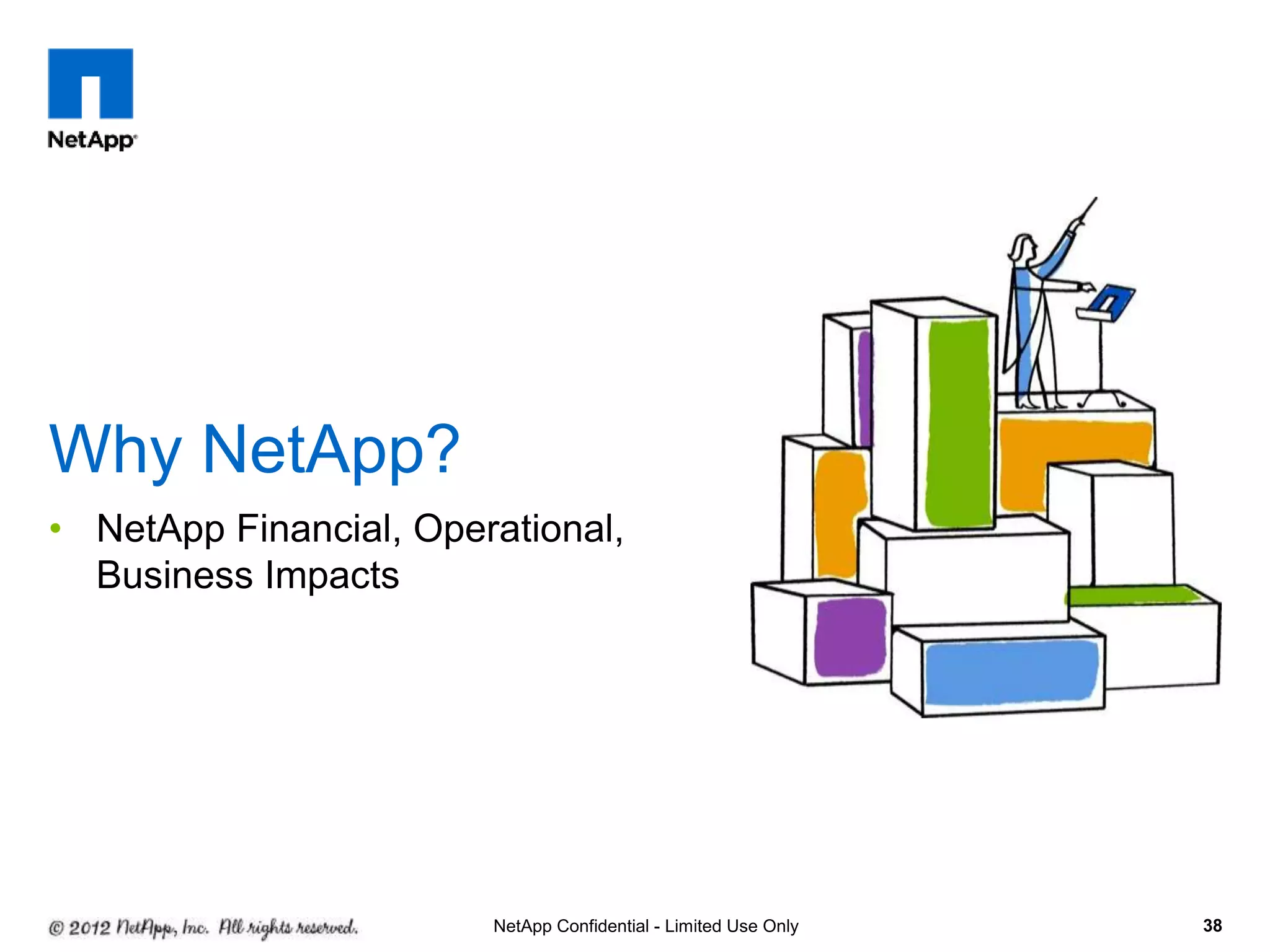
    FUD Response –Flash Drives  VMAX delivers EFD (Enterprise Flash Drives) for high performance – Question:  Can you use EFD for more than one application? How many can you configure? – The truth:  VMAX can use it only for specific applications. They are expensive and need FAST VP to be efficient. – The reality:  With ‘Flash Cache’ NetApp can help customers achieve better performance for all applications. Combining SATA helps customers to reduce their TCO. 37NetApp Confidential - Limited Use Only
  • 38.
    • NetApp Financial,Operational, Business Impacts 38 Why NetApp? NetApp Confidential - Limited Use Only
  • 39.
    Why NetApp (1) More comprehensive consolidation— customer advantage: unmatched flexibility and value; reduced capital outlay  More flexible and efficient—customer advantage: most agile and cost-effective for dynamic, growing environments  Easier to manage and protect data—customer advantage: greater operational efficiency and improved access to data 39NetApp Confidential - Limited Use Only
  • 40.
    Why NetApp (2) Easier and more cost-effective to deploy, maintain, and grow—customer advantage: reduced capital outlay; less expensive to operate  Most expansive family of offerings under a single architecture—customer advantage: most cost- effective consolidation; reduced capital outlay  Delivers with Data ONTAP 8.1.1 Cluster-Mode an automated performance tuning, load balancing across systems, and massive capacity & I/O scaling for rapid responsiveness – customer advantage: get ahead of market changes 40NetApp Confidential - Limited Use Only
  • 41.
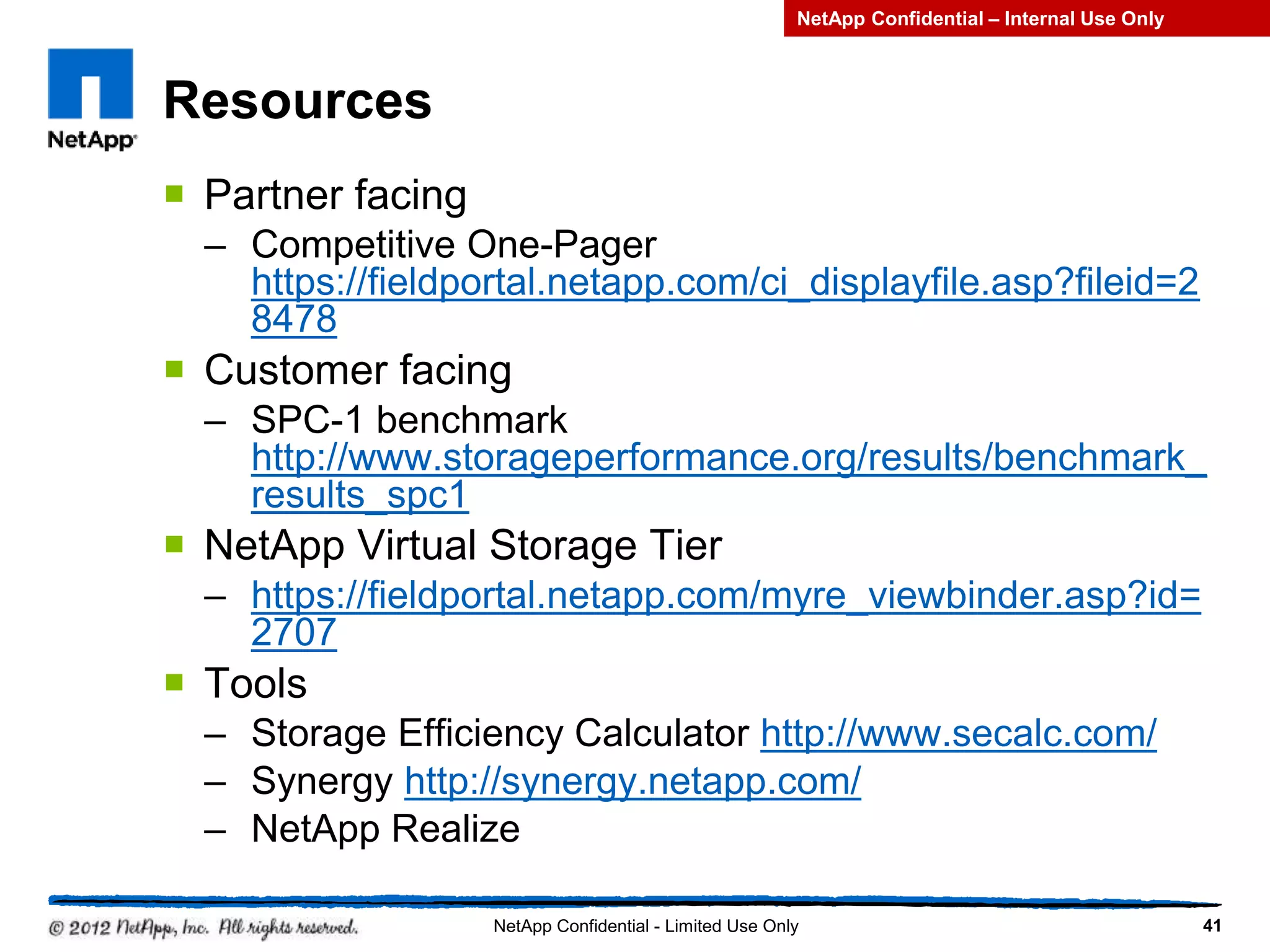
    Resources  Partner facing –Competitive One-Pager https://fieldportal.netapp.com/ci_displayfile.asp?fileid=2 8478  Customer facing – SPC-1 benchmark http://www.storageperformance.org/results/benchmark_ results_spc1  NetApp Virtual Storage Tier – https://fieldportal.netapp.com/myre_viewbinder.asp?id= 2707  Tools – Storage Efficiency Calculator http://www.secalc.com/ – Synergy http://synergy.netapp.com/ – NetApp Realize 41NetApp Confidential - Limited Use Only NetApp Confidential – Internal Use Only
  • 42.
    NetApp Confidential -Limited Use Only 42
  • 43.
    NOTICE As of theissue date of this document, to the best of our knowledge, the information contained herein is an accurate result of our research and/or effort to obtain information. This information is provided "AS-IS" with no warranties of any kind. We offer no warranty that this information has not changed since this document was issued, nor do we undertake to update this document. © 2012 NetApp, Inc. All rights reserved. Specifications subject to change without notice. NetApp, the NetApp logo and other NetApp brands are registered trademarks or trademarks of NetApp, Inc. in the U.S. and other countries. All other brands or products are trademarks or registered trademarks of their respective holders and should be treated as such. 43NetApp Confidential - Limited Use Only