Comparative Methods of
Collegiate, Faith-
Learning Integration
Jeff Beine,
Ph.D.
Malone
University
Background of the study

   Arthur Holmes, PhD (Wheaton College)


   Larry D. Burton & Constance C. Nwosu (2003): Student Perceptions of the
    Integration of Faith, Learning, and Practice In an Educational Methods
    Course, Journal of Research on Christian Education, 12:2, 101-135


   Terry Anne Lawrence, Larry D. Burton & Constance C. Nwosu (2005):
    Refocusing on the Learning in ―Integration of Faith and Learning", Journal of
    Research on Christian Education, 14:1, 17-50
What is the true mission of
a Christian university?
Wheaton College
   Wheaton College exists to help build
    the church and improve society
    worldwide by promoting the
    development of whole and effective
    Christians through excellence in
    programs of Christian higher
    education.
Messiah College
   Our mission is to educate men and
    women toward maturity of
    intellect, character and Christian
    faith in preparation for lives of
    service, leadership and reconciliation
    in church and society.
Azusa Pacific University
   Azusa Pacific University is an
    evangelical Christian community of
    disciples and scholars who seek to
    advance the work of God in the
    world through academic excellence in
    liberal arts and professional programs
    of higher education that encourage
    students to develop a Christian
    perspective of truth and life.
Biola University
   The mission of Biola University is
    biblically centered education,
    scholarship and service—equipping
    men and women in mind and
    character to impact the world for the
    Lord Jesus Christ. Our business is
    to inspire student's learning so that
    they are empowered to think and
    practice from a Christian worldview in
    their fields of service.
Malone University
   The mission of Malone is to provide
    students with an education based on
    biblical faith in order to develop men
    and women in intellectual
    maturity, wisdom, and Christian faith
    who are committed to serve the
    church, community and world.
1 Corinthians 2:16 (NIV)


16 for,―Who has known the mind of the
  Lord so as to instruct him?‖[a]
  But we have the mind of Christ.
Methods
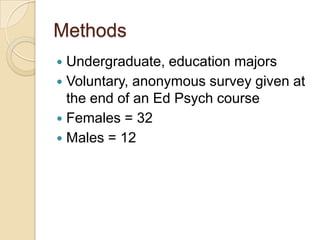
 Undergraduate, education majors
 Voluntary, anonymous survey given at
  the end of an Ed Psych course
 Females = 32
 Males = 12
Types of integrative methods
considered for this survey
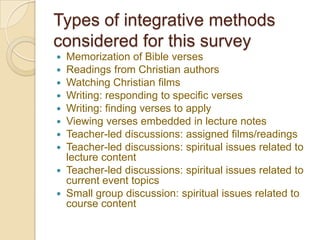
 Memorization of Bible verses
 Readings from Christian authors
 Watching Christian films
 Writing: responding to specific verses
 Writing: finding verses to apply
 Viewing verses embedded in lecture notes
 Teacher-led discussions: assigned films/readings
 Teacher-led discussions: spiritual issues related to
  lecture content
 Teacher-led discussions: spiritual issues related to
  current event topics
 Small group discussion: spiritual issues related to
  course content
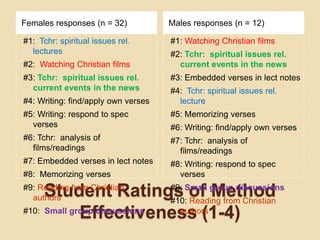
Females responses (n = 32)           Males responses (n = 12)

#1: Tchr: spiritual issues rel.      #1: Watching Christian films
  lectures                           #2: Tchr: spiritual issues rel.
#2: Watching Christian films           current events in the news
#3: Tchr: spiritual issues rel.      #3: Embedded verses in lect notes
  current events in the news         #4: Tchr: spiritual issues rel.
#4: Writing: find/apply own verses     lecture
#5: Writing: respond to spec         #5: Memorizing verses
  verses                             #6: Writing: find/apply own verses
#6: Tchr: analysis of                #7: Tchr: analysis of
  films/readings                       films/readings
#7: Embedded verses in lect notes    #8: Writing: respond to spec
#8: Memorizing verses                  verses

     Student Ratings Small group discussions
#9: Reading from Christian
  authors
                             #9:
                                  of Method
                             #10: Reading from Christian
             Effectiveness (1-4)
#10: Small group discussions   authors
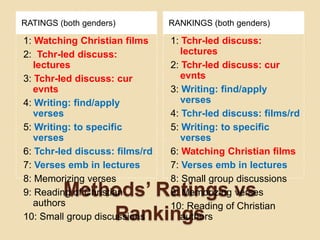
RATINGS (both genders)          RANKINGS (both genders)

1: Watching Christian films     1: Tchr-led discuss:
2: Tchr-led discuss:               lectures
   lectures                     2: Tchr-led discuss: cur
3: Tchr-led discuss: cur           evnts
   evnts                        3: Writing: find/apply
4: Writing: find/apply             verses
   verses                       4: Tchr-led discuss: films/rd
5: Writing: to specific         5: Writing: to specific
   verses                          verses
6: Tchr-led discuss: films/rd   6: Watching Christian films
7: Verses emb in lectures       7: Verses emb in lectures
8: Memorizing verses            8: Small group discussions
         Methods’ Ratings vs
9: Reading of Christian
   authors
                                9: Memorizing verses
                                10: Reading of Christian
             Rankings
10: Small group discussions        authors
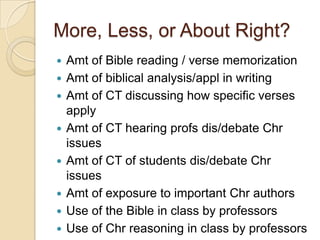
More, Less, or About Right?
   Amt of Bible reading / verse memorization
   Amt of biblical analysis/appl in writing
   Amt of CT discussing how specific verses
    apply
   Amt of CT hearing profs dis/debate Chr
    issues
   Amt of CT of students dis/debate Chr
    issues
   Amt of exposure to important Chr authors
   Use of the Bible in class by professors
   Use of Chr reasoning in class by professors
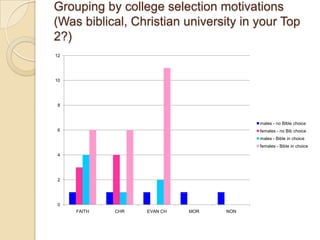
Grouping by college selection motivations
(Was biblical, Christian university in your Top
2?)
12


10


 8


                                         males - no Bible choice
 6                                       females - no Bib choice
                                         males - Bible in choice
                                         females - Bible in choice
 4


 2


 0
     FAITH   CHR   EVAN CH   MOR   NON
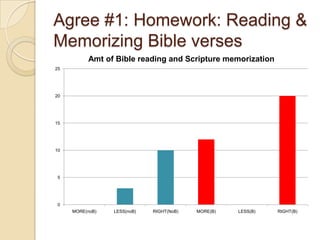
Agree #1: Homework: Reading &
Memorizing Bible verses
          Amt of Bible reading and Scripture memorization
25


20


15


10


 5


 0
     MORE(noB)   LESS(noB)   RIGHT(NoB)   MORE(B)   LESS(B)   RIGHT(B)
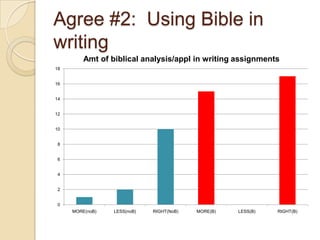
Agree #2: Using Bible in
writing
         Amt of biblical analysis/appl in writing assignments
18


16


14


12


10


 8


 6


 4


 2


 0
     MORE(noB)   LESS(noB)   RIGHT(NoB)   MORE(B)   LESS(B)   RIGHT(B)
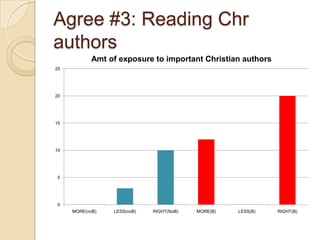
Agree #3: Reading Chr
authors
            Amt of exposure to important Christian authors
25


20


15


10


 5


 0
     MORE(noB)   LESS(noB)   RIGHT(NoB)   MORE(B)   LESS(B)   RIGHT(B)
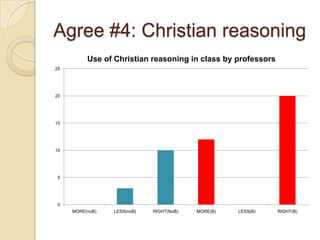
Agree #4: Christian reasoning
          Use of Christian reasoning in class by professors
25


20


15


10


 5


 0
     MORE(noB)   LESS(noB)   RIGHT(NoB)   MORE(B)   LESS(B)   RIGHT(B)
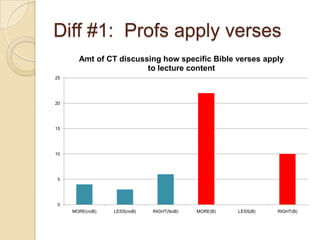
Diff #1: Profs apply verses
       Amt of CT discussing how specific Bible verses apply
                        to lecture content
25


20


15


10


 5


 0
     MORE(noB)   LESS(noB)   RIGHT(NoB)   MORE(B)   LESS(B)   RIGHT(B)
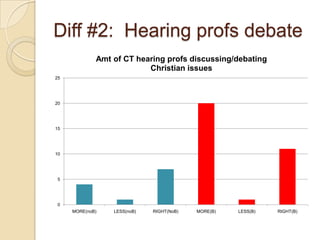
Diff #2: Hearing profs debate
             Amt of CT hearing profs discussing/debating
                          Christian issues
25


20


15


10


 5


 0
     MORE(noB)   LESS(noB)   RIGHT(NoB)   MORE(B)   LESS(B)   RIGHT(B)
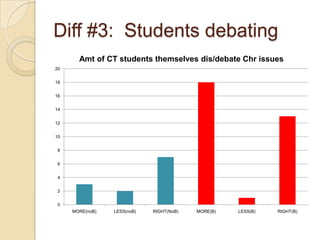
Diff #3: Students debating
       Amt of CT students themselves dis/debate Chr issues
20


18


16


14


12


10


 8


 6


 4


 2


 0
     MORE(noB)   LESS(noB)   RIGHT(NoB)   MORE(B)   LESS(B)   RIGHT(B)
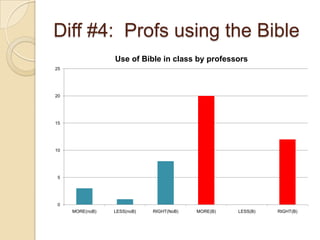
Diff #4: Profs using the Bible
                 Use of Bible in class by professors
25


20


15


10


 5


 0
     MORE(noB)   LESS(noB)   RIGHT(NoB)   MORE(B)   LESS(B)   RIGHT(B)
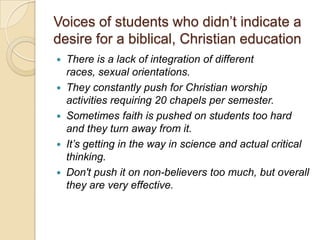
Voices of students who didn’t indicate a
desire for a biblical, Christian education
 There is a lack of integration of different
  races, sexual orientations.
 They constantly push for Christian worship
  activities requiring 20 chapels per semester.
 Sometimes faith is pushed on students too hard
  and they turn away from it.
 It’s getting in the way in science and actual critical
  thinking.
 Don't push it on non-believers too much, but overall
  they are very effective.
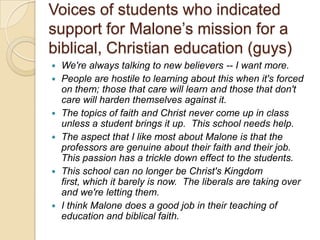
Voices of students who indicated
support for Malone’s mission for a
biblical, Christian education (guys)
   We're always talking to new believers -- I want more.
   People are hostile to learning about this when it's forced
    on them; those that care will learn and those that don't
    care will harden themselves against it.
   The topics of faith and Christ never come up in class
    unless a student brings it up. This school needs help.
   The aspect that I like most about Malone is that the
    professors are genuine about their faith and their job.
    This passion has a trickle down effect to the students.
   This school can no longer be Christ's Kingdom
    first, which it barely is now. The liberals are taking over
    and we're letting them.
   I think Malone does a good job in their teaching of
    education and biblical faith.
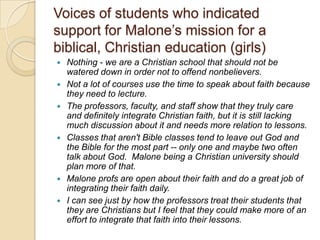
Voices of students who indicated
support for Malone’s mission for a
biblical, Christian education (girls)
   Nothing - we are a Christian school that should not be
    watered down in order not to offend nonbelievers.
   Not a lot of courses use the time to speak about faith because
    they need to lecture.
   The professors, faculty, and staff show that they truly care
    and definitely integrate Christian faith, but it is still lacking
    much discussion about it and needs more relation to lessons.
   Classes that aren't Bible classes tend to leave out God and
    the Bible for the most part -- only one and maybe two often
    talk about God. Malone being a Christian university should
    plan more of that.
   Malone profs are open about their faith and do a great job of
    integrating their faith daily.
   I can see just by how the professors treat their students that
    they are Christians but I feel that they could make more of an
    effort to integrate that faith into their lessons.
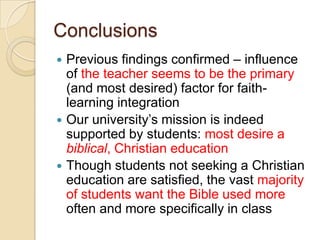
Conclusions
 Previous findings confirmed – influence
  of the teacher seems to be the primary
  (and most desired) factor for faith-
  learning integration
 Our university’s mission is indeed
  supported by students: most desire a
  biblical, Christian education
 Though students not seeking a Christian
  education are satisfied, the vast majority
  of students want the Bible used more
  often and more specifically in class
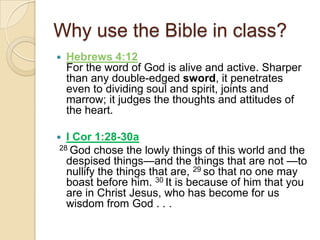
Why use the Bible in class?
   Hebrews 4:12
    For the word of God is alive and active. Sharper
    than any double-edged sword, it penetrates
    even to dividing soul and spirit, joints and
    marrow; it judges the thoughts and attitudes of
    the heart.

 I Cor 1:28-30a
28 God chose the lowly things of this world and the
  despised things—and the things that are not —to
  nullify the things that are, 29 so that no one may
  boast before him. 30 It is because of him that you
  are in Christ Jesus, who has become for us
  wisdom from God . . .

Comparative methods of collegiate, faith learning integration

  • 1.
    Comparative Methods of Collegiate,Faith- Learning Integration Jeff Beine, Ph.D. Malone University
  • 2.
    Background of thestudy  Arthur Holmes, PhD (Wheaton College)  Larry D. Burton & Constance C. Nwosu (2003): Student Perceptions of the Integration of Faith, Learning, and Practice In an Educational Methods Course, Journal of Research on Christian Education, 12:2, 101-135  Terry Anne Lawrence, Larry D. Burton & Constance C. Nwosu (2005): Refocusing on the Learning in ―Integration of Faith and Learning", Journal of Research on Christian Education, 14:1, 17-50
  • 3.
    What is thetrue mission of a Christian university?
  • 4.
    Wheaton College  Wheaton College exists to help build the church and improve society worldwide by promoting the development of whole and effective Christians through excellence in programs of Christian higher education.
  • 5.
    Messiah College  Our mission is to educate men and women toward maturity of intellect, character and Christian faith in preparation for lives of service, leadership and reconciliation in church and society.
  • 6.
    Azusa Pacific University  Azusa Pacific University is an evangelical Christian community of disciples and scholars who seek to advance the work of God in the world through academic excellence in liberal arts and professional programs of higher education that encourage students to develop a Christian perspective of truth and life.
  • 7.
    Biola University  The mission of Biola University is biblically centered education, scholarship and service—equipping men and women in mind and character to impact the world for the Lord Jesus Christ. Our business is to inspire student's learning so that they are empowered to think and practice from a Christian worldview in their fields of service.
  • 8.
    Malone University  The mission of Malone is to provide students with an education based on biblical faith in order to develop men and women in intellectual maturity, wisdom, and Christian faith who are committed to serve the church, community and world.
  • 9.
    1 Corinthians 2:16(NIV) 16 for,―Who has known the mind of the Lord so as to instruct him?‖[a] But we have the mind of Christ.
  • 10.
    Methods  Undergraduate, educationmajors  Voluntary, anonymous survey given at the end of an Ed Psych course  Females = 32  Males = 12
  • 11.
    Types of integrativemethods considered for this survey  Memorization of Bible verses  Readings from Christian authors  Watching Christian films  Writing: responding to specific verses  Writing: finding verses to apply  Viewing verses embedded in lecture notes  Teacher-led discussions: assigned films/readings  Teacher-led discussions: spiritual issues related to lecture content  Teacher-led discussions: spiritual issues related to current event topics  Small group discussion: spiritual issues related to course content
  • 12.
    Females responses (n= 32) Males responses (n = 12) #1: Tchr: spiritual issues rel. #1: Watching Christian films lectures #2: Tchr: spiritual issues rel. #2: Watching Christian films current events in the news #3: Tchr: spiritual issues rel. #3: Embedded verses in lect notes current events in the news #4: Tchr: spiritual issues rel. #4: Writing: find/apply own verses lecture #5: Writing: respond to spec #5: Memorizing verses verses #6: Writing: find/apply own verses #6: Tchr: analysis of #7: Tchr: analysis of films/readings films/readings #7: Embedded verses in lect notes #8: Writing: respond to spec #8: Memorizing verses verses Student Ratings Small group discussions #9: Reading from Christian authors #9: of Method #10: Reading from Christian Effectiveness (1-4) #10: Small group discussions authors
  • 13.
    RATINGS (both genders) RANKINGS (both genders) 1: Watching Christian films 1: Tchr-led discuss: 2: Tchr-led discuss: lectures lectures 2: Tchr-led discuss: cur 3: Tchr-led discuss: cur evnts evnts 3: Writing: find/apply 4: Writing: find/apply verses verses 4: Tchr-led discuss: films/rd 5: Writing: to specific 5: Writing: to specific verses verses 6: Tchr-led discuss: films/rd 6: Watching Christian films 7: Verses emb in lectures 7: Verses emb in lectures 8: Memorizing verses 8: Small group discussions Methods’ Ratings vs 9: Reading of Christian authors 9: Memorizing verses 10: Reading of Christian Rankings 10: Small group discussions authors
  • 14.
    More, Less, orAbout Right?  Amt of Bible reading / verse memorization  Amt of biblical analysis/appl in writing  Amt of CT discussing how specific verses apply  Amt of CT hearing profs dis/debate Chr issues  Amt of CT of students dis/debate Chr issues  Amt of exposure to important Chr authors  Use of the Bible in class by professors  Use of Chr reasoning in class by professors
  • 15.
    Grouping by collegeselection motivations (Was biblical, Christian university in your Top 2?) 12 10 8 males - no Bible choice 6 females - no Bib choice males - Bible in choice females - Bible in choice 4 2 0 FAITH CHR EVAN CH MOR NON
  • 16.
    Agree #1: Homework:Reading & Memorizing Bible verses Amt of Bible reading and Scripture memorization 25 20 15 10 5 0 MORE(noB) LESS(noB) RIGHT(NoB) MORE(B) LESS(B) RIGHT(B)
  • 17.
    Agree #2: UsingBible in writing Amt of biblical analysis/appl in writing assignments 18 16 14 12 10 8 6 4 2 0 MORE(noB) LESS(noB) RIGHT(NoB) MORE(B) LESS(B) RIGHT(B)
  • 18.
    Agree #3: ReadingChr authors Amt of exposure to important Christian authors 25 20 15 10 5 0 MORE(noB) LESS(noB) RIGHT(NoB) MORE(B) LESS(B) RIGHT(B)
  • 19.
    Agree #4: Christianreasoning Use of Christian reasoning in class by professors 25 20 15 10 5 0 MORE(noB) LESS(noB) RIGHT(NoB) MORE(B) LESS(B) RIGHT(B)
  • 20.
    Diff #1: Profsapply verses Amt of CT discussing how specific Bible verses apply to lecture content 25 20 15 10 5 0 MORE(noB) LESS(noB) RIGHT(NoB) MORE(B) LESS(B) RIGHT(B)
  • 21.
    Diff #2: Hearingprofs debate Amt of CT hearing profs discussing/debating Christian issues 25 20 15 10 5 0 MORE(noB) LESS(noB) RIGHT(NoB) MORE(B) LESS(B) RIGHT(B)
  • 22.
    Diff #3: Studentsdebating Amt of CT students themselves dis/debate Chr issues 20 18 16 14 12 10 8 6 4 2 0 MORE(noB) LESS(noB) RIGHT(NoB) MORE(B) LESS(B) RIGHT(B)
  • 23.
    Diff #4: Profsusing the Bible Use of Bible in class by professors 25 20 15 10 5 0 MORE(noB) LESS(noB) RIGHT(NoB) MORE(B) LESS(B) RIGHT(B)
  • 24.
    Voices of studentswho didn’t indicate a desire for a biblical, Christian education  There is a lack of integration of different races, sexual orientations.  They constantly push for Christian worship activities requiring 20 chapels per semester.  Sometimes faith is pushed on students too hard and they turn away from it.  It’s getting in the way in science and actual critical thinking.  Don't push it on non-believers too much, but overall they are very effective.
  • 25.
    Voices of studentswho indicated support for Malone’s mission for a biblical, Christian education (guys)  We're always talking to new believers -- I want more.  People are hostile to learning about this when it's forced on them; those that care will learn and those that don't care will harden themselves against it.  The topics of faith and Christ never come up in class unless a student brings it up. This school needs help.  The aspect that I like most about Malone is that the professors are genuine about their faith and their job. This passion has a trickle down effect to the students.  This school can no longer be Christ's Kingdom first, which it barely is now. The liberals are taking over and we're letting them.  I think Malone does a good job in their teaching of education and biblical faith.
  • 26.
    Voices of studentswho indicated support for Malone’s mission for a biblical, Christian education (girls)  Nothing - we are a Christian school that should not be watered down in order not to offend nonbelievers.  Not a lot of courses use the time to speak about faith because they need to lecture.  The professors, faculty, and staff show that they truly care and definitely integrate Christian faith, but it is still lacking much discussion about it and needs more relation to lessons.  Classes that aren't Bible classes tend to leave out God and the Bible for the most part -- only one and maybe two often talk about God. Malone being a Christian university should plan more of that.  Malone profs are open about their faith and do a great job of integrating their faith daily.  I can see just by how the professors treat their students that they are Christians but I feel that they could make more of an effort to integrate that faith into their lessons.
  • 27.
    Conclusions  Previous findingsconfirmed – influence of the teacher seems to be the primary (and most desired) factor for faith- learning integration  Our university’s mission is indeed supported by students: most desire a biblical, Christian education  Though students not seeking a Christian education are satisfied, the vast majority of students want the Bible used more often and more specifically in class
  • 28.
    Why use theBible in class?  Hebrews 4:12 For the word of God is alive and active. Sharper than any double-edged sword, it penetrates even to dividing soul and spirit, joints and marrow; it judges the thoughts and attitudes of the heart.  I Cor 1:28-30a 28 God chose the lowly things of this world and the despised things—and the things that are not —to nullify the things that are, 29 so that no one may boast before him. 30 It is because of him that you are in Christ Jesus, who has become for us wisdom from God . . .