Comparative and Superlative
Comparative
Is the name for the grammar used when
comparing two things. The two basic ways to
compare are using as .. as or than.
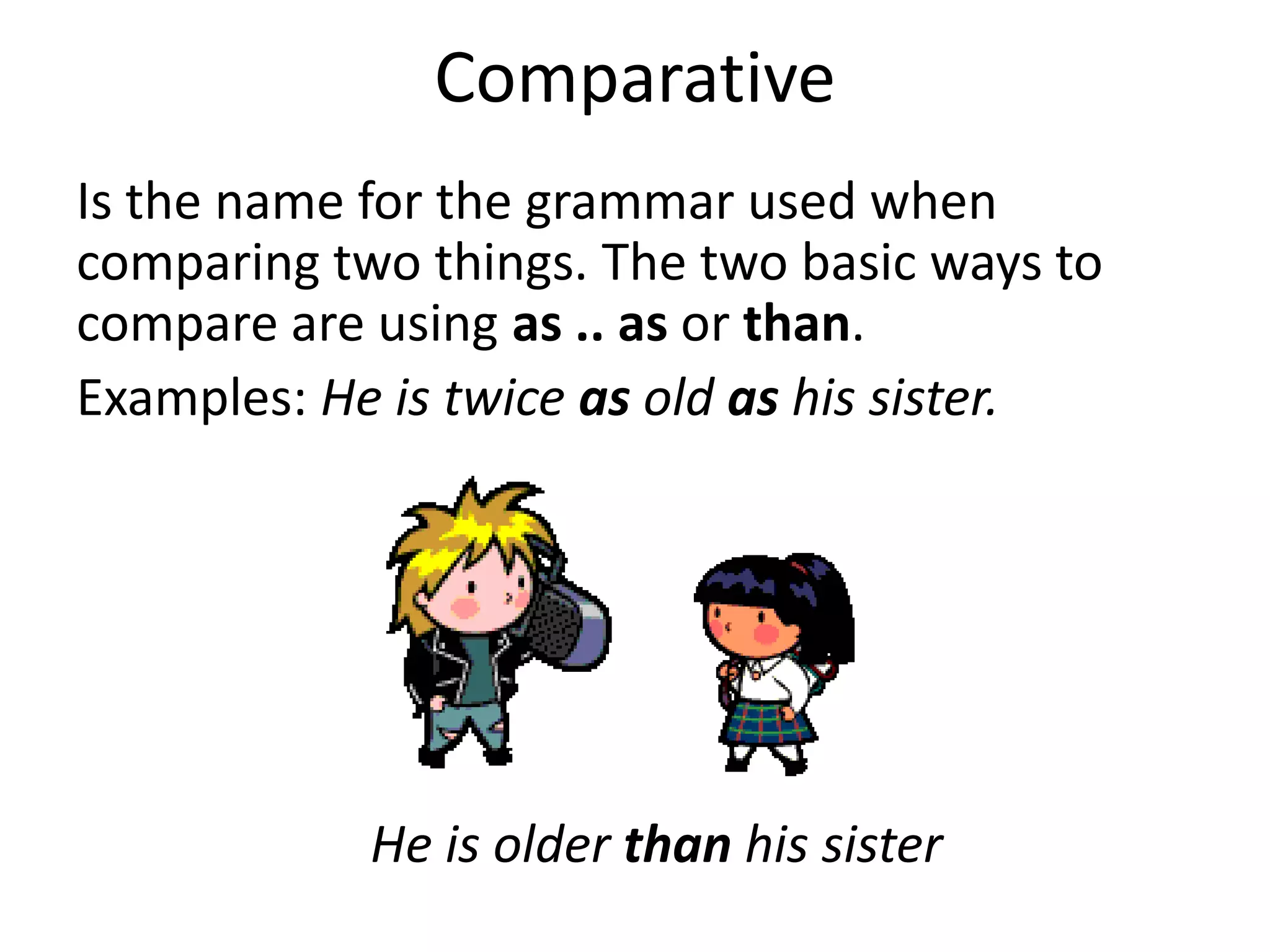
Examples: He is twice as old as his sister.

He is older than his sister
When comparing with as .. as, the adjective does not
change. When comparing with than, however, some
changes are necessary, depending on the number of
syllables the adjective:
one-syllable adjectives: add -er to the adjective
tall  taller
cold  colder

two-syllable adjectives ending in -y: change the -y
to -ier
happy  happier
easy  easier
lucky  luckier
Other 2-syllable adjectives: use more with the
unchanged adjective
crowded  more crowded
boring  more boring
careful  more careful
Adjectives with 3 or more syllables: use more with the
unchanged adjective
difficult  more difficult
intelligent  more intelligent
enjoyable  more enjoyable
irritating  more irritating
Superlative
In the superlative you talk about one thing only
and how it is the best, worst, etc. You do not
compare two things.
Examples: He is the tallest of the class.

She is the youngest of the family
one-syllable adjectives: add -est to the adjective plus
“the”
tall  (the) tallest
cold  (the) coldest
two-syllable adjectives ending in -y: change the -y
to -iest plus “the”
happy  (the) happiest
easy  (the) easiest
lucky  (the) luckiest
Other 2-syllable adjectives: use most with the
unchanged adjective
crowded  (the) most crowded
boring  (the) most boring
careful  (the) most careful
Adjectives with 3 or more syllables: use most with the
unchanged adjective
difficult  (the) most difficult
intelligent  (the) most intelligent
enjoyable  (the) most enjoyable
irritating  (the) most irritating
Exceptions
Irregular adjectives:
Adjective

Comparative

Superlative

good

better

best

bad

worse

worst

far

farther

farthest

little

less

least

many

more

most
Fill in the gaps with the comparative or
superlative form of the adjectives given.
1. A rock is _________ than a leaf. (heavy)
2. Our house is __________than yours. (big)
3. The princess is _________ than the witch. (beautiful)
4. Tom is a ___________ student than Mary. (good)
5. Bicycles are _________ than motorbikes. (safe)
6. Jim is the ________ player in the football team. (good)
7. Elephants are the ____________ animals. (heavy)
8. Let's pick the _____________ apple of the tree. (big)
9. Mary is the ____________ girl in the class. (thin)
10. That is the ________ sofa in our house. (comfortable)
Demonstrative pronouns
demonstrate (verb): to show; to indicate; to
point to
A demonstrative pronoun represents a thing or
things:
near in distance or time (this, these)
far in distance or time (that, those)
demonstrate (verb): to show; to indicate; to
point to
A demonstrative pronoun represents a thing or
things:
near in distance or time (this, these)
far in distance or time (that, those)
Do not confuse demonstrative pronouns with
demonstrative adjectives. They are identical, but
a demonstrative pronoun stands alone, while a
demonstrative adjective qualifies a noun:

That smells. (demonstrative pronoun)

That book is good. (demonstrative adjective + noun)
Exercise
Choose the correct answer.
1. __________ book is
expensive.
a) This
b) These
2. __________ cat is small.
a) That
b) Those
3. __________ pens are blue.
a) This
b) These

4. __________ movie is funny.
a) That
b) Those
5. __________ airplanes are
very big.
a) That
b) Those
6. __________ morning is
perfect for a walk.
a) This
b) These

9.__________ children are cold.
a) That
b) Those

7. __________ car is expensive. 10. __________ food is healthy.
a) That
a) This
b) Those
b) These
8. __________ candy is
delicious.
a) This
b) These

Comparative and superlative 5to

  • 1.
  • 2.
    Comparative Is the namefor the grammar used when comparing two things. The two basic ways to compare are using as .. as or than. Examples: He is twice as old as his sister. He is older than his sister
  • 3.
    When comparing withas .. as, the adjective does not change. When comparing with than, however, some changes are necessary, depending on the number of syllables the adjective: one-syllable adjectives: add -er to the adjective tall  taller cold  colder two-syllable adjectives ending in -y: change the -y to -ier happy  happier easy  easier lucky  luckier
  • 4.
    Other 2-syllable adjectives:use more with the unchanged adjective crowded  more crowded boring  more boring careful  more careful Adjectives with 3 or more syllables: use more with the unchanged adjective difficult  more difficult intelligent  more intelligent enjoyable  more enjoyable irritating  more irritating
  • 5.
    Superlative In the superlativeyou talk about one thing only and how it is the best, worst, etc. You do not compare two things. Examples: He is the tallest of the class. She is the youngest of the family
  • 6.
    one-syllable adjectives: add-est to the adjective plus “the” tall  (the) tallest cold  (the) coldest two-syllable adjectives ending in -y: change the -y to -iest plus “the” happy  (the) happiest easy  (the) easiest lucky  (the) luckiest
  • 7.
    Other 2-syllable adjectives:use most with the unchanged adjective crowded  (the) most crowded boring  (the) most boring careful  (the) most careful Adjectives with 3 or more syllables: use most with the unchanged adjective difficult  (the) most difficult intelligent  (the) most intelligent enjoyable  (the) most enjoyable irritating  (the) most irritating
  • 8.
  • 9.
    Fill in thegaps with the comparative or superlative form of the adjectives given. 1. A rock is _________ than a leaf. (heavy) 2. Our house is __________than yours. (big) 3. The princess is _________ than the witch. (beautiful) 4. Tom is a ___________ student than Mary. (good) 5. Bicycles are _________ than motorbikes. (safe) 6. Jim is the ________ player in the football team. (good) 7. Elephants are the ____________ animals. (heavy) 8. Let's pick the _____________ apple of the tree. (big) 9. Mary is the ____________ girl in the class. (thin) 10. That is the ________ sofa in our house. (comfortable)
  • 10.
  • 11.
    demonstrate (verb): toshow; to indicate; to point to A demonstrative pronoun represents a thing or things: near in distance or time (this, these) far in distance or time (that, those)
  • 12.
    demonstrate (verb): toshow; to indicate; to point to A demonstrative pronoun represents a thing or things: near in distance or time (this, these) far in distance or time (that, those)
  • 13.
    Do not confusedemonstrative pronouns with demonstrative adjectives. They are identical, but a demonstrative pronoun stands alone, while a demonstrative adjective qualifies a noun: That smells. (demonstrative pronoun) That book is good. (demonstrative adjective + noun)
  • 14.
    Exercise Choose the correctanswer. 1. __________ book is expensive. a) This b) These 2. __________ cat is small. a) That b) Those 3. __________ pens are blue. a) This b) These 4. __________ movie is funny. a) That b) Those 5. __________ airplanes are very big. a) That b) Those
  • 15.
    6. __________ morningis perfect for a walk. a) This b) These 9.__________ children are cold. a) That b) Those 7. __________ car is expensive. 10. __________ food is healthy. a) That a) This b) Those b) These 8. __________ candy is delicious. a) This b) These