Download to read offline
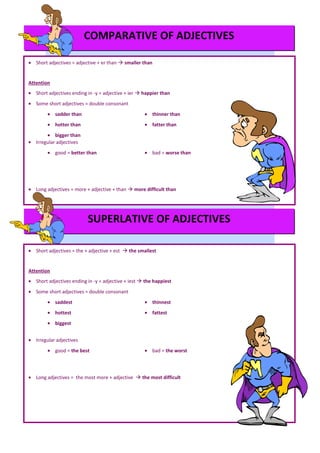
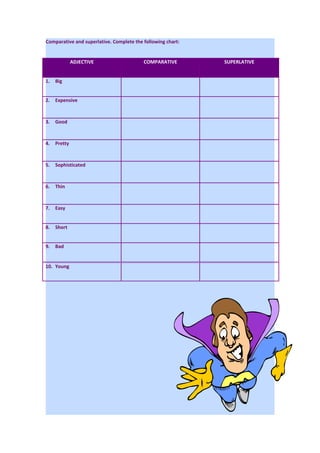

This document provides rules for forming the comparative and superlative forms of adjectives in English. It explains that short adjectives take -er/iest for the comparative/superlative (smaller/smallest), short adjectives ending in -y take -ier/-iest (happier/happiest), and some take a double consonant (sadder/saddest). Long adjectives take more/most before the adjective. It also lists irregular forms such as good/better/best and bad/worse/worst and provides a chart to complete with comparative and superlative forms of sample adjectives.


![Endangered Animals Powerpoint[1]](https://cdn.slidesharecdn.com/ss_thumbnails/endangeredanimalspowerpoint1-1216494381489015-9-thumbnail.jpg?width=640&height=640&fit=bounds)


