07(032), 075-098
Comparative Analysis of Different Drilling
Fluid Additives
Toshabindu panigrahi
April 2024
Abstract
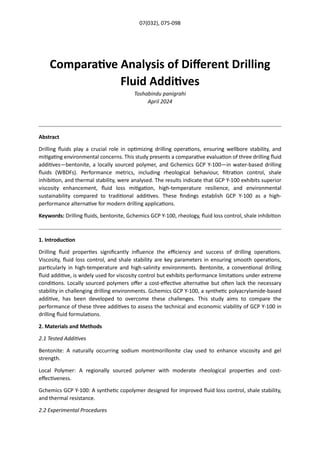
Drilling fluids play a crucial role in optimizing drilling operations, ensuring wellbore stability, and
mitigating environmental concerns. This study presents a comparative evaluation of three drilling fluid
additives—bentonite, a locally sourced polymer, and Gchemics GCP Y-100—in water-based drilling
fluids (WBDFs). Performance metrics, including rheological behaviour, filtration control, shale
inhibition, and thermal stability, were analysed. The results indicate that GCP Y-100 exhibits superior
viscosity enhancement, fluid loss mitigation, high-temperature resilience, and environmental
sustainability compared to traditional additives. These findings establish GCP Y-100 as a high-
performance alternative for modern drilling applications.
Keywords: Drilling fluids, bentonite, Gchemics GCP Y-100, rheology, fluid loss control, shale inhibition
1. Introduction
Drilling fluid properties significantly influence the efficiency and success of drilling operations.
Viscosity, fluid loss control, and shale stability are key parameters in ensuring smooth operations,
particularly in high-temperature and high-salinity environments. Bentonite, a conventional drilling
fluid additive, is widely used for viscosity control but exhibits performance limitations under extreme
conditions. Locally sourced polymers offer a cost-effective alternative but often lack the necessary
stability in challenging drilling environments. Gchemics GCP Y-100, a synthetic polyacrylamide-based
additive, has been developed to overcome these challenges. This study aims to compare the
performance of these three additives to assess the technical and economic viability of GCP Y-100 in
drilling fluid formulations.
2. Materials and Methods
2.1 Tested Additives
Bentonite: A naturally occurring sodium montmorillonite clay used to enhance viscosity and gel
strength.
Local Polymer: A regionally sourced polymer with moderate rheological properties and cost-
effectiveness.
Gchemics GCP Y-100: A synthetic copolymer designed for improved fluid loss control, shale stability,
and thermal resistance.
2.2 Experimental Procedures
07(032), 075-098
Rheological Analysis: Conducted using a Fann viscometer at 35°C with a 300-rpm test speed.
API Filtration Test: Fluid loss measured at 100 psi over 30 minutes.
Shale Recovery Test: Hot rolling dispersion test conducted at 80°C for 16 hours.
Thermal Stability Test: Samples aged at 150°C for 16 hours and re-evaluated.
3. Results and Discussion
3.1 Rheological Performance
GCP Y-100 demonstrated significantly higher viscosity than both bentonite and the local polymer. It
exhibited a 60% increase in apparent viscosity compared to bentonite and 100% compared to the local
polymer. Additionally, its higher yield point ensures superior cuttings suspension and enhances hole
cleaning efficiency, making it a more effective additive for drilling fluid formulations.
3.2 Fluid Loss Control
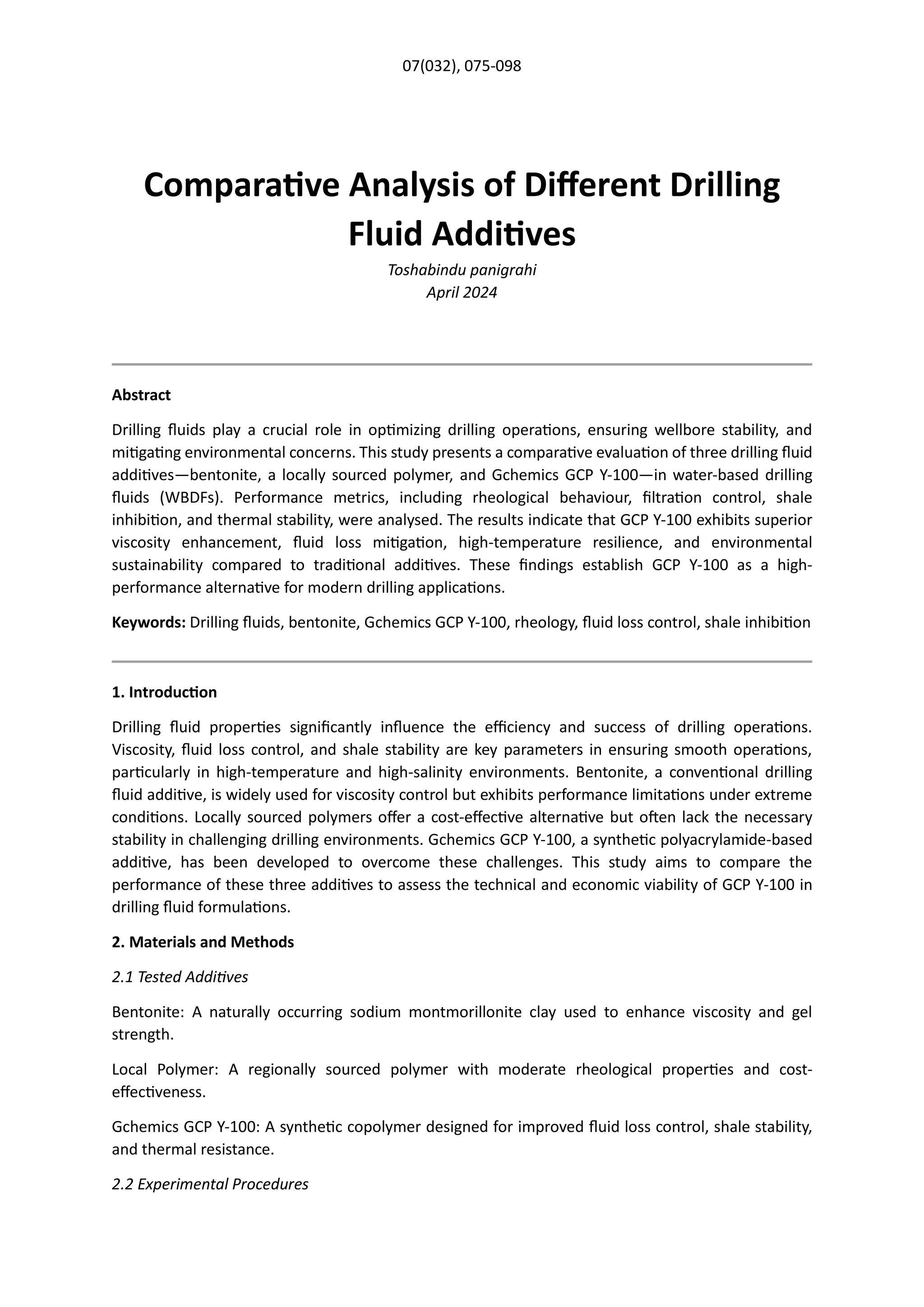
In fluid loss evaluations, GCP Y-100 significantly reduced filtrate loss compared to traditional additives.
It exhibited a 62% reduction in fluid loss compared to bentonite and a 57% reduction compared to the
local polymer. The thinner and more impermeable filter cake formed by GCP Y-100 enhances wellbore
stability, preventing fluid invasion into formations and improving overall drilling efficiency.
Table 1: Fluid loss comparison
Additive Fluid Loss (ml/30 min) Filter Cake Thickness (mm)
Bentonite 16 3.5
Local Polymer 14 2.8
GCP Y-100 6 1.2
3.3 Shale Inhibition
Shale recovery tests confirmed that GCP Y-100 provides superior inhibition properties. With a shale
recovery rate of 90%, it significantly outperforms bentonite (50%) and the local polymer (60%). The
strong inhibition characteristics of GCP Y-100 effectively reduce clay swelling, minimizing the risk of
wellbore collapse in reactive formations.
Table 2: Shale recovery comparison of different drilling additives
Additive Shale Recovery (%) Clay Swelling Reduction (%)
Bentonite 50 30
Local Polymer 60 40
GCP Y-100 90 75
07(032), 075-098
3.4 Thermal and Salinity Stability
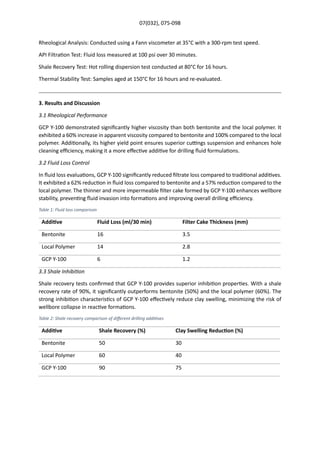
GCP Y-100 exhibited remarkable thermal stability, remaining effective at temperatures up to 180°C,
whereas bentonite degraded above 120°C and the local polymer-maintained stability only up to 130°C.
Furthermore, in high-salinity conditions (100,000 ppm NaCl), GCP Y-100 experienced less than a 10%
viscosity loss, whereas bentonite and the local polymer exhibited significant reductions in
performance. These results highlight the superior resilience of GCP Y-100 under extreme
environmental conditions.
Table 3: Thermal stability of different drilling additives
Additive Thermal Stability (150°C) Salt Tolerance (100,000 ppm NaCl)
Bentonite Degrades above 120°C Poor (viscosity drops >50%)
Local Polymer Stable up to 130°C Moderate (30% viscosity loss)
GCP Y-100 Stable up to 180°C <10% viscosity loss
4. Conclusion
This study demonstrates that Gchemics GCP Y-100 surpasses bentonite and locally sourced polymers
in all key drilling fluid performance metrics. Its advantages include significantly higher viscosity for
improved cuttings transport, reduced fluid loss for enhanced wellbore stability, and superior shale
recovery to prevent formation damage. Additionally, GCP Y-100 offers remarkable thermal and salt
tolerance, making it suitable for extreme drilling conditions. Beyond its technical performance, GCP Y-
100 is environmentally sustainable and cost-effective over time, despite a higher initial investment. For
drilling operations requiring efficiency, cost-effectiveness, and regulatory compliance, GCP Y-100
presents a compelling choice as a high-performance drilling fluid additive.
5. References
1. API 13B-1 (2017). Recommended Practice for Field Testing Water-Based Drilling Fluids.
2. Patel, A.D. (2020). Advanced Fluid Loss Control in HPHT Wells. SPE Journal.
3. Amanullah, M., & Al-Tahini, A. M. (2009). Nano-technology—its significance in smart fluid
development for oil and gas field applications. SPE Journal.
4. Caenn, R., Darley, H. C. H., & Gray, G. R. (2011). Composition and properties of drilling and
completion fluids. Gulf Professional Publishing.
5. Gaurina-Međimurec, N. (2013). Drilling fluids for oil and gas industry. InTech.
6. Hemphill, T. (1998). The effect of drilling fluid rheology on hole cleaning in deviated wells.
Journal of Petroleum Science and Engineering, 19(3-4), 157-164.
7. Howard, J. J., & Scott, P. P. (2018). Polymer-enhanced drilling fluids: Performance
improvement in challenging environments. Journal of Energy Resources Technology, 140(6).
8. Kelessidis, V. C., & Maglione, R. (2008). Drilling fluid rheology and hydraulics for extended
reach and horizontal wells. SPE Drilling & Completion, 23(3), 297-307.
9. Li, M., Zhang, H., & Zhang, J. (2016). High-performance polymer drilling fluids for high-
temperature and high-pressure wells. Journal of Natural Gas Science and Engineering, 35,
1280-1288.
10. Oort, E. V., & Rojas, J. (2013). Novel shale stabilizing drilling fluid for deepwater applications.
SPE Drilling & Completion, 28(1), 21-30.
07(032), 075-098
11. Reid, P. M., & Anderson, S. (2015). Environmental impact of drilling fluid additives in offshore
operations. Environmental Science & Technology, 49(14), 8711-8720.
12. Zhang, P., Liu, Y., & Wang, S. (2020). Experimental evaluation of polymer-based drilling fluids
for enhanced wellbore stability. Journal of Petroleum Science and Engineering, 190, 106863.

Comparative Analysis of Different Drilling Fluid Additives

  • 1.
    07(032), 075-098 Comparative Analysisof Different Drilling Fluid Additives Toshabindu panigrahi April 2024 Abstract Drilling fluids play a crucial role in optimizing drilling operations, ensuring wellbore stability, and mitigating environmental concerns. This study presents a comparative evaluation of three drilling fluid additives—bentonite, a locally sourced polymer, and Gchemics GCP Y-100—in water-based drilling fluids (WBDFs). Performance metrics, including rheological behaviour, filtration control, shale inhibition, and thermal stability, were analysed. The results indicate that GCP Y-100 exhibits superior viscosity enhancement, fluid loss mitigation, high-temperature resilience, and environmental sustainability compared to traditional additives. These findings establish GCP Y-100 as a high- performance alternative for modern drilling applications. Keywords: Drilling fluids, bentonite, Gchemics GCP Y-100, rheology, fluid loss control, shale inhibition 1. Introduction Drilling fluid properties significantly influence the efficiency and success of drilling operations. Viscosity, fluid loss control, and shale stability are key parameters in ensuring smooth operations, particularly in high-temperature and high-salinity environments. Bentonite, a conventional drilling fluid additive, is widely used for viscosity control but exhibits performance limitations under extreme conditions. Locally sourced polymers offer a cost-effective alternative but often lack the necessary stability in challenging drilling environments. Gchemics GCP Y-100, a synthetic polyacrylamide-based additive, has been developed to overcome these challenges. This study aims to compare the performance of these three additives to assess the technical and economic viability of GCP Y-100 in drilling fluid formulations. 2. Materials and Methods 2.1 Tested Additives Bentonite: A naturally occurring sodium montmorillonite clay used to enhance viscosity and gel strength. Local Polymer: A regionally sourced polymer with moderate rheological properties and cost- effectiveness. Gchemics GCP Y-100: A synthetic copolymer designed for improved fluid loss control, shale stability, and thermal resistance. 2.2 Experimental Procedures
  • 2.
    07(032), 075-098 Rheological Analysis:Conducted using a Fann viscometer at 35°C with a 300-rpm test speed. API Filtration Test: Fluid loss measured at 100 psi over 30 minutes. Shale Recovery Test: Hot rolling dispersion test conducted at 80°C for 16 hours. Thermal Stability Test: Samples aged at 150°C for 16 hours and re-evaluated. 3. Results and Discussion 3.1 Rheological Performance GCP Y-100 demonstrated significantly higher viscosity than both bentonite and the local polymer. It exhibited a 60% increase in apparent viscosity compared to bentonite and 100% compared to the local polymer. Additionally, its higher yield point ensures superior cuttings suspension and enhances hole cleaning efficiency, making it a more effective additive for drilling fluid formulations. 3.2 Fluid Loss Control In fluid loss evaluations, GCP Y-100 significantly reduced filtrate loss compared to traditional additives. It exhibited a 62% reduction in fluid loss compared to bentonite and a 57% reduction compared to the local polymer. The thinner and more impermeable filter cake formed by GCP Y-100 enhances wellbore stability, preventing fluid invasion into formations and improving overall drilling efficiency. Table 1: Fluid loss comparison Additive Fluid Loss (ml/30 min) Filter Cake Thickness (mm) Bentonite 16 3.5 Local Polymer 14 2.8 GCP Y-100 6 1.2 3.3 Shale Inhibition Shale recovery tests confirmed that GCP Y-100 provides superior inhibition properties. With a shale recovery rate of 90%, it significantly outperforms bentonite (50%) and the local polymer (60%). The strong inhibition characteristics of GCP Y-100 effectively reduce clay swelling, minimizing the risk of wellbore collapse in reactive formations. Table 2: Shale recovery comparison of different drilling additives Additive Shale Recovery (%) Clay Swelling Reduction (%) Bentonite 50 30 Local Polymer 60 40 GCP Y-100 90 75
  • 3.
    07(032), 075-098 3.4 Thermaland Salinity Stability GCP Y-100 exhibited remarkable thermal stability, remaining effective at temperatures up to 180°C, whereas bentonite degraded above 120°C and the local polymer-maintained stability only up to 130°C. Furthermore, in high-salinity conditions (100,000 ppm NaCl), GCP Y-100 experienced less than a 10% viscosity loss, whereas bentonite and the local polymer exhibited significant reductions in performance. These results highlight the superior resilience of GCP Y-100 under extreme environmental conditions. Table 3: Thermal stability of different drilling additives Additive Thermal Stability (150°C) Salt Tolerance (100,000 ppm NaCl) Bentonite Degrades above 120°C Poor (viscosity drops >50%) Local Polymer Stable up to 130°C Moderate (30% viscosity loss) GCP Y-100 Stable up to 180°C <10% viscosity loss 4. Conclusion This study demonstrates that Gchemics GCP Y-100 surpasses bentonite and locally sourced polymers in all key drilling fluid performance metrics. Its advantages include significantly higher viscosity for improved cuttings transport, reduced fluid loss for enhanced wellbore stability, and superior shale recovery to prevent formation damage. Additionally, GCP Y-100 offers remarkable thermal and salt tolerance, making it suitable for extreme drilling conditions. Beyond its technical performance, GCP Y- 100 is environmentally sustainable and cost-effective over time, despite a higher initial investment. For drilling operations requiring efficiency, cost-effectiveness, and regulatory compliance, GCP Y-100 presents a compelling choice as a high-performance drilling fluid additive. 5. References 1. API 13B-1 (2017). Recommended Practice for Field Testing Water-Based Drilling Fluids. 2. Patel, A.D. (2020). Advanced Fluid Loss Control in HPHT Wells. SPE Journal. 3. Amanullah, M., & Al-Tahini, A. M. (2009). Nano-technology—its significance in smart fluid development for oil and gas field applications. SPE Journal. 4. Caenn, R., Darley, H. C. H., & Gray, G. R. (2011). Composition and properties of drilling and completion fluids. Gulf Professional Publishing. 5. Gaurina-Međimurec, N. (2013). Drilling fluids for oil and gas industry. InTech. 6. Hemphill, T. (1998). The effect of drilling fluid rheology on hole cleaning in deviated wells. Journal of Petroleum Science and Engineering, 19(3-4), 157-164. 7. Howard, J. J., & Scott, P. P. (2018). Polymer-enhanced drilling fluids: Performance improvement in challenging environments. Journal of Energy Resources Technology, 140(6). 8. Kelessidis, V. C., & Maglione, R. (2008). Drilling fluid rheology and hydraulics for extended reach and horizontal wells. SPE Drilling & Completion, 23(3), 297-307. 9. Li, M., Zhang, H., & Zhang, J. (2016). High-performance polymer drilling fluids for high- temperature and high-pressure wells. Journal of Natural Gas Science and Engineering, 35, 1280-1288. 10. Oort, E. V., & Rojas, J. (2013). Novel shale stabilizing drilling fluid for deepwater applications. SPE Drilling & Completion, 28(1), 21-30.
  • 4.
    07(032), 075-098 11. Reid,P. M., & Anderson, S. (2015). Environmental impact of drilling fluid additives in offshore operations. Environmental Science & Technology, 49(14), 8711-8720. 12. Zhang, P., Liu, Y., & Wang, S. (2020). Experimental evaluation of polymer-based drilling fluids for enhanced wellbore stability. Journal of Petroleum Science and Engineering, 190, 106863.