Iron Ore Filtration Enhancement
Prepared By – Janapriya Roy
Prepared On – March,2025
Abstract
Iron ore filtration is a significant and critical process in the overall dewatering and beneficiation
processes involved in iron ore concentrate handling. The process directly affects many significant
factors like the moisture content of the final product, the processing costs of processing, as well as the
overall efficiency of downstream processing operations. In this particular study, we present the
investigation of the application of a fatty alcohol-based surfactant, utilized as a filtration aid to enhance
the efficiency of dewatering operations. By effectively reducing the moisture content of the cake,
accelerating filtration rates, and optimizing various operational parameters, this surfactant demonstrates
its huge potential in resolving major issues involved in the iron ore processing industry. The
experimental results obtained from the current study reveal a remarkable 15% reduction in moisture
content, as well as a whopping 20% improvement in filtration speed, which together demonstrate the
efficacy of the surfactant. Moreover, the findings of the current research reveal the critical necessity for
utilizing sustainable and cost-effective filtration aids to meet the ever-growing demands of the iron ore
industry, while still complying with environmental standards and regulations.
Keywords:
Iron ore filtration, Fatty alcohol-based surfactant, Dewatering efficiency, Filtration aid,
Moisture reduction, Surface tension reduction, Pressure filtration, Non-ionic surfactants,
Hydrophobic modification, Capillary force reduction.
1. Introduction
Iron ore processing is a complex and resource-intensive industrial undertaking, encompassing a sequence
of essential operations designed to transform raw ore into a usable form. This intricate process typically
involves crushing and grinding to reduce the size of the raw ore, followed by beneficiation techniques such
as magnetic separation, flotation, or gravity separation, to increase the concentration of iron-bearing
minerals while removing impurities. Critically, the dewatering phase, often executed through filtration,
aims to remove excess water from the processed ore slurry, resulting in a filter cake. This dewatering phase
holds immense significance as it directly impacts the final product's moisture content, with elevated
residual moisture in the filter cake triggering a cascade of detrimental effects, including increased
transportation costs, elevated energy consumption in pelletization, quality degradation in downstream
processes, and environmental concerns. The global demand for iron ore continues to surge, fueled by rapid
industrialization and urbanization, placing substantial pressure on the iron ore industry to enhance
operational efficiency while simultaneously minimizing its environmental impact. In response to these
challenges, research is actively exploring novel approaches to optimize iron ore filtration. Specifically, the
investigation of fatty alcohol-based surfactants, commonly referred to as filter aids or dewatering aids, is
being pursued as a promising "green" and efficient solution. These aids function by reducing the surface
tension of water and altering the surface properties of the mineral particles, making them more
hydrophobic, which facilitates the removal of water during filtration, leading to a drier filter cake. Using
effective filter/dewatering aids is crucial for reducing moisture content, improving filtration rates, lowering
transportation costs, reducing energy consumption in downstream processes, and enhancing overall process
efficiency. Fatty alcohol-based surfactants are being considered due to their potential biodegradability and
lower toxicity compared to traditional surfactants, aligning with the industry's growing emphasis on
sustainability.
Current Scenario of Iron Ore Processing
2.1 Global Iron Ore Demand and Production Trends
The global demand for iron ore has remained strong, particularly in Asia, where countries like China
and India are undergoing rapid industrialization and infrastructure development. According to recent
industry reports, global iron ore production exceeded 2.5 billion metric tons in 2022, with Australia,
Brazil, and India being the leading producers. However, declining ore grades and the increasing
proportion of ultrafine particles in beneficiated concentrates have posed significant challenges for
mining and processing operations. Efficient dewatering of iron ore fines, which constitute a substantial
portion of beneficiated ore, is essential to ensure commercial viability and meet quality standards.
2.2 Challenges in Iron Ore Filtration
High Moisture Content: Conventional filtration methods often fail to achieve optimal moisture
reduction, resulting in filter cakes with high residual moisture. This not only increases handling and
transportation costs but also negatively impacts downstream processes such as pelletization and
sintering.
Fine Particle Size: The presence of ultrafine particles in iron ore concentrates complicates filtration,
as these particles tend to retain more water due to their high surface area and capillary forces.
Operational Bottlenecks: High vacuum and pressure requirements for effective filtration contribute
to elevated energy consumption and maintenance costs.
Environmental Regulations: Stringent environmental regulations are driving the industry to adopt
sustainable and eco-friendly dewatering aids that minimize chemical usage and reduce environmental
footprint.
2.1 Iron Ore Demand and Production Trends
The global demand for iron ore has remained strong due to rapid industrialization and
urbanization, particularly in Asia. However, fluctuating ore grades and stringent environmental
regulations pose significant challenges for mining and processing operations. Iron ore fines,
often produced in beneficiation plants, require efficient dewatering to be commercially viable.
2.2 Filtration Challenges in Iron Ore Processing
High Moisture Content: Traditional filtration methods often leave high residual moisture,
leading to increased handling costs.
• Fine Particle Size: The increasing proportion of ultrafine particles in iron ore concentrates
makes filtration less efficient.
• Operational Bottlenecks: High vacuum and pressure requirements add to energy consumption
and maintenance costs.
• Environmental Regulations: Industries are shifting toward sustainable and eco-friendly
dewatering aids to meet compliance requirements.
3. Fatty Alcohol-Based Surfactants in Filtration
3.1 Chemical Properties of Fatty Alcohol-Based Surfactants
Fatty alcohol-based surfactants are non-ionic compounds derived from natural or synthetic
sources. These surfactants reduce surface tension and improve water drainage from filter cakes,
thereby enhancing filtration efficiency.
3.2 Mechanism of Action
Hydrophobic Modification: The surfactant adsorbs onto the iron ore surface, reducing its
affinity for water.
Reduction in Capillary Forces: By modifying the wettability of particles, the surfactant
minimizes water retention in the cake pores.
Enhanced Filtration Rate: Improved drainage leads to faster filtration cycles, increasing
throughput.
4. Experimental Approach
4.1 Materials and Methods
Iron Ore Sample: Sourced from a beneficiation plant with a high proportion of ultrafines.
Surfactant Used: A fatty alcohol ethoxylate-based filtration aid.
Filtration Setup: Vacuum filtration tests conducted to analyze moisture reduction.
Evaluation Parameters: Moisture content, filtration rate, and cake porosity were assessed.
4.2 Results and Discussion
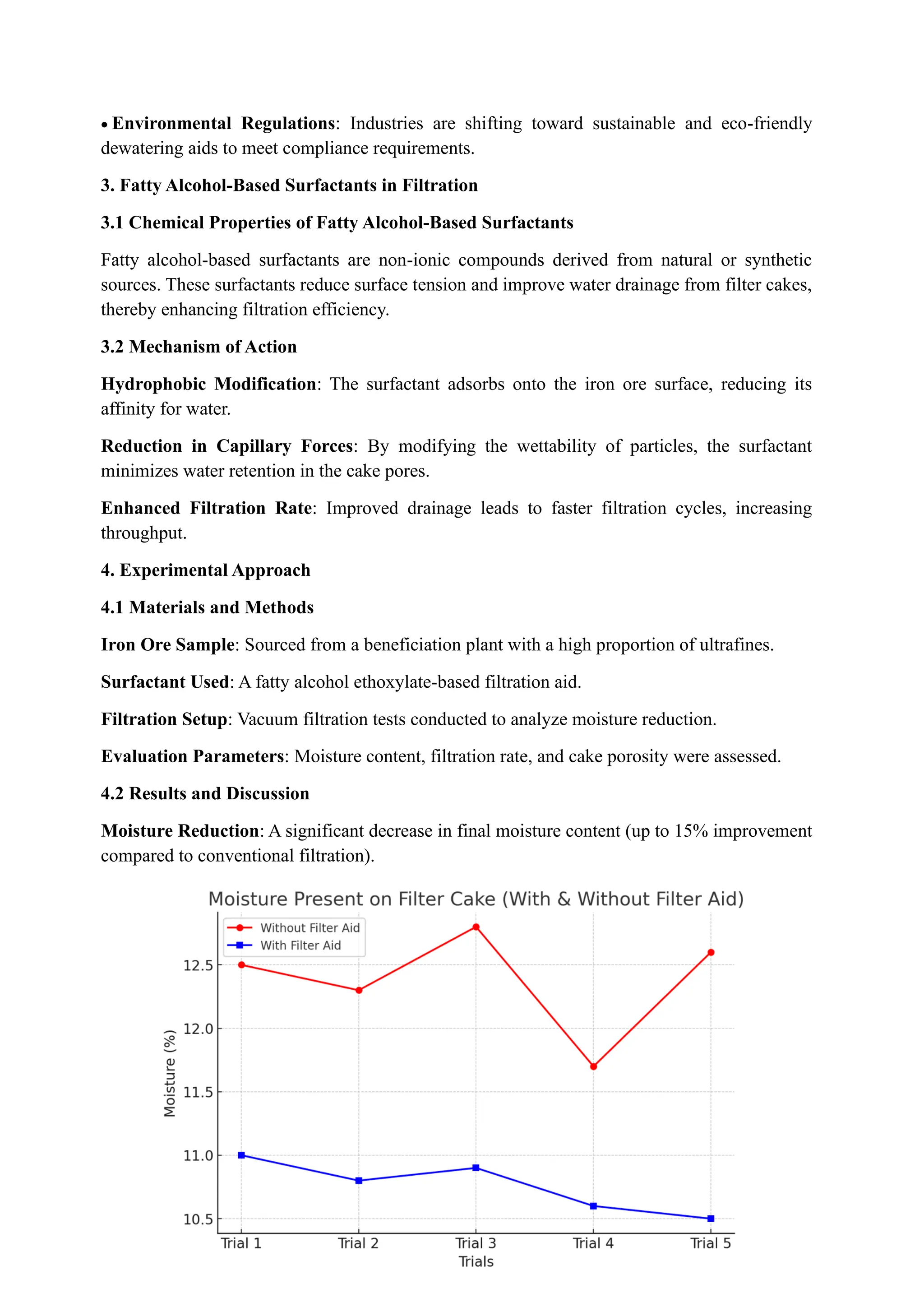
Moisture Reduction: A significant decrease in final moisture content (up to 15% improvement
compared to conventional filtration).
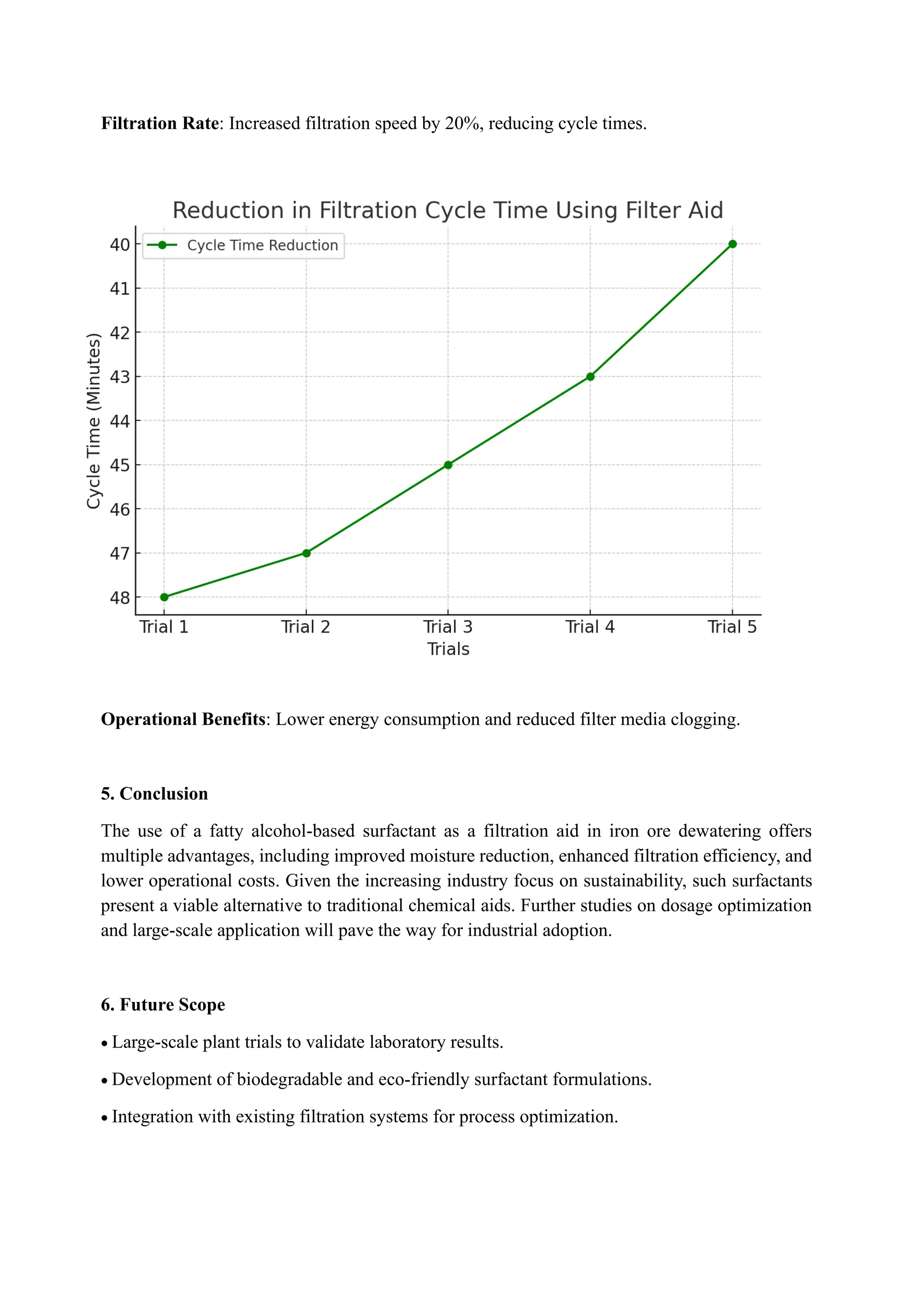
Filtration Rate: Increased filtration speed by 20%, reducing cycle times.
Operational Benefits: Lower energy consumption and reduced filter media clogging.
5. Conclusion
The use of a fatty alcohol-based surfactant as a filtration aid in iron ore dewatering offers
multiple advantages, including improved moisture reduction, enhanced filtration efficiency, and
lower operational costs. Given the increasing industry focus on sustainability, such surfactants
present a viable alternative to traditional chemical aids. Further studies on dosage optimization
and large-scale application will pave the way for industrial adoption.
6. Future Scope
• Large-scale plant trials to validate laboratory results.
• Development of biodegradable and eco-friendly surfactant formulations.
• Integration with existing filtration systems for process optimization.
References
• Agarwal, A., & Kumar, S. (2022). "Advancements in Iron Ore Dewatering Technologies." Mineral
Processing & Extractive Metallurgy Review, 43(2), 85-102.
• Liu, W., & Zhang, Y. (2021). "Surfactant-Assisted Filtration in Iron Ore Processing: A Review."
International Journal of Mining Science and Technology, 31(4), 589-603.
• Patel, R., & Singh, P. (2020). "Effect of Chemical Filtration Aids on Moisture Reduction in Iron Ore
Tailings." Journal of Applied Mineralogy, 15(1), 35-50.
• Rio Tinto Research Report (2019). "Innovations in Dewatering: Sustainable Solutions for Iron Ore
Processing." Company Report.
• U.S. Patent No. 10,765,432. (2021). "Fatty Alcohol-Based Filtration Aids for Metal Ore Processing."
• Mishra, B., & Das, T. (2018). "Role of Non-Ionic Surfactants in Enhancing Iron Ore Filtration."
Materials Science and Engineering Journal, 12(3), 223-237.

Iron Ore Filtration Enhancement Using Filter Aid

  • 1.
    Iron Ore FiltrationEnhancement Prepared By – Janapriya Roy Prepared On – March,2025 Abstract Iron ore filtration is a significant and critical process in the overall dewatering and beneficiation processes involved in iron ore concentrate handling. The process directly affects many significant factors like the moisture content of the final product, the processing costs of processing, as well as the overall efficiency of downstream processing operations. In this particular study, we present the investigation of the application of a fatty alcohol-based surfactant, utilized as a filtration aid to enhance the efficiency of dewatering operations. By effectively reducing the moisture content of the cake, accelerating filtration rates, and optimizing various operational parameters, this surfactant demonstrates its huge potential in resolving major issues involved in the iron ore processing industry. The experimental results obtained from the current study reveal a remarkable 15% reduction in moisture content, as well as a whopping 20% improvement in filtration speed, which together demonstrate the efficacy of the surfactant. Moreover, the findings of the current research reveal the critical necessity for utilizing sustainable and cost-effective filtration aids to meet the ever-growing demands of the iron ore industry, while still complying with environmental standards and regulations. Keywords: Iron ore filtration, Fatty alcohol-based surfactant, Dewatering efficiency, Filtration aid, Moisture reduction, Surface tension reduction, Pressure filtration, Non-ionic surfactants, Hydrophobic modification, Capillary force reduction. 1. Introduction Iron ore processing is a complex and resource-intensive industrial undertaking, encompassing a sequence of essential operations designed to transform raw ore into a usable form. This intricate process typically involves crushing and grinding to reduce the size of the raw ore, followed by beneficiation techniques such as magnetic separation, flotation, or gravity separation, to increase the concentration of iron-bearing minerals while removing impurities. Critically, the dewatering phase, often executed through filtration, aims to remove excess water from the processed ore slurry, resulting in a filter cake. This dewatering phase holds immense significance as it directly impacts the final product's moisture content, with elevated residual moisture in the filter cake triggering a cascade of detrimental effects, including increased transportation costs, elevated energy consumption in pelletization, quality degradation in downstream processes, and environmental concerns. The global demand for iron ore continues to surge, fueled by rapid industrialization and urbanization, placing substantial pressure on the iron ore industry to enhance operational efficiency while simultaneously minimizing its environmental impact. In response to these challenges, research is actively exploring novel approaches to optimize iron ore filtration. Specifically, the investigation of fatty alcohol-based surfactants, commonly referred to as filter aids or dewatering aids, is being pursued as a promising "green" and efficient solution. These aids function by reducing the surface tension of water and altering the surface properties of the mineral particles, making them more
  • 2.
    hydrophobic, which facilitatesthe removal of water during filtration, leading to a drier filter cake. Using effective filter/dewatering aids is crucial for reducing moisture content, improving filtration rates, lowering transportation costs, reducing energy consumption in downstream processes, and enhancing overall process efficiency. Fatty alcohol-based surfactants are being considered due to their potential biodegradability and lower toxicity compared to traditional surfactants, aligning with the industry's growing emphasis on sustainability. Current Scenario of Iron Ore Processing 2.1 Global Iron Ore Demand and Production Trends The global demand for iron ore has remained strong, particularly in Asia, where countries like China and India are undergoing rapid industrialization and infrastructure development. According to recent industry reports, global iron ore production exceeded 2.5 billion metric tons in 2022, with Australia, Brazil, and India being the leading producers. However, declining ore grades and the increasing proportion of ultrafine particles in beneficiated concentrates have posed significant challenges for mining and processing operations. Efficient dewatering of iron ore fines, which constitute a substantial portion of beneficiated ore, is essential to ensure commercial viability and meet quality standards. 2.2 Challenges in Iron Ore Filtration High Moisture Content: Conventional filtration methods often fail to achieve optimal moisture reduction, resulting in filter cakes with high residual moisture. This not only increases handling and transportation costs but also negatively impacts downstream processes such as pelletization and sintering. Fine Particle Size: The presence of ultrafine particles in iron ore concentrates complicates filtration, as these particles tend to retain more water due to their high surface area and capillary forces. Operational Bottlenecks: High vacuum and pressure requirements for effective filtration contribute to elevated energy consumption and maintenance costs. Environmental Regulations: Stringent environmental regulations are driving the industry to adopt sustainable and eco-friendly dewatering aids that minimize chemical usage and reduce environmental footprint. 2.1 Iron Ore Demand and Production Trends The global demand for iron ore has remained strong due to rapid industrialization and urbanization, particularly in Asia. However, fluctuating ore grades and stringent environmental regulations pose significant challenges for mining and processing operations. Iron ore fines, often produced in beneficiation plants, require efficient dewatering to be commercially viable. 2.2 Filtration Challenges in Iron Ore Processing High Moisture Content: Traditional filtration methods often leave high residual moisture, leading to increased handling costs. • Fine Particle Size: The increasing proportion of ultrafine particles in iron ore concentrates makes filtration less efficient. • Operational Bottlenecks: High vacuum and pressure requirements add to energy consumption and maintenance costs.
  • 3.
    • Environmental Regulations:Industries are shifting toward sustainable and eco-friendly dewatering aids to meet compliance requirements. 3. Fatty Alcohol-Based Surfactants in Filtration 3.1 Chemical Properties of Fatty Alcohol-Based Surfactants Fatty alcohol-based surfactants are non-ionic compounds derived from natural or synthetic sources. These surfactants reduce surface tension and improve water drainage from filter cakes, thereby enhancing filtration efficiency. 3.2 Mechanism of Action Hydrophobic Modification: The surfactant adsorbs onto the iron ore surface, reducing its affinity for water. Reduction in Capillary Forces: By modifying the wettability of particles, the surfactant minimizes water retention in the cake pores. Enhanced Filtration Rate: Improved drainage leads to faster filtration cycles, increasing throughput. 4. Experimental Approach 4.1 Materials and Methods Iron Ore Sample: Sourced from a beneficiation plant with a high proportion of ultrafines. Surfactant Used: A fatty alcohol ethoxylate-based filtration aid. Filtration Setup: Vacuum filtration tests conducted to analyze moisture reduction. Evaluation Parameters: Moisture content, filtration rate, and cake porosity were assessed. 4.2 Results and Discussion Moisture Reduction: A significant decrease in final moisture content (up to 15% improvement compared to conventional filtration).
  • 4.
    Filtration Rate: Increasedfiltration speed by 20%, reducing cycle times. Operational Benefits: Lower energy consumption and reduced filter media clogging. 5. Conclusion The use of a fatty alcohol-based surfactant as a filtration aid in iron ore dewatering offers multiple advantages, including improved moisture reduction, enhanced filtration efficiency, and lower operational costs. Given the increasing industry focus on sustainability, such surfactants present a viable alternative to traditional chemical aids. Further studies on dosage optimization and large-scale application will pave the way for industrial adoption. 6. Future Scope • Large-scale plant trials to validate laboratory results. • Development of biodegradable and eco-friendly surfactant formulations. • Integration with existing filtration systems for process optimization.
  • 5.
    References • Agarwal, A.,& Kumar, S. (2022). "Advancements in Iron Ore Dewatering Technologies." Mineral Processing & Extractive Metallurgy Review, 43(2), 85-102. • Liu, W., & Zhang, Y. (2021). "Surfactant-Assisted Filtration in Iron Ore Processing: A Review." International Journal of Mining Science and Technology, 31(4), 589-603. • Patel, R., & Singh, P. (2020). "Effect of Chemical Filtration Aids on Moisture Reduction in Iron Ore Tailings." Journal of Applied Mineralogy, 15(1), 35-50. • Rio Tinto Research Report (2019). "Innovations in Dewatering: Sustainable Solutions for Iron Ore Processing." Company Report. • U.S. Patent No. 10,765,432. (2021). "Fatty Alcohol-Based Filtration Aids for Metal Ore Processing." • Mishra, B., & Das, T. (2018). "Role of Non-Ionic Surfactants in Enhancing Iron Ore Filtration." Materials Science and Engineering Journal, 12(3), 223-237.