
Lesson 16:
Standard I/O bus─ SCSI
Chapter 11: Input/Output Organisation
Schaum’s Outline of Theory and Problems of Computer Architecture
Copyright © The McGraw-Hill Companies Inc. Indian Special Edition 2009
2
Objective
• Familiar with a standard I/O interface─ parallel
bus called SCSI
• Learn that SCSI data bus has data bus plus
parity check bit, has 8- or in recent extensions
16- or 32-bits communicate data as well as
address and 10 or in recent extensions more
control signals
• Learn that SCSI Communicate with the hard
disk with bandwidth of 5 MB/s, in recent
extensions 160 or 320 MB/s bandwidth
Schaum’s Outline of Theory and Problems of Computer Architecture
Copyright © The McGraw-Hill Companies Inc. Indian Special Edition 2009
3
SCSI (Small Computer System Interface)
Bus
Schaum’s Outline of Theory and Problems of Computer Architecture
Copyright © The McGraw-Hill Companies Inc. Indian Special Edition 2009
4
SCSI bus
• SCSI bus controller Communicate 8- or in recent
extensions 16- or 32-bits communicate data as
well as address and 10 or in recent extensions
more control signals
• Communicate with the hard disk with bandwidth
of 5 MB/s
• In recent extensions 160 or 320 MB/s bandwidth
Schaum’s Outline of Theory and Problems of Computer Architecture
Copyright © The McGraw-Hill Companies Inc. Indian Special Edition 2009
5
Bus protocols
• Allow any device on the bus to request the use
of the bus
• Have a policy for deciding which device gets to
use the bus if more than one device wants to
access it at the same time
Schaum’s Outline of Theory and Problems of Computer Architecture
Copyright © The McGraw-Hill Companies Inc. Indian Special Edition 2009
6
SCSI Data bus
• Data bus has data bus plus parity check bit
• Enables single bit-error detection in a data
transfer
Schaum’s Outline of Theory and Problems of Computer Architecture
Copyright © The McGraw-Hill Companies Inc. Indian Special Edition 2009
7
SCSI bus signals
Schaum’s Outline of Theory and Problems of Computer Architecture
Copyright © The McGraw-Hill Companies Inc. Indian Special Edition 2009
8
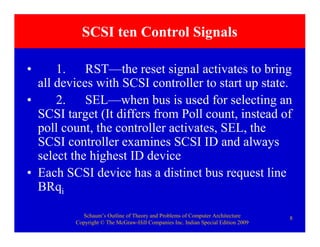
SCSI ten Control Signals
• 1. RST—the reset signal activates to bring
all devices with SCSI controller to start up state.
• 2. SEL—when bus is used for selecting an
SCSI target (It differs from Poll count, instead of
poll count, the controller activates, SEL, the
SCSI controller examines SCSI ID and always
select the highest ID device
• Each SCSI device has a distinct bus request line
BRqi
Schaum’s Outline of Theory and Problems of Computer Architecture
Copyright © The McGraw-Hill Companies Inc. Indian Special Edition 2009
9
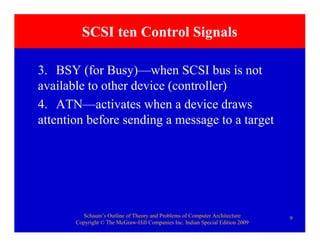
SCSI ten Control Signals
3. BSY (for Busy)—when SCSI bus is not
available to other device (controller)
4. ATN—activates when a device draws
attention before sending a message to a target
Schaum’s Outline of Theory and Problems of Computer Architecture
Copyright © The McGraw-Hill Companies Inc. Indian Special Edition 2009
10
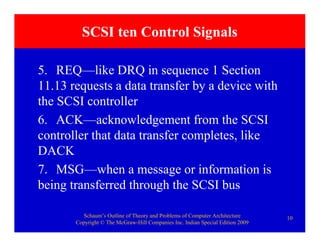
SCSI ten Control Signals
5. REQ—like DRQ in sequence 1 Section
11.13 requests a data transfer by a device with
the SCSI controller
6. ACK—acknowledgement from the SCSI
controller that data transfer completes, like
DACK
7. MSG—when a message or information is
being transferred through the SCSI bus
Schaum’s Outline of Theory and Problems of Computer Architecture
Copyright © The McGraw-Hill Companies Inc. Indian Special Edition 2009
11
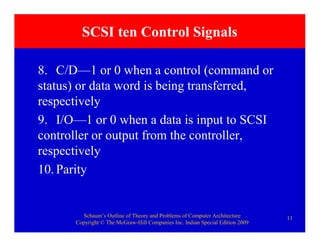
SCSI ten Control Signals
8. C/D—1 or 0 when a control (command or
status) or data word is being transferred,
respectively
9. I/O—1 or 0 when a data is input to SCSI
controller or output from the controller,
respectively
10. Parity
Schaum’s Outline of Theory and Problems of Computer Architecture
Copyright © The McGraw-Hill Companies Inc. Indian Special Edition 2009
12
High-speed SCSI versions
• Use double edge detection of the signals
Schaum’s Outline of Theory and Problems of Computer Architecture
Copyright © The McGraw-Hill Companies Inc. Indian Special Edition 2009
13
SCSI bus signal sequences
Schaum’s Outline of Theory and Problems of Computer Architecture
Copyright © The McGraw-Hill Companies Inc. Indian Special Edition 2009
14
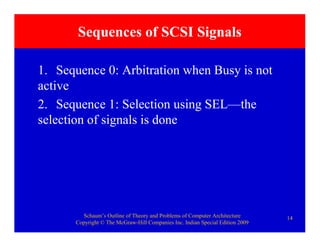
Sequences of SCSI Signals
1. Sequence 0: Arbitration when Busy is not
active
2. Sequence 1: Selection using SEL—the
selection of signals is done
Schaum’s Outline of Theory and Problems of Computer Architecture
Copyright © The McGraw-Hill Companies Inc. Indian Special Edition 2009
15
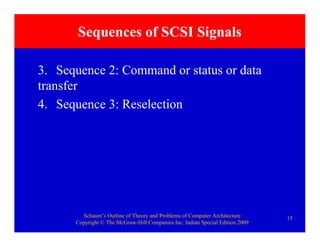
Sequences of SCSI Signals
3. Sequence 2: Command or status or data
transfer
4. Sequence 3: Reselection
Schaum’s Outline of Theory and Problems of Computer Architecture
Copyright © The McGraw-Hill Companies Inc. Indian Special Edition 2009
16
SCSI bus Arbitration policy
Schaum’s Outline of Theory and Problems of Computer Architecture
Copyright © The McGraw-Hill Companies Inc. Indian Special Edition 2009
17
SCSI controller arbitration policy
• Access to highest priority device first
• Advantage that it is easy to decide which device
gets access to the bus
Schaum’s Outline of Theory and Problems of Computer Architecture
Copyright © The McGraw-Hill Companies Inc. Indian Special Edition 2009
18
SCSI controller arbitration policy
Disadvantage
• Starvation
• Starvation when a device with a high SCSI ID
can prevent a device with a lower ID from ever
getting a chance to use the bus by making
repeated requests for the bus
• Can occur any time an arbitration policy always
gives one device priority over another
Schaum’s Outline of Theory and Problems of Computer Architecture
Copyright © The McGraw-Hill Companies Inc. Indian Special Edition 2009
19
Starvation problem
• Can occur any time an arbitration policy always
gives one device priority over another
• Some arbitration policies prevent starvation by
giving more priority to the devices that have
been waiting for the bus longest
Schaum’s Outline of Theory and Problems of Computer Architecture
Copyright © The McGraw-Hill Companies Inc. Indian Special Edition 2009
20
Summary
Schaum’s Outline of Theory and Problems of Computer Architecture
Copyright © The McGraw-Hill Companies Inc. Indian Special Edition 2009
21
We learnt
• Data bus has data bus plus parity check bit
• SCSI has 8- or in recent extensions 16- or 32-
bits communicate data as well as address and 10
or in recent extensions more control signals
• Communicate with the hard disk with bandwidth
of 5 MB/s, in recent extensions 160 or 320 MB/s
bandwidth
• Access to highest priority device first arbitration
policy
Schaum’s Outline of Theory and Problems of Computer Architecture
Copyright © The McGraw-Hill Companies Inc. Indian Special Edition 2009
22
End of Lesson 16 on
Standard I/O bus─ SCSI

Comp archch scsi bus

  • 1.
    Lesson 16: Standard I/Obus─ SCSI Chapter 11: Input/Output Organisation
  • 2.
    Schaum’s Outline ofTheory and Problems of Computer Architecture Copyright © The McGraw-Hill Companies Inc. Indian Special Edition 2009 2 Objective • Familiar with a standard I/O interface─ parallel bus called SCSI • Learn that SCSI data bus has data bus plus parity check bit, has 8- or in recent extensions 16- or 32-bits communicate data as well as address and 10 or in recent extensions more control signals • Learn that SCSI Communicate with the hard disk with bandwidth of 5 MB/s, in recent extensions 160 or 320 MB/s bandwidth
  • 3.
    Schaum’s Outline ofTheory and Problems of Computer Architecture Copyright © The McGraw-Hill Companies Inc. Indian Special Edition 2009 3 SCSI (Small Computer System Interface) Bus
  • 4.
    Schaum’s Outline ofTheory and Problems of Computer Architecture Copyright © The McGraw-Hill Companies Inc. Indian Special Edition 2009 4 SCSI bus • SCSI bus controller Communicate 8- or in recent extensions 16- or 32-bits communicate data as well as address and 10 or in recent extensions more control signals • Communicate with the hard disk with bandwidth of 5 MB/s • In recent extensions 160 or 320 MB/s bandwidth
  • 5.
    Schaum’s Outline ofTheory and Problems of Computer Architecture Copyright © The McGraw-Hill Companies Inc. Indian Special Edition 2009 5 Bus protocols • Allow any device on the bus to request the use of the bus • Have a policy for deciding which device gets to use the bus if more than one device wants to access it at the same time
  • 6.
    Schaum’s Outline ofTheory and Problems of Computer Architecture Copyright © The McGraw-Hill Companies Inc. Indian Special Edition 2009 6 SCSI Data bus • Data bus has data bus plus parity check bit • Enables single bit-error detection in a data transfer
  • 7.
    Schaum’s Outline ofTheory and Problems of Computer Architecture Copyright © The McGraw-Hill Companies Inc. Indian Special Edition 2009 7 SCSI bus signals
  • 8.
    Schaum’s Outline ofTheory and Problems of Computer Architecture Copyright © The McGraw-Hill Companies Inc. Indian Special Edition 2009 8 SCSI ten Control Signals • 1. RST—the reset signal activates to bring all devices with SCSI controller to start up state. • 2. SEL—when bus is used for selecting an SCSI target (It differs from Poll count, instead of poll count, the controller activates, SEL, the SCSI controller examines SCSI ID and always select the highest ID device • Each SCSI device has a distinct bus request line BRqi
  • 9.
    Schaum’s Outline ofTheory and Problems of Computer Architecture Copyright © The McGraw-Hill Companies Inc. Indian Special Edition 2009 9 SCSI ten Control Signals 3. BSY (for Busy)—when SCSI bus is not available to other device (controller) 4. ATN—activates when a device draws attention before sending a message to a target
  • 10.
    Schaum’s Outline ofTheory and Problems of Computer Architecture Copyright © The McGraw-Hill Companies Inc. Indian Special Edition 2009 10 SCSI ten Control Signals 5. REQ—like DRQ in sequence 1 Section 11.13 requests a data transfer by a device with the SCSI controller 6. ACK—acknowledgement from the SCSI controller that data transfer completes, like DACK 7. MSG—when a message or information is being transferred through the SCSI bus
  • 11.
    Schaum’s Outline ofTheory and Problems of Computer Architecture Copyright © The McGraw-Hill Companies Inc. Indian Special Edition 2009 11 SCSI ten Control Signals 8. C/D—1 or 0 when a control (command or status) or data word is being transferred, respectively 9. I/O—1 or 0 when a data is input to SCSI controller or output from the controller, respectively 10. Parity
  • 12.
    Schaum’s Outline ofTheory and Problems of Computer Architecture Copyright © The McGraw-Hill Companies Inc. Indian Special Edition 2009 12 High-speed SCSI versions • Use double edge detection of the signals
  • 13.
    Schaum’s Outline ofTheory and Problems of Computer Architecture Copyright © The McGraw-Hill Companies Inc. Indian Special Edition 2009 13 SCSI bus signal sequences
  • 14.
    Schaum’s Outline ofTheory and Problems of Computer Architecture Copyright © The McGraw-Hill Companies Inc. Indian Special Edition 2009 14 Sequences of SCSI Signals 1. Sequence 0: Arbitration when Busy is not active 2. Sequence 1: Selection using SEL—the selection of signals is done
  • 15.
    Schaum’s Outline ofTheory and Problems of Computer Architecture Copyright © The McGraw-Hill Companies Inc. Indian Special Edition 2009 15 Sequences of SCSI Signals 3. Sequence 2: Command or status or data transfer 4. Sequence 3: Reselection
  • 16.
    Schaum’s Outline ofTheory and Problems of Computer Architecture Copyright © The McGraw-Hill Companies Inc. Indian Special Edition 2009 16 SCSI bus Arbitration policy
  • 17.
    Schaum’s Outline ofTheory and Problems of Computer Architecture Copyright © The McGraw-Hill Companies Inc. Indian Special Edition 2009 17 SCSI controller arbitration policy • Access to highest priority device first • Advantage that it is easy to decide which device gets access to the bus
  • 18.
    Schaum’s Outline ofTheory and Problems of Computer Architecture Copyright © The McGraw-Hill Companies Inc. Indian Special Edition 2009 18 SCSI controller arbitration policy Disadvantage • Starvation • Starvation when a device with a high SCSI ID can prevent a device with a lower ID from ever getting a chance to use the bus by making repeated requests for the bus • Can occur any time an arbitration policy always gives one device priority over another
  • 19.
    Schaum’s Outline ofTheory and Problems of Computer Architecture Copyright © The McGraw-Hill Companies Inc. Indian Special Edition 2009 19 Starvation problem • Can occur any time an arbitration policy always gives one device priority over another • Some arbitration policies prevent starvation by giving more priority to the devices that have been waiting for the bus longest
  • 20.
    Schaum’s Outline ofTheory and Problems of Computer Architecture Copyright © The McGraw-Hill Companies Inc. Indian Special Edition 2009 20 Summary
  • 21.
    Schaum’s Outline ofTheory and Problems of Computer Architecture Copyright © The McGraw-Hill Companies Inc. Indian Special Edition 2009 21 We learnt • Data bus has data bus plus parity check bit • SCSI has 8- or in recent extensions 16- or 32- bits communicate data as well as address and 10 or in recent extensions more control signals • Communicate with the hard disk with bandwidth of 5 MB/s, in recent extensions 160 or 320 MB/s bandwidth • Access to highest priority device first arbitration policy
  • 22.
    Schaum’s Outline ofTheory and Problems of Computer Architecture Copyright © The McGraw-Hill Companies Inc. Indian Special Edition 2009 22 End of Lesson 16 on Standard I/O bus─ SCSI