Lesson 11:
Multiple Bus Organisation
Chapter 05: Basic Processing Units … Control Unit
Design Organization
Schaum’s Outline of Theory and Problems of Computer Architecture
Copyright © The McGraw-Hill Companies Inc. Indian Special Edition 2009
2
Objective
• Understand multiple bus organisation
• Learn how the number of independent steps
can be clubbed into single step in a multiple
bus organization
• Learn how a Processor performance
improves by a multiple bus organization
Schaum’s Outline of Theory and Problems of Computer Architecture
Copyright © The McGraw-Hill Companies Inc. Indian Special Edition 2009
3
Single bus
Schaum’s Outline of Theory and Problems of Computer Architecture
Copyright © The McGraw-Hill Companies Inc. Indian Special Edition 2009
4
Single bus
• Permits a number of units to be connected
together through a common set of wires
• Bus connections─ such that the normal state of
each subunit (when not active) is tristate
• Each subunit activates and takes input from the
bus or sends an output to the bus when a tristate
input or output gate activates
Schaum’s Outline of Theory and Problems of Computer Architecture
Copyright © The McGraw-Hill Companies Inc. Indian Special Edition 2009
5
Single bus
• The tristate input-gate activate by a control
signal φi and output can be activated by another
control signal θj
• Tristate─ inactive state or high impedance state
Schaum’s Outline of Theory and Problems of Computer Architecture
Copyright © The McGraw-Hill Companies Inc. Indian Special Edition 2009
6
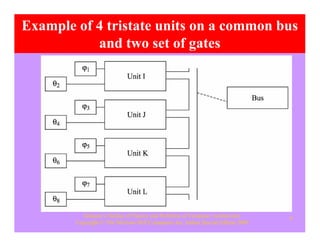
Example of 4 tristate units on a common bus
and two set of gates
Schaum’s Outline of Theory and Problems of Computer Architecture
Copyright © The McGraw-Hill Companies Inc. Indian Special Edition 2009
7
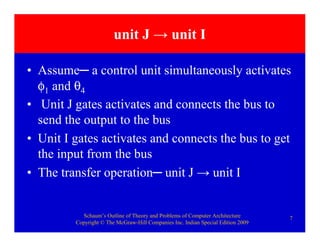
unit J → unit I
• Assume─ a control unit simultaneously activates
φ1 and θ4
• Unit J gates activates and connects the bus to
send the output to the bus
• Unit I gates activates and connects the bus to get
the input from the bus
• The transfer operation─ unit J → unit I
Schaum’s Outline of Theory and Problems of Computer Architecture
Copyright © The McGraw-Hill Companies Inc. Indian Special Edition 2009
8
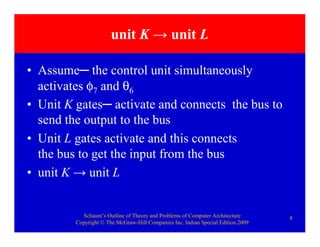
unit K → unit L
• Assume─ the control unit simultaneously
activates φ7 and θ6
• Unit K gates─ activate and connects the bus to
send the output to the bus
• Unit L gates activate and this connects
the bus to get the input from the bus
• unit K → unit L
Schaum’s Outline of Theory and Problems of Computer Architecture
Copyright © The McGraw-Hill Companies Inc. Indian Special Edition 2009
9
Simple processing units’ interconnections and
simpler processor microarchitecture
• All subunits─ registers ri and rj, PC, MAR,
MDR, TEMP, Offset, X, Y, Z, IR, ID, MUX, and
others ─ connect a bus
• Using the same bus, a control unit issues control
signals to the input and output tristate gates and
the processor takes steps i, or j, or k, for
arithmetic operations, fetching an instruction or
data, storing a word in memory, and branching,
respectively
Schaum’s Outline of Theory and Problems of Computer Architecture
Copyright © The McGraw-Hill Companies Inc. Indian Special Edition 2009
10
Two buses
Schaum’s Outline of Theory and Problems of Computer Architecture
Copyright © The McGraw-Hill Companies Inc. Indian Special Edition 2009
11
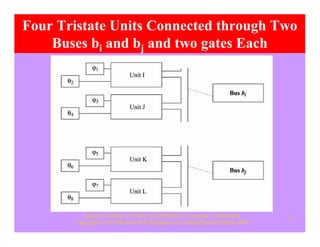
Four Tristate Units Connected through Two
Buses bi and bj and two gates Each
Schaum’s Outline of Theory and Problems of Computer Architecture
Copyright © The McGraw-Hill Companies Inc. Indian Special Edition 2009
12
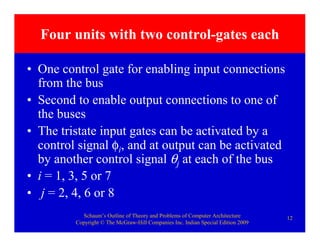
Four units with two control-gates each
• One control gate for enabling input connections
from the bus
• Second to enable output connections to one of
the buses
• The tristate input gates can be activated by a
control signal φi, and at output can be activated
by another control signal θj at each of the bus
• i = 1, 3, 5 or 7
• j = 2, 4, 6 or 8
Schaum’s Outline of Theory and Problems of Computer Architecture
Copyright © The McGraw-Hill Companies Inc. Indian Special Edition 2009
13
unit J → unit I and unit K → unit L
• Assume processor control unit simultaneously
activates φ1, θ4, φ7, and θ6
• Two set of transfer operations─ simultaneously
unit J → unit I and unit K → unit L
Schaum’s Outline of Theory and Problems of Computer Architecture
Copyright © The McGraw-Hill Companies Inc. Indian Special Edition 2009
14
Two buses
• Help in performing two sets of independent steps
simultaneously with the help of a control unit
Schaum’s Outline of Theory and Problems of Computer Architecture
Copyright © The McGraw-Hill Companies Inc. Indian Special Edition 2009
15
Processor performance improvement by a
multiple bus organization
• While the steps still have to be performed by
sequentially changing from one step to another,
the number of independent steps can be clubbed
into single step in a multiple bus organization
Schaum’s Outline of Theory and Problems of Computer Architecture
Copyright © The McGraw-Hill Companies Inc. Indian Special Edition 2009
16
Simultaneous Operations
• The operations i (MUX → X) and i + 2 (Input
operand → Y) independent and simultaneously
if there are two buses
• The operations i + 1 (X → ALU) and i + 3 (Y
→ ALU) are independent and could have been
done simultaneously if there are two buses
• Four steps would have been reduced to two
steps, i' and i' + 1
Schaum’s Outline of Theory and Problems of Computer Architecture
Copyright © The McGraw-Hill Companies Inc. Indian Special Edition 2009
17
Summary
Schaum’s Outline of Theory and Problems of Computer Architecture
Copyright © The McGraw-Hill Companies Inc. Indian Special Edition 2009
18
• Multiple bus organisation
• Clubbing of number of independent steps into
single step in a multiple bus organization
• Improvement in performance in a multiple bus
organization
We Learnt
End of Lesson 11 on
Multiple Bus Organisation

Comp archch05l11multibusorgn

  • 1.
    Lesson 11: Multiple BusOrganisation Chapter 05: Basic Processing Units … Control Unit Design Organization
  • 2.
    Schaum’s Outline ofTheory and Problems of Computer Architecture Copyright © The McGraw-Hill Companies Inc. Indian Special Edition 2009 2 Objective • Understand multiple bus organisation • Learn how the number of independent steps can be clubbed into single step in a multiple bus organization • Learn how a Processor performance improves by a multiple bus organization
  • 3.
    Schaum’s Outline ofTheory and Problems of Computer Architecture Copyright © The McGraw-Hill Companies Inc. Indian Special Edition 2009 3 Single bus
  • 4.
    Schaum’s Outline ofTheory and Problems of Computer Architecture Copyright © The McGraw-Hill Companies Inc. Indian Special Edition 2009 4 Single bus • Permits a number of units to be connected together through a common set of wires • Bus connections─ such that the normal state of each subunit (when not active) is tristate • Each subunit activates and takes input from the bus or sends an output to the bus when a tristate input or output gate activates
  • 5.
    Schaum’s Outline ofTheory and Problems of Computer Architecture Copyright © The McGraw-Hill Companies Inc. Indian Special Edition 2009 5 Single bus • The tristate input-gate activate by a control signal φi and output can be activated by another control signal θj • Tristate─ inactive state or high impedance state
  • 6.
    Schaum’s Outline ofTheory and Problems of Computer Architecture Copyright © The McGraw-Hill Companies Inc. Indian Special Edition 2009 6 Example of 4 tristate units on a common bus and two set of gates
  • 7.
    Schaum’s Outline ofTheory and Problems of Computer Architecture Copyright © The McGraw-Hill Companies Inc. Indian Special Edition 2009 7 unit J → unit I • Assume─ a control unit simultaneously activates φ1 and θ4 • Unit J gates activates and connects the bus to send the output to the bus • Unit I gates activates and connects the bus to get the input from the bus • The transfer operation─ unit J → unit I
  • 8.
    Schaum’s Outline ofTheory and Problems of Computer Architecture Copyright © The McGraw-Hill Companies Inc. Indian Special Edition 2009 8 unit K → unit L • Assume─ the control unit simultaneously activates φ7 and θ6 • Unit K gates─ activate and connects the bus to send the output to the bus • Unit L gates activate and this connects the bus to get the input from the bus • unit K → unit L
  • 9.
    Schaum’s Outline ofTheory and Problems of Computer Architecture Copyright © The McGraw-Hill Companies Inc. Indian Special Edition 2009 9 Simple processing units’ interconnections and simpler processor microarchitecture • All subunits─ registers ri and rj, PC, MAR, MDR, TEMP, Offset, X, Y, Z, IR, ID, MUX, and others ─ connect a bus • Using the same bus, a control unit issues control signals to the input and output tristate gates and the processor takes steps i, or j, or k, for arithmetic operations, fetching an instruction or data, storing a word in memory, and branching, respectively
  • 10.
    Schaum’s Outline ofTheory and Problems of Computer Architecture Copyright © The McGraw-Hill Companies Inc. Indian Special Edition 2009 10 Two buses
  • 11.
    Schaum’s Outline ofTheory and Problems of Computer Architecture Copyright © The McGraw-Hill Companies Inc. Indian Special Edition 2009 11 Four Tristate Units Connected through Two Buses bi and bj and two gates Each
  • 12.
    Schaum’s Outline ofTheory and Problems of Computer Architecture Copyright © The McGraw-Hill Companies Inc. Indian Special Edition 2009 12 Four units with two control-gates each • One control gate for enabling input connections from the bus • Second to enable output connections to one of the buses • The tristate input gates can be activated by a control signal φi, and at output can be activated by another control signal θj at each of the bus • i = 1, 3, 5 or 7 • j = 2, 4, 6 or 8
  • 13.
    Schaum’s Outline ofTheory and Problems of Computer Architecture Copyright © The McGraw-Hill Companies Inc. Indian Special Edition 2009 13 unit J → unit I and unit K → unit L • Assume processor control unit simultaneously activates φ1, θ4, φ7, and θ6 • Two set of transfer operations─ simultaneously unit J → unit I and unit K → unit L
  • 14.
    Schaum’s Outline ofTheory and Problems of Computer Architecture Copyright © The McGraw-Hill Companies Inc. Indian Special Edition 2009 14 Two buses • Help in performing two sets of independent steps simultaneously with the help of a control unit
  • 15.
    Schaum’s Outline ofTheory and Problems of Computer Architecture Copyright © The McGraw-Hill Companies Inc. Indian Special Edition 2009 15 Processor performance improvement by a multiple bus organization • While the steps still have to be performed by sequentially changing from one step to another, the number of independent steps can be clubbed into single step in a multiple bus organization
  • 16.
    Schaum’s Outline ofTheory and Problems of Computer Architecture Copyright © The McGraw-Hill Companies Inc. Indian Special Edition 2009 16 Simultaneous Operations • The operations i (MUX → X) and i + 2 (Input operand → Y) independent and simultaneously if there are two buses • The operations i + 1 (X → ALU) and i + 3 (Y → ALU) are independent and could have been done simultaneously if there are two buses • Four steps would have been reduced to two steps, i' and i' + 1
  • 17.
    Schaum’s Outline ofTheory and Problems of Computer Architecture Copyright © The McGraw-Hill Companies Inc. Indian Special Edition 2009 17 Summary
  • 18.
    Schaum’s Outline ofTheory and Problems of Computer Architecture Copyright © The McGraw-Hill Companies Inc. Indian Special Edition 2009 18 • Multiple bus organisation • Clubbing of number of independent steps into single step in a multiple bus organization • Improvement in performance in a multiple bus organization We Learnt
  • 19.
    End of Lesson11 on Multiple Bus Organisation