CHN
Foundations of Community Health
Nursing
1
Objectives
◼ Define community health.
◼ Explain the concept of community.
◼ Describe three types of communities.
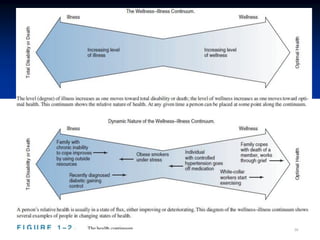
◼ Diagram the health continuum.
◼ Differentiate among the three levels of prevention.
◼ Analyze the 6 components of community health
practice.
◼ Describe the 8 characteristics of community health
nursing.
2
Introduction
◼ Challenges in nursing:
New biotechnologies
millions of people die each year from conflicts
resulting in wars & terrorism,
drought & starvation;
preventable ancient, new, & reemerging infectious
diseases;
and from unhealthy lifestyle choices.
3
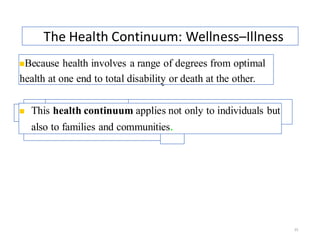
Introduction
Community Health Nursing is:
◼ Community based and, most importantly, it is population
focused.
◼ Operating within an environment of rapid change and
increasingly complex challenges,
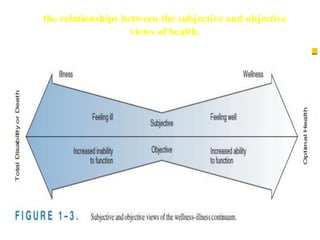
◼ this field of nursing holds the potential for positively shaping the
quality of community health services and improving the health
of the general public.
4
Community Health
◼ In acute care, the health of an individual is the primary focus.
◼Community health broadens that focus to concentrate
on families, populations, and the community at large.
◼ The community becomes the recipient of service, and health
become the product.
5
Community Health
6
◼ Many believe that health & illness are
individual issues ???????
Community Health
Community & National concerns include:
◼ rising incidence & prevalence of sexually transmitted
diseases,
◼ substance abuse,
◼ tuberculosis,
◼ teen pregnancy,
◼ family & teen violence,
◼ terrorism,
◼ pollution-driven environmental hazards
7
Community Health
According to (ANA), Communities can:
◼ Influence spread of disease,
◼ Provide barriers to protect members from health hazards,
◼ Organize ways to combat outbreaks of infectious
disease,
◼ Promote practices that contribute to individual &
collective health.
8
◼ Many different professionals work in
community health to form a complex team.
For example:
A physician treating clients affected by a sudden
outbreak of hepatitis & seeking to find the
source is engaged in community health
practice.
9
Community Health & Public Health
10
◼ Community health & public health share many
features.
◼ Both are organized community efforts aimed at the
promotion, protection & preservation the health of
public .
Public Health
11
Turnock (1997, p. 375) offered a more concise
definition of public health & stated that it includes:
“Activities that society undertakes to assure the
conditions in which people can be healthy. This
includes organized community efforts to prevent,
identify, and counter threats to the health of the
public.”
Community Health
12
◼ Community health: is the identification of needs and the
protection & improvement of collective health within
a geographically defined area.
◼ Examples: health services and programs:
Health education,
Family planning,
Accident prevention,
Environmental protection,
Immunization,
Nutrition,
Community Health
13
Early periodic screening,
School programs,
Mental health services,
Occupational health programs,
& the care of vulnerable
The Concept Of Community
14
◼ A community is a collection of people who share
some important feature of their lives.
Example:
◼ Society of people holding common rights (eg, citizens
of a town).
◼ Sharing common interests (eg, a community of
farmers)
The Concept Of Community
15
Three types of communities that have relevance
to community health practice:
◼ Geographic.
◼ Common interest.
◼ Health problem. Community of Solution
Geographic Community
16
◼ Is defined by its geographic boundaries.
◼ Example: A city, town, or neighborhooh.
◼ WHY It is useful to identify a geographic area as
a community?
It becomes a clear target for analysis of health needs.
A geographic community is easily mobilized for action.
◼ The world can be considered as a global
community.
Common-Interest Community
17
◼ Identified by a common interest or goal.
e.g: members of a national professional organization
◼ The kinds of shared interests that lead to the
formation of communities are widely varied.
Community of Solution
◼ A group of people who come together to solve a
problem that affects all of them.
For example, a water pollution problem may involve
several counties whose agencies and personnel must
work together to control upstream water supply,
industrial waste disposal, and city water treatment.
18
Populations & Aggregates
19
◼ Refers to all of the people occupying an area, or to all of those
who share one or more characteristics.
◼ Is made up of people who do not necessarily interact with one
another and do not necessarily share a sense of belonging to
that group.
Populations & Aggregates
20
◼ Population may be defined geographically.
For example:
The population of the United States, or a city’s
population.
◼ Or defined by common qualities or characteristics.
For example:
elderly population or the homeless population
Populations & Aggregates
21
Aggregate:
◼ Refers to a mass or grouping of distinct individuals who
are considered as a whole & who are loosely associated
with one another.
◼ It is a broader term that includes many different-sized
groups.
◼ Both communities & populations are types of aggregate.
For you as community health nurse student
22
◼ You need to define the community targeted for study &
intervention
◼ Who are the people who compose the community?
◼ Where are they located,
◼ and what are their characteristics?
For you as community health nurse student
23
◼What are the characteristics of the people in terms of
age, sex, race, socioeconomic level, and health status?
◼ How does the community interact with other
communities? What is its history?
◼ What are its resources?
◼ Is the community undergoing rapid change, and, if so,
what are the changes?
The Concept of Health
24
◼Health in the abstract refers to a person’s physical, mental,
and spiritual state; it can be positive (as being in good health)
or negative (as being in poor health).
◼ According to WHO, “a state of complete physical, mental, and
social well-being and not merely the absence of disease or
infirmity” (Venes, 2001, p. 930).
The Health Continuum: Wellness–Illness
25
◼Because health involves a range of degrees from optimal
health at one end to total disability or death at the other.
◼ This health continuum applies not only to individuals but
also to families and communities.
. ◼
,
26
A healthy Community
27
◼ Is one in which the various organizations, groups, & aggregates of
people making up the community do at least four things:
1. They collaborate effectively in identifying the problems & needs of
community.
2. They achieve a working consensus on goals and priorities.
3. They agree on ways and means to implement the agreed on
goals.
4. They collaborate effectively in the required actions.
Health as a State of Being
28
◼ Health refers to a state of being, including many
different qualities & characteristics.
◼ An individual might be described in terms such
as energetic, outgoing, enthusiastic, beautiful,
caring, loving, and intense. Together, these
qualities become the core of a person’s
existence; they describe a state of being.
Health as a State of Being
29
◼ A specific geographic community, such as a
neighborhood, has many characteristics. It might be
characterized by the terms congested, deteriorating,
unattractive, dirty, and disorganized.
◼ Workers involved in a massive layoff who band
together to provide support and share resources to
effectively seek new employment.
Subjective & Objective Dimensions of Health
30
◼ Both how people feel (subjective).
and how well they can function in their environment
(objective).
◼ Healthy people are full of life and energy, capable of
physical and mental productivity. They feel minimal
discomfort and displeasure with the world around
them.
Subjective & Objective Dimensions of Health
31
The subjective dimension (feeling well or ill)
and the objective dimension (functioning)
together provide a clearer picture of
people’s health.
the relationships between the subjective and objective
views of health.
32
◼
.
Continuous & Episodic Health Care Needs
33
◼ Continuous needs:
cover populations in all age groups with birth-to-death
developmental health care needs.
◼ Episodic needs:
one-time, specific, negative health events, such as an illness or
injury, that are not an expected part of life.
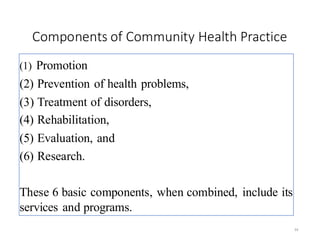
Components of Community Health Practice
34
(1) Promotion of health,
(2) Prevention of health problems,
(3) Treatment of disorders,
(4) Rehabilitation,
(5) Evaluation, and
(6) Research.
These 6 basic components, when combined, include its
services and programs.
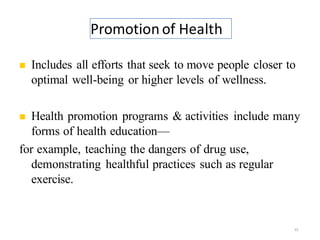
Promotion of Health
35
◼ Includes all efforts that seek to move people closer to
optimal well-being or higher levels of wellness.
◼ Health promotion programs & activities include many
forms of health education—
for example, teaching the dangers of drug use,
demonstrating healthful practices such as regular
exercise.
Promotion of Health
36
◼ The goal of health promotion is to raise levels of
wellness for individuals, families, populations, and
communities.
37
Prevention of Health Problems
◼ Prevention means anticipate (PREDICT) and
averting (AVOIDANCE) problems or
discovering them as early as possible to
minimize potential disability & impairment.
38
.
39
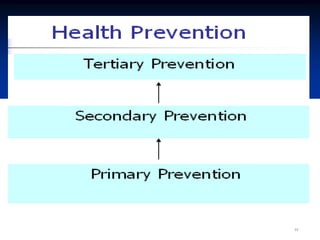
Primary Prevention
40
◼ Prevents the occurrence of a health problem; it includes
measures taken to keep illness or injuries from occurring.
Example:
◼ Educational programs that teach the dangers of smoking.
◼ Encouraging elderly people to install and use safety
devices to prevent injuries from falls
Secondary Prevention
41
◼ Detect & treat existing health problems at the earliest
possible stage when disease or impairment already
exist.
Example:
◼ Hypertension and cholesterol screening programs in
many communities help to identify high-risk
individuals and encourage early treatment to prevent
heart attacks or stroke.
Tertiary Prevention
42
◼ Attempts to reduce the extent (scope) and severity
of a health problem to its lowest possible level, so
as to minimize disability and preserve function.
Example:
◼ Treatment & rehabilitation of persons after a
stroke to reduce impairment.
◼ Post mastectomy exercise programs to restore
functioning, and early treatment and management
of diabetes to reduce problems or slow their
progress.
Treatment of Disorders
43
◼ It focuses on the illness end of the continuum.
◼ This occurs by three methods:
(1) Direct service to people with health problems.
Example:
A nursing center serving a homeless population
provides referral services.
Treatment of Disorders
• (2) Indirect service that helps people to obtain treatment.
• Example:
• A social worker can help a family that is plagued by personal and
economic problems to enter a family therapy and counseling
program.
44
Treatment of Disorders
45
(3) Development of programs to correct unhealthy
conditions.
Example:
The health department developed new regulations for
industrial waste disposal as a result of increased
pollution of the water supply.
Rehabilitation
46
◼ Involves efforts to reduce disability and, as much as
possible, restore function.
◼ For example:
A factory worker who lost his leg in an industrial accident
received good medical and nursing care, prosthetic
fittings, & physical and occupational therapy; he then
retrained to assume an office job.
Evaluation
47
◼ Is the process by which that practice is analyzed,
judged, and improved according to established goals
and standards.
Research
48
Systematic investigation to
◼ Discover facts affecting community health & community
health practice.
◼ Solve problems.
◼ Explore improved methods of health service.
Characteristics of Community Health
Nursing
49
1- Field of Nursing:
◼ Community health nursing adds public health
knowledge and skills that address the needs and
problems of communities.
◼ Focuses care on communities and vulnerable
populations.
Characteristics of Community Health
Nursing
50
It “synthesizes the knowledge from the public health
sciences and professional nursing theories”
to improve the health of communities & vulnerable
populations.
Characteristics of Community Health
Nursing
51
2 Combines Public Health with Nursing:
Is grounded in both public health science and nursing
science.
3 Population Focused:
It is concerned for the health status of population groups
and their environment.
◼ It distinguishes it from other nursing specialties.
Characteristics of Community Health
Nursing
52
4- Emphasizes Prevention, Health Promotion, &
Wellness:
◼ In community health nursing, the promotion of health
and prevention of illness are of first-order priority.
◼ Another distinguishing characteristic of community
health nursing is its emphasis on positive health, or
wellness
Characteristics of
Community Health Nursing
◼ Emphasis on wellness changes the
community health nursing role from a
reactive to a proactive
53
Characteristics of Community Health
Nursing
54
5- Promotes Client Responsibility and Self-Care:
When people believe that their health, and that of the
community, is their own responsibility, not just that of
health professionals, they will take a more active
interest in promoting it.
Characteristics of Community Health
Nursing
55
6- Uses Aggregate Measurement and Analysis:
◼ The need to collect and examine data on the entire
population under study before making intervention
decisions is fundamental to community health nursing.
◼ Focus of community health research and evaluation.
Health states,
environmental factors,
health related services,
economic patterns,
social policy.
Characteristics of Community Health
Nursing
56
7- Uses Principles of Organizational Theory:
◼ To provide effective administration of health care
service.
◼Public health has long been defined as the protection
and improvement of community health through
organized community efforts.
Characteristics of Community Health
Nursing
57
◼ Assess group and community needs,
◼ establish priorities, and plan, implement, and evaluate
services,
they are using public health management and
organizational principles.
Characteristics of
Community Health Nursing
8- Involves Inter-professional Collaboration:
◼ work in cooperation with other team members,
coordinating services and addressing the needs
of population groups.
58
◼ WHY?
◼ Individualized efforts and specialized
programs, when planned in isolation, can lead
to fragmentation and gaps in health service.
59
Characteristics of Community Health
Nursing
60
◼ Inter-professional collaboration requires clarification
of each team member’s role.
◼ Client participation is promoted when people serve
as partners on the health care team.
An aim of community health nursing is to collaborate
with people rather than do things for them.
.
End
61

Communitygjdhbdjbdvdjdbdvdjdjdbdkbbkfkjfkf

  • 1.
  • 2.
    Objectives ◼ Define communityhealth. ◼ Explain the concept of community. ◼ Describe three types of communities. ◼ Diagram the health continuum. ◼ Differentiate among the three levels of prevention. ◼ Analyze the 6 components of community health practice. ◼ Describe the 8 characteristics of community health nursing. 2
  • 3.
    Introduction ◼ Challenges innursing: New biotechnologies millions of people die each year from conflicts resulting in wars & terrorism, drought & starvation; preventable ancient, new, & reemerging infectious diseases; and from unhealthy lifestyle choices. 3
  • 4.
    Introduction Community Health Nursingis: ◼ Community based and, most importantly, it is population focused. ◼ Operating within an environment of rapid change and increasingly complex challenges, ◼ this field of nursing holds the potential for positively shaping the quality of community health services and improving the health of the general public. 4
  • 5.
    Community Health ◼ Inacute care, the health of an individual is the primary focus. ◼Community health broadens that focus to concentrate on families, populations, and the community at large. ◼ The community becomes the recipient of service, and health become the product. 5
  • 6.
    Community Health 6 ◼ Manybelieve that health & illness are individual issues ???????
  • 7.
    Community Health Community &National concerns include: ◼ rising incidence & prevalence of sexually transmitted diseases, ◼ substance abuse, ◼ tuberculosis, ◼ teen pregnancy, ◼ family & teen violence, ◼ terrorism, ◼ pollution-driven environmental hazards 7
  • 8.
    Community Health According to(ANA), Communities can: ◼ Influence spread of disease, ◼ Provide barriers to protect members from health hazards, ◼ Organize ways to combat outbreaks of infectious disease, ◼ Promote practices that contribute to individual & collective health. 8
  • 9.
    ◼ Many differentprofessionals work in community health to form a complex team. For example: A physician treating clients affected by a sudden outbreak of hepatitis & seeking to find the source is engaged in community health practice. 9
  • 10.
    Community Health &Public Health 10 ◼ Community health & public health share many features. ◼ Both are organized community efforts aimed at the promotion, protection & preservation the health of public .
  • 11.
    Public Health 11 Turnock (1997,p. 375) offered a more concise definition of public health & stated that it includes: “Activities that society undertakes to assure the conditions in which people can be healthy. This includes organized community efforts to prevent, identify, and counter threats to the health of the public.”
  • 12.
    Community Health 12 ◼ Communityhealth: is the identification of needs and the protection & improvement of collective health within a geographically defined area. ◼ Examples: health services and programs: Health education, Family planning, Accident prevention, Environmental protection, Immunization, Nutrition,
  • 13.
    Community Health 13 Early periodicscreening, School programs, Mental health services, Occupational health programs, & the care of vulnerable
  • 14.
    The Concept OfCommunity 14 ◼ A community is a collection of people who share some important feature of their lives. Example: ◼ Society of people holding common rights (eg, citizens of a town). ◼ Sharing common interests (eg, a community of farmers)
  • 15.
    The Concept OfCommunity 15 Three types of communities that have relevance to community health practice: ◼ Geographic. ◼ Common interest. ◼ Health problem. Community of Solution
  • 16.
    Geographic Community 16 ◼ Isdefined by its geographic boundaries. ◼ Example: A city, town, or neighborhooh. ◼ WHY It is useful to identify a geographic area as a community? It becomes a clear target for analysis of health needs. A geographic community is easily mobilized for action. ◼ The world can be considered as a global community.
  • 17.
    Common-Interest Community 17 ◼ Identifiedby a common interest or goal. e.g: members of a national professional organization ◼ The kinds of shared interests that lead to the formation of communities are widely varied.
  • 18.
    Community of Solution ◼A group of people who come together to solve a problem that affects all of them. For example, a water pollution problem may involve several counties whose agencies and personnel must work together to control upstream water supply, industrial waste disposal, and city water treatment. 18
  • 19.
    Populations & Aggregates 19 ◼Refers to all of the people occupying an area, or to all of those who share one or more characteristics. ◼ Is made up of people who do not necessarily interact with one another and do not necessarily share a sense of belonging to that group.
  • 20.
    Populations & Aggregates 20 ◼Population may be defined geographically. For example: The population of the United States, or a city’s population. ◼ Or defined by common qualities or characteristics. For example: elderly population or the homeless population
  • 21.
    Populations & Aggregates 21 Aggregate: ◼Refers to a mass or grouping of distinct individuals who are considered as a whole & who are loosely associated with one another. ◼ It is a broader term that includes many different-sized groups. ◼ Both communities & populations are types of aggregate.
  • 22.
    For you ascommunity health nurse student 22 ◼ You need to define the community targeted for study & intervention ◼ Who are the people who compose the community? ◼ Where are they located, ◼ and what are their characteristics?
  • 23.
    For you ascommunity health nurse student 23 ◼What are the characteristics of the people in terms of age, sex, race, socioeconomic level, and health status? ◼ How does the community interact with other communities? What is its history? ◼ What are its resources? ◼ Is the community undergoing rapid change, and, if so, what are the changes?
  • 24.
    The Concept ofHealth 24 ◼Health in the abstract refers to a person’s physical, mental, and spiritual state; it can be positive (as being in good health) or negative (as being in poor health). ◼ According to WHO, “a state of complete physical, mental, and social well-being and not merely the absence of disease or infirmity” (Venes, 2001, p. 930).
  • 25.
    The Health Continuum:Wellness–Illness 25 ◼Because health involves a range of degrees from optimal health at one end to total disability or death at the other. ◼ This health continuum applies not only to individuals but also to families and communities.
  • 26.
  • 27.
    A healthy Community 27 ◼Is one in which the various organizations, groups, & aggregates of people making up the community do at least four things: 1. They collaborate effectively in identifying the problems & needs of community. 2. They achieve a working consensus on goals and priorities. 3. They agree on ways and means to implement the agreed on goals. 4. They collaborate effectively in the required actions.
  • 28.
    Health as aState of Being 28 ◼ Health refers to a state of being, including many different qualities & characteristics. ◼ An individual might be described in terms such as energetic, outgoing, enthusiastic, beautiful, caring, loving, and intense. Together, these qualities become the core of a person’s existence; they describe a state of being.
  • 29.
    Health as aState of Being 29 ◼ A specific geographic community, such as a neighborhood, has many characteristics. It might be characterized by the terms congested, deteriorating, unattractive, dirty, and disorganized. ◼ Workers involved in a massive layoff who band together to provide support and share resources to effectively seek new employment.
  • 30.
    Subjective & ObjectiveDimensions of Health 30 ◼ Both how people feel (subjective). and how well they can function in their environment (objective). ◼ Healthy people are full of life and energy, capable of physical and mental productivity. They feel minimal discomfort and displeasure with the world around them.
  • 31.
    Subjective & ObjectiveDimensions of Health 31 The subjective dimension (feeling well or ill) and the objective dimension (functioning) together provide a clearer picture of people’s health.
  • 32.
    the relationships betweenthe subjective and objective views of health. 32 ◼ .
  • 33.
    Continuous & EpisodicHealth Care Needs 33 ◼ Continuous needs: cover populations in all age groups with birth-to-death developmental health care needs. ◼ Episodic needs: one-time, specific, negative health events, such as an illness or injury, that are not an expected part of life.
  • 34.
    Components of CommunityHealth Practice 34 (1) Promotion of health, (2) Prevention of health problems, (3) Treatment of disorders, (4) Rehabilitation, (5) Evaluation, and (6) Research. These 6 basic components, when combined, include its services and programs.
  • 35.
    Promotion of Health 35 ◼Includes all efforts that seek to move people closer to optimal well-being or higher levels of wellness. ◼ Health promotion programs & activities include many forms of health education— for example, teaching the dangers of drug use, demonstrating healthful practices such as regular exercise.
  • 36.
    Promotion of Health 36 ◼The goal of health promotion is to raise levels of wellness for individuals, families, populations, and communities.
  • 37.
  • 38.
    Prevention of HealthProblems ◼ Prevention means anticipate (PREDICT) and averting (AVOIDANCE) problems or discovering them as early as possible to minimize potential disability & impairment. 38
  • 39.
  • 40.
    Primary Prevention 40 ◼ Preventsthe occurrence of a health problem; it includes measures taken to keep illness or injuries from occurring. Example: ◼ Educational programs that teach the dangers of smoking. ◼ Encouraging elderly people to install and use safety devices to prevent injuries from falls
  • 41.
    Secondary Prevention 41 ◼ Detect& treat existing health problems at the earliest possible stage when disease or impairment already exist. Example: ◼ Hypertension and cholesterol screening programs in many communities help to identify high-risk individuals and encourage early treatment to prevent heart attacks or stroke.
  • 42.
    Tertiary Prevention 42 ◼ Attemptsto reduce the extent (scope) and severity of a health problem to its lowest possible level, so as to minimize disability and preserve function. Example: ◼ Treatment & rehabilitation of persons after a stroke to reduce impairment. ◼ Post mastectomy exercise programs to restore functioning, and early treatment and management of diabetes to reduce problems or slow their progress.
  • 43.
    Treatment of Disorders 43 ◼It focuses on the illness end of the continuum. ◼ This occurs by three methods: (1) Direct service to people with health problems. Example: A nursing center serving a homeless population provides referral services.
  • 44.
    Treatment of Disorders •(2) Indirect service that helps people to obtain treatment. • Example: • A social worker can help a family that is plagued by personal and economic problems to enter a family therapy and counseling program. 44
  • 45.
    Treatment of Disorders 45 (3)Development of programs to correct unhealthy conditions. Example: The health department developed new regulations for industrial waste disposal as a result of increased pollution of the water supply.
  • 46.
    Rehabilitation 46 ◼ Involves effortsto reduce disability and, as much as possible, restore function. ◼ For example: A factory worker who lost his leg in an industrial accident received good medical and nursing care, prosthetic fittings, & physical and occupational therapy; he then retrained to assume an office job.
  • 47.
    Evaluation 47 ◼ Is theprocess by which that practice is analyzed, judged, and improved according to established goals and standards.
  • 48.
    Research 48 Systematic investigation to ◼Discover facts affecting community health & community health practice. ◼ Solve problems. ◼ Explore improved methods of health service.
  • 49.
    Characteristics of CommunityHealth Nursing 49 1- Field of Nursing: ◼ Community health nursing adds public health knowledge and skills that address the needs and problems of communities. ◼ Focuses care on communities and vulnerable populations.
  • 50.
    Characteristics of CommunityHealth Nursing 50 It “synthesizes the knowledge from the public health sciences and professional nursing theories” to improve the health of communities & vulnerable populations.
  • 51.
    Characteristics of CommunityHealth Nursing 51 2 Combines Public Health with Nursing: Is grounded in both public health science and nursing science. 3 Population Focused: It is concerned for the health status of population groups and their environment. ◼ It distinguishes it from other nursing specialties.
  • 52.
    Characteristics of CommunityHealth Nursing 52 4- Emphasizes Prevention, Health Promotion, & Wellness: ◼ In community health nursing, the promotion of health and prevention of illness are of first-order priority. ◼ Another distinguishing characteristic of community health nursing is its emphasis on positive health, or wellness
  • 53.
    Characteristics of Community HealthNursing ◼ Emphasis on wellness changes the community health nursing role from a reactive to a proactive 53
  • 54.
    Characteristics of CommunityHealth Nursing 54 5- Promotes Client Responsibility and Self-Care: When people believe that their health, and that of the community, is their own responsibility, not just that of health professionals, they will take a more active interest in promoting it.
  • 55.
    Characteristics of CommunityHealth Nursing 55 6- Uses Aggregate Measurement and Analysis: ◼ The need to collect and examine data on the entire population under study before making intervention decisions is fundamental to community health nursing. ◼ Focus of community health research and evaluation. Health states, environmental factors, health related services, economic patterns, social policy.
  • 56.
    Characteristics of CommunityHealth Nursing 56 7- Uses Principles of Organizational Theory: ◼ To provide effective administration of health care service. ◼Public health has long been defined as the protection and improvement of community health through organized community efforts.
  • 57.
    Characteristics of CommunityHealth Nursing 57 ◼ Assess group and community needs, ◼ establish priorities, and plan, implement, and evaluate services, they are using public health management and organizational principles.
  • 58.
    Characteristics of Community HealthNursing 8- Involves Inter-professional Collaboration: ◼ work in cooperation with other team members, coordinating services and addressing the needs of population groups. 58 ◼ WHY?
  • 59.
    ◼ Individualized effortsand specialized programs, when planned in isolation, can lead to fragmentation and gaps in health service. 59
  • 60.
    Characteristics of CommunityHealth Nursing 60 ◼ Inter-professional collaboration requires clarification of each team member’s role. ◼ Client participation is promoted when people serve as partners on the health care team. An aim of community health nursing is to collaborate with people rather than do things for them.
  • 61.