COMMUNITY ORGANIZING
Community Organizing
is a process where people who live in proximity to each
other come together into an organization that acts in
their shared self-interest. Unlike those who promote
more-consensual community building, community
organizing generally assume that social change
necessarily involves conflict and social struggle in order
to generate collective power for the powerless. A core
goal of community organizing is to generate durable
power for an organization representing the
community, allowing it to influence key decision-
makers on a range of issues over time.
Community organizing is NOT a technique for
problem solving. Those who would use simple
confrontation or mass meetings to meet their
own selfish need for power, and skip the step
of democratic involvement and control in the
selecting of issues, the crafting of demands or
the negotiating of the victory are called
demagogues. Their organizations are a hollow
sham, without the empowering aspect that
humanizes and ennobles the effort.
THE 10 RULES OF COMMUNITY ORGANIZING
 1. Nobody's going to come to the meeting unless they've got a
reason to come to the meeting.
 2. Nobody's going to come to a meeting unless they know about
it.
 3. If an organization doesn't grow, it will die.
 4. Anyone can be a leader.
 5. the most important victory is the group itself.
 6. Sometimes winning is losing.
 7. Sometimes winning is winning.
 8. If you're not fighting for what you want, you don't want enough.
 9. Celebrate!
 10. Have fun!
The Purpose Community
Organizing
The purpose of community organizing is to bring people
together to find ways to not only enhance their own lives but
also ensure that the lives of future generations do not make
the same mistakes made by previous generations. Through
organizing, the next generations are groomed to take care
of the neighborhood and become responsible stewards of
the land. A neighbourhood and community working
together, can start to expand their focus out of individualistic
survival into making life in the neighborhood more sociable
and more interesting, taking into account the needs of the
next generations. Communities can develop ways for all
generations to live and work together in the same
neighbourhoods and develop a sense of culture that can be
carried on.
Steps in Organizing Community
Community organizing generally takes place under the umbrella
of a non-profit organization that reaches out and engages people
to action. Often-times, paid or volunteer community organizers
help to advance the process of community organizing by
facilitating a process that:
• Identifies a problem or set of problems
• Identifies a solution
• Clarifies a set of objectives
• Develops a strategy and approach
• develops leadership from and relationships among the
people involved
• Mobilizes public support
• Launches a campaign
10 Basic Steps in Organizing the
Community
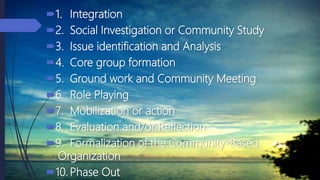
1. Integration
2. Social Investigation or Community Study
3. Issue identification and Analysis
4. Core group formation
5. Ground work and Community Meeting
6. Role Playing
7. Mobilization or action
8. Evaluation and/or Reflection
9. Formalization of the Community-Based
Organization
10. Phase Out
END.
Thank You!!!!

Community organizing

  • 1.
  • 2.
    Community Organizing is aprocess where people who live in proximity to each other come together into an organization that acts in their shared self-interest. Unlike those who promote more-consensual community building, community organizing generally assume that social change necessarily involves conflict and social struggle in order to generate collective power for the powerless. A core goal of community organizing is to generate durable power for an organization representing the community, allowing it to influence key decision- makers on a range of issues over time.
  • 3.
    Community organizing isNOT a technique for problem solving. Those who would use simple confrontation or mass meetings to meet their own selfish need for power, and skip the step of democratic involvement and control in the selecting of issues, the crafting of demands or the negotiating of the victory are called demagogues. Their organizations are a hollow sham, without the empowering aspect that humanizes and ennobles the effort.
  • 4.
    THE 10 RULESOF COMMUNITY ORGANIZING  1. Nobody's going to come to the meeting unless they've got a reason to come to the meeting.  2. Nobody's going to come to a meeting unless they know about it.  3. If an organization doesn't grow, it will die.  4. Anyone can be a leader.  5. the most important victory is the group itself.  6. Sometimes winning is losing.  7. Sometimes winning is winning.  8. If you're not fighting for what you want, you don't want enough.  9. Celebrate!  10. Have fun!
  • 5.
  • 6.
    The purpose ofcommunity organizing is to bring people together to find ways to not only enhance their own lives but also ensure that the lives of future generations do not make the same mistakes made by previous generations. Through organizing, the next generations are groomed to take care of the neighborhood and become responsible stewards of the land. A neighbourhood and community working together, can start to expand their focus out of individualistic survival into making life in the neighborhood more sociable and more interesting, taking into account the needs of the next generations. Communities can develop ways for all generations to live and work together in the same neighbourhoods and develop a sense of culture that can be carried on.
  • 7.
  • 8.
    Community organizing generallytakes place under the umbrella of a non-profit organization that reaches out and engages people to action. Often-times, paid or volunteer community organizers help to advance the process of community organizing by facilitating a process that: • Identifies a problem or set of problems • Identifies a solution • Clarifies a set of objectives • Develops a strategy and approach • develops leadership from and relationships among the people involved • Mobilizes public support • Launches a campaign
  • 9.
    10 Basic Stepsin Organizing the Community
  • 10.
    1. Integration 2. SocialInvestigation or Community Study 3. Issue identification and Analysis 4. Core group formation 5. Ground work and Community Meeting 6. Role Playing 7. Mobilization or action 8. Evaluation and/or Reflection 9. Formalization of the Community-Based Organization 10. Phase Out
  • 11.