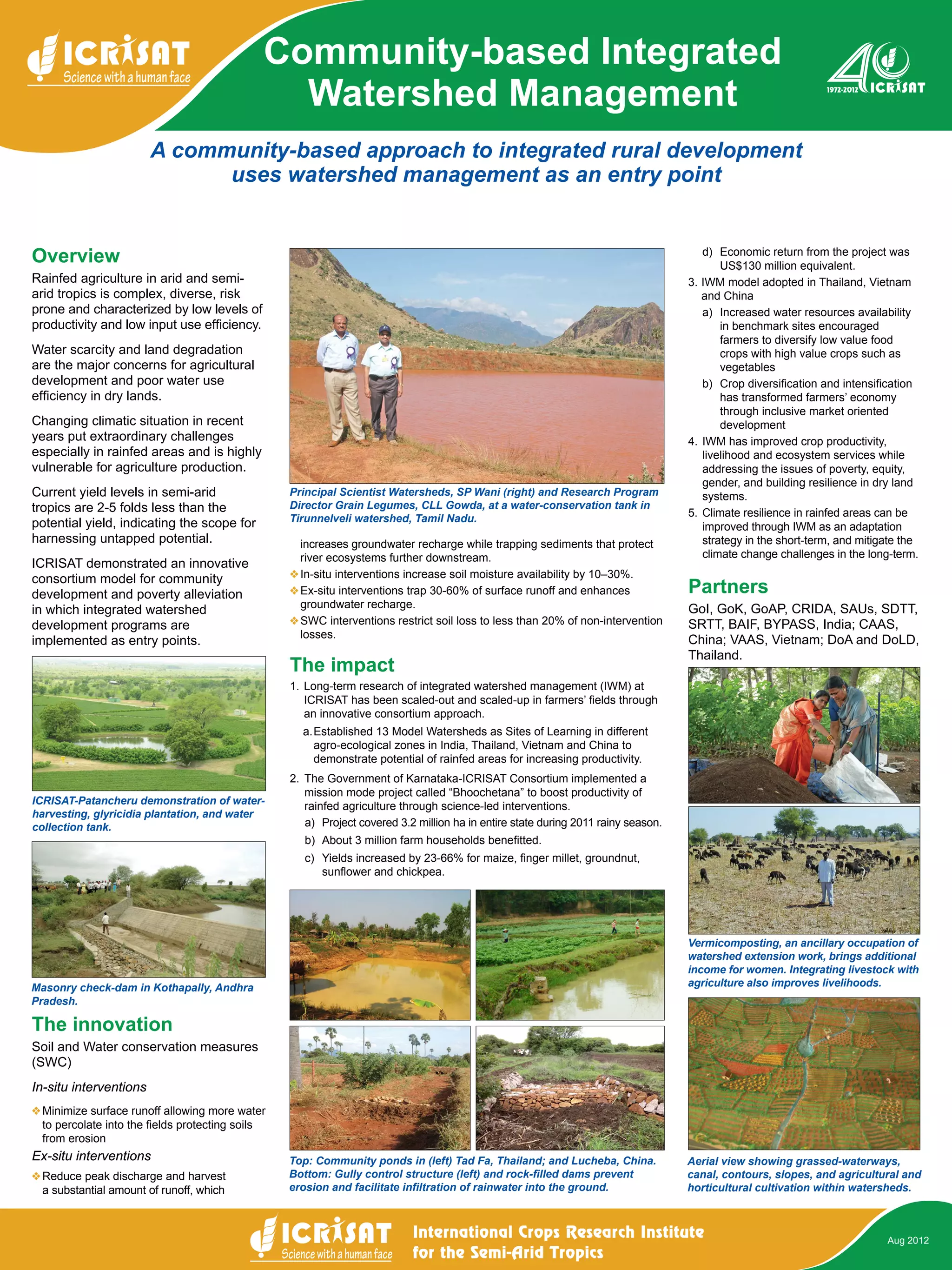
A community-based approach to integrated rural development
uses watershed management as an entry point
Community-based Integrated
Watershed Management
Overview
Rainfed agriculture in arid and semi-
arid tropics is complex, diverse, risk
prone and characterized by low levels of
productivity and low input use efficiency.
Water scarcity and land degradation
are the major concerns for agricultural
development and poor water use
efficiency in dry lands.
Changing climatic situation in recent
years put extraordinary challenges
especially in rainfed areas and is highly
vulnerable for agriculture production.
Current yield levels in semi-arid
tropics are 2-5 folds less than the
potential yield, indicating the scope for
harnessing untapped potential.
ICRISAT demonstrated an innovative
consortium model for community
development and poverty alleviation
in which integrated watershed
development programs are
implemented as entry points.
increases groundwater recharge while trapping sediments that protect
river ecosystems further downstream.
v	In-situ interventions increase soil moisture availability by 10–30%.
v	Ex-situ interventions trap 30-60% of surface runoff and enhances
groundwater recharge.
v	SWC interventions restrict soil loss to less than 20% of non-intervention
losses.
The impact
1.	Long-term research of integrated watershed management (IWM) at
ICRISAT has been scaled-out and scaled-up in farmers’ fields through
an innovative consortium approach.
a.	Established 13 Model Watersheds as Sites of Learning in different
agro-ecological zones in India, Thailand, Vietnam and China to
demonstrate potential of rainfed areas for increasing productivity.
2.	 The Government of Karnataka-ICRISAT Consortium implemented a
mission mode project called “Bhoochetana” to boost productivity of
rainfed agriculture through science-led interventions.
a)	 Project covered 3.2 million ha in entire state during 2011 rainy season.
b)	 About 3 million farm households benefitted.
c)	 Yields increased by 23-66% for maize, finger millet, groundnut,
sunflower and chickpea.
Aug 2012
d)	 Economic return from the project was
US$130 million equivalent.
3.	IWM model adopted in Thailand, Vietnam
and China
a)	 Increased water resources availability
in benchmark sites encouraged
farmers to diversify low value food
crops with high value crops such as
vegetables
b)	 Crop diversification and intensification
has transformed farmers’ economy
through inclusive market oriented
development
4.	IWM has improved crop productivity,
livelihood and ecosystem services while
addressing the issues of poverty, equity,
gender, and building resilience in dry land
systems.
5.	Climate resilience in rainfed areas can be
improved through IWM as an adaptation
strategy in the short-term, and mitigate the
climate change challenges in the long-term.
Partners
GoI, GoK, GoAP, CRIDA, SAUs, SDTT,
SRTT, BAIF, BYPASS, India; CAAS,
China; VAAS, Vietnam; DoA and DoLD,
Thailand.
The innovation
Soil and Water conservation measures
(SWC)
In-situ interventions
v	Minimize surface runoff allowing more water
to percolate into the fields protecting soils
from erosion
Ex-situ interventions
v	Reduce peak discharge and harvest
a substantial amount of runoff, which
Principal Scientist Watersheds, SP Wani (right) and Research Program
Director Grain Legumes, CLL Gowda, at a water-conservation tank in
Tirunnelveli watershed, Tamil Nadu.
ICRISAT-Patancheru demonstration of water-
harvesting, glyricidia plantation, and water
collection tank.
Top: Community ponds in (left) Tad Fa, Thailand; and Lucheba, China.
Bottom: Gully control structure (left) and rock-filled dams prevent
erosion and facilitate infiltration of rainwater into the ground.
Masonry check-dam in Kothapally, Andhra
Pradesh.
Aerial view showing grassed-waterways,
canal, contours, slopes, and agricultural and
horticultural cultivation within watersheds.
Vermicomposting, an ancillary occupation of
watershed extension work, brings additional
income for women. Integrating livestock with
agriculture also improves livelihoods.

Community based Integrated Watershed Management

  • 1.
    A community-based approachto integrated rural development uses watershed management as an entry point Community-based Integrated Watershed Management Overview Rainfed agriculture in arid and semi- arid tropics is complex, diverse, risk prone and characterized by low levels of productivity and low input use efficiency. Water scarcity and land degradation are the major concerns for agricultural development and poor water use efficiency in dry lands. Changing climatic situation in recent years put extraordinary challenges especially in rainfed areas and is highly vulnerable for agriculture production. Current yield levels in semi-arid tropics are 2-5 folds less than the potential yield, indicating the scope for harnessing untapped potential. ICRISAT demonstrated an innovative consortium model for community development and poverty alleviation in which integrated watershed development programs are implemented as entry points. increases groundwater recharge while trapping sediments that protect river ecosystems further downstream. v In-situ interventions increase soil moisture availability by 10–30%. v Ex-situ interventions trap 30-60% of surface runoff and enhances groundwater recharge. v SWC interventions restrict soil loss to less than 20% of non-intervention losses. The impact 1. Long-term research of integrated watershed management (IWM) at ICRISAT has been scaled-out and scaled-up in farmers’ fields through an innovative consortium approach. a. Established 13 Model Watersheds as Sites of Learning in different agro-ecological zones in India, Thailand, Vietnam and China to demonstrate potential of rainfed areas for increasing productivity. 2. The Government of Karnataka-ICRISAT Consortium implemented a mission mode project called “Bhoochetana” to boost productivity of rainfed agriculture through science-led interventions. a) Project covered 3.2 million ha in entire state during 2011 rainy season. b) About 3 million farm households benefitted. c) Yields increased by 23-66% for maize, finger millet, groundnut, sunflower and chickpea. Aug 2012 d) Economic return from the project was US$130 million equivalent. 3. IWM model adopted in Thailand, Vietnam and China a) Increased water resources availability in benchmark sites encouraged farmers to diversify low value food crops with high value crops such as vegetables b) Crop diversification and intensification has transformed farmers’ economy through inclusive market oriented development 4. IWM has improved crop productivity, livelihood and ecosystem services while addressing the issues of poverty, equity, gender, and building resilience in dry land systems. 5. Climate resilience in rainfed areas can be improved through IWM as an adaptation strategy in the short-term, and mitigate the climate change challenges in the long-term. Partners GoI, GoK, GoAP, CRIDA, SAUs, SDTT, SRTT, BAIF, BYPASS, India; CAAS, China; VAAS, Vietnam; DoA and DoLD, Thailand. The innovation Soil and Water conservation measures (SWC) In-situ interventions v Minimize surface runoff allowing more water to percolate into the fields protecting soils from erosion Ex-situ interventions v Reduce peak discharge and harvest a substantial amount of runoff, which Principal Scientist Watersheds, SP Wani (right) and Research Program Director Grain Legumes, CLL Gowda, at a water-conservation tank in Tirunnelveli watershed, Tamil Nadu. ICRISAT-Patancheru demonstration of water- harvesting, glyricidia plantation, and water collection tank. Top: Community ponds in (left) Tad Fa, Thailand; and Lucheba, China. Bottom: Gully control structure (left) and rock-filled dams prevent erosion and facilitate infiltration of rainwater into the ground. Masonry check-dam in Kothapally, Andhra Pradesh. Aerial view showing grassed-waterways, canal, contours, slopes, and agricultural and horticultural cultivation within watersheds. Vermicomposting, an ancillary occupation of watershed extension work, brings additional income for women. Integrating livestock with agriculture also improves livelihoods.