Place Slide Title Text Here
©2013 John Wiley & Sons, Inc. All rights reserved. 18-1
18-1
©2013 John Wiley & Sons, Inc. All rights reserved.
JOHN R. SCHERMERHORN, JR.
MANAGEMENT
MANAGEMENT
12
12th
th
Edition
Edition
Chapter 18
Chapter 18
Communication and
Collaboration
Place Slide Title Text Here
©2013 John Wiley & Sons, Inc. All rights reserved. 18-2
Planning Ahead — Chapter 18 Study Questions
1. What is the communication process?
2. How can we improve our communications?
3. How can we deal positively with conflict?
4. How can we negotiate successful
agreements?
Place Slide Title Text Here
©2013 John Wiley & Sons, Inc. All rights reserved. 18-3
Chapter 18 Learning Dashboard
1. The Communication Process
1. Effective communication
2. Persuasion and credibility in communication
3. Communication barriers
4. Cross-cultural communication
2. Improving Collaboration Through Communication
1. Transparency and openness
2. Use of electronic media
3. Active listening
4. Constructive feedback
5. Space design
Place Slide Title Text Here
©2013 John Wiley & Sons, Inc. All rights reserved. 18-4
Chapter 18 Learning Dashboard
3. Managing Conflict
1. Functional and dysfunctional conflict
2. Causes of conflict
3. Conflict resolution
4. Conflict management styles
5. Structural approaches to conflict management
4. Managing Negotiation
1. Negotiation goals and approaches
2. Gaining agreements
3. Negotiation pitfalls
4. Third-party dispute resolution
Place Slide Title Text Here
©2013 John Wiley & Sons, Inc. All rights reserved. 18-5
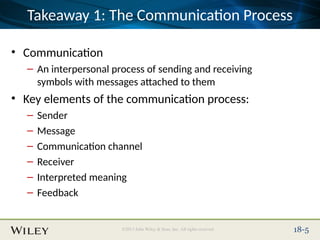
Takeaway 1: The Communication Process
• Communication
– An interpersonal process of sending and receiving
symbols with messages attached to them
• Key elements of the communication process:
– Sender
– Message
– Communication channel
– Receiver
– Interpreted meaning
– Feedback
Place Slide Title Text Here
©2013 John Wiley & Sons, Inc. All rights reserved. 18-6
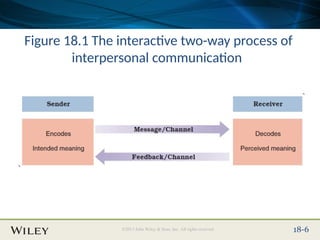
Figure 18.1 The interactive two-way process of
interpersonal communication
Place Slide Title Text Here
©2013 John Wiley & Sons, Inc. All rights reserved. 18-7
Takeaway 1: The Communication Process
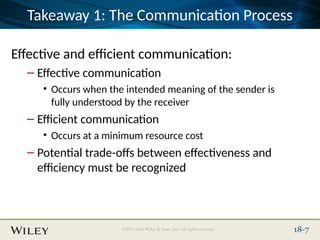
Effective and efficient communication:
– Effective communication
• Occurs when the intended meaning of the sender is
fully understood by the receiver
– Efficient communication
• Occurs at a minimum resource cost
– Potential trade-offs between effectiveness and
efficiency must be recognized
Place Slide Title Text Here
©2013 John Wiley & Sons, Inc. All rights reserved. 18-8
Takeaway 1: The Communication Process
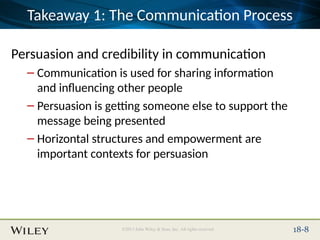
Persuasion and credibility in communication
– Communication is used for sharing information
and influencing other people
– Persuasion is getting someone else to support the
message being presented
– Horizontal structures and empowerment are
important contexts for persuasion
Place Slide Title Text Here
©2013 John Wiley & Sons, Inc. All rights reserved. 18-9
Takeaway 1: The Communication Process
Persuasion and credibility in communication
– Expert power and referent power are essential
for persuasion
– Credibility involves trust, respect, and integrity in
the eyes of others
– Credibility can be built through expertise and
relationships
Place Slide Title Text Here
©2013 John Wiley & Sons, Inc. All rights reserved. 18-10
Takeaway 1: The Communication Process
Communication Barrier:
– Information filtering
– Poor choice of channels
– Poor written or oral expression
– Failure to recognize nonverbal signals
– Physical distractions
Place Slide Title Text Here
©2013 John Wiley & Sons, Inc. All rights reserved. 18-11
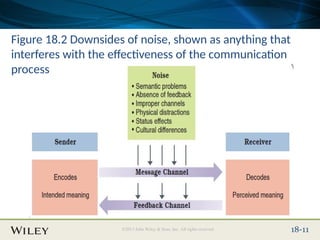
Figure 18.2 Downsides of noise, shown as anything that
interferes with the effectiveness of the communication
process
Place Slide Title Text Here
©2013 John Wiley & Sons, Inc. All rights reserved. 18-12
Takeaway 1: The Communication Process
Information filtering
– Intentional distortion to make it more favorable
to the recipient
– Subordinates may hide unfavorable news from
the manager or make it sound better than it
really is
Place Slide Title Text Here
©2013 John Wiley & Sons, Inc. All rights reserved. 18-13
Takeaway 1: The Communication Process
Poor choice of channels
– Choose the channel that works best
– Written channels work for messages that:
• Are simple and easy to convey
• Require extensive dissemination quickly
• Convey formal policy or authoritative directives
– Spoken channels work best for messages that:
• Are complex or difficult to convey where immediate feedback is
needed
• Attempt to create a supportive, even inspirational, climate
Place Slide Title Text Here
©2013 John Wiley & Sons, Inc. All rights reserved. 18-14
Takeaway 1: The Communication Process
Poor written or oral expression
– Communication only effective when the sender
expresses the message in a way understood by
receiver
– Chose words wisely
Place Slide Title Text Here
©2013 John Wiley & Sons, Inc. All rights reserved. 18-15
Takeaway 1: The Communication Process
Failure to recognize nonverbal signals
– Nonverbal communication takes place through gestures,
facial expressions, body posture, eye contact, and use of
interpersonal space
– Mixed messages occur when a person’s words and
nonverbal signals communicate different things
– The growing use of communication technologies causes
important nonverbal communication to be lost
Place Slide Title Text Here
©2013 John Wiley & Sons, Inc. All rights reserved. 18-16
Takeaway 1: The Communication Process
Physical distractions
– Include interruptions from telephone calls, drop-
in visitors, a lack of privacy, etc.
– Can interfere with the effectiveness of a
communication attempt
– Can be avoided or at least minimized through
proper planning
Place Slide Title Text Here
©2013 John Wiley & Sons, Inc. All rights reserved. 18-17
Takeaway 1: The Communication Process
Cross-cultural communication
– Global economy frequently creates the need to
communicate with colleagues in other countries
with different cultures
– Ethnocentrism
• Tendency to consider one’s culture superior to any and
all others
Place Slide Title Text Here
©2013 John Wiley & Sons, Inc. All rights reserved. 18-18
Takeaway 2: Improving Collaboration Through
Communication
Effective communication is necessary for successful
collaboration
– Transparency and openness
– Use of electronic media
– Active listening
– Constructive feedback
– Space design
– Active listening
– Feedback
Place Slide Title Text Here
©2013 John Wiley & Sons, Inc. All rights reserved. 18-19
Takeaway 2: Improving Collaboration Through
Communication
Transparency and openness
– Communication transparency involves sharing
honest and complete information about the
organization and workplace
– Open book management
• Managers provide employees with important financial
information about their companies
Place Slide Title Text Here
©2013 John Wiley & Sons, Inc. All rights reserved. 18-20
Takeaway 2: Improving Collaboration Through Communication
Using electronic media
– Information technologies facilitate communication
– The electronic grapevine speeds messages and
information from person to person
• Functional if information is accurate and useful
• Dysfunctional if information is false, distorted, or based on rumor
– E-mail privacy
– Employer’s policy on personal e-mail
– Don’t assume that e-mail privacy
exists at work
– Electronic grapevines exist
Place Slide Title Text Here
©2013 John Wiley & Sons, Inc. All rights reserved. 18-21
Takeaway 2: Improving Collaboration Through
Communication
• Active listening
– The process of taking action to help someone say exactly
what he or she really means
• Rules for active listening:
– Listen for message content
– Listen for feelings
– Respond to feelings
– Note all cues, verbal and nonverbal
– Paraphrase and restate
Place Slide Title Text Here
©2013 John Wiley & Sons, Inc. All rights reserved. 18-22
Takeaway 2: Improving Collaboration Through
Communication
• Feedback
– The process of telling others how you feel about
something they did or said, or about the situation in
general (evaluative, interpretive, descriptive)
• Constructive feedback guidelines:
– Give it directly
– Make it specific
– Give it when the receiver is willing/able to accept it
– Make sure it is valid
– Give it in small doses
Place Slide Title Text Here
©2013 John Wiley & Sons, Inc. All rights reserved. 18-23
Takeaway 2: Improving Collaboration Through
Communication
Space design
– Proxemics is the use of interpersonal space
– Interpersonal space is an important
nonverbal cue
– Workspace layout is often overlooked as a
form of nonverbal communication but is
being increasingly recognized for its impact
on communication and behavior
Place Slide Title Text Here
©2013 John Wiley & Sons, Inc. All rights reserved. 18-24
Takeaway 3: Managing Conflict
Conflict
– A disagreement between people on:
• Substantive issues regarding goals and tasks, allocation
of resources, distribution of rewards, policies and
procedures, and job assignments
• Emotional issues arising from feelings of anger,
distrust, dislike, fear, and resentment, as well as
personality clashes
– Conflict that is well managed can help promote
creativity and high performance
Place Slide Title Text Here
©2013 John Wiley & Sons, Inc. All rights reserved. 18-25
Takeaway 3: Managing Conflict
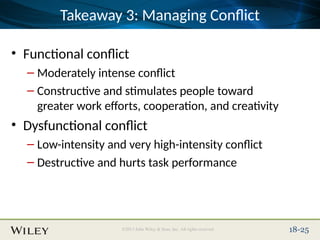
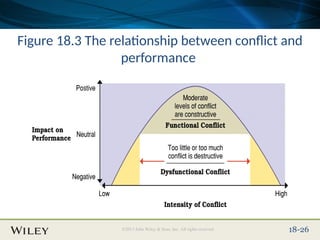
• Functional conflict
– Moderately intense conflict
– Constructive and stimulates people toward
greater work efforts, cooperation, and creativity
• Dysfunctional conflict
– Low-intensity and very high-intensity conflict
– Destructive and hurts task performance
Place Slide Title Text Here
©2013 John Wiley & Sons, Inc. All rights reserved. 18-26
Figure 18.3 The relationship between conflict and
performance
Place Slide Title Text Here
©2013 John Wiley & Sons, Inc. All rights reserved. 18-27
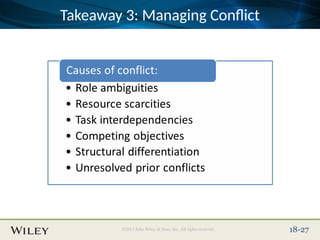
Takeaway 3: Managing Conflict
Place Slide Title Text Here
©2013 John Wiley & Sons, Inc. All rights reserved. 18-28
Takeaway 3: Managing Conflict
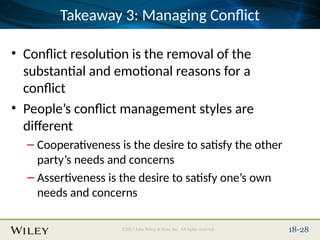
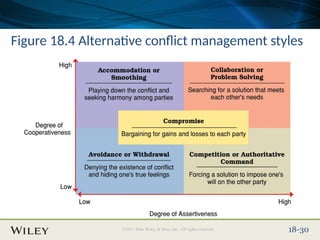
• Conflict resolution is the removal of the
substantial and emotional reasons for a
conflict
• People’s conflict management styles are
different
– Cooperativeness is the desire to satisfy the other
party’s needs and concerns
– Assertiveness is the desire to satisfy one’s own
needs and concerns
Place Slide Title Text Here
©2013 John Wiley & Sons, Inc. All rights reserved. 18-29
Takeaway 3: Managing Conflict
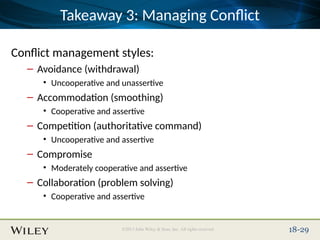
Conflict management styles:
– Avoidance (withdrawal)
• Uncooperative and unassertive
– Accommodation (smoothing)
• Cooperative and assertive
– Competition (authoritative command)
• Uncooperative and assertive
– Compromise
• Moderately cooperative and assertive
– Collaboration (problem solving)
• Cooperative and assertive
Place Slide Title Text Here
©2013 John Wiley & Sons, Inc. All rights reserved. 18-30
Figure 18.4 Alternative conflict management styles
Place Slide Title Text Here
©2013 John Wiley & Sons, Inc. All rights reserved. 18-31
Takeaway 3: Managing Conflict
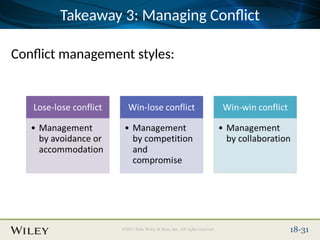
Conflict management styles:
Place Slide Title Text Here
©2013 John Wiley & Sons, Inc. All rights reserved. 18-32
Takeaway 3: Managing Conflict
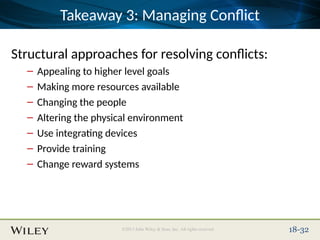
Structural approaches for resolving conflicts:
– Appealing to higher level goals
– Making more resources available
– Changing the people
– Altering the physical environment
– Use integrating devices
– Provide training
– Change reward systems
Place Slide Title Text Here
©2013 John Wiley & Sons, Inc. All rights reserved. 18-33
Takeaway 3: Managing Conflict
Integrative devices for resolving conflicts:
–Using liaison personnel, special task forces,
cross-functional teams, or a matrix
organization
Place Slide Title Text Here
©2013 John Wiley & Sons, Inc. All rights reserved. 18-34
Takeaway 4: Managing Negotiation
Negotiation
– The process of making joint decisions when the
parties involved have different preferences
– All negotiation situations are susceptible to
conflict and require exceptional communication
and interpersonal skills
Place Slide Title Text Here
©2013 John Wiley & Sons, Inc. All rights reserved. 18-35
Takeaway 4: Managing Negotiation
Negotiation goals and approaches:
– Substance goals
• Concerned with outcomes
• Tied to the “content” issues of negotiation
– Relationship goals
• Concerned with processes
• Tied to the way people work together
– Effective negotiations occur when:
• Issues of substance are resolved
• Working relationships are maintained or improved
Place Slide Title Text Here
©2013 John Wiley & Sons, Inc. All rights reserved. 18-36
Takeaway 4: Managing Negotiation
Criteria for effective negotiation:
– Quality
• Negotiating a “wise” agreement that is truly
satisfactory to all sides
– Cost
• Negotiating efficiently, using minimum resources and
time
– Harmony
• Negotiating in a way that fosters interpersonal
relationships
Place Slide Title Text Here
©2013 John Wiley & Sons, Inc. All rights reserved. 18-37
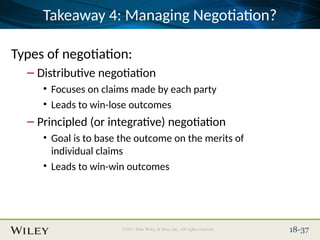
Takeaway 4: Managing Negotiation?
Types of negotiation:
– Distributive negotiation
• Focuses on claims made by each party
• Leads to win-lose outcomes
– Principled (or integrative) negotiation
• Goal is to base the outcome on the merits of
individual claims
• Leads to win-win outcomes
Place Slide Title Text Here
©2013 John Wiley & Sons, Inc. All rights reserved. 18-38
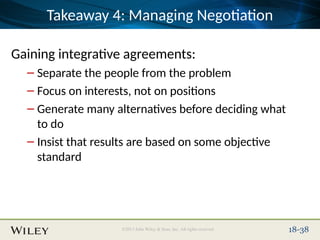
Takeaway 4: Managing Negotiation
Gaining integrative agreements:
– Separate the people from the problem
– Focus on interests, not on positions
– Generate many alternatives before deciding what
to do
– Insist that results are based on some objective
standard
Place Slide Title Text Here
©2013 John Wiley & Sons, Inc. All rights reserved. 18-39
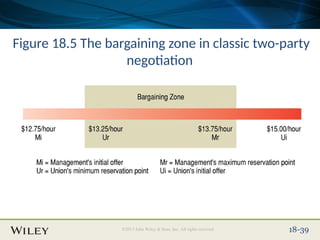
Figure 18.5 The bargaining zone in classic two-party
negotiation
Place Slide Title Text Here
©2013 John Wiley & Sons, Inc. All rights reserved. 18-40
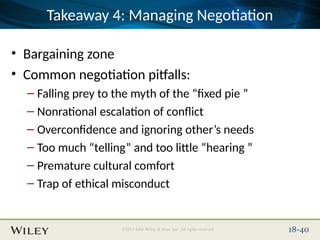
Takeaway 4: Managing Negotiation
• Bargaining zone
• Common negotiation pitfalls:
– Falling prey to the myth of the “fixed pie ”
– Nonrational escalation of conflict
– Overconfidence and ignoring other’s needs
– Too much “telling” and too little “hearing ”
– Premature cultural comfort
– Trap of ethical misconduct
Place Slide Title Text Here
©2013 John Wiley & Sons, Inc. All rights reserved. 18-41
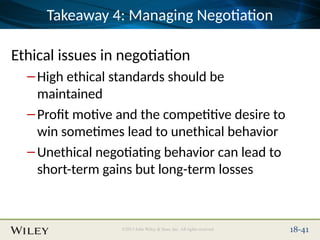
Takeaway 4: Managing Negotiation
Ethical issues in negotiation
–High ethical standards should be
maintained
–Profit motive and the competitive desire to
win sometimes lead to unethical behavior
–Unethical negotiating behavior can lead to
short-term gains but long-term losses
Place Slide Title Text Here
©2013 John Wiley & Sons, Inc. All rights reserved. 18-42
Takeaway 4: Managing Negotiation
Third-party dispute resolution
– Mediation
• Involves a neutral third party who tries to improve
communication between negotiating parties and keep
them focused on relevant issues
– Arbitration
• Involves a neutral third party who acts as a judge and
issues a binding decision
• Ombudsperson is a neutral third party who listens to
complaints in an attempt to resolve disputes

communication and collaboration management

  • 1.
    Place Slide TitleText Here ©2013 John Wiley & Sons, Inc. All rights reserved. 18-1 18-1 ©2013 John Wiley & Sons, Inc. All rights reserved. JOHN R. SCHERMERHORN, JR. JOHN R. SCHERMERHORN, JR. MANAGEMENT MANAGEMENT 12 12th th Edition Edition Chapter 18 Chapter 18 Communication and Collaboration
  • 2.
    Place Slide TitleText Here ©2013 John Wiley & Sons, Inc. All rights reserved. 18-2 Planning Ahead — Chapter 18 Study Questions 1. What is the communication process? 2. How can we improve our communications? 3. How can we deal positively with conflict? 4. How can we negotiate successful agreements?
  • 3.
    Place Slide TitleText Here ©2013 John Wiley & Sons, Inc. All rights reserved. 18-3 Chapter 18 Learning Dashboard 1. The Communication Process 1. Effective communication 2. Persuasion and credibility in communication 3. Communication barriers 4. Cross-cultural communication 2. Improving Collaboration Through Communication 1. Transparency and openness 2. Use of electronic media 3. Active listening 4. Constructive feedback 5. Space design
  • 4.
    Place Slide TitleText Here ©2013 John Wiley & Sons, Inc. All rights reserved. 18-4 Chapter 18 Learning Dashboard 3. Managing Conflict 1. Functional and dysfunctional conflict 2. Causes of conflict 3. Conflict resolution 4. Conflict management styles 5. Structural approaches to conflict management 4. Managing Negotiation 1. Negotiation goals and approaches 2. Gaining agreements 3. Negotiation pitfalls 4. Third-party dispute resolution
  • 5.
    Place Slide TitleText Here ©2013 John Wiley & Sons, Inc. All rights reserved. 18-5 Takeaway 1: The Communication Process • Communication – An interpersonal process of sending and receiving symbols with messages attached to them • Key elements of the communication process: – Sender – Message – Communication channel – Receiver – Interpreted meaning – Feedback
  • 6.
    Place Slide TitleText Here ©2013 John Wiley & Sons, Inc. All rights reserved. 18-6 Figure 18.1 The interactive two-way process of interpersonal communication
  • 7.
    Place Slide TitleText Here ©2013 John Wiley & Sons, Inc. All rights reserved. 18-7 Takeaway 1: The Communication Process Effective and efficient communication: – Effective communication • Occurs when the intended meaning of the sender is fully understood by the receiver – Efficient communication • Occurs at a minimum resource cost – Potential trade-offs between effectiveness and efficiency must be recognized
  • 8.
    Place Slide TitleText Here ©2013 John Wiley & Sons, Inc. All rights reserved. 18-8 Takeaway 1: The Communication Process Persuasion and credibility in communication – Communication is used for sharing information and influencing other people – Persuasion is getting someone else to support the message being presented – Horizontal structures and empowerment are important contexts for persuasion
  • 9.
    Place Slide TitleText Here ©2013 John Wiley & Sons, Inc. All rights reserved. 18-9 Takeaway 1: The Communication Process Persuasion and credibility in communication – Expert power and referent power are essential for persuasion – Credibility involves trust, respect, and integrity in the eyes of others – Credibility can be built through expertise and relationships
  • 10.
    Place Slide TitleText Here ©2013 John Wiley & Sons, Inc. All rights reserved. 18-10 Takeaway 1: The Communication Process Communication Barrier: – Information filtering – Poor choice of channels – Poor written or oral expression – Failure to recognize nonverbal signals – Physical distractions
  • 11.
    Place Slide TitleText Here ©2013 John Wiley & Sons, Inc. All rights reserved. 18-11 Figure 18.2 Downsides of noise, shown as anything that interferes with the effectiveness of the communication process
  • 12.
    Place Slide TitleText Here ©2013 John Wiley & Sons, Inc. All rights reserved. 18-12 Takeaway 1: The Communication Process Information filtering – Intentional distortion to make it more favorable to the recipient – Subordinates may hide unfavorable news from the manager or make it sound better than it really is
  • 13.
    Place Slide TitleText Here ©2013 John Wiley & Sons, Inc. All rights reserved. 18-13 Takeaway 1: The Communication Process Poor choice of channels – Choose the channel that works best – Written channels work for messages that: • Are simple and easy to convey • Require extensive dissemination quickly • Convey formal policy or authoritative directives – Spoken channels work best for messages that: • Are complex or difficult to convey where immediate feedback is needed • Attempt to create a supportive, even inspirational, climate
  • 14.
    Place Slide TitleText Here ©2013 John Wiley & Sons, Inc. All rights reserved. 18-14 Takeaway 1: The Communication Process Poor written or oral expression – Communication only effective when the sender expresses the message in a way understood by receiver – Chose words wisely
  • 15.
    Place Slide TitleText Here ©2013 John Wiley & Sons, Inc. All rights reserved. 18-15 Takeaway 1: The Communication Process Failure to recognize nonverbal signals – Nonverbal communication takes place through gestures, facial expressions, body posture, eye contact, and use of interpersonal space – Mixed messages occur when a person’s words and nonverbal signals communicate different things – The growing use of communication technologies causes important nonverbal communication to be lost
  • 16.
    Place Slide TitleText Here ©2013 John Wiley & Sons, Inc. All rights reserved. 18-16 Takeaway 1: The Communication Process Physical distractions – Include interruptions from telephone calls, drop- in visitors, a lack of privacy, etc. – Can interfere with the effectiveness of a communication attempt – Can be avoided or at least minimized through proper planning
  • 17.
    Place Slide TitleText Here ©2013 John Wiley & Sons, Inc. All rights reserved. 18-17 Takeaway 1: The Communication Process Cross-cultural communication – Global economy frequently creates the need to communicate with colleagues in other countries with different cultures – Ethnocentrism • Tendency to consider one’s culture superior to any and all others
  • 18.
    Place Slide TitleText Here ©2013 John Wiley & Sons, Inc. All rights reserved. 18-18 Takeaway 2: Improving Collaboration Through Communication Effective communication is necessary for successful collaboration – Transparency and openness – Use of electronic media – Active listening – Constructive feedback – Space design – Active listening – Feedback
  • 19.
    Place Slide TitleText Here ©2013 John Wiley & Sons, Inc. All rights reserved. 18-19 Takeaway 2: Improving Collaboration Through Communication Transparency and openness – Communication transparency involves sharing honest and complete information about the organization and workplace – Open book management • Managers provide employees with important financial information about their companies
  • 20.
    Place Slide TitleText Here ©2013 John Wiley & Sons, Inc. All rights reserved. 18-20 Takeaway 2: Improving Collaboration Through Communication Using electronic media – Information technologies facilitate communication – The electronic grapevine speeds messages and information from person to person • Functional if information is accurate and useful • Dysfunctional if information is false, distorted, or based on rumor – E-mail privacy – Employer’s policy on personal e-mail – Don’t assume that e-mail privacy exists at work – Electronic grapevines exist
  • 21.
    Place Slide TitleText Here ©2013 John Wiley & Sons, Inc. All rights reserved. 18-21 Takeaway 2: Improving Collaboration Through Communication • Active listening – The process of taking action to help someone say exactly what he or she really means • Rules for active listening: – Listen for message content – Listen for feelings – Respond to feelings – Note all cues, verbal and nonverbal – Paraphrase and restate
  • 22.
    Place Slide TitleText Here ©2013 John Wiley & Sons, Inc. All rights reserved. 18-22 Takeaway 2: Improving Collaboration Through Communication • Feedback – The process of telling others how you feel about something they did or said, or about the situation in general (evaluative, interpretive, descriptive) • Constructive feedback guidelines: – Give it directly – Make it specific – Give it when the receiver is willing/able to accept it – Make sure it is valid – Give it in small doses
  • 23.
    Place Slide TitleText Here ©2013 John Wiley & Sons, Inc. All rights reserved. 18-23 Takeaway 2: Improving Collaboration Through Communication Space design – Proxemics is the use of interpersonal space – Interpersonal space is an important nonverbal cue – Workspace layout is often overlooked as a form of nonverbal communication but is being increasingly recognized for its impact on communication and behavior
  • 24.
    Place Slide TitleText Here ©2013 John Wiley & Sons, Inc. All rights reserved. 18-24 Takeaway 3: Managing Conflict Conflict – A disagreement between people on: • Substantive issues regarding goals and tasks, allocation of resources, distribution of rewards, policies and procedures, and job assignments • Emotional issues arising from feelings of anger, distrust, dislike, fear, and resentment, as well as personality clashes – Conflict that is well managed can help promote creativity and high performance
  • 25.
    Place Slide TitleText Here ©2013 John Wiley & Sons, Inc. All rights reserved. 18-25 Takeaway 3: Managing Conflict • Functional conflict – Moderately intense conflict – Constructive and stimulates people toward greater work efforts, cooperation, and creativity • Dysfunctional conflict – Low-intensity and very high-intensity conflict – Destructive and hurts task performance
  • 26.
    Place Slide TitleText Here ©2013 John Wiley & Sons, Inc. All rights reserved. 18-26 Figure 18.3 The relationship between conflict and performance
  • 27.
    Place Slide TitleText Here ©2013 John Wiley & Sons, Inc. All rights reserved. 18-27 Takeaway 3: Managing Conflict
  • 28.
    Place Slide TitleText Here ©2013 John Wiley & Sons, Inc. All rights reserved. 18-28 Takeaway 3: Managing Conflict • Conflict resolution is the removal of the substantial and emotional reasons for a conflict • People’s conflict management styles are different – Cooperativeness is the desire to satisfy the other party’s needs and concerns – Assertiveness is the desire to satisfy one’s own needs and concerns
  • 29.
    Place Slide TitleText Here ©2013 John Wiley & Sons, Inc. All rights reserved. 18-29 Takeaway 3: Managing Conflict Conflict management styles: – Avoidance (withdrawal) • Uncooperative and unassertive – Accommodation (smoothing) • Cooperative and assertive – Competition (authoritative command) • Uncooperative and assertive – Compromise • Moderately cooperative and assertive – Collaboration (problem solving) • Cooperative and assertive
  • 30.
    Place Slide TitleText Here ©2013 John Wiley & Sons, Inc. All rights reserved. 18-30 Figure 18.4 Alternative conflict management styles
  • 31.
    Place Slide TitleText Here ©2013 John Wiley & Sons, Inc. All rights reserved. 18-31 Takeaway 3: Managing Conflict Conflict management styles:
  • 32.
    Place Slide TitleText Here ©2013 John Wiley & Sons, Inc. All rights reserved. 18-32 Takeaway 3: Managing Conflict Structural approaches for resolving conflicts: – Appealing to higher level goals – Making more resources available – Changing the people – Altering the physical environment – Use integrating devices – Provide training – Change reward systems
  • 33.
    Place Slide TitleText Here ©2013 John Wiley & Sons, Inc. All rights reserved. 18-33 Takeaway 3: Managing Conflict Integrative devices for resolving conflicts: –Using liaison personnel, special task forces, cross-functional teams, or a matrix organization
  • 34.
    Place Slide TitleText Here ©2013 John Wiley & Sons, Inc. All rights reserved. 18-34 Takeaway 4: Managing Negotiation Negotiation – The process of making joint decisions when the parties involved have different preferences – All negotiation situations are susceptible to conflict and require exceptional communication and interpersonal skills
  • 35.
    Place Slide TitleText Here ©2013 John Wiley & Sons, Inc. All rights reserved. 18-35 Takeaway 4: Managing Negotiation Negotiation goals and approaches: – Substance goals • Concerned with outcomes • Tied to the “content” issues of negotiation – Relationship goals • Concerned with processes • Tied to the way people work together – Effective negotiations occur when: • Issues of substance are resolved • Working relationships are maintained or improved
  • 36.
    Place Slide TitleText Here ©2013 John Wiley & Sons, Inc. All rights reserved. 18-36 Takeaway 4: Managing Negotiation Criteria for effective negotiation: – Quality • Negotiating a “wise” agreement that is truly satisfactory to all sides – Cost • Negotiating efficiently, using minimum resources and time – Harmony • Negotiating in a way that fosters interpersonal relationships
  • 37.
    Place Slide TitleText Here ©2013 John Wiley & Sons, Inc. All rights reserved. 18-37 Takeaway 4: Managing Negotiation? Types of negotiation: – Distributive negotiation • Focuses on claims made by each party • Leads to win-lose outcomes – Principled (or integrative) negotiation • Goal is to base the outcome on the merits of individual claims • Leads to win-win outcomes
  • 38.
    Place Slide TitleText Here ©2013 John Wiley & Sons, Inc. All rights reserved. 18-38 Takeaway 4: Managing Negotiation Gaining integrative agreements: – Separate the people from the problem – Focus on interests, not on positions – Generate many alternatives before deciding what to do – Insist that results are based on some objective standard
  • 39.
    Place Slide TitleText Here ©2013 John Wiley & Sons, Inc. All rights reserved. 18-39 Figure 18.5 The bargaining zone in classic two-party negotiation
  • 40.
    Place Slide TitleText Here ©2013 John Wiley & Sons, Inc. All rights reserved. 18-40 Takeaway 4: Managing Negotiation • Bargaining zone • Common negotiation pitfalls: – Falling prey to the myth of the “fixed pie ” – Nonrational escalation of conflict – Overconfidence and ignoring other’s needs – Too much “telling” and too little “hearing ” – Premature cultural comfort – Trap of ethical misconduct
  • 41.
    Place Slide TitleText Here ©2013 John Wiley & Sons, Inc. All rights reserved. 18-41 Takeaway 4: Managing Negotiation Ethical issues in negotiation –High ethical standards should be maintained –Profit motive and the competitive desire to win sometimes lead to unethical behavior –Unethical negotiating behavior can lead to short-term gains but long-term losses
  • 42.
    Place Slide TitleText Here ©2013 John Wiley & Sons, Inc. All rights reserved. 18-42 Takeaway 4: Managing Negotiation Third-party dispute resolution – Mediation • Involves a neutral third party who tries to improve communication between negotiating parties and keep them focused on relevant issues – Arbitration • Involves a neutral third party who acts as a judge and issues a binding decision • Ombudsperson is a neutral third party who listens to complaints in an attempt to resolve disputes