LDRV6302 UNIT I
Leadership Framework
Dr. Steve Pham
Senior Lecturer in Leadership, International Business,
Entrepreneurship, International HRM
PART I. FOUNDATIONS FOR EFFECTIVE LEADERSHIP
CHAPTER 1. INTRODUCTION
CHAPTER 2. LEADER TRAITS AND CHARACTERISTICS
CHAPTER 3. Leader-Member Exchange and Relationship-Building
CHAPTER 4. Followership: Managing Up and Sideways
CHAPTER 5. The Situational Approach to Leadership
PART II. CONTEMPORARY ISSUES IN LEADERSHIP
CHAPTER 6. Ethical and Moral Leadership
CHAPTER 7. Seeking, Receiving, and Giving Feedback
CHAPTER 8. Team and Shared Leadership
CHAPTER 9. Men and Women in Leadership Roles
CHAPTER 10. Global Leadership
PART III. VISIONARY AND STRATEGIC LEADERSHIP
CHAPTER 11. Inspirational and Visionary Leadership
CHAPTER 12. Strategic Leadership and Shaping Organizational Culture
CHAPTER 13. Generating Organizational Change Through Strategic Leadership
UNIT I. LEADERSHIP FRAMEWORK (4/29)
UNIT II. Charismatic and Transformational Leaders (5/6)
UNIT III. The Power of Influence and Diversity (5/13)
UNIT IV. Motivation and Morale (5/20)
UNIT V. Leadership Models (5/27)
REVIEW I (6/3)
UNIT VI. Organizational Change (6/10)
UNIT VII. 360-Degree Feedback (6/17)
UNIT VIII. Painting a Picture of Leadership (6/24)
REVIEW II (7/1)
Unit I Lectures  Study Guides
Waldman, Leadership for Organizations 1e. SAGE Publishing, 2020.
Unit I Learning Outcomes
Upon completion of this unit, students should be able to explain the
significance of different types of leadership theories.
• identify the leadership THEORY that aligns with a specific
leadership STYLE.
• describe how leadership theories can help an individual in her or
his future CAREER.
Waldman, Leadership for Organizations 1e. SAGE Publishing, 2020.
Reading Assignment
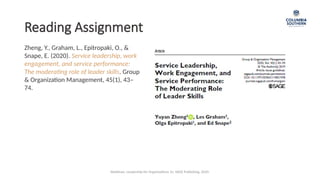
Zheng, Y., Graham, L., Epitropaki, O., &
Snape, E. (2020). Service leadership, work
engagement, and service performance:
The moderating role of leader skills. Group
& Organization Management, 45(1), 43–
74.
Waldman, Leadership for Organizations 1e. SAGE Publishing, 2020.
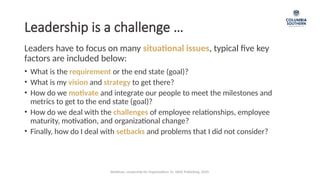
Leadership is a challenge …
Leaders have to focus on many situational issues, typical five key
factors are included below:
• What is the requirement or the end state (goal)?
• What is my vision and strategy to get there?
• How do we motivate and integrate our people to meet the milestones and
metrics to get to the end state (goal)?
• How do we deal with the challenges of employee relationships, employee
maturity, motivation, and organizational change?
• Finally, how do I deal with setbacks and problems that I did not consider?
Waldman, Leadership for Organizations 1e. SAGE Publishing, 2020.
CHAPTER 1
Organizational Leadership
Dr. Steve Pham
Organizational Leadership
1.1 How to define organizational leadership? Gary Yukl’s definition of leadership
and contemporary concepts.
1.2 What are the differences between leadership and management? Describe Jim
Collins’s bus metaphor.
1.3 Are leaders are borne or made? The compromise answer with leadership
qualities that can be developed.
1.4 How organizations benefit from leadership? And discuss the importance of
CONTEXT to leadership, as well as describe how leadership can be learned
based on both SCIENCE and as an ART.
7
Waldman, Leadership for Organizations 1e. SAGE Publishing, 2020.
Defining Organizational Leadership (1 of 2)
Gary Yukl’s definition of leadership: “a process whereby intentional
influence is exerted over other people to guide, structure, and facilitate
activities and relationships in a group or organization.”
8
Textbook’s definition: more specific in terms of what the influence is all
about “the process of exerting intentional influence toward the ideas,
beliefs or values, capabilities, and behaviors of others, willingly on their
part, toward an organizational goal(s) or vision.”
Waldman, Leadership for Organizations 1e. SAGE Publishing, 2020.
Defining Organizational Leadership (2 of 2)
• Leadership pertains to individuals rather than organizations.
• Leadership is a process.
• There can be informal leaders.
9
Some Important Introductory Questions
• Is there a difference between leadership and management?
• Are leaders born or are they made?
• Why exactly is leadership so important for organizations?
• How does context affect leadership?
10
Waldman, Leadership for Organizations 1e. SAGE Publishing, 2020.
Is there a difference between
leadership and management?
11
Waldman, Leadership for Organizations 1e. SAGE Publishing, 2020.
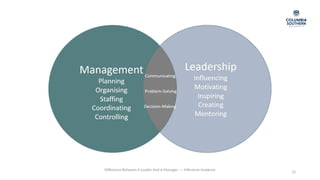
Leadership vs. Management
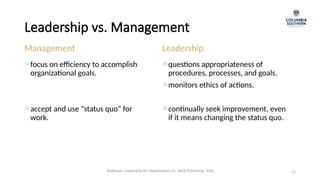
focus on efficiency to accomplish
organizational goals.
accept and use “status quo” for
work.
12
Management Leadership
questions appropriateness of
procedures, processes, and goals.
monitors ethics of actions.
continually seek improvement, even
if it means changing the status quo.
Waldman, Leadership for Organizations 1e. SAGE Publishing, 2020.
Difference Between A Leader And A Manager — Milestone Academy
13
14
Waldman, Leadership for Organizations 1e. SAGE Publishing, 2020.
Are leaders born or are they made?
15
Waldman, Leadership for Organizations 1e. SAGE Publishing, 2020.
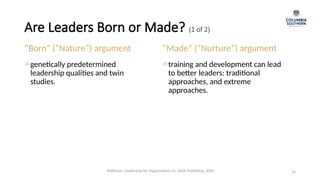
Are Leaders Born or Made? (1 of 2)
genetically predetermined
leadership qualities and twin
studies.
16
“Born” (“Nature”) argument “Made” (“Nurture”) argument
training and development can lead
to better leaders: traditional
approaches, and extreme
approaches.
Waldman, Leadership for Organizations 1e. SAGE Publishing, 2020.
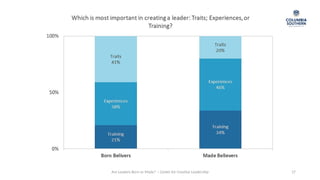
Are Leaders Born or Made? – Center for Creative Leadership 17
Are Leaders Born or Made? (2 of 2)
compromise answer: born with leadership qualities that can be
developed e.g., brain structures, neuroplasticity, and neurofeedback.
largely malleable leadership capabilities e.g., "Leadership and
learning are indispensable to each other.“ –John F. Kennedy
18
Waldman, Leadership for Organizations 1e. SAGE Publishing, 2020.
How does context affect leadership?
19
Waldman, Leadership for Organizations 1e. SAGE Publishing, 2020.
How Does Context Affect Leadership?
20
Context: various circumstances surrounding a leader.
involves urgency of decisions, nature of tasks or work settings, and cultural or
geographic circumstances.
influence of context on type of approach or style of leadership e.g., context of
jobs, industries, or institutions.
ability of context to stifle or facilitate leadership behavior e.g., bureaucratic vs.
experimentation organizations.
Waldman, Leadership for Organizations 1e. SAGE Publishing, 2020.
Why exactly is leadership so important
for organizations?
21
Waldman, Leadership for Organizations 1e. SAGE Publishing, 2020.
The Importance of Leadership for Organizations
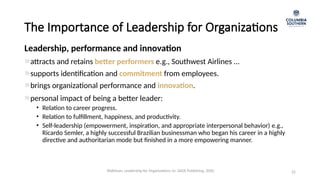
attracts and retains better performers e.g., Southwest Airlines ...
supports identification and commitment from employees.
brings organizational performance and innovation.
22
personal impact of being a better leader:
• Relation to career progress.
• Relation to fulfillment, happiness, and productivity.
• Self-leadership (empowerment, inspiration, and appropriate interpersonal behavior) e.g.,
Ricardo Semler, a highly successful Brazilian businessman who began his career in a highly
directive and authoritarian mode but finished in a more empowering manner.
Leadership, performance and innovation
Waldman, Leadership for Organizations 1e. SAGE Publishing, 2020.
The Importance of Leadership for Organizations
Leadership is just “common sense”—common sense varies among individuals
e.g., support vs. skeptical supervisor for a new parent.
23
Understanding and learning of leadership through role modeling, practice,
feedback, and experience —Personal vs. others’ experience.
Three key principles
• Based on systemic research.
• Use of case videos for role-modeling.
• Use of story-telling.
Leadership is Both a Science and an Art
Waldman, Leadership for Organizations 1e. SAGE Publishing, 2020.
A Look to the Future
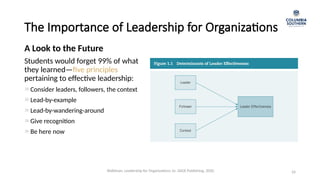
Students would forget 99% of what
they learned—five principles
pertaining to effective leadership:
Consider leaders, followers, the context
Lead-by-example
Lead-by-wandering-around
Give recognition
Be here now
24
The Importance of Leadership for Organizations
Waldman, Leadership for Organizations 1e. SAGE Publishing, 2020.
CHAPTER 2
Leader Traits & Characteristics
Dr. Steve Pham
Leader Traits & Characteristics
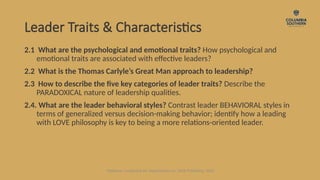
2.1 What are the psychological and emotional traits? How psychological and
emotional traits are associated with effective leaders?
2.2 What is the Thomas Carlyle’s Great Man approach to leadership?
2.3 How to describe the five key categories of leader traits? Describe the
PARADOXICAL nature of leadership qualities.
2.4. What are the leader behavioral styles? Contrast leader BEHAVIORAL styles in
terms of generalized versus decision-making behavior; identify how a leading
with LOVE philosophy is key to being a more relations-oriented leader.
Waldman, Leadership for Organizations 1e. SAGE Publishing, 2020.
The Psychological and Emotional Traits
27
Waldman, Leadership for Organizations 1e. SAGE Publishing, 2020.
The Psychological and Emotional Traits
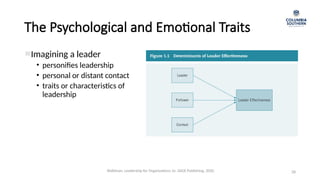
Imagining a leader
• personifies leadership
• personal or distant contact
• traits or characteristics of
leadership
28
Waldman, Leadership for Organizations 1e. SAGE Publishing, 2020.
Tomas Chamorro-Premuzic, & Adrian Frunham (2010). The
Psychology of Personnel Selection. Cambridge University Press.
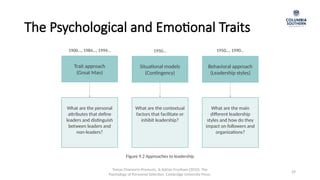
29
Trait approach
(Great Man)
Situational models
(Contingency)
Behavioral approach
(Leadership styles)
What are the personal
attributes that define
leaders and distinguish
between leaders and
non-leaders?
What are the contextual
factors that facilitate or
inhibit leadership?
What are the main
different leadership
styles and how do they
impact on followers and
organizations?
1900…, 1984…, 1994… 1950… 1950…, 1990…
Figure 9.2 Approaches to leadership
The Psychological and Emotional Traits
“Great Man” Approach to Leadership
30
Waldman, Leadership for Organizations 1e. SAGE Publishing, 2020.
Great Man Approach to Leadership (1 of 2)
31
Trait
a trait is a distinguishing quality or characteristic (i.e., physical, cognitive,
emotional).
Thomas Carlyle’s Great Man approach
Great Man approach is the initial thinking (or bias) in this approach was that only
men could truly be leaders -- identify individual or sets of traits (including both
physical and psychological traits) that can distinguish leaders from non-leaders.
Waldman, Leadership for Organizations 1e. SAGE Publishing, 2020.
Great Man Approach to Leadership (2 of 2)
32
Psychological Traits
(five key categories of leader traits)
passion and drive
self and other awareness (including
emotional intelligence)
basic needs or motive profile
character
complexity and paradoxical nature
Physical Traits
gender, height, and physical
appearance
initial bias towards men as leaders
Waldman, Leadership for Organizations 1e. SAGE Publishing, 2020.
Five Key Categories of Leader Traits
33
Waldman, Leadership for Organizations 1e. SAGE Publishing, 2020.
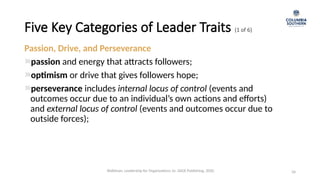
Five Key Categories of Leader Traits (1 of 6)
Passion, Drive, and Perseverance
passion and energy that attracts followers;
optimism or drive that gives followers hope;
perseverance includes internal locus of control (events and
outcomes occur due to an individual’s own actions and efforts)
and external locus of control (events and outcomes occur due to
outside forces);
34
Waldman, Leadership for Organizations 1e. SAGE Publishing, 2020.
Five Key Categories of Leader Traits (2 of 6)
35
Self and Other Awareness
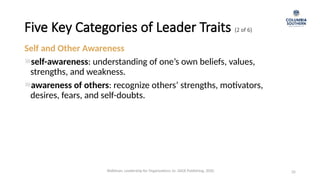
self-awareness: understanding of one’s own beliefs, values,
strengths, and weakness.
awareness of others: recognize others’ strengths, motivators,
desires, fears, and self-doubts.
Waldman, Leadership for Organizations 1e. SAGE Publishing, 2020.
Five Key Categories of Leader Traits (3 of 6)
36
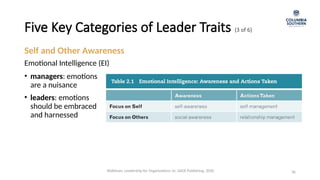
Emotional Intelligence (EI)
Self and Other Awareness
• managers: emotions
are a nuisance
• leaders: emotions
should be embraced
and harnessed
Waldman, Leadership for Organizations 1e. SAGE Publishing, 2020.
37
Five Key Categories of Leader Traits (4 of 6)
Reference: Adapted from Neck, Organizational Behavior, 2e. ©
SAGE Publishing, 2020.
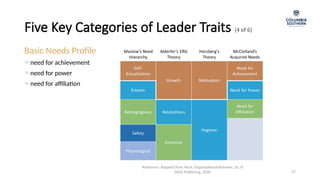
Basic Needs Profile
need for achievement
need for power
need for affiliation
38
Five Key Categories of Leader Traits (5 of 6)
Character: moral excellence and firmness on the part of leaders.
integrity: involves both commission and omission.
genuine or authentic: leaders are themselves.
internal accountability: strong sense of responsibility towards others
or a cause and acceptance of personal repercussions.
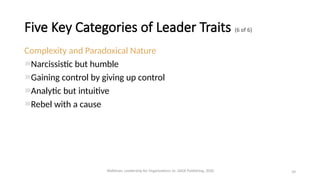
Complexity and Paradoxical Nature
Narcissistic but humble
Gaining control by giving up control
Analytic but intuitive
Rebel with a cause
39
Five Key Categories of Leader Traits (6 of 6)
Waldman, Leadership for Organizations 1e. SAGE Publishing, 2020.
Tomas Chamorro-Premuzic, & Adrian Frunham (2010). The
Psychology of Personnel Selection. Cambridge University Press.
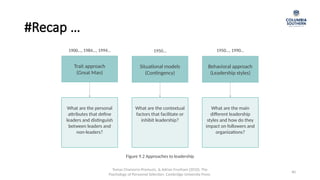
#Recap …
40
Trait approach
(Great Man)
Situational models
(Contingency)
Behavioral approach
(Leadership styles)
What are the personal
attributes that define
leaders and distinguish
between leaders and
non-leaders?
What are the contextual
factors that facilitate or
inhibit leadership?
What are the main
different leadership
styles and how do they
impact on followers and
organizations?
1900…, 1984…, 1994… 1950… 1950…, 1990…
Figure 9.2 Approaches to leadership
Leader Behavioral Styles
41
Waldman, Leadership for Organizations 1e. SAGE Publishing, 2020.
Leader behaviors involve actions taken in the pursuit of influencing
others and attaining goals – two typical leader behavioral styles:
Generalized leader behavior
Decision-making leader behavior
Leader Behavioral Styles (1 of 5)
Waldman, Leadership for Organizations 1e. SAGE Publishing, 2020.
Leader Behavioral Styles (2 of 5)
Generalized leader behavior
Relations-oriented behavior
• respecting ideas and feelings
• establishing trust
• listening to problems
• resolving personal or interpersonal
problems
43
Task-oriented
• work scheduling
• directing work activities
• maintaining efficiency
• enforcing rules
Waldman, Leadership for Organizations 1e. SAGE Publishing, 2020.
Leader Behavioral Styles (3 of 5)
44
Decision-making leader behavior
Autocratic manner –authoritarian decision making
Consulting manner –democratic decision making
Participatory or facilitating manner –democratic decision making
Delegating manner –laissez-faire decision making
Waldman, Leadership for Organizations 1e. SAGE Publishing, 2020.
Leading with Love
Show compassion
Make work fun
Reduce fear in the workplace
45
Leader Behavioral Styles (4 of 5)
Waldman, Leadership for Organizations 1e. SAGE Publishing, 2020.
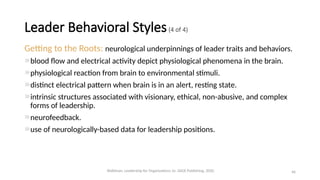
Getting to the Roots: neurological underpinnings of leader traits and behaviors.
blood flow and electrical activity depict physiological phenomena in the brain.
physiological reaction from brain to environmental stimuli.
distinct electrical pattern when brain is in an alert, resting state.
intrinsic structures associated with visionary, ethical, non-abusive, and complex
forms of leadership.
neurofeedback.
use of neurologically-based data for leadership positions.
46
Leader Behavioral Styles(4 of 4)
Waldman, Leadership for Organizations 1e. SAGE Publishing, 2020.
Tomas Chamorro-Premuzic, & Adrian Frunham (2010). The Psychology of Personnel Selection.
Cambridge University Press.
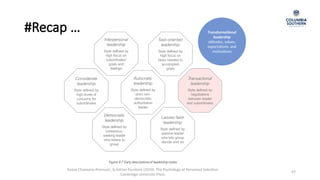
#Recap …
47
Transformational
leadership
attitudes, values,
expectations, and
motivations
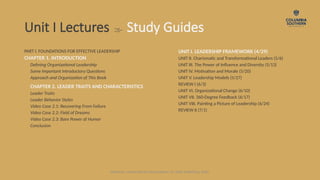
PART I. FOUNDATIONS FOR EFFECTIVE LEADERSHIP
CHAPTER 1. INTRODUCTION
Defining Organizational Leadership
Some Important Introductory Questions
Approach and Organization of This Book
CHAPTER 2. LEADER TRAITS AND CHARACTERISTICS
Leader Traits
Leader Behavior Styles
Video Case 2.1: Recovering From Failure
Video Case 2.2: Field of Dreams
Video Case 2.3: Bare Power of Humor
Conclusion
UNIT I. LEADERSHIP FRAMEWORK (4/29)
UNIT II. Charismatic and Transformational Leaders (5/6)
UNIT III. The Power of Influence and Diversity (5/13)
UNIT IV. Motivation and Morale (5/20)
UNIT V. Leadership Models (5/27)
REVIEW I (6/3)
UNIT VI. Organizational Change (6/10)
UNIT VII. 360-Degree Feedback (6/17)
UNIT VIII. Painting a Picture of Leadership (6/24)
REVIEW II (7/1)
Unit I Lectures  Study Guides
Waldman, Leadership for Organizations 1e. SAGE Publishing, 2020.
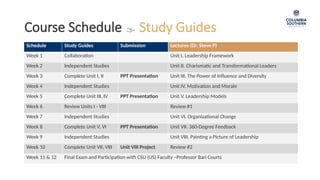
Course Schedule  Study Guides
Schedule Study Guides Submission Lectures (Dr. Steve P)
Week 1 Collaboration Unit I. Leadership Framework
Week 2 Independent Studies Unit II. Charismatic and Transformational Leaders
Week 3 Complete Unit I, II PPT Presentation Unit III. The Power of Influence and Diversity
Week 4 Independent Studies Unit IV. Motivation and Morale
Week 5 Complete Unit III, IV PPT Presentation Unit V. Leadership Models
Week 6 Review Units I - VIII Review #1
Week 7 Independent Studies Unit VI. Organizational Change
Week 8 Complete Unit V, VI PPT Presentation Unit VII. 360-Degree Feedback
Week 9 Independent Studies Unit VIII. Painting a Picture of Leadership
Week 10 Complete Unit VII, VIII Unit VIII Project Review #2
Week 11 & 12 Final Exam and Participation with CSU (US) Faculty –Professor Bari Courts
PART I. FOUNDATIONS FOR EFFECTIVE LEADERSHIP
CHAPTER 1. Introduction
CHAPTER 2. Leader Traits And Characteristics
CHAPTER 3. Leader-Member Exchange and Relationship-Building
CHAPTER 4. Followership: Managing Up and Sideways
CHAPTER 5. The Situational Approach to Leadership
PART II. CONTEMPORARY ISSUES IN LEADERSHIP
CHAPTER 6. Ethical and Moral Leadership
CHAPTER 7. Seeking, Receiving, and Giving Feedback
CHAPTER 8. Team and Shared Leadership
CHAPTER 9. Men and Women in Leadership Roles
CHAPTER 10. Global Leadership
PART III. VISIONARY AND STRATEGIC LEADERSHIP
CHAPTER 11. INSPIRATIONAL AND VISIONARY LEADERSHIP
CHAPTER 12. Strategic Leadership and Shaping Organizational Culture
CHAPTER 13. Generating Organizational Change Through Strategic Leadership
UNIT I. Leadership Framework (4/29)
UNIT II. CHARISMATIC AND TRANSFORMATIONAL
LEADERS (5/6)
UNIT III. The Power of Influence and Diversity (5/13)
UNIT IV. Motivation and Morale (5/20)
UNIT V. Leadership Models (5/27)
REVIEW I (6/3)
UNIT VI. Organizational Change (6/10)
UNIT VII. 360-Degree Feedback (6/17)
UNIT VIII. Painting a Picture of Leadership (6/24)
REVIEW II (7/1)
Unit II Lectures  Study Guides
Waldman, Leadership for Organizations 1e. SAGE Publishing, 2020.
LDRV6302 UNIT II
Charismatic &
Transformational Leaders
Dr. Steve Pham
Senior Lecturer in Leadership, International Business,
Entrepreneurship, International HRM

MBA program: Unit I Leadership Framework.pptx

  • 1.
    LDRV6302 UNIT I LeadershipFramework Dr. Steve Pham Senior Lecturer in Leadership, International Business, Entrepreneurship, International HRM
  • 2.
    PART I. FOUNDATIONSFOR EFFECTIVE LEADERSHIP CHAPTER 1. INTRODUCTION CHAPTER 2. LEADER TRAITS AND CHARACTERISTICS CHAPTER 3. Leader-Member Exchange and Relationship-Building CHAPTER 4. Followership: Managing Up and Sideways CHAPTER 5. The Situational Approach to Leadership PART II. CONTEMPORARY ISSUES IN LEADERSHIP CHAPTER 6. Ethical and Moral Leadership CHAPTER 7. Seeking, Receiving, and Giving Feedback CHAPTER 8. Team and Shared Leadership CHAPTER 9. Men and Women in Leadership Roles CHAPTER 10. Global Leadership PART III. VISIONARY AND STRATEGIC LEADERSHIP CHAPTER 11. Inspirational and Visionary Leadership CHAPTER 12. Strategic Leadership and Shaping Organizational Culture CHAPTER 13. Generating Organizational Change Through Strategic Leadership UNIT I. LEADERSHIP FRAMEWORK (4/29) UNIT II. Charismatic and Transformational Leaders (5/6) UNIT III. The Power of Influence and Diversity (5/13) UNIT IV. Motivation and Morale (5/20) UNIT V. Leadership Models (5/27) REVIEW I (6/3) UNIT VI. Organizational Change (6/10) UNIT VII. 360-Degree Feedback (6/17) UNIT VIII. Painting a Picture of Leadership (6/24) REVIEW II (7/1) Unit I Lectures  Study Guides Waldman, Leadership for Organizations 1e. SAGE Publishing, 2020.
  • 3.
    Unit I LearningOutcomes Upon completion of this unit, students should be able to explain the significance of different types of leadership theories. • identify the leadership THEORY that aligns with a specific leadership STYLE. • describe how leadership theories can help an individual in her or his future CAREER. Waldman, Leadership for Organizations 1e. SAGE Publishing, 2020.
  • 4.
    Reading Assignment Zheng, Y.,Graham, L., Epitropaki, O., & Snape, E. (2020). Service leadership, work engagement, and service performance: The moderating role of leader skills. Group & Organization Management, 45(1), 43– 74. Waldman, Leadership for Organizations 1e. SAGE Publishing, 2020.
  • 5.
    Leadership is achallenge … Leaders have to focus on many situational issues, typical five key factors are included below: • What is the requirement or the end state (goal)? • What is my vision and strategy to get there? • How do we motivate and integrate our people to meet the milestones and metrics to get to the end state (goal)? • How do we deal with the challenges of employee relationships, employee maturity, motivation, and organizational change? • Finally, how do I deal with setbacks and problems that I did not consider? Waldman, Leadership for Organizations 1e. SAGE Publishing, 2020.
  • 6.
  • 7.
    Organizational Leadership 1.1 Howto define organizational leadership? Gary Yukl’s definition of leadership and contemporary concepts. 1.2 What are the differences between leadership and management? Describe Jim Collins’s bus metaphor. 1.3 Are leaders are borne or made? The compromise answer with leadership qualities that can be developed. 1.4 How organizations benefit from leadership? And discuss the importance of CONTEXT to leadership, as well as describe how leadership can be learned based on both SCIENCE and as an ART. 7 Waldman, Leadership for Organizations 1e. SAGE Publishing, 2020.
  • 8.
    Defining Organizational Leadership(1 of 2) Gary Yukl’s definition of leadership: “a process whereby intentional influence is exerted over other people to guide, structure, and facilitate activities and relationships in a group or organization.” 8 Textbook’s definition: more specific in terms of what the influence is all about “the process of exerting intentional influence toward the ideas, beliefs or values, capabilities, and behaviors of others, willingly on their part, toward an organizational goal(s) or vision.” Waldman, Leadership for Organizations 1e. SAGE Publishing, 2020.
  • 9.
    Waldman, Leadership forOrganizations 1e. SAGE Publishing, 2020. Defining Organizational Leadership (2 of 2) • Leadership pertains to individuals rather than organizations. • Leadership is a process. • There can be informal leaders. 9
  • 10.
    Some Important IntroductoryQuestions • Is there a difference between leadership and management? • Are leaders born or are they made? • Why exactly is leadership so important for organizations? • How does context affect leadership? 10 Waldman, Leadership for Organizations 1e. SAGE Publishing, 2020.
  • 11.
    Is there adifference between leadership and management? 11 Waldman, Leadership for Organizations 1e. SAGE Publishing, 2020.
  • 12.
    Leadership vs. Management focuson efficiency to accomplish organizational goals. accept and use “status quo” for work. 12 Management Leadership questions appropriateness of procedures, processes, and goals. monitors ethics of actions. continually seek improvement, even if it means changing the status quo. Waldman, Leadership for Organizations 1e. SAGE Publishing, 2020.
  • 13.
    Difference Between ALeader And A Manager — Milestone Academy 13
  • 14.
    14 Waldman, Leadership forOrganizations 1e. SAGE Publishing, 2020.
  • 15.
    Are leaders bornor are they made? 15 Waldman, Leadership for Organizations 1e. SAGE Publishing, 2020.
  • 16.
    Are Leaders Bornor Made? (1 of 2) genetically predetermined leadership qualities and twin studies. 16 “Born” (“Nature”) argument “Made” (“Nurture”) argument training and development can lead to better leaders: traditional approaches, and extreme approaches. Waldman, Leadership for Organizations 1e. SAGE Publishing, 2020.
  • 17.
    Are Leaders Bornor Made? – Center for Creative Leadership 17
  • 18.
    Are Leaders Bornor Made? (2 of 2) compromise answer: born with leadership qualities that can be developed e.g., brain structures, neuroplasticity, and neurofeedback. largely malleable leadership capabilities e.g., "Leadership and learning are indispensable to each other.“ –John F. Kennedy 18 Waldman, Leadership for Organizations 1e. SAGE Publishing, 2020.
  • 19.
    How does contextaffect leadership? 19 Waldman, Leadership for Organizations 1e. SAGE Publishing, 2020.
  • 20.
    How Does ContextAffect Leadership? 20 Context: various circumstances surrounding a leader. involves urgency of decisions, nature of tasks or work settings, and cultural or geographic circumstances. influence of context on type of approach or style of leadership e.g., context of jobs, industries, or institutions. ability of context to stifle or facilitate leadership behavior e.g., bureaucratic vs. experimentation organizations. Waldman, Leadership for Organizations 1e. SAGE Publishing, 2020.
  • 21.
    Why exactly isleadership so important for organizations? 21 Waldman, Leadership for Organizations 1e. SAGE Publishing, 2020.
  • 22.
    The Importance ofLeadership for Organizations attracts and retains better performers e.g., Southwest Airlines ... supports identification and commitment from employees. brings organizational performance and innovation. 22 personal impact of being a better leader: • Relation to career progress. • Relation to fulfillment, happiness, and productivity. • Self-leadership (empowerment, inspiration, and appropriate interpersonal behavior) e.g., Ricardo Semler, a highly successful Brazilian businessman who began his career in a highly directive and authoritarian mode but finished in a more empowering manner. Leadership, performance and innovation Waldman, Leadership for Organizations 1e. SAGE Publishing, 2020.
  • 23.
    The Importance ofLeadership for Organizations Leadership is just “common sense”—common sense varies among individuals e.g., support vs. skeptical supervisor for a new parent. 23 Understanding and learning of leadership through role modeling, practice, feedback, and experience —Personal vs. others’ experience. Three key principles • Based on systemic research. • Use of case videos for role-modeling. • Use of story-telling. Leadership is Both a Science and an Art Waldman, Leadership for Organizations 1e. SAGE Publishing, 2020.
  • 24.
    A Look tothe Future Students would forget 99% of what they learned—five principles pertaining to effective leadership: Consider leaders, followers, the context Lead-by-example Lead-by-wandering-around Give recognition Be here now 24 The Importance of Leadership for Organizations Waldman, Leadership for Organizations 1e. SAGE Publishing, 2020.
  • 25.
    CHAPTER 2 Leader Traits& Characteristics Dr. Steve Pham
  • 26.
    Leader Traits &Characteristics 2.1 What are the psychological and emotional traits? How psychological and emotional traits are associated with effective leaders? 2.2 What is the Thomas Carlyle’s Great Man approach to leadership? 2.3 How to describe the five key categories of leader traits? Describe the PARADOXICAL nature of leadership qualities. 2.4. What are the leader behavioral styles? Contrast leader BEHAVIORAL styles in terms of generalized versus decision-making behavior; identify how a leading with LOVE philosophy is key to being a more relations-oriented leader. Waldman, Leadership for Organizations 1e. SAGE Publishing, 2020.
  • 27.
    The Psychological andEmotional Traits 27 Waldman, Leadership for Organizations 1e. SAGE Publishing, 2020.
  • 28.
    The Psychological andEmotional Traits Imagining a leader • personifies leadership • personal or distant contact • traits or characteristics of leadership 28 Waldman, Leadership for Organizations 1e. SAGE Publishing, 2020.
  • 29.
    Tomas Chamorro-Premuzic, &Adrian Frunham (2010). The Psychology of Personnel Selection. Cambridge University Press. 29 Trait approach (Great Man) Situational models (Contingency) Behavioral approach (Leadership styles) What are the personal attributes that define leaders and distinguish between leaders and non-leaders? What are the contextual factors that facilitate or inhibit leadership? What are the main different leadership styles and how do they impact on followers and organizations? 1900…, 1984…, 1994… 1950… 1950…, 1990… Figure 9.2 Approaches to leadership The Psychological and Emotional Traits
  • 30.
    “Great Man” Approachto Leadership 30 Waldman, Leadership for Organizations 1e. SAGE Publishing, 2020.
  • 31.
    Great Man Approachto Leadership (1 of 2) 31 Trait a trait is a distinguishing quality or characteristic (i.e., physical, cognitive, emotional). Thomas Carlyle’s Great Man approach Great Man approach is the initial thinking (or bias) in this approach was that only men could truly be leaders -- identify individual or sets of traits (including both physical and psychological traits) that can distinguish leaders from non-leaders. Waldman, Leadership for Organizations 1e. SAGE Publishing, 2020.
  • 32.
    Great Man Approachto Leadership (2 of 2) 32 Psychological Traits (five key categories of leader traits) passion and drive self and other awareness (including emotional intelligence) basic needs or motive profile character complexity and paradoxical nature Physical Traits gender, height, and physical appearance initial bias towards men as leaders Waldman, Leadership for Organizations 1e. SAGE Publishing, 2020.
  • 33.
    Five Key Categoriesof Leader Traits 33 Waldman, Leadership for Organizations 1e. SAGE Publishing, 2020.
  • 34.
    Five Key Categoriesof Leader Traits (1 of 6) Passion, Drive, and Perseverance passion and energy that attracts followers; optimism or drive that gives followers hope; perseverance includes internal locus of control (events and outcomes occur due to an individual’s own actions and efforts) and external locus of control (events and outcomes occur due to outside forces); 34 Waldman, Leadership for Organizations 1e. SAGE Publishing, 2020.
  • 35.
    Five Key Categoriesof Leader Traits (2 of 6) 35 Self and Other Awareness self-awareness: understanding of one’s own beliefs, values, strengths, and weakness. awareness of others: recognize others’ strengths, motivators, desires, fears, and self-doubts. Waldman, Leadership for Organizations 1e. SAGE Publishing, 2020.
  • 36.
    Five Key Categoriesof Leader Traits (3 of 6) 36 Emotional Intelligence (EI) Self and Other Awareness • managers: emotions are a nuisance • leaders: emotions should be embraced and harnessed Waldman, Leadership for Organizations 1e. SAGE Publishing, 2020.
  • 37.
    37 Five Key Categoriesof Leader Traits (4 of 6) Reference: Adapted from Neck, Organizational Behavior, 2e. © SAGE Publishing, 2020. Basic Needs Profile need for achievement need for power need for affiliation
  • 38.
    38 Five Key Categoriesof Leader Traits (5 of 6) Character: moral excellence and firmness on the part of leaders. integrity: involves both commission and omission. genuine or authentic: leaders are themselves. internal accountability: strong sense of responsibility towards others or a cause and acceptance of personal repercussions.
  • 39.
    Complexity and ParadoxicalNature Narcissistic but humble Gaining control by giving up control Analytic but intuitive Rebel with a cause 39 Five Key Categories of Leader Traits (6 of 6) Waldman, Leadership for Organizations 1e. SAGE Publishing, 2020.
  • 40.
    Tomas Chamorro-Premuzic, &Adrian Frunham (2010). The Psychology of Personnel Selection. Cambridge University Press. #Recap … 40 Trait approach (Great Man) Situational models (Contingency) Behavioral approach (Leadership styles) What are the personal attributes that define leaders and distinguish between leaders and non-leaders? What are the contextual factors that facilitate or inhibit leadership? What are the main different leadership styles and how do they impact on followers and organizations? 1900…, 1984…, 1994… 1950… 1950…, 1990… Figure 9.2 Approaches to leadership
  • 41.
    Leader Behavioral Styles 41 Waldman,Leadership for Organizations 1e. SAGE Publishing, 2020.
  • 42.
    Leader behaviors involveactions taken in the pursuit of influencing others and attaining goals – two typical leader behavioral styles: Generalized leader behavior Decision-making leader behavior Leader Behavioral Styles (1 of 5) Waldman, Leadership for Organizations 1e. SAGE Publishing, 2020.
  • 43.
    Leader Behavioral Styles(2 of 5) Generalized leader behavior Relations-oriented behavior • respecting ideas and feelings • establishing trust • listening to problems • resolving personal or interpersonal problems 43 Task-oriented • work scheduling • directing work activities • maintaining efficiency • enforcing rules Waldman, Leadership for Organizations 1e. SAGE Publishing, 2020.
  • 44.
    Leader Behavioral Styles(3 of 5) 44 Decision-making leader behavior Autocratic manner –authoritarian decision making Consulting manner –democratic decision making Participatory or facilitating manner –democratic decision making Delegating manner –laissez-faire decision making Waldman, Leadership for Organizations 1e. SAGE Publishing, 2020.
  • 45.
    Leading with Love Showcompassion Make work fun Reduce fear in the workplace 45 Leader Behavioral Styles (4 of 5) Waldman, Leadership for Organizations 1e. SAGE Publishing, 2020.
  • 46.
    Getting to theRoots: neurological underpinnings of leader traits and behaviors. blood flow and electrical activity depict physiological phenomena in the brain. physiological reaction from brain to environmental stimuli. distinct electrical pattern when brain is in an alert, resting state. intrinsic structures associated with visionary, ethical, non-abusive, and complex forms of leadership. neurofeedback. use of neurologically-based data for leadership positions. 46 Leader Behavioral Styles(4 of 4) Waldman, Leadership for Organizations 1e. SAGE Publishing, 2020.
  • 47.
    Tomas Chamorro-Premuzic, &Adrian Frunham (2010). The Psychology of Personnel Selection. Cambridge University Press. #Recap … 47 Transformational leadership attitudes, values, expectations, and motivations
  • 48.
    PART I. FOUNDATIONSFOR EFFECTIVE LEADERSHIP CHAPTER 1. INTRODUCTION Defining Organizational Leadership Some Important Introductory Questions Approach and Organization of This Book CHAPTER 2. LEADER TRAITS AND CHARACTERISTICS Leader Traits Leader Behavior Styles Video Case 2.1: Recovering From Failure Video Case 2.2: Field of Dreams Video Case 2.3: Bare Power of Humor Conclusion UNIT I. LEADERSHIP FRAMEWORK (4/29) UNIT II. Charismatic and Transformational Leaders (5/6) UNIT III. The Power of Influence and Diversity (5/13) UNIT IV. Motivation and Morale (5/20) UNIT V. Leadership Models (5/27) REVIEW I (6/3) UNIT VI. Organizational Change (6/10) UNIT VII. 360-Degree Feedback (6/17) UNIT VIII. Painting a Picture of Leadership (6/24) REVIEW II (7/1) Unit I Lectures  Study Guides Waldman, Leadership for Organizations 1e. SAGE Publishing, 2020.
  • 49.
    Course Schedule Study Guides Schedule Study Guides Submission Lectures (Dr. Steve P) Week 1 Collaboration Unit I. Leadership Framework Week 2 Independent Studies Unit II. Charismatic and Transformational Leaders Week 3 Complete Unit I, II PPT Presentation Unit III. The Power of Influence and Diversity Week 4 Independent Studies Unit IV. Motivation and Morale Week 5 Complete Unit III, IV PPT Presentation Unit V. Leadership Models Week 6 Review Units I - VIII Review #1 Week 7 Independent Studies Unit VI. Organizational Change Week 8 Complete Unit V, VI PPT Presentation Unit VII. 360-Degree Feedback Week 9 Independent Studies Unit VIII. Painting a Picture of Leadership Week 10 Complete Unit VII, VIII Unit VIII Project Review #2 Week 11 & 12 Final Exam and Participation with CSU (US) Faculty –Professor Bari Courts
  • 50.
    PART I. FOUNDATIONSFOR EFFECTIVE LEADERSHIP CHAPTER 1. Introduction CHAPTER 2. Leader Traits And Characteristics CHAPTER 3. Leader-Member Exchange and Relationship-Building CHAPTER 4. Followership: Managing Up and Sideways CHAPTER 5. The Situational Approach to Leadership PART II. CONTEMPORARY ISSUES IN LEADERSHIP CHAPTER 6. Ethical and Moral Leadership CHAPTER 7. Seeking, Receiving, and Giving Feedback CHAPTER 8. Team and Shared Leadership CHAPTER 9. Men and Women in Leadership Roles CHAPTER 10. Global Leadership PART III. VISIONARY AND STRATEGIC LEADERSHIP CHAPTER 11. INSPIRATIONAL AND VISIONARY LEADERSHIP CHAPTER 12. Strategic Leadership and Shaping Organizational Culture CHAPTER 13. Generating Organizational Change Through Strategic Leadership UNIT I. Leadership Framework (4/29) UNIT II. CHARISMATIC AND TRANSFORMATIONAL LEADERS (5/6) UNIT III. The Power of Influence and Diversity (5/13) UNIT IV. Motivation and Morale (5/20) UNIT V. Leadership Models (5/27) REVIEW I (6/3) UNIT VI. Organizational Change (6/10) UNIT VII. 360-Degree Feedback (6/17) UNIT VIII. Painting a Picture of Leadership (6/24) REVIEW II (7/1) Unit II Lectures  Study Guides Waldman, Leadership for Organizations 1e. SAGE Publishing, 2020.
  • 51.
    LDRV6302 UNIT II Charismatic& Transformational Leaders Dr. Steve Pham Senior Lecturer in Leadership, International Business, Entrepreneurship, International HRM

Editor's Notes

  • #3 In this unit, we will be looking at the different types of leadership theories—specifically: traditional, behavioral, situational, transactional, transformational, and visionary.
  • #6 1.1 Define organizational leadership 1.2 Describe the difference between leadership and management 1.3 Summarize the ways leaders are both born and made 1.4 Explain how organizations benefit from leadership 1.5 Discuss the importance of context to leadership 1.6 Describe how leadership can be learned based on both science and as an art
  • #7 1.1 Define organizational leadership Gary Yukl, a renowned leadership scholar, defined leadership as “a process whereby intentional influence is exerted over other people to guide, structure, and facilitate activities and relationships in a group or organization.” Yukl, G. (2010). Leadership in organizations (8th ed.). Upper Saddle River, NJ: Pearson Education. Our own definition is more specific in terms of what that influence is all about: the process of exerting intentional influence toward the ideas, beliefs/values, capabilities, and behaviors of others, willingly on their part, toward an organizational goal(s) or vision.
  • #8 1.1 Define organizational leadership Gary Yukl, a renowned leadership scholar, defined leadership as “a process whereby intentional influence is exerted over other people to guide, structure, and facilitate activities and relationships in a group or organization.” Yukl, G. (2010). Leadership in organizations (8th ed.). Upper Saddle River, NJ: Pearson Education. Our own definition is more specific in terms of what that influence is all about: the process of exerting intentional influence toward the ideas, beliefs/values, capabilities, and behaviors of others, willingly on their part, toward an organizational goal(s) or vision.
  • #9 1.1 Define organizational leadership
  • #12 Examples Bill Campbell of Intuit: “Your title makes you a manager. Your people make you a leader.” Kent Thiry of DaVita: “You’re not a leader unless people decide you are.”
  • #14 Jim Collins and the bus metaphor: Involves both good management and leadership. Both necessary for effective organizations Both can be shown by the same individual
  • #16 1.3 Summarize the ways leaders are both born and made. This question is truly classic, and it has been raised time and again in the media and in popular culture. Proponents of the leaders are born argument would suggest that leadership qualities are genetically predetermined. In chapter 2, we deal with leader characteristics, some of which are trait-oriented, suggesting a predisposition toward leadership that only some individuals might possess. Indeed, an interesting stream of research involving sets of identical twins who are separated at birth would suggest a tendency for both twins in a given set to either gravitate to leadership positions in later life or for both to not gravitate. In other words, there is more of a tendency for both twins to end up in similar roles (i.e., both as leaders, or both as non-leaders) rather than to end up in diverse leadership roles, whereby one is in a leadership role, but the other is not. Since only the nature portion of the nature-nurture dichotomy is constant for such identical twins who are separated at birth, the logical conclusion is that leaders are born rather than made. However, we must again stress that this research identified only who would end up in leadership roles rather than whether a twin would practice effective leadership as defined in this book. Contradicting the nature argument, literally billions of dollars are spent every year under the premise that leaders, and leadership, can be made. In other words, the idea is that under the right circumstances (e.g., the right approach to training or development), better leaders will result. A plethora of techniques have been used in recent years in order to try to develop leaders. These techniques include more traditional approaches, such as having individuals in leadership positions receive counseling or executive coaching or listen to motivational speakers about the nature and importance of leadership. But they can also include more extreme approaches such as having executives go through eye-opening, consciousness-raising experiences, such as spending significant amounts of time living in impoverished or developing economies (i.e., for the purpose of enhancing one’s perspective on the need for more ethical or socially responsible organizations).
  • #17 1.3 Summarize the ways leaders are both born and made
  • #18 1.3 Summarize the ways leaders are both born and made
  • #20 1.5 Discuss the importance of context to leadership
  • #22 1.4 Explain how organizations benefit from leadership At a personal level, individuals who practice the type of leadership qualities that we will consider in this book tend to be more fulfilled, happier, and more productive individuals. Managing is largely about directing and controlling. However, if one is continually engaging in such actions, over time, it is likely to wear on the individual. That is, the individual will grow weary of feeling the need to always look over the shoulder of the others who he or she is attempting to influence. In return, those individuals will grow weary of being micromanaged. The overall situation is not healthy or even productive for everyone involved. In contrast, with the type of leadership practices that are portrayed in this book, through empowerment, inspiration, and appropriate interpersonal behavior, self-leadership on the part of others accrues over time. Eventually, through leading, an individual does not feel the need to always be micromanaging others, which then feeds into greater fulfillment and more productivity on the part of both the leader and followers. A case in point is Ricardo Semler, a highly successful Brazilian businessman, who began his career in a highly directive and authoritarian mode but finished in a more empowering manner. Semler credits this change in style to his becoming physically healthier and even prolonging his life.
  • #23 1.6 Describe how leadership can be learned based on both science and as an art
  • #24 A colleague of ours routinely admitted to his students that several years after taking his course, students would forget 99 percent of what they learned. He went further to suggest that such is the case for all courses that students take, not just his own. Such a large percentage may be a bit of an exaggeration, and it might vary from course to course. Nevertheless, his basic point is well taken. Our colleague went on to further explain to students that despite the overwhelming amount of course material that would be forgotten over time, he hoped that some key principles would be remembered throughout the years and careers of students. We agree with our colleague, and accordingly have derived our own list of five principles pertaining to effective leadership that we hope students will remember years after reading this book. These principles will be stressed throughout the book and the videos. 5. Be here now. Back in the 1970s, Ram Dass wrote a book titled Be Here Now. 19 In many ways, Dass was ahead of his time in that he talked about the need for people to truly experience the present and be mindful. Since then, advancing technology (e.g., cell phones) and cultural norms (e.g., multitasking) have pushed people toward not experiencing the here and now—that is, not experiencing being in one time and place in one’s consciousness. In other words, and to use more current terminology, the modern world pushes us to not experience mindfulness. For example, while carrying on a verbal conversation with an individual who is physically present, one might simultaneously be eyeing his or her cell phone and responding to text messages. The obvious result is split attention. However, to a large extent, leadership is not a split attention game. Andy Card, President George W. Bush’s chief of staff, said, “You shouldn’t leave the room until the door is shut,” meaning that a leader needs to be solely focused on the conversation at hand.20 In the above example, if a leader is having a conversation with a follower who is experiencing performance or personal problems, that follower needs the leader’s undivided attention and mindfulness. At that point, in order to “be here now,” the leader needs to turn off the phone and be totally available for the follower.
  • #25 2.1 Summarize the psychological and emotional traits that are associated with effective leaders 2.2 Describe the paradoxical nature of leadership qualities 2.3 Contrast leader behavioral styles in terms of generalized versus decision-making behavior 2.4 Identify how a leading with love philosophy is key to being a more relations-oriented leader 2.5 Describe how there are neurological underpinnings of effective leader traits and behaviors
  • #28 2.1 Summarize the psychological and emotional traits that are associated with effective leaders Imagine an individual who when you think of this person, the word leader stands out in your mind. In other words, you think of this person as personifying what leadership is all about. He or she could be someone with whom you have had actual contact in the past, or alternatively, the person could be someone whom you have observed from afar (e.g., through reading, media reporting, documentaries, and so forth). What one trait or characteristic stands out in your mind that makes you want to think of this individual as a leader? The chances are that you are thinking about a quality that will be featured in this chapter. As mentioned in chapter 1, to really understand what leadership processes are all about, we must consider the leader, followers, and the context in which leadership is occurring. Obviously, the starting point is the leader, so it makes sense to devote some significant attention to what qualities make someone an effective leader and how individuals attempt to lead. In this chapter, we distinguish between (1) leader traits and (2) leader behaviours.
  • #29 Historians, novelists and businessmen have always speculated about the characteristics of great leaders. Psychological theories focusing on leaders’ personality or traits were influenced by Carlyle’s (1907) ‘Great Man’ theory of leadership, which posited that ‘the history of the world [was] the biography of great men’ (Carlyle, 1907, p. 18). Carlyle was certain that leaders possessed certain attributes or personal characteristics that were absent in most individuals or followers, a view that implied that a limited number of core individual attributes could be used to distinguish between leaders and followers. For example, physical features, such as height and energy, demographic background variables (see Chapters 5 and 4), such as education and socioeconomic status, and personality characteristics, such as assertiveness, self-confidence and the capacity to tolerate stress, were crucial to discern between leaders and followers. This intrinsic view of leadership attempted to answer three main questions:   (a) What traits best describe great leaders? (b) Can one assess leadership potential on the basis of these traits? (c) Can leadership be learned?   Stogdill (1948) reviewed three decades of research and concluded that a handful of traits, namely dominance, self-confidence, diplomacy, extraversion, ambition, integrity, emotional control, sociability, responsibility, cooperation and especially intelligence (see Chapter 6 and Figure 9.3), set leaders apart from followers and even explained why some leaders are more successful than others. However, he also concluded that none of these attributes were universal predictors of leadership in that their validity was always moderated by situational factors. Indeed, Stogdill stated that ‘leadership is a relation that exists between persons in a social situation, and that persons who are leaders in one situation may not necessarily be leaders in other situations’ (p. 65), and in the following two decades psychologists echoed these pessimistic remarks, expressing a great deal of scepticism with regard to the trait approach to leadership. For example, Ghiselli and Brown (1955, p. 47) noted that ‘[U]nder one set of circumstances an individual will be a good leader and under others he will be a poor one’ and Baron and Byrne observed that ‘[T]he conclusion . . . that leaders do not differ from followers in clear and easily recognised ways, remains valid’ (1987, p. 405).   As pointed out in a recent state-of-the-art review on leadership by Zaccaro (2007, p. 10), the above remarks overlooked the wider conclusions by Stogdill and represented a biased account of his review. In fact, the following fragment (from the same page as the above quote) by Stogdill has been widely omitted from the literature, especially by critics of the trait approach to leadership: ‘Must it then be assumed that leadership is entirely incidental, haphazard, and unpredictable? Not at all. The very studies which provide the strongest arguments for the situational nature of leadership also supply the strongest evidence that leadership patterns as well as non-leadership patterns of behaviour are persistent and relatively stable’ (1948, p. 65).   Although after the 1950s psychologists continued to explore the trait attributes linked to leaders and non-leaders (Atkinson, 1958; McClelland &Winter, 1969), subsequent years were characterised by a growing emphasis on situational or contingent approaches (at least until the late 1980s) (see Section 9.4). Towards the 1970s there was some consensus on the idea that good leaders tended to exhibit higher levels of need for power and lower levels of need for affiliation (McClelland, 1975; McClelland & Burham, 1976). Leaders were also described as being more focused on, or motivated by, influencing others’ thoughts, emotions and behaviours (Winter, 1973), and establishing, maintaining and restoring relationships with others (Heyns, Veroff & Atkinson, 1958). But in the absence of a universal personality framework to classify the trait correlates of leadership and the widely endorsed view that situational factors undermine the importance of interindividual differences in leadership, interest in person-centred research on leadership decreased substantially.   Two important publications in the mid 1980s anticipated a revival of the trait approach to leadership. The first was a seminal book on the topic of presidential leadership by Simonton (1986), who combined psychometric and biographical analyses to identify the attributes of successful American presidents. He listed a total of fourteen, namely moderation, friendliness, intellectual brilliance, Machiavelism, poise and polish, achievement drive, forcefulness, wit, physical attractiveness, pettiness, tidiness, conservatism, inflexibility and pacifism. Barber (1992) provided a shorter, albeit largely overlapping, list of presidential attributes, namely ‘Machiavellian, forceful, moderate, poised and polished, and flexible’ (p. 153). A recent review article by Goethals (2005) concluded that successful American presidents could be characterised by their higher levels of activity, intelligence, optimism and flexibility.   The second publication was a meta-analysis on cognitive ability and leadership by Lord, De Vader and Alliger (1986), who reported a correlation of r = .50 between leadership and intelligence. Although this figure overestimated the importance of intelligence when it comes to explaining individual differences in leadership, it reminded psychologists just how important a single personal attribute can be for predicting leadership. More recently, Judge, Colbert and Illies (2004) re-examined the link between cognitive ability and leadership by meta-analysing data from 40,652 participants and 151 independent samples. They reported a ‘true validity’ of r = .27, which is considerably lower than the one reported by Lord et al. (1986). However, Judge et al. (2004) identified several moderating factors in the leadership–intelligence link.
  • #31 A trait is a distinguishing quality or characteristic (i.e., physical, cognitive, emotional). For many years, researchers and practitioners (e.g., leadership coaches and trainers) have been attempting to identify individual traits, or sets of traits, that can distinguish leaders from non-leaders. Formally, this has become known as the “Great Man approach” to understanding effective leadership. Over time, a number of traits have been potentially identified including both physical and psychological traits. As an example of the former, researchers have looked at such physical qualities as sex, height, and physical appearance. As can be seen in the term Great Man, the initial thinking (or bias) in this approach was that only men could truly be leaders. As we will see throughout this book, nothing could be further from the truth, and indeed, women have as much or more potential for effective leadership. Overall, the search for physical qualities that would separate out people who might be effective leaders has not been very successful or consistent. But with that said, some research would point toward the relevance of certain psychological or emotional traits or combinations of such qualities. We separate these traits into the following categories: (1) passion, drive and perseverance, (2) self and other awareness (including emotional intelligence), (3) basic needs profile, (4) character, and (5) complexity and paradoxical nature.
  • #32 A trait is a distinguishing quality or characteristic (i.e., physical, cognitive, emotional). For many years, researchers and practitioners (e.g., leadership coaches and trainers) have been attempting to identify individual traits, or sets of traits, that can distinguish leaders from non-leaders. Formally, this has become known as the “Great Man approach” to understanding effective leadership. Over time, a number of traits have been potentially identified including both physical and psychological traits. As an example of the former, researchers have looked at such physical qualities as sex, height, and physical appearance. As can be seen in the term Great Man, the initial thinking (or bias) in this approach was that only men could truly be leaders. As we will see throughout this book, nothing could be further from the truth, and indeed, women have as much or more potential for effective leadership. Overall, the search for physical qualities that would separate out people who might be effective leaders has not been very successful or consistent. But with that said, some research would point toward the relevance of certain psychological or emotional traits or combinations of such qualities. We separate these traits into the following categories: (1) passion, drive and perseverance, (2) self and other awareness (including emotional intelligence), (3) basic needs profile, (4) character, and (5) complexity and paradoxical nature.
  • #34 2.1 Summarize the psychological and emotional traits that are associated with effective leaders
  • #35 A trait is a distinguishing quality or characteristic (i.e., physical, cognitive, emotional). For many years, researchers and practitioners (e.g., leadership coaches and trainers) have been attempting to identify individual traits, or sets of traits, that can distinguish leaders from non-leaders. Formally, this has become known as the “Great Man approach” to understanding effective leadership. Over time, a number of traits have been potentially identified including both physical and psychological traits. As an example of the former, researchers have looked at such physical qualities as sex, height, and physical appearance. As can be seen in the term Great Man, the initial thinking (or bias) in this approach was that only men could truly be leaders. As we will see throughout this book, nothing could be further from the truth, and indeed, women have as much or more potential for effective leadership. Overall, the search for physical qualities that would separate out people who might be effective leaders has not been very successful or consistent. But with that said, some research would point toward the relevance of certain psychological or emotional traits or combinations of such qualities. We separate these traits into the following categories: (1) passion, drive and perseverance, (2) self and other awareness (including emotional intelligence), (3) basic needs profile, (4) character, and (5) complexity and paradoxical nature.
  • #36 Awareness of one’s emotions and those of others Actions taken toward one’s emotions and those of others Self-awareness Social awareness Self-management Basic intelligence vs. emotional intelligence
  • #37 2.1 Summarize the psychological and emotional traits that are associated with effective leaders People have higher order needs that pertain to their effectiveness as leaders.
  • #38 2.1 Summarize the psychological and emotional traits that are associated with effective leaders People have higher order needs that pertain to their effectiveness as leaders.
  • #39 Paradox seemingly contradictory elements that exist simultaneously and appear to be logical when considered in isolation. But those elements will at first glance also seem irrational, inconsistent, and even absurd when juxtaposed.
  • #40 Historians, novelists and businessmen have always speculated about the characteristics of great leaders. Psychological theories focusing on leaders’ personality or traits were influenced by Carlyle’s (1907) ‘Great Man’ theory of leadership, which posited that ‘the history of the world [was] the biography of great men’ (Carlyle, 1907, p. 18). Carlyle was certain that leaders possessed certain attributes or personal characteristics that were absent in most individuals or followers, a view that implied that a limited number of core individual attributes could be used to distinguish between leaders and followers. For example, physical features, such as height and energy, demographic background variables (see Chapters 5 and 4), such as education and socioeconomic status, and personality characteristics, such as assertiveness, self-confidence and the capacity to tolerate stress, were crucial to discern between leaders and followers. This intrinsic view of leadership attempted to answer three main questions:   (a) What traits best describe great leaders? (b) Can one assess leadership potential on the basis of these traits? (c) Can leadership be learned?   Stogdill (1948) reviewed three decades of research and concluded that a handful of traits, namely dominance, self-confidence, diplomacy, extraversion, ambition, integrity, emotional control, sociability, responsibility, cooperation and especially intelligence (see Chapter 6 and Figure 9.3), set leaders apart from followers and even explained why some leaders are more successful than others. However, he also concluded that none of these attributes were universal predictors of leadership in that their validity was always moderated by situational factors. Indeed, Stogdill stated that ‘leadership is a relation that exists between persons in a social situation, and that persons who are leaders in one situation may not necessarily be leaders in other situations’ (p. 65), and in the following two decades psychologists echoed these pessimistic remarks, expressing a great deal of scepticism with regard to the trait approach to leadership. For example, Ghiselli and Brown (1955, p. 47) noted that ‘[U]nder one set of circumstances an individual will be a good leader and under others he will be a poor one’ and Baron and Byrne observed that ‘[T]he conclusion . . . that leaders do not differ from followers in clear and easily recognised ways, remains valid’ (1987, p. 405).   As pointed out in a recent state-of-the-art review on leadership by Zaccaro (2007, p. 10), the above remarks overlooked the wider conclusions by Stogdill and represented a biased account of his review. In fact, the following fragment (from the same page as the above quote) by Stogdill has been widely omitted from the literature, especially by critics of the trait approach to leadership: ‘Must it then be assumed that leadership is entirely incidental, haphazard, and unpredictable? Not at all. The very studies which provide the strongest arguments for the situational nature of leadership also supply the strongest evidence that leadership patterns as well as non-leadership patterns of behaviour are persistent and relatively stable’ (1948, p. 65).   Although after the 1950s psychologists continued to explore the trait attributes linked to leaders and non-leaders (Atkinson, 1958; McClelland &Winter, 1969), subsequent years were characterised by a growing emphasis on situational or contingent approaches (at least until the late 1980s) (see Section 9.4). Towards the 1970s there was some consensus on the idea that good leaders tended to exhibit higher levels of need for power and lower levels of need for affiliation (McClelland, 1975; McClelland & Burham, 1976). Leaders were also described as being more focused on, or motivated by, influencing others’ thoughts, emotions and behaviours (Winter, 1973), and establishing, maintaining and restoring relationships with others (Heyns, Veroff & Atkinson, 1958). But in the absence of a universal personality framework to classify the trait correlates of leadership and the widely endorsed view that situational factors undermine the importance of interindividual differences in leadership, interest in person-centred research on leadership decreased substantially.   Two important publications in the mid 1980s anticipated a revival of the trait approach to leadership. The first was a seminal book on the topic of presidential leadership by Simonton (1986), who combined psychometric and biographical analyses to identify the attributes of successful American presidents. He listed a total of fourteen, namely moderation, friendliness, intellectual brilliance, Machiavelism, poise and polish, achievement drive, forcefulness, wit, physical attractiveness, pettiness, tidiness, conservatism, inflexibility and pacifism. Barber (1992) provided a shorter, albeit largely overlapping, list of presidential attributes, namely ‘Machiavellian, forceful, moderate, poised and polished, and flexible’ (p. 153). A recent review article by Goethals (2005) concluded that successful American presidents could be characterised by their higher levels of activity, intelligence, optimism and flexibility.   The second publication was a meta-analysis on cognitive ability and leadership by Lord, De Vader and Alliger (1986), who reported a correlation of r = .50 between leadership and intelligence. Although this figure overestimated the importance of intelligence when it comes to explaining individual differences in leadership, it reminded psychologists just how important a single personal attribute can be for predicting leadership. More recently, Judge, Colbert and Illies (2004) re-examined the link between cognitive ability and leadership by meta-analysing data from 40,652 participants and 151 independent samples. They reported a ‘true validity’ of r = .27, which is considerably lower than the one reported by Lord et al. (1986). However, Judge et al. (2004) identified several moderating factors in the leadership–intelligence link.
  • #42 A consideration of effective leader traits is interesting, and it is frequently the topic of discussion in both academic and popular culture circles. However, traits are not easily developed or modified. This fact runs in contrast to how, in chapter 1, we stressed the notion that effective leaders are at least somewhat “made,” rather than born. So, what exactly can get made, so to speak? To answer this question, leadership thinkers have for years turned to behaviors. In other words, the goal is to identify specific behaviors, or categories of behaviors, that might be associated with effective leaders. Leader behaviors involve actions taken in the pursuit of influencing others and attaining goals. They can be thought of in two ways: (1) generalized and (2) decision-making.
  • #43 People oriented leaders: The people oriented leaders are focusing their behaviors on ensuring that the inner needs of the people are satisfied. Thus they will seek to motivate their staff through emphasizing the human relation. People oriented leaders still focus on the task and the results; they just achieve them through different means. Leaders with a people focus will have behaviors that are in line with: Encouraging Observing Listening Coaching and Mentoring Task oriented leaders: The task concerned leaders are focusing their behaviors on the organizational structure, the operating procedures (S.O.P.) and they like to keep control. Task-oriented leaders are still concern with their staff motivation; however it's not their main concern. They will favor behaviors that are in line with: Initiating Organizing Clarifying Information Gathering
  • #44 2.3 Contrast leader behavioral styles in terms of generalized versus decision-making behavior
  • #45 Leading With Love If we assume that relations-oriented leadership is truly important, and perhaps traditionally undervalued by people in leadership roles, then the question becomes exactly how can one be more relations-oriented as a leader? One philosophy that has been put forth in recent times is the notion of leading with love. In a metaphoric sort of way, leading with love can be likened to relations-oriented leadership “on steroids” in order to show compassion, make work fun, and reduce fear in the workplace. When leading with love, relations are developed with followers by showing deep understanding, compassion, and concern for the individual. Leading with love involves acknowledging the value of others and not assuming negative motives on their part. Another aspect of leading with love is attempting to instill fun and excitement into work. The expression “hump day” refers to Wednesdays. The idea is that the work week is halfway done, and at the end of the work day on Friday, fun can begin. The implicit notion is that work is work, and fun is fun, but the two will not cross paths. Leading with love involves breaking down such stereotypes about work versus fun. The philosophy of leading with love is that the line between work and play should be blurred. Steve Denning is the chairman of General Atlantic Partners, a $20 billion private equity firm. He says that “success without fun isn’t really success, and fun without success isn’t really fun.”25 You need both.
  • #46 In recent years, research has shown that intrinsic structures in the brain are associated with various aspects of effective leadership, such as visionary, ethical, non-abusive, and complex forms of leadership. In other words, we differ on those intrinsic structures, and these differences are associated with whether or not we will tend to be effective as leaders.
  • #47 9.6 Leadership styles: behavioural approaches to leadership Behavioural approaches to leadership attempt to conceptualise different leadership styles, as well as their effects on subordinates. In a sense, this approach combines both trait and situational paradigms as it accepts both the idea that different people tend to have different styles (interindividual differences in leadership), but also that in different roles the same individuals may assume different leadership styles. In that sense, behavioural approaches acknowledge the influence of both situational and personal factors on leadership. In this chapter we shall focus on the latter. Social psychology has long emphasised the distinction between different strategies adopted by leaders and defined their relationship with others/a group (see again Section 9.4, as well as seminal studies by Kurt Lewin, i.e., Lewin, Lippit & White, 1939). However, the behavioural approach soon combined with psychometric techniques, specifically self- and other-reports, in order to identify leadership styles in real-world samples.   One of the first consistent findings from behavioural approaches (see Figure 9.7 for a summary of early descriptions of styles) was that leaders differed in terms of how considerate they were of their subordinates’ feelings and needs. Unlike trait approaches, which would interpret this behavioural pattern as a natural consequence of internal dispositions, such as Agreeableness, behavioural approaches simply state that certain leadership styles are more likely than others to take into consideration the behaviour of followers. Accordingly, the emphasis is on the causes as well as consequences of this leadership style.   In the 1950s (e.g., Bales, 1950; Hemphill & Coons, 1957), psychology introduced another distinction that would later be applied to the study of leadership styles, namely between task-oriented and interpersonally oriented leadership. Task-oriented leadership is characterised by a pragmatic and focused leader who is mainly concerned with the completion of a set of relevant tasks that would enable the accomplishment of specific goals, whereas interpersonally oriented leadership is defined by the leader’s concern with maintaining good relationship with the group.   Another classification of leadership style was the distinction between democratic and autocratic leaders, also referred to as participative and directive leadership, respectively. Thus, leaders differ in the extent to which they seek (democratic/participative) or avoid (autocratic/directive) the participation of their followers/subordinates in key decision making and planning. Psychologists have also conceptualised the laissez-faire (literally ‘let do’) style, which is characterised by a passive leader who tends to avoid decision making and escape responsibilities for group outcomes.   From the late 1970s onwards, leadership research has tended to emphasise the effects of leaders on subordinates with particular focus on leaders’ capacity to inspire, motivate and empower their followers, enabling them to perform at their best. Such attempts are best subsumed in the concepts of charismatic and transformational leadership (Burns, 1978) (see Sections 9.7 and 9.8, respectively).   Another salient leadership style – often opposed to the transformational/charismatic style – is transactional leadership (Avolio, 1999; Bass, 1998), which consists of the mere exchange of interests between the leader and subordinates. Thus, leaders focus on their followers’ needs and establish a relationship with them based on transactions (negotiations) that keep those needs satisfied. Transactional leadership is commonly used to describe the prototypical relationship between work manager and employees, as well as the inherent processes of rewards (carrots) and punishment (sticks) that are used to motivate them. Thus, a key difference between transactional and transformational leadership is that the former uses extrinsic factors to motivate subordinates whereas the latter is largely based on intrinsic motives.
  • #49 As an adult going back to school, it can be difficult to transition back in to “school” mode. The essays and papers that students write in their English and Business Law courses are very different from the memorandums and safety reports they file at work each day. Academic papers often require students to research information from multiple sources, and then convey that information to the reader in a way that shows they comprehend the material. This is done through a combination of direct quotations, paraphrasing, and their own thoughts. It is important to ensure that all sources are given credit for their contributions, and that they are cited using correct APA formatting.   Often times, students do not discover that they are guilty of plagiarism until they receive a notification from their professor or a low grade on their assignment. Wouldn’t it be great for students to have a way to check their work for unintentional plagiarism before submitting it for a grade? Columbia Southern University has teamed with SafeAssign to provide students with a way to do just that. By following the steps in the "Instructions" category to the left, CSU students will now be able to run their written work through the SafeAssign Originality Report database, and receive a report similar to what their professor would receive after the assignment submission. The SafeAssign Originality Report database compares your submissions to other works submitted at multiple universities, as well as various websites, and educational publications. This report will allow students to see what portion of their work is considered as “unoriginal” content, so that they may cite that work appropriately. When using the Originality Report Generator, there are three very important things to remember. SafeAssign does not check for the correctness of citations, grammar, or spelling. Running a paper through the Originality Report Generator does not constitute a submission in a student’s course. Submissions must be made through a student’s course in Blackboard in order to receive credit for grading. The Originality Report Generator is not a tool to be used to circumvent the Academic Integrity Policy.  It is provided to students in order to assist them in developing their research and academic writing skills. If you have any questions regarding use of the Originality Report Generator, please contact Student Services. If you have questions regarding proper APA citations within your work, please consult our Citation Guide, or contact the Success Center.