Communicable Diseases                          g. Invasiveness- ability to penetrate the cell      A. Based on behavior within host
                                                    2. Reservoir                                           1. Infectious disease- caused by invasion
 Communicable Diseases                             - Natural habitant of the organism that is                and multiplication of microorganisms that
  - Is defined as an illness caused by an              where resides and multiplies.                          can be transmitted form one person to
     infectious agent or its toxins, which can be      a. Human                                               another.
     transmitted directly or indirectly to a well      b. Animal                                              Ex: Dengue fever, malaria, leptospirosis
     person.                                           c. Non- animal                                      2. Contagious disease- easily spreads from
  - Caused either by bacteria or virus              3. Portal of Exit/ mode of escape form                    one person to another.
  - Sources of infection consist of man, animal,       reservoir:                                             Ex: TB, chicken pox, measles
     contaminated food or water, insects and           a. Respiratory tract (most common in man)
                                                                                                     NOTE: All Communicable Diseases are
     environmental factors, such as, dust and          b. Gastrointestinal tract
                                                                                                     Infectious. But not all infectious diseases are
     dirt.                                             c. Genitor- urinary tract
                                                                                                     contagious.
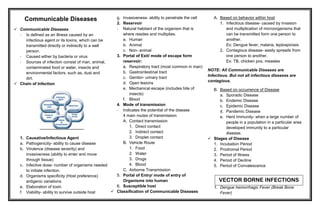
 Chain of Infection                                   d. Open lesions
                                                       e. Mechanical escape (includes bite of          B. Based on occurrence of Disease
                                                          insects)                                        a. Sporadic Disease
                                                       f. Blood                                           b. Endemic Disease
                                                    4. Mode of transmission                               c. Epidemic Disease
                                                    - Indicates the potential of the disease              d. Pandemic Disease
                                                       4 main routes of transmission                      e. Herd Immunity- when a large number of
                                                       A. Contact transmission                               people in a population in a particular area
                                                          1. Direct contact                                  developed immunity to a particular
                                                          2. Indirect contact                                disease.
  1. Causative/Infectious Agent                           3. Droplet contact                          Stages of Disease
  a. Pathogenicity- ability to cause disease           B. Vehicle Route                                1. Incubation Period
  b. Virulence (disease severity) and                     1. Food                                      2. Prodromal Period
     invasiveness (ability to enter and move              2. Water                                     3. Period of Illness
     through tissue)                                      3. Drugs                                     4. Period of Decline
  c. Infective dose- number of organisms needed           4. Blood                                     5. Period of Convalescence
     to initiate infection.                            C. Airborne Transmission
  d. Organisms specificity (Host preference)        5. Portal of Entry/ mode of entry of
     antigenic variations                              Organisms into human                                VECTOR BORNE INFECTIONS
  e. Elaboration of toxin                           6. Susceptible host                                 1. Dengue hemorrhagic Fever (Break Bone
  f. Viability- ability to survive outside host    Classification of Communicable Diseases                Fever)
2. Malaria                                                      e. Manage epistaxis (ice                                 - Other test: CBC, BUN, creatinine,
3. Filariasis                                                      compression or nasal pack)                              SGOT, SGPT
1. Dengue hemorrhagic Fever (Break Bone                         f. Treatment for shock: PRICES                 Management: treatment based on the
   Fever)                                                          P- rotect                                    species of malaria
     Caused by: Flaviviridae virus                                R- est                                       a. 1st line anti malarial drugs: Chloroquine,
     Transmitted through: female Aedes                            i-ce                                            Sulfadoxine, Pyrimethamine and
        Egypti mosquito                                            C-ompression                                    Primaquine
     3 clinical stages:                                           E-levation                                   b. 2nd line: Artemeter lumefranthine
        1. Febrile/ invasive stage (1st 4 days)                    S-upport                                    Nursing Interventions
        2. Toxic/ hemorrhagic stage (4th -7th                   g. Diet: EDCF and drinks                        a. Advise to avoid outdoor night activities,
            day)                                             WOF: signs of complications like                     esp. vector’s peak biting hours from 9pm-
        3. Convalescent/ Recovery Stage (7th-                   bleeding and signs of shock                        3am
            10th day)                                                                                           b. Use mosquito repellents
     S/Sx: - body malaise                           2.   Malaria                                               c. Using chemophylatic anti- malarial drugs
               - saddle- back fever                         Caused by: plasmodium with 4 species:             WOF: cerebral malaria (headache, vomiting,
               - joint pains                                 P. Falciparum (most serious type), P.              changes in LOC, seizure).
               - abdominal pain                              Vivax, P. malaria, P. ovale
               - epistaxis                                 Transmitted through: female anopheles           3. Filariasis- chronic parasistic infection
               - gum bleeding                                mosquitoes                                          Caused by: Wuchereria bancrofti and
               - (+) tourniquet test                       s/Sx: fever- 2-3 days interval (hallmark)              Brugia malayi
     Dx: a. Torniquet Test (Rumpel leads                    3 classic stages:                                   Transmitted through: Aedes, anopheles,
            test)                                            1. cold stage- 10- 15 mins of chills and              mansonia mosquito
            b. Labs: platelet count, HCT, PTT,                   shakes                                          s/Sx: asymptomatic- early stage
            PT                                               2. hot stage- 4-6 hrs of high grade fever             lymphangitis, lymphadenitis,
     Management: Symptomatic and                                with severe headache, vomiting,                   elephantiasis and hydrocelle- late S/Sx
            supportive therapy                                   abdominal pain and cyanotic face                Dx:nocturnal blood examination- blood
            a. Paracetamol- fever                            3. diaphoretic stage- excessive                       taken at 8pm- 4am
            b. Omeprazole- inhibits production                   sweating                                          Immunochromatographic test- rapid
                of HCl.                                    Dx:- clinical history of travel to endemic             assessment method at daytime
            c. Sucralfate- coats lining of gastric        areas                                                  Managemet:
                stomach                                          - Malarial blood smear (thick or thin             DOC:Diethylcarbamazine or
            d. Ranitidine- inhibit secretion of                    smear) - best time to extract: at the           Hetrazan- taken after meals; for 12
                gastric acid                                       height of the fever for P. falciparum.          days and surgery for chronic cases.
    Caused by: rhabdovirus                          1. Active
CENTRAL NERVOUS                                        Types:                                             Ex: purified chick embryo vaccine
SYSTEM INFECTIONS                                       1. Damp/silent type- asymptomatic                  (PCEC), RABIPUR,VEROWELL
1.   Meningitis                                         2. Furious                                      2. Passive- give immediate but
2.   Meninggococcemia                                 3 Stages:                                           temporaryprotection
3.   Rabies                                             1. Prodromal- symptoms with no reason              Ex: Equine rabies immunoglobulin
4.   Tetanus                                            - earliest sign : paresthesia/numbness             (ERIG)- Wt in Kg x 0.2=ml to be
1.   Meningitis- inflammation of meninges               on the bitten area                                 injected (stock is 5ml/vial),
    Caused by: Neisseria meningitides, H.              2. encephalitic- foaming of the mouth.             Human rabies
     influenza,M. tuberculosis and S.                   Hydrophobia, aerophobia                            immunoglobulin(HRIG)- wt in kg X
     Pneumonia                                          3. paralytic                                       .1333= ml to be injected (stock
    s/Sx: Meningeal irritations- Brudzinski          s/Sx: pathognomic sign: Hydrophobia                 2ml/vial).
     sign, babinski sign and kernig sign              Dx:history of bite, fluorescent antibody    4. Tetanus
     (pathognomonic sign)                               test (FAT), and microscopic examination        Caused by: clostridium tetani
    Dx:lumbar puncture                                 of negri bodies                                s/Sx: trismus, risus sardonicus
    Managemet:Mannitol- to dec. ICP                  Management:                                      (sustained contraction of the facial
    WOF: ICP                                      -    Patient should be categorized first             muscles produces a grimace),
                                                   1. Category 1- licking of intact skin, no            opisthotonus (sustained contraction of
2. Meninggococcemia                                    abrasion                                         the back muscles produces an arched
  Caused by: Neisseria meningitidis               2. Category 2- lower extremity bite and              back), rigid abdomen and local muscle
  s/Sx: high grade fever, pathognomonic               biting animal should be observed for 2           spasms
   rash (violaceous or purpuric rashes),               wks                                             Dx:wound culture, CBC
   Fulminant meningococcemia(enlarging             3. Category 3- upper extremity bite, head,             Management: DOC: Penicillin
   violaceous rashes with vasomotor                    neck bite or any site of bite and the dog           Tetanus toxoid prophylaxis (0-1-6-1-
   collapse and shock)                                 can’t be observed for 2 wks                 1)
  Dx:blood, CSF, skin lesion culture          -   treatment is based on the category of bite:          Control of muscle spasm: diazepam
  Management: Antibiotic of choice:                   o 1. Category 1- observe the dog for 2           Nursing Interventions: maintain
   Penicillin                                              wks                                     airway patency, neutralized the toxin.
  WOF: complications like deterioration of            o 2. Category 2- give active vaccine
   sensorium, signs of shock and signs of                  and observe dog for 2 wks
   bleeding.                                           o 3. Category 3- give passive and                 Prepared by: Janica Mae B. Gonzales
                                                           active vaccine
                                                  Vaccine                                                              BSN- 4B1
3. Rabies aka Lyssa
                                                                                                                        11/12/12
Communicable diseases

Communicable diseases

  • 1.
    Communicable Diseases g. Invasiveness- ability to penetrate the cell A. Based on behavior within host 2. Reservoir 1. Infectious disease- caused by invasion  Communicable Diseases - Natural habitant of the organism that is and multiplication of microorganisms that - Is defined as an illness caused by an where resides and multiplies. can be transmitted form one person to infectious agent or its toxins, which can be a. Human another. transmitted directly or indirectly to a well b. Animal Ex: Dengue fever, malaria, leptospirosis person. c. Non- animal 2. Contagious disease- easily spreads from - Caused either by bacteria or virus 3. Portal of Exit/ mode of escape form one person to another. - Sources of infection consist of man, animal, reservoir: Ex: TB, chicken pox, measles contaminated food or water, insects and a. Respiratory tract (most common in man) NOTE: All Communicable Diseases are environmental factors, such as, dust and b. Gastrointestinal tract Infectious. But not all infectious diseases are dirt. c. Genitor- urinary tract contagious.  Chain of Infection d. Open lesions e. Mechanical escape (includes bite of B. Based on occurrence of Disease insects) a. Sporadic Disease f. Blood b. Endemic Disease 4. Mode of transmission c. Epidemic Disease - Indicates the potential of the disease d. Pandemic Disease 4 main routes of transmission e. Herd Immunity- when a large number of A. Contact transmission people in a population in a particular area 1. Direct contact developed immunity to a particular 2. Indirect contact disease. 1. Causative/Infectious Agent 3. Droplet contact  Stages of Disease a. Pathogenicity- ability to cause disease B. Vehicle Route 1. Incubation Period b. Virulence (disease severity) and 1. Food 2. Prodromal Period invasiveness (ability to enter and move 2. Water 3. Period of Illness through tissue) 3. Drugs 4. Period of Decline c. Infective dose- number of organisms needed 4. Blood 5. Period of Convalescence to initiate infection. C. Airborne Transmission d. Organisms specificity (Host preference) 5. Portal of Entry/ mode of entry of antigenic variations Organisms into human VECTOR BORNE INFECTIONS e. Elaboration of toxin 6. Susceptible host 1. Dengue hemorrhagic Fever (Break Bone f. Viability- ability to survive outside host  Classification of Communicable Diseases Fever)
  • 2.
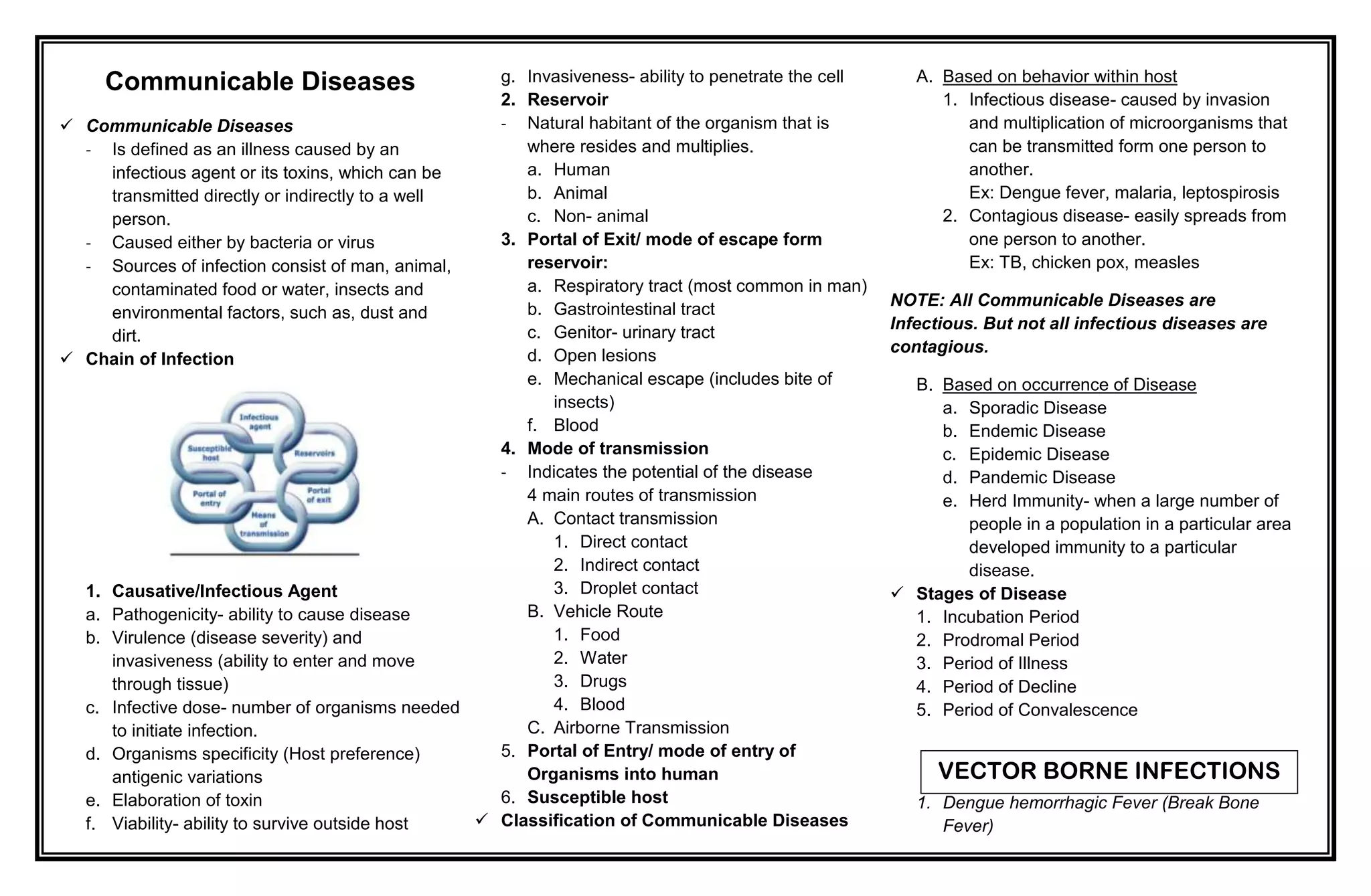
    2. Malaria e. Manage epistaxis (ice - Other test: CBC, BUN, creatinine, 3. Filariasis compression or nasal pack) SGOT, SGPT 1. Dengue hemorrhagic Fever (Break Bone f. Treatment for shock: PRICES  Management: treatment based on the Fever) P- rotect species of malaria  Caused by: Flaviviridae virus R- est a. 1st line anti malarial drugs: Chloroquine,  Transmitted through: female Aedes i-ce Sulfadoxine, Pyrimethamine and Egypti mosquito C-ompression Primaquine  3 clinical stages: E-levation b. 2nd line: Artemeter lumefranthine 1. Febrile/ invasive stage (1st 4 days) S-upport  Nursing Interventions 2. Toxic/ hemorrhagic stage (4th -7th g. Diet: EDCF and drinks a. Advise to avoid outdoor night activities, day)  WOF: signs of complications like esp. vector’s peak biting hours from 9pm- 3. Convalescent/ Recovery Stage (7th- bleeding and signs of shock 3am 10th day) b. Use mosquito repellents  S/Sx: - body malaise 2. Malaria c. Using chemophylatic anti- malarial drugs - saddle- back fever  Caused by: plasmodium with 4 species:  WOF: cerebral malaria (headache, vomiting, - joint pains P. Falciparum (most serious type), P. changes in LOC, seizure). - abdominal pain Vivax, P. malaria, P. ovale - epistaxis  Transmitted through: female anopheles 3. Filariasis- chronic parasistic infection - gum bleeding mosquitoes  Caused by: Wuchereria bancrofti and - (+) tourniquet test  s/Sx: fever- 2-3 days interval (hallmark) Brugia malayi  Dx: a. Torniquet Test (Rumpel leads 3 classic stages:  Transmitted through: Aedes, anopheles, test) 1. cold stage- 10- 15 mins of chills and mansonia mosquito b. Labs: platelet count, HCT, PTT, shakes  s/Sx: asymptomatic- early stage PT 2. hot stage- 4-6 hrs of high grade fever lymphangitis, lymphadenitis,  Management: Symptomatic and with severe headache, vomiting, elephantiasis and hydrocelle- late S/Sx supportive therapy abdominal pain and cyanotic face  Dx:nocturnal blood examination- blood a. Paracetamol- fever 3. diaphoretic stage- excessive taken at 8pm- 4am b. Omeprazole- inhibits production sweating Immunochromatographic test- rapid of HCl.  Dx:- clinical history of travel to endemic assessment method at daytime c. Sucralfate- coats lining of gastric areas  Managemet: stomach - Malarial blood smear (thick or thin DOC:Diethylcarbamazine or d. Ranitidine- inhibit secretion of smear) - best time to extract: at the Hetrazan- taken after meals; for 12 gastric acid height of the fever for P. falciparum. days and surgery for chronic cases.
  • 3.
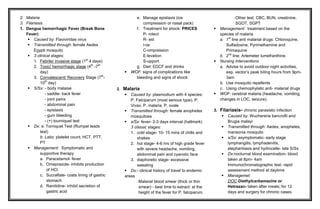
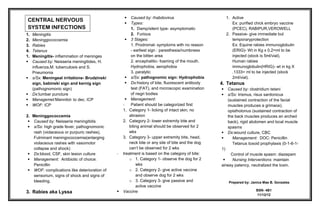
    Caused by: rhabdovirus 1. Active CENTRAL NERVOUS  Types: Ex: purified chick embryo vaccine SYSTEM INFECTIONS 1. Damp/silent type- asymptomatic (PCEC), RABIPUR,VEROWELL 1. Meningitis 2. Furious 2. Passive- give immediate but 2. Meninggococcemia  3 Stages: temporaryprotection 3. Rabies 1. Prodromal- symptoms with no reason Ex: Equine rabies immunoglobulin 4. Tetanus - earliest sign : paresthesia/numbness (ERIG)- Wt in Kg x 0.2=ml to be 1. Meningitis- inflammation of meninges on the bitten area injected (stock is 5ml/vial),  Caused by: Neisseria meningitides, H. 2. encephalitic- foaming of the mouth. Human rabies influenza,M. tuberculosis and S. Hydrophobia, aerophobia immunoglobulin(HRIG)- wt in kg X Pneumonia 3. paralytic .1333= ml to be injected (stock  s/Sx: Meningeal irritations- Brudzinski  s/Sx: pathognomic sign: Hydrophobia 2ml/vial). sign, babinski sign and kernig sign  Dx:history of bite, fluorescent antibody 4. Tetanus (pathognomonic sign) test (FAT), and microscopic examination  Caused by: clostridium tetani  Dx:lumbar puncture of negri bodies  s/Sx: trismus, risus sardonicus  Managemet:Mannitol- to dec. ICP  Management: (sustained contraction of the facial  WOF: ICP - Patient should be categorized first muscles produces a grimace), 1. Category 1- licking of intact skin, no opisthotonus (sustained contraction of 2. Meninggococcemia abrasion the back muscles produces an arched  Caused by: Neisseria meningitidis 2. Category 2- lower extremity bite and back), rigid abdomen and local muscle  s/Sx: high grade fever, pathognomonic biting animal should be observed for 2 spasms rash (violaceous or purpuric rashes), wks  Dx:wound culture, CBC Fulminant meningococcemia(enlarging 3. Category 3- upper extremity bite, head,  Management: DOC: Penicillin violaceous rashes with vasomotor neck bite or any site of bite and the dog Tetanus toxoid prophylaxis (0-1-6-1- collapse and shock) can’t be observed for 2 wks 1)  Dx:blood, CSF, skin lesion culture - treatment is based on the category of bite: Control of muscle spasm: diazepam  Management: Antibiotic of choice: o 1. Category 1- observe the dog for 2  Nursing Interventions: maintain Penicillin wks airway patency, neutralized the toxin.  WOF: complications like deterioration of o 2. Category 2- give active vaccine sensorium, signs of shock and signs of and observe dog for 2 wks bleeding. o 3. Category 3- give passive and Prepared by: Janica Mae B. Gonzales active vaccine  Vaccine BSN- 4B1 3. Rabies aka Lyssa 11/12/12