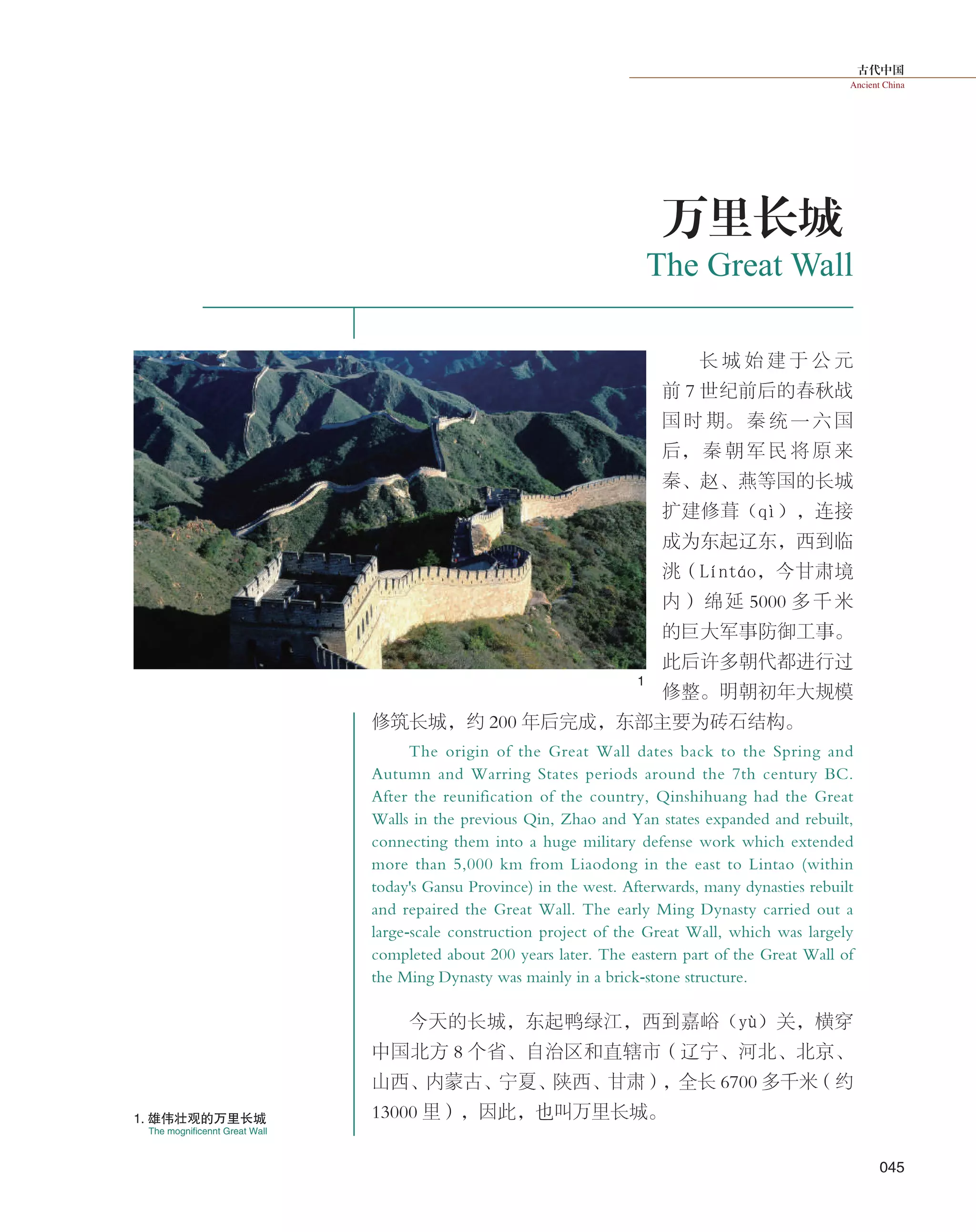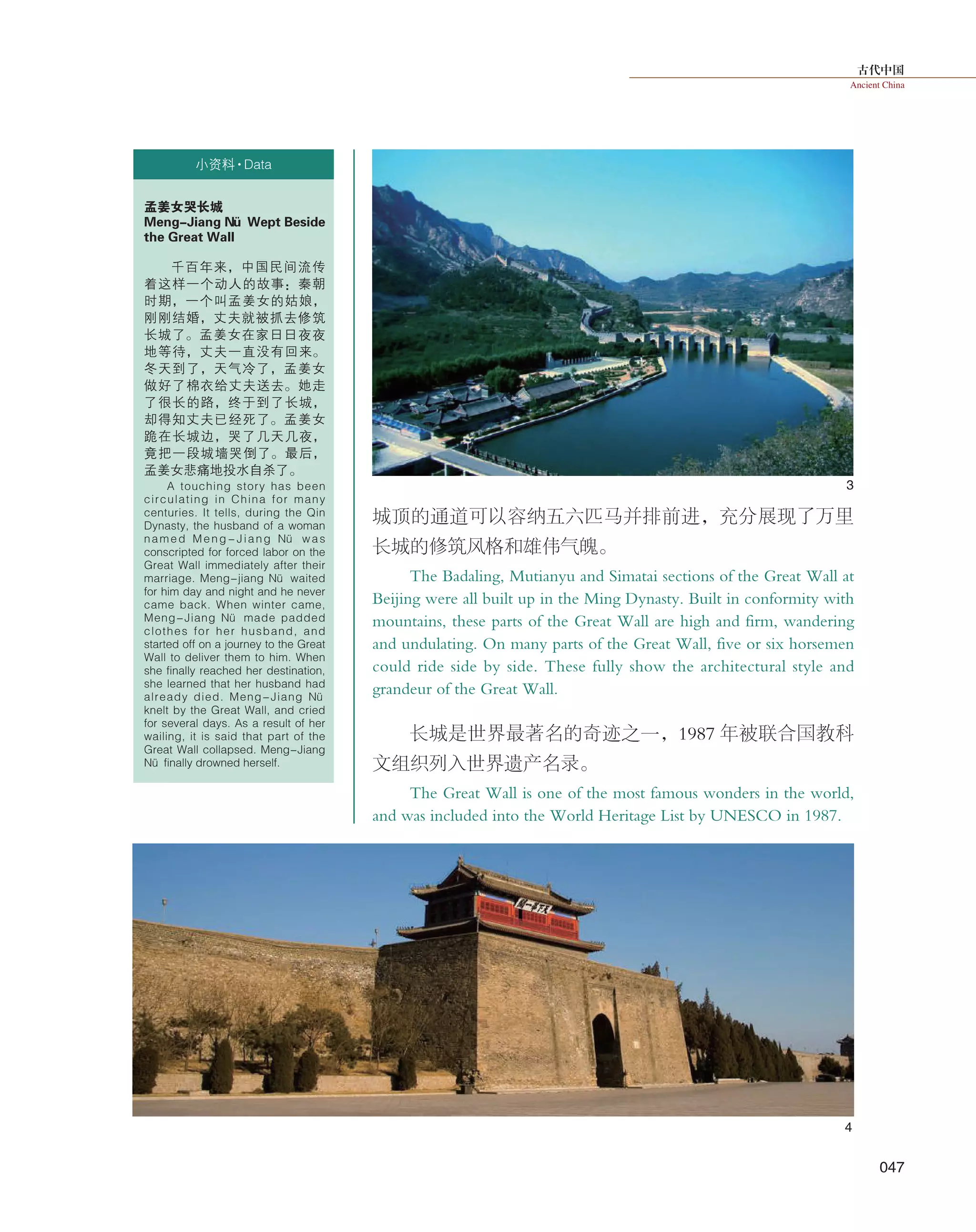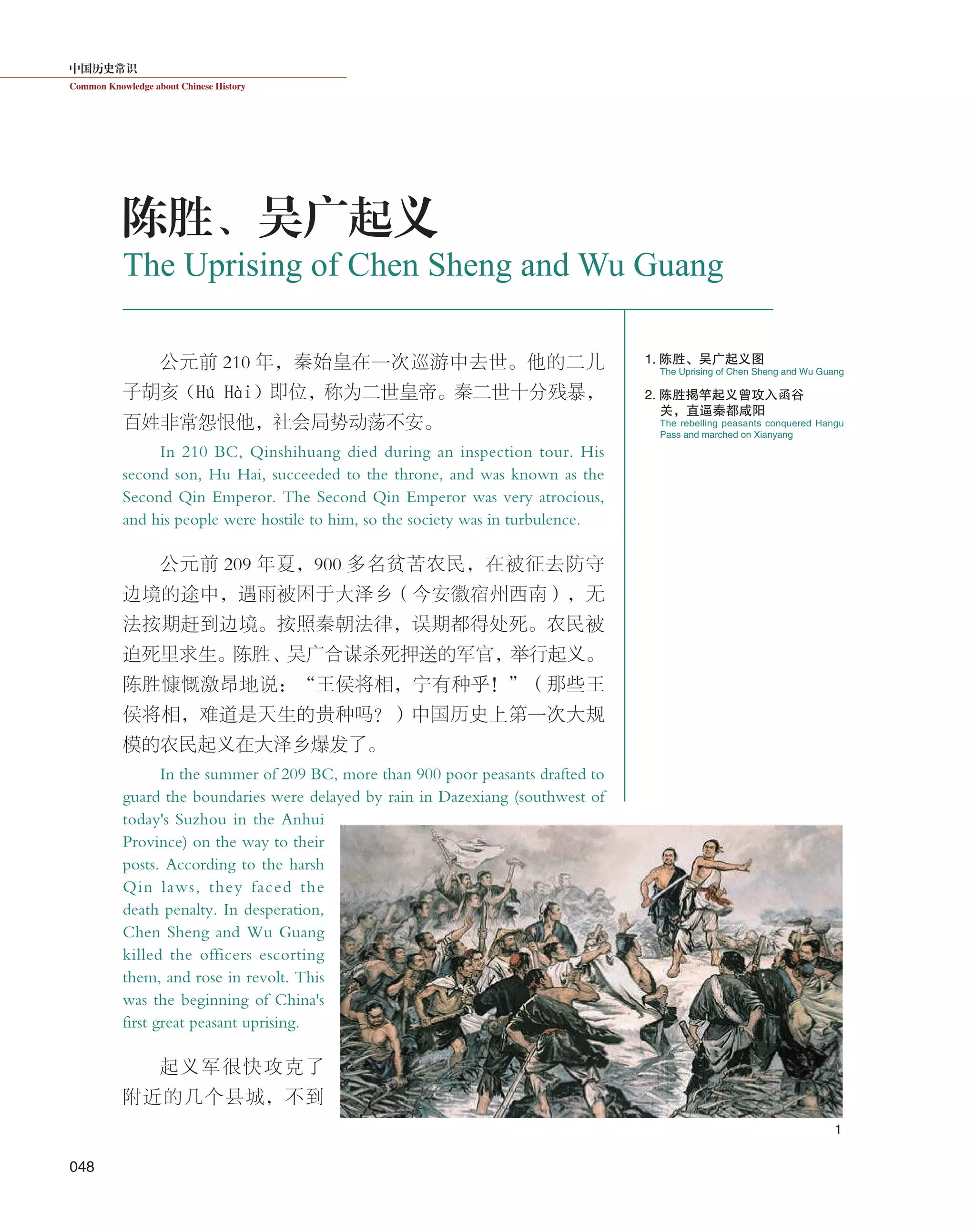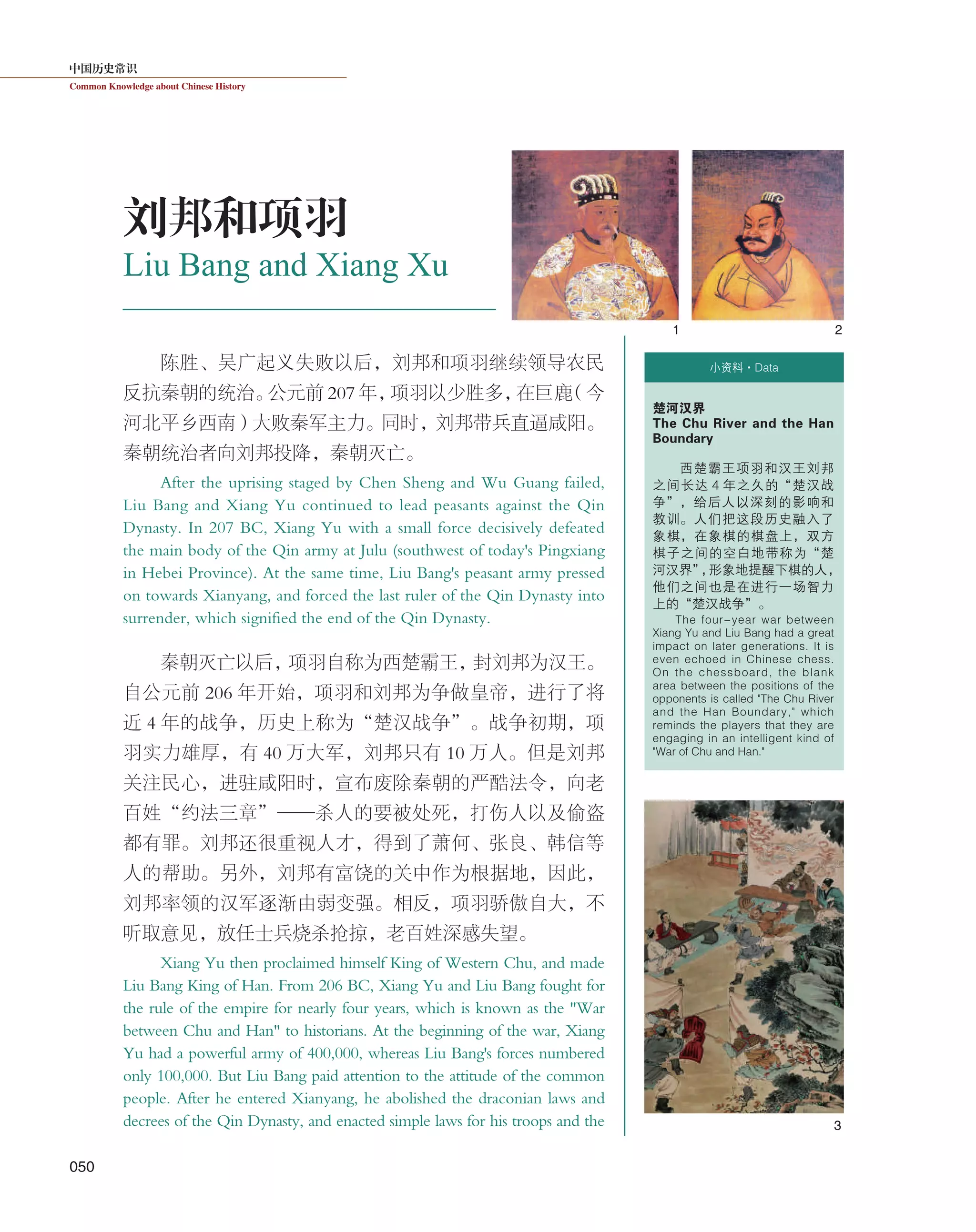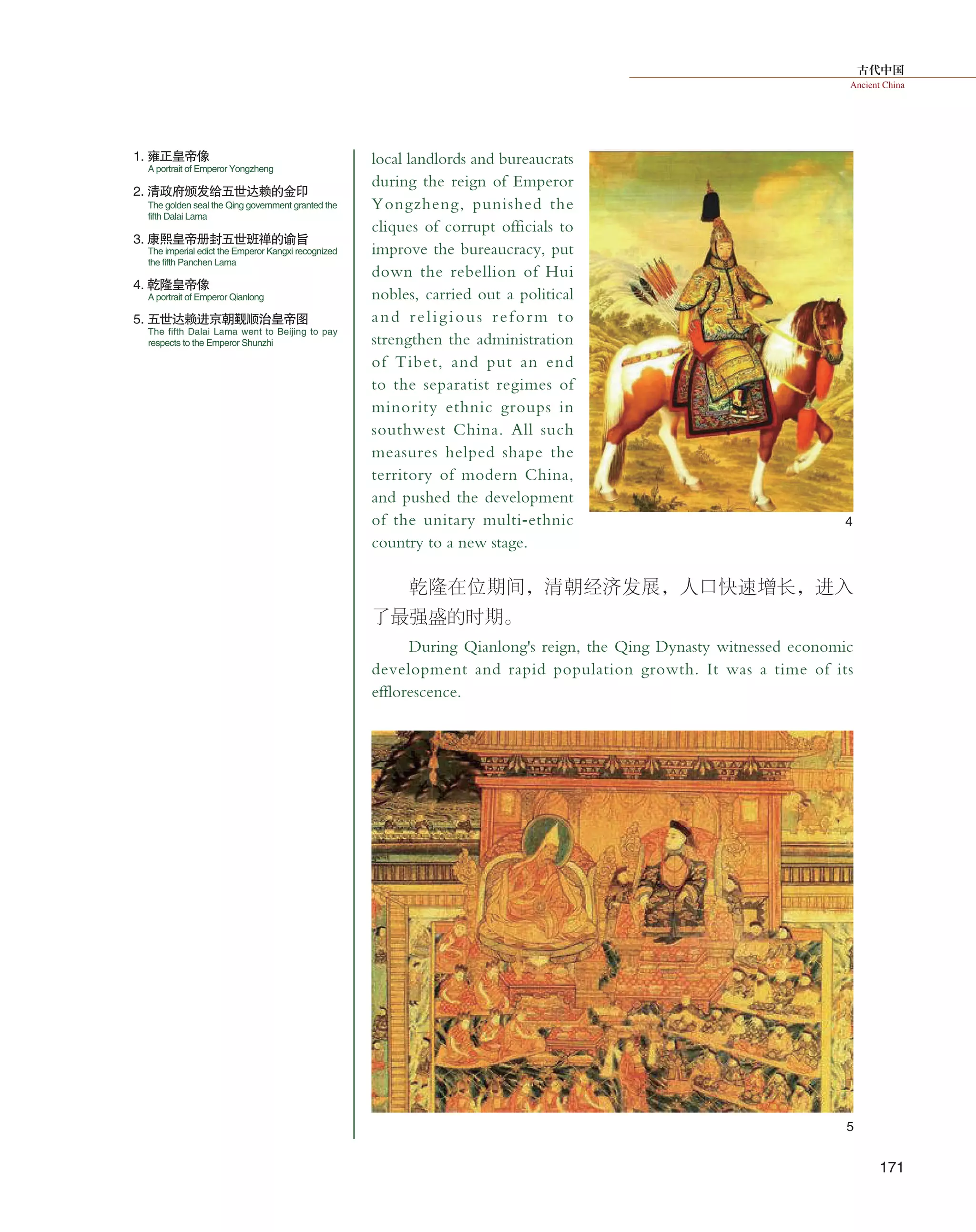
古代中国
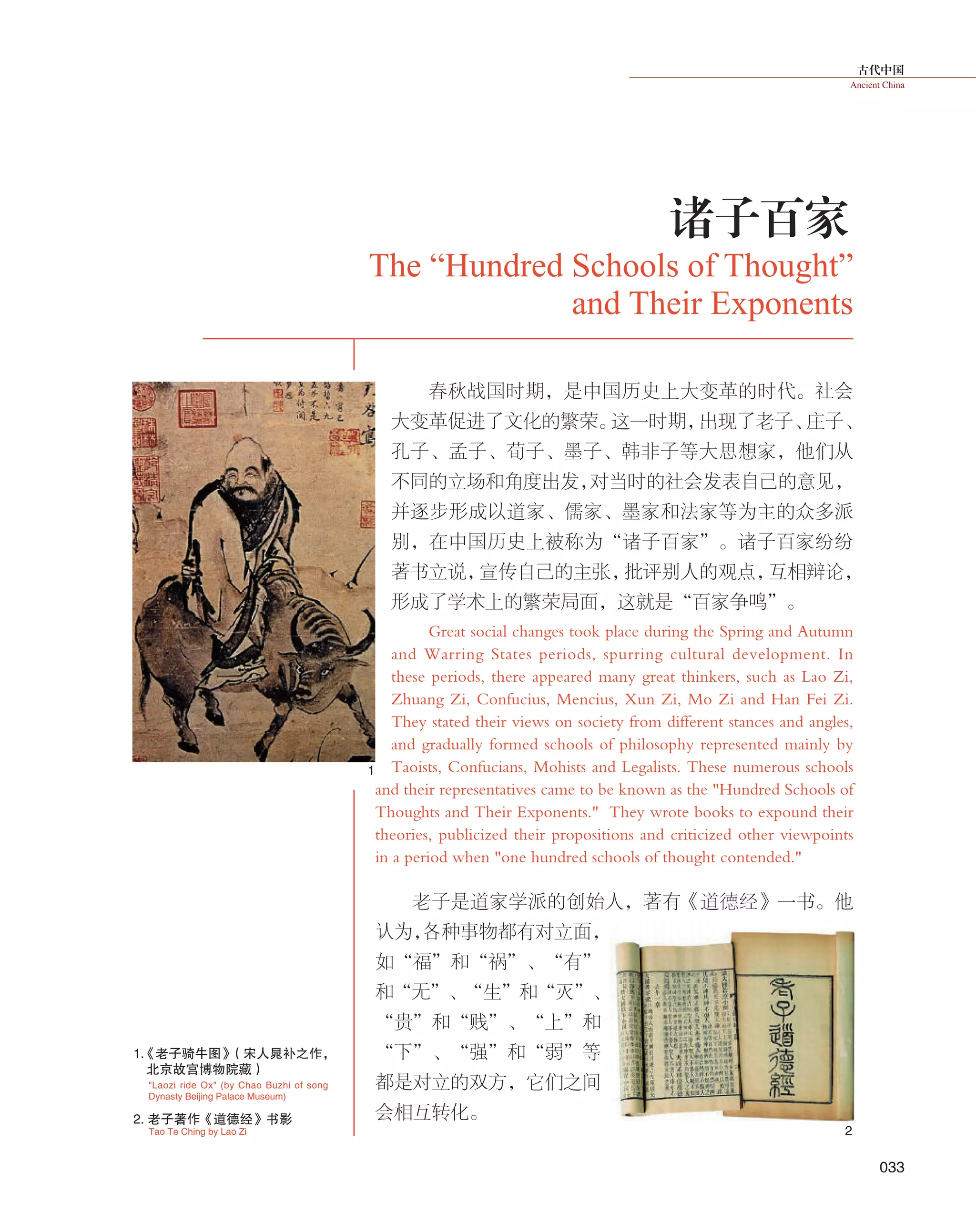
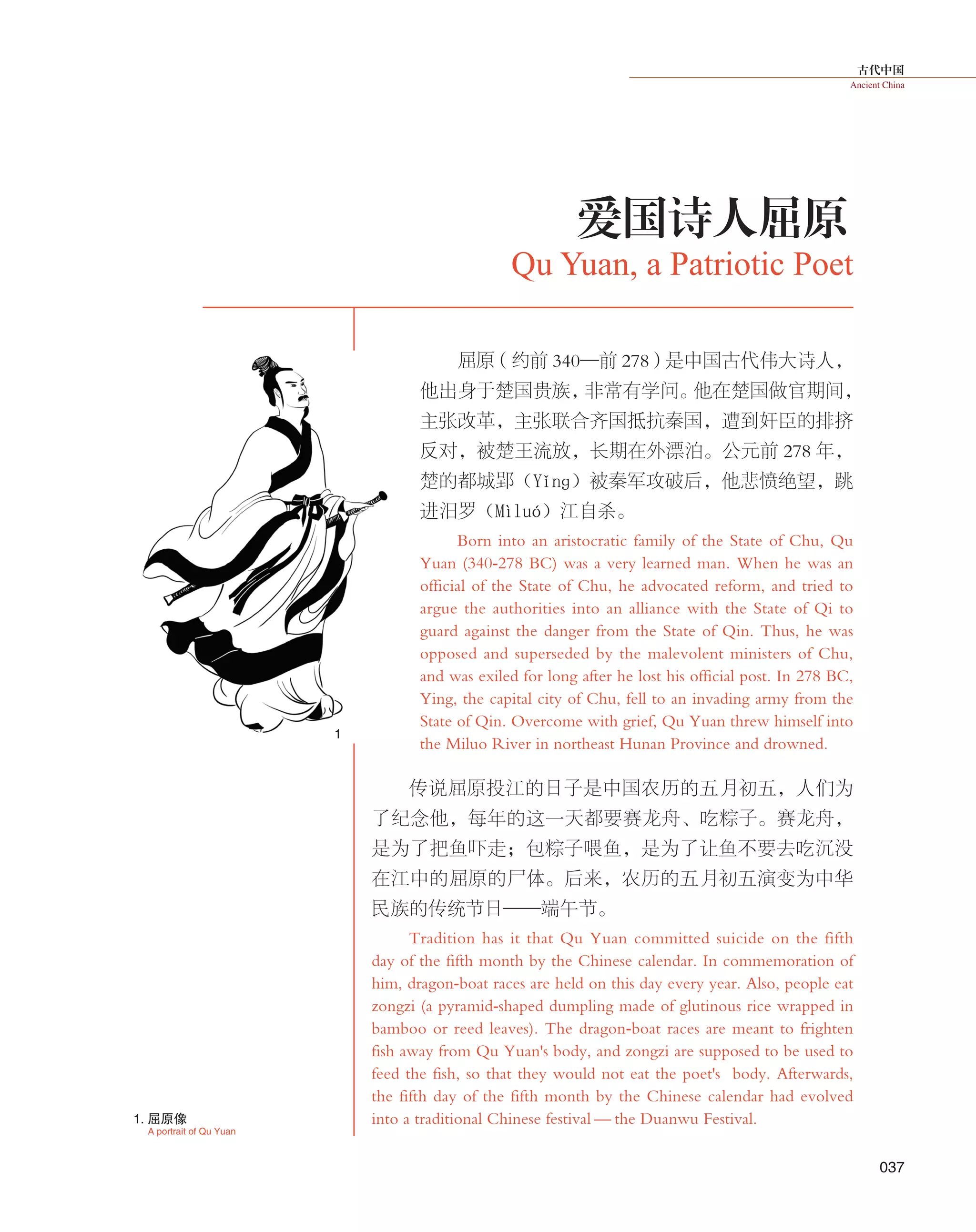
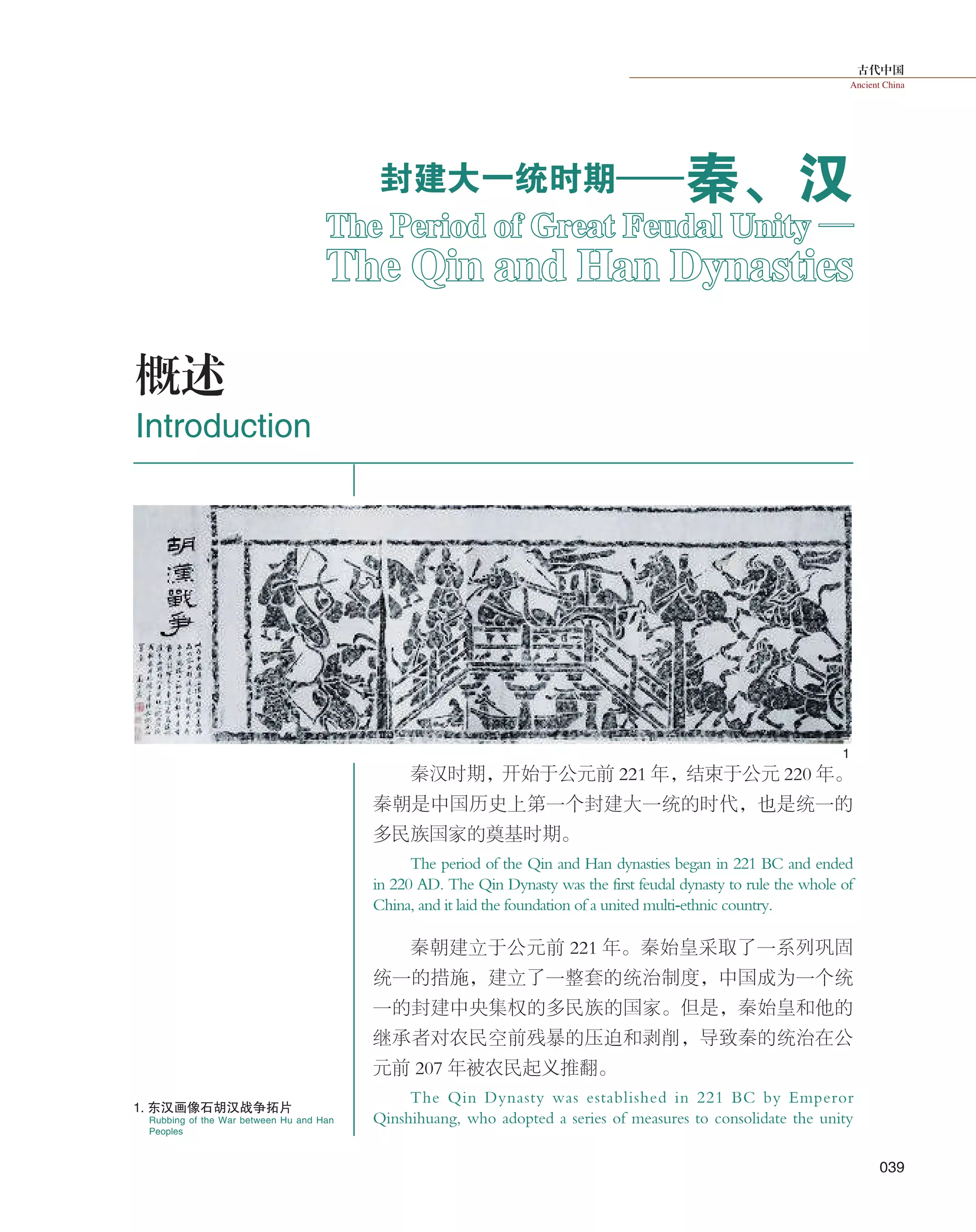
Ancient China
003
Common Knowledge about
Chinese History
(Revised Edition)
国务院侨务办公室
中国海外交流协会
中国历史常识
(修订本)
中国历史常识
Common Knowledge about Chinese History
004
图书代号:JY14N1704
图书在版编目(CIP)数据
中国历史常识 / 王恺主编 . — 西安:陕西师范大学出版
总社有限公司 , 2015.5
ISBN 978-7-5613-7980-6
Ⅰ . ①中… Ⅱ . ①王… Ⅲ . ①中国历史—青少年读物
Ⅳ . ① K209
中国版本图书馆 CIP 数据核字(2014)第 276622 号
中国历史常识
总 策 划 屈瑞新
策划编辑 李强辉 李 蔷
责任编辑 李江明 习华林
责任校对 张爱林
装帧设计 安 梁
出 版 陕西师范大学出版总社
(西安市长安南路 199 号 邮编 710062)
印 刷 东港股份有限公司
开 本 787 mm ×1092mm 1/16
印 张 18.5
字 数 300 千
版 次 2015 年 5 月第 1 版
印 次 2015 年 5 月第 1 次印刷
书 号 ISBN 978-7-5613-7980-6
Common Knowledge about Chinese History
王 恺 主编
【声明】本书为推展海外华文教育免费赠送。书中部分插图选自网络图库,已支付相关费用;
还有部分图片的版权人无法取得联系,敬请权利人及时联系我们,以便奉寄稿酬。联系方式:
33234084@qq.com。
古代中国
Ancient China
005
国务院侨务办公室
中国海外交流协会
中国历史常识
主 编:王 恺
编写人员:李 华 张美霞 徐正龙 夏小芸
钱玉莲 赵 玉 王 浩 唐晓丹 薛蓓蓓
中国历史常识(修订本)
主 编:徐正龙
修订人员(按姓氏音序排列):陈建华 钱玉莲
唐晓丹 徐正龙 张美霞
特约英文编审:张 敏
Overseas Chinese Affairs Office of the State Council
China Overseas Exchange Association
Common Knowledge about Chinese History
Chief Compiler: Wang Kai
Deputy Chief Compiler: Li Hua, Zhang Meixia,
Xu Zhenglong, Xia Xiaoyun, Qian Yulian,
Zhao Yu, Wang Hao, Tang Xiaodan, Xue Beibei
Common Knowledge about Chinese History (Revised Edition)
Chief Compiler: Xu Zhenglong
Reviser(in alphabetical order):
Chen Jianhua, Qian Yulian,
Tang Xiaodan, Xu Zhenglong, Zhang Meixia
Special Review English Experts: Zhang Min
中国历史常识
Common Knowledge about Chinese History
006
古代中国
Ancient China
007
前言
Preface
《中国历史常识》《中国地理常识》和《中国文化常识》是中
华人民共和国国务院侨务办公室、中国海外交流协会委托南京师范
大学、安徽师范大学和北京华文学院分别编写的一套华文教学辅助
读物,供海外华裔青少年通过课堂学习或自学的方式了解中国历史、
地理和文化常识,也可供家长辅导孩子学习使用。我们希望学习者
通过学习,初步了解、掌握中国历史、地理和文化的知识,进而达
到普及、弘扬中华文化和促进中外文化交流的目的。
The Overseas Chinese Affairs Office of the State Council of the People's
Republic of China and China Overseas Exchange Association commissioned
Nanjing Normal University, Anhui Normal University and Beijing Chinese
Language College to respectively write this set of auxiliary Chinese language
teaching materials, namely, Common Knowledge about Chinese History,Common
Knowledge about Chinese Geography and Common Knowledge about Chinese
Culture which acquaint overseas Chinese teenagers with basic knowledge on these
subjects through class education or self-teaching. Parents can also use them to help
their children with study. Moreover, we hope this set of books can offer a wider
group of readers some rudimentary knowledge about Chinese history, geography
and culture, thus promoting cultural exchanges between China and other countries.
根据海外华文教学的实际情况和需求,我们分别选编了中国历
史的重大事件和重要人物,进行客观记述;选取了中国地理最主要
的自然特点和人文特征,进行概略描述;筛选了中华文化和民俗风
情的精华,加以介绍。突出体现科学性、思想性和实用性的编写原则,
在编排设计等方面力求有所创新。
中国历史常识
Common Knowledge about Chinese History
008
编 者
Compilers
2001 年 12 月
December, 2001
According to the actual condition and needs of overseas Chinese language
teaching, in this set of books, we objectively narrate important events and figures in
Chinese history; briefly describe the major natural and cultural features of Chinese
geography; carefully select and introduce the essence of the Chinese culture, habits
and customs. We have tried to introduce new ideas in typesetting, design and so on
and to embody scientific, ideological and practical principles in the writing.
在上述三本书的编写过程中,苏寿桐、王宏志、臧嵘、侯明、
刘淑英、李芳芹等参加了《中国历史常识》的审稿工作;王永昌、
乐平兰、刘淑梅、毕超、徐玉奎、董乃灿、张桂珠、李文君等参加
了《中国地理常识》的审稿工作;张英、张猛、董明、武惠华、陶卫、
杨二林等参加了《中国文化常识》的审稿工作。在此,谨表示诚挚
的谢意。
We are deeply grateful to Su Shoutong, Wang Hongzhi, Zang Rong, Hou
Ming, Liu Shuying and Li Fangqin for revisingCommon Knowledge about Chinese
History, Wang Yongchang, Yue Pinglan, Liu Shumei, Bi Chao, Xu Yukui, Dong
Naican, Zhang Guizhu and Li Wenjun for revising Common Knowledge about
Chinese Geography, and Zhang Ying, Zhang Meng, Dong Ming, Wu Huihua,
Tao Wei and Yang Erlin for revisingCommon Knowledge about Chinese Culture.
书中考虑不周或疏漏之处,祈盼使用者不吝赐正,以期再版时
修订。
Advice is welcomed if there were any mistake in the books. We will revise
them when republishing the next edition.
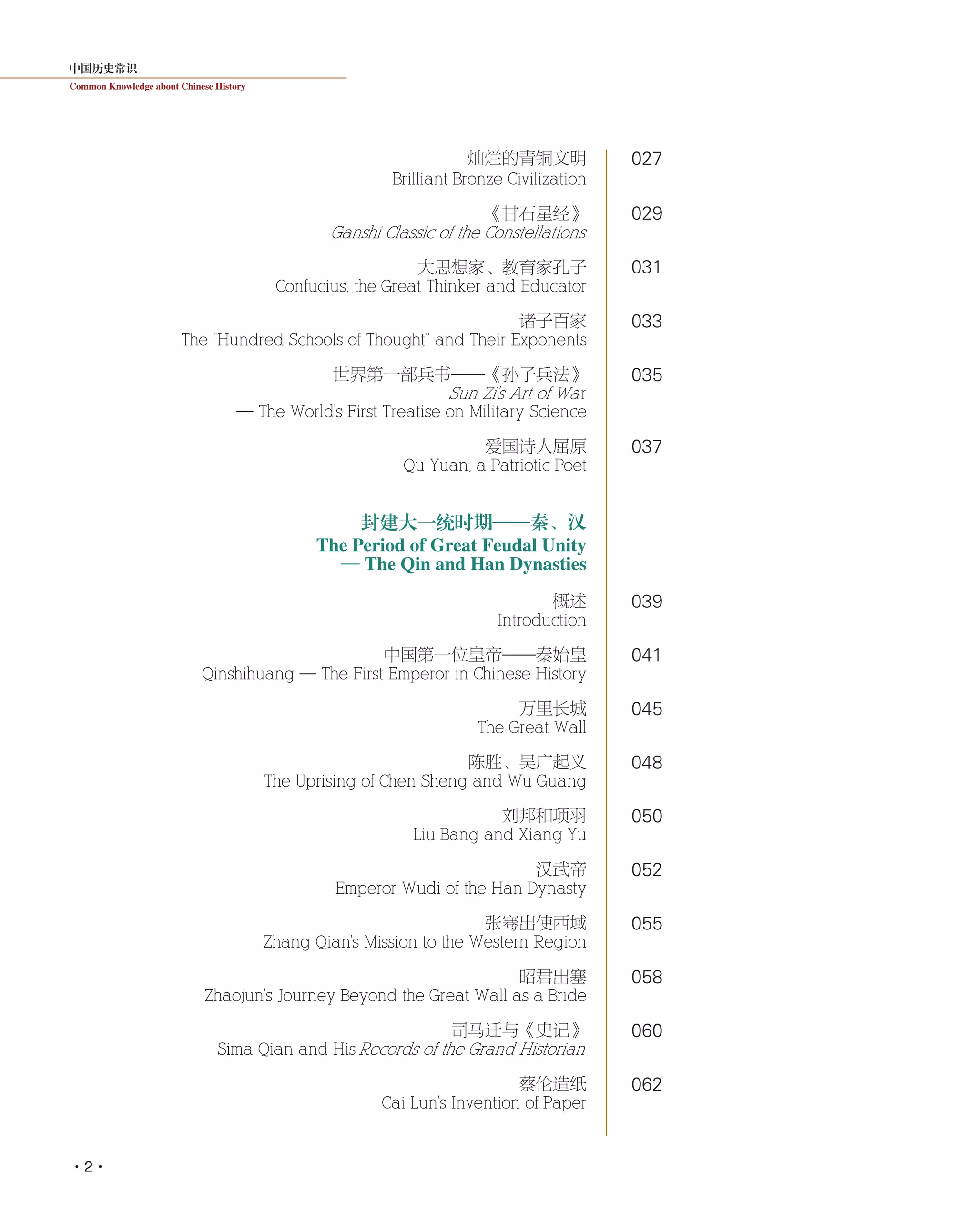
目 录
CONTENTS
·1·
002
005
007
010
012
014
017
020
023
025
古代中国
Ancient China
概述
Introduction
中国历史的开篇——先秦
The Dawn of Chinese History—The Pre-Qin Period
概述
Introduction
中国境内最早的人类
The Earliest Human Beings in China
华夏之祖
Ancestors of the Chinese Nation
大禹治水
Yu the Great's Harnessing the Flood
武王伐纣
King Wu's Attack against King Zhou
西周分封
The Vassal Enfeoffment System of the Western Zhou Dynasty
春秋五霸
Five Hegemonic Vassals of the Spring and Autumn Period
战国七雄
Seven Powers of the Warring States Period
商鞅变法
Shang Yang's Reform
目
录
CONTENTS
中国历史常识
Common Knowledge about Chinese History
·2·
027
029
031
033
035
037
039
041
045
048
050
052
055
058
060
062
灿烂的青铜文明
Brilliant Bronze Civilization
《甘石星经》
Ganshi Classic of the Constellations
大思想家、教育家孔子
Confucius, the Great Thinker and Educator
诸子百家
The "Hundred Schools of Thought" and Their Exponents
世界第一部兵书——《孙子兵法》
Sun Zi's Art of War
— The World's First Treatise on Military Science
爱国诗人屈原
Qu Yuan, a Patriotic Poet
封建大一统时期——秦、汉
The Period of Great Feudal Unity
— The Qin and Han Dynasties
概述
Introduction
中国第一位皇帝——秦始皇
Qinshihuang — The First Emperor in Chinese History
万里长城
The Great Wall
陈胜、吴广起义
The Uprising of Chen Sheng and Wu Guang
刘邦和项羽
Liu Bang and Xiang Yu
汉武帝
Emperor Wudi of the Han Dynasty
张骞出使西域
Zhang Qian's Mission to the Western Region
昭君出塞
Zhaojun's Journey Beyond the Great Wall as a Bride
司马迁与《史记》
Sima Qian and His Records of the Grand Historian
蔡伦造纸
Cai Lun's Invention of Paper
目 录
CONTENTS
·3·
064
066
068
071
073
075
078
080
083
086
088
091
093
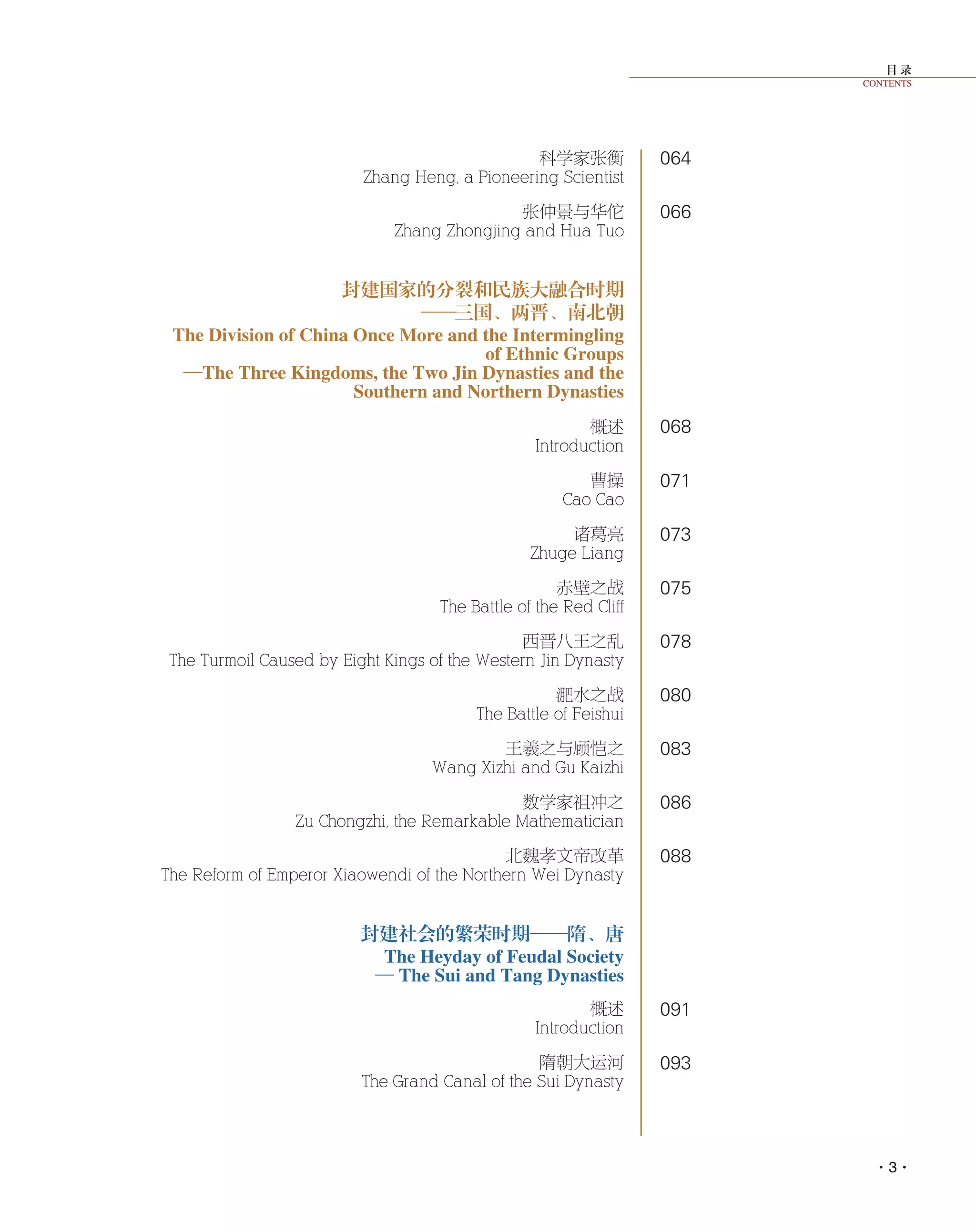
科学家张衡
Zhang Heng, a Pioneering Scientist
张仲景与华佗
Zhang Zhongjing and Hua Tuo
封建国家的分裂和民族大融合时期
——三国、两晋、南北朝
The Division of China Once More and the Intermingling
of Ethnic Groups
—The Three Kingdoms, the Two Jin Dynasties and the
Southern and Northern Dynasties
概述
Introduction
曹操
Cao Cao
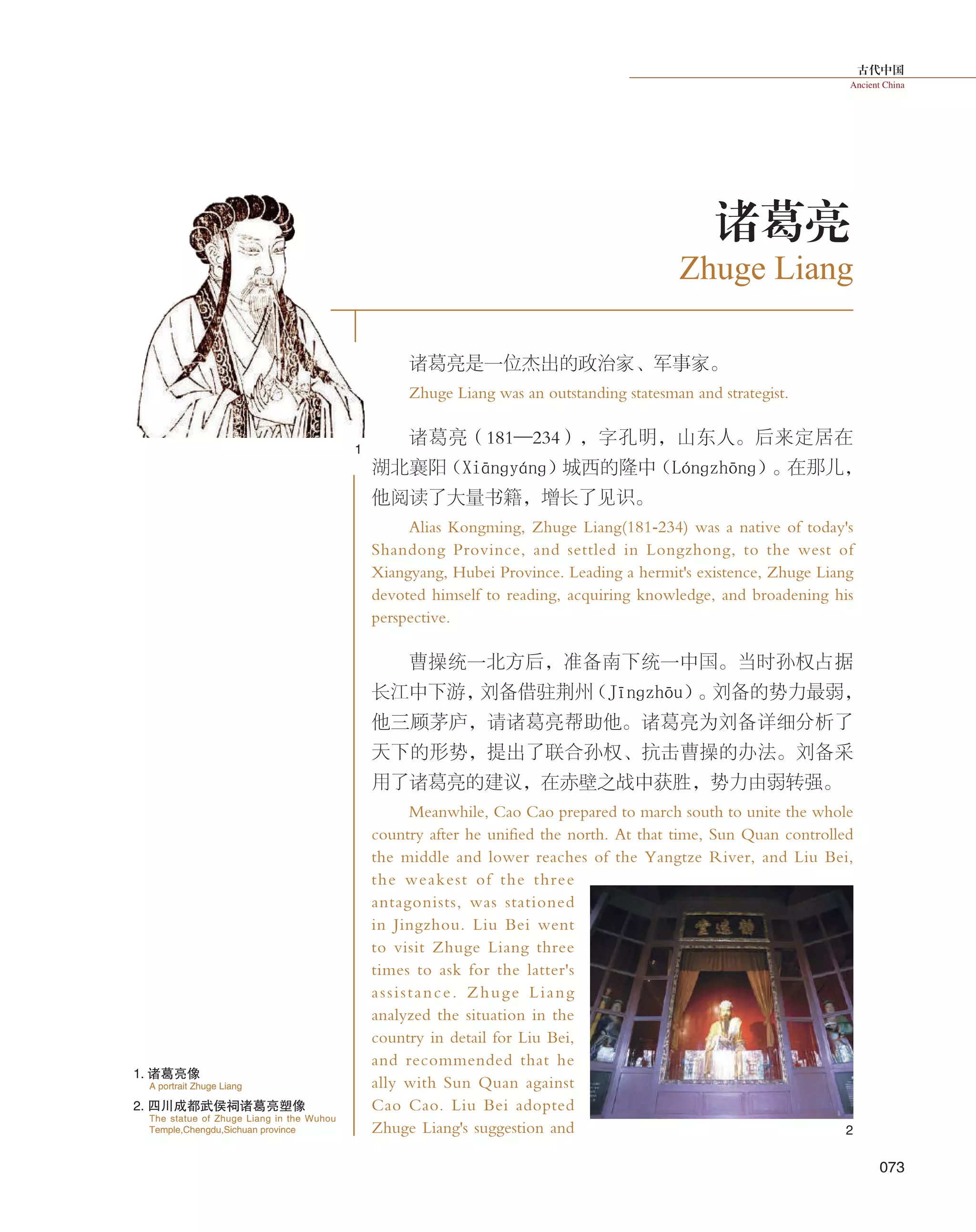
诸葛亮
Zhuge Liang
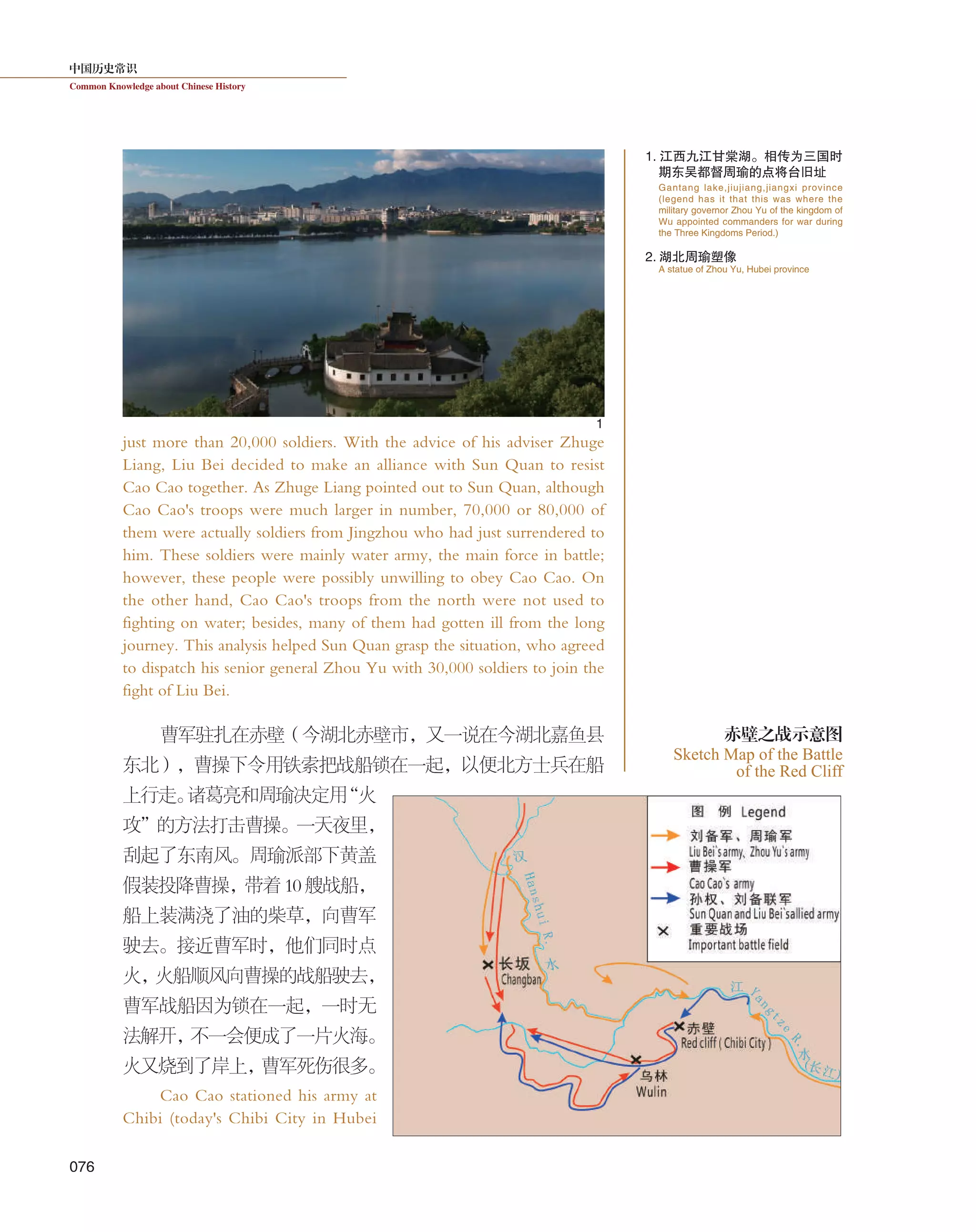
赤壁之战
The Battle of the Red Cliff
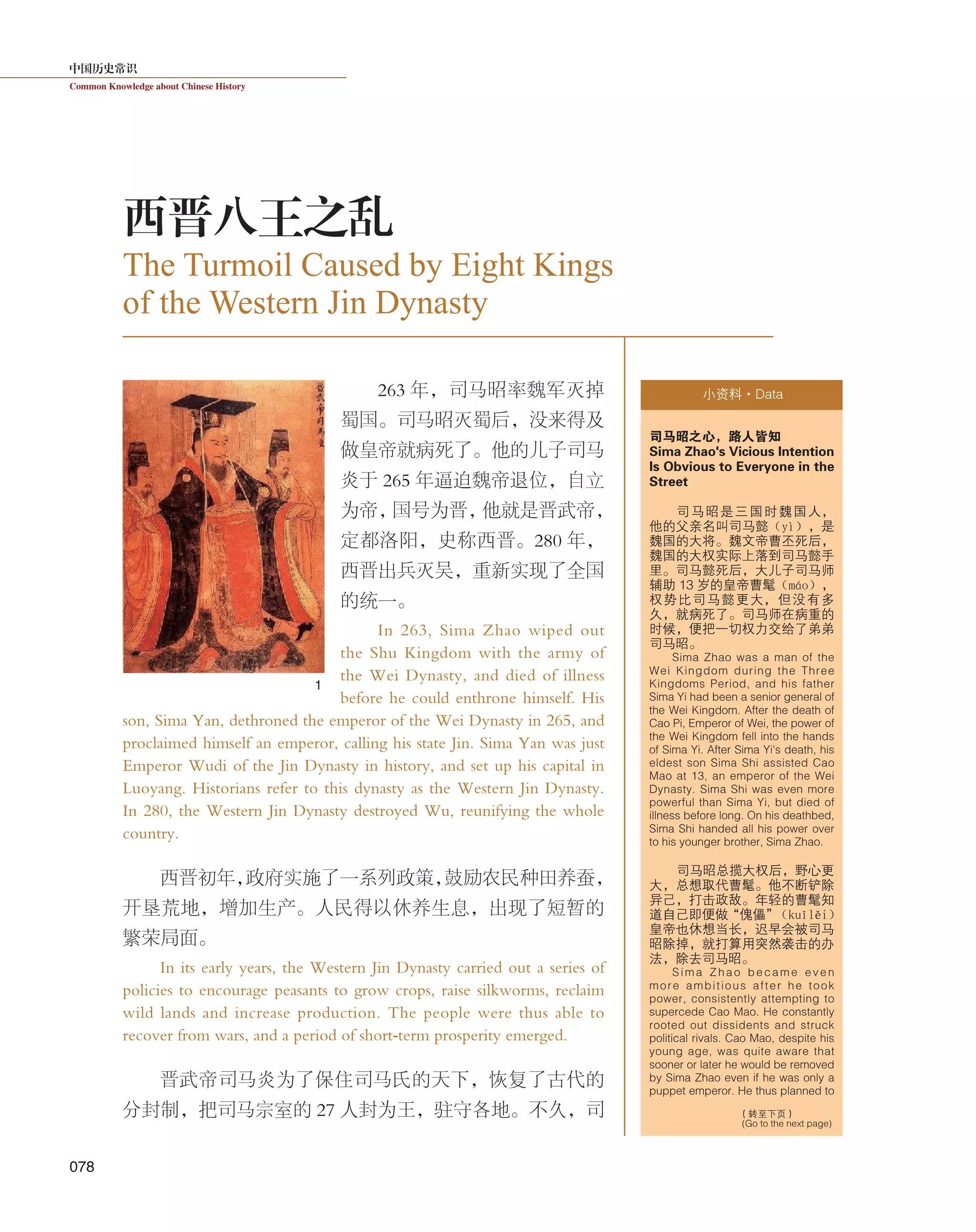
西晋八王之乱
The Turmoil Caused by Eight Kings of the Western Jin Dynasty
淝水之战
The Battle of Feishui
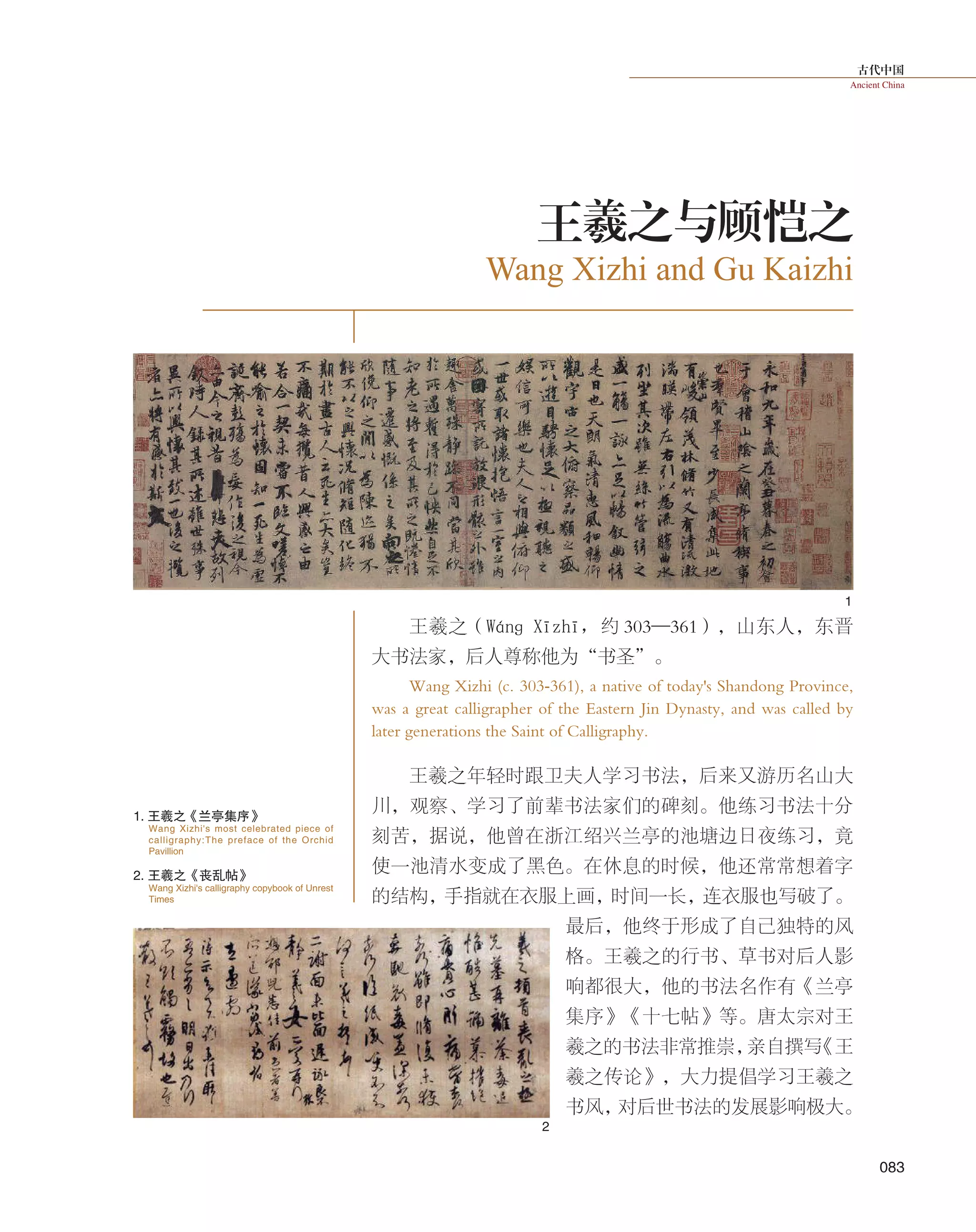
王羲之与顾恺之
Wang Xizhi and Gu Kaizhi
数学家祖冲之
Zu Chongzhi, the Remarkable Mathematician
北魏孝文帝改革
The Reform of Emperor Xiaowendi of the Northern Wei Dynasty
封建社会的繁荣时期——隋、唐
The Heyday of Feudal Society
— The Sui and Tang Dynasties
概述
Introduction
隋朝大运河
The Grand Canal of the Sui Dynasty
中国历史常识
Common Knowledge about Chinese History
·4·
095
097
100
103
105
107
109
112
115
118
121
124
126
128
131
贞观之治
The Benign Administration of the Zhenguan Reign
开元盛世
The Flourishing Kaiyuan Reign
繁盛的长安城
The Heyday of Chang'an
松赞干布和文成公主
Songtsen Gampo and Princess Wencheng
玄奘西游
Xuanzang's Journey to the West
鉴真东渡
Jianzhen's Crossing the Ocean to Japan
科举制
The Imperial Civil Examination System
三大石窟
Three Famous Grottoes
李白、杜甫、白居易
The Great Poets Li Bai, Du Fu and Bai Juyi
封建社会的继续发展和民族政权并立时期
——五代、辽、宋、夏、金、元
The Continued Development of Feudal Society and the
Co-existence of Ethnic Regimes
— The Five Dynasties, and the Liao, Song, Xia, Kin and
Yuan Dynasties
概述
Introduction
杯酒释兵权
Relieving the Generals of Their Commands at a Feast
赤胆忠心的杨家将
The Loyal Generals of the Yang Family
秉公执法的“包青天”
Bao the Upright Judge
王安石变法
Wang Anshi's Reform
忠心报国的岳飞
Yue Fei, a Paragon of Loyalty
目 录
CONTENTS
·5·
133
136
138
140
143
145
147
151
153
156
159
161
163
166
168
成吉思汗与忽必烈
Genghis Khan and Kublai Khan
历史名臣文天祥
Wen Tianxiang, a Renowned Minister in History
马可·波罗来华
Marco Polo's Travels in China
三大发明——宋代的科技成就
Three Great Inventions
—The Technological Achievements of the Song Dynasty
《清明上河图》
Riverside Scene on the Qingming Festival
司马光与《资治通鉴》
Sima Guang and His History Book
宋词与元曲
Song Ci Poetry and Yuan Qu Drama
统一的多民族国家进一步发展和封建国家由盛而衰时期
——明、清(鸦片战争以前)
Further Development of the Unitary Multi-ethnic
Country and Decline of the Feudal Society — The Ming
and Qing Dynasties(Before the Opium War of 1840)
概述
Introduction
明朝开国皇帝朱元璋
Zhu Yuanzhang, the First Emperor of the Ming Dynasty
郑和下西洋
Zheng He's Voyages
戚继光抗倭
Qi Jiguang's Repelling Japanese Pirates
清官海瑞
Hai Rui, an Upright and Incorruptible Official
闯王李自成
Li Zicheng and the Fall of the Ming Dynasty
郑成功收复台湾
Zheng Chenggong's Recovery of Taiwan
康乾盛世
The Golden Age of Three Emperors
中国历史常识
Common Knowledge about Chinese History
·6·
172
175
180
182
184
188
191
194
197
200
203
206
209
212
215
科学巨匠与巨著
Great Scientists and Scientific Works
四大名著
Four Great Classical Novels
近代中国
Modern China
概述
Introduction
林则徐与虎门销烟
Lin Zexu's Destroying Opium at Humen
第一次鸦片战争
The First Opium War
太平天国运动
The Taiping Heavenly Kingdom
第二次鸦片战争
The Second Opium War
洋务运动
The Westernization Movement
中日甲午战争
The Sino-Japanese War of 1894
戊戌变法
The Reform Movement of 1898
义和团运动与八国联军侵华
The Yihetuan (Boxer) Movement and the Aggression by Eight
Powers'Allied Army
孙中山与辛亥革命
Dr. Sun Yat-sen and the Revolution of 1911
五四运动
The May Fourth Movement
中国共产党的成立
The Founding of the Communist Party of China
第一次国共合作与北伐战争
The First KMT-CPC Co-operation and the Northern Expedition
目 录
CONTENTS
·7·
218
221
224
226
229
231
233
236
238
241
244
248
250
252
254
257
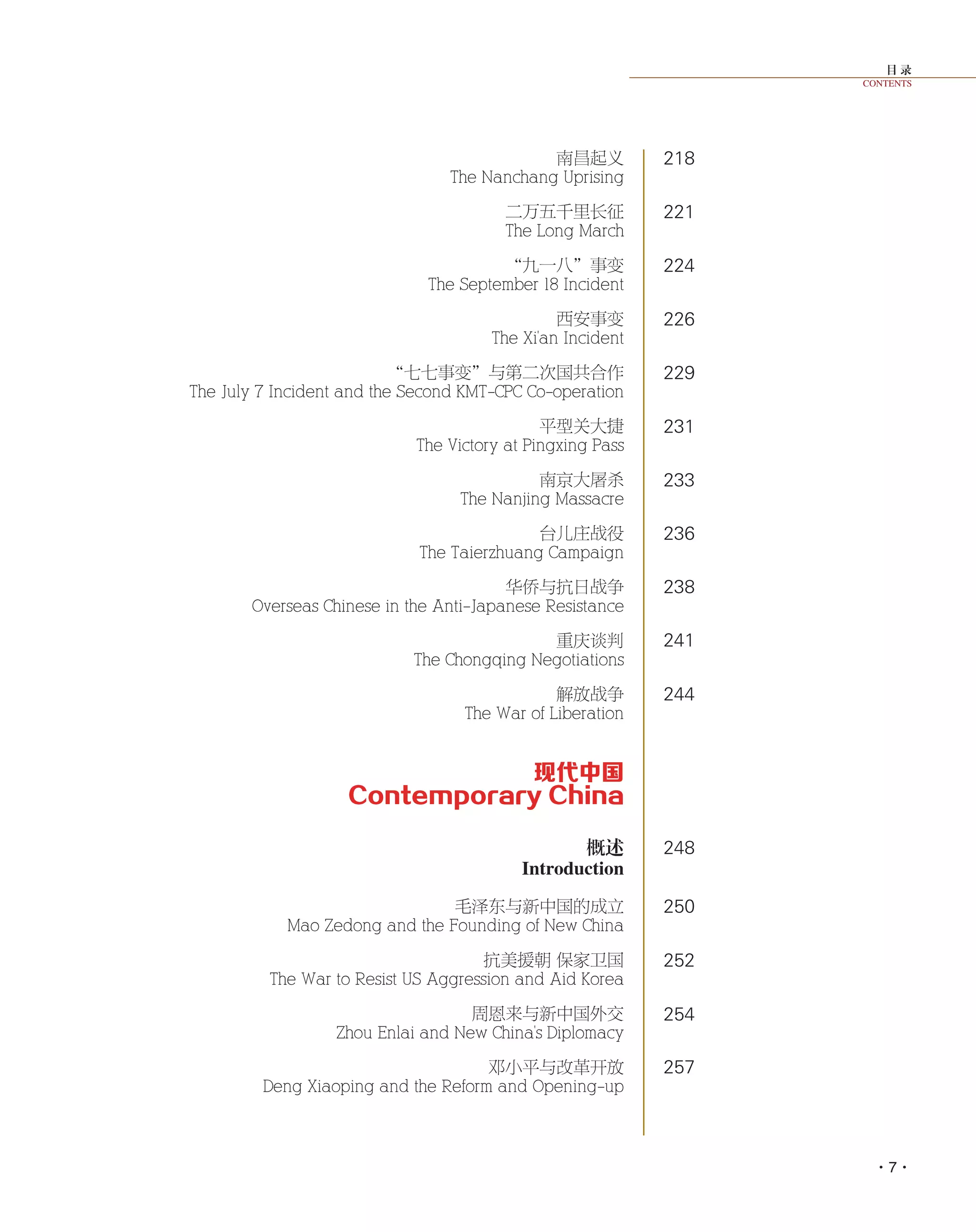
南昌起义
The Nanchang Uprising
二万五千里长征
The Long March
“九一八”事变
The September 18 Incident
西安事变
The Xi'an Incident
“七七事变”与第二次国共合作
The July 7 Incident and the Second KMT-CPC Co-operation
平型关大捷
The Victory at Pingxing Pass
南京大屠杀
The Nanjing Massacre
台儿庄战役
The Taierzhuang Campaign
华侨与抗日战争
Overseas Chinese in the Anti-Japanese Resistance
重庆谈判
The Chongqing Negotiations
解放战争
The War of Liberation
现代中国
Contemporary China
概述
Introduction
毛泽东与新中国的成立
Mao Zedong and the Founding of New China
抗美援朝 保家卫国
The War to Resist US Aggression and Aid Korea
周恩来与新中国外交
Zhou Enlai and New China's Diplomacy
邓小平与改革开放
Deng Xiaoping and the Reform and Opening-up
中国历史常识
Common Knowledge about Chinese History
·8·
香港回归
Hong Kong's Return to China
澳门回归
Macao's Return to China
航天英雄杨利伟
Yang Liwei, the Space Hero
北京奥运会
Beijing Olympic Games
国庆 60 周年
The 60th Anniversary of the Founding of the PRC
上海世界博览会
Shanghai World Exposition
附录:中国历史年代简表
Appendix:A Brief Chronology of Chinese History
260
262
264
266
270
274
278
古代中国
Ancient China
001
古
代
中
国
AncientChina
秦
始
皇
中国历史常识
Common Knowledge about Chinese History
002
概述
Introduction
中国是一个有着悠久历史文明的国家。
China is a country with a very long history.
大约在 170 万年以前,在中国云南元谋县
境内就有中国人的祖先在生活。此后,经过长
时间不断地进化,产生了不同时期的原始人和
氏族部落。大约在公元前 2070 年,中国第一个
王朝夏朝建立,这是中国最早的奴隶制国家。
夏之后的商朝是当时世界上的一个大国,统治
时间长达 500 多年,留下了甲骨文、青铜器等
许多极其珍贵的史料和文物。西周时期国家实行分封制,
诸侯林立,中国开始进入封建社会。这一时期,也是中国
历史上大变革的时代。社会大变革促进了文化的繁荣,以
孔子、老子、墨子等大思想家为代表的诸子百家涌现,出
现了百家争鸣的局面。公元前 221 年,秦灭六国,统一中国。
但因为统治不力,加上暴政,很快被汉朝取代。
The ancestors of the Chinese people began to settle down in
present-day Yuanmou County, Yunnan Province, about 1,700,000
years ago. Later, throughout a long process of constant evolvement,
primitive people and tribes emerged during different periods. Around
2070 BC, the Xia Dynasty was founded, which was both the first
dynasty and the earliest slavery state power in China. The Shang
Dynasty, which succeeded the Xia Dynasty, was a great power in the
world at that time. It existed for over 500 years, and left a great deal of
exceedingly precious historical materials and artifacts such as inscriptions
on bones, tortoise shells and bronze wares. During the Western Zhou
Dynasty, the system of enfeoffment was adopted that resulted in many
contesting feudal lords, and China entered the stage of a feudal society.
It was also a period of immense changes in the history of China. The
enormous societal changes sparked cultural prosperity, creating an
environment in which many contending schools of thought emerged,
including such great thinkers as Confucius, Laozi and Mozi. The state
of Qin vanquished its six rivals and unified China in 221 BC. But Peking Man Figure imagine scenes of life
1. 北京人生活场景想象图
1
古代中国
Ancient China
003
misconduct and tyranny doomed the regime, and it was soon thereafter replaced by the Han Dynasty.
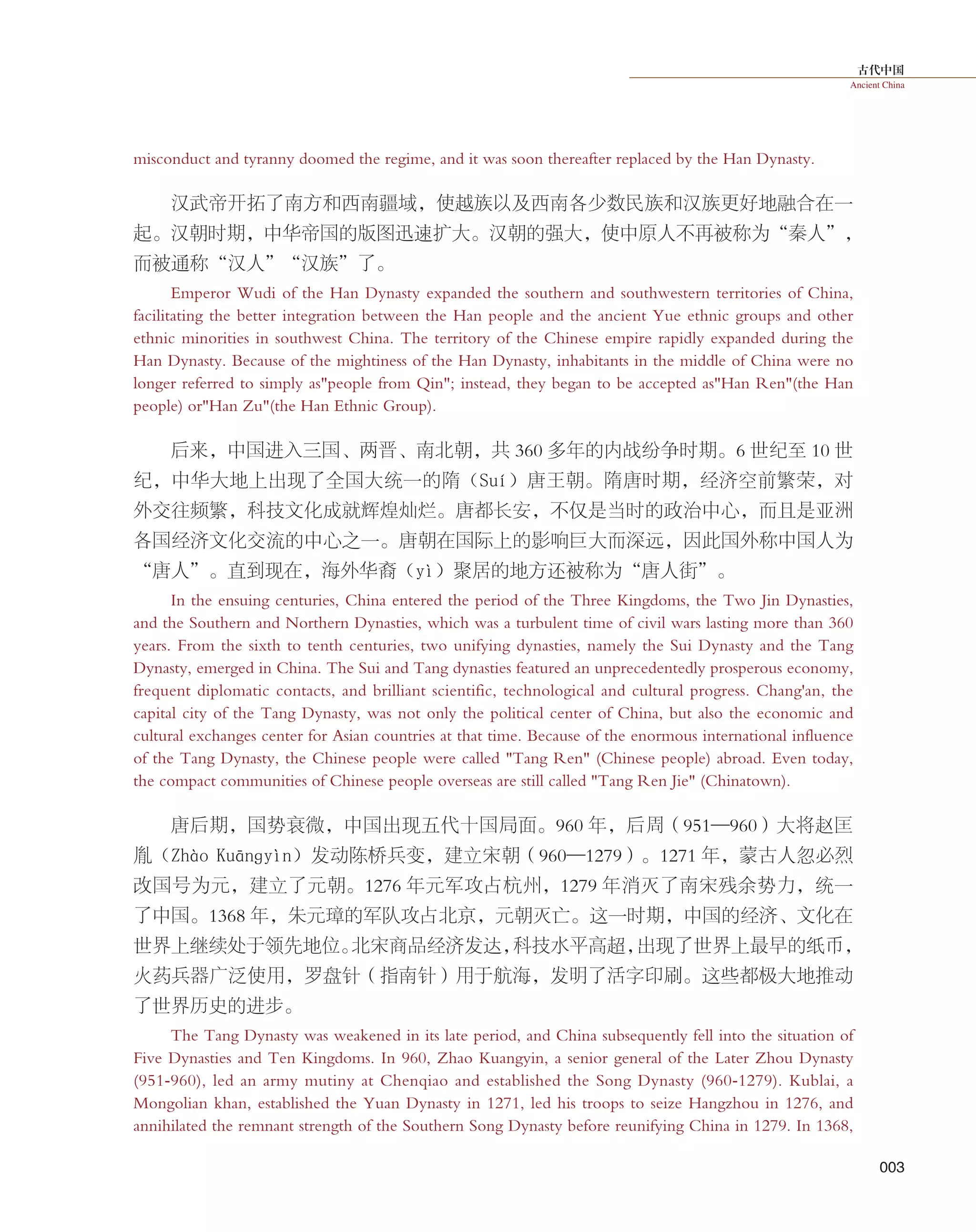
汉武帝开拓了南方和西南疆域,使越族以及西南各少数民族和汉族更好地融合在一
起。汉朝时期,中华帝国的版图迅速扩大。汉朝的强大,使中原人不再被称为“秦人”,
而被通称“汉人”“汉族”了。
Emperor Wudi of the Han Dynasty expanded the southern and southwestern territories of China,
facilitating the better integration between the Han people and the ancient Yue ethnic groups and other
ethnic minorities in southwest China. The territory of the Chinese empire rapidly expanded during the
Han Dynasty. Because of the mightiness of the Han Dynasty, inhabitants in the middle of China were no
longer referred to simply as"people from Qin"; instead, they began to be accepted as"Han Ren"(the Han
people) or"Han Zu"(the Han Ethnic Group).
后来,中国进入三国、两晋、南北朝,共 360 多年的内战纷争时期。6 世纪至 10 世
纪,中华大地上出现了全国大统一的隋(Suí)唐王朝。隋唐时期,经济空前繁荣,对
外交往频繁,科技文化成就辉煌灿烂。唐都长安,不仅是当时的政治中心,而且是亚洲
各国经济文化交流的中心之一。唐朝在国际上的影响巨大而深远,因此国外称中国人为
“唐人”。直到现在,海外华裔(yì)聚居的地方还被称为“唐人街”。
In the ensuing centuries, China entered the period of the Three Kingdoms, the Two Jin Dynasties,
and the Southern and Northern Dynasties, which was a turbulent time of civil wars lasting more than 360
years. From the sixth to tenth centuries, two unifying dynasties, namely the Sui Dynasty and the Tang
Dynasty, emerged in China. The Sui and Tang dynasties featured an unprecedentedly prosperous economy,
frequent diplomatic contacts, and brilliant scientific, technological and cultural progress. Chang'an, the
capital city of the Tang Dynasty, was not only the political center of China, but also the economic and
cultural exchanges center for Asian countries at that time. Because of the enormous international influence
of the Tang Dynasty, the Chinese people were called "Tang Ren" (Chinese people) abroad. Even today,
the compact communities of Chinese people overseas are still called "Tang Ren Jie" (Chinatown).
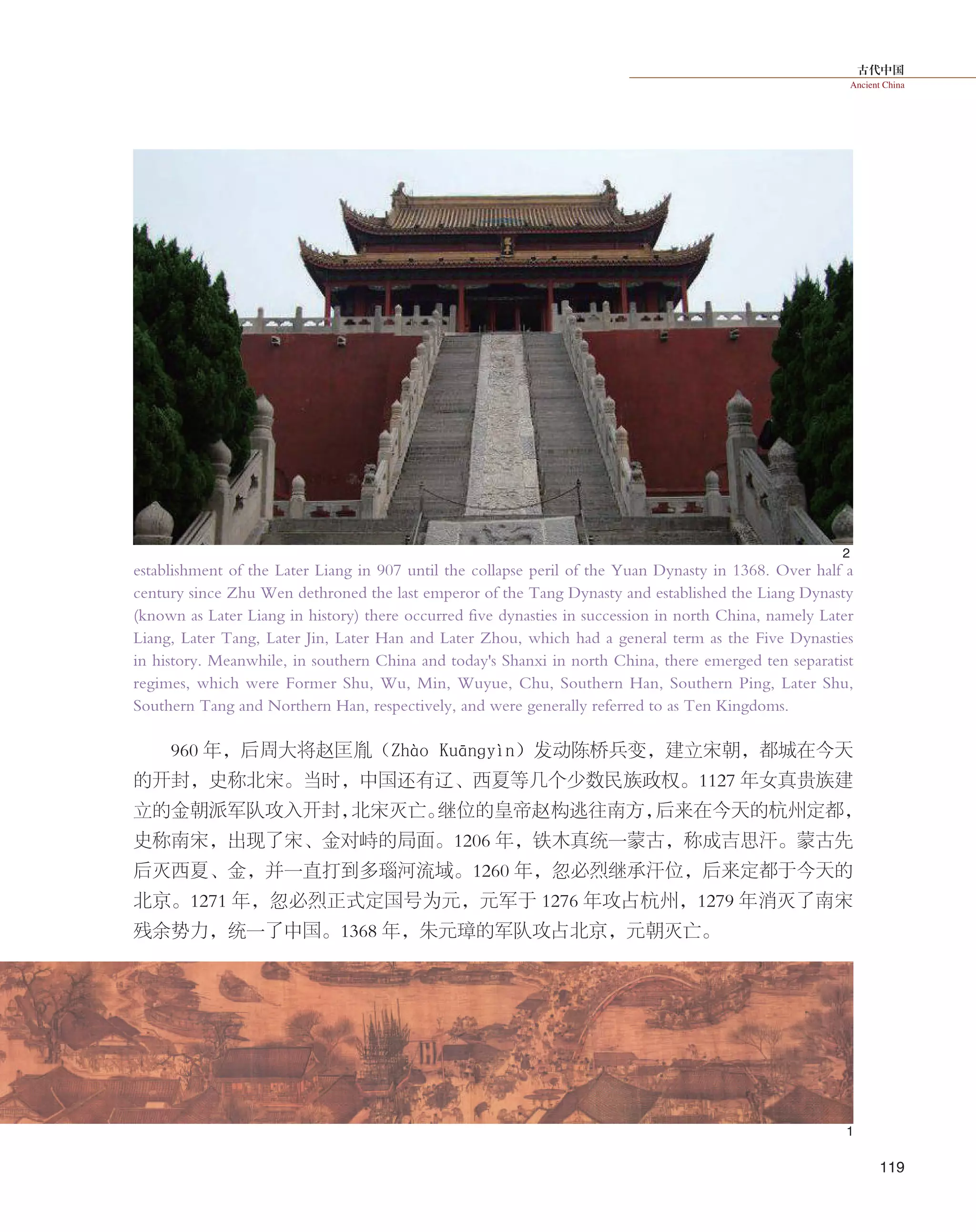
唐后期,国势衰微,中国出现五代十国局面。960 年,后周(951—960)大将赵匡
胤(Zhào  Kuānɡyìn)发动陈桥兵变,建立宋朝(960—1279)。1271 年,蒙古人忽必烈
改国号为元,建立了元朝。1276 年元军攻占杭州,1279 年消灭了南宋残余势力,统一
了中国。1368 年,朱元璋的军队攻占北京,元朝灭亡。这一时期,中国的经济、文化在
世界上继续处于领先地位。北宋商品经济发达,科技水平高超,出现了世界上最早的纸币,
火药兵器广泛使用,罗盘针(指南针)用于航海,发明了活字印刷。这些都极大地推动
了世界历史的进步。
The Tang Dynasty was weakened in its late period, and China subsequently fell into the situation of
Five Dynasties and Ten Kingdoms. In 960, Zhao Kuangyin, a senior general of the Later Zhou Dynasty
(951-960), led an army mutiny at Chenqiao and established the Song Dynasty (960-1279). Kublai, a
Mongolian khan, established the Yuan Dynasty in 1271, led his troops to seize Hangzhou in 1276, and
annihilated the remnant strength of the Southern Song Dynasty before reunifying China in 1279. In 1368,
中国历史常识
Common Knowledge about Chinese History
004
Zhu Yuanzhang's troops captured Beijing, which symbolized the fall of the Yuan Dynasty. During this
period, China continued to hold a leading position in the fields of economy and culture in the world.
The Northern Song Dynasty had a well-developed commodity economy as well as high-level science
and technology. For example, it had the earliest paper notes in the world, widely employed gunpowder
and early thermal weapons, used the compass in seafaring, and invented movable type printing. All these
inventions greatly promoted the world's progress.
14 世纪至 19 世纪,是中国封建社会逐渐走向衰落的明清时期。明朝时,统一的多
民族国家进一步发展。明朝前期经济发展,社会繁荣,郑和多次出使西洋各国,促进了
中外友好交往。清朝的康熙(Kānɡxī)、雍正(Yōnɡzhènɡ)和乾隆(Qiánlónɡ)时期,
也出现了繁荣的盛世。
The 14th to 19th centuries covered the period of the Ming and Qing dynasties, wherein the feudal
society of China gradually declined. The unified multinational country further developed during the Ming
Dynasty. In the early Ming Dynasty, the economy developed and the society prospered. Particularly, Zheng
He went on several missions to Western countries and improved friendly contacts between China and
foreign lands. Additionally, the Kangxi, Yongzheng and Qianlong reigns of the Qing Dynasty witnessed
prosperity as well.
这一时期,世界历史进展迅猛,14、15 世纪,欧洲地中海沿岸一些城市出现了资本
主义萌芽。17、18 世纪,英、美、法三国先后发生资产阶级革命,西方先进国家已经进
入工业革命的成熟阶段,资本主义发展迅速。相比之下,中国却未能同步发展。虽然中
国于明朝中后期产生了资本主义萌芽,但由于封建制度的束缚,生产力发展受到严重阻
碍,商品经济发展艰难,封建社会由盛而衰。随着中国社会发展的逐步落后和西方殖民
主义侵略势力的到来,中国封建统治者对外部世界的态度,逐渐由开放转向闭关锁国,
同西方国家的差距迅速拉大。直到 1840 年英国对中国发动鸦片战争,中国开始进入半
殖民地半封建社会。中国古代历史翻开新的一页,开始进入近代历史篇章。
During this period, the world advanced rapidly as capitalism germinated in some European coastal
cities along the Mediterranean Sea in the 14th and 15th centuries. In the 17th and 18th centuries, bourgeois
revolutions successively took place in Britain, America and France; advanced countries in the West entered
the maturing stage of their Industrial Revolution; capitalism developed rapidly. In comparison, China
did not evolve synchronously. It is a fact that capitalism had begun to germinate during the middle and
late Ming Dynasty in China, but due to the restraint of feudalism, the development of productivity was
seriously hindered. As a result, the commodity-based economy developed sluggishly, and feudal society
began to decline. With the lagging social development of China and the arrival of aggressive forces of
Western colonists, the feudal rulers of China changed their attitudes towards the outside world, gradually
turning from an open door policy to a closed-door bent. The disparity between China and the Western
countries rapidly increased. In 1840, Britain waged the Opium War against China, symbolizing China's
transition into a semi-colonial and semi-feudal society. An old leaf of the ancient history of China was
turned over, and the chapter of modern times thus began.
古代中国
Ancient China
005
中国历史的开篇——先秦
The Dawn of Chinese History —
The Pre-Qin Period
先秦,指中国历史上秦统
一中国以前的漫长历史时期。
The pre-Qin period refers to
remote antiquity in the history of
China before Qinshihuang reunited
the country.
大约在 170 万年以前,云
南元谋县境内就有中国人的
祖先在生活。此后,经过长时
间不断地进化,产生了不同时
期的原始人和氏族部落。
The ancestors of the Chinese
people had begun living in present-
day Yuanmou County, Yunnan
Province, about 1,700,000 years ago. Primitive people and tribes later
emerged following a long period of incremental changes.
大约在公元前 2070 年,中国第一个王朝夏朝建立,统
治时间长达 400 多年。第二个王朝是商朝,也叫殷朝(商
朝多次迁都,最后迁到殷——今河南安阳)。商朝是当时
世界上的一个大国,统治时间长达 500 多年,留下了甲骨
文、青铜器等许多极其珍贵的史料和文物。第三个统一的
概述
Introduction
1. 龙 山 文 化 白 陶 鬶( 距 今
4000 年。 陶 鬶[guī] 是
中国酒器之祖,最初是炊
具,用于煮水或煮酒,后
来演变为礼器)
White pottery gui of the Longshan
Culture has a history of four thousand
years. Pottery gui, the father of
Chinese drinking vessels, was used
originally to boil water or wine, and
later as ritual vessels.
1
中国历史常识
Common Knowledge about Chinese History
006
王朝是西周,都城在镐(hào)京,即今天的陕西西安。后来西周的都城被少数民族攻占,
周王室被迫迁都到今天的洛阳,历史上叫作东周。西周与东周的统治时间共约 800 年。
东周分为春秋(前 770—前 476)和战国(前 475—前 221)两个时期。春秋时期,国家
分裂成许多小国;到了战国时期,形成了 7 个力量强大的国家,这些国家通过改革进入
了封建社会,并为后来秦的统一奠定了基础。
The first dynasty of China, the Xia Dynasty, was founded around 2070 BC and lasted for over
400 years. The second dynasty was the Shang Dynasty, also called the Yin Dynasty (The shang Dynasty
changed its capital several times before finally settling in Yin, today's Anyang in Henan Province). The
Shang Dynasty was a great power in the world of its time. It existed for over 500 years, and left a bounty
of extremely precious historical materials and artifacts, such as inscriptions on bones, tortoise shells and
bronze wares. The third united dynasty was the Western Zhou Dynasty, with its capital in Haojing, today's
Xi'an in Shaanxi Province. Invaded and occupied by ethnic minorities, the capital was forced to move to
today's Luoyang in Henan Province by the Zhou ruling house, from which point it became known to
history as the Eastern Zhou Dynasty. The Western and Eastern Zhou reigned for about eight centuries
altogether. The Eastern Zhou is divided by historians into the Spring and Autumn Period (770-476 BC)
and the Warring States Period (475-221 BC). During the Spring and Autumn period, the country split
into many small rival vassal states; by the time of the Warring States Period, they had coalesced into seven
powerful states. These seven states became feudalist societies through reforms, and laid foundations for the
forthcoming re-unification of China under the Qin Dynasty.
与世界历史对照,当古埃及、古巴比伦、古印度文明发展进步之时,中国正经历文
明走向兴盛的夏、商、西周王朝。当欧洲希腊、罗马城邦国家繁荣之时,正是中国春秋
战国思想文化昌盛的时代。东西方文明交相辉映,地中海地区和中国逐渐形成世界两大
文明的中心。
As the ancient civilizations of Egypt, Babylon and India evolved, China was undergoing its flourishing
civilization of the Xia, Shang and Western Zhou dynasties. While the Greek and Roman city-states in
Europe were in their prime, the thought and culture of the Spring and Autumn and Warring States periods
prospered. The Mediterranean area and China gradually grew into the two civilization centers of the world,
respectively in the West and the East.
古代中国
Ancient China
007
中国是世界文明古国,也是
人类的发源地之一。中国是目前
为止世界上发现远古人类遗址最
多的国家,其中重要的有元谋人、
蓝田人、北京人、山顶洞人等。
China not only boasts an ancient
civilization, but it is also one of
birthplaces of the human race. So far,
China ranks first in the number of
human fossils and cultural sites dating
from the Paleolithic Period, which reveal
traces of Yuanmou Man, Lantian Man,
Peking Man and Upper Cave Man.
  
元谋人
Yuanmou Man
1965 年,在云南省元谋县,考古人员发现了两颗远古
人类的牙齿和一些粗糙的石器。
In 1965, archeologists discovered the remains of two ancient
human teeth and some rough stone tools in Yuanmou County, Yunnan
Province.
经科学家鉴定,这是远古人类的遗骨、遗物,距今大
约 170 万年。在元谋发现的远古人类我们称为元谋人。元
谋人是中国境内目前发现的最早的人类。
Further examination confirmed that the findings belonged to
ancient human's osseous remains and relic, dating back some 1,700,000
years. The ancient human discovered in Yuanmou was referred to as
Yuanmou Man, the earliest human found in China thus far.
中国境内最早的人类
The Earliest Human Beings in China
1. 元谋人牙齿
Yuanmou Man teeth
1
中国古人类化石分布图
Chinese ancient human fossils maps
中国历史常识
Common Knowledge about Chinese History
008
北京人
Peking Man
1929 年,在北京西南周口
店龙骨山山洞里发现了一个完
整的远古人类的头盖骨,后来
在这个遗址中又先后发现了 5
个头盖骨和其他骨骼化石。在
这里发现的远古人类我们称为
北京人。北京人生活的时间距
今约 70 万年至 20 万年,他们
保留了猿的某些特征,但已经能够使用工具劳动。北京人
把石块敲打成粗糙的石器,还把树枝砍成木棒,用来采集
植物,捕捉动物,加工食物。北京人已经会使用天然火。
火的使用是人类进化过程中一个很大的进步。
In 1929, a complete human skull was found in a cave on Mount
Longgu in Zhoukoudian in southwest Beijing. Later, five more human
skulls and other fossil bones were uncovered there. The human beings
whose remains were found in these relics are referred to as Peking Man,
who lived around 700,000 to 200,000 years ago. Peking Man still had
some ape-like characteristics, but he had mastered the arts of making
and using tools. He chipped stones into rough implements and chopped
tree branches into sticks to gather vegetation, hunt animals and process
food. He had also learned to use natural fire, marking a milestone of
human evolution.
1987 年 12 月,
发现北京人头盖骨的
周口店北京猿人遗址
被联合国教科文组织
列入世界遗产名录。
The Zhoukoudian
Peking Man Ruins, where
the skulls of Peking Man
were found, was entered
into the world heritage
list by the UNESCO in
December 1987.
小资料·Data
旧石器时代
Paleolithic Period
原始人用石块敲打出来的
石器叫打制石器,使用这种石器
的时代叫旧石器时代。旧石器时
代经历了二三百万年,那时人们
过着采集和渔猎的生活。
The period in which chipped
stone implements were used is
called the Paleolithic Period. The
Paleolithic Period lasted for two
to three million years. People of
that period survived by gathering,
hunting and fishing.
2. 北京人头盖骨
3. 北京周口店猿人洞遗址
Peking Man skull
Beijing Zhoukoudian Ape Cave
1
2
3
Peking Man head recovery
1. 北京人头部复原像
4. 山顶洞人头部复原像
6. 山顶洞人居住的山洞
5. 山顶洞人制作的骨针和装饰品
Upper Cave men Head Recovery
Cavemen live in caves
The spicule and decorations made by the
Upper Cave Man
古代中国
Ancient China
009
山顶洞人
Upper Cave Man
1930 年,在北京西南周口店龙骨山顶部的山洞里,发
现了距今约 3 万年的人类遗骨,我们把他们称为山顶洞人。
山顶洞人的模样和现代人基本一样。
In 1930, human bones dating from about 30,000 years ago were
found in caves near the top of Mount Longgu in Zhoukoudian,
Beijing. We called them Upper Cave Man. Upper Cave Man's
appearance was almost identical to that of modern man.
山顶洞人用的还是打制石器,但有的制作很精细。他
们已经懂得磨制和钻孔技术,会制造骨针等骨器,会用骨
针缝制兽皮衣服,还会用有钻孔的兽骨、兽牙、石珠、海
蚶(hān)壳做装饰品。他们已懂得人工取火,靠采集植物、
打猎、捕鱼得到食物。
Upper Cave Man also used chipped stone tools, some of which
were exquisitely made, and the tools show that he had already mastered
grinding and drilling techniques. He made bone needles to sew animal
skins into clothing, and used animal bones and teeth, stone beads and
shells as ornaments. He had mastered the skill of making fire, and got
food from gathering vegetation, hurting and fishing.
山顶洞人按母亲的血缘关系组成氏族。同一氏族的成
员居住在一起,共同劳动,共同分配食物。
The Upper Cave people formed matriarchal clans according,
to the mothers blood relationship. Members of the same clan lived
together, worked together and shared their food together.
4
6
新石器时代
Neolithic Period
大约从八九千年前开始,
原始人已经普遍使用磨制石器。
使用磨制石器的时代叫新石器
时代。新石器时代已出现原始
农业和牧业。
Around 8,000-9,000 years
ago, ground stone implements were
already in wide use among primitive
people. The period in which ground
stone implements were used is
called the Neolithic Period. Primitive
agriculture and animal husbandry
first appeared during this period.
小资料·Data
5
中国历史常识
Common Knowledge about Chinese History
010
华夏之祖
Ancestors of the Chinese Nation
中国人常说自己是“炎黄子孙”,这个说法跟传
说中的人物炎帝和黄帝有关。
Chinese people often call themselves "descendants of Yandi
and Huangdi", in reference to the legendary heroes named Yandi
and Huangdi.
大约 4000 多年以前,中国黄河流域一带住着许
多氏族和部落,其中比较著名的是分别以黄帝、炎帝
为首领的两大部落。
Over 4,000 years ago, many clans and tribes resided in the
Yellow River valley, among which two tribes, respectively led
by Huangdi and Yandi, were the most prominent.
黄帝和炎帝两个部落在黄河流域,势力强大。在东方
还生活着一个势力也很强大的部落叫九黎部落,其首领叫
蚩尤(Chīyóu)。相传,当时的九黎族人已经使用铜造的
兵器,打起仗来非常勇猛,常常进攻别的部落。
Huangdi and Yandi, the two powerful tribes resided in the
Yellow River valley. To the east of the Yellow River valley was the
territory of the Jiuli tribe, with Chiyou as its chieftain. It is said that the
Jiuli people used bronze weapons and were a
warlike group.
传说蚩尤部落为了扩大自己的地
盘,同炎帝部落发生了战争。炎帝部
落战败,向黄帝求援。黄帝与炎帝联
合起来大战蚩尤,这次战争发生在涿
鹿(Zhuōlù, 今河北省境内)。在战斗
中,忽然天昏地暗,大雾弥漫,连对
面的人也看不见。黄帝使用指南车, 21
传说中八大部落集团的分布地区
黄帝氏族东移路线
炎帝氏族部分东移路线
传说中洪水泛滥的地区
主要战场
Distribution area of the eight
legendary tribal groups
E a s t w a r d m i g r a t i o n r o u t e o f
Huangdi's tribe
Eastward migration route of part of
Yandi's tribe
Legendary flooded area
Main battle site
黄帝和禹传说时期地域示意图
Sketch Map of the Legendary period of
Huangdi and Yu the Great
古代中国
Ancient China
011
帮助士兵识别方向,追击蚩尤,结果蚩尤被捉住杀死。
Legend has it that the Jiuli attacked Yandi's tribe to expand their
territory. The latter was defeated, thereupon turning to Huangdi for
help. Huangdi allied himself with Yandi, and vanquished Chiyou
at a place called Zhuolu (in today's Hebei Province). A dense mist
descended during the battle, causing great confusion. However,
Huangdi had an instrument on his chariot that perpetually pointed
south. The instrument allowed him to rally the allied forces and chase
Chiyou until finally capturing and executing him.
涿鹿之战后,黄帝和炎帝两个部落为了争夺对其他各
部落的领导地位,又发生了冲突,最后黄帝部落取得了胜利。
两个部落进一步融(rónɡ)合在一起,其他部落也纷纷加
入黄帝部落的联盟,共同开发中原地区。各部落在语言、
习惯、生产、生活等各方面的交流逐渐加强,经过长期的
融合和发展,形成了华夏族的主体。
After the Battle of Zhuolu, conflicts arose between the tribes of
Huangdi and Yandi for the hegemony of all the tribes. The Huangdi
tribe ultimately prevailed. The two tribes were further fused, and others
also joined the alliance headed by the tribe of Huangdi in succession,
in the joint development of the Middle Plains. The collection of tribes
gradually deepened their exchanges in language, customs, production
and living habits, eventually forming the main body of the Huaxia
people after a long period of integration and development.
华夏族是汉族的前身,是中华民族的主要组成部分。
黄帝和炎帝被后代公认为是华夏民族的共同祖先,现在的
中国人都称自己是炎黄子孙。
The Huaxia people were the predecessor of the Han people,
and the principal part of the Chinese nation. The Huaxia people
regarded Huangdi and Yandi as their ancestors, and called themselves
"descendants of Yandi and Huangdi." Even today, the Han people and
many other ethnic minorities of China continue to identify themselves
thusly.
1. 黄帝像
A drawing of Huangdi
5
3
4
小资料·Data
三皇五帝
The Three Emperors and
Five Sovereigns
三皇是中国古代传说中远
古时期的帝王,通常的说法是
指燧(Suì)人、伏羲(xī)、
神农。
The Three Emperors refers
to three legendary monarchs of
China from remote antiquity, namely
Suiren, Fuxi and Shennong.
五 帝 是 中 国 古 代 传 说 中
远古时期的帝王,时代比三皇
略晚。五帝通常指黄帝、颛顼
(Zhuānxū)、帝喾(Dìkù)、
尧(Yáo)和舜(Shùn)。  
The Five Sovereigns refers to
five legendary monarchs of China
in remote antiquity, who came
after the Three Emperors. The Five
Sovereigns are typically known as
Huangdi, Zhuanxu, Diku, Yao and
Shun.
Yandi Mausoleum, Baoji, Shaanxi Province
5. 陕西宝鸡市炎帝祠
A statue of Chiyou
A south-pointing chariot
2. 指南车
4. 蚩尤像
Huangdi Mausoleum
3. 黄帝陵
中国历史常识
Common Knowledge about Chinese History
012
大禹治水
Yu the Great's Harnessing the Flood
大禹(Yǔ)是传说中夏后氏部落的首领,原称“禹”,
也称“夏禹”。传说尧的时候,黄河发大水,洪水冲毁了
村庄和房屋,人们只能住到树上和山顶上。洪水给人们带
来了极大的灾害。那时,炎黄部落联盟的首领尧任用鲧(Gǔn)
治理洪水,鲧采用筑堤堵水的办法治水,没能成功。尧之后,
担任部落联盟首领的舜杀死了鲧,然后命令鲧的儿子禹继
续治水。禹吸取了鲧的教训,改用疏导的方法治水,让洪
水顺着河道流向大海。禹辛勤地工作,传说他在治水的 13
年中,三次经过家门都没有时间进去看看。最后,禹终于
制服了水患。人们感谢禹,尊称他为“大禹”。
Yu the Great was the chieftain of the legendary Xiahou clan. He
was originally called Yu or Xiayu. According to legend, the Yellow
River flooded during the reign of Yao, and the people were forced to
abandon their villages, and moved to higher ground. The aftermath
of the flood brought great misery to the people. Yao, the chieftain of
the Yan-Huang tribal alliance, appointed Gun to harness the flood's
power. Gun built dykes to keep back the water, but failed. Shun,
who succeeded Yao, executed Gun, and appointed Gun's son, Yu,
to continue with the flood-harnessing efforts.
Yu adopted a dredging method to divert the
floodwaters along river courses into the sea. Yu
worked very hard, and it was said that during the
13 years he spent taming the floods, he passed his
home three times, but did not enter until his task
was completed. As a result of his successful efforts,
the people called him"Yu the Great"to show their
respect.
由于禹治水成功,得到舜的禅(shàn)
让,被推举为继承人。舜死后,禹便成为
部落联盟的首领。
2
1
3
古代中国
Ancient China
013
Due to his achievement in harnessing the floods, he was chosen
as the successor of Shun by the latter, with the approval of other tribal
chieftains. After Shun's death, Yu became the head of the tribal alliance.
那时洪水刚刚平定,草木茂盛,野兽危害人民,禹派
人教百姓开辟耕地,还派人教导人民耕种田地,收获粮食,
于是人民的生活渐渐安定下来。禹又对苗族发动战争,阻
止他们进入黄河流域,巩固了华夏族在中原地区的地位。
Following the taming of the floods, vegetation and wild beasts
grew wantonly and threatened the survival of the people. Yu taught
his subjects the art of agriculture, and the people then settled down and
learned to feed themselves in a consistent and organized way. He also
waged wars against the Miao tribes, prevented them from entering the
Yellow River reaches, and consolidated the Huaxia people's supremacy
in the Middle Plains.
禹在世时,部落联盟首领的权力大大加强了。后来禹
死了,他的儿子启排斥伯益,自行继承禹的位置,引起了
有扈(hù)氏部落的反抗。打败了有扈氏以后,启的地位
得到了各部落的承认。从此世袭制代替了禅让制。启建立
的夏朝,是中国历史上第一个王朝。夏朝历经 400 多年,
最后一个王叫桀(Jié),他是个暴君,政权非常腐朽。那
时黄河下游的商部落强大起来,起兵灭夏,大约在公元前
1600 年建立了商朝。
In Yu's time, chieftains of the tribal alliance had
greatly strengthened their authority. After Yu's death,
his son Qi succeeded to the throne on his own by
supplanting Boyi, and thus encountered a revolt by
the Youhu tribe. Qi crushed the Youhu tribe's attempt
to overthrow him, and all tribes accepted his position.
Hence, a hereditary system replaced that reliant on
the demise of the throne. The Xia Dynasty that Qi
established was the first dynasty in the history of China,
and it lasted for over 400 years. Its last king, Jie, was a
tyrant, who led a brutal regime. At that time, a tribe
called Shang in the lower reaches of the Yellow
River gradually grew to become powerful enough
to wage war against the Xia and destroy it,
thereby establishing the Shang Dynasty in
around 1,600 BC.
4
5
A drawing of Yu the Great
1. 大禹像
Dengfeng Kai mother Que (2010 inscribed on
the World Heritage List)
4. 登封启母阙(2010 年列入世界
文化遗产名录)
The picture of Yu the Great Harnessing the
flood
3. 大禹治水图
禅让制
T h e T h r o n e - D e m i s i n g
System 
禅让制是中国古代部落联
盟推选领袖的制度。相传尧是
陶唐氏部落的首领,后被推举
为部落联盟的领袖。尧老了,
征询了四方部落首领的意见,
推选舜为继承人。舜是有虞(yú)
氏部落的首领,聪明能干。尧
对舜考察了三年,最后选定他
为部落联盟首领。舜年老时也
采取同样的办法推选了夏后氏
部落的首领禹接替自己的位置。
禹在位时,推举伯益为继承人。
In ancient China, the ruler of
the alliance of tribes passed on
power to the next generation by
means of abdication. According to
legend, Yao was a chieftain of the
Taotang tribe, who was chosen to
be head of the alliance. In his old
age, Yao consulted the other tribal
chieftains, and chose Shun, head of
the Youyu clan, as his successor.
In the same way, Shun chose Yu,
leader of the Xiahou clan, to be
his successor. Yu recommended
Boyi as his successor while he still
reigned.
小资料·Data
Yu the Great Mausoleum, Shaoxing, Zhejiang
Province
2. 淅江绍兴大禹陵
A statue of Yu the Great, Yuzhou, Henan
Province
5. 河南禹州市大禹雕像
中国历史常识
Common Knowledge about Chinese History
014
商是黄河中下游的一个古老的部落,商的祖先叫契
(Xiè)。商部落早期经常迁徙(qiān xǐ),自契至汤 13 世,
迁了 8 次。汤居亳(Bó),灭夏,建立商朝。汤之后又迁
了 5 次,最后盘庚(Pán'ɡēnɡ)定居于殷(今河南安阳西北)。
之后,商朝出现复兴的局面。
Shang was an ancient tribe located in the middle and lower reaches
of the Yellow River, and its first ancestor was called Xie. The Shang
tribe often migrated in its early stage, moving a total of eight times in 13
generations from Xie to Tang. Tang settled down in Bo and overthrew
the Xia to establish the Shang Dynasty. Shang moved five times after
Tang, and finally Pan'geng settled down in Yin (northwest of today's
Anyang in Henan Province). The Shang Dynasty then underwent a
revival.
商朝后期政治混乱,最后一个王是纣(Zhòu)王。他
只知道自己享乐,根本不管人民的死活,是个残暴的君主。
The Shang Dynasty fell into political disorder in its later period.
Its last monarch was King Zhou, a tyrant who disregarded the people's
subsistence while indulging in his own sensuous pleasures.
商纣王在首都北边的沙丘饲养各地送来的珍禽异兽,
在首都的南边修建鹿台,用来存放无数的珍宝财物。他还
造了“酒池”,里面装满了美酒;还造了“肉林”,里面
挂满了香喷喷的肉。纣王每天和妃子、大臣们
在“酒池”“肉林”中嬉戏游乐。他修建的巨大
的仓库里,装满了从全国各地掠夺来的粮食。
他还发明了许多残酷的刑罚,其中一种叫“炮
烙(páo luò)之刑”,就是把涂满膏脂的空心
铜柱放在燃烧的炭火上烧红,强迫犯人赤脚在
Anyang Yin Ruins Museum
3. 安阳殷墟博物馆
King Wu's Attack Against King Zhou
武王伐纣
3
2
1
The rock with an indentation,which many
believe was made when Jiang Taigong sat
fishing
2. 姜太公钓鱼石
A portrait of Duke Zhou
1. 周公像
古代中国
Ancient China
015
上面行走,犯人站不住,就掉在炭火中被活活烧死。
King Zhou had various birds and beasts raised in Shaqiu, north
of the capital city, as tributes from across the country. He had a Lutai
platform built south of the capital to preserve countless treasures.
Moreover, he had"ponds of drink"dug to be filled with fine wines,
as well as"forests of meat" to store his abundant supply of meat. King
Zhou got enjoyment from his "ponds of drink" and "forests of meat"
along with his concubines and ministers every day. He had huge
storages built, which were filled with grains looted from every corner
of the country. He also invented many brutal methods of punishment,
one of which was "paoluo," in which victims were forced to walk on a
greased bronze pole placed above burning charcoal, only to fall into the
fire and be burnt to death when they slipped.
商纣王不听任何人的劝说,他的叔叔比干因为向他提
意见而被挖心处死。另一个大臣劝他说,这样将会有亡国
丧命的危险。商纣王却回答说,他的性命是上天保佑的,
谁也不能把他怎么样。
King Zhou of the Shang Dynasty refused to hear any dissuasion.
He executed his uncle by digging out the latter's heart for his
remonstration. Another minister admonished King Zhou that the
latter's wrongdoings would endanger both his regime and life, but the
latter replied that his life was blessed by Heaven and that nobody could
do him any harm.
那时,渭水流域的周国,发展迅速。周原来是商的属国。
周文王一心要治理好自己的国家,重视农业生产,待人宽厚,
重用人才。吕尚(俗称姜太公)就是他发现的。吕尚帮助
周文王整顿政治和军事,对内发展生产,使人民安居乐业;
对外征服各部族,不断扩大疆土,周的势力
逐步强大。
In the meantime, a vassal kingdom of the Shang
Dynasty called Zhou (a different Chinese character
from that used as the name of King Zhou) was growing
powerful in the Weishui River valley. The king of
Zhou, named Wen, was an able and enlightened
administrator, who valued agriculture, made good use
of talents and showed generosity to his people. Assisted
by his competent prime minister Lü Shang (commonly
known as Jiang Taigong) both in political and military
小资料·Data
姜太公钓鱼,愿者上钩
Jiang Taigong's Going
Fishing
姜太公,姜姓,吕氏,名尚,
字子牙,又称太公望。传说他
曾经在渭水边钓鱼,希望能看
到从这里经过的周文王。他的
鱼钩是直的,上面没有鱼饵,
而且离水面很高。他一边钓鱼,
一边说:“快上钩呀,愿意的
就快上钩。”有一天周文王发
现了他,高兴地邀请他帮助自
己治理国家。以后人们就用“姜
太公钓鱼,愿者上钩”来比喻
心甘情愿做一件事情。
J i a n g T a i g o n g w a s a n
ambitious man from the Lü clan
of the Jiang tribe, who was given
the name of Shang at his birth,
alias Ziya in his adulthood, and
was respected as Taigong Wang.
Legend has it that he used to fish
by the Weishui River, expecting
to come across King Wen in the
chance that he might pass by. He
held a fishing rod high above the
water, and his fishhook was straight
without any bait. As he pretended
to fish, he would say, "Rise to the
hook. Those who are willing, please
rise to the hook." One day King
Wen took notice, and gladly invited
him to help administer the country.
People have since used the phrase
"Jiang Taigong's going fishing" to
mean that someone is volunteering
to do something even at a cost to
themselves.
Sketch Map of King Wu's Route of
Campaign against King Zhou
武王伐纣路线图
Zhou
Yin
Juqiao
Mt.Ganyang
Mt.Maoshan
中国历史常识
Common Knowledge about Chinese History
016
affairs, King Wen encouraged his people to
live and work in peace by impelling domestic
production, and meanwhile constantly expanded
his territory by conquering other tribes. As a
result, Zhou became increasingly wealthy and
powerful.
公元前 11 世纪中期,周文王死后,
他的儿子继位,这就是周武王。周武王
得到吕尚和叔旦(即周公旦)的帮助,国家兴盛。这时,
商朝的统治更加腐朽。周武王联合西方和南方的部落,进
攻商纣王。双方在牧野(今河南省境内)大战。商朝的军
队大部分是奴隶,他们平时恨透了纣王,不但不抵抗,还
纷纷起义,引导周军进入商朝的首都。商纣王自焚(fén)
而死。商朝灭亡了。周武王得到各个部落和各个小国家的
拥护,于公元前 1046 年建立了周朝,定都镐京(今陕西西
安),历史上称为“西周”。
In the mid-11th century BC, King Wen died, and his son King
Wu came to the throne. The new ruler received assistance from Lü
Shang and his own younger brother, Duke Zhou, and his state hence
thrived. During King Wu's reign, the politics of the Shang Dynasty
became even worse. King Wu united other tribes in the west and the
south, leading an alliance of tribes against the tottering Shang Dynasty.
Both sides confronted each other at Muye (in today's Henan Province)
to stage a decisive battle. The army of the Shang Dynasty was mainly
conscripted slaves, who had been very hostile to King Zhou. They not
only refused to resist King Wu's troops, but staged revolts and guided
the troops of King Wu into the capital city of the Shang Dynasty. King
Zhou immolated himself to death, and the Shang Dynasty thus perished.
With support from all tribes and vassal states, King Wu founded the
Zhou Dynasty in 1046 BC, and settled his capital in Haojing (southwest
of today's Xi'an, Shaanxi Province). This new power is known as the
Western Zhou Dynasty.
甲骨文
Oracle Inscriptions
甲骨文,是指一种刻在龟
甲兽骨上的文字,也叫契文、
卜辞等,1899 年发现于河南安
阳城郊的小屯村一带(殷商后
期都城的所在地)。这些甲骨
文基本上都是商王朝统治者的
占卜记录,内容几乎涉及了当
时社会生产和生活的各个方面。
每一片甲骨文从一字到数十字
不等。甲骨文被认为是汉字的
早期形式,也是中国已发现的
古代文字中时代最早、体系较
为完整的成熟的文字。
Oracle inscriptions refer
to types of Chinese characters
inscribed on tortoise shells and
animal bones. Also known as
Xiewen and Buci, they were first
discovered around Xiaotun in the
suburbs of Anyang (the site of
the capital city of the late Shang
Dynasty), Henan Province in 1899.
These characters on tortoise shells
and animal bones are basically
records for the divining of rulers of
the Shang Dynasty, involving almost
all aspects of social production
and life at that time. Each piece of
shell or bone bears one to tens of
characters. The oracle inscriptions
are thought to be the early forms
of Chinese characters, and also
the earliest mature characters
contained in a relatively complete
system that have been discovered
in China.
小资料·Data
Zhougong Temple, Qishan, Shaanxi
Province
2. 陕西岐山周公庙
Oracle bone inscriptions (Yin Ruins
unearthed inscriptions carved bone)
1. 甲骨卜辞(殷墟出土的刻有卜辞
的牛骨)
1
2
Muye Battle
3. 牧野之战
3
古代中国
Ancient China
017
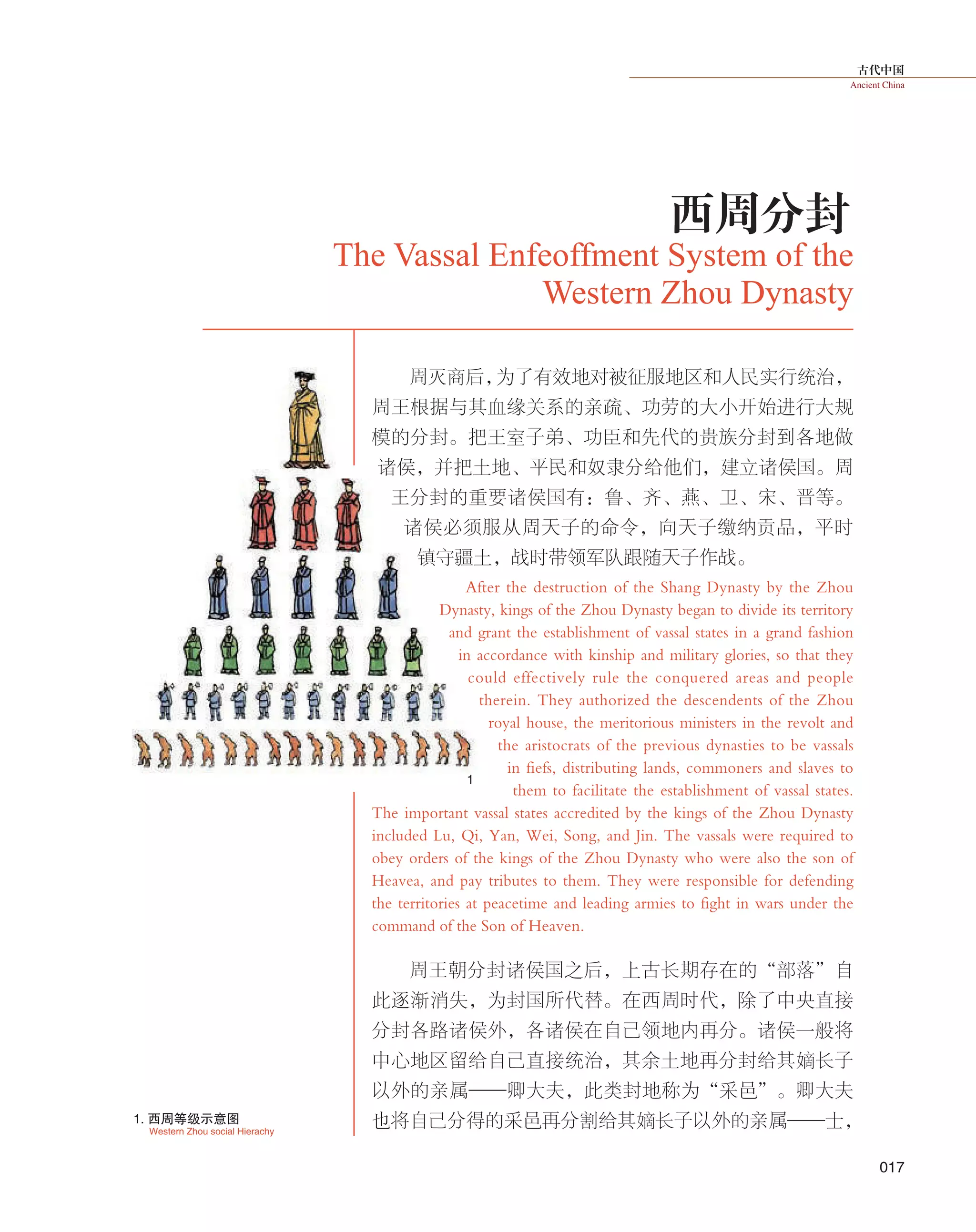
周灭商后,为了有效地对被征服地区和人民实行统治,
周王根据与其血缘关系的亲疏、功劳的大小开始进行大规
模的分封。把王室子弟、功臣和先代的贵族分封到各地做
诸侯,并把土地、平民和奴隶分给他们,建立诸侯国。周
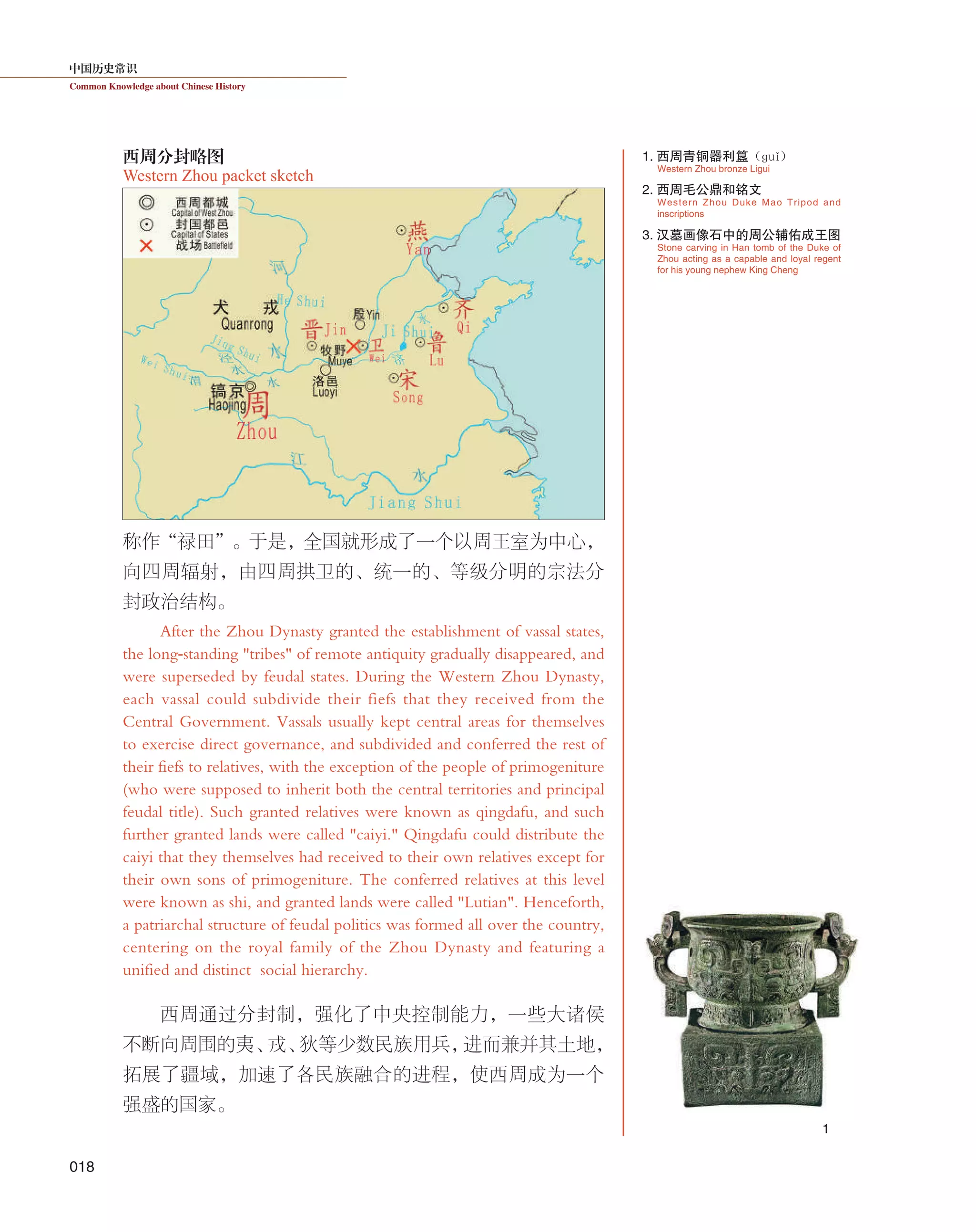
王分封的重要诸侯国有:鲁、齐、燕、卫、宋、晋等。
诸侯必须服从周天子的命令,向天子缴纳贡品,平时
镇守疆土,战时带领军队跟随天子作战。
After the destruction of the Shang Dynasty by the Zhou
Dynasty, kings of the Zhou Dynasty began to divide its territory
and grant the establishment of vassal states in a grand fashion
in accordance with kinship and military glories, so that they
could effectively rule the conquered areas and people
therein. They authorized the descendents of the Zhou
royal house, the meritorious ministers in the revolt and
the aristocrats of the previous dynasties to be vassals
in fiefs, distributing lands, commoners and slaves to
them to facilitate the establishment of vassal states.
The important vassal states accredited by the kings of the Zhou Dynasty
included Lu, Qi, Yan, Wei, Song, and Jin. The vassals were required to
obey orders of the kings of the Zhou Dynasty who were also the son of
Heavea, and pay tributes to them. They were responsible for defending
the territories at peacetime and leading armies to fight in wars under the
command of the Son of Heaven.
周王朝分封诸侯国之后,上古长期存在的“部落”自
此逐渐消失,为封国所代替。在西周时代,除了中央直接
分封各路诸侯外,各诸侯在自己领地内再分。诸侯一般将
中心地区留给自己直接统治,其余土地再分封给其嫡长子
以外的亲属——卿大夫,此类封地称为“采邑”。卿大夫
也将自己分得的采邑再分割给其嫡长子以外的亲属——士,
The Vassal Enfeoffment System of the
Western Zhou Dynasty
西周分封
Western Zhou social Hierachy
1. 西周等级示意图
1
中国历史常识
Common Knowledge about Chinese History
018
称作“禄田”。于是,全国就形成了一个以周王室为中心,
向四周辐射,由四周拱卫的、统一的、等级分明的宗法分
封政治结构。
After the Zhou Dynasty granted the establishment of vassal states,
the long-standing "tribes" of remote antiquity gradually disappeared, and
were superseded by feudal states. During the Western Zhou Dynasty,
each vassal could subdivide their fiefs that they received from the
Central Government. Vassals usually kept central areas for themselves
to exercise direct governance, and subdivided and conferred the rest of
their fiefs to relatives, with the exception of the people of primogeniture
(who were supposed to inherit both the central territories and principal
feudal title). Such granted relatives were known as qingdafu, and such
further granted lands were called "caiyi." Qingdafu could distribute the
caiyi that they themselves had received to their own relatives except for
their own sons of primogeniture. The conferred relatives at this level
were known as shi, and granted lands were called "Lutian". Henceforth,
a patriarchal structure of feudal politics was formed all over the country,
centering on the royal family of the Zhou Dynasty and featuring a
unified and distinct social hierarchy.
西周通过分封制,强化了中央控制能力,一些大诸侯
不断向周围的夷、戎、狄等少数民族用兵,进而兼并其土地,
拓展了疆域,加速了各民族融合的进程,使西周成为一个
强盛的国家。
Western Zhou Duke Mao Tripod and
inscriptions
2. 西周毛公鼎和铭文
Western Zhou packet sketch
西周分封略图
Stone carving in Han tomb of the Duke of
Zhou acting as a capable and loyal regent
for his young nephew King Cheng
3. 汉墓画像石中的周公辅佑成王图
Western Zhou bronze Ligui
1. 西周青铜器利簋(ɡuǐ)
1
古代中国
Ancient China
019
By means of its feudal system, the Western Zhou Dynasty
strengthened the central government's control over vassals, and some
powerful vassals waged constant wars against nearby ethnic minorities
to annex their lands. This enlarged the territories of the Zhou Dynasty
while accelerating the integration of all ethnic groups, making the
Western Dynasty a powerful country.
到了春秋时期,大诸侯国为争夺土地、人口及对其他
诸侯国的支配权,不断进行兼并战争,形成了诸侯争霸的
局面,周王室日益衰微,分封制开始崩溃。秦统一后,建
立郡县制,分封制结束。
By the Spring and Autumn Period, large vassal states constantly
launched wars to take lands, populations and hegemony over other
vassal states, resulting in a situation in which all vassals contested for
hegemony. Consequently, the royal house of the Zhou Dynasty
declined day by day as the Vassal Enfeoffment System began to break
down. After the Qin Dynasty re-unified the country and established a
prefecture-county system, the enfeoffment system came to an end.
《周礼》
The Rites of Zhou
《周礼》全书 6 篇,即《天
官冢宰》《地官司徒》《春官
宗伯》《夏官司马》《秋官司寇》
《冬官司空》,各篇分为上下卷,
共 12 卷。它是一部通过官制来
表述治国方案的著作,六官的
分工大致为:天官主管宫廷,
地官主管民政,春官主管宗族,
夏官主管军事,秋官主管刑罚,
冬官主管营造。相传为西周时
期的著名政治家、思想家、文
学家、军事家周公旦制定。
The Rites of Zhou is divided
into six chapters, namely the
Tianguan Zhongzai (Offices of
the Heavens) , the Diguan Situ
(Offices of Earth) , the Chunguan
Zongbo (Offices of Spring) , the
Xiaguan Sima (Offices of Summer),
the Qiuguan Sikou (Offices of
Autumn), and the  Dongguan
Sikong (Offices of Winter) . As
each chapter is subdivided into
the first and second volumes, the
whole book contains 12 volumes
altogether. The book showcases
the schemes of governance
through the system of offices, and
the work divisions of the duties for
the six officials are generally as
follows: the Heavenly Official takes
charge of the royal court, the Earth
Official the civil affairs, the Spring
Official the patriarchal clans, the
Summer official the military affairs,
the Autumn official the criminal
justice, and the Winter official the
engineering and construction.
It is believed that the system was
established by Dan, the Duke
of Zhou, who was a renowned
statesman, thinker, litterateur and
strategist of the Western Zhou
Dynasty.
《周礼》涉及的内容极为
丰富,等级社会的政治准则、
道德规范和各项制度无所不包,
在上古文献中实属罕见。它是
中国最早和最完整的官制记录,
后来成为儒家主要经典之一。
The Rites of Zhou contains an
abundance of content, including
political standards, ethics and
various systems in a hierarchical
society, and is really rare among
literature in the remote antiquity.
As the earliest and most complete
records of the system of offices in
China, it became one of the major
classics of Confucianism.
小资料·Data
3
2
中国历史常识
Common Knowledge about Chinese History
020
春秋初年有 100 多个诸侯国,各
诸侯国为了争夺土地和人口,发生混
战。力量强大的诸侯国不断吞并弱小
的国家,争夺霸权。春秋时期先后起
来争当霸主的有齐桓(huán)公、宋
襄(xiānɡ)公、晋文公、秦穆(mù)
公、楚庄王,历史上称为“春秋五霸”。
还有一种说法,“春秋五霸”指齐桓公、
晋文公、楚庄王、吴王阖闾(Hélǘ)、
越王勾践(Gōujiàn)。
In the early Spring and Autumn Period,
there existed over 100 vassal states, all
squabbling over lands and populations. Strong
states annexed weak ones and contended for
hegemony over all the others. During this
period, Duke Huan of Qi, Duke Xiang of
Song, Duke Wen of Jin, Duke Mu of Qin
and King Zhuang of Chu became hegemonic powers in succession,
and were historically referred to as the "Five Powers of the Spring and
Autumn Period." Some other historians rank the "five powers" as Duke
Huan of Qi, Duke Wen of Jin, King Zhuang of Chu, King Helü of
Wu and King Goujian of Yue.
齐国是春秋时期东方一个富裕的国家。齐桓公在大政
治家管仲的辅佐下,在政治上和经济上进行了一系列改革,
发展生产,使齐国强大起来。齐桓公率兵击退山戎(rónɡ)
等少数民族的进攻,又率领齐、鲁、宋等八国的军队讨伐
南方的楚国,阻止了楚军的北进,威信大增。公元前 651 年,
Five Hegemonic Vassals of the Spring
and Autumn Period
春秋五霸
Sketch Map of the Main powers during the
Spring and Autumn Period
春秋列国形势图
周王城
Capital of the Zhou Dynasty
各国都城
Capital of the vassal states
吴国进军路线
Wu's route of advance
越国进军路线
Yue's route of advance
齐、楚扩张路线
Qi and Chu's routes of expansion
Shanrong
古代中国
Ancient China
021
齐 桓 公 召 集
各 诸 侯 国 订
立 盟 约, 周
天 子 也 派 人
参 加, 齐 国
称 霸 中 原 的
时代开始了。
Qi was a
rich state in the
orient during
t h e S p r i n g
a n d A u t u m n
Period. With the aid of the able statesman Guan Zhong, Duke Huan
of Qi carried out a series of political and economic reforms, which
helped the state flourish and greatly enhanced its military power. Duke
Huan commanded his troops to fight off the attacks by Shanrong and
other ethnic groups, and led the armies of eight vassal states, including
Qi, Lu and Song, to crusade against the State of Chu in the south and
prevented it from aggressive expansion northwards. In this way, he
gained enormous prestige. In 651 BC, Duke Huan convened a meeting
of the rulers of all the states, at which envoys sent by the Son of Heaven
of Zhou were also present. A treaty of alliance was concluded, and the
hegemonic period of Qi commenced.
齐桓公之后,宋襄公一心想接替齐桓公做霸主,但没
有成功。晋文公做了国君以后采取了一系列措施,很快使
晋国成为北方一大强国。当时南方的楚国也想称霸。公元
前 632 年,晋国和楚国进行了一场大战,楚军大败,晋国
从此成为中原的一大霸主。晋
楚之间的争霸持续了 100 多年,
后来楚庄王大败晋军,做了中
原的霸主。秦穆公本来也打算
向东发展,到中原去做霸主,
但没能成功,转而向西扩大地
盘,独自称霸西方。
Duke Xiang of Song attempted
to supersede Duke Huan's hegemony,
but his efforts were made in vain.
1
2
Horses sacrificed upon the burial of a noble
of the State of Qi in modern Shandong
Province (A total of 600 immolated steeds
have been found in Shandong, indicating
the wealth and power of Qi.)
1. 齐国的殉马坑(在今天的山东省
境内,殉马数量很多,大约有
600 匹,是齐国国力强大的一个
证明)
春秋时期
The Spring and Autumn
Period
春秋是中国历史上的一个
时代名,它代表公元前 770 年
到公元前476年这一历史时期。
中国古代的一部史书《春秋》
记载了这一时期的历史,因而
用“春秋”作时代名。
The Spring and Autumn Period
refers to an era in Chinese history
from 770 BC to 476 BC. The history
during this period is recorded in an
ancient Chinese historical record
The Spring and Autumn Annals.
Therefore, the name "Spring and
Autumn Period" is used to define
that era.
小资料·Data
A portrait of Guan Zhong
2. 管仲像
中国历史常识
Common Knowledge about Chinese History
022
Duke Wen of Jin adopted a series of effective measures after
he was enthroned, and the State of Jin soon became
a powerful state in the north. The State of
Chu in the south also attempted a
hegemonic position. In 632
BC, the State of Jin defeated
the State of Chu in a bloody
war, and the army of the State of
Chu was heavily defeated. From then on, the State of Jin began to rule
over the Middle Plains. The fight for hegemony went on between the
two states for 100 years, until King Zhuang of Chu smashed the Jin army
and made himself the hegemonic power. In the meantime, Duke Mu
of Qin had also attempted to expand his territory eastwards and exert a
hegemonic influence over the Middle Plains. After his failure, he turned
to enlarge his territory to the west and enjoyed an exclusive hegemonic
position there.
吴国和越国都是长江下游的国家。这两个国家都不大,
但也加入了争霸战争。晋楚争霸时,吴国在晋国的支持下
曾经攻破楚国的都城。后来吴越两国进行了多次战争,各
有胜负。公元前 494 年,吴王夫差大败越国,越国成为吴
国的属国。越王勾践经过 10 年的艰苦准备,终于灭掉吴国。
后来勾践又率军北上,成为春秋时期最后一个霸主。
Both the State of Yue and the State of Wu were located on the lower
reaches of the Yangtze River. Despite their small sizes, the two states had
also taken part in the war for hegemony. In the course in which the State
of Jin and the State of Chu contended for hegemony, the State of Wu,
with the support of the State of Jin, once captured the capital city of the
State of Chu. Afterwards, both the State of Wu and the State of Yue waged
wars between each other many times, alternately defeating one another.
In 494 BC, Fuchai, king of the
State of Wu, defeated the State
of Yue heavily, and the State of
Yue thus became a vassal state of
the State of Wu. After a decade of
painstaking preparation, Goujian,
a king of Yue, destroyed the State
of Wu. Later, Goujian led his army
to proceed northward, and made
himself the last hegemony of the
Spring and Autumn Period.
卧薪尝胆
Lying on Brushwood and
Tasting Gall
公元前 494 年,吴王夫差
打败了越国,越王勾践只得向
吴国屈辱求和,同意到吴国做
吴王的奴仆。两年后勾践被释
放回国,他立志报仇雪耻,撤
掉席子睡在硬硬的柴草上,每
次吃饭之前都要先尝一尝苦胆,
还要问自己:“你忘了耻辱了
吗。”他时刻不忘国家破亡的
痛苦,带领越国人民发愤图强,
终于灭掉了吴国。后来人们经
常用“卧薪尝胆”来表示刻苦
自励、奋发向上的决心。
King Fuchai of Wu defeated
the State of Yue in 494 BC, and
King Goujian of Yue had to bear
humiliation and sue for peace,
agreeing to serve the king of Wu
as a slave in the State of Wu. Two
years later, Goujian was released
back to his own state. Having sworn
himself to revenge, he removed
his mat to sleep on brushwood,
tasted gall before each meal, and
urged himself on by uttering the
words, "Have you forgotten the
humiliation?" He kept in mind the
pains caused by the destruction of
his regime, led people of the State
of Yue to make painstaking efforts
and finally annihilated the State of
Wu. Afterwards, people often use
the expression "lying on brushwood
and tasting gall" to express the
determination to exert oneself to
make progress.
小资料·Data
The sword of Gou Jian, ruler of the State of
Yue
Duke Huan and Guan Zhong (Shandong
Wuhou Temple Han Stone)
1. 越王勾践剑
2. 齐桓公和管仲(山东武氏祠汉代
画像石)
1
2
古代中国
Ancient China
023
春秋时期,无数次战争使诸侯国的数量大
大减少。到战国时期,七个实力最强的诸侯国
是齐、楚、燕(Yān)、韩、赵、魏(Wèi)、秦,
被称为“战国七雄”。
The numerous wars in the Spring and Autumn
Period greatly reduced the amount of vassal states. By the
time of the Warring States Period, only seven vassal states
remained, with the rest having been absorbed by Qi,
Chu, Yan, Han, Zhao, Wei and Qin. These seven states
were called the "Seven Powers of the Warring States
Period."
战国初期,韩、赵、魏三家结成联盟,打
败了齐、秦、楚等大国,成为较强盛的国家。后来这个联
盟破裂,齐国、秦国却逐渐兴盛起来。
In the early Warring States Period, Han, Zhao and Wei formed
an alliance, defeating large states such as Qi, Qin and Chu separately,
and becoming relatively powerful ones. Later, the alliance broke up,
while Qi and Qin gradually grew in strength.
战国中期,魏国军队攻打赵国,赵国请齐国帮助退
兵。魏国内部空虚,大军事家孙
膑(Sūn  Bìn)带领齐国的军队直
接去打魏国的首都。魏国军队本已
攻破赵国首都,听闻自己国家情况
危急,便急忙从赵国撤军去救魏国,
刚走到半路,就遇上了埋伏好的齐国
军队。齐国军队堵住魏国军队,打了
个大胜仗。这就是中国历史上著名的
战例——“围魏救赵”。
Seven Powers of the Warring States Period
战国七雄
2
1
"Sun Bin Art of War" bamboo Unearthed in
(Shandong Yinqueshan )
2.《孙膑兵法》竹简(山东银雀山
汉墓出土)
A rubbing of the pattern on the bronze pot
1. 战国水陆攻战纹铜壶拓片
Sketch Map of the warring States
战国形势图
中国历史常识
Common Knowledge about Chinese History
024
In the mid-Warring States Period, the State of Wei attacked Zhao.
Zhao asked the State of Qi for help. The great military strategist Sun Bin
led the Qi army against the Wei capital. Alarmed at the threat to their
lightly defended state, the Wei troops, who had already occupied the Zhao
capital, withdrew, and Zhao was saved. On their way back to Wei, the
Wei forces were ambushed by the Qi army, and were crushingly defeated.
This was a famous battle in Chinese history which gave rise to the saying
"besieging Wei and saving Zhao."
两年后魏国进攻韩国,齐国的军队在孙膑的指挥下围魏
救韩。齐国假装后退,第一天撤出后,营地留下的炉灶足够
做 10 万人的饭;第二天留下的炉灶只够做 5 万人的饭;第
三天留下的炉灶减少到只够做 3 万人的饭。魏军从炉灶的数
量进行推测,以为齐军大量逃亡,于是挑选了精锐的士兵,
追赶齐军,一直追到马陵(今河南省境内),结果被埋伏在
那里的齐军彻底打败。这就是著名的“马陵之战”。两次战
役后,齐国取代了魏国称霸中原。
Two years later, Wei launched an attack against the State of Han.
The Qi army, again under the command of Sun Bin, besieged Wei to
save Han. The Qi army pretended to retreat. On the first day they left
behind enough campfire sites to cook food for 100,000 soldiers, the
second day enough for 50,000 soldiers, and the third day only enough
for 30,000 soldiers. The Wei commander thus speculated that the Qi
soldiers were deserting in great numbers. When the picked troops
of Wei caught up with a small force of the Qi army at Maling
(in today's Henan Province), they were ambushed and utterly
defeated by the full strength of the Qi army. After these two
wars, Qi replaced Wei as the hegemonic power of the Middle Plains.
战国后期,秦国越来越强盛,其他六个国家都不能单
独抵抗秦国,就想联合起来,共同抵抗秦国。于是秦国挑
拨六国之间的关系,使得六国一到关键时刻常常不能齐心
协力。另外,秦国采取远交近攻、各个击破的战略,先后
征服了六国,并灭了周王室,统一了中国。
In the late Warring States Period, Qin became stronger and
stronger. Unable to solely resist Qin, the other six states attempted to
ally against the growing power in the west, but Qin cleverly sowed
discord among them, and they could never form a united front against
it. Qin vanquished the other states one by one, abolished the Zhou
ruling house, and united China under the Qin Dynasty.
小资料·Data
《孙膑兵法》
Sun Bin's Art of War
这部著名的兵书是战国时
期孙膑和他的弟子写的。它继
承并发展了春秋时期的《孙子
兵法》等书的军事思想,总结
了战国中期以来的战争经验,
提出了很多新的观点和原则。
“围魏救赵”和“马陵之战”
就是其军事思想的体现。
This classic of military science
was written by Sun Bin and his
pupils during the Warring States
Period. It inherited and developed
the military theories of the Spring
and Autumn Period, as expounded
in such works as the Sun Zi's
Art of War , summed up military
experiences from the mid-Warring
States Period, and advanced many
new viewpoints and principles.
"Besieging Wei and Saving Zhao"
and "The Battle of Maling" are
examples of the military strategy
enshrined in the Sun Bin's Art of
War.
A spear head with tiger-carving (made
during the Spring & Autumn Period and
Warring States Period)
1. 镂空虎纹戈(大约是春秋战国
时代的兵器)
A bronze Spear head with tiger-carving
(made during the Warring States Period)
2. 虎纹铜矛錞(战国兵器)
1
2
古代中国
Ancient China
025
公元前 361 年,秦国的新国君秦孝公即位。
他下决心要使秦国强大起来,于是下了一道命
令,说谁能使秦国强大,就封谁做官。
In 361 BC, Duke Xiao came to the throne of the
State of Qin. Determined to make Qin a powerful state,
he set about looking for men of talent, promising official
position to anyone who could make Qin powerful.
商鞅(Yānɡ)原来是卫国人,听到这个消息,
就来到了秦国。商鞅和秦孝公谈论国家大事,
一连谈了几天几夜。秦孝公非常赞同商鞅的主张。公元前
356 年,秦孝公任用商鞅,开始改革旧的制度。
Shang Yang, a native of the State of Wei, came to the state
of Qin on hearing the news. Discussing the state affairs with Shang
Yang for successive days, Duke Xiao could not agree any more with
Shang Yang's proposal. In 356 BC, Shang Yang was given the task of
reforming Qin's institutions.
商鞅起草了一个改革的法令,但又怕老百姓不相信他,
就叫人在都城的南门外竖了一根很高的木头,并说,谁能
把木头搬到北门,就赏谁十金。很多人都认为这是开玩笑。
商鞅知道老百姓不相信他,就把赏金提高到五十金。人们
在木头旁议论纷纷,终于有一个人把木头扛起来,一直扛
到了北门。结果商鞅真的赏给那人五十金。这件事在秦国
引起了轰动,商鞅说到做到,在老百姓中有了威信,于是
商鞅就把新法令公布了出去。这就是著名的“南门立木”
的故事。
Shang Yang envisioned a novel way to win the confidence of the
population, so that the people of Qin would back his reform. He had
3
2
1
Shang Yang's Reform
商鞅变法
Shang Yang had a log erected at the South
Gate
1. 商鞅南门立木
Shang Yang prioritized agriculture and
rewarded farmers
2. 商鞅奖励耕织
3. 商鞅推行改革,废除井田,掘开
田间的疆界
Shang Yang introduced land reforms and
privatized land
中国历史常识
Common Knowledge about Chinese History
026
小资料·Data
a log placed near the south gate of the capital of Qin, and announced
that he would give 10 units of money to anyone who carried the log
to the north gate. When nobody took up the offer, Shang Yang raised
the reward to 50 units of money. Finally a man shouldered the log,
and carried it to the north gate. Shang Yang was true to his word, and
handed over 50 units of money to the man. Sure of the confidence of
the people of Qin, Shang Yang proclaimed new decrees to set about
a suit of reforms. This famous story is known as"Erecting a Log at the
Southern Gate."
商鞅变法的主要内容有:国家承认土地私有,允许自
由买卖。生产粮食布帛(bó)多的人可以免除徭役(yáo yì)。
在战争中军功越大,授予的爵(jué)位越高,赐给的土地
和房子也越多。旧贵族没有军功,就不能享受特权。在全
国设置 31 个县,由国君直接派官吏管理。
Shang Yang's reforms mainly included the permitted private
ownership of, and transactions in, land, the exemption from corvee labor
for producers of large amounts of crops or cloth, and the lavish rewards
(such as higher rank, more lands and more houses) for people of military
distinction. Former aristocrats could not enjoy any privilege without
military distinction. The whole state was divided into 31 counties, which
were supervised by officials directly appointed by the Duke.
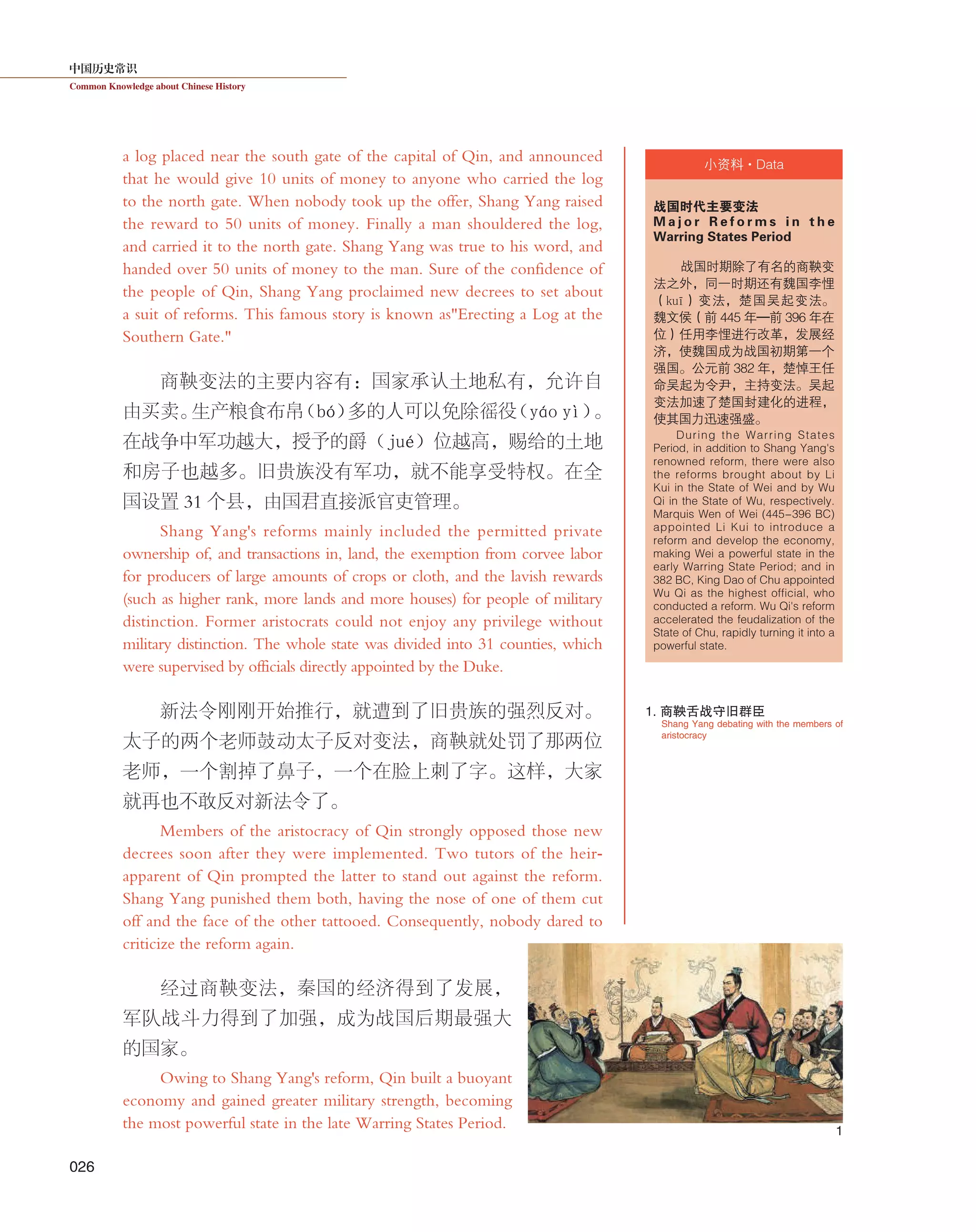
新法令刚刚开始推行,就遭到了旧贵族的强烈反对。
太子的两个老师鼓动太子反对变法,商鞅就处罚了那两位
老师,一个割掉了鼻子,一个在脸上刺了字。这样,大家
就再也不敢反对新法令了。
Members of the aristocracy of Qin strongly opposed those new
decrees soon after they were implemented. Two tutors of the heir-
apparent of Qin prompted the latter to stand out against the reform.
Shang Yang punished them both, having the nose of one of them cut
off and the face of the other tattooed. Consequently, nobody dared to
criticize the reform again.
经过商鞅变法,秦国的经济得到了发展,
军队战斗力得到了加强,成为战国后期最强大
的国家。
Owing to Shang Yang's reform, Qin built a buoyant
economy and gained greater military strength, becoming
the most powerful state in the late Warring States Period.
战国时代主要变法
M a j o r R e f o r m s i n t h e
Warring States Period
战国时期除了有名的商鞅变
法之外,同一时期还有魏国李悝
(kuī)变法,楚国吴起变法。
魏文侯(前 445 年—前 396 年在
位)任用李悝进行改革,发展经
济,使魏国成为战国初期第一个
强国。公元前 382 年,楚悼王任
命吴起为令尹,主持变法。吴起
变法加速了楚国封建化的进程,
使其国力迅速强盛。
During the Warring States
Period, in addition to Shang Yang's
renowned reform, there were also
the reforms brought about by Li
Kui in the State of Wei and by Wu
Qi in the State of Wu, respectively.
Marquis Wen of Wei (445-396 BC)
appointed Li Kui to introduce a
reform and develop the economy,
making Wei a powerful state in the
early Warring State Period; and in
382 BC, King Dao of Chu appointed
Wu Qi as the highest official, who
conducted a reform. Wu Qi's reform
accelerated the feudalization of the
State of Chu, rapidly turning it into a
powerful state.
1
Shang Yang debating with the members of
aristocracy
1. 商鞅舌战守旧群臣
古代中国
Ancient China
027
青铜文明是以使用青铜器为标志的人类文化发展的一
个阶段。
Bronze civilizations represented a stage of the development of
human cultures marked by the use of bronze wares.
青铜是铜、锡、铅的合金,因为颜色青灰,故名青铜。
Bronze is the alloy of copper, tin and lead. Yellowish-brown in
color, it was hence namedqingtong (in Chinese language).
4700 年前,中国的青铜时代开始出现,跨越了夏、商、
西周和春秋战国时代。
The bronze age of China emerged 4,700 years ago, spanning the
four eras of the Xia Dynasty, the Shang Dynasty, the Western Zhou
Dynasty, and the Spring and Autumn and Warring States periods.
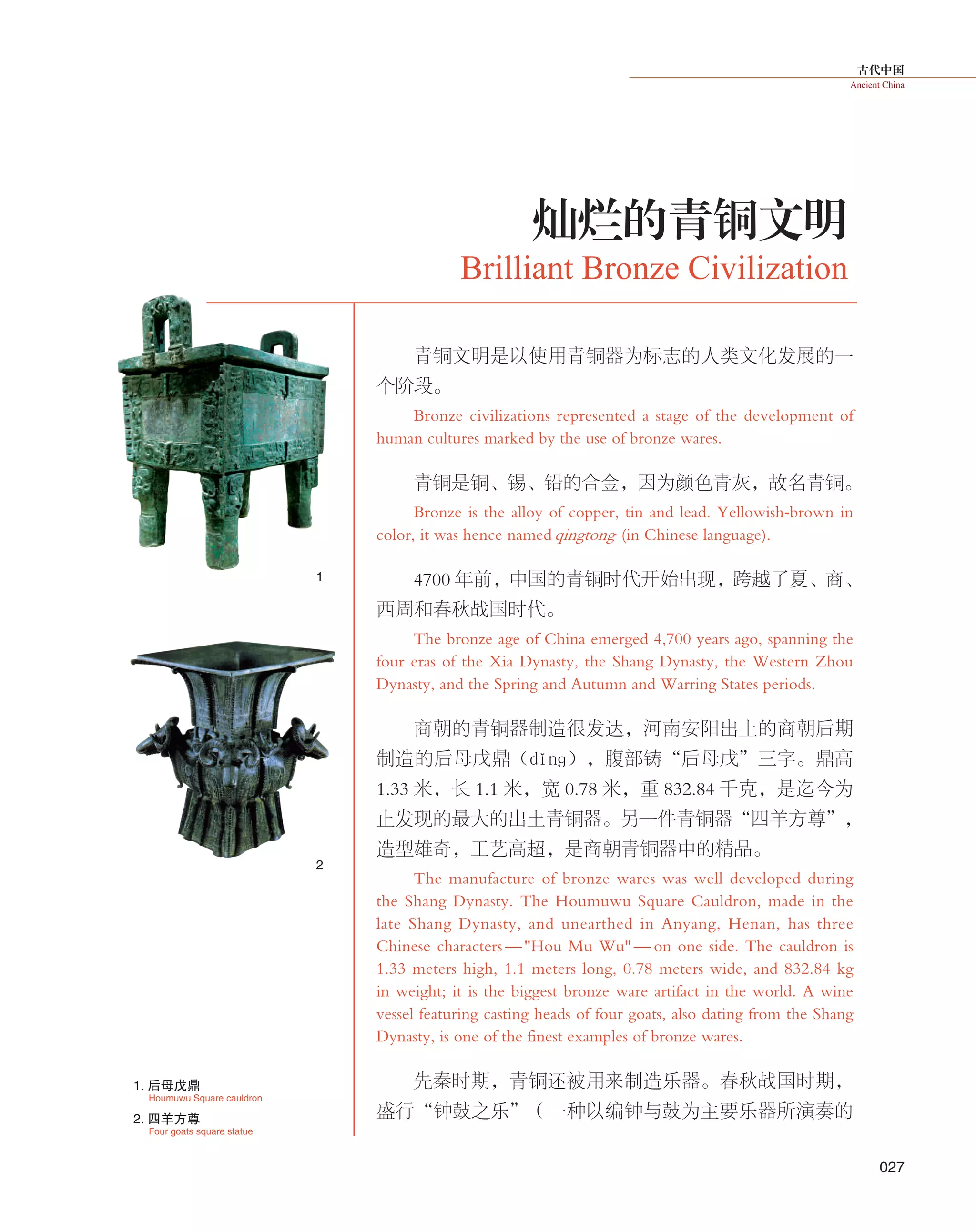
商朝的青铜器制造很发达,河南安阳出土的商朝后期
制造的后母戊鼎(dǐnɡ),腹部铸“后母戊”三字。鼎高
1.33 米,长 1.1 米,宽 0.78 米,重 832.84 千克,是迄今为
止发现的最大的出土青铜器。另一件青铜器“四羊方尊”,
造型雄奇,工艺高超,是商朝青铜器中的精品。
The manufacture of bronze wares was well developed during
the Shang Dynasty. The Houmuwu Square Cauldron, made in the
late Shang Dynasty, and unearthed in Anyang, Henan, has three
Chinese characters —"Hou Mu Wu"— on one side. The cauldron is
1.33 meters high, 1.1 meters long, 0.78 meters wide, and 832.84 kg
in weight; it is the biggest bronze ware artifact in the world. A wine
vessel featuring casting heads of four goats, also dating from the Shang
Dynasty, is one of the finest examples of bronze wares.
先秦时期,青铜还被用来制造乐器。春秋战国时期,
盛行“钟鼓之乐”(一种以编钟与鼓为主要乐器所演奏的
Brilliant Bronze Civilization
灿烂的青铜文明
1
2
Houmuwu Square cauldron
1. 后母戊鼎
Four goats square statue
2. 四羊方尊
中国历史常识
Common Knowledge about Chinese History
028
音乐)。1978 年在湖北随州曾侯乙墓出土的
大量文物中,以整套编钟最为珍贵。编钟共有
64 件,以大小和音高为序组成 8 组,悬挂在
铜木结构的三层钟架上。整套编钟音律准确,
音色优美,音域宽广,它在地下埋藏了 2000
多年,今天依然能用来演奏音乐。
During the pre-Qin period, bronze was also used
to make musical instruments. In the Spring and Autumn
and Warring States periods, the"music of chimes and
drums"was popular at court and religious ceremonies.
In 1978, a complete set of chimes was excavated from
the tomb of Marquis Yi of Zeng in Suizhou, Hubei
Province. A total of 64 chimes were divided into eight
groups in accordance to their different sizes and pitches,
hung on a three-layer stand of bronze and wood. The
chimes have beautiful timbre and wide range, and can still be played
despite being buried for over 2,000 years.
与商周同期,中国西南地区的成都平原也盛行一种独
特的青铜文化——三星堆文化。那里出土的青铜面具、青
铜立人像、青铜神树等,引起了广泛瞩目。
During the time of the Shang and Zhou dynasties, there
prevailed a unique bronze culture in the Chengdu Plain in southwest
China — the Sanxingdui Culture. The bronze masks, bronze standing
human figures, bronze sacred trees excavated there have attracted wide
attention.
中国青铜器制作精美,极具艺术价值,代表着中国先
秦时期高超的技术与文化。现今大多数欧美国家的博物馆
都藏有中国青铜器。
The bronze wares of China were exquisite and had high
artistic value, showcasing the advanced techniques
a n d c u l t u r e o f
China during its
pre-Qin period.
Now , museums
in most European
countries and the
U.S. house bronze
wares from China.
后母戊鼎:青铜国宝更名
Houmuwu Square Cauldron:
The Renaming of National
Bronze Treasure
后母戊鼎是商后期(约前
14 世纪至前 11 世纪)铸品,
原器 1939 年 3 月出土于河南
安阳侯家庄武官村。早在 20 世
纪 70 年代,学术界已对司母戊
鼎的铭文提出了新的考释,将
“司”改释为“后”。因为商
代的文字书体较自由,可以正
书,也可以反书。“后”在这
里表示墓主人的身份,较为妥
当。但因以前中小学课本的广
泛宣传,原名“司母戊鼎”流
传更为广泛。2011 年 3 月底,
在国家博物馆新馆青铜厅开展
后,国宝级青铜器司母戊鼎正
式更名为“后母戊鼎”。
T h e H o u m u w u S q u a r e
Cauldron was a casting ware in
the late Shang Dynasty (about the
14th century BC to the 11th century
BC), excavated at the Wuguan
Village, Houjiazhuang, Anyang City
of Henan Province in March 1939.
It used to be called Simuwu Square
Cauldron, but as early as the
1970s, academia came up with a
new explanation on the inscription
of Houmuwu, interpreting the
character"si"to be"hou."The experts
explained that people of the Shang
Dynasty had casual handwriting,
that the character"hou"could be
written both in an obverse way
and a reversed way, and that it
sounds more reasonable that the
character"hou"should be something
indicating the identity of the owner
of the tomb. However, due to wide
promotion in primary and middle
school textbooks in the past, the
previous name"Simuwu Cauldron"is
more popular. After the opening
of the Hall of Display of Bronze
Ware, a new hall of the National
Museum at the end of March 2011,
the Simuwu Cauldron was formally
renamed"Houmuwu Cauldron."
小资料·Data
1
2
The set of chimes unearthed from the tomb
of Marquis Yi of Zheng
2. 曾侯乙墓出土的编钟
Sanxingdui Bronze Standing Human Figure
1. 三星堆青铜立人像
古代中国
Ancient China
029
中国人很早就注意观察天象。古书上关于
夏朝时流星雨和日食的记载,是世界天文史上
最早的记录。春秋战国时期,天文学已取得了
相当高的成就。鲁国的天文学家在对星象的观
测中,观测到 37 次日食,其中 33 次已被证明
是可靠的。
The Chinese people have paid great attention to
astronomical phenomena since very early times. Meteor
showers and solar eclipses from as far back as the Xia
Dynasty are recorded in ancient books, and are thought
to be the earliest astronomical accounts. By the Spring
and Autumn and Warring States periods, astronomy had
reached quite a high level of sophistication. Astronomers of the State
of Lu observed 37 solar eclipses, among which 33 have been proved
accurate.
这一时期还出现了天
文学专著,齐国人甘德著
《天文星占》八卷,魏国
人石申写了《天文》八卷,
后人将它们合为一部,称
《甘石星经》。这是世界
上 现 存 最 早 的 天 文 学 著
作。书中记录了水、木、金、
火、土五大行星的运行情
况,以及它们的出没规律。
还记录了 800 个恒星的名
字,有 121 个的位置现在
已经被测定。甘德还用肉
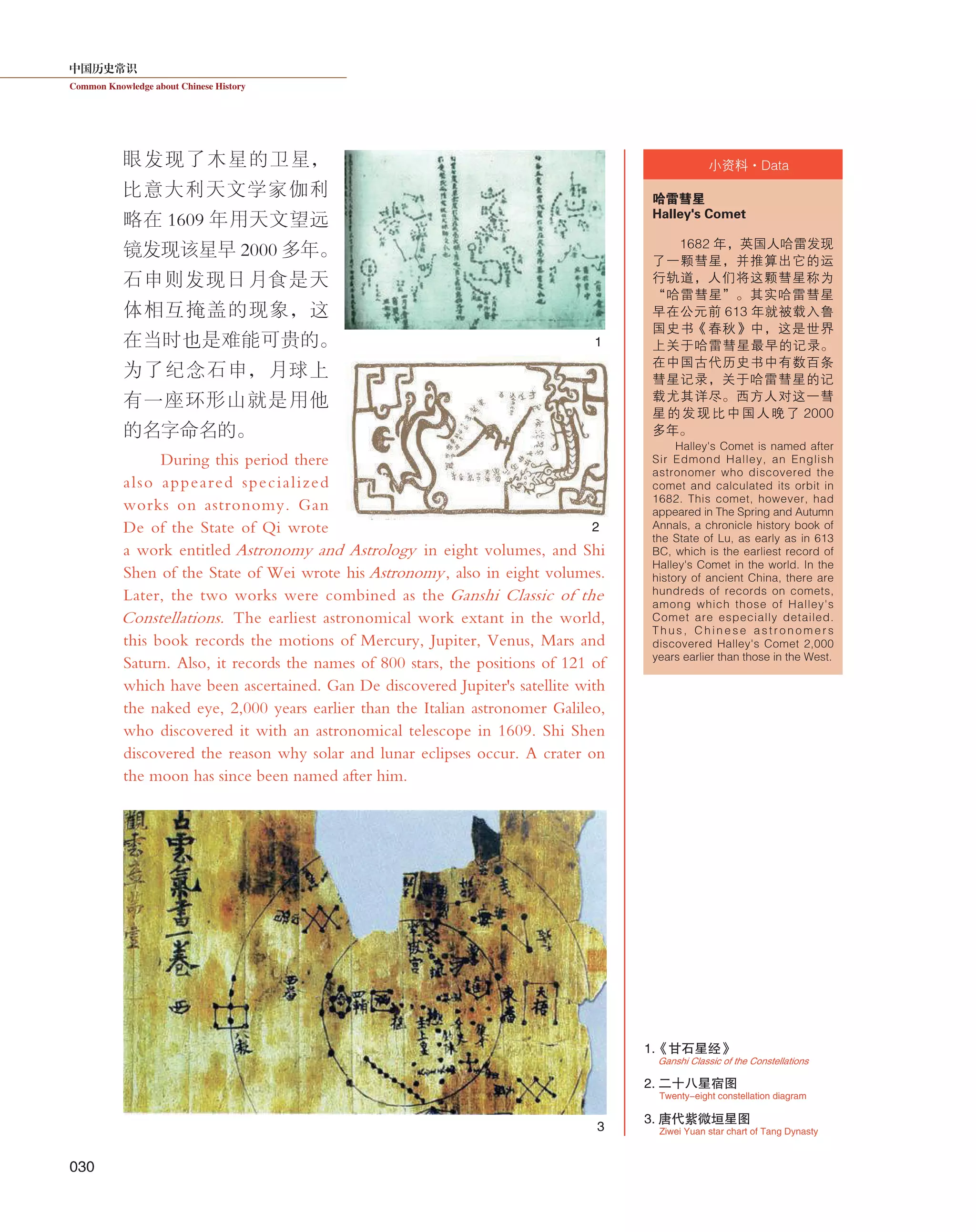
Ganshi Classic of the Constellations
《甘石星经》
Oracle bone script about a solar eclipse
1. 记有日食的甲骨文
1
2Record about Halley inSpring and Autumn
2. 《春秋》记载哈雷彗星(孛星)
的书页
中国历史常识
Common Knowledge about Chinese History
030
眼发现了木星的卫星,
比意大利天文学家伽利
略在 1609 年用天文望远
镜发现该星早 2000 多年。
石申则发现日月食是天
体相互掩盖的现象,这
在当时也是难能可贵的。
为了纪念石申,月球上
有一座环形山就是用他
的名字命名的。
During this period there
also appeared specialized
works on astronomy. Gan
De of the State of Qi wrote
a work entitled Astronomy and Astrology in eight volumes, and Shi
Shen of the State of Wei wrote his Astronomy, also in eight volumes.
Later, the two works were combined as the Ganshi Classic of the
Constellations. The earliest astronomical work extant in the world,
this book records the motions of Mercury, Jupiter, Venus, Mars and
Saturn. Also, it records the names of 800 stars, the positions of 121 of
which have been ascertained. Gan De discovered Jupiter's satellite with
the naked eye, 2,000 years earlier than the Italian astronomer Galileo,
who discovered it with an astronomical telescope in 1609. Shi Shen
discovered the reason why solar and lunar eclipses occur. A crater on
the moon has since been named after him.
小资料·Data
Ziwei Yuan star chart of Tang Dynasty
3. 唐代紫微垣星图
Twenty-eight constellation diagram
2. 二十八星宿图
3
1
哈雷彗星
Halley's Comet
1682 年,英国人哈雷发现
了一颗彗星,并推算出它的运
行轨道,人们将这颗彗星称为
“哈雷彗星”。其实哈雷彗星
早在公元前 613 年就被载入鲁
国史书《春秋》中,这是世界
上关于哈雷彗星最早的记录。
在中国古代历史书中有数百条
彗星记录,关于哈雷彗星的记
载尤其详尽。西方人对这一彗
星的发现比中国人晚了 2000
多年。
Halley's Comet is named after
Sir Edmond Halley, an English
astronomer who discovered the
comet and calculated its orbit in
1682. This comet, however, had
appeared in The Spring and Autumn
Annals, a chronicle history book of
the State of Lu, as early as in 613
BC, which is the earliest record of
Halley's Comet in the world. In the
history of ancient China, there are
hundreds of records on comets,
among which those of Halley's
Comet are especially detailed.
T h u s , C h i n e s e a s t r o n o m e r s
discovered Halley's Comet 2,000
years earlier than those in the West.
2
Ganshi Classic of the Constellations
1.《甘石星经》
古代中国
Ancient China
031
孔子(前 551—前 479),姓孔,名丘,字仲尼,春秋
末期鲁国陬邑(Zōuyì,今山东曲阜东南)人,是儒家学派
的创始人。
Confucius (551-479 BC) was surnamed Kong; with a given
name Qiu, he was also styled Zhongni. A native of Zouyi in
the State of Lu (in the southeast of today's Qufu, Shandong
Province) in the late Spring and Autumn Period, he was the
founder of Confucianism.
孔子是个大思想家。首先,他提出“仁”的学说,
即要求统治者能够体贴民情,爱惜民力,不要过度压迫
剥削人民。其次,他主张以德治民,反对暴政。
Confucius was a great thinker to have emerged at that time. He
advanced the theory of benevolence (ren) on the part of rulers towards
their people, stressing that the wealth the people produced should not
be squandered and that political rule should be based on virtue, instead
of force.
孔子又是个大教育家。在那个时代,只有贵族子弟才
能够接受教育。孔子提倡“有教无类”,他收学生,不论
其地位贵贱,都一律平等地进行教育。孔子兴办私学,
打破了官府对文化教育的垄断。据说孔子教过的学生有
3000 多 人, 其 中 著
名的有 72 人。孔子
主张“因材施教”,
针 对 学 生 的 能 力、
性 格 等 不 同 情 况,
实 施 不 同 的 教 育。
他 教 育 学 生: 学 习
Confucius, the Great Thinker and Educator
大思想家、教育家孔子
A portrait of Confucius
1. 孔子像
The Book of Songs was edited by Confucius.
It contains 305 songs — some of the oldest
pieces of Chinese literature — which were
collected during the 500 years dated from
the early Western Zhou Dynasty though the
the middle of Spring and Autumn Period
2.《诗经》(中国最早的一部诗歌
总集,传为孔子所编,收集了从
西周初到春秋中叶约 500 年间的
诗歌 305 篇)
2
1
中国历史常识
Common Knowledge about Chinese History
032
知识要经常复习,“温故而知新”;学习态度要诚实,
“知之为知之,不知为不知”;还要求把学习和思考结合
起 来。
Confucius was also a great educator. In his time, only descendents
from aristocratic families could receive education. Confucius advocated
"treating everyone the same in education." He taught his pupils without
discrimination, regardless of their social status. Confucius established
private schools and broke the government's monopoly over education.
It is said that Confucius taught as many as 3,000 pupils, among whom
72 became very famous. Confucius proposed "teaching students
according to their aptitude." He told his pupils to review what they
had learned regularly during their study, because "new knowledge can
be gained by reviewing old knowledge." He said one should be honest
in learning and not pretend to know what one did not know. Also, he
told his pupils to combine study with thinking.
后来,孔子的学生们将孔子的思想言行记录下来,汇
编成《论语》一书,《论语》成为儒家经典之一。孔子的
学说成为中国 2000 多年封建文化的正统。
C o n f u c i u s '
disciples recorded his
words and deeds inThe
Analects of Confucius,
which is a classic of
the Confucian school.
Confucius' theories
formed the orthodox
ideology in China for
over 2,000 years.
六经
Six Classics
即儒家的六部经典:《易》
《诗》《礼》《乐》《尚书》《春秋》,
它们是由孔子亲自整理编订的,
是孔子对中国古代文化发展做
出的不朽贡献。
The Six Classics are six
ancient works considered central
to the Confucian canon, namely,
The Book of Changes, The Book of
Songs, The Book of Rites, The Book
of Music, The Book of History and
The Spring and Autumn Annals.
These works were compiled and
edited by Confucius himself. They
were immortal contributions that
Confucius made to the development
of ancient Chinese culture.
小资料·Data
Confucius Giving a Lecture
1. 孔子讲学图
Confucius Temple,Qufu,Shandong
Province
Confucius'Tomb
3. 山东曲阜孔庙
2. 孔子墓
3
2
1
古代中国
Ancient China
033
The “Hundred Schools of Thought”
and Their Exponents
春秋战国时期,是中国历史上大变革的时代。社会
大变革促进了文化的繁荣。这一时期,出现了老子、庄子、
孔子、孟子、荀子、墨子、韩非子等大思想家,他们从
不同的立场和角度出发,对当时的社会发表自己的意见,
并逐步形成以道家、儒家、墨家和法家等为主的众多派
别,在中国历史上被称为“诸子百家”。诸子百家纷纷
著书立说,宣传自己的主张,批评别人的观点,互相辩论,
形成了学术上的繁荣局面,这就是“百家争鸣”。
Great social changes took place during the Spring and Autumn
and Warring States periods, spurring cultural development. In
these periods, there appeared many great thinkers, such as Lao Zi,
Zhuang Zi, Confucius, Mencius, Xun Zi, Mo Zi and Han Fei Zi.
They stated their views on society from different stances and angles,
and gradually formed schools of philosophy represented mainly by
Taoists, Confucians, Mohists and Legalists. These numerous schools
and their representatives came to be known as the "Hundred Schools of
Thoughts and Their Exponents." They wrote books to expound their
theories, publicized their propositions and criticized other viewpoints
in a period when "one hundred schools of thought contended."
老子是道家学派的创始人,著有《道德经》一书。他
认为,各种事物都有对立面,
如“福”和“祸”、“有”
和“无”、“生”和“灭”、
“贵”和“贱”、“上”和
“下”、“强”和“弱”等
都是对立的双方,它们之间
会相互转化。
诸子百家
"Laozi ride Ox" (by Chao Buzhi of song
Dynasty Beijing Palace Museum)
1.《老子骑牛图》(宋人晁补之作,
北京故宫博物院藏)
Tao Te Ching by Lao Zi
2. 老子著作《道德经》书影
1
2
中国历史常识
Common Knowledge about Chinese History
034
Lao Zi was the founder of the Taoist School, and the author of
the Dao De Jing (The Classic of the Way and Virtue). He deemed that
all things have their opposites; for example, fortune and misfortune,
existence and non-existence, life and death, nobility and baseness, high
and low, strong and weak are all pairs of opposite aspects of a greater
unity and can be transformed into each other.
墨子开创了墨家学派,主张节约,反对浪费,主张选
举品德高尚、有才能的人来做官,并要求人们相互友爱,
反对战争。
Mo Zi initiated the Mohist School. He encouraged economic activity
and opposed waste. He advocated choosing noble-minded and talented
people to hold offices. And he called on people to love each other and
eschew wars.
法家最重要的代表人物是韩非,著有《韩非子》一书。他
主张“法治”,认为法律应当向全国公布,臣民应该严格遵守;
强调用严厉的刑罚来镇压人民的反抗。他提倡
改革,提出建立君主专制的中央集权的国家。
他的思想后来被秦始皇采用。
The most important representative of the
Legalist School was Han Fei Zi, who wrote The
Book ofHan Fei Zi. He advocated ruling the country
by means of strictly enforced laws. He was in favor
of a centralized autocratic monarchy, stressing to
suppress the people's revolts through severe penal
punishments. His theories were later adopted by
Emperor Qinshihuang.
1
2
Mo Zi is the representative work of Mo Zi
1. 墨子代表作《墨子》
Meng Temple
2. 孟庙
古代中国
Ancient China
035
《孙子兵法》又称《孙子》,是中国古代著名的兵书,
也是世界上现存最早的军事著作,作者是春秋末期杰出的
军事家孙武。
The Sun Zi's Art of War, also named Sun Zi, is a famous book
of military science in ancient China, and the earliest work of military
science extant in the world as well. Its author, Sun Wu, was an
outstanding strategist of the late Spring and Autumn Period.
孙武是齐国人,后来搬到吴国。那时候,各诸侯国为
了争夺霸主的地位,不断发动战争,社会动荡不安。孙武
居住在吴国时,各国的战争吸引他去思考并总结战争的规
律。经过艰苦的努力,他终于完成了兵书的写作。
Sun Wu was a native of the State of Qi, and later moved to the
State of Wu. At that time, all vassal states waged constant wars for
hegemony, and the society fell into turbulence. When he lived in the
State of Wu, Sun Wu thought deeply the wars among the states and
summarized the regular pattern. Through his arduous effort, he finally
finishedThe Sun Zi's Art of War.
孙武将兵书献给了吴王阖闾。吴王任命孙武为大将,
让他训练吴国军队。他纪律严明,练兵认真。在他的帮助下,
吴国成为春秋时期的一个军事强国。
Sun Wu presented his book to the ruler He Lü of Wu, who
appointed him as a senior general, and entrusted him with the drill of
the army of Wu. Sun Wu was a strict commander, earnest in drilling
the Wu army. With his help, the State of Wu became a major military
power in the Spring and Autumn Period.
《孙子兵法》现存 13 篇,共 6000 多字。在这不长的
篇幅中,孙武全面论述了对战争的看法。他强调战争中要
Sun Zi's Art of War
—The World's First Treatise on Military Science
世界第一部兵书——《孙子兵法》
1
A portrait of Sun Wu
1. 孙武像
中国历史常识
Common Knowledge about Chinese History
036
小资料·Data
对敌我双方的情
况调查清楚,提
出 了“ 知 彼 知
己, 百 战 不 殆
(dài)”( 了
解 敌 人, 了 解
自 己, 无 论 打
多 少 仗 都 不 会
危 险),“ 攻
其 不 备, 出 其
不意”(在敌人没有防备时进攻,在敌人意想不到的地方
下手),以及集中优势兵力打败敌人等思想。孙武特别强
调“非危不战”(不到危急的时候,不要发动战争),因
为打仗会大大加重人民负担。
The Sun Zi's Art of War consists of 13 chapters, amounting to
more than 6,000 characters. In this limited space, Sun Wu expounded
his wide-ranging views on wars. He emphasized the importance of
"knowing yourself and knowing your enemy," "attacking the enemy
unexpectedly" and concentrating a superior force to thoroughly defeat
the enemy. Sun Wu especially stressed the importance of using war
only as a last resort, because war was a grievous burden on the people.
战国时期的军事家孙膑,比孙武晚 100 多年,他继承
了孙武的军事思想,写有《孙膑兵法》。
More than 100 years later, during the Warring States Period,
strategist Sun Bin inherited Sun Wu's military theory, and wrote Sun
Bin's Art of War.
《孙子兵法》已被译为英、法、日、德、俄、捷等多
种文字,这本书虽然讲的是战争规律,但对政治、外交、
商战、体育等领域也有启示意义,因此在世界上享有很高
的声誉。
The Sun Zi's Art of War has been translated into English, French,
Japanese, German, Russian, Czech and other languages. Because it is
deemed applicable to many of life's problems beyond warfare, and it
enjoys high international prestige.
三十六计
The 36 Stratagems
在《孙子兵法》一书中,
孙子共列出了 36 条计谋,教
人 们 如 何 去 应 付 战 争。 在 这
“三十六计”中,有一条最有
名的计谋,那就是“走”。“三十六
计,走为上计”早已成了成语,
意思是:如果你没有获胜的希
望, 那 最 好 的 办 法 就 是 赶 紧
跑 吧。
In his Art of War, Sun Wu lists
36 stratagems, of which the most
famous is "When you are hopeless
of victory, the best course is to flee."
A common saying even nowadays
in China is "of the 36 stratagems,
running away is the best."
The Qing Dynasty edition of Sun Zi's Art
of war
1. 清代版本《孙子兵法》
1
古代中国
Ancient China
037
A portrait of Qu Yuan
1. 屈原像
Qu Yuan, a Patriotic Poet
爱国诗人屈原
屈原(约前 340—前 278)是中国古代伟大诗人,
他出身于楚国贵族,非常有学问。他在楚国做官期间,
主张改革,主张联合齐国抵抗秦国,遭到奸臣的排挤
反对,被楚王流放,长期在外漂泊。公元前 278 年,
楚的都城郢(Yǐnɡ)被秦军攻破后,他悲愤绝望,跳
进汨罗(Mìluó)江自杀。
Born into an aristocratic family of the State of Chu, Qu
Yuan (340-278 BC) was a very learned man. When he was an
official of the State of Chu, he advocated reform, and tried to
argue the authorities into an alliance with the State of Qi to
guard against the danger from the State of Qin. Thus, he was
opposed and superseded by the malevolent ministers of Chu,
and was exiled for long after he lost his official post. In 278 BC,
Ying, the capital city of Chu, fell to an invading army from the
State of Qin. Overcome with grief, Qu Yuan threw himself into
the Miluo River in northeast Hunan Province and drowned.
传说屈原投江的日子是中国农历的五月初五,人们为
了纪念他,每年的这一天都要赛龙舟、吃粽子。赛龙舟,
是为了把鱼吓走;包粽子喂鱼,是为了让鱼不要去吃沉没
在江中的屈原的尸体。后来,农历的五月初五演变为中华
民族的传统节日——端午节。
Tradition has it that Qu Yuan committed suicide on the fifth
day of the fifth month by the Chinese calendar. In commemoration of
him, dragon-boat races are held on this day every year. Also, people eat
zongzi (a pyramid-shaped dumpling made of glutinous rice wrapped in
bamboo or reed leaves). The dragon-boat races are meant to frighten
fish away from Qu Yuan's body, and zongzi are supposed to be used to
feed the fish, so that they would not eat the poet's body. Afterwards,
the fifth day of the fifth month by the Chinese calendar had evolved
into a traditional Chinese festival — the Duanwu Festival.
1
中国历史常识
Common Knowledge about Chinese History
038
小资料·Data
屈原生前采用楚国方言,利用民间歌谣的形式,创造
出一种新的诗歌体裁,后来被称为“楚辞”体。他写了许
多优秀的诗篇,以抒情长诗《离骚》最为著名。他的作品
语言优美,想象奇特,融合大量古代神话传说,富有浪漫
主义色彩,表现了他对楚国的深切怀念和为理想而献身的
精神。屈原的诗不仅在中国广为传诵,还被译为多种外国
文字,成为中华民族贡献给人类文化的一份珍贵遗产。
Adopting the framework of Chu folk ballads and using the Chu
dialect, Qu Yuan created a new type of poems, which is called the
"songs of Chu" genre by later generations. His most famous poem is
the long lyrical work Li Sao. Qu Yuan's poetic works are filled with
devotion to his native state Chu, and are enlivened with references to
ancient myths. They have been translated into many foreign languages.
《楚辞》
The Songs of Chu
西汉时的刘向把屈原以及
其他一些人沿用屈原诗歌形式
创作的作品编辑成诗集《楚辞》,
共 16 篇。《楚辞》是继中国最
早的诗歌总集《诗经》之后的
又一部对中国文学具有深远影
响的诗集,并且是中国第一部
浪漫主义诗歌总集。
The Songs of Chu (Chu Ci)
was collected and compiled by
Liu Xiang of the Western Han
Dynasty, including works by Qu
Yuan and others. It is another
poetry anthology to have exerted
a profound influence over Chinese
literature after The Book of Songs,
and the first romantic poetry
collection of China.
Drogon-boat races are held on the fifth day
of the fifth lunar month in commemoration
of Qu Yuan
The Qu Yuan Memorial Temple in Zigui,
Hubei Province
2. 每年农历五月初五,各地都会
赛龙舟,以纪念屈原
1. 湖北秭归屈原祠
1
2
古代中国
Ancient China
039
秦汉时期,开始于公元前 221 年,结束于公元 220 年。
秦朝是中国历史上第一个封建大一统的时代,也是统一的
多民族国家的奠基时期。
The period of the Qin and Han dynasties began in 221 BC and ended
in 220 AD. The Qin Dynasty was the first feudal dynasty to rule the whole of
China, and it laid the foundation of a united multi-ethnic country.
秦朝建立于公元前 221 年。秦始皇采取了一系列巩固
统一的措施,建立了一整套的统治制度,中国成为一个统
一的封建中央集权的多民族的国家。但是,秦始皇和他的
继承者对农民空前残暴的压迫和剥削,导致秦的统治在公
元前 207 年被农民起义推翻。
The Qin Dynasty was established in 221 BC by Emperor
Qinshihuang, who adopted a series of measures to consolidate the unityRubbing of the War between Hu and Han
Peoples
1
封建大一统时期——秦、汉
概述
Introduction
The Period of Great Feudal Unity —
The Qin and Han Dynasties
1. 东汉画像石胡汉战争拓片
中国历史常识
Common Knowledge about Chinese History
040
of the country, and established a whole set of ruling system to make China the multi-ethnic unified centralized
feudal state. However, the unprecedented brutal suppression and exploitation on peasants by Qinshihuang and his
successor, led to the overthrow of the Qin Dynasty in 207 BC by a peasant uprising.
汉朝包括西汉和东汉两个朝代。公元前 202 年,刘邦建立汉朝,定都长安(今西安),
历史上称为西汉。西汉末年,王莽(Wánɡ Mǎnɡ)夺取西汉政权。公元 25 年,西汉贵族
刘秀借农民起义之机,恢复汉朝,定都于今天的洛阳,历史上称为东汉。东汉末年,政
权被农民起义瓦解,最后结束于公元 220 年。两汉时期长达 400 多年,今天的“汉族”“汉
字”“汉语”等名称都与汉朝有关。
The Han Dynasty consisted of the Western Han Dynasty and the Eastern Han Dynasty. In 202 BC, Liu
Bang established the Han Dynasty, choosing Chang'an (today's Xi'an) as his capital. This period is known to the
historians as the Western Han Dynasty. At the end of the Western Han Dynasty, Wang Mang staged a coup and
seized the power. The Han Dynasty was restored in 25 AD by a royal descendent Liu Xiu, who did so by taking
advantage of a peasant uprising. Liu Xiu moved the capital to the city known today as Luoyang. Subsequently,
this period became known to historians as the Eastern Han Dynasty. The late Eastern Han Dynasty was
decisively weakened by a peasant uprising, and was finally put to an end in 220 AD. The Han Dynasty lasted for
over 400 years, and today's names such as "Hanzu" (the Han people), "hanzi" (Chinese characters) and "hanyu"
(Chinese language) are all related to the Han Dynasty.
秦汉时期,生产发展迅速,经济繁荣,国防巩固,科技文化事业发达,在医学、天
文学、地质学等方面都取得了突出的成就,还涌现出许多著名的政治家、思想家、军事家、
科学家、史学家、文学家。特别是造纸术的发明和改进,对世界文化事业的发展做出了
巨大贡献。秦汉王朝开创的许多制度,为以后历代封建统治者所沿用。
The Qin and Han dynasties witnessed rapid development of social production, prosperous
economy, powerful national defense, advanced science and technology, and thriving culture, making
outstanding achievements in the fields of medicine, astronomy, geology and so forth, with many
famous statesmen, thinkers, military strategists, scientists, historians and litterateurs emerging. Notable
among these achievements was the invention of the technique of papermaking, a great contribution
to world civilization. Many institutions initiated in the Qin and Han dynasties were inherited
continuously by later dynasties.
秦汉时期,从地中海、西亚到太平洋东岸,雄踞着 4 个帝国,其中汉朝与罗马的历
史地位尤其重要。随着丝绸之路的开辟,中国辉煌灿烂的文化开始影响世界,当时世界
上优秀的文明成就也逐渐融入到中国的文化之中。
During the period of the Qin and Han dynasties, there were four powerful empires from the
Mediterranean Sea and West Asia to the eastern coast of the Pacific Ocean, among which the Han Dynasty
and the Roman Empire were the most important. With the opening of the Silk Road, China's brilliant
culture began to influence the whole world, and the splendid cultural accomplishments of other countries
gradually merged into traditional Chinese culture in the meantime.
古代中国
Ancient China
041
秦在公元前 770 年才被封为中国西部的一个诸侯国,
疆域较小,国力不强,始终被中原诸侯看不起。但自从
实行了商鞅变法后,很快成为战国七雄中的强国。秦王
嬴政(Yínɡ Zhènɡ,前 259—前 210)当政之后,发动了
大规模的战争。从公元前 230 年开始,历时 10 年,先后
灭了韩、赵、魏、楚、燕、齐,于公元前 221 年统一了六国,
建立了统一的秦王朝。
It was not until 770 BC that the State of Qin was granted as one
of the vassal states in Western China. Due to its small territory and weak
strength, it had been despised by vassals in the Middle Plains continuously
since its coming into existence. After Shang Yang's reform, however,
it soon became one of the seven most powerful states in China. Ying
Zheng (259-210 BC), a king of the State of Qin, waged large-scale wars
after he came to power. From 230 BC on, in the space of only ten years,
Qin vanquished Han, Zhao, Wei, Chu, Yan and Qi one after another, and
united the whole of China in 221 BC.
嬴政幻想秦的统治能永远继续下去,自称“始皇帝”。
他的后代称二世、三世,以至于千万世。因此,历史上称
嬴政为秦始皇。
Believing the rule of the Qin Dynasty could last forever,
Ying Zheng called himself "Shi Huang Di" (The First Emperor
of the Qin Dynasty), and styled his descendents the Er Shi (the
Second Generation), the San Shi (the Third Generation) and until
the Thousandth Generation. Therefore, Ying Zheng was called
Qinshihuang in history.
秦统一后,采取了许多巩固统一的措施。
Qinshihuang enacted a sweeping series of reforms to consolidate
his rule after he united the country.
Qinshihuang
—The First Emperor in Chinese History
中国第一位皇帝——秦始皇
A portiait of Qinshihuang
1. 秦始皇像
1
中国历史常识
Common Knowledge about Chinese History
042
政治上,秦始皇在中央设置了丞相、御史大夫、太尉
等职。丞相帮助皇帝处理全国的政务,御史大夫负责监察
百官,太尉管理军事,都由皇帝任免。在地方,实行郡县
制度,全国划分为 36 郡(后来增设到 40 多个郡),郡下设县。
郡的长官称郡守;县的长官,大县称县令,小县称县长。
郡县长官都由皇帝直接任免,负责管理人民。这样,皇帝
把统治全国各地的权力牢牢控制在自己手里。
Politically, Qinshihuang established offices such as Prime
Minister, Yushidafu and Taiwei at a central government level. The
Prime Minister helped the emperor deal with governmental affairs of
the whole country, the Yushidafu supervised the bureaucracy, and the
Taiwei was commander-in-chief of the army. They were all appointed
and removed by the emperor himself. At local levels, a prefecture-
county system was carried out, and the whole country was divided into
36 prefectures (later increased to more than 40), which were subdivided
into counties. Magistrates both of the prefectures and counties were
also directly appointed and removed by the emperor. In this way, the
emperor firmly grasped the power all over the country.
经济上,战国时期,各国的度量衡都不一样,秦始皇
统一度量衡,使长度、容量、重量都有了统一的标准,促
进了经济的发展。秦朝还统一了货币。秦政府规定把秦国
的圆形方孔钱,作为统一的货币,通行全国。这对促进多
民族多地区的经济交流十分有用。后来各个朝代的铜钱都
基本上仿照秦朝的样式。
Economically, In the Warring States Period, measurements
differed from state to state. Qinshihuang set fixed standards for length,
volume and weight, which propelled the development of the economy.
The Qin Dynasty also issued a uniform currency. Round coins
with a square hole in the middle were ordained to be used all over
China, which was very useful for the economic
exchanges between multiple ethnic groups and
multiple regions. Those coins set a pattern for the
coins of later dynasties.
文化上,秦始皇下令统一文字,把
简化了的字体小篆(zhuàn)作为标准字
体,在全国通用。后来又出现了一种比
1
2
Qin standardized coinage
Qin unified the Chinese characters
1. 秦统一六国货币简图
2. 秦统一文字
Bronze chariot and horses unearthed in the
mausoleum
4. 秦始皇陵出土的铜车马
Tera cotta warriors unearthed in the Qin Shi
Huang Mausoleum
3. 秦始皇陵出土的兵俑
秦 齐 楚 燕 韩 赵 魏
秦
齐
楚
燕
赵
魏
古代中国
Ancient China
043
小 篆 书 写 更 简
便 的 字 体 ——
隶(lì)书。 现
在 的 楷(kǎi)
书, 就 是 从 隶
书 演 化 来 的。
文 字 的 统 一,
促进了文化的交流。
Culturally, Qinshihuang ordered the standardization of Chinese
characters, taking seal script petit sigillaire (xiaozhuan), a kind of
simplified style, as a standard one to be used throughout the country.
Later, the official script (lishu), a more simplified version of the seal
script, was devised. Today's regular script (kaishu) was developed from
the official script. The unification of characters propelled cultural
exchanges.
公元前 213 年,丞相李斯认为,人们读了古书之后,
会用书中的观点批评时事,不利于朝廷的统治。他建议,
民间除了医药、占卜、种植等书以外,其余的书,尤其是
各国的史书及诸子书籍应全部烧掉。秦始皇采纳了他的建
议。第二年,一些读书人背后议论秦始皇专横武断,滥施
刑罚。秦始皇加以追查,最后活埋了 460 多人。这两件事,
史称“焚书坑儒”。
Li Si, Qinshihuang's prime minister, thought that people who
read ancient books would criticize current affairs from the points of
views in those books, which would go against the rule of the court.
He advised that all books kept by non-governmental organizations and
individuals, especially the history books of previous vassal states and the
works of schools of thoughts in the Spring and Autumn and Warring
States periods, except for those on medicine and agriculture, should
be burned, in order to strengthen the regime's ideological control of
the people. In 213 BC, Qinshihuang adopted his advice. This caused
p r o t e s t s a m o n g
s o m e s c h o l a r s ,
w h o c r i t i c i z e d
Q i n s h i h u a n g ' s
presumption and
arbitrariness and
his abuse of penal
punishment. The
小资料·Data
秦始皇陵兵马俑
The Terra-cotta Warriors
and Horses
1974 年 3 月 的 一 天, 几
位 农 民 在 秦 始 皇 陵 东 面 打 井
时,意外地发现了许多碎陶人,
后经考古发掘,秦始皇陵兵马
俑终于在沉睡千年之后展现在
世人面前。
One day in March 1974,
several peasants who dug a well
in the east of the Mausoleum of
Emperor Qinshihuang unexpectedly
found many broken pieces of terra-
cotta human figures. This event led
to the archaeological discovery of
the terra-cotta warriors and horses
after thousands of years of being
buried underground.
这是一支秦始皇陵从葬的
庞大的地下军队。仅一号坑中
与真人真马一样大小的武士俑
和陶马就有 6000 多个。秦始皇
陵兵马俑是以现实生活为基础
而创作的,每尊陶俑的装束和
神态都不一样,从它们的装束、
表情和手势就可以判断出是官
还是兵,是步兵还是骑兵。秦
始皇陵兵马俑具有鲜明的个性
和强烈的时代特征。
This is a huge underground
army buried as funeral objects
in the Mausoleum of Emperor
Qinshihuang. Even the single Pit
No. 1 contains as many as more
than 6,000 such life-size figures.
The terra-cotta warriors and
horses were made on the basis of
reality, with each terra-cotta figure
showcasing a different costume
and bearing, and one can identify
whether they were officers or
soldiers, and infantries or cavalries
from their costumes, expressions
and gestures. The terra-cotta
warriors and horses showcase
distinctive individuality and intense
epochal characteristics.
秦始皇陵兵马俑的发现,
震惊世界,被誉为“世界第八
大 奇 迹”。1987 年 被 联 合 国
教科文组织列入世界文化遗产
名录。
The discovery of the terr-
acotta warriors and horses caused a
sensation in the world. Reputed to be
the "Eighth Wonder of the World," they
were included in the World Cultural
Heritage List by UNESCO in 1987.
3
4
中国历史常识
Common Knowledge about Chinese History
044
next year, the emperor investigated the dissent, and had more than
460 Confucian scholars buried alive. These two events are known to
historians as "burning books and burying Confucians alive."
军事上,为了防御北方游牧部落匈奴的侵扰,秦始皇
派大将蒙恬(Ménɡ Tián)击退了北方的匈奴。为了防止匈
奴再次侵犯,秦始皇还下令修筑了长城,保障了长城以南
人民的生产和生活的安定。秦始皇还派兵征服珠江流域越
族人居住的地区,使越族归顺,增强了民族间的交往和融合。
Militarily, to curb the incessant invasions of the Hun (Xiongnu)
nomads in the north, the Qin Dynasty dispatched Meng Tian, a senior
general of the Qin Dynasty, to beat back the attacks of this ethnic
group. To guard against its further invasions, the emperor had the Great
Wall built, which guaranteed the peaceful production and life of people
south of the Great Wall. In the south, Qinshihuang dispatched troops
to conquer the areas inhabited by the Yue people in the reaches of the
Pearl River, subduing the Yue people and strengthening the contact
and integration between different ethnic groups.
秦始皇完成了统一大业,结束了长期以来诸侯割据称
雄的局面,建立了中国历史上第一个统一的多民族的封建
国家。秦朝的疆域,东到大海,西到陇西,北到长城一带,
南到南海,人口达到 2000 多万。但秦始皇又是暴君,他的
残暴统治也对中国历史产生了不良影响。
Qinshihuang put an end
to the long-standing situation
in which each vassal occupied a
part of the territory and sought
for hegemony, establishing the
first united multi-ethnic feudal
country on Chinese soil. Qin's
territory, embracing over 20
million people, reached the
Pacific in the east, Longxi (west
of the Longshan Mountains)
in the west, and the Great
Wall in the north and the
South China Sea in the south.
However, Qinshihuang was a
tyrant, and his brutal rule had
also exerted adverse influence
over the history of China in the
meantime.
Sketch Map of Qin Territory
秦朝疆域图
古代中国
Ancient China
045
The Great Wall
万里长城
长 城 始 建 于 公 元
前 7 世纪前后的春秋战
国 时 期。 秦 统 一 六 国
后, 秦 朝 军 民 将 原 来
秦、赵、燕等国的长城
扩建修葺(qì),连接
成为东起辽东,西到临
洮(Líntáo,今甘肃境
内)绵延 5000 多千米
的巨大军事防御工事。
此后许多朝代都进行过
修整。明朝初年大规模
修筑长城,约 200 年后完成,东部主要为砖石结构。
The origin of the Great Wall dates back to the Spring and
Autumn and Warring States periods around the 7th century BC.
After the reunification of the country, Qinshihuang had the Great
Walls in the previous Qin, Zhao and Yan states expanded and rebuilt,
connecting them into a huge military defense work which extended
more than 5,000 km from Liaodong in the east to Lintao (within
today's Gansu Province) in the west. Afterwards, many dynasties rebuilt
and repaired the Great Wall. The early Ming Dynasty carried out a
large-scale construction project of the Great Wall, which was largely
completed about 200 years later. The eastern part of the Great Wall of
the Ming Dynasty was mainly in a brick-stone structure.
今天的长城,东起鸭绿江,西到嘉峪(yù)关,横穿
中国北方 8 个省、自治区和直辖市(辽宁、河北、北京、
山西、内蒙古、宁夏、陕西、甘肃),全长 6700 多千米(约
13000 里),因此,也叫万里长城。
The mognificennt Great Wall
1. 雄伟壮观的万里长城
1
中国历史常识
Common Knowledge about Chinese History
046
Today's Great Wall starts with the Yalu River in the east and ends
at the Jiayu Pass in the west. Extending through five provinces (Liaoning,
Hebei, Shaanxi, Shanxi and Gansu), two autonomous regions (Inner
Mongolia and Ningxia) and one municipality directly under the central
government (Beijing), it totals more than 6,700 km in length (about
13,000 li), hence it is also called Ten Thousand Li Great Wall.
长城由千百座关隘(ài)、城堡、堞楼和高大的城墙组成。
遇有敌情,士兵会在长城北侧沿线的烽火台上点燃烟火,
将情报传递到附近的城市直至都城。
The Great Wall consists of a thousand passes, castles, battlements
and high walls. In the event of an emergency, soldiers would kindle
beacons on the beacon platforms along the northern side of the Great
Wall, transferring the information to cities or towns nearby one by one
and until the capital.
位于北京的八达岭长城、慕田峪长城、司马台长城都
是明代修筑的。这里的长城依山而建,高大坚固,绵延起伏,
1
2
The Jinshanling Great Wall cloaked in mist
Jiayuguan, the western end of the Great
Wall
Shanhaiguan pass of Great Wall
Jiumenkou Great Wall in Liaoning
1. 云海中的金山岭长城
2. 长城西端的嘉峪关
4. 长城东端的山海关
3. 辽宁九门口水上长城
古代中国
Ancient China
047
小资料·Data
孟姜女哭长城
Meng-Jiang Nü Wept Beside
the Great Wall
千百年来,中国民间流传
着这样一个动人的故事:秦朝
时期,一个叫孟姜女的姑娘,
刚刚结婚,丈夫就被抓去修筑
长城了。孟姜女在家日日夜夜
地等待,丈夫一直没有回来。
冬天到了,天气冷了,孟姜女
做好了棉衣给丈夫送去。她走
了很长的路,终于到了长城,
却得知丈夫已经死了。孟姜女
跪在长城边,哭了几天几夜,
竟把一段城墙哭倒了。最后,
孟姜女悲痛地投水自杀了。
A touching story has been
circulating in China for many
centuries. It tells, during the Qin
Dynasty, the husband of a woman
named Meng-Jiang Nü was
conscripted for forced labor on the
Great Wall immediately after their
marriage. Meng-jiang Nü waited
for him day and night and he never
came back. When winter came,
Meng-Jiang Nü made padded
clothes for her husband, and
started off on a journey to the Great
Wall to deliver them to him. When
she finally reached her destination,
she learned that her husband had
already died. Meng-Jiang Nü
knelt by the Great Wall, and cried
for several days. As a result of her
wailing, it is said that part of the
Great Wall collapsed. Meng-Jiang
Nü finally drowned herself.
3
4
城顶的通道可以容纳五六匹马并排前进,充分展现了万里
长城的修筑风格和雄伟气魄。
The Badaling, Mutianyu and Simatai sections of the Great Wall at
Beijing were all built up in the Ming Dynasty. Built in conformity with
mountains, these parts of the Great Wall are high and firm, wandering
and undulating. On many parts of the Great Wall, five or six horsemen
could ride side by side. These fully show the architectural style and
grandeur of the Great Wall.
长城是世界最著名的奇迹之一,1987 年被联合国教科
文组织列入世界遗产名录。
The Great Wall is one of the most famous wonders in the world,
and was included into the World Heritage List by UNESCO in 1987.
中国历史常识
Common Knowledge about Chinese History
048
公元前 210 年,秦始皇在一次巡游中去世。他的二儿
子胡亥(Hú Hài)即位,称为二世皇帝。秦二世十分残暴,
百姓非常怨恨他,社会局势动荡不安。
In 210 BC, Qinshihuang died during an inspection tour. His
second son, Hu Hai, succeeded to the throne, and was known as the
Second Qin Emperor. The Second Qin Emperor was very atrocious,
and his people were hostile to him, so the society was in turbulence.
公元前 209 年夏,900 多名贫苦农民,在被征去防守
边境的途中,遇雨被困于大泽乡(今安徽宿州西南),无
法按期赶到边境。按照秦朝法律,误期都得处死。农民被
迫死里求生。陈胜、吴广合谋杀死押送的军官,举行起义。
陈胜慷慨激昂地说:“王侯将相,宁有种乎!”(那些王
侯将相,难道是天生的贵种吗?)中国历史上第一次大规
模的农民起义在大泽乡爆发了。
In the summer of 209 BC, more than 900 poor peasants drafted to
guard the boundaries were delayed by rain in Dazexiang (southwest of
today's Suzhou in the Anhui
Province) on the way to their
posts. According to the harsh
Qin laws, they faced the
death penalty. In desperation,
Chen Sheng and Wu Guang
killed the officers escorting
them, and rose in revolt. This
was the beginning of China's
first great peasant uprising.
起义军很快攻克了
附近的几个县城,不到
The Uprising of Chen Sheng and Wu Guang
陈胜、吴广起义
The Uprising of Chen Sheng and Wu Guang
The rebelling peasants conquered Hangu
Pass and marched on Xianyang
1. 陈胜、吴广起义图
2. 陈胜揭竿起义曾攻入函谷
关,直逼秦都咸阳
1
古代中国
Ancient China
049
一 个 月, 队 伍 就 壮 大 到 几 万 人。
陈胜在陈地(今河南淮阳)称王,
国号“张楚”。接着,起义军的主
力西进。这年 9 月攻入函谷关,打
到秦都城咸阳附近,队伍发展到几
十万人。
The uprising troops soon seized
several county seats nearby. In less than one
month, they increased to tens of thousands
of people. Chen Sheng proclaimed himself
a king in Chen (today's Huaiyang in
Henan), and called his regime "Zhangchu."
The major force of the uprising troops then
marched westwards, storming their way
over the Hangu Pass. When they came
near Xianyang, the capital city of the Qin
Dynasty, the uprising army increased to
more than hundreds of thousands of people.
秦二世得知起义军入关,非常害怕,来不及调集军队,
只好派章邯(Zhānɡ  Hán)率领正在建造骊(lí)山陵墓的
几十万人迎战,击溃了起义军的主力。不久,吴广被部将
所杀,陈胜也被叛徒刺死。起义军虽进行了将近半年的艰
苦奋斗,但终被秦军镇压。
At the news of the uprising army's marching over the Hangu
Pass, Second Qin Emperor was frightened. Unable to assemble troops
in time, he had to appoint Zhang Han as a commander, conscripting
hundreds of thousands of corvee laborers who were engaged in the
construction of an imperial mausoleum at Mount Lishan to fight off the
uprising army. The major
force of the uprising army
was defeated. Soon, Wu
Guang was killed by a
commander under him,
and Chen Sheng was also
assassinated by a traitor.
The uprising troops were
put down, although they
had fought bitterly for
nearly half a year.
揭竿而起
Holding Up Bamboos and
Rising Up
揭(jiē):高举;竿:竹
竿,代表旗帜;起:起义。这
个成语描述的是陈胜、吴广起
义时,人们砍树木做兵器,举
竹竿当旗帜的情形。现在指不
愿受压迫的人民自己组织起来,
举行起义。
A set phrase in Chinese, it
refers to the event in which Chen
Sheng and Wu Guang started the
uprising, and the rebels "felled
trees to make weapons and held up
bamboos as flags." Now it signifies
a revolt against oppression by
desperate people.
小资料·Data
2
Qinmo peasant war situation map
秦末农民战争形势图
中国历史常识
Common Knowledge about Chinese History
050
陈胜、吴广起义失败以后,刘邦和项羽继续领导农民
反抗秦朝的统治。公元前 207 年,项羽以少胜多,在巨鹿(今
河北平乡西南)大败秦军主力。同时,刘邦带兵直逼咸阳。
秦朝统治者向刘邦投降,秦朝灭亡。
After the uprising staged by Chen Sheng and Wu Guang failed,
Liu Bang and Xiang Yu continued to lead peasants against the Qin
Dynasty. In 207 BC, Xiang Yu with a small force decisively defeated
the main body of the Qin army at Julu (southwest of today's Pingxiang
in Hebei Province). At the same time, Liu Bang's peasant army pressed
on towards Xianyang, and forced the last ruler of the Qin Dynasty into
surrender, which signified the end of the Qin Dynasty.
秦朝灭亡以后,项羽自称为西楚霸王,封刘邦为汉王。
自公元前 206 年开始,项羽和刘邦为争做皇帝,进行了将
近 4 年的战争,历史上称为“楚汉战争”。战争初期,项
羽实力雄厚,有 40 万大军,刘邦只有 10 万人。但是刘邦
关注民心,进驻咸阳时,宣布废除秦朝的严酷法令,向老
百姓“约法三章”——杀人的要被处死,打伤人以及偷盗
都有罪。刘邦还很重视人才,得到了萧何、张良、韩信等
人的帮助。另外,刘邦有富饶的关中作为根据地,因此,
刘邦率领的汉军逐渐由弱变强。相反,项羽骄傲自大,不
听取意见,放任士兵烧杀抢掠,老百姓深感失望。
Xiang Yu then proclaimed himself King of Western Chu, and made
Liu Bang King of Han. From 206 BC, Xiang Yu and Liu Bang fought for
the rule of the empire for nearly four years, which is known as the "War
between Chu and Han" to historians. At the beginning of the war, Xiang
Yu had a powerful army of 400,000, whereas Liu Bang's forces numbered
only 100,000. But Liu Bang paid attention to the attitude of the common
people. After he entered Xianyang, he abolished the draconian laws and
decrees of the Qin Dynasty, and enacted simple laws for his troops and the
Liu Bang and Xiang Xu
刘邦和项羽
1 2
3
小资料·Data
楚河汉界
The Chu River and the Han
Boundary
西楚霸王项羽和汉王刘邦
之间长达 4 年之久的“楚汉战
争”,给后人以深刻的影响和
教训。人们把这段历史融入了
象棋,在象棋的棋盘上,双方
棋子之间的空白地带称为“楚
河汉界”,形象地提醒下棋的人,
他们之间也是在进行一场智力
上的“楚汉战争”。
The four-year war between
Xiang Yu and Liu Bang had a great
impact on later generations. It is
even echoed in Chinese chess.
On the chessboard, the blank
area between the positions of the
opponents is called "The Chu River
and the Han Boundary," which
reminds the players that they are
engaging in an intelligent kind of
"War of Chu and Han."
古代中国
Ancient China
051
common people — murderers and manslayers would be executed, and
those who hurt others or stole were guilty. Meanwhile, he valued talents,
and had the assistance of able officials like Xiao He, Zhang Liang and Han
Xin. In addition, Liu Bang managed to occupy the rich and fertile central
Shaanxi plain as a base. Consequently, the Han army led by Liu Bang
gradually grew stronger. Xiang Yu, in contrast, was arrogant and refused to
attend to advice, and his army was lawless. Wherever they went, they lost
the support of the people.
公元前 202 年,刘邦率大军攻打项羽,在垓下(Gāixià
今安徽省境内)把项羽的楚军重重包围。夜里,项羽听到
汉军军营中的楚歌从四面八方传来,十分吃惊,以为楚的
地方全被汉军占领了,项羽悲痛地与宠妾虞姬(Yú Jī)诀别,
率领 800 多骑兵突围逃走。汉军紧追不舍,形势十分危急,
项羽被迫在乌江(今安徽和县东北)自杀。
In 202 BC, the Han army besieged the Chu army in Gaixia (in
today's Anhui Province). At night, Xiang Yu heard Chu songs from
the camps of the Han troops in all directions, and was deeply shocked,
thinking the whole territory of Chu had been captured by the Han
army. Xiang Yu bade a bitter farewell to his beloved concubine Yu Ji,
and broke through the encirclement with only more than 800 cavalries.
Closely chased by the Han army, Xiang Yu was trapped at the Wujiang
River (in the northeast of today's Hexian County in Anhui Province),
and committed suicide.
项羽虽然失败了,但是他的英雄气概仍然为后人赞叹。
李清照的“生当作人杰,死亦为鬼雄。至今思项羽,不肯
过江东”的诗句,就是诗人对这位盖世英雄的追念。
Despite his failure, Xiang Yu's heroism was valued by later
generations, for example, Li Qingzhao once wrote a poem for the
memory of this great hero, which says,"One should be a hero when
he is alive, and even become a heroic ghost after his death. People still
commemorate Xiang Yu, who refused to flee away to Jiangdong."
刘邦战胜项羽后,建立汉朝,定都长安(今西安西北),
国号“汉”,历史上称为西汉。刘邦就是汉高祖。
After he defeated Xiang Yu, Liu Bang established the Han
Dynasty, with Chang'an (in the northwest of today's Xi'an) as the
capital. This dynasty is called the Western Han Dynasty, and Liu Bang
is known as Emperor Gaozu of Han.
小资料·Data
鸿门宴
The Hongmen Banquet
公元前 207 年,刘邦攻占
秦都咸阳。不久,项羽率 40 万
大军攻来,进驻鸿门(今陕西
临潼东),准备消灭刘邦。在
项羽叔父项伯的调解下,刘邦
亲自到鸿门会见项羽。宴会上,
项羽的军师范增命令大将项庄
舞剑,表面上说是给大家饮酒
助兴,其实是要找机会杀掉刘
邦。项伯看出了项庄的意图,
也拔剑起舞,保护刘邦。正在
情况危急之时,刘邦手下大将
赶到,刘邦趁机逃脱。现在人
们常用“鸿门宴”一词形容以
邀请对方吃饭的形式,设下陷
阱,引诱对方上钩,以达到自
己的目的。
In 207 BC, Liu Bang captured
Xianyang, the capital of the Qin
Dynasty. Before long, Xiang Yu and
his great army of 400 thousand
soldiers stormed their way over
and camped at Hongmen (east
of today's Lintong in Shaanxi
Province), ready to annihilate Liu
Bang. With an intercession by
Xiang Bo, an uncle of Xiang Yu, Liu
Bang personally came to Hongmen
to meet Xiang Yu. At the banquet,
Fan Zeng, the advisor of Xiang Yu,
ordered a senior general Xiang
Zhuang to perform a sword dance.
Professedly, Xiang Zhuang did so
to entertain people at the banquet,
but actually he intended to take the
occasion to stab Liu Bang. Xiang
Bo saw through the plot, and then
joined the sword-dance to protect
Liu Bang. At this perilous moment,
a senior general of Liu Bang arrived
in time, and Liu Bang took his
opportunity to escape. Nowadays, a
"Hongmen Banquet" is used to refer
to a situation in which someone with
a secret intent invites a person to
dinner.
A portiait of Liu Bang
A portiait of Xiang Yu
1. 刘邦像
2. 项羽像
The Hongmen Banquet
3.《鸿门宴》绘画
中国历史常识
Common Knowledge about Chinese History
052
汉武帝刘彻,公元前 140 年至公元前 87 年在位。他当
政期间,出现了长达 50 年的盛世景象,汉朝成为当时世界
上最强大的帝国之一。
Liu Che, known as Emperor Wudi of the Han Dynasty in history,
reigned from 140 BC to 87 BC. This half century was a period in
which Chinese civilization flourished, and the Han Dynasty became
one of the most powerful empires in the world.
汉初,刘邦分封一些同姓的子弟到全国各地做王,想
借此确保刘家的天下。受封的诸侯王的权力很大,他们可
以在辖区内拥有军队,征收租税,铸造钱币,任免官吏。
二三十年后,诸侯王的势力逐渐膨胀,严重影响到中央的
统治。
Soon after he founded the Han Dynasty, Liu Bang granted
strategic territories and the title of "king" to some members of his clan,
expecting to guarantee the power of the Liu Family. The granted vassal
kings had great power. They could have their own armies, levy their
own taxes, issue currency, and appoint and remove officials within their
own jurisdictions. Two or three decades later, the influence of these
vassal kings further increased, and seriously threatened the rule of the
central government.
汉武帝当政后,准许诸侯王把自己的封地再分给子弟,
建立侯国,这就是“推恩令”。一个王国分出许多小侯国,
直属的领地就小了,再没有力量对抗中央。后来,汉武帝
又陆续夺取大批王、侯的爵位。这样,经过长期的斗争,
诸侯国对中央的威胁终于解除了,中央集权制度得到进一
步加强。
A portiait of Emperor Wudi of the Han Dynasty
Confucian school education in the Han
dynasty
1. 汉武帝像
2. 汉代讲学图
1
Emperor Wudi of the Han Dynasty
汉武帝
The battle at Mobei (in 119 BC,Emperor Wudi
sent his general Huo Qubing to fight the Huns
and won.)
3.《漠北之战》绘画(公元前 119 年,
汉武帝命大将霍去病、卫青率兵
战胜匈奴)
古代中国
Ancient China
053
2
3
After his coming to power, Emperor Wudi instituted a system
known as "tui en ling" (a decree to spread favor), whereby the
descendants of the kings were allowed to inherit parts of the kingdoms
as marquisates. After a kingdom was divided into smaller and weaker
territories, it had no longer the power to confront the central
government. Later, Emperor Wudi went even further, depriving
many kings and marquis of their titles in succession. In this way, after
a long-term struggle, the threats of vassal kingdoms against the central
government were finally removed, and the centralization system was
strengthened.
汉武帝时期,儒生董仲舒为了适应中央集权政治的需
要,对儒家学说进行了发挥,宣扬天是万物的主宰,皇帝
是天的儿子,即天子,代表天统治人民。因此,百姓都要
服从皇帝的统治,诸侯王也要听命于皇帝,这叫作“大一统”。
他还提出了“罢黜(chù)百家,独尊儒术”的建议,主张
只提倡儒家学说,其他各家学说都禁止传播,以实行思想
上的统一,从而巩固政治上的统一。
During the reign of Emperor Wudi, a Confucian scholar Dong
Zhongshu adapted Confucian theory to the needs of centralized politics.
He stressed that Heaven dominated everything in the world, and that
the emperor was the Son of Heaven, who ruled over the people on
behalf of Heaven. Therefore, all people, including kings, should abide
by the will of the emperor, and this was called "grand unification."
In addition, Dong Zhongshu advocated suppressing the "Hundred
Schools of Thought" and making Confucianism the state ideology.
中国历史常识
Common Knowledge about Chinese History
054
This, he argued, would unify the people's minds, which in turn would
consolidate political unity.
汉武帝采纳了董仲舒的学说,汉朝政府里就有许多信
奉儒家思想的人做了大官。儒家思想逐渐成为封建社会的
正统思想。
Emperor Wudi adopted Dong Zhongshu's theories, and filled his
administration with Confucian scholars. Confucianism thereby got a
foothold as the dominant ideology in China's feudal society.
汉武帝加强了中央军权,积极巩固边防,壮大军事实力。
从公元前 133 年起,在名将卫青、霍去病的率领下,汉军
向来犯的匈奴发动了三次大规模的战役,取得了决定性的
胜利。汉武帝还开拓了南方和西南疆域,使越族以及西南
各少数民族和汉族更好地融合在一起。汉武帝使西汉进入
鼎盛时期,中华帝国的版图也迅速扩大。
He strengthened the central government's control of military
forces, and was active in cementing boundary defense and expanding
military strength. From 133 BC, led by Wei Qing and Huo Qubing,
who were famous generals of the Han Dynasty, the army of Han waged
three large-scale campaigns against the aggression of Xiongnu, and won
decisive victories. Meanwhile, Emperor Wudi expanded territories
both in the south and southwest, making the Yue people and ethnic
minorities in the southwest better integrated with the Han people.
Emperor Wudi brought the Western Han Dynasty into
its prime, as the territories of the Chinese empire were
rapidly enlarged.
汉朝的强大,使中原人不再被称为“秦人”,
而被通称为“汉人”“汉族”了。汉武帝是秦始
皇之后又一位具有雄才大略,完成了统一中国,
并能使国家稳固发展的帝王。
Owing to the mightiness of the Han Dynasty,
people from the Middle Plains were not called "people
of Qin" anymore; instead, they were commonly known
as "Hanren" (people of Han) or "Hanzu" (the ethic
group of Han). Emperor Wudi was another emperor
after Qinshihuang who was talented and able to unify the
country and bring steady development to it.
Western Han cavalry figurine
1. 西汉骑兵俑
1
古代中国
Ancient China
055
汉代,中国通过“丝绸之路”与域外各民族建立了广
泛的交往,中西文明开始碰撞和交融。
In the Han Dynasty, China established a wide range of contacts
with peoples outside its territory by means of the Silk Road, and the
collision and fusion between Chinese and Western civilizations thus
began.
汉武帝时,北方匈奴常常袭扰汉
朝边境,还控制了当时西域的几十个
小国。西域当时是指甘肃阳关、玉门
关以西的地区,包括今天中国的新疆
地区、中亚及阿富汗等国。公元前
138 年,汉武帝派张骞带领 100 多人
张骞出使西域
Zhang Qian's Mission to the Western Region
Sketch Map of Zhang Qian's Journeys to the Western Region
and the Overland Silk Road
张骞通西域及丝绸之路图
1
The silk goods excavated from the
Western Han Mausoleurn,Mawangdui,
Changsha,Hunan Province
1. 湖南长沙马王堆西汉墓出土的
丝织品
中国历史常识
Common Knowledge about Chinese History
056
出使西域,联络大月氏(zhī),准备左右
夹攻匈奴。没想到刚出边境,张骞就被匈奴
抓住了。在被扣留期间,他学会了匈奴语,
掌握了匈奴的地形。10 多年后,张骞逃了出
来,找到了已经西迁的大月氏。张骞在当地
逗留了一年多,熟悉了西域的环境。后来,
见大月氏国王不想报仇,他只好回国。当年与他同去的
100 多人,只剩下两人回到长安。
During the reign of Emperor Wudi of the Han Dynasty, Xiongnu
in the north often raided and harassed the northern borders of the Han
Dynasty, and controlled tens of small nations in the Western Region at
that time. The Western Region at that time referred to the areas west of
today's Yangguan and Yumenguan in Gansu Province, including today's
Xinjiang of China, mid-Asia and some countries such as Afghanistan.
In 138 BC, Emperor Wudi dispatched Zhang Qian, together with
more than 100 people, to make an envoy journey towards the Western
Region, and contact Darouzhi for a converging attack against Xiongnu.
Unexpectedly, Zhang Qian was captured soon after he left the territory
of the Han Dynasty. During his detainment, he grasped Xiongnu
language, and mastered the terrain of Xiongnu. More than one decade
later, Zhang Qian managed to escape, and found the Darouzhi people,
who had moved westwards. He stayed there for one year, familiarizing
himself with the conditions of the Western Region. Later, finding the
king of Darouzhi unwilling to revenge himself, Zhang Qian had to
return to his homeland. When they set off in the beginning, Zhang
Qian and his mission amounted to more than one hundred people, but
at the end, only two managed to return to Chang'an.
公元前 119 年,汉武帝再次派张骞出使西域。这次随
行的有 300 多人,带去了上万头牛羊和货物。他们访问了
Zhang Qian bade farewell to Emperor Wudi
of the Han Dynasty
The Silk Road sculptures in Xi'an,Shaanxi
Province
1. 张骞拜别汉武帝出使西域
2. 陕西西安丝绸之路雕像
1
2
Xinjiang Turpan Ancient City of Gaochang
(Historical site of the Silk Road)
3. 新疆吐鲁番高昌故城(丝绸之
路遗址)
古代中国
Ancient China
057
3
许多国家,这些国家也派了使臣带着礼物回访。从此以后,
汉朝和西域的往来越来越多。后来,汉朝还在今天新疆地
区设了西域都护,归中央政府管理。
In 119 BC, once again Emperor Wudi dispatched Zhang Qian
westwards to the Western Region as an envoy. This time, Zhang
Qian was accompanied by more than 300 people, who carried tens of
thousands of cows and sheep and many other goods. They paid visits
to many nations, which sent off envoys with gifts to pay return visits.
From then on, contact between the Han Dynasty and the Western
Region increased. Later, the Han Dynasty established the Protectorate
of the Western Region in today's Xinjiang, which was administrated by
the central government.
张骞出使西域后,中西文明交流的“丝绸之路”开辟了。
“丝绸之路”东起长安,向西到地中海东岸,转至罗马帝
国。汉朝的商队,用大量的丝织品同波斯人、印度人、罗
马人交换商品,同时带回了外国的核桃、葡萄、胡萝卜等。
此后的许多世纪,以丝绸贸易为主的中西交流大多通过“丝
绸之路”进行。
After Zhang Qian's mission to the Western Region, the Silk
Road for the exchanges between China and the West was opened. The
Silk Road started from Chang'an in the east, extended westwards to the
eastern bank of the Mediterranean Sea, and turned towards the Roman
Empire. The traveling merchants of the Han Dynasty offered a lot of
silk products in exchange with Persians, Indians and Romans for their
commodities, and meanwhile brought back walnuts, grapes and carrots
from foreign countries. For centuries afterwards, most contact between
China and the West, which was mainly focused on silk trade, was made
by way of the Silk Road.
小资料·Data
海上“丝绸之路”
A Marine Silk Road
汉代,海上也有一条“丝
绸之路”。它从今天广东沿海
港口出发,经 10 个多月的航行,
到达泰国和印度。汉代使者带
去丝绸、黄金,换回那儿著名
的蓝宝石。东汉时,中国的远
洋帆船甚至可到达非洲,由于
那里由罗马管理,所以也与罗
马帝国建立了直接的交往。
During the Han Dynasty, there
was also a Silk Road at sea. This
route set off at the coastal ports in
Guangdong, and reached Thailand
and India after an over ten-month
voyage. Envoys of the Han Dynasty
took silk and gold, and brought
back sapphires. In the Eastern
Han Dynasty, the marine sailing
vessels even could reach parts
of Africa. Because those places
were controlled by Rome, the Han
Dynasty had established direct
contact with the Roman Empire.
中国历史常识
Common Knowledge about Chinese History
058
秦汉之际,中国北方古老的游牧民族匈奴势力强大,
多次南下威胁中原。汉初国力不强,无法与匈奴对抗,便
采取了和亲政策,委曲求全,求得相对的安宁。随着汉朝
经济、军事力量的增强,反击匈奴的条件成熟了,到汉武
帝时便放弃了和亲政策,对匈奴采取了攻势。此后,西汉
和匈奴 80 年没有和亲。
During the Qin and Han period, the Huns (Xiongnu), an ancient
nomadic nation in north China, was very powerful. They stormed their
way southwards repeatedly to threaten the Middle
Plains. The Han Dynasty was weak in its early
days, and unable to confront Xiongnu, hence it
adopted the policy of heqin (marriage ties for
peace), making accommodations for the sake of overall interests and
seeking for relative peace. With the growth of both its economic and
military strength, the Han Dynasty prepared to counterattack the Huns.
Therefore, when it came to Emperor Wudi, the policy of appeasement
was replaced by the one of military pacification. From then on, the Han
Dynasty ceased intermarrying with the Huns for 80 years.
汉宣帝时,匈奴的势力衰落了。此时,匈奴内部出现
了两个单于(Chányú,匈奴君主的称号)对抗的局面。其
中呼韩邪(Hūhányé)单于想借助汉
朝的支持,统一整个匈奴,于是决定
归依汉朝。他两次到长安拜见汉朝皇
帝,受到隆重的欢迎。公元前 36 年,
汉朝派兵攻打了另一个单于,呼韩邪
统一了匈奴。公元前 33 年,他第三
次到长安,向当时的汉元帝提出,愿
Zhaojun's Going Beyond the
Great Wall as a Bride
昭君出塞
The sculpture of Zhaojun,Xingshan
County,Hubei province
1. 湖北兴山县昭君故里的昭君像
1
2
A portrait of Zhaojun leaving hometown to
marry the chief of the Huns
Zhaojun Tomb at the Southern suburbs of
Hohhot, Inner Mongolia
The brick unearthed at Baotou, Inner
Mongolia, provides historical evidence to
making peace with rulers of minority groups
by marriage. Inscribed on it are twelve seal
characters to the effect that "Making peace
with Chanyu by marriage; eternal peace
and happiness lasting for thousands of
years."
3. 昭君出塞画像
4. 内蒙古呼和浩特市南郊的昭
君墓
2. 内蒙古包头地区出土的单于和
亲砖,砖上有 12 个篆体汉字“单
于和亲,千秋万岁,安乐未央”
古代中国
Ancient China
059
3
4
意当汉家的女婿,恢复和亲。元帝立即答应,并在宫女中
进行选拔。有一个叫王昭君的宫女,主动提出要去和亲。
王昭君既美丽又聪明,很受呼韩邪的喜爱,被封为“宁胡
阏氏(yān zhī)”,意思是有了汉女做王妻,安宁就有了
保障。
During the reign of Emperor Xuandi, the power of the Huns
declined drastically. At that time, two men contended for the title khan,
or paramount chief, of the Huns. One of them, Huhanye by name,
attempted to unite the Huns with the support of the Han Dynasty;
hence he decided to be a vassal of the latter. He paid two visits to
Chang'an to present himself to the emperor of the Han Dynasty, and
was warmly welcomed. In 36 BC, the Han Dynasty dispatched troops
to attack the other khan, the rival of Huhanye, and Huhanye thus
reunified the Huns. In 33 BC, Huhanye went to Chang'an for the
third time, and offered to Emperor Yuandi, the incumbent emperor
of the Han Dynasty, to restore the heqin system by marrying a Han
princess. Emperor Yuandi agreed immediately, and set about selecting
a woman from his palace to marry Huhanye. A palace maid named
Wang Zhaojun volunteered to marry Huhanye. Beautiful and smart,
Wang Zhaojun was so beloved by Huhanye that she was given the
title"Ninghuyanzhi",which signified that the Huns would enjoy
guaranteed peace since their khan had a Han woman as his wife.
王昭君出塞以后,在匈奴游牧地区生活了几十年。在
她的影响下,她的子女及周围的人,都努力维护匈奴与汉
朝的友好关系,使汉朝北方边境出现了少有的安定和谐的
景象。
Wang Zhaojun
lived in the Huns'
encampments for tens
of years. Under her
influence, her children
and the people around
her all did their best
to maintain the good
r e l a t i o n s b e t w e e n
t h e H u n s a n d t h e
Han Dynasty, which
brought a rare period of
stability to the northern
border areas.
中国历史常识
Common Knowledge about Chinese History
060
《史记》的作者司马迁(约前
145— 前 87), 生 于 陕 西。 受 父
亲影响,他少年时就阅读古人的
书籍。20 岁时,他到各地去游
历,搜集了很多古代名人
的资料。后来,他被任
命为郎中,可以常随
皇 帝 出 游。 这 些 经
历,为他以后写《史
记》打下了坚实的
基础。
Sima Qian (c.145-87 BC), the author of the Records of the
Grand Historian , was a native of what is now Shaanxi Province.
Encouraged by his father, he began to read ancient books when he
was still very young. At the age of 20 he started to travel extensively,
and gathered a great deal of material
on ancient historical figures. Later, he
was appointed as a special official post,
which enabled him to often go on tours
with the emperor. All these experiences
laid a sound foundation for the writing
of hisRecords of the Grand Historian.
父亲死后不久,司马迁接替
他的职务做了太史令,有机会翻
阅很多图书,做了大量笔记。公
元前 104 年,他正式开始编写《史
记》。在写作过程中,他因为得
Sima Qian and HisRecords
of the Grand Historian
司马迁与《史记》
A portrait of Sima Qian
Sima Qian's Records of the Grand Historian
was the first comprehensive biographical
history book in China
Mausoleum of Sima Qian,Hancheng,
Shaanxi probince
1. 司马迁像
2. 西汉司马迁编著的《史记》,是
中国第一部纪传体通史
3. 陕西韩城司马迁墓
1
2
古代中国
Ancient China
061
罪了皇帝,被判重刑。司马迁因此想到了自杀,但想到自
己的书还没有写完,就忍受内心的痛苦,发愤写作,终于
完成了《史记》。
Sima Qian succeeded to his father's position as the official in
charge of historical records not long after the latter's death, and hence
he had the opportunity to read more books and take a great deal of
notes. In 104 BC, Sima Qian commenced his Records of the Grand
Historian. Falling foul of the emperor, he was severely punished. The
idea of suicide entered his mind, but knowing his book was still not
finished, he was determined to endure the bitterness. From that time
on, he devoted all his time to his life's work, and finally completed the
Records of the Grand Historian.
《史记》全书 130 篇,从传说中的黄帝,写到汉武帝
时代,跨越了 3000 多年的历史。这是中国第一部纪传体通
史,内容涉及政治、经济、文化、军事等各个方面。《史记》
文字简洁通俗,生动传神,既是一部有价值的史学著作,
也是一部杰出的文学著作。
The Records of the Grand Historian is composed of 130 chapters.
It starts from the legendary Yellow Emperor (Huangdi), and ends
with the reign of Emperor Wudi of the Han Dynasty, spanning 3,000
years. As the first
c o m p r e h e n s i v e
biographical history
book of China,
it covers a wide
range of subjects,
including politics,
economy, culture,
military affairs, etc.
Its language is terse
and lively, and easy
to understand. The
Records of the
Grand Historian is
not only a valuable
historical work, but
also an outstanding
work of literature.
班固与《汉书》
Ban Gu and the History of
the Western Han Dynasty
(Han Shu)
班固是东汉时期著名的史
学家、文学家。从 64 年开始,
他奉皇帝的命令开始写西汉的
历史,20 年后完成了大部分。
班固死后,汉明帝命班固的妹
妹班昭续写八《表》,又令随
班昭学习《汉书》的马续补修
《天文志》,最后完成了《汉
书》的写作。《汉书》是继《史
记》之后第二部著名的历史书,
也是中国第一部纪传体断代史,
共 100 篇,80 多万字,记录了
汉代 200 多年的历史。
Ban Gu, a historian and
litterateur of the Eastern Han
Dynasty, began to write the history
of the Western Han Dynasty in 64
at the order of an emperor, and
finished the greater part of it over a
period of 20 years. After Ban Gu's
death, Emperor Mingdi ordered
Ban Gu's younger sister Ban Zhao
to continue with eight Reports
to the Emperors, and arranged
Ma Xu, who studied the History
of the Western Han Dynasty as
a disciple of Ban Zhao, to go on
with the Records of Astronomy .
With these successive efforts, the
History of the Western Han Dynasty
was finally accomplished. It is
the second important historical
masterpiece after the Records of
the Grand Historian, and the first
dynastic record of China presented
in a series of biographies. It is
composed of 100 chapters, totaling
over 800,000 Chinese characters. It
covers the 200 years of the Western
Han Dynasty.
小资料·Data
3
中国历史常识
Common Knowledge about Chinese History
062
蔡伦(61—121),东汉时期的宦官,一生为官 46 年,
地位显赫。蔡伦为官期间,经常亲临现场做技术调查。他
极富创新精神,对发展当时的金属冶炼及加工、机械制造
工艺等起了很大的推动作用。但他的最大贡献主要还在造
纸方面,是造纸技术革新者。
Cai Lun (61-121), an eunuch of the Eastern Han Dynasty, held
office for 46 years and was an eminent public figure. When he was an
official, Cai Lun often made on-site technological investigations. Full
of innovative spirit, he played a great
role in developing metal smeltery,
processing and machinery production.
His greatest contribution, however,
rested in the making of paper, and
he was an innovator of paper-making
techniques.
在纸没有发明以前,古代
各国人民都曾努力寻找各种方
法来记录文字。中国古代是靠
龟甲、兽骨、竹简、木牍、金石、
帛等来记录事物的,但均不能
广泛使用。随着社会经济及文
化的发展,需要用廉价的新型
材料取代。
Before the invention of paper,
people of all ancient nations had made
efforts to record characters or letters
by all means. In ancient China, people
made records using tortoise shells,
animal bones, bamboo slips, wooden
a
b c
d
e
f
g
h
i
Cai Lun's Invention of Paper
蔡伦造纸
A portrait of Cai Lun
Sketch map of papermaking process
schematic of the Han Dynasty
2. 蔡伦像
1. 汉代造纸工序示意图
1
古代中国
Ancient China
063
小资料·Data
古代造纸流程介绍
Introduction to the Process of
Paper-Making in Ancient Times
东汉和帝时期,经过蔡伦的
改进,形成了一套较为定型的造
纸工艺流程。其过程大致可归纳
为以下几个步骤:第一是原料的
收集和处理,就是将植物原料按
照需要进行收集,并将收集到的
原料进行一定的处理如切碎、晾
晒等;第二是纤维的分离,就是
用沤浸或蒸煮的方法(需要在碱
性物质的配合下,如石灰、草木
灰等)使植物纤维原料脱胶,分
散成纤维状;第三是磨(打浆),
就是用臼捣的方法进一步使其分
散为纤维,并使纤维产生一定的
分丝纤帚化,而成为可用纸浆;
第四是抄纸,就是把纸浆掺水使
其成为一定浓度的悬浮液,然后
用抄纸器(竹帘等)捞浆,使纸
浆在捞纸器上均匀交织成薄片状
的湿纸幅;第五是压榨,就是把
抄好的湿纸幅叠放在一起,采用
负重压榨的方法脱去湿纸幅中的
水分;第六是干燥,就是把湿纸
幅晒干或晾干,揭下就成为纸张。
During the reign of Emperor Hedi
of the Eastern Dynasty, a relatively fixed
paper-making process was formed
thanks to the innovation by Cai Lun,
which could be largely divided into
the following steps: 1. The collection
and processing of raw materials. In
this step, plant material was collected
and the raw material was processed
in a certain way, for example, to cut up
and air dry. 2. The separation of fibre.
For this purpose, plant fibre material
was soaked or steamed (together with
alkaline material, such as lime and
plant ashes), and dissolved into fibre
shapes. 3. The grinding (beating). In
this stage, the fibre-shaped material
was smashed in mortars to further
dissolve the fibre, thus further fibrillated
to a certain extent, and became
usable paper pulp. 4. The scooping
of pulp. This meant to mix paper pulp
with water and make it suspending
liquid with a certain concentration,
then scoop the pulp with scooping
implements (bamboo curtains), and
spread it evenly on the scooping
implements, leaving it in the thin pieces
of wet paper. 5. Squeezing. In this
phase, the scooped pieces of wet
paper were piled up, and the water in
them was squeezed out by means of
load. And lastly 6. Drying. This meant
that wet paper pieces were aired until
they were taken off as paper.
2
slips, metal pieces, stones, silk and so on.
But these methods could not be widely
used. With the development of the
society, economy and culture, they had
to be replaced by more economic new
materials.
考 古 发 现, 中 国
早在西汉时期就已有
用作包裹和衬垫的丝
质纤维纸和麻质纤维
纸。丝质纤维纸来源
有限,难以推广;麻质纤维纸粗糙不平,书写不方便。东
汉蔡伦对造纸术进行了改造,用树皮、麻头、破布和旧渔
网作原料,极大地扩大了原料的来源;制造出既美观又便
宜, 并且书写方便的纸张。到了公元三四世纪,纸取代竹
简和丝帛成为中国主要的书写材料。
As archaeological discoveries show, there had been packaging
and padding fibre paper made of silk and hemp, respectively, as early
as in the Western Han Dynasty of China. Fibre paper made of silk had
limited resource and was hard to be popularized, and hemp fibre paper
had rough surfaces and was uneasy to write on. Cai Lun innovated in
the techniques of paper-making, taking tree barks, remains of hemp,
rags and worn fishing nets as material, hence greatly enlarging the range
of resources material. Paper made in this way looked nice, was cheap in
price, and convenient in writing. By the 3rd and 4th centuries, paper
had replaced bamboo slips and silk pieces to become the major writing
material in China.
纸张是传播和保存人类文明信息的主要载体。造纸术
的发明对人类文明的发展产生了无比重要的作用。造纸术
是中国古代最伟大的发明之一,也是人类文明史上的一项
杰出成就。
Paper used to be the major means of spreading and preserving
information of human civilization. The invention of paper-making
had played an extremely important role in the development of human
civilization. Paper-making was one of the greatest inventions of ancient
China, and also an outstanding contribution to the history of human
civilization.
中国历史常识
Common Knowledge about Chinese History
064
张衡(78—139),东汉杰
出的科学家,也是世界上最早的
天文学家之一。他特别爱好数学
和天文学。朝廷听说他有学问,
就任命他为太史令,掌管历史和
历法,负责观察天文。
Zhang Heng (78-139) was
an outstanding scientist of the
Eastern Han Dynasty, and one
of the earliest astronomers in the
world. He was especially fond
of mathematics and astronomy.
With a good reputation as a learned man, he was appointed to the
office with historiographic duties, which was in charge of recording
historical events, drawing up the calendar and observing astronomical
phenomena.
经过多年的观察,他研制了一架“浑天仪”。凡是重
要的天文现象,都刻在“浑天仪”上。
He developed an armillary sphere, on which were carved
important astronomical phenomena.
东汉时期,地震很活跃。当时的人们不懂科学,以为
地震是鬼神发怒。张衡认为地震是一种自然现象,他根据
自己对于地震现象的观测,在公元 132 年发明了“候风地
动仪”。地动仪是用青铜制造的,仪器内部竖着一根铜柱,
周围有 8 根杆子连接外面。外面有 8 条龙,分别朝着 8 个
方向,每条龙的嘴里各含着一粒小铜球。哪个方向地震,
柱子就倒向哪个方向,触动杆子,那个方向的龙嘴就张开,
吐出铜球,落在下面仰头张嘴的小铜蛤蟆(há mɑ)口中。
Zhang Heng, a Pioneering Scientist
科学家张衡
1
2
3
古代中国
Ancient China
065
这样,人们就知道哪
里发生了地震。
E a r t h q u a k e s
happened frequently
during the Eastern Han
Dynasty. Contrary to the
popular belief at that time,
Zhang Heng maintained
that earthquakes were
not signs of Heaven's
anger but were natural
disasters. Based on his
careful observations of
earthquakes, he invented a bronze seismograph in 132. There was an
upright copper cylinder inside the seismograph, around which there
were eight poles connecting to the eight dragons, each with a small
bronze ball in the mouth facing eight different directions. When an
earthquake occurred, a bronze ball would fall from the mouth of one of
the eight carved dragon's heads on the instrument facing the direction
of the epicenter of the earthquake into the mouth of a bronze toad
below.
地动仪制好后,放在洛阳的灵台。138 年 2 月的一天,
地动仪西北方向的龙嘴吐出铜球,掉到了蛤蟆嘴里,这说
明西北方向发生了地震。但是洛阳一点也没有地震的感觉,
大家都说张衡的地动仪是骗人的。可过了几天,甘肃东南
部有人来报告说,那里前几天发生了大地震,人们这才相信。
The seismograph was placed on the Lingtai Platform in Luoyang after
it was produced. One day in February 138, the copper ball in the dragon's
mouth facing the northwest fell down into the mouth of the correspond
toad, which indicated that an earthquake happened in that direction. But
people in Luoyang felt nothing of earthquake, and thus alleged that Zhang
Heng's seismograph was something of fraud. They did not believe the
indication of the seismograph until some people from the southeast of
Gansu came to report the earthquake several days later.
这是人类历史上第一次用仪器来观测地震方向。中国
以外,直到 13 世纪,才有类似的仪器出现。
That was the first time in history that human beings observed the
direction of earthquakes with a seismograph, and it was not until the
13th century that similar instruments appeared outside China.
4
A portrait of Zhang Heng
Zhang Heng seismograph replica
Zhang Heng armillary sphere model
Zhang Heng Museum,Nanyang,Henan
1. 张衡像
2. 张衡地动仪复制品
3. 张衡浑天仪模型
4. 河南南阳张衡博物馆
中国历史常识
Common Knowledge about Chinese History
066
汉代有两位名医,一位是被尊称为“医圣”的
张仲景,另一位是被尊称为“外科鼻祖”的华佗。
There were two famous doctors in the Han Dynasty,
one of whom was Zhang Zhongjing, who was respected as a
"medical sage," and the other was Hua Tuo, who was called the
"founder of Chinese surgery."
张仲景(约 150—219)是东汉末年河南南阳人。
那时瘟疫(wēn yì)流行,不到 10 年,他的家人因
为伤寒(包括霍乱、痢疾、流感等)死了三分之二。
他精心研究古代医学,广泛收集民间秘方,写成了《伤
寒杂病论》16 卷。在他的书里,不仅有大量内服药方,
还介绍了中医理论。《伤寒杂病论》奠定了中医治
疗学的基础。
Zhang Zhongjing (c. 150-219) was a native of Nanyang,
Henan Province at the end of the Eastern Han Dynasty. At
that time, typhoid fever (including cholera, diarrhea, flu and so forth)
spread, and two thirds of his family died of such diseases in less than
ten years. He thus devoted himself to the study of ancient medicine,
set out to gather folk remedies, and compiled a work titled Febrile and
Other Diseases in
16 volumes. This
medical classic not
only contains a wealth
of prescriptions, but
expounds the theories
of traditional Chinese
medicine. It lays a
foundation for the
therapy of Chinese
medicine.
Zhang Zhongjing and Hua Tuo
张仲景与华佗
A statue of Zhang Zhongjing
The monographic medicine works by Zhang
Zhonging
A portrait of Hua Tuo
General Guan Yu feasted while receiving an
operation
Graphic of five animal mimic boxing
1. 张仲景塑像
2. 张仲景所著的《伤寒论》和《金
匮要略》
3. 华佗像
4. 关公刮骨疗毒图
5. 五禽戏图示
1
2
古代中国
Ancient China
067
华 佗(145—208),
安徽亳(Bó)州人,生活
在东汉末年。他在内科、
外科、妇科、小儿科方面
都很精通。华佗的外科技
术很高超,他制成了一种
麻醉药,叫作“麻沸散”。
他曾让患了阑尾(lán wěi)
炎的病人用酒服下“麻沸
散”,等病人全身麻醉后,
他便开始动手术,最后在
伤口上敷上有消毒作用的药,一个月以后,病人完全恢复了
健康。华佗是世界上第一个应用全身麻醉技术的医生。
Hua Tuo (145-208), a native of Bozhou, Anhui Province at the end
of the Eastern Han Dynasty, was proficient in internal medicine, surgery,
gynecology and pediatrics. He invented a kind of narcotic called mafeisan.
He once used such concoction for the general anesthesia of an appendicitis
patient, began to operate on the latter after the medicine worked, and
applied antiphlogistin to disfect the cut at the end. And the patient
completely recovered one month later. He is credited with being the first
surgeon in the world to use the technique of general anesthesia.
此外,华佗还精通针灸(jiǔ)技术。当时丞相曹操得
了神经性头痛,派人请华佗来为自己治病。华佗给曹操针灸,
一针下去,曹操的头就不疼了。
He was also an expert acupuncturist, and once cured Cao Cao,
the renowned prime minister at the end of the Eastern Han Dynasty, of
a disease using this technique.
华佗重视治疗,更重视疾病的预防。他模仿虎、鹿、
熊、猿、鸟五种动物,独创了一套名为“五禽戏”的体操,
用来增强体魄。
Hua Tuo attached importance to therapy, but paid more attention
to prevention. He devised a set of exercises, known as the Five-Animal
Mimic Boxing, to strengthen the physique, imitating the actions of the
tiger, deer, bear, ape and bird.
3
4
5
中国历史常识
Common Knowledge about Chinese History
068
封建国家的分裂和民族大融合时期
——三国、两晋、南北朝
The Division of China Once More
and the Intermingling of Ethnic Groups —
The Three Kingdoms, the Two Jin
Dynasties and the Southern and
Northern Dynasties
三国、两晋、南北朝,又称魏晋南北朝,从 220 年曹
丕(Cáo Pī)称帝开始,到 589 年隋灭陈统一全国结束,
共经历了 360 多年。
The period of the Three Kingdoms, the Western and Eastern
Jin dynasties and the Southern and Northern dynasties is also called
概述
Introduction
1. 千里走单骑(中国国家邮政局
1988 年发行的《三国演义》系
列邮票之一)
2. 白帝庙
1
Riding Alone for Thousands of Miles (one
of the Romance of the Three Kingdoms
special stamps that State Postal Bureau of
China released in 1988)
Baidi Town
古代中国
Ancient China
069
the Wei, Jin and the Southern
and Northern dynasties. It
started in 220, when Cao Pi
claimed himself an emperor of
the Kingdom of Wei, and ended
in 589 when the Sui Dynasty
wiped out Chen and united the
whole country, lasting more
than 360 years.
220 年曹丕建立魏国,
221 年刘备建立蜀国,222
年孙权建立吴国,形成了魏、
蜀、吴三国鼎立的局面。三
国的都城分别在今天的洛阳、成都、南京。
In 221, the year after the establishment of the Kingdom of Wei, Liu Bei established the Kingdom of Shu,
and in 222, Sun Quan founded the Kingdom of Wu, which formed a situation of tripartite confrontation. The
capitals of these three kingdoms were located in today's Luoyang, Chengdu and Nanjing, respectively.
263 年,魏国灭蜀国,265 年魏国大臣司马炎夺取魏的政权称帝,建立晋朝,定都洛阳,
历史上称为“西晋”。280 年,司马炎灭吴,结束了三国分裂局面。西晋的统一局面十
分短暂,316 年,被少数民族政权所灭,中国又陷入分裂割据局面。
In 263, Wei wiped out Shu. In 265, Sima Yan, a senior minister of the Wei Dynasty, seized the
throne of Wei, declared the founding of the Jin Dynasty and chose Luoyang as his capital. This is known
as the Western Jin Dynasty. In 280, Sima Yan vanquished Wu, ending the Three Kingdoms period, but
the Jin Dynasty itself was overrun by nomadic people in 316 after a short-time unification, and once again
China fell into the situation of separation.
317 年,晋王室的司马睿(Sīmǎ Ruì)称帝,建立了东晋王朝,都城在今天的南京。
同时,迁居到黄河流域的几个少数民族,先后建立了许多国家。北方处于长达 130 多年
的分裂割据时期,历史上称为“十六国”时期。
In 317, Sima Rui, a descendant of the royal family of the Jin Dynasty, proclaimed himself an emperor
of the Eastern Jin Dynasty, whose capital was today's Nanjing. At the same time, several minority ethnic
groups in the Yellow River basin also established many states in succession. For more than 130 years,
northern China was chaotically divided, and this period is called the "Era of Sixteen States."
439 年,少数民族建立的北魏政权统一了北方。北魏孝文帝进行改革,规定少数民
族学习汉族的制度、语言、服饰,促进了北方民族的大融合。后来北魏政权分裂为东魏
和西魏,接着北齐取代东魏,北周取代西魏,历史上把上述北方五个朝代,总称为北朝。
2
中国历史常识
Common Knowledge about Chinese History
070
东晋以后,南方在 420 年至 589 年的 170 年里,经历了宋、齐、梁、陈四个朝代,都城
都在今天的南京,历史上称之为南朝。南朝和北朝并存时期,史称南北朝时期。
In 439, the Northern Wei Dynasty, established by a minority people, united the north. Later,
Emperor Xiaowendi of Northern Wei introduced reforms, decreeing that the minority ethnic groups were
to adopt the institutions, language and costumes of the Han people. This resulted in a great intermixing of
different ethnic groups in the north. Later, Northern Wei split into Eastern and Western Wei, and then the
latter two were replaced by Northern Qi and Northern Zhou, respectively. These five northern dynasties
are known as the Northern Dynasties. During the 170 years from 420 to 589, following the fall of Eastern
Jin, there appeared four dynasties in south China in succession, namely, Song, Qi, Liang and Chen, whose
capitals were all situated in today's Nanjing. These four dynasties are called the Southern Dynasties. The
period when the Southern Dynastiy and the Northern Dynastiy co-existed is called the Southern and
Northern Dynasties.
三国鼎立时期,政治、经济、外交各具特色,充满生机,涌现出曹操、诸葛亮等一
批杰出的政治家。三国两晋南北朝时期,出现了许多著名的思想家、军事家、科学家、
文学家、画家、书法家,还有许多对社会科学和自然科学产生积极影响的名著。这些科学、
文化成就,至今仍是中华文化遗产中的瑰宝。
The Three Kingdoms Period showcased its politics, economy and diplomacy, and there emerged a
great number of outstanding statesmen, the foremost of whom were Cao Cao and Zhuge Liang. The three
kingdoms, the two Jin dynasties and the Northern and Southern dynasties produced many famous thinkers,
strategists, scientists, literary figures, painters and calligraphers. In addition, a large number of works were
produced which had a positive influence on the development of the social and natural sciences. These
scientific and cultural achievements are gems of the Chinese cultural heritage.
三国两晋南北朝时期,欧洲强大的罗马帝国分裂,西罗马帝国灭亡,日耳曼人的王
国在西欧建立,欧洲开始进入封建社会。
During this period, Europe witnessed the division of the powerful Roman Empire, the fall of the
Western Roman Empire, and the establishment of Germanic people's kingdoms in Western Europe,
moving to the stage of feudal societies.
古代中国
Ancient China
071
曹操是东汉末年一位杰出的政治家、军事家、文学家。
Cao Cao was an outstanding statesman, strategist and man of
letters of the late Eastern Han Dynasty.
曹操(155—220),字孟德,安徽人。东汉末年,曹
操在镇压农民起义的过程中,建立起一支强大的军队。
Alias Mengde, Cao Cao (155-220) was a native of today's Anhui
Province. He built up a powerful army in the course of suppressing
peasant uprisings.
作为一个军事家,曹操喜爱研究兵书,认为打仗要随
机应变。在官渡之战中,曹操仅有 2 万人的军队,但他正
确分析了敌我形势,以少胜多,打败袁绍的 10 万大军,壮
大了自己的军队。军队壮大了,就需要更多的粮食。曹操
便让士兵们在不打仗的时候进行耕作,这种“屯田”的办法,
不仅解决了军粮,而且使北方的社会经济逐步好转。
As a strategist Cao Cao was keen on the theory of military
strategy, and thought one should be able to play to the score tactically
in warfare. At the Battle of Guandu, with only 20,000 men, he soundly
defeated Yuan Shao's force of 100,000 based on his accurate analysis
between the enemy and themselves, expanding his army. A strong army
needed more food. Between campaigns, Cao Cao made his soldiers
cultivate the land to supply themselves with food. This not only solved
the army's food supply problem, but also improved the social economy
in the north.
在政治上,曹操看到豪强地主势力的发展,造成了东汉
末年的分裂局面,因此,他很注意控制豪强地主的势力。他
曾在官府门前设立一些大棒,专门打击那些以强欺弱的人,
还让敢打击豪强地主的人做官。这些做法,有利于巩固统治。
Cao Cao
曹操
1. 曹操像
2. 曹操泥塑
A portrait of Cao Cao
A clay statue of Cao Cao
1
2
中国历史常识
Common Knowledge about Chinese History
072
On the political stage, Cao Cao noticed that the rise of powerful
landlords was a cause of division of the late Eastern Han Dynasty.
Therefore, he paid attention to curb the strength of powerful landlords.
He once set up huge poles in front of the gates of governmental offices
to punish magnates who bullied the weak, and gave government posts
to people who dared to challenge powerful landlords. All these measures
strengthened his rule.
在用人方面,曹操提出“唯才是举”的方针,也就是
只要有真才实学,不管出身怎样,都被录用。因此,在他
当权的时候,很多有才华的人都受到了重用,这些人为曹
操统一北方出了不少力。
Cao Cao brought forward a policy to promote any person of
talent, no matter what his background was. Therefore, when he was in
power, many talented people were placed in important posts, and they
made many contributions to Cao Cao's unification of the north.
由于这些优势,再加上他控制了汉献帝,所以从 200
年官渡之战后,曹操先后消灭了北方各种军阀势力,结束
了北方分裂状态。这不仅有利于中原地区社会经济的恢复,
也为后来西晋统一全国打下了基础。
Because of these advantages, added to the fact that he had
Emperor Xiandi of the Han Dynasty under his control, Cao Cao put
down all the other warlords one after another in the north after the
Battle of Guandu in 200, and put an end to the situation of separation
in north China. This was not only helpful to the restoration of society
and economy in the Middle Plains, but laid a foundation for the
unification of the whole country by the Western Jin Dynasty.
此外,曹操还很重视文化。他
自己多才多艺,曾写下《观沧海》《短
歌行》和《龟虽寿》等许多不朽诗篇。
他的两个儿子曹丕、曹植也都是有
名的文学家。
Moreover, Cao Cao took much
of count of culture and he was a man of
cultural tastes. He wrote many enduring
poems. His two sons, Cao Pi and Cao Zhi,
were both famous litterateur.
小资料·Data
挟(xié)天子以令诸侯
Controlling the Emperor and
Commanding the Nobles
“挟”,挟持;“天子”,
即皇帝;诸侯,即割据各地的
军阀势力。汉朝末年,皇室力
量衰弱。196 年,曹操将汉献
帝迎往许都(今河南许昌)。
曹操凭借自己强大的军事势力,
控制了朝政大权,常用皇帝的
名义向其他割据势力发号施令,
以获得政治上的主动权,被当
时的人称为“挟天子以令诸侯”。
正因此,当时的名士许劭评价
曹操是“治世之能臣,乱世之
奸雄”。在传统戏曲中,曹操
一直都是以奸臣的形象出现在
舞台上。
Toward the end of the Han
Dynasty, the imperial family was
very weak. In 196, Cao Cao invited
Emperor Xiandi to his headquarters
at Xudu (today's Xuchang, Henan
Province), where the latter was
actually put under house arrest.
Depending upon his powerful military
force, Cao Cao controlled the state
power, and often issued orders in the
name of the emperor to other warlords
so as to gain political advantages
over them. So, people at that time
criticized Cao Cao as "controlling
the emperor and commanding the
nobles," and Xu Shao, a famous
contemporary of Cao Cao, appraised
the latter as "a talented minister in
a well-governed society, and an
ambitious scoundrel in troubled
times." In traditional Chinese operas,
Cao Cao has always been portrayed
as a treacherous man.
1. 曹操生平的事迹经常成为民间工
艺的素材,图为曹操大宴铜雀台
The life of Cao Cao is often a common
theme in folk art
1
古代中国
Ancient China
073
Zhuge Liang
诸葛亮
诸葛亮是一位杰出的政治家、军事家。
Zhuge Liang was an outstanding statesman and strategist.
诸葛亮(181—234),字孔明,山东人。后来定居在
湖北襄阳(Xiānɡyánɡ)城西的隆中(Lónɡzhōnɡ)。在那儿,
他阅读了大量书籍,增长了见识。
Alias Kongming, Zhuge Liang(181-234) was a native of today's
Shandong Province, and settled in Longzhong, to the west of
Xiangyang, Hubei Province. Leading a hermit's existence, Zhuge Liang
devoted himself to reading, acquiring knowledge, and broadening his
perspective.
曹操统一北方后,准备南下统一中国。当时孙权占据
长江中下游,刘备借驻荆州(Jīnɡzhōu)。刘备的势力最弱,
他三顾茅庐,请诸葛亮帮助他。诸葛亮为刘备详细分析了
天下的形势,提出了联合孙权、抗击曹操的办法。刘备采
用了诸葛亮的建议,在赤壁之战中获胜,势力由弱转强。
Meanwhile, Cao Cao prepared to march south to unite the whole
country after he unified the north. At that time, Sun Quan controlled
the middle and lower reaches of the Yangtze River, and Liu Bei,
the weakest of the three
antagonists, was stationed
in Jingzhou. Liu Bei went
to visit Zhuge Liang three
times to ask for the latter's
assistance. Zhuge Liang
analyzed the situation in the
country in detail for Liu Bei,
and recommended that he
ally with Sun Quan against
Cao Cao. Liu Bei adopted
Zhuge Liang's suggestion and
2. 四川成都武侯祠诸葛亮塑像
The statue of Zhuge Liang in the Wuhou
Temple,Chengdu,Sichuan province
1. 诸葛亮像
A portrait Zhuge Liang
1
2
中国历史常识
Common Knowledge about Chinese History
074
defeated Cao Cao in the Battle
of the Red Cliff. Consequently,
his forces grew much stronger.
刘备称帝后不久,病
死在白帝城,临死前将蜀
国 的 大 权 都 交 给 了 诸 葛
亮。诸葛亮一心帮助刘备
的儿子刘禅治理蜀国。此时西南少数民族乘机起兵,225 年,
诸葛亮亲自带军南下,用计策和平地解决了矛盾,并获得
了当地少数民族首领孟获的信任。此后,诸葛亮就任用少
数民族首领管理当地人,蜀政权与少数民族的关系大大改
善。同时,他还大力进行了内部改革,任用有才能的人,
注重农业生产和水利建设,加强部队纪律,使蜀国得以保
持稳定。
Not long after he proclaimed himself emperor, Liu Bei died of
illness in Baidicheng. Before his death, he handed over the state power
of Shu to Zhuge Liang, to be wielded on behalf of Liu Bei's son, Liu
Shan. At that time, the southwestern ethnic minorities rose in rebellion.
In 225, Zhuge Liang led an army south in person, and pacified the
rebellious tribes there and won the confidence of the leader Meng Huo.
His strategy was to govern through the local chieftains, which greatly
improved relations between the Shu government and the minority
peoples. Meanwhile, he also carried out far-reaching internal reforms —
employing people with skills, stressing agricultural production and
irrigation works construction, and strengthening discipline in the army.
This helped Shu stay stable.
后来,为了国家的统一,他六次北上攻打曹魏,但都
失败了。在最后一次北伐中,他由于过度劳累,病死在军
营中。
Later, Zhuge Liang launched six expeditions northward to attack
Wei and unify the country, but failed. On his last northern expedition,
he died of illness due to excessive fatigue.
在中国人的心目中,诸葛亮是智慧的化身,他的传奇
故事被广为传颂。
In the minds of Chinese people, Zhuge Liang was the incarnation
of wisdom, and his legendary stories have been widely told.
三顾茅庐
Three Visits to the Thatched
Cottage
刘备与关羽、张飞结为兄
弟,拥有一个不大的军事集团,
依附荆州的刘表。为扩大自己
的势力,他开始网罗人才。他
曾听说过诸葛亮,知道他很有
谋略,便带着关、张二将,到
隆中诸葛亮的草庐去拜访。一
连两次,诸葛亮都避而不见。
第三次,诸葛亮被刘备的诚心
感动,才出来会见。刘备终于
找到了一位有才能的军师。
Liu Bei made himself a sworn
brother of Guan Yu and Zhang
Fei. Owning a small-sized military
group, he became an appendage
of Liu Biao in Jingzhou. In order
to increase his force, he began to
collect exceptional people. Hearing
that Zhuge Liang was a man of
talents, Liu Bei, together with his
sworn brothers Guan Yu and Zhang
Fei, visited the thatched cottage
in Longzhong where Zhuge Liang
was living in obscurity. Zhuge Liang
refused to meet Liu Bei the first two
times the three people called, but
was touched on the third occasion
by Liu Bei's sincerity, and the latter
finally earned a talented adviser.
小资料·Data
1. 纪念诸葛亮的陕西勉县武侯祠
Wuhou Temple,Mian County,Shaanxi
Province(In memorial of Zhuge liang)
In need of a brilliant military strategist,Liu
Bei paid three visits to Zhuge liang's thatched
cottage to seek his assistance
2. 刘备三顾茅庐,邀请诸葛亮辅政
1
2
古代中国
Ancient China
075
1. 湖北赤壁山
The site of the Battle of the Red Cliff, Hubei
Province 1
曹操统一了北方之后,剩下能
与他对抗的,就只有在长江中下游
一带的孙权和在湖北一带的刘备了。
After Cao Cao united north China,
he had only two rivals — Sun Quan in the
middle and lower reaches of the Yangtze
River and Liu Bei in what is now the area
of Hubei Province.
208 年,曹操带了 20 万大军(对
外号称 80 万)南下。刘备退守湖北
武昌,此时他只有军队 2 万多人。
在军师诸葛亮的建议下,他决定与
孙权共同抗曹。诸葛亮向孙权指出,
曹操虽然人多,但其中有七八万是
刚投降的荆州士兵,这些人主要是水军,是作战的主力,但
他们不一定真心服从曹操。而北方的曹操士兵,不善于水战,
长途而来生病的也很多。这些分析使孙权看清了形势,同意
派大将周瑜带领 3
万军队与刘备一起
战斗。
I n 2 0 8 , C a o
Cao led an army of
200,000 men (who
were professed to be
800,000) south. Liu
Bei had to retreat
to Wuchang, Hubei
Province, and had
The Battle of the Red Cliff
赤壁之战
三国鼎立形势图
Sketch Map of the Triangular Balance of Power
between the Three Kingdoms
中国历史常识
Common Knowledge about Chinese History
076
just more than 20,000 soldiers. With the advice of his adviser Zhuge
Liang, Liu Bei decided to make an alliance with Sun Quan to resist
Cao Cao together. As Zhuge Liang pointed out to Sun Quan, although
Cao Cao's troops were much larger in number, 70,000 or 80,000 of
them were actually soldiers from Jingzhou who had just surrendered to
him. These soldiers were mainly water army, the main force in battle;
however, these people were possibly unwilling to obey Cao Cao. On
the other hand, Cao Cao's troops from the north were not used to
fighting on water; besides, many of them had gotten ill from the long
journey. This analysis helped Sun Quan grasp the situation, who agreed
to dispatch his senior general Zhou Yu with 30,000 soldiers to join the
fight of Liu Bei.
曹军驻扎在赤壁(今湖北赤壁市,又一说在今湖北嘉鱼县
东北),曹操下令用铁索把战船锁在一起,以便北方士兵在船
上行走。诸葛亮和周瑜决定用“火
攻”的方法打击曹操。一天夜里,
刮起了东南风。周瑜派部下黄盖
假装投降曹操,带着 10 艘战船,
船上装满浇了油的柴草,向曹军
驶去。接近曹军时,他们同时点
火,火船顺风向曹操的战船驶去,
曹军战船因为锁在一起,一时无
法解开,不一会便成了一片火海。
火又烧到了岸上,曹军死伤很多。
Cao Cao stationed his army at
Chibi (today's Chibi City in Hubei
Sketch Map of the Battle
of the Red Cliff
赤壁之战示意图
1. 江西九江甘棠湖。相传为三国时
期东吴都督周瑜的点将台旧址
2. 湖北周瑜塑像
Gantang lake,jiujiang,jiangxi province
(legend has it that this was where the
military governor Zhou Yu of the kingdom of
Wu appointed commanders for war during
the Three Kingdoms Period.)
A statue of Zhou Yu, Hubei province
1
古代中国
Ancient China
077
小资料·Data Province, but another account has it in the northeast of Jiayu County,
Hubei). He had his boats tied together with iron chains so that the
soldiers from the north could move aboard. Zhuge Liang and Zhou
Yu decided to strike Cao Cao with "fire." One night, when a favorable
southeast wind began to blow, Zhou Yu dispatched Huang Gai, one
of his subordinates to pretend to surrender to Cao Cao. Huang Gai
commanded ten ships full of firewood which had been soaked in oil,
steering them towards Cao Cao's army. When they were near the
enemy, they set their ships on fire, leaving them sailing down the wind
towards Cao Cao's fleet. Having been chained together, Cao Cao's
ships could not be separated in time, and soon turned into a sea of fire.
The fire even extended onto the bank, and many of Cao Cao's troops
were killed and wounded.
赤壁之战后,全国形势发生了变化。曹操退回北方。
曹操死后,220 年,他的儿子曹丕废掉汉献帝自立,国号
为魏,都城为洛阳。刘备乘机占据了荆州大部分地方,又
向西发展,221 年,刘备自立为帝,国号为蜀,建都成都。
孙权则巩固了在长江中下游的势力,222 年称王,国号吴,
都城为建业(今南京)。三国鼎立的局面,直至 280 年西
晋灭吴才结束。
After the Battle of the Red Cliff, the situation of the whole
country changed. Cao Cao retreated back to the north. In 220, after
Cao Cao's death, his son Cao Pi dethroned Emperor
Xiandi of the Han Dynasty and proclaimed himself an
emperor. Cao Pi named his own state Wei, taking
Luoyang as its capital. Following his victory in
the Battle of the Red Cliff, Liu Bei seized an
opportunity to occupy most of Jingzhou, and
then spread his power to the west. In 221,
he also proclaimed himself an emperor,
and called his state Shu, with the capital
in Chengdu. Sun Quan consolidated his
power in the middle and lower reaches of
the Yangtze River, and proclaimed himself
a"king"in 222. He named his state Wu, and
made Jianye (today's Nanjing) his capital.
The struggle between the three kingdoms
lasted until 280, when the Western Jin
Dynasty wiped out Wu.
孙权称霸江东
Sun Quan Ruled the Roost in
Jiangdong
孙权(约 182—252),字
仲谋,今浙江人。他在哥哥孙
策死后,接管了长江中下游的
军政大权。当时有人很轻视他,
公开反叛,孙权迅速调来军队,
把反叛的人杀了。大家见他这
样有胆量,都很佩服他。后来,
曹操要孙权送一个儿子去做人
质,保证双方友好。孙权听从
了周瑜的意见,决定不服从曹
操,利用江东的地理优势,自
己开创霸业,于是才有后来三
国鼎立的出现。
Sun Quan (c. 182-252), alias
Zhongmou, was a native of today's
Zhejiang Province. After his elder
brother Sun Ce's death, he took
over the rule of the middle and
lower reaches of the Yangtze River.
At that time, people looked down on
him and publicly rebelled against
him. Sun Quan dispatched troops
quickly and killed the rebels, and
his people thereafter admired his
courage. Later, Cao Cao proposed
that as long as Sun Quan sent one
of his sons as hostage, Cao Cao
would promise to maintain good
relations. Adopting Zhou Yu's
advice, Sun Quan decided to refuse
Cao Cao's proposal. Instead, he
developed and expanded his own
power relying on the geographical
advantages in Jiangdong (roughly
the lower reaches of the Yangtze
River south of its watercourse),
which finally led to the situation of
tripartite confrontation.
2
中国历史常识
Common Knowledge about Chinese History
078
263 年,司马昭率魏军灭掉
蜀国。司马昭灭蜀后,没来得及
做皇帝就病死了。他的儿子司马
炎于 265 年逼迫魏帝退位,自立
为帝,国号为晋,他就是晋武帝,
定都洛阳,史称西晋。280 年,
西晋出兵灭吴,重新实现了全国
的统一。
In 263, Sima Zhao wiped out
the Shu Kingdom with the army of
the Wei Dynasty, and died of illness
before he could enthrone himself. His
son, Sima Yan, dethroned the emperor of the Wei Dynasty in 265, and
proclaimed himself an emperor, calling his state Jin. Sima Yan was just
Emperor Wudi of the Jin Dynasty in history, and set up his capital in
Luoyang. Historians refer to this dynasty as the Western Jin Dynasty.
In 280, the Western Jin Dynasty destroyed Wu, reunifying the whole
country.
西晋初年,政府实施了一系列政策,鼓励农民种田养蚕,
开垦荒地,增加生产。人民得以休养生息,出现了短暂的
繁荣局面。
In its early years, the Western Jin Dynasty carried out a series of
policies to encourage peasants to grow crops, raise silkworms, reclaim
wild lands and increase production. The people were thus able to
recover from wars, and a period of short-term prosperity emerged.
晋武帝司马炎为了保住司马氏的天下,恢复了古代的
分封制,把司马宗室的 27 人封为王,驻守各地。不久,司
The Turmoil Caused by Eight Kings
of the Western Jin Dynasty
西晋八王之乱
小资料·Data
司马昭之心,路人皆知
Sima Zhao's Vicious Intention
Is Obvious to Everyone in the
Street
司马昭是三国时魏国人,
他的父亲名叫司马懿(yì),是
魏国的大将。魏文帝曹丕死后,
魏国的大权实际上落到司马懿手
里。司马懿死后,大儿子司马师
辅助 13 岁的皇帝曹髦(máo),
权势比司马懿更大,但没有多
久,就病死了。司马师在病重的
时候,便把一切权力交给了弟弟
司马昭。
Sima Zhao was a man of the
Wei Kingdom during the Three
Kingdoms Period, and his father
Sima Yi had been a senior general of
the Wei Kingdom. After the death of
Cao Pi, Emperor of Wei, the power of
the Wei Kingdom fell into the hands
of Sima Yi. After Sima Yi's death, his
eldest son Sima Shi assisted Cao
Mao at 13, an emperor of the Wei
Dynasty. Sima Shi was even more
powerful than Sima Yi, but died of
illness before long. On his deathbed,
Sima Shi handed all his power over
to his younger brother, Sima Zhao.
司马昭总揽大权后,野心更
大,总想取代曹髦。他不断铲除
异己,打击政敌。年轻的曹髦知
道自己即便做“傀儡”(kuǐlěi)
皇帝也休想当长,迟早会被司马
昭除掉,就打算用突然袭击的办
法,除去司马昭。
Sima Zhao became even
more ambitious after he took
power, consistently attempting to
supercede Cao Mao. He constantly
rooted out dissidents and struck
political rivals. Cao Mao, despite his
young age, was quite aware that
sooner or later he would be removed
by Sima Zhao even if he was only a
puppet emperor. He thus planned to
1
(转至下页)
(Go to the next page)
古代中国
Ancient China
079
马氏家族就发生了内讧(hònɡ),赵王伦、楚王
玮等 8 个王为了争夺皇权刀兵相见,在 291 年至
306 年,演出了一场长达 16 年之久的“八
王之乱”。征战中的诸王为了加强自己的
力量,利用北方少数民族势力参战,使
匈奴、鲜卑、羯(Jié)等军队长驱直入
中原,北方地区出现了空前的大动荡。
In order to guard the power of the Sima
family, Sima Yan, Emperor Wudi of the Jin
Dynasty, restored the vassal enfeoffment system
in ancient times, conferring 27 members of the Sima family with the
title king and making them garrison in their fiefs. Soon, a faction took
place within the Sima clan. Eight kings, including King of Zhao (whose
name was Lun) and King of Chu (whose name was Wei) fought each
other for the imperial throne, creating turmoil from 291 to 306, which
lasted as long as 16 years. In order to increase their power, the kings
invited minority ethnic groups in the north to the war, and troops of
the Huns, Xianbei, Jie and other minorities stormed their way to the
Middle Plains. An unprecedented turbulence occurred in north China.
304 年,匈奴首领刘渊起兵并逐步控制了并州的大部
分土地。308 年,刘渊在平阳(今山西临汾)称帝,并派
兵攻打洛阳。316 年,匈奴军队攻入长安,俘虏了晋愍(mǐn)
帝。西晋在不到 40 年的短暂统一之后灭亡了。
In 304, Liu Yuan, a chief of the Huns, methodically controlled most
territory of Bingzhou. In 308, Liu Yuan proclaimed himself an emperor
in Pingyang (today's Linfen in Shanxi Province), and dispatched troops
to attack Luoyang. In 316, the army of the Huns seized Chang'an and
captured Emperor Mindi of the Jin Dynasty. The Western Jin Dynasty was
thus destroyed after its short unification of less than 40 years.
eliminate Sima Zhao by taking him
by surprise.
一天,曹髦把跟随自己的
心腹大臣找来,对他们说:“司
马昭之心,路人皆知也。我不能
白白忍受被推翻的耻辱,我要你
们同我一道去讨伐他。”几位大
臣知道这样做等于是飞蛾投火,
都劝他暂时忍耐。在场的一个叫
王经的对曹髦说:“当今大权落
在司马昭手里,满朝文武都是他
的人;您力量弱,莽撞行动,后
果不堪设想,应该慎重考虑。”
One day, Cao Mao summoned
his trusted ministers, saying,"Sima
Zhao's vicious intention is obvious
to everyone in the street. I cannot
endure the shame of being overthrown
without any resistance, so I want you
to attack him together with me for his
crimes."Several ministers knew well
that this would only cost their lives
without any positive result, and they
tried to dissuade him out of doing so.
Wang Jing, a minister who attended
the meeting, reasoned with Cao Mao,
saying,"Now the power has fallen into
Sima Zhao's hands, all ministers in the
court are his followers; considering
your weak strength, any imprudence
will cause unimaginable results, so
Your Majesty should have a second
thought over it."
曹髦不接受劝告,亲自率
领左右仆从、侍卫数百人去袭击
司马昭。谁知大臣中早有人把这
消息报告了司马昭。司马昭立即
派兵阻截,把曹髦杀掉了。
Cao Mao refused the advice,
and led in person hundreds of
servants and guards to make a
surprise attack on Sima Zhao. But
out of his expectation, somebody
among his trusted ministers had
reported this news to Sima Zhao,
and immediately Sima dispatched
troops to intercept him, and kill him
halfway.
后来,人们用“司马昭之心,
路人皆知”来说明阴谋家的野心
非常明显,已为人所共知。
Afterwards, people use this
expression to mean that the vicious
ambition of a schemer has been so
obvious that it is known by all.
1. 晋武帝司马炎画像
3. 晋墓壁画
2. 西晋骑马陶俑
2
3
(接上页)
(Continued from previous page)
The Emperor Wudi of the Jin Dynasty Sima
Yan's Portrait
Pottery Equestrian Figurines in the Western
Jin Dynasty
Frescoes of Tombs in the Jin Dynasty
中国历史常识
Common Knowledge about Chinese History
080
317 年,晋朝皇族司马睿在王导
等人的拥戴下即位,定都建康(今南
京),史称东晋。在北方,内迁的各
族和汉族在黄河流域先后建立了 16
个政权,史称“十六国”。
In 317, Sima Rui, a royal member of
the Jin Dynasty, was enthroned with the
support of Wang Dao and others, taking
Jiankang (today's Nanjing) as his capital.
This was historically called the Eastern
Jin Dynasty. In the north, meanwhile, all
minority ethnic groups who had moved to
the inner land of China and the Han people
established 16 powers in succession along the
reaches of the Yellow River, which were
known as "Sixteen Kingdoms."
4 世纪下半期,前秦皇帝苻坚
(Fú  Jiān)统一了北方黄河流域。
383 年 5 月,苻坚征集了 80 多万人的军队开始进攻东晋。
In the latter half of the fourth century, Fu Jian, ruler of the
Former Qin Dynasty, united the Yellow River Valley area. In the fifth
lunar month of 383, Fu Jian led an army of over 800,000 men against
Eastern Jin.
面对前秦的进攻,东晋上下决心同心协力抗敌。当时,
晋军将领是谢石、谢玄和刘牢之,总数只有 8 万人。10 月,
前秦军队攻占寿阳(今安徽寿县),苻坚派被俘的东晋将
军朱序到晋军中去劝降。朱序到了晋营,趁机告诉谢石,
前秦军队到达前线的只有 25 万士兵,建议先发起进攻。
The Battle of Feishui
淝水之战
东晋和十六国形势图
Sketch Map of Eastern Jin and the
Sixteen States of North China
1. 淝水之战图
The Battle of Feishui
古代中国
Ancient China
081
Facing the attack of Fu Jian's army, the Eastern Jin Dynasty
decided to make concerted efforts to fight against the enemy. At that
time, leaders of the Jin army were Xie Shi, Xie Xuan and Liu Laozhi.
They had an army of only 80,000 men. In the 10th lunar month,
Fu Jian's army captured Shouyang (today's Shouxian County, Anhui
Province). Fu Jian sent Zhu Xu, a Jin general captured by the Former
Qin Dynasty, to the Jin army, to induce them to capitulate. Seizing the
chance of going to the Jin camp, Zhu Xu told Xie Shi that there were
only 250,000 Former Qin soldiers in the front, and he suggested the Jin
army launch an attack first.
11 月,刘牢之带精兵 5000 人进攻,消灭了前秦军队 5
万人。谢石等随后乘胜前进,在淝水(Féishuǐ)与前秦军
队隔水对阵。一天,谢玄以隔水不方
便打仗为理由,请前秦军队后退。苻
坚想乘晋军渡河时用骑兵猛冲,消灭
晋军,于是命令前秦军队后退。可是,
前秦士兵不明白后退的意思,以为前
秦军队已战败了。此时,朱序又乘机
大喊:“秦军败了!秦军败了!”前
秦军队顿时大乱。晋军趁机渡过了淝
水,秦兵拼命逃跑,苻坚被箭射伤,
只带了 10 多万人逃回长安。
In the 11th month, Liu Laozhi attacked
the Former Qin army with 5,000 crack
1
淝水之战形势图
Sketch Map of the Battle of the Feishui
中国历史常识
Common Knowledge about Chinese History
082
soldiers and wiped
out 50,000 Former
Qin ones. Xie Shi
and other generals
a d v a n c e d o n t h e
crest of the victory
and confronted the
Former Qin army,
with each side on one
bank of the Feishui
River. One day, Xie
Xuan proposed that
the Former Qin army should draw back since it was not convenient for
the two belligerent parties to fight on different sides of the river. Fu Jian
had planned to attack the Jin army when they crossed the river, so he
ordered his army to retreat. However, his soldiers did not know the real
meaning of the retreat, and many of them thought that they had lost the
battle. Zhu Xu shouted loudly, "Fu Jian's army has lost the battle! Fu
Jian's army has lost the battle!" This threw the Former Qin soldiers into
great confusion at once. The Jin army took advantage of the occasion
and crossed the Feishui River. Fu Jian's soldiers fled desperately and
Fu Jian himself was wounded by an arrow. At last, Fu Jian returned to
Chang'an with only a little more than 100,000 soldiers.
这是历史上有名的以少胜多的淝水之战。淝水之战后,
前秦瓦解,北方又重新分裂。而东晋则保住了南方的稳定。
后来东晋政权被大将刘裕夺取,建立了宋。从 420 年到 589
年的 170 年里,南方先后经历了宋、齐、梁、陈四个朝代,
历史上称之为南朝。439 年北魏政权统一北方,与南朝形
成对峙(zhì)的局面,历史进入了南北朝时期。
This was the famous Battle of Feishui, in which a small army
defeated a much larger one. After the Battle of Feishui, the Former
Qin Dynasty toppled and north China was again run by independent
regimes. But meanwhile, Eastern Jin guaranteed stability in the south.
Later, the power of the Eastern Jin Dynasty was seized by senior general
Liu Yu, who established a dynasty called Song. During the 170 years
from 420 to 589, south China went through the four dynasties of Song,
Qi, Liang and Chen, together known as the Southern Dynasties. In
439, a power called Northern Wei united north China, and formed a
situation of confrontation against the Southern Dynasties. Hence, the
history entered the Southern and Northern Dynasties.
小资料·Data
“草木皆兵”的来历
The Origin of “Every Bush
and Tree Looks Like an
Enemy”
淝水之战时,前秦军队与
晋军隔水对阵。一天,苻坚登
上寿阳城头观察,望见东晋的
部队很严整,又远远望见对面
八公山上草木摇动,以为那也
是晋兵。他对身旁的弟弟说道,
这是很厉害的敌人,怎么能说
他们很弱呢。说完脸上露出害
怕的神情。这就是成语“草木
皆兵”的来历,用来形容人在
非常害怕的时候,听到一点点
动静,就很紧张。
At the Battle of Feishui, the
army of the Former Qin Dynasty
confronted the troops of the Eastern
Jin Dynasty across the Feishui
River. One day, Fu Jian, general
commander of the army of Former
Qin, climbed the Shouyang city
wall to observe the enemy. Seeing
that the troops of Eastern Jin were
in good order, he thought that
the swinging bushes and trees
opposite on Mount Bagong were
enemy soldiers, too. Hawing a
fearful look on his face, Fu Jian said
to his brother:"How could we say
these tough enemies are weak?"
This is the origin of the Chinese
idiom "Every bush and tree looks
like an enemy," which is a metaphor
for extreme timidity.
1. 安徽寿县淝水古战场
1
The Anciant Feishui Battlefield in Shouxian
County, Anhui Province
古代中国
Ancient China
083
王羲之(Wánɡ  Xīzhī,约 303—361),山东人,东晋
大书法家,后人尊称他为“书圣”。
Wang Xizhi (c. 303-361), a native of today's Shandong Province,
was a great calligrapher of the Eastern Jin Dynasty, and was called by
later generations the Saint of Calligraphy.
王羲之年轻时跟卫夫人学习书法,后来又游历名山大
川,观察、学习了前辈书法家们的碑刻。他练习书法十分
刻苦,据说,他曾在浙江绍兴兰亭的池塘边日夜练习,竟
使一池清水变成了黑色。在休息的时候,他还常常想着字
的结构,手指就在衣服上画,时间一长,连衣服也写破了。
最后,他终于形成了自己独特的风
格。王羲之的行书、草书对后人影
响都很大,他的书法名作有《兰亭
集序》《十七帖》等。唐太宗对王
羲之的书法非常推崇,亲自撰写《王
羲之传论》,大力提倡学习王羲之
书风,对后世书法的发展影响极大。
Wang Xizhi and Gu Kaizhi
王羲之与顾恺之
1. 王羲之《兰亭集序》
2. 王羲之《丧乱帖》
Wang Xizhi's most celebrated piece of
calligraphy:The preface of the Orchid
Pavillion
Wang Xizhi's calligraphy copybook of Unrest
Times
1
2
中国历史常识
Common Knowledge about Chinese History
084
Wang Xizhi studied calligraphy under the master calligrapher
Madame Wei in his youth. Then he traveled widely to study tablet
inscriptions created by famous calligraphers of older generations. It is
said that he used to practice calligraphy by the pond beside the Lan
(Orchid) Pavilion in today's Shaoxing, Zhejiang Province, day and
night, until the clear pond water turned black from dipping his inky
brush into it so many times. When he took a rest, he still envisioned
the structure of characters, and his fingers would trace them on his
garments. As a result, his clothes soon became worn out and finally he
developed his own unique style. Wang Xizhi's style in both running
hand and cursive script had a great influence on later generations of
calligraphers. The famous rubbings of his stone inscriptions include
the Preface to Orchid Pavilion and the Seventeenth Calligraphy
Models. Emperor Taizong of the Tang Dynasty admired Wang Xizhi's
calligraphy, and wrote in person On the Biography of Wang Xizhi,
小资料·Data
楷书的初创者
The Inventor of Regular
Script
汉末魏初有一位书法名人
叫钟繇,他擅长书法,特别精
通楷书。他是中国书法史上第
一位楷书大家。他的楷书,使
得中国汉字由以前流行的隶书
向楷书转变,对于汉字的定型
做出了贡献。他的代表作有《宣
示表》和《荐季直表》等。
During the period from the end
of the Han Dynasty to the beginning
of the Wei Dynasty, there was a
famous calligrapher named Zhong
Yao, who is skilled at calligraphy,
especially at regular script. He
was the first master of regular
script in Chinese history, and his
calligraphy enabled the transition
from official script to regular script
as the ordinary writing system. He
also helped set the style of Chinese
characters. His representative
works include the Statement of
Proclamation and the Statement to
Recommend Jizhi.
2
3
古代中国
Ancient China
085
emphatically advocating the calligraphic style of Wang Xizhi. Such
efforts have exerted great influence on later generations.
顾恺之(Gù  Kǎizhī,346—407),东晋杰出画家,后
人把他和陆探微、张僧繇(yáo)、吴道子并称为“画家四
祖”。他曾遍游中国南方,为绘画创作积累了丰富的素材。
Gu Kaizhi (346-407) was an outstanding painter in the Eastern
Jin Dynasty. Later generations grouped him together with Lu Tanwei,
Zhang Sengyao and Wu Daozi, and called them the "Four Ancestors
of Painting." Gu once traveled all over south China accumulating rich
materials for his paintings.
顾恺之的人物画特别出色,他强调“以形写神”,主
张通过人物的眼睛看见心灵的秘密。他曾在一座寺庙里作
壁画,画完人物后不点眼珠,等到参观的时候,他当场点
画眼珠,人像顿时精神焕发,仿佛真人一样。顾恺之的绘
画真迹早已失传,现在保存的有古人的摹(mó)本《女史
箴(zhēn)图卷》《洛神赋图卷》《列女仁智图卷》。
Gu Kaizhi was especially good at figure painting. He maintained
to "depict spirit through figures" and see the mystery of a person's mind
through his or her eyes. Gu Kaizhi once painted murals in a Buddhist
temple. He did not paint the eyeballs of personae until the paintings
were appreciated by visitors. Immediately the figures became vivid and
life-like. Gu Kaizhi's works have long been lost; what remain nowadays
are only the facsimiles of his Picture Scroll of Female Scholars, Picture
Scroll of the Luoshui River Nymph and Picture Scroll of Virtuous
Ladies.
1.《女史箴图卷》(顾恺之画,长
349 厘米,高 25 厘米)
2. 浙江绍兴兰亭。传“鹅池”二字
为王羲之所书
3. 钟繇《宣示表》
4. 王羲之《孔侍中帖》
5. 顾恺之《洛神赋图》(宋摹本)
Gu Kaizhi's Picture Scroll of Female Scholars
(349cm long, 25cm wide)
It is said that the tablet inscription at the
Orchid Pavillion in Shaoxing,Zhejiang
Province,was written by Wang Xizhi.
Wang Xizhi's calligraphy
Gu Kaizhi'sPicture Scroll of the Luoshui River
Nymph (facsimiles of the Song Dynasty)
Zhong Yao'sStatement of Proclamation
1
5
4
中国历史常识
Common Knowledge about Chinese History
086
祖冲之(429—500),南朝
宋齐时期人。他年轻时就学问渊
博,尤其喜爱数学。
Zu Chongzhi (429-500) lived
in the period of Liu Song and Qi of
the Southern Dynasties. He devoted
himself to study in his youth, being
especially fond of mathematics.
祖冲之在数学方面的成
就,是求出了比较精确的圆周
率。圆周率是圆的周长和直
径之间的比例,中国古代很早就知道这个概念,但不太准确。
祖冲之总结前人经验,决定利用三国时候刘徽(Liú  Huī)
的“割圆术”来求圆周率。可是那时运算的工具是竹棍,
对于九位数的运算,要经过 130 次以上的反复计算,而且
又容易出错。祖冲之每算一次,至少重复两遍,直到几次
的结果完全相同才行。经过刻苦运算,他一直算到了圆
内接正 12288 边形的边长和正 24576 边形的面积,终于得
Zu Chongzhi, the Remarkable Mathematician
数学家祖冲之
1. 祖冲之像
2. 古代算筹(中国最古老的计算
工具)
A Portrait of Zu Chongzhi
Chips used for counting (the most ancient
tabulating device of China)
1
2
古代中国
Ancient China
087
出圆周率大于 3.1415926 小于 3.1415927 的
结 论。
Zu Chongzhi's major contribution to
mathematics was his relatively accurate calculation
of pi. Pi is the ratio of a circle's circumference to
its diameter. This concept had been known very
early in ancient China, but was not as accurate as it
should be. On the basis of predecessors' experience,
Zu Chongzhi decided to calculate pi by means
of a "circle-cutting method", which was invented
by Liu Hui of the Three Kingdoms Period. After
unimaginably painstaking calculation, Zu Chongzhi
finally calculated the ratio of the circumference of
a circle to its diameter at between 3.1415926 and
3.1415927.
祖冲之是世界上第一位把圆周率推算到小数点后 7
位数字的科学家。直到 15 世纪的阿拉伯数学家阿尔卡西
(Al-Kashi)和 16 世纪法国数学家韦达(Viete)才推算到
小数点后 16 位,超过了他。除此之外,祖冲之编写过一部《缀
(zhuì)术》,收集了他研究数学的主要成果。唐朝时把《缀
术》列为数学课的主要教科书。
Zu Chongzhi was the first scientist who calculated pi to the
seventh digit after the decimal, and his achievement was not surpassed
until 900 years later. In addition, he had also compiled a mathematics
book called Zhuishu, which became the main mathematics textbook in
China during the Tang Dynasty.
小资料·Data
从西汉刘歆开始到祖冲之,历代都有人对圆周率进行了推算,可从下表看出:
Calculation Graph of the Ratio of a Circle's Circumference to Its Diameter from Liu Xin of the Western Han
Dynasty to Zu Chongzhi, as shown in the following table:
中国古代对圆周率的推算表
Calculation Table ofpi in Amcient China
时代
Period
科学家
Name of the Scientist
圆周率
Ratio
西汉
Western Han Dynasty
刘歆
Liu Xin
3.1547
三国魏晋
Three Kingdoms and Wei and Jin Dynasties
刘徽
Liu Hui
3.14159
南朝宋
Liu Song Dynasty of the Southern Dynasties
何承天
He Chengtian
3.1428
南朝宋齐
Liu Song and Qi Dynasties of the Southern Dynasties
祖冲之
Zu Chongzhi
3.1415926 — 3.1415927
圆周与直径的关系图
Circumference versus Diameter Graph
中国历史常识
Common Knowledge about Chinese History
088
建立北魏、统一北方的
拓跋(Tuòbá)氏是鲜卑族
杰出的一部。拓跋部早期没
有房屋、文字和法律,魏晋
之际,他们游牧到阴山以南
草原,成为 36 个鲜卑部族
的首领,并开始定居,从事
农业生产,逐渐强大起来。
386 年拓跋珪(Tuòbá  Guī)
即王位,改国号魏。439 年
拓 拔 焘(Tuòbá  Tāo) 统 一
了北方,结束了 100 多年分
裂混战的局面,但是,北魏
前期的统治一直处于不稳定状态。
The Tuoba tribe, who established the Northern Wei Dynasty and
united north China, was an outstanding branch of the Xianbei ethnic
group. The Tuoba tribe did not live in houses, nor did they have any
letters or laws in its early stage. During the Wei and Jin dynasties, they
travelled nomadically to the grasslands south of the Yinshan Mountain.
There, they became the leading tribe of 36 Xianbei branches, and
began to settle down and engage in farming, gradually growing stronger
and stronger. In 386, Tuoba Gui was enthroned as a king, and renamed
their state Wei. In 439, Tuoba Tao united North China, which
terminated the situation of division and turmoil that had lasted for more
than one century. However, the rule of the Northern Wei Dynasty in
its early stage had been in an unsteady state continuously.
490 年,24 岁的拓跋宏开始亲政,即孝文帝,是北魏
的第 6 位国君。他的祖母是汉族人,在祖母的影响下,他
The Reform of Emperor Xiaowendi of the
Northern Wei Dynasty
北魏孝文帝改革
1
1. 北魏孝文帝礼佛图
2. 北魏骑兵俑
3. 穿汉族服装的少数民族贵族,选
自敦煌壁画第 285 窟南壁中层的
交纳罚金图(局部)
The  worshipping  Picture of Emperor
Xiaowendi of Northern Wei Dynasty
The Cavalry figurines of Northern Wei
Dynasty
The National Minority Aristocrats in the
Clothing of Han Nationality, Selected from
the Picture of Paying a Fine in the Middle
of the South Wall of the 285th grotto of
Dunhuang Frescoes (Partial)
古代中国
Ancient China
089
学习了很多汉族文化知识。他开始大刀阔斧地进行汉化改
革。他认为要巩固统治,一定要吸收中原文化,改革鲜卑
族落后的习俗。为了接受汉族的先进文化,同时解决粮食
问题,494 年,他把都城迁到了洛阳。
In 490, Tuoba Hong, the 6th monarch of the Northern Wei
Dynasty, the Emperor Xiaowendi, began to run the government in
person at the age of 24. Influenced by his grandmother on his father's
side, who was a Han woman, he was educated in Chinese culture. He
carried out a drastic reform for sinicization. In his opinion, Northern
Wei would have to absorb the culture of the Middle Plains and reform
the backward practices of the Xianbei ethnic group if it wanted to
consolidate its rule. In order to accept the advanced culture of the Han
people, and meanwhile to solve the problem of grain supply, Tuoba
Hong moved his capital to Luoyang in 494.
孝文帝迁都后,推行了一系列改革措施。改革的主要
内容有:要求鲜卑官民穿汉族的服装;30 岁以下在朝廷做
官的鲜卑人一律学说汉语;又把鲜卑的姓改为汉姓;鼓励
鲜卑人与汉族通婚。他还主张
用儒家思想来治理国家。他曾
亲自到曲阜祭孔庙,提倡儒学,
建立学校,得到了汉族士人的
拥护。
After the relocation of his
capital, Emperor Xiaowendi
implemented a series of reform
measures, mainly changing the
bureaucratic system, demanding both
the officials and common people of
the Xianbei ethnic group to wear
the costumes of the Han people,
decreeing that all Xianbei people
under the age of 30 who held offices
in the court spoke Chinese, replacing
the surnames of the Xianbei people
with those of the Han people, and
encouraging the intermarriage
between the Xianbei people and
the Han. In addition, he had also
advocated ruling the country by
小资料·Data
花木兰与《木兰辞》
Hua Mulan and The Ballad of
Mulan
“唧唧复唧唧,木兰当户
织,不闻机杼(zhù)声,唯闻
女叹息……”这是一首流传很
广的北方民歌《木兰辞》的开头。
这首民歌的主角是一位英勇的
北方女性,叫花木兰。这首长
篇叙事诗讲述了花木兰女扮男
装替父从军的传奇故事。
"Click, click, click. Mulan wove
cloth in the house. Yet we could not
hear the sound of the shuttle, but
the sound of Mulan's sighs." This is
the opening of The Ballad of Mulan,
a well-known folk song in north
China. The heroine of this ballad
was a heroic woman of Northern
Wei named Hua Mulan. The song
tells how Hua Mulan disguised
herself as man, and joined the army
in place of her father.
据说花木兰是北魏人,北
方人喜欢练武,花木兰的父亲
以前是一位军人,从小就把木
兰当男孩来养。木兰十来岁时,
他就常带木兰到村外小河边练
武、骑马、射箭、舞刀、使棒。
空余时间,木兰还喜欢看父亲
的旧兵书。
It is said that Hua Mulan lived
during the Northern Wei Dynasty,
and people from north China were
fond of martial arts. Hua Mulan's
father, an ex-soldier, had taught her
military skills since her childhood,
including horse riding, archery and
swordsmanship. Hua Mulan also
read her father's books on military
science when she was free.
北魏经过孝文帝的改革,社
会经济得到了发展,人民生活较
为安定。但是,当时北方游牧民
族柔然族不断南下骚扰,北魏政
权规定每家出一名男子上前线。
木兰的父亲年纪大了,家里的弟
弟年纪又小,于是木兰决定替父
从军,从此开始了她长达 12 年
的军队生活。去边关打仗,对很
多男人来说都是艰苦的事情,更
不要说木兰又要隐瞒身份,又要
与伙伴们一起杀敌。但是花木兰
最后完成了自己的使命,12 年
后胜利还家。皇帝因为她的功劳,
(转至下页)
(Go to the next page)
2
3
中国历史常识
Common Knowledge about Chinese History
090
means of Confucianism. He went
to Qufu to present sacrifices at
the Confucius' Temple in person,
promoted Confucianism, and
established schools. His deeds were
supported by high-ranking Han
people.
孝文帝带头把自己的姓改
为“元”。他还娶了汉族大户
人家的女儿为皇后和妃子。他还极力提倡佛教,闻名中外
的洛阳龙门石窟,就是从他在位时开始修建的。
Emperor Xiaowendi took the lead to replace his surname with
"Yuan". He also married the daughters of eminent families of the
Han ethnic group as his empress and concubines. He also promoted
Buddhism with utmost efforts, and the Longmen Grottoes in Luoyang,
which are well known both at home and abroad, just began to be built
during his reign.
孝文帝的改革,加速了鲜卑和北方民族的汉化进程,
促进了北方民族的大融合,洛阳附近的许多荒地得到了开
垦,北魏的政治和经济有了很大的发展,北魏政权也得到
了巩固。
The reform of Emperor Xiaowendi accelerated the sinicization
both within the Xianbei people and in north China, and propelled the
general integration of ethnic groups in the north. Meanwhile, a lot of
wild lands near Luoyang were reclaimed, the politics and economy of
Northern Wei greatly developed, and the Northern Wei Dynasty was
consolidated.
小资料·Data
想请她做大官,不过被花木兰拒
绝了。
Owing to the reform of Emperor
Xiaowendi of the Northern Wei
Dynasty, both society and the
economy had developed in north
China, and people lived a relatively
peaceful life. To ward off incursions
by the Rouran nomads, the ruler
of Northern Wei ordered that every
household provided a man to
join an expedition against them.
Mulan's father was old then, and
her younger brother was too young
to go and fight. So Mulan decided
to join the army instead of her
father and her 12 years' military life
began. It was very hard for men to
fight invaders at frontier juncture,
not mention for Mulan who had to
maintain her disguise. However,
Mulan accomplished her mission
successfully. In view of her exploits
on the battlefield, the ruler of
Northern Wei offered Mulan a high
official position, but she refused it.
千百年来,花木兰一直是
一位受中国人尊敬的女性,因为
她既勇敢又纯朴。1998 年,迪
斯尼将花木兰的故事改编成动画
片,受到了全世界的欢迎。
For hundreds of years, Hua
Mulan has been a highly respected
woman by the Chinese people
because of her courage and
simplicity. In 1998, her story was
adapted for a Disney cartoon, to the
acclaim of viewers all over the world.
(接上页)
(Continued from previous page)
2
1
1. 迪斯尼“花木兰”造型
2. 南朝乐队画像砖
An image of “Hua Mulan” in a Disney
cartoon
The Portrait Brick of the Band in Southern
Dynasty
古代中国
Ancient China
091
封建社会的繁荣时期——隋、唐
6 世纪至 10 世纪,
在中华大地上出现了全
国大统一的隋(Suí)
唐王朝。581 年,杨坚
夺取北周政权,建立隋
朝。杨坚就是隋文帝。
589 年,隋灭陈,重新
统一南北。618 年,隋
炀帝在农民大起义中被
部下杀死,不久,隋朝
灭亡。在这场农民大起
义中,隋朝大官僚李渊
父子,乘机起兵,建立
唐朝。从唐太宗(627—649 在位)到唐玄宗(712—756 在
位)前期,唐朝先后出现过“贞观之治”和“开元盛世”。
唐朝的疆域空前辽阔,东到大海,南及南海诸岛,西越巴
尔喀什湖,东北到外兴安岭一带。边疆少数民族地区逐步
得到开发,国势十分强盛。
From the 6th to the 10th centuries, China was once more
united, under the Sui and Tang dynasties. In 581, Yang Jian, known as
Emperor Wendi of the Sui Dynasty, usurped the throne of Northern
Zhou, and established Sui. In 589, Sui wiped out the Chen Dynasty,
1
1. 敦煌壁画
Dunhuang murals
The Heyday of Feudal Society—
The Sui and Tang Dynasties
概述
Introduction
中国历史常识
Common Knowledge about Chinese History
092
and reunified the northern and southern parts of the country. In 618, Emperor Yangdi of Sui was killed
by his subordinates in a peasant uprising, and the Sui Dynasty soon came to an end. Li Yuan, a powerful
Sui official, and his sons, took advantage of the great peasant uprising, and established the Tang Dynasty.
During the period from the reign of Emperor Taizong (r. 627-649) to the early part of the reign of
Emperor Xuanzong (r. 712-756), there occurred the "Benign Administration of the Zhenguan" and the
"Flourishing Kaiyuan Reign." Zhenguan and Kaiyuan were the reign titles of emperors Taizong and
Xuangzong, respectively. The territory ruled by the Tang Dynasty was broader than that of any of the
previous dynasties. It reached the East China Sea in the east, extended to the islands in the South China
Sea in the south, bordered Lake Balkhash in today's Kazakhstan in the west, and stretched as far as to the
Outer Hinggan Mountains in the northeast. The bordering areas inhabited by minority ethnic groups were
developed step by step, and the country thrived greatly.
隋唐时期,经济空前繁荣,对外交往频繁,科技文化成就辉煌灿烂。唐代的书法、
绘画、雕刻等成就很高;唐诗在中国古代诗歌史上发展到了最高峰,李白、杜甫是唐朝
最伟大的诗人;唐代散文也有很大成就,韩愈和柳宗元是杰出的代表。唐朝不仅是中国
古代强大的王朝,而且是当时世界上最繁荣富强的国家之一。
During the Sui and Tang dynasties, the economy of China prospered, exchanges with the outside
world were frequent, and glorious scientific and cultural achievements blossomed. Calligraphy, painting
and sculpture flourished in the Tang Dynasty. In particular, Tang Dynasty poetry, represented by the poets
Li Bai and Du Fu, is regarded as the acme of this genre. In the field of prose literature, Han Yu and Liu
Zongyuan were most outstanding. Tang was not only a strong dynasty in ancient China, but also one of
the richest and most powerful countries in the world at that time.
隋唐时期,西欧国家分裂,政局混乱,社会经济、文化处于缓慢发展时期。与之相反,
亚洲则生机勃勃。唐朝与亚洲各国之间的经济文化交往出现了前所未有的盛况。隋唐政
治、经济、文化的发展,影响了亚洲,尤其是东亚的许多国家。唐都长安,不仅是当时
的政治中心,而且是亚洲各国经济文化交流的中心之一。因为唐朝在国际上的影响巨大
而深远,国外称中国人为“唐人”。直到现在,海外华裔(yì)聚居的地方还被称为“唐
人街”。
During the Sui and Tang dynasties, the Western European countries were in disruption, the political
situation was in chaos, and the social economy and culture developed slowly. On the contrary, the
whole situation in Asia was vibrant. The burgeoning economy and culture of the Sui and Tang dynasties
influenced the whole of Asia, especially the countries in East Asia. Chang'an, the capital city of the Tang
Dynasty, was not only the political center of China at that time, but also one of the centers for economic
and cultural exchanges in the whole Asian region. Because of the considerable and profound influence of
the Tang Dynasty in the world, the Chinese people were called "Tang Ren" by foreigners. Even today, the
compact communities of overseas Chinese are still called "Tang Ren Streets" (Chinese towns).
古代中国
Ancient China
093
隋朝大运河
The Grand Canal of the Sui Dynasty
中国的大河如黄河、长江等,大多数是从西向东奔流
入海。南北之间要有一条畅通的河流,只能靠人力开凿
(záo)。中国古代劳动人民开凿过不少人工河道,其中最
著名的就是大运河。
Most of China's major rivers, such as the Yellow River and the
Yangtze River, flow from west to east into the ocean, so canals are the
only option for smooth waterways between north and south. Several
artificial waterways had been built in ancient China, among which the
most famous was the Grand Canal.
605 年至 610 年,隋炀帝为了加强对南方的控制,活
跃南北物资的交流,动用几百万民工,花费了约 6 年的时
间,开凿了这条运河。其中有些河段,是把以前挖好的运
河修复、增宽、加深,中间也利用一些天然河、湖与运
河相连接。隋代大运河全长 2000 多千米,水面宽 30 米到
70 米不等,北通涿郡(今北京),南达余杭(今杭州),
中心在洛阳。它沟通了海河、黄河、淮河、长江、钱塘江
等大河流,经过今天的河北、山东、河南、安徽、
江苏和浙江等广大地区。大运河的开通,对于
促进南北经济、文化
的交流和发展,维护
国家的统一,起到了
非常重要的作用。
In order to strengthen
his control over both
north and south China
and propel the exchange
of commodities between
north and south, Emperor
1. 隋炀帝画像
2. 江苏扬州古运河遗址
A portrait of Emperor Yangdi of Sui
The ruin of ancient canal, Yangzhou,
Jiangsu Province
隋朝大运河示意图
Sketch Map of The Grand Canal
1
2
中国历史常识
Common Knowledge about Chinese History
094
小资料·DataYangdi of the Sui Dynasty conscripted millions of laborers for a project
spanning about six years from 605 to 610 to dig this canal. The Grand
Canal included some previously dug canals, which were repaired,
widened and deepened, and linked with some natural rivers and lakes.
The Grand Canal of the Sui Dynasty totaled more than 2,000 km, with
the width of its water surface ranging from 30 to 70 meters. Centered at
Luoyang, it reached Zhuojun (today's Beijing) in the north and Yuhang
(today's Yellow in south), connecting five major rivers, namely the
Haihe River, the Yellow River, the Huaihe River, the Yangtze River
and the Qiantang River, and stretching through vast areas including
today's Hebei, Shandong, Henan, Anhui, Jiangsu, Zhejiang and so forth.
The opening of the Grand Canal played a vital role in promoting the
economic and cultural development of both the north and south and in
maintaining the unity of the country.
元朝在疏通旧河道的基础上又开凿了山东运河和通惠
河,形成一条北起北京、南达杭州的京杭直通大运河,使
它成为中国南北交通的重要水路。
In the Yuan Dynasty (1271-1368), with the existing canal further
dredged and the Shandong canal and Tonghui Canal newly dug,
a grand canal directly linking Beijing and Hangzhou was formed,
becoming an important waterway for the transport between north and
south China.
中国今日又开始修复大运河,目的不仅是为方便南北
的联系,更主要的是为了南水北调,解决北方缺水的问题。
Today, China has begun to restore the Grand Canal, not only for
the convenience of transportation between the north and the south, but
more importantly for transferring water from the south to the north to
solve the problem of water shortages in north China.
隋炀帝游江都
Emperor Yangdi of Sui Tours
at Jiangdu
隋炀帝是个很有才干的政
治家,也是一位追求奢侈享乐、
滥用民力的暴君。
E m p e r o r Y a n g d i o f t h e
Sui Dynasty was a competent
statesman, but also was a tyrant
who indulged himself in luxury and
pleasure-seeking, and abused the
labor of his people.
隋 朝 时 的 江 都( 今 江 苏
扬州)是东南地区的政治、经
济和文化中心。大运河刚刚修
好,隋炀帝就乘坐 4 层龙舟南
下江都,开始大规模的巡游。
护卫的士兵和拉船的民工多达
几十万人。随行的船有几千艘
(sōu),在大运河中首尾相连,
竟有 100 多千米。到了江都,
每次出游的仪仗队就长达 10 千
米,花费了大量人工和钱财,
无休止的劳役使运河沿岸的老
百姓怨声载道,不断起来反抗。
618 年隋炀帝在江都时,他的
部下发动兵变,隋炀帝被处死。
In the Sui Dynasty, Jiangdu
(today's Yangzhou in Jiangsu
Province) was a political, economic
and cultural center in southeast
China. Soon after the Grand Canal
came into existence, Emperor
Yangdi took four-storied ships
decorated into dragons' shapes,
and led 100,000-200,000 people
to tour southwards to Jiangdu,
beginning his large-scaled cruise.
The escorted ships numbered
thousands, extending more than
100 km end to end along the Grand
Canal. After his arrival in Jiangdu,
his guard of honor stretched as
long as 10 km each time he went
out. With so much labor and money
consumed, the endless compulsory
service filled the common people
along the canal with resentment,
and they constantly revolted. In 618,
Emperor Yangdi's subordinates
staged a mutiny when he was in
Jiangdu, and he was executed.
1
1. 京杭大运河——杭州段
The Hangzhou section of the Beijing-
Hangzhou Grand Canal
古代中国
Ancient China
095
1
2
1. 唐太宗像
2. 唐阎立本《步辇图》( 唐太宗会见
吐蕃王松赞干布派来求婚的使者 )
A portrait of Taizong of Tang
A portrait of the formal meeting between
Emperor Taizong and the messengers (of
king of Tubo—Songtsen Gampo) presenting
a marriage proposal
The Benign Administration of the Zhenguan Reign
贞观之治
唐太宗李世民当皇帝时,年号是贞观(Zhēnɡuān)。
贞观年间(627—649),唐太宗吸取隋朝灭亡的教训,用
心治理国家,实行了很多开明的政策和利国利民的措施,
使唐朝政权得到巩固,社会经济得到恢复和发展,从而出
现了一个比较安定祥和的社会环境。历史学家把这一时期
称为“贞观之治”。
The reign (627-649) of Emperor Taizong, was known as
Zhenguan. Drawing lessons from the downfall of the Sui Dynasty,
Emperor Taizong carried out many enlightened policies and measures
beneficial both to the country and the people, which consolidated
the state power of the Tang Dynasty, restored and developed the
social economy. Therefore, there appeared a relatively stable and
peaceful social environment. This reign has been termed the "Benign
Administration of the Zhenguan Reign" by historians.
唐太宗知道要做到政治清明,就要善于用人,还要广
泛听取意见。因此只要有才能的人,不管出身贵贱(jiàn),
都能够得到他的重用。魏征敢向太宗直接提意见,即使太
宗生气,也不退让。魏征病死,太宗痛哭着说,用铜作镜子,
可以整理衣帽;用历史作镜子,可以了解兴亡;用人作镜子,
可以明白对错。魏征死了,我失去了一面镜子。
中国历史常识
Common Knowledge about Chinese History
096
Emperor Taizong knew that a well-ordered administration needed
capable people and a wide range of expert opinions. So, he made good
use of capable people no matter what their backgrounds were. Wei
Zheng was a courageous minister who dared dissuade Emperor Taizong
directly and did not give way even if it would annoy the latter. Later,
when Wei Zheng died of illness, the Emperor cried out, "Using a
bronze mirror, one could tidy his clothes; using history as a mirror, one
could learn about a country's rise and fall; using a person as a mirror,
one could tell right from wrong. Now Wei Zheng is dead, I have lost
one of my mirrors."
唐太宗采取了许多措施,如合并州县,节省开支;让
农民拥有一定的土地;减轻劳役负担,让农民的生产时间
得到保证等。这些措施很得民心。唐太宗引用古人的话说,
皇帝是船,人民是水;水能载船,也能覆(fù)船。
Emperor Taizong implemented many measures that enjoyed
the support of the people, such as merging counties and prefectures
together to reduce expenditure; letting peasants have a certain amount
of land; and reducing the burden of corvee labor to ensure enough time
for peasants to work on their land. Citing an ancient saying, Emperor
Taizong said that the emperor was like a boat and the people were like
water; water could carry the boat, but it could also capsize it.
唐太宗采用较为开明的民族政策,赢得了各民族的拥
护。西北各族尊称他为“天可汗”。唐太宗还将文成公主
嫁给吐蕃(Tǔbō)的王,使汉藏
民族关系更加友好亲密,对中国
多民族国家的稳定做出了贡献。
Emperor Taizong won the
support of all minority peoples by
adopting relatively enlightened policies
toward them. The ethnic groups in the
northwest called him "Great Khan."
The emperor sent Princess Wencheng
to marry the king of Tubo (the
predecessor of Tibet), which made the
relations between the Han and Tibetan
peoples closer, and contributed to the
stability of China as a multi-ethnic
country.
小资料·Data
唐三彩
Tang Tricolor Pottery
唐代一种涂了黄、绿、褐、
蓝、黑、白等多种釉彩的陶器。
“三彩”就是多种颜色的意思。
中国古代陶器分为素陶和彩陶
两种。唐代以前,彩陶多是单
色陶。到了唐代,三彩陶发展
很快,它吸收了绘画、石刻、
雕塑等艺术的优点,采用了多
种形式的装饰图案,创立了唐
代彩色塑陶艺术的独特风格,
艺术地再现了“盛唐气象”。
Tang Tricolor refers to a kind
of glazed pottery painted with the
colors yellow, green, brown, blue,
black and white. "Tricolor" simply
means a variety of colors. Ancient
Chinese pottery was divided into
the plain type and the colored one.
Colored pottery prior to the Tang
Dynasty was mostly monochrome.
During the Tang Dynasty, tricolor
pottery developed very quickly,
drawing on the strong points of
painting, stone carving, sculpture
and other artistic modes, and the
decorative designs varied. This
kind of pottery reflects the colorful
prosperity of the Tang Dynasty
itself.
1
3
2
1. 唐骑驼乐舞三彩俑
2. 昭陵六骏浮雕之一的“飒露紫”
3. 敦煌第 23 窟壁画《唐朝雨中耕
作图》
The Tang tricolor pottery model of a musical
group
Sa Luzi, One of the Six Horses in Zhaoling
Mausoleum
The 23rd grotto of Dunhuang Frescoes
古代中国
Ancient China
097
1
2
开元是唐玄宗李隆基统治前期的年号。唐玄宗开元年
间(713—741),政治安定,经济繁荣发展,唐朝出现了
全面繁荣的景象,历史学家将这一时期称为“开元盛世”。
Kaiyuan (713-741) was the earlier reign of Li Longji, Emperor
Xuanzong. Through more than one century of accumulation from the
early Zhenguan Reign of Emperor Taizong to the late Kaiyuan Reign,
the Tang Dynasty witnessed unprecedented prosperity, which earned
these years the description "The Flourishing Kaiyuan Period."
唐玄宗又称唐明皇,是武则天的孙子。他当上皇帝后,
立志继承唐太宗的事业,任用有才能的人,接受大臣的正
确意见,精心治理国家。有一年河南等地发生很严重的蝗
(huánɡ)虫灾害。蝗虫飞过时,黑压压一大片,连太阳都
遮没了。田地里的庄稼都被蝗虫吃光了。许多人都认为这
是上天降给人们的灾难,没有办法。但唐玄宗听从当时宰
The Flourishing Kaiyuan Reign
开元盛世
1. 唐玄宗像
2. 唐玄宗曾到五岳之首的泰山封禅
祭天。图为泰山摩崖石刻
A portrait of Emperor Xuanzong
The carving on the cliff of Mt.Taishan.
Emperor Xuanzong was here once to worship
heaven
中国历史常识
Common Knowledge about Chinese History
098
相姚崇的意见,认为蝗虫只不过是一种害虫,没什么可怕的,
坚决消灭它。由于采取了有效的措施,各地的蝗虫都得到
了治理。
Emperor Xuanzong, also called Emperor Minghuang was the
grandson of Wu Zetian. He modeled his rule on that of Emperor
Taizong, appointing capable people, listening to his ministers' advice
and devoting himself to state affairs. One year, a serious locust disaster
happened in Henan and some other places. When swarms of locusts
flew over, all crops in the field were destroyed, and even the sun was
blocked out. Many people thought it was a misfortune from Heaven,
and humans could do nothing about it. But Emperor Xuanzong
accepted the advice of his prime minister Yao Chong, thinking that
locust was merely a kind of harmful insects, and deserved no fright.
Thanks to effective measures, the locust disaster was finally controlled.
唐玄宗在位最初 20 年里,唐朝出现了兴盛的景象。大
诗人杜甫在《忆昔》诗中这样描述:“忆昔开元全盛日,
小邑(yì)犹藏万家室。稻米流脂粟米白,公私仓廪(lǐn)
俱丰实。”诗句的意思是开元全盛时
期,连小县城都有上万户人家。农业
连年获得丰收,粮食装满了公家和私
人的仓库,人民生活十分富裕。
During the first two decades of the
reign of Emperor Xuanzong, the Tang
Dynasty flourished. The renowned poet
Du Fu once described the prosperity of that
time in his poem "Remembering the Past":
"I remember the good old Kaiyuan days/
When even a small county had ten thousand
households/The rice shone and the corn was
white/And granaries both of state and people
burst with grain alike."
1
2
1. 唐代周昉绘《簪花仕女图》。此
图是目前世界范围内唯 一 认定的
唐代仕女画传世孤本
2. 唐开元通宝(开元通宝是唐代流
行时间最长、最重要的货币)
4. 唐代邢窑白瓷汤瓶
3. 唐代越窑海棠式瓷碗
5. 杨贵妃深受唐玄宗的宠爱,但最后
被缢死于马嵬坡。图为杨贵妃墓
Kaiyuantongbao coins - the longest-lasting
and most important form of currency used
during the Tang Dynasty
The White Porcelain Soup Bottle in Xing
Kiln of Tang Dynasty
The Hitom Bowl in Yue Kiln of Tang Dynasty
A Beauty Wearing a Hairpin that Zhou Fang
of Tang Dynasty Painted. This painting
is the only existing copy of paintings
of beauties in Tang Dynasty that are
recognized in the whole world
Mausoleum of lady Yang Although she
was the favorite concubine of Emperor
Xuanzong, she was hung to death on
Mawei Hill during the revolt of An Lushan
古代中国
Ancient China
099
小资料·Data
开元年间,社会安定,天下太平,
商业和交通也十分发达。扬州位于
运河和长江交汇处,中外商人汇集,
城市特别繁华。唐都长安城里更是
热闹非凡,世界上很多国家的使臣、
商人、学者、工匠都争相前往唐朝
进行友好交往,开展贸易,学习文化、技术。中国封建社
会出现了前所未有的盛世景象。这就是历史上有名的“开
元盛世”。
During the Kaiyuan Period, the society was stable and peaceful,
and both commerce and transportation were highly developed.
Yangzhou, located where the Grand Canal meets the Yangtze River,
was a bustling city where merchants from all over China and abroad
converged. Chang'an, the capital of the Tang Dynasty, was then one
of the world's great metropolises. Envoys, merchants, scholars and
artisans of many countries flocked to Chang'an to trade, and to study
the advanced culture and technology of the Tang Dynasty. The feudal
society of China met its unprecedented prosperity, which was the
renowned "The Flourishing Kaiyuan Reign" in history.
安史之乱
The Revolt of An Lushan and
Shi Siming
安 史 之 乱, 是 安 禄 山 和
史思明发动的叛乱战争。天宝
年间,唐玄宗宠幸杨贵妃,不
理朝政。国家政治腐败,军队
战 斗 力 锐 减。 安 禄 山(703—
757)骗取了唐玄宗的信任,掌
管 10 多万人的兵权。天宝十四
年(755), 安 禄 山 以 讨 伐 杨
国忠为名,发兵 15 万,在范阳
发动叛乱。叛军很快攻占东都
洛阳,安禄山在洛阳自称“大
燕皇帝”,建立起一个割据政
权。此后叛军西陷潼关、长安,
唐玄宗逃往四川。唐将李光弼
(bì)、郭子仪等率部参加平叛。
安禄山死后,他的部将史思明
继任叛军首领。762 年叛乱得以
平息。这场叛乱使中国北方经
济遭受严重摧残,唐朝从此走
向衰落。之后,中国的经济中
心逐渐南移。
The Revolt of An Lushan and Shi
Siming was the rebellion launched
by An Lushan and Shi Siming.
During the Tianbao years (742-756),
Emperor Xuanzong was obsessed
by his favorite concubine Lady
Yang, and neglected his duties. The
court was corrupt, and the army was
weak. An Lushan (703-757) wormed
his way into Emperor Xuanzong's
confidence, and took command of
the dynasty's armed forces of more
than 100,000 soldiers. In the 14th
year of the Tianbao Period (755), An
Lushan staged a revolt in Fanyang
with an army of 150,000, under the
pretext of punishing Lady Yang's
brother Yang Guozhong. The rebels
quickly captured Luoyang, the
eastern capital of the Tang Dynasty,
where An Lushan proclaimed himself
"Emperor of Great Yan." Later, the
rebels stormed their way westwards,
capturing Tongguan and Chang'an,
and Emperor Xuanzong fled to
Sichuan. Generals of the Tang
Dynasty, including Li Guangbi and
Guo Ziyi, took part in the suppression
of the rebellion, together with their
subordinates. After the death of
An Lushan, he was succeeded by
his subordinate Shi Siming. In 762,
the revolt was suppressed, but it
had done serious damage to the
economy of north China, and marked
the decline of the Tang Dynasty.
From then on, China's economic
centers began to move gradually
southward.
3
4
5
中国历史常识
Common Knowledge about Chinese History
100
唐代的都城长安,今名西安。长安城建于隋代,叫大
兴城,唐代改称长安城,经过近百年的建设,规模宏大的
长安城才最后建成。唐代的长安城比现在的西安旧城要大
近 10 倍,是当时国际性的大都市。
Chang'an, the capital city of the Tang Dynasty, is now called
Xi'an. The city of Chang'an was built in the Sui Dynasty, called Daxing
at that time, and renamed Chang'an in the Tang Dynasty. The city
took nearly 100 years to build. During the Tang Dynasty, Chang'an
was almost 10 times as big as the old town of today's Xi'an, and was a
metropolis of international renown.
唐都长安,有雄伟的宫城,是皇帝居住和处理国家政
务的地方。宫城南面的皇城里面有政府官署。城内街道、
住宅设计得就像棋盘,布局整齐,东西对称。城里的很多
街道宽度都在 100 米以上,其中朱雀
大街最宽。这充分体现出唐朝政治的
强大和经济的繁华。明清时代的北京
城就是仿照唐代长安城修建的。
The city of Chang'an as the capital of
the Tang Dynasty comprised a magnificent
imperial palace, where the emperors lived
and ruled the country. To the south of the
palace there was the so-called Imperial City,
where the government offices were located.
The streets and residences of Chang'an were
designed like a chessboard, with a neat and
symmetrical layout of east and west. The
width of many streets and avenues inside the
city was over 100 m, among which Zhuque
Avenue was the widest, which fully reflected
the Tang Dynasty's strong political power
The Heyday of Chang'an
繁盛的长安城
唐朝长安城平面图
Layout of Chang'an in the Tang Dynasty
古代中国
Ancient China
101
and prosperous economy.
The city of Beijing in the
Ming and Qing dynasties
was just modeled on the
pattern of Chang'an.
长 安 城 内 有 坊,
有市。坊为住宅区,
市为繁华的商业区,
市坊分开。市里开设
了 许 多 店 铺, 叫 作
“行”,有“肉行”“鱼
行”“药行”“绢行”“铁
行”“金银行”等,据说仅东市就有 200 多种行业。四面
八方的奇珍异宝,在这里都有出售。
Residential areas and commercial ones inside the city were located
separately. In the commercial areas there were many shops: meat shops,
fish shops, medicine shops, silk shops, iron shops, gold and silver shops,
etc. It is said that there were over 200 kinds of shops merely in the
eastern commercial area. All kinds of precious and rare goods were
available in the market.
长安城还是当时的文化中心。娱乐活动丰富多彩,如音
乐、舞蹈、斗鸡、拔河、荡秋千等。唐代最有名的画家、书
法家和诗人都聚集在长安城中,他们的创作活动给长安城增
小资料·Data
六大古都
Six Major Ancient Capitals
中国古代历史上有“六大
古都”,它们分别是陕西西安、
河南洛阳、江苏南京、北京、
河南开封和浙江杭州。
There were six most famous
ancient capitals in Chinese history,
namely, Xi'an in Shaanxi Province,
Luoyang in Henan Province,
Nanjing in Jiangsu Province, Beijing,
Kaifeng in Henan Province, and
Hangzhou in Zhejiang Province.
1
2
2. 今陕西西安市的明代城墙,部分
建在唐长安皇城墙基上
1. 唐玄宗李隆基的离宫——唐兴庆
宫图拓片
The south gate and the embrasure
watchtowers in today's Xi'an (The city wall
of today's Xi'an was built on the base of
the imperial City of Chang'an in the Tang
Dynasty)
Rubbing of Tang Dynasty's Xingqing
Palace(Emperor Xuanzong's detached
palace)
中国历史常识
Common Knowledge about Chinese History
102
添了许多光彩。长安城也
是东西方文明的交汇点,
当时日本、新罗(今朝鲜
半岛)等许多国家都派人
来长安留学,波斯(今伊
朗一带)和大食(今中亚
一带)的商人也纷纷前来
长安城经商。当时,百万
人口的长安城,长期居住
的外国人达万家以上。长
安城不仅是唐代中国的政治、经济、文化中心,而且已经成
了当时国际上著名的城市。
Chang'an was also the cultural center of China at that time, with
rich and colorful recreational activities, such as music, dancing, cock
fighting, tug-of-war, swing-playing, etc. The most famous painters,
calligraphers and poets of the Tang Dynasty all gathered in Chang'an,
and their creative activities added much glory to the city. Meanwhile,
Chang'an was also a joint point both of Oriental and Western
civilizations, with many countries, including Japan and Silla (today's
Korean Peninsula), sending their people to study in Chang'an, and
merchants flocking there from Central Asia. Among the permanent
population of around one million in Chang'an, there were over 10,000
foreign households. In a word, Chang'an was not only a political,
economic and cultural center of China during the Tang Dynasty, but
also an internationally renowned metropolis at that time.
小资料·Data
《送日本使》
Seeing Off Japanese Envoys
日下非殊俗,天中嘉会朝。
念余怀义远,矜尔畏途遥。
涨海宽秋月,归帆駃夕飚。
因惊彼君子,王化远昭昭。
这是唐明皇李隆基为日本
使者写的一首送行诗。译成今
天的汉语,大意是:日本和中
国的风俗没有什么不同。(你
们作为使臣,任期满了)我特
意在京城为你们举办这盛大的
宴会来送行,我会经常想着与
日本的友谊。你们回国的路程
艰难而遥远,我深感担忧。(但
是,想到你们可以回国与家人
团聚,又为你们欣慰)虽然海
阔浪急,但有秋月相伴,你们
可很快到达。我会想着日本的
君臣,也希望通过你们,让中
华文化远播海外,流传久远。
Emperor Taizong of the Tang
Dynasty, whose name was Li
Longji, wrote a farewell poem for
Japanese envoys, which says, "Both
Japan and China have the same
customs. (Now your tenure expires)
I specially hold this grand farewell
banquet in the capital for you. Often
with our friendship in my mind, I
am deeply worried about your epic
return voyage. (But thinking of that
you would join your beloved family,
I feel happy for you.) The seas are
vast, and the waves are vicious,
but with the autumn moon as an
escort, you will get home soon. I will
remember your monarch and his
subjects, and expect that, through
your efforts, the Chinese culture will
be spread far and last forever."
1
2
1. 大明宫遗址出土方花砖
2. 唐高祖李渊修建的夏宫——大明
宫麟德殿复原图
Recreating the image of Tang Dynasty's
Linde Hall in Daming Palace (Emperor
Gaozu's summer palace)
The Tiles Unearthed from the Site of Daming
Palace
古代中国
Ancient China
103
吐蕃人是 藏
族的祖先,很早
就生活在青藏高
原一带,过着农
耕 和 游 牧 的 生
活。7 世纪前期,
吐蕃杰出的首领
松赞干布统一了
那里的许多部落,定都逻些(Luóxiē, 今西藏拉萨)。
The Tubo people were the ancestors of today's Tibetan ethnic
group. They began to live a farming and nomadic life on the Qinghai-
Tibet Plateau very early. In the early seventh century, Songtsen Gampo,
an outstanding chieftain of the Tubo people, united all its tribes, and
made Luoxie (today's Lhasa) the capital of the Tubo kingdom.
松赞干布非常喜欢唐朝文化,也希望得到先进而强盛的
唐朝的支持,他几次向唐求婚。640 年,唐太宗答应把文成
公主嫁给他。
Songtsen Gampo admired the culture of the Tang Dynasty, and
was eager to form an alliance with that powerful empire as well. He
made several proposals to the Tang Dynasty, and finally, Emperor
Taizong of Tang married Princess Wencheng
to him.
641 年,文成公主在唐朝官员的护
送下来到吐蕃,与松赞干布举行盛大的
婚礼。吐蕃人民像过节一样,唱歌跳舞,
欢迎文成公主入藏。吐蕃人原来住帐篷,
据说为了迎接文成公主,特地修建了华
丽的王宫,就是今天布达拉宫的前身。
Songtsen Gampo and Princess Wencheng
松赞干布和文成公主
1 2
3
1. 松赞干布像
2. 文成公主像
3. 西藏拉萨布达拉宫
A statue of Songtsen Gampo
A statue of Princess Wencheng
Potala Palace,Lhasa,Tibet
中国历史常识
Common Knowledge about Chinese History
104
I n 6 4 1 ,
P r i n c e s s
Wencheng arrived
in Tubo, escorted
by officials of the
Tang Dynasty,
and held a grand
wedding with
Songtsen Gampo.
Tubo people sang
and danced to
welcome Princess Wencheng, as in a festival. The Tubo people used to
live in tents. It is said that a gorgeous palace was built specially for her,
which was the predecessor of today's Potala Palace.
文成公主读过许多书,很有才华。她入吐蕃时带去了
许多医药、生产技术书籍(jí)和谷物、蔬菜的种子,还有
唐朝精致的手工艺品。与她一起进藏的还有许多会养蚕、酿
(niànɡ)酒、造纸的工匠和会纺织、刺绣的侍女。文成公
主信佛教,据说大昭(zhāo)寺的基址就是她选定的。先进
的汉族文化传入吐蕃,对吐蕃生产和文化的发展起到很大的
促进作用。
Princess Wencheng read extensively and was very talented. She
took with her to Tubo medicines, books on science and technology,
grain and vegetable seeds, and exquisite handicrafts of the Tang
Dynasty. In addition, many of her companies to Tubo were people
who were proficient in raising silkworms, making wine and paper,
and weaving and embroidering. In addition, Princess Wencheng was
an ardent believer in Buddhism, and it is said that the location of the
Jokhang Temple was chosen by her. The introduction of advanced
culture of the Han people into Tubo played a great role in promoting
the development of production and culture in Tubo.
文成公主在吐蕃生活了 40 年。她为汉藏两族人民的友
谊做出了贡献,一直受到藏族人民的怀念和爱戴。直到现在,
西藏拉萨的大昭寺和布达拉宫中,还保存着文成公主的塑像。
在藏族人民中间,流传着许多关于文成公主的美好传说。
Princess Wencheng lived in Tubo for 40 years, making great
contributions to the friendship between the Han and Tibetan peoples,
and is still remembered and loved by the Tibetans up to now. Statues
of Princess Wencheng are preserved in the Jokhang Temple and Potala
Palace. There are many beautiful legends about Princess Wencheng told
among the Tibetan people.
和同为一家
Unity like within One Family
尺带珠丹,704 年成为吐
蕃首领,是吐蕃第四代赞普。
即位初期,派遣使者入唐,请
求和亲。707 年,唐中宗接受
尺带珠丹的请求,把金城公主
嫁给他。唐朝和吐蕃经济、文
化的交流更加密切。后来尺带
珠丹在写给唐朝玄宗皇帝的信
中说,“外甥是先皇帝舅宿亲,
又蒙降金城公主,遂和同为一
家。天下百姓,普皆安乐。”
足见双方关系的密切,吐蕃王
已自认和唐朝是一家了。
In 704, Khri-lde-gtsug-btsan
became the fourth generation
chieftain of Tubo. In his early reign,
he dispatched envoys to make a
proposal to the Tang Dynasty. In
707, Emperor Zhongzong of the
Tang Dynasty granted his request,
marrying princess Jincheng to
him. The contact between the
Tang Dynasty and Tubo in the
fields of economy and culture
became even closer. Later, Khri-
lde-gtsug-btsan wrote a letter to
Emperor Xuanzong of the Tang
Dynasty, saying, "Formerly I was a
nephew of the late emperor, now I
am honored with the marriage with
Prince Jincheng, so we have been
united as a harmonious family, and
all people in the country thus enjoy
a peaceful life." So, it is evident that
the relations between the two sides
were very close, and that the king
of Tubo had recognized himself as
a member of the royal family of the
Tang Dynasty.
小资料·Data
2
1
1. 大昭寺
2. 大昭寺内的文成公主入吐蕃壁画
Jokhang Temple
The Fresco of Princess Wencheng Goes to
Tubo in the Jokhang Temple
古代中国
Ancient China
105
1
1. 玄奘像
Xuanzang's Journey to the West
玄奘西游
《西游记》里有个和尚唐僧,他去“西天”,也就是
今天的印度半岛取经,带着他的徒弟孙悟空、猪八戒、沙
和尚,历尽艰辛,经过“九九八十一难”,终于到达西天,
取到了真经。故事里的唐僧,心地善良,却又有些糊涂,
这是虚构的神话故事。其实在历史上还真有这么一个到“西
天”取经的唐僧。他的法号叫玄奘(Xuánzànɡ)。
In the classic novel Journey to the West, a monk, the Tang
Priest, goes on a pilgrimage to India to fetch Buddhist scriptures back
to China. Together with his disciples Monkey, Pig and Friar Sand, he
overcomes 81 hardships and his mission is successful. The monk in the
novel was kindhearted but muddleheaded. The novel is a collection of
myths, but in history there really was such a monk. His Buddhist name
was Xuanzang.
玄奘(602—664)少年时就出家做了和尚,认真研究佛学,
精通佛教经典。他发现翻译过来的佛经错误很多,于是就决
心到佛教发源地的天竺(Tiānzhú,今印度半岛)去取经求学。
Xuanzang (602-664) became a monk in his childhood. He
acquired a good command of Buddhist classics, but found that
there were a great many errors in the translated Buddhist scriptures.
Therefore, he decided to go to Tianzhu (today's
Indian Peninsula), the birthplace of Buddhism, to
study and bring back authentic scriptures.
玄奘于唐贞观元年(627)从长安出发
西行。他穿过大片沙漠,克服重重困难,整
整走了一年,终于到达天竺。
Xuanzang started his journey from
Chang'an to the west in the first year (627) of
the Zhenguan reign period of the Tang Dynasty.
He crossed mountains and deserts, overcoming
玄奘西游行程略图
Sketch Map of Xuanzang's
Journey to the West
Portrait of Xuanzang
中国历史常识
Common Knowledge about Chinese History
106
numerous hardships, and finally
reached Tianzhu after a journey of
one whole year.
玄奘西行游历了70多个国家,
留学天竺约 17 年之久,他的壮举
感动了许多天竺人,有的国王还派
人为他抄录经典,他也把当地失传
的佛经介绍给他们。他还学会了天
竺的语言,参加当地研究佛学的盛
会,发表演讲。玄奘的博学,受到
天竺人民的尊敬。
During his journey to the west,
Xuanzang traveled through over 70
countries, and studied in Tianzhu for 17
years. Many Tianzhu people were moved
by his great deeds, and some kings even
arranged people to make copies of Buddhist scriptures for him. Meanwhile,
he introduced the Buddhist scriptures that had been lost in ancient India
to them. Also, he learned the languages of ancient India, and attended
local grand Buddhist meetings to research Buddhism and deliver pertinent
speeches. Xuanzang's erudition won respect from the ancient Indians.
贞观十九年(645)初,玄奘带着 657 部佛经回到长安,
受到热烈欢迎。回国后,玄奘立即开始大规模的佛经翻译工
作,前后翻译佛经 75 部,1335 卷。
In 645, Xuanzang returned to Chang'an with 657 Buddhist
scriptures, and was warmly welcomed. After his return, Xuanzang
immediately commenced the translation of these Buddhist scriptures.
He translated 75 Buddhist scriptures altogether, amounting to 1,335
volumes.
作为一名高僧,一位大翻译家,中印人民的友好使者,
玄奘为中国文化的发展,为中外之间尤其是中国和印度之间
的文化交流做出了巨大的贡献。
Xuanzang was not only an eminent monk, but also a great translator
and an envoy for friendship between China and India. He made great
contributions to the development of Chinese culture, and cultural
exchanges between China and foreign countries, especially India.
小资料·Data
《大唐西域记》
Records on the Western
Regions of the Great Tang
Empire
玄奘西游回国后还写了《大
唐西域记》一书,详细记载了当
时称为西域的 100 多个国家和
地区不同的风土人情、物产、气
候以及地理、历史、语言、宗教
的情况,其中大多数是他西行的
所见所闻,是今天研究中亚和南
亚古代地理和历史的重要资料。
现在此书已经被译成多种外国文
字,成为一部世界名著。
After his return to China,
Xuanzang wrote a book titled
Records on the Western Regions
of the Great Tang Empire . The
book records in detail the different
traditions and customs, products,
climates, geographical conditions,
histories, languages and religions
of over 100 countries and areas in
the Western Regions at that time.
Most of the contents were what
he saw and heard on his journey,
which are very important materials
for research into the geographical
and historical conditions in ancient
Central and South Asia. Now this
book has been translated into many
languages, and enjoys worldwide
fame.
1. 西安大雁塔。玄奘在此翻译从印
度带回的佛经
2. 敦煌壁画中唐玄奘取经图
3. 唐写本《大唐西域记》(残本)
The Greater Goose Pogoda of Xi'an stores
the Buddhist scriptures that Xuanzang
brought back from India
The Picture of Xuanzang's Journey to the
West in the Dunhuang Frescoes
Records on the Western Regions of the
Great Tang Empire (fragment)
1
2
3
古代中国
Ancient China
107
1. 鉴真坐像 ( 现藏于日本奈良唐招
提寺“开山堂”)
2. 鉴真准备东渡图(日本《东征传
绘卷》中鉴真和弟子们准备登船
的情景)
A Statue of Jianzhen (in Japan's Toshodai
Temple)
Jianzhen's Crossing the Ocean to Japan,
Jianzhen and his disciples are boarding the
ships
当玄奘西游取经返回长安差不多 100 年以后,唐代另一
位佛教大师鉴真,决定东渡日本,传播佛法。
Almost 100 years after Xuanzang's return to Chang'an, Jianzhen,
another eminent Buddhist monk of the Tang Dynasty, crossed the
ocean eastward to Japan, to spread Buddhism.
鉴真(688—763),扬州人,少年时出家当和尚。他学
问渊博,有深厚的佛学基础,曾担任扬州大明寺住持。
Jianzhen (688-763) was a native of Yangzhou, and became a
Buddhist monk in his childhood. Both a learned man and a master of
Buddhism, he was once an abbot of the Daming Temple in Yangzhou.
742 年,日本天皇派人来到大明寺,请鉴真去日本传播
佛法。当时海上交通十分艰险,有人表示疑虑,鉴真果断地
说,为了传播佛法,我怎么能怜惜自己的生命呢?
In 742, the ruler of Japan sent envoys to the Daming Temple,
asking Jianzhen to spread Buddhism in the island country. The voyage
at sea was very risky at that time, and some people expressed their
doubts, but Jianzhen replied resolvedly: How could I grudge my life
now that it is for the cause of Buddhism?
但是,鉴真去日本的计划一次
又一次受阻。有一次刚出海不久,
船只触礁(jiāo),又有一次出海,
被官府扣留。当他第五次东渡时,
遇上狂风大浪,航向发生偏差,船
在海上漂流 14 天后才获救。这次东
渡又没有成功。
However, Jianzhen's voyage to Japan
was frustrated again and again. In one of
Jianzhen's Crossing the Ocean to Japan
鉴真东渡
1
2
中国历史常识
Common Knowledge about Chinese History
108
his attempts, the
ship st r uck t h e
rocks soon after it
launched out, and
in another try, the
local authorities of
the Tang Dynasty
d e t a i n e d h i m .
Particularly, in his
fifth eastwards crossing, he was caught in a storm. Consequently, the
ship was off course, and it drifted at sea for 14 days before it was finally
rescued. Of course, the crossing failed once again.
不久,鉴真因病而双目失明,但他去日本传播佛法的
决心没有丝毫动摇。753 年,他已经 66 岁了,又开始了第 6
次航行。在海上与风浪搏斗了一个多月,鉴真终于登上日本
岛,实现了自己的愿望。跟随鉴真渡海东去的还有 23 名弟子。
他们随身带去许多书籍、佛像、经书和其他珍贵物品。
Soon, Jianzhen lost his sight in an illness, but his resolution to
spread Buddhism in Japan never wavered. In 753, he began his 6th
voyage despite already being 66 years old. Struggling at sea for more
than one month, he finally reached Japan and fulfilled his dream. This
time, Jianzhen was accompanied by 23 of his disciples, and they took
many books, Buddhist images, Buddhist scriptures and other precious
objects with them.
鉴真居留日本 10 年,不仅传播了佛法,而且对日本的
建筑、医学、艺术等方面都有突出贡献。鉴真在奈良设计创
建的唐招提寺,被日本人民看作艺术明珠。他的医术在日本
也有很大影响,被日本人誉为“医术之祖”。后来他在日本
去世。
Jianzhen lived in Japan for 10 years. He
not only spread the knowledge of Buddhism,
but made prominent contributions to the
architecture, medicine and art in Japan. He
designed the Toshodai Temple in Nara,
which has been viewed as an artistic treasure
by Japanese people. His art of healing was
influential in Japan, too, and he is praised as
the "Founder of Medicine" by the Japanese
people. Jianzhen died in Japan.
小资料·Data
遣唐使
Envoys Sent to the Tang
Empire
遣唐使,就是日本政府派
遣到唐朝进行交流的使团。唐
朝时期,中国是东方最先进的
国家。日本先后派了 10 多批遣
唐使到中国学习,人数多时达
五六百人。这些遣唐使回国以
后,积极传播中国的社会制度
和文化,促进了中日友好关系
和文化交流。
During the Tang Dynasty,
China was the most advanced
country in the East. Japan sent a
dozen groups of people to study in
China, who numbered 500-600 at a
time at the most. After these people
returned to Japan, they spread
the knowledge of China's social
institutions and culture, which did
a great deal to promote the friendly
relations and cultural exchanges
between China and Japan.
1
2
3
4
1.《东征传绘卷》描绘的日本遣唐
使乘船出海
2. 鉴真手迹《请经书帖》,现藏唐
招提寺
3. 欢迎鉴真(鉴真第六次东渡成功,
到日本后受到欢迎的情景)
4. 江苏扬州鉴真纪念堂
A Portrait of Jianzhen receiving a warm
welcome in Japan (He finally reached
Japan on his Sixth attempt of cossing the
hazardous ocean)
The Japanese Envoys Sent to the Tang
Empire are sailing out in Crossing the Ocean
to Japan
Jianzhen's Handwriting, now reserved in the
Toshodai Temple
Jianzhen Memorial Hall, Yangzhou, Jiangsu
Province
古代中国
Ancient China
109
1. 宋人科举考试图
A portrait of the Imperial Civil Examination
The Imperial Civil Examination System
科举制
科举制也称“开科取士”,就是朝廷开设科目公开考试,
然后根据考试成绩来选取人才,分别授予官职的一种制度。
科举制产生于隋朝,唐朝继承了这一制度,并进一步完善,
成为国家选拔人才的主要方式。
The imperial civil examination system,"kejuzhi"in Chinese, is also
known as"kaike qushi"(to set examinations and select candidate officials
from scholars). In this practice, the imperial government publicly set
examinations and selected its officials from the ranks of the successful
candidates, granted the selected offices in accordance to their marks
respectively. Starting in the Sui Dynasty, the imperial civil examination
system was improved by the Tang Dynasty, and became a major
method for the imperial governments to select talents.
唐朝科举考试分为常科和制科两种。
常科每年举行,考试科目有秀才、明经、
进士等。在众多科目中考进士科难度最大,
往往百人中才取一两名,因此特别受到读
书人的重视。进士科考试合格称为“及第”。
及第的人要在曲江池参加庆祝宴会,并在
长安慈(cí)恩寺大雁塔下题名,十分荣耀。
制科是皇帝临时诏令设置的科目,名目也
很多,通常由皇帝亲自主持,但在读书人
眼里往往被视为非正途出身,不受重视。
The imperial civil examination in the
Tang Dynasty was classified into two types: the
regular one and the irregular one. The regular
examination was held every year. It had many
levels, such as Xiucai, Mingjing and Jinshi. The
Jinshi degree was the most difficult to attain, often
with only one or two selected from a hundred
1
中国历史常识
Common Knowledge about Chinese History
110
examinees. Those who passed the Jinshi examination would attend a
lavish banquet held at the Qujiang Pond, and their names would be
announced under the Greater Goose Pagoda in the Ci'en Temple. It
was a great glory, and was thus highly prized by scholars at that time.
The irregular examination was an occasional one, which was set by the
emperor himself. Irregular examinations varied in items, and in most
cases, the emperor would act as the chief examiner in person. In the
eyes of examinee scholars, however, the irregular examinations were
not as creditable as a regular one, and thus attracted less attention.
唐代考生有两个来源:一是由学馆选送的学生,称为生
徒;二是经州县初考合格后,再进京参加考试,称为乡贡。
唐代科举考试一般由礼部主持,考生录取以后,再经吏部复
试,根据成绩授以各种官职。
In imperial civil examinations of the Tang Dynasty, examinees
came from two camps. One consisted of students chosen by
academies, who were called shengtu ; the other kind, called
xianggong, was of those who had passed pertinent examinations at
小资料·Data
科举考试制度的变化
Changes in the Imperial Civil
Examination System
科举考试的内容有两次比
较大的变化。第一次是北宋后
期,王安石科举改革。科举不
考诗赋,考经义、论、策,这
有利于培养和选拔对社会发展
有用的人才。第二次是明代,
考试内容从可以自由陈述自己
意见的散文,变成了有严格的
格式、不能自由发挥的八股文
(有八个严格规定的部分)。
这是科举考试形式的一大倒退。
The imperial civil examination
system underwent two great
changes. The first change took
place in the late Northern Song
D y n a s t y , w h e n W a n g A n s h i
substituted a politics test for the
poetry test. The second change
occurred in the Ming Dynasty, when
all the examination answers had
to be in the form of an eight-part
essay, and any free expression of
opinions was forbidden. The latter
change was a serious throwback of
the imperial civil examination.
1
2
古代中国
Ancient China
111
prefecture and county levels.
The imperial civil examination
in the Tang Dynasty was usually
presided over by the Ministry of
Education and Culture. Those
who passed the examination
held by the Board of Rites
would be re-examined by the
Ministry of Civil Service Affairs,
and then receive corresponding
kinds of offices according to
their examination results.
隋 唐 时 期 形 成 的 科 举
制,使普通的读书人获得了
参加考试然后被选拔做官的机会。这就使封建王朝能在更大
的范围内选拔官员。科举制历经隋、唐、宋、元、明、清,
一直为历代王朝所采用。科举制是一项很好的文官选拔制度,
也是中国从隋唐到明清 1000 多年顺利发展的一个保障。不
过到了明清时,科举制演变成一种刻板、僵(jiānɡ)化的
制度,也束缚了中国读书人的思想,对历史发展产生了消极
的影响。
The imperial civil examination system developed during the Sui
and Tang dynasties offered opportunities for scholars of lower social
ranks to take public examination and be selected into administrative
bodies, and enabled the feudal courts to select officials in a wider range.
This system had been adopted by all the dynasties of China since the
Sui Dynasty, and was not abandoned until the downfall of the Qing
Dynasty. The imperial civil examination was
a satisfactory system for the selection of civil
officials, and also a guarantee for smooth
development which lasted over ten centuries,
from the Sui and Tang dynasties to the Ming
and Qing dynasties. During the Ming and
Qing dynasties, however, the imperial civil
examination system exclusively stressed the
knowledge of the Confucian classics, and
thus became a rigid and stultifying institution
which was a spiritual shackle to the Chinese
scholars and exerted a negative influence on
the development of history.4
3
1. 江苏常熟清代状元翁同龢(Wēnɡ
Tónɡhé)故居的牌匾。翁同龢曾任
光绪皇帝的老师
2. 南京的江南贡院是中国古代最大
的科举考场
3. 清代殿试试卷封面
4. 清代用于公布殿试结果的大金榜,
张贴在皇宫门外。殿试是科举中最
高级别的考试。“金榜题名时”是
学子的大喜事,但能通过考试的人
极少
The signboard inscribed with "Imperial
Scholar" is hung over the entrance of Weng
Tonghe's old residence, Changshu, Jiangsu
Province (Weng topped the imperial civil of
Emperor Guangxu of the Qing Dynasty)
Jiangnan Examination Hall in Nanjing is the
largest Imperial Civil Examination Hall in
Ancient China
The cover of an examination paper of the
palace examination of the Qing Dynasty
Da jinbang-posted on the wall of the
imperial Palace,this is the list of all
successful candidates in the top imperial
civil examination of Qing Dynasty.Since only
a handful of students who could make the
list, it was considered an exceptional honor
中国历史常识
Common Knowledge about Chinese History
112
大约公元一世纪前后,佛教从新疆传入内地。进入南北
朝以后,统治者为宣扬佛教,在一些地方劈山削崖,开凿石
窟(kū)。隋唐时期,石窟艺术又有很大发展。其中,著名
的有山西大同的云冈石窟、河南洛阳的龙门石窟和甘肃敦煌
的莫高窟。它们以藏有大量丰富多彩、千姿百态的佛教壁画
与雕像塑像闻名于世,被称为艺术的宝库。
Buddhism spread into the hinterland of China by way of Xinjiang
around the first century AD. In order to promote Buddhism, rulers had
grottoes carved in cliffs during the Southern and Northern dynasties
to house Buddha statues and Buddhist murals. In the Sui and Tang
dynasties, grotto art made new great strides. Particularly, three most
famous groups of grottoes are the Yungang Grottoes in Datong, Shanxi
Province, the Longmen Grottoes in Luoyang, Henan Province, and
the Mogao Grottoes in Dunhuang, Gansu Province. They are world-
famous for their great number of rich and colorful Buddhist murals and
statues.
山西的云冈石窟在北魏佛教艺术中最有名。它依山开凿,
东西长 1000 米,雕刻着成千上万大大小小的佛像,最大的
佛像高达 13.7 米。
Three Famous Grottoes
三大石窟
3
1
2
古代中国
Ancient China
113
The Yungang Grottoes is the most eminent among the Buddhist
artistic works of the Northern Wei Dynasty. It is cut in compliance with
the terrain of a mountain, and stretches 1,000 m from east to west. It
contains thousands of Buddhist sculptures of various sizes, among which
the biggest is 13.7 m high.
龙门石窟里最大的洞窟就是唐朝时开凿的。佛像的造型
和服饰更加东方化,更加真实,体现了唐代社会人们的审美
观念。
The largest cave in the Longmen Grottoes was hollowed out
during the Tang Dynasty. Both the figures and costume styles of
Buddhist statues in these grottoes show more Chinese taste and are
more vivid, indicating the aesthetic taste of people in the Tang Dynasty.
莫高窟有 1000 多个洞窟,又叫千佛洞,现有几百个洞
窟,其中十分之六七的洞窟是隋唐时期开凿的。洞窟的四
壁和顶上画满了彩色壁画。现存壁画总面积有 45000 多平
4
5 6
3. 洛阳龙门石窟奉先寺北壁雕像
1. 山西大同云冈石窟第 20 窟雕像
2. 山西大同云冈石窟第 6 窟内造型
4. 敦煌莫高窟第 45 窟西壁佛龛及彩塑
5. 释迦牟尼涅槃像,中唐时期作品(甘
肃敦煌莫高窟第158窟)
6. 敦煌莫高窟第112窟壁画《反弹琵琶》
The Buddhist statues in the Longmen Grottoes
in Luoyang
The Buddhist statues (No.20 Yungang
Grottoes of Datong, Shanxi Province)
The Buddhist statues (No.6 Yungang Grottoes
of Datong, Shanxi Province)
The Buddhist statues(No.45 Mogao Grottoes
of Dunhuang, Gansu Province)
A statue of Sakyamuni's nirvana created
during the mid-Tang Dynasty (No.158 Mogao
Grottoes of Dunhuang, Gansu Province)
The fresco in No.112 grotto of Dunhuang
Mogao
中国历史常识
Common Knowledge about Chinese History
114
方米,内容表现了佛教故事,不少画面反映出隋唐时期社
会的繁荣。莫高窟的塑像共有 2400 多尊,隋唐时期的塑像
占了近一半。这些塑像富于艺术魅力。
The Mogao Grottoes at Dunhuang used to have over 1,000 caves,
hence also known as One-Thousand-Buddha Grottoes, but nowadays
there remain only a few hundred, of which 60%-70% were made in
the Sui and Tang dynasties. The walls and ceilings of the grottoes are
covered with colored frescos, totaling more than 45,000 m2
. The frescos
depict Buddhist stories, and many of them reflect the prosperity of the
Tang Dynasty. The Mogao Grottoes boast over 2,400 statues, almost
half of which date from the Sui and Tang dynasties. These statues are
full of artistic charms.
小资料·Data
乐山大佛
The Great Buddha Statue at
Leshan, Sichuan Province
四川乐山的乐山大佛是世
界上现存最大的一尊石刻坐佛
像。于唐玄宗开元元年(713)
动工兴建,于唐德宗贞元十九
年(803)完工。乐山大佛是弥
勒佛坐像,全身通高 70.8 米,
肩宽 24 米。完工时的弥勒佛坐
像,全身彩绘,上面盖有宽 60
米的 7 层楼阁,这楼阁后来毁
于战火。乐山大佛拥有“山是
一尊佛,佛是一座山”的美誉。
The Leshan Buddha is the
biggest extant seated stone
Buddha statue. Construction of
the statue started in the first year
(713) of the Kaiyuan reign period
of Emperor Xuanzong of the Tang
Dynasty, and it was completed in
the 19th year (803) of the Zhenyuan
reign period of Emperor Dezong. It
is a seated statue of Maitreya (the
Buddha of the Future). It is 70.8 m
high, and the shoulder width is 24
m. When the statue was completed,
it was painted in colors all over, and
a seven-story 60 m wide tower was
erected above it. Later, this tower
was destroyed in a war. As a saying
about the Leshan Buddha goes:
"The mountain is a Buddha, and the
Buddha is a mountain."
3
2
1
1. 敦煌莫高窟第 419 窟壁画《飞天》
3. 乐山大佛
2. 敦煌莫高窟外观
The fresco in No.419 grotto of Dunhuang
Leshan Giant Buddha
Mogao Grottoes
古代中国
Ancient China
115
唐朝,诗歌创作空前繁荣,诗人辈出,在为数众多的
诗人中有三位大诗人,那就是李白、杜甫和白居易。
Poets emerged in large numbers
in the Tang Dynasty, and the three
most celebrated among them were Li
Bai, Du Fu and Bai Juyi.
李白小时候学习刻苦,青
年时很想为国家做一番事业。
但他不肯迎合世俗的性格,使
他的希望一次又一次地破灭。
于是他到处游历,饮酒写诗。
他写了大量赞美祖国大好河山
的诗篇。如他写长江的茫茫无
际:“孤帆远影碧空尽,唯见
长江天际流”;写黄河的一泻
千里:“君不见黄河之水天上
来,奔流到海不复回”;写庐
山瀑布的壮丽景象:“飞流直
下三千尺,疑是银河落九天”;
写静夜思乡之情:“床前明月
光,疑是地上霜。举头望明月,
低头思故乡”。李白的诗想象
丰富,气势宏大,语言自然,
是盛唐时代精神的典型代表。
后人尊称他为“诗仙”。
The Great Poets Li Bai, Du Fu and Bai Juyi
李白、杜甫、白居易
2
1
1. 李白像
2. 李白《蜀道难》诗意图
A portrait of Li Bai
The painting inspired by Li Bai's poem "The
Strenuous Journey to Shu"
中国历史常识
Common Knowledge about Chinese History
116
Li Bai studied very hard in his childhood and had an
ambition to serve the country in his youth. But he became
disillusioned with the orthodox ladder to success through
officialdom. He devoted himself to traveling, drinking and
writing poems. Many of his poems eulogize China's scenery.
For example, he described the vastness of the Yangtze as
follows: "The lonely sail disappears in the distance, leaving
the sky clear and blue/There remains nothing but the
Yangtze flowing to the horizon." Of the Yellow River he
wrote, "The waters of the Yellow River come down from
Heaven/Rushing to the sea, never to come back." He
said of the Lushan waterfall: "Its torrent dashes down three
thousand feet from high/As if the Milky Way has fallen from the azure
sky." Another poem of his describes his longing for his hometown in
the dead of night: "The bright moonlight before my bed/I thought was
frost on the floor/When I raised my eyes I saw the moon gleaming/
When I dropped my head, I thought of my hometown." With rich
imagination, grand air and smooth language, Li Bai was a typical
representative of the ethos of the Tang Dynasty, and was spoken of as
the "poet immortal" by people of later generations.
杜甫生活在唐朝由强盛转向衰落的时代。和李白一样,
年轻时杜甫到各地漫游,在洛阳和李白相遇,两人结下了
深厚的友谊。他的一生充满苦难,也没有实现救济天下的
大志。杜甫具有强烈的爱国情感,把自己和国家的命运联
系在一起,十分同情人民的苦难,他用诗歌描写了一个复
杂多变的时代,后人称他的诗为“诗史”。如“朱门酒肉臭,
路有冻死骨”“国破山河在,城春草木深”等都已成为千
古传诵的名句。他的诗沉郁悲
凉,语言精练,达到了很高的
艺术水平,此后历代很多诗人
都受他的影响。后人尊称他为
“诗圣”。
Du Fu lived during the period
when the Tang Dynasty had passed
its days of glory and was heading
toward decline. Like Li Bai, Du Fu
traveled a lot in his youth. He met
Li Bai in Luoyang, and they became
good friends. Also like Li Bai, Du2
1
3
2. 杜甫像
1. 杜甫的诗反映了唐朝由盛转衰的时
代。图为《杜工部集》书影
4. 白居易像
5. 白居易《琵琶行》诗意图
3. 四川成都杜甫草堂。杜甫为避“安
史之乱”,在此居住了 9 个月,
写下了 240 首诗
A portrait of Du Fu
Du Fu's poems reflected the gradual decline
of the once-great Tang Dynasty
A portrait of Bai Juyi
The painting inspired by Bai Juyi's poem
Song of a Pipa
Du Fu Memorial Hall at his thatched cottage
near Chengdu, Sichuan Province (To avoid
the turmoil of war, Du Fu lived here for nine
months and wrote a total of 240 poems)
古代中国
Ancient China
117
Fu's ambition was thwarted, and his life was full of suffering. Du Fu was
a patriot, who related his own fate with that of the nation, and showed
strong compassion to the sufferings of the people. His poems describe
a sophisticated but changing society, and have thus been called "poetic
history" by later generations. For example, "The fragrance of meat and
wine exudes from rich men's houses/While the poor die of cold and
hunger in the streets" and "The country has fallen into the enemy's
hands/Yet the rivers and mountains are still here/Spring has come to
the city/Where trees and grass grow exuberantly." These famous verses
have been remembered and recited for centuries. Du Fu's poems are
grave and melancholy. The succinct language he used reached a very
high artistic level, and influenced numerous poets after him. He was
called the "sage poet" by later generations.
白居易十几岁就写下了“离离原上草,一岁一枯荣。
野火烧不尽,春风吹又生”这样的名句。他生活在社会矛
盾重重的中唐时期,提倡诗歌应当反映人民的生活。白居
易的诗写得通俗明白,在当时流传很广。据说他写了诗常
常先念给老婆婆听,再不断修改,直到老婆婆听懂为止。
他的长诗如《长恨歌》《琵琶行》写得十分优美动人。
Bai Juyi was writing famous lines as early as in his youth, such as
"Dense grasses in the field/Wither and thrive once a year/They do not
become extinct despite wild fire/And revive once spring wind blows
again". Bai Juyi lived in the mid-Tang Dynasty when various social
conflicts arose, and he advocated that poems should reflect the life of
common people. His poems were written in simple words, and were
very popular at that time. It is said that he often read his poems to
elderly women after he composed them, and kept revising them until
the aged women were able to grasp them. His long poems, including
The Song of Eternal Regrets and The Song of Pipa, are very beautiful
and touching.
小资料·Data
唐诗和唐朝诗人知多少
The Numbers of Poems and
Poets of the Tang Dynasty
据清代的《全唐诗》及相
关的资料统计,唐朝诗人大约
有 3700 人, 唐 诗 约 有 53000
余首。由此可见,唐代诗歌作
者很多,诗篇更多。
According to The Complete
Collections of Poems of the Tang
Dynasty compiled in the Qing
Dynasty and related statistics,
there were 3,700 poets or so in the
Tang Dynasty, who wrote more
than 53,000 poems altogether.
This shows that the Tang Dynasty
produces many poets, and even
more poems.
4
5
中国历史常识
Common Knowledge about Chinese History
118
五代、辽、宋、夏、金、元时期,从 907 年后梁建立开始,
到 1368 年元朝灭亡为止,长达 460 多年。从朱温废掉唐朝
皇帝,建立梁朝(史称后梁)以后的 50 多年里,中国北部
先后出现了后梁、后唐、后晋、后汉、后周五个朝代,史
称“五代”。南方各地和北方的山西,还先后出现了前蜀、
吴、闽(Mǐn)、吴越、楚、南汉、南平、后蜀、南唐、北
汉等 10 个割据政权,史称“十国”。
This period of the Five Dynasties, the Liao, Song, Xia, Kin
and Yuan dynasties lasted for more than 460 years, starting from the
概述
Introduction
The Continued Development of Feudal Society and the
Co-existence of Ethnic Regimes —
The Five Dynasties, and the Liao,
Song, Xia, Kin and Yuan Dynasties
封建社会的继续发展和民族政权并立时期
——五代、辽、宋、夏、金、元
1. 张择端《清明上河图》(局部)
2. 开封龙亭原为宋代皇宫御苑一
部 分
Qingming Festival at the Riverside by
Zhang Zeduan (partial)
Kaifeng Dragon Pavilion used to be part of
the imperial garden during the song dynasty
古代中国
Ancient China
119
establishment of the Later Liang in 907 until the collapse peril of the Yuan Dynasty in 1368. Over half a
century since Zhu Wen dethroned the last emperor of the Tang Dynasty and established the Liang Dynasty
(known as Later Liang in history) there occurred five dynasties in succession in north China, namely Later
Liang, Later Tang, Later Jin, Later Han and Later Zhou, which had a general term as the Five Dynasties
in history. Meanwhile, in southern China and today's Shanxi in north China, there emerged ten separatist
regimes, which were Former Shu, Wu, Min, Wuyue, Chu, Southern Han, Southern Ping, Later Shu,
Southern Tang and Northern Han, respectively, and were generally referred to as Ten Kingdoms.
960 年,后周大将赵匡胤(Zhào Kuānɡyìn)发动陈桥兵变,建立宋朝,都城在今天
的开封,史称北宋。当时,中国还有辽、西夏等几个少数民族政权。1127 年女真贵族建
立的金朝派军队攻入开封,北宋灭亡。继位的皇帝赵构逃往南方,后来在今天的杭州定都,
史称南宋,出现了宋、金对峙的局面。1206 年,铁木真统一蒙古,称成吉思汗。蒙古先
后灭西夏、金,并一直打到多瑙河流域。1260 年,忽必烈继承汗位,后来定都于今天的
北京。1271 年,忽必烈正式定国号为元,元军于 1276 年攻占杭州,1279 年消灭了南宋
残余势力,统一了中国。1368 年,朱元璋的军队攻占北京,元朝灭亡。
2
1
中国历史常识
Common Knowledge about Chinese History
120
In 960, Zhao Kuangyin, a senior general of the Later Zhou Dynasty (951-960), launched a mutiny at
Chenqiao, hence establishing the Song Dynasty, and took today's Kaifeng as his capital. History refers to
this period as the Northern Song Dynasty. Meanwhile, there were also several powers established by some
minority ethnic groups, including Liao and Western Xia. In 1127, the army of the Kin Dynasty, which was
established by the nobles of the Nüzhen ethnic group, captured Kaifeng, and the Northern Song Dynasty
hence came to an end. Zhao Gou, who succeeded to the throne of the Northern Song Dynasty, fled south,
later settling in today's Hangzhou. This new power was known as the Southern Song Dynasty, and a state
of confrontation between Song and Kin thus appeared. In 1206, Temujin united Mongol tribes, and was
respected as Genghis Khan. Mongolia toppled the Western Xia Dynasty and the Kin Dynasty in succession,
and extended as far as to the reaches of Danube. Later, Kublai succeeded to the throne of Khan in 1260,
and went on to take today's Beijing as a capital. In 1271, Kublai formerly named his state Yuan. The Yuan
troops seized Hangzhou in 1276, and annihilated the remnants of the Southern Song Dynasty, hence
uniting the whole of China in 1279. In 1368, Zhu Yuanzhang's army captured Beijing, which symbolized
the end of the Yuan Dynasty.
这一时期,欧洲经济、文化的发展很不平衡。中国的经济、文化在世界上继续处于
领先地位。北宋商品经济发达,科技水平高超,出现了世界上最早的纸币,火药兵器广
泛使用,罗盘针(指南针)用于航海,发明了活字印刷。这些都极大地推动了世界历史
的进步。元朝的疆域比过去的任何朝代都要辽阔,北京是当时闻名世界的大商业都市。
意大利人马可·波罗在元世祖当朝时来到中国,居住了十几年,《马可·波罗行纪》一
书里描述了大都(今北京)的繁华景象。
During this period, Europe endured an imbalance in the development of economy and culture.
In contrast, China's economy and culture continued to take the lead in the world. In particular, the
commodity economy of the Northern Song Dynasty was well developed, and its science and technology
were at a high level. For example, there had emerged paper money, which was the earliest of its kind in the
world, weapons of powder had been widely used, compass instruments had been employed in navigation,
and movable type printing had been invented. All these had greatly impelled the progress of world history.
For another example, the territory of the Yuan Dynasty was larger than those of any other dynasties before
it, and Beijing, the capital city of the Yuan Dynasty, was a world-renowned large commercial metropolis at
that time. Marco Polo, an Italian, came to China during the reign of Emperor Shizu of the Yuan Dynasty,
and lived in China for a dozen years. His travelogue describes the prosperity of Dadu (today's Beijing).
古代中国
Ancient China
121
Relieving the Generals of Their
Commands at a Feast
杯酒释兵权
唐朝灭亡以后,中国历史进入五代十国的混乱时期。
到了后周(951—960)的时候,周世宗让赵匡胤掌握了军
事大权。周世宗死后,由他年幼的儿子继位,赵匡胤趁机
夺取了皇权,建立了宋朝。他就是宋太祖。
After the downfall of the Tang Dynasty, China entered a chaotic period
of the Five Dynasties and Ten Kingdoms. In the Later Zhou Dynasty (951-
960), Emperor Shizong let Zhao Kuangyin control the military leadership.
After Emperor Shizong died, his young son succeeded to the throne. Taking
advantage of the opportunity, Zhao Kuangyin seized the imperial power and
established the Song Dynasty. Zhao Kuangyin became Emperor Taizu.
宋太祖赵匡胤做了皇帝以后没多久,就有两个地方节
度使反叛宋朝。宋太祖费了很大劲儿,才平定了叛乱。因
为这件事,宋太祖心里总不踏实。有一次,他找跟随他多
年的赵普谈话,问他说:“自从唐朝以后,换了许多朝代,
不停地打仗,不知道死了多少百姓。这到底是为什么呢?”
赵普说:“这道理很简单。国家混乱,毛病就出在军事权力
不集中,如果把兵权集中到中央,天下就太平了。”宋太
祖听了连连点头。他自己就是利用手中的兵权夺取皇位的。
为了防止这样的事情再发生,宋太祖决定收回兵权。
Not long after Zhao Kuangyin came to the throne, two local
military governors revolted against the central authority. It took Zhao
Kuangyin a lot of energy to suppress the revolt, which upset him very
much. Once, he talked with Zhao Pu who had been with him for
many years. He asked, "Since the downfall of the Tang Dynasty, many
dynasties have been inflicted with endless wars, and numerous people
have been slaughtered. What was the reason of all these?" Zhao Pu
said the reason was very simple. The country's chaotic situation lay
1. 宋太祖像
A portrait of Emperor Taizu of Song
1
中国历史常识
Common Knowledge about Chinese History
122
in the scattering of
the military power.
The country would
restore peace so
long as the military
power returned to
the overall control
o f t h e c e n t r a l
authority. Emperor
Taizu nodded his
agreement, and it was by controlling the military leadership that he had
seized the imperial power. In order to prevent the same thing from
happening again, Emperor Taizu decided to take back the military
power.
961 年秋天的一个晚上,宋太祖在宫中举行宴会,宴
请石守信等几位老将喝酒。他举起一杯酒,先请大家干了杯,
说:“要不是有你们的帮助,我也不会有今天。但是你们
哪里知道,做皇帝日子也不好过呀,还不如做个节度使快
乐!”石守信等人听了十分惊奇,连忙问这是什么缘故。
宋太祖接着说:“这还不明白?皇帝这个位子,哪个不想
坐呀?”石守信等人领会了皇帝的用意。大家跪在地上说:
“我们决不会对您三心二意。”宋太祖摇摇头说:“对你
们几位难道我还信不过?只怕你们的部下将士当中,有人
贪图富贵,把黄袍披在你们身上。你们想不干,能行吗?”
1
2
1. 宋太祖请大臣喝酒,言谈间解除
他们的兵权,史称“杯酒释兵权”
2. 宋太祖“黄袍加身”处——陈桥
驿故址
3. 明代刘俊《雪夜访普图》
To prevent revolt against the central authority,
Emperor Taizu took back the military power
from his ministers at a banquet. This incident
is referred as "Relieving the Generals of Their
Commands at a Feast"
The site of Chenqiao courier station, where
the incident of "Wrapped Around by the Yellow
Gown" took place
Liujun's Visiting Zhaopu in the Snowy Night in
Ming Dynasty
古代中国
Ancient China
123
石守信等人吓得满
头大汗,连连磕头。
第二天全都称病请
求辞职。宋太祖马
上同意了,给他们
一大笔财物,收回
了他们的兵权。历
史上把这件事称为
“ 杯 酒 释(shì,
解 除 的 意 思) 兵
权”。
In an autumn
e v e n i n g i n 9 6 1 ,
Emperor Taizu held a
banquet in the imperial
palace and invited Shi
Shouxin and other
senior generals. The
Emperor raised a cup
and said, "But for your
help, I wouldn't be
where I am today. But
you don't know how
difficult it is to be an emperor. A local official is more happier than
me." Shi Shouxin and the other generals were very surprised when they
heard this and asked why. Emperor Taizu replied, "It's quite obvious.
Who does not want to be the emperor?" The generals understood
his implicit message and became flustered. They knelt on the ground
hurriedly and said, "We will never betray you." Emperor Taizu shook
his head and said, "I have confidence in all of you. But I am afraid
your subordinates may be ambitious and lust after riches and honors.
When they wrap the yellow gown (a symbol for an emperor) around
you and force you to be the emperor, can you refuse them?" The
generals were so frightened that their faces were covered with beads
of perspiration. The next day they asked to resign under the pretext
of old ages and various illnesses, and the emperor agreed immediately.
He gave them a large amount of money and took back their military
power. Historically, this event is called "relieving the generals of their
commands at a feast."
小资料·Data
黄袍加身
Wrapped Around by the
Yellow Gown
960 年初,后周边境危急,
政府派大将赵匡胤带兵出征。赵
匡胤的弟弟和亲信暗中策划兵
变。当后周大军到达陈桥驿时,
赵匡胤假装喝醉了酒。第二天早
上,很多将士喧闹着拥进他的帐
中,把一件黄袍披在赵匡胤身上,
向他跪拜,高喊“万岁”。赵匡
胤就这样做了皇帝。这就是历史
上有名的“黄袍加身”。
At the beginning of 960,
the frontier of the Later Zhou
Dynasty was in great danger. The
government sent General Zhao
Kuangyin to guard the frontier.
Zhao Kuangyin's younger brother
and trusted subordinates took
advantage of this to secretly plot
a mutiny. When the Later Zhou
army reached Chenqiao courier
station, Zhao Kuangyin feigned
drunkenness. Early the next
morning, many officers and soldiers
swarmed into his tent noisily,
wrapped him with a yellow gown
(a symbol for an emperor) and all
knelt before him, calling him the
"Majesty." Thus, Zhao Kuangyin
became the emperor. This famous
anecdote is known as"wrapped
around by the yellow gown."
3
中国历史常识
Common Knowledge about Chinese History
124
历史上杨家将的主要人物是杨业。
北宋初年,北方的辽国不断侵扰宋朝
边境。代州刺史杨业带领部队守卫边
境重镇雁门关。980 年,辽国派 10 万
大军攻打雁门关。那时候,杨业只有
几千人马。他就让大部分人马守卫雁
门关,自己带领几百名骑兵,悄悄绕
到辽军背后,给辽军一个突然袭击。
辽军毫无防备,心惊胆战,大败而归。
Historically, Yang Ye was the major character of the generals
of the Yang family. In the early Northern Song Dynasty, the Liao
Kingdom in north China constantly intruded the boundary of
the Northern Song Dynasty. Yang Ye, who was a senior military
commander dispatched to Daizhou at that time, led an army to garrison
the Yanmen Pass, an important town at the border. In 980, the Liao
Dynasty dispatched 100,000 troops to attack the Yanmen Pass. Then
and there, Yang Ye had only thousands of troops. So, he ordered
the majority of his forces to garrison the
Yanmen Pass, and he commanded in person
hundreds of cavalries to make a detour to
the rear of the Liao army, taking the latter
by surprise. With this strategy, Yang's troops
won a great victory.
雁门关一仗取得胜利后,杨业又
率部属打了几个大胜仗。
After the victory at the Yanmen Pass,
Yang Ye and his troops won several more
triumphs.
过了两年,宋太宗决定大举攻
The Loyal Generals of the Yang Family
赤胆忠心的杨家将
小资料·Data
辽国
The Kingdom of Liao
916 年,耶律阿保机称皇
帝,建立契丹国。947 年耶律
德光改国号为“辽”,定都上
京(今内蒙古境内)。国号有
时为契丹,有时为辽。
In 916, Yelü Abaoji, leader
of the Khitan tribe, established a
kingdom in the area of modern
Manchuria. In 974, Yelü Deguang
renamed it Liao, with Shangjing (in
today's Inner Mongolia Autonomous
Region) as the capital.
1
2
古代中国
Ancient China
125
辽,令宋军兵分三路进军。杨业担任西路军副帅。开始,
三路军进展顺利。后来,东路军轻率冒进,导致溃败,宋
军只得撤退。撤退时,由于西路主帅指挥错误,杨业的部
队遭到辽国大军伏击。士兵们都战死了,杨业孤军奋战,
身受 10 多处伤,仍坚持战斗,最后被俘。杨业在辽营里宁
死不肯投降,绝食三天三夜,牺牲了。
Two years later, Emperor Taizong of the Song Dynasty decided
to stage a large-scale attack against Liao, ordering the Song army to
march along three courses, and Yang Ye held the post of deputy
commander of the western route army. In the beginning, the Song
troops pressed onwards with ease. Later, however, the eastern route
army was defeated due to its imprudent move, and the whole Song
army had to withdraw. In the course of the retreat, due to a mistake
by the major commander of the western route army, Yang Ye and his
subordinates were ambushed by the huge army of Liao. With all his
men killed in the battle, Yang Ye fought alone, despite wounds across
his body. At the end, he was captured alive. In the camp of Liao, Yang
Ye refused to surrender to the enemy, and starved himself to death in
three days.
杨业死后,杨家子孙继承了他的事业。儿子杨延昭、
孙子杨文广都在保卫宋朝边境的战争中立了功。民间传说
的杨家将的故事就是根据他们的事迹创作的。
After his death, his descendants continued his career. His son
Yang Yanzhao and his grandson Yang Wenguang fought many glorious
battles to repel the incursions by Liao. The folklore about the loyal
generals of the Yang Family was based on their heroic deeds.
3
4
1. 杨令公血战两狼山
2. 京剧中的杨业
4. 契丹人引马图(局部)
3. 杨令公塑像,位于北京密云古北口
镇杨令公庙内
General Yang at war
Yang Ye in Peking Opera
Statue of Yang Linggong is located in the Yang
Linggong Temple of Gubeikou town, Miyun
County, Beijing
Khitan people leading the horse (partial)
中国历史常识
Common Knowledge about Chinese History
126
中国民间流传着许多有关包公的传说,称
他为“包青天”“青天大老爷”,称赞他执法严明,
铁面无私,为老百姓做主。历史上确实有这样
一个清官,他就是宋朝的包拯(Bāo  Zhěnɡ)。
Among the Chinese people many folk stories
spread about Lord Bao, who is also known as"Clear
Sky Bao" and "Clear Sky the Great Lord" for his
fearless espousal of justice. There actually was such an
incorruptible judge in history, and he was called Bao
Zheng of the Song Dynasty.
包拯(999—1062)是安徽合肥人,在地方
和朝廷都做过官。他在做县官时,他的堂舅犯
了法,包拯不讲私情,照样依法办事,派人把他抓到官府,
判了死刑。许多亲戚赶来求情,包拯说:“不是我没有情义,
谁叫他犯法呢?”
Bao Zheng (999-1062), a native of today's Hefei, Anhui Province,
had held posts both in local and central governments. When he was a
county magistrate, his uncle broke the law. He showed no partiality,
and arrested him and sentenced him to death, Many of his relatives
interceded for him. Bao Zheng said: I am not a relentless man, but I
could not cover up a person who violated the law.
后来,包拯又到朝廷做官,他依然秉公执法。有一年开
封发大水,威胁到老百姓的安全。包拯发现涨水的原因是河
道被阻塞了。原来是一些大官在河道上修筑了花园亭台。为
了保证开封的安全,包拯立刻下命令,要这些人把河道上的
建筑全部拆掉。即使是皇亲国戚,违反了法令,包拯也毫不
留情,向皇帝提出自己的意见,直到让这些人受到应有的惩
罚,他才肯罢休。
Bao the Upright Judge
秉公执法的“包青天”
2
1
3
古代中国
Ancient China
127
Later, Bao Zheng became a court official. Still, he refused to
practice favoritism in regards to his fellow officials. One year, Kaifeng,
the capital city of the Northern Song Dynasty, was hit by a flood,
which threatened the security of the people. Bao Zheng found that
the flood was actually caused by the intrusion of waterside gardens
and pavilions built for the pleasure of senior officials. Without any
hesitation, he ordered that these constructions be removed. Moreover,
Bao Zheng showed no mercy to those who broke the law, even if
they were the relatives of the emperor. He would keep on advising the
emperor until the lawbreakers received their deserved punishment.
对受冤枉(yuān wɑnɡ)的老百姓,包拯却充满了同情。
每次遇到案情,他总是深入调查,详细分析,替百姓申冤。
人们感激他公正执法,都称他为“包青天”。
In contrast, Bao Zheng had great sympathy for those who were
unjustly convicted. In each of such cases, he would determinedly carry
out detailed investigations and bring justice to the victims. People
admired his character so much that they praised him as the "Clear Sky
Bao."
包拯做了大官,家里的生活也没有什么变化,穿衣吃饭,
跟普通老百姓一样。包拯死了以后,留下的遗嘱(yí  zhǔ)
中说道:“后代子孙做了官,如果犯了贪污罪,不许回老家;
死了以后,也不许葬在包家的坟地上。”
Despite his high position, Bao Zheng lived a simple and frugal life
just like commoners. He declared in a will that any of his descendants
who were found to be corrupted officials would be forbidden to return
home and would also be denied the right to be buried in the family
graveyard.
包拯一生做官清清白白,受到老百
姓的敬仰。民间流传着许多他的故事,
大家习惯上都叫他“包公”,包拯的本
名倒很少有人提起了。
Bao was a clean official throughout his
life, so he was respected by commoners, and
word of his legend spread. Since people were
used to calling him Lord Bao, his real name
was rarely mentioned.
小资料·Data
包拯小故事
Lord Bao and Inkstones
包拯一生清廉,从不贪污
受贿。他在端州(今广东肇庆市)
当了将近三年官。端州有一种
著名的特产——端砚。笔、墨、
纸、砚合称为文房四宝,而湖
笔、徽墨、宣纸、端砚被称为
四宝之最。端砚石质坚实温润,
纹理细密,发墨快而不易干,
书写流利生辉,从唐代起就很
有名,是上贡皇帝的贡品。包
拯以前的县官常常征收老百姓
的端砚,用来贿赂朝中权贵。
包拯当县官时不加征端砚,也
不贿赂权贵。虽然他十分喜欢
书法,但他离开端州时竟然连
一块端砚也没带走。
Bao Zheng was clean all his
life, and never committed any
defalcation or took any bribes.
He was once the magistrate of
Duanzhou (today's Zhaoqing in
Guangdong Province) for nearly
three years. Duanzhou was a
place famous for its manufacture
of fine-quality inkstones, which
were used for grinding and
mixing ink preparatory to writing.
These inkstones were so fine that
they were even presented as
tribute to emperors. Bao Zheng's
predecessors had often extorted
inkstones from local people and
used them to bribe court officials.
But Bao Zheng refused to stoop
to such dishonesty, nor did he try
to bribe any powerful dignitaries;
in fact, although he was a keen
calligrapher himself, he did not take
a single inkstone with him when he
left Duanzhou.
1. 安徽合肥包公祠内的包公铜像
2. 包拯办案绝不徇私,人称“包青天”
4. 包拯家训
3. 河南开封包公祠内的狗头铡、龙头
铡、虎头铡
A bronze statue of lord Bao in his memorial
temple of Hefel, Anhui Province
Bao Zheng is known as Clear Sky Bao "because
of his integrity and uprightness"
Bao Zheng family motto
The guillotines found in Lord Bao's Memorial
Temple, Kaifeng, Henan Province
4
中国历史常识
Common Knowledge about Chinese History
128
宋神宗即位的时候,社会矛盾突出,政府机构臃肿,军
费、财政开支超额,军事战争常常失败,国家很不景气,神
宗想要找个得力的助手来改革现状,最后他找到了王安石。
When Emperor Shenzong of the Northern Song Dynasty
came to the throne, social contradictions were sharp, governmental
institutions were overstaffed, military and financial expenditure
was beyond due amounts, and the nation had often lost
wars. In a word, the whole country was deep in recession.
Emperor Shenzong was in need of an assistant who could
change the status quo, and he finally found Wang Anshi.
王安石(1021—1086),字介甫,江西临川(今
江西抚州)人。北宋杰出的政治家、思想家、文学家,唐
宋八大家之一。
Wang Anshi (1021-1086), alias Jiefu, was a native of Linchuan
(today's Fuzhou of Jiangxi Province). He called himself Banshan in his
old age; with a posthumous title "Wen," he was also known as Wang
Wen Gong in history. He was an outstanding statesman, thinker and
litterateur, and one of the Eight Great Prose Masters of the Tang and
Song Dynasties. Because of his obstinacy, his contemporary gave him a
nickname of "Obstinate Prime Minister."
王安石做了 20 年地方官,后因改革提议搁浅,他就辞
职回家了。这次,他接到宋神宗召见的命令,知道宋神宗想
要改革,一到京城就进宫与宋神宗单独谈话。第二天,王安
石就草拟了一份详细的改革意见。在宋神宗的大力支持下,
王安石开始进行变法。
Wang Anshi spent the first 20 years of his career in regional
governments, and then resigned to return home when his proposal for
reform was refused by Emperor Renzong of the Song Dynasty. Later,
he was summoned by Emperor Shenzong to have a secret talk, and the
Wang Anshi's Reform
王安石变法
1
1. 王安石像
2. 王安石手迹
A portrait of Wang Anshi
Wang Anshi's Driginal Handwriting
古代中国
Ancient China
129
next day, Wang Anshi came out with a package of detailed proposals
for the reform. With the strong support of Emperor Shenzong, Wang
Anshi initiated his reforms.
王安石变法的主要内容是:
His reforms mainly included the following aspects:
1. 青苗法。每逢青黄不接的季节,穷人的口粮接不上,
就打开官仓,把粮食借给农民,到秋收以后,要他们跟官定
的利息一道偿还。
1. The law of green crops. Every season before crops were ripe,
the deprived people would be short of grains. Then, the government
should lend its grain to peasants, asking the latter to return it with a
certain rate of interest after the harvest in autumn.
2. 农田水利法。政府鼓励地方兴修水利,开垦荒地。
2. The law of farm lands and water conservancy. The government
should encourage regions to develop water conservancy and reclaim
wild lands.
3. 免役法。官府的各种差役,民户不再自己服役,改为
由官府雇人服役。民户按贫富等级,交纳免役钱,原来不服
役的官僚、地主也要交钱。
3. The exemption of corvee labor. Households did not answer
in person for corvee labor demanded by the government; instead, the
government employed people for corvee
labor. And all households paid for the
exemption of corvee labor in accordance
to their level of wealth, and bureaucrats
and landlords were also to pay for it even
though they had not before.
4. 方田均税法。为了防止大地
主兼并土地,隐瞒田产人口,由政
府丈量土地,核实土地数量,按土
地多少、肥瘠收税。
4. The law of land measurement
and taxation. To prevent the landlord
from annexing the land and conceal
the production, the government should2
中国历史常识
Common Knowledge about Chinese History
130
measure the land and verify the land squares, and tax them based on the
quantity for the land.
5. 保甲法。政府把农民按住户组织起来,每十家是一保,
五十家为一大保,十大保为一都保。家里有两个以上成年男
子的,抽一个当保丁,农闲练兵,战时编入军队打仗。
5. The law of national defense. The government organized
peasants by household, and where a household had two adult males,
one of them should be selected as a reservist, who was trained in slack
seasons and conscripted to fight in wartime.
王安石的变法对巩固宋王朝的统治、增加国家收入,起
了积极的作用。但是,也触犯了大地主的利益,遭到许多朝
臣的反对。宋神宗开始犹豫不定 , 王安石无法继续贯彻自己
的主张。到第三年(1076)春天,他再一次辞去官职。其政
治变法对北宋后期社会经济具有很深的影响,已具备近代变
革的特点,被列宁誉为“中国十一世纪伟大的改革家”。
Wang Anshi's reform played a positive role in consolidating the
rule of the Song Dynasty and increasing the state's revenue. However,
it had also offended the interest of squires and was thus opposed by
many ministers. Consequently, Emperor Shenzong began to hesitate,
and Wang Anshi had no way to continue his reform. In the spring
of the third year
following the reform,
he resigned once
again and returned
to Jiangning. Wang
Anshi's political
reform had profound
influence on the
society and economy
of the late Northern
Song Dynasty, and
showed the traits
of modern reforms.
Therefore, he was
praised by Lenin as
"a great reformist of
China in the 11th
century."
1. 江西抚州王安石纪念馆
1
Wang Anshi Memorial in Fuzhou, Jiangxi
古代中国
Ancient China
131
岳飞是南宋时期抗击金朝进犯的名将。他从小刻苦读书,
特别爱读兵法,20 岁时参加了军队,以勇敢出名。
Yue Fei was a famous general of the Southern Song Dynasty who
fought victoriously against the invading forces of Kin. He was diligent
in reading, especially fond of military science, and he joined the army at
20, renowned for his courage.
岳飞一心想收复被金朝占领的中原大地,对自己要求十
分严格,又关心爱护士兵。他领导的岳家军作战十分勇猛,
从没打过败仗。
Yue Fei was keen to recover the Middle Plains seized by the Kin
Dynasty. He was strict with himself and showed his soldiers enough
solicitude. Therefore, the army under his command, known as the
Army of the Yue Family, was fierce in fighting, and was never defeated.
1140 年,金大将兀术(Wùzhú)带领军队向南宋进攻。
岳飞带领岳家军与金兀术作战。
In 1140, the Kin army under General Wuzhu attacked the
S o u t h e r n S o n g
Dynasty, Yue Fei
together with his
Army of the Yue
Family, met the
enemy head-on.
兀术有一支
经过专门训练的
骑兵,人马都披
上厚厚的铁甲,
叫作“拐子马”,
向岳家军进攻。
Yue Fei, a Paragon of Loyalty
忠心报国的岳飞
1. 岳飞塑像
3. 河南汤阴岳飞庙
2. 长跪在岳飞坟前的奸臣秦桧(中)像
A statue of Yue Fei
Yue Fei Temple, Tangyin, Henan Province
A statue of the kneeled treacherous minister,
Qin Hui (middle), is placed in front of Yue Fei
Mausoleum
1
2 3
中国历史常识
Common Knowledge about Chinese History
132
岳飞看准了拐子马的弱点,等敌人冲过来,命令士兵弯着身
子,专砍马腿。马被砍倒了,金兵跌下马来,这样就把拐子
马打败了。兀术听到这个消息,伤心地哭了。他说,自从带
兵打仗以来,全靠拐子马打胜仗,这下全完了。岳家军乘胜
收复了许多中原失地。那时候,金兵中流传着一句话:“撼
(hàn)山易,撼岳家军难!”意思是,推倒一座山很容易,
可是想打败岳飞率领的军队太难了!
Wuzhu had a contingent of specially trained cavalries, whose
warhorses were clad in thick armor, so Yue Fei instructed his men
to hack at the horses' unprotected legs. This fighting method led the
Kin troops to lose their advantage, and they were crushingly defeated.
Exploiting this victory, the Army of the Yue Family recovered many
lost territories in the Middle Plains. At that time, there went a saying
among Kin soldiers, who said, "It may be easier to remove a mountain
than to defeat the Army of the Yue Family!"
后来,昏庸的宋高宗却与金朝讲和,命令岳飞从前线撤
兵,又解除了他的兵权。1142年,奸臣秦桧(Qín Huì)又以“莫
须有”(即当地语言“可能有”的意思)的罪名把岳飞迫害
死了。岳飞死时只有 39 岁。
However, the fatuous Emperor Gaozong of the Southern Song
Dynasty made peace with the Kin, ordered Yue Fei and his army to
withdraw from the frontline, and ousted him from his military power.
In 1142, Qin Hui, an evil prime minister of Emperor Gaozong, even
executed Yue Fei on the pretext of a trumped up charge. Yue Fei was only
39 years old when he died.
小资料·Data
岳飞小故事
A Legend of Yue Fei
传说岳飞出生时有鸟在他
家房顶上飞叫着,他的父母希
望他将来展翅高飞,鹏程万里,
故取名岳飞。岳飞年幼时家贫,
他日耕夜读,苦练本领。年少
时就武艺高强,可以左右开弓
并且百发百中。据《说岳全传》
记载,岳飞的母亲在岳飞背上
刺下了“精忠报国”四个字,
激励他忠勇报国,而这四个字
成了岳飞一生所遵循的原则。
It is said that upon Yue Fei's
birth, there was a bird flying around
and singing above the roof of the
family's house. His parents believed
it was a sign that he would soar to
great heights and have a bright
future, so they named him Fei
("flying"). Yue Fei was born to a
deprived family, but he was diligent
in his childhood. He cultivated the
land in daytime and studied at night.
Even when he was very young
he showed an aptitude for martial
skills. According to the Biography
of Yue Fei , his mother tattooed
four characters meaning "loyalty
and service to the country" on his
back to encourage him to serve the
country loyally and bravely. These
became the principles that guided
him all his life.
1. 杭州岳王庙
The Temple of Yue Fei in Hangzhou1
古代中国
Ancient China
133
蒙古族是中国北方一个
古老的民族。12 世纪末,
铁木真经过 10 多年战争统
一了蒙古各部,1206 年被
推举为蒙古的大汗(hán),
被尊称为“成吉思汗”,意
思是“坚强的君主”。成吉
思汗建立了横跨亚欧大陆的
大蒙古国以后,国力强盛,
军事行动波及欧洲的多瑙河
流域,对世界历史发展进程产生了重大影响。成吉思汗死后,
蒙古军队相继灭西夏和金,统一了中国整个北方地区。
The Mongolian ethnic group in north China has a long history.
At the end of the 12th century, Temujin united all the Mongolian tribes
after 10 years of warfare. In 1206, he was elected as their khan, with
the title of "Genghis Khan," which means "mighty monarch."Under
Genghis Khan, the Mongol empire grew, until it stretched from the
northern borders of China to the Danube River in Europe. The
expansion of the Mongol empire exerted an important influence on
the course of world history. After Genghis Khan's death, the Mongols
wiped out the Western Xia
kingdom and the Kin Dynasty
in succession, and incorporated
northern China into their empire.
1260 年,忽必烈(成吉
思汗的孙子)继承了汗位,
1264 年,建都大都(今北
京)。1271 年, 忽 必 烈 定
1. 成吉思汗像
2. 成吉思汗陵 ( 位于内蒙古伊金霍洛
旗,为后人重建 )
A portrait of Genghis Khan
Genghis Khan Mausoleum, Located in Ejin Horo
Banner in today's Inner Mongolia Autonomous
Region
1
2
Genghis Khan and Kublai Khan
成吉思汗与忽必烈
中国历史常识
Common Knowledge about Chinese History
134
国号为元,正式称
皇帝,建立了元朝
(1271—1368),他
就是元世祖。元世
祖逐步巩固对北方
的统治之后,就集
中力量攻打南宋,
1279 年,终于灭了
南宋,实现了中国
南北大统 一。
In 1260, Kublai,
the grandson of Genghis Khan, succeeded to the position of khan,
and chose Dadu (today's Beijing) as his capital in 1264. In 1271,
Kublai Khan formally proclaimed himself an emperor, historically
known as Emperor Shizu, of the newly established Yuan Dynasty
(1271-1368). Having consolidated his rule over north China,
Emperor Shizu concentrated his forces against the Southern Song
Dynasty, and finally put an end to it. He realized the unity of north
and south China in 1279.
元世祖忽必烈做了皇帝以后,就对中央和地方的行政机
构进行改革。他先在中央设立中书省,为最高的行政机构。
在全国各地设立行中书省,简称“行省”,正式作为地方最
高的行政机构。另外,吐蕃(今西藏)地区在元朝时也正式
成为中国的一个行政区,由中央的宣政院管辖。元朝政府还
设置了澎湖巡检司,管辖台湾
与澎湖,这是台湾归属中国中
央政府管辖的开始。
Kublai Khan reformed the
system of administration both at
central and regional levels after he
took the imperial throne. First,
he established Zhongshusheng
(Metropolitan Secretariat) in the
central government as the highest
administrative institution, and
then Xingzhongshusheng (Branch
Secretariat, Xingsheng for short) in
1. 元世祖忽必烈像
2. 蓟门烟树,是燕京八景之一,也是
元大都遗址公园最西端的起点
3.《元世祖出猎图》,元朝刘贯道作,
其中骑着黑马、身穿白裘的男子是
元世祖忽必烈
A portrait of Kublai Khan, Emperor Shizu of the
Yuan Dynasty
Trees growing in Jimen are one of the eighth
scenery of Yanjing, and are also the westernmost
starting point of the Yuan-dadu Park
Emperor Shizu of Yuan Dynasty Goes Hunting,
painted by Liu Guandao of Yuan Dynasty. The
man who rides a black horse and wears white
clothes is Emperor Shizu of Yuan Dynasty,
Kublai Khan
1
2
古代中国
Ancient China
135
local governments as the
highest local administrative
institutions. There were 10
Xingsheng altogether in
the whole country. Tubo
(today's Tibet) officially
became one of China's
administrative regions in
the Yuan Dynasty, under
the direct administration
o f X u a n z h e n g y u a n
(Commission for Buddhist
and Tibetan Affairs) in
the central government.
Also in the Yuan Dynasty,
the island of Taiwan
b e c a m e p a r t o f t h e
administrative region of
Penghu. This was the
beginning of the Chinese
central government's
a d m i n i s t r a t i o n o v e r
Taiwan.
元朝行省制度的建立,加强了中央与行省、行省与行省
之间的联系,使元朝中央对边疆少数民族地区的管理比以前
任何朝代都有效,有利于多民族统一国家的稳定和发展。这
是元世祖忽必烈的一项创举。
The setting up of the Xingsheng system strengthened the
relations between the central and local governments, as well as those
between different local governments. It made the central government's
administration over border areas more effective than that of any
previous dynasty, solidifying the unity of China as a multi-ethnic
country. It was a great innovation by Kublai.
元朝创设的行省制度对后世影响很大,一直沿用到今天,
但在辖区的数目与大小等方面已有很大的变化。
The establishment of the Xingsheng system in the Yuan Dynasty
has been very influential to the later generations.
小资料·Data
元大都
Dadu in the Yuan Dynasty
大都是元代的首都。元灭
金后,忽必烈以中都(金的首都)
东北风景秀丽的离宫为中心,
于至元元年(1264)着手规划
建设新都城。至元十三年元大
都建成完工。大都城采用外城、
皇城和宫城三城相套形制,规
模宏伟整齐,功能分区明确。
大都是元代最大的商业中心,
城市各种市集多达 30 余处,有
综合性的商业中心,也有各行
业的街市。明清北京城就是在
元大都的基础上改建和扩建而
成的,有许多建筑保留至今。
Dadu was the capital city of the
Yuan Dynasty. After the annihilation
of the Kin Dynasty, Kublai Khan
embarked to plan out and build a
new capital city, which was centered
on the scenic Ligong Palace in the
northeast of the previous Kin capital
Zhongdu (present-day Beijing).
The construction of Dadu started in
1264, and was completed in 1276.
The new capital consisted of the
Outer City, the Imperial City and the
Palace City. With grand buildings
and a strictly ordered pattern of
streets and quarters, Dadu was the
largest commercial center in the
Yuan Dynasty. There were more
than 30 markets of various types,
comprehensive commercial centers
and downtown streets devoted to
different trades. The city of Beijing
during the Ming and Qing dynasties
was extended on the basis of Dadu,
and many of the Yuan Dynasty
buildings are still preserved.
3
中国历史常识
Common Knowledge about Chinese History
136
文天祥(1236—1283)是中国
历史上的名臣,江西人。他从小
爱读历史上忠臣烈士的传记,立
志要向他们学习,年轻时就考中
了状元。
Wen Tianxiang (1236-1283) born
in Jiangxi Province, was a renowned
minister in Chinese history. Still a child,
he became fond of reading biographies
of loyal ministers, and decided to model
himself on them. Later, he achieved the first place in an imperial civil
examination in his youth.
忽必烈建立元朝以后,开始进攻南宋,一路南下逼近临
安(南宋首都,今杭州)。这时南宋朝廷连忙号召各地派兵
救援。文天祥在江西响应,组织了几万义军,准备赶到临安
去。有个朋友劝他说:“你用这些临时招来的人马去抵抗元
军,好比赶着羊群去跟猛虎搏斗,还是不要去吧!”文天祥
说:“国家危急,却没有人为国出力,难道不叫人痛心吗?
我明知道自己力量有限,宁愿为国献身。”
After Kublai Khan's foundation of Yuan Dynasty, he began to attack
the Southern Song Dynasty. When Kublai Khan's armies approached
Lin'an (today's Hangzhou), the capital of the Southern Song Dynasty,
the Southern Song court hurriedly called on forces from all over south
China to its rescue. Wen Tianxiang thus raised a volunteer force of tens of
thousands of people in his home province, ready to hurry over to Lin'an.
A friend of his tried to dissuade him out of doing so, saying, "Now you're
attempting to resist the Yuan army with these temporarily conscripted
people, it makes no difference from driving a flock of sheep to fight a fierce
tiger. You'd better not go." With regards to this friend's kindness, Wen
Wen Tianxiang, a Renowned Minister in History
历史名臣文天祥
小资料·Data
《正气歌》
Song of Integrity
天地有正气,杂然赋流形。
下则为河岳,上则为日星。
于人曰浩然,沛乎塞苍冥。
皇路当清夷,含和吐明庭。
时穷节乃见,一一垂丹青。
在齐太史简,在晋董狐笔。
在秦张良椎,在汉苏武节。
为严将军头,为嵇侍中血。
为张睢阳齿,为颜常山舌。
或为辽东帽,清操厉冰雪。
或为出师表,鬼神泣壮烈。
或为渡江楫,慷慨吞胡羯。
或为击贼笏,逆竖头破裂。
是气所磅礴,凛烈万古存。
当其贯日月,生死安足论。
地维赖以立,天柱赖以尊。
三纲实系命,道义为之根。
嗟予遘阳九,隶也实不力。
楚囚缨其冠,传车送穷北。
鼎镬甘如饴,求之不可得。
阴房阗鬼火,春院闭天黑。
牛骥同一皂,鸡栖凤凰食。
一朝蒙雾露,分作沟中瘠。
如此再寒暑,百疠自辟易。
嗟哉沮洳场,为我安乐国。
岂有他缪巧,阴阳不能贼。
顾此耿耿在,仰视浮云白。
悠悠我心悲,苍天曷有极。
哲人日已远,典刑在夙昔。
风檐展书读,古道照颜色。
There is integrity that is
embodied in various forms.
On the earth it is mountains
and rivers, in the sky it is the sun
and stars.
In man it is the noble spirit that
fills up the whole world.
The imperial road should
be cleared of barbarians and be
flooded with light.
1
(转至下页)
(Go to the next page)
古代中国
Ancient China
137
Tianxiang replied, "The country is now in peril, but nobody will exert
himself for it. Isn't it distressing? I know my strength is limited, but I would
rather sacrifice my life for the country."
南宋朝廷在危急中任命文天祥为右丞相,去和元军谈判。
文天祥被元军扣留,在押往大都(今北京)的途中,他趁机
逃走。
In danger of perdition, the Southern Song Dynasty appointed
Wen Tianxiang as the Deputy Prime Minister, and dispatched him to
negotiate with the Yuan army. Wen was detained by the Yuan side, but
managed to escape when he was escorted to Dadu (today's Beijing).
南宋灭亡以后,文天祥逃到福州、广东,重新组织力量
抗击元军,最终因力量悬殊,被元军抓住,随后被押往大都。
After the fall of the Southern Song Dynasty, Wen Tianxiang
fled to Fuzhou and Guangdong, organizing forces once again to resist
the Yuan army. Because of the disparity of forces, however, he was
captured and then escorted to Dadu.
文天祥在大都被关了 3 年多,宁愿死也不肯投降。元世
祖忽必烈亲自劝他说:“你的忠心,我也完全了解。现在你
如果能改变主意,做元朝的臣子,我仍旧让你当丞相。”文
天祥回答说:“宋朝已经灭亡,我只求一死,别的没什么可
说了。”1283 年,年仅 47 岁的文天祥去世。
Wen Tianxiang spent three years as a prisoner in Dadu, refusing
to surrender to the enemy in spite of the threat of death. It is said that
Kublai Khan (Emperor Shizu, founder of the Yuan Dynasty) tried to
persuade Wen in person, offering the latter the post of prime minister
if he would defect, but Wen replied, "Now that the Song Dynasty has
come to an end, I would be only glad to die." Wen Tianxiang died in
1283, at the age of 47.
文天祥在监狱中写下
的《正气歌》,成为千古
传颂的不朽诗篇。
The Song of Integrity ,
which he wrote behind prison
bars, is regarded as a classic of its
kind.
In times of great danger man's
high moral principle shows itself
and leaves its record in history.
This is revealed in the records
of Qi, and the writings of Dong Hu of
Jin.
It was Zhang Liang's revenge
on Qin and Su Wu's moral courage
in the Han Dynasty.
It was General Yan's head,
and Shizhong Ji's blood.
It was Zhang Juyang's teeth,
and Yan Changshan's tongue.
It was the Liaodong hat that
could withstand ice and snow.
It was Zhuge Liang's memorial
which was so heroic that it moved
the immortals.
It was the river-crossing oar
that wiped out the nomad invaders.
It was the scepter that crushed
treacherous rebel's heads.
Integrity is so majestic that it
will never die out.
It shoots up to the sun and the
moon, and life and death are of no
importance before it.
It supports both the earth and the
sky.
Our lives hinge on our cardinal
guides and our foundation rests on
our morality.
But now everything is upside
down.
Divested of his headgear this
prisoner is kept behind prison bars
in the north.
He would be only glad to be
burned in the barbarian's crucible.
Ghost flame rages in the room
and the courtyard is wrapped in
darkness.
Oxen and steeds live in the
same fold and chickens and
phoenixes share the same food.
The earth is shrouded in mist and
fog.
If things go on like this,
miseries and disasters will spread.
I'm sad that this swamp used
to be my paradise-like homeland.
Fallacies can't become truth
nor can Yin and Yang be confused.
So I'm worried and look up at
the white clouds floating in the sky.
My heart is full of sorrow and I
wonder where the sky will end.
The ancient sages are far
away, my execution is nearing.
I open a book to read, and
there is sunshine on the ancient
words.
1. 文天祥像
2. 江西省吉安县文天祥纪念馆
A portrait of Wen Tianxiang
Wen Tianxiang Memorial Hall, Ji'an, Jiangxi
Province 2
(接上页)
(Continued from previous page)
中国历史常识
Common Knowledge about Chinese History
138
元朝同亚、非、欧各国的交往很多,当时来中国的外
国人之中,最著名的是意大利威尼斯人马可·波罗(Marco
Polo,1254—1324)。
The Yuan Dynasty had connections worldwide. Among the many
foreigners who came to China at that time, Marco Polo (1254-1324),
an Italian from Venice, was the most famous.
1271年夏天,马可·波罗的父亲和叔父带着他离开故乡,
经过 4 年的艰辛旅程,来到了中国。
In the summer of 1271, Marco Polo arrived in China with his
father and uncle after an arduous four-year journey.
马可·波罗聪明好学,来到中国以后,很快学会了蒙
古语、骑马和射箭。忽必烈很喜欢他,经常派他出去视察。
马可·波罗后来在书中描述中国西北、华北、西南、中南
和华东的许多地方,其中多数是他游历过的,但也有一些
可能来自传闻。据说,他在扬州待过,还当了 3 年总管呢。
Marco Polo showed both aptitude for and diligence in study, and
learned the Mongolian language, equitation and toxophily soon after
his arrival in China. He soon became a favorite of Kublai Khan, who
often sent him on inspection tours. Marco Polo had been to most places
that he described in his travelogue, but some content in his book may
be merely hearsay. It is said that he once stayed in Yangzhou, and even
held the office of governor for three years.
在中国时间久了,3 个欧洲人非常怀念故乡,一再要
求回国。获得批准后,他们再次踏上了充满艰险的归途。
经过 4 年多的时间,终于在 1295 年回到了威尼斯。
The three Europeans suffered serious home sickness after long time
stay in China and asked permission to return to their own country, Upon
getting approval, they once again set foot on the perilous way home.
After more than four years' trudge, the three Europeans returned to their
homeland in Venice in 1295.
Marco Polo's Travels in China
马可·波罗来华
1
2
3
古代中国
Ancient China
139
这时他们已经远离故土 24 年,当地人以为他们已经死
在国外了。现在他们却穿着东方的服装回来了。人们认为
他们带回了无数黄金珠宝,给马可·波罗起了个外号,叫
“百万”。
They had been gone for 24 years, and the locals thought they
had died abroad. They returned wearing Oriental costumes. People
supposed that they had brought back numerous gold and treasures, so
they gave Marco Polo the nickname "Millionaire."
没有多久,威尼斯和另外一个城邦热那亚发生了战争。
马可·波罗自己花钱买了一条船,亲自驾驶参加威尼斯的
舰队。结果威尼斯打了败仗,他做了俘虏,被热那亚人关
进了监狱。热那亚人听说他到过东方,常常到监狱里听他
讲他在东方和中国的见闻。牢里关着一个作家,把他讲的
事都记了下来,编成了一本书,叫《马可·波罗行纪》。
Soon, a war broke out between Venice and the city-state Genoa.
Marco Polo bought a ship with his own money to join the fleet of
Venice. But unexpectedly, Venice was defeated, and Marco Polo was
captured and imprisoned by Genoese. The Genoese heard that he had
been to the Orient, so they often paid visits to him in jail and listened
to his tales of the Orient and China. A writer in the jail put down the
stories that Marco Polo told, and compiled them into a book, which
was called The Travels of Marco Polo.
在这本游记里,马可·波罗描绘了一个新奇的东方世界,
详细介绍了中国忽必烈时期的一些重大政治事件、风俗习
惯、宗教信仰、著名城市、物产和商业活动等。这本书一出版,
就受到了欧洲人的欢迎,激起了他们对东方文明的向往。
In this travelogue, Marco Polo described a wonderful Oriental
world, introducing in detail some important political events, customs,
religious faiths, famous cities, products, commercial activities and
so forth of China during the reign of Kublai. The publication was
immediately welcomed by Europeans, arousing
their longing for the Oriental civilization.
15 世纪以后,欧洲的航海家、探
险家,普遍受到了马可·波罗的影响,
去东方寻找一个遍地黄金的国家。
After the 15th century, navigators
and explorers from Europe were generally
influenced by Marco Polo to explore a country
full of gold in the Orient.
小资料·Data
马可·波罗来华背景
How Marco Polo Came to
China
1260 年,马可·波罗的父
亲和叔父经商时,第一次来到
中国,受到了忽必烈的接见。
忽必烈向他们了解西方各国和
罗马的情况,并让他们作为使
者前去罗马。他们完成任务后,
就带上马可·波罗一起来到了
元朝。
In 1260, Marco Polo's father
and uncle came to China for the first
time for trade, and were received by
Kublai Khan. The emperor inquired
about the western countries and
Rome, and appointed them both as
envoys to Rome. After completing
their mission to Rome, they returned
to China, taking young Marco Polo
with them.
1. 马可·波罗像
2.《马可·波罗行纪》德文译本封面。
封面人物是马可·波罗本人
4. 马可·波罗泉州港出航处遗址
3.《马可·波罗行纪》曾经在欧洲引
起轰动,各种文字的译本有几十
种, 图为 1935 年中文版
A portrait of Marco Polo
The Geyman edition of The Travels of Marco
Polo, The cover figure of the book is Marco Polo
himself
The Travels of Marco Polo (The book has been
translated info dozens of languages. This is the
Chinese version translated in 1935)
The Site of Marco Polo's Sailing Place in Port of
Quanzhou
4
中国历史常识
Common Knowledge about Chinese History
140
指南针
The Invention of the Compass
战国时,人们用天然磁石磨成
“司南”,这是世界上最早的指南针,
到今天已经有 2000 多年了。司南磁
性较弱,指南效果比较差。
到了宋朝,人们发明了人造磁
铁,磁性比天然磁铁稳定。指南针
的装置也有很大改进,人们发明了
指南鱼、指南龟、水浮指南针等指
南工具。
在宋代,特别是南宋,海外贸易非常发达。为了克服在
海洋中航行的困难,到北宋末年,在航海上已经应用了指南
针。南宋时还出现了将指南针安装在刻着度数和方位的圆盘
上的罗盘针,使海上航行的人在没有太阳的白天,没有月亮
的晚上,也能辨别方向。
Natural magnets were used
as crude compasses as early as in
the Warring States Period. By the
Song Dynasty, artificial magnets
had been invented with magnetism
more stable than that of natural
magnets. With such artificial magnets,
compasses were developed and used
for navigation, together with degree
markings. This greatly stimulated
maritime trade.
Three Great Inventions
—TheTechnologicalAchievements of the Song Dynasty
三大发明——宋代的科技成就
1
2
古代中国
Ancient China
141
印刷术
The Technique of Printing
在人类文明发展史上,印
刷术的地位非常重要。大约在
隋朝的时候,雕版印刷术被发
明了出来。但雕版印刷费时长,
花钱多。
Printing has played a very
significant role in the history of
civilization. Woodblock printing
was in use at the time of the Sui
Dynasty, but it involved laborious and
expensive processes.
毕昇是北宋时一个聪明能干的印刷工人,发明了泥活字。
先在用黏土制成的一个个小方块上刻出反字。制成一批后,
就放在火中烧硬成为陶字。排版时,在一块铁板上铺上一层
用松香、蜡和纸灰混合的粉末,把一个个陶字排在有框的铁
板上,然后把铁板放到火上加热,等粉末熔化后,用一块平
板把字压平。铁板温度降低后,活字固定,就可以印刷了。
印版中如果有错别字,可以随时更换,印完一版,活字拆了,
铁板可以再用。
Bi Sheng of the Northern Song Dynasty was determined to
improve the printing technique, so he invented moveable types. He
carved characters in reverse on blocks of clay,
and baked the blocks in a kiln. The slugs of
types were pressed onto a coating of rosin,
wax and paper ash spread on an iron tray,
which was then heated and cooled to fix the
slugs. If there was a wrong character, it could
easily be replaced, and the tray, slugs and
coating could be used over and over again.
毕昇为印刷术的改进打下了基
础,西夏有了木活字,明代改成铜活
字,直到后来使用的铅活字。
Bi Sheng's invention laid a sound
foundation for the future improvement of
3
4
1. 汉朝的司南(模型)
2. 宋朝的罗盘针(模型)
3. 北宋出现了世界上最早印刷的纸
币,即“交子”
4. 仿毕昇泥活字
Jiaozi — the earliest paper currency of the world
— was printed in Northem Song Dynasty
Replica of the movable clay type of Bi Sheng
Sinan (south-pointing ladle) of Han Dynasty
(model)
The Compass Instruments of Song Dynasty
(model)
中国历史常识
Common Knowledge about Chinese History
142
printing. Later, wooden movable types were invented in the Western
Xia Dynasty, copper movable types were substituted in the Ming
Dynasty, until lead types were used at last.
火药与火器
Gunpowder and Firearms
中 国 古 代 有 专 门 炼 丹 的 人, 他 们 中 有 人 把 硫 黄
(liú  huánɡ)、硝石、木炭放在一起烧炼,引起了燃烧和
爆炸,人们把这三种物质的混合物叫作“火药”。唐朝中
期的书籍里记载了制成火药的方法。唐朝末年,火药开始
用于军事。
Alchemists were the first people in ancient China to dabble in
chemistry. In the search for "pills of immortality," it was found that
a mixture of sulfur, saltpeter and charcoal could cause an explosion.
Therefore, such mixtures were called "huoyao" (powder). Books in the
mid-Tang Dynasty described how to produce such powder, and at the
end of the Tang Dynasty, it began to be used for military purposes.
宋代,火药得到了广泛使用。火药不仅被用
在生活中,也被用在军事上。火器的制造技术也
提高到了一个新的阶段。北宋制造的火药武器主
要是燃烧性的、爆炸性的,如火箭、霹雳(pī lì)
火球、蒺藜(jí lí)火球等。到了南宋,发明
了管状火器,把火药装在竹筒里点火喷射。有一
次,宋朝军队和蒙古军队打仗,宋军发明了管状
“突火枪”,即把火药装在竹筒里,然后装上“子
窠(kē)”。“子窠”和子弹的性质差不多,是
用石子和铁块做的。这是世界上最早使用的原始
步枪。它的出现是火器制造历史上划时代的进步。
In the Song Dynasty, such mixture began to be
widely used. It was not only used in daily life, such as
hunting, quarrying and making fireworks, but applied for
military use. The powder weapons made in the Northern
Song Dynasty were mainly incendiary and explosive, for
example, fire arrows and bombs. In the Southern Song
Dynasty, crude muskets were invented, and used against
Mongolian invaders.
1
2
1. 北宋火箭(《火龙经》中记载的
多级火箭 “火龙出水”,用于
水战)
2. 南宋突火枪
The fire arrows of the Northern Song Dynasty
The flamethrower of the Southern Song Dynasty
古代中国
Ancient China
143
宋朝的绘画,题材内容相当广泛。除了人物画、山水画、
花鸟画之外,还出现了描写城乡生活的社会风俗画。生活
在北宋末年南宋初年的张择端所画的《清明上河图》是其
中最优秀、最有名的。《清明上河图》描绘了北宋首都东
京(今河南开封)汴河(Biànhé)及其两岸清明节前后的风貌。
The Song Dynasty produced masterpieces of social genre paintings
describing both urban and rural life besides figure paintings, landscape
paintings, and flower-and-bird paintings. The most famous of social
genre works is known as theRiverside Scene on the Qingming Festival.
It was painted by Zhang Zeduan, who lived in the late Northern Song
Dynasty and early Southern Song Dynasty. It depicts scenes along the
Bianhe River at Dongjing (today's Kaifeng in Henan Province), the
capital of the Northern Song Dynasty, at the time of the Qingming
Festival. This traditional festival is held in early April, and is the time
when people visit their ancestral tombs.
《清明上河图》现收藏在北京故宫博物院。长卷共分
三部分:第一部分描绘了晨光之下,郊外河岸上慢慢行进
1
1.《清明上河图》(局部)
The Rainbow Bridge,from Riverside Scene on
the Qingming Festival
Riverside Scene on the Qingming Festival
《清明上河图》
中国历史常识
Common Knowledge about Chinese History
144
着的一支驮着重物的
驴队。第二部分描绘
汴河上交通繁忙的景
象,尤其引人注目的
是像彩虹般横跨汴河
两岸的“虹桥”。桥
上熙(xī)熙攘(rǎnɡ)
攘,车水马龙,非常
热闹。第三部分画的
是市区街景,各行各
业,应有尽有,街上行人,来来往往。整幅画宽 25.5 厘米,
长 525 厘米,共画了各类人物 800 多个,牲畜 94 头,树木
170 多棵。它把汴京郊外的田园风光、汴河上的交通运输、
街头的买卖状况、沿街房屋的建筑特征、船夫们的紧张劳动、
士大夫们的悠闲自得、雄伟的虹桥、巍峨的城楼以及车子、
轿子、骆驼,均描绘得十分逼真。这幅画感染力强,欣赏
价值高,受到人们的普遍喜爱,并被很多画家模仿。
In the collection of the Palace Museum in Beijing, the painting
is divided into three parts. The first part shows a team of pack mules
plodding along the river bank in the suburbs in the morning light;
the second part shows the bustling scene around the Rainbow Bridge
spanning the river; and the third part depicts the downtown streets,
thronged with people plying all sorts of trades, and their customers. The
whole scroll is 25.5 cm wide and 525 cm long, and has over 800 human
and 94 animal figures, and 170 trees. This fascinating painting shows a
wealth of details of life in those days, covering customs, transportation,
business, architecture and the activities of boatmen, sedan-chair carriers,
scholars, etc. With its deep artistic appeal, this painting has become a
favorite of appreciators and painters.
《清明上河图》直观地反映了北宋时代东京的城市面貌。
它不仅欣赏价值高,而且是研究北宋时期城市社会生活的重
要材料。
The Riverside Scene on the Qingming Festival visually reflects
the urban appearance of Dongjing in the Northern Song Dynasty, and
provides valuable material for the study of life in the Northern Song
capital.
1
1.《清明上河图》(局部)
Street scene,from Riverside Scene on the
Qingming Festival
古代中国
Ancient China
145
1
2
司马光与《资治通鉴》
Sima Guang and His History Book
司马光(1019—1086),北
宋政治家、史学家,陕州夏县(今
属山西省)人。他出生在一个官
僚家庭,曾经做过宰相。
Sima Guang (1019-1086), a
statesman and historian of the Northern
Song Dynasty, was born in today's
Shanxi Province into an official's
family. He served as prime minister for
the Song Dynasty at one time.
司马光最大的成就之一就是
主持编写了《资治通鉴》。司马光认为治理国家的人一定要
了解历史,他用了两年的时间,写成了一部从战国到秦末的
史书,名叫《通志》。后来他把《通志》拿给宋英宗看,宋
英宗很满意,让他把这本书编下去。宋英宗允许司马光自己
挑选编写人员,阅读官府藏书。司马光非常高兴,马上成立
书局,邀请当时许多著名的史学家做助手,共同编写通史。
他们收集了很多在以前的历史书中都没有见到过的历史资
料,非常珍贵。
O ne o f S i m a G ua n g ' s g r ea t e s t
achievements was his compilation of the Zi
Zhi Tong Jian (Comprehensive Mirror for
Aid in Government). Convinced that those
who governed the country should be well
versed in history, he spent two years writing
a history book describing the historical events
from the Warring States Period to the late
Qin Dynasty, and named it "Comprehensive
Records." Later, Sima Guang showed this
1.司马光像
2. 线装版本《资治通鉴》
A portrait of Sima Guang
The thread boundComprehensive Mirror for Aid
in Government
中国历史常识
Common Knowledge about Chinese History
146
book to Emperor Yingzong, who was pleased with the book and told
Sima Guang to continue with its compilation. Emperor Yingzong
allowed Sima Guang himself to choose compilers and read the books
housed by the government. Sima Guang was pleased. Immediately he
organized a team, inviting many famous historians of the time to be his
assistants, compiling the comprehensive history book together. They
collected a large number of materials, many of which had never before
been written, and were thus very valuable.
为了编写这本书,司马光花费了大量心血,为了防止自
己睡觉过多,耽误编书,他还特意请人用圆木做了一个枕头。
睡觉时,只要一翻身,枕头就会滚掉,人也就醒了。这个枕
头被称为“警枕”。
Sima Guang was so absorbed in his work that he even invented
an "alarm pillow" which prevented him from sleeping too long. The
wooden pillow was designed to slip from under his head whenever he
turned over.
司马光用了 19 年时间完成了这部历史巨著。继位的宋
神宗觉得很好,定名为《资治通鉴》。《资治通鉴》是一
部编年体通史,记载了中国从公元前 403 年到公元 959 年共
1362 年的历史,共 294 卷,300 多万字,材料详细真实,文
字优美通畅,是后人编写编年体史书的典范,也是中国古代
宝贵的文化遗产。
Sima Guang spent a total of 19 years
completing the massive historical work.
Emperor Shenzong, who succeeded Emperor
Yingzong, greatly appreciated it, and thus
titled it the Zi Zhi Tong Jian (Comprehensive
Mirror for Aid in Government) . The
Comprehensive Mirror for Aid in Government
is a comprehensive chronicle, which covers the
1,362 years history of China from 403 BC to
959 AD. This magnum opus work comprises
294 volumes containing more than 3,000,000
words. With detailed authentic materials and
beautiful prose, it has been a paragon for
later generations to compile chronicles, and a
precious cultural legacy coming down from
ancient China.
小资料·Data
司马光砸缸
Sima Guang's Smashing a
Vat
传说司马光 7 岁那年,跟
小伙伴在院子里玩耍。院子里
有一口大水缸,有个小孩爬到
缸沿上,不小心掉进了水缸。
缸很大,水很深,眼看小孩子
快被淹死了。别的小伙伴都哭
喊着往外跑去。司马光没有惊
慌,想出了一个主意,拿起一
块大石头,用尽力气砸向水缸,
缸破了,水流了出来,小孩得
救了。
A legend has it that one day at
the age of seven when Sima Guang
was playing with other children in
a courtyard, one child fell into a
big vat of water. While the other
children were howling in a panic,
Sima Guang coolly picked up a
large stone, and smashed the side
of the vat with it. The water flowed
out through the hole, and the
drowning child was saved.
1
1. 司马光《资治通鉴》手稿残卷
The remaining manuscript of Sima Guang's Zi
Zhi Tong Jian (Comprehensive Mirror for Aid in
Government)
古代中国
Ancient China
147
宋朝文学的主要成就表现在词的创作上。词是一种新体
诗歌,唐朝时已经出现,最初在民间流行。词的句子有长有
短,便于演唱。经过五代到两宋,词的发展呈现出空前繁荣
的面貌,其思想性、艺术性达到了最高水平。两宋时期,优
秀词人不断出现。苏轼、李清照、辛弃疾、柳永、周邦彦、
姜夔(Jiānɡ Kuí)等人的词代表了宋词的最高成就。
The main literary achievement in the Song Dynasty wasCi (poetry
written to certain tunes with strict tonal patterns and rhyme schemes, in
fixed numbers of lines and words, originating in the Tang Dynasty and
fully developed in the Song Dynasty). Ci have sentences of different
lengths, which are convenient for singing. Many outstanding writers of
Ci appeared in the two Song dynasties, such as Su Shi, Li Qingzhao,
Xin Qiji, Liu Yong, Zhou Bangyan and Jiang Kui.
苏轼(1037—1101),号东坡居士,四川人,中国古代
著名的文学家,具有多方面的艺术才能和造诣。他的词豪迈
奔放,描绘壮观的景物,给词注入了生命力,对词的发展做
出了突出的贡献。他的“大江东去,浪淘尽,千古风流人物”
(《念奴娇·赤壁怀古》),“但愿人长久,千里共婵娟(指
月亮)”(《水调歌头·明月几时有》)被世世代代的中国
人千古传诵。
Su Shi (1037-1101), also known by his literary name Dongpo
(Eastern Slope), was from Sichuan Province. A famous litterateur
of ancient China, Su Shi was gifted in many ways, and earned
accomplishments in many respects. His Ci show heroism and
generosity, and are good at describing spectacular scenes. He filled vital
force into Ci, and contributed greatly to its development. Famous lines
of his, which are still quoted today, include "The endless river eastwards
flows/With its huge waves are gone all those gallant heroes of bygone
days" and "May we live a long life/And together share the beauty of the
moonlight".
SongCi Poetry and YuanQu Drama
宋词与元曲
1
1. 苏轼像
A portrait of Su Shi
中国历史常识
Common Knowledge about Chinese History
148
李清照,生活在北宋末年
南宋初年,济南人,是中国文
学史上最杰出的女词人。她前
半生婚姻生活美满,词写得精
巧、优美,如“帘卷西风,人
比黄花瘦”(《醉花阴·薄雾
浓云愁永昼》),“才下眉头,
却上心头”(《一剪梅·红藕
香残玉簟秋》)等词,写出了
一个生活悠闲自在的妇女对出
门在外的丈夫的深情思念,前
一句因思念而消瘦,后一句因
思念而烦恼。后期,由于丈夫病死,国家破碎,她的词风变
为哀怨、悲愤,一直没有摆脱“寻寻觅觅,冷冷清清,凄凄
惨惨戚戚”(《声声慢》)的悲凉、忧伤情绪。
Li Qingzhao, a native of Ji'nan, Shandong Province, lived in the
period of the late Northern Song Dynasty and the early Southern Song
Dynasty. Her early life was pleasant and comfortable, with a happy
marriage, which can be seen through her delicate and cheerful poetry
written in this period. For example, the lines of "the curtain flows in
the western wind, the beauty is even slimmer than yellow flowers"
and "Off the forehead, immediately it begins to haunt the mind" both
depict the passionate longing of a woman who lives an easy life alone at
home for her husband who is away, with the first line meaning that the
woman has become thinner because of the yearning, and the second
suggesting the annoyance caused by such yearning and loneliness.
However, after the death of her husband and the rise of turmoil in the
country, her works started to betray melancholy and pessimism, and
never shook off the shadow of "Looking and searching, desolate and
alone, chilly, sad and melancholy".
元朝文学的主要成就是元曲。元曲由散曲和杂剧组成。
散曲是在民间歌词的基础上,吸收少数民族音乐,形成的长
短不齐的新的诗歌形式。马致远、关汉卿、白朴、张可久、
贯云石(维吾尔族)、张养浩等人的作品代表了元曲的成就。
描写出门在外凄凉的“枯藤老树昏鸦,小桥流水人家”(马
致远《天净沙·秋思》),概括了普通老百姓生活艰辛的“兴,
“元曲四大家”
F o u r G r e a t Y u a n Q u
Dramatists
著名剧作家关汉卿、马致
远、郑光祖、白朴被称为“元
曲四大家”。
Renowned dramatists Guan
Hanqing, Ma Zhiyuan, Zheng
Guangzu and Bai Pu have been
known as "Four Great Yuan Qu
Dramatists."
1
1. 李清照像
3. 越剧《西厢记》剧照
A portrait of Li Qingzhao
A still of theRomance of the Western Chamber
小资料·Data
2. 杂剧图壁画
A mural of the drama team
古代中国
Ancient China
149
百姓苦!亡,百姓苦!”(张养浩《山坡羊·潼
关怀古》)等都是人们非常喜欢的精彩语句。
The mainly literary achievement in the Yuan Dynasty
was Yuan Qu drama. Leading exponents of this genre,
which used a new type of lyrical poetry for the dialogue,
were Ma Zhiyuan, Guan Hanqing, Bai Pu, Zhang Kejiu,
Guan Yunshi (ethnic Uygur) and Zhang Yanghao.
"Withered branch, old tree and a crow in the dusk; a little
bridge, flowing water and a cottage" describes the loneliness
of a traveler far from home. "The rise of the nation brings
misery to the people, and its fall also brings misery to the
people" presented a biting social commentary. Both these
verses are typical of the Yuan style of lyrics.
元朝戏剧空前发达,出现了元杂剧。元杂剧
是一种把音乐、歌舞、动作、念白(对话、独白)
相结合的综合戏曲艺术。现有剧目 200 多种。关汉卿的《窦
娥冤》、马致远的《汉宫秋》、郑光祖的《倩女离魂》、白
朴的《梧桐雨》及王实甫的《西厢记》等都是经典的元杂剧。
The Yuan Dynasty witnessed an unprecedented period of drama.
Yuan Qu drama combined music, dancing, acting and speaking
(dialogue and monologue) all together. Classical Yuan plays include
The Injustice Suffered by Dou E by Guan Hanqing, The Autumn in
the Palace of Han by Ma Zhiyuan, A Beautiful Girl Loses Her Soul
by Zheng Guangzu, The Parasol Tree and the Rain by Bai Pu, and
3
2
中国历史常识
Common Knowledge about Chinese History
150
the Romance of the Western
Chamber by Wang Shifu.
关汉卿,大都(今北京)
人,是元杂剧作家中最杰
出的一位。他一生从事戏
剧创作活动,长期生活在
演员中间,有时亲自登台
演出。他是一位高产作家,
写了 60 多种杂剧,现在还
保存着 18 种。关汉卿因为
经常在作品中揭露社会的
黑暗,常常受到官府的威
胁,但他毫不动摇。他在一首曲子中自称是“蒸不烂、煮不
熟、捶不扁、炒不爆、响当当一粒铜豌豆”。
Guan Hanqing, a native of Dadu, was the most prominent
dramatist of the Yuan Dynasty. He devoted his whole life to the stage,
living among actors, and occasionally acting on stage. He was a prolific
writer, producing over 60 plays, 18 of which are extant. Guan Hanqing
often disclosed the
dark side of society
in his works, and
thus came under
official suspicion
from time to time.
B u t h e n e v e r
w a v e r e d i n h i s
commitment to
portraying real life
problems. He once
called himself "a
bronze pea which
cannot be destroyed
b y s t e a m i n g ,
cooking, smashing
or frying."
小资料·Data
《窦娥冤》内容提要
The Injustice Suffered by
Dou E
窦娥是一个寡妇,跟着丈夫
的母亲蔡婆一起生活。恶棍张驴
儿看中了窦娥,就想用药毒死蔡
婆,没想到却毒死了自己的父亲。
审案的官员因为接受了张驴儿的
贿赂,诬陷窦娥杀人,判了她死刑。
在刑场上,窦娥强烈地控诉了那
个不合理的社会,发了三个誓愿:
如果她被杀了,那么六月里就会
下雪;杀她时的血迹就会溅到刑
场的白布上;在她死去的地方就
会大旱三年。窦娥被杀了,果然
前两个誓愿当时就实现了,而第
三个誓愿也在三年中被证实了。
三年后,她的父亲做了官,她的
鬼魂向父亲哭诉了冤情,最终得
以平冤昭雪。窦娥的反抗精神在
当时的社会是少见的。
Dou E was a widow who lived
with her mother-in-law, Granny
Cai. The villainous Donkey Zhang,
in an attempt to remove Granny
Cai and marry Dou E, poisons
his own father by mistake. Zhang
bribes the local magistrate, and
gets Dou E accused of the crime.
On the execution grounds, Dou E
protests against the unfair society,
and calls on Heaven to prove her
innocence in three ways after
her death: by sending snow in
the sixth lunar month; by making
her blood splash upward onto a
white cloth; and by inflicting three
years of drought on her hometown.
These three phenomena were
in fact manifested, and three
years later, her father became
an official. Her ghost weeps the
injustice she suffered to her father.
Consequently, Donkey Zhang is
executed, and the soul of Dou E
is appeased. Dou E's defiance
was rare and commendable in the
contemporary society.
1. 关汉卿像
A portrait of Guan Hanqing
1
2
2. 昆曲《窦娥冤》剧照
A still ofThe Injustice Suffered by Dou E
古代中国
Ancient China
151
1.《万国来朝图》(局部)
Envoys from Vassal States and Foreign Countries
Presenting Tributes to the Emperor
Further Development of the Unitary Multi-ethnic
Country and Decline of the Feudal Society —
The Ming and Qing Dynasties
(Before the Opium War of 1840)
概述
Introduction
统一的多民族国家进一步发展
和封建国家由盛而衰时期
—— 明、清(鸦片战争以前)
14 世纪至 19 世纪,是中国封建社会衰落的明清时期。
明朝从 1368 年朱元璋在南京建立政权,到 1644 年崇祯皇
帝在北京煤山上吊自杀,历时 280 多年。从 1644 年,清朝
顺治皇帝入主北京,到 1840 年鸦片战争爆发,清朝前期的
统治长达 190 多年。明朝时,统一的多民族国家进一步发
展。明朝前期经济发展,社会繁荣,郑和多次出使西洋各
国,促进了中外友好交往。清朝的康熙(Kānɡxī)、雍正
(Yōngzhènɡ)和乾隆(Qiánlónɡ)时期,中国社会出现了
繁荣的“盛世”景象。明清时期,中国人民创造了丰富的
物质财富和精神财富,涌现出许多政治家、思想家、军事家、
探险家和科学家,他们在中华民族的史册上谱写了光辉的
篇章。
The period from the 14th to the 19th centuries encompassed
the Ming and Qing dynasties, a period of decline of Chinese feudal
society. The Ming Dynasty lasted over 280 years from its establishment
1
中国历史常识
Common Knowledge about Chinese History
152
by Zhu Yuanzhang in Nanjing in 1368 to Emperor Chongzhen's suicide in 1644. The early half of the
Qing Dynasty lasted over 190 years from Emperor Shunzhi's entry into Beijing in 1644 to the outbreak of
the Opium War in 1840. In the Ming Dynasty, there was a closer integration of the many ethnic groups
that composed China. In the first half of the dynasty, the economy developed rapidly, and the society was
prosperous. Zheng He made seven long-distance voyages with huge merchant fleets, and promoted China's
friendly relations with foreign countries. The reigns of emperors Kangxi, Yongzheng and Qianlong of the
Qing Dynasty are regarded as a golden age both materially and culturally, and there emerged great numbers
of statesmen, thinkers, strategists, explorers and scientists in those days, who composed glorious chapters in
the history of China.
这一时期,世界历史进展迅猛,东西方经济文化接触日益频繁,新航路的开辟使世
界密切联系起来。14、15 世纪,欧洲地中海沿岸一些城市出现了资本主义萌芽。17、18
世纪,英、美、法三国先后发生了资产阶级革命,世界历史进入新的时期。西方先进国
家已经进入工业革命的成熟阶段,资本主义发展迅速。相比之下,中国却未能同步发展。
虽然中国从明朝中后期产生了资本主义萌芽,但由于封建制度的束缚,生产力发展受到
严重阻碍,商品经济发展艰难,封建社会由盛而衰。随着中国社会发展的逐步落伍和西
方殖民主义侵略势力的到来,中国封建统治者对外部世界的态度,逐渐由开放转向闭关
锁国,同西方国家的差距迅速拉大。
Also during this period, economic and cultural contacts between the East and the West became more
and more frequent. The opening of new navigation routes brought every corner of the globe increasingly
closer. In the 14th and the 15th centuries, the germination of capitalism emerged in some cities along the
Mediterranean Sea in Europe. Later, in the 17th and the 18th centuries, bourgeois revolutions took place
in Britain, America and France in succession, and the world history entered a new stage. Some advanced
countries in the West had entered the stage of maturation, and capitalism progressed rapidly. In comparison,
however, China did not synchronically develop. Although the germination of capitalism had occurred in
China as early as the mid-and late Ming Dynasty, due to the restrictions imposed by the feudal political and
economic structure, the development of productivity was seriously hampered, the commodity economy
came across considerable difficulties, and the feudal society began to fall down from its summit. With the
development of the Chinese society being left behind step by step, and the arrival of the aggressive forces of
Western colonialists, the feudal rulers of China changed their attitude towards the outside world, gradually
turning from an opening policy to a closed door one. The disparity between China and Western countries
rapidly grew.
1
1.《康熙帝南巡图卷》(第九卷)
The Emperor Kangxi's Southern Tour (Scroll Nine)
古代中国
Ancient China
153
元朝末年,统治者昏庸无能,社会经济发展迟缓,甚
至倒退,黄河又多次决口。连年的天灾人祸,农民几乎没
有办法生活下去,于是在 14 世纪中叶爆发了大规模的农民
起义。
In the late Yuan Dynasty, the rulers were incompetent, the society
and economy were sluggish, and even regressed, and the Yellow River
burst its banks several times. The peasants had no way to survive such
consecutive natural disasters and man-made calamities anymore, thus
large-scaled peasant uprisings broke out in the mid-14th century.
朱元璋(1328—1398),是元末农民起义领袖之一,
他出生于濠(háo)州(今安徽凤阳)一个贫苦的农民家庭。
1352 年,郭子兴率领农民在濠州起义,朱元璋参加到这支
队伍中来。他作战勇敢又足智多谋,很快就得到了郭子兴
的重用。郭子兴死后,朱元璋成了这支队伍的首领。1356
年 3 月,朱元璋亲自带领大军,攻占了集庆(今江苏南京),
并改名为“应天府”。他接受谋士的建议,在应天召集了
许多有才能的人。同时朱元璋以应天为中心,
采取先易后难的战斗策略,一个一个地消灭了
附近的元军。这时候,其他起义队伍也都各霸
一方,割地称王。1364 年,朱元璋消灭了他
最强大的敌人——陈友谅的起义队伍,此后,
其他农民起义队伍也都被他一个个打败。
Zhu Yuanzhang (1328-1398) was one of the
leaders of these peasant uprisings. He was born into a
poor peasant's family in Haozhou (today's Fengyang,
Anhui Province). In 1352, Guo Zixing staged a peasant
Zhu Yuanzhang, the First Emperor of the
Ming Dynasty
明朝开国皇帝朱元璋
1. 朱元璋像
2. 明朝内阁大堂旧址(朱元璋废除
丞相后,设置殿阁大学士作为侍
从顾问,帮助他处理繁多的政
务——这就是明朝内阁制的雏形)
A portrait of Zhu Yuanzhang
The site of the Cabinet Lobby in Ming Dynasty
(After abolishing the position of prime minister,
Zhu Yuanzhang set the Grand Secretary as
aide consultant to help him with various affairs,
which is the prototype of Cabinet System of
Ming Dynasty.)
1
2
中国历史常识
Common Knowledge about Chinese History
154
uprising in Haozhou. Zhu Yuanzhang joined this army, and soon was
appointed to important positions by Guo Zixing because of his bravery
and resourcefulness in battles. After Guo's death, Zhu became the
leader of this army. In March 1356, Zhu Yuanzhang captured Jiqing
(today's Nanjing) and changed its name to Yingtian. He accepted the
advice of his advisors and brought on many talented people in Yingtian.
Meanwhile, with this major city as his base, he adopted a stratagem
to take the weak first and the stronger later, annihilating nearby Yuan
troops one by one. At that time, each of the other peasant uprisings also
occupied a region, with their leaders proclaiming themselves kings or
emperors. In 1364, Zhu Yuanzhang wiped out his strongest enemy —
the peasant uprising troops led by Chen Youliang, and then defeated
other rival peasant rebel forces one by one.
1368 年,朱元璋在应天称帝,定国号为“明”,史称明朝,
朱元璋就是明太祖。同年秋天,明军攻克元大都,结束了
元朝在全国的统治。此后,他又用近 20 年的时间,完成了
统一大业。
In 1368, Zhu Yuanzhang proclaimed himself an emperor,
historically known as Emperor Taizu of the Ming Dynasty in Nanjing.
In autumn of the same year, the Ming army took Dadu, the capital of
the Yuan Empire, and put an end to the rule of the Mongols. However,
it took Zhu Yuanzhang nearly 20 more years to consolidate his hold
over the whole country.
朱元璋重视农业生产,命令在战争中流亡的农民回家
种田,鼓励他们开垦新的农田;提倡种植棉、桑、麻等经
济作物,免除他们 3 年的赋税。到 1393 年,全国耕地是元
末的4倍。
他恢复了
手工匠人
的自由身
份,推动
手工业的
发展。他
还重视水
利建设,
修建了许
小资料·Data
明成祖迁都
Emperor Chengzu's Moving
the Capital
明成祖朱棣(Zhū Dì)是
明朝的第三个皇帝。明太祖朱
元璋 60 多岁时,太子朱标死了,
于是立朱标的长子朱允炆(wén)
为皇太孙。朱元璋死后,朱允
炆即位。朱元璋的四子燕王朱
棣看到皇位落到了侄子的身上,
心中不服。1399 年,朱棣以帮
助皇帝除掉奸臣为理由,从北
平起兵南下,1402 年攻入了都
城南京,夺得了帝位。朱棣当
了皇帝之后,决定把都城迁到
北平,改北平为北京。
Zhu Di, known as Emperor
Chengzu after death, was the third
emperor of the Ming Dynasty.
Emperor Taizu's crown prince,
Zhu Biao by name, died before his
father, and his place was taken
by his eldest son Zhu Yunwen.
After the new emperor came to the
throne, Zhu Yunwen's uncle, Zhu Di,
the fourth son of Zhu Yuanzhang,
dispatched an army from his power
base of Yan (the present-day
Beijing area) in 1399, on the pretext
of helping the emperor to eliminate
evil ministers. In 1402, this army
captured Nanjing. Zhu Yunwen
disappeared in the turmoil, and
Zhu Di seized the imperial throne.
Having enthroned himself, Emperor
Chengzu removed the capital to
Beiping, and changed its name to
Beijing.
1. 南京明孝陵宝城明楼
2. 明孝陵神道
A scene of the Ming Xiaoling Mausoleum
The Tomb Passage of Xiaoling Mausoleum of the
Ming Dynasty1
古代中国
Ancient China
155
多水利工程。这些措施为社会经济文化的进一步发展提供
了有利的条件。
As Zhu Yuanzhang said, the country needed good governance
now that it had just become stable, just as nestlings could not be
plucked. His first concern was to restore agricultural production, which
had been severely disrupted during the wars. He encouraged peasants
who had fled from their homes during the fighting to return to their
fields and to open up new land. He advocated the planting of cash
crops such as cotton, mulberries and hemp, offering tax exemptions as
an incentive. By 1393, the area of agricultural land had grown to four
times as big as that at the end of the Yuan Dynasty. Zhu Yuanzhang
also extended preferential treatment to craftsmen, granting them
freedom. In addition, Zhu attached importance to water conservancy.
After the founding of the Ming Dynasty, many irrigation works were
built. All these measures provided advantageous conditions for the
further development of society, economy and culture nationwide.
明太祖废除丞相,在中央设立六部,六部直接对皇帝
负责,加强了中央集权。他还设立新的特务机构锦衣卫等,
强化皇权。他以法治国,制定严酷的法律,严惩贪官污吏
和骄横的武将,为巩固明朝的统治打下了良好的基础。
Emperor Taizu abolished the position of prime minister, and set
up six offices known as "boards" in the central government, which
were directly responsible to the emperor. This method strengthened the
centralization of authority. At the same time, the emperor established
Jinyiwei, a special intelligence agency, to intensify imperial power.
He ruled the country by law, formulating astringent laws to increase
penalties for corrupt officials and overbearing military officers. These
measures laid a sound foundation for the consolidation of the rule of the
Ming Dynasty.
小资料·Data
明孝陵
T h e M i n g X i a o l i n g
Mausoleum
朱元璋和皇后马氏的合葬
陵墓,位于南京城外的紫金山
南。1382 年马皇后死,葬在这
里。因为她死后被封为“孝慈”,
所以称为“明孝陵”。1398 年
朱元璋死后,与马皇后合葬。
明孝陵于 1381 年开始动工,历
时 32 年才修建完成,至今已有
600 多年的历史。它由下马坊、
大金门、碑亭、方城、宝城等
组成,是中国现存的最大的皇
帝陵墓之一。明孝陵壮观宏伟,
代表了明初建筑和石刻艺术的
最高成就,直接影响了明清两
代 500 多年帝王陵寝的形制。
2003 年,明孝陵作为明清皇家
陵寝的一部分被联合国教科文
组织列入世界文化遗产名录。
The tomb of Zhu Yuanzhang
and Empress Ma, located in the
south of the Zijin Shan outside
of Nanjing. Empress Ma died in
1382 and was buried there. She
was given the title "Xiaoci" (filial
and kind) after her death, so the
tomb was called the "Ming Xiaoling
Mausoleum." Zhu Yuanzhang was
also buried in this tomb after his
death. The mausoleum began
to be built in 1381, and was not
completed until 32 years later. It
now has a history of over 600 years.
It is composed of the Xiamafang
(Dismount) Archway, Dajinmen
(Great Gold) Gate, Tablet Pavilion,
Square City and Bao (Treasure)
City. It is one of the largest imperial
tombs in China. Spectacular
and imposing, the Ming Xiaoling
Mausoleum represented the highest
architectural and stone carving
achievement in the early Ming
Dynasty, and directly influenced the
system of imperial mausoleums both
of the Ming and Qing dynasties for
more than 500 years. In 2003, the
Ming Xiaoling Mausoleum, as a part
of the imperial tombs of the Ming
and Qing dynasties, was entered in
the list of World Cultural Heritage by
the UNESCO.
2
中国历史常识
Common Knowledge about Chinese History
156
明朝前期,中国是世界上最先进、最发
达的国家之一。为了弘扬国威,扩大明朝在
海外各国的政治影响,加强与世界各国
的联系,明成祖朱棣派郑和多次出
使西洋(指文莱以西的东南亚和
印度洋一带)。
In the early Ming Dynasty,
China was one of the most advanced
and developed countries in the world.
In order to transmit the national
power and strengthen contacts with
other countries, Emperor Chengzu,
whose name was Zhu Di, sent Zheng He on several voyages to the
Western Ocean (Southeast Asia west of Brunei and the Indian Ocean)
on diplomatic missions.
郑和(1371—
1435), 云 南 回
族人,小名三保,
又 称 三 宝 太 监。
他 聪 明 好 学, 立
过 战 功, 明 成 祖
非 常 信 任 他, 派
他出使西洋。1405
年 6 月,郑和奉命
第一次出使西洋。
他率领 2 万多人,
包括水手和士兵,
Zheng He's Voyages
郑和下西洋
1. 郑和像
2. 郑和下西洋宝船模型
A portrait of Zheng He
A model of one of Zheng He's ships
1
郑和航海图
Sketch Map of Zheng He's Voyages
古代中国
Ancient China
157
还有技术人员、翻译等,携带大量金、帛等货
物乘坐 200 多艘海船,从江苏太仓刘家港出发,
先到占城(今越南中南部),一路经过爪哇、
孟加拉等地,到达红海沿岸,后从锡兰、
古里(今印度卡利卡特)回国,历
经两年,于 1407 年秋,返回南京。
Zheng He (1371-1435), a native
of Yunnan Province with Hui
nationality (Moslem), had a
nickname Sanbao, so he was
also known as Sanbao the Chief
of Eunuchs. Showing aptitude
and diligence in study, and having
gained outstanding military exploits,
he won deep trust of Emperor
Chengzu of the Ming Dynasty, so the latter
dispatched him on diplomatic missions to the
West. In June 1405, Zheng He embarked on his first voyage. His fleet
consisted of more than 200 ships, manned by more than 20,000 men,
including sailors, soldiers, technical personnel, interpreters, etc. They
carried large amounts of gold, precious stones, porcelain and silk to be
used for trade and as gifts. The fleet set out from Liujiagang Port in
Taicang, Jiangsu Province. It arrived at the middle and southern parts of
today's Vietnam, and via Java and Bengal, sailed westwards as far as to
the Red Sea. Then, it returned by way of Ceylon and today's Calicut
in India. The round trip took two years, and Zheng He returned to
Nanjing in the autumn of 1407.
郑和的船队满载着金银珠宝、丝绸、瓷器等中国特产,
每到一个国家或地区,郑和都把这些东西当作明朝的礼物
送给他们,表达了和他们友好交往的愿望。西洋国家非常
友好地接待了他和他的船队,有些国家还派使者跟随他前
来朝见中国皇帝。同时,郑和也从各国换回了珠宝、香料
等特产。明成祖对郑和的成绩非常满意。郑和先后 7 次出
使西洋,最远到达非洲东海岸和红海沿岸。
Zheng He's fleets were full of Chinese specialties such as silver,
gold, diamonds, silk products and pottery. He presented these as the
gifts of the Ming Dynasty to every country or region where he arrived,
expressing the desire to establish friendly contacts with them. Those
2
中国历史常识
Common Knowledge about Chinese History
158
western countries received Zheng He and his fleets very warmly. Some
of the countries Zheng He visited dispatched envoys bearing tribute to
the Ming court on his ships. Meanwhile, Zheng He also brought back
diamonds, spices and other specialties from other countries. Zheng He's
achievements made Emperor Chengzu pleased. He travelled to the
Western Ocean seven times, and his farthest voyage took him as far as
to the eastern coast of Africa and the coast of the Red Sea.
这一时期,南洋、西洋许多国家的国王、使臣和商队
纷纷来到中国。郑和的出航也为人类航海史做出了巨大的
贡献。他的第一次远航比哥伦布发现美洲大陆早 87 年,比
达·伽马开辟东方新航路早 93 年,比麦哲伦航行菲律宾早
116 年。因此,郑和下西洋是世界航海史上的创举。现在
东南亚一带还有许多纪念郑和的建筑物,表达了人们对他
的崇敬。
During this period, kings, envoys and merchant fleets of many
countries in the Southern Ocean and the Western Ocean came to
China in succession. Zheng He's voyages were a great feat in the world's
navigation history. His first voyage was 87 years earlier than Columbus'
discovery of the American continent, 93 years earlier than Vasco da
Gama's opening of the new navigation route in the Orient, and 116
years earlier than Fernando de Magallanes' arrival at the Philippines.
Therefore, Zheng He's voyages to the Western Ocean was a pioneering
undertaking in the world navigation history, and in present Southeast
Asia there are still many buildings dedicated to his memory.
小资料·Data
郑和七次下西洋
Zheng He's Seven Voyages
to the Western Ocean
第 1 次:1405—1407 年到
古里、锡兰等地。
第 2 次:1407—1409 年到
古里、小葛兰等地。
第 3 次:1409—1411 年到
忽鲁莫斯(波斯湾)、阿拉伯
等地。
第 4 次:1413—1415 年到
非洲东海岸。
第 5 次:1417—1419 年到
东非。
第 6 次:1421—1422 年到
忽鲁莫斯(波斯湾)、阿拉伯
等地。
第 7 次:1431—1433 年到
红海、麦加等地。
First: 1405—1407 AD reached
Calicut and Sri Lanka
Second: 1407—1409 AD called
at Calicut and Sri Lanka
Third: 1409—1411 AD reached
Hormuz on the Persian Gulf and
Arabia
F o u r t h : 1 4 1 3 — 1 4 1 5 A D
reached the east coast of Africa
Fifth: 1417—1419 AD revisited
East Africa
Sixth: 1421—1422 AD revisited
Hormuz (Persian Gulf) and Arabia
Seventh: 1431—1433 AD
reached the Red Sea and Mecca
1. 福建南山塔下的“天妃灵应碑”
详细记载了郑和七次下西洋的事迹
The story of Zheng He's seven voyages to
the western ocean is inscribed on the Tianfei
Memorial Tablet at Nanshan Pagoda in Fujian1
古代中国
Ancient China
159
元末明初,一些日本海盗时常骚扰中国沿海地区,威
胁了沿海人民的生命安全。当时的人们把这种海盗叫作“倭
寇”(wō kòu)。明朝建立后,实行了严厉的“海禁”政策,
除了政府与海外国家保持朝贡关系外,其他海上贸易一概
禁止。到了明朝中期,倭寇与中国海盗勾结在一起从事海
上武装走私贸易,大肆抢掠,杀人放火,无恶不作,对沿
海人民的危害越来越大。朝廷下决心整治海防,命令戚继
光平定倭寇。
At the end of the Yuan Dynasty and in the early years of the
Ming Dynasty, Japanese pirates often harassed China's coastal areas,
threatening the lives of coastal Chinese people. The Ming Dynasty
strictly forbade any trade with foreigners on the sea except for the
attribute relations between the government and foreign countries.
In the mid-Ming Dynasty, Japanese pirates, in collaboration with
Chinese ones, engaged in maritime contraband, looting, slaughtering
and committing arson. They became a growing scourge to the coastal
people. The Ming court resolved to bolster coastal defenses, and
ordered Qi Jiguang to put an end to the pirate menace.
戚继光(1528—1587),山东蓬莱人,是中国历史上
著名的民族英雄。1556 年,戚继光被派到浙江东部沿海地
区抗击倭寇。他到了浙江以后,发现明朝军队纪律松散,
战斗力不强,于是决定重新招募军队,训练精兵,他很
快就召集了一支 4000 人左右的队伍。戚继光根据沿海
地区的特点,精心训练士兵。经过两个月的严格训练,
这支新军纪律严明,战斗力很强,与敌人作战屡战
屡胜。当地的人们亲切地称他们为“戚家军”。
Qi Jiguang (1528-1587), a native of Penglai, Shandong
Province, was a famous national hero in the history of China.
In 1556, Qi Jiguang, who was still young, was assigned to deal
Qi Jiguang's Repelling Japanese Pirates
戚继光抗倭
1
1. 戚继光像
A portrait of Qi Jiguang
中国历史常识
Common Knowledge about Chinese History
160
with the problem of Japanese pirates in the coastal areas of Zhejiang
Province. Dismayed at the low morale and lack of training of the
soldiers he found there, Qi decided to raise and train his own army.
Soon, he had a force of about 4,000 crack troops. They were known
locally as "Qi's army," and soon distinguished themselves.
1561 年,倭寇假装侵犯奉化、宁海,实际想进攻台州。
戚继光识破了倭寇的诡计,在台州打败了倭寇。戚继光在
台州先后九战九捷,消灭了浙东的倭寇。以后,倭寇到哪里,
戚继光就打到哪里,打得倭寇落花流水。经过近 10 年的艰
苦作战,到 1565 年,倭寇基本上被赶出了东南沿海。
In 1561, the Japanese pirates pretended to invade Fenghua and
Ninghai with the true aim of attacking Taizhou. Qi Jiguang saw
through the enemy's trick, and defeated the invaders at Taizhou. He
won nine victories consecutively at Taizhou, and totally annihilated the
Japanese pirates in eastern Zhejiang. After ridding Zhejiang of the pirate
scourge, Qi Jiguang fought Japanese pirates wherever they appeared
along Chinese coastal areas. After nearly 10 years of hard fighting, he
had largely driven the Japanese pirates off from the coastal areas of
southeastern China by 1565.
1. 大福船(模型,明军的主要战船)
2.《抗倭图卷》(局部),此图卷描
绘了明嘉靖三十四年(1555 年)
浙江沿海军民抗击倭寇侵扰的历史
画卷
A model of a Ming Dynasty battleship
Scroll of Repelling Japanese Pirates (partial)
(This picture illustrates the history of coastal
soldiers and civilians' repelling Japanese pirates
in Zhejiang in 1555.)
1
2
古代中国
Ancient China
161
清官海瑞
Hai Rui, an Upright and Incorruptible Official
海瑞(1514—1587),海南琼州人。1558 年,他被任
命为浙江淳安县知县。在他来之前,县里的官吏贪赃枉法,
往往不顾事实胡乱结案。海瑞到任后,认真处理案件,纠
正了许多冤案错案,老百姓非常敬重他。
Hai Rui (1514-1587), a native of Qiongzhou, Hainan Province,
was appointed as the county magistrate of Chun'an County in Zhejiang
Province in 1558. He cleaned up this notoriously corrupt county,
remedying many unfair or misjudged cases, thereby winning the respect
of common people there.
1564 年,海瑞被调到京城做官。当时的皇帝明世宗相
信长生不老,整天跟道士在皇宫里修炼,20 多年没有上朝
处理国家大事了,但大臣们都不敢劝皇帝。海瑞官虽不大,
却大胆写了一道奏章批评明世宗。海瑞估计明世宗看了这
一道奏章以后,自己可能要被杀头,于是自己买了一口棺
材,告别妻子,并且把他死后的事都交代好了。明世宗看
到他的奏章后,果然大怒,把海瑞逮捕入狱。明世宗死后,
海瑞获释。
In 1564, Hai Rui was transferred to an official post in the
capital. Emperor Shizong was superstitious about "immortality" and
spent all his days
with Taoists in the
palace, completely
n e g l e c t i n g s t a t e
a ff a i r s f or m o r e
than two decades,
while no ministers
dared to dissuade
him. Though only a
very junior official,
Hai Rui had the
The stone horse by the hallway of Hai Rui
Mausoleum
Hai Rui is known as an upright and incorruptible
official
1
2
1. 海瑞像
2. 海瑞墓墓道旁的石马
中国历史常识
Common Knowledge about Chinese History
162
courage to send a memorial to the throne, censuring the emperor.
Fully convinced that the emperor would probably have him executed,
Hai Rui bought a coffin, bade a farewell to his wife, and settled his
supposed posthumous affairs. He was not, in fact, executed, but rather
thrown into prison and was not released until after Emperor Shizong's
death.
1569 年,海瑞又被任命为江南巡抚,巡视应天十府(包
括苏州、应天、松江、常州、镇江、徽州等地)。应天府
是明朝经济、文化最发达的地区,但也是大官僚、大地主
最集中,国家最难管理的地方。大官僚、大地主霸占了大
量的良田。海瑞坚决要求他们把霸占的土地无偿退还给农
民。大官僚、大地主因此非常仇恨海瑞,和朝廷内的一些
官员相互勾结,在皇帝面前说海瑞的坏话。皇帝被这些人
欺骗了,罢免了海瑞的官职,海瑞从此闲居 10 多年。
In 1569, Hai Rui was appointed an imperial inspector of the
10 areas under the administration of Yingtian (including Suzhou,
Yingtian, Songjiang, Changzhou, Zhenjiang, Huizhou, and others).
During the Ming Dynasty, Yingtian was the most advanced region
both in economy and culture, but also one of the most difficult places
to administrate. This region had concentrated more senior officials and
powerful landlords than any other place, who had carved out large
estates for themselves there, depriving the state of large amounts of
fertile land. Hai Rui insisted on the breaking up of these estates, and
the return of the land to the peasants unconditionally. His enemies
thereupon banded together to slander him to the emperor Muzong. Hai
Rui was thus stripped of his official rank, and hence lived in retirement
for ten years.
明神宗时,年迈的海瑞又被起用。
1587 年,海瑞病死于南京任上。海瑞
做官几十年,一生清廉,为人民做了
许多好事,人们称他为“海青天”。
In the reign of Emperor Shenzong, Hai
Rui was reinstated despite his old age, and he
died in 1587 in Yingtian (today's Nanjing),
during his term of office. Throughout the
decades of his tenure, he remained clean and
brought many benefits to the people, and was
thus called "Hai the Clear Sky."
小资料·Data
海瑞墓
Hai Rui's Tomb
位于海口市西涯村。海瑞
一生为官清廉,死后,朝廷命
钦差护送海瑞的灵柩到海南安
葬。海瑞墓始建于 1589 年,全
部用石头建成。陵园是长方形,
入口处有“粤东正气” 四个大
字。墓是圆锥形,墓前有明刻
石碑。墓道两边有石马、石狮、
石羊等。陵园里还种着松树、
椰树等。
This tomb is located in Xiya
Village, Haikou City. Hai Rui was an
uncorruptible official all his life. After
his death, the court dispatched
imperial envoys to escort his
coffin all the way from Nanjing to
Haikou. The tomb of Hai Rui was
constructed entirely out of stones
in 1589. The tomb area is in a
square shape, and at the entrance
to the tomb area are inscribed four
Chinese characters, which say "An
Upright Sprit of East Guangdong."
The tomb itself is in the shape of
a taper, and before it stands an
official stone tablet inscribed in the
Ming Dynasty. Along an avenue
leading to the tomb are lines of
stone horses, lions and sheep. The
whole tomb area is shaded by pine
and coconut trees.
The incorruptible official is buried at his hometown
of Hainan Province
1. 海瑞墓,一代清官长眠于海南家乡
1
古代中国
Ancient China
163
明朝后期,由于皇帝腐朽无能,政治黑暗腐败。官僚
地主霸占了全国绝大部分的良田沃土,很多农民失去了土
地。政府还不断地向农民征收赋税,困苦不堪的农民又遭
受了蝗(huánɡ)灾、旱灾等自然灾害。在这种情况下,农
民起义迅速地在全国酝酿(yùn  niànɡ)。1627 年,农民起
义首先在灾情严重的陕北爆发。农民起义发展迅猛,短短
几年内,就涌现出几十支起义军,其中以高迎祥领导的起
义军规模最大。高迎祥死后,起义军主要有两支:一支由
张献忠率领,另一支由李自成率领。
The late Ming Dynasty suffered from dark and corrupt politics due
to the fatuity and incompetence of emperors. Bureaucrats and landlords
forcibly seized large tracts of fertile lands, leaving many peasants landless,
but the government still imposed more tax burdens on them. Even
worse, natural disasters, including locusts and drought, further befell the
peasants, who had come to a critical point of endurance already. In this
case, peasant uprisings were in the process of gestation rapidly all over
Li Zicheng and the Fall of the Ming Dynasty
闯王李自成
A portrait of Li Zicheng entering Beijing
1. 李自成进北京
1
中国历史常识
Common Knowledge about Chinese History
164
the country. In 1627, a large-scale uprising broke out in today's north
Shaanxi Province first, where the natural disasters were most serious.
The unrest spread throughout the country quickly, and tens of peasant
uprisings had emerged within a few years. Among these rebel peasant
armies, the strongest was led by Gao Yingxiang. After Gao's death, two
major rebel armies were formed: one was led by Zhang Xianzhong, and
the other by Li Zicheng.
李自成(1606—1645),陕西米脂人,1630年在家乡起义,
不久投奔高迎祥,成为高迎祥手下的一名闯将。高迎祥死后,
李自成被拥为“闯王”,率领一支起义军转战于河南一带。
当时,河南是灾情比较严重的地区,李自成在谋士的帮助下,
提出“均田免粮”的口号,赢得了广大农民的支持。人们
互相流传 “杀牛羊,备酒浆,开了城门迎闯王”。起义军
迅速壮大,发展到百万人。1641 年,李自成起义军攻占了
洛阳,活捉并杀死了福王朱常洵(xún),没收王府中的财物,
分给老百姓。1644 年,李自成在西安建立了大顺政权。同年,
乘胜进攻北京,明朝最后一个皇帝崇祯在煤山(今北京景山)
上吊自杀,3 月,李自成大军占领了北京。
Li Zicheng (1606-1645) was a native of Mizhi, Shaanxi Province.
In 1630, he took part in an uprising in his hometown, and soon joined
Gao Yingxiang, rising rapidly to become a daring general under the
latter. With the death of Gao, Li was elected as a "King Pathbreaker,"
taking command of a swarm of rebel forces around present-day Henan
Province. At that time, Henan was one of areas most seriously stricken
by disasters. With the help of advisors, Li Zicheng came up with a
slogan for land reform and agricultural tax abolition, thus winning
the support of peasants in large numbers. A saying spread among the
people, which said to "slaughter oxen and sheep, and prepare wine
and soup; open the city gate to welcome the King Pathbreaker."
Li's army grew rapidly to become a million-strong force. In 1641, Li
Zicheng's army seized Luoyang, captured an enthroned prince alive
and executed him. Meanwhile, it confiscated the property of the prince
and distributed it among the people. In 1644, Li Zicheng established
a regime called Dashun in Xi'an. In the same year, he marched on to
Beijing. As the rebels entered the capital, Emperor Chongzhen, the
last Ming emperor, committed suicide by hanging himself on Coal Hill
(Jingshan), just behind the Forbidden City. In March the same year, Li
Zicheng's troops completely seized Beijing.
小资料·Data
清军入关
The Qing Army Poured
Through Shanhai Pass
1616 年,女真族首领努尔
哈赤建立金,史称后金。1626
年,皇太极继承皇位。1636 年
他改国号为“清”,改“女真”
为“满洲”,称皇帝。1644 年,
清军进攻山海关,山海关守将
吴三桂投降。10 月,清顺治皇
帝从盛京(今沈阳)迁都北京,
开始了对全中国的统治。
In 1616, Nurhachi, leader
of the Jurchen (Nüzhen) tribes,
established the Kin regime,
historically called "Later Kin." In
1626, Huangtaiji succeeded to the
throne, and changed the name of
Jurchen to Manchu in 1636; the
next year, he renamed the regime
Qing, and proclaimed himself an
emperor. In 1644, the Qing army
attacked the Shanhai Pass. Wu
Sangui, the general garrisoning the
pass, surrendered to the Qing army.
In October the same year, Emperor
Shunzhi of the Qing Dynasty moved
the capital from Shengjing (today's
Shenyang) to Beijing, commencing
his rule over the whole of China.
1
2
古代中国
Ancient China
165
农民军进入北京之后,严整军纪。大顺政权命令明朝
的贵族、官僚、富户交出大量钱财,还镇压了一批罪大恶
极的达官贵人,控制了长城以南、淮河以北的广大地区。
The peasant troops enforced strict military disciplines after they
entered Beijing. The Dashun regime ordered the aristocrats, bureaucrats
and rich families to surrender a great deal of riches, and punished a
group of flagitious high officials and eminent personages. The Dashun
regime controlled a vast area from south of the Great Wall to north of
the Huaihe River.
李自成进军北京的消息传到关外,清朝摄政王多尔衮
(ɡǔn)急忙率兵南下,降服了驻守山海关的明将吴三桂。
不久,李自成亲自率农民军同吴三桂的军队以及清军在山
海关展开大战,农民军战败。李自成被迫率军撤出北京,
转战于河南、陕西等地。1645 年,李自成牺牲于湖北通山
九宫山。
At the news of Li Zicheng's entrance into Beijing, Dorgon,
the prince regent of the Qing Dynasty, which had been set up in
1636 by the united Manchu tribes of northeastern China, hurried to
lead an army southward, and subdued Wu Sangui, a general of the
Ming Dynasty who garrisoned the Shanhai Pass. Soon, Li Zicheng
commanded his peasant troops in person to fight both Wu Sangui and
the Qing Dynasty's armies, but was defeated. Li Zicheng had to retreat
from Beijing, continuing to fight around Henan, Shaanxi and other
places. In 1645, Li Zicheng was killed in battle at Mount Jiugong, in
present-day Hubei Province.
The mausoleum of Li Zicheng, Tongshan County,
Hubei Province
Li Zicheng's Palace, Located in the Pan Long
Mountain in the North of Mizhi County in Yulin,
Shaanxi Province
Shanhai Pass
1. 湖北通山县李自成墓
3. 李自成行宫,位于陕西榆林米脂县
城北的盘龙山上
2. 山海关
3
中国历史常识
Common Knowledge about Chinese History
166
宝岛台湾自古以来就是中国不可分割的
领土,它风景美丽,物产丰富。
Taiwan has been an inseparable part of
China since ancient times. It has beautiful
scenery and is rich in agricultural products.
从 1624 年开始,荷兰殖民者
采用欺骗的手段逐步侵占了台湾,
欺压台湾人民。台湾人民不断起来
反抗,可是因为他们力量弱小,
都没有成功。1661 年,在东南沿
海坚持抗清的明朝将领郑成功,决心赶走荷兰殖民者。
In 1624, Dutch colonialists started to gradually encroach on
Taiwan through trickery and bullying of the people in Taiwan. Unable
to endure their suppression and exploitation, the Taiwan people
constantly rose against the colonialists. But due
to their weakness in force, they failed to succeed.
So, Zheng Chenggong, a Ming general who was
resisting the Qing Dynasty in the coastal area of
southeastern China, resolved to drive the Dutch
from Taiwan.
1661 年 3 月,郑成功亲自率领大军,
从金门出发,在台湾当地人的带领下登
上了台湾岛。台湾人民听说郑成功来了,
成群结队,去迎接自己的亲人。等到荷
兰人知道时,中国军队已经像神兵天将
一样来到岛上、海上。郑成功的军队与
荷兰殖民者展开了激烈的战斗,把侵略
Zheng Chenggong's Recovery of Taiwan
郑成功收复台湾
1. 郑成功像
3. 郑成功收复台湾
2. 郑成功率领大军,跨过台湾海峡,
赶走荷兰殖民统治者,收复台湾
A statue of Zheng Chenggong
Leading his armies across the Taiwan Straits,
Zheng Chenggong recovered Taiwan from the
Dutch colonialists
Zheng Chenggong's Recovery of Taiwan
1
郑成功收复台湾略图
Sketch Map of Zheng
Chenggong's Campaign to
Recover Taiwan
古代中国
Ancient China
167
军包围在赤嵌(kàn)
城(今台南地区),
断绝了他们的水源。
守城的荷兰军队如果
不投降就只能渴死、
饿死。荷兰殖民头领
提出给郑成功 10 万
两白银,请求他退兵。
郑成功断然拒绝,他
说台湾历来是中国的
领土,荷兰殖民者必
须退出。荷兰人不甘
心,又派了援兵,企
图打败郑成功。早有
防备的郑成功给敌人
援军一个迎头痛击,彻底打碎了他们的梦想,殖民者最终
向郑成功投降。1662 年,中国收回了台湾。
In March 1661, the resisting forces, led personally by Zheng
Chenggong, set out from Jinmen, and landed in the Taiwan Island with
some Taiwan locals as their guides. At the news of Zheng Chenggong
and his army's arrival, the Taiwan people thronged to meet them.
When the Dutch heard the news, the Chinese army had come to
the island and the sea nearby, as if they had appeared from nowhere.
Zheng's army fought fierce battles with the Dutch colonialists, besieging
them in Chiqian (today's Tainan City) and cutting
off their water supply. Refusing a huge bribe from
the Dutch commander, Zheng forced the enemy
to surrender, and expelled the Dutch from Taiwan
once and for all in 1662.
收复台湾是中国军民抗击外来侵略的
一次大胜利,郑成功也因此成为载入中国
历史的民族英雄。
The recovery of Taiwan was a great victory
for the Chinese people in their resistance to colonial
invaders. For this, Zheng Chenggong became a
national hero.
小资料·Data
中国对台湾的管理简史
A Brief History of China's
Administration of Taiwan
230 年,吴主孙权派卫温
到台湾。
607 年,隋炀帝派朱宽到
台湾安抚当地人。
1292 年,元世祖忽必烈派
大臣到台湾安抚当地人。
1335 年,元朝设“巡检司”
正式管理台湾。
1684 年,清朝设立台湾府。
In 230 AD, Sun Quan, ruler
of the State of Wu in the Three
Kingdoms Period, sent his envoy
Wei Wen to Taiwan.
In 607 AD, Emperor Yangdi of
the Sui Dynasty sent Zhu Kuan to
Taiwan to reassure the local people.
In 1292 AD, Kublai Khan,
Emperor Shizu of the Yuan Dynasty,
sent ministers to Taiwan to reassure
the local people.
In 1335 AD, the Yuan Dynasty
set up the Penghu Inspectorate as
the official administration of Taiwan.
In 1684 AD, the Qing Dynasty
set up the Taiwan Prefecture.
2
3
中国历史常识
Common Knowledge about Chinese History
168
清朝康熙(1661—1722 在位)、雍正(1722—1735 在位)
和乾隆(1735—1796 在位)三位皇帝治理国家时,社会经
济发展水平达到了前所未有的高度,呈现出空前的繁荣和
富强局面,史称“康乾盛世”。
The reigns of the Qing emperors Kangxi (r.1661-1722),
Yongzheng (r.1722-1735) and Qianlong (r.1735-1796) marked a period
of unprecedented prosperity both politically and economically, and are
known as "Kang-Qian Heyday" to historians.
康熙是中国历史上在位时间最长的皇帝,也是清朝最
贤明的君主,他的文治和武功几乎没有哪位皇帝可以与之
相提并论。
Kangxi enjoyed the longest reign in Chinese history, and was the
most enlightened emperor of the Qing Dynasty, whose political and
military achievements had almost no equal among emperors.
1661 年,康熙即位时还是一个小孩子。那时清朝的统
治还不稳固,明朝的旧臣想推翻清朝,恢复明朝的统治,
形势十分危险。为了缓和矛盾,稳定统治局面,康熙把儒
家学说定为官方正统思想,任用汉人做官,提倡汉文化。
在他的倡导下,编成了《康熙字典》;他还派遣耶稣(Yēsū)
The Golden Age of Three Emperors
康乾盛世
1
2 3
古代中国
Ancient China
169
会士到各地测量,绘制了中国第一部实测地图《皇舆全览
图》。
Kangxi was still a child when he ascended to the throne in 1661. It
was a time when the rule of the Qing Dynasty was still not consolidated
yet. People still loyal to the previous Ming Dynasty attempted to
overthrow the Qing and restore the rule of Ming. In short, the situation
was menacing. In order to solve these conflicts and take control of the
situation, Kangxi appointed Han officials, instituted Confucianism as
the State ideology and enthusiastically promoted Han culture among
the ruling Manchu class. He advocated the compilation of the Kangxi
Dictionary, and dispatched Jesuits to survey the surrounding territory,
drawing up the first map of China based on an on-site survey.
康熙非常注重农业生产,并采取一系列措施减轻农民
负担,让被战争破坏的经济迅速恢复起来。他还经常巡视
各地,了解民情,关心人民的疾苦。
Kangxi also attached importance to the restoration of agricultural
production. He adopted a series of measures to lighten the burden on the
peasants, so that prosperity rapidly returned to the countryside. He often
traveled around, learning about the conditions of the people, and expressed
concern for their suffering.
康熙平定了三藩之乱
(吴三桂、耿精忠、尚可
喜的叛乱)、蒙古准噶尔
部和西藏叛乱,从郑成功
后代手中收回了台湾。两
次与沙皇俄国在雅克萨作
战,阻止了沙俄的扩张,
维护了清朝版图的完整,
康熙对国家统一做出了很
大贡献。康熙在位期间,
社会经济发展,人民生活
安定。
During his reign, the
rebellion of three vassals (Wu
Sangui, Geng Jingzhong and
Shang Kexi) was put down,
1. 康熙皇帝像
2. 乾清宫(清朝皇帝处理国家大事的
地方)
3. 乾清宫外部
A portrait of Emperor Kangxi
The throne room of the Qianqing Palace, where
Qing emperors hangdled state affairs
The Surface of the Qianqing Palace
清代强盛时期疆域略图
Sketch Map of the Qing Dynasty's Territory in its Heyday
中国历史常识
Common Knowledge about Chinese History
170
separatist activities in Mongolia and Tibet were stamped out, and the
control of Taiwan was wrested from Zheng Chenggong's descendants.
In addition, the encroachment from tsarist Russia was halted through
two fights, and the intactness of territory of the Qing Dynasty was
guaranteed. Kangxi thus made great contributions to the territorial
integrity of the country. During his reign, the society and economy
developed, and the people lived a stable life.
雍正在位时间较短,他整顿吏治,重视用人,强调务实,
使清朝的社会经济保持稳定和持续发展。乾隆皇帝是雍正
的儿子,1735 年即位后,他鼓励农民开垦荒地,组织移民,
进行农业生产,多次减免农民的赋税。他调整了雍正时中
央与地方地主官僚的紧张关系。惩罚官吏结党营私,改善
了官吏队伍。平定回部贵族叛乱,并对西藏进行了政治和
宗教改革,加强了对西藏的管理。消灭了西南少数民族地
区的割据政权,这些措施奠定了近代中国的版图,把统一
的多民族国家发展到一个新阶段。
Emperor Yongzheng proved himself a worthy successor to
Kangxi's policies, although he did not reign for long. He took actions
against corrupt officials, attached importance to the appointment of
talented and upright people, and emphasized practicality, which resulted
in the steady and sustainable development of society and economy
of the Qing Dynasty. Emperor Qianlong was a son of Emperor
Yongzheng, and succeeded to the throne in 1735. Qianlong encouraged
peasants to cultivate waste lands, organized migrants for agricultural
production, and made several attempts to lighten their tax burden. Also,
he modulated the intense relations between the central government and
小资料·Data
达赖与班禅
The Dalai and Panchen
Lamas
1653 年,清政府册封达赖
五世为“达赖喇嘛”,正式确
定达赖喇嘛为西藏佛教最高领
袖。1713 年,封班禅五世为“班
禅额尔德尼”,颁发金印金册,
正式确立其地位。以后历世达
赖、班禅必经中央政权册封,
成为定制。
In 1653, the Qing government
officially recognized the fifth Dalai
Lama as the supreme head of
Tibetan Buddhism, and in 1713, it
recognized the fifth Panchen Lama,
granting him a golden seal and
formally confirming his position.
From that time on, both the Dalai
and Panchen lamas had to be
confirmed by the central authority.
1
2 3
古代中国
Ancient China
171
local landlords and bureaucrats
during the reign of Emperor
Yongzheng, punished the
cliques of corrupt officials to
improve the bureaucracy, put
down the rebellion of Hui
nobles, carried out a political
and religious reform to
strengthen the administration
of Tibet, and put an end
to the separatist regimes of
minority ethnic groups in
southwest China. All such
measures helped shape the
territory of modern China,
and pushed the development
of the unitary multi-ethnic
country to a new stage.
乾隆在位期间,清朝经济发展,人口快速增长,进入
了最强盛的时期。
During Qianlong's reign, the Qing Dynasty witnessed economic
development and rapid population growth. It was a time of its
efflorescence.
5
4
1. 雍正皇帝像
5. 五世达赖进京朝觐顺治皇帝图
4. 乾隆皇帝像
2. 清政府颁发给五世达赖的金印
3. 康熙皇帝册封五世班禅的谕旨
A portrait of Emperor Yongzheng
The golden seal the Qing government granted the
fifth Dalai Lama
The imperial edict the Emperor Kangxi recognized
the fifth Panchen Lama
A portrait of Emperor Qianlong
The fifth Dalai Lama went to Beijing to pay
respects to the Emperor Shunzhi
中国历史常识
Common Knowledge about Chinese History
172
李时珍和《本草纲目》
Li Shizhen and His Bencao Gangmu (Compendium of
Materia Medica)
李时珍(1518—1593)是明代著名的医生和药物学家,
出生于湖广蕲(Qí)州(今湖北蕲春)一个世代行医的家庭。
他受家庭的影响,从小就对医学有着浓厚的兴趣,并决心
做一个给人们解除病痛的好医生。李时珍 24 岁就开始正式
给人治病,由于他刻苦钻研,医术高超,治好了许多疑难
病症。
Li Shizhen (1518-1593), a famous physician and pharmacologist
of the Ming Dynasty, came from a long line of doctors in present-day
Qichun, Hubei Province, and began to devote himself to the art of
healing at the age of 24, curing many difficult and complicated cases.
李时珍为了研究医术,读了很多古代的医书,他发现
前人编著的医药书中有许多遗漏,甚至还有许多错误,决
心重编一本比较完善的药物学著作。为了实现这一理想,
李时珍阅读了大量的医学著作,还注重实地考察和采集草
药。经过近 30 年的努力,他终于在 60 岁的时候写成了《本
草纲目》一书。这本书内容十分丰富,收入药物 1800 多种,
新增药物 370 多种,医方 1 万多个,配有插图 1000 多幅。
书中关于植物的分类方法,也是当时世界最先进的。《本
草纲目》是中国药物学研究成果的总结,已被译成多
国文字,被誉为“东方医学巨典”。
Li Shizhen had read an abundance of medical books coming
down from the ancient times. Noticing that the classical works on
medicine contained many mistakes and obscurities, he determined
to write a definitive material medica. Devoted to this ideal, Li
Shizhen read more medical works, and paid attention to on-site
investigation and herb collection. After nearly three decades of
Great Scientists and Scientific Works
科学巨匠与巨著
2
1
古代中国
Ancient China
173
work, he finally completed the book Bencao Gangmu (Compendium
of Materia Medica) at the age of 60. The book contains details of over
1,800 kinds of herbs and other medicinal materials, 10,000 prescriptions
and over 1,000 illustrations, with more than 370 new kinds of officinal
materials which had not been mentioned before. It exceeded any other
contemporary books in the world in the classification of plants, and was
a scientific summary of the traditional Chinese medicine of its time.
Today, it has been translated into several major languages, and is praised
as the "great classic of Oriental medicines."
徐光启和《农政全书》
Xu Guangqi and His Encyclopedia of Agriculture
徐光启(1562—1633),上海人,明朝科学家。他曾跟
随意大利传教士利玛窦(dòu)学习西方的天文、数学、测量、
火器等知识。他钻研科学文化知识,在介绍西方自然科学
和发展中国的农业、天文、数学等方面做出了重大贡献。
Xu Guangqi (1562-1633), a native of Shanghai, was a scientist of
the Ming Dynasty. Once studying astronomy, mathematics and the art
of firearm making under an Italian missionary Matteo Ricci, he made
great contributions both to the introduction of Western natural science
into China and to the development of science in China, including
agriculture, astronomy and mathematics.
《农政全书》是关于农业科学的著作。在书中,徐光
启用科学的方法总结了中国传统农业生产技术,如农具、
土壤、水利、施肥等等;他还介绍了欧洲的水利技术。书
中有图,有批注,有说明,内容丰富,被称为中国古代的
一部农业百科全书。
The Encyclopedia of Agriculture is a work about scientific
agriculture. In the book, Xu Guangqi employed a scientific method to
summarize the traditional techniques of China, including farming tools,
soil, water conservation, fertilization and so forth. Also, he introduced
the water conservation techniques in Europe. The book contains
illustration, commentaries and explanatory notes. With rich contents, it
has been known as an encyclopedia of agriculture in ancient China.
宋应星和《天工开物》
Song Yingxing and His Exploitation of the Works of
Nature
宋应星(1587—1666),江西人,明朝末年科学家。
他一生写了许多著作,《天工开物》是其中影响最大的一
2. 《本草纲目》全书外观
1. 李时珍像
3. 《农政全书》
A copy of Li Shizhen'sCompendium of Materia
Encyclopedia of Agriculture
3
A portrait of Li Shizhen
中国历史常识
Common Knowledge about Chinese History
174
部书。这本书是明朝农业和手工业生产技术的总
结,内容十分广泛,几乎包括了当时社会生活的
各个方面,反映了当时的社会发展水平,被誉为
“中国 17 世纪的工艺百科全书”。
Song Yingxing (1587-1666), born in Jiangxi, was a
scientist of the late Ming Dynasty. Among the many books
he wrote, the Exploitation of the Works of Nature was
the most influential. It was a summary of the agricultural
and handicraft techniques of the Ming Dynasty, covering
almost every aspect of contemporary social and economic
life, and reflecting the level of social development at that time. It has
been renowned as "an encyclopedia of craftwork of China in the 17th
century."
徐霞客和《徐霞客游记》
Xu Xiake and HisXu Xiake's Travels
徐霞客(1586—1641),江苏省江阴人,中国 17 世纪
杰出的旅行家和地理学家。徐霞客读了很多书,对地理、
历史、游记类的书特别感兴趣。他发现,有些地理书籍的
记载是错误的,因而决心对祖国的地理情况进行实地考察。
22 岁那年,徐霞客开始了他的野外考察生活,直到他逝世
的那一年。在 30 多年的考察生活中,徐霞客几乎跑遍了全
中国。
Xu Xiake (1586-1641), born in Jiangsu, was an eminent traveler
and geographer of the 17th century. Puzzled by conflicting references
in books of geography, history and travels, he decided to investigate for
himself. From the age of 22, Xu Xiake spent more than three decades
travelling all over China, until the year of his death.
《徐霞客游记》以日记的形式记录了作者旅行考察中
的见闻和内心感受。徐霞客以实际考察的第一手资料,记
录了中国的山川河流、地形地貌、矿产分布等。《徐霞客
游记》是研究中国地貌、水文、动植物分布等的重要参考
资料。
He recorded his observations in his Xu Xiake's Travels, a form
of diaries. The book is still of great importance for the study of China's
landforms, hydrology, distribution of animals and plants, mineral
resources, etc.
1. 《天工开物》中的织机图
2. 徐霞客像
An illnustration of a loom in the Exploitation of
the Works of Nature
A statue of Xu Xiake
2
1
古代中国
Ancient China
175
2
1
四大名著
Four Great Classical Novels
明清时代,古典小说蓬勃发
展,出现了中国文学史上的“四
大名著”,它们是《三国演义》《水
浒传》《西游记》和《红楼梦》。
Literary creation flourished during
the Ming and Qing dynasties, and it was
in this period that the four great Chinese
classical novels were written, namely, the
Romance of the Three Kingdoms, the
Outlaws of the Marsh, theJourney to the
West and A Dream of Red Mansions.
《三国演义》原名《三国志通俗演义》,是著名的历
史小说。它的作者罗贯中依据民间流传的三国故事和历史
著作《三国志》创作而成。罗贯中,元末明初人。小说主
要描写的是曹操、孙权、刘备割据一方,形成三国鼎立局
2. 电视剧《三国演义》剧照
1. 罗贯中像
A statue of Luo Guanzhong
A still of the TV show theRomance of the Three
Kingdoms
中国历史常识
Common Knowledge about Chinese History
176
面的故事。它是中国第一部章回体历
史小说。
T h e R o m a n c e o f t h e T h r e e
Kingdoms, originally named the Popular
Historical Novel Based on a Folk Version
of the Records of the Three Kingdoms, is a
renowned historical novel. Luo Guanzhong,
the author of this book, based his novel
on both folk tales and historical records
of the conflicts between the kingdoms of
Wei, Shu and Wu (220-265), established
by Cao Cao, Liu Bei and Sun Quan, respectively. Written in the early
Ming Dynasty, it was the first historical novel in the form of captioned
chapters to appear in China.
《水浒传》又叫《忠义水浒传》,与《三国演义》差
不多同时出现,是施耐庵根据北宋末年宋江起义的故事创
作而成的长篇小说。小说以“官逼民反”为主题,描写了
水泊梁山的 108 名英雄好汉起义的故事,揭露了封建统治
者的残忍与腐朽,歌颂了好汉们除暴安良的英雄行为。
The Outlaws of the Marsh, which occurred almost at the same
time as the Romance of the Three Kingdoms, was written by Shi
Nai'an. It is based on the folk tales following a band of rebels led by
Song Jiang at the close of the Northern Song Dynasty. The novel is
themed with "mass revolts caused by oppressive officials." It describes
108 heroes and heroines, discloses official corruption and feudal
oppression, and eulogizes the daring deeds of the heroes and heroines
who eliminated tyrants and
appeased kind people.
《西游记》,是明朝
人吴承恩把唐僧取经的故
事和民间传说相结合写成
的。小说描写了曾经大闹
天宫的神猴孙悟空护送师
父唐僧去西天取经途中经
历九九八十一难,最终取
得真经的故事。《西游记》
1
2
3
古代中国
Ancient China
177
1. 武松打虎(《水浒传》)
4. 电视剧《西游记》剧照
2. 施耐庵像
5. 戏曲中齐天大圣孙悟空形象
3. 吴承恩像
想象丰富,故事精彩,语言生动,是中国著名的长篇神话
小说。
The Journey to the West, authored by Wu Cheng'en of the
Ming Dynasty, is a mixture of the true story of a Tang Dynasty monk
who made a perilous overland trip to India to fetch the Buddhist
scriptures, and the pertinent folklore based on
it. The novel tells how Sun Wukong, the
"Monkey King," who once created a tremendous
uproar in the Heaven Palace, escorts his master, the Monk of Tang, to
fetch Buddhist scriptures from the Western Heaven. According to the
novel, they experienced 81 tests on the journey before finally obtaining
the authentic scriptures. The novel features rich imagination, wonderful
stories and vivid language. It is a renowned mythic full-length novel of
China.
《红楼梦》又叫《石头记》,全书 120 回,清朝人曹
雪芹写了前 80 回,高鹗(Gāo È)续写了后 40 回。这部小
说以贾宝玉和林黛玉的爱情悲剧为线索,描写了封建
官僚贾、王、史、薛四大家族特别是贾家的衰落过
程,揭露了封建统治者的罪恶,说明了封建王朝
必将衰落的历史命运。《红楼梦》是中国古典
文学中艺术性和思想性结合得最好的一部长篇
小说,是中国文学史上伟大的现实主义杰作。
A Dream of Red Mansions, also named A Tale of
the Rock, has 120 chapters, of which the first 80 were
written by Cao Xueqin, and the remaining 40 by Gao
4
5
A statue of Shi Nai'an
Wu Song Fights with the Tiger(Outlaws of the
Marsh)
A still of the TV seriesJourney to the West
Image of the Great Sage Equalling Heavens Sun
Wukong in traditional opera
A portrait of Wu Cheng'en
中国历史常识
Common Knowledge about Chinese History
178
E. With the tragic love story of Jia
Baoyu and Lin Daiyu as the main
theme, the novel describes the decline of four feudal noble families,
especially that of the Jia family. The novel discloses the illness of feudal
rulers, and reveals the doomed fate of feudal dynasties. It is the best
paragon for the combination of artistic accomplishment and literary
themes among all classical full-length novels in ancient China, and a
masterpiece of realistic literature of China.
这个时期出现的“四大名著”和其他一些优秀小说都
反映了当时的社会生活,具有一定的现实意义。
The Four Great Classical Novels and other outstanding works
during this period reflected the social reality of that time.
2. 电视剧《红楼梦》剧照
1.曹雪芹像
3. 清《大观园图》(局部)
4. 蒲松龄《聊斋志异》手稿
小资料·Data
《聊斋志异》
Bizarre Stories from a
Chinese Studio
这是清朝康熙年间山东淄
川(今山东淄博)人蒲松龄写
的一部著名的短篇小说集。其
中的故事多是借讲狐仙鬼怪来
反映当时社会的现实生活,有
的讽刺贪官污吏,有的揭露科
举制度的危害,有的歌颂青年
男女真挚的爱情,还有的赞扬
劳动人民的反抗精神。
This work is a collection of
fantastic stories collected and
edited by Pu Songling, a native of
today's Zibo, Shandong Province,
who lived during the reign of
Emperor Kangxi. Most of these
strange tales reflect the social reality
of the era, satirizing the corruption
of officialdom, uncovering the dark
side of the imperial civil examination
system, eulogizing true love
between young men and women,
and praising the rebellious spirit of
the laboring people.
1
2
4
3
A portrait of Cao Xueqin
A still of the TV show A Dream of the Red
Mansions
The Grand View of Garden (Partial)
Manuscript of Pu Songling'sBizarre Stories from
a Chinese Studio
近代中国
Modern China
179
近
代
中
国
ModernChina
南
昌
起
义
油
画
中国历史常识
Common Knowledge about Chinese History
180
英国于 19 世纪 30 年代末在世界上率先完成了工业革
命,成为当时最强大的资本主义国家。为了扩大工业品的
销售市场,占领更广阔的工业原料产地,英国发动了侵略
中国的鸦片战争。中国在鸦片战争中战败,被迫与英国签
订了中英《南京条约》等不平等条约。从此,中国的主权
与领土完整遭到破坏,开始沦为半殖民地半封建国家。所以,
史学界以 1840 年作为中国近代史的开端,此后 110 年的历
史,是中国的近代史。鸦片战争后的 100 多年中,世界列
强一次又一次发动对中国的侵略战争,使中国的主权与领
概述
Introduction
1. 南昌起义浮雕
The Relief of the Nanchang Uprising
近代中国
Modern China
181
土完整不断遭到破坏,使中国完全沦为半殖民地半封建国家。同时,中国也涌现出许许
多多的抵抗侵略、挽救国家危亡的可歌可泣的事迹,如太平天国运动、戊戌变法、义和
团运动等。特别是 1911 年孙中山领导的辛亥革命,推翻了中国 2000 多年的封建君主专
制制度,建立了中华民国。1919 年的五四运动,为中国共产党的诞生奠定了基础。1921
年,中国共产党成立,使中国革命出现了新局面。
In the late 1830s, Britain took the lead to complete the Industrial Revolution, becaming the most
powerful capitalist country at that time. As a part of its efforts to expand the markets for its industrial
products and to secure more sources of industrial raw materials, Britain launched a war against China — the
Opium War — in which China was defeated and was forced to sign unequal treaties, including the Treaty
of Nanking. From that time on, China's sovereignty and territorial integrity were continually ravaged, and
China began to sink to the level of a semi-colonial and semi-feudal country. So historians regard 1840 as
the beginning of China's modern history, and the following 110 years as the history of modern China.
During the century following the Opium War, imperialist powers launched aggressive wars against China
one after another, constantly destroying the sovereignty and territorial integrity of China. Meanwhile, lots
of resistance movements emerged, such as that of the Taiping Heavenly Kingdom, the Reform Movement
of 1898 and the Yihetuan (Boxer) Movement. Among all these movements, the most significant were
the Revolution of 1911 led by Dr. Sun Yat-sen, which overthrew the 2,000-year-old autocratic feudal
monarchy and established the Republic of China; the May Fourth Movement of 1919, which laid
groundwork for the founding of the
Chinese Communist Party (CPC);
and the establishment of CPC, which
brought about a new situation to the
revolution of China.
1949 年, 在 中 国 共 产 党
和毛泽东的领导下,中国人民
赶走了帝国主义侵略势力,推
翻了国民党在大陆的统治,结
束了中国半殖民地半封建的历
史,取得了民主革命的胜 利。
Under the leadership of CPC
and Mao Zedong, the Chinese
people finally liberated China from
imperialist oppression and overthrew
the rule of Kuomintang in the
mainland of China in 1949. This
signifies the end of the semi-colonial
and semi-feudal history of China
and the victory of a democratic
revolution.
1
中国历史常识
Common Knowledge about Chinese History
182
1839 年 6 月 3 日,在广东虎门的海边,许多箱子堆得
像小山一样高,周围有成千上万的群众观看,他们都在激
动而兴奋地等待着……
On June 3, 1839, a seashore in Humen, Guangdong Province
was piled with boxes, where tens of thousands of onlookers excitedly
anticipated…
原来,箱子里装的都是大烟。大烟正式的名字叫鸦片,
是一种毒品。人吸了大烟就会上瘾(yǐn)。常吸大烟的人
身体虚弱,精神萎靡(wěi  mí),骨瘦如柴,被叫作“大烟鬼”。
从 19 世纪初开始,英国等西方国家向中国偷运走私大量鸦
片,在不到 40 年里,就使中国吸鸦片的人数达到 200 多万。
鸦片给英国商人带来巨额的利润,却给中国社会带来了巨
大的危害:它不但损害人民的健康,而且使中国的白银大
量外流,社会经济受到很大影响。另外,由于军队中的“大
烟鬼”增多,军队的士气和战斗力也大大下降了。
The boxes were full of a drug called opium. People easily became
addicted to it, and an addict would become physically and spiritually
weak, withering to skin and bones. Opium addicts were vividly called
"Ghosts of Opium." From the early 19th century, Britain and other
Western countries began to smuggle opium into China. In
less than four decades, the number of China's opium addicts
had reached over two million. Opium brought huge profits
to British merchants, but caused harm to China. It not only
damaged the Chinese people's health, but also drained China
of silver, weakening the economy of the country. Moreover,
the morale and strength of the army were also harmed with
the rise of opium addiction in the ranks.
面对这种严重的形势,以林则徐(1785—
1850)为代表的大臣们多次向道光皇帝上书,主
林则徐与虎门销烟
Lin Zexu's Destroying Opium at Humen
1
2
近代中国
Modern China
183
张严厉禁止鸦片。1839 年,
道光皇帝终于下决心派林则
徐去广州禁烟。
F a c i n g t h i s s e r i o u s
situation, ministers of the Qing
Dynasty, one of whom was Lin
Zexu (1785-1850), reported to
Emperor Daoguang repeatedly,
asking to severely forbid opium. In 1839, the emperor finally took
action, dispatching Lin Zexu to Guangzhou to implement the banning
both of opium smoking and the opium trade.
林则徐到广州后,命令烟贩们交出全部鸦片,并且保
证永远不再走私。刚开始,外国烟贩们拒不交出鸦片,有
的还准备逃跑,但被抓了回来。林则徐派兵包围了英国商馆,
撤出了商馆里的中国雇工,断绝了商馆的饮食供应。林则
徐说:“若鸦片一日未绝,本大臣一日不回!誓与此事相
始终!”烟贩们这下知道没有希望了,只好交出了鸦片,
一共有 2 万多箱,110 多万公斤。
After his arrival at Guangzhou, Lin ordered opium traders to
surrender all their opium and promise they would forever cease
smuggling it. At first, the foreign opium traders refused to surrender
their opium, and some even tried to flee, but were recaptured it.
Lin dispatched troops to besiege the business houses of the British,
withdrew Chinese employees out of the business houses, and cut off the
business houses' supply of water and food. These actions caused great
inconvenience to the foreign opium traders and their supporters. Lin
declared, "I will not leave until opium is completely removed. I swear I
will stick it out!" The disillusioned opium traders had to surrender their
opium, totaling 1,100,000 kg in over 20,000 boxes all together.
林则徐命令将这 2 万多箱大烟运到虎门海边当众全部
销毁。由于大烟数量太多,整整进行了 23 天。虎门销烟是
一件震撼(zhèn  hàn)世界的壮举,林则徐也因此成为中
国近代史上的民族英雄。
Lin Zexu had the confiscated opium piled up on the seashore at
Humen and destroyed it. Starting on June 3, 1839, it took 23 days to
complete the destruction of the drug. For his bold action, Lin Zexu
became a national hero in modern Chinese history.
虎门销烟的方法
The Destruction of Opium at
Humen
 
虎门销烟的方法不是用火
烧,因为鸦片被火烧过之后,
残留物中仍然能够被提炼出毒
品。因此,为了彻底销毁大烟,
林则徐命令在虎门海滩上挖了
两个大池子,灌入海水并放进
大量生石灰,然后把鸦片投进
去。鸦片被石灰水浸泡后,产
生化学反应,就彻底被分解销
毁掉了。
The destruction of opium was
not by fire, because the drugs could
be refined out of the burnt remains.
In order to thoroughly destroy the
opium, Lin Zexu had two huge pits
dug on the seashore of Humen.
The pits were filled with seawater
and raw lime, and then the opium
was poured in. The opium was
completely decomposed by the
chemical change of raw lime and
seawater.
小资料·Data
1. 林则徐塑像
A portrait of Lin Zexu
2. 清人吸食鸦片场景
People in Qing Dynasty Smoking Opium
3
3. 天安门广场人民英雄纪念碑上的
“虎门销烟”浮雕
The Relief of Destruction of Opium at Humen
on the Monument to the People's Heroes on
the Tiananmen Square
中国历史常识
Common Knowledge about Chinese History
184
由于鸦片生意利润很高,不但英国商人能从中赚很多
钱,而且英国政府也能因此得到很大好处。林则徐在广州
的禁烟措施使他们遭受了巨大的损失。1840 年 6 月,英国
派出 48 艘共装备有 540 门大炮的舰队开到广东海面,发动
了第一次鸦片战争。
Because of the high profits of the opium trade, both British traders
and the British government were greatly benefited. So, Lin Zexu's
destruction of the opium stocks in Guangzhou brought huge losses to
Britain, which, in June 1840, dispatched 48 warships equipped with
540 cannons to the coast of Guangdong, launching the First Opium
War against China.
由于林则徐率领广州军民严加防备,英军只好沿海岸
线北上,攻陷浙江的定海,8 月到达天津。清朝道光皇帝
非常害怕。为了让英军退兵,朝廷撤了林则徐的职。
第一次鸦片战争
The First Opium War
1. 关天培像
2. 鸦片战争海战图
3.《南京条约》签署地南京静海寺
的警示钟
Sea Battle of the Opium War
The Jinghai Temple in Nanjing, where the
Treaty of Nanking was signed
A portrait of Guan Tianpei
2
1
近代中国
Modern China
185
Under the command of
Lin Zexu, both the army and
the people of Guangzhou had
made abundant preparations
for the war, and repelled the
British fleet, which then turned
northward along the coast,
captured Dinghai in Zhejiang
Province, and reached Tianjin
in August. Emperor Daoguang
became panic-stricken, and
the Qing court
dismissed Lin
Zexu so that the
British troops
retreated.
1841 年 1 月,英军强行攻占香港岛。清
政府被迫宣战,并派大臣奕山到广州指挥。2
月,英军猛攻虎门炮台,守将关天培在没有援
军的情况下英勇奋战。炮台失守后,关天培和
将士们用大刀与敌人拼杀,最后全部壮烈牺牲。
英军进攻广州,胆小如鼠的奕山举白旗求和。
In January 1841, the British army forcibly occupied
the Hong Kong Island, and the Qing government was
forced to declare a war as it sent a senior minister named
Yishan to Guangzhou to command the Chinese army.
In February, the British troops bombarded Humen
emplacements, and Guan Tianpei, a garrisoning general,
fought back bravely despite a lack of reinforcements.
After the Chinese fort in Humen fell, the defenders,
under General Guan Tianpei, engaged the enemy with
swords, but were overwhelmed and slaughtered at the
end. The British army then attacked Guangzhou, and
Yishan was such a coward that he raised a white flag in
surrender.
英军继续扩大侵华战争,进攻浙江省的定
海、镇海、宁波等地。沿海爱国军民拼死抵抗,
但终因武器落后,加上朝廷腐败、指挥不力而
连连失败。1842 年 6 月,英军进攻上海吴淞口,
3
鸦片战争形势图
Sketch Map of the Opium Wars
中国历史常识
Common Knowledge about Chinese History
186
年近 70 岁的老将陈化成率军迎战,虽身受多处重伤,血染
战袍,仍紧握令旗指挥战斗,直到牺牲。吴淞口失守后,英
军沿长江入侵,8 月打到南京。清政府慌忙投降,与英方签
订了出卖中华民族权益的《南京条约》。其主要内容有:赔
款 2100 万两白银;割让香港岛;开放广州、上海、
厦门、福州、宁波五个城市为通商口岸等等。
这是外国侵略者强迫清政府签订的第一个不
平等条约。中国从此开始沦为半殖民地
半封建国家。
The British then turned their
attention to other parts of the coast,
attacking several places in Zhejiang
Province, including Dinghai,
Zhenhai and Ningbo. The
patriotic army and civilians
along the Zhejiang coast
desperately fought back,
but due to outdated weapons,
inexperienced officers and
corrupt court officials, the
Chinese army suffered one
defeat after another. In June
1842, the British troops
attacked the Wusong
Fort in Shanghai, and
General Chen Huacheng
commanded his men to
meet the enemy head-
on although he was in
his late 60s already. He2
1
东方之珠——香港
Hong Kong — A Pearl of the
Oriental
香港地区包括香港岛、九
龙和新界。秦朝时属于南海郡
番禺县,清朝时属于广东省新
安县,自古以来就是中国领土。
第一次鸦片战争失败后,清政
府被迫将香港岛割让给英国。
1860 年第二次鸦片战争后,清
朝政府又被迫将九龙半岛割让
给英国。1898 年,英国强行租
借九龙北部和新界,租期为 99
年。1997 年,中国收回了香港
地区所有的主权,香港重回祖
国怀抱。
Today's Hong Kong consists
of the Hong Kong Island, Kowloon
and the New Territories. Belonging
to Fanyu County, Nanhai Prefecture
during the Qin Dynasty, and
to Xin'an County, Guangdong
Province in the Qing Dynasty, it has
been a part of the territory of China
since remote antiquity. Having been
defeated in the First Opium War,
the Qing government was forced
to cede the Hong Kong Island to
Britain. After the Second Opium War
in 1860, the Qing government was
coerced again to cede the Kowloon
Peninsula to Britain. In 1898, Britain
forcibly rented northern Kowloon
and the New Territories, for a lease
term of 99 years. In 1997, China
took back its sovereignty over the
whole Hong Kong area.
小资料·Data
近代中国
Modern China
187
was wounded in several places, with his clothes totally soaked in blood,
but still he held his commanding banner to lead the battle until he died.
After the fall of the Wusong Fort, the British troops invaded westwards
along the Yangtze River, and reached Nanjing in August. The Qing
court surrendered in haste, and signed the humiliating "Treaty of
Nanking." Under the terms of the treaty, China was to pay 21 million
silver dollars in reparations; cede the Hong Kong Island to Britain; and
open the cities of Guangzhou, Shanghai, Xiamen, Fuzhou and Ningbo
as trading ports. The "Treaty of Nanking" was the first unequal treaty
that the Qing court was forced to sign with foreign invaders, and it
marked the start of China's decline to the status of a semi-colonial and
semi-feudal country.
4. 鸦片战争时期的香港
1.1842 年 8 月 29 日,清政府被迫
签订《南京条约》
2. 广东虎门鸦片战争博物馆,纪念
作战牺牲的军民的雕像
Museum of Opium War, Humen, Guangdong
Province, exhibits statues of soldiers killed in
wars
In August 29, 1842, Qing government was
forced to signNanjing Treaty
Hongkong during the Opium Wars
3
4
3. 鸦片战争海战图
Sea Battle of the Opium War
中国历史常识
Common Knowledge about Chinese History
188
太平天国运动
第一次鸦片战争以后,清
朝的统治更加腐败,社会黑暗,
人民生活非常贫苦。1843 年,
一个叫洪秀全的青年受基督教
思想的启发,创立了一个宗教
组织——拜上帝会。
宣传人人平等的思
想,号召人民跟清
朝统治者斗争。拜
上帝会发展得很快。
1851 年 1 月 11 日,这天正好是洪秀全 38 岁的生
日,他领导农民在广西桂平县金田村起义,建号
太平天国。
Following China's disastrous defeats in the Opium
War, the Qing Dynasty became more corrupt than ever,
and the misery and poverty of the populace increased. In
1843, Hong Xiuquan, under the influence of Christianity,
set up a religious organization called the God Worship
Society, which advocated human equality and called for
the overthrow of the Qing rulers. The new group quickly
gathered adherents. On January 11, 1851, Hong Xiuquan
put himself at the head of a peasant revolt, which broke
out in Jintian Village, Guiping County, in the present-day
Guangxi Zhuang Autonomous Region, and declared the
establishment of the "Taiping Heavenly Kingdom (Taiping
Tianguo)".
太平军作战勇猛,连连打败清军,队伍从两
万人很快扩大到几十万人。1853 年 3 月,太平
军攻占南京。洪秀全把南京改名为天京,定为首
The Taiping Heavenly Kingdom
太平天国运动形势图
Sketch Map of the Taiping
Heavenly Kingdom Movement
1
近代中国
Modern China
189
都。太平天国颁布了《天朝田亩制度》,中心内容是要实
现“有田同耕,有饭同食,有衣同穿,有钱同使,无处不
均匀,无人不饱暖”的理想社会。太平军出师北伐,逼近
北京,吓得清朝皇帝准备逃跑。
The Taiping army quickly grew to hundreds of thousands,
and was successful in battle wherever it went. In March 1853, the
Taipings occupied Nanjing, and made the city their capital, changing
its name to Tianjing (Heavenly Capital). There, the Taiping Heavenly
Kingdom proclaimed its policy of land reform, whose central content
was to achieve an ideal society here on earth, where all the people
would "share land, food, clothing and money. There will not be
inequality and nobody
will suffer from hunger or
cold." The Taiping army,
victorious everywhere,
marched northward, and
soon threatened Beijing, the
capital of the Qing Dynasty.
Emperor Xianfeng was
so panic-stricken that he
considered abandoning the
capital.
1856 年 8 月,就在
太平天国各方面事业都
1. 洪秀全塑像
A statue of Hong Xiuquan
2. 南京天王府大殿
3. 太平天国颁布的《天朝田亩制度》
The major hall of the Heavenly King's
Mansion in the Presidential House of Nanjing
The Land Reform Policy of Taiping Heavenly
Kingdom
2
3
中国历史常识
Common Knowledge about Chinese History
190
轰轰烈烈地展开的时候,领导
集团内部却为了争夺权力而爆
发了自相残杀的“天京事变”。
这场变乱大大削弱了太平天国
的力量。清军趁机全面反攻,
特别是曾国藩领导的湘军成为
太平天国最强大的敌人。虽然
洪秀全为了扭转局面而选拔任
用了陈玉成、李秀成等一批年
轻的将领,并取得了一些成效,
但还是无法挽救太平天国失败的命运。1863 年底,湘军开
始围困天京。1864 年 6 月 3 日,洪秀全病逝。7 月,湘军
攻破天京。这场历时近 14 年的大规模农民起义被镇压了。
In August 1856, however, a bloody power struggle happened
within the leadership of the Taiping Heavenly Kingdom in Tianjing
when it had just reached its summit. This incident weakened the
Taipings, and the Qing government took advantage of this situation.
Local militias, especially the Xiang Army led by Zeng Guofan, turned
out to be the most threatening enemy and began to counterattack.
Hong Xiuquan promoted some young generals such as Chen Yucheng
and Li Xiucheng, attempting to improve the situation. Such measures
were effective to a certain extent, but still unable to change the doomed
fate of the Taiping Heavenly Kingdoms. In late 1863, the Xiang army
began to besiege Tianjing. On June 3, 1864, Hong Xiuquan died of
illness, and in July Tianjing fell. This large-scaled peasant uprising,
which lasted nearly 14 years, was finally quashed.
打败洋枪队
Defeating the "Foreign
Musketeers Squad"
1860 年,李秀成领导的太
平军占领了上海附近的青浦。
美国人华尔组织“洋枪队”,
帮 助 清 军 攻 打 太 平 军。 李 秀
成率军英勇作战,打死洋枪队
六七百人,缴获(jiǎo huò)
洋枪两千多支,大炮十几门。
洋 枪 队 大 败, 华 尔 身 受 重 伤
逃 跑。
In 1860, the Taiping army, led
by Li Xiucheng, occupied Qingpu
near Shanghai. F. T. Ward, an
American serving with the Qing
forces, organized a "Foreign
Musketeers Squad" in an attempt
to recover Qingpu. The Taiping
army routed the attackers, killing
six or seven hundred musketeers
and seizing over 2,000 rifles and
a dozen cannons. Ward himself
narrowly escaped after he was
seriously wounded.
小资料·Data
The stone boat in the royal palace of the
Taiping Heavenly Kingdom in Nanjing
1. 曾国藩像
2. 南京太平天国天王府石舫
The portrait of Zeng Guofan
1
2
近代中国
Modern China
191
第二次鸦片战争
第一次鸦片战争打开了中国的国门,
但西方国家并不满足于已经取得的权益。
1854 年,以英国公使为首,法、美公使配
合,向清政府提出修改《南京条约》,要
求中国全境开放、鸦片贸易合法化等等。
在其无理要求遭到拒绝后,1856 年 10 月,
英国和法国组成联军,对中国发动了第二
次鸦片战争。
The First Opium War had broken the gate into China, but
western countries were not satisfied with what they had grabbed from
China. In 1854, a British envoy, together with French and American
envoys, asked the Qing government to revise the Treaty of Nanking,
open the whole territory of China, and legalize opium trade, etc. After
their unreasonable demands were turned down, Britain and France
organized an allied army and waged the Second Opium War against
China in October 1856.
1857 年 12 月,英法联军攻陷广州。第二年,敌军北上,
5 月攻陷天津的大沽炮台。咸丰皇帝慌忙派使臣前往天津
议和,清政府被迫与侵略者签订了《天津条约》。其主要
内容包括:允许外国公使进驻北京;增开通商口岸;允许
外国人到内地通商、传教;赔款等。
In December 1857, the British-French allied army seized
Guangzhou. The next year, the enemy marched on northwards, and
captured the Dagu Forts in Tianjin. In this case, Emperor Xianfeng
hurried to send envoys to Tianjin for negotiation, and the Qing
government was forced to sign the Treaty of Tianjin with the invaders.
In this treaty, the Qing government mainly promised to allow foreign
envoys to station themselves in Beijing, open more trading ports,
permit foreigners to spread religious faith in the inland of China, and
pay reparations to the invaders.
The Second Opium War
1.1858 年英法联军在大沽口炮台
登陆的情景
The British-French landing at the Dagu
Forts in 1858
1
中国历史常识
Common Knowledge about Chinese History
192
1859 年
6 月, 英 军
强 行 拆 除 大
沽 口 通 往 天
津 的 防 御 设
备。 大 沽 炮
台 中 国 守 军
奋 起 反 击,
经 过 一 昼 夜
的 激 战, 击
沉敌舰 4 艘,打死打伤敌军 500 多人,敌人狼狈逃窜。
In June 1859, the British army forcibly removed the defense
facility leading from Dagu pass to Tianjin, and the garrison at the Dagu
Forts rose up to fight back. After a fierce battle lasting one day and one
night, they sank four enemy ships, and killed or wounded more than
500 enemies. The invaders fled helter-skelter.
1860 年 8 月,英法联军增加兵力后,再次攻占大沽炮
台和天津,并向首都北京逼进。咸丰皇帝仓皇逃往热河(今
河北省承德市),派弟弟恭亲王奕䜣留守北京。10 月 6 日,
联军攻陷北京,火烧圆明园。
In August 1860, the British-French allied army launched a new
attack and captured Dagu Forts and Tianjin after they reinforced their
troops, and marched on Beijing, the capital of the Qing Dynasty. In
haste, Emperor Xianfeng fled to Rehe (today's Chengde City, Hebei
Province), and arranged his younger brother Yixin, with a title Prince
Gong, to stay in Beijing. On October 6, the allied army captured
Beijing and burned down the Winter Palace.
万园之园——圆明园
The Winter Palace — The
Garden of Gardens
圆明园是清朝最大的皇家
园 林, 始 建 于 1707 年, 后 经
100 多年不断地扩大和完善,
成为一座汇集了天下无数美景
的“万园之园”。
The Winter Palace used to be
the largest imperial garden of the
Qing Dynasty. Originally built in
1707, and expanded and improved
through over one century, it formed
"the garden of gardens," a collection
of scenery in the country.
1860 年,英法联军闯入圆
明园,争先恐后地抢劫园内的珍
宝,无法运走的就摔碎、毁坏。
为了掩盖罪行,他们最后放火焚
烧。大火烧了三天三夜,圆明园
化为灰烬。
In 1860, the British-French
allied troops broke into the Winter
Palace, wantonly looting treasures
in the palace. They carried the
treasure that they could, and
destroyed anything they could not.
In order to conceal their crimes,
they set the palace on fire. The fire
burned for three days and nights,
and the Winter Palace burned down
to the ground.
至今,仍有无数从圆明园被
劫走的精美文物流失在世界各地。
Even today, numberless
exquisite cultural relics plundered
f r o m t h e W i n t e r P a l a c e a r e
scattered in every corner of the
world.
小资料·Data
1
2
近代中国
Modern China
193
1860 年 9 月,奕
䜣与英法代表谈判,
签订了《北京条约》。
清政府将九龙司一区
割让给英国,增开天
津为通商口岸,增加
向英、法的战争赔款。
1860 年 11 月, 英 法
联军撤离北京,第二
次鸦片战争结束。
In September 1860, Yixin negotiated with the representatives of
Britain and France, and signed the Treaty of Beijing. In this treaty, the
Qing government ceded Kowloon to Britain, added Tianjin to the list
of opened trading ports, and increased the amounts of reparations both
to Britain and France. In November the same year, the British-French
allied army withdrew from Beijing, and the Second Opium War came
to an end.
1. 占领大沽炮台的英法联军
3. 圆明园遗址
Ruins of the Winter Palace
The British-French allied army captured the
Dagu Forts
The original appearance of the Hall of
National Peace in the Winter Palace
The head of a carved animal belonging to
the Winter Palace(model)
2. 圆明园的海晏堂原貌
4. 圆明园兽首(模型)
3
4
中国历史常识
Common Knowledge about Chinese History
194
第 二 次 鸦
片战争失败后,
清 朝 统 治 者 内
部 一 些 思 想 较
为 开 明 的 官 员
提 出 了“ 师 夷
长技”的口号,
就 是 要 学 习 外
国 先 进 的 科 学
技术,发展民族工业,摆脱国家落后挨打的屈辱局面。这
些官员被称为“洋务派”,以奕䜣、曾国藩、李鸿章、左
宗棠、张之洞为代表。从 19 世纪 60 年代到 90 年代,他们
自上而下开展了洋务运动。
After the defeat in the Second Opium War, some relatively
enlightened high officials and military officers of the Qing government
coined a slogan: "learn from the strength of barbarians." In other
words, they intended to defuse the humiliation and save the dynasty
by learning and adopting advanced Western science and technology
and developing the national industries of China. Those officials and
officers were known as "Westernizers," among whom Zeng Guofan,
Li Hongzhang, Zuo Zongtang and Zhang Zhidong were the most
outstanding. From the 1860s to the 1890s, these "Westernizers"
launched the "Westernization Movement" from the top to the bottom.
洋务派首先以“自强”为口号,创办了安庆内军械所、
江南制造总局、福州船政局等一批近代军事工业,建立了
新式海军舰队,加强海防。在军事工业初具规模之后,洋
务派又以“求富”为目标,开办了一些民用工业,如李鸿
章在上海创办的轮船招商局,张之洞在湖北创办的汉阳铁
洋务运动
The Westernization Movement
1. 洋务派代表人物奕
2. 洋务派代表人物李鸿章
3. 洋务派代表人物张之洞
4. 洋务派代表人物左宗棠
5. 福州船政局遗址
Yixin, the representative of "Westernizers"
Li Hongzhang, the representative of
"Westernizers"
Zhang Zhidong, the representative of
"Westernizers"
Zuo Zongtang, the representative of
"Westernizers"
The site of Fuzhou Shipyard
1 3
4
2
近代中国
Modern China
195
厂、湖北织布局等。为了适应中外交流的需要,洋务派于
1862 年创办了第一所新式学堂——京师同文馆。后来,还
在各地开办了一些科技学堂、军事学堂,培养了中国近代
第一批翻译、外交、军事和科技人才。
With the slogans of "self-improvement" and "prosperity,"
the "Westernizers" set up modern military and civilian industries
in succession, including the Anqing Internal Arsenal, the Jiangnan
Machinery Factory, the Fuzhou Shipyard, the Shipping Investment-
Inviting Bureau in Shanghai, the Hanyang Iron Plant in Hubei, and the
Hubei Textile Bureau. In order to meet the demands in the contacts
and exchanges between China and foreign countries, the Westernizers
established the first new-style school in 1862, namely the Jingshi
Tongwenguan (Capital Foreign Languages School). Later, they went
on to establish some technological and military schools outside Beijing.
These schools trained the first group of talents of modern China in
the fields of translation, diplomacy, military affairs, and science and
technology.
洋务运动学习西方技术,使中国出现了第一批近代企
业。当时制造的部分枪械、火药赶上了世界水平,生产的
棉布畅销西南部地区,甚至还远销国外。然而,洋务派的
企业多由朝廷出资兴办,管理方式腐败落后,生产经营不
中法战争
The Sino-French War
1883 年 至 1885 年, 法 国
侵略越南进而侵略中国引起的一
场战争。战争初期,清军作战接
连失利。法军将战火从越南北部
扩大到中国东南沿海台湾、澎湖
地区。1884 年 10 月,法军进攻
基隆,向台北进犯。清军和当地
人民顽强抵抗,粉碎了法军夺占
台湾的计划。1885 年,法军进
犯广西边界,老将冯子材英勇抗
击,取得了镇南关大捷,沉重打
击了侵略者。但清政府与法国议
和停战,签订了屈辱的《中法新
约》。其内容主要有:承认法国
对越南的保护权,中国开辟通商
口岸,开放中越边界贸易等。从
此,中国西南边疆国门被打开,
云南、广西和广州湾地区一度变
成法国的势力范围。
This war lasted from 1883
to 1885, caused by France's
invasion into Vietnam and later
aggression against China. In the
beginning of the war, the Qing
army suffered a string of defeats,
and the French troops pushed the
frontline from northern Vietnam to
Taiwan and Penghu areas along
the southeastern coast of China.
In October 1884, the French army
attacked Jilong and marched on
Taibei. Both the Qing army and local
civilians resisted strongly, frustrating
the French army's attempt to
capture Taiwan. In 1885, the
French troops invaded the border
of Guangxi. Feng Zicai, an aged
general of the Qing army, bravely
fought back, and heavily defeated
the enemy at the Zhennan Pass.
However, the Qing government
sought to make peace with France,
and signed the humiliating Sino-
French Treaty. This treaty admitted
France's right to the protection of
Vietnam, promised that China set
up trading ports and opened trade
along the borders between China
and Vietnam. From then on, the
gate to the southwestern territory
of China was opened, and Yunnan,
Guangxi and Guangzhou bay area
fell under the control of France.
小资料·Data
5
中国历史常识
Common Knowledge about Chinese History
196
讲求经济效益,质量也得不到保证。1894 年,中日爆发甲
午战争,李鸿章苦心经营多年的北洋舰队全军覆没,宣告
了洋务运动的失败。
The Westernization Movement, whose essence was the learning
of western technology, resulted in the first group of modern enterprises
in China. Some weapons and powder made in China had caught up
with the advanced world's level, and the cotton cloth woven in China
sold well in southwest China, and even in foreign countries. However,
most enterprises in the Westernization Movement were funded by the
Qing court, and suffered from corrupt and backwards management, low
economic benefits and poor product quality. In 1894, the Northern
Fleet, which Li Hongzhang had painstakingly worked on for many
years, was totally destroyed in the Sino-Japanese War, which sounded
the death knell of the Westernization Movement. 左宗棠收复新疆
Zuo Zongtang's Recovering
Xinjiang
1865 年,在英国和俄国的
支持下,一个叫阿古柏的中亚将
军率军入侵新疆。1876 年,左
宗棠率军出征,在各族人民的支
持下,经过两年的战斗,彻底消
灭了侵略军。左宗棠收复新疆是
19世纪下半叶清朝政府在军事、
外交方面取得的一次重要胜利。
Supported by Britain and
Russia, Mohammad Yaqub Beg,
a general from mid-Asia, invaded
Xinjiang in 1865. Zuo Zongtang
went on an expedition in 1876.
With the support of multi-ethnic
peoples, he spent two years
totally annihilating the aggressive
troops. Zuo Zongtang's recovering
Xinjiang was an important military
and diplomatic victory of the Qing
government in the second half of
the 19th century.
小资料·Data
1. 上海轮船招商局
2. 京师同文馆
Shanghai Shipping Investment-Inviting
Bureau
Jingshi Tongwenguan (Capital Foreign
Languages School)
1
2
近代中国
Modern China
197
日 本 是 中
国的近邻。明
治维新以后,
日本的资本主
义得到迅速发
展,国力大大
增强,侵略扩
张的野心也越
来越大。1894 年(农历甲午年),日本出兵朝鲜,并袭击
中国运兵船,中日甲午战争爆发。
After the Meiji Restoration, which started in 1868, Japan
experienced a rapid development of capitalism, and its strength
increased greatly. Henceforth, it became increasingly ambitious for
the expansion of its territory by means of aggression. In 1894, Japan
dispatched an army to the Korean Peninsula, and took by surprise the
Chinese ships carrying troops to defend the Korean king. The Sino-
Japanese War of 1894 thus broke out.
战争初期,清朝军队在朝
鲜的平壤(rǎnɡ)与日军展开
了战斗,清军战败,日军占领
了平壤。接着战火烧到了中国
境内。
At the beginning of the war,
the Qing army fought the Japanese
forces at Pyongyang. The Qing army
was defeated, and the Japanese forces
occupied Pyongyang. The battlefield
then shifted into the territory of China
itself.
中日甲午战争
The Sino-Japanese War of 1894
1
Sketch Map of the Sino-
Japanese War of 1894
中日甲午战争形势示意图
1. 中日甲午战争海战图
Sea Battle of the Sino-Japanese War
中国历史常识
Common Knowledge about Chinese History
198
9 月 17 日上午,中国北洋水师 10 艘军舰在丁汝昌、
刘步蟾(chán)的指挥下,与由 12 艘日舰组成的日本海军
在黄海展开激战。虽然敌舰数量多、力量强,但中国海军
大部分将士都英勇奋战。致远号弹药用尽、船身中炮后,
舰长邓世昌命令开足马力撞击敌舰,结果军舰不幸被鱼雷
击中沉没,全船 200 多名官兵壮烈牺牲。经远舰舰长林永
升也率领将士战斗到生命的最后一刻。经过几个小时的激
战,北洋水师损失严重,但主力尚存,而日方军舰也受到
重创。
On the morning of September 17, 1894, under the command of
Ding Ruchang and Liu Buchan, 10 warships from China's Northern
Fleet engaged 12 Japanese warships in the Yellow Sea. Despite a larger
number and stronger force of the enemy, most officers and men of the
Chinese navy fought bravely. When the warship "Zhiyuan" ran out of
ammunition, its captain, Deng Shichang, tried to ram a Japanese ship.
The Zhiyuan was torpedoed and sank, and all its 200 officers and men
died heroically. Lin Yongsheng, captain of the warship "Jingyuan",
also fought alongside his men to the last
moment of his life. In the fierce fight,
which lasted several hours, the Northern
Fleet suffered a heavy loss, but its major
force survived. The Japanese warships
were also seriously stricken.
黄海大战后,清军为了保全
舰船,死守威海卫军港,不敢出
战。而日军则攻占了大连、旅顺。
日军在旅顺进行了疯狂的大屠杀
之后,分海陆两路夹击威海卫军
台湾人民的抗日斗争
T h e T a i w a n P e o p l e ' s
S t r u g g l e A g a i n s t t h e
Japanese
《马关条约》签订后,台
湾人民纷纷组织起来,奋勇抗
日,反对割让。在刘永福、徐
骧(xiāng)等的领导下,台
湾军民坚持抗战半年多,打死
打伤日军 3 万多人。虽然日本
侵略者依靠强大的兵力最终占
领了台湾,但此后的几十年里,
台湾人民的反日斗争从未停止
过。1945 年, 根 据《 波 茨 坦
公告》,被日寇侵占了近半个
世纪的台湾终于回到了祖国的
怀 抱。
Following the signing of the
"Treaty of Shimonoseki," the people
of Taiwan organized to fight the
Japanese invaders and refused
to be put under Japan's control.
Led by Liu Yongfu and Xu Xiang,
soldiers and civilians resisted the
Japanese invaders for over half
a year, killing and injuring more
than 30,000 Japanese soldiers.
Although the Japanese invaders
finally captured Taiwan due to their
strong forces, the Taiwan people
never stopped their resistance in
the following decades. In 1945,
in accordance with the Potsdam
Proclamation , Taiwan, which had
been occupied for nearly half a
century by the Japanese, was
returned to China.
小资料·Data
1 2 3
4
近代中国
Modern China
199
4. 北洋水师“致远号”官兵
1. 甲午抗日名将丁汝昌雕像
A statue of Ding Ruchang, the famous
general of the Sino-Japanese War
Officers and soldiers of warship "Zhiyuan" of
Northern Fleet
Great general in the Sino-Japanese War
Deng Shichang
Great general in the Sino-Japanese War
Liu Buchan
2. 甲午抗日名将邓世昌
3. 甲午抗日名将刘步蟾
5. 山东威海刘公岛炮台
The casemate on Liugong Island, Weihai,
Shandong Province
7. 日军在旅顺残杀中国平民
Massacre of cicilians by the Japanses army
in Lushun
Anti-Japanese Army of the Gaoshan
Nationalities in Taiwan
The Taiwan's anti-Japanese soldiers
slaughtered by Japanese Army
6. 台湾高山族的抗日义军
8. 遭日军屠杀的台湾抗日义军
港。北洋舰队在被
动挨打的局面下奋
力抗敌,激战十多
天, 最 终 陷 入 绝
境。丁汝昌自杀殉
国,刘步蟾为了不
让中国军舰落入敌
手,炸沉本舰后自
杀。北洋舰队全军
覆没。
Attempting to preserve its warships, the Qing navy after the battle
in the Yellow Sea obstinately clung to the Weihaiwei military port
instead of meeting the enemy head-on. The Japanese forces, however,
captured Dalian and Lüshun in succession. After an appalling massacre
in Lüshun, they marched on the Weihaiwei military port both from
sea and on land. The Northern Fleet had to do everything in its
power to resist in a passive position. After more than ten days of fierce
fighting, the Chinese navy was driven to the last ditch. Ding Ruchang
committed suicide in the name of the country, and Liu Buchan killed
himself after he sank his own ship in case it was captured by the enemy.
The Northern Fleet was wiped out.
1895 年 1 月,甲午战争以清朝的失败求和而结束。中
日签订了《马关条约》。其主要内容包括:赔偿日本军费
白银 2 亿两,把辽东半岛、台湾等地割让给日本等。甲午
战争以后,中国半殖民地
化的程度进一步加深了。
In January 1895, the Sino-
Japanese War ended, with
the Qing Dynasty suing for
peace. China and Japan signed
the "Treaty of Shimonoseki,"
according to which China had
to pay Japan 200 million taels
(unit of weight) of silver as war
reparations and to cede the
Liaodong Peninsula and Taiwan
to Japan. This war accelerated the
semi-colonization of China.
5
6
7
8
中国历史常识
Common Knowledge about Chinese History
200
1895 年,《马关条约》
签订的消息传到北京。当
时正在北京参加科举考试
的康有为,联合 1300 多
名考生一起给光绪皇帝上
书,反对向日本求和,要
求变法。上书虽然没有到
达皇帝手中,但维新变法
思想的影响迅速扩大。历
史上称这一事件为“公车
上书”。
I n 1 8 9 5 , w h e n t h e
news reached Beijing that the
"Treaty of Shimonoseki" had been signed, Kang Youwei, who was
taking the imperial civil examinations at that time in Beijing, rallied
over 1,300 examinees to submit a petition to Emperor Guangxu,
opposing the peace treaty with Japan and demanding a political reform.
Although the petition never reached the emperor, the influence of the
attempt at reform was quickly expanded.
康有为认为中国的危亡局势都是腐败的制度、落后的
思想造成的。“公车上书”后,他和他的学生梁启超一起
办报纸,组织强学会,宣传改革旧制、变法维新的思想,
在全国掀起了爱国救亡运动的高潮。
Kang Youwei argued that China's perilous situation had resulted
from its corrupt bureaucracy and backward ideology. After his
submission of the petition to the emperor, he and his student Liang
Qichao started newspapers and organized the Qiangxue (Learn-to-be-
Strong) Society to press for political reform.
戊戌变法
The Reform Movement of 1898
1
2
3
4
近代中国
Modern China
201
1898 年,中国农历叫戊戌(Wùxū)年,光绪皇帝终于
下决心重用维新派,在全国实行变法。变法的主要内容有:
政治上改革旧机构,经济上保护、奖励工商业,教育上创
办新学校,改革科举考试,学习西方的科学技术和文化思
想等等。
In 1898, the year Wuxu by the Chinese lunar calendar, Emperor
Guangxu finally decided to put reformers in important positions in the
government, and to carry out reform measures all over the country. The
main contents of the reform were: the overhaul of the old institutions;
the protection, encouragement and rewards for industry and commerce;
the introduction of modern educational methods; the abolition of the
imperial civil examination system; and the wholesale introduction to
Western science, technology and culture.
1. 光绪皇帝像(1871—1908)
A portrait of Emperor Guangxu (1871-1908 AD)
2. 谭嗣同(1865—1898)
Tan Sitong (1865-1898 AD)
Kang Youwei (1858-1927 AD)
Liang Qichao (1873-1929 AD)
The newspapers and journals started in the
period of the reform movement
3. 康有为(1858—1927)
4. 梁启超(1873—1929)
6. 维新变法运动时期出版的报 刊
5.  1895 年 8 月 17 日维新派报刊《万
国公报》在北京创刊,这是维新
派出版的第一份报刊,后改名为
《中外纪闻》
The Reformers started the newspaper
Wan Kwoh Kung Pao in Beijing in August
17, 1895, which is the first newspaper the
reformers published, changing to News in
China and Foreign Countries then
5
6
中国历史常识
Common Knowledge about Chinese History
202
A portrait of Empress Dowager Cixi
1. 慈禧太后像维新派的主张和措
施大大触怒了以慈禧太
后为代表的守旧派。慈
禧太后准备废掉光绪皇
帝。维新派求救于手握
重兵的袁世凯,但是却
被袁世凯出卖了。慈禧
发动政变,派人把光绪
皇帝关了起来,同时抓
捕维新党人。康有为、
梁启超逃到了国外。另
一位重要的维新党人谭
嗣同本来也有机会逃
走,但是他不愿走。他
说,各国变法,没有不
流血的,而中国还没有为变法而流血的人,所以国家不强盛,
今天就从我开始吧。不久,谭嗣同、康广仁等六人被杀害了,
历史上称他们为“戊戌六君子”。
These proposed changes alarmed and infuriated conservatives,
represented by Empress Dowager Cixi, who was to dethrone Emperor
Guangxu. The reformers hoped to enlist the support of Yuan Shikai,
a powerful general and minister, but Yuan saw danger looming, and
refused to lend his support. Cixi masterminded a palace coup, putting
Emperor Guangxu under house arrest, and meanwhile arrested the
reformers. Kang Youwei and Liang Qichao fled abroad. However, Tan
Sitong, another important reformer, who had the chance to escape,
refused to do so. He said, "There cannot be reform without blood. In
China, no one has shed blood for the reform; that's why our country
is still poor and weak. Now, let me be the first to give his life for the
reform." Before long, Tan Sitong, Kang Guangren and four other
leading reformers were executed. They are known to history as the "Six
Gentlemen of Wuxu."
戊戌变法从开始到失败一共只有 103 天,所以又叫“百
日维新”。
The Reform Movement lasted for only 103 days, and so it is also
called the "Hundred Days Reform."
慈禧太后
Empress Dowager Cixi
慈禧(1835—1908),又
称西太后。原为清朝咸丰皇帝
的妃子。1861 年,咸丰去世,
6 岁的同治皇帝即位。慈禧作为
同治的母亲垂帘听政,掌握了
国家大权。1875 年同治病死,
5 岁的光绪皇帝即位,仍由慈禧
听政。慈禧太后是同治、光绪
两朝实际的统治者。
Empress Dowager Cixi (1835-
1908) used to be a concubine
of Emperor Xianfeng. In 1861,
Emperor Xianfeng died, and
six-year-old Emperor Tongzhi
succeeded to the throne. As the
young emperor's mother, Empress
Dowager Cixi sat behind a screen
when the child was "holding court,"
and wielded the actual power
of the throne. In 1875, Emperor
Tongzhi died of illness, and was
succeeded by five-year-old
Emperor Guangxu. The state power
remained in the hands of Cixi.
小资料·Data
1
近代中国
Modern China
203
鸦 片 战 争 以
后,外国传教士凭
借不平等条约给他
们的特权,强占中
国 大 量 田 地、 房
屋,极力扩大教会
势力。每当教民与
平民发生矛盾时,
教会总是无视中国
法律,无条件地庇
护(bì hù)教民。
外国教会与中国平
民之间的矛盾越来
越尖锐。
After the Opium
Wars, foreign missionaries relied on the privileges granted by the
unequal treaties, forcibly grabbing a large number of lands and houses
and going all out to extend the influence of the church in China. Any
time conflicts arose between believers and civilians in China, they
unconditionally showed partiality to their believers, in defiance of
the Chinese law. The rivalry between foreign churches and Chinese
civilians became increasingly testy.
1898 年,在民间习武组织义和拳的基础上,山东兴起
了反教会、反侵略的义和团运动。义和团遭到清军的严厉
镇压。1900 年,义和团向北京进军,队伍迅速壮大。慈禧
义和团运动与八国联军侵华
The Yihetuan (Boxer) Movement and the
Aggression by Eight Powers' Allied Army
1. 武装起来的义和团员
Yihetuan members
1
中国历史常识
Common Knowledge about Chinese History
204
太 后 害 怕 继
续 镇 压 会 危
及 自 己 的 统
治, 又 想 利
用 义 和 团 来
对 付 外 国 势
力, 就 暂 时
承 认 了 义 和
团 的 合 法 地
位,义和团先后进入北京、天津城内。
In 1898, an anti-church and anti-aggression movement known as
Yihetuan (Society of Righteousness and Harmony) arose in Shandong
Province as a development of folk martial arts groups Yihequan. The
Yihetuan was ruthlessly suppressed by the Qing army. In 1900, the
Yihetuan marched on Beijing, and rapidly grew in numbers. Empress
Dowager Cixi was afraid that the further oppression of the Yihetuan
would endanger her regime, and meanwhile attempted to exploit it
against foreign forces. Hence, she pretended to give her recognition
to the Yihetuan as a patriotic movement, and the Yihetuan entered
Beijing and Tianjin in succession.
义和团的发展引起了外国势力的极大恐慌。他们先是逼
迫清政府镇压,后来看到清政府无法控制局面,就决定出兵。
1900 年 6 月,英、美、德、法、俄、日、意、奥八国组成联
军向北京进犯。清政府向列强宣战。义和团与八国联军展开
了激烈的战斗。但由于清政府抗敌决心不坚定,而义和团又
组织松散,且战斗的方式和武器都十分落后,终于失败。8 月,
北京陷落。慈禧太后带着光绪皇帝逃往西安避难。
The development of the Yihetuan movement caused panic
among foreign forces. At first, they compelled the Qing government
to suppress it. But later, when they found that the Qing government
had lost its control over the situation, they decided to dispatch troops
to quash the movement themselves. In June 1900, an allied army
formed by eight countries, namely Britain, the United States, Germany,
France, Tsarist Russia, Japan, Italy and Austria, marched on Beijing.
The Qing government declared war on these powers. But due to the
hesitation of the Qing government, and the loose organization and
backwards combating ways and weapons of the Yihetuan, the occupant
1. 向北京进发的八国联军
The Eight-Power Allied Forces marched
toward Beijing
The imperial edict that Emperor Guangxu's
abolishing the Imperial Examinations
Yangliuqing New Year Paintings of
publicizing the abolishment of Imperial
Civil Examination and advocating the
establishment of new-style schools
3. 光绪帝废除科举制的谕旨(局部)
2. 宣传废除科举制度,提倡建立
新式学堂的杨柳青年画
1
近代中国
Modern China
205
troops defeated the
combined Qing
a n d Y i h e t u a n
forces, and Beijing
fell into the hands
of the foreign allies
in August the same
y e a r . E m p r e s s
D o w a g e r C i x i ,
taking Emperor
Guangxu with her, fled to Xi'an.
为了向列强求和,清政府出卖了义和团,宣布义和团
是“拳匪”,并与外国军队勾结在一起绞杀了义和团运动。
1901 年,列强强迫清政府签订《辛丑条约》。其中关于赔款,
条约规定,清政府要向侵略者支付战争赔款 4.5 亿两白银,
分 39 年还清,本息合计 9.8 亿多两。此外还有各省地方赔
款 2000 多万两,总计超过 10 亿两。从此以后,清政府完
全成为帝国主义统治中国的工具。
In order to sue for peace before the powers, the Qing government
then betrayed the Yihetuan, calling them "bandits," and joined the
foreign forces in suppressing them. In 1901, the foreign powers forced
the Qing government to sign the "Protocol of 1901." According to this
Protocol, the Qing government had to pay 450,000,000 taels silver to
the invaders for their loss in the war. The reparations were to be paid
off within 39 years. With both principal and interest calculated, the
sum totaled more than 980,000,000 taels. In addition, there were also
local reparations at a provincial level, which amounted to more than
20,000,000 taels. So the total reparations exceeded 1,000,000,000 taels.
From then on, the Qing government became a tool for the imperialists
to enforce their will on the Chinese people.
科举制度的废除
The Abolishment of Imperial
Civil Examinations
八国联军侵华战争之后,
慈禧太后感觉到变法维新的重
要性,开始推行“新政”,从政治、
经济、文化等各方面进行改革,
以挽救清朝的统治。为了培养
新式人才,1905 年,清朝政府
宣布,废除延续了 1300 多年的
科举制度。此后,各地纷纷设
立新学堂,吸收西方教育的优
点,增设了许多富国强民的学
科,为中国进一步走向现代化
打下了基础。
After the aggression by the
eight powers' allied army, Express
Dowager Cixi understood the
significance of reform. Hence,
she began to carry out "new
policies," reforming the fields of
politics, economy and culture so
as to rescue the rule of the Qing
Dynasty. In order to train new-
style talents, the Qing government
declared in 1905 the abolishment
of imperial civil examination that
had lasted for more than 1,300
years. From then on, new-style
schools were set up one by one
all over the country to learn from
the strength of western education
and many subjects beneficial to
the prosperity of countries and the
people were opened in the schools.
This laid a foundation for the further
modernization of China.
小资料·Data
2
3
中国历史常识
Common Knowledge about Chinese History
206
1866 年 11 月 12 日,孙中山生于广东省香山县(今中
山县)  一个农民家里。孙中山小时候喜欢听洪秀全的故事,
非常崇拜这位敢于反抗清政府、创立新国家的英雄。12 岁
时,孙中山去了夏威夷(Hawaii),在那里学习到西方的
科学文化知识。那时,孙中山最爱读的是华盛顿(George
Washington)和林肯 (Abraham Lincoln) 的传记,进一步坚
定了为国家和民族的大业而奋斗的志向。
Sun Yat-sen was born in a farming family in Xiangshan County
(now Zhongshan City), Guangdong Province, on November 12, 1866.
In his childhood he heard stories about the Taiping Heavenly Kingdom,
and developed an admiration for the Taiping leader Hong Xiuquan. At
the age of 12, he went to Hawaii, where he studied Western science
and culture. During this period, his favorite books were the biographies
of George Washington and Abraham Lincoln, which planted in him a
resolve to strive for his country and people.
1894 年,孙中山在檀香山(Honolulu)组织了反清团
体兴中会。1905 年,在日本成立中国同盟会,立志要推翻
清政府,赶走侵略者,建立资产阶级民主共和国。孙中山
还将他的革命
理 想 概 括 为
“民族、民权、
民生”的“三
民主义”。
In 1894,
S u n Y a t - s e n
organized an
a n t i - Q i n g
revolutionary
organization,
孙中山与辛亥革命
Dr. Sun Yat-sen and the Revolution of 1911
1
2 3
近代中国
Modern China
207
the Society for the Revival of China
(Xingzhonghui), among patriotic
Chinese in Honolulu. In 1905, he set
up the China Revolutionary League
(Zhongguo Tongmenghui), aspiring to
overthrow the Qing government, drive
off the invaders, and found a bourgeois
democratic republic. Also, he generalized
his revolutionary ideas into the "Three
People's Principles," viz., the Principle of
Nationalism, the Principle of Democracy
and the Principle of the People's
Livelihood.
孙中山领导的革命党秘密组织了多次武装起义,但都
失败了。大批革命党人献出了宝贵的生命。1911 年 4 月 27
日,广州起义爆发。起义之前,广大爱国华侨积极捐助了
大量钱物,有的爱国华侨还回到广州,与国内的革命党人
一起组成“敢死队”,参加起义。起义失败后,有 72 位烈
士的遗体被合葬在广州黄花岗,他们的精神激励着国内外
爱国志士继续奋斗。
The revolutionary party led by Sun Yat-sen secretly organized
many armed uprisings, but all of them failed, to the sacrifice of the lives
of many revolutionaries. On April 27, 1911, an uprising broke out in
Guangzhou. Before the uprising, a large number of patriotic overseas
Chinese actively donated money, and some of them even returned
to Guangzhou to join the "suicide squad" with the revolutionaries
at home. After the uprising was crushed, the remains of 72 martyrs
were buried together in Huanghuagang, Guangzhou City. Their spirit
impelled patriots at home and abroad to go on fighting.
1911 年 10 月 10 日,长期在
军队中开展革命活动的湖北革命
团体文学社和共进会联合发动了
武昌起义,取得成功。武昌起义
的胜利掀起了革命的高潮,各省
纷纷响应。一个多月当中,共有
十多个省宣布独立,清王朝的统
治迅速崩溃。1911 年是中国农历
秋瑾
Qiu Jin
秋瑾(1875—1907),浙
江省绍兴人,是中国近代史上
最著名的女英雄。秋瑾在日本
留学时参加了革命党。她喜欢
身着男装,骑马练剑,被称为“鉴
湖女侠”。1907 年,秋瑾在浙
江准备发动起义,不幸被捕,
英勇牺牲。
Qiu Jin (1875-1907), a native
of Shaoxing, Zhejiang Province, was
the most famous heroine in modern
Chinese history. She joined the
China Revolutionary League when
she studied in Japan. Qiu Jin liked
to wear men's clothes and practiced
horsemanship and fencing. In 1907,
she was arrested and executed for
planning an uprising in Zhejiang.
小资料·Data
4
5
2. 广州黄花岗 72 烈士陵园
T h e t o m b o f t h e 7 2 m a r t y r s i n
Huanghuagang, Guangzhou
1. 推翻满清统治的孙中山先生
Mr. SunYat-sen organized a revolution that
overthrew the Qing Dynasty
The Relief of “Wuchang Uprising” on the
Monument dedicated to the People's Heroes
on the Tiananmen Square
5. 北京天安门人民英雄纪念碑“武
昌起义”浮雕
3. 1912 年 1 月 1 日,孙中山在南
京宣誓就职时的誓词
T h e o a t h S u n Y a t - s e n t o o k w h e n
establishing the interim government of the
Republic of China in Nanjing, Jan 1,1912
4. 秋瑾
Qiu Jin
中国历史常识
Common Knowledge about Chinese History
208
2. 江苏南京临时大总统孙中山
办公室
The office of the interim President Sun
Yat-sen, Nanjing, Jiangsu Province
"Usurper of state power" Yuan Shikai
1. “窃国大盗”袁世凯
辛亥年,历史上把这场推翻清
政府的革命叫“辛亥革命”。
On October 10, 1911, the
Literary Association (Wenxueshe)
and the S ociety for Mutual
Progress (Gongjinhui), two Hubei
revolutionary organizations which
had been developing revolutionary
activities in the army, succeeded
in the Wuchang Uprising. This
uprising triggered nationwide revolts
in all provinces against the Qing
Dynasty. Within a period of more
than one month, a dozen provinces declared their independence, and
the rule of the Qing government quickly collapsed. October 1911
happened to be in the year Xinhai by the Chinese lunar calendar, so
this revolution which overthrew the Qing Dynasty is also called the
"Xinhai Revolution."
1911 年 12 月,孙中山回国。由于他对革命事业做出
的巨大贡献和他在革命党人当中的崇高威望,孙中山被推
选为临时大总统。1912 年 1 月 1 日,孙中山在南京宣誓就职,
中华民国临时政府成立。
In December 1911, Sun Yat-sen returned to China. Because
of the enormous contributions he had made to the revolution and
his prestige among the revolutionaries, he was elected as the Interim
President of the Republic of China. On January 1, 1912, he took the
oath of office in Nanjing, and the interim government of the Republic
of China was thus founded.
中华民国成立不久,政权落入北洋军阀袁世凯的手中,
中国重新陷入了黑暗与战乱之中。
N o t l o n g a f t e r
the foundation of the
Republic of China, Yuan
Shikai managed to push
Sun Yat-sen aside and
get himself elected as the
president. Once again,
China fell into darkness
and chaos caused by wars.
袁世凯
Yuan Shikai
袁世凯(1859—1916),
河南项城人。甲午战争后,袁
世凯编练出中国第一支新式陆
军,史称“北洋新军”。戊戌
变法期间,他见风使舵,出卖
维新派,获得了慈禧太后的信
任。辛亥革命后,他又凭借兵权,
逼走孙中山,窃取了革命果实。
他先任大总统,接着又自称皇
帝。袁世凯被人们称为“窃国
大盗”,他的行为激起了全国
人民的反抗。1916 年 3 月,只
当了 83 天皇帝的袁世凯被迫取
消帝制,不久病死。
Yuan Shikai (1859-1916)
came from Xiangcheng, Henan
Province. After the Sino-Japanese
War of 1894, Yuan trained the first
new-style army of China, known
historically as the "Northern New
Army." In the Reform of 1898, he
had it both ways and betrayed
the reformers, hence gaining the
trust of Empress Dowager Cixi.
After the Revolution of 1911, he
outmaneuvered Sun Yat-sen and
usurped the achievement of the
revolution by way of his military
power. He first took the position
of Grand President, and then
proclaimed himself an emperor.
Yuan Shikai was condemned as a
"usurper of state power," and his
behavior aroused the resistance of
the whole nation. In March 1916,
Yuan Shikai, who held the imperial
throne for merely 83 days, had to
annul the imperial system, and died
of illness shortly thereafter.
小资料·Data
1
2
近代中国
Modern China
209
1918 年,第一次世界大战结束,德国战败。1919 年,英、
法、美等国召开“巴黎和会”。中国作为战胜国之一也参
加了大会。会上,中国代表团提出从德国手中收回山东的
主权,但是这个合理的要求被拒绝了。列强决定把德国在
山东的特权转交给日本,强迫中国代表签字。
The year 1918 witnessed the end of the First World War with
the defeat of Germany. In 1919, Britain, France, the United States and
other victor countries held the Paris Peace Conference, and China also
attended it alongside them. At the conference, China proposed taking
back its sovereignty over Shandong Province from Germany, but their
reasonable appeal was turned down, and the imperialist powers handed
Germany's privilege in Shandong Province over to Japan, forcing
Chinese delegates to sign an agreement.
消息传来,全国人民万分悲愤。1919 年 5 月 4 日,北
京大学等十几所北京的大专院校的学生们在天安门集会,
喊着“还我青岛”“打倒卖国贼”等口号抗议示威。愤怒
的学生还冲进卖国贼曹汝霖的家,痛打了正在曹家的驻日
公使章宗祥,并放火烧了曹宅。北洋政府派军警镇压,抓
五四运动
The May Fourth Movement
1
2
1. 北京天安门人民英雄纪念碑
“五四运动”浮雕
A relief sculpture featuring the May 4
movement on the Monument to the
People's Heroes in Tiananmen Square,
Beijing
Chen Duxiu (1879 -1942)
2. 陈独秀(1879—1942)
中国历史常识
Common Knowledge about Chinese History
210
走了 30 多名学生。
This caused explosions of outrage in China. On May 4, 1919,
students of Peking University and other institutions of higher education
gathered in Tiananmen Square to protest, shouting slogans such as
"Return Qingdao" and "Down with Quislings." In the unrest that
followed, officials considered subservient to the imperialist powers were
attacked, and dozens of students were arrested.
第二天,北京大学生开始罢课,他们走上街头进行爱
国讲演和宣传。各地学生也纷纷起来声援。反动的北洋政
府逮捕了近千名学生,激起了全国人民更大的愤怒。6 月,
上海工人首先罢工支援学生的爱国行为。接着,学生罢课、
工人罢工、商人罢市的运动在全国展开。同时,在巴黎参
加和会的中国代表团收到几千份全国各界群众要求他们拒
签和约的通电。旅居法国的华侨和留学生还包围了中国代
表团的住所,不让他们在卖国条约上签字。在巨大的压力
面前,北洋政府只好释放了爱国学生,撤了卖国贼曹汝霖、
章宗祥、陆宗舆(yú)的官职。中国代表团也拒绝在和约
上签字。“五四运动”取得了胜利。
The next day, college students in Beijing began to boycott
classes, taking to the streets to give patriotic lectures and other forms
of nationalist promotion. The student protests spread to other cities
around China. The reactionary Northern Warlord Government
arrested nearly 1,000 students, which aroused more indignation from
people all over the world. In June, workers in Shanghai took the lead
北京大学
Peking University
北京大学的前身是京师大
学堂,创办于 1898 年,是中国
近代最早的大学。它是戊戌变
法的“新政”措施之一。“五四
运动”前后,成为传播新思想、
新文化的中心。
Peking University grew out of
the Metropolitan University, which
was founded in 1898 and was
the first national university to be
set up in modern China. It was an
outgrowth of the Hundred Days'
Reform Movement of 1898. Around
May 4 Movement, Peking University
became the center of spreading
new thoughts and new culture.
小资料·Data
1 2 3
近代中国
Modern China
211
to go on strike to support the students' patriotic demands, and they
were followed in other cities by students suspending classes, workers
downing tools and merchants closing shops. Meanwhile, the Chinese
delegation to the Paris Peace Conference received thousands of open
telegrams sent by people of all walks of life in China asking them not
to sign the treaty. Overseas Chinese residents and students in France
surrounded the residence of the Chinese delegation, preventing them
from signing the treaty. Confronted with huge pressure, the Northern
Warlord Government had to release the arrested students and remove
the quisling ministers Cao Rulin, Zhang Zongxiang and Lu Zongyu
from office. Furthermore, the Chinese delegation refused to sign the
treaty. The May Fourth Movement had won.
五四运动爆发前,以北京大学为中心的知识界的陈独
秀、胡适、李大钊等发起了反对封建专制、提倡民主科学
精神的新文化运动。五四运动大大促进了这一思想潮流的
传播。五四以后,新的政治力量开始萌芽,中国革命全面
进入现代历史阶段。
However, the significance of the May Fourth Movement was
not limited to this diplomatic victory only. Several years before the
movement, in the intelligentsia mainly based in Peking University,
Chen Duxiu, Hu Shi, Li Dazhao and some others launched a new
culture movement, featuring a new ideology full of a democratic and
scientific spirit. The movement greatly facilitated the spread of this
ethos. Following the May Fourth Movement, a new political force
began to sprout, and China's history entered a new phase.
白话文运动
The Vernacular Language
Movement
在中国古代,书面语使用
文言文,口语则叫白话,二者
很不相同。没读过书的人往往
听不懂一篇文章的内容。为了
普及教育,新文化运动的倡导
者们要求废除文言文,使用白
话文写作。经过胡适、鲁迅等
人的不懈努力,白话文写作逐
渐普及开来。1920 年,全国各
学校一二年级的国文都改成了
白话文。到 1922 年,文言文课
本一律废止,白话文运动取得
了全面的胜利。
In ancient China, people used
ancient Chinese language as a
written language, and called spoken
language "baihua" (vernacular
language). The two were quite
different. People who were not
specially educated often could not
understand things in the written
language. In order to popularize
education, the advocates of the
new culture movement moved
to abolish the ancient Chinese
language and write in vernacular
Chinese. With the unremitting efforts
of Hu Shi, Lu Xun and others, it
gradually became popular to write
in the vernacular Chinese language.
In 1920, vernacular Chinese
became a standard language for
students in grades one and two in
all schools of China, and by 1922,
all textbooks written in the ancient
Chinese written language had been
annulled, allowing victory for the
vernacular language movement.
小资料·Data
The Red Building in Peking University-
Original Place of the May 4th Movement
Hu Shi (1891-1962)
Li Dazhao (1889-1927)
Lu Xun (1881-1936)
1. 胡适(1891—1962)
2. 李大钊(1889—1927)
3. 鲁迅(1881—1936)
4. 北京大学红楼——“五四”运动
策源地
4
中国历史常识
Common Knowledge about Chinese History
212
1917 年,俄国发生了
十月革命,建立了世界上第
一个社会主义国家。当时,
中国知识界正在开展新文
化运动,一方面要打倒封
建旧思想,一方面放眼全
世界,希望从别国的发展
变革中寻找适合中国的救
国道路。因此,十月革命
的胜利和社会主义思想引
起了中国先进知识分子的
高度关注。
In 1917, the October Revolution took place in Russia, and the
first socialist state in the world was established. At that time, the New
Culture Movement was ascendant among Chinese intellectuals. The
movement on the one hand aimed to destroy the old feudal ways
of thinking, and on the other hand sought a modern, all-embracing
worldview from the development and transformation of other countries
to rescue the Chinese nation. Therefore, the victory of the October
Revolution and the socialist thought it involved attracted the attention
of progressive Chinese intellectuals.
1919 年,工人阶级积极参加五四爱国运动,并对斗争
取得最后的胜利起到了重要作用。这使全社会看到了劳动
人民的力量。运动结束后,先进的知识分子主张以马克思
主义为指导,依靠无产阶级,通过革命的方式来打倒旧制度,
建立新社会。全国各地以及海外留学生中出现了很多研究、
宣传马克思主义的报刊和组织。一批满怀爱国热情的马克
思主义者涌现出来,他们当中最突出的有北京大学教授李
中国共产党的成立
The Founding of the Communist Party of China
1
近代中国
Modern China
213
大钊(zhāo)、陈独秀,湖
南《湘江评论》主编毛泽东,
天津南开大学学生领袖周恩
来等。1920 年,陈独秀、李
大钊等先后在上海、北京等
地建立了共产党早期组织,
为中国共产党的成立准备了
条件。
In 1919, the working class
actively took part in the patriotic
May 4 Movement, and played an
important role for the final victory
of the movement. This displayed
to the whole society the strength
of laboring people. After the movement, many intellectuals advocated
relying on the proletariat to break away from the old system and build a
new society, by means of a revolution under the guidance of Marxism.
Chinese students both at home and abroad founded newspapers,
periodicals and organizations to study and publicize Marxism. A group
of patriotic Marxists emerged, among whom the most outstanding
were Li Dazhao and Chen Duxiu as professors at Peking University
in Beijing, Mao Zedong as a chief editor of the Xiangjiang Review
in Hunan and Zhou Enlai as a student leader of Nankai University in
Tianjin. In 1920, Chen Duxiu, Li Dazhao and others established the
rudiment organizations of the Communist Party in Shanghai, Beijing
and other places, respectively. It was a preparation for the founding of
the Communist Party of China (CPC).
1. 中国共产党第一次全国代表大会
从上海移至浙江嘉兴南湖一船上
举行。图为南湖烟雨楼
Chinese Communist party's first general
conference adjourned from Shanghai to
a pleasure-boat on Nanhu Lake, Jiaxing,
Zhejiang Province, This photo shows the
Yanyulou mansion of the Nanhu Lake
3. 上海中共“一大”会址
The site of the First National Congress of
the CPC in Shanghai
2. 参加中国共产党成立大会时期的
毛泽东
Mao Zedong as he looked when he attended
the founding conference of the CPC
2
3
中国历史常识
Common Knowledge about Chinese History
214
Pleasure-Boat on the Nanhu Lake nearby
Jiaxing
1. 嘉兴南湖游船
1921 年 7 月 23 日,毛泽东、李达、董必武等来自全
国的 13 位代表在上海秘密召开成立中国共产党的会议,也
就是中国共产党第一次全国代表大会。大会确定中国共产
党的奋斗目标是推翻资产阶级,建立无产阶级专政,消灭
阶级差别,实现共产主义。大会选举了党的中央领导机构
中央局,选举陈独秀为中央局书记。这样,中国无产阶级
的先锋队——中国共产党诞生了。
On July 23, 1921, a dozen representatives of Marxist groups
from around the country, including Mao Zedong, Li Da and Dong
Biwu, held a secret conference in Shanghai for the founding of the
Communist Party; and it was also the first national congress of CPC.
The conference determined that the goal of CPC was to overthrow
the bourgeois regime, set up a proletariat power, eliminate the disparity
between different classes, and realize communism. The conference
elected its central leadership The Central Bureau, with Chen Duxiu as
its Secretary of the Central Bureau. In this way, CPC, the pioneering
contingent of the Chinese proletariat, came into being.
这次会议以后,在中国的政治舞台上正式出现了一支
崭新的力量——中国共产党,它给灾难深重的中国人民带
来了光明和希望。
After this conference, there emerged a brand-new force-the
Communist Party of China (CPC)-on China's political stage, bringing
hope to the suffering Chinese people.
嘉兴南湖游船
Pleasure-Boat on the Nanhu
Lake Nearby Jiaxing
1921 年 7 月 30 日 晚, 中
国共产党第一次全国代表大会
正在上海的一座楼房里继续秘
密召开。突然,一个陌生男子
闯进来,又借口找错地方匆忙
离开。有地下斗争经验的代表
们立刻意识到那人一定是敌人
派来的侦探。大家迅速撤离。
不一会儿,大批警察包围了会
场。安全撤离的代表们转移到
浙江省的嘉兴,在南湖的一条
游船上继续开会,最终保证了
这次中国共产党成立大会圆满
结束。
On the evening of July 30,
1921, the first national congress
of CPC was secretly commenced
in a storied building in Shanghai.
Suddenly, a stranger broke in,
then left in haste under the pretext
that he had entered by mistake.
The representatives, who were
experienced in underground
struggles, immediately realized he
must be a spy sent by the enemy.
The people retreated quickly.
Before long, the meeting site was
encircled by a large group of
policemen. The representatives,
who had withdrawn in safety, moved
to Jiaxing in Zhejiang Province, and
continued their conference on a
pleasure boat on the Nanhu Lake.
This guaranteed the consummate
end of the founding conference of
CPC.
小资料·Data
1
近代中国
Modern China
215
为了推翻帝国主义和北洋军阀在中国的黑暗统治,孙
中山决定改组国民党,与中国共产党合作。1924 年 1 月,
中国国民党第一次全国代表大会在广州召开,李大钊、毛
泽东等共产党员也参加了会议,第一次国共合作正式形成。
In order to overthrow the rule of the Northern Warlords and
imperialists in China, Sun Yat-sen
decided to transform Kuomintang
(KMT) and cooperate with CPC.
In January 1924, KMT held its first
national congress in Guangzhou, which
was attended by some CPC members,
including Li Dazhao and Mao Zedong.
This conference marked the formal
debut of the first cooperation between
the two parties.
国共两党以广州为革命基
地,准备进行北伐。为了培养军
事人才,建立革命武装力量,孙
第一次国共合作与北伐战争
The First KMT-CPC Co-operation and
the Northern Expedition
1
2
1. 孙中山(中)主持黄埔军校开学典
礼(前排右四为蒋介石)
2. 时任黄埔军校政治部主任的周恩 来
Zhou Enlai as the Director of Department of
Politics at the Whampoa Military Academy
Sun Yat-sen (middle) is hosting the
commencement ceremony of the Whampoa
Military Academy (Chiang Kai-Shek at the front
right four)
中国历史常识
Common Knowledge about Chinese History
216
中山在苏联和中国共产党的帮助下,在广州
创办了中国第一所现代化的军事院校——黄
埔陆军军官学校,简称黄埔军校。校长由蒋
介石担任,周恩来等许多共产党人在军校中
担任了重要的职务。黄埔军校培养了大批优
秀的军事和政治人才,许多人成为国共两党
的高级将领。
Based on Guangzhou as a revolution
settlement, KMT and CPC were going to launch
a northern expedition. With the help of the Soviet
Union and CPC, Sun Yat-sen set up the Whampoa
Military Academy in Guangzhou, the first modern
military academy of China, which trained members
both of CPC and KMT as the spearhead of the new
revolutionary forces. Chiang Kai-shek was appointed
as the president of the Whampoa Military Academy,
and many CPC members, including Zhou Enlai,
held important posts in the academy. The academy
trained large numbers of outstanding military and
political talents, and many of them became the senior
commanders of the two parties afterwards.
1926 年 7 月,为了结束国家军阀割据局面,统一中国,
国共合作的广东革命军开始北伐。北伐军先攻占了湖南的
省会长沙,接着直逼武汉。敌人在武汉外围地势极其险要
的地方派重兵防守。北伐军浴血奋战,特别是叶挺领导的、
以共产党员为主力的第四军独立团冲锋在前,英勇无比,
为第四军赢得了“铁军”的称号。北伐军突破防线,渡过
长江,占领武汉。1927 年 3 月中旬,周恩来率领上海工人
武装起义,使北伐军顺利进驻上海。3 月下旬北伐军攻占
了南京。
In order to put an end to the division caused by warlords and
reunify China, the Guangdong revolutionary army, which was the
result of the cooperation between KMT and CPC, began its Northern
Expedition in July 1926. The Northern Expeditionary Army first
captured Changsha, the capital of Hunan Province, and then pressed
on toward Wuhan, which was heavily fortified. The Northern
Expeditionary Army, especially the Independent Regiment of the
北洋军阀
Northern Warlords
1916 年袁世凯死后,他统
领的北洋新军分裂为直系、皖
系、奉系等几大派系。他们彼
此混战,在不同时期轮番控制
着北京政权,形成了政局混乱、
统治黑暗的北洋政府。北伐战
争的主要对象就是直系的吴佩
孚、孙传芳和奉系的张作霖。
After Yuan Shikai's death in
1916, the Northern New Army he
led was split into several factions,
including Zhixi (the faction of Zhili),
Wanxi (the faction of Anhui) and
Fengxi (the faction of Northeast
China). These factions waged
endless wars against each other,
and took the regime in Beijing
in turn, forming the Northern
Government that signified political
disorder and dark dominion. The
Northern Expedition was mainly
targeted at Wu Peifu and Sun
Chuanfang of Zhixi and Zhang
Zuolin of Fengxi.
小资料·Data
北伐战争形势示意图
Sketch Map of the
近代中国
Modern China
217
Fourth Corps, with
Ye Ting as its colonel
a n d C P C m e m b e r s
a s i t s c o r e , f o u g h t
c o u r a g e o u s l y a n d
won the title of "iron
army" for the Fourth
Corps. The Northern
Expeditionary Army
b r o k e t h r o u g h t h e
Northern Warlords'
line of defense, crossed
the Yangtze River and
occupied Wuhan. In
the middle of March
1927, Zhou Enlai led
the workers of Shanghai
to stage an armed uprising, ensuring the smooth entry of the Northern
Expeditionary Army into Shanghai. In late March, the Northern
Expeditionary Army occupied Nanjing.
国共合作的北伐战争得到了全国人民的热烈拥护和支
持。在不到一年的时间里,北伐军就占领了长江以南的大
部分地区,沉重地打击了反动军阀,使国民革命的火焰燃
遍了半个中国。
The Northern Expedition, which was cooperation between KMT
and CPC, was warmly welcomed and supported by people all over
China. In less than one year, it had occupied most area south of the
Yangtze River, striking a heavy blow at the reactionary warlords and
kindling the flame of revolution over half of China.
中山陵
Dr. Sun Yat-sen's Mausoleum
中山陵是孙中山先生的陵
墓,坐落在南京市东郊的钟山
南麓。1925 年,孙中山病逝于
北京。1926 年,国民政府动工
修建中山陵,至 1929 年建成。
中山陵面积共 8 万多平方米,
主要建筑有牌坊、墓道、陵门、
碑亭、祭堂和墓室等,整个建
筑群依山势层层上升,庄严肃
穆,气势宏伟。
T h e D r . S u n Y a t - s e n ' s
Mausoleum is located at the
southern foot of Mount Zhongshan
in the eastern suburbs of Nanjing
City. Sun died of illness in Beijing
in 1925. The next year, the National
Government began to build a
mausoleum for him, and the
construction was completed in
1929. The mausoleum totals more
than 80,000 square meters in area,
with its major structure including a
decorative gateway, a paved path
leading to the tomb, a gate to the
tomb itself, a gravestone pavilion,
a worship hall, a burial room and
so forth. The whole construction is
built in harmony with the mountain,
in an ascending style one part after
another. It impresses visitors with
solemnity and magnificence.
小资料·Data
1. 有“铁军”之称的第四军叶挺独
立团
The Fourth Corps, an Independent Regime,
won the title "iron army"
2. 南京中山陵
Sun Yat-sen Mausoleum, Nanjng
1
2
中国历史常识
Common Knowledge about Chinese History
218
北伐战争的胜利打击了军阀和帝国主义在中国的统治,
但是,随着形势的发展,国民党右派敌视共产党,破坏国
共合作的面目也日益暴露出来。1927 年 4 月 12 日,蒋介
石在上海发动反革命政变,杀害了 300 多名共产党员和革
命群众。另外还有 500 多人被捕,数千人失踪。接着,广
东、江苏、浙江、湖南等省都发生了屠杀共产党人的惨案。
蒋介石叛变革命以后,在南京建立了国民政府。7 月 15 日,
以汪精卫为首的武汉国民政府也背叛了革命,大规模逮捕
杀害共产党人。至此,第一次国共合作彻底破裂。
The victory of the Northern Expedition greatly weakened the
power of the warlords and imperialists in China. But as time went
on, the right wing of KMT began to show its increasing hostility to
CPC and sabotage the cooperation between the two parties. On April
12, 1927, Chiang Kai-shek staged a reactionary coup in Shanghai,
in which more than 300 CPC members and other revolutionaries
were murdered, more than 500 were arrested, and thousands went
missing. Presently, the purge spread to Guangdong, Jiangsu, Zhejiang
南昌起义
The Nanchang Uprising
1
2
近代中国
Modern China
219
and Hunan provinces, where CPC members were
slaughtered. After his betrayal of the revolution, Chiang
set up his National Government in Nanjing. On July
15, the National Government in Wuhan, led by Wang
Jingwei, also betrayed the revolution, arresting and
killing CPC members on a large scale. By now, the
cooperation between the two parties had completely
dissolved.
面对危急的形势,共产党人为了挽救革命
进行了勇敢顽强的斗争。1927 年 8 月 1 日,周
恩来、贺龙、叶挺、朱德、刘伯承等领导了南昌起义。经
过 4 个多小时的激战,起义军打败了国民党军队,占领了
南昌城。
Facing this desperate situation, the Communists rose in a brave
struggle to save the revolution. On August 1, 1927, Zhou Enlai,
He Long, Ye Ting, Zhu De, Liu Bocheng and others launched the
Nanchang Uprising. After a fierce battle lasting over four hours,
the uprising army defeated the KMT troops and seized the city of
Nanchang.
南昌起义引起了国民党的恐慌,蒋介石调动军队进攻
南昌,起义军撤离南昌,向广东进军,准备重建广东革命
根据地。这一计划由于受到敌人的围攻而失败。
The Nanchang Uprising alarmed KMT, and Chiang dispatched an
army to attack Nanchang. The uprising army retreated from this city,
and marched toward Guangdong, expecting to rebuild the Guangdong
revolutionary base, but the plan was frustrated by the enemy's
besiegement.
1. 南昌起义浮雕
A relief sculpture depicting the Nanchang
Uprising
The gun Zhu De used in the Nanchang
Uprising
Zhu De
2. 朱德在南昌起义中使用的手枪
4. 朱德
3
4
5
3. 周恩来等人领导的南昌起义
The Nanchang Uprising led by Zhou Enlai
An oil painting of the assembly of Red
Armies in the Jinggang Mountains, by Lin
Gang
5. 井冈山会师油画(作者林冈)
中国历史常识
Common Knowledge about Chinese History
220
南昌起义打响了武装反抗国民党反动派的第一枪,中
国共产党从此创建了自己的军队,开始走上独立领导革命、
武装夺取政权的新道路。
The Nanchang Uprising marked the first shot of CPC's armed
struggle against KMT reactionaries. From then on, CPC began to
have its own army, and started a new path to independently lead the
revolution and seize state power by armed force.
井冈山革命根据地
J i n g g a n g M o u n t a i n s
Revolutionary Base
1927 年 9 月,毛泽东在湖
南、江西交界地区领导工农革
命军攻占了一些县城,举行了
秋收起义。起义军原计划攻打
湖南省会长沙,但由于敌强我
弱,毛泽东及时改变方针,转
向敌人力量相对薄弱的农村进
军,在井冈山建立了第一个农
村革命根据地。1928 年 4 月,
朱德、陈毅率领各自的革命队
伍前来会师。会师后的革命军
有一万多人,由朱德任军长,
毛泽东任党代表,成为中国工
农红军第一支坚强的队伍。
In September 1927, Mao
Zedong staged the Autumn Harvest
Uprising, leading the Workers and
Peasants' Revolutionary Army
to seize some county seats. The
uprising army had planned to attack
Changsha, the capital of Hunan
Province. Taking into account the
disparity between the forces of
both sides, Mao Zedong changed
the gameplan in time. They turned
to march on the rural areas where
the enemy was relatively weaker,
and established the first rural
revolutionary base in the Jinggang
Mountains. In 1928, both Zhu De
and Chen Yi led their revolutionary
armies to join Mao Zedong,
respectively. The revolutionary
army after the assembly had more
than 10,000 people, with Zhu De
as the corps commander, and Mao
Zedong as the Representative of
CPC. It was the first army of the
Workers and Peasants' Red Army of
China.
小资料·Data
湘赣边秋收起义和向井冈山进军简图
Sketch Map of the Autumn Harvest Uprising and March to the
Jinggang Mountains
近代中国
Modern China
221
二万五千里长征
从 1930 年 到 1932
年,国民党军队四次包
围革命根据地,对红军
进行“围剿(jiǎo)”,
企图消灭共产党,但都
被 打 退。1933 年, 蒋
介石调集 100 万军队对
革命根据地发动了第五
次“围剿”。由于当时
共产党中央领导人博古
等指挥错误,红军伤亡
惨重,第五次反“围剿”
失败了。
From 1930 to 1932,
the National Government
launched four large-scale
campaigns of "encirclement and suppression" in an attempt to destroy
the revolutionary base areas and eliminate CPC, but was repelled
every time. In 1933, Chiang Kai-shek assembled a force of one million
The Long March
1
The site of Zunyi Conference (Zunyi city in
Guizhou Province)
1. 遵义会议会址(贵州省遵义市)
红军长征路线图
Sketch Map of the Long March
中国历史常识
Common Knowledge about Chinese History
222
men to launch an "encirclement and suppression"
campaign for the fifth time. Due to grave military
mistakes made by the leaders of the Central
Committee of CPC, such as Bo Gu, the Red Army
suffered disastrous casualties, and the fifth resistance
against "encirclement and suppression" was frustrated.
1934 年 10 月,党中央被迫放弃根据地,
8 万多红军向西撤退转移。一路上敌人围追
堵截,红军人员损失大半,渡过湘江时仅剩
3 万多人了。在危急形势下,党中央于 1935
年 1 月在贵州省的遵义召开会议,纠正错误,
取消了博古的指挥权,实际上确立了毛泽东
的领导地位,在生死关头挽救了红军,挽救
了革命。遵义会议后,红军采取了正确的战
略,与敌人斗智斗勇:先是声东击西,四渡
赤水,跳出敌人的包围圈;接着又勇猛作战,
强渡大渡河,飞夺泸定桥,打破敌人的封锁。
一系列的胜仗使红军变被动为主动,打开了
战略转移的新局面。
In October 1934, the Central Committee of CPC was forced
to give away its bases, with more than 80,000 men of the Red Army
retreating westwards. Being besieged, chased and intercepted, the Red
Army lost more than half of its members, with only over 30,000 left
after it crossed the Xiangjiang River. Faced with a perilous situation, the
Central Committee of CPC convened a meeting in Zunyi, Guizhou
Province, in January 1935. The Zunyi Conference rectified the mistakes
that the Central Committee of CPC made in the past, dismissed Bo
Gu of his commanding post, and established Mao Zedong's leadership
both within the Party and the Red Army. The Zunyi Conference
saved the Red Army,
CPC and the Chinese
revolution. After the
conference, the Red
Army adopted correct
strategies, took the
initiative and won
many battles. Famous
episodes at this time
The Luding Bridge that the Red Army
captured
The snow-covered Jiajin Mountain that the
Red Army marched along
The cover of theRed Star over China
1. 红军强渡的泸定桥
2. 红军长征时经过的雪山——夹金山
3. 红一方面军到达陕北吴起镇部分
将士留影
4. 埃德加·斯诺在延安时与毛泽东
合影
6.《西行漫记》封面
5. 北京大学内斯诺墓。按照斯诺的
遗嘱,其一半骨灰葬于北京大学
的未名湖边,墓碑由叶剑英手书。
A picture of partial soldiers when the Red
First Army reached Wuqi Town
A picture of Edgar Snow and Mao Zedong in
Yan'an
Edgar Snow's tomb in the camp of Peking
University, According to Snow's will, half of
his ashes were buried along the Weiming
Lake in Peking University and the tombstone
was written by Ye Jianying   
1
2
3
近代中国
Modern China
223
included crossing the
Chishui River four times,
forcing a way across the
Dadu River and capturing
the Luding Bridge. Through
a series of victories, the Red
Army rectified its passive
situation, and created a new
one of strategic shift.
长征的道路十分艰难。为了保存实力,避开有敌人重
兵把守的城镇,红军不得不选择自然条件恶劣、荒无人烟
的路线行军。红军翻过一座座高入云霄、连鸟都很难飞过
的雪山,蹚过一片片泥泞凶险、随时可能把人吞噬(tūn shì)
的沼泽草地。没有粮食时就挖野菜,啃树皮,甚至把皮带
煮熟切成一块一块分着吃。在艰苦的长征途中,红军克服
了今天人们难以想象的困难。
The Long March was an arduous trek. In order to avoid cities and
towns heavily garrisoned by the enemy and preserve its strength, the
Red Army had to march along desolate courses with menacing natural
conditions, including snow-covered mountains, dangerous swamps and
uninhabited grassland. Short of grains, the Red Army ate wild herbs,
tree barks, and even leather belts. They suffered hardship quite beyond
the imagination of today's people.
1935 年 10 月,中央红军到达了刘志丹领导的陕甘革命
根据地吴起镇,转危为安。1936 年 10 月,红军三大主力在
甘肃省会宁胜利会师。这标志着敌
人的“围剿”彻底失败,二万五千
里长征胜利结束。
In October 1935, the central column
of the Red Army reached Wuqi Town in
northern Shaanxi Province, a Shaanxi-Gansu
revolutionary base led by Liu Zhidan. In
October 1936, the three major columns of
the Red Army converged at Huining and
other places, marking the complete failure of
the enemy's "encirclement and suppression"
and the end of the Long March.
斯诺与《红星照耀中国》
Edgar Snow and His Red
Star Over China
1936 年 6 月, 美 国 记 者
斯 诺(Edgar Snow 1905—
1972)来到陕甘宁边区进行实
地考察。他同毛泽东、周恩来
等进行了多次长时间的谈话,
搜集了二万五千里长征的第一
手资料,撰写出版了新闻报道
集 Red Star Over China,中文
译名《红星照耀中国》,或《西
行漫记》。斯诺作为第一个采
访苏区的西方新闻记者,对中
国共产党进行了客观评价,并
向全世界作了真实公正的报道。
《红星照耀中国》出版后,被
翻译成近 20 种文字,产生了广
泛的影响。
In June 1936, Edgar Snow
( 1 9 0 5 - 1 9 7 2 ) , a n A m e r i c a n
journalist, arrived in Shaanxi-
Gansu-Ningxia Bordering Area
for an on-site investigation. He
interviewed Mao Zedong, Zhou
Enlai and others in several long
conservations, collected the first-
hand information of the Long
March, and wrote a collection of
news report titled Red Star Over
China. Being the first Western news
reporter to visit the Red Army's
settlements, Snow objectively
estimated CPC, and made an
authentic and fair report to the
world. After its publication, the Red
Star Over China was translated into
20 languages, and exerted a wide
influence.
小资料·Data
4
5
6
中国历史常识
Common Knowledge about Chinese History
224
在 20 世纪 30 年代,中国到处传唱着一首名
为《松花江上》的悲愤的歌曲:“九一八,九一八,
从那个悲惨的时候,脱离了我的家乡……” 那么,
“九一八”到底是一个什么日子呢?
In the 1930s, a song named On Songhua Jiang became
popular all over China. Its lyrics went like this: "September
18, September 18. That tragic day I was forced to leave my
hometown…" What happened on September 18?
从 19 世纪后期开始,日本多次发动侵华战争,
并且武装占领了台湾。但是,日本对这一切并不
满足。20 世纪日本准备大规模向国外军事扩张,
中国是其主要目标。为了先吃掉中国的东北三省,
日本制造了“九一八”事变。
Since the latter half of the 19th century, Japan had
launched several aggressive wars against China, and occupied
Taiwan with armed forces, but it was still not satisfied. In
the 20th century, Japan made preparations for a large-scale
aggression abroad, with China as its major target. In order to seize the
three northeastern provinces of China, Japan provoked the September
18 Incident.
1931 年 9 月 18 日晚上,沈阳附近的日军在一个叫柳
条湖的地方炸毁了一段铁路,反而说是中国军队破坏铁路,
想袭击日本军队。日军向东北军驻地和沈阳城发起了突然
进攻。东北军伤亡很大。一夜之间,日军就占领了沈阳。
On the evening of September 18, 1931, Japanese troops stationed
near Shenyang blew up a part of a railway line at Liutiaohu, and blamed
it on the Chinese army, saying the Chinese army intended to take the
Japanese troops by surprise. Then, the Japanese carried out a sudden
attack both against the barracks of the Northeast Army and the city of
“九一八”事变
The September 18 Incident
2
1
1. 东北抗日队伍抗击日军
2. 日军侵入沈阳城内架枪准备射 击
Japanese troops invaded Shenyang
Northeast Anti-Japanese Army fought
against the Japanese Army
3. 溥仪当了伪满洲国的傀儡皇帝
Puyi was the puppet emperor of the state
(Manchukuo) established by Japanese
invaders
4. 伪满洲国皇帝溥仪(左五)与日
军司令官(左四)等人合影
Puyi (fifth from left, front row), emperor of
the puppet state of Manchukuo, and the
Japanese army commander in northeast
China (on Puyi's right)
5.“九一八”纪念碑(辽宁沈阳)
The Memorial Table of the September 18
Incident, Shenyang, Liaoning Province
近代中国
Modern China
225
Shenyang. The northwestern Chinese Army suffered a lot injuries and
death, and the Japanese seized overnight.
“九一八”事变发生时,国民党政府正忙于“剿共”,
企图消灭共产党。蒋介石一再命令东北军指挥官张学良不
许抵抗日本的侵略,说如果抵抗会把事情闹大,还说现在
不是对日作战的时候,共产党才是最大的敌人。由于中国
军队不抵抗,日军仅用了 4 个多月的时间就轻而易举地占
领了东北三省,3000 万同胞沦为亡国奴。
When the September 18 Incident took place, the National
Government of KMT was busy trying to eliminate CPC. Chiang Kai-
shek repeatedly ordered Zhang Xueliang, commander of the Northeast
Army, not to resist the Japanese, claiming that it was not the time to
fight against Japan and CPC was the government's greatest enemy.
Because of this weak-kneed policy, the Japanese army easily occupied
the three provinces of northeast China in the space of only four
months, with 30 million Chinese compatriots falling into the hands of
Japanese invaders.
为了稳固统治,日本侵略者在东北三省成立了“满洲
国”,让早已退位的清朝末代皇帝溥仪(Pǔyí)来当傀儡
(kuǐ lěi)皇帝,实际上,权力完全控制在日本人手中。
日本的侵略和统治激起了当地人民的激烈反抗,许多支抗
日义勇军在十分艰苦危险的环境中与日本侵略军展开了英
勇的斗争。
In order to consolidate their rule over northeast China, the
Japanese invaders established a puppet state called Manchukuo, with
Puyi, the last emperor of the Qing Dynasty who had abdicated for
long, as its titular ruler. In fact, the power was completely in the hands
of Japanese. The aggression and domination aroused great indignation
among the local people, and a lot of volunteers fought bravely against
the invaders under tough and dangerous conditions.
末代皇帝溥仪
The Last Emperor of China
溥仪(1906—1967),满族,
姓爱新觉罗。1908 年光绪皇帝
死后,不满 3 岁的溥仪登上皇
位,年号宣统。1912 年,中华
民国成立,不久后,溥仪退位,
清朝灭亡。溥仪是中国 2000 多
年封建社会里的最后一个皇帝。
Aisin-Gioro Puyi (1906-1967)
was of the Manchu ethnic group.
After the death of Emperor Guangxu
in 1908, Puyi, who was only two
years old at that time, came to the
throne with the reign title Xuantong.
In 1912, the Republic of China was
founded, and Puyi soon abdicated,
which marked the end of the Qing
Dynasty. Puyi was the last emperor
of China's feudal society, which had
lasted over 2,000 years.
小资料·Data
3
4 5
中国历史常识
Common Knowledge about Chinese History
226
日本占领中国东北三省后,又不断制造事
端,准备侵略华北,形势十分危急。中国人民
要求政府停止内战,抵抗日本侵略。但蒋介石
却顽固地坚持先消灭共产党,再抵抗日本侵略
者的政策。
Having occupied the three provinces in northeast
China, the Japanese army indulged in a series of
provocations designed to create an excuse to penetrate
deeper into China. People throughout China demanded
that the National Government stop the civil war and
focus on resisting the Japanese army. But Chiang Kai-
shek stubbornly persisted in his policy of eliminating
CPC first before making a stand against the Japanese
invaders.
1936 年,蒋介石到西安逼迫张学良和杨虎
城两位将军继续“剿共”。已经丢失了自己的
故乡东北三省的张学良一再表示要去抗日,甚
至哭着请求蒋介石不要再打内战了,救国要紧。
可是他不但没能感动蒋介石,反而受到严厉训斥。张学良、
杨虎城看到劝说无效,只好另想办法,逼蒋抗日。
In 1936, Chiang went to Xi'an to press generals Zhang Xueliang
and Yang Hucheng for more vigorous operations against the
Communists. Zhang Xueliang, who was from the Northeast, and had
lost the three northeastern provinces, showed his desire to resist the
Japanese army. He even pleaded with Chiang to stop the civil war and
save the country first with his tears. However, he did not convince
Chiang of his advice, but was rebuked by the latter instead. Seeing all
attempts at persuasion ended in vain, Zhang and Yang decided to force
Chiang to resist the Japanese.
西安事变
The Xi'an Incident
1
近代中国
Modern China
227
12 月 9 日,西安的大学生举行游行集会。他们步行前
往蒋介石的住地,要求停止“剿共”,一致抗日。蒋介石大怒,
命令张学良派兵把学生挡回去,如果学生不听,就开枪镇压。
张学良非常同情学生,他赶到学生们那儿,极力劝说他们
先回去,并且说用自己的生命作保证,实现大家的爱国愿望。
当天晚上,张学良向蒋介石反映学生们的要求,并再一次
恳求抗日救国,但仍然遭到拒绝。
On December 9, students in Xi'an held a demonstration,
demanding that Chiang halt the civil war and turn his guns on the
Japanese. Chiang became furious, ordering Zhang to dispatch his troops
against the students, even if he had to fire at them. Zhang Xueliang
sympathized with the students. He went to the students, tried his best
to dissuade them, and promised with his own life to fulfill the patriotic
w i s h o f t h e
students. On the
evening that day,
Zhang Xueliang
r e p o r t e d t h e
students' demand
to Chiang Kai-
shek, and once
again appealed to
Kiang to resist the
Japanese and save
the country, but
still he was denied.
1. 西安事变前夕的张学良(左)、
杨虎城(右)
Zhang Xueliang (left) and Yang Hucheng on
the eve of the Xi'an Incident
3. 西安事变前,蒋介石在华清池的
办公室
Shortly prior to Xi'an Incident, Chiang Kai-
shek was at his office near the Huaqingchi
Pond, Lintong, Xi'an
2. 西安事变发生在临潼华清池。当
年蒋介石听到枪声,马上逃跑到
背后的骊山上,但在半山被士兵
捉获
The Xi'an Incident took place at the
Huaqingchi Pond, Lintong. As soon as Chiang
Kai-shek heard the gun shot, he immediately
fled to the Lishan Mountain behind the pond,
but was caught halfway by soldiers
2
3
中国历史常识
Common Knowledge about Chinese History
228
12 月 12 日夜里,张学良、杨虎城发动兵变。在临潼
华清池扣留了蒋介石。西安事变发生后,应张学良、杨虎
城的邀请,共产党派周恩来等到西安,商讨解决问题的办法。
经过各方面的努力,终于迫使蒋介石答应停止内战,一致
抗日,西安事变和平解决了。这也为国共两党第二次合作
创造了条件,十年内战基本结束。
On the night of December 12, Zhang Xueliang and Yang
Hucheng launched a mutiny, and arrested Chiang in Lintong. On the
invitation from Zhang and
Yang, CPC sent Zhou Enlai to
Xi'an to discuss how to solve
the problem. Under pressure
from all sides, Chiang Kai-
shek finally agreed to stop the
civil war and cooperate with
CPC to resist the Japanese
invaders. The Xi'an Incident
was thus peacefully solved. It
also afforded an opportunity
for the second cooperation
between KMT and CPC, and
the civil war was largely over
after lasting for one decade.
“千古功臣”
“Heroes of All Time”
西安事变和平解决后,为
了表示自己的忠诚,张学良亲
自护送蒋介石回南京,却从此
被软禁,失去了人身自由。杨
虎城后来被蒋介石秘密杀害。
1946 年底,蒋介石将张学良转
至台湾继续软禁了数十年。张
学良于 2001 年在美国夏威夷病
逝。张学良与杨虎城两位将军
在民族危急关头为抗日事业做
出了巨大的贡献,周恩来后来
称赞他们是“千古功臣”。
After the peaceful conclusion
of the Xi'an Incident, Zhang
Xueliang tried to show his loyalty.
He escorted Chiang Kai-shek in
person to Nanjing, but was thus
put under house arrest, losing his
freedom from then on. Later, Yang
Hucheng was murdered upon
Chiang's order. At the end of 1946,
Zhang was brought to Taiwan, still
under house arrest. Having lost his
freedom for decades, Zhang died of
illness in Hawaii in 2001. These two
generals, namely Zhang Xueliang
and Yang Hucheng, had made a
great contribution to the cause of
resisting Japan at a critical moment
of the nation, and were praised by
Zhou Enlai as "Heroes of All Time."
小资料·Data
1
2
1. 西安事变和平解决时蒋介石(左
一)、杨虎城(左二)、张学良(右
一)等人合影
Chiang Kai-shek (first left), Yang Hucheng
(second left) and Zhang Xueliang (first right)
after the peaceful conclusion of the Xi'an
Incident
Northwest Culture Daily reported the news
of the Xi'an Incident
2.《西北文化日报》报道西安事变
的消息
近代中国
Modern China
229
为了实现侵占全中国的企图,日本发动了“七七事变”。
In order to seize the whole of China, Japan staged the July 7
Incident.
1937 年 7 月 7 日晚上,驻扎在北京(当时称北平)郊
区卢沟桥一带的日本军队举行军事演习。演习结束后,日
军借口有一个士兵失踪了,又说好像听到宛平城内(卢沟
桥附近)有枪声,要强行进入宛平县城内搜查,遭到中国
守军的拒绝。日军随即炮轰卢沟桥,向宛平城发起进攻。
中国军队奋起还击,驻守卢沟桥的 100 多名士兵战斗到只
剩下 4 个人,其余全部牺牲,终于打退了敌人的进攻。由
于这次事件发生在卢沟桥,所以又叫“卢沟桥事变”。
On the night of July 7, 1937, Japanese troops stationed near the
Lugou Bridge area in the suburbs of Beiping (today's Beijing) held a
military exercise. After the exercise, the Japanese army demanded to
enter the Wanping county seat under a pretext that one of its men was
missing and gunshots were heard from within the Wanping county
seat (near the Lugou Bridge). The Japanese army was refused by the
Chinese garrison, then bombarded the Lugou Bridge, and attacked the
Wanping county seat. The Chinese troops were roused to fight back,
and finally repulsed the enemy's assault, but among the 100-plus soldiers
garrisoning the bridge, only four survived the battle. Because it took
The July 7 Incident and the
Second KMT-CPC Co-operation
“七七事变”与第二次国共合作
1
2
3 4
1. 卢沟桥
Lugou Bridge
2. 北京宛平城“七七事变”日军第
一炮弹残壁洞
This hole in Wanping City, Beijing, was lasted
by the first bomb from the Japanese army
during the July 7 Incident
The Chinese garrison bravely resisted the
Japanese aggressors in Lugou Bridge
3. 中国守军在卢沟桥英勇抵抗日本
侵略军
The Chinese Army stationed in the Wanping
County fought back immediately
4. 驻守在宛平城的中国军队紧急赴战
中国历史常识
Common Knowledge about Chinese History
230
place at the Lugou Bridge, the July 7 Incident
is also known as the Lugou Bridge Incident.
“七七事变”后,面对危急的形
势,中国共产党发出通电:“平津危
急!华北危急!中华民族危急!”呼
吁“只有全民族实行抗战,才是我们
的出路!”全国各界群众、爱国党派
和团体、海外华侨也纷纷举行集会,
强烈要求政府抗战。不少大城市相继组织了“抗敌后援会”,
募捐了大量钱物,送往抗日前线,支援和慰劳驻守华北、
积极抗日的中国军队。
After the July 7 Incident, CPC issued a circular telegram in the
desperate situation, declaring, "Both Beiping and Tianjin are in peril!
Northern China is in peril! And the Chinese nation is in peril!" and
calling upon the whole nation to fight against the Japanese aggressors.
People from all walks of life, all the patriotic parties and groups, and
overseas Chinese assembled in succession, and strongly demanded
that the government mount all-out resistance. Aid associations were
organized in succession in many big cities, which collected loads
of money and materials, and sent them to the front line, aiding and
comforting the Chinese army that garrisoned Northern China and
actively resisted the Japanese invaders.
在严峻的形势和全国人民高昂的抗日热情面前,蒋介
石发表谈话,表示准备抗战的决心。国共两党经过谈判,
决定进行第二次国共合作。9 月,国共合作宣言发表,全
国抗日民族统一战线正式形成。
Facing the perilous situation and the burning anti-Japanese
sentiment of the whole nation, Chiang Kai-shek delivered a speech,
expressing his resolve to resist the Japanese invaders. After a negotiation,
both KMT and CPC decided
to cooperate for a second time.
In September the same year, a
declaration on the cooperation
between KMT and CPC
was made, and a united front
line of nationwide resistance
against Japanese aggression was
formally formed.
《义勇军进行曲》
March of the Volunteers
“起来!不愿做奴隶的人
们!把我们的血肉,筑成我们
新的长城!中华民族到了最危
险的时候,每个人被迫着发出
最后的吼声!……”这首由田
汉作词、聂耳作曲的《义勇军
进行曲》原是抗日影片《风云
儿女》的主题歌。“七七事变”
后,它很快成为最著名的抗战
歌曲。由于《义勇军进行曲》
象征着在任何时候任何情况下,
中华民族为保卫国家而顽强斗
争的不屈精神,1949 年新中国
成立后,它被定为中华人民共
和国代国歌,2004 年开始被正
式定为国歌。
"Arise, ye who refuse to be
slaves / With our very flesh and
blood let us build our new Great
Wall / The peoples of China are in
the most critical time/Every person
is forced to expel his last roar!" This
March of the Volunteers, which was
worded by Tian Han and composed
by Nie Er, was the theme song of
the film Children of the Storm, a
story about fighting in the resistance
against Japanese aggression.
After the Lugou Bridge Incident, it
became the most famous patriotic
song for the promotion of the anti-
Japanese resistance. Because it
symbolizes the unyielding spirit of
the Chinese peoples who would fight
unflaggingly to defend the nation
in any case and at any time, the
song was chosen to be the interim
national anthem of the People's
Republic of China after the founding
of New China in 1949, and was
formally adopted as the anthem of
China in 2004.
小资料·Data
1. 卢沟桥“卢沟晓月”石碑
The stone tablet celebrating the "Morning
Moon over Lugou Bridge"
2
1
The March of the Volunteers ' word author
Tian Han (right) and compose author Nie Er
(left)
2. 《义勇军进行曲》词曲作者田汉
(右)与聂耳(左)
近代中国
Modern China
231
“卢沟桥事变”爆发后不久,国共两
党合作抗战。1937 年 8 月,国民政府宣布,
将红军主力部队改编为国民革命军第八路
军,简称八路军。八路军下辖三个师,由
朱德任总指挥,彭德怀任副总指挥。改编
后,八路军立即开赴华北战场,积极配合
正面战场作战。
Soon after the "Lugou Bridge (also Marco
Pdo Bridge) Incident," KMT and CPC began
to cooperate for the resistance against Japanese
aggression. In August 1937, the National
Government declared a reorganization that made
the major forces of the Red Army into the Eighth
Route Army of the National Revolutionary
Army. The Eighth Route Army had three divisions, with Zhu De as its
commander in general, and Peng Dehuai as its deputy commander in
general. After the reorganization, the Eighth Route Army immediately
marched on the north China battlefield, actively cooperating in the
fight on the major battlefields.
1937 年 9 月,华北日军侵入山西,以精锐部队进攻雁
门关等长城关隘,企图夺取太原。
In September 1937,
the Japanese army in north
China invaded Shanxi
Province, which assaulted
the Yanmen Pass and other
strategic places along the
Great Wall with its elite
forces, in an attempt to
seize Taiyuan, the capital
of Shanxi.
平型关大捷
The Victory at Pingxing Pass
1
1. 平型关战斗中第 115 师某部的机
枪阵地
The gun position of a troop of the 115th
Division in Pingxing Pass war
平型关战役形势示意图
Sketch Map of the Battle of Pingxing Pass
中国历史常识
Common Knowledge about Chinese History
232
国民政府组织太原会
战,林彪、聂荣臻(zhēn)
率领八路军 115 师在山西
参加会战。平型关地势险
要,是晋北交通要道。115
师利用平型关的有利地形,
于 9 月 25 日伏击日军,歼
灭日军板垣师团 1000 多人,
缴获大批军用物资,取得
了平型关大捷。这是抗战
以来中国军队的第一次大
捷。平型关大捷粉碎了日
军不可战胜的神话,摧毁
了日军直取太原的军事计
划,支援了国民党军队正在准备的忻口(Xīnkǒu)会战,
鼓舞了全国人民抗战胜利的信心。
The National Government organized a campaign, and Lin Biao
and Nie Rongzhen led the 115th Division of the Eighth Route Army
to take part in the campaign in Shanxi. The Pingxing Pass was a
strategically important transport hub in north area of Shanxi. Making
use of the favorable terrain in the Pingxing Pass, the 115th Division
ambushed the Japanese army on September 25. It wiped out over
1,000 soldiers of the Itagaki Division, and seized a great deal of military
materials. This was the first victory won by the Chinese army since
the beginning of the anti-Japanese war. It dispelled the myth that the
Japanese army was invincible, halted the Japanese advance on Taiyuan,
aided the Xinkou Campaign that the KMT army was preparing, and
boosted the morale of the Chinese people.
新四军
New Fourth Army
继改编八路军之后,1937
年 10 月,国民政府又将在江西、
福建、广东、湖南、湖北、河南、
浙江、安徽等南方 8 省活动的
红军游击队改编为“国民革命
军陆军新编第四军”,简称新
四军,由叶挺、项英、陈毅等
领导。新四军深入敌人后方,
以游击战的形式频繁打击日军,
为抗日战争的胜利做出了重要
贡献。
After the reorganization of the
Eighth Route Army, the National
government reorganized the Red
Army guerillas in eight provinces
of south China, namely Jiangxi,
Fujian, Guangdong, Hunan, Hubei,
Henan, Zhejiang and Anhui, into the
New Fourth Army of the National
Revolutionary Army, known as the
New Fourth Army for short. The
New Fourth Army was commanded
by Ye Ting, Xiang Ying, Chen Yi
and others. It penetrated into the
rear of the enemy to strike the
Japanese invaders frequently in
guerilla warfare, making important
cont ribut ions t o t he vict ory
of resistance war against the
Japanese aggression.
小资料·Data
3. 平型关大捷纪念馆
1. 周恩来在新四军军部与叶挺、项
英合影
2. 整装待发的新四军战士
The Victory at Pingxing Pass Memorial
The ready soldiers of the New Fourth Army
A group picture of Zhou Enlai and Ye
Ting, Xiang Ying in the New Fourth Army
headquarters
1
2
3
近代中国
Modern China
233
1937 年 11 月 12 日,
日军侵占上海后,向当时
中国的首都——南京进犯。
国民政府迁往重庆。12 月
13 日上午,日军侵入城内,
占领国民政府,南京沦陷。
日军采用极其野蛮的手段,
对居民及解除武装的中国
军人进行了长达 6 个星期
的血腥屠杀。
Having captured Shanghai
on November 12, 1937, the
Japanese army began to assault
Nanjing, China's capital at
that time, and the National
G o v e r n m e n t m o v e d t o
Chongqing. On the morning
of December 13, the Japanese army entered into the city of Nanjing
and occupied the seat of the National Government, marking the fall of
Nanjing. For six weeks, the occupying troops engaged in an orgy of
slaughter by a variety of the most brutal means.
日军在南京下关江边、草鞋峡、燕子矶、汉中门外等
地制造了多起集体屠杀事件,还实行了分散屠杀。屠杀之
后,日军采用抛尸入江、火化焚烧、集中掩埋等手段,毁
尸灭迹。日军屠杀手段很残忍,主要有砍头、刺杀、枪击、
活埋、火烧等。日本《东京日日新闻》刊登了一则“杀人
比赛”的报道。报道称,日军少尉向井和野田进行杀人比赛,
野田杀了 105 人,向井杀了 106 人,但不知谁先杀到 100 人,
南京大屠杀
The Nanjing Massacre
1.1937 年 12 月 12 日,日军攻击
中华门
On December 12, 1937, the Japanese Army
attacked the Zhonghua Gate
1
中国历史常识
Common Knowledge about Chinese History
234
所以胜负难定。两人约定重新比赛,看谁先杀满 150 名中
国人……据调查统计,被日军屠杀的人数总计达 30 万以上。
在日本侵略者的屠刀下,南京这座原来和平繁华的大都市,
变成了阴森可怕的人间地狱。日军在南京的暴行,为现代
世界文明史留下了最为黑暗的一页。
The Japanese army perpetrated
massive massacres in several places
of Nanjing, including the riverside
at Xiaguan, Caoxiexia, Yanziji, the
outside of Hanzhongmen, as well
as many separate massacres. The
Japanese army employed very brutal
means in the slaughter, including
beheadings, thrusting with bayonets,
shooting, burying alive, burning
with fire and so forth. After the
massacres, it destroyed the dead
bodies to conceal their crimes,
throwing them into the Yangtze
River, cremating them and burying
them en masse. Perhaps the most
notorious atrocity was a killing
contest between two Japanese
officers as reported in the Tokyo
Nichi Nichi Shimbun. According
to the newspaper, two Japanese
1. 日军在国民政府门前举行入城
仪式
Japanese troops held a march-in before
the National Government office building to
nark their occupation of Nanjing
The Tokyo Nichi Nichi Shimbun reported
a killing contest between two Japanese
officers in Nanjing
2. 日军屠杀中国平民情形
Atrocities carried out against Chinese
civilians by the Japanese army
3.《东京日日新闻》报道日军在
南京进行杀人比赛的消息
5. 南京大屠杀遇难同胞纪念馆
Nanjng Massacre Memorial Hall
The previous house of John Rabe in the
campus of Nanjing University
4. 位于南京大学的拉贝故居
1
2 3
近代中国
Modern China
235
officers engaged in a
killing competition.
Tsuyoshi Noda killed
1 0 5 p e o p l e , a n d
Toshiaki Mukai 106,
but they were not sure
who hit the goal of
killing the 100th first.
So they determined to
continue the contest,
raising the goal to 150
kills…Investigation shows that more than 300,000 people in total were
slaughtered by the Japanese army. The Massacre of Nanjing turned this
metropolis, which had been peaceful and prosperous, into a horrific
hell, and the Japanese army's atrocity in Nanking has left a most dark
page on the modern civilization.
1945 年 8 月 15 日,日本无条件投降。中国军事法庭
及远东国际军事法庭都对南京大屠杀进行了严肃认真的调
查、审理,并作出审判。集体屠杀列为 28 案,零散屠杀列
为 858 案。东京军事法庭对东条英机等 28 名日本甲级战犯
进行了审判。至此,国际社会对侵华日军南京大屠杀事件
定下了铁案。
After the unconditional surrender of Japan on August 15, 1945,
both the Chinese Military Court and the International Military
Tribunal for the Far East carried out serious investigation and trials on
the Nanjing Massacre, and made their judgment. The courts came to
the conclusion that there had been 28 cases of collective slaughter and
858 cases of scattered slaughter. The Tokyo Military Tribunal brought
28 A-level Japanese war criminals to trial, including Toujou Hideki.
This trial was the final conclusion of the international community about
the Nanjing Massacre carried out by the Japanese aggressive troops.
《拉贝日记》
TheDiary of John Rabe
约 翰· 拉 贝 是 德 国 人,
1908 年 到 中 国 经 商。1937 年
日军攻陷南京时,拉贝正在南
京工作生活。他和十几位国际
友人共同发起建立南京安全区,
为大约 25 万中国平民提供了暂
时栖身避难的场所。《拉贝日记》
及其拍摄的 80 多张现场照片,
真实、具体地记述了日军在南
京犯下的一桩桩令人发指的暴
行。《拉贝日记》是近年发现
的关于南京大屠杀的数量最多、
保存得最为完整的史料,是对
日本军国主义者犯下的严重罪
行的有力佐证。
John Rabe was a German
businessman who came to China
in 1908. When the Japanese
army captured Nanjing in 1937,
Rabe was working and living in
Nanjing. Together with a dozen
other foreigners, he established a
Nanking Safety Zone, offering an
interim refuge for 250,000 Chinese
civilians. The Diary of John Rabe
and more than 80 pieces of on-
site photos authentically recorded
in detail the appalling atrocities
committed by the Japanese army
in Nanjing. The diary is the best-
preserved historical material
discovered during the recent
years, with more records about the
Nanjing Massacre than any others
of its kind, and it is convincingly
evident on the serious crimes of the
Japanese militarists.
小资料·Data
4
5
中国历史常识
Common Knowledge about Chinese History
236
台儿庄战役是国民党军队保卫徐州的一次外围战役。
The Taierzhuang Campaign was launched by the KMT army to
protect Xuzhou.
台儿庄位于徐州东北约 50 公里处,临近津浦铁路,同
时又是运河要道,具有十分重要的战略地位。
Located about 50 km northeast of Xuzhou, Taierzhuang is a vital
transportation hub, commanding both a main north-south railway line
and the Grand Canal.
1937 年 12 月,日军占领南京以后,为了打通津浦路,
连接南北战场,决定先夺取徐州。1938 年春,日军从山
东分两路进攻徐州。国民政府第五战区司令长官李宗仁,
指挥中国军队作战,将两路日军分别阻挡在山东临沂和台
儿庄。
After the capture of Nanjing in December 1937, the Japanese
army decided to seize Xuzhou first, in order to link their northern and
southern forces. In the spring of 1938, the Japanese army launched a
台儿庄战役
The Taierzhuang Campaign
1
2
近代中国
Modern China
237
two-pronged attack
o n X u z h o u f r o m
Shandong Province. Li
Zongren, commander
o f t h e F i f t h W a r
Zone of the National
Government, deployed
his men to block both
paths of the Japanese
a d v a n c e a t L i n y i
and Taierzhuang,
r e s p e c t i v e l y , i n
Shandong.
在台儿庄战役
中,池峰城师长率
领中国守军坚守半
个月之久,将日军
主力吸引到台儿庄附近;李宗仁调集大量兵力包围日军,
形成内外夹攻之势,在台儿庄消灭日军 1 万余人,击毁日
军坦克 30 余辆,并缴获大量武器,取得了台儿庄大捷。这
是抗战以来正面战场取得的最大胜利。台儿庄战役沉重地
打击了日军,鼓舞了全国军民的抗战信心。
Division Commander Chi Fengcheng held fast to Taierzhuang for as
long as half a month, drawing the main forces of the Japanese army to the
Taierzhuang area, while Li Zongren mustered his main force to encircle
the Japanese army, thus forming a situation of attacking the enemy from
both the inner and outer sides. Finally, the Chinese army annihilated over
10,000 Japanese soldiers, destroyed 30-odd Japanese tanks and seized a large
number of weapons. It was the largest victory won on the major battlefields
since the beginning
of the resistant war.
The Taierzhuang
campaign struck a
heavy blow to the
Japanese army, and
boosted the morale
of the Chinese army
and people in their
struggle against the
aggressors.
李宗仁
Li Zongren
李宗仁(1891—1969),
广西桂林人,后成为桂系军阀
首领。1948 年,他在当时的国
民政府选举中当选为副总统,
蒋介石下野后任代总统。新中
国成立后去美国治病。1965 年,
在中国政府的关心帮助下,李
宗仁回到北京。1969 年去世。
Li Zongren (1891-1969) was
born in Guilin of today's Guangxi
Zhuang Autonomous Region, and
later became the chief leader of
warlords from Guangxi. He was
elected as the vice-president of the
National Government in 1948, and
held the post of an acting president
after Chiang Kai-shek resigned
as president. He went to the US
for medical treatment after the
New China was founded in 1949.
In 1965, Li Zongren returned to
Beijing. He passed away in 1969.
小资料·Data
1. 台儿庄守军与日军在激战
The fierce battle between the Chinese and
Japanese armies at Taierzhuang
The fierce street battles between the
Chinese Army and the Japanese Army in
Taierzhuang
After the Taierzhuang Campaign, the
Japanese Army's gas masks and flags that
abandoned on the battlefield
3. 中国军队在台儿庄与日军展开
激烈巷战
4. 台儿庄战役中的中国军队
5. 台儿庄战役后,遗弃在战场上
的日军防毒面具和旗帜
2. 李宗仁司令在台儿庄留影
Commander Li Zongren in Taierzhuang
The Chinese Army in the Taierzhuang
Campaign
3
4
5
中国历史常识
Common Knowledge about Chinese History
238
海外华侨有着
爱国的光荣传统。
孙中山领导的辛亥
革命就曾得到广大
华侨的积极响应与
支持。
Overseas Chinese
h a v e a g l o r i o u s
patriotic tradition. The
Revolution of 1911
led by Sun Yat-sen
received an enthusiastic
welcome and support
from numerous overseas
Chinese.
海外华侨是中
华民族抗日战争中
的重要力量。从 1931 年“九一八事变”到 1945 年抗日战
争胜利,他们同祖国人民一起,为世界反法西斯战争做出
了巨大的贡献。
Overseas Chinese were a major force in the
Chinese people's anti-Japanese war as well. From the
September 18 Incident in 1931 to the Victory over
Japan Day in 1945, overseas Chinese, together with
people back home, made great contributions to the
worldwide anti-Fascist war.
他们的贡献主要表现在以下几个方面:
Their contributions were manifested mainly in
the following aspects:
华侨与抗日战争
Overseas Chinese in the Anti-Japanese Resistance
1.1932 年,美国纽约唐人街爱国
华侨劝募献金,支援在上海抗战
的中国军队
2. 菲律宾华侨演出戏剧《警醒》,
为抗日筹款
4. 马来西亚森美兰华侨捐献给八路
军的救护车
In 1932, the patriotic overseas Chinese
in New York's Chinatown donated money
to support the Chinese Army fighting in
Shanghai
The overseas Chinese in Philippines
played drama Alert to raise money for Anti-
Japanese war
The ambulance that the overseas Chinese
in Negeri Sembilan in Malaysia donated to
the Eighth Route Army
1
2
3
3. 1940 年,陈嘉庚(左二)率团
访问延安
5. 厦门大学陈嘉庚铜像
In 1940, Tan Kah-kee (Chen Jiageng) (left
two) led a delegation to visit Yan'an
The bronze statue of Tan Kah-kee (Chen
Jiageng) in Xiamen University
近代中国
Modern China
239
建立广泛的爱国抗日统一组织。抗战爆发后,德、意、
日结成法西斯同盟,支持日本对中国的侵略;而美、法、英
等国采取了“中立政策”。华侨利用自己侨居海外的便利条
件,在欧洲、美洲、大洋洲以及东南亚建立了各种爱国抗日
组织,为祖国的抗日战争争取广泛的国际同情和援助。
The establishment of united patriotic anti-Japanese organizations.
After the breakout of the anti-Japanese resistance, Germany, Italy and
Japan forged a fascist alliance to support Japan's aggression into China,
while the US, France, Britain and others adopted a "fence-sitting"
policy. Overseas Chinese took advantage of their convenient conditions
of living abroad to establish various patriotic anti-Japanese organizations
in Europe, the Americas, Oceania and Southeast Asia, winning
extensive international sympathy and help for the beleaguered China.
积极捐款捐物,支持祖国抗战。他们提供的大量物资,
补充了军队的给养和人民的生活费用。
Enthusiastic donations of money and goods poured in for the anti-
Japanese cause. Overseas Chinese offered plenty of material, supplying
provisions both for the Chinese army and the Chinese people.
支持团结抗
战,反对分裂投
降。“ 九 一 八”
事变后,海外华
侨强烈要求全国
抗战,实行各党
联合作战,成为
推动第二次国共
合作的进步力量。
陈嘉庚
Tan Kah-kee (1874-1961)
陈 嘉 庚(Chén   Jiāɡēnɡ)
(1874—1961),爱国华侨领袖,
福建厦门人。1910 年,陈嘉庚
在新加坡参加了同盟会,曾募
款资助孙中山。陈嘉庚热心兴
办家乡文化教育事业,先后在
厦门创办中小学、专科学校和
厦门大学。“九一八”事变后,
陈嘉庚召开华侨大会,号召侨
胞出钱出力,抵制日货。全面
抗战爆发后,陈嘉庚在新加坡
成立“南洋华侨筹赈祖国难民
总会”,还亲自到延安慰劳抗
日军民。抗战胜利后,创办《南
侨日报》,进行爱国民主活动。
毛泽东曾经用“华侨旗帜,民
族光辉”这句话,高度赞扬陈
嘉庚先生的爱国主义精神。
A leader of patriotic overseas
Chinese, Tan Kah-kee (Chen
Jiageng) was born in Xiamen,
Fujian Province. He joined the China
Revolutionary League in Singapore
in 1910, and collected money to aid
Sun Yat-sen's revolutionary efforts.
He was enthusiastic in spreading
culture and education back in his
hometown, setting up elementary
and secondary schools, vocational
schools and Xiamen University.
In 1921, he established Xiamen
University. After the September
18 Incident, he convened an
overseas Chinese meeting, calling
upon overseas Chinese to donate
money and goods and boycott
Japanese commodities. Following
the breakout of the nationwide
anti-Japanese war in China, he
founded in Singapore the General
Association of Overseas Chinese
in Southeast Asia for Relieving
Fellow Countrymen in Distress, and
went to Yan'an in person to salute
Chinese soldiers and civilians
who participated in resisting the
Japanese invaders. After the victory
in 1945, he set up the Nanqiao
Daily, and engaged in patriotic and
democratic activities. Mao Zedong
highly praised his patriotic spirit by
referring to him as "the role model
of overseas Chinese and the glory
of the nation."
小资料·Data
4
5
中国历史常识
Common Knowledge about Chinese History
240
Support for united resistance against Japanese
invasion and opposition to separation and surrender. After
the September 18 Incident, overseas Chinese strongly
demanded a nationwide resistance against Japanese
aggression, and cooperation among different parties. They
turned out to be a progressive force to impel the second
cooperation between KMT and CPC.
全面抗战开始后,华侨纷纷组织抗日团体,
宣传抗日,回国参战。美国华侨成立航空学校,
为祖国培训航空人才。《南洋商报》《星洲日报》
等 10 余家侨报组织“南洋华侨战地记者通讯团”
回国进行战地采访。1938 年 10 月以后,中国东
南的海陆交通被日军切断,新开辟的滇缅公路完
工后,急需大批汽车司机和修理工,南侨总会受
国民政府委托,招募约3200名华侨机工回国效力。
After the beginning of the nationwide resistance
against Japanese aggression, overseas Chinese organized
anti-Japanese societies to promote the resistance against
Japanese invasion, and returned to their homeland to
directly join the fight. For example, Chinese people in
the US established an aviation school to train pilots for
their motherland. A dozen newspapers run by overseas
Chinese, including the Nanyang Commercial News and
the Sinchew Daily, organized a "Battlefield Reporters'
Contingent of Nanyang Overseas Chinese" to carry out
battlefield interviews back in their motherland. After October 1938,
when the Japanese army cut off both marine and land transportations
in southeast China, the newly constructed Yunnan-Burma Highway
became especially important. In this case, a large number of truck
drivers and repairmen were needed. Entrusted by the National
Government, the General Association of Overseas Chinese in Southeast
Asia recruited about 3,200 overseas Chinese mechanics to offer their
service back in the motherland.
爱国华侨对抗战的重大贡献是中华民族的骄傲,炎黄
子孙的光荣,受到世人的称颂。
The great contributions that the patriotic overseas Chinese made
to the anti-Japanese resistance were a part of the pride and glory of the
Chinese nation, and were praised by people all over the world.
1. 马来西亚华侨欢送机工回国服务
盛况
The overseas Chinese in Malaysia saw the
machinists off to return China
3
1
2
2. 美洲华侨航空学校第一期学生
3.“南洋华侨战地记者通讯团”回
国进行战地采访
The first phase students of the overseas
Chinese aeronautical school in America
"Battlefield Reporters' Contingent of
Nanyang Overseas Chinese" carried out
battlefield interviews back in their motherland
近代中国
Modern China
241
抗日战争胜利后,蒋介石一方面准备发动
内战,一方面又受到国内外要求和平、反对内
战的舆论压力,于是采取了“假和平,真备战”
的策略。1945 年 8 月,蒋介石三次邀请毛泽
东去重庆“商讨”国内和平问题。他的真实意
图是:如果毛泽东不去,就宣传共产党没有和
平诚意,把发动内战的责任加在共产党身上;
如果去了,就可以借谈判之机,逼迫共产党交
出人民军队和解放区政权。
After the end of the anti-Japanese war, Chiang
Kai-shek prepared to restart the civil war, but with
pressure from home and abroad, he adopted a policy
of "phony peace and real civil war." In August 1945,
Chiang invited Mao Zedong to Chongqing, ostensibly
to discuss the issue of domestic peace. Actually, his true
intention was this: If Mao refused his invitation, he
would disseminate that CPC had no sincerity for peace,
and thus blamed the civil war on CPC; if Mao accepted
his invitation, which was out of his expectation, he
could force CPC to give away its armed forces and power in liberated
areas by means of the negotiations.
1945 年 8 月 28 日,为谋求和平,毛泽东、周恩来、
王若飞等中共领导人从延安前往重庆,开始了重庆谈判。
国民党派王世杰、张治中、邵力子为谈判代表。
Mao Zedong, Zhou Enlai, Wang Ruofei and other leaders of
CPC set out from Yan'an to Chongqing on August 28, 1945, and
began the Chongqing negotiations. KMT assigned Wang Shijie, Zhang
Zhizhong and Shao Lizi as its representatives for the negotiations.
这次谈判共进行了 43 天。中共代表团提出了和平建国
重庆谈判
The Chongqing Negotiations
1.“双十协定”签订后毛泽东和
蒋介石在重庆合影
Mao Zedong posed with Chiang Kai-
shek in Chongqing after they signed the
"Double 10th Agreement"
1
中国历史常识
Common Knowledge about Chinese History
242
的基本方针,即坚决避免内战,在和平、民主、团结的基
础上实现全国统一,建立独立、自由、富强的新中国。蒋
介石不得不表面同意结束专制统治,召开各党派参加的政
治协商会议,保障民主自由,保障各党派平等合法地位等,
并于 10 月 10 日公布了《政府与中共代表会谈纪要》,即“双
十协定”。
The negotiations lasted 43 days. The delegation of CPC proposed
a basic guideline of the peaceful founding of a New China, i.e.,
resolvedly avoiding the civil war, realizing the unity of the whole
country on the basis of peace, democracy and unity, and founding a
New China of independence,
freedom, wealth and strength.
C h i a n g K a i - s h e k h a d t o
ostensibly agree to the convening
of a consultative conference of all
political parties, the guaranteeing
of democracy and freedom,
and the equal, legal status of all
political parties. Finally, Chiang
published the "Summary of
Talks Between CPC and KMT
Representatives," which is also
known as the "Double 10th
Agreement" because it was
published on October 10, i.e.,
the 10th day of the 10th month.
革命圣地——延安
Yan'an—A Revolutionary
Shrine
延安位于黄土高原,自古
以来就是陕北地区的政治、军
事中心,有“塞上咽喉”“军
事重镇”之称。抗日战争和解
放战争时期,延安成为中共中
央所在地。毛泽东等共产党领
导人在此指挥广大军民与敌人
进行顽强的战斗,并一次次取
得胜利。延安因此被誉为“革
命圣地”。从抗战时期开始,
许多进步青年怀着崇高的理想
从四面八方来到延安,为民族
解放事业贡献力量。
Yan'an, located in the Loess
Plateau, has been the political
and military center in north
Shaanxi since ancient times, with
a reputation of being a "throat
along the border" and "a place of
strategic importance." During the
anti-Japanese resistance and the
liberation war, Yan'an became the
site of the Central Committee of
CPC. It was in this place that Mao
Zedong and other CPC leaders
commanded the CPC armies and
pro-CPC civilians to persistently
fight the enemy and win one
victory after another, and Yan'an
was reputed as the "shrine of
revolution." From the anti-Japanese
resistance on, many progressive
young people, who embraced
sublime ideals, went to Yan'an
from all directions, making their
contributions to the liberation of the
nation.
小资料·Data1
2
近代中国
Modern China
243
这次谈判,国共双方在解放区的政权问题和军队问题
上争论激烈。中共代表团要求承认人民军队和解放区民主
政权的合法地位,蒋介石则要求中共交出军队和解放区。
为了争取和平,中共代表团作出让步,在普遍裁减全国军
队的条件下,将人民解放军减少为 24 个师,并自动退出广
东、湖南等 8 个解放区。
However, there still remained disputes both over the political
power and armed forces in the liberated areas. The delegation of
CPC appealed to legal status for the people's army and the democratic
government of the liberated areas, while Chiang demanded that CPC
surrender both its army and liberated areas. In order to achieve the
peace, the CPC delegation made concessions, promising to reduce the
People's Liberation Army to 24 divisions on condition of an overall
reduction of armed forces in China, and retreat from eight liberated
areas, including those in Guangdong and Hunan.
这次谈判迫使蒋介石承认了和平建国等政治方针,同
时也揭穿了国民党假和平、真备战的阴谋,使得中共在政
治上取得主动,国民党在政治上陷入孤立。
These negotiations forced Chiang to agree to a peaceful
settlement, and meanwhile exposed his policy of "phoney peace and
real civil war." CPC thus gained the political initiative.
1.  1945 年 8 月 28 日,毛泽东、
周恩来等人在美方代表赫尔利
的陪同下前往重庆谈判
On August 28, 1945, Mao Zedong, Zhou
Enlai and other members of the CPC
negotiating team left for Chongqing
accompainied by the US representative
Patrick Hurley
2. 毛泽东、周恩来在重庆谈判期
间下榻于桂园,“双十协定”
即在此签订
During the negotiation in Chongqing, Mao
Zedong and Zhou Enlai stayed at Guiyuan.
where the "Double 10th Agreement" was
signed
Yan'an—A Revolutionary Shrine
3. 革命圣地延安
3
中国历史常识
Common Knowledge about Chinese History
244
2. 辽沈战役中解放军进攻锦州
The PLA attacked Jinzhou in the Liaoxi-
Shenyang Campaign
3.   1947 年,刘伯承、邓小平率领
解放军挺进大别山
解放战争
1946 年 6 月,蒋介石下令
全面进攻解放区,解放区军民
奋起抗击,解放战争正式开始。
In June 1946, Chiang Kai-shek
ordered a launch of an all-out attack
on the liberated areas. Both soldiers
and civilians of the liberated areas rose
as one against the enemy. The War of
Liberation thus formally started.
全面内战爆发时,国民党
政府在军事力量上占有明显优
势,拥有 430 多万人的庞大军
队,控制着全国所有的大城市
和绝大部分交通干线,还得到美国在军事上和财政上的
支持。
At the beginning of the overall civil war, KMT had obvious
military superiority. They possessed a massive army of over 4,300,000
men, controlled all the big cities and most of the main lines of
transportation in China, and received military and financial support
from the US.
1947 年 2 月,解放区军民取得了自卫战争的初步胜利。
1947 年 3 月起,国民党军队从原来对解放区的全面进攻,
改为对陕甘宁和山东两个解放区的重点进攻,但也失败了。
到 1947 年 6 月,国共双方力量对比已发生了显著的变化。
国民党军队总兵力下降到 373 万人,士气低落。国民党政
府在政治上、经济上也陷入严重危机。人民解放军总兵力
不断上升,充满胜利的信心。人民解放军开始转入战略进
攻阶段。
The War of Liberation
1. 毛泽东率领党中央和人民解放
军总部转战陕北
Mao Zedong led the CPC Central
Committee and the PLA headquarters to
fight in northern Shaanxi
In 1947, Liu Bocheng and Deng Xiaoping
led the PLA to march into the Dabie
Mountains
1
5.   1949 年 3 月 25 日, 毛 泽 东 在
北平西苑机场检阅部队
Mao Zedong inspected troops at the
Beiping Xiyuan Airport on Mar 25, 1949
4. 人民解放军进入北平城
The PLA entered Beiping
近代中国
Modern China
245
In February 1947,
the liberated areas
won initial victories.
In March 1947, KMT
began to concentrate
their forces against the
Shaanxi-Gansu-Ningxia
and Shandong liberated
areas, but these two
areas held out against
all the odds. By June
1947, the strength
of the armed forces
of CPC had grown
remarkably, while that
of KMT had shrunk to
3,730,000 men, with
low morale. At the
same time, the National
Government fell into
grave political and
economic crises. With
the overall strength of
armed forces constantly
growing and gaining
morale, the People's
Liberation Army
(PLA) began to
move to the phase of strategic offensive.
1947 年 7 月起,解放军三支大军先后南下中原,
展开进攻。到 1948 年 8 月,双方力量对比发生了进一
步的变化。人民解放军的人数上升到 280 万,解放区
面积也扩大了。中共中央作好了大决战的准备,先后
组织了辽沈、淮海、平津三大战役,基本上消灭了国
民党的主力部队,解放了全国大部分地区,加速了全
国解放战争胜利的到来。
From July 1947 on, three wings of the PLA advanced
southward to the Middle Plains area successively. By August
1948, the strength of the armed forces of the two sides had
changed further, with the PLA increasing to 2,800,000 men and
北京和平解放
The Peaceful Liberation of
Beijing
1949 年 1 月,华北“剿匪”
总司令傅作义将军与人民解放
军经过谈判,签署了和平解放
北平的声明。1949 年 1 月 31 日,
解放军举行了正式的入城仪式,
北平和平解放。这一方面完好
地保留了这座历史悠久的文化
古都,另一方面大大推动了全
国解放的进程。
In January 1949, General Fu
Zuoyi, commander-in-chief of
the KMT's North China "Bandit
Suppression" Headquarters,
signed a statement on the peaceful
liberation of Beiping (today's
Beijing) after negotiating with the
PLA. On January 31, 1949, the
PLA held a ceremony to enter the
city, and Beiping was liberated
peacefully, which preserved the
long-standing cultural center and
national capital to the utmost, and
meanwhile greatly propelled the
liberation process of the whole of
China.
小资料·Data
2
3
5
4
中国历史常识
Common Knowledge about Chinese History
246
The PLA seized Nanjing National
Government "the Presidential Palace"
3. 人民解放军占领南京国民政府
“总统府”
the liberated areas having expanded rapidly. The Central Committee
of CPC had made full preparations for decisive campaigns to end the
war. They launched the three major campaigns of Liaoxi-Shenyang,
Huai-Hai and Beijing-Tianjin in succession, which basically destroyed
the main force of the KMT army and liberated most of China. The
victories of these campaigns accelerated the advent of the liberation of
the whole country.
三大战役以后,国民党继续在长江南岸部署兵力,妄
图凭借长江天险,阻止人民解放军渡江南进。1949 年 4 月
21 日,毛泽东和朱德下达命令,人民解放军在东起江阴,
西至湖口,长达 500 多公里的战线上,分三路发起渡江战役。
23 日,人民解放军占领南京。蒋介石集团逃往台湾。
After the three decisive campaigns, KMT deployed its troops on
the south bank of the Yangtze River, which is a natural barrier. On
April 21, 1949, Mao Zedong and Zhu De ordered the PLA to force the
river in three places along a front of over 500 km, starting from Jiangyin
in the east and ending at Hukou in the west. On April 23, the PLA
occupied Nanjing, and the Chiang Kai-shek clique fled to Taiwan.
总统府
The Presidential Palace
总统府位于南京市长江路
292 号。明初这里是汉王府,
1912 年,孙中山临时大总统也
曾在此办公。蒋介石在抗战前
后 14 年内以此为国民政府,所
以称总统府。1949 年 4 月 23 日,
人民解放军占领南京,总统府
大门上的青天白日旗落下,标
志着一个旧时代的结束。
The Presidential Palace is
located at NO. 292 Changjiang
Road, Nanjing. It was the residence
of Prince Han at the beginning
of the Ming Dynasty. Sun Yat-
sen used it as his headquarters
when he was an interim president
in 1912. Chiang Kai-shek made it
the site of the National Government
for 14 years before and after the
anti-Japanese war. On April 23,
1949, the PLA seized Nanjing, and
the national flag of the National
Government was removed from
the gate of the Presidential Palace,
marking the end of an old age.
小资料·Data
3
1 2
2. 人民群众积极支前
The masses actively supported the front
1. 解放军渡江作战
The PLA fought to cross the Yangtze River
现代中国
Contemporary China
247
现
代
中
国
ContemporaryChina
繁
华
的
上
海
中国历史常识
Common Knowledge about Chinese History
248
1949 年 10 月 1 日, 毛 泽 东
主席登上雄伟的天安门城楼,向
全世界人民庄严宣告:中华人民
共和国中央人民政府成立了!中
国人民从此站起来了! 10 月 1 日
就是新中国的国庆节。这一天也
是中国现代史的开端。新中国成
立后,在以毛泽东为核心的第一
代中央领导集体的领导下,中国恢复了国民经济,建立了
社会主义制度,改善了人民生活,加强了民族团结,发展
了对外关系,恢复了中国在联合国的合法权利和联合国常
任理事国的合法席位,政治、经济面貌得到了巨大改观。
On October 1, 1949, Chairman Mao Zedong declared solemnly
to the world from the magnificent Tiananmen Gate: "The People's
Republic of China is founded! The Chinese people have risen!" That
day marked the beginning of China's contemporary history. After
the founding of New China, under the direction of CPC and her
first generation leader centered around Chairman Mao, New China
recovered her national economy, established the socialist system,
improved the people's living standard, strengthened the unity of all
ethnic groups, developed relations with foreign countries, and resumed
her legal status in the UN and her permanent membership in the UN
Security Council. China took on an entirely new look both politically
and economically.
从 1978 年开始,在以邓小平为核心的第二代中央领导
集体的领导下,在第三次科技革命的影响和推动下,中国
进入改革开放和社会主义现代化建设的新时期,经济发展
速度大大加快,科技、教育、文化、体育、卫生事业不断
进步,国际地位迅速提高,成功地运用“一国两制”政策
解决了香港问题、澳门问题。
概述
Introduction
1. 北京天安门
Beijing Tiananmen
Hong Kong
The opening ceremony of Shanghai World
Exposition
2. 上海世博会开幕式
3. 香港
1
2
现代中国
Contemporary China
249
In 1978, led by the second-generation leadership group of the Central Committee of CPC, which
was centered around Deng Xiaoping and impelled by the Third Technological Revolution, New China
entered a new period of reform, opening-up and socialist modernization, with her economy developing
rapidly, her undertakings in the scientific, educational, cultural, sports and health fields making constant
progress and her international status increasing by leaps and bounds. Using the policy of " one country, two
systems," China successfully solved the historical questions of governing Hong Kong and Macao.
以江泽民为核心的第三代中央领导集体,面对国际风云变幻,沉着应对,在保持国
内政局稳定的基础上,继续坚持改革开放政策。1997 年和 1999 年香港和澳门分别顺利
回归。2001 年中国加入世界贸易组织(WTO),对中国的社会主义现代化建设产生了
积极影响。
Facing international changes and turbulence, the third central leadership group concentrated around
Jiang Zemin remained steady and calm, and continued to adhere to the policy of opening and reform on
the basis of internal political stability. Hong Kong and Macao were smoothly returned in 1997 and 1999,
respectively. China went on to join the WTO in 2001, which exerted a positive influence on the socialist
modernization of China.
以胡锦涛为总书记的党中央,带领中国人民,奋力推进中华民族的伟大复兴,取得
了举世瞩目的辉煌成就。中国实现了“飞天”的梦想,并迎来了北京奥运会、国庆 60 周年、
上海世博会等一系列重大盛事;经济方面,至 2010 年,中国已超越日本成为世界第二
大经济体。
Under the leadership of the Central Committee of CPC, with Hu Jintao as its General Secretary,
the Chinese people have continued to vigorously impel the great revival of the Chinese nation. China has
fulfilled her dream of "flying to the moon," and sponsored a series of important events such as the Beijing
Olympic Games, the 60th National Day and the Shanghai World Exposition. In the economic arena,
China had exceeded Japan to become the second-largest economy in the world in 2010.
目前,中国人民正在以习近平为总书记的党中央领导下,坚定不移地走中国特色社
会主义道路,继往开来,解放思想,改革开放,凝聚力量,攻坚克难,共同为全面建设
小康社会,实现中华民族伟大复兴的中国梦,加快推进中国特色社会主义建设而奋斗。
At present, under the leadership of the CPC Central
Committee, which has Xi Jinping as the general secretary,
the Chinese people are unswervingly adhering to socialism
with Chinese characteristics, carrying forward the cause
and forging ahead into the future, emancipating the mind,
sticking to reform and opening up, gathering strength,
overcoming the difficulties, and making joint efforts to
build a well-off society in an all-round way, to realize the
Chinese dream of the Chinese nation's great rejuvenation
and to speed up the construction of socialism with Chinese
characteristics. 3
中国历史常识
Common Knowledge about Chinese History
250
1949 年 9 月 21 日, 中
国人民政治协商会议第一届
全体会议在北平开幕。会议
决定成立中华人民共和国,
选举毛泽东为中华人民共和
国中央人民政府主席,朱德、
刘少奇等人为副主席,决定
把北平改名为北京,作为中
华人民共和国的首都,以《义
勇军进行曲》为代国歌,以
五星红旗为国旗。
In September 1949, the First Plenary Session of the Chinese
People's Political Consultative Conference (CPPCC) was held in
Beiping. The Plenary Session decided to found the People's Republic
of China (PRC), and elected Mao Zedong as Chairman of the Central
People's Government of the PRC, and Zhu De, Liu Shaoqi and others
as Vice-Chairmen. The Plenary Session also chose to change the name
of Beiping to Beijing and make it the capital of the PRC, and adopt the
March of the Volunteers as the national anthem
and the five-star red flag as the national flag.
10 月 1 日下午 2 时,国家领导人宣
布就职,任命周恩来为中央人民政府政
务院总理。
At 2 p.m. on October 1, the state leaders
were sworn into office, and Zhou Enlai was
appointed as Premier of the Government
Administration Council of the Central People's
Government.
毛泽东与新中国的成立
Mao Zedong and the Founding of New China
1. 毛泽东
Mao Zedong
2. 1949 年 10 月 1 日, 毛 泽 东 主
席在天安门城楼上庄严宣告:
“中华人民共和国中央人民政
府成立了!”
On October 1, 1949, Chairman Mao
Zedong solemnly declared from Tiananmen
Rostrum, "The Central Government of the
People's Republic of China is founded!"
President Mao Zedong pressed the bottom,
and then the first five-star red flag of the
new China was raised up slowly in the
Tiananmen Square
The five-star red flag
The PLA Ground Force were receiving
inspection in Tiananmen Square
People in Beijing celebrated the birth of the
new China in Tiananmen Square
4. 毛泽东主席按动电钮,新中国
第一面五星红旗在北京天安门
广场冉冉升起
3. 五星红旗
6. 中国人民解放军陆军经过天安
门广场接受检阅
5. 北京人民群众在天安门广场欢
庆新中国的诞生
1
2
现代中国
Contemporary China
251
10 月 1 日下午 3 时,
举行开国大典。北京 30
万群众齐集天安门广场,
毛泽东站在天安门城楼
上,向全世界庄严宣告:
“中华人民共和国中央
人民政府成立了!”在
礼炮声中,他亲自升起
了第一面五星红旗,接
着举行了盛大的阅兵式
和礼花晚会。
At 3 p.m., the founding
ceremony of the PRC was
held. In Beijing, 300,000 people gathered in Tiananmen Square.
Standing on the Tiananmen Gate, Mao Zedong declared solemnly to
the world, "The Central People's Government of the People's Republic
of China is founded!" He personally raised the first five-star red flag to
the accompaniment of an artillery salute. This was followed by a grand
military review, and a firework display in the evening.
中华人民共和国的成立,标志着 100 多年来半殖民地
半封建的旧中国历史的结束,揭开了中国历史的新篇章,
使一个占世界人口近四分之一的大国成为独立统一的国家,
人民从此成为国家的主人。
The founding of the PRC marked the end of the semi-colonial
and semi-feudal society of old China, which had lasted for more than
one century, and opened a new chapter in Chinese history. Since
then, China, with nearly a quarter of the world's population within her
t e r r i t o r y ,
has been a
united and
independent
c o u n t r y ,
a n d h e r
people have
b e c o m e
their own
masters.
国旗
The National Flag
五星红旗的旗面是红色的,
象征革命;旗上的五角星是黄
色的,4 颗小星绕着 1 颗大星,
象征中国共产党领导下的人民
大团结;旗面为长方形,长与
宽的比为 3:2。
The red background of the
national flag of the PRC signifies the
revolution; the five-pointed stars
on the flag are in yellow color, with
four smaller stars around a bigger
one, symbolizing the grand unity
of the revolutionary people under
the leadership of CPC. The flag is
in shape of rectangle, with a ratio
between length and width of 3:2.
小资料·Data
4
3
5 6
中国历史常识
Common Knowledge about Chinese History
252
1950 年 6 月 25 日,朝鲜内战爆发。
美国立即出兵干涉朝鲜内政;同时,美
国海军侵入台湾海峡。7 月 7 日,美国
操纵联合国安理会通过决议,组成以美
军为主的“联合国军”,扩大侵朝战争。
美国总统杜鲁门任命麦克阿瑟(sè)为
“联合国军”总司令。
On June 25, 1950, a civil war broke out
on the Korean Peninsula. The US immediately
sent troops to intervene in the internal affairs of Korea, and meanwhile,
the US navy invaded the Taiwan Straits. On July 7, the US manipulated
the UN Security Council to pass a resolution, and thus organized a
"UN Command" consisting mainly of US troops in order to expand
the aggression against Korea. US President H. S. Truman appointed
General Douglas MacArthur as the Commander-in-Chief of the "UN
Command."
中国主张和平解决朝鲜问题,对于美国武装干涉朝鲜
内政和侵入中国领土、领空表示强烈抗议。
China insisted on a peaceful solution to the Korean question and
strongly protested against the US armed interference in Korea's internal
affairs as well as its intrusion into China's territory and territorial air
space.
9 月 15 日,美军在朝鲜西海岸登陆,进攻朝鲜人民军,
并于 10 月初越过北纬 38 度线(简称“三八线”),企图
迅速占领整个朝鲜。同时,美国空军不断轰炸中朝边境的
中国乡镇,海军不断炮击中国船只,中国安全受到严重威胁。
On September 15, the US troops landed on the western coast
of Korea to assault the People's Army of Korea, and crossed the
38th Parallel (the demarcation line between the Democratic People's
抗美援朝 保家卫国
The War to Resist US Aggression and Aid Korea
1. 中国人民志愿军跨过鸭绿江,
开赴朝鲜战场
Chinese People's Volunteers cross the
Yalu River and marched to the Korean
battlefield
2. 彭德怀(左)、金日成(右)
等中朝指挥人员在一起
Peng Dehuai (left), kill ll Sung (right)and
other Chinese and Korean commanding
personnel
3.1953 年 7 月 27 日,朝鲜停战
协定签字仪式在板门店举行
On July 27, 1953, the signing ceremony of
the Korean armistice agreement was held
in Panmunjom, on the 38th Parallel
1
现代中国
Contemporary China
253
Republic of Korea and the Republic of Korea), attempting to quickly
seize the whole of Korea. At the same time, the US air force bombed
Chinese villages and towns near the Chinese-Korean border, and its
navy bombarded Chinese ships. The security of China was seriously
endangered.
10 月初,中国政府根据朝鲜民主主义人民共和国政府
的请求,作出“抗美援朝、保家卫国”的决策。中国人民
志愿军于 1950 年 10 月 19 日,在司令员彭德怀率领下,跨
过鸭绿江,开赴朝鲜战场,与朝鲜人民军并肩作战抗击美
国侵略者。从 1950 年 10 月到 1951 年 6 月,连续进行了五
次战略性战役,将“联合国军”打回“三八线”,扭转了
朝鲜战局。1951 年 7 月,战争双方开始举行朝鲜停战谈判。
1953 年 7 月 27 日,战争双方在朝鲜停战协定上签字,抗
美援朝战争结束。
Upon the request of the government of the Democratic People's
Republic of Korea, the Chinese government made a decision in early
October to "resist the US and aid Korea, and protect our motherland."
On October 19, 1950, under Commander-in-Chief Peng Dehuai, the
Chinese People's Volunteers crossed the Yalu River and marched to
the Korean battlefield to fight side by side with the Korean People's
Army against the US invaders. From October 1950 to June 1951, they
launched five strategic campaigns in succession, which forced the "UN
forces" back to the 38th Parallel. In July 1951, the two belligerent
parties began armistice talks. On July 27, 1953, they signed an armistice
agreement, and the Korean War ended.
抗美援朝战争的胜利,粉碎了帝国主义扩大侵略的野
心,维护了亚洲与世界和平,提高了中国的国际威望,为
新中国的建设赢得了相对稳定的和平环境。
The War to Resist US Aggression and Aid Korea crushed the
imperialists' aggressive ambitions, helped to safeguard Asian and global
peace, enhanced China's international prestige and won a peaceful
environment of relative stability for the construction of New China.
毛岸英牺牲
The Heroic Death of Mao
Anying
抗美援朝战争爆发后,毛
泽东主席的长子毛岸英主动要
求参加志愿军到朝鲜参战。他
担任中国人民志愿军司令部俄
语翻译和秘书。1950 年 11 月
25 日上午,美空军轰炸机突然
飞临志愿军司令部上空,投下
了几十枚凝固汽油弹,在作战
室紧张工作的毛岸英壮烈牺牲,
长眠在朝鲜的土地上。
Mao Anying, the eldest son of
Chairman Mao Zedong, voluntarily
joined the Chinese People's
Volunteers to fight in Korea,
serving as Russian translator and
secretary at the Headquarters
of Chinese People's Volunteers.
On the morning of November 25,
1950, bombers of the US Air Force
suddenly appeared above the
headquarters of the voluntary army,
and threw down tens of napalm
bombs. Mao Anying, who was still
hard at work, died a heroic death
during the bombing attack. He
sleeps eternally on Korean soil.
小资料·Data
2
3
中国历史常识
Common Knowledge about Chinese History
254
周恩来是一位杰出的政治家、外交家,是中国共产党
的重要领导人。他在北伐战争、南昌起义、遵义会议、万
里长征、西安事变、重庆谈判,以及中华人民共和国的创
建等一系列重大历史事件中都发挥了重要的作用。他是新
中国的首任总理兼外交部长,富有高超的外交艺术和人格
魅力。他在外交场合的每一次出现,都给爱好和平的人们
带来希望,是成功和胜利的象征。
Zhou Enlai was an important leader of CPC. He was an
outstanding statesman and diplomat who played an important role in
a series of major historical events, such as the Northern Expedition,
Nanchang Uprising, Zunyi Conference, Long March, Xi'an Incident,
Chongqing Negotiations and the founding of the PRC. As the first
premier and concurrently minister of foreign affairs of New China,
he possessed superb diplomatic skills and charisma. Every time his
appearance at diplomatic occasions brought hope to those who loved
peace. He was a symbol of
success and victory.
1954 年 4 月 至 7 月,
美国、苏联、中国、法国,
还有朝鲜战争和印度支那
战争的交战各方,在瑞士
日内瓦举行会议,讨论停
战问题。这是新中国第一
次以大国身份参加的重要
国际会议。周恩来率领中
国代表团出色地完成了任
务,为恢复和平做出了巨
大贡 献。
周恩来与新中国外交
Zhou Enlai and New China's Diplomacy
1
现代中国
Contemporary China
255
From April to July 1954, the US, the Soviet Union, China, France
and the belligerent parties in the Korean War and the Indo-China War
held a conference in Geneva, Switzerland, to discuss the armistice issue.
This was the first important international conference in which New
China participated as a great nation. The Chinese delegation, led by
Zhou Enlai, accomplished their objectives at the conference with flying
colors, and made a great contribution to the restoration of peace.
周恩来还为中美关系的改善做出了杰出贡献。新中国
成立后,中美两国关系中断了 20 多年。20 世纪 60 年代末,
中美两国政府都决定改善中美关系。1970 年 10 月 1 日,
天安门广场举行国庆节庆祝活动,周恩来邀请美国记者埃
德加·斯诺夫妇登上天安门城楼
观礼,向美国发出了友好的信息。
Zhou Enlai also made exceptional
contributions to the improvement of
Sino-US relations. Relations between
China and the US were suspended for
over two decades after the founding of
New China. But in the late 1960s, both
the Chinese and the US governments
decided to improve their relations. Zhou
Enlai invited the US reporter Edgar
Snow and his wife to the National Day
celebrations held in the Tiananmen
Square on October 1, 1970, sending a
signal of friendship to the US.
1. 周恩来总理(1898—1976)
Premier Zhou Enlai (1898-1976 AD)
2.1954 年,周恩来出席日内瓦会 议
3.1972 年 2 月 21 日,美国总统尼
克松来华访问,周恩来在机场
迎 接
On February 21, 1972, Premier Zhou Enlai
greeted US President Richard Nixon at
Beijing International Airport
In 1954, Zhou Enlai attended Geneva
Conference
3
2
中国历史常识
Common Knowledge about Chinese History
256
1972 年 2 月 21 日,美国总统尼克松在和中国没有外
交关系的情况下,到长期相互敌视的中国进行友好访问。
周恩来在机场迎接。当他们的手握在一起时,周恩来微笑
着说:“你把手伸过了世界上最辽阔的海洋来和我握手。”
中美关系开始走上了正常化的道路。周恩来在其中发挥了
任何人都无法代替的关键性作用,在制定和执行这一时期
中国对美国的方针方面表现了极大的创造性、灵活性,以
及卓越的外交艺术。
On February 21, 1972, US President Richard Nixon visited
China, despite the fact that the two countries had no formal diplomatic
relations and had been hostile against each other for long. Zhou Enlai
went to the airport to welcome him, and said, as they shook hands,
"You stretched out your hand across the broadest ocean in the world
to shake hands with me." From that moment on, relations between the
two countries began to be orbited onto the road of normalization. Zhou
Enlai played a decisive
role in this process,
d i s p l a y i n g g r e a t
creativity, flexibility,
and extraordinary
diplomatic skills in
working out and
implementing China's
policy concerning the
USA.
In April, 1971, Prime Minister Zhou Enlai
met with the all members of table tennis
delegation of United States in Beijing
Zhuang Zedong compared notes with the
chairman of the American Table Tennis
Association Steenhoven
1.1971 年 4 月,周恩来总理在北
京会见了美国乒乓球代表团全
体成员
2. 庄则栋与美国乒协主席斯廷霍
文切磋球艺
1
2
乒乓外交
The“Ping-PongDiplomacy”
1971 年 4 月 10 日至 17 日,
美国乒乓球代表队来中国进行
友好访问和比赛。这是自新中
国成立以来,第一个应邀访问
中华人民共和国的美国代表团。
美国乒乓球队访华在美国引起
强烈的反响,掀起一股“中国
热”,引起了国际上广泛的关注。
1972 年 4 月 12 日至 29 日,中
国乒乓球代表团赴美进行回访。
中美两国乒乓球队之间的互访,
打开了两国人民友好往来的大
门,“小球转动了大球”, 推
进了两国关系正常化的进程,
被国际舆论誉为“乒乓外交”。
From April 10 to 17, 1971, a US
table tennis (Ping-Pong) delegation
toured China, playing matches
with their Chinese counterpart.
This was the first US delegation to
visit China by invitation since the
founding of the PRC. From April 12
to 29, 1972, a Chinese table tennis
delegation returned a visit to the
USA. This "Ping-Pong diplomacy"
gave momentum to the process of
normalizing relations between the
PRC and the USA.
小资料·Data
现代中国
Contemporary China
257
中国的改革开放,开
始于 1978 年召开的中国共
产党十一届三中全会,经
历了从农村改革到城市改
革,从经济体制的改革到
各方面体制的改革,从对
内搞活到对外开放的进程。
The Third Plenary Session
of the 11th Central Committee
of CPC, held in late 1978, saw
the introduction of China's
reform and opening-up policies. The process of the new policies was
from rural reform to urban reform, from reform of the economic
structure to that of structures in all aspects, and from internal vitalization
to external opening-up.
邓小平是这场改革的主要领导人,是中国改革开放的
总设计师。
Deng Xiaoping was the major leader and general architect of
China's reform and opening-up policies.
邓小平提出了“建设有中国特色的社会主义”的理论:
以经济建设为中心,进行现代化建设,在农村实行家庭联
产承包责任制,在城市推行打破“大锅饭”的各种经济责
任制,建立公有制基础上的社会主义市场经济体制。同时,
改革政治体制,如党政分开、下放权力、精简机构、发扬
民主等等。
Deng Xiaoping initiated the theory of "building socialism with
Chinese characteristics," e.g., carrying out construction to realize
modernization with economic construction as the central task,
邓小平与改革开放
Deng Xiaoping and the Reform and Opening-up
1. 邓小平是中国改革开放的总设计师
Deng Xiaoping was the mastermind behind
China's reform and opening-up policies
1
中国历史常识
Common Knowledge about Chinese History
258
5. 2 001 年 11 月 11 日,在卡塔尔
首都多哈举行了中国加入世贸组
织议定书签字仪式。当时的中国
外经贸部部长石广生(右)在签
字后与世贸组织总干事穆尔(左)
举杯庆祝中国入世成 功
implementing the household
contract responsibility
system with remuneration
linked to output in rural
areas, and, in urban areas
practicing various economic
systems of responsibility
to prevent people from
"eating from the same big
pot" (getting the same
reward or pay as everyone
else regardless of one's
work performance) and
establishing a socialist market
economic system based on
public ownership of the
means of production. At
the same time, the political
systems were also reformed,
such as by separating the
functions of the Party and the government, transferring power to
lower levels, simplifying the administrative structure and developing a
democratic style of work.
把改革和开放结合起来,设置经济特区。1979 年 7 月,
国务院确定广东、福建两省试办经济特区。1980 年,正式
设立了深圳、珠海、汕头、厦门四个经济特区。又相继开
放了沿海十几个城市,在长江三角洲、珠江三角洲、闽东
南地区、环渤海地区开辟经济开放区,批准海南建省并成
为经济特区。1984 年 1 月,邓小平等
人视察了深圳和珠海两个经济特区。
1992 年,又视察了武昌、深圳、珠海、
上海等地,发表重要讲话,强调改革
开放胆子要大一些,要抓住时机,关
键是发展经济。
Deng Xiaoping advocated combining
reform and opening-up, and setting up special
economic zones (SEZs) to attract foreign
investment and boost the economy. In July
1979, the State Council decided to set up the
1. 邓小平在广东谈改革开放问题
2. 邓小平参观深圳先科激光公司
Deng Xiaoping visited the Shenzhen Xianke
laser Company
Deng Xiaoping went on an inspection tour
of Shanghai Nanpu Bridge
Deng Xiaoping went on an inspection tour
of Zhuhai
Deng Xiaoping were talking about the
issues of reform and opening-up
4. 邓小平视察上海南浦大桥
3. 邓小平视察珠海
On November 11,2001, the signing
ceremony for China's accession to the Word
Trade Organization (WTO) was held in
Doha ,the capital of Qatar. Shi Guangsheng,
the then current China's Minister of Foreign
Trade and Economic Cooperation, and
Mr.Moore, General Secretary of the WTO,
celebrated the accession
1
2
3
现代中国
Contemporary China
259
first group of SEZs in Guangdong and Fujian provinces on a trial basis.
In 1980, the four SEZs of Shenzhen, Zhuhai, Shantou and Xiamen
were formally set up. Then a dozen coastal cities were opened in
succession, and open economic regions were established in the Yangtze
River Delta, the Pearl River Delta, southeast Fujian area and the area
around the Bohai Sea. The Hainan Island was made a full-fledged
province and an SEZ. In January 1984, Deng Xiaoping and other
leaders went on an inspection tour of the Shenzhen and Zhuhai SEZs.
In 1992, Deng inspected Wuchang, Shenzhen, Zhuhai and Shanghai,
and gave instructions to emphasize boldness in the reform and opening-
up tasks, telling people to grasp opportunities and take economic
development as the key to progress.
邓小平提出“科技是第一生产力”,提出要尊重知识,
尊重人才,发展教育事业,加强社会主义精神文明建设。
Deng emphasized, "Science and technology are the first
productive forces," and urged more respect for knowledgeable and
talented people. He also noted the need to develop education and
strengthen the construction of socialist spiritual civilization.
在解决香港和澳门问题上,邓小平提出了用“一国两制”
的方针实现祖国统一的构想,取得了成功。
As for the Hong Kong and Macao questions, Deng advanced the
principle of "one country, two systems" to realize the reunification of
the country. This principle underlay the successful reunion of Hong
Kong and Macao with the motherland.
经过 30 多年的改革开放,中国在政治、经济、文化等
领域都取得了巨大的成就,综合国力显著增强,目前已超
越日本,成为全球第二大经济体,人民生活水平日益提高。
After more than three
decades of reform and opening-
up, China has made enormous
achievements in the political,
economic, cultural and other fields,
with its comprehensive national
power obviously increased. It has
now exceeded Japan and become
the second-largest economy in
the world, and the people's living
standards have increasingly been
improved.
4
5
中国历史常识
Common Knowledge about Chinese History
260
1840 年 6 月, 英 国 挑 起
侵略中国的鸦片战争。英国在
1841 年 1 月 26 日占领香港岛。
1842 年 8 月 29 日,清政府被
迫与英国签订了屈辱的《南京
条约》,将香港岛割让给英国。
Britain waged the aggressive
Opium War against China in June
1840, and seized the Hong Kong
Island on January 26, 1841. On
August 29, 1842, the government of the Qing Dynasty was forced to
sign the Treaty of Nanking with Britain, formally ceding the Hong
Kong Island to Britain.
1982 年 9 月 24 日,邓小平在北京人民大会堂会见英
国首相玛格丽特·撒切尔夫人时,提出“一国两制”这一
解决香港问题的方法,也
就是实行“一个国家,两
种制度”“港人治港”“高
度自治”,保持香港原有
的资本主义制度和生活方
式 50 年 不 变。 经 多 次 协
商,1984 年 12 月 19 日,
中英达成协议,签订了《中
华人民共和国与大不列颠
及北爱尔兰联合王国关于
香港问题的联合声明》,
宣告“中国政府将于 1997
香港回归
Hong Kong's Return to China
2.1982 年 9 月 24 日,邓小平在
北京人民大会堂会见英国首相
玛格丽特·撒切尔夫人
On September 24, 1982, Deng Xiaoping
met with British Prime Minister Margaret
Thatcher in Beijing Great Hall
On December 19, 1984, Deng Xiaoping
attended the ceremony of signing the
Sino-British Joint Declaration on the
Question of Hong Kong
3.1984 年 12 月 19 日,邓小平出
席中英两国政府关于香港问题
联合声明的签字仪式
1. 香港政权交接仪式现场
A scene of the hand-over ceremony
6. 江泽民主席与查尔斯王子在香
港政权交接仪式上
4. 香港回归后的夜景
A night scene ofter Hong Kong's return to
China
President Jiang Zemin and Prince Charles
in the Hong Kong handover ceremony
The Hong Kong people are celebrating
their coming back to the motherland
5. 香港人民欢庆回归祖国
1
2
3
现代中国
Contemporary China
261
年 7 月 1 日对香港恢复行使主
权,英国将在同时把香港交还
中国”。
On December 19, 1984, Deng
Xiaoping proposed the principle of
"one country, two systems" to solve
the Hong Kong question when he met
with British Prime Minister Margaret
Thatcher. Under this principle, Hong
Kong was to be administered by Hong
Kong people as a highly autonomous
region, and Hong Kong's capitalist
system and lifestyle would not be changed for 50 years. After many
rounds of consultation, China and Britain reached an agreement, and
signed the "Sino-British Joint Declaration on the Question of Hong
Kong," which declared that "the Chinese government will resume
exercise of its sovereignty over Hong Kong from July 1, 1997, and at
the same time Britain will return Hong Kong to China."
1997 年 6 月 30 日午夜,中英两国政府香港政权交接
仪式在香港隆重举行。7 月 1 日零点,中华人民共和国国
旗和香港特别行政区区旗在香港升起。中华人民共和国主
席江泽民在香港会议展览中心庄严宣告:根据中英关于香
港问题的联合声明,两国政府举行了香港政权交接仪式,
宣告中国对香港恢复行使主权,中华人民共和国香港特别
行政区正式成立。之后,香港特区首任行政长官董建华宣
誓就职。英国在香港一个半世纪的殖民统治结束了,香港
终于回到祖国的怀抱。
On midnight of June 30, 1997, the handover ceremony was
held solemnly in Hong Kong. At zero hour on July 1, the national
flag of the PRC and the regional flag of the Hong Kong Special
Administrative Region (HKSAR) were raised. Jiang Zemin, president
of the PRC, solemnly declared at the Hong Kong Convention and
Exhibition Centre the handover of sovereignty over Hong Kong
between the Chinese and British governments in accordance with their
Joint Declaration, China's resuming exercise of sovereignty over Hong
Kong, and the founding of the HKSAR. Then Tung Chee Hwa, the
first Chief Executive of the HKSAR, took the oath of office. The one-
and-a-half centuries of Britain's colonial rule of Hong Kong came to an
end, and Hong Kong finally returned to the motherland.
香港
Hong Kong
香港位于珠江三角洲南部、
珠江口东侧,有“东方之珠”
之美誉,是国际上尤其是亚太
地区的贸易、金融、交通、旅
游中心。经济以贸易为主,制
造业、金融业、房地产业、旅
游业等都很发达。维多利亚港
是世界上最繁忙的港口之一,
大屿山的香港国际机场是世界
最先进的机场之一。
Hong Kong is located on the
eastern side of the estuary of the
Pearl River in the southern part
of the Pearl River delta, reputed
to be a "Pearl of the Orient." It is
an international, especially Asia-
pacific trade, financial, transport
and tourist center. Its economy is
focused on trading, and meanwhile
its manufacturing, financing, real
estate, and tourism are also well
developed. The Victoria Port is one
of the busiest of its kind in the world,
and the Hong Kong International
Airport ranks among the busiest
airports in the world.
小资料·Data
4
5
6
中国历史常识
Common Knowledge about Chinese History
262
从 1553 年开始,中国澳门逐渐被葡萄牙殖民者攫取
(jué  qǔ)了管制权,成为西方殖民者在中国领土上建立
的第一个侵略基地。
Macao was the first Chinese territory to fall into the hands of
Western colonialists, as beginning in 1553, the Portuguese gradually
asserted their power over it.
20 世纪 70 年代末,中葡两国就澳门问题达成了原则
协议。1986 年至 1987 年,中葡两国经过和平友好谈判,
最 终 于 1987 年 4 月
13 日签字发表了《中
华人民共和国政府和
葡萄牙共和国政府关
于澳门问题的联合声
明》,确认澳门地区
是中国领土,中国政
府 将 于 1999 年 12 月
澳门回归
Macao's Return to China
2.1987 年 4 月 13 日,中葡关于
澳门问题的联合声明在北京正
式 签 署 后, 两 国 领 导 人 举 杯
祝 贺
1. 澳门政权交接仪式现场
A scene of the Hand-over ceremony
The grand scene of the return of Macao
The return Macao
3. 江泽民主席与桑帕约总统在澳
门政权交接仪式上
President Jiang Zemin and Portuguese
President Sampaio at the handover
ceremony to mark the return of Macao to
China
On April 13, 1987, after officially signing
the "Sino-Portuguese Joint Declaration
on the Question of Macao", the leaders of
China and Portugal gives a toast
5. 澳门回归盛况
6.1999 年 12 月 20 日零点整,澳
门市政厅广场万众欢庆回归
A midnight scene at Largo do Senado
Square after Macao's return to China, Dec
20, 1999
4. 回归后的澳门
1
2
现代中国
Contemporary China
263
20 日对澳门恢复行使主权。
At the end of the 1970s,
China and Portugal reached an
agreement in principle on the
question of Macao. After peaceful
and friendly negotiations from
1986 to 1987, China and Portugal
finally signed the "Sino-Portuguese
Joint Declaration on the Question
of Macao" on April 13, 1987. The
Declaration affirmed that Macao is
a part of China, and the Chinese
government would resume exercise
of its sovereignty over the territory
on December 20, 1999.
1999 年 12 月 19 日 23 时 42 分,澳门政权交接仪式正
式开始,葡萄牙总统桑帕约等政府要员参加仪式。12 月 20
日零时,中华人民共和国主席江泽民宣告,中国政府对澳
门恢复行使主权。之后,澳门特区首任行政长官何厚铧(huá)
宣誓就职。
At 23:42 on December 19, 1999, the hand-over ceremony
formally opened, in the presence of PRC President Jiang Zemin,
Portuguese President Jorge Sampaio, and other leading governmental
officials. At zero hour on December 20, Jiang Zemin declared the
resumption of exercise of China's sovereignty over Macao by the
Chinese government. Ho Hau-Wah, the first Chief Executive of the
Macao Special Administrative Region, then took the oath of office.
澳门
Macao
澳门地处珠江三角洲西岸,
面积约 29.5 平方公里,人口约
55 万,是一个中西文化交汇的
地方。澳门实行的是自由经济
制度,近年来,旅游博彩业以
及其他服务业正逐步取代制造
业而成为主要的经济支柱。
Situated on the west bank
of the Pearl River Delta, Macao
covers an area of 23.5 km2, with
a population of about 440,000.
It is a place where Eastern and
Western cultures converge. Macao
has a free economic system. In
recent years, tourism, gambling
and various other service trades
have gradually replaced the
manufacturing industry to become
the economic mainstay.
小资料·Data
3
4
5 6
中国历史常识
Common Knowledge about Chinese History
264
中华民族是最早产生飞天
梦想的伟大民族。嫦娥奔月的
神话故事家喻户晓。敦煌壁画
上的飞天艺术形象美妙绝伦。
中国明代的万户,在人类历史
上第一个用火箭进行升空飞行
试验,第一个为人类探索太空
飞行献出了宝贵生命。
The Chinese people were the
first to have the dream of flying in
space. The myth of Chang'e flying to the moon is familiar to all Chinese
people, and the artistic images of flying fairies on the Dunhuang murals
are extremely beautiful. Wan Hu of the Ming Dynasty of China was
the first to attempt flight by means of rockets in the history of mankind,
and the first to sacrifice his life for the exploration of space flight.
1988 年,美国第一位登上月球的宇航员阿姆斯特朗访
问中国,他在北京航天医学工程研究所作报告时说:“人
类最早产生飞天梦想的是一位美丽的中国姑娘,而人类最
先登上月球的是一个美国人。这位美丽的中国姑娘就是嫦
娥,这个美国人就是我。”这让中国人心头别有一番滋味。
是啊,有着灿烂文明的中华民族,近代以来却远远落后了。
中国的航天员什么时候才能上天?
Neil Armstrong (1930-2012), the first astronaut of the USA to
land on the moon, made a speech at the Beijing Spaceflight Medical
Engineering Institute when he paid a visit to China in 1988. Armstrong
said, "The first human being who dreamed of space flight was a beautiful
Chinese girl, while the first human being who actually reached the moon
is an American. That pretty Chinese girl was Chang'e, and the American
is just me." Armstrong's words, despite his intended fun and kindness,
航天英雄杨利伟
Yang Liwei, the Space Hero
1. 中国太空飞行第一人——杨利伟
2. 杨利伟在太空仓内展示中国国旗
和联合国旗
3. 中国太空行走第一人——翟志刚
4. 翟志刚出舱后挥动中国国旗
Yang Liwei — the first astronaut of China
Zhai Zhigang — the first space walker of
China
Zhai Zhigang waves the flag of the PRC in
the outside-cabin space
Yang Liwei shows the flag of the PRC and
the UN in capsules
1
2
现代中国
Contemporary China
265
distressed the audience — The Chinese
nation, which had had brilliant civilization,
has lagged far behind since the early
modern times. When could the astronauts
of China make their space flight?
今天,迅速崛起的中国,终
于具备了这样的科技实力和综合
国力。让谁去完成首次太空飞行
的壮举呢?首次太空飞行,是一
项超常任务,需要具备超常意志的人去完成。历史选择了
杨利伟。
Today, China has technological strength and comprehensive
national strength. Who, then, could fulfill the task of virgin spaceflight?
The first spaceflight was an extremely challenging task, and it had to
be assigned to a man of extraordinary willpower. History chose Yang
Liwei.
杨利伟,是中国培养的第一代航天员。2003 年 10 月
15 日北京时间 9 时,他乘坐长征二号 F 火箭运载的“神
舟”五号飞船首次进入太空,成为中国太空飞行的第一人。
2003 年 10 月 16 日 6 时 28 分,飞船在内蒙古草原中部成功
着陆,杨利伟的名字便迅速传遍世界。他的“首飞”,是
中华民族一次划时代的伟大飞行。
Yang belongs to the first generation of astronauts of China. At 9
o'clock Beijing time on October 15, 2003, Yang rode Shenzhou No. 5,
carried by the long March II-F rocket, to enter outer space for the first
time, becoming the first man in the history of spaceflight in China. The
spaceship successfully landed in the middle part of Inner Mongolia at
6:28, October 16, 2003, and Yang Liwei's name spread quickly all over
the world. His "initiative flight" was an epochal flight of the Chinese
nation.
“太空一往返,中华五千年。”从嫦娥、万户到杨利伟,
杨利伟的“首飞”成功,使中华民族的飞天梦想变成了现实。
"For flying in space,the Chinese took five thousand years." From
Chang'e, Wan Hu to Yang Liwei, the Chinese people always dream of
flying in the sky. Yang Liwei's "initiative flight" success, make the flying
dream became a reality of the Chinese nation.
载人航天
Manned space flight
1961 年 4 月 12 日, 苏 联
成功地发射了东方 1 号载人飞
船,尤里·加加林成为世界上
第一名宇航员。
1965 年 3 月 18 日 10 点
整,苏联拜克努尔航天发射场,
“上升”2 号载人宇宙飞船顺
利起飞。 11 点 34 分 51 秒,31
岁的宇航员阿列克谢·列昂诺
夫离开气闸舱,进入宇宙空间。
这是人类在太空的第一次漫步。
1969 年 7 月 20 日, 美 国
宇航员阿姆斯特朗从登月舱走
出,跨出了人类历史上最不平
凡的一步。
2008 年 9 月 27 日 16 时
43 分 24 秒,我国航天员翟志
刚打开 " 神舟 " 七号载人飞船轨
道舱舱门,首次实施空间出舱
活动,茫茫太空第一次留下中
国人的足迹。
On April 12, 1961, the Soviet
launched the Vostok 1 manned
spacecraft, aboard which was Yuri
Gagarin, the first cosmonaut in the
world.
At 10 o'clock of March 18,
1965, Vostok 1 manned spacecraft
was launched. At 11:34:51, the
31-year-old cosmonaut Alexey
Leonov left his cabin and entered
outer space. This was the first time
for human beings to take a space
walk.
On July 20, 1969, an American
cosmonaut named Neil Armstrong
walked out of his lunar module,
taking the most extraordinary step
in the history of mankind.
At 16:43:24 of September 27,
2008, a Chinese cosmonaut Zhai
Zhigang opened the door to the
orbit cabin on the Shenzhou No.7
manned spacecraft, performing
outside-cabin space activities for
the first time. It was the first time for
Chinese to take a space walk.
小资料·Data
3
4
中国历史常识
Common Knowledge about Chinese History
266
2008 年北京奥运会,是第二十九届夏季奥林匹克运动
会,于2008年8月8日20时开幕,2008年8月24日闭幕。“同
一个世界,同一个梦想”(One World, One Dream),是
本届奥运会口号。参赛国家及地区达 204 个,参赛运动员
11 438 人,设 28 种运动,302 项比赛项目。
The Beijing Olympic Games 2008 was the 29th summer Olympic
Games. It opened at 20 on August 8 and closed on August 24 , 2008.
This session of Olympics had "One World, One Dream" as its slogan.
Attended by 11,438 competitors from 204 countries and regions, it set
up 28 kinds of sports and 302 competitive items.
本届奥运会有三大理念:绿色奥运,科技奥运,人文
奥运。北京奥运会强调人文精神,强调人的身心协调,强
北京奥运会
Beijing Olympic Games
1. 北京奥运会开幕式
2. 北京奥运会中国代表团
3. 北京 2008 年奥运会会徽
4. 北京奥运会吉祥物——福娃
The opening ceremony of Beijing Olympic
Games
The Chinese delegation of Beijing Olympic
Games
The Emblem of Beijing Olympic Games
2008
Fuwa — the Mascots of Beijing Olympic
Games
1
现代中国
Contemporary China
267
调奥运会不是单纯的体育比赛,而是体育、文化、艺术的
结合,是以体育为载体的文化盛典,而且是多元文化精彩
纷呈的盛典。北京奥运会体现了中国人民和世界人民一起
追求和平、发展、进步的愿望,成为世界了解中国文化历
史的窗口。
This Olympics had three themes in general: Green Olympics,
Scientific and Technological Olympics, and Humanity Olympics. The
Beijing Olympics stressed human spirit, attached importance to the
coordinated mind and body of man, and emphasized that the Olympics
should be viewed as a combination of sports, culture and art or a grand
cultural event rather than a mere sport meeting. It showed the Chinese
people's wish to seek peace, development and progress together with
the world people. It was a window for the world to learn about the
culture and history of China.
北京奥运会吉祥物——福娃
Fuwa — The Mascots of
Beijing Olympic Games
福 娃(Fuwa) 是 2008 北
京奥运会的吉祥物,由画家韩
美林设计完成。福娃的造型融
入了鱼、大熊猫、奥林匹克圣火、
藏羚羊以及燕子的形象。每个
娃娃都有一个朗朗上口的名字:
“贝贝”“晶晶”“欢欢”“迎
迎”和“妮妮”,当把五个娃
娃的名字连在一起,你会读出
北京对世界的盛情邀请“北京
欢迎你”(贝晶欢迎妮)。
福娃向世界各地的孩子们
传递友谊、和平、积极进取的
精神和人与自然和谐相处的美
好愿望。
Fuwa (good-luck dolls) were
the mascots of the 2008 Summer
Olympics in Beijing. The designs,
created by  a famous Chinese
artist Han Meilin, were infused
with the images of fish, giant
panda, Olympic holy torch, Tibetan
antelope and swallow. There are five
fuwa: Beibei, Jingjing, Huanhuan,
Yingying, and Nini. Together, the
names form the sentence "Beijing
huanying ni," which literally means
"Beijing welcomes you."
Fuwa impress children all
over the world with the spirit of
friendship, peace and ambition and
the good wish for the harmonious
relations between man and nature.
小资料·Data
2
3
4
中国历史常识
Common Knowledge about Chinese History
268
在本届奥运会上,
出现了不少让世人难
忘的赛事焦点:
In this session of
Olympics, there emerged
many impressive highlights:
1. 牙 买 加 运 动 员
博 尔 特, 在 男 子 100
米项目上以 9 秒 69 的
成绩刷新世界纪录,
并在 200 米项目上再
度打破世界纪录。
1. Jamaican runner Usain Bolt created a new world record in
men's 100-m with a time of 9.69 seconds, and broke the world's record
in 200-m race once again.
2. 美国游泳选手菲尔普斯接连夺得 8 枚金牌,打破了
马克·施皮茨于同一届奥运会中夺得 7 枚金牌的最高纪录。
2. USA swimmer Michael Phelps won eight gold medals
consecutively, breaking the record of Mark Andrew Spitz, who had
won seven gold medals in the single session of Olympics.
3. 阿富汗在跆拳道中赢得铜牌,是该国奥运史上首枚
奥运奖牌。
3. Afghanistan won a bronze medal in taekwondo, winning the
first medal of this country in Olympic history.
萨马兰奇与北京奥运会
Samaranch and Beijing
Olympic Games
萨 马 兰 奇(Juan Antonio
Samaranch Toriello), 西 班 牙
人,国际奥委会终身荣誉主席。
他长期支持中国的体育事业,支
持中国申办奥运会。他多次在公
开场合表示,让北京办一次奥运
会是他在离任前的最大心愿,只
有这样,他的奥运人生才没有留
下遗憾。萨马兰奇认为:“选择
北京举办奥运会是十分正确的,
我从不为此后悔。中国最近 25
年来发生了惊人的变化,经济发
展举世瞩目,最大的受益者是人
民。中国从一个灾难深重的国家
成为一个蒸蒸日上的经济强国。
北京奥运会的组织工作具有历史
意义,其奥运设施如鸟巢、水立
方等将载入史册。”
Juan Antonio Samaranch
Toriello (1920-2010) came from
Spain, and was the honorary life
president of IOC. As a long-
standing supporter of the physical
culture of China, and an advocate
for China's application for the
hosting of Olympics, Samaranch
had expressed publicly several
times that it was his greatest wish
to give Beijing a chance to host the
Olympics before the expiration of
his terms, and his Olympic career
could be consummate only if he
managed it. Samaranch never
regretted his choice. He held
that China had shown striking
changes in the recent decades,
that its economic development had
caught world attention, and that
those who benefited most were
its people. He was convinced that
the organizational work on the
Beijing Olympics was of historical
significance, and its Olympic
facilities such as the Bird's Nest and
the Aquatics Center would leave
their own traces in history.
2008 年 9 月,西班牙《先
锋报》刊登了他所撰写的题为
《我为什么爱中国,尊重中国?》
的文章。文中写道:中国人民
是一个拥有超强记忆力的民族,
他们懂得珍惜患难之交,不会
忘记患难时期与自己站在一边
的人。正因为如此,在这次北
京奥运会上,我才能享受到中
小资料·Data
1
2
(转至下页)
(Go to the next page)
现代中国
Contemporary China
269
4. 俄罗斯撑(chēnɡ)竿跳运动员伊辛巴耶娃第 24 次
改写了女子撑竿跳的世界纪录。
4. Yelena Isinayeva, a pole vaulter from Russia, created the
world's records in women's pole vault for the 24th time.
在本届奥运会上,中国奖牌获得情况为:金牌 51 枚,
银牌 21 枚,铜牌 28 枚,总计 100 枚。金牌总数第一,奖
牌总数第二,为历届奥运会中取得的最好成绩。
In this Olympic Games, China won 51 gold, 21 silver and 28
bronze medals, for a total of 100. It ranked first in gold medal tally and
second in medal count among all participant countries. It was the best
achievement it had made in the history of the Olympics.
中国是世界上人口最多的国家,2008 年奥运会在拥有
世界上五分之一人口、4 亿青少年的中国举办,奥林匹克理
念和精神得到更广泛的普及和发扬。国际奥委会主席罗格在
闭幕式上这样评价道:这是一届真正的无与伦比的奥运会。
China has the largest population in the world. With the
Olympics 2008 held in Beijing, the capital of a country which has
one fifth of the world population and 400,000,000 young people.
The concept and spirit of Olympics were more extensively spread
and promoted. As the IOC President Jacques Rogge said on the
closing ceremony of the Olympics 2008, Beijing Olympic Games
was a "truly exceptional games."
国人民的友谊和对我的爱,这
是很难用言语表达的情感。30
年来我 29 次访问中国。我从中
国收获了爱和友谊,也学会了
爱与尊重中国人民。
In September 2008, the La
Vanguardia, a Spanish newspaper,
published an essay written by
Samaranch, which is titled "Why Do
I Love and Respect China." In the
essay, Samaranch wrote that, "The
Chinese people are a nation with
retentive memory, which makes
them cherish the friends in need,
and never forget those who take
their side when they are in need.
That is why I can enjoy the Chinese
people's friendship and love in this
Beijing Olympics. It is a kind of
feeling beyond words. I have paid
29 visits to China in the past three
decades. I have harvested love and
friendship from China, and learned
to love and respect the Chinese
people, too."
2001 年 7 月 13 日 22 时
15 分, 萨 马 兰 奇 在 莫 斯 科 宣
布北京获得 2008 年奥运会主
办 权。
At 22:15 on July 13, 2001,
Samaranch declared in Moscow
that Beijing gained the sponsorship
of Olympics 2008.
2. 鸟巢——北京 2008 年奥运会主
会场
3. 在男子 100 米决赛中,牙买加选
手乌塞恩·博尔特以 9 秒 69 夺
得金牌并打破世界纪录
Jamaican runner Usain Bolt won a gold
medal and created a new world record in
men's 100-m in 9.69 seconds
At 22:15 on July 13, 2001, Samaranch
declared in Moscow that Beijing gained the
sponsorship of Olympics 2008
1. 2001 年 7 月 13 日 22 时 15 分
萨马兰奇在莫斯科宣布北京获得
2008 年奥运会主办权
Bird's nest — the major game site of Beijing
Olympic Games 2008
3
(接上页)
(Continued from previous page)
中国历史常识
Common Knowledge about Chinese History
270
2009 年 10 月 1 日,中华人民共和国迎来 60 华诞。
October 1, 2009 was the 60th anniversary of the founding of the
People's Republic of China.
10 月 1 日上午,中共中央总书记、国家主席、中央军
委主席胡锦涛,身着中山装,神采奕奕地站立在天安门城
楼上,发表国庆讲话。他说:“60 年来,在以毛泽东、邓
小平、江泽民为核心的党的三代中央领导集体和党的十六
大以来的党中央领导下,勤劳智慧的中国各族人民同心同
德,艰苦奋斗,战胜各种艰难曲折和风险考验,取得了举
世瞩目的伟大成就,谱写了自强不息的壮丽凯歌。今天,
一个面向现代化、面向世界、面向未来的社会主义中国巍
(wēi)然屹(yì)立在世界东方。”当胡主席在结束讲话
时高呼“伟大的中国人民万岁”时,举国上下,一片沸腾
(fèi ténɡ)。
On the morning of
October 1 that year, Hu
Jintao, Secretary of The
Central Committee of CPC,
President of the PRC and
the Chairman of the Central
Military Commission, was in
a Sun Yet-sen suit, delivering
a celebration speech at the
Tiananmen Gate. He said,
"In the past sixty years, with
the three generations of Party
leadership with Comrade
Mao Zedong, Comrade Deng
Xiaoping and Comrade Jiang
Zemin as a core, and with the
国庆 60 周年
The 60th Anniversary of the Founding of the PRC
1.     2009 年国庆 60 周年庆典,天安
门广场举行隆重升旗仪 式
2. 胡锦涛主席检阅海陆空三军
President Hu Jintao reviewing the military
parade
In the celebration of the 60th Anniversary of
the founding of the PRC, the national flag-
raising ceremony was held in the Tiananmen
Square
1
现代中国
Contemporary China
271
leadership of the Central Committee formed after the 16th National
Congress of the CPC, with hard work and wisdom of all ethnic groups
of the country, the Chinese people have joined hands to overcome the
great hardship and made great contributions that have been recognized
by the world, and proved our perseverance and endurance. Today,
a socialist China is standing firm in the east as marching towards
modernization, embracing the world and future." At the end of his
speech, President Hu shouted, "Long live the great Chinese people!"
to the cheers of the whole nation.
首都各界庆祝活动在北京天安门广场和长安街沿线隆
重举行,上午 10 时许国庆大阅兵开始举行。数十个徒步方
队、装备方队以及空中梯队以磅礴(pánɡ bó)的气势经过
天安门,这是新中国成立 60 年来,中国军队装备数量最多、
规模最大的一次全景展示。阅兵活动之后,举行了盛大的
群众游行,由 10 万各界群众、60 辆彩车组成的 36 个方阵
和 6 节行进式文艺表演依次通过天安门广场中心区,在首
都北京抒发海内外中华儿女心系祖国的赤子情怀。
The celebration activity of all circles in the capital city was
solemnly performed on the Tiananmen Square and along the Chang'an
Street. The National Day military parade started at around 10 A.M.
Tens of square arrays paraded through the Tiananmen Square. This
was the largest panorama display with the largest number of military
equipment during the period of 60 years since the founding of New
China. The military parade was followed by the procession of civilians,
阅兵
Military Parade
据记载,前古埃及、波斯、
罗马等国,已有阅兵的活动。
中国早在春秋时期就有“观兵
以威诸侯”的记载。如桓公六
年八月,曾举行“大阅”。“大
阅者何?阅兵车也。”最初的
阅兵是以打猎的方式进行的。
军队列好阵势,最高统治者在
阵前先用弓箭射猎禽兽,然后
检阅部队。近年挖掘出来的秦
始皇陵兵马俑,就很像古代阅
兵的阵式。现代最早的国庆阅
兵来源于法国。
7 月 14 日 国 庆 阅 兵 是 法
国国庆的传统,纪念法国大革
命时期民众攻陷封建王朝的象
征——巴士底狱的那一天。
Historical literature shows that
military parades had emerged as
early as in ancient Egypt, Persia
and Rome before Christ. In China,
the earliest records on the review of
military parades were made during
the Spring and Autumn Period,
which says to "review military
parade to deter vassals." For
example, a "review of Grand Military
Parade" was once carried in August
of the Sixth Year of the Reign of
Duke Huan. "What is a Grand
Military Parade? It is the review of
procession of fighting vehicles." The
earliest review of military parade
was in the form of hunting. In a
review of military parade, the troops
were deployed in battle arrays,
with the highest ruler shot preys
with arrows in front of the arrays
first, and then reviewed the arrays.
The terracotta warriors and horses
excavated around the mausoleum
of Qinshihuan recently were very
like the review of military parade in
ancient China.
The earliest modern military
parade for the celebration of
national day originated from France.
It is a tradition of France to hold
a military parade on its National
Day on July 14, which is intended
for celebrating the day when the
populace seized the Bastile during
the French Revolution period, a
symbol of the feudal dynasties.
小资料·Data
2
中国历史常识
Common Knowledge about Chinese History
272
during which 100,000 people of all circles, 36 square
arrays composed of 60 floats and six formations
of marching artistic performance passed in order
through the central part of the Tiananmen Square
in Beijing, the capital city of China, expressing the
patriotic passions of the Chinese people both at
home and abroad.
中国国庆 60 周年,不仅是中国人的盛
事,也吸引了全球的关注。
The celebration for the 60th anniversary of the
founding of China was not only a great event of the
Chinese people, but also drew the attention of the
whole globe.
美联社:国庆庆典激起了中国人民的爱
国心。这个美好的时刻让中国人民感到骄傲。
中国摆脱了 60 年前的战争、贫穷,成为一
个生机勃勃的世界第三大经济体。在北京市
中心举行的盛大庆典展示了中国不断增强
的全球影响力。中国国家主席胡锦涛和其他
领导人一起庆祝中国在世界舞台取得的新
成就。中国现在一天的产出相当于 50 年前
一年的产出,并有望在 2010 年超过日本成
为世界第二大经济体。
Associated Press: The celebration of the
National Day arouses the patriotism of the Chinese
people. At this beautiful moment, the Chinese
people are proud that China has shaken off the sixty-year-ago wars
and poverty, and become the third largest vigorous economy in
the world. The great celebration conducted at the center of Beijing
City displayed the increasing global influence of China. President
Hu Jintao, together with other leaders of China, celebrated its new
achievement on the world stage. Now, the output of one day in
China equates that of one year five decades ago, and it has been
expected to surpass Japan to become the second largest economy in
the world in 2010.
日本共同社:与 10 年前的大阅兵相比,包括装甲车、
地对空导弹等在内,出现了非常先进的武器。中国已拥有
1
2
3
现代中国
Contemporary China
273
世界一流的武器。军事力量是一个国家国力的象征之一,
中国借建国 60 周年庆典之际,向全世界展示了自信。
Tokyo News Service: Compared with the military parade ten
years ago, very advanced weapons emerge, including armored vehicles
and surface-to-air missiles. China has owned world first class weapons.
Military forces are one of signs of a nation's strength, and China shows
its confidence on the occasion of the celebration for its 60th National
Day.
60 年风雨兼程,新中国交出了一份优异的答卷。文明
古国焕发了青春活力,今日之中国,大踏步赶上了时代潮流,
稳步走上了奔向富裕安康的广阔道路。正如胡锦涛主席所
指出的:“展望未来,中国的发展前景无限美好”,中国
将“与时俱进,锐意进取,继续朝着建设富强民主文明和
谐的社会主义现代化国家,实现中华民族伟大复兴的宏伟
目标奋勇前进,继续以自己的辛勤劳动和不懈奋斗为人类
做出新的更大的贡献”!
After 60 years trials and hardship, New China hands over an
excellent answer sheet, and the ancient civilization reveals its vigor
once again. Today's China has caught up with the strides of times,
steadily stepping on the broad road towards affluence and peace. Just as
President Hu Jintao has pointed out, "Looking forward to the future,
the prospect of China's development is infinitely bright." And China
will "advance with the times, forge ahead with keen determination,
continue to move ahead courageously towards the goal of building a
strong, democratic, civilized, harmonious, and modernized socialist
country and achieving the great rejuvenation of the Chinese nation,
and continue to make new and greater contributions to humankind
with their own hard work and unremitting efforts."
The three-service honor guards guarded the
military flag crossing the Tiananmen Square
A female soldiers' square formation receiving
inspection
The civilians' parade crossing Tiananmen
Square
All circle in the capital city were holding the
National Day Gala
1. 三军仪仗队护卫军旗通过天安门
广场
2. 女兵方队接受检阅
3. 群众游行方阵通过天安门广场
4. 首都各界举行盛大国庆联欢晚会
4
中国历史常识
Common Knowledge about Chinese History
274
世界博览会
是人类文明的驿
站。自 1851 年伦
敦的“万国工业
博览会”开始,
世博会正日益成
为全球经济、科
技和文化领域的
盛会,成为各国
人民总结历史经
验、交流聪明才
智、体现合作精
神、展望未来发
展的重要舞台。
其特点是举办时间长、展出规模大、参展国家多、影响深远。
因此,世博会被誉为世界经济、科技、文化的“奥林匹克”
盛会。
The World Exposition is a fair of civilizations of mankind. Since
the "Great Exhibition of Industries of All Nations" in London in
1851, the World Exposition is increasingly becoming a great meeting
place of the global economy, science and technology and culture,
an important stage for people of all countries to conclude historical
experiences, exchange intelligence, showcase cooperative spirits, and
envision future development. The World Exposition features long
duration, considerable scales, large numbers of participant countries and
profound influence. Therefore, the World Exposition has been praised
as the "Olympic" meeting in the fields of world economy, science and
technology and culture.
上海世界博览会
Shanghai World Exposition
1. 中国 2010 年上海世博会开幕式
大型灯光喷泉焰火表演在上海
举行
2. 中国馆超大多媒体“清明上河
图”长卷视频画廊
The gallery of large multimedia video of the
Riverside Scene on the Qingming Festival
in the China Pavilion
The opening ceremony of 2010 Shanghai
World Exposition saw large lighting fountain
firework display held in Shanghai
1
现代中国
Contemporary China
275
2010 年上海世界博览会,是第 41 届世界博览会。2010
年 5 月 1 日至 10 月 31 日,在中国上海举行。参加的国家
和国际组织有 240 多个,为历届世博会之最,吸引了世界
各地数以千万计的观众前来参观。
The Shanghai World Exposition 2010 was the 41th session of its
kind, and was held in Shanghai from May 1 to October 31, 2010. It was
attended by more than 240 countries and international organizations,
surpassing any other session in the amount of participants, and attracting
tens of millions of audiences from every corner of the world.
上海世博会以“城市,让生活更美好”为主题,并设
5 个副主题:城市多元文化的融合,城市经济的繁荣,城
市科技的创新,城市社区的重塑,城市和乡村的互动。以
期实现 4 个目标:1.提高公众对“城市时代”中各种挑战
的忧患意识,并提供可能的解决方案;2.促进对城市遗产
的保护,使人们更加关注健康的城市发展;3.推广可持续
的城市发展理念,成功实践和创新技术,寻求发展中国家
的可持续的城市发展模式;4.促进人类社会的交流融合和
互相理解。
The theme of the Shanghai World Exposition was "Better City,
Better Life," which was complemented with five sub-themes: the
blending of diverse cultures in the city, economic prosperity in the
city, innovation of science and technology in the city, the remodeling
of communities in the city, and rural-urban interaction. This session of
exposition intended to fulfill four goals: 1. To raise public awareness
about various challenges in the "age of cities," and offer possible
中国国家馆
China Pavilion
中国馆外观以“东方之冠”
为构思主题,高达 69 米,大红
的外表,巍峨的斗拱,就像矗
立于高天厚土间的一位巨人。
国家馆居中升起、层叠出挑;
地区馆水平展开,以舒展的平
台基座的形态映衬国家馆,成
为开放、柔性、亲民、层次丰
富的城市广场;二者互为映衬,
共同组成表达盛世大国主题的
统一整体。
The 69-metre high pavilion,
the tallest structure at the Expo,
is dubbed "The Oriental Crown"
because of its resemblance to an
ancient Chinese crown exteriorly
painted in Chinese red.  It was
m e t i c u l o u s l y d e s i g n e d w i t h
profound meaning and symbolism.
The architectonic feature of the
building was inspired by the
Chinese roof bracket known as
the dougong, a traditional wooden
bracket used to support large
overhanging eaves which dates
back nearly 2,000 years. As the
main China pavilion rises up at the
center with overhanging columns,
the joint provincial pavilions stretch
out in plane, playing the role of
platform pedestals to set off the
major pavilion, and forming an
urban square that symbolizes
openness, flexibility and unity and
displays multi-layers. Altogether,
these two parts constitute a whole
which expresses such a theme as a
great nation in a golden age.
小资料·Data
2
中国历史常识
Common Knowledge about Chinese History
276
resolutions; 2. To improve the protection of city heritage, make people
pay more attention to the healthy development of cities; 3. To spread
the concept of sustainable city development, pertinent experience of
successful practices and innovative technology, seek for the pattern
of sustainable city development in developing countries; and 4. To
improve communication, integration and mutual understanding in
human societies.
21 世纪是城市发展的重要时期,预计全球总人口
将有 55% 居住于城市。因此,对未来城市生活的憧憬
(chōnɡ jǐnɡ)与展望是一项全球性的课题,它与不同发
展水平的国家和人民都休戚相关。作为首届以城市为主题
的世界博览会,在 184 天的展期里,世界各国政府和人民
围绕“城市,让生活更美好”这一主题充分展示城市文
明成果、交流城市发展
经验、传播先进城市理
念,从而为新世纪人类
的居住、生活和工作探
索崭新的模式,为生态
和谐社会的缔造和人类
的可持续发展提供生动
的例 证。
T h e 2 1 s t c e n t u r y
is an important time for
city development, as it is
anticipated that 55% of the
total global population will
live in cities and towns.
Therefore, the prospect
of future urban life is a
global topic, and is related
to countries and peoples at
various development levels.
During the 184-day duration
of the first city-themed world
exposition, governments and
people of all countries in the
world adhered to the theme
of "Better City, Better Life"
海宝——上海世博会吉祥物
Haibao—The Mascot of
Shanghai World Exposition
海宝以汉字“人”字为核
心创意,配以代表生命和活力
的海蓝色。他的欢笑,展示着
中国积极乐观、健康向上的精
神面貌;他挺胸抬头的动作和
双手的配合,显示着包容和热
情;他翘起的大拇指,是对来
自世界各地的朋友发出的真诚
邀请。
T h e d e s i g n o f H a i b a o ,
the mascot of Shanghai World
Exposition, is mainly based on
the shape of a Chinese character
"ren" which means "human being"
or "people," matched with the
color of sea blue to represent life
and vitality. Its smile displays the
optimism of China, its posture of
raised chest and head, together
with its hands, indicates its
tolerance and enthusiasm, and its
raised thumb is a sincere invitation
to friends from every corner of the
world.
小资料·Data
1. 上海世博会瑞士馆
2. 上海世博会法国馆
3. 上海世博会德国馆
7. 上海世博会西班牙馆未来使者
“小米宝宝”
5. 上海世博会会徽
6. 上海世博会吉祥物
4. 上海世博会中国国家馆
The future angel "baby Miguelin" of the
Spain Pavilion at the Shanghai World
Exposition
The Swiss Pavilion at the Shanghai World
Exposition
The France Pavilion at the Shanghai World
Exposition
The Germany Pavilion at the Shanghai
World Exposition
The emblem of Shanghai World Exposition
The mascot of Shang World Exposition
The China Pavilion at the Shanghai World
Exposition
1
2
3
现代中国
Contemporary China
277
to fully display the achievements of urban civilization, exchange the
experiences in urban development, and spread the advanced concepts
about cities. Accordingly, they explored completely new patterns for
man's inhabitation, life and work in the new century, and offered vivid
examples for the building of ecologically harmonious society and the
sustainable development of mankind.
具有悠久东方文明的中国,是一个热爱国际交往、崇
尚世界和平的国家。2010 年上海世博会,这是首次在发展
中国家举办,体现了国际社会对中国改革开放道路的支持
和信任,也体现了世界人民对中国未来发展的瞩目和期盼。
China, an Oriental civilization with a long history, is a country
fond of international exchanges and world peace. The Shanghai World
Exposition 2010 was the first of its kind held in a developing country.
It indicated the international communities' support for and trust of the
Chinese path of reform and opening-up, and also the world's attention
to and expectation for the future development of China.
上海世界博览会会徽
Emblem of Shanghai World
Exposition
会徽以中国汉字“世”字
书法创意为形,与“2010”巧
妙组合,相得益彰,表达了中
国人民举办一届属于世界的、
多元文化融合的博览盛会的愿
望。“世”字图形寓意三人合
臂相拥,状似美满幸福、相携
同乐的家庭,也可抽象为“你、
我、他”广义的人类,对美好
和谐的生活追求,表达了世博
会“理解、沟通、欢聚、合作”
的理念,突显以人为本的积极
追求。以绿色为主色调,富有
活力,增添了向上升腾明快的
动感,抒发了中国人民面向未
来追求可持续发展的创造激情。
The emblem is an artistic
combination of the Chinese
character "shi" (the society or the
world) and the number "2010,"
conveying the Chinese people's
wish to host a global-scaled
exposition which showcases the
diversified urban cultures of the
world. The design of the character
"shi" looks like three people arm in
arm, symbolizing a happy family
of you, him/her and me or the big
family of mankind. It expresses the
pursuit of a good and harmonious
life, the concept of "understanding,
communication, gathering and
cooperation." It is mainly in
green color, which is vigorous
and adds the sense of mobility,
depicting the Chinese people's
creative enthusiasm for the future
sustainable development.
小资料·Data
4
5 6 7
中国历史常识
Common Knowledge about Chinese History
278
中国历史年代简表
A Brief Chronology of Chinses Histroy
古代中国
Ancient Chian
约 170 万年前—1840 年
c.1700000 years ago-1840 AD
旧石器时代 Paleolithic Period
约 170 万年前—约 1 万年前
c.1700000 years ago-c.10000 years ago
新石器时代 Neolithic Period
约 1 万年前—4000 年前
c.10000 years ago-4000 years ago
五帝 Five Emperors
约公元前 30 世纪初—约前 21 世纪初
c.30 century BC-c.21st century BC
夏 Xia Dynasty 约公元前 2070—前 1600 年 2070 BC-1600 BC
商 Shang Dynasty	
  商前期 early stage of the Shang Dynasty	
  商后期 late stage of the Shang Dynasty
公元前 1600—前 1046 年 1600 BC-1046 BC
公元前 1600—前 1300 年 1600 BC-1300 BC
公元前 1300—前 1046 年 1300 BC-1046 BC
周 Zhou Dynasty	
西周 Western Zhou Dynasty 	
  东周 Eastern Zhou Dynasty
公元前 1046—前 256 年 1046 BC-256 BC
公元前 1046—前 771 年 1046 BC-771 BC
公元前 771—前 256 年 771 BC-256 BC
秦(秦帝国)Qin Dynasty (Qin Empire) 公元前 221—前 206 年 221 BC-206 BC
汉 Han Dynasty 
西汉 Western Han Dynasty 	
东汉 Eastern Han Dynasty
公元前 206—公元 220 年 206 BC-220 AD
公元前 206—公元 25 年 206 BC-25 AD
公元 25—220 年 25 AD-220 AD
三国 Three Kingdoms
魏 Wei Dynasty	
蜀汉 Shuhan Dynasty	
吴 Wu Dynasty
公元 220—280 年 220 AD-280 AD
公元 220—265 年 220 AD-265 AD
公元 221—263 年 221 AD-263 AD
公元 222—280 年 222 AD-280 AD
晋 Jin Dynasty
西晋 Western Jin Dynasty	
东晋 Eastern Jin Dynasty
公元 265—420 年 265 AD-420 AD
公元 265—317 年 265 AD-317AD
公元 317—420 年 317 AD-420 AD
南北朝 Southern and Northern Dynasties
南朝 Southern Dynasty	
  宋 Song Dynasty	
  齐 Qi Dynasty	
  梁 Liang Dynasty	
  陈 Chen Dynasty	
公元 420—589 年 420 AD-589 AD
公元 420—479 年 420 AD-479 AD
公元 479—502 年 479 AD-502AD
公元 502—557 年 502 AD-557 AD
公元 557—589 年 557 AD-589 AD
附录 APPENDIX
现代中国
Contemporary China
279
北朝 Northern Dynasty	
  北魏 Northern Wei Dynasty	
  东魏 Eastern Wei Dynasty	
  北齐 Northern Qi Dynasty	
  西魏 Western Wei  Dynasty	
  北周 Northern Zhou Dynasty
公元 386—534 年 386 AD-534 AD
公元 534—550 年 534 AD-550 AD
公元 550—577 年 550 AD-577AD
公元 535—556 年 530 AD-556 AD
公元 557—581 年 557 AD-581AD
隋 Sui Dynasty 公元 581—618 年 581 AD-618 AD
唐 Tang Dynasty 公元 618—907 年 618 AD-907 AD
五代 Five Dynasties
  后梁 Later Liang Dynasty 	
  后唐 Later Tang Dynasty 	
  后晋 Later Jin Dynasty 	
  后汉 Later Han Dynasty 	
  后周 Later Zhou Dynasty 
公元 907—960 年 907 AD-960 AD
  公元 907—923 年 907 AD-923 AD
  公元 923—936 年 923 AD-936 AD
  公元 936—946 年 936 AD-946 AD
  公元 947—950 年 947 AD-950 AD
  公元 951—960 年 951 AD-960 AD
宋 Song Dynasty	
  北宋 Northern Song Dynasty	
  南宋 Southern Song Dynasty
公元 960—1279 年 960 AD-1279 AD
  公元 960—1127 年 960 AD-1127 AD
  公元 1127—1279 年 1127 AD-1279 AD
辽 Liao Dynasty 公元 907—1125 年 907 AD-1125 AD
金 Jin Dynasty 公元 1115—1234 年 1115 AD-1234 AD
元 Yuan Dynasty 公元 1206—1368 年 1206 AD-1368 AD
明 Ming Dynasty 公元 1368—1644 年 1368 AD-1644 AD
清(鸦片战争以前)
Qing Dynasty (before the Opium war of 1840)
公元 1616—1840 年 1616 AD-1840 AD
近代中国
Modern China
公元 1840—1949 年
1840 AD-1949 AD
清(鸦片战争以后)
Qing Dynasty (after the Opium war of 1840)
公元 1840—1911 年 1840 AD-1911 AD
中华民国 Republic of China 公元 1912—1949 年 1912 AD-1949 AD
现代中国
Contemporary China
公元 1949 年—
1949 AD-
中华人民共和国 People's Republic of China 公元 1949 年— 1949 AD-
中国历史常识
Common Knowledge about Chinese History
280
修订说明
Remarks about the Revision
根据海外华文教育的发展变化,以及在使用过程中海内外各方面反映的意见和建议,
我们及时组织力量对《中国历史常识》《中国地理常识》和《中国文化常识》进行了修订。
与前一版相比,本版增删了部分章节和插图,吸收了国内外最新研究成果,更正了一些
错误,内容更加充实、准确。
In reply to the evolving development of overseas Chinese education as well as feedback and
suggestions received from the stakeholders both at home and abroad, we decide to mobilize the available
resources to make revisions of Common Knowledge about Chinese History, Common Knowledge about
Chinese Geography, and Common Knowledge about Chinese Culture. The current edition is more
informative and concise than the previous one in that we have drawn on the latest research work, corrected
some errors and mistakes, and added or deleted either the content or illustrations accordingly.
本次修订工作由南京师范大学和北京华文学院承担。其中,南京师范大学负责《中
国历史常识》和《中国地理常识》,北京华文学院负责《中国文化常识》。中译英工作
由中国翻译协会承担。
The revision project is undertaken by Nanjing Normal University and Beijing Chinese Language
College. Specifically, the former takes charge of both the Common Knowledge about Chinese History and
Common Knowledge about Chinese Geography, while the latter of Common Knowledge about Chinese
Culture. Translators Association of China takes charge of the Chinese to English translation.
本次修订得到了湖南师范大学夏赞才教授、厦门大学耿虎教授、首都师范大学阎守
成教授的大力帮助,特此致谢。
We'd like to gratefully acknowledge the generous assistance from Prof. Xia Zancai with Hunan
Normal University, Prof. Geng Hu with Xiamen University, and Prof. Yan Shoucheng with Capital
Normal University in the revision project.
因水平所限,本版仍难免有讹误或不当之处,敬请指正。
We are fully aware of our constraints in meeting the challenging task, hence any invaluable
corrections from our readers and stakeholders would be highly appreciated.
2014 年 9 月
September, 2014

中国历史常识 - Common Knowledge about Chinese History

  • 3.
    古代中国 Ancient China 003 Common Knowledgeabout Chinese History (Revised Edition) 国务院侨务办公室 中国海外交流协会 中国历史常识 (修订本)
  • 4.
    中国历史常识 Common Knowledge aboutChinese History 004 图书代号:JY14N1704 图书在版编目(CIP)数据 中国历史常识 / 王恺主编 . — 西安:陕西师范大学出版 总社有限公司 , 2015.5 ISBN 978-7-5613-7980-6 Ⅰ . ①中… Ⅱ . ①王… Ⅲ . ①中国历史—青少年读物 Ⅳ . ① K209 中国版本图书馆 CIP 数据核字(2014)第 276622 号 中国历史常识 总 策 划 屈瑞新 策划编辑 李强辉 李 蔷 责任编辑 李江明 习华林 责任校对 张爱林 装帧设计 安 梁 出 版 陕西师范大学出版总社 (西安市长安南路 199 号 邮编 710062) 印 刷 东港股份有限公司 开 本 787 mm ×1092mm 1/16 印 张 18.5 字 数 300 千 版 次 2015 年 5 月第 1 版 印 次 2015 年 5 月第 1 次印刷 书 号 ISBN 978-7-5613-7980-6 Common Knowledge about Chinese History 王 恺 主编 【声明】本书为推展海外华文教育免费赠送。书中部分插图选自网络图库,已支付相关费用; 还有部分图片的版权人无法取得联系,敬请权利人及时联系我们,以便奉寄稿酬。联系方式: 33234084@qq.com。
  • 5.
    古代中国 Ancient China 005 国务院侨务办公室 中国海外交流协会 中国历史常识 主 编:王恺 编写人员:李 华 张美霞 徐正龙 夏小芸 钱玉莲 赵 玉 王 浩 唐晓丹 薛蓓蓓 中国历史常识(修订本) 主 编:徐正龙 修订人员(按姓氏音序排列):陈建华 钱玉莲 唐晓丹 徐正龙 张美霞 特约英文编审:张 敏 Overseas Chinese Affairs Office of the State Council China Overseas Exchange Association Common Knowledge about Chinese History Chief Compiler: Wang Kai Deputy Chief Compiler: Li Hua, Zhang Meixia, Xu Zhenglong, Xia Xiaoyun, Qian Yulian, Zhao Yu, Wang Hao, Tang Xiaodan, Xue Beibei Common Knowledge about Chinese History (Revised Edition) Chief Compiler: Xu Zhenglong Reviser(in alphabetical order): Chen Jianhua, Qian Yulian, Tang Xiaodan, Xu Zhenglong, Zhang Meixia Special Review English Experts: Zhang Min
  • 6.
  • 7.
    古代中国 Ancient China 007 前言 Preface 《中国历史常识》《中国地理常识》和《中国文化常识》是中 华人民共和国国务院侨务办公室、中国海外交流协会委托南京师范 大学、安徽师范大学和北京华文学院分别编写的一套华文教学辅助 读物,供海外华裔青少年通过课堂学习或自学的方式了解中国历史、 地理和文化常识,也可供家长辅导孩子学习使用。我们希望学习者 通过学习,初步了解、掌握中国历史、地理和文化的知识,进而达 到普及、弘扬中华文化和促进中外文化交流的目的。 The OverseasChinese Affairs Office of the State Council of the People's Republic of China and China Overseas Exchange Association commissioned Nanjing Normal University, Anhui Normal University and Beijing Chinese Language College to respectively write this set of auxiliary Chinese language teaching materials, namely, Common Knowledge about Chinese History,Common Knowledge about Chinese Geography and Common Knowledge about Chinese Culture which acquaint overseas Chinese teenagers with basic knowledge on these subjects through class education or self-teaching. Parents can also use them to help their children with study. Moreover, we hope this set of books can offer a wider group of readers some rudimentary knowledge about Chinese history, geography and culture, thus promoting cultural exchanges between China and other countries. 根据海外华文教学的实际情况和需求,我们分别选编了中国历 史的重大事件和重要人物,进行客观记述;选取了中国地理最主要 的自然特点和人文特征,进行概略描述;筛选了中华文化和民俗风 情的精华,加以介绍。突出体现科学性、思想性和实用性的编写原则, 在编排设计等方面力求有所创新。
  • 8.
    中国历史常识 Common Knowledge aboutChinese History 008 编 者 Compilers 2001 年 12 月 December, 2001 According to the actual condition and needs of overseas Chinese language teaching, in this set of books, we objectively narrate important events and figures in Chinese history; briefly describe the major natural and cultural features of Chinese geography; carefully select and introduce the essence of the Chinese culture, habits and customs. We have tried to introduce new ideas in typesetting, design and so on and to embody scientific, ideological and practical principles in the writing. 在上述三本书的编写过程中,苏寿桐、王宏志、臧嵘、侯明、 刘淑英、李芳芹等参加了《中国历史常识》的审稿工作;王永昌、 乐平兰、刘淑梅、毕超、徐玉奎、董乃灿、张桂珠、李文君等参加 了《中国地理常识》的审稿工作;张英、张猛、董明、武惠华、陶卫、 杨二林等参加了《中国文化常识》的审稿工作。在此,谨表示诚挚 的谢意。 We are deeply grateful to Su Shoutong, Wang Hongzhi, Zang Rong, Hou Ming, Liu Shuying and Li Fangqin for revisingCommon Knowledge about Chinese History, Wang Yongchang, Yue Pinglan, Liu Shumei, Bi Chao, Xu Yukui, Dong Naican, Zhang Guizhu and Li Wenjun for revising Common Knowledge about Chinese Geography, and Zhang Ying, Zhang Meng, Dong Ming, Wu Huihua, Tao Wei and Yang Erlin for revisingCommon Knowledge about Chinese Culture. 书中考虑不周或疏漏之处,祈盼使用者不吝赐正,以期再版时 修订。 Advice is welcomed if there were any mistake in the books. We will revise them when republishing the next edition.
  • 9.
    目 录 CONTENTS ·1· 002 005 007 010 012 014 017 020 023 025 古代中国 Ancient China 概述 Introduction 中国历史的开篇——先秦 TheDawn of Chinese History—The Pre-Qin Period 概述 Introduction 中国境内最早的人类 The Earliest Human Beings in China 华夏之祖 Ancestors of the Chinese Nation 大禹治水 Yu the Great's Harnessing the Flood 武王伐纣 King Wu's Attack against King Zhou 西周分封 The Vassal Enfeoffment System of the Western Zhou Dynasty 春秋五霸 Five Hegemonic Vassals of the Spring and Autumn Period 战国七雄 Seven Powers of the Warring States Period 商鞅变法 Shang Yang's Reform 目 录 CONTENTS
  • 10.
    中国历史常识 Common Knowledge aboutChinese History ·2· 027 029 031 033 035 037 039 041 045 048 050 052 055 058 060 062 灿烂的青铜文明 Brilliant Bronze Civilization 《甘石星经》 Ganshi Classic of the Constellations 大思想家、教育家孔子 Confucius, the Great Thinker and Educator 诸子百家 The "Hundred Schools of Thought" and Their Exponents 世界第一部兵书——《孙子兵法》 Sun Zi's Art of War — The World's First Treatise on Military Science 爱国诗人屈原 Qu Yuan, a Patriotic Poet 封建大一统时期——秦、汉 The Period of Great Feudal Unity — The Qin and Han Dynasties 概述 Introduction 中国第一位皇帝——秦始皇 Qinshihuang — The First Emperor in Chinese History 万里长城 The Great Wall 陈胜、吴广起义 The Uprising of Chen Sheng and Wu Guang 刘邦和项羽 Liu Bang and Xiang Yu 汉武帝 Emperor Wudi of the Han Dynasty 张骞出使西域 Zhang Qian's Mission to the Western Region 昭君出塞 Zhaojun's Journey Beyond the Great Wall as a Bride 司马迁与《史记》 Sima Qian and His Records of the Grand Historian 蔡伦造纸 Cai Lun's Invention of Paper
  • 11.
    目 录 CONTENTS ·3· 064 066 068 071 073 075 078 080 083 086 088 091 093 科学家张衡 Zhang Heng,a Pioneering Scientist 张仲景与华佗 Zhang Zhongjing and Hua Tuo 封建国家的分裂和民族大融合时期 ——三国、两晋、南北朝 The Division of China Once More and the Intermingling of Ethnic Groups —The Three Kingdoms, the Two Jin Dynasties and the Southern and Northern Dynasties 概述 Introduction 曹操 Cao Cao 诸葛亮 Zhuge Liang 赤壁之战 The Battle of the Red Cliff 西晋八王之乱 The Turmoil Caused by Eight Kings of the Western Jin Dynasty 淝水之战 The Battle of Feishui 王羲之与顾恺之 Wang Xizhi and Gu Kaizhi 数学家祖冲之 Zu Chongzhi, the Remarkable Mathematician 北魏孝文帝改革 The Reform of Emperor Xiaowendi of the Northern Wei Dynasty 封建社会的繁荣时期——隋、唐 The Heyday of Feudal Society — The Sui and Tang Dynasties 概述 Introduction 隋朝大运河 The Grand Canal of the Sui Dynasty
  • 12.
    中国历史常识 Common Knowledge aboutChinese History ·4· 095 097 100 103 105 107 109 112 115 118 121 124 126 128 131 贞观之治 The Benign Administration of the Zhenguan Reign 开元盛世 The Flourishing Kaiyuan Reign 繁盛的长安城 The Heyday of Chang'an 松赞干布和文成公主 Songtsen Gampo and Princess Wencheng 玄奘西游 Xuanzang's Journey to the West 鉴真东渡 Jianzhen's Crossing the Ocean to Japan 科举制 The Imperial Civil Examination System 三大石窟 Three Famous Grottoes 李白、杜甫、白居易 The Great Poets Li Bai, Du Fu and Bai Juyi 封建社会的继续发展和民族政权并立时期 ——五代、辽、宋、夏、金、元 The Continued Development of Feudal Society and the Co-existence of Ethnic Regimes — The Five Dynasties, and the Liao, Song, Xia, Kin and Yuan Dynasties 概述 Introduction 杯酒释兵权 Relieving the Generals of Their Commands at a Feast 赤胆忠心的杨家将 The Loyal Generals of the Yang Family 秉公执法的“包青天” Bao the Upright Judge 王安石变法 Wang Anshi's Reform 忠心报国的岳飞 Yue Fei, a Paragon of Loyalty
  • 13.
    目 录 CONTENTS ·5· 133 136 138 140 143 145 147 151 153 156 159 161 163 166 168 成吉思汗与忽必烈 Genghis Khanand Kublai Khan 历史名臣文天祥 Wen Tianxiang, a Renowned Minister in History 马可·波罗来华 Marco Polo's Travels in China 三大发明——宋代的科技成就 Three Great Inventions —The Technological Achievements of the Song Dynasty 《清明上河图》 Riverside Scene on the Qingming Festival 司马光与《资治通鉴》 Sima Guang and His History Book 宋词与元曲 Song Ci Poetry and Yuan Qu Drama 统一的多民族国家进一步发展和封建国家由盛而衰时期 ——明、清(鸦片战争以前) Further Development of the Unitary Multi-ethnic Country and Decline of the Feudal Society — The Ming and Qing Dynasties(Before the Opium War of 1840) 概述 Introduction 明朝开国皇帝朱元璋 Zhu Yuanzhang, the First Emperor of the Ming Dynasty 郑和下西洋 Zheng He's Voyages 戚继光抗倭 Qi Jiguang's Repelling Japanese Pirates 清官海瑞 Hai Rui, an Upright and Incorruptible Official 闯王李自成 Li Zicheng and the Fall of the Ming Dynasty 郑成功收复台湾 Zheng Chenggong's Recovery of Taiwan 康乾盛世 The Golden Age of Three Emperors
  • 14.
    中国历史常识 Common Knowledge aboutChinese History ·6· 172 175 180 182 184 188 191 194 197 200 203 206 209 212 215 科学巨匠与巨著 Great Scientists and Scientific Works 四大名著 Four Great Classical Novels 近代中国 Modern China 概述 Introduction 林则徐与虎门销烟 Lin Zexu's Destroying Opium at Humen 第一次鸦片战争 The First Opium War 太平天国运动 The Taiping Heavenly Kingdom 第二次鸦片战争 The Second Opium War 洋务运动 The Westernization Movement 中日甲午战争 The Sino-Japanese War of 1894 戊戌变法 The Reform Movement of 1898 义和团运动与八国联军侵华 The Yihetuan (Boxer) Movement and the Aggression by Eight Powers'Allied Army 孙中山与辛亥革命 Dr. Sun Yat-sen and the Revolution of 1911 五四运动 The May Fourth Movement 中国共产党的成立 The Founding of the Communist Party of China 第一次国共合作与北伐战争 The First KMT-CPC Co-operation and the Northern Expedition
  • 15.
    目 录 CONTENTS ·7· 218 221 224 226 229 231 233 236 238 241 244 248 250 252 254 257 南昌起义 The NanchangUprising 二万五千里长征 The Long March “九一八”事变 The September 18 Incident 西安事变 The Xi'an Incident “七七事变”与第二次国共合作 The July 7 Incident and the Second KMT-CPC Co-operation 平型关大捷 The Victory at Pingxing Pass 南京大屠杀 The Nanjing Massacre 台儿庄战役 The Taierzhuang Campaign 华侨与抗日战争 Overseas Chinese in the Anti-Japanese Resistance 重庆谈判 The Chongqing Negotiations 解放战争 The War of Liberation 现代中国 Contemporary China 概述 Introduction 毛泽东与新中国的成立 Mao Zedong and the Founding of New China 抗美援朝 保家卫国 The War to Resist US Aggression and Aid Korea 周恩来与新中国外交 Zhou Enlai and New China's Diplomacy 邓小平与改革开放 Deng Xiaoping and the Reform and Opening-up
  • 16.
    中国历史常识 Common Knowledge aboutChinese History ·8· 香港回归 Hong Kong's Return to China 澳门回归 Macao's Return to China 航天英雄杨利伟 Yang Liwei, the Space Hero 北京奥运会 Beijing Olympic Games 国庆 60 周年 The 60th Anniversary of the Founding of the PRC 上海世界博览会 Shanghai World Exposition 附录:中国历史年代简表 Appendix:A Brief Chronology of Chinese History 260 262 264 266 270 274 278
  • 17.
  • 18.
    中国历史常识 Common Knowledge aboutChinese History 002 概述 Introduction 中国是一个有着悠久历史文明的国家。 China is a country with a very long history. 大约在 170 万年以前,在中国云南元谋县 境内就有中国人的祖先在生活。此后,经过长 时间不断地进化,产生了不同时期的原始人和 氏族部落。大约在公元前 2070 年,中国第一个 王朝夏朝建立,这是中国最早的奴隶制国家。 夏之后的商朝是当时世界上的一个大国,统治 时间长达 500 多年,留下了甲骨文、青铜器等 许多极其珍贵的史料和文物。西周时期国家实行分封制, 诸侯林立,中国开始进入封建社会。这一时期,也是中国 历史上大变革的时代。社会大变革促进了文化的繁荣,以 孔子、老子、墨子等大思想家为代表的诸子百家涌现,出 现了百家争鸣的局面。公元前 221 年,秦灭六国,统一中国。 但因为统治不力,加上暴政,很快被汉朝取代。 The ancestors of the Chinese people began to settle down in present-day Yuanmou County, Yunnan Province, about 1,700,000 years ago. Later, throughout a long process of constant evolvement, primitive people and tribes emerged during different periods. Around 2070 BC, the Xia Dynasty was founded, which was both the first dynasty and the earliest slavery state power in China. The Shang Dynasty, which succeeded the Xia Dynasty, was a great power in the world at that time. It existed for over 500 years, and left a great deal of exceedingly precious historical materials and artifacts such as inscriptions on bones, tortoise shells and bronze wares. During the Western Zhou Dynasty, the system of enfeoffment was adopted that resulted in many contesting feudal lords, and China entered the stage of a feudal society. It was also a period of immense changes in the history of China. The enormous societal changes sparked cultural prosperity, creating an environment in which many contending schools of thought emerged, including such great thinkers as Confucius, Laozi and Mozi. The state of Qin vanquished its six rivals and unified China in 221 BC. But Peking Man Figure imagine scenes of life 1. 北京人生活场景想象图 1
  • 19.
    古代中国 Ancient China 003 misconduct andtyranny doomed the regime, and it was soon thereafter replaced by the Han Dynasty. 汉武帝开拓了南方和西南疆域,使越族以及西南各少数民族和汉族更好地融合在一 起。汉朝时期,中华帝国的版图迅速扩大。汉朝的强大,使中原人不再被称为“秦人”, 而被通称“汉人”“汉族”了。 Emperor Wudi of the Han Dynasty expanded the southern and southwestern territories of China, facilitating the better integration between the Han people and the ancient Yue ethnic groups and other ethnic minorities in southwest China. The territory of the Chinese empire rapidly expanded during the Han Dynasty. Because of the mightiness of the Han Dynasty, inhabitants in the middle of China were no longer referred to simply as"people from Qin"; instead, they began to be accepted as"Han Ren"(the Han people) or"Han Zu"(the Han Ethnic Group). 后来,中国进入三国、两晋、南北朝,共 360 多年的内战纷争时期。6 世纪至 10 世 纪,中华大地上出现了全国大统一的隋(Suí)唐王朝。隋唐时期,经济空前繁荣,对 外交往频繁,科技文化成就辉煌灿烂。唐都长安,不仅是当时的政治中心,而且是亚洲 各国经济文化交流的中心之一。唐朝在国际上的影响巨大而深远,因此国外称中国人为 “唐人”。直到现在,海外华裔(yì)聚居的地方还被称为“唐人街”。 In the ensuing centuries, China entered the period of the Three Kingdoms, the Two Jin Dynasties, and the Southern and Northern Dynasties, which was a turbulent time of civil wars lasting more than 360 years. From the sixth to tenth centuries, two unifying dynasties, namely the Sui Dynasty and the Tang Dynasty, emerged in China. The Sui and Tang dynasties featured an unprecedentedly prosperous economy, frequent diplomatic contacts, and brilliant scientific, technological and cultural progress. Chang'an, the capital city of the Tang Dynasty, was not only the political center of China, but also the economic and cultural exchanges center for Asian countries at that time. Because of the enormous international influence of the Tang Dynasty, the Chinese people were called "Tang Ren" (Chinese people) abroad. Even today, the compact communities of Chinese people overseas are still called "Tang Ren Jie" (Chinatown). 唐后期,国势衰微,中国出现五代十国局面。960 年,后周(951—960)大将赵匡 胤(Zhào  Kuānɡyìn)发动陈桥兵变,建立宋朝(960—1279)。1271 年,蒙古人忽必烈 改国号为元,建立了元朝。1276 年元军攻占杭州,1279 年消灭了南宋残余势力,统一 了中国。1368 年,朱元璋的军队攻占北京,元朝灭亡。这一时期,中国的经济、文化在 世界上继续处于领先地位。北宋商品经济发达,科技水平高超,出现了世界上最早的纸币, 火药兵器广泛使用,罗盘针(指南针)用于航海,发明了活字印刷。这些都极大地推动 了世界历史的进步。 The Tang Dynasty was weakened in its late period, and China subsequently fell into the situation of Five Dynasties and Ten Kingdoms. In 960, Zhao Kuangyin, a senior general of the Later Zhou Dynasty (951-960), led an army mutiny at Chenqiao and established the Song Dynasty (960-1279). Kublai, a Mongolian khan, established the Yuan Dynasty in 1271, led his troops to seize Hangzhou in 1276, and annihilated the remnant strength of the Southern Song Dynasty before reunifying China in 1279. In 1368,
  • 20.
    中国历史常识 Common Knowledge aboutChinese History 004 Zhu Yuanzhang's troops captured Beijing, which symbolized the fall of the Yuan Dynasty. During this period, China continued to hold a leading position in the fields of economy and culture in the world. The Northern Song Dynasty had a well-developed commodity economy as well as high-level science and technology. For example, it had the earliest paper notes in the world, widely employed gunpowder and early thermal weapons, used the compass in seafaring, and invented movable type printing. All these inventions greatly promoted the world's progress. 14 世纪至 19 世纪,是中国封建社会逐渐走向衰落的明清时期。明朝时,统一的多 民族国家进一步发展。明朝前期经济发展,社会繁荣,郑和多次出使西洋各国,促进了 中外友好交往。清朝的康熙(Kānɡxī)、雍正(Yōnɡzhènɡ)和乾隆(Qiánlónɡ)时期, 也出现了繁荣的盛世。 The 14th to 19th centuries covered the period of the Ming and Qing dynasties, wherein the feudal society of China gradually declined. The unified multinational country further developed during the Ming Dynasty. In the early Ming Dynasty, the economy developed and the society prospered. Particularly, Zheng He went on several missions to Western countries and improved friendly contacts between China and foreign lands. Additionally, the Kangxi, Yongzheng and Qianlong reigns of the Qing Dynasty witnessed prosperity as well. 这一时期,世界历史进展迅猛,14、15 世纪,欧洲地中海沿岸一些城市出现了资本 主义萌芽。17、18 世纪,英、美、法三国先后发生资产阶级革命,西方先进国家已经进 入工业革命的成熟阶段,资本主义发展迅速。相比之下,中国却未能同步发展。虽然中 国于明朝中后期产生了资本主义萌芽,但由于封建制度的束缚,生产力发展受到严重阻 碍,商品经济发展艰难,封建社会由盛而衰。随着中国社会发展的逐步落后和西方殖民 主义侵略势力的到来,中国封建统治者对外部世界的态度,逐渐由开放转向闭关锁国, 同西方国家的差距迅速拉大。直到 1840 年英国对中国发动鸦片战争,中国开始进入半 殖民地半封建社会。中国古代历史翻开新的一页,开始进入近代历史篇章。 During this period, the world advanced rapidly as capitalism germinated in some European coastal cities along the Mediterranean Sea in the 14th and 15th centuries. In the 17th and 18th centuries, bourgeois revolutions successively took place in Britain, America and France; advanced countries in the West entered the maturing stage of their Industrial Revolution; capitalism developed rapidly. In comparison, China did not evolve synchronously. It is a fact that capitalism had begun to germinate during the middle and late Ming Dynasty in China, but due to the restraint of feudalism, the development of productivity was seriously hindered. As a result, the commodity-based economy developed sluggishly, and feudal society began to decline. With the lagging social development of China and the arrival of aggressive forces of Western colonists, the feudal rulers of China changed their attitudes towards the outside world, gradually turning from an open door policy to a closed-door bent. The disparity between China and the Western countries rapidly increased. In 1840, Britain waged the Opium War against China, symbolizing China's transition into a semi-colonial and semi-feudal society. An old leaf of the ancient history of China was turned over, and the chapter of modern times thus began.
  • 21.
    古代中国 Ancient China 005 中国历史的开篇——先秦 The Dawnof Chinese History — The Pre-Qin Period 先秦,指中国历史上秦统 一中国以前的漫长历史时期。 The pre-Qin period refers to remote antiquity in the history of China before Qinshihuang reunited the country. 大约在 170 万年以前,云 南元谋县境内就有中国人的 祖先在生活。此后,经过长时 间不断地进化,产生了不同时 期的原始人和氏族部落。 The ancestors of the Chinese people had begun living in present- day Yuanmou County, Yunnan Province, about 1,700,000 years ago. Primitive people and tribes later emerged following a long period of incremental changes. 大约在公元前 2070 年,中国第一个王朝夏朝建立,统 治时间长达 400 多年。第二个王朝是商朝,也叫殷朝(商 朝多次迁都,最后迁到殷——今河南安阳)。商朝是当时 世界上的一个大国,统治时间长达 500 多年,留下了甲骨 文、青铜器等许多极其珍贵的史料和文物。第三个统一的 概述 Introduction 1. 龙 山 文 化 白 陶 鬶( 距 今 4000 年。 陶 鬶[guī] 是 中国酒器之祖,最初是炊 具,用于煮水或煮酒,后 来演变为礼器) White pottery gui of the Longshan Culture has a history of four thousand years. Pottery gui, the father of Chinese drinking vessels, was used originally to boil water or wine, and later as ritual vessels. 1
  • 22.
    中国历史常识 Common Knowledge aboutChinese History 006 王朝是西周,都城在镐(hào)京,即今天的陕西西安。后来西周的都城被少数民族攻占, 周王室被迫迁都到今天的洛阳,历史上叫作东周。西周与东周的统治时间共约 800 年。 东周分为春秋(前 770—前 476)和战国(前 475—前 221)两个时期。春秋时期,国家 分裂成许多小国;到了战国时期,形成了 7 个力量强大的国家,这些国家通过改革进入 了封建社会,并为后来秦的统一奠定了基础。 The first dynasty of China, the Xia Dynasty, was founded around 2070 BC and lasted for over 400 years. The second dynasty was the Shang Dynasty, also called the Yin Dynasty (The shang Dynasty changed its capital several times before finally settling in Yin, today's Anyang in Henan Province). The Shang Dynasty was a great power in the world of its time. It existed for over 500 years, and left a bounty of extremely precious historical materials and artifacts, such as inscriptions on bones, tortoise shells and bronze wares. The third united dynasty was the Western Zhou Dynasty, with its capital in Haojing, today's Xi'an in Shaanxi Province. Invaded and occupied by ethnic minorities, the capital was forced to move to today's Luoyang in Henan Province by the Zhou ruling house, from which point it became known to history as the Eastern Zhou Dynasty. The Western and Eastern Zhou reigned for about eight centuries altogether. The Eastern Zhou is divided by historians into the Spring and Autumn Period (770-476 BC) and the Warring States Period (475-221 BC). During the Spring and Autumn period, the country split into many small rival vassal states; by the time of the Warring States Period, they had coalesced into seven powerful states. These seven states became feudalist societies through reforms, and laid foundations for the forthcoming re-unification of China under the Qin Dynasty. 与世界历史对照,当古埃及、古巴比伦、古印度文明发展进步之时,中国正经历文 明走向兴盛的夏、商、西周王朝。当欧洲希腊、罗马城邦国家繁荣之时,正是中国春秋 战国思想文化昌盛的时代。东西方文明交相辉映,地中海地区和中国逐渐形成世界两大 文明的中心。 As the ancient civilizations of Egypt, Babylon and India evolved, China was undergoing its flourishing civilization of the Xia, Shang and Western Zhou dynasties. While the Greek and Roman city-states in Europe were in their prime, the thought and culture of the Spring and Autumn and Warring States periods prospered. The Mediterranean area and China gradually grew into the two civilization centers of the world, respectively in the West and the East.
  • 23.
    古代中国 Ancient China 007 中国是世界文明古国,也是 人类的发源地之一。中国是目前 为止世界上发现远古人类遗址最 多的国家,其中重要的有元谋人、 蓝田人、北京人、山顶洞人等。 China notonly boasts an ancient civilization, but it is also one of birthplaces of the human race. So far, China ranks first in the number of human fossils and cultural sites dating from the Paleolithic Period, which reveal traces of Yuanmou Man, Lantian Man, Peking Man and Upper Cave Man.    元谋人 Yuanmou Man 1965 年,在云南省元谋县,考古人员发现了两颗远古 人类的牙齿和一些粗糙的石器。 In 1965, archeologists discovered the remains of two ancient human teeth and some rough stone tools in Yuanmou County, Yunnan Province. 经科学家鉴定,这是远古人类的遗骨、遗物,距今大 约 170 万年。在元谋发现的远古人类我们称为元谋人。元 谋人是中国境内目前发现的最早的人类。 Further examination confirmed that the findings belonged to ancient human's osseous remains and relic, dating back some 1,700,000 years. The ancient human discovered in Yuanmou was referred to as Yuanmou Man, the earliest human found in China thus far. 中国境内最早的人类 The Earliest Human Beings in China 1. 元谋人牙齿 Yuanmou Man teeth 1 中国古人类化石分布图 Chinese ancient human fossils maps
  • 24.
    中国历史常识 Common Knowledge aboutChinese History 008 北京人 Peking Man 1929 年,在北京西南周口 店龙骨山山洞里发现了一个完 整的远古人类的头盖骨,后来 在这个遗址中又先后发现了 5 个头盖骨和其他骨骼化石。在 这里发现的远古人类我们称为 北京人。北京人生活的时间距 今约 70 万年至 20 万年,他们 保留了猿的某些特征,但已经能够使用工具劳动。北京人 把石块敲打成粗糙的石器,还把树枝砍成木棒,用来采集 植物,捕捉动物,加工食物。北京人已经会使用天然火。 火的使用是人类进化过程中一个很大的进步。 In 1929, a complete human skull was found in a cave on Mount Longgu in Zhoukoudian in southwest Beijing. Later, five more human skulls and other fossil bones were uncovered there. The human beings whose remains were found in these relics are referred to as Peking Man, who lived around 700,000 to 200,000 years ago. Peking Man still had some ape-like characteristics, but he had mastered the arts of making and using tools. He chipped stones into rough implements and chopped tree branches into sticks to gather vegetation, hunt animals and process food. He had also learned to use natural fire, marking a milestone of human evolution. 1987 年 12 月, 发现北京人头盖骨的 周口店北京猿人遗址 被联合国教科文组织 列入世界遗产名录。 The Zhoukoudian Peking Man Ruins, where the skulls of Peking Man were found, was entered into the world heritage list by the UNESCO in December 1987. 小资料·Data 旧石器时代 Paleolithic Period 原始人用石块敲打出来的 石器叫打制石器,使用这种石器 的时代叫旧石器时代。旧石器时 代经历了二三百万年,那时人们 过着采集和渔猎的生活。 The period in which chipped stone implements were used is called the Paleolithic Period. The Paleolithic Period lasted for two to three million years. People of that period survived by gathering, hunting and fishing. 2. 北京人头盖骨 3. 北京周口店猿人洞遗址 Peking Man skull Beijing Zhoukoudian Ape Cave 1 2 3 Peking Man head recovery 1. 北京人头部复原像 4. 山顶洞人头部复原像 6. 山顶洞人居住的山洞 5. 山顶洞人制作的骨针和装饰品 Upper Cave men Head Recovery Cavemen live in caves The spicule and decorations made by the Upper Cave Man
  • 25.
    古代中国 Ancient China 009 山顶洞人 Upper CaveMan 1930 年,在北京西南周口店龙骨山顶部的山洞里,发 现了距今约 3 万年的人类遗骨,我们把他们称为山顶洞人。 山顶洞人的模样和现代人基本一样。 In 1930, human bones dating from about 30,000 years ago were found in caves near the top of Mount Longgu in Zhoukoudian, Beijing. We called them Upper Cave Man. Upper Cave Man's appearance was almost identical to that of modern man. 山顶洞人用的还是打制石器,但有的制作很精细。他 们已经懂得磨制和钻孔技术,会制造骨针等骨器,会用骨 针缝制兽皮衣服,还会用有钻孔的兽骨、兽牙、石珠、海 蚶(hān)壳做装饰品。他们已懂得人工取火,靠采集植物、 打猎、捕鱼得到食物。 Upper Cave Man also used chipped stone tools, some of which were exquisitely made, and the tools show that he had already mastered grinding and drilling techniques. He made bone needles to sew animal skins into clothing, and used animal bones and teeth, stone beads and shells as ornaments. He had mastered the skill of making fire, and got food from gathering vegetation, hurting and fishing. 山顶洞人按母亲的血缘关系组成氏族。同一氏族的成 员居住在一起,共同劳动,共同分配食物。 The Upper Cave people formed matriarchal clans according, to the mothers blood relationship. Members of the same clan lived together, worked together and shared their food together. 4 6 新石器时代 Neolithic Period 大约从八九千年前开始, 原始人已经普遍使用磨制石器。 使用磨制石器的时代叫新石器 时代。新石器时代已出现原始 农业和牧业。 Around 8,000-9,000 years ago, ground stone implements were already in wide use among primitive people. The period in which ground stone implements were used is called the Neolithic Period. Primitive agriculture and animal husbandry first appeared during this period. 小资料·Data 5
  • 26.
    中国历史常识 Common Knowledge aboutChinese History 010 华夏之祖 Ancestors of the Chinese Nation 中国人常说自己是“炎黄子孙”,这个说法跟传 说中的人物炎帝和黄帝有关。 Chinese people often call themselves "descendants of Yandi and Huangdi", in reference to the legendary heroes named Yandi and Huangdi. 大约 4000 多年以前,中国黄河流域一带住着许 多氏族和部落,其中比较著名的是分别以黄帝、炎帝 为首领的两大部落。 Over 4,000 years ago, many clans and tribes resided in the Yellow River valley, among which two tribes, respectively led by Huangdi and Yandi, were the most prominent. 黄帝和炎帝两个部落在黄河流域,势力强大。在东方 还生活着一个势力也很强大的部落叫九黎部落,其首领叫 蚩尤(Chīyóu)。相传,当时的九黎族人已经使用铜造的 兵器,打起仗来非常勇猛,常常进攻别的部落。 Huangdi and Yandi, the two powerful tribes resided in the Yellow River valley. To the east of the Yellow River valley was the territory of the Jiuli tribe, with Chiyou as its chieftain. It is said that the Jiuli people used bronze weapons and were a warlike group. 传说蚩尤部落为了扩大自己的地 盘,同炎帝部落发生了战争。炎帝部 落战败,向黄帝求援。黄帝与炎帝联 合起来大战蚩尤,这次战争发生在涿 鹿(Zhuōlù, 今河北省境内)。在战斗 中,忽然天昏地暗,大雾弥漫,连对 面的人也看不见。黄帝使用指南车, 21 传说中八大部落集团的分布地区 黄帝氏族东移路线 炎帝氏族部分东移路线 传说中洪水泛滥的地区 主要战场 Distribution area of the eight legendary tribal groups E a s t w a r d m i g r a t i o n r o u t e o f Huangdi's tribe Eastward migration route of part of Yandi's tribe Legendary flooded area Main battle site 黄帝和禹传说时期地域示意图 Sketch Map of the Legendary period of Huangdi and Yu the Great
  • 27.
    古代中国 Ancient China 011 帮助士兵识别方向,追击蚩尤,结果蚩尤被捉住杀死。 Legend hasit that the Jiuli attacked Yandi's tribe to expand their territory. The latter was defeated, thereupon turning to Huangdi for help. Huangdi allied himself with Yandi, and vanquished Chiyou at a place called Zhuolu (in today's Hebei Province). A dense mist descended during the battle, causing great confusion. However, Huangdi had an instrument on his chariot that perpetually pointed south. The instrument allowed him to rally the allied forces and chase Chiyou until finally capturing and executing him. 涿鹿之战后,黄帝和炎帝两个部落为了争夺对其他各 部落的领导地位,又发生了冲突,最后黄帝部落取得了胜利。 两个部落进一步融(rónɡ)合在一起,其他部落也纷纷加 入黄帝部落的联盟,共同开发中原地区。各部落在语言、 习惯、生产、生活等各方面的交流逐渐加强,经过长期的 融合和发展,形成了华夏族的主体。 After the Battle of Zhuolu, conflicts arose between the tribes of Huangdi and Yandi for the hegemony of all the tribes. The Huangdi tribe ultimately prevailed. The two tribes were further fused, and others also joined the alliance headed by the tribe of Huangdi in succession, in the joint development of the Middle Plains. The collection of tribes gradually deepened their exchanges in language, customs, production and living habits, eventually forming the main body of the Huaxia people after a long period of integration and development. 华夏族是汉族的前身,是中华民族的主要组成部分。 黄帝和炎帝被后代公认为是华夏民族的共同祖先,现在的 中国人都称自己是炎黄子孙。 The Huaxia people were the predecessor of the Han people, and the principal part of the Chinese nation. The Huaxia people regarded Huangdi and Yandi as their ancestors, and called themselves "descendants of Yandi and Huangdi." Even today, the Han people and many other ethnic minorities of China continue to identify themselves thusly. 1. 黄帝像 A drawing of Huangdi 5 3 4 小资料·Data 三皇五帝 The Three Emperors and Five Sovereigns 三皇是中国古代传说中远 古时期的帝王,通常的说法是 指燧(Suì)人、伏羲(xī)、 神农。 The Three Emperors refers to three legendary monarchs of China from remote antiquity, namely Suiren, Fuxi and Shennong. 五 帝 是 中 国 古 代 传 说 中 远古时期的帝王,时代比三皇 略晚。五帝通常指黄帝、颛顼 (Zhuānxū)、帝喾(Dìkù)、 尧(Yáo)和舜(Shùn)。   The Five Sovereigns refers to five legendary monarchs of China in remote antiquity, who came after the Three Emperors. The Five Sovereigns are typically known as Huangdi, Zhuanxu, Diku, Yao and Shun. Yandi Mausoleum, Baoji, Shaanxi Province 5. 陕西宝鸡市炎帝祠 A statue of Chiyou A south-pointing chariot 2. 指南车 4. 蚩尤像 Huangdi Mausoleum 3. 黄帝陵
  • 28.
    中国历史常识 Common Knowledge aboutChinese History 012 大禹治水 Yu the Great's Harnessing the Flood 大禹(Yǔ)是传说中夏后氏部落的首领,原称“禹”, 也称“夏禹”。传说尧的时候,黄河发大水,洪水冲毁了 村庄和房屋,人们只能住到树上和山顶上。洪水给人们带 来了极大的灾害。那时,炎黄部落联盟的首领尧任用鲧(Gǔn) 治理洪水,鲧采用筑堤堵水的办法治水,没能成功。尧之后, 担任部落联盟首领的舜杀死了鲧,然后命令鲧的儿子禹继 续治水。禹吸取了鲧的教训,改用疏导的方法治水,让洪 水顺着河道流向大海。禹辛勤地工作,传说他在治水的 13 年中,三次经过家门都没有时间进去看看。最后,禹终于 制服了水患。人们感谢禹,尊称他为“大禹”。 Yu the Great was the chieftain of the legendary Xiahou clan. He was originally called Yu or Xiayu. According to legend, the Yellow River flooded during the reign of Yao, and the people were forced to abandon their villages, and moved to higher ground. The aftermath of the flood brought great misery to the people. Yao, the chieftain of the Yan-Huang tribal alliance, appointed Gun to harness the flood's power. Gun built dykes to keep back the water, but failed. Shun, who succeeded Yao, executed Gun, and appointed Gun's son, Yu, to continue with the flood-harnessing efforts. Yu adopted a dredging method to divert the floodwaters along river courses into the sea. Yu worked very hard, and it was said that during the 13 years he spent taming the floods, he passed his home three times, but did not enter until his task was completed. As a result of his successful efforts, the people called him"Yu the Great"to show their respect. 由于禹治水成功,得到舜的禅(shàn) 让,被推举为继承人。舜死后,禹便成为 部落联盟的首领。 2 1 3
  • 29.
    古代中国 Ancient China 013 Due tohis achievement in harnessing the floods, he was chosen as the successor of Shun by the latter, with the approval of other tribal chieftains. After Shun's death, Yu became the head of the tribal alliance. 那时洪水刚刚平定,草木茂盛,野兽危害人民,禹派 人教百姓开辟耕地,还派人教导人民耕种田地,收获粮食, 于是人民的生活渐渐安定下来。禹又对苗族发动战争,阻 止他们进入黄河流域,巩固了华夏族在中原地区的地位。 Following the taming of the floods, vegetation and wild beasts grew wantonly and threatened the survival of the people. Yu taught his subjects the art of agriculture, and the people then settled down and learned to feed themselves in a consistent and organized way. He also waged wars against the Miao tribes, prevented them from entering the Yellow River reaches, and consolidated the Huaxia people's supremacy in the Middle Plains. 禹在世时,部落联盟首领的权力大大加强了。后来禹 死了,他的儿子启排斥伯益,自行继承禹的位置,引起了 有扈(hù)氏部落的反抗。打败了有扈氏以后,启的地位 得到了各部落的承认。从此世袭制代替了禅让制。启建立 的夏朝,是中国历史上第一个王朝。夏朝历经 400 多年, 最后一个王叫桀(Jié),他是个暴君,政权非常腐朽。那 时黄河下游的商部落强大起来,起兵灭夏,大约在公元前 1600 年建立了商朝。 In Yu's time, chieftains of the tribal alliance had greatly strengthened their authority. After Yu's death, his son Qi succeeded to the throne on his own by supplanting Boyi, and thus encountered a revolt by the Youhu tribe. Qi crushed the Youhu tribe's attempt to overthrow him, and all tribes accepted his position. Hence, a hereditary system replaced that reliant on the demise of the throne. The Xia Dynasty that Qi established was the first dynasty in the history of China, and it lasted for over 400 years. Its last king, Jie, was a tyrant, who led a brutal regime. At that time, a tribe called Shang in the lower reaches of the Yellow River gradually grew to become powerful enough to wage war against the Xia and destroy it, thereby establishing the Shang Dynasty in around 1,600 BC. 4 5 A drawing of Yu the Great 1. 大禹像 Dengfeng Kai mother Que (2010 inscribed on the World Heritage List) 4. 登封启母阙(2010 年列入世界 文化遗产名录) The picture of Yu the Great Harnessing the flood 3. 大禹治水图 禅让制 T h e T h r o n e - D e m i s i n g System  禅让制是中国古代部落联 盟推选领袖的制度。相传尧是 陶唐氏部落的首领,后被推举 为部落联盟的领袖。尧老了, 征询了四方部落首领的意见, 推选舜为继承人。舜是有虞(yú) 氏部落的首领,聪明能干。尧 对舜考察了三年,最后选定他 为部落联盟首领。舜年老时也 采取同样的办法推选了夏后氏 部落的首领禹接替自己的位置。 禹在位时,推举伯益为继承人。 In ancient China, the ruler of the alliance of tribes passed on power to the next generation by means of abdication. According to legend, Yao was a chieftain of the Taotang tribe, who was chosen to be head of the alliance. In his old age, Yao consulted the other tribal chieftains, and chose Shun, head of the Youyu clan, as his successor. In the same way, Shun chose Yu, leader of the Xiahou clan, to be his successor. Yu recommended Boyi as his successor while he still reigned. 小资料·Data Yu the Great Mausoleum, Shaoxing, Zhejiang Province 2. 淅江绍兴大禹陵 A statue of Yu the Great, Yuzhou, Henan Province 5. 河南禹州市大禹雕像
  • 30.
    中国历史常识 Common Knowledge aboutChinese History 014 商是黄河中下游的一个古老的部落,商的祖先叫契 (Xiè)。商部落早期经常迁徙(qiān xǐ),自契至汤 13 世, 迁了 8 次。汤居亳(Bó),灭夏,建立商朝。汤之后又迁 了 5 次,最后盘庚(Pán'ɡēnɡ)定居于殷(今河南安阳西北)。 之后,商朝出现复兴的局面。 Shang was an ancient tribe located in the middle and lower reaches of the Yellow River, and its first ancestor was called Xie. The Shang tribe often migrated in its early stage, moving a total of eight times in 13 generations from Xie to Tang. Tang settled down in Bo and overthrew the Xia to establish the Shang Dynasty. Shang moved five times after Tang, and finally Pan'geng settled down in Yin (northwest of today's Anyang in Henan Province). The Shang Dynasty then underwent a revival. 商朝后期政治混乱,最后一个王是纣(Zhòu)王。他 只知道自己享乐,根本不管人民的死活,是个残暴的君主。 The Shang Dynasty fell into political disorder in its later period. Its last monarch was King Zhou, a tyrant who disregarded the people's subsistence while indulging in his own sensuous pleasures. 商纣王在首都北边的沙丘饲养各地送来的珍禽异兽, 在首都的南边修建鹿台,用来存放无数的珍宝财物。他还 造了“酒池”,里面装满了美酒;还造了“肉林”,里面 挂满了香喷喷的肉。纣王每天和妃子、大臣们 在“酒池”“肉林”中嬉戏游乐。他修建的巨大 的仓库里,装满了从全国各地掠夺来的粮食。 他还发明了许多残酷的刑罚,其中一种叫“炮 烙(páo luò)之刑”,就是把涂满膏脂的空心 铜柱放在燃烧的炭火上烧红,强迫犯人赤脚在 Anyang Yin Ruins Museum 3. 安阳殷墟博物馆 King Wu's Attack Against King Zhou 武王伐纣 3 2 1 The rock with an indentation,which many believe was made when Jiang Taigong sat fishing 2. 姜太公钓鱼石 A portrait of Duke Zhou 1. 周公像
  • 31.
    古代中国 Ancient China 015 上面行走,犯人站不住,就掉在炭火中被活活烧死。 King Zhouhad various birds and beasts raised in Shaqiu, north of the capital city, as tributes from across the country. He had a Lutai platform built south of the capital to preserve countless treasures. Moreover, he had"ponds of drink"dug to be filled with fine wines, as well as"forests of meat" to store his abundant supply of meat. King Zhou got enjoyment from his "ponds of drink" and "forests of meat" along with his concubines and ministers every day. He had huge storages built, which were filled with grains looted from every corner of the country. He also invented many brutal methods of punishment, one of which was "paoluo," in which victims were forced to walk on a greased bronze pole placed above burning charcoal, only to fall into the fire and be burnt to death when they slipped. 商纣王不听任何人的劝说,他的叔叔比干因为向他提 意见而被挖心处死。另一个大臣劝他说,这样将会有亡国 丧命的危险。商纣王却回答说,他的性命是上天保佑的, 谁也不能把他怎么样。 King Zhou of the Shang Dynasty refused to hear any dissuasion. He executed his uncle by digging out the latter's heart for his remonstration. Another minister admonished King Zhou that the latter's wrongdoings would endanger both his regime and life, but the latter replied that his life was blessed by Heaven and that nobody could do him any harm. 那时,渭水流域的周国,发展迅速。周原来是商的属国。 周文王一心要治理好自己的国家,重视农业生产,待人宽厚, 重用人才。吕尚(俗称姜太公)就是他发现的。吕尚帮助 周文王整顿政治和军事,对内发展生产,使人民安居乐业; 对外征服各部族,不断扩大疆土,周的势力 逐步强大。 In the meantime, a vassal kingdom of the Shang Dynasty called Zhou (a different Chinese character from that used as the name of King Zhou) was growing powerful in the Weishui River valley. The king of Zhou, named Wen, was an able and enlightened administrator, who valued agriculture, made good use of talents and showed generosity to his people. Assisted by his competent prime minister Lü Shang (commonly known as Jiang Taigong) both in political and military 小资料·Data 姜太公钓鱼,愿者上钩 Jiang Taigong's Going Fishing 姜太公,姜姓,吕氏,名尚, 字子牙,又称太公望。传说他 曾经在渭水边钓鱼,希望能看 到从这里经过的周文王。他的 鱼钩是直的,上面没有鱼饵, 而且离水面很高。他一边钓鱼, 一边说:“快上钩呀,愿意的 就快上钩。”有一天周文王发 现了他,高兴地邀请他帮助自 己治理国家。以后人们就用“姜 太公钓鱼,愿者上钩”来比喻 心甘情愿做一件事情。 J i a n g T a i g o n g w a s a n ambitious man from the Lü clan of the Jiang tribe, who was given the name of Shang at his birth, alias Ziya in his adulthood, and was respected as Taigong Wang. Legend has it that he used to fish by the Weishui River, expecting to come across King Wen in the chance that he might pass by. He held a fishing rod high above the water, and his fishhook was straight without any bait. As he pretended to fish, he would say, "Rise to the hook. Those who are willing, please rise to the hook." One day King Wen took notice, and gladly invited him to help administer the country. People have since used the phrase "Jiang Taigong's going fishing" to mean that someone is volunteering to do something even at a cost to themselves. Sketch Map of King Wu's Route of Campaign against King Zhou 武王伐纣路线图 Zhou Yin Juqiao Mt.Ganyang Mt.Maoshan
  • 32.
    中国历史常识 Common Knowledge aboutChinese History 016 affairs, King Wen encouraged his people to live and work in peace by impelling domestic production, and meanwhile constantly expanded his territory by conquering other tribes. As a result, Zhou became increasingly wealthy and powerful. 公元前 11 世纪中期,周文王死后, 他的儿子继位,这就是周武王。周武王 得到吕尚和叔旦(即周公旦)的帮助,国家兴盛。这时, 商朝的统治更加腐朽。周武王联合西方和南方的部落,进 攻商纣王。双方在牧野(今河南省境内)大战。商朝的军 队大部分是奴隶,他们平时恨透了纣王,不但不抵抗,还 纷纷起义,引导周军进入商朝的首都。商纣王自焚(fén) 而死。商朝灭亡了。周武王得到各个部落和各个小国家的 拥护,于公元前 1046 年建立了周朝,定都镐京(今陕西西 安),历史上称为“西周”。 In the mid-11th century BC, King Wen died, and his son King Wu came to the throne. The new ruler received assistance from Lü Shang and his own younger brother, Duke Zhou, and his state hence thrived. During King Wu's reign, the politics of the Shang Dynasty became even worse. King Wu united other tribes in the west and the south, leading an alliance of tribes against the tottering Shang Dynasty. Both sides confronted each other at Muye (in today's Henan Province) to stage a decisive battle. The army of the Shang Dynasty was mainly conscripted slaves, who had been very hostile to King Zhou. They not only refused to resist King Wu's troops, but staged revolts and guided the troops of King Wu into the capital city of the Shang Dynasty. King Zhou immolated himself to death, and the Shang Dynasty thus perished. With support from all tribes and vassal states, King Wu founded the Zhou Dynasty in 1046 BC, and settled his capital in Haojing (southwest of today's Xi'an, Shaanxi Province). This new power is known as the Western Zhou Dynasty. 甲骨文 Oracle Inscriptions 甲骨文,是指一种刻在龟 甲兽骨上的文字,也叫契文、 卜辞等,1899 年发现于河南安 阳城郊的小屯村一带(殷商后 期都城的所在地)。这些甲骨 文基本上都是商王朝统治者的 占卜记录,内容几乎涉及了当 时社会生产和生活的各个方面。 每一片甲骨文从一字到数十字 不等。甲骨文被认为是汉字的 早期形式,也是中国已发现的 古代文字中时代最早、体系较 为完整的成熟的文字。 Oracle inscriptions refer to types of Chinese characters inscribed on tortoise shells and animal bones. Also known as Xiewen and Buci, they were first discovered around Xiaotun in the suburbs of Anyang (the site of the capital city of the late Shang Dynasty), Henan Province in 1899. These characters on tortoise shells and animal bones are basically records for the divining of rulers of the Shang Dynasty, involving almost all aspects of social production and life at that time. Each piece of shell or bone bears one to tens of characters. The oracle inscriptions are thought to be the early forms of Chinese characters, and also the earliest mature characters contained in a relatively complete system that have been discovered in China. 小资料·Data Zhougong Temple, Qishan, Shaanxi Province 2. 陕西岐山周公庙 Oracle bone inscriptions (Yin Ruins unearthed inscriptions carved bone) 1. 甲骨卜辞(殷墟出土的刻有卜辞 的牛骨) 1 2 Muye Battle 3. 牧野之战 3
  • 33.
    古代中国 Ancient China 017 周灭商后,为了有效地对被征服地区和人民实行统治, 周王根据与其血缘关系的亲疏、功劳的大小开始进行大规 模的分封。把王室子弟、功臣和先代的贵族分封到各地做 诸侯,并把土地、平民和奴隶分给他们,建立诸侯国。周 王分封的重要诸侯国有:鲁、齐、燕、卫、宋、晋等。 诸侯必须服从周天子的命令,向天子缴纳贡品,平时 镇守疆土,战时带领军队跟随天子作战。 After thedestruction of the Shang Dynasty by the Zhou Dynasty, kings of the Zhou Dynasty began to divide its territory and grant the establishment of vassal states in a grand fashion in accordance with kinship and military glories, so that they could effectively rule the conquered areas and people therein. They authorized the descendents of the Zhou royal house, the meritorious ministers in the revolt and the aristocrats of the previous dynasties to be vassals in fiefs, distributing lands, commoners and slaves to them to facilitate the establishment of vassal states. The important vassal states accredited by the kings of the Zhou Dynasty included Lu, Qi, Yan, Wei, Song, and Jin. The vassals were required to obey orders of the kings of the Zhou Dynasty who were also the son of Heavea, and pay tributes to them. They were responsible for defending the territories at peacetime and leading armies to fight in wars under the command of the Son of Heaven. 周王朝分封诸侯国之后,上古长期存在的“部落”自 此逐渐消失,为封国所代替。在西周时代,除了中央直接 分封各路诸侯外,各诸侯在自己领地内再分。诸侯一般将 中心地区留给自己直接统治,其余土地再分封给其嫡长子 以外的亲属——卿大夫,此类封地称为“采邑”。卿大夫 也将自己分得的采邑再分割给其嫡长子以外的亲属——士, The Vassal Enfeoffment System of the Western Zhou Dynasty 西周分封 Western Zhou social Hierachy 1. 西周等级示意图 1
  • 34.
    中国历史常识 Common Knowledge aboutChinese History 018 称作“禄田”。于是,全国就形成了一个以周王室为中心, 向四周辐射,由四周拱卫的、统一的、等级分明的宗法分 封政治结构。 After the Zhou Dynasty granted the establishment of vassal states, the long-standing "tribes" of remote antiquity gradually disappeared, and were superseded by feudal states. During the Western Zhou Dynasty, each vassal could subdivide their fiefs that they received from the Central Government. Vassals usually kept central areas for themselves to exercise direct governance, and subdivided and conferred the rest of their fiefs to relatives, with the exception of the people of primogeniture (who were supposed to inherit both the central territories and principal feudal title). Such granted relatives were known as qingdafu, and such further granted lands were called "caiyi." Qingdafu could distribute the caiyi that they themselves had received to their own relatives except for their own sons of primogeniture. The conferred relatives at this level were known as shi, and granted lands were called "Lutian". Henceforth, a patriarchal structure of feudal politics was formed all over the country, centering on the royal family of the Zhou Dynasty and featuring a unified and distinct social hierarchy. 西周通过分封制,强化了中央控制能力,一些大诸侯 不断向周围的夷、戎、狄等少数民族用兵,进而兼并其土地, 拓展了疆域,加速了各民族融合的进程,使西周成为一个 强盛的国家。 Western Zhou Duke Mao Tripod and inscriptions 2. 西周毛公鼎和铭文 Western Zhou packet sketch 西周分封略图 Stone carving in Han tomb of the Duke of Zhou acting as a capable and loyal regent for his young nephew King Cheng 3. 汉墓画像石中的周公辅佑成王图 Western Zhou bronze Ligui 1. 西周青铜器利簋(ɡuǐ) 1
  • 35.
    古代中国 Ancient China 019 By meansof its feudal system, the Western Zhou Dynasty strengthened the central government's control over vassals, and some powerful vassals waged constant wars against nearby ethnic minorities to annex their lands. This enlarged the territories of the Zhou Dynasty while accelerating the integration of all ethnic groups, making the Western Dynasty a powerful country. 到了春秋时期,大诸侯国为争夺土地、人口及对其他 诸侯国的支配权,不断进行兼并战争,形成了诸侯争霸的 局面,周王室日益衰微,分封制开始崩溃。秦统一后,建 立郡县制,分封制结束。 By the Spring and Autumn Period, large vassal states constantly launched wars to take lands, populations and hegemony over other vassal states, resulting in a situation in which all vassals contested for hegemony. Consequently, the royal house of the Zhou Dynasty declined day by day as the Vassal Enfeoffment System began to break down. After the Qin Dynasty re-unified the country and established a prefecture-county system, the enfeoffment system came to an end. 《周礼》 The Rites of Zhou 《周礼》全书 6 篇,即《天 官冢宰》《地官司徒》《春官 宗伯》《夏官司马》《秋官司寇》 《冬官司空》,各篇分为上下卷, 共 12 卷。它是一部通过官制来 表述治国方案的著作,六官的 分工大致为:天官主管宫廷, 地官主管民政,春官主管宗族, 夏官主管军事,秋官主管刑罚, 冬官主管营造。相传为西周时 期的著名政治家、思想家、文 学家、军事家周公旦制定。 The Rites of Zhou is divided into six chapters, namely the Tianguan Zhongzai (Offices of the Heavens) , the Diguan Situ (Offices of Earth) , the Chunguan Zongbo (Offices of Spring) , the Xiaguan Sima (Offices of Summer), the Qiuguan Sikou (Offices of Autumn), and the  Dongguan Sikong (Offices of Winter) . As each chapter is subdivided into the first and second volumes, the whole book contains 12 volumes altogether. The book showcases the schemes of governance through the system of offices, and the work divisions of the duties for the six officials are generally as follows: the Heavenly Official takes charge of the royal court, the Earth Official the civil affairs, the Spring Official the patriarchal clans, the Summer official the military affairs, the Autumn official the criminal justice, and the Winter official the engineering and construction. It is believed that the system was established by Dan, the Duke of Zhou, who was a renowned statesman, thinker, litterateur and strategist of the Western Zhou Dynasty. 《周礼》涉及的内容极为 丰富,等级社会的政治准则、 道德规范和各项制度无所不包, 在上古文献中实属罕见。它是 中国最早和最完整的官制记录, 后来成为儒家主要经典之一。 The Rites of Zhou contains an abundance of content, including political standards, ethics and various systems in a hierarchical society, and is really rare among literature in the remote antiquity. As the earliest and most complete records of the system of offices in China, it became one of the major classics of Confucianism. 小资料·Data 3 2
  • 36.
    中国历史常识 Common Knowledge aboutChinese History 020 春秋初年有 100 多个诸侯国,各 诸侯国为了争夺土地和人口,发生混 战。力量强大的诸侯国不断吞并弱小 的国家,争夺霸权。春秋时期先后起 来争当霸主的有齐桓(huán)公、宋 襄(xiānɡ)公、晋文公、秦穆(mù) 公、楚庄王,历史上称为“春秋五霸”。 还有一种说法,“春秋五霸”指齐桓公、 晋文公、楚庄王、吴王阖闾(Hélǘ)、 越王勾践(Gōujiàn)。 In the early Spring and Autumn Period, there existed over 100 vassal states, all squabbling over lands and populations. Strong states annexed weak ones and contended for hegemony over all the others. During this period, Duke Huan of Qi, Duke Xiang of Song, Duke Wen of Jin, Duke Mu of Qin and King Zhuang of Chu became hegemonic powers in succession, and were historically referred to as the "Five Powers of the Spring and Autumn Period." Some other historians rank the "five powers" as Duke Huan of Qi, Duke Wen of Jin, King Zhuang of Chu, King Helü of Wu and King Goujian of Yue. 齐国是春秋时期东方一个富裕的国家。齐桓公在大政 治家管仲的辅佐下,在政治上和经济上进行了一系列改革, 发展生产,使齐国强大起来。齐桓公率兵击退山戎(rónɡ) 等少数民族的进攻,又率领齐、鲁、宋等八国的军队讨伐 南方的楚国,阻止了楚军的北进,威信大增。公元前 651 年, Five Hegemonic Vassals of the Spring and Autumn Period 春秋五霸 Sketch Map of the Main powers during the Spring and Autumn Period 春秋列国形势图 周王城 Capital of the Zhou Dynasty 各国都城 Capital of the vassal states 吴国进军路线 Wu's route of advance 越国进军路线 Yue's route of advance 齐、楚扩张路线 Qi and Chu's routes of expansion Shanrong
  • 37.
    古代中国 Ancient China 021 齐 桓公 召 集 各 诸 侯 国 订 立 盟 约, 周 天 子 也 派 人 参 加, 齐 国 称 霸 中 原 的 时代开始了。 Qi was a rich state in the orient during t h e S p r i n g a n d A u t u m n Period. With the aid of the able statesman Guan Zhong, Duke Huan of Qi carried out a series of political and economic reforms, which helped the state flourish and greatly enhanced its military power. Duke Huan commanded his troops to fight off the attacks by Shanrong and other ethnic groups, and led the armies of eight vassal states, including Qi, Lu and Song, to crusade against the State of Chu in the south and prevented it from aggressive expansion northwards. In this way, he gained enormous prestige. In 651 BC, Duke Huan convened a meeting of the rulers of all the states, at which envoys sent by the Son of Heaven of Zhou were also present. A treaty of alliance was concluded, and the hegemonic period of Qi commenced. 齐桓公之后,宋襄公一心想接替齐桓公做霸主,但没 有成功。晋文公做了国君以后采取了一系列措施,很快使 晋国成为北方一大强国。当时南方的楚国也想称霸。公元 前 632 年,晋国和楚国进行了一场大战,楚军大败,晋国 从此成为中原的一大霸主。晋 楚之间的争霸持续了 100 多年, 后来楚庄王大败晋军,做了中 原的霸主。秦穆公本来也打算 向东发展,到中原去做霸主, 但没能成功,转而向西扩大地 盘,独自称霸西方。 Duke Xiang of Song attempted to supersede Duke Huan's hegemony, but his efforts were made in vain. 1 2 Horses sacrificed upon the burial of a noble of the State of Qi in modern Shandong Province (A total of 600 immolated steeds have been found in Shandong, indicating the wealth and power of Qi.) 1. 齐国的殉马坑(在今天的山东省 境内,殉马数量很多,大约有 600 匹,是齐国国力强大的一个 证明) 春秋时期 The Spring and Autumn Period 春秋是中国历史上的一个 时代名,它代表公元前 770 年 到公元前476年这一历史时期。 中国古代的一部史书《春秋》 记载了这一时期的历史,因而 用“春秋”作时代名。 The Spring and Autumn Period refers to an era in Chinese history from 770 BC to 476 BC. The history during this period is recorded in an ancient Chinese historical record The Spring and Autumn Annals. Therefore, the name "Spring and Autumn Period" is used to define that era. 小资料·Data A portrait of Guan Zhong 2. 管仲像
  • 38.
    中国历史常识 Common Knowledge aboutChinese History 022 Duke Wen of Jin adopted a series of effective measures after he was enthroned, and the State of Jin soon became a powerful state in the north. The State of Chu in the south also attempted a hegemonic position. In 632 BC, the State of Jin defeated the State of Chu in a bloody war, and the army of the State of Chu was heavily defeated. From then on, the State of Jin began to rule over the Middle Plains. The fight for hegemony went on between the two states for 100 years, until King Zhuang of Chu smashed the Jin army and made himself the hegemonic power. In the meantime, Duke Mu of Qin had also attempted to expand his territory eastwards and exert a hegemonic influence over the Middle Plains. After his failure, he turned to enlarge his territory to the west and enjoyed an exclusive hegemonic position there. 吴国和越国都是长江下游的国家。这两个国家都不大, 但也加入了争霸战争。晋楚争霸时,吴国在晋国的支持下 曾经攻破楚国的都城。后来吴越两国进行了多次战争,各 有胜负。公元前 494 年,吴王夫差大败越国,越国成为吴 国的属国。越王勾践经过 10 年的艰苦准备,终于灭掉吴国。 后来勾践又率军北上,成为春秋时期最后一个霸主。 Both the State of Yue and the State of Wu were located on the lower reaches of the Yangtze River. Despite their small sizes, the two states had also taken part in the war for hegemony. In the course in which the State of Jin and the State of Chu contended for hegemony, the State of Wu, with the support of the State of Jin, once captured the capital city of the State of Chu. Afterwards, both the State of Wu and the State of Yue waged wars between each other many times, alternately defeating one another. In 494 BC, Fuchai, king of the State of Wu, defeated the State of Yue heavily, and the State of Yue thus became a vassal state of the State of Wu. After a decade of painstaking preparation, Goujian, a king of Yue, destroyed the State of Wu. Later, Goujian led his army to proceed northward, and made himself the last hegemony of the Spring and Autumn Period. 卧薪尝胆 Lying on Brushwood and Tasting Gall 公元前 494 年,吴王夫差 打败了越国,越王勾践只得向 吴国屈辱求和,同意到吴国做 吴王的奴仆。两年后勾践被释 放回国,他立志报仇雪耻,撤 掉席子睡在硬硬的柴草上,每 次吃饭之前都要先尝一尝苦胆, 还要问自己:“你忘了耻辱了 吗。”他时刻不忘国家破亡的 痛苦,带领越国人民发愤图强, 终于灭掉了吴国。后来人们经 常用“卧薪尝胆”来表示刻苦 自励、奋发向上的决心。 King Fuchai of Wu defeated the State of Yue in 494 BC, and King Goujian of Yue had to bear humiliation and sue for peace, agreeing to serve the king of Wu as a slave in the State of Wu. Two years later, Goujian was released back to his own state. Having sworn himself to revenge, he removed his mat to sleep on brushwood, tasted gall before each meal, and urged himself on by uttering the words, "Have you forgotten the humiliation?" He kept in mind the pains caused by the destruction of his regime, led people of the State of Yue to make painstaking efforts and finally annihilated the State of Wu. Afterwards, people often use the expression "lying on brushwood and tasting gall" to express the determination to exert oneself to make progress. 小资料·Data The sword of Gou Jian, ruler of the State of Yue Duke Huan and Guan Zhong (Shandong Wuhou Temple Han Stone) 1. 越王勾践剑 2. 齐桓公和管仲(山东武氏祠汉代 画像石) 1 2
  • 39.
    古代中国 Ancient China 023 春秋时期,无数次战争使诸侯国的数量大 大减少。到战国时期,七个实力最强的诸侯国 是齐、楚、燕(Yān)、韩、赵、魏(Wèi)、秦, 被称为“战国七雄”。 The numerouswars in the Spring and Autumn Period greatly reduced the amount of vassal states. By the time of the Warring States Period, only seven vassal states remained, with the rest having been absorbed by Qi, Chu, Yan, Han, Zhao, Wei and Qin. These seven states were called the "Seven Powers of the Warring States Period." 战国初期,韩、赵、魏三家结成联盟,打 败了齐、秦、楚等大国,成为较强盛的国家。后来这个联 盟破裂,齐国、秦国却逐渐兴盛起来。 In the early Warring States Period, Han, Zhao and Wei formed an alliance, defeating large states such as Qi, Qin and Chu separately, and becoming relatively powerful ones. Later, the alliance broke up, while Qi and Qin gradually grew in strength. 战国中期,魏国军队攻打赵国,赵国请齐国帮助退 兵。魏国内部空虚,大军事家孙 膑(Sūn  Bìn)带领齐国的军队直 接去打魏国的首都。魏国军队本已 攻破赵国首都,听闻自己国家情况 危急,便急忙从赵国撤军去救魏国, 刚走到半路,就遇上了埋伏好的齐国 军队。齐国军队堵住魏国军队,打了 个大胜仗。这就是中国历史上著名的 战例——“围魏救赵”。 Seven Powers of the Warring States Period 战国七雄 2 1 "Sun Bin Art of War" bamboo Unearthed in (Shandong Yinqueshan ) 2.《孙膑兵法》竹简(山东银雀山 汉墓出土) A rubbing of the pattern on the bronze pot 1. 战国水陆攻战纹铜壶拓片 Sketch Map of the warring States 战国形势图
  • 40.
    中国历史常识 Common Knowledge aboutChinese History 024 In the mid-Warring States Period, the State of Wei attacked Zhao. Zhao asked the State of Qi for help. The great military strategist Sun Bin led the Qi army against the Wei capital. Alarmed at the threat to their lightly defended state, the Wei troops, who had already occupied the Zhao capital, withdrew, and Zhao was saved. On their way back to Wei, the Wei forces were ambushed by the Qi army, and were crushingly defeated. This was a famous battle in Chinese history which gave rise to the saying "besieging Wei and saving Zhao." 两年后魏国进攻韩国,齐国的军队在孙膑的指挥下围魏 救韩。齐国假装后退,第一天撤出后,营地留下的炉灶足够 做 10 万人的饭;第二天留下的炉灶只够做 5 万人的饭;第 三天留下的炉灶减少到只够做 3 万人的饭。魏军从炉灶的数 量进行推测,以为齐军大量逃亡,于是挑选了精锐的士兵, 追赶齐军,一直追到马陵(今河南省境内),结果被埋伏在 那里的齐军彻底打败。这就是著名的“马陵之战”。两次战 役后,齐国取代了魏国称霸中原。 Two years later, Wei launched an attack against the State of Han. The Qi army, again under the command of Sun Bin, besieged Wei to save Han. The Qi army pretended to retreat. On the first day they left behind enough campfire sites to cook food for 100,000 soldiers, the second day enough for 50,000 soldiers, and the third day only enough for 30,000 soldiers. The Wei commander thus speculated that the Qi soldiers were deserting in great numbers. When the picked troops of Wei caught up with a small force of the Qi army at Maling (in today's Henan Province), they were ambushed and utterly defeated by the full strength of the Qi army. After these two wars, Qi replaced Wei as the hegemonic power of the Middle Plains. 战国后期,秦国越来越强盛,其他六个国家都不能单 独抵抗秦国,就想联合起来,共同抵抗秦国。于是秦国挑 拨六国之间的关系,使得六国一到关键时刻常常不能齐心 协力。另外,秦国采取远交近攻、各个击破的战略,先后 征服了六国,并灭了周王室,统一了中国。 In the late Warring States Period, Qin became stronger and stronger. Unable to solely resist Qin, the other six states attempted to ally against the growing power in the west, but Qin cleverly sowed discord among them, and they could never form a united front against it. Qin vanquished the other states one by one, abolished the Zhou ruling house, and united China under the Qin Dynasty. 小资料·Data 《孙膑兵法》 Sun Bin's Art of War 这部著名的兵书是战国时 期孙膑和他的弟子写的。它继 承并发展了春秋时期的《孙子 兵法》等书的军事思想,总结 了战国中期以来的战争经验, 提出了很多新的观点和原则。 “围魏救赵”和“马陵之战” 就是其军事思想的体现。 This classic of military science was written by Sun Bin and his pupils during the Warring States Period. It inherited and developed the military theories of the Spring and Autumn Period, as expounded in such works as the Sun Zi's Art of War , summed up military experiences from the mid-Warring States Period, and advanced many new viewpoints and principles. "Besieging Wei and Saving Zhao" and "The Battle of Maling" are examples of the military strategy enshrined in the Sun Bin's Art of War. A spear head with tiger-carving (made during the Spring & Autumn Period and Warring States Period) 1. 镂空虎纹戈(大约是春秋战国 时代的兵器) A bronze Spear head with tiger-carving (made during the Warring States Period) 2. 虎纹铜矛錞(战国兵器) 1 2
  • 41.
    古代中国 Ancient China 025 公元前 361年,秦国的新国君秦孝公即位。 他下决心要使秦国强大起来,于是下了一道命 令,说谁能使秦国强大,就封谁做官。 In 361 BC, Duke Xiao came to the throne of the State of Qin. Determined to make Qin a powerful state, he set about looking for men of talent, promising official position to anyone who could make Qin powerful. 商鞅(Yānɡ)原来是卫国人,听到这个消息, 就来到了秦国。商鞅和秦孝公谈论国家大事, 一连谈了几天几夜。秦孝公非常赞同商鞅的主张。公元前 356 年,秦孝公任用商鞅,开始改革旧的制度。 Shang Yang, a native of the State of Wei, came to the state of Qin on hearing the news. Discussing the state affairs with Shang Yang for successive days, Duke Xiao could not agree any more with Shang Yang's proposal. In 356 BC, Shang Yang was given the task of reforming Qin's institutions. 商鞅起草了一个改革的法令,但又怕老百姓不相信他, 就叫人在都城的南门外竖了一根很高的木头,并说,谁能 把木头搬到北门,就赏谁十金。很多人都认为这是开玩笑。 商鞅知道老百姓不相信他,就把赏金提高到五十金。人们 在木头旁议论纷纷,终于有一个人把木头扛起来,一直扛 到了北门。结果商鞅真的赏给那人五十金。这件事在秦国 引起了轰动,商鞅说到做到,在老百姓中有了威信,于是 商鞅就把新法令公布了出去。这就是著名的“南门立木” 的故事。 Shang Yang envisioned a novel way to win the confidence of the population, so that the people of Qin would back his reform. He had 3 2 1 Shang Yang's Reform 商鞅变法 Shang Yang had a log erected at the South Gate 1. 商鞅南门立木 Shang Yang prioritized agriculture and rewarded farmers 2. 商鞅奖励耕织 3. 商鞅推行改革,废除井田,掘开 田间的疆界 Shang Yang introduced land reforms and privatized land
  • 42.
    中国历史常识 Common Knowledge aboutChinese History 026 小资料·Data a log placed near the south gate of the capital of Qin, and announced that he would give 10 units of money to anyone who carried the log to the north gate. When nobody took up the offer, Shang Yang raised the reward to 50 units of money. Finally a man shouldered the log, and carried it to the north gate. Shang Yang was true to his word, and handed over 50 units of money to the man. Sure of the confidence of the people of Qin, Shang Yang proclaimed new decrees to set about a suit of reforms. This famous story is known as"Erecting a Log at the Southern Gate." 商鞅变法的主要内容有:国家承认土地私有,允许自 由买卖。生产粮食布帛(bó)多的人可以免除徭役(yáo yì)。 在战争中军功越大,授予的爵(jué)位越高,赐给的土地 和房子也越多。旧贵族没有军功,就不能享受特权。在全 国设置 31 个县,由国君直接派官吏管理。 Shang Yang's reforms mainly included the permitted private ownership of, and transactions in, land, the exemption from corvee labor for producers of large amounts of crops or cloth, and the lavish rewards (such as higher rank, more lands and more houses) for people of military distinction. Former aristocrats could not enjoy any privilege without military distinction. The whole state was divided into 31 counties, which were supervised by officials directly appointed by the Duke. 新法令刚刚开始推行,就遭到了旧贵族的强烈反对。 太子的两个老师鼓动太子反对变法,商鞅就处罚了那两位 老师,一个割掉了鼻子,一个在脸上刺了字。这样,大家 就再也不敢反对新法令了。 Members of the aristocracy of Qin strongly opposed those new decrees soon after they were implemented. Two tutors of the heir- apparent of Qin prompted the latter to stand out against the reform. Shang Yang punished them both, having the nose of one of them cut off and the face of the other tattooed. Consequently, nobody dared to criticize the reform again. 经过商鞅变法,秦国的经济得到了发展, 军队战斗力得到了加强,成为战国后期最强大 的国家。 Owing to Shang Yang's reform, Qin built a buoyant economy and gained greater military strength, becoming the most powerful state in the late Warring States Period. 战国时代主要变法 M a j o r R e f o r m s i n t h e Warring States Period 战国时期除了有名的商鞅变 法之外,同一时期还有魏国李悝 (kuī)变法,楚国吴起变法。 魏文侯(前 445 年—前 396 年在 位)任用李悝进行改革,发展经 济,使魏国成为战国初期第一个 强国。公元前 382 年,楚悼王任 命吴起为令尹,主持变法。吴起 变法加速了楚国封建化的进程, 使其国力迅速强盛。 During the Warring States Period, in addition to Shang Yang's renowned reform, there were also the reforms brought about by Li Kui in the State of Wei and by Wu Qi in the State of Wu, respectively. Marquis Wen of Wei (445-396 BC) appointed Li Kui to introduce a reform and develop the economy, making Wei a powerful state in the early Warring State Period; and in 382 BC, King Dao of Chu appointed Wu Qi as the highest official, who conducted a reform. Wu Qi's reform accelerated the feudalization of the State of Chu, rapidly turning it into a powerful state. 1 Shang Yang debating with the members of aristocracy 1. 商鞅舌战守旧群臣
  • 43.
    古代中国 Ancient China 027 青铜文明是以使用青铜器为标志的人类文化发展的一 个阶段。 Bronze civilizationsrepresented a stage of the development of human cultures marked by the use of bronze wares. 青铜是铜、锡、铅的合金,因为颜色青灰,故名青铜。 Bronze is the alloy of copper, tin and lead. Yellowish-brown in color, it was hence namedqingtong (in Chinese language). 4700 年前,中国的青铜时代开始出现,跨越了夏、商、 西周和春秋战国时代。 The bronze age of China emerged 4,700 years ago, spanning the four eras of the Xia Dynasty, the Shang Dynasty, the Western Zhou Dynasty, and the Spring and Autumn and Warring States periods. 商朝的青铜器制造很发达,河南安阳出土的商朝后期 制造的后母戊鼎(dǐnɡ),腹部铸“后母戊”三字。鼎高 1.33 米,长 1.1 米,宽 0.78 米,重 832.84 千克,是迄今为 止发现的最大的出土青铜器。另一件青铜器“四羊方尊”, 造型雄奇,工艺高超,是商朝青铜器中的精品。 The manufacture of bronze wares was well developed during the Shang Dynasty. The Houmuwu Square Cauldron, made in the late Shang Dynasty, and unearthed in Anyang, Henan, has three Chinese characters —"Hou Mu Wu"— on one side. The cauldron is 1.33 meters high, 1.1 meters long, 0.78 meters wide, and 832.84 kg in weight; it is the biggest bronze ware artifact in the world. A wine vessel featuring casting heads of four goats, also dating from the Shang Dynasty, is one of the finest examples of bronze wares. 先秦时期,青铜还被用来制造乐器。春秋战国时期, 盛行“钟鼓之乐”(一种以编钟与鼓为主要乐器所演奏的 Brilliant Bronze Civilization 灿烂的青铜文明 1 2 Houmuwu Square cauldron 1. 后母戊鼎 Four goats square statue 2. 四羊方尊
  • 44.
    中国历史常识 Common Knowledge aboutChinese History 028 音乐)。1978 年在湖北随州曾侯乙墓出土的 大量文物中,以整套编钟最为珍贵。编钟共有 64 件,以大小和音高为序组成 8 组,悬挂在 铜木结构的三层钟架上。整套编钟音律准确, 音色优美,音域宽广,它在地下埋藏了 2000 多年,今天依然能用来演奏音乐。 During the pre-Qin period, bronze was also used to make musical instruments. In the Spring and Autumn and Warring States periods, the"music of chimes and drums"was popular at court and religious ceremonies. In 1978, a complete set of chimes was excavated from the tomb of Marquis Yi of Zeng in Suizhou, Hubei Province. A total of 64 chimes were divided into eight groups in accordance to their different sizes and pitches, hung on a three-layer stand of bronze and wood. The chimes have beautiful timbre and wide range, and can still be played despite being buried for over 2,000 years. 与商周同期,中国西南地区的成都平原也盛行一种独 特的青铜文化——三星堆文化。那里出土的青铜面具、青 铜立人像、青铜神树等,引起了广泛瞩目。 During the time of the Shang and Zhou dynasties, there prevailed a unique bronze culture in the Chengdu Plain in southwest China — the Sanxingdui Culture. The bronze masks, bronze standing human figures, bronze sacred trees excavated there have attracted wide attention. 中国青铜器制作精美,极具艺术价值,代表着中国先 秦时期高超的技术与文化。现今大多数欧美国家的博物馆 都藏有中国青铜器。 The bronze wares of China were exquisite and had high artistic value, showcasing the advanced techniques a n d c u l t u r e o f China during its pre-Qin period. Now , museums in most European countries and the U.S. house bronze wares from China. 后母戊鼎:青铜国宝更名 Houmuwu Square Cauldron: The Renaming of National Bronze Treasure 后母戊鼎是商后期(约前 14 世纪至前 11 世纪)铸品, 原器 1939 年 3 月出土于河南 安阳侯家庄武官村。早在 20 世 纪 70 年代,学术界已对司母戊 鼎的铭文提出了新的考释,将 “司”改释为“后”。因为商 代的文字书体较自由,可以正 书,也可以反书。“后”在这 里表示墓主人的身份,较为妥 当。但因以前中小学课本的广 泛宣传,原名“司母戊鼎”流 传更为广泛。2011 年 3 月底, 在国家博物馆新馆青铜厅开展 后,国宝级青铜器司母戊鼎正 式更名为“后母戊鼎”。 T h e H o u m u w u S q u a r e Cauldron was a casting ware in the late Shang Dynasty (about the 14th century BC to the 11th century BC), excavated at the Wuguan Village, Houjiazhuang, Anyang City of Henan Province in March 1939. It used to be called Simuwu Square Cauldron, but as early as the 1970s, academia came up with a new explanation on the inscription of Houmuwu, interpreting the character"si"to be"hou."The experts explained that people of the Shang Dynasty had casual handwriting, that the character"hou"could be written both in an obverse way and a reversed way, and that it sounds more reasonable that the character"hou"should be something indicating the identity of the owner of the tomb. However, due to wide promotion in primary and middle school textbooks in the past, the previous name"Simuwu Cauldron"is more popular. After the opening of the Hall of Display of Bronze Ware, a new hall of the National Museum at the end of March 2011, the Simuwu Cauldron was formally renamed"Houmuwu Cauldron." 小资料·Data 1 2 The set of chimes unearthed from the tomb of Marquis Yi of Zheng 2. 曾侯乙墓出土的编钟 Sanxingdui Bronze Standing Human Figure 1. 三星堆青铜立人像
  • 45.
    古代中国 Ancient China 029 中国人很早就注意观察天象。古书上关于 夏朝时流星雨和日食的记载,是世界天文史上 最早的记录。春秋战国时期,天文学已取得了 相当高的成就。鲁国的天文学家在对星象的观 测中,观测到 37次日食,其中 33 次已被证明 是可靠的。 The Chinese people have paid great attention to astronomical phenomena since very early times. Meteor showers and solar eclipses from as far back as the Xia Dynasty are recorded in ancient books, and are thought to be the earliest astronomical accounts. By the Spring and Autumn and Warring States periods, astronomy had reached quite a high level of sophistication. Astronomers of the State of Lu observed 37 solar eclipses, among which 33 have been proved accurate. 这一时期还出现了天 文学专著,齐国人甘德著 《天文星占》八卷,魏国 人石申写了《天文》八卷, 后人将它们合为一部,称 《甘石星经》。这是世界 上 现 存 最 早 的 天 文 学 著 作。书中记录了水、木、金、 火、土五大行星的运行情 况,以及它们的出没规律。 还记录了 800 个恒星的名 字,有 121 个的位置现在 已经被测定。甘德还用肉 Ganshi Classic of the Constellations 《甘石星经》 Oracle bone script about a solar eclipse 1. 记有日食的甲骨文 1 2Record about Halley inSpring and Autumn 2. 《春秋》记载哈雷彗星(孛星) 的书页
  • 46.
    中国历史常识 Common Knowledge aboutChinese History 030 眼发现了木星的卫星, 比意大利天文学家伽利 略在 1609 年用天文望远 镜发现该星早 2000 多年。 石申则发现日月食是天 体相互掩盖的现象,这 在当时也是难能可贵的。 为了纪念石申,月球上 有一座环形山就是用他 的名字命名的。 During this period there also appeared specialized works on astronomy. Gan De of the State of Qi wrote a work entitled Astronomy and Astrology in eight volumes, and Shi Shen of the State of Wei wrote his Astronomy, also in eight volumes. Later, the two works were combined as the Ganshi Classic of the Constellations. The earliest astronomical work extant in the world, this book records the motions of Mercury, Jupiter, Venus, Mars and Saturn. Also, it records the names of 800 stars, the positions of 121 of which have been ascertained. Gan De discovered Jupiter's satellite with the naked eye, 2,000 years earlier than the Italian astronomer Galileo, who discovered it with an astronomical telescope in 1609. Shi Shen discovered the reason why solar and lunar eclipses occur. A crater on the moon has since been named after him. 小资料·Data Ziwei Yuan star chart of Tang Dynasty 3. 唐代紫微垣星图 Twenty-eight constellation diagram 2. 二十八星宿图 3 1 哈雷彗星 Halley's Comet 1682 年,英国人哈雷发现 了一颗彗星,并推算出它的运 行轨道,人们将这颗彗星称为 “哈雷彗星”。其实哈雷彗星 早在公元前 613 年就被载入鲁 国史书《春秋》中,这是世界 上关于哈雷彗星最早的记录。 在中国古代历史书中有数百条 彗星记录,关于哈雷彗星的记 载尤其详尽。西方人对这一彗 星的发现比中国人晚了 2000 多年。 Halley's Comet is named after Sir Edmond Halley, an English astronomer who discovered the comet and calculated its orbit in 1682. This comet, however, had appeared in The Spring and Autumn Annals, a chronicle history book of the State of Lu, as early as in 613 BC, which is the earliest record of Halley's Comet in the world. In the history of ancient China, there are hundreds of records on comets, among which those of Halley's Comet are especially detailed. T h u s , C h i n e s e a s t r o n o m e r s discovered Halley's Comet 2,000 years earlier than those in the West. 2 Ganshi Classic of the Constellations 1.《甘石星经》
  • 47.
    古代中国 Ancient China 031 孔子(前 551—前479),姓孔,名丘,字仲尼,春秋 末期鲁国陬邑(Zōuyì,今山东曲阜东南)人,是儒家学派 的创始人。 Confucius (551-479 BC) was surnamed Kong; with a given name Qiu, he was also styled Zhongni. A native of Zouyi in the State of Lu (in the southeast of today's Qufu, Shandong Province) in the late Spring and Autumn Period, he was the founder of Confucianism. 孔子是个大思想家。首先,他提出“仁”的学说, 即要求统治者能够体贴民情,爱惜民力,不要过度压迫 剥削人民。其次,他主张以德治民,反对暴政。 Confucius was a great thinker to have emerged at that time. He advanced the theory of benevolence (ren) on the part of rulers towards their people, stressing that the wealth the people produced should not be squandered and that political rule should be based on virtue, instead of force. 孔子又是个大教育家。在那个时代,只有贵族子弟才 能够接受教育。孔子提倡“有教无类”,他收学生,不论 其地位贵贱,都一律平等地进行教育。孔子兴办私学, 打破了官府对文化教育的垄断。据说孔子教过的学生有 3000 多 人, 其 中 著 名的有 72 人。孔子 主张“因材施教”, 针 对 学 生 的 能 力、 性 格 等 不 同 情 况, 实 施 不 同 的 教 育。 他 教 育 学 生: 学 习 Confucius, the Great Thinker and Educator 大思想家、教育家孔子 A portrait of Confucius 1. 孔子像 The Book of Songs was edited by Confucius. It contains 305 songs — some of the oldest pieces of Chinese literature — which were collected during the 500 years dated from the early Western Zhou Dynasty though the the middle of Spring and Autumn Period 2.《诗经》(中国最早的一部诗歌 总集,传为孔子所编,收集了从 西周初到春秋中叶约 500 年间的 诗歌 305 篇) 2 1
  • 48.
    中国历史常识 Common Knowledge aboutChinese History 032 知识要经常复习,“温故而知新”;学习态度要诚实, “知之为知之,不知为不知”;还要求把学习和思考结合 起 来。 Confucius was also a great educator. In his time, only descendents from aristocratic families could receive education. Confucius advocated "treating everyone the same in education." He taught his pupils without discrimination, regardless of their social status. Confucius established private schools and broke the government's monopoly over education. It is said that Confucius taught as many as 3,000 pupils, among whom 72 became very famous. Confucius proposed "teaching students according to their aptitude." He told his pupils to review what they had learned regularly during their study, because "new knowledge can be gained by reviewing old knowledge." He said one should be honest in learning and not pretend to know what one did not know. Also, he told his pupils to combine study with thinking. 后来,孔子的学生们将孔子的思想言行记录下来,汇 编成《论语》一书,《论语》成为儒家经典之一。孔子的 学说成为中国 2000 多年封建文化的正统。 C o n f u c i u s ' disciples recorded his words and deeds inThe Analects of Confucius, which is a classic of the Confucian school. Confucius' theories formed the orthodox ideology in China for over 2,000 years. 六经 Six Classics 即儒家的六部经典:《易》 《诗》《礼》《乐》《尚书》《春秋》, 它们是由孔子亲自整理编订的, 是孔子对中国古代文化发展做 出的不朽贡献。 The Six Classics are six ancient works considered central to the Confucian canon, namely, The Book of Changes, The Book of Songs, The Book of Rites, The Book of Music, The Book of History and The Spring and Autumn Annals. These works were compiled and edited by Confucius himself. They were immortal contributions that Confucius made to the development of ancient Chinese culture. 小资料·Data Confucius Giving a Lecture 1. 孔子讲学图 Confucius Temple,Qufu,Shandong Province Confucius'Tomb 3. 山东曲阜孔庙 2. 孔子墓 3 2 1
  • 49.
    古代中国 Ancient China 033 The “HundredSchools of Thought” and Their Exponents 春秋战国时期,是中国历史上大变革的时代。社会 大变革促进了文化的繁荣。这一时期,出现了老子、庄子、 孔子、孟子、荀子、墨子、韩非子等大思想家,他们从 不同的立场和角度出发,对当时的社会发表自己的意见, 并逐步形成以道家、儒家、墨家和法家等为主的众多派 别,在中国历史上被称为“诸子百家”。诸子百家纷纷 著书立说,宣传自己的主张,批评别人的观点,互相辩论, 形成了学术上的繁荣局面,这就是“百家争鸣”。 Great social changes took place during the Spring and Autumn and Warring States periods, spurring cultural development. In these periods, there appeared many great thinkers, such as Lao Zi, Zhuang Zi, Confucius, Mencius, Xun Zi, Mo Zi and Han Fei Zi. They stated their views on society from different stances and angles, and gradually formed schools of philosophy represented mainly by Taoists, Confucians, Mohists and Legalists. These numerous schools and their representatives came to be known as the "Hundred Schools of Thoughts and Their Exponents." They wrote books to expound their theories, publicized their propositions and criticized other viewpoints in a period when "one hundred schools of thought contended." 老子是道家学派的创始人,著有《道德经》一书。他 认为,各种事物都有对立面, 如“福”和“祸”、“有” 和“无”、“生”和“灭”、 “贵”和“贱”、“上”和 “下”、“强”和“弱”等 都是对立的双方,它们之间 会相互转化。 诸子百家 "Laozi ride Ox" (by Chao Buzhi of song Dynasty Beijing Palace Museum) 1.《老子骑牛图》(宋人晁补之作, 北京故宫博物院藏) Tao Te Ching by Lao Zi 2. 老子著作《道德经》书影 1 2
  • 50.
    中国历史常识 Common Knowledge aboutChinese History 034 Lao Zi was the founder of the Taoist School, and the author of the Dao De Jing (The Classic of the Way and Virtue). He deemed that all things have their opposites; for example, fortune and misfortune, existence and non-existence, life and death, nobility and baseness, high and low, strong and weak are all pairs of opposite aspects of a greater unity and can be transformed into each other. 墨子开创了墨家学派,主张节约,反对浪费,主张选 举品德高尚、有才能的人来做官,并要求人们相互友爱, 反对战争。 Mo Zi initiated the Mohist School. He encouraged economic activity and opposed waste. He advocated choosing noble-minded and talented people to hold offices. And he called on people to love each other and eschew wars. 法家最重要的代表人物是韩非,著有《韩非子》一书。他 主张“法治”,认为法律应当向全国公布,臣民应该严格遵守; 强调用严厉的刑罚来镇压人民的反抗。他提倡 改革,提出建立君主专制的中央集权的国家。 他的思想后来被秦始皇采用。 The most important representative of the Legalist School was Han Fei Zi, who wrote The Book ofHan Fei Zi. He advocated ruling the country by means of strictly enforced laws. He was in favor of a centralized autocratic monarchy, stressing to suppress the people's revolts through severe penal punishments. His theories were later adopted by Emperor Qinshihuang. 1 2 Mo Zi is the representative work of Mo Zi 1. 墨子代表作《墨子》 Meng Temple 2. 孟庙
  • 51.
    古代中国 Ancient China 035 《孙子兵法》又称《孙子》,是中国古代著名的兵书, 也是世界上现存最早的军事著作,作者是春秋末期杰出的 军事家孙武。 The SunZi's Art of War, also named Sun Zi, is a famous book of military science in ancient China, and the earliest work of military science extant in the world as well. Its author, Sun Wu, was an outstanding strategist of the late Spring and Autumn Period. 孙武是齐国人,后来搬到吴国。那时候,各诸侯国为 了争夺霸主的地位,不断发动战争,社会动荡不安。孙武 居住在吴国时,各国的战争吸引他去思考并总结战争的规 律。经过艰苦的努力,他终于完成了兵书的写作。 Sun Wu was a native of the State of Qi, and later moved to the State of Wu. At that time, all vassal states waged constant wars for hegemony, and the society fell into turbulence. When he lived in the State of Wu, Sun Wu thought deeply the wars among the states and summarized the regular pattern. Through his arduous effort, he finally finishedThe Sun Zi's Art of War. 孙武将兵书献给了吴王阖闾。吴王任命孙武为大将, 让他训练吴国军队。他纪律严明,练兵认真。在他的帮助下, 吴国成为春秋时期的一个军事强国。 Sun Wu presented his book to the ruler He Lü of Wu, who appointed him as a senior general, and entrusted him with the drill of the army of Wu. Sun Wu was a strict commander, earnest in drilling the Wu army. With his help, the State of Wu became a major military power in the Spring and Autumn Period. 《孙子兵法》现存 13 篇,共 6000 多字。在这不长的 篇幅中,孙武全面论述了对战争的看法。他强调战争中要 Sun Zi's Art of War —The World's First Treatise on Military Science 世界第一部兵书——《孙子兵法》 1 A portrait of Sun Wu 1. 孙武像
  • 52.
    中国历史常识 Common Knowledge aboutChinese History 036 小资料·Data 对敌我双方的情 况调查清楚,提 出 了“ 知 彼 知 己, 百 战 不 殆 (dài)”( 了 解 敌 人, 了 解 自 己, 无 论 打 多 少 仗 都 不 会 危 险),“ 攻 其 不 备, 出 其 不意”(在敌人没有防备时进攻,在敌人意想不到的地方 下手),以及集中优势兵力打败敌人等思想。孙武特别强 调“非危不战”(不到危急的时候,不要发动战争),因 为打仗会大大加重人民负担。 The Sun Zi's Art of War consists of 13 chapters, amounting to more than 6,000 characters. In this limited space, Sun Wu expounded his wide-ranging views on wars. He emphasized the importance of "knowing yourself and knowing your enemy," "attacking the enemy unexpectedly" and concentrating a superior force to thoroughly defeat the enemy. Sun Wu especially stressed the importance of using war only as a last resort, because war was a grievous burden on the people. 战国时期的军事家孙膑,比孙武晚 100 多年,他继承 了孙武的军事思想,写有《孙膑兵法》。 More than 100 years later, during the Warring States Period, strategist Sun Bin inherited Sun Wu's military theory, and wrote Sun Bin's Art of War. 《孙子兵法》已被译为英、法、日、德、俄、捷等多 种文字,这本书虽然讲的是战争规律,但对政治、外交、 商战、体育等领域也有启示意义,因此在世界上享有很高 的声誉。 The Sun Zi's Art of War has been translated into English, French, Japanese, German, Russian, Czech and other languages. Because it is deemed applicable to many of life's problems beyond warfare, and it enjoys high international prestige. 三十六计 The 36 Stratagems 在《孙子兵法》一书中, 孙子共列出了 36 条计谋,教 人 们 如 何 去 应 付 战 争。 在 这 “三十六计”中,有一条最有 名的计谋,那就是“走”。“三十六 计,走为上计”早已成了成语, 意思是:如果你没有获胜的希 望, 那 最 好 的 办 法 就 是 赶 紧 跑 吧。 In his Art of War, Sun Wu lists 36 stratagems, of which the most famous is "When you are hopeless of victory, the best course is to flee." A common saying even nowadays in China is "of the 36 stratagems, running away is the best." The Qing Dynasty edition of Sun Zi's Art of war 1. 清代版本《孙子兵法》 1
  • 53.
    古代中国 Ancient China 037 A portraitof Qu Yuan 1. 屈原像 Qu Yuan, a Patriotic Poet 爱国诗人屈原 屈原(约前 340—前 278)是中国古代伟大诗人, 他出身于楚国贵族,非常有学问。他在楚国做官期间, 主张改革,主张联合齐国抵抗秦国,遭到奸臣的排挤 反对,被楚王流放,长期在外漂泊。公元前 278 年, 楚的都城郢(Yǐnɡ)被秦军攻破后,他悲愤绝望,跳 进汨罗(Mìluó)江自杀。 Born into an aristocratic family of the State of Chu, Qu Yuan (340-278 BC) was a very learned man. When he was an official of the State of Chu, he advocated reform, and tried to argue the authorities into an alliance with the State of Qi to guard against the danger from the State of Qin. Thus, he was opposed and superseded by the malevolent ministers of Chu, and was exiled for long after he lost his official post. In 278 BC, Ying, the capital city of Chu, fell to an invading army from the State of Qin. Overcome with grief, Qu Yuan threw himself into the Miluo River in northeast Hunan Province and drowned. 传说屈原投江的日子是中国农历的五月初五,人们为 了纪念他,每年的这一天都要赛龙舟、吃粽子。赛龙舟, 是为了把鱼吓走;包粽子喂鱼,是为了让鱼不要去吃沉没 在江中的屈原的尸体。后来,农历的五月初五演变为中华 民族的传统节日——端午节。 Tradition has it that Qu Yuan committed suicide on the fifth day of the fifth month by the Chinese calendar. In commemoration of him, dragon-boat races are held on this day every year. Also, people eat zongzi (a pyramid-shaped dumpling made of glutinous rice wrapped in bamboo or reed leaves). The dragon-boat races are meant to frighten fish away from Qu Yuan's body, and zongzi are supposed to be used to feed the fish, so that they would not eat the poet's body. Afterwards, the fifth day of the fifth month by the Chinese calendar had evolved into a traditional Chinese festival — the Duanwu Festival. 1
  • 54.
    中国历史常识 Common Knowledge aboutChinese History 038 小资料·Data 屈原生前采用楚国方言,利用民间歌谣的形式,创造 出一种新的诗歌体裁,后来被称为“楚辞”体。他写了许 多优秀的诗篇,以抒情长诗《离骚》最为著名。他的作品 语言优美,想象奇特,融合大量古代神话传说,富有浪漫 主义色彩,表现了他对楚国的深切怀念和为理想而献身的 精神。屈原的诗不仅在中国广为传诵,还被译为多种外国 文字,成为中华民族贡献给人类文化的一份珍贵遗产。 Adopting the framework of Chu folk ballads and using the Chu dialect, Qu Yuan created a new type of poems, which is called the "songs of Chu" genre by later generations. His most famous poem is the long lyrical work Li Sao. Qu Yuan's poetic works are filled with devotion to his native state Chu, and are enlivened with references to ancient myths. They have been translated into many foreign languages. 《楚辞》 The Songs of Chu 西汉时的刘向把屈原以及 其他一些人沿用屈原诗歌形式 创作的作品编辑成诗集《楚辞》, 共 16 篇。《楚辞》是继中国最 早的诗歌总集《诗经》之后的 又一部对中国文学具有深远影 响的诗集,并且是中国第一部 浪漫主义诗歌总集。 The Songs of Chu (Chu Ci) was collected and compiled by Liu Xiang of the Western Han Dynasty, including works by Qu Yuan and others. It is another poetry anthology to have exerted a profound influence over Chinese literature after The Book of Songs, and the first romantic poetry collection of China. Drogon-boat races are held on the fifth day of the fifth lunar month in commemoration of Qu Yuan The Qu Yuan Memorial Temple in Zigui, Hubei Province 2. 每年农历五月初五,各地都会 赛龙舟,以纪念屈原 1. 湖北秭归屈原祠 1 2
  • 55.
    古代中国 Ancient China 039 秦汉时期,开始于公元前 221年,结束于公元 220 年。 秦朝是中国历史上第一个封建大一统的时代,也是统一的 多民族国家的奠基时期。 The period of the Qin and Han dynasties began in 221 BC and ended in 220 AD. The Qin Dynasty was the first feudal dynasty to rule the whole of China, and it laid the foundation of a united multi-ethnic country. 秦朝建立于公元前 221 年。秦始皇采取了一系列巩固 统一的措施,建立了一整套的统治制度,中国成为一个统 一的封建中央集权的多民族的国家。但是,秦始皇和他的 继承者对农民空前残暴的压迫和剥削,导致秦的统治在公 元前 207 年被农民起义推翻。 The Qin Dynasty was established in 221 BC by Emperor Qinshihuang, who adopted a series of measures to consolidate the unityRubbing of the War between Hu and Han Peoples 1 封建大一统时期——秦、汉 概述 Introduction The Period of Great Feudal Unity — The Qin and Han Dynasties 1. 东汉画像石胡汉战争拓片
  • 56.
    中国历史常识 Common Knowledge aboutChinese History 040 of the country, and established a whole set of ruling system to make China the multi-ethnic unified centralized feudal state. However, the unprecedented brutal suppression and exploitation on peasants by Qinshihuang and his successor, led to the overthrow of the Qin Dynasty in 207 BC by a peasant uprising. 汉朝包括西汉和东汉两个朝代。公元前 202 年,刘邦建立汉朝,定都长安(今西安), 历史上称为西汉。西汉末年,王莽(Wánɡ Mǎnɡ)夺取西汉政权。公元 25 年,西汉贵族 刘秀借农民起义之机,恢复汉朝,定都于今天的洛阳,历史上称为东汉。东汉末年,政 权被农民起义瓦解,最后结束于公元 220 年。两汉时期长达 400 多年,今天的“汉族”“汉 字”“汉语”等名称都与汉朝有关。 The Han Dynasty consisted of the Western Han Dynasty and the Eastern Han Dynasty. In 202 BC, Liu Bang established the Han Dynasty, choosing Chang'an (today's Xi'an) as his capital. This period is known to the historians as the Western Han Dynasty. At the end of the Western Han Dynasty, Wang Mang staged a coup and seized the power. The Han Dynasty was restored in 25 AD by a royal descendent Liu Xiu, who did so by taking advantage of a peasant uprising. Liu Xiu moved the capital to the city known today as Luoyang. Subsequently, this period became known to historians as the Eastern Han Dynasty. The late Eastern Han Dynasty was decisively weakened by a peasant uprising, and was finally put to an end in 220 AD. The Han Dynasty lasted for over 400 years, and today's names such as "Hanzu" (the Han people), "hanzi" (Chinese characters) and "hanyu" (Chinese language) are all related to the Han Dynasty. 秦汉时期,生产发展迅速,经济繁荣,国防巩固,科技文化事业发达,在医学、天 文学、地质学等方面都取得了突出的成就,还涌现出许多著名的政治家、思想家、军事家、 科学家、史学家、文学家。特别是造纸术的发明和改进,对世界文化事业的发展做出了 巨大贡献。秦汉王朝开创的许多制度,为以后历代封建统治者所沿用。 The Qin and Han dynasties witnessed rapid development of social production, prosperous economy, powerful national defense, advanced science and technology, and thriving culture, making outstanding achievements in the fields of medicine, astronomy, geology and so forth, with many famous statesmen, thinkers, military strategists, scientists, historians and litterateurs emerging. Notable among these achievements was the invention of the technique of papermaking, a great contribution to world civilization. Many institutions initiated in the Qin and Han dynasties were inherited continuously by later dynasties. 秦汉时期,从地中海、西亚到太平洋东岸,雄踞着 4 个帝国,其中汉朝与罗马的历 史地位尤其重要。随着丝绸之路的开辟,中国辉煌灿烂的文化开始影响世界,当时世界 上优秀的文明成就也逐渐融入到中国的文化之中。 During the period of the Qin and Han dynasties, there were four powerful empires from the Mediterranean Sea and West Asia to the eastern coast of the Pacific Ocean, among which the Han Dynasty and the Roman Empire were the most important. With the opening of the Silk Road, China's brilliant culture began to influence the whole world, and the splendid cultural accomplishments of other countries gradually merged into traditional Chinese culture in the meantime.
  • 57.
    古代中国 Ancient China 041 秦在公元前 770年才被封为中国西部的一个诸侯国, 疆域较小,国力不强,始终被中原诸侯看不起。但自从 实行了商鞅变法后,很快成为战国七雄中的强国。秦王 嬴政(Yínɡ Zhènɡ,前 259—前 210)当政之后,发动了 大规模的战争。从公元前 230 年开始,历时 10 年,先后 灭了韩、赵、魏、楚、燕、齐,于公元前 221 年统一了六国, 建立了统一的秦王朝。 It was not until 770 BC that the State of Qin was granted as one of the vassal states in Western China. Due to its small territory and weak strength, it had been despised by vassals in the Middle Plains continuously since its coming into existence. After Shang Yang's reform, however, it soon became one of the seven most powerful states in China. Ying Zheng (259-210 BC), a king of the State of Qin, waged large-scale wars after he came to power. From 230 BC on, in the space of only ten years, Qin vanquished Han, Zhao, Wei, Chu, Yan and Qi one after another, and united the whole of China in 221 BC. 嬴政幻想秦的统治能永远继续下去,自称“始皇帝”。 他的后代称二世、三世,以至于千万世。因此,历史上称 嬴政为秦始皇。 Believing the rule of the Qin Dynasty could last forever, Ying Zheng called himself "Shi Huang Di" (The First Emperor of the Qin Dynasty), and styled his descendents the Er Shi (the Second Generation), the San Shi (the Third Generation) and until the Thousandth Generation. Therefore, Ying Zheng was called Qinshihuang in history. 秦统一后,采取了许多巩固统一的措施。 Qinshihuang enacted a sweeping series of reforms to consolidate his rule after he united the country. Qinshihuang —The First Emperor in Chinese History 中国第一位皇帝——秦始皇 A portiait of Qinshihuang 1. 秦始皇像 1
  • 58.
    中国历史常识 Common Knowledge aboutChinese History 042 政治上,秦始皇在中央设置了丞相、御史大夫、太尉 等职。丞相帮助皇帝处理全国的政务,御史大夫负责监察 百官,太尉管理军事,都由皇帝任免。在地方,实行郡县 制度,全国划分为 36 郡(后来增设到 40 多个郡),郡下设县。 郡的长官称郡守;县的长官,大县称县令,小县称县长。 郡县长官都由皇帝直接任免,负责管理人民。这样,皇帝 把统治全国各地的权力牢牢控制在自己手里。 Politically, Qinshihuang established offices such as Prime Minister, Yushidafu and Taiwei at a central government level. The Prime Minister helped the emperor deal with governmental affairs of the whole country, the Yushidafu supervised the bureaucracy, and the Taiwei was commander-in-chief of the army. They were all appointed and removed by the emperor himself. At local levels, a prefecture- county system was carried out, and the whole country was divided into 36 prefectures (later increased to more than 40), which were subdivided into counties. Magistrates both of the prefectures and counties were also directly appointed and removed by the emperor. In this way, the emperor firmly grasped the power all over the country. 经济上,战国时期,各国的度量衡都不一样,秦始皇 统一度量衡,使长度、容量、重量都有了统一的标准,促 进了经济的发展。秦朝还统一了货币。秦政府规定把秦国 的圆形方孔钱,作为统一的货币,通行全国。这对促进多 民族多地区的经济交流十分有用。后来各个朝代的铜钱都 基本上仿照秦朝的样式。 Economically, In the Warring States Period, measurements differed from state to state. Qinshihuang set fixed standards for length, volume and weight, which propelled the development of the economy. The Qin Dynasty also issued a uniform currency. Round coins with a square hole in the middle were ordained to be used all over China, which was very useful for the economic exchanges between multiple ethnic groups and multiple regions. Those coins set a pattern for the coins of later dynasties. 文化上,秦始皇下令统一文字,把 简化了的字体小篆(zhuàn)作为标准字 体,在全国通用。后来又出现了一种比 1 2 Qin standardized coinage Qin unified the Chinese characters 1. 秦统一六国货币简图 2. 秦统一文字 Bronze chariot and horses unearthed in the mausoleum 4. 秦始皇陵出土的铜车马 Tera cotta warriors unearthed in the Qin Shi Huang Mausoleum 3. 秦始皇陵出土的兵俑 秦 齐 楚 燕 韩 赵 魏 秦 齐 楚 燕 赵 魏
  • 59.
    古代中国 Ancient China 043 小 篆书 写 更 简 便 的 字 体 —— 隶(lì)书。 现 在 的 楷(kǎi) 书, 就 是 从 隶 书 演 化 来 的。 文 字 的 统 一, 促进了文化的交流。 Culturally, Qinshihuang ordered the standardization of Chinese characters, taking seal script petit sigillaire (xiaozhuan), a kind of simplified style, as a standard one to be used throughout the country. Later, the official script (lishu), a more simplified version of the seal script, was devised. Today's regular script (kaishu) was developed from the official script. The unification of characters propelled cultural exchanges. 公元前 213 年,丞相李斯认为,人们读了古书之后, 会用书中的观点批评时事,不利于朝廷的统治。他建议, 民间除了医药、占卜、种植等书以外,其余的书,尤其是 各国的史书及诸子书籍应全部烧掉。秦始皇采纳了他的建 议。第二年,一些读书人背后议论秦始皇专横武断,滥施 刑罚。秦始皇加以追查,最后活埋了 460 多人。这两件事, 史称“焚书坑儒”。 Li Si, Qinshihuang's prime minister, thought that people who read ancient books would criticize current affairs from the points of views in those books, which would go against the rule of the court. He advised that all books kept by non-governmental organizations and individuals, especially the history books of previous vassal states and the works of schools of thoughts in the Spring and Autumn and Warring States periods, except for those on medicine and agriculture, should be burned, in order to strengthen the regime's ideological control of the people. In 213 BC, Qinshihuang adopted his advice. This caused p r o t e s t s a m o n g s o m e s c h o l a r s , w h o c r i t i c i z e d Q i n s h i h u a n g ' s presumption and arbitrariness and his abuse of penal punishment. The 小资料·Data 秦始皇陵兵马俑 The Terra-cotta Warriors and Horses 1974 年 3 月 的 一 天, 几 位 农 民 在 秦 始 皇 陵 东 面 打 井 时,意外地发现了许多碎陶人, 后经考古发掘,秦始皇陵兵马 俑终于在沉睡千年之后展现在 世人面前。 One day in March 1974, several peasants who dug a well in the east of the Mausoleum of Emperor Qinshihuang unexpectedly found many broken pieces of terra- cotta human figures. This event led to the archaeological discovery of the terra-cotta warriors and horses after thousands of years of being buried underground. 这是一支秦始皇陵从葬的 庞大的地下军队。仅一号坑中 与真人真马一样大小的武士俑 和陶马就有 6000 多个。秦始皇 陵兵马俑是以现实生活为基础 而创作的,每尊陶俑的装束和 神态都不一样,从它们的装束、 表情和手势就可以判断出是官 还是兵,是步兵还是骑兵。秦 始皇陵兵马俑具有鲜明的个性 和强烈的时代特征。 This is a huge underground army buried as funeral objects in the Mausoleum of Emperor Qinshihuang. Even the single Pit No. 1 contains as many as more than 6,000 such life-size figures. The terra-cotta warriors and horses were made on the basis of reality, with each terra-cotta figure showcasing a different costume and bearing, and one can identify whether they were officers or soldiers, and infantries or cavalries from their costumes, expressions and gestures. The terra-cotta warriors and horses showcase distinctive individuality and intense epochal characteristics. 秦始皇陵兵马俑的发现, 震惊世界,被誉为“世界第八 大 奇 迹”。1987 年 被 联 合 国 教科文组织列入世界文化遗产 名录。 The discovery of the terr- acotta warriors and horses caused a sensation in the world. Reputed to be the "Eighth Wonder of the World," they were included in the World Cultural Heritage List by UNESCO in 1987. 3 4
  • 60.
    中国历史常识 Common Knowledge aboutChinese History 044 next year, the emperor investigated the dissent, and had more than 460 Confucian scholars buried alive. These two events are known to historians as "burning books and burying Confucians alive." 军事上,为了防御北方游牧部落匈奴的侵扰,秦始皇 派大将蒙恬(Ménɡ Tián)击退了北方的匈奴。为了防止匈 奴再次侵犯,秦始皇还下令修筑了长城,保障了长城以南 人民的生产和生活的安定。秦始皇还派兵征服珠江流域越 族人居住的地区,使越族归顺,增强了民族间的交往和融合。 Militarily, to curb the incessant invasions of the Hun (Xiongnu) nomads in the north, the Qin Dynasty dispatched Meng Tian, a senior general of the Qin Dynasty, to beat back the attacks of this ethnic group. To guard against its further invasions, the emperor had the Great Wall built, which guaranteed the peaceful production and life of people south of the Great Wall. In the south, Qinshihuang dispatched troops to conquer the areas inhabited by the Yue people in the reaches of the Pearl River, subduing the Yue people and strengthening the contact and integration between different ethnic groups. 秦始皇完成了统一大业,结束了长期以来诸侯割据称 雄的局面,建立了中国历史上第一个统一的多民族的封建 国家。秦朝的疆域,东到大海,西到陇西,北到长城一带, 南到南海,人口达到 2000 多万。但秦始皇又是暴君,他的 残暴统治也对中国历史产生了不良影响。 Qinshihuang put an end to the long-standing situation in which each vassal occupied a part of the territory and sought for hegemony, establishing the first united multi-ethnic feudal country on Chinese soil. Qin's territory, embracing over 20 million people, reached the Pacific in the east, Longxi (west of the Longshan Mountains) in the west, and the Great Wall in the north and the South China Sea in the south. However, Qinshihuang was a tyrant, and his brutal rule had also exerted adverse influence over the history of China in the meantime. Sketch Map of Qin Territory 秦朝疆域图
  • 61.
    古代中国 Ancient China 045 The GreatWall 万里长城 长 城 始 建 于 公 元 前 7 世纪前后的春秋战 国 时 期。 秦 统 一 六 国 后, 秦 朝 军 民 将 原 来 秦、赵、燕等国的长城 扩建修葺(qì),连接 成为东起辽东,西到临 洮(Líntáo,今甘肃境 内)绵延 5000 多千米 的巨大军事防御工事。 此后许多朝代都进行过 修整。明朝初年大规模 修筑长城,约 200 年后完成,东部主要为砖石结构。 The origin of the Great Wall dates back to the Spring and Autumn and Warring States periods around the 7th century BC. After the reunification of the country, Qinshihuang had the Great Walls in the previous Qin, Zhao and Yan states expanded and rebuilt, connecting them into a huge military defense work which extended more than 5,000 km from Liaodong in the east to Lintao (within today's Gansu Province) in the west. Afterwards, many dynasties rebuilt and repaired the Great Wall. The early Ming Dynasty carried out a large-scale construction project of the Great Wall, which was largely completed about 200 years later. The eastern part of the Great Wall of the Ming Dynasty was mainly in a brick-stone structure. 今天的长城,东起鸭绿江,西到嘉峪(yù)关,横穿 中国北方 8 个省、自治区和直辖市(辽宁、河北、北京、 山西、内蒙古、宁夏、陕西、甘肃),全长 6700 多千米(约 13000 里),因此,也叫万里长城。 The mognificennt Great Wall 1. 雄伟壮观的万里长城 1
  • 62.
    中国历史常识 Common Knowledge aboutChinese History 046 Today's Great Wall starts with the Yalu River in the east and ends at the Jiayu Pass in the west. Extending through five provinces (Liaoning, Hebei, Shaanxi, Shanxi and Gansu), two autonomous regions (Inner Mongolia and Ningxia) and one municipality directly under the central government (Beijing), it totals more than 6,700 km in length (about 13,000 li), hence it is also called Ten Thousand Li Great Wall. 长城由千百座关隘(ài)、城堡、堞楼和高大的城墙组成。 遇有敌情,士兵会在长城北侧沿线的烽火台上点燃烟火, 将情报传递到附近的城市直至都城。 The Great Wall consists of a thousand passes, castles, battlements and high walls. In the event of an emergency, soldiers would kindle beacons on the beacon platforms along the northern side of the Great Wall, transferring the information to cities or towns nearby one by one and until the capital. 位于北京的八达岭长城、慕田峪长城、司马台长城都 是明代修筑的。这里的长城依山而建,高大坚固,绵延起伏, 1 2 The Jinshanling Great Wall cloaked in mist Jiayuguan, the western end of the Great Wall Shanhaiguan pass of Great Wall Jiumenkou Great Wall in Liaoning 1. 云海中的金山岭长城 2. 长城西端的嘉峪关 4. 长城东端的山海关 3. 辽宁九门口水上长城
  • 63.
    古代中国 Ancient China 047 小资料·Data 孟姜女哭长城 Meng-Jiang NüWept Beside the Great Wall 千百年来,中国民间流传 着这样一个动人的故事:秦朝 时期,一个叫孟姜女的姑娘, 刚刚结婚,丈夫就被抓去修筑 长城了。孟姜女在家日日夜夜 地等待,丈夫一直没有回来。 冬天到了,天气冷了,孟姜女 做好了棉衣给丈夫送去。她走 了很长的路,终于到了长城, 却得知丈夫已经死了。孟姜女 跪在长城边,哭了几天几夜, 竟把一段城墙哭倒了。最后, 孟姜女悲痛地投水自杀了。 A touching story has been circulating in China for many centuries. It tells, during the Qin Dynasty, the husband of a woman named Meng-Jiang Nü was conscripted for forced labor on the Great Wall immediately after their marriage. Meng-jiang Nü waited for him day and night and he never came back. When winter came, Meng-Jiang Nü made padded clothes for her husband, and started off on a journey to the Great Wall to deliver them to him. When she finally reached her destination, she learned that her husband had already died. Meng-Jiang Nü knelt by the Great Wall, and cried for several days. As a result of her wailing, it is said that part of the Great Wall collapsed. Meng-Jiang Nü finally drowned herself. 3 4 城顶的通道可以容纳五六匹马并排前进,充分展现了万里 长城的修筑风格和雄伟气魄。 The Badaling, Mutianyu and Simatai sections of the Great Wall at Beijing were all built up in the Ming Dynasty. Built in conformity with mountains, these parts of the Great Wall are high and firm, wandering and undulating. On many parts of the Great Wall, five or six horsemen could ride side by side. These fully show the architectural style and grandeur of the Great Wall. 长城是世界最著名的奇迹之一,1987 年被联合国教科 文组织列入世界遗产名录。 The Great Wall is one of the most famous wonders in the world, and was included into the World Heritage List by UNESCO in 1987.
  • 64.
    中国历史常识 Common Knowledge aboutChinese History 048 公元前 210 年,秦始皇在一次巡游中去世。他的二儿 子胡亥(Hú Hài)即位,称为二世皇帝。秦二世十分残暴, 百姓非常怨恨他,社会局势动荡不安。 In 210 BC, Qinshihuang died during an inspection tour. His second son, Hu Hai, succeeded to the throne, and was known as the Second Qin Emperor. The Second Qin Emperor was very atrocious, and his people were hostile to him, so the society was in turbulence. 公元前 209 年夏,900 多名贫苦农民,在被征去防守 边境的途中,遇雨被困于大泽乡(今安徽宿州西南),无 法按期赶到边境。按照秦朝法律,误期都得处死。农民被 迫死里求生。陈胜、吴广合谋杀死押送的军官,举行起义。 陈胜慷慨激昂地说:“王侯将相,宁有种乎!”(那些王 侯将相,难道是天生的贵种吗?)中国历史上第一次大规 模的农民起义在大泽乡爆发了。 In the summer of 209 BC, more than 900 poor peasants drafted to guard the boundaries were delayed by rain in Dazexiang (southwest of today's Suzhou in the Anhui Province) on the way to their posts. According to the harsh Qin laws, they faced the death penalty. In desperation, Chen Sheng and Wu Guang killed the officers escorting them, and rose in revolt. This was the beginning of China's first great peasant uprising. 起义军很快攻克了 附近的几个县城,不到 The Uprising of Chen Sheng and Wu Guang 陈胜、吴广起义 The Uprising of Chen Sheng and Wu Guang The rebelling peasants conquered Hangu Pass and marched on Xianyang 1. 陈胜、吴广起义图 2. 陈胜揭竿起义曾攻入函谷 关,直逼秦都咸阳 1
  • 65.
    古代中国 Ancient China 049 一 个月, 队 伍 就 壮 大 到 几 万 人。 陈胜在陈地(今河南淮阳)称王, 国号“张楚”。接着,起义军的主 力西进。这年 9 月攻入函谷关,打 到秦都城咸阳附近,队伍发展到几 十万人。 The uprising troops soon seized several county seats nearby. In less than one month, they increased to tens of thousands of people. Chen Sheng proclaimed himself a king in Chen (today's Huaiyang in Henan), and called his regime "Zhangchu." The major force of the uprising troops then marched westwards, storming their way over the Hangu Pass. When they came near Xianyang, the capital city of the Qin Dynasty, the uprising army increased to more than hundreds of thousands of people. 秦二世得知起义军入关,非常害怕,来不及调集军队, 只好派章邯(Zhānɡ  Hán)率领正在建造骊(lí)山陵墓的 几十万人迎战,击溃了起义军的主力。不久,吴广被部将 所杀,陈胜也被叛徒刺死。起义军虽进行了将近半年的艰 苦奋斗,但终被秦军镇压。 At the news of the uprising army's marching over the Hangu Pass, Second Qin Emperor was frightened. Unable to assemble troops in time, he had to appoint Zhang Han as a commander, conscripting hundreds of thousands of corvee laborers who were engaged in the construction of an imperial mausoleum at Mount Lishan to fight off the uprising army. The major force of the uprising army was defeated. Soon, Wu Guang was killed by a commander under him, and Chen Sheng was also assassinated by a traitor. The uprising troops were put down, although they had fought bitterly for nearly half a year. 揭竿而起 Holding Up Bamboos and Rising Up 揭(jiē):高举;竿:竹 竿,代表旗帜;起:起义。这 个成语描述的是陈胜、吴广起 义时,人们砍树木做兵器,举 竹竿当旗帜的情形。现在指不 愿受压迫的人民自己组织起来, 举行起义。 A set phrase in Chinese, it refers to the event in which Chen Sheng and Wu Guang started the uprising, and the rebels "felled trees to make weapons and held up bamboos as flags." Now it signifies a revolt against oppression by desperate people. 小资料·Data 2 Qinmo peasant war situation map 秦末农民战争形势图
  • 66.
    中国历史常识 Common Knowledge aboutChinese History 050 陈胜、吴广起义失败以后,刘邦和项羽继续领导农民 反抗秦朝的统治。公元前 207 年,项羽以少胜多,在巨鹿(今 河北平乡西南)大败秦军主力。同时,刘邦带兵直逼咸阳。 秦朝统治者向刘邦投降,秦朝灭亡。 After the uprising staged by Chen Sheng and Wu Guang failed, Liu Bang and Xiang Yu continued to lead peasants against the Qin Dynasty. In 207 BC, Xiang Yu with a small force decisively defeated the main body of the Qin army at Julu (southwest of today's Pingxiang in Hebei Province). At the same time, Liu Bang's peasant army pressed on towards Xianyang, and forced the last ruler of the Qin Dynasty into surrender, which signified the end of the Qin Dynasty. 秦朝灭亡以后,项羽自称为西楚霸王,封刘邦为汉王。 自公元前 206 年开始,项羽和刘邦为争做皇帝,进行了将 近 4 年的战争,历史上称为“楚汉战争”。战争初期,项 羽实力雄厚,有 40 万大军,刘邦只有 10 万人。但是刘邦 关注民心,进驻咸阳时,宣布废除秦朝的严酷法令,向老 百姓“约法三章”——杀人的要被处死,打伤人以及偷盗 都有罪。刘邦还很重视人才,得到了萧何、张良、韩信等 人的帮助。另外,刘邦有富饶的关中作为根据地,因此, 刘邦率领的汉军逐渐由弱变强。相反,项羽骄傲自大,不 听取意见,放任士兵烧杀抢掠,老百姓深感失望。 Xiang Yu then proclaimed himself King of Western Chu, and made Liu Bang King of Han. From 206 BC, Xiang Yu and Liu Bang fought for the rule of the empire for nearly four years, which is known as the "War between Chu and Han" to historians. At the beginning of the war, Xiang Yu had a powerful army of 400,000, whereas Liu Bang's forces numbered only 100,000. But Liu Bang paid attention to the attitude of the common people. After he entered Xianyang, he abolished the draconian laws and decrees of the Qin Dynasty, and enacted simple laws for his troops and the Liu Bang and Xiang Xu 刘邦和项羽 1 2 3 小资料·Data 楚河汉界 The Chu River and the Han Boundary 西楚霸王项羽和汉王刘邦 之间长达 4 年之久的“楚汉战 争”,给后人以深刻的影响和 教训。人们把这段历史融入了 象棋,在象棋的棋盘上,双方 棋子之间的空白地带称为“楚 河汉界”,形象地提醒下棋的人, 他们之间也是在进行一场智力 上的“楚汉战争”。 The four-year war between Xiang Yu and Liu Bang had a great impact on later generations. It is even echoed in Chinese chess. On the chessboard, the blank area between the positions of the opponents is called "The Chu River and the Han Boundary," which reminds the players that they are engaging in an intelligent kind of "War of Chu and Han."
  • 67.
    古代中国 Ancient China 051 common people— murderers and manslayers would be executed, and those who hurt others or stole were guilty. Meanwhile, he valued talents, and had the assistance of able officials like Xiao He, Zhang Liang and Han Xin. In addition, Liu Bang managed to occupy the rich and fertile central Shaanxi plain as a base. Consequently, the Han army led by Liu Bang gradually grew stronger. Xiang Yu, in contrast, was arrogant and refused to attend to advice, and his army was lawless. Wherever they went, they lost the support of the people. 公元前 202 年,刘邦率大军攻打项羽,在垓下(Gāixià 今安徽省境内)把项羽的楚军重重包围。夜里,项羽听到 汉军军营中的楚歌从四面八方传来,十分吃惊,以为楚的 地方全被汉军占领了,项羽悲痛地与宠妾虞姬(Yú Jī)诀别, 率领 800 多骑兵突围逃走。汉军紧追不舍,形势十分危急, 项羽被迫在乌江(今安徽和县东北)自杀。 In 202 BC, the Han army besieged the Chu army in Gaixia (in today's Anhui Province). At night, Xiang Yu heard Chu songs from the camps of the Han troops in all directions, and was deeply shocked, thinking the whole territory of Chu had been captured by the Han army. Xiang Yu bade a bitter farewell to his beloved concubine Yu Ji, and broke through the encirclement with only more than 800 cavalries. Closely chased by the Han army, Xiang Yu was trapped at the Wujiang River (in the northeast of today's Hexian County in Anhui Province), and committed suicide. 项羽虽然失败了,但是他的英雄气概仍然为后人赞叹。 李清照的“生当作人杰,死亦为鬼雄。至今思项羽,不肯 过江东”的诗句,就是诗人对这位盖世英雄的追念。 Despite his failure, Xiang Yu's heroism was valued by later generations, for example, Li Qingzhao once wrote a poem for the memory of this great hero, which says,"One should be a hero when he is alive, and even become a heroic ghost after his death. People still commemorate Xiang Yu, who refused to flee away to Jiangdong." 刘邦战胜项羽后,建立汉朝,定都长安(今西安西北), 国号“汉”,历史上称为西汉。刘邦就是汉高祖。 After he defeated Xiang Yu, Liu Bang established the Han Dynasty, with Chang'an (in the northwest of today's Xi'an) as the capital. This dynasty is called the Western Han Dynasty, and Liu Bang is known as Emperor Gaozu of Han. 小资料·Data 鸿门宴 The Hongmen Banquet 公元前 207 年,刘邦攻占 秦都咸阳。不久,项羽率 40 万 大军攻来,进驻鸿门(今陕西 临潼东),准备消灭刘邦。在 项羽叔父项伯的调解下,刘邦 亲自到鸿门会见项羽。宴会上, 项羽的军师范增命令大将项庄 舞剑,表面上说是给大家饮酒 助兴,其实是要找机会杀掉刘 邦。项伯看出了项庄的意图, 也拔剑起舞,保护刘邦。正在 情况危急之时,刘邦手下大将 赶到,刘邦趁机逃脱。现在人 们常用“鸿门宴”一词形容以 邀请对方吃饭的形式,设下陷 阱,引诱对方上钩,以达到自 己的目的。 In 207 BC, Liu Bang captured Xianyang, the capital of the Qin Dynasty. Before long, Xiang Yu and his great army of 400 thousand soldiers stormed their way over and camped at Hongmen (east of today's Lintong in Shaanxi Province), ready to annihilate Liu Bang. With an intercession by Xiang Bo, an uncle of Xiang Yu, Liu Bang personally came to Hongmen to meet Xiang Yu. At the banquet, Fan Zeng, the advisor of Xiang Yu, ordered a senior general Xiang Zhuang to perform a sword dance. Professedly, Xiang Zhuang did so to entertain people at the banquet, but actually he intended to take the occasion to stab Liu Bang. Xiang Bo saw through the plot, and then joined the sword-dance to protect Liu Bang. At this perilous moment, a senior general of Liu Bang arrived in time, and Liu Bang took his opportunity to escape. Nowadays, a "Hongmen Banquet" is used to refer to a situation in which someone with a secret intent invites a person to dinner. A portiait of Liu Bang A portiait of Xiang Yu 1. 刘邦像 2. 项羽像 The Hongmen Banquet 3.《鸿门宴》绘画
  • 68.
    中国历史常识 Common Knowledge aboutChinese History 052 汉武帝刘彻,公元前 140 年至公元前 87 年在位。他当 政期间,出现了长达 50 年的盛世景象,汉朝成为当时世界 上最强大的帝国之一。 Liu Che, known as Emperor Wudi of the Han Dynasty in history, reigned from 140 BC to 87 BC. This half century was a period in which Chinese civilization flourished, and the Han Dynasty became one of the most powerful empires in the world. 汉初,刘邦分封一些同姓的子弟到全国各地做王,想 借此确保刘家的天下。受封的诸侯王的权力很大,他们可 以在辖区内拥有军队,征收租税,铸造钱币,任免官吏。 二三十年后,诸侯王的势力逐渐膨胀,严重影响到中央的 统治。 Soon after he founded the Han Dynasty, Liu Bang granted strategic territories and the title of "king" to some members of his clan, expecting to guarantee the power of the Liu Family. The granted vassal kings had great power. They could have their own armies, levy their own taxes, issue currency, and appoint and remove officials within their own jurisdictions. Two or three decades later, the influence of these vassal kings further increased, and seriously threatened the rule of the central government. 汉武帝当政后,准许诸侯王把自己的封地再分给子弟, 建立侯国,这就是“推恩令”。一个王国分出许多小侯国, 直属的领地就小了,再没有力量对抗中央。后来,汉武帝 又陆续夺取大批王、侯的爵位。这样,经过长期的斗争, 诸侯国对中央的威胁终于解除了,中央集权制度得到进一 步加强。 A portiait of Emperor Wudi of the Han Dynasty Confucian school education in the Han dynasty 1. 汉武帝像 2. 汉代讲学图 1 Emperor Wudi of the Han Dynasty 汉武帝 The battle at Mobei (in 119 BC,Emperor Wudi sent his general Huo Qubing to fight the Huns and won.) 3.《漠北之战》绘画(公元前 119 年, 汉武帝命大将霍去病、卫青率兵 战胜匈奴)
  • 69.
    古代中国 Ancient China 053 2 3 After hiscoming to power, Emperor Wudi instituted a system known as "tui en ling" (a decree to spread favor), whereby the descendants of the kings were allowed to inherit parts of the kingdoms as marquisates. After a kingdom was divided into smaller and weaker territories, it had no longer the power to confront the central government. Later, Emperor Wudi went even further, depriving many kings and marquis of their titles in succession. In this way, after a long-term struggle, the threats of vassal kingdoms against the central government were finally removed, and the centralization system was strengthened. 汉武帝时期,儒生董仲舒为了适应中央集权政治的需 要,对儒家学说进行了发挥,宣扬天是万物的主宰,皇帝 是天的儿子,即天子,代表天统治人民。因此,百姓都要 服从皇帝的统治,诸侯王也要听命于皇帝,这叫作“大一统”。 他还提出了“罢黜(chù)百家,独尊儒术”的建议,主张 只提倡儒家学说,其他各家学说都禁止传播,以实行思想 上的统一,从而巩固政治上的统一。 During the reign of Emperor Wudi, a Confucian scholar Dong Zhongshu adapted Confucian theory to the needs of centralized politics. He stressed that Heaven dominated everything in the world, and that the emperor was the Son of Heaven, who ruled over the people on behalf of Heaven. Therefore, all people, including kings, should abide by the will of the emperor, and this was called "grand unification." In addition, Dong Zhongshu advocated suppressing the "Hundred Schools of Thought" and making Confucianism the state ideology.
  • 70.
    中国历史常识 Common Knowledge aboutChinese History 054 This, he argued, would unify the people's minds, which in turn would consolidate political unity. 汉武帝采纳了董仲舒的学说,汉朝政府里就有许多信 奉儒家思想的人做了大官。儒家思想逐渐成为封建社会的 正统思想。 Emperor Wudi adopted Dong Zhongshu's theories, and filled his administration with Confucian scholars. Confucianism thereby got a foothold as the dominant ideology in China's feudal society. 汉武帝加强了中央军权,积极巩固边防,壮大军事实力。 从公元前 133 年起,在名将卫青、霍去病的率领下,汉军 向来犯的匈奴发动了三次大规模的战役,取得了决定性的 胜利。汉武帝还开拓了南方和西南疆域,使越族以及西南 各少数民族和汉族更好地融合在一起。汉武帝使西汉进入 鼎盛时期,中华帝国的版图也迅速扩大。 He strengthened the central government's control of military forces, and was active in cementing boundary defense and expanding military strength. From 133 BC, led by Wei Qing and Huo Qubing, who were famous generals of the Han Dynasty, the army of Han waged three large-scale campaigns against the aggression of Xiongnu, and won decisive victories. Meanwhile, Emperor Wudi expanded territories both in the south and southwest, making the Yue people and ethnic minorities in the southwest better integrated with the Han people. Emperor Wudi brought the Western Han Dynasty into its prime, as the territories of the Chinese empire were rapidly enlarged. 汉朝的强大,使中原人不再被称为“秦人”, 而被通称为“汉人”“汉族”了。汉武帝是秦始 皇之后又一位具有雄才大略,完成了统一中国, 并能使国家稳固发展的帝王。 Owing to the mightiness of the Han Dynasty, people from the Middle Plains were not called "people of Qin" anymore; instead, they were commonly known as "Hanren" (people of Han) or "Hanzu" (the ethic group of Han). Emperor Wudi was another emperor after Qinshihuang who was talented and able to unify the country and bring steady development to it. Western Han cavalry figurine 1. 西汉骑兵俑 1
  • 71.
    古代中国 Ancient China 055 汉代,中国通过“丝绸之路”与域外各民族建立了广 泛的交往,中西文明开始碰撞和交融。 In theHan Dynasty, China established a wide range of contacts with peoples outside its territory by means of the Silk Road, and the collision and fusion between Chinese and Western civilizations thus began. 汉武帝时,北方匈奴常常袭扰汉 朝边境,还控制了当时西域的几十个 小国。西域当时是指甘肃阳关、玉门 关以西的地区,包括今天中国的新疆 地区、中亚及阿富汗等国。公元前 138 年,汉武帝派张骞带领 100 多人 张骞出使西域 Zhang Qian's Mission to the Western Region Sketch Map of Zhang Qian's Journeys to the Western Region and the Overland Silk Road 张骞通西域及丝绸之路图 1 The silk goods excavated from the Western Han Mausoleurn,Mawangdui, Changsha,Hunan Province 1. 湖南长沙马王堆西汉墓出土的 丝织品
  • 72.
    中国历史常识 Common Knowledge aboutChinese History 056 出使西域,联络大月氏(zhī),准备左右 夹攻匈奴。没想到刚出边境,张骞就被匈奴 抓住了。在被扣留期间,他学会了匈奴语, 掌握了匈奴的地形。10 多年后,张骞逃了出 来,找到了已经西迁的大月氏。张骞在当地 逗留了一年多,熟悉了西域的环境。后来, 见大月氏国王不想报仇,他只好回国。当年与他同去的 100 多人,只剩下两人回到长安。 During the reign of Emperor Wudi of the Han Dynasty, Xiongnu in the north often raided and harassed the northern borders of the Han Dynasty, and controlled tens of small nations in the Western Region at that time. The Western Region at that time referred to the areas west of today's Yangguan and Yumenguan in Gansu Province, including today's Xinjiang of China, mid-Asia and some countries such as Afghanistan. In 138 BC, Emperor Wudi dispatched Zhang Qian, together with more than 100 people, to make an envoy journey towards the Western Region, and contact Darouzhi for a converging attack against Xiongnu. Unexpectedly, Zhang Qian was captured soon after he left the territory of the Han Dynasty. During his detainment, he grasped Xiongnu language, and mastered the terrain of Xiongnu. More than one decade later, Zhang Qian managed to escape, and found the Darouzhi people, who had moved westwards. He stayed there for one year, familiarizing himself with the conditions of the Western Region. Later, finding the king of Darouzhi unwilling to revenge himself, Zhang Qian had to return to his homeland. When they set off in the beginning, Zhang Qian and his mission amounted to more than one hundred people, but at the end, only two managed to return to Chang'an. 公元前 119 年,汉武帝再次派张骞出使西域。这次随 行的有 300 多人,带去了上万头牛羊和货物。他们访问了 Zhang Qian bade farewell to Emperor Wudi of the Han Dynasty The Silk Road sculptures in Xi'an,Shaanxi Province 1. 张骞拜别汉武帝出使西域 2. 陕西西安丝绸之路雕像 1 2 Xinjiang Turpan Ancient City of Gaochang (Historical site of the Silk Road) 3. 新疆吐鲁番高昌故城(丝绸之 路遗址)
  • 73.
    古代中国 Ancient China 057 3 许多国家,这些国家也派了使臣带着礼物回访。从此以后, 汉朝和西域的往来越来越多。后来,汉朝还在今天新疆地 区设了西域都护,归中央政府管理。 In 119BC, once again Emperor Wudi dispatched Zhang Qian westwards to the Western Region as an envoy. This time, Zhang Qian was accompanied by more than 300 people, who carried tens of thousands of cows and sheep and many other goods. They paid visits to many nations, which sent off envoys with gifts to pay return visits. From then on, contact between the Han Dynasty and the Western Region increased. Later, the Han Dynasty established the Protectorate of the Western Region in today's Xinjiang, which was administrated by the central government. 张骞出使西域后,中西文明交流的“丝绸之路”开辟了。 “丝绸之路”东起长安,向西到地中海东岸,转至罗马帝 国。汉朝的商队,用大量的丝织品同波斯人、印度人、罗 马人交换商品,同时带回了外国的核桃、葡萄、胡萝卜等。 此后的许多世纪,以丝绸贸易为主的中西交流大多通过“丝 绸之路”进行。 After Zhang Qian's mission to the Western Region, the Silk Road for the exchanges between China and the West was opened. The Silk Road started from Chang'an in the east, extended westwards to the eastern bank of the Mediterranean Sea, and turned towards the Roman Empire. The traveling merchants of the Han Dynasty offered a lot of silk products in exchange with Persians, Indians and Romans for their commodities, and meanwhile brought back walnuts, grapes and carrots from foreign countries. For centuries afterwards, most contact between China and the West, which was mainly focused on silk trade, was made by way of the Silk Road. 小资料·Data 海上“丝绸之路” A Marine Silk Road 汉代,海上也有一条“丝 绸之路”。它从今天广东沿海 港口出发,经 10 个多月的航行, 到达泰国和印度。汉代使者带 去丝绸、黄金,换回那儿著名 的蓝宝石。东汉时,中国的远 洋帆船甚至可到达非洲,由于 那里由罗马管理,所以也与罗 马帝国建立了直接的交往。 During the Han Dynasty, there was also a Silk Road at sea. This route set off at the coastal ports in Guangdong, and reached Thailand and India after an over ten-month voyage. Envoys of the Han Dynasty took silk and gold, and brought back sapphires. In the Eastern Han Dynasty, the marine sailing vessels even could reach parts of Africa. Because those places were controlled by Rome, the Han Dynasty had established direct contact with the Roman Empire.
  • 74.
    中国历史常识 Common Knowledge aboutChinese History 058 秦汉之际,中国北方古老的游牧民族匈奴势力强大, 多次南下威胁中原。汉初国力不强,无法与匈奴对抗,便 采取了和亲政策,委曲求全,求得相对的安宁。随着汉朝 经济、军事力量的增强,反击匈奴的条件成熟了,到汉武 帝时便放弃了和亲政策,对匈奴采取了攻势。此后,西汉 和匈奴 80 年没有和亲。 During the Qin and Han period, the Huns (Xiongnu), an ancient nomadic nation in north China, was very powerful. They stormed their way southwards repeatedly to threaten the Middle Plains. The Han Dynasty was weak in its early days, and unable to confront Xiongnu, hence it adopted the policy of heqin (marriage ties for peace), making accommodations for the sake of overall interests and seeking for relative peace. With the growth of both its economic and military strength, the Han Dynasty prepared to counterattack the Huns. Therefore, when it came to Emperor Wudi, the policy of appeasement was replaced by the one of military pacification. From then on, the Han Dynasty ceased intermarrying with the Huns for 80 years. 汉宣帝时,匈奴的势力衰落了。此时,匈奴内部出现 了两个单于(Chányú,匈奴君主的称号)对抗的局面。其 中呼韩邪(Hūhányé)单于想借助汉 朝的支持,统一整个匈奴,于是决定 归依汉朝。他两次到长安拜见汉朝皇 帝,受到隆重的欢迎。公元前 36 年, 汉朝派兵攻打了另一个单于,呼韩邪 统一了匈奴。公元前 33 年,他第三 次到长安,向当时的汉元帝提出,愿 Zhaojun's Going Beyond the Great Wall as a Bride 昭君出塞 The sculpture of Zhaojun,Xingshan County,Hubei province 1. 湖北兴山县昭君故里的昭君像 1 2 A portrait of Zhaojun leaving hometown to marry the chief of the Huns Zhaojun Tomb at the Southern suburbs of Hohhot, Inner Mongolia The brick unearthed at Baotou, Inner Mongolia, provides historical evidence to making peace with rulers of minority groups by marriage. Inscribed on it are twelve seal characters to the effect that "Making peace with Chanyu by marriage; eternal peace and happiness lasting for thousands of years." 3. 昭君出塞画像 4. 内蒙古呼和浩特市南郊的昭 君墓 2. 内蒙古包头地区出土的单于和 亲砖,砖上有 12 个篆体汉字“单 于和亲,千秋万岁,安乐未央”
  • 75.
    古代中国 Ancient China 059 3 4 意当汉家的女婿,恢复和亲。元帝立即答应,并在宫女中 进行选拔。有一个叫王昭君的宫女,主动提出要去和亲。 王昭君既美丽又聪明,很受呼韩邪的喜爱,被封为“宁胡 阏氏(yān zhī)”,意思是有了汉女做王妻,安宁就有了 保障。 Duringthe reign of Emperor Xuandi, the power of the Huns declined drastically. At that time, two men contended for the title khan, or paramount chief, of the Huns. One of them, Huhanye by name, attempted to unite the Huns with the support of the Han Dynasty; hence he decided to be a vassal of the latter. He paid two visits to Chang'an to present himself to the emperor of the Han Dynasty, and was warmly welcomed. In 36 BC, the Han Dynasty dispatched troops to attack the other khan, the rival of Huhanye, and Huhanye thus reunified the Huns. In 33 BC, Huhanye went to Chang'an for the third time, and offered to Emperor Yuandi, the incumbent emperor of the Han Dynasty, to restore the heqin system by marrying a Han princess. Emperor Yuandi agreed immediately, and set about selecting a woman from his palace to marry Huhanye. A palace maid named Wang Zhaojun volunteered to marry Huhanye. Beautiful and smart, Wang Zhaojun was so beloved by Huhanye that she was given the title"Ninghuyanzhi",which signified that the Huns would enjoy guaranteed peace since their khan had a Han woman as his wife. 王昭君出塞以后,在匈奴游牧地区生活了几十年。在 她的影响下,她的子女及周围的人,都努力维护匈奴与汉 朝的友好关系,使汉朝北方边境出现了少有的安定和谐的 景象。 Wang Zhaojun lived in the Huns' encampments for tens of years. Under her influence, her children and the people around her all did their best to maintain the good r e l a t i o n s b e t w e e n t h e H u n s a n d t h e Han Dynasty, which brought a rare period of stability to the northern border areas.
  • 76.
    中国历史常识 Common Knowledge aboutChinese History 060 《史记》的作者司马迁(约前 145— 前 87), 生 于 陕 西。 受 父 亲影响,他少年时就阅读古人的 书籍。20 岁时,他到各地去游 历,搜集了很多古代名人 的资料。后来,他被任 命为郎中,可以常随 皇 帝 出 游。 这 些 经 历,为他以后写《史 记》打下了坚实的 基础。 Sima Qian (c.145-87 BC), the author of the Records of the Grand Historian , was a native of what is now Shaanxi Province. Encouraged by his father, he began to read ancient books when he was still very young. At the age of 20 he started to travel extensively, and gathered a great deal of material on ancient historical figures. Later, he was appointed as a special official post, which enabled him to often go on tours with the emperor. All these experiences laid a sound foundation for the writing of hisRecords of the Grand Historian. 父亲死后不久,司马迁接替 他的职务做了太史令,有机会翻 阅很多图书,做了大量笔记。公 元前 104 年,他正式开始编写《史 记》。在写作过程中,他因为得 Sima Qian and HisRecords of the Grand Historian 司马迁与《史记》 A portrait of Sima Qian Sima Qian's Records of the Grand Historian was the first comprehensive biographical history book in China Mausoleum of Sima Qian,Hancheng, Shaanxi probince 1. 司马迁像 2. 西汉司马迁编著的《史记》,是 中国第一部纪传体通史 3. 陕西韩城司马迁墓 1 2
  • 77.
    古代中国 Ancient China 061 罪了皇帝,被判重刑。司马迁因此想到了自杀,但想到自 己的书还没有写完,就忍受内心的痛苦,发愤写作,终于 完成了《史记》。 Sima Qiansucceeded to his father's position as the official in charge of historical records not long after the latter's death, and hence he had the opportunity to read more books and take a great deal of notes. In 104 BC, Sima Qian commenced his Records of the Grand Historian. Falling foul of the emperor, he was severely punished. The idea of suicide entered his mind, but knowing his book was still not finished, he was determined to endure the bitterness. From that time on, he devoted all his time to his life's work, and finally completed the Records of the Grand Historian. 《史记》全书 130 篇,从传说中的黄帝,写到汉武帝 时代,跨越了 3000 多年的历史。这是中国第一部纪传体通 史,内容涉及政治、经济、文化、军事等各个方面。《史记》 文字简洁通俗,生动传神,既是一部有价值的史学著作, 也是一部杰出的文学著作。 The Records of the Grand Historian is composed of 130 chapters. It starts from the legendary Yellow Emperor (Huangdi), and ends with the reign of Emperor Wudi of the Han Dynasty, spanning 3,000 years. As the first c o m p r e h e n s i v e biographical history book of China, it covers a wide range of subjects, including politics, economy, culture, military affairs, etc. Its language is terse and lively, and easy to understand. The Records of the Grand Historian is not only a valuable historical work, but also an outstanding work of literature. 班固与《汉书》 Ban Gu and the History of the Western Han Dynasty (Han Shu) 班固是东汉时期著名的史 学家、文学家。从 64 年开始, 他奉皇帝的命令开始写西汉的 历史,20 年后完成了大部分。 班固死后,汉明帝命班固的妹 妹班昭续写八《表》,又令随 班昭学习《汉书》的马续补修 《天文志》,最后完成了《汉 书》的写作。《汉书》是继《史 记》之后第二部著名的历史书, 也是中国第一部纪传体断代史, 共 100 篇,80 多万字,记录了 汉代 200 多年的历史。 Ban Gu, a historian and litterateur of the Eastern Han Dynasty, began to write the history of the Western Han Dynasty in 64 at the order of an emperor, and finished the greater part of it over a period of 20 years. After Ban Gu's death, Emperor Mingdi ordered Ban Gu's younger sister Ban Zhao to continue with eight Reports to the Emperors, and arranged Ma Xu, who studied the History of the Western Han Dynasty as a disciple of Ban Zhao, to go on with the Records of Astronomy . With these successive efforts, the History of the Western Han Dynasty was finally accomplished. It is the second important historical masterpiece after the Records of the Grand Historian, and the first dynastic record of China presented in a series of biographies. It is composed of 100 chapters, totaling over 800,000 Chinese characters. It covers the 200 years of the Western Han Dynasty. 小资料·Data 3
  • 78.
    中国历史常识 Common Knowledge aboutChinese History 062 蔡伦(61—121),东汉时期的宦官,一生为官 46 年, 地位显赫。蔡伦为官期间,经常亲临现场做技术调查。他 极富创新精神,对发展当时的金属冶炼及加工、机械制造 工艺等起了很大的推动作用。但他的最大贡献主要还在造 纸方面,是造纸技术革新者。 Cai Lun (61-121), an eunuch of the Eastern Han Dynasty, held office for 46 years and was an eminent public figure. When he was an official, Cai Lun often made on-site technological investigations. Full of innovative spirit, he played a great role in developing metal smeltery, processing and machinery production. His greatest contribution, however, rested in the making of paper, and he was an innovator of paper-making techniques. 在纸没有发明以前,古代 各国人民都曾努力寻找各种方 法来记录文字。中国古代是靠 龟甲、兽骨、竹简、木牍、金石、 帛等来记录事物的,但均不能 广泛使用。随着社会经济及文 化的发展,需要用廉价的新型 材料取代。 Before the invention of paper, people of all ancient nations had made efforts to record characters or letters by all means. In ancient China, people made records using tortoise shells, animal bones, bamboo slips, wooden a b c d e f g h i Cai Lun's Invention of Paper 蔡伦造纸 A portrait of Cai Lun Sketch map of papermaking process schematic of the Han Dynasty 2. 蔡伦像 1. 汉代造纸工序示意图 1
  • 79.
    古代中国 Ancient China 063 小资料·Data 古代造纸流程介绍 Introduction tothe Process of Paper-Making in Ancient Times 东汉和帝时期,经过蔡伦的 改进,形成了一套较为定型的造 纸工艺流程。其过程大致可归纳 为以下几个步骤:第一是原料的 收集和处理,就是将植物原料按 照需要进行收集,并将收集到的 原料进行一定的处理如切碎、晾 晒等;第二是纤维的分离,就是 用沤浸或蒸煮的方法(需要在碱 性物质的配合下,如石灰、草木 灰等)使植物纤维原料脱胶,分 散成纤维状;第三是磨(打浆), 就是用臼捣的方法进一步使其分 散为纤维,并使纤维产生一定的 分丝纤帚化,而成为可用纸浆; 第四是抄纸,就是把纸浆掺水使 其成为一定浓度的悬浮液,然后 用抄纸器(竹帘等)捞浆,使纸 浆在捞纸器上均匀交织成薄片状 的湿纸幅;第五是压榨,就是把 抄好的湿纸幅叠放在一起,采用 负重压榨的方法脱去湿纸幅中的 水分;第六是干燥,就是把湿纸 幅晒干或晾干,揭下就成为纸张。 During the reign of Emperor Hedi of the Eastern Dynasty, a relatively fixed paper-making process was formed thanks to the innovation by Cai Lun, which could be largely divided into the following steps: 1. The collection and processing of raw materials. In this step, plant material was collected and the raw material was processed in a certain way, for example, to cut up and air dry. 2. The separation of fibre. For this purpose, plant fibre material was soaked or steamed (together with alkaline material, such as lime and plant ashes), and dissolved into fibre shapes. 3. The grinding (beating). In this stage, the fibre-shaped material was smashed in mortars to further dissolve the fibre, thus further fibrillated to a certain extent, and became usable paper pulp. 4. The scooping of pulp. This meant to mix paper pulp with water and make it suspending liquid with a certain concentration, then scoop the pulp with scooping implements (bamboo curtains), and spread it evenly on the scooping implements, leaving it in the thin pieces of wet paper. 5. Squeezing. In this phase, the scooped pieces of wet paper were piled up, and the water in them was squeezed out by means of load. And lastly 6. Drying. This meant that wet paper pieces were aired until they were taken off as paper. 2 slips, metal pieces, stones, silk and so on. But these methods could not be widely used. With the development of the society, economy and culture, they had to be replaced by more economic new materials. 考 古 发 现, 中 国 早在西汉时期就已有 用作包裹和衬垫的丝 质纤维纸和麻质纤维 纸。丝质纤维纸来源 有限,难以推广;麻质纤维纸粗糙不平,书写不方便。东 汉蔡伦对造纸术进行了改造,用树皮、麻头、破布和旧渔 网作原料,极大地扩大了原料的来源;制造出既美观又便 宜, 并且书写方便的纸张。到了公元三四世纪,纸取代竹 简和丝帛成为中国主要的书写材料。 As archaeological discoveries show, there had been packaging and padding fibre paper made of silk and hemp, respectively, as early as in the Western Han Dynasty of China. Fibre paper made of silk had limited resource and was hard to be popularized, and hemp fibre paper had rough surfaces and was uneasy to write on. Cai Lun innovated in the techniques of paper-making, taking tree barks, remains of hemp, rags and worn fishing nets as material, hence greatly enlarging the range of resources material. Paper made in this way looked nice, was cheap in price, and convenient in writing. By the 3rd and 4th centuries, paper had replaced bamboo slips and silk pieces to become the major writing material in China. 纸张是传播和保存人类文明信息的主要载体。造纸术 的发明对人类文明的发展产生了无比重要的作用。造纸术 是中国古代最伟大的发明之一,也是人类文明史上的一项 杰出成就。 Paper used to be the major means of spreading and preserving information of human civilization. The invention of paper-making had played an extremely important role in the development of human civilization. Paper-making was one of the greatest inventions of ancient China, and also an outstanding contribution to the history of human civilization.
  • 80.
    中国历史常识 Common Knowledge aboutChinese History 064 张衡(78—139),东汉杰 出的科学家,也是世界上最早的 天文学家之一。他特别爱好数学 和天文学。朝廷听说他有学问, 就任命他为太史令,掌管历史和 历法,负责观察天文。 Zhang Heng (78-139) was an outstanding scientist of the Eastern Han Dynasty, and one of the earliest astronomers in the world. He was especially fond of mathematics and astronomy. With a good reputation as a learned man, he was appointed to the office with historiographic duties, which was in charge of recording historical events, drawing up the calendar and observing astronomical phenomena. 经过多年的观察,他研制了一架“浑天仪”。凡是重 要的天文现象,都刻在“浑天仪”上。 He developed an armillary sphere, on which were carved important astronomical phenomena. 东汉时期,地震很活跃。当时的人们不懂科学,以为 地震是鬼神发怒。张衡认为地震是一种自然现象,他根据 自己对于地震现象的观测,在公元 132 年发明了“候风地 动仪”。地动仪是用青铜制造的,仪器内部竖着一根铜柱, 周围有 8 根杆子连接外面。外面有 8 条龙,分别朝着 8 个 方向,每条龙的嘴里各含着一粒小铜球。哪个方向地震, 柱子就倒向哪个方向,触动杆子,那个方向的龙嘴就张开, 吐出铜球,落在下面仰头张嘴的小铜蛤蟆(há mɑ)口中。 Zhang Heng, a Pioneering Scientist 科学家张衡 1 2 3
  • 81.
    古代中国 Ancient China 065 这样,人们就知道哪 里发生了地震。 E ar t h q u a k e s happened frequently during the Eastern Han Dynasty. Contrary to the popular belief at that time, Zhang Heng maintained that earthquakes were not signs of Heaven's anger but were natural disasters. Based on his careful observations of earthquakes, he invented a bronze seismograph in 132. There was an upright copper cylinder inside the seismograph, around which there were eight poles connecting to the eight dragons, each with a small bronze ball in the mouth facing eight different directions. When an earthquake occurred, a bronze ball would fall from the mouth of one of the eight carved dragon's heads on the instrument facing the direction of the epicenter of the earthquake into the mouth of a bronze toad below. 地动仪制好后,放在洛阳的灵台。138 年 2 月的一天, 地动仪西北方向的龙嘴吐出铜球,掉到了蛤蟆嘴里,这说 明西北方向发生了地震。但是洛阳一点也没有地震的感觉, 大家都说张衡的地动仪是骗人的。可过了几天,甘肃东南 部有人来报告说,那里前几天发生了大地震,人们这才相信。 The seismograph was placed on the Lingtai Platform in Luoyang after it was produced. One day in February 138, the copper ball in the dragon's mouth facing the northwest fell down into the mouth of the correspond toad, which indicated that an earthquake happened in that direction. But people in Luoyang felt nothing of earthquake, and thus alleged that Zhang Heng's seismograph was something of fraud. They did not believe the indication of the seismograph until some people from the southeast of Gansu came to report the earthquake several days later. 这是人类历史上第一次用仪器来观测地震方向。中国 以外,直到 13 世纪,才有类似的仪器出现。 That was the first time in history that human beings observed the direction of earthquakes with a seismograph, and it was not until the 13th century that similar instruments appeared outside China. 4 A portrait of Zhang Heng Zhang Heng seismograph replica Zhang Heng armillary sphere model Zhang Heng Museum,Nanyang,Henan 1. 张衡像 2. 张衡地动仪复制品 3. 张衡浑天仪模型 4. 河南南阳张衡博物馆
  • 82.
    中国历史常识 Common Knowledge aboutChinese History 066 汉代有两位名医,一位是被尊称为“医圣”的 张仲景,另一位是被尊称为“外科鼻祖”的华佗。 There were two famous doctors in the Han Dynasty, one of whom was Zhang Zhongjing, who was respected as a "medical sage," and the other was Hua Tuo, who was called the "founder of Chinese surgery." 张仲景(约 150—219)是东汉末年河南南阳人。 那时瘟疫(wēn yì)流行,不到 10 年,他的家人因 为伤寒(包括霍乱、痢疾、流感等)死了三分之二。 他精心研究古代医学,广泛收集民间秘方,写成了《伤 寒杂病论》16 卷。在他的书里,不仅有大量内服药方, 还介绍了中医理论。《伤寒杂病论》奠定了中医治 疗学的基础。 Zhang Zhongjing (c. 150-219) was a native of Nanyang, Henan Province at the end of the Eastern Han Dynasty. At that time, typhoid fever (including cholera, diarrhea, flu and so forth) spread, and two thirds of his family died of such diseases in less than ten years. He thus devoted himself to the study of ancient medicine, set out to gather folk remedies, and compiled a work titled Febrile and Other Diseases in 16 volumes. This medical classic not only contains a wealth of prescriptions, but expounds the theories of traditional Chinese medicine. It lays a foundation for the therapy of Chinese medicine. Zhang Zhongjing and Hua Tuo 张仲景与华佗 A statue of Zhang Zhongjing The monographic medicine works by Zhang Zhonging A portrait of Hua Tuo General Guan Yu feasted while receiving an operation Graphic of five animal mimic boxing 1. 张仲景塑像 2. 张仲景所著的《伤寒论》和《金 匮要略》 3. 华佗像 4. 关公刮骨疗毒图 5. 五禽戏图示 1 2
  • 83.
    古代中国 Ancient China 067 华 佗(145—208), 安徽亳(Bó)州人,生活 在东汉末年。他在内科、 外科、妇科、小儿科方面 都很精通。华佗的外科技 术很高超,他制成了一种 麻醉药,叫作“麻沸散”。 他曾让患了阑尾(lán wěi) 炎的病人用酒服下“麻沸 散”,等病人全身麻醉后, 他便开始动手术,最后在 伤口上敷上有消毒作用的药,一个月以后,病人完全恢复了 健康。华佗是世界上第一个应用全身麻醉技术的医生。 HuaTuo (145-208), a native of Bozhou, Anhui Province at the end of the Eastern Han Dynasty, was proficient in internal medicine, surgery, gynecology and pediatrics. He invented a kind of narcotic called mafeisan. He once used such concoction for the general anesthesia of an appendicitis patient, began to operate on the latter after the medicine worked, and applied antiphlogistin to disfect the cut at the end. And the patient completely recovered one month later. He is credited with being the first surgeon in the world to use the technique of general anesthesia. 此外,华佗还精通针灸(jiǔ)技术。当时丞相曹操得 了神经性头痛,派人请华佗来为自己治病。华佗给曹操针灸, 一针下去,曹操的头就不疼了。 He was also an expert acupuncturist, and once cured Cao Cao, the renowned prime minister at the end of the Eastern Han Dynasty, of a disease using this technique. 华佗重视治疗,更重视疾病的预防。他模仿虎、鹿、 熊、猿、鸟五种动物,独创了一套名为“五禽戏”的体操, 用来增强体魄。 Hua Tuo attached importance to therapy, but paid more attention to prevention. He devised a set of exercises, known as the Five-Animal Mimic Boxing, to strengthen the physique, imitating the actions of the tiger, deer, bear, ape and bird. 3 4 5
  • 84.
    中国历史常识 Common Knowledge aboutChinese History 068 封建国家的分裂和民族大融合时期 ——三国、两晋、南北朝 The Division of China Once More and the Intermingling of Ethnic Groups — The Three Kingdoms, the Two Jin Dynasties and the Southern and Northern Dynasties 三国、两晋、南北朝,又称魏晋南北朝,从 220 年曹 丕(Cáo Pī)称帝开始,到 589 年隋灭陈统一全国结束, 共经历了 360 多年。 The period of the Three Kingdoms, the Western and Eastern Jin dynasties and the Southern and Northern dynasties is also called 概述 Introduction 1. 千里走单骑(中国国家邮政局 1988 年发行的《三国演义》系 列邮票之一) 2. 白帝庙 1 Riding Alone for Thousands of Miles (one of the Romance of the Three Kingdoms special stamps that State Postal Bureau of China released in 1988) Baidi Town
  • 85.
    古代中国 Ancient China 069 the Wei,Jin and the Southern and Northern dynasties. It started in 220, when Cao Pi claimed himself an emperor of the Kingdom of Wei, and ended in 589 when the Sui Dynasty wiped out Chen and united the whole country, lasting more than 360 years. 220 年曹丕建立魏国, 221 年刘备建立蜀国,222 年孙权建立吴国,形成了魏、 蜀、吴三国鼎立的局面。三 国的都城分别在今天的洛阳、成都、南京。 In 221, the year after the establishment of the Kingdom of Wei, Liu Bei established the Kingdom of Shu, and in 222, Sun Quan founded the Kingdom of Wu, which formed a situation of tripartite confrontation. The capitals of these three kingdoms were located in today's Luoyang, Chengdu and Nanjing, respectively. 263 年,魏国灭蜀国,265 年魏国大臣司马炎夺取魏的政权称帝,建立晋朝,定都洛阳, 历史上称为“西晋”。280 年,司马炎灭吴,结束了三国分裂局面。西晋的统一局面十 分短暂,316 年,被少数民族政权所灭,中国又陷入分裂割据局面。 In 263, Wei wiped out Shu. In 265, Sima Yan, a senior minister of the Wei Dynasty, seized the throne of Wei, declared the founding of the Jin Dynasty and chose Luoyang as his capital. This is known as the Western Jin Dynasty. In 280, Sima Yan vanquished Wu, ending the Three Kingdoms period, but the Jin Dynasty itself was overrun by nomadic people in 316 after a short-time unification, and once again China fell into the situation of separation. 317 年,晋王室的司马睿(Sīmǎ Ruì)称帝,建立了东晋王朝,都城在今天的南京。 同时,迁居到黄河流域的几个少数民族,先后建立了许多国家。北方处于长达 130 多年 的分裂割据时期,历史上称为“十六国”时期。 In 317, Sima Rui, a descendant of the royal family of the Jin Dynasty, proclaimed himself an emperor of the Eastern Jin Dynasty, whose capital was today's Nanjing. At the same time, several minority ethnic groups in the Yellow River basin also established many states in succession. For more than 130 years, northern China was chaotically divided, and this period is called the "Era of Sixteen States." 439 年,少数民族建立的北魏政权统一了北方。北魏孝文帝进行改革,规定少数民 族学习汉族的制度、语言、服饰,促进了北方民族的大融合。后来北魏政权分裂为东魏 和西魏,接着北齐取代东魏,北周取代西魏,历史上把上述北方五个朝代,总称为北朝。 2
  • 86.
    中国历史常识 Common Knowledge aboutChinese History 070 东晋以后,南方在 420 年至 589 年的 170 年里,经历了宋、齐、梁、陈四个朝代,都城 都在今天的南京,历史上称之为南朝。南朝和北朝并存时期,史称南北朝时期。 In 439, the Northern Wei Dynasty, established by a minority people, united the north. Later, Emperor Xiaowendi of Northern Wei introduced reforms, decreeing that the minority ethnic groups were to adopt the institutions, language and costumes of the Han people. This resulted in a great intermixing of different ethnic groups in the north. Later, Northern Wei split into Eastern and Western Wei, and then the latter two were replaced by Northern Qi and Northern Zhou, respectively. These five northern dynasties are known as the Northern Dynasties. During the 170 years from 420 to 589, following the fall of Eastern Jin, there appeared four dynasties in south China in succession, namely, Song, Qi, Liang and Chen, whose capitals were all situated in today's Nanjing. These four dynasties are called the Southern Dynasties. The period when the Southern Dynastiy and the Northern Dynastiy co-existed is called the Southern and Northern Dynasties. 三国鼎立时期,政治、经济、外交各具特色,充满生机,涌现出曹操、诸葛亮等一 批杰出的政治家。三国两晋南北朝时期,出现了许多著名的思想家、军事家、科学家、 文学家、画家、书法家,还有许多对社会科学和自然科学产生积极影响的名著。这些科学、 文化成就,至今仍是中华文化遗产中的瑰宝。 The Three Kingdoms Period showcased its politics, economy and diplomacy, and there emerged a great number of outstanding statesmen, the foremost of whom were Cao Cao and Zhuge Liang. The three kingdoms, the two Jin dynasties and the Northern and Southern dynasties produced many famous thinkers, strategists, scientists, literary figures, painters and calligraphers. In addition, a large number of works were produced which had a positive influence on the development of the social and natural sciences. These scientific and cultural achievements are gems of the Chinese cultural heritage. 三国两晋南北朝时期,欧洲强大的罗马帝国分裂,西罗马帝国灭亡,日耳曼人的王 国在西欧建立,欧洲开始进入封建社会。 During this period, Europe witnessed the division of the powerful Roman Empire, the fall of the Western Roman Empire, and the establishment of Germanic people's kingdoms in Western Europe, moving to the stage of feudal societies.
  • 87.
    古代中国 Ancient China 071 曹操是东汉末年一位杰出的政治家、军事家、文学家。 Cao Caowas an outstanding statesman, strategist and man of letters of the late Eastern Han Dynasty. 曹操(155—220),字孟德,安徽人。东汉末年,曹 操在镇压农民起义的过程中,建立起一支强大的军队。 Alias Mengde, Cao Cao (155-220) was a native of today's Anhui Province. He built up a powerful army in the course of suppressing peasant uprisings. 作为一个军事家,曹操喜爱研究兵书,认为打仗要随 机应变。在官渡之战中,曹操仅有 2 万人的军队,但他正 确分析了敌我形势,以少胜多,打败袁绍的 10 万大军,壮 大了自己的军队。军队壮大了,就需要更多的粮食。曹操 便让士兵们在不打仗的时候进行耕作,这种“屯田”的办法, 不仅解决了军粮,而且使北方的社会经济逐步好转。 As a strategist Cao Cao was keen on the theory of military strategy, and thought one should be able to play to the score tactically in warfare. At the Battle of Guandu, with only 20,000 men, he soundly defeated Yuan Shao's force of 100,000 based on his accurate analysis between the enemy and themselves, expanding his army. A strong army needed more food. Between campaigns, Cao Cao made his soldiers cultivate the land to supply themselves with food. This not only solved the army's food supply problem, but also improved the social economy in the north. 在政治上,曹操看到豪强地主势力的发展,造成了东汉 末年的分裂局面,因此,他很注意控制豪强地主的势力。他 曾在官府门前设立一些大棒,专门打击那些以强欺弱的人, 还让敢打击豪强地主的人做官。这些做法,有利于巩固统治。 Cao Cao 曹操 1. 曹操像 2. 曹操泥塑 A portrait of Cao Cao A clay statue of Cao Cao 1 2
  • 88.
    中国历史常识 Common Knowledge aboutChinese History 072 On the political stage, Cao Cao noticed that the rise of powerful landlords was a cause of division of the late Eastern Han Dynasty. Therefore, he paid attention to curb the strength of powerful landlords. He once set up huge poles in front of the gates of governmental offices to punish magnates who bullied the weak, and gave government posts to people who dared to challenge powerful landlords. All these measures strengthened his rule. 在用人方面,曹操提出“唯才是举”的方针,也就是 只要有真才实学,不管出身怎样,都被录用。因此,在他 当权的时候,很多有才华的人都受到了重用,这些人为曹 操统一北方出了不少力。 Cao Cao brought forward a policy to promote any person of talent, no matter what his background was. Therefore, when he was in power, many talented people were placed in important posts, and they made many contributions to Cao Cao's unification of the north. 由于这些优势,再加上他控制了汉献帝,所以从 200 年官渡之战后,曹操先后消灭了北方各种军阀势力,结束 了北方分裂状态。这不仅有利于中原地区社会经济的恢复, 也为后来西晋统一全国打下了基础。 Because of these advantages, added to the fact that he had Emperor Xiandi of the Han Dynasty under his control, Cao Cao put down all the other warlords one after another in the north after the Battle of Guandu in 200, and put an end to the situation of separation in north China. This was not only helpful to the restoration of society and economy in the Middle Plains, but laid a foundation for the unification of the whole country by the Western Jin Dynasty. 此外,曹操还很重视文化。他 自己多才多艺,曾写下《观沧海》《短 歌行》和《龟虽寿》等许多不朽诗篇。 他的两个儿子曹丕、曹植也都是有 名的文学家。 Moreover, Cao Cao took much of count of culture and he was a man of cultural tastes. He wrote many enduring poems. His two sons, Cao Pi and Cao Zhi, were both famous litterateur. 小资料·Data 挟(xié)天子以令诸侯 Controlling the Emperor and Commanding the Nobles “挟”,挟持;“天子”, 即皇帝;诸侯,即割据各地的 军阀势力。汉朝末年,皇室力 量衰弱。196 年,曹操将汉献 帝迎往许都(今河南许昌)。 曹操凭借自己强大的军事势力, 控制了朝政大权,常用皇帝的 名义向其他割据势力发号施令, 以获得政治上的主动权,被当 时的人称为“挟天子以令诸侯”。 正因此,当时的名士许劭评价 曹操是“治世之能臣,乱世之 奸雄”。在传统戏曲中,曹操 一直都是以奸臣的形象出现在 舞台上。 Toward the end of the Han Dynasty, the imperial family was very weak. In 196, Cao Cao invited Emperor Xiandi to his headquarters at Xudu (today's Xuchang, Henan Province), where the latter was actually put under house arrest. Depending upon his powerful military force, Cao Cao controlled the state power, and often issued orders in the name of the emperor to other warlords so as to gain political advantages over them. So, people at that time criticized Cao Cao as "controlling the emperor and commanding the nobles," and Xu Shao, a famous contemporary of Cao Cao, appraised the latter as "a talented minister in a well-governed society, and an ambitious scoundrel in troubled times." In traditional Chinese operas, Cao Cao has always been portrayed as a treacherous man. 1. 曹操生平的事迹经常成为民间工 艺的素材,图为曹操大宴铜雀台 The life of Cao Cao is often a common theme in folk art 1
  • 89.
    古代中国 Ancient China 073 Zhuge Liang 诸葛亮 诸葛亮是一位杰出的政治家、军事家。 ZhugeLiang was an outstanding statesman and strategist. 诸葛亮(181—234),字孔明,山东人。后来定居在 湖北襄阳(Xiānɡyánɡ)城西的隆中(Lónɡzhōnɡ)。在那儿, 他阅读了大量书籍,增长了见识。 Alias Kongming, Zhuge Liang(181-234) was a native of today's Shandong Province, and settled in Longzhong, to the west of Xiangyang, Hubei Province. Leading a hermit's existence, Zhuge Liang devoted himself to reading, acquiring knowledge, and broadening his perspective. 曹操统一北方后,准备南下统一中国。当时孙权占据 长江中下游,刘备借驻荆州(Jīnɡzhōu)。刘备的势力最弱, 他三顾茅庐,请诸葛亮帮助他。诸葛亮为刘备详细分析了 天下的形势,提出了联合孙权、抗击曹操的办法。刘备采 用了诸葛亮的建议,在赤壁之战中获胜,势力由弱转强。 Meanwhile, Cao Cao prepared to march south to unite the whole country after he unified the north. At that time, Sun Quan controlled the middle and lower reaches of the Yangtze River, and Liu Bei, the weakest of the three antagonists, was stationed in Jingzhou. Liu Bei went to visit Zhuge Liang three times to ask for the latter's assistance. Zhuge Liang analyzed the situation in the country in detail for Liu Bei, and recommended that he ally with Sun Quan against Cao Cao. Liu Bei adopted Zhuge Liang's suggestion and 2. 四川成都武侯祠诸葛亮塑像 The statue of Zhuge Liang in the Wuhou Temple,Chengdu,Sichuan province 1. 诸葛亮像 A portrait Zhuge Liang 1 2
  • 90.
    中国历史常识 Common Knowledge aboutChinese History 074 defeated Cao Cao in the Battle of the Red Cliff. Consequently, his forces grew much stronger. 刘备称帝后不久,病 死在白帝城,临死前将蜀 国 的 大 权 都 交 给 了 诸 葛 亮。诸葛亮一心帮助刘备 的儿子刘禅治理蜀国。此时西南少数民族乘机起兵,225 年, 诸葛亮亲自带军南下,用计策和平地解决了矛盾,并获得 了当地少数民族首领孟获的信任。此后,诸葛亮就任用少 数民族首领管理当地人,蜀政权与少数民族的关系大大改 善。同时,他还大力进行了内部改革,任用有才能的人, 注重农业生产和水利建设,加强部队纪律,使蜀国得以保 持稳定。 Not long after he proclaimed himself emperor, Liu Bei died of illness in Baidicheng. Before his death, he handed over the state power of Shu to Zhuge Liang, to be wielded on behalf of Liu Bei's son, Liu Shan. At that time, the southwestern ethnic minorities rose in rebellion. In 225, Zhuge Liang led an army south in person, and pacified the rebellious tribes there and won the confidence of the leader Meng Huo. His strategy was to govern through the local chieftains, which greatly improved relations between the Shu government and the minority peoples. Meanwhile, he also carried out far-reaching internal reforms — employing people with skills, stressing agricultural production and irrigation works construction, and strengthening discipline in the army. This helped Shu stay stable. 后来,为了国家的统一,他六次北上攻打曹魏,但都 失败了。在最后一次北伐中,他由于过度劳累,病死在军 营中。 Later, Zhuge Liang launched six expeditions northward to attack Wei and unify the country, but failed. On his last northern expedition, he died of illness due to excessive fatigue. 在中国人的心目中,诸葛亮是智慧的化身,他的传奇 故事被广为传颂。 In the minds of Chinese people, Zhuge Liang was the incarnation of wisdom, and his legendary stories have been widely told. 三顾茅庐 Three Visits to the Thatched Cottage 刘备与关羽、张飞结为兄 弟,拥有一个不大的军事集团, 依附荆州的刘表。为扩大自己 的势力,他开始网罗人才。他 曾听说过诸葛亮,知道他很有 谋略,便带着关、张二将,到 隆中诸葛亮的草庐去拜访。一 连两次,诸葛亮都避而不见。 第三次,诸葛亮被刘备的诚心 感动,才出来会见。刘备终于 找到了一位有才能的军师。 Liu Bei made himself a sworn brother of Guan Yu and Zhang Fei. Owning a small-sized military group, he became an appendage of Liu Biao in Jingzhou. In order to increase his force, he began to collect exceptional people. Hearing that Zhuge Liang was a man of talents, Liu Bei, together with his sworn brothers Guan Yu and Zhang Fei, visited the thatched cottage in Longzhong where Zhuge Liang was living in obscurity. Zhuge Liang refused to meet Liu Bei the first two times the three people called, but was touched on the third occasion by Liu Bei's sincerity, and the latter finally earned a talented adviser. 小资料·Data 1. 纪念诸葛亮的陕西勉县武侯祠 Wuhou Temple,Mian County,Shaanxi Province(In memorial of Zhuge liang) In need of a brilliant military strategist,Liu Bei paid three visits to Zhuge liang's thatched cottage to seek his assistance 2. 刘备三顾茅庐,邀请诸葛亮辅政 1 2
  • 91.
    古代中国 Ancient China 075 1. 湖北赤壁山 Thesite of the Battle of the Red Cliff, Hubei Province 1 曹操统一了北方之后,剩下能 与他对抗的,就只有在长江中下游 一带的孙权和在湖北一带的刘备了。 After Cao Cao united north China, he had only two rivals — Sun Quan in the middle and lower reaches of the Yangtze River and Liu Bei in what is now the area of Hubei Province. 208 年,曹操带了 20 万大军(对 外号称 80 万)南下。刘备退守湖北 武昌,此时他只有军队 2 万多人。 在军师诸葛亮的建议下,他决定与 孙权共同抗曹。诸葛亮向孙权指出, 曹操虽然人多,但其中有七八万是 刚投降的荆州士兵,这些人主要是水军,是作战的主力,但 他们不一定真心服从曹操。而北方的曹操士兵,不善于水战, 长途而来生病的也很多。这些分析使孙权看清了形势,同意 派大将周瑜带领 3 万军队与刘备一起 战斗。 I n 2 0 8 , C a o Cao led an army of 200,000 men (who were professed to be 800,000) south. Liu Bei had to retreat to Wuchang, Hubei Province, and had The Battle of the Red Cliff 赤壁之战 三国鼎立形势图 Sketch Map of the Triangular Balance of Power between the Three Kingdoms
  • 92.
    中国历史常识 Common Knowledge aboutChinese History 076 just more than 20,000 soldiers. With the advice of his adviser Zhuge Liang, Liu Bei decided to make an alliance with Sun Quan to resist Cao Cao together. As Zhuge Liang pointed out to Sun Quan, although Cao Cao's troops were much larger in number, 70,000 or 80,000 of them were actually soldiers from Jingzhou who had just surrendered to him. These soldiers were mainly water army, the main force in battle; however, these people were possibly unwilling to obey Cao Cao. On the other hand, Cao Cao's troops from the north were not used to fighting on water; besides, many of them had gotten ill from the long journey. This analysis helped Sun Quan grasp the situation, who agreed to dispatch his senior general Zhou Yu with 30,000 soldiers to join the fight of Liu Bei. 曹军驻扎在赤壁(今湖北赤壁市,又一说在今湖北嘉鱼县 东北),曹操下令用铁索把战船锁在一起,以便北方士兵在船 上行走。诸葛亮和周瑜决定用“火 攻”的方法打击曹操。一天夜里, 刮起了东南风。周瑜派部下黄盖 假装投降曹操,带着 10 艘战船, 船上装满浇了油的柴草,向曹军 驶去。接近曹军时,他们同时点 火,火船顺风向曹操的战船驶去, 曹军战船因为锁在一起,一时无 法解开,不一会便成了一片火海。 火又烧到了岸上,曹军死伤很多。 Cao Cao stationed his army at Chibi (today's Chibi City in Hubei Sketch Map of the Battle of the Red Cliff 赤壁之战示意图 1. 江西九江甘棠湖。相传为三国时 期东吴都督周瑜的点将台旧址 2. 湖北周瑜塑像 Gantang lake,jiujiang,jiangxi province (legend has it that this was where the military governor Zhou Yu of the kingdom of Wu appointed commanders for war during the Three Kingdoms Period.) A statue of Zhou Yu, Hubei province 1
  • 93.
    古代中国 Ancient China 077 小资料·Data Province,but another account has it in the northeast of Jiayu County, Hubei). He had his boats tied together with iron chains so that the soldiers from the north could move aboard. Zhuge Liang and Zhou Yu decided to strike Cao Cao with "fire." One night, when a favorable southeast wind began to blow, Zhou Yu dispatched Huang Gai, one of his subordinates to pretend to surrender to Cao Cao. Huang Gai commanded ten ships full of firewood which had been soaked in oil, steering them towards Cao Cao's army. When they were near the enemy, they set their ships on fire, leaving them sailing down the wind towards Cao Cao's fleet. Having been chained together, Cao Cao's ships could not be separated in time, and soon turned into a sea of fire. The fire even extended onto the bank, and many of Cao Cao's troops were killed and wounded. 赤壁之战后,全国形势发生了变化。曹操退回北方。 曹操死后,220 年,他的儿子曹丕废掉汉献帝自立,国号 为魏,都城为洛阳。刘备乘机占据了荆州大部分地方,又 向西发展,221 年,刘备自立为帝,国号为蜀,建都成都。 孙权则巩固了在长江中下游的势力,222 年称王,国号吴, 都城为建业(今南京)。三国鼎立的局面,直至 280 年西 晋灭吴才结束。 After the Battle of the Red Cliff, the situation of the whole country changed. Cao Cao retreated back to the north. In 220, after Cao Cao's death, his son Cao Pi dethroned Emperor Xiandi of the Han Dynasty and proclaimed himself an emperor. Cao Pi named his own state Wei, taking Luoyang as its capital. Following his victory in the Battle of the Red Cliff, Liu Bei seized an opportunity to occupy most of Jingzhou, and then spread his power to the west. In 221, he also proclaimed himself an emperor, and called his state Shu, with the capital in Chengdu. Sun Quan consolidated his power in the middle and lower reaches of the Yangtze River, and proclaimed himself a"king"in 222. He named his state Wu, and made Jianye (today's Nanjing) his capital. The struggle between the three kingdoms lasted until 280, when the Western Jin Dynasty wiped out Wu. 孙权称霸江东 Sun Quan Ruled the Roost in Jiangdong 孙权(约 182—252),字 仲谋,今浙江人。他在哥哥孙 策死后,接管了长江中下游的 军政大权。当时有人很轻视他, 公开反叛,孙权迅速调来军队, 把反叛的人杀了。大家见他这 样有胆量,都很佩服他。后来, 曹操要孙权送一个儿子去做人 质,保证双方友好。孙权听从 了周瑜的意见,决定不服从曹 操,利用江东的地理优势,自 己开创霸业,于是才有后来三 国鼎立的出现。 Sun Quan (c. 182-252), alias Zhongmou, was a native of today's Zhejiang Province. After his elder brother Sun Ce's death, he took over the rule of the middle and lower reaches of the Yangtze River. At that time, people looked down on him and publicly rebelled against him. Sun Quan dispatched troops quickly and killed the rebels, and his people thereafter admired his courage. Later, Cao Cao proposed that as long as Sun Quan sent one of his sons as hostage, Cao Cao would promise to maintain good relations. Adopting Zhou Yu's advice, Sun Quan decided to refuse Cao Cao's proposal. Instead, he developed and expanded his own power relying on the geographical advantages in Jiangdong (roughly the lower reaches of the Yangtze River south of its watercourse), which finally led to the situation of tripartite confrontation. 2
  • 94.
    中国历史常识 Common Knowledge aboutChinese History 078 263 年,司马昭率魏军灭掉 蜀国。司马昭灭蜀后,没来得及 做皇帝就病死了。他的儿子司马 炎于 265 年逼迫魏帝退位,自立 为帝,国号为晋,他就是晋武帝, 定都洛阳,史称西晋。280 年, 西晋出兵灭吴,重新实现了全国 的统一。 In 263, Sima Zhao wiped out the Shu Kingdom with the army of the Wei Dynasty, and died of illness before he could enthrone himself. His son, Sima Yan, dethroned the emperor of the Wei Dynasty in 265, and proclaimed himself an emperor, calling his state Jin. Sima Yan was just Emperor Wudi of the Jin Dynasty in history, and set up his capital in Luoyang. Historians refer to this dynasty as the Western Jin Dynasty. In 280, the Western Jin Dynasty destroyed Wu, reunifying the whole country. 西晋初年,政府实施了一系列政策,鼓励农民种田养蚕, 开垦荒地,增加生产。人民得以休养生息,出现了短暂的 繁荣局面。 In its early years, the Western Jin Dynasty carried out a series of policies to encourage peasants to grow crops, raise silkworms, reclaim wild lands and increase production. The people were thus able to recover from wars, and a period of short-term prosperity emerged. 晋武帝司马炎为了保住司马氏的天下,恢复了古代的 分封制,把司马宗室的 27 人封为王,驻守各地。不久,司 The Turmoil Caused by Eight Kings of the Western Jin Dynasty 西晋八王之乱 小资料·Data 司马昭之心,路人皆知 Sima Zhao's Vicious Intention Is Obvious to Everyone in the Street 司马昭是三国时魏国人, 他的父亲名叫司马懿(yì),是 魏国的大将。魏文帝曹丕死后, 魏国的大权实际上落到司马懿手 里。司马懿死后,大儿子司马师 辅助 13 岁的皇帝曹髦(máo), 权势比司马懿更大,但没有多 久,就病死了。司马师在病重的 时候,便把一切权力交给了弟弟 司马昭。 Sima Zhao was a man of the Wei Kingdom during the Three Kingdoms Period, and his father Sima Yi had been a senior general of the Wei Kingdom. After the death of Cao Pi, Emperor of Wei, the power of the Wei Kingdom fell into the hands of Sima Yi. After Sima Yi's death, his eldest son Sima Shi assisted Cao Mao at 13, an emperor of the Wei Dynasty. Sima Shi was even more powerful than Sima Yi, but died of illness before long. On his deathbed, Sima Shi handed all his power over to his younger brother, Sima Zhao. 司马昭总揽大权后,野心更 大,总想取代曹髦。他不断铲除 异己,打击政敌。年轻的曹髦知 道自己即便做“傀儡”(kuǐlěi) 皇帝也休想当长,迟早会被司马 昭除掉,就打算用突然袭击的办 法,除去司马昭。 Sima Zhao became even more ambitious after he took power, consistently attempting to supercede Cao Mao. He constantly rooted out dissidents and struck political rivals. Cao Mao, despite his young age, was quite aware that sooner or later he would be removed by Sima Zhao even if he was only a puppet emperor. He thus planned to 1 (转至下页) (Go to the next page)
  • 95.
    古代中国 Ancient China 079 马氏家族就发生了内讧(hònɡ),赵王伦、楚王 玮等 8个王为了争夺皇权刀兵相见,在 291 年至 306 年,演出了一场长达 16 年之久的“八 王之乱”。征战中的诸王为了加强自己的 力量,利用北方少数民族势力参战,使 匈奴、鲜卑、羯(Jié)等军队长驱直入 中原,北方地区出现了空前的大动荡。 In order to guard the power of the Sima family, Sima Yan, Emperor Wudi of the Jin Dynasty, restored the vassal enfeoffment system in ancient times, conferring 27 members of the Sima family with the title king and making them garrison in their fiefs. Soon, a faction took place within the Sima clan. Eight kings, including King of Zhao (whose name was Lun) and King of Chu (whose name was Wei) fought each other for the imperial throne, creating turmoil from 291 to 306, which lasted as long as 16 years. In order to increase their power, the kings invited minority ethnic groups in the north to the war, and troops of the Huns, Xianbei, Jie and other minorities stormed their way to the Middle Plains. An unprecedented turbulence occurred in north China. 304 年,匈奴首领刘渊起兵并逐步控制了并州的大部 分土地。308 年,刘渊在平阳(今山西临汾)称帝,并派 兵攻打洛阳。316 年,匈奴军队攻入长安,俘虏了晋愍(mǐn) 帝。西晋在不到 40 年的短暂统一之后灭亡了。 In 304, Liu Yuan, a chief of the Huns, methodically controlled most territory of Bingzhou. In 308, Liu Yuan proclaimed himself an emperor in Pingyang (today's Linfen in Shanxi Province), and dispatched troops to attack Luoyang. In 316, the army of the Huns seized Chang'an and captured Emperor Mindi of the Jin Dynasty. The Western Jin Dynasty was thus destroyed after its short unification of less than 40 years. eliminate Sima Zhao by taking him by surprise. 一天,曹髦把跟随自己的 心腹大臣找来,对他们说:“司 马昭之心,路人皆知也。我不能 白白忍受被推翻的耻辱,我要你 们同我一道去讨伐他。”几位大 臣知道这样做等于是飞蛾投火, 都劝他暂时忍耐。在场的一个叫 王经的对曹髦说:“当今大权落 在司马昭手里,满朝文武都是他 的人;您力量弱,莽撞行动,后 果不堪设想,应该慎重考虑。” One day, Cao Mao summoned his trusted ministers, saying,"Sima Zhao's vicious intention is obvious to everyone in the street. I cannot endure the shame of being overthrown without any resistance, so I want you to attack him together with me for his crimes."Several ministers knew well that this would only cost their lives without any positive result, and they tried to dissuade him out of doing so. Wang Jing, a minister who attended the meeting, reasoned with Cao Mao, saying,"Now the power has fallen into Sima Zhao's hands, all ministers in the court are his followers; considering your weak strength, any imprudence will cause unimaginable results, so Your Majesty should have a second thought over it." 曹髦不接受劝告,亲自率 领左右仆从、侍卫数百人去袭击 司马昭。谁知大臣中早有人把这 消息报告了司马昭。司马昭立即 派兵阻截,把曹髦杀掉了。 Cao Mao refused the advice, and led in person hundreds of servants and guards to make a surprise attack on Sima Zhao. But out of his expectation, somebody among his trusted ministers had reported this news to Sima Zhao, and immediately Sima dispatched troops to intercept him, and kill him halfway. 后来,人们用“司马昭之心, 路人皆知”来说明阴谋家的野心 非常明显,已为人所共知。 Afterwards, people use this expression to mean that the vicious ambition of a schemer has been so obvious that it is known by all. 1. 晋武帝司马炎画像 3. 晋墓壁画 2. 西晋骑马陶俑 2 3 (接上页) (Continued from previous page) The Emperor Wudi of the Jin Dynasty Sima Yan's Portrait Pottery Equestrian Figurines in the Western Jin Dynasty Frescoes of Tombs in the Jin Dynasty
  • 96.
    中国历史常识 Common Knowledge aboutChinese History 080 317 年,晋朝皇族司马睿在王导 等人的拥戴下即位,定都建康(今南 京),史称东晋。在北方,内迁的各 族和汉族在黄河流域先后建立了 16 个政权,史称“十六国”。 In 317, Sima Rui, a royal member of the Jin Dynasty, was enthroned with the support of Wang Dao and others, taking Jiankang (today's Nanjing) as his capital. This was historically called the Eastern Jin Dynasty. In the north, meanwhile, all minority ethnic groups who had moved to the inner land of China and the Han people established 16 powers in succession along the reaches of the Yellow River, which were known as "Sixteen Kingdoms." 4 世纪下半期,前秦皇帝苻坚 (Fú  Jiān)统一了北方黄河流域。 383 年 5 月,苻坚征集了 80 多万人的军队开始进攻东晋。 In the latter half of the fourth century, Fu Jian, ruler of the Former Qin Dynasty, united the Yellow River Valley area. In the fifth lunar month of 383, Fu Jian led an army of over 800,000 men against Eastern Jin. 面对前秦的进攻,东晋上下决心同心协力抗敌。当时, 晋军将领是谢石、谢玄和刘牢之,总数只有 8 万人。10 月, 前秦军队攻占寿阳(今安徽寿县),苻坚派被俘的东晋将 军朱序到晋军中去劝降。朱序到了晋营,趁机告诉谢石, 前秦军队到达前线的只有 25 万士兵,建议先发起进攻。 The Battle of Feishui 淝水之战 东晋和十六国形势图 Sketch Map of Eastern Jin and the Sixteen States of North China 1. 淝水之战图 The Battle of Feishui
  • 97.
    古代中国 Ancient China 081 Facing theattack of Fu Jian's army, the Eastern Jin Dynasty decided to make concerted efforts to fight against the enemy. At that time, leaders of the Jin army were Xie Shi, Xie Xuan and Liu Laozhi. They had an army of only 80,000 men. In the 10th lunar month, Fu Jian's army captured Shouyang (today's Shouxian County, Anhui Province). Fu Jian sent Zhu Xu, a Jin general captured by the Former Qin Dynasty, to the Jin army, to induce them to capitulate. Seizing the chance of going to the Jin camp, Zhu Xu told Xie Shi that there were only 250,000 Former Qin soldiers in the front, and he suggested the Jin army launch an attack first. 11 月,刘牢之带精兵 5000 人进攻,消灭了前秦军队 5 万人。谢石等随后乘胜前进,在淝水(Féishuǐ)与前秦军 队隔水对阵。一天,谢玄以隔水不方 便打仗为理由,请前秦军队后退。苻 坚想乘晋军渡河时用骑兵猛冲,消灭 晋军,于是命令前秦军队后退。可是, 前秦士兵不明白后退的意思,以为前 秦军队已战败了。此时,朱序又乘机 大喊:“秦军败了!秦军败了!”前 秦军队顿时大乱。晋军趁机渡过了淝 水,秦兵拼命逃跑,苻坚被箭射伤, 只带了 10 多万人逃回长安。 In the 11th month, Liu Laozhi attacked the Former Qin army with 5,000 crack 1 淝水之战形势图 Sketch Map of the Battle of the Feishui
  • 98.
    中国历史常识 Common Knowledge aboutChinese History 082 soldiers and wiped out 50,000 Former Qin ones. Xie Shi and other generals a d v a n c e d o n t h e crest of the victory and confronted the Former Qin army, with each side on one bank of the Feishui River. One day, Xie Xuan proposed that the Former Qin army should draw back since it was not convenient for the two belligerent parties to fight on different sides of the river. Fu Jian had planned to attack the Jin army when they crossed the river, so he ordered his army to retreat. However, his soldiers did not know the real meaning of the retreat, and many of them thought that they had lost the battle. Zhu Xu shouted loudly, "Fu Jian's army has lost the battle! Fu Jian's army has lost the battle!" This threw the Former Qin soldiers into great confusion at once. The Jin army took advantage of the occasion and crossed the Feishui River. Fu Jian's soldiers fled desperately and Fu Jian himself was wounded by an arrow. At last, Fu Jian returned to Chang'an with only a little more than 100,000 soldiers. 这是历史上有名的以少胜多的淝水之战。淝水之战后, 前秦瓦解,北方又重新分裂。而东晋则保住了南方的稳定。 后来东晋政权被大将刘裕夺取,建立了宋。从 420 年到 589 年的 170 年里,南方先后经历了宋、齐、梁、陈四个朝代, 历史上称之为南朝。439 年北魏政权统一北方,与南朝形 成对峙(zhì)的局面,历史进入了南北朝时期。 This was the famous Battle of Feishui, in which a small army defeated a much larger one. After the Battle of Feishui, the Former Qin Dynasty toppled and north China was again run by independent regimes. But meanwhile, Eastern Jin guaranteed stability in the south. Later, the power of the Eastern Jin Dynasty was seized by senior general Liu Yu, who established a dynasty called Song. During the 170 years from 420 to 589, south China went through the four dynasties of Song, Qi, Liang and Chen, together known as the Southern Dynasties. In 439, a power called Northern Wei united north China, and formed a situation of confrontation against the Southern Dynasties. Hence, the history entered the Southern and Northern Dynasties. 小资料·Data “草木皆兵”的来历 The Origin of “Every Bush and Tree Looks Like an Enemy” 淝水之战时,前秦军队与 晋军隔水对阵。一天,苻坚登 上寿阳城头观察,望见东晋的 部队很严整,又远远望见对面 八公山上草木摇动,以为那也 是晋兵。他对身旁的弟弟说道, 这是很厉害的敌人,怎么能说 他们很弱呢。说完脸上露出害 怕的神情。这就是成语“草木 皆兵”的来历,用来形容人在 非常害怕的时候,听到一点点 动静,就很紧张。 At the Battle of Feishui, the army of the Former Qin Dynasty confronted the troops of the Eastern Jin Dynasty across the Feishui River. One day, Fu Jian, general commander of the army of Former Qin, climbed the Shouyang city wall to observe the enemy. Seeing that the troops of Eastern Jin were in good order, he thought that the swinging bushes and trees opposite on Mount Bagong were enemy soldiers, too. Hawing a fearful look on his face, Fu Jian said to his brother:"How could we say these tough enemies are weak?" This is the origin of the Chinese idiom "Every bush and tree looks like an enemy," which is a metaphor for extreme timidity. 1. 安徽寿县淝水古战场 1 The Anciant Feishui Battlefield in Shouxian County, Anhui Province
  • 99.
    古代中国 Ancient China 083 王羲之(Wánɡ  Xīzhī,约 303—361),山东人,东晋 大书法家,后人尊称他为“书圣”。 WangXizhi (c. 303-361), a native of today's Shandong Province, was a great calligrapher of the Eastern Jin Dynasty, and was called by later generations the Saint of Calligraphy. 王羲之年轻时跟卫夫人学习书法,后来又游历名山大 川,观察、学习了前辈书法家们的碑刻。他练习书法十分 刻苦,据说,他曾在浙江绍兴兰亭的池塘边日夜练习,竟 使一池清水变成了黑色。在休息的时候,他还常常想着字 的结构,手指就在衣服上画,时间一长,连衣服也写破了。 最后,他终于形成了自己独特的风 格。王羲之的行书、草书对后人影 响都很大,他的书法名作有《兰亭 集序》《十七帖》等。唐太宗对王 羲之的书法非常推崇,亲自撰写《王 羲之传论》,大力提倡学习王羲之 书风,对后世书法的发展影响极大。 Wang Xizhi and Gu Kaizhi 王羲之与顾恺之 1. 王羲之《兰亭集序》 2. 王羲之《丧乱帖》 Wang Xizhi's most celebrated piece of calligraphy:The preface of the Orchid Pavillion Wang Xizhi's calligraphy copybook of Unrest Times 1 2
  • 100.
    中国历史常识 Common Knowledge aboutChinese History 084 Wang Xizhi studied calligraphy under the master calligrapher Madame Wei in his youth. Then he traveled widely to study tablet inscriptions created by famous calligraphers of older generations. It is said that he used to practice calligraphy by the pond beside the Lan (Orchid) Pavilion in today's Shaoxing, Zhejiang Province, day and night, until the clear pond water turned black from dipping his inky brush into it so many times. When he took a rest, he still envisioned the structure of characters, and his fingers would trace them on his garments. As a result, his clothes soon became worn out and finally he developed his own unique style. Wang Xizhi's style in both running hand and cursive script had a great influence on later generations of calligraphers. The famous rubbings of his stone inscriptions include the Preface to Orchid Pavilion and the Seventeenth Calligraphy Models. Emperor Taizong of the Tang Dynasty admired Wang Xizhi's calligraphy, and wrote in person On the Biography of Wang Xizhi, 小资料·Data 楷书的初创者 The Inventor of Regular Script 汉末魏初有一位书法名人 叫钟繇,他擅长书法,特别精 通楷书。他是中国书法史上第 一位楷书大家。他的楷书,使 得中国汉字由以前流行的隶书 向楷书转变,对于汉字的定型 做出了贡献。他的代表作有《宣 示表》和《荐季直表》等。 During the period from the end of the Han Dynasty to the beginning of the Wei Dynasty, there was a famous calligrapher named Zhong Yao, who is skilled at calligraphy, especially at regular script. He was the first master of regular script in Chinese history, and his calligraphy enabled the transition from official script to regular script as the ordinary writing system. He also helped set the style of Chinese characters. His representative works include the Statement of Proclamation and the Statement to Recommend Jizhi. 2 3
  • 101.
    古代中国 Ancient China 085 emphatically advocatingthe calligraphic style of Wang Xizhi. Such efforts have exerted great influence on later generations. 顾恺之(Gù  Kǎizhī,346—407),东晋杰出画家,后 人把他和陆探微、张僧繇(yáo)、吴道子并称为“画家四 祖”。他曾遍游中国南方,为绘画创作积累了丰富的素材。 Gu Kaizhi (346-407) was an outstanding painter in the Eastern Jin Dynasty. Later generations grouped him together with Lu Tanwei, Zhang Sengyao and Wu Daozi, and called them the "Four Ancestors of Painting." Gu once traveled all over south China accumulating rich materials for his paintings. 顾恺之的人物画特别出色,他强调“以形写神”,主 张通过人物的眼睛看见心灵的秘密。他曾在一座寺庙里作 壁画,画完人物后不点眼珠,等到参观的时候,他当场点 画眼珠,人像顿时精神焕发,仿佛真人一样。顾恺之的绘 画真迹早已失传,现在保存的有古人的摹(mó)本《女史 箴(zhēn)图卷》《洛神赋图卷》《列女仁智图卷》。 Gu Kaizhi was especially good at figure painting. He maintained to "depict spirit through figures" and see the mystery of a person's mind through his or her eyes. Gu Kaizhi once painted murals in a Buddhist temple. He did not paint the eyeballs of personae until the paintings were appreciated by visitors. Immediately the figures became vivid and life-like. Gu Kaizhi's works have long been lost; what remain nowadays are only the facsimiles of his Picture Scroll of Female Scholars, Picture Scroll of the Luoshui River Nymph and Picture Scroll of Virtuous Ladies. 1.《女史箴图卷》(顾恺之画,长 349 厘米,高 25 厘米) 2. 浙江绍兴兰亭。传“鹅池”二字 为王羲之所书 3. 钟繇《宣示表》 4. 王羲之《孔侍中帖》 5. 顾恺之《洛神赋图》(宋摹本) Gu Kaizhi's Picture Scroll of Female Scholars (349cm long, 25cm wide) It is said that the tablet inscription at the Orchid Pavillion in Shaoxing,Zhejiang Province,was written by Wang Xizhi. Wang Xizhi's calligraphy Gu Kaizhi'sPicture Scroll of the Luoshui River Nymph (facsimiles of the Song Dynasty) Zhong Yao'sStatement of Proclamation 1 5 4
  • 102.
    中国历史常识 Common Knowledge aboutChinese History 086 祖冲之(429—500),南朝 宋齐时期人。他年轻时就学问渊 博,尤其喜爱数学。 Zu Chongzhi (429-500) lived in the period of Liu Song and Qi of the Southern Dynasties. He devoted himself to study in his youth, being especially fond of mathematics. 祖冲之在数学方面的成 就,是求出了比较精确的圆周 率。圆周率是圆的周长和直 径之间的比例,中国古代很早就知道这个概念,但不太准确。 祖冲之总结前人经验,决定利用三国时候刘徽(Liú  Huī) 的“割圆术”来求圆周率。可是那时运算的工具是竹棍, 对于九位数的运算,要经过 130 次以上的反复计算,而且 又容易出错。祖冲之每算一次,至少重复两遍,直到几次 的结果完全相同才行。经过刻苦运算,他一直算到了圆 内接正 12288 边形的边长和正 24576 边形的面积,终于得 Zu Chongzhi, the Remarkable Mathematician 数学家祖冲之 1. 祖冲之像 2. 古代算筹(中国最古老的计算 工具) A Portrait of Zu Chongzhi Chips used for counting (the most ancient tabulating device of China) 1 2
  • 103.
    古代中国 Ancient China 087 出圆周率大于 3.1415926小于 3.1415927 的 结 论。 Zu Chongzhi's major contribution to mathematics was his relatively accurate calculation of pi. Pi is the ratio of a circle's circumference to its diameter. This concept had been known very early in ancient China, but was not as accurate as it should be. On the basis of predecessors' experience, Zu Chongzhi decided to calculate pi by means of a "circle-cutting method", which was invented by Liu Hui of the Three Kingdoms Period. After unimaginably painstaking calculation, Zu Chongzhi finally calculated the ratio of the circumference of a circle to its diameter at between 3.1415926 and 3.1415927. 祖冲之是世界上第一位把圆周率推算到小数点后 7 位数字的科学家。直到 15 世纪的阿拉伯数学家阿尔卡西 (Al-Kashi)和 16 世纪法国数学家韦达(Viete)才推算到 小数点后 16 位,超过了他。除此之外,祖冲之编写过一部《缀 (zhuì)术》,收集了他研究数学的主要成果。唐朝时把《缀 术》列为数学课的主要教科书。 Zu Chongzhi was the first scientist who calculated pi to the seventh digit after the decimal, and his achievement was not surpassed until 900 years later. In addition, he had also compiled a mathematics book called Zhuishu, which became the main mathematics textbook in China during the Tang Dynasty. 小资料·Data 从西汉刘歆开始到祖冲之,历代都有人对圆周率进行了推算,可从下表看出: Calculation Graph of the Ratio of a Circle's Circumference to Its Diameter from Liu Xin of the Western Han Dynasty to Zu Chongzhi, as shown in the following table: 中国古代对圆周率的推算表 Calculation Table ofpi in Amcient China 时代 Period 科学家 Name of the Scientist 圆周率 Ratio 西汉 Western Han Dynasty 刘歆 Liu Xin 3.1547 三国魏晋 Three Kingdoms and Wei and Jin Dynasties 刘徽 Liu Hui 3.14159 南朝宋 Liu Song Dynasty of the Southern Dynasties 何承天 He Chengtian 3.1428 南朝宋齐 Liu Song and Qi Dynasties of the Southern Dynasties 祖冲之 Zu Chongzhi 3.1415926 — 3.1415927 圆周与直径的关系图 Circumference versus Diameter Graph
  • 104.
    中国历史常识 Common Knowledge aboutChinese History 088 建立北魏、统一北方的 拓跋(Tuòbá)氏是鲜卑族 杰出的一部。拓跋部早期没 有房屋、文字和法律,魏晋 之际,他们游牧到阴山以南 草原,成为 36 个鲜卑部族 的首领,并开始定居,从事 农业生产,逐渐强大起来。 386 年拓跋珪(Tuòbá  Guī) 即王位,改国号魏。439 年 拓 拔 焘(Tuòbá  Tāo) 统 一 了北方,结束了 100 多年分 裂混战的局面,但是,北魏 前期的统治一直处于不稳定状态。 The Tuoba tribe, who established the Northern Wei Dynasty and united north China, was an outstanding branch of the Xianbei ethnic group. The Tuoba tribe did not live in houses, nor did they have any letters or laws in its early stage. During the Wei and Jin dynasties, they travelled nomadically to the grasslands south of the Yinshan Mountain. There, they became the leading tribe of 36 Xianbei branches, and began to settle down and engage in farming, gradually growing stronger and stronger. In 386, Tuoba Gui was enthroned as a king, and renamed their state Wei. In 439, Tuoba Tao united North China, which terminated the situation of division and turmoil that had lasted for more than one century. However, the rule of the Northern Wei Dynasty in its early stage had been in an unsteady state continuously. 490 年,24 岁的拓跋宏开始亲政,即孝文帝,是北魏 的第 6 位国君。他的祖母是汉族人,在祖母的影响下,他 The Reform of Emperor Xiaowendi of the Northern Wei Dynasty 北魏孝文帝改革 1 1. 北魏孝文帝礼佛图 2. 北魏骑兵俑 3. 穿汉族服装的少数民族贵族,选 自敦煌壁画第 285 窟南壁中层的 交纳罚金图(局部) The  worshipping  Picture of Emperor Xiaowendi of Northern Wei Dynasty The Cavalry figurines of Northern Wei Dynasty The National Minority Aristocrats in the Clothing of Han Nationality, Selected from the Picture of Paying a Fine in the Middle of the South Wall of the 285th grotto of Dunhuang Frescoes (Partial)
  • 105.
    古代中国 Ancient China 089 学习了很多汉族文化知识。他开始大刀阔斧地进行汉化改 革。他认为要巩固统治,一定要吸收中原文化,改革鲜卑 族落后的习俗。为了接受汉族的先进文化,同时解决粮食 问题,494 年,他把都城迁到了洛阳。 In490, Tuoba Hong, the 6th monarch of the Northern Wei Dynasty, the Emperor Xiaowendi, began to run the government in person at the age of 24. Influenced by his grandmother on his father's side, who was a Han woman, he was educated in Chinese culture. He carried out a drastic reform for sinicization. In his opinion, Northern Wei would have to absorb the culture of the Middle Plains and reform the backward practices of the Xianbei ethnic group if it wanted to consolidate its rule. In order to accept the advanced culture of the Han people, and meanwhile to solve the problem of grain supply, Tuoba Hong moved his capital to Luoyang in 494. 孝文帝迁都后,推行了一系列改革措施。改革的主要 内容有:要求鲜卑官民穿汉族的服装;30 岁以下在朝廷做 官的鲜卑人一律学说汉语;又把鲜卑的姓改为汉姓;鼓励 鲜卑人与汉族通婚。他还主张 用儒家思想来治理国家。他曾 亲自到曲阜祭孔庙,提倡儒学, 建立学校,得到了汉族士人的 拥护。 After the relocation of his capital, Emperor Xiaowendi implemented a series of reform measures, mainly changing the bureaucratic system, demanding both the officials and common people of the Xianbei ethnic group to wear the costumes of the Han people, decreeing that all Xianbei people under the age of 30 who held offices in the court spoke Chinese, replacing the surnames of the Xianbei people with those of the Han people, and encouraging the intermarriage between the Xianbei people and the Han. In addition, he had also advocated ruling the country by 小资料·Data 花木兰与《木兰辞》 Hua Mulan and The Ballad of Mulan “唧唧复唧唧,木兰当户 织,不闻机杼(zhù)声,唯闻 女叹息……”这是一首流传很 广的北方民歌《木兰辞》的开头。 这首民歌的主角是一位英勇的 北方女性,叫花木兰。这首长 篇叙事诗讲述了花木兰女扮男 装替父从军的传奇故事。 "Click, click, click. Mulan wove cloth in the house. Yet we could not hear the sound of the shuttle, but the sound of Mulan's sighs." This is the opening of The Ballad of Mulan, a well-known folk song in north China. The heroine of this ballad was a heroic woman of Northern Wei named Hua Mulan. The song tells how Hua Mulan disguised herself as man, and joined the army in place of her father. 据说花木兰是北魏人,北 方人喜欢练武,花木兰的父亲 以前是一位军人,从小就把木 兰当男孩来养。木兰十来岁时, 他就常带木兰到村外小河边练 武、骑马、射箭、舞刀、使棒。 空余时间,木兰还喜欢看父亲 的旧兵书。 It is said that Hua Mulan lived during the Northern Wei Dynasty, and people from north China were fond of martial arts. Hua Mulan's father, an ex-soldier, had taught her military skills since her childhood, including horse riding, archery and swordsmanship. Hua Mulan also read her father's books on military science when she was free. 北魏经过孝文帝的改革,社 会经济得到了发展,人民生活较 为安定。但是,当时北方游牧民 族柔然族不断南下骚扰,北魏政 权规定每家出一名男子上前线。 木兰的父亲年纪大了,家里的弟 弟年纪又小,于是木兰决定替父 从军,从此开始了她长达 12 年 的军队生活。去边关打仗,对很 多男人来说都是艰苦的事情,更 不要说木兰又要隐瞒身份,又要 与伙伴们一起杀敌。但是花木兰 最后完成了自己的使命,12 年 后胜利还家。皇帝因为她的功劳, (转至下页) (Go to the next page) 2 3
  • 106.
    中国历史常识 Common Knowledge aboutChinese History 090 means of Confucianism. He went to Qufu to present sacrifices at the Confucius' Temple in person, promoted Confucianism, and established schools. His deeds were supported by high-ranking Han people. 孝文帝带头把自己的姓改 为“元”。他还娶了汉族大户 人家的女儿为皇后和妃子。他还极力提倡佛教,闻名中外 的洛阳龙门石窟,就是从他在位时开始修建的。 Emperor Xiaowendi took the lead to replace his surname with "Yuan". He also married the daughters of eminent families of the Han ethnic group as his empress and concubines. He also promoted Buddhism with utmost efforts, and the Longmen Grottoes in Luoyang, which are well known both at home and abroad, just began to be built during his reign. 孝文帝的改革,加速了鲜卑和北方民族的汉化进程, 促进了北方民族的大融合,洛阳附近的许多荒地得到了开 垦,北魏的政治和经济有了很大的发展,北魏政权也得到 了巩固。 The reform of Emperor Xiaowendi accelerated the sinicization both within the Xianbei people and in north China, and propelled the general integration of ethnic groups in the north. Meanwhile, a lot of wild lands near Luoyang were reclaimed, the politics and economy of Northern Wei greatly developed, and the Northern Wei Dynasty was consolidated. 小资料·Data 想请她做大官,不过被花木兰拒 绝了。 Owing to the reform of Emperor Xiaowendi of the Northern Wei Dynasty, both society and the economy had developed in north China, and people lived a relatively peaceful life. To ward off incursions by the Rouran nomads, the ruler of Northern Wei ordered that every household provided a man to join an expedition against them. Mulan's father was old then, and her younger brother was too young to go and fight. So Mulan decided to join the army instead of her father and her 12 years' military life began. It was very hard for men to fight invaders at frontier juncture, not mention for Mulan who had to maintain her disguise. However, Mulan accomplished her mission successfully. In view of her exploits on the battlefield, the ruler of Northern Wei offered Mulan a high official position, but she refused it. 千百年来,花木兰一直是 一位受中国人尊敬的女性,因为 她既勇敢又纯朴。1998 年,迪 斯尼将花木兰的故事改编成动画 片,受到了全世界的欢迎。 For hundreds of years, Hua Mulan has been a highly respected woman by the Chinese people because of her courage and simplicity. In 1998, her story was adapted for a Disney cartoon, to the acclaim of viewers all over the world. (接上页) (Continued from previous page) 2 1 1. 迪斯尼“花木兰”造型 2. 南朝乐队画像砖 An image of “Hua Mulan” in a Disney cartoon The Portrait Brick of the Band in Southern Dynasty
  • 107.
    古代中国 Ancient China 091 封建社会的繁荣时期——隋、唐 6 世纪至10 世纪, 在中华大地上出现了全 国大统一的隋(Suí) 唐王朝。581 年,杨坚 夺取北周政权,建立隋 朝。杨坚就是隋文帝。 589 年,隋灭陈,重新 统一南北。618 年,隋 炀帝在农民大起义中被 部下杀死,不久,隋朝 灭亡。在这场农民大起 义中,隋朝大官僚李渊 父子,乘机起兵,建立 唐朝。从唐太宗(627—649 在位)到唐玄宗(712—756 在 位)前期,唐朝先后出现过“贞观之治”和“开元盛世”。 唐朝的疆域空前辽阔,东到大海,南及南海诸岛,西越巴 尔喀什湖,东北到外兴安岭一带。边疆少数民族地区逐步 得到开发,国势十分强盛。 From the 6th to the 10th centuries, China was once more united, under the Sui and Tang dynasties. In 581, Yang Jian, known as Emperor Wendi of the Sui Dynasty, usurped the throne of Northern Zhou, and established Sui. In 589, Sui wiped out the Chen Dynasty, 1 1. 敦煌壁画 Dunhuang murals The Heyday of Feudal Society— The Sui and Tang Dynasties 概述 Introduction
  • 108.
    中国历史常识 Common Knowledge aboutChinese History 092 and reunified the northern and southern parts of the country. In 618, Emperor Yangdi of Sui was killed by his subordinates in a peasant uprising, and the Sui Dynasty soon came to an end. Li Yuan, a powerful Sui official, and his sons, took advantage of the great peasant uprising, and established the Tang Dynasty. During the period from the reign of Emperor Taizong (r. 627-649) to the early part of the reign of Emperor Xuanzong (r. 712-756), there occurred the "Benign Administration of the Zhenguan" and the "Flourishing Kaiyuan Reign." Zhenguan and Kaiyuan were the reign titles of emperors Taizong and Xuangzong, respectively. The territory ruled by the Tang Dynasty was broader than that of any of the previous dynasties. It reached the East China Sea in the east, extended to the islands in the South China Sea in the south, bordered Lake Balkhash in today's Kazakhstan in the west, and stretched as far as to the Outer Hinggan Mountains in the northeast. The bordering areas inhabited by minority ethnic groups were developed step by step, and the country thrived greatly. 隋唐时期,经济空前繁荣,对外交往频繁,科技文化成就辉煌灿烂。唐代的书法、 绘画、雕刻等成就很高;唐诗在中国古代诗歌史上发展到了最高峰,李白、杜甫是唐朝 最伟大的诗人;唐代散文也有很大成就,韩愈和柳宗元是杰出的代表。唐朝不仅是中国 古代强大的王朝,而且是当时世界上最繁荣富强的国家之一。 During the Sui and Tang dynasties, the economy of China prospered, exchanges with the outside world were frequent, and glorious scientific and cultural achievements blossomed. Calligraphy, painting and sculpture flourished in the Tang Dynasty. In particular, Tang Dynasty poetry, represented by the poets Li Bai and Du Fu, is regarded as the acme of this genre. In the field of prose literature, Han Yu and Liu Zongyuan were most outstanding. Tang was not only a strong dynasty in ancient China, but also one of the richest and most powerful countries in the world at that time. 隋唐时期,西欧国家分裂,政局混乱,社会经济、文化处于缓慢发展时期。与之相反, 亚洲则生机勃勃。唐朝与亚洲各国之间的经济文化交往出现了前所未有的盛况。隋唐政 治、经济、文化的发展,影响了亚洲,尤其是东亚的许多国家。唐都长安,不仅是当时 的政治中心,而且是亚洲各国经济文化交流的中心之一。因为唐朝在国际上的影响巨大 而深远,国外称中国人为“唐人”。直到现在,海外华裔(yì)聚居的地方还被称为“唐 人街”。 During the Sui and Tang dynasties, the Western European countries were in disruption, the political situation was in chaos, and the social economy and culture developed slowly. On the contrary, the whole situation in Asia was vibrant. The burgeoning economy and culture of the Sui and Tang dynasties influenced the whole of Asia, especially the countries in East Asia. Chang'an, the capital city of the Tang Dynasty, was not only the political center of China at that time, but also one of the centers for economic and cultural exchanges in the whole Asian region. Because of the considerable and profound influence of the Tang Dynasty in the world, the Chinese people were called "Tang Ren" by foreigners. Even today, the compact communities of overseas Chinese are still called "Tang Ren Streets" (Chinese towns).
  • 109.
    古代中国 Ancient China 093 隋朝大运河 The GrandCanal of the Sui Dynasty 中国的大河如黄河、长江等,大多数是从西向东奔流 入海。南北之间要有一条畅通的河流,只能靠人力开凿 (záo)。中国古代劳动人民开凿过不少人工河道,其中最 著名的就是大运河。 Most of China's major rivers, such as the Yellow River and the Yangtze River, flow from west to east into the ocean, so canals are the only option for smooth waterways between north and south. Several artificial waterways had been built in ancient China, among which the most famous was the Grand Canal. 605 年至 610 年,隋炀帝为了加强对南方的控制,活 跃南北物资的交流,动用几百万民工,花费了约 6 年的时 间,开凿了这条运河。其中有些河段,是把以前挖好的运 河修复、增宽、加深,中间也利用一些天然河、湖与运 河相连接。隋代大运河全长 2000 多千米,水面宽 30 米到 70 米不等,北通涿郡(今北京),南达余杭(今杭州), 中心在洛阳。它沟通了海河、黄河、淮河、长江、钱塘江 等大河流,经过今天的河北、山东、河南、安徽、 江苏和浙江等广大地区。大运河的开通,对于 促进南北经济、文化 的交流和发展,维护 国家的统一,起到了 非常重要的作用。 In order to strengthen his control over both north and south China and propel the exchange of commodities between north and south, Emperor 1. 隋炀帝画像 2. 江苏扬州古运河遗址 A portrait of Emperor Yangdi of Sui The ruin of ancient canal, Yangzhou, Jiangsu Province 隋朝大运河示意图 Sketch Map of The Grand Canal 1 2
  • 110.
    中国历史常识 Common Knowledge aboutChinese History 094 小资料·DataYangdi of the Sui Dynasty conscripted millions of laborers for a project spanning about six years from 605 to 610 to dig this canal. The Grand Canal included some previously dug canals, which were repaired, widened and deepened, and linked with some natural rivers and lakes. The Grand Canal of the Sui Dynasty totaled more than 2,000 km, with the width of its water surface ranging from 30 to 70 meters. Centered at Luoyang, it reached Zhuojun (today's Beijing) in the north and Yuhang (today's Yellow in south), connecting five major rivers, namely the Haihe River, the Yellow River, the Huaihe River, the Yangtze River and the Qiantang River, and stretching through vast areas including today's Hebei, Shandong, Henan, Anhui, Jiangsu, Zhejiang and so forth. The opening of the Grand Canal played a vital role in promoting the economic and cultural development of both the north and south and in maintaining the unity of the country. 元朝在疏通旧河道的基础上又开凿了山东运河和通惠 河,形成一条北起北京、南达杭州的京杭直通大运河,使 它成为中国南北交通的重要水路。 In the Yuan Dynasty (1271-1368), with the existing canal further dredged and the Shandong canal and Tonghui Canal newly dug, a grand canal directly linking Beijing and Hangzhou was formed, becoming an important waterway for the transport between north and south China. 中国今日又开始修复大运河,目的不仅是为方便南北 的联系,更主要的是为了南水北调,解决北方缺水的问题。 Today, China has begun to restore the Grand Canal, not only for the convenience of transportation between the north and the south, but more importantly for transferring water from the south to the north to solve the problem of water shortages in north China. 隋炀帝游江都 Emperor Yangdi of Sui Tours at Jiangdu 隋炀帝是个很有才干的政 治家,也是一位追求奢侈享乐、 滥用民力的暴君。 E m p e r o r Y a n g d i o f t h e Sui Dynasty was a competent statesman, but also was a tyrant who indulged himself in luxury and pleasure-seeking, and abused the labor of his people. 隋 朝 时 的 江 都( 今 江 苏 扬州)是东南地区的政治、经 济和文化中心。大运河刚刚修 好,隋炀帝就乘坐 4 层龙舟南 下江都,开始大规模的巡游。 护卫的士兵和拉船的民工多达 几十万人。随行的船有几千艘 (sōu),在大运河中首尾相连, 竟有 100 多千米。到了江都, 每次出游的仪仗队就长达 10 千 米,花费了大量人工和钱财, 无休止的劳役使运河沿岸的老 百姓怨声载道,不断起来反抗。 618 年隋炀帝在江都时,他的 部下发动兵变,隋炀帝被处死。 In the Sui Dynasty, Jiangdu (today's Yangzhou in Jiangsu Province) was a political, economic and cultural center in southeast China. Soon after the Grand Canal came into existence, Emperor Yangdi took four-storied ships decorated into dragons' shapes, and led 100,000-200,000 people to tour southwards to Jiangdu, beginning his large-scaled cruise. The escorted ships numbered thousands, extending more than 100 km end to end along the Grand Canal. After his arrival in Jiangdu, his guard of honor stretched as long as 10 km each time he went out. With so much labor and money consumed, the endless compulsory service filled the common people along the canal with resentment, and they constantly revolted. In 618, Emperor Yangdi's subordinates staged a mutiny when he was in Jiangdu, and he was executed. 1 1. 京杭大运河——杭州段 The Hangzhou section of the Beijing- Hangzhou Grand Canal
  • 111.
    古代中国 Ancient China 095 1 2 1. 唐太宗像 2.唐阎立本《步辇图》( 唐太宗会见 吐蕃王松赞干布派来求婚的使者 ) A portrait of Taizong of Tang A portrait of the formal meeting between Emperor Taizong and the messengers (of king of Tubo—Songtsen Gampo) presenting a marriage proposal The Benign Administration of the Zhenguan Reign 贞观之治 唐太宗李世民当皇帝时,年号是贞观(Zhēnɡuān)。 贞观年间(627—649),唐太宗吸取隋朝灭亡的教训,用 心治理国家,实行了很多开明的政策和利国利民的措施, 使唐朝政权得到巩固,社会经济得到恢复和发展,从而出 现了一个比较安定祥和的社会环境。历史学家把这一时期 称为“贞观之治”。 The reign (627-649) of Emperor Taizong, was known as Zhenguan. Drawing lessons from the downfall of the Sui Dynasty, Emperor Taizong carried out many enlightened policies and measures beneficial both to the country and the people, which consolidated the state power of the Tang Dynasty, restored and developed the social economy. Therefore, there appeared a relatively stable and peaceful social environment. This reign has been termed the "Benign Administration of the Zhenguan Reign" by historians. 唐太宗知道要做到政治清明,就要善于用人,还要广 泛听取意见。因此只要有才能的人,不管出身贵贱(jiàn), 都能够得到他的重用。魏征敢向太宗直接提意见,即使太 宗生气,也不退让。魏征病死,太宗痛哭着说,用铜作镜子, 可以整理衣帽;用历史作镜子,可以了解兴亡;用人作镜子, 可以明白对错。魏征死了,我失去了一面镜子。
  • 112.
    中国历史常识 Common Knowledge aboutChinese History 096 Emperor Taizong knew that a well-ordered administration needed capable people and a wide range of expert opinions. So, he made good use of capable people no matter what their backgrounds were. Wei Zheng was a courageous minister who dared dissuade Emperor Taizong directly and did not give way even if it would annoy the latter. Later, when Wei Zheng died of illness, the Emperor cried out, "Using a bronze mirror, one could tidy his clothes; using history as a mirror, one could learn about a country's rise and fall; using a person as a mirror, one could tell right from wrong. Now Wei Zheng is dead, I have lost one of my mirrors." 唐太宗采取了许多措施,如合并州县,节省开支;让 农民拥有一定的土地;减轻劳役负担,让农民的生产时间 得到保证等。这些措施很得民心。唐太宗引用古人的话说, 皇帝是船,人民是水;水能载船,也能覆(fù)船。 Emperor Taizong implemented many measures that enjoyed the support of the people, such as merging counties and prefectures together to reduce expenditure; letting peasants have a certain amount of land; and reducing the burden of corvee labor to ensure enough time for peasants to work on their land. Citing an ancient saying, Emperor Taizong said that the emperor was like a boat and the people were like water; water could carry the boat, but it could also capsize it. 唐太宗采用较为开明的民族政策,赢得了各民族的拥 护。西北各族尊称他为“天可汗”。唐太宗还将文成公主 嫁给吐蕃(Tǔbō)的王,使汉藏 民族关系更加友好亲密,对中国 多民族国家的稳定做出了贡献。 Emperor Taizong won the support of all minority peoples by adopting relatively enlightened policies toward them. The ethnic groups in the northwest called him "Great Khan." The emperor sent Princess Wencheng to marry the king of Tubo (the predecessor of Tibet), which made the relations between the Han and Tibetan peoples closer, and contributed to the stability of China as a multi-ethnic country. 小资料·Data 唐三彩 Tang Tricolor Pottery 唐代一种涂了黄、绿、褐、 蓝、黑、白等多种釉彩的陶器。 “三彩”就是多种颜色的意思。 中国古代陶器分为素陶和彩陶 两种。唐代以前,彩陶多是单 色陶。到了唐代,三彩陶发展 很快,它吸收了绘画、石刻、 雕塑等艺术的优点,采用了多 种形式的装饰图案,创立了唐 代彩色塑陶艺术的独特风格, 艺术地再现了“盛唐气象”。 Tang Tricolor refers to a kind of glazed pottery painted with the colors yellow, green, brown, blue, black and white. "Tricolor" simply means a variety of colors. Ancient Chinese pottery was divided into the plain type and the colored one. Colored pottery prior to the Tang Dynasty was mostly monochrome. During the Tang Dynasty, tricolor pottery developed very quickly, drawing on the strong points of painting, stone carving, sculpture and other artistic modes, and the decorative designs varied. This kind of pottery reflects the colorful prosperity of the Tang Dynasty itself. 1 3 2 1. 唐骑驼乐舞三彩俑 2. 昭陵六骏浮雕之一的“飒露紫” 3. 敦煌第 23 窟壁画《唐朝雨中耕 作图》 The Tang tricolor pottery model of a musical group Sa Luzi, One of the Six Horses in Zhaoling Mausoleum The 23rd grotto of Dunhuang Frescoes
  • 113.
    古代中国 Ancient China 097 1 2 开元是唐玄宗李隆基统治前期的年号。唐玄宗开元年 间(713—741),政治安定,经济繁荣发展,唐朝出现了 全面繁荣的景象,历史学家将这一时期称为“开元盛世”。 Kaiyuan (713-741)was the earlier reign of Li Longji, Emperor Xuanzong. Through more than one century of accumulation from the early Zhenguan Reign of Emperor Taizong to the late Kaiyuan Reign, the Tang Dynasty witnessed unprecedented prosperity, which earned these years the description "The Flourishing Kaiyuan Period." 唐玄宗又称唐明皇,是武则天的孙子。他当上皇帝后, 立志继承唐太宗的事业,任用有才能的人,接受大臣的正 确意见,精心治理国家。有一年河南等地发生很严重的蝗 (huánɡ)虫灾害。蝗虫飞过时,黑压压一大片,连太阳都 遮没了。田地里的庄稼都被蝗虫吃光了。许多人都认为这 是上天降给人们的灾难,没有办法。但唐玄宗听从当时宰 The Flourishing Kaiyuan Reign 开元盛世 1. 唐玄宗像 2. 唐玄宗曾到五岳之首的泰山封禅 祭天。图为泰山摩崖石刻 A portrait of Emperor Xuanzong The carving on the cliff of Mt.Taishan. Emperor Xuanzong was here once to worship heaven
  • 114.
    中国历史常识 Common Knowledge aboutChinese History 098 相姚崇的意见,认为蝗虫只不过是一种害虫,没什么可怕的, 坚决消灭它。由于采取了有效的措施,各地的蝗虫都得到 了治理。 Emperor Xuanzong, also called Emperor Minghuang was the grandson of Wu Zetian. He modeled his rule on that of Emperor Taizong, appointing capable people, listening to his ministers' advice and devoting himself to state affairs. One year, a serious locust disaster happened in Henan and some other places. When swarms of locusts flew over, all crops in the field were destroyed, and even the sun was blocked out. Many people thought it was a misfortune from Heaven, and humans could do nothing about it. But Emperor Xuanzong accepted the advice of his prime minister Yao Chong, thinking that locust was merely a kind of harmful insects, and deserved no fright. Thanks to effective measures, the locust disaster was finally controlled. 唐玄宗在位最初 20 年里,唐朝出现了兴盛的景象。大 诗人杜甫在《忆昔》诗中这样描述:“忆昔开元全盛日, 小邑(yì)犹藏万家室。稻米流脂粟米白,公私仓廪(lǐn) 俱丰实。”诗句的意思是开元全盛时 期,连小县城都有上万户人家。农业 连年获得丰收,粮食装满了公家和私 人的仓库,人民生活十分富裕。 During the first two decades of the reign of Emperor Xuanzong, the Tang Dynasty flourished. The renowned poet Du Fu once described the prosperity of that time in his poem "Remembering the Past": "I remember the good old Kaiyuan days/ When even a small county had ten thousand households/The rice shone and the corn was white/And granaries both of state and people burst with grain alike." 1 2 1. 唐代周昉绘《簪花仕女图》。此 图是目前世界范围内唯 一 认定的 唐代仕女画传世孤本 2. 唐开元通宝(开元通宝是唐代流 行时间最长、最重要的货币) 4. 唐代邢窑白瓷汤瓶 3. 唐代越窑海棠式瓷碗 5. 杨贵妃深受唐玄宗的宠爱,但最后 被缢死于马嵬坡。图为杨贵妃墓 Kaiyuantongbao coins - the longest-lasting and most important form of currency used during the Tang Dynasty The White Porcelain Soup Bottle in Xing Kiln of Tang Dynasty The Hitom Bowl in Yue Kiln of Tang Dynasty A Beauty Wearing a Hairpin that Zhou Fang of Tang Dynasty Painted. This painting is the only existing copy of paintings of beauties in Tang Dynasty that are recognized in the whole world Mausoleum of lady Yang Although she was the favorite concubine of Emperor Xuanzong, she was hung to death on Mawei Hill during the revolt of An Lushan
  • 115.
    古代中国 Ancient China 099 小资料·Data 开元年间,社会安定,天下太平, 商业和交通也十分发达。扬州位于 运河和长江交汇处,中外商人汇集, 城市特别繁华。唐都长安城里更是 热闹非凡,世界上很多国家的使臣、 商人、学者、工匠都争相前往唐朝 进行友好交往,开展贸易,学习文化、技术。中国封建社 会出现了前所未有的盛世景象。这就是历史上有名的“开 元盛世”。 During theKaiyuan Period, the society was stable and peaceful, and both commerce and transportation were highly developed. Yangzhou, located where the Grand Canal meets the Yangtze River, was a bustling city where merchants from all over China and abroad converged. Chang'an, the capital of the Tang Dynasty, was then one of the world's great metropolises. Envoys, merchants, scholars and artisans of many countries flocked to Chang'an to trade, and to study the advanced culture and technology of the Tang Dynasty. The feudal society of China met its unprecedented prosperity, which was the renowned "The Flourishing Kaiyuan Reign" in history. 安史之乱 The Revolt of An Lushan and Shi Siming 安 史 之 乱, 是 安 禄 山 和 史思明发动的叛乱战争。天宝 年间,唐玄宗宠幸杨贵妃,不 理朝政。国家政治腐败,军队 战 斗 力 锐 减。 安 禄 山(703— 757)骗取了唐玄宗的信任,掌 管 10 多万人的兵权。天宝十四 年(755), 安 禄 山 以 讨 伐 杨 国忠为名,发兵 15 万,在范阳 发动叛乱。叛军很快攻占东都 洛阳,安禄山在洛阳自称“大 燕皇帝”,建立起一个割据政 权。此后叛军西陷潼关、长安, 唐玄宗逃往四川。唐将李光弼 (bì)、郭子仪等率部参加平叛。 安禄山死后,他的部将史思明 继任叛军首领。762 年叛乱得以 平息。这场叛乱使中国北方经 济遭受严重摧残,唐朝从此走 向衰落。之后,中国的经济中 心逐渐南移。 The Revolt of An Lushan and Shi Siming was the rebellion launched by An Lushan and Shi Siming. During the Tianbao years (742-756), Emperor Xuanzong was obsessed by his favorite concubine Lady Yang, and neglected his duties. The court was corrupt, and the army was weak. An Lushan (703-757) wormed his way into Emperor Xuanzong's confidence, and took command of the dynasty's armed forces of more than 100,000 soldiers. In the 14th year of the Tianbao Period (755), An Lushan staged a revolt in Fanyang with an army of 150,000, under the pretext of punishing Lady Yang's brother Yang Guozhong. The rebels quickly captured Luoyang, the eastern capital of the Tang Dynasty, where An Lushan proclaimed himself "Emperor of Great Yan." Later, the rebels stormed their way westwards, capturing Tongguan and Chang'an, and Emperor Xuanzong fled to Sichuan. Generals of the Tang Dynasty, including Li Guangbi and Guo Ziyi, took part in the suppression of the rebellion, together with their subordinates. After the death of An Lushan, he was succeeded by his subordinate Shi Siming. In 762, the revolt was suppressed, but it had done serious damage to the economy of north China, and marked the decline of the Tang Dynasty. From then on, China's economic centers began to move gradually southward. 3 4 5
  • 116.
    中国历史常识 Common Knowledge aboutChinese History 100 唐代的都城长安,今名西安。长安城建于隋代,叫大 兴城,唐代改称长安城,经过近百年的建设,规模宏大的 长安城才最后建成。唐代的长安城比现在的西安旧城要大 近 10 倍,是当时国际性的大都市。 Chang'an, the capital city of the Tang Dynasty, is now called Xi'an. The city of Chang'an was built in the Sui Dynasty, called Daxing at that time, and renamed Chang'an in the Tang Dynasty. The city took nearly 100 years to build. During the Tang Dynasty, Chang'an was almost 10 times as big as the old town of today's Xi'an, and was a metropolis of international renown. 唐都长安,有雄伟的宫城,是皇帝居住和处理国家政 务的地方。宫城南面的皇城里面有政府官署。城内街道、 住宅设计得就像棋盘,布局整齐,东西对称。城里的很多 街道宽度都在 100 米以上,其中朱雀 大街最宽。这充分体现出唐朝政治的 强大和经济的繁华。明清时代的北京 城就是仿照唐代长安城修建的。 The city of Chang'an as the capital of the Tang Dynasty comprised a magnificent imperial palace, where the emperors lived and ruled the country. To the south of the palace there was the so-called Imperial City, where the government offices were located. The streets and residences of Chang'an were designed like a chessboard, with a neat and symmetrical layout of east and west. The width of many streets and avenues inside the city was over 100 m, among which Zhuque Avenue was the widest, which fully reflected the Tang Dynasty's strong political power The Heyday of Chang'an 繁盛的长安城 唐朝长安城平面图 Layout of Chang'an in the Tang Dynasty
  • 117.
    古代中国 Ancient China 101 and prosperouseconomy. The city of Beijing in the Ming and Qing dynasties was just modeled on the pattern of Chang'an. 长 安 城 内 有 坊, 有市。坊为住宅区, 市为繁华的商业区, 市坊分开。市里开设 了 许 多 店 铺, 叫 作 “行”,有“肉行”“鱼 行”“药行”“绢行”“铁 行”“金银行”等,据说仅东市就有 200 多种行业。四面 八方的奇珍异宝,在这里都有出售。 Residential areas and commercial ones inside the city were located separately. In the commercial areas there were many shops: meat shops, fish shops, medicine shops, silk shops, iron shops, gold and silver shops, etc. It is said that there were over 200 kinds of shops merely in the eastern commercial area. All kinds of precious and rare goods were available in the market. 长安城还是当时的文化中心。娱乐活动丰富多彩,如音 乐、舞蹈、斗鸡、拔河、荡秋千等。唐代最有名的画家、书 法家和诗人都聚集在长安城中,他们的创作活动给长安城增 小资料·Data 六大古都 Six Major Ancient Capitals 中国古代历史上有“六大 古都”,它们分别是陕西西安、 河南洛阳、江苏南京、北京、 河南开封和浙江杭州。 There were six most famous ancient capitals in Chinese history, namely, Xi'an in Shaanxi Province, Luoyang in Henan Province, Nanjing in Jiangsu Province, Beijing, Kaifeng in Henan Province, and Hangzhou in Zhejiang Province. 1 2 2. 今陕西西安市的明代城墙,部分 建在唐长安皇城墙基上 1. 唐玄宗李隆基的离宫——唐兴庆 宫图拓片 The south gate and the embrasure watchtowers in today's Xi'an (The city wall of today's Xi'an was built on the base of the imperial City of Chang'an in the Tang Dynasty) Rubbing of Tang Dynasty's Xingqing Palace(Emperor Xuanzong's detached palace)
  • 118.
    中国历史常识 Common Knowledge aboutChinese History 102 添了许多光彩。长安城也 是东西方文明的交汇点, 当时日本、新罗(今朝鲜 半岛)等许多国家都派人 来长安留学,波斯(今伊 朗一带)和大食(今中亚 一带)的商人也纷纷前来 长安城经商。当时,百万 人口的长安城,长期居住 的外国人达万家以上。长 安城不仅是唐代中国的政治、经济、文化中心,而且已经成 了当时国际上著名的城市。 Chang'an was also the cultural center of China at that time, with rich and colorful recreational activities, such as music, dancing, cock fighting, tug-of-war, swing-playing, etc. The most famous painters, calligraphers and poets of the Tang Dynasty all gathered in Chang'an, and their creative activities added much glory to the city. Meanwhile, Chang'an was also a joint point both of Oriental and Western civilizations, with many countries, including Japan and Silla (today's Korean Peninsula), sending their people to study in Chang'an, and merchants flocking there from Central Asia. Among the permanent population of around one million in Chang'an, there were over 10,000 foreign households. In a word, Chang'an was not only a political, economic and cultural center of China during the Tang Dynasty, but also an internationally renowned metropolis at that time. 小资料·Data 《送日本使》 Seeing Off Japanese Envoys 日下非殊俗,天中嘉会朝。 念余怀义远,矜尔畏途遥。 涨海宽秋月,归帆駃夕飚。 因惊彼君子,王化远昭昭。 这是唐明皇李隆基为日本 使者写的一首送行诗。译成今 天的汉语,大意是:日本和中 国的风俗没有什么不同。(你 们作为使臣,任期满了)我特 意在京城为你们举办这盛大的 宴会来送行,我会经常想着与 日本的友谊。你们回国的路程 艰难而遥远,我深感担忧。(但 是,想到你们可以回国与家人 团聚,又为你们欣慰)虽然海 阔浪急,但有秋月相伴,你们 可很快到达。我会想着日本的 君臣,也希望通过你们,让中 华文化远播海外,流传久远。 Emperor Taizong of the Tang Dynasty, whose name was Li Longji, wrote a farewell poem for Japanese envoys, which says, "Both Japan and China have the same customs. (Now your tenure expires) I specially hold this grand farewell banquet in the capital for you. Often with our friendship in my mind, I am deeply worried about your epic return voyage. (But thinking of that you would join your beloved family, I feel happy for you.) The seas are vast, and the waves are vicious, but with the autumn moon as an escort, you will get home soon. I will remember your monarch and his subjects, and expect that, through your efforts, the Chinese culture will be spread far and last forever." 1 2 1. 大明宫遗址出土方花砖 2. 唐高祖李渊修建的夏宫——大明 宫麟德殿复原图 Recreating the image of Tang Dynasty's Linde Hall in Daming Palace (Emperor Gaozu's summer palace) The Tiles Unearthed from the Site of Daming Palace
  • 119.
    古代中国 Ancient China 103 吐蕃人是 藏 族的祖先,很早 就生活在青藏高 原一带,过着农 耕 和游 牧 的 生 活。7 世纪前期, 吐蕃杰出的首领 松赞干布统一了 那里的许多部落,定都逻些(Luóxiē, 今西藏拉萨)。 The Tubo people were the ancestors of today's Tibetan ethnic group. They began to live a farming and nomadic life on the Qinghai- Tibet Plateau very early. In the early seventh century, Songtsen Gampo, an outstanding chieftain of the Tubo people, united all its tribes, and made Luoxie (today's Lhasa) the capital of the Tubo kingdom. 松赞干布非常喜欢唐朝文化,也希望得到先进而强盛的 唐朝的支持,他几次向唐求婚。640 年,唐太宗答应把文成 公主嫁给他。 Songtsen Gampo admired the culture of the Tang Dynasty, and was eager to form an alliance with that powerful empire as well. He made several proposals to the Tang Dynasty, and finally, Emperor Taizong of Tang married Princess Wencheng to him. 641 年,文成公主在唐朝官员的护 送下来到吐蕃,与松赞干布举行盛大的 婚礼。吐蕃人民像过节一样,唱歌跳舞, 欢迎文成公主入藏。吐蕃人原来住帐篷, 据说为了迎接文成公主,特地修建了华 丽的王宫,就是今天布达拉宫的前身。 Songtsen Gampo and Princess Wencheng 松赞干布和文成公主 1 2 3 1. 松赞干布像 2. 文成公主像 3. 西藏拉萨布达拉宫 A statue of Songtsen Gampo A statue of Princess Wencheng Potala Palace,Lhasa,Tibet
  • 120.
    中国历史常识 Common Knowledge aboutChinese History 104 I n 6 4 1 , P r i n c e s s Wencheng arrived in Tubo, escorted by officials of the Tang Dynasty, and held a grand wedding with Songtsen Gampo. Tubo people sang and danced to welcome Princess Wencheng, as in a festival. The Tubo people used to live in tents. It is said that a gorgeous palace was built specially for her, which was the predecessor of today's Potala Palace. 文成公主读过许多书,很有才华。她入吐蕃时带去了 许多医药、生产技术书籍(jí)和谷物、蔬菜的种子,还有 唐朝精致的手工艺品。与她一起进藏的还有许多会养蚕、酿 (niànɡ)酒、造纸的工匠和会纺织、刺绣的侍女。文成公 主信佛教,据说大昭(zhāo)寺的基址就是她选定的。先进 的汉族文化传入吐蕃,对吐蕃生产和文化的发展起到很大的 促进作用。 Princess Wencheng read extensively and was very talented. She took with her to Tubo medicines, books on science and technology, grain and vegetable seeds, and exquisite handicrafts of the Tang Dynasty. In addition, many of her companies to Tubo were people who were proficient in raising silkworms, making wine and paper, and weaving and embroidering. In addition, Princess Wencheng was an ardent believer in Buddhism, and it is said that the location of the Jokhang Temple was chosen by her. The introduction of advanced culture of the Han people into Tubo played a great role in promoting the development of production and culture in Tubo. 文成公主在吐蕃生活了 40 年。她为汉藏两族人民的友 谊做出了贡献,一直受到藏族人民的怀念和爱戴。直到现在, 西藏拉萨的大昭寺和布达拉宫中,还保存着文成公主的塑像。 在藏族人民中间,流传着许多关于文成公主的美好传说。 Princess Wencheng lived in Tubo for 40 years, making great contributions to the friendship between the Han and Tibetan peoples, and is still remembered and loved by the Tibetans up to now. Statues of Princess Wencheng are preserved in the Jokhang Temple and Potala Palace. There are many beautiful legends about Princess Wencheng told among the Tibetan people. 和同为一家 Unity like within One Family 尺带珠丹,704 年成为吐 蕃首领,是吐蕃第四代赞普。 即位初期,派遣使者入唐,请 求和亲。707 年,唐中宗接受 尺带珠丹的请求,把金城公主 嫁给他。唐朝和吐蕃经济、文 化的交流更加密切。后来尺带 珠丹在写给唐朝玄宗皇帝的信 中说,“外甥是先皇帝舅宿亲, 又蒙降金城公主,遂和同为一 家。天下百姓,普皆安乐。” 足见双方关系的密切,吐蕃王 已自认和唐朝是一家了。 In 704, Khri-lde-gtsug-btsan became the fourth generation chieftain of Tubo. In his early reign, he dispatched envoys to make a proposal to the Tang Dynasty. In 707, Emperor Zhongzong of the Tang Dynasty granted his request, marrying princess Jincheng to him. The contact between the Tang Dynasty and Tubo in the fields of economy and culture became even closer. Later, Khri- lde-gtsug-btsan wrote a letter to Emperor Xuanzong of the Tang Dynasty, saying, "Formerly I was a nephew of the late emperor, now I am honored with the marriage with Prince Jincheng, so we have been united as a harmonious family, and all people in the country thus enjoy a peaceful life." So, it is evident that the relations between the two sides were very close, and that the king of Tubo had recognized himself as a member of the royal family of the Tang Dynasty. 小资料·Data 2 1 1. 大昭寺 2. 大昭寺内的文成公主入吐蕃壁画 Jokhang Temple The Fresco of Princess Wencheng Goes to Tubo in the Jokhang Temple
  • 121.
    古代中国 Ancient China 105 1 1. 玄奘像 Xuanzang'sJourney to the West 玄奘西游 《西游记》里有个和尚唐僧,他去“西天”,也就是 今天的印度半岛取经,带着他的徒弟孙悟空、猪八戒、沙 和尚,历尽艰辛,经过“九九八十一难”,终于到达西天, 取到了真经。故事里的唐僧,心地善良,却又有些糊涂, 这是虚构的神话故事。其实在历史上还真有这么一个到“西 天”取经的唐僧。他的法号叫玄奘(Xuánzànɡ)。 In the classic novel Journey to the West, a monk, the Tang Priest, goes on a pilgrimage to India to fetch Buddhist scriptures back to China. Together with his disciples Monkey, Pig and Friar Sand, he overcomes 81 hardships and his mission is successful. The monk in the novel was kindhearted but muddleheaded. The novel is a collection of myths, but in history there really was such a monk. His Buddhist name was Xuanzang. 玄奘(602—664)少年时就出家做了和尚,认真研究佛学, 精通佛教经典。他发现翻译过来的佛经错误很多,于是就决 心到佛教发源地的天竺(Tiānzhú,今印度半岛)去取经求学。 Xuanzang (602-664) became a monk in his childhood. He acquired a good command of Buddhist classics, but found that there were a great many errors in the translated Buddhist scriptures. Therefore, he decided to go to Tianzhu (today's Indian Peninsula), the birthplace of Buddhism, to study and bring back authentic scriptures. 玄奘于唐贞观元年(627)从长安出发 西行。他穿过大片沙漠,克服重重困难,整 整走了一年,终于到达天竺。 Xuanzang started his journey from Chang'an to the west in the first year (627) of the Zhenguan reign period of the Tang Dynasty. He crossed mountains and deserts, overcoming 玄奘西游行程略图 Sketch Map of Xuanzang's Journey to the West Portrait of Xuanzang
  • 122.
    中国历史常识 Common Knowledge aboutChinese History 106 numerous hardships, and finally reached Tianzhu after a journey of one whole year. 玄奘西行游历了70多个国家, 留学天竺约 17 年之久,他的壮举 感动了许多天竺人,有的国王还派 人为他抄录经典,他也把当地失传 的佛经介绍给他们。他还学会了天 竺的语言,参加当地研究佛学的盛 会,发表演讲。玄奘的博学,受到 天竺人民的尊敬。 During his journey to the west, Xuanzang traveled through over 70 countries, and studied in Tianzhu for 17 years. Many Tianzhu people were moved by his great deeds, and some kings even arranged people to make copies of Buddhist scriptures for him. Meanwhile, he introduced the Buddhist scriptures that had been lost in ancient India to them. Also, he learned the languages of ancient India, and attended local grand Buddhist meetings to research Buddhism and deliver pertinent speeches. Xuanzang's erudition won respect from the ancient Indians. 贞观十九年(645)初,玄奘带着 657 部佛经回到长安, 受到热烈欢迎。回国后,玄奘立即开始大规模的佛经翻译工 作,前后翻译佛经 75 部,1335 卷。 In 645, Xuanzang returned to Chang'an with 657 Buddhist scriptures, and was warmly welcomed. After his return, Xuanzang immediately commenced the translation of these Buddhist scriptures. He translated 75 Buddhist scriptures altogether, amounting to 1,335 volumes. 作为一名高僧,一位大翻译家,中印人民的友好使者, 玄奘为中国文化的发展,为中外之间尤其是中国和印度之间 的文化交流做出了巨大的贡献。 Xuanzang was not only an eminent monk, but also a great translator and an envoy for friendship between China and India. He made great contributions to the development of Chinese culture, and cultural exchanges between China and foreign countries, especially India. 小资料·Data 《大唐西域记》 Records on the Western Regions of the Great Tang Empire 玄奘西游回国后还写了《大 唐西域记》一书,详细记载了当 时称为西域的 100 多个国家和 地区不同的风土人情、物产、气 候以及地理、历史、语言、宗教 的情况,其中大多数是他西行的 所见所闻,是今天研究中亚和南 亚古代地理和历史的重要资料。 现在此书已经被译成多种外国文 字,成为一部世界名著。 After his return to China, Xuanzang wrote a book titled Records on the Western Regions of the Great Tang Empire . The book records in detail the different traditions and customs, products, climates, geographical conditions, histories, languages and religions of over 100 countries and areas in the Western Regions at that time. Most of the contents were what he saw and heard on his journey, which are very important materials for research into the geographical and historical conditions in ancient Central and South Asia. Now this book has been translated into many languages, and enjoys worldwide fame. 1. 西安大雁塔。玄奘在此翻译从印 度带回的佛经 2. 敦煌壁画中唐玄奘取经图 3. 唐写本《大唐西域记》(残本) The Greater Goose Pogoda of Xi'an stores the Buddhist scriptures that Xuanzang brought back from India The Picture of Xuanzang's Journey to the West in the Dunhuang Frescoes Records on the Western Regions of the Great Tang Empire (fragment) 1 2 3
  • 123.
    古代中国 Ancient China 107 1. 鉴真坐像( 现藏于日本奈良唐招 提寺“开山堂”) 2. 鉴真准备东渡图(日本《东征传 绘卷》中鉴真和弟子们准备登船 的情景) A Statue of Jianzhen (in Japan's Toshodai Temple) Jianzhen's Crossing the Ocean to Japan, Jianzhen and his disciples are boarding the ships 当玄奘西游取经返回长安差不多 100 年以后,唐代另一 位佛教大师鉴真,决定东渡日本,传播佛法。 Almost 100 years after Xuanzang's return to Chang'an, Jianzhen, another eminent Buddhist monk of the Tang Dynasty, crossed the ocean eastward to Japan, to spread Buddhism. 鉴真(688—763),扬州人,少年时出家当和尚。他学 问渊博,有深厚的佛学基础,曾担任扬州大明寺住持。 Jianzhen (688-763) was a native of Yangzhou, and became a Buddhist monk in his childhood. Both a learned man and a master of Buddhism, he was once an abbot of the Daming Temple in Yangzhou. 742 年,日本天皇派人来到大明寺,请鉴真去日本传播 佛法。当时海上交通十分艰险,有人表示疑虑,鉴真果断地 说,为了传播佛法,我怎么能怜惜自己的生命呢? In 742, the ruler of Japan sent envoys to the Daming Temple, asking Jianzhen to spread Buddhism in the island country. The voyage at sea was very risky at that time, and some people expressed their doubts, but Jianzhen replied resolvedly: How could I grudge my life now that it is for the cause of Buddhism? 但是,鉴真去日本的计划一次 又一次受阻。有一次刚出海不久, 船只触礁(jiāo),又有一次出海, 被官府扣留。当他第五次东渡时, 遇上狂风大浪,航向发生偏差,船 在海上漂流 14 天后才获救。这次东 渡又没有成功。 However, Jianzhen's voyage to Japan was frustrated again and again. In one of Jianzhen's Crossing the Ocean to Japan 鉴真东渡 1 2
  • 124.
    中国历史常识 Common Knowledge aboutChinese History 108 his attempts, the ship st r uck t h e rocks soon after it launched out, and in another try, the local authorities of the Tang Dynasty d e t a i n e d h i m . Particularly, in his fifth eastwards crossing, he was caught in a storm. Consequently, the ship was off course, and it drifted at sea for 14 days before it was finally rescued. Of course, the crossing failed once again. 不久,鉴真因病而双目失明,但他去日本传播佛法的 决心没有丝毫动摇。753 年,他已经 66 岁了,又开始了第 6 次航行。在海上与风浪搏斗了一个多月,鉴真终于登上日本 岛,实现了自己的愿望。跟随鉴真渡海东去的还有 23 名弟子。 他们随身带去许多书籍、佛像、经书和其他珍贵物品。 Soon, Jianzhen lost his sight in an illness, but his resolution to spread Buddhism in Japan never wavered. In 753, he began his 6th voyage despite already being 66 years old. Struggling at sea for more than one month, he finally reached Japan and fulfilled his dream. This time, Jianzhen was accompanied by 23 of his disciples, and they took many books, Buddhist images, Buddhist scriptures and other precious objects with them. 鉴真居留日本 10 年,不仅传播了佛法,而且对日本的 建筑、医学、艺术等方面都有突出贡献。鉴真在奈良设计创 建的唐招提寺,被日本人民看作艺术明珠。他的医术在日本 也有很大影响,被日本人誉为“医术之祖”。后来他在日本 去世。 Jianzhen lived in Japan for 10 years. He not only spread the knowledge of Buddhism, but made prominent contributions to the architecture, medicine and art in Japan. He designed the Toshodai Temple in Nara, which has been viewed as an artistic treasure by Japanese people. His art of healing was influential in Japan, too, and he is praised as the "Founder of Medicine" by the Japanese people. Jianzhen died in Japan. 小资料·Data 遣唐使 Envoys Sent to the Tang Empire 遣唐使,就是日本政府派 遣到唐朝进行交流的使团。唐 朝时期,中国是东方最先进的 国家。日本先后派了 10 多批遣 唐使到中国学习,人数多时达 五六百人。这些遣唐使回国以 后,积极传播中国的社会制度 和文化,促进了中日友好关系 和文化交流。 During the Tang Dynasty, China was the most advanced country in the East. Japan sent a dozen groups of people to study in China, who numbered 500-600 at a time at the most. After these people returned to Japan, they spread the knowledge of China's social institutions and culture, which did a great deal to promote the friendly relations and cultural exchanges between China and Japan. 1 2 3 4 1.《东征传绘卷》描绘的日本遣唐 使乘船出海 2. 鉴真手迹《请经书帖》,现藏唐 招提寺 3. 欢迎鉴真(鉴真第六次东渡成功, 到日本后受到欢迎的情景) 4. 江苏扬州鉴真纪念堂 A Portrait of Jianzhen receiving a warm welcome in Japan (He finally reached Japan on his Sixth attempt of cossing the hazardous ocean) The Japanese Envoys Sent to the Tang Empire are sailing out in Crossing the Ocean to Japan Jianzhen's Handwriting, now reserved in the Toshodai Temple Jianzhen Memorial Hall, Yangzhou, Jiangsu Province
  • 125.
    古代中国 Ancient China 109 1. 宋人科举考试图 Aportrait of the Imperial Civil Examination The Imperial Civil Examination System 科举制 科举制也称“开科取士”,就是朝廷开设科目公开考试, 然后根据考试成绩来选取人才,分别授予官职的一种制度。 科举制产生于隋朝,唐朝继承了这一制度,并进一步完善, 成为国家选拔人才的主要方式。 The imperial civil examination system,"kejuzhi"in Chinese, is also known as"kaike qushi"(to set examinations and select candidate officials from scholars). In this practice, the imperial government publicly set examinations and selected its officials from the ranks of the successful candidates, granted the selected offices in accordance to their marks respectively. Starting in the Sui Dynasty, the imperial civil examination system was improved by the Tang Dynasty, and became a major method for the imperial governments to select talents. 唐朝科举考试分为常科和制科两种。 常科每年举行,考试科目有秀才、明经、 进士等。在众多科目中考进士科难度最大, 往往百人中才取一两名,因此特别受到读 书人的重视。进士科考试合格称为“及第”。 及第的人要在曲江池参加庆祝宴会,并在 长安慈(cí)恩寺大雁塔下题名,十分荣耀。 制科是皇帝临时诏令设置的科目,名目也 很多,通常由皇帝亲自主持,但在读书人 眼里往往被视为非正途出身,不受重视。 The imperial civil examination in the Tang Dynasty was classified into two types: the regular one and the irregular one. The regular examination was held every year. It had many levels, such as Xiucai, Mingjing and Jinshi. The Jinshi degree was the most difficult to attain, often with only one or two selected from a hundred 1
  • 126.
    中国历史常识 Common Knowledge aboutChinese History 110 examinees. Those who passed the Jinshi examination would attend a lavish banquet held at the Qujiang Pond, and their names would be announced under the Greater Goose Pagoda in the Ci'en Temple. It was a great glory, and was thus highly prized by scholars at that time. The irregular examination was an occasional one, which was set by the emperor himself. Irregular examinations varied in items, and in most cases, the emperor would act as the chief examiner in person. In the eyes of examinee scholars, however, the irregular examinations were not as creditable as a regular one, and thus attracted less attention. 唐代考生有两个来源:一是由学馆选送的学生,称为生 徒;二是经州县初考合格后,再进京参加考试,称为乡贡。 唐代科举考试一般由礼部主持,考生录取以后,再经吏部复 试,根据成绩授以各种官职。 In imperial civil examinations of the Tang Dynasty, examinees came from two camps. One consisted of students chosen by academies, who were called shengtu ; the other kind, called xianggong, was of those who had passed pertinent examinations at 小资料·Data 科举考试制度的变化 Changes in the Imperial Civil Examination System 科举考试的内容有两次比 较大的变化。第一次是北宋后 期,王安石科举改革。科举不 考诗赋,考经义、论、策,这 有利于培养和选拔对社会发展 有用的人才。第二次是明代, 考试内容从可以自由陈述自己 意见的散文,变成了有严格的 格式、不能自由发挥的八股文 (有八个严格规定的部分)。 这是科举考试形式的一大倒退。 The imperial civil examination system underwent two great changes. The first change took place in the late Northern Song D y n a s t y , w h e n W a n g A n s h i substituted a politics test for the poetry test. The second change occurred in the Ming Dynasty, when all the examination answers had to be in the form of an eight-part essay, and any free expression of opinions was forbidden. The latter change was a serious throwback of the imperial civil examination. 1 2
  • 127.
    古代中国 Ancient China 111 prefecture andcounty levels. The imperial civil examination in the Tang Dynasty was usually presided over by the Ministry of Education and Culture. Those who passed the examination held by the Board of Rites would be re-examined by the Ministry of Civil Service Affairs, and then receive corresponding kinds of offices according to their examination results. 隋 唐 时 期 形 成 的 科 举 制,使普通的读书人获得了 参加考试然后被选拔做官的机会。这就使封建王朝能在更大 的范围内选拔官员。科举制历经隋、唐、宋、元、明、清, 一直为历代王朝所采用。科举制是一项很好的文官选拔制度, 也是中国从隋唐到明清 1000 多年顺利发展的一个保障。不 过到了明清时,科举制演变成一种刻板、僵(jiānɡ)化的 制度,也束缚了中国读书人的思想,对历史发展产生了消极 的影响。 The imperial civil examination system developed during the Sui and Tang dynasties offered opportunities for scholars of lower social ranks to take public examination and be selected into administrative bodies, and enabled the feudal courts to select officials in a wider range. This system had been adopted by all the dynasties of China since the Sui Dynasty, and was not abandoned until the downfall of the Qing Dynasty. The imperial civil examination was a satisfactory system for the selection of civil officials, and also a guarantee for smooth development which lasted over ten centuries, from the Sui and Tang dynasties to the Ming and Qing dynasties. During the Ming and Qing dynasties, however, the imperial civil examination system exclusively stressed the knowledge of the Confucian classics, and thus became a rigid and stultifying institution which was a spiritual shackle to the Chinese scholars and exerted a negative influence on the development of history.4 3 1. 江苏常熟清代状元翁同龢(Wēnɡ Tónɡhé)故居的牌匾。翁同龢曾任 光绪皇帝的老师 2. 南京的江南贡院是中国古代最大 的科举考场 3. 清代殿试试卷封面 4. 清代用于公布殿试结果的大金榜, 张贴在皇宫门外。殿试是科举中最 高级别的考试。“金榜题名时”是 学子的大喜事,但能通过考试的人 极少 The signboard inscribed with "Imperial Scholar" is hung over the entrance of Weng Tonghe's old residence, Changshu, Jiangsu Province (Weng topped the imperial civil of Emperor Guangxu of the Qing Dynasty) Jiangnan Examination Hall in Nanjing is the largest Imperial Civil Examination Hall in Ancient China The cover of an examination paper of the palace examination of the Qing Dynasty Da jinbang-posted on the wall of the imperial Palace,this is the list of all successful candidates in the top imperial civil examination of Qing Dynasty.Since only a handful of students who could make the list, it was considered an exceptional honor
  • 128.
    中国历史常识 Common Knowledge aboutChinese History 112 大约公元一世纪前后,佛教从新疆传入内地。进入南北 朝以后,统治者为宣扬佛教,在一些地方劈山削崖,开凿石 窟(kū)。隋唐时期,石窟艺术又有很大发展。其中,著名 的有山西大同的云冈石窟、河南洛阳的龙门石窟和甘肃敦煌 的莫高窟。它们以藏有大量丰富多彩、千姿百态的佛教壁画 与雕像塑像闻名于世,被称为艺术的宝库。 Buddhism spread into the hinterland of China by way of Xinjiang around the first century AD. In order to promote Buddhism, rulers had grottoes carved in cliffs during the Southern and Northern dynasties to house Buddha statues and Buddhist murals. In the Sui and Tang dynasties, grotto art made new great strides. Particularly, three most famous groups of grottoes are the Yungang Grottoes in Datong, Shanxi Province, the Longmen Grottoes in Luoyang, Henan Province, and the Mogao Grottoes in Dunhuang, Gansu Province. They are world- famous for their great number of rich and colorful Buddhist murals and statues. 山西的云冈石窟在北魏佛教艺术中最有名。它依山开凿, 东西长 1000 米,雕刻着成千上万大大小小的佛像,最大的 佛像高达 13.7 米。 Three Famous Grottoes 三大石窟 3 1 2
  • 129.
    古代中国 Ancient China 113 The YungangGrottoes is the most eminent among the Buddhist artistic works of the Northern Wei Dynasty. It is cut in compliance with the terrain of a mountain, and stretches 1,000 m from east to west. It contains thousands of Buddhist sculptures of various sizes, among which the biggest is 13.7 m high. 龙门石窟里最大的洞窟就是唐朝时开凿的。佛像的造型 和服饰更加东方化,更加真实,体现了唐代社会人们的审美 观念。 The largest cave in the Longmen Grottoes was hollowed out during the Tang Dynasty. Both the figures and costume styles of Buddhist statues in these grottoes show more Chinese taste and are more vivid, indicating the aesthetic taste of people in the Tang Dynasty. 莫高窟有 1000 多个洞窟,又叫千佛洞,现有几百个洞 窟,其中十分之六七的洞窟是隋唐时期开凿的。洞窟的四 壁和顶上画满了彩色壁画。现存壁画总面积有 45000 多平 4 5 6 3. 洛阳龙门石窟奉先寺北壁雕像 1. 山西大同云冈石窟第 20 窟雕像 2. 山西大同云冈石窟第 6 窟内造型 4. 敦煌莫高窟第 45 窟西壁佛龛及彩塑 5. 释迦牟尼涅槃像,中唐时期作品(甘 肃敦煌莫高窟第158窟) 6. 敦煌莫高窟第112窟壁画《反弹琵琶》 The Buddhist statues in the Longmen Grottoes in Luoyang The Buddhist statues (No.20 Yungang Grottoes of Datong, Shanxi Province) The Buddhist statues (No.6 Yungang Grottoes of Datong, Shanxi Province) The Buddhist statues(No.45 Mogao Grottoes of Dunhuang, Gansu Province) A statue of Sakyamuni's nirvana created during the mid-Tang Dynasty (No.158 Mogao Grottoes of Dunhuang, Gansu Province) The fresco in No.112 grotto of Dunhuang Mogao
  • 130.
    中国历史常识 Common Knowledge aboutChinese History 114 方米,内容表现了佛教故事,不少画面反映出隋唐时期社 会的繁荣。莫高窟的塑像共有 2400 多尊,隋唐时期的塑像 占了近一半。这些塑像富于艺术魅力。 The Mogao Grottoes at Dunhuang used to have over 1,000 caves, hence also known as One-Thousand-Buddha Grottoes, but nowadays there remain only a few hundred, of which 60%-70% were made in the Sui and Tang dynasties. The walls and ceilings of the grottoes are covered with colored frescos, totaling more than 45,000 m2 . The frescos depict Buddhist stories, and many of them reflect the prosperity of the Tang Dynasty. The Mogao Grottoes boast over 2,400 statues, almost half of which date from the Sui and Tang dynasties. These statues are full of artistic charms. 小资料·Data 乐山大佛 The Great Buddha Statue at Leshan, Sichuan Province 四川乐山的乐山大佛是世 界上现存最大的一尊石刻坐佛 像。于唐玄宗开元元年(713) 动工兴建,于唐德宗贞元十九 年(803)完工。乐山大佛是弥 勒佛坐像,全身通高 70.8 米, 肩宽 24 米。完工时的弥勒佛坐 像,全身彩绘,上面盖有宽 60 米的 7 层楼阁,这楼阁后来毁 于战火。乐山大佛拥有“山是 一尊佛,佛是一座山”的美誉。 The Leshan Buddha is the biggest extant seated stone Buddha statue. Construction of the statue started in the first year (713) of the Kaiyuan reign period of Emperor Xuanzong of the Tang Dynasty, and it was completed in the 19th year (803) of the Zhenyuan reign period of Emperor Dezong. It is a seated statue of Maitreya (the Buddha of the Future). It is 70.8 m high, and the shoulder width is 24 m. When the statue was completed, it was painted in colors all over, and a seven-story 60 m wide tower was erected above it. Later, this tower was destroyed in a war. As a saying about the Leshan Buddha goes: "The mountain is a Buddha, and the Buddha is a mountain." 3 2 1 1. 敦煌莫高窟第 419 窟壁画《飞天》 3. 乐山大佛 2. 敦煌莫高窟外观 The fresco in No.419 grotto of Dunhuang Leshan Giant Buddha Mogao Grottoes
  • 131.
    古代中国 Ancient China 115 唐朝,诗歌创作空前繁荣,诗人辈出,在为数众多的 诗人中有三位大诗人,那就是李白、杜甫和白居易。 Poets emergedin large numbers in the Tang Dynasty, and the three most celebrated among them were Li Bai, Du Fu and Bai Juyi. 李白小时候学习刻苦,青 年时很想为国家做一番事业。 但他不肯迎合世俗的性格,使 他的希望一次又一次地破灭。 于是他到处游历,饮酒写诗。 他写了大量赞美祖国大好河山 的诗篇。如他写长江的茫茫无 际:“孤帆远影碧空尽,唯见 长江天际流”;写黄河的一泻 千里:“君不见黄河之水天上 来,奔流到海不复回”;写庐 山瀑布的壮丽景象:“飞流直 下三千尺,疑是银河落九天”; 写静夜思乡之情:“床前明月 光,疑是地上霜。举头望明月, 低头思故乡”。李白的诗想象 丰富,气势宏大,语言自然, 是盛唐时代精神的典型代表。 后人尊称他为“诗仙”。 The Great Poets Li Bai, Du Fu and Bai Juyi 李白、杜甫、白居易 2 1 1. 李白像 2. 李白《蜀道难》诗意图 A portrait of Li Bai The painting inspired by Li Bai's poem "The Strenuous Journey to Shu"
  • 132.
    中国历史常识 Common Knowledge aboutChinese History 116 Li Bai studied very hard in his childhood and had an ambition to serve the country in his youth. But he became disillusioned with the orthodox ladder to success through officialdom. He devoted himself to traveling, drinking and writing poems. Many of his poems eulogize China's scenery. For example, he described the vastness of the Yangtze as follows: "The lonely sail disappears in the distance, leaving the sky clear and blue/There remains nothing but the Yangtze flowing to the horizon." Of the Yellow River he wrote, "The waters of the Yellow River come down from Heaven/Rushing to the sea, never to come back." He said of the Lushan waterfall: "Its torrent dashes down three thousand feet from high/As if the Milky Way has fallen from the azure sky." Another poem of his describes his longing for his hometown in the dead of night: "The bright moonlight before my bed/I thought was frost on the floor/When I raised my eyes I saw the moon gleaming/ When I dropped my head, I thought of my hometown." With rich imagination, grand air and smooth language, Li Bai was a typical representative of the ethos of the Tang Dynasty, and was spoken of as the "poet immortal" by people of later generations. 杜甫生活在唐朝由强盛转向衰落的时代。和李白一样, 年轻时杜甫到各地漫游,在洛阳和李白相遇,两人结下了 深厚的友谊。他的一生充满苦难,也没有实现救济天下的 大志。杜甫具有强烈的爱国情感,把自己和国家的命运联 系在一起,十分同情人民的苦难,他用诗歌描写了一个复 杂多变的时代,后人称他的诗为“诗史”。如“朱门酒肉臭, 路有冻死骨”“国破山河在,城春草木深”等都已成为千 古传诵的名句。他的诗沉郁悲 凉,语言精练,达到了很高的 艺术水平,此后历代很多诗人 都受他的影响。后人尊称他为 “诗圣”。 Du Fu lived during the period when the Tang Dynasty had passed its days of glory and was heading toward decline. Like Li Bai, Du Fu traveled a lot in his youth. He met Li Bai in Luoyang, and they became good friends. Also like Li Bai, Du2 1 3 2. 杜甫像 1. 杜甫的诗反映了唐朝由盛转衰的时 代。图为《杜工部集》书影 4. 白居易像 5. 白居易《琵琶行》诗意图 3. 四川成都杜甫草堂。杜甫为避“安 史之乱”,在此居住了 9 个月, 写下了 240 首诗 A portrait of Du Fu Du Fu's poems reflected the gradual decline of the once-great Tang Dynasty A portrait of Bai Juyi The painting inspired by Bai Juyi's poem Song of a Pipa Du Fu Memorial Hall at his thatched cottage near Chengdu, Sichuan Province (To avoid the turmoil of war, Du Fu lived here for nine months and wrote a total of 240 poems)
  • 133.
    古代中国 Ancient China 117 Fu's ambitionwas thwarted, and his life was full of suffering. Du Fu was a patriot, who related his own fate with that of the nation, and showed strong compassion to the sufferings of the people. His poems describe a sophisticated but changing society, and have thus been called "poetic history" by later generations. For example, "The fragrance of meat and wine exudes from rich men's houses/While the poor die of cold and hunger in the streets" and "The country has fallen into the enemy's hands/Yet the rivers and mountains are still here/Spring has come to the city/Where trees and grass grow exuberantly." These famous verses have been remembered and recited for centuries. Du Fu's poems are grave and melancholy. The succinct language he used reached a very high artistic level, and influenced numerous poets after him. He was called the "sage poet" by later generations. 白居易十几岁就写下了“离离原上草,一岁一枯荣。 野火烧不尽,春风吹又生”这样的名句。他生活在社会矛 盾重重的中唐时期,提倡诗歌应当反映人民的生活。白居 易的诗写得通俗明白,在当时流传很广。据说他写了诗常 常先念给老婆婆听,再不断修改,直到老婆婆听懂为止。 他的长诗如《长恨歌》《琵琶行》写得十分优美动人。 Bai Juyi was writing famous lines as early as in his youth, such as "Dense grasses in the field/Wither and thrive once a year/They do not become extinct despite wild fire/And revive once spring wind blows again". Bai Juyi lived in the mid-Tang Dynasty when various social conflicts arose, and he advocated that poems should reflect the life of common people. His poems were written in simple words, and were very popular at that time. It is said that he often read his poems to elderly women after he composed them, and kept revising them until the aged women were able to grasp them. His long poems, including The Song of Eternal Regrets and The Song of Pipa, are very beautiful and touching. 小资料·Data 唐诗和唐朝诗人知多少 The Numbers of Poems and Poets of the Tang Dynasty 据清代的《全唐诗》及相 关的资料统计,唐朝诗人大约 有 3700 人, 唐 诗 约 有 53000 余首。由此可见,唐代诗歌作 者很多,诗篇更多。 According to The Complete Collections of Poems of the Tang Dynasty compiled in the Qing Dynasty and related statistics, there were 3,700 poets or so in the Tang Dynasty, who wrote more than 53,000 poems altogether. This shows that the Tang Dynasty produces many poets, and even more poems. 4 5
  • 134.
    中国历史常识 Common Knowledge aboutChinese History 118 五代、辽、宋、夏、金、元时期,从 907 年后梁建立开始, 到 1368 年元朝灭亡为止,长达 460 多年。从朱温废掉唐朝 皇帝,建立梁朝(史称后梁)以后的 50 多年里,中国北部 先后出现了后梁、后唐、后晋、后汉、后周五个朝代,史 称“五代”。南方各地和北方的山西,还先后出现了前蜀、 吴、闽(Mǐn)、吴越、楚、南汉、南平、后蜀、南唐、北 汉等 10 个割据政权,史称“十国”。 This period of the Five Dynasties, the Liao, Song, Xia, Kin and Yuan dynasties lasted for more than 460 years, starting from the 概述 Introduction The Continued Development of Feudal Society and the Co-existence of Ethnic Regimes — The Five Dynasties, and the Liao, Song, Xia, Kin and Yuan Dynasties 封建社会的继续发展和民族政权并立时期 ——五代、辽、宋、夏、金、元 1. 张择端《清明上河图》(局部) 2. 开封龙亭原为宋代皇宫御苑一 部 分 Qingming Festival at the Riverside by Zhang Zeduan (partial) Kaifeng Dragon Pavilion used to be part of the imperial garden during the song dynasty
  • 135.
    古代中国 Ancient China 119 establishment ofthe Later Liang in 907 until the collapse peril of the Yuan Dynasty in 1368. Over half a century since Zhu Wen dethroned the last emperor of the Tang Dynasty and established the Liang Dynasty (known as Later Liang in history) there occurred five dynasties in succession in north China, namely Later Liang, Later Tang, Later Jin, Later Han and Later Zhou, which had a general term as the Five Dynasties in history. Meanwhile, in southern China and today's Shanxi in north China, there emerged ten separatist regimes, which were Former Shu, Wu, Min, Wuyue, Chu, Southern Han, Southern Ping, Later Shu, Southern Tang and Northern Han, respectively, and were generally referred to as Ten Kingdoms. 960 年,后周大将赵匡胤(Zhào Kuānɡyìn)发动陈桥兵变,建立宋朝,都城在今天 的开封,史称北宋。当时,中国还有辽、西夏等几个少数民族政权。1127 年女真贵族建 立的金朝派军队攻入开封,北宋灭亡。继位的皇帝赵构逃往南方,后来在今天的杭州定都, 史称南宋,出现了宋、金对峙的局面。1206 年,铁木真统一蒙古,称成吉思汗。蒙古先 后灭西夏、金,并一直打到多瑙河流域。1260 年,忽必烈继承汗位,后来定都于今天的 北京。1271 年,忽必烈正式定国号为元,元军于 1276 年攻占杭州,1279 年消灭了南宋 残余势力,统一了中国。1368 年,朱元璋的军队攻占北京,元朝灭亡。 2 1
  • 136.
    中国历史常识 Common Knowledge aboutChinese History 120 In 960, Zhao Kuangyin, a senior general of the Later Zhou Dynasty (951-960), launched a mutiny at Chenqiao, hence establishing the Song Dynasty, and took today's Kaifeng as his capital. History refers to this period as the Northern Song Dynasty. Meanwhile, there were also several powers established by some minority ethnic groups, including Liao and Western Xia. In 1127, the army of the Kin Dynasty, which was established by the nobles of the Nüzhen ethnic group, captured Kaifeng, and the Northern Song Dynasty hence came to an end. Zhao Gou, who succeeded to the throne of the Northern Song Dynasty, fled south, later settling in today's Hangzhou. This new power was known as the Southern Song Dynasty, and a state of confrontation between Song and Kin thus appeared. In 1206, Temujin united Mongol tribes, and was respected as Genghis Khan. Mongolia toppled the Western Xia Dynasty and the Kin Dynasty in succession, and extended as far as to the reaches of Danube. Later, Kublai succeeded to the throne of Khan in 1260, and went on to take today's Beijing as a capital. In 1271, Kublai formerly named his state Yuan. The Yuan troops seized Hangzhou in 1276, and annihilated the remnants of the Southern Song Dynasty, hence uniting the whole of China in 1279. In 1368, Zhu Yuanzhang's army captured Beijing, which symbolized the end of the Yuan Dynasty. 这一时期,欧洲经济、文化的发展很不平衡。中国的经济、文化在世界上继续处于 领先地位。北宋商品经济发达,科技水平高超,出现了世界上最早的纸币,火药兵器广 泛使用,罗盘针(指南针)用于航海,发明了活字印刷。这些都极大地推动了世界历史 的进步。元朝的疆域比过去的任何朝代都要辽阔,北京是当时闻名世界的大商业都市。 意大利人马可·波罗在元世祖当朝时来到中国,居住了十几年,《马可·波罗行纪》一 书里描述了大都(今北京)的繁华景象。 During this period, Europe endured an imbalance in the development of economy and culture. In contrast, China's economy and culture continued to take the lead in the world. In particular, the commodity economy of the Northern Song Dynasty was well developed, and its science and technology were at a high level. For example, there had emerged paper money, which was the earliest of its kind in the world, weapons of powder had been widely used, compass instruments had been employed in navigation, and movable type printing had been invented. All these had greatly impelled the progress of world history. For another example, the territory of the Yuan Dynasty was larger than those of any other dynasties before it, and Beijing, the capital city of the Yuan Dynasty, was a world-renowned large commercial metropolis at that time. Marco Polo, an Italian, came to China during the reign of Emperor Shizu of the Yuan Dynasty, and lived in China for a dozen years. His travelogue describes the prosperity of Dadu (today's Beijing).
  • 137.
    古代中国 Ancient China 121 Relieving theGenerals of Their Commands at a Feast 杯酒释兵权 唐朝灭亡以后,中国历史进入五代十国的混乱时期。 到了后周(951—960)的时候,周世宗让赵匡胤掌握了军 事大权。周世宗死后,由他年幼的儿子继位,赵匡胤趁机 夺取了皇权,建立了宋朝。他就是宋太祖。 After the downfall of the Tang Dynasty, China entered a chaotic period of the Five Dynasties and Ten Kingdoms. In the Later Zhou Dynasty (951- 960), Emperor Shizong let Zhao Kuangyin control the military leadership. After Emperor Shizong died, his young son succeeded to the throne. Taking advantage of the opportunity, Zhao Kuangyin seized the imperial power and established the Song Dynasty. Zhao Kuangyin became Emperor Taizu. 宋太祖赵匡胤做了皇帝以后没多久,就有两个地方节 度使反叛宋朝。宋太祖费了很大劲儿,才平定了叛乱。因 为这件事,宋太祖心里总不踏实。有一次,他找跟随他多 年的赵普谈话,问他说:“自从唐朝以后,换了许多朝代, 不停地打仗,不知道死了多少百姓。这到底是为什么呢?” 赵普说:“这道理很简单。国家混乱,毛病就出在军事权力 不集中,如果把兵权集中到中央,天下就太平了。”宋太 祖听了连连点头。他自己就是利用手中的兵权夺取皇位的。 为了防止这样的事情再发生,宋太祖决定收回兵权。 Not long after Zhao Kuangyin came to the throne, two local military governors revolted against the central authority. It took Zhao Kuangyin a lot of energy to suppress the revolt, which upset him very much. Once, he talked with Zhao Pu who had been with him for many years. He asked, "Since the downfall of the Tang Dynasty, many dynasties have been inflicted with endless wars, and numerous people have been slaughtered. What was the reason of all these?" Zhao Pu said the reason was very simple. The country's chaotic situation lay 1. 宋太祖像 A portrait of Emperor Taizu of Song 1
  • 138.
    中国历史常识 Common Knowledge aboutChinese History 122 in the scattering of the military power. The country would restore peace so long as the military power returned to the overall control o f t h e c e n t r a l authority. Emperor Taizu nodded his agreement, and it was by controlling the military leadership that he had seized the imperial power. In order to prevent the same thing from happening again, Emperor Taizu decided to take back the military power. 961 年秋天的一个晚上,宋太祖在宫中举行宴会,宴 请石守信等几位老将喝酒。他举起一杯酒,先请大家干了杯, 说:“要不是有你们的帮助,我也不会有今天。但是你们 哪里知道,做皇帝日子也不好过呀,还不如做个节度使快 乐!”石守信等人听了十分惊奇,连忙问这是什么缘故。 宋太祖接着说:“这还不明白?皇帝这个位子,哪个不想 坐呀?”石守信等人领会了皇帝的用意。大家跪在地上说: “我们决不会对您三心二意。”宋太祖摇摇头说:“对你 们几位难道我还信不过?只怕你们的部下将士当中,有人 贪图富贵,把黄袍披在你们身上。你们想不干,能行吗?” 1 2 1. 宋太祖请大臣喝酒,言谈间解除 他们的兵权,史称“杯酒释兵权” 2. 宋太祖“黄袍加身”处——陈桥 驿故址 3. 明代刘俊《雪夜访普图》 To prevent revolt against the central authority, Emperor Taizu took back the military power from his ministers at a banquet. This incident is referred as "Relieving the Generals of Their Commands at a Feast" The site of Chenqiao courier station, where the incident of "Wrapped Around by the Yellow Gown" took place Liujun's Visiting Zhaopu in the Snowy Night in Ming Dynasty
  • 139.
    古代中国 Ancient China 123 石守信等人吓得满 头大汗,连连磕头。 第二天全都称病请 求辞职。宋太祖马 上同意了,给他们 一大笔财物,收回 了他们的兵权。历 史上把这件事称为 “ 杯酒 释(shì, 解 除 的 意 思) 兵 权”。 In an autumn e v e n i n g i n 9 6 1 , Emperor Taizu held a banquet in the imperial palace and invited Shi Shouxin and other senior generals. The Emperor raised a cup and said, "But for your help, I wouldn't be where I am today. But you don't know how difficult it is to be an emperor. A local official is more happier than me." Shi Shouxin and the other generals were very surprised when they heard this and asked why. Emperor Taizu replied, "It's quite obvious. Who does not want to be the emperor?" The generals understood his implicit message and became flustered. They knelt on the ground hurriedly and said, "We will never betray you." Emperor Taizu shook his head and said, "I have confidence in all of you. But I am afraid your subordinates may be ambitious and lust after riches and honors. When they wrap the yellow gown (a symbol for an emperor) around you and force you to be the emperor, can you refuse them?" The generals were so frightened that their faces were covered with beads of perspiration. The next day they asked to resign under the pretext of old ages and various illnesses, and the emperor agreed immediately. He gave them a large amount of money and took back their military power. Historically, this event is called "relieving the generals of their commands at a feast." 小资料·Data 黄袍加身 Wrapped Around by the Yellow Gown 960 年初,后周边境危急, 政府派大将赵匡胤带兵出征。赵 匡胤的弟弟和亲信暗中策划兵 变。当后周大军到达陈桥驿时, 赵匡胤假装喝醉了酒。第二天早 上,很多将士喧闹着拥进他的帐 中,把一件黄袍披在赵匡胤身上, 向他跪拜,高喊“万岁”。赵匡 胤就这样做了皇帝。这就是历史 上有名的“黄袍加身”。 At the beginning of 960, the frontier of the Later Zhou Dynasty was in great danger. The government sent General Zhao Kuangyin to guard the frontier. Zhao Kuangyin's younger brother and trusted subordinates took advantage of this to secretly plot a mutiny. When the Later Zhou army reached Chenqiao courier station, Zhao Kuangyin feigned drunkenness. Early the next morning, many officers and soldiers swarmed into his tent noisily, wrapped him with a yellow gown (a symbol for an emperor) and all knelt before him, calling him the "Majesty." Thus, Zhao Kuangyin became the emperor. This famous anecdote is known as"wrapped around by the yellow gown." 3
  • 140.
    中国历史常识 Common Knowledge aboutChinese History 124 历史上杨家将的主要人物是杨业。 北宋初年,北方的辽国不断侵扰宋朝 边境。代州刺史杨业带领部队守卫边 境重镇雁门关。980 年,辽国派 10 万 大军攻打雁门关。那时候,杨业只有 几千人马。他就让大部分人马守卫雁 门关,自己带领几百名骑兵,悄悄绕 到辽军背后,给辽军一个突然袭击。 辽军毫无防备,心惊胆战,大败而归。 Historically, Yang Ye was the major character of the generals of the Yang family. In the early Northern Song Dynasty, the Liao Kingdom in north China constantly intruded the boundary of the Northern Song Dynasty. Yang Ye, who was a senior military commander dispatched to Daizhou at that time, led an army to garrison the Yanmen Pass, an important town at the border. In 980, the Liao Dynasty dispatched 100,000 troops to attack the Yanmen Pass. Then and there, Yang Ye had only thousands of troops. So, he ordered the majority of his forces to garrison the Yanmen Pass, and he commanded in person hundreds of cavalries to make a detour to the rear of the Liao army, taking the latter by surprise. With this strategy, Yang's troops won a great victory. 雁门关一仗取得胜利后,杨业又 率部属打了几个大胜仗。 After the victory at the Yanmen Pass, Yang Ye and his troops won several more triumphs. 过了两年,宋太宗决定大举攻 The Loyal Generals of the Yang Family 赤胆忠心的杨家将 小资料·Data 辽国 The Kingdom of Liao 916 年,耶律阿保机称皇 帝,建立契丹国。947 年耶律 德光改国号为“辽”,定都上 京(今内蒙古境内)。国号有 时为契丹,有时为辽。 In 916, Yelü Abaoji, leader of the Khitan tribe, established a kingdom in the area of modern Manchuria. In 974, Yelü Deguang renamed it Liao, with Shangjing (in today's Inner Mongolia Autonomous Region) as the capital. 1 2
  • 141.
    古代中国 Ancient China 125 辽,令宋军兵分三路进军。杨业担任西路军副帅。开始, 三路军进展顺利。后来,东路军轻率冒进,导致溃败,宋 军只得撤退。撤退时,由于西路主帅指挥错误,杨业的部 队遭到辽国大军伏击。士兵们都战死了,杨业孤军奋战, 身受 10多处伤,仍坚持战斗,最后被俘。杨业在辽营里宁 死不肯投降,绝食三天三夜,牺牲了。 Two years later, Emperor Taizong of the Song Dynasty decided to stage a large-scale attack against Liao, ordering the Song army to march along three courses, and Yang Ye held the post of deputy commander of the western route army. In the beginning, the Song troops pressed onwards with ease. Later, however, the eastern route army was defeated due to its imprudent move, and the whole Song army had to withdraw. In the course of the retreat, due to a mistake by the major commander of the western route army, Yang Ye and his subordinates were ambushed by the huge army of Liao. With all his men killed in the battle, Yang Ye fought alone, despite wounds across his body. At the end, he was captured alive. In the camp of Liao, Yang Ye refused to surrender to the enemy, and starved himself to death in three days. 杨业死后,杨家子孙继承了他的事业。儿子杨延昭、 孙子杨文广都在保卫宋朝边境的战争中立了功。民间传说 的杨家将的故事就是根据他们的事迹创作的。 After his death, his descendants continued his career. His son Yang Yanzhao and his grandson Yang Wenguang fought many glorious battles to repel the incursions by Liao. The folklore about the loyal generals of the Yang Family was based on their heroic deeds. 3 4 1. 杨令公血战两狼山 2. 京剧中的杨业 4. 契丹人引马图(局部) 3. 杨令公塑像,位于北京密云古北口 镇杨令公庙内 General Yang at war Yang Ye in Peking Opera Statue of Yang Linggong is located in the Yang Linggong Temple of Gubeikou town, Miyun County, Beijing Khitan people leading the horse (partial)
  • 142.
    中国历史常识 Common Knowledge aboutChinese History 126 中国民间流传着许多有关包公的传说,称 他为“包青天”“青天大老爷”,称赞他执法严明, 铁面无私,为老百姓做主。历史上确实有这样 一个清官,他就是宋朝的包拯(Bāo  Zhěnɡ)。 Among the Chinese people many folk stories spread about Lord Bao, who is also known as"Clear Sky Bao" and "Clear Sky the Great Lord" for his fearless espousal of justice. There actually was such an incorruptible judge in history, and he was called Bao Zheng of the Song Dynasty. 包拯(999—1062)是安徽合肥人,在地方 和朝廷都做过官。他在做县官时,他的堂舅犯 了法,包拯不讲私情,照样依法办事,派人把他抓到官府, 判了死刑。许多亲戚赶来求情,包拯说:“不是我没有情义, 谁叫他犯法呢?” Bao Zheng (999-1062), a native of today's Hefei, Anhui Province, had held posts both in local and central governments. When he was a county magistrate, his uncle broke the law. He showed no partiality, and arrested him and sentenced him to death, Many of his relatives interceded for him. Bao Zheng said: I am not a relentless man, but I could not cover up a person who violated the law. 后来,包拯又到朝廷做官,他依然秉公执法。有一年开 封发大水,威胁到老百姓的安全。包拯发现涨水的原因是河 道被阻塞了。原来是一些大官在河道上修筑了花园亭台。为 了保证开封的安全,包拯立刻下命令,要这些人把河道上的 建筑全部拆掉。即使是皇亲国戚,违反了法令,包拯也毫不 留情,向皇帝提出自己的意见,直到让这些人受到应有的惩 罚,他才肯罢休。 Bao the Upright Judge 秉公执法的“包青天” 2 1 3
  • 143.
    古代中国 Ancient China 127 Later, BaoZheng became a court official. Still, he refused to practice favoritism in regards to his fellow officials. One year, Kaifeng, the capital city of the Northern Song Dynasty, was hit by a flood, which threatened the security of the people. Bao Zheng found that the flood was actually caused by the intrusion of waterside gardens and pavilions built for the pleasure of senior officials. Without any hesitation, he ordered that these constructions be removed. Moreover, Bao Zheng showed no mercy to those who broke the law, even if they were the relatives of the emperor. He would keep on advising the emperor until the lawbreakers received their deserved punishment. 对受冤枉(yuān wɑnɡ)的老百姓,包拯却充满了同情。 每次遇到案情,他总是深入调查,详细分析,替百姓申冤。 人们感激他公正执法,都称他为“包青天”。 In contrast, Bao Zheng had great sympathy for those who were unjustly convicted. In each of such cases, he would determinedly carry out detailed investigations and bring justice to the victims. People admired his character so much that they praised him as the "Clear Sky Bao." 包拯做了大官,家里的生活也没有什么变化,穿衣吃饭, 跟普通老百姓一样。包拯死了以后,留下的遗嘱(yí  zhǔ) 中说道:“后代子孙做了官,如果犯了贪污罪,不许回老家; 死了以后,也不许葬在包家的坟地上。” Despite his high position, Bao Zheng lived a simple and frugal life just like commoners. He declared in a will that any of his descendants who were found to be corrupted officials would be forbidden to return home and would also be denied the right to be buried in the family graveyard. 包拯一生做官清清白白,受到老百 姓的敬仰。民间流传着许多他的故事, 大家习惯上都叫他“包公”,包拯的本 名倒很少有人提起了。 Bao was a clean official throughout his life, so he was respected by commoners, and word of his legend spread. Since people were used to calling him Lord Bao, his real name was rarely mentioned. 小资料·Data 包拯小故事 Lord Bao and Inkstones 包拯一生清廉,从不贪污 受贿。他在端州(今广东肇庆市) 当了将近三年官。端州有一种 著名的特产——端砚。笔、墨、 纸、砚合称为文房四宝,而湖 笔、徽墨、宣纸、端砚被称为 四宝之最。端砚石质坚实温润, 纹理细密,发墨快而不易干, 书写流利生辉,从唐代起就很 有名,是上贡皇帝的贡品。包 拯以前的县官常常征收老百姓 的端砚,用来贿赂朝中权贵。 包拯当县官时不加征端砚,也 不贿赂权贵。虽然他十分喜欢 书法,但他离开端州时竟然连 一块端砚也没带走。 Bao Zheng was clean all his life, and never committed any defalcation or took any bribes. He was once the magistrate of Duanzhou (today's Zhaoqing in Guangdong Province) for nearly three years. Duanzhou was a place famous for its manufacture of fine-quality inkstones, which were used for grinding and mixing ink preparatory to writing. These inkstones were so fine that they were even presented as tribute to emperors. Bao Zheng's predecessors had often extorted inkstones from local people and used them to bribe court officials. But Bao Zheng refused to stoop to such dishonesty, nor did he try to bribe any powerful dignitaries; in fact, although he was a keen calligrapher himself, he did not take a single inkstone with him when he left Duanzhou. 1. 安徽合肥包公祠内的包公铜像 2. 包拯办案绝不徇私,人称“包青天” 4. 包拯家训 3. 河南开封包公祠内的狗头铡、龙头 铡、虎头铡 A bronze statue of lord Bao in his memorial temple of Hefel, Anhui Province Bao Zheng is known as Clear Sky Bao "because of his integrity and uprightness" Bao Zheng family motto The guillotines found in Lord Bao's Memorial Temple, Kaifeng, Henan Province 4
  • 144.
    中国历史常识 Common Knowledge aboutChinese History 128 宋神宗即位的时候,社会矛盾突出,政府机构臃肿,军 费、财政开支超额,军事战争常常失败,国家很不景气,神 宗想要找个得力的助手来改革现状,最后他找到了王安石。 When Emperor Shenzong of the Northern Song Dynasty came to the throne, social contradictions were sharp, governmental institutions were overstaffed, military and financial expenditure was beyond due amounts, and the nation had often lost wars. In a word, the whole country was deep in recession. Emperor Shenzong was in need of an assistant who could change the status quo, and he finally found Wang Anshi. 王安石(1021—1086),字介甫,江西临川(今 江西抚州)人。北宋杰出的政治家、思想家、文学家,唐 宋八大家之一。 Wang Anshi (1021-1086), alias Jiefu, was a native of Linchuan (today's Fuzhou of Jiangxi Province). He called himself Banshan in his old age; with a posthumous title "Wen," he was also known as Wang Wen Gong in history. He was an outstanding statesman, thinker and litterateur, and one of the Eight Great Prose Masters of the Tang and Song Dynasties. Because of his obstinacy, his contemporary gave him a nickname of "Obstinate Prime Minister." 王安石做了 20 年地方官,后因改革提议搁浅,他就辞 职回家了。这次,他接到宋神宗召见的命令,知道宋神宗想 要改革,一到京城就进宫与宋神宗单独谈话。第二天,王安 石就草拟了一份详细的改革意见。在宋神宗的大力支持下, 王安石开始进行变法。 Wang Anshi spent the first 20 years of his career in regional governments, and then resigned to return home when his proposal for reform was refused by Emperor Renzong of the Song Dynasty. Later, he was summoned by Emperor Shenzong to have a secret talk, and the Wang Anshi's Reform 王安石变法 1 1. 王安石像 2. 王安石手迹 A portrait of Wang Anshi Wang Anshi's Driginal Handwriting
  • 145.
    古代中国 Ancient China 129 next day,Wang Anshi came out with a package of detailed proposals for the reform. With the strong support of Emperor Shenzong, Wang Anshi initiated his reforms. 王安石变法的主要内容是: His reforms mainly included the following aspects: 1. 青苗法。每逢青黄不接的季节,穷人的口粮接不上, 就打开官仓,把粮食借给农民,到秋收以后,要他们跟官定 的利息一道偿还。 1. The law of green crops. Every season before crops were ripe, the deprived people would be short of grains. Then, the government should lend its grain to peasants, asking the latter to return it with a certain rate of interest after the harvest in autumn. 2. 农田水利法。政府鼓励地方兴修水利,开垦荒地。 2. The law of farm lands and water conservancy. The government should encourage regions to develop water conservancy and reclaim wild lands. 3. 免役法。官府的各种差役,民户不再自己服役,改为 由官府雇人服役。民户按贫富等级,交纳免役钱,原来不服 役的官僚、地主也要交钱。 3. The exemption of corvee labor. Households did not answer in person for corvee labor demanded by the government; instead, the government employed people for corvee labor. And all households paid for the exemption of corvee labor in accordance to their level of wealth, and bureaucrats and landlords were also to pay for it even though they had not before. 4. 方田均税法。为了防止大地 主兼并土地,隐瞒田产人口,由政 府丈量土地,核实土地数量,按土 地多少、肥瘠收税。 4. The law of land measurement and taxation. To prevent the landlord from annexing the land and conceal the production, the government should2
  • 146.
    中国历史常识 Common Knowledge aboutChinese History 130 measure the land and verify the land squares, and tax them based on the quantity for the land. 5. 保甲法。政府把农民按住户组织起来,每十家是一保, 五十家为一大保,十大保为一都保。家里有两个以上成年男 子的,抽一个当保丁,农闲练兵,战时编入军队打仗。 5. The law of national defense. The government organized peasants by household, and where a household had two adult males, one of them should be selected as a reservist, who was trained in slack seasons and conscripted to fight in wartime. 王安石的变法对巩固宋王朝的统治、增加国家收入,起 了积极的作用。但是,也触犯了大地主的利益,遭到许多朝 臣的反对。宋神宗开始犹豫不定 , 王安石无法继续贯彻自己 的主张。到第三年(1076)春天,他再一次辞去官职。其政 治变法对北宋后期社会经济具有很深的影响,已具备近代变 革的特点,被列宁誉为“中国十一世纪伟大的改革家”。 Wang Anshi's reform played a positive role in consolidating the rule of the Song Dynasty and increasing the state's revenue. However, it had also offended the interest of squires and was thus opposed by many ministers. Consequently, Emperor Shenzong began to hesitate, and Wang Anshi had no way to continue his reform. In the spring of the third year following the reform, he resigned once again and returned to Jiangning. Wang Anshi's political reform had profound influence on the society and economy of the late Northern Song Dynasty, and showed the traits of modern reforms. Therefore, he was praised by Lenin as "a great reformist of China in the 11th century." 1. 江西抚州王安石纪念馆 1 Wang Anshi Memorial in Fuzhou, Jiangxi
  • 147.
    古代中国 Ancient China 131 岳飞是南宋时期抗击金朝进犯的名将。他从小刻苦读书, 特别爱读兵法,20 岁时参加了军队,以勇敢出名。 YueFei was a famous general of the Southern Song Dynasty who fought victoriously against the invading forces of Kin. He was diligent in reading, especially fond of military science, and he joined the army at 20, renowned for his courage. 岳飞一心想收复被金朝占领的中原大地,对自己要求十 分严格,又关心爱护士兵。他领导的岳家军作战十分勇猛, 从没打过败仗。 Yue Fei was keen to recover the Middle Plains seized by the Kin Dynasty. He was strict with himself and showed his soldiers enough solicitude. Therefore, the army under his command, known as the Army of the Yue Family, was fierce in fighting, and was never defeated. 1140 年,金大将兀术(Wùzhú)带领军队向南宋进攻。 岳飞带领岳家军与金兀术作战。 In 1140, the Kin army under General Wuzhu attacked the S o u t h e r n S o n g Dynasty, Yue Fei together with his Army of the Yue Family, met the enemy head-on. 兀术有一支 经过专门训练的 骑兵,人马都披 上厚厚的铁甲, 叫作“拐子马”, 向岳家军进攻。 Yue Fei, a Paragon of Loyalty 忠心报国的岳飞 1. 岳飞塑像 3. 河南汤阴岳飞庙 2. 长跪在岳飞坟前的奸臣秦桧(中)像 A statue of Yue Fei Yue Fei Temple, Tangyin, Henan Province A statue of the kneeled treacherous minister, Qin Hui (middle), is placed in front of Yue Fei Mausoleum 1 2 3
  • 148.
    中国历史常识 Common Knowledge aboutChinese History 132 岳飞看准了拐子马的弱点,等敌人冲过来,命令士兵弯着身 子,专砍马腿。马被砍倒了,金兵跌下马来,这样就把拐子 马打败了。兀术听到这个消息,伤心地哭了。他说,自从带 兵打仗以来,全靠拐子马打胜仗,这下全完了。岳家军乘胜 收复了许多中原失地。那时候,金兵中流传着一句话:“撼 (hàn)山易,撼岳家军难!”意思是,推倒一座山很容易, 可是想打败岳飞率领的军队太难了! Wuzhu had a contingent of specially trained cavalries, whose warhorses were clad in thick armor, so Yue Fei instructed his men to hack at the horses' unprotected legs. This fighting method led the Kin troops to lose their advantage, and they were crushingly defeated. Exploiting this victory, the Army of the Yue Family recovered many lost territories in the Middle Plains. At that time, there went a saying among Kin soldiers, who said, "It may be easier to remove a mountain than to defeat the Army of the Yue Family!" 后来,昏庸的宋高宗却与金朝讲和,命令岳飞从前线撤 兵,又解除了他的兵权。1142年,奸臣秦桧(Qín Huì)又以“莫 须有”(即当地语言“可能有”的意思)的罪名把岳飞迫害 死了。岳飞死时只有 39 岁。 However, the fatuous Emperor Gaozong of the Southern Song Dynasty made peace with the Kin, ordered Yue Fei and his army to withdraw from the frontline, and ousted him from his military power. In 1142, Qin Hui, an evil prime minister of Emperor Gaozong, even executed Yue Fei on the pretext of a trumped up charge. Yue Fei was only 39 years old when he died. 小资料·Data 岳飞小故事 A Legend of Yue Fei 传说岳飞出生时有鸟在他 家房顶上飞叫着,他的父母希 望他将来展翅高飞,鹏程万里, 故取名岳飞。岳飞年幼时家贫, 他日耕夜读,苦练本领。年少 时就武艺高强,可以左右开弓 并且百发百中。据《说岳全传》 记载,岳飞的母亲在岳飞背上 刺下了“精忠报国”四个字, 激励他忠勇报国,而这四个字 成了岳飞一生所遵循的原则。 It is said that upon Yue Fei's birth, there was a bird flying around and singing above the roof of the family's house. His parents believed it was a sign that he would soar to great heights and have a bright future, so they named him Fei ("flying"). Yue Fei was born to a deprived family, but he was diligent in his childhood. He cultivated the land in daytime and studied at night. Even when he was very young he showed an aptitude for martial skills. According to the Biography of Yue Fei , his mother tattooed four characters meaning "loyalty and service to the country" on his back to encourage him to serve the country loyally and bravely. These became the principles that guided him all his life. 1. 杭州岳王庙 The Temple of Yue Fei in Hangzhou1
  • 149.
    古代中国 Ancient China 133 蒙古族是中国北方一个 古老的民族。12 世纪末, 铁木真经过10 多年战争统 一了蒙古各部,1206 年被 推举为蒙古的大汗(hán), 被尊称为“成吉思汗”,意 思是“坚强的君主”。成吉 思汗建立了横跨亚欧大陆的 大蒙古国以后,国力强盛, 军事行动波及欧洲的多瑙河 流域,对世界历史发展进程产生了重大影响。成吉思汗死后, 蒙古军队相继灭西夏和金,统一了中国整个北方地区。 The Mongolian ethnic group in north China has a long history. At the end of the 12th century, Temujin united all the Mongolian tribes after 10 years of warfare. In 1206, he was elected as their khan, with the title of "Genghis Khan," which means "mighty monarch."Under Genghis Khan, the Mongol empire grew, until it stretched from the northern borders of China to the Danube River in Europe. The expansion of the Mongol empire exerted an important influence on the course of world history. After Genghis Khan's death, the Mongols wiped out the Western Xia kingdom and the Kin Dynasty in succession, and incorporated northern China into their empire. 1260 年,忽必烈(成吉 思汗的孙子)继承了汗位, 1264 年,建都大都(今北 京)。1271 年, 忽 必 烈 定 1. 成吉思汗像 2. 成吉思汗陵 ( 位于内蒙古伊金霍洛 旗,为后人重建 ) A portrait of Genghis Khan Genghis Khan Mausoleum, Located in Ejin Horo Banner in today's Inner Mongolia Autonomous Region 1 2 Genghis Khan and Kublai Khan 成吉思汗与忽必烈
  • 150.
    中国历史常识 Common Knowledge aboutChinese History 134 国号为元,正式称 皇帝,建立了元朝 (1271—1368),他 就是元世祖。元世 祖逐步巩固对北方 的统治之后,就集 中力量攻打南宋, 1279 年,终于灭了 南宋,实现了中国 南北大统 一。 In 1260, Kublai, the grandson of Genghis Khan, succeeded to the position of khan, and chose Dadu (today's Beijing) as his capital in 1264. In 1271, Kublai Khan formally proclaimed himself an emperor, historically known as Emperor Shizu, of the newly established Yuan Dynasty (1271-1368). Having consolidated his rule over north China, Emperor Shizu concentrated his forces against the Southern Song Dynasty, and finally put an end to it. He realized the unity of north and south China in 1279. 元世祖忽必烈做了皇帝以后,就对中央和地方的行政机 构进行改革。他先在中央设立中书省,为最高的行政机构。 在全国各地设立行中书省,简称“行省”,正式作为地方最 高的行政机构。另外,吐蕃(今西藏)地区在元朝时也正式 成为中国的一个行政区,由中央的宣政院管辖。元朝政府还 设置了澎湖巡检司,管辖台湾 与澎湖,这是台湾归属中国中 央政府管辖的开始。 Kublai Khan reformed the system of administration both at central and regional levels after he took the imperial throne. First, he established Zhongshusheng (Metropolitan Secretariat) in the central government as the highest administrative institution, and then Xingzhongshusheng (Branch Secretariat, Xingsheng for short) in 1. 元世祖忽必烈像 2. 蓟门烟树,是燕京八景之一,也是 元大都遗址公园最西端的起点 3.《元世祖出猎图》,元朝刘贯道作, 其中骑着黑马、身穿白裘的男子是 元世祖忽必烈 A portrait of Kublai Khan, Emperor Shizu of the Yuan Dynasty Trees growing in Jimen are one of the eighth scenery of Yanjing, and are also the westernmost starting point of the Yuan-dadu Park Emperor Shizu of Yuan Dynasty Goes Hunting, painted by Liu Guandao of Yuan Dynasty. The man who rides a black horse and wears white clothes is Emperor Shizu of Yuan Dynasty, Kublai Khan 1 2
  • 151.
    古代中国 Ancient China 135 local governmentsas the highest local administrative institutions. There were 10 Xingsheng altogether in the whole country. Tubo (today's Tibet) officially became one of China's administrative regions in the Yuan Dynasty, under the direct administration o f X u a n z h e n g y u a n (Commission for Buddhist and Tibetan Affairs) in the central government. Also in the Yuan Dynasty, the island of Taiwan b e c a m e p a r t o f t h e administrative region of Penghu. This was the beginning of the Chinese central government's a d m i n i s t r a t i o n o v e r Taiwan. 元朝行省制度的建立,加强了中央与行省、行省与行省 之间的联系,使元朝中央对边疆少数民族地区的管理比以前 任何朝代都有效,有利于多民族统一国家的稳定和发展。这 是元世祖忽必烈的一项创举。 The setting up of the Xingsheng system strengthened the relations between the central and local governments, as well as those between different local governments. It made the central government's administration over border areas more effective than that of any previous dynasty, solidifying the unity of China as a multi-ethnic country. It was a great innovation by Kublai. 元朝创设的行省制度对后世影响很大,一直沿用到今天, 但在辖区的数目与大小等方面已有很大的变化。 The establishment of the Xingsheng system in the Yuan Dynasty has been very influential to the later generations. 小资料·Data 元大都 Dadu in the Yuan Dynasty 大都是元代的首都。元灭 金后,忽必烈以中都(金的首都) 东北风景秀丽的离宫为中心, 于至元元年(1264)着手规划 建设新都城。至元十三年元大 都建成完工。大都城采用外城、 皇城和宫城三城相套形制,规 模宏伟整齐,功能分区明确。 大都是元代最大的商业中心, 城市各种市集多达 30 余处,有 综合性的商业中心,也有各行 业的街市。明清北京城就是在 元大都的基础上改建和扩建而 成的,有许多建筑保留至今。 Dadu was the capital city of the Yuan Dynasty. After the annihilation of the Kin Dynasty, Kublai Khan embarked to plan out and build a new capital city, which was centered on the scenic Ligong Palace in the northeast of the previous Kin capital Zhongdu (present-day Beijing). The construction of Dadu started in 1264, and was completed in 1276. The new capital consisted of the Outer City, the Imperial City and the Palace City. With grand buildings and a strictly ordered pattern of streets and quarters, Dadu was the largest commercial center in the Yuan Dynasty. There were more than 30 markets of various types, comprehensive commercial centers and downtown streets devoted to different trades. The city of Beijing during the Ming and Qing dynasties was extended on the basis of Dadu, and many of the Yuan Dynasty buildings are still preserved. 3
  • 152.
    中国历史常识 Common Knowledge aboutChinese History 136 文天祥(1236—1283)是中国 历史上的名臣,江西人。他从小 爱读历史上忠臣烈士的传记,立 志要向他们学习,年轻时就考中 了状元。 Wen Tianxiang (1236-1283) born in Jiangxi Province, was a renowned minister in Chinese history. Still a child, he became fond of reading biographies of loyal ministers, and decided to model himself on them. Later, he achieved the first place in an imperial civil examination in his youth. 忽必烈建立元朝以后,开始进攻南宋,一路南下逼近临 安(南宋首都,今杭州)。这时南宋朝廷连忙号召各地派兵 救援。文天祥在江西响应,组织了几万义军,准备赶到临安 去。有个朋友劝他说:“你用这些临时招来的人马去抵抗元 军,好比赶着羊群去跟猛虎搏斗,还是不要去吧!”文天祥 说:“国家危急,却没有人为国出力,难道不叫人痛心吗? 我明知道自己力量有限,宁愿为国献身。” After Kublai Khan's foundation of Yuan Dynasty, he began to attack the Southern Song Dynasty. When Kublai Khan's armies approached Lin'an (today's Hangzhou), the capital of the Southern Song Dynasty, the Southern Song court hurriedly called on forces from all over south China to its rescue. Wen Tianxiang thus raised a volunteer force of tens of thousands of people in his home province, ready to hurry over to Lin'an. A friend of his tried to dissuade him out of doing so, saying, "Now you're attempting to resist the Yuan army with these temporarily conscripted people, it makes no difference from driving a flock of sheep to fight a fierce tiger. You'd better not go." With regards to this friend's kindness, Wen Wen Tianxiang, a Renowned Minister in History 历史名臣文天祥 小资料·Data 《正气歌》 Song of Integrity 天地有正气,杂然赋流形。 下则为河岳,上则为日星。 于人曰浩然,沛乎塞苍冥。 皇路当清夷,含和吐明庭。 时穷节乃见,一一垂丹青。 在齐太史简,在晋董狐笔。 在秦张良椎,在汉苏武节。 为严将军头,为嵇侍中血。 为张睢阳齿,为颜常山舌。 或为辽东帽,清操厉冰雪。 或为出师表,鬼神泣壮烈。 或为渡江楫,慷慨吞胡羯。 或为击贼笏,逆竖头破裂。 是气所磅礴,凛烈万古存。 当其贯日月,生死安足论。 地维赖以立,天柱赖以尊。 三纲实系命,道义为之根。 嗟予遘阳九,隶也实不力。 楚囚缨其冠,传车送穷北。 鼎镬甘如饴,求之不可得。 阴房阗鬼火,春院闭天黑。 牛骥同一皂,鸡栖凤凰食。 一朝蒙雾露,分作沟中瘠。 如此再寒暑,百疠自辟易。 嗟哉沮洳场,为我安乐国。 岂有他缪巧,阴阳不能贼。 顾此耿耿在,仰视浮云白。 悠悠我心悲,苍天曷有极。 哲人日已远,典刑在夙昔。 风檐展书读,古道照颜色。 There is integrity that is embodied in various forms. On the earth it is mountains and rivers, in the sky it is the sun and stars. In man it is the noble spirit that fills up the whole world. The imperial road should be cleared of barbarians and be flooded with light. 1 (转至下页) (Go to the next page)
  • 153.
    古代中国 Ancient China 137 Tianxiang replied,"The country is now in peril, but nobody will exert himself for it. Isn't it distressing? I know my strength is limited, but I would rather sacrifice my life for the country." 南宋朝廷在危急中任命文天祥为右丞相,去和元军谈判。 文天祥被元军扣留,在押往大都(今北京)的途中,他趁机 逃走。 In danger of perdition, the Southern Song Dynasty appointed Wen Tianxiang as the Deputy Prime Minister, and dispatched him to negotiate with the Yuan army. Wen was detained by the Yuan side, but managed to escape when he was escorted to Dadu (today's Beijing). 南宋灭亡以后,文天祥逃到福州、广东,重新组织力量 抗击元军,最终因力量悬殊,被元军抓住,随后被押往大都。 After the fall of the Southern Song Dynasty, Wen Tianxiang fled to Fuzhou and Guangdong, organizing forces once again to resist the Yuan army. Because of the disparity of forces, however, he was captured and then escorted to Dadu. 文天祥在大都被关了 3 年多,宁愿死也不肯投降。元世 祖忽必烈亲自劝他说:“你的忠心,我也完全了解。现在你 如果能改变主意,做元朝的臣子,我仍旧让你当丞相。”文 天祥回答说:“宋朝已经灭亡,我只求一死,别的没什么可 说了。”1283 年,年仅 47 岁的文天祥去世。 Wen Tianxiang spent three years as a prisoner in Dadu, refusing to surrender to the enemy in spite of the threat of death. It is said that Kublai Khan (Emperor Shizu, founder of the Yuan Dynasty) tried to persuade Wen in person, offering the latter the post of prime minister if he would defect, but Wen replied, "Now that the Song Dynasty has come to an end, I would be only glad to die." Wen Tianxiang died in 1283, at the age of 47. 文天祥在监狱中写下 的《正气歌》,成为千古 传颂的不朽诗篇。 The Song of Integrity , which he wrote behind prison bars, is regarded as a classic of its kind. In times of great danger man's high moral principle shows itself and leaves its record in history. This is revealed in the records of Qi, and the writings of Dong Hu of Jin. It was Zhang Liang's revenge on Qin and Su Wu's moral courage in the Han Dynasty. It was General Yan's head, and Shizhong Ji's blood. It was Zhang Juyang's teeth, and Yan Changshan's tongue. It was the Liaodong hat that could withstand ice and snow. It was Zhuge Liang's memorial which was so heroic that it moved the immortals. It was the river-crossing oar that wiped out the nomad invaders. It was the scepter that crushed treacherous rebel's heads. Integrity is so majestic that it will never die out. It shoots up to the sun and the moon, and life and death are of no importance before it. It supports both the earth and the sky. Our lives hinge on our cardinal guides and our foundation rests on our morality. But now everything is upside down. Divested of his headgear this prisoner is kept behind prison bars in the north. He would be only glad to be burned in the barbarian's crucible. Ghost flame rages in the room and the courtyard is wrapped in darkness. Oxen and steeds live in the same fold and chickens and phoenixes share the same food. The earth is shrouded in mist and fog. If things go on like this, miseries and disasters will spread. I'm sad that this swamp used to be my paradise-like homeland. Fallacies can't become truth nor can Yin and Yang be confused. So I'm worried and look up at the white clouds floating in the sky. My heart is full of sorrow and I wonder where the sky will end. The ancient sages are far away, my execution is nearing. I open a book to read, and there is sunshine on the ancient words. 1. 文天祥像 2. 江西省吉安县文天祥纪念馆 A portrait of Wen Tianxiang Wen Tianxiang Memorial Hall, Ji'an, Jiangxi Province 2 (接上页) (Continued from previous page)
  • 154.
    中国历史常识 Common Knowledge aboutChinese History 138 元朝同亚、非、欧各国的交往很多,当时来中国的外 国人之中,最著名的是意大利威尼斯人马可·波罗(Marco Polo,1254—1324)。 The Yuan Dynasty had connections worldwide. Among the many foreigners who came to China at that time, Marco Polo (1254-1324), an Italian from Venice, was the most famous. 1271年夏天,马可·波罗的父亲和叔父带着他离开故乡, 经过 4 年的艰辛旅程,来到了中国。 In the summer of 1271, Marco Polo arrived in China with his father and uncle after an arduous four-year journey. 马可·波罗聪明好学,来到中国以后,很快学会了蒙 古语、骑马和射箭。忽必烈很喜欢他,经常派他出去视察。 马可·波罗后来在书中描述中国西北、华北、西南、中南 和华东的许多地方,其中多数是他游历过的,但也有一些 可能来自传闻。据说,他在扬州待过,还当了 3 年总管呢。 Marco Polo showed both aptitude for and diligence in study, and learned the Mongolian language, equitation and toxophily soon after his arrival in China. He soon became a favorite of Kublai Khan, who often sent him on inspection tours. Marco Polo had been to most places that he described in his travelogue, but some content in his book may be merely hearsay. It is said that he once stayed in Yangzhou, and even held the office of governor for three years. 在中国时间久了,3 个欧洲人非常怀念故乡,一再要 求回国。获得批准后,他们再次踏上了充满艰险的归途。 经过 4 年多的时间,终于在 1295 年回到了威尼斯。 The three Europeans suffered serious home sickness after long time stay in China and asked permission to return to their own country, Upon getting approval, they once again set foot on the perilous way home. After more than four years' trudge, the three Europeans returned to their homeland in Venice in 1295. Marco Polo's Travels in China 马可·波罗来华 1 2 3
  • 155.
    古代中国 Ancient China 139 这时他们已经远离故土 24年,当地人以为他们已经死 在国外了。现在他们却穿着东方的服装回来了。人们认为 他们带回了无数黄金珠宝,给马可·波罗起了个外号,叫 “百万”。 They had been gone for 24 years, and the locals thought they had died abroad. They returned wearing Oriental costumes. People supposed that they had brought back numerous gold and treasures, so they gave Marco Polo the nickname "Millionaire." 没有多久,威尼斯和另外一个城邦热那亚发生了战争。 马可·波罗自己花钱买了一条船,亲自驾驶参加威尼斯的 舰队。结果威尼斯打了败仗,他做了俘虏,被热那亚人关 进了监狱。热那亚人听说他到过东方,常常到监狱里听他 讲他在东方和中国的见闻。牢里关着一个作家,把他讲的 事都记了下来,编成了一本书,叫《马可·波罗行纪》。 Soon, a war broke out between Venice and the city-state Genoa. Marco Polo bought a ship with his own money to join the fleet of Venice. But unexpectedly, Venice was defeated, and Marco Polo was captured and imprisoned by Genoese. The Genoese heard that he had been to the Orient, so they often paid visits to him in jail and listened to his tales of the Orient and China. A writer in the jail put down the stories that Marco Polo told, and compiled them into a book, which was called The Travels of Marco Polo. 在这本游记里,马可·波罗描绘了一个新奇的东方世界, 详细介绍了中国忽必烈时期的一些重大政治事件、风俗习 惯、宗教信仰、著名城市、物产和商业活动等。这本书一出版, 就受到了欧洲人的欢迎,激起了他们对东方文明的向往。 In this travelogue, Marco Polo described a wonderful Oriental world, introducing in detail some important political events, customs, religious faiths, famous cities, products, commercial activities and so forth of China during the reign of Kublai. The publication was immediately welcomed by Europeans, arousing their longing for the Oriental civilization. 15 世纪以后,欧洲的航海家、探 险家,普遍受到了马可·波罗的影响, 去东方寻找一个遍地黄金的国家。 After the 15th century, navigators and explorers from Europe were generally influenced by Marco Polo to explore a country full of gold in the Orient. 小资料·Data 马可·波罗来华背景 How Marco Polo Came to China 1260 年,马可·波罗的父 亲和叔父经商时,第一次来到 中国,受到了忽必烈的接见。 忽必烈向他们了解西方各国和 罗马的情况,并让他们作为使 者前去罗马。他们完成任务后, 就带上马可·波罗一起来到了 元朝。 In 1260, Marco Polo's father and uncle came to China for the first time for trade, and were received by Kublai Khan. The emperor inquired about the western countries and Rome, and appointed them both as envoys to Rome. After completing their mission to Rome, they returned to China, taking young Marco Polo with them. 1. 马可·波罗像 2.《马可·波罗行纪》德文译本封面。 封面人物是马可·波罗本人 4. 马可·波罗泉州港出航处遗址 3.《马可·波罗行纪》曾经在欧洲引 起轰动,各种文字的译本有几十 种, 图为 1935 年中文版 A portrait of Marco Polo The Geyman edition of The Travels of Marco Polo, The cover figure of the book is Marco Polo himself The Travels of Marco Polo (The book has been translated info dozens of languages. This is the Chinese version translated in 1935) The Site of Marco Polo's Sailing Place in Port of Quanzhou 4
  • 156.
    中国历史常识 Common Knowledge aboutChinese History 140 指南针 The Invention of the Compass 战国时,人们用天然磁石磨成 “司南”,这是世界上最早的指南针, 到今天已经有 2000 多年了。司南磁 性较弱,指南效果比较差。 到了宋朝,人们发明了人造磁 铁,磁性比天然磁铁稳定。指南针 的装置也有很大改进,人们发明了 指南鱼、指南龟、水浮指南针等指 南工具。 在宋代,特别是南宋,海外贸易非常发达。为了克服在 海洋中航行的困难,到北宋末年,在航海上已经应用了指南 针。南宋时还出现了将指南针安装在刻着度数和方位的圆盘 上的罗盘针,使海上航行的人在没有太阳的白天,没有月亮 的晚上,也能辨别方向。 Natural magnets were used as crude compasses as early as in the Warring States Period. By the Song Dynasty, artificial magnets had been invented with magnetism more stable than that of natural magnets. With such artificial magnets, compasses were developed and used for navigation, together with degree markings. This greatly stimulated maritime trade. Three Great Inventions —TheTechnologicalAchievements of the Song Dynasty 三大发明——宋代的科技成就 1 2
  • 157.
    古代中国 Ancient China 141 印刷术 The Techniqueof Printing 在人类文明发展史上,印 刷术的地位非常重要。大约在 隋朝的时候,雕版印刷术被发 明了出来。但雕版印刷费时长, 花钱多。 Printing has played a very significant role in the history of civilization. Woodblock printing was in use at the time of the Sui Dynasty, but it involved laborious and expensive processes. 毕昇是北宋时一个聪明能干的印刷工人,发明了泥活字。 先在用黏土制成的一个个小方块上刻出反字。制成一批后, 就放在火中烧硬成为陶字。排版时,在一块铁板上铺上一层 用松香、蜡和纸灰混合的粉末,把一个个陶字排在有框的铁 板上,然后把铁板放到火上加热,等粉末熔化后,用一块平 板把字压平。铁板温度降低后,活字固定,就可以印刷了。 印版中如果有错别字,可以随时更换,印完一版,活字拆了, 铁板可以再用。 Bi Sheng of the Northern Song Dynasty was determined to improve the printing technique, so he invented moveable types. He carved characters in reverse on blocks of clay, and baked the blocks in a kiln. The slugs of types were pressed onto a coating of rosin, wax and paper ash spread on an iron tray, which was then heated and cooled to fix the slugs. If there was a wrong character, it could easily be replaced, and the tray, slugs and coating could be used over and over again. 毕昇为印刷术的改进打下了基 础,西夏有了木活字,明代改成铜活 字,直到后来使用的铅活字。 Bi Sheng's invention laid a sound foundation for the future improvement of 3 4 1. 汉朝的司南(模型) 2. 宋朝的罗盘针(模型) 3. 北宋出现了世界上最早印刷的纸 币,即“交子” 4. 仿毕昇泥活字 Jiaozi — the earliest paper currency of the world — was printed in Northem Song Dynasty Replica of the movable clay type of Bi Sheng Sinan (south-pointing ladle) of Han Dynasty (model) The Compass Instruments of Song Dynasty (model)
  • 158.
    中国历史常识 Common Knowledge aboutChinese History 142 printing. Later, wooden movable types were invented in the Western Xia Dynasty, copper movable types were substituted in the Ming Dynasty, until lead types were used at last. 火药与火器 Gunpowder and Firearms 中 国 古 代 有 专 门 炼 丹 的 人, 他 们 中 有 人 把 硫 黄 (liú  huánɡ)、硝石、木炭放在一起烧炼,引起了燃烧和 爆炸,人们把这三种物质的混合物叫作“火药”。唐朝中 期的书籍里记载了制成火药的方法。唐朝末年,火药开始 用于军事。 Alchemists were the first people in ancient China to dabble in chemistry. In the search for "pills of immortality," it was found that a mixture of sulfur, saltpeter and charcoal could cause an explosion. Therefore, such mixtures were called "huoyao" (powder). Books in the mid-Tang Dynasty described how to produce such powder, and at the end of the Tang Dynasty, it began to be used for military purposes. 宋代,火药得到了广泛使用。火药不仅被用 在生活中,也被用在军事上。火器的制造技术也 提高到了一个新的阶段。北宋制造的火药武器主 要是燃烧性的、爆炸性的,如火箭、霹雳(pī lì) 火球、蒺藜(jí lí)火球等。到了南宋,发明 了管状火器,把火药装在竹筒里点火喷射。有一 次,宋朝军队和蒙古军队打仗,宋军发明了管状 “突火枪”,即把火药装在竹筒里,然后装上“子 窠(kē)”。“子窠”和子弹的性质差不多,是 用石子和铁块做的。这是世界上最早使用的原始 步枪。它的出现是火器制造历史上划时代的进步。 In the Song Dynasty, such mixture began to be widely used. It was not only used in daily life, such as hunting, quarrying and making fireworks, but applied for military use. The powder weapons made in the Northern Song Dynasty were mainly incendiary and explosive, for example, fire arrows and bombs. In the Southern Song Dynasty, crude muskets were invented, and used against Mongolian invaders. 1 2 1. 北宋火箭(《火龙经》中记载的 多级火箭 “火龙出水”,用于 水战) 2. 南宋突火枪 The fire arrows of the Northern Song Dynasty The flamethrower of the Southern Song Dynasty
  • 159.
    古代中国 Ancient China 143 宋朝的绘画,题材内容相当广泛。除了人物画、山水画、 花鸟画之外,还出现了描写城乡生活的社会风俗画。生活 在北宋末年南宋初年的张择端所画的《清明上河图》是其 中最优秀、最有名的。《清明上河图》描绘了北宋首都东 京(今河南开封)汴河(Biànhé)及其两岸清明节前后的风貌。 The SongDynasty produced masterpieces of social genre paintings describing both urban and rural life besides figure paintings, landscape paintings, and flower-and-bird paintings. The most famous of social genre works is known as theRiverside Scene on the Qingming Festival. It was painted by Zhang Zeduan, who lived in the late Northern Song Dynasty and early Southern Song Dynasty. It depicts scenes along the Bianhe River at Dongjing (today's Kaifeng in Henan Province), the capital of the Northern Song Dynasty, at the time of the Qingming Festival. This traditional festival is held in early April, and is the time when people visit their ancestral tombs. 《清明上河图》现收藏在北京故宫博物院。长卷共分 三部分:第一部分描绘了晨光之下,郊外河岸上慢慢行进 1 1.《清明上河图》(局部) The Rainbow Bridge,from Riverside Scene on the Qingming Festival Riverside Scene on the Qingming Festival 《清明上河图》
  • 160.
    中国历史常识 Common Knowledge aboutChinese History 144 着的一支驮着重物的 驴队。第二部分描绘 汴河上交通繁忙的景 象,尤其引人注目的 是像彩虹般横跨汴河 两岸的“虹桥”。桥 上熙(xī)熙攘(rǎnɡ) 攘,车水马龙,非常 热闹。第三部分画的 是市区街景,各行各 业,应有尽有,街上行人,来来往往。整幅画宽 25.5 厘米, 长 525 厘米,共画了各类人物 800 多个,牲畜 94 头,树木 170 多棵。它把汴京郊外的田园风光、汴河上的交通运输、 街头的买卖状况、沿街房屋的建筑特征、船夫们的紧张劳动、 士大夫们的悠闲自得、雄伟的虹桥、巍峨的城楼以及车子、 轿子、骆驼,均描绘得十分逼真。这幅画感染力强,欣赏 价值高,受到人们的普遍喜爱,并被很多画家模仿。 In the collection of the Palace Museum in Beijing, the painting is divided into three parts. The first part shows a team of pack mules plodding along the river bank in the suburbs in the morning light; the second part shows the bustling scene around the Rainbow Bridge spanning the river; and the third part depicts the downtown streets, thronged with people plying all sorts of trades, and their customers. The whole scroll is 25.5 cm wide and 525 cm long, and has over 800 human and 94 animal figures, and 170 trees. This fascinating painting shows a wealth of details of life in those days, covering customs, transportation, business, architecture and the activities of boatmen, sedan-chair carriers, scholars, etc. With its deep artistic appeal, this painting has become a favorite of appreciators and painters. 《清明上河图》直观地反映了北宋时代东京的城市面貌。 它不仅欣赏价值高,而且是研究北宋时期城市社会生活的重 要材料。 The Riverside Scene on the Qingming Festival visually reflects the urban appearance of Dongjing in the Northern Song Dynasty, and provides valuable material for the study of life in the Northern Song capital. 1 1.《清明上河图》(局部) Street scene,from Riverside Scene on the Qingming Festival
  • 161.
    古代中国 Ancient China 145 1 2 司马光与《资治通鉴》 Sima Guangand His History Book 司马光(1019—1086),北 宋政治家、史学家,陕州夏县(今 属山西省)人。他出生在一个官 僚家庭,曾经做过宰相。 Sima Guang (1019-1086), a statesman and historian of the Northern Song Dynasty, was born in today's Shanxi Province into an official's family. He served as prime minister for the Song Dynasty at one time. 司马光最大的成就之一就是 主持编写了《资治通鉴》。司马光认为治理国家的人一定要 了解历史,他用了两年的时间,写成了一部从战国到秦末的 史书,名叫《通志》。后来他把《通志》拿给宋英宗看,宋 英宗很满意,让他把这本书编下去。宋英宗允许司马光自己 挑选编写人员,阅读官府藏书。司马光非常高兴,马上成立 书局,邀请当时许多著名的史学家做助手,共同编写通史。 他们收集了很多在以前的历史书中都没有见到过的历史资 料,非常珍贵。 O ne o f S i m a G ua n g ' s g r ea t e s t achievements was his compilation of the Zi Zhi Tong Jian (Comprehensive Mirror for Aid in Government). Convinced that those who governed the country should be well versed in history, he spent two years writing a history book describing the historical events from the Warring States Period to the late Qin Dynasty, and named it "Comprehensive Records." Later, Sima Guang showed this 1.司马光像 2. 线装版本《资治通鉴》 A portrait of Sima Guang The thread boundComprehensive Mirror for Aid in Government
  • 162.
    中国历史常识 Common Knowledge aboutChinese History 146 book to Emperor Yingzong, who was pleased with the book and told Sima Guang to continue with its compilation. Emperor Yingzong allowed Sima Guang himself to choose compilers and read the books housed by the government. Sima Guang was pleased. Immediately he organized a team, inviting many famous historians of the time to be his assistants, compiling the comprehensive history book together. They collected a large number of materials, many of which had never before been written, and were thus very valuable. 为了编写这本书,司马光花费了大量心血,为了防止自 己睡觉过多,耽误编书,他还特意请人用圆木做了一个枕头。 睡觉时,只要一翻身,枕头就会滚掉,人也就醒了。这个枕 头被称为“警枕”。 Sima Guang was so absorbed in his work that he even invented an "alarm pillow" which prevented him from sleeping too long. The wooden pillow was designed to slip from under his head whenever he turned over. 司马光用了 19 年时间完成了这部历史巨著。继位的宋 神宗觉得很好,定名为《资治通鉴》。《资治通鉴》是一 部编年体通史,记载了中国从公元前 403 年到公元 959 年共 1362 年的历史,共 294 卷,300 多万字,材料详细真实,文 字优美通畅,是后人编写编年体史书的典范,也是中国古代 宝贵的文化遗产。 Sima Guang spent a total of 19 years completing the massive historical work. Emperor Shenzong, who succeeded Emperor Yingzong, greatly appreciated it, and thus titled it the Zi Zhi Tong Jian (Comprehensive Mirror for Aid in Government) . The Comprehensive Mirror for Aid in Government is a comprehensive chronicle, which covers the 1,362 years history of China from 403 BC to 959 AD. This magnum opus work comprises 294 volumes containing more than 3,000,000 words. With detailed authentic materials and beautiful prose, it has been a paragon for later generations to compile chronicles, and a precious cultural legacy coming down from ancient China. 小资料·Data 司马光砸缸 Sima Guang's Smashing a Vat 传说司马光 7 岁那年,跟 小伙伴在院子里玩耍。院子里 有一口大水缸,有个小孩爬到 缸沿上,不小心掉进了水缸。 缸很大,水很深,眼看小孩子 快被淹死了。别的小伙伴都哭 喊着往外跑去。司马光没有惊 慌,想出了一个主意,拿起一 块大石头,用尽力气砸向水缸, 缸破了,水流了出来,小孩得 救了。 A legend has it that one day at the age of seven when Sima Guang was playing with other children in a courtyard, one child fell into a big vat of water. While the other children were howling in a panic, Sima Guang coolly picked up a large stone, and smashed the side of the vat with it. The water flowed out through the hole, and the drowning child was saved. 1 1. 司马光《资治通鉴》手稿残卷 The remaining manuscript of Sima Guang's Zi Zhi Tong Jian (Comprehensive Mirror for Aid in Government)
  • 163.
    古代中国 Ancient China 147 宋朝文学的主要成就表现在词的创作上。词是一种新体 诗歌,唐朝时已经出现,最初在民间流行。词的句子有长有 短,便于演唱。经过五代到两宋,词的发展呈现出空前繁荣 的面貌,其思想性、艺术性达到了最高水平。两宋时期,优 秀词人不断出现。苏轼、李清照、辛弃疾、柳永、周邦彦、 姜夔(Jiānɡ Kuí)等人的词代表了宋词的最高成就。 Themain literary achievement in the Song Dynasty wasCi (poetry written to certain tunes with strict tonal patterns and rhyme schemes, in fixed numbers of lines and words, originating in the Tang Dynasty and fully developed in the Song Dynasty). Ci have sentences of different lengths, which are convenient for singing. Many outstanding writers of Ci appeared in the two Song dynasties, such as Su Shi, Li Qingzhao, Xin Qiji, Liu Yong, Zhou Bangyan and Jiang Kui. 苏轼(1037—1101),号东坡居士,四川人,中国古代 著名的文学家,具有多方面的艺术才能和造诣。他的词豪迈 奔放,描绘壮观的景物,给词注入了生命力,对词的发展做 出了突出的贡献。他的“大江东去,浪淘尽,千古风流人物” (《念奴娇·赤壁怀古》),“但愿人长久,千里共婵娟(指 月亮)”(《水调歌头·明月几时有》)被世世代代的中国 人千古传诵。 Su Shi (1037-1101), also known by his literary name Dongpo (Eastern Slope), was from Sichuan Province. A famous litterateur of ancient China, Su Shi was gifted in many ways, and earned accomplishments in many respects. His Ci show heroism and generosity, and are good at describing spectacular scenes. He filled vital force into Ci, and contributed greatly to its development. Famous lines of his, which are still quoted today, include "The endless river eastwards flows/With its huge waves are gone all those gallant heroes of bygone days" and "May we live a long life/And together share the beauty of the moonlight". SongCi Poetry and YuanQu Drama 宋词与元曲 1 1. 苏轼像 A portrait of Su Shi
  • 164.
    中国历史常识 Common Knowledge aboutChinese History 148 李清照,生活在北宋末年 南宋初年,济南人,是中国文 学史上最杰出的女词人。她前 半生婚姻生活美满,词写得精 巧、优美,如“帘卷西风,人 比黄花瘦”(《醉花阴·薄雾 浓云愁永昼》),“才下眉头, 却上心头”(《一剪梅·红藕 香残玉簟秋》)等词,写出了 一个生活悠闲自在的妇女对出 门在外的丈夫的深情思念,前 一句因思念而消瘦,后一句因 思念而烦恼。后期,由于丈夫病死,国家破碎,她的词风变 为哀怨、悲愤,一直没有摆脱“寻寻觅觅,冷冷清清,凄凄 惨惨戚戚”(《声声慢》)的悲凉、忧伤情绪。 Li Qingzhao, a native of Ji'nan, Shandong Province, lived in the period of the late Northern Song Dynasty and the early Southern Song Dynasty. Her early life was pleasant and comfortable, with a happy marriage, which can be seen through her delicate and cheerful poetry written in this period. For example, the lines of "the curtain flows in the western wind, the beauty is even slimmer than yellow flowers" and "Off the forehead, immediately it begins to haunt the mind" both depict the passionate longing of a woman who lives an easy life alone at home for her husband who is away, with the first line meaning that the woman has become thinner because of the yearning, and the second suggesting the annoyance caused by such yearning and loneliness. However, after the death of her husband and the rise of turmoil in the country, her works started to betray melancholy and pessimism, and never shook off the shadow of "Looking and searching, desolate and alone, chilly, sad and melancholy". 元朝文学的主要成就是元曲。元曲由散曲和杂剧组成。 散曲是在民间歌词的基础上,吸收少数民族音乐,形成的长 短不齐的新的诗歌形式。马致远、关汉卿、白朴、张可久、 贯云石(维吾尔族)、张养浩等人的作品代表了元曲的成就。 描写出门在外凄凉的“枯藤老树昏鸦,小桥流水人家”(马 致远《天净沙·秋思》),概括了普通老百姓生活艰辛的“兴, “元曲四大家” F o u r G r e a t Y u a n Q u Dramatists 著名剧作家关汉卿、马致 远、郑光祖、白朴被称为“元 曲四大家”。 Renowned dramatists Guan Hanqing, Ma Zhiyuan, Zheng Guangzu and Bai Pu have been known as "Four Great Yuan Qu Dramatists." 1 1. 李清照像 3. 越剧《西厢记》剧照 A portrait of Li Qingzhao A still of theRomance of the Western Chamber 小资料·Data 2. 杂剧图壁画 A mural of the drama team
  • 165.
    古代中国 Ancient China 149 百姓苦!亡,百姓苦!”(张养浩《山坡羊·潼 关怀古》)等都是人们非常喜欢的精彩语句。 The mainlyliterary achievement in the Yuan Dynasty was Yuan Qu drama. Leading exponents of this genre, which used a new type of lyrical poetry for the dialogue, were Ma Zhiyuan, Guan Hanqing, Bai Pu, Zhang Kejiu, Guan Yunshi (ethnic Uygur) and Zhang Yanghao. "Withered branch, old tree and a crow in the dusk; a little bridge, flowing water and a cottage" describes the loneliness of a traveler far from home. "The rise of the nation brings misery to the people, and its fall also brings misery to the people" presented a biting social commentary. Both these verses are typical of the Yuan style of lyrics. 元朝戏剧空前发达,出现了元杂剧。元杂剧 是一种把音乐、歌舞、动作、念白(对话、独白) 相结合的综合戏曲艺术。现有剧目 200 多种。关汉卿的《窦 娥冤》、马致远的《汉宫秋》、郑光祖的《倩女离魂》、白 朴的《梧桐雨》及王实甫的《西厢记》等都是经典的元杂剧。 The Yuan Dynasty witnessed an unprecedented period of drama. Yuan Qu drama combined music, dancing, acting and speaking (dialogue and monologue) all together. Classical Yuan plays include The Injustice Suffered by Dou E by Guan Hanqing, The Autumn in the Palace of Han by Ma Zhiyuan, A Beautiful Girl Loses Her Soul by Zheng Guangzu, The Parasol Tree and the Rain by Bai Pu, and 3 2
  • 166.
    中国历史常识 Common Knowledge aboutChinese History 150 the Romance of the Western Chamber by Wang Shifu. 关汉卿,大都(今北京) 人,是元杂剧作家中最杰 出的一位。他一生从事戏 剧创作活动,长期生活在 演员中间,有时亲自登台 演出。他是一位高产作家, 写了 60 多种杂剧,现在还 保存着 18 种。关汉卿因为 经常在作品中揭露社会的 黑暗,常常受到官府的威 胁,但他毫不动摇。他在一首曲子中自称是“蒸不烂、煮不 熟、捶不扁、炒不爆、响当当一粒铜豌豆”。 Guan Hanqing, a native of Dadu, was the most prominent dramatist of the Yuan Dynasty. He devoted his whole life to the stage, living among actors, and occasionally acting on stage. He was a prolific writer, producing over 60 plays, 18 of which are extant. Guan Hanqing often disclosed the dark side of society in his works, and thus came under official suspicion from time to time. B u t h e n e v e r w a v e r e d i n h i s commitment to portraying real life problems. He once called himself "a bronze pea which cannot be destroyed b y s t e a m i n g , cooking, smashing or frying." 小资料·Data 《窦娥冤》内容提要 The Injustice Suffered by Dou E 窦娥是一个寡妇,跟着丈夫 的母亲蔡婆一起生活。恶棍张驴 儿看中了窦娥,就想用药毒死蔡 婆,没想到却毒死了自己的父亲。 审案的官员因为接受了张驴儿的 贿赂,诬陷窦娥杀人,判了她死刑。 在刑场上,窦娥强烈地控诉了那 个不合理的社会,发了三个誓愿: 如果她被杀了,那么六月里就会 下雪;杀她时的血迹就会溅到刑 场的白布上;在她死去的地方就 会大旱三年。窦娥被杀了,果然 前两个誓愿当时就实现了,而第 三个誓愿也在三年中被证实了。 三年后,她的父亲做了官,她的 鬼魂向父亲哭诉了冤情,最终得 以平冤昭雪。窦娥的反抗精神在 当时的社会是少见的。 Dou E was a widow who lived with her mother-in-law, Granny Cai. The villainous Donkey Zhang, in an attempt to remove Granny Cai and marry Dou E, poisons his own father by mistake. Zhang bribes the local magistrate, and gets Dou E accused of the crime. On the execution grounds, Dou E protests against the unfair society, and calls on Heaven to prove her innocence in three ways after her death: by sending snow in the sixth lunar month; by making her blood splash upward onto a white cloth; and by inflicting three years of drought on her hometown. These three phenomena were in fact manifested, and three years later, her father became an official. Her ghost weeps the injustice she suffered to her father. Consequently, Donkey Zhang is executed, and the soul of Dou E is appeased. Dou E's defiance was rare and commendable in the contemporary society. 1. 关汉卿像 A portrait of Guan Hanqing 1 2 2. 昆曲《窦娥冤》剧照 A still ofThe Injustice Suffered by Dou E
  • 167.
    古代中国 Ancient China 151 1.《万国来朝图》(局部) Envoys fromVassal States and Foreign Countries Presenting Tributes to the Emperor Further Development of the Unitary Multi-ethnic Country and Decline of the Feudal Society — The Ming and Qing Dynasties (Before the Opium War of 1840) 概述 Introduction 统一的多民族国家进一步发展 和封建国家由盛而衰时期 —— 明、清(鸦片战争以前) 14 世纪至 19 世纪,是中国封建社会衰落的明清时期。 明朝从 1368 年朱元璋在南京建立政权,到 1644 年崇祯皇 帝在北京煤山上吊自杀,历时 280 多年。从 1644 年,清朝 顺治皇帝入主北京,到 1840 年鸦片战争爆发,清朝前期的 统治长达 190 多年。明朝时,统一的多民族国家进一步发 展。明朝前期经济发展,社会繁荣,郑和多次出使西洋各 国,促进了中外友好交往。清朝的康熙(Kānɡxī)、雍正 (Yōngzhènɡ)和乾隆(Qiánlónɡ)时期,中国社会出现了 繁荣的“盛世”景象。明清时期,中国人民创造了丰富的 物质财富和精神财富,涌现出许多政治家、思想家、军事家、 探险家和科学家,他们在中华民族的史册上谱写了光辉的 篇章。 The period from the 14th to the 19th centuries encompassed the Ming and Qing dynasties, a period of decline of Chinese feudal society. The Ming Dynasty lasted over 280 years from its establishment 1
  • 168.
    中国历史常识 Common Knowledge aboutChinese History 152 by Zhu Yuanzhang in Nanjing in 1368 to Emperor Chongzhen's suicide in 1644. The early half of the Qing Dynasty lasted over 190 years from Emperor Shunzhi's entry into Beijing in 1644 to the outbreak of the Opium War in 1840. In the Ming Dynasty, there was a closer integration of the many ethnic groups that composed China. In the first half of the dynasty, the economy developed rapidly, and the society was prosperous. Zheng He made seven long-distance voyages with huge merchant fleets, and promoted China's friendly relations with foreign countries. The reigns of emperors Kangxi, Yongzheng and Qianlong of the Qing Dynasty are regarded as a golden age both materially and culturally, and there emerged great numbers of statesmen, thinkers, strategists, explorers and scientists in those days, who composed glorious chapters in the history of China. 这一时期,世界历史进展迅猛,东西方经济文化接触日益频繁,新航路的开辟使世 界密切联系起来。14、15 世纪,欧洲地中海沿岸一些城市出现了资本主义萌芽。17、18 世纪,英、美、法三国先后发生了资产阶级革命,世界历史进入新的时期。西方先进国 家已经进入工业革命的成熟阶段,资本主义发展迅速。相比之下,中国却未能同步发展。 虽然中国从明朝中后期产生了资本主义萌芽,但由于封建制度的束缚,生产力发展受到 严重阻碍,商品经济发展艰难,封建社会由盛而衰。随着中国社会发展的逐步落伍和西 方殖民主义侵略势力的到来,中国封建统治者对外部世界的态度,逐渐由开放转向闭关 锁国,同西方国家的差距迅速拉大。 Also during this period, economic and cultural contacts between the East and the West became more and more frequent. The opening of new navigation routes brought every corner of the globe increasingly closer. In the 14th and the 15th centuries, the germination of capitalism emerged in some cities along the Mediterranean Sea in Europe. Later, in the 17th and the 18th centuries, bourgeois revolutions took place in Britain, America and France in succession, and the world history entered a new stage. Some advanced countries in the West had entered the stage of maturation, and capitalism progressed rapidly. In comparison, however, China did not synchronically develop. Although the germination of capitalism had occurred in China as early as the mid-and late Ming Dynasty, due to the restrictions imposed by the feudal political and economic structure, the development of productivity was seriously hampered, the commodity economy came across considerable difficulties, and the feudal society began to fall down from its summit. With the development of the Chinese society being left behind step by step, and the arrival of the aggressive forces of Western colonialists, the feudal rulers of China changed their attitude towards the outside world, gradually turning from an opening policy to a closed door one. The disparity between China and Western countries rapidly grew. 1 1.《康熙帝南巡图卷》(第九卷) The Emperor Kangxi's Southern Tour (Scroll Nine)
  • 169.
    古代中国 Ancient China 153 元朝末年,统治者昏庸无能,社会经济发展迟缓,甚 至倒退,黄河又多次决口。连年的天灾人祸,农民几乎没 有办法生活下去,于是在 14世纪中叶爆发了大规模的农民 起义。 In the late Yuan Dynasty, the rulers were incompetent, the society and economy were sluggish, and even regressed, and the Yellow River burst its banks several times. The peasants had no way to survive such consecutive natural disasters and man-made calamities anymore, thus large-scaled peasant uprisings broke out in the mid-14th century. 朱元璋(1328—1398),是元末农民起义领袖之一, 他出生于濠(háo)州(今安徽凤阳)一个贫苦的农民家庭。 1352 年,郭子兴率领农民在濠州起义,朱元璋参加到这支 队伍中来。他作战勇敢又足智多谋,很快就得到了郭子兴 的重用。郭子兴死后,朱元璋成了这支队伍的首领。1356 年 3 月,朱元璋亲自带领大军,攻占了集庆(今江苏南京), 并改名为“应天府”。他接受谋士的建议,在应天召集了 许多有才能的人。同时朱元璋以应天为中心, 采取先易后难的战斗策略,一个一个地消灭了 附近的元军。这时候,其他起义队伍也都各霸 一方,割地称王。1364 年,朱元璋消灭了他 最强大的敌人——陈友谅的起义队伍,此后, 其他农民起义队伍也都被他一个个打败。 Zhu Yuanzhang (1328-1398) was one of the leaders of these peasant uprisings. He was born into a poor peasant's family in Haozhou (today's Fengyang, Anhui Province). In 1352, Guo Zixing staged a peasant Zhu Yuanzhang, the First Emperor of the Ming Dynasty 明朝开国皇帝朱元璋 1. 朱元璋像 2. 明朝内阁大堂旧址(朱元璋废除 丞相后,设置殿阁大学士作为侍 从顾问,帮助他处理繁多的政 务——这就是明朝内阁制的雏形) A portrait of Zhu Yuanzhang The site of the Cabinet Lobby in Ming Dynasty (After abolishing the position of prime minister, Zhu Yuanzhang set the Grand Secretary as aide consultant to help him with various affairs, which is the prototype of Cabinet System of Ming Dynasty.) 1 2
  • 170.
    中国历史常识 Common Knowledge aboutChinese History 154 uprising in Haozhou. Zhu Yuanzhang joined this army, and soon was appointed to important positions by Guo Zixing because of his bravery and resourcefulness in battles. After Guo's death, Zhu became the leader of this army. In March 1356, Zhu Yuanzhang captured Jiqing (today's Nanjing) and changed its name to Yingtian. He accepted the advice of his advisors and brought on many talented people in Yingtian. Meanwhile, with this major city as his base, he adopted a stratagem to take the weak first and the stronger later, annihilating nearby Yuan troops one by one. At that time, each of the other peasant uprisings also occupied a region, with their leaders proclaiming themselves kings or emperors. In 1364, Zhu Yuanzhang wiped out his strongest enemy — the peasant uprising troops led by Chen Youliang, and then defeated other rival peasant rebel forces one by one. 1368 年,朱元璋在应天称帝,定国号为“明”,史称明朝, 朱元璋就是明太祖。同年秋天,明军攻克元大都,结束了 元朝在全国的统治。此后,他又用近 20 年的时间,完成了 统一大业。 In 1368, Zhu Yuanzhang proclaimed himself an emperor, historically known as Emperor Taizu of the Ming Dynasty in Nanjing. In autumn of the same year, the Ming army took Dadu, the capital of the Yuan Empire, and put an end to the rule of the Mongols. However, it took Zhu Yuanzhang nearly 20 more years to consolidate his hold over the whole country. 朱元璋重视农业生产,命令在战争中流亡的农民回家 种田,鼓励他们开垦新的农田;提倡种植棉、桑、麻等经 济作物,免除他们 3 年的赋税。到 1393 年,全国耕地是元 末的4倍。 他恢复了 手工匠人 的自由身 份,推动 手工业的 发展。他 还重视水 利建设, 修建了许 小资料·Data 明成祖迁都 Emperor Chengzu's Moving the Capital 明成祖朱棣(Zhū Dì)是 明朝的第三个皇帝。明太祖朱 元璋 60 多岁时,太子朱标死了, 于是立朱标的长子朱允炆(wén) 为皇太孙。朱元璋死后,朱允 炆即位。朱元璋的四子燕王朱 棣看到皇位落到了侄子的身上, 心中不服。1399 年,朱棣以帮 助皇帝除掉奸臣为理由,从北 平起兵南下,1402 年攻入了都 城南京,夺得了帝位。朱棣当 了皇帝之后,决定把都城迁到 北平,改北平为北京。 Zhu Di, known as Emperor Chengzu after death, was the third emperor of the Ming Dynasty. Emperor Taizu's crown prince, Zhu Biao by name, died before his father, and his place was taken by his eldest son Zhu Yunwen. After the new emperor came to the throne, Zhu Yunwen's uncle, Zhu Di, the fourth son of Zhu Yuanzhang, dispatched an army from his power base of Yan (the present-day Beijing area) in 1399, on the pretext of helping the emperor to eliminate evil ministers. In 1402, this army captured Nanjing. Zhu Yunwen disappeared in the turmoil, and Zhu Di seized the imperial throne. Having enthroned himself, Emperor Chengzu removed the capital to Beiping, and changed its name to Beijing. 1. 南京明孝陵宝城明楼 2. 明孝陵神道 A scene of the Ming Xiaoling Mausoleum The Tomb Passage of Xiaoling Mausoleum of the Ming Dynasty1
  • 171.
    古代中国 Ancient China 155 多水利工程。这些措施为社会经济文化的进一步发展提供 了有利的条件。 As ZhuYuanzhang said, the country needed good governance now that it had just become stable, just as nestlings could not be plucked. His first concern was to restore agricultural production, which had been severely disrupted during the wars. He encouraged peasants who had fled from their homes during the fighting to return to their fields and to open up new land. He advocated the planting of cash crops such as cotton, mulberries and hemp, offering tax exemptions as an incentive. By 1393, the area of agricultural land had grown to four times as big as that at the end of the Yuan Dynasty. Zhu Yuanzhang also extended preferential treatment to craftsmen, granting them freedom. In addition, Zhu attached importance to water conservancy. After the founding of the Ming Dynasty, many irrigation works were built. All these measures provided advantageous conditions for the further development of society, economy and culture nationwide. 明太祖废除丞相,在中央设立六部,六部直接对皇帝 负责,加强了中央集权。他还设立新的特务机构锦衣卫等, 强化皇权。他以法治国,制定严酷的法律,严惩贪官污吏 和骄横的武将,为巩固明朝的统治打下了良好的基础。 Emperor Taizu abolished the position of prime minister, and set up six offices known as "boards" in the central government, which were directly responsible to the emperor. This method strengthened the centralization of authority. At the same time, the emperor established Jinyiwei, a special intelligence agency, to intensify imperial power. He ruled the country by law, formulating astringent laws to increase penalties for corrupt officials and overbearing military officers. These measures laid a sound foundation for the consolidation of the rule of the Ming Dynasty. 小资料·Data 明孝陵 T h e M i n g X i a o l i n g Mausoleum 朱元璋和皇后马氏的合葬 陵墓,位于南京城外的紫金山 南。1382 年马皇后死,葬在这 里。因为她死后被封为“孝慈”, 所以称为“明孝陵”。1398 年 朱元璋死后,与马皇后合葬。 明孝陵于 1381 年开始动工,历 时 32 年才修建完成,至今已有 600 多年的历史。它由下马坊、 大金门、碑亭、方城、宝城等 组成,是中国现存的最大的皇 帝陵墓之一。明孝陵壮观宏伟, 代表了明初建筑和石刻艺术的 最高成就,直接影响了明清两 代 500 多年帝王陵寝的形制。 2003 年,明孝陵作为明清皇家 陵寝的一部分被联合国教科文 组织列入世界文化遗产名录。 The tomb of Zhu Yuanzhang and Empress Ma, located in the south of the Zijin Shan outside of Nanjing. Empress Ma died in 1382 and was buried there. She was given the title "Xiaoci" (filial and kind) after her death, so the tomb was called the "Ming Xiaoling Mausoleum." Zhu Yuanzhang was also buried in this tomb after his death. The mausoleum began to be built in 1381, and was not completed until 32 years later. It now has a history of over 600 years. It is composed of the Xiamafang (Dismount) Archway, Dajinmen (Great Gold) Gate, Tablet Pavilion, Square City and Bao (Treasure) City. It is one of the largest imperial tombs in China. Spectacular and imposing, the Ming Xiaoling Mausoleum represented the highest architectural and stone carving achievement in the early Ming Dynasty, and directly influenced the system of imperial mausoleums both of the Ming and Qing dynasties for more than 500 years. In 2003, the Ming Xiaoling Mausoleum, as a part of the imperial tombs of the Ming and Qing dynasties, was entered in the list of World Cultural Heritage by the UNESCO. 2
  • 172.
    中国历史常识 Common Knowledge aboutChinese History 156 明朝前期,中国是世界上最先进、最发 达的国家之一。为了弘扬国威,扩大明朝在 海外各国的政治影响,加强与世界各国 的联系,明成祖朱棣派郑和多次出 使西洋(指文莱以西的东南亚和 印度洋一带)。 In the early Ming Dynasty, China was one of the most advanced and developed countries in the world. In order to transmit the national power and strengthen contacts with other countries, Emperor Chengzu, whose name was Zhu Di, sent Zheng He on several voyages to the Western Ocean (Southeast Asia west of Brunei and the Indian Ocean) on diplomatic missions. 郑和(1371— 1435), 云 南 回 族人,小名三保, 又 称 三 宝 太 监。 他 聪 明 好 学, 立 过 战 功, 明 成 祖 非 常 信 任 他, 派 他出使西洋。1405 年 6 月,郑和奉命 第一次出使西洋。 他率领 2 万多人, 包括水手和士兵, Zheng He's Voyages 郑和下西洋 1. 郑和像 2. 郑和下西洋宝船模型 A portrait of Zheng He A model of one of Zheng He's ships 1 郑和航海图 Sketch Map of Zheng He's Voyages
  • 173.
    古代中国 Ancient China 157 还有技术人员、翻译等,携带大量金、帛等货 物乘坐 200多艘海船,从江苏太仓刘家港出发, 先到占城(今越南中南部),一路经过爪哇、 孟加拉等地,到达红海沿岸,后从锡兰、 古里(今印度卡利卡特)回国,历 经两年,于 1407 年秋,返回南京。 Zheng He (1371-1435), a native of Yunnan Province with Hui nationality (Moslem), had a nickname Sanbao, so he was also known as Sanbao the Chief of Eunuchs. Showing aptitude and diligence in study, and having gained outstanding military exploits, he won deep trust of Emperor Chengzu of the Ming Dynasty, so the latter dispatched him on diplomatic missions to the West. In June 1405, Zheng He embarked on his first voyage. His fleet consisted of more than 200 ships, manned by more than 20,000 men, including sailors, soldiers, technical personnel, interpreters, etc. They carried large amounts of gold, precious stones, porcelain and silk to be used for trade and as gifts. The fleet set out from Liujiagang Port in Taicang, Jiangsu Province. It arrived at the middle and southern parts of today's Vietnam, and via Java and Bengal, sailed westwards as far as to the Red Sea. Then, it returned by way of Ceylon and today's Calicut in India. The round trip took two years, and Zheng He returned to Nanjing in the autumn of 1407. 郑和的船队满载着金银珠宝、丝绸、瓷器等中国特产, 每到一个国家或地区,郑和都把这些东西当作明朝的礼物 送给他们,表达了和他们友好交往的愿望。西洋国家非常 友好地接待了他和他的船队,有些国家还派使者跟随他前 来朝见中国皇帝。同时,郑和也从各国换回了珠宝、香料 等特产。明成祖对郑和的成绩非常满意。郑和先后 7 次出 使西洋,最远到达非洲东海岸和红海沿岸。 Zheng He's fleets were full of Chinese specialties such as silver, gold, diamonds, silk products and pottery. He presented these as the gifts of the Ming Dynasty to every country or region where he arrived, expressing the desire to establish friendly contacts with them. Those 2
  • 174.
    中国历史常识 Common Knowledge aboutChinese History 158 western countries received Zheng He and his fleets very warmly. Some of the countries Zheng He visited dispatched envoys bearing tribute to the Ming court on his ships. Meanwhile, Zheng He also brought back diamonds, spices and other specialties from other countries. Zheng He's achievements made Emperor Chengzu pleased. He travelled to the Western Ocean seven times, and his farthest voyage took him as far as to the eastern coast of Africa and the coast of the Red Sea. 这一时期,南洋、西洋许多国家的国王、使臣和商队 纷纷来到中国。郑和的出航也为人类航海史做出了巨大的 贡献。他的第一次远航比哥伦布发现美洲大陆早 87 年,比 达·伽马开辟东方新航路早 93 年,比麦哲伦航行菲律宾早 116 年。因此,郑和下西洋是世界航海史上的创举。现在 东南亚一带还有许多纪念郑和的建筑物,表达了人们对他 的崇敬。 During this period, kings, envoys and merchant fleets of many countries in the Southern Ocean and the Western Ocean came to China in succession. Zheng He's voyages were a great feat in the world's navigation history. His first voyage was 87 years earlier than Columbus' discovery of the American continent, 93 years earlier than Vasco da Gama's opening of the new navigation route in the Orient, and 116 years earlier than Fernando de Magallanes' arrival at the Philippines. Therefore, Zheng He's voyages to the Western Ocean was a pioneering undertaking in the world navigation history, and in present Southeast Asia there are still many buildings dedicated to his memory. 小资料·Data 郑和七次下西洋 Zheng He's Seven Voyages to the Western Ocean 第 1 次:1405—1407 年到 古里、锡兰等地。 第 2 次:1407—1409 年到 古里、小葛兰等地。 第 3 次:1409—1411 年到 忽鲁莫斯(波斯湾)、阿拉伯 等地。 第 4 次:1413—1415 年到 非洲东海岸。 第 5 次:1417—1419 年到 东非。 第 6 次:1421—1422 年到 忽鲁莫斯(波斯湾)、阿拉伯 等地。 第 7 次:1431—1433 年到 红海、麦加等地。 First: 1405—1407 AD reached Calicut and Sri Lanka Second: 1407—1409 AD called at Calicut and Sri Lanka Third: 1409—1411 AD reached Hormuz on the Persian Gulf and Arabia F o u r t h : 1 4 1 3 — 1 4 1 5 A D reached the east coast of Africa Fifth: 1417—1419 AD revisited East Africa Sixth: 1421—1422 AD revisited Hormuz (Persian Gulf) and Arabia Seventh: 1431—1433 AD reached the Red Sea and Mecca 1. 福建南山塔下的“天妃灵应碑” 详细记载了郑和七次下西洋的事迹 The story of Zheng He's seven voyages to the western ocean is inscribed on the Tianfei Memorial Tablet at Nanshan Pagoda in Fujian1
  • 175.
    古代中国 Ancient China 159 元末明初,一些日本海盗时常骚扰中国沿海地区,威 胁了沿海人民的生命安全。当时的人们把这种海盗叫作“倭 寇”(wō kòu)。明朝建立后,实行了严厉的“海禁”政策, 除了政府与海外国家保持朝贡关系外,其他海上贸易一概 禁止。到了明朝中期,倭寇与中国海盗勾结在一起从事海 上武装走私贸易,大肆抢掠,杀人放火,无恶不作,对沿 海人民的危害越来越大。朝廷下决心整治海防,命令戚继 光平定倭寇。 Atthe end of the Yuan Dynasty and in the early years of the Ming Dynasty, Japanese pirates often harassed China's coastal areas, threatening the lives of coastal Chinese people. The Ming Dynasty strictly forbade any trade with foreigners on the sea except for the attribute relations between the government and foreign countries. In the mid-Ming Dynasty, Japanese pirates, in collaboration with Chinese ones, engaged in maritime contraband, looting, slaughtering and committing arson. They became a growing scourge to the coastal people. The Ming court resolved to bolster coastal defenses, and ordered Qi Jiguang to put an end to the pirate menace. 戚继光(1528—1587),山东蓬莱人,是中国历史上 著名的民族英雄。1556 年,戚继光被派到浙江东部沿海地 区抗击倭寇。他到了浙江以后,发现明朝军队纪律松散, 战斗力不强,于是决定重新招募军队,训练精兵,他很 快就召集了一支 4000 人左右的队伍。戚继光根据沿海 地区的特点,精心训练士兵。经过两个月的严格训练, 这支新军纪律严明,战斗力很强,与敌人作战屡战 屡胜。当地的人们亲切地称他们为“戚家军”。 Qi Jiguang (1528-1587), a native of Penglai, Shandong Province, was a famous national hero in the history of China. In 1556, Qi Jiguang, who was still young, was assigned to deal Qi Jiguang's Repelling Japanese Pirates 戚继光抗倭 1 1. 戚继光像 A portrait of Qi Jiguang
  • 176.
    中国历史常识 Common Knowledge aboutChinese History 160 with the problem of Japanese pirates in the coastal areas of Zhejiang Province. Dismayed at the low morale and lack of training of the soldiers he found there, Qi decided to raise and train his own army. Soon, he had a force of about 4,000 crack troops. They were known locally as "Qi's army," and soon distinguished themselves. 1561 年,倭寇假装侵犯奉化、宁海,实际想进攻台州。 戚继光识破了倭寇的诡计,在台州打败了倭寇。戚继光在 台州先后九战九捷,消灭了浙东的倭寇。以后,倭寇到哪里, 戚继光就打到哪里,打得倭寇落花流水。经过近 10 年的艰 苦作战,到 1565 年,倭寇基本上被赶出了东南沿海。 In 1561, the Japanese pirates pretended to invade Fenghua and Ninghai with the true aim of attacking Taizhou. Qi Jiguang saw through the enemy's trick, and defeated the invaders at Taizhou. He won nine victories consecutively at Taizhou, and totally annihilated the Japanese pirates in eastern Zhejiang. After ridding Zhejiang of the pirate scourge, Qi Jiguang fought Japanese pirates wherever they appeared along Chinese coastal areas. After nearly 10 years of hard fighting, he had largely driven the Japanese pirates off from the coastal areas of southeastern China by 1565. 1. 大福船(模型,明军的主要战船) 2.《抗倭图卷》(局部),此图卷描 绘了明嘉靖三十四年(1555 年) 浙江沿海军民抗击倭寇侵扰的历史 画卷 A model of a Ming Dynasty battleship Scroll of Repelling Japanese Pirates (partial) (This picture illustrates the history of coastal soldiers and civilians' repelling Japanese pirates in Zhejiang in 1555.) 1 2
  • 177.
    古代中国 Ancient China 161 清官海瑞 Hai Rui,an Upright and Incorruptible Official 海瑞(1514—1587),海南琼州人。1558 年,他被任 命为浙江淳安县知县。在他来之前,县里的官吏贪赃枉法, 往往不顾事实胡乱结案。海瑞到任后,认真处理案件,纠 正了许多冤案错案,老百姓非常敬重他。 Hai Rui (1514-1587), a native of Qiongzhou, Hainan Province, was appointed as the county magistrate of Chun'an County in Zhejiang Province in 1558. He cleaned up this notoriously corrupt county, remedying many unfair or misjudged cases, thereby winning the respect of common people there. 1564 年,海瑞被调到京城做官。当时的皇帝明世宗相 信长生不老,整天跟道士在皇宫里修炼,20 多年没有上朝 处理国家大事了,但大臣们都不敢劝皇帝。海瑞官虽不大, 却大胆写了一道奏章批评明世宗。海瑞估计明世宗看了这 一道奏章以后,自己可能要被杀头,于是自己买了一口棺 材,告别妻子,并且把他死后的事都交代好了。明世宗看 到他的奏章后,果然大怒,把海瑞逮捕入狱。明世宗死后, 海瑞获释。 In 1564, Hai Rui was transferred to an official post in the capital. Emperor Shizong was superstitious about "immortality" and spent all his days with Taoists in the palace, completely n e g l e c t i n g s t a t e a ff a i r s f or m o r e than two decades, while no ministers dared to dissuade him. Though only a very junior official, Hai Rui had the The stone horse by the hallway of Hai Rui Mausoleum Hai Rui is known as an upright and incorruptible official 1 2 1. 海瑞像 2. 海瑞墓墓道旁的石马
  • 178.
    中国历史常识 Common Knowledge aboutChinese History 162 courage to send a memorial to the throne, censuring the emperor. Fully convinced that the emperor would probably have him executed, Hai Rui bought a coffin, bade a farewell to his wife, and settled his supposed posthumous affairs. He was not, in fact, executed, but rather thrown into prison and was not released until after Emperor Shizong's death. 1569 年,海瑞又被任命为江南巡抚,巡视应天十府(包 括苏州、应天、松江、常州、镇江、徽州等地)。应天府 是明朝经济、文化最发达的地区,但也是大官僚、大地主 最集中,国家最难管理的地方。大官僚、大地主霸占了大 量的良田。海瑞坚决要求他们把霸占的土地无偿退还给农 民。大官僚、大地主因此非常仇恨海瑞,和朝廷内的一些 官员相互勾结,在皇帝面前说海瑞的坏话。皇帝被这些人 欺骗了,罢免了海瑞的官职,海瑞从此闲居 10 多年。 In 1569, Hai Rui was appointed an imperial inspector of the 10 areas under the administration of Yingtian (including Suzhou, Yingtian, Songjiang, Changzhou, Zhenjiang, Huizhou, and others). During the Ming Dynasty, Yingtian was the most advanced region both in economy and culture, but also one of the most difficult places to administrate. This region had concentrated more senior officials and powerful landlords than any other place, who had carved out large estates for themselves there, depriving the state of large amounts of fertile land. Hai Rui insisted on the breaking up of these estates, and the return of the land to the peasants unconditionally. His enemies thereupon banded together to slander him to the emperor Muzong. Hai Rui was thus stripped of his official rank, and hence lived in retirement for ten years. 明神宗时,年迈的海瑞又被起用。 1587 年,海瑞病死于南京任上。海瑞 做官几十年,一生清廉,为人民做了 许多好事,人们称他为“海青天”。 In the reign of Emperor Shenzong, Hai Rui was reinstated despite his old age, and he died in 1587 in Yingtian (today's Nanjing), during his term of office. Throughout the decades of his tenure, he remained clean and brought many benefits to the people, and was thus called "Hai the Clear Sky." 小资料·Data 海瑞墓 Hai Rui's Tomb 位于海口市西涯村。海瑞 一生为官清廉,死后,朝廷命 钦差护送海瑞的灵柩到海南安 葬。海瑞墓始建于 1589 年,全 部用石头建成。陵园是长方形, 入口处有“粤东正气” 四个大 字。墓是圆锥形,墓前有明刻 石碑。墓道两边有石马、石狮、 石羊等。陵园里还种着松树、 椰树等。 This tomb is located in Xiya Village, Haikou City. Hai Rui was an uncorruptible official all his life. After his death, the court dispatched imperial envoys to escort his coffin all the way from Nanjing to Haikou. The tomb of Hai Rui was constructed entirely out of stones in 1589. The tomb area is in a square shape, and at the entrance to the tomb area are inscribed four Chinese characters, which say "An Upright Sprit of East Guangdong." The tomb itself is in the shape of a taper, and before it stands an official stone tablet inscribed in the Ming Dynasty. Along an avenue leading to the tomb are lines of stone horses, lions and sheep. The whole tomb area is shaded by pine and coconut trees. The incorruptible official is buried at his hometown of Hainan Province 1. 海瑞墓,一代清官长眠于海南家乡 1
  • 179.
    古代中国 Ancient China 163 明朝后期,由于皇帝腐朽无能,政治黑暗腐败。官僚 地主霸占了全国绝大部分的良田沃土,很多农民失去了土 地。政府还不断地向农民征收赋税,困苦不堪的农民又遭 受了蝗(huánɡ)灾、旱灾等自然灾害。在这种情况下,农 民起义迅速地在全国酝酿(yùn  niànɡ)。1627 年,农民起 义首先在灾情严重的陕北爆发。农民起义发展迅猛,短短 几年内,就涌现出几十支起义军,其中以高迎祥领导的起 义军规模最大。高迎祥死后,起义军主要有两支:一支由 张献忠率领,另一支由李自成率领。 Thelate Ming Dynasty suffered from dark and corrupt politics due to the fatuity and incompetence of emperors. Bureaucrats and landlords forcibly seized large tracts of fertile lands, leaving many peasants landless, but the government still imposed more tax burdens on them. Even worse, natural disasters, including locusts and drought, further befell the peasants, who had come to a critical point of endurance already. In this case, peasant uprisings were in the process of gestation rapidly all over Li Zicheng and the Fall of the Ming Dynasty 闯王李自成 A portrait of Li Zicheng entering Beijing 1. 李自成进北京 1
  • 180.
    中国历史常识 Common Knowledge aboutChinese History 164 the country. In 1627, a large-scale uprising broke out in today's north Shaanxi Province first, where the natural disasters were most serious. The unrest spread throughout the country quickly, and tens of peasant uprisings had emerged within a few years. Among these rebel peasant armies, the strongest was led by Gao Yingxiang. After Gao's death, two major rebel armies were formed: one was led by Zhang Xianzhong, and the other by Li Zicheng. 李自成(1606—1645),陕西米脂人,1630年在家乡起义, 不久投奔高迎祥,成为高迎祥手下的一名闯将。高迎祥死后, 李自成被拥为“闯王”,率领一支起义军转战于河南一带。 当时,河南是灾情比较严重的地区,李自成在谋士的帮助下, 提出“均田免粮”的口号,赢得了广大农民的支持。人们 互相流传 “杀牛羊,备酒浆,开了城门迎闯王”。起义军 迅速壮大,发展到百万人。1641 年,李自成起义军攻占了 洛阳,活捉并杀死了福王朱常洵(xún),没收王府中的财物, 分给老百姓。1644 年,李自成在西安建立了大顺政权。同年, 乘胜进攻北京,明朝最后一个皇帝崇祯在煤山(今北京景山) 上吊自杀,3 月,李自成大军占领了北京。 Li Zicheng (1606-1645) was a native of Mizhi, Shaanxi Province. In 1630, he took part in an uprising in his hometown, and soon joined Gao Yingxiang, rising rapidly to become a daring general under the latter. With the death of Gao, Li was elected as a "King Pathbreaker," taking command of a swarm of rebel forces around present-day Henan Province. At that time, Henan was one of areas most seriously stricken by disasters. With the help of advisors, Li Zicheng came up with a slogan for land reform and agricultural tax abolition, thus winning the support of peasants in large numbers. A saying spread among the people, which said to "slaughter oxen and sheep, and prepare wine and soup; open the city gate to welcome the King Pathbreaker." Li's army grew rapidly to become a million-strong force. In 1641, Li Zicheng's army seized Luoyang, captured an enthroned prince alive and executed him. Meanwhile, it confiscated the property of the prince and distributed it among the people. In 1644, Li Zicheng established a regime called Dashun in Xi'an. In the same year, he marched on to Beijing. As the rebels entered the capital, Emperor Chongzhen, the last Ming emperor, committed suicide by hanging himself on Coal Hill (Jingshan), just behind the Forbidden City. In March the same year, Li Zicheng's troops completely seized Beijing. 小资料·Data 清军入关 The Qing Army Poured Through Shanhai Pass 1616 年,女真族首领努尔 哈赤建立金,史称后金。1626 年,皇太极继承皇位。1636 年 他改国号为“清”,改“女真” 为“满洲”,称皇帝。1644 年, 清军进攻山海关,山海关守将 吴三桂投降。10 月,清顺治皇 帝从盛京(今沈阳)迁都北京, 开始了对全中国的统治。 In 1616, Nurhachi, leader of the Jurchen (Nüzhen) tribes, established the Kin regime, historically called "Later Kin." In 1626, Huangtaiji succeeded to the throne, and changed the name of Jurchen to Manchu in 1636; the next year, he renamed the regime Qing, and proclaimed himself an emperor. In 1644, the Qing army attacked the Shanhai Pass. Wu Sangui, the general garrisoning the pass, surrendered to the Qing army. In October the same year, Emperor Shunzhi of the Qing Dynasty moved the capital from Shengjing (today's Shenyang) to Beijing, commencing his rule over the whole of China. 1 2
  • 181.
    古代中国 Ancient China 165 农民军进入北京之后,严整军纪。大顺政权命令明朝 的贵族、官僚、富户交出大量钱财,还镇压了一批罪大恶 极的达官贵人,控制了长城以南、淮河以北的广大地区。 The peasanttroops enforced strict military disciplines after they entered Beijing. The Dashun regime ordered the aristocrats, bureaucrats and rich families to surrender a great deal of riches, and punished a group of flagitious high officials and eminent personages. The Dashun regime controlled a vast area from south of the Great Wall to north of the Huaihe River. 李自成进军北京的消息传到关外,清朝摄政王多尔衮 (ɡǔn)急忙率兵南下,降服了驻守山海关的明将吴三桂。 不久,李自成亲自率农民军同吴三桂的军队以及清军在山 海关展开大战,农民军战败。李自成被迫率军撤出北京, 转战于河南、陕西等地。1645 年,李自成牺牲于湖北通山 九宫山。 At the news of Li Zicheng's entrance into Beijing, Dorgon, the prince regent of the Qing Dynasty, which had been set up in 1636 by the united Manchu tribes of northeastern China, hurried to lead an army southward, and subdued Wu Sangui, a general of the Ming Dynasty who garrisoned the Shanhai Pass. Soon, Li Zicheng commanded his peasant troops in person to fight both Wu Sangui and the Qing Dynasty's armies, but was defeated. Li Zicheng had to retreat from Beijing, continuing to fight around Henan, Shaanxi and other places. In 1645, Li Zicheng was killed in battle at Mount Jiugong, in present-day Hubei Province. The mausoleum of Li Zicheng, Tongshan County, Hubei Province Li Zicheng's Palace, Located in the Pan Long Mountain in the North of Mizhi County in Yulin, Shaanxi Province Shanhai Pass 1. 湖北通山县李自成墓 3. 李自成行宫,位于陕西榆林米脂县 城北的盘龙山上 2. 山海关 3
  • 182.
    中国历史常识 Common Knowledge aboutChinese History 166 宝岛台湾自古以来就是中国不可分割的 领土,它风景美丽,物产丰富。 Taiwan has been an inseparable part of China since ancient times. It has beautiful scenery and is rich in agricultural products. 从 1624 年开始,荷兰殖民者 采用欺骗的手段逐步侵占了台湾, 欺压台湾人民。台湾人民不断起来 反抗,可是因为他们力量弱小, 都没有成功。1661 年,在东南沿 海坚持抗清的明朝将领郑成功,决心赶走荷兰殖民者。 In 1624, Dutch colonialists started to gradually encroach on Taiwan through trickery and bullying of the people in Taiwan. Unable to endure their suppression and exploitation, the Taiwan people constantly rose against the colonialists. But due to their weakness in force, they failed to succeed. So, Zheng Chenggong, a Ming general who was resisting the Qing Dynasty in the coastal area of southeastern China, resolved to drive the Dutch from Taiwan. 1661 年 3 月,郑成功亲自率领大军, 从金门出发,在台湾当地人的带领下登 上了台湾岛。台湾人民听说郑成功来了, 成群结队,去迎接自己的亲人。等到荷 兰人知道时,中国军队已经像神兵天将 一样来到岛上、海上。郑成功的军队与 荷兰殖民者展开了激烈的战斗,把侵略 Zheng Chenggong's Recovery of Taiwan 郑成功收复台湾 1. 郑成功像 3. 郑成功收复台湾 2. 郑成功率领大军,跨过台湾海峡, 赶走荷兰殖民统治者,收复台湾 A statue of Zheng Chenggong Leading his armies across the Taiwan Straits, Zheng Chenggong recovered Taiwan from the Dutch colonialists Zheng Chenggong's Recovery of Taiwan 1 郑成功收复台湾略图 Sketch Map of Zheng Chenggong's Campaign to Recover Taiwan
  • 183.
    古代中国 Ancient China 167 军包围在赤嵌(kàn) 城(今台南地区), 断绝了他们的水源。 守城的荷兰军队如果 不投降就只能渴死、 饿死。荷兰殖民头领 提出给郑成功 10万 两白银,请求他退兵。 郑成功断然拒绝,他 说台湾历来是中国的 领土,荷兰殖民者必 须退出。荷兰人不甘 心,又派了援兵,企 图打败郑成功。早有 防备的郑成功给敌人 援军一个迎头痛击,彻底打碎了他们的梦想,殖民者最终 向郑成功投降。1662 年,中国收回了台湾。 In March 1661, the resisting forces, led personally by Zheng Chenggong, set out from Jinmen, and landed in the Taiwan Island with some Taiwan locals as their guides. At the news of Zheng Chenggong and his army's arrival, the Taiwan people thronged to meet them. When the Dutch heard the news, the Chinese army had come to the island and the sea nearby, as if they had appeared from nowhere. Zheng's army fought fierce battles with the Dutch colonialists, besieging them in Chiqian (today's Tainan City) and cutting off their water supply. Refusing a huge bribe from the Dutch commander, Zheng forced the enemy to surrender, and expelled the Dutch from Taiwan once and for all in 1662. 收复台湾是中国军民抗击外来侵略的 一次大胜利,郑成功也因此成为载入中国 历史的民族英雄。 The recovery of Taiwan was a great victory for the Chinese people in their resistance to colonial invaders. For this, Zheng Chenggong became a national hero. 小资料·Data 中国对台湾的管理简史 A Brief History of China's Administration of Taiwan 230 年,吴主孙权派卫温 到台湾。 607 年,隋炀帝派朱宽到 台湾安抚当地人。 1292 年,元世祖忽必烈派 大臣到台湾安抚当地人。 1335 年,元朝设“巡检司” 正式管理台湾。 1684 年,清朝设立台湾府。 In 230 AD, Sun Quan, ruler of the State of Wu in the Three Kingdoms Period, sent his envoy Wei Wen to Taiwan. In 607 AD, Emperor Yangdi of the Sui Dynasty sent Zhu Kuan to Taiwan to reassure the local people. In 1292 AD, Kublai Khan, Emperor Shizu of the Yuan Dynasty, sent ministers to Taiwan to reassure the local people. In 1335 AD, the Yuan Dynasty set up the Penghu Inspectorate as the official administration of Taiwan. In 1684 AD, the Qing Dynasty set up the Taiwan Prefecture. 2 3
  • 184.
    中国历史常识 Common Knowledge aboutChinese History 168 清朝康熙(1661—1722 在位)、雍正(1722—1735 在位) 和乾隆(1735—1796 在位)三位皇帝治理国家时,社会经 济发展水平达到了前所未有的高度,呈现出空前的繁荣和 富强局面,史称“康乾盛世”。 The reigns of the Qing emperors Kangxi (r.1661-1722), Yongzheng (r.1722-1735) and Qianlong (r.1735-1796) marked a period of unprecedented prosperity both politically and economically, and are known as "Kang-Qian Heyday" to historians. 康熙是中国历史上在位时间最长的皇帝,也是清朝最 贤明的君主,他的文治和武功几乎没有哪位皇帝可以与之 相提并论。 Kangxi enjoyed the longest reign in Chinese history, and was the most enlightened emperor of the Qing Dynasty, whose political and military achievements had almost no equal among emperors. 1661 年,康熙即位时还是一个小孩子。那时清朝的统 治还不稳固,明朝的旧臣想推翻清朝,恢复明朝的统治, 形势十分危险。为了缓和矛盾,稳定统治局面,康熙把儒 家学说定为官方正统思想,任用汉人做官,提倡汉文化。 在他的倡导下,编成了《康熙字典》;他还派遣耶稣(Yēsū) The Golden Age of Three Emperors 康乾盛世 1 2 3
  • 185.
    古代中国 Ancient China 169 会士到各地测量,绘制了中国第一部实测地图《皇舆全览 图》。 Kangxi wasstill a child when he ascended to the throne in 1661. It was a time when the rule of the Qing Dynasty was still not consolidated yet. People still loyal to the previous Ming Dynasty attempted to overthrow the Qing and restore the rule of Ming. In short, the situation was menacing. In order to solve these conflicts and take control of the situation, Kangxi appointed Han officials, instituted Confucianism as the State ideology and enthusiastically promoted Han culture among the ruling Manchu class. He advocated the compilation of the Kangxi Dictionary, and dispatched Jesuits to survey the surrounding territory, drawing up the first map of China based on an on-site survey. 康熙非常注重农业生产,并采取一系列措施减轻农民 负担,让被战争破坏的经济迅速恢复起来。他还经常巡视 各地,了解民情,关心人民的疾苦。 Kangxi also attached importance to the restoration of agricultural production. He adopted a series of measures to lighten the burden on the peasants, so that prosperity rapidly returned to the countryside. He often traveled around, learning about the conditions of the people, and expressed concern for their suffering. 康熙平定了三藩之乱 (吴三桂、耿精忠、尚可 喜的叛乱)、蒙古准噶尔 部和西藏叛乱,从郑成功 后代手中收回了台湾。两 次与沙皇俄国在雅克萨作 战,阻止了沙俄的扩张, 维护了清朝版图的完整, 康熙对国家统一做出了很 大贡献。康熙在位期间, 社会经济发展,人民生活 安定。 During his reign, the rebellion of three vassals (Wu Sangui, Geng Jingzhong and Shang Kexi) was put down, 1. 康熙皇帝像 2. 乾清宫(清朝皇帝处理国家大事的 地方) 3. 乾清宫外部 A portrait of Emperor Kangxi The throne room of the Qianqing Palace, where Qing emperors hangdled state affairs The Surface of the Qianqing Palace 清代强盛时期疆域略图 Sketch Map of the Qing Dynasty's Territory in its Heyday
  • 186.
    中国历史常识 Common Knowledge aboutChinese History 170 separatist activities in Mongolia and Tibet were stamped out, and the control of Taiwan was wrested from Zheng Chenggong's descendants. In addition, the encroachment from tsarist Russia was halted through two fights, and the intactness of territory of the Qing Dynasty was guaranteed. Kangxi thus made great contributions to the territorial integrity of the country. During his reign, the society and economy developed, and the people lived a stable life. 雍正在位时间较短,他整顿吏治,重视用人,强调务实, 使清朝的社会经济保持稳定和持续发展。乾隆皇帝是雍正 的儿子,1735 年即位后,他鼓励农民开垦荒地,组织移民, 进行农业生产,多次减免农民的赋税。他调整了雍正时中 央与地方地主官僚的紧张关系。惩罚官吏结党营私,改善 了官吏队伍。平定回部贵族叛乱,并对西藏进行了政治和 宗教改革,加强了对西藏的管理。消灭了西南少数民族地 区的割据政权,这些措施奠定了近代中国的版图,把统一 的多民族国家发展到一个新阶段。 Emperor Yongzheng proved himself a worthy successor to Kangxi's policies, although he did not reign for long. He took actions against corrupt officials, attached importance to the appointment of talented and upright people, and emphasized practicality, which resulted in the steady and sustainable development of society and economy of the Qing Dynasty. Emperor Qianlong was a son of Emperor Yongzheng, and succeeded to the throne in 1735. Qianlong encouraged peasants to cultivate waste lands, organized migrants for agricultural production, and made several attempts to lighten their tax burden. Also, he modulated the intense relations between the central government and 小资料·Data 达赖与班禅 The Dalai and Panchen Lamas 1653 年,清政府册封达赖 五世为“达赖喇嘛”,正式确 定达赖喇嘛为西藏佛教最高领 袖。1713 年,封班禅五世为“班 禅额尔德尼”,颁发金印金册, 正式确立其地位。以后历世达 赖、班禅必经中央政权册封, 成为定制。 In 1653, the Qing government officially recognized the fifth Dalai Lama as the supreme head of Tibetan Buddhism, and in 1713, it recognized the fifth Panchen Lama, granting him a golden seal and formally confirming his position. From that time on, both the Dalai and Panchen lamas had to be confirmed by the central authority. 1 2 3
  • 187.
    古代中国 Ancient China 171 local landlordsand bureaucrats during the reign of Emperor Yongzheng, punished the cliques of corrupt officials to improve the bureaucracy, put down the rebellion of Hui nobles, carried out a political and religious reform to strengthen the administration of Tibet, and put an end to the separatist regimes of minority ethnic groups in southwest China. All such measures helped shape the territory of modern China, and pushed the development of the unitary multi-ethnic country to a new stage. 乾隆在位期间,清朝经济发展,人口快速增长,进入 了最强盛的时期。 During Qianlong's reign, the Qing Dynasty witnessed economic development and rapid population growth. It was a time of its efflorescence. 5 4 1. 雍正皇帝像 5. 五世达赖进京朝觐顺治皇帝图 4. 乾隆皇帝像 2. 清政府颁发给五世达赖的金印 3. 康熙皇帝册封五世班禅的谕旨 A portrait of Emperor Yongzheng The golden seal the Qing government granted the fifth Dalai Lama The imperial edict the Emperor Kangxi recognized the fifth Panchen Lama A portrait of Emperor Qianlong The fifth Dalai Lama went to Beijing to pay respects to the Emperor Shunzhi
  • 188.
    中国历史常识 Common Knowledge aboutChinese History 172 李时珍和《本草纲目》 Li Shizhen and His Bencao Gangmu (Compendium of Materia Medica) 李时珍(1518—1593)是明代著名的医生和药物学家, 出生于湖广蕲(Qí)州(今湖北蕲春)一个世代行医的家庭。 他受家庭的影响,从小就对医学有着浓厚的兴趣,并决心 做一个给人们解除病痛的好医生。李时珍 24 岁就开始正式 给人治病,由于他刻苦钻研,医术高超,治好了许多疑难 病症。 Li Shizhen (1518-1593), a famous physician and pharmacologist of the Ming Dynasty, came from a long line of doctors in present-day Qichun, Hubei Province, and began to devote himself to the art of healing at the age of 24, curing many difficult and complicated cases. 李时珍为了研究医术,读了很多古代的医书,他发现 前人编著的医药书中有许多遗漏,甚至还有许多错误,决 心重编一本比较完善的药物学著作。为了实现这一理想, 李时珍阅读了大量的医学著作,还注重实地考察和采集草 药。经过近 30 年的努力,他终于在 60 岁的时候写成了《本 草纲目》一书。这本书内容十分丰富,收入药物 1800 多种, 新增药物 370 多种,医方 1 万多个,配有插图 1000 多幅。 书中关于植物的分类方法,也是当时世界最先进的。《本 草纲目》是中国药物学研究成果的总结,已被译成多 国文字,被誉为“东方医学巨典”。 Li Shizhen had read an abundance of medical books coming down from the ancient times. Noticing that the classical works on medicine contained many mistakes and obscurities, he determined to write a definitive material medica. Devoted to this ideal, Li Shizhen read more medical works, and paid attention to on-site investigation and herb collection. After nearly three decades of Great Scientists and Scientific Works 科学巨匠与巨著 2 1
  • 189.
    古代中国 Ancient China 173 work, hefinally completed the book Bencao Gangmu (Compendium of Materia Medica) at the age of 60. The book contains details of over 1,800 kinds of herbs and other medicinal materials, 10,000 prescriptions and over 1,000 illustrations, with more than 370 new kinds of officinal materials which had not been mentioned before. It exceeded any other contemporary books in the world in the classification of plants, and was a scientific summary of the traditional Chinese medicine of its time. Today, it has been translated into several major languages, and is praised as the "great classic of Oriental medicines." 徐光启和《农政全书》 Xu Guangqi and His Encyclopedia of Agriculture 徐光启(1562—1633),上海人,明朝科学家。他曾跟 随意大利传教士利玛窦(dòu)学习西方的天文、数学、测量、 火器等知识。他钻研科学文化知识,在介绍西方自然科学 和发展中国的农业、天文、数学等方面做出了重大贡献。 Xu Guangqi (1562-1633), a native of Shanghai, was a scientist of the Ming Dynasty. Once studying astronomy, mathematics and the art of firearm making under an Italian missionary Matteo Ricci, he made great contributions both to the introduction of Western natural science into China and to the development of science in China, including agriculture, astronomy and mathematics. 《农政全书》是关于农业科学的著作。在书中,徐光 启用科学的方法总结了中国传统农业生产技术,如农具、 土壤、水利、施肥等等;他还介绍了欧洲的水利技术。书 中有图,有批注,有说明,内容丰富,被称为中国古代的 一部农业百科全书。 The Encyclopedia of Agriculture is a work about scientific agriculture. In the book, Xu Guangqi employed a scientific method to summarize the traditional techniques of China, including farming tools, soil, water conservation, fertilization and so forth. Also, he introduced the water conservation techniques in Europe. The book contains illustration, commentaries and explanatory notes. With rich contents, it has been known as an encyclopedia of agriculture in ancient China. 宋应星和《天工开物》 Song Yingxing and His Exploitation of the Works of Nature 宋应星(1587—1666),江西人,明朝末年科学家。 他一生写了许多著作,《天工开物》是其中影响最大的一 2. 《本草纲目》全书外观 1. 李时珍像 3. 《农政全书》 A copy of Li Shizhen'sCompendium of Materia Encyclopedia of Agriculture 3 A portrait of Li Shizhen
  • 190.
    中国历史常识 Common Knowledge aboutChinese History 174 部书。这本书是明朝农业和手工业生产技术的总 结,内容十分广泛,几乎包括了当时社会生活的 各个方面,反映了当时的社会发展水平,被誉为 “中国 17 世纪的工艺百科全书”。 Song Yingxing (1587-1666), born in Jiangxi, was a scientist of the late Ming Dynasty. Among the many books he wrote, the Exploitation of the Works of Nature was the most influential. It was a summary of the agricultural and handicraft techniques of the Ming Dynasty, covering almost every aspect of contemporary social and economic life, and reflecting the level of social development at that time. It has been renowned as "an encyclopedia of craftwork of China in the 17th century." 徐霞客和《徐霞客游记》 Xu Xiake and HisXu Xiake's Travels 徐霞客(1586—1641),江苏省江阴人,中国 17 世纪 杰出的旅行家和地理学家。徐霞客读了很多书,对地理、 历史、游记类的书特别感兴趣。他发现,有些地理书籍的 记载是错误的,因而决心对祖国的地理情况进行实地考察。 22 岁那年,徐霞客开始了他的野外考察生活,直到他逝世 的那一年。在 30 多年的考察生活中,徐霞客几乎跑遍了全 中国。 Xu Xiake (1586-1641), born in Jiangsu, was an eminent traveler and geographer of the 17th century. Puzzled by conflicting references in books of geography, history and travels, he decided to investigate for himself. From the age of 22, Xu Xiake spent more than three decades travelling all over China, until the year of his death. 《徐霞客游记》以日记的形式记录了作者旅行考察中 的见闻和内心感受。徐霞客以实际考察的第一手资料,记 录了中国的山川河流、地形地貌、矿产分布等。《徐霞客 游记》是研究中国地貌、水文、动植物分布等的重要参考 资料。 He recorded his observations in his Xu Xiake's Travels, a form of diaries. The book is still of great importance for the study of China's landforms, hydrology, distribution of animals and plants, mineral resources, etc. 1. 《天工开物》中的织机图 2. 徐霞客像 An illnustration of a loom in the Exploitation of the Works of Nature A statue of Xu Xiake 2 1
  • 191.
    古代中国 Ancient China 175 2 1 四大名著 Four GreatClassical Novels 明清时代,古典小说蓬勃发 展,出现了中国文学史上的“四 大名著”,它们是《三国演义》《水 浒传》《西游记》和《红楼梦》。 Literary creation flourished during the Ming and Qing dynasties, and it was in this period that the four great Chinese classical novels were written, namely, the Romance of the Three Kingdoms, the Outlaws of the Marsh, theJourney to the West and A Dream of Red Mansions. 《三国演义》原名《三国志通俗演义》,是著名的历 史小说。它的作者罗贯中依据民间流传的三国故事和历史 著作《三国志》创作而成。罗贯中,元末明初人。小说主 要描写的是曹操、孙权、刘备割据一方,形成三国鼎立局 2. 电视剧《三国演义》剧照 1. 罗贯中像 A statue of Luo Guanzhong A still of the TV show theRomance of the Three Kingdoms
  • 192.
    中国历史常识 Common Knowledge aboutChinese History 176 面的故事。它是中国第一部章回体历 史小说。 T h e R o m a n c e o f t h e T h r e e Kingdoms, originally named the Popular Historical Novel Based on a Folk Version of the Records of the Three Kingdoms, is a renowned historical novel. Luo Guanzhong, the author of this book, based his novel on both folk tales and historical records of the conflicts between the kingdoms of Wei, Shu and Wu (220-265), established by Cao Cao, Liu Bei and Sun Quan, respectively. Written in the early Ming Dynasty, it was the first historical novel in the form of captioned chapters to appear in China. 《水浒传》又叫《忠义水浒传》,与《三国演义》差 不多同时出现,是施耐庵根据北宋末年宋江起义的故事创 作而成的长篇小说。小说以“官逼民反”为主题,描写了 水泊梁山的 108 名英雄好汉起义的故事,揭露了封建统治 者的残忍与腐朽,歌颂了好汉们除暴安良的英雄行为。 The Outlaws of the Marsh, which occurred almost at the same time as the Romance of the Three Kingdoms, was written by Shi Nai'an. It is based on the folk tales following a band of rebels led by Song Jiang at the close of the Northern Song Dynasty. The novel is themed with "mass revolts caused by oppressive officials." It describes 108 heroes and heroines, discloses official corruption and feudal oppression, and eulogizes the daring deeds of the heroes and heroines who eliminated tyrants and appeased kind people. 《西游记》,是明朝 人吴承恩把唐僧取经的故 事和民间传说相结合写成 的。小说描写了曾经大闹 天宫的神猴孙悟空护送师 父唐僧去西天取经途中经 历九九八十一难,最终取 得真经的故事。《西游记》 1 2 3
  • 193.
    古代中国 Ancient China 177 1. 武松打虎(《水浒传》) 4.电视剧《西游记》剧照 2. 施耐庵像 5. 戏曲中齐天大圣孙悟空形象 3. 吴承恩像 想象丰富,故事精彩,语言生动,是中国著名的长篇神话 小说。 The Journey to the West, authored by Wu Cheng'en of the Ming Dynasty, is a mixture of the true story of a Tang Dynasty monk who made a perilous overland trip to India to fetch the Buddhist scriptures, and the pertinent folklore based on it. The novel tells how Sun Wukong, the "Monkey King," who once created a tremendous uproar in the Heaven Palace, escorts his master, the Monk of Tang, to fetch Buddhist scriptures from the Western Heaven. According to the novel, they experienced 81 tests on the journey before finally obtaining the authentic scriptures. The novel features rich imagination, wonderful stories and vivid language. It is a renowned mythic full-length novel of China. 《红楼梦》又叫《石头记》,全书 120 回,清朝人曹 雪芹写了前 80 回,高鹗(Gāo È)续写了后 40 回。这部小 说以贾宝玉和林黛玉的爱情悲剧为线索,描写了封建 官僚贾、王、史、薛四大家族特别是贾家的衰落过 程,揭露了封建统治者的罪恶,说明了封建王朝 必将衰落的历史命运。《红楼梦》是中国古典 文学中艺术性和思想性结合得最好的一部长篇 小说,是中国文学史上伟大的现实主义杰作。 A Dream of Red Mansions, also named A Tale of the Rock, has 120 chapters, of which the first 80 were written by Cao Xueqin, and the remaining 40 by Gao 4 5 A statue of Shi Nai'an Wu Song Fights with the Tiger(Outlaws of the Marsh) A still of the TV seriesJourney to the West Image of the Great Sage Equalling Heavens Sun Wukong in traditional opera A portrait of Wu Cheng'en
  • 194.
    中国历史常识 Common Knowledge aboutChinese History 178 E. With the tragic love story of Jia Baoyu and Lin Daiyu as the main theme, the novel describes the decline of four feudal noble families, especially that of the Jia family. The novel discloses the illness of feudal rulers, and reveals the doomed fate of feudal dynasties. It is the best paragon for the combination of artistic accomplishment and literary themes among all classical full-length novels in ancient China, and a masterpiece of realistic literature of China. 这个时期出现的“四大名著”和其他一些优秀小说都 反映了当时的社会生活,具有一定的现实意义。 The Four Great Classical Novels and other outstanding works during this period reflected the social reality of that time. 2. 电视剧《红楼梦》剧照 1.曹雪芹像 3. 清《大观园图》(局部) 4. 蒲松龄《聊斋志异》手稿 小资料·Data 《聊斋志异》 Bizarre Stories from a Chinese Studio 这是清朝康熙年间山东淄 川(今山东淄博)人蒲松龄写 的一部著名的短篇小说集。其 中的故事多是借讲狐仙鬼怪来 反映当时社会的现实生活,有 的讽刺贪官污吏,有的揭露科 举制度的危害,有的歌颂青年 男女真挚的爱情,还有的赞扬 劳动人民的反抗精神。 This work is a collection of fantastic stories collected and edited by Pu Songling, a native of today's Zibo, Shandong Province, who lived during the reign of Emperor Kangxi. Most of these strange tales reflect the social reality of the era, satirizing the corruption of officialdom, uncovering the dark side of the imperial civil examination system, eulogizing true love between young men and women, and praising the rebellious spirit of the laboring people. 1 2 4 3 A portrait of Cao Xueqin A still of the TV show A Dream of the Red Mansions The Grand View of Garden (Partial) Manuscript of Pu Songling'sBizarre Stories from a Chinese Studio
  • 195.
  • 196.
    中国历史常识 Common Knowledge aboutChinese History 180 英国于 19 世纪 30 年代末在世界上率先完成了工业革 命,成为当时最强大的资本主义国家。为了扩大工业品的 销售市场,占领更广阔的工业原料产地,英国发动了侵略 中国的鸦片战争。中国在鸦片战争中战败,被迫与英国签 订了中英《南京条约》等不平等条约。从此,中国的主权 与领土完整遭到破坏,开始沦为半殖民地半封建国家。所以, 史学界以 1840 年作为中国近代史的开端,此后 110 年的历 史,是中国的近代史。鸦片战争后的 100 多年中,世界列 强一次又一次发动对中国的侵略战争,使中国的主权与领 概述 Introduction 1. 南昌起义浮雕 The Relief of the Nanchang Uprising
  • 197.
    近代中国 Modern China 181 土完整不断遭到破坏,使中国完全沦为半殖民地半封建国家。同时,中国也涌现出许许 多多的抵抗侵略、挽救国家危亡的可歌可泣的事迹,如太平天国运动、戊戌变法、义和 团运动等。特别是 1911年孙中山领导的辛亥革命,推翻了中国 2000 多年的封建君主专 制制度,建立了中华民国。1919 年的五四运动,为中国共产党的诞生奠定了基础。1921 年,中国共产党成立,使中国革命出现了新局面。 In the late 1830s, Britain took the lead to complete the Industrial Revolution, becaming the most powerful capitalist country at that time. As a part of its efforts to expand the markets for its industrial products and to secure more sources of industrial raw materials, Britain launched a war against China — the Opium War — in which China was defeated and was forced to sign unequal treaties, including the Treaty of Nanking. From that time on, China's sovereignty and territorial integrity were continually ravaged, and China began to sink to the level of a semi-colonial and semi-feudal country. So historians regard 1840 as the beginning of China's modern history, and the following 110 years as the history of modern China. During the century following the Opium War, imperialist powers launched aggressive wars against China one after another, constantly destroying the sovereignty and territorial integrity of China. Meanwhile, lots of resistance movements emerged, such as that of the Taiping Heavenly Kingdom, the Reform Movement of 1898 and the Yihetuan (Boxer) Movement. Among all these movements, the most significant were the Revolution of 1911 led by Dr. Sun Yat-sen, which overthrew the 2,000-year-old autocratic feudal monarchy and established the Republic of China; the May Fourth Movement of 1919, which laid groundwork for the founding of the Chinese Communist Party (CPC); and the establishment of CPC, which brought about a new situation to the revolution of China. 1949 年, 在 中 国 共 产 党 和毛泽东的领导下,中国人民 赶走了帝国主义侵略势力,推 翻了国民党在大陆的统治,结 束了中国半殖民地半封建的历 史,取得了民主革命的胜 利。 Under the leadership of CPC and Mao Zedong, the Chinese people finally liberated China from imperialist oppression and overthrew the rule of Kuomintang in the mainland of China in 1949. This signifies the end of the semi-colonial and semi-feudal history of China and the victory of a democratic revolution. 1
  • 198.
    中国历史常识 Common Knowledge aboutChinese History 182 1839 年 6 月 3 日,在广东虎门的海边,许多箱子堆得 像小山一样高,周围有成千上万的群众观看,他们都在激 动而兴奋地等待着…… On June 3, 1839, a seashore in Humen, Guangdong Province was piled with boxes, where tens of thousands of onlookers excitedly anticipated… 原来,箱子里装的都是大烟。大烟正式的名字叫鸦片, 是一种毒品。人吸了大烟就会上瘾(yǐn)。常吸大烟的人 身体虚弱,精神萎靡(wěi  mí),骨瘦如柴,被叫作“大烟鬼”。 从 19 世纪初开始,英国等西方国家向中国偷运走私大量鸦 片,在不到 40 年里,就使中国吸鸦片的人数达到 200 多万。 鸦片给英国商人带来巨额的利润,却给中国社会带来了巨 大的危害:它不但损害人民的健康,而且使中国的白银大 量外流,社会经济受到很大影响。另外,由于军队中的“大 烟鬼”增多,军队的士气和战斗力也大大下降了。 The boxes were full of a drug called opium. People easily became addicted to it, and an addict would become physically and spiritually weak, withering to skin and bones. Opium addicts were vividly called "Ghosts of Opium." From the early 19th century, Britain and other Western countries began to smuggle opium into China. In less than four decades, the number of China's opium addicts had reached over two million. Opium brought huge profits to British merchants, but caused harm to China. It not only damaged the Chinese people's health, but also drained China of silver, weakening the economy of the country. Moreover, the morale and strength of the army were also harmed with the rise of opium addiction in the ranks. 面对这种严重的形势,以林则徐(1785— 1850)为代表的大臣们多次向道光皇帝上书,主 林则徐与虎门销烟 Lin Zexu's Destroying Opium at Humen 1 2
  • 199.
    近代中国 Modern China 183 张严厉禁止鸦片。1839 年, 道光皇帝终于下决心派林则 徐去广州禁烟。 Fa c i n g t h i s s e r i o u s situation, ministers of the Qing Dynasty, one of whom was Lin Zexu (1785-1850), reported to Emperor Daoguang repeatedly, asking to severely forbid opium. In 1839, the emperor finally took action, dispatching Lin Zexu to Guangzhou to implement the banning both of opium smoking and the opium trade. 林则徐到广州后,命令烟贩们交出全部鸦片,并且保 证永远不再走私。刚开始,外国烟贩们拒不交出鸦片,有 的还准备逃跑,但被抓了回来。林则徐派兵包围了英国商馆, 撤出了商馆里的中国雇工,断绝了商馆的饮食供应。林则 徐说:“若鸦片一日未绝,本大臣一日不回!誓与此事相 始终!”烟贩们这下知道没有希望了,只好交出了鸦片, 一共有 2 万多箱,110 多万公斤。 After his arrival at Guangzhou, Lin ordered opium traders to surrender all their opium and promise they would forever cease smuggling it. At first, the foreign opium traders refused to surrender their opium, and some even tried to flee, but were recaptured it. Lin dispatched troops to besiege the business houses of the British, withdrew Chinese employees out of the business houses, and cut off the business houses' supply of water and food. These actions caused great inconvenience to the foreign opium traders and their supporters. Lin declared, "I will not leave until opium is completely removed. I swear I will stick it out!" The disillusioned opium traders had to surrender their opium, totaling 1,100,000 kg in over 20,000 boxes all together. 林则徐命令将这 2 万多箱大烟运到虎门海边当众全部 销毁。由于大烟数量太多,整整进行了 23 天。虎门销烟是 一件震撼(zhèn  hàn)世界的壮举,林则徐也因此成为中 国近代史上的民族英雄。 Lin Zexu had the confiscated opium piled up on the seashore at Humen and destroyed it. Starting on June 3, 1839, it took 23 days to complete the destruction of the drug. For his bold action, Lin Zexu became a national hero in modern Chinese history. 虎门销烟的方法 The Destruction of Opium at Humen   虎门销烟的方法不是用火 烧,因为鸦片被火烧过之后, 残留物中仍然能够被提炼出毒 品。因此,为了彻底销毁大烟, 林则徐命令在虎门海滩上挖了 两个大池子,灌入海水并放进 大量生石灰,然后把鸦片投进 去。鸦片被石灰水浸泡后,产 生化学反应,就彻底被分解销 毁掉了。 The destruction of opium was not by fire, because the drugs could be refined out of the burnt remains. In order to thoroughly destroy the opium, Lin Zexu had two huge pits dug on the seashore of Humen. The pits were filled with seawater and raw lime, and then the opium was poured in. The opium was completely decomposed by the chemical change of raw lime and seawater. 小资料·Data 1. 林则徐塑像 A portrait of Lin Zexu 2. 清人吸食鸦片场景 People in Qing Dynasty Smoking Opium 3 3. 天安门广场人民英雄纪念碑上的 “虎门销烟”浮雕 The Relief of Destruction of Opium at Humen on the Monument to the People's Heroes on the Tiananmen Square
  • 200.
    中国历史常识 Common Knowledge aboutChinese History 184 由于鸦片生意利润很高,不但英国商人能从中赚很多 钱,而且英国政府也能因此得到很大好处。林则徐在广州 的禁烟措施使他们遭受了巨大的损失。1840 年 6 月,英国 派出 48 艘共装备有 540 门大炮的舰队开到广东海面,发动 了第一次鸦片战争。 Because of the high profits of the opium trade, both British traders and the British government were greatly benefited. So, Lin Zexu's destruction of the opium stocks in Guangzhou brought huge losses to Britain, which, in June 1840, dispatched 48 warships equipped with 540 cannons to the coast of Guangdong, launching the First Opium War against China. 由于林则徐率领广州军民严加防备,英军只好沿海岸 线北上,攻陷浙江的定海,8 月到达天津。清朝道光皇帝 非常害怕。为了让英军退兵,朝廷撤了林则徐的职。 第一次鸦片战争 The First Opium War 1. 关天培像 2. 鸦片战争海战图 3.《南京条约》签署地南京静海寺 的警示钟 Sea Battle of the Opium War The Jinghai Temple in Nanjing, where the Treaty of Nanking was signed A portrait of Guan Tianpei 2 1
  • 201.
    近代中国 Modern China 185 Under thecommand of Lin Zexu, both the army and the people of Guangzhou had made abundant preparations for the war, and repelled the British fleet, which then turned northward along the coast, captured Dinghai in Zhejiang Province, and reached Tianjin in August. Emperor Daoguang became panic-stricken, and the Qing court dismissed Lin Zexu so that the British troops retreated. 1841 年 1 月,英军强行攻占香港岛。清 政府被迫宣战,并派大臣奕山到广州指挥。2 月,英军猛攻虎门炮台,守将关天培在没有援 军的情况下英勇奋战。炮台失守后,关天培和 将士们用大刀与敌人拼杀,最后全部壮烈牺牲。 英军进攻广州,胆小如鼠的奕山举白旗求和。 In January 1841, the British army forcibly occupied the Hong Kong Island, and the Qing government was forced to declare a war as it sent a senior minister named Yishan to Guangzhou to command the Chinese army. In February, the British troops bombarded Humen emplacements, and Guan Tianpei, a garrisoning general, fought back bravely despite a lack of reinforcements. After the Chinese fort in Humen fell, the defenders, under General Guan Tianpei, engaged the enemy with swords, but were overwhelmed and slaughtered at the end. The British army then attacked Guangzhou, and Yishan was such a coward that he raised a white flag in surrender. 英军继续扩大侵华战争,进攻浙江省的定 海、镇海、宁波等地。沿海爱国军民拼死抵抗, 但终因武器落后,加上朝廷腐败、指挥不力而 连连失败。1842 年 6 月,英军进攻上海吴淞口, 3 鸦片战争形势图 Sketch Map of the Opium Wars
  • 202.
    中国历史常识 Common Knowledge aboutChinese History 186 年近 70 岁的老将陈化成率军迎战,虽身受多处重伤,血染 战袍,仍紧握令旗指挥战斗,直到牺牲。吴淞口失守后,英 军沿长江入侵,8 月打到南京。清政府慌忙投降,与英方签 订了出卖中华民族权益的《南京条约》。其主要内容有:赔 款 2100 万两白银;割让香港岛;开放广州、上海、 厦门、福州、宁波五个城市为通商口岸等等。 这是外国侵略者强迫清政府签订的第一个不 平等条约。中国从此开始沦为半殖民地 半封建国家。 The British then turned their attention to other parts of the coast, attacking several places in Zhejiang Province, including Dinghai, Zhenhai and Ningbo. The patriotic army and civilians along the Zhejiang coast desperately fought back, but due to outdated weapons, inexperienced officers and corrupt court officials, the Chinese army suffered one defeat after another. In June 1842, the British troops attacked the Wusong Fort in Shanghai, and General Chen Huacheng commanded his men to meet the enemy head- on although he was in his late 60s already. He2 1 东方之珠——香港 Hong Kong — A Pearl of the Oriental 香港地区包括香港岛、九 龙和新界。秦朝时属于南海郡 番禺县,清朝时属于广东省新 安县,自古以来就是中国领土。 第一次鸦片战争失败后,清政 府被迫将香港岛割让给英国。 1860 年第二次鸦片战争后,清 朝政府又被迫将九龙半岛割让 给英国。1898 年,英国强行租 借九龙北部和新界,租期为 99 年。1997 年,中国收回了香港 地区所有的主权,香港重回祖 国怀抱。 Today's Hong Kong consists of the Hong Kong Island, Kowloon and the New Territories. Belonging to Fanyu County, Nanhai Prefecture during the Qin Dynasty, and to Xin'an County, Guangdong Province in the Qing Dynasty, it has been a part of the territory of China since remote antiquity. Having been defeated in the First Opium War, the Qing government was forced to cede the Hong Kong Island to Britain. After the Second Opium War in 1860, the Qing government was coerced again to cede the Kowloon Peninsula to Britain. In 1898, Britain forcibly rented northern Kowloon and the New Territories, for a lease term of 99 years. In 1997, China took back its sovereignty over the whole Hong Kong area. 小资料·Data
  • 203.
    近代中国 Modern China 187 was woundedin several places, with his clothes totally soaked in blood, but still he held his commanding banner to lead the battle until he died. After the fall of the Wusong Fort, the British troops invaded westwards along the Yangtze River, and reached Nanjing in August. The Qing court surrendered in haste, and signed the humiliating "Treaty of Nanking." Under the terms of the treaty, China was to pay 21 million silver dollars in reparations; cede the Hong Kong Island to Britain; and open the cities of Guangzhou, Shanghai, Xiamen, Fuzhou and Ningbo as trading ports. The "Treaty of Nanking" was the first unequal treaty that the Qing court was forced to sign with foreign invaders, and it marked the start of China's decline to the status of a semi-colonial and semi-feudal country. 4. 鸦片战争时期的香港 1.1842 年 8 月 29 日,清政府被迫 签订《南京条约》 2. 广东虎门鸦片战争博物馆,纪念 作战牺牲的军民的雕像 Museum of Opium War, Humen, Guangdong Province, exhibits statues of soldiers killed in wars In August 29, 1842, Qing government was forced to signNanjing Treaty Hongkong during the Opium Wars 3 4 3. 鸦片战争海战图 Sea Battle of the Opium War
  • 204.
    中国历史常识 Common Knowledge aboutChinese History 188 太平天国运动 第一次鸦片战争以后,清 朝的统治更加腐败,社会黑暗, 人民生活非常贫苦。1843 年, 一个叫洪秀全的青年受基督教 思想的启发,创立了一个宗教 组织——拜上帝会。 宣传人人平等的思 想,号召人民跟清 朝统治者斗争。拜 上帝会发展得很快。 1851 年 1 月 11 日,这天正好是洪秀全 38 岁的生 日,他领导农民在广西桂平县金田村起义,建号 太平天国。 Following China's disastrous defeats in the Opium War, the Qing Dynasty became more corrupt than ever, and the misery and poverty of the populace increased. In 1843, Hong Xiuquan, under the influence of Christianity, set up a religious organization called the God Worship Society, which advocated human equality and called for the overthrow of the Qing rulers. The new group quickly gathered adherents. On January 11, 1851, Hong Xiuquan put himself at the head of a peasant revolt, which broke out in Jintian Village, Guiping County, in the present-day Guangxi Zhuang Autonomous Region, and declared the establishment of the "Taiping Heavenly Kingdom (Taiping Tianguo)". 太平军作战勇猛,连连打败清军,队伍从两 万人很快扩大到几十万人。1853 年 3 月,太平 军攻占南京。洪秀全把南京改名为天京,定为首 The Taiping Heavenly Kingdom 太平天国运动形势图 Sketch Map of the Taiping Heavenly Kingdom Movement 1
  • 205.
    近代中国 Modern China 189 都。太平天国颁布了《天朝田亩制度》,中心内容是要实 现“有田同耕,有饭同食,有衣同穿,有钱同使,无处不 均匀,无人不饱暖”的理想社会。太平军出师北伐,逼近 北京,吓得清朝皇帝准备逃跑。 The Taipingarmy quickly grew to hundreds of thousands, and was successful in battle wherever it went. In March 1853, the Taipings occupied Nanjing, and made the city their capital, changing its name to Tianjing (Heavenly Capital). There, the Taiping Heavenly Kingdom proclaimed its policy of land reform, whose central content was to achieve an ideal society here on earth, where all the people would "share land, food, clothing and money. There will not be inequality and nobody will suffer from hunger or cold." The Taiping army, victorious everywhere, marched northward, and soon threatened Beijing, the capital of the Qing Dynasty. Emperor Xianfeng was so panic-stricken that he considered abandoning the capital. 1856 年 8 月,就在 太平天国各方面事业都 1. 洪秀全塑像 A statue of Hong Xiuquan 2. 南京天王府大殿 3. 太平天国颁布的《天朝田亩制度》 The major hall of the Heavenly King's Mansion in the Presidential House of Nanjing The Land Reform Policy of Taiping Heavenly Kingdom 2 3
  • 206.
    中国历史常识 Common Knowledge aboutChinese History 190 轰轰烈烈地展开的时候,领导 集团内部却为了争夺权力而爆 发了自相残杀的“天京事变”。 这场变乱大大削弱了太平天国 的力量。清军趁机全面反攻, 特别是曾国藩领导的湘军成为 太平天国最强大的敌人。虽然 洪秀全为了扭转局面而选拔任 用了陈玉成、李秀成等一批年 轻的将领,并取得了一些成效, 但还是无法挽救太平天国失败的命运。1863 年底,湘军开 始围困天京。1864 年 6 月 3 日,洪秀全病逝。7 月,湘军 攻破天京。这场历时近 14 年的大规模农民起义被镇压了。 In August 1856, however, a bloody power struggle happened within the leadership of the Taiping Heavenly Kingdom in Tianjing when it had just reached its summit. This incident weakened the Taipings, and the Qing government took advantage of this situation. Local militias, especially the Xiang Army led by Zeng Guofan, turned out to be the most threatening enemy and began to counterattack. Hong Xiuquan promoted some young generals such as Chen Yucheng and Li Xiucheng, attempting to improve the situation. Such measures were effective to a certain extent, but still unable to change the doomed fate of the Taiping Heavenly Kingdoms. In late 1863, the Xiang army began to besiege Tianjing. On June 3, 1864, Hong Xiuquan died of illness, and in July Tianjing fell. This large-scaled peasant uprising, which lasted nearly 14 years, was finally quashed. 打败洋枪队 Defeating the "Foreign Musketeers Squad" 1860 年,李秀成领导的太 平军占领了上海附近的青浦。 美国人华尔组织“洋枪队”, 帮 助 清 军 攻 打 太 平 军。 李 秀 成率军英勇作战,打死洋枪队 六七百人,缴获(jiǎo huò) 洋枪两千多支,大炮十几门。 洋 枪 队 大 败, 华 尔 身 受 重 伤 逃 跑。 In 1860, the Taiping army, led by Li Xiucheng, occupied Qingpu near Shanghai. F. T. Ward, an American serving with the Qing forces, organized a "Foreign Musketeers Squad" in an attempt to recover Qingpu. The Taiping army routed the attackers, killing six or seven hundred musketeers and seizing over 2,000 rifles and a dozen cannons. Ward himself narrowly escaped after he was seriously wounded. 小资料·Data The stone boat in the royal palace of the Taiping Heavenly Kingdom in Nanjing 1. 曾国藩像 2. 南京太平天国天王府石舫 The portrait of Zeng Guofan 1 2
  • 207.
    近代中国 Modern China 191 第二次鸦片战争 第一次鸦片战争打开了中国的国门, 但西方国家并不满足于已经取得的权益。 1854 年,以英国公使为首,法、美公使配 合,向清政府提出修改《南京条约》,要 求中国全境开放、鸦片贸易合法化等等。 在其无理要求遭到拒绝后,1856年 10 月, 英国和法国组成联军,对中国发动了第二 次鸦片战争。 The First Opium War had broken the gate into China, but western countries were not satisfied with what they had grabbed from China. In 1854, a British envoy, together with French and American envoys, asked the Qing government to revise the Treaty of Nanking, open the whole territory of China, and legalize opium trade, etc. After their unreasonable demands were turned down, Britain and France organized an allied army and waged the Second Opium War against China in October 1856. 1857 年 12 月,英法联军攻陷广州。第二年,敌军北上, 5 月攻陷天津的大沽炮台。咸丰皇帝慌忙派使臣前往天津 议和,清政府被迫与侵略者签订了《天津条约》。其主要 内容包括:允许外国公使进驻北京;增开通商口岸;允许 外国人到内地通商、传教;赔款等。 In December 1857, the British-French allied army seized Guangzhou. The next year, the enemy marched on northwards, and captured the Dagu Forts in Tianjin. In this case, Emperor Xianfeng hurried to send envoys to Tianjin for negotiation, and the Qing government was forced to sign the Treaty of Tianjin with the invaders. In this treaty, the Qing government mainly promised to allow foreign envoys to station themselves in Beijing, open more trading ports, permit foreigners to spread religious faith in the inland of China, and pay reparations to the invaders. The Second Opium War 1.1858 年英法联军在大沽口炮台 登陆的情景 The British-French landing at the Dagu Forts in 1858 1
  • 208.
    中国历史常识 Common Knowledge aboutChinese History 192 1859 年 6 月, 英 军 强 行 拆 除 大 沽 口 通 往 天 津 的 防 御 设 备。 大 沽 炮 台 中 国 守 军 奋 起 反 击, 经 过 一 昼 夜 的 激 战, 击 沉敌舰 4 艘,打死打伤敌军 500 多人,敌人狼狈逃窜。 In June 1859, the British army forcibly removed the defense facility leading from Dagu pass to Tianjin, and the garrison at the Dagu Forts rose up to fight back. After a fierce battle lasting one day and one night, they sank four enemy ships, and killed or wounded more than 500 enemies. The invaders fled helter-skelter. 1860 年 8 月,英法联军增加兵力后,再次攻占大沽炮 台和天津,并向首都北京逼进。咸丰皇帝仓皇逃往热河(今 河北省承德市),派弟弟恭亲王奕䜣留守北京。10 月 6 日, 联军攻陷北京,火烧圆明园。 In August 1860, the British-French allied army launched a new attack and captured Dagu Forts and Tianjin after they reinforced their troops, and marched on Beijing, the capital of the Qing Dynasty. In haste, Emperor Xianfeng fled to Rehe (today's Chengde City, Hebei Province), and arranged his younger brother Yixin, with a title Prince Gong, to stay in Beijing. On October 6, the allied army captured Beijing and burned down the Winter Palace. 万园之园——圆明园 The Winter Palace — The Garden of Gardens 圆明园是清朝最大的皇家 园 林, 始 建 于 1707 年, 后 经 100 多年不断地扩大和完善, 成为一座汇集了天下无数美景 的“万园之园”。 The Winter Palace used to be the largest imperial garden of the Qing Dynasty. Originally built in 1707, and expanded and improved through over one century, it formed "the garden of gardens," a collection of scenery in the country. 1860 年,英法联军闯入圆 明园,争先恐后地抢劫园内的珍 宝,无法运走的就摔碎、毁坏。 为了掩盖罪行,他们最后放火焚 烧。大火烧了三天三夜,圆明园 化为灰烬。 In 1860, the British-French allied troops broke into the Winter Palace, wantonly looting treasures in the palace. They carried the treasure that they could, and destroyed anything they could not. In order to conceal their crimes, they set the palace on fire. The fire burned for three days and nights, and the Winter Palace burned down to the ground. 至今,仍有无数从圆明园被 劫走的精美文物流失在世界各地。 Even today, numberless exquisite cultural relics plundered f r o m t h e W i n t e r P a l a c e a r e scattered in every corner of the world. 小资料·Data 1 2
  • 209.
    近代中国 Modern China 193 1860 年9 月,奕 䜣与英法代表谈判, 签订了《北京条约》。 清政府将九龙司一区 割让给英国,增开天 津为通商口岸,增加 向英、法的战争赔款。 1860 年 11 月, 英 法 联军撤离北京,第二 次鸦片战争结束。 In September 1860, Yixin negotiated with the representatives of Britain and France, and signed the Treaty of Beijing. In this treaty, the Qing government ceded Kowloon to Britain, added Tianjin to the list of opened trading ports, and increased the amounts of reparations both to Britain and France. In November the same year, the British-French allied army withdrew from Beijing, and the Second Opium War came to an end. 1. 占领大沽炮台的英法联军 3. 圆明园遗址 Ruins of the Winter Palace The British-French allied army captured the Dagu Forts The original appearance of the Hall of National Peace in the Winter Palace The head of a carved animal belonging to the Winter Palace(model) 2. 圆明园的海晏堂原貌 4. 圆明园兽首(模型) 3 4
  • 210.
    中国历史常识 Common Knowledge aboutChinese History 194 第 二 次 鸦 片战争失败后, 清 朝 统 治 者 内 部 一 些 思 想 较 为 开 明 的 官 员 提 出 了“ 师 夷 长技”的口号, 就 是 要 学 习 外 国 先 进 的 科 学 技术,发展民族工业,摆脱国家落后挨打的屈辱局面。这 些官员被称为“洋务派”,以奕䜣、曾国藩、李鸿章、左 宗棠、张之洞为代表。从 19 世纪 60 年代到 90 年代,他们 自上而下开展了洋务运动。 After the defeat in the Second Opium War, some relatively enlightened high officials and military officers of the Qing government coined a slogan: "learn from the strength of barbarians." In other words, they intended to defuse the humiliation and save the dynasty by learning and adopting advanced Western science and technology and developing the national industries of China. Those officials and officers were known as "Westernizers," among whom Zeng Guofan, Li Hongzhang, Zuo Zongtang and Zhang Zhidong were the most outstanding. From the 1860s to the 1890s, these "Westernizers" launched the "Westernization Movement" from the top to the bottom. 洋务派首先以“自强”为口号,创办了安庆内军械所、 江南制造总局、福州船政局等一批近代军事工业,建立了 新式海军舰队,加强海防。在军事工业初具规模之后,洋 务派又以“求富”为目标,开办了一些民用工业,如李鸿 章在上海创办的轮船招商局,张之洞在湖北创办的汉阳铁 洋务运动 The Westernization Movement 1. 洋务派代表人物奕 2. 洋务派代表人物李鸿章 3. 洋务派代表人物张之洞 4. 洋务派代表人物左宗棠 5. 福州船政局遗址 Yixin, the representative of "Westernizers" Li Hongzhang, the representative of "Westernizers" Zhang Zhidong, the representative of "Westernizers" Zuo Zongtang, the representative of "Westernizers" The site of Fuzhou Shipyard 1 3 4 2
  • 211.
    近代中国 Modern China 195 厂、湖北织布局等。为了适应中外交流的需要,洋务派于 1862 年创办了第一所新式学堂——京师同文馆。后来,还 在各地开办了一些科技学堂、军事学堂,培养了中国近代 第一批翻译、外交、军事和科技人才。 Withthe slogans of "self-improvement" and "prosperity," the "Westernizers" set up modern military and civilian industries in succession, including the Anqing Internal Arsenal, the Jiangnan Machinery Factory, the Fuzhou Shipyard, the Shipping Investment- Inviting Bureau in Shanghai, the Hanyang Iron Plant in Hubei, and the Hubei Textile Bureau. In order to meet the demands in the contacts and exchanges between China and foreign countries, the Westernizers established the first new-style school in 1862, namely the Jingshi Tongwenguan (Capital Foreign Languages School). Later, they went on to establish some technological and military schools outside Beijing. These schools trained the first group of talents of modern China in the fields of translation, diplomacy, military affairs, and science and technology. 洋务运动学习西方技术,使中国出现了第一批近代企 业。当时制造的部分枪械、火药赶上了世界水平,生产的 棉布畅销西南部地区,甚至还远销国外。然而,洋务派的 企业多由朝廷出资兴办,管理方式腐败落后,生产经营不 中法战争 The Sino-French War 1883 年 至 1885 年, 法 国 侵略越南进而侵略中国引起的一 场战争。战争初期,清军作战接 连失利。法军将战火从越南北部 扩大到中国东南沿海台湾、澎湖 地区。1884 年 10 月,法军进攻 基隆,向台北进犯。清军和当地 人民顽强抵抗,粉碎了法军夺占 台湾的计划。1885 年,法军进 犯广西边界,老将冯子材英勇抗 击,取得了镇南关大捷,沉重打 击了侵略者。但清政府与法国议 和停战,签订了屈辱的《中法新 约》。其内容主要有:承认法国 对越南的保护权,中国开辟通商 口岸,开放中越边界贸易等。从 此,中国西南边疆国门被打开, 云南、广西和广州湾地区一度变 成法国的势力范围。 This war lasted from 1883 to 1885, caused by France's invasion into Vietnam and later aggression against China. In the beginning of the war, the Qing army suffered a string of defeats, and the French troops pushed the frontline from northern Vietnam to Taiwan and Penghu areas along the southeastern coast of China. In October 1884, the French army attacked Jilong and marched on Taibei. Both the Qing army and local civilians resisted strongly, frustrating the French army's attempt to capture Taiwan. In 1885, the French troops invaded the border of Guangxi. Feng Zicai, an aged general of the Qing army, bravely fought back, and heavily defeated the enemy at the Zhennan Pass. However, the Qing government sought to make peace with France, and signed the humiliating Sino- French Treaty. This treaty admitted France's right to the protection of Vietnam, promised that China set up trading ports and opened trade along the borders between China and Vietnam. From then on, the gate to the southwestern territory of China was opened, and Yunnan, Guangxi and Guangzhou bay area fell under the control of France. 小资料·Data 5
  • 212.
    中国历史常识 Common Knowledge aboutChinese History 196 讲求经济效益,质量也得不到保证。1894 年,中日爆发甲 午战争,李鸿章苦心经营多年的北洋舰队全军覆没,宣告 了洋务运动的失败。 The Westernization Movement, whose essence was the learning of western technology, resulted in the first group of modern enterprises in China. Some weapons and powder made in China had caught up with the advanced world's level, and the cotton cloth woven in China sold well in southwest China, and even in foreign countries. However, most enterprises in the Westernization Movement were funded by the Qing court, and suffered from corrupt and backwards management, low economic benefits and poor product quality. In 1894, the Northern Fleet, which Li Hongzhang had painstakingly worked on for many years, was totally destroyed in the Sino-Japanese War, which sounded the death knell of the Westernization Movement. 左宗棠收复新疆 Zuo Zongtang's Recovering Xinjiang 1865 年,在英国和俄国的 支持下,一个叫阿古柏的中亚将 军率军入侵新疆。1876 年,左 宗棠率军出征,在各族人民的支 持下,经过两年的战斗,彻底消 灭了侵略军。左宗棠收复新疆是 19世纪下半叶清朝政府在军事、 外交方面取得的一次重要胜利。 Supported by Britain and Russia, Mohammad Yaqub Beg, a general from mid-Asia, invaded Xinjiang in 1865. Zuo Zongtang went on an expedition in 1876. With the support of multi-ethnic peoples, he spent two years totally annihilating the aggressive troops. Zuo Zongtang's recovering Xinjiang was an important military and diplomatic victory of the Qing government in the second half of the 19th century. 小资料·Data 1. 上海轮船招商局 2. 京师同文馆 Shanghai Shipping Investment-Inviting Bureau Jingshi Tongwenguan (Capital Foreign Languages School) 1 2
  • 213.
    近代中国 Modern China 197 日 本是 中 国的近邻。明 治维新以后, 日本的资本主 义得到迅速发 展,国力大大 增强,侵略扩 张的野心也越 来越大。1894 年(农历甲午年),日本出兵朝鲜,并袭击 中国运兵船,中日甲午战争爆发。 After the Meiji Restoration, which started in 1868, Japan experienced a rapid development of capitalism, and its strength increased greatly. Henceforth, it became increasingly ambitious for the expansion of its territory by means of aggression. In 1894, Japan dispatched an army to the Korean Peninsula, and took by surprise the Chinese ships carrying troops to defend the Korean king. The Sino- Japanese War of 1894 thus broke out. 战争初期,清朝军队在朝 鲜的平壤(rǎnɡ)与日军展开 了战斗,清军战败,日军占领 了平壤。接着战火烧到了中国 境内。 At the beginning of the war, the Qing army fought the Japanese forces at Pyongyang. The Qing army was defeated, and the Japanese forces occupied Pyongyang. The battlefield then shifted into the territory of China itself. 中日甲午战争 The Sino-Japanese War of 1894 1 Sketch Map of the Sino- Japanese War of 1894 中日甲午战争形势示意图 1. 中日甲午战争海战图 Sea Battle of the Sino-Japanese War
  • 214.
    中国历史常识 Common Knowledge aboutChinese History 198 9 月 17 日上午,中国北洋水师 10 艘军舰在丁汝昌、 刘步蟾(chán)的指挥下,与由 12 艘日舰组成的日本海军 在黄海展开激战。虽然敌舰数量多、力量强,但中国海军 大部分将士都英勇奋战。致远号弹药用尽、船身中炮后, 舰长邓世昌命令开足马力撞击敌舰,结果军舰不幸被鱼雷 击中沉没,全船 200 多名官兵壮烈牺牲。经远舰舰长林永 升也率领将士战斗到生命的最后一刻。经过几个小时的激 战,北洋水师损失严重,但主力尚存,而日方军舰也受到 重创。 On the morning of September 17, 1894, under the command of Ding Ruchang and Liu Buchan, 10 warships from China's Northern Fleet engaged 12 Japanese warships in the Yellow Sea. Despite a larger number and stronger force of the enemy, most officers and men of the Chinese navy fought bravely. When the warship "Zhiyuan" ran out of ammunition, its captain, Deng Shichang, tried to ram a Japanese ship. The Zhiyuan was torpedoed and sank, and all its 200 officers and men died heroically. Lin Yongsheng, captain of the warship "Jingyuan", also fought alongside his men to the last moment of his life. In the fierce fight, which lasted several hours, the Northern Fleet suffered a heavy loss, but its major force survived. The Japanese warships were also seriously stricken. 黄海大战后,清军为了保全 舰船,死守威海卫军港,不敢出 战。而日军则攻占了大连、旅顺。 日军在旅顺进行了疯狂的大屠杀 之后,分海陆两路夹击威海卫军 台湾人民的抗日斗争 T h e T a i w a n P e o p l e ' s S t r u g g l e A g a i n s t t h e Japanese 《马关条约》签订后,台 湾人民纷纷组织起来,奋勇抗 日,反对割让。在刘永福、徐 骧(xiāng)等的领导下,台 湾军民坚持抗战半年多,打死 打伤日军 3 万多人。虽然日本 侵略者依靠强大的兵力最终占 领了台湾,但此后的几十年里, 台湾人民的反日斗争从未停止 过。1945 年, 根 据《 波 茨 坦 公告》,被日寇侵占了近半个 世纪的台湾终于回到了祖国的 怀 抱。 Following the signing of the "Treaty of Shimonoseki," the people of Taiwan organized to fight the Japanese invaders and refused to be put under Japan's control. Led by Liu Yongfu and Xu Xiang, soldiers and civilians resisted the Japanese invaders for over half a year, killing and injuring more than 30,000 Japanese soldiers. Although the Japanese invaders finally captured Taiwan due to their strong forces, the Taiwan people never stopped their resistance in the following decades. In 1945, in accordance with the Potsdam Proclamation , Taiwan, which had been occupied for nearly half a century by the Japanese, was returned to China. 小资料·Data 1 2 3 4
  • 215.
    近代中国 Modern China 199 4. 北洋水师“致远号”官兵 1.甲午抗日名将丁汝昌雕像 A statue of Ding Ruchang, the famous general of the Sino-Japanese War Officers and soldiers of warship "Zhiyuan" of Northern Fleet Great general in the Sino-Japanese War Deng Shichang Great general in the Sino-Japanese War Liu Buchan 2. 甲午抗日名将邓世昌 3. 甲午抗日名将刘步蟾 5. 山东威海刘公岛炮台 The casemate on Liugong Island, Weihai, Shandong Province 7. 日军在旅顺残杀中国平民 Massacre of cicilians by the Japanses army in Lushun Anti-Japanese Army of the Gaoshan Nationalities in Taiwan The Taiwan's anti-Japanese soldiers slaughtered by Japanese Army 6. 台湾高山族的抗日义军 8. 遭日军屠杀的台湾抗日义军 港。北洋舰队在被 动挨打的局面下奋 力抗敌,激战十多 天, 最 终 陷 入 绝 境。丁汝昌自杀殉 国,刘步蟾为了不 让中国军舰落入敌 手,炸沉本舰后自 杀。北洋舰队全军 覆没。 Attempting to preserve its warships, the Qing navy after the battle in the Yellow Sea obstinately clung to the Weihaiwei military port instead of meeting the enemy head-on. The Japanese forces, however, captured Dalian and Lüshun in succession. After an appalling massacre in Lüshun, they marched on the Weihaiwei military port both from sea and on land. The Northern Fleet had to do everything in its power to resist in a passive position. After more than ten days of fierce fighting, the Chinese navy was driven to the last ditch. Ding Ruchang committed suicide in the name of the country, and Liu Buchan killed himself after he sank his own ship in case it was captured by the enemy. The Northern Fleet was wiped out. 1895 年 1 月,甲午战争以清朝的失败求和而结束。中 日签订了《马关条约》。其主要内容包括:赔偿日本军费 白银 2 亿两,把辽东半岛、台湾等地割让给日本等。甲午 战争以后,中国半殖民地 化的程度进一步加深了。 In January 1895, the Sino- Japanese War ended, with the Qing Dynasty suing for peace. China and Japan signed the "Treaty of Shimonoseki," according to which China had to pay Japan 200 million taels (unit of weight) of silver as war reparations and to cede the Liaodong Peninsula and Taiwan to Japan. This war accelerated the semi-colonization of China. 5 6 7 8
  • 216.
    中国历史常识 Common Knowledge aboutChinese History 200 1895 年,《马关条约》 签订的消息传到北京。当 时正在北京参加科举考试 的康有为,联合 1300 多 名考生一起给光绪皇帝上 书,反对向日本求和,要 求变法。上书虽然没有到 达皇帝手中,但维新变法 思想的影响迅速扩大。历 史上称这一事件为“公车 上书”。 I n 1 8 9 5 , w h e n t h e news reached Beijing that the "Treaty of Shimonoseki" had been signed, Kang Youwei, who was taking the imperial civil examinations at that time in Beijing, rallied over 1,300 examinees to submit a petition to Emperor Guangxu, opposing the peace treaty with Japan and demanding a political reform. Although the petition never reached the emperor, the influence of the attempt at reform was quickly expanded. 康有为认为中国的危亡局势都是腐败的制度、落后的 思想造成的。“公车上书”后,他和他的学生梁启超一起 办报纸,组织强学会,宣传改革旧制、变法维新的思想, 在全国掀起了爱国救亡运动的高潮。 Kang Youwei argued that China's perilous situation had resulted from its corrupt bureaucracy and backward ideology. After his submission of the petition to the emperor, he and his student Liang Qichao started newspapers and organized the Qiangxue (Learn-to-be- Strong) Society to press for political reform. 戊戌变法 The Reform Movement of 1898 1 2 3 4
  • 217.
    近代中国 Modern China 201 1898 年,中国农历叫戊戌(Wùxū)年,光绪皇帝终于 下决心重用维新派,在全国实行变法。变法的主要内容有: 政治上改革旧机构,经济上保护、奖励工商业,教育上创 办新学校,改革科举考试,学习西方的科学技术和文化思 想等等。 In1898, the year Wuxu by the Chinese lunar calendar, Emperor Guangxu finally decided to put reformers in important positions in the government, and to carry out reform measures all over the country. The main contents of the reform were: the overhaul of the old institutions; the protection, encouragement and rewards for industry and commerce; the introduction of modern educational methods; the abolition of the imperial civil examination system; and the wholesale introduction to Western science, technology and culture. 1. 光绪皇帝像(1871—1908) A portrait of Emperor Guangxu (1871-1908 AD) 2. 谭嗣同(1865—1898) Tan Sitong (1865-1898 AD) Kang Youwei (1858-1927 AD) Liang Qichao (1873-1929 AD) The newspapers and journals started in the period of the reform movement 3. 康有为(1858—1927) 4. 梁启超(1873—1929) 6. 维新变法运动时期出版的报 刊 5.  1895 年 8 月 17 日维新派报刊《万 国公报》在北京创刊,这是维新 派出版的第一份报刊,后改名为 《中外纪闻》 The Reformers started the newspaper Wan Kwoh Kung Pao in Beijing in August 17, 1895, which is the first newspaper the reformers published, changing to News in China and Foreign Countries then 5 6
  • 218.
    中国历史常识 Common Knowledge aboutChinese History 202 A portrait of Empress Dowager Cixi 1. 慈禧太后像维新派的主张和措 施大大触怒了以慈禧太 后为代表的守旧派。慈 禧太后准备废掉光绪皇 帝。维新派求救于手握 重兵的袁世凯,但是却 被袁世凯出卖了。慈禧 发动政变,派人把光绪 皇帝关了起来,同时抓 捕维新党人。康有为、 梁启超逃到了国外。另 一位重要的维新党人谭 嗣同本来也有机会逃 走,但是他不愿走。他 说,各国变法,没有不 流血的,而中国还没有为变法而流血的人,所以国家不强盛, 今天就从我开始吧。不久,谭嗣同、康广仁等六人被杀害了, 历史上称他们为“戊戌六君子”。 These proposed changes alarmed and infuriated conservatives, represented by Empress Dowager Cixi, who was to dethrone Emperor Guangxu. The reformers hoped to enlist the support of Yuan Shikai, a powerful general and minister, but Yuan saw danger looming, and refused to lend his support. Cixi masterminded a palace coup, putting Emperor Guangxu under house arrest, and meanwhile arrested the reformers. Kang Youwei and Liang Qichao fled abroad. However, Tan Sitong, another important reformer, who had the chance to escape, refused to do so. He said, "There cannot be reform without blood. In China, no one has shed blood for the reform; that's why our country is still poor and weak. Now, let me be the first to give his life for the reform." Before long, Tan Sitong, Kang Guangren and four other leading reformers were executed. They are known to history as the "Six Gentlemen of Wuxu." 戊戌变法从开始到失败一共只有 103 天,所以又叫“百 日维新”。 The Reform Movement lasted for only 103 days, and so it is also called the "Hundred Days Reform." 慈禧太后 Empress Dowager Cixi 慈禧(1835—1908),又 称西太后。原为清朝咸丰皇帝 的妃子。1861 年,咸丰去世, 6 岁的同治皇帝即位。慈禧作为 同治的母亲垂帘听政,掌握了 国家大权。1875 年同治病死, 5 岁的光绪皇帝即位,仍由慈禧 听政。慈禧太后是同治、光绪 两朝实际的统治者。 Empress Dowager Cixi (1835- 1908) used to be a concubine of Emperor Xianfeng. In 1861, Emperor Xianfeng died, and six-year-old Emperor Tongzhi succeeded to the throne. As the young emperor's mother, Empress Dowager Cixi sat behind a screen when the child was "holding court," and wielded the actual power of the throne. In 1875, Emperor Tongzhi died of illness, and was succeeded by five-year-old Emperor Guangxu. The state power remained in the hands of Cixi. 小资料·Data 1
  • 219.
    近代中国 Modern China 203 鸦 片战 争 以 后,外国传教士凭 借不平等条约给他 们的特权,强占中 国 大 量 田 地、 房 屋,极力扩大教会 势力。每当教民与 平民发生矛盾时, 教会总是无视中国 法律,无条件地庇 护(bì hù)教民。 外国教会与中国平 民之间的矛盾越来 越尖锐。 After the Opium Wars, foreign missionaries relied on the privileges granted by the unequal treaties, forcibly grabbing a large number of lands and houses and going all out to extend the influence of the church in China. Any time conflicts arose between believers and civilians in China, they unconditionally showed partiality to their believers, in defiance of the Chinese law. The rivalry between foreign churches and Chinese civilians became increasingly testy. 1898 年,在民间习武组织义和拳的基础上,山东兴起 了反教会、反侵略的义和团运动。义和团遭到清军的严厉 镇压。1900 年,义和团向北京进军,队伍迅速壮大。慈禧 义和团运动与八国联军侵华 The Yihetuan (Boxer) Movement and the Aggression by Eight Powers' Allied Army 1. 武装起来的义和团员 Yihetuan members 1
  • 220.
    中国历史常识 Common Knowledge aboutChinese History 204 太 后 害 怕 继 续 镇 压 会 危 及 自 己 的 统 治, 又 想 利 用 义 和 团 来 对 付 外 国 势 力, 就 暂 时 承 认 了 义 和 团 的 合 法 地 位,义和团先后进入北京、天津城内。 In 1898, an anti-church and anti-aggression movement known as Yihetuan (Society of Righteousness and Harmony) arose in Shandong Province as a development of folk martial arts groups Yihequan. The Yihetuan was ruthlessly suppressed by the Qing army. In 1900, the Yihetuan marched on Beijing, and rapidly grew in numbers. Empress Dowager Cixi was afraid that the further oppression of the Yihetuan would endanger her regime, and meanwhile attempted to exploit it against foreign forces. Hence, she pretended to give her recognition to the Yihetuan as a patriotic movement, and the Yihetuan entered Beijing and Tianjin in succession. 义和团的发展引起了外国势力的极大恐慌。他们先是逼 迫清政府镇压,后来看到清政府无法控制局面,就决定出兵。 1900 年 6 月,英、美、德、法、俄、日、意、奥八国组成联 军向北京进犯。清政府向列强宣战。义和团与八国联军展开 了激烈的战斗。但由于清政府抗敌决心不坚定,而义和团又 组织松散,且战斗的方式和武器都十分落后,终于失败。8 月, 北京陷落。慈禧太后带着光绪皇帝逃往西安避难。 The development of the Yihetuan movement caused panic among foreign forces. At first, they compelled the Qing government to suppress it. But later, when they found that the Qing government had lost its control over the situation, they decided to dispatch troops to quash the movement themselves. In June 1900, an allied army formed by eight countries, namely Britain, the United States, Germany, France, Tsarist Russia, Japan, Italy and Austria, marched on Beijing. The Qing government declared war on these powers. But due to the hesitation of the Qing government, and the loose organization and backwards combating ways and weapons of the Yihetuan, the occupant 1. 向北京进发的八国联军 The Eight-Power Allied Forces marched toward Beijing The imperial edict that Emperor Guangxu's abolishing the Imperial Examinations Yangliuqing New Year Paintings of publicizing the abolishment of Imperial Civil Examination and advocating the establishment of new-style schools 3. 光绪帝废除科举制的谕旨(局部) 2. 宣传废除科举制度,提倡建立 新式学堂的杨柳青年画 1
  • 221.
    近代中国 Modern China 205 troops defeatedthe combined Qing a n d Y i h e t u a n forces, and Beijing fell into the hands of the foreign allies in August the same y e a r . E m p r e s s D o w a g e r C i x i , taking Emperor Guangxu with her, fled to Xi'an. 为了向列强求和,清政府出卖了义和团,宣布义和团 是“拳匪”,并与外国军队勾结在一起绞杀了义和团运动。 1901 年,列强强迫清政府签订《辛丑条约》。其中关于赔款, 条约规定,清政府要向侵略者支付战争赔款 4.5 亿两白银, 分 39 年还清,本息合计 9.8 亿多两。此外还有各省地方赔 款 2000 多万两,总计超过 10 亿两。从此以后,清政府完 全成为帝国主义统治中国的工具。 In order to sue for peace before the powers, the Qing government then betrayed the Yihetuan, calling them "bandits," and joined the foreign forces in suppressing them. In 1901, the foreign powers forced the Qing government to sign the "Protocol of 1901." According to this Protocol, the Qing government had to pay 450,000,000 taels silver to the invaders for their loss in the war. The reparations were to be paid off within 39 years. With both principal and interest calculated, the sum totaled more than 980,000,000 taels. In addition, there were also local reparations at a provincial level, which amounted to more than 20,000,000 taels. So the total reparations exceeded 1,000,000,000 taels. From then on, the Qing government became a tool for the imperialists to enforce their will on the Chinese people. 科举制度的废除 The Abolishment of Imperial Civil Examinations 八国联军侵华战争之后, 慈禧太后感觉到变法维新的重 要性,开始推行“新政”,从政治、 经济、文化等各方面进行改革, 以挽救清朝的统治。为了培养 新式人才,1905 年,清朝政府 宣布,废除延续了 1300 多年的 科举制度。此后,各地纷纷设 立新学堂,吸收西方教育的优 点,增设了许多富国强民的学 科,为中国进一步走向现代化 打下了基础。 After the aggression by the eight powers' allied army, Express Dowager Cixi understood the significance of reform. Hence, she began to carry out "new policies," reforming the fields of politics, economy and culture so as to rescue the rule of the Qing Dynasty. In order to train new- style talents, the Qing government declared in 1905 the abolishment of imperial civil examination that had lasted for more than 1,300 years. From then on, new-style schools were set up one by one all over the country to learn from the strength of western education and many subjects beneficial to the prosperity of countries and the people were opened in the schools. This laid a foundation for the further modernization of China. 小资料·Data 2 3
  • 222.
    中国历史常识 Common Knowledge aboutChinese History 206 1866 年 11 月 12 日,孙中山生于广东省香山县(今中 山县)  一个农民家里。孙中山小时候喜欢听洪秀全的故事, 非常崇拜这位敢于反抗清政府、创立新国家的英雄。12 岁 时,孙中山去了夏威夷(Hawaii),在那里学习到西方的 科学文化知识。那时,孙中山最爱读的是华盛顿(George Washington)和林肯 (Abraham Lincoln) 的传记,进一步坚 定了为国家和民族的大业而奋斗的志向。 Sun Yat-sen was born in a farming family in Xiangshan County (now Zhongshan City), Guangdong Province, on November 12, 1866. In his childhood he heard stories about the Taiping Heavenly Kingdom, and developed an admiration for the Taiping leader Hong Xiuquan. At the age of 12, he went to Hawaii, where he studied Western science and culture. During this period, his favorite books were the biographies of George Washington and Abraham Lincoln, which planted in him a resolve to strive for his country and people. 1894 年,孙中山在檀香山(Honolulu)组织了反清团 体兴中会。1905 年,在日本成立中国同盟会,立志要推翻 清政府,赶走侵略者,建立资产阶级民主共和国。孙中山 还将他的革命 理 想 概 括 为 “民族、民权、 民生”的“三 民主义”。 In 1894, S u n Y a t - s e n organized an a n t i - Q i n g revolutionary organization, 孙中山与辛亥革命 Dr. Sun Yat-sen and the Revolution of 1911 1 2 3
  • 223.
    近代中国 Modern China 207 the Societyfor the Revival of China (Xingzhonghui), among patriotic Chinese in Honolulu. In 1905, he set up the China Revolutionary League (Zhongguo Tongmenghui), aspiring to overthrow the Qing government, drive off the invaders, and found a bourgeois democratic republic. Also, he generalized his revolutionary ideas into the "Three People's Principles," viz., the Principle of Nationalism, the Principle of Democracy and the Principle of the People's Livelihood. 孙中山领导的革命党秘密组织了多次武装起义,但都 失败了。大批革命党人献出了宝贵的生命。1911 年 4 月 27 日,广州起义爆发。起义之前,广大爱国华侨积极捐助了 大量钱物,有的爱国华侨还回到广州,与国内的革命党人 一起组成“敢死队”,参加起义。起义失败后,有 72 位烈 士的遗体被合葬在广州黄花岗,他们的精神激励着国内外 爱国志士继续奋斗。 The revolutionary party led by Sun Yat-sen secretly organized many armed uprisings, but all of them failed, to the sacrifice of the lives of many revolutionaries. On April 27, 1911, an uprising broke out in Guangzhou. Before the uprising, a large number of patriotic overseas Chinese actively donated money, and some of them even returned to Guangzhou to join the "suicide squad" with the revolutionaries at home. After the uprising was crushed, the remains of 72 martyrs were buried together in Huanghuagang, Guangzhou City. Their spirit impelled patriots at home and abroad to go on fighting. 1911 年 10 月 10 日,长期在 军队中开展革命活动的湖北革命 团体文学社和共进会联合发动了 武昌起义,取得成功。武昌起义 的胜利掀起了革命的高潮,各省 纷纷响应。一个多月当中,共有 十多个省宣布独立,清王朝的统 治迅速崩溃。1911 年是中国农历 秋瑾 Qiu Jin 秋瑾(1875—1907),浙 江省绍兴人,是中国近代史上 最著名的女英雄。秋瑾在日本 留学时参加了革命党。她喜欢 身着男装,骑马练剑,被称为“鉴 湖女侠”。1907 年,秋瑾在浙 江准备发动起义,不幸被捕, 英勇牺牲。 Qiu Jin (1875-1907), a native of Shaoxing, Zhejiang Province, was the most famous heroine in modern Chinese history. She joined the China Revolutionary League when she studied in Japan. Qiu Jin liked to wear men's clothes and practiced horsemanship and fencing. In 1907, she was arrested and executed for planning an uprising in Zhejiang. 小资料·Data 4 5 2. 广州黄花岗 72 烈士陵园 T h e t o m b o f t h e 7 2 m a r t y r s i n Huanghuagang, Guangzhou 1. 推翻满清统治的孙中山先生 Mr. SunYat-sen organized a revolution that overthrew the Qing Dynasty The Relief of “Wuchang Uprising” on the Monument dedicated to the People's Heroes on the Tiananmen Square 5. 北京天安门人民英雄纪念碑“武 昌起义”浮雕 3. 1912 年 1 月 1 日,孙中山在南 京宣誓就职时的誓词 T h e o a t h S u n Y a t - s e n t o o k w h e n establishing the interim government of the Republic of China in Nanjing, Jan 1,1912 4. 秋瑾 Qiu Jin
  • 224.
    中国历史常识 Common Knowledge aboutChinese History 208 2. 江苏南京临时大总统孙中山 办公室 The office of the interim President Sun Yat-sen, Nanjing, Jiangsu Province "Usurper of state power" Yuan Shikai 1. “窃国大盗”袁世凯 辛亥年,历史上把这场推翻清 政府的革命叫“辛亥革命”。 On October 10, 1911, the Literary Association (Wenxueshe) and the S ociety for Mutual Progress (Gongjinhui), two Hubei revolutionary organizations which had been developing revolutionary activities in the army, succeeded in the Wuchang Uprising. This uprising triggered nationwide revolts in all provinces against the Qing Dynasty. Within a period of more than one month, a dozen provinces declared their independence, and the rule of the Qing government quickly collapsed. October 1911 happened to be in the year Xinhai by the Chinese lunar calendar, so this revolution which overthrew the Qing Dynasty is also called the "Xinhai Revolution." 1911 年 12 月,孙中山回国。由于他对革命事业做出 的巨大贡献和他在革命党人当中的崇高威望,孙中山被推 选为临时大总统。1912 年 1 月 1 日,孙中山在南京宣誓就职, 中华民国临时政府成立。 In December 1911, Sun Yat-sen returned to China. Because of the enormous contributions he had made to the revolution and his prestige among the revolutionaries, he was elected as the Interim President of the Republic of China. On January 1, 1912, he took the oath of office in Nanjing, and the interim government of the Republic of China was thus founded. 中华民国成立不久,政权落入北洋军阀袁世凯的手中, 中国重新陷入了黑暗与战乱之中。 N o t l o n g a f t e r the foundation of the Republic of China, Yuan Shikai managed to push Sun Yat-sen aside and get himself elected as the president. Once again, China fell into darkness and chaos caused by wars. 袁世凯 Yuan Shikai 袁世凯(1859—1916), 河南项城人。甲午战争后,袁 世凯编练出中国第一支新式陆 军,史称“北洋新军”。戊戌 变法期间,他见风使舵,出卖 维新派,获得了慈禧太后的信 任。辛亥革命后,他又凭借兵权, 逼走孙中山,窃取了革命果实。 他先任大总统,接着又自称皇 帝。袁世凯被人们称为“窃国 大盗”,他的行为激起了全国 人民的反抗。1916 年 3 月,只 当了 83 天皇帝的袁世凯被迫取 消帝制,不久病死。 Yuan Shikai (1859-1916) came from Xiangcheng, Henan Province. After the Sino-Japanese War of 1894, Yuan trained the first new-style army of China, known historically as the "Northern New Army." In the Reform of 1898, he had it both ways and betrayed the reformers, hence gaining the trust of Empress Dowager Cixi. After the Revolution of 1911, he outmaneuvered Sun Yat-sen and usurped the achievement of the revolution by way of his military power. He first took the position of Grand President, and then proclaimed himself an emperor. Yuan Shikai was condemned as a "usurper of state power," and his behavior aroused the resistance of the whole nation. In March 1916, Yuan Shikai, who held the imperial throne for merely 83 days, had to annul the imperial system, and died of illness shortly thereafter. 小资料·Data 1 2
  • 225.
    近代中国 Modern China 209 1918 年,第一次世界大战结束,德国战败。1919年,英、 法、美等国召开“巴黎和会”。中国作为战胜国之一也参 加了大会。会上,中国代表团提出从德国手中收回山东的 主权,但是这个合理的要求被拒绝了。列强决定把德国在 山东的特权转交给日本,强迫中国代表签字。 The year 1918 witnessed the end of the First World War with the defeat of Germany. In 1919, Britain, France, the United States and other victor countries held the Paris Peace Conference, and China also attended it alongside them. At the conference, China proposed taking back its sovereignty over Shandong Province from Germany, but their reasonable appeal was turned down, and the imperialist powers handed Germany's privilege in Shandong Province over to Japan, forcing Chinese delegates to sign an agreement. 消息传来,全国人民万分悲愤。1919 年 5 月 4 日,北 京大学等十几所北京的大专院校的学生们在天安门集会, 喊着“还我青岛”“打倒卖国贼”等口号抗议示威。愤怒 的学生还冲进卖国贼曹汝霖的家,痛打了正在曹家的驻日 公使章宗祥,并放火烧了曹宅。北洋政府派军警镇压,抓 五四运动 The May Fourth Movement 1 2 1. 北京天安门人民英雄纪念碑 “五四运动”浮雕 A relief sculpture featuring the May 4 movement on the Monument to the People's Heroes in Tiananmen Square, Beijing Chen Duxiu (1879 -1942) 2. 陈独秀(1879—1942)
  • 226.
    中国历史常识 Common Knowledge aboutChinese History 210 走了 30 多名学生。 This caused explosions of outrage in China. On May 4, 1919, students of Peking University and other institutions of higher education gathered in Tiananmen Square to protest, shouting slogans such as "Return Qingdao" and "Down with Quislings." In the unrest that followed, officials considered subservient to the imperialist powers were attacked, and dozens of students were arrested. 第二天,北京大学生开始罢课,他们走上街头进行爱 国讲演和宣传。各地学生也纷纷起来声援。反动的北洋政 府逮捕了近千名学生,激起了全国人民更大的愤怒。6 月, 上海工人首先罢工支援学生的爱国行为。接着,学生罢课、 工人罢工、商人罢市的运动在全国展开。同时,在巴黎参 加和会的中国代表团收到几千份全国各界群众要求他们拒 签和约的通电。旅居法国的华侨和留学生还包围了中国代 表团的住所,不让他们在卖国条约上签字。在巨大的压力 面前,北洋政府只好释放了爱国学生,撤了卖国贼曹汝霖、 章宗祥、陆宗舆(yú)的官职。中国代表团也拒绝在和约 上签字。“五四运动”取得了胜利。 The next day, college students in Beijing began to boycott classes, taking to the streets to give patriotic lectures and other forms of nationalist promotion. The student protests spread to other cities around China. The reactionary Northern Warlord Government arrested nearly 1,000 students, which aroused more indignation from people all over the world. In June, workers in Shanghai took the lead 北京大学 Peking University 北京大学的前身是京师大 学堂,创办于 1898 年,是中国 近代最早的大学。它是戊戌变 法的“新政”措施之一。“五四 运动”前后,成为传播新思想、 新文化的中心。 Peking University grew out of the Metropolitan University, which was founded in 1898 and was the first national university to be set up in modern China. It was an outgrowth of the Hundred Days' Reform Movement of 1898. Around May 4 Movement, Peking University became the center of spreading new thoughts and new culture. 小资料·Data 1 2 3
  • 227.
    近代中国 Modern China 211 to goon strike to support the students' patriotic demands, and they were followed in other cities by students suspending classes, workers downing tools and merchants closing shops. Meanwhile, the Chinese delegation to the Paris Peace Conference received thousands of open telegrams sent by people of all walks of life in China asking them not to sign the treaty. Overseas Chinese residents and students in France surrounded the residence of the Chinese delegation, preventing them from signing the treaty. Confronted with huge pressure, the Northern Warlord Government had to release the arrested students and remove the quisling ministers Cao Rulin, Zhang Zongxiang and Lu Zongyu from office. Furthermore, the Chinese delegation refused to sign the treaty. The May Fourth Movement had won. 五四运动爆发前,以北京大学为中心的知识界的陈独 秀、胡适、李大钊等发起了反对封建专制、提倡民主科学 精神的新文化运动。五四运动大大促进了这一思想潮流的 传播。五四以后,新的政治力量开始萌芽,中国革命全面 进入现代历史阶段。 However, the significance of the May Fourth Movement was not limited to this diplomatic victory only. Several years before the movement, in the intelligentsia mainly based in Peking University, Chen Duxiu, Hu Shi, Li Dazhao and some others launched a new culture movement, featuring a new ideology full of a democratic and scientific spirit. The movement greatly facilitated the spread of this ethos. Following the May Fourth Movement, a new political force began to sprout, and China's history entered a new phase. 白话文运动 The Vernacular Language Movement 在中国古代,书面语使用 文言文,口语则叫白话,二者 很不相同。没读过书的人往往 听不懂一篇文章的内容。为了 普及教育,新文化运动的倡导 者们要求废除文言文,使用白 话文写作。经过胡适、鲁迅等 人的不懈努力,白话文写作逐 渐普及开来。1920 年,全国各 学校一二年级的国文都改成了 白话文。到 1922 年,文言文课 本一律废止,白话文运动取得 了全面的胜利。 In ancient China, people used ancient Chinese language as a written language, and called spoken language "baihua" (vernacular language). The two were quite different. People who were not specially educated often could not understand things in the written language. In order to popularize education, the advocates of the new culture movement moved to abolish the ancient Chinese language and write in vernacular Chinese. With the unremitting efforts of Hu Shi, Lu Xun and others, it gradually became popular to write in the vernacular Chinese language. In 1920, vernacular Chinese became a standard language for students in grades one and two in all schools of China, and by 1922, all textbooks written in the ancient Chinese written language had been annulled, allowing victory for the vernacular language movement. 小资料·Data The Red Building in Peking University- Original Place of the May 4th Movement Hu Shi (1891-1962) Li Dazhao (1889-1927) Lu Xun (1881-1936) 1. 胡适(1891—1962) 2. 李大钊(1889—1927) 3. 鲁迅(1881—1936) 4. 北京大学红楼——“五四”运动 策源地 4
  • 228.
    中国历史常识 Common Knowledge aboutChinese History 212 1917 年,俄国发生了 十月革命,建立了世界上第 一个社会主义国家。当时, 中国知识界正在开展新文 化运动,一方面要打倒封 建旧思想,一方面放眼全 世界,希望从别国的发展 变革中寻找适合中国的救 国道路。因此,十月革命 的胜利和社会主义思想引 起了中国先进知识分子的 高度关注。 In 1917, the October Revolution took place in Russia, and the first socialist state in the world was established. At that time, the New Culture Movement was ascendant among Chinese intellectuals. The movement on the one hand aimed to destroy the old feudal ways of thinking, and on the other hand sought a modern, all-embracing worldview from the development and transformation of other countries to rescue the Chinese nation. Therefore, the victory of the October Revolution and the socialist thought it involved attracted the attention of progressive Chinese intellectuals. 1919 年,工人阶级积极参加五四爱国运动,并对斗争 取得最后的胜利起到了重要作用。这使全社会看到了劳动 人民的力量。运动结束后,先进的知识分子主张以马克思 主义为指导,依靠无产阶级,通过革命的方式来打倒旧制度, 建立新社会。全国各地以及海外留学生中出现了很多研究、 宣传马克思主义的报刊和组织。一批满怀爱国热情的马克 思主义者涌现出来,他们当中最突出的有北京大学教授李 中国共产党的成立 The Founding of the Communist Party of China 1
  • 229.
    近代中国 Modern China 213 大钊(zhāo)、陈独秀,湖 南《湘江评论》主编毛泽东, 天津南开大学学生领袖周恩 来等。1920 年,陈独秀、李 大钊等先后在上海、北京等 地建立了共产党早期组织, 为中国共产党的成立准备了 条件。 In1919, the working class actively took part in the patriotic May 4 Movement, and played an important role for the final victory of the movement. This displayed to the whole society the strength of laboring people. After the movement, many intellectuals advocated relying on the proletariat to break away from the old system and build a new society, by means of a revolution under the guidance of Marxism. Chinese students both at home and abroad founded newspapers, periodicals and organizations to study and publicize Marxism. A group of patriotic Marxists emerged, among whom the most outstanding were Li Dazhao and Chen Duxiu as professors at Peking University in Beijing, Mao Zedong as a chief editor of the Xiangjiang Review in Hunan and Zhou Enlai as a student leader of Nankai University in Tianjin. In 1920, Chen Duxiu, Li Dazhao and others established the rudiment organizations of the Communist Party in Shanghai, Beijing and other places, respectively. It was a preparation for the founding of the Communist Party of China (CPC). 1. 中国共产党第一次全国代表大会 从上海移至浙江嘉兴南湖一船上 举行。图为南湖烟雨楼 Chinese Communist party's first general conference adjourned from Shanghai to a pleasure-boat on Nanhu Lake, Jiaxing, Zhejiang Province, This photo shows the Yanyulou mansion of the Nanhu Lake 3. 上海中共“一大”会址 The site of the First National Congress of the CPC in Shanghai 2. 参加中国共产党成立大会时期的 毛泽东 Mao Zedong as he looked when he attended the founding conference of the CPC 2 3
  • 230.
    中国历史常识 Common Knowledge aboutChinese History 214 Pleasure-Boat on the Nanhu Lake nearby Jiaxing 1. 嘉兴南湖游船 1921 年 7 月 23 日,毛泽东、李达、董必武等来自全 国的 13 位代表在上海秘密召开成立中国共产党的会议,也 就是中国共产党第一次全国代表大会。大会确定中国共产 党的奋斗目标是推翻资产阶级,建立无产阶级专政,消灭 阶级差别,实现共产主义。大会选举了党的中央领导机构 中央局,选举陈独秀为中央局书记。这样,中国无产阶级 的先锋队——中国共产党诞生了。 On July 23, 1921, a dozen representatives of Marxist groups from around the country, including Mao Zedong, Li Da and Dong Biwu, held a secret conference in Shanghai for the founding of the Communist Party; and it was also the first national congress of CPC. The conference determined that the goal of CPC was to overthrow the bourgeois regime, set up a proletariat power, eliminate the disparity between different classes, and realize communism. The conference elected its central leadership The Central Bureau, with Chen Duxiu as its Secretary of the Central Bureau. In this way, CPC, the pioneering contingent of the Chinese proletariat, came into being. 这次会议以后,在中国的政治舞台上正式出现了一支 崭新的力量——中国共产党,它给灾难深重的中国人民带 来了光明和希望。 After this conference, there emerged a brand-new force-the Communist Party of China (CPC)-on China's political stage, bringing hope to the suffering Chinese people. 嘉兴南湖游船 Pleasure-Boat on the Nanhu Lake Nearby Jiaxing 1921 年 7 月 30 日 晚, 中 国共产党第一次全国代表大会 正在上海的一座楼房里继续秘 密召开。突然,一个陌生男子 闯进来,又借口找错地方匆忙 离开。有地下斗争经验的代表 们立刻意识到那人一定是敌人 派来的侦探。大家迅速撤离。 不一会儿,大批警察包围了会 场。安全撤离的代表们转移到 浙江省的嘉兴,在南湖的一条 游船上继续开会,最终保证了 这次中国共产党成立大会圆满 结束。 On the evening of July 30, 1921, the first national congress of CPC was secretly commenced in a storied building in Shanghai. Suddenly, a stranger broke in, then left in haste under the pretext that he had entered by mistake. The representatives, who were experienced in underground struggles, immediately realized he must be a spy sent by the enemy. The people retreated quickly. Before long, the meeting site was encircled by a large group of policemen. The representatives, who had withdrawn in safety, moved to Jiaxing in Zhejiang Province, and continued their conference on a pleasure boat on the Nanhu Lake. This guaranteed the consummate end of the founding conference of CPC. 小资料·Data 1
  • 231.
    近代中国 Modern China 215 为了推翻帝国主义和北洋军阀在中国的黑暗统治,孙 中山决定改组国民党,与中国共产党合作。1924 年1 月, 中国国民党第一次全国代表大会在广州召开,李大钊、毛 泽东等共产党员也参加了会议,第一次国共合作正式形成。 In order to overthrow the rule of the Northern Warlords and imperialists in China, Sun Yat-sen decided to transform Kuomintang (KMT) and cooperate with CPC. In January 1924, KMT held its first national congress in Guangzhou, which was attended by some CPC members, including Li Dazhao and Mao Zedong. This conference marked the formal debut of the first cooperation between the two parties. 国共两党以广州为革命基 地,准备进行北伐。为了培养军 事人才,建立革命武装力量,孙 第一次国共合作与北伐战争 The First KMT-CPC Co-operation and the Northern Expedition 1 2 1. 孙中山(中)主持黄埔军校开学典 礼(前排右四为蒋介石) 2. 时任黄埔军校政治部主任的周恩 来 Zhou Enlai as the Director of Department of Politics at the Whampoa Military Academy Sun Yat-sen (middle) is hosting the commencement ceremony of the Whampoa Military Academy (Chiang Kai-Shek at the front right four)
  • 232.
    中国历史常识 Common Knowledge aboutChinese History 216 中山在苏联和中国共产党的帮助下,在广州 创办了中国第一所现代化的军事院校——黄 埔陆军军官学校,简称黄埔军校。校长由蒋 介石担任,周恩来等许多共产党人在军校中 担任了重要的职务。黄埔军校培养了大批优 秀的军事和政治人才,许多人成为国共两党 的高级将领。 Based on Guangzhou as a revolution settlement, KMT and CPC were going to launch a northern expedition. With the help of the Soviet Union and CPC, Sun Yat-sen set up the Whampoa Military Academy in Guangzhou, the first modern military academy of China, which trained members both of CPC and KMT as the spearhead of the new revolutionary forces. Chiang Kai-shek was appointed as the president of the Whampoa Military Academy, and many CPC members, including Zhou Enlai, held important posts in the academy. The academy trained large numbers of outstanding military and political talents, and many of them became the senior commanders of the two parties afterwards. 1926 年 7 月,为了结束国家军阀割据局面,统一中国, 国共合作的广东革命军开始北伐。北伐军先攻占了湖南的 省会长沙,接着直逼武汉。敌人在武汉外围地势极其险要 的地方派重兵防守。北伐军浴血奋战,特别是叶挺领导的、 以共产党员为主力的第四军独立团冲锋在前,英勇无比, 为第四军赢得了“铁军”的称号。北伐军突破防线,渡过 长江,占领武汉。1927 年 3 月中旬,周恩来率领上海工人 武装起义,使北伐军顺利进驻上海。3 月下旬北伐军攻占 了南京。 In order to put an end to the division caused by warlords and reunify China, the Guangdong revolutionary army, which was the result of the cooperation between KMT and CPC, began its Northern Expedition in July 1926. The Northern Expeditionary Army first captured Changsha, the capital of Hunan Province, and then pressed on toward Wuhan, which was heavily fortified. The Northern Expeditionary Army, especially the Independent Regiment of the 北洋军阀 Northern Warlords 1916 年袁世凯死后,他统 领的北洋新军分裂为直系、皖 系、奉系等几大派系。他们彼 此混战,在不同时期轮番控制 着北京政权,形成了政局混乱、 统治黑暗的北洋政府。北伐战 争的主要对象就是直系的吴佩 孚、孙传芳和奉系的张作霖。 After Yuan Shikai's death in 1916, the Northern New Army he led was split into several factions, including Zhixi (the faction of Zhili), Wanxi (the faction of Anhui) and Fengxi (the faction of Northeast China). These factions waged endless wars against each other, and took the regime in Beijing in turn, forming the Northern Government that signified political disorder and dark dominion. The Northern Expedition was mainly targeted at Wu Peifu and Sun Chuanfang of Zhixi and Zhang Zuolin of Fengxi. 小资料·Data 北伐战争形势示意图 Sketch Map of the
  • 233.
    近代中国 Modern China 217 Fourth Corps,with Ye Ting as its colonel a n d C P C m e m b e r s a s i t s c o r e , f o u g h t c o u r a g e o u s l y a n d won the title of "iron army" for the Fourth Corps. The Northern Expeditionary Army b r o k e t h r o u g h t h e Northern Warlords' line of defense, crossed the Yangtze River and occupied Wuhan. In the middle of March 1927, Zhou Enlai led the workers of Shanghai to stage an armed uprising, ensuring the smooth entry of the Northern Expeditionary Army into Shanghai. In late March, the Northern Expeditionary Army occupied Nanjing. 国共合作的北伐战争得到了全国人民的热烈拥护和支 持。在不到一年的时间里,北伐军就占领了长江以南的大 部分地区,沉重地打击了反动军阀,使国民革命的火焰燃 遍了半个中国。 The Northern Expedition, which was cooperation between KMT and CPC, was warmly welcomed and supported by people all over China. In less than one year, it had occupied most area south of the Yangtze River, striking a heavy blow at the reactionary warlords and kindling the flame of revolution over half of China. 中山陵 Dr. Sun Yat-sen's Mausoleum 中山陵是孙中山先生的陵 墓,坐落在南京市东郊的钟山 南麓。1925 年,孙中山病逝于 北京。1926 年,国民政府动工 修建中山陵,至 1929 年建成。 中山陵面积共 8 万多平方米, 主要建筑有牌坊、墓道、陵门、 碑亭、祭堂和墓室等,整个建 筑群依山势层层上升,庄严肃 穆,气势宏伟。 T h e D r . S u n Y a t - s e n ' s Mausoleum is located at the southern foot of Mount Zhongshan in the eastern suburbs of Nanjing City. Sun died of illness in Beijing in 1925. The next year, the National Government began to build a mausoleum for him, and the construction was completed in 1929. The mausoleum totals more than 80,000 square meters in area, with its major structure including a decorative gateway, a paved path leading to the tomb, a gate to the tomb itself, a gravestone pavilion, a worship hall, a burial room and so forth. The whole construction is built in harmony with the mountain, in an ascending style one part after another. It impresses visitors with solemnity and magnificence. 小资料·Data 1. 有“铁军”之称的第四军叶挺独 立团 The Fourth Corps, an Independent Regime, won the title "iron army" 2. 南京中山陵 Sun Yat-sen Mausoleum, Nanjng 1 2
  • 234.
    中国历史常识 Common Knowledge aboutChinese History 218 北伐战争的胜利打击了军阀和帝国主义在中国的统治, 但是,随着形势的发展,国民党右派敌视共产党,破坏国 共合作的面目也日益暴露出来。1927 年 4 月 12 日,蒋介 石在上海发动反革命政变,杀害了 300 多名共产党员和革 命群众。另外还有 500 多人被捕,数千人失踪。接着,广 东、江苏、浙江、湖南等省都发生了屠杀共产党人的惨案。 蒋介石叛变革命以后,在南京建立了国民政府。7 月 15 日, 以汪精卫为首的武汉国民政府也背叛了革命,大规模逮捕 杀害共产党人。至此,第一次国共合作彻底破裂。 The victory of the Northern Expedition greatly weakened the power of the warlords and imperialists in China. But as time went on, the right wing of KMT began to show its increasing hostility to CPC and sabotage the cooperation between the two parties. On April 12, 1927, Chiang Kai-shek staged a reactionary coup in Shanghai, in which more than 300 CPC members and other revolutionaries were murdered, more than 500 were arrested, and thousands went missing. Presently, the purge spread to Guangdong, Jiangsu, Zhejiang 南昌起义 The Nanchang Uprising 1 2
  • 235.
    近代中国 Modern China 219 and Hunanprovinces, where CPC members were slaughtered. After his betrayal of the revolution, Chiang set up his National Government in Nanjing. On July 15, the National Government in Wuhan, led by Wang Jingwei, also betrayed the revolution, arresting and killing CPC members on a large scale. By now, the cooperation between the two parties had completely dissolved. 面对危急的形势,共产党人为了挽救革命 进行了勇敢顽强的斗争。1927 年 8 月 1 日,周 恩来、贺龙、叶挺、朱德、刘伯承等领导了南昌起义。经 过 4 个多小时的激战,起义军打败了国民党军队,占领了 南昌城。 Facing this desperate situation, the Communists rose in a brave struggle to save the revolution. On August 1, 1927, Zhou Enlai, He Long, Ye Ting, Zhu De, Liu Bocheng and others launched the Nanchang Uprising. After a fierce battle lasting over four hours, the uprising army defeated the KMT troops and seized the city of Nanchang. 南昌起义引起了国民党的恐慌,蒋介石调动军队进攻 南昌,起义军撤离南昌,向广东进军,准备重建广东革命 根据地。这一计划由于受到敌人的围攻而失败。 The Nanchang Uprising alarmed KMT, and Chiang dispatched an army to attack Nanchang. The uprising army retreated from this city, and marched toward Guangdong, expecting to rebuild the Guangdong revolutionary base, but the plan was frustrated by the enemy's besiegement. 1. 南昌起义浮雕 A relief sculpture depicting the Nanchang Uprising The gun Zhu De used in the Nanchang Uprising Zhu De 2. 朱德在南昌起义中使用的手枪 4. 朱德 3 4 5 3. 周恩来等人领导的南昌起义 The Nanchang Uprising led by Zhou Enlai An oil painting of the assembly of Red Armies in the Jinggang Mountains, by Lin Gang 5. 井冈山会师油画(作者林冈)
  • 236.
    中国历史常识 Common Knowledge aboutChinese History 220 南昌起义打响了武装反抗国民党反动派的第一枪,中 国共产党从此创建了自己的军队,开始走上独立领导革命、 武装夺取政权的新道路。 The Nanchang Uprising marked the first shot of CPC's armed struggle against KMT reactionaries. From then on, CPC began to have its own army, and started a new path to independently lead the revolution and seize state power by armed force. 井冈山革命根据地 J i n g g a n g M o u n t a i n s Revolutionary Base 1927 年 9 月,毛泽东在湖 南、江西交界地区领导工农革 命军攻占了一些县城,举行了 秋收起义。起义军原计划攻打 湖南省会长沙,但由于敌强我 弱,毛泽东及时改变方针,转 向敌人力量相对薄弱的农村进 军,在井冈山建立了第一个农 村革命根据地。1928 年 4 月, 朱德、陈毅率领各自的革命队 伍前来会师。会师后的革命军 有一万多人,由朱德任军长, 毛泽东任党代表,成为中国工 农红军第一支坚强的队伍。 In September 1927, Mao Zedong staged the Autumn Harvest Uprising, leading the Workers and Peasants' Revolutionary Army to seize some county seats. The uprising army had planned to attack Changsha, the capital of Hunan Province. Taking into account the disparity between the forces of both sides, Mao Zedong changed the gameplan in time. They turned to march on the rural areas where the enemy was relatively weaker, and established the first rural revolutionary base in the Jinggang Mountains. In 1928, both Zhu De and Chen Yi led their revolutionary armies to join Mao Zedong, respectively. The revolutionary army after the assembly had more than 10,000 people, with Zhu De as the corps commander, and Mao Zedong as the Representative of CPC. It was the first army of the Workers and Peasants' Red Army of China. 小资料·Data 湘赣边秋收起义和向井冈山进军简图 Sketch Map of the Autumn Harvest Uprising and March to the Jinggang Mountains
  • 237.
    近代中国 Modern China 221 二万五千里长征 从 1930年 到 1932 年,国民党军队四次包 围革命根据地,对红军 进行“围剿(jiǎo)”, 企图消灭共产党,但都 被 打 退。1933 年, 蒋 介石调集 100 万军队对 革命根据地发动了第五 次“围剿”。由于当时 共产党中央领导人博古 等指挥错误,红军伤亡 惨重,第五次反“围剿” 失败了。 From 1930 to 1932, the National Government launched four large-scale campaigns of "encirclement and suppression" in an attempt to destroy the revolutionary base areas and eliminate CPC, but was repelled every time. In 1933, Chiang Kai-shek assembled a force of one million The Long March 1 The site of Zunyi Conference (Zunyi city in Guizhou Province) 1. 遵义会议会址(贵州省遵义市) 红军长征路线图 Sketch Map of the Long March
  • 238.
    中国历史常识 Common Knowledge aboutChinese History 222 men to launch an "encirclement and suppression" campaign for the fifth time. Due to grave military mistakes made by the leaders of the Central Committee of CPC, such as Bo Gu, the Red Army suffered disastrous casualties, and the fifth resistance against "encirclement and suppression" was frustrated. 1934 年 10 月,党中央被迫放弃根据地, 8 万多红军向西撤退转移。一路上敌人围追 堵截,红军人员损失大半,渡过湘江时仅剩 3 万多人了。在危急形势下,党中央于 1935 年 1 月在贵州省的遵义召开会议,纠正错误, 取消了博古的指挥权,实际上确立了毛泽东 的领导地位,在生死关头挽救了红军,挽救 了革命。遵义会议后,红军采取了正确的战 略,与敌人斗智斗勇:先是声东击西,四渡 赤水,跳出敌人的包围圈;接着又勇猛作战, 强渡大渡河,飞夺泸定桥,打破敌人的封锁。 一系列的胜仗使红军变被动为主动,打开了 战略转移的新局面。 In October 1934, the Central Committee of CPC was forced to give away its bases, with more than 80,000 men of the Red Army retreating westwards. Being besieged, chased and intercepted, the Red Army lost more than half of its members, with only over 30,000 left after it crossed the Xiangjiang River. Faced with a perilous situation, the Central Committee of CPC convened a meeting in Zunyi, Guizhou Province, in January 1935. The Zunyi Conference rectified the mistakes that the Central Committee of CPC made in the past, dismissed Bo Gu of his commanding post, and established Mao Zedong's leadership both within the Party and the Red Army. The Zunyi Conference saved the Red Army, CPC and the Chinese revolution. After the conference, the Red Army adopted correct strategies, took the initiative and won many battles. Famous episodes at this time The Luding Bridge that the Red Army captured The snow-covered Jiajin Mountain that the Red Army marched along The cover of theRed Star over China 1. 红军强渡的泸定桥 2. 红军长征时经过的雪山——夹金山 3. 红一方面军到达陕北吴起镇部分 将士留影 4. 埃德加·斯诺在延安时与毛泽东 合影 6.《西行漫记》封面 5. 北京大学内斯诺墓。按照斯诺的 遗嘱,其一半骨灰葬于北京大学 的未名湖边,墓碑由叶剑英手书。 A picture of partial soldiers when the Red First Army reached Wuqi Town A picture of Edgar Snow and Mao Zedong in Yan'an Edgar Snow's tomb in the camp of Peking University, According to Snow's will, half of his ashes were buried along the Weiming Lake in Peking University and the tombstone was written by Ye Jianying    1 2 3
  • 239.
    近代中国 Modern China 223 included crossingthe Chishui River four times, forcing a way across the Dadu River and capturing the Luding Bridge. Through a series of victories, the Red Army rectified its passive situation, and created a new one of strategic shift. 长征的道路十分艰难。为了保存实力,避开有敌人重 兵把守的城镇,红军不得不选择自然条件恶劣、荒无人烟 的路线行军。红军翻过一座座高入云霄、连鸟都很难飞过 的雪山,蹚过一片片泥泞凶险、随时可能把人吞噬(tūn shì) 的沼泽草地。没有粮食时就挖野菜,啃树皮,甚至把皮带 煮熟切成一块一块分着吃。在艰苦的长征途中,红军克服 了今天人们难以想象的困难。 The Long March was an arduous trek. In order to avoid cities and towns heavily garrisoned by the enemy and preserve its strength, the Red Army had to march along desolate courses with menacing natural conditions, including snow-covered mountains, dangerous swamps and uninhabited grassland. Short of grains, the Red Army ate wild herbs, tree barks, and even leather belts. They suffered hardship quite beyond the imagination of today's people. 1935 年 10 月,中央红军到达了刘志丹领导的陕甘革命 根据地吴起镇,转危为安。1936 年 10 月,红军三大主力在 甘肃省会宁胜利会师。这标志着敌 人的“围剿”彻底失败,二万五千 里长征胜利结束。 In October 1935, the central column of the Red Army reached Wuqi Town in northern Shaanxi Province, a Shaanxi-Gansu revolutionary base led by Liu Zhidan. In October 1936, the three major columns of the Red Army converged at Huining and other places, marking the complete failure of the enemy's "encirclement and suppression" and the end of the Long March. 斯诺与《红星照耀中国》 Edgar Snow and His Red Star Over China 1936 年 6 月, 美 国 记 者 斯 诺(Edgar Snow 1905— 1972)来到陕甘宁边区进行实 地考察。他同毛泽东、周恩来 等进行了多次长时间的谈话, 搜集了二万五千里长征的第一 手资料,撰写出版了新闻报道 集 Red Star Over China,中文 译名《红星照耀中国》,或《西 行漫记》。斯诺作为第一个采 访苏区的西方新闻记者,对中 国共产党进行了客观评价,并 向全世界作了真实公正的报道。 《红星照耀中国》出版后,被 翻译成近 20 种文字,产生了广 泛的影响。 In June 1936, Edgar Snow ( 1 9 0 5 - 1 9 7 2 ) , a n A m e r i c a n journalist, arrived in Shaanxi- Gansu-Ningxia Bordering Area for an on-site investigation. He interviewed Mao Zedong, Zhou Enlai and others in several long conservations, collected the first- hand information of the Long March, and wrote a collection of news report titled Red Star Over China. Being the first Western news reporter to visit the Red Army's settlements, Snow objectively estimated CPC, and made an authentic and fair report to the world. After its publication, the Red Star Over China was translated into 20 languages, and exerted a wide influence. 小资料·Data 4 5 6
  • 240.
    中国历史常识 Common Knowledge aboutChinese History 224 在 20 世纪 30 年代,中国到处传唱着一首名 为《松花江上》的悲愤的歌曲:“九一八,九一八, 从那个悲惨的时候,脱离了我的家乡……” 那么, “九一八”到底是一个什么日子呢? In the 1930s, a song named On Songhua Jiang became popular all over China. Its lyrics went like this: "September 18, September 18. That tragic day I was forced to leave my hometown…" What happened on September 18? 从 19 世纪后期开始,日本多次发动侵华战争, 并且武装占领了台湾。但是,日本对这一切并不 满足。20 世纪日本准备大规模向国外军事扩张, 中国是其主要目标。为了先吃掉中国的东北三省, 日本制造了“九一八”事变。 Since the latter half of the 19th century, Japan had launched several aggressive wars against China, and occupied Taiwan with armed forces, but it was still not satisfied. In the 20th century, Japan made preparations for a large-scale aggression abroad, with China as its major target. In order to seize the three northeastern provinces of China, Japan provoked the September 18 Incident. 1931 年 9 月 18 日晚上,沈阳附近的日军在一个叫柳 条湖的地方炸毁了一段铁路,反而说是中国军队破坏铁路, 想袭击日本军队。日军向东北军驻地和沈阳城发起了突然 进攻。东北军伤亡很大。一夜之间,日军就占领了沈阳。 On the evening of September 18, 1931, Japanese troops stationed near Shenyang blew up a part of a railway line at Liutiaohu, and blamed it on the Chinese army, saying the Chinese army intended to take the Japanese troops by surprise. Then, the Japanese carried out a sudden attack both against the barracks of the Northeast Army and the city of “九一八”事变 The September 18 Incident 2 1 1. 东北抗日队伍抗击日军 2. 日军侵入沈阳城内架枪准备射 击 Japanese troops invaded Shenyang Northeast Anti-Japanese Army fought against the Japanese Army 3. 溥仪当了伪满洲国的傀儡皇帝 Puyi was the puppet emperor of the state (Manchukuo) established by Japanese invaders 4. 伪满洲国皇帝溥仪(左五)与日 军司令官(左四)等人合影 Puyi (fifth from left, front row), emperor of the puppet state of Manchukuo, and the Japanese army commander in northeast China (on Puyi's right) 5.“九一八”纪念碑(辽宁沈阳) The Memorial Table of the September 18 Incident, Shenyang, Liaoning Province
  • 241.
    近代中国 Modern China 225 Shenyang. Thenorthwestern Chinese Army suffered a lot injuries and death, and the Japanese seized overnight. “九一八”事变发生时,国民党政府正忙于“剿共”, 企图消灭共产党。蒋介石一再命令东北军指挥官张学良不 许抵抗日本的侵略,说如果抵抗会把事情闹大,还说现在 不是对日作战的时候,共产党才是最大的敌人。由于中国 军队不抵抗,日军仅用了 4 个多月的时间就轻而易举地占 领了东北三省,3000 万同胞沦为亡国奴。 When the September 18 Incident took place, the National Government of KMT was busy trying to eliminate CPC. Chiang Kai- shek repeatedly ordered Zhang Xueliang, commander of the Northeast Army, not to resist the Japanese, claiming that it was not the time to fight against Japan and CPC was the government's greatest enemy. Because of this weak-kneed policy, the Japanese army easily occupied the three provinces of northeast China in the space of only four months, with 30 million Chinese compatriots falling into the hands of Japanese invaders. 为了稳固统治,日本侵略者在东北三省成立了“满洲 国”,让早已退位的清朝末代皇帝溥仪(Pǔyí)来当傀儡 (kuǐ lěi)皇帝,实际上,权力完全控制在日本人手中。 日本的侵略和统治激起了当地人民的激烈反抗,许多支抗 日义勇军在十分艰苦危险的环境中与日本侵略军展开了英 勇的斗争。 In order to consolidate their rule over northeast China, the Japanese invaders established a puppet state called Manchukuo, with Puyi, the last emperor of the Qing Dynasty who had abdicated for long, as its titular ruler. In fact, the power was completely in the hands of Japanese. The aggression and domination aroused great indignation among the local people, and a lot of volunteers fought bravely against the invaders under tough and dangerous conditions. 末代皇帝溥仪 The Last Emperor of China 溥仪(1906—1967),满族, 姓爱新觉罗。1908 年光绪皇帝 死后,不满 3 岁的溥仪登上皇 位,年号宣统。1912 年,中华 民国成立,不久后,溥仪退位, 清朝灭亡。溥仪是中国 2000 多 年封建社会里的最后一个皇帝。 Aisin-Gioro Puyi (1906-1967) was of the Manchu ethnic group. After the death of Emperor Guangxu in 1908, Puyi, who was only two years old at that time, came to the throne with the reign title Xuantong. In 1912, the Republic of China was founded, and Puyi soon abdicated, which marked the end of the Qing Dynasty. Puyi was the last emperor of China's feudal society, which had lasted over 2,000 years. 小资料·Data 3 4 5
  • 242.
    中国历史常识 Common Knowledge aboutChinese History 226 日本占领中国东北三省后,又不断制造事 端,准备侵略华北,形势十分危急。中国人民 要求政府停止内战,抵抗日本侵略。但蒋介石 却顽固地坚持先消灭共产党,再抵抗日本侵略 者的政策。 Having occupied the three provinces in northeast China, the Japanese army indulged in a series of provocations designed to create an excuse to penetrate deeper into China. People throughout China demanded that the National Government stop the civil war and focus on resisting the Japanese army. But Chiang Kai- shek stubbornly persisted in his policy of eliminating CPC first before making a stand against the Japanese invaders. 1936 年,蒋介石到西安逼迫张学良和杨虎 城两位将军继续“剿共”。已经丢失了自己的 故乡东北三省的张学良一再表示要去抗日,甚 至哭着请求蒋介石不要再打内战了,救国要紧。 可是他不但没能感动蒋介石,反而受到严厉训斥。张学良、 杨虎城看到劝说无效,只好另想办法,逼蒋抗日。 In 1936, Chiang went to Xi'an to press generals Zhang Xueliang and Yang Hucheng for more vigorous operations against the Communists. Zhang Xueliang, who was from the Northeast, and had lost the three northeastern provinces, showed his desire to resist the Japanese army. He even pleaded with Chiang to stop the civil war and save the country first with his tears. However, he did not convince Chiang of his advice, but was rebuked by the latter instead. Seeing all attempts at persuasion ended in vain, Zhang and Yang decided to force Chiang to resist the Japanese. 西安事变 The Xi'an Incident 1
  • 243.
    近代中国 Modern China 227 12 月9 日,西安的大学生举行游行集会。他们步行前 往蒋介石的住地,要求停止“剿共”,一致抗日。蒋介石大怒, 命令张学良派兵把学生挡回去,如果学生不听,就开枪镇压。 张学良非常同情学生,他赶到学生们那儿,极力劝说他们 先回去,并且说用自己的生命作保证,实现大家的爱国愿望。 当天晚上,张学良向蒋介石反映学生们的要求,并再一次 恳求抗日救国,但仍然遭到拒绝。 On December 9, students in Xi'an held a demonstration, demanding that Chiang halt the civil war and turn his guns on the Japanese. Chiang became furious, ordering Zhang to dispatch his troops against the students, even if he had to fire at them. Zhang Xueliang sympathized with the students. He went to the students, tried his best to dissuade them, and promised with his own life to fulfill the patriotic w i s h o f t h e students. On the evening that day, Zhang Xueliang r e p o r t e d t h e students' demand to Chiang Kai- shek, and once again appealed to Kiang to resist the Japanese and save the country, but still he was denied. 1. 西安事变前夕的张学良(左)、 杨虎城(右) Zhang Xueliang (left) and Yang Hucheng on the eve of the Xi'an Incident 3. 西安事变前,蒋介石在华清池的 办公室 Shortly prior to Xi'an Incident, Chiang Kai- shek was at his office near the Huaqingchi Pond, Lintong, Xi'an 2. 西安事变发生在临潼华清池。当 年蒋介石听到枪声,马上逃跑到 背后的骊山上,但在半山被士兵 捉获 The Xi'an Incident took place at the Huaqingchi Pond, Lintong. As soon as Chiang Kai-shek heard the gun shot, he immediately fled to the Lishan Mountain behind the pond, but was caught halfway by soldiers 2 3
  • 244.
    中国历史常识 Common Knowledge aboutChinese History 228 12 月 12 日夜里,张学良、杨虎城发动兵变。在临潼 华清池扣留了蒋介石。西安事变发生后,应张学良、杨虎 城的邀请,共产党派周恩来等到西安,商讨解决问题的办法。 经过各方面的努力,终于迫使蒋介石答应停止内战,一致 抗日,西安事变和平解决了。这也为国共两党第二次合作 创造了条件,十年内战基本结束。 On the night of December 12, Zhang Xueliang and Yang Hucheng launched a mutiny, and arrested Chiang in Lintong. On the invitation from Zhang and Yang, CPC sent Zhou Enlai to Xi'an to discuss how to solve the problem. Under pressure from all sides, Chiang Kai- shek finally agreed to stop the civil war and cooperate with CPC to resist the Japanese invaders. The Xi'an Incident was thus peacefully solved. It also afforded an opportunity for the second cooperation between KMT and CPC, and the civil war was largely over after lasting for one decade. “千古功臣” “Heroes of All Time” 西安事变和平解决后,为 了表示自己的忠诚,张学良亲 自护送蒋介石回南京,却从此 被软禁,失去了人身自由。杨 虎城后来被蒋介石秘密杀害。 1946 年底,蒋介石将张学良转 至台湾继续软禁了数十年。张 学良于 2001 年在美国夏威夷病 逝。张学良与杨虎城两位将军 在民族危急关头为抗日事业做 出了巨大的贡献,周恩来后来 称赞他们是“千古功臣”。 After the peaceful conclusion of the Xi'an Incident, Zhang Xueliang tried to show his loyalty. He escorted Chiang Kai-shek in person to Nanjing, but was thus put under house arrest, losing his freedom from then on. Later, Yang Hucheng was murdered upon Chiang's order. At the end of 1946, Zhang was brought to Taiwan, still under house arrest. Having lost his freedom for decades, Zhang died of illness in Hawaii in 2001. These two generals, namely Zhang Xueliang and Yang Hucheng, had made a great contribution to the cause of resisting Japan at a critical moment of the nation, and were praised by Zhou Enlai as "Heroes of All Time." 小资料·Data 1 2 1. 西安事变和平解决时蒋介石(左 一)、杨虎城(左二)、张学良(右 一)等人合影 Chiang Kai-shek (first left), Yang Hucheng (second left) and Zhang Xueliang (first right) after the peaceful conclusion of the Xi'an Incident Northwest Culture Daily reported the news of the Xi'an Incident 2.《西北文化日报》报道西安事变 的消息
  • 245.
    近代中国 Modern China 229 为了实现侵占全中国的企图,日本发动了“七七事变”。 In orderto seize the whole of China, Japan staged the July 7 Incident. 1937 年 7 月 7 日晚上,驻扎在北京(当时称北平)郊 区卢沟桥一带的日本军队举行军事演习。演习结束后,日 军借口有一个士兵失踪了,又说好像听到宛平城内(卢沟 桥附近)有枪声,要强行进入宛平县城内搜查,遭到中国 守军的拒绝。日军随即炮轰卢沟桥,向宛平城发起进攻。 中国军队奋起还击,驻守卢沟桥的 100 多名士兵战斗到只 剩下 4 个人,其余全部牺牲,终于打退了敌人的进攻。由 于这次事件发生在卢沟桥,所以又叫“卢沟桥事变”。 On the night of July 7, 1937, Japanese troops stationed near the Lugou Bridge area in the suburbs of Beiping (today's Beijing) held a military exercise. After the exercise, the Japanese army demanded to enter the Wanping county seat under a pretext that one of its men was missing and gunshots were heard from within the Wanping county seat (near the Lugou Bridge). The Japanese army was refused by the Chinese garrison, then bombarded the Lugou Bridge, and attacked the Wanping county seat. The Chinese troops were roused to fight back, and finally repulsed the enemy's assault, but among the 100-plus soldiers garrisoning the bridge, only four survived the battle. Because it took The July 7 Incident and the Second KMT-CPC Co-operation “七七事变”与第二次国共合作 1 2 3 4 1. 卢沟桥 Lugou Bridge 2. 北京宛平城“七七事变”日军第 一炮弹残壁洞 This hole in Wanping City, Beijing, was lasted by the first bomb from the Japanese army during the July 7 Incident The Chinese garrison bravely resisted the Japanese aggressors in Lugou Bridge 3. 中国守军在卢沟桥英勇抵抗日本 侵略军 The Chinese Army stationed in the Wanping County fought back immediately 4. 驻守在宛平城的中国军队紧急赴战
  • 246.
    中国历史常识 Common Knowledge aboutChinese History 230 place at the Lugou Bridge, the July 7 Incident is also known as the Lugou Bridge Incident. “七七事变”后,面对危急的形 势,中国共产党发出通电:“平津危 急!华北危急!中华民族危急!”呼 吁“只有全民族实行抗战,才是我们 的出路!”全国各界群众、爱国党派 和团体、海外华侨也纷纷举行集会, 强烈要求政府抗战。不少大城市相继组织了“抗敌后援会”, 募捐了大量钱物,送往抗日前线,支援和慰劳驻守华北、 积极抗日的中国军队。 After the July 7 Incident, CPC issued a circular telegram in the desperate situation, declaring, "Both Beiping and Tianjin are in peril! Northern China is in peril! And the Chinese nation is in peril!" and calling upon the whole nation to fight against the Japanese aggressors. People from all walks of life, all the patriotic parties and groups, and overseas Chinese assembled in succession, and strongly demanded that the government mount all-out resistance. Aid associations were organized in succession in many big cities, which collected loads of money and materials, and sent them to the front line, aiding and comforting the Chinese army that garrisoned Northern China and actively resisted the Japanese invaders. 在严峻的形势和全国人民高昂的抗日热情面前,蒋介 石发表谈话,表示准备抗战的决心。国共两党经过谈判, 决定进行第二次国共合作。9 月,国共合作宣言发表,全 国抗日民族统一战线正式形成。 Facing the perilous situation and the burning anti-Japanese sentiment of the whole nation, Chiang Kai-shek delivered a speech, expressing his resolve to resist the Japanese invaders. After a negotiation, both KMT and CPC decided to cooperate for a second time. In September the same year, a declaration on the cooperation between KMT and CPC was made, and a united front line of nationwide resistance against Japanese aggression was formally formed. 《义勇军进行曲》 March of the Volunteers “起来!不愿做奴隶的人 们!把我们的血肉,筑成我们 新的长城!中华民族到了最危 险的时候,每个人被迫着发出 最后的吼声!……”这首由田 汉作词、聂耳作曲的《义勇军 进行曲》原是抗日影片《风云 儿女》的主题歌。“七七事变” 后,它很快成为最著名的抗战 歌曲。由于《义勇军进行曲》 象征着在任何时候任何情况下, 中华民族为保卫国家而顽强斗 争的不屈精神,1949 年新中国 成立后,它被定为中华人民共 和国代国歌,2004 年开始被正 式定为国歌。 "Arise, ye who refuse to be slaves / With our very flesh and blood let us build our new Great Wall / The peoples of China are in the most critical time/Every person is forced to expel his last roar!" This March of the Volunteers, which was worded by Tian Han and composed by Nie Er, was the theme song of the film Children of the Storm, a story about fighting in the resistance against Japanese aggression. After the Lugou Bridge Incident, it became the most famous patriotic song for the promotion of the anti- Japanese resistance. Because it symbolizes the unyielding spirit of the Chinese peoples who would fight unflaggingly to defend the nation in any case and at any time, the song was chosen to be the interim national anthem of the People's Republic of China after the founding of New China in 1949, and was formally adopted as the anthem of China in 2004. 小资料·Data 1. 卢沟桥“卢沟晓月”石碑 The stone tablet celebrating the "Morning Moon over Lugou Bridge" 2 1 The March of the Volunteers ' word author Tian Han (right) and compose author Nie Er (left) 2. 《义勇军进行曲》词曲作者田汉 (右)与聂耳(左)
  • 247.
    近代中国 Modern China 231 “卢沟桥事变”爆发后不久,国共两 党合作抗战。1937 年8 月,国民政府宣布, 将红军主力部队改编为国民革命军第八路 军,简称八路军。八路军下辖三个师,由 朱德任总指挥,彭德怀任副总指挥。改编 后,八路军立即开赴华北战场,积极配合 正面战场作战。 Soon after the "Lugou Bridge (also Marco Pdo Bridge) Incident," KMT and CPC began to cooperate for the resistance against Japanese aggression. In August 1937, the National Government declared a reorganization that made the major forces of the Red Army into the Eighth Route Army of the National Revolutionary Army. The Eighth Route Army had three divisions, with Zhu De as its commander in general, and Peng Dehuai as its deputy commander in general. After the reorganization, the Eighth Route Army immediately marched on the north China battlefield, actively cooperating in the fight on the major battlefields. 1937 年 9 月,华北日军侵入山西,以精锐部队进攻雁 门关等长城关隘,企图夺取太原。 In September 1937, the Japanese army in north China invaded Shanxi Province, which assaulted the Yanmen Pass and other strategic places along the Great Wall with its elite forces, in an attempt to seize Taiyuan, the capital of Shanxi. 平型关大捷 The Victory at Pingxing Pass 1 1. 平型关战斗中第 115 师某部的机 枪阵地 The gun position of a troop of the 115th Division in Pingxing Pass war 平型关战役形势示意图 Sketch Map of the Battle of Pingxing Pass
  • 248.
    中国历史常识 Common Knowledge aboutChinese History 232 国民政府组织太原会 战,林彪、聂荣臻(zhēn) 率领八路军 115 师在山西 参加会战。平型关地势险 要,是晋北交通要道。115 师利用平型关的有利地形, 于 9 月 25 日伏击日军,歼 灭日军板垣师团 1000 多人, 缴获大批军用物资,取得 了平型关大捷。这是抗战 以来中国军队的第一次大 捷。平型关大捷粉碎了日 军不可战胜的神话,摧毁 了日军直取太原的军事计 划,支援了国民党军队正在准备的忻口(Xīnkǒu)会战, 鼓舞了全国人民抗战胜利的信心。 The National Government organized a campaign, and Lin Biao and Nie Rongzhen led the 115th Division of the Eighth Route Army to take part in the campaign in Shanxi. The Pingxing Pass was a strategically important transport hub in north area of Shanxi. Making use of the favorable terrain in the Pingxing Pass, the 115th Division ambushed the Japanese army on September 25. It wiped out over 1,000 soldiers of the Itagaki Division, and seized a great deal of military materials. This was the first victory won by the Chinese army since the beginning of the anti-Japanese war. It dispelled the myth that the Japanese army was invincible, halted the Japanese advance on Taiyuan, aided the Xinkou Campaign that the KMT army was preparing, and boosted the morale of the Chinese people. 新四军 New Fourth Army 继改编八路军之后,1937 年 10 月,国民政府又将在江西、 福建、广东、湖南、湖北、河南、 浙江、安徽等南方 8 省活动的 红军游击队改编为“国民革命 军陆军新编第四军”,简称新 四军,由叶挺、项英、陈毅等 领导。新四军深入敌人后方, 以游击战的形式频繁打击日军, 为抗日战争的胜利做出了重要 贡献。 After the reorganization of the Eighth Route Army, the National government reorganized the Red Army guerillas in eight provinces of south China, namely Jiangxi, Fujian, Guangdong, Hunan, Hubei, Henan, Zhejiang and Anhui, into the New Fourth Army of the National Revolutionary Army, known as the New Fourth Army for short. The New Fourth Army was commanded by Ye Ting, Xiang Ying, Chen Yi and others. It penetrated into the rear of the enemy to strike the Japanese invaders frequently in guerilla warfare, making important cont ribut ions t o t he vict ory of resistance war against the Japanese aggression. 小资料·Data 3. 平型关大捷纪念馆 1. 周恩来在新四军军部与叶挺、项 英合影 2. 整装待发的新四军战士 The Victory at Pingxing Pass Memorial The ready soldiers of the New Fourth Army A group picture of Zhou Enlai and Ye Ting, Xiang Ying in the New Fourth Army headquarters 1 2 3
  • 249.
    近代中国 Modern China 233 1937 年11 月 12 日, 日军侵占上海后,向当时 中国的首都——南京进犯。 国民政府迁往重庆。12 月 13 日上午,日军侵入城内, 占领国民政府,南京沦陷。 日军采用极其野蛮的手段, 对居民及解除武装的中国 军人进行了长达 6 个星期 的血腥屠杀。 Having captured Shanghai on November 12, 1937, the Japanese army began to assault Nanjing, China's capital at that time, and the National G o v e r n m e n t m o v e d t o Chongqing. On the morning of December 13, the Japanese army entered into the city of Nanjing and occupied the seat of the National Government, marking the fall of Nanjing. For six weeks, the occupying troops engaged in an orgy of slaughter by a variety of the most brutal means. 日军在南京下关江边、草鞋峡、燕子矶、汉中门外等 地制造了多起集体屠杀事件,还实行了分散屠杀。屠杀之 后,日军采用抛尸入江、火化焚烧、集中掩埋等手段,毁 尸灭迹。日军屠杀手段很残忍,主要有砍头、刺杀、枪击、 活埋、火烧等。日本《东京日日新闻》刊登了一则“杀人 比赛”的报道。报道称,日军少尉向井和野田进行杀人比赛, 野田杀了 105 人,向井杀了 106 人,但不知谁先杀到 100 人, 南京大屠杀 The Nanjing Massacre 1.1937 年 12 月 12 日,日军攻击 中华门 On December 12, 1937, the Japanese Army attacked the Zhonghua Gate 1
  • 250.
    中国历史常识 Common Knowledge aboutChinese History 234 所以胜负难定。两人约定重新比赛,看谁先杀满 150 名中 国人……据调查统计,被日军屠杀的人数总计达 30 万以上。 在日本侵略者的屠刀下,南京这座原来和平繁华的大都市, 变成了阴森可怕的人间地狱。日军在南京的暴行,为现代 世界文明史留下了最为黑暗的一页。 The Japanese army perpetrated massive massacres in several places of Nanjing, including the riverside at Xiaguan, Caoxiexia, Yanziji, the outside of Hanzhongmen, as well as many separate massacres. The Japanese army employed very brutal means in the slaughter, including beheadings, thrusting with bayonets, shooting, burying alive, burning with fire and so forth. After the massacres, it destroyed the dead bodies to conceal their crimes, throwing them into the Yangtze River, cremating them and burying them en masse. Perhaps the most notorious atrocity was a killing contest between two Japanese officers as reported in the Tokyo Nichi Nichi Shimbun. According to the newspaper, two Japanese 1. 日军在国民政府门前举行入城 仪式 Japanese troops held a march-in before the National Government office building to nark their occupation of Nanjing The Tokyo Nichi Nichi Shimbun reported a killing contest between two Japanese officers in Nanjing 2. 日军屠杀中国平民情形 Atrocities carried out against Chinese civilians by the Japanese army 3.《东京日日新闻》报道日军在 南京进行杀人比赛的消息 5. 南京大屠杀遇难同胞纪念馆 Nanjng Massacre Memorial Hall The previous house of John Rabe in the campus of Nanjing University 4. 位于南京大学的拉贝故居 1 2 3
  • 251.
    近代中国 Modern China 235 officers engagedin a killing competition. Tsuyoshi Noda killed 1 0 5 p e o p l e , a n d Toshiaki Mukai 106, but they were not sure who hit the goal of killing the 100th first. So they determined to continue the contest, raising the goal to 150 kills…Investigation shows that more than 300,000 people in total were slaughtered by the Japanese army. The Massacre of Nanjing turned this metropolis, which had been peaceful and prosperous, into a horrific hell, and the Japanese army's atrocity in Nanking has left a most dark page on the modern civilization. 1945 年 8 月 15 日,日本无条件投降。中国军事法庭 及远东国际军事法庭都对南京大屠杀进行了严肃认真的调 查、审理,并作出审判。集体屠杀列为 28 案,零散屠杀列 为 858 案。东京军事法庭对东条英机等 28 名日本甲级战犯 进行了审判。至此,国际社会对侵华日军南京大屠杀事件 定下了铁案。 After the unconditional surrender of Japan on August 15, 1945, both the Chinese Military Court and the International Military Tribunal for the Far East carried out serious investigation and trials on the Nanjing Massacre, and made their judgment. The courts came to the conclusion that there had been 28 cases of collective slaughter and 858 cases of scattered slaughter. The Tokyo Military Tribunal brought 28 A-level Japanese war criminals to trial, including Toujou Hideki. This trial was the final conclusion of the international community about the Nanjing Massacre carried out by the Japanese aggressive troops. 《拉贝日记》 TheDiary of John Rabe 约 翰· 拉 贝 是 德 国 人, 1908 年 到 中 国 经 商。1937 年 日军攻陷南京时,拉贝正在南 京工作生活。他和十几位国际 友人共同发起建立南京安全区, 为大约 25 万中国平民提供了暂 时栖身避难的场所。《拉贝日记》 及其拍摄的 80 多张现场照片, 真实、具体地记述了日军在南 京犯下的一桩桩令人发指的暴 行。《拉贝日记》是近年发现 的关于南京大屠杀的数量最多、 保存得最为完整的史料,是对 日本军国主义者犯下的严重罪 行的有力佐证。 John Rabe was a German businessman who came to China in 1908. When the Japanese army captured Nanjing in 1937, Rabe was working and living in Nanjing. Together with a dozen other foreigners, he established a Nanking Safety Zone, offering an interim refuge for 250,000 Chinese civilians. The Diary of John Rabe and more than 80 pieces of on- site photos authentically recorded in detail the appalling atrocities committed by the Japanese army in Nanjing. The diary is the best- preserved historical material discovered during the recent years, with more records about the Nanjing Massacre than any others of its kind, and it is convincingly evident on the serious crimes of the Japanese militarists. 小资料·Data 4 5
  • 252.
    中国历史常识 Common Knowledge aboutChinese History 236 台儿庄战役是国民党军队保卫徐州的一次外围战役。 The Taierzhuang Campaign was launched by the KMT army to protect Xuzhou. 台儿庄位于徐州东北约 50 公里处,临近津浦铁路,同 时又是运河要道,具有十分重要的战略地位。 Located about 50 km northeast of Xuzhou, Taierzhuang is a vital transportation hub, commanding both a main north-south railway line and the Grand Canal. 1937 年 12 月,日军占领南京以后,为了打通津浦路, 连接南北战场,决定先夺取徐州。1938 年春,日军从山 东分两路进攻徐州。国民政府第五战区司令长官李宗仁, 指挥中国军队作战,将两路日军分别阻挡在山东临沂和台 儿庄。 After the capture of Nanjing in December 1937, the Japanese army decided to seize Xuzhou first, in order to link their northern and southern forces. In the spring of 1938, the Japanese army launched a 台儿庄战役 The Taierzhuang Campaign 1 2
  • 253.
    近代中国 Modern China 237 two-pronged attack on X u z h o u f r o m Shandong Province. Li Zongren, commander o f t h e F i f t h W a r Zone of the National Government, deployed his men to block both paths of the Japanese a d v a n c e a t L i n y i and Taierzhuang, r e s p e c t i v e l y , i n Shandong. 在台儿庄战役 中,池峰城师长率 领中国守军坚守半 个月之久,将日军 主力吸引到台儿庄附近;李宗仁调集大量兵力包围日军, 形成内外夹攻之势,在台儿庄消灭日军 1 万余人,击毁日 军坦克 30 余辆,并缴获大量武器,取得了台儿庄大捷。这 是抗战以来正面战场取得的最大胜利。台儿庄战役沉重地 打击了日军,鼓舞了全国军民的抗战信心。 Division Commander Chi Fengcheng held fast to Taierzhuang for as long as half a month, drawing the main forces of the Japanese army to the Taierzhuang area, while Li Zongren mustered his main force to encircle the Japanese army, thus forming a situation of attacking the enemy from both the inner and outer sides. Finally, the Chinese army annihilated over 10,000 Japanese soldiers, destroyed 30-odd Japanese tanks and seized a large number of weapons. It was the largest victory won on the major battlefields since the beginning of the resistant war. The Taierzhuang campaign struck a heavy blow to the Japanese army, and boosted the morale of the Chinese army and people in their struggle against the aggressors. 李宗仁 Li Zongren 李宗仁(1891—1969), 广西桂林人,后成为桂系军阀 首领。1948 年,他在当时的国 民政府选举中当选为副总统, 蒋介石下野后任代总统。新中 国成立后去美国治病。1965 年, 在中国政府的关心帮助下,李 宗仁回到北京。1969 年去世。 Li Zongren (1891-1969) was born in Guilin of today's Guangxi Zhuang Autonomous Region, and later became the chief leader of warlords from Guangxi. He was elected as the vice-president of the National Government in 1948, and held the post of an acting president after Chiang Kai-shek resigned as president. He went to the US for medical treatment after the New China was founded in 1949. In 1965, Li Zongren returned to Beijing. He passed away in 1969. 小资料·Data 1. 台儿庄守军与日军在激战 The fierce battle between the Chinese and Japanese armies at Taierzhuang The fierce street battles between the Chinese Army and the Japanese Army in Taierzhuang After the Taierzhuang Campaign, the Japanese Army's gas masks and flags that abandoned on the battlefield 3. 中国军队在台儿庄与日军展开 激烈巷战 4. 台儿庄战役中的中国军队 5. 台儿庄战役后,遗弃在战场上 的日军防毒面具和旗帜 2. 李宗仁司令在台儿庄留影 Commander Li Zongren in Taierzhuang The Chinese Army in the Taierzhuang Campaign 3 4 5
  • 254.
    中国历史常识 Common Knowledge aboutChinese History 238 海外华侨有着 爱国的光荣传统。 孙中山领导的辛亥 革命就曾得到广大 华侨的积极响应与 支持。 Overseas Chinese h a v e a g l o r i o u s patriotic tradition. The Revolution of 1911 led by Sun Yat-sen received an enthusiastic welcome and support from numerous overseas Chinese. 海外华侨是中 华民族抗日战争中 的重要力量。从 1931 年“九一八事变”到 1945 年抗日战 争胜利,他们同祖国人民一起,为世界反法西斯战争做出 了巨大的贡献。 Overseas Chinese were a major force in the Chinese people's anti-Japanese war as well. From the September 18 Incident in 1931 to the Victory over Japan Day in 1945, overseas Chinese, together with people back home, made great contributions to the worldwide anti-Fascist war. 他们的贡献主要表现在以下几个方面: Their contributions were manifested mainly in the following aspects: 华侨与抗日战争 Overseas Chinese in the Anti-Japanese Resistance 1.1932 年,美国纽约唐人街爱国 华侨劝募献金,支援在上海抗战 的中国军队 2. 菲律宾华侨演出戏剧《警醒》, 为抗日筹款 4. 马来西亚森美兰华侨捐献给八路 军的救护车 In 1932, the patriotic overseas Chinese in New York's Chinatown donated money to support the Chinese Army fighting in Shanghai The overseas Chinese in Philippines played drama Alert to raise money for Anti- Japanese war The ambulance that the overseas Chinese in Negeri Sembilan in Malaysia donated to the Eighth Route Army 1 2 3 3. 1940 年,陈嘉庚(左二)率团 访问延安 5. 厦门大学陈嘉庚铜像 In 1940, Tan Kah-kee (Chen Jiageng) (left two) led a delegation to visit Yan'an The bronze statue of Tan Kah-kee (Chen Jiageng) in Xiamen University
  • 255.
    近代中国 Modern China 239 建立广泛的爱国抗日统一组织。抗战爆发后,德、意、 日结成法西斯同盟,支持日本对中国的侵略;而美、法、英 等国采取了“中立政策”。华侨利用自己侨居海外的便利条 件,在欧洲、美洲、大洋洲以及东南亚建立了各种爱国抗日 组织,为祖国的抗日战争争取广泛的国际同情和援助。 The establishmentof united patriotic anti-Japanese organizations. After the breakout of the anti-Japanese resistance, Germany, Italy and Japan forged a fascist alliance to support Japan's aggression into China, while the US, France, Britain and others adopted a "fence-sitting" policy. Overseas Chinese took advantage of their convenient conditions of living abroad to establish various patriotic anti-Japanese organizations in Europe, the Americas, Oceania and Southeast Asia, winning extensive international sympathy and help for the beleaguered China. 积极捐款捐物,支持祖国抗战。他们提供的大量物资, 补充了军队的给养和人民的生活费用。 Enthusiastic donations of money and goods poured in for the anti- Japanese cause. Overseas Chinese offered plenty of material, supplying provisions both for the Chinese army and the Chinese people. 支持团结抗 战,反对分裂投 降。“ 九 一 八” 事变后,海外华 侨强烈要求全国 抗战,实行各党 联合作战,成为 推动第二次国共 合作的进步力量。 陈嘉庚 Tan Kah-kee (1874-1961) 陈 嘉 庚(Chén   Jiāɡēnɡ) (1874—1961),爱国华侨领袖, 福建厦门人。1910 年,陈嘉庚 在新加坡参加了同盟会,曾募 款资助孙中山。陈嘉庚热心兴 办家乡文化教育事业,先后在 厦门创办中小学、专科学校和 厦门大学。“九一八”事变后, 陈嘉庚召开华侨大会,号召侨 胞出钱出力,抵制日货。全面 抗战爆发后,陈嘉庚在新加坡 成立“南洋华侨筹赈祖国难民 总会”,还亲自到延安慰劳抗 日军民。抗战胜利后,创办《南 侨日报》,进行爱国民主活动。 毛泽东曾经用“华侨旗帜,民 族光辉”这句话,高度赞扬陈 嘉庚先生的爱国主义精神。 A leader of patriotic overseas Chinese, Tan Kah-kee (Chen Jiageng) was born in Xiamen, Fujian Province. He joined the China Revolutionary League in Singapore in 1910, and collected money to aid Sun Yat-sen's revolutionary efforts. He was enthusiastic in spreading culture and education back in his hometown, setting up elementary and secondary schools, vocational schools and Xiamen University. In 1921, he established Xiamen University. After the September 18 Incident, he convened an overseas Chinese meeting, calling upon overseas Chinese to donate money and goods and boycott Japanese commodities. Following the breakout of the nationwide anti-Japanese war in China, he founded in Singapore the General Association of Overseas Chinese in Southeast Asia for Relieving Fellow Countrymen in Distress, and went to Yan'an in person to salute Chinese soldiers and civilians who participated in resisting the Japanese invaders. After the victory in 1945, he set up the Nanqiao Daily, and engaged in patriotic and democratic activities. Mao Zedong highly praised his patriotic spirit by referring to him as "the role model of overseas Chinese and the glory of the nation." 小资料·Data 4 5
  • 256.
    中国历史常识 Common Knowledge aboutChinese History 240 Support for united resistance against Japanese invasion and opposition to separation and surrender. After the September 18 Incident, overseas Chinese strongly demanded a nationwide resistance against Japanese aggression, and cooperation among different parties. They turned out to be a progressive force to impel the second cooperation between KMT and CPC. 全面抗战开始后,华侨纷纷组织抗日团体, 宣传抗日,回国参战。美国华侨成立航空学校, 为祖国培训航空人才。《南洋商报》《星洲日报》 等 10 余家侨报组织“南洋华侨战地记者通讯团” 回国进行战地采访。1938 年 10 月以后,中国东 南的海陆交通被日军切断,新开辟的滇缅公路完 工后,急需大批汽车司机和修理工,南侨总会受 国民政府委托,招募约3200名华侨机工回国效力。 After the beginning of the nationwide resistance against Japanese aggression, overseas Chinese organized anti-Japanese societies to promote the resistance against Japanese invasion, and returned to their homeland to directly join the fight. For example, Chinese people in the US established an aviation school to train pilots for their motherland. A dozen newspapers run by overseas Chinese, including the Nanyang Commercial News and the Sinchew Daily, organized a "Battlefield Reporters' Contingent of Nanyang Overseas Chinese" to carry out battlefield interviews back in their motherland. After October 1938, when the Japanese army cut off both marine and land transportations in southeast China, the newly constructed Yunnan-Burma Highway became especially important. In this case, a large number of truck drivers and repairmen were needed. Entrusted by the National Government, the General Association of Overseas Chinese in Southeast Asia recruited about 3,200 overseas Chinese mechanics to offer their service back in the motherland. 爱国华侨对抗战的重大贡献是中华民族的骄傲,炎黄 子孙的光荣,受到世人的称颂。 The great contributions that the patriotic overseas Chinese made to the anti-Japanese resistance were a part of the pride and glory of the Chinese nation, and were praised by people all over the world. 1. 马来西亚华侨欢送机工回国服务 盛况 The overseas Chinese in Malaysia saw the machinists off to return China 3 1 2 2. 美洲华侨航空学校第一期学生 3.“南洋华侨战地记者通讯团”回 国进行战地采访 The first phase students of the overseas Chinese aeronautical school in America "Battlefield Reporters' Contingent of Nanyang Overseas Chinese" carried out battlefield interviews back in their motherland
  • 257.
    近代中国 Modern China 241 抗日战争胜利后,蒋介石一方面准备发动 内战,一方面又受到国内外要求和平、反对内 战的舆论压力,于是采取了“假和平,真备战” 的策略。1945 年8 月,蒋介石三次邀请毛泽 东去重庆“商讨”国内和平问题。他的真实意 图是:如果毛泽东不去,就宣传共产党没有和 平诚意,把发动内战的责任加在共产党身上; 如果去了,就可以借谈判之机,逼迫共产党交 出人民军队和解放区政权。 After the end of the anti-Japanese war, Chiang Kai-shek prepared to restart the civil war, but with pressure from home and abroad, he adopted a policy of "phony peace and real civil war." In August 1945, Chiang invited Mao Zedong to Chongqing, ostensibly to discuss the issue of domestic peace. Actually, his true intention was this: If Mao refused his invitation, he would disseminate that CPC had no sincerity for peace, and thus blamed the civil war on CPC; if Mao accepted his invitation, which was out of his expectation, he could force CPC to give away its armed forces and power in liberated areas by means of the negotiations. 1945 年 8 月 28 日,为谋求和平,毛泽东、周恩来、 王若飞等中共领导人从延安前往重庆,开始了重庆谈判。 国民党派王世杰、张治中、邵力子为谈判代表。 Mao Zedong, Zhou Enlai, Wang Ruofei and other leaders of CPC set out from Yan'an to Chongqing on August 28, 1945, and began the Chongqing negotiations. KMT assigned Wang Shijie, Zhang Zhizhong and Shao Lizi as its representatives for the negotiations. 这次谈判共进行了 43 天。中共代表团提出了和平建国 重庆谈判 The Chongqing Negotiations 1.“双十协定”签订后毛泽东和 蒋介石在重庆合影 Mao Zedong posed with Chiang Kai- shek in Chongqing after they signed the "Double 10th Agreement" 1
  • 258.
    中国历史常识 Common Knowledge aboutChinese History 242 的基本方针,即坚决避免内战,在和平、民主、团结的基 础上实现全国统一,建立独立、自由、富强的新中国。蒋 介石不得不表面同意结束专制统治,召开各党派参加的政 治协商会议,保障民主自由,保障各党派平等合法地位等, 并于 10 月 10 日公布了《政府与中共代表会谈纪要》,即“双 十协定”。 The negotiations lasted 43 days. The delegation of CPC proposed a basic guideline of the peaceful founding of a New China, i.e., resolvedly avoiding the civil war, realizing the unity of the whole country on the basis of peace, democracy and unity, and founding a New China of independence, freedom, wealth and strength. C h i a n g K a i - s h e k h a d t o ostensibly agree to the convening of a consultative conference of all political parties, the guaranteeing of democracy and freedom, and the equal, legal status of all political parties. Finally, Chiang published the "Summary of Talks Between CPC and KMT Representatives," which is also known as the "Double 10th Agreement" because it was published on October 10, i.e., the 10th day of the 10th month. 革命圣地——延安 Yan'an—A Revolutionary Shrine 延安位于黄土高原,自古 以来就是陕北地区的政治、军 事中心,有“塞上咽喉”“军 事重镇”之称。抗日战争和解 放战争时期,延安成为中共中 央所在地。毛泽东等共产党领 导人在此指挥广大军民与敌人 进行顽强的战斗,并一次次取 得胜利。延安因此被誉为“革 命圣地”。从抗战时期开始, 许多进步青年怀着崇高的理想 从四面八方来到延安,为民族 解放事业贡献力量。 Yan'an, located in the Loess Plateau, has been the political and military center in north Shaanxi since ancient times, with a reputation of being a "throat along the border" and "a place of strategic importance." During the anti-Japanese resistance and the liberation war, Yan'an became the site of the Central Committee of CPC. It was in this place that Mao Zedong and other CPC leaders commanded the CPC armies and pro-CPC civilians to persistently fight the enemy and win one victory after another, and Yan'an was reputed as the "shrine of revolution." From the anti-Japanese resistance on, many progressive young people, who embraced sublime ideals, went to Yan'an from all directions, making their contributions to the liberation of the nation. 小资料·Data1 2
  • 259.
    近代中国 Modern China 243 这次谈判,国共双方在解放区的政权问题和军队问题 上争论激烈。中共代表团要求承认人民军队和解放区民主 政权的合法地位,蒋介石则要求中共交出军队和解放区。 为了争取和平,中共代表团作出让步,在普遍裁减全国军 队的条件下,将人民解放军减少为 24个师,并自动退出广 东、湖南等 8 个解放区。 However, there still remained disputes both over the political power and armed forces in the liberated areas. The delegation of CPC appealed to legal status for the people's army and the democratic government of the liberated areas, while Chiang demanded that CPC surrender both its army and liberated areas. In order to achieve the peace, the CPC delegation made concessions, promising to reduce the People's Liberation Army to 24 divisions on condition of an overall reduction of armed forces in China, and retreat from eight liberated areas, including those in Guangdong and Hunan. 这次谈判迫使蒋介石承认了和平建国等政治方针,同 时也揭穿了国民党假和平、真备战的阴谋,使得中共在政 治上取得主动,国民党在政治上陷入孤立。 These negotiations forced Chiang to agree to a peaceful settlement, and meanwhile exposed his policy of "phoney peace and real civil war." CPC thus gained the political initiative. 1.  1945 年 8 月 28 日,毛泽东、 周恩来等人在美方代表赫尔利 的陪同下前往重庆谈判 On August 28, 1945, Mao Zedong, Zhou Enlai and other members of the CPC negotiating team left for Chongqing accompainied by the US representative Patrick Hurley 2. 毛泽东、周恩来在重庆谈判期 间下榻于桂园,“双十协定” 即在此签订 During the negotiation in Chongqing, Mao Zedong and Zhou Enlai stayed at Guiyuan. where the "Double 10th Agreement" was signed Yan'an—A Revolutionary Shrine 3. 革命圣地延安 3
  • 260.
    中国历史常识 Common Knowledge aboutChinese History 244 2. 辽沈战役中解放军进攻锦州 The PLA attacked Jinzhou in the Liaoxi- Shenyang Campaign 3.   1947 年,刘伯承、邓小平率领 解放军挺进大别山 解放战争 1946 年 6 月,蒋介石下令 全面进攻解放区,解放区军民 奋起抗击,解放战争正式开始。 In June 1946, Chiang Kai-shek ordered a launch of an all-out attack on the liberated areas. Both soldiers and civilians of the liberated areas rose as one against the enemy. The War of Liberation thus formally started. 全面内战爆发时,国民党 政府在军事力量上占有明显优 势,拥有 430 多万人的庞大军 队,控制着全国所有的大城市 和绝大部分交通干线,还得到美国在军事上和财政上的 支持。 At the beginning of the overall civil war, KMT had obvious military superiority. They possessed a massive army of over 4,300,000 men, controlled all the big cities and most of the main lines of transportation in China, and received military and financial support from the US. 1947 年 2 月,解放区军民取得了自卫战争的初步胜利。 1947 年 3 月起,国民党军队从原来对解放区的全面进攻, 改为对陕甘宁和山东两个解放区的重点进攻,但也失败了。 到 1947 年 6 月,国共双方力量对比已发生了显著的变化。 国民党军队总兵力下降到 373 万人,士气低落。国民党政 府在政治上、经济上也陷入严重危机。人民解放军总兵力 不断上升,充满胜利的信心。人民解放军开始转入战略进 攻阶段。 The War of Liberation 1. 毛泽东率领党中央和人民解放 军总部转战陕北 Mao Zedong led the CPC Central Committee and the PLA headquarters to fight in northern Shaanxi In 1947, Liu Bocheng and Deng Xiaoping led the PLA to march into the Dabie Mountains 1 5.   1949 年 3 月 25 日, 毛 泽 东 在 北平西苑机场检阅部队 Mao Zedong inspected troops at the Beiping Xiyuan Airport on Mar 25, 1949 4. 人民解放军进入北平城 The PLA entered Beiping
  • 261.
    近代中国 Modern China 245 In February1947, the liberated areas won initial victories. In March 1947, KMT began to concentrate their forces against the Shaanxi-Gansu-Ningxia and Shandong liberated areas, but these two areas held out against all the odds. By June 1947, the strength of the armed forces of CPC had grown remarkably, while that of KMT had shrunk to 3,730,000 men, with low morale. At the same time, the National Government fell into grave political and economic crises. With the overall strength of armed forces constantly growing and gaining morale, the People's Liberation Army (PLA) began to move to the phase of strategic offensive. 1947 年 7 月起,解放军三支大军先后南下中原, 展开进攻。到 1948 年 8 月,双方力量对比发生了进一 步的变化。人民解放军的人数上升到 280 万,解放区 面积也扩大了。中共中央作好了大决战的准备,先后 组织了辽沈、淮海、平津三大战役,基本上消灭了国 民党的主力部队,解放了全国大部分地区,加速了全 国解放战争胜利的到来。 From July 1947 on, three wings of the PLA advanced southward to the Middle Plains area successively. By August 1948, the strength of the armed forces of the two sides had changed further, with the PLA increasing to 2,800,000 men and 北京和平解放 The Peaceful Liberation of Beijing 1949 年 1 月,华北“剿匪” 总司令傅作义将军与人民解放 军经过谈判,签署了和平解放 北平的声明。1949 年 1 月 31 日, 解放军举行了正式的入城仪式, 北平和平解放。这一方面完好 地保留了这座历史悠久的文化 古都,另一方面大大推动了全 国解放的进程。 In January 1949, General Fu Zuoyi, commander-in-chief of the KMT's North China "Bandit Suppression" Headquarters, signed a statement on the peaceful liberation of Beiping (today's Beijing) after negotiating with the PLA. On January 31, 1949, the PLA held a ceremony to enter the city, and Beiping was liberated peacefully, which preserved the long-standing cultural center and national capital to the utmost, and meanwhile greatly propelled the liberation process of the whole of China. 小资料·Data 2 3 5 4
  • 262.
    中国历史常识 Common Knowledge aboutChinese History 246 The PLA seized Nanjing National Government "the Presidential Palace" 3. 人民解放军占领南京国民政府 “总统府” the liberated areas having expanded rapidly. The Central Committee of CPC had made full preparations for decisive campaigns to end the war. They launched the three major campaigns of Liaoxi-Shenyang, Huai-Hai and Beijing-Tianjin in succession, which basically destroyed the main force of the KMT army and liberated most of China. The victories of these campaigns accelerated the advent of the liberation of the whole country. 三大战役以后,国民党继续在长江南岸部署兵力,妄 图凭借长江天险,阻止人民解放军渡江南进。1949 年 4 月 21 日,毛泽东和朱德下达命令,人民解放军在东起江阴, 西至湖口,长达 500 多公里的战线上,分三路发起渡江战役。 23 日,人民解放军占领南京。蒋介石集团逃往台湾。 After the three decisive campaigns, KMT deployed its troops on the south bank of the Yangtze River, which is a natural barrier. On April 21, 1949, Mao Zedong and Zhu De ordered the PLA to force the river in three places along a front of over 500 km, starting from Jiangyin in the east and ending at Hukou in the west. On April 23, the PLA occupied Nanjing, and the Chiang Kai-shek clique fled to Taiwan. 总统府 The Presidential Palace 总统府位于南京市长江路 292 号。明初这里是汉王府, 1912 年,孙中山临时大总统也 曾在此办公。蒋介石在抗战前 后 14 年内以此为国民政府,所 以称总统府。1949 年 4 月 23 日, 人民解放军占领南京,总统府 大门上的青天白日旗落下,标 志着一个旧时代的结束。 The Presidential Palace is located at NO. 292 Changjiang Road, Nanjing. It was the residence of Prince Han at the beginning of the Ming Dynasty. Sun Yat- sen used it as his headquarters when he was an interim president in 1912. Chiang Kai-shek made it the site of the National Government for 14 years before and after the anti-Japanese war. On April 23, 1949, the PLA seized Nanjing, and the national flag of the National Government was removed from the gate of the Presidential Palace, marking the end of an old age. 小资料·Data 3 1 2 2. 人民群众积极支前 The masses actively supported the front 1. 解放军渡江作战 The PLA fought to cross the Yangtze River
  • 263.
  • 264.
    中国历史常识 Common Knowledge aboutChinese History 248 1949 年 10 月 1 日, 毛 泽 东 主席登上雄伟的天安门城楼,向 全世界人民庄严宣告:中华人民 共和国中央人民政府成立了!中 国人民从此站起来了! 10 月 1 日 就是新中国的国庆节。这一天也 是中国现代史的开端。新中国成 立后,在以毛泽东为核心的第一 代中央领导集体的领导下,中国恢复了国民经济,建立了 社会主义制度,改善了人民生活,加强了民族团结,发展 了对外关系,恢复了中国在联合国的合法权利和联合国常 任理事国的合法席位,政治、经济面貌得到了巨大改观。 On October 1, 1949, Chairman Mao Zedong declared solemnly to the world from the magnificent Tiananmen Gate: "The People's Republic of China is founded! The Chinese people have risen!" That day marked the beginning of China's contemporary history. After the founding of New China, under the direction of CPC and her first generation leader centered around Chairman Mao, New China recovered her national economy, established the socialist system, improved the people's living standard, strengthened the unity of all ethnic groups, developed relations with foreign countries, and resumed her legal status in the UN and her permanent membership in the UN Security Council. China took on an entirely new look both politically and economically. 从 1978 年开始,在以邓小平为核心的第二代中央领导 集体的领导下,在第三次科技革命的影响和推动下,中国 进入改革开放和社会主义现代化建设的新时期,经济发展 速度大大加快,科技、教育、文化、体育、卫生事业不断 进步,国际地位迅速提高,成功地运用“一国两制”政策 解决了香港问题、澳门问题。 概述 Introduction 1. 北京天安门 Beijing Tiananmen Hong Kong The opening ceremony of Shanghai World Exposition 2. 上海世博会开幕式 3. 香港 1 2
  • 265.
    现代中国 Contemporary China 249 In 1978,led by the second-generation leadership group of the Central Committee of CPC, which was centered around Deng Xiaoping and impelled by the Third Technological Revolution, New China entered a new period of reform, opening-up and socialist modernization, with her economy developing rapidly, her undertakings in the scientific, educational, cultural, sports and health fields making constant progress and her international status increasing by leaps and bounds. Using the policy of " one country, two systems," China successfully solved the historical questions of governing Hong Kong and Macao. 以江泽民为核心的第三代中央领导集体,面对国际风云变幻,沉着应对,在保持国 内政局稳定的基础上,继续坚持改革开放政策。1997 年和 1999 年香港和澳门分别顺利 回归。2001 年中国加入世界贸易组织(WTO),对中国的社会主义现代化建设产生了 积极影响。 Facing international changes and turbulence, the third central leadership group concentrated around Jiang Zemin remained steady and calm, and continued to adhere to the policy of opening and reform on the basis of internal political stability. Hong Kong and Macao were smoothly returned in 1997 and 1999, respectively. China went on to join the WTO in 2001, which exerted a positive influence on the socialist modernization of China. 以胡锦涛为总书记的党中央,带领中国人民,奋力推进中华民族的伟大复兴,取得 了举世瞩目的辉煌成就。中国实现了“飞天”的梦想,并迎来了北京奥运会、国庆 60 周年、 上海世博会等一系列重大盛事;经济方面,至 2010 年,中国已超越日本成为世界第二 大经济体。 Under the leadership of the Central Committee of CPC, with Hu Jintao as its General Secretary, the Chinese people have continued to vigorously impel the great revival of the Chinese nation. China has fulfilled her dream of "flying to the moon," and sponsored a series of important events such as the Beijing Olympic Games, the 60th National Day and the Shanghai World Exposition. In the economic arena, China had exceeded Japan to become the second-largest economy in the world in 2010. 目前,中国人民正在以习近平为总书记的党中央领导下,坚定不移地走中国特色社 会主义道路,继往开来,解放思想,改革开放,凝聚力量,攻坚克难,共同为全面建设 小康社会,实现中华民族伟大复兴的中国梦,加快推进中国特色社会主义建设而奋斗。 At present, under the leadership of the CPC Central Committee, which has Xi Jinping as the general secretary, the Chinese people are unswervingly adhering to socialism with Chinese characteristics, carrying forward the cause and forging ahead into the future, emancipating the mind, sticking to reform and opening up, gathering strength, overcoming the difficulties, and making joint efforts to build a well-off society in an all-round way, to realize the Chinese dream of the Chinese nation's great rejuvenation and to speed up the construction of socialism with Chinese characteristics. 3
  • 266.
    中国历史常识 Common Knowledge aboutChinese History 250 1949 年 9 月 21 日, 中 国人民政治协商会议第一届 全体会议在北平开幕。会议 决定成立中华人民共和国, 选举毛泽东为中华人民共和 国中央人民政府主席,朱德、 刘少奇等人为副主席,决定 把北平改名为北京,作为中 华人民共和国的首都,以《义 勇军进行曲》为代国歌,以 五星红旗为国旗。 In September 1949, the First Plenary Session of the Chinese People's Political Consultative Conference (CPPCC) was held in Beiping. The Plenary Session decided to found the People's Republic of China (PRC), and elected Mao Zedong as Chairman of the Central People's Government of the PRC, and Zhu De, Liu Shaoqi and others as Vice-Chairmen. The Plenary Session also chose to change the name of Beiping to Beijing and make it the capital of the PRC, and adopt the March of the Volunteers as the national anthem and the five-star red flag as the national flag. 10 月 1 日下午 2 时,国家领导人宣 布就职,任命周恩来为中央人民政府政 务院总理。 At 2 p.m. on October 1, the state leaders were sworn into office, and Zhou Enlai was appointed as Premier of the Government Administration Council of the Central People's Government. 毛泽东与新中国的成立 Mao Zedong and the Founding of New China 1. 毛泽东 Mao Zedong 2. 1949 年 10 月 1 日, 毛 泽 东 主 席在天安门城楼上庄严宣告: “中华人民共和国中央人民政 府成立了!” On October 1, 1949, Chairman Mao Zedong solemnly declared from Tiananmen Rostrum, "The Central Government of the People's Republic of China is founded!" President Mao Zedong pressed the bottom, and then the first five-star red flag of the new China was raised up slowly in the Tiananmen Square The five-star red flag The PLA Ground Force were receiving inspection in Tiananmen Square People in Beijing celebrated the birth of the new China in Tiananmen Square 4. 毛泽东主席按动电钮,新中国 第一面五星红旗在北京天安门 广场冉冉升起 3. 五星红旗 6. 中国人民解放军陆军经过天安 门广场接受检阅 5. 北京人民群众在天安门广场欢 庆新中国的诞生 1 2
  • 267.
    现代中国 Contemporary China 251 10 月1 日下午 3 时, 举行开国大典。北京 30 万群众齐集天安门广场, 毛泽东站在天安门城楼 上,向全世界庄严宣告: “中华人民共和国中央 人民政府成立了!”在 礼炮声中,他亲自升起 了第一面五星红旗,接 着举行了盛大的阅兵式 和礼花晚会。 At 3 p.m., the founding ceremony of the PRC was held. In Beijing, 300,000 people gathered in Tiananmen Square. Standing on the Tiananmen Gate, Mao Zedong declared solemnly to the world, "The Central People's Government of the People's Republic of China is founded!" He personally raised the first five-star red flag to the accompaniment of an artillery salute. This was followed by a grand military review, and a firework display in the evening. 中华人民共和国的成立,标志着 100 多年来半殖民地 半封建的旧中国历史的结束,揭开了中国历史的新篇章, 使一个占世界人口近四分之一的大国成为独立统一的国家, 人民从此成为国家的主人。 The founding of the PRC marked the end of the semi-colonial and semi-feudal society of old China, which had lasted for more than one century, and opened a new chapter in Chinese history. Since then, China, with nearly a quarter of the world's population within her t e r r i t o r y , has been a united and independent c o u n t r y , a n d h e r people have b e c o m e their own masters. 国旗 The National Flag 五星红旗的旗面是红色的, 象征革命;旗上的五角星是黄 色的,4 颗小星绕着 1 颗大星, 象征中国共产党领导下的人民 大团结;旗面为长方形,长与 宽的比为 3:2。 The red background of the national flag of the PRC signifies the revolution; the five-pointed stars on the flag are in yellow color, with four smaller stars around a bigger one, symbolizing the grand unity of the revolutionary people under the leadership of CPC. The flag is in shape of rectangle, with a ratio between length and width of 3:2. 小资料·Data 4 3 5 6
  • 268.
    中国历史常识 Common Knowledge aboutChinese History 252 1950 年 6 月 25 日,朝鲜内战爆发。 美国立即出兵干涉朝鲜内政;同时,美 国海军侵入台湾海峡。7 月 7 日,美国 操纵联合国安理会通过决议,组成以美 军为主的“联合国军”,扩大侵朝战争。 美国总统杜鲁门任命麦克阿瑟(sè)为 “联合国军”总司令。 On June 25, 1950, a civil war broke out on the Korean Peninsula. The US immediately sent troops to intervene in the internal affairs of Korea, and meanwhile, the US navy invaded the Taiwan Straits. On July 7, the US manipulated the UN Security Council to pass a resolution, and thus organized a "UN Command" consisting mainly of US troops in order to expand the aggression against Korea. US President H. S. Truman appointed General Douglas MacArthur as the Commander-in-Chief of the "UN Command." 中国主张和平解决朝鲜问题,对于美国武装干涉朝鲜 内政和侵入中国领土、领空表示强烈抗议。 China insisted on a peaceful solution to the Korean question and strongly protested against the US armed interference in Korea's internal affairs as well as its intrusion into China's territory and territorial air space. 9 月 15 日,美军在朝鲜西海岸登陆,进攻朝鲜人民军, 并于 10 月初越过北纬 38 度线(简称“三八线”),企图 迅速占领整个朝鲜。同时,美国空军不断轰炸中朝边境的 中国乡镇,海军不断炮击中国船只,中国安全受到严重威胁。 On September 15, the US troops landed on the western coast of Korea to assault the People's Army of Korea, and crossed the 38th Parallel (the demarcation line between the Democratic People's 抗美援朝 保家卫国 The War to Resist US Aggression and Aid Korea 1. 中国人民志愿军跨过鸭绿江, 开赴朝鲜战场 Chinese People's Volunteers cross the Yalu River and marched to the Korean battlefield 2. 彭德怀(左)、金日成(右) 等中朝指挥人员在一起 Peng Dehuai (left), kill ll Sung (right)and other Chinese and Korean commanding personnel 3.1953 年 7 月 27 日,朝鲜停战 协定签字仪式在板门店举行 On July 27, 1953, the signing ceremony of the Korean armistice agreement was held in Panmunjom, on the 38th Parallel 1
  • 269.
    现代中国 Contemporary China 253 Republic ofKorea and the Republic of Korea), attempting to quickly seize the whole of Korea. At the same time, the US air force bombed Chinese villages and towns near the Chinese-Korean border, and its navy bombarded Chinese ships. The security of China was seriously endangered. 10 月初,中国政府根据朝鲜民主主义人民共和国政府 的请求,作出“抗美援朝、保家卫国”的决策。中国人民 志愿军于 1950 年 10 月 19 日,在司令员彭德怀率领下,跨 过鸭绿江,开赴朝鲜战场,与朝鲜人民军并肩作战抗击美 国侵略者。从 1950 年 10 月到 1951 年 6 月,连续进行了五 次战略性战役,将“联合国军”打回“三八线”,扭转了 朝鲜战局。1951 年 7 月,战争双方开始举行朝鲜停战谈判。 1953 年 7 月 27 日,战争双方在朝鲜停战协定上签字,抗 美援朝战争结束。 Upon the request of the government of the Democratic People's Republic of Korea, the Chinese government made a decision in early October to "resist the US and aid Korea, and protect our motherland." On October 19, 1950, under Commander-in-Chief Peng Dehuai, the Chinese People's Volunteers crossed the Yalu River and marched to the Korean battlefield to fight side by side with the Korean People's Army against the US invaders. From October 1950 to June 1951, they launched five strategic campaigns in succession, which forced the "UN forces" back to the 38th Parallel. In July 1951, the two belligerent parties began armistice talks. On July 27, 1953, they signed an armistice agreement, and the Korean War ended. 抗美援朝战争的胜利,粉碎了帝国主义扩大侵略的野 心,维护了亚洲与世界和平,提高了中国的国际威望,为 新中国的建设赢得了相对稳定的和平环境。 The War to Resist US Aggression and Aid Korea crushed the imperialists' aggressive ambitions, helped to safeguard Asian and global peace, enhanced China's international prestige and won a peaceful environment of relative stability for the construction of New China. 毛岸英牺牲 The Heroic Death of Mao Anying 抗美援朝战争爆发后,毛 泽东主席的长子毛岸英主动要 求参加志愿军到朝鲜参战。他 担任中国人民志愿军司令部俄 语翻译和秘书。1950 年 11 月 25 日上午,美空军轰炸机突然 飞临志愿军司令部上空,投下 了几十枚凝固汽油弹,在作战 室紧张工作的毛岸英壮烈牺牲, 长眠在朝鲜的土地上。 Mao Anying, the eldest son of Chairman Mao Zedong, voluntarily joined the Chinese People's Volunteers to fight in Korea, serving as Russian translator and secretary at the Headquarters of Chinese People's Volunteers. On the morning of November 25, 1950, bombers of the US Air Force suddenly appeared above the headquarters of the voluntary army, and threw down tens of napalm bombs. Mao Anying, who was still hard at work, died a heroic death during the bombing attack. He sleeps eternally on Korean soil. 小资料·Data 2 3
  • 270.
    中国历史常识 Common Knowledge aboutChinese History 254 周恩来是一位杰出的政治家、外交家,是中国共产党 的重要领导人。他在北伐战争、南昌起义、遵义会议、万 里长征、西安事变、重庆谈判,以及中华人民共和国的创 建等一系列重大历史事件中都发挥了重要的作用。他是新 中国的首任总理兼外交部长,富有高超的外交艺术和人格 魅力。他在外交场合的每一次出现,都给爱好和平的人们 带来希望,是成功和胜利的象征。 Zhou Enlai was an important leader of CPC. He was an outstanding statesman and diplomat who played an important role in a series of major historical events, such as the Northern Expedition, Nanchang Uprising, Zunyi Conference, Long March, Xi'an Incident, Chongqing Negotiations and the founding of the PRC. As the first premier and concurrently minister of foreign affairs of New China, he possessed superb diplomatic skills and charisma. Every time his appearance at diplomatic occasions brought hope to those who loved peace. He was a symbol of success and victory. 1954 年 4 月 至 7 月, 美国、苏联、中国、法国, 还有朝鲜战争和印度支那 战争的交战各方,在瑞士 日内瓦举行会议,讨论停 战问题。这是新中国第一 次以大国身份参加的重要 国际会议。周恩来率领中 国代表团出色地完成了任 务,为恢复和平做出了巨 大贡 献。 周恩来与新中国外交 Zhou Enlai and New China's Diplomacy 1
  • 271.
    现代中国 Contemporary China 255 From Aprilto July 1954, the US, the Soviet Union, China, France and the belligerent parties in the Korean War and the Indo-China War held a conference in Geneva, Switzerland, to discuss the armistice issue. This was the first important international conference in which New China participated as a great nation. The Chinese delegation, led by Zhou Enlai, accomplished their objectives at the conference with flying colors, and made a great contribution to the restoration of peace. 周恩来还为中美关系的改善做出了杰出贡献。新中国 成立后,中美两国关系中断了 20 多年。20 世纪 60 年代末, 中美两国政府都决定改善中美关系。1970 年 10 月 1 日, 天安门广场举行国庆节庆祝活动,周恩来邀请美国记者埃 德加·斯诺夫妇登上天安门城楼 观礼,向美国发出了友好的信息。 Zhou Enlai also made exceptional contributions to the improvement of Sino-US relations. Relations between China and the US were suspended for over two decades after the founding of New China. But in the late 1960s, both the Chinese and the US governments decided to improve their relations. Zhou Enlai invited the US reporter Edgar Snow and his wife to the National Day celebrations held in the Tiananmen Square on October 1, 1970, sending a signal of friendship to the US. 1. 周恩来总理(1898—1976) Premier Zhou Enlai (1898-1976 AD) 2.1954 年,周恩来出席日内瓦会 议 3.1972 年 2 月 21 日,美国总统尼 克松来华访问,周恩来在机场 迎 接 On February 21, 1972, Premier Zhou Enlai greeted US President Richard Nixon at Beijing International Airport In 1954, Zhou Enlai attended Geneva Conference 3 2
  • 272.
    中国历史常识 Common Knowledge aboutChinese History 256 1972 年 2 月 21 日,美国总统尼克松在和中国没有外 交关系的情况下,到长期相互敌视的中国进行友好访问。 周恩来在机场迎接。当他们的手握在一起时,周恩来微笑 着说:“你把手伸过了世界上最辽阔的海洋来和我握手。” 中美关系开始走上了正常化的道路。周恩来在其中发挥了 任何人都无法代替的关键性作用,在制定和执行这一时期 中国对美国的方针方面表现了极大的创造性、灵活性,以 及卓越的外交艺术。 On February 21, 1972, US President Richard Nixon visited China, despite the fact that the two countries had no formal diplomatic relations and had been hostile against each other for long. Zhou Enlai went to the airport to welcome him, and said, as they shook hands, "You stretched out your hand across the broadest ocean in the world to shake hands with me." From that moment on, relations between the two countries began to be orbited onto the road of normalization. Zhou Enlai played a decisive role in this process, d i s p l a y i n g g r e a t creativity, flexibility, and extraordinary diplomatic skills in working out and implementing China's policy concerning the USA. In April, 1971, Prime Minister Zhou Enlai met with the all members of table tennis delegation of United States in Beijing Zhuang Zedong compared notes with the chairman of the American Table Tennis Association Steenhoven 1.1971 年 4 月,周恩来总理在北 京会见了美国乒乓球代表团全 体成员 2. 庄则栋与美国乒协主席斯廷霍 文切磋球艺 1 2 乒乓外交 The“Ping-PongDiplomacy” 1971 年 4 月 10 日至 17 日, 美国乒乓球代表队来中国进行 友好访问和比赛。这是自新中 国成立以来,第一个应邀访问 中华人民共和国的美国代表团。 美国乒乓球队访华在美国引起 强烈的反响,掀起一股“中国 热”,引起了国际上广泛的关注。 1972 年 4 月 12 日至 29 日,中 国乒乓球代表团赴美进行回访。 中美两国乒乓球队之间的互访, 打开了两国人民友好往来的大 门,“小球转动了大球”, 推 进了两国关系正常化的进程, 被国际舆论誉为“乒乓外交”。 From April 10 to 17, 1971, a US table tennis (Ping-Pong) delegation toured China, playing matches with their Chinese counterpart. This was the first US delegation to visit China by invitation since the founding of the PRC. From April 12 to 29, 1972, a Chinese table tennis delegation returned a visit to the USA. This "Ping-Pong diplomacy" gave momentum to the process of normalizing relations between the PRC and the USA. 小资料·Data
  • 273.
    现代中国 Contemporary China 257 中国的改革开放,开 始于 1978年召开的中国共 产党十一届三中全会,经 历了从农村改革到城市改 革,从经济体制的改革到 各方面体制的改革,从对 内搞活到对外开放的进程。 The Third Plenary Session of the 11th Central Committee of CPC, held in late 1978, saw the introduction of China's reform and opening-up policies. The process of the new policies was from rural reform to urban reform, from reform of the economic structure to that of structures in all aspects, and from internal vitalization to external opening-up. 邓小平是这场改革的主要领导人,是中国改革开放的 总设计师。 Deng Xiaoping was the major leader and general architect of China's reform and opening-up policies. 邓小平提出了“建设有中国特色的社会主义”的理论: 以经济建设为中心,进行现代化建设,在农村实行家庭联 产承包责任制,在城市推行打破“大锅饭”的各种经济责 任制,建立公有制基础上的社会主义市场经济体制。同时, 改革政治体制,如党政分开、下放权力、精简机构、发扬 民主等等。 Deng Xiaoping initiated the theory of "building socialism with Chinese characteristics," e.g., carrying out construction to realize modernization with economic construction as the central task, 邓小平与改革开放 Deng Xiaoping and the Reform and Opening-up 1. 邓小平是中国改革开放的总设计师 Deng Xiaoping was the mastermind behind China's reform and opening-up policies 1
  • 274.
    中国历史常识 Common Knowledge aboutChinese History 258 5. 2 001 年 11 月 11 日,在卡塔尔 首都多哈举行了中国加入世贸组 织议定书签字仪式。当时的中国 外经贸部部长石广生(右)在签 字后与世贸组织总干事穆尔(左) 举杯庆祝中国入世成 功 implementing the household contract responsibility system with remuneration linked to output in rural areas, and, in urban areas practicing various economic systems of responsibility to prevent people from "eating from the same big pot" (getting the same reward or pay as everyone else regardless of one's work performance) and establishing a socialist market economic system based on public ownership of the means of production. At the same time, the political systems were also reformed, such as by separating the functions of the Party and the government, transferring power to lower levels, simplifying the administrative structure and developing a democratic style of work. 把改革和开放结合起来,设置经济特区。1979 年 7 月, 国务院确定广东、福建两省试办经济特区。1980 年,正式 设立了深圳、珠海、汕头、厦门四个经济特区。又相继开 放了沿海十几个城市,在长江三角洲、珠江三角洲、闽东 南地区、环渤海地区开辟经济开放区,批准海南建省并成 为经济特区。1984 年 1 月,邓小平等 人视察了深圳和珠海两个经济特区。 1992 年,又视察了武昌、深圳、珠海、 上海等地,发表重要讲话,强调改革 开放胆子要大一些,要抓住时机,关 键是发展经济。 Deng Xiaoping advocated combining reform and opening-up, and setting up special economic zones (SEZs) to attract foreign investment and boost the economy. In July 1979, the State Council decided to set up the 1. 邓小平在广东谈改革开放问题 2. 邓小平参观深圳先科激光公司 Deng Xiaoping visited the Shenzhen Xianke laser Company Deng Xiaoping went on an inspection tour of Shanghai Nanpu Bridge Deng Xiaoping went on an inspection tour of Zhuhai Deng Xiaoping were talking about the issues of reform and opening-up 4. 邓小平视察上海南浦大桥 3. 邓小平视察珠海 On November 11,2001, the signing ceremony for China's accession to the Word Trade Organization (WTO) was held in Doha ,the capital of Qatar. Shi Guangsheng, the then current China's Minister of Foreign Trade and Economic Cooperation, and Mr.Moore, General Secretary of the WTO, celebrated the accession 1 2 3
  • 275.
    现代中国 Contemporary China 259 first groupof SEZs in Guangdong and Fujian provinces on a trial basis. In 1980, the four SEZs of Shenzhen, Zhuhai, Shantou and Xiamen were formally set up. Then a dozen coastal cities were opened in succession, and open economic regions were established in the Yangtze River Delta, the Pearl River Delta, southeast Fujian area and the area around the Bohai Sea. The Hainan Island was made a full-fledged province and an SEZ. In January 1984, Deng Xiaoping and other leaders went on an inspection tour of the Shenzhen and Zhuhai SEZs. In 1992, Deng inspected Wuchang, Shenzhen, Zhuhai and Shanghai, and gave instructions to emphasize boldness in the reform and opening- up tasks, telling people to grasp opportunities and take economic development as the key to progress. 邓小平提出“科技是第一生产力”,提出要尊重知识, 尊重人才,发展教育事业,加强社会主义精神文明建设。 Deng emphasized, "Science and technology are the first productive forces," and urged more respect for knowledgeable and talented people. He also noted the need to develop education and strengthen the construction of socialist spiritual civilization. 在解决香港和澳门问题上,邓小平提出了用“一国两制” 的方针实现祖国统一的构想,取得了成功。 As for the Hong Kong and Macao questions, Deng advanced the principle of "one country, two systems" to realize the reunification of the country. This principle underlay the successful reunion of Hong Kong and Macao with the motherland. 经过 30 多年的改革开放,中国在政治、经济、文化等 领域都取得了巨大的成就,综合国力显著增强,目前已超 越日本,成为全球第二大经济体,人民生活水平日益提高。 After more than three decades of reform and opening- up, China has made enormous achievements in the political, economic, cultural and other fields, with its comprehensive national power obviously increased. It has now exceeded Japan and become the second-largest economy in the world, and the people's living standards have increasingly been improved. 4 5
  • 276.
    中国历史常识 Common Knowledge aboutChinese History 260 1840 年 6 月, 英 国 挑 起 侵略中国的鸦片战争。英国在 1841 年 1 月 26 日占领香港岛。 1842 年 8 月 29 日,清政府被 迫与英国签订了屈辱的《南京 条约》,将香港岛割让给英国。 Britain waged the aggressive Opium War against China in June 1840, and seized the Hong Kong Island on January 26, 1841. On August 29, 1842, the government of the Qing Dynasty was forced to sign the Treaty of Nanking with Britain, formally ceding the Hong Kong Island to Britain. 1982 年 9 月 24 日,邓小平在北京人民大会堂会见英 国首相玛格丽特·撒切尔夫人时,提出“一国两制”这一 解决香港问题的方法,也 就是实行“一个国家,两 种制度”“港人治港”“高 度自治”,保持香港原有 的资本主义制度和生活方 式 50 年 不 变。 经 多 次 协 商,1984 年 12 月 19 日, 中英达成协议,签订了《中 华人民共和国与大不列颠 及北爱尔兰联合王国关于 香港问题的联合声明》, 宣告“中国政府将于 1997 香港回归 Hong Kong's Return to China 2.1982 年 9 月 24 日,邓小平在 北京人民大会堂会见英国首相 玛格丽特·撒切尔夫人 On September 24, 1982, Deng Xiaoping met with British Prime Minister Margaret Thatcher in Beijing Great Hall On December 19, 1984, Deng Xiaoping attended the ceremony of signing the Sino-British Joint Declaration on the Question of Hong Kong 3.1984 年 12 月 19 日,邓小平出 席中英两国政府关于香港问题 联合声明的签字仪式 1. 香港政权交接仪式现场 A scene of the hand-over ceremony 6. 江泽民主席与查尔斯王子在香 港政权交接仪式上 4. 香港回归后的夜景 A night scene ofter Hong Kong's return to China President Jiang Zemin and Prince Charles in the Hong Kong handover ceremony The Hong Kong people are celebrating their coming back to the motherland 5. 香港人民欢庆回归祖国 1 2 3
  • 277.
    现代中国 Contemporary China 261 年 7月 1 日对香港恢复行使主 权,英国将在同时把香港交还 中国”。 On December 19, 1984, Deng Xiaoping proposed the principle of "one country, two systems" to solve the Hong Kong question when he met with British Prime Minister Margaret Thatcher. Under this principle, Hong Kong was to be administered by Hong Kong people as a highly autonomous region, and Hong Kong's capitalist system and lifestyle would not be changed for 50 years. After many rounds of consultation, China and Britain reached an agreement, and signed the "Sino-British Joint Declaration on the Question of Hong Kong," which declared that "the Chinese government will resume exercise of its sovereignty over Hong Kong from July 1, 1997, and at the same time Britain will return Hong Kong to China." 1997 年 6 月 30 日午夜,中英两国政府香港政权交接 仪式在香港隆重举行。7 月 1 日零点,中华人民共和国国 旗和香港特别行政区区旗在香港升起。中华人民共和国主 席江泽民在香港会议展览中心庄严宣告:根据中英关于香 港问题的联合声明,两国政府举行了香港政权交接仪式, 宣告中国对香港恢复行使主权,中华人民共和国香港特别 行政区正式成立。之后,香港特区首任行政长官董建华宣 誓就职。英国在香港一个半世纪的殖民统治结束了,香港 终于回到祖国的怀抱。 On midnight of June 30, 1997, the handover ceremony was held solemnly in Hong Kong. At zero hour on July 1, the national flag of the PRC and the regional flag of the Hong Kong Special Administrative Region (HKSAR) were raised. Jiang Zemin, president of the PRC, solemnly declared at the Hong Kong Convention and Exhibition Centre the handover of sovereignty over Hong Kong between the Chinese and British governments in accordance with their Joint Declaration, China's resuming exercise of sovereignty over Hong Kong, and the founding of the HKSAR. Then Tung Chee Hwa, the first Chief Executive of the HKSAR, took the oath of office. The one- and-a-half centuries of Britain's colonial rule of Hong Kong came to an end, and Hong Kong finally returned to the motherland. 香港 Hong Kong 香港位于珠江三角洲南部、 珠江口东侧,有“东方之珠” 之美誉,是国际上尤其是亚太 地区的贸易、金融、交通、旅 游中心。经济以贸易为主,制 造业、金融业、房地产业、旅 游业等都很发达。维多利亚港 是世界上最繁忙的港口之一, 大屿山的香港国际机场是世界 最先进的机场之一。 Hong Kong is located on the eastern side of the estuary of the Pearl River in the southern part of the Pearl River delta, reputed to be a "Pearl of the Orient." It is an international, especially Asia- pacific trade, financial, transport and tourist center. Its economy is focused on trading, and meanwhile its manufacturing, financing, real estate, and tourism are also well developed. The Victoria Port is one of the busiest of its kind in the world, and the Hong Kong International Airport ranks among the busiest airports in the world. 小资料·Data 4 5 6
  • 278.
    中国历史常识 Common Knowledge aboutChinese History 262 从 1553 年开始,中国澳门逐渐被葡萄牙殖民者攫取 (jué  qǔ)了管制权,成为西方殖民者在中国领土上建立 的第一个侵略基地。 Macao was the first Chinese territory to fall into the hands of Western colonialists, as beginning in 1553, the Portuguese gradually asserted their power over it. 20 世纪 70 年代末,中葡两国就澳门问题达成了原则 协议。1986 年至 1987 年,中葡两国经过和平友好谈判, 最 终 于 1987 年 4 月 13 日签字发表了《中 华人民共和国政府和 葡萄牙共和国政府关 于澳门问题的联合声 明》,确认澳门地区 是中国领土,中国政 府 将 于 1999 年 12 月 澳门回归 Macao's Return to China 2.1987 年 4 月 13 日,中葡关于 澳门问题的联合声明在北京正 式 签 署 后, 两 国 领 导 人 举 杯 祝 贺 1. 澳门政权交接仪式现场 A scene of the Hand-over ceremony The grand scene of the return of Macao The return Macao 3. 江泽民主席与桑帕约总统在澳 门政权交接仪式上 President Jiang Zemin and Portuguese President Sampaio at the handover ceremony to mark the return of Macao to China On April 13, 1987, after officially signing the "Sino-Portuguese Joint Declaration on the Question of Macao", the leaders of China and Portugal gives a toast 5. 澳门回归盛况 6.1999 年 12 月 20 日零点整,澳 门市政厅广场万众欢庆回归 A midnight scene at Largo do Senado Square after Macao's return to China, Dec 20, 1999 4. 回归后的澳门 1 2
  • 279.
    现代中国 Contemporary China 263 20 日对澳门恢复行使主权。 Atthe end of the 1970s, China and Portugal reached an agreement in principle on the question of Macao. After peaceful and friendly negotiations from 1986 to 1987, China and Portugal finally signed the "Sino-Portuguese Joint Declaration on the Question of Macao" on April 13, 1987. The Declaration affirmed that Macao is a part of China, and the Chinese government would resume exercise of its sovereignty over the territory on December 20, 1999. 1999 年 12 月 19 日 23 时 42 分,澳门政权交接仪式正 式开始,葡萄牙总统桑帕约等政府要员参加仪式。12 月 20 日零时,中华人民共和国主席江泽民宣告,中国政府对澳 门恢复行使主权。之后,澳门特区首任行政长官何厚铧(huá) 宣誓就职。 At 23:42 on December 19, 1999, the hand-over ceremony formally opened, in the presence of PRC President Jiang Zemin, Portuguese President Jorge Sampaio, and other leading governmental officials. At zero hour on December 20, Jiang Zemin declared the resumption of exercise of China's sovereignty over Macao by the Chinese government. Ho Hau-Wah, the first Chief Executive of the Macao Special Administrative Region, then took the oath of office. 澳门 Macao 澳门地处珠江三角洲西岸, 面积约 29.5 平方公里,人口约 55 万,是一个中西文化交汇的 地方。澳门实行的是自由经济 制度,近年来,旅游博彩业以 及其他服务业正逐步取代制造 业而成为主要的经济支柱。 Situated on the west bank of the Pearl River Delta, Macao covers an area of 23.5 km2, with a population of about 440,000. It is a place where Eastern and Western cultures converge. Macao has a free economic system. In recent years, tourism, gambling and various other service trades have gradually replaced the manufacturing industry to become the economic mainstay. 小资料·Data 3 4 5 6
  • 280.
    中国历史常识 Common Knowledge aboutChinese History 264 中华民族是最早产生飞天 梦想的伟大民族。嫦娥奔月的 神话故事家喻户晓。敦煌壁画 上的飞天艺术形象美妙绝伦。 中国明代的万户,在人类历史 上第一个用火箭进行升空飞行 试验,第一个为人类探索太空 飞行献出了宝贵生命。 The Chinese people were the first to have the dream of flying in space. The myth of Chang'e flying to the moon is familiar to all Chinese people, and the artistic images of flying fairies on the Dunhuang murals are extremely beautiful. Wan Hu of the Ming Dynasty of China was the first to attempt flight by means of rockets in the history of mankind, and the first to sacrifice his life for the exploration of space flight. 1988 年,美国第一位登上月球的宇航员阿姆斯特朗访 问中国,他在北京航天医学工程研究所作报告时说:“人 类最早产生飞天梦想的是一位美丽的中国姑娘,而人类最 先登上月球的是一个美国人。这位美丽的中国姑娘就是嫦 娥,这个美国人就是我。”这让中国人心头别有一番滋味。 是啊,有着灿烂文明的中华民族,近代以来却远远落后了。 中国的航天员什么时候才能上天? Neil Armstrong (1930-2012), the first astronaut of the USA to land on the moon, made a speech at the Beijing Spaceflight Medical Engineering Institute when he paid a visit to China in 1988. Armstrong said, "The first human being who dreamed of space flight was a beautiful Chinese girl, while the first human being who actually reached the moon is an American. That pretty Chinese girl was Chang'e, and the American is just me." Armstrong's words, despite his intended fun and kindness, 航天英雄杨利伟 Yang Liwei, the Space Hero 1. 中国太空飞行第一人——杨利伟 2. 杨利伟在太空仓内展示中国国旗 和联合国旗 3. 中国太空行走第一人——翟志刚 4. 翟志刚出舱后挥动中国国旗 Yang Liwei — the first astronaut of China Zhai Zhigang — the first space walker of China Zhai Zhigang waves the flag of the PRC in the outside-cabin space Yang Liwei shows the flag of the PRC and the UN in capsules 1 2
  • 281.
    现代中国 Contemporary China 265 distressed theaudience — The Chinese nation, which had had brilliant civilization, has lagged far behind since the early modern times. When could the astronauts of China make their space flight? 今天,迅速崛起的中国,终 于具备了这样的科技实力和综合 国力。让谁去完成首次太空飞行 的壮举呢?首次太空飞行,是一 项超常任务,需要具备超常意志的人去完成。历史选择了 杨利伟。 Today, China has technological strength and comprehensive national strength. Who, then, could fulfill the task of virgin spaceflight? The first spaceflight was an extremely challenging task, and it had to be assigned to a man of extraordinary willpower. History chose Yang Liwei. 杨利伟,是中国培养的第一代航天员。2003 年 10 月 15 日北京时间 9 时,他乘坐长征二号 F 火箭运载的“神 舟”五号飞船首次进入太空,成为中国太空飞行的第一人。 2003 年 10 月 16 日 6 时 28 分,飞船在内蒙古草原中部成功 着陆,杨利伟的名字便迅速传遍世界。他的“首飞”,是 中华民族一次划时代的伟大飞行。 Yang belongs to the first generation of astronauts of China. At 9 o'clock Beijing time on October 15, 2003, Yang rode Shenzhou No. 5, carried by the long March II-F rocket, to enter outer space for the first time, becoming the first man in the history of spaceflight in China. The spaceship successfully landed in the middle part of Inner Mongolia at 6:28, October 16, 2003, and Yang Liwei's name spread quickly all over the world. His "initiative flight" was an epochal flight of the Chinese nation. “太空一往返,中华五千年。”从嫦娥、万户到杨利伟, 杨利伟的“首飞”成功,使中华民族的飞天梦想变成了现实。 "For flying in space,the Chinese took five thousand years." From Chang'e, Wan Hu to Yang Liwei, the Chinese people always dream of flying in the sky. Yang Liwei's "initiative flight" success, make the flying dream became a reality of the Chinese nation. 载人航天 Manned space flight 1961 年 4 月 12 日, 苏 联 成功地发射了东方 1 号载人飞 船,尤里·加加林成为世界上 第一名宇航员。 1965 年 3 月 18 日 10 点 整,苏联拜克努尔航天发射场, “上升”2 号载人宇宙飞船顺 利起飞。 11 点 34 分 51 秒,31 岁的宇航员阿列克谢·列昂诺 夫离开气闸舱,进入宇宙空间。 这是人类在太空的第一次漫步。 1969 年 7 月 20 日, 美 国 宇航员阿姆斯特朗从登月舱走 出,跨出了人类历史上最不平 凡的一步。 2008 年 9 月 27 日 16 时 43 分 24 秒,我国航天员翟志 刚打开 " 神舟 " 七号载人飞船轨 道舱舱门,首次实施空间出舱 活动,茫茫太空第一次留下中 国人的足迹。 On April 12, 1961, the Soviet launched the Vostok 1 manned spacecraft, aboard which was Yuri Gagarin, the first cosmonaut in the world. At 10 o'clock of March 18, 1965, Vostok 1 manned spacecraft was launched. At 11:34:51, the 31-year-old cosmonaut Alexey Leonov left his cabin and entered outer space. This was the first time for human beings to take a space walk. On July 20, 1969, an American cosmonaut named Neil Armstrong walked out of his lunar module, taking the most extraordinary step in the history of mankind. At 16:43:24 of September 27, 2008, a Chinese cosmonaut Zhai Zhigang opened the door to the orbit cabin on the Shenzhou No.7 manned spacecraft, performing outside-cabin space activities for the first time. It was the first time for Chinese to take a space walk. 小资料·Data 3 4
  • 282.
    中国历史常识 Common Knowledge aboutChinese History 266 2008 年北京奥运会,是第二十九届夏季奥林匹克运动 会,于2008年8月8日20时开幕,2008年8月24日闭幕。“同 一个世界,同一个梦想”(One World, One Dream),是 本届奥运会口号。参赛国家及地区达 204 个,参赛运动员 11 438 人,设 28 种运动,302 项比赛项目。 The Beijing Olympic Games 2008 was the 29th summer Olympic Games. It opened at 20 on August 8 and closed on August 24 , 2008. This session of Olympics had "One World, One Dream" as its slogan. Attended by 11,438 competitors from 204 countries and regions, it set up 28 kinds of sports and 302 competitive items. 本届奥运会有三大理念:绿色奥运,科技奥运,人文 奥运。北京奥运会强调人文精神,强调人的身心协调,强 北京奥运会 Beijing Olympic Games 1. 北京奥运会开幕式 2. 北京奥运会中国代表团 3. 北京 2008 年奥运会会徽 4. 北京奥运会吉祥物——福娃 The opening ceremony of Beijing Olympic Games The Chinese delegation of Beijing Olympic Games The Emblem of Beijing Olympic Games 2008 Fuwa — the Mascots of Beijing Olympic Games 1
  • 283.
    现代中国 Contemporary China 267 调奥运会不是单纯的体育比赛,而是体育、文化、艺术的 结合,是以体育为载体的文化盛典,而且是多元文化精彩 纷呈的盛典。北京奥运会体现了中国人民和世界人民一起 追求和平、发展、进步的愿望,成为世界了解中国文化历 史的窗口。 This Olympicshad three themes in general: Green Olympics, Scientific and Technological Olympics, and Humanity Olympics. The Beijing Olympics stressed human spirit, attached importance to the coordinated mind and body of man, and emphasized that the Olympics should be viewed as a combination of sports, culture and art or a grand cultural event rather than a mere sport meeting. It showed the Chinese people's wish to seek peace, development and progress together with the world people. It was a window for the world to learn about the culture and history of China. 北京奥运会吉祥物——福娃 Fuwa — The Mascots of Beijing Olympic Games 福 娃(Fuwa) 是 2008 北 京奥运会的吉祥物,由画家韩 美林设计完成。福娃的造型融 入了鱼、大熊猫、奥林匹克圣火、 藏羚羊以及燕子的形象。每个 娃娃都有一个朗朗上口的名字: “贝贝”“晶晶”“欢欢”“迎 迎”和“妮妮”,当把五个娃 娃的名字连在一起,你会读出 北京对世界的盛情邀请“北京 欢迎你”(贝晶欢迎妮)。 福娃向世界各地的孩子们 传递友谊、和平、积极进取的 精神和人与自然和谐相处的美 好愿望。 Fuwa (good-luck dolls) were the mascots of the 2008 Summer Olympics in Beijing. The designs, created by  a famous Chinese artist Han Meilin, were infused with the images of fish, giant panda, Olympic holy torch, Tibetan antelope and swallow. There are five fuwa: Beibei, Jingjing, Huanhuan, Yingying, and Nini. Together, the names form the sentence "Beijing huanying ni," which literally means "Beijing welcomes you." Fuwa impress children all over the world with the spirit of friendship, peace and ambition and the good wish for the harmonious relations between man and nature. 小资料·Data 2 3 4
  • 284.
    中国历史常识 Common Knowledge aboutChinese History 268 在本届奥运会上, 出现了不少让世人难 忘的赛事焦点: In this session of Olympics, there emerged many impressive highlights: 1. 牙 买 加 运 动 员 博 尔 特, 在 男 子 100 米项目上以 9 秒 69 的 成绩刷新世界纪录, 并在 200 米项目上再 度打破世界纪录。 1. Jamaican runner Usain Bolt created a new world record in men's 100-m with a time of 9.69 seconds, and broke the world's record in 200-m race once again. 2. 美国游泳选手菲尔普斯接连夺得 8 枚金牌,打破了 马克·施皮茨于同一届奥运会中夺得 7 枚金牌的最高纪录。 2. USA swimmer Michael Phelps won eight gold medals consecutively, breaking the record of Mark Andrew Spitz, who had won seven gold medals in the single session of Olympics. 3. 阿富汗在跆拳道中赢得铜牌,是该国奥运史上首枚 奥运奖牌。 3. Afghanistan won a bronze medal in taekwondo, winning the first medal of this country in Olympic history. 萨马兰奇与北京奥运会 Samaranch and Beijing Olympic Games 萨 马 兰 奇(Juan Antonio Samaranch Toriello), 西 班 牙 人,国际奥委会终身荣誉主席。 他长期支持中国的体育事业,支 持中国申办奥运会。他多次在公 开场合表示,让北京办一次奥运 会是他在离任前的最大心愿,只 有这样,他的奥运人生才没有留 下遗憾。萨马兰奇认为:“选择 北京举办奥运会是十分正确的, 我从不为此后悔。中国最近 25 年来发生了惊人的变化,经济发 展举世瞩目,最大的受益者是人 民。中国从一个灾难深重的国家 成为一个蒸蒸日上的经济强国。 北京奥运会的组织工作具有历史 意义,其奥运设施如鸟巢、水立 方等将载入史册。” Juan Antonio Samaranch Toriello (1920-2010) came from Spain, and was the honorary life president of IOC. As a long- standing supporter of the physical culture of China, and an advocate for China's application for the hosting of Olympics, Samaranch had expressed publicly several times that it was his greatest wish to give Beijing a chance to host the Olympics before the expiration of his terms, and his Olympic career could be consummate only if he managed it. Samaranch never regretted his choice. He held that China had shown striking changes in the recent decades, that its economic development had caught world attention, and that those who benefited most were its people. He was convinced that the organizational work on the Beijing Olympics was of historical significance, and its Olympic facilities such as the Bird's Nest and the Aquatics Center would leave their own traces in history. 2008 年 9 月,西班牙《先 锋报》刊登了他所撰写的题为 《我为什么爱中国,尊重中国?》 的文章。文中写道:中国人民 是一个拥有超强记忆力的民族, 他们懂得珍惜患难之交,不会 忘记患难时期与自己站在一边 的人。正因为如此,在这次北 京奥运会上,我才能享受到中 小资料·Data 1 2 (转至下页) (Go to the next page)
  • 285.
    现代中国 Contemporary China 269 4. 俄罗斯撑(chēnɡ)竿跳运动员伊辛巴耶娃第24 次 改写了女子撑竿跳的世界纪录。 4. Yelena Isinayeva, a pole vaulter from Russia, created the world's records in women's pole vault for the 24th time. 在本届奥运会上,中国奖牌获得情况为:金牌 51 枚, 银牌 21 枚,铜牌 28 枚,总计 100 枚。金牌总数第一,奖 牌总数第二,为历届奥运会中取得的最好成绩。 In this Olympic Games, China won 51 gold, 21 silver and 28 bronze medals, for a total of 100. It ranked first in gold medal tally and second in medal count among all participant countries. It was the best achievement it had made in the history of the Olympics. 中国是世界上人口最多的国家,2008 年奥运会在拥有 世界上五分之一人口、4 亿青少年的中国举办,奥林匹克理 念和精神得到更广泛的普及和发扬。国际奥委会主席罗格在 闭幕式上这样评价道:这是一届真正的无与伦比的奥运会。 China has the largest population in the world. With the Olympics 2008 held in Beijing, the capital of a country which has one fifth of the world population and 400,000,000 young people. The concept and spirit of Olympics were more extensively spread and promoted. As the IOC President Jacques Rogge said on the closing ceremony of the Olympics 2008, Beijing Olympic Games was a "truly exceptional games." 国人民的友谊和对我的爱,这 是很难用言语表达的情感。30 年来我 29 次访问中国。我从中 国收获了爱和友谊,也学会了 爱与尊重中国人民。 In September 2008, the La Vanguardia, a Spanish newspaper, published an essay written by Samaranch, which is titled "Why Do I Love and Respect China." In the essay, Samaranch wrote that, "The Chinese people are a nation with retentive memory, which makes them cherish the friends in need, and never forget those who take their side when they are in need. That is why I can enjoy the Chinese people's friendship and love in this Beijing Olympics. It is a kind of feeling beyond words. I have paid 29 visits to China in the past three decades. I have harvested love and friendship from China, and learned to love and respect the Chinese people, too." 2001 年 7 月 13 日 22 时 15 分, 萨 马 兰 奇 在 莫 斯 科 宣 布北京获得 2008 年奥运会主 办 权。 At 22:15 on July 13, 2001, Samaranch declared in Moscow that Beijing gained the sponsorship of Olympics 2008. 2. 鸟巢——北京 2008 年奥运会主 会场 3. 在男子 100 米决赛中,牙买加选 手乌塞恩·博尔特以 9 秒 69 夺 得金牌并打破世界纪录 Jamaican runner Usain Bolt won a gold medal and created a new world record in men's 100-m in 9.69 seconds At 22:15 on July 13, 2001, Samaranch declared in Moscow that Beijing gained the sponsorship of Olympics 2008 1. 2001 年 7 月 13 日 22 时 15 分 萨马兰奇在莫斯科宣布北京获得 2008 年奥运会主办权 Bird's nest — the major game site of Beijing Olympic Games 2008 3 (接上页) (Continued from previous page)
  • 286.
    中国历史常识 Common Knowledge aboutChinese History 270 2009 年 10 月 1 日,中华人民共和国迎来 60 华诞。 October 1, 2009 was the 60th anniversary of the founding of the People's Republic of China. 10 月 1 日上午,中共中央总书记、国家主席、中央军 委主席胡锦涛,身着中山装,神采奕奕地站立在天安门城 楼上,发表国庆讲话。他说:“60 年来,在以毛泽东、邓 小平、江泽民为核心的党的三代中央领导集体和党的十六 大以来的党中央领导下,勤劳智慧的中国各族人民同心同 德,艰苦奋斗,战胜各种艰难曲折和风险考验,取得了举 世瞩目的伟大成就,谱写了自强不息的壮丽凯歌。今天, 一个面向现代化、面向世界、面向未来的社会主义中国巍 (wēi)然屹(yì)立在世界东方。”当胡主席在结束讲话 时高呼“伟大的中国人民万岁”时,举国上下,一片沸腾 (fèi ténɡ)。 On the morning of October 1 that year, Hu Jintao, Secretary of The Central Committee of CPC, President of the PRC and the Chairman of the Central Military Commission, was in a Sun Yet-sen suit, delivering a celebration speech at the Tiananmen Gate. He said, "In the past sixty years, with the three generations of Party leadership with Comrade Mao Zedong, Comrade Deng Xiaoping and Comrade Jiang Zemin as a core, and with the 国庆 60 周年 The 60th Anniversary of the Founding of the PRC 1.     2009 年国庆 60 周年庆典,天安 门广场举行隆重升旗仪 式 2. 胡锦涛主席检阅海陆空三军 President Hu Jintao reviewing the military parade In the celebration of the 60th Anniversary of the founding of the PRC, the national flag- raising ceremony was held in the Tiananmen Square 1
  • 287.
    现代中国 Contemporary China 271 leadership ofthe Central Committee formed after the 16th National Congress of the CPC, with hard work and wisdom of all ethnic groups of the country, the Chinese people have joined hands to overcome the great hardship and made great contributions that have been recognized by the world, and proved our perseverance and endurance. Today, a socialist China is standing firm in the east as marching towards modernization, embracing the world and future." At the end of his speech, President Hu shouted, "Long live the great Chinese people!" to the cheers of the whole nation. 首都各界庆祝活动在北京天安门广场和长安街沿线隆 重举行,上午 10 时许国庆大阅兵开始举行。数十个徒步方 队、装备方队以及空中梯队以磅礴(pánɡ bó)的气势经过 天安门,这是新中国成立 60 年来,中国军队装备数量最多、 规模最大的一次全景展示。阅兵活动之后,举行了盛大的 群众游行,由 10 万各界群众、60 辆彩车组成的 36 个方阵 和 6 节行进式文艺表演依次通过天安门广场中心区,在首 都北京抒发海内外中华儿女心系祖国的赤子情怀。 The celebration activity of all circles in the capital city was solemnly performed on the Tiananmen Square and along the Chang'an Street. The National Day military parade started at around 10 A.M. Tens of square arrays paraded through the Tiananmen Square. This was the largest panorama display with the largest number of military equipment during the period of 60 years since the founding of New China. The military parade was followed by the procession of civilians, 阅兵 Military Parade 据记载,前古埃及、波斯、 罗马等国,已有阅兵的活动。 中国早在春秋时期就有“观兵 以威诸侯”的记载。如桓公六 年八月,曾举行“大阅”。“大 阅者何?阅兵车也。”最初的 阅兵是以打猎的方式进行的。 军队列好阵势,最高统治者在 阵前先用弓箭射猎禽兽,然后 检阅部队。近年挖掘出来的秦 始皇陵兵马俑,就很像古代阅 兵的阵式。现代最早的国庆阅 兵来源于法国。 7 月 14 日 国 庆 阅 兵 是 法 国国庆的传统,纪念法国大革 命时期民众攻陷封建王朝的象 征——巴士底狱的那一天。 Historical literature shows that military parades had emerged as early as in ancient Egypt, Persia and Rome before Christ. In China, the earliest records on the review of military parades were made during the Spring and Autumn Period, which says to "review military parade to deter vassals." For example, a "review of Grand Military Parade" was once carried in August of the Sixth Year of the Reign of Duke Huan. "What is a Grand Military Parade? It is the review of procession of fighting vehicles." The earliest review of military parade was in the form of hunting. In a review of military parade, the troops were deployed in battle arrays, with the highest ruler shot preys with arrows in front of the arrays first, and then reviewed the arrays. The terracotta warriors and horses excavated around the mausoleum of Qinshihuan recently were very like the review of military parade in ancient China. The earliest modern military parade for the celebration of national day originated from France. It is a tradition of France to hold a military parade on its National Day on July 14, which is intended for celebrating the day when the populace seized the Bastile during the French Revolution period, a symbol of the feudal dynasties. 小资料·Data 2
  • 288.
    中国历史常识 Common Knowledge aboutChinese History 272 during which 100,000 people of all circles, 36 square arrays composed of 60 floats and six formations of marching artistic performance passed in order through the central part of the Tiananmen Square in Beijing, the capital city of China, expressing the patriotic passions of the Chinese people both at home and abroad. 中国国庆 60 周年,不仅是中国人的盛 事,也吸引了全球的关注。 The celebration for the 60th anniversary of the founding of China was not only a great event of the Chinese people, but also drew the attention of the whole globe. 美联社:国庆庆典激起了中国人民的爱 国心。这个美好的时刻让中国人民感到骄傲。 中国摆脱了 60 年前的战争、贫穷,成为一 个生机勃勃的世界第三大经济体。在北京市 中心举行的盛大庆典展示了中国不断增强 的全球影响力。中国国家主席胡锦涛和其他 领导人一起庆祝中国在世界舞台取得的新 成就。中国现在一天的产出相当于 50 年前 一年的产出,并有望在 2010 年超过日本成 为世界第二大经济体。 Associated Press: The celebration of the National Day arouses the patriotism of the Chinese people. At this beautiful moment, the Chinese people are proud that China has shaken off the sixty-year-ago wars and poverty, and become the third largest vigorous economy in the world. The great celebration conducted at the center of Beijing City displayed the increasing global influence of China. President Hu Jintao, together with other leaders of China, celebrated its new achievement on the world stage. Now, the output of one day in China equates that of one year five decades ago, and it has been expected to surpass Japan to become the second largest economy in the world in 2010. 日本共同社:与 10 年前的大阅兵相比,包括装甲车、 地对空导弹等在内,出现了非常先进的武器。中国已拥有 1 2 3
  • 289.
    现代中国 Contemporary China 273 世界一流的武器。军事力量是一个国家国力的象征之一, 中国借建国 60周年庆典之际,向全世界展示了自信。 Tokyo News Service: Compared with the military parade ten years ago, very advanced weapons emerge, including armored vehicles and surface-to-air missiles. China has owned world first class weapons. Military forces are one of signs of a nation's strength, and China shows its confidence on the occasion of the celebration for its 60th National Day. 60 年风雨兼程,新中国交出了一份优异的答卷。文明 古国焕发了青春活力,今日之中国,大踏步赶上了时代潮流, 稳步走上了奔向富裕安康的广阔道路。正如胡锦涛主席所 指出的:“展望未来,中国的发展前景无限美好”,中国 将“与时俱进,锐意进取,继续朝着建设富强民主文明和 谐的社会主义现代化国家,实现中华民族伟大复兴的宏伟 目标奋勇前进,继续以自己的辛勤劳动和不懈奋斗为人类 做出新的更大的贡献”! After 60 years trials and hardship, New China hands over an excellent answer sheet, and the ancient civilization reveals its vigor once again. Today's China has caught up with the strides of times, steadily stepping on the broad road towards affluence and peace. Just as President Hu Jintao has pointed out, "Looking forward to the future, the prospect of China's development is infinitely bright." And China will "advance with the times, forge ahead with keen determination, continue to move ahead courageously towards the goal of building a strong, democratic, civilized, harmonious, and modernized socialist country and achieving the great rejuvenation of the Chinese nation, and continue to make new and greater contributions to humankind with their own hard work and unremitting efforts." The three-service honor guards guarded the military flag crossing the Tiananmen Square A female soldiers' square formation receiving inspection The civilians' parade crossing Tiananmen Square All circle in the capital city were holding the National Day Gala 1. 三军仪仗队护卫军旗通过天安门 广场 2. 女兵方队接受检阅 3. 群众游行方阵通过天安门广场 4. 首都各界举行盛大国庆联欢晚会 4
  • 290.
    中国历史常识 Common Knowledge aboutChinese History 274 世界博览会 是人类文明的驿 站。自 1851 年伦 敦的“万国工业 博览会”开始, 世博会正日益成 为全球经济、科 技和文化领域的 盛会,成为各国 人民总结历史经 验、交流聪明才 智、体现合作精 神、展望未来发 展的重要舞台。 其特点是举办时间长、展出规模大、参展国家多、影响深远。 因此,世博会被誉为世界经济、科技、文化的“奥林匹克” 盛会。 The World Exposition is a fair of civilizations of mankind. Since the "Great Exhibition of Industries of All Nations" in London in 1851, the World Exposition is increasingly becoming a great meeting place of the global economy, science and technology and culture, an important stage for people of all countries to conclude historical experiences, exchange intelligence, showcase cooperative spirits, and envision future development. The World Exposition features long duration, considerable scales, large numbers of participant countries and profound influence. Therefore, the World Exposition has been praised as the "Olympic" meeting in the fields of world economy, science and technology and culture. 上海世界博览会 Shanghai World Exposition 1. 中国 2010 年上海世博会开幕式 大型灯光喷泉焰火表演在上海 举行 2. 中国馆超大多媒体“清明上河 图”长卷视频画廊 The gallery of large multimedia video of the Riverside Scene on the Qingming Festival in the China Pavilion The opening ceremony of 2010 Shanghai World Exposition saw large lighting fountain firework display held in Shanghai 1
  • 291.
    现代中国 Contemporary China 275 2010 年上海世界博览会,是第41 届世界博览会。2010 年 5 月 1 日至 10 月 31 日,在中国上海举行。参加的国家 和国际组织有 240 多个,为历届世博会之最,吸引了世界 各地数以千万计的观众前来参观。 The Shanghai World Exposition 2010 was the 41th session of its kind, and was held in Shanghai from May 1 to October 31, 2010. It was attended by more than 240 countries and international organizations, surpassing any other session in the amount of participants, and attracting tens of millions of audiences from every corner of the world. 上海世博会以“城市,让生活更美好”为主题,并设 5 个副主题:城市多元文化的融合,城市经济的繁荣,城 市科技的创新,城市社区的重塑,城市和乡村的互动。以 期实现 4 个目标:1.提高公众对“城市时代”中各种挑战 的忧患意识,并提供可能的解决方案;2.促进对城市遗产 的保护,使人们更加关注健康的城市发展;3.推广可持续 的城市发展理念,成功实践和创新技术,寻求发展中国家 的可持续的城市发展模式;4.促进人类社会的交流融合和 互相理解。 The theme of the Shanghai World Exposition was "Better City, Better Life," which was complemented with five sub-themes: the blending of diverse cultures in the city, economic prosperity in the city, innovation of science and technology in the city, the remodeling of communities in the city, and rural-urban interaction. This session of exposition intended to fulfill four goals: 1. To raise public awareness about various challenges in the "age of cities," and offer possible 中国国家馆 China Pavilion 中国馆外观以“东方之冠” 为构思主题,高达 69 米,大红 的外表,巍峨的斗拱,就像矗 立于高天厚土间的一位巨人。 国家馆居中升起、层叠出挑; 地区馆水平展开,以舒展的平 台基座的形态映衬国家馆,成 为开放、柔性、亲民、层次丰 富的城市广场;二者互为映衬, 共同组成表达盛世大国主题的 统一整体。 The 69-metre high pavilion, the tallest structure at the Expo, is dubbed "The Oriental Crown" because of its resemblance to an ancient Chinese crown exteriorly painted in Chinese red.  It was m e t i c u l o u s l y d e s i g n e d w i t h profound meaning and symbolism. The architectonic feature of the building was inspired by the Chinese roof bracket known as the dougong, a traditional wooden bracket used to support large overhanging eaves which dates back nearly 2,000 years. As the main China pavilion rises up at the center with overhanging columns, the joint provincial pavilions stretch out in plane, playing the role of platform pedestals to set off the major pavilion, and forming an urban square that symbolizes openness, flexibility and unity and displays multi-layers. Altogether, these two parts constitute a whole which expresses such a theme as a great nation in a golden age. 小资料·Data 2
  • 292.
    中国历史常识 Common Knowledge aboutChinese History 276 resolutions; 2. To improve the protection of city heritage, make people pay more attention to the healthy development of cities; 3. To spread the concept of sustainable city development, pertinent experience of successful practices and innovative technology, seek for the pattern of sustainable city development in developing countries; and 4. To improve communication, integration and mutual understanding in human societies. 21 世纪是城市发展的重要时期,预计全球总人口 将有 55% 居住于城市。因此,对未来城市生活的憧憬 (chōnɡ jǐnɡ)与展望是一项全球性的课题,它与不同发 展水平的国家和人民都休戚相关。作为首届以城市为主题 的世界博览会,在 184 天的展期里,世界各国政府和人民 围绕“城市,让生活更美好”这一主题充分展示城市文 明成果、交流城市发展 经验、传播先进城市理 念,从而为新世纪人类 的居住、生活和工作探 索崭新的模式,为生态 和谐社会的缔造和人类 的可持续发展提供生动 的例 证。 T h e 2 1 s t c e n t u r y is an important time for city development, as it is anticipated that 55% of the total global population will live in cities and towns. Therefore, the prospect of future urban life is a global topic, and is related to countries and peoples at various development levels. During the 184-day duration of the first city-themed world exposition, governments and people of all countries in the world adhered to the theme of "Better City, Better Life" 海宝——上海世博会吉祥物 Haibao—The Mascot of Shanghai World Exposition 海宝以汉字“人”字为核 心创意,配以代表生命和活力 的海蓝色。他的欢笑,展示着 中国积极乐观、健康向上的精 神面貌;他挺胸抬头的动作和 双手的配合,显示着包容和热 情;他翘起的大拇指,是对来 自世界各地的朋友发出的真诚 邀请。 T h e d e s i g n o f H a i b a o , the mascot of Shanghai World Exposition, is mainly based on the shape of a Chinese character "ren" which means "human being" or "people," matched with the color of sea blue to represent life and vitality. Its smile displays the optimism of China, its posture of raised chest and head, together with its hands, indicates its tolerance and enthusiasm, and its raised thumb is a sincere invitation to friends from every corner of the world. 小资料·Data 1. 上海世博会瑞士馆 2. 上海世博会法国馆 3. 上海世博会德国馆 7. 上海世博会西班牙馆未来使者 “小米宝宝” 5. 上海世博会会徽 6. 上海世博会吉祥物 4. 上海世博会中国国家馆 The future angel "baby Miguelin" of the Spain Pavilion at the Shanghai World Exposition The Swiss Pavilion at the Shanghai World Exposition The France Pavilion at the Shanghai World Exposition The Germany Pavilion at the Shanghai World Exposition The emblem of Shanghai World Exposition The mascot of Shang World Exposition The China Pavilion at the Shanghai World Exposition 1 2 3
  • 293.
    现代中国 Contemporary China 277 to fullydisplay the achievements of urban civilization, exchange the experiences in urban development, and spread the advanced concepts about cities. Accordingly, they explored completely new patterns for man's inhabitation, life and work in the new century, and offered vivid examples for the building of ecologically harmonious society and the sustainable development of mankind. 具有悠久东方文明的中国,是一个热爱国际交往、崇 尚世界和平的国家。2010 年上海世博会,这是首次在发展 中国家举办,体现了国际社会对中国改革开放道路的支持 和信任,也体现了世界人民对中国未来发展的瞩目和期盼。 China, an Oriental civilization with a long history, is a country fond of international exchanges and world peace. The Shanghai World Exposition 2010 was the first of its kind held in a developing country. It indicated the international communities' support for and trust of the Chinese path of reform and opening-up, and also the world's attention to and expectation for the future development of China. 上海世界博览会会徽 Emblem of Shanghai World Exposition 会徽以中国汉字“世”字 书法创意为形,与“2010”巧 妙组合,相得益彰,表达了中 国人民举办一届属于世界的、 多元文化融合的博览盛会的愿 望。“世”字图形寓意三人合 臂相拥,状似美满幸福、相携 同乐的家庭,也可抽象为“你、 我、他”广义的人类,对美好 和谐的生活追求,表达了世博 会“理解、沟通、欢聚、合作” 的理念,突显以人为本的积极 追求。以绿色为主色调,富有 活力,增添了向上升腾明快的 动感,抒发了中国人民面向未 来追求可持续发展的创造激情。 The emblem is an artistic combination of the Chinese character "shi" (the society or the world) and the number "2010," conveying the Chinese people's wish to host a global-scaled exposition which showcases the diversified urban cultures of the world. The design of the character "shi" looks like three people arm in arm, symbolizing a happy family of you, him/her and me or the big family of mankind. It expresses the pursuit of a good and harmonious life, the concept of "understanding, communication, gathering and cooperation." It is mainly in green color, which is vigorous and adds the sense of mobility, depicting the Chinese people's creative enthusiasm for the future sustainable development. 小资料·Data 4 5 6 7
  • 294.
    中国历史常识 Common Knowledge aboutChinese History 278 中国历史年代简表 A Brief Chronology of Chinses Histroy 古代中国 Ancient Chian 约 170 万年前—1840 年 c.1700000 years ago-1840 AD 旧石器时代 Paleolithic Period 约 170 万年前—约 1 万年前 c.1700000 years ago-c.10000 years ago 新石器时代 Neolithic Period 约 1 万年前—4000 年前 c.10000 years ago-4000 years ago 五帝 Five Emperors 约公元前 30 世纪初—约前 21 世纪初 c.30 century BC-c.21st century BC 夏 Xia Dynasty 约公元前 2070—前 1600 年 2070 BC-1600 BC 商 Shang Dynasty   商前期 early stage of the Shang Dynasty   商后期 late stage of the Shang Dynasty 公元前 1600—前 1046 年 1600 BC-1046 BC 公元前 1600—前 1300 年 1600 BC-1300 BC 公元前 1300—前 1046 年 1300 BC-1046 BC 周 Zhou Dynasty 西周 Western Zhou Dynasty    东周 Eastern Zhou Dynasty 公元前 1046—前 256 年 1046 BC-256 BC 公元前 1046—前 771 年 1046 BC-771 BC 公元前 771—前 256 年 771 BC-256 BC 秦(秦帝国)Qin Dynasty (Qin Empire) 公元前 221—前 206 年 221 BC-206 BC 汉 Han Dynasty  西汉 Western Han Dynasty  东汉 Eastern Han Dynasty 公元前 206—公元 220 年 206 BC-220 AD 公元前 206—公元 25 年 206 BC-25 AD 公元 25—220 年 25 AD-220 AD 三国 Three Kingdoms 魏 Wei Dynasty 蜀汉 Shuhan Dynasty 吴 Wu Dynasty 公元 220—280 年 220 AD-280 AD 公元 220—265 年 220 AD-265 AD 公元 221—263 年 221 AD-263 AD 公元 222—280 年 222 AD-280 AD 晋 Jin Dynasty 西晋 Western Jin Dynasty 东晋 Eastern Jin Dynasty 公元 265—420 年 265 AD-420 AD 公元 265—317 年 265 AD-317AD 公元 317—420 年 317 AD-420 AD 南北朝 Southern and Northern Dynasties 南朝 Southern Dynasty   宋 Song Dynasty   齐 Qi Dynasty   梁 Liang Dynasty   陈 Chen Dynasty 公元 420—589 年 420 AD-589 AD 公元 420—479 年 420 AD-479 AD 公元 479—502 年 479 AD-502AD 公元 502—557 年 502 AD-557 AD 公元 557—589 年 557 AD-589 AD 附录 APPENDIX
  • 295.
    现代中国 Contemporary China 279 北朝 NorthernDynasty   北魏 Northern Wei Dynasty   东魏 Eastern Wei Dynasty   北齐 Northern Qi Dynasty   西魏 Western Wei  Dynasty   北周 Northern Zhou Dynasty 公元 386—534 年 386 AD-534 AD 公元 534—550 年 534 AD-550 AD 公元 550—577 年 550 AD-577AD 公元 535—556 年 530 AD-556 AD 公元 557—581 年 557 AD-581AD 隋 Sui Dynasty 公元 581—618 年 581 AD-618 AD 唐 Tang Dynasty 公元 618—907 年 618 AD-907 AD 五代 Five Dynasties   后梁 Later Liang Dynasty    后唐 Later Tang Dynasty    后晋 Later Jin Dynasty    后汉 Later Han Dynasty    后周 Later Zhou Dynasty  公元 907—960 年 907 AD-960 AD   公元 907—923 年 907 AD-923 AD   公元 923—936 年 923 AD-936 AD   公元 936—946 年 936 AD-946 AD   公元 947—950 年 947 AD-950 AD   公元 951—960 年 951 AD-960 AD 宋 Song Dynasty   北宋 Northern Song Dynasty   南宋 Southern Song Dynasty 公元 960—1279 年 960 AD-1279 AD   公元 960—1127 年 960 AD-1127 AD   公元 1127—1279 年 1127 AD-1279 AD 辽 Liao Dynasty 公元 907—1125 年 907 AD-1125 AD 金 Jin Dynasty 公元 1115—1234 年 1115 AD-1234 AD 元 Yuan Dynasty 公元 1206—1368 年 1206 AD-1368 AD 明 Ming Dynasty 公元 1368—1644 年 1368 AD-1644 AD 清(鸦片战争以前) Qing Dynasty (before the Opium war of 1840) 公元 1616—1840 年 1616 AD-1840 AD 近代中国 Modern China 公元 1840—1949 年 1840 AD-1949 AD 清(鸦片战争以后) Qing Dynasty (after the Opium war of 1840) 公元 1840—1911 年 1840 AD-1911 AD 中华民国 Republic of China 公元 1912—1949 年 1912 AD-1949 AD 现代中国 Contemporary China 公元 1949 年— 1949 AD- 中华人民共和国 People's Republic of China 公元 1949 年— 1949 AD-
  • 296.
    中国历史常识 Common Knowledge aboutChinese History 280 修订说明 Remarks about the Revision 根据海外华文教育的发展变化,以及在使用过程中海内外各方面反映的意见和建议, 我们及时组织力量对《中国历史常识》《中国地理常识》和《中国文化常识》进行了修订。 与前一版相比,本版增删了部分章节和插图,吸收了国内外最新研究成果,更正了一些 错误,内容更加充实、准确。 In reply to the evolving development of overseas Chinese education as well as feedback and suggestions received from the stakeholders both at home and abroad, we decide to mobilize the available resources to make revisions of Common Knowledge about Chinese History, Common Knowledge about Chinese Geography, and Common Knowledge about Chinese Culture. The current edition is more informative and concise than the previous one in that we have drawn on the latest research work, corrected some errors and mistakes, and added or deleted either the content or illustrations accordingly. 本次修订工作由南京师范大学和北京华文学院承担。其中,南京师范大学负责《中 国历史常识》和《中国地理常识》,北京华文学院负责《中国文化常识》。中译英工作 由中国翻译协会承担。 The revision project is undertaken by Nanjing Normal University and Beijing Chinese Language College. Specifically, the former takes charge of both the Common Knowledge about Chinese History and Common Knowledge about Chinese Geography, while the latter of Common Knowledge about Chinese Culture. Translators Association of China takes charge of the Chinese to English translation. 本次修订得到了湖南师范大学夏赞才教授、厦门大学耿虎教授、首都师范大学阎守 成教授的大力帮助,特此致谢。 We'd like to gratefully acknowledge the generous assistance from Prof. Xia Zancai with Hunan Normal University, Prof. Geng Hu with Xiamen University, and Prof. Yan Shoucheng with Capital Normal University in the revision project. 因水平所限,本版仍难免有讹误或不当之处,敬请指正。 We are fully aware of our constraints in meeting the challenging task, hence any invaluable corrections from our readers and stakeholders would be highly appreciated. 2014 年 9 月 September, 2014