Major Repairs at Your Common
Interest Association
Orientation-Legal Issues
Robert Hall, Esq.
Flynn/Riley/Bailey/Pasek, LLP
Big Picture View of Issues
• Construction and Risk Management
• Communications
• Phasing
• Relocation
• Change Orders
• Supervision
• Payment Control/Mechanics Liens
Reduce and Manage Risk
• Association legal risks arise during construction
• The Association/and its legal/design/team
should:
– Identify risk/problem areas & events and;
– Draft solutions in the contract before the work starts
Reduce and Manage Risk
• What is a Contract?
• Consider potential problem areas/events that
can cause legal risk during the repair process.
• A reference for checklist of potential “events”-AIA
201 General Conditions for Construction -
A “what-if” index.
Reduce and Manage Risk
• A contract should:
– Record the terms of the agreement
– Define scope and price
But most importantly:
– Allocate the risks between owner and contractor
If drafted well:
– Give parties a reasonable level of prediction of events
when issues identified in the contract occur.
• Really then, a contract should:
Define the results when certain “what if” events
occur.
Communications
Why an important contract issue?
– Many events occur daily during repairs
– Decisions are required among:
• OWNER / Architect / General Contractor / Subs
– Those required to make decisions should be
kept informed as job progresses
• Risk of a potential dispute increases when parties
are not kept “in the loop”
– Communication is key element for resolution
Communications
Contract Issues:
– Define the following:
– Methods of Communication
• Phone / Fax / Email / Mail
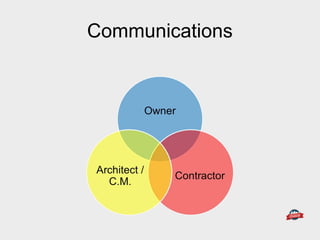
– Parties for Communication
• OWNER / Architect / Contractor / Subs
• Representative of each Party
• Contact Information
– Chain of Communication
• For Approvals and Decisions
• To Direct the Work / Through the Contracted Parties
Methods:
• What type of information goes out: eg: provide
project schedules
• What type of notifications are provided
• Email, door-hangers, phone calls
• Weekly Meetings
• 24 hour emergency response
Communications
Communications
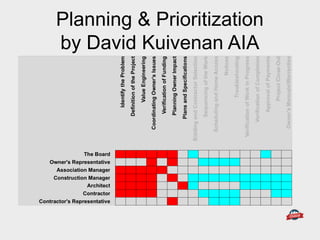
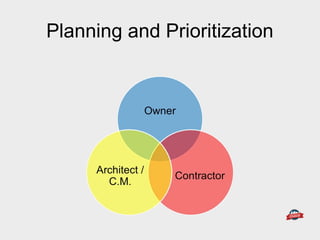
Planning & Prioritization
by David Kuivenan AIA
Phasing / Planning and
Prioritization
• Prototyping to Refine Repair Scope and $
• Phasing can spread out $ needed
– Over Seasons or Years
– Delay work until funds avail.
• Phase by Building or Location
• Phase by Scope or Trade
• Phase by Conditions/Problems/Related
Issues / Postpone less urgent issues
Relocation
• Consider options to minimize relocation
– Phasing or Design Solutions can reduce need
• If needed:
– Who will coordinate the moving of personal
property?
– Lodging of members of Association?
– Funding for relocation?
Planning and Prioritization
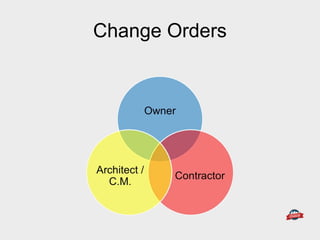
Change Orders
Are:
• A different or changed condition the contractor
could not have anticipated at the bid stage or;
• An agreement by the parties to change scope or
contract time
Change Orders
• Risk management strategy to minimize Changes
• Require contractor to review all available as built
documents on the project
– Defect reports from a litigation
– Original design documents
– Testing photos, results etc
– Conditions revealed from pre/bid site inspections
• Track change orders that modify scope as job
proceeds (Payment Control)
Can:
• Slow production & progress of the job
• Change the direction or expectations
• Alter project schedules via time extensions
• Be offered as a no-cost change for rain
days and general conditions
• Be created or result from surprises
• Lead to a special assessment
Change Orders
Keys to Change Orders:
• Determine Unit Costs prior to signature of
contract
• Contractor to not perform any work prior to
authorization
• Timely Communication required to
transmit, review and approve changes
• Timely Communication required to review
affect on Contract Time and Budget
Change Orders
Change Orders
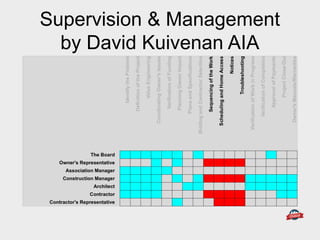
Supervision & Management
by David Kuivenan AIA
Contractor Supervision
• Superintendent / key person employed by the
General Contractor
– Person must be identified/cannot be changed without
approval of Owner
• Means / Methods / Procedures
• Construction Details
• Communication
• Schedule
• Project Driver
• Responsibility includes checking work of Subs
General Superintendent
• Production Manager - oversee all aspects of
construction from contract completion.
Project Manager
• Project Manager - communication, quality control,
scheduling of work and manpower.
On-Site Assistant Project Manager
• On-Site Assistant Project Manager - communication
with all subcontractors and employees, direct
supervisor on project, quality control.
Contractor Supervision
Architect / C.M. Supervision
• Hire an Architect / Construction Manager to
observe the work of the Contractors
– Does not direct the work
– Is not responsible for Means & Methods
– (Included in the design team contracts?)
• Field Observations
– Key tool for verification of progress/quality of the work
• Periodic Observation
• Continuous Inspection
• Special Inspection
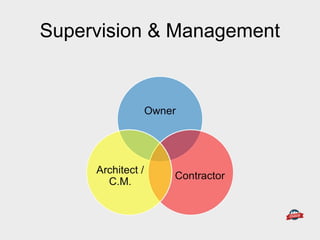
Supervision & Management
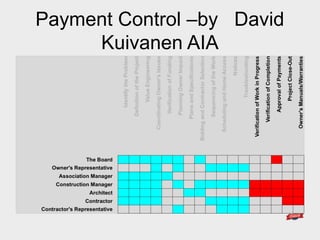
Payment Control –by David
Kuivanen AIA
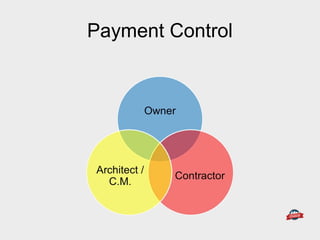
Payment Control
• Owner’s main responsibility/make
decisions/decide scope/make payments
• Owner controls payments when a process for
approval is spelled out in the contract and
Owner follows it
– Contractor applies for payment
– Architect/Construction Mgr. reviews progress & quality
of work/certifies payment
– AIA/standard approach/calendar day/5/20/25
Different Payment Plans
All Terms can be negotiated.
AIA Contract - Net 30 Days.
• Payment submitted on X date of month and
owner makes payment no later then X date of
the following month
• No billing for mobilization
Payment Control
Different Payment Plans
All Terms can be negotiated.
Other Contract Schedules - Net 14 Days
• Payment submitted two weeks prior to BOD
meeting.
• Payment is processed and submitted to BOD
for payment signature at BOD meeting
Payment Control
Different Payment Plans
All Terms can be negotiated.
Other payment schedules – Net 5 Days
• Payments submitted on agreed upon date
• Payment is processed and submitted for BOD
approval and signature
Payment Control
The Hammers of Payment
Control
• If possible, negotiate flexibility in payment
requirement for Board convenience/corresponds
to Board meetings/communications process
established
• Joint checks
• Conditional/Final Lien Releases
• Final Payment/Warranty Binder
Payment Control
Payment Control
• What is a Mechanic’s Lien?
– A recorded “claim” by a contractor who
performs work or supplies materials to a job
site
– Preceded by a Pre-Lien Notice
Payment Control
Mechanics Liens
• How does Association protect itself?
– Contract provisions
– List of subs & suppliers given to owner
– Payment control
– Lien releases
– Indemnity clause offered by general contractor (Negotiated)
– Keep track of pre-lien notices
– Never pay cash
– Checks reference invoices
– Use joint checks
– Consider a payment of performance bond
• What should Association do when confronted with a filed
lien?
Project Completion
• “Substantial Completion” triggered
– Usually starts insurance/warranty period
• Final Completion
– Delivery of Warranties, Manuals, Instructions
– Approval of Final Payments
– Payment of Retention
– End of Presentation/ Robert P. Hall, Jr., Esq.

Common Interest Repair Issues

  • 1.
    Major Repairs atYour Common Interest Association Orientation-Legal Issues Robert Hall, Esq. Flynn/Riley/Bailey/Pasek, LLP
  • 2.
    Big Picture Viewof Issues • Construction and Risk Management • Communications • Phasing • Relocation • Change Orders • Supervision • Payment Control/Mechanics Liens
  • 3.
    Reduce and ManageRisk • Association legal risks arise during construction • The Association/and its legal/design/team should: – Identify risk/problem areas & events and; – Draft solutions in the contract before the work starts
  • 4.
    Reduce and ManageRisk • What is a Contract? • Consider potential problem areas/events that can cause legal risk during the repair process. • A reference for checklist of potential “events”-AIA 201 General Conditions for Construction - A “what-if” index.
  • 5.
    Reduce and ManageRisk • A contract should: – Record the terms of the agreement – Define scope and price But most importantly: – Allocate the risks between owner and contractor If drafted well: – Give parties a reasonable level of prediction of events when issues identified in the contract occur. • Really then, a contract should: Define the results when certain “what if” events occur.
  • 6.
    Communications Why an importantcontract issue? – Many events occur daily during repairs – Decisions are required among: • OWNER / Architect / General Contractor / Subs – Those required to make decisions should be kept informed as job progresses • Risk of a potential dispute increases when parties are not kept “in the loop” – Communication is key element for resolution
  • 7.
    Communications Contract Issues: – Definethe following: – Methods of Communication • Phone / Fax / Email / Mail – Parties for Communication • OWNER / Architect / Contractor / Subs • Representative of each Party • Contact Information – Chain of Communication • For Approvals and Decisions • To Direct the Work / Through the Contracted Parties
  • 8.
    Methods: • What typeof information goes out: eg: provide project schedules • What type of notifications are provided • Email, door-hangers, phone calls • Weekly Meetings • 24 hour emergency response Communications
  • 9.
  • 10.
    Planning & Prioritization byDavid Kuivenan AIA
  • 11.
    Phasing / Planningand Prioritization • Prototyping to Refine Repair Scope and $ • Phasing can spread out $ needed – Over Seasons or Years – Delay work until funds avail. • Phase by Building or Location • Phase by Scope or Trade • Phase by Conditions/Problems/Related Issues / Postpone less urgent issues
  • 12.
    Relocation • Consider optionsto minimize relocation – Phasing or Design Solutions can reduce need • If needed: – Who will coordinate the moving of personal property? – Lodging of members of Association? – Funding for relocation?
  • 13.
  • 14.
    Change Orders Are: • Adifferent or changed condition the contractor could not have anticipated at the bid stage or; • An agreement by the parties to change scope or contract time
  • 15.
    Change Orders • Riskmanagement strategy to minimize Changes • Require contractor to review all available as built documents on the project – Defect reports from a litigation – Original design documents – Testing photos, results etc – Conditions revealed from pre/bid site inspections • Track change orders that modify scope as job proceeds (Payment Control)
  • 16.
    Can: • Slow production& progress of the job • Change the direction or expectations • Alter project schedules via time extensions • Be offered as a no-cost change for rain days and general conditions • Be created or result from surprises • Lead to a special assessment Change Orders
  • 17.
    Keys to ChangeOrders: • Determine Unit Costs prior to signature of contract • Contractor to not perform any work prior to authorization • Timely Communication required to transmit, review and approve changes • Timely Communication required to review affect on Contract Time and Budget Change Orders
  • 18.
  • 19.
    Supervision & Management byDavid Kuivenan AIA
  • 20.
    Contractor Supervision • Superintendent/ key person employed by the General Contractor – Person must be identified/cannot be changed without approval of Owner • Means / Methods / Procedures • Construction Details • Communication • Schedule • Project Driver • Responsibility includes checking work of Subs
  • 21.
    General Superintendent • ProductionManager - oversee all aspects of construction from contract completion. Project Manager • Project Manager - communication, quality control, scheduling of work and manpower. On-Site Assistant Project Manager • On-Site Assistant Project Manager - communication with all subcontractors and employees, direct supervisor on project, quality control. Contractor Supervision
  • 22.
    Architect / C.M.Supervision • Hire an Architect / Construction Manager to observe the work of the Contractors – Does not direct the work – Is not responsible for Means & Methods – (Included in the design team contracts?) • Field Observations – Key tool for verification of progress/quality of the work • Periodic Observation • Continuous Inspection • Special Inspection
  • 23.
  • 24.
    Payment Control –byDavid Kuivanen AIA
  • 25.
    Payment Control • Owner’smain responsibility/make decisions/decide scope/make payments • Owner controls payments when a process for approval is spelled out in the contract and Owner follows it – Contractor applies for payment – Architect/Construction Mgr. reviews progress & quality of work/certifies payment – AIA/standard approach/calendar day/5/20/25
  • 26.
    Different Payment Plans AllTerms can be negotiated. AIA Contract - Net 30 Days. • Payment submitted on X date of month and owner makes payment no later then X date of the following month • No billing for mobilization Payment Control
  • 27.
    Different Payment Plans AllTerms can be negotiated. Other Contract Schedules - Net 14 Days • Payment submitted two weeks prior to BOD meeting. • Payment is processed and submitted to BOD for payment signature at BOD meeting Payment Control
  • 28.
    Different Payment Plans AllTerms can be negotiated. Other payment schedules – Net 5 Days • Payments submitted on agreed upon date • Payment is processed and submitted for BOD approval and signature Payment Control
  • 29.
    The Hammers ofPayment Control • If possible, negotiate flexibility in payment requirement for Board convenience/corresponds to Board meetings/communications process established • Joint checks • Conditional/Final Lien Releases • Final Payment/Warranty Binder
  • 30.
  • 31.
    Payment Control • Whatis a Mechanic’s Lien? – A recorded “claim” by a contractor who performs work or supplies materials to a job site – Preceded by a Pre-Lien Notice
  • 32.
    Payment Control Mechanics Liens •How does Association protect itself? – Contract provisions – List of subs & suppliers given to owner – Payment control – Lien releases – Indemnity clause offered by general contractor (Negotiated) – Keep track of pre-lien notices – Never pay cash – Checks reference invoices – Use joint checks – Consider a payment of performance bond • What should Association do when confronted with a filed lien?
  • 33.
    Project Completion • “SubstantialCompletion” triggered – Usually starts insurance/warranty period • Final Completion – Delivery of Warranties, Manuals, Instructions – Approval of Final Payments – Payment of Retention – End of Presentation/ Robert P. Hall, Jr., Esq.