WELCOME TO ENGLISH FOR
ACADEMIC WRITING COURSE
(EAW)
Week 1
General information
on LE 4000
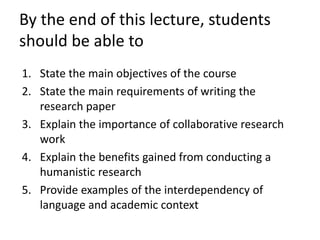
1. State the main objectives of the course
2. State the main requirements of writing the
research paper
3. Explain the importance of collaborative research
work
4. Explain the benefits gained from conducting a
humanistic research
5. Provide examples of the interdependency of
language and academic context
By the end of this lecture, students
should be able to
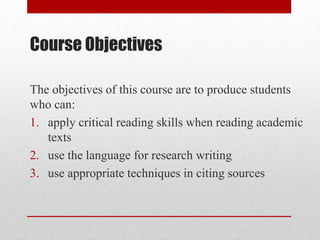
Course Objectives
The objectives of this course are to produce students
who can:
1. apply critical reading skills when reading academic
texts
2. use the language for research writing
3. use appropriate techniques in citing sources
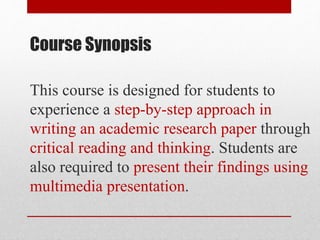
Course Synopsis
This course is designed for students to
experience a step-by-step approach in
writing an academic research paper through
critical reading and thinking. Students are
also required to present their findings using
multimedia presentation.
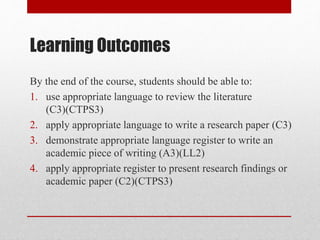
Learning Outcomes
By the end of the course, students should be able to:
1. use appropriate language to review the literature
(C3)(CTPS3)
2. apply appropriate language to write a research paper (C3)
3. demonstrate appropriate language register to write an
academic piece of writing (A3)(LL2)
4. apply appropriate register to present research findings or
academic paper (C2)(CTPS3)
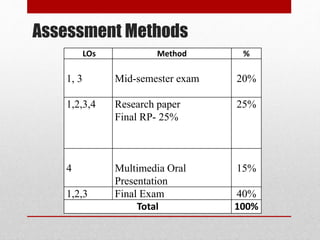
Assessment Methods
LOs Method %
1, 3 Mid-semester exam 20%
1,2,3,4 Research paper
Final RP- 25%
25%
4 Multimedia Oral
Presentation
15%
1,2,3 Final Exam 40%
Total 100%
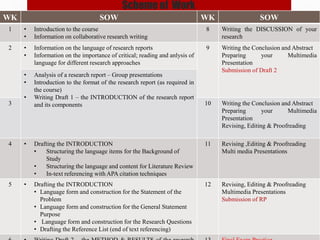
Scheme of Work
WK SOW WK SOW
1 • Introduction to the course
• Information on collaborative research writing
8 Writing the DISCUSSION of your
research
2 • Information on the language of research reports
• Information on the importance of critical; reading and anlysis of
language for different research approaches
9 Writing the Conclusion and Abstract
Preparing your Multimedia
Presentation
Submission of Draft 2
• Analysis of a research report – Group presentations
• Introduction to the format of the research report (as required in
the course)
• Writing Draft 1 – the INTRODUCTION of the research report
and its components3 10 Writing the Conclusion and Abstract
Preparing your Multimedia
Presentation
Revising, Editing & Proofreading
4 • Drafting the INTRODUCTION
• Structuring the language items for the Background of
Study
• Structuring the language and content for Literature Review
• In-text referencing with APA citation techniques
11 Revising ,Editing & Proofreading
Multi media Presentations
5 • Drafting the INTRODUCTION
• Language form and construction for the Statement of the
Problem
• Language form and construction for the General Statement
Purpose
• Language form and construction for the Research Questions
• Drafting the Reference List (end of text referencing)
12 Revising, Editing & Proofreading
Multimedia Presentations
Submission of RP
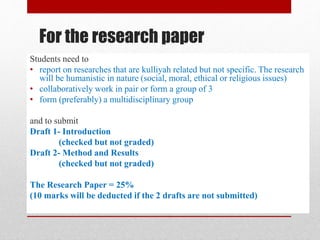
For the research paper
Students need to
• report on researches that are kulliyah related but not specific. The research
will be humanistic in nature (social, moral, ethical or religious issues)
• collaboratively work in pair or form a group of 3
• form (preferably) a multidisciplinary group
and to submit
Draft 1- Introduction
(checked but not graded)
Draft 2- Method and Results
(checked but not graded)
The Research Paper = 25%
(10 marks will be deducted if the 2 drafts are not submitted)
Why write a humanistic nature paper
collaboratively?
Malaysian industries are currently emphasizing a set of skills that the
graduates should have when they apply for a job, which are divided into
two separate categories comprising hard skills and soft skills. (p.9)
Correspondingly, some of the soft skills are team working skills,
presentation skills, decision making skills, communication skills (p. 10)
Consideration therefore should be given to the problem of poor intake
attributes. Students should be encouraged to question, debate,
create and innovate, through discussion and research and be
prepared to think out of the box rather than be mere passive
spectators waiting to be told what to do. University is that crucial
period when dependent school students need to learn to be
independent individuals; a time when they should question and
probe, rather than take things for granted; a time when they should
learn the importance and benefits of research, dare to extend the
boundaries of known knowledge and wisdom and acquire belief in the
critical importance of lifelong learning. (p. 13)
• According to a survey conducted by
Manpower Inc. (2008), the five most
sought after attributes by Malaysian
firms that were identified comprised
strong communication skills and the
ability to relay information to others, a
drive to ensure customer/client
satisfaction with every contact,
consistently high standards and
commitment to quality service,
consistently high commitment to
integrity, honesty and ethical conduct.
• Correspondingly, the five most difficult
attributes to find in the talent pool that were
also reported were loyalty and a willingness
to make a career commitment to the firm,
critical thinking, reasoning and problem
solving skills, self-motivation, strong
communication skills, consistently high
standards and commitment to quality
service, independent, and ability to relay
information to others (Downe & Ho,
2008).
Developing and Assessing College Student
Teamwork Skills
Richard L. Hughes, Steven K. Jones (2011)
http://academics.boisestate.edu/fsp/files/2013/04/developing-and-
assessing-teamwork.pdf
An important role for higher education should involve
developing critical teamwork skills among students so as to
prepare them for success in life. This very point was highlighted
in a 2009 poll conducted on behalf of the Association of
American Colleges and Universities (AACU), in which 71
percent of employers said they wanted colleges to place greater
emphasis on “teamwork skills and the ability to collaborate with
others in diverse group settings” (Hart, 2010, p. 2). Many studies,
in fact, have identified teamwork as one of the most valued and
necessary skills among college graduates. For example, a report
by the Conference Board (2008) indicated that for four-year
college graduates, prospective employers rated the importance of
effective teamwork and collaboration second only to oral
communication in contributing to job success.
The Philosophy and Objectives of Education in Islam
Muhamad Hafiz Khamis Al-Hafiz
Mohamad Johdi Salleh, PhD
2010, International Islamic University Malaysia (IIUM)
Definition of Education
Ta'līm, from the root 'alima (to know, to be aware, to
perceive, to learn), which is used to denote knowledge being
sought or imparted through instruction and teaching.
Tarbiyah, from the root raba (to increase, to grow, to rear),
implies a state of spiritual and ethical nurturing in accordance
with the will of God.
Ta'dīb, from the root aduba (to be cultured, refined, well-
mannered), suggests a person's development of sound
social behavior. What is meant by sound requires a deeper
understanding of the Islamic conception of the human
being.
Why look at the Language for Research
Reports?
• Language construct, and is constructed by,
features of its academic context (language and
academic contexts are interdependent of each other)
• Language to be used should be based on the research
designs
(Creswell, 1994, 2009; Hyland, 2006)
Language Focus of Research Reports
So in this course,
• You will be focusing on research discourse - the key
terms, phrases, tenses, academic vocabulary and
language constructions
• You will be focusing on the language needed for
Quantitative researches (descriptive and experimental)
• You will be using APA format and citation techniques
which are commonly used for social studies
The end.
1. What are the main objectives of the course?
2. What are the main requirements of writing the
research paper
3. Explain the importance of collaborative research
work
4. Explain the benefits gained from conducting a
humanistic research
5. What is the relationship between language and
academic context? Provide an example.
Questions to answer:

LE 4000 week1a pptslides general info. English

  • 1.
    WELCOME TO ENGLISHFOR ACADEMIC WRITING COURSE (EAW) Week 1 General information on LE 4000
  • 2.
    1. State themain objectives of the course 2. State the main requirements of writing the research paper 3. Explain the importance of collaborative research work 4. Explain the benefits gained from conducting a humanistic research 5. Provide examples of the interdependency of language and academic context By the end of this lecture, students should be able to
  • 3.
    Course Objectives The objectivesof this course are to produce students who can: 1. apply critical reading skills when reading academic texts 2. use the language for research writing 3. use appropriate techniques in citing sources
  • 4.
    Course Synopsis This courseis designed for students to experience a step-by-step approach in writing an academic research paper through critical reading and thinking. Students are also required to present their findings using multimedia presentation.
  • 5.
    Learning Outcomes By theend of the course, students should be able to: 1. use appropriate language to review the literature (C3)(CTPS3) 2. apply appropriate language to write a research paper (C3) 3. demonstrate appropriate language register to write an academic piece of writing (A3)(LL2) 4. apply appropriate register to present research findings or academic paper (C2)(CTPS3)
  • 6.
    Assessment Methods LOs Method% 1, 3 Mid-semester exam 20% 1,2,3,4 Research paper Final RP- 25% 25% 4 Multimedia Oral Presentation 15% 1,2,3 Final Exam 40% Total 100%
  • 7.
    Scheme of Work WKSOW WK SOW 1 • Introduction to the course • Information on collaborative research writing 8 Writing the DISCUSSION of your research 2 • Information on the language of research reports • Information on the importance of critical; reading and anlysis of language for different research approaches 9 Writing the Conclusion and Abstract Preparing your Multimedia Presentation Submission of Draft 2 • Analysis of a research report – Group presentations • Introduction to the format of the research report (as required in the course) • Writing Draft 1 – the INTRODUCTION of the research report and its components3 10 Writing the Conclusion and Abstract Preparing your Multimedia Presentation Revising, Editing & Proofreading 4 • Drafting the INTRODUCTION • Structuring the language items for the Background of Study • Structuring the language and content for Literature Review • In-text referencing with APA citation techniques 11 Revising ,Editing & Proofreading Multi media Presentations 5 • Drafting the INTRODUCTION • Language form and construction for the Statement of the Problem • Language form and construction for the General Statement Purpose • Language form and construction for the Research Questions • Drafting the Reference List (end of text referencing) 12 Revising, Editing & Proofreading Multimedia Presentations Submission of RP
  • 8.
    For the researchpaper Students need to • report on researches that are kulliyah related but not specific. The research will be humanistic in nature (social, moral, ethical or religious issues) • collaboratively work in pair or form a group of 3 • form (preferably) a multidisciplinary group and to submit Draft 1- Introduction (checked but not graded) Draft 2- Method and Results (checked but not graded) The Research Paper = 25% (10 marks will be deducted if the 2 drafts are not submitted)
  • 9.
    Why write ahumanistic nature paper collaboratively? Malaysian industries are currently emphasizing a set of skills that the graduates should have when they apply for a job, which are divided into two separate categories comprising hard skills and soft skills. (p.9) Correspondingly, some of the soft skills are team working skills, presentation skills, decision making skills, communication skills (p. 10) Consideration therefore should be given to the problem of poor intake attributes. Students should be encouraged to question, debate, create and innovate, through discussion and research and be prepared to think out of the box rather than be mere passive spectators waiting to be told what to do. University is that crucial period when dependent school students need to learn to be independent individuals; a time when they should question and probe, rather than take things for granted; a time when they should learn the importance and benefits of research, dare to extend the boundaries of known knowledge and wisdom and acquire belief in the critical importance of lifelong learning. (p. 13)
  • 10.
    • According toa survey conducted by Manpower Inc. (2008), the five most sought after attributes by Malaysian firms that were identified comprised strong communication skills and the ability to relay information to others, a drive to ensure customer/client satisfaction with every contact, consistently high standards and commitment to quality service, consistently high commitment to integrity, honesty and ethical conduct.
  • 11.
    • Correspondingly, thefive most difficult attributes to find in the talent pool that were also reported were loyalty and a willingness to make a career commitment to the firm, critical thinking, reasoning and problem solving skills, self-motivation, strong communication skills, consistently high standards and commitment to quality service, independent, and ability to relay information to others (Downe & Ho, 2008).
  • 12.
    Developing and AssessingCollege Student Teamwork Skills Richard L. Hughes, Steven K. Jones (2011) http://academics.boisestate.edu/fsp/files/2013/04/developing-and- assessing-teamwork.pdf An important role for higher education should involve developing critical teamwork skills among students so as to prepare them for success in life. This very point was highlighted in a 2009 poll conducted on behalf of the Association of American Colleges and Universities (AACU), in which 71 percent of employers said they wanted colleges to place greater emphasis on “teamwork skills and the ability to collaborate with others in diverse group settings” (Hart, 2010, p. 2). Many studies, in fact, have identified teamwork as one of the most valued and necessary skills among college graduates. For example, a report by the Conference Board (2008) indicated that for four-year college graduates, prospective employers rated the importance of effective teamwork and collaboration second only to oral communication in contributing to job success.
  • 13.
    The Philosophy andObjectives of Education in Islam Muhamad Hafiz Khamis Al-Hafiz Mohamad Johdi Salleh, PhD 2010, International Islamic University Malaysia (IIUM) Definition of Education Ta'līm, from the root 'alima (to know, to be aware, to perceive, to learn), which is used to denote knowledge being sought or imparted through instruction and teaching. Tarbiyah, from the root raba (to increase, to grow, to rear), implies a state of spiritual and ethical nurturing in accordance with the will of God. Ta'dīb, from the root aduba (to be cultured, refined, well- mannered), suggests a person's development of sound social behavior. What is meant by sound requires a deeper understanding of the Islamic conception of the human being.
  • 14.
    Why look atthe Language for Research Reports? • Language construct, and is constructed by, features of its academic context (language and academic contexts are interdependent of each other) • Language to be used should be based on the research designs (Creswell, 1994, 2009; Hyland, 2006)
  • 15.
    Language Focus ofResearch Reports So in this course, • You will be focusing on research discourse - the key terms, phrases, tenses, academic vocabulary and language constructions • You will be focusing on the language needed for Quantitative researches (descriptive and experimental) • You will be using APA format and citation techniques which are commonly used for social studies The end.
  • 16.
    1. What arethe main objectives of the course? 2. What are the main requirements of writing the research paper 3. Explain the importance of collaborative research work 4. Explain the benefits gained from conducting a humanistic research 5. What is the relationship between language and academic context? Provide an example. Questions to answer: