Super-Mini
COMMON AMERICAN PHRASES
A Guide to Conversation and Small Talk
This dictionary is a basic col.lection of some l 700 eve- ryday phrases
and sentences that Americans use over and over in their greetings,
goodbyes, and everyday small talk. Whereas it is true that there is an
infinite number of possi- ble sentences in any language, it is also true
that some of those sentences are used repeatedly from day to day. The
effective use of language is not in being able to create and understand
an infinite number of sentences, but to use the right sentence the right
way in a given context.
This collection is not only a dictionary but also a re- source for the
learning of these expressions. The user is en- couraged not only to use
the dictionary as a reference book, but to read it from cover to cover.
In many instances the meaning of a phrase is quite clear,but the typicaJ
context for the phrase is not. Each entry ex- pression is illustrated in a
typical context, usually in the form of a short script that illustrates a
typical use of the expression. In some instances, the meaning of the full
ex- pression is quite clear, but the expression typically occurs in an
elliptical form that is not easy to understand. This dictionary cross-
references the elliptical forms to the full forms.
The style of the typical entry phrase and the examples is highly
colloquial. Many of the examples express joking, anger, and sarcasm. A
surprising number of examples -
all taken from real conversational exchanges - contain ex- aggerations
and non sequiturs. In general, this is not the type of language that one
would choose to write or even speak on many occasions. It is the type
of language that one hears every day and needs to understand, however.
This dictionary also includes a Phrase-Finder Index that allows the
user to find the full form of a phrase by looking
up any word in the phrase.
3
Absolutely! (¡Absolutamente!)
MOTHER: Do you want another piece of cake? CHILD: Absolutely! BOB: Are
you ready to go? MARY: Absolutely!
Absolutely not! Definitely not (¡Absolutamente no!
Definitivamente no )
BOB: Will youplease slip this bottle into your pocket? BILL: Absolutelynot!
BOB: Can I please have the car again tonight? FATHER: Absolutely not!You
can't have the car every night!
Act your age! (¡Actúa según tu edad!)
Johnny was squirming around and pinching his sister. His mother finally said,
"Johnny, act your age!" D CHILD: Aw, come on! Let me see your book! MARY:
Be quiet and act your age. Don't be such a baby
Adios.
BOB: See you later, man. BILL: Yeah, man. Adios. BOB: Adios, my
friend. MARY: See you, Bob.
After while. (Después de un rato.)
See you later, alligator). MARY: See you later. BILL: After while, crocodile.
JANE: After while. MARY: Tood/e- oo.
After you. (Después de ti.)
Bob stepped back and made a motion with his hand indicating
that Mary should go first. "After you, " smiled Bob. BOB: It's
time to get in the food line. Who's going lo go first? BILL: After
you. BOB: Thanks.
Again(, please). (De nuevo, porfavor.)
The play director said, "Again, please.And speakmoreclearlythis time." TOM:
I need some money. I'll pay you back. BILL (pretending not to hear): Again,
please. TOM: I said I need some money. How many times do 1 have to say it?
Age before beauty. (Edad antes de la belleza.)
As they approached the door, Bob laughed and said to Bill, "Age before
beauty. " "No, no. Please, you take the next available seat," smiled Tom.
"Age before beauty, you know. ,,
3
all in all; all things considered; on balance. (en general ; todas
las cosas consideradas; mirándolo bien)
BILL: All in all, this was a fine evening. ALICE: I think so too. "Our
time at the conference was well spent, all in all," thought Fred. BILL:
How did it go? ALICE: On balance, it went quite well. BOB: Did the
play turn a profit? FRED: I suppose that we made a nice profit, all
things considered.
Allow me; Permit me.(¡permítame!)
Tom and Jane approached the door. "Allow me, " said Tom, grabbing the
doorknob. "Permitme,"said Fred, pulling out a gold-platedlighterandlighting
Jane's cigarette.
All right.(¡está bien! De acuerdo! Bien! Bueno!)
FATHER: Do it now,before you forget. BILL: All right.
TOM: Please remember to bring me back a pizza.
SALLY: AII right, but I get some of it. ALICE: Come on.
let's give Sally some encouragement. FRED: All right,
Sally! Keep it up! You can do it! "That's the way to go!
All right!" shouted various members of the audience.
All right already! ; All righty already! (¡Ya está bien! ;
¡Todo bien ya!)
ALICE: All right already! Stop pushing me! MARY: I didn't do anything! BOB:
Come on! Get over here! BOB: All righty already! Don't rush me!
All systems are go. (Todoslos sistemas están en marcha.)
BILL: Can we leave now? Is the car gassed up and
ready? TOM: All systems are go. Let's get going.
SALLY: Are you all rested up for the track meet?
MARY: Yes. All systems are go.
3
All the more reason for doingsomething
all the more reason to do something.
(Razón de más para hacer algo. Razón de más para hacer algo)
BILL: I don't do well in calculus because I don't like
the stuff. FATHER: Ail the more reason for working
harder at it. BOB: I'm tired of painting this fence. it's
so old it's rotting! SALLY: All the more reason to paint
it.
Aloha.
"Aloha. Welcome," smiled the hostess. ALICE: Hello.
Can I come in? SUE: Come in. Aloha and welcome.
MARY: It's time we were going. Aloha. JANE: Aloha,
Mary. Come again. All the family stood by the little
plane, cried and cried, and called "Aloha, aloha, "
long after my little plane took me away to the big
island.
Am I glad to see you! (¡Me alegro de verte!)
BILL: Well, I finally got here! JOHN: Boy howdy! Am I glad to see you! TOM (as BilI
opens the door): Here I am, Bill. What's wrong? BILL: Boy, am I glad to see you!
Come on· in. The hot water heater exploded.
Am I right? (Estoyen lo cierto?)
JOHN: Now, this is the kind of thing we should be doing. Am I right?
SUE: Well, sure. I guess. FRED: You don't want to do this for the rest
of your life. Am I right? BOB: Yeah. FRED: You want to make something
of yourself. Am 1 right? BOB: 1 suppose.
And how! (¡y cómo!)
MARY: Wasn't that a great game? Didn't you like it? SALLY: And how! BOB:
Hey, man! Don't you just love this pizza? TOM: And how!
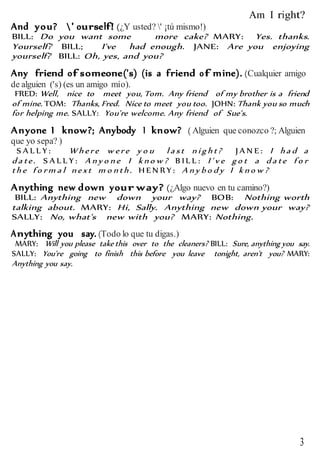
Am I right?
3
And you? ' ourself! (¿Y usted? ' ¡tú mismo!)
BILL: Do you want some more cake? MARY: Yes. thanks.
Yourself? BILL; I've had enough. JANE: Are you enjoying
yourself? BILL: Oh, yes, and you?
Any friend of someone('s) (is a friend of mine). (Cualquier amigo
de alguien ('s) (es un amigo mío).
FRED: Well, nice to meet you, Tom. Any friend of my brother is a friend
of mine. TOM: Thanks, Fred. Nice to meet you too. JOHN: Thank you so much
for helping me. SALLY: You're welcome. Any friend of Sue's.
Anyone I know?; Anybody I know? ( Alguien que conozco ?; Alguien
que yo sepa? )
S A L L Y : W h ere w ere y o u l a st n i gh t? J A N E : I h a d a
d a te. S A L L Y : A n y o n e I k n o w ? B IL L : I' v e go t a d a te f o r
th e f o rm a l n ext m o n th . H E N R Y : A n y b o d y I k n o w ?
Anything new down your way? (¿Algo nuevo en tu camino?)
BILL: Anything new down your way? BOB: Nothing worth
talking about. MARY: Hi, Sally. Anything new down your way?
SALLY: No, what's new with you? MARY: Nothing.
Anything you say. (Todo lo que tu digas.)
MARY: Will you please take this over to the cleaners? BILL: Sure, anything you say.
SALLY: You're going to finish this before you leave tonight, aren't you? MARY:
Anything you say.
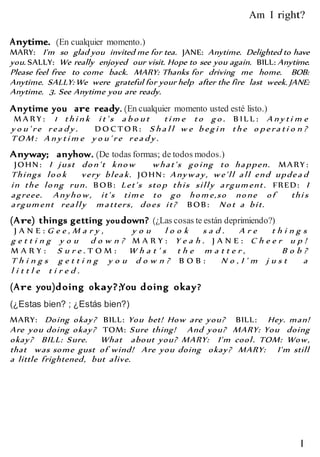
l
Am I right?
Anytime. (En cualquier momento.)
MARY: I'm so glad you invited me for tea. JANE: Anytime. Delighted to have
you. SALLY: We really enjoyed our visit. Hope to see you again. BILL: Anytime.
Please feel free to come back. MARY: Thanks for driving me home. BOB:
Anytime. SALLY: We were grateful for your help after the fire last week. JANE:
Anytime. 3. See Anytime you are ready.
Anytime you are ready. (En cualquier momento usted esté listo.)
M A R Y : 1 th i n k i t' s a b o u t ti m e to go . B IL L : A n y ti m e
y o u ' re rea d y . D O C T O R : S h a l l w e b egi n th e o p era ti o n ?
TO M : A n y ti m e y o u ' re rea d y .
Anyway; anyhow. (De todas formas; de todos modos.)
JOHN: I just don't know what's going to happen. MARY :
Things look very bleak. JOHN: Anyway, we'll all end updea d
in the long run. BOB: Let's stop this silly argum ent. FRED: I
agreee. Anyhow, it's tim e to go hom e,so none of thi s
argum ent really m atters, does it? BOB: Not a bit.
(Are) things getting youdown? (¿Las cosas te están deprimiendo?)
J A N E : G e e , M a r y , y o u l o o k s a d . A r e t h i n g s
g e t t i n g y o u d o w n ? M A R Y : Y e a h . J A N E : C h e e r u p !
M A R Y : S u r e . T O M : W h a t ' s t h e m a t t e r , B o b ?
T h i n g s g e t t i n g y o u d o w n ? B O B : N o , I ' m j u s t a
l i t t l e t i r e d .
(Are you)doing okay?;You doing okay?
(¿Estas bien? ; ¿Estás bien?)
MARY: Doing okay? BILL: You bet! How are you? BILL: Hey. man!
Are you doing okay? TOM: Sure thing! And you? MARY: You doing
okay? BILL: Sure. What about you? MARY: I'm cool. TOM: Wow,
that was some gust of wind! Are you doing okay? MARY: I'm still
a little frightened, but alive.
l
Am I right?
VIII
Am I right?
Am I right?

Common american phrases

  • 1.
    Super-Mini COMMON AMERICAN PHRASES AGuide to Conversation and Small Talk This dictionary is a basic col.lection of some l 700 eve- ryday phrases and sentences that Americans use over and over in their greetings, goodbyes, and everyday small talk. Whereas it is true that there is an infinite number of possi- ble sentences in any language, it is also true that some of those sentences are used repeatedly from day to day. The effective use of language is not in being able to create and understand an infinite number of sentences, but to use the right sentence the right way in a given context. This collection is not only a dictionary but also a re- source for the learning of these expressions. The user is en- couraged not only to use the dictionary as a reference book, but to read it from cover to cover. In many instances the meaning of a phrase is quite clear,but the typicaJ context for the phrase is not. Each entry ex- pression is illustrated in a typical context, usually in the form of a short script that illustrates a typical use of the expression. In some instances, the meaning of the full ex- pression is quite clear, but the expression typically occurs in an elliptical form that is not easy to understand. This dictionary cross- references the elliptical forms to the full forms. The style of the typical entry phrase and the examples is highly colloquial. Many of the examples express joking, anger, and sarcasm. A surprising number of examples - all taken from real conversational exchanges - contain ex- aggerations and non sequiturs. In general, this is not the type of language that one would choose to write or even speak on many occasions. It is the type of language that one hears every day and needs to understand, however. This dictionary also includes a Phrase-Finder Index that allows the user to find the full form of a phrase by looking up any word in the phrase.
  • 2.
    3 Absolutely! (¡Absolutamente!) MOTHER: Doyou want another piece of cake? CHILD: Absolutely! BOB: Are you ready to go? MARY: Absolutely! Absolutely not! Definitely not (¡Absolutamente no! Definitivamente no ) BOB: Will youplease slip this bottle into your pocket? BILL: Absolutelynot! BOB: Can I please have the car again tonight? FATHER: Absolutely not!You can't have the car every night! Act your age! (¡Actúa según tu edad!) Johnny was squirming around and pinching his sister. His mother finally said, "Johnny, act your age!" D CHILD: Aw, come on! Let me see your book! MARY: Be quiet and act your age. Don't be such a baby Adios. BOB: See you later, man. BILL: Yeah, man. Adios. BOB: Adios, my friend. MARY: See you, Bob. After while. (Después de un rato.) See you later, alligator). MARY: See you later. BILL: After while, crocodile. JANE: After while. MARY: Tood/e- oo. After you. (Después de ti.) Bob stepped back and made a motion with his hand indicating that Mary should go first. "After you, " smiled Bob. BOB: It's time to get in the food line. Who's going lo go first? BILL: After you. BOB: Thanks. Again(, please). (De nuevo, porfavor.) The play director said, "Again, please.And speakmoreclearlythis time." TOM: I need some money. I'll pay you back. BILL (pretending not to hear): Again, please. TOM: I said I need some money. How many times do 1 have to say it? Age before beauty. (Edad antes de la belleza.) As they approached the door, Bob laughed and said to Bill, "Age before beauty. " "No, no. Please, you take the next available seat," smiled Tom. "Age before beauty, you know. ,,
  • 3.
    3 all in all;all things considered; on balance. (en general ; todas las cosas consideradas; mirándolo bien) BILL: All in all, this was a fine evening. ALICE: I think so too. "Our time at the conference was well spent, all in all," thought Fred. BILL: How did it go? ALICE: On balance, it went quite well. BOB: Did the play turn a profit? FRED: I suppose that we made a nice profit, all things considered. Allow me; Permit me.(¡permítame!) Tom and Jane approached the door. "Allow me, " said Tom, grabbing the doorknob. "Permitme,"said Fred, pulling out a gold-platedlighterandlighting Jane's cigarette. All right.(¡está bien! De acuerdo! Bien! Bueno!) FATHER: Do it now,before you forget. BILL: All right. TOM: Please remember to bring me back a pizza. SALLY: AII right, but I get some of it. ALICE: Come on. let's give Sally some encouragement. FRED: All right, Sally! Keep it up! You can do it! "That's the way to go! All right!" shouted various members of the audience. All right already! ; All righty already! (¡Ya está bien! ; ¡Todo bien ya!) ALICE: All right already! Stop pushing me! MARY: I didn't do anything! BOB: Come on! Get over here! BOB: All righty already! Don't rush me! All systems are go. (Todoslos sistemas están en marcha.) BILL: Can we leave now? Is the car gassed up and ready? TOM: All systems are go. Let's get going. SALLY: Are you all rested up for the track meet? MARY: Yes. All systems are go.
  • 4.
    3 All the morereason for doingsomething all the more reason to do something. (Razón de más para hacer algo. Razón de más para hacer algo) BILL: I don't do well in calculus because I don't like the stuff. FATHER: Ail the more reason for working harder at it. BOB: I'm tired of painting this fence. it's so old it's rotting! SALLY: All the more reason to paint it. Aloha. "Aloha. Welcome," smiled the hostess. ALICE: Hello. Can I come in? SUE: Come in. Aloha and welcome. MARY: It's time we were going. Aloha. JANE: Aloha, Mary. Come again. All the family stood by the little plane, cried and cried, and called "Aloha, aloha, " long after my little plane took me away to the big island. Am I glad to see you! (¡Me alegro de verte!) BILL: Well, I finally got here! JOHN: Boy howdy! Am I glad to see you! TOM (as BilI opens the door): Here I am, Bill. What's wrong? BILL: Boy, am I glad to see you! Come on· in. The hot water heater exploded. Am I right? (Estoyen lo cierto?) JOHN: Now, this is the kind of thing we should be doing. Am I right? SUE: Well, sure. I guess. FRED: You don't want to do this for the rest of your life. Am I right? BOB: Yeah. FRED: You want to make something of yourself. Am 1 right? BOB: 1 suppose. And how! (¡y cómo!) MARY: Wasn't that a great game? Didn't you like it? SALLY: And how! BOB: Hey, man! Don't you just love this pizza? TOM: And how!
  • 5.
    Am I right? 3 Andyou? ' ourself! (¿Y usted? ' ¡tú mismo!) BILL: Do you want some more cake? MARY: Yes. thanks. Yourself? BILL; I've had enough. JANE: Are you enjoying yourself? BILL: Oh, yes, and you? Any friend of someone('s) (is a friend of mine). (Cualquier amigo de alguien ('s) (es un amigo mío). FRED: Well, nice to meet you, Tom. Any friend of my brother is a friend of mine. TOM: Thanks, Fred. Nice to meet you too. JOHN: Thank you so much for helping me. SALLY: You're welcome. Any friend of Sue's. Anyone I know?; Anybody I know? ( Alguien que conozco ?; Alguien que yo sepa? ) S A L L Y : W h ere w ere y o u l a st n i gh t? J A N E : I h a d a d a te. S A L L Y : A n y o n e I k n o w ? B IL L : I' v e go t a d a te f o r th e f o rm a l n ext m o n th . H E N R Y : A n y b o d y I k n o w ? Anything new down your way? (¿Algo nuevo en tu camino?) BILL: Anything new down your way? BOB: Nothing worth talking about. MARY: Hi, Sally. Anything new down your way? SALLY: No, what's new with you? MARY: Nothing. Anything you say. (Todo lo que tu digas.) MARY: Will you please take this over to the cleaners? BILL: Sure, anything you say. SALLY: You're going to finish this before you leave tonight, aren't you? MARY: Anything you say.
  • 6.
    l Am I right? Anytime.(En cualquier momento.) MARY: I'm so glad you invited me for tea. JANE: Anytime. Delighted to have you. SALLY: We really enjoyed our visit. Hope to see you again. BILL: Anytime. Please feel free to come back. MARY: Thanks for driving me home. BOB: Anytime. SALLY: We were grateful for your help after the fire last week. JANE: Anytime. 3. See Anytime you are ready. Anytime you are ready. (En cualquier momento usted esté listo.) M A R Y : 1 th i n k i t' s a b o u t ti m e to go . B IL L : A n y ti m e y o u ' re rea d y . D O C T O R : S h a l l w e b egi n th e o p era ti o n ? TO M : A n y ti m e y o u ' re rea d y . Anyway; anyhow. (De todas formas; de todos modos.) JOHN: I just don't know what's going to happen. MARY : Things look very bleak. JOHN: Anyway, we'll all end updea d in the long run. BOB: Let's stop this silly argum ent. FRED: I agreee. Anyhow, it's tim e to go hom e,so none of thi s argum ent really m atters, does it? BOB: Not a bit. (Are) things getting youdown? (¿Las cosas te están deprimiendo?) J A N E : G e e , M a r y , y o u l o o k s a d . A r e t h i n g s g e t t i n g y o u d o w n ? M A R Y : Y e a h . J A N E : C h e e r u p ! M A R Y : S u r e . T O M : W h a t ' s t h e m a t t e r , B o b ? T h i n g s g e t t i n g y o u d o w n ? B O B : N o , I ' m j u s t a l i t t l e t i r e d . (Are you)doing okay?;You doing okay? (¿Estas bien? ; ¿Estás bien?) MARY: Doing okay? BILL: You bet! How are you? BILL: Hey. man! Are you doing okay? TOM: Sure thing! And you? MARY: You doing okay? BILL: Sure. What about you? MARY: I'm cool. TOM: Wow, that was some gust of wind! Are you doing okay? MARY: I'm still a little frightened, but alive.
  • 7.
  • 8.
  • 9.