“USIBWC Update on the International Waters of the Rio Grande”

                        presented at
            Texas Water Conservation Association
                             on
                        June 14, 2012
                             by
          Carlos Peña, Principal Engineer Operations
       International Boundary and Water Commission,
                    United States Section
IBWC Mission

The International Boundary and Water
Commission, United States and Mexico, is
responsible for applying the boundary and water
treaties between the two countries and settling
differences that arise in their application.


           Excellence through teamwork.
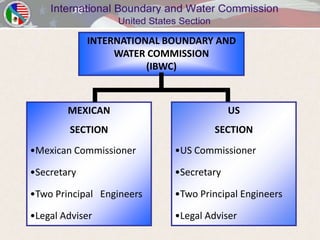
INTERNATIONAL BOUNDARY AND
                  WATER COMMISSION
                        (IBWC)


        MEXICAN                          US
         SECTION                     SECTION
•Mexican Commissioner       •US Commissioner

•Secretary                  •Secretary

•Two Principal Engineers    •Two Principal Engineers

•Legal Adviser              •Legal Adviser
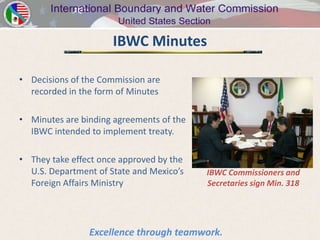
IBWC Minutes

• Decisions of the Commission are
  recorded in the form of Minutes

• Minutes are binding agreements of the
  IBWC intended to implement treaty.

• They take effect once approved by the
  U.S. Department of State and Mexico’s   IBWC Commissioners and
  Foreign Affairs Ministry                Secretaries sign Min. 318


                Excellence through teamwork.
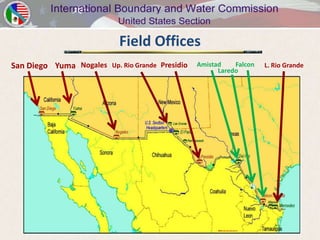
Field Offices
San Diego Yuma Nogales   Up. Rio Grande Presidio   Amistad    Falcon   L. Rio Grande
                                                         Laredo
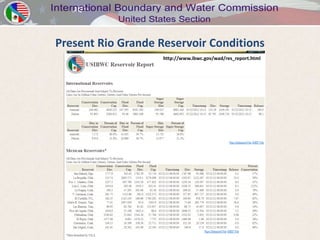
Present Rio Grande Reservoir Conditions
                    http://www.ibwc.gov/wad/res_report.html
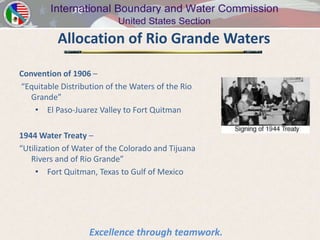
Allocation of Rio Grande Waters

Convention of 1906 –
“Equitable Distribution of the Waters of the Rio
   Grande”
    • El Paso-Juarez Valley to Fort Quitman

1944 Water Treaty –
“Utilization of Water of the Colorado and Tijuana
   Rivers and of Rio Grande”
     • Fort Quitman, Texas to Gulf of Mexico


                   Excellence through teamwork.
Convention of 1906
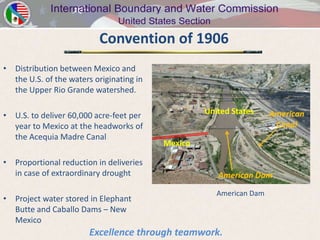
• Distribution between Mexico and
  the U.S. of the waters originating in
  the Upper Rio Grande watershed.

• U.S. to deliver 60,000 acre-feet per             United States     American
  year to Mexico at the headworks of                                  Canal
  the Acequia Madre Canal
                                          Mexico

• Proportional reduction in deliveries
  in case of extraordinary drought                    American Dam

                                                      American Dam
• Project water stored in Elephant
  Butte and Caballo Dams – New
  Mexico
                        Excellence through teamwork.
Convention of 1906
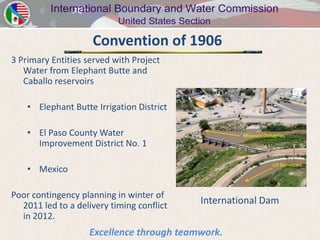
3 Primary Entities served with Project
   Water from Elephant Butte and
   Caballo reservoirs

    • Elephant Butte Irrigation District

    • El Paso County Water                          Mexico’s Deliveries
      Improvement District No. 1

                                                                 US Deliveries
    • Mexico

Poor contingency planning in winter of
  2011 led to a delivery timing conflict   International Dam
  in 2012.
                   Excellence through teamwork.
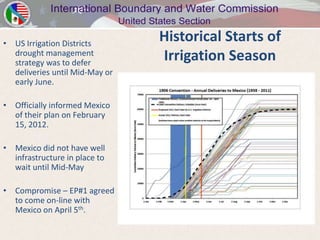
• US Irrigation Districts
                                Historical Starts of
  drought management
  strategy was to defer
                                Irrigation Season
  deliveries until Mid-May or
  early June.

• Officially informed Mexico
  of their plan on February
  15, 2012.

• Mexico did not have well
  infrastructure in place to
  wait until Mid-May

• Compromise – EP#1 agreed
  to come on-line with
  Mexico on April 5th.
Lesson’s Learned from 2012
•   Initiate early contingency planning with all
    three irrigation entities (Fall of 2012)

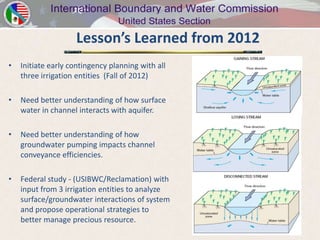
•   Need better understanding of how surface
    water in channel interacts with aquifer.

•   Need better understanding of how
    groundwater pumping impacts channel
    conveyance efficiencies.

•   Federal study - (USIBWC/Reclamation) with
    input from 3 irrigation entities to analyze
    surface/groundwater interactions of system
    and propose operational strategies to
    better manage precious resource.
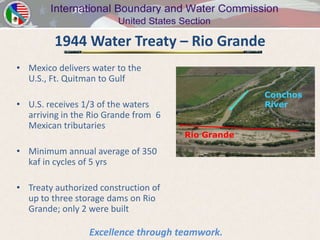
1944 Water Treaty – Rio Grande
• Mexico delivers water to the
  U.S., Ft. Quitman to Gulf
                                                   Conchos
• U.S. receives 1/3 of the waters                  River
  arriving in the Rio Grande from 6
  Mexican tributaries
                                      Rio Grande

• Minimum annual average of 350
  kaf in cycles of 5 yrs

• Treaty authorized construction of
  up to three storage dams on Rio
  Grande; only 2 were built

                 Excellence through teamwork.
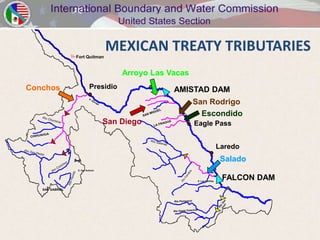
Fort Quitman
                                    MEXICAN TREATY TRIBUTARIES
                                        Arroyo Las Vacas
Conchos                     Presidio                AMISTAD DAM
                                                           San Rodrigo
                                                             Escondido
                                    San Diego              Eagle Pass


                                                                               Laredo
                                                                                Salado
                   E. San Antonio


                                                            E. Las Tortillas
                                                                                FALCON DAM
   SAN GABRIEL
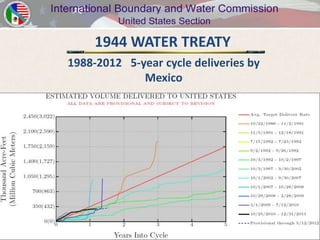
1944 WATER TREATY
1988-2012 5-year cycle deliveries by
             Mexico
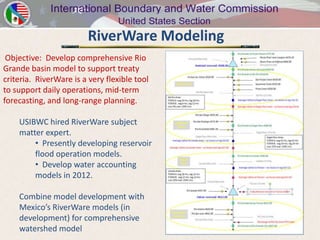
RiverWare Modeling
 Objective: Develop comprehensive Rio
Grande basin model to support treaty
criteria. RiverWare is a very flexible tool
to support daily operations, mid-term
forecasting, and long-range planning.

    USIBWC hired RiverWare subject
    matter expert.
        • Presently developing reservoir
        flood operation models.
        • Develop water accounting
        models in 2012.

    Combine model development with
    Mexico’s RiverWare models (in
    development) for comprehensive
    watershed model
Questions?

   Carlos Peña, Principal Engineer Operations
International Boundary and Water Commission,
             United States Section


         Excellence through teamwork.

USIBWC Update on the International Waters of the Rio Grande

  • 1.
    “USIBWC Update onthe International Waters of the Rio Grande” presented at Texas Water Conservation Association on June 14, 2012 by Carlos Peña, Principal Engineer Operations International Boundary and Water Commission, United States Section
  • 2.
    IBWC Mission The InternationalBoundary and Water Commission, United States and Mexico, is responsible for applying the boundary and water treaties between the two countries and settling differences that arise in their application. Excellence through teamwork.
  • 3.
    INTERNATIONAL BOUNDARY AND WATER COMMISSION (IBWC) MEXICAN US SECTION SECTION •Mexican Commissioner •US Commissioner •Secretary •Secretary •Two Principal Engineers •Two Principal Engineers •Legal Adviser •Legal Adviser
  • 4.
    IBWC Minutes • Decisionsof the Commission are recorded in the form of Minutes • Minutes are binding agreements of the IBWC intended to implement treaty. • They take effect once approved by the U.S. Department of State and Mexico’s IBWC Commissioners and Foreign Affairs Ministry Secretaries sign Min. 318 Excellence through teamwork.
  • 5.
    Field Offices San DiegoYuma Nogales Up. Rio Grande Presidio Amistad Falcon L. Rio Grande Laredo
  • 6.
    Present Rio GrandeReservoir Conditions http://www.ibwc.gov/wad/res_report.html
  • 7.
    Allocation of RioGrande Waters Convention of 1906 – “Equitable Distribution of the Waters of the Rio Grande” • El Paso-Juarez Valley to Fort Quitman 1944 Water Treaty – “Utilization of Water of the Colorado and Tijuana Rivers and of Rio Grande” • Fort Quitman, Texas to Gulf of Mexico Excellence through teamwork.
  • 8.
    Convention of 1906 •Distribution between Mexico and the U.S. of the waters originating in the Upper Rio Grande watershed. • U.S. to deliver 60,000 acre-feet per United States American year to Mexico at the headworks of Canal the Acequia Madre Canal Mexico • Proportional reduction in deliveries in case of extraordinary drought American Dam American Dam • Project water stored in Elephant Butte and Caballo Dams – New Mexico Excellence through teamwork.
  • 9.
    Convention of 1906 3Primary Entities served with Project Water from Elephant Butte and Caballo reservoirs • Elephant Butte Irrigation District • El Paso County Water Mexico’s Deliveries Improvement District No. 1 US Deliveries • Mexico Poor contingency planning in winter of 2011 led to a delivery timing conflict International Dam in 2012. Excellence through teamwork.
  • 10.
    • US IrrigationDistricts Historical Starts of drought management strategy was to defer Irrigation Season deliveries until Mid-May or early June. • Officially informed Mexico of their plan on February 15, 2012. • Mexico did not have well infrastructure in place to wait until Mid-May • Compromise – EP#1 agreed to come on-line with Mexico on April 5th.
  • 11.
    Lesson’s Learned from2012 • Initiate early contingency planning with all three irrigation entities (Fall of 2012) • Need better understanding of how surface water in channel interacts with aquifer. • Need better understanding of how groundwater pumping impacts channel conveyance efficiencies. • Federal study - (USIBWC/Reclamation) with input from 3 irrigation entities to analyze surface/groundwater interactions of system and propose operational strategies to better manage precious resource.
  • 12.
    1944 Water Treaty– Rio Grande • Mexico delivers water to the U.S., Ft. Quitman to Gulf Conchos • U.S. receives 1/3 of the waters River arriving in the Rio Grande from 6 Mexican tributaries Rio Grande • Minimum annual average of 350 kaf in cycles of 5 yrs • Treaty authorized construction of up to three storage dams on Rio Grande; only 2 were built Excellence through teamwork.
  • 13.
    Fort Quitman MEXICAN TREATY TRIBUTARIES Arroyo Las Vacas Conchos Presidio AMISTAD DAM San Rodrigo Escondido San Diego Eagle Pass Laredo Salado E. San Antonio E. Las Tortillas FALCON DAM SAN GABRIEL
  • 14.
    1944 WATER TREATY 1988-20125-year cycle deliveries by Mexico
  • 15.
    RiverWare Modeling Objective:Develop comprehensive Rio Grande basin model to support treaty criteria. RiverWare is a very flexible tool to support daily operations, mid-term forecasting, and long-range planning. USIBWC hired RiverWare subject matter expert. • Presently developing reservoir flood operation models. • Develop water accounting models in 2012. Combine model development with Mexico’s RiverWare models (in development) for comprehensive watershed model
  • 16.
    Questions? Carlos Peña, Principal Engineer Operations International Boundary and Water Commission, United States Section Excellence through teamwork.

Editor's Notes

  • #5 Over 300 minutes of the IBWC. Various Minutes relate to construction, operation, and maintenance of Amistad and Falcon Dams, levee systems and flood control projects, etc.
  • #6 This is where our field offices are located. There is usually a Mexican counterpart office at the sister city.Along the Rio Grande, we have personnel in Las Cruces, El Paso, Fort Hancock, Presidio, Del Rio, Laredo, Falcon and Mercedes.We also maintain an office at the State Department.
  • #11 What was different this year…there was not sufficient project water to sustain a continuous release from Caballo reservoir for the entire irrigation season.US irrigation districts (EBID and EP#1) developed a water budget that deferred releases until Mid-May/June timeframe.Unfortunately, Mexico was informed of US plan on Feb. 15th (2 weeks prior to typical start of irrigation season). Mexico did not have operating well infrastructure to augment 1st irrigation with groundwater, therefore requested their allocated amount in late March.A compromise was reached in the hallways of the Austin capitol building where EP#1 reluctantly agreed to come on-line with Mexico on April 5th.
  • #13 The Conchos River in the Big Bend area is the biggest contributor to Mexico’s treaty deliveries followed by the Salado, which enters at Falcon. The two dams are Amistad and Falcon.A new cycle begins after the U.S. conservation capacity in Amistad and Falcon Dams is filled so sometimes cycles are less than 5 years.