© 2014 by McGraw-Hill Education
CHAPTER 6
FILM
© 2014 by McGraw-Hill Education
IN-CLASS MEDIA PRESENTATION
A SHORT HISTORY OF
FILM
6-2
© 2014 by McGraw-Hill Education
A SHORT HISTORY OF FILM
Describe how the art of film became an
industry during the early 20th century and
resembled a factory.
Studios owned stables of stars, writers,
and producers to make the movies, and
the theaters to show them in – they
churned the movies out like a factory
churns out “product”.
6-3
© 2014 by McGraw-Hill Education
A SHORT HISTORY OF FILM
Why did this “Factory” system of making
movies change?
Studios lost control as stars, writers,
and producers fought for the right to be
independent and movie theaters became
independent after antitrust suits were
brought against the major studios
because they held a monopoly over the
entire film industry.
6-4
© 2014 by McGraw-Hill Education
A SHORT HISTORY OF FILM
These antitrust actions spelled the end of the
studio system and the beginning of an era in
which production companies primarily made films
on a project-by-project basis.
This new breed of production company is often
assembled for a particular film and then dissolved
afterwards. There are no stars or directors under
long-term contracts to be automatically used for
ongoing productions. Today, people are
especially selected for each film.
6-5
© 2014 by McGraw-Hill Education
A SHORT HISTORY OF FILM
How did the Film Industry react to the
coming of the Television Age starting
in the 1950’s?
Tried to make movies “special” and different
than Television
Made movies that featured content and
themes you couldn’t see on Television
Sold old movies to Television
Realized that Home Video was an effective
way to advertise their theatrical releases
6-6
© 2014 by McGraw-Hill Education
MOVIES & CULTURE
Why do you think movies have
such an important place in
American culture? What makes
them so special?
6-7
© 2014 by McGraw-Hill Education
MOVIES & CULTURE
Movies hold a very special place
in our culture…
We talk of Hollywood as the “dream
factory,” the makers of “movie magic.”
We want our lives and loves to be “just
like in the movies.” The movies are
“larger than life,” and movie stars are
much more glamorous than television
stars.
6-8
© 2014 by McGraw-Hill Education
MOVIES AS A MEDIUM
MOVIES ARE ESPECIALLY COLLABORATIVE AND
COMBINE MEDIA INTO ONE PACKAGE:
Visuals (moving and otherwise)
Print/Words (script)
Music + Sound (soundtrack/score/sound design)
Camera work (lighting, movement, effects)
Design (production elements, color schemes,
wardrobe, etc.)
All of these elements (and more) combine to make
a “movie” – GOODFELLAS tracking shot
6-9
© 2014 by McGraw-Hill Education
MOVIES AND THEIR AUDIENCES
•Today’s movie audience is increasingly a
young one
•The typical moviegoer in the United
States is a teenager or young adult.
These teens and 20-somethings,
although making up less than 20% of the
total population, represent more than
30% of the tickets bought.
6-10
© 2014 by McGraw-Hill Education
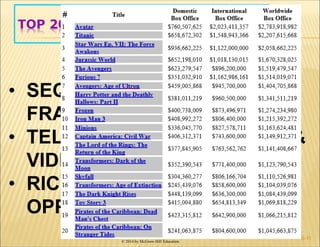
TOP 20 WORLDWIDE HITS
6-11
• SEQUELS, REMAKES, AND
FRANCHISES
• TELEVISION, COMIC BOOK, &
VIDEO-GAME REMAKES
• RICH MERCHANDISE
OPPORTUNITIES
© 2014 by McGraw-Hill Education
THREE COMPONENT SYSTEM
PRODUCTION
• About 700 feature-length films are
produced annually in the U.S.
• Most are now shot on digital (not
film) – which can make making a
movie cheaper OR more expensive,
depending on the type of film you’re
making
6-12
© 2014 by McGraw-Hill Education
THREE COMPONENT SYSTEM
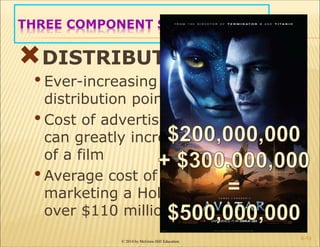
DISTRIBUTION
•Ever-increasing number of
distribution points to consider
•Cost of advertising and promotion
can greatly increase the total cost
of a film
•Average cost of producing and
marketing a Hollywood feature is
over $110 million
6-13
© 2014 by McGraw-Hill Education
THREE COMPONENT SYSTEM
EXHIBITION
About 39,000 movie screens exhibit
motion pictures in the United States
 The five largest American movie
chains sell nearly 80% of all tickets
 Concession sales account for 40% of a
theater’s profits (at an 80% profit
margin)
 Not just movies are being shown
6-14
© 2014 by McGraw-Hill Education
TRENDS AND CONVERGENCE IN
MOVIEMAKING
HOW movies are sold, watched
and distributed is changing
drastically due to the massive
growth of digital media and new
distribution models – films are no
longer typically destined for the big
screen and, as a result, everything
from how they’re made to how
they’re sold is changing.
6-15
© 2014 by McGraw-Hill Education
TRENDS AND CONVERGENCE IN
MOVIEMAKING
 All major film studios are a major part
of a large conglomerate, and much of
this takes place as foreign ownership
 CONGLOMERATION + FOREIGN
OWNERSHIP = Blockbuster
Mentality
Filmmaking characterized by reduced
risk taking and more formulaic
movies.
6-16
© 2014 by McGraw-Hill Education
TRENDS AND CONVERGENCE IN
MOVIEMAKING
“CONCEPT” FILMS
Movies that can be
described in one line
Depend little on
characterization, plot
development, and dialogue
More easily sold overseas
6-17
© 2014 by McGraw-Hill Education
TRENDS AND CONVERGENCE IN
MOVIEMAKING
The importance of foreign
distribution cannot be overstated;
only 2 in 10 U.S. features make a
profit on U.S. box office. Much of
their eventual profit comes from
overseas sales.
 Typically, overseas box office
accounts for 70% of a studio
movie's total ticket sales
6-18
© 2014 by McGraw-Hill Education
TRENDS AND CONVERGENCE IN
MOVIEMAKING
Many movies are adaptations of
television shows, comic books, and
video games because of the
“Blockbuster Mentality” as well as…
 Merchandise tie-ins which accounts
for almost $200 billion in payments
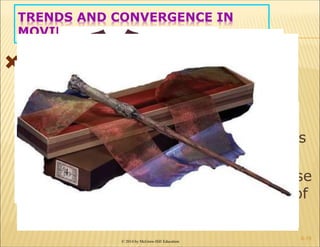
 By 2011, the HARRY POTTER franchise
had made over $7 BILLION in sales of
official merchandise
6-19
© 2014 by McGraw-Hill Education
TRENDS AND CONVERGENCE IN
MOVIEMAKING
 Brief History: Product placements in
movies
 THE SOCIAL NETWORK:
adidas, Apache, Apple, Arm & Hammer, Boston University, Brooks
Brothers, Cadillac, Cambridge University, Columbia University,
Cornell University, Dell, Disney, Exeter Academy, Facebook,
Friendster, Gap, Google, Harvard University, LiveJournal, London
School of Economics, Macy's,match.com, Microsoft, Mountain
Dew, MySpace, Napster, Network Solutions, New England
Patriots, NFL, Nike, Oxford University, Patagonia, Philips, Polaroid,
Polo Ralph Lauren, Porsche, Range Rover, Red Bull, Samsung,
Sony VAIO, Stairmaster, Stanford University, The Harvard
Crimson, The North Face, The Unlimited, Thirsty Scholar, Tower
Records, Ty Nant, Under Armour, Victoria's Secret, Yale University
6-20
© 2014 by McGraw-Hill Education
DEVELOPING MEDIA LITERACY
SKILLS
Recognizing Product Placements
 Product placement—a business in its own
right
It’s a commercial that lives “forever”
All but guaranteed to have worldwide
distribution
Unskippable
 Awareness of efforts of movie industry to
maximize income from films is central to
good film literacy
6-21
© 2014 by McGraw-Hill Education
DEVELOPING MEDIA LITERACY
SKILLS
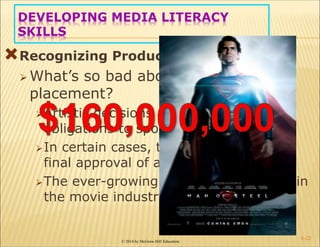
Recognizing Product Placements
 What’s so bad about product
placement?
Artistic decisions are placed second to
obligations to sponsors
In certain cases, the sponsor can have
final approval of a scene/film
The ever-growing importance of profit in
the movie industry
6-22
© 2014 by McGraw-Hill Education
MOVIES & TECHNOLOGY
Back in the day, filmmakers used matte
paintings, miniature models and trick
photography to achieve impossible
looking cinematic effects. Today,
Hollywood has nearly perfected the art
and application of computer-generated
imagery (CGI) in movies and TV shows.
6-23
© 2014 by McGraw-Hill Education
MOVIES & TECHNOLOGY
CGI = Computer Generated Images
TOP 10 Visual Effects You Thought Were
Real
PRACTICAL EFFECTS = “In-Camera”
A practical effect is a special effect
produced physically, without computer-
generated imagery or other post
production techniques.
TOP 10
BOTTOM 10
6-24

COMM 101 - Chapter #6 (FILM)

  • 1.
    © 2014 byMcGraw-Hill Education CHAPTER 6 FILM
  • 2.
    © 2014 byMcGraw-Hill Education IN-CLASS MEDIA PRESENTATION A SHORT HISTORY OF FILM 6-2
  • 3.
    © 2014 byMcGraw-Hill Education A SHORT HISTORY OF FILM Describe how the art of film became an industry during the early 20th century and resembled a factory. Studios owned stables of stars, writers, and producers to make the movies, and the theaters to show them in – they churned the movies out like a factory churns out “product”. 6-3
  • 4.
    © 2014 byMcGraw-Hill Education A SHORT HISTORY OF FILM Why did this “Factory” system of making movies change? Studios lost control as stars, writers, and producers fought for the right to be independent and movie theaters became independent after antitrust suits were brought against the major studios because they held a monopoly over the entire film industry. 6-4
  • 5.
    © 2014 byMcGraw-Hill Education A SHORT HISTORY OF FILM These antitrust actions spelled the end of the studio system and the beginning of an era in which production companies primarily made films on a project-by-project basis. This new breed of production company is often assembled for a particular film and then dissolved afterwards. There are no stars or directors under long-term contracts to be automatically used for ongoing productions. Today, people are especially selected for each film. 6-5
  • 6.
    © 2014 byMcGraw-Hill Education A SHORT HISTORY OF FILM How did the Film Industry react to the coming of the Television Age starting in the 1950’s? Tried to make movies “special” and different than Television Made movies that featured content and themes you couldn’t see on Television Sold old movies to Television Realized that Home Video was an effective way to advertise their theatrical releases 6-6
  • 7.
    © 2014 byMcGraw-Hill Education MOVIES & CULTURE Why do you think movies have such an important place in American culture? What makes them so special? 6-7
  • 8.
    © 2014 byMcGraw-Hill Education MOVIES & CULTURE Movies hold a very special place in our culture… We talk of Hollywood as the “dream factory,” the makers of “movie magic.” We want our lives and loves to be “just like in the movies.” The movies are “larger than life,” and movie stars are much more glamorous than television stars. 6-8
  • 9.
    © 2014 byMcGraw-Hill Education MOVIES AS A MEDIUM MOVIES ARE ESPECIALLY COLLABORATIVE AND COMBINE MEDIA INTO ONE PACKAGE: Visuals (moving and otherwise) Print/Words (script) Music + Sound (soundtrack/score/sound design) Camera work (lighting, movement, effects) Design (production elements, color schemes, wardrobe, etc.) All of these elements (and more) combine to make a “movie” – GOODFELLAS tracking shot 6-9
  • 10.
    © 2014 byMcGraw-Hill Education MOVIES AND THEIR AUDIENCES •Today’s movie audience is increasingly a young one •The typical moviegoer in the United States is a teenager or young adult. These teens and 20-somethings, although making up less than 20% of the total population, represent more than 30% of the tickets bought. 6-10
  • 11.
    © 2014 byMcGraw-Hill Education TOP 20 WORLDWIDE HITS 6-11 • SEQUELS, REMAKES, AND FRANCHISES • TELEVISION, COMIC BOOK, & VIDEO-GAME REMAKES • RICH MERCHANDISE OPPORTUNITIES
  • 12.
    © 2014 byMcGraw-Hill Education THREE COMPONENT SYSTEM PRODUCTION • About 700 feature-length films are produced annually in the U.S. • Most are now shot on digital (not film) – which can make making a movie cheaper OR more expensive, depending on the type of film you’re making 6-12
  • 13.
    © 2014 byMcGraw-Hill Education THREE COMPONENT SYSTEM DISTRIBUTION •Ever-increasing number of distribution points to consider •Cost of advertising and promotion can greatly increase the total cost of a film •Average cost of producing and marketing a Hollywood feature is over $110 million 6-13
  • 14.
    © 2014 byMcGraw-Hill Education THREE COMPONENT SYSTEM EXHIBITION About 39,000 movie screens exhibit motion pictures in the United States  The five largest American movie chains sell nearly 80% of all tickets  Concession sales account for 40% of a theater’s profits (at an 80% profit margin)  Not just movies are being shown 6-14
  • 15.
    © 2014 byMcGraw-Hill Education TRENDS AND CONVERGENCE IN MOVIEMAKING HOW movies are sold, watched and distributed is changing drastically due to the massive growth of digital media and new distribution models – films are no longer typically destined for the big screen and, as a result, everything from how they’re made to how they’re sold is changing. 6-15
  • 16.
    © 2014 byMcGraw-Hill Education TRENDS AND CONVERGENCE IN MOVIEMAKING  All major film studios are a major part of a large conglomerate, and much of this takes place as foreign ownership  CONGLOMERATION + FOREIGN OWNERSHIP = Blockbuster Mentality Filmmaking characterized by reduced risk taking and more formulaic movies. 6-16
  • 17.
    © 2014 byMcGraw-Hill Education TRENDS AND CONVERGENCE IN MOVIEMAKING “CONCEPT” FILMS Movies that can be described in one line Depend little on characterization, plot development, and dialogue More easily sold overseas 6-17
  • 18.
    © 2014 byMcGraw-Hill Education TRENDS AND CONVERGENCE IN MOVIEMAKING The importance of foreign distribution cannot be overstated; only 2 in 10 U.S. features make a profit on U.S. box office. Much of their eventual profit comes from overseas sales.  Typically, overseas box office accounts for 70% of a studio movie's total ticket sales 6-18
  • 19.
    © 2014 byMcGraw-Hill Education TRENDS AND CONVERGENCE IN MOVIEMAKING Many movies are adaptations of television shows, comic books, and video games because of the “Blockbuster Mentality” as well as…  Merchandise tie-ins which accounts for almost $200 billion in payments  By 2011, the HARRY POTTER franchise had made over $7 BILLION in sales of official merchandise 6-19
  • 20.
    © 2014 byMcGraw-Hill Education TRENDS AND CONVERGENCE IN MOVIEMAKING  Brief History: Product placements in movies  THE SOCIAL NETWORK: adidas, Apache, Apple, Arm & Hammer, Boston University, Brooks Brothers, Cadillac, Cambridge University, Columbia University, Cornell University, Dell, Disney, Exeter Academy, Facebook, Friendster, Gap, Google, Harvard University, LiveJournal, London School of Economics, Macy's,match.com, Microsoft, Mountain Dew, MySpace, Napster, Network Solutions, New England Patriots, NFL, Nike, Oxford University, Patagonia, Philips, Polaroid, Polo Ralph Lauren, Porsche, Range Rover, Red Bull, Samsung, Sony VAIO, Stairmaster, Stanford University, The Harvard Crimson, The North Face, The Unlimited, Thirsty Scholar, Tower Records, Ty Nant, Under Armour, Victoria's Secret, Yale University 6-20
  • 21.
    © 2014 byMcGraw-Hill Education DEVELOPING MEDIA LITERACY SKILLS Recognizing Product Placements  Product placement—a business in its own right It’s a commercial that lives “forever” All but guaranteed to have worldwide distribution Unskippable  Awareness of efforts of movie industry to maximize income from films is central to good film literacy 6-21
  • 22.
    © 2014 byMcGraw-Hill Education DEVELOPING MEDIA LITERACY SKILLS Recognizing Product Placements  What’s so bad about product placement? Artistic decisions are placed second to obligations to sponsors In certain cases, the sponsor can have final approval of a scene/film The ever-growing importance of profit in the movie industry 6-22
  • 23.
    © 2014 byMcGraw-Hill Education MOVIES & TECHNOLOGY Back in the day, filmmakers used matte paintings, miniature models and trick photography to achieve impossible looking cinematic effects. Today, Hollywood has nearly perfected the art and application of computer-generated imagery (CGI) in movies and TV shows. 6-23
  • 24.
    © 2014 byMcGraw-Hill Education MOVIES & TECHNOLOGY CGI = Computer Generated Images TOP 10 Visual Effects You Thought Were Real PRACTICAL EFFECTS = “In-Camera” A practical effect is a special effect produced physically, without computer- generated imagery or other post production techniques. TOP 10 BOTTOM 10 6-24