Combustion-Flaring
Modern society makes great use of hydrocarbons and
chemicals, requiring the drilling of wells for hydrocarbons,
and refineries and chemical plants to produce the products
that drive our society.
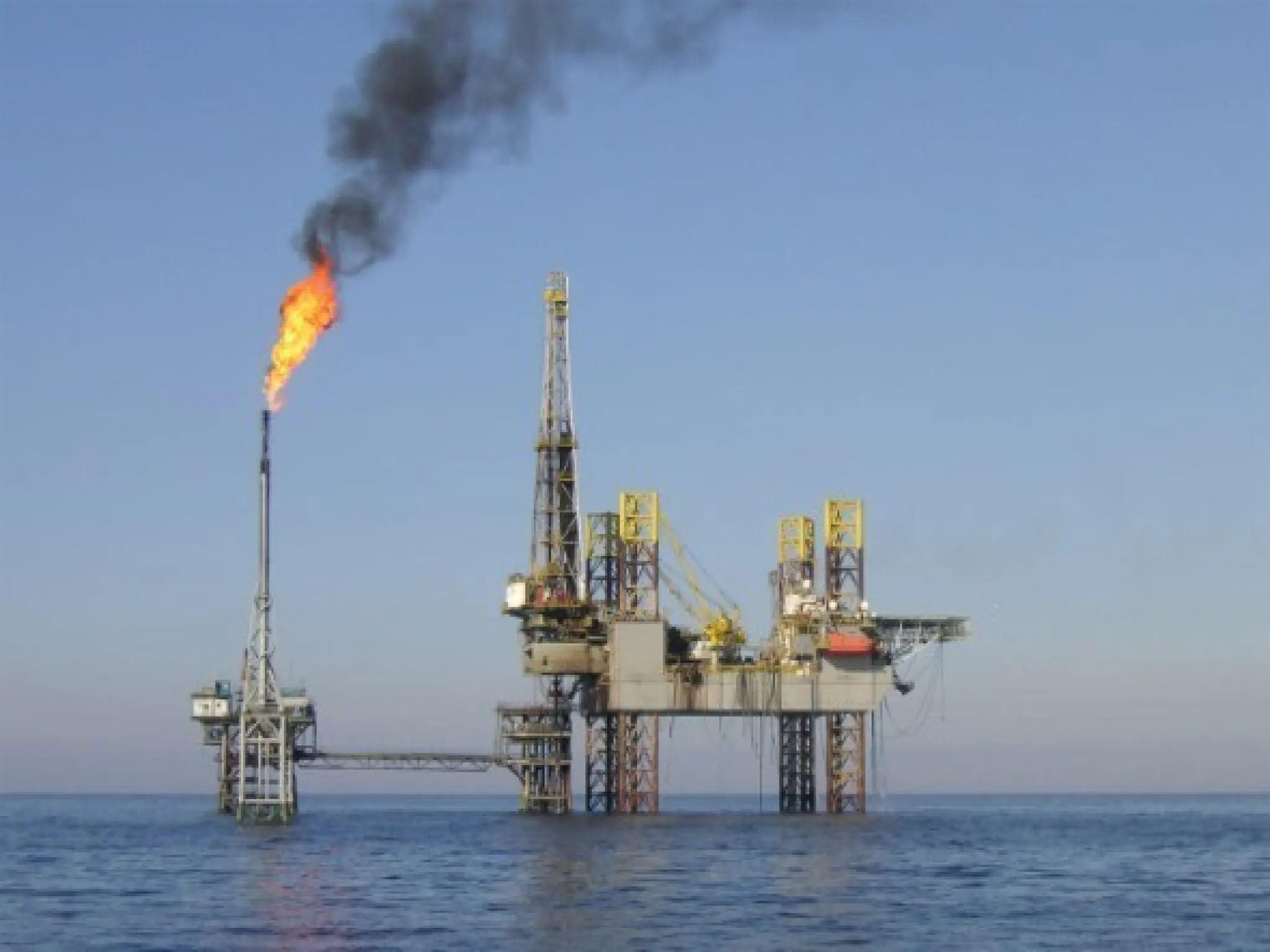
In the course of operation of these complex machines, flaring
will occur. Flaring is the burning of waste gasses through a
flare stack or other combustion device.
It is different from a furnace or other form of combustion in
that it is not intended to be a feature of the plant for profit, but
rather for safety.
In general, flaring is for pressure relief without simply
venting dangerous chemicals to the environment.
Flaring often occurs during discovery and testing of an oil
well.
During operation of a well, it can be that there are gases
which are not economical to transport or capture, and so are
flared.
It can also occur during chemical processing. In chemical
processing, flaring is usually to remove waste products or for
emergency pressure relief.
Start-up and shutdown of plants are also common sources of
flaring.
Products of flaring are often water and carbon dioxide with
usually greater than 98% combustion of volatile organic
compounds (Ex. benzene, ethylene glycol, formaldehyde,
methylene chloride, tetrachloroethylene, toluene, xylene, and
1,3-butadiene.)
This is excellent from a toxicity standpoint. Depending on the
inlet gasses, other products such as sulfur dioxide are possible,
which can be locally restricted.
Flaring can be used in place of venting waste streams to reduce
the load of toxic or greenhouse gasses, such as methane, which
is more than 20 times as deleterious as carbon dioxide towards
global warming, where carbon dioxide is a direct combustion
product.
In this way, flaring is far more acceptable than venting, or
simply releasing chemicals into the atmosphere.
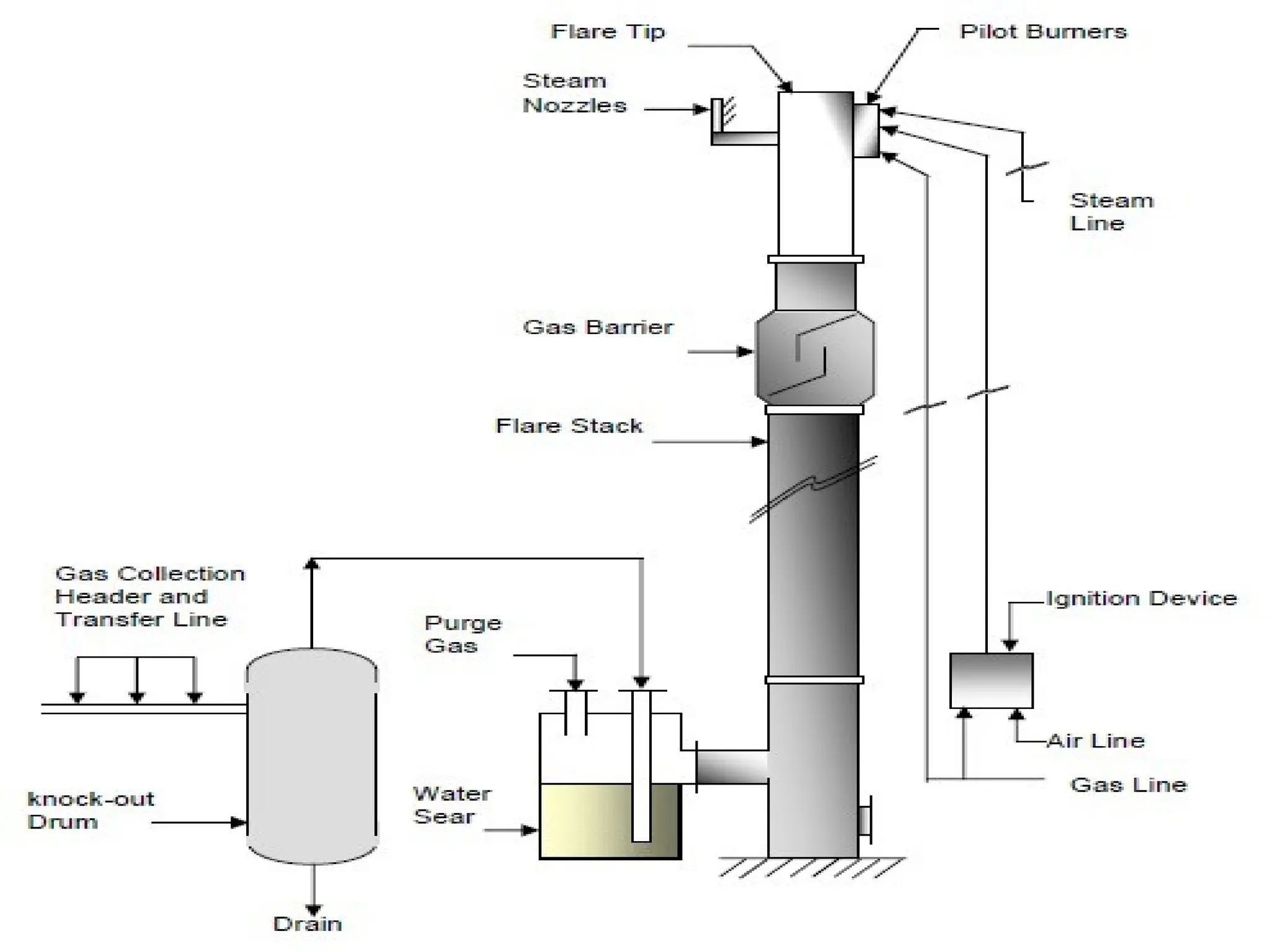
 The Knock out drum is a vessel in the flare
header designed to remove & accumulate
condensed & entrained liquids from the relief
gases.
 The purge gas is inert, i.e. by definition non-
combustible, or more precisely, non-reactive.
 Basic description:
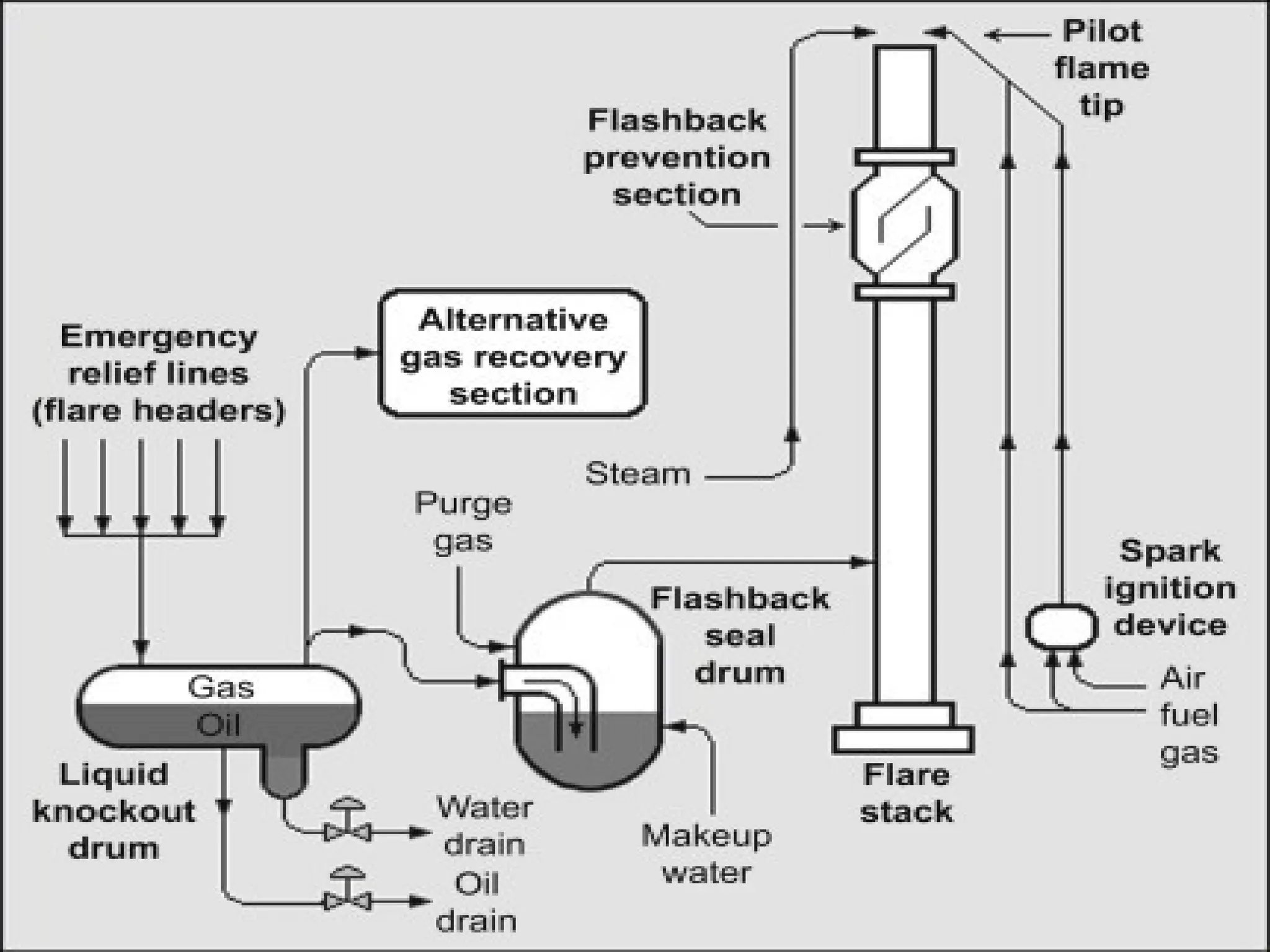
Here can be seen an inlet flow for pressure release, coupled to
a knockout drum for vapor-liquid separation, that liquids like
oil and water will not be drawn into the flare stack and can be
recovered.
The diagram includes an "Alternative Gas Recovery Section"
for the purpose of recovering some of the gas to be flared for
use; this may not be sufficient to contain all inlet gas, or may
not be present.
In this diagram, the inlet gas to be flared continues to a
flashback seal drum, which has two important mechanical
characteristics.
First, there is a threshold pressure required for combustible
inlet gasses to be able to pass from the knockout drum to the
flashback seal drum.
Second, the influx (growth) of purge gas removes any
lingering (lazy) combustible gasses.
Both of these characteristics make it challenging for any flame
to travel down the flare stack and into the refinery, causing
destruction.
The flare stack has a flame for ignition at the top, and in this
case is designed to minimize flashback. Here, there exists
steam injection to improve the quality of combustion.
Flares are implemented with concerns such as gas
composition and pressure, safety, environmental regulations,
and social effects (noise and light pollution).
Flaring is undertaken as a way to remove dangerous gasses
with lower harm to the environment.
It is used in safely regulating pressure in chemical plants, as
well as handling natural gas release in wells.
Alternatives, such as piping the gas to a plant or on-site
capture and use, are of great interest.
THANK
YOU

Combustion-flaring. By Vikrant D. Bute Asst. Prof. Dept of Environmental Science

  • 1.
    Combustion-Flaring Modern society makesgreat use of hydrocarbons and chemicals, requiring the drilling of wells for hydrocarbons, and refineries and chemical plants to produce the products that drive our society. In the course of operation of these complex machines, flaring will occur. Flaring is the burning of waste gasses through a flare stack or other combustion device. It is different from a furnace or other form of combustion in that it is not intended to be a feature of the plant for profit, but rather for safety.
  • 2.
    In general, flaringis for pressure relief without simply venting dangerous chemicals to the environment. Flaring often occurs during discovery and testing of an oil well. During operation of a well, it can be that there are gases which are not economical to transport or capture, and so are flared. It can also occur during chemical processing. In chemical processing, flaring is usually to remove waste products or for emergency pressure relief. Start-up and shutdown of plants are also common sources of flaring.
  • 3.
    Products of flaringare often water and carbon dioxide with usually greater than 98% combustion of volatile organic compounds (Ex. benzene, ethylene glycol, formaldehyde, methylene chloride, tetrachloroethylene, toluene, xylene, and 1,3-butadiene.) This is excellent from a toxicity standpoint. Depending on the inlet gasses, other products such as sulfur dioxide are possible, which can be locally restricted. Flaring can be used in place of venting waste streams to reduce the load of toxic or greenhouse gasses, such as methane, which is more than 20 times as deleterious as carbon dioxide towards global warming, where carbon dioxide is a direct combustion product. In this way, flaring is far more acceptable than venting, or simply releasing chemicals into the atmosphere.
  • 7.
     The Knockout drum is a vessel in the flare header designed to remove & accumulate condensed & entrained liquids from the relief gases.  The purge gas is inert, i.e. by definition non- combustible, or more precisely, non-reactive.
  • 8.
     Basic description: Herecan be seen an inlet flow for pressure release, coupled to a knockout drum for vapor-liquid separation, that liquids like oil and water will not be drawn into the flare stack and can be recovered. The diagram includes an "Alternative Gas Recovery Section" for the purpose of recovering some of the gas to be flared for use; this may not be sufficient to contain all inlet gas, or may not be present. In this diagram, the inlet gas to be flared continues to a flashback seal drum, which has two important mechanical characteristics.
  • 9.
    First, there isa threshold pressure required for combustible inlet gasses to be able to pass from the knockout drum to the flashback seal drum. Second, the influx (growth) of purge gas removes any lingering (lazy) combustible gasses. Both of these characteristics make it challenging for any flame to travel down the flare stack and into the refinery, causing destruction. The flare stack has a flame for ignition at the top, and in this case is designed to minimize flashback. Here, there exists steam injection to improve the quality of combustion.
  • 10.
    Flares are implementedwith concerns such as gas composition and pressure, safety, environmental regulations, and social effects (noise and light pollution).
  • 11.
    Flaring is undertakenas a way to remove dangerous gasses with lower harm to the environment. It is used in safely regulating pressure in chemical plants, as well as handling natural gas release in wells. Alternatives, such as piping the gas to a plant or on-site capture and use, are of great interest.
  • 12.