Colors and Markings Anastasia Kellogg
The Five Basic Coat Colors Black The horse’s coat, mane, and tail are black
The Five Basic Coat Colors Brown The horse’s coat, mane, and tail are brown. The color may be nearly black, or lighter. Very dark seal brown may be distinguished from black by looking at the muzzle. If there are brown hairs here, the horse is brown.
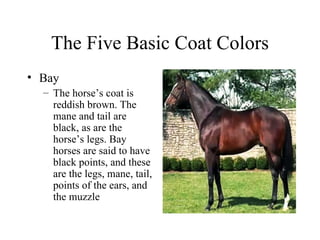
The Five Basic Coat Colors Bay The horse’s coat is reddish brown. The mane and tail are black, as are the horse’s legs. Bay horses are said to have black points, and these are the legs, mane, tail, points of the ears, and the muzzle
The Five Basic Coat Colors Chestnut The horse’s coat is a shade of red. The mane and tail are also chestnut, and may be the same shade as the coat, lighter than the coat (flaxen) or darker than the coat, but NEVER BLACK. (If he had a black mane and tail than he’d be a bay).
The Five Basic Coat Colors White The horse is entirely white, with pink skin. If he has dark skin, he isn’t white, he’s gray Doesn’t really exist (at least not in a surviving specimen) just play along. This “white” color is often a misidentification of color (double crème or maximal white sabino are the most common mistakes)
The Epistatic Modifiers The three epistatic modifiers are gray, roan, and dominant white. (although dominant white is one of the five basic coat colors, the genes that cause it are classed as epistatic modifiers).
The Epistatic Modifiers Gray A progressive silvering after birth. The horse is born one of the other colors and then goes from dark gray to almost white with age. The color may change at various rates depending on the individual No visible difference between heterozygous or homozygous gray
The Epistatic Modifiers Roan White hairs are mixed with hairs of any other color. Roan on bay is red roan, roan on black is blue roan, and roan on chestnut is strawberry roan No visible difference between homozygous and heterozygous roan
The Epistatic Modifiers Dominant white An absence of pigment which causes the fifth basic coat color, white Once more, this doesn’t exist, this is outdated information, but the approved sources have yet to update Just learn it and play along
The Epistatic Modifiers Sabino Not sure whether this is epistatic or a color pattern, I will list it under both Sabino often causes high stockings, loud facial markings and a mixture of white hairs with the colored (though to a lesser degree than a roan, notice the silver look to this horse, his black coloration is silvered by the white hairs)
The Epistatic Modifiers Sabino This is the homozygous form of the sabino gene Causes white pigment with dark eyes Often mistaken for white Note the dark eyes, in a contest you would identify this as white
The Dilutions-Cream Smoky Black Body color ranges from black to this chocolate color. Yellow hairs may be visible on the muzzle and flank. Sometimes misidentified as liver chestnut.
The Dilutions-Cream Buckskin Body color ranges from light yellow to deep gold, with black points. Mane and tail are black and skin is dark. A single dilution of bay
The Dilutions-Cream Palomino Body color ranges from deep gold color to light yellow with white or flaxen mane and tail with brown eyes and dark skin. A single dilution of chestnut
The Dilutions-Cream Smoky Cream Body color is a cream color, often slightly darker than a cremello. Eyes are blue with pink skin. In a contest you would identify this as a cremello, as it is hard to identify the difference between a smoky cream and a cremello without genetic testing.
The Dilutions-Cream Perlino Body ranges from white to cream color with legs a slightly darker shade. Mane and tail are several shades darker than body color. Blue eyes with pink skin. A double dilution of bay
The Dilutions-Cream Cremello Body ranges from white to cream. Mane and tail range from white to cream. Blue eyes and pink skin. A double dilution of chestnut
The Dilutions-Dun Grullo Body is often a mousy color with a dorsal stripe and zebra markings. Mane and tail are black. Eyes and skin are dark. A dilution of black
The Dilutions-Dun Dun Golden body color with a dorsal stripe and zebra markings. Black mane and tail. Dark skin and eyes. Often mistaken for buckskin. LOOK FOR THE DORSAL STRIPE!
The Dilutions-Dun Red dun Often a light reddish, or apricot color with a dorsal stripe. Slightly darker mane and tail with dark eyes and skin. Can be mistaken for chestnut. LOOK FOR THE DORSAL STRIPE!
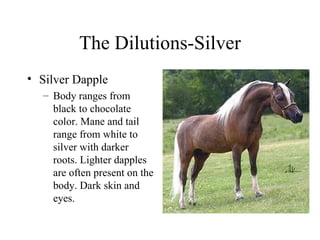
The Dilutions-Silver Silver Dapple Body ranges from black to chocolate color. Mane and tail range from white to silver with darker roots. Lighter dapples are often present on the body. Dark skin and eyes.
The Dilutions-Silver Bay Silver Body is reddish brown, lighter dapples may be present with silver points. Dark skin and eyes.
The Dilutions-Champagne Classic Champagne Body is taupe to dove gray. Darker mane, tail, and points. Amber eyes with pink skin. Reverse dappling may occur.
The Dilutions-Champagne Sable Champagne Body is a sable color with darker mane and tail. Eyes are amber with pink skin. Reverse dappling may occur.
The Dilutions-Champagne Amber Champagne Body ranges from gold to amber. Mane, tail, and points are chocolate colored. Eyes are amber and the skin is pink. Reverse dappling may be present. Look at this horse, he exhibits reverse dappling, where the dapples are darker rather than lighter.
The Dilutions-Champagne Gold Champagne Body is shaded very similar to the palomino. Mane and tail are white. Eyes are amber with pink skin. When identifying between gold champagne and palomino look at the eye and skin color Note that this horse has a strange sheen to his coat. This is common in champagnes, but not exclusive.
Color Patterns Piebald Black with white spots, or vice versa
Color Patterns Skewbald White with any other color
Color Patterns Pinto Large spots (includes Tobiano and Overo)
Color Patterns Tobiano Color on white (white extends over the back)
Color Patterns Overo White on color (white does not cross over the top line)
Color Patterns-Overo Patterns Frame Overo
Color Patterns-Overo Patterns Splash Overo
Color Patterns-Overo Patterns Sabino Overo
Color Patterns Small spots (includes leopard, blanket, snowflake, and roan with appy markings)
Color Patterns-Appaloosa Patterns Blanket
Color Patterns-Appaloosa Patterns Leopard
Color Patterns-Appaloosa Patterns Snowflake
Color Patterns-Appaloosa Patterns Frost
Color Patterns-Appaloosa Patterns Marble
Facial Markings Star White marking approximately between the eyes
Facial Markings Snip White marking on the nose
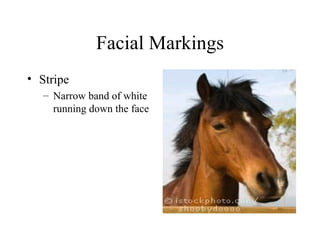
Facial Markings Stripe Narrow band of white running down the face
Facial Markings Blaze White extends almost to the eyes, but not past
Facial Markings Bald face White extends past the eyes
Leg Markings Stocking
Leg Markings Sock
Leg Markings Fetlock
Leg Markings Pastern
Leg Markings Coronet
Leg Markings Distal spots

Colors And Markings

  • 1.
    Colors and MarkingsAnastasia Kellogg
  • 2.
    The Five BasicCoat Colors Black The horse’s coat, mane, and tail are black
  • 3.
    The Five BasicCoat Colors Brown The horse’s coat, mane, and tail are brown. The color may be nearly black, or lighter. Very dark seal brown may be distinguished from black by looking at the muzzle. If there are brown hairs here, the horse is brown.
  • 4.
    The Five BasicCoat Colors Bay The horse’s coat is reddish brown. The mane and tail are black, as are the horse’s legs. Bay horses are said to have black points, and these are the legs, mane, tail, points of the ears, and the muzzle
  • 5.
    The Five BasicCoat Colors Chestnut The horse’s coat is a shade of red. The mane and tail are also chestnut, and may be the same shade as the coat, lighter than the coat (flaxen) or darker than the coat, but NEVER BLACK. (If he had a black mane and tail than he’d be a bay).
  • 6.
    The Five BasicCoat Colors White The horse is entirely white, with pink skin. If he has dark skin, he isn’t white, he’s gray Doesn’t really exist (at least not in a surviving specimen) just play along. This “white” color is often a misidentification of color (double crème or maximal white sabino are the most common mistakes)
  • 7.
    The Epistatic ModifiersThe three epistatic modifiers are gray, roan, and dominant white. (although dominant white is one of the five basic coat colors, the genes that cause it are classed as epistatic modifiers).
  • 8.
    The Epistatic ModifiersGray A progressive silvering after birth. The horse is born one of the other colors and then goes from dark gray to almost white with age. The color may change at various rates depending on the individual No visible difference between heterozygous or homozygous gray
  • 9.
    The Epistatic ModifiersRoan White hairs are mixed with hairs of any other color. Roan on bay is red roan, roan on black is blue roan, and roan on chestnut is strawberry roan No visible difference between homozygous and heterozygous roan
  • 10.
    The Epistatic ModifiersDominant white An absence of pigment which causes the fifth basic coat color, white Once more, this doesn’t exist, this is outdated information, but the approved sources have yet to update Just learn it and play along
  • 11.
    The Epistatic ModifiersSabino Not sure whether this is epistatic or a color pattern, I will list it under both Sabino often causes high stockings, loud facial markings and a mixture of white hairs with the colored (though to a lesser degree than a roan, notice the silver look to this horse, his black coloration is silvered by the white hairs)
  • 12.
    The Epistatic ModifiersSabino This is the homozygous form of the sabino gene Causes white pigment with dark eyes Often mistaken for white Note the dark eyes, in a contest you would identify this as white
  • 13.
    The Dilutions-Cream SmokyBlack Body color ranges from black to this chocolate color. Yellow hairs may be visible on the muzzle and flank. Sometimes misidentified as liver chestnut.
  • 14.
    The Dilutions-Cream BuckskinBody color ranges from light yellow to deep gold, with black points. Mane and tail are black and skin is dark. A single dilution of bay
  • 15.
    The Dilutions-Cream PalominoBody color ranges from deep gold color to light yellow with white or flaxen mane and tail with brown eyes and dark skin. A single dilution of chestnut
  • 16.
    The Dilutions-Cream SmokyCream Body color is a cream color, often slightly darker than a cremello. Eyes are blue with pink skin. In a contest you would identify this as a cremello, as it is hard to identify the difference between a smoky cream and a cremello without genetic testing.
  • 17.
    The Dilutions-Cream PerlinoBody ranges from white to cream color with legs a slightly darker shade. Mane and tail are several shades darker than body color. Blue eyes with pink skin. A double dilution of bay
  • 18.
    The Dilutions-Cream CremelloBody ranges from white to cream. Mane and tail range from white to cream. Blue eyes and pink skin. A double dilution of chestnut
  • 19.
    The Dilutions-Dun GrulloBody is often a mousy color with a dorsal stripe and zebra markings. Mane and tail are black. Eyes and skin are dark. A dilution of black
  • 20.
    The Dilutions-Dun DunGolden body color with a dorsal stripe and zebra markings. Black mane and tail. Dark skin and eyes. Often mistaken for buckskin. LOOK FOR THE DORSAL STRIPE!
  • 21.
    The Dilutions-Dun Reddun Often a light reddish, or apricot color with a dorsal stripe. Slightly darker mane and tail with dark eyes and skin. Can be mistaken for chestnut. LOOK FOR THE DORSAL STRIPE!
  • 22.
    The Dilutions-Silver SilverDapple Body ranges from black to chocolate color. Mane and tail range from white to silver with darker roots. Lighter dapples are often present on the body. Dark skin and eyes.
  • 23.
    The Dilutions-Silver BaySilver Body is reddish brown, lighter dapples may be present with silver points. Dark skin and eyes.
  • 24.
    The Dilutions-Champagne ClassicChampagne Body is taupe to dove gray. Darker mane, tail, and points. Amber eyes with pink skin. Reverse dappling may occur.
  • 25.
    The Dilutions-Champagne SableChampagne Body is a sable color with darker mane and tail. Eyes are amber with pink skin. Reverse dappling may occur.
  • 26.
    The Dilutions-Champagne AmberChampagne Body ranges from gold to amber. Mane, tail, and points are chocolate colored. Eyes are amber and the skin is pink. Reverse dappling may be present. Look at this horse, he exhibits reverse dappling, where the dapples are darker rather than lighter.
  • 27.
    The Dilutions-Champagne GoldChampagne Body is shaded very similar to the palomino. Mane and tail are white. Eyes are amber with pink skin. When identifying between gold champagne and palomino look at the eye and skin color Note that this horse has a strange sheen to his coat. This is common in champagnes, but not exclusive.
  • 28.
    Color Patterns PiebaldBlack with white spots, or vice versa
  • 29.
    Color Patterns SkewbaldWhite with any other color
  • 30.
    Color Patterns PintoLarge spots (includes Tobiano and Overo)
  • 31.
    Color Patterns TobianoColor on white (white extends over the back)
  • 32.
    Color Patterns OveroWhite on color (white does not cross over the top line)
  • 33.
  • 34.
  • 35.
  • 36.
    Color Patterns Smallspots (includes leopard, blanket, snowflake, and roan with appy markings)
  • 37.
  • 38.
  • 39.
  • 40.
  • 41.
  • 42.
    Facial Markings StarWhite marking approximately between the eyes
  • 43.
    Facial Markings SnipWhite marking on the nose
  • 44.
    Facial Markings StripeNarrow band of white running down the face
  • 45.
    Facial Markings BlazeWhite extends almost to the eyes, but not past
  • 46.
    Facial Markings Baldface White extends past the eyes
  • 47.
  • 48.
  • 49.
  • 50.
  • 51.
  • 52.