EQUINE MEDICINE
Foaling and Foal Care
Foal Development
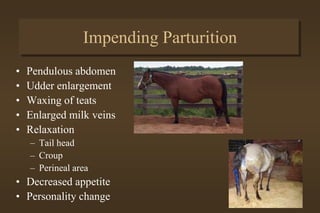
Impending Parturition
• Pendulous abdomen
• Udder enlargement
• Waxing of teats
• Enlarged milk veins
• Relaxation
– Tail head
– Croup
– Perineal area
• Decreased appetite
• Personality change
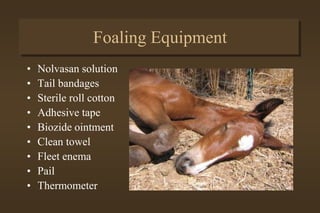
Foaling Equipment
• Nolvasan solution
• Tail bandages
• Sterile roll cotton
• Adhesive tape
• Biozide ointment
• Clean towel
• Fleet enema
• Pail
• Thermometer
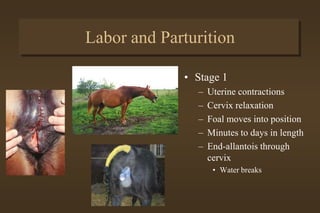
Labor and Parturition
• Stage 1
– Uterine contractions
– Cervix relaxation
– Foal moves into position
– Minutes to days in length
– End-allantois through
cervix
• Water breaks
Labor and Parturition
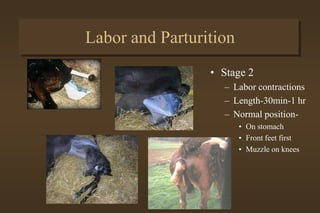
• Stage 2
– Labor contractions
– Length-30min-1 hr
– Normal position-
• On stomach
• Front feet first
• Muzzle on knees
Labor and Parturition
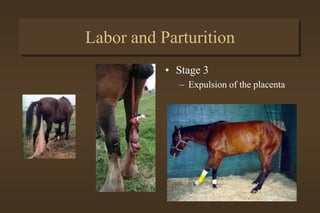
• Stage 3
– Expulsion of the placenta
Postpartum
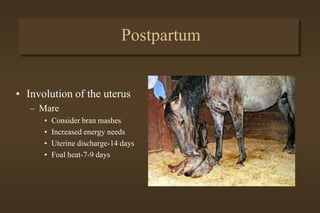
• Involution of the uterus
– Mare
• Consider bran mashes
• Increased energy needs
• Uterine discharge-14 days
• Foal heat-7-9 days
Postpartum
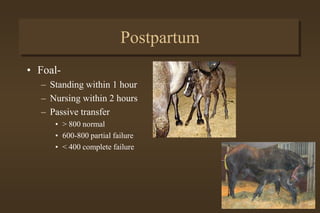
• Foal-
– Standing within 1 hour
– Nursing within 2 hours
– Passive transfer
• > 800 normal
• 600-800 partial failure
• < 400 complete failure
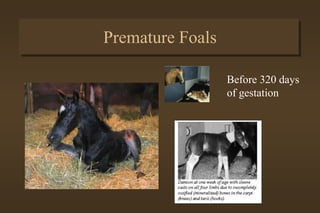
Premature Foals
Before 320 days
of gestation
Foal Care
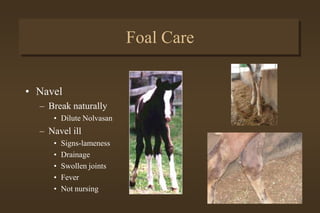
• Navel
– Break naturally
• Dilute Nolvasan
– Navel ill
• Signs-lameness
• Drainage
• Swollen joints
• Fever
• Not nursing
Foal Care
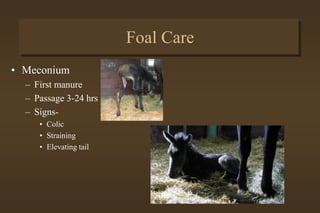
• Meconium
– First manure
– Passage 3-24 hrs
– Signs-
• Colic
• Straining
• Elevating tail
Foal Care
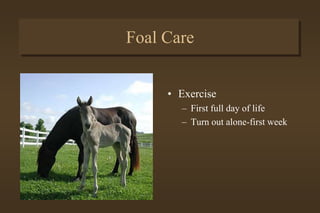
• Exercise
– First full day of life
– Turn out alone-first week
Foal Care
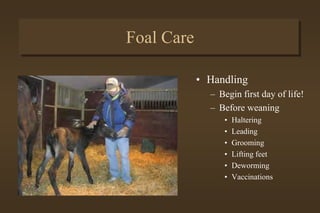
• Handling
– Begin first day of life!
– Before weaning
• Haltering
• Leading
• Grooming
• Lifting feet
• Deworming
• Vaccinations
Foal Care
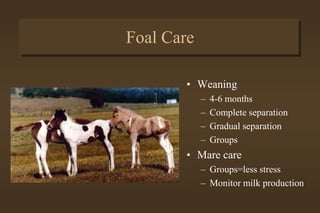
• Weaning
– 4-6 months
– Complete separation
– Gradual separation
– Groups
• Mare care
– Groups=less stress
– Monitor milk production
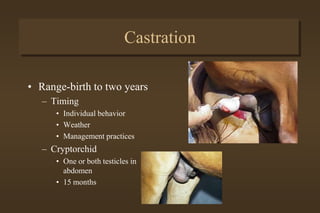
Castration
• Range-birth to two years
– Timing
• Individual behavior
• Weather
• Management practices
– Cryptorchid
• One or both testicles in
abdomen
• 15 months

Foaling & Foal Care