Compiled & Presented by: Ar.A.Purushothaman Arumugam M.Arch., CA, AIIA, Principal Architect - D2 Studios.
Color / Colour is the visual perceptual property corresponding in humans
to the categories called red, blue, yellow, green and others.
Color derives from the spectrum of light (distribution of light power versus
wavelength) interacting in the eye with the spectral sensitivities of the light
receptors.
Ar.A.Purushothaman Arumugam M.Arch., CA, AIIA, Principal Architect - D2 Studios.
Color categories and physical specifications of color are also associated with objects, materials, light sources, etc.,
based on their physical properties such as light absorption, reflection, or emission spectra.
Because perception of color stems from the
varying spectral sensitivity of different types of
cone cells in the retina to different parts of the
spectrum, colors may be defined and quantified
by the degree to which they stimulate these cells.
Ar.A.Purushothaman Arumugam M.Arch., CA, AIIA, Principal Architect - D2 Studios.
Primary Colors - These are colors that cannot be created through the mixing
of other colors. They are colors in their own right. The three primary colors can
be seen below RED - YELLOW - BLUE.
Ar.A.Purushothaman Arumugam M.Arch., CA, AIIA, Principal Architect - D2 Studios.
Primary colors can be mixed together to produce SECONDARY
COLOURS. Yellow mixes with blue in equal quantity will gives you
green
Ar.A.Purushothaman Arumugam M.Arch., CA, AIIA, Principal Architect - D2 Studios.
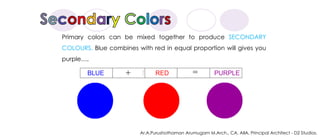
Primary colors can be mixed together to produce SECONDARY
COLOURS. Blue combines with red in equal proportion will gives you
purple…,
Ar.A.Purushothaman Arumugam M.Arch., CA, AIIA, Principal Architect - D2 Studios.
Primary colors can be mixed together to produce SECONDARY
COLOURS. Red combines with yellow in equal proportion will gives
you orange…,
Ar.A.Purushothaman Arumugam M.Arch., CA, AIIA, Principal Architect - D2 Studios.
Tertiary colors are combinations of primary and secondary
colors.
There are six tertiary colors; red-orange, yellow-orange, yellow-
green, blue-green, blue-violet, and red-violet.
An easy way to remember these names is to place the primary
name before the other color.
So the tertiary color produced when mixing the primary color
blue with the secondary color green, is called 'blue-green'.
Ar.A.Purushothaman Arumugam M.Arch., CA, AIIA, Principal Architect - D2 Studios.
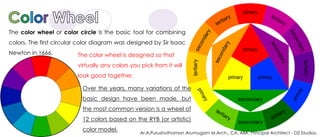
The color wheel or color circle is the basic tool for combining
colors. The first circular color diagram was designed by Sir Isaac
Newton in 1666. The color wheel is designed so that
virtually any colors you pick from it will
look good together.
Over the years, many variations of the
basic design have been made, but
the most common version is a wheel of
12 colors based on the RYB (or artistic)
color model.
Ar.A.Purushothaman Arumugam M.Arch., CA, AIIA, Principal Architect - D2 Studios.
Tints are light values that are made by mixing a color with white. For example, pink
is a tint of red, and light blue is a tint of blue.
Shades are dark values that are made by mixing a color with black. Maroon is a
shade of red, and navy is a shade of blue.
Ar.A.Purushothaman Arumugam M.Arch., CA, AIIA, Principal Architect - D2 Studios.
Tones nothing but the true colors and if gray is added, the result is a
different tone.
The given example clearly shows the tonal variations and colors will lose
its nature that’s why it looks peculiar.
Ar.A.Purushothaman Arumugam M.Arch., CA, AIIA, Principal Architect - D2 Studios.
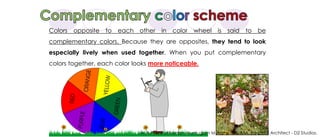
Colors opposite to each other in color wheel is said to be
complementary colors. Because they are opposites, they tend to look
especially lively when used together. When you put complementary
colors together, each color looks more noticeable.
Ar.A.Purushothaman Arumugam M.Arch., CA, AIIA, Principal Architect - D2 Studios.
Analogous colors sit next to each other on the color wheel. They tend
to look pleasant together because they are closely related.
Ar.A.Purushothaman Arumugam M.Arch., CA, AIIA, Principal Architect - D2 Studios.
Neutral colors don't usually show up on the color wheel. Neutral colors include
black, white, gray, and sometimes brown and beige. They are sometimes
called “earth tones.”
Ar.A.Purushothaman Arumugam M.Arch., CA, AIIA, Principal Architect - D2 Studios.
Warm colors are made with red, orange, yellow, or some
combination of these. Warm colors tend to make you think of sunlight
and warmth.
Ar.A.Purushothaman Arumugam M.Arch., CA, AIIA, Principal Architect - D2 Studios.
Cool colors are made with blue, green, purple, or some combination
of these. Cool colors might make you think of cool and peaceful
things, like winter skies and still ponds.
Ar.A.Purushothaman Arumugam M.Arch., CA, AIIA, Principal Architect - D2 Studios.
Triadic
A triadic color scheme uses colors that are evenly spaced around the color wheel.
Triadic color schemes tend to be quite vibrant, even if you use pale or unsaturated
versions of your hues.
To use a triadic harmony successfully, the colors should be carefully balanced - let one
color dominate and use the two others for accent.
Ar.A.Purushothaman Arumugam M.Arch., CA, AIIA, Principal Architect - D2 Studios.
Split
The split-complementary color scheme is a variation of the complementary color scheme.
In addition to the base color, it uses the two colors adjacent to its complement.
This color scheme has the same strong visual contrast as the complementary color scheme, but has
less tension.
The split-complimentary color scheme is often a good choice for beginners, because it is difficult to
mess up. Ar.A.Purushothaman Arumugam M.Arch., CA, AIIA, Principal Architect - D2 Studios.
Colors red yellow and green create a harmonious design, regardless of
whether this combination fits into a technical formula for color harmony.
Ar.A.Purushothaman Arumugam M.Arch., CA, AIIA, Principal Architect - D2 Studios.
How color behaves in relation to other colors and
shapes is a complex area of color theory. Compare
the contrast effects of different color backgrounds for
the same red square.
Observing the effects colors have on each other is the
starting point for understanding the relativity of color. The
relationship of values, saturations and the warmth or
coolness of respective hues can cause noticeable
differences in our perception of color.
Ar.A.Purushothaman Arumugam M.Arch., CA, AIIA, Principal Architect - D2 Studios.
I
N
D
I
A
Ar.A.Purushothaman Arumugam M.Arch., CA, AIIA, Principal Architect - D2 Studios.
I
N
D
I
A
Ar.A.Purushothaman Arumugam M.Arch., CA, AIIA, Principal Architect - D2 Studios.
I
N
D
I
A
Ar.A.Purushothaman Arumugam M.Arch., CA, AIIA, Principal Architect - D2 Studios.
………..Ar.A.Purushothaman Arumugam M.Arch., CA, AIIA, Principal Architect - D2 Studios.

Colors

  • 1.
    Compiled & Presentedby: Ar.A.Purushothaman Arumugam M.Arch., CA, AIIA, Principal Architect - D2 Studios.
  • 2.
    Color / Colouris the visual perceptual property corresponding in humans to the categories called red, blue, yellow, green and others. Color derives from the spectrum of light (distribution of light power versus wavelength) interacting in the eye with the spectral sensitivities of the light receptors. Ar.A.Purushothaman Arumugam M.Arch., CA, AIIA, Principal Architect - D2 Studios.
  • 3.
    Color categories andphysical specifications of color are also associated with objects, materials, light sources, etc., based on their physical properties such as light absorption, reflection, or emission spectra. Because perception of color stems from the varying spectral sensitivity of different types of cone cells in the retina to different parts of the spectrum, colors may be defined and quantified by the degree to which they stimulate these cells. Ar.A.Purushothaman Arumugam M.Arch., CA, AIIA, Principal Architect - D2 Studios.
  • 4.
    Primary Colors -These are colors that cannot be created through the mixing of other colors. They are colors in their own right. The three primary colors can be seen below RED - YELLOW - BLUE. Ar.A.Purushothaman Arumugam M.Arch., CA, AIIA, Principal Architect - D2 Studios.
  • 5.
    Primary colors canbe mixed together to produce SECONDARY COLOURS. Yellow mixes with blue in equal quantity will gives you green Ar.A.Purushothaman Arumugam M.Arch., CA, AIIA, Principal Architect - D2 Studios.
  • 6.
    Primary colors canbe mixed together to produce SECONDARY COLOURS. Blue combines with red in equal proportion will gives you purple…, Ar.A.Purushothaman Arumugam M.Arch., CA, AIIA, Principal Architect - D2 Studios.
  • 7.
    Primary colors canbe mixed together to produce SECONDARY COLOURS. Red combines with yellow in equal proportion will gives you orange…, Ar.A.Purushothaman Arumugam M.Arch., CA, AIIA, Principal Architect - D2 Studios.
  • 8.
    Ar.A.Purushothaman Arumugam M.Arch.,CA, AIIA, Principal Architect - D2 Studios.
  • 9.
    Tertiary colors arecombinations of primary and secondary colors. There are six tertiary colors; red-orange, yellow-orange, yellow- green, blue-green, blue-violet, and red-violet. An easy way to remember these names is to place the primary name before the other color. So the tertiary color produced when mixing the primary color blue with the secondary color green, is called 'blue-green'. Ar.A.Purushothaman Arumugam M.Arch., CA, AIIA, Principal Architect - D2 Studios.
  • 10.
    The color wheelor color circle is the basic tool for combining colors. The first circular color diagram was designed by Sir Isaac Newton in 1666. The color wheel is designed so that virtually any colors you pick from it will look good together. Over the years, many variations of the basic design have been made, but the most common version is a wheel of 12 colors based on the RYB (or artistic) color model. Ar.A.Purushothaman Arumugam M.Arch., CA, AIIA, Principal Architect - D2 Studios.
  • 11.
    Tints are lightvalues that are made by mixing a color with white. For example, pink is a tint of red, and light blue is a tint of blue. Shades are dark values that are made by mixing a color with black. Maroon is a shade of red, and navy is a shade of blue. Ar.A.Purushothaman Arumugam M.Arch., CA, AIIA, Principal Architect - D2 Studios.
  • 12.
    Tones nothing butthe true colors and if gray is added, the result is a different tone. The given example clearly shows the tonal variations and colors will lose its nature that’s why it looks peculiar. Ar.A.Purushothaman Arumugam M.Arch., CA, AIIA, Principal Architect - D2 Studios.
  • 13.
    Colors opposite toeach other in color wheel is said to be complementary colors. Because they are opposites, they tend to look especially lively when used together. When you put complementary colors together, each color looks more noticeable. Ar.A.Purushothaman Arumugam M.Arch., CA, AIIA, Principal Architect - D2 Studios.
  • 14.
    Analogous colors sitnext to each other on the color wheel. They tend to look pleasant together because they are closely related. Ar.A.Purushothaman Arumugam M.Arch., CA, AIIA, Principal Architect - D2 Studios.
  • 15.
    Neutral colors don'tusually show up on the color wheel. Neutral colors include black, white, gray, and sometimes brown and beige. They are sometimes called “earth tones.” Ar.A.Purushothaman Arumugam M.Arch., CA, AIIA, Principal Architect - D2 Studios.
  • 16.
    Warm colors aremade with red, orange, yellow, or some combination of these. Warm colors tend to make you think of sunlight and warmth. Ar.A.Purushothaman Arumugam M.Arch., CA, AIIA, Principal Architect - D2 Studios.
  • 17.
    Cool colors aremade with blue, green, purple, or some combination of these. Cool colors might make you think of cool and peaceful things, like winter skies and still ponds. Ar.A.Purushothaman Arumugam M.Arch., CA, AIIA, Principal Architect - D2 Studios.
  • 18.
    Triadic A triadic colorscheme uses colors that are evenly spaced around the color wheel. Triadic color schemes tend to be quite vibrant, even if you use pale or unsaturated versions of your hues. To use a triadic harmony successfully, the colors should be carefully balanced - let one color dominate and use the two others for accent. Ar.A.Purushothaman Arumugam M.Arch., CA, AIIA, Principal Architect - D2 Studios.
  • 19.
    Split The split-complementary colorscheme is a variation of the complementary color scheme. In addition to the base color, it uses the two colors adjacent to its complement. This color scheme has the same strong visual contrast as the complementary color scheme, but has less tension. The split-complimentary color scheme is often a good choice for beginners, because it is difficult to mess up. Ar.A.Purushothaman Arumugam M.Arch., CA, AIIA, Principal Architect - D2 Studios.
  • 20.
    Colors red yellowand green create a harmonious design, regardless of whether this combination fits into a technical formula for color harmony. Ar.A.Purushothaman Arumugam M.Arch., CA, AIIA, Principal Architect - D2 Studios.
  • 21.
    How color behavesin relation to other colors and shapes is a complex area of color theory. Compare the contrast effects of different color backgrounds for the same red square. Observing the effects colors have on each other is the starting point for understanding the relativity of color. The relationship of values, saturations and the warmth or coolness of respective hues can cause noticeable differences in our perception of color. Ar.A.Purushothaman Arumugam M.Arch., CA, AIIA, Principal Architect - D2 Studios.
  • 22.
    Ar.A.Purushothaman Arumugam M.Arch.,CA, AIIA, Principal Architect - D2 Studios.
  • 23.
    Ar.A.Purushothaman Arumugam M.Arch.,CA, AIIA, Principal Architect - D2 Studios.
  • 24.
    Ar.A.Purushothaman Arumugam M.Arch.,CA, AIIA, Principal Architect - D2 Studios.
  • 25.
    Ar.A.Purushothaman Arumugam M.Arch.,CA, AIIA, Principal Architect - D2 Studios.
  • 26.
    Ar.A.Purushothaman Arumugam M.Arch.,CA, AIIA, Principal Architect - D2 Studios.
  • 27.
    Ar.A.Purushothaman Arumugam M.Arch.,CA, AIIA, Principal Architect - D2 Studios.
  • 28.
    I N D I A Ar.A.Purushothaman Arumugam M.Arch.,CA, AIIA, Principal Architect - D2 Studios.
  • 29.
    I N D I A Ar.A.Purushothaman Arumugam M.Arch.,CA, AIIA, Principal Architect - D2 Studios.
  • 30.
    I N D I A Ar.A.Purushothaman Arumugam M.Arch.,CA, AIIA, Principal Architect - D2 Studios.
  • 31.
    ………..Ar.A.Purushothaman Arumugam M.Arch.,CA, AIIA, Principal Architect - D2 Studios.