International Research Journal of Engineering and Technology (IRJET) e-ISSN: 2395 -0056
Volume: 04 Issue: 3 | Mar -2017 www.irjet.net p-ISSN: 2395-0072
© 2017, IRJET | Impact Factor value: 5.181 | ISO 9001:2008 Certified Journal | Page 484
Color Code PIN Authentication System Using
Multi-TouchTechnology
K. Abinaya1, T. Pavithra2, P. Divya3, S.Hema malini4
Mrs. S. Hema malini, Associate Professor, Dept. of Computer Science & Engineering, Panimalar Institute of
Technology, Chennai, Tamilnadu, India
------------------------------------------------------------------------------------------------------------------------------------------------
ABSTRACT: Users typically use direct PIN entry
method for multiple system in numerous session.
Direct PIN entries are highly susceptible to shoulder
surfing attacks as attackers can effectively observe
PIN entry with concealed cameras and they can use it
illegally. Indirect PIN entry method proposed as
countermeasures to this issues. To achieve this BW
method is used with MULTI-TOUCH technique.
Random four colors are used for indirect PIN entry
method and attackers find it difficult due to the
probability of finding PIN is very complex. In addition
to colors, pattern are also used like dotted, diagonal
strips to help visually challenged persons. This
establish a secure transaction between the mobile
app and server with improved BW method. This
method prevents the transaction from a well-trained
perceptual grouper to crack the PIN digit entered by
the user in a conventional way.
KEY WORDS- PIN, color, attackers, server,
transaction, shoulder-surfing.
1. INTRODUCTION
A. PIN ENTRY SECURITY PROBLEMS
Personal identification numbers (PIN), typically
constructed and memorized, is widely used as
numerical passwords for user authentication or
various unlocking purposes.
Unexpectedly, when the user enters the PIN
directly in public places it may lead to shoulder-
surfing attack. The people nearby may or can
observe the PIN entry with or without concealed
cameras. The camera-based shoulder-surfing leads
to more security issues. When the attackers
observes the PIN entry using the cameras, the
entries are noted perfectly though they are in long
range. The camera-based shoulder-surfing is strong
enough to note the PIN entry, when the user enters
the PIN multiple times. Thus the attackers can
easily use the PIN entries illegally.
B. IMPROVED PIN ENTRY METHOD
Here indirect way of PIN entry method is used
by which security is enhanced. Instead of standard
PIN numbers, the color code with multi-touch
technology is used to enter the PIN in public places.
The multi-touch technology uses four standard
colors for the PIN entry purposes. The colors used
are standard with the reputation of colors in the
keypad.
2. RELATED WORK
[1] Designing Leakage-Resilient Password
Entry on Touchscreen Mobile Devices by Qiang
Yan, Jin Han, Robert H.Deng
Touchscreen devices are fast moving
commodities since the user can use various services
at any time anywhere. To avoid the unauthorized
attack it uses the passwords for user
authentication. Even though it uses passwords
some passwords are poor in providing the security.
Mostly the leakage is more in computer systems
than in mobile devices. Since the features like touch
screen is not present in basic mobiles they are used
in less. In this method cover pad provides a security
in this devices. This works with the conditions like
time pressure, distraction, mental workload. This
International Research Journal of Engineering and Technology (IRJET) e-ISSN: 2395 -0056
Volume: 04 Issue: 3 | Mar -2017 www.irjet.net p-ISSN: 2395-0072
© 2017, IRJET | Impact Factor value: 5.181 | ISO 9001:2008 Certified Journal | Page 485
condition has the common password. Test
conditions are checked by user and the process is
proceeded.
[2] On Limitations of Designing Leakage-
Resilient Password Systems: Attacks, Principles
and Usability by Qiang Yan, Jin Han, Yingjiu Li,
Robert H. Deng[2]
The design of leakage-resilient password
systems (LRPSes) in the absence of trusted devices
remains a challenging problem today despite two
decades of intensive re- search in the security
community. The inherent tradeoff between security
and usability in designing LRPS is investigated.
Most of the existing LRPS systems are subject to
two types of generic attacks - brute force and
statistical attacks, whose power has been
underestimated in the literature. And in order to
defend against these two generic attacks, we
introduce five design principles that are necessary
to achieve leakage resilience in the absence of
trusted devices. And also to get better understand
about tradeoff between security and usability of
LRPS. By decomposing the authentication process
of existing LRPS systems into atomic cognitive
operations in psychology, it show that a secure
LRPS in practical settings always imposes a
considerable amount of cognitive workload on its
users are proposed.
[3] Breaking Undercover: Exploiting Design
Flaws and Nonuniform Human Behavior by Toni
Perkovi , Asma Mumtaz ,Yousra Javed[3]
Two attacks on Undercover, a human
authentication scheme against passive observers.
The first attack exploits non-uniform human
behavior in responding to authentication
challenges and the second one is based on
information leaked from authentication challenges
or responses visible to the attacker. Theoretical and
experimental analyses show that both attacks can
reveal the user’s password with high probability
with O(10) observed login sessions. And also
proposed some enhancements to make Undercover
secure against the attacks . First, it reemphasizes
the principle of “devil is in details” for the design of
security-related human-computer interface.
Secondly, it reveals a subtle relationship between
security and usability .To design a secure human-
computer interface, designers should pay special
attention to possible negative influence of any
detail of the interface including how human users
interact with the system.
[4] Multi-touch Authentication on Tabletops by
David Kim, Paul Dunphy, Pim Briggs[4]
The introduction of the tabletops has made
the user to develop the security system in the
devices. The user authentication is based on
something you know but it is overcome to avoid
shoulder surfing. In this paper to avoid shouder
surfing multi touch system is avoided and number
of novel laptops is used. So improved system like
the PIN and graphical passwords is used in this
paper. The user can make the system convinent to
the access purpose by creating the PIN and the
password.
[5] ColorPIN- Securing PIN Entry Through
Indirect Input by Alexander De Luca, Katja
Hertzschuch, Heinrich Hussmann
Automated Teller Machine (ATM) thefts are
large in number now a days. The main reason for
this type of theft increasing is that the PIN number
used is itself not providing a improved security
mechanism. The security is maintained only by the
user. Its user’s duty to maintain the PIN security.
to overcome this color PIN authentication is the
specified new way. The color PIN is based on one-
to-one relationship which uses the number of clicks
to use them. The user should know that color PIN is
more secure than the standard PIN mechanism.
3. COLOR CODE PIN ENTRY SYSTEM
A. Concept
In this paper, a secured PIN authentication is
done through color keypad in various devices. The
proposed algorithm uses the generated four digit
PIN in which each digit block is separated with the
combination of two colors to prevent shoulder
International Research Journal of Engineering and Technology (IRJET) e-ISSN: 2395 -0056
Volume: 04 Issue: 3 | Mar -2017 www.irjet.net p-ISSN: 2395-0072
© 2017, IRJET | Impact Factor value: 5.181 | ISO 9001:2008 Certified Journal | Page 486
surfing attack by extracting PIN digit after all user
iterations got completed.
In this method, the single numeric digit is
divided into two different color, in which the user
can choose either of two colors that fulfils his or her
PIN digit key in each round. In this session, totally
four rounds are executed for PIN authentication
where each digit is authenticated four times
individually to enhance security in mobile banking.
B. User Registration
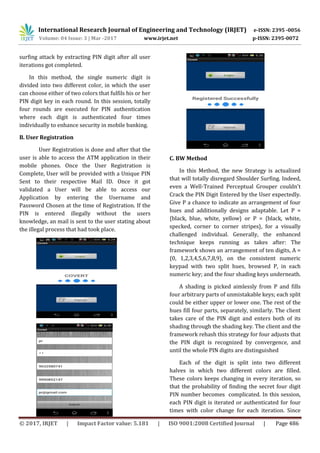
User Registration is done and after that the
user is able to access the ATM application in their
mobile phones. Once the User Registration is
Complete, User will be provided with a Unique PIN
Sent to their respective Mail ID. Once it got
validated a User will be able to access our
Application by entering the Username and
Password Chosen at the time of Registration. If the
PIN is entered illegally without the users
knowledge, an mail is sent to the user stating about
the illegal process that had took place.
C. BW Method
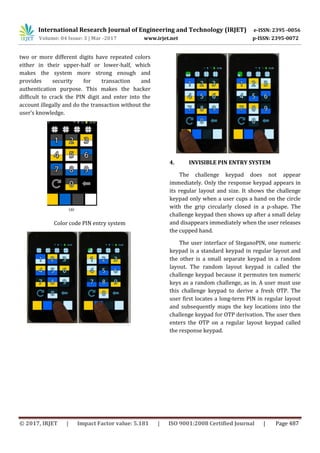
In this Method, the new Strategy is actualized
that will totally disregard Shoulder Surfing. Indeed,
even a Well-Trained Perceptual Grouper couldn't
Crack the PIN Digit Entered by the User expectedly.
Give P a chance to indicate an arrangement of four
hues and additionally designs adaptable. Let P =
{black, blue, white, yellow} or P = {black, white,
specked, corner to corner stripes}, for a visually
challenged individual. Generally, the enhanced
technique keeps running as takes after: The
framework shows an arrangement of ten digits, A =
{0, 1,2,3,4,5,6,7,8,9}, on the consistent numeric
keypad with two split hues, browsed P, in each
numeric key; and the four shading keys underneath.
A shading is picked aimlessly from P and fills
four arbitrary parts of unmistakable keys; each split
could be either upper or lower one. The rest of the
hues fill four parts, separately, similarly. The client
takes care of the PIN digit and enters both of its
shading through the shading key. The client and the
framework rehash this strategy for four adjusts that
the PIN digit is recognized by convergence, and
until the whole PIN digits are distinguished
Each of the digit is split into two different
halves in which two different colors are filled.
These colors keeps changing in every iteration, so
that the probability of finding the secret four digit
PIN number becomes complicated. In this session,
each PIN digit is iterated or authenticated for four
times with color change for each iteration. Since
International Research Journal of Engineering and Technology (IRJET) e-ISSN: 2395 -0056
Volume: 04 Issue: 3 | Mar -2017 www.irjet.net p-ISSN: 2395-0072
© 2017, IRJET | Impact Factor value: 5.181 | ISO 9001:2008 Certified Journal | Page 487
two or more different digits have repeated colors
either in their upper-half or lower-half, which
makes the system more strong enough and
provides security for transaction and
authentication purpose. This makes the hacker
difficult to crack the PIN digit and enter into the
account illegally and do the transaction without the
user’s knowledge.
Color code PIN entry system
4. INVISIBLE PIN ENTRY SYSTEM
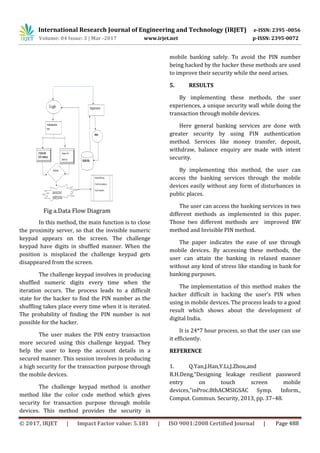
The challenge keypad does not appear
immediately. Only the response keypad appears in
its regular layout and size. It shows the challenge
keypad only when a user cups a hand on the circle
with the grip circularly closed in a ρ-shape. The
challenge keypad then shows up after a small delay
and disappears immediately when the user releases
the cupped hand.
The user interface of SteganoPIN, one numeric
keypad is a standard keypad in regular layout and
the other is a small separate keypad in a random
layout. The random layout keypad is called the
challenge keypad because it permutes ten numeric
keys as a random challenge, as in. A user must use
this challenge keypad to derive a fresh OTP. The
user first locates a long-term PIN in regular layout
and subsequently maps the key locations into the
challenge keypad for OTP derivation. The user then
enters the OTP on a regular layout keypad called
the response keypad.
International Research Journal of Engineering and Technology (IRJET) e-ISSN: 2395 -0056
Volume: 04 Issue: 3 | Mar -2017 www.irjet.net p-ISSN: 2395-0072
© 2017, IRJET | Impact Factor value: 5.181 | ISO 9001:2008 Certified Journal | Page 488
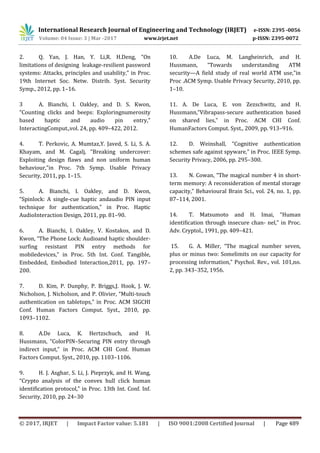
Fig a.Data Flow Diagram
In this method, the main function is to close
the proximity server, so that the invisible numeric
keypad appears on the screen. The challenge
keypad have digits in shuffled manner. When the
position is misplaced the challenge keypad gets
disappeared from the screen.
The challenge keypad involves in producing
shuffled numeric digits every time when the
iteration occurs. The process leads to a difficult
state for the hacker to find the PIN number as the
shuffling takes place every time when it is iterated.
The probability of finding the PIN number is not
possible for the hacker.
The user makes the PIN entry transaction
more secured using this challenge keypad. They
help the user to keep the account details in a
secured manner. This session involves in producing
a high security for the transaction purpose through
the mobile devices.
The challenge keypad method is another
method like the color code method which gives
security for transaction purpose through mobile
devices. This method provides the security in
mobile banking safely. To avoid the PIN number
being hacked by the hacker these methods are used
to improve their security while the need arises.
5. RESULTS
By implementing these methods, the user
experiences, a unique security wall while doing the
transaction through mobile devices.
Here general banking services are done with
greater security by using PIN authentication
method. Services like money transfer, deposit,
withdraw, balance enquiry are made with intent
security.
By implementing this method, the user can
access the banking services through the mobile
devices easily without any form of disturbances in
public places.
The user can access the banking services in two
different methods as implemented in this paper.
Those two different methods are improved BW
method and Invisible PIN method.
The paper indicates the ease of use through
mobile devices. By accessing these methods, the
user can attain the banking in relaxed manner
without any kind of stress like standing in bank for
banking purposes.
The implementation of this method makes the
hacker difficult in hacking the user’s PIN when
using in mobile devices. The process leads to a good
result which shows about the development of
digital India.
It is 24*7 hour process, so that the user can use
it efficiently.
REFERENCE
1. Q.Yan,J.Han,Y.Li,J.Zhou,and
R.H.Deng,“Designing leakage resilient password
entry on touch screen mobile
devices,”inProc.8thACMSIGSAC Symp. Inform.,
Comput. Commun. Security, 2013, pp. 37–48.
International Research Journal of Engineering and Technology (IRJET) e-ISSN: 2395 -0056
Volume: 04 Issue: 3 | Mar -2017 www.irjet.net p-ISSN: 2395-0072
© 2017, IRJET | Impact Factor value: 5.181 | ISO 9001:2008 Certified Journal | Page 489
2. Q. Yan, J. Han, Y. Li,R. H.Deng, “On
limitations of designing leakage-resilient password
systems: Attacks, principles and usability,” in Proc.
19th Internet Soc. Netw. Distrib. Syst. Security
Symp., 2012, pp. 1–16.
3 A. Bianchi, I. Oakley, and D. S. Kwon,
“Counting clicks and beeps: Exploringnumerosity
based haptic and audio pin entry,”
InteractingComput.,vol. 24, pp. 409–422, 2012.
4. T. Perkovic, A. Mumtaz,Y. Javed, S. Li, S. A.
Khayam, and M. Cagalj, “Breaking undercover:
Exploiting design flaws and non uniform human
behaviour,”in Proc. 7th Symp. Usable Privacy
Security, 2011, pp. 1–15.
5. A. Bianchi, I. Oakley, and D. Kwon,
“Spinlock: A single-cue haptic andaudio PIN input
technique for authentication,” in Proc. Haptic
AudioInteraction Design, 2011, pp. 81–90.
6. A. Bianchi, I. Oakley, V. Kostakos, and D.
Kwon, “The Phone Lock: Audioand haptic shoulder-
surfing resistant PIN entry methods for
mobiledevices,” in Proc. 5th Int. Conf. Tangible,
Embedded, Embodied Interaction,2011, pp. 197–
200.
7. D. Kim, P. Dunphy, P. Briggs,J. Hook, J. W.
Nicholson, J. Nicholson, and P. Olivier, “Multi-touch
authentication on tabletops,” in Proc. ACM SIGCHI
Conf. Human Factors Comput. Syst., 2010, pp.
1093–1102.
8. A.De Luca, K. Hertzschuch, and H.
Hussmann, “ColorPIN–Securing PIN entry through
indirect input,” in Proc. ACM CHI Conf. Human
Factors Comput. Syst., 2010, pp. 1103–1106.
9. H. J. Asghar, S. Li, J. Pieprzyk, and H. Wang,
“Crypto analysis of the convex hull click human
identification protocol,” in Proc. 13th Int. Conf. Inf.
Security, 2010, pp. 24–30
10. A.De Luca, M. Langheinrich, and H.
Hussmann, “Towards understanding ATM
security—A field study of real world ATM use,”in
Proc .ACM Symp. Usable Privacy Security, 2010, pp.
1–10.
11. A. De Luca, E. von Zezschwitz, and H.
Hussmann,“Vibrapass-secure authentication based
on shared lies,” in Proc. ACM CHI Conf.
HumanFactors Comput. Syst., 2009, pp. 913–916.
12. D. Weinshall, “Cognitive authentication
schemes safe against spyware,” in Proc. IEEE Symp.
Security Privacy, 2006, pp. 295–300.
13. N. Cowan, “The magical number 4 in short-
term memory: A reconsideration of mental storage
capacity,” Behavioural Brain Sci., vol. 24, no. 1, pp.
87–114, 2001.
14. T. Matsumoto and H. Imai, “Human
identification through insecure chan- nel,” in Proc.
Adv. Cryptol., 1991, pp. 409–421.
15. G. A. Miller, “The magical number seven,
plus or minus two: Somelimits on our capacity for
processing information,” Psychol. Rev., vol. 101,no.
2, pp. 343–352, 1956.

Color Code PIN Authentication System Using Multi-TouchTechnology

  • 1.
    International Research Journalof Engineering and Technology (IRJET) e-ISSN: 2395 -0056 Volume: 04 Issue: 3 | Mar -2017 www.irjet.net p-ISSN: 2395-0072 © 2017, IRJET | Impact Factor value: 5.181 | ISO 9001:2008 Certified Journal | Page 484 Color Code PIN Authentication System Using Multi-TouchTechnology K. Abinaya1, T. Pavithra2, P. Divya3, S.Hema malini4 Mrs. S. Hema malini, Associate Professor, Dept. of Computer Science & Engineering, Panimalar Institute of Technology, Chennai, Tamilnadu, India ------------------------------------------------------------------------------------------------------------------------------------------------ ABSTRACT: Users typically use direct PIN entry method for multiple system in numerous session. Direct PIN entries are highly susceptible to shoulder surfing attacks as attackers can effectively observe PIN entry with concealed cameras and they can use it illegally. Indirect PIN entry method proposed as countermeasures to this issues. To achieve this BW method is used with MULTI-TOUCH technique. Random four colors are used for indirect PIN entry method and attackers find it difficult due to the probability of finding PIN is very complex. In addition to colors, pattern are also used like dotted, diagonal strips to help visually challenged persons. This establish a secure transaction between the mobile app and server with improved BW method. This method prevents the transaction from a well-trained perceptual grouper to crack the PIN digit entered by the user in a conventional way. KEY WORDS- PIN, color, attackers, server, transaction, shoulder-surfing. 1. INTRODUCTION A. PIN ENTRY SECURITY PROBLEMS Personal identification numbers (PIN), typically constructed and memorized, is widely used as numerical passwords for user authentication or various unlocking purposes. Unexpectedly, when the user enters the PIN directly in public places it may lead to shoulder- surfing attack. The people nearby may or can observe the PIN entry with or without concealed cameras. The camera-based shoulder-surfing leads to more security issues. When the attackers observes the PIN entry using the cameras, the entries are noted perfectly though they are in long range. The camera-based shoulder-surfing is strong enough to note the PIN entry, when the user enters the PIN multiple times. Thus the attackers can easily use the PIN entries illegally. B. IMPROVED PIN ENTRY METHOD Here indirect way of PIN entry method is used by which security is enhanced. Instead of standard PIN numbers, the color code with multi-touch technology is used to enter the PIN in public places. The multi-touch technology uses four standard colors for the PIN entry purposes. The colors used are standard with the reputation of colors in the keypad. 2. RELATED WORK [1] Designing Leakage-Resilient Password Entry on Touchscreen Mobile Devices by Qiang Yan, Jin Han, Robert H.Deng Touchscreen devices are fast moving commodities since the user can use various services at any time anywhere. To avoid the unauthorized attack it uses the passwords for user authentication. Even though it uses passwords some passwords are poor in providing the security. Mostly the leakage is more in computer systems than in mobile devices. Since the features like touch screen is not present in basic mobiles they are used in less. In this method cover pad provides a security in this devices. This works with the conditions like time pressure, distraction, mental workload. This
  • 2.
    International Research Journalof Engineering and Technology (IRJET) e-ISSN: 2395 -0056 Volume: 04 Issue: 3 | Mar -2017 www.irjet.net p-ISSN: 2395-0072 © 2017, IRJET | Impact Factor value: 5.181 | ISO 9001:2008 Certified Journal | Page 485 condition has the common password. Test conditions are checked by user and the process is proceeded. [2] On Limitations of Designing Leakage- Resilient Password Systems: Attacks, Principles and Usability by Qiang Yan, Jin Han, Yingjiu Li, Robert H. Deng[2] The design of leakage-resilient password systems (LRPSes) in the absence of trusted devices remains a challenging problem today despite two decades of intensive re- search in the security community. The inherent tradeoff between security and usability in designing LRPS is investigated. Most of the existing LRPS systems are subject to two types of generic attacks - brute force and statistical attacks, whose power has been underestimated in the literature. And in order to defend against these two generic attacks, we introduce five design principles that are necessary to achieve leakage resilience in the absence of trusted devices. And also to get better understand about tradeoff between security and usability of LRPS. By decomposing the authentication process of existing LRPS systems into atomic cognitive operations in psychology, it show that a secure LRPS in practical settings always imposes a considerable amount of cognitive workload on its users are proposed. [3] Breaking Undercover: Exploiting Design Flaws and Nonuniform Human Behavior by Toni Perkovi , Asma Mumtaz ,Yousra Javed[3] Two attacks on Undercover, a human authentication scheme against passive observers. The first attack exploits non-uniform human behavior in responding to authentication challenges and the second one is based on information leaked from authentication challenges or responses visible to the attacker. Theoretical and experimental analyses show that both attacks can reveal the user’s password with high probability with O(10) observed login sessions. And also proposed some enhancements to make Undercover secure against the attacks . First, it reemphasizes the principle of “devil is in details” for the design of security-related human-computer interface. Secondly, it reveals a subtle relationship between security and usability .To design a secure human- computer interface, designers should pay special attention to possible negative influence of any detail of the interface including how human users interact with the system. [4] Multi-touch Authentication on Tabletops by David Kim, Paul Dunphy, Pim Briggs[4] The introduction of the tabletops has made the user to develop the security system in the devices. The user authentication is based on something you know but it is overcome to avoid shoulder surfing. In this paper to avoid shouder surfing multi touch system is avoided and number of novel laptops is used. So improved system like the PIN and graphical passwords is used in this paper. The user can make the system convinent to the access purpose by creating the PIN and the password. [5] ColorPIN- Securing PIN Entry Through Indirect Input by Alexander De Luca, Katja Hertzschuch, Heinrich Hussmann Automated Teller Machine (ATM) thefts are large in number now a days. The main reason for this type of theft increasing is that the PIN number used is itself not providing a improved security mechanism. The security is maintained only by the user. Its user’s duty to maintain the PIN security. to overcome this color PIN authentication is the specified new way. The color PIN is based on one- to-one relationship which uses the number of clicks to use them. The user should know that color PIN is more secure than the standard PIN mechanism. 3. COLOR CODE PIN ENTRY SYSTEM A. Concept In this paper, a secured PIN authentication is done through color keypad in various devices. The proposed algorithm uses the generated four digit PIN in which each digit block is separated with the combination of two colors to prevent shoulder
  • 3.
    International Research Journalof Engineering and Technology (IRJET) e-ISSN: 2395 -0056 Volume: 04 Issue: 3 | Mar -2017 www.irjet.net p-ISSN: 2395-0072 © 2017, IRJET | Impact Factor value: 5.181 | ISO 9001:2008 Certified Journal | Page 486 surfing attack by extracting PIN digit after all user iterations got completed. In this method, the single numeric digit is divided into two different color, in which the user can choose either of two colors that fulfils his or her PIN digit key in each round. In this session, totally four rounds are executed for PIN authentication where each digit is authenticated four times individually to enhance security in mobile banking. B. User Registration User Registration is done and after that the user is able to access the ATM application in their mobile phones. Once the User Registration is Complete, User will be provided with a Unique PIN Sent to their respective Mail ID. Once it got validated a User will be able to access our Application by entering the Username and Password Chosen at the time of Registration. If the PIN is entered illegally without the users knowledge, an mail is sent to the user stating about the illegal process that had took place. C. BW Method In this Method, the new Strategy is actualized that will totally disregard Shoulder Surfing. Indeed, even a Well-Trained Perceptual Grouper couldn't Crack the PIN Digit Entered by the User expectedly. Give P a chance to indicate an arrangement of four hues and additionally designs adaptable. Let P = {black, blue, white, yellow} or P = {black, white, specked, corner to corner stripes}, for a visually challenged individual. Generally, the enhanced technique keeps running as takes after: The framework shows an arrangement of ten digits, A = {0, 1,2,3,4,5,6,7,8,9}, on the consistent numeric keypad with two split hues, browsed P, in each numeric key; and the four shading keys underneath. A shading is picked aimlessly from P and fills four arbitrary parts of unmistakable keys; each split could be either upper or lower one. The rest of the hues fill four parts, separately, similarly. The client takes care of the PIN digit and enters both of its shading through the shading key. The client and the framework rehash this strategy for four adjusts that the PIN digit is recognized by convergence, and until the whole PIN digits are distinguished Each of the digit is split into two different halves in which two different colors are filled. These colors keeps changing in every iteration, so that the probability of finding the secret four digit PIN number becomes complicated. In this session, each PIN digit is iterated or authenticated for four times with color change for each iteration. Since
  • 4.
    International Research Journalof Engineering and Technology (IRJET) e-ISSN: 2395 -0056 Volume: 04 Issue: 3 | Mar -2017 www.irjet.net p-ISSN: 2395-0072 © 2017, IRJET | Impact Factor value: 5.181 | ISO 9001:2008 Certified Journal | Page 487 two or more different digits have repeated colors either in their upper-half or lower-half, which makes the system more strong enough and provides security for transaction and authentication purpose. This makes the hacker difficult to crack the PIN digit and enter into the account illegally and do the transaction without the user’s knowledge. Color code PIN entry system 4. INVISIBLE PIN ENTRY SYSTEM The challenge keypad does not appear immediately. Only the response keypad appears in its regular layout and size. It shows the challenge keypad only when a user cups a hand on the circle with the grip circularly closed in a ρ-shape. The challenge keypad then shows up after a small delay and disappears immediately when the user releases the cupped hand. The user interface of SteganoPIN, one numeric keypad is a standard keypad in regular layout and the other is a small separate keypad in a random layout. The random layout keypad is called the challenge keypad because it permutes ten numeric keys as a random challenge, as in. A user must use this challenge keypad to derive a fresh OTP. The user first locates a long-term PIN in regular layout and subsequently maps the key locations into the challenge keypad for OTP derivation. The user then enters the OTP on a regular layout keypad called the response keypad.
  • 5.
    International Research Journalof Engineering and Technology (IRJET) e-ISSN: 2395 -0056 Volume: 04 Issue: 3 | Mar -2017 www.irjet.net p-ISSN: 2395-0072 © 2017, IRJET | Impact Factor value: 5.181 | ISO 9001:2008 Certified Journal | Page 488 Fig a.Data Flow Diagram In this method, the main function is to close the proximity server, so that the invisible numeric keypad appears on the screen. The challenge keypad have digits in shuffled manner. When the position is misplaced the challenge keypad gets disappeared from the screen. The challenge keypad involves in producing shuffled numeric digits every time when the iteration occurs. The process leads to a difficult state for the hacker to find the PIN number as the shuffling takes place every time when it is iterated. The probability of finding the PIN number is not possible for the hacker. The user makes the PIN entry transaction more secured using this challenge keypad. They help the user to keep the account details in a secured manner. This session involves in producing a high security for the transaction purpose through the mobile devices. The challenge keypad method is another method like the color code method which gives security for transaction purpose through mobile devices. This method provides the security in mobile banking safely. To avoid the PIN number being hacked by the hacker these methods are used to improve their security while the need arises. 5. RESULTS By implementing these methods, the user experiences, a unique security wall while doing the transaction through mobile devices. Here general banking services are done with greater security by using PIN authentication method. Services like money transfer, deposit, withdraw, balance enquiry are made with intent security. By implementing this method, the user can access the banking services through the mobile devices easily without any form of disturbances in public places. The user can access the banking services in two different methods as implemented in this paper. Those two different methods are improved BW method and Invisible PIN method. The paper indicates the ease of use through mobile devices. By accessing these methods, the user can attain the banking in relaxed manner without any kind of stress like standing in bank for banking purposes. The implementation of this method makes the hacker difficult in hacking the user’s PIN when using in mobile devices. The process leads to a good result which shows about the development of digital India. It is 24*7 hour process, so that the user can use it efficiently. REFERENCE 1. Q.Yan,J.Han,Y.Li,J.Zhou,and R.H.Deng,“Designing leakage resilient password entry on touch screen mobile devices,”inProc.8thACMSIGSAC Symp. Inform., Comput. Commun. Security, 2013, pp. 37–48.
  • 6.
    International Research Journalof Engineering and Technology (IRJET) e-ISSN: 2395 -0056 Volume: 04 Issue: 3 | Mar -2017 www.irjet.net p-ISSN: 2395-0072 © 2017, IRJET | Impact Factor value: 5.181 | ISO 9001:2008 Certified Journal | Page 489 2. Q. Yan, J. Han, Y. Li,R. H.Deng, “On limitations of designing leakage-resilient password systems: Attacks, principles and usability,” in Proc. 19th Internet Soc. Netw. Distrib. Syst. Security Symp., 2012, pp. 1–16. 3 A. Bianchi, I. Oakley, and D. S. Kwon, “Counting clicks and beeps: Exploringnumerosity based haptic and audio pin entry,” InteractingComput.,vol. 24, pp. 409–422, 2012. 4. T. Perkovic, A. Mumtaz,Y. Javed, S. Li, S. A. Khayam, and M. Cagalj, “Breaking undercover: Exploiting design flaws and non uniform human behaviour,”in Proc. 7th Symp. Usable Privacy Security, 2011, pp. 1–15. 5. A. Bianchi, I. Oakley, and D. Kwon, “Spinlock: A single-cue haptic andaudio PIN input technique for authentication,” in Proc. Haptic AudioInteraction Design, 2011, pp. 81–90. 6. A. Bianchi, I. Oakley, V. Kostakos, and D. Kwon, “The Phone Lock: Audioand haptic shoulder- surfing resistant PIN entry methods for mobiledevices,” in Proc. 5th Int. Conf. Tangible, Embedded, Embodied Interaction,2011, pp. 197– 200. 7. D. Kim, P. Dunphy, P. Briggs,J. Hook, J. W. Nicholson, J. Nicholson, and P. Olivier, “Multi-touch authentication on tabletops,” in Proc. ACM SIGCHI Conf. Human Factors Comput. Syst., 2010, pp. 1093–1102. 8. A.De Luca, K. Hertzschuch, and H. Hussmann, “ColorPIN–Securing PIN entry through indirect input,” in Proc. ACM CHI Conf. Human Factors Comput. Syst., 2010, pp. 1103–1106. 9. H. J. Asghar, S. Li, J. Pieprzyk, and H. Wang, “Crypto analysis of the convex hull click human identification protocol,” in Proc. 13th Int. Conf. Inf. Security, 2010, pp. 24–30 10. A.De Luca, M. Langheinrich, and H. Hussmann, “Towards understanding ATM security—A field study of real world ATM use,”in Proc .ACM Symp. Usable Privacy Security, 2010, pp. 1–10. 11. A. De Luca, E. von Zezschwitz, and H. Hussmann,“Vibrapass-secure authentication based on shared lies,” in Proc. ACM CHI Conf. HumanFactors Comput. Syst., 2009, pp. 913–916. 12. D. Weinshall, “Cognitive authentication schemes safe against spyware,” in Proc. IEEE Symp. Security Privacy, 2006, pp. 295–300. 13. N. Cowan, “The magical number 4 in short- term memory: A reconsideration of mental storage capacity,” Behavioural Brain Sci., vol. 24, no. 1, pp. 87–114, 2001. 14. T. Matsumoto and H. Imai, “Human identification through insecure chan- nel,” in Proc. Adv. Cryptol., 1991, pp. 409–421. 15. G. A. Miller, “The magical number seven, plus or minus two: Somelimits on our capacity for processing information,” Psychol. Rev., vol. 101,no. 2, pp. 343–352, 1956.