Colonial Government By Mr. Casey
AGENDA English Government (Britain) Colonial Government The Path to War British Government
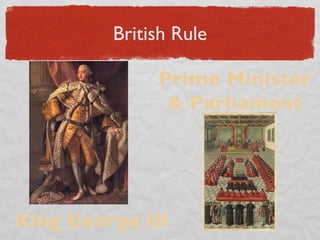
British Rule King George III Prime Minister & Parliament
By the late 1700’s the colonies had been governing themselves for more than 100 years. They had been practicing self-government and making their own laws. They had a sense of freedom and although they were British subjects, they had a desire to live free.
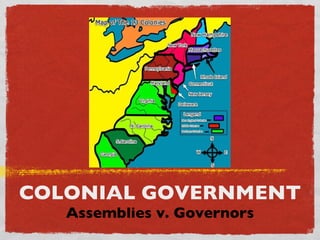
COLONIAL GOVERNMENT Assemblies v. Governors
Assembly Each of the colonies had an assembly of representatives that voted on laws and whether or not to support the Royal Governor The colonists had no representation in Parliament. What problems do you think that caused? Why would colonists be upset about no representatives from the colonies in Parliament? The colonies modeled their government on  Parliament .  *Parliament was Britain’s lawmaking body. Elected members voted on laws and taxes. The king still held great power and final say.
Assembly The colonists had no representation in Parliament. What problems do you think that caused? Why would colonists be upset about no representatives from the colonies in Parliament? The colonies modeled their government on  Parliament .  *Parliament was Britain’s lawmaking body. Elected members voted on laws and taxes. The king still held great power and final say.
Royal  Governors Eight of the 13 colonies had a Royal Governor. They were appointed by the king. Their job was to enforce British Law. They often disagreed with the assembly.
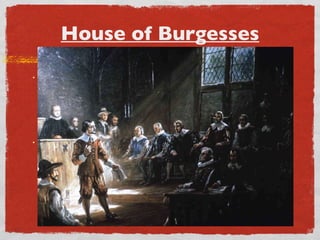
House of Burgesses Virginia had the most successful assembly. It was called the  House of Burgesses.   It was started in 1619.   Many other colonies end up copying the House of Burgesses system.  Assemblies (like the H.O.B) could make laws to print money, build roads, collect taxes, make land laws, and organize militias
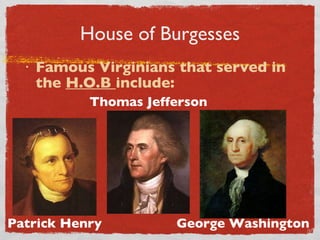
House of Burgesses Famous Virginians that served in the  H.O.B  include: Thomas Jefferson Patrick Henry George Washington
What are a few of the documents that inspired the colonists to govern themselves? The Mayflower Compact Fundamental Orders of Connecticut

Colonial Government

  • 1.
  • 2.
    AGENDA English Government(Britain) Colonial Government The Path to War British Government
  • 3.
    British Rule KingGeorge III Prime Minister & Parliament
  • 4.
    By the late1700’s the colonies had been governing themselves for more than 100 years. They had been practicing self-government and making their own laws. They had a sense of freedom and although they were British subjects, they had a desire to live free.
  • 5.
  • 6.
    Assembly Each ofthe colonies had an assembly of representatives that voted on laws and whether or not to support the Royal Governor The colonists had no representation in Parliament. What problems do you think that caused? Why would colonists be upset about no representatives from the colonies in Parliament? The colonies modeled their government on Parliament . *Parliament was Britain’s lawmaking body. Elected members voted on laws and taxes. The king still held great power and final say.
  • 7.
    Assembly The colonistshad no representation in Parliament. What problems do you think that caused? Why would colonists be upset about no representatives from the colonies in Parliament? The colonies modeled their government on Parliament . *Parliament was Britain’s lawmaking body. Elected members voted on laws and taxes. The king still held great power and final say.
  • 8.
    Royal GovernorsEight of the 13 colonies had a Royal Governor. They were appointed by the king. Their job was to enforce British Law. They often disagreed with the assembly.
  • 9.
    House of BurgessesVirginia had the most successful assembly. It was called the House of Burgesses. It was started in 1619. Many other colonies end up copying the House of Burgesses system. Assemblies (like the H.O.B) could make laws to print money, build roads, collect taxes, make land laws, and organize militias
  • 10.
    House of BurgessesFamous Virginians that served in the H.O.B include: Thomas Jefferson Patrick Henry George Washington
  • 11.
    What are afew of the documents that inspired the colonists to govern themselves? The Mayflower Compact Fundamental Orders of Connecticut