DESCRIBE COLLEGE LIBRARY AND IDENTIFY 
VARIOUS SECTIONS IN IT. ALSO DEFINE E-RESOURCES 
AND DESCRIBE FEW E-RESOURCES 
ON A SELECTED SUBJECT 
(Economics) USING LIBRARY RESOURCES / 
ONLINE RESOURCES 
1
Introduction 
What is library? 
A place/ room/ building containing collection of books, 
periodicals and other reading materials arranged in a systematic 
way for the use of readers is known as Library. There are 
various kinds of libraries, i.e. Public library, Special Library, 
academic library etc. 
A College Library is an important Unit/ Department of a College 
and its resources (books, journals, magazines, newspapers etc) 
are used by its members i.e. College Teachers, Staff members 
and Students [i.e. Shyam Lal College (Evening) Library]. 
Units of a library- 
1. Acquisition Section/ Unit- This section do work related 
with resources / books etc procurement , which further 
involves with the work of Selection/ Order/Payment of 
the library resources/books etc. 
2. Technical Section/ Unit- This section/unit do work of 
Classification and Cataloguing or the Library 
resources/books. 
3. Maintenance section/ Unit- This section/unit do work of 
Labeling, Pasting of slips, Stamping, Book cards, 
Shelving, Binding of the library resources/books. 
4. Reprographic Section/ Unit- do work of photocopy/ 
Xeroxing to library users on demand. 
2
5. Administrative and Management Section/ Unit- Deals 
work related with administration and management of the 
College library and submit information related with library 
from time to time to authority. 
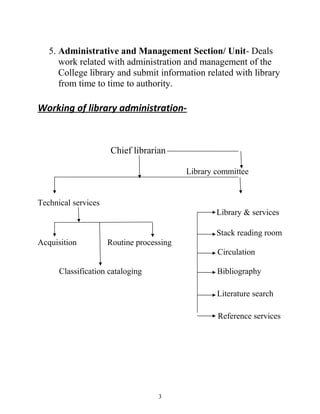
Working of library administration- 
Chief librarian 
Library committee 
Technical services 
Library & services 
Stack reading room 
Acquisition Routine processing 
Circulation 
Classification cataloging Bibliography 
Literature search 
Reference services 
3
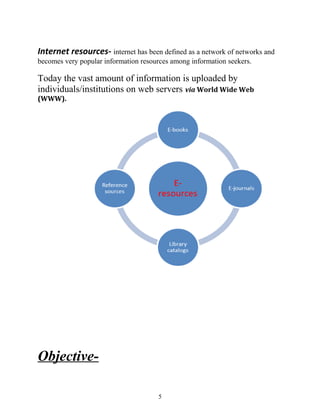
What is e-resource? 
An electronic resource is any information source that the library 
provides access to in an electronic format. 
Our e-resources include lots of things: full-text journals, 
newspapers, e-books, dictionaries, encyclopaedias, economic 
data, digital images, market research, etc. 
Few e-resources- 
Electronic Books and Texts: e-books are paperless portable 
computerized digital media which are expensive then the paper 
version. Often e-books are available on CD ROM or internet. 
E-books contain multimedia content such as texts, pictures, 
sounds etc. 
Electronic Journals: e-journals are periodical publications 
electronically available to be used with the help of a computer 
on optical disks, networks or in other forms. 
E-journals are able to disseminate the information as speedily as 
possible. 
Websites- websites are built from a collection of linked web 
pages where users can jump between available web pages by 
clicking on the active links. 
A user may have multiple options in the form of websites to 
access the information. 
4
Internet resources- internet has been defined as a network of networks and 
becomes very popular information resources among information seekers. 
Today the vast amount of information is uploaded by 
individuals/institutions on web servers via World Wide Web 
(WWW). 
Objective- 
5
Our objective is to describe various sections of library using 
library resources such as books, CDs, DVDs, magazines, 
computer, internet access etc. and e-resource like e-books, 
journals, dictionaries, encyclopaedias, economic data, 
newspapers etc. 
Our main goal is to get familiar with the college library that how 
it works, or what is the library management system in our 
college. We took the help of librarian and teachers to know that 
what is library and what are the features of our college library 
and its resources 
Observations 
6
In this project we’ve discussed the library resources that are 
available in our college and also we have collect some e-books 
on our subject (economics) using online resources. Few of them 
are, 
few e-books on economics- 
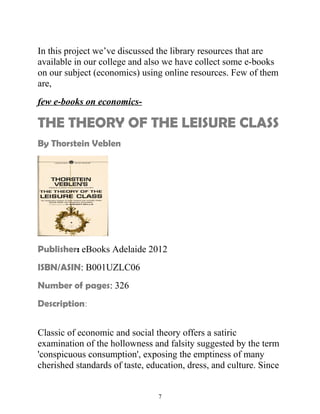
THE THEORY OF THE LEISURE CLASS 
By Thorstein Veblen 
Publisher: eBooks Adelaide 2012 
ISBN/ASIN: B001UZLC06 
Number of pages: 326 
Description: 
Classic of economic and social theory offers a satiric 
examination of the hollowness and falsity suggested by the term 
'conspicuous consumption', exposing the emptiness of many 
cherished standards of taste, education, dress, and culture. Since 
7
first appearing in 1899, it has become a classic of social theory 
that has contributed to the modernization of economic policy. 
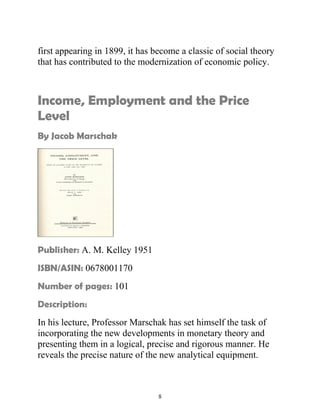
Income, Employment and the Price 
Level 
By Jacob Marschak 
Publisher: A. M. Kelley 1951 
ISBN/ASIN: 0678001170 
Number of pages: 101 
Description: 
In his lecture, Professor Marschak has set himself the task of 
incorporating the new developments in monetary theory and 
presenting them in a logical, precise and rigorous manner. He 
reveals the precise nature of the new analytical equipment. 
8
Farewell to the Self-Employed: Deconstructing 
a Socioeconomic and Legal Solipsism 
By Marc Linder 
Publisher: Greenwood Press 1992 
ISBN/ASIN: 0313284660 
ISBN-13: 9780313284663 
Number of pages: 217 
Description: 
This work offers a firm theoretical foundation for discussing the 
self-employed, their role over time, and the formulation of 
policy towards them. It is a comprehensive analysis of self- 
9
employment to integrate legal, sociological, and economic 
theory. Linder offers a conceptual critique of the underpinnings 
of the category of the self-employed that calls into question the 
theoretical coherence of the traditional approaches. 
Principles of Economics 
By Libby Rittenberg, Timothy Tregarthen 
Publisher: Flat World Knowledge 2011 
ISBN/ASIN: 193612601X 
ISBN-13: 9781936126019 
Number of pages: 913 
Description: 
The authors teach economics as the study of 'choice' by 
providing students with an accessible, straightforward overview 
of economics. Rittenberg and Tregarthen help students to 
understand how real individuals actually work with economics. 
10
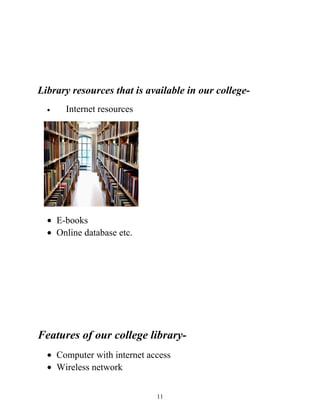
Library resources that is available in our college- 
· Internet resources 
· E-books 
· Online database etc. 
Features of our college library- 
· Computer with internet access 
· Wireless network 
11
· Word processing software (Microsoft) 
· Large print collection 
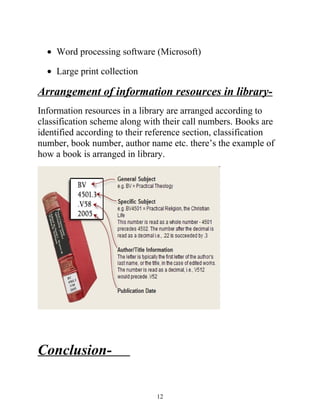
Arrangement of information resources in library- 
Information resources in a library are arranged according to 
classification scheme along with their call numbers. Books are 
identified according to their reference section, classification 
number, book number, author name etc. there’s the example of 
how a book is arranged in library. 
Conclusion- 
12
Library is an essential part of a college, having books and other 
reading material (print and online version) useful to its 
users/readers. 
Presently online version of books etc are emerging rapidly 
which is available easily with the help of computer system with 
internet facilty.it is suggested that student may search reading 
materials(eBooks n etc) towards his/her study. 
References- 
1. Book of Information Technology 
2. Wikipedia 
3. e-booksdirectory 
13

College library: how it works

  • 1.
    DESCRIBE COLLEGE LIBRARYAND IDENTIFY VARIOUS SECTIONS IN IT. ALSO DEFINE E-RESOURCES AND DESCRIBE FEW E-RESOURCES ON A SELECTED SUBJECT (Economics) USING LIBRARY RESOURCES / ONLINE RESOURCES 1
  • 2.
    Introduction What islibrary? A place/ room/ building containing collection of books, periodicals and other reading materials arranged in a systematic way for the use of readers is known as Library. There are various kinds of libraries, i.e. Public library, Special Library, academic library etc. A College Library is an important Unit/ Department of a College and its resources (books, journals, magazines, newspapers etc) are used by its members i.e. College Teachers, Staff members and Students [i.e. Shyam Lal College (Evening) Library]. Units of a library- 1. Acquisition Section/ Unit- This section do work related with resources / books etc procurement , which further involves with the work of Selection/ Order/Payment of the library resources/books etc. 2. Technical Section/ Unit- This section/unit do work of Classification and Cataloguing or the Library resources/books. 3. Maintenance section/ Unit- This section/unit do work of Labeling, Pasting of slips, Stamping, Book cards, Shelving, Binding of the library resources/books. 4. Reprographic Section/ Unit- do work of photocopy/ Xeroxing to library users on demand. 2
  • 3.
    5. Administrative andManagement Section/ Unit- Deals work related with administration and management of the College library and submit information related with library from time to time to authority. Working of library administration- Chief librarian Library committee Technical services Library & services Stack reading room Acquisition Routine processing Circulation Classification cataloging Bibliography Literature search Reference services 3
  • 4.
    What is e-resource? An electronic resource is any information source that the library provides access to in an electronic format. Our e-resources include lots of things: full-text journals, newspapers, e-books, dictionaries, encyclopaedias, economic data, digital images, market research, etc. Few e-resources- Electronic Books and Texts: e-books are paperless portable computerized digital media which are expensive then the paper version. Often e-books are available on CD ROM or internet. E-books contain multimedia content such as texts, pictures, sounds etc. Electronic Journals: e-journals are periodical publications electronically available to be used with the help of a computer on optical disks, networks or in other forms. E-journals are able to disseminate the information as speedily as possible. Websites- websites are built from a collection of linked web pages where users can jump between available web pages by clicking on the active links. A user may have multiple options in the form of websites to access the information. 4
  • 5.
    Internet resources- internethas been defined as a network of networks and becomes very popular information resources among information seekers. Today the vast amount of information is uploaded by individuals/institutions on web servers via World Wide Web (WWW). Objective- 5
  • 6.
    Our objective isto describe various sections of library using library resources such as books, CDs, DVDs, magazines, computer, internet access etc. and e-resource like e-books, journals, dictionaries, encyclopaedias, economic data, newspapers etc. Our main goal is to get familiar with the college library that how it works, or what is the library management system in our college. We took the help of librarian and teachers to know that what is library and what are the features of our college library and its resources Observations 6
  • 7.
    In this projectwe’ve discussed the library resources that are available in our college and also we have collect some e-books on our subject (economics) using online resources. Few of them are, few e-books on economics- THE THEORY OF THE LEISURE CLASS By Thorstein Veblen Publisher: eBooks Adelaide 2012 ISBN/ASIN: B001UZLC06 Number of pages: 326 Description: Classic of economic and social theory offers a satiric examination of the hollowness and falsity suggested by the term 'conspicuous consumption', exposing the emptiness of many cherished standards of taste, education, dress, and culture. Since 7
  • 8.
    first appearing in1899, it has become a classic of social theory that has contributed to the modernization of economic policy. Income, Employment and the Price Level By Jacob Marschak Publisher: A. M. Kelley 1951 ISBN/ASIN: 0678001170 Number of pages: 101 Description: In his lecture, Professor Marschak has set himself the task of incorporating the new developments in monetary theory and presenting them in a logical, precise and rigorous manner. He reveals the precise nature of the new analytical equipment. 8
  • 9.
    Farewell to theSelf-Employed: Deconstructing a Socioeconomic and Legal Solipsism By Marc Linder Publisher: Greenwood Press 1992 ISBN/ASIN: 0313284660 ISBN-13: 9780313284663 Number of pages: 217 Description: This work offers a firm theoretical foundation for discussing the self-employed, their role over time, and the formulation of policy towards them. It is a comprehensive analysis of self- 9
  • 10.
    employment to integratelegal, sociological, and economic theory. Linder offers a conceptual critique of the underpinnings of the category of the self-employed that calls into question the theoretical coherence of the traditional approaches. Principles of Economics By Libby Rittenberg, Timothy Tregarthen Publisher: Flat World Knowledge 2011 ISBN/ASIN: 193612601X ISBN-13: 9781936126019 Number of pages: 913 Description: The authors teach economics as the study of 'choice' by providing students with an accessible, straightforward overview of economics. Rittenberg and Tregarthen help students to understand how real individuals actually work with economics. 10
  • 11.
    Library resources thatis available in our college- · Internet resources · E-books · Online database etc. Features of our college library- · Computer with internet access · Wireless network 11
  • 12.
    · Word processingsoftware (Microsoft) · Large print collection Arrangement of information resources in library- Information resources in a library are arranged according to classification scheme along with their call numbers. Books are identified according to their reference section, classification number, book number, author name etc. there’s the example of how a book is arranged in library. Conclusion- 12
  • 13.
    Library is anessential part of a college, having books and other reading material (print and online version) useful to its users/readers. Presently online version of books etc are emerging rapidly which is available easily with the help of computer system with internet facilty.it is suggested that student may search reading materials(eBooks n etc) towards his/her study. References- 1. Book of Information Technology 2. Wikipedia 3. e-booksdirectory 13