Java/J2EE Programming Training
Collections – Sorting, Comparing
Page 2Classification: Restricted
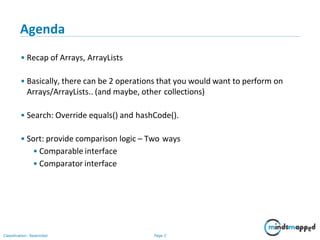
Agenda
• Recap of Arrays, ArrayLists
• Basically, there can be 2 operations that you would want to perform on
Arrays/ArrayLists.. (and maybe, other collections)
• Search: Override equals() and hashCode().
• Sort: provide comparison logic – Two ways
• Comparable interface
• Comparator interface
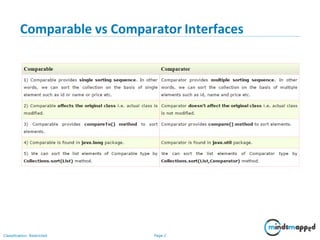
Comparable vs Comparator Interfaces
Classification: Restricted Page 2
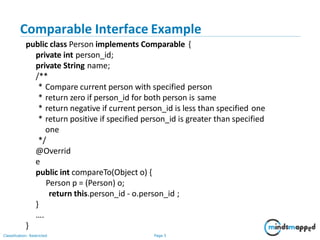
Comparable Interface Example
Classification: Restricted Page 3
public class Person implements Comparable {
private int person_id;
private String name;
/**
* Compare current person with specified person
* return zero if person_id for both person is same
* return negative if current person_id is less than specified one
* return positive if specified person_id is greater than specified
one
*/
@Overrid
e
public int compareTo(Object o) {
Person p = (Person) o;
return this.person_id - o.person_id ;
}
….
}
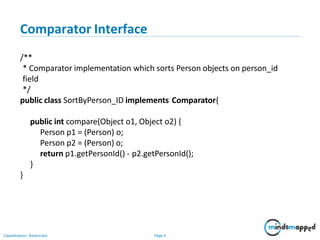
Comparator Interface
Classification: Restricted Page 4
/**
* Comparator implementation which sorts Person objects on person_id
field
*/
public class SortByPerson_ID implements Comparator{
public int compare(Object o1, Object o2) {
Person p1 = (Person) o;
Person p2 = (Person) o;
return p1.getPersonId() - p2.getPersonId();
}
}
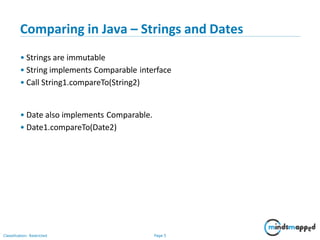
Comparing in Java – Strings and Dates
Classification: Restricted Page 5
• Strings are immutable
• String implements Comparable interface
• Call String1.compareTo(String2)
• Date also implements Comparable.
• Date1.compareTo(Date2)
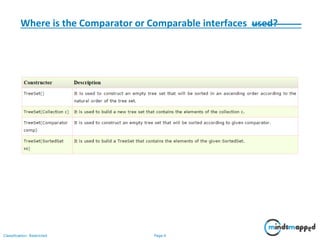
Where is the Comparator or Comparable interfaces used?
Classification: Restricted Page 6
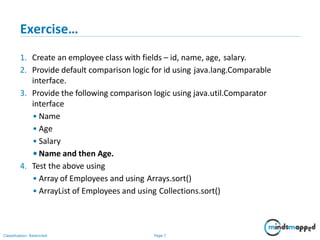
Exercise…
Classification: Restricted Page 7
1. Create an employee class with fields – id, name, age, salary.
2. Provide default comparison logic for id using java.lang.Comparable
interface.
3. Provide the following comparison logic using java.util.Comparator
interface
• Name
• Age
• Salary
•Name and then Age.
4. Test the above using
• Array of Employees and using Arrays.sort()
• ArrayList of Employees and using Collections.sort()
Thank You

Collections - Sorting, Comparing Basics

  • 1.
  • 2.
    Page 2Classification: Restricted Agenda •Recap of Arrays, ArrayLists • Basically, there can be 2 operations that you would want to perform on Arrays/ArrayLists.. (and maybe, other collections) • Search: Override equals() and hashCode(). • Sort: provide comparison logic – Two ways • Comparable interface • Comparator interface
  • 3.
    Comparable vs ComparatorInterfaces Classification: Restricted Page 2
  • 4.
    Comparable Interface Example Classification:Restricted Page 3 public class Person implements Comparable { private int person_id; private String name; /** * Compare current person with specified person * return zero if person_id for both person is same * return negative if current person_id is less than specified one * return positive if specified person_id is greater than specified one */ @Overrid e public int compareTo(Object o) { Person p = (Person) o; return this.person_id - o.person_id ; } …. }
  • 5.
    Comparator Interface Classification: RestrictedPage 4 /** * Comparator implementation which sorts Person objects on person_id field */ public class SortByPerson_ID implements Comparator{ public int compare(Object o1, Object o2) { Person p1 = (Person) o; Person p2 = (Person) o; return p1.getPersonId() - p2.getPersonId(); } }
  • 6.
    Comparing in Java– Strings and Dates Classification: Restricted Page 5 • Strings are immutable • String implements Comparable interface • Call String1.compareTo(String2) • Date also implements Comparable. • Date1.compareTo(Date2)
  • 7.
    Where is theComparator or Comparable interfaces used? Classification: Restricted Page 6
  • 8.
    Exercise… Classification: Restricted Page7 1. Create an employee class with fields – id, name, age, salary. 2. Provide default comparison logic for id using java.lang.Comparable interface. 3. Provide the following comparison logic using java.util.Comparator interface • Name • Age • Salary •Name and then Age. 4. Test the above using • Array of Employees and using Arrays.sort() • ArrayList of Employees and using Collections.sort()
  • 9.