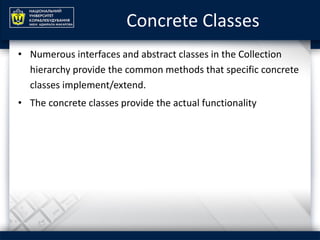
Concrete Classes
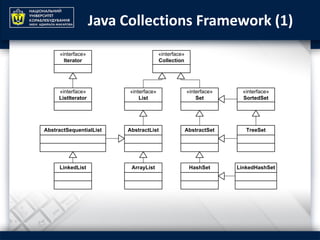
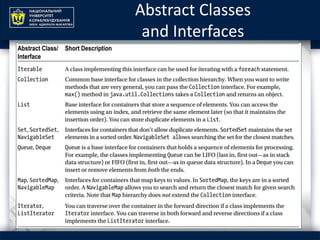
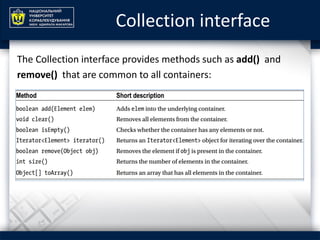
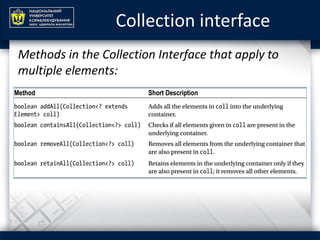
• Numerousinterfaces and abstract classes in the Collection
hierarchy provide the common methods that specific concrete
classes implement/extend.
• The concrete classes provide the actual functionality
List Classes
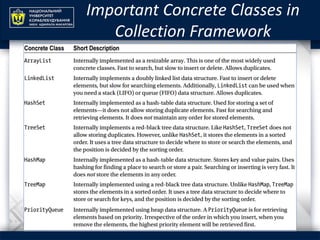
ArrayList implementsa resizable array.
• When you create a native array (say, new String[10]; ), the
size of the array is known (fixed) at the time of creation.
However, ArrayList is a dynamic array:
• it can grow in size as required. Internally, an ArrayList
allocates a block of memory and grows it as required.
• So, accessing array elements is very fast in an ArrayList.
LinkedList implements interface List with data structure of linked
list.
Set Classes
• Set,as we studied, contains no duplicates.
• Unlike List, a Set doesn’t remember where you inserted the
element (i.e., it doesn’t remember the insertion order).
There are two important concrete classes for Set:
• HashSet and TreeSet.
• A HashSet is for quickly inserting and retrieving elements;
it does not maintain any sorting order for the elements it
holds.
• A TreeSet stores the elements in a sorted order (and it
implements the SortedSet interface).
12.
Comparable and Comparator
Interfaces
•Comparable and Comparator interfaces are
used to compare similar objects (for example,
while performing searching or sorting).
• Assume that you have a container containing
a list of Person object.
• Now, how do you compare two Person
objects?
13.
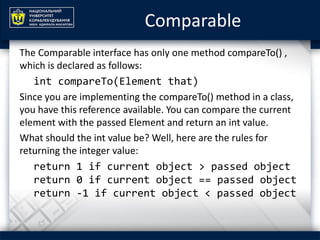
Comparable
The Comparable interfacehas only one method compareTo() ,
which is declared as follows:
int compareTo(Element that)
Since you are implementing the compareTo() method in a class,
you have this reference available. You can compare the current
element with the passed Element and return an int value.
What should the int value be? Well, here are the rules for
returning the integer value:
return 1 if current object > passed object
return 0 if current object == passed object
return -1 if current object < passed object
14.
Natural Ordering
• Whatdoes >, < or == mean for an Element?
It is left to you to decide how to compare two
objects!
• But the meaning of comparison should be a
natural one; in other words, the comparison
should mean natural ordering.
• Integers are comparing with each other, based on
a numeric order
• Strings are comparing with each other, based on
a lexicographic comparison
15.
Comparator
• If youneed to implement two or more
alternative ways to compare two similar
objects, then you may implement the
Comparator interface.
The Map Interface
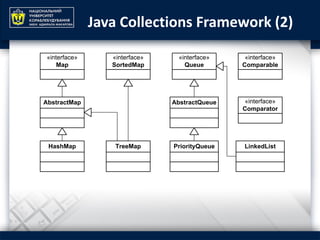
•A Map stores key and value pairs.
• The Map interface does not extend the Collection interface.
• However, there are methods in the Map interface that you
can use to get the objects classes that implement the
Collection interface to work around this problem.
• Also, the method names in Map are very similar to the
methods in Collection, so it is easy to understand and use
Map.
18.
Maps
There are twoimportant concrete classes of Map:
HashMap and TreeMap.
• A HashMap uses a hash table data structure
internally. In HashMap, searching (or looking up
elements) is a fast operation. However, HashMap
neither remembers the order in which you inserted
elements nor keeps elements in any sorted order.
• A TreeMap uses a red-black tree data structure
internally. Unlike HashMap, TreeMap keeps the
elements in sorted order (i.e., sorted by its keys).
So, searching or inserting is somewhat slower than
the HashMap.
![List Classes
ArrayList implements a resizable array.
• When you create a native array (say, new String[10]; ), the
size of the array is known (fixed) at the time of creation.
However, ArrayList is a dynamic array:
• it can grow in size as required. Internally, an ArrayList
allocates a block of memory and grows it as required.
• So, accessing array elements is very fast in an ArrayList.
LinkedList implements interface List with data structure of linked
list.](https://image.slidesharecdn.com/2coll-250914144521-3638b358/85/Java-Collections-part-2-All-collections-9-320.jpg)