13-1
Collection Considerations
Chapter 13
© Rick Mercer
Data Structures with Ja
©Rick Mercer
Data Structures with Java and JUnit
13-2
Outline
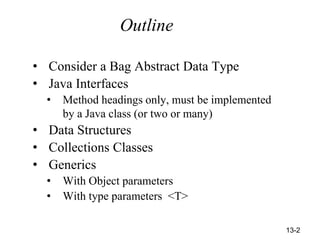
• Consider a Bag Abstract Data Type
• Java Interfaces
• Method headings only, must be implemented
by a Java class (or two or many)
• Data Structures
• Collections Classes
• Generics
• With Object parameters
• With type parameters <T>
13-3
Some Definitions
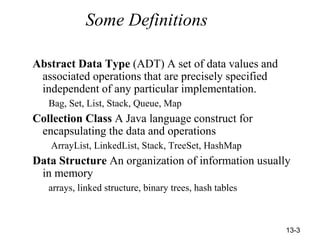
Abstract Data Type (ADT) A set of data values and
associated operations that are precisely specified
independent of any particular implementation.
Bag, Set, List, Stack, Queue, Map
Collection Class A Java language construct for
encapsulating the data and operations
ArrayList, LinkedList, Stack, TreeSet, HashMap
Data Structure An organization of information usually
in memory
arrays, linked structure, binary trees, hash tables
13-4
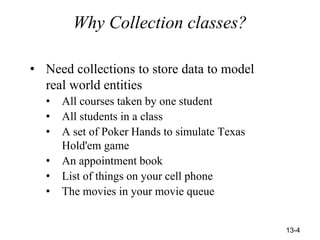
Why Collection classes?
• Need collections to store data to model
real world entities
• All courses taken by one student
• All students in a class
• A set of Poker Hands to simulate Texas
Hold'em game
• An appointment book
• List of things on your cell phone
• The movies in your movie queue
13-5
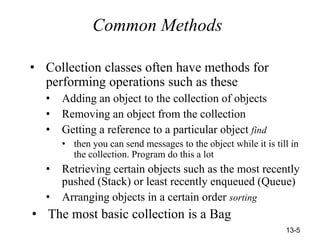
Common Methods
• Collection classes often have methods for
performing operations such as these
• Adding an object to the collection of objects
• Removing an object from the collection
• Getting a reference to a particular object find
• then you can send messages to the object while it is till in
the collection. Program do this a lot
• Retrieving certain objects such as the most recently
pushed (Stack) or least recently enqueued (Queue)
• Arranging objects in a certain order sorting
• The most basic collection is a Bag
13-6
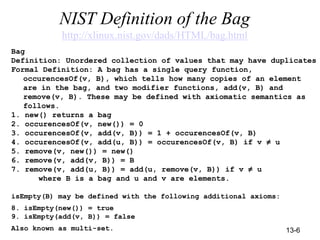
NIST Definition of the Bag
http://xlinux.nist.gov/dads/HTML/bag.html
Bag
Definition: Unordered collection of values that may have duplicates
Formal Definition: A bag has a single query function,
occurencesOf(v, B), which tells how many copies of an element
are in the bag, and two modifier functions, add(v, B) and
remove(v, B). These may be defined with axiomatic semantics as
follows.
1. new() returns a bag
2. occurencesOf(v, new()) = 0
3. occurencesOf(v, add(v, B)) = 1 + occurencesOf(v, B)
4. occurencesOf(v, add(u, B)) = occurencesOf(v, B) if v ≠ u
5. remove(v, new()) = new()
6. remove(v, add(v, B)) = B
7. remove(v, add(u, B)) = add(u, remove(v, B)) if v ≠ u
where B is a bag and u and v are elements.
isEmpty(B) may be defined with the following additional axioms:
8. isEmpty(new()) = true
9. isEmpty(add(v, B)) = false
Also known as multi-set.
13-7
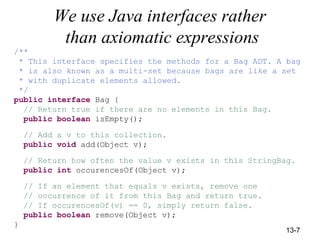
We use Java interfaces rather
than axiomatic expressions
/**
* This interface specifies the methods for a Bag ADT. A bag
* is also known as a multi-set because bags are like a set
* with duplicate elements allowed.
*/
public interface Bag {
// Return true if there are no elements in this Bag.
public boolean isEmpty();
// Add a v to this collection.
public void add(Object v);
// Return how often the value v exists in this StringBag.
public int occurencesOf(Object v);
// If an element that equals v exists, remove one
// occurrence of it from this Bag and return true.
// If occurencesOf(v) == 0, simply return false.
public boolean remove(Object v);
}
13-8
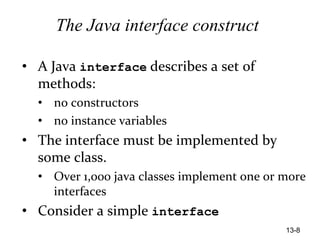
The Java interface construct
• A Java interface describes a set of
methods:
• no constructors
• no instance variables
• The interface must be implemented by
some class.
• Over 1,000 java classes implement one or more
interfaces
• Consider a simple interface
13-9
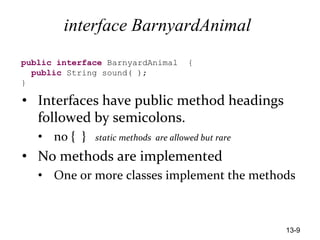
interface BarnyardAnimal
public interface BarnyardAnimal {
public String sound( );
}
• Interfaces have public method headings
followed by semicolons.
• no { } static methods are allowed but rare
• No methods are implemented
• One or more classes implement the methods
13-10
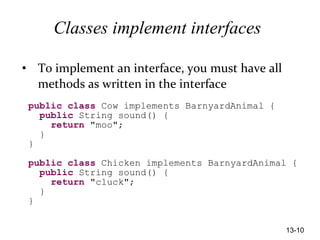
Classes implement interfaces
• To implement an interface, you must have all
methods as written in the interface
public class Cow implements BarnyardAnimal {
public String sound() {
return "moo";
}
}
public class Chicken implements BarnyardAnimal {
public String sound() {
return "cluck";
}
}
13-11
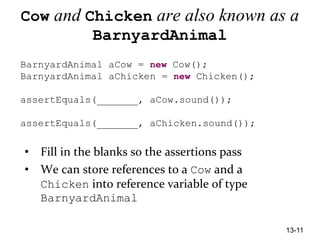
Cow and Chicken are also known as a
BarnyardAnimal
BarnyardAnimal aCow = new Cow();
BarnyardAnimal aChicken = new Chicken();
assertEquals(_______, aCow.sound());
assertEquals(_______, aChicken.sound());
• Fill in the blanks so the assertions pass
• We can store references to a Cow and a
Chicken into reference variable of type
BarnyardAnimal
13-12
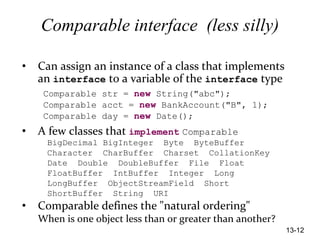
Comparable interface (less silly)
• Can assign an instance of a class that implements
an interface to a variable of the interface type
Comparable str = new String("abc");
Comparable acct = new BankAccount("B", 1);
Comparable day = new Date();
• A few classes that implement Comparable
BigDecimal BigInteger Byte ByteBuffer
Character CharBuffer Charset CollationKey
Date Double DoubleBuffer File Float
FloatBuffer IntBuffer Integer Long
LongBuffer ObjectStreamField Short
ShortBuffer String URI
• Comparable defines the "natural ordering"
When is one object less than or greater than another?
13-13
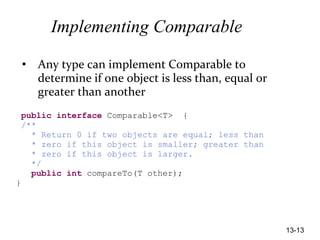
Implementing Comparable
• Any type can implement Comparable to
determine if one object is less than, equal or
greater than another
public interface Comparable<T> {
/**
* Return 0 if two objects are equal; less than
* zero if this object is smaller; greater than
* zero if this object is larger.
*/
public int compareTo(T other);
}
13-14
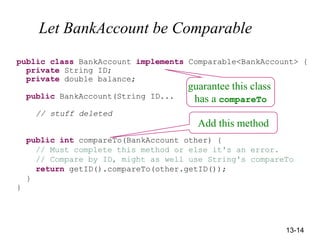
Let BankAccount be Comparable
public class BankAccount implements Comparable<BankAccount> {
private String ID;
private double balance;
public BankAccount(String ID...
// stuff deleted
public int compareTo(BankAccount other) {
// Must complete this method or else it's an error.
// Compare by ID, might as well use String's compareTo
return getID().compareTo(other.getID());
}
}
Add this method
guarantee this class
has a compareTo
13-15
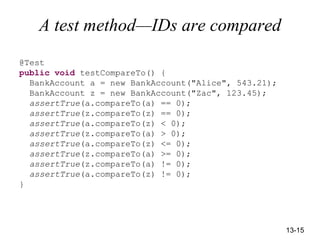
A test method—IDs are compared
@Test
public void testCompareTo() {
BankAccount a = new BankAccount("Alice", 543.21);
BankAccount z = new BankAccount("Zac", 123.45);
assertTrue(a.compareTo(a) == 0);
assertTrue(z.compareTo(z) == 0);
assertTrue(a.compareTo(z) < 0);
assertTrue(z.compareTo(a) > 0);
assertTrue(a.compareTo(z) <= 0);
assertTrue(z.compareTo(a) >= 0);
assertTrue(z.compareTo(a) != 0);
assertTrue(a.compareTo(z) != 0);
}
13-16
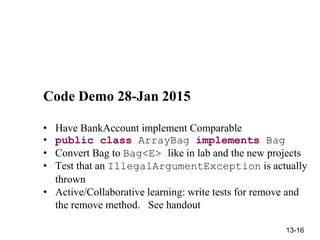
Code Demo 28-Jan 2015
• Have BankAccount implement Comparable
• public class ArrayBag implements Bag
• Convert Bag to Bag<E> like in lab and the new projects
• Test that an IllegalArgumentException is actually
thrown
• Active/Collaborative learning: write tests for remove and
the remove method. See handout
13-17
Generic Collections Classes
1) With Object parameters
2) With Java generics using type parameters
13-18
Outline
• Class Object, casting, and a little
inheritance
• Generic Collections with Object[]
• Using <Type> to give us type safety
• Autoboxing / Unboxing
13-19
Can have one Collection
class for any type
public class ArrayBag implements Bag {
// --Instance variables
private Object[] data;
private int n;
// Construct an empty bag that can store any type
public ArrayBag() {
data = new Object[20];
n = 0;
}
public void add(Object element) { }
public int occurencesOf(Object element) { }
public boolean remove(Object element) { }
}
13-20
What was that Object thing?
• Java has a class named Object
• It communicates with the operating system to
allocate memory at runtime
• Object has 11 methods
• Object is the superclass of all other classes
• All classes extend Object or a class that extends
Object , or a class that extends a class that
extends Object, or …
13-21
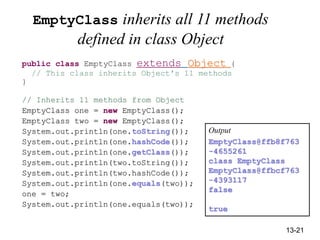
EmptyClass inherits all 11 methods
defined in class Object
public class EmptyClass extends Object {
// This class inherits Object's 11 methods
}
// Inherits 11 methods from Object
EmptyClass one = new EmptyClass();
EmptyClass two = new EmptyClass();
System.out.println(one.toString());
System.out.println(one.hashCode());
System.out.println(one.getClass());
System.out.println(two.toString());
System.out.println(two.hashCode());
System.out.println(one.equals(two));
one = two;
System.out.println(one.equals(two));
Output
EmptyClass@ffb8f763
-4655261
class EmptyClass
EmptyClass@ffbcf763
-4393117
false
true
13-22
One way assignment: up the
hierarchy, but not down
• Can assign any reference to an Object object
Object obj1 = new String("a string");
Object obj2 = new Integer(123);
System.out.println(obj1.toString());
System.out.println(obj2.toString());
Output
a string
123
• But not the other way compiletime error
String str = obj1; // incompatible types
^
Type mismatch: cannot convert from Object to String
13-23
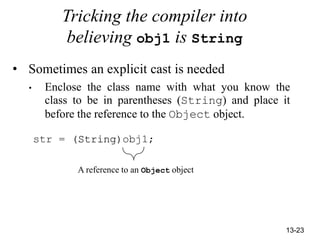
Tricking the compiler into
believing obj1 is String
• Sometimes an explicit cast is needed
• Enclose the class name with what you know the
class to be in parentheses (String) and place it
before the reference to the Object object.
str = (String)obj1;
A reference to an Object object
13-24
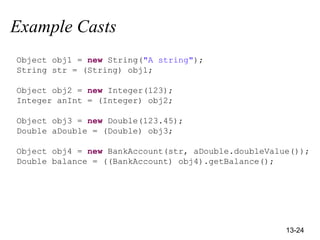
Example Casts
Object obj1 = new String("A string");
String str = (String) obj1;
Object obj2 = new Integer(123);
Integer anInt = (Integer) obj2;
Object obj3 = new Double(123.45);
Double aDouble = (Double) obj3;
Object obj4 = new BankAccount(str, aDouble.doubleValue());
Double balance = ((BankAccount) obj4).getBalance();
13-25
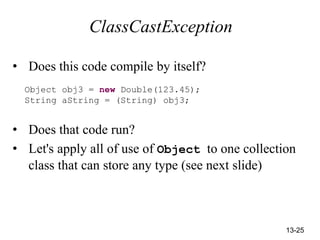
ClassCastException
• Does this code compile by itself?
Object obj3 = new Double(123.45);
String aString = (String) obj3;
• Does that code run?
• Let's apply all of use of Object to one collection
class that can store any type (see next slide)
13-26
Object can store a reference to type
• The Object class allows collections of any type
• Use Object[] rather than any one specific type
public class ArrayBag implements Bag {
private Object[] data;
private int n;
public ArrayBag() {
data = new Object[20];
n = 0;
}
public void add(Object element) {
13-27
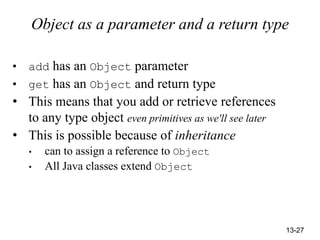
Object as a parameter and a return type
• add has an Object parameter
• get has an Object and return type
• This means that you add or retrieve references
to any type object even primitives as we'll see later
• This is possible because of inheritance
• can to assign a reference to Object
• All Java classes extend Object
13-28
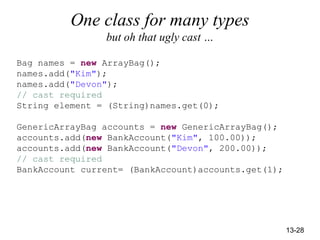
One class for many types
but oh that ugly cast …
Bag names = new ArrayBag();
names.add("Kim");
names.add("Devon");
// cast required
String element = (String)names.get(0);
GenericArrayBag accounts = new GenericArrayBag();
accounts.add(new BankAccount("Kim", 100.00));
accounts.add(new BankAccount("Devon", 200.00));
// cast required
BankAccount current= (BankAccount)accounts.get(1);
13-29
Generics via Type Parameters <E>
A better way to implement collection classes
Assumption: GenericArrayBag has been implemented using an
Object[] instance variable, an Object parameter in add, and an
Object return type in get
13-30
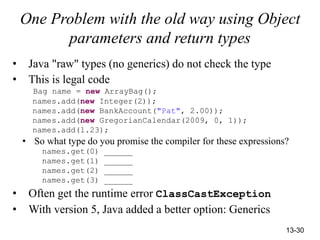
One Problem with the old way using Object
parameters and return types
• Java "raw" types (no generics) do not check the type
• This is legal code
Bag name = new ArrayBag();
names.add(new Integer(2));
names.add(new BankAccount("Pat", 2.00));
names.add(new GregorianCalendar(2009, 0, 1));
names.add(1.23);
• So what type do you promise the compiler for these expressions?
names.get(0) ______
names.get(1) ______
names.get(2) ______
names.get(3) ______
• Often get the runtime error ClassCastException
• With version 5, Java added a better option: Generics
13-31
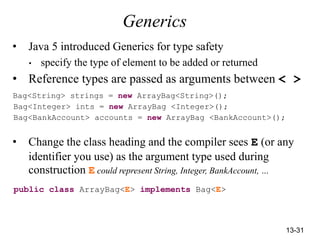
Generics
• Java 5 introduced Generics for type safety
• specify the type of element to be added or returned
• Reference types are passed as arguments between < >
Bag<String> strings = new ArrayBag<String>();
Bag<Integer> ints = new ArrayBag <Integer>();
Bag<BankAccount> accounts = new ArrayBag <BankAccount>();
• Change the class heading and the compiler sees E (or any
identifier you use) as the argument type used during
construction E could represent String, Integer, BankAccount, …
public class ArrayBag<E> implements Bag<E>
13-32
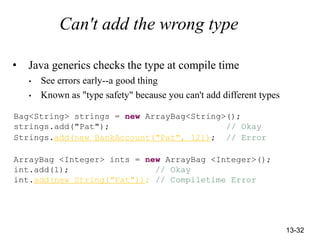
Can't add the wrong type
• Java generics checks the type at compile time
• See errors early--a good thing
• Known as "type safety" because you can't add different types
Bag<String> strings = new ArrayBag<String>();
strings.add("Pat"); // Okay
Strings.add(new BankAccount("Pat", 12)); // Error
ArrayBag <Integer> ints = new ArrayBag <Integer>();
int.add(1); // Okay
int.add(new String("Pat")); // Compiletime Error
13-33
Type parameter <E>
• Type parameters the new way to have a generic collection
public class ArrayBag<E> implements Bag<E> {
private Object[] data;
private int n;
public ArrayBag() {
data = new Object[20];
n = 0;
}
public void add(E element) { ... }
public E get(int index) { ... }
13-34
Can not have E[]
• We can not declare arrays of a generic parameter
public class ArrayBag<E> implements Bag<E> {
private E[] data;
public ArrayBag() {
data = new E[1000];
^
Cannot create a generic array of E
13-35
Can cast with (Type[])
• At runtime, the generic parameter E is really
Object
• We could use a cast like this: (E[])
public class ArrayBag<E> implements Bag<E> {
private E[] data;
public ArrayList() {
data = (E[]) (new Object[1000]);
}
13-36
Use Object[]
• Or we can use Object[] as the instance variable
public class ArrayBag<E> implements Bag<E> {
private Object[] data;
public ArrayBag() {
data = new Object[1000];
}
13-37
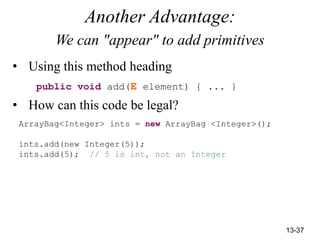
Another Advantage:
We can "appear" to add primitives
• Using this method heading
public void add(E element) { ... }
• How can this code be legal?
ArrayBag<Integer> ints = new ArrayBag <Integer>();
ints.add(new Integer(5));
ints.add(5); // 5 is int, not an Integer
13-38
Primitives are appear to be Objects
• To allow collections of primitive types, with Object[]
Java provided wrapper classes:
Integer Double Character Boolean Long Float
These allow you to treat primitives as Objects (need new)
• Before Java 5, wrapper objects can't handle arithmetic
operators
Integer anInt = new Integer(50);
int result = 2 * anInt - 3;
Error before Java 5
• Now objects appear as primitives and primitives as objects
Integer i = 3; // assign int to Integer
int j = new Integer(4); // Integer to int
int k = (3*new Integer(7)) + (4*i); // operators OK
13-39
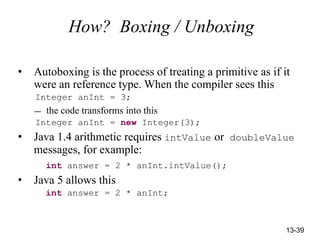
How? Boxing / Unboxing
• Autoboxing is the process of treating a primitive as if it
were an reference type. When the compiler sees this
Integer anInt = 3;
— the code transforms into this
Integer anInt = new Integer(3);
• Java 1.4 arithmetic requires intValue or doubleValue
messages, for example:
int answer = 2 * anInt.intValue();
• Java 5 allows this
int answer = 2 * anInt;
13-40
Collection Classes
13-41
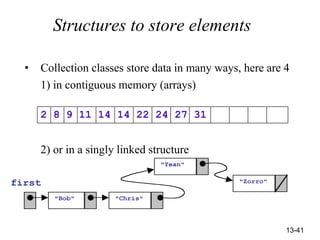
Structures to store elements
• Collection classes store data in many ways, here are 4
1) in contiguous memory (arrays)
2) or in a singly linked structure
"Bob"
first
"Chris"
"Zorro"
"Yean"
2 8 9 11 14 14 22 24 27 31
13-42
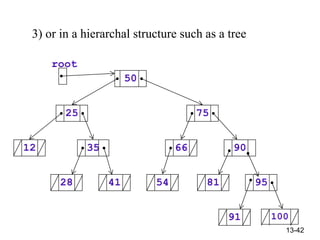
3) or in a hierarchal structure such as a tree
50
75
25
12 35
28 41
66 90
81 95
91 100
54
root
13-43
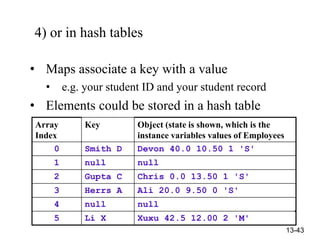
4) or in hash tables
• Maps associate a key with a value
• e.g. your student ID and your student record
• Elements could be stored in a hash table
Array
Index
Key Object (state is shown, which is the
instance variables values of Employees
0 Smith D Devon 40.0 10.50 1 'S'
1 null null
2 Gupta C Chris 0.0 13.50 1 'S'
3 Herrs A Ali 20.0 9.50 0 'S'
4 null null
5 Li X Xuxu 42.5 12.00 2 'M'

CollectionConsiderationsCollectionConsiderations.ppt

  • 1.
    13-1 Collection Considerations Chapter 13 ©Rick Mercer Data Structures with Ja ©Rick Mercer Data Structures with Java and JUnit
  • 2.
    13-2 Outline • Consider aBag Abstract Data Type • Java Interfaces • Method headings only, must be implemented by a Java class (or two or many) • Data Structures • Collections Classes • Generics • With Object parameters • With type parameters <T>
  • 3.
    13-3 Some Definitions Abstract DataType (ADT) A set of data values and associated operations that are precisely specified independent of any particular implementation. Bag, Set, List, Stack, Queue, Map Collection Class A Java language construct for encapsulating the data and operations ArrayList, LinkedList, Stack, TreeSet, HashMap Data Structure An organization of information usually in memory arrays, linked structure, binary trees, hash tables
  • 4.
    13-4 Why Collection classes? •Need collections to store data to model real world entities • All courses taken by one student • All students in a class • A set of Poker Hands to simulate Texas Hold'em game • An appointment book • List of things on your cell phone • The movies in your movie queue
  • 5.
    13-5 Common Methods • Collectionclasses often have methods for performing operations such as these • Adding an object to the collection of objects • Removing an object from the collection • Getting a reference to a particular object find • then you can send messages to the object while it is till in the collection. Program do this a lot • Retrieving certain objects such as the most recently pushed (Stack) or least recently enqueued (Queue) • Arranging objects in a certain order sorting • The most basic collection is a Bag
  • 6.
    13-6 NIST Definition ofthe Bag http://xlinux.nist.gov/dads/HTML/bag.html Bag Definition: Unordered collection of values that may have duplicates Formal Definition: A bag has a single query function, occurencesOf(v, B), which tells how many copies of an element are in the bag, and two modifier functions, add(v, B) and remove(v, B). These may be defined with axiomatic semantics as follows. 1. new() returns a bag 2. occurencesOf(v, new()) = 0 3. occurencesOf(v, add(v, B)) = 1 + occurencesOf(v, B) 4. occurencesOf(v, add(u, B)) = occurencesOf(v, B) if v ≠ u 5. remove(v, new()) = new() 6. remove(v, add(v, B)) = B 7. remove(v, add(u, B)) = add(u, remove(v, B)) if v ≠ u where B is a bag and u and v are elements. isEmpty(B) may be defined with the following additional axioms: 8. isEmpty(new()) = true 9. isEmpty(add(v, B)) = false Also known as multi-set.
  • 7.
    13-7 We use Javainterfaces rather than axiomatic expressions /** * This interface specifies the methods for a Bag ADT. A bag * is also known as a multi-set because bags are like a set * with duplicate elements allowed. */ public interface Bag { // Return true if there are no elements in this Bag. public boolean isEmpty(); // Add a v to this collection. public void add(Object v); // Return how often the value v exists in this StringBag. public int occurencesOf(Object v); // If an element that equals v exists, remove one // occurrence of it from this Bag and return true. // If occurencesOf(v) == 0, simply return false. public boolean remove(Object v); }
  • 8.
    13-8 The Java interfaceconstruct • A Java interface describes a set of methods: • no constructors • no instance variables • The interface must be implemented by some class. • Over 1,000 java classes implement one or more interfaces • Consider a simple interface
  • 9.
    13-9 interface BarnyardAnimal public interfaceBarnyardAnimal { public String sound( ); } • Interfaces have public method headings followed by semicolons. • no { } static methods are allowed but rare • No methods are implemented • One or more classes implement the methods
  • 10.
    13-10 Classes implement interfaces •To implement an interface, you must have all methods as written in the interface public class Cow implements BarnyardAnimal { public String sound() { return "moo"; } } public class Chicken implements BarnyardAnimal { public String sound() { return "cluck"; } }
  • 11.
    13-11 Cow and Chickenare also known as a BarnyardAnimal BarnyardAnimal aCow = new Cow(); BarnyardAnimal aChicken = new Chicken(); assertEquals(_______, aCow.sound()); assertEquals(_______, aChicken.sound()); • Fill in the blanks so the assertions pass • We can store references to a Cow and a Chicken into reference variable of type BarnyardAnimal
  • 12.
    13-12 Comparable interface (lesssilly) • Can assign an instance of a class that implements an interface to a variable of the interface type Comparable str = new String("abc"); Comparable acct = new BankAccount("B", 1); Comparable day = new Date(); • A few classes that implement Comparable BigDecimal BigInteger Byte ByteBuffer Character CharBuffer Charset CollationKey Date Double DoubleBuffer File Float FloatBuffer IntBuffer Integer Long LongBuffer ObjectStreamField Short ShortBuffer String URI • Comparable defines the "natural ordering" When is one object less than or greater than another?
  • 13.
    13-13 Implementing Comparable • Anytype can implement Comparable to determine if one object is less than, equal or greater than another public interface Comparable<T> { /** * Return 0 if two objects are equal; less than * zero if this object is smaller; greater than * zero if this object is larger. */ public int compareTo(T other); }
  • 14.
    13-14 Let BankAccount beComparable public class BankAccount implements Comparable<BankAccount> { private String ID; private double balance; public BankAccount(String ID... // stuff deleted public int compareTo(BankAccount other) { // Must complete this method or else it's an error. // Compare by ID, might as well use String's compareTo return getID().compareTo(other.getID()); } } Add this method guarantee this class has a compareTo
  • 15.
    13-15 A test method—IDsare compared @Test public void testCompareTo() { BankAccount a = new BankAccount("Alice", 543.21); BankAccount z = new BankAccount("Zac", 123.45); assertTrue(a.compareTo(a) == 0); assertTrue(z.compareTo(z) == 0); assertTrue(a.compareTo(z) < 0); assertTrue(z.compareTo(a) > 0); assertTrue(a.compareTo(z) <= 0); assertTrue(z.compareTo(a) >= 0); assertTrue(z.compareTo(a) != 0); assertTrue(a.compareTo(z) != 0); }
  • 16.
    13-16 Code Demo 28-Jan2015 • Have BankAccount implement Comparable • public class ArrayBag implements Bag • Convert Bag to Bag<E> like in lab and the new projects • Test that an IllegalArgumentException is actually thrown • Active/Collaborative learning: write tests for remove and the remove method. See handout
  • 17.
    13-17 Generic Collections Classes 1)With Object parameters 2) With Java generics using type parameters
  • 18.
    13-18 Outline • Class Object,casting, and a little inheritance • Generic Collections with Object[] • Using <Type> to give us type safety • Autoboxing / Unboxing
  • 19.
    13-19 Can have oneCollection class for any type public class ArrayBag implements Bag { // --Instance variables private Object[] data; private int n; // Construct an empty bag that can store any type public ArrayBag() { data = new Object[20]; n = 0; } public void add(Object element) { } public int occurencesOf(Object element) { } public boolean remove(Object element) { } }
  • 20.
    13-20 What was thatObject thing? • Java has a class named Object • It communicates with the operating system to allocate memory at runtime • Object has 11 methods • Object is the superclass of all other classes • All classes extend Object or a class that extends Object , or a class that extends a class that extends Object, or …
  • 21.
    13-21 EmptyClass inherits all11 methods defined in class Object public class EmptyClass extends Object { // This class inherits Object's 11 methods } // Inherits 11 methods from Object EmptyClass one = new EmptyClass(); EmptyClass two = new EmptyClass(); System.out.println(one.toString()); System.out.println(one.hashCode()); System.out.println(one.getClass()); System.out.println(two.toString()); System.out.println(two.hashCode()); System.out.println(one.equals(two)); one = two; System.out.println(one.equals(two)); Output EmptyClass@ffb8f763 -4655261 class EmptyClass EmptyClass@ffbcf763 -4393117 false true
  • 22.
    13-22 One way assignment:up the hierarchy, but not down • Can assign any reference to an Object object Object obj1 = new String("a string"); Object obj2 = new Integer(123); System.out.println(obj1.toString()); System.out.println(obj2.toString()); Output a string 123 • But not the other way compiletime error String str = obj1; // incompatible types ^ Type mismatch: cannot convert from Object to String
  • 23.
    13-23 Tricking the compilerinto believing obj1 is String • Sometimes an explicit cast is needed • Enclose the class name with what you know the class to be in parentheses (String) and place it before the reference to the Object object. str = (String)obj1; A reference to an Object object
  • 24.
    13-24 Example Casts Object obj1= new String("A string"); String str = (String) obj1; Object obj2 = new Integer(123); Integer anInt = (Integer) obj2; Object obj3 = new Double(123.45); Double aDouble = (Double) obj3; Object obj4 = new BankAccount(str, aDouble.doubleValue()); Double balance = ((BankAccount) obj4).getBalance();
  • 25.
    13-25 ClassCastException • Does thiscode compile by itself? Object obj3 = new Double(123.45); String aString = (String) obj3; • Does that code run? • Let's apply all of use of Object to one collection class that can store any type (see next slide)
  • 26.
    13-26 Object can storea reference to type • The Object class allows collections of any type • Use Object[] rather than any one specific type public class ArrayBag implements Bag { private Object[] data; private int n; public ArrayBag() { data = new Object[20]; n = 0; } public void add(Object element) {
  • 27.
    13-27 Object as aparameter and a return type • add has an Object parameter • get has an Object and return type • This means that you add or retrieve references to any type object even primitives as we'll see later • This is possible because of inheritance • can to assign a reference to Object • All Java classes extend Object
  • 28.
    13-28 One class formany types but oh that ugly cast … Bag names = new ArrayBag(); names.add("Kim"); names.add("Devon"); // cast required String element = (String)names.get(0); GenericArrayBag accounts = new GenericArrayBag(); accounts.add(new BankAccount("Kim", 100.00)); accounts.add(new BankAccount("Devon", 200.00)); // cast required BankAccount current= (BankAccount)accounts.get(1);
  • 29.
    13-29 Generics via TypeParameters <E> A better way to implement collection classes Assumption: GenericArrayBag has been implemented using an Object[] instance variable, an Object parameter in add, and an Object return type in get
  • 30.
    13-30 One Problem withthe old way using Object parameters and return types • Java "raw" types (no generics) do not check the type • This is legal code Bag name = new ArrayBag(); names.add(new Integer(2)); names.add(new BankAccount("Pat", 2.00)); names.add(new GregorianCalendar(2009, 0, 1)); names.add(1.23); • So what type do you promise the compiler for these expressions? names.get(0) ______ names.get(1) ______ names.get(2) ______ names.get(3) ______ • Often get the runtime error ClassCastException • With version 5, Java added a better option: Generics
  • 31.
    13-31 Generics • Java 5introduced Generics for type safety • specify the type of element to be added or returned • Reference types are passed as arguments between < > Bag<String> strings = new ArrayBag<String>(); Bag<Integer> ints = new ArrayBag <Integer>(); Bag<BankAccount> accounts = new ArrayBag <BankAccount>(); • Change the class heading and the compiler sees E (or any identifier you use) as the argument type used during construction E could represent String, Integer, BankAccount, … public class ArrayBag<E> implements Bag<E>
  • 32.
    13-32 Can't add thewrong type • Java generics checks the type at compile time • See errors early--a good thing • Known as "type safety" because you can't add different types Bag<String> strings = new ArrayBag<String>(); strings.add("Pat"); // Okay Strings.add(new BankAccount("Pat", 12)); // Error ArrayBag <Integer> ints = new ArrayBag <Integer>(); int.add(1); // Okay int.add(new String("Pat")); // Compiletime Error
  • 33.
    13-33 Type parameter <E> •Type parameters the new way to have a generic collection public class ArrayBag<E> implements Bag<E> { private Object[] data; private int n; public ArrayBag() { data = new Object[20]; n = 0; } public void add(E element) { ... } public E get(int index) { ... }
  • 34.
    13-34 Can not haveE[] • We can not declare arrays of a generic parameter public class ArrayBag<E> implements Bag<E> { private E[] data; public ArrayBag() { data = new E[1000]; ^ Cannot create a generic array of E
  • 35.
    13-35 Can cast with(Type[]) • At runtime, the generic parameter E is really Object • We could use a cast like this: (E[]) public class ArrayBag<E> implements Bag<E> { private E[] data; public ArrayList() { data = (E[]) (new Object[1000]); }
  • 36.
    13-36 Use Object[] • Orwe can use Object[] as the instance variable public class ArrayBag<E> implements Bag<E> { private Object[] data; public ArrayBag() { data = new Object[1000]; }
  • 37.
    13-37 Another Advantage: We can"appear" to add primitives • Using this method heading public void add(E element) { ... } • How can this code be legal? ArrayBag<Integer> ints = new ArrayBag <Integer>(); ints.add(new Integer(5)); ints.add(5); // 5 is int, not an Integer
  • 38.
    13-38 Primitives are appearto be Objects • To allow collections of primitive types, with Object[] Java provided wrapper classes: Integer Double Character Boolean Long Float These allow you to treat primitives as Objects (need new) • Before Java 5, wrapper objects can't handle arithmetic operators Integer anInt = new Integer(50); int result = 2 * anInt - 3; Error before Java 5 • Now objects appear as primitives and primitives as objects Integer i = 3; // assign int to Integer int j = new Integer(4); // Integer to int int k = (3*new Integer(7)) + (4*i); // operators OK
  • 39.
    13-39 How? Boxing /Unboxing • Autoboxing is the process of treating a primitive as if it were an reference type. When the compiler sees this Integer anInt = 3; — the code transforms into this Integer anInt = new Integer(3); • Java 1.4 arithmetic requires intValue or doubleValue messages, for example: int answer = 2 * anInt.intValue(); • Java 5 allows this int answer = 2 * anInt;
  • 40.
  • 41.
    13-41 Structures to storeelements • Collection classes store data in many ways, here are 4 1) in contiguous memory (arrays) 2) or in a singly linked structure "Bob" first "Chris" "Zorro" "Yean" 2 8 9 11 14 14 22 24 27 31
  • 42.
    13-42 3) or ina hierarchal structure such as a tree 50 75 25 12 35 28 41 66 90 81 95 91 100 54 root
  • 43.
    13-43 4) or inhash tables • Maps associate a key with a value • e.g. your student ID and your student record • Elements could be stored in a hash table Array Index Key Object (state is shown, which is the instance variables values of Employees 0 Smith D Devon 40.0 10.50 1 'S' 1 null null 2 Gupta C Chris 0.0 13.50 1 'S' 3 Herrs A Ali 20.0 9.50 0 'S' 4 null null 5 Li X Xuxu 42.5 12.00 2 'M'