Sílvia Roda Couvaneiro
Instituto de Educação da Universidade de Lisboa
silvia.couvaneiro@campus.ul.pt
Neuza Pedro
Instituto de Educação da Universidade de Lisboa
nspedro@ie.ulisboa.pt
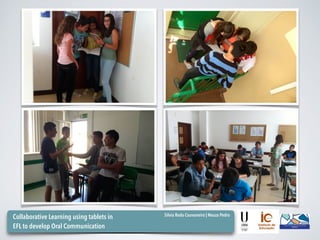
Collaborative Learning using tablets in
EFL to develop Oral Communication
PROJECT STEPS


- plan of action
according to
literature


- data collection
instruments


- unit and lesson
plans


- digital resources


- contact with
teachers and
students


- activities in class


- mixed data
collection


- data analysis,
crossing all the
results and
contrasting with
literature


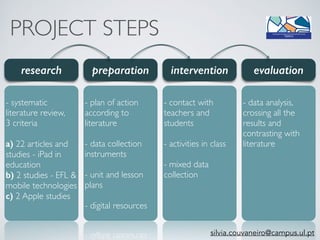
- systematic
literature review,

3 criteria


a) 22 articles and
studies - iPad in
education

b) 2 studies - EFL &
mobile technologies

c) 2 Apple studies
research preparation intervention evaluation
silvia.couvaneiro@campus.ul.pt
- seems evident that the iPad can add value to learning contexts:
characteristics and high level of usability
- most significant aspects about the iPad's educational use:
• approach to the needs and interests of students as a
form of motivation;
• the possibility of differentiation;
• the development of a large range of skills, including
those related to the use of technologies;
• the possibility of individual work as well as an
autonomous collaborative work;
• less need of teacher lecture;
• and creative production of different artefacts.
silvia.couvaneiro@campus.ul.pt
Literature review
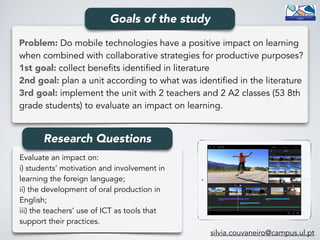
Problem: Do mobile technologies have a positive impact on learning
when combined with collaborative strategies for productive purposes?

1st goal: collect benefits identified in literature

2nd goal: plan a unit according to what was identified in the literature

3rd goal: implement the unit with 2 teachers and 2 A2 classes (53 8th
grade students) to evaluate an impact on learning.
Goals of the study
Evaluate an impact on:

i) students’ motivation and involvement in
learning the foreign language;

ii) the development of oral production in
English;

iii) the teachers’ use of ICT as tools that
support their practices.
Research Questions
silvia.couvaneiro@campus.ul.pt
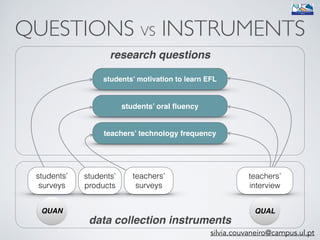
QUESTIONS VS INSTRUMENTS
research questions
students’ oral fluency
data collection instruments
QUAL
students’ motivation to learn EFL
teachers’ technology frequency
students’
surveys
teachers’
surveys
students’
products
teachers’
interview
QUAN
silvia.couvaneiro@campus.ul.pt
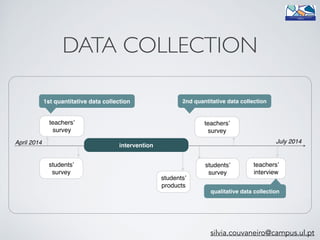
qualitative data collection
intervention
students’
survey
teachers’
survey
teachers’
interview
students’
products
1st quantitative data collection 2nd quantitative data collection
teachers’
survey
students’
survey
April 2014 July 2014
DATA COLLECTION
silvia.couvaneiro@campus.ul.pt
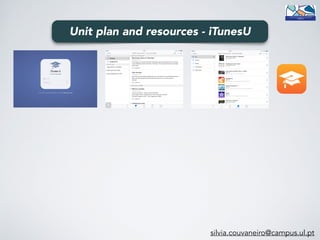
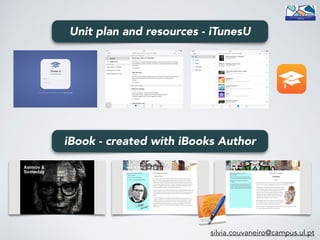
Unit plan and resources - iTunesU
iBook - created with iBooks Author
silvia.couvaneiro@campus.ul.pt
Unit plan and resources - iTunesU
silvia.couvaneiro@campus.ul.pt
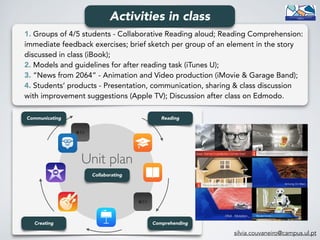
Reading
ComprehendingCreating
Communicating
Unit plan
Collaborating
1. Groups of 4/5 students - Collaborative Reading aloud; Reading Comprehension:
immediate feedback exercises; brief sketch per group of an element in the story
discussed in class (iBook);
2. Models and guidelines for after reading task (iTunes U);
3. “News from 2064” - Animation and Video production (iMovie & Garage Band);
4. Students’ products - Presentation, communication, sharing & class discussion
with improvement suggestions (Apple TV); Discussion after class on Edmodo.
Activities in class
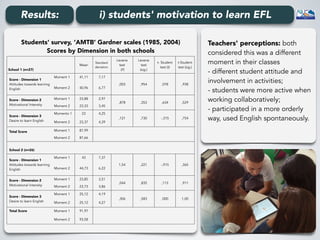
Students' survey, ‘AMTB’ Gardner scales (1985, 2004)

Scores by Dimension in both schools
School 1 (n=27)
Mean
Standard
deviation
Levene
test
(F)
Levene
test
(sig.)
t- Student
test (t)
t-Student
test (sig.)
Score - Dimension 1 

Attitudes towards learning
English
Moment 1 41,11 7,17
,003 ,954 ,078 ,938
Moment 2 40,96 6,77
Score - Dimension 2

Motivational Intensity
Moment 1 23,88 2,97
,878 ,353 ,634 ,529
Moment 2 23,33 3,45
Score - Dimension 3

Desire to learn English
Momento 1 23 4,25
,121 ,730 -,315 ,754
Moment 2 23,37 4,39
Total Score
 Moment 1 87,99
Moment 2 87,66
School 2 (n=26)
Score - Dimension 1 

Attitudes towards learning
English
Moment 1 43 7,37
1,54 ,221 -,915 ,365
Moment 2 44,73 6,22
Score - Dimension 2

Motivational Intensity
Moment 1 23,85 3,51
,044 ,835 ,113 ,911
Moment 2 23,73 3,86
Score - Dimension 3

Desire to learn English
Moment 1 25,12 4,19
,306 ,583 ,000 1,00
Moment 2 25,12 4,27
Total Score
 Moment 1 91,97
Moment 2 93,58
Teachers' perceptions: both
considered this was a different
moment in their classes

- different student attitude and
involvement in activities;

- students were more active when
working collaboratively;

- participated in a more orderly
way, used English spontaneously.
Results: i) students' motivation to learn EFL
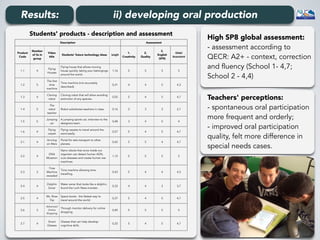
Results: ii) developing oral production
Students' products - description and assessment
Description Assessment
Product
Code
Number
of Ss in
group
Video
title
Students' future technology ideas Length
1.
Creativity
2.
Quality
3.
English
(SP8)
Global
Assessment
1.1 4
Flying
Houses
Flying house that allows moving
house quickly, taking your belongings
around the world.
1,16 5 5 5 5
1.2 5
The first
time
machine
Time machine (not accurately
described).
0,31 4 4 5 4,3
1.3 4
Cloning
robot
Cloning robot that will allow avoiding
extinction of any species.
0,55 5 4 5 4,7
1.4 5
The
robot
teacher
Robot substitutes teachers in class. 0,16 2 3 3 2,7
1.5 5
Jumping
car
A jumping sports car, interview to the
designers team.
0,48 3 4 5 4
1.6 4
Flying
carpet
Flying carpets to travel around the
word easily.
0,57 5 4 5 4,7
2.1 4
Arriving
on Mars
Portal for tele-transport to other
planets.
0,42 5 5 4 4,7
2.2 4
DNA
Mutation
Nano robots that once inside our
organism can detect human ADN,
cure diseases and create human war
machines.
1,12 5 5 5 5
2.3 3
Time
Machine
revealed
Time machine allowing time
travelling.
0,43 5 4 4 4,3
2.4 4
Dolphin
Sonar
Water sonar that looks like a dolphin,
found the Loch Ness monster.
0,32 4 4 3 3,7
2.5 4
Ms. Rose
Trip
Space boots - the fastest way to
travel around the world.
0,37 5 4 5 4,7
2.6 3
Advanced
Online
Shopping
Through monitor delivery for online
shopping.
0,40 5 5 5 5
2.7 4
Smart
Glasses
Glasses that can help develop
cognitive skills.
0,32 5 4 5 4,7
Teachers' perceptions:

- spontaneous oral participation
more frequent and orderly;

- improved oral participation
quality, felt more difference in
special needs cases.
High SP8 global assessment:

- assessment according to
QECR: A2+ - context, correction
and fluency (School 1- 4,7;
School 2 - 4,4)
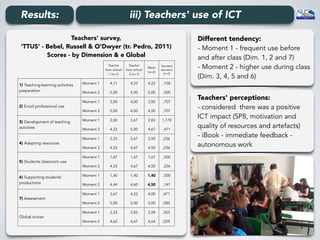
Results: iii) Teachers' use of ICT
Teachers' survey,

‘TTUS’ - Bebel, Russell & O’Dwyer (tr. Pedro, 2011)

Scores - by Dimension & e Global
Teacher
from school
1 (n=1)
Teacher
from school
2 (n=1)
Mean
(n=2)
Standard
deviation
(n=2)
1) Teaching-learning activities
preparation
Moment 1 4,11 4,33 4,22 ,158
Moment 2 5,00 5,00 5,00 ,000
2) Email professional use
Moment 1 3,00 4,00 3,50 ,707
Moment 2 5,00 4,00 4,50 ,707
3) Development of teaching
activities
Moment 1 2,00 3,67 2,83 1,178
Moment 2 4,33 5,00 4,67 ,471
4) Adapting resources
Moment 1 2,33 2,67 2,50 ,236
Moment 2 4,33 4,67 4,50 ,236
5) Students classroom use
Moment 1 1,67 1,67 1,67 ,000
Moment 2 4,33 4,67 4,50 ,236
6) Supporting students'
productions
Moment 1 1,40 1,40 1,40 ,000
Moment 2 4,44 4,60 4,50 ,141
7) Assessment
Moment 1 3,67 4,33 4,00 ,471
Moment 2 5,00 5,00 5,00 ,000
Global scores
Moment 1 2,33 2,83 2,58 ,353
Moment 2 4,62 4,67 4,64 ,029
Teachers' perceptions:

- considered there was a positive
ICT impact (SP8, motivation and
quality of resources and artefacts)

- iBook - immediate feedback -
autonomous work
Different tendency:

- Moment 1 - frequent use before
and after class (Dim. 1, 2 and 7)

- Moment 2 - higher use during class
(Dim. 3, 4, 5 and 6)
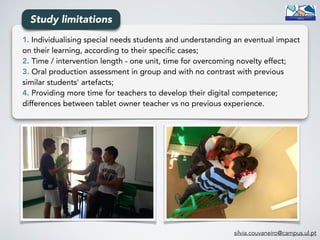
1. Individualising special needs students and understanding an eventual impact
on their learning, according to their specific cases;
2. Time / intervention length - one unit, time for overcoming novelty effect;
3. Oral production assessment in group and with no contrast with previous
similar students' artefacts;
4. Providing more time for teachers to develop their digital competence;
differences between tablet owner teacher vs no previous experience.
Study limitations
silvia.couvaneiro@campus.ul.pt
1. Students were more active - apparent changes in motivation and
involvement in class - teachers perceptions
2. Students' oral fluency appears to have improved; teachers felt it
was more frequent in spontaneous situations in class
3. Teachers used ICT for more purposes than before, with stronger
incidence on supporting students' productions
4. Both teachers considered technology and strategies affected
behaviour positively
1. Evaluate longer term impact on learning and motivation;

2. Also focus on Students’ use of technology, digital competence;
3. Allow Teachers to have training in advance and support
throughout the study;

4. Consider 1:1 deployments to individualise learning progress.
Further research
Main Findings
silvia.couvaneiro@campus.ul.pt
Collaborative Learning using tablets in

EFL to develop Oral Communication


Sílvia Roda Couvaneiro | Neuza Pedro

Collaborative Learning using tablets in EFL to develop Oral Communication

  • 1.
    Sílvia Roda Couvaneiro Institutode Educação da Universidade de Lisboa silvia.couvaneiro@campus.ul.pt Neuza Pedro Instituto de Educação da Universidade de Lisboa nspedro@ie.ulisboa.pt Collaborative Learning using tablets in EFL to develop Oral Communication
  • 2.
    PROJECT STEPS 
 - planof action according to literature
 
 - data collection instruments
 
 - unit and lesson plans
 
 - digital resources 
 - contact with teachers and students
 
 - activities in class
 
 - mixed data collection 
 - data analysis, crossing all the results and contrasting with literature 
 - systematic literature review,
 3 criteria
 
 a) 22 articles and studies - iPad in education
 b) 2 studies - EFL & mobile technologies
 c) 2 Apple studies research preparation intervention evaluation silvia.couvaneiro@campus.ul.pt
  • 3.
    - seems evidentthat the iPad can add value to learning contexts: characteristics and high level of usability - most significant aspects about the iPad's educational use: • approach to the needs and interests of students as a form of motivation; • the possibility of differentiation; • the development of a large range of skills, including those related to the use of technologies; • the possibility of individual work as well as an autonomous collaborative work; • less need of teacher lecture; • and creative production of different artefacts. silvia.couvaneiro@campus.ul.pt Literature review
  • 4.
    Problem: Do mobiletechnologies have a positive impact on learning when combined with collaborative strategies for productive purposes?
 1st goal: collect benefits identified in literature
 2nd goal: plan a unit according to what was identified in the literature
 3rd goal: implement the unit with 2 teachers and 2 A2 classes (53 8th grade students) to evaluate an impact on learning. Goals of the study Evaluate an impact on:
 i) students’ motivation and involvement in learning the foreign language;
 ii) the development of oral production in English;
 iii) the teachers’ use of ICT as tools that support their practices. Research Questions silvia.couvaneiro@campus.ul.pt
  • 5.
    QUESTIONS VS INSTRUMENTS researchquestions students’ oral fluency data collection instruments QUAL students’ motivation to learn EFL teachers’ technology frequency students’ surveys teachers’ surveys students’ products teachers’ interview QUAN silvia.couvaneiro@campus.ul.pt
  • 6.
    qualitative data collection intervention students’ survey teachers’ survey teachers’ interview students’ products 1stquantitative data collection 2nd quantitative data collection teachers’ survey students’ survey April 2014 July 2014 DATA COLLECTION silvia.couvaneiro@campus.ul.pt
  • 7.
  • 8.
    iBook - createdwith iBooks Author silvia.couvaneiro@campus.ul.pt Unit plan and resources - iTunesU
  • 9.
    silvia.couvaneiro@campus.ul.pt Reading ComprehendingCreating Communicating Unit plan Collaborating 1. Groupsof 4/5 students - Collaborative Reading aloud; Reading Comprehension: immediate feedback exercises; brief sketch per group of an element in the story discussed in class (iBook); 2. Models and guidelines for after reading task (iTunes U); 3. “News from 2064” - Animation and Video production (iMovie & Garage Band); 4. Students’ products - Presentation, communication, sharing & class discussion with improvement suggestions (Apple TV); Discussion after class on Edmodo. Activities in class
  • 10.
    Students' survey, ‘AMTB’Gardner scales (1985, 2004)
 Scores by Dimension in both schools School 1 (n=27) Mean Standard deviation Levene test (F) Levene test (sig.) t- Student test (t) t-Student test (sig.) Score - Dimension 1 
 Attitudes towards learning English Moment 1 41,11 7,17 ,003 ,954 ,078 ,938 Moment 2 40,96 6,77 Score - Dimension 2
 Motivational Intensity Moment 1 23,88 2,97 ,878 ,353 ,634 ,529 Moment 2 23,33 3,45 Score - Dimension 3
 Desire to learn English Momento 1 23 4,25 ,121 ,730 -,315 ,754 Moment 2 23,37 4,39 Total Score
 Moment 1 87,99 Moment 2 87,66 School 2 (n=26) Score - Dimension 1 
 Attitudes towards learning English Moment 1 43 7,37 1,54 ,221 -,915 ,365 Moment 2 44,73 6,22 Score - Dimension 2
 Motivational Intensity Moment 1 23,85 3,51 ,044 ,835 ,113 ,911 Moment 2 23,73 3,86 Score - Dimension 3
 Desire to learn English Moment 1 25,12 4,19 ,306 ,583 ,000 1,00 Moment 2 25,12 4,27 Total Score
 Moment 1 91,97 Moment 2 93,58 Teachers' perceptions: both considered this was a different moment in their classes
 - different student attitude and involvement in activities;
 - students were more active when working collaboratively;
 - participated in a more orderly way, used English spontaneously. Results: i) students' motivation to learn EFL
  • 11.
    Results: ii) developingoral production Students' products - description and assessment Description Assessment Product Code Number of Ss in group Video title Students' future technology ideas Length 1. Creativity 2. Quality 3. English (SP8) Global Assessment 1.1 4 Flying Houses Flying house that allows moving house quickly, taking your belongings around the world. 1,16 5 5 5 5 1.2 5 The first time machine Time machine (not accurately described). 0,31 4 4 5 4,3 1.3 4 Cloning robot Cloning robot that will allow avoiding extinction of any species. 0,55 5 4 5 4,7 1.4 5 The robot teacher Robot substitutes teachers in class. 0,16 2 3 3 2,7 1.5 5 Jumping car A jumping sports car, interview to the designers team. 0,48 3 4 5 4 1.6 4 Flying carpet Flying carpets to travel around the word easily. 0,57 5 4 5 4,7 2.1 4 Arriving on Mars Portal for tele-transport to other planets. 0,42 5 5 4 4,7 2.2 4 DNA Mutation Nano robots that once inside our organism can detect human ADN, cure diseases and create human war machines. 1,12 5 5 5 5 2.3 3 Time Machine revealed Time machine allowing time travelling. 0,43 5 4 4 4,3 2.4 4 Dolphin Sonar Water sonar that looks like a dolphin, found the Loch Ness monster. 0,32 4 4 3 3,7 2.5 4 Ms. Rose Trip Space boots - the fastest way to travel around the world. 0,37 5 4 5 4,7 2.6 3 Advanced Online Shopping Through monitor delivery for online shopping. 0,40 5 5 5 5 2.7 4 Smart Glasses Glasses that can help develop cognitive skills. 0,32 5 4 5 4,7 Teachers' perceptions:
 - spontaneous oral participation more frequent and orderly;
 - improved oral participation quality, felt more difference in special needs cases. High SP8 global assessment:
 - assessment according to QECR: A2+ - context, correction and fluency (School 1- 4,7; School 2 - 4,4)
  • 12.
    Results: iii) Teachers'use of ICT Teachers' survey,
 ‘TTUS’ - Bebel, Russell & O’Dwyer (tr. Pedro, 2011)
 Scores - by Dimension & e Global Teacher from school 1 (n=1) Teacher from school 2 (n=1) Mean (n=2) Standard deviation (n=2) 1) Teaching-learning activities preparation Moment 1 4,11 4,33 4,22 ,158 Moment 2 5,00 5,00 5,00 ,000 2) Email professional use Moment 1 3,00 4,00 3,50 ,707 Moment 2 5,00 4,00 4,50 ,707 3) Development of teaching activities Moment 1 2,00 3,67 2,83 1,178 Moment 2 4,33 5,00 4,67 ,471 4) Adapting resources Moment 1 2,33 2,67 2,50 ,236 Moment 2 4,33 4,67 4,50 ,236 5) Students classroom use Moment 1 1,67 1,67 1,67 ,000 Moment 2 4,33 4,67 4,50 ,236 6) Supporting students' productions Moment 1 1,40 1,40 1,40 ,000 Moment 2 4,44 4,60 4,50 ,141 7) Assessment Moment 1 3,67 4,33 4,00 ,471 Moment 2 5,00 5,00 5,00 ,000 Global scores Moment 1 2,33 2,83 2,58 ,353 Moment 2 4,62 4,67 4,64 ,029 Teachers' perceptions:
 - considered there was a positive ICT impact (SP8, motivation and quality of resources and artefacts)
 - iBook - immediate feedback - autonomous work Different tendency:
 - Moment 1 - frequent use before and after class (Dim. 1, 2 and 7)
 - Moment 2 - higher use during class (Dim. 3, 4, 5 and 6)
  • 13.
    1. Individualising specialneeds students and understanding an eventual impact on their learning, according to their specific cases; 2. Time / intervention length - one unit, time for overcoming novelty effect; 3. Oral production assessment in group and with no contrast with previous similar students' artefacts; 4. Providing more time for teachers to develop their digital competence; differences between tablet owner teacher vs no previous experience. Study limitations silvia.couvaneiro@campus.ul.pt
  • 14.
    1. Students weremore active - apparent changes in motivation and involvement in class - teachers perceptions 2. Students' oral fluency appears to have improved; teachers felt it was more frequent in spontaneous situations in class 3. Teachers used ICT for more purposes than before, with stronger incidence on supporting students' productions 4. Both teachers considered technology and strategies affected behaviour positively 1. Evaluate longer term impact on learning and motivation;
 2. Also focus on Students’ use of technology, digital competence; 3. Allow Teachers to have training in advance and support throughout the study;
 4. Consider 1:1 deployments to individualise learning progress. Further research Main Findings silvia.couvaneiro@campus.ul.pt
  • 15.
    Collaborative Learning usingtablets in
 EFL to develop Oral Communication 
 Sílvia Roda Couvaneiro | Neuza Pedro