Session ID:
Remember to complete your evaluation for this session within the app!
10480
manoj.rathi@jadeglobal.com
Implementing WMS
for 30+ Warehouses
in 12 Months
Agenda
Introduction
Business Challenges and Requirements
Solution
Approach
Lessons Learnt
Q&A
Session Evalution
Presenter Introduction
Manoj Rathi CSCP, CS&OP, Six Sigma, MBA
SCM SME with over 20 years of experience
20+ presentations on Oracle Forums
Key Oracle Certifications
Oracle Order Management Cloud 2017 Certified Implementation Specialist
Oracle Manufacturing Cloud 2017 Certified Implementation Specialist
Oracle Procurement Cloud 2016 Certified Implementation Specialist
Oracle SCM Cloud 2017 Sales Specialist
Oracle SCM Cloud 2017 PreSales Specialist
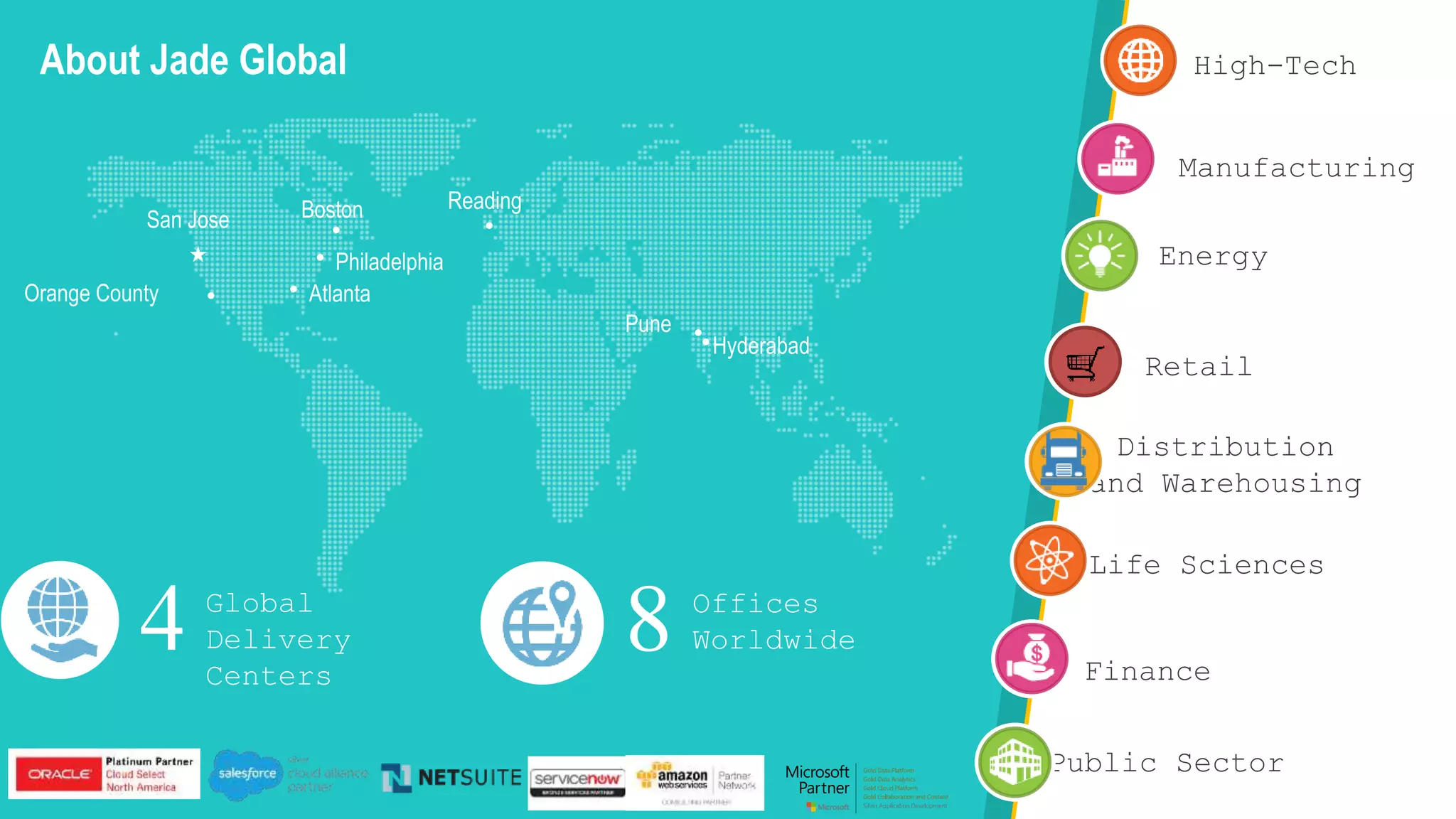
Pune
San Jose
Orange County Atlanta
Hyderabad
Reading
Philadelphia
Boston
About Jade Global High-Tech
Manufacturing
4 Global
Delivery
Centers
8 Offices
Worldwide
Life Sciences
Finance
Public Sector
Distribution
and Warehousing
Retail
Energy
5/16/2018
Challenges and
Requirements
The Challenges
• Sub-optimized and non-scalable processes and systems
– Use of work orders to track project material issue
• Serials captured outside system in a spreadsheet
– either capture them at receipt or at Sales order issue
• Higher Transaction Processing time
• Paper based process
• Delayed transaction entry in Oracle  Delayed visibility in Oracle
• Manual errors and mistakes  Inventory inaccuracy
• Timely onboarding of a new warehouse
Requirements
• Scalable standardized processes to be deployed across all warehouses
• Track serial numbers during shipment, returns and on projects (field)
• Provide a order fulfillment process based on WMS and industry best practices
• Provide shipment verification step for the staged material for projects
• Provide fool-proofing in the warehousing operations
• Provide a solid business change management process
• Provide a standardized process to capture miscellaneous transactions in the
warehouse that are not tracked on project BOM (sales order)
• Ability to upload and maintain project BOMs
• Capture demand for project material requirements
• Track transfers between warehouses and distribution centers.
• Data Conversion
Solution
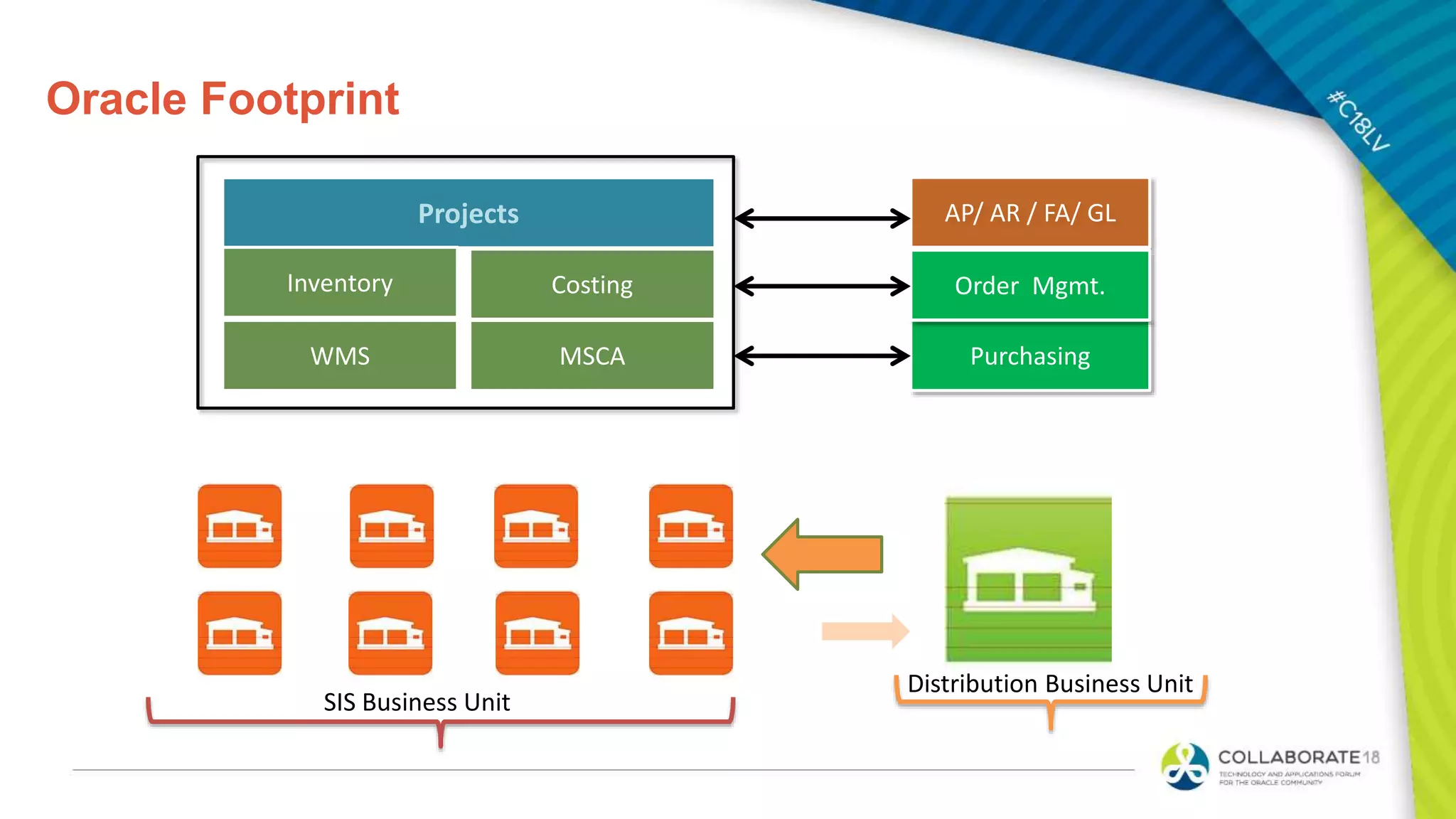
Oracle Footprint
Projects
CostingInventory
AP/ AR / FA/ GL
Purchasing
Order Mgmt.
MSCAWMS
SIS Business Unit
Distribution Business Unit
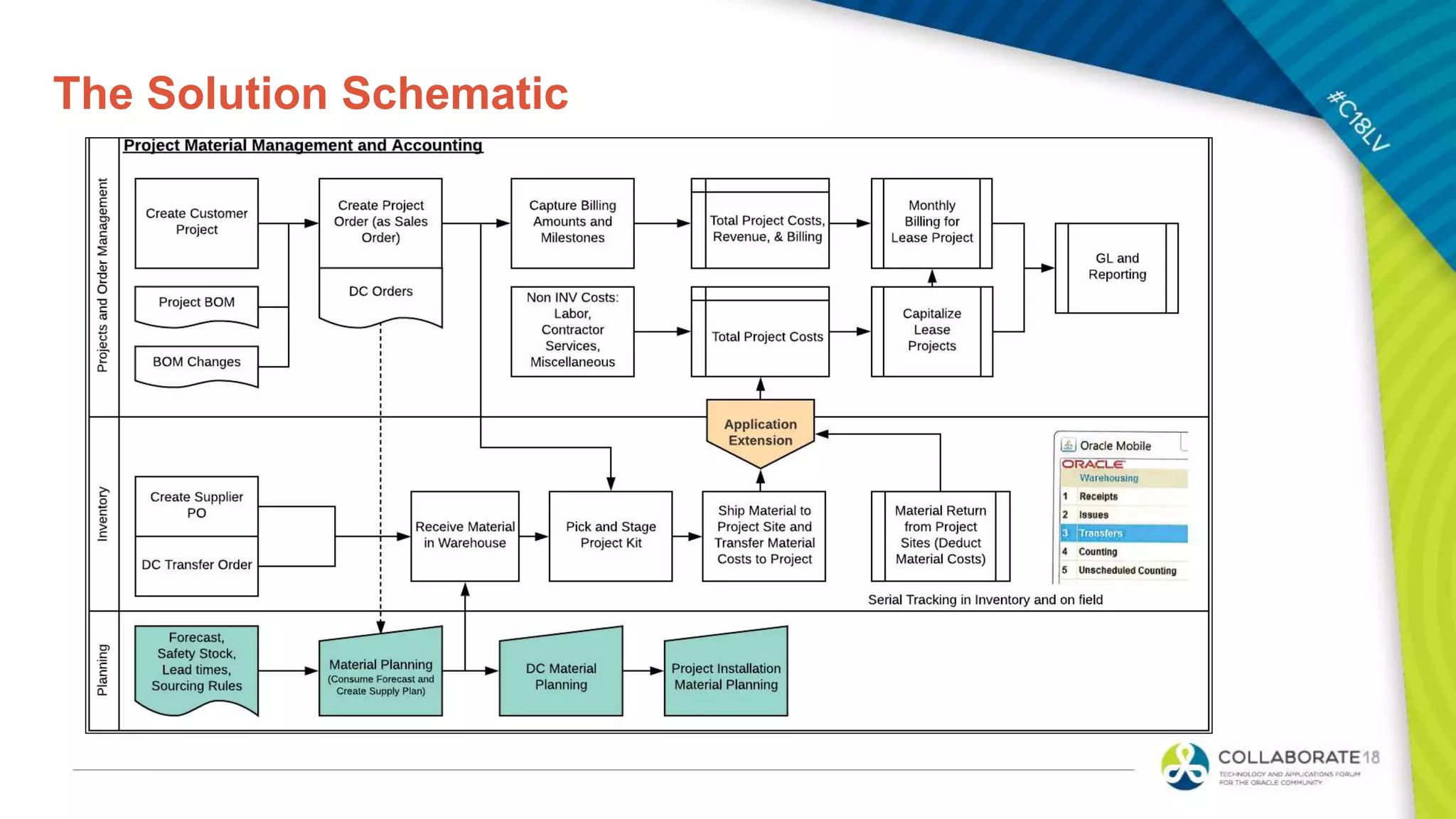
The Solution Schematic
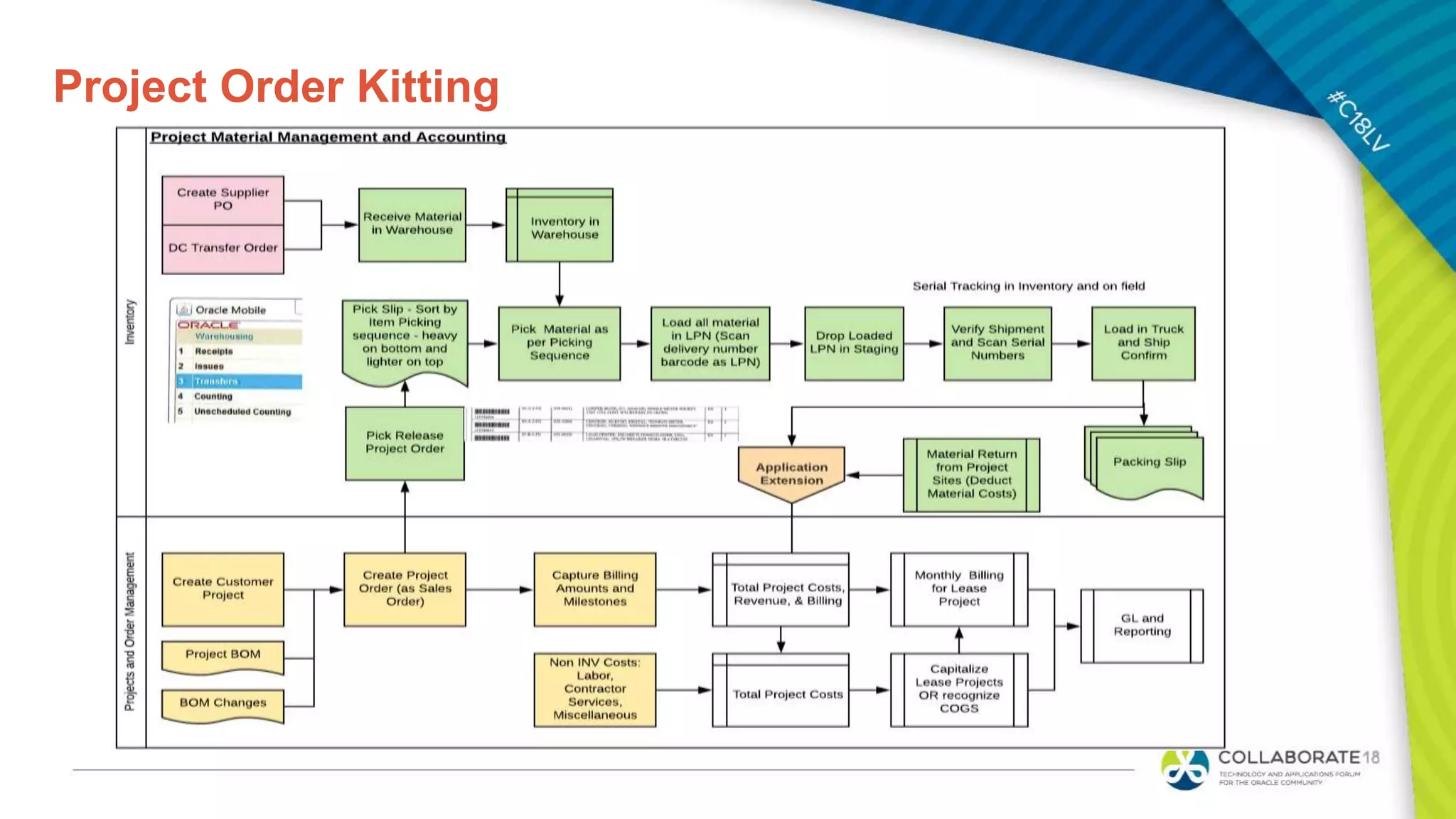
Project Order Kitting
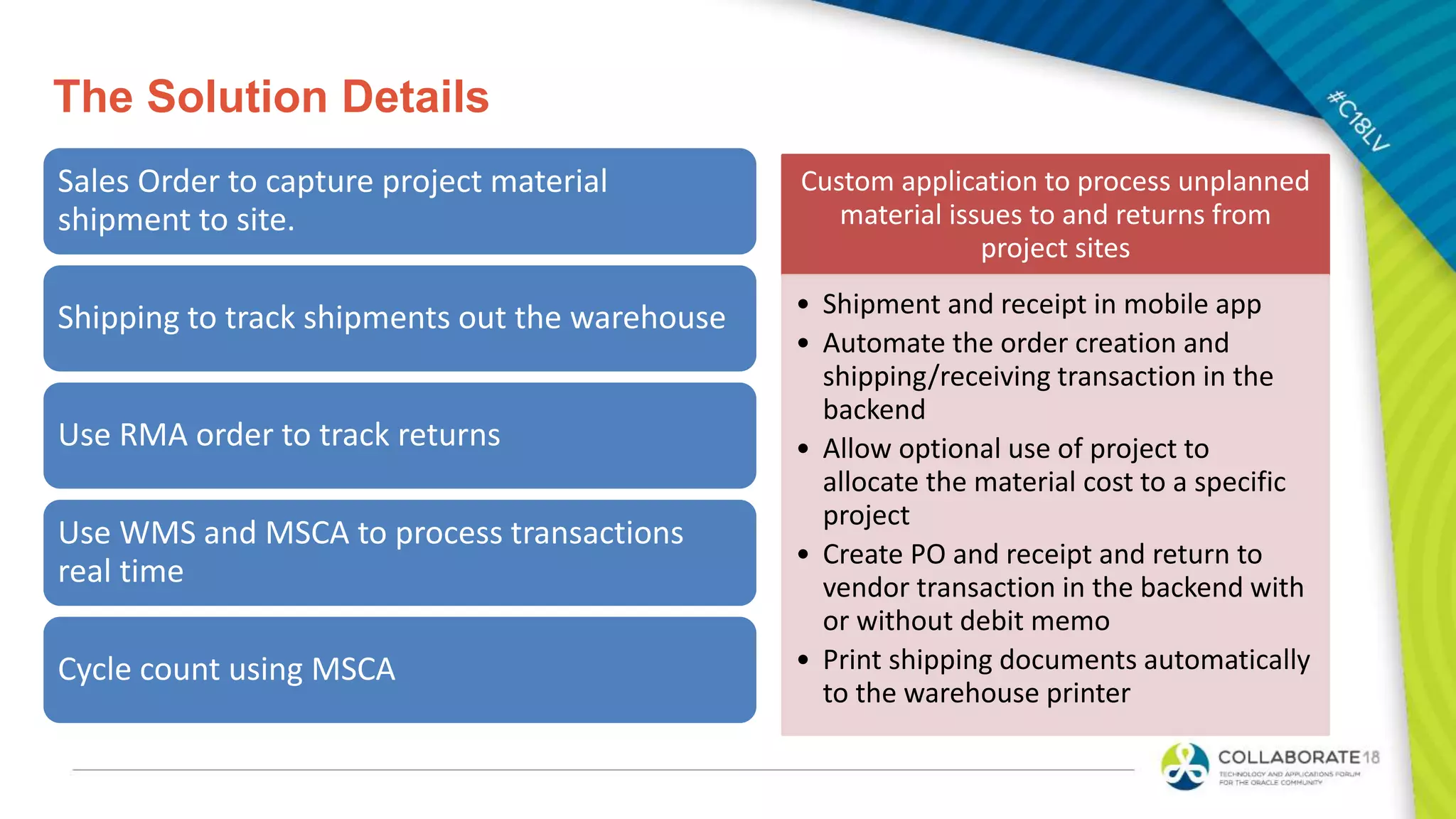
The Solution Details
Sales Order to capture project material
shipment to site.
Shipping to track shipments out the warehouse
Use RMA order to track returns
Use WMS and MSCA to process transactions
real time
Cycle count using MSCA
Custom application to process unplanned
material issues to and returns from
project sites
• Shipment and receipt in mobile app
• Automate the order creation and
shipping/receiving transaction in the
backend
• Allow optional use of project to
allocate the material cost to a specific
project
• Create PO and receipt and return to
vendor transaction in the backend with
or without debit memo
• Print shipping documents automatically
to the warehouse printer
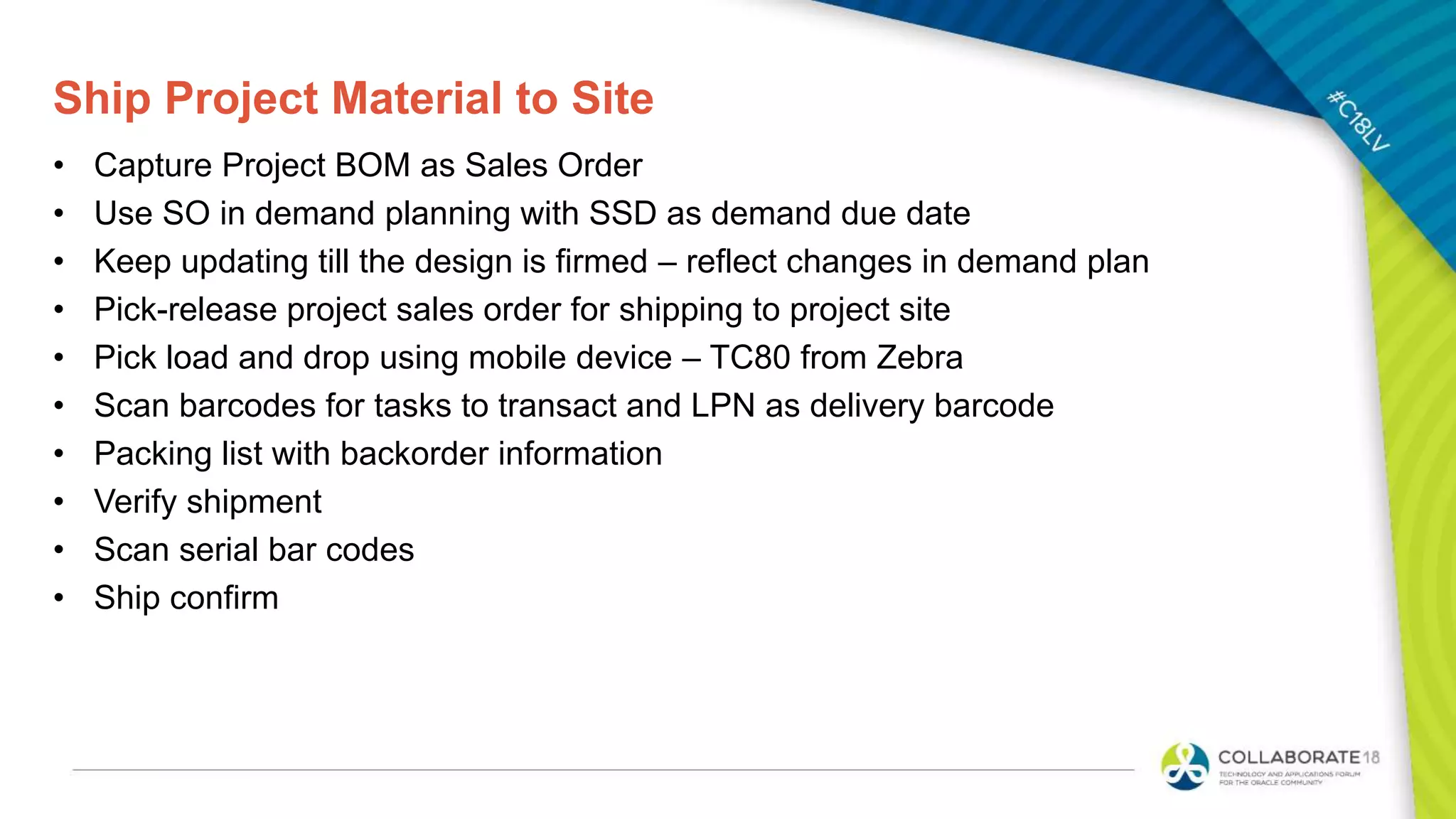
Ship Project Material to Site
• Capture Project BOM as Sales Order
• Use SO in demand planning with SSD as demand due date
• Keep updating till the design is firmed – reflect changes in demand plan
• Pick-release project sales order for shipping to project site
• Pick load and drop using mobile device – TC80 from Zebra
• Scan barcodes for tasks to transact and LPN as delivery barcode
• Packing list with backorder information
• Verify shipment
• Scan serial bar codes
• Ship confirm
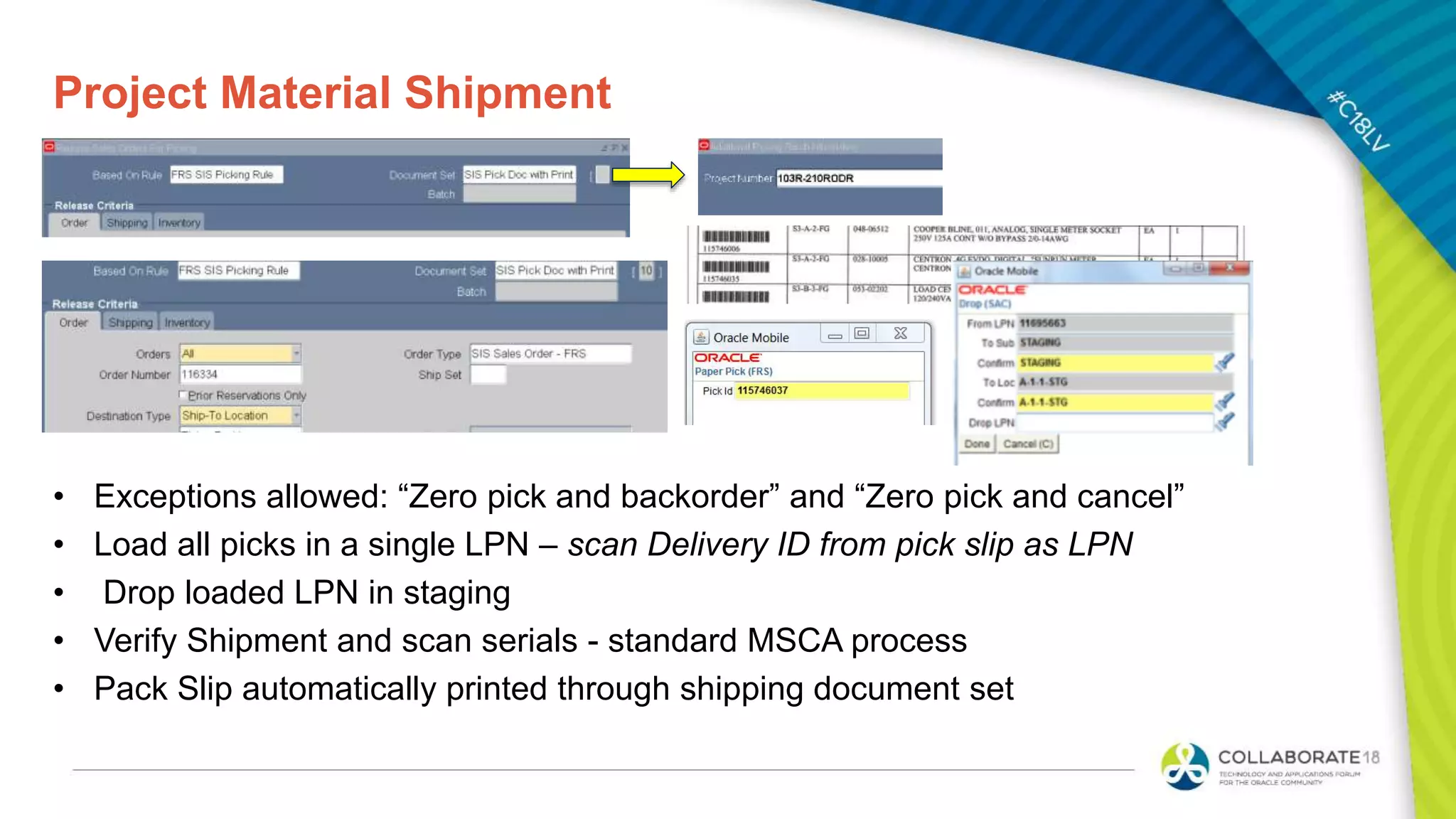
Project Material Shipment
• Exceptions allowed: “Zero pick and backorder” and “Zero pick and cancel”
• Load all picks in a single LPN – scan Delivery ID from pick slip as LPN
• Drop loaded LPN in staging
• Verify Shipment and scan serials - standard MSCA process
• Pack Slip automatically printed through shipping document set
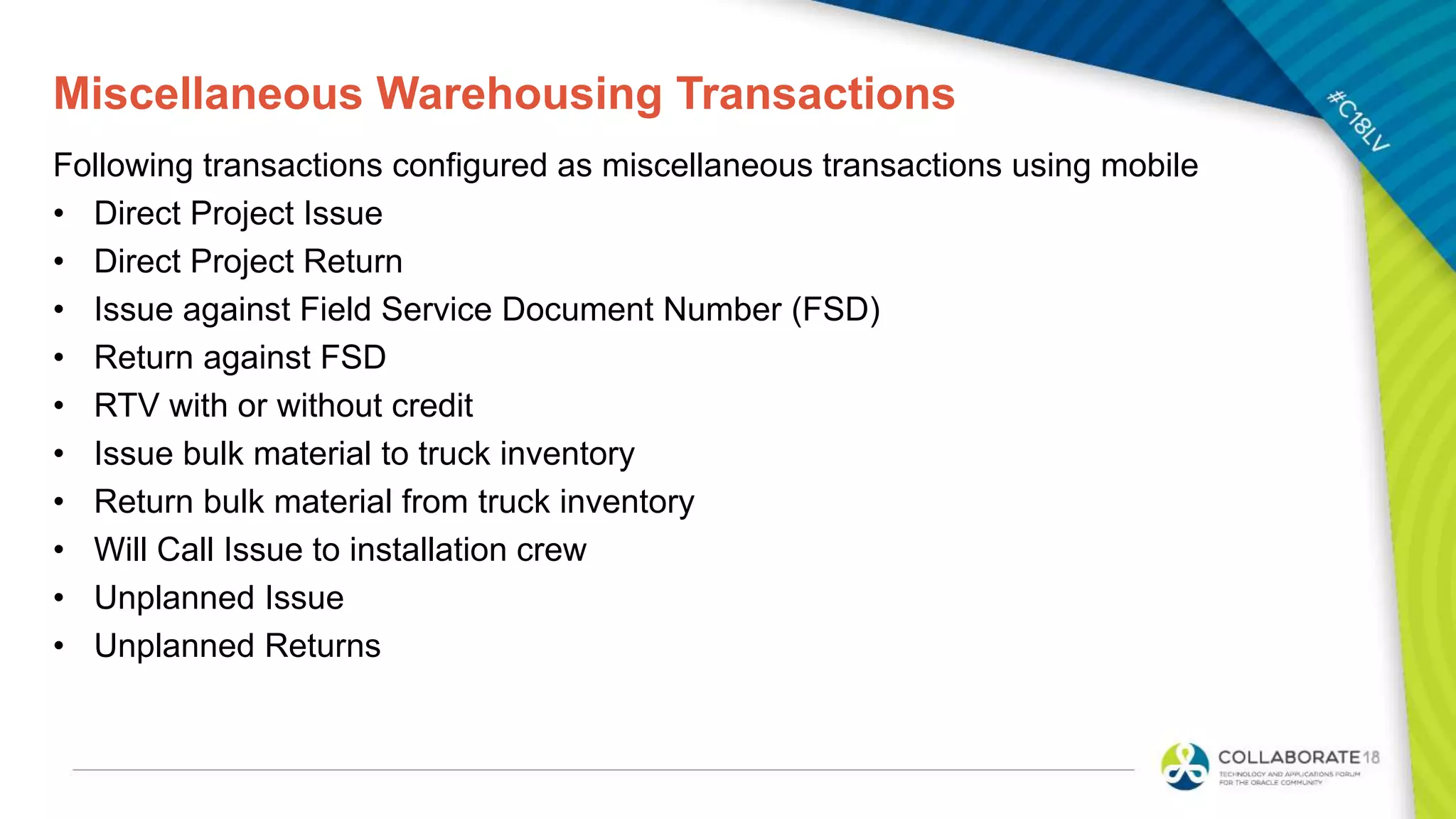
Miscellaneous Warehousing Transactions
Following transactions configured as miscellaneous transactions using mobile
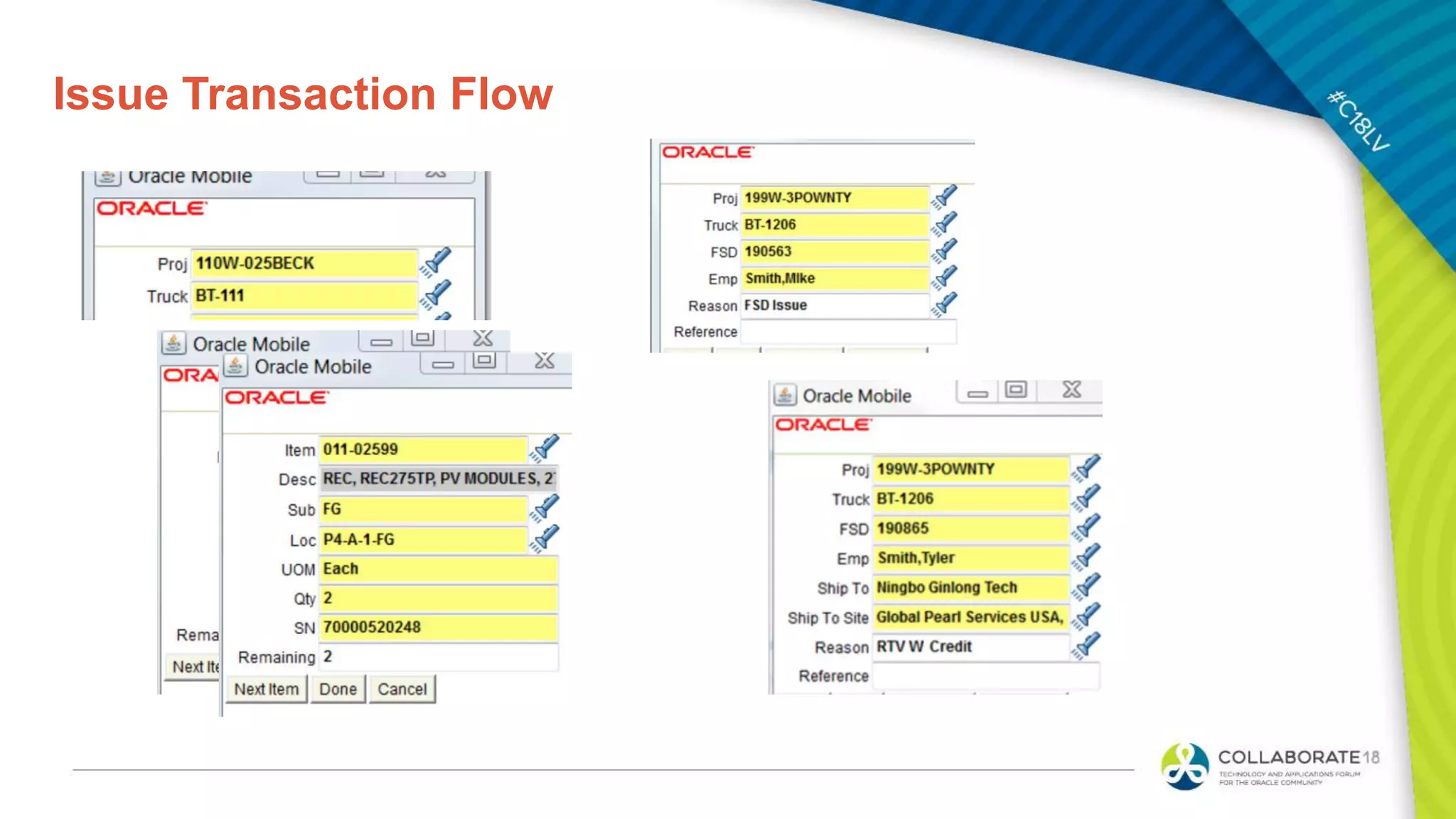
• Direct Project Issue
• Direct Project Return
• Issue against Field Service Document Number (FSD)
• Return against FSD
• RTV with or without credit
• Issue bulk material to truck inventory
• Return bulk material from truck inventory
• Will Call Issue to installation crew
• Unplanned Issue
• Unplanned Returns
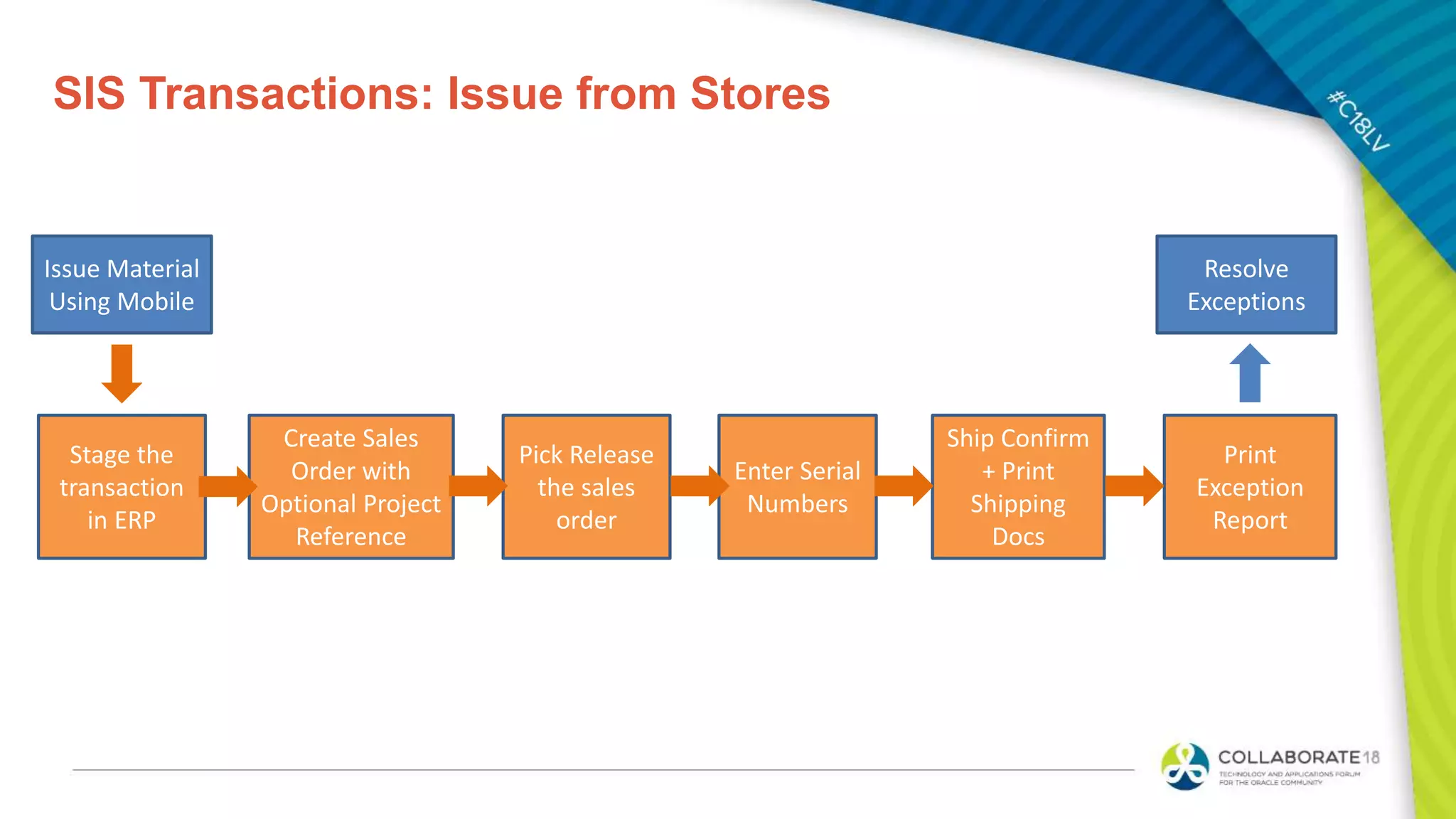
SIS Transactions: Issue from Stores
Issue Material
Using Mobile
Stage the
transaction
in ERP
Create Sales
Order with
Optional Project
Reference
Enter Serial
Numbers
Pick Release
the sales
order
Ship Confirm
+ Print
Shipping
Docs
Resolve
Exceptions
Print
Exception
Report
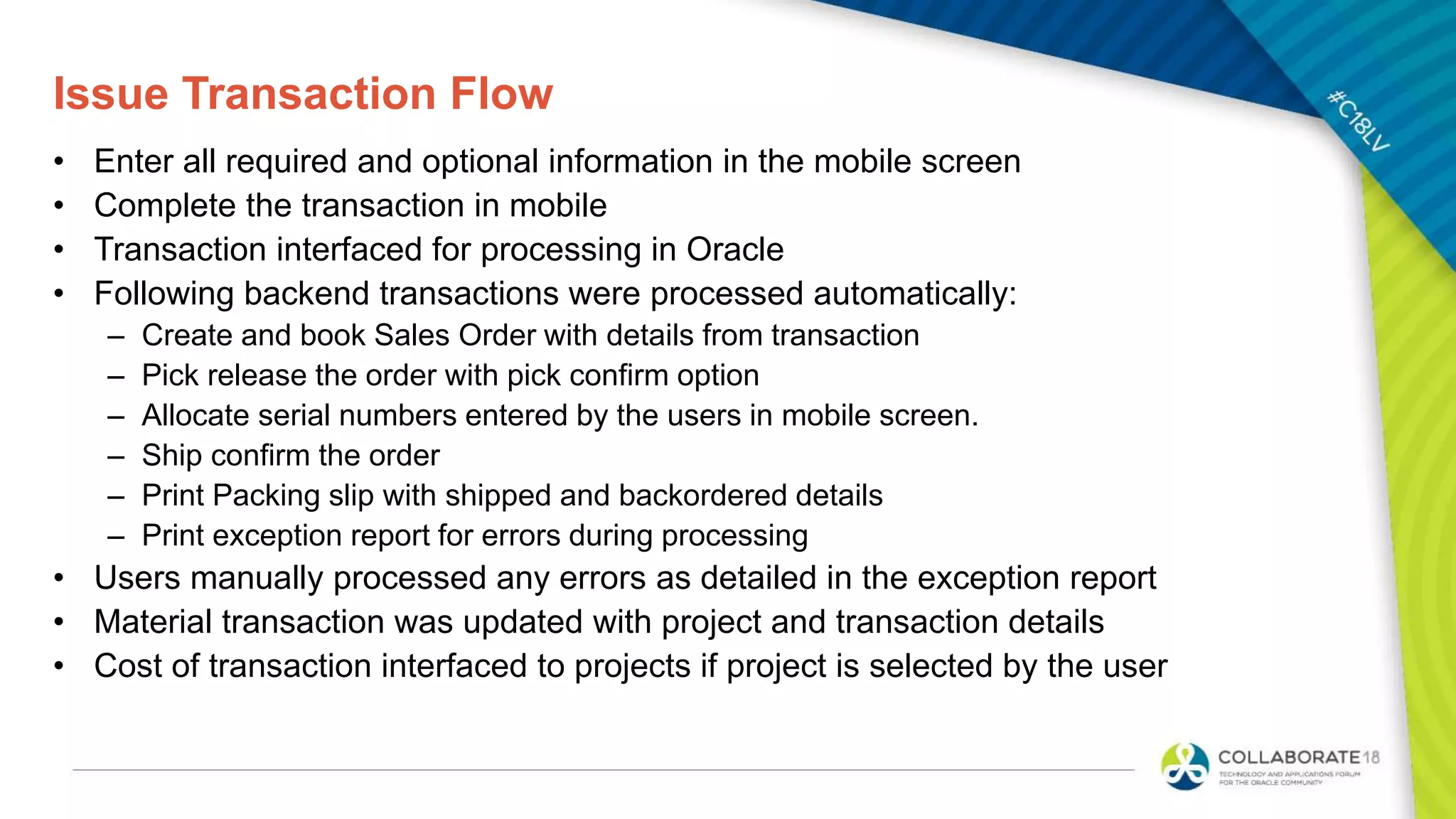
Issue Transaction Flow
• Enter all required and optional information in the mobile screen
• Complete the transaction in mobile
• Transaction interfaced for processing in Oracle
• Following backend transactions were processed automatically:
– Create and book Sales Order with details from transaction
– Pick release the order with pick confirm option
– Allocate serial numbers entered by the users in mobile screen.
– Ship confirm the order
– Print Packing slip with shipped and backordered details
– Print exception report for errors during processing
• Users manually processed any errors as detailed in the exception report
• Material transaction was updated with project and transaction details
• Cost of transaction interfaced to projects if project is selected by the user
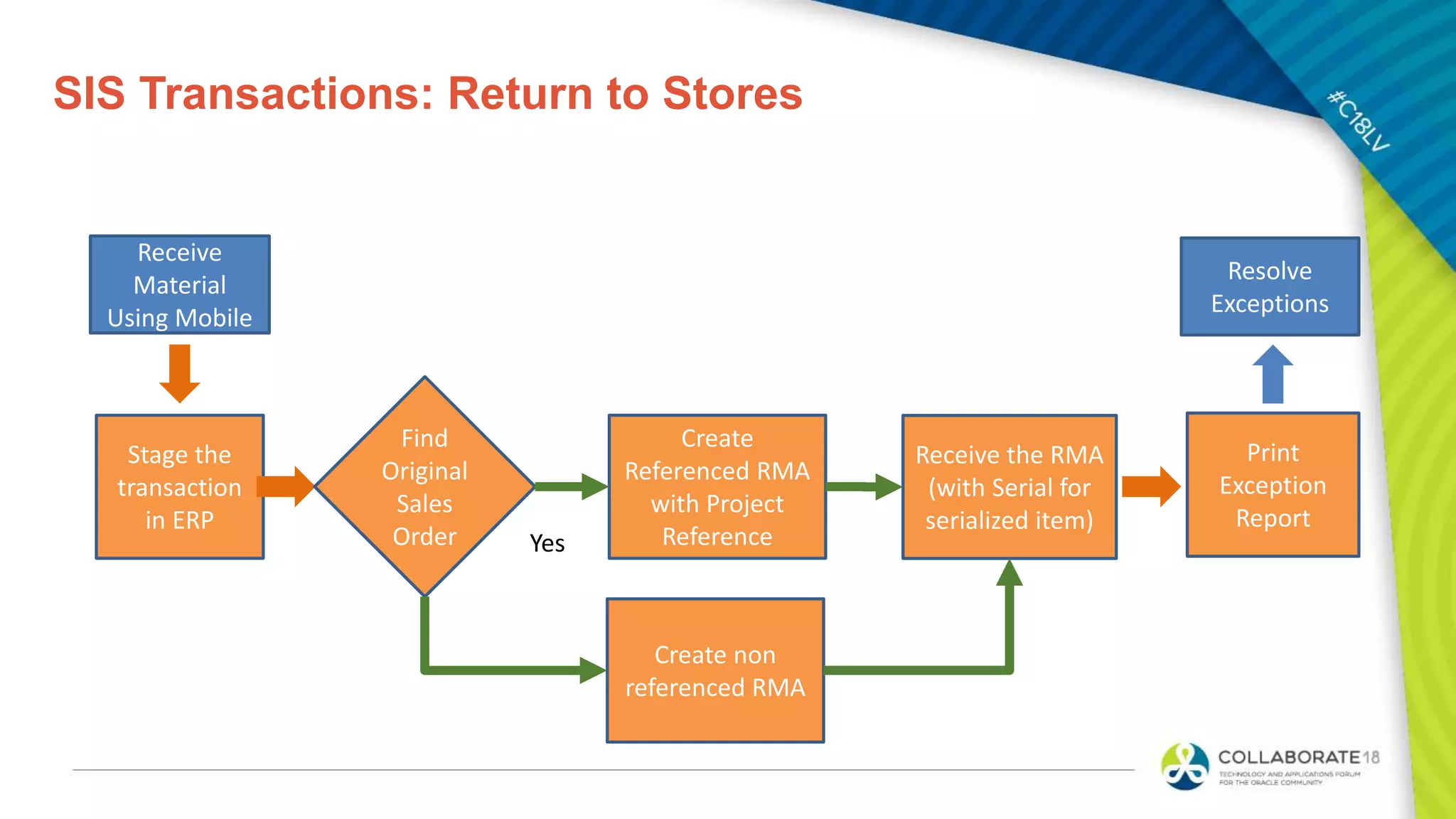
SIS Transactions: Return to Stores
Receive
Material
Using Mobile
Stage the
transaction
in ERP
Create
Referenced RMA
with Project
Reference
Receive the RMA
(with Serial for
serialized item)
Create non
referenced RMA
Resolve
Exceptions
Print
Exception
Report
Find
Original
Sales
Order Yes
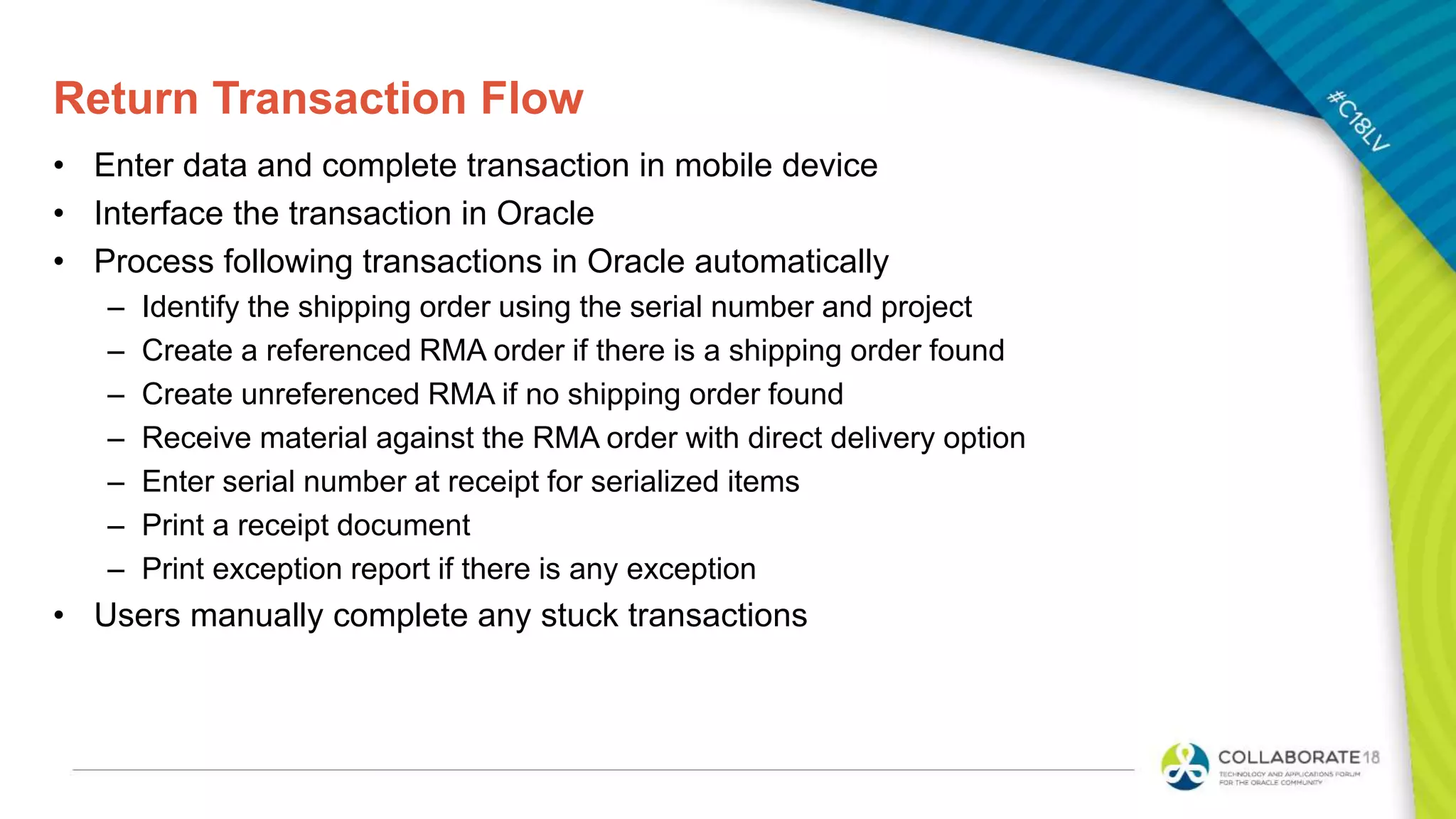
Return Transaction Flow
• Enter data and complete transaction in mobile device
• Interface the transaction in Oracle
• Process following transactions in Oracle automatically
– Identify the shipping order using the serial number and project
– Create a referenced RMA order if there is a shipping order found
– Create unreferenced RMA if no shipping order found
– Receive material against the RMA order with direct delivery option
– Enter serial number at receipt for serialized items
– Print a receipt document
– Print exception report if there is any exception
• Users manually complete any stuck transactions
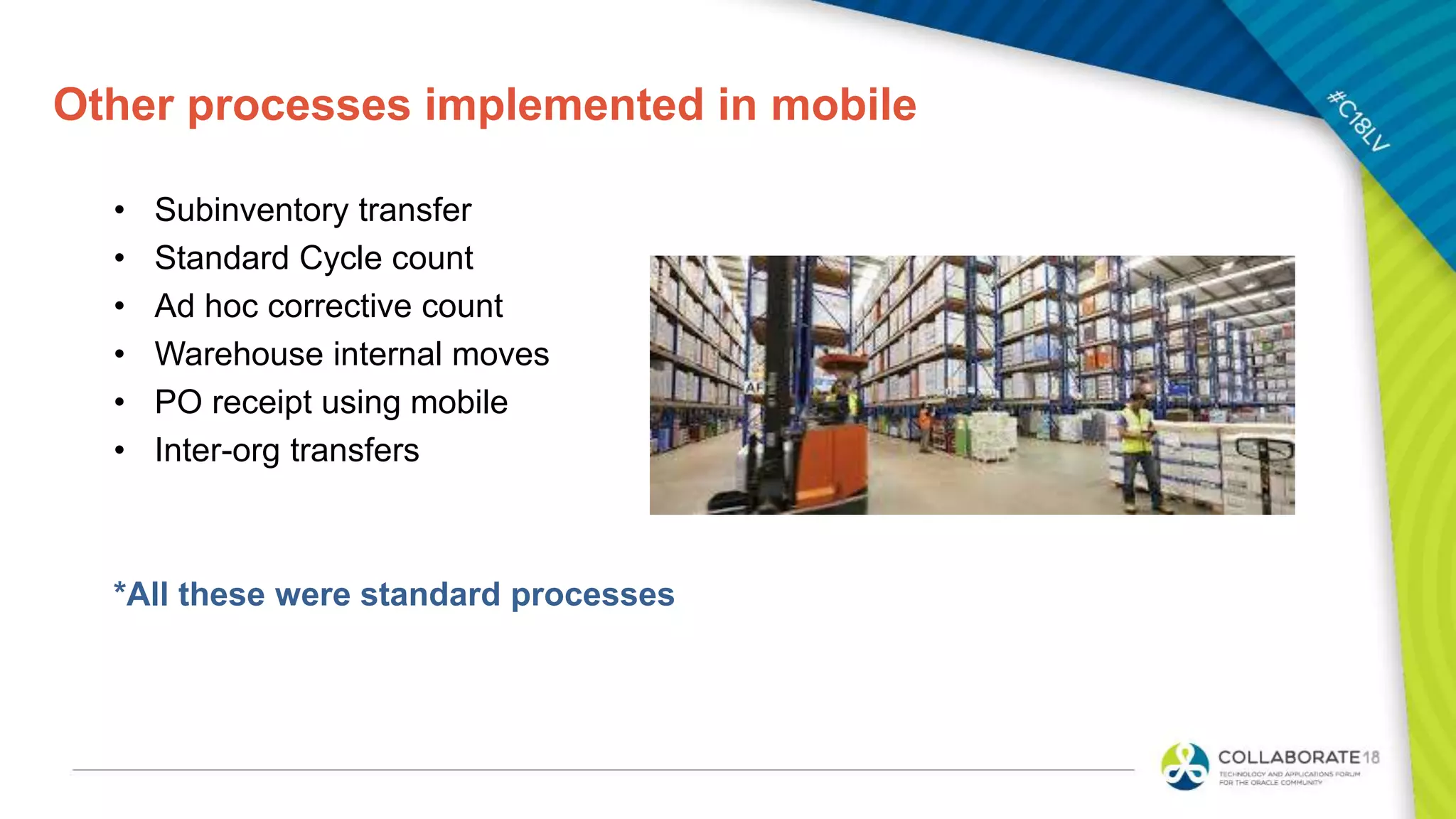
Other processes implemented in mobile
• Subinventory transfer
• Standard Cycle count
• Ad hoc corrective count
• Warehouse internal moves
• PO receipt using mobile
• Inter-org transfers
*All these were standard processes
Rollout Approach
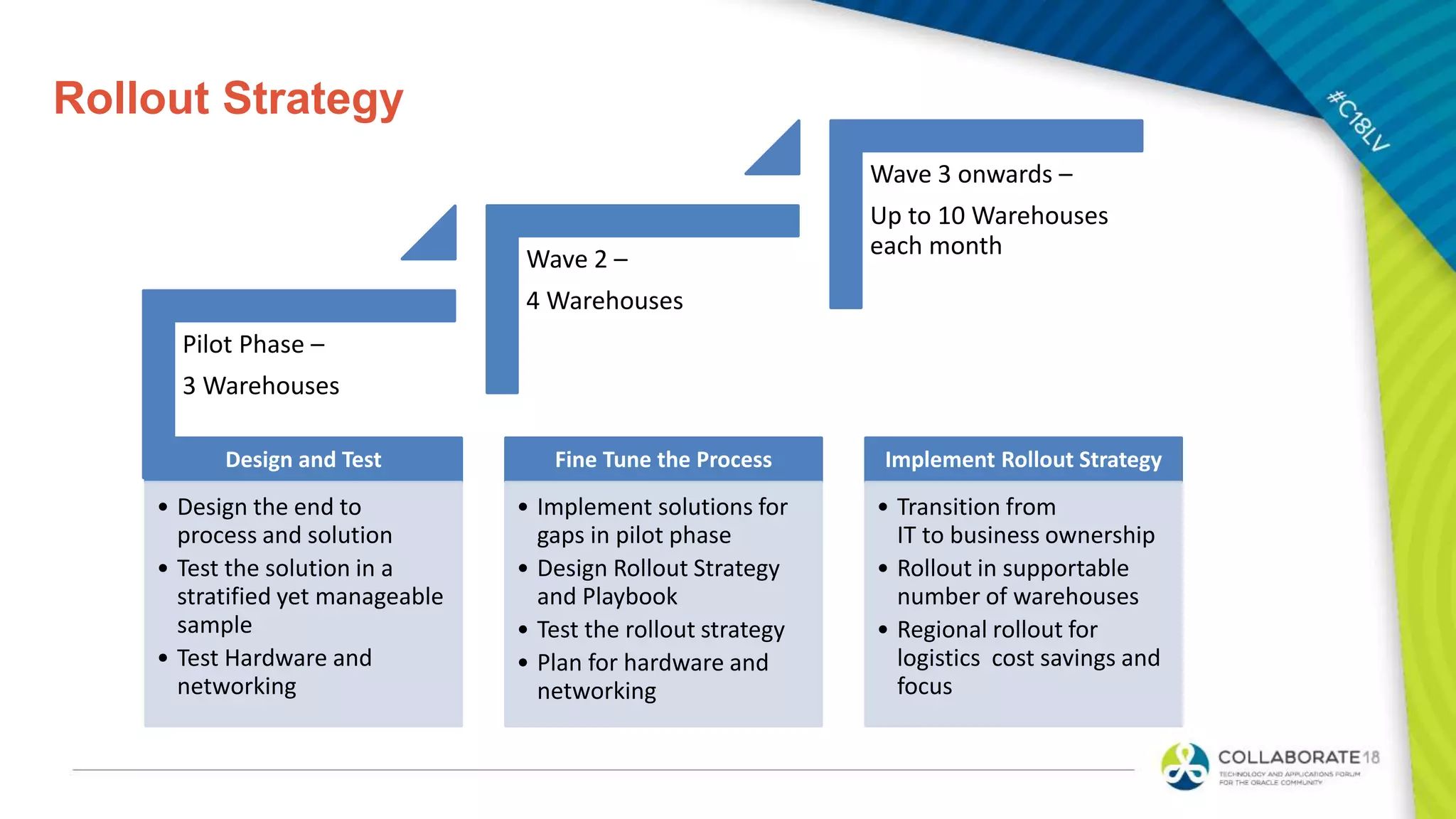
Rollout Strategy
Pilot Phase –
3 Warehouses
Wave 2 –
4 Warehouses
Wave 3 onwards –
Up to 10 Warehouses
each month
Design and Test
• Design the end to
process and solution
• Test the solution in a
stratified yet manageable
sample
• Test Hardware and
networking
Fine Tune the Process
• Implement solutions for
gaps in pilot phase
• Design Rollout Strategy
and Playbook
• Test the rollout strategy
• Plan for hardware and
networking
Implement Rollout Strategy
• Transition from
IT to business ownership
• Rollout in supportable
number of warehouses
• Regional rollout for
logistics cost savings and
focus
Rollout Strategy
• Implemented new process in 3 selected warehouses – pilot wave
– Ease of support
– Savviness of users for new technology and change management
– Proximity from the corporate headquarters
• Identify all the issues related to the new process in the initial support phase
• Planned wave 2 for 4 warehouses closer to head quarters
• Implemented new process in 4 warehouses
• Planned and Implemented new process in 8-10 warehouses in next 2 waves
– Number of trained support people to handle initial peak in support needs
– Clusters of warehouses in close proximity to optimize travel costs
– Central training locations for each wave
– Warehousing wifi readiness a key factor in warehouse selection for each wave
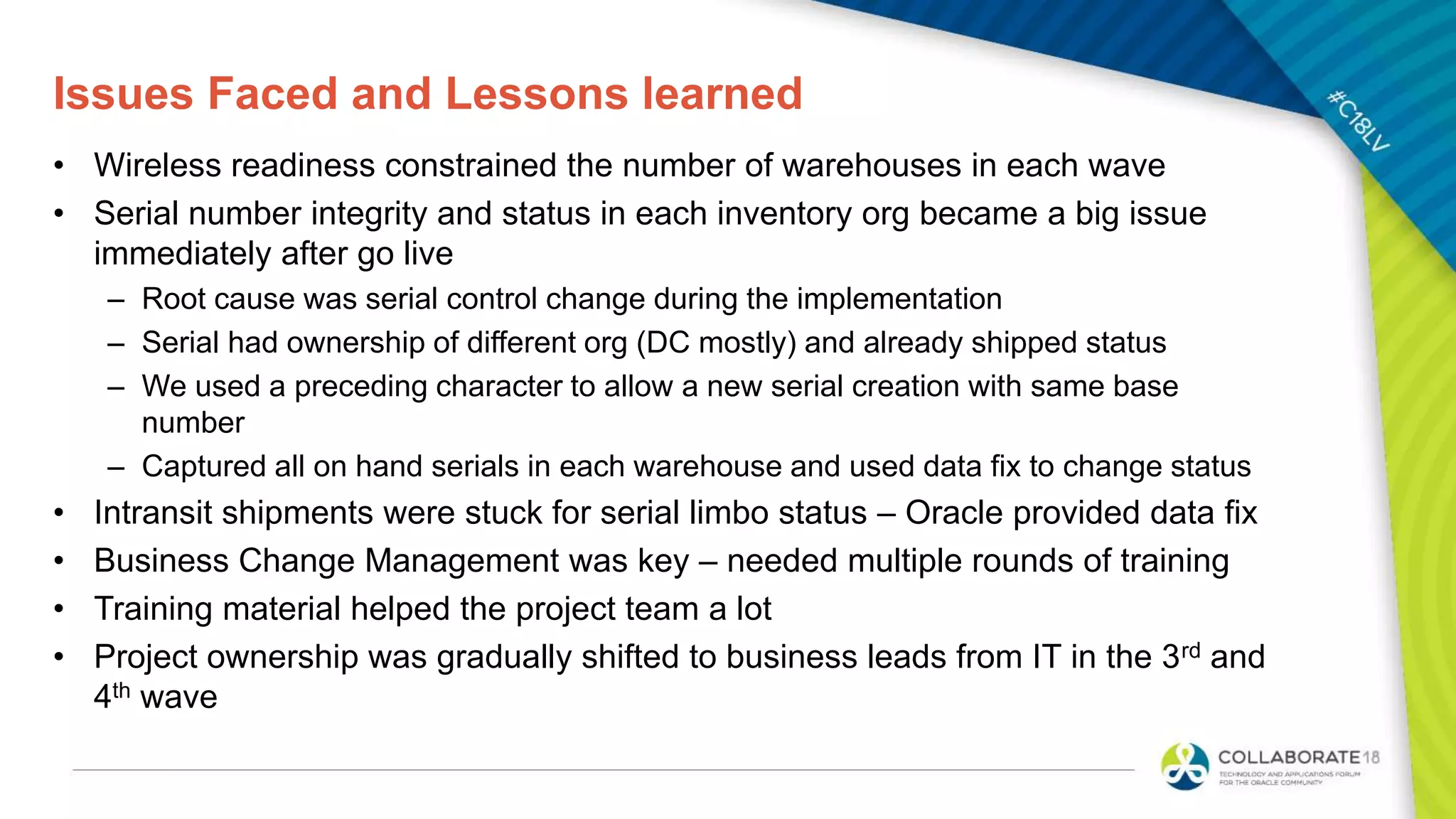
Issues Faced and Lessons learned
• Wireless readiness constrained the number of warehouses in each wave
• Serial number integrity and status in each inventory org became a big issue
immediately after go live
– Root cause was serial control change during the implementation
– Serial had ownership of different org (DC mostly) and already shipped status
– We used a preceding character to allow a new serial creation with same base
number
– Captured all on hand serials in each warehouse and used data fix to change status
• Intransit shipments were stuck for serial limbo status – Oracle provided data fix
• Business Change Management was key – needed multiple rounds of training
• Training material helped the project team a lot
• Project ownership was gradually shifted to business leads from IT in the 3rd and
4th wave
Other WMS stories from Sunrun
• Distribution Center Process Optimization
• Ship Verification Process
• How to increase outbound velocity in the warehouse
– Eliminate non value added activities
– Add mobility to the processes – real time data entry
– Remove papers in the process
– Automate activities such as label printing
– Move work upstream in the supply chain
• Best practices in capturing project costs and reporting
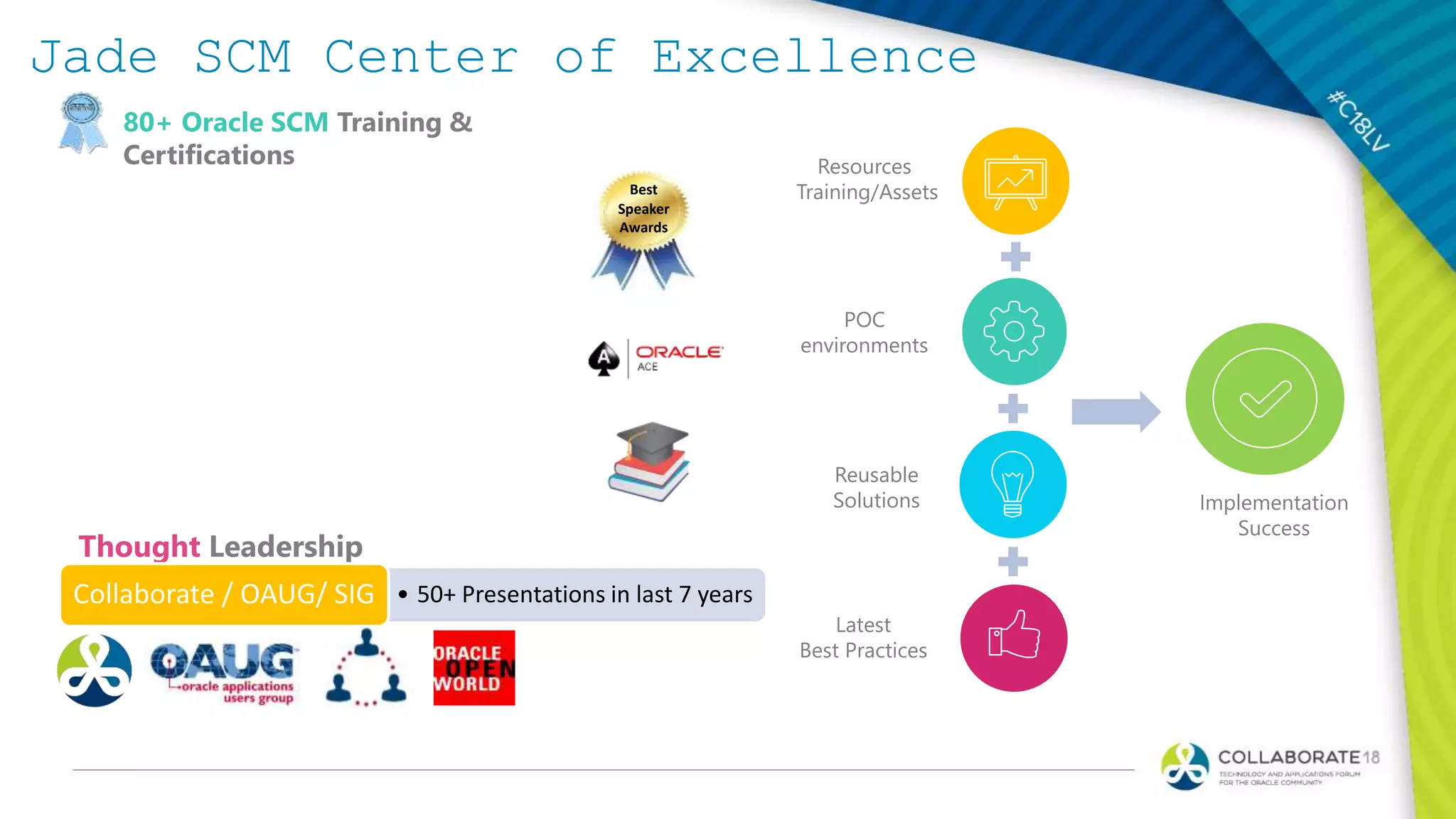
Best
Speaker
Awards
Resources
Training/Assets
Reusable
Solutions
Latest
Best Practices
POC
environments
Implementation
Success
10+
10+
20+
10+
10+
25+
80+ Oracle SCM Training &
Certifications
Thought Leadership
• 50+ Presentations in last 7 yearsCollaborate / OAUG/ SIG
Jade SCM Center of Excellence
Thank You

COLLABORATE 18 Presentation: Implementing WMS for 30+ Warehouses in 12 Months

  • 1.
    Session ID: Remember tocomplete your evaluation for this session within the app! 10480 manoj.rathi@jadeglobal.com Implementing WMS for 30+ Warehouses in 12 Months
  • 2.
    Agenda Introduction Business Challenges andRequirements Solution Approach Lessons Learnt Q&A Session Evalution
  • 3.
    Presenter Introduction Manoj RathiCSCP, CS&OP, Six Sigma, MBA SCM SME with over 20 years of experience 20+ presentations on Oracle Forums Key Oracle Certifications Oracle Order Management Cloud 2017 Certified Implementation Specialist Oracle Manufacturing Cloud 2017 Certified Implementation Specialist Oracle Procurement Cloud 2016 Certified Implementation Specialist Oracle SCM Cloud 2017 Sales Specialist Oracle SCM Cloud 2017 PreSales Specialist
  • 4.
    Pune San Jose Orange CountyAtlanta Hyderabad Reading Philadelphia Boston About Jade Global High-Tech Manufacturing 4 Global Delivery Centers 8 Offices Worldwide Life Sciences Finance Public Sector Distribution and Warehousing Retail Energy 5/16/2018
  • 5.
  • 6.
    The Challenges • Sub-optimizedand non-scalable processes and systems – Use of work orders to track project material issue • Serials captured outside system in a spreadsheet – either capture them at receipt or at Sales order issue • Higher Transaction Processing time • Paper based process • Delayed transaction entry in Oracle  Delayed visibility in Oracle • Manual errors and mistakes  Inventory inaccuracy • Timely onboarding of a new warehouse
  • 7.
    Requirements • Scalable standardizedprocesses to be deployed across all warehouses • Track serial numbers during shipment, returns and on projects (field) • Provide a order fulfillment process based on WMS and industry best practices • Provide shipment verification step for the staged material for projects • Provide fool-proofing in the warehousing operations • Provide a solid business change management process • Provide a standardized process to capture miscellaneous transactions in the warehouse that are not tracked on project BOM (sales order) • Ability to upload and maintain project BOMs • Capture demand for project material requirements • Track transfers between warehouses and distribution centers. • Data Conversion
  • 8.
  • 9.
    Oracle Footprint Projects CostingInventory AP/ AR/ FA/ GL Purchasing Order Mgmt. MSCAWMS SIS Business Unit Distribution Business Unit
  • 10.
  • 11.
  • 12.
    The Solution Details SalesOrder to capture project material shipment to site. Shipping to track shipments out the warehouse Use RMA order to track returns Use WMS and MSCA to process transactions real time Cycle count using MSCA Custom application to process unplanned material issues to and returns from project sites • Shipment and receipt in mobile app • Automate the order creation and shipping/receiving transaction in the backend • Allow optional use of project to allocate the material cost to a specific project • Create PO and receipt and return to vendor transaction in the backend with or without debit memo • Print shipping documents automatically to the warehouse printer
  • 13.
    Ship Project Materialto Site • Capture Project BOM as Sales Order • Use SO in demand planning with SSD as demand due date • Keep updating till the design is firmed – reflect changes in demand plan • Pick-release project sales order for shipping to project site • Pick load and drop using mobile device – TC80 from Zebra • Scan barcodes for tasks to transact and LPN as delivery barcode • Packing list with backorder information • Verify shipment • Scan serial bar codes • Ship confirm
  • 14.
    Project Material Shipment •Exceptions allowed: “Zero pick and backorder” and “Zero pick and cancel” • Load all picks in a single LPN – scan Delivery ID from pick slip as LPN • Drop loaded LPN in staging • Verify Shipment and scan serials - standard MSCA process • Pack Slip automatically printed through shipping document set
  • 15.
    Miscellaneous Warehousing Transactions Followingtransactions configured as miscellaneous transactions using mobile • Direct Project Issue • Direct Project Return • Issue against Field Service Document Number (FSD) • Return against FSD • RTV with or without credit • Issue bulk material to truck inventory • Return bulk material from truck inventory • Will Call Issue to installation crew • Unplanned Issue • Unplanned Returns
  • 16.
    SIS Transactions: Issuefrom Stores Issue Material Using Mobile Stage the transaction in ERP Create Sales Order with Optional Project Reference Enter Serial Numbers Pick Release the sales order Ship Confirm + Print Shipping Docs Resolve Exceptions Print Exception Report
  • 17.
  • 18.
    Issue Transaction Flow •Enter all required and optional information in the mobile screen • Complete the transaction in mobile • Transaction interfaced for processing in Oracle • Following backend transactions were processed automatically: – Create and book Sales Order with details from transaction – Pick release the order with pick confirm option – Allocate serial numbers entered by the users in mobile screen. – Ship confirm the order – Print Packing slip with shipped and backordered details – Print exception report for errors during processing • Users manually processed any errors as detailed in the exception report • Material transaction was updated with project and transaction details • Cost of transaction interfaced to projects if project is selected by the user
  • 19.
    SIS Transactions: Returnto Stores Receive Material Using Mobile Stage the transaction in ERP Create Referenced RMA with Project Reference Receive the RMA (with Serial for serialized item) Create non referenced RMA Resolve Exceptions Print Exception Report Find Original Sales Order Yes
  • 20.
    Return Transaction Flow •Enter data and complete transaction in mobile device • Interface the transaction in Oracle • Process following transactions in Oracle automatically – Identify the shipping order using the serial number and project – Create a referenced RMA order if there is a shipping order found – Create unreferenced RMA if no shipping order found – Receive material against the RMA order with direct delivery option – Enter serial number at receipt for serialized items – Print a receipt document – Print exception report if there is any exception • Users manually complete any stuck transactions
  • 21.
    Other processes implementedin mobile • Subinventory transfer • Standard Cycle count • Ad hoc corrective count • Warehouse internal moves • PO receipt using mobile • Inter-org transfers *All these were standard processes
  • 22.
  • 23.
    Rollout Strategy Pilot Phase– 3 Warehouses Wave 2 – 4 Warehouses Wave 3 onwards – Up to 10 Warehouses each month Design and Test • Design the end to process and solution • Test the solution in a stratified yet manageable sample • Test Hardware and networking Fine Tune the Process • Implement solutions for gaps in pilot phase • Design Rollout Strategy and Playbook • Test the rollout strategy • Plan for hardware and networking Implement Rollout Strategy • Transition from IT to business ownership • Rollout in supportable number of warehouses • Regional rollout for logistics cost savings and focus
  • 24.
    Rollout Strategy • Implementednew process in 3 selected warehouses – pilot wave – Ease of support – Savviness of users for new technology and change management – Proximity from the corporate headquarters • Identify all the issues related to the new process in the initial support phase • Planned wave 2 for 4 warehouses closer to head quarters • Implemented new process in 4 warehouses • Planned and Implemented new process in 8-10 warehouses in next 2 waves – Number of trained support people to handle initial peak in support needs – Clusters of warehouses in close proximity to optimize travel costs – Central training locations for each wave – Warehousing wifi readiness a key factor in warehouse selection for each wave
  • 25.
    Issues Faced andLessons learned • Wireless readiness constrained the number of warehouses in each wave • Serial number integrity and status in each inventory org became a big issue immediately after go live – Root cause was serial control change during the implementation – Serial had ownership of different org (DC mostly) and already shipped status – We used a preceding character to allow a new serial creation with same base number – Captured all on hand serials in each warehouse and used data fix to change status • Intransit shipments were stuck for serial limbo status – Oracle provided data fix • Business Change Management was key – needed multiple rounds of training • Training material helped the project team a lot • Project ownership was gradually shifted to business leads from IT in the 3rd and 4th wave
  • 26.
    Other WMS storiesfrom Sunrun • Distribution Center Process Optimization • Ship Verification Process • How to increase outbound velocity in the warehouse – Eliminate non value added activities – Add mobility to the processes – real time data entry – Remove papers in the process – Automate activities such as label printing – Move work upstream in the supply chain • Best practices in capturing project costs and reporting
  • 27.
    Best Speaker Awards Resources Training/Assets Reusable Solutions Latest Best Practices POC environments Implementation Success 10+ 10+ 20+ 10+ 10+ 25+ 80+ OracleSCM Training & Certifications Thought Leadership • 50+ Presentations in last 7 yearsCollaborate / OAUG/ SIG Jade SCM Center of Excellence
  • 28.

Editor's Notes

  • #3 Agenda
  • #4 Presenter Introduction
  • #5 Introduction of Jade Global Jade is an Oracle Platinum partner and a cloud select partner Jade has completed 20+ cloud projects including many SCM projects
  • #28 Thought leadership repeated