Coiled Tubing
Introduction and Basics
By: Abdullah N. Abdulrazzaq
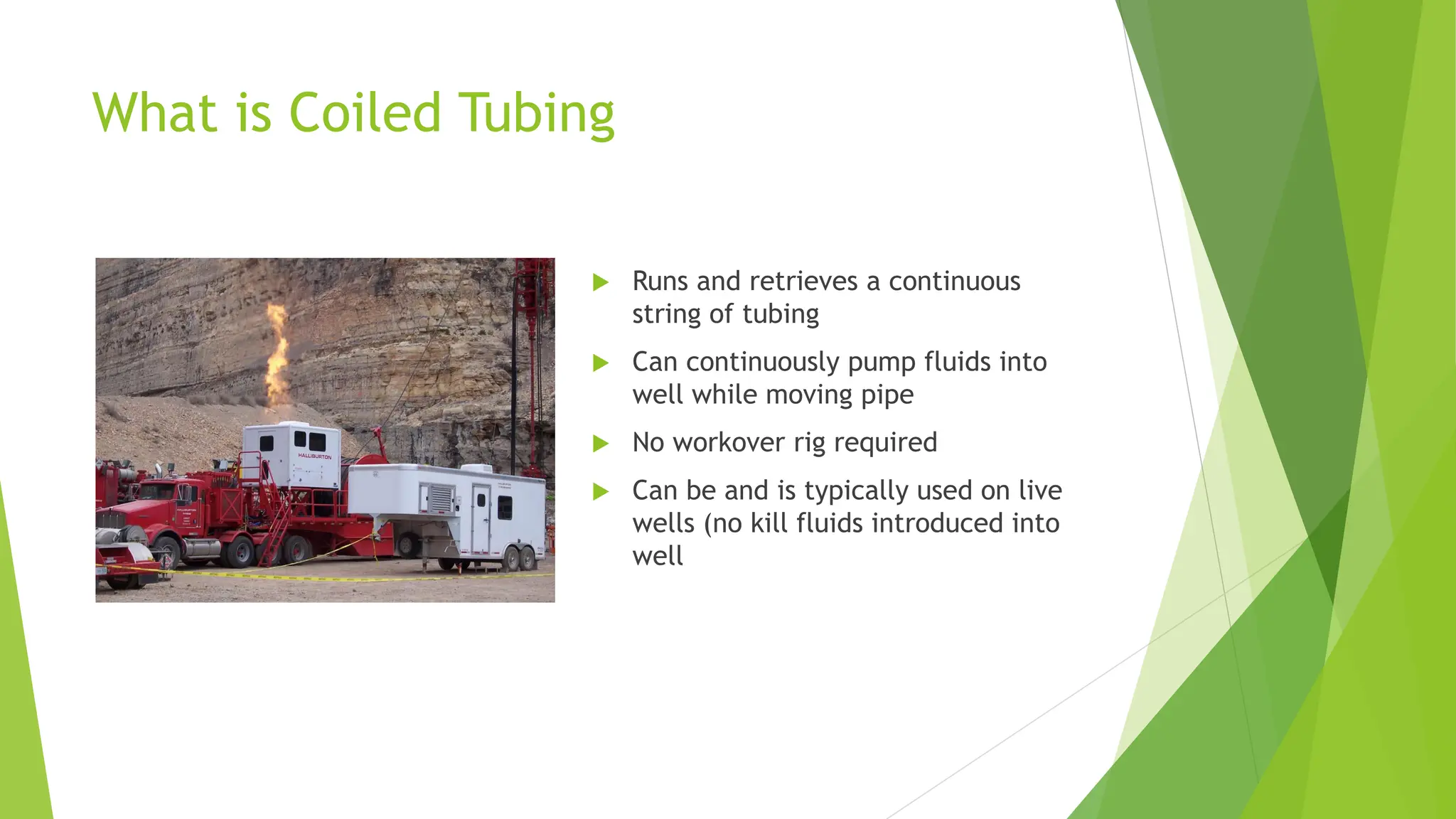
What is Coiled Tubing
 Runs and retrieves a continuous
string of tubing
 Can continuously pump fluids into
well while moving pipe
 No workover rig required
 Can be and is typically used on live
wells (no kill fluids introduced into
well
Origin Of Coiled
tubing
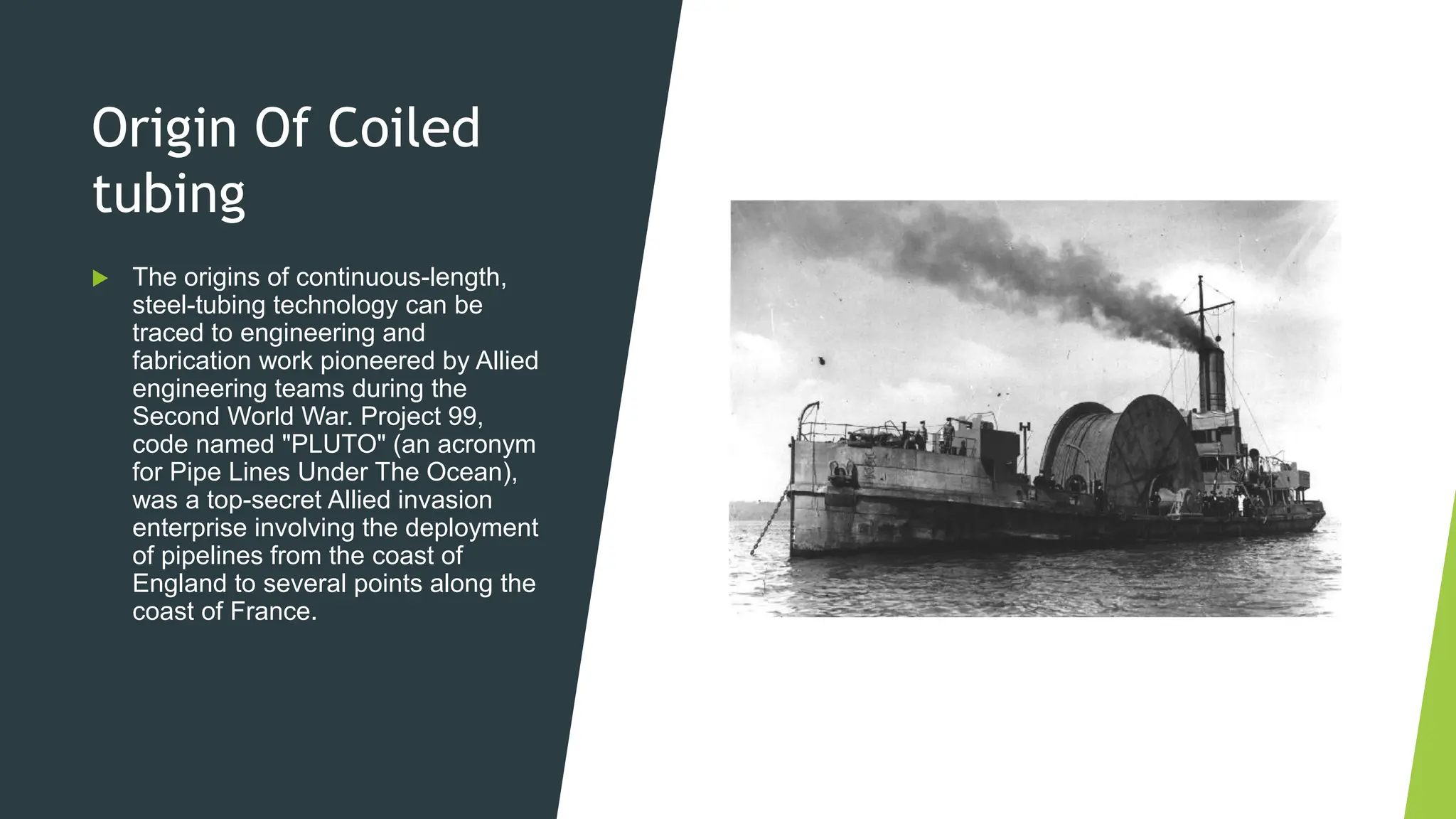
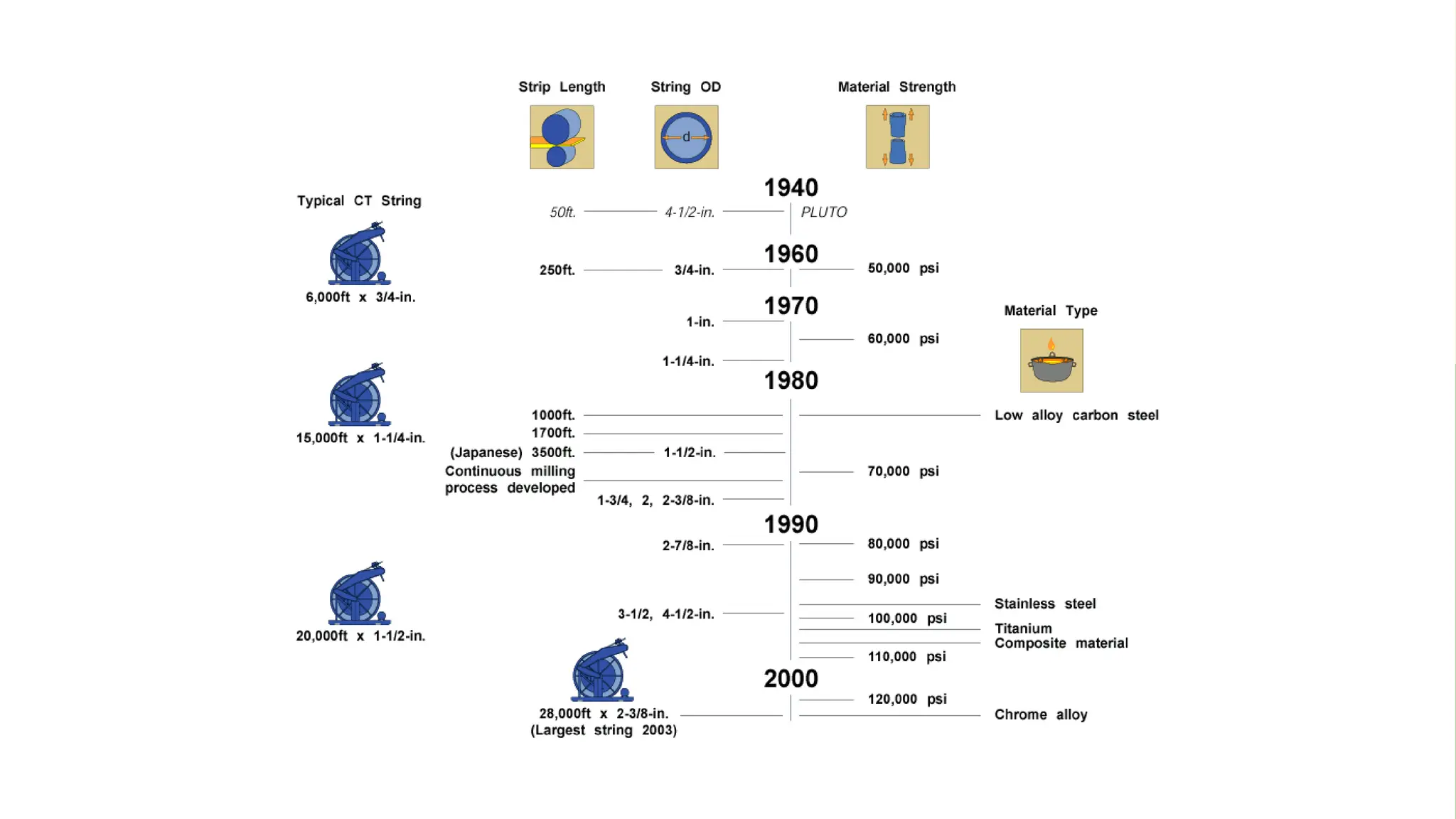
 The origins of continuous-length,
steel-tubing technology can be
traced to engineering and
fabrication work pioneered by Allied
engineering teams during the
Second World War. Project 99,
code named "PLUTO" (an acronym
for Pipe Lines Under The Ocean),
was a top-secret Allied invasion
enterprise involving the deployment
of pipelines from the coast of
England to several points along the
coast of France.
CT String
Manufacturing
and
Construction
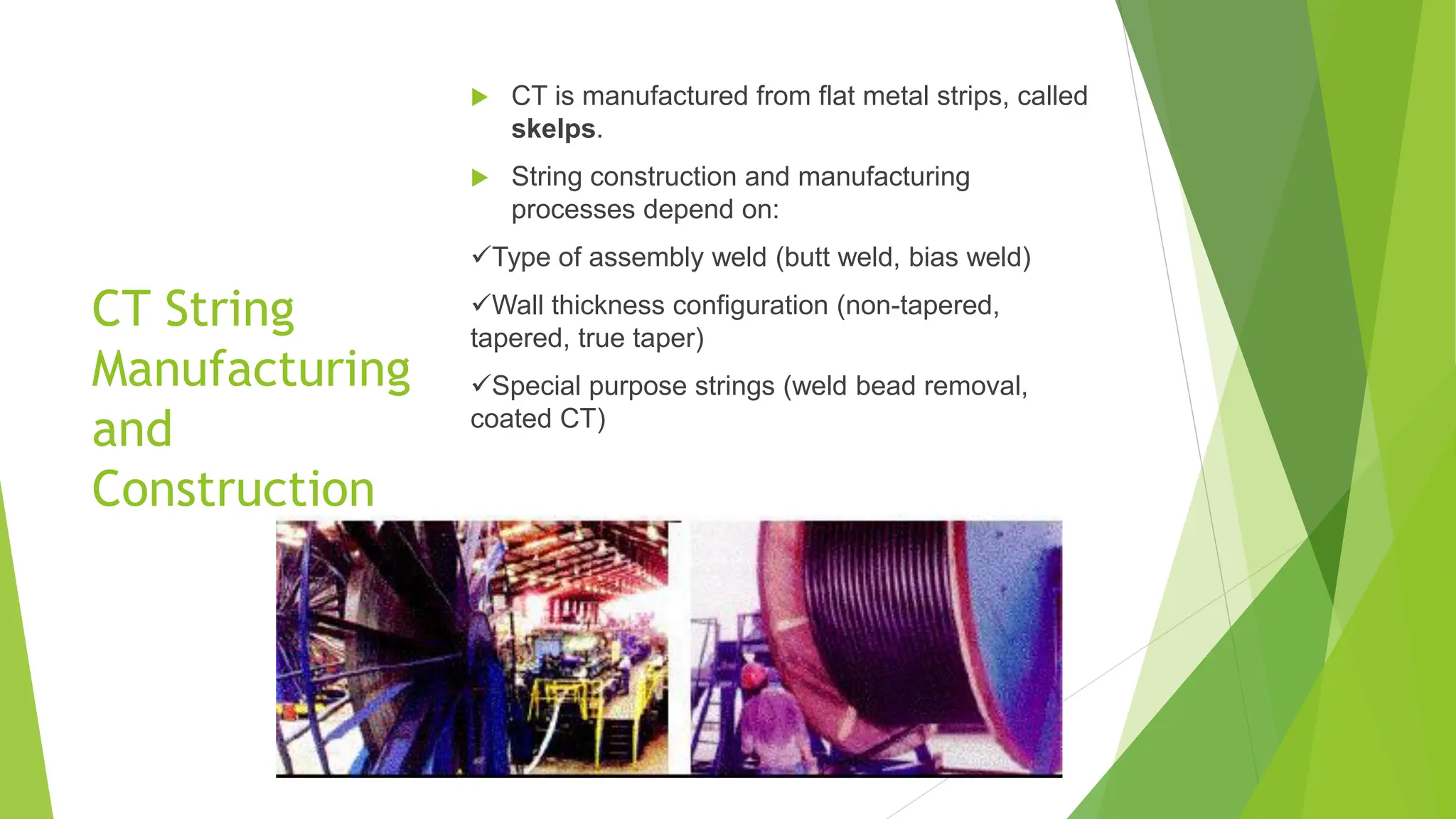
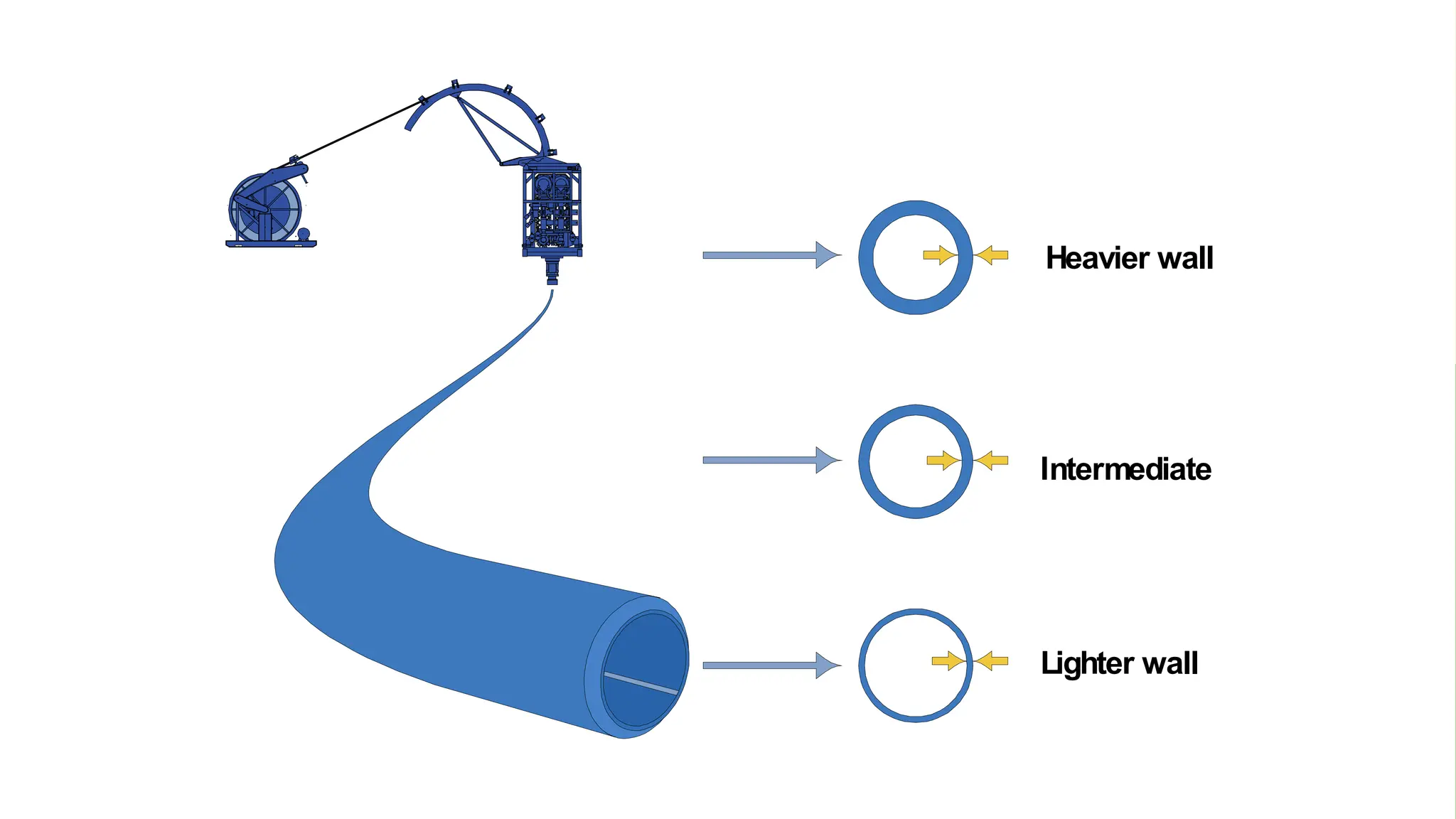
 CT is manufactured from flat metal strips, called
skelps.
 String construction and manufacturing
processes depend on:
✓Type of assembly weld (butt weld, bias weld)
✓Wall thickness configuration (non-tapered,
tapered, true taper)
✓Special purpose strings (weld bead removal,
coated CT)
Coiled Tubing Products
 Grades
 60000 to 120000 psi Yield Materials
 Configurations
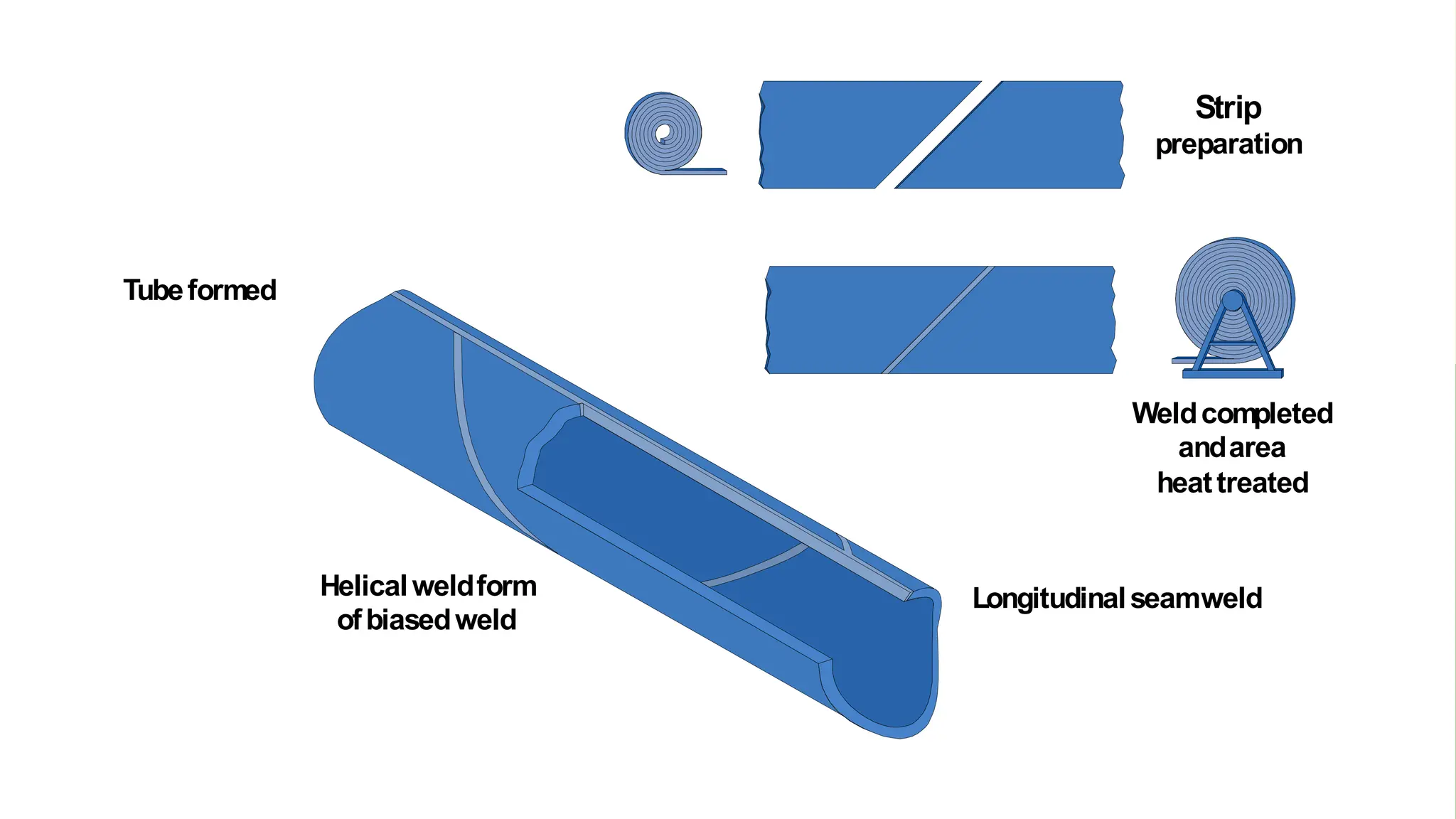
 Butt Welded
 Continuous Milled (Bias Weld)
 Tapered Strings
 True Tapered Strings
 Manufacturers
 Tenaris Coiled Tubing- e.g. HS80 and HS80CM
 Quality Tubing - e.g. QT80 and QT800
 Global (new manufacturer)
Coiled Tubing Terminology
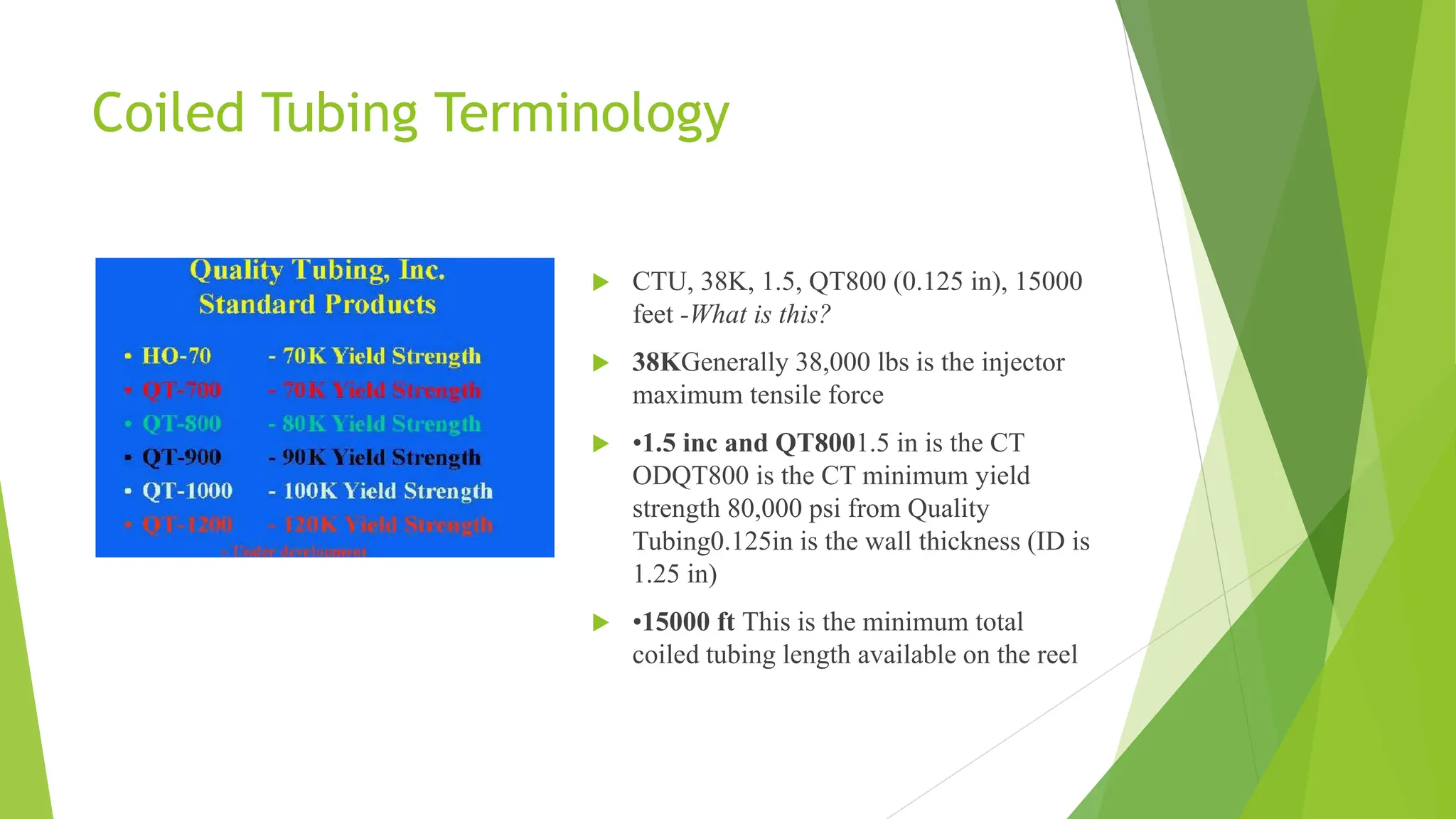
 CTU, 38K, 1.5, QT800 (0.125 in), 15000
feet -What is this?
 38KGenerally 38,000 lbs is the injector
maximum tensile force
 •1.5 inc and QT8001.5 in is the CT
ODQT800 is the CT minimum yield
strength 80,000 psi from Quality
Tubing0.125in is the wall thickness (ID is
1.25 in)
 •15000 ft This is the minimum total
coiled tubing length available on the reel
Strip
preparation
Weldcompleted
andarea
heattreated
Longitudinalseamweld
Tubeformed
Helicalweldform
ofbiasedweld
Intermediate
Lighter wall
Heavier wall
Coiled Tubing Equipment
 The basic configuration of a coiled tubing equipment package is dependent
on:
 Operating environment
 e.g., offshore, arctic, desert
 Primary applications
 e.g., units prepared for CTD, Fracturing operations will typically be larger than
conventional service units
 CT string dimensions
 e.g., string length/OD and necessary reel dimensions
Basic Equipment Configurations
 Onshore
 Paved road trucks (road legal for operating area)
 Off-road trucks (all-wheel drive, e.g., desert)
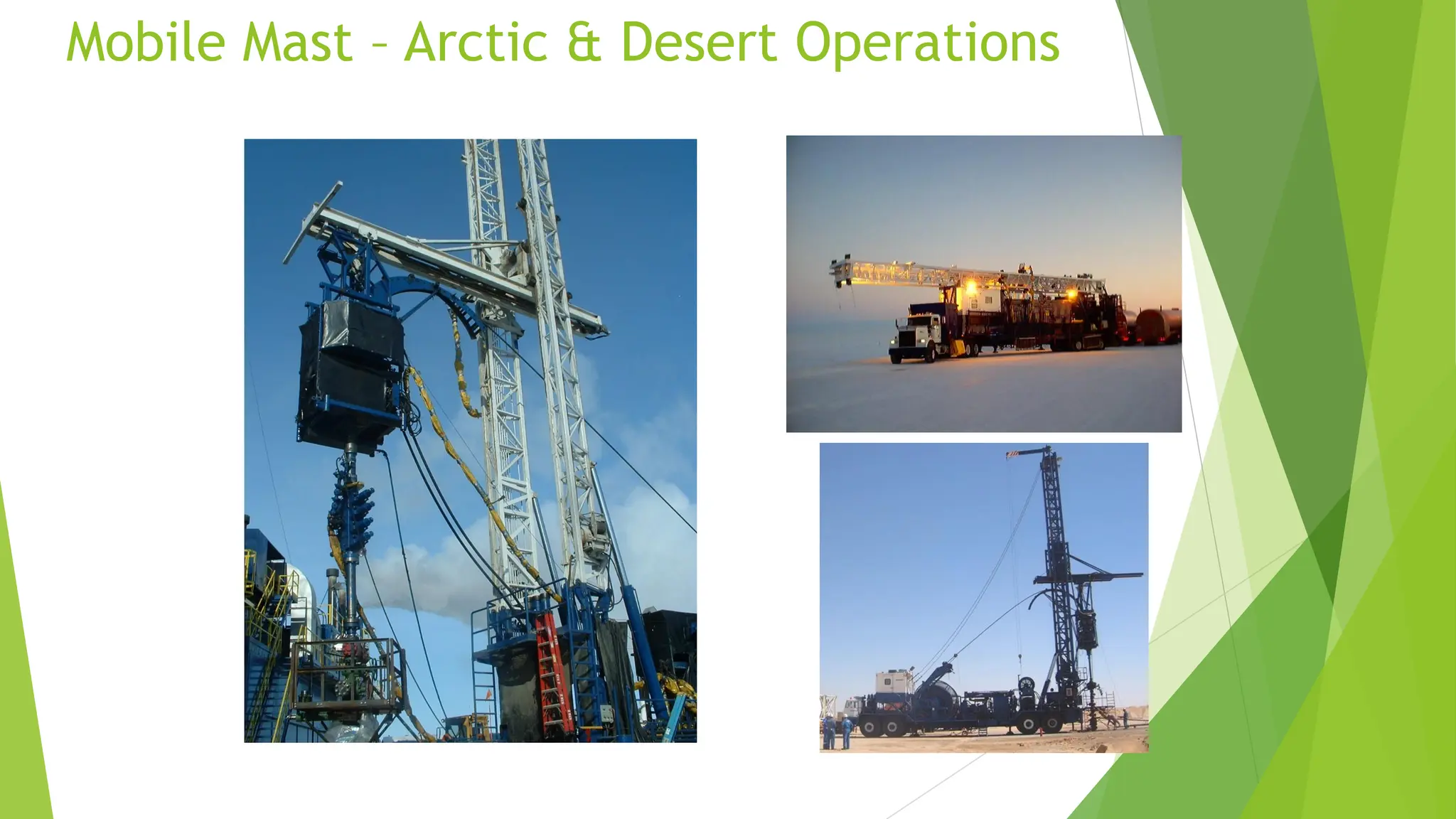
 Mobile mast units (special environment, e.g., arctic)
 Offshore
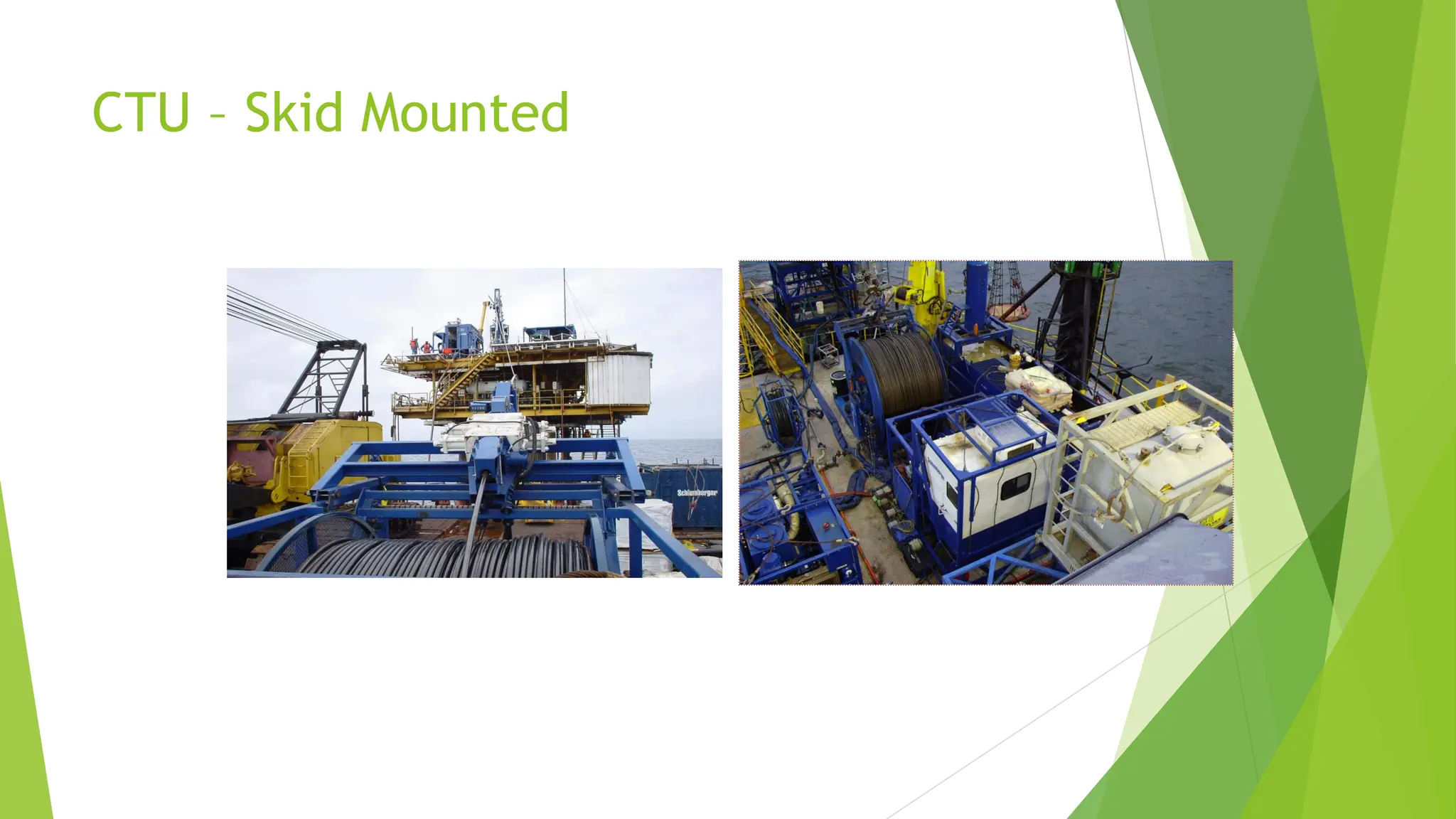
 Skid mounted units (crash-frame protected)
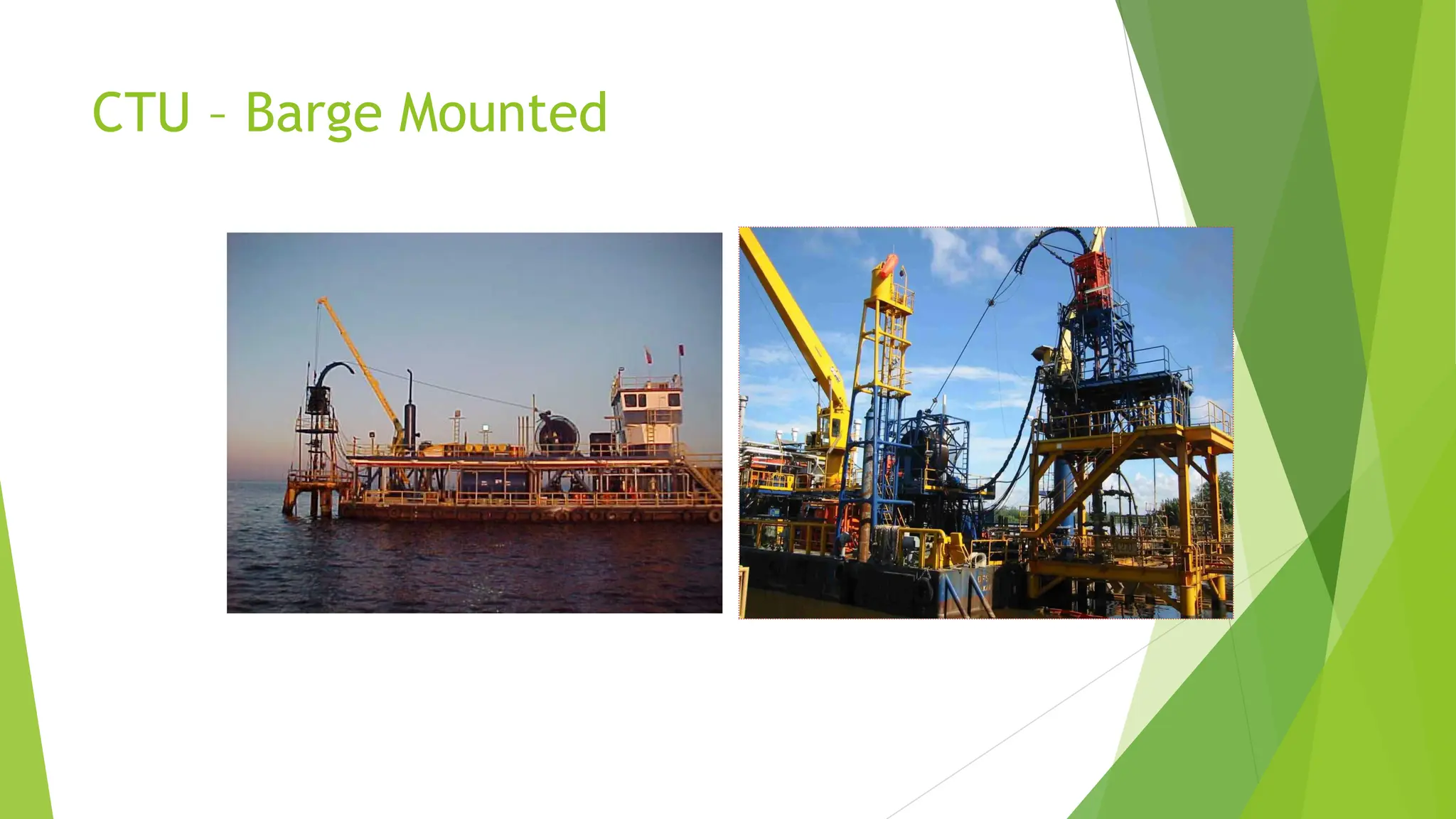
 Barge mounted units (permanent placement)
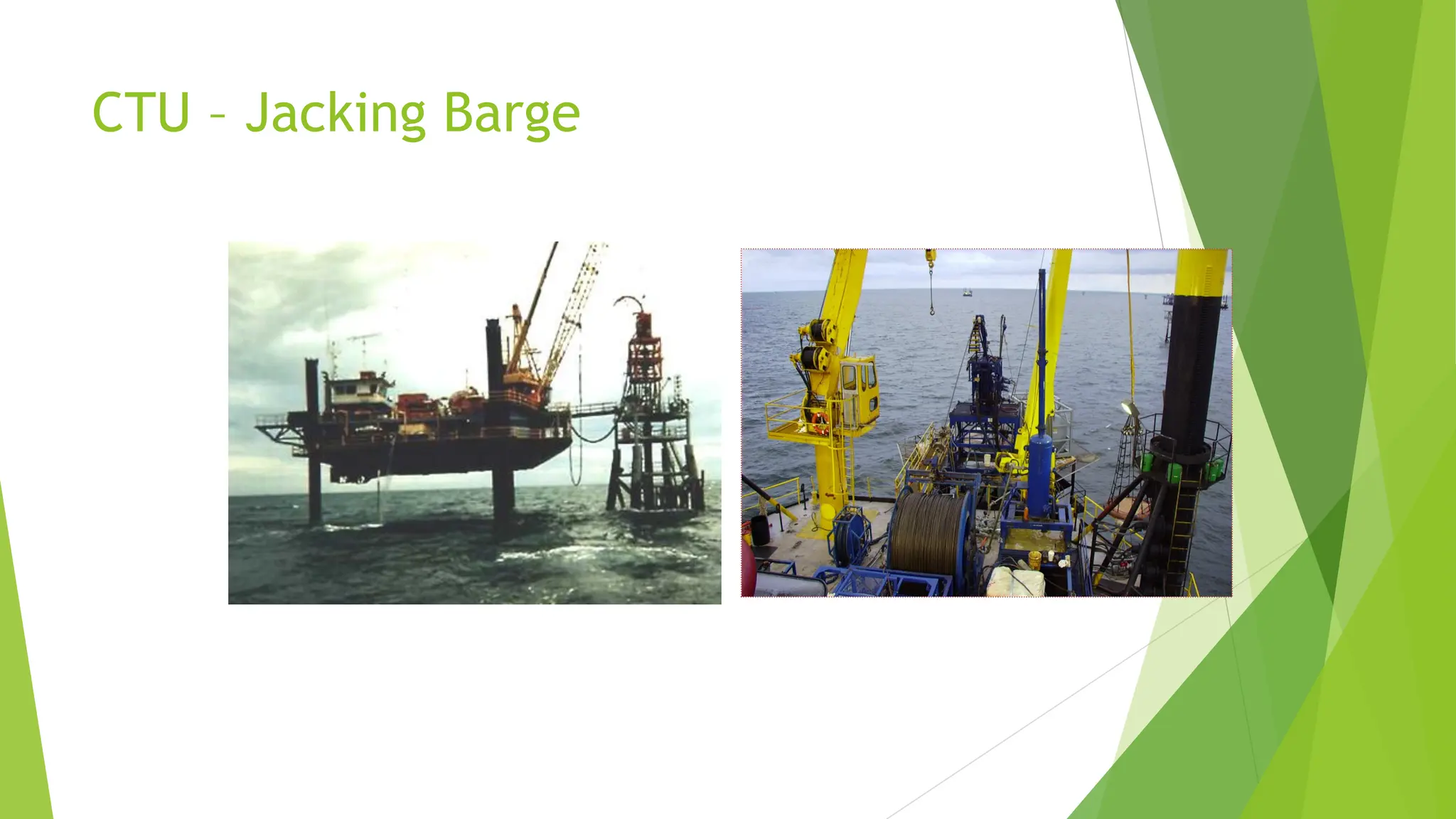
 Jacking barge/tender vessel
CT Express – Trailer Mounted
 CTU - Paved Road
 Trailer mounted CTU configured from skid mounted equipment for flexibility. The
crash frame protection is removed (to reduce weight) when the skids are fixed to
the trailer, but can be fitted if the equipment is to be shipped offshore.
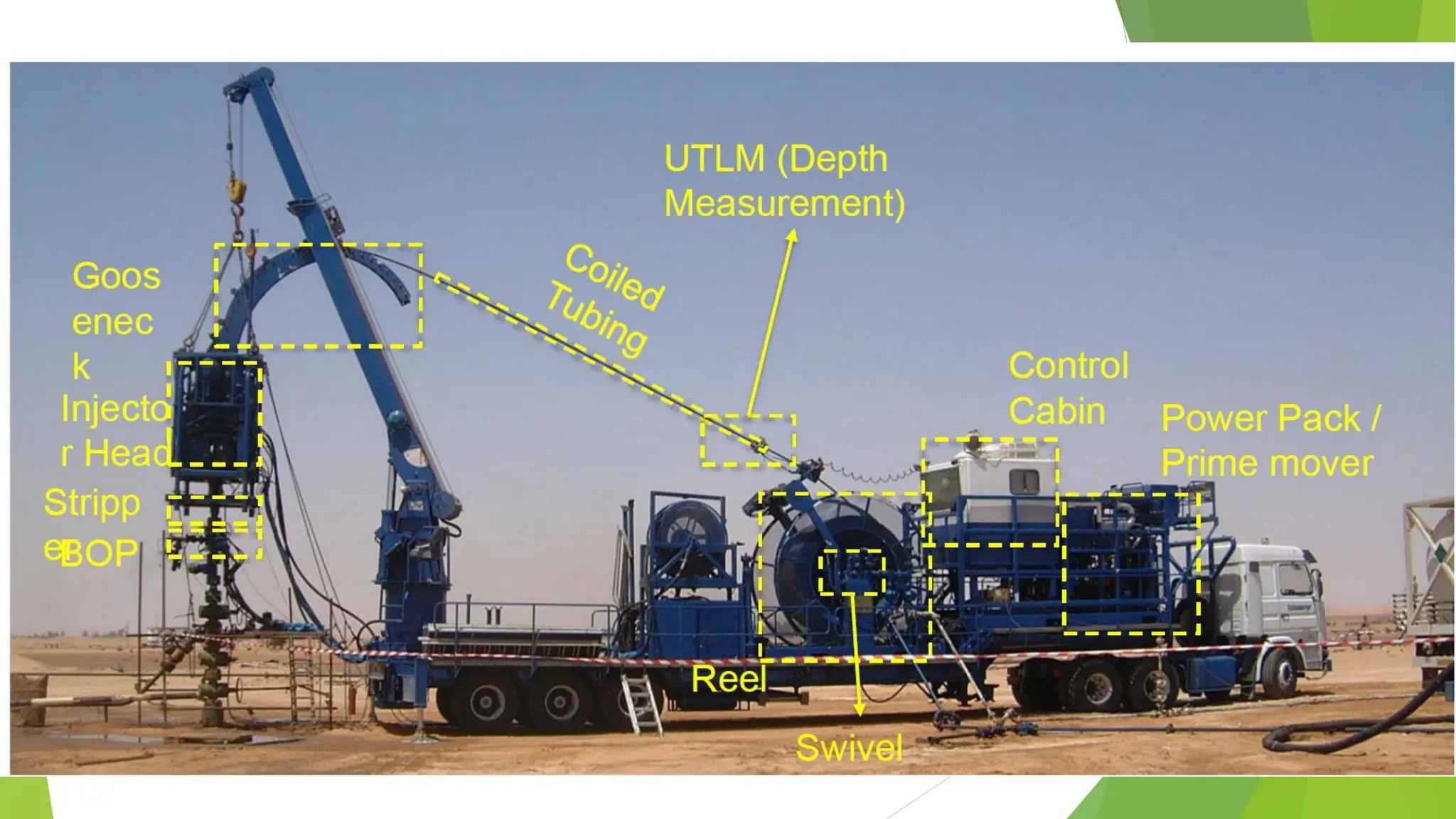
 The configuration shown requires two trucks. The truck/trailer shown transports
the reel, control cabin, power pack and BOP. A smaller crane truck is used to
transport the crane, injector head and riser wellhead package (as required).
 Weight restrictions (country, state or road capacity) and the required CT string
size/length (weight) are the key factors in determining if two trucks are required
for the CTU package.
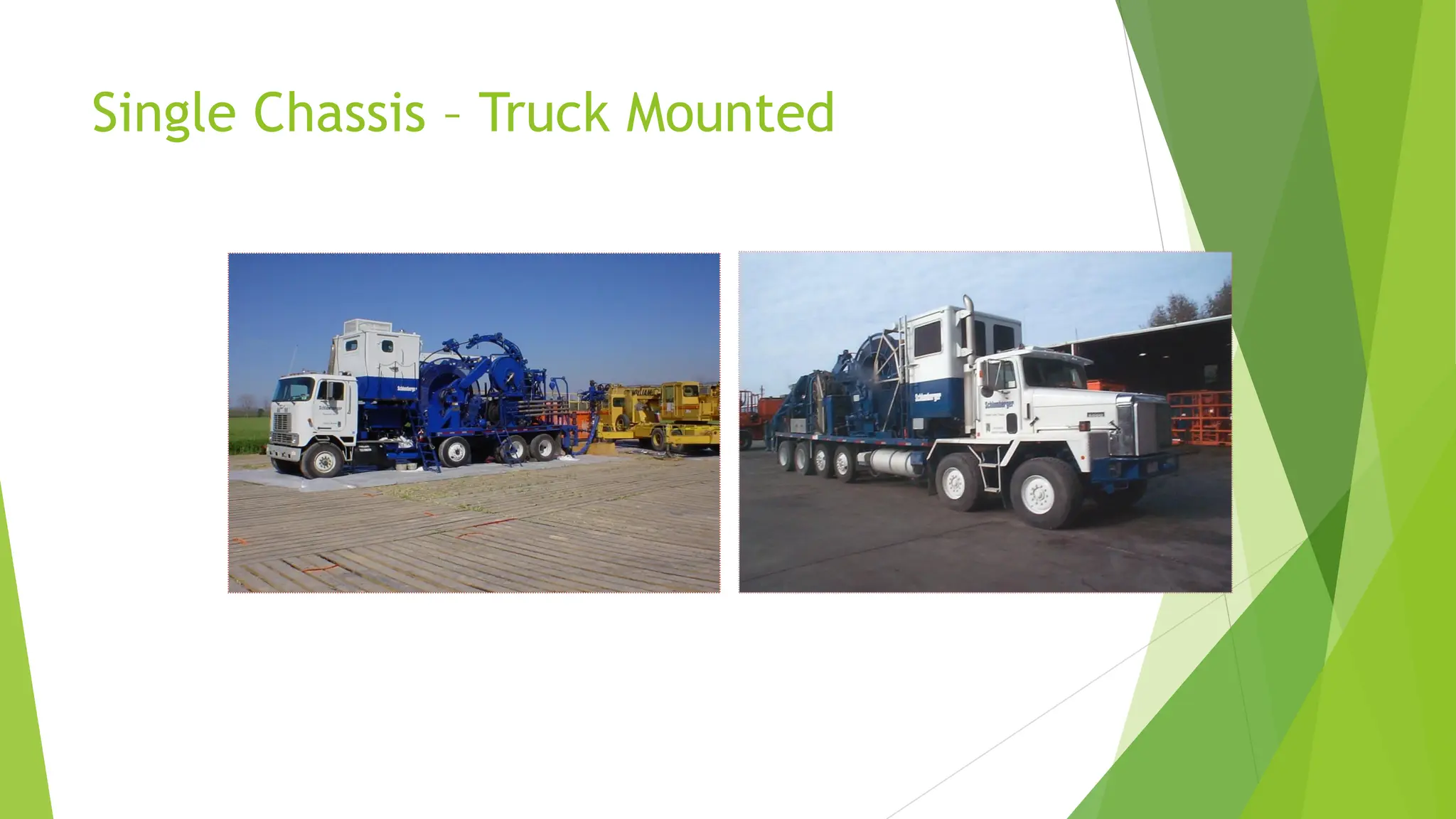
Single Chassis – Truck Mounted
Mobile Mast – Arctic & Desert Operations
CTU – Skid Mounted
CTU – Barge Mounted
CTU – Jacking Barge
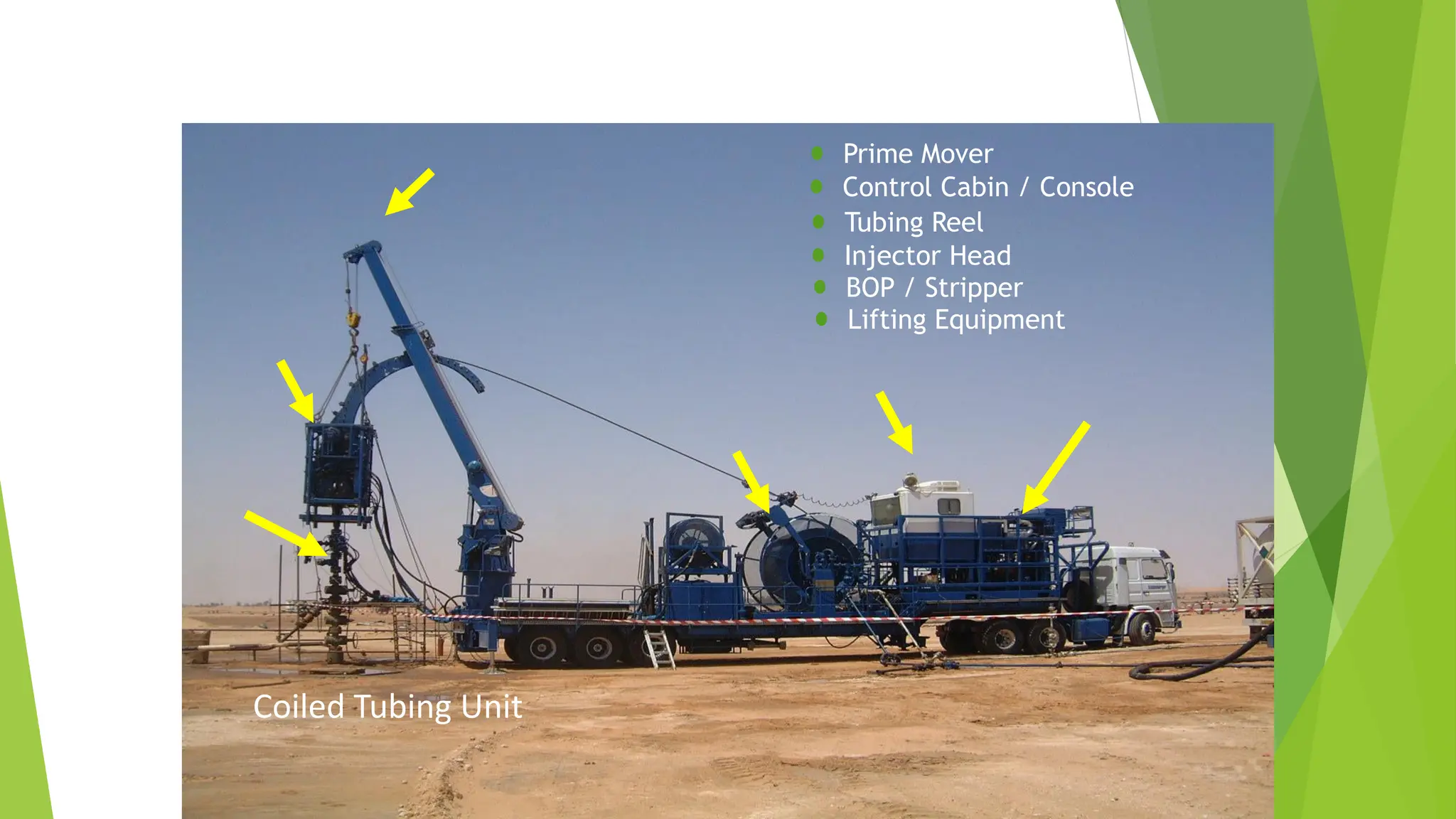
Main CT Equipment Package
Coiled Tubing Unit
Prime Mover
Control Cabin / Console
Tubing Reel
Injector Head
BOP / Stripper
Lifting Equipment
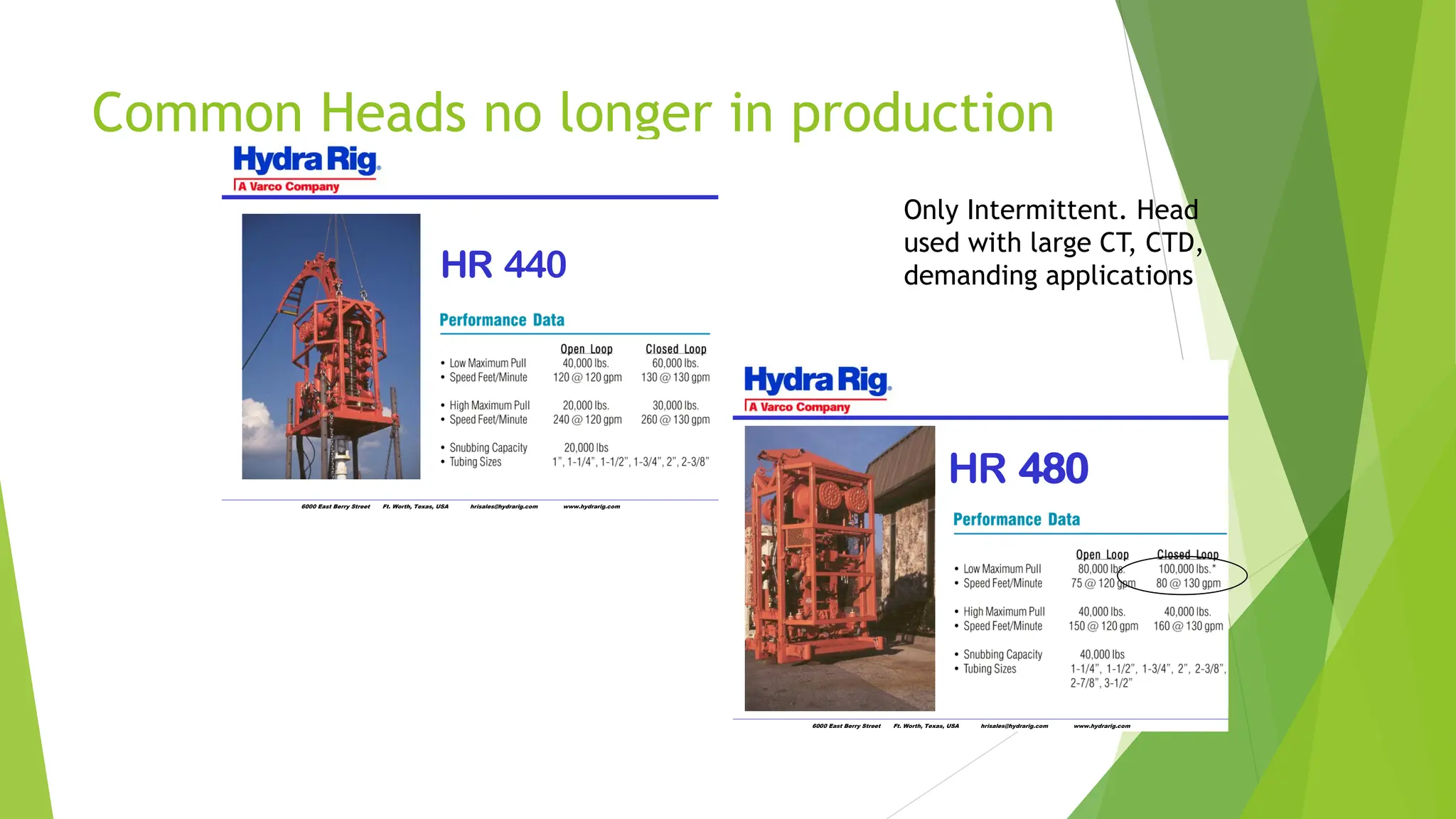
Common Heads no longer in production
6000 East Berry Street Ft. Worth, Texas, USA hrisales@hydrarig.com www.hydrarig.com
HR 440
6000 East Berry Street Ft. Worth, Texas, USA hrisales@hydrarig.com www.hydrarig.com
HR 480
Only Intermittent. Head
used with large CT, CTD,
demanding applications
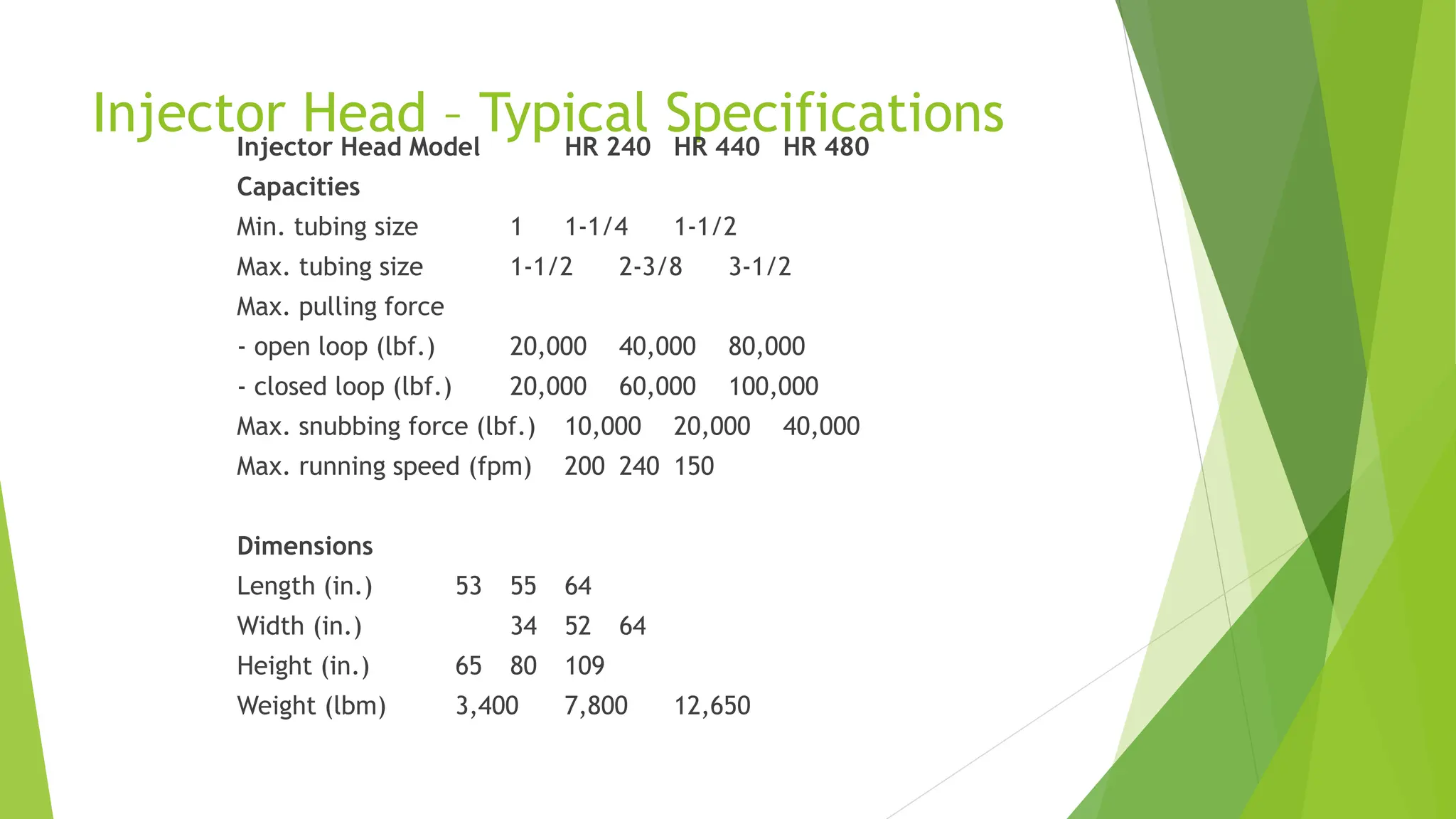
Injector Head – Typical Specifications
Injector Head Model HR 240 HR 440 HR 480
Capacities
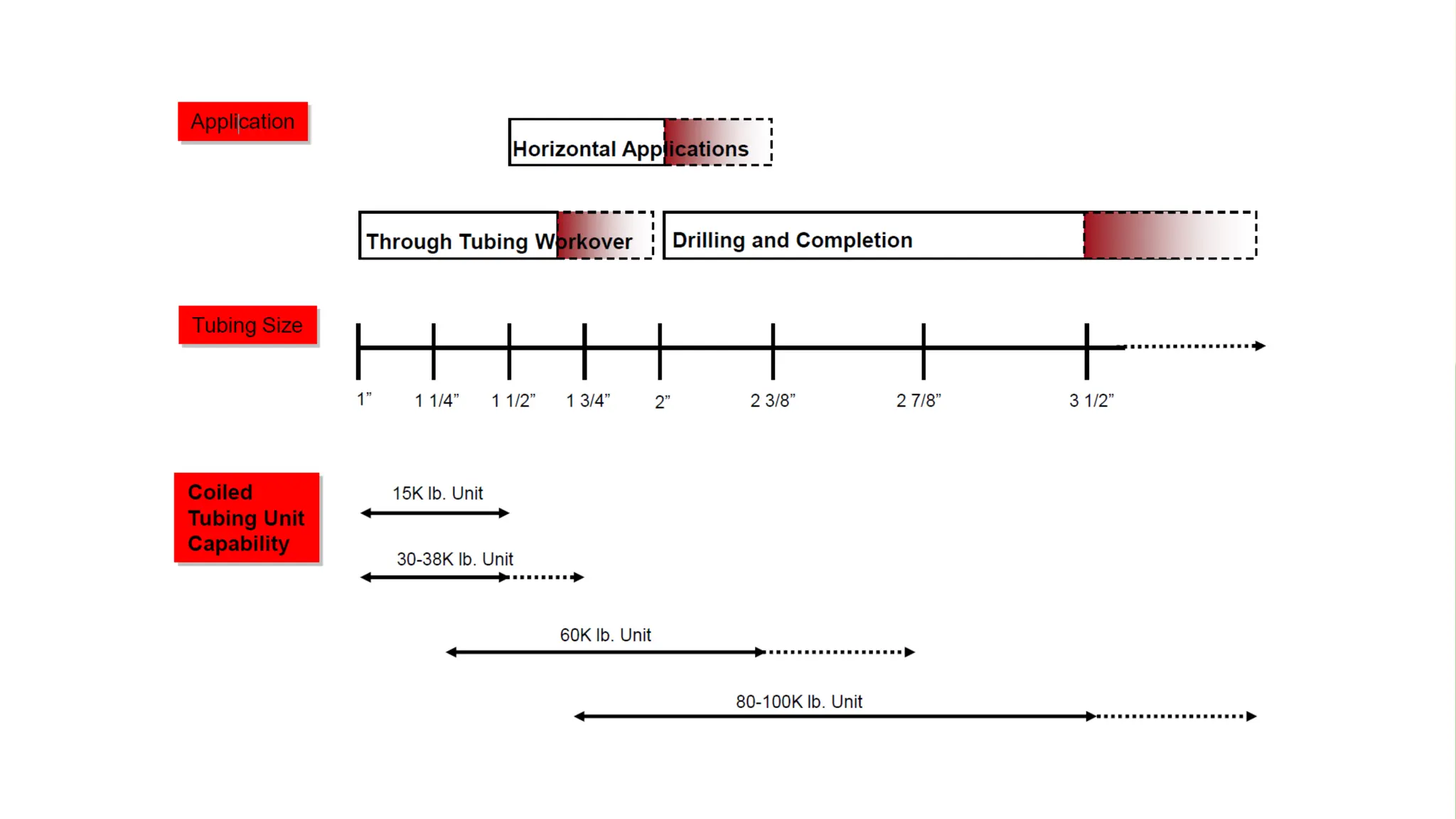
Min. tubing size 1 1-1/4 1-1/2
Max. tubing size 1-1/2 2-3/8 3-1/2
Max. pulling force
- open loop (lbf.) 20,000 40,000 80,000
- closed loop (lbf.) 20,000 60,000 100,000
Max. snubbing force (lbf.) 10,000 20,000 40,000
Max. running speed (fpm) 200 240 150
Dimensions
Length (in.) 53 55 64
Width (in.) 34 52 64
Height (in.) 65 80 109
Weight (lbm) 3,400 7,800 12,650
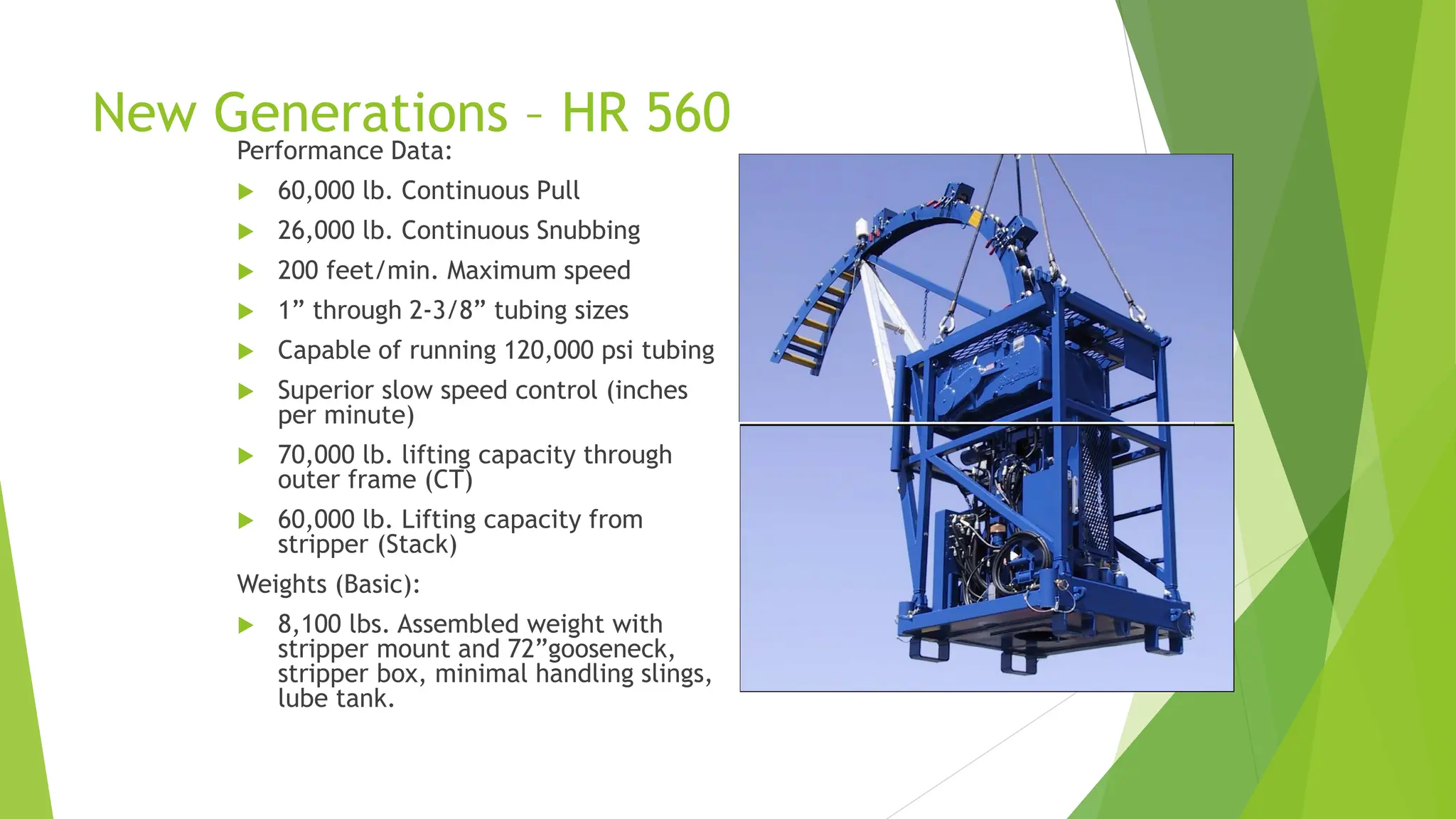
New Generations – HR 560
Performance Data:
 60,000 lb. Continuous Pull
 26,000 lb. Continuous Snubbing
 200 feet/min. Maximum speed
 1” through 2-3/8” tubing sizes
 Capable of running 120,000 psi tubing
 Superior slow speed control (inches
per minute)
 70,000 lb. lifting capacity through
outer frame (CT)
 60,000 lb. Lifting capacity from
stripper (Stack)
Weights (Basic):
 8,100 lbs. Assembled weight with
stripper mount and 72”gooseneck,
stripper box, minimal handling slings,
lube tank.
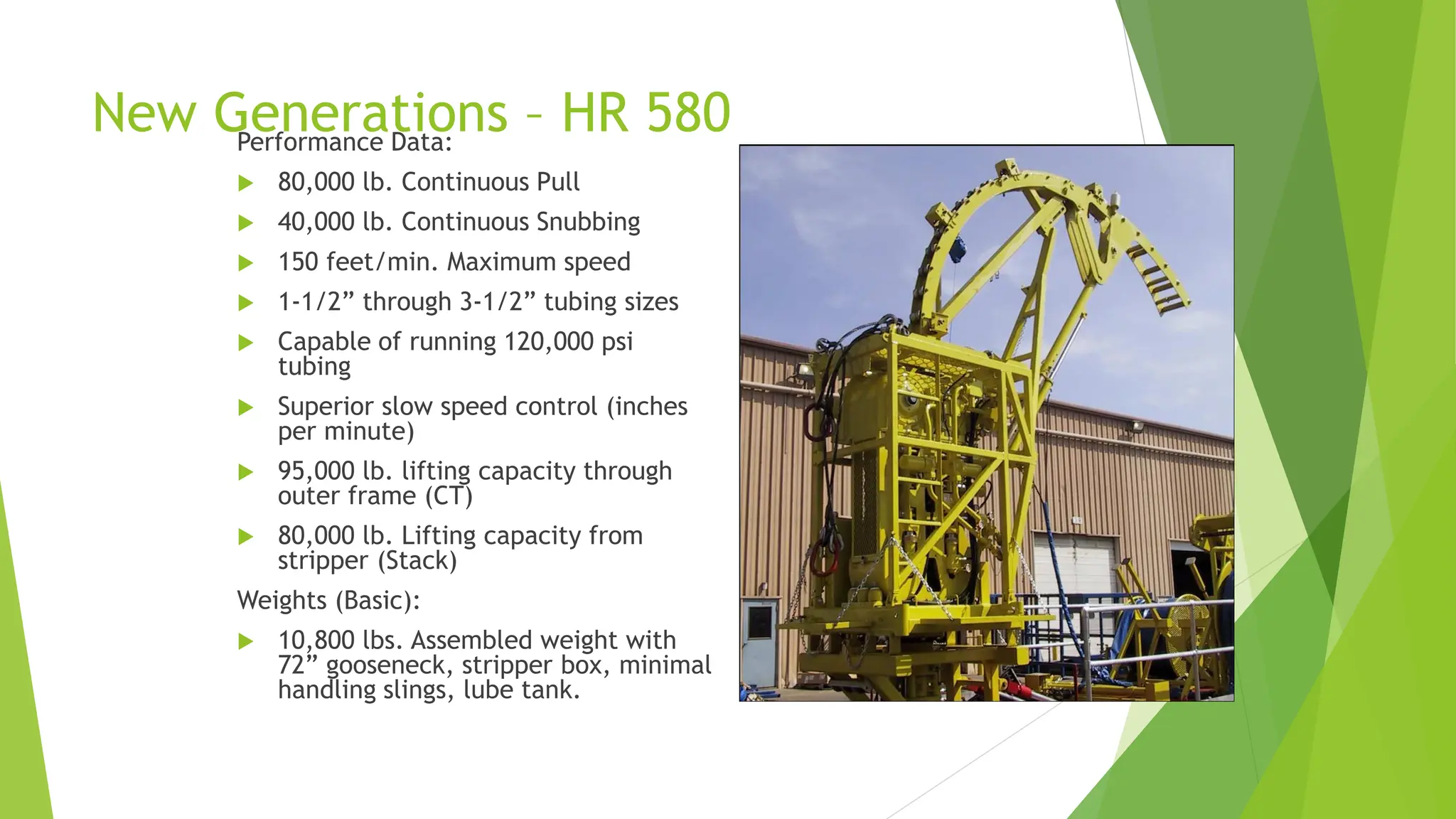
New Generations – HR 580
Performance Data:
 80,000 lb. Continuous Pull
 40,000 lb. Continuous Snubbing
 150 feet/min. Maximum speed
 1-1/2” through 3-1/2” tubing sizes
 Capable of running 120,000 psi
tubing
 Superior slow speed control (inches
per minute)
 95,000 lb. lifting capacity through
outer frame (CT)
 80,000 lb. Lifting capacity from
stripper (Stack)
Weights (Basic):
 10,800 lbs. Assembled weight with
72” gooseneck, stripper box, minimal
handling slings, lube tank.
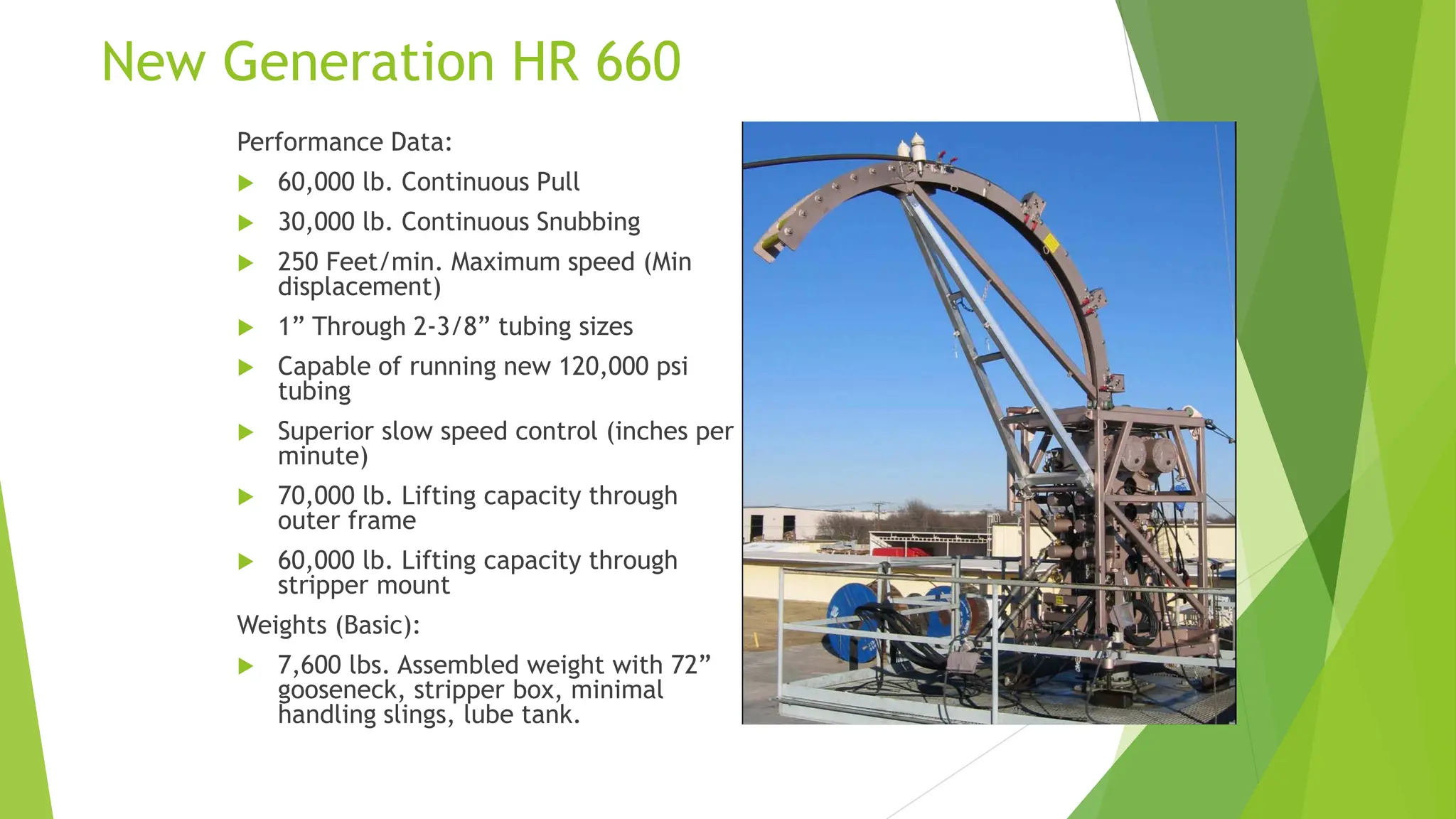
New Generation HR 660
Performance Data:
 60,000 lb. Continuous Pull
 30,000 lb. Continuous Snubbing
 250 Feet/min. Maximum speed (Min
displacement)
 1” Through 2-3/8” tubing sizes
 Capable of running new 120,000 psi
tubing
 Superior slow speed control (inches per
minute)
 70,000 lb. Lifting capacity through
outer frame
 60,000 lb. Lifting capacity through
stripper mount
Weights (Basic):
 7,600 lbs. Assembled weight with 72”
gooseneck, stripper box, minimal
handling slings, lube tank.
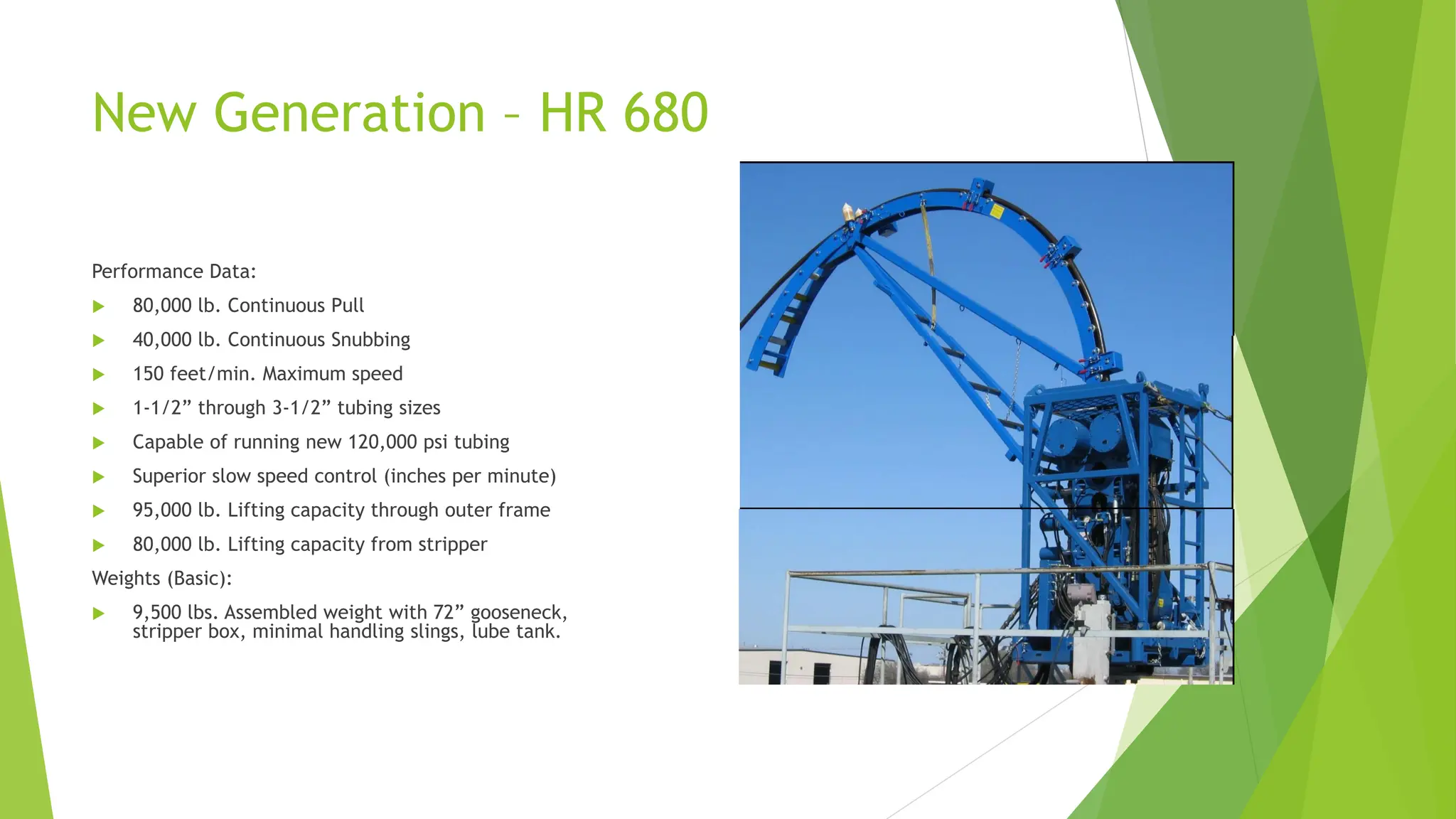
New Generation – HR 680
Performance Data:
 80,000 lb. Continuous Pull
 40,000 lb. Continuous Snubbing
 150 feet/min. Maximum speed
 1-1/2” through 3-1/2” tubing sizes
 Capable of running new 120,000 psi tubing
 Superior slow speed control (inches per minute)
 95,000 lb. Lifting capacity through outer frame
 80,000 lb. Lifting capacity from stripper
Weights (Basic):
 9,500 lbs. Assembled weight with 72” gooseneck,
stripper box, minimal handling slings, lube tank.
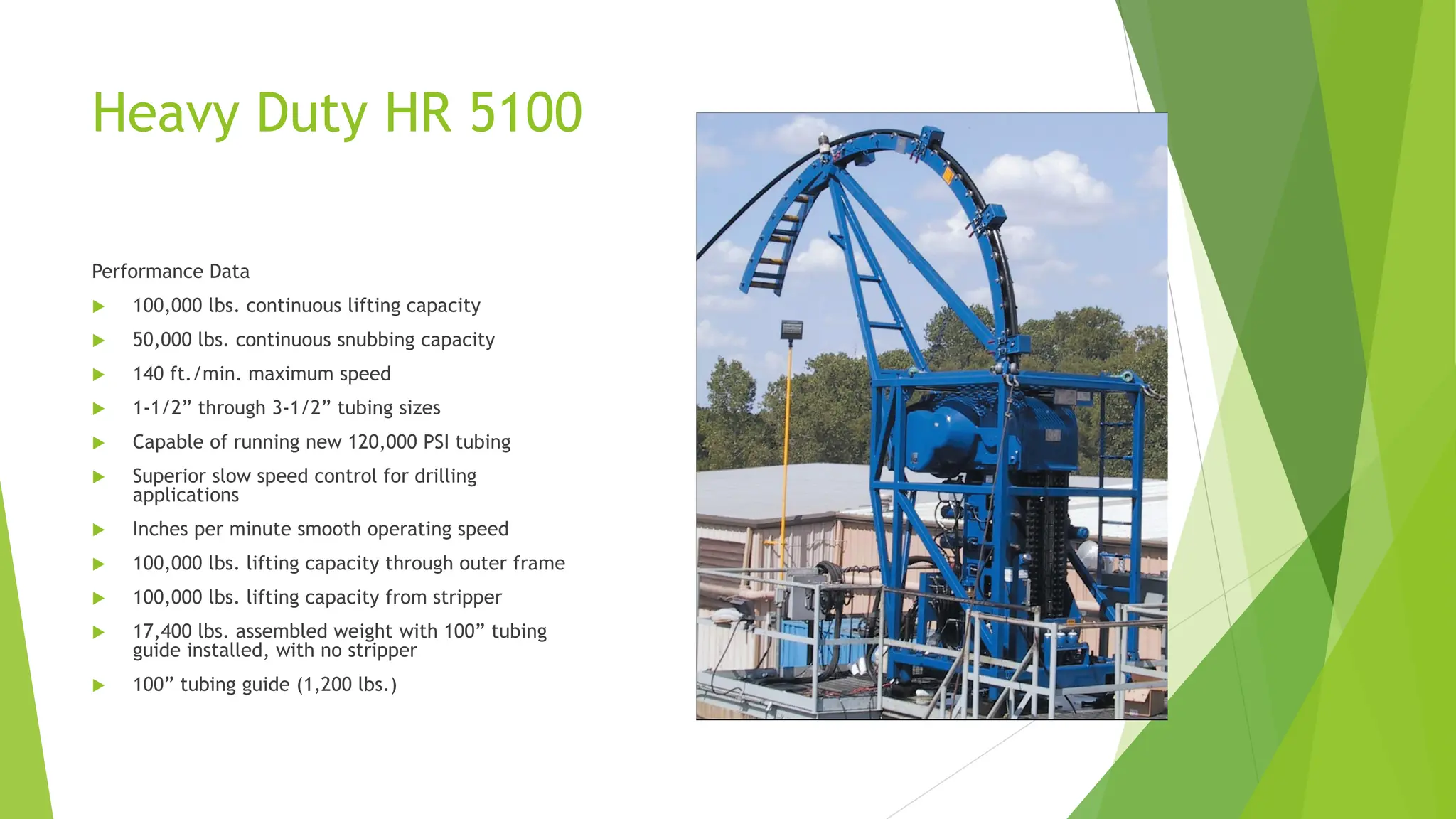
Heavy Duty HR 5100
Performance Data
 100,000 lbs. continuous lifting capacity
 50,000 lbs. continuous snubbing capacity
 140 ft./min. maximum speed
 1-1/2” through 3-1/2” tubing sizes
 Capable of running new 120,000 PSI tubing
 Superior slow speed control for drilling
applications
 Inches per minute smooth operating speed
 100,000 lbs. lifting capacity through outer frame
 100,000 lbs. lifting capacity from stripper
 17,400 lbs. assembled weight with 100” tubing
guide installed, with no stripper
 100” tubing guide (1,200 lbs.)
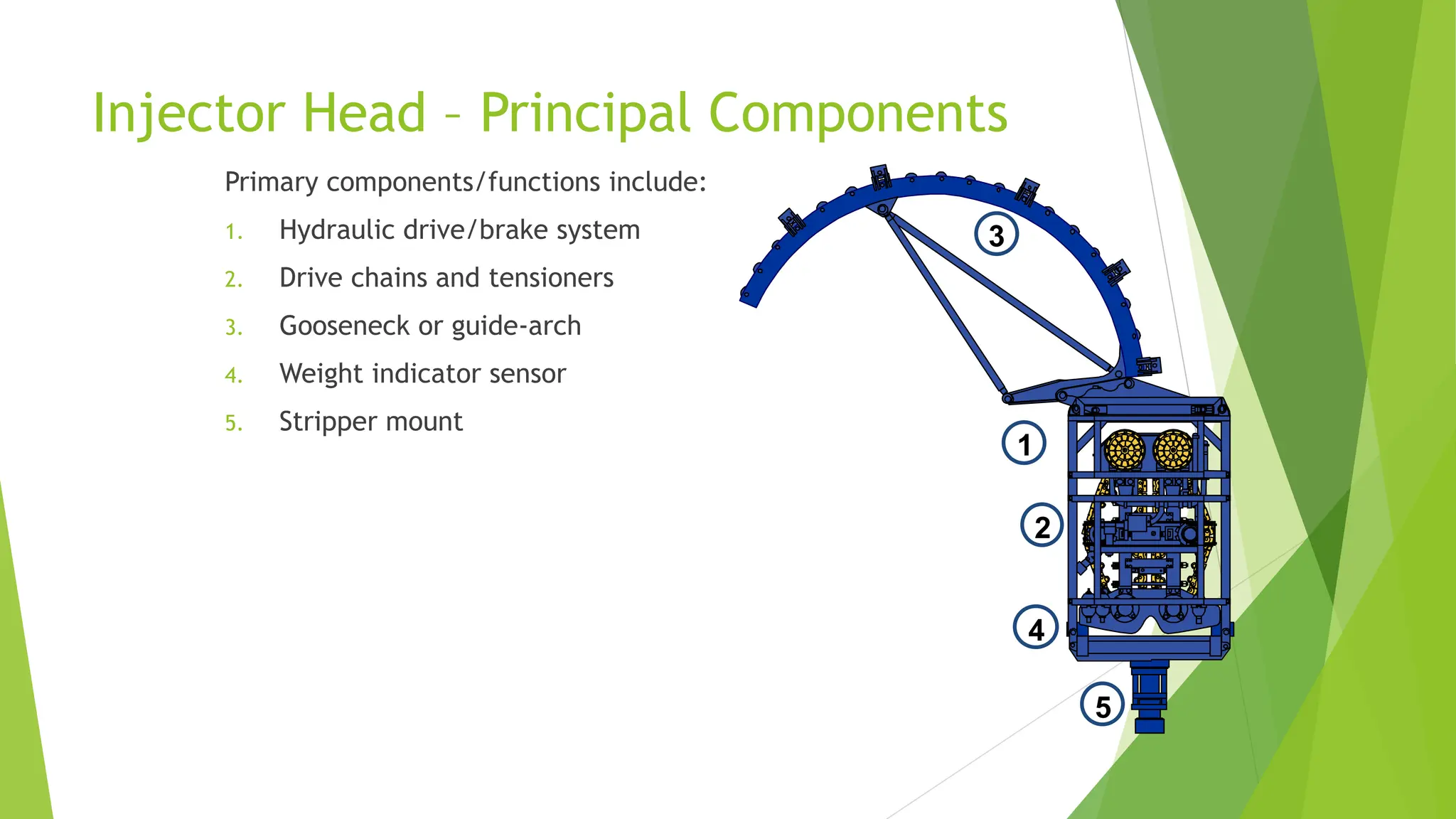
Injector Head – Principal Components
Primary components/functions include:
1. Hydraulic drive/brake system
2. Drive chains and tensioners
3. Gooseneck or guide-arch
4. Weight indicator sensor
5. Stripper mount
1
2
3
4
5
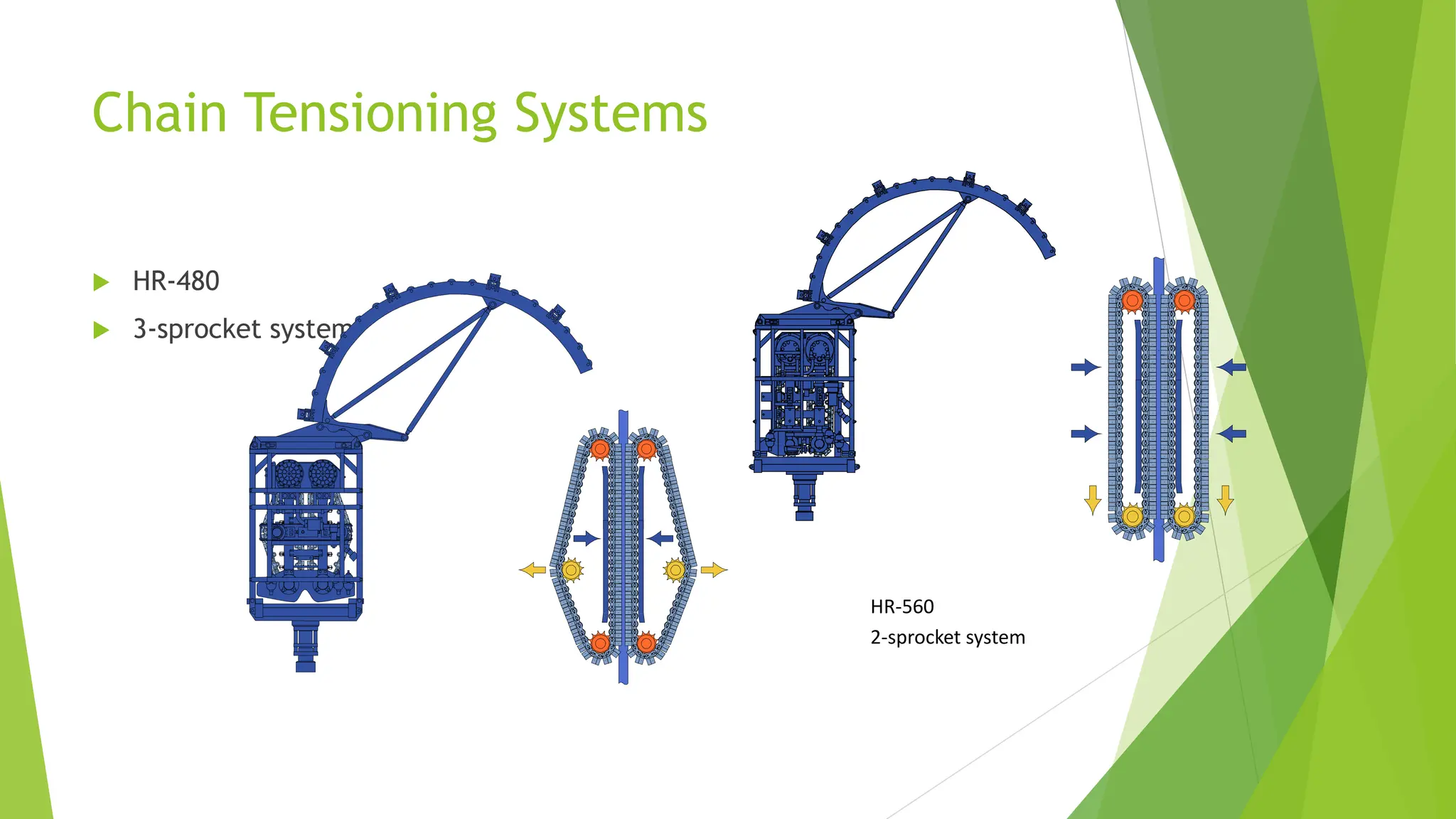
Chain Tensioning Systems
 HR-480
 3-sprocket system
HR-560
2-sprocket system
Chain Components – HR 240/260
Gripper block
Roller
bearing
Chainlink
pins
Chainlink plate
andsplit pin
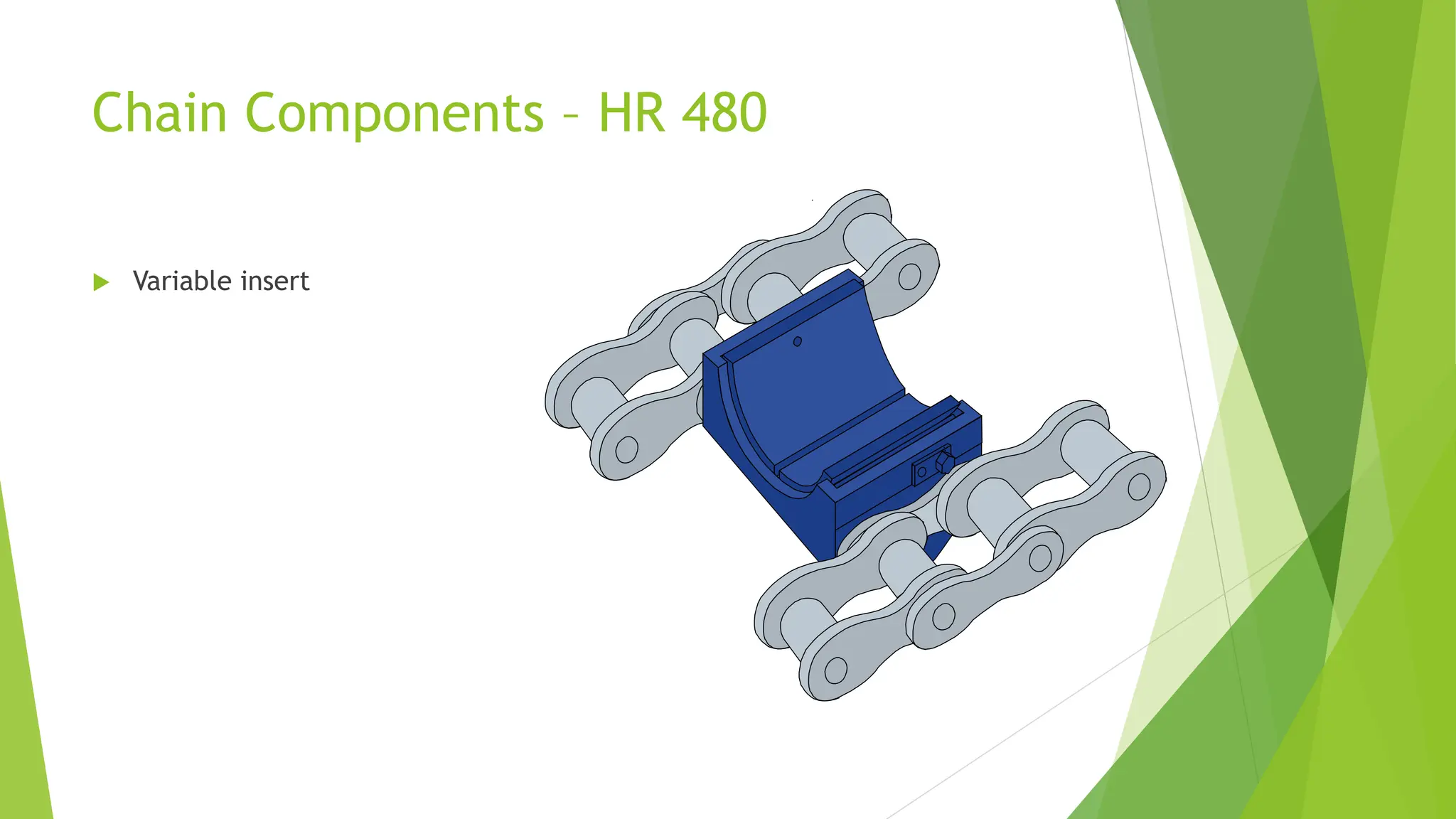
Chain Components – HR 480
 Variable insert
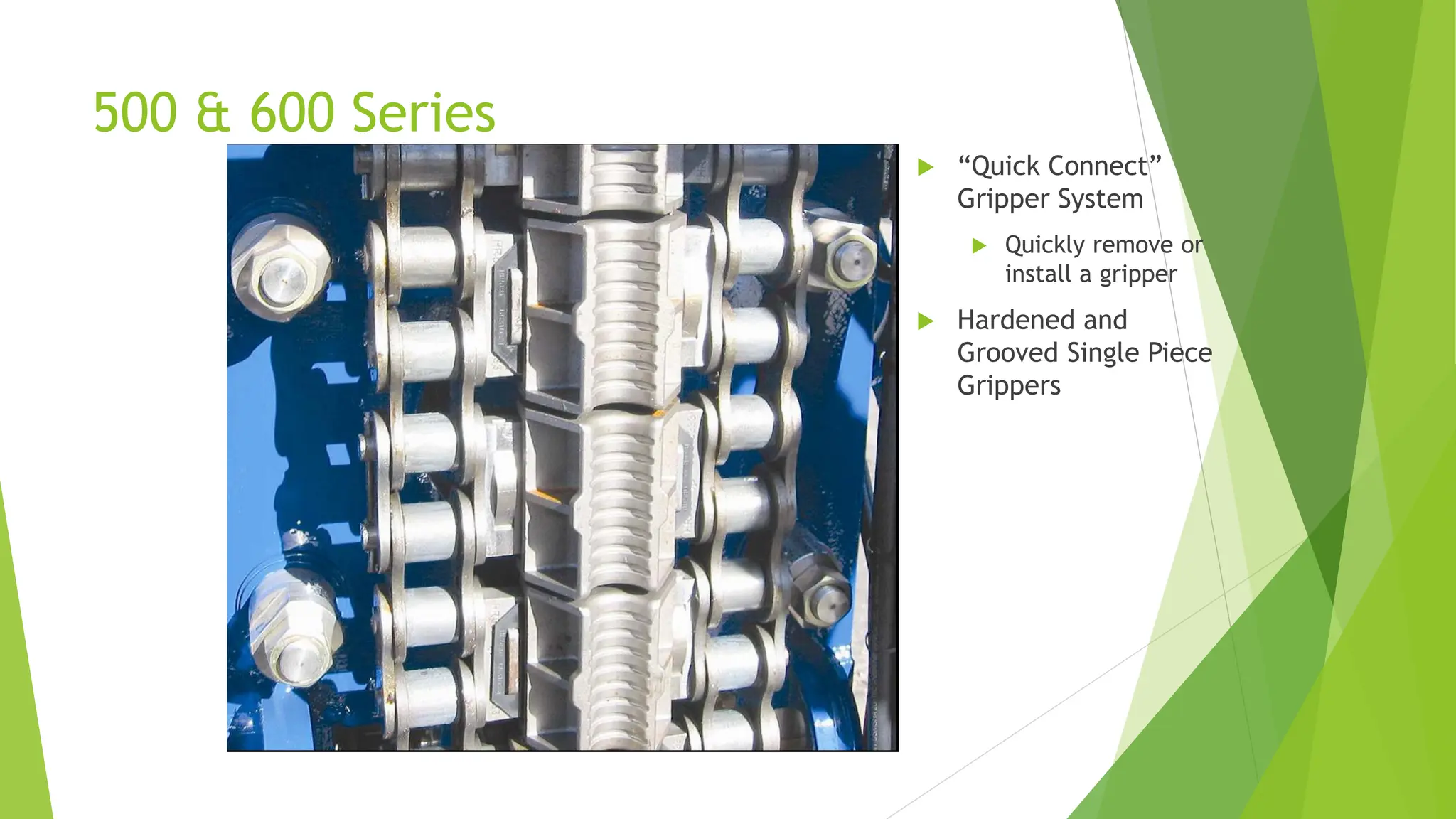
500 & 600 Series
 “Quick Connect”
Gripper System
 Quickly remove or
install a gripper
 Hardened and
Grooved Single Piece
Grippers
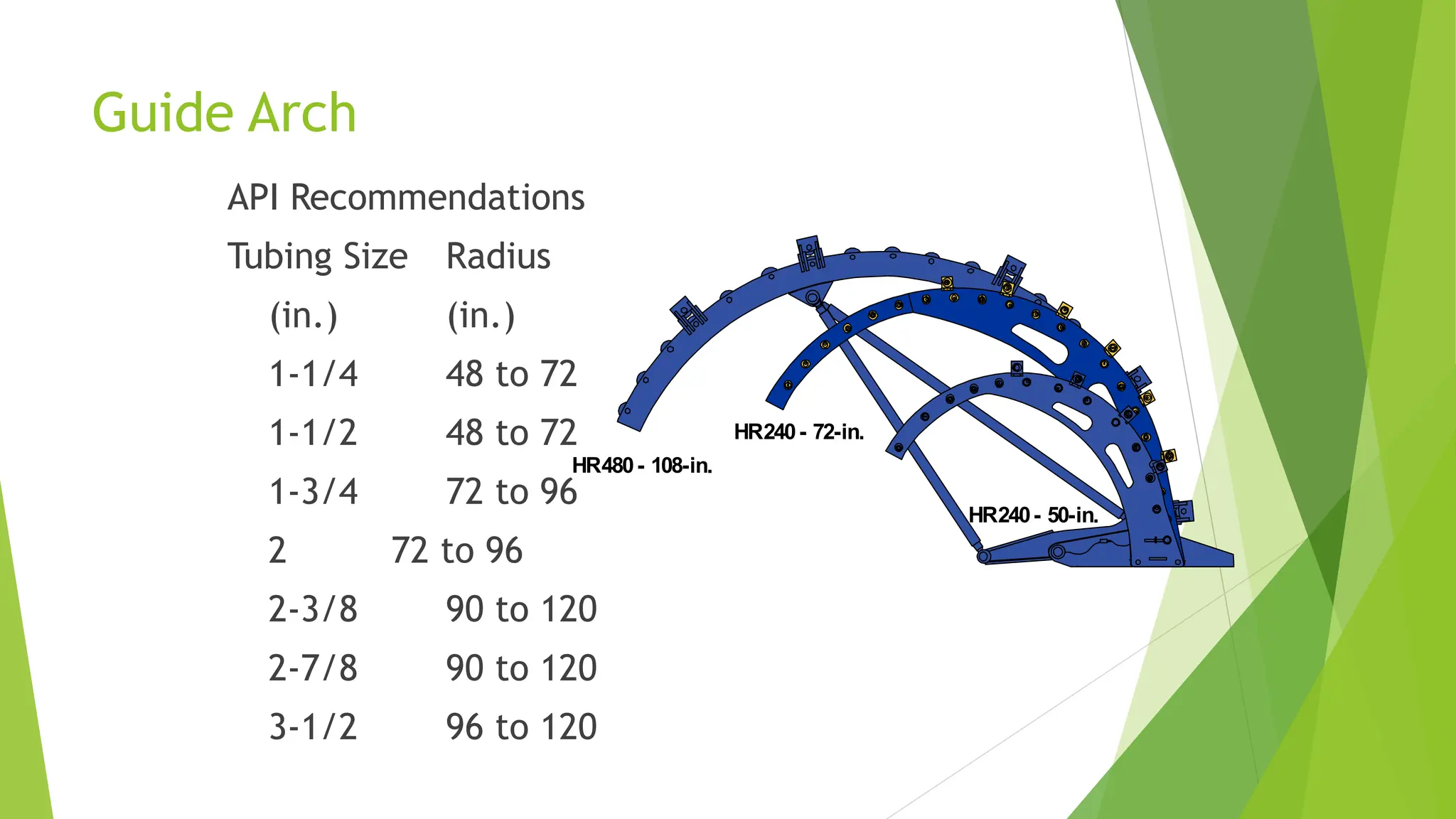
Guide Arch
API Recommendations
Tubing Size Radius
(in.) (in.)
1-1/4 48 to 72
1-1/2 48 to 72
1-3/4 72 to 96
2 72 to 96
2-3/8 90 to 120
2-7/8 90 to 120
3-1/2 96 to 120
HR240- 50-in.
HR480- 108-in.
HR240- 72-in.
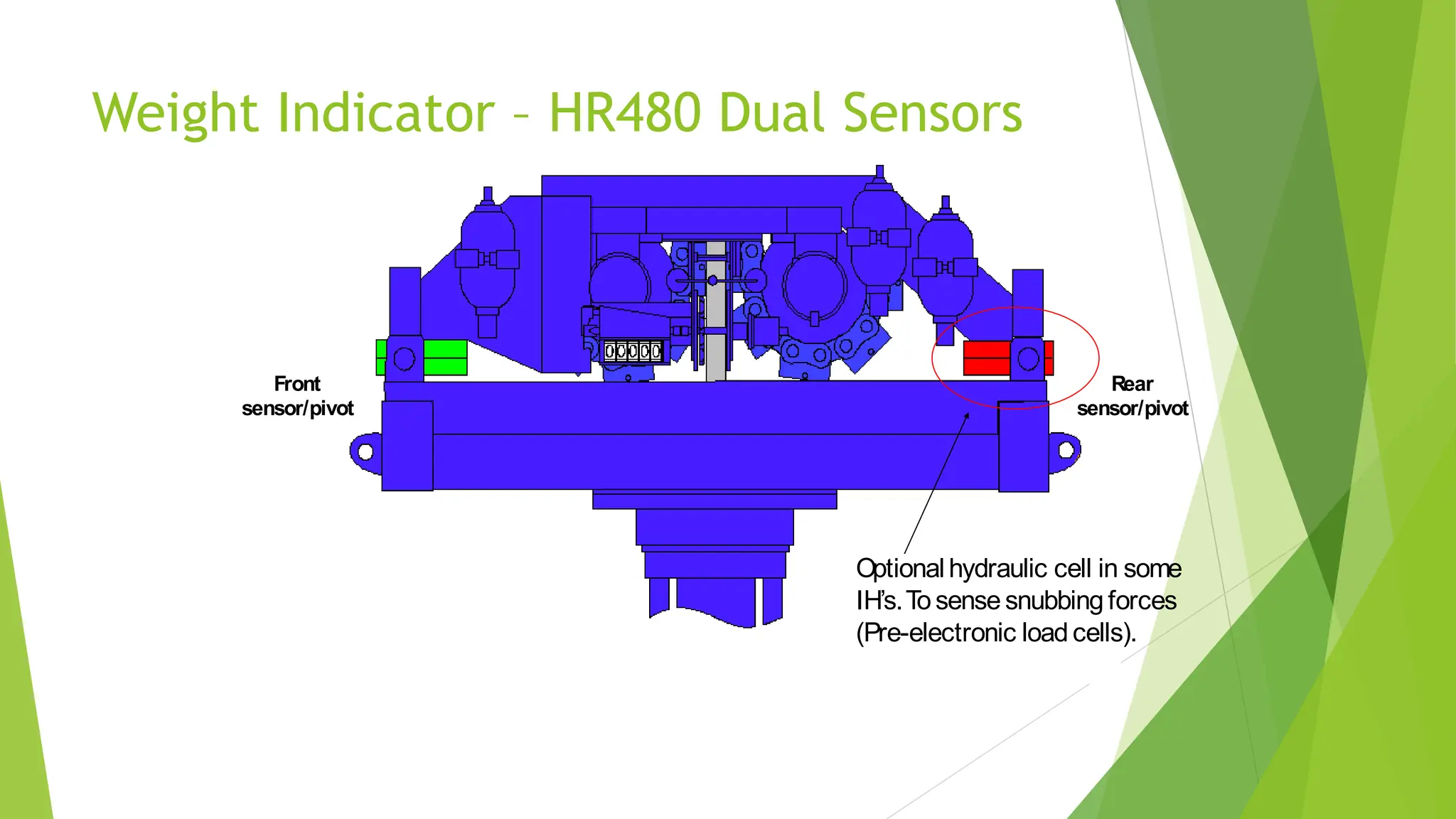
Weight Indicator – HR480 Dual Sensors
Front
sensor/pivot
Rear
sensor/pivot
Optional hydraulic cell in some
IH’s.To sense snubbing forces
(Pre-electronic load cells).
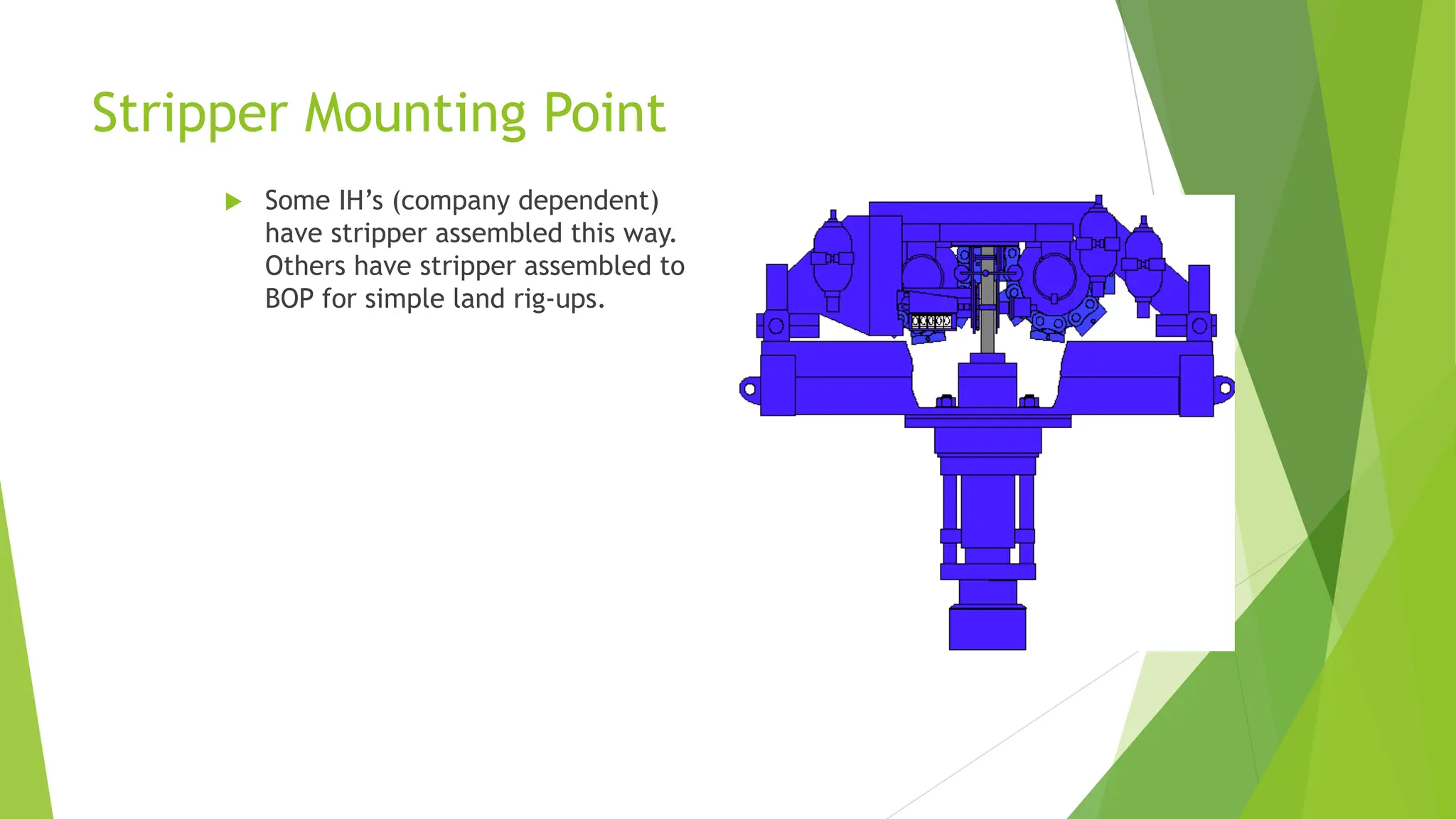
Stripper Mounting Point
 Some IH’s (company dependent)
have stripper assembled this way.
Others have stripper assembled to
BOP for simple land rig-ups.
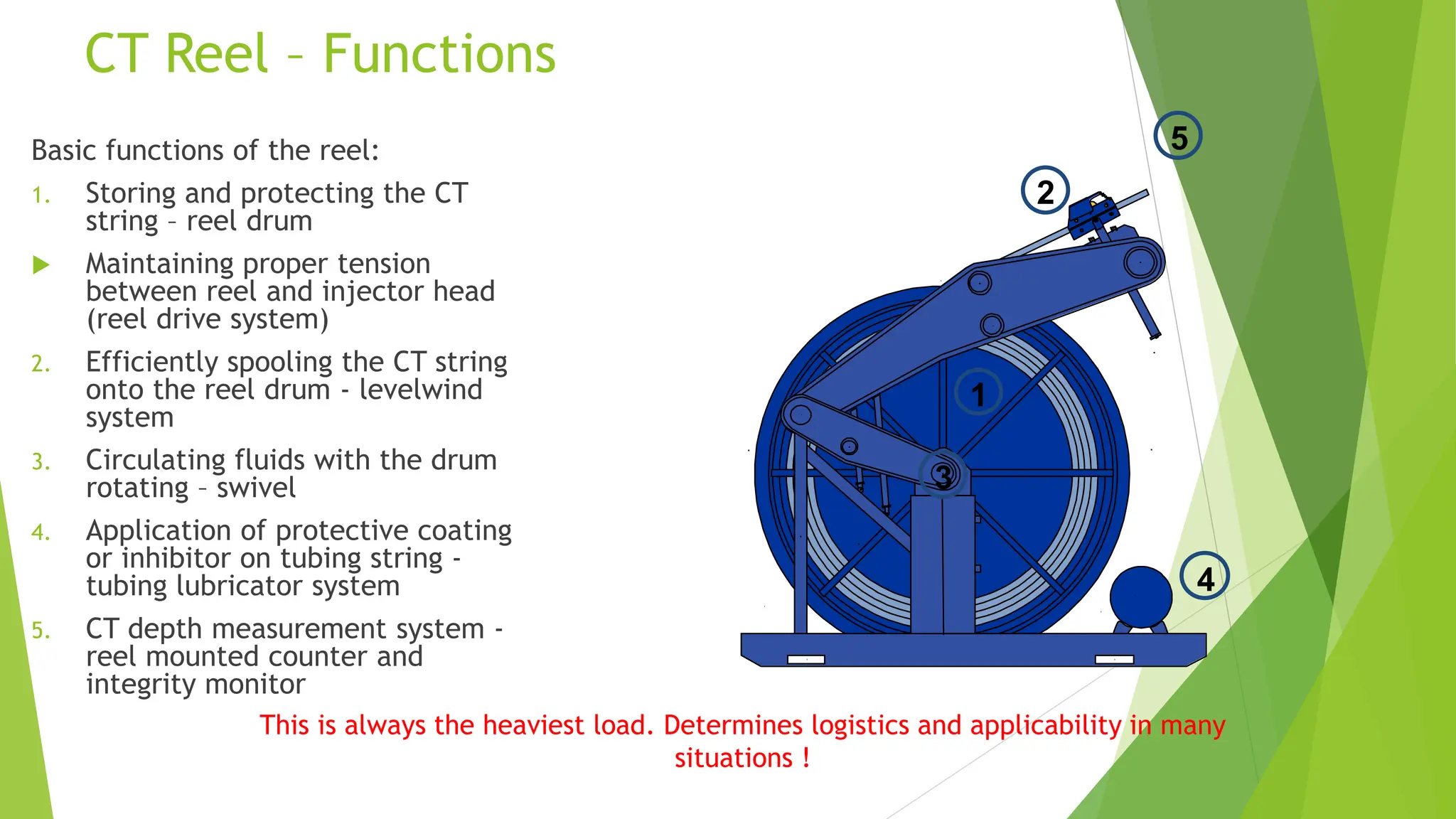
CT Reel – Functions
Basic functions of the reel:
1. Storing and protecting the CT
string – reel drum
 Maintaining proper tension
between reel and injector head
(reel drive system)
2. Efficiently spooling the CT string
onto the reel drum - levelwind
system
3. Circulating fluids with the drum
rotating – swivel
4. Application of protective coating
or inhibitor on tubing string -
tubing lubricator system
5. CT depth measurement system -
reel mounted counter and
integrity monitor
This is always the heaviest load. Determines logistics and applicability in many
situations !
1
2
3
4
5
1
3
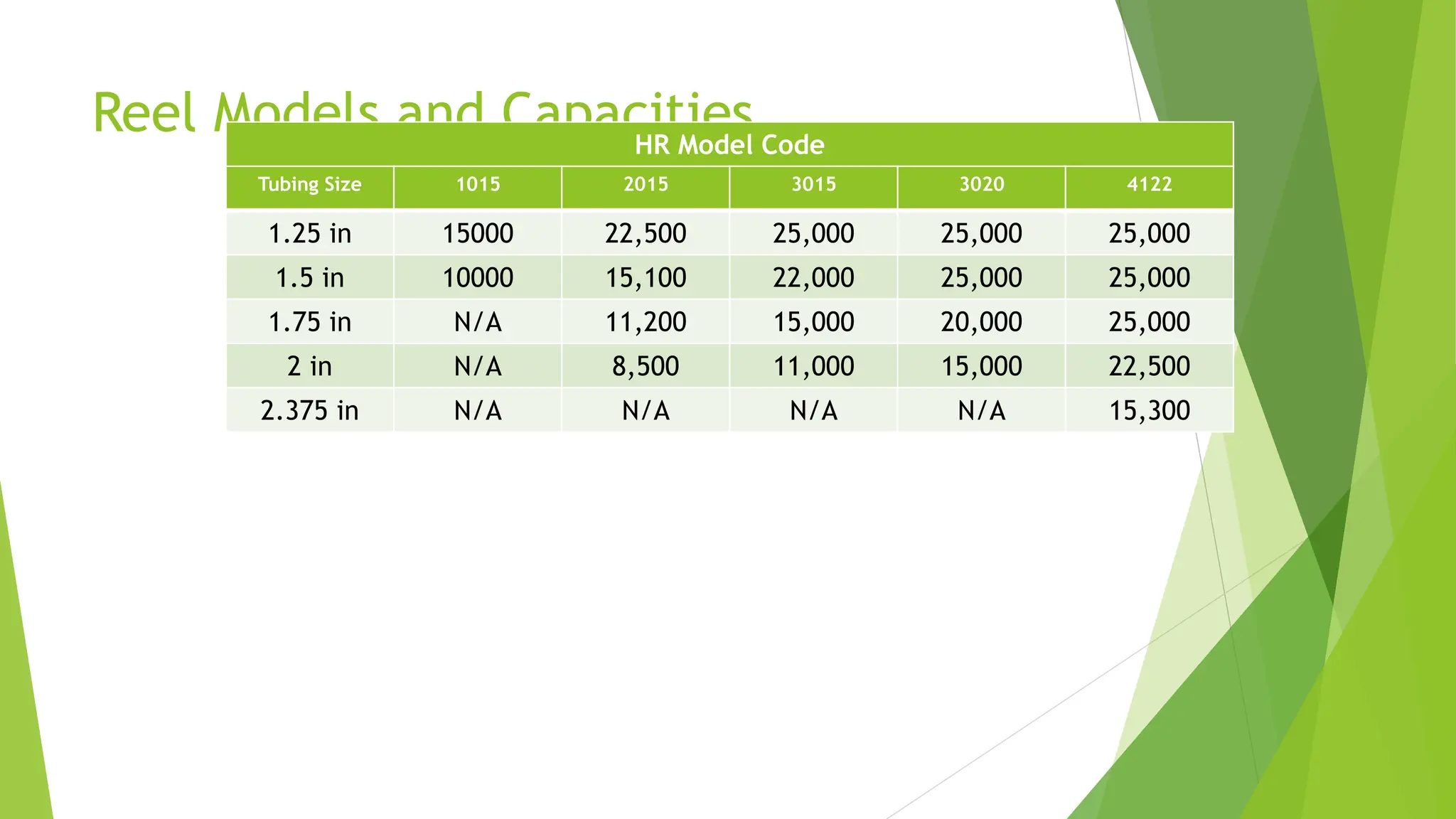
Reel Models and Capacities
HR Model Code
Tubing Size 1015 2015 3015 3020 4122
1.25 in 15000 22,500 25,000 25,000 25,000
1.5 in 10000 15,100 22,000 25,000 25,000
1.75 in N/A 11,200 15,000 20,000 25,000
2 in N/A 8,500 11,000 15,000 22,500
2.375 in N/A N/A N/A N/A 15,300
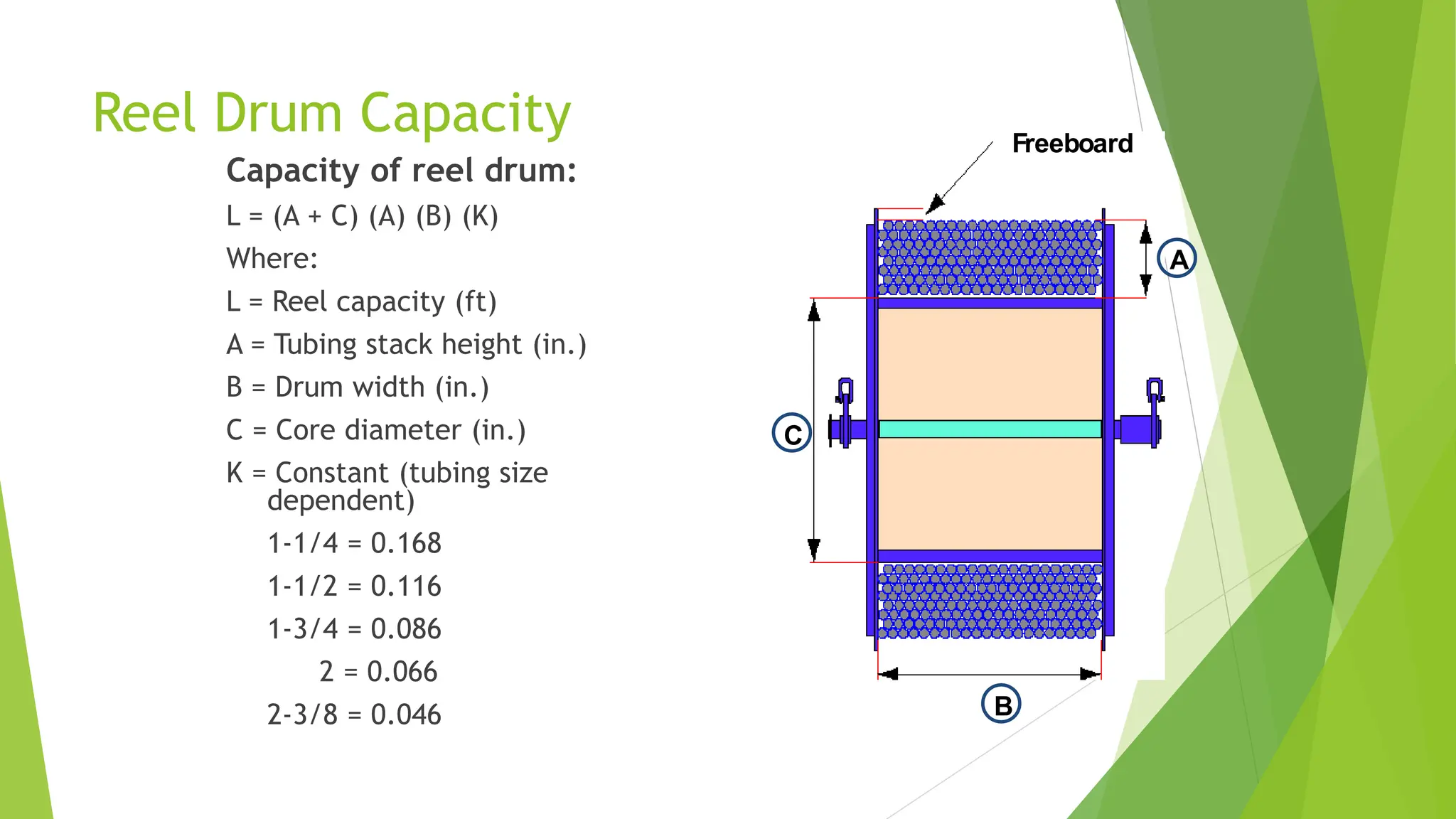
Reel Drum Capacity
Capacity of reel drum:
L = (A + C) (A) (B) (K)
Where:
L = Reel capacity (ft)
A = Tubing stack height (in.)
B = Drum width (in.)
C = Core diameter (in.)
K = Constant (tubing size
dependent)
1-1/4 = 0.168
1-1/2 = 0.116
1-3/4 = 0.086
2 = 0.066
2-3/8 = 0.046
Freeboard
A
B
C
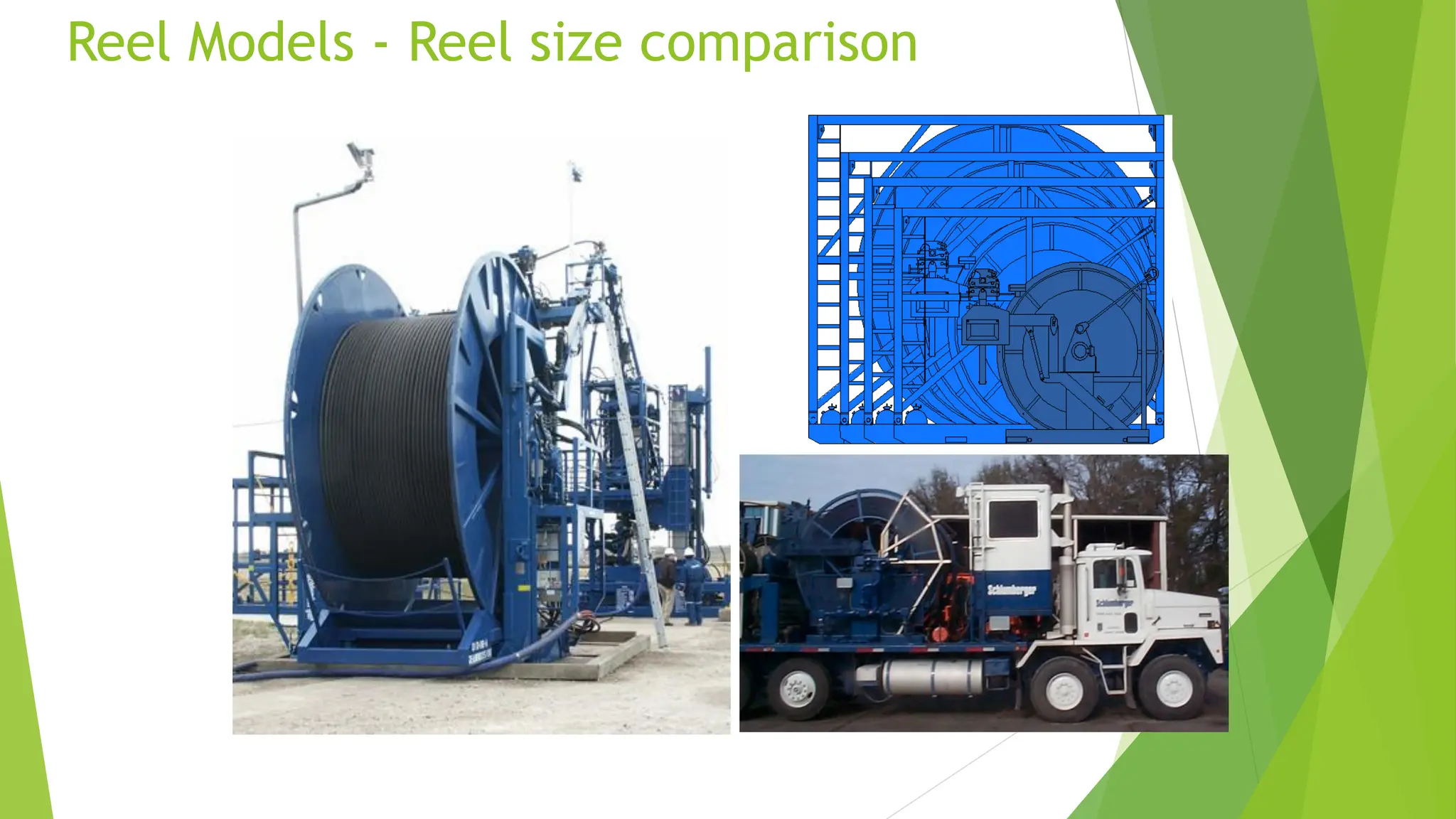
Reel Models - Reel size comparison
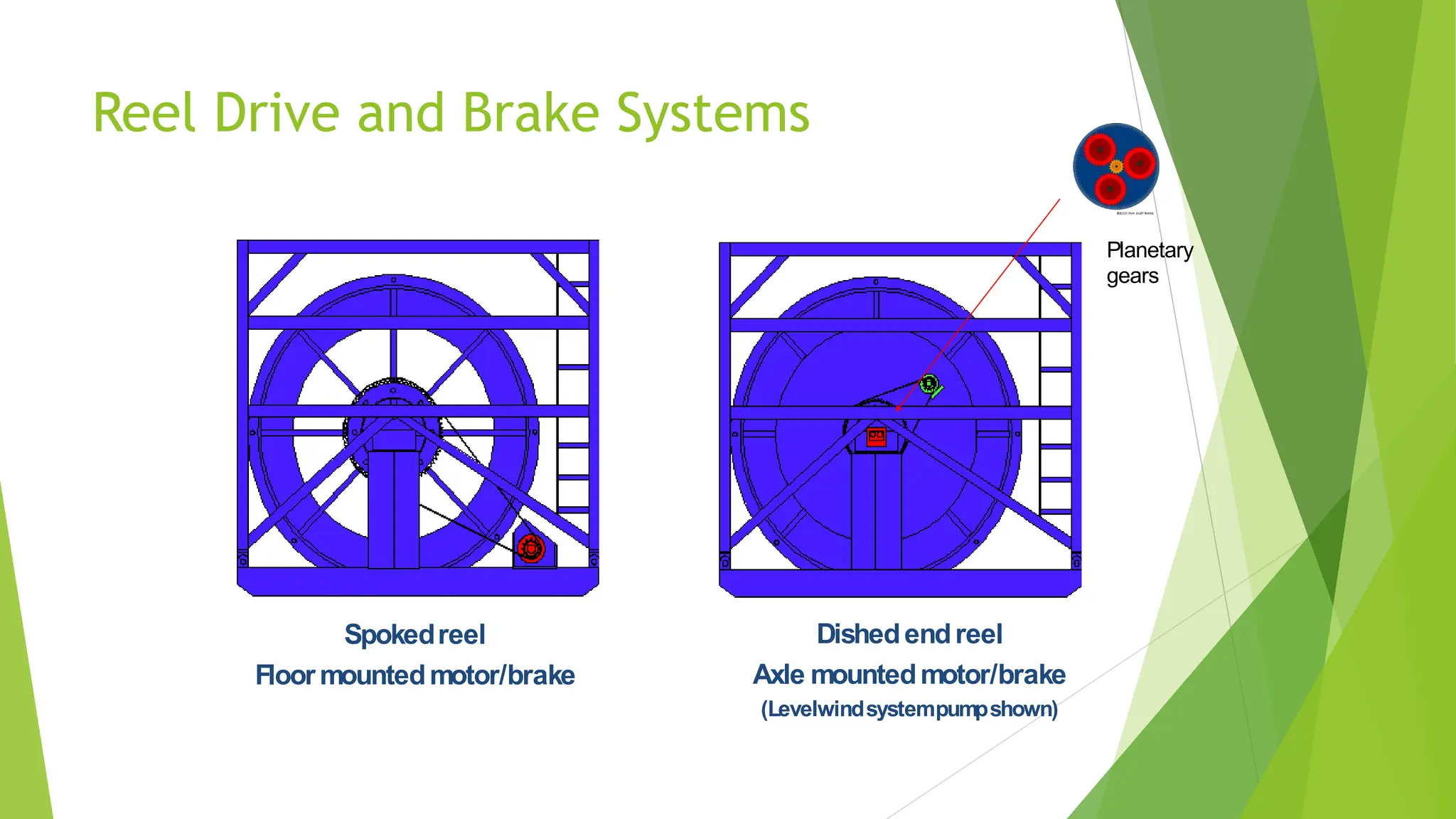
Reel Drive and Brake Systems
Spokedreel
Floor mountedmotor/brake
Dishedendreel
Axle mountedmotor/brake
(Levelwindsystempumpshown)
Planetary
gears
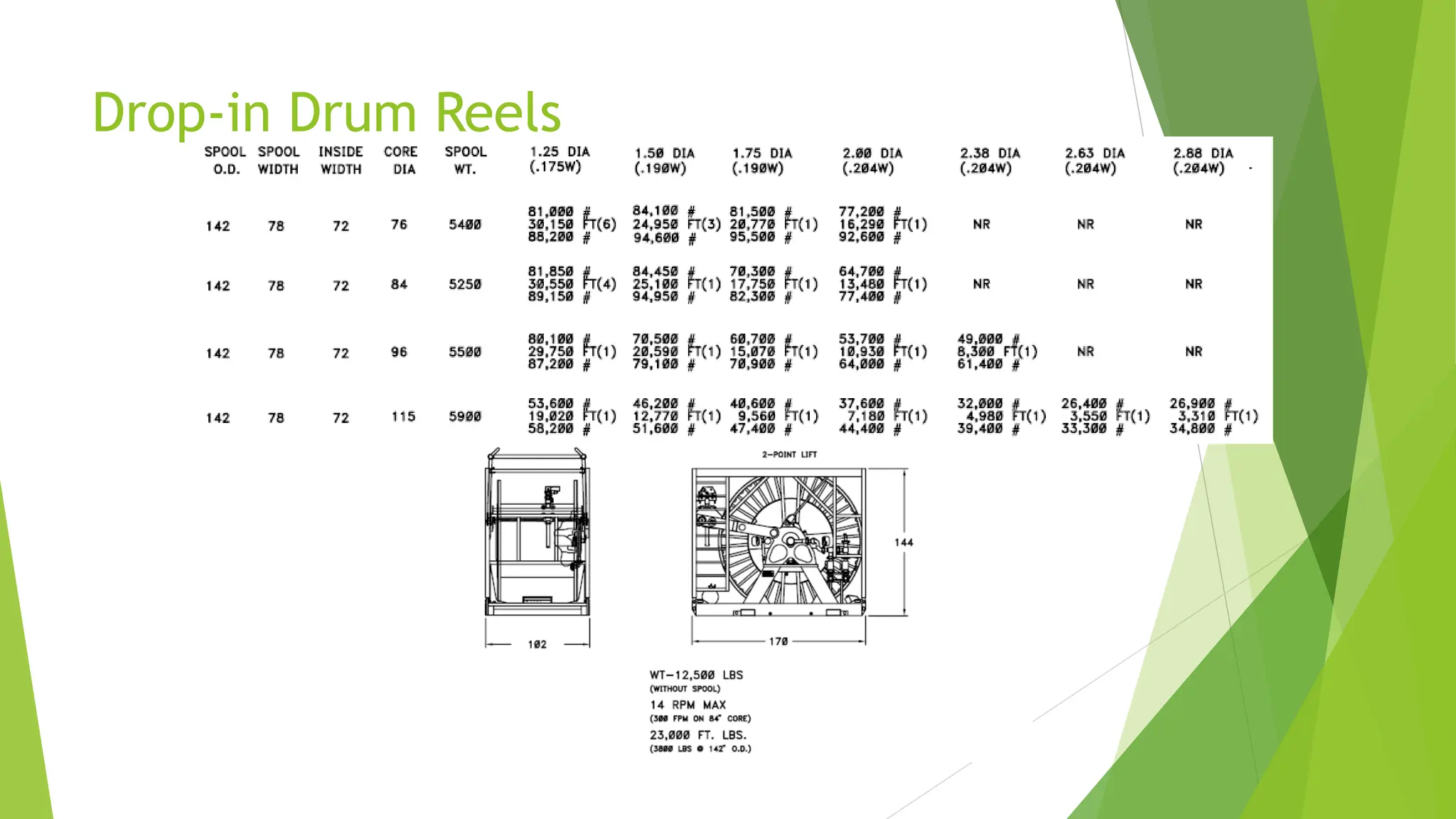
Drop-in Drum Reels
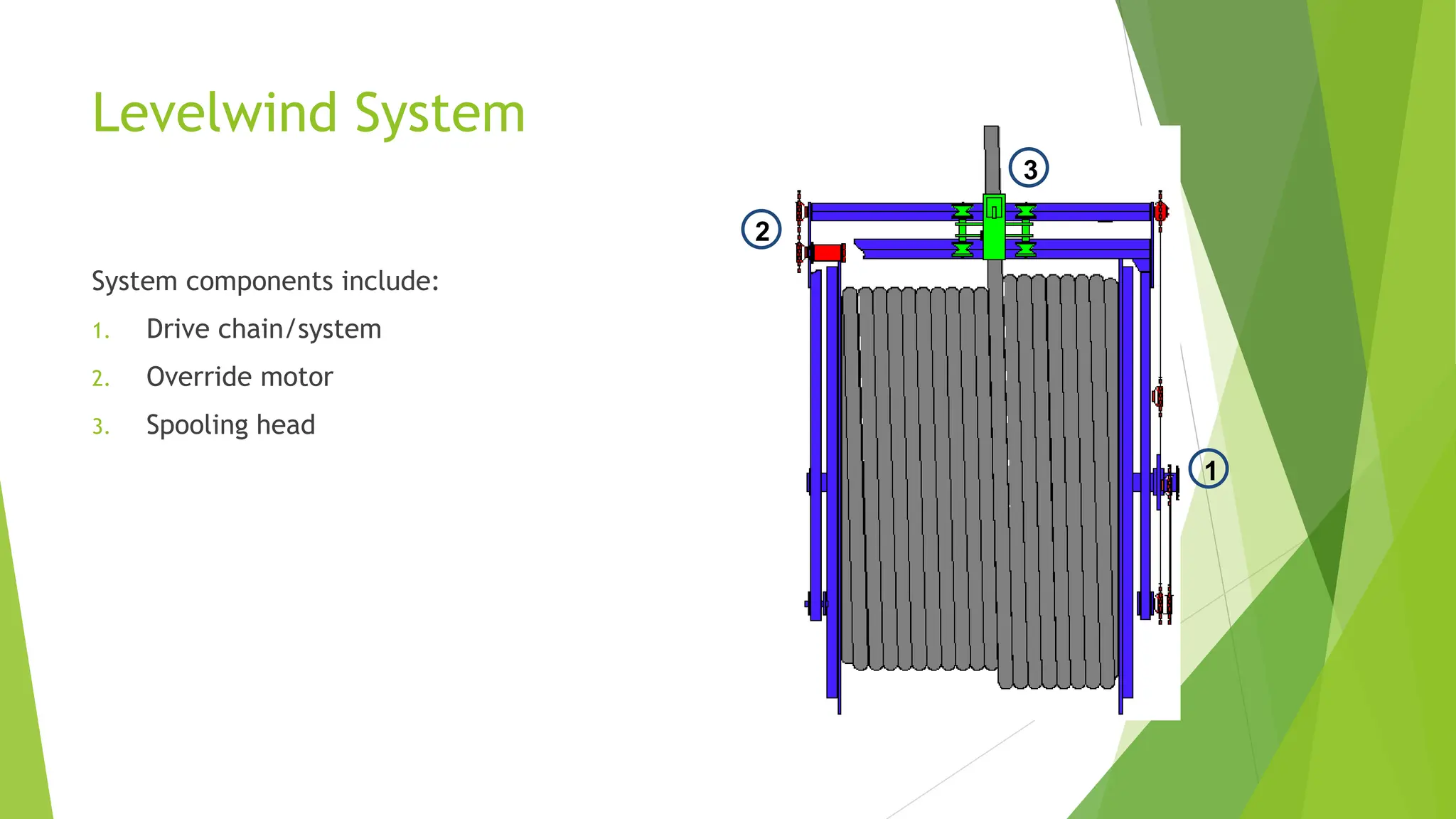
Levelwind System
System components include:
1. Drive chain/system
2. Override motor
3. Spooling head
3
2
1
Workover and Coiled Tubing Units
 Standard Work-over Unit
 Generally requires longer rig ups /
Downs
 ▪Longer RIH and POH.
 ▪Need to stop circulation to make
pipe connections.
 ▪Generally need to kill the well for
operations.
 Coiled Tubing Unit
 ▪Faster rig ups / Downs
 ▪Live Well/ Min. production
downtime
 ▪Continuous tubing / continuous
circulation
 ▪Enhanced Tubing Management
 ▪Improve Safety (min. thread
connections)
Coiled Tubing
Advantages
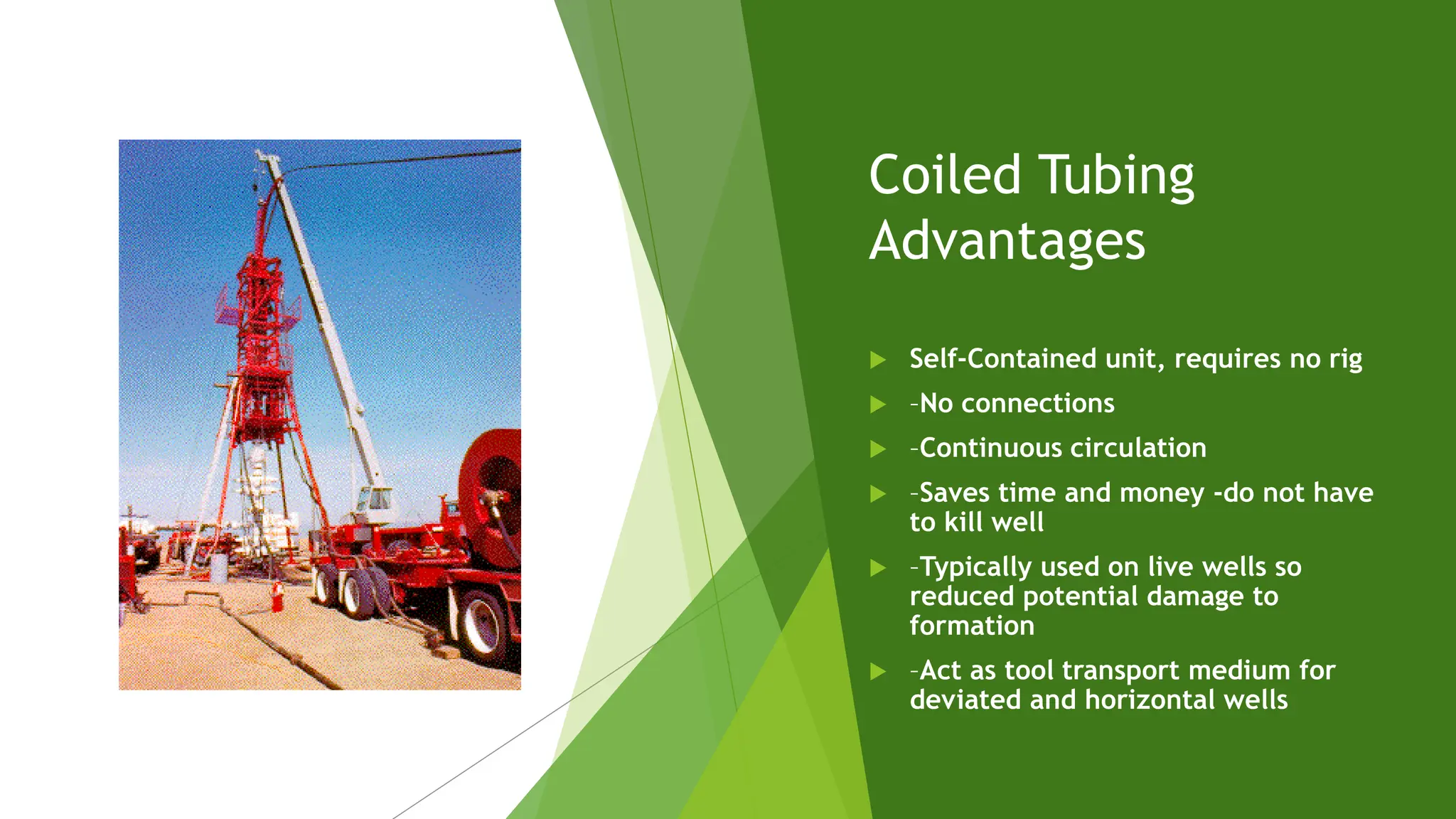
 Self-Contained unit, requires no rig
 –No connections
 –Continuous circulation
 –Saves time and money -do not have
to kill well
 –Typically used on live wells so
reduced potential damage to
formation
 –Act as tool transport medium for
deviated and horizontal wells
Coiled Tubing
Limitations
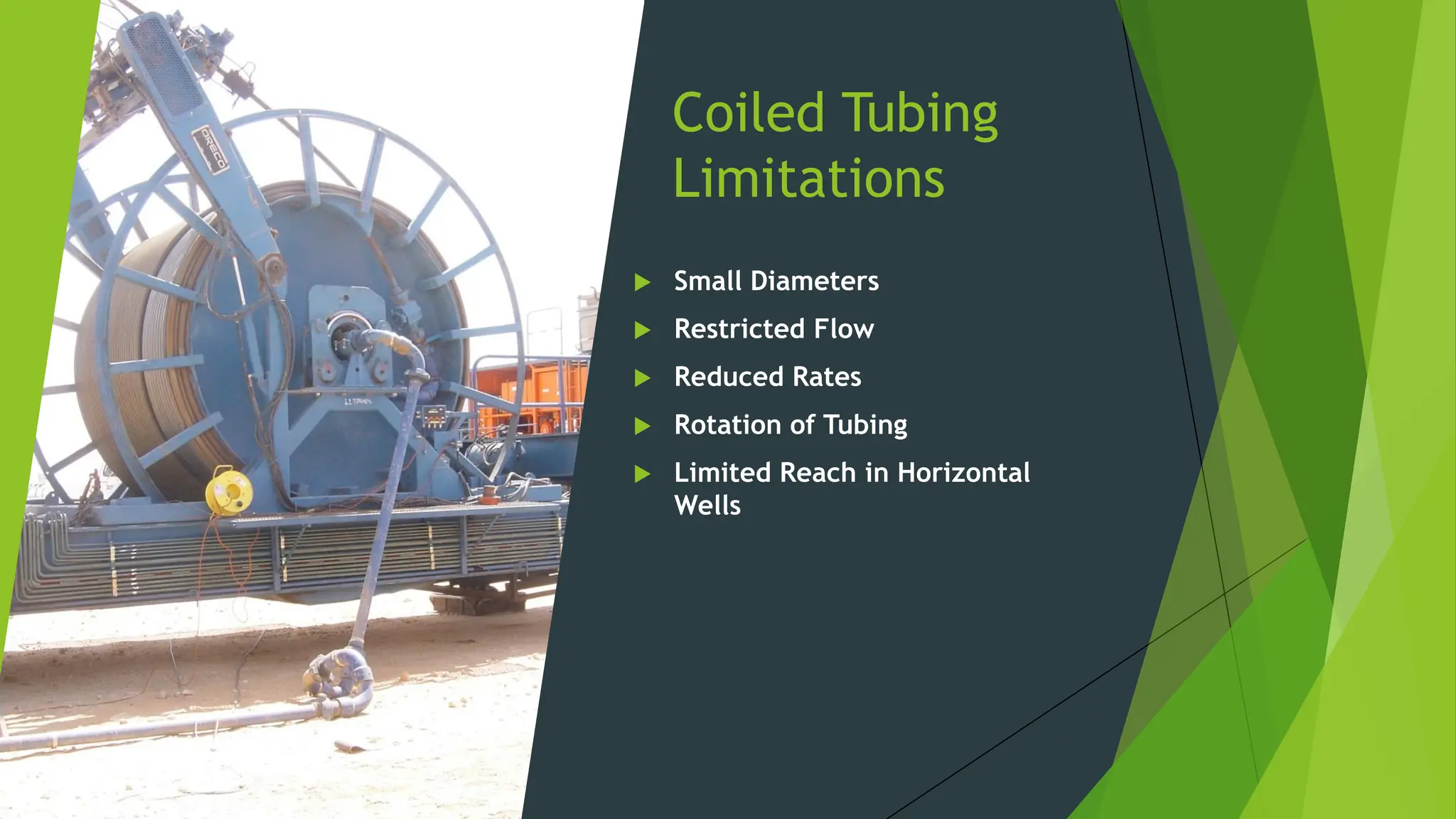
 Small Diameters
 Restricted Flow
 Reduced Rates
 Rotation of Tubing
 Limited Reach in Horizontal
Wells
Coiled Tubing
Operation
Introduction to Coiled Tubing Application
CT Application Analysis
 Key application segments
 Fluid conveyance
 Circulation, placement, injection
 Tool conveyance
 Mechanical, Electrical
 Completions
 ESP, Vel Strings, etc
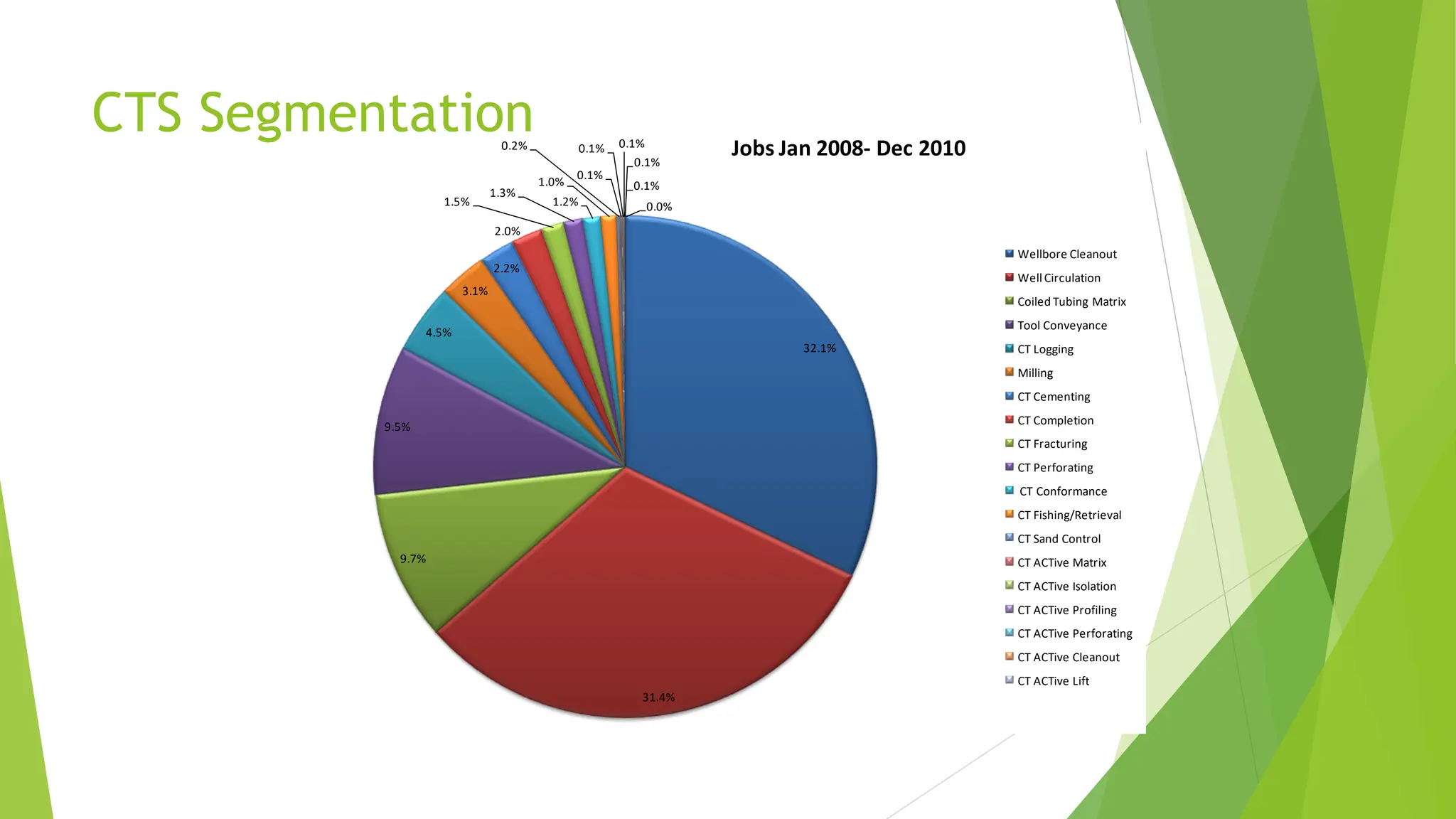
32.1%
31.4%
9.7%
9.5%
4.5%
3.1%
2.2%
2.0%
1.5%
1.3%
1.2%
1.0%
0.2%
0.1%
0.1% 0.1%
0.1%
0.1%
0.0%
Jobs Jan 2008- Dec 2010
Wellbore Cleanout
Well Circulation
Coiled Tubing Matrix
Tool Conveyance
CT Logging
Milling
CT Cementing
CT Completion
CT Fracturing
CT Perforating
CT Conformance
CT Fishing/Retrieval
CT Sand Control
CT ACTive Matrix
CT ACTive Isolation
CT ACTive Profiling
CT ACTive Perforating
CT ACTive Cleanout
CT ACTive Lift
CTS Segmentation
Fluid Conveyance
Applications
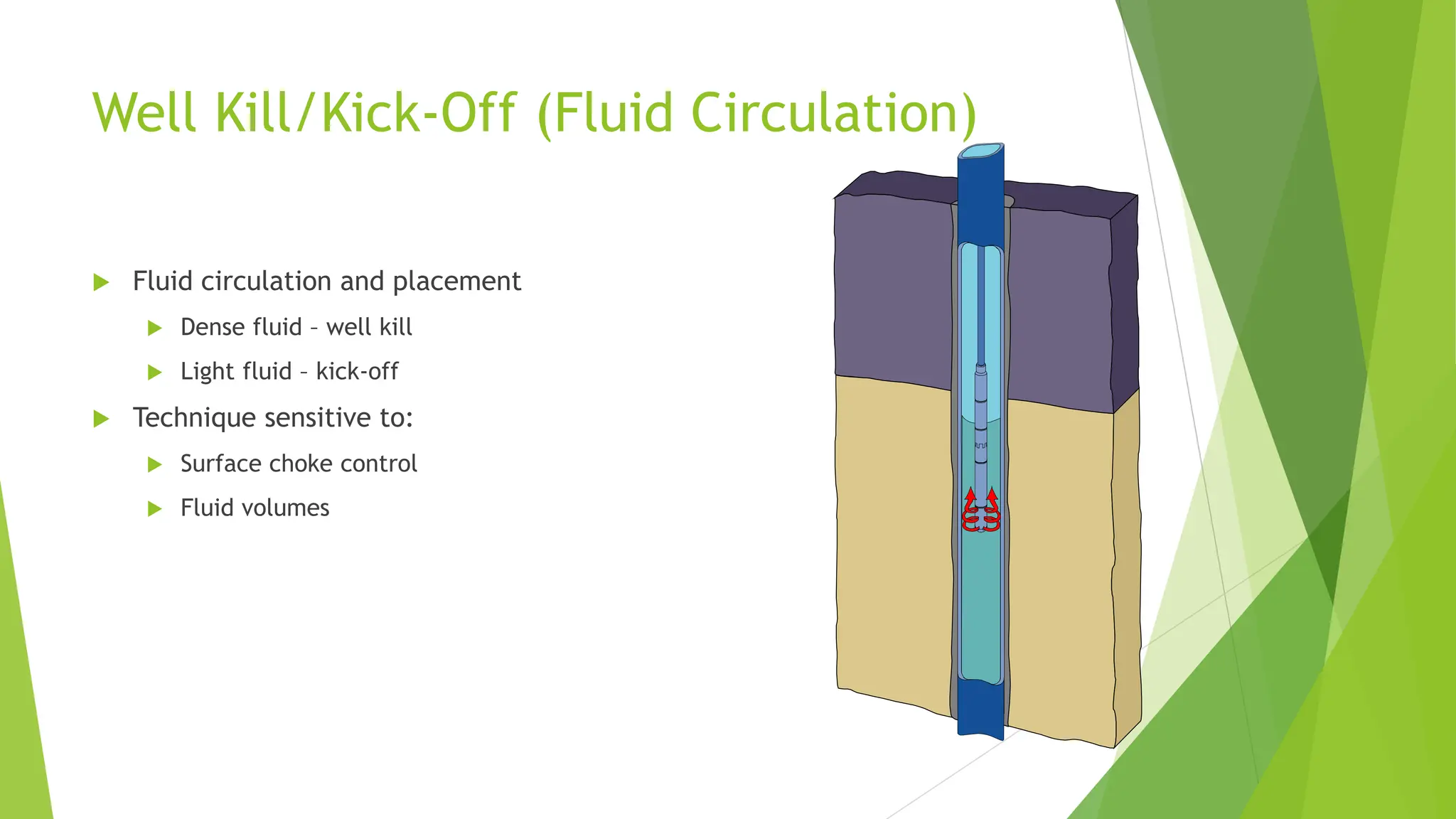
Well Kill/Kick-Off (Fluid Circulation)
 Fluid circulation and placement
 Dense fluid – well kill
 Light fluid – kick-off
 Technique sensitive to:
 Surface choke control
 Fluid volumes
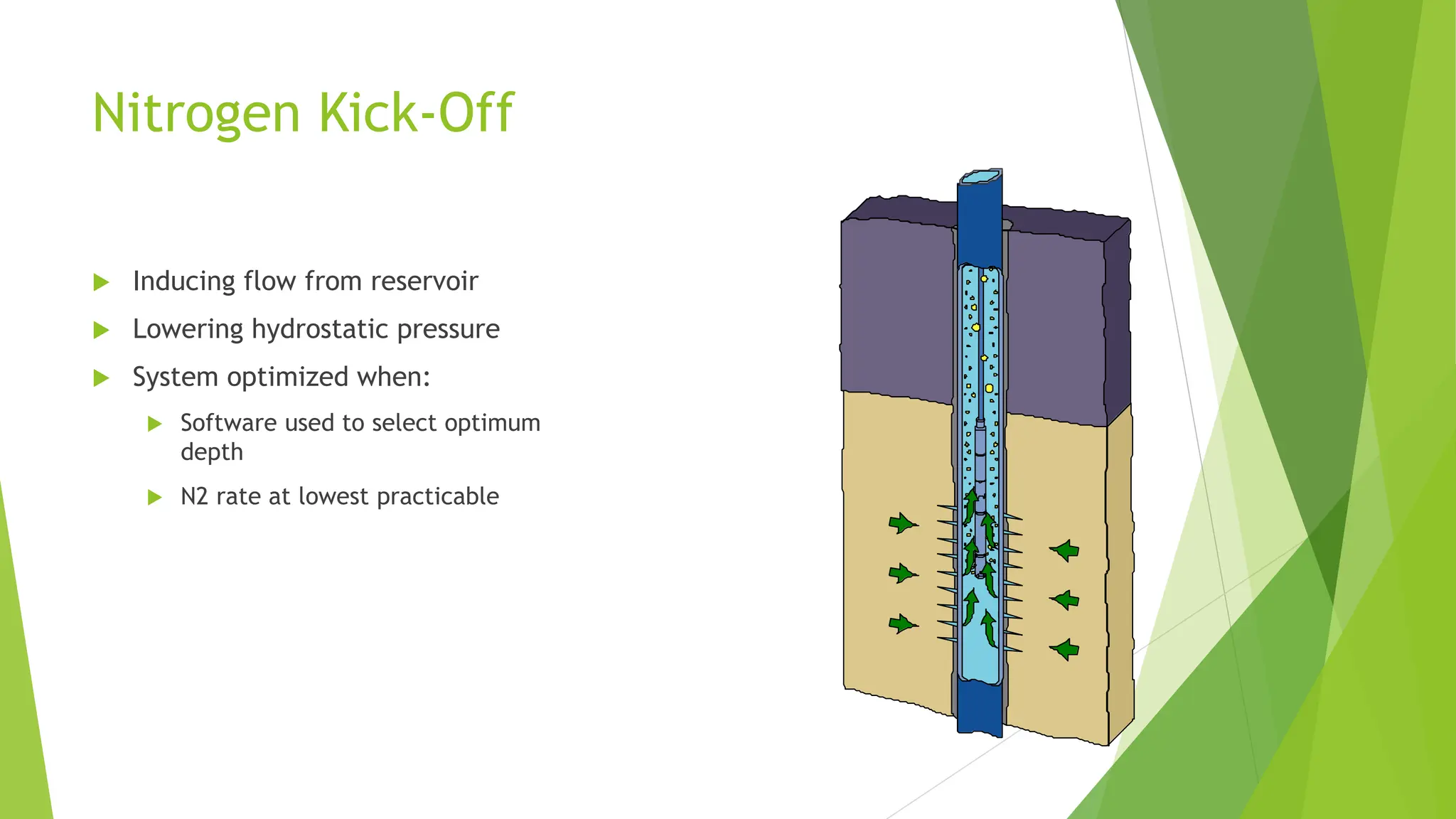
Nitrogen Kick-Off
 Inducing flow from reservoir
 Lowering hydrostatic pressure
 System optimized when:
 Software used to select optimum
depth
 N2 rate at lowest practicable
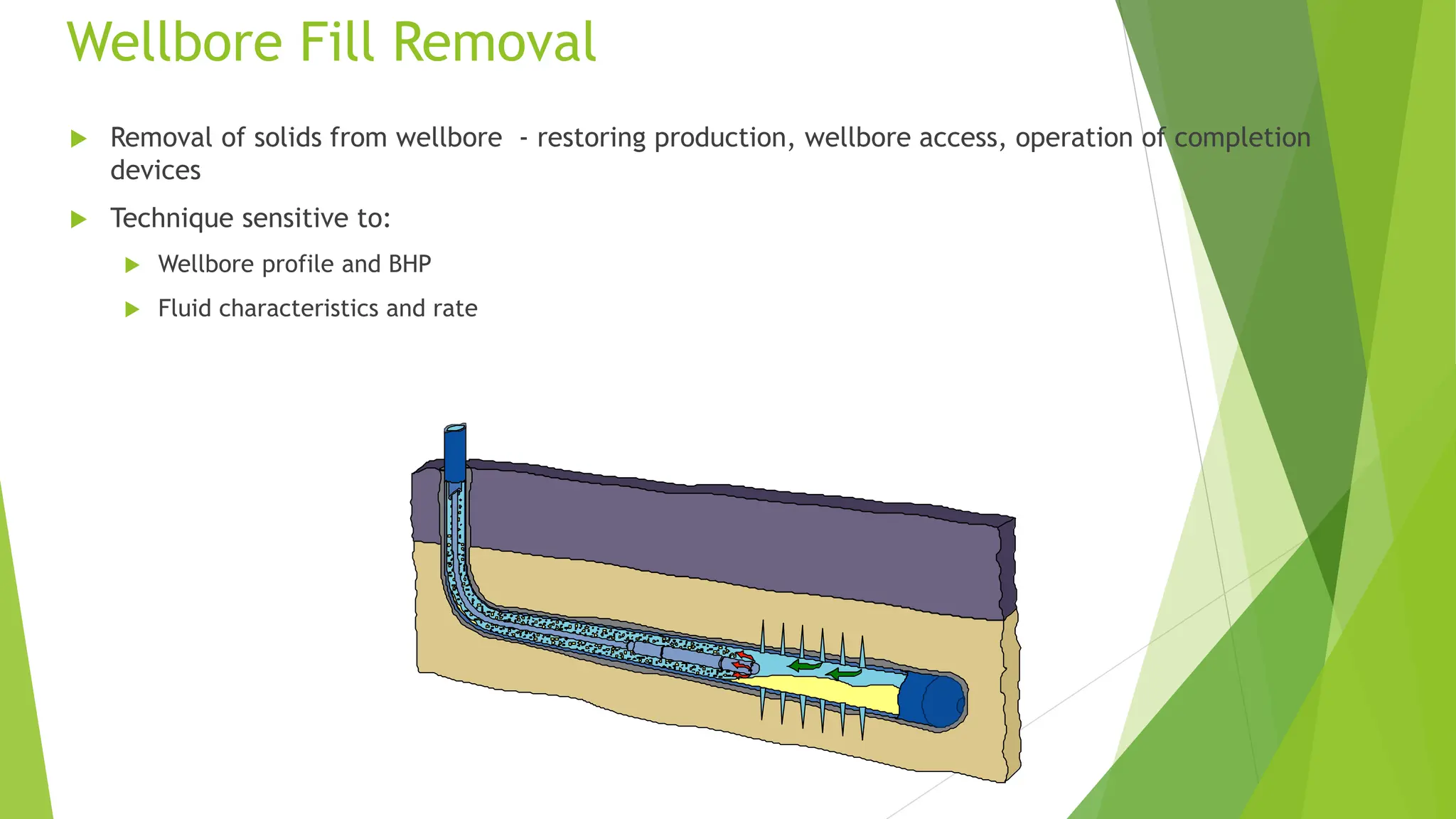
Wellbore Fill Removal
 Removal of solids from wellbore - restoring production, wellbore access, operation of completion
devices
 Technique sensitive to:
 Wellbore profile and BHP
 Fluid characteristics and rate
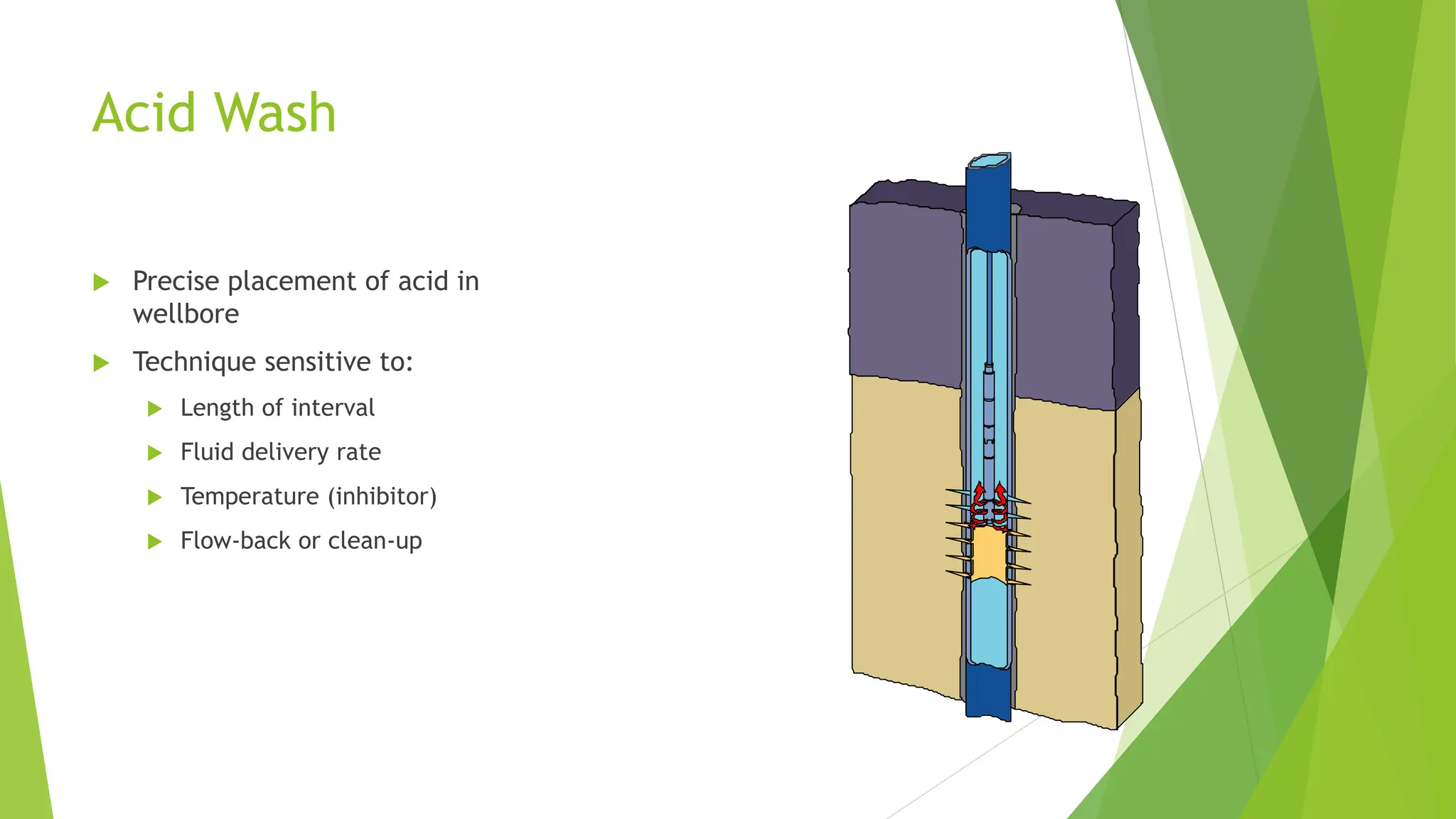
Acid Wash
 Precise placement of acid in
wellbore
 Technique sensitive to:
 Length of interval
 Fluid delivery rate
 Temperature (inhibitor)
 Flow-back or clean-up
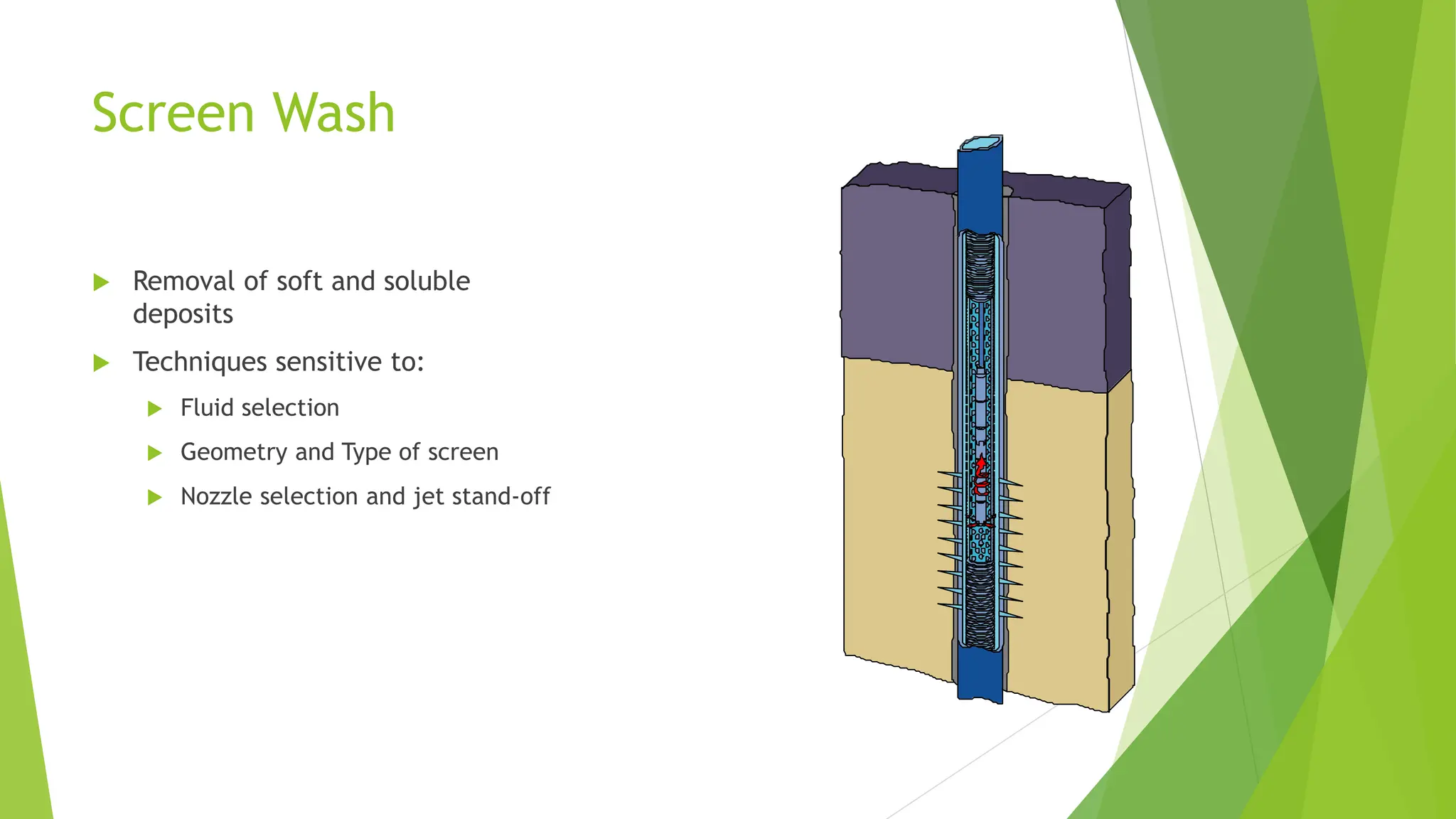
Screen Wash
 Removal of soft and soluble
deposits
 Techniques sensitive to:
 Fluid selection
 Geometry and Type of screen
 Nozzle selection and jet stand-off
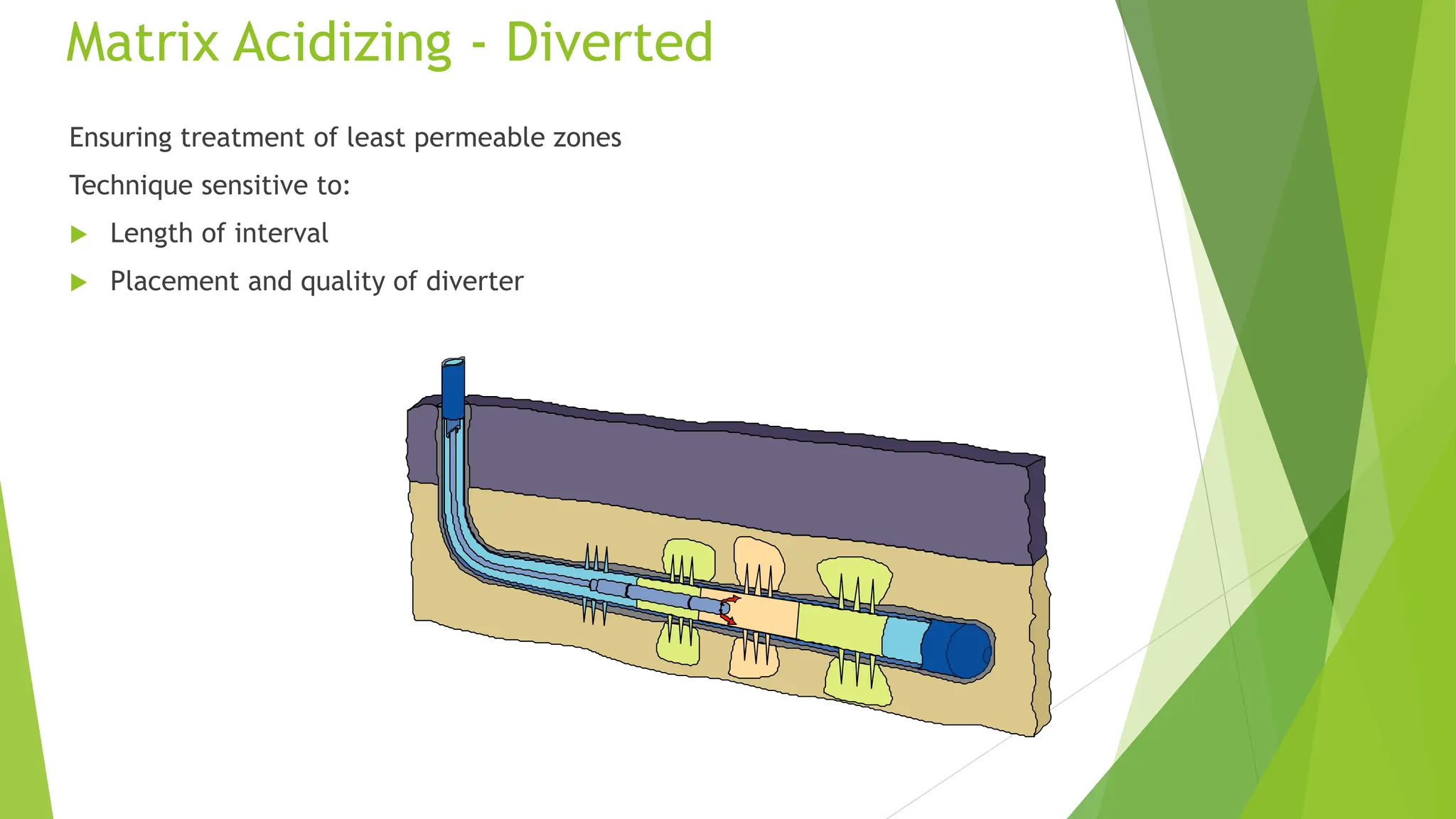
Matrix Acidizing - Diverted
Ensuring treatment of least permeable zones
Technique sensitive to:
 Length of interval
 Placement and quality of diverter
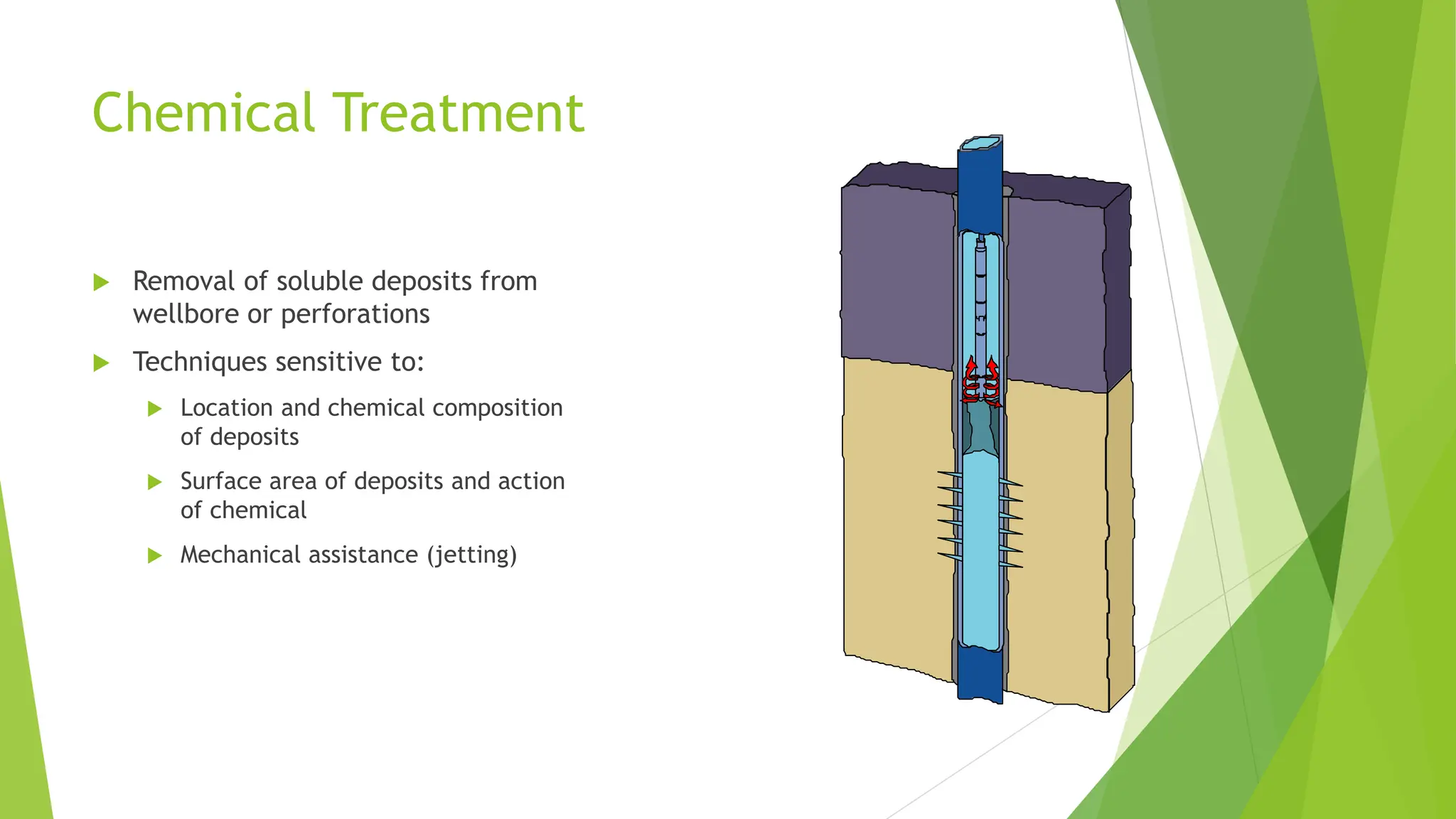
Chemical Treatment
 Removal of soluble deposits from
wellbore or perforations
 Techniques sensitive to:
 Location and chemical composition
of deposits
 Surface area of deposits and action
of chemical
 Mechanical assistance (jetting)
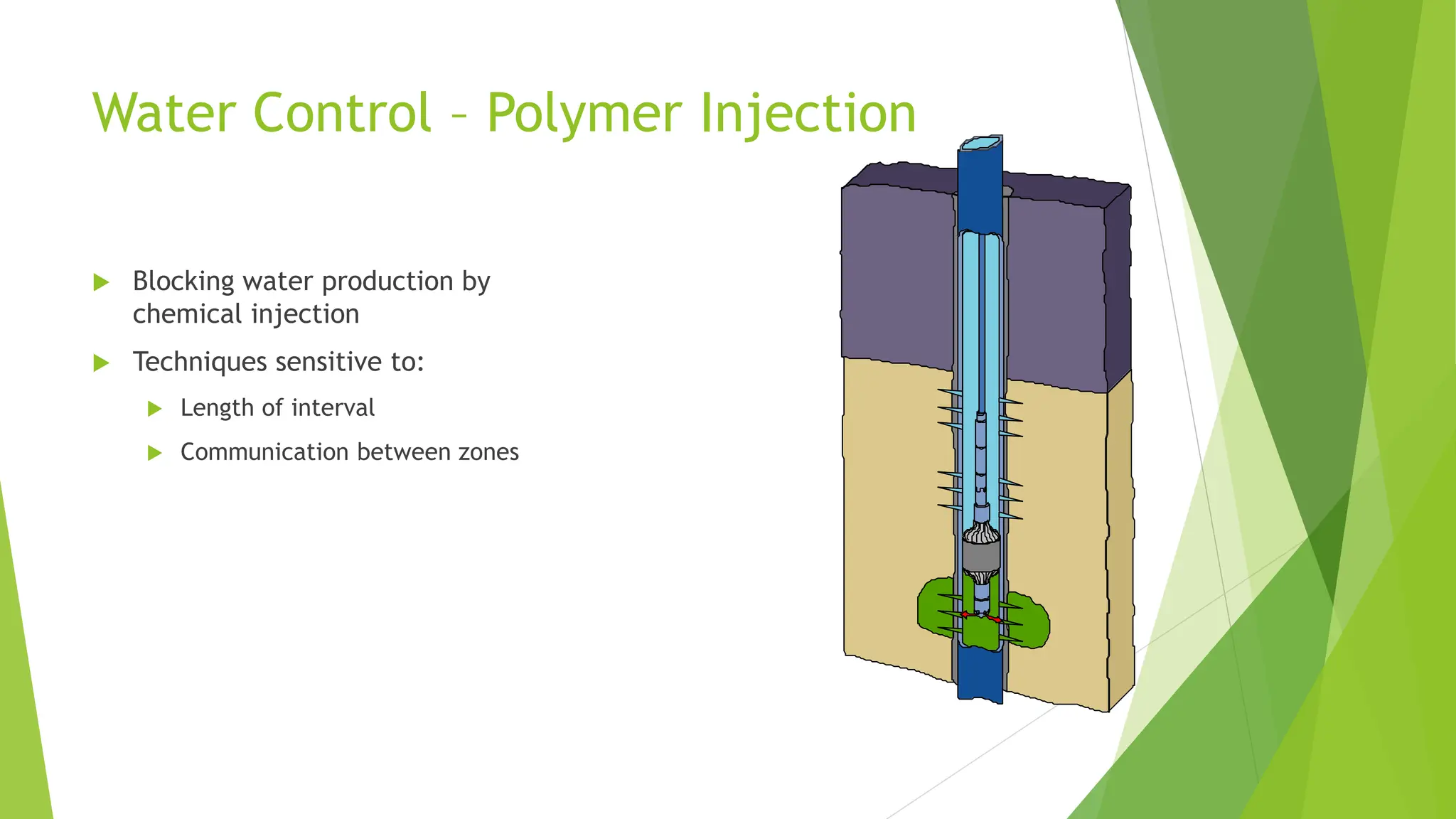
Water Control – Polymer Injection
 Blocking water production by
chemical injection
 Techniques sensitive to:
 Length of interval
 Communication between zones
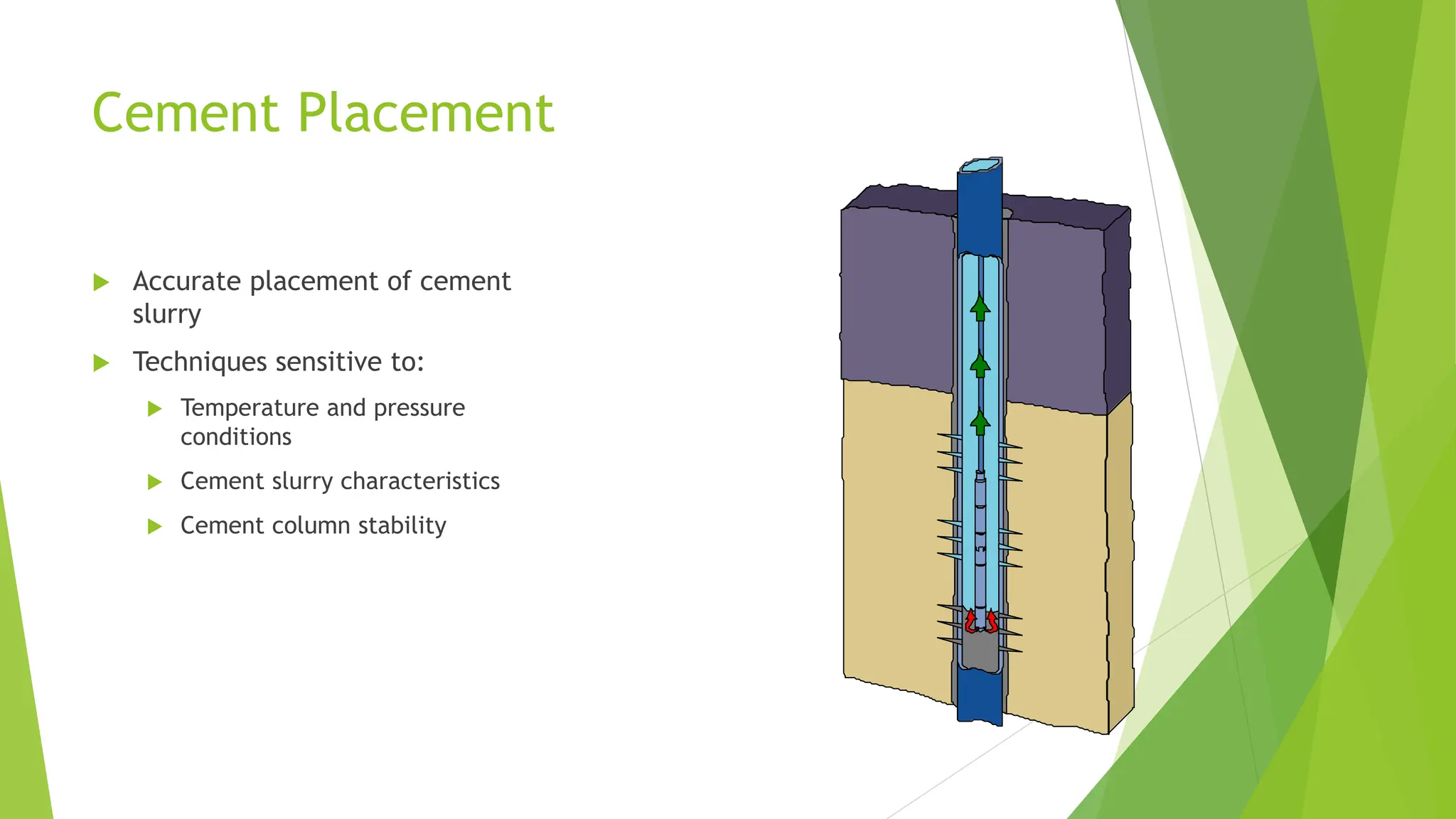
Cement Placement
 Accurate placement of cement
slurry
 Techniques sensitive to:
 Temperature and pressure
conditions
 Cement slurry characteristics
 Cement column stability
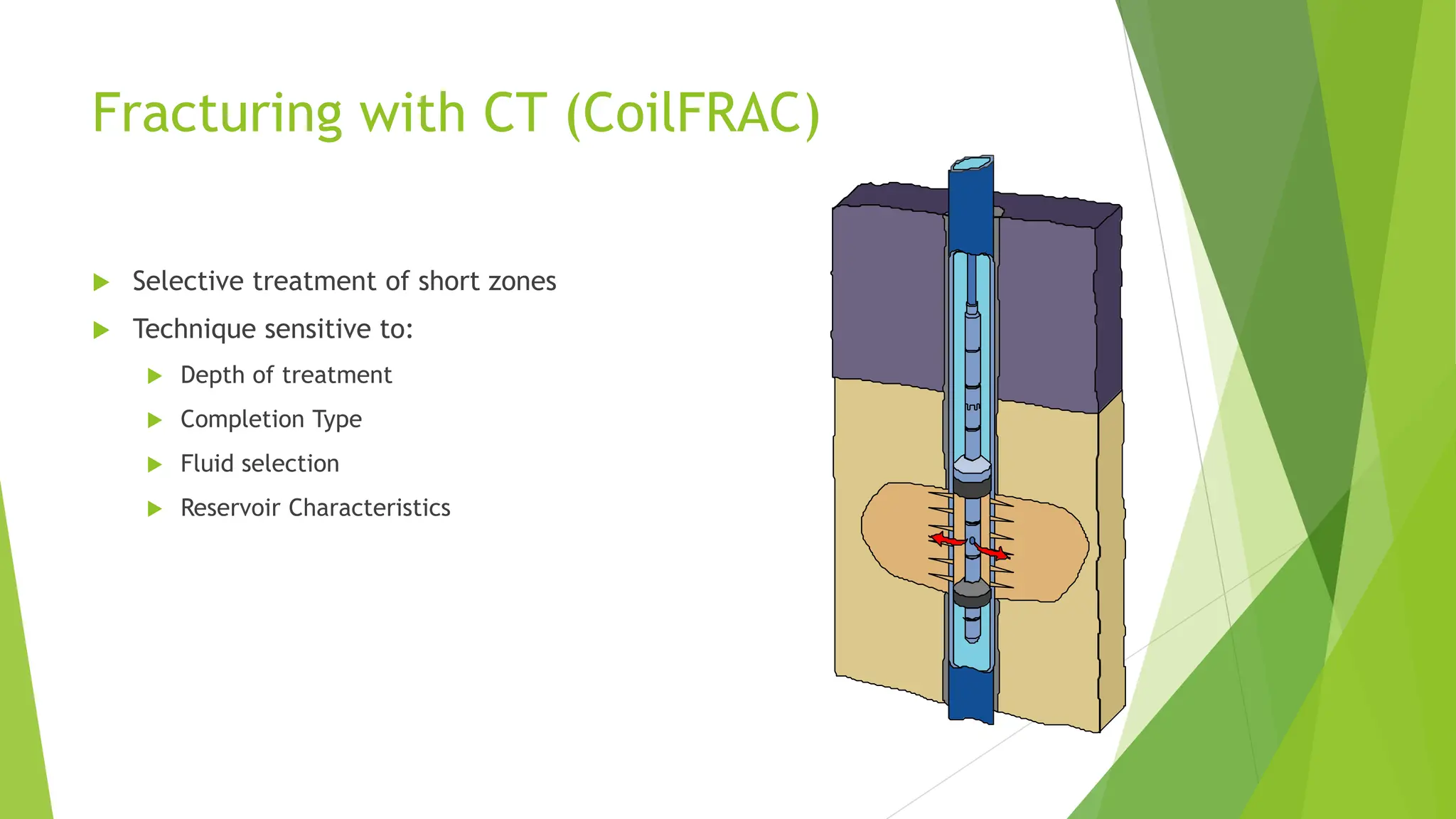
Fracturing with CT (CoilFRAC)
 Selective treatment of short zones
 Technique sensitive to:
 Depth of treatment
 Completion Type
 Fluid selection
 Reservoir Characteristics
Tool Conveyance
Applications
Conveying Tools
 Principal issues for tool conveyance
 Handling of toolstring
 insertion and retrieval process
 Depth control
 accurate placement/correlation
 Wellbore conditions
 pressure, temperature, fluid compatibility
 CT string force/movement
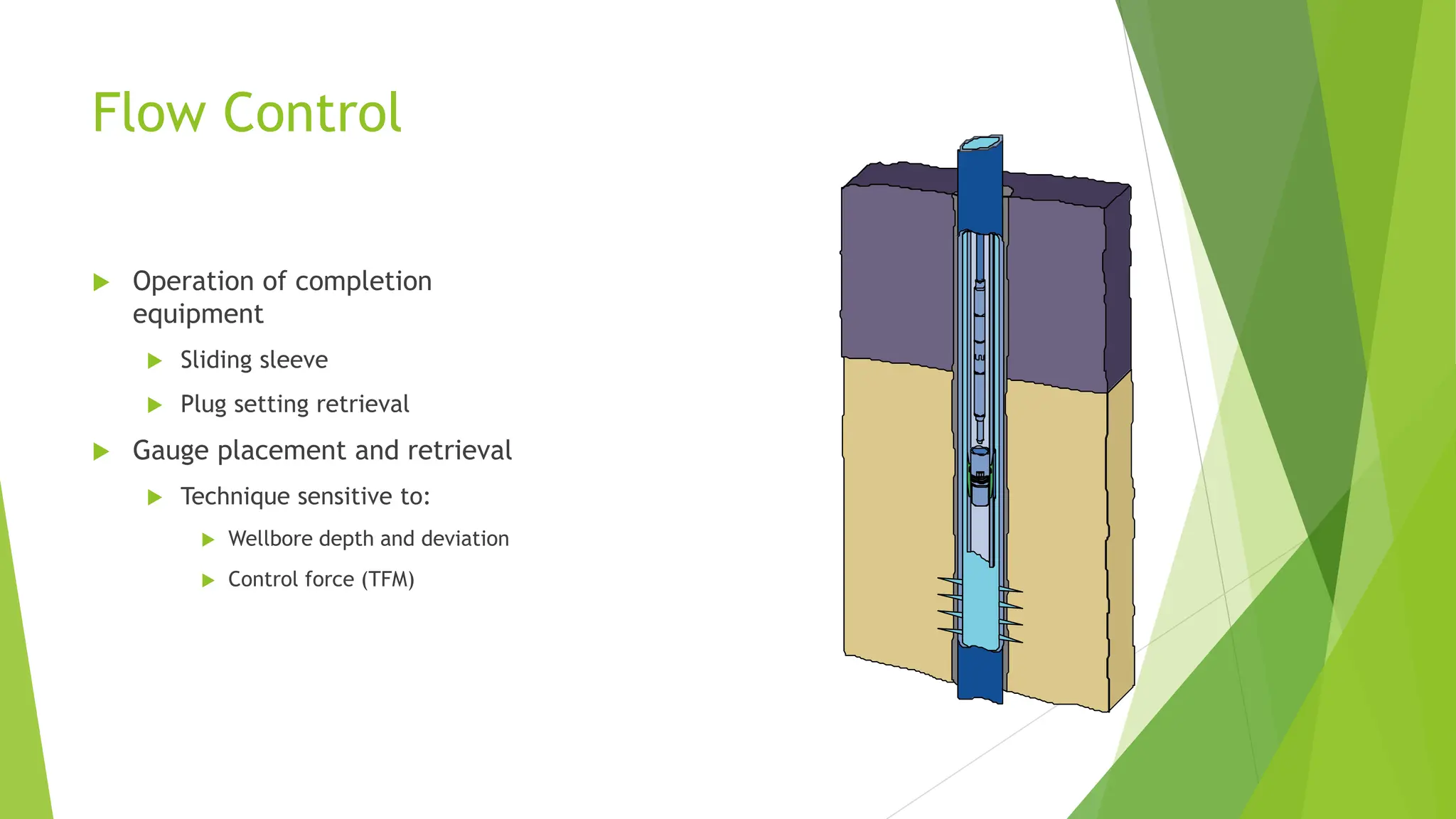
Flow Control
 Operation of completion
equipment
 Sliding sleeve
 Plug setting retrieval
 Gauge placement and retrieval
 Technique sensitive to:
 Wellbore depth and deviation
 Control force (TFM)
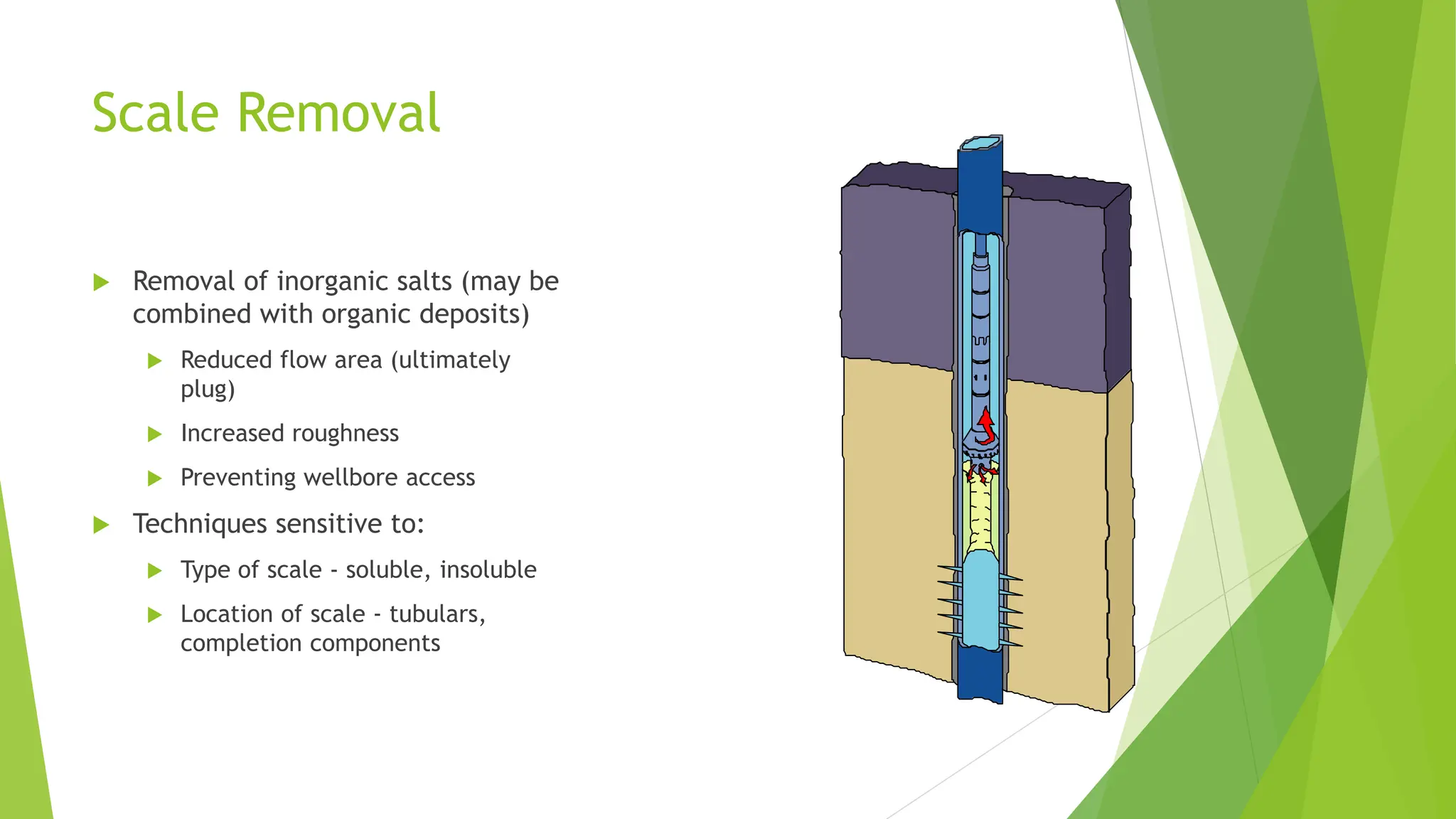
Scale Removal
 Removal of inorganic salts (may be
combined with organic deposits)
 Reduced flow area (ultimately
plug)
 Increased roughness
 Preventing wellbore access
 Techniques sensitive to:
 Type of scale - soluble, insoluble
 Location of scale - tubulars,
completion components
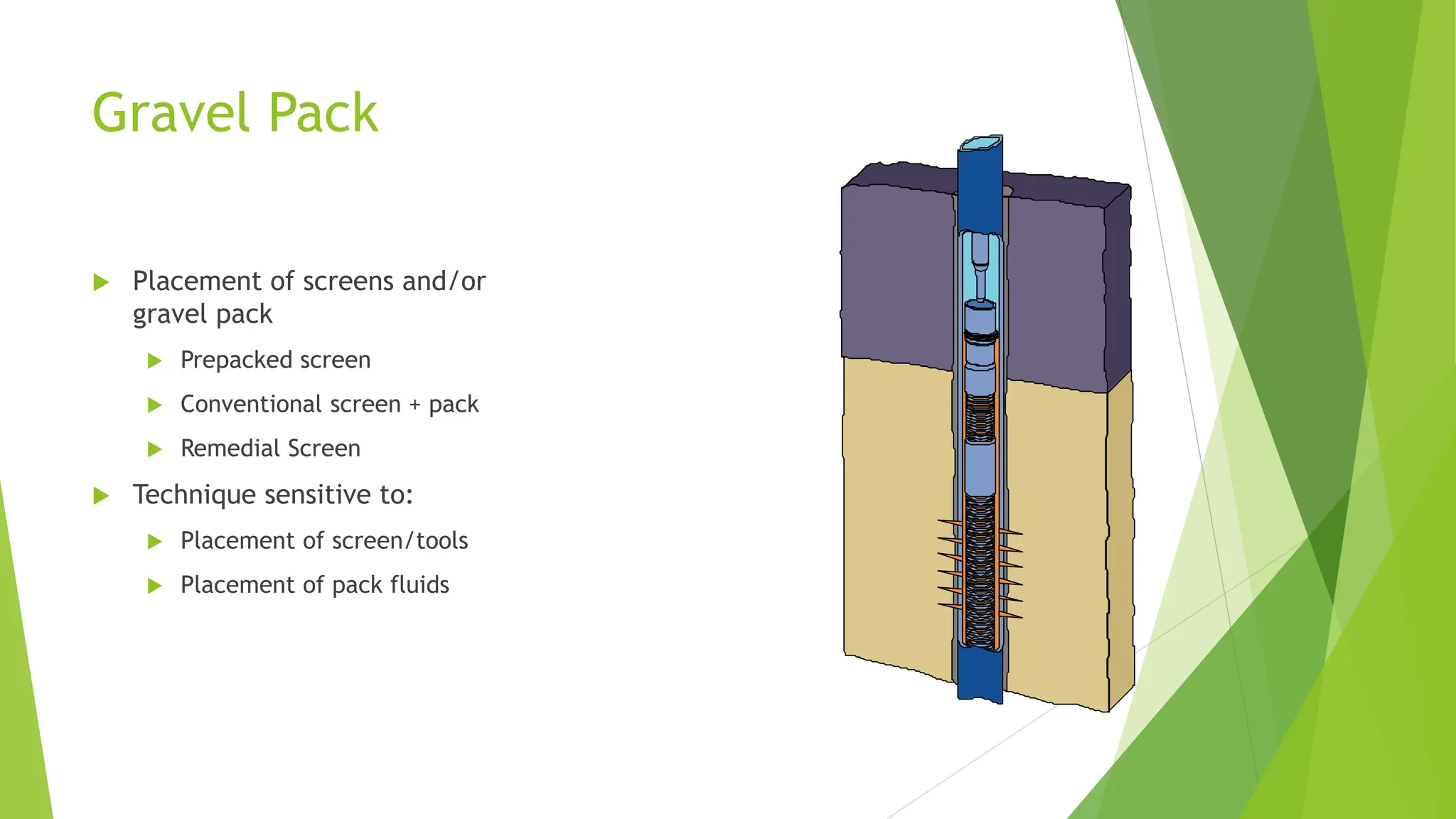
Gravel Pack
 Placement of screens and/or
gravel pack
 Prepacked screen
 Conventional screen + pack
 Remedial Screen
 Technique sensitive to:
 Placement of screen/tools
 Placement of pack fluids
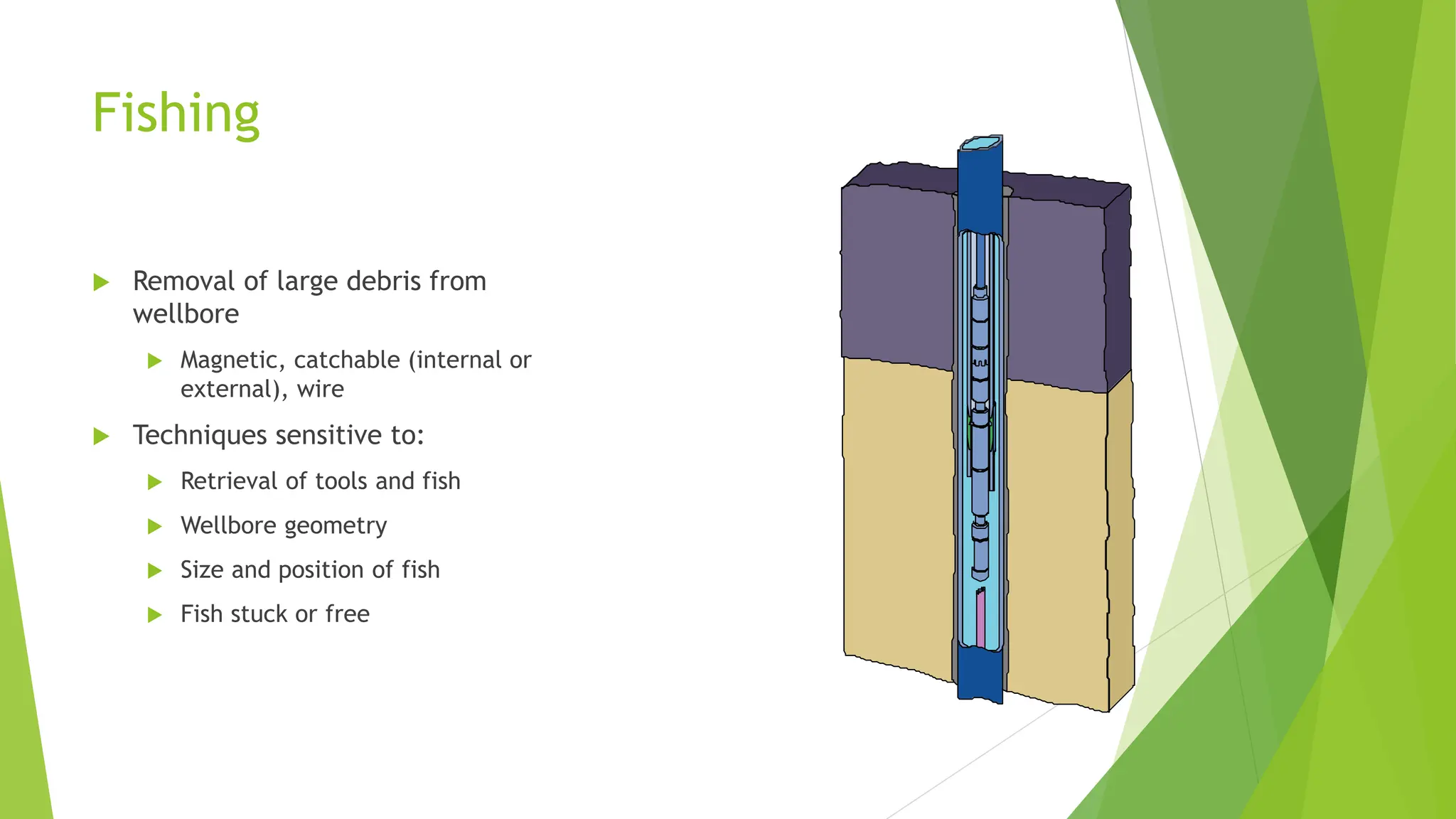
Fishing
 Removal of large debris from
wellbore
 Magnetic, catchable (internal or
external), wire
 Techniques sensitive to:
 Retrieval of tools and fish
 Wellbore geometry
 Size and position of fish
 Fish stuck or free
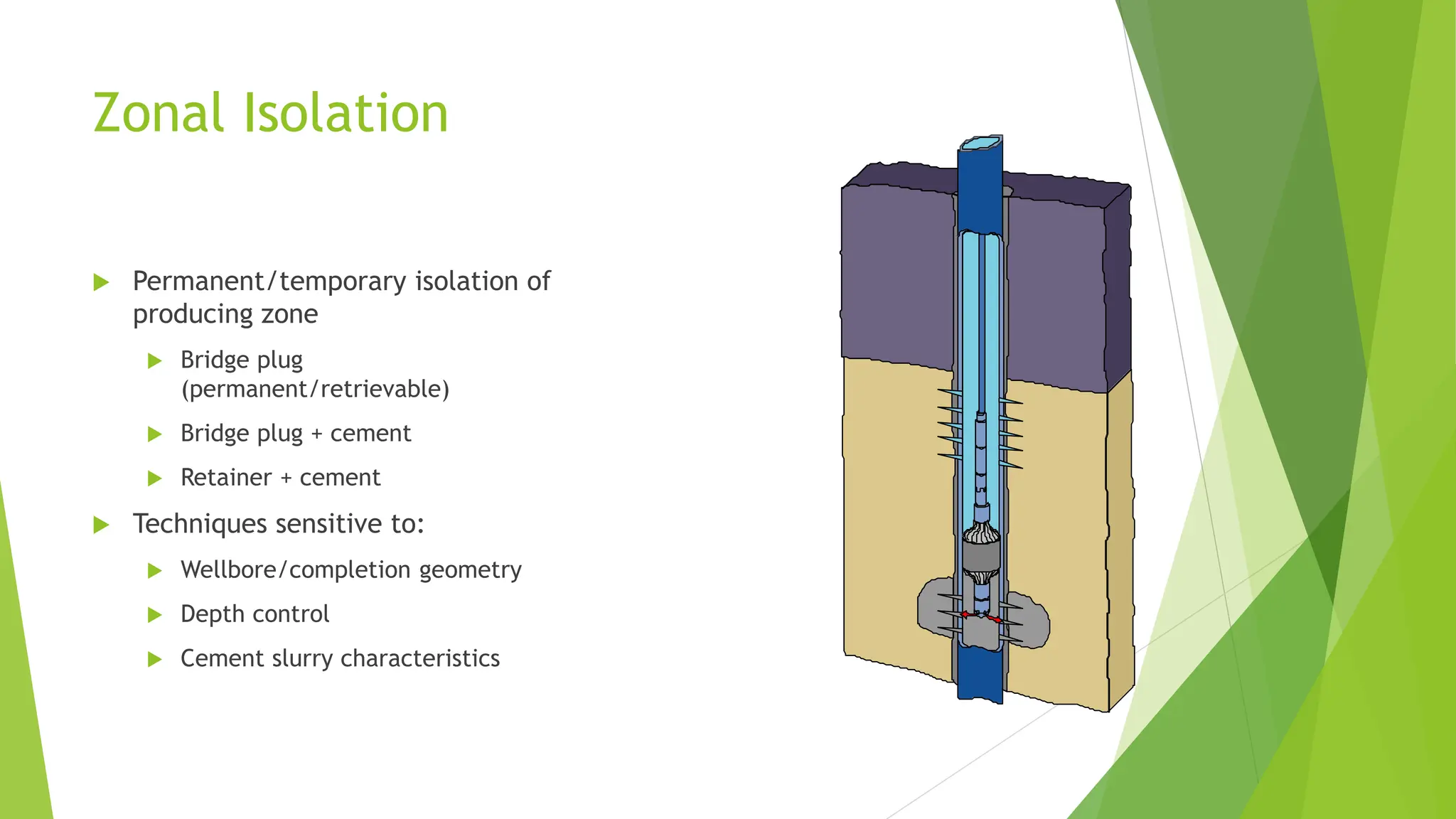
Zonal Isolation
 Permanent/temporary isolation of
producing zone
 Bridge plug
(permanent/retrievable)
 Bridge plug + cement
 Retainer + cement
 Techniques sensitive to:
 Wellbore/completion geometry
 Depth control
 Cement slurry characteristics
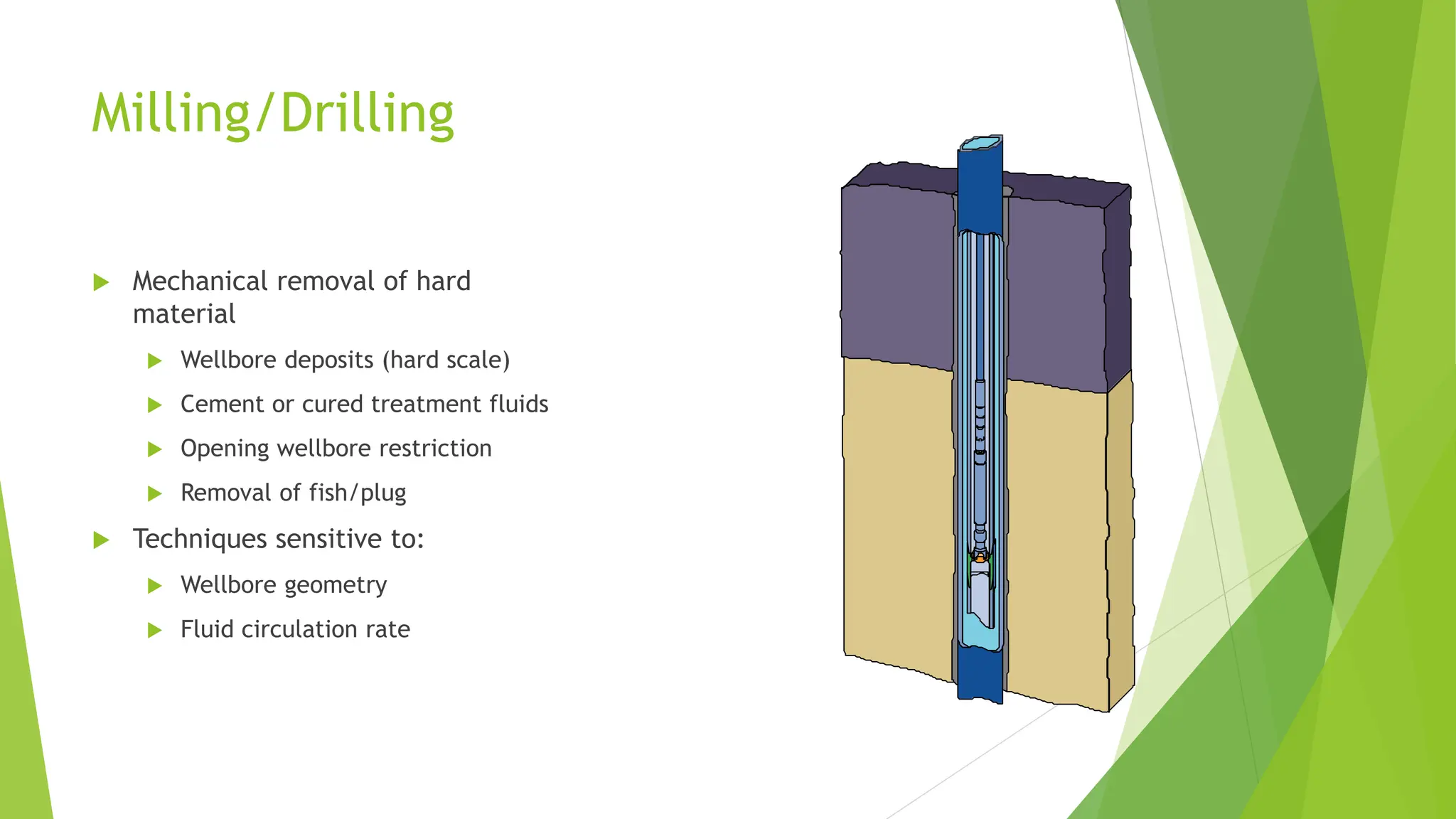
Milling/Drilling
 Mechanical removal of hard
material
 Wellbore deposits (hard scale)
 Cement or cured treatment fluids
 Opening wellbore restriction
 Removal of fish/plug
 Techniques sensitive to:
 Wellbore geometry
 Fluid circulation rate
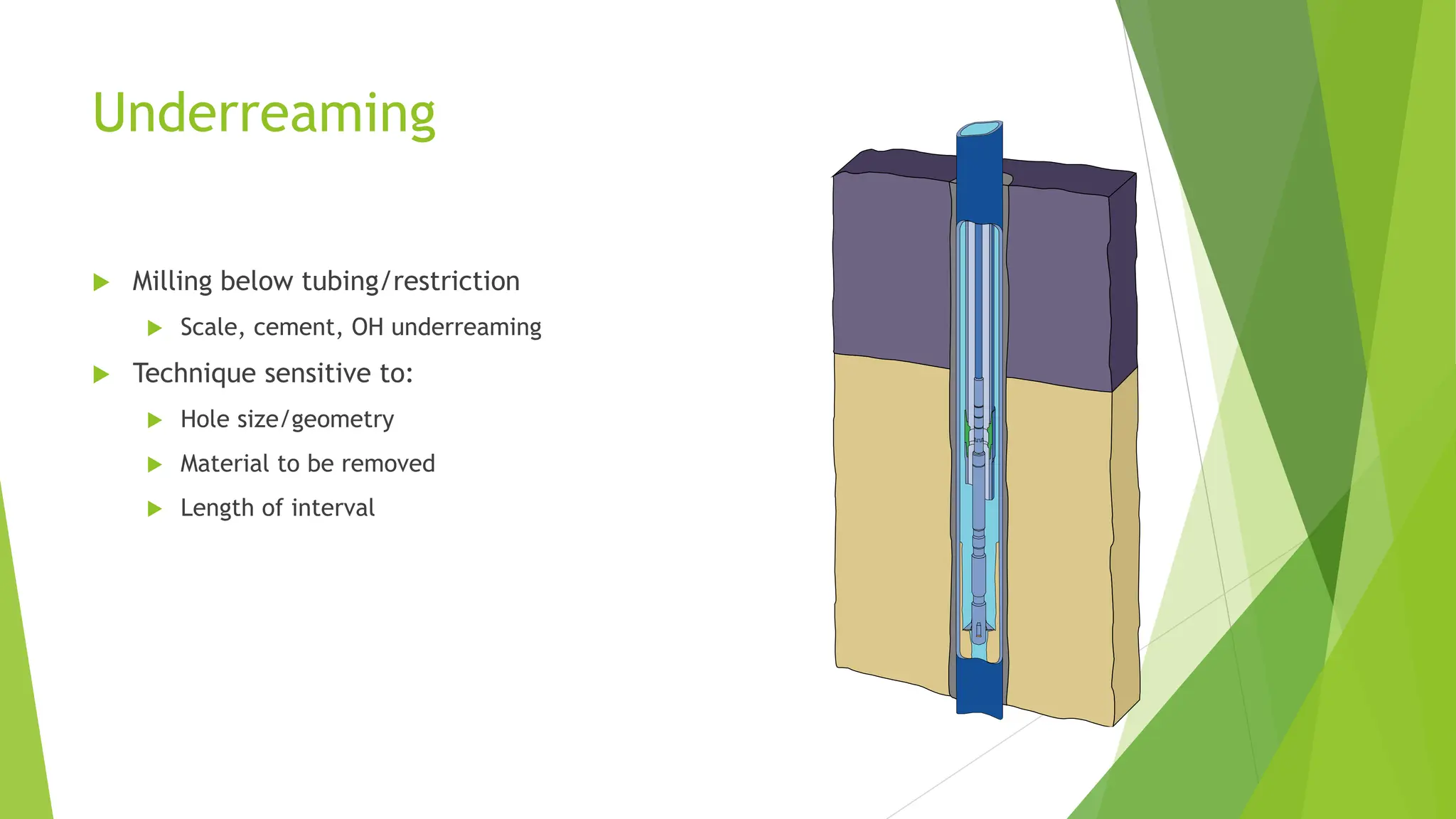
Underreaming
 Milling below tubing/restriction
 Scale, cement, OH underreaming
 Technique sensitive to:
 Hole size/geometry
 Material to be removed
 Length of interval
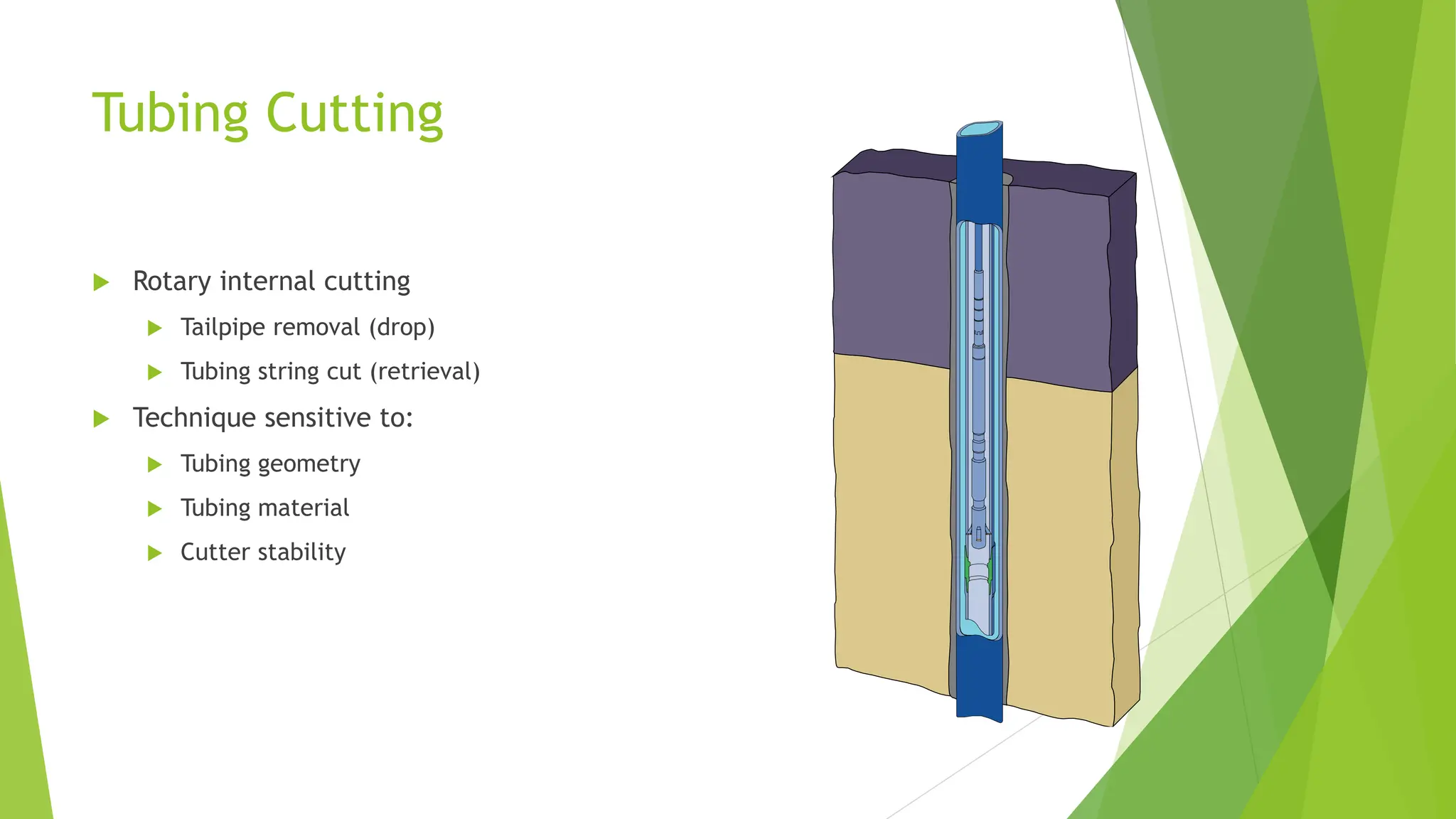
Tubing Cutting
 Rotary internal cutting
 Tailpipe removal (drop)
 Tubing string cut (retrieval)
 Technique sensitive to:
 Tubing geometry
 Tubing material
 Cutter stability
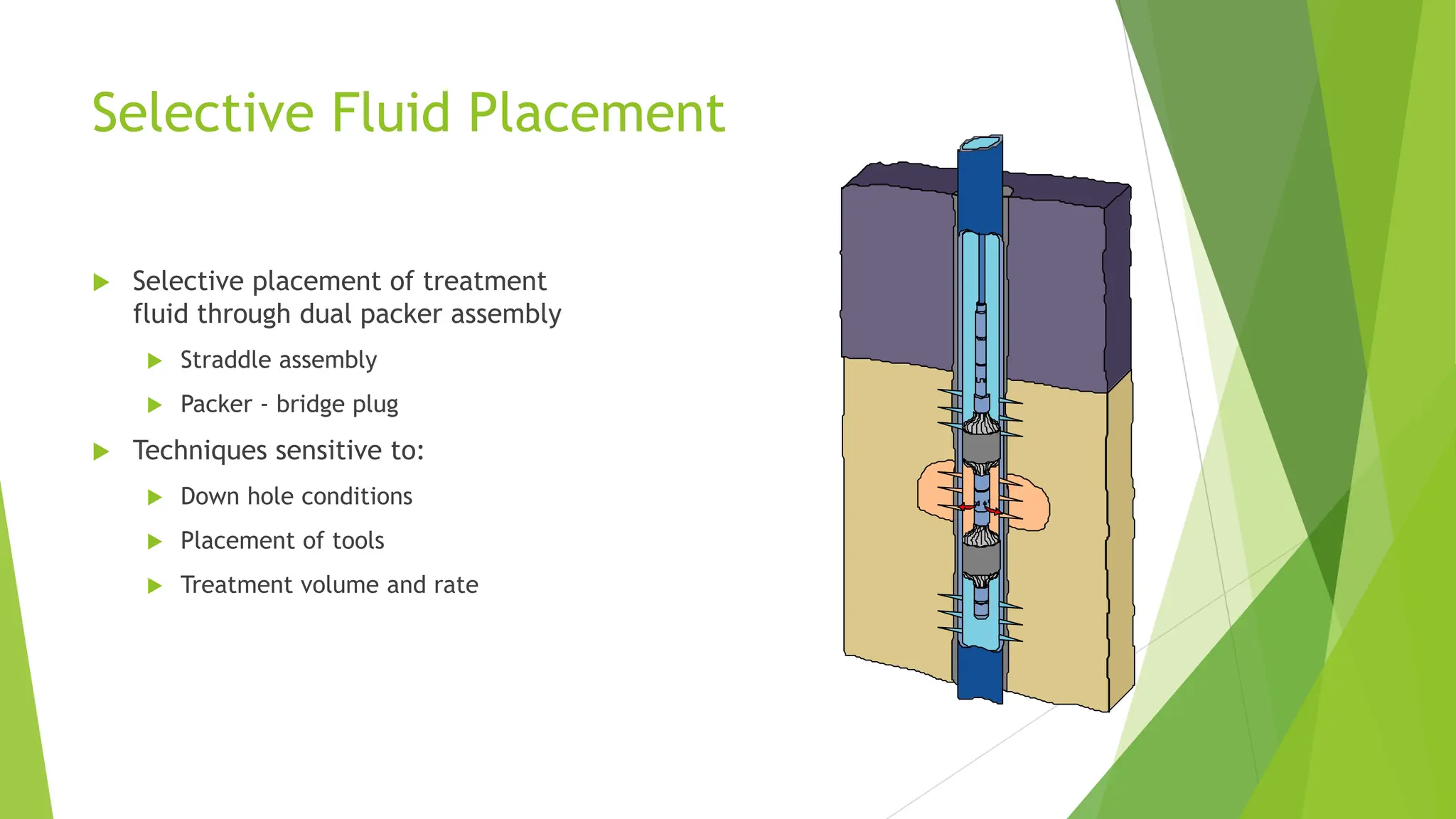
Selective Fluid Placement
 Selective placement of treatment
fluid through dual packer assembly
 Straddle assembly
 Packer - bridge plug
 Techniques sensitive to:
 Down hole conditions
 Placement of tools
 Treatment volume and rate
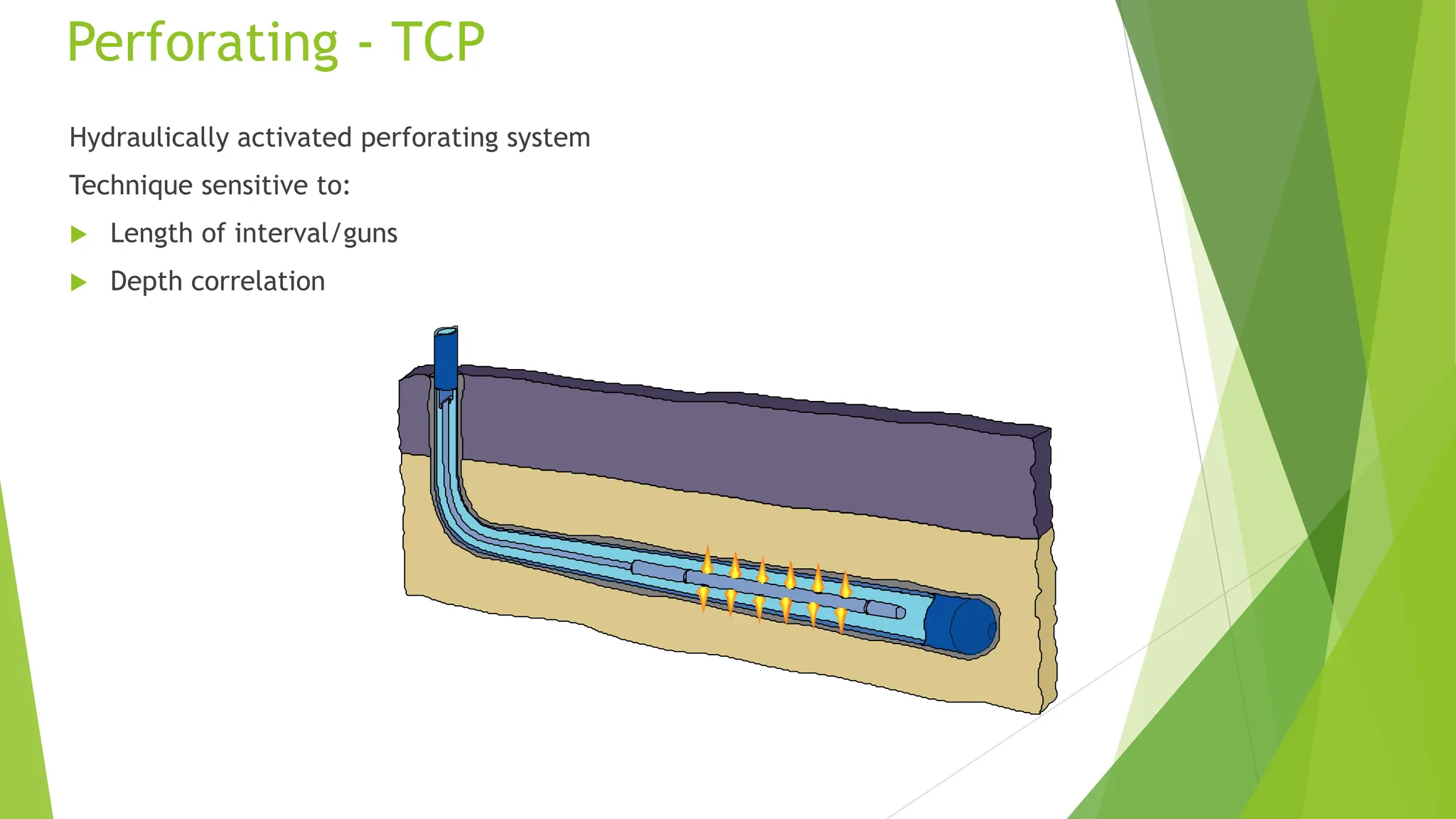
Perforating - TCP
Hydraulically activated perforating system
Technique sensitive to:
 Length of interval/guns
 Depth correlation
Production Logging - Memory
 Wellbore and production data
recorded within toolstring
 Pressure, temperature, flow rate
 Techniques sensitive to:
 Duration of survey/operation
 Synchronization of time/depth
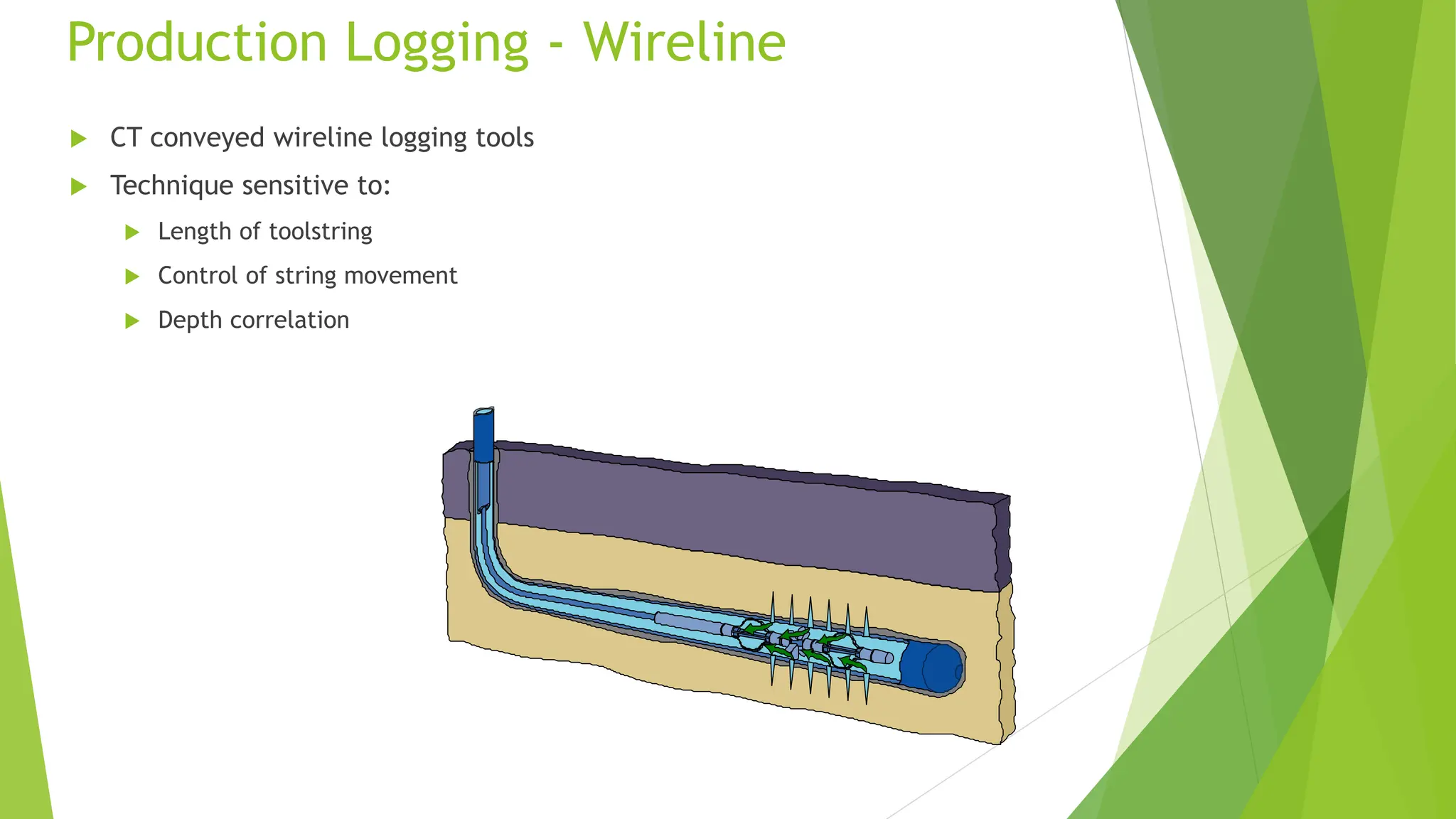
Production Logging - Wireline
 CT conveyed wireline logging tools
 Technique sensitive to:
 Length of toolstring
 Control of string movement
 Depth correlation
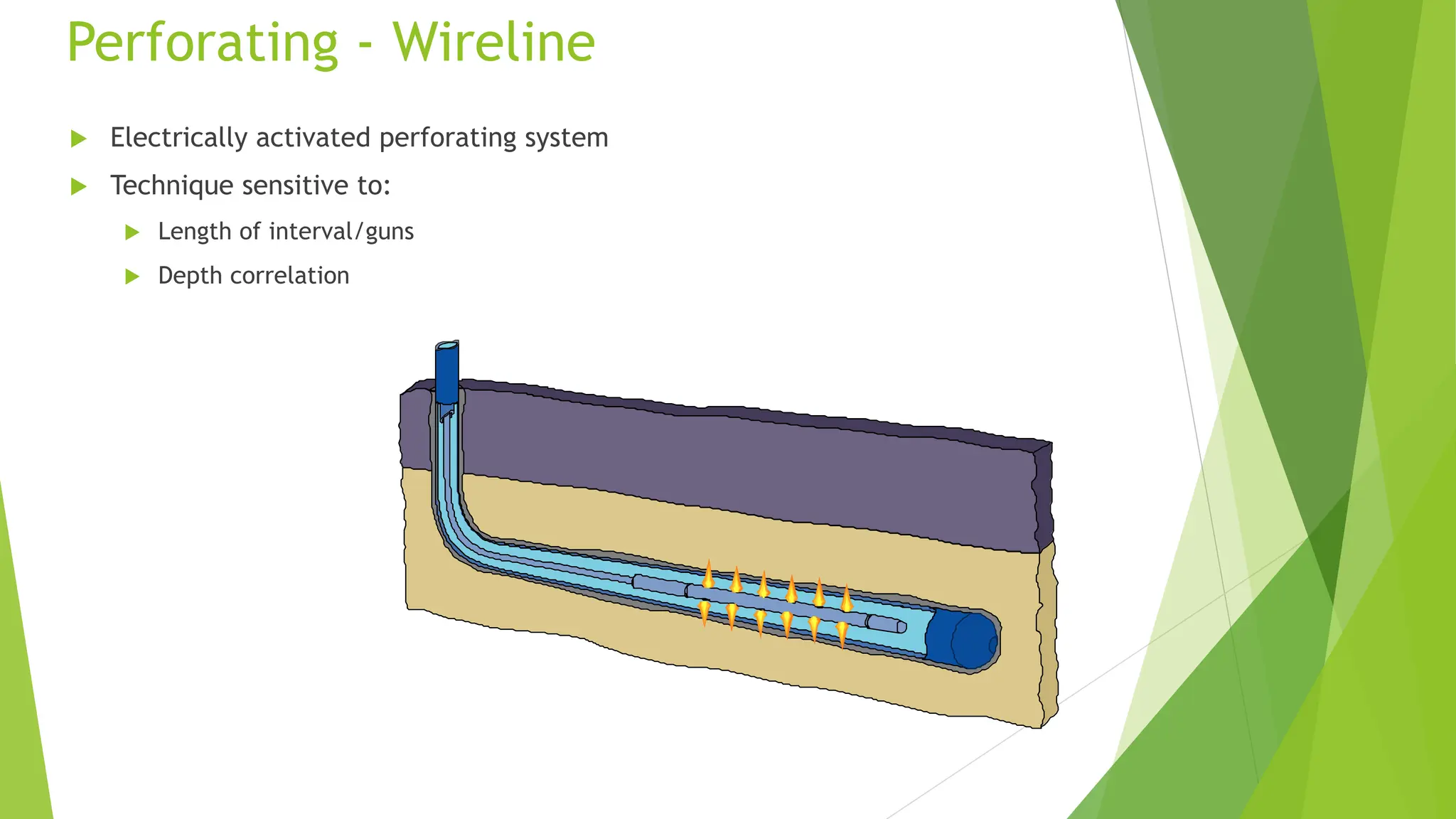
Perforating - Wireline
 Electrically activated perforating system
 Technique sensitive to:
 Length of interval/guns
 Depth correlation
Coiled Tubing Introduction and Basics.pdf

  • 1.
    Coiled Tubing Introduction andBasics By: Abdullah N. Abdulrazzaq
  • 2.
    What is CoiledTubing  Runs and retrieves a continuous string of tubing  Can continuously pump fluids into well while moving pipe  No workover rig required  Can be and is typically used on live wells (no kill fluids introduced into well
  • 3.
    Origin Of Coiled tubing The origins of continuous-length, steel-tubing technology can be traced to engineering and fabrication work pioneered by Allied engineering teams during the Second World War. Project 99, code named "PLUTO" (an acronym for Pipe Lines Under The Ocean), was a top-secret Allied invasion enterprise involving the deployment of pipelines from the coast of England to several points along the coast of France.
  • 4.
    CT String Manufacturing and Construction  CTis manufactured from flat metal strips, called skelps.  String construction and manufacturing processes depend on: ✓Type of assembly weld (butt weld, bias weld) ✓Wall thickness configuration (non-tapered, tapered, true taper) ✓Special purpose strings (weld bead removal, coated CT)
  • 5.
    Coiled Tubing Products Grades  60000 to 120000 psi Yield Materials  Configurations  Butt Welded  Continuous Milled (Bias Weld)  Tapered Strings  True Tapered Strings  Manufacturers  Tenaris Coiled Tubing- e.g. HS80 and HS80CM  Quality Tubing - e.g. QT80 and QT800  Global (new manufacturer)
  • 7.
    Coiled Tubing Terminology CTU, 38K, 1.5, QT800 (0.125 in), 15000 feet -What is this?  38KGenerally 38,000 lbs is the injector maximum tensile force  •1.5 inc and QT8001.5 in is the CT ODQT800 is the CT minimum yield strength 80,000 psi from Quality Tubing0.125in is the wall thickness (ID is 1.25 in)  •15000 ft This is the minimum total coiled tubing length available on the reel
  • 9.
  • 10.
  • 11.
    Coiled Tubing Equipment The basic configuration of a coiled tubing equipment package is dependent on:  Operating environment  e.g., offshore, arctic, desert  Primary applications  e.g., units prepared for CTD, Fracturing operations will typically be larger than conventional service units  CT string dimensions  e.g., string length/OD and necessary reel dimensions
  • 12.
    Basic Equipment Configurations Onshore  Paved road trucks (road legal for operating area)  Off-road trucks (all-wheel drive, e.g., desert)  Mobile mast units (special environment, e.g., arctic)  Offshore  Skid mounted units (crash-frame protected)  Barge mounted units (permanent placement)  Jacking barge/tender vessel
  • 13.
    CT Express –Trailer Mounted  CTU - Paved Road  Trailer mounted CTU configured from skid mounted equipment for flexibility. The crash frame protection is removed (to reduce weight) when the skids are fixed to the trailer, but can be fitted if the equipment is to be shipped offshore.  The configuration shown requires two trucks. The truck/trailer shown transports the reel, control cabin, power pack and BOP. A smaller crane truck is used to transport the crane, injector head and riser wellhead package (as required).  Weight restrictions (country, state or road capacity) and the required CT string size/length (weight) are the key factors in determining if two trucks are required for the CTU package.
  • 14.
    Single Chassis –Truck Mounted
  • 15.
    Mobile Mast –Arctic & Desert Operations
  • 16.
    CTU – SkidMounted
  • 17.
  • 18.
  • 19.
    Main CT EquipmentPackage Coiled Tubing Unit Prime Mover Control Cabin / Console Tubing Reel Injector Head BOP / Stripper Lifting Equipment
  • 21.
    Common Heads nolonger in production 6000 East Berry Street Ft. Worth, Texas, USA hrisales@hydrarig.com www.hydrarig.com HR 440 6000 East Berry Street Ft. Worth, Texas, USA hrisales@hydrarig.com www.hydrarig.com HR 480 Only Intermittent. Head used with large CT, CTD, demanding applications
  • 22.
    Injector Head –Typical Specifications Injector Head Model HR 240 HR 440 HR 480 Capacities Min. tubing size 1 1-1/4 1-1/2 Max. tubing size 1-1/2 2-3/8 3-1/2 Max. pulling force - open loop (lbf.) 20,000 40,000 80,000 - closed loop (lbf.) 20,000 60,000 100,000 Max. snubbing force (lbf.) 10,000 20,000 40,000 Max. running speed (fpm) 200 240 150 Dimensions Length (in.) 53 55 64 Width (in.) 34 52 64 Height (in.) 65 80 109 Weight (lbm) 3,400 7,800 12,650
  • 23.
    New Generations –HR 560 Performance Data:  60,000 lb. Continuous Pull  26,000 lb. Continuous Snubbing  200 feet/min. Maximum speed  1” through 2-3/8” tubing sizes  Capable of running 120,000 psi tubing  Superior slow speed control (inches per minute)  70,000 lb. lifting capacity through outer frame (CT)  60,000 lb. Lifting capacity from stripper (Stack) Weights (Basic):  8,100 lbs. Assembled weight with stripper mount and 72”gooseneck, stripper box, minimal handling slings, lube tank.
  • 24.
    New Generations –HR 580 Performance Data:  80,000 lb. Continuous Pull  40,000 lb. Continuous Snubbing  150 feet/min. Maximum speed  1-1/2” through 3-1/2” tubing sizes  Capable of running 120,000 psi tubing  Superior slow speed control (inches per minute)  95,000 lb. lifting capacity through outer frame (CT)  80,000 lb. Lifting capacity from stripper (Stack) Weights (Basic):  10,800 lbs. Assembled weight with 72” gooseneck, stripper box, minimal handling slings, lube tank.
  • 25.
    New Generation HR660 Performance Data:  60,000 lb. Continuous Pull  30,000 lb. Continuous Snubbing  250 Feet/min. Maximum speed (Min displacement)  1” Through 2-3/8” tubing sizes  Capable of running new 120,000 psi tubing  Superior slow speed control (inches per minute)  70,000 lb. Lifting capacity through outer frame  60,000 lb. Lifting capacity through stripper mount Weights (Basic):  7,600 lbs. Assembled weight with 72” gooseneck, stripper box, minimal handling slings, lube tank.
  • 26.
    New Generation –HR 680 Performance Data:  80,000 lb. Continuous Pull  40,000 lb. Continuous Snubbing  150 feet/min. Maximum speed  1-1/2” through 3-1/2” tubing sizes  Capable of running new 120,000 psi tubing  Superior slow speed control (inches per minute)  95,000 lb. Lifting capacity through outer frame  80,000 lb. Lifting capacity from stripper Weights (Basic):  9,500 lbs. Assembled weight with 72” gooseneck, stripper box, minimal handling slings, lube tank.
  • 27.
    Heavy Duty HR5100 Performance Data  100,000 lbs. continuous lifting capacity  50,000 lbs. continuous snubbing capacity  140 ft./min. maximum speed  1-1/2” through 3-1/2” tubing sizes  Capable of running new 120,000 PSI tubing  Superior slow speed control for drilling applications  Inches per minute smooth operating speed  100,000 lbs. lifting capacity through outer frame  100,000 lbs. lifting capacity from stripper  17,400 lbs. assembled weight with 100” tubing guide installed, with no stripper  100” tubing guide (1,200 lbs.)
  • 28.
    Injector Head –Principal Components Primary components/functions include: 1. Hydraulic drive/brake system 2. Drive chains and tensioners 3. Gooseneck or guide-arch 4. Weight indicator sensor 5. Stripper mount 1 2 3 4 5
  • 29.
    Chain Tensioning Systems HR-480  3-sprocket system HR-560 2-sprocket system
  • 30.
    Chain Components –HR 240/260 Gripper block Roller bearing Chainlink pins Chainlink plate andsplit pin
  • 31.
    Chain Components –HR 480  Variable insert
  • 32.
    500 & 600Series  “Quick Connect” Gripper System  Quickly remove or install a gripper  Hardened and Grooved Single Piece Grippers
  • 33.
    Guide Arch API Recommendations TubingSize Radius (in.) (in.) 1-1/4 48 to 72 1-1/2 48 to 72 1-3/4 72 to 96 2 72 to 96 2-3/8 90 to 120 2-7/8 90 to 120 3-1/2 96 to 120 HR240- 50-in. HR480- 108-in. HR240- 72-in.
  • 34.
    Weight Indicator –HR480 Dual Sensors Front sensor/pivot Rear sensor/pivot Optional hydraulic cell in some IH’s.To sense snubbing forces (Pre-electronic load cells).
  • 35.
    Stripper Mounting Point Some IH’s (company dependent) have stripper assembled this way. Others have stripper assembled to BOP for simple land rig-ups.
  • 36.
    CT Reel –Functions Basic functions of the reel: 1. Storing and protecting the CT string – reel drum  Maintaining proper tension between reel and injector head (reel drive system) 2. Efficiently spooling the CT string onto the reel drum - levelwind system 3. Circulating fluids with the drum rotating – swivel 4. Application of protective coating or inhibitor on tubing string - tubing lubricator system 5. CT depth measurement system - reel mounted counter and integrity monitor This is always the heaviest load. Determines logistics and applicability in many situations ! 1 2 3 4 5 1 3
  • 37.
    Reel Models andCapacities HR Model Code Tubing Size 1015 2015 3015 3020 4122 1.25 in 15000 22,500 25,000 25,000 25,000 1.5 in 10000 15,100 22,000 25,000 25,000 1.75 in N/A 11,200 15,000 20,000 25,000 2 in N/A 8,500 11,000 15,000 22,500 2.375 in N/A N/A N/A N/A 15,300
  • 38.
    Reel Drum Capacity Capacityof reel drum: L = (A + C) (A) (B) (K) Where: L = Reel capacity (ft) A = Tubing stack height (in.) B = Drum width (in.) C = Core diameter (in.) K = Constant (tubing size dependent) 1-1/4 = 0.168 1-1/2 = 0.116 1-3/4 = 0.086 2 = 0.066 2-3/8 = 0.046 Freeboard A B C
  • 39.
    Reel Models -Reel size comparison
  • 40.
    Reel Drive andBrake Systems Spokedreel Floor mountedmotor/brake Dishedendreel Axle mountedmotor/brake (Levelwindsystempumpshown) Planetary gears
  • 41.
  • 42.
    Levelwind System System componentsinclude: 1. Drive chain/system 2. Override motor 3. Spooling head 3 2 1
  • 43.
    Workover and CoiledTubing Units  Standard Work-over Unit  Generally requires longer rig ups / Downs  ▪Longer RIH and POH.  ▪Need to stop circulation to make pipe connections.  ▪Generally need to kill the well for operations.  Coiled Tubing Unit  ▪Faster rig ups / Downs  ▪Live Well/ Min. production downtime  ▪Continuous tubing / continuous circulation  ▪Enhanced Tubing Management  ▪Improve Safety (min. thread connections)
  • 44.
    Coiled Tubing Advantages  Self-Containedunit, requires no rig  –No connections  –Continuous circulation  –Saves time and money -do not have to kill well  –Typically used on live wells so reduced potential damage to formation  –Act as tool transport medium for deviated and horizontal wells
  • 45.
    Coiled Tubing Limitations  SmallDiameters  Restricted Flow  Reduced Rates  Rotation of Tubing  Limited Reach in Horizontal Wells
  • 46.
    Coiled Tubing Operation Introduction toCoiled Tubing Application
  • 47.
    CT Application Analysis Key application segments  Fluid conveyance  Circulation, placement, injection  Tool conveyance  Mechanical, Electrical  Completions  ESP, Vel Strings, etc
  • 48.
    32.1% 31.4% 9.7% 9.5% 4.5% 3.1% 2.2% 2.0% 1.5% 1.3% 1.2% 1.0% 0.2% 0.1% 0.1% 0.1% 0.1% 0.1% 0.0% Jobs Jan2008- Dec 2010 Wellbore Cleanout Well Circulation Coiled Tubing Matrix Tool Conveyance CT Logging Milling CT Cementing CT Completion CT Fracturing CT Perforating CT Conformance CT Fishing/Retrieval CT Sand Control CT ACTive Matrix CT ACTive Isolation CT ACTive Profiling CT ACTive Perforating CT ACTive Cleanout CT ACTive Lift CTS Segmentation
  • 49.
  • 50.
    Well Kill/Kick-Off (FluidCirculation)  Fluid circulation and placement  Dense fluid – well kill  Light fluid – kick-off  Technique sensitive to:  Surface choke control  Fluid volumes
  • 51.
    Nitrogen Kick-Off  Inducingflow from reservoir  Lowering hydrostatic pressure  System optimized when:  Software used to select optimum depth  N2 rate at lowest practicable
  • 52.
    Wellbore Fill Removal Removal of solids from wellbore - restoring production, wellbore access, operation of completion devices  Technique sensitive to:  Wellbore profile and BHP  Fluid characteristics and rate
  • 53.
    Acid Wash  Preciseplacement of acid in wellbore  Technique sensitive to:  Length of interval  Fluid delivery rate  Temperature (inhibitor)  Flow-back or clean-up
  • 54.
    Screen Wash  Removalof soft and soluble deposits  Techniques sensitive to:  Fluid selection  Geometry and Type of screen  Nozzle selection and jet stand-off
  • 55.
    Matrix Acidizing -Diverted Ensuring treatment of least permeable zones Technique sensitive to:  Length of interval  Placement and quality of diverter
  • 56.
    Chemical Treatment  Removalof soluble deposits from wellbore or perforations  Techniques sensitive to:  Location and chemical composition of deposits  Surface area of deposits and action of chemical  Mechanical assistance (jetting)
  • 57.
    Water Control –Polymer Injection  Blocking water production by chemical injection  Techniques sensitive to:  Length of interval  Communication between zones
  • 58.
    Cement Placement  Accurateplacement of cement slurry  Techniques sensitive to:  Temperature and pressure conditions  Cement slurry characteristics  Cement column stability
  • 59.
    Fracturing with CT(CoilFRAC)  Selective treatment of short zones  Technique sensitive to:  Depth of treatment  Completion Type  Fluid selection  Reservoir Characteristics
  • 60.
  • 61.
    Conveying Tools  Principalissues for tool conveyance  Handling of toolstring  insertion and retrieval process  Depth control  accurate placement/correlation  Wellbore conditions  pressure, temperature, fluid compatibility  CT string force/movement
  • 62.
    Flow Control  Operationof completion equipment  Sliding sleeve  Plug setting retrieval  Gauge placement and retrieval  Technique sensitive to:  Wellbore depth and deviation  Control force (TFM)
  • 63.
    Scale Removal  Removalof inorganic salts (may be combined with organic deposits)  Reduced flow area (ultimately plug)  Increased roughness  Preventing wellbore access  Techniques sensitive to:  Type of scale - soluble, insoluble  Location of scale - tubulars, completion components
  • 64.
    Gravel Pack  Placementof screens and/or gravel pack  Prepacked screen  Conventional screen + pack  Remedial Screen  Technique sensitive to:  Placement of screen/tools  Placement of pack fluids
  • 65.
    Fishing  Removal oflarge debris from wellbore  Magnetic, catchable (internal or external), wire  Techniques sensitive to:  Retrieval of tools and fish  Wellbore geometry  Size and position of fish  Fish stuck or free
  • 66.
    Zonal Isolation  Permanent/temporaryisolation of producing zone  Bridge plug (permanent/retrievable)  Bridge plug + cement  Retainer + cement  Techniques sensitive to:  Wellbore/completion geometry  Depth control  Cement slurry characteristics
  • 67.
    Milling/Drilling  Mechanical removalof hard material  Wellbore deposits (hard scale)  Cement or cured treatment fluids  Opening wellbore restriction  Removal of fish/plug  Techniques sensitive to:  Wellbore geometry  Fluid circulation rate
  • 68.
    Underreaming  Milling belowtubing/restriction  Scale, cement, OH underreaming  Technique sensitive to:  Hole size/geometry  Material to be removed  Length of interval
  • 69.
    Tubing Cutting  Rotaryinternal cutting  Tailpipe removal (drop)  Tubing string cut (retrieval)  Technique sensitive to:  Tubing geometry  Tubing material  Cutter stability
  • 70.
    Selective Fluid Placement Selective placement of treatment fluid through dual packer assembly  Straddle assembly  Packer - bridge plug  Techniques sensitive to:  Down hole conditions  Placement of tools  Treatment volume and rate
  • 71.
    Perforating - TCP Hydraulicallyactivated perforating system Technique sensitive to:  Length of interval/guns  Depth correlation
  • 72.
    Production Logging -Memory  Wellbore and production data recorded within toolstring  Pressure, temperature, flow rate  Techniques sensitive to:  Duration of survey/operation  Synchronization of time/depth
  • 73.
    Production Logging -Wireline  CT conveyed wireline logging tools  Technique sensitive to:  Length of toolstring  Control of string movement  Depth correlation
  • 74.
    Perforating - Wireline Electrically activated perforating system  Technique sensitive to:  Length of interval/guns  Depth correlation