Mostly Asked Cognizant Interview Questions
and Answers
Cognizant Interview
Interviews can be challenging, correct? Especially when you apply for a multinational
powerhouse like Cognizant. Whether you're a newcomer to the corporate world or a seasoned
professional looking for a career boost, preparing for the cognizant interview can make
difference.
However, Cognizant is looking for more than just technical expertise, they want problem
solvers, team participants, and innovators.
In this Interview Tutorial, we'll lead you through the most popular Cognizant interview
questions and answers for freshers, experienced professionals, technical rounds, and even
role-specific questions. It's like having a friend give you insider ideas to help you ace the
interview. Are you ready for your next Cognizant interview? Let's start then..!
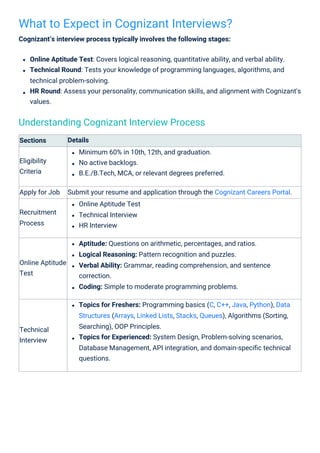
What to Expect in Cognizant Interviews?
Cognizant’s interview process typically involves the following stages:
Technical
Interview
Sections
Eligibility
Criteria
Apply for Job
Recruitment
Process
Online Aptitude
Test
Online Aptitude Test: Covers logical reasoning, quantitative ability, and verbal ability.
Technical Round: Tests your knowledge of programming languages, algorithms, and
technical problem-solving.
HR Round: Assess your personality, communication skills, and alignment with Cognizant's
values.
Details
Minimum 60% in 10th, 12th, and graduation.
No active backlogs.
B.E./B.Tech, MCA, or relevant degrees preferred.
Submit your resume and application through the Cognizant Careers Portal.
Online Aptitude Test
Technical Interview
HR Interview
Aptitude: Questions on arithmetic, percentages, and ratios.
Logical Reasoning: Pattern recognition and puzzles.
Verbal Ability: Grammar, reading comprehension, and sentence
correction.
Coding: Simple to moderate programming problems.
Topics for Freshers: Programming basics (C, C++, Java, Python), Data
Structures (Arrays, Linked Lists, Stacks, Queues), Algorithms (Sorting,
Searching), OOP Principles.
Topics for Experienced: System Design, Problem-solving scenarios,
Database Management, API integration, and domain-specific technical
questions.
Understanding Cognizant Interview Process
Answer:
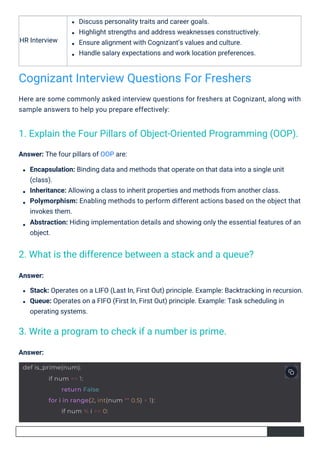
HR Interview
Discuss personality traits and career goals.
Highlight strengths and address weaknesses constructively.
Ensure alignment with Cognizant’s values and culture.
Handle salary expectations and work location preferences.
Here are some commonly asked interview questions for freshers at Cognizant, along with
sample answers to help you prepare effectively:
Answer:
Stack: Operates on a LIFO (Last In, First Out) principle. Example: Backtracking in recursion.
Queue: Operates on a FIFO (First In, First Out) principle. Example: Task scheduling in
operating systems.
Answer: The four pillars of OOP are:
Encapsulation: Binding data and methods that operate on that data into a single unit
(class).
Inheritance: Allowing a class to inherit properties and methods from another class.
Polymorphism: Enabling methods to perform different actions based on the object that
invokes them.
Abstraction: Hiding implementation details and showing only the essential features of an
object.
Cognizant Interview Questions For Freshers
3. Write a program to check if a number is prime.
2. What is the difference between a stack and a queue?
1. Explain the Four Pillars of Object-Oriented Programming (OOP).
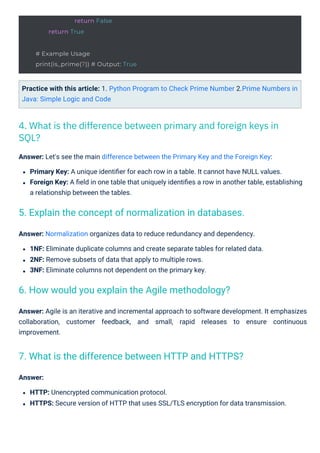
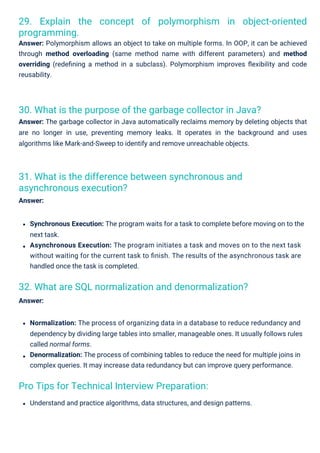
def is_prime(num):
if num <= 1:
return False
for i in range(2, int(num ** 0.5) + 1):
if num % i == 0:
Answer: Normalization organizes data to reduce redundancy and dependency.
1NF: Eliminate duplicate columns and create separate tables for related data.
2NF: Remove subsets of data that apply to multiple rows.
3NF: Eliminate columns not dependent on the primary key.
Answer:
HTTP: Unencrypted communication protocol.
HTTPS: Secure version of HTTP that uses SSL/TLS encryption for data transmission.
Practice with this article: 1. Python Program to Check Prime Number 2.Prime Numbers in
Java: Simple Logic and Code
Answer: Let's see the main difference between the Primary Key and the Foreign Key:
Primary Key: A unique identifier for each row in a table. It cannot have NULL values.
Foreign Key: A field in one table that uniquely identifies a row in another table, establishing
a relationship between the tables.
Answer: Agile is an iterative and incremental approach to software development. It emphasizes
collaboration, customer feedback, and small, rapid releases to ensure continuous
improvement.
4. What is the difference between primary and foreign keys in
SQL?
6. How would you explain the Agile methodology?
7. What is the difference between HTTP and HTTPS?
5. Explain the concept of normalization in databases.
return False
return True
# Example Usage
print(is_prime(7)) # Output: True
Pro Tips for Freshers:
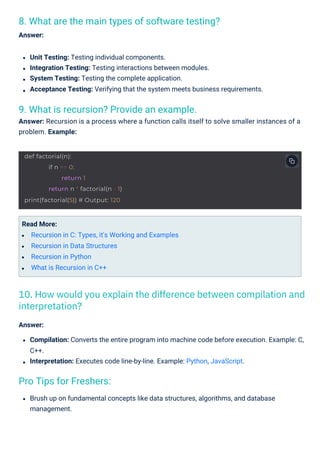
9. What is recursion? Provide an example.
Answer: Recursion is a process where a function calls itself to solve smaller instances of a
problem. Example:
8. What are the main types of software testing?
Answer:
Read More:
Recursion in C: Types, it's Working and Examples
Recursion in Data Structures
Recursion in Python
What is Recursion in C++
Unit Testing: Testing individual components.
Integration Testing: Testing interactions between modules.
System Testing: Testing the complete application.
Acceptance Testing: Verifying that the system meets business requirements.
Brush up on fundamental concepts like data structures, algorithms, and database
management.
Answer:
Compilation: Converts the entire program into machine code before execution. Example: C,
C++.
Interpretation: Executes code line-by-line. Example: Python, JavaScript.
10. How would you explain the difference between compilation and
interpretation?
def factorial(n):
if n == 0:
return 1
return n * factorial(n - 1)
print(factorial(5)) # Output: 120
Practice coding problems on platforms like HackerRank LeetCode, and Scholarhat.
Prepare to explain your academic projects and the technologies used.
Develop concise answers for HR questions like career goals and strengths/weaknesses.
Answer:
Abstract Class: Can have both abstract and concrete methods. It can maintain state
(fields) and provide a default implementation. A class can extend only one abstract class.
Interface: Only defines method signatures (can have default or static methods since Java
8). It cannot maintain state (fields), and a class can implement multiple interfaces.
Answer: Memory management in Java is handled by the JVM using automatic garbage
collection. The JVM manages memory allocation for objects and deallocates memory when
objects are no longer in use. Developers can use the System.gc() method to suggest garbage
collection, but it’s not guaranteed to run immediately.
By preparing these questions thoroughly, you’ll be better equipped to excel in Cognizant's
interviews. Good luck!
Answer: A deadlock occurs when two or more threads are blocked forever due to circular
dependencies on resources. To prevent deadlock, avoid nested locks, use a timeout for
lock
Answer: Multithreading in Java allows concurrent execution of two or more threads, enabling
parallelism. Java provides the Thread class and the Runnable interface to implement
multithreading. Threads can run concurrently, and synchronization is used to ensure that
shared resources are accessed by only one thread at a time to prevent conflicts or data
corruption.
Cognizant Interview Questions For Experienced
11. Can you explain the difference between an abstract class and
an interface in Java?
13. Explain how multithreading works in Java.
12. How do you handle memory management in Java?
14. What is a deadlock in Java? How do you prevent it?
Answer: To optimize SQL queries:
Use indexes on columns that are frequently queried.
Avoid using SELECT *; instead, specify required columns.
Use joins instead of subqueries when possible.
Make use of EXPLAIN to analyze query plans and identify performance bottlenecks.
Minimize the use of OR clauses and use IN when checking multiple values.
acquisition, or use higher-level concurrency utilities like ReentrantLock that can avoid
deadlock situations.
Answer:
HashMap: Hasmap in Java stores key-value pairs and allows null values. It does not
guarantee any specific order of elements as it uses a hash table for storage.
TreeMap: A sorted map that orders its elements based on their natural ordering or by a
comparator. It does not allow null keys but allows null values.
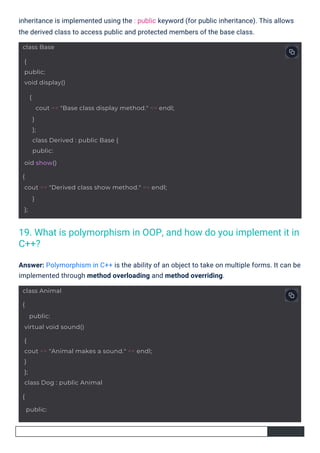
Answer: Inheritance in C++ is a fundamental concept in object-oriented programming where a
class (derived class) inherits properties and behaviors from another class (base class). In C++,
Answer:
JOIN: Combines columns from two or more tables based on a related column between
them (e.g., primary key and foreign key). It can be of various types: INNER JOIN, LEFT JOIN,
RIGHT JOIN, and FULL JOIN.
UNION: Combines results of two or more SELECT statements and returns a single result
set. It ensures distinct rows and does not combine columns. The number of columns and
data types must be the same in each SELECT.
17. How do you optimize SQL queries for performance?
16. What is the difference between a HashMap and a TreeMap in
Java?
18. Explain the concept of inheritance and how it is implemented
in C++.
15. Can you explain the difference between SQL JOIN and UNION?
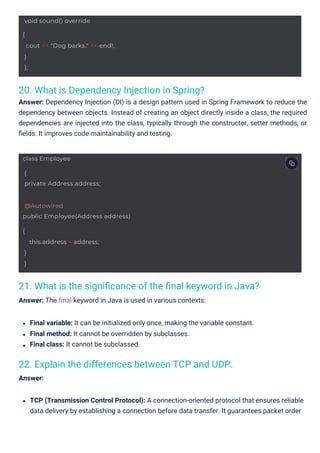
Answer: Polymorphism in C++ is the ability of an object to take on multiple forms. It can be
implemented through method overloading and method overriding.
inheritance is implemented using the : public keyword (for public inheritance). This allows
the derived class to access public and protected members of the base class.
class Animal
{
public:
virtual void sound()
{
cout << "Animal makes a sound." << endl;
}
};
class Dog : public Animal
{
public:
class Base
{
public:
void display()
{
cout << "Base class display method." << endl;
}
};
class Derived : public Base {
public:
oid show()
{
cout << "Derived class show method." << endl;
}
};
19. What is polymorphism in OOP, and how do you implement it in
C++?
20. What is Dependency Injection in Spring?
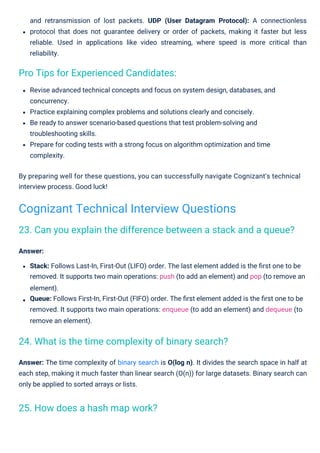
Answer: Dependency Injection (DI) is a design pattern used in Spring Framework to reduce the
dependency between objects. Instead of creating an object directly inside a class, the required
dependencies are injected into the class, typically through the constructor, setter methods, or
fields. It improves code maintainability and testing.
22. Explain the differences between TCP and UDP.
Answer:
21. What is the significance of the final keyword in Java?
Answer: The final keyword in Java is used in various contexts:
Final variable: It can be initialized only once, making the variable constant.
Final method: It cannot be overridden by subclasses.
Final class: It cannot be subclassed.
TCP (Transmission Control Protocol): A connection-oriented protocol that ensures reliable
data delivery by establishing a connection before data transfer. It guarantees packet order
class Employee
{
private Address address;
void sound() override
{
cout << "Dog barks." << endl;
}
};
@Autowired
public Employee(Address address)
{
this.address = address;
}
}
Answer:
Stack: Follows Last-In, First-Out (LIFO) order. The last element added is the first one to be
removed. It supports two main operations: push (to add an element) and pop (to remove an
element).
Queue: Follows First-In, First-Out (FIFO) order. The first element added is the first one to be
removed. It supports two main operations: enqueue (to add an element) and dequeue (to
remove an element).
and retransmission of lost packets. UDP (User Datagram Protocol): A connectionless
protocol that does not guarantee delivery or order of packets, making it faster but less
reliable. Used in applications like video streaming, where speed is more critical than
reliability.
Answer: The time complexity of binary search is O(log n). It divides the search space in half at
each step, making it much faster than linear search (O(n)) for large datasets. Binary search can
only be applied to sorted arrays or lists.
Revise advanced technical concepts and focus on system design, databases, and
concurrency.
Practice explaining complex problems and solutions clearly and concisely.
Be ready to answer scenario-based questions that test problem-solving and
troubleshooting skills.
Prepare for coding tests with a strong focus on algorithm optimization and time
complexity.
By preparing well for these questions, you can successfully navigate Cognizant's technical
interview process. Good luck!
25. How does a hash map work?
Pro Tips for Experienced Candidates:
24. What is the time complexity of binary search?
23. Can you explain the difference between a stack and a queue?
Cognizant Technical Interview Questions
Answer:
Abstract Class: Can have both abstract and concrete methods. It may contain a state
(fields), and a class can extend only one abstract class.
Interface: Can only declare method signatures and not provide implementations (except
default and static methods). A class can implement multiple interfaces.
Answer: A hash map stores key-value pairs. It uses a hash function to compute an index in an
array where the corresponding value is stored. When a key is queried, the hash map uses the
hash function to find the value efficiently. If two keys produce the same hash (a collision), it
resolves this through techniques like chaining or open addressing.
Answer:
INNER JOIN: Returns rows where there is a match in both tables.
LEFT JOIN (or LEFT OUTER JOIN): Returns all rows from the left table and matches rows
from the right table. If there is no match, NULL is returned for columns from the right table.
RIGHT JOIN (or RIGHT OUTER JOIN): Returns all rows from the right table and matching
rows from the left table. If there is no match, NULL is returned for columns from the left
table.
FULL JOIN (or FULL OUTER JOIN): Returns all rows when there is a match in one of the
tables. If there is no match, NULL values are returned for missing columns from the non-
matching table.
Answer:
Array: A collection of elements stored in contiguous memory locations. It has a fixed size,
and elements can be accessed via index in constant time (O(1)).
Linked List: A collection of elements (nodes) where each node contains data and a
reference to the next node. It allows dynamic size but accessing elements requires
traversal, leading to linear time complexity (O(n)).
27. What are the different types of joins in SQL?
28. What is the difference between an abstract class and an
interface in Java?
26. What is the difference between a linked list and an array?
Pro Tips for Technical Interview Preparation:
31. What is the difference between synchronous and
asynchronous execution?
Answer:
32. What are SQL normalization and denormalization?
Answer:
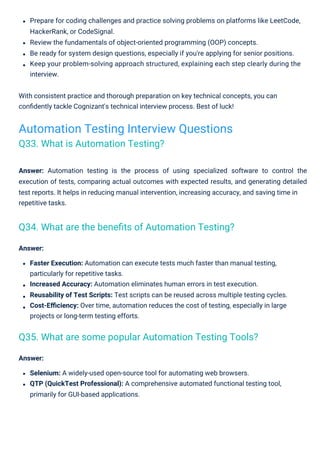
30. What is the purpose of the garbage collector in Java?
Answer: The garbage collector in Java automatically reclaims memory by deleting objects that
are no longer in use, preventing memory leaks. It operates in the background and uses
algorithms like Mark-and-Sweep to identify and remove unreachable objects.
29. Explain the concept of polymorphism in object-oriented
programming.
Answer: Polymorphism allows an object to take on multiple forms. In OOP, it can be achieved
through method overloading (same method name with different parameters) and method
overriding (redefining a method in a subclass). Polymorphism improves flexibility and code
reusability.
Understand and practice algorithms, data structures, and design patterns.
Normalization: The process of organizing data in a database to reduce redundancy and
dependency by dividing large tables into smaller, manageable ones. It usually follows rules
called normal forms.
Denormalization: The process of combining tables to reduce the need for multiple joins in
complex queries. It may increase data redundancy but can improve query performance.
Synchronous Execution: The program waits for a task to complete before moving on to the
next task.
Asynchronous Execution: The program initiates a task and moves on to the next task
without waiting for the current task to finish. The results of the asynchronous task are
handled once the task is completed.
Answer: Automation testing is the process of using specialized software to control the
execution of tests, comparing actual outcomes with expected results, and generating detailed
test reports. It helps in reducing manual intervention, increasing accuracy, and saving time in
repetitive tasks.
Answer:
Faster Execution: Automation can execute tests much faster than manual testing,
particularly for repetitive tasks.
Increased Accuracy: Automation eliminates human errors in test execution.
Reusability of Test Scripts: Test scripts can be reused across multiple testing cycles.
Cost-Efficiency: Over time, automation reduces the cost of testing, especially in large
projects or long-term testing efforts.
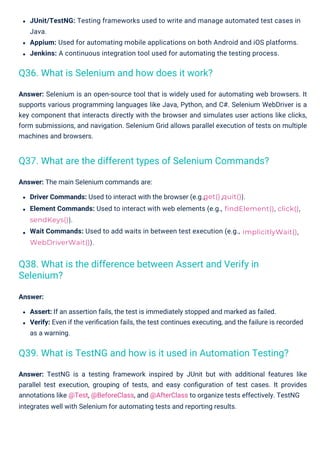
Prepare for coding challenges and practice solving problems on platforms like LeetCode,
HackerRank, or CodeSignal.
Review the fundamentals of object-oriented programming (OOP) concepts.
Be ready for system design questions, especially if you're applying for senior positions.
Keep your problem-solving approach structured, explaining each step clearly during the
interview.
With consistent practice and thorough preparation on key technical concepts, you can
confidently tackle Cognizant's technical interview process. Best of luck!
Answer:
Selenium: A widely-used open-source tool for automating web browsers.
QTP (QuickTest Professional): A comprehensive automated functional testing tool,
primarily for GUI-based applications.
Automation Testing Interview Questions
Q33. What is Automation Testing?
Q34. What are the benefits of Automation Testing?
Q35. What are some popular Automation Testing Tools?
Answer: The main Selenium commands are:
Driver Commands: Used to interact with the browser (e.g.,
Element Commands: Used to interact with web elements (e.g.,
sendKeys()).
Wait Commands: Used to add waits in between test execution (e.g.,
WebDriverWait()).
,
Answer:
Assert: If an assertion fails, the test is immediately stopped and marked as failed.
Verify: Even if the verification fails, the test continues executing, and the failure is recorded
as a warning.
JUnit/TestNG: Testing frameworks used to write and manage automated test cases in
Java.
Appium: Used for automating mobile applications on both Android and iOS platforms.
Jenkins: A continuous integration tool used for automating the testing process.
Answer: TestNG is a testing framework inspired by JUnit but with additional features like
parallel test execution, grouping of tests, and easy configuration of test cases. It provides
annotations like @Test, @BeforeClass, and @AfterClass to organize tests effectively. TestNG
integrates well with Selenium for automating tests and reporting results.
Answer: Selenium is an open-source tool that is widely used for automating web browsers. It
supports various programming languages like Java, Python, and C#. Selenium WebDriver is a
key component that interacts directly with the browser and simulates user actions like clicks,
form submissions, and navigation. Selenium Grid allows parallel execution of tests on multiple
machines and browsers.
Q36. What is Selenium and how does it work?
Q38. What is the difference between Assert and Verify in
Selenium?
Q37. What are the different types of Selenium Commands?
Q39. What is TestNG and how is it used in Automation Testing?
implicitlyWait(),
get() quit()).
findElement(), click(),
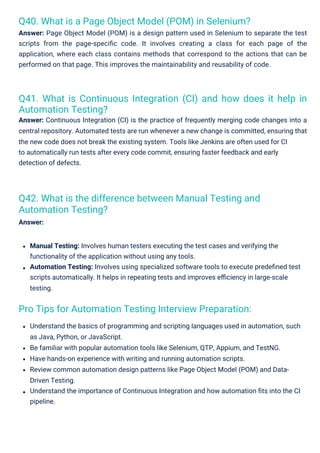
Q40. What is a Page Object Model (POM) in Selenium?
Answer: Page Object Model (POM) is a design pattern used in Selenium to separate the test
scripts from the page-specific code. It involves creating a class for each page of the
application, where each class contains methods that correspond to the actions that can be
performed on that page. This improves the maintainability and reusability of code.
Pro Tips for Automation Testing Interview Preparation:
Q42. What is the difference between Manual Testing and
Automation Testing?
Answer:
Q41. What is Continuous Integration (CI) and how does it help in
Automation Testing?
Answer: Continuous Integration (CI) is the practice of frequently merging code changes into a
central repository. Automated tests are run whenever a new change is committed, ensuring that
the new code does not break the existing system. Tools like Jenkins are often used for CI
to automatically run tests after every code commit, ensuring faster feedback and early
detection of defects.
Manual Testing: Involves human testers executing the test cases and verifying the
functionality of the application without using any tools.
Automation Testing: Involves using specialized software tools to execute predefined test
scripts automatically. It helps in repeating tests and improves efficiency in large-scale
testing.
Understand the basics of programming and scripting languages used in automation, such
as Java, Python, or JavaScript.
Be familiar with popular automation tools like Selenium, QTP, Appium, and TestNG.
Have hands-on experience with writing and running automation scripts.
Review common automation design patterns like Page Object Model (POM) and Data-
Driven Testing.
Understand the importance of Continuous Integration and how automation fits into the CI
pipeline.
BPO/Non-Voice Process Interview Questions
Q43. What do you know about BPO and the Non-Voice Process?
Answer: BPO (Business Process Outsourcing) refers to the outsourcing of business tasks and
processes to third-party service providers. A Non-Voice Process involves tasks where customer
interaction is done via emails, chats, or other text-based communication rather than voice calls.
It focuses on data entry, customer support through chat, technical support, and similar
services.
Q44. Why do you want to work in a BPO/Non-Voice Process?
Answer: I am interested in working in a BPO/Non-Voice Process because I am comfortable
with email/chat-based communication and believe I can effectively address customer
concerns in writing. Additionally, I am drawn to the structured work environment, the
opportunities for growth, and the chance to develop my communication and problem-solving
skills.
Q45. How do you handle stress in a high-pressure environment?
Answer: I handle stress by staying organized and prioritizing tasks. I break down complex
issues into manageable steps and focus on delivering one task at a time. I also take short
breaks to refresh myself and avoid burnout. Being adaptable and maintaining a positive
attitude helps me work effectively under pressure.
Q47. What skills do you possess that make you a good fit for this
role?
Q46. How do you manage a situation where there is a high volume
of work and tight deadlines?
Answer: I prioritize tasks based on urgency and importance. I use task management tools to
ensure all deadlines are met. If needed, I communicate with my team to divide responsibilities
and ensure that the work is distributed efficiently. Staying focused and maintaining good time
management is key to meeting tight deadlines.
Answer: I would first empathize with the customer’s frustration and listen actively to
understand their issue. After that, I would provide a clear and practical solution, ensuring the
customer feels heard and valued. If needed, I would escalate the issue to the appropriate
department while keeping the customer informed of the progress.
Answer: In my previous job, I was responsible for handling a large volume of data entry tasks
with tight deadlines. To manage this, I developed a systematic approach where I organized the
Answer: I ensure accuracy by double-checking my work before submission. To handle multiple
tasks efficiently, I follow a clear workflow, take notes, and set reminders. I also maintain focus
by minimizing distractions, ensuring that each task gets the necessary attention.
Answer: I am motivated by the opportunity to deliver high-quality service, the challenges that
come with handling a variety of customer queries, and the potential for professional growth.
The performance-based incentives and the team-oriented environment also motivate me to
consistently perform at my best.
Answer: I have strong written communication skills, attention to detail, and the ability to stay
organized while handling multiple tasks. My problem-solving abilities, coupled with a
customer-centric approach, allow me to address customer queries and concerns effectively.
Additionally, I am proficient in using office tools and managing workflows in non-voice
processes.
Q51. Can you describe a situation where you handled a
challenging task in a previous job?
Q49. What motivates you to work in a BPO/Non-Voice Process
environment?
Q50. How do you maintain accuracy and quality while handling
multiple tasks?
Q48. How would you deal with a customer who is unhappy with the
service you’ve provided?
Answer: I keep myself motivated by setting small goals throughout the day. I also remind
myself of the bigger picture and the importance of my work. Taking short breaks and
celebrating small wins helps maintain my energy levels and focus during repetitive tasks.
data into categories and processed them in batches. This approach allowed me to meet
deadlines while maintaining high accuracy.
Focus on your communication skills, especially your writing ability.
Be prepared to handle customer queries and demonstrate your problem-solving skills.
Familiarize yourself with BPO processes and customer service best practices.
Maintain a calm and composed demeanor while dealing with difficult situations.
Practice time management to ensure you can handle high workloads and meet deadlines.
With a proactive mindset and an ability to stay focused under pressure, you will be well-
equipped to succeed in a BPO/Non-Voice process interview and beyond!
Answer: The SDLC (Software Development Life Cycle) process typically includes several
stages:
Requirement Analysis: Gathering and analyzing user requirements to understand project
needs.
Design: Creating system architecture and design based on the requirements.
Implementation: Writing code and developing the solution based on design specifications.
Testing: Ensuring the solution is bug-free and meets the requirements through rigorous
testing (unit, integration, system testing, etc.).
Deployment: Deploying the application to the live environment.
Maintenance: Ongoing support and updates after deployment to address any issues and
improve functionality.
Q53: Describe the SDLC process you follow.
Pro Tips for BPO/Non-Voice Process Interview Preparation:
Q52. How do you keep yourself motivated during repetitive tasks?
Cognizant CIS Interview Questions
Cognizant GENC Developer Interview Questions
Q54: What are ITIL's best practices?
Answer: ITIL (Information Technology Infrastructure Library) is a framework for delivering IT
services efficiently and effectively. It includes the following best practices:
Q56. What are the key components of an IT infrastructure?
Answer: The key components of IT infrastructure include:
Q55. What is ITIL? How does it help in IT service management?
Answer: ITIL (Information Technology Infrastructure Library) is a set of best practices for IT
service management (ITSM). It helps organizations deliver IT services effectively and
efficiently by focusing on customer needs and IT service lifecycle management. ITIL
practices cover service strategy, service design, service transition, service operation, and
continual service improvement. By following ITIL, companies can improve service quality,
increase
customer satisfaction, and reduce service costs.
Hardware: Physical devices like servers, networking devices, and storage systems.
Software: Operating systems, middleware, and enterprise applications that run on the
hardware.
Networking: Network devices (routers, switches), protocols, and communication channels
that enable connectivity.
People: IT personnel who design, implement, and manage the infrastructure.
Processes: IT processes that manage and monitor the entire infrastructure.
Service Strategy: Defining the strategy for delivering IT services in alignment with business
needs.
Service Design: Designing IT services with a focus on quality, usability, and cost-
effectiveness.
Service Transition: Managing the transition of new or updated services from development
into production.
Service Operation: Ensuring that IT services are delivered consistently and meet
performance expectations.
Continual Service Improvement: Continuously evaluating and improving services,
processes, and performance to meet evolving business needs.
Q57. Explain what a Service Level Agreement (SLA) is in IT
services.
Answer: A Service Level Agreement (SLA) is a formal document that outlines the expected
level of service between a service provider and a customer. It defines the key performance
indicators (KPIs) such as
Acing a Cognizant interview requires a combination of technical expertise, problem-solving
skills, and effective communication. By understanding the interview process and practicing
relevant questions, you can confidently demonstrate your abilities and secure your dream
role at Cognizant. Good luck!
To prepare for Cognizant interviews, focus on technical concepts relevant to the role, improve
problem-solving skills, and practice commonly asked questions. Develop strong
communication skills, research the company, and stay updated on emerging technologies.
Mock interviews and online resources can also help enhance your readiness.
How to Prepare for Cognizant Interviews in 2024
Conclusion

Cognizant Interview Questions By ScholarHat.pdf

  • 1.
    Mostly Asked CognizantInterview Questions and Answers Cognizant Interview Interviews can be challenging, correct? Especially when you apply for a multinational powerhouse like Cognizant. Whether you're a newcomer to the corporate world or a seasoned professional looking for a career boost, preparing for the cognizant interview can make difference. However, Cognizant is looking for more than just technical expertise, they want problem solvers, team participants, and innovators. In this Interview Tutorial, we'll lead you through the most popular Cognizant interview questions and answers for freshers, experienced professionals, technical rounds, and even role-specific questions. It's like having a friend give you insider ideas to help you ace the interview. Are you ready for your next Cognizant interview? Let's start then..!
  • 2.
    What to Expectin Cognizant Interviews? Cognizant’s interview process typically involves the following stages: Technical Interview Sections Eligibility Criteria Apply for Job Recruitment Process Online Aptitude Test Online Aptitude Test: Covers logical reasoning, quantitative ability, and verbal ability. Technical Round: Tests your knowledge of programming languages, algorithms, and technical problem-solving. HR Round: Assess your personality, communication skills, and alignment with Cognizant's values. Details Minimum 60% in 10th, 12th, and graduation. No active backlogs. B.E./B.Tech, MCA, or relevant degrees preferred. Submit your resume and application through the Cognizant Careers Portal. Online Aptitude Test Technical Interview HR Interview Aptitude: Questions on arithmetic, percentages, and ratios. Logical Reasoning: Pattern recognition and puzzles. Verbal Ability: Grammar, reading comprehension, and sentence correction. Coding: Simple to moderate programming problems. Topics for Freshers: Programming basics (C, C++, Java, Python), Data Structures (Arrays, Linked Lists, Stacks, Queues), Algorithms (Sorting, Searching), OOP Principles. Topics for Experienced: System Design, Problem-solving scenarios, Database Management, API integration, and domain-specific technical questions. Understanding Cognizant Interview Process
  • 3.
    Answer: HR Interview Discuss personalitytraits and career goals. Highlight strengths and address weaknesses constructively. Ensure alignment with Cognizant’s values and culture. Handle salary expectations and work location preferences. Here are some commonly asked interview questions for freshers at Cognizant, along with sample answers to help you prepare effectively: Answer: Stack: Operates on a LIFO (Last In, First Out) principle. Example: Backtracking in recursion. Queue: Operates on a FIFO (First In, First Out) principle. Example: Task scheduling in operating systems. Answer: The four pillars of OOP are: Encapsulation: Binding data and methods that operate on that data into a single unit (class). Inheritance: Allowing a class to inherit properties and methods from another class. Polymorphism: Enabling methods to perform different actions based on the object that invokes them. Abstraction: Hiding implementation details and showing only the essential features of an object. Cognizant Interview Questions For Freshers 3. Write a program to check if a number is prime. 2. What is the difference between a stack and a queue? 1. Explain the Four Pillars of Object-Oriented Programming (OOP). def is_prime(num): if num <= 1: return False for i in range(2, int(num ** 0.5) + 1): if num % i == 0:
  • 4.
    Answer: Normalization organizesdata to reduce redundancy and dependency. 1NF: Eliminate duplicate columns and create separate tables for related data. 2NF: Remove subsets of data that apply to multiple rows. 3NF: Eliminate columns not dependent on the primary key. Answer: HTTP: Unencrypted communication protocol. HTTPS: Secure version of HTTP that uses SSL/TLS encryption for data transmission. Practice with this article: 1. Python Program to Check Prime Number 2.Prime Numbers in Java: Simple Logic and Code Answer: Let's see the main difference between the Primary Key and the Foreign Key: Primary Key: A unique identifier for each row in a table. It cannot have NULL values. Foreign Key: A field in one table that uniquely identifies a row in another table, establishing a relationship between the tables. Answer: Agile is an iterative and incremental approach to software development. It emphasizes collaboration, customer feedback, and small, rapid releases to ensure continuous improvement. 4. What is the difference between primary and foreign keys in SQL? 6. How would you explain the Agile methodology? 7. What is the difference between HTTP and HTTPS? 5. Explain the concept of normalization in databases. return False return True # Example Usage print(is_prime(7)) # Output: True
  • 5.
    Pro Tips forFreshers: 9. What is recursion? Provide an example. Answer: Recursion is a process where a function calls itself to solve smaller instances of a problem. Example: 8. What are the main types of software testing? Answer: Read More: Recursion in C: Types, it's Working and Examples Recursion in Data Structures Recursion in Python What is Recursion in C++ Unit Testing: Testing individual components. Integration Testing: Testing interactions between modules. System Testing: Testing the complete application. Acceptance Testing: Verifying that the system meets business requirements. Brush up on fundamental concepts like data structures, algorithms, and database management. Answer: Compilation: Converts the entire program into machine code before execution. Example: C, C++. Interpretation: Executes code line-by-line. Example: Python, JavaScript. 10. How would you explain the difference between compilation and interpretation? def factorial(n): if n == 0: return 1 return n * factorial(n - 1) print(factorial(5)) # Output: 120
  • 6.
    Practice coding problemson platforms like HackerRank LeetCode, and Scholarhat. Prepare to explain your academic projects and the technologies used. Develop concise answers for HR questions like career goals and strengths/weaknesses. Answer: Abstract Class: Can have both abstract and concrete methods. It can maintain state (fields) and provide a default implementation. A class can extend only one abstract class. Interface: Only defines method signatures (can have default or static methods since Java 8). It cannot maintain state (fields), and a class can implement multiple interfaces. Answer: Memory management in Java is handled by the JVM using automatic garbage collection. The JVM manages memory allocation for objects and deallocates memory when objects are no longer in use. Developers can use the System.gc() method to suggest garbage collection, but it’s not guaranteed to run immediately. By preparing these questions thoroughly, you’ll be better equipped to excel in Cognizant's interviews. Good luck! Answer: A deadlock occurs when two or more threads are blocked forever due to circular dependencies on resources. To prevent deadlock, avoid nested locks, use a timeout for lock Answer: Multithreading in Java allows concurrent execution of two or more threads, enabling parallelism. Java provides the Thread class and the Runnable interface to implement multithreading. Threads can run concurrently, and synchronization is used to ensure that shared resources are accessed by only one thread at a time to prevent conflicts or data corruption. Cognizant Interview Questions For Experienced 11. Can you explain the difference between an abstract class and an interface in Java? 13. Explain how multithreading works in Java. 12. How do you handle memory management in Java? 14. What is a deadlock in Java? How do you prevent it?
  • 7.
    Answer: To optimizeSQL queries: Use indexes on columns that are frequently queried. Avoid using SELECT *; instead, specify required columns. Use joins instead of subqueries when possible. Make use of EXPLAIN to analyze query plans and identify performance bottlenecks. Minimize the use of OR clauses and use IN when checking multiple values. acquisition, or use higher-level concurrency utilities like ReentrantLock that can avoid deadlock situations. Answer: HashMap: Hasmap in Java stores key-value pairs and allows null values. It does not guarantee any specific order of elements as it uses a hash table for storage. TreeMap: A sorted map that orders its elements based on their natural ordering or by a comparator. It does not allow null keys but allows null values. Answer: Inheritance in C++ is a fundamental concept in object-oriented programming where a class (derived class) inherits properties and behaviors from another class (base class). In C++, Answer: JOIN: Combines columns from two or more tables based on a related column between them (e.g., primary key and foreign key). It can be of various types: INNER JOIN, LEFT JOIN, RIGHT JOIN, and FULL JOIN. UNION: Combines results of two or more SELECT statements and returns a single result set. It ensures distinct rows and does not combine columns. The number of columns and data types must be the same in each SELECT. 17. How do you optimize SQL queries for performance? 16. What is the difference between a HashMap and a TreeMap in Java? 18. Explain the concept of inheritance and how it is implemented in C++. 15. Can you explain the difference between SQL JOIN and UNION?
  • 8.
    Answer: Polymorphism inC++ is the ability of an object to take on multiple forms. It can be implemented through method overloading and method overriding. inheritance is implemented using the : public keyword (for public inheritance). This allows the derived class to access public and protected members of the base class. class Animal { public: virtual void sound() { cout << "Animal makes a sound." << endl; } }; class Dog : public Animal { public: class Base { public: void display() { cout << "Base class display method." << endl; } }; class Derived : public Base { public: oid show() { cout << "Derived class show method." << endl; } }; 19. What is polymorphism in OOP, and how do you implement it in C++?
  • 9.
    20. What isDependency Injection in Spring? Answer: Dependency Injection (DI) is a design pattern used in Spring Framework to reduce the dependency between objects. Instead of creating an object directly inside a class, the required dependencies are injected into the class, typically through the constructor, setter methods, or fields. It improves code maintainability and testing. 22. Explain the differences between TCP and UDP. Answer: 21. What is the significance of the final keyword in Java? Answer: The final keyword in Java is used in various contexts: Final variable: It can be initialized only once, making the variable constant. Final method: It cannot be overridden by subclasses. Final class: It cannot be subclassed. TCP (Transmission Control Protocol): A connection-oriented protocol that ensures reliable data delivery by establishing a connection before data transfer. It guarantees packet order class Employee { private Address address; void sound() override { cout << "Dog barks." << endl; } }; @Autowired public Employee(Address address) { this.address = address; } }
  • 10.
    Answer: Stack: Follows Last-In,First-Out (LIFO) order. The last element added is the first one to be removed. It supports two main operations: push (to add an element) and pop (to remove an element). Queue: Follows First-In, First-Out (FIFO) order. The first element added is the first one to be removed. It supports two main operations: enqueue (to add an element) and dequeue (to remove an element). and retransmission of lost packets. UDP (User Datagram Protocol): A connectionless protocol that does not guarantee delivery or order of packets, making it faster but less reliable. Used in applications like video streaming, where speed is more critical than reliability. Answer: The time complexity of binary search is O(log n). It divides the search space in half at each step, making it much faster than linear search (O(n)) for large datasets. Binary search can only be applied to sorted arrays or lists. Revise advanced technical concepts and focus on system design, databases, and concurrency. Practice explaining complex problems and solutions clearly and concisely. Be ready to answer scenario-based questions that test problem-solving and troubleshooting skills. Prepare for coding tests with a strong focus on algorithm optimization and time complexity. By preparing well for these questions, you can successfully navigate Cognizant's technical interview process. Good luck! 25. How does a hash map work? Pro Tips for Experienced Candidates: 24. What is the time complexity of binary search? 23. Can you explain the difference between a stack and a queue? Cognizant Technical Interview Questions
  • 11.
    Answer: Abstract Class: Canhave both abstract and concrete methods. It may contain a state (fields), and a class can extend only one abstract class. Interface: Can only declare method signatures and not provide implementations (except default and static methods). A class can implement multiple interfaces. Answer: A hash map stores key-value pairs. It uses a hash function to compute an index in an array where the corresponding value is stored. When a key is queried, the hash map uses the hash function to find the value efficiently. If two keys produce the same hash (a collision), it resolves this through techniques like chaining or open addressing. Answer: INNER JOIN: Returns rows where there is a match in both tables. LEFT JOIN (or LEFT OUTER JOIN): Returns all rows from the left table and matches rows from the right table. If there is no match, NULL is returned for columns from the right table. RIGHT JOIN (or RIGHT OUTER JOIN): Returns all rows from the right table and matching rows from the left table. If there is no match, NULL is returned for columns from the left table. FULL JOIN (or FULL OUTER JOIN): Returns all rows when there is a match in one of the tables. If there is no match, NULL values are returned for missing columns from the non- matching table. Answer: Array: A collection of elements stored in contiguous memory locations. It has a fixed size, and elements can be accessed via index in constant time (O(1)). Linked List: A collection of elements (nodes) where each node contains data and a reference to the next node. It allows dynamic size but accessing elements requires traversal, leading to linear time complexity (O(n)). 27. What are the different types of joins in SQL? 28. What is the difference between an abstract class and an interface in Java? 26. What is the difference between a linked list and an array?
  • 12.
    Pro Tips forTechnical Interview Preparation: 31. What is the difference between synchronous and asynchronous execution? Answer: 32. What are SQL normalization and denormalization? Answer: 30. What is the purpose of the garbage collector in Java? Answer: The garbage collector in Java automatically reclaims memory by deleting objects that are no longer in use, preventing memory leaks. It operates in the background and uses algorithms like Mark-and-Sweep to identify and remove unreachable objects. 29. Explain the concept of polymorphism in object-oriented programming. Answer: Polymorphism allows an object to take on multiple forms. In OOP, it can be achieved through method overloading (same method name with different parameters) and method overriding (redefining a method in a subclass). Polymorphism improves flexibility and code reusability. Understand and practice algorithms, data structures, and design patterns. Normalization: The process of organizing data in a database to reduce redundancy and dependency by dividing large tables into smaller, manageable ones. It usually follows rules called normal forms. Denormalization: The process of combining tables to reduce the need for multiple joins in complex queries. It may increase data redundancy but can improve query performance. Synchronous Execution: The program waits for a task to complete before moving on to the next task. Asynchronous Execution: The program initiates a task and moves on to the next task without waiting for the current task to finish. The results of the asynchronous task are handled once the task is completed.
  • 13.
    Answer: Automation testingis the process of using specialized software to control the execution of tests, comparing actual outcomes with expected results, and generating detailed test reports. It helps in reducing manual intervention, increasing accuracy, and saving time in repetitive tasks. Answer: Faster Execution: Automation can execute tests much faster than manual testing, particularly for repetitive tasks. Increased Accuracy: Automation eliminates human errors in test execution. Reusability of Test Scripts: Test scripts can be reused across multiple testing cycles. Cost-Efficiency: Over time, automation reduces the cost of testing, especially in large projects or long-term testing efforts. Prepare for coding challenges and practice solving problems on platforms like LeetCode, HackerRank, or CodeSignal. Review the fundamentals of object-oriented programming (OOP) concepts. Be ready for system design questions, especially if you're applying for senior positions. Keep your problem-solving approach structured, explaining each step clearly during the interview. With consistent practice and thorough preparation on key technical concepts, you can confidently tackle Cognizant's technical interview process. Best of luck! Answer: Selenium: A widely-used open-source tool for automating web browsers. QTP (QuickTest Professional): A comprehensive automated functional testing tool, primarily for GUI-based applications. Automation Testing Interview Questions Q33. What is Automation Testing? Q34. What are the benefits of Automation Testing? Q35. What are some popular Automation Testing Tools?
  • 14.
    Answer: The mainSelenium commands are: Driver Commands: Used to interact with the browser (e.g., Element Commands: Used to interact with web elements (e.g., sendKeys()). Wait Commands: Used to add waits in between test execution (e.g., WebDriverWait()). , Answer: Assert: If an assertion fails, the test is immediately stopped and marked as failed. Verify: Even if the verification fails, the test continues executing, and the failure is recorded as a warning. JUnit/TestNG: Testing frameworks used to write and manage automated test cases in Java. Appium: Used for automating mobile applications on both Android and iOS platforms. Jenkins: A continuous integration tool used for automating the testing process. Answer: TestNG is a testing framework inspired by JUnit but with additional features like parallel test execution, grouping of tests, and easy configuration of test cases. It provides annotations like @Test, @BeforeClass, and @AfterClass to organize tests effectively. TestNG integrates well with Selenium for automating tests and reporting results. Answer: Selenium is an open-source tool that is widely used for automating web browsers. It supports various programming languages like Java, Python, and C#. Selenium WebDriver is a key component that interacts directly with the browser and simulates user actions like clicks, form submissions, and navigation. Selenium Grid allows parallel execution of tests on multiple machines and browsers. Q36. What is Selenium and how does it work? Q38. What is the difference between Assert and Verify in Selenium? Q37. What are the different types of Selenium Commands? Q39. What is TestNG and how is it used in Automation Testing? implicitlyWait(), get() quit()). findElement(), click(),
  • 15.
    Q40. What isa Page Object Model (POM) in Selenium? Answer: Page Object Model (POM) is a design pattern used in Selenium to separate the test scripts from the page-specific code. It involves creating a class for each page of the application, where each class contains methods that correspond to the actions that can be performed on that page. This improves the maintainability and reusability of code. Pro Tips for Automation Testing Interview Preparation: Q42. What is the difference between Manual Testing and Automation Testing? Answer: Q41. What is Continuous Integration (CI) and how does it help in Automation Testing? Answer: Continuous Integration (CI) is the practice of frequently merging code changes into a central repository. Automated tests are run whenever a new change is committed, ensuring that the new code does not break the existing system. Tools like Jenkins are often used for CI to automatically run tests after every code commit, ensuring faster feedback and early detection of defects. Manual Testing: Involves human testers executing the test cases and verifying the functionality of the application without using any tools. Automation Testing: Involves using specialized software tools to execute predefined test scripts automatically. It helps in repeating tests and improves efficiency in large-scale testing. Understand the basics of programming and scripting languages used in automation, such as Java, Python, or JavaScript. Be familiar with popular automation tools like Selenium, QTP, Appium, and TestNG. Have hands-on experience with writing and running automation scripts. Review common automation design patterns like Page Object Model (POM) and Data- Driven Testing. Understand the importance of Continuous Integration and how automation fits into the CI pipeline.
  • 16.
    BPO/Non-Voice Process InterviewQuestions Q43. What do you know about BPO and the Non-Voice Process? Answer: BPO (Business Process Outsourcing) refers to the outsourcing of business tasks and processes to third-party service providers. A Non-Voice Process involves tasks where customer interaction is done via emails, chats, or other text-based communication rather than voice calls. It focuses on data entry, customer support through chat, technical support, and similar services. Q44. Why do you want to work in a BPO/Non-Voice Process? Answer: I am interested in working in a BPO/Non-Voice Process because I am comfortable with email/chat-based communication and believe I can effectively address customer concerns in writing. Additionally, I am drawn to the structured work environment, the opportunities for growth, and the chance to develop my communication and problem-solving skills. Q45. How do you handle stress in a high-pressure environment? Answer: I handle stress by staying organized and prioritizing tasks. I break down complex issues into manageable steps and focus on delivering one task at a time. I also take short breaks to refresh myself and avoid burnout. Being adaptable and maintaining a positive attitude helps me work effectively under pressure. Q47. What skills do you possess that make you a good fit for this role? Q46. How do you manage a situation where there is a high volume of work and tight deadlines? Answer: I prioritize tasks based on urgency and importance. I use task management tools to ensure all deadlines are met. If needed, I communicate with my team to divide responsibilities and ensure that the work is distributed efficiently. Staying focused and maintaining good time management is key to meeting tight deadlines.
  • 17.
    Answer: I wouldfirst empathize with the customer’s frustration and listen actively to understand their issue. After that, I would provide a clear and practical solution, ensuring the customer feels heard and valued. If needed, I would escalate the issue to the appropriate department while keeping the customer informed of the progress. Answer: In my previous job, I was responsible for handling a large volume of data entry tasks with tight deadlines. To manage this, I developed a systematic approach where I organized the Answer: I ensure accuracy by double-checking my work before submission. To handle multiple tasks efficiently, I follow a clear workflow, take notes, and set reminders. I also maintain focus by minimizing distractions, ensuring that each task gets the necessary attention. Answer: I am motivated by the opportunity to deliver high-quality service, the challenges that come with handling a variety of customer queries, and the potential for professional growth. The performance-based incentives and the team-oriented environment also motivate me to consistently perform at my best. Answer: I have strong written communication skills, attention to detail, and the ability to stay organized while handling multiple tasks. My problem-solving abilities, coupled with a customer-centric approach, allow me to address customer queries and concerns effectively. Additionally, I am proficient in using office tools and managing workflows in non-voice processes. Q51. Can you describe a situation where you handled a challenging task in a previous job? Q49. What motivates you to work in a BPO/Non-Voice Process environment? Q50. How do you maintain accuracy and quality while handling multiple tasks? Q48. How would you deal with a customer who is unhappy with the service you’ve provided?
  • 18.
    Answer: I keepmyself motivated by setting small goals throughout the day. I also remind myself of the bigger picture and the importance of my work. Taking short breaks and celebrating small wins helps maintain my energy levels and focus during repetitive tasks. data into categories and processed them in batches. This approach allowed me to meet deadlines while maintaining high accuracy. Focus on your communication skills, especially your writing ability. Be prepared to handle customer queries and demonstrate your problem-solving skills. Familiarize yourself with BPO processes and customer service best practices. Maintain a calm and composed demeanor while dealing with difficult situations. Practice time management to ensure you can handle high workloads and meet deadlines. With a proactive mindset and an ability to stay focused under pressure, you will be well- equipped to succeed in a BPO/Non-Voice process interview and beyond! Answer: The SDLC (Software Development Life Cycle) process typically includes several stages: Requirement Analysis: Gathering and analyzing user requirements to understand project needs. Design: Creating system architecture and design based on the requirements. Implementation: Writing code and developing the solution based on design specifications. Testing: Ensuring the solution is bug-free and meets the requirements through rigorous testing (unit, integration, system testing, etc.). Deployment: Deploying the application to the live environment. Maintenance: Ongoing support and updates after deployment to address any issues and improve functionality. Q53: Describe the SDLC process you follow. Pro Tips for BPO/Non-Voice Process Interview Preparation: Q52. How do you keep yourself motivated during repetitive tasks? Cognizant CIS Interview Questions Cognizant GENC Developer Interview Questions
  • 19.
    Q54: What areITIL's best practices? Answer: ITIL (Information Technology Infrastructure Library) is a framework for delivering IT services efficiently and effectively. It includes the following best practices: Q56. What are the key components of an IT infrastructure? Answer: The key components of IT infrastructure include: Q55. What is ITIL? How does it help in IT service management? Answer: ITIL (Information Technology Infrastructure Library) is a set of best practices for IT service management (ITSM). It helps organizations deliver IT services effectively and efficiently by focusing on customer needs and IT service lifecycle management. ITIL practices cover service strategy, service design, service transition, service operation, and continual service improvement. By following ITIL, companies can improve service quality, increase customer satisfaction, and reduce service costs. Hardware: Physical devices like servers, networking devices, and storage systems. Software: Operating systems, middleware, and enterprise applications that run on the hardware. Networking: Network devices (routers, switches), protocols, and communication channels that enable connectivity. People: IT personnel who design, implement, and manage the infrastructure. Processes: IT processes that manage and monitor the entire infrastructure. Service Strategy: Defining the strategy for delivering IT services in alignment with business needs. Service Design: Designing IT services with a focus on quality, usability, and cost- effectiveness. Service Transition: Managing the transition of new or updated services from development into production. Service Operation: Ensuring that IT services are delivered consistently and meet performance expectations. Continual Service Improvement: Continuously evaluating and improving services, processes, and performance to meet evolving business needs.
  • 20.
    Q57. Explain whata Service Level Agreement (SLA) is in IT services. Answer: A Service Level Agreement (SLA) is a formal document that outlines the expected level of service between a service provider and a customer. It defines the key performance indicators (KPIs) such as Acing a Cognizant interview requires a combination of technical expertise, problem-solving skills, and effective communication. By understanding the interview process and practicing relevant questions, you can confidently demonstrate your abilities and secure your dream role at Cognizant. Good luck! To prepare for Cognizant interviews, focus on technical concepts relevant to the role, improve problem-solving skills, and practice commonly asked questions. Develop strong communication skills, research the company, and stay updated on emerging technologies. Mock interviews and online resources can also help enhance your readiness. How to Prepare for Cognizant Interviews in 2024 Conclusion