Top Google Interview Questions and How to
Answer Them
Google Interview Questions
Studying for Google interview Questions can be difficult, especially because the requirements
for getting a job as a software engineer are very high. These Google interview questions
contain crucial Google interview questions for software engineers, insights into Google
interview questions for freshers, and the most recent Google interview questions for 2024.
With these materials, you'll be better able to handle each step of the interview and successfully
demonstrate your talents.
What should you expect in Google Interviews?
Start learning the Interview Question tutorial; you will learn different types of interview
questions that are mostly asked in your Google Interview, including understanding the Google
Interview Process, Google interview questions for freshers, Google Programming Languages
Interview Questions, and a lot more.
Section
Eligibility Criteria
Online Application
Description
Relevant degree (e.g., B.Tech, MCA)
Strong academic record
Coding experience (for technical roles)
You can expect in Google interviews:
Technical Questions: Solve coding problems focusing on algorithms and data structures.
System Design: Design scalable and efficient systems (for experienced roles).
Behavioral Questions: Share examples of how you handle challenges and work in teams.
Culture Fit: Show how you align with Google’s values of teamwork and innovation.
Submit your resume via Google's career portal
Fill in personal and educational details
Provide coding samples or portfolio (if
applicable)
Understand the Google Interview Process
Technical
(Freshers)
Interview Rounds
Recruitment Process
HR Interview Questions
Interview
Technical
(Experienced)
Interview
Questions
Questions
Resume screening
Online coding assessment (if applicable)
Technical interviews
HR interview
Why do you want to work at Google?
Tell me about a challenging project.
How do you handle teamwork or conflict?
What is your greatest strength?
Where do you see yourself in 5 years?
System design questions
Problem-solving on scalability & optimization
Advanced algorithms and data structures
Phone Screen (Coding & behavioral questions)
On-site Interviews (Technical & behavioral)
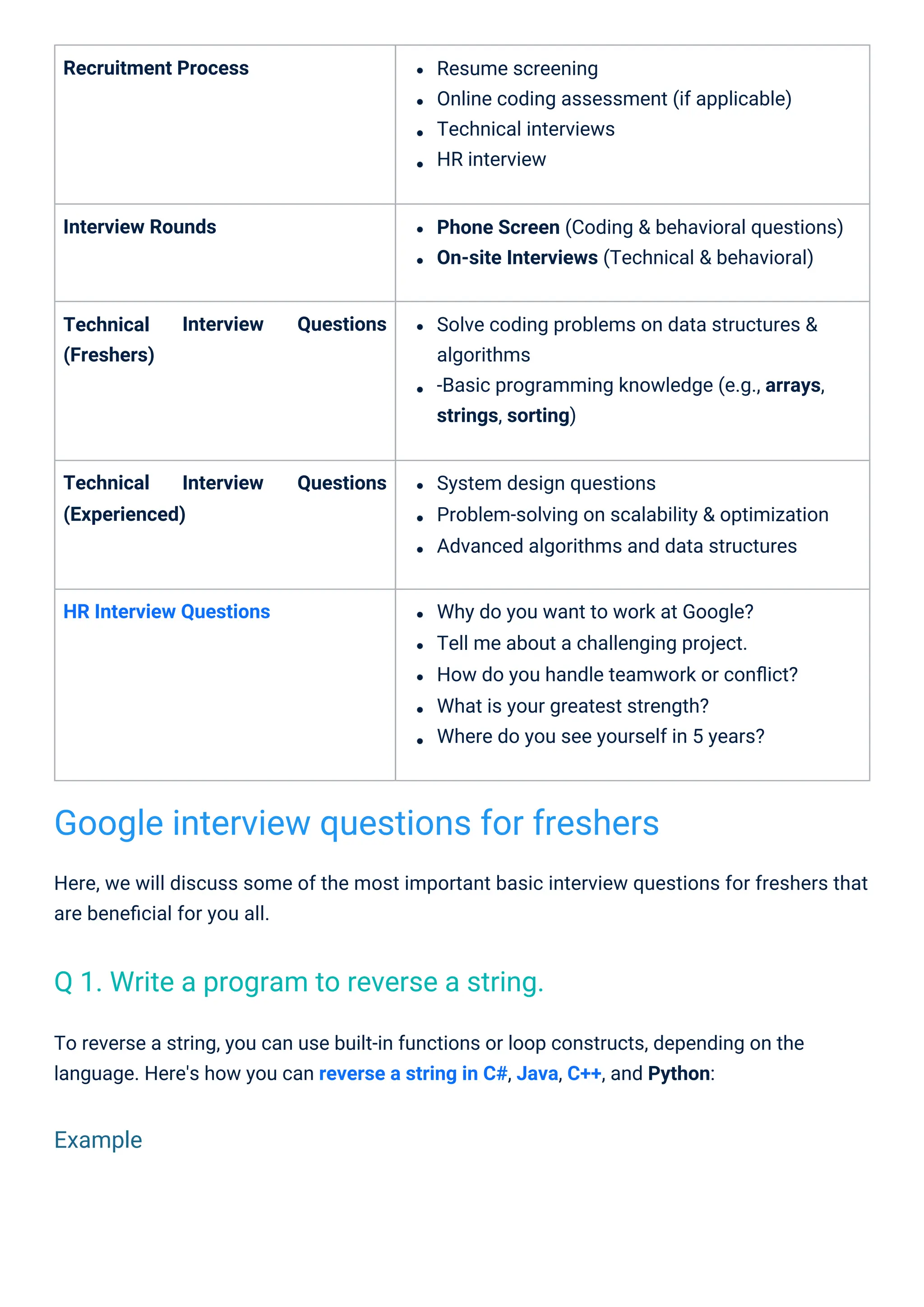
To reverse a string, you can use built-in functions or loop constructs, depending on the
language. Here's how you can reverse a string in C#, Java, C++, and Python:
Solve coding problems on data structures &
algorithms
-Basic programming knowledge (e.g., arrays,
strings, sorting)
Here, we will discuss some of the most important basic interview questions for freshers that
are beneficial for you all.
Google interview questions for freshers
Q 1. Write a program to reverse a string.
Example
C++
C++
C#
C#
Python
Python
Java
Java
Output
Example
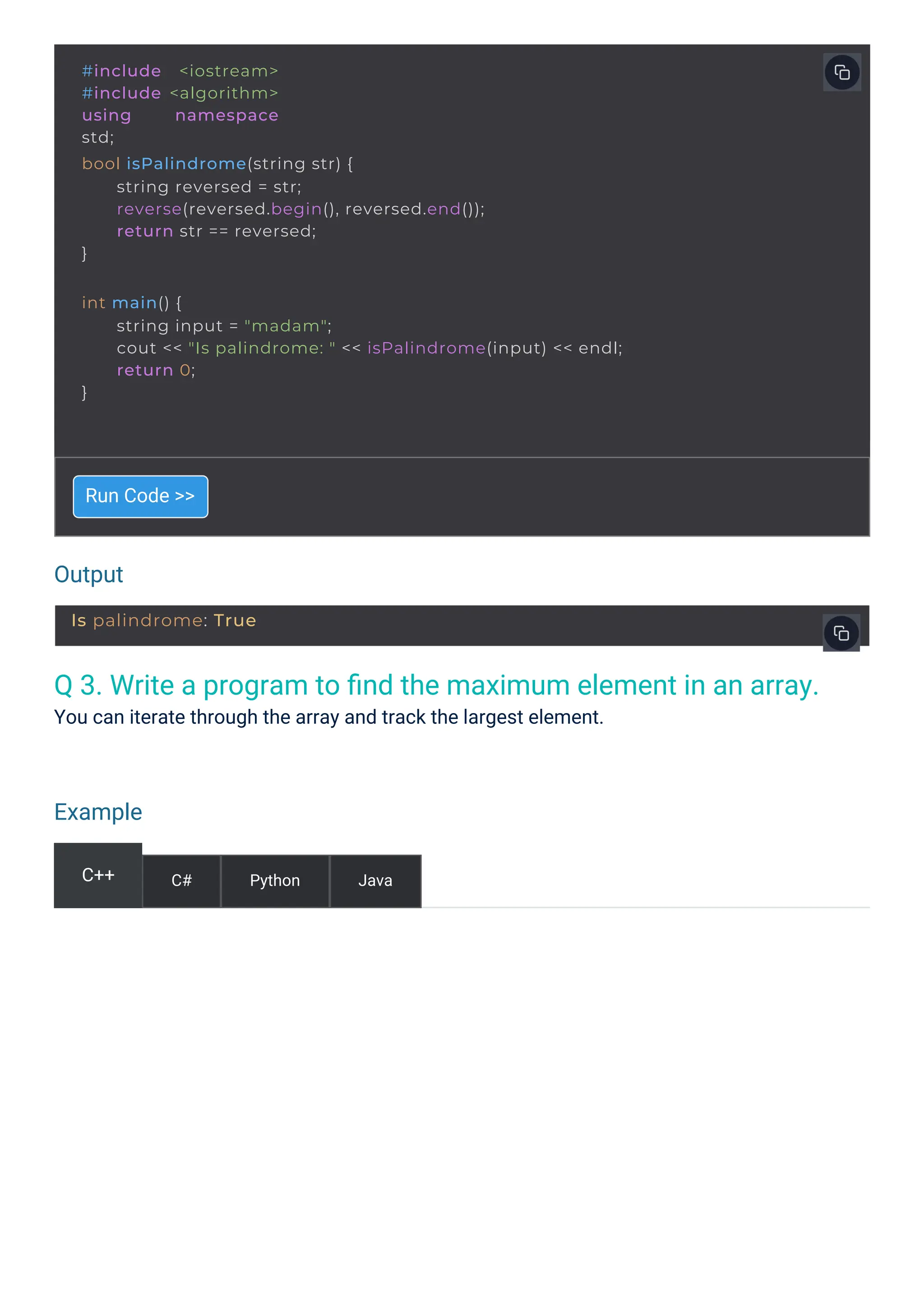
Q 2. Write a program to check whether a string is a palindrome.
A palindrome is a word, phrase, or sequence that reads the same backward as forwards. Here's
how you can check if a string is a palindrome in different languages.
Run Code >>
#include <iostream>
#include <algorithm>
using namespace
std;
string reverseString(string str) {
}
reverse(str.begin(), str.end());
return str;
int main() {
}
string input = "hello";
cout << "Reversed string: " << reverseString(input) << endl;
return 0;
Reversed string: olleh
Output
Example
Q 3. Write a program to find the maximum element in an array.
You can iterate through the array and track the largest element.
Run Code >>
C++ C# Python Java
#include <iostream>
#include <algorithm>
using namespace
std;
bool isPalindrome(string str) {
}
string reversed = str;
reverse(reversed.begin(), reversed.end());
return str == reversed;
int main() {
}
string input = "madam";
cout << "Is palindrome: " << isPalindrome(input) << endl;
return 0;
Is palindrome: True
Output
Example
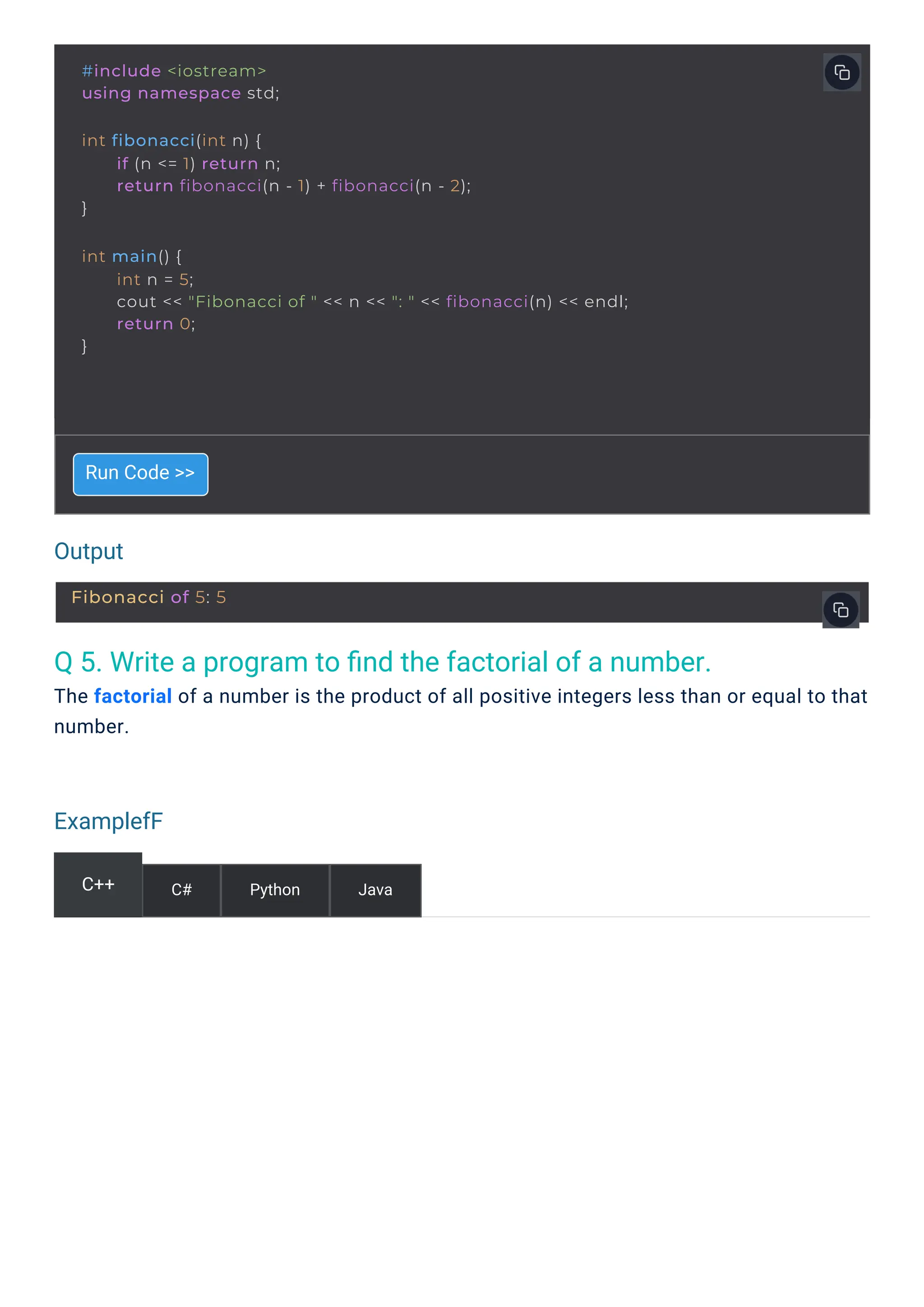
Q 4. Write a program to generate the nth Fibonacci number.
The Fibonacci sequence starts with 0 and 1, and each subsequent number is the sum of the
two preceding ones.
Run Code >>
Read more: How to Implement Fibonacci Series in C#
C++ C# Python Java
#include <iostream>
#include <algorithm>
using namespace
std;
int findMax(int arr[], int size) {
}
return *max_element(arr, arr + size);
int main() {
}
int arr[] = {1, 5, 3, 9, 2};
int size = sizeof(arr) / sizeof(arr[0]);
cout << "Maximum element: " << findMax(arr, size) << endl;
return 0;
Maximum element: 9
Output
ExamplefF
Q 5. Write a program to find the factorial of a number.
The factorial of a number is the product of all positive integers less than or equal to that
number.
Run Code >>
C++ C# Python Java
#include <iostream>
using namespace std;
int fibonacci(int n) {
}
if (n <= 1) return n;
return fibonacci(n - 1) + fibonacci(n - 2);
int main() {
}
int n = 5;
cout << "Fibonacci of " << n << ": " << fibonacci(n) << endl;
return 0;
Fibonacci of 5: 5
Output
Example
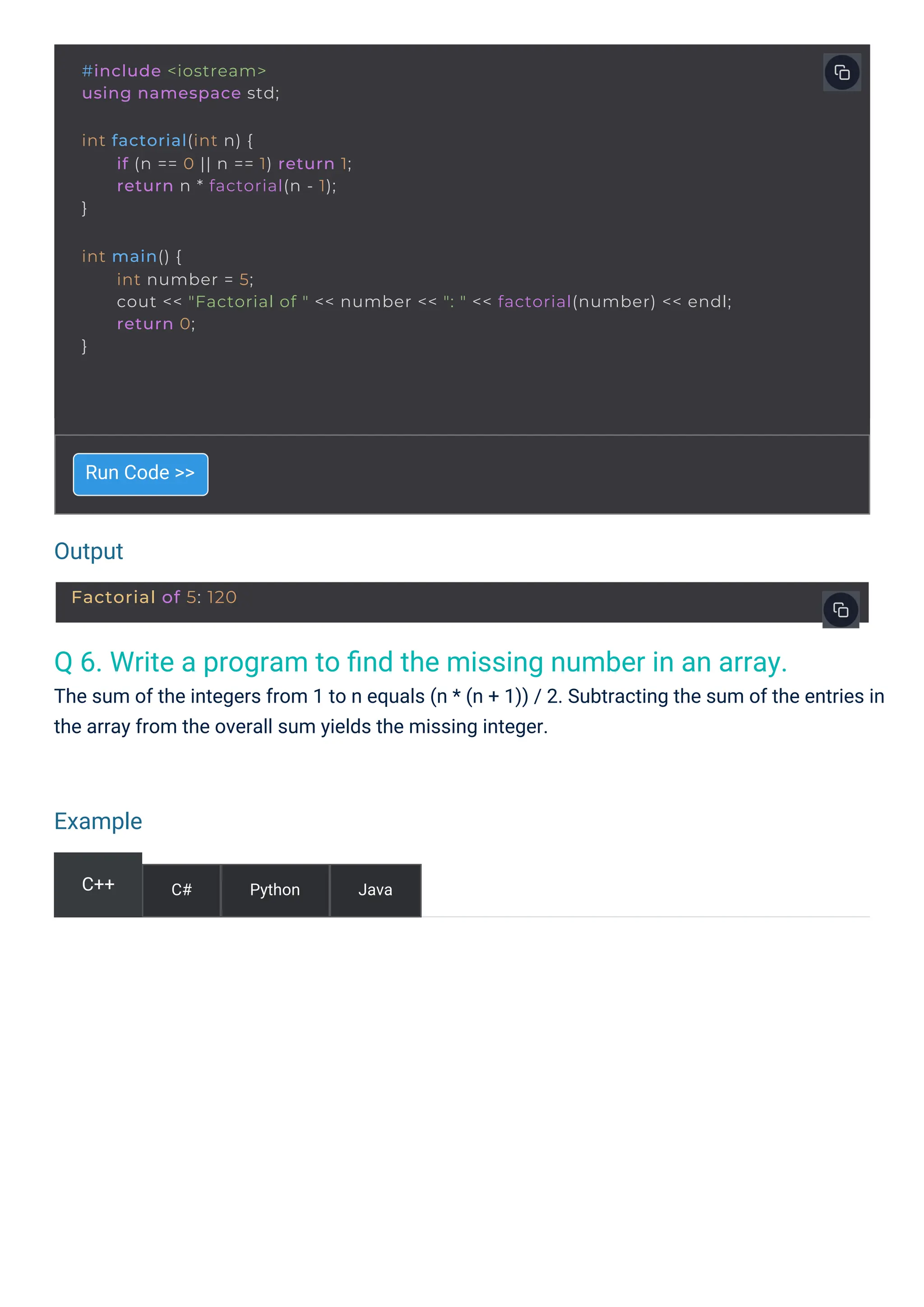
Q 6. Write a program to find the missing number in an array.
The sum of the integers from 1 to n equals (n * (n + 1)) / 2. Subtracting the sum of the entries in
the array from the overall sum yields the missing integer.
Run Code >>
C++ C# Python Java
#include <iostream>
using namespace std;
int factorial(int n) {
}
if (n == 0 || n == 1) return 1;
return n * factorial(n - 1);
int main() {
}
int number = 5;
cout << "Factorial of " << number << ": " << factorial(number) << endl;
return 0;
Factorial of 5: 120
Output
Google Programming Languages Interview Questions
Q 1. What are the differences between Java and C#?
Java and C# are both object-oriented languages but differ in their platform dependency. Java is
platform-independent at runtime and is used with the JVM, whereas C# is primarily used with
the .NET framework on Windows. C# has properties, events, and a for each loop for collection
traversal, while Java uses getter/setter methods and has a simpler event model.
Q 2. What is the difference between == and === in JavaScript?
In JavaScript, == checks for equality after type conversion, while === checks for strict equality
without type conversion. For instance, 5 == '5' is true because of type conversion, but 5 === '5' is
Run Code >>
#include <iostream>
using namespace std;
int findMissingNumber(int arr[], int n) {
}
int totalSum = n * (n + 1) / 2;
int arrSum = 0;
for (int i = 0; i < n - 1; i++) {
arrSum += arr[i];
}
r e t u r n t o t a l S u m - a r r S u m ;
int main() {
}
int arr[] = { 1, 2, 4, 5, 6 };
int n = 6;
cout << "Missing number: " << findMissingNumber(arr, n) << endl;
return 0;
Missing number: 3
false.
The async and await are used in C# for asynchronous programming, allowing non-blocking
execution. An async method performs work on a separate thread without blocking the main
thread, and await is used to indicate where asynchronous operations pause and resume.
Q 6. Explain the map() function in Python.
The map() function in Python applies a given function to each item of an iterable (like a list)
and returns a map object. For example, map(lambda x: x*2, [1, 2, 3]) results in [2, 4, 6].
Python uses automatic garbage collection through reference counting and a cyclic garbage
collector. It manages memory allocation dynamically, using __del__ destructors less often
than languages like C++.
A virtual function in C++ is a function in a base class marked with the virtual keyword. This
allows derived classes to override the function, enabling polymorphism. The actual function
called depends on the object type.
An abstract class in Java can have method implementations, but an interface can only have
method declarations (prior to Java 8). Multiple interfaces can be implemented by a class, but
only one abstract class can be extended.
JavaScript uses prototype-based inheritance, meaning objects inherit directly from other
objects rather than classes. ES6 introduced classes syntactically, but they are still prototype-
based.
Q 5. Explain async and await in C#.
Q 8. What is a virtual function in C++?
Q 7. How is inheritance handled in JavaScript?
Q 3. How does Python handle memory management?
Q 4. What is the difference between an interface and an abstract
class in Java?
Q 9. What is the final keyword in Java?
In Java, the final keyword can be used with variables, methods, and classes. A final variable
cannot be reassigned, a final method cannot be overridden, and a final class cannot be
subclassed.
Q 13. How does C++ handle multiple inheritance?
C++ supports multiple inheritance, allowing a class to inherit from more than one base class.
This can lead to ambiguity, which can be resolved using virtual inheritance to avoid the
"diamond problem."
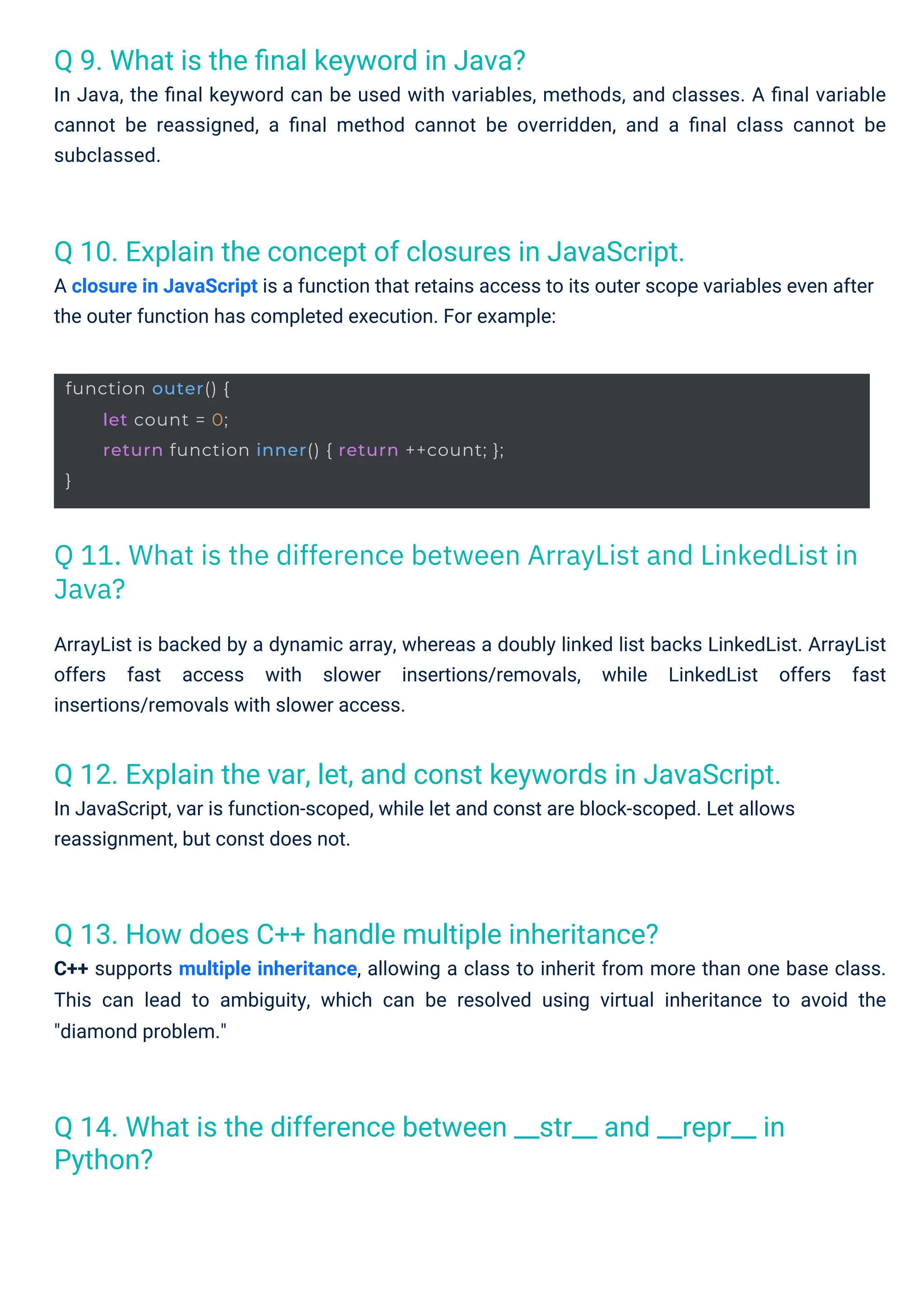
Q 10. Explain the concept of closures in JavaScript.
A closure in JavaScript is a function that retains access to its outer scope variables even after
the outer function has completed execution. For example:
Q 14. What is the difference between __str__ and __repr__ in
Python?
Q 12. Explain the var, let, and const keywords in JavaScript.
In JavaScript, var is function-scoped, while let and const are block-scoped. Let allows
reassignment, but const does not.
ArrayList is backed by a dynamic array, whereas a doubly linked list backs LinkedList. ArrayList
offers fast access with slower insertions/removals, while LinkedList offers fast
insertions/removals with slower access.
function outer() {
}
let count = 0;
return function inner() { return ++count; };
Q 11. What is the difference between ArrayList and LinkedList in
Java?
JavaScript is single-threaded, so async programming allows non-blocking operations, using
promises or async/await syntax to handle delayed operations like I/O without freezing the
main thread.
Private variables in C++ are accessible only within the class that declares them. To access
private variables, you typically use public getter and setter functions.
In Python, __init__ is a constructor method called when an object is instantiated. self
represents the instance of the class and is used to access class variables and methods.
LINQ (Language Integrated Query) is a set of methods in C# for querying collections. It
provides the syntax for querying collections, databases, and XML data using lambda
expressions.
The const correctness in C++ ensures that variables or parameters marked as const are not
modified. It helps prevent accidental changes to values within functions and supports safer
code.
In Python, __str__ returns a readable string for end users, while __repr__ provides a developer-
oriented representation of the object, often used for debugging.
An abstract class in C# cannot be instantiated directly and is meant to be subclassed, with or
without abstract methods. A sealed class cannot be inherited, making it a final implementation.
Q 15. What is LINQ in C#?
Q 18. What is const correctness in C++?
Q 20. Explain async programming in JavaScript.
Q 17. Explain __init__ and self in Python classes.
Q 16. How are private variables accessed in C++?
Q 19. What is the difference between abstract and sealed in C#?
Top 20 Google Interview Coding Questions for
Practise
Here, we provide some of the most important coding questions that you can practice for your
job interview:
Q 1. How do you reverse a linked list?
Q 2. How would you detect a cycle in a linked list?
Q 3. Write a function to check if a given string is a palindrome.
Q 4. How do you find the intersection of two arrays?
Q 5. How would you merge two sorted arrays?
Q 6. Create a function that finds the largest sum of a subarray (Kadane's
algorithm).
Q 7. How do you determine the longest substring without repeated characters?
Q 8. How would you assess whether a binary tree is balanced?
Q 9. How do you determine the lowest common ancestor in a binary tree?
Q 10. Create a function that checks if two strings are anagrams.
Q 11. How would you get duplicates out of a sorted linked list?
Q 12. Write a function that rotates a matrix by 90 degrees.
Q 13. How do you determine the kth greatest element in an array?
Q 14. How would you create a queue with two stacks?
Q 15. Create a function that finds the first non-repeating character in a string.
Q 16. How do you check if two binary trees are identical?
Q 17. How would you implement depth-first search (DFS) in a graph?
Q 18. Write a function to find the missing number in an array of consecutive
numbers.
Q 19. would you check if a binary tree is a valid binary search tree (BST)?
Q 20. How do you find the longest common prefix among an array of strings?
System Design Interview Questions at Google
Interview
Let's go through some system-design interview questions:
This involves building a system to upload, store, sync, and retrieve files across devices. Key
points include file chunking for upload efficiency, metadata management, data consistency
across devices, redundancy for data recovery, and handling concurrency when multiple users
update files simultaneously.
A URL shortener takes long URLs and generates a shorter, unique version for easy sharing. Key
considerations include how to handle millions of URL requests, ensuring unique shortened
URLs, implementing a hashing function for unique mappings, managing high availability, and
choosing the right database for quick retrieval.
A rate limiter restricts the number of requests a user can make in a given period to prevent
abuse. Key considerations include different algorithms like token buckets, fixed windows,
and
A web crawler is essential for indexing content across websites for search engines. Discuss
how to handle large volumes of web data, prioritize crawling based on freshness and
relevance, handle URL deduplication, and ensure distributed crawling to balance load across
servers. You may also mention approaches to managing rate-limiting, politeness policies, and
handling errors like 404 pages.
Q 4. Design a Rate Limiter
Q 2. Design a Web Crawler
Q 3. Design Google Drive or Dropbox
Q 1. Design a URL Shortener (like Bit.ly)
A chat system must support real-time messaging, user presence updates, and message
history. Key points include how to manage user authentication, implement a message queue
for real-time delivery, handle offline messages, ensure message ordering, and choose a
suitable database for high-volume storage.
This involves matching drivers and passengers in real time. Key points include location tracking
for real-time positioning, a matching algorithm for quick pairing, handling surge
This involves predicting user queries as they type in a search bar. Discuss using Trie data
structures for fast prefix searches, caching frequently typed queries for efficiency, ranking
results based on popularity or personalization, and how to handle updates to the dataset for
new trending queries.
sliding windows for rate-limiting, as well as storing data in memory or a fast-access cache for
real-time decision-making. Consider scalability and how to handle distributed instances.
A CDN distributes content across multiple locations so that users can access it faster globally.
Discuss storing content in geographically distributed servers, caching strategies, load
balancing across servers, and managing cache invalidation when content updates. Also,
network latency and redundancy should be considered for reliability.
A notification system sends messages to users across different devices. Consider notification
types (email, SMS, in-app), ensuring timely delivery, scheduling for specific times or events,
handling retries for undelivered messages and user preferences, and using a queuing system
to balance load during peak times.
Q 7. Design a Notification System
Q 5. Design a Chat System (like WhatsApp)
Q 6. Design a Search Autocomplete System
Q 9. Design a Ride-Sharing System (like Uber)
Q 8. Design a Content Delivery Network (CDN)
pricing during peak hours, managing trip history, and ensuring data consistency between
drivers and riders. Consider scalability for handling high user loads.
Google Cloud provides various VM types, including N1 Standard for general use, N2 for better
performance, and specialized VMs like Compute-Optimized, Memory-Optimized, and
Preemptible VMs for specific workloads.
Google Cloud Storage offers different classes based on access frequency: Standard (frequent
access), Nearline (less than once a month), Coldline (rarely accessed), and Archive (long-term
storage).
A news feed delivers personalized content to users based on their activity and interests.
Discuss ranking algorithms for relevance, how to manage a large number of updates in real-
time, caching strategies for frequently viewed posts, and handling privacy settings.
Additionally, consider ways to optimize the system for responsiveness and scalability.
Google Cloud Platform (GCP) is a suite of cloud services for computing, storage, data analytics,
and machine learning. It offers services like Compute Engine, App Engine, BigQuery, Cloud
Storage, and more.
Q 4. How does Google Cloud Networking work?
Q 10. Design a News Feed System (like Facebook)
Q 2. Explain the differences between Google Cloud Storage
classes.
Q 3. What are the different types of virtual machines in Google
Cloud?
Q 1. What is Google Cloud Platform (GCP), and what services does
it offer?
Google Cloud Interview Questions
Google Cloud Networking includes services like VPC for isolated networks, Cloud Load
Balancing for traffic distribution, and Cloud CDN for content delivery with low latency globally.
Google Kubernetes Engine (GKE) is a managed service for deploying and managing
containerized applications using Kubernetes, providing automated updates, scaling, and
integration with other GCP services.
Google Cloud IAM allows administrators to manage permissions for users, groups, and service
accounts, assigning roles to grant access to specific GCP resources securely.
Cloud Spanner is a globally distributed, scalable relational database offering ACID transactions,
horizontal scaling, and strong consistency, unlike traditional databases that are limited in
scalability.
Google Cloud Pub/Sub is a messaging service for event-driven architectures used for
asynchronous communication, real-time event processing, and decoupling services in
distributed systems.
BigQuery is a fully managed, serverless data warehouse for fast SQL queries on large datasets,
offering scalability and real-time analytics with minimal management.
Q 7. What is BigQuery, and how does it work?
Q 10. How would you design a highly available and scalable
architecture on Google Cloud?
Q 5. What is Kubernetes Engine (GKE), and how does it work?
Q 9. What is Google Cloud Spanner, and how is it different from
traditional relational databases?
Q 6. How does Google Cloud Identity and Access Management
(IAM) work?
Q 8. What is Google Cloud Pub/Sub, and when would you use it?
Use efficient algorithms and data structures, minimize
unnecessary computations.
A stack follows LIFO (Last In, First Out), and a queue follows FIFO (First In, First Out).
time complexity, and
Arrays are fixed-size and allow fast access by index, while linked lists are dynamic and allow
fast insertion/deletion but slower access.
Dynamic programming solves problems by breaking them into overlapping subproblems and
storing results to avoid redundant calculations.
reduce
A hash table stores data in key-value pairs using a hash function to access values by their keys
quickly.
To design a highly available and scalable system, use managed services, auto-scaling, multi-
region resources, load balancing, and data replication to ensure performance and fault
tolerance.
Understand the problem, break it into smaller parts, choose the right data structure/algorithm,
write code, and then test and optimize it.
Google Software Engineer Interview Questions
Q 1. What is your approach to solving a coding problem?
Q 5. What is dynamic programming?
Q 4. What is a hash table, and how does it work?
Q 7. Explain object-oriented programming (OOP).
Q 6. What is the difference between a stack and a queue?
Q 2. How do you optimize your code for better performance?
Q 3. What is the difference between an array and a linked list?
O(log n) for a balanced tree, but O(n) in the worst case for an unbalanced tree.
Use print statements, a debugger, or break the problem down to identify issues and fix them
step-by-step.
Prioritize tasks based on urgency, break them into smaller tasks, and focus on completing
critical ones first.
A queue in a data structure is a data structure that follows FIFO and is used in scenarios like
task scheduling or handling requests on a server.
Object-Oriented Programming is a programming style based on objects, which encapsulate
data and methods. Key principles include encapsulation, inheritance, polymorphism, and
abstraction.
Binary search is a search algorithm that repeatedly divides a sorted list in half to find a target
value with O(log n) time complexity.
A shallow copy copies references to objects, while a deep copy duplicates the entire object,
including nested objects.
Q 14. What is recursion?
Q 13. What is a binary search?
Q 11. What is a queue, and how is it used?
Q 9. How do you handle debugging in your code?
Q 12. What is the difference between deep copy and shallow
copy?
Q 8. What is the time complexity of searching in a binary search
tree (BST)?
Q 10. How would you handle multiple tasks with tight deadlines?
A race condition occurs when two threads access shared resources simultaneously, causing
unpredictable results.
Recursion in C is when a function calls itself to solve smaller instances of a problem, often with
a base case to stop the recursion.
Big-O notation helps to measure the efficiency of an algorithm, indicating its time and space
complexity as the input size grows.
SQL databases are relational and use structured query language, while NoSQL databases are
non-relational and handle unstructured or semi-structured data.
A process is an independent program in execution, while a thread is a smaller unit of a process
that can run concurrently with other threads.
Ensure code quality through writing unit tests and code reviews, adhering to coding standards,
and using tools like linters to catch errors early.
Inheritance in OOPs allows a class to inherit properties and methods from another class,
promoting code reuse.
Q 19. What is a race condition?
Q 20. How do you ensure code quality?
Q 16. What is the importance of Big-O notation?
Q 17. Explain the concept of inheritance in OOP.
Q 15. What is the difference between a process and a thread?
Q 18. What is the difference between SQL and NoSQL databases?
Google Interview Questions for Experienced
Professionals
Q 6. Design a URL shortening service (like bit.ly).
This involves creating a system that maps long URLs to short ones using unique identifiers. It
requires efficient URL mapping, redirection handling, and scalability.
Q 2. How would you find the intersection of two arrays?
You can use a hash set to store one array's elements and check for matches with the other
array. Alternatively, sorting both arrays and using a two-pointer technique is another approach.
Q 4. How would you implement an LRU (Least Recently Used)
cache?
An LRU cache can be implemented using a hash map and a doubly linked list. The hash map
allows O(1) access to items, while the doubly linked list maintains the order of use for eviction.
Q 5. What is dynamic programming? Can you give a real-world
problem that requires this approach?
Dynamic programming solves problems by breaking them down into overlapping subproblems
and storing solutions. The Fibonacci sequence is a classic example where DP optimizes
repeated calculations.
Q 1. What are the differences between a stack and a queue, and
where would you use each?
A stack follows the Last In, First Out (LIFO) principle, and a queue follows the First In, First Out
(FIFO). Stacks are used in recursion and undo functionality, while queues are used for task
scheduling and real-time systems.
Q 3. Explain the concept of a binary search tree and its use cases.
A binary search tree (BST) is a tree where each node's left child is smaller and the right child is
larger. It supports efficient searching, insertion, and deletion in O(log n) time and is used in
search operations and range queries.
Q 11. Design a file storage system.
A file storage system must handle file uploads, retrieval, and metadata management while
ensuring scalability, redundancy, and data consistency across multiple storage nodes.
Q 7. How would you design a scalable notification system?
A scalable notification system uses message queues (like Kafka) to handle high volumes of
notifications asynchronously and ensures real-time delivery using push notifications for
mobile apps.
Q 10. What is the difference between a process and a thread?
A process is a standalone program with its own memory, while a thread is a smaller unit of
execution within a process that shares the process's memory space.
Q 13. What are the trade-offs between using a relational and a
NoSQL database?
Q 12. How would you implement an autocomplete feature for a
search engine?
Implementing autocomplete can involve using a trie or prefix tree, allowing efficient retrieval of
suggestions based on user input.
Q 9. How would you find the shortest path in a weighted graph?
Dijkstra’s algorithm can be used for graphs with non-negative weights, while Bellman-Ford
handles negative weights. Both algorithms find the shortest path efficiently.
Q 8. Explain the differences between a relational database and a
NoSQL database.
Relational databases use structured tables with a fixed schema, supporting ACID transactions.
NoSQL databases are flexible, handle unstructured data, and focus on scalability and
availability.
Use threads to split the array into smaller parts, then compute each part in parallel, combining
the results at the end, ensuring proper synchronization to avoid data races.
Use data replication, redundancy, and eventual consistency to handle failures and ensure data
recovery in case of a loss.
Relational databases are ideal for structured data and complex queries, supporting ACID
properties. NoSQL databases offer better scalability and flexibility but typically sacrifice
consistency for availability.
Deadlock occurs when two or more threads are waiting indefinitely for each other to release
resources. Prevent it by using lock ordering, timeouts, or deadlock detection techniques.
The CAP theorem states that a distributed system can guarantee at most two of three
properties: Consistency, Availability, and Partition Tolerance. It highlights trade-offs when
designing distributed systems.
A messaging system requires handling real-time communication, message delivery, storage,
and ensuring scalability with efficient use of databases and message queues.
Q 19. Design an e-commerce checkout system.
Q 16. Design a messaging system like WhatsApp or Slack.
Q 17. How would you handle a situation where a distributed
system loses data?
Q 15. How would you implement a multithreaded program that
computes the sum of a large array?
Q 18. What is a deadlock, and how can you prevent it in a multi-
threaded application?
Q 14. Explain the CAP theorem and its importance in distributed
systems.
An e-commerce checkout system must manage inventory, handle transactions, and integrate
payment gateways while ensuring consistency and scalability.
Synchronous programming blocks the execution until a task is completed, while asynchronous
programming allows tasks to run concurrently, improving system responsiveness and resource
utilization.
In conclusion, mastering Google Interview Questions is key to succeeding in their rigorous
interview process. By practicing common technical and system design questions,
candidates can improve their problem-solving skills. Proper preparation for Google
Interview Questions increases the chances of standing out and securing a position at the
company.
Q 20. Explain the difference between synchronous and
asynchronous programming.
Conclusion

Google Interview Questions By Scholarhat

  • 1.
    Top Google InterviewQuestions and How to Answer Them Google Interview Questions Studying for Google interview Questions can be difficult, especially because the requirements for getting a job as a software engineer are very high. These Google interview questions contain crucial Google interview questions for software engineers, insights into Google interview questions for freshers, and the most recent Google interview questions for 2024. With these materials, you'll be better able to handle each step of the interview and successfully demonstrate your talents. What should you expect in Google Interviews? Start learning the Interview Question tutorial; you will learn different types of interview questions that are mostly asked in your Google Interview, including understanding the Google Interview Process, Google interview questions for freshers, Google Programming Languages Interview Questions, and a lot more.
  • 2.
    Section Eligibility Criteria Online Application Description Relevantdegree (e.g., B.Tech, MCA) Strong academic record Coding experience (for technical roles) You can expect in Google interviews: Technical Questions: Solve coding problems focusing on algorithms and data structures. System Design: Design scalable and efficient systems (for experienced roles). Behavioral Questions: Share examples of how you handle challenges and work in teams. Culture Fit: Show how you align with Google’s values of teamwork and innovation. Submit your resume via Google's career portal Fill in personal and educational details Provide coding samples or portfolio (if applicable) Understand the Google Interview Process
  • 3.
    Technical (Freshers) Interview Rounds Recruitment Process HRInterview Questions Interview Technical (Experienced) Interview Questions Questions Resume screening Online coding assessment (if applicable) Technical interviews HR interview Why do you want to work at Google? Tell me about a challenging project. How do you handle teamwork or conflict? What is your greatest strength? Where do you see yourself in 5 years? System design questions Problem-solving on scalability & optimization Advanced algorithms and data structures Phone Screen (Coding & behavioral questions) On-site Interviews (Technical & behavioral) To reverse a string, you can use built-in functions or loop constructs, depending on the language. Here's how you can reverse a string in C#, Java, C++, and Python: Solve coding problems on data structures & algorithms -Basic programming knowledge (e.g., arrays, strings, sorting) Here, we will discuss some of the most important basic interview questions for freshers that are beneficial for you all. Google interview questions for freshers Q 1. Write a program to reverse a string. Example
  • 4.
    C++ C++ C# C# Python Python Java Java Output Example Q 2. Writea program to check whether a string is a palindrome. A palindrome is a word, phrase, or sequence that reads the same backward as forwards. Here's how you can check if a string is a palindrome in different languages. Run Code >> #include <iostream> #include <algorithm> using namespace std; string reverseString(string str) { } reverse(str.begin(), str.end()); return str; int main() { } string input = "hello"; cout << "Reversed string: " << reverseString(input) << endl; return 0; Reversed string: olleh
  • 5.
    Output Example Q 3. Writea program to find the maximum element in an array. You can iterate through the array and track the largest element. Run Code >> C++ C# Python Java #include <iostream> #include <algorithm> using namespace std; bool isPalindrome(string str) { } string reversed = str; reverse(reversed.begin(), reversed.end()); return str == reversed; int main() { } string input = "madam"; cout << "Is palindrome: " << isPalindrome(input) << endl; return 0; Is palindrome: True
  • 6.
    Output Example Q 4. Writea program to generate the nth Fibonacci number. The Fibonacci sequence starts with 0 and 1, and each subsequent number is the sum of the two preceding ones. Run Code >> Read more: How to Implement Fibonacci Series in C# C++ C# Python Java #include <iostream> #include <algorithm> using namespace std; int findMax(int arr[], int size) { } return *max_element(arr, arr + size); int main() { } int arr[] = {1, 5, 3, 9, 2}; int size = sizeof(arr) / sizeof(arr[0]); cout << "Maximum element: " << findMax(arr, size) << endl; return 0; Maximum element: 9
  • 7.
    Output ExamplefF Q 5. Writea program to find the factorial of a number. The factorial of a number is the product of all positive integers less than or equal to that number. Run Code >> C++ C# Python Java #include <iostream> using namespace std; int fibonacci(int n) { } if (n <= 1) return n; return fibonacci(n - 1) + fibonacci(n - 2); int main() { } int n = 5; cout << "Fibonacci of " << n << ": " << fibonacci(n) << endl; return 0; Fibonacci of 5: 5
  • 8.
    Output Example Q 6. Writea program to find the missing number in an array. The sum of the integers from 1 to n equals (n * (n + 1)) / 2. Subtracting the sum of the entries in the array from the overall sum yields the missing integer. Run Code >> C++ C# Python Java #include <iostream> using namespace std; int factorial(int n) { } if (n == 0 || n == 1) return 1; return n * factorial(n - 1); int main() { } int number = 5; cout << "Factorial of " << number << ": " << factorial(number) << endl; return 0; Factorial of 5: 120
  • 9.
    Output Google Programming LanguagesInterview Questions Q 1. What are the differences between Java and C#? Java and C# are both object-oriented languages but differ in their platform dependency. Java is platform-independent at runtime and is used with the JVM, whereas C# is primarily used with the .NET framework on Windows. C# has properties, events, and a for each loop for collection traversal, while Java uses getter/setter methods and has a simpler event model. Q 2. What is the difference between == and === in JavaScript? In JavaScript, == checks for equality after type conversion, while === checks for strict equality without type conversion. For instance, 5 == '5' is true because of type conversion, but 5 === '5' is Run Code >> #include <iostream> using namespace std; int findMissingNumber(int arr[], int n) { } int totalSum = n * (n + 1) / 2; int arrSum = 0; for (int i = 0; i < n - 1; i++) { arrSum += arr[i]; } r e t u r n t o t a l S u m - a r r S u m ; int main() { } int arr[] = { 1, 2, 4, 5, 6 }; int n = 6; cout << "Missing number: " << findMissingNumber(arr, n) << endl; return 0; Missing number: 3
  • 10.
    false. The async andawait are used in C# for asynchronous programming, allowing non-blocking execution. An async method performs work on a separate thread without blocking the main thread, and await is used to indicate where asynchronous operations pause and resume. Q 6. Explain the map() function in Python. The map() function in Python applies a given function to each item of an iterable (like a list) and returns a map object. For example, map(lambda x: x*2, [1, 2, 3]) results in [2, 4, 6]. Python uses automatic garbage collection through reference counting and a cyclic garbage collector. It manages memory allocation dynamically, using __del__ destructors less often than languages like C++. A virtual function in C++ is a function in a base class marked with the virtual keyword. This allows derived classes to override the function, enabling polymorphism. The actual function called depends on the object type. An abstract class in Java can have method implementations, but an interface can only have method declarations (prior to Java 8). Multiple interfaces can be implemented by a class, but only one abstract class can be extended. JavaScript uses prototype-based inheritance, meaning objects inherit directly from other objects rather than classes. ES6 introduced classes syntactically, but they are still prototype- based. Q 5. Explain async and await in C#. Q 8. What is a virtual function in C++? Q 7. How is inheritance handled in JavaScript? Q 3. How does Python handle memory management? Q 4. What is the difference between an interface and an abstract class in Java?
  • 11.
    Q 9. Whatis the final keyword in Java? In Java, the final keyword can be used with variables, methods, and classes. A final variable cannot be reassigned, a final method cannot be overridden, and a final class cannot be subclassed. Q 13. How does C++ handle multiple inheritance? C++ supports multiple inheritance, allowing a class to inherit from more than one base class. This can lead to ambiguity, which can be resolved using virtual inheritance to avoid the "diamond problem." Q 10. Explain the concept of closures in JavaScript. A closure in JavaScript is a function that retains access to its outer scope variables even after the outer function has completed execution. For example: Q 14. What is the difference between __str__ and __repr__ in Python? Q 12. Explain the var, let, and const keywords in JavaScript. In JavaScript, var is function-scoped, while let and const are block-scoped. Let allows reassignment, but const does not. ArrayList is backed by a dynamic array, whereas a doubly linked list backs LinkedList. ArrayList offers fast access with slower insertions/removals, while LinkedList offers fast insertions/removals with slower access. function outer() { } let count = 0; return function inner() { return ++count; }; Q 11. What is the difference between ArrayList and LinkedList in Java?
  • 12.
    JavaScript is single-threaded,so async programming allows non-blocking operations, using promises or async/await syntax to handle delayed operations like I/O without freezing the main thread. Private variables in C++ are accessible only within the class that declares them. To access private variables, you typically use public getter and setter functions. In Python, __init__ is a constructor method called when an object is instantiated. self represents the instance of the class and is used to access class variables and methods. LINQ (Language Integrated Query) is a set of methods in C# for querying collections. It provides the syntax for querying collections, databases, and XML data using lambda expressions. The const correctness in C++ ensures that variables or parameters marked as const are not modified. It helps prevent accidental changes to values within functions and supports safer code. In Python, __str__ returns a readable string for end users, while __repr__ provides a developer- oriented representation of the object, often used for debugging. An abstract class in C# cannot be instantiated directly and is meant to be subclassed, with or without abstract methods. A sealed class cannot be inherited, making it a final implementation. Q 15. What is LINQ in C#? Q 18. What is const correctness in C++? Q 20. Explain async programming in JavaScript. Q 17. Explain __init__ and self in Python classes. Q 16. How are private variables accessed in C++? Q 19. What is the difference between abstract and sealed in C#?
  • 13.
    Top 20 GoogleInterview Coding Questions for Practise Here, we provide some of the most important coding questions that you can practice for your job interview: Q 1. How do you reverse a linked list? Q 2. How would you detect a cycle in a linked list? Q 3. Write a function to check if a given string is a palindrome. Q 4. How do you find the intersection of two arrays? Q 5. How would you merge two sorted arrays? Q 6. Create a function that finds the largest sum of a subarray (Kadane's algorithm). Q 7. How do you determine the longest substring without repeated characters? Q 8. How would you assess whether a binary tree is balanced? Q 9. How do you determine the lowest common ancestor in a binary tree? Q 10. Create a function that checks if two strings are anagrams. Q 11. How would you get duplicates out of a sorted linked list? Q 12. Write a function that rotates a matrix by 90 degrees. Q 13. How do you determine the kth greatest element in an array? Q 14. How would you create a queue with two stacks? Q 15. Create a function that finds the first non-repeating character in a string. Q 16. How do you check if two binary trees are identical? Q 17. How would you implement depth-first search (DFS) in a graph? Q 18. Write a function to find the missing number in an array of consecutive numbers.
  • 14.
    Q 19. wouldyou check if a binary tree is a valid binary search tree (BST)? Q 20. How do you find the longest common prefix among an array of strings? System Design Interview Questions at Google Interview Let's go through some system-design interview questions: This involves building a system to upload, store, sync, and retrieve files across devices. Key points include file chunking for upload efficiency, metadata management, data consistency across devices, redundancy for data recovery, and handling concurrency when multiple users update files simultaneously. A URL shortener takes long URLs and generates a shorter, unique version for easy sharing. Key considerations include how to handle millions of URL requests, ensuring unique shortened URLs, implementing a hashing function for unique mappings, managing high availability, and choosing the right database for quick retrieval. A rate limiter restricts the number of requests a user can make in a given period to prevent abuse. Key considerations include different algorithms like token buckets, fixed windows, and A web crawler is essential for indexing content across websites for search engines. Discuss how to handle large volumes of web data, prioritize crawling based on freshness and relevance, handle URL deduplication, and ensure distributed crawling to balance load across servers. You may also mention approaches to managing rate-limiting, politeness policies, and handling errors like 404 pages. Q 4. Design a Rate Limiter Q 2. Design a Web Crawler Q 3. Design Google Drive or Dropbox Q 1. Design a URL Shortener (like Bit.ly)
  • 15.
    A chat systemmust support real-time messaging, user presence updates, and message history. Key points include how to manage user authentication, implement a message queue for real-time delivery, handle offline messages, ensure message ordering, and choose a suitable database for high-volume storage. This involves matching drivers and passengers in real time. Key points include location tracking for real-time positioning, a matching algorithm for quick pairing, handling surge This involves predicting user queries as they type in a search bar. Discuss using Trie data structures for fast prefix searches, caching frequently typed queries for efficiency, ranking results based on popularity or personalization, and how to handle updates to the dataset for new trending queries. sliding windows for rate-limiting, as well as storing data in memory or a fast-access cache for real-time decision-making. Consider scalability and how to handle distributed instances. A CDN distributes content across multiple locations so that users can access it faster globally. Discuss storing content in geographically distributed servers, caching strategies, load balancing across servers, and managing cache invalidation when content updates. Also, network latency and redundancy should be considered for reliability. A notification system sends messages to users across different devices. Consider notification types (email, SMS, in-app), ensuring timely delivery, scheduling for specific times or events, handling retries for undelivered messages and user preferences, and using a queuing system to balance load during peak times. Q 7. Design a Notification System Q 5. Design a Chat System (like WhatsApp) Q 6. Design a Search Autocomplete System Q 9. Design a Ride-Sharing System (like Uber) Q 8. Design a Content Delivery Network (CDN)
  • 16.
    pricing during peakhours, managing trip history, and ensuring data consistency between drivers and riders. Consider scalability for handling high user loads. Google Cloud provides various VM types, including N1 Standard for general use, N2 for better performance, and specialized VMs like Compute-Optimized, Memory-Optimized, and Preemptible VMs for specific workloads. Google Cloud Storage offers different classes based on access frequency: Standard (frequent access), Nearline (less than once a month), Coldline (rarely accessed), and Archive (long-term storage). A news feed delivers personalized content to users based on their activity and interests. Discuss ranking algorithms for relevance, how to manage a large number of updates in real- time, caching strategies for frequently viewed posts, and handling privacy settings. Additionally, consider ways to optimize the system for responsiveness and scalability. Google Cloud Platform (GCP) is a suite of cloud services for computing, storage, data analytics, and machine learning. It offers services like Compute Engine, App Engine, BigQuery, Cloud Storage, and more. Q 4. How does Google Cloud Networking work? Q 10. Design a News Feed System (like Facebook) Q 2. Explain the differences between Google Cloud Storage classes. Q 3. What are the different types of virtual machines in Google Cloud? Q 1. What is Google Cloud Platform (GCP), and what services does it offer? Google Cloud Interview Questions
  • 17.
    Google Cloud Networkingincludes services like VPC for isolated networks, Cloud Load Balancing for traffic distribution, and Cloud CDN for content delivery with low latency globally. Google Kubernetes Engine (GKE) is a managed service for deploying and managing containerized applications using Kubernetes, providing automated updates, scaling, and integration with other GCP services. Google Cloud IAM allows administrators to manage permissions for users, groups, and service accounts, assigning roles to grant access to specific GCP resources securely. Cloud Spanner is a globally distributed, scalable relational database offering ACID transactions, horizontal scaling, and strong consistency, unlike traditional databases that are limited in scalability. Google Cloud Pub/Sub is a messaging service for event-driven architectures used for asynchronous communication, real-time event processing, and decoupling services in distributed systems. BigQuery is a fully managed, serverless data warehouse for fast SQL queries on large datasets, offering scalability and real-time analytics with minimal management. Q 7. What is BigQuery, and how does it work? Q 10. How would you design a highly available and scalable architecture on Google Cloud? Q 5. What is Kubernetes Engine (GKE), and how does it work? Q 9. What is Google Cloud Spanner, and how is it different from traditional relational databases? Q 6. How does Google Cloud Identity and Access Management (IAM) work? Q 8. What is Google Cloud Pub/Sub, and when would you use it?
  • 18.
    Use efficient algorithmsand data structures, minimize unnecessary computations. A stack follows LIFO (Last In, First Out), and a queue follows FIFO (First In, First Out). time complexity, and Arrays are fixed-size and allow fast access by index, while linked lists are dynamic and allow fast insertion/deletion but slower access. Dynamic programming solves problems by breaking them into overlapping subproblems and storing results to avoid redundant calculations. reduce A hash table stores data in key-value pairs using a hash function to access values by their keys quickly. To design a highly available and scalable system, use managed services, auto-scaling, multi- region resources, load balancing, and data replication to ensure performance and fault tolerance. Understand the problem, break it into smaller parts, choose the right data structure/algorithm, write code, and then test and optimize it. Google Software Engineer Interview Questions Q 1. What is your approach to solving a coding problem? Q 5. What is dynamic programming? Q 4. What is a hash table, and how does it work? Q 7. Explain object-oriented programming (OOP). Q 6. What is the difference between a stack and a queue? Q 2. How do you optimize your code for better performance? Q 3. What is the difference between an array and a linked list?
  • 19.
    O(log n) fora balanced tree, but O(n) in the worst case for an unbalanced tree. Use print statements, a debugger, or break the problem down to identify issues and fix them step-by-step. Prioritize tasks based on urgency, break them into smaller tasks, and focus on completing critical ones first. A queue in a data structure is a data structure that follows FIFO and is used in scenarios like task scheduling or handling requests on a server. Object-Oriented Programming is a programming style based on objects, which encapsulate data and methods. Key principles include encapsulation, inheritance, polymorphism, and abstraction. Binary search is a search algorithm that repeatedly divides a sorted list in half to find a target value with O(log n) time complexity. A shallow copy copies references to objects, while a deep copy duplicates the entire object, including nested objects. Q 14. What is recursion? Q 13. What is a binary search? Q 11. What is a queue, and how is it used? Q 9. How do you handle debugging in your code? Q 12. What is the difference between deep copy and shallow copy? Q 8. What is the time complexity of searching in a binary search tree (BST)? Q 10. How would you handle multiple tasks with tight deadlines?
  • 20.
    A race conditionoccurs when two threads access shared resources simultaneously, causing unpredictable results. Recursion in C is when a function calls itself to solve smaller instances of a problem, often with a base case to stop the recursion. Big-O notation helps to measure the efficiency of an algorithm, indicating its time and space complexity as the input size grows. SQL databases are relational and use structured query language, while NoSQL databases are non-relational and handle unstructured or semi-structured data. A process is an independent program in execution, while a thread is a smaller unit of a process that can run concurrently with other threads. Ensure code quality through writing unit tests and code reviews, adhering to coding standards, and using tools like linters to catch errors early. Inheritance in OOPs allows a class to inherit properties and methods from another class, promoting code reuse. Q 19. What is a race condition? Q 20. How do you ensure code quality? Q 16. What is the importance of Big-O notation? Q 17. Explain the concept of inheritance in OOP. Q 15. What is the difference between a process and a thread? Q 18. What is the difference between SQL and NoSQL databases? Google Interview Questions for Experienced Professionals
  • 21.
    Q 6. Designa URL shortening service (like bit.ly). This involves creating a system that maps long URLs to short ones using unique identifiers. It requires efficient URL mapping, redirection handling, and scalability. Q 2. How would you find the intersection of two arrays? You can use a hash set to store one array's elements and check for matches with the other array. Alternatively, sorting both arrays and using a two-pointer technique is another approach. Q 4. How would you implement an LRU (Least Recently Used) cache? An LRU cache can be implemented using a hash map and a doubly linked list. The hash map allows O(1) access to items, while the doubly linked list maintains the order of use for eviction. Q 5. What is dynamic programming? Can you give a real-world problem that requires this approach? Dynamic programming solves problems by breaking them down into overlapping subproblems and storing solutions. The Fibonacci sequence is a classic example where DP optimizes repeated calculations. Q 1. What are the differences between a stack and a queue, and where would you use each? A stack follows the Last In, First Out (LIFO) principle, and a queue follows the First In, First Out (FIFO). Stacks are used in recursion and undo functionality, while queues are used for task scheduling and real-time systems. Q 3. Explain the concept of a binary search tree and its use cases. A binary search tree (BST) is a tree where each node's left child is smaller and the right child is larger. It supports efficient searching, insertion, and deletion in O(log n) time and is used in search operations and range queries.
  • 22.
    Q 11. Designa file storage system. A file storage system must handle file uploads, retrieval, and metadata management while ensuring scalability, redundancy, and data consistency across multiple storage nodes. Q 7. How would you design a scalable notification system? A scalable notification system uses message queues (like Kafka) to handle high volumes of notifications asynchronously and ensures real-time delivery using push notifications for mobile apps. Q 10. What is the difference between a process and a thread? A process is a standalone program with its own memory, while a thread is a smaller unit of execution within a process that shares the process's memory space. Q 13. What are the trade-offs between using a relational and a NoSQL database? Q 12. How would you implement an autocomplete feature for a search engine? Implementing autocomplete can involve using a trie or prefix tree, allowing efficient retrieval of suggestions based on user input. Q 9. How would you find the shortest path in a weighted graph? Dijkstra’s algorithm can be used for graphs with non-negative weights, while Bellman-Ford handles negative weights. Both algorithms find the shortest path efficiently. Q 8. Explain the differences between a relational database and a NoSQL database. Relational databases use structured tables with a fixed schema, supporting ACID transactions. NoSQL databases are flexible, handle unstructured data, and focus on scalability and availability.
  • 23.
    Use threads tosplit the array into smaller parts, then compute each part in parallel, combining the results at the end, ensuring proper synchronization to avoid data races. Use data replication, redundancy, and eventual consistency to handle failures and ensure data recovery in case of a loss. Relational databases are ideal for structured data and complex queries, supporting ACID properties. NoSQL databases offer better scalability and flexibility but typically sacrifice consistency for availability. Deadlock occurs when two or more threads are waiting indefinitely for each other to release resources. Prevent it by using lock ordering, timeouts, or deadlock detection techniques. The CAP theorem states that a distributed system can guarantee at most two of three properties: Consistency, Availability, and Partition Tolerance. It highlights trade-offs when designing distributed systems. A messaging system requires handling real-time communication, message delivery, storage, and ensuring scalability with efficient use of databases and message queues. Q 19. Design an e-commerce checkout system. Q 16. Design a messaging system like WhatsApp or Slack. Q 17. How would you handle a situation where a distributed system loses data? Q 15. How would you implement a multithreaded program that computes the sum of a large array? Q 18. What is a deadlock, and how can you prevent it in a multi- threaded application? Q 14. Explain the CAP theorem and its importance in distributed systems.
  • 24.
    An e-commerce checkoutsystem must manage inventory, handle transactions, and integrate payment gateways while ensuring consistency and scalability. Synchronous programming blocks the execution until a task is completed, while asynchronous programming allows tasks to run concurrently, improving system responsiveness and resource utilization. In conclusion, mastering Google Interview Questions is key to succeeding in their rigorous interview process. By practicing common technical and system design questions, candidates can improve their problem-solving skills. Proper preparation for Google Interview Questions increases the chances of standing out and securing a position at the company. Q 20. Explain the difference between synchronous and asynchronous programming. Conclusion