Thecaseforanewriskcategory
Risks that threaten
human civilisation
Global
Challenges
12
Extreme
Climate Change
NucleNanotechnologyEcological
Catastrophe
Futur
Glob
Artificial
Intelligence
Extreme
Climate Change
Nuclear WarNanotechnologyEcological
Catastrophe
Glob
Pand
Future Bad
Global Governance
Supe
Artificial
Intelligence
Extreme
Climate Change
Nuclear WarNanotechnologyEcological
Catastrophe
Global System
Collapse
Majo
Impa
Global
Pandemic
Future Bad
Global Governance
Super-volcano Synthetic
Biology
Artificial
Intelligence
Unkn
Cons
Extreme
Climate Change
Nuclear WarNanotechnologyEcological
Catastrophe
Global System
Collapse
Major Asteroid
Impact
Global
Pandemic
Future Bad
Global Governance
Super-volcano Synthetic
Biology
Artificial
Intelligence
Unknown
Consequences
Extreme
Climate Change
Nuclear WarNanotechnologyEcological
Catastrophe
Glob
Colla
Global
Pandemic
Future Bad
Global Governance
Super-volcano Synt
Biolo
Artificial
Intelligence
Extreme
Climate Change
Nuclear WarNanotechnologyEcological
Catastrophe
Global System
Collapse
Majo
Impa
Global
Pandemic
Future Bad
Global Governance
Super-volcano Synthetic
Biology
Artificial
Intelligence
Unkn
Cons
Extreme
Climate Change
NucleNanotechnologyEcological
Catastrophe
Futur
Glob
Artificial
Intelligence
Extre
Clim
NanoEcological
Catastrophe
Artificial
Intelligence
Extreme
Climate Change
Nuclear WarNanotechnologyEcological
Catastrophe
Global System
Collapse
Major Asteroid
Impact
Global
Pandemic
Future Bad
Global Governance
Super-volcano Synthetic
Biology
Artificial
Intelligence
Unknown
Consequences
Extreme
Climate Change
Glob
Pand
Future Bad
Global Governance
Artificial
Intelligence
Extre
Clim
NanoEcological
Catastrophe
Artificial
Intelligence
Extreme
Climate Change
Nuclear WarNanotechnologyEcological
Catastrophe
Glob
Colla
Global
Pandemic
Future Bad
Global Governance
Super-volcano Synt
Biolo
Artificial
Intelligence
Published February 2015 by Global Challenges Foundation.
The opinions expressed in this report are those of the authors and
do not necessarily reflect those of Global Challenges Foundation.
Any inaccuracies in the report remain the responsibility of the authors.
The material and the geographical designations in this report do
not imply the expression of any opinion whatsoever on the part of
Global Challenges Foundation, concerning the legal status of any country,
territory, or area,or concerning the delimitation of its frontiers or boundaries.
For comments and/or queries on this report, please contact the co-authors:
Dennis Pamlin
Executive Project Manager Global Risks
Global Challenges Foundation
dennis@globalchallenges.org
http://globalchallenges.org
or
Stuart Armstrong
Future of Humanity Institute Oxford University
stuart.armstrong@philosophy.ox.ac.uk
http://www.fhi.ox.ac.uk/
Dr Nick Beckstead, Research Fellow, Future of Humanity Institute, Oxford Martin School & Faculty of Philosophy, University of Oxford
Kennette Benedict, Executive Director and Publisher of the Bulletin of the Atomic Scientists
Oliver Bettis, pricing actuary Munich RE and fellow of the Chartered Insurance Institute and the Institute & Faculty of Actuaries.
Dr Eric Drexler, Academic Visitor, Future of Humanity Institute, Oxford Martin School & Faculty of Philosophy, University of Oxford
Madeleine Enarsson, Transformative Catalyst, 21st Century Frontiers
Dr Seán Ó hÉigeartaigh, Senior Academic Manager, Future of Humanity Institute, University of Oxford and Executive Director,
Centre for the Study of Existential Risk, University of Cambridge
Martin Hellman, Professor Emeritus of Electrical Engineering, Stanford University
Pan Jiahua, Director of the Institute for Urban and Environmental Studies, Chinese Academy of Social Sciences (CASS);
professor of economics at CASS; vice president Chinese Society for Ecological Economics;
member National Expert Panel on Climate Change and National Foreign Policy Advisory Committee, China
Aled Jones, Director of the Global Sustainability Institute (GSI) at Anglia Ruskin University
Nick Mabey, Chief Executive and a founder director of E3G (Third Generation Environmentalism)
Jennifer Morgan, Founder & Co-Convener, the finance lab
Prof Vincent Müller, James Martin Research Fellow, Future of Humanity Institute, Oxford Martin School & Faculty of Philosophy, University of Oxford
Robert de Neufville, Professional Associate, Global Catastrophic Risk Institute
Prof Toby Ord, James Martin Research Fellow, Future of Humanity Institute, Oxford Martin School & Faculty of Philosophy, University of Oxford
Jules Peck, Founding Partner, Jericho Chambers; Trustee, New Economics Foundation
Dr Anders Sandberg, James Martin Research Fellow, Future of Humanity Institute, Oxford Martin School & Faculty of Philosophy, University of Oxford
Nick Silver, director of Callund Consulting and founder and director of the Climate Bonds Initiative (CBI)
Andrew Simms, Author, Fellow at the New Economics Foundation and Chief Analyst at Global Witness
Andrew Snyder-Beattie, Academic Project Manager, Future of Humanity Institute, Oxford Martin School & Faculty of Philosophy, University of Oxford
James Taplan, Principal Sustainability Advisor, Forum for the Future
Raj Thamotheram, CEO, Preventable Surprises
Nathan Wolfe, Director of Global Viral and the Lorry I. Lokey Visiting Professor in Human Biology at Stanford University.
Liang Yin, Investment Consultant at Towers Watson
The main authors of this report are
Dennis Pamlin, Executive Project
Manager, Global Challenges Foundation
and Dr Stuart Armstrong, James Martin
Research Fellow, Future of Humanity
Institute, Oxford Martin School & Faculty
of Philosophy, University of Oxford. Dr
Stuart Armstrong wrote the chapter
covering the twelve global challenges,
under the direction of Dennis Pamlin
who served as project manager and
himself wrote and edited the rest of the
report. Seth Baum, Executive Director
of the Global Catastrophic Risk Institute
and affiliate researcher at the Center for
Research on Environmental Decisions,
Columbia University, also played an
important role as he helped develop
the methodology chapter regarding the
selection of the global challenges with
potentially infinite impacts as well as
providing helpful input throughout the
process. But the report is the
result of a collaborative approach
where many people have provided
invaluable contributions.
The authors would therefore like to thank
a few people in particular. First and
foremost László Szombatfalvy, chairman
of Global Challenges Foundation, whose
work is the basis for this report and
whose guidance on all levels has been
invaluable. The rest of the board of the
Global Challenges Foundation have
also contributed in many different ways,
in particular Johan Rockström has
provided important input regarding the
structure and methodology. Outside the
foundation Prof Nick Bostrom, Professor
& Director of the Future of Humanity
Institute, Oxford Martin School & Faculty
of Philosophy, University of Oxford, who
initiated the possibility of working with
the Future of Humanity Institute at the
University of Oxford, played a particularly
important role. Patrick McSharry,
head of Smith School’s Catastrophe
Risk Financing research area, provided
invaluable input regarding complex
systems and ways that the economic
system can respond to infinite impacts.
Alex Kirby also played a key part as he
did so much more than proofread the
text; the report would hardly be possible
to read without his help.
Others that must be mentioned,
including those who participated in the
workshop on January 14th 2014, at
the Future of Humanity Institute (FHI),
University of Oxford and the workshop at
the Munich RE office in London, January
15th 2014, and helped provide input
regarding the economic and finance
aspects, include (in alphabetical order):
Global Challenges – Twelve risks that threaten human civilisation – The case for a new category of risks 1
Executive Summary
Preface
1. Twelve risks threaten human civilisation
2. Risks with infinite impact: A new category of risks
2.1 Report structure .............................................................................................................
2.2 Goals ...............................................................................................................................
2.3 Global risks and infinite impact ...................................................................................
2.3.1 Definition of infinite impact .......................................................................................
2.4 Methodology to identify global risks with potential infinite impact ........................
2.4.1 A scientific review of key literature ...........................................................................
2.4.2 Areviewoforganisationsworkingwithglobalchallenges....................................
2.4.3 Workshops ..................................................................................................................
2.5 Theresultinglistofglobalrisks.....................................................................................
2.5.1 Risks not included .......................................................................................................
2.6 Relationship between impact levels beyond the threshold ........................................
3 Twelve Global Challenges
3.1 Current risks / 3.1.1 Extreme Climate Change ............................................................
3.1.2 NuclearWar................................................................................................................
3.1.3 Ecological Catastrophe ..............................................................................................
3.1.4 GlobalPandemic.........................................................................................................
3.1.5 Global System Collapse ..............................................................................................
3.2 Exogenic risks / 3.2.1 Major Asteroid Impact ............................................................
3.2.2 Super-volcano ............................................................................................................
3.3 Emerging risks / 3.3.1 Synthetic Biology ....................................................................
3.3.2 Nanotechnology .........................................................................................................
3.3.3 ArtificialIntelligence..................................................................................................
3.3.4 Unknown Consequences ...........................................................................................
3.4 Global policy risk / 3.4.1 Future Bad Global Governance .........................................
2
26
28
30
37
38
40
40
49
50
52
55
55
56
58
60
62
70
78
84
90
96
102
108
114
120
126
132
Contents
2 Global Challenges – Twelve risks that threaten human civilisation – The case for a new category of risks
Contents
4. Relations between global risks
4.1 General relations between global risks ........................................................................
4.2 Specific relations between global risks ........................................................................
5. Uncertainties and probabilities – an initial overview
6. Underlying trends of key importance
6.1 Poverty ............................................................................................................................
6.2 Population growth ........................................................................................................
6.3 Technological development...........................................................................................
6.4 Demographic changes...................................................................................................
7. Possible ways forward ................................................................................................
Endnotes
Appendix 1 – Global Challenges Bibliography
Appendix 2 – Workshops
Notes
138
139
141
142
170
171
173
174
175
176
184
198
206
208
3Global Challenges – Twelve risks that threaten human civilisation – The case for a new category of risks
Contents
This is the executive summary
of a report about a limited number
of global risks that pose a threat
to human civilisation, or even
possibly to all human life.
Summary
Executive
4 Global Challenges – Twelve risks that threaten human civilisation – The case for a new category of risks
Executive Summary
History:
the LA-602
document
With such a focus it may surprise some readers to find that
the report’s essential aim is to inspire action and dialogue as
well as an increased use of the methodologies used for risk
assessment. The real focus is not on the almost unimaginable
impacts of the risks the report outlines. Its fundamental
purpose is to encourage global collaboration and to use this
new category of risk as a driver for innovation.
The idea that we face a number of global challenges
threatening the very basis of our civilisation at the beginning
of the 21st century is well accepted in the scientific community,
and is studied at a number of leading universities.I
But there
is still no coordinated approach to address this group of
challenges and turn them into opportunities.
It is only 70 years ago that
Edward Teller, one of the
greatest physicists of his time,
with his back-of-the-envelope
calculations, produced results
that differed drastically from
all that had gone before.His
calculations showed that the
explosion of a nuclear bomb – a
creation of some of the brightest
minds on the planet, including
Teller himself – could result in
a chain reaction so powerful
that it would ignite the world’s
atmosphere, thereby ending
human life on Earth.
Robert Oppenheimer, who
led the Manhattan Project to
develop the nuclear bomb,
halted the project to see
whether Teller’s calculations
were correct. The resulting
document, LA-602: Ignition of
the Atmosphere with Nuclear
Bombs, concluded that Teller
was wrong. But the sheer
complexity drove the assessors
to end their study by writing
that “further work on the
subject [is] highly desirable”.
The LA-602 document can
be seen as the first global
challenge report addressing
a category of risks where the
worst possible impact in all
practical senses is infinite.
I http://en.wikipedia.org/wiki/Global_catastrophic_risk
Global Challenges – Twelve risks that threaten human civilisation – The case for a new category of risks 5
Executive Summary
12 Global
risks
Ecological
Catastrophe
Artificial
Intelligence
Ecological
Catastrophe
Artificial
Intelligence
Ecological
Catastrophe
Artificial
Intelligence
Extreme
Climate Change
Nuclear WarNanotechnologyEcological
Catastrophe
Future Bad
Global Governance
Artificial
Intelligence
Extreme
Climate Change
Nuclear WarNanotechnologyEcological
Catastrophe
Future Bad
Global Governanc
Artificial
Intelligence
Extreme
Climate Change
Nuclear WarNanotechnologyEcological
Catastrophe
Future Bad
Global Governance
Artificial
Intelligence
Extreme
Climate Change
Nuclear WarNanotechnologyEcological
Catastrophe
Future Bad
Global Governance
Artificial
Intelligence
Extreme
Climate Change
Nuclear WarNanotechnologyEcological
Catastrophe
Global
Pandemic
Future Bad
Global Governance
Super-volcano
Artificial
ntelligence
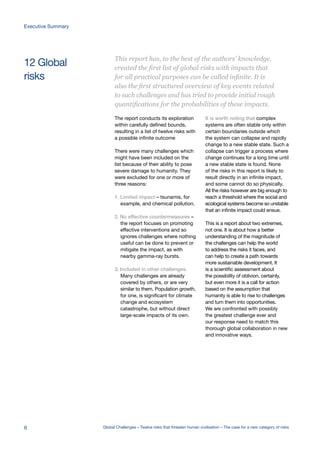
The report conducts its exploration
within carefully defined bounds,
resulting in a list of twelve risks with
a possible infinite outcome
There were many challenges which
might have been included on the
list because of their ability to pose
severe damage to humanity. They
were excluded for one or more of
three reasons:
1. Limited impact – tsunamis, for
example, and chemical pollution.
2. No effective countermeasures –
the report focuses on promoting
effective interventions and so
ignores challenges where nothing
useful can be done to prevent or
mitigate the impact, as with
nearby gamma-ray bursts.
3. Included in other challenges.
Many challenges are already
covered by others, or are very
similar to them. Population growth,
for one, is significant for climate
change and ecosystem
catastrophe, but without direct
large-scale impacts of its own.
It is worth noting that complex
systems are often stable only within
certain boundaries outside which
the system can collapse and rapidly
change to a new stable state. Such a
collapse can trigger a process where
change continues for a long time until
a new stable state is found. None
of the risks in this report is likely to
result directly in an infinite impact,
and some cannot do so physically.
All the risks however are big enough to
reach a threshold where the social and
ecological systems become so unstable
that an infinite impact could ensue.
This is a report about two extremes,
not one. It is about how a better
understanding of the magnitude of
the challenges can help the world
to address the risks it faces, and
can help to create a path towards
more sustainable development. It
is a scientific assessment about
the possibility of oblivion, certainly,
but even more it is a call for action
based on the assumption that
humanity is able to rise to challenges
and turn them into opportunities.
We are confronted with possibly
the greatest challenge ever and
our response need to match this
thorough global collaboration in new
and innovative ways.
This report has, to the best of the authors’ knowledge,
created the first list of global risks with impacts that
for all practical purposes can be called infinite. It is
also the first structured overview of key events related
to such challenges and has tried to provide initial rough
quantifications for the probabilities of these impacts.
6 Global Challenges – Twelve risks that threaten human civilisation – The case for a new category of risks
Executive Summary
Extreme
Climate Change
Nuclear WarNanotechnology
Gl
Co
Global
Pandemic
Future Bad
Global Governance
Super-volcano Sy
Bio
Extreme
Climate Change
Nuclear WarNanotechnology
e
G
C
Global
Pandemic
Future Bad
Global Governance
Super-volcano S
B
Extreme
Climate Change
Nuclear WarNanotechnology
he
G
C
Global
Pandemic
Future Bad
Global Governance
Super-volcano S
B
e
Extreme
Climate Change
Nuclear WarNanotechnologyEcological
Catastrophe
Glo
Pa
Future Bad
Global Governance
Su
Artificial
Intelligence
r
Global System
Collapse
Major Asteroid
Impact
Global
Pandemicernance
Super-volcano Synthetic
Biology
Unknown
Consequences
r
Global System
Collapse
Major Asteroid
Impact
Global
Pandemicernance
Super-volcano Synthetic
Biology
Unknown
Consequences
Global System
Collapse
Major Asteroid
Impact
Global
Pandemicrnance
Super-volcano Synthetic
Biology
Unknown
Consequences
r
Global System
Collapse
Major Asteroid
Impact
Global
Pandemicernance
Super-volcano Synthetic
Biology
Unknown
Consequences
Extreme
Climate Change
NNanotechnologyEcological
Catastrophe
F
G
Artificial
Intelligence
Extreme
Climate Change
Glo
Pa
Future Bad
Global Governance
Artificial
Intelligence
Global System
Collapse
Major Asteroid
Impact
no Synthetic
Biology
Unknown
Consequences
Extreme
Climate Change
G
P
Future Bad
Global Governance
Artificial
Intelligence
Global Challenges – Twelve risks that threaten human civilisation – The case for a new category of risks 7
Executive Summary
The goals
of the report
The first of the report’s goals –
acknowledging the existence of
risks with potential infinite impact –
seeks to help key stakeholders to
acknowledge the existence of the
category of risks that could result
in infinite impact and to show them
that we can reduce or even eliminate
most of them.
The second inspires by showing
the practical action that is taking
place today. This report seeks to
show that helping to meet these
global challenges is perhaps the
most important contribution anyone
can make today, and highlights
concrete examples to inspire a new
generation of leaders.
The third goal is to connect
different groups at every level,
so that leaders in different sectors
connect with each other to
encourage collaboration. This will
need a specific focus on financial
and security policy where significant
risks combine to demand action
beyond the incremental.
The fourth goal is to deliver actual
strategies and initiatives that
produce actual results. The report
is a first step and its success will
ultimately be measured only on how
it contributes to concrete results.
The report will have achieved its
goals when key decision-makers
recognise the magnitude of the
possible risks and our ability to
reduce or even eliminate most
of them.
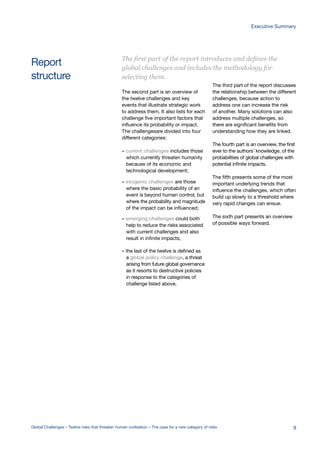
The four main goals of this report are to acknowledge,
inspire, connect and deliver.
The goals
1. to acknowledge the existence of
risks with potential infinite impact
2. to inspire by showing the practical
action that is taking place today.
3. to connect different groups at every level.
4. to deliver actual strategies and initiatives
that produce actual results.
8 Global Challenges – Twelve risks that threaten human civilisation – The case for a new category of risks
Executive Summary
Report
structure
The second part is an overview of
the twelve challenges and key
events that illustrate strategic work
to address them. It also lists for each
challenge five important factors that
influence its probability or impact.
The challengesare divided into four
different categories:
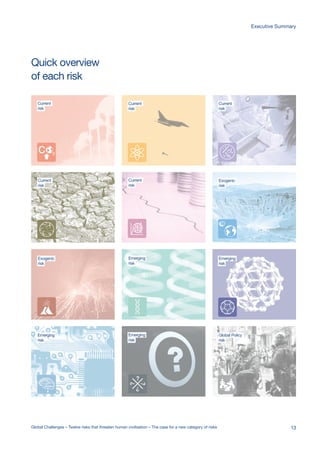
– current challenges includes those
which currently threaten humanity
because of its economic and
technological development;
– exogenic challenges are those
where the basic probability of an
event is beyond human control, but
where the probability and magnitude
of the impact can be influenced;
– emerging challenges could both
help to reduce the risks associated
with current challenges and also
result in infinite impacts;
– the last of the twelve is defined as
a global policy challenge, a threat
arising from future global governance
as it resorts to destructive policies
in response to the categories of
challenge listed above.
The third part of the report discusses
the relationship between the different
challenges, because action to
address one can increase the risk
of another. Many solutions can also
address multiple challenges, so
there are significant benefits from
understanding how they are linked.
The fourth part is an overview, the first
ever to the authors’ knowledge, of the
probabilities of global challenges with
potential infinite impacts.
The fifth presents some of the most
important underlying trends that
influence the challenges, which often
build up slowly to a threshold where
very rapid changes can ensue.
The sixth part presents an overview
of possible ways forward.
The first part of the report introduces and defines the
global challenges and includes the methodology for
selecting them.
Global Challenges – Twelve risks that threaten human civilisation – The case for a new category of risks 9
Executive Summary
A new category
of global risk
Risk Probability Impact= x
For several reasons the potentially
infinite impacts of the challenges in
this report are not as well known as
they should be. One reason is the
way that extreme impacts are often
masked by most of the theories and
models used by governments and
business today.
Climate change is a good example,
where almost all of the focus is on
the most likely scenarios and there
are few public studies that include
the low-probability high-impact
scenarios. In most reports about
climate impacts, those caused by
warming beyond five or six degrees
Celsius are omitted from tables
and graphs. Other aspects that
contribute to this relative invisibility
include the fact that extreme
impacts are difficult to translate into
monetary terms, they have a global
scope, and they often require a time-
horizon of a century or more. They
cannot be understood simply by
linear extrapolation of current trends,
and they lack historical precedents.
There is also the fact that the
measures required to significantly
reduce the probability of infinite
impacts will be radical compared to
a business-as-usual scenario.
A scientific approach requires us
to base our decisions on the whole
probability distribution.
The review of literature indicate that,
under a business as usual scenario,
new risks with potential infinite impact
is probably inseparable from the rapid
technological development in areas
like synthetic biology, nanotechnology
and AI.
Most risks are linked to increased
knowledge, economic and technical
development that has brought many
benefits. E.g. climate change is a
result from the industrial revolution
and fossil fuelbased development.
The increased potential for global
pandemics is one consequence of
an integrated global economy where
goods and services move quickly
internationally. Similar challenges can
be expected for synthetic biology,
nanotechnology and AI.
There are remedies, including
technological and institutional,
for all risks. But they will require
collaboration of a sort humanity has
not achieved before, and the creation
of systems which can deal with
problems pre-emptively. It is important
to understand that much of the
knowledge and many tools that we
have, and will develop, can be
both a risk and a solution to risks
depending on context.
The idea that there may be risks where the impact can be
described as infinite, defined as the end of human civilisation
or even human life, is not new. However, it excites relatively
little political or academic interest and the way it is treated in
popular culture makes a serious discussion harder.
10 Global Challenges – Twelve risks that threaten human civilisation – The case for a new category of risks
Executive Summary
Infinite impacts
and thresholds
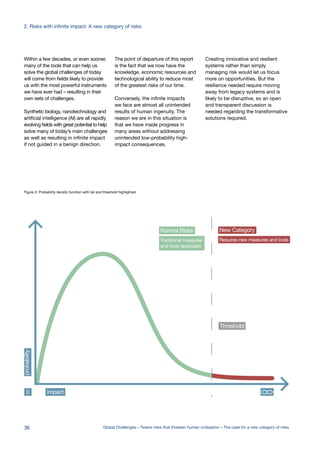
Normal Risks
Threshold
Traditional measures
and tools applicable
New Category
Requires new measures and tools
impact0
probability
Risk Probability Impact= x
Its equally clear economic component
can generate disagreement over issues
such as discounting, which the report
examines in some detail,considering
for example the role of tipping points.
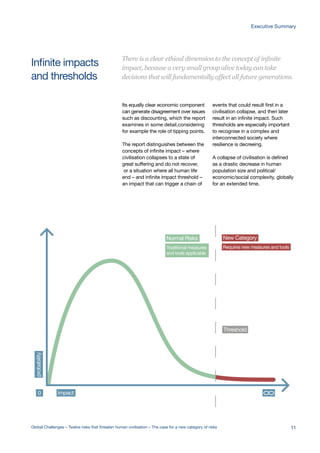
The report distinguishes between the
concepts of infinite impact – where
civilisation collapses to a state of
great suffering and do not recover,
or a situation where all human life
end – and infinite impact threshold –
an impact that can trigger a chain of
events that could result first in a
civilisation collapse, and then later
result in an infinite impact. Such
thresholds are especially important
to recognise in a complex and
interconnected society where
resilience is decreeing.
A collapse of civilisation is defined
as a drastic decrease in human
population size and political/
economic/social complexity, globally
for an extended time.
There is a clear ethical dimension to the concept of infinite
impact, because a very small group alive today can take
decisions that will fundamentally affect all future generations.
Global Challenges – Twelve risks that threaten human civilisation – The case for a new category of risks 11
Executive Summary
Methodology
Estimations of impact
Only literature where there is some estimation of impact that
indicates the possibility of an infinite impact is included.
Leading organisations’ priorities
In order to increase the probability of covering all relevant risks an overview
of leading organisations' work was conducted. This list was then compared with the initial list
and subjected to the same filter regarding the possibility to affect the probability or impact.
Possibility of addressing the risk
Possibility of addressing the risk: From the risks gathered
from literature and organisations only those where the probability
or impact can be affected by human actions are included.
Expert review
Qualitative assessment: Expert review in order to increase the
probability of covering all relevant global risks.
List of risks
Result: List of risks with potentially infinite impacts.
Relevant literature
Identification of credible sources: search relevant literature
in academic literature included in World of Knowledge and Google Scholar.
1
2
3
4
5
6
Ecological
Catastrophe
Artificial
Intelligence
Extreme
Climate Change
Nuclear WarNanotechnologyEcological
Catastrophe
Future Bad
Global Gove
Artificial
Intelligence
Ecological
Catastrophe
Artificial
Intelligence
Ecological
Catastrophe
Artificial
Intelligence
Extreme
Climate Chang
NanotechnologEcological
Catastrophe
Artificial
Intelligence
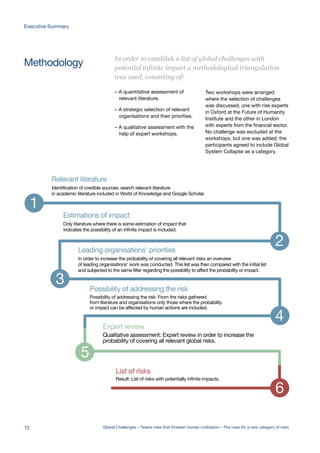
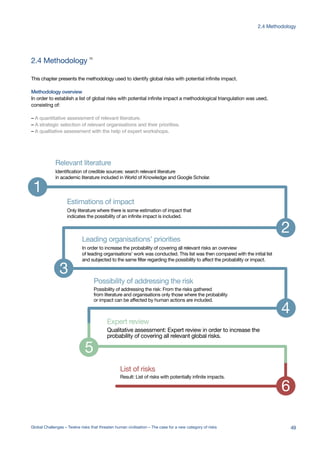
– A quantitative assessment of
relevant literature.
– A strategic selection of relevant
organisations and their priorities.
– A qualitative assessment with the
help of expert workshops.
Two workshops were arranged
where the selection of challenges
was discussed, one with risk experts
in Oxford at the Future of Humanity
Institute and the other in London
with experts from the financial sector.
No challenge was excluded at the
workshops, but one was added: the
participants agreed to include Global
System Collapse as a category.
In order to establish a list of global challenges with
potential infinite impact a methodological triangulation
was used, consisting of:
12 Global Challenges – Twelve risks that threaten human civilisation – The case for a new category of risks
Executive Summary
Quick overview
of each risk
Current
risk
risk
Extreme
Climate Change
Nuclear WarNanotechnologyEcological
Catastrophe
Global System
Collapse
Major Asteroid
Impact
Global
Pandemic
Future Bad
Global Governance
Super-volcano Synthetic
Biology
Artificial
Intelligence
Unknown
Consequences
Global Policy
risk
risk
Current
risk
Current
risk
Current
risk
Current
risk
Exogenic
risk risk
risk risk
Exogenic
Emerging Emerging
EmergingEmerging
Extreme
Climate Change
Nuclear WarNanotechnologyEcological
Catastrophe
Global System
Collapse
Major Asteroid
Impact
Global
Pandemic
Future Bad
Global Governance
Super-volcano Synthetic
Biology
Artificial
Intelligence
Unknown
Consequences
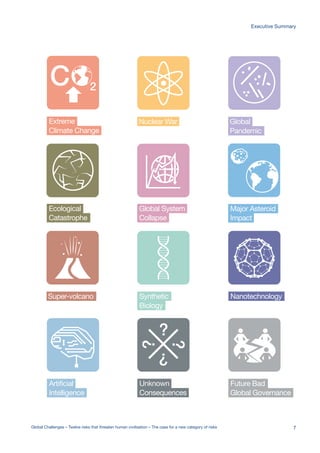
Nuclear War
Global System
Collapse
Major Asteroid
Impact
Global
Pandemic
Future Bad
Global Governance
Super-volcano Synthetic
Biology
Unknown
Consequences
Extreme
Climate Change
Nuclear WarNanotechnologyEcological
Catastrophe
Global System
Collapse
Major Asteroid
Impact
Global
Pandemic
Future Bad
Global Governance
Super-volcano Synthetic
Biology
Artificial
Intelligence
Unknown
Consequences
Extreme
Climate Change
Nuclear WarNanotechnologyEcological
Catastrophe
Global System
Collapse
Major Asteroid
Impact
Global
Pandemic
Future Bad
Global Governance
Super-volcano Synthetic
Biology
Artificial
Intelligence
Unknown
Consequences
Extreme
Climate Change
Nuclear WarNanotechnologyEcological
Catastrophe
Global System
Collapse
Major Asteroid
Impact
Global
Pandemic
Future Bad
Global Governance
Super-volcano Synthetic
Biology
Artificial
Intelligence
Unknown
Consequences
Extreme
Climate Change
Nuclear WarNanotechnologyEcological
Catastrophe
Global System
Collapse
Major Asteroid
Impact
Global
Pandemic
Future Bad
Global Governance
Super-volcano Synthetic
Biology
Artificial
Intelligence
Unknown
Consequences
Extreme
Climate Change
Nuclear WarNanotechnology
Global System
Collapse
Major Asteroid
Impact
Global
Pandemic
Future Bad
Global Governance
Super-volcano Synthetic
Biology
Unknown
Consequences
Extreme
Climate Change
Nuclear WarNanotechnologyEcological
Catastrophe
Global System
Collapse
Major Asteroid
Impact
Global
Pandemic
Future Bad
Global Governance
Super-volcano Synthetic
Biology
Artificial
Intelligence
Unknown
Consequences
Extreme
Climate Change
Nuclear WarNanotechnologyEcological
Catastrophe
Global System
Collapse
Major Asteroid
Impact
Global
Pandemic
Future Bad
Global Governance
Super-volcano Synthetic
Biology
Artificial
Intelligence
Unknown
Consequences
Extreme
Climate Change
Nuclear WarNanotechnologyEcological
Catastrophe
Globa
Collap
Global
Pandemic
Future Bad
Global Governance
Super-volcano Synthe
Biolog
Artificial
Intelligence
Extreme
Climate Change
Nuclear WarNanotechnologyEcological
Catastrophe
Global System
Collapse
Major
Impac
Global
Pandemic
Future Bad
Global Governance
Super-volcano Synthetic
Biology
Artificial
Intelligence
Unkno
Conse
Global Challenges – Twelve risks that threaten human civilisation – The case for a new category of risks 13
Executive Summary
plunge temperatures below freezing
around the globe and possibly also
destroy most of the ozone layer.
The detonations would need to
start firestorms in the targeted
cities, which could lift the soot up
into the stratosphere. The risks are
severe and recent models have
confirmed the earlier analysis. The
disintegration of the global food
supply would make mass starvation
and state collapse likely.
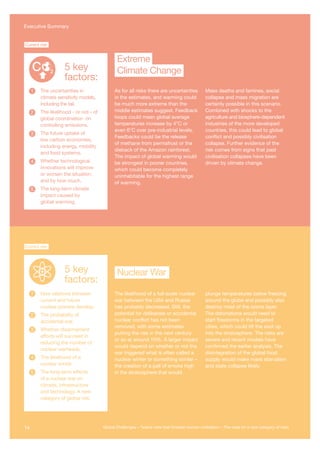
As for all risks there are uncertainties
in the estimates, and warming could
be much more extreme than the
middle estimates suggest. Feedback
loops could mean global average
temperatures increase by 4°C or
even 6°C over pre-industrial levels.
Feedbacks could be the release
of methane from permafrost or the
dieback of the Amazon rainforest.
The impact of global warming would
be strongest in poorer countries,
which could become completely
uninhabitable for the highest range
of warming.
The likelihood of a full-scale nuclear
war between the USA and Russia
has probably decreased. Still, the
potential for deliberate or accidental
nuclear conflict has not been
removed, with some estimates
putting the risk in the next century
or so at around 10%. A larger impact
would depend on whether or not the
war triggered what is often called a
nuclear winter or something similar –
the creation of a pall of smoke high
in the stratosphere that would
Mass deaths and famines, social
collapse and mass migration are
certainly possible in this scenario.
Combined with shocks to the
agriculture and biosphere-dependent
industries of the more developed
countries, this could lead to global
conflict and possibly civilisation
collapse. Further evidence of the
risk comes from signs that past
civilisation collapses have been
driven by climate change.
The uncertainties in
climate sensitivity models,
including the tail.
The likelihood - or not - of
global coordination on
controlling emissions.
The future uptake of
low carbon economies,
including energy, mobility
and food systems.
Whether technological
innovations will improve
or worsen the situation,
and by how much.
The long-term climate
impact caused by
global warming.
1
2
3
4
5
Extreme
Climate Change
5 key
factors:
Climate Change
Extreme
Current risk
How relations between
current and future
nuclear powers develop.
The probability of
accidental war.
Whether disarmament
efforts will succeed in
reducing the number of
nuclear warheads.
The likelihood of a
nuclear winter.
The long-term effects
of a nuclear war on
climate, infrastructure
and technology. A new
category of global risk.
1
2
3
4
5
5 key
factors:
Current risk
Nuclear War
Nuclear War
14 Global Challenges – Twelve risks that threaten human civilisation – The case for a new category of risks
Executive Summary
the damage and (unlike previous,
localised collapses) the whole world
is potentially at risk.
It seems plausible that some human
lifestyles could be sustained in a
relatively ecosystem independent
way, at relatively low costs. Whether
this can be achieved on a large
scale in practice, especially during
a collapse, will be a technological
challenge and whether it is something
we want is an ethical question.
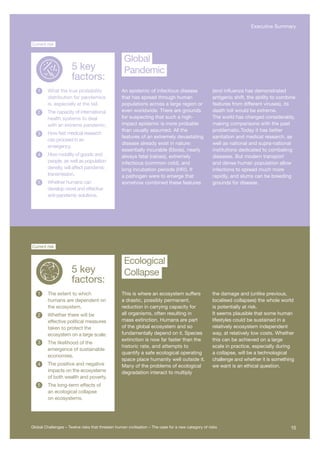
This is where an ecosystem suffers
a drastic, possibly permanent,
reduction in carrying capacity for
all organisms, often resulting in
mass extinction. Humans are part
of the global ecosystem and so
fundamentally depend on it. Species
extinction is now far faster than the
historic rate, and attempts to
quantify a safe ecological operating
space place humanity well outside it.
Many of the problems of ecological
degradation interact to multiply
The extent to which
humans are dependent on
the ecosystem.
Whether there will be
effective political measures
taken to protect the
ecosystem on a large scale.
The likelihood of the
emergence of sustainable
economies.
The positive and negative
impacts on the ecosystems
of both wealth and poverty.
The long-term effects of
an ecological collapse
on ecosystems.
1
2
3
4
5
Collapse
Ecological
Current risk
Pandemic
Global
Current risk
5 key
factors:
5 key
factors:
An epidemic of infectious disease
that has spread through human
populations across a large region or
even worldwide. There are grounds
for suspecting that such a high-
impact epidemic is more probable
than usually assumed. All the
features of an extremely devastating
disease already exist in nature:
essentially incurable (Ebola), nearly
always fatal (rabies), extremely
infectious (common cold), and
long incubation periods (HIV). If
a pathogen were to emerge that
somehow combined these features
What the true probability
distribution for pandemics
is, especially at the tail.
The capacity of international
health systems to deal
with an extreme pandemic.
How fast medical research
can proceed in an
emergency.
How mobility of goods and
people, as well as population
density, will affect pandemic
transmission.
Whether humans can
develop novel and effective
anti-pandemic solutions.
(and influenza has demonstrated
antigenic shift, the ability to combine
features from different viruses), its
death toll would be extreme.
The world has changed considerably,
making comparisons with the past
problematic.Today it has better
sanitation and medical research, as
well as national and supra-national
institutions dedicated to combating
diseases. But modern transport
and dense human population allow
infections to spread much more
rapidly, and slums can be breeding
grounds for disease.
1
2
3
4
5
Ecological
Collapse
Global
Pandemic
Global Challenges – Twelve risks that threaten human civilisation – The case for a new category of risks 15
Executive Summary
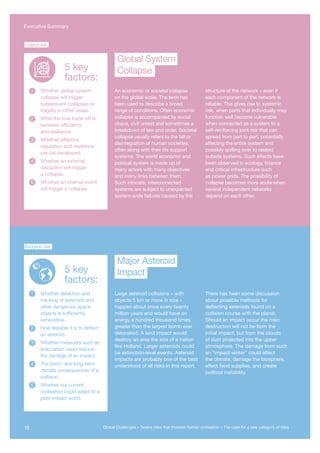
An economic or societal collapse
on the global scale. The term has
been used to describe a broad
range of conditions. Often economic
collapse is accompanied by social
chaos, civil unrest and sometimes a
breakdown of law and order. Societal
collapse usually refers to the fall or
disintegration of human societies,
often along with their life support
systems. The world economic and
political system is made up of
many actors with many objectives
and many links between them.
Such intricate, interconnected
systems are subject to unexpected
system-wide failures caused by the
structure of the network – even if
each component of the network is
reliable. This gives rise to systemic
risk, when parts that individually may
function well become vulnerable
when connected as a system to a
self-reinforcing joint risk that can
spread from part to part, potentially
affecting the entire system and
possibly spilling over to related
outside systems. Such effects have
been observed in ecology, finance
and critical infrastructure such
as power grids. The possibility of
collapse becomes more acute when
several independent networks
depend on each other.
Whether global system
collapse will trigger
subsequent collapses or
fragility in other areas.
What the true trade-off is
between efficiency
and resilience.
Whether effective
regulation and resilience
can be developed.
Whether an external
disruption will trigger
a collapse.
Whether an internal event
will trigger a collapse.
1
2
3
4
5
Collapse
Global System
Current risk
Whether detection and
tracking of asteroids and
other dangerous space
objects is sufficiently
exhaustive.
How feasible it is to deflect
an asteroid.
Whether measures such as
evacuation could reduce
the damage of an impact.
The short- and long-term
climate consequences of a
collision.
Whether our current
civilisation could adapt to a
post-impact world.
Exogenic risk
Impact
Major Asteroid
1
2
3
4
5
5 key
factors:
5 key
factors:
Large asteroid collisions – with
objects 5 km or more in size –
happen about once every twenty
million years and would have an
energy a hundred thousand times
greater than the largest bomb ever
detonated. A land impact would
destroy an area the size of a nation
like Holland. Larger asteroids could
be extinction-level events. Asteroid
impacts are probably one of the best
understood of all risks in this report.
There has been some discussion
about possible methods for
deflecting asteroids found on a
collision course with the planet.
Should an impact occur the main
destruction will not be from the
initial impact, but from the clouds
of dust projected into the upper
atmosphere. The damage from such
an “impact winter” could affect
the climate, damage the biosphere,
affect food supplies, and create
political instability.
Global System
Collapse
Major Asteroid
Impact
16 Global Challenges – Twelve risks that threaten human civilisation – The case for a new category of risks
Executive Summary
The true destructive potential
ofsyntheticbiology,especially
the tail risk.
Whether the field will be
successfully regulated, or
successfully manage to
regulate itself.
Whether the field will usher
in a new era of bio-warfare.
Whether the tools of synthetic
biology can be used
defensively to create effective
counter measures.
The dangers of relying
on synthetic biologists to
estimate the danger of
synthetic biology.
1
2
3
4
5
Biology
Synthetic
Emerging risk
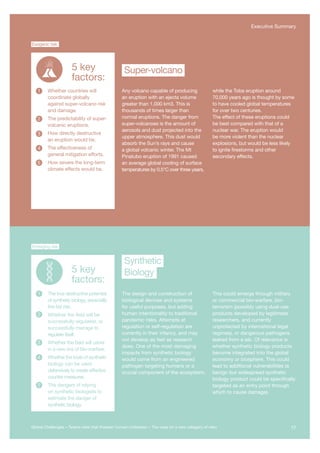
This could emerge through military
or commercial bio-warfare, bio-
terrorism (possibly using dual-use
products developed by legitimate
researchers, and currently
unprotected by international legal
regimes), or dangerous pathogens
leaked from a lab. Of relevance is
whether synthetic biology products
become integrated into the global
economy or biosphere. This could
lead to additional vulnerabilities (a
benign but widespread synthetic
biology product could be specifically
targeted as an entry point through
which to cause damage).
The design and construction of
biological devices and systems
for useful purposes, but adding
human intentionality to traditional
pandemic risks. Attempts at
regulation or self-regulation are
currently in their infancy, and may
not develop as fast as research
does. One of the most damaging
impacts from synthetic biology
would come from an engineered
pathogen targeting humans or a
crucial component of the ecosystem.
Any volcano capable of producing
an eruption with an ejecta volume
greater than 1,000 km3. This is
thousands of times larger than
normal eruptions. The danger from
super-volcanoes is the amount of
aerosols and dust projected into the
upper atmosphere. This dust would
absorb the Sun’s rays and cause
a global volcanic winter. The Mt
Pinatubo eruption of 1991 caused
an average global cooling of surface
temperatures by 0.5°C over three years,
while the Toba eruption around
70,000 years ago is thought by some
to have cooled global temperatures
for over two centuries.
The effect of these eruptions could
be best compared with that of a
nuclear war. The eruption would
be more violent than the nuclear
explosions, but would be less likely
to ignite firestorms and other
secondary effects.
Whether countries will
coordinate globally
against super-volcano risk
and damage.
The predictability of super-
volcanic eruptions.
How directly destructive
an eruption would be.
The effectiveness of
general mitigation efforts.
How severe the long-term
climate effects would be.
1
2
3
4
5
Super-volcano
Exogenic risk
5 key
factors:
5 key
factors:
Synthetic
Biology
Super-volcano
Global Challenges – Twelve risks that threaten human civilisation – The case for a new category of risks 17
Executive Summary
Intelligence
Emerging risk
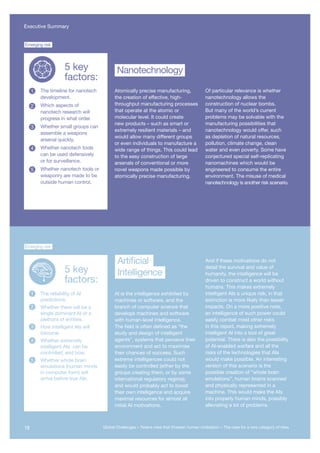
And if these motivations do not
detail the survival and value of
humanity, the intelligence will be
driven to construct a world without
humans. This makes extremely
intelligent AIs a unique risk, in that
extinction is more likely than lesser
impacts. On a more positive note,
an intelligence of such power could
easily combat most other risks
in this report, making extremely
intelligent AI into a tool of great
potential. There is also the possibility
of AI-enabled warfare and all the
risks of the technologies that AIs
would make possible. An interesting
version of this scenario is the
possible creation of “whole brain
emulations”, human brains scanned
and physically represented in a
machine. This would make the AIs
into properly human minds, possibly
alleviating a lot of problems.
Atomically precise manufacturing,
the creation of effective, high-
throughput manufacturing processes
that operate at the atomic or
molecular level. It could create
new products – such as smart or
extremely resilient materials – and
would allow many different groups
or even individuals to manufacture a
wide range of things. This could lead
to the easy construction of large
arsenals of conventional or more
novel weapons made possible by
atomically precise manufacturing.
AI is the intelligence exhibited by
machines or software, and the
branch of computer science that
develops machines and software
with human-level intelligence.
The field is often defined as “the
study and design of intelligent
agents”, systems that perceive their
environment and act to maximise
their chances of success. Such
extreme intelligences could not
easily be controlled (either by the
groups creating them, or by some
international regulatory regime),
and would probably act to boost
their own intelligence and acquire
maximal resources for almost all
initial AI motivations.
Of particular relevance is whether
nanotechnology allows the
construction of nuclear bombs.
But many of the world’s current
problems may be solvable with the
manufacturing possibilities that
nanotechnology would offer, such
as depletion of natural resources,
pollution, climate change, clean
water and even poverty. Some have
conjectured special self-replicating
nanomachines which would be
engineered to consume the entire
environment. The misuse of medical
nanotechnology is another risk scenario.
The timeline for nanotech
development.
Which aspects of
nanotech research will
progress in what order.
Whether small groups can
assemble a weapons
arsenal quickly.
Whether nanotech tools
can be used defensively
or for surveillance.
Whether nanotech tools or
weaponry are made to be
outside human control.
1
2
3
4
5
The reliability of AI
predictions.
Whether there will be a
single dominant AI or a
plethora of entities.
How intelligent AIs will
become.
Whether extremely
intelligent AIs can be
controlled, and how.
Whether whole brain
emulations (human minds
in computer form) will
arrive before true AIs.
1
2
3
4
5
Artificial
Nanotechnology
Emerging risk
5 key
factors:
5 key
factors:
Nanotechnology
Artificial
Intelligence
18 Global Challenges – Twelve risks that threaten human civilisation – The case for a new category of risks
Executive Summary
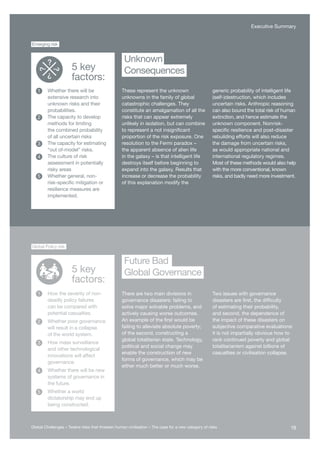
There are two main divisions in
governance disasters: failing to
solve major solvable problems, and
actively causing worse outcomes.
An example of the first would be
failing to alleviate absolute poverty;
of the second, constructing a
global totalitarian state. Technology,
political and social change may
enable the construction of new
forms of governance, which may be
either much better or much worse.
Two issues with governance
disasters are first, the difficulty
of estimating their probability,
and second, the dependence of
the impact of these disasters on
subjective comparative evaluations:
it is not impartially obvious how to
rank continued poverty and global
totalitarianism against billions of
casualties or civilisation collapse.
How the severity of non-
deadly policy failures
can be compared with
potential casualties.
Whether poor governance
will result in a collapse
of the world system.
How mass surveillance
and other technological
innovations will affect
governance.
Whether there will be new
systems of governance in
the future.
Whether a world
dictatorship may end up
being constructed.
1
2
3
4
5
generic probability of intelligent life
(self-)destruction, which includes
uncertain risks. Anthropic reasoning
can also bound the total risk of human
extinction, and hence estimate the
unknown component. Nonrisk-
specific resilience and post-disaster
rebuilding efforts will also reduce
the damage from uncertain risks,
as would appropriate national and
international regulatory regimes.
Most of these methods would also help
with the more conventional, known
risks, and badly need more investment.
These represent the unknown
unknowns in the family of global
catastrophic challenges. They
constitute an amalgamation of all the
risks that can appear extremely
unlikely in isolation, but can combine
to represent a not insignificant
proportion of the risk exposure. One
resolution to the Fermi paradox –
the apparent absence of alien life
in the galaxy – is that intelligent life
destroys itself before beginning to
expand into the galaxy. Results that
increase or decrease the probability
of this explanation modify the
Whether there will be
extensive research into
unknown risks and their
probabilities.
The capacity to develop
methods for limiting
the combined probability
of all uncertain risks
The capacity for estimating
“out of-model” risks.
The culture of risk
assessment in potentially
risky areas
Whether general, non-
risk-specific mitigation or
resilience measures are
implemented.
1
2
3
4
5
Global Governance
Future Bad
Global Policy risk
Consequences
Unknown
Emerging risk
5 key
factors:
5 key
factors:
Unknown
Consequences
Future Bad
Global Governance
Global Challenges – Twelve risks that threaten human civilisation – The case for a new category of risks 19
Executive Summary
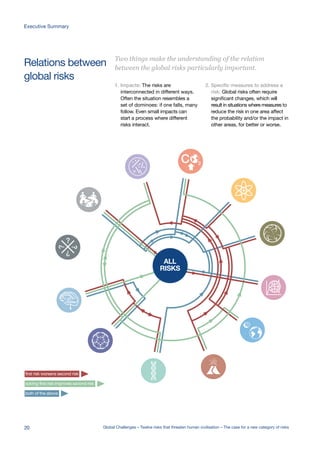
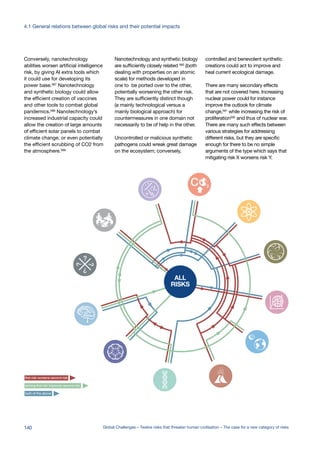
Relations between
global risks
ALL
RISKS
solving first risk improves second risk
both of the above
first risk worsens second risk
1. Impacts: The risks are
interconnected in different ways.
Often the situation resembles a
set of dominoes: if one falls, many
follow. Even small impacts can
start a process where different
risks interact.
2. Specific measures to address a
risk: Global risks often require
significant changes, which will
result in situations where measures to
reduce the risk in one area affect
the probability and/or the impact in
other areas, for better or worse.
Two things make the understanding of the relation
between the global risks particularly important.
20 Global Challenges – Twelve risks that threaten human civilisation – The case for a new category of risks
Executive Summary
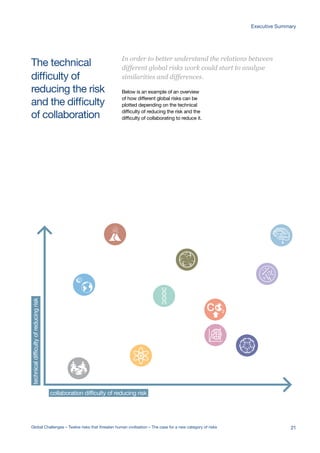
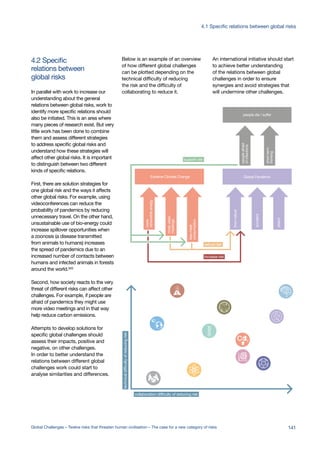
collaboration difficulty of reducing risk
technicaldifficultyofreducingrisk
The technical
difficulty of
reducing the risk
and the difficulty
of collaboration
Below is an example of an overview
of how different global risks can be
plotted depending on the technical
difficulty of reducing the risk and the
difficulty of collaborating to reduce it.
In order to better understand the relations between
different global risks work could start to analyse
similarities and differences.
Global Challenges – Twelve risks that threaten human civilisation – The case for a new category of risks 21
Executive Summary
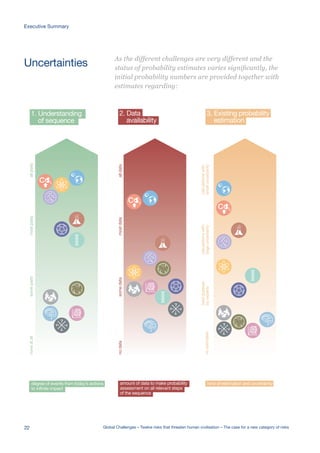
Uncertainties
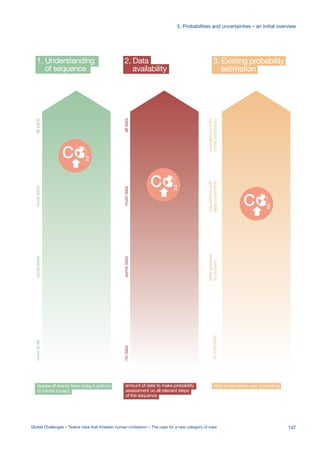
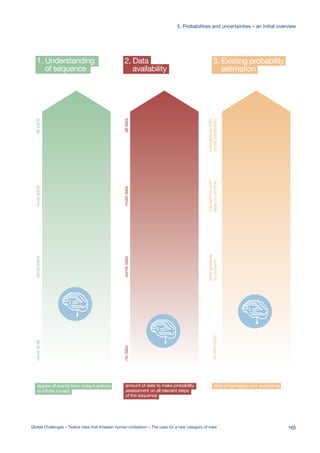
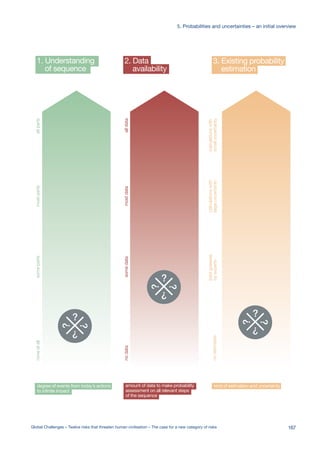
As the different challenges are very different and the
status of probability estimates varies significantly, the
initial probability numbers are provided together with
estimates regarding:
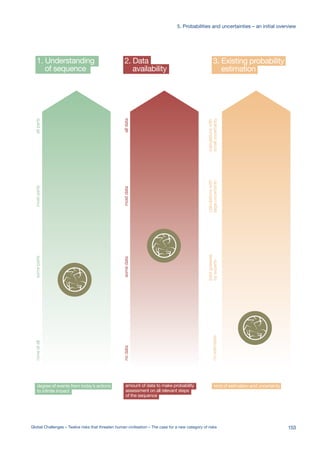
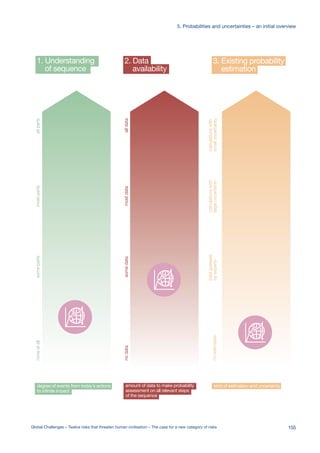
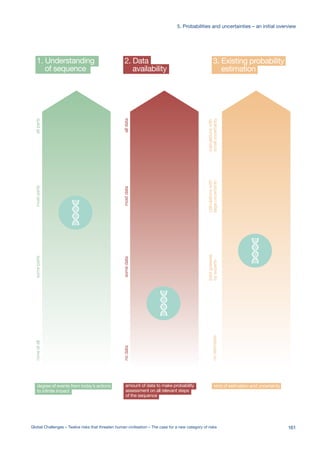
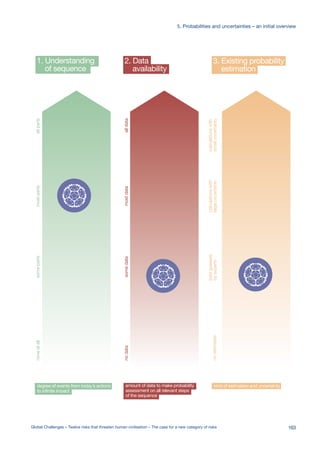
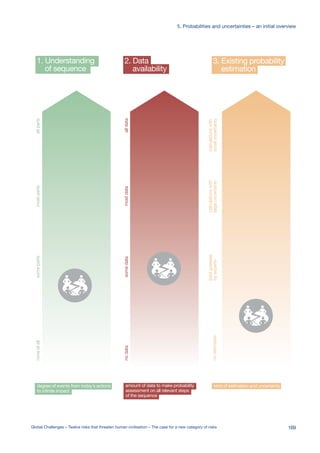
1. Understanding
of sequence
degree of events from today’s actions
to infinite impact
noneatallsomepartsmostpartsallparts
amount of data to make probability
assessment on all relevant steps
of the sequence
nodatasomedatamostdataalldata
2. Data
availability
1. Understanding
of sequence
degree of events from today’s actions
to infinite impact
noneatallsomepartsmostpartsallparts
amount of data to make probability
assessment on all relevant steps
of the sequence
nodatasomedatamostdataalldata2. Data
availability
kind of estimation and uncertainty
noestimates
bestguesses
byexperts
calculationswith
largeuncertainty
calculationswith
smalluncertainty
3. Existing probability
estimation
1. Understanding
of sequence
degree of events from today’s actions
to infinite impact
noneatallsomepartsmostpartsallparts
amount of data to make probability
assessment on all relevant steps
of the sequence
nodatasomedatamostdataalldata
2. Data
availability
1. Understanding
of sequence
degree of events from today’s actions
to infinite impact
noneatallsomepartsmostpartsallparts
amount of data to make probability
assessment on all relevant steps
of the sequence
nodatasomedatamostdataalldata
2. Data
availability
kind of estimation and uncertainty
noestimates
bestguesses
byexperts
calculationswith
largeuncertainty
calculationswith
smalluncertainty
3. Existing probability
estimation
noneatallsomepartsmostpartsallparts
degree of events from today’s actions
to infinite impact
amount of data to make probability
assessment on all relevant steps
of the sequence
nodatasomedatamostdataalldata
kind of estimation and uncertainty
noestimates
bestguesses
byexperts
calculationswith
largeuncertainty
calculationswith
smalluncertainty
n / a
22 Global Challenges – Twelve risks that threaten human civilisation – The case for a new category of risks
Executive Summary
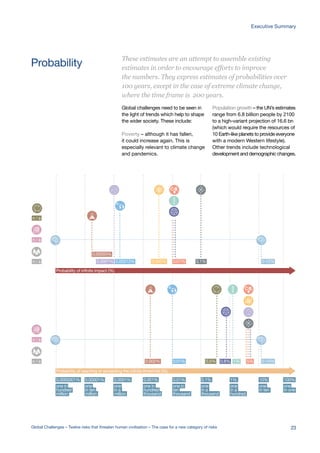
Probability
These estimates are an attempt to assemble existing
estimates in order to encourage efforts to improve
the numbers. They express estimates of probabilities over
100 years, except in the case of extreme climate change,
where the time frame is 200 years.
Global challenges need to be seen in
the light of trends which help to shape
the wider society. These include:
Poverty – although it has fallen,
it could increase again. This is
especially relevant to climate change
and pandemics.
Population growth – the UN’s estimates
range from 6.8 billion people by 2100
to a high-variant projection of 16.6 bn
(which would require the resources of
10 Earth-like planets to provide everyone
with a modern Western lifestyle).
Other trends include technological
development and demographic changes.
0.002% 0.01% 0.5% 0.8% 1% 5% 0-10%
Probability of reaching or exceeding the infinite threshold (%)
n / a
n / a
n / a
n / a
n / a
0.0000001%
one in
hundred
million
100%
one
in one
0.00001%
one
in ten
million
0.0001%
one
in a
million
0.001%
one in
hundred
thousand
0.01%
one in
ten
thousand
0.1%
one
in a
thousand
1%
one
in a
hundred
10%
one
in ten
Probability of infinite impact (%)
0.0001%
0.00003%
0.00013% 0.005% 0.01% 0.1% 0-10%
Global Challenges – Twelve risks that threaten human civilisation – The case for a new category of risks 23
Executive Summary
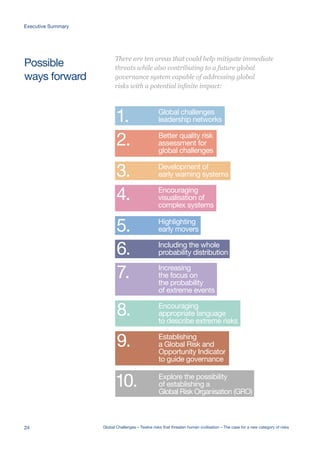
Possible
ways forward
Global challenges
leadership networks
Better quality risk
assessment for
global challenges
Development of
early warning systems
Encouraging
visualisation of
complex systems
Highlighting
early movers
Including the whole
probability distribution
Increasing
the focus on
the probability
of extreme events
Encouraging
appropriate language
to describe extreme risks
Establishing
a Global Risk and
Opportunity Indicator
to guide governance
Explore the possibility
of establishing a
Global Risk Organisation (GRO)
1.
2.
3.
4.
5.
6.
7.
8.
9.
10.
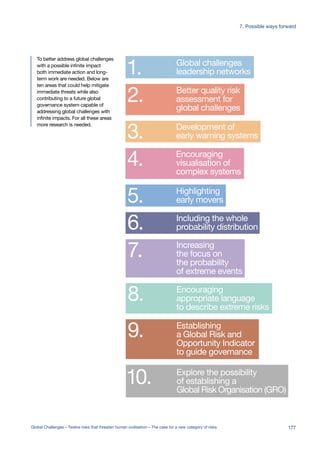
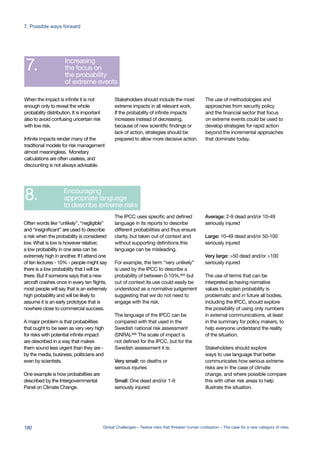
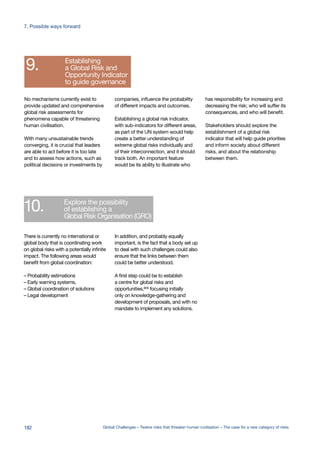
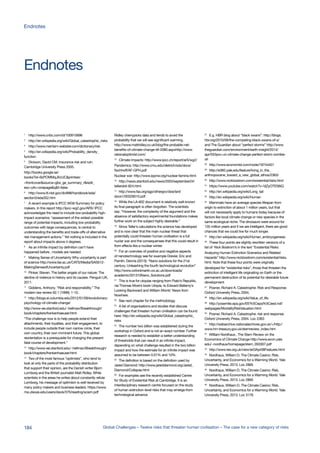
There are ten areas that could help mitigate immediate
threats while also contributing to a future global
governance system capable of addressing global
risks with a potential infinite impact:
24 Global Challenges – Twelve risks that threaten human civilisation – The case for a new category of risks
Executive Summary
Executive Summary
Global Challenges – Twelve risks that threaten human civilisation – The case for a new category of risks 25
Over the last century the world has changed in ways that humanity
has not experienced in several millennia. The changes are being caused
by the extremely rapid development of science and technology, by the
population explosion that has quadrupled the number of people on Earth,
and by a greatly improved but very resource-demanding standard of
living in developed countries.
The consequences of these changes are very diverse:
– Less poverty, better health and longer life in many countries
– Globalisation, whose most important effect is the emergence
of a shattered global community where all people’s behaviour
affects each other’s vital interests
– New global risks of previously unseen scope.
This means that we are now forced to live with the risk of various kinds of
extreme disaster with the potential of severely affecting billions of people.
Preface
Preface
26 Global Challenges – Twelve risks that threaten human civilisation – The case for a new category of risks
In this Yearbook from the Global
Challenges Foundation “risk” is
defined as the potential damage
that can be caused by an extreme
disaster multiplied by the probability
that it will occur.
For the risk of exceptional damage,
the probability of occurrence
is usually small, or very small,
compared with other risks in society,
but the effects can be absolutely
dire, meaning they must be taken
very seriously.
We do not know the exact nature of
these risks are and how they may
strike. Some are obvious, others
may sound like pure science fiction,
but they have led many scientists
to regard them as real threats - and
therefore it is best to include them in
the calculations.
With few exceptions, humans have
created these risks. There are only a
few risks were we are not the cause,
for example natural disasters like an
asteroid impact.
We could eliminate some of these
risks (e.g. nuclear war). In other
cases, all we can do is minimise the
likelihood of damage, since we have
already crossed the threshold that
can lead to serious consequences
(with climate change, for example,
where we have already emitted such
high levels of greenhouse gases that
there are small but not insignificant
likelihoods of significant damage).
For other risks we cannot affect the
likelihood of them occurring, only
minimise its damage (with super-
volcanic eruptions, for instance).
However, here we can build social
and ecological resilience so as to
reduce the damage.
For decisions concerning
countermeasures the first important
question is: What level of probability
of global catastrophes are we
prepared to accept? This question
has not yet appeared on the
political agenda. The reason is that
both scientific reports and the media
choose to focus on the most likely
outcome of these risks.
In the absence of risk analysis both
decision-makers and the public remain
blissfully unaware that the probabilities
of certain global catastrophes are
significantly higher than we would
accept in our everyday lives, where
incomparably smaller values are at stake.
Another, very important reason for
not acting against acknowledged
global risks is that they require global
responses and therefore global
decisions.
Regrettably there is no global
decision-making body capable of
that, no globally functioning legal
system, and so there is a lack of
effective tools for dealing with these
challenges. The result: the risks are
increased in the absence of effective
measures to counter them.
This report wants, on a strictly
scientific basis, to identify and
describe the global risks of extreme
disasters, and also to report the latest
developments affecting these risks
and measures to face up to them.
The Global Challenges Foundation’s
goal in this report is to accelerate
effective counter-actions against
global events with the potential for
large-scale unwanted effects by
deepening both decision makers’ and
the public’s insights into the risks, and
also to inspire both debate and well-
judged decisions on these questions:
– What probabilities of extreme
disasters are acceptable?
– Which are the optimal
countermeasures?
– How can an effective global
decision-making system be
created - with or without a global
legal system?
We are also convinced that
knowledge of these risks is not only
a prerequisite for reducing them, but
also a responsibility which we owe
to our children, grandchildren and to
all future generations. It is up to us
to decide whether these threats can
possibly be reduced or not! These
efforts do not only demand sacrifices
on our part. They also create
opportunities for everyone to make a
significant contribution to improving
the future of humanity:
– For world leaders this means
assuming their responsibility and
starting to work towards common,
global decision-making.
– Scientists need to focus their
research on areas that will help us take
effective measures against the risks.
– Companies should make
sustainability a business model.
– And there is a special opportunity
for all of us - that when choosing
our politicians and suppliers (of
goods and services), we should
consider their ambition to eliminate
or at least minimise global risks
and to create an efficient decision-
making system that can manage
these risks.
Finally, I would on behalf of the
Global Challenges Foundation extend
my sincere gratitude to both Dennis
Pamlin, editor of the report, and to all
the scientists and other experts who
have contributed their research and /
or valuable comments.
Laszlo Szombatfalvy
Founder and Chairman,
The Global Challenges Foundation
Preface
27Global Challenges – Twelve risks that threaten human civilisation – The case for a new category of risks
Ecological
Catastrophe
Artificial
Intelligence
Extreme
Climate Change
Nuclear WarNanotechnologyEcological
Catastrophe
Future Bad
Global Gove
Artificial
Intelligence
Ecological
Catastrophe
Artificial
Intelligence
Ecological
Catastrophe
Artificial
Intelligence
Extreme
Climate Chang
NanotechnologEcological
Catastrophe
Artificial
Intelligence
threaten human civilisation
1. Twelve risks that
“Tell me, and I’ll forget.
Show me, and I may remember.
Involve me, and I’ll understand“
Xunzi
1. Twelve risks threaten human civilisation
28 Global Challenges – Twelve risks that threaten human civilisation – The case for a new category of risks
Current
risk
risk
Extreme
Climate Change
Nuclear WarNanotechnologyEcological
Catastrophe
Global System
Collapse
Major Asteroid
Impact
Global
Pandemic
Future Bad
Global Governance
Super-volcano Synthetic
Biology
Artificial
Intelligence
Unknown
Consequences
Global Policy
risk
risk
Current
risk
Current
risk
Current
risk
Current
risk
Exogenic
risk risk
risk risk
Exogenic
Emerging Emerging
EmergingEmerging
Extreme
Climate Change
Nuclear WarNanotechnologyEcological
Catastrophe
Global System
Collapse
Major Asteroid
Impact
Global
Pandemic
Future Bad
Global Governance
Super-volcano Synthetic
Biology
Artificial
Intelligence
Unknown
Consequences
Nuclear War
Global System
Collapse
Major Asteroid
Impact
Global
Pandemic
Future Bad
Global Governance
Super-volcano Synthetic
Biology
Unknown
Consequences
Extreme
Climate Change
Nuclear WarNanotechnologyEcological
Catastrophe
Global System
Collapse
Major Asteroid
Impact
Global
Pandemic
Future Bad
Global Governance
Super-volcano Synthetic
Biology
Artificial
Intelligence
Unknown
Consequences
Extreme
Climate Change
Nuclear WarNanotechnologyEcological
Catastrophe
Global System
Collapse
Major Asteroid
Impact
Global
Pandemic
Future Bad
Global Governance
Super-volcano Synthetic
Biology
Artificial
Intelligence
Unknown
Consequences
Extreme
Climate Change
Nuclear WarNanotechnologyEcological
Catastrophe
Global System
Collapse
Major Asteroid
Impact
Global
Pandemic
Future Bad
Global Governance
Super-volcano Synthetic
Biology
Artificial
Intelligence
Unknown
Consequences
Extreme
Climate Change
Nuclear WarNanotechnologyEcological
Catastrophe
Global System
Collapse
Major Asteroid
Impact
Global
Pandemic
Future Bad
Global Governance
Super-volcano Synthetic
Biology
Artificial
Intelligence
Unknown
Consequences
Extreme
Climate Change
Nuclear WarNanotechnology
Global System
Collapse
Major Asteroid
Impact
Global
Pandemic
Future Bad
Global Governance
Super-volcano Synthetic
Biology
Unknown
Consequences
Extreme
Climate Change
Nuclear WarNanotechnologyEcological
Catastrophe
Global System
Collapse
Major Asteroid
Impact
Global
Pandemic
Future Bad
Global Governance
Super-volcano Synthetic
Biology
Artificial
Intelligence
Unknown
Consequences
Extreme
Climate Change
Nuclear WarNanotechnologyEcological
Catastrophe
Global System
Collapse
Major Asteroid
Impact
Global
Pandemic
Future Bad
Global Governance
Super-volcano Synthetic
Biology
Artificial
Intelligence
Unknown
Consequences
Extreme
Climate Change
Nuclear WarNanotechnologyEcological
Catastrophe
Globa
Collap
Global
Pandemic
Future Bad
Global Governance
Super-volcano Synthe
Biolog
Artificial
Intelligence
Extreme
Climate Change
Nuclear WarNanotechnologyEcological
Catastrophe
Global System
Collapse
Major
Impac
Global
Pandemic
Future Bad
Global Governance
Super-volcano Synthetic
Biology
Artificial
Intelligence
Unkno
Conse
1. Twelve risks threaten human civilisation
29Global Challenges – Twelve risks that threaten human civilisation – The case for a new category of risks
“Most risk management is really just
advanced contingency planning and
disciplining yourself to realise that,
given enough time, very low
probability events not only can happen,
but they absolutely will happen.”
Lloyd Blankfein,
Goldman Sachs CEO,
July 2013
1
A new category of risks
2. Risks with infinite impact:
30 Global Challenges – Twelve risks that threaten human civilisation – The case for a new category of risks
2. Risks with infinite impact: A new category of risks
Risk=Probability×Impact
Impacts where civilisation
collapses to a state of great
suffering and do not recover,
or a situation where all human
life end, are defined as infinite
as the result is irreversible and
lasts forever.
impact0
probability
A
B
C
D
A new group of global risks
This is a report about a limited
number of global risks – that can
be identifies through a scientific
and transparent process – with
impacts of a magnitude that pose
a threat to human civilisation, or
even possibly to all human life.
With such a focus it may surprise
some readers to find that the report’s
essential aim is to inspire action and
dialogue as well as an increased
use of the methodologies used for
risk assessment.
The real focus is not on the almost
unimaginable impacts of the risks
the report outlines. Its fundamental
purpose is to encourage global
collaboration and to use this new
category of risk as a driver
for innovation.
The idea that we face a number
of global challenges threatening
the very basis of our civilisation at
the beginning of the 21st century
is well accepted in the scientific
community, and is studied at a
number of leading universities.2
But there is still no coordinated
approach to address this group
of challenges and turn them into
opportunities for a new generation
of global cooperation and the
creation of a global governance
system capable of addressing the
greatest challenges of our time.
This report has, to the best of our
knowledge, created the first science
based list of global risks with a
potentially infinite impact where we
in extreme cases all human life could
end and has made the first attempt
to provide initial overview of the
uncertainties related to these risks
as well as rough quantifications for
the probabilities of these impacts.
What is risk?
Risk is the potential of losing something
of value, weighed against the potential
to gain something of value. Every
day we make different kinds of risk
assessments, in more or less rational
ways, when we weigh different options
against each other.
The basic idea of risk is that
an uncertainty exists regarding
the outcome and that we must
find a way to take the best
possible decision based on our
understanding of this uncertainty.3
To calculate risk the probability of
an outcome is often multiplied by
the impact. The impact in turn is in
most cases measured in economic
terms, but it can also be measured
in anything we want to avoid, such
as suffering.
At the heart of a risk assessment
is a probability distribution, often
described by a probability density
function4
; see figure X for a
graphic illustration.
The slightly tilted bell curve is a
common probability distribution,
but the shape differs and in reality is
seldom as smooth as the example.
The total area under the curve
always represents 100 percent, i.e.
all the possible outcomes fit under
the curve. In this case (A) represents
the most probable impact. With a
much lower probability it will be a
close to zero impact, illustrated by
(B). In the same way as in case B
there is also a low probability that
the situation will be very significant,
illustrated by (C).
Figure 1:Probability density function
31
2. Risks with infinite impact: A new category of risks
Global Challenges – Twelve risks that threaten human civilisation – The case for a new category of risks
impact0
probability
A
B
C
D
The impacts (A), (B) and (C) all
belong to the same category, normal
impacts: the impacts may be more
or less serious, but they can be dealt
with within the current system.
The impacts in this report are
however of a special kind. These
are impacts where everything will
be lost and the situation will not
be reversible, i.e challenges with a
potentially infinite impact
In insurance and finance this kind of
risk is called “risk of ruin”, an impact
where all capital is lost.5 This impact
is however only infinite for the
company that is losing the money.
From society’s perspective, that is
not a special category of risk.
In this report the focus is on the “risk
of ruin” on a global scale and on a
human level, in the worst case this
is when we risk the extinction of our
own species.
On a probability curve the impacts in
this report are usually at the very far
right with a relatively low probability
compared with other impacts,
illustrated by (D) in Figure X+1.
Often they are so far out on the tail
of the curve that they are not even
included in studies.
For each risk in this report the
probability of an infinite impact is
very low compared to the mos likely
outcome. Some studies even indicate
that not all risks in this report can
result in an infinite impact. But a
significant number of peer-reviewed
reports indicate that those impacts
not only can happen, but that their
probability is increasing due to
unsustainable trends.
The assumption for this report is that
by creating a better understanding
of our scientific knowledge regarding
risks with a potentially infinite impact
we can inspire initiatives that can turn
these risks into drivers for innovation.
Not only could a better
understanding of the unique
magnitude of these risks help
address the risks we face,it could
also help to create a path towards
more sustainable development.
The group of global risks discussed
in this report are so different from
most of the challenges we face that
they are hard to comprehend.
But that is also why they can help us
to build the collaboration we need
and drive the development of further
solutions that benefit both people
and the planet.
As noted above, none of the risks in
this report is likely to result directly
in an infinite impact, and some are
probably even physically incapable
of doing so. But all are so significant
that they could reach a threshold
impact able to create social and
ecological instability that could
trigger a process which could lead to
an infinite impact.
For several reasons the potentially
infinite impacts of the risks in this
report are not as well known as
they should be. One reason is the
way that extreme impacts are often
masked by most of the theories and
models used by governments and
business today.
For example, the probability of
extreme impacts is often below what
is included in studies and strategies.
The tendency to exclude impacts
below a probability of five percent
is one reason for the relative
“invisibility” of infinite impacts.
The almost standard use of a 95%
confidence interval is one reason
why low-probability high-impacts are
often ignored.6
Figure 2: Probability density function with tail highlighted
32 Global Challenges – Twelve risks that threaten human civilisation – The case for a new category of risks
2. Risks with infinite impact: A new category of risks
Ethical
These are impacts that threaten the very survival of humanity and life on Earth – and therefore can be seen as being
infinitely negative from an ethical perspective. No positive gain can outweigh even a small probability for an infinite
negative impact. Such risks require society to ensure that we eliminate these risks by reducing the impact below a
infinite impact as a top priority, or at least do everything we can to reduce the probability of these risks. As some
of these risks are impossible to eliminate today it is also important to discuss what probability can right now be
accepted for risks with a possible infinite impact.
Economic
Infinite impacts are beyond what most traditional economic models today are able to cope with. The impacts
are irreversible in the most fundamental way, so tools like cost-benefit assessment seldom make sense. To use
discounting that makes infinite impacts, which could take place 100 years or more from now and affect all future
generations, close to invisible in economic assessments, is another example of a challenge with current tools. So
while tools like cost-benefit models and discounting can help us in some areas, they are seldom applicable in the
context of infinite impacts. New tools are needed to guide the global economy in an age of potential infinite impacts.
See chapter 2.2.2 for a more detailed iscussion.
Infinite impact
The concept infinite impact refers to two aspects in particular; the terminology is not meant to imply a literally infinite impact
(with all the mathematical subtleties that would imply) but to serve as a reminder that these risks are of a different nature.
Climate change is a good example,
where almost all of the focus is
on the most likely scenarios and
there are few studies that include
the low-probability high-impact
scenarios. In most reports about
climate impacts, the impacts caused
by warming beyond five or six
degrees Celsius are even omitted
from tables and graphs even though
the IPCC own research indicate that
the probability of these impacts are
often between one and five percent,
and sometimes even higher.7
Other aspects that contribute to this
relative invisibility include the fact
that extreme impacts are difficult to
translate into monetary terms, they
have a global scope, and they often
require a time-horizon of a century
or more. They cannot be understood
simply by linear extrapolation
of current trends, and they lack
historical precedents.
There is also the fact that the
measures required to significantly
reduce the probability of infinite
impacts will be radical compared to
a business-as-usual scenario with a
focus on incremental changes.
The exact probability of a specific
impact is difficult or impossible to
estimate.8
However, the important
thing is to establish the current
magnitude of the probabilities and
compare them with the probabilities
for such impacts we cannot accept.
A failure to provide any estimate for
these riks often results in strategies
and priorities defined as though the
probability of a totally unacceptable
outcome is zero. An approximate
number for a best estimate also
makes it easier to understand that
a great uncertainty means the
actual probability can be both
much higher and much lower than
the best estimate.
It should also be stressed that
uncertainty is not a weakness in
science; it always exists in scientific
work. It is a systematic way of
understanding the limitations of the
methodology, data, etc.9
Uncertainty
is not a reason to wait to take action
if the impacts are serious. Increased
uncertainty is something that risk
experts, e.g. insurance experts and
security policy experts, interpret as a
signal for action.
A contrasting challenge is that our
cultural references to the threat of
infinite impacts have been dominated
throughout history by religious groups
seeking to scare society without any
scientific backing, often as a way
to discipline people and implement
unpopular measures. It should not
have to be said, but this report is
obviously fundamentally different as
it focuses on scientific evidence from
peer-reviewed sources.
33Global Challenges – Twelve risks that threaten human civilisation – The case for a new category of risks
2. Risks with infinite impact: A new category of risks
Roulette and Russian roulette
When probability and normal risks are discussed the example of a casino and roulette is often used. You bet
something, then spin the wheel and with a certain probability you win or lose. You can use different odds to discuss
different kinds of risk taking. These kinds of thought experiment can be very useful, but when it comes to infinite
risks these gaming analogies become problematic.
For infinite impact a more appropriate analogy is probably Russian roulette. But instead of “normal” Russian
roulette where you only bet your own life you are now also betting everyone you know and everyone you don’t
know. Everyone alive will die if you lose. There will be no second chance for anyone as there will be no future
generations; humanity will end with your loss. What probability would you accept for different sums of money if you
played this version of Russian roulette?
Most people would say that it is stupid and – no matter how low the probability is and no matter how big the
potential win is – this kind of game should not be played, as it is unethical. Many would also say that no person
should be allowed to make such a judgment, as those who are affected do not have a say. You could add that most
of those who will lose from it cannot say anything as they are not born and will never exist if you lose.
The difference between ordinary roulette and “allhumanity Russian roulette” is one way of illustrating the difference
in nature between a “normal” risk that is reversible, and a risk with an infinite impact.
An additional challenge to
acknowledging the risks in this
report is that many of the traditional
risks, including wars and violence,
have decreased even though it might
not always looks that way in media.10
So a significant number of experts
today spend a substantial amount
of time trying to explain that much
of what is discussed as dangerous
trends might not be as dangerous
as we think. For policy makers
listening only to experts in traditional
risk areas it is therefore easy to get
the impression that global risks are
becoming less of a problem.
The chain of events that could
result in infinite impacts in this
report also differ from most of the
traditional risks, as most of them
are not triggered by wilful acts,
but accidents/mistakes. Even the
probabilities related to nuclear war
in this report are to a large degree
related to inadvertent escalation.
As many of the tools to analyse and
address risks have been developed
to protect nations and states from
attacks, risks involving accidents
tend to get less attention.
This report emphasises the need for
an open and democratic process
in addressing global challenges
with potentially infinite impact.
Hence, this is a scientifically based
invitation to discuss how we as a
global community can address what
could be considered the greatest
challenges of our time.
The difficulty for individual scientists
to communicate a scientific risk
approach should however not be
underestimated. Scientists who
today talk about low-probability
impacts, that are serious but still
far from infinite, are often accused
of pessimism and scaremongering,
even if they do nothing but highlight
scientific findings.11
To highlight
infinite impacts with even lower
probability can therefore be
something that a scientist who care
about his/her reputation want to avoid.
In the media it is still common
to contrast the most probable
climate impact with the probability
that nothing, or almost nothing,
will happen. The fact that almost
nothing could happen is not wrong
in most cases, but it is unscientific
and dangerous if different levels of
probability are presented as equal.
The tendency to compare the
most probable climate impact
with the possibility of a low or no
impact also results in a situation
where low-probability high-impact
outcomes often are totally ignored.
An honest and scientific approach
is to, whenever possible, present
the whole probability distribution
and pay special attention to
unacceptable outcomes.
The fact that we have challenges
that with some probability might be
infinite and therefore fundamentally
irreversible is difficult to comprehend,
and physiologically they are
something our brains are poorly
equipped to respond to, according to
evolutionary psychologists.12
It is hard for us as individuals to
grasp that humanity for the first
time in its history now has the
capacity to create such catastrophic
outcomes. Professor Marianne
Frankenhaeuser, former head of
the psychology division, Karolinska
34 Global Challenges – Twelve risks that threaten human civilisation – The case for a new category of risks
2. Risks with infinite impact: A new category of risks
Institute, Stockholm, put it this way:
“Part of the answer is to be found in
psychological defence mechanisms.
The nuclear threat is collectively
denied, because to face it would
force us to face some aspects of the
world’s situation which we do not
want to recognise.” 13
This psychological denial may be
one reason why there is a tendency
among some stakeholders to
confuse “being optimistic” with
denying what science is telling us,
and ignoring parts of the probability
curve.14 Ignoring the fact that there is
strong scientific evidence for serious
impacts in different areas, and
focusing only on selected sources
which suggest that the problem may
not be so serious, is not optimistic. It
is both unscientific and dangerous.15
A scientific approach requires us
to base our decisions on the whole
probability distribution. Whether it is
possible to address the challenge or
not is the area where optimism and
pessimism can make people look at
the same set of data and come to
different conclusions.
Two things are important to keep
in mind: first, that there is always a
probability distribution when it comes
to risk; second, that there are two
different kinds of impacts that are of
interest for this report. The probability
distribution can have different shapes
but in simplified cases the shape
tends to look like a slightly modified
clock (remember figure X).
In the media it can sound as though
experts argue whether an impact,
for example a climate impact or a
pandemic, will be dangerous or not.
But what serious experts discuss is
the probability of different oucomes.
They can disagree on the shape of
the curve or what curves should be
studied, but not that a probability
curve exist. With climate change this
includes discussions about how how
sensitive the climate is, how much
greenhouse gas will be emitted, and
what impacts that different warmings
will result in.
Just as it is important not to ignore
challenges with potentially infinite
impacts, it is also important not to
use them to scare people. Dramatic
images and strong language are best
avoided whenever possible, as this
group of risks require sophisticated
strategies that benefit from rational
arguments. Throughout history
we have seen too many examples
when threats of danger have been
damagingly used to undermine
important values.
The history of infinite impacts:
The LA-602 document
The understanding of infinite impacts
is very recent compared with most
of our institutions and laws. It is only
70 years ago that Edward Teller,
one of the greatest physicists of his
time, with his back-of-the-envelope
calculations, produced results that
differed drastically from all that
had gone before. His calculations
indicated that the explosion of a
nuclear bomb – a creation of some
of the brightest minds on the planet,
including Teller himself – could result
in a chain reaction so powerful that it
would ignite the world’s atmosphere,
thereby ending human life on Earth.16
Robert Oppenheimer, who led the
Manhattan Project to develop the
nuclear bomb, halted the project to
see whether Teller’s calculations were
correct.17
The resulting document, LA-
602: Ignition of the Atmosphere with
Nuclear Bombs, concluded that Teller
was wrong, But the sheer complexity
drove them to end their assessment
by writing that “further work on the
subject [is] highly desirable”.18
The LA-602 document can be
seen as the first scientific global
risk report addressing a category
of risks where the worst possible
impact in all practical senses is
infinite.19
Since the atomic bomb
more challenges have emerged with
potential infinite impact. Allmost all
of these new challenges are linked to
the increased knowledge, economic
and technical development that
has brought so many benefits. For
example, climate change is the
result of the industrial revolution and
development that was, and still is,
based heavily on fossil fuel.
The increased potential for global
pandemics is the result of an
integrated global economy where
goods and services move quickly
around the world, combined
with rapid urbanisation and high
population density.
In parallel with the increased number
of risks with possible infinite impact,
our capacity to analyse and solve
them has greatly increased too.
Science and technology today
provide us with knowledge and
tools that can radically reduce the
risks that historically have been
behind major extinctions, such as
pandemics and asteroids.
Recent challenges like climate
change, and emerging challenges
like synthetic biology and
nanotechnology, can to a large
degree be addressed by smart use
of new technologies, new lifestyles
and institutional structures. It will be
hard as it will require collaboration
of a kind that we have not seen
before. It will also require us to
create systems that can deal with
the problems before they occur. The
fact that the same knowledge and
tools can be both a problem and a
solution is important to understand
to avoid polarisation.
35Global Challenges – Twelve risks that threaten human civilisation – The case for a new category of risks
2. Risks with infinite impact: A new category of risks
Normal Risks
Threshold
Traditional measures
and tools applicable
New Category
Requires new measures and tools
impact0
probability
Risk Probability Impact= x
Within a few decades, or even sooner,
many of the tools that can help us
solve the global challenges of today
will come from fields likely to provide
us with the most powerful instruments
we have ever had – resulting in their
own sets of challenges.
Synthetic biology, nanotechnology and
artificial intelligence (AI) are all rapidly
evolving fields with great potential to help
solve many of today’s main challenges
as well as resulting in infinite impact
if not guided in a benign direction.
The point of departure of this report
is the fact that we now have the
knowledge, economic resources and
technological ability to reduce most
of the greatest risks of our time.
Conversely, the infinite impacts
we face are almost all unintended
results of human ingenuity. The
reason we are in this situation is
that we have made progress in
many areas without addressing
unintended low-probability high-
impact consequences.
Figure 3: Probability density function with tail and threshold highlighted
Creating innovative and resilient
systems rather than simply
managing risk would let us focus
more on opportunities. But the
resilience needed require moving
away from legacy systems and is
likely to be disruptive, so an open
and transparent discussion is
needed regarding the transformative
solutions required.
36 Global Challenges – Twelve risks that threaten human civilisation – The case for a new category of risks
2. Risks with infinite impact: A new category of risks
2.1 Report structure
The first part of the report is an
introduction where the global risks
with potential infinite impact are
introduced and defined. This part
also includes the methodology for
selecting these risks, and presents
the twelve risks that meet this
definition. Four goals of the report
are also presented, under the
headings “acknowledge”, “inspire”,
“connect” and “deliver”.
The second part is an overview of
the twelve global risks and key
events that illustrate some of the
work around the world to address
them. For each challenge five
important factors that influence the
probability or impact are also listed.
The risks are divided into four
different categories depending on
their characteristics.
“Current challenges” is the first
category and includes the risks that
currently threaten humanity due to
our economic and technological
development - extreme climate
change, for example, which depends
on how much greenhouse gas we emit.
“Exogenic challenges” includes
risks where the basic probability
of an event is beyond human
control, but where the probability
and magnitude of the impact can
be influenced - asteroid impacts,
for example, where the asteroids’
paths are beyond human control
but an impact can be moderated by
either changing the direction of the
asteroid or preparing for an impact.
“Emerging challenges” includes
areas where technological
development and scientific
assessment indicate that they
could both be a very important
contribution to human welfare and
help reduce the risks associated
with current challenges, but could
also result in new infinite impacts.20
AI, nanotechnology and synthetic
biology are examples.
“Global policy challenge” is
a different kind of risk. It is a
probable threat arising from future
global governance as it resorts to
destructive policies, possibly in
response to the other challenges
listed above.
The third part of the report
discusses the relationship
between the different risks. Action
to reduce one risk can increase
another, unless their possible links
are understood. Many solutions
are also able to address multiple
risks, so there are significant
benefits from understanding how
one relates to others. Investigating
these correlations could be a start,
but correlation is a linear measure
and non-linear techniques may
be more helpful for assessing the
aggregate risk.
The fourth part is an overview, the
first ever to our knowledge, of the
uncertainties and probabilities of
global risks with potential infinite
impacts. The numbers are only
rough estimated and meant to be
a first step in a dialogue where
methodologies are developed and
estimates refined.
The fifth part presents some of
the most important underlying
trends that influence the global
challenges, which often build up
slowly until they reach a threshold
and very rapid changes ensue.
The sixth and final part presents an
overview of possible ways forward.
37Global Challenges – Twelve risks that threaten human civilisation – The case for a new category of risks
2.1 Report structure
2.2 Goals But we now face the possibility that
even tools created with the best of
intentions can have a darker side
too, a side that may threaten human
civilisation, and conceivably the
continuation of human life.
This is what all decision-makers need
to recognise. Rather than succumbing
to terror, though, we need to
acknowledge that we can let the
prospect inspire and drive us forward.
Establish a category of risks with
possible infinite impact
Before anything significant can
happen regarding global risks with
possible infinite impacts, their
existence must be acknowledged.
Rapid technological development
and economic growth have delivered
unprecedented material welfare to
billions of people in a veritable tide
of utopias.21
Show concrete action that is taking
place today
This report seeks to show that it is
not only possible to contribute to
reducing these risks, but that it is
perhaps the most important thing
anyone can spend their time on.
It does so by combining information
about the risks with information about
individuals and groups who has
made a significant contribution by
turning challenges into opportunities.
By highlighting concrete examples
the report hopes to inspire a new
generation of leaders.
Goal 1: Acknowledge
That key stakeholders,
influencing global challenges,
acknowledge the existence of
the category of risks that could
result ininfinite impact. They
should also recognice that the
list of risks that belong to this
category should be revised as
new technologies are developed
and our knowledge increases.
Regardless of the risks included,
the category should be given
special attention in all processes
and decisions of relevance. The
report also seeks to demonstrate
to all key stakeholders that we
have the capacity to reduce, or
even eliminate, most of the risks
in this category.
Goal 2: Inspire
That policy makers inspire
action by explaining how the
probabilities and impacts
can be reduced and turned
into opportunities. Concrete
examples of initiatives should
be communicated in different
networks in order to create
ripple effects, with the long-term
goal that all key stakeholders
should be inspired to turn these
risks into opportunities for
positive action.
38 Global Challenges – Twelve risks that threaten human civilisation – The case for a new category of risks
2.2 Goals
Support new meetings between
interested stakeholders
The nature of these risks spans
countries and continents; they
require action by governments and
politicians, but also by companies,
academia, NGOs, and many other
groups. The magnitude of the
possible impacts requires not only
leaders to act but above all new
models for global cooperation and
decision-making to ensure delivery.
The need for political leadership is
therefore crucial.
Even with those risks where many
groups are involved, such as climate
change and pandemics, very few
today address the possibility of
infinite impact aspects.
Even fewer groups address the links
between the different risks.
There is also a need to connect
different levels of work, so that local,
regional, national and international
efforts can support each other when
it comes to risks with potential
infinite impacts.
Identify and implement strategies
and initiatives
Reports can acknowledge, inspire
and connect, but only people can
deliver actual results. The main
focus of the report is to show that
actual initiatives need to be taken
that deliver actual results.
Only when the probability of an
infinite impact becomes acceptably
low, very close to zero, and/or when
the maximum impact is significantly
reduced, should we talk about
real progress.
In order to deliver results it is
important to remember that global
governance to tackle these risks is
the way we organise society in order
to address our greatest challenges.
It is not a question of establishing a
“world government”, it is about the
way we organise ourselves on all
levels, from the local to the global.
The report is a first step and should
be seen as an invitation to all
responsible parties that can affect
the probability and impact of risks
with potentially infinite impacts.
But its success will ultimately be
measured only on how it contributes
to concrete results.
Goal 3: Connect
That leaders in different sectors
connect with each other to
encourage collaboration. A
specific focus on financial and
security policy where significant
risks combine to demand
action beyond the incremental
is required.
Goal 4: Deliver
That concrete strategies are
developed that allow key
stakeholders to identify, quantify
and address global challenges
as well as gather support for
concrete steps towards a well-
functioning global governance
system, This would include
tools and initiatives that can
help identify, quantify and
reduce risks with possible
Infinite impacts.
39Global Challenges – Twelve risks that threaten human civilisation – The case for a new category of risks
2.2 Goals
and infinite impact
2.3 Global challenges
impact” as a concept?
2.3.2 Why use “infinite
infinite impact
2.3.1 Definition of
This chapter first introduces the
concept of infinite impact. It then
describes the methodology used to
identify challenges with an infinite
impact. It then presents risks with
potentially infinite impact that the
methodology results in.
The specific criterion for including a
risk in this report is that well-sourced
science shows the challenge can have
the following consequences: 22
1. Infinite impact: When civilisation
collapses to a state of great
suffering and do not recover, or a
situation where all human life end.
The existence of such threats is
well attested by science.23
2. Infinite impact threshold – an
impact that can trigger a chain of
events that could result first in a
civilisation collapse, and then later
result in an infinite impact. Such
thresholds are especially important
to recognise in a complex and
interconnected society where
resilience is decreeing.24
A collapse of civilisation is defined as a
drastic decrease in human population
size and political/ economic/social
complexity, globally for an extended
time.25
The above definition means the
list of challenges is not static. When
new challenges emerge, or current
ones fade away, the list will change.
An additional criterion for including
risks in this report is “human influence”.
Only risks where humans can influence
either the probability, the impact, or
both, are included. For most risks both
impact and probability can be affected,
for example with
nuclear war, where the number/size of
weapons influences the impact and
tensions between countries affect
the probability.
Other risks, such as a supervolcano,
are included as it is possible to affect
the impact through various mitigation
methods, even if we currently cannot
affect the probability. Risks that are
susceptible to human influence are
indirectly linked, because efforts to
address one of them may increase or
decrease the likelihood of another.
The concept of infinity was chosen
as it reflects many of the challenges,
especially in economic theory, to
addressing these risks as well as the
need to question much of our current
way of thinking.
The concept of a category of risks
based on their extreme impact is
meant to provide a tool to distinguish
one particular kind of risk from others.
The benefit of this new concept
should be assessed based on two
things. First, does the category exist,
and second, is the concept helpful in
addressing these risks?
The report has found ample
evidence that there are risks with
an impact that can end human
civilisation and even all human life.
The report further concludes that
a new category of risk is not only
meaningful but also timely. We live
in a society where global risks with
potentially infinite impacts increase
in numbers and probability according
to a number of studies. Looking
ahead many emerging technologies,
which will certainly provide beneficial
results, can result in an increased
probability of infinite impacts.26
Over the last few years a greater
understanding of low probability or
unknown probability has helped more
people to understand the importance
of looking beyond the most probable
scenarios. Concepts like “black
swans” and “perfect storms” are
now part of mainstream policy and
business language.27
Greater understanding of the
technology and science of complex
systems has also resulted in a new
understanding of potentially disruptive
events. Humans now have such an
impact on the planet that the term
“the anthropocene” is being used,
even by mainstream media like The
Economist.28 The term was introduced
in the 90s by the Nobel Prize winner
Paul Crutzen to describe how humans
are now the dominant force changing
the Earth’s ecosystems.29
The idea to establish a well category
of risks that focus on risks with a
possible infinite impact that can be
used as a practical tool by policy
makers is partly inspired by Nick
Bostrom’s philosophical work and his
introduction of a risk taxonomy that
includes an academic category called
“existential risks”.30
Introducing a category with risks
that have a potentially infinite
impact is not meant to be a
mathematical definition; infinity is a
thorny mathematical concept and
nothing in reality can be infinite.31
It
is meant to illustrate a singularity,
when humanity is threatened, when
many of the tools used to approach
most challenges today become
problematic, meaningless, or even
counterproductive.
The concept of an infinite impact
highlights a unique situation where
humanity itself is threatened and the
very idea of value and price collapses
from a human perspective, as the
40 Global Challenges – Twelve risks that threaten human civilisation – The case for a new category of risks
2.3 Global challenges and infinite impact
Life Value
The following estimates have been applied to the value of life in the US. The estimates are either for one year of
additional life or for the statistical value of a single life.
– $50,000 per year of quality life (international standard most private and government-run health insurance plans
worldwide use to determine whether to cover a new medical procedure)
– $129,000 per year of quality life (based on analysis of kidney dialysis procedures by Stefanos Zenios and
colleagues at Stanford Graduate School of Business)
– $7.4 million (Environmental Protection Agency)
– $7.9 million (Food and Drug Administration)
– $6 million (Transportation Department)
– $28 million (Richard Posner based on the willingness to pay for avoiding a plane crash)
Source: Wikipedia: Value of life http://en.wikipedia.org/wiki/Value_of_life
US EPA: Frequently Asked Questions on Mortality Risk Valuation
http://yosemite.epa.gov/EE%5Cepa%5Ceed.nsf/webpages/MortalityRiskValuation.html
Posner, Richard A. Catastrophe: risk and response. Oxford University Press, 2004
price of the last humans also can be
seen to be infinite. This is not to say
that those traditional tools cannot still
be useful, but with infinite impacts
we need to add an additional set of
analytical tools.
Some of the risks, including nuclear
war, climate change and pandemics,
are often included in current risk
overviews, but in many cases
their possible infinite impacts are
excluded. The impacts which are
included are in most cases still very
serious, but only the more probable
parts of the probability distributions
are included, and the last part of the
long tail – where the infinite impact
is found - is excluded.32
Most risk reports do not differentiate
between challenges with a limited
impact and those with a potential
infinite impact. This is dangerous, as it
can mean resources are spent in ways
that increase the probability of an
infinite impact.
Ethical aspects of infinite impact
The basic ethical aspect of infinite
impact is this: a very small group
alive today can take decisions
that will fundamentally affect all
future generations.
“All future generations” is not a
concept that is often discussed, and
for good reason. All through human
history we have had no tools with a
measurable global impact for more
than a few generations. Only in the
last few decades has our potential
impact reached a level where all
future generations can be affected,
for the simple reason that we now
have the technological capacity to
end human civilisation.
If we count human history from the
time when we began to practice
settled agriculture, that gives us
about 12,000 years.33
If we make a
moderate assumption that humanity
will live for at least 50 million more
years34
our 12,000-year history so far
represents 1/4200, or 0.024%, of our
potential history. So our generation
has the option of risking everything
and annulling 99.976% of our
potential history. Comparing 0.024%
with the days of a person living to 100
years from the day of conception,
this would equal less than nine
days and is the first stage of human
embryogenesis, the germinal stage.35
Two additional arguments to treat
potentially infinite impacts as a
separate category are: 36
1. An approach to infinite impacts
cannot be one of trial-and-error,
because there is no opportunity
to learn from errors. The reactive
approach – see what happens,
limit damage, and learn from
experience – is unworkable. Instead
society must be proactive. This
requires foresight to foresee new
types of threat and willingness to
take decisive preventative action
and to bear the costs (moral and
economic) of such actions.
41Global Challenges – Twelve risks that threaten human civilisation – The case for a new category of risks
2.3 Global challenges and infinite impact
2. We cannot necessarily rely on
the institutions, morality, social
attitudes or national security
policies that developed from our
experience of other sorts of risk.
Infinite impacts are in a different
category. Institutions and individuals
may find it hard to take these risks
seriously simply because they lie
outside our experience. Our collective
fear-response will probably be ill-
calibrated to the magnitude of threat.
Economic aspects of infinite
impact and discounting
In today’s society a monetary value
is sometimes ascribed to human life.
Some experts use this method to
estimate risk by assigning a monetary
value to human extinction.37
We have to remember that the
monetary values placed on a human
life in most cases are not meant
to suggest that we have actually
assigned a specific value to a life.
Assigning a value to a human life is
a tool used in a society with a limited
supply of resources or infrastructure
(ambulances, perhaps) or skills. In
such a society it is impossible to save
every life, so some trade-off must
be made.38 The US Environmental
Protection Agency explains its use like
this: “The EPA does not place a dollar
value on individual lives. Rather, when
conducting a benefit-cost analysis
of new environmental policies, the
Agency uses estimates of how much
people are willing to pay for small
reductions in their risks of dying from
adverse health conditions that may be
caused by environmental pollution.” 39
The fact that monetary values for
human lives can help to define
priorities when it comes to smaller
risks does not mean that they are
suitable for quite different uses.
Applying a monetary value to the
whole human race makes little
sense to most people, and from an
economic perspective it makes no
sense. Money helps us to prioritise,
but with no humans there would be no
economy and no need for priorities.
Ignoring, or discounting, future
generations is actually the only way
to avoid astronomical numbers
for impacts that may seriously
affect every generation to come. In
Catastrophe: Risk and Response,
Richard Posner provides a cost
estimate, based on the assumption
that a human life is worth $50,000,
resulting in a $300 tn cost for the
whole of humanity, assuming a
population of six billion. He then
doubles the population number
to include the value of all future
generations, ending up with $600 tn,
while acknowledging that “without
discounting, the present value of the
benefits of risk-avoidance measures
would often approach infinity for the
type of catastrophic risk with which
this book is concerned.” 40
Discounting for risks that include
the possibility of an infinite impact
differs from risk discounting for less
serious impacts. For example the
Stern Review41 prompted a discussion
between its chief author, Nicholas
Stern, and William Nordhaus,42 each
of whom argued for different discount
levels using different arguments. But
neither discussed a possible infinite
climate impact. An overview of the
discussion by David Evans of Oxford
Brookes University highlighted some
of the differing assumptions.43
Two things make infinite impacts special
from a discounting perspective. First,
there is no way that future generations
can compensate for the impact, as they
will not exist. Second, the impact is
something that is beyond an individual
preference, as society will no longer exist.
Discounting is undertaken to allocate
resources in the most productive way.
In cases that do not include infinite
impacts, discounting “reflects the
fact that there are many high-yield
investments that would improve the
quality of life for future generations.
The discount rate should be set so
that our investable funds are devoted
to the most productive uses.” 44
When
there is a potential infinite impact the
focus is no longer on what investments
have the best rate of return, it is about
avoiding the ultimate end.
While many economists shy away
from infinite impacts those exploring
the potential extreme impacts of
global challenges often assume
infinite numbers to make their point.
Nordhaus for example writes that “the
sum of undiscounted anxieties would
be infinite (i.e. equal to 1 + 1 +1 + … =
∞). In this situation, most of us would
dissolve in a sea of anxiety about all
the things that could go wrong for
distant generations from asteroids,
wars, out-of-control robots, fat tails,
smart dust and other disasters.” 45
It is interesting that Nordhaus
himself provides very good graphs
that show why the most important
factor when determining actions
is a possible threshold (see below
Figure X and X+1). Nordhaus was
discussing climate change, but the
role of thresholds is similar for most
infinite impacts. The first figure
is based on traditional economic
approaches which assume that
Nature has no thresholds; the second
graph illustrates what happens with
the curve when a threshold exists.
As Nordhaus also notes, it is hard
to establish thresholds, but if they
are significant all other assumptions
become secondary. The challenge
that Nordhaus does not address, and
which is important especially with
climate change, is that thresholds
become invisible in economic
calculations if they occur far into the
future, even if it is current actions that
42 Global Challenges – Twelve risks that threaten human civilisation – The case for a new category of risks
2.3 Global challenges and infinite impact
total discounted
discounted damages
abatement (limited part.)
0
1
2
3
4
5
6
1 2 3 4 5 6
Global temperature limit (°C)
Shareofglobalincome(%)
total discounted
damages with ripping costs
abatement (limited part.)
0
4
8
12
16
20
1 2 3 4 5 6
Global temperature limit (°C)
Shareofglobalincome(%)
unbalance the system and eventually
push it over the threshold.46
Note that these dramatic illustrations
rest on assumptions that the
thresholds are still relatively benign,
not moving us beyond tipping points
which result in an accelerated release
of methane that could result in a
temperature increase of more than 8 °C,
possibly producing infinite impacts.47
Calculating illustrative numbers
By including the welfare of future
generations, something that is
important when their very existence
is threatened, economic discounting
becomes difficult. In this chapter some
illustrative numbers are provided to
indicate the order of magnitude of the
values that calculations provide when
traditional calculations also include
future generations. These illustrative
calculations are only illustrative as the
timespans that must be used make all
traditional assumptions questionable
to say the least. Still as an indicator for
why infinite impact might be a good
approximation they might help.
As a spieces that can manipulate
our environment it could be argued
that the time the human race will be
around, if we do not kill ourselves,
can be estimated to be between
1-10 million years – the typical time
period for the biological evolution of a
successful species48 – and one billion
years, the inhabitable time of Earth.49
Figure 5: Nordhaus, The Climate Casino: Climate policy with a sharp tipping point at 3.5°C. This shows that the
optimal temperature increase is very close to the threshold. It is constrained on the low side by abatement costs
and on the high side by the sharp increase in damages
Figure 4: Nordhaus, The Climate Casino: Total cost of different targets assuming limited participation and
discounting of future incomes.
43Global Challenges – Twelve risks that threaten human civilisation – The case for a new category of risks
2.3 Global challenges and infinite impact
threshold (IIT)
2.3.3 Infinite impact
These numbers can be multiplied
many times if a more philosophical
and technology-optimistic scenario is
assumed for how many lives we should
include in future generations. The
following quote is from an article by
Nick Bostrom in Global Policy Journal:
“However, the relevant figure is not
how many people could live on
Earth but how many descendants
we could have in total. One lower
bound of the number of biological
human life-years in the future
accessible universe (based on
current cosmological estimates)
is 1034 years. Another estimate,
which assumes that future minds
will be mainly implemented in
computational hardware instead
of biological neuronal wetware,
produces a lower bound of 1054
human-brain-emulation subjective
life-years.” 54
Likewise the value of a life, $28
million, a value that is based on an
assessment of how individual chose
when it comes to flying, can be seen
a much to small. This value is based
on how much we value our own lives
on the margin, it is reasonable to
assume that the value would be higher
than only a multiplication of our own
value if we also considered the risk of
loosing our family, everyone we know,
as well as everyone on the planet. In
the same way as the cost increase
when a certain product is in short
supply, the cost of the last humans
could be assumed to be very high, if
not infinite.
Obviously, the very idea to put a
price on the survival of humanity
can be questioned for good
reasons, but if we still want to use
a number the $28 million per life
should at least be considered as a
significant underestimation.
For those that are reluctant or unable
to use infinity in calculations and
are in need of a number for their
formulas, $86 sextillion could be a
good initial start for the cost of infinite
impacts. But it is important to note
that this number might be orders of
magnitude smaller than an estimate
which actually took into account a
more correct estimation of the number
of people that should be included in
future generations as well as the price
that should be assigned to the loss of
the last humans.
As we address very complex systems,
such as human civilisation and global
ecosystems, a concept as important
as infinite impact in this report is that
of infinity impact threshold. This is the
impact level that can trigger a chain
of events that results in the end of
human civilisation.
The infinite impact threshold (IIT)
concept represents the idea that
long before an actual infinite impact
is reached there is a tipping point
where it, with some probability, is no
longer possible to reverse events.
So instead of focusing only on the
ultimate impact it is important to
estimate what level of impact the
infinity threshold entails.
The IIT is defined as an impact that
can trigger a chain of events that
could result first in a civilisation
collapse, and then later result in an
infinite impact. Such thresholds are
especially important to recognise in a
complex and interconnected society
where resilience is decreeing.
If we assume
– 50 million years for the future of
humanity as our reference,
– an average life expectancy of 100
years50
, and
– a global population of 6 billion
people51
– all conservative estimate – , we
have half a million generations
ahead of us with a total of 3
quadrillion individuals.
Assuming a value of $50,000 per life,
the cost of losing them would then be
$1.5 ×10²⁰, or $150 quintillion.
This is a very low estimate and Posner
suggests that maybe the cost of a
life should be “written up $28 million”
for catastrophic risks52. Posner’s
calculations, where only one future
generation is included, result in a
cost of $336 quadrillion. If we include
all future generations with the same
value, $28 million, the result is a total
cost of $86 sextillion, or $86 × 1021.
This $86 sextillion is obviously a
very rough number (using one billion
years instead of 50 million would
for example require us to multiply
the results by 20), but again it is the
magnitude that is interesting. As
a reference there are about 1011
to 1012 stars in our galaxy, and
perhaps something like the same
number of galaxies. With this simple
calculation you get 1022 to 1024,
or 10 to 1,000 sextillion, stars in the
universe to put the cost of infinite
impacts when including future
generations in perspective.53
44 Global Challenges – Twelve risks that threaten human civilisation – The case for a new category of risks
2.3 Global challenges and infinite impact
Threshold
Normal Risks
Traditional measures
and tools applicable
impact0
probability
Risks with
infinite impact
Situation that requires
new measures and tools
and ALARP
2.3.4 Global F-N curves
Social and ecological systems are
complex, and in most complex
systems there are thresholds where
positive feedback loops become
self-reinforcing. In a system where
resilience is too low, feedback loops
can result in a total system collapse.
These thresholds are very difficult
to estimate and in most cases it is
possible only to estimate their order
of magnitude.
As David Orrell and Patrick McSharry
wrote in A systems approach to
forecasting: “Complex systems have
emergent properties, qualities that
cannot be predicted in advance from
knowledge of systems components
alone”. According to complexity
scientist Stephen Wolfram’s principle
of computational irreducibility, the only
way to predict the evolution of such
a system is to run the system itself:
“There is no simple set of equations
that can look into its future.” 55
Orrell and McSharry also noted
that “in orthodox economics, the
reductionist approach means that
the economy is seen as consisting
of individual, independent agents
who act to maximise their own
utility. It assumes that prices are
driven to a state of near-equilibrium
by the ‘invisible hand’ of the
economy. Deviations from this state
are assumed to be random and
independent, so the price fluctuations
are often modelled using the normal
distribution or other distributions with
thin tails and finite variance.”
The drawbacks of an approach using
the normal distribution, or other
distributions with thin tails and finite
variance, become obvious when the
unexpected happens as in the recent
credit crunch, when existing models
totally failed to capture the true risks
of the economy. As an employee of
Lehman Brothers put it on August 11,
2007: ‘Events tha models predicted
would happen only once in 10,000 years
happened every day for three days.’” 56
The exact level for an infinite
impact threshold should not be the
focus, but rather the fact that such
thresholds exists and that an order
of magnitude should be estimated.57
During the process of the project to
write the report experts suggested
that a relatively quick death of two
billion people could be used as a
tentative number until more research
is available.58 With current trends
undermining ecological and social
resilience it should be noted that the
threshold level is likely to become
lower as time progress.
In the context of global risks with
potentially infinite impact the
possibility to establish global F-N
curves is worth exploring. One
of the most common and flexible
frameworks used for risk criteria
divides risks into three bands: 59
1. Upper: an unacceptable/
intolerable region, where risks are
intolerable except in extraordinary
circumstances and risk reduction
measures are essential.
2. Middle: an ALARP (“as low as
reasonably practicable”) region,
where risk reduction measures
are desirable but may not be
implemented if their cost is
disproportionate to the benefit
achieved.
3. Lower: a broadly acceptable/
negligible region, where no further
risk reduction measures are needed.
The bands are expressed by F-N
curves. When the frequency of events
which cause at least N fatalities is
plotted against the number N on
log log scales, the result is called an
F-N curve.60 If the frequency scale is
replaced by annual probability, then
the resultant curve is called an f-N curve.
Figure 6: Normal risks and risks with possible infinite impact
45Global Challenges – Twelve risks that threaten human civilisation – The case for a new category of risks
2.3 Global challenges and infinite impact
1.00E-08
1.00E-07
1.00E-06
1.00E-05
1.00E-04
1.00E-03
1.00E-02
1.00E-01
1 10 100
Fatalities (N)
1000 10000
Frequency(Events>NperYr)
Negligible
ALARP
Intollerable
Negligible Intollerable Detailed Analysis
The concept for the middle band
when using F-N curves is ALARP. It
is a term often used in the area of
safety-critical and safety-involved
systems.62
The ALARP principle is that
the residual risk should be as low as
reasonably practicable.
The upper band, the unacceptable/
intolerable region, is usually the area
above the ALARP area (see figure Z1)
Figure X: Pros and cons of F-N curves.
By using F-N curves it is also
possible to establish absolute impact
levels that are never acceptable,
regardless of probability (Figure
Z2. Based on an actual F-n Curve
showing an absolute impact level that
is defined as unacceptable). This has
been done in some cases for local
projects. The infinite threshold could
be used to create an impact limit on
global F-N curves used for global
challenges in the future. Such an
approach would help governments,
companies and researchers when
they develop new technical solutions
and when investing in resilience.
Instead of reducing risk, such an
approach encourages the building of
systems which cannot have negative
impacts above a certain level.
Pros
– Clearly shows relationship
between frequency and size
of accident
– Allows judgement on relative
importance of different sizes
of accident
– Slope steeper than -1
provides explicit consideration
of multiple fatality aversion
and favours concepts with
lower potential for large
fatality events
– Allows company to manage
overall risk exposure from
portfolio of all existing and
future facilities
Cons
– Cumulative expression makes
it difficult to interpret, especially
by non-risk specialists
– Can be awkard to derive
– May be difficult to use if criterion
is exceeded in one area but
otherwise is well below
– Much debate about criterion lines
Figure 7: Example of F-n Curve Showing Different
Levels of Risk 61
Figure 8: Example of F-n Curve Showing an absolute
impact level that is defined as unacceptable/
infinite. i.e no level of probability is acceptable
above a certain level of impact, in this case
1000 dead 64
Figure 9: Pros and cons of F-N curves 63
46 Global Challenges – Twelve risks that threaten human civilisation – The case for a new category of risks
2.3 Global challenges and infinite impact
practical guidance
that can provide
defined group of risks
2.3.5 A name for a clearly
10 100 1000 10000
10
10
10
10
10
10
10
10-2
-3
-4
-5
-6
-7
-8
-9
Number of Fatalities (N)
Frequency(F)ofaccidentswithNorMoreFatalities(PerYear)
ALARP
region
Unacceptable
Acceptable
Today no established methodology
exists that provides a constantly
updated list of risks that threaten human
civilisation, or even all human life. Given
that such a category can help society to
better understand and act to avoid such
risks, and better understand the relation
between these risks, it can be argued
that a name for this category would
be helpful.65
To name something that refer to end
of humanity is in itself a challenge as
the very idea is so far from our usual
references and to many the intuitive
feeling will be to dismiss any such thing.
The concept used in this report is
“infinity”. The reson for this is that
many of the challenges relate to
macroeconomics and its challenges in
relation to the kind of impacts that the
risks in this report focus on.
Below is an overview of the
process when different names were
discussed. In one way the name is
not very important as long as people
understand the impacts and risks
associated with it. Still, a name is
symbolic and can either help or make
it more difficult to get support to
establish the new category.
The work to establish a list of risks
with infinite impact evolved from
“existential risk”, the philosophical
concept that inspired much of the
work to establish a clearly defined
group of risks. The reason for not
using the concept “existential risk
and impact” for this category, beside
the fact that existential impact is
also used in academic contexts to
refer to a personal impact, is that the
infinite category is a smaller subset
of “existential risk” and this new
category ment to be used as a tool,
not a scientific concept. Not only
should the impacts in the category
potentially result in the end of all
human life, it should be possible to
affect the probability and/or impact
of that risk. It must also exist an
agreed methodology, such as the one
suggested in this report, that decides
what risks belong and not belong on
the list.
Another concept that the category
relates to is “global catastrophic risk” as it
is one of the most used concepts among
academics interested in infinite impacts.
However it is vague enough to be used
to refer to impacts from a few thousand
deaths to the end of human civilisation.
Already in use but not clearly defined,
it includes both the academic concept
existential risks and the category of risks
with infinite impacts.
To illustrate the fact that an impact that
can not be acceptable in anyway inifinity
highlights the fact that this is beyond the
scope of most cost benefit modelts.
Further, the name clearly highlights
the unique nature without any
normative judgements.
Still, infinity is an abstract concept
and it might not be best communicate
the unique group of risks that it covers
to all stakeholders. In the same way
as it can be hard to use a singularity to
describe a black hole, it can be difficult
to use infinity to describe a certain risk.
If people can accept that it is only from
a specific perspective that the infinity
concept is relevant it could be used
beyond the areas of macroeconomics.
Two other concepts that also have
been considered during the process
of writing this report are “xrisks” and
“human risk of ruin”. Xrisk has the
advantage, and disadvantage, of not
really saying anything at all about the
risk. The positive aspect is that the
name can be associated with the
general concept of extinction and the
philosophical concept of existential risk
as both have the letter x in them. The
disadvantage is the x often represents
the unkown and can therefore relate
to any risk. There is nothing in the
name that directly relate to the kind of
impacts that the category covers, so
it is easy to interpret the term as just
unknown risks.
Human risk of ruin has the adventage
of having a direct link to a concept,
risk of ruin, that relate to a very
specific state where all is lost. As risk
of ruin is a consept use in gambling,
insurance, and finance that all can
give very important contributions to
the work with this new category of
risk. The resemblense to an existing
consept that is well established could
both be a strength and a liability.
47Global Challenges – Twelve risks that threaten human civilisation – The case for a new category of risks
2.3 Global challenges and infinite impact
3. 2. 1.
9. Unacceptable risks in different
combinations, e.g. unacceptable
global risks – This is probably
not appropriate for two main
reasons. First, it is a normative
statement and the category aims
to be scientific; whether these
risks are unacceptable or not is
up to the citizens of the world
to decide. Second, the idea of
risk is that it is a combination of
probability times impact. If a risk
is unacceptable is therefore also
usually related to how easy it is
to avoid. Even if a risk is small,
due to relatively low probability
and relatively low impact, but is
very easy to address, it can be
seen as unacceptable. In the
same way a large risk can be seen
as acceptable if it would require
significant resources to reduce.
There will not be a perfect concept
and the question is what concept
can find the best balance between
being easy to understand, acceptable
where policy decisions needs to be
made and also acceptable for all key
groups that are relevant for work in
these area. During the process to find
a name for this category inspiration
has been found in the process when
new concepts has been introduces
from irrational numbers and genocide
to sustainable development and
Human Development Index. So far
“infinite risk” can be seen as the
least bad concept in some areas and
“xrisks” and “human risk of ruin” the
least bad in others.
The purpose of this report is to
establish a methodology to identify
a very specific group of risks as
well as continue to a process where
these risks will be addressed in a
systematic and appropriate way.
The issue of naming this group
of risks will be left to others. The
important is that the category gets
the attention it deserves.
The three concepts are very different.
Global catastrophic risk is possibly
the most used concept in contexts
where infinite impacts are included,
but it is without any clear definition.
Existential risk is an academic
concept used by a much smaller
group and with particular focus on
future technologies. The category in
this report is a tool to help decision
makers develop strategies that help
reduce the probability that humanity
will end when it can be avoided. The
relation between the three concepts
can be illustrated with three circles.
The large circle (1) represents global
catastrophic risks, the middle one
(2) existential risks and the small
circle (3) The list of twelve risks in
this report, i.e. risks where there are
peer reviewed academic studies that
estimate the probability for an infinite
impact and where there are known
ways to reduce the risk. A list that
could be called infinite risks, xrisks, or
human risk of ruin.
Other concepts that are related to
infinite impacts that could potentially
be used to describe the same
category if the above suggestions
are not seen as acceptable concepts
are presented below, together with
the main reason why these concepts
were not chosen for this report.
1. Risk of ruin – is a concept in
gambling, insurance and finance
relating to the likelihood of losing
all one’s capital or affecting one’s
bankroll beyond the point of
recovery. It is used to describe
individual companies rather
than systems.66
2. Extinction risk – is used in
biology for any species that
is threatened. The concept is
also used in memory/cognition
research. It is a very dramatic term,
to be used with care. These factors
make it probably unsuitable for use
by stakeholders accustomed to
traditional risk assessment.
3. Astronomical risk – is seldom
used scientifically, but when it is
used it is often used for asteroids
and is probably best reserved
for them.67
4. Apocalyptic risk – could have
been suitable, as the original
meaning is apocálypsis, from the
Greek ἀπό and καλύπτω meaning
‘un-covering’. It is sometime used,
but in a more general sense, to
significant risks.68 But through
history and today it is mainly used
for a religious end of time scenario.
Its strong links to unscientific
doom-mongers make it probably
unsuitable for a scientific concept.
5. End-of-the-world risk -
belongs to the irrational
doomsday narrative and so is
probably unsuitable for scientific
risk assessments
6. Extreme risk – is vague enough
to describe anything beyond the
normal, so it is probably unsuitable
for risk assessments.
7. Unique risk – is even vaguer,
as every risk is unique in some
way. Probably best avoided in
risk assessments.
8. Collapse risk – is based on
Jared Diamond’s thinking.69
There are many different kinds of
collapse and only a few result in
infinite impact.
48 Global Challenges – Twelve risks that threaten human civilisation – The case for a new category of risks
2.3 Global challenges and infinite impact
Estimations of impact
Only literature where there is some estimation of impact that
indicates the possibility of an infinite impact is included.
Leading organisations’ priorities
In order to increase the probability of covering all relevant risks an overview
of leading organisations' work was conducted. This list was then compared with the initial list
and subjected to the same filter regarding the possibility to affect the probability or impact.
Possibility of addressing the risk
Possibility of addressing the risk: From the risks gathered
from literature and organisations only those where the probability
or impact can be affected by human actions are included.
Expert review
Qualitative assessment: Expert review in order to increase the
probability of covering all relevant global risks.
List of risks
Result: List of risks with potentially infinite impacts.
Relevant literature
Identification of credible sources: search relevant literature
in academic literature included in World of Knowledge and Google Scholar.
1
2
3
4
5
6
This chapter presents the methodology used to identify global risks with potential infinite impact.
Methodology overview
In order to establish a list of global risks with potential infinite impact a methodological triangulation was used,
consisting of:
– A quantitative assessment of relevant literature.
– A strategic selection of relevant organisations and their priorities.
– A qualitative assessment with the help of expert workshops.
2.4 Methodology 70
49Global Challenges – Twelve risks that threaten human civilisation – The case for a new category of risks
2.4 Methodology
The scientific review of literature was
led by Seth Baum, Executive Director
of the Global Catastrophic Risk
Institute72
and research scientist at the
Center for Research on Environmental
Decisions, Columbia University.73
The methodology for including global
risks with a potential infinite impact
is based on a scientific review of key
literature, with focus on peer-reviewed
academic journals, using keyword
search of both World of Knowledge74
and Google Scholar75 combined with
existing literature overviews in the
area of global challenges. This also
included a snowball methodology
where references in the leading studies
and books were used to identify other
scientific studies and books.
In order to select words for a literature
search to identify infinite impacts a
process was established to identify
words in the scientific literature
connected to global challenges with
potentially infinite impacts. Some
words generate a lot of misses, i.e.
publications that use the term but
are not the focus of this report. For
example “existential risk” is used in
business; “human extinction” is used
in memory/cognition. Some search
terms produced relatively few hits.
For example “global catastrophic
risk” is not used much. Other words
are only used by people within a
specific research community: few use
“existential risk” in our sense unless
they are using Nick Bostrom’s work.
The term “global catastrophe” was
identified as a phrase that referred
almost exclusively to extremely
negative impacts on humans, by
a diversity of researchers, not just
people in one research community.
A list of 178 relevant books and reports
was established based on what other
studies have referred to, and/or which
are seen as landmark studies by
groups interviewed during the process.
They were selected for a closer
examination regarding the challenges
they include.76
The full bibliography, even with its focus
on publications of general interest, is
still rather long. So it is helpful to have a
shorter list focused on the highlights, the
most important publications based on
how often they are quoted, how well-
spread the content (methodology, lists,
etc.) is and how often key organisations
use them. The publications included must
meet at least one of the following criteria:
– Historical significance. This
includes being the first publication
to introduce certain key concepts,
or other early discussions of global
challenges. Publications of historical
significance are important for showing
the intellectual history of global
challenges. Understanding how the
state of the art research got to where it
is today can also help us understand
where it might go in the future.
– Influential in developing the field.
This includes publications that are
highly cited77 and those that have
motivated significant additional
research. They are not necessarily
the first publications to introduce
the concepts they discuss, but for
whatever reason they will have proved
important in advancing research.
– State of the art. This includes
publications developing new concepts
at the forefront of global challenges
research as well as those providing
the best discussions of important
established concepts. Reading these
publications would bring a researcher
up to speed with current research
on global challenges. So they are
important for the quality of their ideas.
– Covers multiple global
challenges (at least two).
Publications that discuss a
variety of global challenges are of
particular importance because they
aid in identifying and comparing the
various challenges. This process
is essential for research on global
risks to identify boundaries and
research priorities.
In order to identify which global
challenges are most commonly
discussed, key surveys were identified
and coded. First, a list of publications
that survey at least three global
challenges was compiled, and they
were then scanned to find which
challenges they discussed.
The publications that survey many
global challenges were identified from
the full bibliography. Publications
from both the academic and popular
literature were considered. Emphasis
was placed on publications of repute
or other significance.78
To qualify
as a survey of global challenges,
the publication had to provide an
explicit list of challenges or to be of
sufficient length and breadth for it
to discuss a variety of challenges.
Many of the publications are books
or book-length collections of articles
published in book form or as special
issues of scholarly journals. Some
individual articles were also included
because they discussed a significant
breadth of challenges.
A total of 40 global challenge survey
publications were identified. For
authors with multiple entries (Bostrom
with three and WEF with ten) each
challenge was counted only once to
avoid bias.
review of key literature 71
2.4.1 A scientific
50 Global Challenges – Twelve risks that threaten human civilisation – The case for a new category of risks
2.4 Methodology
0
5
10
15
20
25
ClimateChange
NuclearWar
Pandemic
Biodiversityloss
Asteroid/Comet/Meteor
Volcano
GeneticEngineerigng
HighEnergyPhysics
Nanotech
ResourceDepletion
ArtificialIntelligence
ChemicalPollution
EcologicalCatastrophe
Biogeochem
GovernmentFailure
AstronomicExpplosion
LULCC
Poverty
SystemFailure
BiologicalWeapons
ChemicalWeapons
Extraterrestrial
RejectProcreation
ComputerFailure
EMPulse
NewTechnology
OzoneDepletion
Dysegenics
OceanAcidification
InterstellarCloud
AtmosphereAerosols
PhaseTraansition
Simulation
Unknown
21
18
17
15
14 14
13 13 13 13
11 11 11
8 8 8 8
7 7
5 5 5 5
4 4 4 4
3 3
2
1 1 1 1
In terms of authorship and audience,
there are 17 academic publications,
9 popular publications, 1 government
report, 3 publications written by
academics for popular audiences.
In terms of format, there are 15
books, 5 edited collections, 7 articles,
3 of miscellaneous format. Of the
40 publications identified, 22 were
available at the time of coding. In
addition 10 Global Risks Reports
from the World Economic Forum were
coded and then gathered under one
heading: “WEF Global Risk Report
2005-2014”.
A list of 34 global challenges was
developed based on the challenges
mentioned in the publications. A
spreadsheet containing the challenges
and the publications was created to
record mentions of specific challenges
in each publication to be coded.
Then each publication was scanned
in its entirety for mentions of global
challenges. Scanning by this method
was necessary because many of the
publications did not contain explicit
lists of global challenges, and the ones
that did often mentioned additional
challenges separately from their lists.
So it was not required that a global
challenge be mentioned in a list
for it to be counted – it only had to
be mentioned somewhere in the
publication as a challenge.
Assessing whether a particular
portion of text counts as a global
challenge and which category it
fits in sometimes requires some
interpretation. This is inevitable
for most types of textual analysis,
or, more generally, for the coding
of qualitative data. The need for
interpretation in this coding was
heightened by the fact that the
publications often were not written
with the purpose of surveying the
breadth of global challenges, and even
the publications that were intended
as surveys did not use consistent
definitions of global challenges.
The coding presented here erred on the
side of greater inclusivity: if a portion
of text was in the vicinity of a global
challenge, then it was coded as one.
For example, some publications
discussed risks associated with
nuclear weapons in a general sense
without specifically mentioning the
possibility of large-scale nuclear war.
These discussions were coded as
mentions of nuclear war, even though
they could also refer to single usages
of nuclear weapons that would not
rate as a global challenge.
This more inclusive approach is
warranted because many of the
publications were not focused
exclusively on global challenges. If
they were focused on them, it is likely
that they would have included these
risks in their global challenge form
(e.g., nuclear war), given that they
were already discussing something
related (e.g., nuclear weapons).
Below are the results from the
overview of the surveys.
Figure 9: Number of times global challenges are included in surveys of global challenges
51Global Challenges – Twelve risks that threaten human civilisation – The case for a new category of risks
2.4 Methodology
ClimateChange
NuclearWar
Pandemic
Biodiversityloss
Asteroid/Comet/Meteor
HighEnergyPhysics
Nanotech
Volcano
GeneticEngineering
ResourceDepletion
ChemicalPollution
ArtificialIntelligence
EcologicalCatastrophe
21
18
17
15
14 14
13 13 13 13
11 11 11
0
25
20
15
10
5
dung beetle star trek zinc oxalate human
extinction
0
200
400
600
800
1000
It should be noted that the literature
that includes multiple global
challenges with possible infinite
impact is very small, given the fact
that it is about the survival of the
human race.
Experts in the field of global
challenges, like Nick Bostrom, have
urged policymakers and donors to
focus more on the global challenges
with infinite impacts and have used
dramatic rhetoric to illustrate how
little research is being done on them
compared with other areas.
It is however important to note that many
more studies exist that focus on individual
global risks, but often without including
low-probability high-impact outcomes.80
How much work actually exists on
human extinction infinite impact is
therefore difficult to assess.
The list of risks found in the scientific
literature was checked against
a review of what challenges key
organisations working on global
challenges include in their material
and on their webpages. This was
done to ensure that no important risk
was excluded from the list.
The coding of key organisations
paralleled the coding of key survey
publications. Organisations were
identified via the global catastrophic
risk organisation directory published by
the Global Catastrophic Risk Institute.82
They were selected from the directory
if they worked on a variety of global
challenges – at least three, and ideally
more. The reason for focusing on
those that work on multiple challenges
is to understand which challenges
they consider important and why. In
contrast, organisations that focus on
only one or two challenges may not
Figure 11: From the paper “Existential Risk Prevention as Global Priority” 79
Figure 10: The global challenges included ten times or more in surveys of global challenges
on global challenges 81
organisations working
2.4.2 A review of
52 Global Challenges – Twelve risks that threaten human civilisation – The case for a new category of risks
2.4 Methodology
ClimateChange
NuclearWar
Pandemic
ResourceDepletion
BiologicalWeapons
ComputerFailure
GovernmentFailure
Nanotech
ChemicalWeapons
ArtificialIntelligence
Poverty
Volcano
Asteroid/Comet/Meteor
AstronomicExplosion
GeneticEngineering
SystemFailure
Biodiversityloss
EcologicalFailure
Biogechem
HighEnergyPhysics
NewTechnology
ChemicalPollution
Extraterrestrial
OzoneDepletion
AtmosphericAerosols
Dysgenics
EMPulse
InterstellarCloud
LULCC
OceanAcidification
PhaseTransition
RejectProcreation
Simulation
Unknown
1313
12
9
8
77 7
6
5
4 4
22 2 2
1 1 1 1 1 1 1 1 1
0 0 0 000 0 0 0
0
4
8
12
2
6
10
14
be able to adjust their focus according
to which challenges they consider the
most important.
The organisation coding used the
same coding scheme developed
for coding survey publications.
References to specific global
challenges were obtained from
organisations’ websites. Many have
web pages which list the topics they
work on. Where possible, references
to global challenges were pulled from
these pages. Additional references to
these challenges were identified by
browsing other web pages, including
recent publications. While it is possible
that some of these organisations
have worked on global challenges
not mentioned on the web pages
that were examined, overall the main
challenges that they have worked on
have probably been identified and
coded. So the results should give a
reasonably accurate picture of what
global challenges these organisations
are working on.
Organisations working with global
challenges were initially selected on
the basis of the literature overview. A
snowball sampling was conducted
based on the list of organisations
identified, according to whether they
claimed to work on global challenges
and/or their web page contained
information about “existential risk”,
“global catastrophic risk”,“human
extinction” or “greatest global
challenges”. Cross-references
between organisations and input
during the workshops were also
used to identify organisations.
An initial list of 180 organisations
which work with global challenges
was established. Based on the
production of relevant literature,
which other organisations referred
to the organisation, and/or are seen
as influential by groups interviewed
during the process a short-list of
organisations were selected for a closer
examination regarding the challenges
they work with.
Then those working with multiple
challenges were selected, resulting in
a list of 19 organisations.83
Below is the overview of the
results from the overview of key
organisations working with multiple
global challenges.
The organisations working on global
challenges vary widely in:
1. What they count as a global
challenge
2. How systematically they identify
global challenges; and
3. Their emphasis on the most
important global challenges
For most organisations working
with global challenges there are no
explanations for the methodology used
to select the challenges. Only a few
thought leaders, like Tower Watson and
their Extreme Risk Report 2013, have
a framework for the challenges and
estimates of possible impacts.
Figure 12: Global challenges that key prganisations work with
53Global Challenges – Twelve risks that threaten human civilisation – The case for a new category of risks
2.4 Methodology
ClimateChange
NuclearWar
Pandemic
ResourceDepletion
BiologicalWeapons
Nanotech
ChemicalWeapons
ComputerFailure
GovernmentFailure
ArtificialIntelligence
SystemFailure
GeneticEngeneering
AtmosphericAerosols13 13
12
9
8
7 7 7
6
5
4 4
0
4
8
12
2
6
10
14
In most cases there is neither
a definition of the impact, nor a
definition of the probability. The report
that focuses on global risk which is
probably best known is the WEF Global
Risk Report. The WEF’s risk work, with
many other groups’, is probably best
described as belonging to the category
of risk perception rather than risk
assessment, where experts are asked
to estimate risks, but without any clear
definition of probability or impact. The
more serious organisations, like the
WEF, also clearly define what they do
as discussing perception of risk, not a
scientific assessment of the actual risk.
The WEF describes its perception
methodology as follows: “This
approach can highlight areas that
are of most concern to different
stakeholders, and potentially galvanise
shared efforts to address them.” 85
The question which people are asked
to answer is: “What occurrence
causes significant negative impact for
several countries and industries?” 86
The respondents are then asked to
provide a number on two scales from
1-4, one for impact and another for
likelihood (within 10 years).87
It is then up to the respondent to
define what 1-4 means, so the major
value of the report is to track the
changes in perception over the years.
Such perception approaches are
obviously very interesting and, as
the WEF states, can influence actual
probability as the readers’ decisions
will be influenced by how different
challenges are perceived. Still, it is
important to remember that the report
does not provide an assessment of
the actual probability (0-100%) or
an assessment of the impact (and
not the impact on human suffering,
as many respondents likely define
risk in monetary terms for their own
company or country).
An overview of WEF reports from
the last ten years indicates that
the challenges that likely could
happen when applying a five year
horizon, like the first signs of climate
change, governmental failure and
traditional pandemic, are identified.
On the other hand, challenges which
have very big impacts but lower
probability, like extreme climate
change, nanotechnology, major
volcanoes, AI, and asteroids, tend to
get less, or no, attention.
An important question to explore is
whether a focus on the smaller but still
serious impacts of global challenges
can result in an increased probability
of infinite impacts. For example, there
are reasons to believe that a focus
on incremental adaptation instead
of significant mitigation could be a
problem for climate change as it could
result in high-carbon lock-in.88
Other research indicates that focus
on commercially relevant smaller
pandemics could result in actions that
make a major pandemic more likely. It
is argued that this could happen, for
example, by encouraging increased
trade of goods while investing in
equipment that scans for the type of
pandemics that are known. Such a
system can reduce the probability for
known pandemics while at the same
time resulting in an increased probability
for new and more serious pandemics.89
Figure 13: The top 12 global challenges that key organisations work with
54 Global Challenges – Twelve risks that threaten human civilisation – The case for a new category of risks
2.4 Methodology
2.4.3 Workshops
global risks
2.5 The list of
Two workshops were arranged
where the selection of challenges
was discussed, one with risk experts
in Oxford at the Future of Humanity
Institute and the other in London
with experts from the financial
sector. See Appendix 2 for agenda
and participants.
In both workshops the list of global
challenges was discussed to see if
any additional challenges should be
included, or if there were reasons to
exclude some from the list.
No challenge was excluded at the
workshops, but one was added.
Although little research exists yet that
is able to verify the potential impacts,
the participants agreed to include
Global System Collapse as a risk
with possible infinite impact. There
was agreement that further research
is needed to clarify exactly what
parts of the economic and political
system could collapse and result in
a potentially infinite outcome. The
conclusion was that enough research
exists to include such a collapse on
the list.
Based on the risks identified in the
literature review and in the review of
organisations and applying the criteria
for possible infinite impact, these risks
were identified:
1. Extreme Climate Change
2. Nuclear War
3. Global Pandemic
4. Ecological Catastrophe
5. Global System Collapse
6. Major Asteroid Impact
7. Supervolcano
8. Synthetic Biology
9. Nanotechnology
10. Artificial Intelligence (AI)
11. Unknown consequences
12. Future Bad Global Governance
This is an initial list. Additional risks
will be added as new scientific studies
become available, and some will be
removed if steps are taken to reduce
their probability90 and/or impact so
that they no longer meet the criteria.
Four categories of global challenges
The challenges included in this report
belong to four categories. The first,
current challenges, includes those
where decisions today can result
directly in infinite impacts. They are
included even if the time between
action and impact might be decades,
as with climate change.
The second category is exogenous
challenges, those where decisions do
not – currently – influence probability,
but can influence impact.
The third category is emerging
challenges, those where technology
and science are not advanced enough
to pose a severe threat today, but
where the challenges will probably
soon be able to have an infinite impact.
The technologies included in emerging
challenges, including synthetic
biology, nanotechnology and artificial
intelligence (AI), will be critical to
finding solutions to infinite impacts.
Including these technologies should
not be seen as an attempt to arrest
them. If anything, the development
of sustainable solutions should be
accelerated. But it is equally important
to create guidelines and frameworks
to avoid their misuse, whether
intentional or accidental.
The fourth category, future global
policy challenges, is of a different kind.
It includes challenges related to the
consequences of an inferior or destructive
global governance system. This is
especially important as well-intended
actions to reduce global challenges
could lead to future global governance
systems with destructive impact.
The first category, current
challenges, includes:
1. Extreme Climate Change
2. Nuclear War
3. Global Pandemic
4. Ecological Catastrophe
5. Global System Collapse
The second category, exogenous
challenges, covers:
6. Major Asteroid Impact
7. Supervolcano
Those in the third category, emerging
challenges, are:
8. Synthetic Biology
9. Nanotechnology
10. Artificial Intelligence (AI)
11. Unknown consequences
The fourth category, global policy
challenges, is:
12. Future bad governance
55Global Challenges – Twelve risks that threaten human civilisation – The case for a new category of risks
2.4 Methodology / 2.5 The rseulting list of global risks using this methodology
not included
2.5.1 Risks
Many risks could severely damage
humanity but have not been included
in this report. They were excluded for
one or more of three reasons:
1. Limited impact. Many challenges
can have significant local negative
effects, without approaching the “2
billion negatively affected” criterion
- tsunamis, for example, and
chemical pollution.
2. No effective countermeasures.
The report focuses on promoting
effective interventions and so
ignores challenges where nothing
useful can be done to prevent or
mitigate the impact, as with nearby
gamma-ray bursts.
3. Included in other challenges.
Many challenges are already
covered by others, or have a
damage profile so similar that
there seemed no need to have
a separate category. Population
growth, for one, is an underlying
driver significant for climate change
and eco-system catastrophe, but
without direct large-scale impacts.
The challenges mentioned in the
reviewed literature and organisations
which are not included in this report
often refer to economic damage such
as “fiscal crises” or “unemployment”.
While such impacts could have
far-reaching consequences they are
obviously of another magnitude than
those included here.
Some of the risks that were suggested
and/or which exist in books and
reports about global risks were
rejected according to the criteria
above. They include: 91
1. Astronomical explosion/nearby
gamma-ray burst or supernova.92
These seem to be events of
extremely low probability and
unlikely to be survivable. Milder
versions of them (where the source
is sufficiently far away) may be
considered in a subsequent report.
=> Not included due to:
No effective countermeasures
2. False vacuum collapse.
If our universe is in a false
vacuum and it collapses at any
point, the collapse would expand
at the speed of light destroying
all organised structures in the
universe.93 This would not
be survivable.
=> Not included due to:
No effective countermeasures
3. Chemical pollution.
Increasingly, there is particular
concern about three types of
chemicals: those that persist in
the environment and accumulate
in the bodies of wildlife and
people, endocrine disruptors that
can interfere with hormones, and
chemicals that cause cancer or
damage DNA.
=> Not included due to:
Limited impact
4. Dangerous physics experiments
creating black holes/strangelets
including high energy physics.
These risks are of low probability94
and have been subsumed under
“Uncertain Risks”.
=> Not included due to:
Included in other challenges
5. Destructive solar flares.
Though solar flares or coronal
mass ejections could cause
great economic damage to our
technological civilisation,95 they
would not lead directly to mass
casualties unless the system lacks
basic resilience . So they have
been subsumed in the Global
System Collapse category.
=> Not included due to:
Limited impact/included in
other challenges
56 Global Challenges – Twelve risks that threaten human civilisation – The case for a new category of risks
2.5 The rseulting list of global risks using this methodology
6. Moral collapse of humanity.
Humanity may develop along
a path that we would currently
find morally repellent. The
consequences of this are not
clear-cut, and depend on value
judgements that would be
contentious and unshared.96
Some
of these risks (such as global
totalitarianism or enduring poverty)
were included in the Governance
Disasters category.
=> Not included due to:
Included in other challenges
7. Resource depletion/LULCC/
Biodiversity loss.
It has often been argued that
declining resources will cause
increased conflict.97
Nevertheless
such conflicts would not be
sufficient in themselves to threaten
humanity on a large scale,
without a “ System Collapse”
or “Governance Disasters”. In
the same way Land-use and
land-cover change (LULCC) and
biodiversity loss is submersed in
ecological collapse if the impact is
beyond the infinite threshold.
=> Not included due to:
Included in other challenges
8. New technological
experimental risks.
It is possible and plausible that
new unexpected technological
risks will emerge due to
experiments. However, until we
know what such risks may be, they
are subsumed in the “Uncertain
Risks” category.
=> Not included due to:
Included in other challenges
9. Genocides.
Though immense tragedies in
restricted areas, past genocides
have remained contained in space
and time and haven’t spread
across the globe.98
=> Not included due to:
Limited impact
10. Natural disasters.
Most natural disasters, like
tsunamis and hurricanes, have
no likelihood of causing the
extent of casualties100 needed
for consideration on this list, as
they are geographically limited
and follow relatively mild impact
probability curves.
=> Not included due to:
Limited impact
11. Computer failure/Cyber-
warfare. Though an area of great
interest and research, cyber-
warfare has never caused mass
casualties and would be unlikely
to do so directly. It may be the
subject of a future report, but in
this report it is considered to be
a subset of warfare and general
destabilising risks.
=> Not included due to:
Limited impact /Submersed in
other challenges
12. Underlying trends, e.g.
overpopulation. Though increased
population will put strains on
resources and can contribute to
increased probability for other
challenges included in this report
(such as climate change and
ecosystem catastrophe), plausible
population levels will not cause
any direct harm to humanity.101
Population growth is however an
important trend that is significantly
affecting several risks.
=> Not included due to:
Limited impact / Submersed in
other challenges
Note: Important underlying trends are
discussed in chapter 5.
57Global Challenges – Twelve risks that threaten human civilisation – The case for a new category of risks
2.5 The rseulting list of global risks using this methodology
the infinite threshold
impact levels beyond
2.6 Relationship between
General
mitigation
and resilience
Total
short term
casualties
Civilisation
collapse
General pre-risk
collapse countermeasures
Post-risk
collapse
countermeasures
Post-collapse
external
threats and risks
Post-collapse
politics
Maintaining
technology base
Long-term
reconstruction
probability
Anthropic effect
Extinction
Pre-risk rebuilding enablers (tech stores...)
Social and ecosystem resilience
Long term impact
Post-risk
politics
Complex systems are often stable
only within certain boundaries.
Outside these boundaries the
system can collapse and rapidly
change to a new stable state, or it
can trigger a process where change
continues for a long time until a new
stable state is found.
Sometimes it can take a very long
time for a system to stabilise again.
Looking at all the biotic crises over
the past 530 million years, a research
team from Berkeley found an
average of 10 million years between
an extinction and a subsequent
flourishing of life.102
What makes things difficult is that
once a system is unstable a small
disaster can have knock-on effects –
the death of one Austrian nobleman
can result in an ultimatum which
draws in neighbours until Australians
end up fighting Turks and the First
World War is well under way, to be
followed by communism, the Second
World War and the Cold War.
The challenge of understanding
complex systems includes the fact
that many of them have multiple
attractors, including what are called
“strange attractors”.103 Changes are
close to linear as long as the system
does not change very much, but once
it is pushed out of balance it will get
closer to other attractors, and when
those become strong enough the
system will tend to move towards
chaos until a new balance is achieved
around the new attractor.104
None of the risks in this report is likely
to result directly in an infinite impact,
and some cannot do so physically.
All the risks however are big enough
to reach a threshold where the social
and ecological systems become so
unstable that an infinite impact could
ensue, as the graph below shows.
This graph and its accompanying text
explain how an event that reaches
a threshold level could cascade into
even worse situations, via civilisation
collapse105 to human extinction.
The graph also seeks to illustrate the
importance of ensuring ecological
and social resilience, the two major
insurance policies we have against a
negative spiral after a major impact that
takes us beyond the infinite threshold.
58 Global Challenges – Twelve risks that threaten human civilisation – The case for a new category of risks
2.6 Relations between impact levels beyond the infinite threshold
1. Social and ecosystem resilience.
Resilient systems are naturally
resistant to collapse, though
this often comes at the cost of
efficiency.106
The more resilient
the system, the more likely it is
to be able to adapt to even large
disasters. Improving resilience
ahead of time can improve
outcomes, even if the nature of the
disaster isn’t known.
2. General pre-risk collapse
countermeasures. This category
consists of all those measures put
into place ahead of time to prevent
civilisation collapse. It could include,
for instance, measures to ensure
continuity of government or prevent
breakup of countries (or to allow
these breakups to happen with the
minimum of disruption). At the same
time it should be noted that these
kinds of measures could also trigger
the breakdown.
3. General mitigation and resilience.
This category consists of all
measures that can reduce the
impact of risks and prevent them
getting out of hand (excluding social
and ecosystem measures, which
are important and general enough to
deserve their own category).
4. Pre-risk rebuilding enablers.
On top of attempting to prevent
collapses, measures can also
be taken to enable rebuilding
after a collapse.107
This could
involve building stores of food, of
technology, or crucial reconstruction
tools.108
Alternatively, it could
involve training of key individuals
or institutions (such as the crews of
nuclear submarines) to give them
useful post-collapse skills.
5. Long-term impact. Some risks
(such as climate change) have
strong long-term impacts after years
or even decades. Others (such
as pandemics) are more likely to
have only a short-term impact. This
category includes only direct long-
term impacts.
6. Post-risk politics. The political
structures of the post-risk world
(governmental systems, conflicts
between and within political
groupings, economic and political
links between groups) will be
important in determining if a large
impact leads ultimately to civilisation
collapse or if recovery is possible.
7. Post-risk collapse
countermeasures. These are the
countermeasures that the post-
risk political structures are likely to
implement to prevent a complete
civilisation collapse.
8. Maintaining a technology base.
Current society is complex,
with part of the world’s excess
production diverted into maintaining
a population of scientists,
engineers and other experts,
capable of preserving knowledge
of technological innovations and
developing new ones. In the simpler
post-collapse societies, with
possibly much lower populations,
it will be a challenge to maintain
current technology and prevent
crucial skills from being lost.109
9. Post-collapse politics. Just as
post-risk politics are important for
preventing a collapse, post-collapse
politics will be important in allowing
a recovery. The ultimate fate of
humanity may be tied up with the
preservation of such concepts as
human rights, the scientific method
and technological progress.
10. Post-collapse external threats
and risks. Simply because a
risk has triggered the collapse of
human civilisation, that does not
mean that other risks are no longer
present. Humanity will have much
less resilience to deal with further
damage, so the probability of these
risks is important to determine the
ultimate fate of humanity.
11. Anthropic effects. We cannot
observe a world incapable of
supporting life, because we
could not be alive to observe it.
When estimating the likelihood
of disasters and recovery it is
very important to take this effect
into consideration and to adjust
probability estimates accordingly.110
12. Long-term reconstruction
probability. A post-collapse world
will differ significantly from a pre-
industrial revolution world. Easy
access to coal and oil will no longer
be possible. In contrast, much
usable aluminium will have been
extracted and processed and will
be left lying on the surface for easy
use. Thus it will be important to
establish how technically possible it
may be to have a second industrial
revolution and further reconstruction
up to current capabilities without
creating the problems that the first
industrial revolution resulted in.
59Global Challenges – Twelve risks that threaten human civilisation – The case for a new category of risks
2.6 Relations between impact levels beyond the infinite threshold
Ecological
Catastrophe
Artificial
Intelligence
Ecological
Catastrophe
Artificial
Intelligence
Ecological
Catastrophe
Artificial
Intelligence
Extreme
Climate Change
Nuclear WarNanotechnologyEcological
Catastrophe
Global
Pandemic
Future Bad
Global Governance
Super-volcano
Artificial
Intelligence
Extreme
Climate Change
Nuclear WarNanotechnologyEcological
Catastrophe
Global
Pandemic
Future Bad
Global Governance
Super-volcano
Artificial
Intelligence
Ecological
Catastrophe
Artificial
Intelligence
Ecological
Catastrophe
Artificial
Intelligence
Ecological
Catastrophe
Artificial
Intelligence
Extreme
Climate Change
Nuclear WarNanotechnologyEcological
Catastrophe
Future Bad
Global Governance
Artificial
Intelligence
You may choose to look the other way
but you can never say again that you
did not know.”
William Wilberforce
Challenges
3. Twelve Global
60 Global Challenges – Twelve risks that threaten human civilisation – The case for a new category of risks
3. Twelve Global Challenges
Extreme
Climate Change
Nuclear WarNanotechnology
Global System
Collapse
Majo
Imp
Global
Pandemic
Future Bad
Global Governance
Super-volcano Synthetic
Biology
Unk
Con
Extreme
Climate Change
Nuclear WarNanotechnology
Global System
Collapse
Ma
Imp
Global
Pandemic
Future Bad
Global Governance
Super-volcano Synthetic
Biology
Unk
Co
Extreme
Climate Change
Nuclear WarNanotechnology
Global System
Collapse
Ma
Im
Global
Pandemic
Future Bad
Global Governance
Super-volcano Synthetic
Biology
Un
Co
Ex
Cl
NEcological
Catastrophe
Artificial
Intelligence
Global System
Collapse
Major Asteroid
Impact
Synthetic
Biology
Unknown
Consequences
Global System
Collapse
Major Asteroid
Impact
Synthetic
Biology
Unknown
Consequences
Extreme
Climate Change
Nuclear WarNanotechnology
Global System
Collapse
Ma
Im
Global
Pandemic
Future Bad
Global Governance
Super-volcano Synthetic
Biology
Un
Co
Extreme
Climate Change
Nuclear WarNanotechnology
Global System
Collapse
M
Im
Global
Pandemic
Future Bad
Global Governance
Super-volcano Synthetic
Biology
U
C
Extreme
Climate Change
Nuclear WarNanotechnology
Global System
Collapse
Majo
Imp
Global
Pandemic
Future Bad
Global Governance
Super-volcano Synthetic
Biology
Unk
Con
Extreme
Climate Change
Glo
Pan
Future Bad
Global Governance
Artificial
Intelligence
Global System
Collapse
Major Asteroid
Impact
Global
Pandemicnance
Super-volcano Synthetic
Biology
Unknown
Consequences
Extreme
Climate Change
Gl
Pa
Future Bad
Global Governance
Artificial
Intelligence
For the selection of events
information from specialised bodies
and scientific journals in the area of
global risk was gathered.111
Using
keywords related to the various risks
a global selection of events was
sought, along with original sourcing
in academic or official sources.
The list of events was then ranked
based on their risk relevance, i.e. their
effect on the probability and/or the
impact of the challenge.
To finalise the list, a group of experts
was consulted by email and a draft
overview of the challenges was
presented at a workshop at the Future
of Humanity Institute (FHI) in Oxford,
where additional input was provided
on selection and content. Issue experts
were then consulted before the final list
of events was established. 112
Four categories were used to classify
the different events:
1. Policy: Global or national policy
initiatives that affect probability
and/or impact
2. Event: The challenge is made
real in some way that is relevant for
probability and/or impact
3. Research: New knowledge about
probability and/or impact
4. Initiative: A stakeholder/group
addressing the challenge in concrete
ways to reduce probability and impact
61Global Challenges – Twelve risks that threaten human civilisation – The case for a new category of risks
3. Twelve Global Challengesof risks
Extreme
Climate Change
Nuclear WarNanotechnology
Global
Pandemi
Future Bad
Global Governance
Super-vo
3.1Current risk
Climate Change
3.1.1 Extreme
Climate change is a significant and lasting change
in the statistical distribution of weather patterns
over periods ranging from decades to millions of years.
It may be a change in average weather conditions,
or in the distribution of weather around the average
conditions
(i.e., more or fewer extreme weather events).
Extreme climate change is used to distinguish
from the impacts beyond the dangerous climate
that a 2° C temperature rise is expected to result in.
113
62 Global Challenges – Twelve risks that threaten human civilisation – The case for a new category of risks
3. Twelve Global Challenges / 3.1 Current risks
3.1.1.1 Expected impact
disaggregation
3.1.1.2 Probability
Global System
Collapse
Major Asteroid
Impact
bal
demic
er-volcano Synthetic
Biology
Unknown
Consequences
Many of the expected impacts of
climate change are well known,
including a warming climate, more
severe storms and droughts, rising
sea levels, ocean acidification, and
damage to vulnerable ecosystems.114
As for all risks there are uncertainties
in the estimates, and warming could
be much more extreme than the
middle estimates suggest. Models
tend to underestimate uncertainty115
(especially where impact on humanity
is concerned,116 where the effect also
depends on modellers’ choices such
as the discount rate117), so there is
a probability118 that humanity could
be looking at a 4°C119 or even 6°C120
warming in the coming decades. This
could arise from positive feedback
loops, such as the release of methane
from permafrost121
or the dieback
of the Amazon rainforests,122
that
strengthen the warming effect. So far,
efforts at curbing emissions have been
only moderately successful and are
still very far from what is needed.123
The impact of global warming,
whether mild or severe, would
be felt most strongly in poorer
countries. Adaptation that can
address significant warming is
often very expensive,124 and many
of the poorest countries are in the
tropics and sub-tropics that would
be hardest hit (they could become
completely uninhabitable for the
highest range of warming125
). Mass
deaths and famines, social collapse
and mass migration are certainly
possible in this scenario.
Combined with shocks to the
agriculture and biosphere-dependent
industries of the more developed
countries, this could lead to global
conflict and possibly civilisation
collapse – to the extent that many
experts see climate change as a
national security risk126
. Further
evidence of the risk comes from
indications that past civilisation
collapses have been driven by
climate change.127
Extinction risk could develop from this
if the remaining human groups were
vulnerable to other shocks, such as
pandemics, possibly exacerbated
by the changed climate.128 There is
some evidence of 6°C climate change
causing mass extinction in the past,129
but a technological species such as
ourselves might be more resilient to
such a shock.
A unique feature of the climate
change challenge is what is called
geo-engineering.130
Though this could
- if it works - reduce many impacts
at a relatively low cost, it would
not do so evenly. Geo-engineering
would possibly reduce the impacts
of climate change in some countries,
benefitting them while leaving others
to suffer.131 This could lead to greater
political instability. One of the most
popular geo-engineering ideas –
stratospheric sulphate aerosols
– suffers from the weakness that it
must be continuous. 132
If for any reason it stopped (such as a
civilisation collapse), warming would
resume at a significantly higher pace,
reaching the point where it would
have been without geo-engineering.
The speed of this rebound would
put extra pressure on the ecosystem
and the world’s political system. So
the biggest challenge is that geo-
engineering may backfire and simply
make matters worse.134
Five important factors in estimating
the probabilities and impacts of the
challenge:
1. The uncertainties in climate
sensitivity models, including the tail.
2. The likelihood - or not - of
global coordination on controlling
emissions.
3. The future uptake of low-carbon
economies, including energy,
mobility and food systems.
4. Whether technological
innovations will improve or worsen
the situation, and by how much.
5. The long-term climate impact
caused by global warming.
63Global Challenges – Twelve risks that threaten human civilisation – The case for a new category of risks
3.1 Current risks
CLIMATE CHANGE
Climate research
Pre-warming
mitigation efforts
Pre-warming
collapse
countermeasures
Climate warfare
Collapse of
geoengineering
projects
New, polluting,
uses for carbon
products
Low-carbon
economiesGeoengineering
Technological
innovations
Research in
emmision-reducing
technologies
Global
coordination
Economic
transformations
Research in
mitigation and
adaptation
Moderate
climate change Global poverty
Extreme
climate change Feedback loops
Carbon
emissions
Climate change
mitigation and
adaptation
Direct casualties
Political
instability in
vulnerable nations
Agriculture
disruption
Disruption to
world politics
and economy
Ecosystem
damage
(e.g. ocean
acidification)
Post warming
politics
Long-term
climate effects
Forced migration
Total short-term casualties
Meta-uncertainty on how to predict the international
political process
Meta-uncertainty on the true uncertainty in climate
change models
Increased storms,
flooding and
natural disaters
Civilization
collapse
Easily visible
effects of
climate change
Extinction
Uncertain events
Key
Meta-uncertainties Risk events Direct impacts Indirect impacts
Current
intervention areas Bad decisions Accidents Severe impacts
GOVERNANCE DISASTERS
Global povety Global instability
New system
of governace
Smart Sensors
Global
coordination
Improvements to
global goverance
Deliberate
attempts to
construct world
dictatorship
Technological
innovations
Enduring poverty
Not achieving
important
ethical goals
Climate change
Lack of human
flourishing
Undesirable
world system
(e.g. global
dictatorship)
Global
pollution
Disruption to
world politics
and economy
Total short-term
casualties
Collapse of
world system
Post-disaster
politics
General mitigation
effort
Long-term
negative effects
Civilisation
collapse
Extinction
Failing to solve
important probelms
Making
things worse
Uncertain events
Key
Meta-uncertainties Risk events Direct impacts Indirect impacts
Current
intervention areas Bad decisions Accidents Severe impacts
Meta-uncertainty
on tradeoffs
between e.g.
poverty, survival,
freedom
64 Global Challenges – Twelve risks that threaten human civilisation – The case for a new category of risks
3.1 Current risks
1. Research which further refines our
understanding of climate change and
geo-engineering ideas will be essential in
predicting change, preparing for it, and
potentially reversing it. On the negative
side, climate science research may allow
the possibility of climate change tools
being used for warfare.
2. Global poverty will affect both the
vulnerability of many nations to the
effects of climate change, and the
likelihood of achieving global co-
ordination earlier rather than later.
3. Pre-extreme warming mitigation
efforts will affect the level of impact from
climate change.
4. Pre-warming collapse
countermeasures will affect the
likelihood of civilisation collapse.
5. Research into mitigation and
adaptation is necessary for effective
implementation of either approach.
6. Research into emission-reducing
technologies (such as alternative
energies) will be important for
transitioning to a low carbon economy.
7. Global coordination and cooperation
will be key to funding mitigation/
adaptation research and development,
and for the global control of carbon
emissions or transitioning to a global low
carbon economy.
8. Climate warfare is possible if geo-
engineering and climate modification
methods can be harnessed by nations
to harm others.
9. New, more polluting uses of carbon
would, if they had a strong economic
rationale, put upwards pressure on
carbon emissions.
10. The direct casualties of limited
global warming are likely to be few, as
humans can adapt to many different
temperatures and climates. The indirect
effect can however be significant, e.g.
migration, starvation, extreme weather.
11. Climate change is likely to cause
extensive ecosystem damage, such
as ocean acidification and pressure
on many sensitive species that cannot
easily adapt to temperature changes.
12. Agriculture will be disrupted by
increased temperature.
13. The direct and indirect effects of
climate change will have a great impact
on the world’s political and economic
systems, which will in turn determine the
severity of the changes.
14. Many nations will be made
politically vulnerable to the direct and
indirect impacts of climate change,
putting great pressure on their political
systems and institutions.
15. Climate change will cause an
increase in storms, floods, and other
natural disasters. If political stability is
maintained, most of the casualties are
likely to result from these factors.
16. Forced migration from unstable or
disrupted areas will put further pressure
on more stable areas.
17. The long-term impact of
climate change (including further
carbon emissions and warming)
will be important for determining
the risk of collapse and
subsequent rebuilding possibilities.
18. Attempts to mitigate and adapt
to climate change will be important
for reducing the severity of climate
change’s impact.
19. The level of carbon emissions is the
driver of climate change, and will be
crucial in determining its ultimate impact.
20. Feedback loops will be important in
determining whether carbon emissions
are self-damping or self-forcing (i.e.
whether an extra ton of CO2 emissions
is likely to result in more or less than a
ton in the atmosphere).
21. Transitioning to low carbon
economies will be crucial for reducing
emissions without disrupting the world’s
political or economic systems.
22. Geo-engineering offers the possibility
of decreasing carbon concentration in
the atmosphere alongside, or instead of,
emission reductions. But it may make
climate warfare a possibility.
23. If geo-engineering projects collapse
in the middle of implementation, this
could lead to strong warming over a
dangerously short period of time.
24. Technological innovations will be
crucial for transitioning to low carbon
economies or allowing geo-engineering.
But they may also result in new,
carbon-intensive innovations, which,
if sufficiently profitable, could push
emissions up.
25. Some level of changes to the
standard economic system may
be needed to transition to low
carbon economies.
26. Easily visible impacts of climate
change may be instrumental in pushing
better global coordination on the issue.
27. The political systems in place as
warming increases will determine how
well the world copes with a hotter planet.
28. Climate models are extremely
detailed and inevitably uncertain.
But the real level of uncertainty
includes uncertainties about the
models themselves.
29. The course of international
politics is extremely hard to predict,
even for political scientists.135
65Global Challenges – Twelve risks that threaten human civilisation – The case for a new category of risks
3.1 Current risks
during 2013
3.1.1.3 Main events
19-Apr-13: Launch of the report
“Unburnable Carbon 2013: Wasted
capital and stranded assets” 136
– Research
To constrain the rise in global average
temperature to less than 2°C above
pre-industrial levels, a maximum of
around 565 – 886 billion tonnes (Gt)
of carbon dioxide could be emitted
before 2050.137 The world’s proven
fossil fuel reserves amount to 2,860 Gt
of CO2, however, and are viewed as
assets by companies and countries.
Since it is likely that these assets
cannot be realised, these entities
are over-valued at current prices –
arguably, a “carbon bubble.”
The report provides evidence that
serious risks are growing for high-
carbon assets, and aims to help
investors and regulators manage
these risks more effectively and
prepare for a global agreement on
emissions reductions. It indirectly
highlights part of the challenge of
emissions reductions: they will mean
the loss of highly valuable assets to
corporations and governments.
02-May-13: CO2 at 400 PPM
for the first time in > 800,000 years138
– Event
The Mauna Loa carbon dioxide
record, also known as the “Keeling
Curve,” is the world’s longest
unbroken record of atmospheric CO2
concentrations. It recently reached
400 ppm (parts per million) of CO2.
Such concentrations have not been
reached for at least 800,000 years,139
placing humanity in a historically
unprecedented situation.
Prior to the Industrial Revolution,
natural climate variations caused
atmospheric CO2 to vary between
about 200 ppm during ice ages
and 300 ppm during the warmer
inter-glacial periods. The last time
concentrations were as high as
they are now seems to have been
during the Mid-Pliocene, about 3
million years before the present when
temperatures were 2-3°C warmer,
and in which geological evidence and
isotopes agree that sea level was at
least 15 to 25 m above today’s levels
with correspondingly smaller ice
sheets and lower continental aridity.140
21-May-13: China agrees
to impose carbon targets by 2016141
– Policy
Since China is the world’s greatest
emitter of CO2,142
any reduction
steps it takes can have a substantial
impact. It has announced a “National
Low Carbon Day“,143
a “series of
major promotional events to improve
awareness and get the whole society
to address climate change.” More
practically, the Chinese government
has agreed to impose carbon targets
by 2016 - a ceiling on greenhouse
gas emissions.144
Figure 14-15, Source: Scripps Institution of Oceanography, via http://blogs.scientificamerican.com/
observations/2013/05/09/400-ppm-carbon-dioxide-in-the-atmosphere-reaches-prehistoric-levels
66 Global Challenges – Twelve risks that threaten human civilisation – The case for a new category of risks
3.1 Current risks
22-May-13: Private Sector Initiative
- database of actions on adaptation145
– Initiative
Global warming is an externality146
– a
consequence of business decisions
made by entities that do not bear the
full cost of what they decide – so the
drive to mitigate its effects is more
likely to come from governmental or
supra-governmental organisations.
Nevertheless, the private sector has
been involved in mitigation attempts for
a variety of reasons, from investment
opportunities to public relations. The
United Nations Framework Convention
on Climate Change (UNFCCC)
maintains a database of some of these
attempts, ranging from Ericsson’s
enabling access to climate services in
Uganda, through BASF’s development
of new technologies for food security,
Allianz insurers rewarding sustainable
business practices, all the way to
Chiles de Nicaragua’s attempts to
enable small agro-exporters to adapt to
climate change – and many more.
The potential opportunities for private
companies are listed as:
– New market opportunities and
expansion;
– Development of climate-friendly
goods and services;
– Potential cost savings;
– Risk reduction measures, including
physical operations;
– Climate proofing the supply chain;
– Enhanced corporate social
responsibility.
27-Sep-13:IPCCreport:“ClimateChange
2013: The Physical Science Basis” 147
– Research
The 5th IPCC report “considers new
evidence of climate change based
on many independent scientific
analyses from observations of the
climate system, palaeoclimate
archives, theoretical studies of climate
processes and simulations using
climate models.” It concludes that:
– Warming of the climate system is
unequivocal, and since the 1950s
many of the observed changes
are unprecedented over decades
to millennia. The atmosphere and
oceans have warmed, the amounts
of snow and ice have diminished,
sea level has risen, and the
concentrations of greenhouse gases
have increased
– Human influence on the climate
system is clear. This is evident from
the increasing greenhouse gas
concentrations in the atmosphere,
positive radiative forcing, observed
warming, and understanding of the
climate system. It is extremely likely
that human influence has been the
dominant cause of the observed
warming since the mid-20th century.
– Each of the last three decades has
been successively warmer at the
Earth’s surface than any preceding
decade since 1850.
– Over the last two decades, the
Greenland and Antarctic ice sheets
have been losing mass, glaciers
have continued to shrink almost
worldwide, and Arctic sea ice and
Northern Hemisphere spring snow
cover have continued to decrease
in extent.
– The rate of sea level rise since
the mid-19th century has been
larger than the mean rate during
the previous two millennia (high
confidence). Over the period 1901 to
2010, global mean sea level rose by
0.19 [0.17 to 0.21] m.
– The atmospheric concentrations
of carbon dioxide, methane, and
nitrous oxide have increased to
levels unprecedented in at least the
last 800,000 years. Carbon dioxide
concentrations have increased by
40% since pre-industrial times,
primarily from fossil fuel emissions
and secondarily from net land use
change emissions.
The report further predicted, amongst
other points, that:
– Continued emissions of greenhouse
gases will cause further warming
and changes in all components of
the climate system. Limiting climate
change will require substantial and
sustained reductions of greenhouse
gas emissions.
– The oceans will continue to warm
during the 21st century. Heat will
penetrate from the surface to the deep
ocean and affect ocean circulation.
Further uptake of carbon by the oceans
will increase ocean acidification.
Global mean sea level will continue
to rise during the 21st century.
– It is very likely that Arctic sea ice
cover will continue to shrink and
become thinner. Global glacier
volume will further decrease.
– Most aspects of climate change
will persist for many centuries even
if emissions of CO2 are stopped.
67Global Challenges – Twelve risks that threaten human civilisation – The case for a new category of risks
3.1 Current risks
27-Sep-13: Launch of the Global Risk
and Opportunity Indicator (GROI) 148
– Research
Launched by the Global Challenge
Foundation, this Indicator is a web tool
for illustrating quantified risks, with
the objective of increasing awareness
about global risks and opportunities
and helping guide the changes required
in the global governance system. The
site is still under construction; the
Foundation’s aims are to achieve, by
the end of 2014:
1. An interactive Global Risk &
Opportunity Indicator that allows
users to calculate the probability
for any global warming, between
one and ten degrees Celsius,
at different greenhouse gas
concentrations. The indicator
will then be further developed to
illustrate interdependencies with
other global risks and highlight
opportunities for minimising the
risks. Subsequent development
will allow users to change different
underlying assumptions and see
the corresponding change in risk.
2. Methodology and data to
estimate probabilities for a number
of climate impacts at different
temperature levels, e.g., sea level
rise, droughts, flooding and heat
waves, as well as to explore the risk
of runaway global warming.
3. Methodology and data to
estimate the probability of
existential climate threats, i.e., to
estimate the risk that climate change
impacts pose a significant threat
to human civilisation – defined as a
serious negative impact on at least
two billion people.
23-Nov-13: Limited progress at Warsaw
COP 19 climate negotiations 149
– Policy
The global environment can be
considered a global public good (i.e.
non-excludable and non-rivalrous).150
Economic theory claims that such
goods will be undersupplied by the
market.151
Hence the importance of
trans-national negotiations to address
climate change.
Despite the importance of the subject,
the main achievement of the Warsaw
negotiations was to keep talks on
track for more negotiations in 2015.152
Though there was general agreement
on the necessity of cutting carbon
emissions, the dispute was over
how to share the burden of doing
so. In this instance, the debate was
between more- and less-developed
countries, with the latter demanding
compensation from the former to
help them cope with the burden of
reducing emissions. That particular
dispute was papered over,153 but
similar ones will be likely in future due
to the range of different actors and
their divergent agendas.154
03-Dec-13 Abrupt Impacts of Climate
Change: Anticipating Surprises155
– Research
Climate change has been developing
gradually, at least on the human
scale156
(though very rapidly on a
geological timescale157
). This may
not continue, however: this paper
looks at the potential for abrupt
changes in physical, biological, and
human systems, in response to
steady climate change. It highlights
two abrupt changes that are already
under way: the rapid decline in sea
ice158 and the extinction pressure on
species.159 On the other hand, some
widely discussed abrupt changes –
the rapid shutdown of the Atlantic
Meridional Overturning Circulation160
and the rapid release of methane
from either thawing permafrost161
or
methane hydrates162
– are shown to
be unlikely to occur this century.
The report argues that large
uncertainties about the likelihood of
some potential abrupt changes163
highlight the need for expanded
research and monitoring, and propose
an abrupt change early warning
system. The aim would be to foresee
abrupt change before it occurs, and
reduce the potential consequences.
68 Global Challenges – Twelve risks that threaten human civilisation – The case for a new category of risks
3.1 Current risks
69Global Challenges – Twelve risks that threaten human civilisation – The case for a new category of risks
3.1 Current risks
Nuclear War
Global S
Collapse
Global
Pandemic
Future Bad
Global Governance
Super-volcano Syntheti
Biology
3.1Current risk
3.1.2 Nuclear War
After their use in Hiroshima and Nagasaki
nuclear weapons have never been used in
a conflict,but because they are extremely
powerful and could cause destruction
throughout the world, the possibility of
nuclear war has had a great effect on
international politics.
164
70 Global Challenges – Twelve risks that threaten human civilisation – The case for a new category of risks
3.1 Current risks
3.1.2.1 Expected impact
disaggregation
3.1.2.2 Probability
bal System
lapse
Major Asteroid
Impact
nthetic
logy
Unknown
Consequences
The likelihood of a full-scale nuclear
war between the USA and Russia has
probably decreased in recent decades
due to some improvements in relations
between these two countries and
reductions in the size of their arsenals.
Still, the potential for deliberate or
accidental165 nuclear conflict has not
been removed, with some estimates
putting the risk of nuclear war in the
next century or so at around 10%166 – it
may have been mostly down to luck
that such a war did not happen in the
last half century167.
A nuclear war could have a range of
different impacts. At the lowest end
is the most obvious and immediate
impact: destruction and death in
major cities across the world, due to
the explosions themselves and the
radioactive fallout. But even if the
entire populations of Europe, Russia
and the USA were directly wiped
out in a nuclear war – an outcome
that some studies have shown to
be physically impossible168, given
population dispersal and the number
of missiles in existence169 – that
would not raise the war to the first
level of impact, which requires > 2
billion affected.170
A larger impact would depend on
whether or not the war triggered what
is often called a nuclear winter or
something similar.171
The term refers
to the creation of a pall of smoke high
in the stratosphere that would plunge
temperatures below freezing around
the globe and possibly also destroy
most of the ozone layer.172
The detonations would need to
start firestorms in the targeted
cities, which could lift the soot up
into the stratosphere.173
There are some uncertainties about
both the climate models and the
likelihood of devastating firestorms,174
but the risks are severe and recent
models175
have confirmed the earlier176
analysis. Even a smaller nuclear
conflict (between India and Pakistan,
for instance) could trigger a smaller
nuclear winter which would place
billions in danger.177
The disintegration of the global
food supply would make mass
starvation and state collapse likely.
As the world balance of power
would be dramatically shifted and
previous ideological positions
called into question, large-scale war
would be likely. This could lead to a
civilisation collapse.
Extinction risk is only possible if
the aftermath of the nuclear war
fragments and diminishes human
society to the point where recovery
becomes impossible178
before
humanity succumbs179
to other risks,
such as pandemics.180
Five important factors in
estimating the probabilities and
impacts of the challenge:
1. How relations between current
and future nuclear powers develop.
2. The probability of accidental war.
3. Whether disarmament efforts will
succeed in reducing the number of
nuclear warheads.
4. The likelihood of a nuclear winter.
5. The long-term effects of a nuclear
war on climate, infrastructure
and technology.
71Global Challenges – Twelve risks that threaten human civilisation – The case for a new category of risks
3.1 Current risks
NUCLEAR WAR
US-Russia
relations
Relations between
future major
nuclear powers
Number of
future major
nuclear powers
Meta-certainty
of changes in the
military technology
Meta-certainty
of political
predictions
Disarmament
efforts
Proliferation:
desire for
nuclear weapons
Proliferation:
building nuclear
weapons
Number of
future small
nuclear powers
Relations
between future
nuclear powers
Relations
between current
nuclear powers
Nuclear attack
Nuclear attack
Full-scale
Nuclear War
Disruption to
world politics
and economy
War casualties
Firestorm risksFirestorm risks
Nuclear WinterSmall
Nuclear Winter
Post-war politics
Pre-war casualty
countermeasures
(bunkers, food...)
Long-term
impact
Extinction Civisation
collapse
Total
short term
casualties
War casualties
Nuclear
accidents or
misunderstandings
Small-scale
Nuclear War
Nuclear terrorism Nuclear security
Uncertain events
Key
Meta-uncertainties Risk events Direct impacts Indirect impacts
Current
intervention areas Bad decisions Accidents Severe impacts
GOVERNANCE DISASTERS
Global povety Global instability
New system
of governace
Smart Sensors
Global
coordination
Improvements to
global goverance
Deliberate
attempts to
construct world
dictatorship
Technological
innovations
Enduring poverty
Not achieving
important
ethical goals
Climate change
Lack of human
flourishing
Undesirable
world system
(e.g. global
dictatorship)
Global
pollution
Disruption to
world politics
and economy
Total short-term
casualties
Collapse of
world system
Post-disaster
politics
General mitigation
effort
Long-term
negative effects
Civilisation
collapse
Extinction
Failing to solve
important probelms
Making
things worse
Uncertain events
Key
Meta-uncertainties Risk events Direct impacts Indirect impacts
Current
intervention areas Bad decisions Accidents Severe impacts
Meta-uncertainty
on tradeoffs
between e.g.
poverty, survival,
freedom
72 Global Challenges – Twelve risks that threaten human civilisation – The case for a new category of risks
3.1 Current risks
1. The success or failure of
disarmament will determine the
number of nuclear warheads available
for a future nuclear conflict.
2. The first step of proliferation
is countries desiring to possess
nuclear weapons. Various political
interventions may reduce or increase
this desire.
3. The second step of proliferation is
countries building nuclear weapons.
Various mechanisms, agreements and
inspections may be relevant
4. Nuclear terrorism may be the trigger
of a larger nuclear conflict, especially
if the detonation is misinterpreted as a
traditional attack.
5. The security of nuclear weapons
and materials affects both the
probability of nuclear terrorism and the
control likelihood of nuclear accidents.
6. The relations between future
nuclear powers will be the major
determinant of whether a nuclear war
breaks out.
7. The relations between current
nuclear powers will be a major
determinant of the relations between
future nuclear powers.
8. The relations between future major
nuclear powers will be the major
component of determining whether a
major nuclear war breaks out.
9. Relations between the USA and
Russia (the only current major nuclear
powers) will be a major determinant
of the relations between future major
nuclear powers.
10. Pre-war countermeasures (such
as nuclear bunkers and food stores)
can help mitigate the casualties of a
smaller nuclear conflict.
11. A small-scale nuclear war could
start with an attack by one or more
nuclear powers.
12. A full-scale nuclear war could start
with an attack by one or more major
nuclear powers.
13. Aside from attacks, the other
way a nuclear war could start would
be through accidental firings or
misinterpretations of other incidents.
14. Firestorms caused by burning
cities are one of the main ways
a nuclear conflict could cause
major climate disruption, and
hence high casualties.
15. The direct war casualties from
a nuclear conflict are likely to be
small compared with the potential
climate effects.
16. A nuclear winter is the way
in which a nuclear conflict could
have the most damaging effects
on the world.
17. Even a smaller nuclear conflict
could trigger a smaller nuclear
winter that could have major
disruptive effects on agriculture
hence human survival.
18. Any war will have a disruptive
impact on the world’s politics and
economy. A nuclear conflict – possibly
accompanied by a nuclear winter –
even more so.
19. The long term impact of nuclear
winter, infrastructure disruption, and
possibly radiation, will determine the
likelihood of collapse and rebuilding.
20. Since a nuclear power must be
one of the parties to a nuclear war,
the number of the former affects the
probability of the latter.
21. Since a major nuclear power
must be one of the parties to a major
nuclear war, the number of the former
affects the probability of the latter.
22. Post-war politics will be
determined by the war, the disruption
it caused, and the number of
casualties it inflicted.
23. Unlike other risks, nuclear
weapons are targeted by humans,
so may take out important parts
of the world’s infrastructure (and
conventional weapons used in a
conflict may have the same effect).
24. Unlike other risks, nuclear
weapons are targeted by humans, so
may take out important parts of the
world’s technology and research base
(and conventional weapons used in a
conflict may have the same effect).
25. Maintaining a technology base
will be complicated by the possible
targeting of infrastructure and the
technology base during a conflict.
26. The further development of military
technology is hard to predict. The
current balance of power under MAD
(mutually assured destruction) is
based on certain assumptions about
the effectiveness of nuclear weapons,
such as second strike capability. If this
were removed (such as by effective
submarine detection, or anti-ballistic
missile shields), the effect on the
balance of power is hard to predict.
27. The course of international politics
is extremely hard to predict, even for
political scientists.181
73Global Challenges – Twelve risks that threaten human civilisation – The case for a new category of risks
3.1 Current risks
during 2013
3.1.2.3 Main events
12-Feb-13: North Korea carries out
third, largest nuclear test 182
– Event
On 12 February 2013, North Korea carried
out its third nuclear test. The test was
condemned across the world, 183
and led to increased sanctions184
against the already isolated nation.185
North Korea is the only nation to have
withdrawn from the Nuclear Non-
Proliferation Treaty,186 and is the only
country to have conducted nuclear
tests in the 21st century, starting
in 2006, 187 as well as developing a
ballistic missile capability.188 It has also
been involved in the export of weapons
technology, undermining the Treaty.189
Diplomatic attempts to deal with North
Korea (especially on the part of the
United States) have generally been
inconsistent and unsuccessful.190
Though the situation remains a
potential flashpoint for conventional
and nuclear conflict, and its collapse
could have disastrous consequences191
(including the possibility of “loose
nukes” becoming available to various
groups), it should be noted that the
“North Korean problem” has existed
in one form or another since the end
of the Korean War in 1953, without
erupting into open conflict.192
04-Mar-13: Conference: Humanitarian
Impact of Nuclear weapons 193
– Policy
On 4 and 5 March 2013, the
Norwegian Minister of Foreign
Affairs, Espen Barth Eide, hosted
an international conference on the
humanitarian impact of nuclear
weapons. The conference heard
presentations on the effects of
nuclear weapons detonations.
Three key points emerged:
– It is unlikely that any state or
international body could address the
immediate humanitarian emergency
caused by a nuclear weapon
detonation in an adequate manner
and provide sufficient assistance to
those affected. Moreover, it might
not be possible to establish such
capacities at all.
– The historical experience from the
use and testing of nuclear weapons
has demonstrated their devastating
immediate and long-term effects.
While political circumstances have
changed, the destructive potential of
nuclear weapons remains.
– The effects of a nuclear weapon
detonation, irrespective of cause,
will not be limited by national
borders, and will affect states and
people to significant degrees,
regionally as well as globally.
A number of states wished to explore
these issues further, and Mexico said it
would host a follow-up conference.194
Figure16,Source:WikimediaCommons,http://en.wikipedia.org/wiki/
File:Worldwide_nuclear_testing.svgCC-BY-SAlicense.
Worldwide nuclear testing, 1945-2013
74 Global Challenges – Twelve risks that threaten human civilisation – The case for a new category of risks
3.1 Current risks
16-May-13: Revealed: The USSR
and US Came Closer to Nuclear War
Than Was Thought 195
– Research
Documents recently released under a
FOIA (US Freedom Of Information Act)
request show that the risk of nuclear
conflict between the superpowers
was higher than realised at the time.
The large-scale 1983 NATO nuclear
exercises Able Archer 83” spurred “a
high level of Soviet military activity,
with new deployments of weapons
and strike forces.” This unprecedented
Soviet reaction in turn created a
series of introspective US intelligence
analyses and counter-analyses,
debating whether US intelligence
had actually understood Soviet
actions, perceptions, and fears – and
acknowledging the danger of nuclear
“miscalculation” if it had not.196
This is but one of the many nuclear
accidents197
and incidents that
peppered the Cold War and its
aftermath, and which have been
revealed only subsequently. We know
now that there were at least three
occasions – the Cuban missile crisis in
1962,198 the Petrov incident in 1983199
and the Norwegian rocket incident in
1995200
– where a full-scale nuclear
war was only narrowly averted.201
Further information on these incidents,
and on how they were interpreted
and misinterpreted202
by the great
powers, will be important to estimate
the probability of nuclear conflict
in the coming decades. On a more
positive note, efforts are being made
to reduce the probability of inadvertent
or accidental nuclear conflicts.203
24-Jun-13: Report: “Analysing and
Reducing the Risks of Inadvertent
Nuclear War Between the United
States and Russia” 204
– Research
Though the end of the Cold War has
reduced the likelihood of deliberate
nuclear war, its impact on the risk
of accidental nuclear war is much
smaller. The arsenals remain on
“launch on warning”,205
meaning that
there is a possibility for a “retaliatory”
strike before an attack is confirmed.
The most likely cause of such an
accident is either a false warning
(of which there have been many,
with causes ranging from weather
phenomena to a faulty computer
chip, wild animal activity, and control-
room training tapes loaded at the
wrong time)206 or a misinterpreted
terrorist attack.207
The report attempted a rigorous
estimate of the numerical probability
of nuclear war. Such numerical rigour
is rare, with the exception of Hellman’s
estimates.208
This report applied risk
analysis methods using fault trees and
mathematical modelling to assess the
relative risks of multiple inadvertent
nuclear war scenarios previously
identified in the literature.
Then it combined the fault tree-based
risk models with parameter estimates
sourced from the academic literature,
characterising uncertainties in the
form of probability distributions,
with propagation of uncertainties
in the fault tree using Monte Carlo
simulation methods. Finally, it also
performed sensitivity analyses to
identify dominant risks under various
assumptions. This kind of highly
disaggregated analysis is most likely
to elicit the best performance and
estimates from experts.209
Their conclusion was that (under the
more pessimistic assumption), there
was a mean 2% risk of accidental
nuclear war a year (a high risk when
compounded over several decades),
with the risk from false alarm being
orders of magnitude higher than that
from terrorist attacks. The analysis
suggests that the most important
inadvertent nuclear war risk factor is the
short launch decision times,210
inherent
in the “launch on warning” posture.
Some ways of improving this were
suggested, for instance by moving each
country’s strategic submarines away
from the other’s coasts.
75Global Challenges – Twelve risks that threaten human civilisation – The case for a new category of risks
3.1 Current risks
03-Sep-13: Report of the UN
General Assembly working group on
“Taking Forward Multilateral Nuclear
Disarmament Negotiations” 211
– Policy
The working group had extensive
exchanges of view from different
participants, and reviewed existing
disarmament commitments and
proposals, including international law.
The issues surrounding disarmament
and treaties were analysed in depth,
and several proposals were put
forward, with an eye to the complete
elimination of nuclear weapons.
A key recognition was, however, that
“participants recognised the absence
of concrete outcomes of multilateral
nuclear disarmament negotiations
within the United Nations framework
for more than a decade”. Indeed,
though the Nuclear Non-Proliferation
Treaty212
(NPT) is a multilateral treaty
closely connected with the United
Nations, and though it committed
the nuclear powers to reduce their
arsenals, all the major nuclear arms
reduction deals have been bilateral
treaties between the US and the
USSR/Russia. These include the INF
treaty213, START I214, SORT215, and New
START216, which have significantly
reduced the world’s stock of nuclear
weapons. It has also been argued
that the NPT has been undermined
by a number of bilateral deals made
by NPT signatories, most notably
the United States.217
This further
serves to emphasise the weakness of
international institutions where nuclear
arms control is concerned.
15-Nov-13: International Physicians
for the Prevention of Nuclear War
report: “Nuclear Famine: Two Billion
People at Risk?” 218
– Research
This report is one of a series of
reports and publications in recent
years about the potential impacts of
nuclear conflicts.219
It looked at the
likely consequences of a “limited”
nuclear war, such as between India
and Pakistan.
While previous papers had estimated
that up to a billion people might
be at risk in such a conflict,220 this
report increased the estimate to
two billion. The main source of this
increase is decreased agricultural
production in the United States221
and in China.222
A key component
of these estimates was the severe
agricultural impact of the relatively
mild temperature reduction in 1816,
the “year without a summer” 223
,
due mainly to the “volcanic winter”
caused by the eruption of Mount
Tambora. The report highlights some
significant areas of uncertainty,
such as whether a small nuclear
conflict and its consequences would
lead to further conflicts across the
world, and doubts whether markets,
governments and other organisations
could mitigate the negative impacts.
The report is a reminder that even
small-scale nuclear conflict could
have severe consequences.
24-Nov-13: Nuclear deal with Iran
may reduce risk of proliferation 224
– Policy
In November, Iran struck a deal
with the so called “P5+1” (the five
permanent members of the security
council, plus Germany). The deal, if
it holds, would allow Iran to continue
some uranium enrichment, but it
would have to submit to inspections
to ensure it wasn’t developing a
nuclear weapons programme (the deal
would also result in eased sanctions
in return). There have been long-
running fears than Iran may have been
attempting to construct a nuclear
weapon225, resulting in sanctions
being imposed on it.226
This event illustrates the surprising
success of the Non-Proliferation
Treaty,227
which came into force in
1970. At the time it was proposed
there were fears of very rapid
proliferation of nuclear weapons.228
And though 40 countries or more
currently have the knowhow to
build nuclear weapons,229 only nine
countries are currently known to
possess them: the five security council
members, India, Pakistan, and North
Korea, plus Israel.230
76 Global Challenges – Twelve risks that threaten human civilisation – The case for a new category of risks
3.1 Current risks
77Global Challenges – Twelve risks that threaten human civilisation – The case for a new category of risks
3.1 Current risks
Extreme
Climate Change
Nuclear WNanotechnologyEcological
Catastrophe
Future B
Global G
Artificial
Intelligence
3.1Current risk
Catastrophe
3.1.3 Ecological
Ecological collapse refers to a situation
where an ecosystem suffers a drastic,
possibly permanent, reduction in carrying
capacity for all organisms, often resulting
in mass extinction.
Usually an ecological collapse
is precipitated by a disastrous event
occurring on a short time scale.
231
78 Global Challenges – Twelve risks that threaten human civilisation – The case for a new category of risks
3.1 Current risks
3.1.3.1 Expected impact
disaggregation
3.1.3.2 Probability
clear War
Global System
Collapse
Global
Pandemic
ure Bad
bal Governance
Super-volcano Synthetic
Biology
Humans are part of the global
ecosystem and so fundamentally
depend on it for our welfare.
Species extinction is proceeding at
a greatly increased rate compared
with historic data232
, and attempts to
quantify a safe ecological operating
space place humanity well outside
it.233 Furthermore, there may be signs
of a “sudden” biosphere collapse,
possibly within a few generations.234
Many of the problems of ecological
degradation interact to multiply
the damage and (unlike previous,
localised collapses) the whole world
is potentially at risk, 235 with severe
challenges to countering this risk
through global policy.236
If animals are seen to have intrinsic
value, 237
or if human quality of
life is dependent on a functioning
ecosystem, 238
the current situation
already represents a large loss.
Whether such a loss will extend to
human lives depends on technological
and political factors - technological,
because it seems plausible that some
human lifestyles could be sustained
in a relatively ecosystem-independent
way, at relatively low costs.239 Whether
this can be implemented on a large
scale in practice, especially during a
collapse, will be a political challenge
and whether it is something we want
is an ethical question.
There is currently more than enough
food for everyone on the planet to
ensure the nutrition needed, 240
but
its distribution is extremely uneven
and malnutrition persists. Thus
ecological collapse need not have
a strong absolute effect in order to
result in strong localised, or global,
effects. Even a partial collapse could
lead to wars, mass migrations, and
social instability. It is conceivable that
such a scenario, if drawn out and
exacerbated by poor decision-making,
could eventually lead to mass deaths
and even the collapse of civilisation.
Extinction risk is possible only if the
aftermath of collapse fragments
and diminishes human society
so far that recovery becomes
impossible241 before humanity
succumbs to other risks (such as
climate change or pandemics).
After a post-civilisation collapse
human society could still be suffering
from the effects of ecological
collapse, depending on what form it
took, this could make the recovery of
human civilisation more challenging
than in some of the other scenarios
presented here.
Five important factors in
estimating the probabilities and
impacts of the challenge:
1. The extent to which humans are
dependent on the ecosystem.
2. Whether there will be effective
political measures taken to protect
the ecosystem on a large scale.
3. The likelihood of the emergence
of sustainable economies.
4. The positive and negative
impacts on the eco systems of
both wealth and poverty.
5. The long-term effects of an
ecological collapse on ecosystems.
79Global Challenges – Twelve risks that threaten human civilisation – The case for a new category of risks
3.1 Current risks
MAJOR ASTEROID IMPACT
National space
programs
Making the risk
a priority
Small asteroid
impacts
Private space
programs
Long-term
climate impact
Meta-uncertainty of
anthropic effects
upon the true
risk probability
Post-impact
politics
Climate impacts
Disruption to
world politics
and econmy
Direct destruction Civilisation
collapse
Total short-term
casuaities
Preemptive
evacuation
Global
coordination
Extinction
Asteroid deflection
technologies
Asteroid dection
and tracking
General mitigation
efforts
Asteroid impact
Easier access
to space
Uncertain events
Key
Meta-uncertainties Risk events Direct impacts Indirect impacts
Current
intervention areas Bad decisions Accidents Severe impacts
GOVERNANCE DISASTERS
Global povety Global instability
New system
of governace
Smart Sensors
Global
coordination
Improvements to
global goverance
Deliberate
attempts to
construct world
dictatorship
Technological
innovations
Enduring poverty
Not achieving
important
ethical goals
Climate change
Lack of human
flourishing
Undesirable
world system
(e.g. global
dictatorship)
Global
pollution
Disruption to
world politics
and economy
Total short-term
casualties
Collapse of
world system
Post-disaster
politics
General mitigation
effort
Long-term
negative effects
Civilisation
collapse
Extinction
Failing to solve
important probelms
Making
things worse
Uncertain events
Key
Meta-uncertainties Risk events Direct impacts Indirect impacts
Current
intervention areas Bad decisions Accidents Severe impacts
Meta-uncertainty
on tradeoffs
between e.g.
poverty, survival,
freedom
80 Global Challenges – Twelve risks that threaten human civilisation – The case for a new category of risks
3.1 Current risks
1. Global coordination and
cooperation will be important to any
attempt to control ecological damage
on a large scale and prevent “races to
the bottom”.
2. Poverty is often seen as
exacerbating ecological damage
through unsustainable practices,
while richer countries introduce
environmental regulations – but richer
nations exploit many resources (such
as fossil fuels) in non-sustainable and
damaging ways.
3. Transitioning to sustainable
economies, or sustainable
economic trajectories, could control
ecological damage.
4. Research into sustainability could
allow the construction of sustainable
economies or environments at costs
that people are willing to bear.
5. Climate change exacerbates the
pressure on the ecological system
by changing weather patterns and
increasing natural disasters in ways
ecosystems find hard to adapt to.
6. Global pollution is a visible source
of ecological damage, one that global
agreements have had moderate
success at tackling.
7. Truly global preservation efforts
may be needed for some threatened
ecosystems that stretch beyond
natural boundaries (e.g. in the seas
and oceans).
8. Beyond general all-purpose
mitigation efforts, addressing
this threat could include the
preservation of ecosystems,
species or genetic codes, to allow a
subsequent rebuilding.
9. New, profitable, but environmentally
damaging industries could put extra
strain on the ecosystem.
10. According to some systems of
value, the loss of certain animals
and ecosystems constitutes a moral
tragedy in and of itself.
11. Humans derive much pleasure and
many benefits from various parts of
the ecosystem, and losing this would
result in a loss to human quality of life.
12. Ongoing and continuous
biodiversity loss is a clear
consequence of ecological collapse.
13. Ecological damage can put
the human food system in danger,
triggering famines.
14. Ecological damage increases
vulnerability to floods and other
natural disasters.
15. Disruptions to the world’s political
and economic systems could trigger
further conflicts or instabilities,
causing more casualties and impairing
effective response.
16. Since a lot of the world’s carbon is
locked up in trees, ecological collapse
could exacerbate climate change.
17. The ecosystem is of great
economic benefit to humanity,
so its loss would have large
economic costs.
18. Ecological damage is likely to
be long-term: the effects will last for
many generations.
19. Technological innovations
may result in more sustainable
economies, or in more
environmentally damaging products.
20. It may be possible to
ensure human survival in semi-
“closed” systems (solar power,
hydroponic food, distilled water),
with minimal dependency on the
external ecosystem.
21. Over the long term, it may become
possible and necessary to go about
rebuilding the ecosystem and healing
its damage.
22. Political decisions will be the most
likely factors to exacerbate or mitigate
an ecological disaster.
23. It is unclear how dependent
humans truly are on the
ecosystem, and how much
damage they could inflict without
threatening their own survival.
81Global Challenges – Twelve risks that threaten human civilisation – The case for a new category of risks
3.1 Current risks
during 2013
3.1.3.3 Main events
22-Jan-13: Current extinctions
probably the result of past actions;
many future extinctions to come 242
– Research
An estimated 40% of world trade
is based on biological products
or processes such as agriculture,
forestry, fisheries and plant-derived
pharmaceuticals, and biodiversity
comprises an invaluable pool
for innovations.243 And yet this
biodiversity is being lost at an
alarming rate – the rate of extinctions
for plants and animals is 100 to 1,000
times higher than their pre-human
levels.244 A variety of methods have
been suggested to halt or slow
this loss, ranging from putting an
explicit value245
on biodiversity and
ecosystem services (human benefits
from a multitude of resources and
processes that are supplied by
ecosystems), 246 to performing triage
on the most valuable species.247 This
research paper suggests, however,
that there is a lag of several decades
between human pressure on the
ecosystem and ultimate species
extinction. This suggests that many
extinctions will continue in decades
to come, irrespective of current
conservation efforts.
05-Apr-13: Ocean data added to
Microsoft Eye on Earth project
– Initiative
In order to safeguard ecological
resources, it is important to
track and quantify them. This
has traditionally been the role of
governments or non-governmental
organisations.248
Recently,
however, private organisations
have started developing tools to
enable companies and individuals
to track ecological damage and
make decisions in consequence.
One such tool was Eye on Earth,
developed by Microsoft in alliance
with the European Environment
Agency and Esri.249 It was launched
with three services – WaterWatch,
AirWatch and NoiseWatch – keeping
track of the levels of different
pollutants, using official sources
and inputs from citizens.250
This was
subsequently expanded to include
other environmentally sensitive
pieces of information, such as the
states of coral reefs and invasive
alien species.
It was primarily land-based, so
the oceans were missing from
this visualisation tool. This lack
has been partially overcome
with the inclusion of data from
the MyOcean 2 project251
(partly funded by the European
Commission). The data cover sea
surface temperature, salinity and
currents for the Mediterranean Sea
and the Black Sea.
30-May-13: Improvement in
managed fisheries in Europe 252
– Research
Human action has been shown to
be able to mitigate some ecosystem
damage. Overfishing is expected by
standard economic theory: the sea’s
resources are a (global) common,
where the rational behaviour of
individual fishermen must lead to
dilapidation of the resource.253 Unlike
on land, where nature reserves or
parks can be established, there
are no easy ways of establishing
property rights in the sea254 (thus
privatising that “common”). A
typical example of this behaviour
is the collapse of the Grand Banks
fisheries off Canada’s Atlantic coast
in the 1990s, where cod biomass fell
by over 95% from its peak and has
currently not recovered.255
It is therefore significant that the
European Union has been partly
successful in its attempts to control
over-fishing through legislation.
For instance, despite the fact that
North Sea cod remains vulnerable,
there has been a recent increase
in stock size and a decrease in
fish mortality. This may point to
the potential for further ecological
improvements through well-chosen
policy interventions.
82 Global Challenges – Twelve risks that threaten human civilisation – The case for a new category of risks
3.1 Current risks
Figure 18: Increase in the number of species assessed for the IUCN Red List of Threatened SpeciesTM (2000–2013.2).
Source: http://www.iucnredlist.org/about/summary-statistics
02-Jul-13: About 21,000 Species Face
Extinction, says International Union
for Conservation of Nature (IUCN) 256
– Event
In 2013 the IUCN added an additional
4,807 species to its Red List of
Threatened Species. This brings
the total to about 21,000. Some
have argued that we are entering
a new geological era in Earth’s
history: the Anthropocene257, when
human actions are one of the major
impactors on the planet’s biosphere.
The graph shows a fairly steady
growth in the (estimated) number of
threatened species. This steadiness
may be illusory, as the biosphere
shows signs that it may be
approaching a planetary-scale tipping
point, where it may shift abruptly
and irreversibly from one state to
another. As a result, the biological
resources humans presently take
for granted may be subject to rapid
and unpredictable transformations
within a few human generations.258
This could be seen as a great tragedy
beyond purely human concerns, if
animals (and animal welfare) are seen
to have intrinsic value.259
Figure 17: Collapse of Atlantic cod stocks (East Coast of Newfoundland), 1992
Source: http://en.wikipedia.org/wiki/File:Surexploitation_morue_surp%C3%AAcheEn.jpg)
83Global Challenges – Twelve risks that threaten human civilisation – The case for a new category of risks
3.1 Current risks
Global System
Collapse
Major A
Impact
Global
Pandemic
Super-volcano Synthetic
Biology
Unknow
Conseq
3.1Current risk
Pandemic
3.1.4 Global
A pandemic (from Greek πᾶν, pan,
“all”, and δῆμος demos, “people”)
is an epidemic of infectious disease
that has spread through human populations
across a large region; for instance
several continents, or even worldwide.
Here only worldwide events are included.
A widespread endemic disease
that is stable in terms of how many people
become sick from it is not a pandemic.
260
84 Global Challenges – Twelve risks that threaten human civilisation – The case for a new category of risks
3. Twelve Global Challenges / 3.1 Current risks
3.1.4.1 Expected impact
disaggregation
3.1.4.2 Probability
Influenza subtypes266
jor Asteroid
pact
known
nsequences
Infectious diseases have been one
of the greatest causes of mortality
in history. Unlike many other
global challenges pandemics have
happened recently, as we can see
where reasonably good data exist.
Plotting historic epidemic fatalities
on a log scale reveals that these
tend to follow a power law; with a
small exponent: many plagues have
been found to follow a power law
with exponent 0.26.261
These kinds of power laws are
heavy-tailed262 to a significant
degree.263 In consequence most of
the fatalities are accounted for by the
top few events.264 If this law holds for
future pandemics as well,265
then the
majority of people who will die from
epidemics will likely die from the
single largest pandemic.
Most epidemic fatalities follow a
power law, with some extreme
events – such as the Black Death
and Spanish ‘Flu – being even
more deadly.267
There are other grounds for
suspecting that such a high-
impact epidemic will have a greater
probability than usually assumed.
All the features of an extremely
devastating disease already exist
in nature: essentially incurable
(Ebola268
), nearly always fatal
(rabies269
), extremely infectious
(common cold270
), and long
incubation periods (HIV271
). If a
pathogen were to emerge that
somehow combined these features
(and influenza has demonstrated
antigenic shift, the ability to combine
features from different viruses272
),
its death toll would be extreme.
Many relevant features of the world
have changed considerably, making
past comparisons problematic.
The modern world has better
sanitation and medical research, as
well as national and supra-national
institutions dedicated to combating
diseases. Private insurers are also
interested in modelling pandemic
risks.273
Set against this is the fact
that modern transport and dense
human population allow infections
to spread much more rapidly274,
and there is the potential for urban
slums to serve as breeding grounds
for disease.275
Unlike events such as nuclear wars,
pandemics would not damage the
world’s infrastructure, and initial
survivors would likely be resistant
to the infection. And there would
probably be survivors, if only in
isolated locations. Hence the risk
of a civilisation collapse would
come from the ripple effect of the
fatalities and the policy responses.
These would include political and
agricultural disruption as well as
economic dislocation and damage
to the world’s trade network
(including the food trade).
Extinction risk is only possible if the
aftermath of the epidemic fragments
and diminishes human society to
the extent that recovery becomes
impossible277
before humanity
succumbs to other risks (such as
climate change or further pandemics).
Five important factors in
estimating the probabilities and
impacts of the challenge:
1. What the true probability
distribution for pandemics is,
especially at the tail.
2. The capacity of modern i
international health systems to
deal with an extreme pandemic.
3. How fast medical research can
proceed in an emergency.
4. How mobility of goods and
people, as well as population
density, will affect pandemic
transmission.
5. Whether humans can develop
novel and effective anti-pandemic
solutions.
85Global Challenges – Twelve risks that threaten human civilisation – The case for a new category of risks
3.1 Current risks
GOVERNANCE DISASTERS
Global povety Global instability
New system
of governace
Smart Sensors
Global
coordination
Improvements to
global goverance
Deliberate
attempts to
construct world
dictatorship
Technological
innovations
Enduring poverty
Not achieving
important
ethical goals
Climate change
Lack of human
flourishing
Undesirable
world system
(e.g. global
dictatorship)
Global
pollution
Disruption to
world politics
and economy
Total short-term
casualties
Collapse of
world system
Post-disaster
politics
General mitigation
effort
Long-term
negative effects
Civilisation
collapse
Extinction
Failing to solve
important probelms
Making
things worse
Uncertain events
Key
Meta-uncertainties Risk events Direct impacts Indirect impacts
Current
intervention areas Bad decisions Accidents Severe impacts
Meta-uncertainty
on tradeoffs
between e.g.
poverty, survival,
freedom
GLOBAL PANDEMIC
Contact with
reservoir species Global poverty
Small pandemic
scares
Density of
populationBio-terrorismMedical research
Global
coordination
Impact of
increased
movement of
goods and people
Antibiotics
resistance
Impact of
sanitiation or
lack thereof
Accidental release
from lab
Healthcare in
individual
countries
Pandemic
combining
different deadly
features
Deadly
pandemic
Pandemic
leaping the
species barrier
Impact of
monoculture
food supply
Smart sensors
Post-pandemic
politics
Disruption to
world politics
and economy
Long-term fate
of pandemic virus/
bacteria/parasite
Impact on meat
production and
food supply
Pandemic
transmission
Direct casualties
Effectiveness of
countermeasures
Total short-term
casualties
Pre-pandemic
medical
contingency plans
Civilisation
collapse
ExtinctionMeta-uncertainty of how the changed world
has affected pandemic probabilities
Meta-uncertainty of what probability
distributions pandemics follow
Uncertain events
Key
Meta-uncertainties Risk events Direct impacts Indirect impacts
Current
intervention areas Bad decisions Accidents Severe impacts
86 Global Challenges – Twelve risks that threaten human civilisation – The case for a new category of risks
3.1 Current risks
1. Extensive medical research
will be key to preventing and
combatting large scale pandemics.
The drawbacks are the possibility
of accidental release of dangerous
pathogens from laboratories and
of bioterrorism.
2. As so much is known about
pandemic risks compared with
other risks, there are more
possibilities for specific pre-
pandemic contingency plans.
3. The effectiveness of healthcare
systems will be important, especially
in less developed nations where
the pandemic may overwhelm the
system, and then transmit from there
to other nations.
4. Global coordination in detection,
analysis and treatment are vital
for stopping a pandemic in its
early stages, and for implementing
measures such as quarantines and
more advanced countermeasures.
5. Poverty will affect the quality
of national healthcare systems,
population density and sanitation
quality, the movement of local goods
and people, and the effectiveness of
the political response.
6. Bioterrorists may unleash a
pathogen held in storage, such
as smallpox.
7. Laboratory security at the top labs
is insufficient for the danger at hand,
and accidental release is a non-
negligible possibility.
8. Pandemics are one of the risks
where there is a possibility for a
very large number of direct
casualties, depending on the
severity of the pathogen.
9. Mass casualties and finger-pointing
could destabilise the world political
and economic systems.
10. If the pathogen is transmissible
to farm animals, this could affect the
world food supply.
11. It is unlikely the pathogen would
be a recurrent, long-term risk, but
variants of it could continue to affect
people and animals for many years,
dependent on its transmissibility and
life cycle.
12. Small pandemic scares could
improve global coordination on
the issue.
13. Increased population density
causes increased transmissibility
of the pathogen, especially in
urban slums.
14. Some pathogens, such as bird ‘flu,
depend on regular contact between
humans and “reservoir species”
in order to evolve into periodically
dangerous strains.
15. If antibiotic resistance develops,
humanity could see the resurgence of
bacteria-based pandemics.
16. The increased movement of
people and products increases
the speed and spread of
pandemic transmission.
17. Sanitation or its lack will strongly
affect the spread of certain pathogens
in key areas.
18. The efficiency of global reaction
to a new pandemic will be strongly
determined by the speed of research
on the pathogen during the pandemic.
19. A great risk will arise if a pathogen
combines the different dangerous
features of current viruses or bacteria.
20. The improvements to surveillance
and sensing technologies (including
indirect detection via web queries or
social media) open the possibility of
smarter interventions (such as micro-
quarantines) and faster understanding
of the pathogen’s transmissibility.
21. Post-pandemic politics will be
important for preventing a civilisation
collapse or enabling reconstruction.
22. Many pathogens incubate in
species close to humans, before
leaping the species barrier.
23. Monoculture food systems make
it easier to transmit any pathogen
infecting human food animals.
24. The mode of transmission of the
pathogen will be critical to its ultimate
reach and impact.
25. Various countermeasures are
available in terms of detection,
virus analysis, treatment, and
quarantining. Future research,
technological and political
developments may open
up new methods of fighting
the pathogen.
26. Many of the current factors
determining pathogen transmission
are unprecedented, such as
movements of goods and people, the
quality of healthcare systems, and
the existence of a centralised political
response. This means that data from
past pandemics will not be as reliable
for computing probability distributions.
27. The pandemic risk lies in the
“tails” – the extreme events – and
these tails must be estimated from
few data points, making them tricky
and uncertain.
87Global Challenges – Twelve risks that threaten human civilisation – The case for a new category of risks
3.1 Current risks
during 2013
3.1.4.3 Main events
10-Jun-13: Pandemic Influenza
Risk Management: WHO Interim
Guidance 278
– Policy
This is an updated document
that replaces the 2009 Pandemic
Influenza Preparedness and
Response: a WHO guidance
document.279 It updates its
recommendations based on lessons
from the influenza A(H1N1) 2009
pandemic (swine ‘flu),280 the adoption
by the Sixty-fourth World Health
Assembly of the Pandemic Influenza
Preparedness Framework281 (for
the sharing of influenza viruses
and access to vaccines and other
benefits), and the States Parties’
obligations on capacity strengthening
contained in the International Health
Regulations of 2005.282
Of significance was the Report
of the Review Committee on the
Functioning of the International
Health Regulations (2005) on the
A(H1N1) 2009 pandemic,283 which
concluded: “We were lucky this time,
but as the report concludes, the world
is ill-prepared to respond to a severe
influenza pandemic or to any similarly
global, sustained and threatening
public-health emergency.” This is
reinforced by the fact that the 2009
pandemic is alleged to have infected
24% of the population.284
The main lesson the WHO drew from
that epidemic was that member states
generally had communication issues
(between ministries of health and
decision,makers, and with the public),
and were prepared for a pandemic of
high severity and appeared unable to
adapt their national and subnational
responses adequately to a more
moderate event.
The guidance paper indicates
simultaneously the weaknesses
of pandemic preparations,
the improvements in these
preparations, and the continued
role of the WHO as global directing
and coordinating authority.
24-Jul-13: Bacteria become
resistant to some of the last
remaining antibiotics 285
– Event
Bacterial infections, such as the Black
Death, 286 syphilis, 287 and tuberculosis,
288 have been responsible for millions
of deaths, over the thousands of years
they have co-existed with humanity.
Though these diseases have not
been eradicated – overall, a third of
the world is currently infected with the
tuberculosis bacillus289
– they have
been controlled since the introduction
of antibiotics, and prognostics have
improved tremendously. But recently
a rising number of bacteria have
developed antibiotic resistance, due
mainly to antibiotic over-prescription290
and use in livestock feed.291 This
Nature report highlights the worrying
way in which Enterobacteriaceae
(bacteria with a 50% mortality
rate) have become resistant to
carbapenems, one of the last
remaining antibiotics that had been
effective against them.
09-Aug-13: Epihack: Digital disease
surveillance hack-a-thon 292
– Initiative
Beyond the formal, top-down
initiatives to deal with pandemics,
there are openings for bottom-up,
innovative ideas. Epihack attempted
to generate just such ideas, through
three days of designing and hacking
in Cambodia. Descriptions of the
winning projects were given:
– CoPanFlu This project included
home visits to collect blood
samples from 807 homes and
weekly follow-up phone calls
to document the occurrence of
infectious respiratory symptoms.
These visits and phone calls
caused disturbance to the
participants. The new system uses
SMS for users to report symptoms.
Chart and map visualisation of
the data (with full case details)
and a fieldwork tracking tool were
developed to help the research
team analyse and monitor data.
– DoctorMe In addition to all of the
popular features of DoctorMe (free
health information for the general
public), the tool now features a
weekly survey for users. The survey
will ask participants to select
whether they are experiencing any
symptoms from a list.
88 Global Challenges – Twelve risks that threaten human civilisation – The case for a new category of risks
3.1 Current risks
– ILI Surveillance, Bureau of
Epidemiology Thailand The old
system was web-based and had
no visual element. The new mobile
application and website provide a
map visualisation for the reported
cases of influenza-like illness (ILI) in
Thailand. The map shows hospital
ILI cases with colour-coded pins to
indicate the level of ILI and allows
for simple analysis of the situation.
– Mae Tao Clinic The electronic
records for this healthcare clinic were
very basic. During EpiHack, the data
was moved to the cloud and is now
open-source. A data visualisation
dashboard was created to allow for
map visualisation of diagnoses. The
staff at Mae Tao Clinic can now easily
view and analyse the data to spot
trends and send alerts. They plan to
pilot this programme at their clinic
and, if successful, to replicate it with
other clinics.
– Verboice The technology platform of
Verboice is so user-friendly
it doesn’t require technical
developers to develop the systems.
At EpiHack, project managers were
able to design and create systems
to address needs in their work
completely on their own. In just
eight hours, four project managers
each completed their own voice-
based participatory surveillance
systems to monitor One Health
in Kenya and Tanzania; early
warning generation in South Sudan;
animal health in Laos; unexploded
ordnance in Laos; child trafficking
in Cambodia. The project owners
of these new systems will now
take them back to their countries
and develop implementation and
sustainability plans.
22-Sep-13: Research hints at
possibility for universal ‘flu vaccine 293
– Research
The Spanish ‘flu outbreak was the
deadliest short pandemic in history,
infecting about a third of the world
population (≈ 500 million people)
and killing 50-100 million people.294
There have been numerous ‘flu
pandemics in the last few centuries,
with three others having around a
million casualties (the 1889-1890
Russian ‘Flu,295 the 1957-1958
Asian ‘Flu, and the 1968-1969
Hong Kong ‘Flu296 outbreaks). The
most recent pandemic was that in
2009, which killed 150,000-500.000
people.297 Thus any move towards
a universal ‘flu vaccine would be
of great importance to combating
such recurring pandemics. This
paper, analysing the role of T cells in
combating influenza, suggests a way
that such a vaccine could be feasible.
28-Nov-13: Difficulties in containing
the accidental laboratory escape of
potential pandemic influenza viruses 298
– Research
Biosafety laboratories experiment
with some of the deadliest of the
world’s pathogens, and occasionally
create new ones.299 Their number
is increasing globally, and their
safety record is far from perfect,
with several pathogen leaks
reported300
and others suspected301
(the last smallpox fatality was due
to a virus that escaped a lab302
,
after eradication of the virus in the
wild). The rate of pathogen escape
has been estimated at 0.3% per
laboratory, per year303
– a very high
probability, given the 44 BSL-4304
labs and several thousands of BSL-3
labs. There have already been three
known escapes from BSL-4 labs
since 1990.305
This report uses an agent-based model
to analyse whether the accidental
laboratory release of pandemic ‘flu
viruses could be contained, and
concludes that controllability of escape
events is not guaranteed.
3-Dec-13: Global pandemic tops poll
of insurance industry risks 306
– Initiative
Academics and governmental307/
supra-governmental308 organisations
have long worried about the risks of
pandemics. But such organisations
attract certain types of people with
specific outlooks, who can be subject
to further biases because of their
profession and the social milieu
surrounding it.309 Insurers come from
a different background, focusing on
practical profitability in the business
world. It is therefore instructive that
they too see pandemics as among
the major threats in the world today.
This also implies that combatting
pandemics is of use not only from
a humanitarian but also from an
economic standpoint.
89Global Challenges – Twelve risks that threaten human civilisation – The case for a new category of risks
3.1 Current risks
Global System
Collapse
Major Asteroid
Impact
Synthetic
Biology
Unknown
Consequences
3.1Current risk
System Collapse
3.1.5 Global
Global system collapse is defined here as either
an economic or societal collapse on the global scale.
There is no precise definition of a system collapse.
The term has been used to describe a broad range
of bad economic conditions, ranging from a severe,
prolonged depression with high bankruptcy rates
and high unemployment, to a breakdown in normal
commerce caused by hyperinflation, or even an
economically-caused sharp increase in the death rate
and perhaps even a decline in population.
310
90 Global Challenges – Twelve risks that threaten human civilisation – The case for a new category of risks
3. Twelve Global Challenges / 3.1 Current risks
3.1.5.1 Expected impact
disaggregation
3.1.5.2 Probability
Often economic collapse is
accompanied by social chaos, civil
unrest and sometimes a breakdown of
law and order. Societal collapse usually
refers to the fall or disintegration of
human societies, often along with their
life support systems. It broadly includes
both quite abrupt societal failures typified
by collapses, and more extended
gradual declines of superpowers. Here
only the former is included.
The world economic and political
system is made up of many actors
with many objectives and many
links between them. Such intricate,
interconnected systems are subject
to unexpected system-wide failures
due to the structure of the network311
– even if each component of the
network is reliable. This gives rise to
systemic risk: systemic risk occurs
when parts that individually may
function well become vulnerable
when connected as a system to a
self-reinforcing joint risk that can
spread from part to part (contagion),
potentially affecting the entire system
and possibly spilling over to related
outside systems.312 Such effects
have been observed in such diverse
areas as ecology,313 finance314 and
critical infrastructure315 (such as
power grids). They are characterised
by the possibility that a small internal
or external disruption could cause a
highly non-linear effect,316
including
a cascading failure that infects the
whole system,317
as in the 2008-2009
financial crisis.
The possibility of collapse becomes
more acute when several independent
networks depend on each other, as
is increasingly the case (water supply,
transport, fuel and power stations
are strongly coupled, for instance).318
This dependence links social and
technological systems as well.319
This trend is likely to be intensified
by continuing globalisation,320
while
global governance and regulatory
mechanisms seem inadequate to
address the issue.321
This is possibly
because the tension between
resilience and efficiency322
can even
exacerbate the problem.323
Many triggers could start such a failure
cascade, such as the infrastructure
damage wrought by a coronal mass
ejection,324 an ongoing cyber conflict,
or a milder form of some of the risks
presented in the rest of the paper.
Indeed the main risk factor with global
systems collapse is as something
which may exacerbate some of
the other risks in this paper, or as a
trigger. But a simple global systems
collapse still poses risks on its own.
The productivity of modern societies
is largely dependent on the careful
matching of different types of capital325
(social, technological, natural...)
with each other. If this matching is
disrupted, this could trigger a “social
collapse” far out of proportion to
the initial disruption.326 States and
institutions have collapsed in the past
for seemingly minor systemic
reasons.327
And institutional collapses
can create knock-on effects, such as
the descent of formerly prosperous
states to much more impoverished
and destabilising entities.328
Such
processes could trigger damage on
a large scale if they weaken global
political and economic systems to such
an extent that secondary effects (such
as conflict or starvation) could cause
great death and suffering.
Five important factors in estimating
the probabilities of various impacts:
1. Whether global system collapse
will trigger subsequent collapses
or fragility in other areas.
2. What the true trade-off is
between efficiency and resilience.
3. Whether effective regulation and
resilience can be developed.
4. Whether an external disruption
will trigger a collapse.
5. Whether an internal event will
trigger a collapse.
Example of an interconnected network: the Internet. Each line is drawn between two nodes, representing two
IP addresses. This is a small look at the backbone of the Internet.
Source: http://en.wikipedia.org/wiki/File:Internet_map_1024.jpg
91Global Challenges – Twelve risks that threaten human civilisation – The case for a new category of risks
3.1 Current risks
GOVERNANCE DISASTERS
Global povety Global instability
New system
of governace
Smart Sensors
Global
coordination
Improvements to
global goverance
Deliberate
attempts to
construct world
dictatorship
Technological
innovations
Enduring poverty
Not achieving
important
ethical goals
Climate change
Lack of human
flourishing
Undesirable
world system
(e.g. global
dictatorship)
Global
pollution
Disruption to
world politics
and economy
Total short-term
casualties
Collapse of
world system
Post-disaster
politics
General mitigation
effort
Long-term
negative effects
Civilisation
collapse
Extinction
Failing to solve
important probelms
Making
things worse
Uncertain events
Key
Meta-uncertainties Risk events Direct impacts Indirect impacts
Current
intervention areas Bad decisions Accidents Severe impacts
Meta-uncertainty
on tradeoffs
between e.g.
poverty, survival,
freedom
GOVERNANCE DISASTERS
Global povety Global instability
New system
of governace
Smart Sensors
Global
coordination
Improvements to
global goverance
Deliberate
attempts to
construct world
dictatorship
Technological
innovations
Enduring poverty
Not achieving
important
ethical goals
Climate change
Lack of human
flourishing
Undesirable
world system
(e.g. global
dictatorship)
Global
pollution
Disruption to
world politics
and economy
Total short-term
casualties
Collapse of
world system
Post-disaster
politics
General mitigation
effort
Long-term
negative effects
Civilisation
collapse
Extinction
Failing to solve
important probelms
Making
things worse
Uncertain events
Key
Meta-uncertainties Risk events Direct impacts Indirect impacts
Current
intervention areas Bad decisions Accidents Severe impacts
Meta-uncertainty
on tradeoffs
between e.g.
poverty, survival,
freedom
92 Global Challenges – Twelve risks that threaten human civilisation – The case for a new category of risks
3.1 Current risks
1. Increased global coordination
and cooperation may allow effective
regulatory responses, but it also
causes the integration of many
different aspects of today’s world,
likely increasing systemic risk.
2. Systemic risk is only gradually
becoming understood, and further
research is needed, especially
when it comes to actually reducing
systemic risk.
3. Since systemic risk is risk in the
entire system, rather than in any
individual component of it, only
institutions with overall views and
effects can tackle it. But regulating
systemic risk is a new and
uncertain task.
4. Building resilience – the ability of
system components to survive shocks
– should reduce systemic risk.
5. Fragile systems are often built
because they are more efficient t
han robust systems, and hence
more profitable.
6. General mitigation efforts should
involve features that are disconnected
from the standard system, and thus
should remain able to continue being
of use if the main system collapses
7. A system collapse could spread
to other areas, infecting previously
untouched systems (as the sub-
prime mortgage crisis affected the
world financial system, economy, and
ultimately its political system).
8. The system collapse may lead to
increased fragility in areas that it does
not directly damage, making them
vulnerable to subsequent shocks.
9. A collapse that spread to
government institutions would
undermine the possibilities of
combating the collapse.
10. A natural ecosystem collapse
could be a cause or consequence of a
collapse in humanity’s institutions.
11. Economic collapse is an obvious
and visible way in which system
collapse could cause a lot of damage.
12. In order to cause mass casualties,
a system collapse would need to
cause major disruptions to the world’s
political and economic system.
13. If the current world system
collapses, there is a risk of casualties
through loss of trade, poverty, wars
and increased fragility.
14. It is not obvious that the world’s
institutions and systems can be put
together again after a collapse; they may
be stuck in a suboptimal equilibrium.
15. Power grids are often analysed
as possible candidates for system
collapse, and they are becoming
more integrated.
16. The world’s financial systems
have already caused a system
collapse, and they are still growing
more integrated.
17. The world’s economies are
also getting integrated, spreading
recessions across national boundaries.
18. The world’s political and legal
systems are becoming more closely
integrated as well. Any risk has not
been extensively researched yet, and
there remain strong obstacles (mainly
at the nation state level) slowing down
this form of integration.
19. The politics of the post-system
collapse world will be important in
formulating an effective response
instead of an indifferent or counter-
productive one.
20. System collapses can be triggered
internally by very small events, without
an apparent cause.
21. External disruptions can trigger the
collapse of an already fragile system.
22. The trade-off between efficiency
and resilience is a key source of
fragility, in a world economy built
around maximising efficiency.
23. Climate change, mass
movements of animals and
agricultural mono-cultures are
interlinking ecosystems with each
other and with human institutions.
24. There is a lot of uncertainty
about systemic risk, especially in
the interactions between different
fragilities that would not be sufficient
to cause a collapse on their own.
93Global Challenges – Twelve risks that threaten human civilisation – The case for a new category of risks
3.1 Current risks
during 2013
3.1.5.3 Main events
16-Jan-13: Systemic Risk Centre
founded at the LSE 329
– Event
Effective interventions into systemic
risks depend on high quality research,
which may be why the London
School of Economics (LSE) founded
a £5 million research centre to study
systemic financial risk. A press
release said:
“The Centre will undertake an
economic analysis of the fundamental
risks to the financial system, based on
an interdisciplinary approach.
It will bring together experts from
finance, economics, computer
science, political science, law and the
natural and mathematical sciences.
This will allow researchers affiliated to
the Centre to investigate how risk is
created through feedback loops within
and between the financial, economic,
legal and political systems. Political
decisions, for example, can directly
affect people’s behaviour in the
financial markets, which in turn affects
political decision-making and so on –
with the outcomes being unexpected
and complex.”
Besides the research results produced
by the centre, its very existence shows
that systemic risk is being taken
seriously in academic quarters.
14-Mar-13: Systemic sovereign credit
risk has “deep roots in the flows and
liquidity of financial markets.” 330
– Research
It is important to estimate the source
of systemic risk. Different mitigation
policies should be implemented
if sovereign systemic risks spring
from financial markets rather than
macroeconomic fundamentals. This
paper argues that systemic sovereign
risks spring from financial markets
(through capital flows, funding
availability, risk premiums, and
liquidity shocks331) rather than from
fundamentals.332 It further estimates
that systemic risks are three times
larger in eurozone countries than in
US states.
Figure 19: Network Diagram of connections between, banks, brokers/dealers, insurers and hedge funds. Jan 1994-Dec 1996
Source: https://app.box.com/shared/oesro8zzco0mtvuymh3f
94 Global Challenges – Twelve risks that threaten human civilisation – The case for a new category of risks
3.1 Current risks
17-Jul-13 IMF launches “Systemic
Risk Monitoring (“SysMo”) Toolkit—A
User Guide” 333
– Policy
In order to mitigate or prevent
systemic risk, it needs to be
monitored. In this paper, the
authors set out to clarify the nature
and use of the systemic risk
monitoring tools that are currently
available, providing guidance on
how to select the best set of tools
depending on the circumstances.
The paper breaks down the tools
into four categories, each with their
strengths and weaknesses:
– Single risk/soundness indicators. 334
Indicators based on balance sheet
data, such as financial soundness
indicators (FSIs), are widely
available and cover many risk
dimensions. However, they tend to
be backward-looking and do not
account for probabilities of default
or correlation structures. Moreover,
only some of these indicators
can be used as early-warning
tools (e.g., indicators of funding
structures). Market data can be
used to construct complementary
indicators for higher-frequency
risk monitoring.
– Fundamentals-based models 335
rely
on macroeconomic or balance sheet
data to help assess macro-financial
linkages (e.g., macro stress testing
or network models). By providing
vulnerability measures based on
actual interconnectedness and
exposures, these models may help
build a realistic “story”. However,
they often require long-term data
series, assume that parameters
and relationships are stable under
stressed conditions, and produce
only low-frequency risk estimates.
– Market-based models. 336 These
models uncover information
about risks from high-frequency
market data and are thus suitable
for tracking rapidly-changing
conditions of a firm or sector.
These approaches are more
dynamic, but their capacity to
reliably predict financial stress has
yet to be firmly established.
– Hybrid, structural models. 337
These
models estimate the impact
of shocks on key financial and
real variables (e.g., default
probabilities, or credit growth) by
integrating balance sheet data and
market prices. Examples include
the CCA and distance-to-default
measures, which compare the
market value of an entity‘s assets
to its debt obligations.
The paper concludes, however, that
the systemic risk monitoring toolkit
is incomplete and that “tools exist
to assess most sectors and levels of
aggregation, but they provide only
partial coverage of potential risks and
only tentative signals on the likelihood
and impact of systemic risk events. As
such, they may not provide sufficient
comfort to policymakers.”
23-Dec-13: Citigroup analysis reports
reduced systemic political and
financial risks in 2013 and 2014 338
– Initiative
Tracking the ebb and flow of
the likelihood of various risks is
important for estimating where best
to direct energy and resources. Even
approximate, order of magnitude
estimates are sufficient if they
establish that some risks are much
more dangerous than others (order
of magnitude estimates correspond
to the “Class 5 cost estimate”, 339
undertaken at the very beginning of
the project, between 0% and 2% of
its completion). In 2013, Citigroup
analysts predicted that (with caveats)
systemic risks would recede in
Europe during the year, a prediction
which seems to have been vindicated
by events. As for the future, Tina
Fordham, chief global political analyst
at Citigroup Global Markets, predicted
that “systemic political risks will
decline in 2014, but country-level and
geopolitical risks remain significant.”
It seems positive both that market
analysts are tracking systemic risks
and that they see them as decreasing
(though their focus is mainly on
political and financial systemic risks).
95Global Challenges – Twelve risks that threaten human civilisation – The case for a new category of risks
3.1 Current risks
Major Asteroid
Impact
Unknown
Consequences
3.2Exogenic risk
Asteroid Impact
3.2.1 Major
When large objects strike terrestrial planets
like the Earth, there can be significant physical
and biospheric consequences, though
atmospheres mitigate many surface impacts
by slowing an object’s entry.
Impact structures are dominant landforms
on many of the solar system’s solid objects
and present the strongest empirical evidence
for their frequency and scale.
340
96 Global Challenges – Twelve risks that threaten human civilisation – The case for a new category of risks
3.2 Exogenic risks
3.2.1.1 Expected impact
disaggregation
3.2.1.2 Probability
Asteroids have caused significant
extinction events throughout the
Earth’s history. The most famous is the
Chicxulub impactor, which probably
helped cause the extinction of the
non-avian dinosaurs and more than
75% of all species.341
Large asteroid
collisions – objects 5 km or more in
size – happen approximately once
every twenty million years and would
have an energy a hundred thousand
times greater342 than the largest bomb
ever detonated.343 A land impact
would destroy an area the size of a
nation like Holland.344 Larger asteroids
could be extinction level events.
Asteroid impacts are probably one
of the best understood of all risks
in this report. Their mechanisms
and frequencies are reasonably well
estimated.345
Recent ground- and
space-based346
tracking projects
have been cataloguing and tracking
the largest asteroids,347 and have
discovered that the risks were lower
than was previously feared.348 The
projects are now cataloguing asteroids
of smaller size and damage potential.
There has been some speculation
about possible methods for deflecting
asteroids350, should they be found on a
collision course with the planet. Such
means remain speculative, currently,
but may become more feasible given
technological progress and potentially
more affordable access to space.351
Should an impact occur, though,
asteroid impact risks are similar to
those of super-volcanoes, in that
the main destruction will not be
wrought by the initial impact, but
by the clouds of dust projected into
the upperatmosphere. The damage
from such an “impact winter” could
affect the climate, damage the
biosphere, affect food supplies, and
create political instability. Though
humanity currently produces
enough food to feed all humans,352
this supply is distributed extremely
unevenly, and starvation still exists.
Therefore a disruption that is small
in an absolute sense could still
cause mass starvation in the future.
Mass starvation, mass migration,
political instability and wars could
be triggered, possibly leading to a
civilisation collapse. Unless the impact
is at the extreme end of the damage
scale and makes the planet unviable,
human extinction is possible only as
a consequence of civilisation collapse
and subsequent shocks.353
Five important factors in
estimating the probabilities and
impacts of the challenge:
1. Whether detection and tracking of
asteroids and other dangerous
space objects is sufficiently
exhaustive.
2. How feasible it is to deflect
an asteroid.
3. Whether measures such as
evacuation could reduce the
damage of an impact.
4. The short- and long-term climate
consequences of a collision.
5. Whether our current civilisation
could adapt to a post-impact world.
Figure 20: How the Spaceguard Survey has reduced the short-term risk of impacts from near-Earth objects349
97Global Challenges – Twelve risks that threaten human civilisation – The case for a new category of risks
3.2 Exogenic risks
SUPER VOLCANO
Medium
volcanic eruptions
Making the risk
a priority
Supervolcano
research
Predictability
of eruptions
Supervolcano
eruption
Better monitoring
and prediction
Global
coordination
Direct destruction
Post-eruption
politics
Climate impacts Long-term
climate impact
General
mitigation efforts
Extinction
Meta-uncertainty
of anthropic effects
upon the true
risk probability
Disruption to
world politics
and economy
Preemptive
evacuation
Total short-term
casualties
Civilisation
collapse
Uncertain events
Key
Meta-uncertainties Risk events Direct impacts Indirect impacts
Current
intervention areas Bad decisions Accidents Severe impacts
GOVERNANCE DISASTERS
Global povety Global instability
New system
of governace
Smart Sensors
Global
coordination
Improvements to
global goverance
Deliberate
attempts to
construct world
dictatorship
Technological
innovations
Enduring poverty
Not achieving
important
ethical goals
Climate change
Lack of human
flourishing
Undesirable
world system
(e.g. global
dictatorship)
Global
pollution
Disruption to
world politics
and economy
Total short-term
casualties
Collapse of
world system
Post-disaster
politics
General mitigation
effort
Long-term
negative effects
Civilisation
collapse
Extinction
Failing to solve
important probelms
Making
things worse
Uncertain events
Key
Meta-uncertainties Risk events Direct impacts Indirect impacts
Current
intervention areas Bad decisions Accidents Severe impacts
Meta-uncertainty
on tradeoffs
between e.g.
poverty, survival,
freedom
98 Global Challenges – Twelve risks that threaten human civilisation – The case for a new category of risks
3.2 Exogenic risks
1. Competition between private
space programmes could be a
determining factor in reducing the
cost of space flight.
2. National space programmes have
always provided the impetus for space
flight projects, especially the more
speculative and cutting-edge ones.
3. Protecting against asteroid impacts
is already accepted as a project worth
funding, but increased focus on the
problem could increase the ability to
predict and prevent such impacts.
4. Asteroid detection and tracking
continues to progress well currently,
and is key to preventing such
collisions in future.
5. Better global coordination is not
strongly needed to track or deflect
asteroids, but would be important if a
large-scale evacuation was needed.
6. General mitigation efforts may help
reduce the direct and indirect negative
impact of an impact, by, for instance,
equipping people to deal with the
changed climate.
7. Unlike many risks, there is no upper
bound on how destructive an asteroid
impact could be, though the largest
impacts are the rarest.
8. The aftermath of an impact could
greatly disrupt the world economic
and political system.
9. Climate impacts would be the most
destructive consequences of medium-
scale meteor impacts, with the world
plunged into an “impact winter”.
10. The effects of an impact winter
could last for a long time.
11. Easier access to space would be
important for any plans to actually
deflect an asteroid.
12. There are currently no asteroid
deflection abilities, but there are
many plans that could conceivably be
implemented in due course.
13. Small asteroid impacts could motivate
increased anti-asteroid precautions.
14. With enough warning, it could be
possible to pre-emptively evacuate
the impact area.
15. Post-impact politics will be
important for reconstruction,
adapting to the changed climate, and
prevention of further harm.
16. Estimating the likelihood of
asteroid impacts suffers from
“anthropic shadow” effects: 355 we
may be underestimating the danger
because if there had been many more
impacts in recent times, humans
would not currently be around to
observe their effects and take them
into account.
Source: http://en.wikipedia.org/wiki/File:Chelyabinsk_meteor_trace_15-02-2013.jpg
99Global Challenges – Twelve risks that threaten human civilisation – The case for a new category of risks
3.2 Exogenic risks
during 2013
3.2.1.3 Main events
15-Feb-13: Chelyabinsk meteor
causes large fireball 356
– Event
The Chelyabinsk meteor was a
near-Earth asteroid that entered
Earth’s atmosphere over Russia, with
an estimated speed of 18.6 km/s,
almost 60 times the speed of sound.
It exploded into a very visible air burst
over Chelyabinsk Oblast, which was
recorded by numerous video sources.
The meteor was undetected before it
entered the Earth’s atmosphere, and
caused numerous injuries, extensive
damage, but no deaths. It was the
largest to crash to Earth since 1908,
357
when an object hit Tunguska in
Siberia.358
The meteor seemed ideal
from the risk reduction perspective:
a large, visible impact that attracted
great attention, and a renewed
commitment to asteroid precautions, 359
but no actual fatalities.
19-Jun-13: Space Research
Institute of Russian Academy of
Science presents a strategy to
use small asteroids to deflect
hazardous objects from the
trajectory of collision with Earth 360
– Research
Though the analysis and tracking of
asteroids has progressed rapidly, 361
methods for deflecting a dangerous
asteroid, should it be detected, remain
speculative.362
The Space Research
Institute of the Russian Academy of
Science introduces another approach:
selecting small (10-15m) near-Earth
asteroids and causing them to strike
a larger dangerous one, altering its
trajectory. The more suggestions and
ideas there are for such deflections,
the more likely it is that one of them
will yield an implementable approach.
17-Oct-13: The probability for
“Asteroid 2013 TV135” to impact
Earth in 2032 is one in 63,000 363
– Event
NASA reports that a 400-metre
asteroid has one chance in 63,000
of impacting the Earth. An asteroid
this size would produce ocean-
wide tsunamis or destroy land areas
the size of a small state (Delaware,
Estonia).364 For comparison, the odds
of dying from lightning strike are 1
in 83,930, of a snake, bee or other
venomous bite or sting is 1 in 100,000,
of an earthquake 1 in 131,890, and of
a dog attack 1 in 147,717.365 So the
risk of asteroid death, though low, is
comparable to commoner risks
28-Oct-13: United Nations to Adopt
Asteroid Defence Plan 366
– Policy
The UN plans to set up an
International Asteroid Warning
Group for member nations to
share information about potentially
hazardous space rocks. If
astronomers detect an asteroid that
poses a threat to Earth, the UN’s
Committee on the Peaceful Uses of
Outer Space will help coordinate a
mission to launch a spacecraft to slam
into the object and deflect it from its
collision course.
This marks the first time an
international body has assigned
responsibility for tracking and
intercepting dangerous asteroids.
14-Nov-13: Risk of medium asteroid
strike may be ten times larger than
previously thought 367
– Research
This paper analyses in detail the
Chelyabinsk impact, estimated to have
had an energy of 500 kilotonnes of
TNT. It demonstrates problems with
the standard methods for estimating
the energy of collisions – derived from
nuclear weapons results 368 – and
from that deduces that the number of
impactors with diameters of tens of
metres may be an order of magnitude
higher than estimated. It argues that this
demonstrates a deviation from a simple
power law, and thus that there is a non-
equilibrium in the near-Earth asteroid
population for objects 10 to 50metres in
diameter. This shifts more of the impact
risk to asteroids of these sizes.
3-Dec-13: SpaceX launches into
geostationary orbit 369
– Initiative
Easy access to space is important for all
asteroid deflection proposals.370 Since
America retired the Space Shuttle, 371
it has been putting its hope in private
space companies.372 The success
of SpaceX opens the possibility of
eventual cheaper access to space.
100 Global Challenges – Twelve risks that threaten human civilisation – The case for a new category of risks
3.2 Exogenic risks
Figure 15: Impact effects by size of Near Earth Object354
Consequences
Upper atmosphere detonation of “stones” (stony
asteroids) and comets; only “irons” (iron asteroids)
<3% penetrate to surface.
Irons make craters (Barringer Crater); Stones produce
air-bursts (Tunguska). Land impacts could destroy
area the size of a city (Washington, London, Moscow).
Irons and stones produce ground-bursts; comets
produce air-bursts. Ocean impacts produce signifi-
cant tsunamis. Land impacts destroy area the size of
a large urban area (New York, Tokyo).
Impacts on land produce craters ocean-wide tsunamis
are produced by ocean impacts. Land impacts destroy
area the size of a small state (Delaware, Estonia).
Tsunamis reach hemispheric scales, exceed damage
from land impacts. Land impacts destroy area the
size of a moderate state (Virginia, Taiwan).
Both land and ocean impacts raise enough dust to
affect climate, freeze crops. Ocean impacts generate
global scale tsunamis. Global destruction of ozone.
Land impacts destroy area the size of a large state
(California, France, Japan). A 30 kilometre crater pen-
etrates through all but the deepest ocean dephts.
Both land and ocean impacts raise dust, change
climate. Impact ejecta are global, triggering wide-
spread fires. Land impacts destroy area size of a
large nation (Mexico, India).
Prolonged climate effects, global conflagration,
probable mass extinction. Direct destruction ap-
proaches continental scale (Australia, Europe, Usa).
Large mass extinction (for example K/T or Creta-
ceous-Tertiary geological boundary).
Threatens survival of all advanced life forms.
NEO
diameter
75m
160m
350m
700m
1.7km
3km
7km
16km
Yeld
Megatonnes
(MT*)
<10
10 to 100
100 to 1,000
1,000
to
10,000
10,000
to
100,000
100,000
to
1 million
1 million
to
10 million
10 million
to
100 million
100 million
to
1 billion
>1 billion
Crater
diameter
(km)
1.5
3
6
12
30
60
125
250
Average
interval b/w
impact (years)
1,000
4,000
16,000
63,000
250,000
1 million
10 million
100 million
101Global Challenges – Twelve risks that threaten human civilisation – The case for a new category of risks
3.2 Exogenic risks
Global System
Collapse
Major As
Impact
Global
Pandemic
Super-volcano Synthetic
Biology
Unknow
Conseq
3.2Current risk
3.2.2 Super-volcano
A super-volcano is any volcano capable
of producing an eruption with an ejecta volume
greater than 1,000 km3. This is thousands of times
larger than normal eruptions.
Super-volcanoes can occur when magma in the
mantle rises into the crust from a hotspot but is
unable to break through it, so that pressure builds
in a large and growing magma pool until the crust
is unable to contain the pressure.
373
102 Global Challenges – Twelve risks that threaten human civilisation – The case for a new category of risks
3.2 Exogenic risks
3.2.2.1 Expected impact
disaggregation
3.2.2.2 Probability
jor Asteroid
pact
known
nsequences
The eruption which formed the
Siberian Traps was one of the largest
in history. It was immediately followed
by the most severe wave of extinction
in the planet’s history, 374
the Permian–
Triassic extinction event, 375
where
96% of all marine species and 70% of
terrestrial vertebrate species died out.
Recent research has provided evidence
of a causal link: that the eruption
caused the mass extinction.376 There
have been many other super-volcanic
eruptions throughout history.377 The
return period for the largest super-
volcanoes (those with a Volcanic
Explosivity Index378 of 8 or above) has
been estimated from 30,000 years379
at the low end, to 45,000 or even
700,000 years380
at the high end.
Many aspects of super-volcanic activity
are not well understood as there have
been no historical precedents, and
such eruptions must be reconstructed
from their deposits.381
The danger from super-volcanoes
is the amount of aerosols and dust
projected into the upper atmosphere.
This dust would absorb the Sun’s rays
and cause a global volcanic winter.
The Mt Pinatubo eruption of 1991
caused an average global cooling of
surface temperatures by 0.5°C over
three years, while the Toba eruption
around 70,000 years ago is thought
by some to have cooled global
temperatures for over two centuries.382
The effect of these eruptions could be
best compared with that of a nuclear
war. The eruption would be more
violent than the nuclear explosions,383
but would be less likely to ignite
firestorms and other secondary
effects. Unlike nuclear weapons,
a super-volcano would not be
targeted, leaving most of the world’s
infrastructure intact.
The extent of the impact would
thus depend on the severity of the
eruption - which might or might not be
foreseen, depending on improvements
in volcanic predictions384
- and the
subsequent policy response. Another
Siberian Trap-like eruption is extremely
unlikely on human timescales, but the
damage from even a smaller eruption
could affect the climate, damage the
biosphere, affect food supplies and
create political instability.
A report by a Geological Society
of London working group notes:
“Although at present there is no
technical fix for averting super-
eruptions, improved monitoring,
awareness-raising and research-based
planning would reduce the suffering of
many millions of people.” 385
Though humanity currently produces
enough food to feed everyone,386
this supply is distributed extremely
unevenly, and starvation still exists.
Therefore a disruption that is small in
an absolute sense could still cause
mass starvation. Mass starvation, mass
migration, political instability and wars
could be triggered, possibly leading to
a civilisation collapse.
Unless the eruption is at the extreme end
ofthedamagescaleandmakestheplanet
unviable,humanextinctionispossibleonly
as a consequence of civilisation collapse
and subsequent shocks.387
Prof. Michael Rampino, New York
University, has estimated that a large
(1,000 cubic kilometres of magma)
super-eruption would have global
effects comparable to an object 1.5km
in diameter striking the Earth.388
Five important factors in
estimating the probabilities and
impacts of the challenge:
1. Whether countries will coordinate
globally against super-volcano risk
and damage.
2. The predictability of super-
volcanic eruptions.
3. How directly destructive an
eruption would be.
4. The effectiveness of general
mitigation efforts.
5. How severe the long-term
climate effects would be.
Satellite image of Lake Toba
Source: NASA, http://en.wikipedia.org/wiki/File:Toba_overview.jpg
103Global Challenges – Twelve risks that threaten human civilisation – The case for a new category of risks
3.2 Exogenic risks
GLOBAL PANDEMIC
Contact with
reservoir species Global poverty
Small pandemic
scares
Density of
populationBio-terrorismMedical research
Global
coordination
Impact of
increased
movement of
goods and people
Antibiotics
resistance
Impact of
sanitiation or
lack thereof
Accidental release
from lab
Healthcare in
individual
countries
Pandemic
combining
different deadly
features
Deadly
pandemic
Pandemic
leaping the
species barrier
Impact of
monoculture
food supply
Smart sensors
Post-pandemic
politics
Disruption to
world politics
and economy
Long-term fate
of pandemic virus/
bacteria/parasite
Impact on meat
production and
food supply
Pandemic
transmission
Direct casualties
Effectiveness of
countermeasures
Total short-term
casualties
Pre-pandemic
medical
contingency plans
Civilisation
collapse
ExtinctionMeta-uncertainty of how the changed world
has affected pandemic probabilities
Meta-uncertainty of what probability
distributions pandemics follow
Uncertain events
Key
Meta-uncertainties Risk events Direct impacts Indirect impacts
Current
intervention areas Bad decisions Accidents Severe impacts
GOVERNANCE DISASTERS
Global povety Global instability
New system
of governace
Smart Sensors
Global
coordination
Improvements to
global goverance
Deliberate
attempts to
construct world
dictatorship
Technological
innovations
Enduring poverty
Not achieving
important
ethical goals
Climate change
Lack of human
flourishing
Undesirable
world system
(e.g. global
dictatorship)
Global
pollution
Disruption to
world politics
and economy
Total short-term
casualties
Collapse of
world system
Post-disaster
politics
General mitigation
effort
Long-term
negative effects
Civilisation
collapse
Extinction
Failing to solve
important probelms
Making
things worse
Uncertain events
Key
Meta-uncertainties Risk events Direct impacts Indirect impacts
Current
intervention areas Bad decisions Accidents Severe impacts
Meta-uncertainty
on tradeoffs
between e.g.
poverty, survival,
freedom
104 Global Challenges – Twelve risks that threaten human civilisation – The case for a new category of risks
3.2 Exogenic risks
1. Whether super-volcano risk is made
a priority will have a large impact on
research and volcano monitoring.
2. Further super-volcano research will
be important in any mitigation and
monitoring efforts.
3. Global coordination and
cooperation between nations will
determine research levels, the
chances of evacuations, and post-
eruption disruption to the world
political and economic system.
4. General mitigation efforts may help
reduce the direct and indirect negative
impact of an eruption, by, for instance,
equipping people to deal with the
changed climate.
5. The direct destructive effect
of a super-volcano can be
extensive, especially in the area
around the eruption.
6. A super-volcano’s main
destructive impact is through its
effect on the climate, akin to a
nuclear winter cooling effect. This
will strongly affect all impact levels,
and the disruption to the world’s
political and economic system.
7. The level of this disruption will
determine how well countries cope
with the aftermath of the eruption and
subsequent climate changes, and
whether subsequent conflicts or trade
wars will occur, adding to the damage.
8. The long-term climate impact will
determine in what state the post-
eruption world will find itself, relevant
both for reconstruction after a collapse
and for preventing such a collapse.
9. Whether eruptions are
fundamentally predictable or
not, and how far in advance,
will be very important for many
mitigation strategies.
10. Better volcano monitoring
and prediction (if possible) will
allow such interventions as pre-
emptive evacuations.
11. Evacuations are likely to be the
only effective response to an imminent
eruption, as super-volcanoes are
unlikely to be controllable or divertible.
12. Post-eruption politics will be a
consequence of the number of short-
term casualties, and the disruption to
the world system.
13. Medium scale volcanic eruptions
may persuade leaders to make the
risk more of a priority.
14. Estimating the likelihood of
super-volcanic eruptions suffers from
“anthropic shadow” effects: 390
we
may be underestimating the danger
because if there had been many more
eruptions in recent times, humans
would not currently be around to
observe their effects and take them
into account.
Figure 21: Volcanic Explosivity Index 389
VEI
0
1
2
3
4
5
6
7
8
Ejecta volume
< 10,000 m3
> 10,000 m3
> 1,000,000 m3
> 10,000,000 m3
> 0.1 km3
> 1 km3
> 10 km3
> 100 km3
> 1,000 km3
Classification
Hawaiian
Hawaiian / Strombolian
Strombolian / Vulcanian
Vulcanian / Peléan
Peléan / Plinian
Plinian
Plinian / Ultra-Plinian
Ultra-Plinian
Supervolcanic
Description
Effusive
Gentle
Explosive
Catastrophic
Cataclysmic
Paroxysmic
Colossal
Mega-colossal
Apocalyptic
Plume
< 100 m
100-1000 m
1-5 km
3-15 km
10-25 km
20-35 km
> 30 km
> 40 km
> 50 km
Frequency
constant
daily
weekly
few months
≥ 1 yr
≥ 10 yrs
≥ 100 yrs
≥ 1,000 yrs
≥ 10,00 yrs
105Global Challenges – Twelve risks that threaten human civilisation – The case for a new category of risks
3.2 Exogenic risks
during 2013
3.2.2.3 Main events
15-Mar-13: Climate impact of
super-volcanoes may be less than
previously thought 391
– Research
The Toba eruption around 70,000
years ago was one of the world’s
largest super-volcanic eruptions. In
contrast with some theories that claim
it caused a volcanic winter that may
have lasted over two centuries, 392
this paper claims that analysis of ash
from the Toba super-eruption in Lake
Malawi shows no evidence of volcanic
winter in East Africa. This further
illustrates the difficulty of establishing
the exact impact of large-scale
disasters, when the evidence record
is poor.
17-Jul-13: The Volcanological
Society of Japan looks at volcano
and super-volcano mitigation 393
– Policy
Prevention of super-volcano eruptions
is impossible with current technology,
but there may be some possibility
of mitigating their effects. The
Volcanological Society of Japan is
one of the few organisations that have
looked at such potential mitigation.
They put the risk of super-volcanic
eruptions in the context of standard
volcanic eruptions, just on a larger
scale (noting that super-volcanic
eruptions have affected Japan in
the past). Japan has been a very
seismically active country for its entire
history,394
so it might be hoped that
adequate volcanic mitigation measures
would have been implemented.
But the report notes that “remarkably
few [of Japan’s local governments]
have drafted volcanic disaster
countermeasure[s]”, 395 adding that
“Local governments that have actually
experienced a volcanic disaster focus
attention on volcanic disaster-related
discussion, but most have not drafted
specific procedures for volcanic
disasters and seem to think that the
general disaster countermeasure
volume is adequate.” This provokes
some pessimism about the likelihood
of effective planetary super-volcano
mitigation measures being implemented,
especially in those areas with no
direct experience of volcanic risk.
This is due to the normalcy bias,
“the tendency to minimise the
probability of potential threats or
their dangerous implications,”. 396
27-Oct-13: Yellowstone super-
volcano larger than previously
thought 397
– Research
Another continuing development in
the science of super-volcanoes, this
paper demonstrates that the crustal
magma reservoir under Yellowstone
was 50% larger than was previously
thought. However, despite this
increase, integrated probabilistic
hazard assessment shows that the
biggest Yellowstone Plateau threat
is from large M7+ earthquakes -
significantly damaging398
, but very
unlikely to threaten billions - not from
volcanic or super-volcano eruptions.
Figure 22: Location of Yellowstone hotspot over time (numbers indicate millions of years before the present).
Source: http://en.wikipedia.org/wiki/File:HotspotsSRP.jpg
106 Global Challenges – Twelve risks that threaten human civilisation – The case for a new category of risks
3.2 Exogenic risks
15-Nov-13: Insurance executives
rank super-volcanoes low on the list
of extreme risks 399
– Initiative
Academics have long worried about
the probability of super-volcanic
eruptions. But academia attracts
certain types of people with specific
outlooks, who can be subject to
further biases because of their
profession and the social milieu
surrounding it.400 Insurers come from
a different background, focusing on
practical profitability in the business
world and using a relatively short
time horizon. So it is instructive that
they do not see super-volcanoes as
a major threat in the world today: “Of
interest to us is the very low ranking
of the user-submitted idea of super-
volcanoes in the US”.
20-Dec-13: Super-volcano confirmed
as responsible for one of the largest
extinctions in history 401
– Research
The maximal destructive potential
of super-volcanoes is uncertain.
There have been large super-
volcanic eruptions throughout
history, 402
and many extinction
events, but uncertainties in the
geological record mean that it was
hard to establish whether they
were causally linked. One eloquent
example was the eruption which
formed the Siberian Traps403 (one
of the largest in history), and the
Permian–Triassic extinction, 404
where 96% of all marine species
and 70% of terrestrial vertebrates
died out. The two events were
close on the geological timeline,
and this paper, using recent dating
techniques, confirmed that the
super-volcano erupted shortly
before the extinction, making it
the likely culprit. The risk of large
impacts from super-volcanoes has
thus gained in plausibility.
107Global Challenges – Twelve risks that threaten human civilisation – The case for a new category of risks
3.2 Exogenic risks
Global System
Collapse
Major Asteroid
Impact
Synthetic
Biology
Unknown
Consequences
3.3Emerging risk
Biology
3.3.1 Synthetic
Synthetic biology is the design and construction
of biological devices and systems for useful
purposes. It is an area of biological research
and technology that combines biology and
engineering, and so often overlaps with
bioengineering and biomedical engineering.
It encompasses a variety of different approaches,
methodologies, and disciplines with a focus
on engineering biology and biotechnology.
405
108 Global Challenges – Twelve risks that threaten human civilisation – The case for a new category of risks
3.3 Emerging risks
3.3.1.1 Expected impact
disaggregation
3.3.1.2 Probability
Pandemics are one of the
worst killers in human history.
Synthetic biology is the design
and construction of biological
devices and systems to
accomplish the specific goal of
the synthetic biologist,406
adding
human intentionality to traditional
pandemic risks.
The positive and negative potentials
of synthetic biology are unclear407
– much of the information currently
comes from synthetic biologists, 408
who may not be able to provide an
impartial overview (the problem is
exacerbated by the decentralised
nature of the field409). Attempts at
regulation410
or self-regulation411
are
currently in their infancy, and may not
develop as fast as research does.412
One of the most damaging impacts
from synthetic biology would come
from an engineered pathogen,413
targeting humans or a crucial
component of the ecosystem (such
as rice, which accounts for 20% of all
calories consumed by humans).414
This could emerge through military
bio-warfare, 415
commercial bio-warfare,
416
bio-terrorism417
(possibly using
dual-use products418
developed by
legitimate researchers, and currently
unprotected by international legal
regimes419
), or dangerous pathogens
leaked from a lab420
. Of relevance is
whether synthetic biology products
become integrated into the global
economy or biosphere. This could
lead to additional vulnerabilities (a
benign but widespread synthetic
biology product could be specifically
targeted as an entry point through
which to cause damage). But such a
development would lead to greater
industry and academic research,
which could allow the creation of
reactive or pre-emptive cures.421
The impact is very similar to that of
pandemics: mass casualties and
subsequent economic and political
instabilities leading to possible
civilisation collapse. A bio-war would
contribute greatly to the resulting
instability. Even for the most perfectly
engineered pathogen, survivors are
likely, if only in isolated or mainly
isolated locations.422
Extinction risk is unlikely, 423
but
possible if the aftermath of the
epidemic fragments and diminishes
human society to the extent that
recovery becomes impossible424
before
humanity succumbs to other risks.425
Five important factors in
estimating the probabilities and
impacts of the challenge:
1. The true destructive potential
of synthetic biology, especially
the tail risk.
2. Whether the field will be
successfully regulated, or
successfully manage to
regulate itself.
3. Whether the field will usher in a
new era of bio-warfare.
4. Whether the tools of synthetic
biology can be used defensively to
create effective counter measures.
5. The dangers of relying on
synthetic biologists to estimate the
danger of synthetic biology.
109Global Challenges – Twelve risks that threaten human civilisation – The case for a new category of risks
3.3 Emerging risks
SYNTHETIC BIOLOGY
Small
security scares
Knowledge
controlMilitary research
Global
coordination
Continuing
synthetic biology
research
Smart sensors
Pathogen
research Bio-terrorism
Bio-warfare
New
vulnerabilities
Long-term
ecosystem impact
Pathogen
transmission
chains
Prevalence of
synthetic biology
products
Knowledge
leak
Dual use
research
Commercially
targeted damaging
synthetic biology
Meta-uncertainty
of reying on
synthetic biologists
for risk estimates
Meta-uncertainty
of true potential
of synthetic biology
Engineered
ecosystem-
affecting pathogen
Engineered
human-affecting
pathogen
Accidental
release
Post-pathogen
politics
Agriculture
impact
Direct
casualties
Total short-term
casualties
Pre-release
medical
contingency
plans
Extinction
Civilsation
collapse
Disruption to
world politics
and economy
Effective regulatory
framework
Uncertain events
Key
Meta-uncertainties Risk events Direct impacts Indirect impacts
Current
intervention areas Bad decisions Accidents Severe impacts
GOVERNANCE DISASTERS
Global povety Global instability
New system
of governace
Smart Sensors
Global
coordination
Improvements to
global goverance
Deliberate
attempts to
construct world
dictatorship
Technological
innovations
Enduring poverty
Not achieving
important
ethical goals
Climate change
Lack of human
flourishing
Undesirable
world system
(e.g. global
dictatorship)
Global
pollution
Disruption to
world politics
and economy
Total short-term
casualties
Collapse of
world system
Post-disaster
politics
General mitigation
effort
Long-term
negative effects
Civilisation
collapse
Extinction
Failing to solve
important probelms
Making
things worse
Uncertain events
Key
Meta-uncertainties Risk events Direct impacts Indirect impacts
Current
intervention areas Bad decisions Accidents Severe impacts
Meta-uncertainty
on tradeoffs
between e.g.
poverty, survival,
freedom
110 Global Challenges – Twelve risks that threaten human civilisation – The case for a new category of risks
3.3 Emerging risks
1. Global coordination and
cooperation will be important to
preventing biowarfare and creating an
effective regulatory framework.
2. Military research in synthetic biology
would be a direct risk for creating
dangerous bio-weapons.
3. Effective and intelligent regulatory
frameworks are the great challenge for
controlling synthetic biology risks. The
field is currently self-regulated, and it
isn’t clear whether this is sufficient.
4. Synthetic biology is novel enough
for some parts of the field potentially
to be shut down if they are seen to be
too dangerous: continuing synthetic
biology research is not a given.
5. Of all technological fields, synthetic
biology could be one requiring
knowledge control: where dangerous
knowledge (such as how to synthesise
certain pathogens) is kept out of the
public domain. Other dangerous
technologies (e.g. nuclear weapons)
require a large project or rare
materials, and could be regulated at
that level instead.
6. Mass surveillance and smart
sensors may be needed to ensure
dangerous synthetic biology projects
are not carried out.
7. Most of the pre-release mitigation
efforts are similar to those for fighting
a conventional pandemic.
8. Biowarfare is one major scenario
in which synthesised biological
agents are targeted at humans or at
the ecosystem.
9. Commercial enterprises, especially
those exploiting natural resources,
may be tempted to target their rival’s
products with pathogens that may get
out of control.
10. Bio-terrorism has the potential
to be the most destructive form of
terrorism of all, with a small group
causing billions of casualties.
11. The various products produced by
synthetic biology research could be
deadly if accidentally released.
12. It is hard to estimate ahead of
time, but the direct casualties of an
engineered pathogen could potentially
include everyone infected, which
could include almost everyone alive.
13. The most devastating pathogen
affecting the ecosystem would be one
targeting food production in one form
or another.
14. The widespread use of synthetic
biology products could introduce new
vulnerabilities, if these products are
specifically targeted.
15. Human- or ecosystem-targeting
pathogens on a large scale could
disrupt the world’s political and
economic system, especially if one
party is blamed for their release.
16. Natural pathogens are unlikely to
have a long-term devastating effect,
but human-designed ones could
– or they could be upgraded and
changed regularly.
17. Small security scares could
provide impetus to the development
of effective regulations.
18. Knowledge leaks (such as
genomes published online) could
enable bioterrorism if the cost of
producing pathogens is low.
19. Much legitimate synthetic biology
research could have dual use for
terrorists or as weapons.
20. It may be possible to control direct
pathogen research through regulations
– certainly more so than dual use
products. This kind of research is the
most likely to lead to bio-weapons, or
to accidental release.
21. If synthetic biology products
are prevalent, this may introduce
new vulnerabilities.
22. Post-pathogen politics will be
important for preventing civilisation
collapses, and regulating further
synthetic biology experiments
and developments.
23. The pathogen transmission
chains are important in determining
the transmissibility of the pathogens
in the human population, and
whether quarantine or similar
methods will be effective.
24. Synthetic biology research
may enable the construction of
effective preventative measures or
countermeasures to an outbreak
(both for a designed pathogen and a
natural one).
25. The pathogen transmission chains
are important in determining the
transmissibility of the pathogens in the
ecosystem, and the effectiveness of
various countermeasures.
26. Of all risks, those of synthetic
biology are the most uncertain: they
could turn out to be very high, or very
low; it is currently not known.
27. Active synthetic biologists are
the major source of information on
synthetic biology risks, which calls
the impartiality of their estimates
into question.
111Global Challenges – Twelve risks that threaten human civilisation – The case for a new category of risks
3.3 Emerging risks
during 2013
3.3.1.3 Main events
15-Jan-13: Improved bio-safety in
iGEM synthetic biology competition 426
– Initiative
A significant part of synthetic
biology is developed by “bio-
hackers“, 427 small-scale operations
with a hobbyist or competitive
hacker ethos. This ethos would be
more attracted to self-regulation428
rather than outside governmental
regulation. But industry self-
regulations often fail in their
goals (especially without explicit
sanctions for malfeasance),429 so it
is currently unclear whether it can
be relied upon to reduce risk. The
International Genetically Engineered
Machines (iGEM) competition is one
of the largest in synthetic biology,
and has attempted to promote
bio-safety in its participants. It is
significant for the potential of self-
regulation that such attempts have
been partially successful.
23-Jan-13: Work resumes on lethal
‘flu strains 430
– Event
In 2011, scientists working in
avian ‘flu research performed two
experiments431
showing how the ‘flu
virus could be made transmissible to
ferrets (and, by extension, humans).
This generated protests and calls for
the papers to remain fully or partially
unpublished, 432 because of the
potential for misuse by bio-terrorists
or bio-weapons programmes. In
response, researchers in the field
declared a voluntary moratorium in
January 2012.433 A year later, they
decided to lift the moratorium.
One cannot expect workers in a
field to be unbiased about their
own research, 434
so it is significant
that this decision was condemned
by many scientists, including other
virologists.435
This provides strong
evidence that ending the moratorium
was a dangerous decision.
28-Feb-13: WHO report: Many
countries and institutions lack
oversight of “dual use” biological
research, and there is a lack of global
frameworks on the issue 436
– Policy
Dual use biological research
concerns life sciences research
intended for benefit, but with results
which might easily be misapplied
to produce harm when used by
bio-terrorists or in bio-weapon
research. Examples of these included
the experiments making avian ‘flu
transmissible to humans.437 But there
were other examples too, including: 438
– Accidentally increasing the virulence
of mousepox as part of an
experiment to control mice as
pests in Australia.439
– Variola virus immune
evasion design.440
– Chemical synthesis of
poliovirus cDNA.441
– Reconstruction of the 1918
‘flu virus.442
– Creating and synthesising
aminimal organism.443
As life science techniques develop,
there is the potential for more such
potentially dual use research in future.
Yet, despite these dangers, the WHO
reports that many countries and
institutions lack oversight of such
research, and that there is a lack of
global frameworks on the issue.
112 Global Challenges – Twelve risks that threaten human civilisation – The case for a new category of risks
3.3 Emerging risks
01-Jun-13: Scientists create hybrid
airborne H5N1 flu 444
– Research
The H in H5N1 stands for
“hemagglutinin”, as depicted in
this molecular model. Permission
is granted to copy, distribute and/
or modify this document under the
terms of the GNU Free Documentation
License, Version 1.2 or any later
version published by the Free
Software Foundation; with no Invariant
Sections, no Front-Cover Texts, and
no Back-Cover Texts. A copy of the
license is included in the section
entitled GNU Free Documentation
Research continues into gain of
function (GOF) for different influenza
viruses. This report detailed methods
for airborne mammal-to-mammal
transmission of the H5N1 ‘flu virus,
when hybridised with a highly
transmissible (and human-infective)
H1N1 virus. There is a possibility
that such viruses (or those created
in similar GOF experiments) could
become transmissible to humans, and
potentially cause a pandemic if they
escaped from the lab.
A report from the Center for Arms
Control and Non-Proliferation445
applied likelihood-weighted-
consequence analysis to estimate
the probability and impact of such
escapes. It estimated that the risk
was considerable: even if a rapid
quarantine was instituted, each
lab-year of such research carried an
expected casualty rate of 180 to 1,100
fatalities, and $2.3 million to $390
million in economic damage.
Hemagglutinin molecule
Source: http://en.wikipedia.org/wiki/
File:Hemagglutinin_molecule.png
113Global Challenges – Twelve risks that threaten human civilisation – The case for a new category of risks
3.3 Emerging risks
Extreme
Climate Change
Nuclear WarNanotechnology
Global
Pandemi
Future Bad
Global Governance
Super-vo
3.3Emerging risk
3.3.2 Nanotechnology
Nanotechnology, 446
here defined as atomically
precise manufacturing,
447
is the creation of effective,
high-throughput manufacturing processes
that operate at the atomic or molecular level.
There are many suggested designs, 448
but there are no immediately available
methods to construct them.
449
114 Global Challenges – Twelve risks that threaten human civilisation – The case for a new category of risks
3.3 Emerging risks
3.3.2.1 Expected impact
disaggregation
3.3.2.2 Probability
Global System
Collapse
Major Asteroid
Impact
bal
demic
er-volcano Synthetic
Biology
Unknown
Consequences
It is currently unclear whether
nanotechnology would be a
revolution in manufacturing, or merely
a continuation of current trends.
Industry represents 30% of world
GDP, 450
a declining fraction, so from
a narrow economic perspective it
could be argued that the impact of
nanotechnology would be relatively
small. However, nanotechnology could
create new products – such as smart
or extremely resilient materials451 – and
would allow many different groups
or even individuals to manufacture a
wide range of things.
This could lead to the easy
construction of large arsenals of
weapons by small groups.452
These
might be masses of conventional
weapons (such as drones or cruise
missiles), or more novel weapons
made possible by atomically precise
manufacturing. If this is combined
with a possible collapse in world trade
networks453 – since manufacturing
could now be entirely local – there
would be a likely increase in the
number of conflicts throughout
the world. Of particular relevance
is whether nanotechnology allows
rapid uranium extraction and isotope
separation454 and the construction of
nuclear bombs, which would increase
the severity of the consequent
conflicts. Unlike the strategic
stalemate of nuclear weapons,
nanotechnology arms races could
involve constantly evolving arsenals
and become very unstable.455
These
conflicts could lead to mass casualties
and potentially to civilisation collapse
if the world political and social system
were too damaged.
Some nanotechnology
pathways could mitigate
these developments, however.
Cheap mass surveillance, 456
for instance, could catch such
re-armament efforts (though
surveillance could have its own
detrimental effects). Many of the
world’s current problems may be
solvable with the manufacturing
possibilities that nanotechnology
would make possible, such as
depletion of natural resources,
pollution, climate change, clean
water, and even poverty.457 There
are currently few applicable
international legal regimes
governing nanotechnology.458
In the media the label “grey
goo” 459 is sometimes applied to
nanotechnology.. This is meant to
describe a hypothetical situation
where special self-replicating
nanomachines would be engineered
to consume the entire environment.
It is unclear how effective they could
be, and they play no role in atomically
precise manufacturing.460 Mass self-
replication would be detectable, and
vulnerable to human-directed counter-
measures.461 However, it is possible
that such replicating machines
could endure and thrive in particular
ecological niches, where the cost
of removing them is too high.462 The
misuse of medical nanotechnology463
is another risk scenario.
Extinction risk is only likely as
a long-term consequence of
civilisation collapse, if the survivors
are unable to rebuild and succumb
to other threats.464
The possibility
of nanomachines or nanoweapons
remaining active after a civilisation
collapse may make the rebuilding
more difficult, however, while the
availability of atomically precise
manufacturing systems, by contrast,
could aid rebuilding.
Five important factors in
estimating the probabilities and
impacts of the challenge:
1. The timeline for nanotech
development.
2. Which aspects of nanotech
research will progress in what order.
3. Whether it will be possible
for small groups to assemble a
weapons arsenal in a short period
of time.
4. Whether nanotech tools can be
effectively used defensively or for
surveillance.
5. Whether nanotech tools
or weaponry are made to be
independent of human control.
115Global Challenges – Twelve risks that threaten human civilisation – The case for a new category of risks
3.3 Emerging risks
NANOTECHNOLOGY
Military
nanotech research
Continuing
nanotech research
Effective
regulatory
framework
General
mitigation effort
Prevalence of
nanotechnology
products
Ultra-
manufacturing
Meta-uncertainty:
nanotech. revolution
or evolution, speed
of implementation?
Meta-uncertainty
of political
predictions
New vulnerabilitiesNew vulnerabilities
Smart sensors
Minor negative
impacts of early
nanotechnology
Disruption to
world politics
and economy
Effectiveness of
countermeasures
Direct
casualties
Damage to the
world’s ecosystem
and agriculture
Post-nanotech
politics
Global
coordination
Nano-warfare
Loss of control
over aggressive
nanotechnology
Nano-terrorism
Breakdown
of trade
International
relations
Uncontrolled
nano-ecology
Direct
casualties
Total short-
term casualtiesExtinctionCivilsation
collapse
Large-scale
nano-war
Long-term
ecosystem impact
AI
Uncertain events
Key
Meta-uncertainties Risk events Direct impacts Indirect impacts
Current
intervention areas Bad decisions Accidents Severe impacts
GOVERNANCE DISASTERS
Global povety Global instability
New system
of governace
Smart Sensors
Global
coordination
Improvements to
global goverance
Deliberate
attempts to
construct world
dictatorship
Technological
innovations
Enduring poverty
Not achieving
important
ethical goals
Climate change
Lack of human
flourishing
Undesirable
world system
(e.g. global
dictatorship)
Global
pollution
Disruption to
world politics
and economy
Total short-term
casualties
Collapse of
world system
Post-disaster
politics
General mitigation
effort
Long-term
negative effects
Civilisation
collapse
Extinction
Failing to solve
important probelms
Making
things worse
Uncertain events
Key
Meta-uncertainties Risk events Direct impacts Indirect impacts
Current
intervention areas Bad decisions Accidents Severe impacts
Meta-uncertainty
on tradeoffs
between e.g.
poverty, survival,
freedom
116 Global Challenges – Twelve risks that threaten human civilisation – The case for a new category of risks
3.3 Emerging risks
1. An effective regulatory framework
could control the potential dangers
of nanotechnology, though this
depends very much on the nature of
the problems and the design of the
regulations. Regulating the potentially
pollutant aspects of nanotechnology
– such as micro-particles – would
be more feasible under traditional
frameworks, but somewhat tangential
to the main issues.
2. Continuing research – into the
transformative aspects, not just
standard materials science – is required
for nanotechnology to become a viable
option for manufacturing.
3. Military nanotechnology
research increases the chance that
nanotechnology will be used for
effective weapons production, and
may lead to an arms race.
4. Global coordination allows for
regulatory responses, and may
mitigate the effect of possible
collapse of trade routes.
5. The general mitigation efforts of
most relevance to nanotechnology are
probably in surveillance and improved
international relations.
6. Nanoterrorism is one way in
which humanity could lose control of
aggressive nanotechnology.
7. Nanotechnology-empowered
warfare could spiral out of control,
or could lead to the deployment
of uncontrolled aggressive
nanotechnology. The risk would be
acute if small groups were capable of
effective nanowarfare on their own.
8. Uncontrolled aggressive
nanotechnology is a scenario in which
humanity unleashes weapons that it
cannot subsequently bring under control,
which go on to have independent
negative impacts on the world.
9. The direct casualties of an
uncontrolled nanotechnology are hard
to estimate, as they depend critically
on the nature of the nanotechnology,
the countermeasures used, and the
general technological abilities of the
human race after nanotechnology
development. The casualties from
nanowarfare are similarly hard to
determine, as it is unclear what would
be the most effective military use of
nanoweapons, and whether this would
involve high or low casualties (contrast
mass nuclear weapons with targeted
shutdown of information networks).
10. Disruption of the world
political and economic system
(exacerbated by the collapse of
trade routes or nanowarfare) could
lead to further casualties.
11. A nano-ecology could disrupt and
undermine the standard biological
ecology, including food production.
12. The widespread use of
nanotechnology could generate new
vulnerabilities (just as modern cities are
vulnerable to EMP (electro-magnetic
pulse) weapons that would have had
no effects in previous eras).
13. Over the long term, a nano-ecology
could spread and develop in ways that
are hard to predict or control (especially
if there are new vulnerabilities to it).
14. Any problems with early
nanotechnology could provide impetus
for a regulatory or political response.
15. The prevalence of
nanotechnology products could
introduce new vulnerabilities.
16. Smart sensors of all kinds would
be very important to either controlling
a nano-ecology or preventing small
groups from rapidly constructing
arsenals of weapons.
17. A nano-ecology becomes
considerably more dangerous if
there is an intelligence controlling it
(or pieces of it). Successful artificial
intelligence could allow this to happen.
18. It is in its potential for extreme
manufacturing that the promise and
perils of nanotechnology lie.
19. Nanoweapon proliferation could
completely destabilise international
relations and arms control treaties,
by allowing small groups to rapidly
construct large arsenals.
20. One of the greatest threats of
nanotechnology is the possibility
that it could result in a breakdown
of trade between currently
interdependent nations.
21. International relations could break
down if trade does, leading to much
potential for conflict.
22. The effectiveness of
countermeasures is extremely
hard to judge, as is the balance
between “defensive” and “offensive”
nanoweaponry. Nanotechnology could
allow novel approaches to controlling
the problem, such as extremely
effective sensors.
23. Post-nanotech politics will
determine the risk of collapse and the
potential for reconstruction.
24. Much of the analysis of the impact
of nanotechnology proceeds by
analogy with previous discoveries
or economic changes. It is unclear
whether evolution or revolution is the
better analogy, and what the speed of
implementation of nanotechnological
discoveries will be.
25. The course of international politics
is extremely hard to predict, even for
political scientists.465
117Global Challenges – Twelve risks that threaten human civilisation – The case for a new category of risks
3.3 Emerging risks
during 2013
3.3.2.3 Main events
11-Jan-13: Artificial molecular
assembly device created 466
– Research
A functional and practical design
for assembling molecules is an
essential feature for successful
nanotechnology. There have been
many designs proposed, 467 and
some constructed, but not yet a
fully functional molecular assembly
device.468 This design, based on
principles from biology (it uses
messenger RNA as its input code,
and synthesises peptides) represents
another step towards that important goal.
06-May-13: First weapon made with
3D printer 469
– Event
It is the ability to make weapons en
masse that represents one of the
dangers of nanotechnology.470 3D
printing (or additive manufacturing)471
is not nanotechnology, but can be
considered a precursor, as it similarly
allows small groups to design and
manufacture their desired products
themselves. That one of the early
designs has been a functioning
weapon, and that such weapon
design was justified on moral
grounds,472 indicates a very high
probability that nanotechnology
will be used for weapon production.
07-May-13: Publication of Eric
Drexler’s book “Radical Abundance:
How a Revolution in Nanotechnology
Will Change Civilization” 473
– Research
Eric Drexler is one of the pioneers of
nanotechnology, and introduced the
concepts to the general public with
his book “Engines of Creation”.474
Twenty seven years later, he presents
a history, progress report, and
updated version of his vision, the
central theme of which is to “imagine
a world where the gadgets and goods
that run our society are produced not
in far-flung supply chains of industrial
facilities, but in compact, even
desktop-scale, machines.”
The revolution in manufacturing
would produce the “radical
abundance” of the title, with small
groups and individuals capable of
producing an extraordinarily wide
range of products without requiring
large amounts of capital or long
supply chains. The risks of social
and political disruption are then
examined. The disruptions that
can be anticipated include “falling
demand for conventional labor,
resources, and capital in physical
production, with the potential
for cascading disruptive effects
throughout the global economy”,
as well as disruptions in supply
chains, trade, dependence, and
the revaluation of assets (mineral
resources and large industrial
facilities, for example, will lose much
of their value).
This would go together with an
increase in surveillance capability
and a potential nanotechnology
arms race. The book recommends
taking pre-emptive action at the
international level to prepare for
these disruptions.
118 Global Challenges – Twelve risks that threaten human civilisation – The case for a new category of risks
3.3 Emerging risks
01-Jun-13: Nanostart AG: Venture
Capital Investments in Nanotech 475
– Initiative
A key sign of a developing technology
is interest from investment companies.
Nanostart AG is an example of such a
company, with extensive investments
in various nanotechnology projects.
Interestingly, their interests are
not limited to more conventional
nanotech projects, but extend to
such speculative endeavours as
space elevators.476 This serves as
a reminder of the potentially large
profits available in nanotechnology.
Thus it seems likely that when the
technology matures sufficiently to
cause increased risks, there will be
many commercial entities heavily
investing in the technology, which
will make the process of regulation
more contentious, possibly leading
to “regulatory capture” 477
by
these entities, with their interests
represented rather than those of the
broader community.
16-Dec-13: Nanotechnology: A Policy
Primer, CRS report of Congress 478
– Policy
Governmental and supra-
governmental policies will be
key to dealing with the dangers
and destabilising influences of
nanotechnology, through regulation,
treaties, redistributive efforts or
simply through preparing their
populations for the change.
And institutions such as the US
Congress are keeping an eye
on nanotechnology, in this case
through the Congressional Research
Service. This report, however,
does not delve into the major risks
of nanotechnology, but restricts
itself to minor subjects such as
the safety of nanomaterials and
US competitiveness in that field.
War, trade disruption and potential
development and misuse of nano-
replicators479
are not discussed.
This seems to reflect a certain lack
of prioritisation and perhaps even
a misplaced focus on the less
important risks.
Source: http://upload.wikimedia.org/wikipedia/commons/thumb/b/be/XP002.jpg/1279px-XP002.jpg
119Global Challenges – Twelve risks that threaten human civilisation – The case for a new category of risks
3.3 Emerging risks
Extreme
Climate Change
Nuclear WNanotechnologyEcological
Catastrophe
Future B
Global G
Artificial
Intelligence
3.3Emerging risk
Intelligence
3.3.3 Artificial
Artificial intelligence (AI) is the
intelligence exhibited by machines
or software, and the branch of
computer science that develops
machines and software with
human-level intelligence.
120 Global Challenges – Twelve risks that threaten human civilisation – The case for a new category of risks
3.3 Emerging risks
3.3.3.1 Expected impact
disaggregation
3.3.3.2 Probability
clear War
Global System
Collapse
Global
Pandemic
ure Bad
bal Governance
Super-volcano Synthetic
Biology
Major AI researchers and textbooks
define the field as “the study and
design of intelligent agents”, where
an intelligent agent is a system that
perceives its environment and takes
actions that maximise its chances
of success.480
Artificial Intelligence (AI) is one of the
least understood global challenges.
There is considerable uncertainty on
what timescales an AI could be built,
if at all, with expert opinion shown to
be very unreliable in this domain.481
This uncertainty is bi-directional: AIs
could be developed much sooner or
much later than expected.
Despite the uncertainty of when
and how AI could be developed,
there are reasons to suspect that
an AI with human-comparable
skills would be a major risk factor.
AIs would immediately benefit
from improvements to computer
speed and any computer research.
They could be trained in specific
professions and copied at will, thus
replacing most human capital in
the world, causing potentially great
economic disruption. Through
their advantages in speed and
performance, and through their
better integration with standard
computer software, they could
quickly become extremely
intelligent in one or more domains
(research, planning, social skills...).
If they became skilled at computer
research, the recursive self-
improvement could generate what
is sometime called a “singularity”,
482
but is perhaps better described
as an “intelligence explosion”, 483
with the AI’s intelligence increasing
very rapidly.484
Such extreme intelligences could
not easily be controlled (either by the
groups creating them, or by some
international regulatory regime),485
and would probably act in a way
to boost their own intelligence and
acquire maximal resources for
almost all initial AI motivations.486
And
if these motivations do not detail487
the survival and value of humanity
in exhaustive detail, the intelligence
will be driven to construct a world
without humans or without meaningful
features of human existence.
This makes extremely intelligent AIs
a unique risk,488 in that extinction is
more likely than lesser impacts. An
AI would only turn on humans if it
foresaw a likely chance of winning;
otherwise it would remain fully
integrated into society. And if an
AI had been able to successfully
engineer a civilisation collapse, for
instance, then it could certainly drive
the remaining humans to extinction.
On a more positive note, an
intelligence of such power could easily
combat most other risks in this report,
making extremely intelligent AI into
a tool of great positive potential as
well.489 Whether such an intelligence
is developed safely depends on how
much effort is invested in AI safety
(“Friendly AI”)490 as opposed to simply
building an AI.491
If the returns from increased
intelligence are low, intelligence
explosions and extreme intelligence
may not be possible. In that case,
there would probably be an ecology
of AIs of different levels of intelligence,
performing different tasks. In this
scenario, apart from the economic
dislocation already noted, there is also
the possibility of AI-enabled warfare
and all the risks of the technologies
that AIs would make possible.
An interesting version of this scenario
is the possible creation of “whole brain
emulations,“ human brains scanned
and physically instantiated - physically
represented - in a machine. This
would make the AIs into, what could
be called, properly human minds,
possibly alleviating a lot of problems.
Five important factors in
estimating the probabilities and
impacts of the challenge:
1. The reliability of AI predictions.
2. Whether there will be a single
dominant AI or a plethora of entities.
3. How intelligent AIs will become.
4. Whether extremely intelligent AIs
can be controlled, and how.
5. Whether whole brain emulations
(human minds in computer form)
will arrive before true AIs.
Source: http://commons.wikimedia.org/wiki/
File:Artificial.intelligence.jpg
121Global Challenges – Twelve risks that threaten human civilisation – The case for a new category of risks
3.3 Emerging risks
AI
Global
coordination
AI-warfare
Meta-uncertainty
of what an AI is
likely to be
Meta-uncertainty
on the reliability of
AI predictions
General mitigation
effort
AI
amalgamation
Effective
regulatory
framework
AI
amalgamation
Military
AI research
Reduced impact
AI/Oracle AI
Uploads
Uncontrolled
AI research
Suffering of
artifical agents
Economic
collapse
Human
redundancy
Total short-term
casualties
Civilisation
Collapse
Extreme
intelligence AI
Extinction
Plethora of AIs
Copyable
human capital
AI attack
contained
Partial
friendliness
Diminishing return
to intelligence
AI arms race
Friendly
AI projects
Long-term
impact
Post-eruption
politics
Uncertain events
Key
Meta-uncertainties Risk events Direct impacts Indirect impacts
Current
intervention areas Bad decisions Accidents Severe impacts
GOVERNANCE DISASTERS
Global povety Global instability
New system
of governace
Smart Sensors
Global
coordination
Improvements to
global goverance
Deliberate
attempts to
construct world
dictatorship
Technological
innovations
Enduring poverty
Not achieving
important
ethical goals
Climate change
Lack of human
flourishing
Undesirable
world system
(e.g. global
dictatorship)
Global
pollution
Disruption to
world politics
and economy
Total short-term
casualties
Collapse of
world system
Post-disaster
politics
General mitigation
effort
Long-term
negative effects
Civilisation
collapse
Extinction
Failing to solve
important probelms
Making
things worse
Uncertain events
Key
Meta-uncertainties Risk events Direct impacts Indirect impacts
Current
intervention areas Bad decisions Accidents Severe impacts
Meta-uncertainty
on tradeoffs
between e.g.
poverty, survival,
freedom
122 Global Challenges – Twelve risks that threaten human civilisation – The case for a new category of risks
3.3 Emerging risks
1. The advantages of global
coordination and cooperation are
clear if there are diminishing returns
to intelligence and a plethora of AIs,
but less clear if there is a strong first
mover advantage to the first group to
produce AI: then the decisions of that
first group are more relevant than the
general international environment.
2. Military AI research will result in
AIs built for military purposes, but
possibly with more safeguards than
other designs.
3. Effective regulatory frameworks
would be very difficult without
knowledge of what forms AIs will
ultimately take.
4. Uncontrolled AI research (or
research by teams unconcerned
with security) increases the risk of
potentially dangerous AI development.
5. “Friendly AI” projects aim to directly
produce AIs with goals compatible
with human survival.
6. Reduced impact and Oracle AI
are examples of projects that aim
to produce AIs whose abilities and
goals are restricted in some sense, to
prevent them having a strong negative
impact on humanity.493
7. General mitigation methods will be
of little use against intelligent AIs, but
may help in the aftermath of conflict.
8. Copyable human capital –
software with the capability to
perform tasks with human-like skills
– would revolutionise the economic
and social systems.
9. Economic collapse may follow from
mass unemployment as humans are
replaced by copyable human capital.
10. Many economic and social
set-ups could inflict great suffering
on artificial agents, a great moral
negative if they are capable of feeling
such suffering.494
11. Human redundancy may follow the
creation of copyable human capital, as
software replaces human jobs.
12. Once invented, AIs will
be integrated into the world’s
economic and social system,
barring massive.resistance.
13. An AI arms race could result in
AIs being constructed with pernicious
goals or lack of safety precautions.
14. Uploads – human brains
instantiated in software – are one
route to AIs. These AIs would have
safer goals, lower likelihood of
extreme intelligence, and would be
more likely to be able to suffer.495
15. Disparate AIs may amalgamate
by sharing their code or negotiating to
share a common goal to pursue their
objectives more effectively.
16. There may be diminishing returns
to intelligence, limiting the power
of any one AI, and leading to the
existence of many different AIs.496
17. Partial “friendliness” may
be sufficient to control AIs in
certain circumstances.
18 .Containing an AI attack may be
possible, if the AIs are of reduced
intelligence or are forced to attack
before being ready.
19. New political systems may emerge
in the wake of AI creation, or after an
AI attack, and will profoundly influence
the shape of future society.
20. AI is the domain with the largest
uncertainties; it isn’t clear what an AI
is likely to be like.
21. Predictions concerning
AI are very unreliable and
underestimate uncertainties.
123Global Challenges – Twelve risks that threaten human civilisation – The case for a new category of risks
3.3 Emerging risks
during 2013
3.3.3.3 Main events
19-Mar-13: DARPA Sets Out
to Make Computers That Can
Teach Themselves 497
– Policy
The amount of information stored
in a human brain is extremely large.
Similarly, the amount of information
needed to perform adequately at
complex human tasks is considerable
– far more than is easily programmable
by hand (the Cyc project,498 for
instance, started in 1984, aiming
to rapidly formally codify all human
common sense – and is still running).
Thus the interest, in the field of
machine learning, of algorithms that
can teach themselves skills and
knowledge from raw data. With the
rise of “Big Data“,499
vast databases
and increased computer power, there
has been a flowering of applications of
computer learning.500
This has caught
the eye of the Defense Advanced
Research Projects Agency (DARPA),
a research arm of the US defence
department responsible for the
development of new technologies.
In this project, DARPA aims both to
“enable new applications that are
impossible to conceive of using today’s
technology” and to simplify machines
so that non-experts can effectively use
them and build applications for them.
This most recent project confirms
the interest of the military in artificial
intelligence development.
25-Apr-13: Kurzweil plans to help
Google make an AI brain 501
– Initiative
The idea of creating a fully general
AI, an AI that is capable of all tasks
requiring intelligence, went into
abeyance during the AI winter,502
a period of reduced interest and
funding in AI. The term AI itself fell into
disfavour.503 But recent AI successes
such as Watson’s triumph on
“Jeopardy!” 504 (demonstrating a certain
level of natural language recognition
and processing) and Google’s self-
driving car505 (demonstrating spatial
awareness and movement) have
revived interest in constructing a
human-like mind in digital form.
Kurzweil, hired by Google at the end
of 2012, reveals in this interview his
interest in doing just that. A notable
feature of Kurzweil is his optimism
about the consequences of creating
AIs,506
which could affect the level of
precautions his team would include in
its design.
13-Sep-13: Publication: “Responses to
Catastrophic AGI Risk: A Survey” 507
– Research
Since the recognition of the potential
risk with AGI (Artificial General
Intelligence),508
various proposals
have been put forward to deal with
the problem. After arguing that
uncertainty about a timeline to AI509
does not translate into a certainty
that AIs will take a long time, the
paper analyses why AIs could be an
existential risk. It argues that a trend
toward automatisation would give
AIs increased influence in society,
as such systems would be easier
to control, and there could be a
discontinuity in which they gained
power rapidly.510 This could pose a
great risk to humanity if the AIs did not
share human values (intelligence and
values are argued to be independent
for an AI),511
a task which seems
difficult to achieve if human values are
complex and fragile,512
and therefore
problematic to specify.
The authors then turned to analysing
the AI safety proposals, dividing them
into proposals for societal action,
external constraints, and internal
constraints. They found that many
proposals seemed to suffer from
serious problems, or to be of limited
effectiveness. They concluded by
reviewing the proposals they thought
most worthy of further study, including
AI confinement, Oracle AI, and
motivational weaknesses. For the long
term, they thought the most promising
approaches were value learning (with
human-like architecture as a less
reliable but possibly easier alternative).
Formal verification was valued,
whenever it could be implemented.
124 Global Challenges – Twelve risks that threaten human civilisation – The case for a new category of risks
3.3 Emerging risks
01-Oct-13: Publication of “Our Final
Invention: Artificial Intelligence
and the End of the Human Era”
by James Barrat, warning of the
dangers of AI 519
– Research,
In this book, James Barrat argues
for the possibility of human-level AI
being developed within a decade,
based on the current progress in
computer intelligence and the large
sums invested by governments and
corporations into AI research. Once
this is achieved, the AI would soon
surpass human intelligence, and
would develop survival drives similar
to humans (a point also made in
Omohundro’s “AI drives” thesis).520
The book then imagines the
competition between humanity and
a cunning, powerful rival, in the form
of the AI – a rival, moreover, that may
not be “evil” but simply harmful to
humanity as a side effect of its goals,
or simply through monopolising
scarce resources.
Along with many interviews of
researchers working in the forefront
of current AI development, the
book further claims that without
extraordinarily careful planning,521
powerful “thinking” machines present
potentially catastrophic consequences
for the human race.
15-Oct-13: “Racing to the precipice:
a model of artificial intelligence
development” lays out the dangers
of AI arms races 522
– Research
AIs may be developed by different
groups, each desiring to be the
first to produce an artificial mind.
The competitive pressure will be
stronger the more powerful AIs are
believed to be, thus maximising
the danger in those situations.
This paper considers an AI arms
race,523 where different teams have
the option of reducing their safety
precautions in order to perfect
their device first – but running the
risk of creating a dangerous and
uncontrollable AI. In the absence of
enforceable agreements between the
teams, this dynamic pushes each to
take on more risk than they would
want (similarly to the “prisoner’s
dilemma“),524
potentially causing an
extremely damaging outcome.
The situation is improved if risk-
taking makes little difference to
speed of development, if the teams
have reduced enmity between
them, or if there are fewer teams
involved (those last two factors also
help with reaching agreements).
Somewhat surprisingly, information
has a negative impact: the outcome
is safer if the teams are ignorant of
each other’s rate of progress, and
even of their own.
24-Oct-13: Growing researcher
awareness of the threat of artificial
intelligence 525
– Research
Much more effort is devoted to
creating AI than to ensuring that
it is developed safely.526
Those
working in developing AI could be
motivated to minimise the extent
their creation represented a potential
danger.527 It is therefore significant
when a researcher focused on the
danger of AI is invited to speak at
a mainstream AI conference, as
Dr. Anders Sandberg of the Future
of Humanity Institute was, at the
23rd International Joint Conference
on Artificial Intelligence in Beijing.
He took part in a panel discussion
entitled “The Future of AI: What if
we succeed?”, along with Joanna
Bryson, Henry Kautz and Sebastian
Thrun. He argued that though
current AI research does not appear
to directly lead to dangerous AIs,
the time to design and implement
safety measures is now. This is
both because of the time needed
to develop such safety measures,
which could necessitate solving
hard philosophical problems,528 and
because of the potential for sudden
increases in AI skill and intelligence.
Further, security precautions would
be easier to implement if they
were integrated into the design by
the designers themselves (or by
researchers intimately aware of the
properties of the design). Further
evidence of the increased awareness
of risks was Stuart Russell’s529
joining
of the board of the Cambridge
Centre for the Study of Existential
Risks (CSER).530
125Global Challenges – Twelve risks that threaten human civilisation – The case for a new category of risks
3.3 Emerging risks
Major Asteroid
Impact
Unknown
Consequences
3.3Emerging risk
Consequences
3.3.4 Unknown
Uncertain risks represent the
unknown unknowns in the family
of global catastrophic challenges.
They constitute an amalgamation
of all the risks that can appear extremely
unlikely in isolation, but can combine to
represent a not insignificant proportion
of the risk exposure
531
126 Global Challenges – Twelve risks that threaten human civilisation – The case for a new category of risks
3.3 Emerging risks
3.3.4.1 Expected impact
disaggregation
3.3.4.2 Probability
There are many different possible risks
that seem individually very unlikely
and speculative. Could someone
develop a super-pollutant that renders
the human race sterile? Could the
LHC have created a black hole
that swallowed the Earth? 532
Might
computer games become so addictive
that large populations will die rather
than ceasing to indulge in them? 533
Could experiments on animals
lift them to a level of intelligence
comparable with humans? 534 Might
some of the people sending signals
to extra-terrestrial intelligences attract
deadly alien attention? 535 What are
the risks out there that we can’t yet
conceive of?
These risks sound unlikely and for
many possibly ridiculous. But many
of today’s risks would have sounded
ridiculous to people from the past. If
this trend is extrapolated, there will be
risks in the future that sound ridiculous
today, which means that absurdity is
not a useful guide to risk intensity.
Expert opinion provides some
information on specific speculative
risks. But it will tend to give them
extremely low probabilities – after all,
the risks are highly speculative, which
also means the expert’s judgement is
less reliable.536
But in these situations, the main
source of probability of the risk is
not the quoted number, but the
much greater probability that the
experts’ models and world views
are wrong.537
If marginal scientific
theories predict large risks, the
probability is concentrated in the
likelihood that the theory might
be correct.538
Conversely, if many
independent models, theories, and
arguments all point in the direction
of safety, then the conclusion is
more reliable.
There are methods to estimate
uncertain risks without needing to be
explicit about them. One resolution
to the Fermi paradox – the apparent
absence of alien life in the galaxy – is
that intelligent life destroys itself before
beginning to expand into the galaxy.
Results that increase539
or decrease
the probability of this explanation
modify the generic probability of
intelligent life (self-)destruction, which
includes uncertain risks. Anthropic
reasoning540 can also bound the total
risk of human extinction, and hence
estimate the unknown component.
Non-risk-specific resilience and
post-disaster rebuilding efforts541
will also reduce the damage from
uncertain risks, as would appropriate
national and international regulatory
regimes.542 Most of these methods
would also help with the more
conventional, known risks, and badly
need more investment.
Five important factors in
estimating the probabilities and
impacts of the challenge:
1. Whether there will be extensive
research into unknown risks and
their probabilities.
2. The capacity to develop
methods for limiting the
combined probability of all
uncertain risks.
3. The capacity for estimating
“out-of-model” risks.
4. The culture of risk assessment
in potentially risky areas.
5. Whether general, non-risk-
specific mitigation or resilience
measures are implemented.
127Global Challenges – Twelve risks that threaten human civilisation – The case for a new category of risks
3.3 Emerging risks
ECOLOGICAL CATASTROPHE
Long-term
ecological effects
Post-eco-collapse
climate change
Moral tragedy from
ecosystem loss
Quality of life
loss from
ecosystem loss
Ecological
collapse
Economic costs
Disruption to
politics and
economy
Threat to
food supply
Loss of
biodiversity
Rebuilding
the ecosystem
Vulnerabilities
to flood and
otherdisasters
Sustainable or
non-sustainable
economies
Post-eco-collapse
politics
Pollution
Preservation
efforts
Pre-eco-collapse
climate change
New,
environmentally
damaging industries
Meta-uncertainty on the true dependence of
humanity on theecosystem
Total short-term
casualties
Civilisation
collapse
Extinction
Pre-eco-collapse
mitigation efforts
Human survivability
in “closed” systems
Global poverty
Global
coordination
Sustainability
research
Technological
innovations
Uncertain events
Key
Meta-uncertainties Risk events Direct impacts Indirect impacts
Current
intervention areas Bad decisions Accidents Severe impacts
GOVERNANCE DISASTERS
Global povety Global instability
New system
of governace
Smart Sensors
Global
coordination
Improvements to
global goverance
Deliberate
attempts to
construct world
dictatorship
Technological
innovations
Enduring poverty
Not achieving
important
ethical goals
Climate change
Lack of human
flourishing
Undesirable
world system
(e.g. global
dictatorship)
Global
pollution
Disruption to
world politics
and economy
Total short-term
casualties
Collapse of
world system
Post-disaster
politics
General mitigation
effort
Long-term
negative effects
Civilisation
collapse
Extinction
Failing to solve
important probelms
Making
things worse
Uncertain events
Key
Meta-uncertainties Risk events Direct impacts Indirect impacts
Current
intervention areas Bad decisions Accidents Severe impacts
Meta-uncertainty
on tradeoffs
between e.g.
poverty, survival,
freedom
128 Global Challenges – Twelve risks that threaten human civilisation – The case for a new category of risks
3.3 Emerging risks
1. Smart sensors and surveillance
could detect many uncertain risks
in the early stages, and allow
researchers to grasp what is going on.
2. Proper risk assessment in
domains where uncertain risks are
possible could cut down on the
risk considerably.
3. Global coordination would aid risk
assessment and mitigation.
4. Specific research into uncertain and
unknown risks would increase our
understanding of the risks involved.
5. General mitigation efforts are mostly
general resilience building.
6. Some institutions may
deliberately pursue dangerous
technologies or experiments, or
may convince themselves that their
research is not dangerous.
7. Unforeseen accidents could be the
trigger for many uncertain risks.
8. The amount of direct casualties
varies wildly depending on the
risk involved.
9. The disruptions to the world’s
economic and political system vary
wildly depending on the risk involved.
10. The uncertain risk may have other
disruptive effects (such as loss of trust
in certain technologies).
11. The long-term impact varies wildly
depending on the risk involved.
12. The world’s political structure,
after an unknown risk is triggered, will
determine whether humanity improves
or worsens the situation.
13. Some methods (such as
considering the Fermi paradox)
may bound the total probability of
destructive uncertain risks, but these
are very speculative.
14. Trying to estimate unknown or
out of model risks is by definition very
difficult and uncertain.
129Global Challenges – Twelve risks that threaten human civilisation – The case for a new category of risks
3.3 Emerging risks
during 2013
3.3.4.3 Main events
28-Mar-13: Paper on Adaptation
to and recovery from global
catastrophes in general 543
– Research
One approach to dealing with
uncertain risks is to build general
adaptation and recovery methods that
would be relevant to a wide class of
potential disasters. This paper notes
the absence of published research
in this area,544 and seeks to begin to
fill the gap. It identifies methods for
increasing survivor resilience and
promoting successful adaptation
and recovery, even for isolated
communities. It recognises that the
process is highly complex, and needs
further research.
28-Mar-13: Paper Evaluating Methods
for Estimating Existential Risks 545
– Research
It would be advantageous to have
a rigorous approach for estimating
severe risks, including uncertain and
unknown ones. This paper reviews
and assesses various methods for
estimating existential risks, such as
simple elicitation; whole evidence
Bayesian; evidential reasoning using
imprecise probabilities; Bayesian
networks; influence modelling based
on environmental scans; simple
elicitation using extinction scenarios
as anchors; and computationally
intensive possible-worlds modelling.546
These methods can be applied
rigorously to uncertain risks, assessing
them in the same way as more
standard risks. Influence modelling
based on environmental scans547
can even suggest some new as yet
unknown risks.
Figure 23: Number of galaxies that can reach us with speeds of 50%c, 80%c, 99%c and c, from different
starting moments 552
01-Aug-13: The Fermi paradox
provides an estimate of total
existential risk (including uncertain
risks) 548
– Research
The Fermi paradox is the seeming
contradiction between the apparent
ease with which intelligent life could
arise in the galaxy, and the lack of
evidence of any such life.
Many explanations have been
proposed to resolve the paradox,549
one of which is relevant to
existential risks: the “Late Great
Filter” explanation.550 This posits
that intelligent life is inevitably
destroyed before it can expand
through the galaxy.
Such an explanation gives a bound
to existential risk from all sources,
including uncertain risks.
This paper demonstrates the
relative ease with which a space-
faring civilisation could cross
between galaxies.
Combined with recent evidence
that the majority of Earth-like
planets formed before the Earth,551
this makes the absence of visible
intelligent life more inexplicable,
and worsens the Fermi paradox,
increasing the probability of a Late
Great Filter and thus of existential
risk from all sources.
130 Global Challenges – Twelve risks that threaten human civilisation – The case for a new category of risks
3.3 Emerging risks
01-Nov-13: Top conglomerates
spearhead creation of private sector
disaster response body 553
– Initiative
One of the most effective tools
against uncertain risks is to
adopt general disaster recovery
measures. Anything that enables
the preservation of resources
or knowledge and the rapid
reconstruction of key infrastructure
will be of use against a wide variety
of risks. Though governments and
supra-governmental organisations
play a vital role in this, it would be
beneficial to get the private sector,
with its funds and its expertise,
involved too. The private sector
has played a key role in recovery
from many disasters (such as
the Japanese 2011 earthquake/
tsunami).554
This news report shows
that the private sector aims to take
on a larger role in disaster relief in
the Philippines. More importantly,
the key players aim for the creation
of a private sector disaster
response body, so as to have a
better organised private sector
response during disasters. This is
significant as it disperses disaster
recovery expertise to a wider group
of individuals, and suggests that
private companies may be alternate
entities capable of providing
relief after a major disaster. Thus
preparations for post-disaster
recovery could include building up
private sector capacity as well as
other measures.
131Global Challenges – Twelve risks that threaten human civilisation – The case for a new category of risks
3.3 Emerging risks
Nuclear War
Global S
Collapse
Global
Pandemic
Future Bad
Global Governance
Super-volcano Syntheti
Biology
3.4Global Policy risk
Global Governance
3.4.1 Future Bad
“Global governance refers to the way
in which global affairs are managed.
As there is no global government, global
governance typically involves a range of
actors including states, as well as regional
and international organisations.
However, a single organisation
may nominally be given the lead
role on an issue.”
485
132 Global Challenges – Twelve risks that threaten human civilisation – The case for a new category of risks
3.4 Global Policy risks
3.4.1.1 Expected impact
disaggregation
3.4.1.2 Probability
bal System
lapse
Major Asteroid
Impact
nthetic
logy
Unknown
Consequences
Often global governance is confused
with global government, but they
are two very different things. Global
governance is just a term to describe
the way global affairs are managed,
or not managed. Global government
is the idea that the world should be
run like a country with a government.
The global governance system
will inevitably have pros and cons,
depending on the political decisions
that are made.
This section looks at global
governance disasters. Though all the
risks in this report can be exacerbated
by poorly chosen policy decisions, this
classification contains those problems
that arise almost exclusively from bad
policy choices.
There are two main divisions in
governance disasters: failing to solve
major solvable problems, and actively
causing worse outcomes. An example
of the first would be failing to alleviate
absolute poverty.556
An example of the second would
be constructing a global totalitarian
state.557
In general, technology,
political and social change may
enable the construction of new forms
of governance, which may be either
much better or much worse.
These examples immediately
illustrate two issues with governance
disasters. First, the task of estimating
their probability is difficult. Long-
term political predictions are of
questionable validity and subject to
strong biases,558 especially where
strongly-held values are concerned.559
Second, the impact of these
governance disasters depends to a
large extent on subjective comparative
evaluations. It is not impartially
obvious how to rank continued
poverty and global totalitarianism
versus billions of casualties or
civilisation collapse.560
The long term
impact needs also to be considered:
how will poverty and global
governance change? If there are many
generations ahead of us, then the
long term state of humanity’s policy561
becomes much more important than
the short term one.
Five important factors in estimating
the probabilities of various impacts:
1. How the severity of non-deadly
policy failures can be compared
with potential casualties.
2. Whether poorgovernancewillresult
in a collapse of the world system.
3. How mass surveillance and
other technological innovations
will affect governance.
4. Whether there will be new systems
of governance in the future.
5. Whether a world dictatorship
may end up being constructed.
133Global Challenges – Twelve risks that threaten human civilisation – The case for a new category of risks
3.4 Global Policy risks
GOVERNANCE DISASTERS
Global povety Global instability
New system
of governace
Smart Sensors
Global
coordination
Improvements to
global goverance
Deliberate
attempts to
construct world
dictatorship
Technological
innovations
Enduring poverty
Not achieving
important
ethical goals
Climate change
Lack of human
flourishing
Undesirable
world system
(e.g. global
dictatorship)
Global
pollution
Disruption to
world politics
and economy
Total short-term
casualties
Collapse of
world system
Post-disaster
politics
General mitigation
effort
Long-term
negative effects
Civilisation
collapse
Extinction
Failing to solve
important probelms
Making
things worse
Uncertain events
Key
Meta-uncertainties Risk events Direct impacts Indirect impacts
Current
intervention areas Bad decisions Accidents Severe impacts
Meta-uncertainty
on tradeoffs
between e.g.
poverty, survival,
freedom
GOVERNANCE DISASTERS
Global povety Global instability
New system
of governace
Smart Sensors
Global
coordination
Improvements to
global goverance
Deliberate
attempts to
construct world
dictatorship
Technological
innovations
Enduring poverty
Not achieving
important
ethical goals
Climate change
Lack of human
flourishing
Undesirable
world system
(e.g. global
dictatorship)
Global
pollution
Disruption to
world politics
and economy
Total short-term
casualties
Collapse of
world system
Post-disaster
politics
General mitigation
effort
Long-term
negative effects
Civilisation
collapse
Extinction
Failing to solve
important probelms
Making
things worse
Uncertain events
Key
Meta-uncertainties Risk events Direct impacts Indirect impacts
Current
intervention areas Bad decisions Accidents Severe impacts
Meta-uncertainty
on tradeoffs
between e.g.
poverty, survival,
freedom
134 Global Challenges – Twelve risks that threaten human civilisation – The case for a new category of risks
3.4 Global Policy risks
1. Global coordination between
nations is essential for building a good
global governance system – but also
essential for building a bad one.
2. Global poverty is one of the
important problems that are being
only partially solved by current
policies. In turn, it can contribute to
global instability, worsening likely
governance outcomes.
3. Smart sensors and mass
surveillance can contribute to new
systems of governance, but also to
large-scale dictatorships.
4. The global system of governance
consists of the UN and a wide
variety of bilateral or multilateral
agreements and norms, constructed
mainly according to national
self-interests. Thus significant
improvements to global governance
are currently possible.
5. General mitigation efforts against
governance disasters are tricky –
most mitigation efforts are the results
of governance decisions! However,
some efforts can be made – for
instance, an increase in recognised
human rights across the globe could
militate against certain pernicious
governance directions. These efforts
are of a very different nature to
mitigating other risks.
6. Some groups may deliberately seek
to construct a world dictatorship,
either through self-interest or because
they believe it would be the best
design for global governance.
7. Undesirable world systems (such as
global dictatorships) could result from
a worsening of global governance.
8. Many value systems do not
distinguish between action and
inaction, so a global system that
didn’t positively encourage human
flourishing would be almost as
pernicious as one that blocked it.
9. Global pollution is a problem
requiring solutions at the global
governance level.
10. Climate change is a problem
requiring solutions at the global
governance level.
11. Various ethical systems have
desirable goals that could be achieved
in theory, but would not be achieved
under suboptimal governance.
12. It would be a tragedy if absolute
poverty were to endure over the
generations to come, especially if this
outcome were avoidable.
13. A collapse of the world system, for
any reason (including revolution) is the
most direct way a governance disaster
could result in mass casualties.
14. Governance decisions taken at
the global level have a high potential
to cause disruptions to the world’s
political and economic systems.
15. Bad governance at the global
level may not be susceptible to
improvements and could cause
problems for a considerable amount
of time.
16. Technological innovations could
allow completely new models of
government, but could also facilitate
surveillance dictatorships.
17. Global instability could result
in more pernicious systems of
governance, as well as an increased
failure to solve important problems.
18. New systems of governance
could be developed, using
modern communication
technology for instance.
19. The political landscape after
a disaster will be important in
determining whether governance
disasters could cause civilisation
collapses or mass casualties.
20. How to compare enduring poverty,
actual casualties, and repressive
governance is a question of values
and not just of direct comparison of
lives lost.
135Global Challenges – Twelve risks that threaten human civilisation – The case for a new category of risks
3.4 Global Policy risks
during 2013
3.4.1.3 Main events
1981
Brazil
57.5
59.7 57.6
India
35.1
29.1
Gini index*
35.5
41.5
30.8
China
81 90
93
95 052000
0
20
40
60
80
100
33.4
Less poverty of nations
15-Feb-13: Existential risk reduction
as a global priority 562
– Research
In this paper Nick Bostrom, the
director of the Future Humanity
Institute, lays out the case for making
existential risk reduction a global
priority. Existential risks (Xrisks) are the
highest category of negative impact
in this report, those that threaten the
entire future of humanity. The policy
implications of the paper are:
– Existential risk is a concept that can
focus long-term global efforts and
sustainability concerns.
– The biggest existential risks
are anthropogenic and related to
potential future technologies.
– A moral case can be made that
existential risk reduction is strictly
more important than any other
global public good.
– Sustainability should be rethought
in dynamic terms, as aiming for a
sustainable trajectory rather than a
sustainable state.
– Some small existential risks can
be mitigated today directly (e.g.
asteroids) or indirectly (by building
resilience and reserves to increase
survivability in a range of extreme
scenarios) but it is more important
to build capacity to improve
humanity’s ability to deal with the
larger existential risks that will arise
later in this century. This will require
collective wisdom, technology
foresight, and the ability when
necessary to mobilise a strong
global coordinated response to
expected existential risks.
– Perhaps the most cost-effective
way to reduce existential risks
today is to fund analysis of a
wide range of existential risks and
potential mitigation strategies, with
a long-term perspective.
If this paper is right, a general lack
of focus on existential risks by
governments and other agents can
be considered a governance disaster
in itself.
19-Apr-13: Multidimensional poverty
index diminishes in 18 out of 22
analysed countries 563
– Event
Of 22 countries for which the Oxford
Poverty and Human Development
Initiative analysed changes in MPI
(Multidimensional Poverty Index)
poverty over time, 18 reduced
poverty significantly.
This confirms other studies, by
the World Bank564
and others:565
poverty reduction is possible, and
has been successfully implemented
in many countries.
05-Jun-13: Guardian leaks NSA
spying programme 566
– Initiative
A significant event was the revelation
by Edward Snowden of the extent of
the NSA’s surveillance programme.
This included the mass recording
and mining of data across the
United States and the interception of
foreign politicians’ data.
The revelations caused great
controversy567 and raised questions
about the NSA’s surveillance
oversight.568
The episode established
that discrete mass surveillance – an
important component of potential
Figure 24: Less poverty of nation - Population living below $1.25 a day at 205 Purchasing-pover parity, %
* 0=absolute equality, 100=absolute inequality
Source: Economist, originally World Bank, http://www.economist.com/node/14979330
136 Global Challenges – Twelve risks that threaten human civilisation – The case for a new category of risks
3.4 Global Policy risks
totalitarianism – was already
possible using current technology
and political organisation.
14-Jun-13: UNDP-UNEP Poverty-
Environment Initiative Launches New
Five-Year Phase to Meet Growing
Demand from Member States 569
– Policy
To reduce poverty in the future,
it is important to maintain and
extend past trends in poverty
mitigation. The United Nations’
Poverty-Environment Initiative (PEI),
launched in 2008, has had a number
of success stories from Uruguay570
to Malawi.571 Due to increased
demand from member states, the
programme has been extended
for another five years, 2013-2017,
and may add countries such as
Myanmar, Mongolia, Indonesia,
Albania, Peru and Paraguay. Such
programmes demonstrate that
the bureaucratic/policy side of
poverty reduction is supported by
an international infrastructure with a
strong emphasis on assessments.
The effect of such approaches on
overall poverty will depend on the
interplay between these policies and
the other side of poverty reduction,
economic growth572 and trade.573
137Global Challenges – Twelve risks that threaten human civilisation – The case for a new category of risks
3.4 Global Policy risks
“We have some idea what might happen if,
in the face of other pressing global challenges,
we divert our focus from making systemic
improvements in public health and veterinary
services — and that prospect is frightening.”
The World Bank
574
global risks
4. Relations between
138 Global Challenges – Twelve risks that threaten human civilisation – The case for a new category of risks
4. Relations between global risk
and their potential impacts
between global risks
4.1 General relationsTwo things make the understanding
of the relation between the global
risks particularly important.
1. Impacts: The global risks
are interconnected in different
ways. Often the situation can be
described as a set of dominoes: if
one falls, many others follow. Even
small impacts can start a process
where different challenges interact.
Higher temperatures due to global
warming can result in the spreading
of pandemics which increase
tensions between countries, and
so on.
2. Specific measures to address
a risk: Global risks often require
significant changes in our current
society, from how we build cities
to how food is produced and
provided. Such significant changes
will result in situations where
measures to reduce the risk in
one area affect the probability
and/or the impact in other areas.
Depending on the measure chosen
to reduce the risk, and other
complementary measures, the
effect can be positive or negative.
Relations between global risks is an
area where surprisingly little work is
being done. Most research focuses
on individual or closely related
groups of challenges. Organisations
working on global challenges are
almost always working on individual
risks. The initial overview below is
based on individual studies where
different relations are analysed , but
no work has been identified where
the relations between all twelve
challenges have been analysed.
A risk that is natural to start with is
future bad global governance, as all
other global challenges exacerbate
governance disasters,575
and all other
global challenges can potentially be
exacerbated by governance disasters.
A well functioning global governance
system is therefore a key factor to
address global catastrophic risks.
Conversely, avoiding governance
disasters improves all risks, as
better institutions are better able to
mitigate risks. Governance disasters
directly increase the problems of
climate change (through a lack of
coordination between countries),
the risk of nuclear war (by stoking
conflict between nuclear powers) and
global system collapse (by weakening
global responses to systemic risks).
All risks exacerbate global system
collapse, by putting extra stress on an
interconnected system.576
Conversely,
a resilient governance system is
better able to cope with all risks, and
a collapsed global system is more
vulnerable to all risks.
Nuclear war,577
asteroid impacts578
and super-volcanoes579
have direct
impacts on the climate, and, through
that, on the ecosystem.580
The kinds of mitigation efforts capable
of containing the damage from a
super-volcano would most likely be
effective against asteroid impact
damage, because of the similar
nature of the impacts. The converse
is not true, since one major method
of reducing asteroid impact – space-
based deflection581 – would have no
impact on super-volcano risk.
Solving climate change would help
reduce current ecological pressure.582
International agreements to reduce
ecological damage could be extended
to combating climate change as
well, by establishing structures
for international collaboration and
encouraging resource-efficient
solutions . Climate change also
creates conditions more suitable for
the spread of pandemics.583
Measures
to combat global pandemics, such as
strengthened outbreak coordination
and statistical modelling,584 could be
used to combat synthetic pathogens
as well.
If a safe artificial intelligence is
developed, this provides a great
resource for improving outcomes
and mitigating all types of risk.585
Artificial intelligence risks worsening
nanotechnology risks, by allowing
nanomachines and weapons to be
designed with intelligence and without
centralised control, overcoming the
main potential weaknesses of these
machines586
by putting planning
abilities on the other side.
139Global Challenges – Twelve risks that threaten human civilisation – The case for a new category of risks
4. Relations between global risk / 4.1 General relations between global risks and their potential impacts
Conversely, nanotechnology
abilities worsen artificial intelligence
risk, by giving AI extra tools which
it could use for developing its
power base.587
Nanotechnology
and synthetic biology could allow
the efficient creation of vaccines
and other tools to combat global
pandemics.588
Nanotechnology’s
increased industrial capacity could
allow the creation of large amounts
of efficient solar panels to combat
climate change, or even potentially
the efficient scrubbing of CO2 from
the atmosphere.589
Nanotechnology and synthetic biology
are sufficiently closely related 590
(both
dealing with properties on an atomic
scale) for methods developed in
one to be ported over to the other,
potentially worsening the other risk.
They are sufficiently distinct though
(a mainly technological versus a
mainly biological approach) for
countermeasures in one domain not
necessarily to be of help in the other.
Uncontrolled or malicious synthetic
pathogens could wreak great damage
on the ecosystem; conversely,
controlled and benevolent synthetic
creations could act to improve and
heal current ecological damage.
There are many secondary effects
that are not covered here. Increasing
nuclear power could for instance
improve the outlook for climate
change,591
while increasing the risk of
proliferation592
and thus of nuclear war.
There are many such effects between
various strategies for addressing
different risks, but they are specific
enough for there to be no simple
arguments of the type which says that
mitigating risk X worsens risk Y.
ALL
RISKS
solving first risk improves second risk
both of the above
first risk worsens second risk
140 Global Challenges – Twelve risks that threaten human civilisation – The case for a new category of risks
4.1 General relations between global risks and their potential impacts
global risks
relations between
4.2 Specific
In parallel with work to increase our
understanding about the general
relations between global risks, work to
identify more specific relations should
also be initiated. This is an area where
many pieces of research exist. But very
little work has been done to combine
them and assess different strategies
to address specific global risks and
understand how these strategies will
affect other global risks. It is important
to distinguish between two different
kinds of specific relations.
First, there are solution strategies for
one global risk and the ways it affects
other global risks. For example, using
videoconferences can reduce the
probability of pandemics by reducing
unnecessary travel. On the other hand,
unsustainable use of bio-energy could
increase spillover opportunities when
a zoonosis (a disease transmitted
from animals to humans) increases
the spread of pandemics due to an
increased number of contacts between
humans and infected animals in forests
around the world.593
Second, how society reacts to the very
threat of different risks can affect other
challenges. For example, if people are
afraid of pandemics they might use
more video meetings and in that way
help reduce carbon emissions.
Attempts to develop solutions for
specific global challenges should
assess their impacts, positive and
negative, on other challenges.
In order to better understand the
relations between different global
challenges work could start to
analyse similarities and differences.
Below is an example of an overview
of how different global challenges
can be plotted depending on the
technical difficulty of reducing
the risk and the difficulty of
collaborating to reduce it.
An international initiative should start
to achieve better understanding
of the relations between global
challenges in order to ensure
synergies and avoid strategies that
will undermine other challenges.
collaboration difficulty of reducing risk
technicaldifficultyofreducingrisk
peopleafraid
ofinfections
shortterm
thinking
people die / suffer
Global Pandemic
reduce risk
increase risk
support use
lessmeat
consumption
morevideo
meetings
more
renewableenergy
attack
accident
fromnature
Extreme Climate Change
141Global Challenges – Twelve risks that threaten human civilisation – The case for a new category of risks
4.1 Specific relations between global risks
“Uncertainty is an uncomfortable position.
But certainty is an absurd one.”
Voltaire
– an initial overview
5. Probabilities and uncertainties
142 Global Challenges – Twelve risks that threaten human civilisation – The case for a new category of risks
5. Probabilities and uncertainties – an initial overview
During the process of identifying
risks that could have an infinite
impact it became evident that
the most common question
among people interested in
global challenges is this: “How
probable is it that this impact
will ever happen?” For those
with expert knowledge in one
area the first question is often:
“How does the probability and
magnitude of impact in this area
compare with the probability and
magnitude of impact in other
areas?” Finally, those who have
tried to estimate probabilities for
global challenges ask: “What is the
status of knowledge in other areas
compared to mine?”
These are all very important questions,
and this chapter is not an attempt
to answer them. But, as there is no
organisation, process or report that
has provided an overview of quantified
assessment for global challenges with
potential infinite impact, the chapter
does try to present the current state
of knowledge in order to inspire
further work.
It is easy to argue that it is too difficult,
or even impossible, to assess the
probabilities that are at all meaningful
for the risks in this report, and
therefore to exclude them. There are
many good reasons for not trying,
including significant uncertainty in
almost all steps of the assessment.
Not only do great uncertainties exist
for all the risks, but the difficulties of
estimating probabilities are also very
different. At one end of the spectrum the
probability of a nuclear war can change
dramatically from one day to another
due to political decisions. Much of the
uncertainty is related to psychological
assumptions of how different individuals
will react under stress.
At the other end of the spectrum
there is AI, where there is not even a
generally accepted understanding of
the possibility of the impacts capable
of creating the risks covered in this
report. There are challenges with
very much data, including asteroids,
and other challenges with very little
relevant data, such as bad future
global governance.
Obviously the risks also share a
number of characteristics: they all
have potentially extreme outcomes
and have never been experienced
before. The possibility of studying
series of data, exploring how the
outcome will change with incremental
changes in input data, and testing
conclusions on similar events are just
a few examples of things that in most
cases cannot be done. Estimating
probabilities in traditional ways is
therefore very difficult.594
However, as the current lack of
interest in global risks with potentially
infinite impacts may in part be due to
the lack of actual numbers, the best
estimates that could be found are
presented below with explanations.
These estimates are only an attempt
to assemble existing estimates in
order to encourage a process to
improve these numbers.
These estimates range from rigorous
calculations based on large amounts
of high-quality data (asteroids) to
guesstimates by interested experts
(AI). The result is that some have a
more rigorous methodology behind
them, and others should be taken
with a large grain of salt, but all are
still very rough estimates. As science
progresses they will be updated.
It is even possible that some will
change by orders of magnitude.
But instead of no estimate at all, we
now have an initial reference that we
hope will trigger a discussion and
collaboration that will help improve
what we have already.
As many of the challenges are long-
term and require early action to be
avoided or mitigated the probability
is provided for the next 100 years,
instead of the annual probability that
is often provided. The reason for this
is that a 100-year perspective helps
us understand that even relatively
small probabilities can become
significant over a century. Say that
it is a one in 100 probability (1%) for
an impact to occur. Over a century
there is a 63.4% probability of one
or more such impacts.595 Further,
structures that need to change require
us to look beyond the immediate
and incremental changes that most
discussions focus on today.
143Global Challenges – Twelve risks that threaten human civilisation – The case for a new category of risks
5. Probabilities and uncertainties – an initial overview
Structure of the probability estimates
As the different challenges are very
different and the status of probability
estimates varies significantly, the initial
probability numbers are provided
together with estimates regarding:
1. The understanding of sequence.
This is an estimation of how well the
sequence from today to a possible
infinite impact is understood. At
one extreme all the different paths
from today to an infinite impact are
understood. At the other extreme,
there is only a theoretical idea that
is coherent and does not break any
natural laws. In the latter case there
would be no understanding of how
it is possible to get from where we
are today to an infinite impact. A
sequence is required to calculate
an estimate instead of only having
educated guesses.
2. Data availability.
This is an estimate of the amount of
data available to make probability
assessments on all relevant steps
of the sequence. In some areas a
lot of hard-to-get data is needed
to make an assessment (e.g a
global pandemic); in other areas
the data is related to secret and/
or psychological factors (e.g.
large-scale nuclear war). In others
relatively little data is needed
(asteroids), or a lot has been done
to gather data (e.g. climate change).
3. Existing probability estimates
form an estimate of the kind
of uncertainty that exists.
This obviously depends on
understanding of sequence
and data availability, but it also
depends on resources and interest
in communicating with the rest of
the world.
The estimates below are preliminary,
but a sound risk approach requires
stakeholders to begin to include them
in strategic assessments.
One group in particular is of interest
and that is actuaries, the professionals
who deal with the financial impact of
risk and uncertainty.
One of the key guiding rules they
follow is to ensure a capital adequacy
at a 1-in-200 level.
This rule, which is included in for
example ICA596
and Solvency II,597
provides an opportunity to discuss
risks with a possible infinite impact.
One contribution could be to discuss
the pros and cons with different
definitions of the 1-in-200 level. For
example one definition is that “each
company holds enough capital to
withstand the events of the next one
year with a probability of 199 out of
200.” 598 This would exclude many
of the risks in this report and could
even result in the risks increasing,
as the time perspective is so short.
Investments could help reduce short-
term risks at the same time as they
increase long-term risks.
Another definition is that “a company
should hold enough capital to be
able to withstand a ‘reasonably
foreseeable’ adverse event”.599 This
highlights the challenge of determining
what “reasonably foreseeable” is.
Hopefully all the risks in this report
could be included on such a list. Then
the questions would be what we can
do about it.
0.0000001%
one in hundred
million
0.00001%
one in ten
million
0.0001%
one in a
million
0.001%
one in hundred
thousand
0.01%
one in ten
thousand
0.1%
one in
thousand
1%
one in
hundred
10%
one in
ten
100%
one in one
0.
infinite impact %
infinite threshold %
144 Global Challenges – Twelve risks that threaten human civilisation – The case for a new category of risks
5. Probabilities and uncertainties – an initial overview
amount of data to make probability
assessment on all relevant steps
of the sequence
nodatasomedatamostdataalldata
2. Data
availability
kind of estimation and uncertainty
noestimates
bestguesses
byexperts
calculationswith
largeuncertainty
calculationswith
smalluncertainty
3. Existing probability
estimation
1. Understanding
of sequence
degree of events from today’s actions
to infinite impact
noneatallsomepartsmostpartsallparts
n/a n/a
0.00013%
0.01%
0.01%
0-10%
0-10%
0.8%
145Global Challenges – Twelve risks that threaten human civilisation – The case for a new category of risks
5. Probabilities and uncertainties – an initial overview
Climate Change
Extreme
Extreme climate change is one of
the risks where global research
collaboration has taken place on a
significant scale.
The IPCC process is an
unprecedented scientific achievement
that has helped provide a unique level
of understanding for such a complex
area. Even so, the understanding of
tipping points and collapses is still
rudimentary. From a risk perspective it
is important to know that many factors
that could result in infinite impacts
are excluded from most studies, for
example the rapid release of methane
clathrates.600
Similarly, significant
uncertainty exists about political
decisions in many countries, about the
implementation of new solutions and
about what lifestyles will dominate.
The IPCC process ensures that
data is widely available and of
good quality, thanks to intensive
peer review in the natural science
area. Estimates of political and
technological development exist, but
they are more rudimentary compared
to the natural science.601
With such a high-profile area there are
also a number of quantified estimates
in key areas such as emissions
trajectories, climate sensitivity,
impacts and thresholds that allow for
approximations of probabilities. But
only a few estimates exist that provide
probability assessments, as there is a
tendency to use scenarios instead.
One aspect that makes climate
change different from all other risks
is that the time from initial action
to impact is very long. The great
uncertainty is where the threshold
lies where the planet begins to
emit greenhouse gases that start
irreversible feedbacks.
Most models indicate that it will be
decades before the Earth reaches
equilibrium, and some impacts,
like sea-level rise, will happen
over millennia.602
This long interval
between action and impact means
the probability of climate change is
expressed on a 200-year timescale,
compared with 100 years for the
other challenges.
Based on available assessments603
the best current estimate for
extreme climate change in the
next 200 years is:
5% for infinite threshold,
0.01% for infinite impact
0.0000001%
one in hundred
million
0.00001%
one in ten
million
0.0001%
one in a
million
0.001%
one in hundred
thousand
0.01%
one in ten
thousand
0.01%
5%
infinite impact %
infinite threshold %
146 Global Challenges – Twelve risks that threaten human civilisation – The case for a new category of risks
5. Probabilities and uncertainties – an initial overview
amount of data to make probability
assessment on all relevant steps
of the sequence
nodatasomedatamostdataalldata
2. Data
availability
kind of estimation and uncertainty
noestimates
bestguesses
byexperts
calculationswith
largeuncertainty
calculationswith
smalluncertainty
3. Existing probability
estimation
1. Understanding
of sequence
degree of events from today’s actions
to infinite impact
noneatallsomepartsmostpartsallparts
%
en
d
0.1%
one in
thousand
1%
one in
hundred
10%
one in
ten
100%
one in one
0.0001%
5%
n/a n/a
0.00013%
0.002%
0.00003%
0.01%
ct %
hold %
147Global Challenges – Twelve risks that threaten human civilisation – The case for a new category of risks
5. Probabilities and uncertainties – an initial overview
Nuclear War
Nuclear war is the risk that started
the work with scientific assessments
related to infinite impact.604
The understanding of the sequence
is relatively well known. Still, the
fact is that the impact will depend
significantly on how serious the
nuclear winter will be as the result of
a war (if there is any nuclear winter
at all). The probability of a nuclear
winter will depend on when during the
year the war happens, and what the
weather is during this time. The result
is that the probability of an infinite
impact has an inherent uncertainty
and can be estimated only once a war
has already started.
The data availability is relatively
low as much of the probability is
decided by factors that are secret
(e.g. the targets for nuclear weapons).
It depends on knowledge that by
definition is unavailable (no nuclear
explosions, for example, have taken
place in a modern city); on human
factors (e.g. stress tolerance and
aggressive tendencies among those
who will have to decide whether
or not to launch nuclear weapons);
and on the effectiveness of current
policies (e.g. how efficient current
deterrence policies are). The fact that
climate change research has provided
better scientific understanding of the
probability and nature of a nuclear
winter, thanks to better climate
modelling, is worth noting as it
shows how research programmes
on different global challenges can be
mutually supportive.605
There are some estimates of key
aspects, such as the probability of
accidental initiation of a nuclear war,
but few estimates of the probability of
a full-scale nuclear war.
Based on available assessments607
the best current estimate for nuclear
war in the next 100 years is:
5% for infinite threshold,
0.005% for infinite impact
0.0000001%
one in hundred
million
0.00001%
one in ten
million
0.0001%
one in a
million
0.001%
one in hundred
thousand
0.01%
one in ten
thousand
0.01%
5%
n5%
0.005%
infinite impact %
infinite threshold %
148 Global Challenges – Twelve risks that threaten human civilisation – The case for a new category of risks
5. Probabilities and uncertainties – an initial overview
noneatallsomepartsmostpartsallparts
amount of data to make probability
assessment on all relevant steps
of the sequence
nodatasomedatamostdataalldata
2. Data
availability
kind of estimation and uncertainty
noestimates
bestguesses
byexperts
calculationswith
largeuncertainty
calculationswith
smalluncertainty
3. Existing probability
estimation
1. Understanding
of sequence
degree of events from today’s actions
to infinite impact
%
en
d
0.1%
one in
thousand
1%
one in
hundred
10%
one in
ten
100%
one in one
0.0001%
5%
n/a 1%
0.5%
n/a n/a
0.00013%
0.002%
0.00003%
0.01%
0.01%
ct %
hold %
149Global Challenges – Twelve risks that threaten human civilisation – The case for a new category of risks
5. Probabilities and uncertainties – an initial overview
Pandemic
Global
On a general level the sequence, or
rather sequences, for a pandemic
are relatively well-known. The
challenge here is that there are so
many different scenarios that it
is very difficult to calculate all the
different possibilities even if the
sequence is well-known. Compared
with climate change where GHG
gases are a small group, and nuclear
war where the number of warheads
is relatively limited, the number of
ways that a global pandemic can
start is almost unlimited.
Making things worse too is the fact
that a global pandemic that reached
the infinite threshold would most
certainly be very different from almost
all earlier pandemics, and maybe
something totally new that has never
happened before. Understanding
more than the most basic sequence
therefore becomes a challenge.
When it comes to data availability
for pandemics the situation is
different compared with nuclear
war or climate change, where the
impact depends on something that
can be removed (nuclear weapons
and GHG gases). It is not possible
to get rid of mutating viruses and
other organisms, so the data needed
is of another kind and magnitude.
There will always be new diseases
emerging, because there is constant
evolution, resulting in microbes
looking for ecological niches.
With many of the spillover effects
occurring in remote areas, even
basic data is still very rudimentary.
Scientists who collect data relevant
for pandemics are often working with
very small resources, and there is no
systematic way of collecting data on
a global scale, although interesting
initiatives are under way.607 While
an early warning system would be
comparatively inexpensive, there are
still no resources available.
Most of the probability estimates
made for pandemics are for their more
benign versions. For the possible
pandemic that could kill two billion or
more there are very few estimates.
Based on available assessments608
the best current estimate of a global
pandemic in the next 100 years is:
5% for infinite threshold,
0.0001% for infinite impact
The reason for the big difference
between threshold and impact is
mainly that a pandemic will not
directly affect infrastructure or the
rest of the ecosystem in the way that
extreme climate change or nuclear
war would. This means that resilience
will be relatively better after the infinite
threshold is crossed.
.0000001%
e in hundred
llion
0.00001%
one in ten
million
0.0001%
one in a
million
0.001%
one in hundred
thousand
0.01%
one in ten
thousand
0.1%
one in
thousand
1%
one in
hundred
10%
one in
ten
100%
one in one
0.01% 0.0001%
5% 5%
0.0001
infinite impact %
infinite threshold %.0000001%
ne in hundred
illion
0.00001%
one in ten
million
0.0001%
one in a
million
0.001%
one in hundred
thousand
0.01%
one in ten
thousand
0.1%
one in
thousand
1%
one in
hundred
10%
one in
ten
100%
one in one
0.01% 0.0001%
5% 5%
0.000
infinite impact %
infinite threshold %
150 Global Challenges – Twelve risks that threaten human civilisation – The case for a new category of risks
5. Probabilities and uncertainties – an initial overview
amount of data to make probability
assessment on all relevant steps
of the sequence
nodatasomedatamostdataalldata
2. Data
availability
kind of estimation and uncertainty
noestimates
bestguesses
byexperts
calculationswith
largeuncertainty
calculationswith
smalluncertainty
3. Existing probability
estimation
1. Understanding
of sequence
degree of events from today’s actions
to infinite impact
noneatallsomepartsmostpartsallparts
n/a n/a
0.00013%
0.002%
0.00003%
0.01%
0.01%
0-10%
0-10%
0.1%
0.8%
5%
n/a n/a
0.00013%
0.002%
0.00003%
0.01%
0.01%
0-10%
0-10%
0.1%
0.8%
5%
151Global Challenges – Twelve risks that threaten human civilisation – The case for a new category of risks
5. Probabilities and uncertainties – an initial overview
Catastrophe 609
Ecological
This is one of the more complex
risks as it can be seen more as a
heading than a description of a
specific challenge with a well-defined
sequence. In other words it is not
one sequence, but very many still
unknown sequences. The concept
of ecological collapse usually refers
to a situation where some part of the
ecological web becomes so weak that
it collapses.
There are many studies about the
stability and possible collapse of
different ecosystems, but there are
few that look into the possibility
for a full ecological collapse that
would result in at least two billion
people suffering.
Data availability is good in many
areas, but the challenge is that
without an understanding of the
system dynamics, and because of its
complexity, there are inherent limits to
how exact the knowledge is that can
be achieved.610
Regarding probability estimates, it is
only ecological collapse and global
system collapse of the current man-
made global challenges that have no
estimates for infinite impact.
Based on available assessments611
the best current estimate of an
ecological catastrophe in the next 100
years is:
0.5% for infinite threshold,
Not available for infinite impact
.0000001%
e in hundred
lion
0.00001%
one in ten
million
0.0001%
one in a
million
0.001%
one in hundred
thousand
0.01%
one in ten
thousand
0.1%
one in
thousand
1%
one in
hundred
10%
one in
ten
100%
one in one
0.01% 0.0001%
5% 5%
n/a5%
0.005% 0.5%
0.0001
infinite impact %
infinite threshold %.0000001%
ne in hundred
illion
0.00001%
one in ten
million
0.0001%
one in a
million
0.001%
one in hundred
thousand
0.01%
one in ten
thousand
0.1%
one in
thousand
1%
one in
hundred
10%
one in
ten
100%
one in one
0.01% 0.0001%
5% 5%
n/a5%
0.005% 0.5%
0.000
infinite impact %
infinite threshold %
152 Global Challenges – Twelve risks that threaten human civilisation – The case for a new category of risks
5. Probabilities and uncertainties – an initial overview
amount of data to make probability
assessment on all relevant steps
of the sequence
nodatasomedatamostdataalldata
2. Data
availability
kind of estimation and uncertainty
noestimates
bestguesses
byexperts
calculationswith
largeuncertainty
calculationswith
smalluncertainty
3. Existing probability
estimation
1. Understanding
of sequence
degree of events from today’s actions
to infinite impact
noneatallsomepartsmostpartsallparts
1%
n/a n/a
0.00013%
0.002%
0.00003%
0.01%
0.01%
0.01%
0-10%
0-10%
0.1%
0.8%
5%
n/a n/a1%
n/a n/a
0.00013%
0.002%
0.00003%
0.01%
0.01%
0.01%
0-10%
0-10%
0.1%
0.8%
5%
n/a n/a
153Global Challenges – Twelve risks that threaten human civilisation – The case for a new category of risks
5. Probabilities and uncertainties – an initial overview
Collapse
Global System
Since the financial crisis the
possibility of a global collapse of
the current political, economic and
financial system has been discussed
intensively. A rapidly evolving and
increasingly interconnected system, it
is subject to unexpected, system-wide
failures because of the structure of the
network – it faces a systemic risk.
Possible sequences for a global
system collapse resulting in infinite
impacts are very hard to establish,
for three reasons. First, it is a very
complicated system, with many
dynamic interactions, as there are
many people who together with
machines react to each other. The
current global system shows a lot
of complex dynamic phenomena,
such as business cycles, financial
crises, irregular growth, and bullwhip
effect.612 Many nonlinear dynamic
models of economics and finance
present various complex dynamic
behaviours such as chaos, fractals,
and bifurcation.
Second, it is a rec ent system that
has been so interconnected for
only a few years, as it depends on
an infrastructure that did not exist
before the internet, so there is little
experience of how it works.
Third, the system is rapidly
changing and becoming
even more complex as more
connections are added and
its speed increases. Better
understanding of complex
systems with multiple
attractors and bifurcation
behaviour will help improve the
possibility of understanding
the possible sequences.613
An additional challenge for the
understanding of sequences that
can result in impacts beyond the
infinite threshold is that almost all
research being done in the area of
global system collapse focuses on its
economic or geopolitical implications,
not on a full system collapse and not
on human suffering.
The data availability of global system
collapse is something of a paradox.
On the one hand the system is almost
nothing but information, but at the
same time data about how the system
itself operates, what algorithms are
used, and so on,, are not well known.
No estimate of the probability of a
global system collapse that would
result in an impact beyond the infinite
threshold has been identified during
the project.
Based on available assessments the
best current estimate of a global
system collapse in the next 100
years is:
Not available for infinite threshold,
Not available for infinite impact
%
en
nd
0.1%
one in
thousand
1%
one in
hundred
10%
one in
ten
n/a n/a
act %
%
ten
nd
0.1%
one in
thousand
1%
one in
hundred
10%
one in
ten
n/a n/a
act %
154 Global Challenges – Twelve risks that threaten human civilisation – The case for a new category of risks
5. Probabilities and uncertainties – an initial overview
amount of data to make probability
assessment on all relevant steps
of the sequence
nodatasomedatamostdataalldata
2. Data
availability
kind of estimation and uncertainty
noestimates
bestguesses
byexperts
calculationswith
largeuncertainty
calculationswith
smalluncertainty
3. Existing probability
estimation
1. Understanding
of sequence
degree of events from today’s actions
to infinite impact
noneatallsomepartsmostpartsallparts
0.01%
0.8%
0.01%
0.8%
155Global Challenges – Twelve risks that threaten human civilisation – The case for a new category of risks
5. Probabilities and uncertainties – an initial overview
Impact
Major Asteroid
The understanding of sequence
when it comes to asteroid impacts
is relatively straightforward and our
planet is constantly experiencing
asteroids, so assumptions can be
tested. This, combined with the fact
that there has been a number of
major impacts in the Earth’s history,
makes the sequence reasonably
well known.614
The data availability is still far from
perfect, but it is rapidly improving.
Currently NASA has a table with
potential future Earth impact
events that the JPL Sentry System
has detected, based on currently
available observations.615
Other initiatives, like the the
Sentinel Mission by the B612
foundation, are under way that will
further improve availability.
Compared with most other
global challenges there are many
probability estimates with transparent
methodology, and the degree of
uncertainty is relatively low compared
with other challenges. NASA even
has an overview of the probability of
individual objects hitting Earth.617 For
the most severe impacts the size of
the asteroid will make it visible years in
advance and this will only improve as
our capacity to scan the space around
us increases.
Based on available assessments618
the best current estimate of a major
asteroid impact in the next 100
years is:
0.01% for infinite threshold,
0.00013% for infinite impact
%
en
nd
0.1%
one in
thousand
1%
one in
hundred
10%
one in
ten
100%
one in one
n/a n/a
0.00013%
0.01%
act %
shold %
%
ten
nd
0.1%
one in
thousand
1%
one in
hundred
10%
one in
ten
100%
one in one
n/a n/a
0.00013%
0.01%
act %
shold %
156 Global Challenges – Twelve risks that threaten human civilisation – The case for a new category of risks
5. Probabilities and uncertainties – an initial overview
amount of data to make probability
assessment on all relevant steps
of the sequence
nodatasomedatamostdataalldata
2. Data
availability
kind of estimation and uncertainty
noestimates
bestguesses
byexperts
calculationswith
largeuncertainty
calculationswith
smalluncertainty
3. Existing probability
estimation
1. Understanding
of sequence
degree of events from today’s actions
to infinite impact
noneatallsomepartsmostpartsallparts
0.01%
0-10%
0-10%
0.8%
0.01%
0-10%
0-10%
0.8%
157Global Challenges – Twelve risks that threaten human civilisation – The case for a new category of risks
5. Probabilities and uncertainties – an initial overview
Super-volcano
The super-volcano risk has many
similarities with a major asteroid risk.
Both have happened a number of
times through our planet’s history, and
both have had major consequences.
The understanding of the sequence is
however a lot lower than for asteroids,
as the mechanisms behind volcano
eruptions are not very well known. The
possibility of foreseeing when a super-
volcano will erupt and how big the
impact will be is therefore low. Compared
with a major asteroid, there will therefore
be much less time to prepare.
There is data available for different
impacts, and knowledge of where
super- volcanoes might erupt is
increasing, but due to the lack of
understanding when it comes to the
sequence the probability estimations
are still very rudimentary.
A number of estimates exist where
the probability is assessed, but they
are quite rudimentary, based on the
historic frequency of earlier super-
volcano eruptions. As these are so
infrequent, the uncertainty becomes
very significant.
Based on available assessments619
the best current estimate of a super-
volcano in the next 100 years is:
0.002% for infinite threshold,
0.00003% for infinite impact
%
en
nd
0.1%
one in
thousand
1%
one in
hundred
10%
one in
ten
100%
one in one
0.0001%
5%
n/a n/a
0.00013%
0.002%
0.00003%
0.01%
act %
shold %
158 Global Challenges – Twelve risks that threaten human civilisation – The case for a new category of risks
5. Probabilities and uncertainties – an initial overview
amount of data to make probability
assessment on all relevant steps
of the sequence
nodatasomedatamostdataalldata
2. Data
availability
kind of estimation and uncertainty
noestimates
bestguesses
byexperts
calculationswith
largeuncertainty
calculationswith
smalluncertainty
3. Existing probability
estimation
1. Understanding
of sequence
degree of events from today’s actions
to infinite impact
noneatallsomepartsmostpartsallparts
0.01%
0-10%
0-10%
0.1%
0.8%
5%
159Global Challenges – Twelve risks that threaten human civilisation – The case for a new category of risks
5. Probabilities and uncertainties – an initial overview
Biology
Synthetic
Many experts see synthetic biology
as the most serious future risk. The
ability already exists to develop very
deadly viruses, and as knowledge
and technology develop further more
deadly pandemics can be developed
by an increasing number of people.
The basic sequence is relatively
well-known, given that it would be a
more deadly version of a current virus,
but there is also the possibility that
a new virus (or other organism) may
be found where the sequence will be
unknown and therefore also much
more dangerous.
One of the challenges to
understanding the sequence is that
the spreading of synthetic biology
will come either from a wilful act
(e.g. terrorism) or an accident
(e.g. unintentional release from a
laboratory). This also makes data
hard to get. There are some numbers
for accidents in labs, but they are
available in only a few countries and
there are probably many more than
those reported.620 With terrorist acts
there are probability estimates that
can be used as a basis for the use of
synthetic biology as well.621
There are some existing estimates
for synthetic biology, but these are
based on possible use in war, where
calculations depend on some specific
differences from existing pathogens
that are assumed to be necessary for
a pandemic with an infinite impact.
Based on available assessments622
the best current estimate of an
impact from synthetic biology in the
next 100 years is:
1% for infinite threshold,
0.01% for infinite impact
The probability numbers for synthetic
biology are very high and can
hopefully be reduced once better
monitoring is in place, together with
increased global collaboration.
%
en
nd
0.1%
one in
thousand
1%
one in
hundred
10%
one in
ten
100%
one in one
0.0001%
5%
n/a 1%
0.5%
n/a n/a
0.00013%
0.002%
0.00003%
0.01%
0.01%
act %
shold %
%
en
nd
0.1%
one in
thousand
1%
one in
hundred
10%
one in
ten
100%
one in one
0.0001%
5%
n/a 1%
0.5%
n/a n/a
0.00013%
0.002%
0.00003%
0.01%
0.01%
act %
shold %
160 Global Challenges – Twelve risks that threaten human civilisation – The case for a new category of risks
5. Probabilities and uncertainties – an initial overview
amount of data to make probability
assessment on all relevant steps
of the sequence
nodatasomedatamostdataalldata
2. Data
availability
kind of estimation and uncertainty
noestimates
bestguesses
byexperts
calculationswith
largeuncertainty
calculationswith
smalluncertainty
3. Existing probability
estimation
1. Understanding
of sequence
degree of events from today’s actions
to infinite impact
noneatallsomepartsmostpartsallparts
0.01%
0-10%
0-10%
0.1%
0.8%
5%
n/a n/a
0.01%
0-10%
0-10%
0.1%
0.8%
5%
n/a n/a
161Global Challenges – Twelve risks that threaten human civilisation – The case for a new category of risks
5. Probabilities and uncertainties – an initial overview
Nanotechnology
Nanotechnology is best described
as a general capacity, rather than
a specific tool. In relation to infinite
impacts this is a challenge, as there
are many ways that nanotechnology
can be used that could result in infinite
impacts, but also many others where
it can help reduce infinite impacts.
Different possible sequences from
today’s situation to precise atomic
manufacturing are well documented
and the probability that none of
the possible paths would deliver
results is very small. What specific
sequence and with what results is
however very uncertain.
Compared with many other global
challenges nanotechnology could
result in many different risks - and
opportunities, from an accelerated
ability to manufacture (new) weapons623
to the creation of new materials and
substances. These are certainly orders
of magnitude more likely, far likelier
than any probability of the “grey
goo” that has resulted in significant
misunderstanding.
The data availability is difficult to
estimate as there are very different
kinds of data, and also an obvious
lack of data, as nanotechnology is in
its very early days.
There are some estimates from
experts, but the uncertainty is
significant. A relative probability
estimate is a possible first step,
comparing nanotechnology solutions
with existing systems where the
probability is better known.
Admiral David E. Jeremiah,
for example, said at the 1995
Foresight Conference on Molecular
Technology: “Military applications
of molecular manufacturing have
even greater potential than nuclear
weapons to radically change the
balance of power.” 624
A systems-
forecasting approach could probably
provide better estimates and help
develop complementary measures
that would support the positive parts
of nanotechnology while reducing
the negative.
Based on available assessments625
the best current estimate of an
impact from nanotechnology in the
next 100 years is:
0.8% for infinite threshold,
0.01% for infinite impact
n/a n/a
0.01%
0.8%n/a n/a
0.01%
0.8%
162 Global Challenges – Twelve risks that threaten human civilisation – The case for a new category of risks
5. Probabilities and uncertainties – an initial overview
amount of data to make probability
assessment on all relevant steps
of the sequence
nodatasomedatamostdataalldata
2. Data
availability
kind of estimation and uncertainty
noestimates
bestguesses
byexperts
calculationswith
largeuncertainty
calculationswith
smalluncertainty
3. Existing probability
estimation
1. Understanding
of sequence
degree of events from today’s actions
to infinite impact
noneatallsomepartsmostpartsallparts
163Global Challenges – Twelve risks that threaten human civilisation – The case for a new category of risks
5. Probabilities and uncertainties – an initial overview
Intelligence
Artificial
Artificial Intelligence is the global risk
where least is known. Not even those
who see the possibility of developing
an AI claim to be able to describe
what a working AI is in detail, let alone
provide a description of the sequence
from where we are today to an AI that
could result in infinite impact.
The assumptions for an AI are based
on the current rapid technological
development, but as it is not even
possible to simulate a simple version
of AI it is hard to get any data.
What is possible is to define a number
of general factors determining
risk. These include Capability and
Compatible goals.626 For global
challenges in rapidly evolving areas
where incremental development might
not happen and little is known about
the sequence, the only way to reduce
risks with possible infinite impacts
might be to ensure focus on these
general factors.
The only estimates of probabilities
that exist so far have been made
by a small group with a significant
proportion of people with a passion
for AI. Compared with many other
challenges the possibility of an AI
capable of infinite impact can almost
be described as all or nothing. This
is also why the estimates are the
same for the infinite threshold and the
infinite impact.
Based on available assessments627
the best current estimate of an
impact from AI in the next 100 years
is:
0-10% for infinite threshold,
0-10% for infinite impact
The reason for 0-10% on both impact
levels is that most experts assume
that the kind of AI capable of impacts
beyond the infinite threshold is likely
to be one that also can result in an
infinite impact. If we succeed it will
move beyond control very rapidly.
Due to the significant impact it would
have if it worked, there is no difference
between the two impact levels.
n/a n/a
0.00013%
0.01%
0.01%
0-10%
0-10%
0.8%n/a n/a
0.00013%
0.01%
0.01%
0-10%
0-10%
0.8%
164 Global Challenges – Twelve risks that threaten human civilisation – The case for a new category of risks
5. Probabilities and uncertainties – an initial overview
amount of data to make probability
assessment on all relevant steps
of the sequence
nodatasomedatamostdataalldata
2. Data
availability
kind of estimation and uncertainty
noestimates
bestguesses
byexperts
calculationswith
largeuncertainty
calculationswith
smalluncertainty
3. Existing probability
estimation
1. Understanding
of sequence
degree of events from today’s actions
to infinite impact
noneatallsomepartsmostpartsallparts
165Global Challenges – Twelve risks that threaten human civilisation – The case for a new category of risks
5. Probabilities and uncertainties – an initial overview
Consequences
Unknown
Uncertain risks must be included
in any project addressing low-
probability high-impact events. The
way to approach uncertain risks is, by
definition, uncertain.
The sequence can only be assessed
on the basis of experience of
unexpected events, so actual data
does not exist.
But we know from history that these
kinds of events happen over and
over again. With rapid technological
development and increased tensions
over coming decades, the magnitude
of the impacts can be assumed to
increase. The probability estimates
exist only as best guesses by experts,
and while it is possible to make
the assessments more formal it is
currently the best existing estimates
that at least provide a preliminary
order of magnitude for these risks.
Based on available assessments628
the best current estimate of an
uncertain risk in the next 100 years is:
5% for infinite threshold,
0.1% for infinite impact
n/a n/a
0.00013%
0.002%
0.00003%
0.01%
0.01%
0-10%
0-10%
0.1%
0.8%
5%
n/a n/a
0.00013%
0.002%
0.00003%
0.01%
0.01%
0-10%
0-10%
0.1%
0.8%
5%
166 Global Challenges – Twelve risks that threaten human civilisation – The case for a new category of risks
5. Probabilities and uncertainties – an initial overview
amount of data to make probability
assessment on all relevant steps
of the sequence
nodatasomedatamostdataalldata
2. Data
availability
kind of estimation and uncertainty
noestimates
bestguesses
byexperts
calculationswith
largeuncertainty
calculationswith
smalluncertainty
3. Existing probability
estimation
1. Understanding
of sequence
degree of events from today’s actions
to infinite impact
noneatallsomepartsmostpartsallparts
167Global Challenges – Twelve risks that threaten human civilisation – The case for a new category of risks
5. Probabilities and uncertainties – an initial overview
Global Governance
Future Bad
As there is no global government,
global governance today typically
involves a range of actors including
states, regional and international
organisations. A single organisation
may nominally be given the lead role
on an issue.629
Future bad global governance is
an important challenge, although
it is totally different from the other
challenges. We should remember that
at present about two billion people
live in poverty, and the risks from
global challenges are increasing. No
governance system is perfect, but it
is possible to improve significantly on
the current system without increasing
the risks.
The probability of a bad global
governance system will increase the
longer it takes to implement solutions
to address global challenges.
When the world experiences
significant negative impacts, the
time for reflection will be shorter and
polarisation is likely to increase.
To establish a failed governance
system on a global level will require
something extraordinary, as nations
tend to protect their national
sovereignty at almost any cost.
What can help in understanding
possible sequences is an increasing
amount of data on how complex
organisations work and the
psychology of organisations that can
create destructive patterns.630
Based on available assessments the
best current estimate of a future bad
global governance with potentially
infinite impacts in the next 100 years is:
Not available for infinite threshold,
Not available for infinite impact
1%
n/a n/a
0.00013%
0.002%
0.00003%
0.01%
0.01%
0.01%
0-10%
0-10%
0.1%
0.8%
5%
n/a n/a1%
n/a n/a
0.00013%
0.002%
0.00003%
0.01%
0.01%
0.01%
0-10%
0-10%
0.1%
0.8%
5%
n/a n/a
168 Global Challenges – Twelve risks that threaten human civilisation – The case for a new category of risks
5. Probabilities and uncertainties – an initial overview
amount of data to make probability
assessment on all relevant steps
of the sequence
nodatasomedatamostdataalldata
2. Data
availability
kind of estimation and uncertainty
noestimates
bestguesses
byexperts
calculationswith
largeuncertainty
calculationswith
smalluncertainty
3. Existing probability
estimation
1. Understanding
of sequence
degree of events from today’s actions
to infinite impact
noneatallsomepartsmostpartsallparts
169Global Challenges – Twelve risks that threaten human civilisation – The case for a new category of risks
5. Probabilities and uncertainties – an initial overview
Those who do not remember the past
are condemned to repeat it.
George Santayana
of key importance
6. Underlying trends
170 Global Challenges – Twelve risks that threaten human civilisation – The case for a new category of risks
6. Underlying trends of key importance
6.1 PovertyTo address the global challenges
means recognising several
underlying trends. These will
influence the challenges by
affecting society as a whole as
well as more directly affecting the
challenges. Currently most risk
assessments and other studies
related to global challenges
neglect the fact that these trends
can have very different outcomes.
The most common mistake is that
the most likely development of these
underlying trends is taken for granted
as the only possible outcome.
Most of the trends have probability
distributions where low-probability/
high-impact possibilities are often
ignored. In this chapter some of
the most important trends, where
the possible outcomes can differ
significantly, are described through a
global risk perspective .
For each of the trends the simple
rule based on a risk perspective is:
“Aim for the best, but be prepared
for the worst”.
Global poverty has fallen dramatically
over the last two centuries, and the
fall has intensified in recent decades,
raising hopes that poverty, defined
by the World Bank as an income
below US$1.25 per day, may be
eliminated within the next 50 years.
The Economist even had a cover, in
June 2013, with the title “Towards the
end of poverty”.631 The World Bank
has set an interim target of reducing
global extreme poverty to 9% of the
world’s population by 2020, which, if
achieved, would mark the first time
the rate has fallen to single digits.632
The milestone is based on a World
Bank economic analysis of global
poverty trends aimed at the goal of
ending extreme poverty by 2030.
Reaching 9% in 2020 would mean
an estimated 690 m people would
still be living in extreme poverty by
then, 510 m fewer in poverty than
a decade earlier. That would be the
equivalent of half the population
of Africa, or more than double the
population of Indonesia.633
There are reasons to celebrate this
development as more people than
ever live a life where they do not have
to constantly worry about their most
basic needs. But there are two things
worth remembering:
1. Poverty could increase again.
2. Defining poverty is difficult.
Today very few people assume that
poverty could increase again. But
everything from economic crisis and
pandemics to climate change and
wars could change that. The situation
after the fall of the Soviet Union
resulted in increased poverty.634
Even conservative estimates show
that the percentage of people in
poverty by 2030 could range from
almost zero to nearly 20%.636
Figure 25: Russian Male Life Expectancy635
Figure 26: Prospects for Ending Extreme Poverty by 2030.637
171Global Challenges – Twelve risks that threaten human civilisation – The case for a new category of risks
6. Underlying trends of key importance / 6.1 Poverty
Even more complicated is the
definition of poverty. The level of
$1.25 is a very rough indicator and
does not say very much about the
situation of the people living life at
that level. How desperate are they
(important for war/terrorism)? What
risks do they feel they must take
(important for climate change and
ecological collapse as people will
engage in illegal deforestation)?
Poverty is also important in
pandemics, as reduced income can
result in increased migration and also
increased hunting of wild animals.
Understanding the relationship
between poverty and global
challenges requires us to develop
strategies that help ensure poverty
reduction. Planning means it is
important to assume different levels
of poverty reduction - for example:
For successful poverty reduction,
low-carbon solutions are crucial, as
it is rich people who are the main
emitters on the planet because of
their unsustainable lifestyles.
If poverty reduction is unsuccessful,
structures to address a higher
likelihood of outbreaks that can turn
into pandemics are required as poor
people tend to live in societies where
they are more likely to get infected
and where often even basic health
service is lacking .
The conclusion is that climate
strategies should prepare for
successful poverty reduction by
setting targets and developing
solutions that work in a world with low
poverty, and should not assume high
levels of poverty. At the same time
our strategies for pandemics must
assume that poverty reduction could
fail and develop solutions accordingly.
Figure 27: Different kinds of poverty - Number of people in poverty638
China
Number of people in poverty, m 1990 2010 2030
India Sub-saharan Africa
0
0
5
10
15
20
25
30
1 2 3 4 5 6
Mean daily consumption (PPP $)
$ 1.25
0
0
5
10
15
20
25
30
1 2 3 4 5 6
Mean daily consumption (PPP $)
$ 1.25
0
0
5
10
15
20
25
30
1 2 3 4 5 6
Mean daily consumption (PPP $)
$ 1.25
172 Global Challenges – Twelve risks that threaten human civilisation – The case for a new category of risks
6.1 Poverty
growth
6.2 Population
Population growth is a trend that
has been discussed intensively
from a sustainability and risk
perspective since Malthus did his
famous projection.639
A “natural population increase”
occurs when the birth rate is
higher than the death rate. While
a country’s population growth rate
depends on this natural increase
and on migration, global population
growth is determined exclusively by
natural increase.640
Around the world, death rates
gradually decreased in the late 19th
and the 20th centuries, with those
in developing countries plummeting
after World War II thanks to the spread
of modern medicine which allowed
control of infectious diseases.641
According to the 2012 Revision of
the official United Nations population
estimates and projections, the world
population of 7.2 billion in mid-2013
is projected to increase by almost
one bn people within twelve years,
reaching 8.1 bn in 2025, and to
further increase to 9.6 bn in 2050 and
10.9 bn by 2100.642
These results are based on the
medium-variant projection, which
assumes a decline of fertility for
countries where large families are still
prevalent as well as a slight increase
of fertility in several countries with
fewer than two children per woman
on average.643
The medium projection is still
dramatic as it assumes another four
bn people on the planet, more than a
50% increase in population, equal to
the Earth’s entire population in 1975,
in just 86 years.644
The high-variant projection depicted
in the figure below assumes an extra
half a child per woman (on average)
compared with the medium variant,
implying a world population of 10.9
bn in 2050 and 16.6 bn in 2100.645
That is equal to a 133% population
increase in just 86 years .
The difference between projections
for 2100, from 10.9 bn people in
the medium scenario,to 16.6 bn in
the high scenario, equals the world
population in 1995. There is also a
credible low scenario with 6.8 bn
by 2100.646 A strategic approach
must be based on all possible
outcomes. Planning as though the
world population will be only 6.8 bn
is not optimistic: it is unscientific
and dangerous. Even to plan for a
world with 10.9 bn is not strategic
as this would ignore the significant
probability that the world’s population
would be much larger . There should
be a plan for a world with 16.6 bn
people, combined with a long-term
strategy to ensure a sustainable
population level.
It is also important to ensure that
more attention is paid to early
warning systems that allow us to
influence population development in
a sustainable direction.
The fact that projections can change
is clearly demonstrated by the
difference between the current (2012)
revision, and the 2010 Revision of
World Population Prospects. The
latter was published only two years
earlier and projected world population
reaching 9.3 bn in 2050 and 10.1 bn
in 2100 (medium variant).647
This is
almost a 10% difference in the space
of two years.
Current ways to provide the lifestyles
enjoyed in countries like the UK
and US today would require 3.5- 5
planets, while the global population
is about 7 bn people.648 Under the
high-variant projection, more than 10
planets would be needed.
With other underlying trends
technology breakthroughs and
institutional changes can result
in very rapid changes. Global
population growth cannot change
as rapidly. And as it is related
to many factors, including other
underlying trends such as income
levels, education, access to health
services and cultural values that
are all assumed to be undergoing
significant changes over coming
decades, population growth over
long time periods is even more
difficult to estimate.
Figure 28: Population of the world, 1950-2100, according to different projections and variants
Source: http://esa.un.org/wpp/documentation/pdf/WPP2012_Volume-I_Comprehensive-Tables.pdf, p. xv
173Global Challenges – Twelve risks that threaten human civilisation – The case for a new category of risks
6.2 Population growth
development
6.3 Technological
Technological development since the
industrial revolution has been faster
than most experts expected. For
material welfare this has been very
positive; average longevity and health
improvements in general have all
shown dramatic positive development.
During the second half of the 20th
century global health improved more
than in all previous human history.
Average life expectancy at birth in
low- and middle-income countries
increased from 40 years in 1950 to 65
years in 1998.649
While weapons have become more
deadly the death toll from wars has
actually decreased over time.650
How
big a part technology has played
by creating greater transparency, or
increasing the fear of using weapons
which have become too powerful (for
example nuclear bombs), is disputed.
But most experts agree that
technology has played an important
role.651 This is not the same as saying
that this development will continue.
Estimating the future development
of technology is very difficult. On
the one hand there is evidence that
technology will continue to accelerate
at the pace it has achieved so far.
Researchers at MIT and the Santa Fe
Institute have found that some widely
used formulas for predicting how
rapidly technology will advance —
notably, Moore’s and Wright’s Laws
— offer superior approximations of
the pace of technological progress.652
Experts like Ray Kurzweil, who was
recently hired by Google, is one of
those who think that most people
do not understand the implications
of exponential growth in the area
of technology and the results it
generates in price, capacity and
overall transformation of society.653
On the other hand there are natural
limits that could begin to constrain
technological development in
two ways. The technology itself
may hit a barrier. For example, at
some stage a processor may not
continue to become smaller and
faster, as the speed of light and
quantum mechanics will limit its
development.654
There might be other
ways to overcome such boundaries,
but no exponential trend can last
forever. Second, nature itself may
set limits. We may choose to take
more care of the planet, or limits to
materials like rare earths may begin
to slow technology.655
But regardless
of ultimate limits, many exponential
trends are likely to continue over the
coming decades and will present us
with new opportunities as well as
risks in the 21st century, as these
trends converge in a society with
20th century institutions.
mobile-cellular telephone subscriptions
individuals usign the Internet
fixed-telephone subscriptions
0
10
20
30
40
50
60
70
80
90
100
2000 2002 2004 2006 2008 2010 2012 2014
Global ITC developments, 2000-2014*
Per100inhabitants
95.5
40.4
15.8
Figure 29: Moore’s forecast for PV656
Figure 30: Global ICT development 2000-2013657
174 Global Challenges – Twelve risks that threaten human civilisation – The case for a new category of risks
6.3 Technological development
changes
6.4 DemographicHow technological development can
be supported in order to increase
opportunities and reduce risks will be
increasingly important to discuss.
As technology in many areas is
developing exponentially it is
important to analyse its development
very carefully. The potential for
technology to help solve existing and
future global challenges is almost
limitless. And so unfortunately is its
potential to accelerate existing risks
and create new ones. Too many
initiatives today focus on only one
side of technology, either the positive
or the negative. Acknowleding both
sides is necessary in order to ensure
a strategic response.
The world’s population is undergoing
a massive demographic shift. Fertility
rates have fallen and the number of
children has stopped growing. It is a
historic shift.
Those who are 80 or more now make
up only slightly more than 1% of the
total human population. This proportion
is projected to increase almost fourfold
over the next 50 years, to reach 4.1%
in 2050. Currently, only one country,
Sweden, has more than 5% in this
age group. By 2050 the over-80s are
projected to number almost 379 mn
people globally, about 5.5 times as
many as in 2000 (69 mn). In 1950, the
over-80s numbered under 14 mn.
Although the proportion of people who
live beyond 100 is still very small, their
number is growing rapidly.
In 2000 there were an estimated
180,000 centenarians globally. By
2050 they are projected to number
3.2 mn, an increase of about
eighteen times.659
Within the more developed regions,
Japan, in particular, will experience
a remarkable increase in the number
of centenarians over the next half
century, from fewer than 13,000 in
2000 to almost 1 mn in 2050. By
then Japan is expected to have by
far the world’s largest number and
proportion of centenarians, nearly
1% of its population.660
The stagnating and ageing
population in many OECD countries
and China will put pressure on
current systems, which were not
designed to deal with a situation
of ageing and often shrinking
populations in many parts of the
world, while the populations in other
parts of the world are rapidly growing.
millionspopulation aged 80 or over: World, 1950-2050
1950
1975
2000
2025
2050 379.0
153.4
69.2
31.4
13.8
Figure 24: Population aged 80 or over661
175Global Challenges – Twelve risks that threaten human civilisation – The case for a new category of risks
6.3 Technological development / 6.4 Demographic changes
Our very survival depends
on our ability to stay awake,
to adjust to new ideas,
to remain vigilant and to face
the challenge of change.
Martin Luther King Jr.
forward
7. Possible ways
176 Global Challenges – Twelve risks that threaten human civilisation – The case for a new category of risks
7. Possible ways forward
To better address global challenges
with a possible infinite impact
both immediate action and long-
term work are needed. Below are
ten areas that could help mitigate
immediate threats while also
contributing to a future global
governance system capable of
addressing global challenges with
infinite impacts. For all these areas
more research is needed.
Global challenges
leadership networks
Better quality risk
assessment for
global challenges
Development of
early warning systems
Encouraging
visualisation of
complex systems
Highlighting
early movers
Including the whole
probability distribution
Increasing
the focus on
the probability
of extreme events
Encouraging
appropriate language
to describe extreme risks
Establishing
a Global Risk and
Opportunity Indicator
to guide governance
Explore the possibility
of establishing a
Global Risk Organisation (GRO)
1.
2.
3.
4.
5.
6.
7.
8.
9.
10.
177Global Challenges – Twelve risks that threaten human civilisation – The case for a new category of risks
7. Possible ways forward
Global challenges
leadership networks
Better quality risk
assessment for
global challenges
Development of
early warning systems
Encouraging
visualisation of
complex systems
Highlighting
early movers
Including the whole
probability distribution
Increasing
the focus on
the probability
of extreme events
Encouraging
appropriate language
to describe extreme risks
Establishing
a Global Risk and
Opportunity Indicator
to guide governance
Explore the possibility
of establishing a
Global Risk Organisation (GRO)
1.
2.
3.
4.
5.
6.
7.
8.
9.
10.
Global challenges
leadership networks
Better quality risk
assessment for
global challenges
Development of
early warning systems
Encouraging
visualisation of
complex systems
Highlighting
early movers
Including the whole
probability distribution
Increasing
the focus on
the probability
of extreme events
Encouraging
appropriate language
to describe extreme risks
Establishing
a Global Risk and
Opportunity Indicator
to guide governance
Explore the possibility
of establishing a
Global Risk Organisation (GRO)
1.
2.
3.
4.
5.
6.
7.
8.
9.
10.
Global challenges
leadership networks
Better quality risk
assessment for
global challenges
Development of
early warning systems
Encouraging
visualisation of
complex systems
Highlighting
early movers
Including the whole
probability distribution
Increasing
the focus on
the probability
of extreme events
Encouraging
appropriate language
to describe extreme risks
Establishing
1.
2.
3.
4.
5.
6.
7.
8.
be assumed to increase or decrease
global risks. Such a system would
allow more time to develop strategies
to mitigate risks and turn global
challenges into opportunities for
innovation and collaboration.
The warning system would require
significant research into infinity
thresholds. Both traditional as well as
more recent methodologies based on
understanding of complex systems
should be encouraged.
“big data”.662
These opportunities
include both new ways of collecting
large amounts of high-quality data,
and new ways to analyse them.
Early warning systems should be
built to ensure that data is collected
and analysed in ways that can be
useful for multiple global challenges.
The warnings should not only include
changes in the physical world,
but also indicate when decisions,
investments and legal changes can
The rapid technological development
has many benefits, but it also
challenges as risks can rapidly
become very serious and reach infinite
thresholds. To develop early warning
systems that can gather and process
data transparently is therefore of the
utmost importance. Technological
progress, from smart phones and
sensors to significant processing
power and networks, allows for totally
new ways of establishing early warning
systems based on so-called
Institutions and universities
engaged in developing new
methodologies to assess global
risks have a particular responsibility
for developing and refining risk
assessments for global challenges.
methodology development could
be accelerated and improved, as
the possibility of learning from
different areas would increase. Such
a process could also encourage
increased investments in methodology
development based on the latest
innovations, such as systems-
forecasting approaches.
There is currently no global
coordination when it comes
to risk assessments of global
challenges. Different experts use
different methodologies, data
and ways to present their results,
making it very difficult to compare
the risk assessments that exist.
By establishing a process that
coordinates and encourages risk
assessments of global challenges,
Four groups are of particular
importance: experts in finance,
experts in security policy, lawyers
with knowledge of global risks and
international law, and finally a group
consisting of clusters of stakeholders
with solutions that can reduce the
risks. Leadership networks that
include participants from all four
groups are of particular interest.
infinite impacts, and could work
on a roadmap for a future global
governance system that can address
existing and new global challenges.
The networks should be as
transparent and inclusive as possible,
especially as global collaboration is
needed. The use of new collaboration
tools and principles, such as wiki-
processes and creative commons,
should be encouraged.
The long-term goal needs to be
the establishment of a transparent
and democratic global governance
system that can address global
challenges with infinite impacts. To
support this leadership networks can
be established involving interested
governments, major companies,
NGOs, researchers and other relevant
stakeholders. These networks could
develop strategies to address multiple
challenges with potential
178 Global Challenges – Twelve risks that threaten human civilisation – The case for a new category of risks
7. Possible ways forward
Global challenges
leadership networks
Better quality risk
assessment for
global challenges
Development of
early warning systems
Encouraging
visualisation of
complex systems
Highlighting
early movers
Including the whole
probability distribution
Increasing
the focus on
the probability
of extreme events
Encouraging
appropriate language
to describe extreme risks
Establishing
a Global Risk and
Opportunity Indicator
to guide governance
Explore the possibility
of establishing a
Global Risk Organisation (GRO)
1.
2.
3.
4.
5.
6.
7.
8.
9.
10.
Better quality risk
assessment for
global challenges
Development of
early warning systems
Encouraging
visualisation of
complex systems
Highlighting
early movers
Including the whole
probability distribution
Increasing
the focus on
the probability
of extreme events
Encouraging
appropriate language
to describe extreme risks
Establishing
a Global Risk and
Opportunity Indicator
to guide governance
Explore the possibility
of establishing a
Global Risk Organisation (GRO)
2.
3.
4.
5.
6.
7.
8.
9.
10.
Global challenges
leadership networks
Better quality risk
assessment for
global challenges
Development of
early warning systems
Encouraging
visualisation of
complex systems
Highlighting
early movers
Including the whole
probability distribution
Increasing
the focus on
the probability
of extreme events
Encouraging
appropriate language
to describe extreme risks
Establishing
a Global Risk and
Opportunity Indicator
to guide governance
Explore the possibility
of establishing a
Global Risk Organisation (GRO)
1.
2.
3.
4.
5.
6.
7.
8.
9.
10.
Tables, graphs and key conclusions
in reports related to global challenges
should, when possible, include the
whole probability distribution.664
Current lack of data and of scientific
studies regarding low-probability
high-impact outcomes in many areas
should not be used as an excuse to
ignore the probability distribution. This
is especially important when many of
the global challenges have a very long
and fat “tail”.
Governments, major companies,
NGOs, researchers and other
relevant stakeholders should address
the whole probability distribution,
including low-probability high-
impact scenarios. This would ensure
that serious risks are not disregarded
or obscured.
In particular, leadership with a focus
on multiple global challenges and the
relationship between them should be
highlighted, as very little is being done
in this area.
Governments, companies,
organisations and networks working
on global challenges should
increase their efforts to reward
leadership when they find it Major
news outlets can also report when
significant positive steps are taken
to reduce global risks with potential
infinite impacts.
New visualisation tools could
help make complex systems easier
to understand and also help the
communication of challenges
and opportunities.663
Visualisation tools are needed both
for decision makers to highlight the
consequences of different strategies
and for citizens to increase their basic
understanding of infinite impacts.
The global challenges depend on
a very complex ecosystem and
social system.
With a global economic and
technological system, which both
helps and creates risks that are
increasingly interconnected and
difficult to understand, there is a
challenge to understand
the challenges.
179Global Challenges – Twelve risks that threaten human civilisation – The case for a new category of risks
7. Possible ways forward
Global challenges
leadership networks
Better quality risk
assessment for
global challenges
Development of
early warning systems
Encouraging
visualisation of
complex systems
Highlighting
early movers
Including the whole
probability distribution
Increasing
the focus on
the probability
of extreme events
Encouraging
appropriate language
to describe extreme risks
Establishing
a Global Risk and
Opportunity Indicator
to guide governance
Explore the possibility
of establishing a
Global Risk Organisation (GRO)
1.
2.
3.
4.
5.
6.
7.
8.
9.
10.
complex systems
Highlighting
early movers
Including the whole
probability distribution
Increasing
the focus on
the probability
of extreme events
Encouraging
appropriate language
to describe extreme risks
Establishing
a Global Risk and
Opportunity Indicator
to guide governance
Explore the possibility
of establishing a
Global Risk Organisation (GRO)
5.
6.
7.
8.
9.
10.
The IPCC uses specific and defined
language in its reports to describe
different probabilities and thus ensure
clarity, but taken out of context and
without supporting definitions this
language can be misleading.
For example, the term “very unlikely”
is used by the IPCC to describe a
probability of between 0-10%,665 but
out of context its use could easily be
understood as a normative judgement
suggesting that we do not need to
engage with the risk.
The language of the IPCC can be
compared with that used in the
Swedish national risk assessment
(SNRA).666
The scale of impact is
not defined for the IPCC, but for the
Swedish assessment it is:
Very small: no deaths or
serious injuries
Small: One dead and/or 1-9
seriously injured
Average: 2-9 dead and/or 10-49
seriously injured
Large: 10-49 dead and/or 50-100
seriously injured
Very large: >50 dead and/or >100
seriously injured
The use of terms that can be
interpreted as having normative
values to explain probability is
problematic and in future all bodies,
including the IPCC, should explore
the possibility of using only numbers
in external communications, at least
in the summary for policy makers, to
help everyone understand the reality
of the situation.
Stakeholders should explore
ways to use language that better
communicates how serious extreme
risks are in the case of climate
change, and where possible compare
this with other risk areas to help
illustrate the situation.
Often words like “unlikely”, “negligible”
and “insignificant” are used to describe
a risk when the probability is considered
low. What is low is however relative;
a low probability in one area can be
extremely high in another. If I attend one
of ten lectures - 10% - people might say
there is a low probability that I will be
there. But if someone says that a new
aircraft crashes once in every ten flights,
most people will say that is an extremely
high probability and will be likely to
assume it is an early prototype that is
nowhere close to commercial success.
A major problem is that probabilities
that ought to be seen as very very high
for risks with potential infinite impact
are described in a way that makes
them sound less urgent than they are -
by the media, business, politicians and
even by scientists.
One example is how probabilities are
described by the Intergovernmental
Panel on Climate Change.
The use of methodologies and
approaches from security policy
and the financial sector that focus
on extreme events could be used to
develop strategies for rapid action
beyond the incremental approaches
that dominate today.
Stakeholders should include the most
extreme impacts in all relevant work.
If the probability of infinite impacts
increases instead of decreasing,
because of new scientific findings or
lack of action, strategies should be
prepared to allow more decisive action.
When the impact is infinite it is not
enough only to reveal the whole
probability distribution. It is important
also to avoid confusing uncertain risk
with low risk.
Infinite impacts render many of the
traditional models for risk management
almost meaningless. Monetary
calculations are often useless, and
discounting is not always advisable.
180 Global Challenges – Twelve risks that threaten human civilisation – The case for a new category of risks
7. Possible ways forward
IPCC Term SNRA Term Likelihood of the
Outcome: IPCC
Likelihood of the
Outcome: SNRA
Very certainly
Very likely
Likely
About as likely as not
Unlikely
Very unlikely
Exceptionally unlikely
Very high
High
Average
Low
Very low
99-100% probability
90-100% probability
66-100% probability
33-66% probability
0-10% probability
0-1% probability
> 20% [more than once
every 5 years]
20%-2% [Between once
every 5 years and once
every 50 years]
2%-0.02% [Between once
every 50 years and once
every 500 years]
0.02%-0.002% [Between
once every 500 years and
once every 5000 years]
< 0.002% [Less than once
every 5000 years]
Figure 31: Comparing the probability scale in the Swedish national risk assessment667
and the Likelihood Scale used by the IPCC668
181Global Challenges – Twelve risks that threaten human civilisation – The case for a new category of risks
7. Possible ways forward
Development of
early warning systems
Encouraging
visualisation of
complex systems
Highlighting
early movers
Including the whole
probability distribution
Increasing
the focus on
the probability
of extreme events
Encouraging
appropriate language
to describe extreme risks
Establishing
a Global Risk and
Opportunity Indicator
to guide governance
Explore the possibility
of establishing a
Global Risk Organisation (GRO)
3.
4.
5.
6.
7.
8.
9.
10.
the focus on
the probability
of extreme events
Encouraging
appropriate language
to describe extreme risks
Establishing
a Global Risk and
Opportunity Indicator
to guide governance
Explore the possibility
of establishing a
Global Risk Organisation (GRO)
7.
8.
9.
10.
In addition, and probably equally
important, is the fact that a body set up
to deal with such challenges could also
ensure that the links between them
could be better understood.
A first step could be to establish
a centre for global risks and
opportunities,669 focusing initially
only on knowledge-gathering and
development of proposals, and with no
mandate to implement any solutions.
There is currently no international or
global body that is coordinating work
on global risks with a potentially infinite
impact. The following areas would
benefit from global coordination:
– Probability estimations
– Early warning systems,
– Global coordination of solutions
– Legal development
has responsibility for increasing and
decreasing the risk; who will suffer its
consequences, and who will benefit.
Stakeholders should explore the
establishment of a global risk
indicator that will help guide priorities
and inform society about different
risks, and about the relationship
between them.
companies, influence the probability
of different impacts and outcomes.
Establishing a global risk indicator,
with sub-indicators for different areas,
as part of the UN system would help
create a better understanding of
extreme global risks individually and
of their interconnection, and it should
track both. An important feature
would be its ability to illustrate who
No mechanisms currently exist to
provide updated and comprehensive
global risk assessments for
phenomena capable of threatening
human civilisation.
With many unsustainable trends
converging, it is crucial that leaders
are able to act before it is too late
and to assess how actions, such as
political decisions or investments by
182 Global Challenges – Twelve risks that threaten human civilisation – The case for a new category of risks
7. Possible ways forward
183Global Challenges – Twelve risks that threaten human civilisation – The case for a new category of risks
7. Possible ways forward
1
http://www.cnbc.com/id/100915696
2
http://en.wikipedia.org/wiki/Global_catastrophic_risks
3
http://www.merriam-webster.com/dictionary/risk
4
http://en.wikipedia.org/wiki/Probability_density_
function
5
Dickson, David CM. Insurance risk and ruin.
Cambridge University Press 2005.
http://books.google.se/
books?id=9zPOMMqJXcUC&printsec
=frontcover&source=gbs_ge_summary_r&redir_
esc=y#v=onepage&q&f=false
6
http://www.itl.nist.gov/div898/handbook/eda/
section3/eda352.htm
7
A recent example is IPCC WGII Summary for policy
makers. In this report http://ipcc-wg2.gov/AR5/ IPCC
acknowledges the need to include low-probability high-
impact scenarios: “assessment of the widest possible
range of potential impacts, including low-probability
outcomes with large consequences, is central to
understanding the benefits and trade-offs of alternative
risk management actions.” Yet nothing is included in the
report about impacts above 4 degrees.
8
As an infinite impact by definition can’t have
happened before , models are needed.
9
Making Sense of Uncertainty Why uncertainty is part
of science http://www.lse.ac.uk/CATS/Media/SAS012-
MakingSenseofUncertainty.pdf
10
Pinker, Steven. The better angels of our nature: The
decline of violence in history and its causes. Penguin UK,
2011.
11
Giddens, Anthony. “Risk and responsibility.” The
modern law review 62.1 (1999): 1-10.
12
http://blogs.ei.columbia.edu/2012/01/09/evolutionary-
psychology-of-climate-change/
http://www-ee.stanford.edu/~hellman/Breakthrough/
book/chapters/frankenhaeuser.html
“The challenge now is to help people extend their
attachments, their loyalties, and their engagement, to
include people outside their own narrow circle, their
own country, their own imminent future. This global
reorientation is a prerequisite for changing the present
fatal course of development.”
13
http://www-ee.stanford.edu/~hellman/Breakthrough/
book/chapters/frankenhaeuser.html
14
Two of the most famous “optimists”, who tend to
look at only the parts of the probability distribution
that support their opinion, are the Danish writer Bjorn
Lomborg and the British journalist Matt Ridley. While
scientists in the areas he writes about constantly refute
Lomborg, his message of optimism is well received by
many policy makers and business leaders. https://www.
ma.utexas.edu/users/davis/375/reading/sciam.pdf
Ridley cherrypicks data and tends to avoid the
probability that we will see significant warming.
http://www.mattridley.co.uk/blog/the-probable-net-
benefits-of-climate-change-till-2080.aspxhttp://www.
rationaloptimist.com/
15
Climate Impacts: http://www.ipcc.ch/report/ar5/wg2/
Pandemics: http://www.cmu.edu/dietrich/sds/docs/
fischhoff/AF-GPH.pdf
Nuclear war: http://www.ippnw.org/nuclear-famine.html
16
http://news.stanford.edu/news/2003/september24/
tellerobit-924.html
17
http://www.fas.org/sgp/othergov/doe/lanl/
docs1/00329010.pdf
18
While the LA-602 document is relatively well-known
its final paragraph is often forgotten. The scientists
say: “However, the complexity of the argument and the
absence of satisfactory experimental foundations makes
further work on the subject highly desirable.”
19
Since Teller’s calculations the science has developed
and is now clear that the main nuclear threat that
potentially could threaten human civilisation is a full
nuclar war and the consequenses that this could result in
from effects like a nuclear winter.
20
For an overview of positive and negative aspects
of nanotechnology see for example Drexler, Eric and
Pamlin, Dennis (2013): “Nano-solutions for the 21st
century. Unleashing the fourth technological revolution”
http://www.oxfordmartin.ox.ac.uk/downloads/
academic/201310Nano_Solutions.pdf
21
This is true for utopias ranging from Plato’s Republic,
via Thomas More’s book Utopia, to Edward Bellamy’s
Looking Backward and William Morris’ News from
Nowhere.
22
See next chapter for the methodology.
23
A list of organisations and studies that discuss
challenges that threaten human civilisation can be found
here: http://en.wikipedia.org/wiki/Global_catastrophic_
risks
24
The number two billion was established during the
workshop in Oxford and is not an exact number. Further
research is needed to establish a better understanding
of thresholds that can result in an infinite impact,
depending on what challenge resulted in the two billion
impact and how the estimate for an infinite impact was
assumed to be between 0.01% and 10%.
25
The definition is based on the definition used by
Jared Diamond: http://www.jareddiamond.org/Jared_
Diamond/Collapse.html
26
For examples see the recently established Centre
for Study of Existential Risk at Cambridge. It is an
interdisciplinary research centre focused on the study
of human extinction-level risks that may emerge from
technological advance
27
E.g. HBR blog about “black swans”: http://blogs.
hbr.org/2010/09/the-competing-black-swans-of-s/
and The Guardian about “perfect storms” http://www.
theguardian.com/environment/earth-insight/2014/
apr/03/ipcc-un-climate-change-perfect-storm-zombie-
oil
28
http://www.economist.com/node/18744401
29
http://e360.yale.edu/feature/living_in_the_
anthropocene_toward_a_new_global_ethos/2363/
30
http://www.nickbostrom.com/existential/risks.html
31
https://www.youtube.com/watch?v=VjZyOTES6iQ
32
http://en.wikipedia.org/wiki/Long_tail
33
http://en.wikipedia.org/wiki/Human
34
Mammals have an average species lifespan from
origin to extinction of about 1 million years, but that
will not necessarily apply to humans today because of
factors like local climate change or new species in the
same ecological niche. The dinosaurs were around for
135 million years and if we are intelligent, there are good
chances that we could live for much longer.
35
http://en.wikipedia.org/wiki/Human_embryogenesis
36
These four points are slightly rewritten versions of a
list of Nick Bostrom’s in the text “Existential Risks:
Analyzing Human Extinction Scenarios and Related
Hazards” http://www.nickbostrom.com/existential/risks.
html. Note that these four points were originally
developed for “existential risks”, those that threaten the
extinction of intelligent life originating on Earth or the
permanent destruction of its potential for desirable future
development.
37
Posner, Richard A. Catastrophe: Risk and Response.
Oxford University Press, 2004,
38
http://en.wikipedia.org/wiki/Value_of_life
39
http://yosemite.epa.gov/EE%5Cepa%5Ceed.nsf/
webpages/MortalityRiskValuation.html
40
Posner, Richard A. Catastrophe: risk and response.
Oxford University Press, 2004. Loc 2363
41
http://webarchive.nationalarchives.gov.uk/+/http:/
www.hm-treasury.gov.uk/sternreview_index.htm
42
William Nordhaus , The Stern Review on the
Economics of Climate Change http://www.econ.yale.
edu/~nordhaus/homepage/stern_050307.pdf
43
http://www.res.org.uk/view/art3Apr08Features.html
44
Nordhaus, William D. The Climate Casino: Risk,
Uncertainty, and Economics for a Warming World. Yale
University Press, 2013. Loc 2895
45
Nordhaus, William D. The Climate Casino: Risk,
Uncertainty, and Economics for a Warming World. Yale
University Press, 2013. Loc 2895
46
Nordhaus, William D. The Climate Casino: Risk,
Uncertainty, and Economics for a Warming World. Yale
University Press, 2013. Loc 3176
Endnotes
184 Global Challenges – Twelve risks that threaten human civilisation – The case for a new category of risks
Endnotes
47
Timothy M. Lenton, Juan-Carlos Ciscar: Integrating
tipping points into climate impact assessments. Springer
Netherlands 2013-04-01 http://link.springer.com/
article/10.1007%2Fs10584-012-0572-8
48
Carl Sagan use 10 million years in: Sagan, Carl
(1983). “Nuclear war and climatic catastrophe: Some
policy implications”. Foreign Affairs 62: 275, and The
Blackwell’s Concise Encyclopedia of Ecology and other
sources provide an estimate of about 1 million years
for mammals. http://eu.wiley.com/WileyCDA/WileyTitle/
productCd-0632048727.html
49
One billion years is used by Bruce E. Tonn in the
paper Obligations to future generations and acceptable
risks of human extinction: “ Futures 41.7 (2009): 427-
435.
50
In Japan in Japan the life expectancy at age zero, that
is, at birth (LEB), is 83 years. In 2010 the world LEB was
67.2.
51
This is based on a low estimate for the planet’s
population as far out as current projections are made,
2100. http://esa.un.org/wpp/ Looking further into the
far future, beyond 500 years, it is likely that humanity
will have expanded into space and have a much larger
population.
52
Posner, Richard A. Catastrophe: Risk and Response.
Oxford University Press, 2004, Loc 2378
53
http://www.esa.int/Our_Activities/Space_Science/
Herschel/How_many_stars_are_there_in_the_Universe?
54
http://www.existential-risk.org/concept.pdf
55
McSharry, Patrick E., and David Orrell (2009). A
Systems Approach to Forecasting. FORESIGHT:
The International Journal of Applied Forecasting,
referring to Wolfram, Stephen (2002):A new kind
of science, V Wolfram media. http://www.irgc.
org/wp-content/uploads/2013/06/McSharry-
OrrellMcSharry2009foresight.pdf
56
From A Systems Approach to Forecasting” by
David Orrell and Patrick McSharry, http://www.
irgc.org/wp-content/uploads/2013/06/McSharry-
OrrellMcSharry2009foresight.pdf
referring to Wolfram, S. (2002). A New Kind of Science.
https://www.wolframscience.com/
57
A possible infinite threshold could be compared with
the two events that are often cited as the world’s worst
wars and anthropogenic disasters: the second world
war, with 40-71 million dead (1.7-3.1% of the world’s
population) and the Mongol Conquests, 1206-1368, with
30 million dead (7.5% of the global total). See: http://
en.wikipedia.org/wiki/List_of_wars_and_anthropogenic_
disasters_by_death_toll
58
The number two billion was established during
workshops arranged during the process and is not an
exact number. Further research is needed to establish a
better understanding of thresholds that can result in an
infinite impact. The number of people dead is only one
factor and different global risks are likley to have very
different thresholds.
59
HSE 2001. Reducing Risks, Protecting People –
HSE’s Decision-Making Process, 2001.
http://www.hse.gov.uk/risk/theory/r2p2.pdf
60
Bedford, Paul, Millard, Stephen and Jing Yang,
Assessing operational risk in CHAPS Sterling: a
simulation approach (2004).
61
SO 16732-1, Fire Safety Engineering – Guidance
on Fire Risk Assessment, International Organization for
Standardization, Geneva, Switzerland, 2012.
62
http://en.wikipedia.org/wiki/ALARP
63
http://www.risktec.co.uk/media/43520/risk%20
criteria%20-%20when%20is%20low%20enough%20
good%20enough%20-%20saudi.pdf
64
SO 16732-1, Fire Safety Engineering – Guidance
on Fire Risk Assessment, International Organization for
Standardization, Geneva, Switzerland, 2012.
65
An example of a concept that helped increase the
focus on an important category is Genocide, which was
introduced by Raphael Lemkin. http://en.wikipedia.org/
wiki/Genocide
66
E.g. Vinso, Joseph D. “A Determination of the Risk
of Ruin.” Journal of Financial and Quantitative Analysis
14.01 (1979): 77-100.
67
E.g. Reed, Christina. Earth Science: Decade by
Decade. Infobase Publishing, 2009.
68
Culpitt, Ian. Social policy and risk. Sage, 1999.
69
http://en.wikipedia.org/wiki/Jared_Diamond
70
The methodology applied in this study has been
developed by Dennis Pamlin from Global Challenges
Foundation and Stuart Armstrong, James Martin
Research Fellow, Future of Humanity Institute at the
University of Oxford together with Seth Baum, Executive
Director of the Global Catastrophic Risk Institute and
affiliate researcher at the Center for Research on
Environmental Decisions, Columbia University.
71
The literature overview is included as Appendix 1.
72
http://gcrinstitute.org/people/
73
http://cred.columbia.edu/about-cred/people/
affiliated-researchers/sethbaum/
74
http://wokinfo.com/
75
http://scholar.google.com
76
See Appendix 1 for the full overview.
77
http://highlycited.com/
78
Specifically, publications selected met one or more
of the following criteria, and were more likely to be
selected if they met multiple criteria: (1) published in a
peer-reviewed journal or academic press; (2) authored
by scholars of established distinction; (3) published in
an authoritative popular media outlet; (4) authored by
journalists or other non-academic writers of established
distinction; (5) highly cited by other scholars; (6) thorough
in presentation and analysis.
79
http://www.existential-risk.org/concept.pdf
80
Climate change is a good example. Very little is done
on the infinite impacts where global warming would
result in an average temperature rise of 6°C or more.
81
The list of organisations is included as Appendix 2.
82
http://gcrinstitute.org/organization-directory/
83
The 19 organisations are:
Brookings
http://www.brookings.edu/research#topics/
Bulletin of the Atomic Scientists
http://thebulletin.org/
CSER
http://cser.org/emerging-risks-from-technology/
Center for International Security and Cooperation
http://cisac.stanford.edu/
Club of Rome
http://www.clubofrome.org/
Council on Foreign Relations
http://www.cfr.org/issue/
Federation of American Scientists
http://www.fas.org/programs
Future of Humanity Institute
http://www.fhi.ox.ac.uk/research/research-areas/
Global Catastrophic Risk Institute
http://gcrinstitute.org/research/
Institute for Defence Studies and Analyses
http://www.idsa.in/topics
International Risk Governance Council
http://www.irgc.org/issues/
Lifeboat Foundation
http://lifeboat.com/ex/programs
Nuclear Threat Initiative
http://www.nti.org/
Saving Humanity from Homo Sapiens
http://shfhs.org/whatarexrisks.html
Skoll Global Threats Fund
http://www.skollglobalthreats.org/
Stimson Center
http://www.stimson.org/programs/
Risk Response Network
http://forumblog.org/communities/risk-response-
network/
World Economic Forum
http://www.weforum.org/reports/global-risks-2014-
report
Tower Watson
http://www.towerswatson.com/en/Insights/IC-Types/
Survey-Research-Results/2013/10/Extreme-risks-2013
84
http://www.towerswatson.com/en/Insights/IC-Types/
Survey-Research-Results/2013/10/Extreme-risks-2013
85
Page 50 http://www3.weforum.org/docs/WEF_
GlobalRisks_Report_2014.pdf
86
Page 50 http://www3.weforum.org/docs/WEF_
GlobalRisks_Report_2014.pdf
87
http://www.weforum.org/reports/global-risks-2014-
report
88
http://www.iea.org/newsroomandevents/
pressreleases/2011/november/name,20318,en.html
http://www.ipcc.ch/pdf/assessment-report/ar4/wg3/ar4-
wg3-chapter12.pdf
89
Wolfe, Nathan. The viral storm: the dawn of a new
pandemic age. Macmillan, 2011.
90
This includes any research that indicates the
probabilities are much lower than first believed.
91
For a list of other overviews please see Annex 1
92
See Podsiadlowski, Ph, et al. “The rates of
hypernovae and gamma-ray bursts: implications for their
progenitors.” The Astrophysical Journal Letters 607.1
(2004).
93
See Coleman, Sidney, and Frank De Luccia.
“Gravitational effects on and of vacuum decay.” Physical
Review D 21.12 (1980): 3305-3315.
94
See Iliopoulos, John, et al. “Study of potentially
dangerous events during heavy-ion collisions at the LHC:
report of the LHC safety study group.” Vol. 1. CERN
(2003). http://194.109.159.7/cern/20101116222315/
cdsweb.cern.ch/record/613175/files/p1.pdf
95
See for instance “Solar storm Risk to the North
American electric grid“, Lloyds (2013).
96
See Bennett, Oliver. “Cultural pessimism: Narratives
of decline in the postmodern world.” Edinburgh
University Press (2001).
97
See Klare, Michael T. “Resource wars: The new
landscape of global conflict.” Macmillan (2001).
98
See for instance the genocides listed in White,
Matthew “Atrocitology: Humanity’s 100 Deadliest
Achievements.” Canongate Books (2011).
99
See for instance the exponents on different power
laws of natural and other disasters in Hanson, Robin.
185Global Challenges – Twelve risks that threaten human civilisation – The case for a new category of risks
Endnotes
“Catastrophe, social collapse, and human extinction.”
Global Catastrophic Risks 1 (2008).
100
See the damage and impacts listed in Carr, Jeffrey.
“Inside cyber warfare: Mapping the cyber underworld.”
O’Reilly Media, Inc. (2011). http://www.amazon.
co.uk/Inside-Cyber-Warfare-Mapping-Underworld/
dp/1449310044
101
See the medium estimate in United Nations. Dept.
of Economic and Social Affairs. “World Population
to 2300.” New York: United Nations, Department of
Economic and Social Affairs, (2004). https://www.
un.org/esa/population/publications/longrange2/
WorldPop2300final.pdf
102
See the article ” Delayed biological recovery from
extinctions throughout the fossil record” by James W.
Kirchner & Anne Weil in Nature: http://seismo.berkeley.
edu/~kirchner/reprints/2000_34_delayed_recovery.pdf
103
Attractor: a set of physical properties towards which a
system tends to evolve. Strange attractor: a complicated
set with a fractal structure. http://en.wikipedia.org/wiki/
Attractor
http://www.stsci.edu/~lbradley/seminar/attractors.html
104
Folke, C., S. R. Carpenter, B. Walker, M. Scheffer,
T. Chapin, and J. Rockström. 2010. Resilience
thinking: integrating resilience, adaptability and
transformability. Ecology and Society 15(4): 20. [online]
URL: http://www.ecologyandsociety.org/vol15/iss4/
art20/
105
We define use Jared Diamods definition of collapse
for ”end of civilisation”, but focus only in global
impacts, so the definiton is ”A drastic decrease in
human population size and/or political/economic/social
complexity, globally for an extended time.” http://www.
jareddiamond.org/Jared_Diamond/Collapse.html
106
See Korhonen, Jouni, and Thomas P. Seager.
“Beyond eco‐efficiency: a resilience perspective.”
Business Strategy and the Environment 17.7 (2008): 411-
419.
107
Maher, Timothy M., and Seth D. Baum. “Adaptation
to and recovery from global catastrophe.” Sustainability
5.4 (2013): 1461-1479.
108
Such as the Svalbard Global Seed Vault.
109
The fall of the Roman Empire, for instance, resulted
in the loss of many technologies and techniques:
Aiyar, Shekhar, Carl-Johan Dalgaard, and Omer Moav.
“Technological progress and regress in pre-industrial
times.” Journal of Economic Growth 13.2 (2008): 125-
144.
110
See Ćirković, Milan M., Anders Sandberg, and Nick
Bostrom. “Anthropic shadow: Observation selection
effects and human extinction risks.” Risk analysis 30.10
(2010): 1495-1506.
111
Organisations working with global challenges
included in the process where challenges were selected.
Below: example of organisations where information was
gathered from, in alphabetical order:
http://cass.cssn.cn/
http://www.cfr.org
http://cser.org
http://www.thebulletin.org
http://www.fhi.ox.ac.uk
http://www.sipri.org
http://www.skollglobalthreats.org
http://www.stockholmresilience.org
http://www.un.org/en/sc/
http://www.weforum.org/issues/global-risks
Examples of relevant literature:
Nick Bostrom & Milan Cirkovic Eds.(Oxford University
Press, 2008) Global Catastrophic Risks.
Martin Rees, “Our final century”, Random House, 2003.
Martin, James, 2007. The Meaning of the 21st Century.
New York: Riverhead Penguin.
Posner, Richard, 2004. Catastrophe: Risk and Response.
Oxford: Oxford University Press.
112
See appendix X for participants at workshops
113
http://en.wikipedia.org/wiki/Climate_change
114
See the IPCC’s Fifth Assessment Report.
115
See Chateld, Chris. “Model uncertainty, data mining
and statistical inference.” JR Statist. Soc. A 158 (1995):
419-466, and for climate change models specifically,
see Pindyck, Robert S. “Climate Change Policy: What
do the models tell us?“ No. w19244. National Bureau of
Economic Research (2013).
116
See Stern, Nicholas. “The structure of economic
modeling of the potential impacts of climate change:
grafting gross underestimation of risk onto already
narrow science models.” Journal of Economic Literature
51.3 (2013): 838-859.
117
See Weitzman, Martin L. “Tail-Hedge Discounting
and the Social Cost of Carbon.” Journal of Economic
Literature 51.3 (2013): 873-882.
118
See Bodman, Roger W., Peter J. Rayner, and David J.
Karoly. “Uncertainty in temperature projections reduced
using carbon cycle and climate observations.” Nature
Climate Change (2013).
119
Some of the severe consequences of this are
explored in the World Bank report “Turn Down The Heat:
why a 4°C warmer world must be avoided“ (2012).
120
See Lynas, Mark. “Six degrees: Our future on a hotter
planet.” HarperCollins UK (2008), also summarised by
its author in a Guardian article “Six steps to hell,” and
Schneider, Stephen. “The worst-case scenario.” Nature
458.7242 (2009): 1104-1105.
121
See Zimov, Sergey A., Edward AG Schuur, and F.
Stuart Chapin III. “Permafrost and the global carbon
budget.” Science 312.5780 (2006): 1612-1613.
122
See Malhi, Yadvinder, et al. “Exploring the likelihood
and mechanism of a climate-change-induced dieback
of the Amazon rainforest.” Proceedings of the National
Academy of Sciences 106.49 (2009): 20610-20615.
123
There are arguments that climate change is
structurally unsuited to treaty-based emissions curbs;
see Barrett, Scott. “Climate treaties and approaching
catastrophes.” Journal of Environmental Economics and
Management (2013).
124
The World Bank has estimated that the cost of
adapting to 2°C climate change would be of the order of
$70-100 billion a year (source: Economics of Adaptation
to Climate Change, World Bank).
125
See Lynas, Mark. “Six degrees: Our future on a hotter
planet.” HarperCollins UK (2008), also summarised by its
author in a Guardian article “Six steps to hell.”
126
See for instance the open letter from the Partnership
for a Secure America: “Thirty-Eight Leading U.S. National
Security Experts Urge Action on International Climate
Change Initiatives“ (2013).
127
See Weiss, Harvey, and Raymond Bradley; “What
drives societal collapse?“ The Anthropology of Climate
Change: An Historical Reader (2013): 151-154.
128
See Patz, Jonathan A., et al.; “Global climate change
and emerging infectious diseases.” JAMA: the journal
of the American Medical Association 275.3 (1996): 217-
223.
129
See Benton, Michael J., and Richard J. Twitchett.
“How to kill (almost) all life: the end-Permian extinction
event.” Trends in Ecology & Evolution 18.7 (2003): 358-
365.
130
See Shepherd, J. G.: “Geoengineering the climate:
science, governance and uncertainty.” Royal Society,
(2009).
131
See Robock, Alan, et al: “Benefits, risks, and costs of
stratospheric geoengineering.” Geophysical Research
Letters 36.19 (2009).
132
See Brovkin, Victor, et al.: “Geoengineering climate by
stratospheric sulfur injections: Earth system vulnerability
to technological failure.” Climatic Change 92.3-4 (2009):
243-259.
133
See Baum, Seth D., Timothy M. Maher Jr, and
Jacob Haqq-Misra.: “Double catastrophe: intermittent
stratospheric geoengineering induced by societal
collapse.” Environment Systems & Decisions (2013):
1-13.
134
http://www.nature.com/ncomms/2014/140225/
ncomms4304/full/ncomms4304.html
http://www.geomar.de/en/news/article/climate-
engineering-geringes-potential-grosse-nebenwirkungen/
135
See Tetlock, Philip E.: “Expert political judgment: How
good is it? How can we know?” Princeton University
Press (2005).
136
See the Carbon Tracker Initiative report: “Unburnable
carbon 2013: Wasted capital and stranded assets.”
137
These figures are broadly in line with those of
Meinshausen, Malte, et al.: “Greenhouse-gas emission
targets for limiting global warming to 2°C.” Nature
458.7242 (2009): 1158-1162.
138
See for instance the Scientific American report: “400
PPM: Carbon Dioxide in the Atmosphere Reaches
Prehistoric Levels.”
139
See Lüthi, Dieter, et al.: “High-resolution carbon
dioxide concentration record 650,000–800,000 years
before present.” Nature 453.7193 (2008): 379-382.
140
See the IPCC’s Fourth Assessment Report.
141
See the Independent report “China agrees to impose
carbon targets by 2016.”
142
See the UN Millennium Development Goal database
“Carbon dioxide emissions (CO2), thousand metric tons
of CO2 (CDIAC).”
143
See the announcement by the Chinese Bureau of
Meteorology: “National Low Carbon Day logo and
slogan officially announced.”
144
See the Warsaw Climate Change Conference Press
Release “UN Climate Change Conference in Warsaw
keeps governments on a track towards 2015 climate
agreement.”
145
See the UNFCCC’s “Private Sector Initiative -
database of actions on adaptation.”
146
See Buchanan, James M.: “Externality.” Economica
29.116 (1962): 371-384.
147
See the IPCC’s Fifth Assessment Report.
148
See the Global Challenge Foundation’s explanation
“About the Global Risk and Opportunity Indicator.”
149
See the Warsaw Climate Change Conference Press
Release “UN Climate Change Conference in Warsaw
keeps governments on a track towards 2015 climate
agreement.”
150
http://en.wikipedia.org/wiki/Public_good
151
See Feldman, Allan M., and A. M. Feldman.: “Welfare
economics and social choice theory.” Boston: Martinus
Nijhoff (1980).
152
See the Warsaw Climate Change Conference Press
Release “UN Climate Change Conference in Warsaw
keeps governments on a track towards 2015 climate
186 Global Challenges – Twelve risks that threaten human civilisation – The case for a new category of risks
Endnotes
agreement.”
153
“The so-called “Warsaw International Mechanism
for Loss and Damage” will from next year commit
developed nations to provide expertise and potentially
aid to countries hit by climate-related impacts. [...]
However, the vague wording fell short of the kind of
detailed commitments on additional funding and the
commitment to compensation that many developing
nations had been seeking.” (source: Business Green:
“COP 19: Warsaw climate deal finalised as deadlock
broken“).
154
See for instance Bulkeley, Harriet, and Peter Newell.:
“Governing climate change.” Routledge (2010).
155
See the National Research Council: “Abrupt Impacts
of Climate Change: Anticipating Surprises.” Washington,
DC: The National Academies Press (2013).
156
See NASA’s “GISS Surface Temperature Analysis.”
157
See the IPCC’s Fourth Assessment Report.
158
See the IPCC’s Fifth Assessment Report.
159
See the IUCN’s Red List of Threatened Species.
160
See McManus, J. F., et al.: “Collapse and rapid
resumption of Atlantic meridional circulation linked to
deglacial climate changes.” Nature 428.6985 (2004):
834-837.
161
See Schuur, Edward AG, et al.: “Vulnerability of
permafrost carbon to climate change: Implications for
the global carbon cycle.” BioScience 58.8 (2008): 701-
714.
162
See Archer, David.: “Methane hydrate stability
and anthropogenic climate change.” Biogeosciences
Discussions 4.2 (2007): 993-1057.
163
For example, as climate warms, the destabilization of
the West Antarctic ice sheet could raise sea level rapidly,
with serious consequences for coastal communities.
164
http://simple.wikipedia.org/wiki/Nuclear_war
165
For an analysis of the possibility of accidental nuclear
war between Russia and the USA, see Barrett, Anthony
M., Seth D. Baum, and Kelly Hostetler.: “Analyzing and
Reducing the Risks of Inadvertent Nuclear War Between
the United States and Russia.” Science & Global
Security 21.2 (2013): 106-133.
166
Hellman, Martin E.: “How risky is nuclear optimism?.”
Bulletin of the Atomic Scientists 67.2 (2011): 47-56.
167
See Lundgren, Carl.: “What are the odds? Assessing
the probability of a nuclear war.” The Nonproliferation
Review 20.2 (2013): 361-374.
168
A 1979 study by the United States Office of
Technology Assessment, “The Effects of Nuclear War,”
estimated 20-160 million immediate casualties from a
full-scale nuclear war.
169
Currently estimated at around 17,000 (source: SIPRI
yearbook 2013).
170
Though it has been argued that scientists, under
pressure from governments and industry, have
systematically underestimated the deleterious global
impact of radiation. See Perrow, Charles.: “Nuclear
denial: From Hiroshima to Fukushima.” Bulletin of the
Atomic Scientists 69.5 (2013): 56-67.
171
The seminal American paper was Turco, Richard
P., et al.: “Nuclear winter: global consequences of
multiple nuclear explosions.” Science 222.4630 (1983):
1283-1292. The Soviet Union was working on similar
simulations; see for instance Peterson, Jeannie.: “The
aftermath: The human and ecological consequences of
nuclear war.” New York: Pantheon (1983).
172
See Mills, Michael J., et al.: “Massive global ozone
loss predicted following regional nuclear conflict.”
Proceedings of the National Academy of Sciences
105.14 (2008): 5307-5312.
173
Though some have argued for a significant climate
effect of the nuclear explosions themselves, see Fujii,
Yoshiaki.: “The role of atmospheric nuclear explosions
on the stagnation of global warming in the mid 20th
century.” Journal of Atmospheric and Solar-Terrestrial
Physics 73.5 (2011): 643-652.
174
There is (fortunately) very little empirical evidence
on the impact of nuclear bombs on cities. Hiroshima
suffered a firestorm, while Nagasaki did not – and both
cities and nuclear weapons are very different now from
what they were in 1945.
175
See Toon, Owen B., et al.: “Atmospheric effects and
societal consequences of regional scale nuclear conflicts
and acts of individual nuclear terrorism.” Atmospheric
Chemistry and Physics 7.8 (2007): 1973-2002, and
Robock, Alan, Luke Oman, and Georgiy L. Stenchikov.:
“Nuclear winter revisited with a modern climate
model and current nuclear arsenals: Still catastrophic
consequences.” Journal of Geophysical Research:
Atmospheres (1984–2012) 112.D13 (2007).
176
Arsenals have been reduced, but there remain
over 17,000 nuclear warheads in the world’s arsenals
(source: SIPRI yearbook 2013), down from a peak of
some 68,000 in 1983, still more than enough to trigger a
nuclear winter.
177
See Toon, Owen B., et al.: “Atmospheric effects and
societal consequences of regional scale nuclear conflicts
and acts of individual nuclear terrorism.” Atmospheric
Chemistry and Physics 7.8 (2007): 1973-2002, and
Helfand, Ira.: “NUCLEAR FAMINE: TWO BILLION
PEOPLE AT RISK?.” International Physicians for the
Prevention of Nuclear War (2013).
178
Maher, Timothy M., and Seth D. Baum.: “Adaptation
to and recovery from global catastrophe.” Sustainability
5.4 (2013): 1461-1479.
179
See the later part of the scenario in Tonn, Bruce, and
Donald MacGregor.: “A singular chain of events.” Futures
41.10 (2009): 706-714.
180
A synthesis blogpost by Carl Shulman of the Future
of Humanity Institute puts the risk of extinction, given
civilisation collapse, at no more than 10%.
181
See Tetlock, Philip E.: “Expert political judgment: How
good is it? How can we know?” Princeton University
Press (2005).
182
See the official Remarks by Ambassador Susan
E. Rice, U.S. Permanent Representative to the United
Nations, at the Security Council Stakeout.
183
“North Korean nuclear test draws anger, including
from China“ (Reuters).
184
See the Security Council Resolution 2087 (2013).
185
See the description of the sanctions in the Security
Council Committee established pursuant to resolution
1718.
186
See the States Parties of the Nuclear Non-
Proliferation Treaty (NPT).
187
See North Korean security challenges: a net
assessment. International Institute for Strategic Studies,
2011, Chapter 5.
188
See North Korean security challenges: a net
assessment. International Institute for Strategic Studies,
2011, Chapter 6.
189
See North Korean security challenges: a net
assessment. International Institute for Strategic Studies,
2011, Chapter 8.
190
See Chanlett-Avery, Emma, and Mi Ae Taylor.: “North
Korea: US Relations, Nuclear Diplomacy, and Internal
Situation.” Congressional Research Service, Library of
Congress, 2010.
191
See Bennett, Bruce W., and Jennifer Lind.: “The
Collapse of North Korea: Military Missions and
Requirements.” International Security 36.2 (2011): 84-
119.
192
Even the 1968 capture by North Korea of the USS
Pueblo did not reignite conflict (see Armbrister, Trevor.:
“A Matter of Accountability: The True Story of the Pueblo
Affair.” Globe Pequot, 2004).
193
See the Norwegian Ministry of Foreign Affairs:
“Conference: Humanitarian Impact of Nuclear weapons.”
194
This conference took place 13-14 February of 2014
http://www.sre.gob.mx/en/index.php/humanimpact-
nayarit-2014
195
See The 1983 War Scare: “The Last Paroxysm” of
the Cold War Part I, The 1983 War Scare: “The Last
Paroxysm” of the Cold War Part II, and The 1983 War
Scare: “The Last Paroxysm” of the Cold War Part III.
196
See The 1983 War Scare: “The Last Paroxysm” of the
Cold War Part III.
197
An extensive but certainly not exhaustive list can be
found at http://en.wikipedia.org/wiki/List_of_military_
nuclear_accidents.
198
See especially the role of Vasili Arkhipov in preventing
the conflict from going nuclear – a role that was only
revealed in 2002 (source: Roberts, Priscilla, ed. “Cuban
Missile Crisis: The Essential Reference Guide.” ABC-
CLIO, 2012).
199
See Scott Shane, writing in the Baltimore Sun: “The
Nuclear War that Almost Happened in 1983“ (August 31,
2003).
200
See the PBS report on the incident.
201
Errors of a different kind happened in the early days
of the Cold War, when simple game theory models were
used to argue for a nuclear first strike (source: Kaku,
Michio, and Daniel Axelrod. “To win a nuclear war: the
Pentagon’s secret war plans.” Black Rose Books Ltd.,
1987).
202
Some have modelled the nuclear standoff as a
“perceptual dilemma,” where misperception of the
adversary is the main cause of arms races (source:
Plous, Scott.: “The nuclear arms race: prisoner’s
dilemma or perceptual dilemma?.” Journal of Peace
Research 30.2 (1993): 163-179).
203
See Barrett, Anthony M., Seth D. Baum, and Kelly
Hostetler.: “Analyzing and Reducing the Risks of
Inadvertent Nuclear War Between the United States and
Russia.” Science & Global Security 21.2 (2013): 106-133.
204
See Barrett, Anthony M., Seth D. Baum, and Kelly
Hostetler.: “Analyzing and Reducing the Risks of
Inadvertent Nuclear War Between the United States and
Russia.” Science & Global Security 21.2 (2013): 106-133.
205
See Podvig, Pavel.: “Reducing the risk of an
Accidental Launch.” Science and Global Security 14.2-3
(2006): 75-115.
206
See Intriligator, Michael D., and Dagobert L. Brito.:
“Accidental nuclear war: a significant issue for arms
control.” Current Research on Peace and Violence
11.1/2 (1988): 14-23.
207
See Ayson, Robert.: “After a terrorist nuclear attack:
Envisaging catalytic effects.” Studies in Conflict &
Terrorism 33.7 (2010): 571-593.
208
See Hellman, Martin E.: “How risky is nuclear
optimism?.” Bulletin of the Atomic Scientists 67.2 (2011):
47-56.
209
See Shanteau, James.: “Competence in experts: The
role of task characteristics.” Organizational behavior and
human decision processes 53.2 (1992): 252-266.
187Global Challenges – Twelve risks that threaten human civilisation – The case for a new category of risks
Endnotes
210
See also Mosher, David E., et al.: Beyond the Nuclear
Shadow. “A Phased Approach for Improving Nuclear
Safety and US Russian Relations.” No. RAND/MR-1666-
NSRD. RAND CORP SANTA MONICA CA, 2003.
211
See the Report of the Open-ended Working Group
to develop proposals to take forward multilateral nuclear
disarmament negotiations for the achievement and
maintenance of a world without nuclear weapons.
212
See the text of the Treaty on the Non-Proliferation of
Nuclear Weapons.
213
Treaty Between the United States of America and the
Union of Soviet Socialist Republics on the Elimination of
Their Intermediate-Range and Shorter-Range Missiles.
214
Treaty Between the United States of America and the
Union of Soviet Socialist Republics on the Reduction
and Limitation of Strategic Offensive Arms.
215
Treaty Between the United States of America and the
Russian Federation On Strategic Offensive Reductions.
216
The Treaty between the United States of America
and the Russian Federation on Measures for the Further
Reduction and Limitation of Strategic Offensive Arms
also known as the New START Treaty.
217
See Sovacool, Benjamin K. “Contesting the future of
nuclear power: a critical global assessment of atomic
energy.” World Scientific, 2011.
218
Helfand, Ira.: “Nuclear Famine: Two Billion People
at Risk?“ International Physicians for the Prevention of
Nuclear War (2013).
219
See for instance Robock, Alan, Luke Oman, and
Georgiy L. Stenchikov.: “Nuclear winter revisited with a
modern climate model and current nuclear arsenals: Still
catastrophic consequences.” Journal of Geophysical
Research: Atmospheres (1984–2012) 112.D13 (2007),
Toon, Owen B., et al. “Atmospheric effects and societal
consequences of regional scale nuclear conflicts and
acts of individual nuclear terrorism.” Atmospheric
Chemistry and Physics 7.8 (2007): 1973-2002, and
Stenke, A., et al. “Climate and chemistry effects of a
regional scale nuclear conflict.” Atmospheric Chemistry
and Physics Discussions 13.5 (2013): 12089-12134.
220
Helfand, Ira.: “An assessment of the extent of
projected global famine resulting from limited, regional
nuclear war.” Royal Soc. Med, London (2007).
221
See Özdoğan, Mutlu, Alan Robock, and Christopher
J. Kucharik.: “Impacts of a nuclear war in South Asia on
soybean and maize production in the Midwest United
States.” Climatic Change 116.2 (2013): 373-387.
Xia, Lili, and Alan Robock.: “Impacts of a nuclear war
in South Asia on rice production in Mainland China.”
Climatic Change 116.2 (2013): 357-372.
223
See Stommel H, Stommel E.: “Volcano Weather: The
Story of 1816, The Year without a Summer.” Seven Seas
Press: Newport (1983).
224
See the European External Action Service Joint Plan
of Action (24 November 2013).
225
See the report of the Director General of the IAEA (8
November 2011).
226
See Security Council Resolution 1737 (2006).
227
See the text of the Treaty on the Non-Proliferation of
Nuclear Weapons.
228
See for instance President Kennedy’s quote
during the third Nixon-Kennedy presidential debate,
October 13, 1960: “There are indications because of
new inventions, that 10, 15, or 20 nations will have a
nuclear capacity, including Red China, by the end of the
Presidential office in 1964.”
229
“More Than 40 Countries Could Have Nuclear
Weapons Know-How, IAEA Chief ElBaradei Warns“
(Nuclear Threat Initiative).
230
http://en.wikipedia.org/wiki/List_of_states_with_
nuclear_weapons
231
http://en.wikipedia.org/wiki/Ecological_collapse
232
See Pimm, Stuart L., et al.: “The future of
biodiversity.” Science 269 (1995): 347-347.
233
See Rockström, Johan, et al.: “Planetary boundaries:
exploring the safe operating space for humanity.”
Ecology and society 14.2 (2009).
234
See Barnosky, Anthony D., et al.: “Approaching a
state shift in Earth’s biosphere.” Nature 486.7401 (2012):
52-58.
235
See Ehrlich, Paul R., and Anne H. Ehrlich.: “Can a
collapse of global civilization be avoided?.” Proceedings
of the Royal Society B: Biological Sciences 280.1754
(2013).
236
See Galaz, Victor, et al.: “Global environmental
governance and planetary boundaries: An introduction.”
Ecological Economics 81 (2012): 1-3.
237
See Dol, Marcel, ed.: “Recognizing the intrinsic
value of animals: beyond animal welfare.” Uitgeverij Van
Gorcum (1999).
238
See Dasgupta, Partha.: “Human well-being and the
natural environment.” OUP Catalogue (2001).
239
See the author’s blog post: “Water, food or energy:
we won’t lack them.,” summarising the current evidence.
240
See “2013 World Hunger and Poverty Facts and
Statistics.” World Hunger Education Service (2013).
241
Maher, Timothy M., and Seth D. Baum.: “Adaptation
to and recovery from global catastrophe.” Sustainability
5.4 (2013): 1461-1479.
242
See Dullinger, Stefan, et al.: “Europe’s other debt
crisis caused by the long legacy of future extinctions.”
Proceedings of the National Academy of Sciences
110.18 (2013): 7342-7347.
243
G8 2007 Environment Ministers Meeting.
244
See Pimm, Stuart L., et al. “The future of biodiversity.”
Science 269 (1995): 347-347.
245
See Jones-Walters, Lawrence, and Ivo Mulder:
“Valuing nature: The economics of biodiversity.” Journal
for Nature Conservation 17.4 (2009): 245-247.
246
See the UN-mandated “Millennium Ecosystem
Assessment, Ecosystems and Human Well-being:
Synthesis“ (2005).
247
See Bottrill, Madeleine C., et al.: “Is conservation
triage just smart decision making?“ Trends in Ecology &
Evolution 23.12 (2008): 649-654.
248
See Fox, Jonathan A., and Lloyd David Brown, eds.:
“The struggle for accountability: the World Bank, NGOs,
and grassroots movements.” MIT Press (1998).
249
http://www.esri.com/news/releases/11-4qtr/gis-
cloud-featured-at-eye-on-earth-summit.html
250
See Microsoft’s press release “Eye on Earth Enables
Cloud-Based Environmental Data Sharing“ (2011).
251
“The main objective of the MyOcean2 project is to
deliver and operate a rigorous, robust and sustainable
Ocean Monitoring and Forecasting system of the GMES
Marine Service (OMF/GMS) to users for all marine
applications: maritime safety, marine resources, marine
and coastal environment and climate, seasonal and
weather forecasting.” (Source the MyOcean2 website).
252
See the “Communication from the (European)
commission to the council, concerning a consultation on
Fishing Opportunities for 2014.”
253
The famous “tragedy of the commons.” See Garrett
Hardin. “The Tragedy of the Commons“ Science
162.3859 (1968): 1243-1248.
254
See Schlager, Edella, and Elinor Ostrom. “Property-
rights regimes and natural resources: a conceptual
analysis.” Land economics (1992): 249-262.
255
See Frank, Kenneth T., et al. “Trophic cascades in a
formerly cod-dominated ecosystem.” Science 308.5728
(2005): 1621-1623.
256
See the IUCN’s Red List of Threatened Species.
257
See Zalasiewicz, Jan, et al. “Are we now living in the
Anthropocene?.” GSA Today 18.2 (2008): 4.
258
See Barnosky, Anthony D., et al.: “Approaching a
state shift in Earth’s biosphere.” Nature 486.7401 (2012):
52-58.
259
See Dol, Marcel, ed.: “Recognising the intrinsic
value of animals: beyond animal welfare.” Uitgeverij Van
Gorcum (1999).
260
http://en.wikipedia.org/wiki/Pandemic
261
See Hanson, Robin.: “Catastrophe, social collapse,
and human extinction.” Global Catastrophic Risks 1
(2008): 357.
262
See Asmussen, Søren. “Steady-State Properties of
of GI/G/1.” Applied Probability and Queues (2003): 266-
301.
263
Possessing neither variance nor mean.
264
This explains why governments and international
organisations seem to over-react to pandemics (such
as the swine ‘flu scare). Though any single pandemic is
unlikely to cause a large number of casualties, there is
always the small risk that it could get out of hand and kill
millions.
265
There is always a probability that the power law will
not hold for future pandemics – but the majority of the
risk is concentrated in scenarios where it does.
266
See Hanson, Robin.: “Catastrophe, social collapse,
and human extinction.” Global Catastrophic Risks 1
(2008): 357.
267
Source: EM-DAT, The International Disaster Database.
268
See Jeffs, Benjamin.: “A clinical guide to viral
haemorrhagic fevers: Ebola, Marburg and Lassa.”
Tropical Doctor 36.1 (2006): 1-4.
269
See the WHO Factsheet 99 on Rabies.
270
See Arroll, Bruce.: “Common cold.” Clinical evidence
2011 (2011).
271
See “Stages of HIV.” U.S. Department of Health &
Human Services.
272
See Bouvier, Nicole M., and Peter Palese.: “The
biology of influenza viruses.” Vaccine 26 (2008):
D49-D53.
273
See for instance Risk Management Solutions’
pandemic model, overviewed in “The RMS® Influenza
Pandemic Risk Model.”
274
SARS (Severe ), for instance, started in China and
spread to 17 other countries, including Canada (source:
Lung Disease & Respiratory Health Center, SARS:
Timeline of an Outbreak).
275
See Riley, Lee W., et al.: “Slum health: diseases of
neglected populations.” BMC international health and
human rights 7.1 (2007): 2.
276
Brazil alone is estimated to have over 50 uncontacted
tribes (source: Survival International).
277
Maher, Timothy M., and Seth D. Baum.: “Adaptation
to and recovery from global catastrophe.” Sustainability
5.4 (2013): 1461-1479.
278
See the WHO Interim Guidance “Pandemic Influenza
Risk Management.”
279
See the WHO guidance document “Pandemic
influenza preparedness and response.”
280
See Trifonov, Vladimir, Hossein Khiabanian, and
188 Global Challenges – Twelve risks that threaten human civilisation – The case for a new category of risks
Endnotes
Raul Rabadan.: “Geographic dependence, surveillance,
and origins of the 2009 influenza A (H1N1) virus.” New
England Journal of Medicine 361.2 (2009): 115-119.
281
See the WHO Sixty Fourth World Health Assembly
“Resolutions and Decisions,” resolution WHA64.5.
282
See the WHO International Health Regulations
(2005) “Alert, response, and capacity building under the
International Health Regulations (IHR).”
283
See the “Report of the Review Committee on the
Functioning of the International Health Regulations
(2005) in Relation to Pandemic (H1N1) 2009.” Geneva,
World Health Organization (2011).
284
See Kerkhove, Maria D., et al.: “Estimating age‐
specific cumulative incidence for the 2009 influenza
pandemic: a meta‐analysis of A (H1N1) pdm09
serological studies from 19 countries.” Influenza and
Other Respiratory Viruses (2013).
285
Report in Nature by Maryn McKenna, “Antibiotic
resistance: The last resort.”
286
See Alchon, Suzanne Austin. “A Pest in the Land:
New World Epidemics in a Global Perspective.”
University of New Mexico Press (2003).
287
See Rothschild, Bruce M..: “History of syphilis.”
Clinical infectious diseases: an official publication of the
Infectious Diseases Society of America 40.10 (2005):
1454–63
288
See Lawn, Stephen D., and Zumla, Alimuddin I.:
“Tuberculosis,” The Lancet 378.9785 (2011): 57-72.
289
See the World Health Organization Fact Sheet No 104
on Tuberculosis.
290
See Harrison, J. W., and T. A. Svec: “The beginning of
the end of the antibiotic era? Part II. Proposed solutions
to antibiotic abuse.” Quintessence international (Berlin,
Germany: 1985) 29.4 (1998): 223.
291
See Mathew, Alan G., Robin Cissell, and S.
Liamthong: “Antibiotic resistance in bacteria associated
with food animals: a United States perspective of
livestock production.” Foodborne pathogens and
disease 4.2 (2007): 115-133.
292
See the final summary from the Skoll Global Threats
Fund “Wrap up from Epihack.”
293
See Sridhar, Saranya, et al.: “Cellular immune
correlates of protection against symptomatic pandemic
influenza.” Nature Medicine 19.10 (2013): 1305-1312.
294
See Taubenberger, Jeffery K., and David M. Morens.:
“1918 Influenza: the mother of all pandemics.” Rev
Biomed 17 (2006): 69-79.
295
See Valleron, Alain-Jacques, et al.: “Transmissibility
and geographic spread of the 1889 influenza pandemic.”
Proceedings of the National Academy of Sciences
107.19 (2010): 8778-8781.
296
See the WHO report Ten things you need to know
about pandemic influenza.
297
See Dawood, Fatimah S., et al.: “Estimated global
mortality associated with the first 12 months of 2009
pandemic influenza A H1N1 virus circulation: a modelling
study.” The Lancet infectious diseases 12.9 (2012): 687-
695.
298
See Merler, Stefano, et al.: “Containing the accidental
laboratory escape of potential pandemic influenza
viruses.” BMC medicine 11.1 (2013): 252.
299
Report in Nature by Declan Butler, “Work resumes on
lethal flu strains.”
300
From 2004 to 2010, 639 release reports were
reported to the Centers for Disease Control (CDC),
11 of them reporting laboratory-acquired infections
(source: Henkel, Richard D., Thomas Miller, and Robbin
S. Weyant. Monitoring Select Agent Theft, Loss and
Release Reports in the United States—2004-2010. Appl
Biosaf 17 (2012):171-180.)
301
It is suspected that the 1977-1978 Russian ‘Flu
epidemic was caused by a laboratory incident in
Russia or northern China (source: NPR’s interview
with Professor John Oxford at St. Bart’s and the Royal
London Hospital).
302
See Pennington, Hugh.: Smallpox and bioterrorism.
Bulletin of the World Health Organization 81.10 (2003):
762-767.
303
See Klotz, L. C., and E. J. Sylvester.: The
unacceptable risks of a man-made pandemic. Bulletin of
the Atomic Scientists 7 (2012).
304
The highest level of biosecurity.
305
A Marburg virus laboratory-acquired infection at the
Vector facility in the Soviet Union in 1990, a foot-and-
mouth disease virus escape from the Pirbright facility in
England, and a SARS virus laboratory-acquired infection
from a BSL-4-rated biosafety cabinet in a Taiwan
laboratory.
306
See the Towers Watson poll of global insurance
executives on the most worrying extreme risks facing the
insurance industry.
307
See the CDC’s report Taubenberger, Jeffery K., and
David M. Morens.: 1918 Influenza: the mother of all
pandemics. Rev Biomed 17 (2006): 69-79.
308
See the World Health Organization Global Influenza
Programme: Pandemic influenza preparedness and
response: a WHO guidance document. World Health
Organisation (2009).
309
See Merton, Robert K.: Bureaucratic structure and
personality. Social forces 18.4 (1940): 560-568, and
Turner, Marlene E., and Anthony R. Pratkanis: Twenty-
five years of groupthink theory and research: Lessons
from the evaluation of a theory. Organizational Behavior
and Human Decision Processes 73.2 (1998): 105-115.
310
http://en.wikipedia.org/wiki/Economic_collapse
http://en.wikipedia.org/wiki/Societal_collapse
311
See Helbing, Dirk.: Globally networked risks and how
to respond. Nature 497.7447 (2013): 51-59.
312
See Anders Sandberg, Nick Beckstead, Stuart
Armstrong.: “Defining systemic risk.” Report from
the FHI-Amlin Systemic Risk of Risk Modelling
Collaboration. Oxford University (2014).
313
See Gunderson, Lance H.: “Ecological resilience--in
theory and application.” Annual review of ecology and
systematics (2000): 425-439, and Kambhu, John, Scott
Weidman, and Neel Krishnan. Part 3: Systemic risk in
ecology and engineering. Economic Policy Review 13.2
(2007).
314
See De Bandt, Olivier, and Philipp Hartmann.:
Systemic risk: A survey. ECB Working Paper No. 35
(2000).
315
See Rinaldi, Steven M., James P. Peerenboom,
and Terrence K. Kelly.: Identifying, understanding, and
analyzing critical infrastructure interdependencies.
Control Systems, IEEE 21.6 (2001): 11-25.
316
See Homer-Dixon, Thomas.: Complexity Science.
Oxford Leadership Journal 2.1 (2011): 15.
317
See Allen, Franklin, and Douglas Gale.: Financial
contagion. Journal of political economy 108.1 (2000):
1-33.
318
See Buldyrev, Sergey V., et al.: Catastrophic cascade
of failures in interdependent networks. Nature 464.7291
(2010): 1025-1028.
319
See Vespignani, Alessandro.: Predicting the behavior
of techno-social systems. Science 325.5939 (2009): 425.
320
See Goldin, Ian, and Mike Mariathasan.: The Butterfly
Defect: How Globalization Creates Systemic Risks, and
What to Do about It. Princeton University Press (2014).
321
See Goldin, Ian, and Tiffany Vogel.: Global
governance and systemic risk in the 21st century:
lessons from the financial crisis. Global Policy 1.1 (2010):
4-15.
322
See Korhonen, Jouni, and Thomas P. Seager.:
Beyond eco‐efficiency: a resilience perspective.
Business Strategy and the Environment 17.7 (2008): 411-
419.
322
See J. Doyne Farmer.: Toward better quantitative
models of systemic risk. Presentation at Institute for New
Economic Thinking (2010).
323
See the Lloyds Insurance report “Solar storm risk to
the North American electric grid.” (2013).
324
See Barro, Robert J., and Xavier Sala-i-Martin.:
Economic growth and convergence across the United
States. No. w3419. National Bureau of Economic
Research (1990).
325
See Hanson, Robin.: Catastrophe, social collapse,
and human extinction. Global Catastrophic Risks 1
(2008): 357.
326
See for instance the temporary collapse of the
Albanian state in 1997 over poorly regulated investment
pyramid schemes: Jarvis, Christopher.: The rise
and fall of Albania’s pyramid schemes. Finance and
Development 37.1 (2000): 46-49.
327
See Acemoglu, Daron, James A. Robinson, and Dan
Woren.: Why nations fail: the origins of power, prosperity,
and poverty. Vol. 4. New York: Crown Business (2012).
328
See the LSE press release Research centre to study
risks to financial system launched at LSE (2013).
330
See Ang, Andrew, and Francis A. Longstaff.: Systemic
sovereign credit risk: Lessons from the US and Europe.
Journal of Monetary Economics (2013).
331
See for instance Brunnermeier, Markus K., and Lasse
Heje Pedersen.: Market liquidity and funding liquidity.
Review of Financial studies 22.6 (2009): 2201-2238.
332
See for instance Calomiris, Charles W., and Joseph R.
Mason.: Fundamentals, panics, and bank distress during
the depression. American Economic Review (2003):
1615-1647.
333
See the IMF working paper Systemic Risk Monitoring
(“SysMo”) Toolkit—A User Guide (2013).
334
See for instance Moorhouse, Andrew.: An
introduction to financial soundness indicators. Monetary
& Financial Statistics (2004).
335
See for instance Baldacci, E., McHugh, J. and
Petrova, I.: Measuring Fiscal Vulnerabilities and Fiscal
Stress: A Proposed Set of Indicators, IMF Working Paper
11/94 (2011).
336
See for instance Hamilton, James D., and Raul
Susmel.: Autoregressive conditional heteroskedasticity
and changes in regime. Journal of Econometrics 64.1
(1994): 307-333.
337
See for instance Gray, Dale F., and Andreas A. Jobst.:
Modelling systemic financial sector and sovereign risk.
Sveriges Riksbank Economic Review (2011): 68-97.
338
See Citigroup’s paper 2013 Outlook and Strategies
(2013) and the Financial Post news report by David Pett:
Three geopolitical risks investors should keep an eye on
in 2014 (2013).
339
Used by such diverse bodies as the US Department
of Energy (source: the US Department of Energy’s Cost
Estimating Guide (2011)) and AACE (Association for the
Advancement of Cost Engineering) International (source:
AACE Recommended Practice No. 56R-08 Cost
Estimate Classification System (2012)).
189Global Challenges – Twelve risks that threaten human civilisation – The case for a new category of risks
Endnotes
340
http://en.wikipedia.org/wiki/Impact_event
341
See Jablonski, David, and W. G. Chaloner.:
Extinctions in the Fossil Record [and Discussion].
Philosophical Transactions of the Royal Society of
London. Series B: Biological Sciences 344.1307 (1994):
11-17.
342
See Collins, Gareth S., H. Jay Melosh, and Robert
A. Marcus.: Earth Impact Effects Program: A Web‐
based computer program for calculating the regional
environmental consequences of a meteoroid impact on
Earth. Meteoritics & planetary science 40.6 (2005): 817-
840. Input data: Projectile Diameter: 5000m, Projectile
Density: 2600 kg/m3, Impact Velocity: 17.00 km/s,
Impact Angle: 45 degrees.
343
The “Tsar Bomba” at 2x10¹⁷ Joules (source:
Adamsky, Viktor, and Yuri Smirnov.: Moscow’s Biggest
Bomb: The 50-Megaton Test of October 1961. Cold War
International History Project Bulletin 4 (1994): 19-21.).
344
The effects of various sizes of impacts have been
estimated in Atkinson, Harry, Crispin Tickell, and
David Williams.: Report of the task force on potentially
hazardous near-Earth objects. (2000).
345
See for instance Collins, Gareth S., H. Jay Melosh,
and Robert A. Marcus.: Earth Impact Effects Program:
A Web‐based computer program for calculating the
regional environmental consequences of a meteoroid
impact on Earth. Meteoritics & planetary science
40.6 (2005): 817-840, Jeffers, S. V., et al.: Near‐Earth
object velocity distributions and consequences for
the Chicxulub impactor. Monthly Notices of the Royal
Astronomical Society 327.1 (2001): 126-132, and Board,
Space Studies.: Defending Planet Earth: Near-Earth
Object Surveys and Hazard Mitigation Strategies.
National Academies Press (2010). A summary of the last
paper can be found at The Danger from Asteroid impact.
346
See the NASA press release NASA Spacecraft
Reactivated to Hunt for Asteroids.
347
See NASA’s Near Earth Objects Discovery Statistics.
348
See Harris, Alan.: What Spaceguard did. Nature
453.7199 (2008): 1178-1179.
349
http://www.nature.com/nature/journal/v453/n7199/
fig_tab/4531178a_F2.html
350
See Hall, Christopher D., and I. Michael Ross.:
Dynamics and control problems in the deflection of
Near-Earth Objects. Adv. Astronaut. Sci 67.640 (1997):
1-18.
351
Some are more optimistic than others: “An impact
can be predicted in advance in ways that remain
imperfect but are much more reliable than predictions
of earthquakes or even storms, and the components
of technology exist - at affordable costs given the
consequences of an actual impact - to move any
threatening object away and avoid the disaster
altogether.” (source: Chapman, Clark R. “The hazard
of near-Earth asteroid impacts on earth.” Earth and
Planetary Science Letters 222.1 (2004): 1-15.) See also
NASA’s report to Congress “Near-Earth Object Survey
and Deflection Analysis of Alternatives“ (2007).
352
See 2013 World Hunger and Poverty Facts and
Statistics. World Hunger Education Service (2013).
353
See Maher, Timothy M., and Seth D. Baum.:
Adaptation to and recovery from global catastrophe.
Sustainability 5.4 (2013): 1461-1479.
354
Report of the Task Force on potentially hazardous
Near-Earth Objects. http://spaceguardcentre.com/wp-
content/uploads/2014/04/full_report.pdf
355
See Ćirković, Milan M., Anders Sandberg, and Nick
Bostrom.: Anthropic shadow: Observation selection
effects and human extinction risks. Risk analysis 30.10
(2010): 1495-1506.
356
See NASA’s press release on the meteor, Additional
Details on the Large Fireball Event over Russia on Feb.
15, 2013.
357
See Borovička, Jiří, et al.: The trajectory, structure
and origin of the Chelyabinsk asteroidal impactor. Nature
(2013).
358
See Chyba, Christopher F., Paul J. Thomas, and
Kevin J. Zahnle.: The 1908 Tunguska explosion:
atmospheric disruption of a stony asteroid. Nature
361.6407 (1993): 40-44.
359
See for instance the Russian reaction: PM Medvedev
Says Russian Meteorite KEF-2013 Shows “Entire Planet”
Vulnerable.
360
See the Space Research Institute of Russian
Academy of Science report Deflecting Hazardous
Asteroids from Collision with the Earth by Using Small
Asteroids.
361
See for instance Collins, Gareth S., H. Jay Melosh,
and Robert A. Marcus.: Earth Impact Effects Program:
A Web‐based computer program for calculating the
regional environmental consequences of a meteoroid
impact on Earth. Meteoritics & planetary science 40.6
(2005): 817-840, and Jeffers, S. V., et al.: Near‐Earth
object velocity distributions and consequences for
the Chicxulub impactor. Monthly Notices of the Royal
Astronomical Society 327.1 (2001): 126-132.
362
See Hall, Christopher D., and I. Michael Ross.:
Dynamics and control problems in the deflection of
Near-Earth Objects. Adv. Astronaut. Sci 67.640 (1997):
1-18.
363
See NASA’s Asteroid Watch, Asteroid 2013 TV135 - A
Reality Check.
364
The effects of various sizes of impacts have been
estimated in Atkinson, Harry, Crispin Tickell, and
David Williams.: Report of the task force on potentially
hazardous near-Earth objects. (2000).
365
See Live Science, The Odds of Dying.
366
See Scientific American, United Nations to Adopt
Asteroid Defense Plan.
367
See Brown, P. G., et al.: A 500-kiloton airburst over
Chelyabinsk and an enhanced hazard from small
impactors. Nature (2013).
368
See Glasstone, Samuel.: The effects of nuclear
weapons. US Department of Defense (1964).
369
See NBC’s report Third time’s the charm: SpaceX
launches big commercial satellite.
370
See Hall, Christopher D., and I. Michael Ross.:
Dynamics and control problems in the deflection of
Near-Earth Objects. Adv. Astronaut. Sci 67.640 (1997):
1-18.
371
See NASA News, NASA Announces New Homes for
Space Shuttle Orbiters After Retirement.
372
See NASA Report Launching into History.
373
http://en.wikipedia.org/wiki/Supervolcano
374
See Reichow, Marc K., et al.: The timing and extent of
the eruption of the Siberian Traps large igneous province:
Implications for the end-Permian environmental crisis.
Earth and Planetary Science Letters 277.1 (2009): 9-20,
and Benton, Michael J., and M. J. Benton.: When life
nearly died: the greatest mass extinction of all time. Vol.
5. London: Thames & Hudson (2003).
375
See Shen, Shu-zhong, et al.: Calibrating the end-
Permian mass extinction. Science 334.6061 (2011):
1367-1372.
376
Kerr, Richard A.: Mega-Eruptions Drove the Mother of
Mass Extinctions. Science 342.6165 (2013): 1424-1424.
377
A partial list can be found on Wikipedia: http://
en.wikipedia.org/wiki/Timetable_of_major_worldwide_
volcanic_eruptions.
378
See Newhall, Christopher G., and Stephen Self.:
The Volcanic Explosivity Index (VEI): an estimate of
explosive magnitude for historical volcanism. Journal
of Geophysical Research: Oceans (1978–2012) 87.C2
(1982): 1231-1238.
379
See Aspinall, W., et al.: Volcano hazard and
exposure in GDRFF priority countries and risk mitigation
measures-GFDRR Volcano Risk Study. Bristol: Bristol
University Cabot Institute and NGI Norway for the World
Bank: NGI Report 20100806.2011 (2011).
380
See Mason, Ben G., David M. Pyle, and Clive
Oppenheimer.: The size and frequency of the largest
explosive eruptions on Earth. Bulletin of Volcanology
66.8 (2004): 735-748.
381
See Stephen Self and Stephen Blake,
“Consequences of Explosive Super-eruptions”
ELEMENTS , VOL . 4, 41–46: http://chuma.cas.usf.
edu/~juster/GLY2030-F09/supervolcanoes-self%20
and%20blake.pdf
382
See Zielinski, G. A., et al.: Potential atmospheric
impact of the Toba Mega‐Eruption∼ 71,000 years ago.
Geophysical Research Letters 23.8 (1996): 837-840.
383
It is estimated that the largest volcanic eruptions have
an energy greater than 1021 Joules (source: Mason, Ben
G., David M. Pyle, and Clive Oppenheimer.: The size and
frequency of the largest explosive eruptions on Earth.
Bulletin of Volcanology 66.8 (2004): 735-748.), while
the largest nuclear device ever exploded had a yield of
around 2x10¹⁷ Joules (source: Adamsky, Viktor, and Yuri
Smirnov.: Moscow’s Biggest Bomb: The 50-Megaton
Test of October 1961. Cold War International History
Project Bulletin 4 (1994): 19-21.).
384
See Scarpa, Roberto.: Predicting volcanic eruptions.
Science 293.5530 (2001): 615-616.
385
Sparks, Stephen. Super-eruptions: Global effects and
future threats, report of a Geological Society of London
working group. Geological Society, 2005.
386
See 2013 World Hunger and Poverty Facts and
Statistics. World Hunger Education Service (2013).
387
Maher, Timothy M., and Seth D. Baum.: Adaptation to
and recovery from global catastrophe. Sustainability 5.4
(2013): 1461-1479.
388
See Sparks, S. & Self. S. et al., 2005: Super-eruptions:
global effects and future threats: Report of a Geological
Society of London working group. http://www.geo.mtu.
edu/~raman/VBigIdeas/Supereruptions_files/Super-
eruptionsGeolSocLon.pdf
389
http://en.wikipedia.org/wiki/Volcanic_Explosivity_
Index
http://volcanoes.usgs.gov/images/pglossary/vei.php
390
See Ćirković, Milan M., Anders Sandberg, and Nick
Bostrom.: Anthropic shadow: Observation selection
effects and human extinction risks. Risk analysis 30.10
(2010): 1495-1506.
391
See Lane, Christine S., Ben T. Chorn, and Thomas
C. Johnson.: Ash from the Toba supereruption in Lake
Malawi shows no volcanic winter in East Africa at 75
ka. Proceedings of the National Academy of Sciences
110.20 (2013): 8025-8029.
392
See Zielinski, G. A., et al.: Potential atmospheric
impact of the Toba Mega‐Eruption ∼ 71,000 years ago.
Geophysical Research Letters 23.8 (1996): 837-840.
393
See Yoichi Nakamura, Shigeo Aramaki and Eisuke
Fujita, Japan’s Volcanic Disaster Mitigation Initiatives:
Activities of the Commission on Mitigation of Volcanic
Disasters, the Volcanological Society of Japan, Technical
190 Global Challenges – Twelve risks that threaten human civilisation – The case for a new category of risks
Endnotes
Note of the National Research Institute for Earth Science
and Disaster Prevention 380 (2013).
394
See Barnes, Gina L.: Origins of the Japanese Islands:
The New “Big Picture”. Nichibunken Japan Review
(2003): 3-50.
395
See Nakamura, Y., Fukushima, K., Jin, X., Ukawa, M.,
Sato, T., and Hotta, Y.: Mitigation Systems by Hazard
Maps, Mitigation Plans, and Risk Analyses Regarding
Volcanic Disasters in Japan. J. Disaster Research, 3-4,
(2007) 297-304.
396
See Omer, Haim, and Nahman Alon.: The continuity
principle: A unified approach to disaster and trauma.
American Journal of Community Psychology 22.2
(1994): 273-287.
397
See Smith, Robert B. et al.: Discoveries and
breakthroughs from integrative analysis of Yellowstone
science revealing new tectonic-volcanic models and
a new assessment of earthquake-volcano hazards.
Geological Society of America Abstracts with Programs.
Vol. 45. No. 7. 2013.
398
See Earthquake-hazards Scenario for a M7
Earthquake on the Salt Lake City Segment of the
Wasatch Fault Zone, Utah. No. 111. Utah Geological
Survey (2004).
399
See the Towers Watson poll of global insurance
executives on the most worrying extreme risks facing
the insurance industry.
400
See Merton, Robert K.: Bureaucratic structure and
personality. Social forces 18.4 (1940): 560-568, and
Turner, Marlene E., and Anthony R. Pratkanis.: Twenty-
five years of groupthink theory and research: Lessons
from the evaluation of a theory. Organizational Behavior
and Human Decision Processes 73.2 (1998): 105-115.
401
See Kerr, Richard A.: Mega-Eruptions Drove the
Mother of Mass Extinctions. Science 342.6165 (2013):
1424-1424.
402
A partial list can be found on Wikipedia: http://
en.wikipedia.org/wiki/Timetable_of_major_worldwide_
volcanic_eruptions.
403
See Reichow, Marc K., et al.: The timing and
extent of the eruption of the Siberian Traps large
igneous province: Implications for the end-Permian
environmental crisis. Earth and Planetary Science
Letters 277.1 (2009): 9-20, and Benton, Michael J., and
M. J. Benton.: When life nearly died: the greatest mass
extinction of all time. Vol. 5. London: Thames & Hudson
(2003).
404
See Shen, Shu-zhong, et al.: Calibrating the end-
Permian mass extinction. Science 334.6061 (2011):
1367-1372.
405
http://en.wikipedia.org/wiki/Synthetic_biology
406
See Schmidt, Markus, ed.: Synthetic biology:
industrial and environmental applications. Wiley-
Blackwell (2012).
407
Making Synthetic biology into an “epistemic” risk: the
risk might be minute or huge, it’s unclear at present. See
Sahlin, Nils-Eric, and Johannes Persson.: Epistemic risk:
the significance of knowing what one does not know.
Future risks and risk management. Springer Netherlands
(1994) 37-62.
408
The decision to lift the moratorium on potentially
dangerous gain of function ‘flu research was taken by
the researchers themselves (source: Declan Butler: Work
resumes on lethal flu strains, Nature News).
409
See Schmidt, Markus.: Diffusion of synthetic biology:
a challenge to biosafety. Systems and synthetic biology
2.1-2 (2008): 1-6.
410
See Wilson, Grant.: Minimizing global catastrophic
and existential risks from emerging technologies through
international law. Available at SSRN 2179094 (2012).
411
See Kelle, Alexander.: Ensuring the security of
synthetic biology—towards a 5P governance strategy.
Systems and synthetic biology 3.1-4 (2009): 85-90,
and Bernauer, Hubert, et al.: Technical solutions for
biosecurity in synthetic biology. Industry Association
Synthetic Biology, Munich, Germany (2008).
412
Though see some of the suggestions in Garfinkel,
Michele S., et al.: Synthetic genomics: options for
governance. Industrial Biotechnology 3.4 (2007): 333-
365.
413
See Dennis, Carina.: The bugs of war. Nature
411.6835 (2001): 232-235.
414
See Smith, Bruce D., and Mark Nesbitt.: The
emergence of agriculture. New York: Scientific American
Library (1995).
415
See Tucker, Jonathan B.: The Current Bioweapons
Threat. Biopreparedness and Public Health. Springer
Netherlands (2013) 7-16.
416
With corporations targeting each other’s biological
products, for instance.
417
A risk the US Government is already taking seriously;
see for instance President George W. Bush’s April 2004
Biodefense for the 21st Century initiative. The threat
of bioterrorism is also prominent in the 2007 report
Mapping the Global Future: Report of the National
Intelligence Council’s 2020 Project.
418
The World Health Organization estimates that many
countries and institutions lack oversight of such dual
use technologies (source: Report of the WHO Informal
Consultation on Dual Use Research of Concern, World
Health Organization).
419
See Baum, Seth, and Grant Wilson.: The Ethics of
Global Catastrophic Risk from Dual-Use Bioengineering.
Ethics in Biology, Engineering and Medicine 4 (2013).
420
Attempts at containing such a leak may not be
successful; see Merler, Stefano, et al.: Containing the
accidental laboratory escape of potential pandemic
influenza viruses. BMC medicine 11.1 (2013): 252.
421
See for instance Hwang, In Young, et al.:
Reprogramming Microbes to Be Pathogen-Seeking
Killers. ACS synthetic biology (2013).
422
Brazil alone is estimated to have over 50 uncontacted
tribes (source: Survival International).
423
See Top U.S. Disease Fighters Warn of New
Engineered Pathogens but Call Bioweapons Doomsday
Unlikely. Global Security Newswire (2005).
424
Maher, Timothy M., and Seth D. Baum.: Adaptation to
and recovery from global catastrophe. Sustainability 5.4
(2013): 1461-1479.
425
See the later part of the scenario in Tonn, Bruce, and
Donald MacGregor.: A singular chain of events. Futures
41.10 (2009): 706-714.
426
See Guan, Zheng-Jun, et al.: Biosafety
Considerations of Synthetic Biology in the International
Genetically Engineered Machine (iGEM) Competition.
BioScience 63.1 (2013): 25-34.
427
See Wired Magazine’s feature article Genome at
Home: Biohackers Build Their Own Labs.
428
Such as Bernauer, Hubert, et al.: Technical solutions
for biosecurity in synthetic biology. Industry Association
Synthetic Biology, Munich, Germany (2008).
429
See Lenox, Michael J., and Jennifer Nash.: Industry
self‐regulation and adverse selection: a comparison
across four trade association programs. Business
strategy and the environment 12.6 (2003): 343-356.
430
See Butler, Declan.: Work resumes on lethal flu
strains. Nature 493.7433 (2013): 459-459.
431
See Imai, Masaki, et al.: Experimental adaptation
of an influenza H5 HA confers respiratory droplet
transmission to a reassortant H5 HA/H1N1 virus in
ferrets. Nature 486.7403 (2012): 420-428, and Herfst,
Sander, et al.: Airborne transmission of influenza A/H5N1
virus between ferrets. Science 336.6088 (2012): 1534-
1541.
432
See Butler, Declan.: Fears grow over lab-bred flu.
Nature 480 (2011): 421-422.
433
See Fouchier, R. A., et al.: Pause on avian flu
transmission research. Science 335.6067 (2012): 400-
401.
434
See Sherrill, Michelle.: Self-Serving Bias. American
Psychologist 41: 954-969 (2008).
435
See for instance the London Independent: Leading
scientists condemn decision to continue controversial
research into deadly H5N1 bird-flu virus.
436
See the Report of the WHO Informal Consultation on
Dual Use Research of Concern.
437
See Imai, Masaki, et al.: Experimental adaptation
of an influenza H5 HA confers respiratory droplet
transmission to a reassortant H5 HA/H1N1 virus in
ferrets. Nature 486.7403 (2012): 420-428, and Herfst,
Sander, et al.: Airborne transmission of influenza A/H5N1
virus between ferrets. Science 336.6088 (2012): 1534-
1541.
438
See the WHO report Responsible life sciences
research for global health security: a guidance
document. (2010).
439
See Jackson, Ronald J., et al.: Expression of
mouse interleukin-4 by a recombinant ectromelia
virus suppresses cytolytic lymphocyte responses and
overcomes genetic resistance to mousepox. Journal of
virology 75.3 (2001): 1205-1210.
440
See Rosengard, Ariella M., et al.: Variola virus immune
evasion design: expression of a highly efficient inhibitor
of human complement. Proceedings of the National
Academy of Sciences 99.13 (2002): 8808-8813.
441
See Cello, Jeronimo, Aniko V. Paul, and Eckard
Wimmer.: Chemical synthesis of poliovirus cDNA:
generation of infectious virus in the absence of natural
template. Science 297.5583 (2002): 1016-1018.
442
See Tumpey, Terrence M., et al.: Characterization of
the reconstructed 1918 Spanish influenza pandemic
virus. Science 310.5745 (2005): 77-80.
443
See Gibson, Daniel G., et al.: Complete chemical
synthesis, assembly, and cloning of a Mycoplasma
genitalium genome. Science 319.5867 (2008): 1215-
1220.
444
See Zhang, Ying, et al.: H5N1 hybrid viruses bearing
2009/H1N1 virus genes transmit in guinea pigs by
respiratory droplet. Science 340.6139 (2013): 1459-
1463.
445
The Human Fatality and Economic Burden of a Man-
made Influenza Pandemic.
446
See Drexler, K. Eric.: Engines of Creation: the Coming
Era of Nanotechnology. Fourth Estate (1990).
447
See Drexler, K. Eric.: Radical Abundance: How a
Revolution in Nanotechnology Will Change Civilization.
Public Affairs (2013).
448
See Freitas, Robert A., and Ralph Charles Merkle.:
Kinematic self-replicating machines. Georgetown, TX:
Landes Bioscience/Eurekah. com (2004).
449
See Committee to Review the National
Nanotechnology Initiative.: A matter of size: Triennial
review of the National Nanotechnology Initiative. (2006).
450
According to the CIA World Factbook.
191Global Challenges – Twelve risks that threaten human civilisation – The case for a new category of risks
Endnotes
451
See Roco, Mihail C., and William S. Bainbridge.:
Societal implications of nanoscience and
nanotechnology: Maximizing human benefit. Journal of
Nanoparticle Research 7.1 (2005): 1-13.
452
See the report of the Center for Responsible
Nanotechnology,: Dangers of Molecular Manufacturing.
453
See Drexler, K. Eric.: Radical Abundance: How a
Revolution in Nanotechnology Will Change Civilization.
PublicAffairs (2013).
454
See Barber, Kevin, et al.: Nanotechnology for Uranium
Separations and Immobilization. Advances in Materials
Science for Environmental and Nuclear Technology:
Ceramic Transactions 107 (2010): 177.
455
See Gubrud, Mark Avrum.: Nanotechnology and
international security. Fifth Foresight Conference on
Molecular Nanotechnology (1997).
456
See Altmann, Jürgen.: Military uses of
nanotechnology: perspectives and concerns. Security
Dialogue 35.1 (2004): 61-79.
457
See the Oxford Martin School publication by Drexler,
K. Eric and Pamlin, Dennis: Nano-solutions for the 21st
Century, (2013).
458
See Wilson, Grant.: Minimizing global catastrophic
and existential risks from emerging technologies through
international law. Available at SSRN 2179094 (2012).
459
See Drexler, K. Eric.: Engines of Creation: the Coming
Era of Nanotechnology. Fourth Estate (1990).
460
See Phoenix, Chris, and Eric Drexler.: Safe
exponential manufacturing. Nanotechnology 15.8 (2004):
869.
461
See Freitas Jr, Robert A.: Some limits to global
ecophagy by biovorous nanoreplicators, with public
policy recommendations. Foresight Institute (2000).
462
Such as computer viruses today, which endure
despite efforts at eradication, but don’t threaten the
system as a whole.
463
See Leary, Scott P., Charles Y. Liu, and Michael LJ
Apuzzo.: Toward the emergence of nanoneurosurgery:
Part III-Nanomedicine: Targeted nanotherapy,
nanosurgery, and progress toward the realization of
nanoneurosurgery. Neurosurgery 58.6 (2006): 1009-
1026..
464
See the later part of the scenario in Tonn, Bruce, and
Donald MacGregor.: A singular chain of events. Futures
41.10 (2009): 706-714.
465
See Tetlock, Philip E.: Expert political judgment: How
good is it? How can we know? Princeton University
Press (2005).
466
See Lewandowski, Bartosz, et al.: Sequence-
specific peptide synthesis by an artificial small-molecule
machine. Science 339.6116 (2013): 189-193.
467
See Freitas, Robert A., and Ralph Charles Merkle.:
Kinematic self-replicating machines. Georgetown, TX:
Landes Bioscience/Eurekah. com (2004).
468
Defined by Eric Drexler as a “device able to guide
chemical reactions by positioning reactive molecules
with atomic precision.”
469
See Vugt, Gert Van.: The Killer Idea: How Some
Gunslinging Anarchists Held Freedom of Speech at
Gunpoint. Proceedings of the eLaw Conference 3D
Printing: Destiny, Doom or Dream (2013).
470
See the report of the Center for Responsible
Nanotechnology, Dangers of Molecular Manufacturing.
471
See Excell, John, and Stuart Nathan.: The rise of
additive manufacturing. The Engineer (2010).
472
The gun designer, Cody Wilson, who describes
himself as a crypto-anarchist, said his plans to make
the design available were “about liberty” (source: BBC
News).
473
See Drexler, K. Eric.: Radical Abundance: How a
Revolution in Nanotechnology Will Change Civilization.
PublicAffairs (2013).
474
See Drexler, K. Eric.: Engines of Creation: the Coming
Era of Nanotechnology. Fourth Estate (1990).
475
See Nanostart’s presentation at the
EuroNanoForum 2013, Dublin: Venture Capital
Investments in Nanotech (2013).
476
See Nanostart’s newsletter, A space elevator would
be a tremendous benefit for humankind (2012).
477
See Levine, Michael E., and Jennifer L. Forrence.:
Regulatory capture, public interest, and the public
agenda: Toward a synthesis. Journal of Law, Economics,
& Organization 6 (1990): 167-198.
478
See the Congressional Research Service report,
Nanotechnology: a Policy Primer (2013).
479
Nano-replicator: A system able to build copies of itself
when provided with raw materials and energy
480
http://en.wikipedia.org/wiki/Artificial_intelligence
481
See Armstrong, Stuart, and Kaj Sotala. 2012.: How
We’re Predicting AI—or Failing To. In Beyond AI: Artificial
Dreams, edited by Jan Romportl, Pavel Ircing, Eva
Zackova, Michal Polak, and Radek Schuster, 52–75
482
See Chalmers, David, The singularity: A philosophical
analysis. Journal of Consciousness Studies 17.9-10
(2010): 9-10.
483
See Muehlhauser, Luke, and Anna Salamon.:
Intelligence explosion: Evidence and import. Singularity
Hypotheses. Springer Berlin Heidelberg (2012) 15-42.
484
See Yudkowsky, Eliezer.: Intelligence Explosion
Microeconomics. Technical report 2013-1 Berkeley, CA:
Machine Intelligence Research Institute (2013).
485
See Wilson, Grant.: Minimizing global catastrophic
and existential risks from emerging technologies through
international law. Available at SSRN 2179094 (2012).
486
See Omohundro, Stephen M.: The basic AI drives.
Frontiers in Artificial Intelligence and applications 171
(2008): 483.
487
See Muehlhauser, Luke, and Louie Helm.:
Intelligence Explosion and Machine Ethics. In Singularity
Hypotheses: A Scientific and Philosophical Assessment,
edited by Amnon Eden, Johnny Søraker, James H. Moor,
and Eric Steinhart. Berlin: Springer (2012)
488
Dealing with most risks comes under the category
of decision theory: finding the right approaches to
maximise the probability of the most preferred options.
But an intelligent agent can react to decisions in a way
the environment cannot, meaning that interactions
with AIs are better modelled by the more complicated
discipline of game theory.
489
See Yudkowsky, Eliezer.: Artificial intelligence as
a positive and negative factor in global risk. Global
catastrophic risks 1 (2008): 303.
490
See Muehlhauser, Luke, and Nick Bostrom.: Why we
need friendly AI. Think: Philosophy for Everyone (2014).
491
The balance is currently very uneven, with only three
small organisations – the Future of Humanity Institute,
the Machine Intelligence Research Institute and the
Cambridge Centre for Existential Risk – and focused
mainly on the risks of AI, along with some private
individuals.
492
See Sandberg, Anders, and Nick Bostrom.: Whole
brain emulation: A roadmap. Future of Humanity Institute
Technical Report #2008-3, Oxford University (2008).
493
A dangerous AI would be a very intelligent that could
acquire great power in the world, and would have goals
that were not compatible with full human survival and
flourishing. There are a variety of ways of avoiding this.
“Friendly AI” projects focus on the AI’s goals directly,
and attempt to make these compatible with human
survival. The Oracle AI approach attempts to “box” the
AI (constrain its abilities to influence the world) in order
to prevent it from acquiring power. The reduced impact
AI is a novel approach which attempts to construct
AIs goals that are not friendly per se, but that motivate
the AI to have a very limited impact on the world, thus
constraining the potential damage it could do.
494
There are many different designs for AIs, and
disagreements about whether they could be considered
moral agents or capable of suffering. At one end of
the scale is the theoretical AIXI(tl), which is essentially
nothing more than an equation with vast computing
power; at the other lie whole brain emulations, copies of
human minds implemented inside a computer. Suffering
for the first design seems unlikely; suffering for the
second seems very possible. Determining whether a
specific AI design can suffer will be an important part of
figuring out what to do with it; it seems unlikely that we’ll
have hard and fast rules in advance.
495
The idea behind uploads, also called whole brain
emulations, is to take a human brain, copy the position
of its neurones and connections to sufficient precision,
and then run the emulation forwards according to the
laws of physics and chemistry. It should then behave
exactly as a human brain in the real world. See http://
www.fhi.ox.ac.uk/brain-emulation-roadmap-report.pdf
for more details, which also goes into the requirements
and tries to estimate the likelihood off success of such
an approach (it depends on certain likely but uncertain
assumptions about how the brain works at the small
scale; ie that most things below a certain scale can
be handled statistically rather than through detailed
modelling).
496
There’s two ways there could be diminishing returns
to intelligence: first, it might not be possible for an AI
to improve its own intelligence strongly. Maybe it could
find some ways of better executing its algorithms, and
a few other low-hanging fruits, but it’s very possible that
after doing this, it will find that the remaining intelligence-
increase problems are hard, and that it hasn’t improved
itself sufficiently to make them easy (you could analogise
this to dampened resonance - initially the AI can improve
its intelligence quite easily, and this gives it more
intelligence with which to work, allowing it to improve its
intelligence still further; but each time, the effect is less,
and it soon plateaus).
The other way there could be diminishing returns to
intelligence is if intelligence doesn’t translate into power
effectively. This is more likely with things like social
intelligence: it seems plausible that no entity could
convince, say, 99% of Britain to vote for their party,
no matter how socially intelligent it was. Scientific and
technological intelligence could conceivably be limited
by creativity (unlikely), constraints on the speed of
making experiments, or just the fact that humans have
solved the easy problems already.
497
See DARPA’s briefing, DARPA-SN-13-30:
Probabilistic Programming for Advancing Machine
Learning (PPAML) (2013).
498
See for instance Curtis, Jon, Gavin Matthews, and
David Baxter.: On the effective use of Cyc in a question
answering system. Proc Workshop on Knowledge and
Reasoning for Answering Questions. (2005).
499
See The Rise of Industrial Big Data, GE Intelligent
Platforms (2013).
500
Such as Watson’s triumph on “Jeopardy!” (source:
Ferrucci, David, et al.: Building Watson: An overview of
192 Global Challenges – Twelve risks that threaten human civilisation – The case for a new category of risks
Endnotes
the DeepQA project. AI magazine 31.3 (2010): 59-79).
501
See the Wired report by Steven Levy, How Ray
Kurzweil Will Help Google Make the Ultimate AI Brain
(2013).
502
“Soon after [1988] came a period called the ‘AI
Winter,’ in which many companies fell by the wayside as
they failed to deliver on extravagant promises.” (Source:
Stuart, Russell, and Norvig Peter. “Artificial intelligence:
a modern approach.” Upper Saddle River, New Jersey:
Prentice Hall (2003) pp24).
503
“At its low point, some computer scientists and
software engineers avoided the term artificial intelligence
for fear of being viewed as wild-eyed dreamers.”
(Source: New York Times report by John Markov: Behind
Artificial Intelligence, a Squadron of Bright Real People
(2005)).
504
See Ferrucci, David, et al.: Building Watson: An
overview of the DeepQA project. AI magazine 31.3
(2010): 59-79.
505
See Guizzo, Erico.: How Google’s self-driving car
works. IEEE Spectrum Online (2011).
506
See Kurzweil, Ray.: The Age of Spiritual Machines:
How we will live, work and think in the new age of
intelligent machines. Orion (1999).
507
See Sotala, Kaj and Roman V. Yampolskiy.:
Responses to Catastrophic AGI Risk: A Survey.
Technical report 2013-2. Berkeley, CA: Machine
Intelligence Research Institute (2013)
508
The term AI is now ambiguous, with various “narrow
AIs” being produced (such as self-driving cars or
stock-trading programmes). An “AGI” returns to the
original meaning of AI, that of an artificial being with
general intelligence skills. This report will use the term AI
interchangeably with AGI, however.
509
See Armstrong, Stuart, and Kaj Sotala. 2012.: How
We’re Predicting AI—or Failing To. In Beyond AI: Artificial
Dreams, edited by Jan Romportl, Pavel Ircing, Eva
Zackova, Michal Polak, Radek Schuster, 52–75
510
See Yudkowsky, Eliezer.: Levels of Organization in
General Intelligence. In Artificial General Intelligence,
edited by Ben Goertzel and Cassio Pennachin 389–501
(2007).
511
See Bostrom, Nick.: The superintelligent will:
Motivation and instrumental rationality in advanced
artificial agents. Minds and Machines 22.2 (2012): 71-85,
and Armstrong, Stuart.:General purpose intelligence:
arguing the Orthogonality thesis.” Analysis and
Metaphysics (2013).
512
See the Less Wrong summary post Complexity of
value for a discussion on this issue.
513
See Yampolskiy, Roman V.: Leakproofing the
Singularity. Journal of Consciousness Studies 19.1-2
(2012): 194-214.
514
See Armstrong, Stuart, Anders Sandberg, and Nick
Bostrom.: Thinking inside the box: Using and controlling
an Oracle AI. Minds and Machines (2012).
515
See Armstrong, Stuart, Anders Sandberg, and Nick
Bostrom.: Thinking inside the box: Using and controlling
an Oracle AI. Minds and Machines (2012).
516
See Dewey, Daniel. “Learning what to value.” Artificial
General Intelligence. Springer Berlin Heidelberg, (2011).
309-314.
517
See Thomas, Michael SC, and James L. McClelland.
“Connectionist models of cognition.” The Cambridge
handbook of computational psychology (2008): 23-58.
518
See Yudkowsky, Eliezer.: Artificial intelligence as
a positive and negative factor in global risk. Global
catastrophic risks 1 (2008): 303, and Omohundro,
Steve.: Rational artificial intelligence for the greater good.
Singularity Hypotheses. Springer Berlin Heidelberg.
(2012) 161-179.
519
See James Barrat.: Our Final Invention: Artificial
Intelligence and the End of the Human Era. (2013).
520
See Omohundro, Stephen M.: The basic AI drives.
Frontiers in Artificial Intelligence and applications 171
(2008): 483.
521
Directly coding safe behaviour is seen to be an
extremely difficult challenge.
522
See Armstrong, Stuart, Bostrom, Nick, and Shulman,
Carl.: Racing to the precipice: a model of artificial
intelligence development. Technical Report #2013-1,
Future of Humanity Institute, Oxford University (2013).:
http://www.fhi.ox.ac.uk/wp-content/uploads/Racing-
to-the-precipice-a-model-of-artificial-intelligence-
development.pdf
523
See Smith, Theresa Clair.: Arms race instability and
war. Journal of Conflict Resolution 24.2 (1980): 253-284.
http://jcr.sagepub.com/content/24/2/253.full.pdf+html
524
See Rapoport, Anatol.: Prisoner’s dilemma: A study
in conflict and cooperation. University of Michigan Press
(1965).
525
See the special events on the program of the 23rd
International Joint Conference on Artificial Intelligence.
http://ijcai13.org/program/special_events_the_impact_
of_ai_on_society
526
See Bostrom, Nick.: Existential Risk Prevention as
Global Priority. Global Policy 4.1 (2013): 15-31.
527
See Sherrill, Michelle.: Self-Serving Bias. American
Psychologist 41: 954-969 (2008). https://facultystaff.
richmond.edu/~dforsyth/pubs/forsyth2008selfserving.
pdf
528
See Yudkowsky, Eliezer.: Artificial intelligence as
a positive and negative factor in global risk. Global
catastrophic risks 1 (2008): 303. http://intelligence.org/
files/AIPosNegFactor.pdf
529
One of the authors of Artificial Intelligence: a
modern approach. http://www.amazon.co.uk/
Artificial-Intelligence-Approach-International-Edition/
dp/0130803022
530
See CSER’s list of external advisors on their website.
http://cser.org/
531
See for instance the “X factors” section of Global
Risks 2013 - Eighth Edition. World Economic Forum
(2013).
532
See Ellis, John, et al.: Review of the safety of LHC
collisions. Journal of Physics G: Nuclear and Particle
Physics 35.11 (2008): 115004.
533
See S Korean dies after games session, BBC News.
534
See Alex Knapp, Is It Ethical to Make Animals As
Smart As People? Forbes.
535
See George Dvorsky, New Project to Message Aliens
is Both Useless and Potentially Reckless, io9.
536
See Shanteau, James.: Competence in experts: The
role of task characteristics. Organisational behavior and
human decision processes 53.2 (1992): 252-266.
537
See Ord, Toby, Rafaela Hillerbrand, and Anders
Sandberg.: Probing the improbable: Methodological
challenges for risks with low probabilities and high
stakes. Journal of Risk Research 13.2 (2010): 191-205.
538
See Ćirković, Milan M.: Small Theories and Large
Risks—Is Risk Analysis Relevant for Epistemology?. Risk
Analysis 32.11 (2012): 1994-2004.
539
This paper demonstrates the relative ease of moving
between galaxies, making the Fermi paradox more
problematic: Armstrong, Stuart, and Anders Sandberg.:
Eternity in six hours: Intergalactic spreading of intelligent
life and sharpening the Fermi paradox. Acta Astronautica
(2013).
540
See Bostrom, Nick.: Anthropic bias: Observation
selection effects in science and philosophy. Psychology
Press (2002).
541
Maher, Timothy M., and Seth D. Baum.: Adaptation to
and recovery from global catastrophe. Sustainability 5.4
(2013): 1461-1479.
542
See Wilson, Grant.: Minimizing global catastrophic
and existential risks from emerging technologies through
international law. Available at SSRN 2179094 (2012).
543
See Maher, Timothy M., and Seth D. Baum:
Adaptation to and recovery from global catastrophe.
Sustainability 5.4 (2013): 1461-1479.
544
One possible exception could be James Lovelock:
The Revenge of Gaia. Why the Earth is fighting back—
and how we can still save humanity. (2006).
545
See Tonn, Bruce, and Dorian Stiefel.: Evaluating
methods for estimating existential risks. Risk Analysis
(2013).
546
For more information about the different methods:
Tonn, Bruce, and Dorian Stiefel. “Evaluating methods
for estimating existential risks.” Risk Analysis 33.10
(2013): 1772-1787. http://www.ncbi.nlm.nih.gov/
pubmed/23551083
547
See Tonn, Bruce E.: A methodology for organizing
and quantifying the results of environmental scanning
exercises. Technological Forecasting and Social Change
75.5 (2008): 595-609.
548
See Armstrong, Stuart, and Anders Sandberg.:
Eternity in six hours: Intergalactic spreading of intelligent
life and sharpening the Fermi paradox. Acta Astronautica
(2013).
549
See Webb, Stephen.: If the Universe is teeming with
aliens... Where is everybody?: Fifty solutions to the Fermi
paradoxandtheproblemofextraterrestriallife.Springer(2002).
550
See Hanson, Robin.: The great filter - are we almost
past it? (1998).
551
See Lineweaver, Charles H., Yeshe Fenner, and Brad
K. Gibson.: The galactic habitable zone and the age
distribution of complex life in the Milky Way. Science
303.5654 (2004): 59-62.
552
http://www.fhi.ox.ac.uk/intergalactic-spreading.pdf
553
See The Philippine Star news report Top
conglomerates spearhead creation of private sector
disaster response body (2013).
554
See the UNISDR report Private Sector Strengths
Applied (2013). http://www.philstar.com:8080/
business/2013/12/10/1266103/top-conglomerates-
spearhead-creation-private-sector-disaster-response
http://www.unisdr.org/files/33594_
privatesectorstrengthsapplied2013di.pdf
555
http://www.who.int/trade/glossary/story038/en/
556
There are known effective strategies for poverty
reduction. See for instance Ravallion, Martin.: A
comparative perspective on poverty reduction in Brazil,
China and India. World Bank Policy Research Working
Paper Series (2009).
557
See Bostrom, Nick.: What is a singleton? Linguistic
and Philosophical Investigations 5.2 (2006): 48-54, and
Caplan, Bryan.: The totalitarian threat. (2008).
558
See Tetlock, Philip E.: Expert political judgment: How
good is it? How can we know? Princeton University
Press (2005).
559
See Tetlock, Philip E.: Thinking the unthinkable:
Sacred values and taboo cognitions. Trends in cognitive
sciences 7.7 (2003): 320-324.
560
See for instance the multiplicity of values in the World
193Global Challenges – Twelve risks that threaten human civilisation – The case for a new category of risks
Endnotes
Values Survey. Those countries with stronger survival,
and weaker self expression, values would be presumably
more likely to tolerate dictatorships in exchange for
reduced casualties.
561
These papers provide an overview of the potential
resources for future human generations, hinting at their
potential size: Bostrom, Nick.: Astronomical waste: The
opportunity cost of delayed technological development.
Utilitas 15.03 (2003): 308-314, and Armstrong, Stuart,
and Anders Sandberg.: Eternity in six hours: Intergalactic
spreading of intelligent life and sharpening the Fermi
paradox. Acta Astronautica (2013).
562
See Bostrom, Nick.: Existential Risk Prevention as
Global Priority. Global Policy 4.1 (2013): 15-31. http://
www.existential-risk.org/concept.pdf
563
See Oxford Poverty and Human Development
Initiative (2013), Multidimensional Poverty Index (MPI)
Data Bank. OPHI, University of Oxford.
564
See Ravallion, Martin.: A comparative perspective on
poverty reduction in Brazil, China and India. World Bank
Policy Research Working Paper Series (2009).
565
See for instance Jeanneney, Sylviane Guillaumont,
and Kangni Kpodar.: Financial development and poverty
reduction: Can there be a benefit without a cost? The
Journal of Development Studies 47.1 (2011): 143-163.
566
See the Guardian’s report, The NSA Files.
567
The reaction was both within the USA and without;
see for instance Der Spiegel’s report, Out of Hand:
Europe Furious Over US Spying Allegations.
568
Many news stories raised the issue; see for instance
the PBS report NSA repeatedly failed to obey court
orders on how to conduct surveillance on Americans.
569
See the UNEP press release UNDP-UNEP Poverty-
Environment Initiative Launches New Five-Year Phase to
Meet Growing Demand from Member States (2013).
570
See the UNEP news report Sharing the waste,
sharing the wealth: Uruguay uses the law to catalyse the
transition to an inclusive green economy.
571
See the UNEP news report Malawi changes course
after analysing the real costs and benefits of policy
choices.
572
See Ravallion, Martin.: A comparative perspective on
poverty reduction in Brazil, China and India. World Bank
Policy Research Working Paper Series (2009).
573
See Dollar, David, and Aart Kraay.: Trade, growth,
and poverty World Bank, Development Research Group,
Macroeconomics and Growth (2001).
574
World Bank address to a ministerial conference on
responses to pandemic threat, 2008, in Background
Paper, Pandemic risk, by Olga B. Jonas, The World
Bank: http://un-influenza.org/sites/default/files/WDR14_
bp_Pandemic_Risk_Jonas.pdf
575
See Esser, James K.: Alive and well after 25 years: A
review of groupthink research. Organizational behavior
and human decision processes 73.2 (1998): 116-141
and Kerr, Norbert L., and R. Scott Tindale.: Group
performance and decision making. Annu. Rev. Psychol.
55 (2004): 623-655.
576
See Homer-Dixon, Thomas.: The upside of down:
catastrophe, creativity, and the renewal of civilization.
Island Press (2008).
577
See Turco, Richard P., et al.: Nuclear winter: global
consequences of multiple nuclear explosions. Science
222.4630 (1983): 1283-1292.
578
See Jablonski, David, and W. G. Chaloner.:
Extinctions in the Fossil Record [and Discussion].
Philosophical Transactions of the Royal Society of
London. Series B: Biological Sciences 344.1307 (1994):
11-17.
579
See Zielinski, G. A., et al.: Potential atmospheric
impact of the Toba Mega‐Eruption 71,000 years ago.
Geophysical Research Letters 23.8 (1996): 837-840.
580
See Jablonski, David, and W. G. Chaloner.:
Extinctions in the Fossil Record [and Discussion].
Philosophical Transactions of the Royal Society of
London. Series B: Biological Sciences 344.1307 (1994):
11-17.
581
See Hall, Christopher D., and I. Michael Ross.:
Dynamics and control problems in the deflection of
Near-Earth Objects. Adv. Astronaut. Sci 67.640 (1997):
1-18.
582
See Parmesan, Camille.: Ecological and evolutionary
responses to recent climate change. Annu. Rev. Ecol.
Evol. Syst. 37 (2006): 637-669.
583
See Epstein, Paul R.: Climate and health. Science
285.5426 (1999): 347-348.
584
See the World Health Organization Global Influenza
Programme.: Pandemic influenza preparedness and
response: a WHO guidance document. World Health
Organization (2009).
585
See Yudkowsky, Eliezer.:Artificial intelligence as
a positive and negative factor in global risk. Global
catastrophic risks 1 (2008): 303.
586
See Freitas Jr, Robert A.: Some limits to global
ecophagy by biovorous nanoreplicators, with public
policy recommendations. Foresight Institute (2000).
587
See the report of the Center for Responsible
Nanotechnology, Dangers of Molecular Manufacturing.
588
See for instance Imai, Masaki, et al.: Experimental
adaptation of an influenza H5 HA confers respiratory
droplet transmission to a reassortant H5 HA/H1N1 virus
in ferrets. Nature 486.7403 (2012): 420-428.
589
See Drexler, K. Eric.: Radical Abundance: How a
Revolution in Nanotechnology Will Change Civilization.
Public Affairs (2013).
590
See Drexler, K. Eric.: Radical Abundance: How a
Revolution in Nanotechnology Will Change Civilization.
Public Affairs (2013).
591
See Sailor, William C., et al.: A nuclear solution to
climate change? Science (Washington) 288.5469 (2000):
1177-1178. http://faculty.publicpolicy.umd.edu/sites/
default/files/fetter/files/2000-Science-NE.pdf
592
See Harding, Jim.: Economics of nuclear power
and proliferation risks in a carbon-constrained
world. The Electricity Journal 20.10 (2007): 65-76.
http://www.sciencedirect.com/science/article/pii/
S1040619007001285
593
Morse, Stephen S., et al.: Prediction and prevention
of the next pandemic zoonosis. The Lancet 380.9857
(2012): 1956-1965. http://www.thelancet.com/journals/
lancet/article/PIIS0140-6736(12)61684-5/abstract
594
See this text by Nick Bostrom discussing difficulties
estimating existential risks.: http://www.nickbostrom.
com/existential/risks.html
595
For an explanation of how to calculate probabilities
see: http://en.wikipedia.org/wiki/100-year_flood
596
http://www.lloyds.com/the-market/business-
timetable/solvency/ica
597
http://en.wikipedia.org/wiki/Solvency_II
598
What is a 1-in-200? Presented at GIRO 2009 by
Cameron Heath (Chair), John Campbell, Daniel Clarke,
Darren Farr, Gladys Hosken, Gillian James, Andrew
Newman, David Simmons, and Hannes Van Rensburg
www.actuaries.org.uk/system/files/documents/pdf/1-
200-final-paper.pdf
599
What is a 1-in-200? Presented at GIRO 2009 by
Cameron Heath (Chair), John Campbell, Daniel Clarke,
Darren Farr, Gladys Hosken, Gillian James, Andrew
Newman, David Simmons, and Hannes Van Rensburg
www.actuaries.org.uk/system/files/documents/pdf/1-
200-final-paper.pdf
600
http://www.itm.su.se/page.php?pid=1081
601
http://www.ipcc.ch
602
Schaeffer, Michiel; Hare, William; Rahmstorf, Stefan;
Vermeer, Martin (2009): Long-term sea-level rise implied
by 1.5 C and 2 C warming levels. Nature http://www.
nature.com/nclimate/journal/v2/n12/full/nclimate1584.
html
603
Sources for the estimates include:
Fekete, Hanna; Vieweg, Marion; Rocha, Marcia;
Braun, Nadine; Lindberg, Marie; Gütschow, Johannes;
Jefferey, Louise; Höhne, Niklas ; Hare, Bill; Schaeffer,
Michiel; Macey, Kirsten and Larkin, Julia (2013):
Analysis of current greenhouse gas emission trends
http://climateactiontracker.org/assets/publications/
publications/CAT_Trend_Report.pdf
New, Mark G.; Liverman, Diana M.; Betts, Richard
A.; Anderson, Kevin L. and West, Chris C. (2011):
Four degrees and beyond: the potential for a global
temperature increase of four degrees and its implications
http://rsta.royalsocietypublishing.org/content/369/1934.
toc
Rogelj, Joeri (2013): Risk shifts under changing climate
sensitivity estimates, http://global-risk-indicator.net/data/
pdf_01.pdf
Schneider, Stephen H. (2005): What is the Probability of
‘Dangerous’ Climate Change? http://stephenschneider.
stanford.edu/Climate/Climate_Impacts/
WhatIsTheProbability.html
Sokolov, A. P., and Co-authors, 2009: Probabilistic
Forecast for Twenty-First-Century Climate Based on
Uncertainties in Emissions (Without Policy) and Climate
Parameters. J. Climate, 22, 5175–5204.
http://journals.ametsoc.org/doi/
abs/10.1175/2009JCLI2863.1
World Bank (2013): Turn Down the Heat: Climate
Extremes, Regional Impacts, and the Case for Resilience
http://www.worldbank.org/content/dam/Worldbank/
document/Full_Report_Vol_2_Turn_Down_The_
Heat_%20Climate_Extremes_Regional_Impacts_Case_
for_Resilience_Print%20version_FINAL.pdf
604
http://news.stanford.edu/news/2003/september24/
tellerobit-924.html
605
Robock, A., L. Oman, and G. L. Stenchikov
(2007), Nuclear winter revisited with a modern climate
model and current nuclear arsenals: Still catastrophic
consequences, J. Geophys. Res., 112, D13107,
doi:10.1029/2006JD008235. http://www.envsci.rutgers.
edu/~gera/nwinter/nw6accepted.pdf
606
Sources for the estimates include:
Brams, Steven J.;Kilgour, D. Marc; Fichtner, John; &
Avenhaus, Rudolf (1989): The Probability of Nuclear War
, Journal of Peace Research 26(1): 91–99. http://econ.
as.nyu.edu/docs/IO/9397/RR86-24.pdf
Helfand, Ira. “NUCLEAR FAMINE: TWO BILLION
PEOPLE AT RISK?.” International Physicians for the
Prevention of Nuclear War (2013). http://www.psr.org/
assets/pdfs/two-billion-at-risk.pdf
Hellman, Martin E. (2008); ”Risk Analysis of Nuclear
Deterrence” in THE BENT OF TAU BETA PI http://
nuclearrisk.org/paper.pdf
Lugar, Richard G (2005): ”The Lugar Survey On
Proliferation Threats and Responses” https://www.fas.
org/irp/threat/lugar_survey.pdf
194 Global Challenges – Twelve risks that threaten human civilisation – The case for a new category of risks
Endnotes
Robock, A., L. Oman, and G. L. Stenchikov
(2007), Nuclear winter revisited with a modern
climate model and current nuclear arsenals: Still
catastrophic consequences, J. Geophys. Res., 112,
D13107, doi:10.1029/2006JD008235. http://web.
kaust.edu.sa/faculty/GeorgiyStenchikov/nwinter/
RobockJgr2006JD008235.pdf
Shulman, Carl (2012): Nuclear winter and human
extinction: Q&A with Luke Oman http://www.
overcomingbias.com/2012/11/nuclear-winter-and-
human-extinction-qa-with-luke-oman.html
607
See for example: http://metabiota.com/ and http://
instedd.org/
608
Sources for the estimates include:
Bagus, Ghalid (2008): Pandemic Risk Modeling
http://www.chicagoactuarialassociation.org/CAA_
PandemicRiskModelingBagus_Jun08.pdf
Broekhoven, Henk van, Hellman, Anni (2006): Actuarial
reflections on pandemic risk and its consequences
http://actuary.eu/documents/pandemics_web.pdf
Brockmann, Dirk and Helbing, Dirk (2013): The Hidden
Geometry of Complex, Network-Driven Contagion
Phenomena SCIENCE VOL 342 http://rocs.hu-berlin.de/
resources/HiddenGeometryPaper.pdf
W. Bruine de Bruin, B. Fischhoff; L. Brilliant and D.
Caruso (2006):
Expert judgments of pandemic influenza risks, Global
Public Health, June 2006; 1(2): 178193 http://www.cmu.
edu/dietrich/sds/docs/fischhoff/AF-GPH.pdf
Khan K, Sears J, Hu VW, Brownstein JS, Hay S,
Kossowsky D, Eckhardt R, Chim T, Berry I, Bogoch
I, Cetron M.: Potential for the International Spread
of Middle East Respiratory Syndrome in Association
with Mass Gatherings in Saudi Arabia. PLOS Currents
Outbreaks. 2013 Jul 17. Edition 1. doi: 10.1371/currents.
outbreaks.a7b70897ac2fa4f79b59f90d24c860b8.
http://currents.plos.org/outbreaks/article/assessing-risk-
for-the-international-spread-of-middle-east-respiratory-
syndrome-in-association-with-mass-gatherings-in-
saudi-arabia/
Murray, Christopher JL, et al.: Estimation of potential
global pandemic influenza mortality on the basis of vital
registry data from the 1918–20 pandemic: a quantitative
analysis. The Lancet 368.9554 (2007): 2211-2218. http://
www.thelancet.com/journals/lancet/article/PIIS0140-
6736(06)69895-4/fulltext
Sandman , Peter M. (2007): Talking about a flu pandemic
worst-case scenario, http://www.cidrap.umn.edu/news-
perspective/2007/03/talking-about-flu-pandemic-worst-
case-scenario
609
Sources for the estimates include: Peterson, G. D., S.
R. Carpenter, and William A. Brock.: Uncertainty and the
management of multistate ecosystems: an apparently
rational route to collapse. Ecology 84.6 (2003): 1403-
1411.
Butler, Colin D., Carlos F. Corvalan, and Hillel S. Koren.:
Human health, well-being, and global ecological
scenarios. Ecosystems 8.2 (2005): 153-162.Brook, Barry
W., Navjot S. Sodhi, and Corey J A Bradshaw.: Synergies
among extinction drivers under global change. Trends in
ecology & evolution 23.8 (2008): 453-460.
Conversations with Johan Rockstrom, Executive director
of the Stockholm Resilience Centre.
610
This is true for all complex systems. E.g. Sage, A.P.,
Systems engineering: Fundamental limits and future
prospects, Proceedings of the IEEE , vol.69, no.2,
pp.158,166, Feb. 1981
611
Sources for the estimates include:
612
http://en.wikipedia.org/wiki/Bullwhip_effect
613
See for example Gao, Qin and Ma, Junhai (2009):
Chaos and Hopf bifurcation of a finance system and
Hommes, Cars, and Florian Wagener (2009): Complex
evolutionary systems in behavioral finance. Handbook of
financial markets: Dynamics and evolution
614
Sleep, Norman H., et al. (1989): Annihilation of
ecosystems by large asteroid impacts on the early Earth.
Nature 342.6246
615
http://neo.jpl.nasa.gov/risks/doc/sentry.html
616
https://b612foundation.org/
617
http://neo.jpl.nasa.gov/risks/
618
Sources for the estimates include:
Jablonski, David, and W. G. Chaloner.: Extinctions
in the Fossil Record [and Discussion]. Philosophical
Transactions of the Royal Society of London. Series B:
Biological Sciences 344.1307 (1994): 11-17.
Collins, Gareth S., H. Jay Melosh, and Robert A.
Marcus.: Earth Impact Effects Program: A Web‐
based computer program for calculating the regional
environmental consequences of a meteoroid impact
on Earth. Meteoritics & planetary science 40.6 (2005):
817-840.
Monthly Notices of the Royal Astronomical Society 327.1
(2001): 126-132, and Board, Space Studies.: Defending
Planet Earth: Near-Earth Object Surveys and Hazard
Mitigation Strategies. National Academies Press (2010).
http://neo.jpl.nasa.gov/risks/
Neukum, G., and B. A. Ivanov. (1994): Crater size
distributions and impact probabilities on Earth from lunar,
terrestrial-planet, and asteroid cratering data. Hazards
due to Comets and Asteroids 359
Chodas, P., and D. Yeomans. (1999): Orbit determination
and estimation of impact probability for near-Earth
objects.
Chapman, Clark R., and David Morrison. (1994): Impacts
on the Earth by asteroids and comets: assessing the
hazard. Nature 367.6458
Chapman, Clark R., Daniel D. Durda, and Robert E.
Gold. (2001): The comet/asteroid impact hazard: a
systems approach. Office of Space Studies, Southwest
Research Institute, Boulder CO 80302
619
Sources for the estimations include:
620
E.g. US Government laboratories had 395 incidents
that involved the potential release of selected agents
between 2003 and 2009, though only seven related
infections were reported. The accidents, including
animal bites, needle sticks, and other mishaps, are
mentioned briefly in an NRC report on the plans for a
risk assessment for an Army biodefense lab to be built at
Ft. Detrick in Frederick, Md. National Research Council.
Review of Risk Assessment Work Plan for the Medical
Countermeasures Test and Evaluation Facility at Fort
Detrick: A Letter Report. Washington, DC: The National
Academies Press, 2011: http://www.nap.edu/catalog.
php?record_id=13265
621
Clauset, Aaron, and Ryan Woodard. (2013):
Estimating the historical and future probabilities of large
terrorist events. The Annals of Applied Statistics 7.4:
1838-1865. http://arxiv.org/pdf/1209.0089v3.pdf
622
Bennett, Gaymon, et al. “From synthetic biology to
biohacking: are we prepared?.” Nature Biotechnology
27.12 (2009): 1109-1111.
Bostrom, Nick and Sandberg, Anders (2008): Global
catastrophic risks survey: civil wars 98.3 http://www.fhi.
ox.ac.uk/gcr-report.pdf
Mukunda, Gautam, Kenneth A. Oye, and Scott C. Mohr.
“What rough beast? Synthetic biology, uncertainty,
and the future of biosecurity.” Politics and the Life
Sciences 28.2 (2009): 2-26.
Russ, Zachary N. “Synthetic biology: enormous
possibility, exaggerated perils.” Journal of biological
engineering 2.7 (2008).
Radosavljevic, Vladan, and Goran Belojevic. “A new
model of bioterrorism risk assessment.” Biosecurity and
bioterrorism: biodefense strategy, practice, and science
7.4 (2009): 443-451.
Tucker, Jonathan B., and Raymond A. Zilinskas. “The
promise and perils of synthetic biology.” New Atlantis
12.1 (2006): 25-45.
623
Altmann, Jürgen, and Mark A. Gubrud.: Military,
arms control, and security aspects of nanotechnology.
Discovering the Nanoscale (2004): 269 http://
nanoinvesting.my-place.us/altmann-gubrud.pdf
624
Quoted in Kaku, Michio: Visions: how science will
revolutionize the 21st century. Oxford University Press,
1999
625
Altmann, Jürgen, and Mark A. Gubrud.: Military,
arms control, and security aspects of nanotechnology.
Discovering the Nanoscale (2004): 269 http://
nanoinvesting.my-place.us/altmann-gubrud.pdf
Berube, David M., et al. “Communicating Risk in the
21st Century: The case of nanotechnology.” National
Nanotechnology Coordination Office, Arlington (2010).
Bostrom, Nick and Sandberg, Anders (2008): Global
catastrophic risks survey civil wars 98.3 http://www.fhi.
ox.ac.uk/gcr-report.pdf
Turchin, Alexey.: Structure of the global catastrophe.
Risks of human extinction in the XXI century. Lulu. com,
2008.
Williams, Richard A., et al. “Risk characterization for
nanotechnology.” Risk Analysis 30.11 (2010): 1671-1679.
626
http://www.fhi.ox.ac.uk/wp-content/uploads/Racing-
to-the-precipice-a-model-of-artificial-intelligence-
development.pdf
627
Bostrom, Nick and Sandberg, Anders (2008): Global
catastrophic risks survey civil wars 98.3 http://www.fhi.
ox.ac.uk/gcr-report.pdf
Kruel Alexander (2013): Probability of unfriendly and
friendly AI, including comments to the blog post
http://kruel.co/2013/09/23/probability-of-unfriendly-and-
friendly-ai/#sthash.xRhFOGHW.dpbs
628
Bostrom, Nick and Sandberg, Anders (2008): Global
catastrophic risks survey civil wars 98.3 http://www.fhi.
ox.ac.uk/gcr-report.pdf
629
http://www.who.int/trade/glossary/story038/en/
630
One of those who led the development of how
organisations can become destructive is Philip
Zimbardo, Stanford University http://www.lucifereffect.
com/
631
http://www.economist.com/news/briefing/21578643-
world-has-astonishing-chance-take-billion-people-
out-extreme-poverty-2030-not?fsrc=scn/tw/te/pe/im/
notalwayswithus
632
http://www.worldbank.org/en/news/press-
release/2013/10/09/world-bank-sets-interim-poverty-
target-at-9-percent-in-2020
633
http://www.worldbank.org/en/news/press-
release/2013/10/09/world-bank-sets-interim-poverty-
target-at-9-percent-in-2020
634
http://econ.worldbank.org/external/default/
main?pagePK=64165259&theSitePK=469372&piPK=64
165421&menuPK=64166093&entityID=000094946_030
11004010512
635
http://en.wikipedia.org/wiki/History_of_Russia_
195Global Challenges – Twelve risks that threaten human civilisation – The case for a new category of risks
Endnotes
(1992%E2%80%93present)
636
http://www.brookings.edu/research/interactives/2013/
ending-extreme-poverty
637
http://www.brookings.edu/research/interactives/2013/
ending-extreme-poverty
638
http://www.economist.com/news/briefing/21578643-
world-has-astonishing-chance-take-billion-people-
out-extreme-poverty-2030-not?fsrc=scn/tw/te/pe/im/
notalwayswithus
639
http://en.wikipedia.org/wiki/Malthusian_catastrophe
640
http://www.worldbank.org/depweb/english/beyond/
global/chapter3.html
641
http://www.worldbank.org/depweb/english/beyond/
global/chapter3.html
642
http://www.worldbank.org/depweb/english/beyond/
global/chapter3.html
643
http://esa.un.org/wpp/Documentation/pdf/WPP2012_
HIGHLIGHTS.pdf
644
http://esa.un.org/wpp/Documentation/pdf/WPP2012_
HIGHLIGHTS.pdf
645
http://esa.un.org/wpp/Documentation/pdf/WPP2012_
HIGHLIGHTS.pdf
646
http://www.worldometers.info/world-population/
647
http://esa.un.org/unpd/wpp/Documentation/pdf/
WPP2010_Wallchart_Text.pdf
648
http://wwf.panda.org/about_our_earth/all_
publications/living_planet_report/
649
http://www.worldbank.org/depweb/english/beyond/
global/chapter8.html
650
http://en.wikipedia.org/wiki/List_of_wars_and_
anthropogenic_disasters_by_death_toll
651
Van Evera, Stephen (2013): Causes of war: Power
and the roots of conflict. Cornell University Press, 2013.
Xu Jin (2006): The Strategic Implications of Changes
in Military Technology, Chinese Journal of International
Politics 2006 1: 163-193. http://cjip.oxfordjournals.org/
content/1/2/163.full
652
http://www.plosone.org/article/
info%3Adoi%2F10.1371%2Fjournal.pone.0052669
653
http://www.kurzweilai.net/the-law-of-accelerating-
returns
654
Lloyd, Seth (2000): Ultimate physical limits to
computation, http://arxiv.org/pdf/quant-ph/9908043.
pdf?origin=publication_detail
http://www.nature.com/nature/journal/v406/n6799/
full/4061047a0.html
655
E.g. Claw E. (1998) The natural limits of technological
innovation: http://www.sciencedirect.com/science/
article/pii/S0160791X98000050
656
Nagy, Béla; Doyne Farmer, J.; M. Bui, Quan; E.
Trancik, Jessika (2013): A projection of future PV
electricity costs from the Photovoltaics2 historical data
set (1977–2009) using Moore’s exponential functional
form. Figure_6.tif. PLOS ONE. 10.1371/journal.
pone.0052669.g006.
657
http://www.itu.int/en/ITU-D/Statistics/Pages/intlcoop/
mdg/default.aspx
658
http://www.un.org/esa/population/publications/
worldageing19502050/pdf/90chapteriv.pdf
659
http://www.un.org/esa/population/publications/
worldageing19502050/pdf/90chapteriv.pdf
660
http://www.un.org/esa/population/publications/
worldageing19502050/pdf/90chapteriv.pdf
661
http://www.un.org/esa/population/publications/
worldageing19502050/pdf/90chapteriv.pdf
662
http://en.wikipedia.org/wiki/Big_data
663
For some examples of visualisation tools: http://www.
creativebloq.com/design-tools/data-visualization-712402
664
For a discussion about risk and the importance
of probability curves of risk, see Kaplan, Stanley and
Garrick, John B., On the Quantitative Definition of
Risk, Risk Analysis, Vol. I, No. 1, 1981, in which the
authors state (pp. 11–27): “We prefer to say that ‘risk is
probability and consequence.’ In the case of a single
scenario the probability times consequence viewpoint
would equate a low-probability high-damage scenario
with a high-probability low-damage scenario – clearly not
the same thing at all. In the case of multiple scenarios the
probability times consequence view would correspond
to saying the risk is the expected value of damage, i.e.,
the mean of the risk curve. We say it is not the mean of
the curve, but the curve itself which is the risk. A single
number is not a big enough concept to communicate
the idea of risk. It takes a whole curve. Now the truth is
that a curve is not a big enough concept either. It takes a
whole family of curves to fully communicate the idea of
risk.”
665
http://www.ipcc.ch/pdf/supporting-material/
uncertainty-guidance-note.pdf
666
SNRA covers risks such as school shootings,
heatwaves and collapses of hydroelectric dams
667
https://www.msb.se/RibData/Filer/pdf/26561.pdf
668
http://www.ipcc.ch/pdf/supporting-material/
uncertainty-guidance-note.pdf
669
Richard Possner has described key elements of such
a centre in the book Catastrophe: risk and response.
Posner, Richard A. Catastrophe: risk and response.
Oxford University Press, 2004.
196 Global Challenges – Twelve risks that threaten human civilisation – The case for a new category of risks
Endnotes
197Global Challenges – Twelve risks that threaten human civilisation – The case for a new category of risks
Endnotes
The Global Catastrophic Risk Insti-
tute (GCRI) published a GCR bibliog-
raphy compiled in July 2011 by Seth
Baum, available at http://gcrinstitute.
org/bibliography. This contains 115
entries, emphasising publications
surveying the breadth of the risks or
discussing other topics of general
interest to the study of GCR, with
less emphasis on analysis of spe-
cific global challenges. It has been
updated for this Global Challenges
Foundation report and now contains
178 entries.
The reason for focusing on general
interest publications is because the
literature on specific global challeng-
es is far too voluminous to cata-
logue. It would include, for example,
a significant portion of the literatures
on climate change, energy, nuclear
weapons, infectious diseases and
biodiversity, all topics that receive
extensive research attention. Thus
the full bibliography compiled by
GCRI is only a small portion of the
total global challenges literature.
Publications for the full bibliography
were identified in several ways. The
bibliography began with publications
already known to fit the selection
criteria. Additional publications were
identified by examining the reference
lists of the initial publications.
More publications were identified
by searching scholarly databases
(mainly Web of Science and Google
Scholar) and databases of popular
literature (mainly Amazon and the
New York Public Library) for relevant
keywords and for citations of the
publications already identified.
Several keywords and phrases
were searched for in the databases:
“existential catastrophe”; “exis-
tential risk”; “global catastrophe”;
“global catastrophic risk”; “greatest
global challenges”; “human extinc-
tion”; “xrisk”; and “infinite risk”. The
results of these searches were then
screened for relevant publications.
Many of the results were not rele-
vant, because these terms are used
in other ways. For example, “existen-
tial risk” is sometimes used to refer
to risks to the existence of business-
es, countries or other entities; “hu-
man extinction” is used in the study
of memory. The publications that
use these terms in the same sense
as the bibliography were then further
screened for publications of general
global challenges interest, not for
specific global challenges.
The most productive search term for
the database searches turned out to
be “global catastrophe”. This term
produced a relatively large number
of hits and relatively few publications
on unrelated topics.
Further, the term is used by re-
searchers from a variety of different
backgrounds. This makes it a par-
ticularly fruitful term for discovering
new global challenges research.
One hallmark of the global chal-
lenges topic is that it is studied by
distinct research communities that
have limited interaction with each
other. As research communities often
develop their own terminology, it can
be difficult to discover one commu-
nity by searching for another’s terms.
For example, “existential risk” is
used heavily by researchers studying
risk from artificial intelligence and
other emerging technologies, but it is
rarely used by researchers studying
environmental risks. Discovering and
connecting the disparate corners
of the GCR research is an ongoing
challenge for the GCR community.
Bibliography searches such as these
are an important way to meet this
challenge.
Bibliography
Global Challenges
Appendix 1 –
198 Global Challenges – Twelve risks that threaten human civilisation – The case for a new category of risks
Appendix 1 – Global Challenges Bibliography
– Andersen, Ross, 2012. We’re under-
estimating the risk of human extinc-
tion. The Atlantic, March 6. http://
www.theatlantic.com/technology/
archive/2012/03/were-underesti-
mating-the-risk-of-human-extinc-
tion/253821
– Andersen, Ross, 2013. Omens.
Aeon, February 25. http://aeon.co/
magazine/world-views/ross-anders-
en-human-extinction
– Asimov, Isaac, 1981. A Choice of Ca-
tastrophes: The Disasters That Threat-
en Our World. New York: Ballantine
Books.
– Barrett, Scott, 2006. The problem of
averting global catastrophe. Chicago
Journal of International Law, vol. 6, no.
2, pages 527-552.
– Barrett, Scott, 2007. Why Cooper-
ate? The Incentive to Supply Global
Public Goods. Oxford: Oxford Univer-
sity Press.
– Barrett, Anthony M., Seth D. Baum,
and Kelly R. Hostetler, 2013. Analyzing
and reducing the risks of inadvertent
nuclear war between the United States
and Russia. Science and Global Secu-
rity, vol. 21, no. 2, pages 106-133.
– Baudiment, Fabienne Goux, 2009.
Tomorrow will die. Futures, vol. 41, no.
10 (December), pages 746-753.
– Baum, Seth, 2008. Reducing cat-
astrophic risk through integrative
assessment. Hawaii Reporter, August
25; Daily Camera (Boulder, CO), Sep-
tember 2 http://www.amergeog.org/
newsrelease/baum-hawaii08.pdf
– Baum, Seth D., 2008. Better to exist:
A reply to Benatar. Journal of Medical
Ethics, vol. 34, no. 12 (December),
pages 875-876. http://sethbaum.com/
ac/2008_BetterToExist.pdf
– Baum, Seth D., 2009. Global Cat-
astrophic Risks (book review). Risk
Analysis, vol. 29, no. 1 (January),
pages 155-156. http://sethbaum.com/
ac/2009_Rev-GCR.pdf
– Baum, Seth D., 2009. Cost-ben-
efit analysis of space exploration:
Some ethical considerations. Space
Policy, vol. 25, no. 2 (May), pages
75-80. http://sethbaum.com/ac/2009_
CBA-SpaceExploration.html
– Baum, Seth D., 2010. Is humanity
doomed? Insights from astrobiology.
Sustainability, vol. 2, no. 2 (February),
pages 591-603.
– Baum, Seth D., 2013. Teaching
astrobiology in a sustainability course.
Journal of Sustainability Education,
February (online): http://www.jsed-
imensions.org/wordpress/content/
teaching-astrobiology-in-a-sustainabil-
ity-course_2013_02.
– Baum, Seth D., Timothy M. Maher
Jr., and Jacob Haqq-Misra, 2013.
Double catastrophe: Intermittent
stratospheric geoengineering induced
by societal collapse. Environment,
Systems, and Decisions, vol. 33, no. 1
(March), pages 168-180.
– Baum, Seth D. and Grant S. Wilson,
2013. The ethics of global catastrophic
risk from dual-use bioengineering. Eth-
ics in Biology, Engineering and Medi-
cine, vol. 4, no. 1, pages 59-72.
– Beckstead, Nicholas, 2013. On The
Overwhelming Importance Of Shaping
The Far Future. Doctoral Dissertation,
Department of Philosophy, Rutgers
University.
– Benatar, David, 2006. Better Never to
Have Been: The Harm of Coming Into
Existence. Oxford: Clarendon Press.
– Bloom, Barry, 2003. Bioterrorism and
the university: The threats to security –
and to openness. Harvard Magazine,
November-December, pages 48-52.
– Bommier, Antoine and Stéphane
Zuber, 2008. Can preferences for
catastrophe avoidance reconcile social
discounting with intergenerational eq-
uity?. Social Choice and Welfare, vol.
31, no. 3 (October), pages 415-434.
– Bostrom, Nick 1999. The doomsday
argument is alive and kicking. Mind,
vol. 108, no. 431, pages 539-550.
http://www.anthropic-principle.com/
preprints/ali/alive.html
– Bostrom, Nick, 2001. The doomsday
argument, Adam & Eve, UN++, and
Quantum Joe. Synthese, vol. 127,
no. 3, pages 359-387. http://www.
anthropic-principle.com/preprints/cau/
paradoxes.html
– Bostrom, Nick, 2002. Existential
risks: Analyzing human extinction
scenarios and related hazards. Journal
of Evolution and Technology, 9. http://
www.jetpress.org/volume9/risks.pdf
– Bostrom, Nick, 2003. Astronomical
waste: The opportunity cost of delayed
technological development. Utilitas,
Vol. 15, No. 3, pp. 308-314. http://
www.nickbostrom.com/astronomical/
waste.pdf
– Bostrom, Nick, 2006. Dinosaurs,
dodos, humans?. Global Agenda,
January, pages 230-231. http://www.
nickbostrom.com/papers/globalagen-
da.pdf
– Bostrom, Nick, 2011. Existential risk
FAQ. http://www.existentialrisk.com/
faq.html
– Bostrom, Nick (2013) Existential risk
prevention as a global priority. Global
Policy 4(1) 15-31.
199Global Challenges – Twelve risks that threaten human civilisation – The case for a new category of risks
Appendix 1 – Global Challenges Bibliography
– Bostrom, Nick and Milan M. Ćirković,
2003. The doomsday argument and
the self-indication assumption: Reply
to Olum. Philosophical Quarterly, vol.
53, no. 210 (January), pages 83-91.
http://www.anthropic-principle.com/
preprints/olum/sia.pdf
– Bostrom, Nick and Milan Ćirković,
2008. Global Catastrophic Risks.
Oxford: Oxford University Press. http://
www.global-catastrophic-risks.com/
book.html
– Bostrom, Nick and Milan Ćirković,
2008. Introduction. In Nick Bostrom
and Milan Ćirković (eds), Global Cata-
strophic Risks. Oxford: Oxford Uni-
versity Press http://www.global-cata-
strophic-risks.com/docs/Chap01.pdf
– Buchholz, Wolfgang, Michael Schy-
mura, 2012. Expected utility theory
and the tyranny of catastrophic risks.
Ecological Economics, vol. 77, pages
234–239.
– Butzer, Karl W., Georgina H. Endfield,
editors, 2012. Critical Perspectives
on Historical Collapse. Proceedings
of the National Academy of Scienc-
es (Special Feature), vol. 109, pages
3628-3681.
– Cairns, John Jr., 2010. Global Crisis
Collaboration: The Key to the Surviv-
al of Civilization in the 21st Century.
Asian Journal of Experimental Scienc-
es, Vol. 24, No. 1, 33-38.
– Carpenter, P. A. and P. C. Bishop,
2009. A review of previous mass
extinctions and historic catastrophic
events. Futures, vol. 41, no. 10 (De-
cember), pages 676-682.
– Carpenter, P. A. and P. C. Bishop,
2009. The seventh mass extinction:
Human-caused events contribute to
a fatal consequence. Futures, vol. 41,
no. 10 (December), pages 715-722.
– Charles, Daniel, 2006. A ‘forever’
seed bank takes root in the Arctic.
Science, vol. 312, no. 5781 (23 June),
pages 1730-1731.
– Chichilnisky, Graciela, 2009. Avoid-
ing extinction: Equal treatment of the
present and the future. Economics,
vol. 3, article 2009-32. http://www.
economics-ejournal.org/economics/
journalarticles/2009-32
– Chichilnisky, Graciela, 2009. Avoiding
extinction: The future of economics.
International Journal of Green Eco-
nomics, vol. 3, no. 1, pages 1-18.
– Chichilnisky, Graciela, 2009. Cata-
strophic risks. International Journal of
Green Economics, vol. 3, no. 2, pages
130-141.
– Chichilnisky, Graciela and Peter Ei-
senberger, 2010. Asteroids: Assessing
catastrophic risks. Journal of Proba-
bility and Statistics, vol. 2010, article
954750. http://www.hindawi.com/jour-
nals/jps/2010/954750
– Ćirković, Milan M., 2002. Cosmo-
logical Forecast and its Practical
Significance. Journal of Evolution and
Technology, xii. http://www.jetpress.
org/volume12/CosmologicalForecast.
pdf
– Ćirković, Milan M., 2007. Evolu-
tionary catastrophes and the Goldi-
locks problem. International Journal
of Astrobiology, vol. 6, no. 4, pages
325-329. http://arxiv.org/ftp/arxiv/pa-
pers/0709/0709.2309.pdf
–Ćirković, Milan M., 2012. Small Theo-
ries and Large Risks—Is Risk Analysis
Relevant for Epistemology? Risk Anal-
ysis, Vol. 32, No. 11, p. 1994-2004.
– Ćirković, Milan, Anders Sandberg,
and Nick Bostrom, 2010. Anthropic
shadow: Observation selection effects
and human extinction risks. Risk Anal-
ysis, vol. 30, no. 10 (October), pages
1495-1506. http://www.nickbostrom.
com/papers/anthropicshadow.pdf
– Cloninger, C. Robert, 2013. What
Makes People Healthy, Happy, and
Fulfilled In The Face Of Current World
Challenges? Mens Sana Monographs
11(1): 16–24. http://www.ncbi.nlm.nih.
gov/pmc/articles/PMC3653221
– Coates, Joseph F. et al., 1979. Risks
to Humankind. Washington, DC: U.S.
Congress, Office of Technology As-
sessment, March.
– Coates, Joseph F., 2009. Risks and
threats to civilization, humankind, and
the earth. Futures, vol. 41, no. 10 (De-
cember), pages 694-705.
– Colebrook, Claire, 2013. Framing the
End of the Species: Images without
Bodies. symploke, Volume 21, Num-
bers 1-2, pages 51-63.
– Cooke, Roger M. and Carolyn
Kousky, 2009. Climate change and risk
management: challenges for insur-
ance, adaptation, and loss estimation.
Resources for the Future Discussion
Paper 09-03.
– Coughlan, Sean, 2013. How are hu-
mans going to become extinct? BBC
News, April 24. http://www.bbc.co.uk/
news/business-22002530
– Curry, Nathan, 2013. Some Cred-
ible Scientists Believe Humanity is
Irreparably Close to Destruction. Vice
Canada. http://www.vice.com/en_ca/
read/near-term-extinctionists-believe-
the-world-is-going-to-end-very-soon
200 Global Challenges – Twelve risks that threaten human civilisation – The case for a new category of risks
Appendix 1 – Global Challenges Bibliography
– de Neufville, Robert, 2013. Can the
human race survive? Anthropocene,
January 31. http://anthropoceneblog.
wordpress.com/2013/01/31/can-the-
human-race-surviv
– Dieks, Dennis, 1992. Doomsday - Or:
The dangers of statistics. Philosophical
Quarterly, vol. 42, no. 166 (January),
pages 78-84.
– Draper, John William, 2013. Ex-
tinction and Risk. U of Penn Law
School, Public Law Research Paper
No. 12-24; U of Penn, Inst for Law
& Econ Research Paper No. 12-14.
Available at SSRN: http://ssrn.com/
abstract=2030241
– Dvorsky, George, 2012. Does a
galaxy filled with habitable planets
mean humanity is doomed? io9, June
18. http://io9.com/5919110/does-a-
galaxy-filled-with-habitable-planets-
mean-humanity-is-doomed
– Dvorsky, George, 2012. 9 ways
humanity could bring about its own
destruction. io9, December 12. http://
io9.com/5967660/9-ways-humanity-
could-bring-about-our-own-destruc-
tion
– Dvorsky, George, 2013. Can one
single person destroy the entire
world? io9, http://io9.com/could-a-sin-
gle-individual-really-destroy-the-wor
ld-1471212186/1471327744
– Economist, The, 1998. Human ex-
tinction: Sui genocide. The Economist,
vol. 349, no. 8099 (December 19),
pages 130-131. http://www.econo-
mist.com/node/179963
– Eckhardt, William, 1993. Probability
theory and the doomsday argument.
Mind, vol. 102, no. 407 (July), pages
483-488. http://williameckhardt.com.
p2.hostingprod.com/yahoo_site_ad-
min/assets/docs/William_Eckhardt_-_
Probability_Theory_and_the_Dooms-
day_Argument.131122037.pdf
– Epstein, Richard J. and Y. Zhao,
2009. The threat that dare not speak
its name: Human extinction. Perspec-
tives in Biology and Medicine, vol. 52,
no. 1 (Winter), pages 116-125.
– Faber, M.H., 2010. Critical Issues in
the Management of Catastrophic and
Global Risks, ISRERM 2010. http://
www.adaptationlearning.net/system/
files/GlobalCatastrophicRisks.pdf
– Faber, M.H., 2011. On the govern-
ance of global and catastrophic risks.
International Journal of Risk Assess-
ment and Management, vol. 15, no.
5-6, pages 400-416.
– Franck, Thomas M., 2006. Collective
security and UN reform: Between the
necessary and the possible. Chicago
Journal of International Law, vol. 6, no.
2, pages 597-612.
– German Advisory Council on Global
Change, 1998. World in Transition:
Strategies for Managing Global Envi-
ronmental Risks. Berlin: Springer
– Gott, J. Richard III, 1993. Implica-
tions of the Copernican Principle for
our future prospects. Nature, vol. 363,
pages 315-319. http://www-psych.
stanford.edu/~jbt/224/Gott_93.pdf
– Grausam, Daniel, 2011. On Endings:
American Postmodern Fiction and the
Cold War. Charlottesville: University of
Virginia Press.
– Guterl, Fred, 2012. The Fate of the
Species: Why the Human Race May
Cause Its Own Extinction and How We
Can Stop It. New York: Bloomsbury USA.
– Haller, Stephen F., 2002. Apoca-
lypse Soon? Wagering on Warnings of
Global Catastrophe. Montreal: McGill-
Queens University Press.
– Hanson, Robin, 1998. Critiquing the
doomsday argument. Unpublished
manuscript, 27 August. http://hanson.
gmu.edu/nodoom.html
– Hayne, David M. (ed), 1999. Human
Survivability in the 21st Century. Toron-
to: University of Toronto Press.
Hempsell, C. M., 2004. The investi-
gation of natural global catastrophes.
Journal of the British Interplanetary
Society, vol. 57, pages 2-13.
– Hempsell, C. M., 2004. The poten-
tial for space intervention in global
catastrophes. Journal of the British
Interplanetary Society, vol. 57, pages
14-21.
– Herz, John H., 2003. On human sur-
vival: Reflections on survival research
and survival policies. World Futures,
vol. 59, no. 3-4 (April-June), pages
135-143.
– Horton, Richard, 2005. Threats to
human survival: A WIRE to warn the
world. Lancet, vol. 365 (15 January),
191-193.
– Iklé, Fred Charles, 2006. Annihilation
from Within: The Ultimate Threat to
Nations. New York: Columbia Univer-
sity Press.
– Jablonowski, Mark, 2012. Surviving
progress: Managing the collective risks
of civilization. real-world economics
review, 62, p. 121-131. http://www.
paecon.net/PAEReview/issue62/Jablo-
nowski62.pdf
– Jha, Alok, 2011. The Doomsday
Handbook - 50 Ways to the End of the
World. London: Quercus.
201Global Challenges – Twelve risks that threaten human civilisation – The case for a new category of risks
Appendix 1 – Global Challenges Bibliography
– Jones, Andrew R., 2009. The next
mass extinction: Human evolution or
human eradication. Journal of Cos-
mology, vol. 2, pages 316-333. http://
journalofcosmology.com/Extinc-
tion108.html
– Jones, Charles I., 2011. Life and
growth. Working paper, Stanford
University Graduate School of Busi-
ness. http://www.stanford.edu/~chadj/
life200.pdf
– Jones, Christopher B., 2009. Gaia
bites back: Accelerated warming.
Futures, vol. 41, no. 10 (December),
pages 723-730.
– Joy, Bill, 2000. Why the future
doesn’t need us. Wired, April, pages
238-262. http://www.wired.com/wired/
archive/8.04/joy.html
– Kaplan, Ralph and Harvey Silver-
glate, 2006. An urgent cause for
philanthropy. Boston Globe, July
23. http://www.boston.com/news/
globe/editorial_opinion/oped/arti-
cles/2006/07/23/an_urgent_cause_for_
philanthropy
– Kaplan, Ralph and Harvey Silver-
glate, 2007. The next generation of
threats. The Boston Globe, February
24. http://www.boston.com/news/
globe/editorial_opinion/oped/arti-
cles/2007/02/24/the_next_genera-
tion_of_threats
– Kent, Adrian, 2003. A critical look at
risk assessments for global catastro-
phes. Risk Analysis, vol. 24, no. 1
(February), pages 157-168.
– Kock, R. A., 2013. Will the damage
be done before we feel the heat?
Infectious disease emergence and
human response. Animal Health Re-
search Reviews, Volume 14, Issue 2,
pp 127-132
– Koopmans, Tjalling C., 1974. Proof
for a case where discounting advanc-
es the doomsday. Review of Economic
Studies, vol. 41, pages 117-120.
– Kuznick, Peter J., 2007. Prophets of
doom or voices of sanity? The evolv-
ing discourse of annihilation in the first
decade and a half of the nuclear age.
Journal of Genocide Research, vol. 9,
no. 3 (September), pages 411–441.
– Leggett, Mark, 2006. An indicative
costed plan for the mitigation of global
risks. Futures, 38, 778-809.
Lenman, James 2002. On becoming
extinct. Pacific Philosophical Quarter-
ly, vol. 83, no. 3 (September), pages
253-269.
– Leslie, John, 1989. Risking the
world’s end. Canadian Nuclear Society
Bulletin, May, pages 10-15.
– Leslie, John, 1990. Is the end of the
world nigh?. Philosophical Quarterly,
vol. 40, no. 158 (January), pages 65-
72.
– Leslie, John, 1990. Risking the
world’s end. Interchange, vol. 21, no. 1
(Spring), pages 49-58.
– Leslie, John, 1992. Time and the
anthropic principle. Mind, vol. 101, no.
403 (July), pages 521-540.
– Leslie, John, 1992. Doomsday revis-
ited. Philosophical Quarterly, vol. 42,
no. 166 (January), pages 85-89.
– Leslie, John, 1993. Doom and prob-
abilities. Mind, vol. 102, no. 407 (July)
Mind, vol. 102, no. 407 (July), pages
489-491.
– Leslie, John, 1996. The End of the
World: The Science and Ethics of Hu-
man Extinction. London: Routledge.
– Leslie, John, 1997. Observer-relative
chances and the doomsday argument.
Inquiry, vol. 40, no. 4, pages 427-436.
– Leslie, John, 2010. The Risk that
Humans Will Soon Be Extinct. Philoso-
phy, Volume 85, Issue 04, p. 447-463.
– Levin, Josh, 2009. How is America
going to end? Slate’s ‘Choose your
own apocalypse’ lets you map out
the death of the United States. Slate,
7 August. http://www.slate.com/
id/2223285
– Levin, Josh, 2009. How is America
going to end? The world’s leading
futurologists have four theories. Slate,
7 August. http://www.slate.com/
id/2223962
- Levin, Josh, 2009. How is America
going to end? The apocalypse you
chose. Plus, the end-of-America social
network. Slate, 7 August. http://www.
slate.com/id/2224425
- Lisboa, Maria Manuel, 2011. The End
of the World: Apocalypse and Its After-
math in Western Culture. Cambridge,
UK: Open Book Publishers
- Lopes, Tobin, Thomas J. Chermack,
Deb Demers, Madhavi Kari, Berna-
dette Kasshanna, Tiffani Payne, 2009.
Human Extinction Scenario Frame-
works. Futures, vol. 41, no. 10 (De-
cember), pages 731-737.
– Maher, Timothy M., Jr. and Seth
D. Baum, 2013. Adaptation to and
recovery from global catastrophe. Sus-
tainability, vol. 5, no. 4 (April), pages
1461-1479.
– Mann, Charles C., 2012. State of the
species. Orion Magazine, November/
December, pages 16-27. http://www.
orionmagazine.org/index.php/articles/
article/7146
202 Global Challenges – Twelve risks that threaten human civilisation – The case for a new category of risks
Appendix 1 – Global Challenges Bibliography
– Martin, James, 2007. The Meaning of
the 21st Century. New York: Riverhead
Penguin.
– Mason, Colin, 2003. The 2030 Spike:
Countdown to Global Catastrophe.
London: Earthscan.
– Matheny, Jason G., 2007. Reducing
the risk of human extinction. Risk Anal-
ysis vol. 27, no. 5, pages 1335-1344.
http://jgmatheny.org/matheny_extinc-
tion_risk.htm
– Matheny, Jason G., undated. Ought
we worry about human extinction?.
Unpublished working paper, http://jg-
matheny.org/extinctionethics.htm
– Matson, John and John Pavlus,
2010. Laying odds on the apocalypse.
Scientific American, vol. 303, no. 3
(September), pages 82-83.
– McGuire, Bill, 2005. Global Ca-
tastrophes: A Very Short Introduction.
Oxford: Oxford University Press.
– Morgan, Dennis Ray, 2009. World on
fire: two scenarios of the destruction
of human civilization and possible
extinction of the human race. Futures,
vol. 41, no. 10 (December), pages
683-693.
– Ng, Yew-Kwang, 1991. Should we
be very cautious or extremely cautious
on measures that may involve our de-
struction?. Social Choice and Welfare,
vol. 8, pages 79-88.
– Ng, Yew-Kwang, 2011. Consumption
tradeoff vs. catastrophes avoidance:
Implications of some recent results in
happiness studies on the economics
of climate change. Climatic change,
Volume 105, Issue 1-2, pp 109-127.
– Nordhaus, William D., 2009. An anal-
ysis of the dismal theorem. Cowles
Foundation Discussion Paper, No.
1686. http://cowles.econ.yale.edu/P/
cd/d16b/d1686.pdf
– Norgaard, Richard B. and Paul Baer,
2003. Seeing the whole picture. World
Futures, vol. 59, no. 3-4 (April-June),
pages 225-239.
– Ord, Toby, Rafaela Hillerbrand, and
Anders Sandberg, 2010. Probing the
improbable: Methodological challeng-
es for risks with low probabilities and
high stakes. Journal of Risk Research,
vol. 13, no. 2 (March), pages 191-205.
http://www.fhi.ox.ac.uk/__data/assets/
pdf_file/0006/4020/probing-the-im-
probable.pdf
– Parson, Edward A, 2007. The big
one: A review of Richard Posner’s Ca-
tastrophe: Risk and Response. Journal
of Economic Literature, XLV (March),
pp. 147-164
– Pindyck, Robert S., 2011. Fat Tails,
Thin Tails, and Climate Change Policy.
Review of Environmental Economics
and Policy, 5 (2) 258-274.
– Pindyck, Robert S. and Neng Wang,
2011. The economic and policy con-
sequences of catastrophes. NBER
Working Papers, no. 15373. http://
www.nber.org/papers/w15373. http://
web.mit.edu/rpindyck/www/Papers/
EconDisastersJanuary2011.pdf
– Posner, Richard, 2004. Catastrophe:
Risk and Response. Oxford: Oxford
University Press.
– Posner, Richard A., 2005. Cata-
strophic risks, resource allocation, and
homeland security. Journal of Home-
land Security, October. http://www.
homelandsecurity.org/journal/Default.
aspx?oid=133&ocat=1
– Posner, Richard A., 2006. Efficient
responses to catastrophic risk. Chica-
go Journal of International Law, vol. 6,
no. 2, pages 511-526.
– Powell, Corey S., 2000. 20 ways the
world could end swept away. Discover,
vol. 21, no. 10 (October).
– Randers, Jorgen, 2008. Global
collapse — Fact or fiction?. Futures,
vol. 40, no. 10 (December), pages
853-864.
– Rees, Martin, 2003. Our Final Cen-
tury: Will the Human Race Survive the
Twenty-first Century? Oxford: William
Heinemann.
– Rees, Martin, 2013. Denial of Cat-
astrophic Risks. Science, vol. 339 (8
March), page 1123
– Rees, Martin, 2013. We are in denial
about catastrophic risks. Edge. http://
edge.org/response-detail/23864
– Rifkin, Lawrence, 2013. The survival
of humanity. Scientific American, Sep-
tember 13. http://blogs.scientificamer-
ican.com/guest-blog/2013/09/13/
the-survival-of-humanity
– Roberts, Patrick S., 2008. Catastro-
phe: Risk and Response, by Richard
A. Posner. Homeland Security Affairs,
vol. 4, no. 1 (January).
203Global Challenges – Twelve risks that threaten human civilisation – The case for a new category of risks
Appendix 1 – Global Challenges Bibliography
– Rockström, Johan, Will Steffen,
Kevin Noone, Åsa Persson, F. Stuart III
Chapin, Eric Lambin, Timothy M. Len-
ton, Marten Scheffer, Carl Folke, Hans
Joachim Schellnhuber, Björn Nykvist,
Cynthia A. de Wit, Terry Hughes,
Sander van der Leeuw, Henning Rod-
he, Sverker Sörlin, Peter K. Snyder,
Robert Costanza, Uno Svedin, Malin
Falkenmark, Louise Karlberg, Robert
W. Corell, Victoria J. Fabry, James
Hansen, Brian Walker, Diana Liverman,
Katherine Richardson, Paul Crutzen,
and Jonathan Foley, 2009. Planetary
boundaries: Exploring the safe oper-
ating space for humanity. Ecology and
Society, vol. 14, no. 2, article 32, http://
www.ecologyandsociety.org/vol14/
iss2/art32
– Rockström, Johan, Will Steffen,
Kevin Noone, Åsa Persson, F. Stuart
III Chapin, Eric Lambin, Timothy M.
Lenton, Marten Scheffer, Carl Folke,
Hans Joachim Schellnhuber, Björn
Nykvist, Cynthia A. de Wit, Terry
Hughes, Sander van der Leeuw, Hen-
ning Rodhe, Sverker Sörlin, Peter K.
Snyder, Robert Costanza, Uno Svedin,
Malin Falkenmark, Louise Karlberg,
Robert W. Corell, Victoria J. Fabry,
James Hansen, Brian Walker, Diana
Liverman, Katherine Richardson, Paul
Crutzen, and Jonathan Foley, 2009. A
safe operating space for humanity. Na-
ture, vol. 461 (24 September), pages
472-475.
– Russell, Bertrand, Albert Einstein,
Max Born, Percy W. Bridgman,
Leopold Infeld, Frederic Joliot Cu-
rie, Herman J. Muller, Linus Pauling,
Cecil F. Powell, Joseph Rotblat, Hideki
Yukawa, 1955. The Russell-Einstein
manifesto. July 9. http://www.pug-
wash.org/about/manifesto.htm
– Sandberg, Anders and Nick Bo-
strom, 2008. Global catastrophic
risks survey. Technical Report 2008/1,
Future of Humanity Institute, Ox-
ford University. http://www.fhi.ox.ac.
uk/Reports/2008-1.pdf
– Sandberg, Anders, Jason G. Mathe-
ny, and Milan M. Ćirković, 2008. How
can we reduce the risk of human
extinction?. Bulletin of the Atomic
Scientists, September. http://www.
thebulletin.org/web-edition/features/
how-can-we-reduce-the-risk-of-hu-
man-extinction
– Scheffler, Samuel, 2013. The im-
portance of the afterlife. Seriously.
The New York Times, September
21. http://opinionator.blogs.ny-
times.com/2013/09/21/the-impor-
tance-of-the-afterlife-seriously
– Schild, Rudy, 2009. Asteroids,
Meteors, Comets, Climate and Mass
Extinctions. Journal of Cosmology
(special issue), November. http://jour-
nalofcosmology.com/Contents2.html
– Seidel, Peter, 2003. Introduction.
World Futures, vol. 59, no. 3-4 (April-
June), pages 127-128.
– Seidel, Peter, 2003. ‘Survival re-
search’: A new discipline needed now.
World Futures, vol. 59, no. 3-4 (April-
June), pages 129-133.
– Seidel, Peter, 2009. Is it inevitable
that evolution self-destruct?. Futures,
vol. 41, no. 10 (December), pages
754-759.
– Sevilla, J. P., 2012. On the Underlying
Ontology of the View that Extinction
is Bad. Available at SSRN: http://ssrn.
com/abstract=1755298 or http://dx.
doi.org/10.2139/ssrn.1755298
– Shapovalov, Viktor I., Nickolay V.
Kazakov, 2013. The fundamental rea-
sons for global catastrophes. Natural
Science Vol.5, No.6, 673-677.
– Shapiro, Robert, 2009. A new
rationale for returning to the Moon?
Protecting civilization with a sanctuary.
Space Policy, vol. 25, no. 1 (February),
pages 1-5.
– Shuckburgh, Emily, 2008, editor. Sur-
vival: The Survival of the Human Race.
Cambridge, UK: Cambridge University
Press.
– Singer, Peter, 2005. ‘Catastrophe’:
Apocalypse when? (book review
of R. Posner). New York Times, 2
January 2005 http://www.nytimes.
com/2005/01/02/books/review/02SIN-
GERL.html
– Smil, Vaclav, 2005. The next 50
years: Fatal discontinuities. Population
& Development Review, 31:201-236
http://home.cc.umanitoba.ca/~vsmil/
publications_pdf.html
– Smil, Vaclav, 2008. Global Catastro-
phes and Trends: The Next Fifty Years.
Cambridge, MA: MIT Press.
– Sunstein, Cass R., 2005-2006.
Irreversible and catastrophic: Glob-
al warming, terrorism, and other
problems. Pace Environmental Law
Review, vol. 23, no. 1 (Winter), pages
3-19.
– Sunstein, Cass R., 2006. Irreversible
and catastrophic. Cornell Law Review,
vol. 91, no. 4, pages 841-897.
– Sunstein, Cass R, 2007. Worst-Case
Scenarios. Cambridge, MA: Harvard
University Press.
– Tännsjö, Torbjörn, 1997. Doom
soon?. Inquiry, vol. 40, no. 2, pages
243-252.
204 Global Challenges – Twelve risks that threaten human civilisation – The case for a new category of risks
Appendix 1 – Global Challenges Bibliography
– Taylor, Kenneth B., 2013. Demise
of the Modern Human. World Future
Review, vol. 5, no. 2, p. 85-93.
– Taylor, Matthew A., 2012. Whither
life? Subjectivity (2012) 5, 276–289.
– Tegmark, Max and Nick Bostrom,
2005. Is a doomsday catastrophe
likely?. Nature, vol. 438 (8 December),
page 754.
– Thacker, Eugene, 2012. Notes on Ex-
tinction and Existence. Configurations,
Volume 20, Number 1-2, 137-148
– Tonn, Bruce E., 1999. Transcending
oblivion. Futures, vol. 31, pages 351-
359.
– Tonn, Bruce E., 2000. Ensuring the
future. Futures, vol. 32, pages 17-26.
– Tonn, Bruce E., 2002. Distant futures
and the environment. Futures, vol. 34,
pages 117-132.
– Tonn, Bruce E., 2004. Research so-
ciety: science and technology for the
ages. Futures, 36, 335–346
– Tonn, Bruce E., 2007. Futures sus-
tainability. Futures 39, pages 1097-
1116.
– Tonn, Bruce E., 2009. Obligations
to future generations and acceptable
risks of human extinction. Futures, vol.
41, no. 7, pages 427-435.
– Tonn, Bruce E., 2009. Beliefs about
human extinction. Futures, vol. 41, no.
10 (December), pages 766-773.
– Tonn, Bruce, 2009. Preventing the
next mass extinction: Ethical obliga-
tions. Journal of Cosmology, vol. 2,
pages 334-343.
– Tonn, Bruce, Don MacGregor, edi-
tors, 2009. Human Extinction. Futures
(special issue), Volume 41, Issue 10,
Pages 673-774.
– Tonn, Bruce and Donald MacGregor,
2009. Are we doomed?. Futures, vol.
41, no. 10 (December), pages 673-
675.
– Tonn, Bruce and Donald MacGre-
gor, 2009. A singular chain of events.
Futures, vol. 41, no. 10 (December),
pages 706-714.
– Tonn, Bruce and Jenna Tonn, 2009.
A literary human extinction scenario.
Futures, vol. 41, no. 10 (December),
pages 760-765.
– Tonn, Bruce, Dorian Stiefel, 2013.
Evaluating Methods for Estimating
Existential Risks. Risk Analysis, Vol.
33, No. 10, pages 1772-1787.
– Trisel, Brooke Allen, 2004. Human
extinction and the value of our efforts.
The Philosophical Forum, vol. 35, no. 3
(September), pages 371-391.
– Tudge, C., 1989. The rise and fall of
Homo sapiens sapiens. Philosophical
Transactions of the Royal Society of
London, Series B, vol. 325, no. 1228 (6
November), pages 479-488.
– Union of Concerned Scientists,
1993. World Scientists’ Warning To
Humanity. Cambridge, MA: Union of
Concerned Scientists.
– Vikulin, A. V., N. V. Semenets, M.
A. Vikulina, 2013. Global disasters:
Geodynamics and society. Izvestiya,
Atmospheric and Oceanic Physics,
Volume 49, Issue 7, pp 691-714
– Waldman, Ronald, 2006. Respond-
ing to catastrophes: A public health
perspective. Chicago Journal of
International Law, vol. 6, no. 2, pages
553-572.
- Wells, Willard, 2009. Apocalypse
When? Calculating How Long the
Human Race Will Survive. Chichester,
UK: Springer-Praxis.
– Weitzman, Martin L., 2009. Structural
uncertainty and the value of statistical
life in the economics of catastrophic
climate change. Review of Economics
and Statistics, vol. 91, no. 1, pages
1-19.
– Wiener, Jonathan B., 2005. Review
of: Catastrophe: Risk and Response
and Collapse: How Societies Choose
to Fail or Succeed. Journal of Policy
Analysis and Management, vol. 24, no.
4, pages 885-890.
– Wilson, E.O., 1993. Is humanity sui-
cidal? The New York Times Magazine,
May 30, pages 24-28.
– Wilson, Grant S., 2013. Minimizing
global catastrophic and existential
risks from emerging technologies
through international law. Virginia Envi-
ronmental Law Journal, vol. 31, no. 2.
– Wuthnow, Robert, 2010. Be Very
Afraid: The Cultural Response to
Terror, Pandemics, Environmental
Devastation, Nuclear Annihilation, and
Other Threats. Oxford: Oxford Univer-
sity Press.
205Global Challenges – Twelve risks that threaten human civilisation – The case for a new category of risks
Appendix 1 – Global Challenges Bibliography
Workshop 1
14 January 2014,
at the Future of Humanity Institute
(FHI), University of Oxford:
Participants
Stuart Armstrong, James Martin Re-
search Fellow, FHI, Oxford
Seth Baum, Executive Director of the
Global Catastrophic Risk Institute
Nick Beckstead, Research Fellow,
FHI, Oxford
Eric Drexler, Academic Visitor, James
Martin Research Fellow, FHI, Oxford
Madeleine Enarsson, Transformative
Catalyst, 21st Century Frontiers
Seán Ó hÉigeartaigh, James Martin Aca-
demic Project Manager, FHI, Oxford and
project manager, Cambridge’s Centre for
Study of Existential Risk, Cambridge
Patrick McSharry, head of Smith
School’s Catastrophe Risk Financing
research area.
Vincent Müller, James Martin Research
Fellow, FHI, Oxford
Robert de Neufville, Professional As-
sociate, Global Catastrophic
Risk Institute
Toby Ord, James Martin Research
Fellow, FHI, Oxford
Dennis Pamlin, Executive Project
Manager, Global Challenges
Foundation
Jules Peck, Founding Partner, Jericho
Chambers; Trustee, New Economics
Foundation
Anders Sandberg, James Martin Re-
search Fellow, FHI, Oxford
Andrew Simms, Author, Fellow at the
New Economics Foundation and Chief
Analyst at Global Witness
Andrew Snyder-Beattie, Academic
Project Manager, FHI, Oxford
James Taplan, Principal Sustainability
Advisor, Forum for the Future
Raj Thamotheram, CEO, Preventable
Surprises
Agenda
09.30 Welcome
09.35-09.50: Round of introductions
09.50-10.10
Introducing the Global Challenges Foun-
dation and the work with the “Global
Challenges Report”
What is the background for this work,
draft structure of the report and agenda
for the day?
10.10-10.40
Global Challenges in society today and
global risks
Who cares about and works with the
major global challenges that pose an
existential threat and who wants to cancel
the apocalypse? In short: In what context
will the report be received?
10.40-11.40
Major events during 2013 and links to 2014
Discussing the draft list and structure.
What is missing, especially with regards to
emerging countries? What could happen
during 2014 that we think should be
reflected in the report?
11.40-12.30
Infinite impacts
How can infinite impacts be defined and
presented in ways that make policy mak-
ers take them seriously? What models
and narratives exist, what coalitions can
work with such questions?
12.30-13.30 Lunch
13.30-14.30
Major challenges
Probabilities and impacts, discussions
regarding the challenges. Who can
provide an estimation of the risk and who
can continue to work on these? Are there
synergies between them?
14.30-15.30
Emerging challenges
Probabilities and impacts, discussions
regarding the challenges. Who can
provide an estimation of the risk and who
can continue to work on these? Are there
synergies between them and between
them and today’s major challenges?
15.30-16.00
Natural challenges and policy challenges
How to deal with these challenges that are
different, especially policy challenges?
16.00-16.30
Next steps and need for funding
Based on the discussion during the day,
what are possible next steps? Are there
initiatives/work in need of funding? What
role could a quarterly Global Challenges/
risk report have?
Workshops
Appendix 2 –
206 Global Challenges – Twelve risks that threaten human civilisation – The case for a new category of risks
Appendix 2 – Workshops
Workshop 2
15 January 2014
at the Munich RE office in London:
Participants
Oliver Bettis, pricing actuary Mu-
nich RE and fellow of the Chartered
Insurance Institute and the Institute &
Faculty of Actuaries.
Madeleine Enarsson, Transformative
Catalyst, 21st Century Frontiers
Jennifer Morgan, Founder & Co-Con-
vener, the finance lab
Dennis Pamlin, Executive Project Man-
ager, Global Challenges Foundation
Nick Silver, director of Callund Con-
sulting and founder and director of the
Climate Bonds Initiative (CBI)
Liang Yin, Investment Consultant at
Towers Watson
Agenda
11.00-11.05
Welcome
11.05-11.15
Round of introductions
11.15-11.30
The Global Challenges Foundation and
a risk report
11.30-12.00
Infinite impacts and global challenges.
12.00-12.15
What risks with a possible infinite impact
are on the radar screen of actuaries
today (comparing the list from Oxford
with current actuary work) and how can
“Infinite impacts” be addressed?
12.15-12.45
Relations and overview
12.45-13.00
How can infinite impacts be included
in mainstream actuary work? How can
thought leaders in the actuarial profes-
sion begin to include infinite impacts?
13.00-13.30
What should the report include to be
relevant for actuaries/financial sector?
13.30-14.00
Possible ways forward
207Global Challenges – Twelve risks that threaten human civilisation – The case for a new category of risks
Appendix 2 – Workshops
Notes
Global Challenges – Twelve risks that threaten human civilisation – The case for a new category of risks208
Notes
design by wearebwa.co.uk
For comments and/or queries on this report, please contact the co-authors:
Dennis Pamlin
Executive Project Manager
Global Risks
Global Challenges Foundation
dennis@globalchallenges.org
globalchallenges.org
Published February 2015
by Global Challenges Foundation
globalchallenges.org
Global Challenges Foundation
Stureplan 4C
114 35 Stockholm
Dr Stuart Armstrong
James Martin Research Fellow,
Future of Humanity Institute,
Oxford Martin School & Faculty of Philosophy,
University of Oxford
stuart.armstrong@philosophy.ox.ac.uk
fhi.ox.ac.uk

12 risks with infinite impact

  • 1.
    Thecaseforanewriskcategory Risks that threaten humancivilisation Global Challenges 12 Extreme Climate Change NucleNanotechnologyEcological Catastrophe Futur Glob Artificial Intelligence Extreme Climate Change Nuclear WarNanotechnologyEcological Catastrophe Glob Pand Future Bad Global Governance Supe Artificial Intelligence Extreme Climate Change Nuclear WarNanotechnologyEcological Catastrophe Global System Collapse Majo Impa Global Pandemic Future Bad Global Governance Super-volcano Synthetic Biology Artificial Intelligence Unkn Cons Extreme Climate Change Nuclear WarNanotechnologyEcological Catastrophe Global System Collapse Major Asteroid Impact Global Pandemic Future Bad Global Governance Super-volcano Synthetic Biology Artificial Intelligence Unknown Consequences Extreme Climate Change Nuclear WarNanotechnologyEcological Catastrophe Glob Colla Global Pandemic Future Bad Global Governance Super-volcano Synt Biolo Artificial Intelligence Extreme Climate Change Nuclear WarNanotechnologyEcological Catastrophe Global System Collapse Majo Impa Global Pandemic Future Bad Global Governance Super-volcano Synthetic Biology Artificial Intelligence Unkn Cons Extreme Climate Change NucleNanotechnologyEcological Catastrophe Futur Glob Artificial Intelligence Extre Clim NanoEcological Catastrophe Artificial Intelligence Extreme Climate Change Nuclear WarNanotechnologyEcological Catastrophe Global System Collapse Major Asteroid Impact Global Pandemic Future Bad Global Governance Super-volcano Synthetic Biology Artificial Intelligence Unknown Consequences Extreme Climate Change Glob Pand Future Bad Global Governance Artificial Intelligence Extre Clim NanoEcological Catastrophe Artificial Intelligence Extreme Climate Change Nuclear WarNanotechnologyEcological Catastrophe Glob Colla Global Pandemic Future Bad Global Governance Super-volcano Synt Biolo Artificial Intelligence
  • 2.
    Published February 2015by Global Challenges Foundation. The opinions expressed in this report are those of the authors and do not necessarily reflect those of Global Challenges Foundation. Any inaccuracies in the report remain the responsibility of the authors. The material and the geographical designations in this report do not imply the expression of any opinion whatsoever on the part of Global Challenges Foundation, concerning the legal status of any country, territory, or area,or concerning the delimitation of its frontiers or boundaries. For comments and/or queries on this report, please contact the co-authors: Dennis Pamlin Executive Project Manager Global Risks Global Challenges Foundation dennis@globalchallenges.org http://globalchallenges.org or Stuart Armstrong Future of Humanity Institute Oxford University stuart.armstrong@philosophy.ox.ac.uk http://www.fhi.ox.ac.uk/
  • 3.
    Dr Nick Beckstead,Research Fellow, Future of Humanity Institute, Oxford Martin School & Faculty of Philosophy, University of Oxford Kennette Benedict, Executive Director and Publisher of the Bulletin of the Atomic Scientists Oliver Bettis, pricing actuary Munich RE and fellow of the Chartered Insurance Institute and the Institute & Faculty of Actuaries. Dr Eric Drexler, Academic Visitor, Future of Humanity Institute, Oxford Martin School & Faculty of Philosophy, University of Oxford Madeleine Enarsson, Transformative Catalyst, 21st Century Frontiers Dr Seán Ó hÉigeartaigh, Senior Academic Manager, Future of Humanity Institute, University of Oxford and Executive Director, Centre for the Study of Existential Risk, University of Cambridge Martin Hellman, Professor Emeritus of Electrical Engineering, Stanford University Pan Jiahua, Director of the Institute for Urban and Environmental Studies, Chinese Academy of Social Sciences (CASS); professor of economics at CASS; vice president Chinese Society for Ecological Economics; member National Expert Panel on Climate Change and National Foreign Policy Advisory Committee, China Aled Jones, Director of the Global Sustainability Institute (GSI) at Anglia Ruskin University Nick Mabey, Chief Executive and a founder director of E3G (Third Generation Environmentalism) Jennifer Morgan, Founder & Co-Convener, the finance lab Prof Vincent Müller, James Martin Research Fellow, Future of Humanity Institute, Oxford Martin School & Faculty of Philosophy, University of Oxford Robert de Neufville, Professional Associate, Global Catastrophic Risk Institute Prof Toby Ord, James Martin Research Fellow, Future of Humanity Institute, Oxford Martin School & Faculty of Philosophy, University of Oxford Jules Peck, Founding Partner, Jericho Chambers; Trustee, New Economics Foundation Dr Anders Sandberg, James Martin Research Fellow, Future of Humanity Institute, Oxford Martin School & Faculty of Philosophy, University of Oxford Nick Silver, director of Callund Consulting and founder and director of the Climate Bonds Initiative (CBI) Andrew Simms, Author, Fellow at the New Economics Foundation and Chief Analyst at Global Witness Andrew Snyder-Beattie, Academic Project Manager, Future of Humanity Institute, Oxford Martin School & Faculty of Philosophy, University of Oxford James Taplan, Principal Sustainability Advisor, Forum for the Future Raj Thamotheram, CEO, Preventable Surprises Nathan Wolfe, Director of Global Viral and the Lorry I. Lokey Visiting Professor in Human Biology at Stanford University. Liang Yin, Investment Consultant at Towers Watson The main authors of this report are Dennis Pamlin, Executive Project Manager, Global Challenges Foundation and Dr Stuart Armstrong, James Martin Research Fellow, Future of Humanity Institute, Oxford Martin School & Faculty of Philosophy, University of Oxford. Dr Stuart Armstrong wrote the chapter covering the twelve global challenges, under the direction of Dennis Pamlin who served as project manager and himself wrote and edited the rest of the report. Seth Baum, Executive Director of the Global Catastrophic Risk Institute and affiliate researcher at the Center for Research on Environmental Decisions, Columbia University, also played an important role as he helped develop the methodology chapter regarding the selection of the global challenges with potentially infinite impacts as well as providing helpful input throughout the process. But the report is the result of a collaborative approach where many people have provided invaluable contributions. The authors would therefore like to thank a few people in particular. First and foremost László Szombatfalvy, chairman of Global Challenges Foundation, whose work is the basis for this report and whose guidance on all levels has been invaluable. The rest of the board of the Global Challenges Foundation have also contributed in many different ways, in particular Johan Rockström has provided important input regarding the structure and methodology. Outside the foundation Prof Nick Bostrom, Professor & Director of the Future of Humanity Institute, Oxford Martin School & Faculty of Philosophy, University of Oxford, who initiated the possibility of working with the Future of Humanity Institute at the University of Oxford, played a particularly important role. Patrick McSharry, head of Smith School’s Catastrophe Risk Financing research area, provided invaluable input regarding complex systems and ways that the economic system can respond to infinite impacts. Alex Kirby also played a key part as he did so much more than proofread the text; the report would hardly be possible to read without his help. Others that must be mentioned, including those who participated in the workshop on January 14th 2014, at the Future of Humanity Institute (FHI), University of Oxford and the workshop at the Munich RE office in London, January 15th 2014, and helped provide input regarding the economic and finance aspects, include (in alphabetical order): Global Challenges – Twelve risks that threaten human civilisation – The case for a new category of risks 1
  • 4.
    Executive Summary Preface 1. Twelverisks threaten human civilisation 2. Risks with infinite impact: A new category of risks 2.1 Report structure ............................................................................................................. 2.2 Goals ............................................................................................................................... 2.3 Global risks and infinite impact ................................................................................... 2.3.1 Definition of infinite impact ....................................................................................... 2.4 Methodology to identify global risks with potential infinite impact ........................ 2.4.1 A scientific review of key literature ........................................................................... 2.4.2 Areviewoforganisationsworkingwithglobalchallenges.................................... 2.4.3 Workshops .................................................................................................................. 2.5 Theresultinglistofglobalrisks..................................................................................... 2.5.1 Risks not included ....................................................................................................... 2.6 Relationship between impact levels beyond the threshold ........................................ 3 Twelve Global Challenges 3.1 Current risks / 3.1.1 Extreme Climate Change ............................................................ 3.1.2 NuclearWar................................................................................................................ 3.1.3 Ecological Catastrophe .............................................................................................. 3.1.4 GlobalPandemic......................................................................................................... 3.1.5 Global System Collapse .............................................................................................. 3.2 Exogenic risks / 3.2.1 Major Asteroid Impact ............................................................ 3.2.2 Super-volcano ............................................................................................................ 3.3 Emerging risks / 3.3.1 Synthetic Biology .................................................................... 3.3.2 Nanotechnology ......................................................................................................... 3.3.3 ArtificialIntelligence.................................................................................................. 3.3.4 Unknown Consequences ........................................................................................... 3.4 Global policy risk / 3.4.1 Future Bad Global Governance ......................................... 2 26 28 30 37 38 40 40 49 50 52 55 55 56 58 60 62 70 78 84 90 96 102 108 114 120 126 132 Contents 2 Global Challenges – Twelve risks that threaten human civilisation – The case for a new category of risks Contents
  • 5.
    4. Relations betweenglobal risks 4.1 General relations between global risks ........................................................................ 4.2 Specific relations between global risks ........................................................................ 5. Uncertainties and probabilities – an initial overview 6. Underlying trends of key importance 6.1 Poverty ............................................................................................................................ 6.2 Population growth ........................................................................................................ 6.3 Technological development........................................................................................... 6.4 Demographic changes................................................................................................... 7. Possible ways forward ................................................................................................ Endnotes Appendix 1 – Global Challenges Bibliography Appendix 2 – Workshops Notes 138 139 141 142 170 171 173 174 175 176 184 198 206 208 3Global Challenges – Twelve risks that threaten human civilisation – The case for a new category of risks Contents
  • 6.
    This is theexecutive summary of a report about a limited number of global risks that pose a threat to human civilisation, or even possibly to all human life. Summary Executive 4 Global Challenges – Twelve risks that threaten human civilisation – The case for a new category of risks Executive Summary
  • 7.
    History: the LA-602 document With sucha focus it may surprise some readers to find that the report’s essential aim is to inspire action and dialogue as well as an increased use of the methodologies used for risk assessment. The real focus is not on the almost unimaginable impacts of the risks the report outlines. Its fundamental purpose is to encourage global collaboration and to use this new category of risk as a driver for innovation. The idea that we face a number of global challenges threatening the very basis of our civilisation at the beginning of the 21st century is well accepted in the scientific community, and is studied at a number of leading universities.I But there is still no coordinated approach to address this group of challenges and turn them into opportunities. It is only 70 years ago that Edward Teller, one of the greatest physicists of his time, with his back-of-the-envelope calculations, produced results that differed drastically from all that had gone before.His calculations showed that the explosion of a nuclear bomb – a creation of some of the brightest minds on the planet, including Teller himself – could result in a chain reaction so powerful that it would ignite the world’s atmosphere, thereby ending human life on Earth. Robert Oppenheimer, who led the Manhattan Project to develop the nuclear bomb, halted the project to see whether Teller’s calculations were correct. The resulting document, LA-602: Ignition of the Atmosphere with Nuclear Bombs, concluded that Teller was wrong. But the sheer complexity drove the assessors to end their study by writing that “further work on the subject [is] highly desirable”. The LA-602 document can be seen as the first global challenge report addressing a category of risks where the worst possible impact in all practical senses is infinite. I http://en.wikipedia.org/wiki/Global_catastrophic_risk Global Challenges – Twelve risks that threaten human civilisation – The case for a new category of risks 5 Executive Summary
  • 8.
    12 Global risks Ecological Catastrophe Artificial Intelligence Ecological Catastrophe Artificial Intelligence Ecological Catastrophe Artificial Intelligence Extreme Climate Change NuclearWarNanotechnologyEcological Catastrophe Future Bad Global Governance Artificial Intelligence Extreme Climate Change Nuclear WarNanotechnologyEcological Catastrophe Future Bad Global Governanc Artificial Intelligence Extreme Climate Change Nuclear WarNanotechnologyEcological Catastrophe Future Bad Global Governance Artificial Intelligence Extreme Climate Change Nuclear WarNanotechnologyEcological Catastrophe Future Bad Global Governance Artificial Intelligence Extreme Climate Change Nuclear WarNanotechnologyEcological Catastrophe Global Pandemic Future Bad Global Governance Super-volcano Artificial ntelligence The report conducts its exploration within carefully defined bounds, resulting in a list of twelve risks with a possible infinite outcome There were many challenges which might have been included on the list because of their ability to pose severe damage to humanity. They were excluded for one or more of three reasons: 1. Limited impact – tsunamis, for example, and chemical pollution. 2. No effective countermeasures – the report focuses on promoting effective interventions and so ignores challenges where nothing useful can be done to prevent or mitigate the impact, as with nearby gamma-ray bursts. 3. Included in other challenges. Many challenges are already covered by others, or are very similar to them. Population growth, for one, is significant for climate change and ecosystem catastrophe, but without direct large-scale impacts of its own. It is worth noting that complex systems are often stable only within certain boundaries outside which the system can collapse and rapidly change to a new stable state. Such a collapse can trigger a process where change continues for a long time until a new stable state is found. None of the risks in this report is likely to result directly in an infinite impact, and some cannot do so physically. All the risks however are big enough to reach a threshold where the social and ecological systems become so unstable that an infinite impact could ensue. This is a report about two extremes, not one. It is about how a better understanding of the magnitude of the challenges can help the world to address the risks it faces, and can help to create a path towards more sustainable development. It is a scientific assessment about the possibility of oblivion, certainly, but even more it is a call for action based on the assumption that humanity is able to rise to challenges and turn them into opportunities. We are confronted with possibly the greatest challenge ever and our response need to match this thorough global collaboration in new and innovative ways. This report has, to the best of the authors’ knowledge, created the first list of global risks with impacts that for all practical purposes can be called infinite. It is also the first structured overview of key events related to such challenges and has tried to provide initial rough quantifications for the probabilities of these impacts. 6 Global Challenges – Twelve risks that threaten human civilisation – The case for a new category of risks Executive Summary
  • 9.
    Extreme Climate Change Nuclear WarNanotechnology Gl Co Global Pandemic FutureBad Global Governance Super-volcano Sy Bio Extreme Climate Change Nuclear WarNanotechnology e G C Global Pandemic Future Bad Global Governance Super-volcano S B Extreme Climate Change Nuclear WarNanotechnology he G C Global Pandemic Future Bad Global Governance Super-volcano S B e Extreme Climate Change Nuclear WarNanotechnologyEcological Catastrophe Glo Pa Future Bad Global Governance Su Artificial Intelligence r Global System Collapse Major Asteroid Impact Global Pandemicernance Super-volcano Synthetic Biology Unknown Consequences r Global System Collapse Major Asteroid Impact Global Pandemicernance Super-volcano Synthetic Biology Unknown Consequences Global System Collapse Major Asteroid Impact Global Pandemicrnance Super-volcano Synthetic Biology Unknown Consequences r Global System Collapse Major Asteroid Impact Global Pandemicernance Super-volcano Synthetic Biology Unknown Consequences Extreme Climate Change NNanotechnologyEcological Catastrophe F G Artificial Intelligence Extreme Climate Change Glo Pa Future Bad Global Governance Artificial Intelligence Global System Collapse Major Asteroid Impact no Synthetic Biology Unknown Consequences Extreme Climate Change G P Future Bad Global Governance Artificial Intelligence Global Challenges – Twelve risks that threaten human civilisation – The case for a new category of risks 7 Executive Summary
  • 10.
    The goals of thereport The first of the report’s goals – acknowledging the existence of risks with potential infinite impact – seeks to help key stakeholders to acknowledge the existence of the category of risks that could result in infinite impact and to show them that we can reduce or even eliminate most of them. The second inspires by showing the practical action that is taking place today. This report seeks to show that helping to meet these global challenges is perhaps the most important contribution anyone can make today, and highlights concrete examples to inspire a new generation of leaders. The third goal is to connect different groups at every level, so that leaders in different sectors connect with each other to encourage collaboration. This will need a specific focus on financial and security policy where significant risks combine to demand action beyond the incremental. The fourth goal is to deliver actual strategies and initiatives that produce actual results. The report is a first step and its success will ultimately be measured only on how it contributes to concrete results. The report will have achieved its goals when key decision-makers recognise the magnitude of the possible risks and our ability to reduce or even eliminate most of them. The four main goals of this report are to acknowledge, inspire, connect and deliver. The goals 1. to acknowledge the existence of risks with potential infinite impact 2. to inspire by showing the practical action that is taking place today. 3. to connect different groups at every level. 4. to deliver actual strategies and initiatives that produce actual results. 8 Global Challenges – Twelve risks that threaten human civilisation – The case for a new category of risks Executive Summary
  • 11.
    Report structure The second partis an overview of the twelve challenges and key events that illustrate strategic work to address them. It also lists for each challenge five important factors that influence its probability or impact. The challengesare divided into four different categories: – current challenges includes those which currently threaten humanity because of its economic and technological development; – exogenic challenges are those where the basic probability of an event is beyond human control, but where the probability and magnitude of the impact can be influenced; – emerging challenges could both help to reduce the risks associated with current challenges and also result in infinite impacts; – the last of the twelve is defined as a global policy challenge, a threat arising from future global governance as it resorts to destructive policies in response to the categories of challenge listed above. The third part of the report discusses the relationship between the different challenges, because action to address one can increase the risk of another. Many solutions can also address multiple challenges, so there are significant benefits from understanding how they are linked. The fourth part is an overview, the first ever to the authors’ knowledge, of the probabilities of global challenges with potential infinite impacts. The fifth presents some of the most important underlying trends that influence the challenges, which often build up slowly to a threshold where very rapid changes can ensue. The sixth part presents an overview of possible ways forward. The first part of the report introduces and defines the global challenges and includes the methodology for selecting them. Global Challenges – Twelve risks that threaten human civilisation – The case for a new category of risks 9 Executive Summary
  • 12.
    A new category ofglobal risk Risk Probability Impact= x For several reasons the potentially infinite impacts of the challenges in this report are not as well known as they should be. One reason is the way that extreme impacts are often masked by most of the theories and models used by governments and business today. Climate change is a good example, where almost all of the focus is on the most likely scenarios and there are few public studies that include the low-probability high-impact scenarios. In most reports about climate impacts, those caused by warming beyond five or six degrees Celsius are omitted from tables and graphs. Other aspects that contribute to this relative invisibility include the fact that extreme impacts are difficult to translate into monetary terms, they have a global scope, and they often require a time- horizon of a century or more. They cannot be understood simply by linear extrapolation of current trends, and they lack historical precedents. There is also the fact that the measures required to significantly reduce the probability of infinite impacts will be radical compared to a business-as-usual scenario. A scientific approach requires us to base our decisions on the whole probability distribution. The review of literature indicate that, under a business as usual scenario, new risks with potential infinite impact is probably inseparable from the rapid technological development in areas like synthetic biology, nanotechnology and AI. Most risks are linked to increased knowledge, economic and technical development that has brought many benefits. E.g. climate change is a result from the industrial revolution and fossil fuelbased development. The increased potential for global pandemics is one consequence of an integrated global economy where goods and services move quickly internationally. Similar challenges can be expected for synthetic biology, nanotechnology and AI. There are remedies, including technological and institutional, for all risks. But they will require collaboration of a sort humanity has not achieved before, and the creation of systems which can deal with problems pre-emptively. It is important to understand that much of the knowledge and many tools that we have, and will develop, can be both a risk and a solution to risks depending on context. The idea that there may be risks where the impact can be described as infinite, defined as the end of human civilisation or even human life, is not new. However, it excites relatively little political or academic interest and the way it is treated in popular culture makes a serious discussion harder. 10 Global Challenges – Twelve risks that threaten human civilisation – The case for a new category of risks Executive Summary
  • 13.
    Infinite impacts and thresholds NormalRisks Threshold Traditional measures and tools applicable New Category Requires new measures and tools impact0 probability Risk Probability Impact= x Its equally clear economic component can generate disagreement over issues such as discounting, which the report examines in some detail,considering for example the role of tipping points. The report distinguishes between the concepts of infinite impact – where civilisation collapses to a state of great suffering and do not recover, or a situation where all human life end – and infinite impact threshold – an impact that can trigger a chain of events that could result first in a civilisation collapse, and then later result in an infinite impact. Such thresholds are especially important to recognise in a complex and interconnected society where resilience is decreeing. A collapse of civilisation is defined as a drastic decrease in human population size and political/ economic/social complexity, globally for an extended time. There is a clear ethical dimension to the concept of infinite impact, because a very small group alive today can take decisions that will fundamentally affect all future generations. Global Challenges – Twelve risks that threaten human civilisation – The case for a new category of risks 11 Executive Summary
  • 14.
    Methodology Estimations of impact Onlyliterature where there is some estimation of impact that indicates the possibility of an infinite impact is included. Leading organisations’ priorities In order to increase the probability of covering all relevant risks an overview of leading organisations' work was conducted. This list was then compared with the initial list and subjected to the same filter regarding the possibility to affect the probability or impact. Possibility of addressing the risk Possibility of addressing the risk: From the risks gathered from literature and organisations only those where the probability or impact can be affected by human actions are included. Expert review Qualitative assessment: Expert review in order to increase the probability of covering all relevant global risks. List of risks Result: List of risks with potentially infinite impacts. Relevant literature Identification of credible sources: search relevant literature in academic literature included in World of Knowledge and Google Scholar. 1 2 3 4 5 6 Ecological Catastrophe Artificial Intelligence Extreme Climate Change Nuclear WarNanotechnologyEcological Catastrophe Future Bad Global Gove Artificial Intelligence Ecological Catastrophe Artificial Intelligence Ecological Catastrophe Artificial Intelligence Extreme Climate Chang NanotechnologEcological Catastrophe Artificial Intelligence – A quantitative assessment of relevant literature. – A strategic selection of relevant organisations and their priorities. – A qualitative assessment with the help of expert workshops. Two workshops were arranged where the selection of challenges was discussed, one with risk experts in Oxford at the Future of Humanity Institute and the other in London with experts from the financial sector. No challenge was excluded at the workshops, but one was added: the participants agreed to include Global System Collapse as a category. In order to establish a list of global challenges with potential infinite impact a methodological triangulation was used, consisting of: 12 Global Challenges – Twelve risks that threaten human civilisation – The case for a new category of risks Executive Summary
  • 15.
    Quick overview of eachrisk Current risk risk Extreme Climate Change Nuclear WarNanotechnologyEcological Catastrophe Global System Collapse Major Asteroid Impact Global Pandemic Future Bad Global Governance Super-volcano Synthetic Biology Artificial Intelligence Unknown Consequences Global Policy risk risk Current risk Current risk Current risk Current risk Exogenic risk risk risk risk Exogenic Emerging Emerging EmergingEmerging Extreme Climate Change Nuclear WarNanotechnologyEcological Catastrophe Global System Collapse Major Asteroid Impact Global Pandemic Future Bad Global Governance Super-volcano Synthetic Biology Artificial Intelligence Unknown Consequences Nuclear War Global System Collapse Major Asteroid Impact Global Pandemic Future Bad Global Governance Super-volcano Synthetic Biology Unknown Consequences Extreme Climate Change Nuclear WarNanotechnologyEcological Catastrophe Global System Collapse Major Asteroid Impact Global Pandemic Future Bad Global Governance Super-volcano Synthetic Biology Artificial Intelligence Unknown Consequences Extreme Climate Change Nuclear WarNanotechnologyEcological Catastrophe Global System Collapse Major Asteroid Impact Global Pandemic Future Bad Global Governance Super-volcano Synthetic Biology Artificial Intelligence Unknown Consequences Extreme Climate Change Nuclear WarNanotechnologyEcological Catastrophe Global System Collapse Major Asteroid Impact Global Pandemic Future Bad Global Governance Super-volcano Synthetic Biology Artificial Intelligence Unknown Consequences Extreme Climate Change Nuclear WarNanotechnologyEcological Catastrophe Global System Collapse Major Asteroid Impact Global Pandemic Future Bad Global Governance Super-volcano Synthetic Biology Artificial Intelligence Unknown Consequences Extreme Climate Change Nuclear WarNanotechnology Global System Collapse Major Asteroid Impact Global Pandemic Future Bad Global Governance Super-volcano Synthetic Biology Unknown Consequences Extreme Climate Change Nuclear WarNanotechnologyEcological Catastrophe Global System Collapse Major Asteroid Impact Global Pandemic Future Bad Global Governance Super-volcano Synthetic Biology Artificial Intelligence Unknown Consequences Extreme Climate Change Nuclear WarNanotechnologyEcological Catastrophe Global System Collapse Major Asteroid Impact Global Pandemic Future Bad Global Governance Super-volcano Synthetic Biology Artificial Intelligence Unknown Consequences Extreme Climate Change Nuclear WarNanotechnologyEcological Catastrophe Globa Collap Global Pandemic Future Bad Global Governance Super-volcano Synthe Biolog Artificial Intelligence Extreme Climate Change Nuclear WarNanotechnologyEcological Catastrophe Global System Collapse Major Impac Global Pandemic Future Bad Global Governance Super-volcano Synthetic Biology Artificial Intelligence Unkno Conse Global Challenges – Twelve risks that threaten human civilisation – The case for a new category of risks 13 Executive Summary
  • 16.
    plunge temperatures belowfreezing around the globe and possibly also destroy most of the ozone layer. The detonations would need to start firestorms in the targeted cities, which could lift the soot up into the stratosphere. The risks are severe and recent models have confirmed the earlier analysis. The disintegration of the global food supply would make mass starvation and state collapse likely. As for all risks there are uncertainties in the estimates, and warming could be much more extreme than the middle estimates suggest. Feedback loops could mean global average temperatures increase by 4°C or even 6°C over pre-industrial levels. Feedbacks could be the release of methane from permafrost or the dieback of the Amazon rainforest. The impact of global warming would be strongest in poorer countries, which could become completely uninhabitable for the highest range of warming. The likelihood of a full-scale nuclear war between the USA and Russia has probably decreased. Still, the potential for deliberate or accidental nuclear conflict has not been removed, with some estimates putting the risk in the next century or so at around 10%. A larger impact would depend on whether or not the war triggered what is often called a nuclear winter or something similar – the creation of a pall of smoke high in the stratosphere that would Mass deaths and famines, social collapse and mass migration are certainly possible in this scenario. Combined with shocks to the agriculture and biosphere-dependent industries of the more developed countries, this could lead to global conflict and possibly civilisation collapse. Further evidence of the risk comes from signs that past civilisation collapses have been driven by climate change. The uncertainties in climate sensitivity models, including the tail. The likelihood - or not - of global coordination on controlling emissions. The future uptake of low carbon economies, including energy, mobility and food systems. Whether technological innovations will improve or worsen the situation, and by how much. The long-term climate impact caused by global warming. 1 2 3 4 5 Extreme Climate Change 5 key factors: Climate Change Extreme Current risk How relations between current and future nuclear powers develop. The probability of accidental war. Whether disarmament efforts will succeed in reducing the number of nuclear warheads. The likelihood of a nuclear winter. The long-term effects of a nuclear war on climate, infrastructure and technology. A new category of global risk. 1 2 3 4 5 5 key factors: Current risk Nuclear War Nuclear War 14 Global Challenges – Twelve risks that threaten human civilisation – The case for a new category of risks Executive Summary
  • 17.
    the damage and(unlike previous, localised collapses) the whole world is potentially at risk. It seems plausible that some human lifestyles could be sustained in a relatively ecosystem independent way, at relatively low costs. Whether this can be achieved on a large scale in practice, especially during a collapse, will be a technological challenge and whether it is something we want is an ethical question. This is where an ecosystem suffers a drastic, possibly permanent, reduction in carrying capacity for all organisms, often resulting in mass extinction. Humans are part of the global ecosystem and so fundamentally depend on it. Species extinction is now far faster than the historic rate, and attempts to quantify a safe ecological operating space place humanity well outside it. Many of the problems of ecological degradation interact to multiply The extent to which humans are dependent on the ecosystem. Whether there will be effective political measures taken to protect the ecosystem on a large scale. The likelihood of the emergence of sustainable economies. The positive and negative impacts on the ecosystems of both wealth and poverty. The long-term effects of an ecological collapse on ecosystems. 1 2 3 4 5 Collapse Ecological Current risk Pandemic Global Current risk 5 key factors: 5 key factors: An epidemic of infectious disease that has spread through human populations across a large region or even worldwide. There are grounds for suspecting that such a high- impact epidemic is more probable than usually assumed. All the features of an extremely devastating disease already exist in nature: essentially incurable (Ebola), nearly always fatal (rabies), extremely infectious (common cold), and long incubation periods (HIV). If a pathogen were to emerge that somehow combined these features What the true probability distribution for pandemics is, especially at the tail. The capacity of international health systems to deal with an extreme pandemic. How fast medical research can proceed in an emergency. How mobility of goods and people, as well as population density, will affect pandemic transmission. Whether humans can develop novel and effective anti-pandemic solutions. (and influenza has demonstrated antigenic shift, the ability to combine features from different viruses), its death toll would be extreme. The world has changed considerably, making comparisons with the past problematic.Today it has better sanitation and medical research, as well as national and supra-national institutions dedicated to combating diseases. But modern transport and dense human population allow infections to spread much more rapidly, and slums can be breeding grounds for disease. 1 2 3 4 5 Ecological Collapse Global Pandemic Global Challenges – Twelve risks that threaten human civilisation – The case for a new category of risks 15 Executive Summary
  • 18.
    An economic orsocietal collapse on the global scale. The term has been used to describe a broad range of conditions. Often economic collapse is accompanied by social chaos, civil unrest and sometimes a breakdown of law and order. Societal collapse usually refers to the fall or disintegration of human societies, often along with their life support systems. The world economic and political system is made up of many actors with many objectives and many links between them. Such intricate, interconnected systems are subject to unexpected system-wide failures caused by the structure of the network – even if each component of the network is reliable. This gives rise to systemic risk, when parts that individually may function well become vulnerable when connected as a system to a self-reinforcing joint risk that can spread from part to part, potentially affecting the entire system and possibly spilling over to related outside systems. Such effects have been observed in ecology, finance and critical infrastructure such as power grids. The possibility of collapse becomes more acute when several independent networks depend on each other. Whether global system collapse will trigger subsequent collapses or fragility in other areas. What the true trade-off is between efficiency and resilience. Whether effective regulation and resilience can be developed. Whether an external disruption will trigger a collapse. Whether an internal event will trigger a collapse. 1 2 3 4 5 Collapse Global System Current risk Whether detection and tracking of asteroids and other dangerous space objects is sufficiently exhaustive. How feasible it is to deflect an asteroid. Whether measures such as evacuation could reduce the damage of an impact. The short- and long-term climate consequences of a collision. Whether our current civilisation could adapt to a post-impact world. Exogenic risk Impact Major Asteroid 1 2 3 4 5 5 key factors: 5 key factors: Large asteroid collisions – with objects 5 km or more in size – happen about once every twenty million years and would have an energy a hundred thousand times greater than the largest bomb ever detonated. A land impact would destroy an area the size of a nation like Holland. Larger asteroids could be extinction-level events. Asteroid impacts are probably one of the best understood of all risks in this report. There has been some discussion about possible methods for deflecting asteroids found on a collision course with the planet. Should an impact occur the main destruction will not be from the initial impact, but from the clouds of dust projected into the upper atmosphere. The damage from such an “impact winter” could affect the climate, damage the biosphere, affect food supplies, and create political instability. Global System Collapse Major Asteroid Impact 16 Global Challenges – Twelve risks that threaten human civilisation – The case for a new category of risks Executive Summary
  • 19.
    The true destructivepotential ofsyntheticbiology,especially the tail risk. Whether the field will be successfully regulated, or successfully manage to regulate itself. Whether the field will usher in a new era of bio-warfare. Whether the tools of synthetic biology can be used defensively to create effective counter measures. The dangers of relying on synthetic biologists to estimate the danger of synthetic biology. 1 2 3 4 5 Biology Synthetic Emerging risk This could emerge through military or commercial bio-warfare, bio- terrorism (possibly using dual-use products developed by legitimate researchers, and currently unprotected by international legal regimes), or dangerous pathogens leaked from a lab. Of relevance is whether synthetic biology products become integrated into the global economy or biosphere. This could lead to additional vulnerabilities (a benign but widespread synthetic biology product could be specifically targeted as an entry point through which to cause damage). The design and construction of biological devices and systems for useful purposes, but adding human intentionality to traditional pandemic risks. Attempts at regulation or self-regulation are currently in their infancy, and may not develop as fast as research does. One of the most damaging impacts from synthetic biology would come from an engineered pathogen targeting humans or a crucial component of the ecosystem. Any volcano capable of producing an eruption with an ejecta volume greater than 1,000 km3. This is thousands of times larger than normal eruptions. The danger from super-volcanoes is the amount of aerosols and dust projected into the upper atmosphere. This dust would absorb the Sun’s rays and cause a global volcanic winter. The Mt Pinatubo eruption of 1991 caused an average global cooling of surface temperatures by 0.5°C over three years, while the Toba eruption around 70,000 years ago is thought by some to have cooled global temperatures for over two centuries. The effect of these eruptions could be best compared with that of a nuclear war. The eruption would be more violent than the nuclear explosions, but would be less likely to ignite firestorms and other secondary effects. Whether countries will coordinate globally against super-volcano risk and damage. The predictability of super- volcanic eruptions. How directly destructive an eruption would be. The effectiveness of general mitigation efforts. How severe the long-term climate effects would be. 1 2 3 4 5 Super-volcano Exogenic risk 5 key factors: 5 key factors: Synthetic Biology Super-volcano Global Challenges – Twelve risks that threaten human civilisation – The case for a new category of risks 17 Executive Summary
  • 20.
    Intelligence Emerging risk And ifthese motivations do not detail the survival and value of humanity, the intelligence will be driven to construct a world without humans. This makes extremely intelligent AIs a unique risk, in that extinction is more likely than lesser impacts. On a more positive note, an intelligence of such power could easily combat most other risks in this report, making extremely intelligent AI into a tool of great potential. There is also the possibility of AI-enabled warfare and all the risks of the technologies that AIs would make possible. An interesting version of this scenario is the possible creation of “whole brain emulations”, human brains scanned and physically represented in a machine. This would make the AIs into properly human minds, possibly alleviating a lot of problems. Atomically precise manufacturing, the creation of effective, high- throughput manufacturing processes that operate at the atomic or molecular level. It could create new products – such as smart or extremely resilient materials – and would allow many different groups or even individuals to manufacture a wide range of things. This could lead to the easy construction of large arsenals of conventional or more novel weapons made possible by atomically precise manufacturing. AI is the intelligence exhibited by machines or software, and the branch of computer science that develops machines and software with human-level intelligence. The field is often defined as “the study and design of intelligent agents”, systems that perceive their environment and act to maximise their chances of success. Such extreme intelligences could not easily be controlled (either by the groups creating them, or by some international regulatory regime), and would probably act to boost their own intelligence and acquire maximal resources for almost all initial AI motivations. Of particular relevance is whether nanotechnology allows the construction of nuclear bombs. But many of the world’s current problems may be solvable with the manufacturing possibilities that nanotechnology would offer, such as depletion of natural resources, pollution, climate change, clean water and even poverty. Some have conjectured special self-replicating nanomachines which would be engineered to consume the entire environment. The misuse of medical nanotechnology is another risk scenario. The timeline for nanotech development. Which aspects of nanotech research will progress in what order. Whether small groups can assemble a weapons arsenal quickly. Whether nanotech tools can be used defensively or for surveillance. Whether nanotech tools or weaponry are made to be outside human control. 1 2 3 4 5 The reliability of AI predictions. Whether there will be a single dominant AI or a plethora of entities. How intelligent AIs will become. Whether extremely intelligent AIs can be controlled, and how. Whether whole brain emulations (human minds in computer form) will arrive before true AIs. 1 2 3 4 5 Artificial Nanotechnology Emerging risk 5 key factors: 5 key factors: Nanotechnology Artificial Intelligence 18 Global Challenges – Twelve risks that threaten human civilisation – The case for a new category of risks Executive Summary
  • 21.
    There are twomain divisions in governance disasters: failing to solve major solvable problems, and actively causing worse outcomes. An example of the first would be failing to alleviate absolute poverty; of the second, constructing a global totalitarian state. Technology, political and social change may enable the construction of new forms of governance, which may be either much better or much worse. Two issues with governance disasters are first, the difficulty of estimating their probability, and second, the dependence of the impact of these disasters on subjective comparative evaluations: it is not impartially obvious how to rank continued poverty and global totalitarianism against billions of casualties or civilisation collapse. How the severity of non- deadly policy failures can be compared with potential casualties. Whether poor governance will result in a collapse of the world system. How mass surveillance and other technological innovations will affect governance. Whether there will be new systems of governance in the future. Whether a world dictatorship may end up being constructed. 1 2 3 4 5 generic probability of intelligent life (self-)destruction, which includes uncertain risks. Anthropic reasoning can also bound the total risk of human extinction, and hence estimate the unknown component. Nonrisk- specific resilience and post-disaster rebuilding efforts will also reduce the damage from uncertain risks, as would appropriate national and international regulatory regimes. Most of these methods would also help with the more conventional, known risks, and badly need more investment. These represent the unknown unknowns in the family of global catastrophic challenges. They constitute an amalgamation of all the risks that can appear extremely unlikely in isolation, but can combine to represent a not insignificant proportion of the risk exposure. One resolution to the Fermi paradox – the apparent absence of alien life in the galaxy – is that intelligent life destroys itself before beginning to expand into the galaxy. Results that increase or decrease the probability of this explanation modify the Whether there will be extensive research into unknown risks and their probabilities. The capacity to develop methods for limiting the combined probability of all uncertain risks The capacity for estimating “out of-model” risks. The culture of risk assessment in potentially risky areas Whether general, non- risk-specific mitigation or resilience measures are implemented. 1 2 3 4 5 Global Governance Future Bad Global Policy risk Consequences Unknown Emerging risk 5 key factors: 5 key factors: Unknown Consequences Future Bad Global Governance Global Challenges – Twelve risks that threaten human civilisation – The case for a new category of risks 19 Executive Summary
  • 22.
    Relations between global risks ALL RISKS solvingfirst risk improves second risk both of the above first risk worsens second risk 1. Impacts: The risks are interconnected in different ways. Often the situation resembles a set of dominoes: if one falls, many follow. Even small impacts can start a process where different risks interact. 2. Specific measures to address a risk: Global risks often require significant changes, which will result in situations where measures to reduce the risk in one area affect the probability and/or the impact in other areas, for better or worse. Two things make the understanding of the relation between the global risks particularly important. 20 Global Challenges – Twelve risks that threaten human civilisation – The case for a new category of risks Executive Summary
  • 23.
    collaboration difficulty ofreducing risk technicaldifficultyofreducingrisk The technical difficulty of reducing the risk and the difficulty of collaboration Below is an example of an overview of how different global risks can be plotted depending on the technical difficulty of reducing the risk and the difficulty of collaborating to reduce it. In order to better understand the relations between different global risks work could start to analyse similarities and differences. Global Challenges – Twelve risks that threaten human civilisation – The case for a new category of risks 21 Executive Summary
  • 24.
    Uncertainties As the differentchallenges are very different and the status of probability estimates varies significantly, the initial probability numbers are provided together with estimates regarding: 1. Understanding of sequence degree of events from today’s actions to infinite impact noneatallsomepartsmostpartsallparts amount of data to make probability assessment on all relevant steps of the sequence nodatasomedatamostdataalldata 2. Data availability 1. Understanding of sequence degree of events from today’s actions to infinite impact noneatallsomepartsmostpartsallparts amount of data to make probability assessment on all relevant steps of the sequence nodatasomedatamostdataalldata2. Data availability kind of estimation and uncertainty noestimates bestguesses byexperts calculationswith largeuncertainty calculationswith smalluncertainty 3. Existing probability estimation 1. Understanding of sequence degree of events from today’s actions to infinite impact noneatallsomepartsmostpartsallparts amount of data to make probability assessment on all relevant steps of the sequence nodatasomedatamostdataalldata 2. Data availability 1. Understanding of sequence degree of events from today’s actions to infinite impact noneatallsomepartsmostpartsallparts amount of data to make probability assessment on all relevant steps of the sequence nodatasomedatamostdataalldata 2. Data availability kind of estimation and uncertainty noestimates bestguesses byexperts calculationswith largeuncertainty calculationswith smalluncertainty 3. Existing probability estimation noneatallsomepartsmostpartsallparts degree of events from today’s actions to infinite impact amount of data to make probability assessment on all relevant steps of the sequence nodatasomedatamostdataalldata kind of estimation and uncertainty noestimates bestguesses byexperts calculationswith largeuncertainty calculationswith smalluncertainty n / a 22 Global Challenges – Twelve risks that threaten human civilisation – The case for a new category of risks Executive Summary
  • 25.
    Probability These estimates arean attempt to assemble existing estimates in order to encourage efforts to improve the numbers. They express estimates of probabilities over 100 years, except in the case of extreme climate change, where the time frame is 200 years. Global challenges need to be seen in the light of trends which help to shape the wider society. These include: Poverty – although it has fallen, it could increase again. This is especially relevant to climate change and pandemics. Population growth – the UN’s estimates range from 6.8 billion people by 2100 to a high-variant projection of 16.6 bn (which would require the resources of 10 Earth-like planets to provide everyone with a modern Western lifestyle). Other trends include technological development and demographic changes. 0.002% 0.01% 0.5% 0.8% 1% 5% 0-10% Probability of reaching or exceeding the infinite threshold (%) n / a n / a n / a n / a n / a 0.0000001% one in hundred million 100% one in one 0.00001% one in ten million 0.0001% one in a million 0.001% one in hundred thousand 0.01% one in ten thousand 0.1% one in a thousand 1% one in a hundred 10% one in ten Probability of infinite impact (%) 0.0001% 0.00003% 0.00013% 0.005% 0.01% 0.1% 0-10% Global Challenges – Twelve risks that threaten human civilisation – The case for a new category of risks 23 Executive Summary
  • 26.
    Possible ways forward Global challenges leadershipnetworks Better quality risk assessment for global challenges Development of early warning systems Encouraging visualisation of complex systems Highlighting early movers Including the whole probability distribution Increasing the focus on the probability of extreme events Encouraging appropriate language to describe extreme risks Establishing a Global Risk and Opportunity Indicator to guide governance Explore the possibility of establishing a Global Risk Organisation (GRO) 1. 2. 3. 4. 5. 6. 7. 8. 9. 10. There are ten areas that could help mitigate immediate threats while also contributing to a future global governance system capable of addressing global risks with a potential infinite impact: 24 Global Challenges – Twelve risks that threaten human civilisation – The case for a new category of risks Executive Summary
  • 27.
    Executive Summary Global Challenges– Twelve risks that threaten human civilisation – The case for a new category of risks 25
  • 28.
    Over the lastcentury the world has changed in ways that humanity has not experienced in several millennia. The changes are being caused by the extremely rapid development of science and technology, by the population explosion that has quadrupled the number of people on Earth, and by a greatly improved but very resource-demanding standard of living in developed countries. The consequences of these changes are very diverse: – Less poverty, better health and longer life in many countries – Globalisation, whose most important effect is the emergence of a shattered global community where all people’s behaviour affects each other’s vital interests – New global risks of previously unseen scope. This means that we are now forced to live with the risk of various kinds of extreme disaster with the potential of severely affecting billions of people. Preface Preface 26 Global Challenges – Twelve risks that threaten human civilisation – The case for a new category of risks
  • 29.
    In this Yearbookfrom the Global Challenges Foundation “risk” is defined as the potential damage that can be caused by an extreme disaster multiplied by the probability that it will occur. For the risk of exceptional damage, the probability of occurrence is usually small, or very small, compared with other risks in society, but the effects can be absolutely dire, meaning they must be taken very seriously. We do not know the exact nature of these risks are and how they may strike. Some are obvious, others may sound like pure science fiction, but they have led many scientists to regard them as real threats - and therefore it is best to include them in the calculations. With few exceptions, humans have created these risks. There are only a few risks were we are not the cause, for example natural disasters like an asteroid impact. We could eliminate some of these risks (e.g. nuclear war). In other cases, all we can do is minimise the likelihood of damage, since we have already crossed the threshold that can lead to serious consequences (with climate change, for example, where we have already emitted such high levels of greenhouse gases that there are small but not insignificant likelihoods of significant damage). For other risks we cannot affect the likelihood of them occurring, only minimise its damage (with super- volcanic eruptions, for instance). However, here we can build social and ecological resilience so as to reduce the damage. For decisions concerning countermeasures the first important question is: What level of probability of global catastrophes are we prepared to accept? This question has not yet appeared on the political agenda. The reason is that both scientific reports and the media choose to focus on the most likely outcome of these risks. In the absence of risk analysis both decision-makers and the public remain blissfully unaware that the probabilities of certain global catastrophes are significantly higher than we would accept in our everyday lives, where incomparably smaller values are at stake. Another, very important reason for not acting against acknowledged global risks is that they require global responses and therefore global decisions. Regrettably there is no global decision-making body capable of that, no globally functioning legal system, and so there is a lack of effective tools for dealing with these challenges. The result: the risks are increased in the absence of effective measures to counter them. This report wants, on a strictly scientific basis, to identify and describe the global risks of extreme disasters, and also to report the latest developments affecting these risks and measures to face up to them. The Global Challenges Foundation’s goal in this report is to accelerate effective counter-actions against global events with the potential for large-scale unwanted effects by deepening both decision makers’ and the public’s insights into the risks, and also to inspire both debate and well- judged decisions on these questions: – What probabilities of extreme disasters are acceptable? – Which are the optimal countermeasures? – How can an effective global decision-making system be created - with or without a global legal system? We are also convinced that knowledge of these risks is not only a prerequisite for reducing them, but also a responsibility which we owe to our children, grandchildren and to all future generations. It is up to us to decide whether these threats can possibly be reduced or not! These efforts do not only demand sacrifices on our part. They also create opportunities for everyone to make a significant contribution to improving the future of humanity: – For world leaders this means assuming their responsibility and starting to work towards common, global decision-making. – Scientists need to focus their research on areas that will help us take effective measures against the risks. – Companies should make sustainability a business model. – And there is a special opportunity for all of us - that when choosing our politicians and suppliers (of goods and services), we should consider their ambition to eliminate or at least minimise global risks and to create an efficient decision- making system that can manage these risks. Finally, I would on behalf of the Global Challenges Foundation extend my sincere gratitude to both Dennis Pamlin, editor of the report, and to all the scientists and other experts who have contributed their research and / or valuable comments. Laszlo Szombatfalvy Founder and Chairman, The Global Challenges Foundation Preface 27Global Challenges – Twelve risks that threaten human civilisation – The case for a new category of risks
  • 30.
    Ecological Catastrophe Artificial Intelligence Extreme Climate Change Nuclear WarNanotechnologyEcological Catastrophe FutureBad Global Gove Artificial Intelligence Ecological Catastrophe Artificial Intelligence Ecological Catastrophe Artificial Intelligence Extreme Climate Chang NanotechnologEcological Catastrophe Artificial Intelligence threaten human civilisation 1. Twelve risks that “Tell me, and I’ll forget. Show me, and I may remember. Involve me, and I’ll understand“ Xunzi 1. Twelve risks threaten human civilisation 28 Global Challenges – Twelve risks that threaten human civilisation – The case for a new category of risks
  • 31.
    Current risk risk Extreme Climate Change Nuclear WarNanotechnologyEcological Catastrophe GlobalSystem Collapse Major Asteroid Impact Global Pandemic Future Bad Global Governance Super-volcano Synthetic Biology Artificial Intelligence Unknown Consequences Global Policy risk risk Current risk Current risk Current risk Current risk Exogenic risk risk risk risk Exogenic Emerging Emerging EmergingEmerging Extreme Climate Change Nuclear WarNanotechnologyEcological Catastrophe Global System Collapse Major Asteroid Impact Global Pandemic Future Bad Global Governance Super-volcano Synthetic Biology Artificial Intelligence Unknown Consequences Nuclear War Global System Collapse Major Asteroid Impact Global Pandemic Future Bad Global Governance Super-volcano Synthetic Biology Unknown Consequences Extreme Climate Change Nuclear WarNanotechnologyEcological Catastrophe Global System Collapse Major Asteroid Impact Global Pandemic Future Bad Global Governance Super-volcano Synthetic Biology Artificial Intelligence Unknown Consequences Extreme Climate Change Nuclear WarNanotechnologyEcological Catastrophe Global System Collapse Major Asteroid Impact Global Pandemic Future Bad Global Governance Super-volcano Synthetic Biology Artificial Intelligence Unknown Consequences Extreme Climate Change Nuclear WarNanotechnologyEcological Catastrophe Global System Collapse Major Asteroid Impact Global Pandemic Future Bad Global Governance Super-volcano Synthetic Biology Artificial Intelligence Unknown Consequences Extreme Climate Change Nuclear WarNanotechnologyEcological Catastrophe Global System Collapse Major Asteroid Impact Global Pandemic Future Bad Global Governance Super-volcano Synthetic Biology Artificial Intelligence Unknown Consequences Extreme Climate Change Nuclear WarNanotechnology Global System Collapse Major Asteroid Impact Global Pandemic Future Bad Global Governance Super-volcano Synthetic Biology Unknown Consequences Extreme Climate Change Nuclear WarNanotechnologyEcological Catastrophe Global System Collapse Major Asteroid Impact Global Pandemic Future Bad Global Governance Super-volcano Synthetic Biology Artificial Intelligence Unknown Consequences Extreme Climate Change Nuclear WarNanotechnologyEcological Catastrophe Global System Collapse Major Asteroid Impact Global Pandemic Future Bad Global Governance Super-volcano Synthetic Biology Artificial Intelligence Unknown Consequences Extreme Climate Change Nuclear WarNanotechnologyEcological Catastrophe Globa Collap Global Pandemic Future Bad Global Governance Super-volcano Synthe Biolog Artificial Intelligence Extreme Climate Change Nuclear WarNanotechnologyEcological Catastrophe Global System Collapse Major Impac Global Pandemic Future Bad Global Governance Super-volcano Synthetic Biology Artificial Intelligence Unkno Conse 1. Twelve risks threaten human civilisation 29Global Challenges – Twelve risks that threaten human civilisation – The case for a new category of risks
  • 32.
    “Most risk managementis really just advanced contingency planning and disciplining yourself to realise that, given enough time, very low probability events not only can happen, but they absolutely will happen.” Lloyd Blankfein, Goldman Sachs CEO, July 2013 1 A new category of risks 2. Risks with infinite impact: 30 Global Challenges – Twelve risks that threaten human civilisation – The case for a new category of risks 2. Risks with infinite impact: A new category of risks
  • 33.
    Risk=Probability×Impact Impacts where civilisation collapsesto a state of great suffering and do not recover, or a situation where all human life end, are defined as infinite as the result is irreversible and lasts forever. impact0 probability A B C D A new group of global risks This is a report about a limited number of global risks – that can be identifies through a scientific and transparent process – with impacts of a magnitude that pose a threat to human civilisation, or even possibly to all human life. With such a focus it may surprise some readers to find that the report’s essential aim is to inspire action and dialogue as well as an increased use of the methodologies used for risk assessment. The real focus is not on the almost unimaginable impacts of the risks the report outlines. Its fundamental purpose is to encourage global collaboration and to use this new category of risk as a driver for innovation. The idea that we face a number of global challenges threatening the very basis of our civilisation at the beginning of the 21st century is well accepted in the scientific community, and is studied at a number of leading universities.2 But there is still no coordinated approach to address this group of challenges and turn them into opportunities for a new generation of global cooperation and the creation of a global governance system capable of addressing the greatest challenges of our time. This report has, to the best of our knowledge, created the first science based list of global risks with a potentially infinite impact where we in extreme cases all human life could end and has made the first attempt to provide initial overview of the uncertainties related to these risks as well as rough quantifications for the probabilities of these impacts. What is risk? Risk is the potential of losing something of value, weighed against the potential to gain something of value. Every day we make different kinds of risk assessments, in more or less rational ways, when we weigh different options against each other. The basic idea of risk is that an uncertainty exists regarding the outcome and that we must find a way to take the best possible decision based on our understanding of this uncertainty.3 To calculate risk the probability of an outcome is often multiplied by the impact. The impact in turn is in most cases measured in economic terms, but it can also be measured in anything we want to avoid, such as suffering. At the heart of a risk assessment is a probability distribution, often described by a probability density function4 ; see figure X for a graphic illustration. The slightly tilted bell curve is a common probability distribution, but the shape differs and in reality is seldom as smooth as the example. The total area under the curve always represents 100 percent, i.e. all the possible outcomes fit under the curve. In this case (A) represents the most probable impact. With a much lower probability it will be a close to zero impact, illustrated by (B). In the same way as in case B there is also a low probability that the situation will be very significant, illustrated by (C). Figure 1:Probability density function 31 2. Risks with infinite impact: A new category of risks Global Challenges – Twelve risks that threaten human civilisation – The case for a new category of risks
  • 34.
    impact0 probability A B C D The impacts (A),(B) and (C) all belong to the same category, normal impacts: the impacts may be more or less serious, but they can be dealt with within the current system. The impacts in this report are however of a special kind. These are impacts where everything will be lost and the situation will not be reversible, i.e challenges with a potentially infinite impact In insurance and finance this kind of risk is called “risk of ruin”, an impact where all capital is lost.5 This impact is however only infinite for the company that is losing the money. From society’s perspective, that is not a special category of risk. In this report the focus is on the “risk of ruin” on a global scale and on a human level, in the worst case this is when we risk the extinction of our own species. On a probability curve the impacts in this report are usually at the very far right with a relatively low probability compared with other impacts, illustrated by (D) in Figure X+1. Often they are so far out on the tail of the curve that they are not even included in studies. For each risk in this report the probability of an infinite impact is very low compared to the mos likely outcome. Some studies even indicate that not all risks in this report can result in an infinite impact. But a significant number of peer-reviewed reports indicate that those impacts not only can happen, but that their probability is increasing due to unsustainable trends. The assumption for this report is that by creating a better understanding of our scientific knowledge regarding risks with a potentially infinite impact we can inspire initiatives that can turn these risks into drivers for innovation. Not only could a better understanding of the unique magnitude of these risks help address the risks we face,it could also help to create a path towards more sustainable development. The group of global risks discussed in this report are so different from most of the challenges we face that they are hard to comprehend. But that is also why they can help us to build the collaboration we need and drive the development of further solutions that benefit both people and the planet. As noted above, none of the risks in this report is likely to result directly in an infinite impact, and some are probably even physically incapable of doing so. But all are so significant that they could reach a threshold impact able to create social and ecological instability that could trigger a process which could lead to an infinite impact. For several reasons the potentially infinite impacts of the risks in this report are not as well known as they should be. One reason is the way that extreme impacts are often masked by most of the theories and models used by governments and business today. For example, the probability of extreme impacts is often below what is included in studies and strategies. The tendency to exclude impacts below a probability of five percent is one reason for the relative “invisibility” of infinite impacts. The almost standard use of a 95% confidence interval is one reason why low-probability high-impacts are often ignored.6 Figure 2: Probability density function with tail highlighted 32 Global Challenges – Twelve risks that threaten human civilisation – The case for a new category of risks 2. Risks with infinite impact: A new category of risks
  • 35.
    Ethical These are impactsthat threaten the very survival of humanity and life on Earth – and therefore can be seen as being infinitely negative from an ethical perspective. No positive gain can outweigh even a small probability for an infinite negative impact. Such risks require society to ensure that we eliminate these risks by reducing the impact below a infinite impact as a top priority, or at least do everything we can to reduce the probability of these risks. As some of these risks are impossible to eliminate today it is also important to discuss what probability can right now be accepted for risks with a possible infinite impact. Economic Infinite impacts are beyond what most traditional economic models today are able to cope with. The impacts are irreversible in the most fundamental way, so tools like cost-benefit assessment seldom make sense. To use discounting that makes infinite impacts, which could take place 100 years or more from now and affect all future generations, close to invisible in economic assessments, is another example of a challenge with current tools. So while tools like cost-benefit models and discounting can help us in some areas, they are seldom applicable in the context of infinite impacts. New tools are needed to guide the global economy in an age of potential infinite impacts. See chapter 2.2.2 for a more detailed iscussion. Infinite impact The concept infinite impact refers to two aspects in particular; the terminology is not meant to imply a literally infinite impact (with all the mathematical subtleties that would imply) but to serve as a reminder that these risks are of a different nature. Climate change is a good example, where almost all of the focus is on the most likely scenarios and there are few studies that include the low-probability high-impact scenarios. In most reports about climate impacts, the impacts caused by warming beyond five or six degrees Celsius are even omitted from tables and graphs even though the IPCC own research indicate that the probability of these impacts are often between one and five percent, and sometimes even higher.7 Other aspects that contribute to this relative invisibility include the fact that extreme impacts are difficult to translate into monetary terms, they have a global scope, and they often require a time-horizon of a century or more. They cannot be understood simply by linear extrapolation of current trends, and they lack historical precedents. There is also the fact that the measures required to significantly reduce the probability of infinite impacts will be radical compared to a business-as-usual scenario with a focus on incremental changes. The exact probability of a specific impact is difficult or impossible to estimate.8 However, the important thing is to establish the current magnitude of the probabilities and compare them with the probabilities for such impacts we cannot accept. A failure to provide any estimate for these riks often results in strategies and priorities defined as though the probability of a totally unacceptable outcome is zero. An approximate number for a best estimate also makes it easier to understand that a great uncertainty means the actual probability can be both much higher and much lower than the best estimate. It should also be stressed that uncertainty is not a weakness in science; it always exists in scientific work. It is a systematic way of understanding the limitations of the methodology, data, etc.9 Uncertainty is not a reason to wait to take action if the impacts are serious. Increased uncertainty is something that risk experts, e.g. insurance experts and security policy experts, interpret as a signal for action. A contrasting challenge is that our cultural references to the threat of infinite impacts have been dominated throughout history by religious groups seeking to scare society without any scientific backing, often as a way to discipline people and implement unpopular measures. It should not have to be said, but this report is obviously fundamentally different as it focuses on scientific evidence from peer-reviewed sources. 33Global Challenges – Twelve risks that threaten human civilisation – The case for a new category of risks 2. Risks with infinite impact: A new category of risks
  • 36.
    Roulette and Russianroulette When probability and normal risks are discussed the example of a casino and roulette is often used. You bet something, then spin the wheel and with a certain probability you win or lose. You can use different odds to discuss different kinds of risk taking. These kinds of thought experiment can be very useful, but when it comes to infinite risks these gaming analogies become problematic. For infinite impact a more appropriate analogy is probably Russian roulette. But instead of “normal” Russian roulette where you only bet your own life you are now also betting everyone you know and everyone you don’t know. Everyone alive will die if you lose. There will be no second chance for anyone as there will be no future generations; humanity will end with your loss. What probability would you accept for different sums of money if you played this version of Russian roulette? Most people would say that it is stupid and – no matter how low the probability is and no matter how big the potential win is – this kind of game should not be played, as it is unethical. Many would also say that no person should be allowed to make such a judgment, as those who are affected do not have a say. You could add that most of those who will lose from it cannot say anything as they are not born and will never exist if you lose. The difference between ordinary roulette and “allhumanity Russian roulette” is one way of illustrating the difference in nature between a “normal” risk that is reversible, and a risk with an infinite impact. An additional challenge to acknowledging the risks in this report is that many of the traditional risks, including wars and violence, have decreased even though it might not always looks that way in media.10 So a significant number of experts today spend a substantial amount of time trying to explain that much of what is discussed as dangerous trends might not be as dangerous as we think. For policy makers listening only to experts in traditional risk areas it is therefore easy to get the impression that global risks are becoming less of a problem. The chain of events that could result in infinite impacts in this report also differ from most of the traditional risks, as most of them are not triggered by wilful acts, but accidents/mistakes. Even the probabilities related to nuclear war in this report are to a large degree related to inadvertent escalation. As many of the tools to analyse and address risks have been developed to protect nations and states from attacks, risks involving accidents tend to get less attention. This report emphasises the need for an open and democratic process in addressing global challenges with potentially infinite impact. Hence, this is a scientifically based invitation to discuss how we as a global community can address what could be considered the greatest challenges of our time. The difficulty for individual scientists to communicate a scientific risk approach should however not be underestimated. Scientists who today talk about low-probability impacts, that are serious but still far from infinite, are often accused of pessimism and scaremongering, even if they do nothing but highlight scientific findings.11 To highlight infinite impacts with even lower probability can therefore be something that a scientist who care about his/her reputation want to avoid. In the media it is still common to contrast the most probable climate impact with the probability that nothing, or almost nothing, will happen. The fact that almost nothing could happen is not wrong in most cases, but it is unscientific and dangerous if different levels of probability are presented as equal. The tendency to compare the most probable climate impact with the possibility of a low or no impact also results in a situation where low-probability high-impact outcomes often are totally ignored. An honest and scientific approach is to, whenever possible, present the whole probability distribution and pay special attention to unacceptable outcomes. The fact that we have challenges that with some probability might be infinite and therefore fundamentally irreversible is difficult to comprehend, and physiologically they are something our brains are poorly equipped to respond to, according to evolutionary psychologists.12 It is hard for us as individuals to grasp that humanity for the first time in its history now has the capacity to create such catastrophic outcomes. Professor Marianne Frankenhaeuser, former head of the psychology division, Karolinska 34 Global Challenges – Twelve risks that threaten human civilisation – The case for a new category of risks 2. Risks with infinite impact: A new category of risks
  • 37.
    Institute, Stockholm, putit this way: “Part of the answer is to be found in psychological defence mechanisms. The nuclear threat is collectively denied, because to face it would force us to face some aspects of the world’s situation which we do not want to recognise.” 13 This psychological denial may be one reason why there is a tendency among some stakeholders to confuse “being optimistic” with denying what science is telling us, and ignoring parts of the probability curve.14 Ignoring the fact that there is strong scientific evidence for serious impacts in different areas, and focusing only on selected sources which suggest that the problem may not be so serious, is not optimistic. It is both unscientific and dangerous.15 A scientific approach requires us to base our decisions on the whole probability distribution. Whether it is possible to address the challenge or not is the area where optimism and pessimism can make people look at the same set of data and come to different conclusions. Two things are important to keep in mind: first, that there is always a probability distribution when it comes to risk; second, that there are two different kinds of impacts that are of interest for this report. The probability distribution can have different shapes but in simplified cases the shape tends to look like a slightly modified clock (remember figure X). In the media it can sound as though experts argue whether an impact, for example a climate impact or a pandemic, will be dangerous or not. But what serious experts discuss is the probability of different oucomes. They can disagree on the shape of the curve or what curves should be studied, but not that a probability curve exist. With climate change this includes discussions about how how sensitive the climate is, how much greenhouse gas will be emitted, and what impacts that different warmings will result in. Just as it is important not to ignore challenges with potentially infinite impacts, it is also important not to use them to scare people. Dramatic images and strong language are best avoided whenever possible, as this group of risks require sophisticated strategies that benefit from rational arguments. Throughout history we have seen too many examples when threats of danger have been damagingly used to undermine important values. The history of infinite impacts: The LA-602 document The understanding of infinite impacts is very recent compared with most of our institutions and laws. It is only 70 years ago that Edward Teller, one of the greatest physicists of his time, with his back-of-the-envelope calculations, produced results that differed drastically from all that had gone before. His calculations indicated that the explosion of a nuclear bomb – a creation of some of the brightest minds on the planet, including Teller himself – could result in a chain reaction so powerful that it would ignite the world’s atmosphere, thereby ending human life on Earth.16 Robert Oppenheimer, who led the Manhattan Project to develop the nuclear bomb, halted the project to see whether Teller’s calculations were correct.17 The resulting document, LA- 602: Ignition of the Atmosphere with Nuclear Bombs, concluded that Teller was wrong, But the sheer complexity drove them to end their assessment by writing that “further work on the subject [is] highly desirable”.18 The LA-602 document can be seen as the first scientific global risk report addressing a category of risks where the worst possible impact in all practical senses is infinite.19 Since the atomic bomb more challenges have emerged with potential infinite impact. Allmost all of these new challenges are linked to the increased knowledge, economic and technical development that has brought so many benefits. For example, climate change is the result of the industrial revolution and development that was, and still is, based heavily on fossil fuel. The increased potential for global pandemics is the result of an integrated global economy where goods and services move quickly around the world, combined with rapid urbanisation and high population density. In parallel with the increased number of risks with possible infinite impact, our capacity to analyse and solve them has greatly increased too. Science and technology today provide us with knowledge and tools that can radically reduce the risks that historically have been behind major extinctions, such as pandemics and asteroids. Recent challenges like climate change, and emerging challenges like synthetic biology and nanotechnology, can to a large degree be addressed by smart use of new technologies, new lifestyles and institutional structures. It will be hard as it will require collaboration of a kind that we have not seen before. It will also require us to create systems that can deal with the problems before they occur. The fact that the same knowledge and tools can be both a problem and a solution is important to understand to avoid polarisation. 35Global Challenges – Twelve risks that threaten human civilisation – The case for a new category of risks 2. Risks with infinite impact: A new category of risks
  • 38.
    Normal Risks Threshold Traditional measures andtools applicable New Category Requires new measures and tools impact0 probability Risk Probability Impact= x Within a few decades, or even sooner, many of the tools that can help us solve the global challenges of today will come from fields likely to provide us with the most powerful instruments we have ever had – resulting in their own sets of challenges. Synthetic biology, nanotechnology and artificial intelligence (AI) are all rapidly evolving fields with great potential to help solve many of today’s main challenges as well as resulting in infinite impact if not guided in a benign direction. The point of departure of this report is the fact that we now have the knowledge, economic resources and technological ability to reduce most of the greatest risks of our time. Conversely, the infinite impacts we face are almost all unintended results of human ingenuity. The reason we are in this situation is that we have made progress in many areas without addressing unintended low-probability high- impact consequences. Figure 3: Probability density function with tail and threshold highlighted Creating innovative and resilient systems rather than simply managing risk would let us focus more on opportunities. But the resilience needed require moving away from legacy systems and is likely to be disruptive, so an open and transparent discussion is needed regarding the transformative solutions required. 36 Global Challenges – Twelve risks that threaten human civilisation – The case for a new category of risks 2. Risks with infinite impact: A new category of risks
  • 39.
    2.1 Report structure Thefirst part of the report is an introduction where the global risks with potential infinite impact are introduced and defined. This part also includes the methodology for selecting these risks, and presents the twelve risks that meet this definition. Four goals of the report are also presented, under the headings “acknowledge”, “inspire”, “connect” and “deliver”. The second part is an overview of the twelve global risks and key events that illustrate some of the work around the world to address them. For each challenge five important factors that influence the probability or impact are also listed. The risks are divided into four different categories depending on their characteristics. “Current challenges” is the first category and includes the risks that currently threaten humanity due to our economic and technological development - extreme climate change, for example, which depends on how much greenhouse gas we emit. “Exogenic challenges” includes risks where the basic probability of an event is beyond human control, but where the probability and magnitude of the impact can be influenced - asteroid impacts, for example, where the asteroids’ paths are beyond human control but an impact can be moderated by either changing the direction of the asteroid or preparing for an impact. “Emerging challenges” includes areas where technological development and scientific assessment indicate that they could both be a very important contribution to human welfare and help reduce the risks associated with current challenges, but could also result in new infinite impacts.20 AI, nanotechnology and synthetic biology are examples. “Global policy challenge” is a different kind of risk. It is a probable threat arising from future global governance as it resorts to destructive policies, possibly in response to the other challenges listed above. The third part of the report discusses the relationship between the different risks. Action to reduce one risk can increase another, unless their possible links are understood. Many solutions are also able to address multiple risks, so there are significant benefits from understanding how one relates to others. Investigating these correlations could be a start, but correlation is a linear measure and non-linear techniques may be more helpful for assessing the aggregate risk. The fourth part is an overview, the first ever to our knowledge, of the uncertainties and probabilities of global risks with potential infinite impacts. The numbers are only rough estimated and meant to be a first step in a dialogue where methodologies are developed and estimates refined. The fifth part presents some of the most important underlying trends that influence the global challenges, which often build up slowly until they reach a threshold and very rapid changes ensue. The sixth and final part presents an overview of possible ways forward. 37Global Challenges – Twelve risks that threaten human civilisation – The case for a new category of risks 2.1 Report structure
  • 40.
    2.2 Goals Butwe now face the possibility that even tools created with the best of intentions can have a darker side too, a side that may threaten human civilisation, and conceivably the continuation of human life. This is what all decision-makers need to recognise. Rather than succumbing to terror, though, we need to acknowledge that we can let the prospect inspire and drive us forward. Establish a category of risks with possible infinite impact Before anything significant can happen regarding global risks with possible infinite impacts, their existence must be acknowledged. Rapid technological development and economic growth have delivered unprecedented material welfare to billions of people in a veritable tide of utopias.21 Show concrete action that is taking place today This report seeks to show that it is not only possible to contribute to reducing these risks, but that it is perhaps the most important thing anyone can spend their time on. It does so by combining information about the risks with information about individuals and groups who has made a significant contribution by turning challenges into opportunities. By highlighting concrete examples the report hopes to inspire a new generation of leaders. Goal 1: Acknowledge That key stakeholders, influencing global challenges, acknowledge the existence of the category of risks that could result ininfinite impact. They should also recognice that the list of risks that belong to this category should be revised as new technologies are developed and our knowledge increases. Regardless of the risks included, the category should be given special attention in all processes and decisions of relevance. The report also seeks to demonstrate to all key stakeholders that we have the capacity to reduce, or even eliminate, most of the risks in this category. Goal 2: Inspire That policy makers inspire action by explaining how the probabilities and impacts can be reduced and turned into opportunities. Concrete examples of initiatives should be communicated in different networks in order to create ripple effects, with the long-term goal that all key stakeholders should be inspired to turn these risks into opportunities for positive action. 38 Global Challenges – Twelve risks that threaten human civilisation – The case for a new category of risks 2.2 Goals
  • 41.
    Support new meetingsbetween interested stakeholders The nature of these risks spans countries and continents; they require action by governments and politicians, but also by companies, academia, NGOs, and many other groups. The magnitude of the possible impacts requires not only leaders to act but above all new models for global cooperation and decision-making to ensure delivery. The need for political leadership is therefore crucial. Even with those risks where many groups are involved, such as climate change and pandemics, very few today address the possibility of infinite impact aspects. Even fewer groups address the links between the different risks. There is also a need to connect different levels of work, so that local, regional, national and international efforts can support each other when it comes to risks with potential infinite impacts. Identify and implement strategies and initiatives Reports can acknowledge, inspire and connect, but only people can deliver actual results. The main focus of the report is to show that actual initiatives need to be taken that deliver actual results. Only when the probability of an infinite impact becomes acceptably low, very close to zero, and/or when the maximum impact is significantly reduced, should we talk about real progress. In order to deliver results it is important to remember that global governance to tackle these risks is the way we organise society in order to address our greatest challenges. It is not a question of establishing a “world government”, it is about the way we organise ourselves on all levels, from the local to the global. The report is a first step and should be seen as an invitation to all responsible parties that can affect the probability and impact of risks with potentially infinite impacts. But its success will ultimately be measured only on how it contributes to concrete results. Goal 3: Connect That leaders in different sectors connect with each other to encourage collaboration. A specific focus on financial and security policy where significant risks combine to demand action beyond the incremental is required. Goal 4: Deliver That concrete strategies are developed that allow key stakeholders to identify, quantify and address global challenges as well as gather support for concrete steps towards a well- functioning global governance system, This would include tools and initiatives that can help identify, quantify and reduce risks with possible Infinite impacts. 39Global Challenges – Twelve risks that threaten human civilisation – The case for a new category of risks 2.2 Goals
  • 42.
    and infinite impact 2.3Global challenges impact” as a concept? 2.3.2 Why use “infinite infinite impact 2.3.1 Definition of This chapter first introduces the concept of infinite impact. It then describes the methodology used to identify challenges with an infinite impact. It then presents risks with potentially infinite impact that the methodology results in. The specific criterion for including a risk in this report is that well-sourced science shows the challenge can have the following consequences: 22 1. Infinite impact: When civilisation collapses to a state of great suffering and do not recover, or a situation where all human life end. The existence of such threats is well attested by science.23 2. Infinite impact threshold – an impact that can trigger a chain of events that could result first in a civilisation collapse, and then later result in an infinite impact. Such thresholds are especially important to recognise in a complex and interconnected society where resilience is decreeing.24 A collapse of civilisation is defined as a drastic decrease in human population size and political/ economic/social complexity, globally for an extended time.25 The above definition means the list of challenges is not static. When new challenges emerge, or current ones fade away, the list will change. An additional criterion for including risks in this report is “human influence”. Only risks where humans can influence either the probability, the impact, or both, are included. For most risks both impact and probability can be affected, for example with nuclear war, where the number/size of weapons influences the impact and tensions between countries affect the probability. Other risks, such as a supervolcano, are included as it is possible to affect the impact through various mitigation methods, even if we currently cannot affect the probability. Risks that are susceptible to human influence are indirectly linked, because efforts to address one of them may increase or decrease the likelihood of another. The concept of infinity was chosen as it reflects many of the challenges, especially in economic theory, to addressing these risks as well as the need to question much of our current way of thinking. The concept of a category of risks based on their extreme impact is meant to provide a tool to distinguish one particular kind of risk from others. The benefit of this new concept should be assessed based on two things. First, does the category exist, and second, is the concept helpful in addressing these risks? The report has found ample evidence that there are risks with an impact that can end human civilisation and even all human life. The report further concludes that a new category of risk is not only meaningful but also timely. We live in a society where global risks with potentially infinite impacts increase in numbers and probability according to a number of studies. Looking ahead many emerging technologies, which will certainly provide beneficial results, can result in an increased probability of infinite impacts.26 Over the last few years a greater understanding of low probability or unknown probability has helped more people to understand the importance of looking beyond the most probable scenarios. Concepts like “black swans” and “perfect storms” are now part of mainstream policy and business language.27 Greater understanding of the technology and science of complex systems has also resulted in a new understanding of potentially disruptive events. Humans now have such an impact on the planet that the term “the anthropocene” is being used, even by mainstream media like The Economist.28 The term was introduced in the 90s by the Nobel Prize winner Paul Crutzen to describe how humans are now the dominant force changing the Earth’s ecosystems.29 The idea to establish a well category of risks that focus on risks with a possible infinite impact that can be used as a practical tool by policy makers is partly inspired by Nick Bostrom’s philosophical work and his introduction of a risk taxonomy that includes an academic category called “existential risks”.30 Introducing a category with risks that have a potentially infinite impact is not meant to be a mathematical definition; infinity is a thorny mathematical concept and nothing in reality can be infinite.31 It is meant to illustrate a singularity, when humanity is threatened, when many of the tools used to approach most challenges today become problematic, meaningless, or even counterproductive. The concept of an infinite impact highlights a unique situation where humanity itself is threatened and the very idea of value and price collapses from a human perspective, as the 40 Global Challenges – Twelve risks that threaten human civilisation – The case for a new category of risks 2.3 Global challenges and infinite impact
  • 43.
    Life Value The followingestimates have been applied to the value of life in the US. The estimates are either for one year of additional life or for the statistical value of a single life. – $50,000 per year of quality life (international standard most private and government-run health insurance plans worldwide use to determine whether to cover a new medical procedure) – $129,000 per year of quality life (based on analysis of kidney dialysis procedures by Stefanos Zenios and colleagues at Stanford Graduate School of Business) – $7.4 million (Environmental Protection Agency) – $7.9 million (Food and Drug Administration) – $6 million (Transportation Department) – $28 million (Richard Posner based on the willingness to pay for avoiding a plane crash) Source: Wikipedia: Value of life http://en.wikipedia.org/wiki/Value_of_life US EPA: Frequently Asked Questions on Mortality Risk Valuation http://yosemite.epa.gov/EE%5Cepa%5Ceed.nsf/webpages/MortalityRiskValuation.html Posner, Richard A. Catastrophe: risk and response. Oxford University Press, 2004 price of the last humans also can be seen to be infinite. This is not to say that those traditional tools cannot still be useful, but with infinite impacts we need to add an additional set of analytical tools. Some of the risks, including nuclear war, climate change and pandemics, are often included in current risk overviews, but in many cases their possible infinite impacts are excluded. The impacts which are included are in most cases still very serious, but only the more probable parts of the probability distributions are included, and the last part of the long tail – where the infinite impact is found - is excluded.32 Most risk reports do not differentiate between challenges with a limited impact and those with a potential infinite impact. This is dangerous, as it can mean resources are spent in ways that increase the probability of an infinite impact. Ethical aspects of infinite impact The basic ethical aspect of infinite impact is this: a very small group alive today can take decisions that will fundamentally affect all future generations. “All future generations” is not a concept that is often discussed, and for good reason. All through human history we have had no tools with a measurable global impact for more than a few generations. Only in the last few decades has our potential impact reached a level where all future generations can be affected, for the simple reason that we now have the technological capacity to end human civilisation. If we count human history from the time when we began to practice settled agriculture, that gives us about 12,000 years.33 If we make a moderate assumption that humanity will live for at least 50 million more years34 our 12,000-year history so far represents 1/4200, or 0.024%, of our potential history. So our generation has the option of risking everything and annulling 99.976% of our potential history. Comparing 0.024% with the days of a person living to 100 years from the day of conception, this would equal less than nine days and is the first stage of human embryogenesis, the germinal stage.35 Two additional arguments to treat potentially infinite impacts as a separate category are: 36 1. An approach to infinite impacts cannot be one of trial-and-error, because there is no opportunity to learn from errors. The reactive approach – see what happens, limit damage, and learn from experience – is unworkable. Instead society must be proactive. This requires foresight to foresee new types of threat and willingness to take decisive preventative action and to bear the costs (moral and economic) of such actions. 41Global Challenges – Twelve risks that threaten human civilisation – The case for a new category of risks 2.3 Global challenges and infinite impact
  • 44.
    2. We cannotnecessarily rely on the institutions, morality, social attitudes or national security policies that developed from our experience of other sorts of risk. Infinite impacts are in a different category. Institutions and individuals may find it hard to take these risks seriously simply because they lie outside our experience. Our collective fear-response will probably be ill- calibrated to the magnitude of threat. Economic aspects of infinite impact and discounting In today’s society a monetary value is sometimes ascribed to human life. Some experts use this method to estimate risk by assigning a monetary value to human extinction.37 We have to remember that the monetary values placed on a human life in most cases are not meant to suggest that we have actually assigned a specific value to a life. Assigning a value to a human life is a tool used in a society with a limited supply of resources or infrastructure (ambulances, perhaps) or skills. In such a society it is impossible to save every life, so some trade-off must be made.38 The US Environmental Protection Agency explains its use like this: “The EPA does not place a dollar value on individual lives. Rather, when conducting a benefit-cost analysis of new environmental policies, the Agency uses estimates of how much people are willing to pay for small reductions in their risks of dying from adverse health conditions that may be caused by environmental pollution.” 39 The fact that monetary values for human lives can help to define priorities when it comes to smaller risks does not mean that they are suitable for quite different uses. Applying a monetary value to the whole human race makes little sense to most people, and from an economic perspective it makes no sense. Money helps us to prioritise, but with no humans there would be no economy and no need for priorities. Ignoring, or discounting, future generations is actually the only way to avoid astronomical numbers for impacts that may seriously affect every generation to come. In Catastrophe: Risk and Response, Richard Posner provides a cost estimate, based on the assumption that a human life is worth $50,000, resulting in a $300 tn cost for the whole of humanity, assuming a population of six billion. He then doubles the population number to include the value of all future generations, ending up with $600 tn, while acknowledging that “without discounting, the present value of the benefits of risk-avoidance measures would often approach infinity for the type of catastrophic risk with which this book is concerned.” 40 Discounting for risks that include the possibility of an infinite impact differs from risk discounting for less serious impacts. For example the Stern Review41 prompted a discussion between its chief author, Nicholas Stern, and William Nordhaus,42 each of whom argued for different discount levels using different arguments. But neither discussed a possible infinite climate impact. An overview of the discussion by David Evans of Oxford Brookes University highlighted some of the differing assumptions.43 Two things make infinite impacts special from a discounting perspective. First, there is no way that future generations can compensate for the impact, as they will not exist. Second, the impact is something that is beyond an individual preference, as society will no longer exist. Discounting is undertaken to allocate resources in the most productive way. In cases that do not include infinite impacts, discounting “reflects the fact that there are many high-yield investments that would improve the quality of life for future generations. The discount rate should be set so that our investable funds are devoted to the most productive uses.” 44 When there is a potential infinite impact the focus is no longer on what investments have the best rate of return, it is about avoiding the ultimate end. While many economists shy away from infinite impacts those exploring the potential extreme impacts of global challenges often assume infinite numbers to make their point. Nordhaus for example writes that “the sum of undiscounted anxieties would be infinite (i.e. equal to 1 + 1 +1 + … = ∞). In this situation, most of us would dissolve in a sea of anxiety about all the things that could go wrong for distant generations from asteroids, wars, out-of-control robots, fat tails, smart dust and other disasters.” 45 It is interesting that Nordhaus himself provides very good graphs that show why the most important factor when determining actions is a possible threshold (see below Figure X and X+1). Nordhaus was discussing climate change, but the role of thresholds is similar for most infinite impacts. The first figure is based on traditional economic approaches which assume that Nature has no thresholds; the second graph illustrates what happens with the curve when a threshold exists. As Nordhaus also notes, it is hard to establish thresholds, but if they are significant all other assumptions become secondary. The challenge that Nordhaus does not address, and which is important especially with climate change, is that thresholds become invisible in economic calculations if they occur far into the future, even if it is current actions that 42 Global Challenges – Twelve risks that threaten human civilisation – The case for a new category of risks 2.3 Global challenges and infinite impact
  • 45.
    total discounted discounted damages abatement(limited part.) 0 1 2 3 4 5 6 1 2 3 4 5 6 Global temperature limit (°C) Shareofglobalincome(%) total discounted damages with ripping costs abatement (limited part.) 0 4 8 12 16 20 1 2 3 4 5 6 Global temperature limit (°C) Shareofglobalincome(%) unbalance the system and eventually push it over the threshold.46 Note that these dramatic illustrations rest on assumptions that the thresholds are still relatively benign, not moving us beyond tipping points which result in an accelerated release of methane that could result in a temperature increase of more than 8 °C, possibly producing infinite impacts.47 Calculating illustrative numbers By including the welfare of future generations, something that is important when their very existence is threatened, economic discounting becomes difficult. In this chapter some illustrative numbers are provided to indicate the order of magnitude of the values that calculations provide when traditional calculations also include future generations. These illustrative calculations are only illustrative as the timespans that must be used make all traditional assumptions questionable to say the least. Still as an indicator for why infinite impact might be a good approximation they might help. As a spieces that can manipulate our environment it could be argued that the time the human race will be around, if we do not kill ourselves, can be estimated to be between 1-10 million years – the typical time period for the biological evolution of a successful species48 – and one billion years, the inhabitable time of Earth.49 Figure 5: Nordhaus, The Climate Casino: Climate policy with a sharp tipping point at 3.5°C. This shows that the optimal temperature increase is very close to the threshold. It is constrained on the low side by abatement costs and on the high side by the sharp increase in damages Figure 4: Nordhaus, The Climate Casino: Total cost of different targets assuming limited participation and discounting of future incomes. 43Global Challenges – Twelve risks that threaten human civilisation – The case for a new category of risks 2.3 Global challenges and infinite impact
  • 46.
    threshold (IIT) 2.3.3 Infiniteimpact These numbers can be multiplied many times if a more philosophical and technology-optimistic scenario is assumed for how many lives we should include in future generations. The following quote is from an article by Nick Bostrom in Global Policy Journal: “However, the relevant figure is not how many people could live on Earth but how many descendants we could have in total. One lower bound of the number of biological human life-years in the future accessible universe (based on current cosmological estimates) is 1034 years. Another estimate, which assumes that future minds will be mainly implemented in computational hardware instead of biological neuronal wetware, produces a lower bound of 1054 human-brain-emulation subjective life-years.” 54 Likewise the value of a life, $28 million, a value that is based on an assessment of how individual chose when it comes to flying, can be seen a much to small. This value is based on how much we value our own lives on the margin, it is reasonable to assume that the value would be higher than only a multiplication of our own value if we also considered the risk of loosing our family, everyone we know, as well as everyone on the planet. In the same way as the cost increase when a certain product is in short supply, the cost of the last humans could be assumed to be very high, if not infinite. Obviously, the very idea to put a price on the survival of humanity can be questioned for good reasons, but if we still want to use a number the $28 million per life should at least be considered as a significant underestimation. For those that are reluctant or unable to use infinity in calculations and are in need of a number for their formulas, $86 sextillion could be a good initial start for the cost of infinite impacts. But it is important to note that this number might be orders of magnitude smaller than an estimate which actually took into account a more correct estimation of the number of people that should be included in future generations as well as the price that should be assigned to the loss of the last humans. As we address very complex systems, such as human civilisation and global ecosystems, a concept as important as infinite impact in this report is that of infinity impact threshold. This is the impact level that can trigger a chain of events that results in the end of human civilisation. The infinite impact threshold (IIT) concept represents the idea that long before an actual infinite impact is reached there is a tipping point where it, with some probability, is no longer possible to reverse events. So instead of focusing only on the ultimate impact it is important to estimate what level of impact the infinity threshold entails. The IIT is defined as an impact that can trigger a chain of events that could result first in a civilisation collapse, and then later result in an infinite impact. Such thresholds are especially important to recognise in a complex and interconnected society where resilience is decreeing. If we assume – 50 million years for the future of humanity as our reference, – an average life expectancy of 100 years50 , and – a global population of 6 billion people51 – all conservative estimate – , we have half a million generations ahead of us with a total of 3 quadrillion individuals. Assuming a value of $50,000 per life, the cost of losing them would then be $1.5 ×10²⁰, or $150 quintillion. This is a very low estimate and Posner suggests that maybe the cost of a life should be “written up $28 million” for catastrophic risks52. Posner’s calculations, where only one future generation is included, result in a cost of $336 quadrillion. If we include all future generations with the same value, $28 million, the result is a total cost of $86 sextillion, or $86 × 1021. This $86 sextillion is obviously a very rough number (using one billion years instead of 50 million would for example require us to multiply the results by 20), but again it is the magnitude that is interesting. As a reference there are about 1011 to 1012 stars in our galaxy, and perhaps something like the same number of galaxies. With this simple calculation you get 1022 to 1024, or 10 to 1,000 sextillion, stars in the universe to put the cost of infinite impacts when including future generations in perspective.53 44 Global Challenges – Twelve risks that threaten human civilisation – The case for a new category of risks 2.3 Global challenges and infinite impact
  • 47.
    Threshold Normal Risks Traditional measures andtools applicable impact0 probability Risks with infinite impact Situation that requires new measures and tools and ALARP 2.3.4 Global F-N curves Social and ecological systems are complex, and in most complex systems there are thresholds where positive feedback loops become self-reinforcing. In a system where resilience is too low, feedback loops can result in a total system collapse. These thresholds are very difficult to estimate and in most cases it is possible only to estimate their order of magnitude. As David Orrell and Patrick McSharry wrote in A systems approach to forecasting: “Complex systems have emergent properties, qualities that cannot be predicted in advance from knowledge of systems components alone”. According to complexity scientist Stephen Wolfram’s principle of computational irreducibility, the only way to predict the evolution of such a system is to run the system itself: “There is no simple set of equations that can look into its future.” 55 Orrell and McSharry also noted that “in orthodox economics, the reductionist approach means that the economy is seen as consisting of individual, independent agents who act to maximise their own utility. It assumes that prices are driven to a state of near-equilibrium by the ‘invisible hand’ of the economy. Deviations from this state are assumed to be random and independent, so the price fluctuations are often modelled using the normal distribution or other distributions with thin tails and finite variance.” The drawbacks of an approach using the normal distribution, or other distributions with thin tails and finite variance, become obvious when the unexpected happens as in the recent credit crunch, when existing models totally failed to capture the true risks of the economy. As an employee of Lehman Brothers put it on August 11, 2007: ‘Events tha models predicted would happen only once in 10,000 years happened every day for three days.’” 56 The exact level for an infinite impact threshold should not be the focus, but rather the fact that such thresholds exists and that an order of magnitude should be estimated.57 During the process of the project to write the report experts suggested that a relatively quick death of two billion people could be used as a tentative number until more research is available.58 With current trends undermining ecological and social resilience it should be noted that the threshold level is likely to become lower as time progress. In the context of global risks with potentially infinite impact the possibility to establish global F-N curves is worth exploring. One of the most common and flexible frameworks used for risk criteria divides risks into three bands: 59 1. Upper: an unacceptable/ intolerable region, where risks are intolerable except in extraordinary circumstances and risk reduction measures are essential. 2. Middle: an ALARP (“as low as reasonably practicable”) region, where risk reduction measures are desirable but may not be implemented if their cost is disproportionate to the benefit achieved. 3. Lower: a broadly acceptable/ negligible region, where no further risk reduction measures are needed. The bands are expressed by F-N curves. When the frequency of events which cause at least N fatalities is plotted against the number N on log log scales, the result is called an F-N curve.60 If the frequency scale is replaced by annual probability, then the resultant curve is called an f-N curve. Figure 6: Normal risks and risks with possible infinite impact 45Global Challenges – Twelve risks that threaten human civilisation – The case for a new category of risks 2.3 Global challenges and infinite impact
  • 48.
    1.00E-08 1.00E-07 1.00E-06 1.00E-05 1.00E-04 1.00E-03 1.00E-02 1.00E-01 1 10 100 Fatalities(N) 1000 10000 Frequency(Events>NperYr) Negligible ALARP Intollerable Negligible Intollerable Detailed Analysis The concept for the middle band when using F-N curves is ALARP. It is a term often used in the area of safety-critical and safety-involved systems.62 The ALARP principle is that the residual risk should be as low as reasonably practicable. The upper band, the unacceptable/ intolerable region, is usually the area above the ALARP area (see figure Z1) Figure X: Pros and cons of F-N curves. By using F-N curves it is also possible to establish absolute impact levels that are never acceptable, regardless of probability (Figure Z2. Based on an actual F-n Curve showing an absolute impact level that is defined as unacceptable). This has been done in some cases for local projects. The infinite threshold could be used to create an impact limit on global F-N curves used for global challenges in the future. Such an approach would help governments, companies and researchers when they develop new technical solutions and when investing in resilience. Instead of reducing risk, such an approach encourages the building of systems which cannot have negative impacts above a certain level. Pros – Clearly shows relationship between frequency and size of accident – Allows judgement on relative importance of different sizes of accident – Slope steeper than -1 provides explicit consideration of multiple fatality aversion and favours concepts with lower potential for large fatality events – Allows company to manage overall risk exposure from portfolio of all existing and future facilities Cons – Cumulative expression makes it difficult to interpret, especially by non-risk specialists – Can be awkard to derive – May be difficult to use if criterion is exceeded in one area but otherwise is well below – Much debate about criterion lines Figure 7: Example of F-n Curve Showing Different Levels of Risk 61 Figure 8: Example of F-n Curve Showing an absolute impact level that is defined as unacceptable/ infinite. i.e no level of probability is acceptable above a certain level of impact, in this case 1000 dead 64 Figure 9: Pros and cons of F-N curves 63 46 Global Challenges – Twelve risks that threaten human civilisation – The case for a new category of risks 2.3 Global challenges and infinite impact
  • 49.
    practical guidance that canprovide defined group of risks 2.3.5 A name for a clearly 10 100 1000 10000 10 10 10 10 10 10 10 10-2 -3 -4 -5 -6 -7 -8 -9 Number of Fatalities (N) Frequency(F)ofaccidentswithNorMoreFatalities(PerYear) ALARP region Unacceptable Acceptable Today no established methodology exists that provides a constantly updated list of risks that threaten human civilisation, or even all human life. Given that such a category can help society to better understand and act to avoid such risks, and better understand the relation between these risks, it can be argued that a name for this category would be helpful.65 To name something that refer to end of humanity is in itself a challenge as the very idea is so far from our usual references and to many the intuitive feeling will be to dismiss any such thing. The concept used in this report is “infinity”. The reson for this is that many of the challenges relate to macroeconomics and its challenges in relation to the kind of impacts that the risks in this report focus on. Below is an overview of the process when different names were discussed. In one way the name is not very important as long as people understand the impacts and risks associated with it. Still, a name is symbolic and can either help or make it more difficult to get support to establish the new category. The work to establish a list of risks with infinite impact evolved from “existential risk”, the philosophical concept that inspired much of the work to establish a clearly defined group of risks. The reason for not using the concept “existential risk and impact” for this category, beside the fact that existential impact is also used in academic contexts to refer to a personal impact, is that the infinite category is a smaller subset of “existential risk” and this new category ment to be used as a tool, not a scientific concept. Not only should the impacts in the category potentially result in the end of all human life, it should be possible to affect the probability and/or impact of that risk. It must also exist an agreed methodology, such as the one suggested in this report, that decides what risks belong and not belong on the list. Another concept that the category relates to is “global catastrophic risk” as it is one of the most used concepts among academics interested in infinite impacts. However it is vague enough to be used to refer to impacts from a few thousand deaths to the end of human civilisation. Already in use but not clearly defined, it includes both the academic concept existential risks and the category of risks with infinite impacts. To illustrate the fact that an impact that can not be acceptable in anyway inifinity highlights the fact that this is beyond the scope of most cost benefit modelts. Further, the name clearly highlights the unique nature without any normative judgements. Still, infinity is an abstract concept and it might not be best communicate the unique group of risks that it covers to all stakeholders. In the same way as it can be hard to use a singularity to describe a black hole, it can be difficult to use infinity to describe a certain risk. If people can accept that it is only from a specific perspective that the infinity concept is relevant it could be used beyond the areas of macroeconomics. Two other concepts that also have been considered during the process of writing this report are “xrisks” and “human risk of ruin”. Xrisk has the advantage, and disadvantage, of not really saying anything at all about the risk. The positive aspect is that the name can be associated with the general concept of extinction and the philosophical concept of existential risk as both have the letter x in them. The disadvantage is the x often represents the unkown and can therefore relate to any risk. There is nothing in the name that directly relate to the kind of impacts that the category covers, so it is easy to interpret the term as just unknown risks. Human risk of ruin has the adventage of having a direct link to a concept, risk of ruin, that relate to a very specific state where all is lost. As risk of ruin is a consept use in gambling, insurance, and finance that all can give very important contributions to the work with this new category of risk. The resemblense to an existing consept that is well established could both be a strength and a liability. 47Global Challenges – Twelve risks that threaten human civilisation – The case for a new category of risks 2.3 Global challenges and infinite impact
  • 50.
    3. 2. 1. 9.Unacceptable risks in different combinations, e.g. unacceptable global risks – This is probably not appropriate for two main reasons. First, it is a normative statement and the category aims to be scientific; whether these risks are unacceptable or not is up to the citizens of the world to decide. Second, the idea of risk is that it is a combination of probability times impact. If a risk is unacceptable is therefore also usually related to how easy it is to avoid. Even if a risk is small, due to relatively low probability and relatively low impact, but is very easy to address, it can be seen as unacceptable. In the same way a large risk can be seen as acceptable if it would require significant resources to reduce. There will not be a perfect concept and the question is what concept can find the best balance between being easy to understand, acceptable where policy decisions needs to be made and also acceptable for all key groups that are relevant for work in these area. During the process to find a name for this category inspiration has been found in the process when new concepts has been introduces from irrational numbers and genocide to sustainable development and Human Development Index. So far “infinite risk” can be seen as the least bad concept in some areas and “xrisks” and “human risk of ruin” the least bad in others. The purpose of this report is to establish a methodology to identify a very specific group of risks as well as continue to a process where these risks will be addressed in a systematic and appropriate way. The issue of naming this group of risks will be left to others. The important is that the category gets the attention it deserves. The three concepts are very different. Global catastrophic risk is possibly the most used concept in contexts where infinite impacts are included, but it is without any clear definition. Existential risk is an academic concept used by a much smaller group and with particular focus on future technologies. The category in this report is a tool to help decision makers develop strategies that help reduce the probability that humanity will end when it can be avoided. The relation between the three concepts can be illustrated with three circles. The large circle (1) represents global catastrophic risks, the middle one (2) existential risks and the small circle (3) The list of twelve risks in this report, i.e. risks where there are peer reviewed academic studies that estimate the probability for an infinite impact and where there are known ways to reduce the risk. A list that could be called infinite risks, xrisks, or human risk of ruin. Other concepts that are related to infinite impacts that could potentially be used to describe the same category if the above suggestions are not seen as acceptable concepts are presented below, together with the main reason why these concepts were not chosen for this report. 1. Risk of ruin – is a concept in gambling, insurance and finance relating to the likelihood of losing all one’s capital or affecting one’s bankroll beyond the point of recovery. It is used to describe individual companies rather than systems.66 2. Extinction risk – is used in biology for any species that is threatened. The concept is also used in memory/cognition research. It is a very dramatic term, to be used with care. These factors make it probably unsuitable for use by stakeholders accustomed to traditional risk assessment. 3. Astronomical risk – is seldom used scientifically, but when it is used it is often used for asteroids and is probably best reserved for them.67 4. Apocalyptic risk – could have been suitable, as the original meaning is apocálypsis, from the Greek ἀπό and καλύπτω meaning ‘un-covering’. It is sometime used, but in a more general sense, to significant risks.68 But through history and today it is mainly used for a religious end of time scenario. Its strong links to unscientific doom-mongers make it probably unsuitable for a scientific concept. 5. End-of-the-world risk - belongs to the irrational doomsday narrative and so is probably unsuitable for scientific risk assessments 6. Extreme risk – is vague enough to describe anything beyond the normal, so it is probably unsuitable for risk assessments. 7. Unique risk – is even vaguer, as every risk is unique in some way. Probably best avoided in risk assessments. 8. Collapse risk – is based on Jared Diamond’s thinking.69 There are many different kinds of collapse and only a few result in infinite impact. 48 Global Challenges – Twelve risks that threaten human civilisation – The case for a new category of risks 2.3 Global challenges and infinite impact
  • 51.
    Estimations of impact Onlyliterature where there is some estimation of impact that indicates the possibility of an infinite impact is included. Leading organisations’ priorities In order to increase the probability of covering all relevant risks an overview of leading organisations' work was conducted. This list was then compared with the initial list and subjected to the same filter regarding the possibility to affect the probability or impact. Possibility of addressing the risk Possibility of addressing the risk: From the risks gathered from literature and organisations only those where the probability or impact can be affected by human actions are included. Expert review Qualitative assessment: Expert review in order to increase the probability of covering all relevant global risks. List of risks Result: List of risks with potentially infinite impacts. Relevant literature Identification of credible sources: search relevant literature in academic literature included in World of Knowledge and Google Scholar. 1 2 3 4 5 6 This chapter presents the methodology used to identify global risks with potential infinite impact. Methodology overview In order to establish a list of global risks with potential infinite impact a methodological triangulation was used, consisting of: – A quantitative assessment of relevant literature. – A strategic selection of relevant organisations and their priorities. – A qualitative assessment with the help of expert workshops. 2.4 Methodology 70 49Global Challenges – Twelve risks that threaten human civilisation – The case for a new category of risks 2.4 Methodology
  • 52.
    The scientific reviewof literature was led by Seth Baum, Executive Director of the Global Catastrophic Risk Institute72 and research scientist at the Center for Research on Environmental Decisions, Columbia University.73 The methodology for including global risks with a potential infinite impact is based on a scientific review of key literature, with focus on peer-reviewed academic journals, using keyword search of both World of Knowledge74 and Google Scholar75 combined with existing literature overviews in the area of global challenges. This also included a snowball methodology where references in the leading studies and books were used to identify other scientific studies and books. In order to select words for a literature search to identify infinite impacts a process was established to identify words in the scientific literature connected to global challenges with potentially infinite impacts. Some words generate a lot of misses, i.e. publications that use the term but are not the focus of this report. For example “existential risk” is used in business; “human extinction” is used in memory/cognition. Some search terms produced relatively few hits. For example “global catastrophic risk” is not used much. Other words are only used by people within a specific research community: few use “existential risk” in our sense unless they are using Nick Bostrom’s work. The term “global catastrophe” was identified as a phrase that referred almost exclusively to extremely negative impacts on humans, by a diversity of researchers, not just people in one research community. A list of 178 relevant books and reports was established based on what other studies have referred to, and/or which are seen as landmark studies by groups interviewed during the process. They were selected for a closer examination regarding the challenges they include.76 The full bibliography, even with its focus on publications of general interest, is still rather long. So it is helpful to have a shorter list focused on the highlights, the most important publications based on how often they are quoted, how well- spread the content (methodology, lists, etc.) is and how often key organisations use them. The publications included must meet at least one of the following criteria: – Historical significance. This includes being the first publication to introduce certain key concepts, or other early discussions of global challenges. Publications of historical significance are important for showing the intellectual history of global challenges. Understanding how the state of the art research got to where it is today can also help us understand where it might go in the future. – Influential in developing the field. This includes publications that are highly cited77 and those that have motivated significant additional research. They are not necessarily the first publications to introduce the concepts they discuss, but for whatever reason they will have proved important in advancing research. – State of the art. This includes publications developing new concepts at the forefront of global challenges research as well as those providing the best discussions of important established concepts. Reading these publications would bring a researcher up to speed with current research on global challenges. So they are important for the quality of their ideas. – Covers multiple global challenges (at least two). Publications that discuss a variety of global challenges are of particular importance because they aid in identifying and comparing the various challenges. This process is essential for research on global risks to identify boundaries and research priorities. In order to identify which global challenges are most commonly discussed, key surveys were identified and coded. First, a list of publications that survey at least three global challenges was compiled, and they were then scanned to find which challenges they discussed. The publications that survey many global challenges were identified from the full bibliography. Publications from both the academic and popular literature were considered. Emphasis was placed on publications of repute or other significance.78 To qualify as a survey of global challenges, the publication had to provide an explicit list of challenges or to be of sufficient length and breadth for it to discuss a variety of challenges. Many of the publications are books or book-length collections of articles published in book form or as special issues of scholarly journals. Some individual articles were also included because they discussed a significant breadth of challenges. A total of 40 global challenge survey publications were identified. For authors with multiple entries (Bostrom with three and WEF with ten) each challenge was counted only once to avoid bias. review of key literature 71 2.4.1 A scientific 50 Global Challenges – Twelve risks that threaten human civilisation – The case for a new category of risks 2.4 Methodology
  • 53.
    0 5 10 15 20 25 ClimateChange NuclearWar Pandemic Biodiversityloss Asteroid/Comet/Meteor Volcano GeneticEngineerigng HighEnergyPhysics Nanotech ResourceDepletion ArtificialIntelligence ChemicalPollution EcologicalCatastrophe Biogeochem GovernmentFailure AstronomicExpplosion LULCC Poverty SystemFailure BiologicalWeapons ChemicalWeapons Extraterrestrial RejectProcreation ComputerFailure EMPulse NewTechnology OzoneDepletion Dysegenics OceanAcidification InterstellarCloud AtmosphereAerosols PhaseTraansition Simulation Unknown 21 18 17 15 14 14 13 1313 13 11 11 11 8 8 8 8 7 7 5 5 5 5 4 4 4 4 3 3 2 1 1 1 1 In terms of authorship and audience, there are 17 academic publications, 9 popular publications, 1 government report, 3 publications written by academics for popular audiences. In terms of format, there are 15 books, 5 edited collections, 7 articles, 3 of miscellaneous format. Of the 40 publications identified, 22 were available at the time of coding. In addition 10 Global Risks Reports from the World Economic Forum were coded and then gathered under one heading: “WEF Global Risk Report 2005-2014”. A list of 34 global challenges was developed based on the challenges mentioned in the publications. A spreadsheet containing the challenges and the publications was created to record mentions of specific challenges in each publication to be coded. Then each publication was scanned in its entirety for mentions of global challenges. Scanning by this method was necessary because many of the publications did not contain explicit lists of global challenges, and the ones that did often mentioned additional challenges separately from their lists. So it was not required that a global challenge be mentioned in a list for it to be counted – it only had to be mentioned somewhere in the publication as a challenge. Assessing whether a particular portion of text counts as a global challenge and which category it fits in sometimes requires some interpretation. This is inevitable for most types of textual analysis, or, more generally, for the coding of qualitative data. The need for interpretation in this coding was heightened by the fact that the publications often were not written with the purpose of surveying the breadth of global challenges, and even the publications that were intended as surveys did not use consistent definitions of global challenges. The coding presented here erred on the side of greater inclusivity: if a portion of text was in the vicinity of a global challenge, then it was coded as one. For example, some publications discussed risks associated with nuclear weapons in a general sense without specifically mentioning the possibility of large-scale nuclear war. These discussions were coded as mentions of nuclear war, even though they could also refer to single usages of nuclear weapons that would not rate as a global challenge. This more inclusive approach is warranted because many of the publications were not focused exclusively on global challenges. If they were focused on them, it is likely that they would have included these risks in their global challenge form (e.g., nuclear war), given that they were already discussing something related (e.g., nuclear weapons). Below are the results from the overview of the surveys. Figure 9: Number of times global challenges are included in surveys of global challenges 51Global Challenges – Twelve risks that threaten human civilisation – The case for a new category of risks 2.4 Methodology
  • 54.
    ClimateChange NuclearWar Pandemic Biodiversityloss Asteroid/Comet/Meteor HighEnergyPhysics Nanotech Volcano GeneticEngineering ResourceDepletion ChemicalPollution ArtificialIntelligence EcologicalCatastrophe 21 18 17 15 14 14 13 1313 13 11 11 11 0 25 20 15 10 5 dung beetle star trek zinc oxalate human extinction 0 200 400 600 800 1000 It should be noted that the literature that includes multiple global challenges with possible infinite impact is very small, given the fact that it is about the survival of the human race. Experts in the field of global challenges, like Nick Bostrom, have urged policymakers and donors to focus more on the global challenges with infinite impacts and have used dramatic rhetoric to illustrate how little research is being done on them compared with other areas. It is however important to note that many more studies exist that focus on individual global risks, but often without including low-probability high-impact outcomes.80 How much work actually exists on human extinction infinite impact is therefore difficult to assess. The list of risks found in the scientific literature was checked against a review of what challenges key organisations working on global challenges include in their material and on their webpages. This was done to ensure that no important risk was excluded from the list. The coding of key organisations paralleled the coding of key survey publications. Organisations were identified via the global catastrophic risk organisation directory published by the Global Catastrophic Risk Institute.82 They were selected from the directory if they worked on a variety of global challenges – at least three, and ideally more. The reason for focusing on those that work on multiple challenges is to understand which challenges they consider important and why. In contrast, organisations that focus on only one or two challenges may not Figure 11: From the paper “Existential Risk Prevention as Global Priority” 79 Figure 10: The global challenges included ten times or more in surveys of global challenges on global challenges 81 organisations working 2.4.2 A review of 52 Global Challenges – Twelve risks that threaten human civilisation – The case for a new category of risks 2.4 Methodology
  • 55.
    ClimateChange NuclearWar Pandemic ResourceDepletion BiologicalWeapons ComputerFailure GovernmentFailure Nanotech ChemicalWeapons ArtificialIntelligence Poverty Volcano Asteroid/Comet/Meteor AstronomicExplosion GeneticEngineering SystemFailure Biodiversityloss EcologicalFailure Biogechem HighEnergyPhysics NewTechnology ChemicalPollution Extraterrestrial OzoneDepletion AtmosphericAerosols Dysgenics EMPulse InterstellarCloud LULCC OceanAcidification PhaseTransition RejectProcreation Simulation Unknown 1313 12 9 8 77 7 6 5 4 4 222 2 1 1 1 1 1 1 1 1 1 0 0 0 000 0 0 0 0 4 8 12 2 6 10 14 be able to adjust their focus according to which challenges they consider the most important. The organisation coding used the same coding scheme developed for coding survey publications. References to specific global challenges were obtained from organisations’ websites. Many have web pages which list the topics they work on. Where possible, references to global challenges were pulled from these pages. Additional references to these challenges were identified by browsing other web pages, including recent publications. While it is possible that some of these organisations have worked on global challenges not mentioned on the web pages that were examined, overall the main challenges that they have worked on have probably been identified and coded. So the results should give a reasonably accurate picture of what global challenges these organisations are working on. Organisations working with global challenges were initially selected on the basis of the literature overview. A snowball sampling was conducted based on the list of organisations identified, according to whether they claimed to work on global challenges and/or their web page contained information about “existential risk”, “global catastrophic risk”,“human extinction” or “greatest global challenges”. Cross-references between organisations and input during the workshops were also used to identify organisations. An initial list of 180 organisations which work with global challenges was established. Based on the production of relevant literature, which other organisations referred to the organisation, and/or are seen as influential by groups interviewed during the process a short-list of organisations were selected for a closer examination regarding the challenges they work with. Then those working with multiple challenges were selected, resulting in a list of 19 organisations.83 Below is the overview of the results from the overview of key organisations working with multiple global challenges. The organisations working on global challenges vary widely in: 1. What they count as a global challenge 2. How systematically they identify global challenges; and 3. Their emphasis on the most important global challenges For most organisations working with global challenges there are no explanations for the methodology used to select the challenges. Only a few thought leaders, like Tower Watson and their Extreme Risk Report 2013, have a framework for the challenges and estimates of possible impacts. Figure 12: Global challenges that key prganisations work with 53Global Challenges – Twelve risks that threaten human civilisation – The case for a new category of risks 2.4 Methodology
  • 56.
    ClimateChange NuclearWar Pandemic ResourceDepletion BiologicalWeapons Nanotech ChemicalWeapons ComputerFailure GovernmentFailure ArtificialIntelligence SystemFailure GeneticEngeneering AtmosphericAerosols13 13 12 9 8 7 77 6 5 4 4 0 4 8 12 2 6 10 14 In most cases there is neither a definition of the impact, nor a definition of the probability. The report that focuses on global risk which is probably best known is the WEF Global Risk Report. The WEF’s risk work, with many other groups’, is probably best described as belonging to the category of risk perception rather than risk assessment, where experts are asked to estimate risks, but without any clear definition of probability or impact. The more serious organisations, like the WEF, also clearly define what they do as discussing perception of risk, not a scientific assessment of the actual risk. The WEF describes its perception methodology as follows: “This approach can highlight areas that are of most concern to different stakeholders, and potentially galvanise shared efforts to address them.” 85 The question which people are asked to answer is: “What occurrence causes significant negative impact for several countries and industries?” 86 The respondents are then asked to provide a number on two scales from 1-4, one for impact and another for likelihood (within 10 years).87 It is then up to the respondent to define what 1-4 means, so the major value of the report is to track the changes in perception over the years. Such perception approaches are obviously very interesting and, as the WEF states, can influence actual probability as the readers’ decisions will be influenced by how different challenges are perceived. Still, it is important to remember that the report does not provide an assessment of the actual probability (0-100%) or an assessment of the impact (and not the impact on human suffering, as many respondents likely define risk in monetary terms for their own company or country). An overview of WEF reports from the last ten years indicates that the challenges that likely could happen when applying a five year horizon, like the first signs of climate change, governmental failure and traditional pandemic, are identified. On the other hand, challenges which have very big impacts but lower probability, like extreme climate change, nanotechnology, major volcanoes, AI, and asteroids, tend to get less, or no, attention. An important question to explore is whether a focus on the smaller but still serious impacts of global challenges can result in an increased probability of infinite impacts. For example, there are reasons to believe that a focus on incremental adaptation instead of significant mitigation could be a problem for climate change as it could result in high-carbon lock-in.88 Other research indicates that focus on commercially relevant smaller pandemics could result in actions that make a major pandemic more likely. It is argued that this could happen, for example, by encouraging increased trade of goods while investing in equipment that scans for the type of pandemics that are known. Such a system can reduce the probability for known pandemics while at the same time resulting in an increased probability for new and more serious pandemics.89 Figure 13: The top 12 global challenges that key organisations work with 54 Global Challenges – Twelve risks that threaten human civilisation – The case for a new category of risks 2.4 Methodology
  • 57.
    2.4.3 Workshops global risks 2.5The list of Two workshops were arranged where the selection of challenges was discussed, one with risk experts in Oxford at the Future of Humanity Institute and the other in London with experts from the financial sector. See Appendix 2 for agenda and participants. In both workshops the list of global challenges was discussed to see if any additional challenges should be included, or if there were reasons to exclude some from the list. No challenge was excluded at the workshops, but one was added. Although little research exists yet that is able to verify the potential impacts, the participants agreed to include Global System Collapse as a risk with possible infinite impact. There was agreement that further research is needed to clarify exactly what parts of the economic and political system could collapse and result in a potentially infinite outcome. The conclusion was that enough research exists to include such a collapse on the list. Based on the risks identified in the literature review and in the review of organisations and applying the criteria for possible infinite impact, these risks were identified: 1. Extreme Climate Change 2. Nuclear War 3. Global Pandemic 4. Ecological Catastrophe 5. Global System Collapse 6. Major Asteroid Impact 7. Supervolcano 8. Synthetic Biology 9. Nanotechnology 10. Artificial Intelligence (AI) 11. Unknown consequences 12. Future Bad Global Governance This is an initial list. Additional risks will be added as new scientific studies become available, and some will be removed if steps are taken to reduce their probability90 and/or impact so that they no longer meet the criteria. Four categories of global challenges The challenges included in this report belong to four categories. The first, current challenges, includes those where decisions today can result directly in infinite impacts. They are included even if the time between action and impact might be decades, as with climate change. The second category is exogenous challenges, those where decisions do not – currently – influence probability, but can influence impact. The third category is emerging challenges, those where technology and science are not advanced enough to pose a severe threat today, but where the challenges will probably soon be able to have an infinite impact. The technologies included in emerging challenges, including synthetic biology, nanotechnology and artificial intelligence (AI), will be critical to finding solutions to infinite impacts. Including these technologies should not be seen as an attempt to arrest them. If anything, the development of sustainable solutions should be accelerated. But it is equally important to create guidelines and frameworks to avoid their misuse, whether intentional or accidental. The fourth category, future global policy challenges, is of a different kind. It includes challenges related to the consequences of an inferior or destructive global governance system. This is especially important as well-intended actions to reduce global challenges could lead to future global governance systems with destructive impact. The first category, current challenges, includes: 1. Extreme Climate Change 2. Nuclear War 3. Global Pandemic 4. Ecological Catastrophe 5. Global System Collapse The second category, exogenous challenges, covers: 6. Major Asteroid Impact 7. Supervolcano Those in the third category, emerging challenges, are: 8. Synthetic Biology 9. Nanotechnology 10. Artificial Intelligence (AI) 11. Unknown consequences The fourth category, global policy challenges, is: 12. Future bad governance 55Global Challenges – Twelve risks that threaten human civilisation – The case for a new category of risks 2.4 Methodology / 2.5 The rseulting list of global risks using this methodology
  • 58.
    not included 2.5.1 Risks Manyrisks could severely damage humanity but have not been included in this report. They were excluded for one or more of three reasons: 1. Limited impact. Many challenges can have significant local negative effects, without approaching the “2 billion negatively affected” criterion - tsunamis, for example, and chemical pollution. 2. No effective countermeasures. The report focuses on promoting effective interventions and so ignores challenges where nothing useful can be done to prevent or mitigate the impact, as with nearby gamma-ray bursts. 3. Included in other challenges. Many challenges are already covered by others, or have a damage profile so similar that there seemed no need to have a separate category. Population growth, for one, is an underlying driver significant for climate change and eco-system catastrophe, but without direct large-scale impacts. The challenges mentioned in the reviewed literature and organisations which are not included in this report often refer to economic damage such as “fiscal crises” or “unemployment”. While such impacts could have far-reaching consequences they are obviously of another magnitude than those included here. Some of the risks that were suggested and/or which exist in books and reports about global risks were rejected according to the criteria above. They include: 91 1. Astronomical explosion/nearby gamma-ray burst or supernova.92 These seem to be events of extremely low probability and unlikely to be survivable. Milder versions of them (where the source is sufficiently far away) may be considered in a subsequent report. => Not included due to: No effective countermeasures 2. False vacuum collapse. If our universe is in a false vacuum and it collapses at any point, the collapse would expand at the speed of light destroying all organised structures in the universe.93 This would not be survivable. => Not included due to: No effective countermeasures 3. Chemical pollution. Increasingly, there is particular concern about three types of chemicals: those that persist in the environment and accumulate in the bodies of wildlife and people, endocrine disruptors that can interfere with hormones, and chemicals that cause cancer or damage DNA. => Not included due to: Limited impact 4. Dangerous physics experiments creating black holes/strangelets including high energy physics. These risks are of low probability94 and have been subsumed under “Uncertain Risks”. => Not included due to: Included in other challenges 5. Destructive solar flares. Though solar flares or coronal mass ejections could cause great economic damage to our technological civilisation,95 they would not lead directly to mass casualties unless the system lacks basic resilience . So they have been subsumed in the Global System Collapse category. => Not included due to: Limited impact/included in other challenges 56 Global Challenges – Twelve risks that threaten human civilisation – The case for a new category of risks 2.5 The rseulting list of global risks using this methodology
  • 59.
    6. Moral collapseof humanity. Humanity may develop along a path that we would currently find morally repellent. The consequences of this are not clear-cut, and depend on value judgements that would be contentious and unshared.96 Some of these risks (such as global totalitarianism or enduring poverty) were included in the Governance Disasters category. => Not included due to: Included in other challenges 7. Resource depletion/LULCC/ Biodiversity loss. It has often been argued that declining resources will cause increased conflict.97 Nevertheless such conflicts would not be sufficient in themselves to threaten humanity on a large scale, without a “ System Collapse” or “Governance Disasters”. In the same way Land-use and land-cover change (LULCC) and biodiversity loss is submersed in ecological collapse if the impact is beyond the infinite threshold. => Not included due to: Included in other challenges 8. New technological experimental risks. It is possible and plausible that new unexpected technological risks will emerge due to experiments. However, until we know what such risks may be, they are subsumed in the “Uncertain Risks” category. => Not included due to: Included in other challenges 9. Genocides. Though immense tragedies in restricted areas, past genocides have remained contained in space and time and haven’t spread across the globe.98 => Not included due to: Limited impact 10. Natural disasters. Most natural disasters, like tsunamis and hurricanes, have no likelihood of causing the extent of casualties100 needed for consideration on this list, as they are geographically limited and follow relatively mild impact probability curves. => Not included due to: Limited impact 11. Computer failure/Cyber- warfare. Though an area of great interest and research, cyber- warfare has never caused mass casualties and would be unlikely to do so directly. It may be the subject of a future report, but in this report it is considered to be a subset of warfare and general destabilising risks. => Not included due to: Limited impact /Submersed in other challenges 12. Underlying trends, e.g. overpopulation. Though increased population will put strains on resources and can contribute to increased probability for other challenges included in this report (such as climate change and ecosystem catastrophe), plausible population levels will not cause any direct harm to humanity.101 Population growth is however an important trend that is significantly affecting several risks. => Not included due to: Limited impact / Submersed in other challenges Note: Important underlying trends are discussed in chapter 5. 57Global Challenges – Twelve risks that threaten human civilisation – The case for a new category of risks 2.5 The rseulting list of global risks using this methodology
  • 60.
    the infinite threshold impactlevels beyond 2.6 Relationship between General mitigation and resilience Total short term casualties Civilisation collapse General pre-risk collapse countermeasures Post-risk collapse countermeasures Post-collapse external threats and risks Post-collapse politics Maintaining technology base Long-term reconstruction probability Anthropic effect Extinction Pre-risk rebuilding enablers (tech stores...) Social and ecosystem resilience Long term impact Post-risk politics Complex systems are often stable only within certain boundaries. Outside these boundaries the system can collapse and rapidly change to a new stable state, or it can trigger a process where change continues for a long time until a new stable state is found. Sometimes it can take a very long time for a system to stabilise again. Looking at all the biotic crises over the past 530 million years, a research team from Berkeley found an average of 10 million years between an extinction and a subsequent flourishing of life.102 What makes things difficult is that once a system is unstable a small disaster can have knock-on effects – the death of one Austrian nobleman can result in an ultimatum which draws in neighbours until Australians end up fighting Turks and the First World War is well under way, to be followed by communism, the Second World War and the Cold War. The challenge of understanding complex systems includes the fact that many of them have multiple attractors, including what are called “strange attractors”.103 Changes are close to linear as long as the system does not change very much, but once it is pushed out of balance it will get closer to other attractors, and when those become strong enough the system will tend to move towards chaos until a new balance is achieved around the new attractor.104 None of the risks in this report is likely to result directly in an infinite impact, and some cannot do so physically. All the risks however are big enough to reach a threshold where the social and ecological systems become so unstable that an infinite impact could ensue, as the graph below shows. This graph and its accompanying text explain how an event that reaches a threshold level could cascade into even worse situations, via civilisation collapse105 to human extinction. The graph also seeks to illustrate the importance of ensuring ecological and social resilience, the two major insurance policies we have against a negative spiral after a major impact that takes us beyond the infinite threshold. 58 Global Challenges – Twelve risks that threaten human civilisation – The case for a new category of risks 2.6 Relations between impact levels beyond the infinite threshold
  • 61.
    1. Social andecosystem resilience. Resilient systems are naturally resistant to collapse, though this often comes at the cost of efficiency.106 The more resilient the system, the more likely it is to be able to adapt to even large disasters. Improving resilience ahead of time can improve outcomes, even if the nature of the disaster isn’t known. 2. General pre-risk collapse countermeasures. This category consists of all those measures put into place ahead of time to prevent civilisation collapse. It could include, for instance, measures to ensure continuity of government or prevent breakup of countries (or to allow these breakups to happen with the minimum of disruption). At the same time it should be noted that these kinds of measures could also trigger the breakdown. 3. General mitigation and resilience. This category consists of all measures that can reduce the impact of risks and prevent them getting out of hand (excluding social and ecosystem measures, which are important and general enough to deserve their own category). 4. Pre-risk rebuilding enablers. On top of attempting to prevent collapses, measures can also be taken to enable rebuilding after a collapse.107 This could involve building stores of food, of technology, or crucial reconstruction tools.108 Alternatively, it could involve training of key individuals or institutions (such as the crews of nuclear submarines) to give them useful post-collapse skills. 5. Long-term impact. Some risks (such as climate change) have strong long-term impacts after years or even decades. Others (such as pandemics) are more likely to have only a short-term impact. This category includes only direct long- term impacts. 6. Post-risk politics. The political structures of the post-risk world (governmental systems, conflicts between and within political groupings, economic and political links between groups) will be important in determining if a large impact leads ultimately to civilisation collapse or if recovery is possible. 7. Post-risk collapse countermeasures. These are the countermeasures that the post- risk political structures are likely to implement to prevent a complete civilisation collapse. 8. Maintaining a technology base. Current society is complex, with part of the world’s excess production diverted into maintaining a population of scientists, engineers and other experts, capable of preserving knowledge of technological innovations and developing new ones. In the simpler post-collapse societies, with possibly much lower populations, it will be a challenge to maintain current technology and prevent crucial skills from being lost.109 9. Post-collapse politics. Just as post-risk politics are important for preventing a collapse, post-collapse politics will be important in allowing a recovery. The ultimate fate of humanity may be tied up with the preservation of such concepts as human rights, the scientific method and technological progress. 10. Post-collapse external threats and risks. Simply because a risk has triggered the collapse of human civilisation, that does not mean that other risks are no longer present. Humanity will have much less resilience to deal with further damage, so the probability of these risks is important to determine the ultimate fate of humanity. 11. Anthropic effects. We cannot observe a world incapable of supporting life, because we could not be alive to observe it. When estimating the likelihood of disasters and recovery it is very important to take this effect into consideration and to adjust probability estimates accordingly.110 12. Long-term reconstruction probability. A post-collapse world will differ significantly from a pre- industrial revolution world. Easy access to coal and oil will no longer be possible. In contrast, much usable aluminium will have been extracted and processed and will be left lying on the surface for easy use. Thus it will be important to establish how technically possible it may be to have a second industrial revolution and further reconstruction up to current capabilities without creating the problems that the first industrial revolution resulted in. 59Global Challenges – Twelve risks that threaten human civilisation – The case for a new category of risks 2.6 Relations between impact levels beyond the infinite threshold
  • 62.
    Ecological Catastrophe Artificial Intelligence Ecological Catastrophe Artificial Intelligence Ecological Catastrophe Artificial Intelligence Extreme Climate Change Nuclear WarNanotechnologyEcological Catastrophe Global Pandemic FutureBad Global Governance Super-volcano Artificial Intelligence Extreme Climate Change Nuclear WarNanotechnologyEcological Catastrophe Global Pandemic Future Bad Global Governance Super-volcano Artificial Intelligence Ecological Catastrophe Artificial Intelligence Ecological Catastrophe Artificial Intelligence Ecological Catastrophe Artificial Intelligence Extreme Climate Change Nuclear WarNanotechnologyEcological Catastrophe Future Bad Global Governance Artificial Intelligence You may choose to look the other way but you can never say again that you did not know.” William Wilberforce Challenges 3. Twelve Global 60 Global Challenges – Twelve risks that threaten human civilisation – The case for a new category of risks 3. Twelve Global Challenges
  • 63.
    Extreme Climate Change Nuclear WarNanotechnology GlobalSystem Collapse Majo Imp Global Pandemic Future Bad Global Governance Super-volcano Synthetic Biology Unk Con Extreme Climate Change Nuclear WarNanotechnology Global System Collapse Ma Imp Global Pandemic Future Bad Global Governance Super-volcano Synthetic Biology Unk Co Extreme Climate Change Nuclear WarNanotechnology Global System Collapse Ma Im Global Pandemic Future Bad Global Governance Super-volcano Synthetic Biology Un Co Ex Cl NEcological Catastrophe Artificial Intelligence Global System Collapse Major Asteroid Impact Synthetic Biology Unknown Consequences Global System Collapse Major Asteroid Impact Synthetic Biology Unknown Consequences Extreme Climate Change Nuclear WarNanotechnology Global System Collapse Ma Im Global Pandemic Future Bad Global Governance Super-volcano Synthetic Biology Un Co Extreme Climate Change Nuclear WarNanotechnology Global System Collapse M Im Global Pandemic Future Bad Global Governance Super-volcano Synthetic Biology U C Extreme Climate Change Nuclear WarNanotechnology Global System Collapse Majo Imp Global Pandemic Future Bad Global Governance Super-volcano Synthetic Biology Unk Con Extreme Climate Change Glo Pan Future Bad Global Governance Artificial Intelligence Global System Collapse Major Asteroid Impact Global Pandemicnance Super-volcano Synthetic Biology Unknown Consequences Extreme Climate Change Gl Pa Future Bad Global Governance Artificial Intelligence For the selection of events information from specialised bodies and scientific journals in the area of global risk was gathered.111 Using keywords related to the various risks a global selection of events was sought, along with original sourcing in academic or official sources. The list of events was then ranked based on their risk relevance, i.e. their effect on the probability and/or the impact of the challenge. To finalise the list, a group of experts was consulted by email and a draft overview of the challenges was presented at a workshop at the Future of Humanity Institute (FHI) in Oxford, where additional input was provided on selection and content. Issue experts were then consulted before the final list of events was established. 112 Four categories were used to classify the different events: 1. Policy: Global or national policy initiatives that affect probability and/or impact 2. Event: The challenge is made real in some way that is relevant for probability and/or impact 3. Research: New knowledge about probability and/or impact 4. Initiative: A stakeholder/group addressing the challenge in concrete ways to reduce probability and impact 61Global Challenges – Twelve risks that threaten human civilisation – The case for a new category of risks 3. Twelve Global Challengesof risks
  • 64.
    Extreme Climate Change Nuclear WarNanotechnology Global Pandemi FutureBad Global Governance Super-vo 3.1Current risk Climate Change 3.1.1 Extreme Climate change is a significant and lasting change in the statistical distribution of weather patterns over periods ranging from decades to millions of years. It may be a change in average weather conditions, or in the distribution of weather around the average conditions (i.e., more or fewer extreme weather events). Extreme climate change is used to distinguish from the impacts beyond the dangerous climate that a 2° C temperature rise is expected to result in. 113 62 Global Challenges – Twelve risks that threaten human civilisation – The case for a new category of risks 3. Twelve Global Challenges / 3.1 Current risks
  • 65.
    3.1.1.1 Expected impact disaggregation 3.1.1.2Probability Global System Collapse Major Asteroid Impact bal demic er-volcano Synthetic Biology Unknown Consequences Many of the expected impacts of climate change are well known, including a warming climate, more severe storms and droughts, rising sea levels, ocean acidification, and damage to vulnerable ecosystems.114 As for all risks there are uncertainties in the estimates, and warming could be much more extreme than the middle estimates suggest. Models tend to underestimate uncertainty115 (especially where impact on humanity is concerned,116 where the effect also depends on modellers’ choices such as the discount rate117), so there is a probability118 that humanity could be looking at a 4°C119 or even 6°C120 warming in the coming decades. This could arise from positive feedback loops, such as the release of methane from permafrost121 or the dieback of the Amazon rainforests,122 that strengthen the warming effect. So far, efforts at curbing emissions have been only moderately successful and are still very far from what is needed.123 The impact of global warming, whether mild or severe, would be felt most strongly in poorer countries. Adaptation that can address significant warming is often very expensive,124 and many of the poorest countries are in the tropics and sub-tropics that would be hardest hit (they could become completely uninhabitable for the highest range of warming125 ). Mass deaths and famines, social collapse and mass migration are certainly possible in this scenario. Combined with shocks to the agriculture and biosphere-dependent industries of the more developed countries, this could lead to global conflict and possibly civilisation collapse – to the extent that many experts see climate change as a national security risk126 . Further evidence of the risk comes from indications that past civilisation collapses have been driven by climate change.127 Extinction risk could develop from this if the remaining human groups were vulnerable to other shocks, such as pandemics, possibly exacerbated by the changed climate.128 There is some evidence of 6°C climate change causing mass extinction in the past,129 but a technological species such as ourselves might be more resilient to such a shock. A unique feature of the climate change challenge is what is called geo-engineering.130 Though this could - if it works - reduce many impacts at a relatively low cost, it would not do so evenly. Geo-engineering would possibly reduce the impacts of climate change in some countries, benefitting them while leaving others to suffer.131 This could lead to greater political instability. One of the most popular geo-engineering ideas – stratospheric sulphate aerosols – suffers from the weakness that it must be continuous. 132 If for any reason it stopped (such as a civilisation collapse), warming would resume at a significantly higher pace, reaching the point where it would have been without geo-engineering. The speed of this rebound would put extra pressure on the ecosystem and the world’s political system. So the biggest challenge is that geo- engineering may backfire and simply make matters worse.134 Five important factors in estimating the probabilities and impacts of the challenge: 1. The uncertainties in climate sensitivity models, including the tail. 2. The likelihood - or not - of global coordination on controlling emissions. 3. The future uptake of low-carbon economies, including energy, mobility and food systems. 4. Whether technological innovations will improve or worsen the situation, and by how much. 5. The long-term climate impact caused by global warming. 63Global Challenges – Twelve risks that threaten human civilisation – The case for a new category of risks 3.1 Current risks
  • 66.
    CLIMATE CHANGE Climate research Pre-warming mitigationefforts Pre-warming collapse countermeasures Climate warfare Collapse of geoengineering projects New, polluting, uses for carbon products Low-carbon economiesGeoengineering Technological innovations Research in emmision-reducing technologies Global coordination Economic transformations Research in mitigation and adaptation Moderate climate change Global poverty Extreme climate change Feedback loops Carbon emissions Climate change mitigation and adaptation Direct casualties Political instability in vulnerable nations Agriculture disruption Disruption to world politics and economy Ecosystem damage (e.g. ocean acidification) Post warming politics Long-term climate effects Forced migration Total short-term casualties Meta-uncertainty on how to predict the international political process Meta-uncertainty on the true uncertainty in climate change models Increased storms, flooding and natural disaters Civilization collapse Easily visible effects of climate change Extinction Uncertain events Key Meta-uncertainties Risk events Direct impacts Indirect impacts Current intervention areas Bad decisions Accidents Severe impacts GOVERNANCE DISASTERS Global povety Global instability New system of governace Smart Sensors Global coordination Improvements to global goverance Deliberate attempts to construct world dictatorship Technological innovations Enduring poverty Not achieving important ethical goals Climate change Lack of human flourishing Undesirable world system (e.g. global dictatorship) Global pollution Disruption to world politics and economy Total short-term casualties Collapse of world system Post-disaster politics General mitigation effort Long-term negative effects Civilisation collapse Extinction Failing to solve important probelms Making things worse Uncertain events Key Meta-uncertainties Risk events Direct impacts Indirect impacts Current intervention areas Bad decisions Accidents Severe impacts Meta-uncertainty on tradeoffs between e.g. poverty, survival, freedom 64 Global Challenges – Twelve risks that threaten human civilisation – The case for a new category of risks 3.1 Current risks
  • 67.
    1. Research whichfurther refines our understanding of climate change and geo-engineering ideas will be essential in predicting change, preparing for it, and potentially reversing it. On the negative side, climate science research may allow the possibility of climate change tools being used for warfare. 2. Global poverty will affect both the vulnerability of many nations to the effects of climate change, and the likelihood of achieving global co- ordination earlier rather than later. 3. Pre-extreme warming mitigation efforts will affect the level of impact from climate change. 4. Pre-warming collapse countermeasures will affect the likelihood of civilisation collapse. 5. Research into mitigation and adaptation is necessary for effective implementation of either approach. 6. Research into emission-reducing technologies (such as alternative energies) will be important for transitioning to a low carbon economy. 7. Global coordination and cooperation will be key to funding mitigation/ adaptation research and development, and for the global control of carbon emissions or transitioning to a global low carbon economy. 8. Climate warfare is possible if geo- engineering and climate modification methods can be harnessed by nations to harm others. 9. New, more polluting uses of carbon would, if they had a strong economic rationale, put upwards pressure on carbon emissions. 10. The direct casualties of limited global warming are likely to be few, as humans can adapt to many different temperatures and climates. The indirect effect can however be significant, e.g. migration, starvation, extreme weather. 11. Climate change is likely to cause extensive ecosystem damage, such as ocean acidification and pressure on many sensitive species that cannot easily adapt to temperature changes. 12. Agriculture will be disrupted by increased temperature. 13. The direct and indirect effects of climate change will have a great impact on the world’s political and economic systems, which will in turn determine the severity of the changes. 14. Many nations will be made politically vulnerable to the direct and indirect impacts of climate change, putting great pressure on their political systems and institutions. 15. Climate change will cause an increase in storms, floods, and other natural disasters. If political stability is maintained, most of the casualties are likely to result from these factors. 16. Forced migration from unstable or disrupted areas will put further pressure on more stable areas. 17. The long-term impact of climate change (including further carbon emissions and warming) will be important for determining the risk of collapse and subsequent rebuilding possibilities. 18. Attempts to mitigate and adapt to climate change will be important for reducing the severity of climate change’s impact. 19. The level of carbon emissions is the driver of climate change, and will be crucial in determining its ultimate impact. 20. Feedback loops will be important in determining whether carbon emissions are self-damping or self-forcing (i.e. whether an extra ton of CO2 emissions is likely to result in more or less than a ton in the atmosphere). 21. Transitioning to low carbon economies will be crucial for reducing emissions without disrupting the world’s political or economic systems. 22. Geo-engineering offers the possibility of decreasing carbon concentration in the atmosphere alongside, or instead of, emission reductions. But it may make climate warfare a possibility. 23. If geo-engineering projects collapse in the middle of implementation, this could lead to strong warming over a dangerously short period of time. 24. Technological innovations will be crucial for transitioning to low carbon economies or allowing geo-engineering. But they may also result in new, carbon-intensive innovations, which, if sufficiently profitable, could push emissions up. 25. Some level of changes to the standard economic system may be needed to transition to low carbon economies. 26. Easily visible impacts of climate change may be instrumental in pushing better global coordination on the issue. 27. The political systems in place as warming increases will determine how well the world copes with a hotter planet. 28. Climate models are extremely detailed and inevitably uncertain. But the real level of uncertainty includes uncertainties about the models themselves. 29. The course of international politics is extremely hard to predict, even for political scientists.135 65Global Challenges – Twelve risks that threaten human civilisation – The case for a new category of risks 3.1 Current risks
  • 68.
    during 2013 3.1.1.3 Mainevents 19-Apr-13: Launch of the report “Unburnable Carbon 2013: Wasted capital and stranded assets” 136 – Research To constrain the rise in global average temperature to less than 2°C above pre-industrial levels, a maximum of around 565 – 886 billion tonnes (Gt) of carbon dioxide could be emitted before 2050.137 The world’s proven fossil fuel reserves amount to 2,860 Gt of CO2, however, and are viewed as assets by companies and countries. Since it is likely that these assets cannot be realised, these entities are over-valued at current prices – arguably, a “carbon bubble.” The report provides evidence that serious risks are growing for high- carbon assets, and aims to help investors and regulators manage these risks more effectively and prepare for a global agreement on emissions reductions. It indirectly highlights part of the challenge of emissions reductions: they will mean the loss of highly valuable assets to corporations and governments. 02-May-13: CO2 at 400 PPM for the first time in > 800,000 years138 – Event The Mauna Loa carbon dioxide record, also known as the “Keeling Curve,” is the world’s longest unbroken record of atmospheric CO2 concentrations. It recently reached 400 ppm (parts per million) of CO2. Such concentrations have not been reached for at least 800,000 years,139 placing humanity in a historically unprecedented situation. Prior to the Industrial Revolution, natural climate variations caused atmospheric CO2 to vary between about 200 ppm during ice ages and 300 ppm during the warmer inter-glacial periods. The last time concentrations were as high as they are now seems to have been during the Mid-Pliocene, about 3 million years before the present when temperatures were 2-3°C warmer, and in which geological evidence and isotopes agree that sea level was at least 15 to 25 m above today’s levels with correspondingly smaller ice sheets and lower continental aridity.140 21-May-13: China agrees to impose carbon targets by 2016141 – Policy Since China is the world’s greatest emitter of CO2,142 any reduction steps it takes can have a substantial impact. It has announced a “National Low Carbon Day“,143 a “series of major promotional events to improve awareness and get the whole society to address climate change.” More practically, the Chinese government has agreed to impose carbon targets by 2016 - a ceiling on greenhouse gas emissions.144 Figure 14-15, Source: Scripps Institution of Oceanography, via http://blogs.scientificamerican.com/ observations/2013/05/09/400-ppm-carbon-dioxide-in-the-atmosphere-reaches-prehistoric-levels 66 Global Challenges – Twelve risks that threaten human civilisation – The case for a new category of risks 3.1 Current risks
  • 69.
    22-May-13: Private SectorInitiative - database of actions on adaptation145 – Initiative Global warming is an externality146 – a consequence of business decisions made by entities that do not bear the full cost of what they decide – so the drive to mitigate its effects is more likely to come from governmental or supra-governmental organisations. Nevertheless, the private sector has been involved in mitigation attempts for a variety of reasons, from investment opportunities to public relations. The United Nations Framework Convention on Climate Change (UNFCCC) maintains a database of some of these attempts, ranging from Ericsson’s enabling access to climate services in Uganda, through BASF’s development of new technologies for food security, Allianz insurers rewarding sustainable business practices, all the way to Chiles de Nicaragua’s attempts to enable small agro-exporters to adapt to climate change – and many more. The potential opportunities for private companies are listed as: – New market opportunities and expansion; – Development of climate-friendly goods and services; – Potential cost savings; – Risk reduction measures, including physical operations; – Climate proofing the supply chain; – Enhanced corporate social responsibility. 27-Sep-13:IPCCreport:“ClimateChange 2013: The Physical Science Basis” 147 – Research The 5th IPCC report “considers new evidence of climate change based on many independent scientific analyses from observations of the climate system, palaeoclimate archives, theoretical studies of climate processes and simulations using climate models.” It concludes that: – Warming of the climate system is unequivocal, and since the 1950s many of the observed changes are unprecedented over decades to millennia. The atmosphere and oceans have warmed, the amounts of snow and ice have diminished, sea level has risen, and the concentrations of greenhouse gases have increased – Human influence on the climate system is clear. This is evident from the increasing greenhouse gas concentrations in the atmosphere, positive radiative forcing, observed warming, and understanding of the climate system. It is extremely likely that human influence has been the dominant cause of the observed warming since the mid-20th century. – Each of the last three decades has been successively warmer at the Earth’s surface than any preceding decade since 1850. – Over the last two decades, the Greenland and Antarctic ice sheets have been losing mass, glaciers have continued to shrink almost worldwide, and Arctic sea ice and Northern Hemisphere spring snow cover have continued to decrease in extent. – The rate of sea level rise since the mid-19th century has been larger than the mean rate during the previous two millennia (high confidence). Over the period 1901 to 2010, global mean sea level rose by 0.19 [0.17 to 0.21] m. – The atmospheric concentrations of carbon dioxide, methane, and nitrous oxide have increased to levels unprecedented in at least the last 800,000 years. Carbon dioxide concentrations have increased by 40% since pre-industrial times, primarily from fossil fuel emissions and secondarily from net land use change emissions. The report further predicted, amongst other points, that: – Continued emissions of greenhouse gases will cause further warming and changes in all components of the climate system. Limiting climate change will require substantial and sustained reductions of greenhouse gas emissions. – The oceans will continue to warm during the 21st century. Heat will penetrate from the surface to the deep ocean and affect ocean circulation. Further uptake of carbon by the oceans will increase ocean acidification. Global mean sea level will continue to rise during the 21st century. – It is very likely that Arctic sea ice cover will continue to shrink and become thinner. Global glacier volume will further decrease. – Most aspects of climate change will persist for many centuries even if emissions of CO2 are stopped. 67Global Challenges – Twelve risks that threaten human civilisation – The case for a new category of risks 3.1 Current risks
  • 70.
    27-Sep-13: Launch ofthe Global Risk and Opportunity Indicator (GROI) 148 – Research Launched by the Global Challenge Foundation, this Indicator is a web tool for illustrating quantified risks, with the objective of increasing awareness about global risks and opportunities and helping guide the changes required in the global governance system. The site is still under construction; the Foundation’s aims are to achieve, by the end of 2014: 1. An interactive Global Risk & Opportunity Indicator that allows users to calculate the probability for any global warming, between one and ten degrees Celsius, at different greenhouse gas concentrations. The indicator will then be further developed to illustrate interdependencies with other global risks and highlight opportunities for minimising the risks. Subsequent development will allow users to change different underlying assumptions and see the corresponding change in risk. 2. Methodology and data to estimate probabilities for a number of climate impacts at different temperature levels, e.g., sea level rise, droughts, flooding and heat waves, as well as to explore the risk of runaway global warming. 3. Methodology and data to estimate the probability of existential climate threats, i.e., to estimate the risk that climate change impacts pose a significant threat to human civilisation – defined as a serious negative impact on at least two billion people. 23-Nov-13: Limited progress at Warsaw COP 19 climate negotiations 149 – Policy The global environment can be considered a global public good (i.e. non-excludable and non-rivalrous).150 Economic theory claims that such goods will be undersupplied by the market.151 Hence the importance of trans-national negotiations to address climate change. Despite the importance of the subject, the main achievement of the Warsaw negotiations was to keep talks on track for more negotiations in 2015.152 Though there was general agreement on the necessity of cutting carbon emissions, the dispute was over how to share the burden of doing so. In this instance, the debate was between more- and less-developed countries, with the latter demanding compensation from the former to help them cope with the burden of reducing emissions. That particular dispute was papered over,153 but similar ones will be likely in future due to the range of different actors and their divergent agendas.154 03-Dec-13 Abrupt Impacts of Climate Change: Anticipating Surprises155 – Research Climate change has been developing gradually, at least on the human scale156 (though very rapidly on a geological timescale157 ). This may not continue, however: this paper looks at the potential for abrupt changes in physical, biological, and human systems, in response to steady climate change. It highlights two abrupt changes that are already under way: the rapid decline in sea ice158 and the extinction pressure on species.159 On the other hand, some widely discussed abrupt changes – the rapid shutdown of the Atlantic Meridional Overturning Circulation160 and the rapid release of methane from either thawing permafrost161 or methane hydrates162 – are shown to be unlikely to occur this century. The report argues that large uncertainties about the likelihood of some potential abrupt changes163 highlight the need for expanded research and monitoring, and propose an abrupt change early warning system. The aim would be to foresee abrupt change before it occurs, and reduce the potential consequences. 68 Global Challenges – Twelve risks that threaten human civilisation – The case for a new category of risks 3.1 Current risks
  • 71.
    69Global Challenges –Twelve risks that threaten human civilisation – The case for a new category of risks 3.1 Current risks
  • 72.
    Nuclear War Global S Collapse Global Pandemic FutureBad Global Governance Super-volcano Syntheti Biology 3.1Current risk 3.1.2 Nuclear War After their use in Hiroshima and Nagasaki nuclear weapons have never been used in a conflict,but because they are extremely powerful and could cause destruction throughout the world, the possibility of nuclear war has had a great effect on international politics. 164 70 Global Challenges – Twelve risks that threaten human civilisation – The case for a new category of risks 3.1 Current risks
  • 73.
    3.1.2.1 Expected impact disaggregation 3.1.2.2Probability bal System lapse Major Asteroid Impact nthetic logy Unknown Consequences The likelihood of a full-scale nuclear war between the USA and Russia has probably decreased in recent decades due to some improvements in relations between these two countries and reductions in the size of their arsenals. Still, the potential for deliberate or accidental165 nuclear conflict has not been removed, with some estimates putting the risk of nuclear war in the next century or so at around 10%166 – it may have been mostly down to luck that such a war did not happen in the last half century167. A nuclear war could have a range of different impacts. At the lowest end is the most obvious and immediate impact: destruction and death in major cities across the world, due to the explosions themselves and the radioactive fallout. But even if the entire populations of Europe, Russia and the USA were directly wiped out in a nuclear war – an outcome that some studies have shown to be physically impossible168, given population dispersal and the number of missiles in existence169 – that would not raise the war to the first level of impact, which requires > 2 billion affected.170 A larger impact would depend on whether or not the war triggered what is often called a nuclear winter or something similar.171 The term refers to the creation of a pall of smoke high in the stratosphere that would plunge temperatures below freezing around the globe and possibly also destroy most of the ozone layer.172 The detonations would need to start firestorms in the targeted cities, which could lift the soot up into the stratosphere.173 There are some uncertainties about both the climate models and the likelihood of devastating firestorms,174 but the risks are severe and recent models175 have confirmed the earlier176 analysis. Even a smaller nuclear conflict (between India and Pakistan, for instance) could trigger a smaller nuclear winter which would place billions in danger.177 The disintegration of the global food supply would make mass starvation and state collapse likely. As the world balance of power would be dramatically shifted and previous ideological positions called into question, large-scale war would be likely. This could lead to a civilisation collapse. Extinction risk is only possible if the aftermath of the nuclear war fragments and diminishes human society to the point where recovery becomes impossible178 before humanity succumbs179 to other risks, such as pandemics.180 Five important factors in estimating the probabilities and impacts of the challenge: 1. How relations between current and future nuclear powers develop. 2. The probability of accidental war. 3. Whether disarmament efforts will succeed in reducing the number of nuclear warheads. 4. The likelihood of a nuclear winter. 5. The long-term effects of a nuclear war on climate, infrastructure and technology. 71Global Challenges – Twelve risks that threaten human civilisation – The case for a new category of risks 3.1 Current risks
  • 74.
    NUCLEAR WAR US-Russia relations Relations between futuremajor nuclear powers Number of future major nuclear powers Meta-certainty of changes in the military technology Meta-certainty of political predictions Disarmament efforts Proliferation: desire for nuclear weapons Proliferation: building nuclear weapons Number of future small nuclear powers Relations between future nuclear powers Relations between current nuclear powers Nuclear attack Nuclear attack Full-scale Nuclear War Disruption to world politics and economy War casualties Firestorm risksFirestorm risks Nuclear WinterSmall Nuclear Winter Post-war politics Pre-war casualty countermeasures (bunkers, food...) Long-term impact Extinction Civisation collapse Total short term casualties War casualties Nuclear accidents or misunderstandings Small-scale Nuclear War Nuclear terrorism Nuclear security Uncertain events Key Meta-uncertainties Risk events Direct impacts Indirect impacts Current intervention areas Bad decisions Accidents Severe impacts GOVERNANCE DISASTERS Global povety Global instability New system of governace Smart Sensors Global coordination Improvements to global goverance Deliberate attempts to construct world dictatorship Technological innovations Enduring poverty Not achieving important ethical goals Climate change Lack of human flourishing Undesirable world system (e.g. global dictatorship) Global pollution Disruption to world politics and economy Total short-term casualties Collapse of world system Post-disaster politics General mitigation effort Long-term negative effects Civilisation collapse Extinction Failing to solve important probelms Making things worse Uncertain events Key Meta-uncertainties Risk events Direct impacts Indirect impacts Current intervention areas Bad decisions Accidents Severe impacts Meta-uncertainty on tradeoffs between e.g. poverty, survival, freedom 72 Global Challenges – Twelve risks that threaten human civilisation – The case for a new category of risks 3.1 Current risks
  • 75.
    1. The successor failure of disarmament will determine the number of nuclear warheads available for a future nuclear conflict. 2. The first step of proliferation is countries desiring to possess nuclear weapons. Various political interventions may reduce or increase this desire. 3. The second step of proliferation is countries building nuclear weapons. Various mechanisms, agreements and inspections may be relevant 4. Nuclear terrorism may be the trigger of a larger nuclear conflict, especially if the detonation is misinterpreted as a traditional attack. 5. The security of nuclear weapons and materials affects both the probability of nuclear terrorism and the control likelihood of nuclear accidents. 6. The relations between future nuclear powers will be the major determinant of whether a nuclear war breaks out. 7. The relations between current nuclear powers will be a major determinant of the relations between future nuclear powers. 8. The relations between future major nuclear powers will be the major component of determining whether a major nuclear war breaks out. 9. Relations between the USA and Russia (the only current major nuclear powers) will be a major determinant of the relations between future major nuclear powers. 10. Pre-war countermeasures (such as nuclear bunkers and food stores) can help mitigate the casualties of a smaller nuclear conflict. 11. A small-scale nuclear war could start with an attack by one or more nuclear powers. 12. A full-scale nuclear war could start with an attack by one or more major nuclear powers. 13. Aside from attacks, the other way a nuclear war could start would be through accidental firings or misinterpretations of other incidents. 14. Firestorms caused by burning cities are one of the main ways a nuclear conflict could cause major climate disruption, and hence high casualties. 15. The direct war casualties from a nuclear conflict are likely to be small compared with the potential climate effects. 16. A nuclear winter is the way in which a nuclear conflict could have the most damaging effects on the world. 17. Even a smaller nuclear conflict could trigger a smaller nuclear winter that could have major disruptive effects on agriculture hence human survival. 18. Any war will have a disruptive impact on the world’s politics and economy. A nuclear conflict – possibly accompanied by a nuclear winter – even more so. 19. The long term impact of nuclear winter, infrastructure disruption, and possibly radiation, will determine the likelihood of collapse and rebuilding. 20. Since a nuclear power must be one of the parties to a nuclear war, the number of the former affects the probability of the latter. 21. Since a major nuclear power must be one of the parties to a major nuclear war, the number of the former affects the probability of the latter. 22. Post-war politics will be determined by the war, the disruption it caused, and the number of casualties it inflicted. 23. Unlike other risks, nuclear weapons are targeted by humans, so may take out important parts of the world’s infrastructure (and conventional weapons used in a conflict may have the same effect). 24. Unlike other risks, nuclear weapons are targeted by humans, so may take out important parts of the world’s technology and research base (and conventional weapons used in a conflict may have the same effect). 25. Maintaining a technology base will be complicated by the possible targeting of infrastructure and the technology base during a conflict. 26. The further development of military technology is hard to predict. The current balance of power under MAD (mutually assured destruction) is based on certain assumptions about the effectiveness of nuclear weapons, such as second strike capability. If this were removed (such as by effective submarine detection, or anti-ballistic missile shields), the effect on the balance of power is hard to predict. 27. The course of international politics is extremely hard to predict, even for political scientists.181 73Global Challenges – Twelve risks that threaten human civilisation – The case for a new category of risks 3.1 Current risks
  • 76.
    during 2013 3.1.2.3 Mainevents 12-Feb-13: North Korea carries out third, largest nuclear test 182 – Event On 12 February 2013, North Korea carried out its third nuclear test. The test was condemned across the world, 183 and led to increased sanctions184 against the already isolated nation.185 North Korea is the only nation to have withdrawn from the Nuclear Non- Proliferation Treaty,186 and is the only country to have conducted nuclear tests in the 21st century, starting in 2006, 187 as well as developing a ballistic missile capability.188 It has also been involved in the export of weapons technology, undermining the Treaty.189 Diplomatic attempts to deal with North Korea (especially on the part of the United States) have generally been inconsistent and unsuccessful.190 Though the situation remains a potential flashpoint for conventional and nuclear conflict, and its collapse could have disastrous consequences191 (including the possibility of “loose nukes” becoming available to various groups), it should be noted that the “North Korean problem” has existed in one form or another since the end of the Korean War in 1953, without erupting into open conflict.192 04-Mar-13: Conference: Humanitarian Impact of Nuclear weapons 193 – Policy On 4 and 5 March 2013, the Norwegian Minister of Foreign Affairs, Espen Barth Eide, hosted an international conference on the humanitarian impact of nuclear weapons. The conference heard presentations on the effects of nuclear weapons detonations. Three key points emerged: – It is unlikely that any state or international body could address the immediate humanitarian emergency caused by a nuclear weapon detonation in an adequate manner and provide sufficient assistance to those affected. Moreover, it might not be possible to establish such capacities at all. – The historical experience from the use and testing of nuclear weapons has demonstrated their devastating immediate and long-term effects. While political circumstances have changed, the destructive potential of nuclear weapons remains. – The effects of a nuclear weapon detonation, irrespective of cause, will not be limited by national borders, and will affect states and people to significant degrees, regionally as well as globally. A number of states wished to explore these issues further, and Mexico said it would host a follow-up conference.194 Figure16,Source:WikimediaCommons,http://en.wikipedia.org/wiki/ File:Worldwide_nuclear_testing.svgCC-BY-SAlicense. Worldwide nuclear testing, 1945-2013 74 Global Challenges – Twelve risks that threaten human civilisation – The case for a new category of risks 3.1 Current risks
  • 77.
    16-May-13: Revealed: TheUSSR and US Came Closer to Nuclear War Than Was Thought 195 – Research Documents recently released under a FOIA (US Freedom Of Information Act) request show that the risk of nuclear conflict between the superpowers was higher than realised at the time. The large-scale 1983 NATO nuclear exercises Able Archer 83” spurred “a high level of Soviet military activity, with new deployments of weapons and strike forces.” This unprecedented Soviet reaction in turn created a series of introspective US intelligence analyses and counter-analyses, debating whether US intelligence had actually understood Soviet actions, perceptions, and fears – and acknowledging the danger of nuclear “miscalculation” if it had not.196 This is but one of the many nuclear accidents197 and incidents that peppered the Cold War and its aftermath, and which have been revealed only subsequently. We know now that there were at least three occasions – the Cuban missile crisis in 1962,198 the Petrov incident in 1983199 and the Norwegian rocket incident in 1995200 – where a full-scale nuclear war was only narrowly averted.201 Further information on these incidents, and on how they were interpreted and misinterpreted202 by the great powers, will be important to estimate the probability of nuclear conflict in the coming decades. On a more positive note, efforts are being made to reduce the probability of inadvertent or accidental nuclear conflicts.203 24-Jun-13: Report: “Analysing and Reducing the Risks of Inadvertent Nuclear War Between the United States and Russia” 204 – Research Though the end of the Cold War has reduced the likelihood of deliberate nuclear war, its impact on the risk of accidental nuclear war is much smaller. The arsenals remain on “launch on warning”,205 meaning that there is a possibility for a “retaliatory” strike before an attack is confirmed. The most likely cause of such an accident is either a false warning (of which there have been many, with causes ranging from weather phenomena to a faulty computer chip, wild animal activity, and control- room training tapes loaded at the wrong time)206 or a misinterpreted terrorist attack.207 The report attempted a rigorous estimate of the numerical probability of nuclear war. Such numerical rigour is rare, with the exception of Hellman’s estimates.208 This report applied risk analysis methods using fault trees and mathematical modelling to assess the relative risks of multiple inadvertent nuclear war scenarios previously identified in the literature. Then it combined the fault tree-based risk models with parameter estimates sourced from the academic literature, characterising uncertainties in the form of probability distributions, with propagation of uncertainties in the fault tree using Monte Carlo simulation methods. Finally, it also performed sensitivity analyses to identify dominant risks under various assumptions. This kind of highly disaggregated analysis is most likely to elicit the best performance and estimates from experts.209 Their conclusion was that (under the more pessimistic assumption), there was a mean 2% risk of accidental nuclear war a year (a high risk when compounded over several decades), with the risk from false alarm being orders of magnitude higher than that from terrorist attacks. The analysis suggests that the most important inadvertent nuclear war risk factor is the short launch decision times,210 inherent in the “launch on warning” posture. Some ways of improving this were suggested, for instance by moving each country’s strategic submarines away from the other’s coasts. 75Global Challenges – Twelve risks that threaten human civilisation – The case for a new category of risks 3.1 Current risks
  • 78.
    03-Sep-13: Report ofthe UN General Assembly working group on “Taking Forward Multilateral Nuclear Disarmament Negotiations” 211 – Policy The working group had extensive exchanges of view from different participants, and reviewed existing disarmament commitments and proposals, including international law. The issues surrounding disarmament and treaties were analysed in depth, and several proposals were put forward, with an eye to the complete elimination of nuclear weapons. A key recognition was, however, that “participants recognised the absence of concrete outcomes of multilateral nuclear disarmament negotiations within the United Nations framework for more than a decade”. Indeed, though the Nuclear Non-Proliferation Treaty212 (NPT) is a multilateral treaty closely connected with the United Nations, and though it committed the nuclear powers to reduce their arsenals, all the major nuclear arms reduction deals have been bilateral treaties between the US and the USSR/Russia. These include the INF treaty213, START I214, SORT215, and New START216, which have significantly reduced the world’s stock of nuclear weapons. It has also been argued that the NPT has been undermined by a number of bilateral deals made by NPT signatories, most notably the United States.217 This further serves to emphasise the weakness of international institutions where nuclear arms control is concerned. 15-Nov-13: International Physicians for the Prevention of Nuclear War report: “Nuclear Famine: Two Billion People at Risk?” 218 – Research This report is one of a series of reports and publications in recent years about the potential impacts of nuclear conflicts.219 It looked at the likely consequences of a “limited” nuclear war, such as between India and Pakistan. While previous papers had estimated that up to a billion people might be at risk in such a conflict,220 this report increased the estimate to two billion. The main source of this increase is decreased agricultural production in the United States221 and in China.222 A key component of these estimates was the severe agricultural impact of the relatively mild temperature reduction in 1816, the “year without a summer” 223 , due mainly to the “volcanic winter” caused by the eruption of Mount Tambora. The report highlights some significant areas of uncertainty, such as whether a small nuclear conflict and its consequences would lead to further conflicts across the world, and doubts whether markets, governments and other organisations could mitigate the negative impacts. The report is a reminder that even small-scale nuclear conflict could have severe consequences. 24-Nov-13: Nuclear deal with Iran may reduce risk of proliferation 224 – Policy In November, Iran struck a deal with the so called “P5+1” (the five permanent members of the security council, plus Germany). The deal, if it holds, would allow Iran to continue some uranium enrichment, but it would have to submit to inspections to ensure it wasn’t developing a nuclear weapons programme (the deal would also result in eased sanctions in return). There have been long- running fears than Iran may have been attempting to construct a nuclear weapon225, resulting in sanctions being imposed on it.226 This event illustrates the surprising success of the Non-Proliferation Treaty,227 which came into force in 1970. At the time it was proposed there were fears of very rapid proliferation of nuclear weapons.228 And though 40 countries or more currently have the knowhow to build nuclear weapons,229 only nine countries are currently known to possess them: the five security council members, India, Pakistan, and North Korea, plus Israel.230 76 Global Challenges – Twelve risks that threaten human civilisation – The case for a new category of risks 3.1 Current risks
  • 79.
    77Global Challenges –Twelve risks that threaten human civilisation – The case for a new category of risks 3.1 Current risks
  • 80.
    Extreme Climate Change Nuclear WNanotechnologyEcological Catastrophe FutureB Global G Artificial Intelligence 3.1Current risk Catastrophe 3.1.3 Ecological Ecological collapse refers to a situation where an ecosystem suffers a drastic, possibly permanent, reduction in carrying capacity for all organisms, often resulting in mass extinction. Usually an ecological collapse is precipitated by a disastrous event occurring on a short time scale. 231 78 Global Challenges – Twelve risks that threaten human civilisation – The case for a new category of risks 3.1 Current risks
  • 81.
    3.1.3.1 Expected impact disaggregation 3.1.3.2Probability clear War Global System Collapse Global Pandemic ure Bad bal Governance Super-volcano Synthetic Biology Humans are part of the global ecosystem and so fundamentally depend on it for our welfare. Species extinction is proceeding at a greatly increased rate compared with historic data232 , and attempts to quantify a safe ecological operating space place humanity well outside it.233 Furthermore, there may be signs of a “sudden” biosphere collapse, possibly within a few generations.234 Many of the problems of ecological degradation interact to multiply the damage and (unlike previous, localised collapses) the whole world is potentially at risk, 235 with severe challenges to countering this risk through global policy.236 If animals are seen to have intrinsic value, 237 or if human quality of life is dependent on a functioning ecosystem, 238 the current situation already represents a large loss. Whether such a loss will extend to human lives depends on technological and political factors - technological, because it seems plausible that some human lifestyles could be sustained in a relatively ecosystem-independent way, at relatively low costs.239 Whether this can be implemented on a large scale in practice, especially during a collapse, will be a political challenge and whether it is something we want is an ethical question. There is currently more than enough food for everyone on the planet to ensure the nutrition needed, 240 but its distribution is extremely uneven and malnutrition persists. Thus ecological collapse need not have a strong absolute effect in order to result in strong localised, or global, effects. Even a partial collapse could lead to wars, mass migrations, and social instability. It is conceivable that such a scenario, if drawn out and exacerbated by poor decision-making, could eventually lead to mass deaths and even the collapse of civilisation. Extinction risk is possible only if the aftermath of collapse fragments and diminishes human society so far that recovery becomes impossible241 before humanity succumbs to other risks (such as climate change or pandemics). After a post-civilisation collapse human society could still be suffering from the effects of ecological collapse, depending on what form it took, this could make the recovery of human civilisation more challenging than in some of the other scenarios presented here. Five important factors in estimating the probabilities and impacts of the challenge: 1. The extent to which humans are dependent on the ecosystem. 2. Whether there will be effective political measures taken to protect the ecosystem on a large scale. 3. The likelihood of the emergence of sustainable economies. 4. The positive and negative impacts on the eco systems of both wealth and poverty. 5. The long-term effects of an ecological collapse on ecosystems. 79Global Challenges – Twelve risks that threaten human civilisation – The case for a new category of risks 3.1 Current risks
  • 82.
    MAJOR ASTEROID IMPACT Nationalspace programs Making the risk a priority Small asteroid impacts Private space programs Long-term climate impact Meta-uncertainty of anthropic effects upon the true risk probability Post-impact politics Climate impacts Disruption to world politics and econmy Direct destruction Civilisation collapse Total short-term casuaities Preemptive evacuation Global coordination Extinction Asteroid deflection technologies Asteroid dection and tracking General mitigation efforts Asteroid impact Easier access to space Uncertain events Key Meta-uncertainties Risk events Direct impacts Indirect impacts Current intervention areas Bad decisions Accidents Severe impacts GOVERNANCE DISASTERS Global povety Global instability New system of governace Smart Sensors Global coordination Improvements to global goverance Deliberate attempts to construct world dictatorship Technological innovations Enduring poverty Not achieving important ethical goals Climate change Lack of human flourishing Undesirable world system (e.g. global dictatorship) Global pollution Disruption to world politics and economy Total short-term casualties Collapse of world system Post-disaster politics General mitigation effort Long-term negative effects Civilisation collapse Extinction Failing to solve important probelms Making things worse Uncertain events Key Meta-uncertainties Risk events Direct impacts Indirect impacts Current intervention areas Bad decisions Accidents Severe impacts Meta-uncertainty on tradeoffs between e.g. poverty, survival, freedom 80 Global Challenges – Twelve risks that threaten human civilisation – The case for a new category of risks 3.1 Current risks
  • 83.
    1. Global coordinationand cooperation will be important to any attempt to control ecological damage on a large scale and prevent “races to the bottom”. 2. Poverty is often seen as exacerbating ecological damage through unsustainable practices, while richer countries introduce environmental regulations – but richer nations exploit many resources (such as fossil fuels) in non-sustainable and damaging ways. 3. Transitioning to sustainable economies, or sustainable economic trajectories, could control ecological damage. 4. Research into sustainability could allow the construction of sustainable economies or environments at costs that people are willing to bear. 5. Climate change exacerbates the pressure on the ecological system by changing weather patterns and increasing natural disasters in ways ecosystems find hard to adapt to. 6. Global pollution is a visible source of ecological damage, one that global agreements have had moderate success at tackling. 7. Truly global preservation efforts may be needed for some threatened ecosystems that stretch beyond natural boundaries (e.g. in the seas and oceans). 8. Beyond general all-purpose mitigation efforts, addressing this threat could include the preservation of ecosystems, species or genetic codes, to allow a subsequent rebuilding. 9. New, profitable, but environmentally damaging industries could put extra strain on the ecosystem. 10. According to some systems of value, the loss of certain animals and ecosystems constitutes a moral tragedy in and of itself. 11. Humans derive much pleasure and many benefits from various parts of the ecosystem, and losing this would result in a loss to human quality of life. 12. Ongoing and continuous biodiversity loss is a clear consequence of ecological collapse. 13. Ecological damage can put the human food system in danger, triggering famines. 14. Ecological damage increases vulnerability to floods and other natural disasters. 15. Disruptions to the world’s political and economic systems could trigger further conflicts or instabilities, causing more casualties and impairing effective response. 16. Since a lot of the world’s carbon is locked up in trees, ecological collapse could exacerbate climate change. 17. The ecosystem is of great economic benefit to humanity, so its loss would have large economic costs. 18. Ecological damage is likely to be long-term: the effects will last for many generations. 19. Technological innovations may result in more sustainable economies, or in more environmentally damaging products. 20. It may be possible to ensure human survival in semi- “closed” systems (solar power, hydroponic food, distilled water), with minimal dependency on the external ecosystem. 21. Over the long term, it may become possible and necessary to go about rebuilding the ecosystem and healing its damage. 22. Political decisions will be the most likely factors to exacerbate or mitigate an ecological disaster. 23. It is unclear how dependent humans truly are on the ecosystem, and how much damage they could inflict without threatening their own survival. 81Global Challenges – Twelve risks that threaten human civilisation – The case for a new category of risks 3.1 Current risks
  • 84.
    during 2013 3.1.3.3 Mainevents 22-Jan-13: Current extinctions probably the result of past actions; many future extinctions to come 242 – Research An estimated 40% of world trade is based on biological products or processes such as agriculture, forestry, fisheries and plant-derived pharmaceuticals, and biodiversity comprises an invaluable pool for innovations.243 And yet this biodiversity is being lost at an alarming rate – the rate of extinctions for plants and animals is 100 to 1,000 times higher than their pre-human levels.244 A variety of methods have been suggested to halt or slow this loss, ranging from putting an explicit value245 on biodiversity and ecosystem services (human benefits from a multitude of resources and processes that are supplied by ecosystems), 246 to performing triage on the most valuable species.247 This research paper suggests, however, that there is a lag of several decades between human pressure on the ecosystem and ultimate species extinction. This suggests that many extinctions will continue in decades to come, irrespective of current conservation efforts. 05-Apr-13: Ocean data added to Microsoft Eye on Earth project – Initiative In order to safeguard ecological resources, it is important to track and quantify them. This has traditionally been the role of governments or non-governmental organisations.248 Recently, however, private organisations have started developing tools to enable companies and individuals to track ecological damage and make decisions in consequence. One such tool was Eye on Earth, developed by Microsoft in alliance with the European Environment Agency and Esri.249 It was launched with three services – WaterWatch, AirWatch and NoiseWatch – keeping track of the levels of different pollutants, using official sources and inputs from citizens.250 This was subsequently expanded to include other environmentally sensitive pieces of information, such as the states of coral reefs and invasive alien species. It was primarily land-based, so the oceans were missing from this visualisation tool. This lack has been partially overcome with the inclusion of data from the MyOcean 2 project251 (partly funded by the European Commission). The data cover sea surface temperature, salinity and currents for the Mediterranean Sea and the Black Sea. 30-May-13: Improvement in managed fisheries in Europe 252 – Research Human action has been shown to be able to mitigate some ecosystem damage. Overfishing is expected by standard economic theory: the sea’s resources are a (global) common, where the rational behaviour of individual fishermen must lead to dilapidation of the resource.253 Unlike on land, where nature reserves or parks can be established, there are no easy ways of establishing property rights in the sea254 (thus privatising that “common”). A typical example of this behaviour is the collapse of the Grand Banks fisheries off Canada’s Atlantic coast in the 1990s, where cod biomass fell by over 95% from its peak and has currently not recovered.255 It is therefore significant that the European Union has been partly successful in its attempts to control over-fishing through legislation. For instance, despite the fact that North Sea cod remains vulnerable, there has been a recent increase in stock size and a decrease in fish mortality. This may point to the potential for further ecological improvements through well-chosen policy interventions. 82 Global Challenges – Twelve risks that threaten human civilisation – The case for a new category of risks 3.1 Current risks
  • 85.
    Figure 18: Increasein the number of species assessed for the IUCN Red List of Threatened SpeciesTM (2000–2013.2). Source: http://www.iucnredlist.org/about/summary-statistics 02-Jul-13: About 21,000 Species Face Extinction, says International Union for Conservation of Nature (IUCN) 256 – Event In 2013 the IUCN added an additional 4,807 species to its Red List of Threatened Species. This brings the total to about 21,000. Some have argued that we are entering a new geological era in Earth’s history: the Anthropocene257, when human actions are one of the major impactors on the planet’s biosphere. The graph shows a fairly steady growth in the (estimated) number of threatened species. This steadiness may be illusory, as the biosphere shows signs that it may be approaching a planetary-scale tipping point, where it may shift abruptly and irreversibly from one state to another. As a result, the biological resources humans presently take for granted may be subject to rapid and unpredictable transformations within a few human generations.258 This could be seen as a great tragedy beyond purely human concerns, if animals (and animal welfare) are seen to have intrinsic value.259 Figure 17: Collapse of Atlantic cod stocks (East Coast of Newfoundland), 1992 Source: http://en.wikipedia.org/wiki/File:Surexploitation_morue_surp%C3%AAcheEn.jpg) 83Global Challenges – Twelve risks that threaten human civilisation – The case for a new category of risks 3.1 Current risks
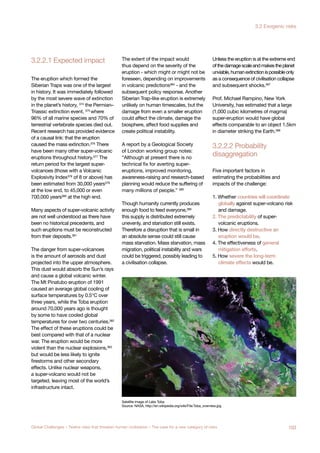
  • 86.
    Global System Collapse Major A Impact Global Pandemic Super-volcanoSynthetic Biology Unknow Conseq 3.1Current risk Pandemic 3.1.4 Global A pandemic (from Greek πᾶν, pan, “all”, and δῆμος demos, “people”) is an epidemic of infectious disease that has spread through human populations across a large region; for instance several continents, or even worldwide. Here only worldwide events are included. A widespread endemic disease that is stable in terms of how many people become sick from it is not a pandemic. 260 84 Global Challenges – Twelve risks that threaten human civilisation – The case for a new category of risks 3. Twelve Global Challenges / 3.1 Current risks
  • 87.
    3.1.4.1 Expected impact disaggregation 3.1.4.2Probability Influenza subtypes266 jor Asteroid pact known nsequences Infectious diseases have been one of the greatest causes of mortality in history. Unlike many other global challenges pandemics have happened recently, as we can see where reasonably good data exist. Plotting historic epidemic fatalities on a log scale reveals that these tend to follow a power law; with a small exponent: many plagues have been found to follow a power law with exponent 0.26.261 These kinds of power laws are heavy-tailed262 to a significant degree.263 In consequence most of the fatalities are accounted for by the top few events.264 If this law holds for future pandemics as well,265 then the majority of people who will die from epidemics will likely die from the single largest pandemic. Most epidemic fatalities follow a power law, with some extreme events – such as the Black Death and Spanish ‘Flu – being even more deadly.267 There are other grounds for suspecting that such a high- impact epidemic will have a greater probability than usually assumed. All the features of an extremely devastating disease already exist in nature: essentially incurable (Ebola268 ), nearly always fatal (rabies269 ), extremely infectious (common cold270 ), and long incubation periods (HIV271 ). If a pathogen were to emerge that somehow combined these features (and influenza has demonstrated antigenic shift, the ability to combine features from different viruses272 ), its death toll would be extreme. Many relevant features of the world have changed considerably, making past comparisons problematic. The modern world has better sanitation and medical research, as well as national and supra-national institutions dedicated to combating diseases. Private insurers are also interested in modelling pandemic risks.273 Set against this is the fact that modern transport and dense human population allow infections to spread much more rapidly274, and there is the potential for urban slums to serve as breeding grounds for disease.275 Unlike events such as nuclear wars, pandemics would not damage the world’s infrastructure, and initial survivors would likely be resistant to the infection. And there would probably be survivors, if only in isolated locations. Hence the risk of a civilisation collapse would come from the ripple effect of the fatalities and the policy responses. These would include political and agricultural disruption as well as economic dislocation and damage to the world’s trade network (including the food trade). Extinction risk is only possible if the aftermath of the epidemic fragments and diminishes human society to the extent that recovery becomes impossible277 before humanity succumbs to other risks (such as climate change or further pandemics). Five important factors in estimating the probabilities and impacts of the challenge: 1. What the true probability distribution for pandemics is, especially at the tail. 2. The capacity of modern i international health systems to deal with an extreme pandemic. 3. How fast medical research can proceed in an emergency. 4. How mobility of goods and people, as well as population density, will affect pandemic transmission. 5. Whether humans can develop novel and effective anti-pandemic solutions. 85Global Challenges – Twelve risks that threaten human civilisation – The case for a new category of risks 3.1 Current risks
  • 88.
    GOVERNANCE DISASTERS Global povetyGlobal instability New system of governace Smart Sensors Global coordination Improvements to global goverance Deliberate attempts to construct world dictatorship Technological innovations Enduring poverty Not achieving important ethical goals Climate change Lack of human flourishing Undesirable world system (e.g. global dictatorship) Global pollution Disruption to world politics and economy Total short-term casualties Collapse of world system Post-disaster politics General mitigation effort Long-term negative effects Civilisation collapse Extinction Failing to solve important probelms Making things worse Uncertain events Key Meta-uncertainties Risk events Direct impacts Indirect impacts Current intervention areas Bad decisions Accidents Severe impacts Meta-uncertainty on tradeoffs between e.g. poverty, survival, freedom GLOBAL PANDEMIC Contact with reservoir species Global poverty Small pandemic scares Density of populationBio-terrorismMedical research Global coordination Impact of increased movement of goods and people Antibiotics resistance Impact of sanitiation or lack thereof Accidental release from lab Healthcare in individual countries Pandemic combining different deadly features Deadly pandemic Pandemic leaping the species barrier Impact of monoculture food supply Smart sensors Post-pandemic politics Disruption to world politics and economy Long-term fate of pandemic virus/ bacteria/parasite Impact on meat production and food supply Pandemic transmission Direct casualties Effectiveness of countermeasures Total short-term casualties Pre-pandemic medical contingency plans Civilisation collapse ExtinctionMeta-uncertainty of how the changed world has affected pandemic probabilities Meta-uncertainty of what probability distributions pandemics follow Uncertain events Key Meta-uncertainties Risk events Direct impacts Indirect impacts Current intervention areas Bad decisions Accidents Severe impacts 86 Global Challenges – Twelve risks that threaten human civilisation – The case for a new category of risks 3.1 Current risks
  • 89.
    1. Extensive medicalresearch will be key to preventing and combatting large scale pandemics. The drawbacks are the possibility of accidental release of dangerous pathogens from laboratories and of bioterrorism. 2. As so much is known about pandemic risks compared with other risks, there are more possibilities for specific pre- pandemic contingency plans. 3. The effectiveness of healthcare systems will be important, especially in less developed nations where the pandemic may overwhelm the system, and then transmit from there to other nations. 4. Global coordination in detection, analysis and treatment are vital for stopping a pandemic in its early stages, and for implementing measures such as quarantines and more advanced countermeasures. 5. Poverty will affect the quality of national healthcare systems, population density and sanitation quality, the movement of local goods and people, and the effectiveness of the political response. 6. Bioterrorists may unleash a pathogen held in storage, such as smallpox. 7. Laboratory security at the top labs is insufficient for the danger at hand, and accidental release is a non- negligible possibility. 8. Pandemics are one of the risks where there is a possibility for a very large number of direct casualties, depending on the severity of the pathogen. 9. Mass casualties and finger-pointing could destabilise the world political and economic systems. 10. If the pathogen is transmissible to farm animals, this could affect the world food supply. 11. It is unlikely the pathogen would be a recurrent, long-term risk, but variants of it could continue to affect people and animals for many years, dependent on its transmissibility and life cycle. 12. Small pandemic scares could improve global coordination on the issue. 13. Increased population density causes increased transmissibility of the pathogen, especially in urban slums. 14. Some pathogens, such as bird ‘flu, depend on regular contact between humans and “reservoir species” in order to evolve into periodically dangerous strains. 15. If antibiotic resistance develops, humanity could see the resurgence of bacteria-based pandemics. 16. The increased movement of people and products increases the speed and spread of pandemic transmission. 17. Sanitation or its lack will strongly affect the spread of certain pathogens in key areas. 18. The efficiency of global reaction to a new pandemic will be strongly determined by the speed of research on the pathogen during the pandemic. 19. A great risk will arise if a pathogen combines the different dangerous features of current viruses or bacteria. 20. The improvements to surveillance and sensing technologies (including indirect detection via web queries or social media) open the possibility of smarter interventions (such as micro- quarantines) and faster understanding of the pathogen’s transmissibility. 21. Post-pandemic politics will be important for preventing a civilisation collapse or enabling reconstruction. 22. Many pathogens incubate in species close to humans, before leaping the species barrier. 23. Monoculture food systems make it easier to transmit any pathogen infecting human food animals. 24. The mode of transmission of the pathogen will be critical to its ultimate reach and impact. 25. Various countermeasures are available in terms of detection, virus analysis, treatment, and quarantining. Future research, technological and political developments may open up new methods of fighting the pathogen. 26. Many of the current factors determining pathogen transmission are unprecedented, such as movements of goods and people, the quality of healthcare systems, and the existence of a centralised political response. This means that data from past pandemics will not be as reliable for computing probability distributions. 27. The pandemic risk lies in the “tails” – the extreme events – and these tails must be estimated from few data points, making them tricky and uncertain. 87Global Challenges – Twelve risks that threaten human civilisation – The case for a new category of risks 3.1 Current risks
  • 90.
    during 2013 3.1.4.3 Mainevents 10-Jun-13: Pandemic Influenza Risk Management: WHO Interim Guidance 278 – Policy This is an updated document that replaces the 2009 Pandemic Influenza Preparedness and Response: a WHO guidance document.279 It updates its recommendations based on lessons from the influenza A(H1N1) 2009 pandemic (swine ‘flu),280 the adoption by the Sixty-fourth World Health Assembly of the Pandemic Influenza Preparedness Framework281 (for the sharing of influenza viruses and access to vaccines and other benefits), and the States Parties’ obligations on capacity strengthening contained in the International Health Regulations of 2005.282 Of significance was the Report of the Review Committee on the Functioning of the International Health Regulations (2005) on the A(H1N1) 2009 pandemic,283 which concluded: “We were lucky this time, but as the report concludes, the world is ill-prepared to respond to a severe influenza pandemic or to any similarly global, sustained and threatening public-health emergency.” This is reinforced by the fact that the 2009 pandemic is alleged to have infected 24% of the population.284 The main lesson the WHO drew from that epidemic was that member states generally had communication issues (between ministries of health and decision,makers, and with the public), and were prepared for a pandemic of high severity and appeared unable to adapt their national and subnational responses adequately to a more moderate event. The guidance paper indicates simultaneously the weaknesses of pandemic preparations, the improvements in these preparations, and the continued role of the WHO as global directing and coordinating authority. 24-Jul-13: Bacteria become resistant to some of the last remaining antibiotics 285 – Event Bacterial infections, such as the Black Death, 286 syphilis, 287 and tuberculosis, 288 have been responsible for millions of deaths, over the thousands of years they have co-existed with humanity. Though these diseases have not been eradicated – overall, a third of the world is currently infected with the tuberculosis bacillus289 – they have been controlled since the introduction of antibiotics, and prognostics have improved tremendously. But recently a rising number of bacteria have developed antibiotic resistance, due mainly to antibiotic over-prescription290 and use in livestock feed.291 This Nature report highlights the worrying way in which Enterobacteriaceae (bacteria with a 50% mortality rate) have become resistant to carbapenems, one of the last remaining antibiotics that had been effective against them. 09-Aug-13: Epihack: Digital disease surveillance hack-a-thon 292 – Initiative Beyond the formal, top-down initiatives to deal with pandemics, there are openings for bottom-up, innovative ideas. Epihack attempted to generate just such ideas, through three days of designing and hacking in Cambodia. Descriptions of the winning projects were given: – CoPanFlu This project included home visits to collect blood samples from 807 homes and weekly follow-up phone calls to document the occurrence of infectious respiratory symptoms. These visits and phone calls caused disturbance to the participants. The new system uses SMS for users to report symptoms. Chart and map visualisation of the data (with full case details) and a fieldwork tracking tool were developed to help the research team analyse and monitor data. – DoctorMe In addition to all of the popular features of DoctorMe (free health information for the general public), the tool now features a weekly survey for users. The survey will ask participants to select whether they are experiencing any symptoms from a list. 88 Global Challenges – Twelve risks that threaten human civilisation – The case for a new category of risks 3.1 Current risks
  • 91.
    – ILI Surveillance,Bureau of Epidemiology Thailand The old system was web-based and had no visual element. The new mobile application and website provide a map visualisation for the reported cases of influenza-like illness (ILI) in Thailand. The map shows hospital ILI cases with colour-coded pins to indicate the level of ILI and allows for simple analysis of the situation. – Mae Tao Clinic The electronic records for this healthcare clinic were very basic. During EpiHack, the data was moved to the cloud and is now open-source. A data visualisation dashboard was created to allow for map visualisation of diagnoses. The staff at Mae Tao Clinic can now easily view and analyse the data to spot trends and send alerts. They plan to pilot this programme at their clinic and, if successful, to replicate it with other clinics. – Verboice The technology platform of Verboice is so user-friendly it doesn’t require technical developers to develop the systems. At EpiHack, project managers were able to design and create systems to address needs in their work completely on their own. In just eight hours, four project managers each completed their own voice- based participatory surveillance systems to monitor One Health in Kenya and Tanzania; early warning generation in South Sudan; animal health in Laos; unexploded ordnance in Laos; child trafficking in Cambodia. The project owners of these new systems will now take them back to their countries and develop implementation and sustainability plans. 22-Sep-13: Research hints at possibility for universal ‘flu vaccine 293 – Research The Spanish ‘flu outbreak was the deadliest short pandemic in history, infecting about a third of the world population (≈ 500 million people) and killing 50-100 million people.294 There have been numerous ‘flu pandemics in the last few centuries, with three others having around a million casualties (the 1889-1890 Russian ‘Flu,295 the 1957-1958 Asian ‘Flu, and the 1968-1969 Hong Kong ‘Flu296 outbreaks). The most recent pandemic was that in 2009, which killed 150,000-500.000 people.297 Thus any move towards a universal ‘flu vaccine would be of great importance to combating such recurring pandemics. This paper, analysing the role of T cells in combating influenza, suggests a way that such a vaccine could be feasible. 28-Nov-13: Difficulties in containing the accidental laboratory escape of potential pandemic influenza viruses 298 – Research Biosafety laboratories experiment with some of the deadliest of the world’s pathogens, and occasionally create new ones.299 Their number is increasing globally, and their safety record is far from perfect, with several pathogen leaks reported300 and others suspected301 (the last smallpox fatality was due to a virus that escaped a lab302 , after eradication of the virus in the wild). The rate of pathogen escape has been estimated at 0.3% per laboratory, per year303 – a very high probability, given the 44 BSL-4304 labs and several thousands of BSL-3 labs. There have already been three known escapes from BSL-4 labs since 1990.305 This report uses an agent-based model to analyse whether the accidental laboratory release of pandemic ‘flu viruses could be contained, and concludes that controllability of escape events is not guaranteed. 3-Dec-13: Global pandemic tops poll of insurance industry risks 306 – Initiative Academics and governmental307/ supra-governmental308 organisations have long worried about the risks of pandemics. But such organisations attract certain types of people with specific outlooks, who can be subject to further biases because of their profession and the social milieu surrounding it.309 Insurers come from a different background, focusing on practical profitability in the business world. It is therefore instructive that they too see pandemics as among the major threats in the world today. This also implies that combatting pandemics is of use not only from a humanitarian but also from an economic standpoint. 89Global Challenges – Twelve risks that threaten human civilisation – The case for a new category of risks 3.1 Current risks
  • 92.
    Global System Collapse Major Asteroid Impact Synthetic Biology Unknown Consequences 3.1Currentrisk System Collapse 3.1.5 Global Global system collapse is defined here as either an economic or societal collapse on the global scale. There is no precise definition of a system collapse. The term has been used to describe a broad range of bad economic conditions, ranging from a severe, prolonged depression with high bankruptcy rates and high unemployment, to a breakdown in normal commerce caused by hyperinflation, or even an economically-caused sharp increase in the death rate and perhaps even a decline in population. 310 90 Global Challenges – Twelve risks that threaten human civilisation – The case for a new category of risks 3. Twelve Global Challenges / 3.1 Current risks
  • 93.
    3.1.5.1 Expected impact disaggregation 3.1.5.2Probability Often economic collapse is accompanied by social chaos, civil unrest and sometimes a breakdown of law and order. Societal collapse usually refers to the fall or disintegration of human societies, often along with their life support systems. It broadly includes both quite abrupt societal failures typified by collapses, and more extended gradual declines of superpowers. Here only the former is included. The world economic and political system is made up of many actors with many objectives and many links between them. Such intricate, interconnected systems are subject to unexpected system-wide failures due to the structure of the network311 – even if each component of the network is reliable. This gives rise to systemic risk: systemic risk occurs when parts that individually may function well become vulnerable when connected as a system to a self-reinforcing joint risk that can spread from part to part (contagion), potentially affecting the entire system and possibly spilling over to related outside systems.312 Such effects have been observed in such diverse areas as ecology,313 finance314 and critical infrastructure315 (such as power grids). They are characterised by the possibility that a small internal or external disruption could cause a highly non-linear effect,316 including a cascading failure that infects the whole system,317 as in the 2008-2009 financial crisis. The possibility of collapse becomes more acute when several independent networks depend on each other, as is increasingly the case (water supply, transport, fuel and power stations are strongly coupled, for instance).318 This dependence links social and technological systems as well.319 This trend is likely to be intensified by continuing globalisation,320 while global governance and regulatory mechanisms seem inadequate to address the issue.321 This is possibly because the tension between resilience and efficiency322 can even exacerbate the problem.323 Many triggers could start such a failure cascade, such as the infrastructure damage wrought by a coronal mass ejection,324 an ongoing cyber conflict, or a milder form of some of the risks presented in the rest of the paper. Indeed the main risk factor with global systems collapse is as something which may exacerbate some of the other risks in this paper, or as a trigger. But a simple global systems collapse still poses risks on its own. The productivity of modern societies is largely dependent on the careful matching of different types of capital325 (social, technological, natural...) with each other. If this matching is disrupted, this could trigger a “social collapse” far out of proportion to the initial disruption.326 States and institutions have collapsed in the past for seemingly minor systemic reasons.327 And institutional collapses can create knock-on effects, such as the descent of formerly prosperous states to much more impoverished and destabilising entities.328 Such processes could trigger damage on a large scale if they weaken global political and economic systems to such an extent that secondary effects (such as conflict or starvation) could cause great death and suffering. Five important factors in estimating the probabilities of various impacts: 1. Whether global system collapse will trigger subsequent collapses or fragility in other areas. 2. What the true trade-off is between efficiency and resilience. 3. Whether effective regulation and resilience can be developed. 4. Whether an external disruption will trigger a collapse. 5. Whether an internal event will trigger a collapse. Example of an interconnected network: the Internet. Each line is drawn between two nodes, representing two IP addresses. This is a small look at the backbone of the Internet. Source: http://en.wikipedia.org/wiki/File:Internet_map_1024.jpg 91Global Challenges – Twelve risks that threaten human civilisation – The case for a new category of risks 3.1 Current risks
  • 94.
    GOVERNANCE DISASTERS Global povetyGlobal instability New system of governace Smart Sensors Global coordination Improvements to global goverance Deliberate attempts to construct world dictatorship Technological innovations Enduring poverty Not achieving important ethical goals Climate change Lack of human flourishing Undesirable world system (e.g. global dictatorship) Global pollution Disruption to world politics and economy Total short-term casualties Collapse of world system Post-disaster politics General mitigation effort Long-term negative effects Civilisation collapse Extinction Failing to solve important probelms Making things worse Uncertain events Key Meta-uncertainties Risk events Direct impacts Indirect impacts Current intervention areas Bad decisions Accidents Severe impacts Meta-uncertainty on tradeoffs between e.g. poverty, survival, freedom GOVERNANCE DISASTERS Global povety Global instability New system of governace Smart Sensors Global coordination Improvements to global goverance Deliberate attempts to construct world dictatorship Technological innovations Enduring poverty Not achieving important ethical goals Climate change Lack of human flourishing Undesirable world system (e.g. global dictatorship) Global pollution Disruption to world politics and economy Total short-term casualties Collapse of world system Post-disaster politics General mitigation effort Long-term negative effects Civilisation collapse Extinction Failing to solve important probelms Making things worse Uncertain events Key Meta-uncertainties Risk events Direct impacts Indirect impacts Current intervention areas Bad decisions Accidents Severe impacts Meta-uncertainty on tradeoffs between e.g. poverty, survival, freedom 92 Global Challenges – Twelve risks that threaten human civilisation – The case for a new category of risks 3.1 Current risks
  • 95.
    1. Increased globalcoordination and cooperation may allow effective regulatory responses, but it also causes the integration of many different aspects of today’s world, likely increasing systemic risk. 2. Systemic risk is only gradually becoming understood, and further research is needed, especially when it comes to actually reducing systemic risk. 3. Since systemic risk is risk in the entire system, rather than in any individual component of it, only institutions with overall views and effects can tackle it. But regulating systemic risk is a new and uncertain task. 4. Building resilience – the ability of system components to survive shocks – should reduce systemic risk. 5. Fragile systems are often built because they are more efficient t han robust systems, and hence more profitable. 6. General mitigation efforts should involve features that are disconnected from the standard system, and thus should remain able to continue being of use if the main system collapses 7. A system collapse could spread to other areas, infecting previously untouched systems (as the sub- prime mortgage crisis affected the world financial system, economy, and ultimately its political system). 8. The system collapse may lead to increased fragility in areas that it does not directly damage, making them vulnerable to subsequent shocks. 9. A collapse that spread to government institutions would undermine the possibilities of combating the collapse. 10. A natural ecosystem collapse could be a cause or consequence of a collapse in humanity’s institutions. 11. Economic collapse is an obvious and visible way in which system collapse could cause a lot of damage. 12. In order to cause mass casualties, a system collapse would need to cause major disruptions to the world’s political and economic system. 13. If the current world system collapses, there is a risk of casualties through loss of trade, poverty, wars and increased fragility. 14. It is not obvious that the world’s institutions and systems can be put together again after a collapse; they may be stuck in a suboptimal equilibrium. 15. Power grids are often analysed as possible candidates for system collapse, and they are becoming more integrated. 16. The world’s financial systems have already caused a system collapse, and they are still growing more integrated. 17. The world’s economies are also getting integrated, spreading recessions across national boundaries. 18. The world’s political and legal systems are becoming more closely integrated as well. Any risk has not been extensively researched yet, and there remain strong obstacles (mainly at the nation state level) slowing down this form of integration. 19. The politics of the post-system collapse world will be important in formulating an effective response instead of an indifferent or counter- productive one. 20. System collapses can be triggered internally by very small events, without an apparent cause. 21. External disruptions can trigger the collapse of an already fragile system. 22. The trade-off between efficiency and resilience is a key source of fragility, in a world economy built around maximising efficiency. 23. Climate change, mass movements of animals and agricultural mono-cultures are interlinking ecosystems with each other and with human institutions. 24. There is a lot of uncertainty about systemic risk, especially in the interactions between different fragilities that would not be sufficient to cause a collapse on their own. 93Global Challenges – Twelve risks that threaten human civilisation – The case for a new category of risks 3.1 Current risks
  • 96.
    during 2013 3.1.5.3 Mainevents 16-Jan-13: Systemic Risk Centre founded at the LSE 329 – Event Effective interventions into systemic risks depend on high quality research, which may be why the London School of Economics (LSE) founded a £5 million research centre to study systemic financial risk. A press release said: “The Centre will undertake an economic analysis of the fundamental risks to the financial system, based on an interdisciplinary approach. It will bring together experts from finance, economics, computer science, political science, law and the natural and mathematical sciences. This will allow researchers affiliated to the Centre to investigate how risk is created through feedback loops within and between the financial, economic, legal and political systems. Political decisions, for example, can directly affect people’s behaviour in the financial markets, which in turn affects political decision-making and so on – with the outcomes being unexpected and complex.” Besides the research results produced by the centre, its very existence shows that systemic risk is being taken seriously in academic quarters. 14-Mar-13: Systemic sovereign credit risk has “deep roots in the flows and liquidity of financial markets.” 330 – Research It is important to estimate the source of systemic risk. Different mitigation policies should be implemented if sovereign systemic risks spring from financial markets rather than macroeconomic fundamentals. This paper argues that systemic sovereign risks spring from financial markets (through capital flows, funding availability, risk premiums, and liquidity shocks331) rather than from fundamentals.332 It further estimates that systemic risks are three times larger in eurozone countries than in US states. Figure 19: Network Diagram of connections between, banks, brokers/dealers, insurers and hedge funds. Jan 1994-Dec 1996 Source: https://app.box.com/shared/oesro8zzco0mtvuymh3f 94 Global Challenges – Twelve risks that threaten human civilisation – The case for a new category of risks 3.1 Current risks
  • 97.
    17-Jul-13 IMF launches“Systemic Risk Monitoring (“SysMo”) Toolkit—A User Guide” 333 – Policy In order to mitigate or prevent systemic risk, it needs to be monitored. In this paper, the authors set out to clarify the nature and use of the systemic risk monitoring tools that are currently available, providing guidance on how to select the best set of tools depending on the circumstances. The paper breaks down the tools into four categories, each with their strengths and weaknesses: – Single risk/soundness indicators. 334 Indicators based on balance sheet data, such as financial soundness indicators (FSIs), are widely available and cover many risk dimensions. However, they tend to be backward-looking and do not account for probabilities of default or correlation structures. Moreover, only some of these indicators can be used as early-warning tools (e.g., indicators of funding structures). Market data can be used to construct complementary indicators for higher-frequency risk monitoring. – Fundamentals-based models 335 rely on macroeconomic or balance sheet data to help assess macro-financial linkages (e.g., macro stress testing or network models). By providing vulnerability measures based on actual interconnectedness and exposures, these models may help build a realistic “story”. However, they often require long-term data series, assume that parameters and relationships are stable under stressed conditions, and produce only low-frequency risk estimates. – Market-based models. 336 These models uncover information about risks from high-frequency market data and are thus suitable for tracking rapidly-changing conditions of a firm or sector. These approaches are more dynamic, but their capacity to reliably predict financial stress has yet to be firmly established. – Hybrid, structural models. 337 These models estimate the impact of shocks on key financial and real variables (e.g., default probabilities, or credit growth) by integrating balance sheet data and market prices. Examples include the CCA and distance-to-default measures, which compare the market value of an entity‘s assets to its debt obligations. The paper concludes, however, that the systemic risk monitoring toolkit is incomplete and that “tools exist to assess most sectors and levels of aggregation, but they provide only partial coverage of potential risks and only tentative signals on the likelihood and impact of systemic risk events. As such, they may not provide sufficient comfort to policymakers.” 23-Dec-13: Citigroup analysis reports reduced systemic political and financial risks in 2013 and 2014 338 – Initiative Tracking the ebb and flow of the likelihood of various risks is important for estimating where best to direct energy and resources. Even approximate, order of magnitude estimates are sufficient if they establish that some risks are much more dangerous than others (order of magnitude estimates correspond to the “Class 5 cost estimate”, 339 undertaken at the very beginning of the project, between 0% and 2% of its completion). In 2013, Citigroup analysts predicted that (with caveats) systemic risks would recede in Europe during the year, a prediction which seems to have been vindicated by events. As for the future, Tina Fordham, chief global political analyst at Citigroup Global Markets, predicted that “systemic political risks will decline in 2014, but country-level and geopolitical risks remain significant.” It seems positive both that market analysts are tracking systemic risks and that they see them as decreasing (though their focus is mainly on political and financial systemic risks). 95Global Challenges – Twelve risks that threaten human civilisation – The case for a new category of risks 3.1 Current risks
  • 98.
    Major Asteroid Impact Unknown Consequences 3.2Exogenic risk AsteroidImpact 3.2.1 Major When large objects strike terrestrial planets like the Earth, there can be significant physical and biospheric consequences, though atmospheres mitigate many surface impacts by slowing an object’s entry. Impact structures are dominant landforms on many of the solar system’s solid objects and present the strongest empirical evidence for their frequency and scale. 340 96 Global Challenges – Twelve risks that threaten human civilisation – The case for a new category of risks 3.2 Exogenic risks
  • 99.
    3.2.1.1 Expected impact disaggregation 3.2.1.2Probability Asteroids have caused significant extinction events throughout the Earth’s history. The most famous is the Chicxulub impactor, which probably helped cause the extinction of the non-avian dinosaurs and more than 75% of all species.341 Large asteroid collisions – objects 5 km or more in size – happen approximately once every twenty million years and would have an energy a hundred thousand times greater342 than the largest bomb ever detonated.343 A land impact would destroy an area the size of a nation like Holland.344 Larger asteroids could be extinction level events. Asteroid impacts are probably one of the best understood of all risks in this report. Their mechanisms and frequencies are reasonably well estimated.345 Recent ground- and space-based346 tracking projects have been cataloguing and tracking the largest asteroids,347 and have discovered that the risks were lower than was previously feared.348 The projects are now cataloguing asteroids of smaller size and damage potential. There has been some speculation about possible methods for deflecting asteroids350, should they be found on a collision course with the planet. Such means remain speculative, currently, but may become more feasible given technological progress and potentially more affordable access to space.351 Should an impact occur, though, asteroid impact risks are similar to those of super-volcanoes, in that the main destruction will not be wrought by the initial impact, but by the clouds of dust projected into the upperatmosphere. The damage from such an “impact winter” could affect the climate, damage the biosphere, affect food supplies, and create political instability. Though humanity currently produces enough food to feed all humans,352 this supply is distributed extremely unevenly, and starvation still exists. Therefore a disruption that is small in an absolute sense could still cause mass starvation in the future. Mass starvation, mass migration, political instability and wars could be triggered, possibly leading to a civilisation collapse. Unless the impact is at the extreme end of the damage scale and makes the planet unviable, human extinction is possible only as a consequence of civilisation collapse and subsequent shocks.353 Five important factors in estimating the probabilities and impacts of the challenge: 1. Whether detection and tracking of asteroids and other dangerous space objects is sufficiently exhaustive. 2. How feasible it is to deflect an asteroid. 3. Whether measures such as evacuation could reduce the damage of an impact. 4. The short- and long-term climate consequences of a collision. 5. Whether our current civilisation could adapt to a post-impact world. Figure 20: How the Spaceguard Survey has reduced the short-term risk of impacts from near-Earth objects349 97Global Challenges – Twelve risks that threaten human civilisation – The case for a new category of risks 3.2 Exogenic risks
  • 100.
    SUPER VOLCANO Medium volcanic eruptions Makingthe risk a priority Supervolcano research Predictability of eruptions Supervolcano eruption Better monitoring and prediction Global coordination Direct destruction Post-eruption politics Climate impacts Long-term climate impact General mitigation efforts Extinction Meta-uncertainty of anthropic effects upon the true risk probability Disruption to world politics and economy Preemptive evacuation Total short-term casualties Civilisation collapse Uncertain events Key Meta-uncertainties Risk events Direct impacts Indirect impacts Current intervention areas Bad decisions Accidents Severe impacts GOVERNANCE DISASTERS Global povety Global instability New system of governace Smart Sensors Global coordination Improvements to global goverance Deliberate attempts to construct world dictatorship Technological innovations Enduring poverty Not achieving important ethical goals Climate change Lack of human flourishing Undesirable world system (e.g. global dictatorship) Global pollution Disruption to world politics and economy Total short-term casualties Collapse of world system Post-disaster politics General mitigation effort Long-term negative effects Civilisation collapse Extinction Failing to solve important probelms Making things worse Uncertain events Key Meta-uncertainties Risk events Direct impacts Indirect impacts Current intervention areas Bad decisions Accidents Severe impacts Meta-uncertainty on tradeoffs between e.g. poverty, survival, freedom 98 Global Challenges – Twelve risks that threaten human civilisation – The case for a new category of risks 3.2 Exogenic risks
  • 101.
    1. Competition betweenprivate space programmes could be a determining factor in reducing the cost of space flight. 2. National space programmes have always provided the impetus for space flight projects, especially the more speculative and cutting-edge ones. 3. Protecting against asteroid impacts is already accepted as a project worth funding, but increased focus on the problem could increase the ability to predict and prevent such impacts. 4. Asteroid detection and tracking continues to progress well currently, and is key to preventing such collisions in future. 5. Better global coordination is not strongly needed to track or deflect asteroids, but would be important if a large-scale evacuation was needed. 6. General mitigation efforts may help reduce the direct and indirect negative impact of an impact, by, for instance, equipping people to deal with the changed climate. 7. Unlike many risks, there is no upper bound on how destructive an asteroid impact could be, though the largest impacts are the rarest. 8. The aftermath of an impact could greatly disrupt the world economic and political system. 9. Climate impacts would be the most destructive consequences of medium- scale meteor impacts, with the world plunged into an “impact winter”. 10. The effects of an impact winter could last for a long time. 11. Easier access to space would be important for any plans to actually deflect an asteroid. 12. There are currently no asteroid deflection abilities, but there are many plans that could conceivably be implemented in due course. 13. Small asteroid impacts could motivate increased anti-asteroid precautions. 14. With enough warning, it could be possible to pre-emptively evacuate the impact area. 15. Post-impact politics will be important for reconstruction, adapting to the changed climate, and prevention of further harm. 16. Estimating the likelihood of asteroid impacts suffers from “anthropic shadow” effects: 355 we may be underestimating the danger because if there had been many more impacts in recent times, humans would not currently be around to observe their effects and take them into account. Source: http://en.wikipedia.org/wiki/File:Chelyabinsk_meteor_trace_15-02-2013.jpg 99Global Challenges – Twelve risks that threaten human civilisation – The case for a new category of risks 3.2 Exogenic risks
  • 102.
    during 2013 3.2.1.3 Mainevents 15-Feb-13: Chelyabinsk meteor causes large fireball 356 – Event The Chelyabinsk meteor was a near-Earth asteroid that entered Earth’s atmosphere over Russia, with an estimated speed of 18.6 km/s, almost 60 times the speed of sound. It exploded into a very visible air burst over Chelyabinsk Oblast, which was recorded by numerous video sources. The meteor was undetected before it entered the Earth’s atmosphere, and caused numerous injuries, extensive damage, but no deaths. It was the largest to crash to Earth since 1908, 357 when an object hit Tunguska in Siberia.358 The meteor seemed ideal from the risk reduction perspective: a large, visible impact that attracted great attention, and a renewed commitment to asteroid precautions, 359 but no actual fatalities. 19-Jun-13: Space Research Institute of Russian Academy of Science presents a strategy to use small asteroids to deflect hazardous objects from the trajectory of collision with Earth 360 – Research Though the analysis and tracking of asteroids has progressed rapidly, 361 methods for deflecting a dangerous asteroid, should it be detected, remain speculative.362 The Space Research Institute of the Russian Academy of Science introduces another approach: selecting small (10-15m) near-Earth asteroids and causing them to strike a larger dangerous one, altering its trajectory. The more suggestions and ideas there are for such deflections, the more likely it is that one of them will yield an implementable approach. 17-Oct-13: The probability for “Asteroid 2013 TV135” to impact Earth in 2032 is one in 63,000 363 – Event NASA reports that a 400-metre asteroid has one chance in 63,000 of impacting the Earth. An asteroid this size would produce ocean- wide tsunamis or destroy land areas the size of a small state (Delaware, Estonia).364 For comparison, the odds of dying from lightning strike are 1 in 83,930, of a snake, bee or other venomous bite or sting is 1 in 100,000, of an earthquake 1 in 131,890, and of a dog attack 1 in 147,717.365 So the risk of asteroid death, though low, is comparable to commoner risks 28-Oct-13: United Nations to Adopt Asteroid Defence Plan 366 – Policy The UN plans to set up an International Asteroid Warning Group for member nations to share information about potentially hazardous space rocks. If astronomers detect an asteroid that poses a threat to Earth, the UN’s Committee on the Peaceful Uses of Outer Space will help coordinate a mission to launch a spacecraft to slam into the object and deflect it from its collision course. This marks the first time an international body has assigned responsibility for tracking and intercepting dangerous asteroids. 14-Nov-13: Risk of medium asteroid strike may be ten times larger than previously thought 367 – Research This paper analyses in detail the Chelyabinsk impact, estimated to have had an energy of 500 kilotonnes of TNT. It demonstrates problems with the standard methods for estimating the energy of collisions – derived from nuclear weapons results 368 – and from that deduces that the number of impactors with diameters of tens of metres may be an order of magnitude higher than estimated. It argues that this demonstrates a deviation from a simple power law, and thus that there is a non- equilibrium in the near-Earth asteroid population for objects 10 to 50metres in diameter. This shifts more of the impact risk to asteroids of these sizes. 3-Dec-13: SpaceX launches into geostationary orbit 369 – Initiative Easy access to space is important for all asteroid deflection proposals.370 Since America retired the Space Shuttle, 371 it has been putting its hope in private space companies.372 The success of SpaceX opens the possibility of eventual cheaper access to space. 100 Global Challenges – Twelve risks that threaten human civilisation – The case for a new category of risks 3.2 Exogenic risks
  • 103.
    Figure 15: Impacteffects by size of Near Earth Object354 Consequences Upper atmosphere detonation of “stones” (stony asteroids) and comets; only “irons” (iron asteroids) <3% penetrate to surface. Irons make craters (Barringer Crater); Stones produce air-bursts (Tunguska). Land impacts could destroy area the size of a city (Washington, London, Moscow). Irons and stones produce ground-bursts; comets produce air-bursts. Ocean impacts produce signifi- cant tsunamis. Land impacts destroy area the size of a large urban area (New York, Tokyo). Impacts on land produce craters ocean-wide tsunamis are produced by ocean impacts. Land impacts destroy area the size of a small state (Delaware, Estonia). Tsunamis reach hemispheric scales, exceed damage from land impacts. Land impacts destroy area the size of a moderate state (Virginia, Taiwan). Both land and ocean impacts raise enough dust to affect climate, freeze crops. Ocean impacts generate global scale tsunamis. Global destruction of ozone. Land impacts destroy area the size of a large state (California, France, Japan). A 30 kilometre crater pen- etrates through all but the deepest ocean dephts. Both land and ocean impacts raise dust, change climate. Impact ejecta are global, triggering wide- spread fires. Land impacts destroy area size of a large nation (Mexico, India). Prolonged climate effects, global conflagration, probable mass extinction. Direct destruction ap- proaches continental scale (Australia, Europe, Usa). Large mass extinction (for example K/T or Creta- ceous-Tertiary geological boundary). Threatens survival of all advanced life forms. NEO diameter 75m 160m 350m 700m 1.7km 3km 7km 16km Yeld Megatonnes (MT*) <10 10 to 100 100 to 1,000 1,000 to 10,000 10,000 to 100,000 100,000 to 1 million 1 million to 10 million 10 million to 100 million 100 million to 1 billion >1 billion Crater diameter (km) 1.5 3 6 12 30 60 125 250 Average interval b/w impact (years) 1,000 4,000 16,000 63,000 250,000 1 million 10 million 100 million 101Global Challenges – Twelve risks that threaten human civilisation – The case for a new category of risks 3.2 Exogenic risks
  • 104.
    Global System Collapse Major As Impact Global Pandemic Super-volcanoSynthetic Biology Unknow Conseq 3.2Current risk 3.2.2 Super-volcano A super-volcano is any volcano capable of producing an eruption with an ejecta volume greater than 1,000 km3. This is thousands of times larger than normal eruptions. Super-volcanoes can occur when magma in the mantle rises into the crust from a hotspot but is unable to break through it, so that pressure builds in a large and growing magma pool until the crust is unable to contain the pressure. 373 102 Global Challenges – Twelve risks that threaten human civilisation – The case for a new category of risks 3.2 Exogenic risks
  • 105.
    3.2.2.1 Expected impact disaggregation 3.2.2.2Probability jor Asteroid pact known nsequences The eruption which formed the Siberian Traps was one of the largest in history. It was immediately followed by the most severe wave of extinction in the planet’s history, 374 the Permian– Triassic extinction event, 375 where 96% of all marine species and 70% of terrestrial vertebrate species died out. Recent research has provided evidence of a causal link: that the eruption caused the mass extinction.376 There have been many other super-volcanic eruptions throughout history.377 The return period for the largest super- volcanoes (those with a Volcanic Explosivity Index378 of 8 or above) has been estimated from 30,000 years379 at the low end, to 45,000 or even 700,000 years380 at the high end. Many aspects of super-volcanic activity are not well understood as there have been no historical precedents, and such eruptions must be reconstructed from their deposits.381 The danger from super-volcanoes is the amount of aerosols and dust projected into the upper atmosphere. This dust would absorb the Sun’s rays and cause a global volcanic winter. The Mt Pinatubo eruption of 1991 caused an average global cooling of surface temperatures by 0.5°C over three years, while the Toba eruption around 70,000 years ago is thought by some to have cooled global temperatures for over two centuries.382 The effect of these eruptions could be best compared with that of a nuclear war. The eruption would be more violent than the nuclear explosions,383 but would be less likely to ignite firestorms and other secondary effects. Unlike nuclear weapons, a super-volcano would not be targeted, leaving most of the world’s infrastructure intact. The extent of the impact would thus depend on the severity of the eruption - which might or might not be foreseen, depending on improvements in volcanic predictions384 - and the subsequent policy response. Another Siberian Trap-like eruption is extremely unlikely on human timescales, but the damage from even a smaller eruption could affect the climate, damage the biosphere, affect food supplies and create political instability. A report by a Geological Society of London working group notes: “Although at present there is no technical fix for averting super- eruptions, improved monitoring, awareness-raising and research-based planning would reduce the suffering of many millions of people.” 385 Though humanity currently produces enough food to feed everyone,386 this supply is distributed extremely unevenly, and starvation still exists. Therefore a disruption that is small in an absolute sense could still cause mass starvation. Mass starvation, mass migration, political instability and wars could be triggered, possibly leading to a civilisation collapse. Unless the eruption is at the extreme end ofthedamagescaleandmakestheplanet unviable,humanextinctionispossibleonly as a consequence of civilisation collapse and subsequent shocks.387 Prof. Michael Rampino, New York University, has estimated that a large (1,000 cubic kilometres of magma) super-eruption would have global effects comparable to an object 1.5km in diameter striking the Earth.388 Five important factors in estimating the probabilities and impacts of the challenge: 1. Whether countries will coordinate globally against super-volcano risk and damage. 2. The predictability of super- volcanic eruptions. 3. How directly destructive an eruption would be. 4. The effectiveness of general mitigation efforts. 5. How severe the long-term climate effects would be. Satellite image of Lake Toba Source: NASA, http://en.wikipedia.org/wiki/File:Toba_overview.jpg 103Global Challenges – Twelve risks that threaten human civilisation – The case for a new category of risks 3.2 Exogenic risks
  • 106.
    GLOBAL PANDEMIC Contact with reservoirspecies Global poverty Small pandemic scares Density of populationBio-terrorismMedical research Global coordination Impact of increased movement of goods and people Antibiotics resistance Impact of sanitiation or lack thereof Accidental release from lab Healthcare in individual countries Pandemic combining different deadly features Deadly pandemic Pandemic leaping the species barrier Impact of monoculture food supply Smart sensors Post-pandemic politics Disruption to world politics and economy Long-term fate of pandemic virus/ bacteria/parasite Impact on meat production and food supply Pandemic transmission Direct casualties Effectiveness of countermeasures Total short-term casualties Pre-pandemic medical contingency plans Civilisation collapse ExtinctionMeta-uncertainty of how the changed world has affected pandemic probabilities Meta-uncertainty of what probability distributions pandemics follow Uncertain events Key Meta-uncertainties Risk events Direct impacts Indirect impacts Current intervention areas Bad decisions Accidents Severe impacts GOVERNANCE DISASTERS Global povety Global instability New system of governace Smart Sensors Global coordination Improvements to global goverance Deliberate attempts to construct world dictatorship Technological innovations Enduring poverty Not achieving important ethical goals Climate change Lack of human flourishing Undesirable world system (e.g. global dictatorship) Global pollution Disruption to world politics and economy Total short-term casualties Collapse of world system Post-disaster politics General mitigation effort Long-term negative effects Civilisation collapse Extinction Failing to solve important probelms Making things worse Uncertain events Key Meta-uncertainties Risk events Direct impacts Indirect impacts Current intervention areas Bad decisions Accidents Severe impacts Meta-uncertainty on tradeoffs between e.g. poverty, survival, freedom 104 Global Challenges – Twelve risks that threaten human civilisation – The case for a new category of risks 3.2 Exogenic risks
  • 107.
    1. Whether super-volcanorisk is made a priority will have a large impact on research and volcano monitoring. 2. Further super-volcano research will be important in any mitigation and monitoring efforts. 3. Global coordination and cooperation between nations will determine research levels, the chances of evacuations, and post- eruption disruption to the world political and economic system. 4. General mitigation efforts may help reduce the direct and indirect negative impact of an eruption, by, for instance, equipping people to deal with the changed climate. 5. The direct destructive effect of a super-volcano can be extensive, especially in the area around the eruption. 6. A super-volcano’s main destructive impact is through its effect on the climate, akin to a nuclear winter cooling effect. This will strongly affect all impact levels, and the disruption to the world’s political and economic system. 7. The level of this disruption will determine how well countries cope with the aftermath of the eruption and subsequent climate changes, and whether subsequent conflicts or trade wars will occur, adding to the damage. 8. The long-term climate impact will determine in what state the post- eruption world will find itself, relevant both for reconstruction after a collapse and for preventing such a collapse. 9. Whether eruptions are fundamentally predictable or not, and how far in advance, will be very important for many mitigation strategies. 10. Better volcano monitoring and prediction (if possible) will allow such interventions as pre- emptive evacuations. 11. Evacuations are likely to be the only effective response to an imminent eruption, as super-volcanoes are unlikely to be controllable or divertible. 12. Post-eruption politics will be a consequence of the number of short- term casualties, and the disruption to the world system. 13. Medium scale volcanic eruptions may persuade leaders to make the risk more of a priority. 14. Estimating the likelihood of super-volcanic eruptions suffers from “anthropic shadow” effects: 390 we may be underestimating the danger because if there had been many more eruptions in recent times, humans would not currently be around to observe their effects and take them into account. Figure 21: Volcanic Explosivity Index 389 VEI 0 1 2 3 4 5 6 7 8 Ejecta volume < 10,000 m3 > 10,000 m3 > 1,000,000 m3 > 10,000,000 m3 > 0.1 km3 > 1 km3 > 10 km3 > 100 km3 > 1,000 km3 Classification Hawaiian Hawaiian / Strombolian Strombolian / Vulcanian Vulcanian / Peléan Peléan / Plinian Plinian Plinian / Ultra-Plinian Ultra-Plinian Supervolcanic Description Effusive Gentle Explosive Catastrophic Cataclysmic Paroxysmic Colossal Mega-colossal Apocalyptic Plume < 100 m 100-1000 m 1-5 km 3-15 km 10-25 km 20-35 km > 30 km > 40 km > 50 km Frequency constant daily weekly few months ≥ 1 yr ≥ 10 yrs ≥ 100 yrs ≥ 1,000 yrs ≥ 10,00 yrs 105Global Challenges – Twelve risks that threaten human civilisation – The case for a new category of risks 3.2 Exogenic risks
  • 108.
    during 2013 3.2.2.3 Mainevents 15-Mar-13: Climate impact of super-volcanoes may be less than previously thought 391 – Research The Toba eruption around 70,000 years ago was one of the world’s largest super-volcanic eruptions. In contrast with some theories that claim it caused a volcanic winter that may have lasted over two centuries, 392 this paper claims that analysis of ash from the Toba super-eruption in Lake Malawi shows no evidence of volcanic winter in East Africa. This further illustrates the difficulty of establishing the exact impact of large-scale disasters, when the evidence record is poor. 17-Jul-13: The Volcanological Society of Japan looks at volcano and super-volcano mitigation 393 – Policy Prevention of super-volcano eruptions is impossible with current technology, but there may be some possibility of mitigating their effects. The Volcanological Society of Japan is one of the few organisations that have looked at such potential mitigation. They put the risk of super-volcanic eruptions in the context of standard volcanic eruptions, just on a larger scale (noting that super-volcanic eruptions have affected Japan in the past). Japan has been a very seismically active country for its entire history,394 so it might be hoped that adequate volcanic mitigation measures would have been implemented. But the report notes that “remarkably few [of Japan’s local governments] have drafted volcanic disaster countermeasure[s]”, 395 adding that “Local governments that have actually experienced a volcanic disaster focus attention on volcanic disaster-related discussion, but most have not drafted specific procedures for volcanic disasters and seem to think that the general disaster countermeasure volume is adequate.” This provokes some pessimism about the likelihood of effective planetary super-volcano mitigation measures being implemented, especially in those areas with no direct experience of volcanic risk. This is due to the normalcy bias, “the tendency to minimise the probability of potential threats or their dangerous implications,”. 396 27-Oct-13: Yellowstone super- volcano larger than previously thought 397 – Research Another continuing development in the science of super-volcanoes, this paper demonstrates that the crustal magma reservoir under Yellowstone was 50% larger than was previously thought. However, despite this increase, integrated probabilistic hazard assessment shows that the biggest Yellowstone Plateau threat is from large M7+ earthquakes - significantly damaging398 , but very unlikely to threaten billions - not from volcanic or super-volcano eruptions. Figure 22: Location of Yellowstone hotspot over time (numbers indicate millions of years before the present). Source: http://en.wikipedia.org/wiki/File:HotspotsSRP.jpg 106 Global Challenges – Twelve risks that threaten human civilisation – The case for a new category of risks 3.2 Exogenic risks
  • 109.
    15-Nov-13: Insurance executives ranksuper-volcanoes low on the list of extreme risks 399 – Initiative Academics have long worried about the probability of super-volcanic eruptions. But academia attracts certain types of people with specific outlooks, who can be subject to further biases because of their profession and the social milieu surrounding it.400 Insurers come from a different background, focusing on practical profitability in the business world and using a relatively short time horizon. So it is instructive that they do not see super-volcanoes as a major threat in the world today: “Of interest to us is the very low ranking of the user-submitted idea of super- volcanoes in the US”. 20-Dec-13: Super-volcano confirmed as responsible for one of the largest extinctions in history 401 – Research The maximal destructive potential of super-volcanoes is uncertain. There have been large super- volcanic eruptions throughout history, 402 and many extinction events, but uncertainties in the geological record mean that it was hard to establish whether they were causally linked. One eloquent example was the eruption which formed the Siberian Traps403 (one of the largest in history), and the Permian–Triassic extinction, 404 where 96% of all marine species and 70% of terrestrial vertebrates died out. The two events were close on the geological timeline, and this paper, using recent dating techniques, confirmed that the super-volcano erupted shortly before the extinction, making it the likely culprit. The risk of large impacts from super-volcanoes has thus gained in plausibility. 107Global Challenges – Twelve risks that threaten human civilisation – The case for a new category of risks 3.2 Exogenic risks
  • 110.
    Global System Collapse Major Asteroid Impact Synthetic Biology Unknown Consequences 3.3Emergingrisk Biology 3.3.1 Synthetic Synthetic biology is the design and construction of biological devices and systems for useful purposes. It is an area of biological research and technology that combines biology and engineering, and so often overlaps with bioengineering and biomedical engineering. It encompasses a variety of different approaches, methodologies, and disciplines with a focus on engineering biology and biotechnology. 405 108 Global Challenges – Twelve risks that threaten human civilisation – The case for a new category of risks 3.3 Emerging risks
  • 111.
    3.3.1.1 Expected impact disaggregation 3.3.1.2Probability Pandemics are one of the worst killers in human history. Synthetic biology is the design and construction of biological devices and systems to accomplish the specific goal of the synthetic biologist,406 adding human intentionality to traditional pandemic risks. The positive and negative potentials of synthetic biology are unclear407 – much of the information currently comes from synthetic biologists, 408 who may not be able to provide an impartial overview (the problem is exacerbated by the decentralised nature of the field409). Attempts at regulation410 or self-regulation411 are currently in their infancy, and may not develop as fast as research does.412 One of the most damaging impacts from synthetic biology would come from an engineered pathogen,413 targeting humans or a crucial component of the ecosystem (such as rice, which accounts for 20% of all calories consumed by humans).414 This could emerge through military bio-warfare, 415 commercial bio-warfare, 416 bio-terrorism417 (possibly using dual-use products418 developed by legitimate researchers, and currently unprotected by international legal regimes419 ), or dangerous pathogens leaked from a lab420 . Of relevance is whether synthetic biology products become integrated into the global economy or biosphere. This could lead to additional vulnerabilities (a benign but widespread synthetic biology product could be specifically targeted as an entry point through which to cause damage). But such a development would lead to greater industry and academic research, which could allow the creation of reactive or pre-emptive cures.421 The impact is very similar to that of pandemics: mass casualties and subsequent economic and political instabilities leading to possible civilisation collapse. A bio-war would contribute greatly to the resulting instability. Even for the most perfectly engineered pathogen, survivors are likely, if only in isolated or mainly isolated locations.422 Extinction risk is unlikely, 423 but possible if the aftermath of the epidemic fragments and diminishes human society to the extent that recovery becomes impossible424 before humanity succumbs to other risks.425 Five important factors in estimating the probabilities and impacts of the challenge: 1. The true destructive potential of synthetic biology, especially the tail risk. 2. Whether the field will be successfully regulated, or successfully manage to regulate itself. 3. Whether the field will usher in a new era of bio-warfare. 4. Whether the tools of synthetic biology can be used defensively to create effective counter measures. 5. The dangers of relying on synthetic biologists to estimate the danger of synthetic biology. 109Global Challenges – Twelve risks that threaten human civilisation – The case for a new category of risks 3.3 Emerging risks
  • 112.
    SYNTHETIC BIOLOGY Small security scares Knowledge controlMilitaryresearch Global coordination Continuing synthetic biology research Smart sensors Pathogen research Bio-terrorism Bio-warfare New vulnerabilities Long-term ecosystem impact Pathogen transmission chains Prevalence of synthetic biology products Knowledge leak Dual use research Commercially targeted damaging synthetic biology Meta-uncertainty of reying on synthetic biologists for risk estimates Meta-uncertainty of true potential of synthetic biology Engineered ecosystem- affecting pathogen Engineered human-affecting pathogen Accidental release Post-pathogen politics Agriculture impact Direct casualties Total short-term casualties Pre-release medical contingency plans Extinction Civilsation collapse Disruption to world politics and economy Effective regulatory framework Uncertain events Key Meta-uncertainties Risk events Direct impacts Indirect impacts Current intervention areas Bad decisions Accidents Severe impacts GOVERNANCE DISASTERS Global povety Global instability New system of governace Smart Sensors Global coordination Improvements to global goverance Deliberate attempts to construct world dictatorship Technological innovations Enduring poverty Not achieving important ethical goals Climate change Lack of human flourishing Undesirable world system (e.g. global dictatorship) Global pollution Disruption to world politics and economy Total short-term casualties Collapse of world system Post-disaster politics General mitigation effort Long-term negative effects Civilisation collapse Extinction Failing to solve important probelms Making things worse Uncertain events Key Meta-uncertainties Risk events Direct impacts Indirect impacts Current intervention areas Bad decisions Accidents Severe impacts Meta-uncertainty on tradeoffs between e.g. poverty, survival, freedom 110 Global Challenges – Twelve risks that threaten human civilisation – The case for a new category of risks 3.3 Emerging risks
  • 113.
    1. Global coordinationand cooperation will be important to preventing biowarfare and creating an effective regulatory framework. 2. Military research in synthetic biology would be a direct risk for creating dangerous bio-weapons. 3. Effective and intelligent regulatory frameworks are the great challenge for controlling synthetic biology risks. The field is currently self-regulated, and it isn’t clear whether this is sufficient. 4. Synthetic biology is novel enough for some parts of the field potentially to be shut down if they are seen to be too dangerous: continuing synthetic biology research is not a given. 5. Of all technological fields, synthetic biology could be one requiring knowledge control: where dangerous knowledge (such as how to synthesise certain pathogens) is kept out of the public domain. Other dangerous technologies (e.g. nuclear weapons) require a large project or rare materials, and could be regulated at that level instead. 6. Mass surveillance and smart sensors may be needed to ensure dangerous synthetic biology projects are not carried out. 7. Most of the pre-release mitigation efforts are similar to those for fighting a conventional pandemic. 8. Biowarfare is one major scenario in which synthesised biological agents are targeted at humans or at the ecosystem. 9. Commercial enterprises, especially those exploiting natural resources, may be tempted to target their rival’s products with pathogens that may get out of control. 10. Bio-terrorism has the potential to be the most destructive form of terrorism of all, with a small group causing billions of casualties. 11. The various products produced by synthetic biology research could be deadly if accidentally released. 12. It is hard to estimate ahead of time, but the direct casualties of an engineered pathogen could potentially include everyone infected, which could include almost everyone alive. 13. The most devastating pathogen affecting the ecosystem would be one targeting food production in one form or another. 14. The widespread use of synthetic biology products could introduce new vulnerabilities, if these products are specifically targeted. 15. Human- or ecosystem-targeting pathogens on a large scale could disrupt the world’s political and economic system, especially if one party is blamed for their release. 16. Natural pathogens are unlikely to have a long-term devastating effect, but human-designed ones could – or they could be upgraded and changed regularly. 17. Small security scares could provide impetus to the development of effective regulations. 18. Knowledge leaks (such as genomes published online) could enable bioterrorism if the cost of producing pathogens is low. 19. Much legitimate synthetic biology research could have dual use for terrorists or as weapons. 20. It may be possible to control direct pathogen research through regulations – certainly more so than dual use products. This kind of research is the most likely to lead to bio-weapons, or to accidental release. 21. If synthetic biology products are prevalent, this may introduce new vulnerabilities. 22. Post-pathogen politics will be important for preventing civilisation collapses, and regulating further synthetic biology experiments and developments. 23. The pathogen transmission chains are important in determining the transmissibility of the pathogens in the human population, and whether quarantine or similar methods will be effective. 24. Synthetic biology research may enable the construction of effective preventative measures or countermeasures to an outbreak (both for a designed pathogen and a natural one). 25. The pathogen transmission chains are important in determining the transmissibility of the pathogens in the ecosystem, and the effectiveness of various countermeasures. 26. Of all risks, those of synthetic biology are the most uncertain: they could turn out to be very high, or very low; it is currently not known. 27. Active synthetic biologists are the major source of information on synthetic biology risks, which calls the impartiality of their estimates into question. 111Global Challenges – Twelve risks that threaten human civilisation – The case for a new category of risks 3.3 Emerging risks
  • 114.
    during 2013 3.3.1.3 Mainevents 15-Jan-13: Improved bio-safety in iGEM synthetic biology competition 426 – Initiative A significant part of synthetic biology is developed by “bio- hackers“, 427 small-scale operations with a hobbyist or competitive hacker ethos. This ethos would be more attracted to self-regulation428 rather than outside governmental regulation. But industry self- regulations often fail in their goals (especially without explicit sanctions for malfeasance),429 so it is currently unclear whether it can be relied upon to reduce risk. The International Genetically Engineered Machines (iGEM) competition is one of the largest in synthetic biology, and has attempted to promote bio-safety in its participants. It is significant for the potential of self- regulation that such attempts have been partially successful. 23-Jan-13: Work resumes on lethal ‘flu strains 430 – Event In 2011, scientists working in avian ‘flu research performed two experiments431 showing how the ‘flu virus could be made transmissible to ferrets (and, by extension, humans). This generated protests and calls for the papers to remain fully or partially unpublished, 432 because of the potential for misuse by bio-terrorists or bio-weapons programmes. In response, researchers in the field declared a voluntary moratorium in January 2012.433 A year later, they decided to lift the moratorium. One cannot expect workers in a field to be unbiased about their own research, 434 so it is significant that this decision was condemned by many scientists, including other virologists.435 This provides strong evidence that ending the moratorium was a dangerous decision. 28-Feb-13: WHO report: Many countries and institutions lack oversight of “dual use” biological research, and there is a lack of global frameworks on the issue 436 – Policy Dual use biological research concerns life sciences research intended for benefit, but with results which might easily be misapplied to produce harm when used by bio-terrorists or in bio-weapon research. Examples of these included the experiments making avian ‘flu transmissible to humans.437 But there were other examples too, including: 438 – Accidentally increasing the virulence of mousepox as part of an experiment to control mice as pests in Australia.439 – Variola virus immune evasion design.440 – Chemical synthesis of poliovirus cDNA.441 – Reconstruction of the 1918 ‘flu virus.442 – Creating and synthesising aminimal organism.443 As life science techniques develop, there is the potential for more such potentially dual use research in future. Yet, despite these dangers, the WHO reports that many countries and institutions lack oversight of such research, and that there is a lack of global frameworks on the issue. 112 Global Challenges – Twelve risks that threaten human civilisation – The case for a new category of risks 3.3 Emerging risks
  • 115.
    01-Jun-13: Scientists createhybrid airborne H5N1 flu 444 – Research The H in H5N1 stands for “hemagglutinin”, as depicted in this molecular model. Permission is granted to copy, distribute and/ or modify this document under the terms of the GNU Free Documentation License, Version 1.2 or any later version published by the Free Software Foundation; with no Invariant Sections, no Front-Cover Texts, and no Back-Cover Texts. A copy of the license is included in the section entitled GNU Free Documentation Research continues into gain of function (GOF) for different influenza viruses. This report detailed methods for airborne mammal-to-mammal transmission of the H5N1 ‘flu virus, when hybridised with a highly transmissible (and human-infective) H1N1 virus. There is a possibility that such viruses (or those created in similar GOF experiments) could become transmissible to humans, and potentially cause a pandemic if they escaped from the lab. A report from the Center for Arms Control and Non-Proliferation445 applied likelihood-weighted- consequence analysis to estimate the probability and impact of such escapes. It estimated that the risk was considerable: even if a rapid quarantine was instituted, each lab-year of such research carried an expected casualty rate of 180 to 1,100 fatalities, and $2.3 million to $390 million in economic damage. Hemagglutinin molecule Source: http://en.wikipedia.org/wiki/ File:Hemagglutinin_molecule.png 113Global Challenges – Twelve risks that threaten human civilisation – The case for a new category of risks 3.3 Emerging risks
  • 116.
    Extreme Climate Change Nuclear WarNanotechnology Global Pandemi FutureBad Global Governance Super-vo 3.3Emerging risk 3.3.2 Nanotechnology Nanotechnology, 446 here defined as atomically precise manufacturing, 447 is the creation of effective, high-throughput manufacturing processes that operate at the atomic or molecular level. There are many suggested designs, 448 but there are no immediately available methods to construct them. 449 114 Global Challenges – Twelve risks that threaten human civilisation – The case for a new category of risks 3.3 Emerging risks
  • 117.
    3.3.2.1 Expected impact disaggregation 3.3.2.2Probability Global System Collapse Major Asteroid Impact bal demic er-volcano Synthetic Biology Unknown Consequences It is currently unclear whether nanotechnology would be a revolution in manufacturing, or merely a continuation of current trends. Industry represents 30% of world GDP, 450 a declining fraction, so from a narrow economic perspective it could be argued that the impact of nanotechnology would be relatively small. However, nanotechnology could create new products – such as smart or extremely resilient materials451 – and would allow many different groups or even individuals to manufacture a wide range of things. This could lead to the easy construction of large arsenals of weapons by small groups.452 These might be masses of conventional weapons (such as drones or cruise missiles), or more novel weapons made possible by atomically precise manufacturing. If this is combined with a possible collapse in world trade networks453 – since manufacturing could now be entirely local – there would be a likely increase in the number of conflicts throughout the world. Of particular relevance is whether nanotechnology allows rapid uranium extraction and isotope separation454 and the construction of nuclear bombs, which would increase the severity of the consequent conflicts. Unlike the strategic stalemate of nuclear weapons, nanotechnology arms races could involve constantly evolving arsenals and become very unstable.455 These conflicts could lead to mass casualties and potentially to civilisation collapse if the world political and social system were too damaged. Some nanotechnology pathways could mitigate these developments, however. Cheap mass surveillance, 456 for instance, could catch such re-armament efforts (though surveillance could have its own detrimental effects). Many of the world’s current problems may be solvable with the manufacturing possibilities that nanotechnology would make possible, such as depletion of natural resources, pollution, climate change, clean water, and even poverty.457 There are currently few applicable international legal regimes governing nanotechnology.458 In the media the label “grey goo” 459 is sometimes applied to nanotechnology.. This is meant to describe a hypothetical situation where special self-replicating nanomachines would be engineered to consume the entire environment. It is unclear how effective they could be, and they play no role in atomically precise manufacturing.460 Mass self- replication would be detectable, and vulnerable to human-directed counter- measures.461 However, it is possible that such replicating machines could endure and thrive in particular ecological niches, where the cost of removing them is too high.462 The misuse of medical nanotechnology463 is another risk scenario. Extinction risk is only likely as a long-term consequence of civilisation collapse, if the survivors are unable to rebuild and succumb to other threats.464 The possibility of nanomachines or nanoweapons remaining active after a civilisation collapse may make the rebuilding more difficult, however, while the availability of atomically precise manufacturing systems, by contrast, could aid rebuilding. Five important factors in estimating the probabilities and impacts of the challenge: 1. The timeline for nanotech development. 2. Which aspects of nanotech research will progress in what order. 3. Whether it will be possible for small groups to assemble a weapons arsenal in a short period of time. 4. Whether nanotech tools can be effectively used defensively or for surveillance. 5. Whether nanotech tools or weaponry are made to be independent of human control. 115Global Challenges – Twelve risks that threaten human civilisation – The case for a new category of risks 3.3 Emerging risks
  • 118.
    NANOTECHNOLOGY Military nanotech research Continuing nanotech research Effective regulatory framework General mitigationeffort Prevalence of nanotechnology products Ultra- manufacturing Meta-uncertainty: nanotech. revolution or evolution, speed of implementation? Meta-uncertainty of political predictions New vulnerabilitiesNew vulnerabilities Smart sensors Minor negative impacts of early nanotechnology Disruption to world politics and economy Effectiveness of countermeasures Direct casualties Damage to the world’s ecosystem and agriculture Post-nanotech politics Global coordination Nano-warfare Loss of control over aggressive nanotechnology Nano-terrorism Breakdown of trade International relations Uncontrolled nano-ecology Direct casualties Total short- term casualtiesExtinctionCivilsation collapse Large-scale nano-war Long-term ecosystem impact AI Uncertain events Key Meta-uncertainties Risk events Direct impacts Indirect impacts Current intervention areas Bad decisions Accidents Severe impacts GOVERNANCE DISASTERS Global povety Global instability New system of governace Smart Sensors Global coordination Improvements to global goverance Deliberate attempts to construct world dictatorship Technological innovations Enduring poverty Not achieving important ethical goals Climate change Lack of human flourishing Undesirable world system (e.g. global dictatorship) Global pollution Disruption to world politics and economy Total short-term casualties Collapse of world system Post-disaster politics General mitigation effort Long-term negative effects Civilisation collapse Extinction Failing to solve important probelms Making things worse Uncertain events Key Meta-uncertainties Risk events Direct impacts Indirect impacts Current intervention areas Bad decisions Accidents Severe impacts Meta-uncertainty on tradeoffs between e.g. poverty, survival, freedom 116 Global Challenges – Twelve risks that threaten human civilisation – The case for a new category of risks 3.3 Emerging risks
  • 119.
    1. An effectiveregulatory framework could control the potential dangers of nanotechnology, though this depends very much on the nature of the problems and the design of the regulations. Regulating the potentially pollutant aspects of nanotechnology – such as micro-particles – would be more feasible under traditional frameworks, but somewhat tangential to the main issues. 2. Continuing research – into the transformative aspects, not just standard materials science – is required for nanotechnology to become a viable option for manufacturing. 3. Military nanotechnology research increases the chance that nanotechnology will be used for effective weapons production, and may lead to an arms race. 4. Global coordination allows for regulatory responses, and may mitigate the effect of possible collapse of trade routes. 5. The general mitigation efforts of most relevance to nanotechnology are probably in surveillance and improved international relations. 6. Nanoterrorism is one way in which humanity could lose control of aggressive nanotechnology. 7. Nanotechnology-empowered warfare could spiral out of control, or could lead to the deployment of uncontrolled aggressive nanotechnology. The risk would be acute if small groups were capable of effective nanowarfare on their own. 8. Uncontrolled aggressive nanotechnology is a scenario in which humanity unleashes weapons that it cannot subsequently bring under control, which go on to have independent negative impacts on the world. 9. The direct casualties of an uncontrolled nanotechnology are hard to estimate, as they depend critically on the nature of the nanotechnology, the countermeasures used, and the general technological abilities of the human race after nanotechnology development. The casualties from nanowarfare are similarly hard to determine, as it is unclear what would be the most effective military use of nanoweapons, and whether this would involve high or low casualties (contrast mass nuclear weapons with targeted shutdown of information networks). 10. Disruption of the world political and economic system (exacerbated by the collapse of trade routes or nanowarfare) could lead to further casualties. 11. A nano-ecology could disrupt and undermine the standard biological ecology, including food production. 12. The widespread use of nanotechnology could generate new vulnerabilities (just as modern cities are vulnerable to EMP (electro-magnetic pulse) weapons that would have had no effects in previous eras). 13. Over the long term, a nano-ecology could spread and develop in ways that are hard to predict or control (especially if there are new vulnerabilities to it). 14. Any problems with early nanotechnology could provide impetus for a regulatory or political response. 15. The prevalence of nanotechnology products could introduce new vulnerabilities. 16. Smart sensors of all kinds would be very important to either controlling a nano-ecology or preventing small groups from rapidly constructing arsenals of weapons. 17. A nano-ecology becomes considerably more dangerous if there is an intelligence controlling it (or pieces of it). Successful artificial intelligence could allow this to happen. 18. It is in its potential for extreme manufacturing that the promise and perils of nanotechnology lie. 19. Nanoweapon proliferation could completely destabilise international relations and arms control treaties, by allowing small groups to rapidly construct large arsenals. 20. One of the greatest threats of nanotechnology is the possibility that it could result in a breakdown of trade between currently interdependent nations. 21. International relations could break down if trade does, leading to much potential for conflict. 22. The effectiveness of countermeasures is extremely hard to judge, as is the balance between “defensive” and “offensive” nanoweaponry. Nanotechnology could allow novel approaches to controlling the problem, such as extremely effective sensors. 23. Post-nanotech politics will determine the risk of collapse and the potential for reconstruction. 24. Much of the analysis of the impact of nanotechnology proceeds by analogy with previous discoveries or economic changes. It is unclear whether evolution or revolution is the better analogy, and what the speed of implementation of nanotechnological discoveries will be. 25. The course of international politics is extremely hard to predict, even for political scientists.465 117Global Challenges – Twelve risks that threaten human civilisation – The case for a new category of risks 3.3 Emerging risks
  • 120.
    during 2013 3.3.2.3 Mainevents 11-Jan-13: Artificial molecular assembly device created 466 – Research A functional and practical design for assembling molecules is an essential feature for successful nanotechnology. There have been many designs proposed, 467 and some constructed, but not yet a fully functional molecular assembly device.468 This design, based on principles from biology (it uses messenger RNA as its input code, and synthesises peptides) represents another step towards that important goal. 06-May-13: First weapon made with 3D printer 469 – Event It is the ability to make weapons en masse that represents one of the dangers of nanotechnology.470 3D printing (or additive manufacturing)471 is not nanotechnology, but can be considered a precursor, as it similarly allows small groups to design and manufacture their desired products themselves. That one of the early designs has been a functioning weapon, and that such weapon design was justified on moral grounds,472 indicates a very high probability that nanotechnology will be used for weapon production. 07-May-13: Publication of Eric Drexler’s book “Radical Abundance: How a Revolution in Nanotechnology Will Change Civilization” 473 – Research Eric Drexler is one of the pioneers of nanotechnology, and introduced the concepts to the general public with his book “Engines of Creation”.474 Twenty seven years later, he presents a history, progress report, and updated version of his vision, the central theme of which is to “imagine a world where the gadgets and goods that run our society are produced not in far-flung supply chains of industrial facilities, but in compact, even desktop-scale, machines.” The revolution in manufacturing would produce the “radical abundance” of the title, with small groups and individuals capable of producing an extraordinarily wide range of products without requiring large amounts of capital or long supply chains. The risks of social and political disruption are then examined. The disruptions that can be anticipated include “falling demand for conventional labor, resources, and capital in physical production, with the potential for cascading disruptive effects throughout the global economy”, as well as disruptions in supply chains, trade, dependence, and the revaluation of assets (mineral resources and large industrial facilities, for example, will lose much of their value). This would go together with an increase in surveillance capability and a potential nanotechnology arms race. The book recommends taking pre-emptive action at the international level to prepare for these disruptions. 118 Global Challenges – Twelve risks that threaten human civilisation – The case for a new category of risks 3.3 Emerging risks
  • 121.
    01-Jun-13: Nanostart AG:Venture Capital Investments in Nanotech 475 – Initiative A key sign of a developing technology is interest from investment companies. Nanostart AG is an example of such a company, with extensive investments in various nanotechnology projects. Interestingly, their interests are not limited to more conventional nanotech projects, but extend to such speculative endeavours as space elevators.476 This serves as a reminder of the potentially large profits available in nanotechnology. Thus it seems likely that when the technology matures sufficiently to cause increased risks, there will be many commercial entities heavily investing in the technology, which will make the process of regulation more contentious, possibly leading to “regulatory capture” 477 by these entities, with their interests represented rather than those of the broader community. 16-Dec-13: Nanotechnology: A Policy Primer, CRS report of Congress 478 – Policy Governmental and supra- governmental policies will be key to dealing with the dangers and destabilising influences of nanotechnology, through regulation, treaties, redistributive efforts or simply through preparing their populations for the change. And institutions such as the US Congress are keeping an eye on nanotechnology, in this case through the Congressional Research Service. This report, however, does not delve into the major risks of nanotechnology, but restricts itself to minor subjects such as the safety of nanomaterials and US competitiveness in that field. War, trade disruption and potential development and misuse of nano- replicators479 are not discussed. This seems to reflect a certain lack of prioritisation and perhaps even a misplaced focus on the less important risks. Source: http://upload.wikimedia.org/wikipedia/commons/thumb/b/be/XP002.jpg/1279px-XP002.jpg 119Global Challenges – Twelve risks that threaten human civilisation – The case for a new category of risks 3.3 Emerging risks
  • 122.
    Extreme Climate Change Nuclear WNanotechnologyEcological Catastrophe FutureB Global G Artificial Intelligence 3.3Emerging risk Intelligence 3.3.3 Artificial Artificial intelligence (AI) is the intelligence exhibited by machines or software, and the branch of computer science that develops machines and software with human-level intelligence. 120 Global Challenges – Twelve risks that threaten human civilisation – The case for a new category of risks 3.3 Emerging risks
  • 123.
    3.3.3.1 Expected impact disaggregation 3.3.3.2Probability clear War Global System Collapse Global Pandemic ure Bad bal Governance Super-volcano Synthetic Biology Major AI researchers and textbooks define the field as “the study and design of intelligent agents”, where an intelligent agent is a system that perceives its environment and takes actions that maximise its chances of success.480 Artificial Intelligence (AI) is one of the least understood global challenges. There is considerable uncertainty on what timescales an AI could be built, if at all, with expert opinion shown to be very unreliable in this domain.481 This uncertainty is bi-directional: AIs could be developed much sooner or much later than expected. Despite the uncertainty of when and how AI could be developed, there are reasons to suspect that an AI with human-comparable skills would be a major risk factor. AIs would immediately benefit from improvements to computer speed and any computer research. They could be trained in specific professions and copied at will, thus replacing most human capital in the world, causing potentially great economic disruption. Through their advantages in speed and performance, and through their better integration with standard computer software, they could quickly become extremely intelligent in one or more domains (research, planning, social skills...). If they became skilled at computer research, the recursive self- improvement could generate what is sometime called a “singularity”, 482 but is perhaps better described as an “intelligence explosion”, 483 with the AI’s intelligence increasing very rapidly.484 Such extreme intelligences could not easily be controlled (either by the groups creating them, or by some international regulatory regime),485 and would probably act in a way to boost their own intelligence and acquire maximal resources for almost all initial AI motivations.486 And if these motivations do not detail487 the survival and value of humanity in exhaustive detail, the intelligence will be driven to construct a world without humans or without meaningful features of human existence. This makes extremely intelligent AIs a unique risk,488 in that extinction is more likely than lesser impacts. An AI would only turn on humans if it foresaw a likely chance of winning; otherwise it would remain fully integrated into society. And if an AI had been able to successfully engineer a civilisation collapse, for instance, then it could certainly drive the remaining humans to extinction. On a more positive note, an intelligence of such power could easily combat most other risks in this report, making extremely intelligent AI into a tool of great positive potential as well.489 Whether such an intelligence is developed safely depends on how much effort is invested in AI safety (“Friendly AI”)490 as opposed to simply building an AI.491 If the returns from increased intelligence are low, intelligence explosions and extreme intelligence may not be possible. In that case, there would probably be an ecology of AIs of different levels of intelligence, performing different tasks. In this scenario, apart from the economic dislocation already noted, there is also the possibility of AI-enabled warfare and all the risks of the technologies that AIs would make possible. An interesting version of this scenario is the possible creation of “whole brain emulations,“ human brains scanned and physically instantiated - physically represented - in a machine. This would make the AIs into, what could be called, properly human minds, possibly alleviating a lot of problems. Five important factors in estimating the probabilities and impacts of the challenge: 1. The reliability of AI predictions. 2. Whether there will be a single dominant AI or a plethora of entities. 3. How intelligent AIs will become. 4. Whether extremely intelligent AIs can be controlled, and how. 5. Whether whole brain emulations (human minds in computer form) will arrive before true AIs. Source: http://commons.wikimedia.org/wiki/ File:Artificial.intelligence.jpg 121Global Challenges – Twelve risks that threaten human civilisation – The case for a new category of risks 3.3 Emerging risks
  • 124.
    AI Global coordination AI-warfare Meta-uncertainty of what anAI is likely to be Meta-uncertainty on the reliability of AI predictions General mitigation effort AI amalgamation Effective regulatory framework AI amalgamation Military AI research Reduced impact AI/Oracle AI Uploads Uncontrolled AI research Suffering of artifical agents Economic collapse Human redundancy Total short-term casualties Civilisation Collapse Extreme intelligence AI Extinction Plethora of AIs Copyable human capital AI attack contained Partial friendliness Diminishing return to intelligence AI arms race Friendly AI projects Long-term impact Post-eruption politics Uncertain events Key Meta-uncertainties Risk events Direct impacts Indirect impacts Current intervention areas Bad decisions Accidents Severe impacts GOVERNANCE DISASTERS Global povety Global instability New system of governace Smart Sensors Global coordination Improvements to global goverance Deliberate attempts to construct world dictatorship Technological innovations Enduring poverty Not achieving important ethical goals Climate change Lack of human flourishing Undesirable world system (e.g. global dictatorship) Global pollution Disruption to world politics and economy Total short-term casualties Collapse of world system Post-disaster politics General mitigation effort Long-term negative effects Civilisation collapse Extinction Failing to solve important probelms Making things worse Uncertain events Key Meta-uncertainties Risk events Direct impacts Indirect impacts Current intervention areas Bad decisions Accidents Severe impacts Meta-uncertainty on tradeoffs between e.g. poverty, survival, freedom 122 Global Challenges – Twelve risks that threaten human civilisation – The case for a new category of risks 3.3 Emerging risks
  • 125.
    1. The advantagesof global coordination and cooperation are clear if there are diminishing returns to intelligence and a plethora of AIs, but less clear if there is a strong first mover advantage to the first group to produce AI: then the decisions of that first group are more relevant than the general international environment. 2. Military AI research will result in AIs built for military purposes, but possibly with more safeguards than other designs. 3. Effective regulatory frameworks would be very difficult without knowledge of what forms AIs will ultimately take. 4. Uncontrolled AI research (or research by teams unconcerned with security) increases the risk of potentially dangerous AI development. 5. “Friendly AI” projects aim to directly produce AIs with goals compatible with human survival. 6. Reduced impact and Oracle AI are examples of projects that aim to produce AIs whose abilities and goals are restricted in some sense, to prevent them having a strong negative impact on humanity.493 7. General mitigation methods will be of little use against intelligent AIs, but may help in the aftermath of conflict. 8. Copyable human capital – software with the capability to perform tasks with human-like skills – would revolutionise the economic and social systems. 9. Economic collapse may follow from mass unemployment as humans are replaced by copyable human capital. 10. Many economic and social set-ups could inflict great suffering on artificial agents, a great moral negative if they are capable of feeling such suffering.494 11. Human redundancy may follow the creation of copyable human capital, as software replaces human jobs. 12. Once invented, AIs will be integrated into the world’s economic and social system, barring massive.resistance. 13. An AI arms race could result in AIs being constructed with pernicious goals or lack of safety precautions. 14. Uploads – human brains instantiated in software – are one route to AIs. These AIs would have safer goals, lower likelihood of extreme intelligence, and would be more likely to be able to suffer.495 15. Disparate AIs may amalgamate by sharing their code or negotiating to share a common goal to pursue their objectives more effectively. 16. There may be diminishing returns to intelligence, limiting the power of any one AI, and leading to the existence of many different AIs.496 17. Partial “friendliness” may be sufficient to control AIs in certain circumstances. 18 .Containing an AI attack may be possible, if the AIs are of reduced intelligence or are forced to attack before being ready. 19. New political systems may emerge in the wake of AI creation, or after an AI attack, and will profoundly influence the shape of future society. 20. AI is the domain with the largest uncertainties; it isn’t clear what an AI is likely to be like. 21. Predictions concerning AI are very unreliable and underestimate uncertainties. 123Global Challenges – Twelve risks that threaten human civilisation – The case for a new category of risks 3.3 Emerging risks
  • 126.
    during 2013 3.3.3.3 Mainevents 19-Mar-13: DARPA Sets Out to Make Computers That Can Teach Themselves 497 – Policy The amount of information stored in a human brain is extremely large. Similarly, the amount of information needed to perform adequately at complex human tasks is considerable – far more than is easily programmable by hand (the Cyc project,498 for instance, started in 1984, aiming to rapidly formally codify all human common sense – and is still running). Thus the interest, in the field of machine learning, of algorithms that can teach themselves skills and knowledge from raw data. With the rise of “Big Data“,499 vast databases and increased computer power, there has been a flowering of applications of computer learning.500 This has caught the eye of the Defense Advanced Research Projects Agency (DARPA), a research arm of the US defence department responsible for the development of new technologies. In this project, DARPA aims both to “enable new applications that are impossible to conceive of using today’s technology” and to simplify machines so that non-experts can effectively use them and build applications for them. This most recent project confirms the interest of the military in artificial intelligence development. 25-Apr-13: Kurzweil plans to help Google make an AI brain 501 – Initiative The idea of creating a fully general AI, an AI that is capable of all tasks requiring intelligence, went into abeyance during the AI winter,502 a period of reduced interest and funding in AI. The term AI itself fell into disfavour.503 But recent AI successes such as Watson’s triumph on “Jeopardy!” 504 (demonstrating a certain level of natural language recognition and processing) and Google’s self- driving car505 (demonstrating spatial awareness and movement) have revived interest in constructing a human-like mind in digital form. Kurzweil, hired by Google at the end of 2012, reveals in this interview his interest in doing just that. A notable feature of Kurzweil is his optimism about the consequences of creating AIs,506 which could affect the level of precautions his team would include in its design. 13-Sep-13: Publication: “Responses to Catastrophic AGI Risk: A Survey” 507 – Research Since the recognition of the potential risk with AGI (Artificial General Intelligence),508 various proposals have been put forward to deal with the problem. After arguing that uncertainty about a timeline to AI509 does not translate into a certainty that AIs will take a long time, the paper analyses why AIs could be an existential risk. It argues that a trend toward automatisation would give AIs increased influence in society, as such systems would be easier to control, and there could be a discontinuity in which they gained power rapidly.510 This could pose a great risk to humanity if the AIs did not share human values (intelligence and values are argued to be independent for an AI),511 a task which seems difficult to achieve if human values are complex and fragile,512 and therefore problematic to specify. The authors then turned to analysing the AI safety proposals, dividing them into proposals for societal action, external constraints, and internal constraints. They found that many proposals seemed to suffer from serious problems, or to be of limited effectiveness. They concluded by reviewing the proposals they thought most worthy of further study, including AI confinement, Oracle AI, and motivational weaknesses. For the long term, they thought the most promising approaches were value learning (with human-like architecture as a less reliable but possibly easier alternative). Formal verification was valued, whenever it could be implemented. 124 Global Challenges – Twelve risks that threaten human civilisation – The case for a new category of risks 3.3 Emerging risks
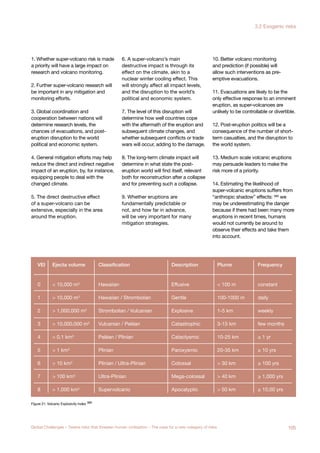
  • 127.
    01-Oct-13: Publication of“Our Final Invention: Artificial Intelligence and the End of the Human Era” by James Barrat, warning of the dangers of AI 519 – Research, In this book, James Barrat argues for the possibility of human-level AI being developed within a decade, based on the current progress in computer intelligence and the large sums invested by governments and corporations into AI research. Once this is achieved, the AI would soon surpass human intelligence, and would develop survival drives similar to humans (a point also made in Omohundro’s “AI drives” thesis).520 The book then imagines the competition between humanity and a cunning, powerful rival, in the form of the AI – a rival, moreover, that may not be “evil” but simply harmful to humanity as a side effect of its goals, or simply through monopolising scarce resources. Along with many interviews of researchers working in the forefront of current AI development, the book further claims that without extraordinarily careful planning,521 powerful “thinking” machines present potentially catastrophic consequences for the human race. 15-Oct-13: “Racing to the precipice: a model of artificial intelligence development” lays out the dangers of AI arms races 522 – Research AIs may be developed by different groups, each desiring to be the first to produce an artificial mind. The competitive pressure will be stronger the more powerful AIs are believed to be, thus maximising the danger in those situations. This paper considers an AI arms race,523 where different teams have the option of reducing their safety precautions in order to perfect their device first – but running the risk of creating a dangerous and uncontrollable AI. In the absence of enforceable agreements between the teams, this dynamic pushes each to take on more risk than they would want (similarly to the “prisoner’s dilemma“),524 potentially causing an extremely damaging outcome. The situation is improved if risk- taking makes little difference to speed of development, if the teams have reduced enmity between them, or if there are fewer teams involved (those last two factors also help with reaching agreements). Somewhat surprisingly, information has a negative impact: the outcome is safer if the teams are ignorant of each other’s rate of progress, and even of their own. 24-Oct-13: Growing researcher awareness of the threat of artificial intelligence 525 – Research Much more effort is devoted to creating AI than to ensuring that it is developed safely.526 Those working in developing AI could be motivated to minimise the extent their creation represented a potential danger.527 It is therefore significant when a researcher focused on the danger of AI is invited to speak at a mainstream AI conference, as Dr. Anders Sandberg of the Future of Humanity Institute was, at the 23rd International Joint Conference on Artificial Intelligence in Beijing. He took part in a panel discussion entitled “The Future of AI: What if we succeed?”, along with Joanna Bryson, Henry Kautz and Sebastian Thrun. He argued that though current AI research does not appear to directly lead to dangerous AIs, the time to design and implement safety measures is now. This is both because of the time needed to develop such safety measures, which could necessitate solving hard philosophical problems,528 and because of the potential for sudden increases in AI skill and intelligence. Further, security precautions would be easier to implement if they were integrated into the design by the designers themselves (or by researchers intimately aware of the properties of the design). Further evidence of the increased awareness of risks was Stuart Russell’s529 joining of the board of the Cambridge Centre for the Study of Existential Risks (CSER).530 125Global Challenges – Twelve risks that threaten human civilisation – The case for a new category of risks 3.3 Emerging risks
  • 128.
    Major Asteroid Impact Unknown Consequences 3.3Emerging risk Consequences 3.3.4Unknown Uncertain risks represent the unknown unknowns in the family of global catastrophic challenges. They constitute an amalgamation of all the risks that can appear extremely unlikely in isolation, but can combine to represent a not insignificant proportion of the risk exposure 531 126 Global Challenges – Twelve risks that threaten human civilisation – The case for a new category of risks 3.3 Emerging risks
  • 129.
    3.3.4.1 Expected impact disaggregation 3.3.4.2Probability There are many different possible risks that seem individually very unlikely and speculative. Could someone develop a super-pollutant that renders the human race sterile? Could the LHC have created a black hole that swallowed the Earth? 532 Might computer games become so addictive that large populations will die rather than ceasing to indulge in them? 533 Could experiments on animals lift them to a level of intelligence comparable with humans? 534 Might some of the people sending signals to extra-terrestrial intelligences attract deadly alien attention? 535 What are the risks out there that we can’t yet conceive of? These risks sound unlikely and for many possibly ridiculous. But many of today’s risks would have sounded ridiculous to people from the past. If this trend is extrapolated, there will be risks in the future that sound ridiculous today, which means that absurdity is not a useful guide to risk intensity. Expert opinion provides some information on specific speculative risks. But it will tend to give them extremely low probabilities – after all, the risks are highly speculative, which also means the expert’s judgement is less reliable.536 But in these situations, the main source of probability of the risk is not the quoted number, but the much greater probability that the experts’ models and world views are wrong.537 If marginal scientific theories predict large risks, the probability is concentrated in the likelihood that the theory might be correct.538 Conversely, if many independent models, theories, and arguments all point in the direction of safety, then the conclusion is more reliable. There are methods to estimate uncertain risks without needing to be explicit about them. One resolution to the Fermi paradox – the apparent absence of alien life in the galaxy – is that intelligent life destroys itself before beginning to expand into the galaxy. Results that increase539 or decrease the probability of this explanation modify the generic probability of intelligent life (self-)destruction, which includes uncertain risks. Anthropic reasoning540 can also bound the total risk of human extinction, and hence estimate the unknown component. Non-risk-specific resilience and post-disaster rebuilding efforts541 will also reduce the damage from uncertain risks, as would appropriate national and international regulatory regimes.542 Most of these methods would also help with the more conventional, known risks, and badly need more investment. Five important factors in estimating the probabilities and impacts of the challenge: 1. Whether there will be extensive research into unknown risks and their probabilities. 2. The capacity to develop methods for limiting the combined probability of all uncertain risks. 3. The capacity for estimating “out-of-model” risks. 4. The culture of risk assessment in potentially risky areas. 5. Whether general, non-risk- specific mitigation or resilience measures are implemented. 127Global Challenges – Twelve risks that threaten human civilisation – The case for a new category of risks 3.3 Emerging risks
  • 130.
    ECOLOGICAL CATASTROPHE Long-term ecological effects Post-eco-collapse climatechange Moral tragedy from ecosystem loss Quality of life loss from ecosystem loss Ecological collapse Economic costs Disruption to politics and economy Threat to food supply Loss of biodiversity Rebuilding the ecosystem Vulnerabilities to flood and otherdisasters Sustainable or non-sustainable economies Post-eco-collapse politics Pollution Preservation efforts Pre-eco-collapse climate change New, environmentally damaging industries Meta-uncertainty on the true dependence of humanity on theecosystem Total short-term casualties Civilisation collapse Extinction Pre-eco-collapse mitigation efforts Human survivability in “closed” systems Global poverty Global coordination Sustainability research Technological innovations Uncertain events Key Meta-uncertainties Risk events Direct impacts Indirect impacts Current intervention areas Bad decisions Accidents Severe impacts GOVERNANCE DISASTERS Global povety Global instability New system of governace Smart Sensors Global coordination Improvements to global goverance Deliberate attempts to construct world dictatorship Technological innovations Enduring poverty Not achieving important ethical goals Climate change Lack of human flourishing Undesirable world system (e.g. global dictatorship) Global pollution Disruption to world politics and economy Total short-term casualties Collapse of world system Post-disaster politics General mitigation effort Long-term negative effects Civilisation collapse Extinction Failing to solve important probelms Making things worse Uncertain events Key Meta-uncertainties Risk events Direct impacts Indirect impacts Current intervention areas Bad decisions Accidents Severe impacts Meta-uncertainty on tradeoffs between e.g. poverty, survival, freedom 128 Global Challenges – Twelve risks that threaten human civilisation – The case for a new category of risks 3.3 Emerging risks
  • 131.
    1. Smart sensorsand surveillance could detect many uncertain risks in the early stages, and allow researchers to grasp what is going on. 2. Proper risk assessment in domains where uncertain risks are possible could cut down on the risk considerably. 3. Global coordination would aid risk assessment and mitigation. 4. Specific research into uncertain and unknown risks would increase our understanding of the risks involved. 5. General mitigation efforts are mostly general resilience building. 6. Some institutions may deliberately pursue dangerous technologies or experiments, or may convince themselves that their research is not dangerous. 7. Unforeseen accidents could be the trigger for many uncertain risks. 8. The amount of direct casualties varies wildly depending on the risk involved. 9. The disruptions to the world’s economic and political system vary wildly depending on the risk involved. 10. The uncertain risk may have other disruptive effects (such as loss of trust in certain technologies). 11. The long-term impact varies wildly depending on the risk involved. 12. The world’s political structure, after an unknown risk is triggered, will determine whether humanity improves or worsens the situation. 13. Some methods (such as considering the Fermi paradox) may bound the total probability of destructive uncertain risks, but these are very speculative. 14. Trying to estimate unknown or out of model risks is by definition very difficult and uncertain. 129Global Challenges – Twelve risks that threaten human civilisation – The case for a new category of risks 3.3 Emerging risks
  • 132.
    during 2013 3.3.4.3 Mainevents 28-Mar-13: Paper on Adaptation to and recovery from global catastrophes in general 543 – Research One approach to dealing with uncertain risks is to build general adaptation and recovery methods that would be relevant to a wide class of potential disasters. This paper notes the absence of published research in this area,544 and seeks to begin to fill the gap. It identifies methods for increasing survivor resilience and promoting successful adaptation and recovery, even for isolated communities. It recognises that the process is highly complex, and needs further research. 28-Mar-13: Paper Evaluating Methods for Estimating Existential Risks 545 – Research It would be advantageous to have a rigorous approach for estimating severe risks, including uncertain and unknown ones. This paper reviews and assesses various methods for estimating existential risks, such as simple elicitation; whole evidence Bayesian; evidential reasoning using imprecise probabilities; Bayesian networks; influence modelling based on environmental scans; simple elicitation using extinction scenarios as anchors; and computationally intensive possible-worlds modelling.546 These methods can be applied rigorously to uncertain risks, assessing them in the same way as more standard risks. Influence modelling based on environmental scans547 can even suggest some new as yet unknown risks. Figure 23: Number of galaxies that can reach us with speeds of 50%c, 80%c, 99%c and c, from different starting moments 552 01-Aug-13: The Fermi paradox provides an estimate of total existential risk (including uncertain risks) 548 – Research The Fermi paradox is the seeming contradiction between the apparent ease with which intelligent life could arise in the galaxy, and the lack of evidence of any such life. Many explanations have been proposed to resolve the paradox,549 one of which is relevant to existential risks: the “Late Great Filter” explanation.550 This posits that intelligent life is inevitably destroyed before it can expand through the galaxy. Such an explanation gives a bound to existential risk from all sources, including uncertain risks. This paper demonstrates the relative ease with which a space- faring civilisation could cross between galaxies. Combined with recent evidence that the majority of Earth-like planets formed before the Earth,551 this makes the absence of visible intelligent life more inexplicable, and worsens the Fermi paradox, increasing the probability of a Late Great Filter and thus of existential risk from all sources. 130 Global Challenges – Twelve risks that threaten human civilisation – The case for a new category of risks 3.3 Emerging risks
  • 133.
    01-Nov-13: Top conglomerates spearheadcreation of private sector disaster response body 553 – Initiative One of the most effective tools against uncertain risks is to adopt general disaster recovery measures. Anything that enables the preservation of resources or knowledge and the rapid reconstruction of key infrastructure will be of use against a wide variety of risks. Though governments and supra-governmental organisations play a vital role in this, it would be beneficial to get the private sector, with its funds and its expertise, involved too. The private sector has played a key role in recovery from many disasters (such as the Japanese 2011 earthquake/ tsunami).554 This news report shows that the private sector aims to take on a larger role in disaster relief in the Philippines. More importantly, the key players aim for the creation of a private sector disaster response body, so as to have a better organised private sector response during disasters. This is significant as it disperses disaster recovery expertise to a wider group of individuals, and suggests that private companies may be alternate entities capable of providing relief after a major disaster. Thus preparations for post-disaster recovery could include building up private sector capacity as well as other measures. 131Global Challenges – Twelve risks that threaten human civilisation – The case for a new category of risks 3.3 Emerging risks
  • 134.
    Nuclear War Global S Collapse Global Pandemic FutureBad Global Governance Super-volcano Syntheti Biology 3.4Global Policy risk Global Governance 3.4.1 Future Bad “Global governance refers to the way in which global affairs are managed. As there is no global government, global governance typically involves a range of actors including states, as well as regional and international organisations. However, a single organisation may nominally be given the lead role on an issue.” 485 132 Global Challenges – Twelve risks that threaten human civilisation – The case for a new category of risks 3.4 Global Policy risks
  • 135.
    3.4.1.1 Expected impact disaggregation 3.4.1.2Probability bal System lapse Major Asteroid Impact nthetic logy Unknown Consequences Often global governance is confused with global government, but they are two very different things. Global governance is just a term to describe the way global affairs are managed, or not managed. Global government is the idea that the world should be run like a country with a government. The global governance system will inevitably have pros and cons, depending on the political decisions that are made. This section looks at global governance disasters. Though all the risks in this report can be exacerbated by poorly chosen policy decisions, this classification contains those problems that arise almost exclusively from bad policy choices. There are two main divisions in governance disasters: failing to solve major solvable problems, and actively causing worse outcomes. An example of the first would be failing to alleviate absolute poverty.556 An example of the second would be constructing a global totalitarian state.557 In general, technology, political and social change may enable the construction of new forms of governance, which may be either much better or much worse. These examples immediately illustrate two issues with governance disasters. First, the task of estimating their probability is difficult. Long- term political predictions are of questionable validity and subject to strong biases,558 especially where strongly-held values are concerned.559 Second, the impact of these governance disasters depends to a large extent on subjective comparative evaluations. It is not impartially obvious how to rank continued poverty and global totalitarianism versus billions of casualties or civilisation collapse.560 The long term impact needs also to be considered: how will poverty and global governance change? If there are many generations ahead of us, then the long term state of humanity’s policy561 becomes much more important than the short term one. Five important factors in estimating the probabilities of various impacts: 1. How the severity of non-deadly policy failures can be compared with potential casualties. 2. Whether poorgovernancewillresult in a collapse of the world system. 3. How mass surveillance and other technological innovations will affect governance. 4. Whether there will be new systems of governance in the future. 5. Whether a world dictatorship may end up being constructed. 133Global Challenges – Twelve risks that threaten human civilisation – The case for a new category of risks 3.4 Global Policy risks
  • 136.
    GOVERNANCE DISASTERS Global povetyGlobal instability New system of governace Smart Sensors Global coordination Improvements to global goverance Deliberate attempts to construct world dictatorship Technological innovations Enduring poverty Not achieving important ethical goals Climate change Lack of human flourishing Undesirable world system (e.g. global dictatorship) Global pollution Disruption to world politics and economy Total short-term casualties Collapse of world system Post-disaster politics General mitigation effort Long-term negative effects Civilisation collapse Extinction Failing to solve important probelms Making things worse Uncertain events Key Meta-uncertainties Risk events Direct impacts Indirect impacts Current intervention areas Bad decisions Accidents Severe impacts Meta-uncertainty on tradeoffs between e.g. poverty, survival, freedom GOVERNANCE DISASTERS Global povety Global instability New system of governace Smart Sensors Global coordination Improvements to global goverance Deliberate attempts to construct world dictatorship Technological innovations Enduring poverty Not achieving important ethical goals Climate change Lack of human flourishing Undesirable world system (e.g. global dictatorship) Global pollution Disruption to world politics and economy Total short-term casualties Collapse of world system Post-disaster politics General mitigation effort Long-term negative effects Civilisation collapse Extinction Failing to solve important probelms Making things worse Uncertain events Key Meta-uncertainties Risk events Direct impacts Indirect impacts Current intervention areas Bad decisions Accidents Severe impacts Meta-uncertainty on tradeoffs between e.g. poverty, survival, freedom 134 Global Challenges – Twelve risks that threaten human civilisation – The case for a new category of risks 3.4 Global Policy risks
  • 137.
    1. Global coordinationbetween nations is essential for building a good global governance system – but also essential for building a bad one. 2. Global poverty is one of the important problems that are being only partially solved by current policies. In turn, it can contribute to global instability, worsening likely governance outcomes. 3. Smart sensors and mass surveillance can contribute to new systems of governance, but also to large-scale dictatorships. 4. The global system of governance consists of the UN and a wide variety of bilateral or multilateral agreements and norms, constructed mainly according to national self-interests. Thus significant improvements to global governance are currently possible. 5. General mitigation efforts against governance disasters are tricky – most mitigation efforts are the results of governance decisions! However, some efforts can be made – for instance, an increase in recognised human rights across the globe could militate against certain pernicious governance directions. These efforts are of a very different nature to mitigating other risks. 6. Some groups may deliberately seek to construct a world dictatorship, either through self-interest or because they believe it would be the best design for global governance. 7. Undesirable world systems (such as global dictatorships) could result from a worsening of global governance. 8. Many value systems do not distinguish between action and inaction, so a global system that didn’t positively encourage human flourishing would be almost as pernicious as one that blocked it. 9. Global pollution is a problem requiring solutions at the global governance level. 10. Climate change is a problem requiring solutions at the global governance level. 11. Various ethical systems have desirable goals that could be achieved in theory, but would not be achieved under suboptimal governance. 12. It would be a tragedy if absolute poverty were to endure over the generations to come, especially if this outcome were avoidable. 13. A collapse of the world system, for any reason (including revolution) is the most direct way a governance disaster could result in mass casualties. 14. Governance decisions taken at the global level have a high potential to cause disruptions to the world’s political and economic systems. 15. Bad governance at the global level may not be susceptible to improvements and could cause problems for a considerable amount of time. 16. Technological innovations could allow completely new models of government, but could also facilitate surveillance dictatorships. 17. Global instability could result in more pernicious systems of governance, as well as an increased failure to solve important problems. 18. New systems of governance could be developed, using modern communication technology for instance. 19. The political landscape after a disaster will be important in determining whether governance disasters could cause civilisation collapses or mass casualties. 20. How to compare enduring poverty, actual casualties, and repressive governance is a question of values and not just of direct comparison of lives lost. 135Global Challenges – Twelve risks that threaten human civilisation – The case for a new category of risks 3.4 Global Policy risks
  • 138.
    during 2013 3.4.1.3 Mainevents 1981 Brazil 57.5 59.7 57.6 India 35.1 29.1 Gini index* 35.5 41.5 30.8 China 81 90 93 95 052000 0 20 40 60 80 100 33.4 Less poverty of nations 15-Feb-13: Existential risk reduction as a global priority 562 – Research In this paper Nick Bostrom, the director of the Future Humanity Institute, lays out the case for making existential risk reduction a global priority. Existential risks (Xrisks) are the highest category of negative impact in this report, those that threaten the entire future of humanity. The policy implications of the paper are: – Existential risk is a concept that can focus long-term global efforts and sustainability concerns. – The biggest existential risks are anthropogenic and related to potential future technologies. – A moral case can be made that existential risk reduction is strictly more important than any other global public good. – Sustainability should be rethought in dynamic terms, as aiming for a sustainable trajectory rather than a sustainable state. – Some small existential risks can be mitigated today directly (e.g. asteroids) or indirectly (by building resilience and reserves to increase survivability in a range of extreme scenarios) but it is more important to build capacity to improve humanity’s ability to deal with the larger existential risks that will arise later in this century. This will require collective wisdom, technology foresight, and the ability when necessary to mobilise a strong global coordinated response to expected existential risks. – Perhaps the most cost-effective way to reduce existential risks today is to fund analysis of a wide range of existential risks and potential mitigation strategies, with a long-term perspective. If this paper is right, a general lack of focus on existential risks by governments and other agents can be considered a governance disaster in itself. 19-Apr-13: Multidimensional poverty index diminishes in 18 out of 22 analysed countries 563 – Event Of 22 countries for which the Oxford Poverty and Human Development Initiative analysed changes in MPI (Multidimensional Poverty Index) poverty over time, 18 reduced poverty significantly. This confirms other studies, by the World Bank564 and others:565 poverty reduction is possible, and has been successfully implemented in many countries. 05-Jun-13: Guardian leaks NSA spying programme 566 – Initiative A significant event was the revelation by Edward Snowden of the extent of the NSA’s surveillance programme. This included the mass recording and mining of data across the United States and the interception of foreign politicians’ data. The revelations caused great controversy567 and raised questions about the NSA’s surveillance oversight.568 The episode established that discrete mass surveillance – an important component of potential Figure 24: Less poverty of nation - Population living below $1.25 a day at 205 Purchasing-pover parity, % * 0=absolute equality, 100=absolute inequality Source: Economist, originally World Bank, http://www.economist.com/node/14979330 136 Global Challenges – Twelve risks that threaten human civilisation – The case for a new category of risks 3.4 Global Policy risks
  • 139.
    totalitarianism – wasalready possible using current technology and political organisation. 14-Jun-13: UNDP-UNEP Poverty- Environment Initiative Launches New Five-Year Phase to Meet Growing Demand from Member States 569 – Policy To reduce poverty in the future, it is important to maintain and extend past trends in poverty mitigation. The United Nations’ Poverty-Environment Initiative (PEI), launched in 2008, has had a number of success stories from Uruguay570 to Malawi.571 Due to increased demand from member states, the programme has been extended for another five years, 2013-2017, and may add countries such as Myanmar, Mongolia, Indonesia, Albania, Peru and Paraguay. Such programmes demonstrate that the bureaucratic/policy side of poverty reduction is supported by an international infrastructure with a strong emphasis on assessments. The effect of such approaches on overall poverty will depend on the interplay between these policies and the other side of poverty reduction, economic growth572 and trade.573 137Global Challenges – Twelve risks that threaten human civilisation – The case for a new category of risks 3.4 Global Policy risks
  • 140.
    “We have someidea what might happen if, in the face of other pressing global challenges, we divert our focus from making systemic improvements in public health and veterinary services — and that prospect is frightening.” The World Bank 574 global risks 4. Relations between 138 Global Challenges – Twelve risks that threaten human civilisation – The case for a new category of risks 4. Relations between global risk
  • 141.
    and their potentialimpacts between global risks 4.1 General relationsTwo things make the understanding of the relation between the global risks particularly important. 1. Impacts: The global risks are interconnected in different ways. Often the situation can be described as a set of dominoes: if one falls, many others follow. Even small impacts can start a process where different challenges interact. Higher temperatures due to global warming can result in the spreading of pandemics which increase tensions between countries, and so on. 2. Specific measures to address a risk: Global risks often require significant changes in our current society, from how we build cities to how food is produced and provided. Such significant changes will result in situations where measures to reduce the risk in one area affect the probability and/or the impact in other areas. Depending on the measure chosen to reduce the risk, and other complementary measures, the effect can be positive or negative. Relations between global risks is an area where surprisingly little work is being done. Most research focuses on individual or closely related groups of challenges. Organisations working on global challenges are almost always working on individual risks. The initial overview below is based on individual studies where different relations are analysed , but no work has been identified where the relations between all twelve challenges have been analysed. A risk that is natural to start with is future bad global governance, as all other global challenges exacerbate governance disasters,575 and all other global challenges can potentially be exacerbated by governance disasters. A well functioning global governance system is therefore a key factor to address global catastrophic risks. Conversely, avoiding governance disasters improves all risks, as better institutions are better able to mitigate risks. Governance disasters directly increase the problems of climate change (through a lack of coordination between countries), the risk of nuclear war (by stoking conflict between nuclear powers) and global system collapse (by weakening global responses to systemic risks). All risks exacerbate global system collapse, by putting extra stress on an interconnected system.576 Conversely, a resilient governance system is better able to cope with all risks, and a collapsed global system is more vulnerable to all risks. Nuclear war,577 asteroid impacts578 and super-volcanoes579 have direct impacts on the climate, and, through that, on the ecosystem.580 The kinds of mitigation efforts capable of containing the damage from a super-volcano would most likely be effective against asteroid impact damage, because of the similar nature of the impacts. The converse is not true, since one major method of reducing asteroid impact – space- based deflection581 – would have no impact on super-volcano risk. Solving climate change would help reduce current ecological pressure.582 International agreements to reduce ecological damage could be extended to combating climate change as well, by establishing structures for international collaboration and encouraging resource-efficient solutions . Climate change also creates conditions more suitable for the spread of pandemics.583 Measures to combat global pandemics, such as strengthened outbreak coordination and statistical modelling,584 could be used to combat synthetic pathogens as well. If a safe artificial intelligence is developed, this provides a great resource for improving outcomes and mitigating all types of risk.585 Artificial intelligence risks worsening nanotechnology risks, by allowing nanomachines and weapons to be designed with intelligence and without centralised control, overcoming the main potential weaknesses of these machines586 by putting planning abilities on the other side. 139Global Challenges – Twelve risks that threaten human civilisation – The case for a new category of risks 4. Relations between global risk / 4.1 General relations between global risks and their potential impacts
  • 142.
    Conversely, nanotechnology abilities worsenartificial intelligence risk, by giving AI extra tools which it could use for developing its power base.587 Nanotechnology and synthetic biology could allow the efficient creation of vaccines and other tools to combat global pandemics.588 Nanotechnology’s increased industrial capacity could allow the creation of large amounts of efficient solar panels to combat climate change, or even potentially the efficient scrubbing of CO2 from the atmosphere.589 Nanotechnology and synthetic biology are sufficiently closely related 590 (both dealing with properties on an atomic scale) for methods developed in one to be ported over to the other, potentially worsening the other risk. They are sufficiently distinct though (a mainly technological versus a mainly biological approach) for countermeasures in one domain not necessarily to be of help in the other. Uncontrolled or malicious synthetic pathogens could wreak great damage on the ecosystem; conversely, controlled and benevolent synthetic creations could act to improve and heal current ecological damage. There are many secondary effects that are not covered here. Increasing nuclear power could for instance improve the outlook for climate change,591 while increasing the risk of proliferation592 and thus of nuclear war. There are many such effects between various strategies for addressing different risks, but they are specific enough for there to be no simple arguments of the type which says that mitigating risk X worsens risk Y. ALL RISKS solving first risk improves second risk both of the above first risk worsens second risk 140 Global Challenges – Twelve risks that threaten human civilisation – The case for a new category of risks 4.1 General relations between global risks and their potential impacts
  • 143.
    global risks relations between 4.2Specific In parallel with work to increase our understanding about the general relations between global risks, work to identify more specific relations should also be initiated. This is an area where many pieces of research exist. But very little work has been done to combine them and assess different strategies to address specific global risks and understand how these strategies will affect other global risks. It is important to distinguish between two different kinds of specific relations. First, there are solution strategies for one global risk and the ways it affects other global risks. For example, using videoconferences can reduce the probability of pandemics by reducing unnecessary travel. On the other hand, unsustainable use of bio-energy could increase spillover opportunities when a zoonosis (a disease transmitted from animals to humans) increases the spread of pandemics due to an increased number of contacts between humans and infected animals in forests around the world.593 Second, how society reacts to the very threat of different risks can affect other challenges. For example, if people are afraid of pandemics they might use more video meetings and in that way help reduce carbon emissions. Attempts to develop solutions for specific global challenges should assess their impacts, positive and negative, on other challenges. In order to better understand the relations between different global challenges work could start to analyse similarities and differences. Below is an example of an overview of how different global challenges can be plotted depending on the technical difficulty of reducing the risk and the difficulty of collaborating to reduce it. An international initiative should start to achieve better understanding of the relations between global challenges in order to ensure synergies and avoid strategies that will undermine other challenges. collaboration difficulty of reducing risk technicaldifficultyofreducingrisk peopleafraid ofinfections shortterm thinking people die / suffer Global Pandemic reduce risk increase risk support use lessmeat consumption morevideo meetings more renewableenergy attack accident fromnature Extreme Climate Change 141Global Challenges – Twelve risks that threaten human civilisation – The case for a new category of risks 4.1 Specific relations between global risks
  • 144.
    “Uncertainty is anuncomfortable position. But certainty is an absurd one.” Voltaire – an initial overview 5. Probabilities and uncertainties 142 Global Challenges – Twelve risks that threaten human civilisation – The case for a new category of risks 5. Probabilities and uncertainties – an initial overview
  • 145.
    During the processof identifying risks that could have an infinite impact it became evident that the most common question among people interested in global challenges is this: “How probable is it that this impact will ever happen?” For those with expert knowledge in one area the first question is often: “How does the probability and magnitude of impact in this area compare with the probability and magnitude of impact in other areas?” Finally, those who have tried to estimate probabilities for global challenges ask: “What is the status of knowledge in other areas compared to mine?” These are all very important questions, and this chapter is not an attempt to answer them. But, as there is no organisation, process or report that has provided an overview of quantified assessment for global challenges with potential infinite impact, the chapter does try to present the current state of knowledge in order to inspire further work. It is easy to argue that it is too difficult, or even impossible, to assess the probabilities that are at all meaningful for the risks in this report, and therefore to exclude them. There are many good reasons for not trying, including significant uncertainty in almost all steps of the assessment. Not only do great uncertainties exist for all the risks, but the difficulties of estimating probabilities are also very different. At one end of the spectrum the probability of a nuclear war can change dramatically from one day to another due to political decisions. Much of the uncertainty is related to psychological assumptions of how different individuals will react under stress. At the other end of the spectrum there is AI, where there is not even a generally accepted understanding of the possibility of the impacts capable of creating the risks covered in this report. There are challenges with very much data, including asteroids, and other challenges with very little relevant data, such as bad future global governance. Obviously the risks also share a number of characteristics: they all have potentially extreme outcomes and have never been experienced before. The possibility of studying series of data, exploring how the outcome will change with incremental changes in input data, and testing conclusions on similar events are just a few examples of things that in most cases cannot be done. Estimating probabilities in traditional ways is therefore very difficult.594 However, as the current lack of interest in global risks with potentially infinite impacts may in part be due to the lack of actual numbers, the best estimates that could be found are presented below with explanations. These estimates are only an attempt to assemble existing estimates in order to encourage a process to improve these numbers. These estimates range from rigorous calculations based on large amounts of high-quality data (asteroids) to guesstimates by interested experts (AI). The result is that some have a more rigorous methodology behind them, and others should be taken with a large grain of salt, but all are still very rough estimates. As science progresses they will be updated. It is even possible that some will change by orders of magnitude. But instead of no estimate at all, we now have an initial reference that we hope will trigger a discussion and collaboration that will help improve what we have already. As many of the challenges are long- term and require early action to be avoided or mitigated the probability is provided for the next 100 years, instead of the annual probability that is often provided. The reason for this is that a 100-year perspective helps us understand that even relatively small probabilities can become significant over a century. Say that it is a one in 100 probability (1%) for an impact to occur. Over a century there is a 63.4% probability of one or more such impacts.595 Further, structures that need to change require us to look beyond the immediate and incremental changes that most discussions focus on today. 143Global Challenges – Twelve risks that threaten human civilisation – The case for a new category of risks 5. Probabilities and uncertainties – an initial overview
  • 146.
    Structure of theprobability estimates As the different challenges are very different and the status of probability estimates varies significantly, the initial probability numbers are provided together with estimates regarding: 1. The understanding of sequence. This is an estimation of how well the sequence from today to a possible infinite impact is understood. At one extreme all the different paths from today to an infinite impact are understood. At the other extreme, there is only a theoretical idea that is coherent and does not break any natural laws. In the latter case there would be no understanding of how it is possible to get from where we are today to an infinite impact. A sequence is required to calculate an estimate instead of only having educated guesses. 2. Data availability. This is an estimate of the amount of data available to make probability assessments on all relevant steps of the sequence. In some areas a lot of hard-to-get data is needed to make an assessment (e.g a global pandemic); in other areas the data is related to secret and/ or psychological factors (e.g. large-scale nuclear war). In others relatively little data is needed (asteroids), or a lot has been done to gather data (e.g. climate change). 3. Existing probability estimates form an estimate of the kind of uncertainty that exists. This obviously depends on understanding of sequence and data availability, but it also depends on resources and interest in communicating with the rest of the world. The estimates below are preliminary, but a sound risk approach requires stakeholders to begin to include them in strategic assessments. One group in particular is of interest and that is actuaries, the professionals who deal with the financial impact of risk and uncertainty. One of the key guiding rules they follow is to ensure a capital adequacy at a 1-in-200 level. This rule, which is included in for example ICA596 and Solvency II,597 provides an opportunity to discuss risks with a possible infinite impact. One contribution could be to discuss the pros and cons with different definitions of the 1-in-200 level. For example one definition is that “each company holds enough capital to withstand the events of the next one year with a probability of 199 out of 200.” 598 This would exclude many of the risks in this report and could even result in the risks increasing, as the time perspective is so short. Investments could help reduce short- term risks at the same time as they increase long-term risks. Another definition is that “a company should hold enough capital to be able to withstand a ‘reasonably foreseeable’ adverse event”.599 This highlights the challenge of determining what “reasonably foreseeable” is. Hopefully all the risks in this report could be included on such a list. Then the questions would be what we can do about it. 0.0000001% one in hundred million 0.00001% one in ten million 0.0001% one in a million 0.001% one in hundred thousand 0.01% one in ten thousand 0.1% one in thousand 1% one in hundred 10% one in ten 100% one in one 0. infinite impact % infinite threshold % 144 Global Challenges – Twelve risks that threaten human civilisation – The case for a new category of risks 5. Probabilities and uncertainties – an initial overview
  • 147.
    amount of datato make probability assessment on all relevant steps of the sequence nodatasomedatamostdataalldata 2. Data availability kind of estimation and uncertainty noestimates bestguesses byexperts calculationswith largeuncertainty calculationswith smalluncertainty 3. Existing probability estimation 1. Understanding of sequence degree of events from today’s actions to infinite impact noneatallsomepartsmostpartsallparts n/a n/a 0.00013% 0.01% 0.01% 0-10% 0-10% 0.8% 145Global Challenges – Twelve risks that threaten human civilisation – The case for a new category of risks 5. Probabilities and uncertainties – an initial overview
  • 148.
    Climate Change Extreme Extreme climatechange is one of the risks where global research collaboration has taken place on a significant scale. The IPCC process is an unprecedented scientific achievement that has helped provide a unique level of understanding for such a complex area. Even so, the understanding of tipping points and collapses is still rudimentary. From a risk perspective it is important to know that many factors that could result in infinite impacts are excluded from most studies, for example the rapid release of methane clathrates.600 Similarly, significant uncertainty exists about political decisions in many countries, about the implementation of new solutions and about what lifestyles will dominate. The IPCC process ensures that data is widely available and of good quality, thanks to intensive peer review in the natural science area. Estimates of political and technological development exist, but they are more rudimentary compared to the natural science.601 With such a high-profile area there are also a number of quantified estimates in key areas such as emissions trajectories, climate sensitivity, impacts and thresholds that allow for approximations of probabilities. But only a few estimates exist that provide probability assessments, as there is a tendency to use scenarios instead. One aspect that makes climate change different from all other risks is that the time from initial action to impact is very long. The great uncertainty is where the threshold lies where the planet begins to emit greenhouse gases that start irreversible feedbacks. Most models indicate that it will be decades before the Earth reaches equilibrium, and some impacts, like sea-level rise, will happen over millennia.602 This long interval between action and impact means the probability of climate change is expressed on a 200-year timescale, compared with 100 years for the other challenges. Based on available assessments603 the best current estimate for extreme climate change in the next 200 years is: 5% for infinite threshold, 0.01% for infinite impact 0.0000001% one in hundred million 0.00001% one in ten million 0.0001% one in a million 0.001% one in hundred thousand 0.01% one in ten thousand 0.01% 5% infinite impact % infinite threshold % 146 Global Challenges – Twelve risks that threaten human civilisation – The case for a new category of risks 5. Probabilities and uncertainties – an initial overview
  • 149.
    amount of datato make probability assessment on all relevant steps of the sequence nodatasomedatamostdataalldata 2. Data availability kind of estimation and uncertainty noestimates bestguesses byexperts calculationswith largeuncertainty calculationswith smalluncertainty 3. Existing probability estimation 1. Understanding of sequence degree of events from today’s actions to infinite impact noneatallsomepartsmostpartsallparts % en d 0.1% one in thousand 1% one in hundred 10% one in ten 100% one in one 0.0001% 5% n/a n/a 0.00013% 0.002% 0.00003% 0.01% ct % hold % 147Global Challenges – Twelve risks that threaten human civilisation – The case for a new category of risks 5. Probabilities and uncertainties – an initial overview
  • 150.
    Nuclear War Nuclear waris the risk that started the work with scientific assessments related to infinite impact.604 The understanding of the sequence is relatively well known. Still, the fact is that the impact will depend significantly on how serious the nuclear winter will be as the result of a war (if there is any nuclear winter at all). The probability of a nuclear winter will depend on when during the year the war happens, and what the weather is during this time. The result is that the probability of an infinite impact has an inherent uncertainty and can be estimated only once a war has already started. The data availability is relatively low as much of the probability is decided by factors that are secret (e.g. the targets for nuclear weapons). It depends on knowledge that by definition is unavailable (no nuclear explosions, for example, have taken place in a modern city); on human factors (e.g. stress tolerance and aggressive tendencies among those who will have to decide whether or not to launch nuclear weapons); and on the effectiveness of current policies (e.g. how efficient current deterrence policies are). The fact that climate change research has provided better scientific understanding of the probability and nature of a nuclear winter, thanks to better climate modelling, is worth noting as it shows how research programmes on different global challenges can be mutually supportive.605 There are some estimates of key aspects, such as the probability of accidental initiation of a nuclear war, but few estimates of the probability of a full-scale nuclear war. Based on available assessments607 the best current estimate for nuclear war in the next 100 years is: 5% for infinite threshold, 0.005% for infinite impact 0.0000001% one in hundred million 0.00001% one in ten million 0.0001% one in a million 0.001% one in hundred thousand 0.01% one in ten thousand 0.01% 5% n5% 0.005% infinite impact % infinite threshold % 148 Global Challenges – Twelve risks that threaten human civilisation – The case for a new category of risks 5. Probabilities and uncertainties – an initial overview
  • 151.
    noneatallsomepartsmostpartsallparts amount of datato make probability assessment on all relevant steps of the sequence nodatasomedatamostdataalldata 2. Data availability kind of estimation and uncertainty noestimates bestguesses byexperts calculationswith largeuncertainty calculationswith smalluncertainty 3. Existing probability estimation 1. Understanding of sequence degree of events from today’s actions to infinite impact % en d 0.1% one in thousand 1% one in hundred 10% one in ten 100% one in one 0.0001% 5% n/a 1% 0.5% n/a n/a 0.00013% 0.002% 0.00003% 0.01% 0.01% ct % hold % 149Global Challenges – Twelve risks that threaten human civilisation – The case for a new category of risks 5. Probabilities and uncertainties – an initial overview
  • 152.
    Pandemic Global On a generallevel the sequence, or rather sequences, for a pandemic are relatively well-known. The challenge here is that there are so many different scenarios that it is very difficult to calculate all the different possibilities even if the sequence is well-known. Compared with climate change where GHG gases are a small group, and nuclear war where the number of warheads is relatively limited, the number of ways that a global pandemic can start is almost unlimited. Making things worse too is the fact that a global pandemic that reached the infinite threshold would most certainly be very different from almost all earlier pandemics, and maybe something totally new that has never happened before. Understanding more than the most basic sequence therefore becomes a challenge. When it comes to data availability for pandemics the situation is different compared with nuclear war or climate change, where the impact depends on something that can be removed (nuclear weapons and GHG gases). It is not possible to get rid of mutating viruses and other organisms, so the data needed is of another kind and magnitude. There will always be new diseases emerging, because there is constant evolution, resulting in microbes looking for ecological niches. With many of the spillover effects occurring in remote areas, even basic data is still very rudimentary. Scientists who collect data relevant for pandemics are often working with very small resources, and there is no systematic way of collecting data on a global scale, although interesting initiatives are under way.607 While an early warning system would be comparatively inexpensive, there are still no resources available. Most of the probability estimates made for pandemics are for their more benign versions. For the possible pandemic that could kill two billion or more there are very few estimates. Based on available assessments608 the best current estimate of a global pandemic in the next 100 years is: 5% for infinite threshold, 0.0001% for infinite impact The reason for the big difference between threshold and impact is mainly that a pandemic will not directly affect infrastructure or the rest of the ecosystem in the way that extreme climate change or nuclear war would. This means that resilience will be relatively better after the infinite threshold is crossed. .0000001% e in hundred llion 0.00001% one in ten million 0.0001% one in a million 0.001% one in hundred thousand 0.01% one in ten thousand 0.1% one in thousand 1% one in hundred 10% one in ten 100% one in one 0.01% 0.0001% 5% 5% 0.0001 infinite impact % infinite threshold %.0000001% ne in hundred illion 0.00001% one in ten million 0.0001% one in a million 0.001% one in hundred thousand 0.01% one in ten thousand 0.1% one in thousand 1% one in hundred 10% one in ten 100% one in one 0.01% 0.0001% 5% 5% 0.000 infinite impact % infinite threshold % 150 Global Challenges – Twelve risks that threaten human civilisation – The case for a new category of risks 5. Probabilities and uncertainties – an initial overview
  • 153.
    amount of datato make probability assessment on all relevant steps of the sequence nodatasomedatamostdataalldata 2. Data availability kind of estimation and uncertainty noestimates bestguesses byexperts calculationswith largeuncertainty calculationswith smalluncertainty 3. Existing probability estimation 1. Understanding of sequence degree of events from today’s actions to infinite impact noneatallsomepartsmostpartsallparts n/a n/a 0.00013% 0.002% 0.00003% 0.01% 0.01% 0-10% 0-10% 0.1% 0.8% 5% n/a n/a 0.00013% 0.002% 0.00003% 0.01% 0.01% 0-10% 0-10% 0.1% 0.8% 5% 151Global Challenges – Twelve risks that threaten human civilisation – The case for a new category of risks 5. Probabilities and uncertainties – an initial overview
  • 154.
    Catastrophe 609 Ecological This isone of the more complex risks as it can be seen more as a heading than a description of a specific challenge with a well-defined sequence. In other words it is not one sequence, but very many still unknown sequences. The concept of ecological collapse usually refers to a situation where some part of the ecological web becomes so weak that it collapses. There are many studies about the stability and possible collapse of different ecosystems, but there are few that look into the possibility for a full ecological collapse that would result in at least two billion people suffering. Data availability is good in many areas, but the challenge is that without an understanding of the system dynamics, and because of its complexity, there are inherent limits to how exact the knowledge is that can be achieved.610 Regarding probability estimates, it is only ecological collapse and global system collapse of the current man- made global challenges that have no estimates for infinite impact. Based on available assessments611 the best current estimate of an ecological catastrophe in the next 100 years is: 0.5% for infinite threshold, Not available for infinite impact .0000001% e in hundred lion 0.00001% one in ten million 0.0001% one in a million 0.001% one in hundred thousand 0.01% one in ten thousand 0.1% one in thousand 1% one in hundred 10% one in ten 100% one in one 0.01% 0.0001% 5% 5% n/a5% 0.005% 0.5% 0.0001 infinite impact % infinite threshold %.0000001% ne in hundred illion 0.00001% one in ten million 0.0001% one in a million 0.001% one in hundred thousand 0.01% one in ten thousand 0.1% one in thousand 1% one in hundred 10% one in ten 100% one in one 0.01% 0.0001% 5% 5% n/a5% 0.005% 0.5% 0.000 infinite impact % infinite threshold % 152 Global Challenges – Twelve risks that threaten human civilisation – The case for a new category of risks 5. Probabilities and uncertainties – an initial overview
  • 155.
    amount of datato make probability assessment on all relevant steps of the sequence nodatasomedatamostdataalldata 2. Data availability kind of estimation and uncertainty noestimates bestguesses byexperts calculationswith largeuncertainty calculationswith smalluncertainty 3. Existing probability estimation 1. Understanding of sequence degree of events from today’s actions to infinite impact noneatallsomepartsmostpartsallparts 1% n/a n/a 0.00013% 0.002% 0.00003% 0.01% 0.01% 0.01% 0-10% 0-10% 0.1% 0.8% 5% n/a n/a1% n/a n/a 0.00013% 0.002% 0.00003% 0.01% 0.01% 0.01% 0-10% 0-10% 0.1% 0.8% 5% n/a n/a 153Global Challenges – Twelve risks that threaten human civilisation – The case for a new category of risks 5. Probabilities and uncertainties – an initial overview
  • 156.
    Collapse Global System Since thefinancial crisis the possibility of a global collapse of the current political, economic and financial system has been discussed intensively. A rapidly evolving and increasingly interconnected system, it is subject to unexpected, system-wide failures because of the structure of the network – it faces a systemic risk. Possible sequences for a global system collapse resulting in infinite impacts are very hard to establish, for three reasons. First, it is a very complicated system, with many dynamic interactions, as there are many people who together with machines react to each other. The current global system shows a lot of complex dynamic phenomena, such as business cycles, financial crises, irregular growth, and bullwhip effect.612 Many nonlinear dynamic models of economics and finance present various complex dynamic behaviours such as chaos, fractals, and bifurcation. Second, it is a rec ent system that has been so interconnected for only a few years, as it depends on an infrastructure that did not exist before the internet, so there is little experience of how it works. Third, the system is rapidly changing and becoming even more complex as more connections are added and its speed increases. Better understanding of complex systems with multiple attractors and bifurcation behaviour will help improve the possibility of understanding the possible sequences.613 An additional challenge for the understanding of sequences that can result in impacts beyond the infinite threshold is that almost all research being done in the area of global system collapse focuses on its economic or geopolitical implications, not on a full system collapse and not on human suffering. The data availability of global system collapse is something of a paradox. On the one hand the system is almost nothing but information, but at the same time data about how the system itself operates, what algorithms are used, and so on,, are not well known. No estimate of the probability of a global system collapse that would result in an impact beyond the infinite threshold has been identified during the project. Based on available assessments the best current estimate of a global system collapse in the next 100 years is: Not available for infinite threshold, Not available for infinite impact % en nd 0.1% one in thousand 1% one in hundred 10% one in ten n/a n/a act % % ten nd 0.1% one in thousand 1% one in hundred 10% one in ten n/a n/a act % 154 Global Challenges – Twelve risks that threaten human civilisation – The case for a new category of risks 5. Probabilities and uncertainties – an initial overview
  • 157.
    amount of datato make probability assessment on all relevant steps of the sequence nodatasomedatamostdataalldata 2. Data availability kind of estimation and uncertainty noestimates bestguesses byexperts calculationswith largeuncertainty calculationswith smalluncertainty 3. Existing probability estimation 1. Understanding of sequence degree of events from today’s actions to infinite impact noneatallsomepartsmostpartsallparts 0.01% 0.8% 0.01% 0.8% 155Global Challenges – Twelve risks that threaten human civilisation – The case for a new category of risks 5. Probabilities and uncertainties – an initial overview
  • 158.
    Impact Major Asteroid The understandingof sequence when it comes to asteroid impacts is relatively straightforward and our planet is constantly experiencing asteroids, so assumptions can be tested. This, combined with the fact that there has been a number of major impacts in the Earth’s history, makes the sequence reasonably well known.614 The data availability is still far from perfect, but it is rapidly improving. Currently NASA has a table with potential future Earth impact events that the JPL Sentry System has detected, based on currently available observations.615 Other initiatives, like the the Sentinel Mission by the B612 foundation, are under way that will further improve availability. Compared with most other global challenges there are many probability estimates with transparent methodology, and the degree of uncertainty is relatively low compared with other challenges. NASA even has an overview of the probability of individual objects hitting Earth.617 For the most severe impacts the size of the asteroid will make it visible years in advance and this will only improve as our capacity to scan the space around us increases. Based on available assessments618 the best current estimate of a major asteroid impact in the next 100 years is: 0.01% for infinite threshold, 0.00013% for infinite impact % en nd 0.1% one in thousand 1% one in hundred 10% one in ten 100% one in one n/a n/a 0.00013% 0.01% act % shold % % ten nd 0.1% one in thousand 1% one in hundred 10% one in ten 100% one in one n/a n/a 0.00013% 0.01% act % shold % 156 Global Challenges – Twelve risks that threaten human civilisation – The case for a new category of risks 5. Probabilities and uncertainties – an initial overview
  • 159.
    amount of datato make probability assessment on all relevant steps of the sequence nodatasomedatamostdataalldata 2. Data availability kind of estimation and uncertainty noestimates bestguesses byexperts calculationswith largeuncertainty calculationswith smalluncertainty 3. Existing probability estimation 1. Understanding of sequence degree of events from today’s actions to infinite impact noneatallsomepartsmostpartsallparts 0.01% 0-10% 0-10% 0.8% 0.01% 0-10% 0-10% 0.8% 157Global Challenges – Twelve risks that threaten human civilisation – The case for a new category of risks 5. Probabilities and uncertainties – an initial overview
  • 160.
    Super-volcano The super-volcano riskhas many similarities with a major asteroid risk. Both have happened a number of times through our planet’s history, and both have had major consequences. The understanding of the sequence is however a lot lower than for asteroids, as the mechanisms behind volcano eruptions are not very well known. The possibility of foreseeing when a super- volcano will erupt and how big the impact will be is therefore low. Compared with a major asteroid, there will therefore be much less time to prepare. There is data available for different impacts, and knowledge of where super- volcanoes might erupt is increasing, but due to the lack of understanding when it comes to the sequence the probability estimations are still very rudimentary. A number of estimates exist where the probability is assessed, but they are quite rudimentary, based on the historic frequency of earlier super- volcano eruptions. As these are so infrequent, the uncertainty becomes very significant. Based on available assessments619 the best current estimate of a super- volcano in the next 100 years is: 0.002% for infinite threshold, 0.00003% for infinite impact % en nd 0.1% one in thousand 1% one in hundred 10% one in ten 100% one in one 0.0001% 5% n/a n/a 0.00013% 0.002% 0.00003% 0.01% act % shold % 158 Global Challenges – Twelve risks that threaten human civilisation – The case for a new category of risks 5. Probabilities and uncertainties – an initial overview
  • 161.
    amount of datato make probability assessment on all relevant steps of the sequence nodatasomedatamostdataalldata 2. Data availability kind of estimation and uncertainty noestimates bestguesses byexperts calculationswith largeuncertainty calculationswith smalluncertainty 3. Existing probability estimation 1. Understanding of sequence degree of events from today’s actions to infinite impact noneatallsomepartsmostpartsallparts 0.01% 0-10% 0-10% 0.1% 0.8% 5% 159Global Challenges – Twelve risks that threaten human civilisation – The case for a new category of risks 5. Probabilities and uncertainties – an initial overview
  • 162.
    Biology Synthetic Many experts seesynthetic biology as the most serious future risk. The ability already exists to develop very deadly viruses, and as knowledge and technology develop further more deadly pandemics can be developed by an increasing number of people. The basic sequence is relatively well-known, given that it would be a more deadly version of a current virus, but there is also the possibility that a new virus (or other organism) may be found where the sequence will be unknown and therefore also much more dangerous. One of the challenges to understanding the sequence is that the spreading of synthetic biology will come either from a wilful act (e.g. terrorism) or an accident (e.g. unintentional release from a laboratory). This also makes data hard to get. There are some numbers for accidents in labs, but they are available in only a few countries and there are probably many more than those reported.620 With terrorist acts there are probability estimates that can be used as a basis for the use of synthetic biology as well.621 There are some existing estimates for synthetic biology, but these are based on possible use in war, where calculations depend on some specific differences from existing pathogens that are assumed to be necessary for a pandemic with an infinite impact. Based on available assessments622 the best current estimate of an impact from synthetic biology in the next 100 years is: 1% for infinite threshold, 0.01% for infinite impact The probability numbers for synthetic biology are very high and can hopefully be reduced once better monitoring is in place, together with increased global collaboration. % en nd 0.1% one in thousand 1% one in hundred 10% one in ten 100% one in one 0.0001% 5% n/a 1% 0.5% n/a n/a 0.00013% 0.002% 0.00003% 0.01% 0.01% act % shold % % en nd 0.1% one in thousand 1% one in hundred 10% one in ten 100% one in one 0.0001% 5% n/a 1% 0.5% n/a n/a 0.00013% 0.002% 0.00003% 0.01% 0.01% act % shold % 160 Global Challenges – Twelve risks that threaten human civilisation – The case for a new category of risks 5. Probabilities and uncertainties – an initial overview
  • 163.
    amount of datato make probability assessment on all relevant steps of the sequence nodatasomedatamostdataalldata 2. Data availability kind of estimation and uncertainty noestimates bestguesses byexperts calculationswith largeuncertainty calculationswith smalluncertainty 3. Existing probability estimation 1. Understanding of sequence degree of events from today’s actions to infinite impact noneatallsomepartsmostpartsallparts 0.01% 0-10% 0-10% 0.1% 0.8% 5% n/a n/a 0.01% 0-10% 0-10% 0.1% 0.8% 5% n/a n/a 161Global Challenges – Twelve risks that threaten human civilisation – The case for a new category of risks 5. Probabilities and uncertainties – an initial overview
  • 164.
    Nanotechnology Nanotechnology is bestdescribed as a general capacity, rather than a specific tool. In relation to infinite impacts this is a challenge, as there are many ways that nanotechnology can be used that could result in infinite impacts, but also many others where it can help reduce infinite impacts. Different possible sequences from today’s situation to precise atomic manufacturing are well documented and the probability that none of the possible paths would deliver results is very small. What specific sequence and with what results is however very uncertain. Compared with many other global challenges nanotechnology could result in many different risks - and opportunities, from an accelerated ability to manufacture (new) weapons623 to the creation of new materials and substances. These are certainly orders of magnitude more likely, far likelier than any probability of the “grey goo” that has resulted in significant misunderstanding. The data availability is difficult to estimate as there are very different kinds of data, and also an obvious lack of data, as nanotechnology is in its very early days. There are some estimates from experts, but the uncertainty is significant. A relative probability estimate is a possible first step, comparing nanotechnology solutions with existing systems where the probability is better known. Admiral David E. Jeremiah, for example, said at the 1995 Foresight Conference on Molecular Technology: “Military applications of molecular manufacturing have even greater potential than nuclear weapons to radically change the balance of power.” 624 A systems- forecasting approach could probably provide better estimates and help develop complementary measures that would support the positive parts of nanotechnology while reducing the negative. Based on available assessments625 the best current estimate of an impact from nanotechnology in the next 100 years is: 0.8% for infinite threshold, 0.01% for infinite impact n/a n/a 0.01% 0.8%n/a n/a 0.01% 0.8% 162 Global Challenges – Twelve risks that threaten human civilisation – The case for a new category of risks 5. Probabilities and uncertainties – an initial overview
  • 165.
    amount of datato make probability assessment on all relevant steps of the sequence nodatasomedatamostdataalldata 2. Data availability kind of estimation and uncertainty noestimates bestguesses byexperts calculationswith largeuncertainty calculationswith smalluncertainty 3. Existing probability estimation 1. Understanding of sequence degree of events from today’s actions to infinite impact noneatallsomepartsmostpartsallparts 163Global Challenges – Twelve risks that threaten human civilisation – The case for a new category of risks 5. Probabilities and uncertainties – an initial overview
  • 166.
    Intelligence Artificial Artificial Intelligence isthe global risk where least is known. Not even those who see the possibility of developing an AI claim to be able to describe what a working AI is in detail, let alone provide a description of the sequence from where we are today to an AI that could result in infinite impact. The assumptions for an AI are based on the current rapid technological development, but as it is not even possible to simulate a simple version of AI it is hard to get any data. What is possible is to define a number of general factors determining risk. These include Capability and Compatible goals.626 For global challenges in rapidly evolving areas where incremental development might not happen and little is known about the sequence, the only way to reduce risks with possible infinite impacts might be to ensure focus on these general factors. The only estimates of probabilities that exist so far have been made by a small group with a significant proportion of people with a passion for AI. Compared with many other challenges the possibility of an AI capable of infinite impact can almost be described as all or nothing. This is also why the estimates are the same for the infinite threshold and the infinite impact. Based on available assessments627 the best current estimate of an impact from AI in the next 100 years is: 0-10% for infinite threshold, 0-10% for infinite impact The reason for 0-10% on both impact levels is that most experts assume that the kind of AI capable of impacts beyond the infinite threshold is likely to be one that also can result in an infinite impact. If we succeed it will move beyond control very rapidly. Due to the significant impact it would have if it worked, there is no difference between the two impact levels. n/a n/a 0.00013% 0.01% 0.01% 0-10% 0-10% 0.8%n/a n/a 0.00013% 0.01% 0.01% 0-10% 0-10% 0.8% 164 Global Challenges – Twelve risks that threaten human civilisation – The case for a new category of risks 5. Probabilities and uncertainties – an initial overview
  • 167.
    amount of datato make probability assessment on all relevant steps of the sequence nodatasomedatamostdataalldata 2. Data availability kind of estimation and uncertainty noestimates bestguesses byexperts calculationswith largeuncertainty calculationswith smalluncertainty 3. Existing probability estimation 1. Understanding of sequence degree of events from today’s actions to infinite impact noneatallsomepartsmostpartsallparts 165Global Challenges – Twelve risks that threaten human civilisation – The case for a new category of risks 5. Probabilities and uncertainties – an initial overview
  • 168.
    Consequences Unknown Uncertain risks mustbe included in any project addressing low- probability high-impact events. The way to approach uncertain risks is, by definition, uncertain. The sequence can only be assessed on the basis of experience of unexpected events, so actual data does not exist. But we know from history that these kinds of events happen over and over again. With rapid technological development and increased tensions over coming decades, the magnitude of the impacts can be assumed to increase. The probability estimates exist only as best guesses by experts, and while it is possible to make the assessments more formal it is currently the best existing estimates that at least provide a preliminary order of magnitude for these risks. Based on available assessments628 the best current estimate of an uncertain risk in the next 100 years is: 5% for infinite threshold, 0.1% for infinite impact n/a n/a 0.00013% 0.002% 0.00003% 0.01% 0.01% 0-10% 0-10% 0.1% 0.8% 5% n/a n/a 0.00013% 0.002% 0.00003% 0.01% 0.01% 0-10% 0-10% 0.1% 0.8% 5% 166 Global Challenges – Twelve risks that threaten human civilisation – The case for a new category of risks 5. Probabilities and uncertainties – an initial overview
  • 169.
    amount of datato make probability assessment on all relevant steps of the sequence nodatasomedatamostdataalldata 2. Data availability kind of estimation and uncertainty noestimates bestguesses byexperts calculationswith largeuncertainty calculationswith smalluncertainty 3. Existing probability estimation 1. Understanding of sequence degree of events from today’s actions to infinite impact noneatallsomepartsmostpartsallparts 167Global Challenges – Twelve risks that threaten human civilisation – The case for a new category of risks 5. Probabilities and uncertainties – an initial overview
  • 170.
    Global Governance Future Bad Asthere is no global government, global governance today typically involves a range of actors including states, regional and international organisations. A single organisation may nominally be given the lead role on an issue.629 Future bad global governance is an important challenge, although it is totally different from the other challenges. We should remember that at present about two billion people live in poverty, and the risks from global challenges are increasing. No governance system is perfect, but it is possible to improve significantly on the current system without increasing the risks. The probability of a bad global governance system will increase the longer it takes to implement solutions to address global challenges. When the world experiences significant negative impacts, the time for reflection will be shorter and polarisation is likely to increase. To establish a failed governance system on a global level will require something extraordinary, as nations tend to protect their national sovereignty at almost any cost. What can help in understanding possible sequences is an increasing amount of data on how complex organisations work and the psychology of organisations that can create destructive patterns.630 Based on available assessments the best current estimate of a future bad global governance with potentially infinite impacts in the next 100 years is: Not available for infinite threshold, Not available for infinite impact 1% n/a n/a 0.00013% 0.002% 0.00003% 0.01% 0.01% 0.01% 0-10% 0-10% 0.1% 0.8% 5% n/a n/a1% n/a n/a 0.00013% 0.002% 0.00003% 0.01% 0.01% 0.01% 0-10% 0-10% 0.1% 0.8% 5% n/a n/a 168 Global Challenges – Twelve risks that threaten human civilisation – The case for a new category of risks 5. Probabilities and uncertainties – an initial overview
  • 171.
    amount of datato make probability assessment on all relevant steps of the sequence nodatasomedatamostdataalldata 2. Data availability kind of estimation and uncertainty noestimates bestguesses byexperts calculationswith largeuncertainty calculationswith smalluncertainty 3. Existing probability estimation 1. Understanding of sequence degree of events from today’s actions to infinite impact noneatallsomepartsmostpartsallparts 169Global Challenges – Twelve risks that threaten human civilisation – The case for a new category of risks 5. Probabilities and uncertainties – an initial overview
  • 172.
    Those who donot remember the past are condemned to repeat it. George Santayana of key importance 6. Underlying trends 170 Global Challenges – Twelve risks that threaten human civilisation – The case for a new category of risks 6. Underlying trends of key importance
  • 173.
    6.1 PovertyTo addressthe global challenges means recognising several underlying trends. These will influence the challenges by affecting society as a whole as well as more directly affecting the challenges. Currently most risk assessments and other studies related to global challenges neglect the fact that these trends can have very different outcomes. The most common mistake is that the most likely development of these underlying trends is taken for granted as the only possible outcome. Most of the trends have probability distributions where low-probability/ high-impact possibilities are often ignored. In this chapter some of the most important trends, where the possible outcomes can differ significantly, are described through a global risk perspective . For each of the trends the simple rule based on a risk perspective is: “Aim for the best, but be prepared for the worst”. Global poverty has fallen dramatically over the last two centuries, and the fall has intensified in recent decades, raising hopes that poverty, defined by the World Bank as an income below US$1.25 per day, may be eliminated within the next 50 years. The Economist even had a cover, in June 2013, with the title “Towards the end of poverty”.631 The World Bank has set an interim target of reducing global extreme poverty to 9% of the world’s population by 2020, which, if achieved, would mark the first time the rate has fallen to single digits.632 The milestone is based on a World Bank economic analysis of global poverty trends aimed at the goal of ending extreme poverty by 2030. Reaching 9% in 2020 would mean an estimated 690 m people would still be living in extreme poverty by then, 510 m fewer in poverty than a decade earlier. That would be the equivalent of half the population of Africa, or more than double the population of Indonesia.633 There are reasons to celebrate this development as more people than ever live a life where they do not have to constantly worry about their most basic needs. But there are two things worth remembering: 1. Poverty could increase again. 2. Defining poverty is difficult. Today very few people assume that poverty could increase again. But everything from economic crisis and pandemics to climate change and wars could change that. The situation after the fall of the Soviet Union resulted in increased poverty.634 Even conservative estimates show that the percentage of people in poverty by 2030 could range from almost zero to nearly 20%.636 Figure 25: Russian Male Life Expectancy635 Figure 26: Prospects for Ending Extreme Poverty by 2030.637 171Global Challenges – Twelve risks that threaten human civilisation – The case for a new category of risks 6. Underlying trends of key importance / 6.1 Poverty
  • 174.
    Even more complicatedis the definition of poverty. The level of $1.25 is a very rough indicator and does not say very much about the situation of the people living life at that level. How desperate are they (important for war/terrorism)? What risks do they feel they must take (important for climate change and ecological collapse as people will engage in illegal deforestation)? Poverty is also important in pandemics, as reduced income can result in increased migration and also increased hunting of wild animals. Understanding the relationship between poverty and global challenges requires us to develop strategies that help ensure poverty reduction. Planning means it is important to assume different levels of poverty reduction - for example: For successful poverty reduction, low-carbon solutions are crucial, as it is rich people who are the main emitters on the planet because of their unsustainable lifestyles. If poverty reduction is unsuccessful, structures to address a higher likelihood of outbreaks that can turn into pandemics are required as poor people tend to live in societies where they are more likely to get infected and where often even basic health service is lacking . The conclusion is that climate strategies should prepare for successful poverty reduction by setting targets and developing solutions that work in a world with low poverty, and should not assume high levels of poverty. At the same time our strategies for pandemics must assume that poverty reduction could fail and develop solutions accordingly. Figure 27: Different kinds of poverty - Number of people in poverty638 China Number of people in poverty, m 1990 2010 2030 India Sub-saharan Africa 0 0 5 10 15 20 25 30 1 2 3 4 5 6 Mean daily consumption (PPP $) $ 1.25 0 0 5 10 15 20 25 30 1 2 3 4 5 6 Mean daily consumption (PPP $) $ 1.25 0 0 5 10 15 20 25 30 1 2 3 4 5 6 Mean daily consumption (PPP $) $ 1.25 172 Global Challenges – Twelve risks that threaten human civilisation – The case for a new category of risks 6.1 Poverty
  • 175.
    growth 6.2 Population Population growthis a trend that has been discussed intensively from a sustainability and risk perspective since Malthus did his famous projection.639 A “natural population increase” occurs when the birth rate is higher than the death rate. While a country’s population growth rate depends on this natural increase and on migration, global population growth is determined exclusively by natural increase.640 Around the world, death rates gradually decreased in the late 19th and the 20th centuries, with those in developing countries plummeting after World War II thanks to the spread of modern medicine which allowed control of infectious diseases.641 According to the 2012 Revision of the official United Nations population estimates and projections, the world population of 7.2 billion in mid-2013 is projected to increase by almost one bn people within twelve years, reaching 8.1 bn in 2025, and to further increase to 9.6 bn in 2050 and 10.9 bn by 2100.642 These results are based on the medium-variant projection, which assumes a decline of fertility for countries where large families are still prevalent as well as a slight increase of fertility in several countries with fewer than two children per woman on average.643 The medium projection is still dramatic as it assumes another four bn people on the planet, more than a 50% increase in population, equal to the Earth’s entire population in 1975, in just 86 years.644 The high-variant projection depicted in the figure below assumes an extra half a child per woman (on average) compared with the medium variant, implying a world population of 10.9 bn in 2050 and 16.6 bn in 2100.645 That is equal to a 133% population increase in just 86 years . The difference between projections for 2100, from 10.9 bn people in the medium scenario,to 16.6 bn in the high scenario, equals the world population in 1995. There is also a credible low scenario with 6.8 bn by 2100.646 A strategic approach must be based on all possible outcomes. Planning as though the world population will be only 6.8 bn is not optimistic: it is unscientific and dangerous. Even to plan for a world with 10.9 bn is not strategic as this would ignore the significant probability that the world’s population would be much larger . There should be a plan for a world with 16.6 bn people, combined with a long-term strategy to ensure a sustainable population level. It is also important to ensure that more attention is paid to early warning systems that allow us to influence population development in a sustainable direction. The fact that projections can change is clearly demonstrated by the difference between the current (2012) revision, and the 2010 Revision of World Population Prospects. The latter was published only two years earlier and projected world population reaching 9.3 bn in 2050 and 10.1 bn in 2100 (medium variant).647 This is almost a 10% difference in the space of two years. Current ways to provide the lifestyles enjoyed in countries like the UK and US today would require 3.5- 5 planets, while the global population is about 7 bn people.648 Under the high-variant projection, more than 10 planets would be needed. With other underlying trends technology breakthroughs and institutional changes can result in very rapid changes. Global population growth cannot change as rapidly. And as it is related to many factors, including other underlying trends such as income levels, education, access to health services and cultural values that are all assumed to be undergoing significant changes over coming decades, population growth over long time periods is even more difficult to estimate. Figure 28: Population of the world, 1950-2100, according to different projections and variants Source: http://esa.un.org/wpp/documentation/pdf/WPP2012_Volume-I_Comprehensive-Tables.pdf, p. xv 173Global Challenges – Twelve risks that threaten human civilisation – The case for a new category of risks 6.2 Population growth
  • 176.
    development 6.3 Technological Technological developmentsince the industrial revolution has been faster than most experts expected. For material welfare this has been very positive; average longevity and health improvements in general have all shown dramatic positive development. During the second half of the 20th century global health improved more than in all previous human history. Average life expectancy at birth in low- and middle-income countries increased from 40 years in 1950 to 65 years in 1998.649 While weapons have become more deadly the death toll from wars has actually decreased over time.650 How big a part technology has played by creating greater transparency, or increasing the fear of using weapons which have become too powerful (for example nuclear bombs), is disputed. But most experts agree that technology has played an important role.651 This is not the same as saying that this development will continue. Estimating the future development of technology is very difficult. On the one hand there is evidence that technology will continue to accelerate at the pace it has achieved so far. Researchers at MIT and the Santa Fe Institute have found that some widely used formulas for predicting how rapidly technology will advance — notably, Moore’s and Wright’s Laws — offer superior approximations of the pace of technological progress.652 Experts like Ray Kurzweil, who was recently hired by Google, is one of those who think that most people do not understand the implications of exponential growth in the area of technology and the results it generates in price, capacity and overall transformation of society.653 On the other hand there are natural limits that could begin to constrain technological development in two ways. The technology itself may hit a barrier. For example, at some stage a processor may not continue to become smaller and faster, as the speed of light and quantum mechanics will limit its development.654 There might be other ways to overcome such boundaries, but no exponential trend can last forever. Second, nature itself may set limits. We may choose to take more care of the planet, or limits to materials like rare earths may begin to slow technology.655 But regardless of ultimate limits, many exponential trends are likely to continue over the coming decades and will present us with new opportunities as well as risks in the 21st century, as these trends converge in a society with 20th century institutions. mobile-cellular telephone subscriptions individuals usign the Internet fixed-telephone subscriptions 0 10 20 30 40 50 60 70 80 90 100 2000 2002 2004 2006 2008 2010 2012 2014 Global ITC developments, 2000-2014* Per100inhabitants 95.5 40.4 15.8 Figure 29: Moore’s forecast for PV656 Figure 30: Global ICT development 2000-2013657 174 Global Challenges – Twelve risks that threaten human civilisation – The case for a new category of risks 6.3 Technological development
  • 177.
    changes 6.4 DemographicHow technologicaldevelopment can be supported in order to increase opportunities and reduce risks will be increasingly important to discuss. As technology in many areas is developing exponentially it is important to analyse its development very carefully. The potential for technology to help solve existing and future global challenges is almost limitless. And so unfortunately is its potential to accelerate existing risks and create new ones. Too many initiatives today focus on only one side of technology, either the positive or the negative. Acknowleding both sides is necessary in order to ensure a strategic response. The world’s population is undergoing a massive demographic shift. Fertility rates have fallen and the number of children has stopped growing. It is a historic shift. Those who are 80 or more now make up only slightly more than 1% of the total human population. This proportion is projected to increase almost fourfold over the next 50 years, to reach 4.1% in 2050. Currently, only one country, Sweden, has more than 5% in this age group. By 2050 the over-80s are projected to number almost 379 mn people globally, about 5.5 times as many as in 2000 (69 mn). In 1950, the over-80s numbered under 14 mn. Although the proportion of people who live beyond 100 is still very small, their number is growing rapidly. In 2000 there were an estimated 180,000 centenarians globally. By 2050 they are projected to number 3.2 mn, an increase of about eighteen times.659 Within the more developed regions, Japan, in particular, will experience a remarkable increase in the number of centenarians over the next half century, from fewer than 13,000 in 2000 to almost 1 mn in 2050. By then Japan is expected to have by far the world’s largest number and proportion of centenarians, nearly 1% of its population.660 The stagnating and ageing population in many OECD countries and China will put pressure on current systems, which were not designed to deal with a situation of ageing and often shrinking populations in many parts of the world, while the populations in other parts of the world are rapidly growing. millionspopulation aged 80 or over: World, 1950-2050 1950 1975 2000 2025 2050 379.0 153.4 69.2 31.4 13.8 Figure 24: Population aged 80 or over661 175Global Challenges – Twelve risks that threaten human civilisation – The case for a new category of risks 6.3 Technological development / 6.4 Demographic changes
  • 178.
    Our very survivaldepends on our ability to stay awake, to adjust to new ideas, to remain vigilant and to face the challenge of change. Martin Luther King Jr. forward 7. Possible ways 176 Global Challenges – Twelve risks that threaten human civilisation – The case for a new category of risks 7. Possible ways forward
  • 179.
    To better addressglobal challenges with a possible infinite impact both immediate action and long- term work are needed. Below are ten areas that could help mitigate immediate threats while also contributing to a future global governance system capable of addressing global challenges with infinite impacts. For all these areas more research is needed. Global challenges leadership networks Better quality risk assessment for global challenges Development of early warning systems Encouraging visualisation of complex systems Highlighting early movers Including the whole probability distribution Increasing the focus on the probability of extreme events Encouraging appropriate language to describe extreme risks Establishing a Global Risk and Opportunity Indicator to guide governance Explore the possibility of establishing a Global Risk Organisation (GRO) 1. 2. 3. 4. 5. 6. 7. 8. 9. 10. 177Global Challenges – Twelve risks that threaten human civilisation – The case for a new category of risks 7. Possible ways forward
  • 180.
    Global challenges leadership networks Betterquality risk assessment for global challenges Development of early warning systems Encouraging visualisation of complex systems Highlighting early movers Including the whole probability distribution Increasing the focus on the probability of extreme events Encouraging appropriate language to describe extreme risks Establishing a Global Risk and Opportunity Indicator to guide governance Explore the possibility of establishing a Global Risk Organisation (GRO) 1. 2. 3. 4. 5. 6. 7. 8. 9. 10. Global challenges leadership networks Better quality risk assessment for global challenges Development of early warning systems Encouraging visualisation of complex systems Highlighting early movers Including the whole probability distribution Increasing the focus on the probability of extreme events Encouraging appropriate language to describe extreme risks Establishing a Global Risk and Opportunity Indicator to guide governance Explore the possibility of establishing a Global Risk Organisation (GRO) 1. 2. 3. 4. 5. 6. 7. 8. 9. 10. Global challenges leadership networks Better quality risk assessment for global challenges Development of early warning systems Encouraging visualisation of complex systems Highlighting early movers Including the whole probability distribution Increasing the focus on the probability of extreme events Encouraging appropriate language to describe extreme risks Establishing 1. 2. 3. 4. 5. 6. 7. 8. be assumed to increase or decrease global risks. Such a system would allow more time to develop strategies to mitigate risks and turn global challenges into opportunities for innovation and collaboration. The warning system would require significant research into infinity thresholds. Both traditional as well as more recent methodologies based on understanding of complex systems should be encouraged. “big data”.662 These opportunities include both new ways of collecting large amounts of high-quality data, and new ways to analyse them. Early warning systems should be built to ensure that data is collected and analysed in ways that can be useful for multiple global challenges. The warnings should not only include changes in the physical world, but also indicate when decisions, investments and legal changes can The rapid technological development has many benefits, but it also challenges as risks can rapidly become very serious and reach infinite thresholds. To develop early warning systems that can gather and process data transparently is therefore of the utmost importance. Technological progress, from smart phones and sensors to significant processing power and networks, allows for totally new ways of establishing early warning systems based on so-called Institutions and universities engaged in developing new methodologies to assess global risks have a particular responsibility for developing and refining risk assessments for global challenges. methodology development could be accelerated and improved, as the possibility of learning from different areas would increase. Such a process could also encourage increased investments in methodology development based on the latest innovations, such as systems- forecasting approaches. There is currently no global coordination when it comes to risk assessments of global challenges. Different experts use different methodologies, data and ways to present their results, making it very difficult to compare the risk assessments that exist. By establishing a process that coordinates and encourages risk assessments of global challenges, Four groups are of particular importance: experts in finance, experts in security policy, lawyers with knowledge of global risks and international law, and finally a group consisting of clusters of stakeholders with solutions that can reduce the risks. Leadership networks that include participants from all four groups are of particular interest. infinite impacts, and could work on a roadmap for a future global governance system that can address existing and new global challenges. The networks should be as transparent and inclusive as possible, especially as global collaboration is needed. The use of new collaboration tools and principles, such as wiki- processes and creative commons, should be encouraged. The long-term goal needs to be the establishment of a transparent and democratic global governance system that can address global challenges with infinite impacts. To support this leadership networks can be established involving interested governments, major companies, NGOs, researchers and other relevant stakeholders. These networks could develop strategies to address multiple challenges with potential 178 Global Challenges – Twelve risks that threaten human civilisation – The case for a new category of risks 7. Possible ways forward
  • 181.
    Global challenges leadership networks Betterquality risk assessment for global challenges Development of early warning systems Encouraging visualisation of complex systems Highlighting early movers Including the whole probability distribution Increasing the focus on the probability of extreme events Encouraging appropriate language to describe extreme risks Establishing a Global Risk and Opportunity Indicator to guide governance Explore the possibility of establishing a Global Risk Organisation (GRO) 1. 2. 3. 4. 5. 6. 7. 8. 9. 10. Better quality risk assessment for global challenges Development of early warning systems Encouraging visualisation of complex systems Highlighting early movers Including the whole probability distribution Increasing the focus on the probability of extreme events Encouraging appropriate language to describe extreme risks Establishing a Global Risk and Opportunity Indicator to guide governance Explore the possibility of establishing a Global Risk Organisation (GRO) 2. 3. 4. 5. 6. 7. 8. 9. 10. Global challenges leadership networks Better quality risk assessment for global challenges Development of early warning systems Encouraging visualisation of complex systems Highlighting early movers Including the whole probability distribution Increasing the focus on the probability of extreme events Encouraging appropriate language to describe extreme risks Establishing a Global Risk and Opportunity Indicator to guide governance Explore the possibility of establishing a Global Risk Organisation (GRO) 1. 2. 3. 4. 5. 6. 7. 8. 9. 10. Tables, graphs and key conclusions in reports related to global challenges should, when possible, include the whole probability distribution.664 Current lack of data and of scientific studies regarding low-probability high-impact outcomes in many areas should not be used as an excuse to ignore the probability distribution. This is especially important when many of the global challenges have a very long and fat “tail”. Governments, major companies, NGOs, researchers and other relevant stakeholders should address the whole probability distribution, including low-probability high- impact scenarios. This would ensure that serious risks are not disregarded or obscured. In particular, leadership with a focus on multiple global challenges and the relationship between them should be highlighted, as very little is being done in this area. Governments, companies, organisations and networks working on global challenges should increase their efforts to reward leadership when they find it Major news outlets can also report when significant positive steps are taken to reduce global risks with potential infinite impacts. New visualisation tools could help make complex systems easier to understand and also help the communication of challenges and opportunities.663 Visualisation tools are needed both for decision makers to highlight the consequences of different strategies and for citizens to increase their basic understanding of infinite impacts. The global challenges depend on a very complex ecosystem and social system. With a global economic and technological system, which both helps and creates risks that are increasingly interconnected and difficult to understand, there is a challenge to understand the challenges. 179Global Challenges – Twelve risks that threaten human civilisation – The case for a new category of risks 7. Possible ways forward
  • 182.
    Global challenges leadership networks Betterquality risk assessment for global challenges Development of early warning systems Encouraging visualisation of complex systems Highlighting early movers Including the whole probability distribution Increasing the focus on the probability of extreme events Encouraging appropriate language to describe extreme risks Establishing a Global Risk and Opportunity Indicator to guide governance Explore the possibility of establishing a Global Risk Organisation (GRO) 1. 2. 3. 4. 5. 6. 7. 8. 9. 10. complex systems Highlighting early movers Including the whole probability distribution Increasing the focus on the probability of extreme events Encouraging appropriate language to describe extreme risks Establishing a Global Risk and Opportunity Indicator to guide governance Explore the possibility of establishing a Global Risk Organisation (GRO) 5. 6. 7. 8. 9. 10. The IPCC uses specific and defined language in its reports to describe different probabilities and thus ensure clarity, but taken out of context and without supporting definitions this language can be misleading. For example, the term “very unlikely” is used by the IPCC to describe a probability of between 0-10%,665 but out of context its use could easily be understood as a normative judgement suggesting that we do not need to engage with the risk. The language of the IPCC can be compared with that used in the Swedish national risk assessment (SNRA).666 The scale of impact is not defined for the IPCC, but for the Swedish assessment it is: Very small: no deaths or serious injuries Small: One dead and/or 1-9 seriously injured Average: 2-9 dead and/or 10-49 seriously injured Large: 10-49 dead and/or 50-100 seriously injured Very large: >50 dead and/or >100 seriously injured The use of terms that can be interpreted as having normative values to explain probability is problematic and in future all bodies, including the IPCC, should explore the possibility of using only numbers in external communications, at least in the summary for policy makers, to help everyone understand the reality of the situation. Stakeholders should explore ways to use language that better communicates how serious extreme risks are in the case of climate change, and where possible compare this with other risk areas to help illustrate the situation. Often words like “unlikely”, “negligible” and “insignificant” are used to describe a risk when the probability is considered low. What is low is however relative; a low probability in one area can be extremely high in another. If I attend one of ten lectures - 10% - people might say there is a low probability that I will be there. But if someone says that a new aircraft crashes once in every ten flights, most people will say that is an extremely high probability and will be likely to assume it is an early prototype that is nowhere close to commercial success. A major problem is that probabilities that ought to be seen as very very high for risks with potential infinite impact are described in a way that makes them sound less urgent than they are - by the media, business, politicians and even by scientists. One example is how probabilities are described by the Intergovernmental Panel on Climate Change. The use of methodologies and approaches from security policy and the financial sector that focus on extreme events could be used to develop strategies for rapid action beyond the incremental approaches that dominate today. Stakeholders should include the most extreme impacts in all relevant work. If the probability of infinite impacts increases instead of decreasing, because of new scientific findings or lack of action, strategies should be prepared to allow more decisive action. When the impact is infinite it is not enough only to reveal the whole probability distribution. It is important also to avoid confusing uncertain risk with low risk. Infinite impacts render many of the traditional models for risk management almost meaningless. Monetary calculations are often useless, and discounting is not always advisable. 180 Global Challenges – Twelve risks that threaten human civilisation – The case for a new category of risks 7. Possible ways forward
  • 183.
    IPCC Term SNRATerm Likelihood of the Outcome: IPCC Likelihood of the Outcome: SNRA Very certainly Very likely Likely About as likely as not Unlikely Very unlikely Exceptionally unlikely Very high High Average Low Very low 99-100% probability 90-100% probability 66-100% probability 33-66% probability 0-10% probability 0-1% probability > 20% [more than once every 5 years] 20%-2% [Between once every 5 years and once every 50 years] 2%-0.02% [Between once every 50 years and once every 500 years] 0.02%-0.002% [Between once every 500 years and once every 5000 years] < 0.002% [Less than once every 5000 years] Figure 31: Comparing the probability scale in the Swedish national risk assessment667 and the Likelihood Scale used by the IPCC668 181Global Challenges – Twelve risks that threaten human civilisation – The case for a new category of risks 7. Possible ways forward
  • 184.
    Development of early warningsystems Encouraging visualisation of complex systems Highlighting early movers Including the whole probability distribution Increasing the focus on the probability of extreme events Encouraging appropriate language to describe extreme risks Establishing a Global Risk and Opportunity Indicator to guide governance Explore the possibility of establishing a Global Risk Organisation (GRO) 3. 4. 5. 6. 7. 8. 9. 10. the focus on the probability of extreme events Encouraging appropriate language to describe extreme risks Establishing a Global Risk and Opportunity Indicator to guide governance Explore the possibility of establishing a Global Risk Organisation (GRO) 7. 8. 9. 10. In addition, and probably equally important, is the fact that a body set up to deal with such challenges could also ensure that the links between them could be better understood. A first step could be to establish a centre for global risks and opportunities,669 focusing initially only on knowledge-gathering and development of proposals, and with no mandate to implement any solutions. There is currently no international or global body that is coordinating work on global risks with a potentially infinite impact. The following areas would benefit from global coordination: – Probability estimations – Early warning systems, – Global coordination of solutions – Legal development has responsibility for increasing and decreasing the risk; who will suffer its consequences, and who will benefit. Stakeholders should explore the establishment of a global risk indicator that will help guide priorities and inform society about different risks, and about the relationship between them. companies, influence the probability of different impacts and outcomes. Establishing a global risk indicator, with sub-indicators for different areas, as part of the UN system would help create a better understanding of extreme global risks individually and of their interconnection, and it should track both. An important feature would be its ability to illustrate who No mechanisms currently exist to provide updated and comprehensive global risk assessments for phenomena capable of threatening human civilisation. With many unsustainable trends converging, it is crucial that leaders are able to act before it is too late and to assess how actions, such as political decisions or investments by 182 Global Challenges – Twelve risks that threaten human civilisation – The case for a new category of risks 7. Possible ways forward
  • 185.
    183Global Challenges –Twelve risks that threaten human civilisation – The case for a new category of risks 7. Possible ways forward
  • 186.
    1 http://www.cnbc.com/id/100915696 2 http://en.wikipedia.org/wiki/Global_catastrophic_risks 3 http://www.merriam-webster.com/dictionary/risk 4 http://en.wikipedia.org/wiki/Probability_density_ function 5 Dickson, David CM.Insurance risk and ruin. Cambridge University Press 2005. http://books.google.se/ books?id=9zPOMMqJXcUC&printsec =frontcover&source=gbs_ge_summary_r&redir_ esc=y#v=onepage&q&f=false 6 http://www.itl.nist.gov/div898/handbook/eda/ section3/eda352.htm 7 A recent example is IPCC WGII Summary for policy makers. In this report http://ipcc-wg2.gov/AR5/ IPCC acknowledges the need to include low-probability high- impact scenarios: “assessment of the widest possible range of potential impacts, including low-probability outcomes with large consequences, is central to understanding the benefits and trade-offs of alternative risk management actions.” Yet nothing is included in the report about impacts above 4 degrees. 8 As an infinite impact by definition can’t have happened before , models are needed. 9 Making Sense of Uncertainty Why uncertainty is part of science http://www.lse.ac.uk/CATS/Media/SAS012- MakingSenseofUncertainty.pdf 10 Pinker, Steven. The better angels of our nature: The decline of violence in history and its causes. Penguin UK, 2011. 11 Giddens, Anthony. “Risk and responsibility.” The modern law review 62.1 (1999): 1-10. 12 http://blogs.ei.columbia.edu/2012/01/09/evolutionary- psychology-of-climate-change/ http://www-ee.stanford.edu/~hellman/Breakthrough/ book/chapters/frankenhaeuser.html “The challenge now is to help people extend their attachments, their loyalties, and their engagement, to include people outside their own narrow circle, their own country, their own imminent future. This global reorientation is a prerequisite for changing the present fatal course of development.” 13 http://www-ee.stanford.edu/~hellman/Breakthrough/ book/chapters/frankenhaeuser.html 14 Two of the most famous “optimists”, who tend to look at only the parts of the probability distribution that support their opinion, are the Danish writer Bjorn Lomborg and the British journalist Matt Ridley. While scientists in the areas he writes about constantly refute Lomborg, his message of optimism is well received by many policy makers and business leaders. https://www. ma.utexas.edu/users/davis/375/reading/sciam.pdf Ridley cherrypicks data and tends to avoid the probability that we will see significant warming. http://www.mattridley.co.uk/blog/the-probable-net- benefits-of-climate-change-till-2080.aspxhttp://www. rationaloptimist.com/ 15 Climate Impacts: http://www.ipcc.ch/report/ar5/wg2/ Pandemics: http://www.cmu.edu/dietrich/sds/docs/ fischhoff/AF-GPH.pdf Nuclear war: http://www.ippnw.org/nuclear-famine.html 16 http://news.stanford.edu/news/2003/september24/ tellerobit-924.html 17 http://www.fas.org/sgp/othergov/doe/lanl/ docs1/00329010.pdf 18 While the LA-602 document is relatively well-known its final paragraph is often forgotten. The scientists say: “However, the complexity of the argument and the absence of satisfactory experimental foundations makes further work on the subject highly desirable.” 19 Since Teller’s calculations the science has developed and is now clear that the main nuclear threat that potentially could threaten human civilisation is a full nuclar war and the consequenses that this could result in from effects like a nuclear winter. 20 For an overview of positive and negative aspects of nanotechnology see for example Drexler, Eric and Pamlin, Dennis (2013): “Nano-solutions for the 21st century. Unleashing the fourth technological revolution” http://www.oxfordmartin.ox.ac.uk/downloads/ academic/201310Nano_Solutions.pdf 21 This is true for utopias ranging from Plato’s Republic, via Thomas More’s book Utopia, to Edward Bellamy’s Looking Backward and William Morris’ News from Nowhere. 22 See next chapter for the methodology. 23 A list of organisations and studies that discuss challenges that threaten human civilisation can be found here: http://en.wikipedia.org/wiki/Global_catastrophic_ risks 24 The number two billion was established during the workshop in Oxford and is not an exact number. Further research is needed to establish a better understanding of thresholds that can result in an infinite impact, depending on what challenge resulted in the two billion impact and how the estimate for an infinite impact was assumed to be between 0.01% and 10%. 25 The definition is based on the definition used by Jared Diamond: http://www.jareddiamond.org/Jared_ Diamond/Collapse.html 26 For examples see the recently established Centre for Study of Existential Risk at Cambridge. It is an interdisciplinary research centre focused on the study of human extinction-level risks that may emerge from technological advance 27 E.g. HBR blog about “black swans”: http://blogs. hbr.org/2010/09/the-competing-black-swans-of-s/ and The Guardian about “perfect storms” http://www. theguardian.com/environment/earth-insight/2014/ apr/03/ipcc-un-climate-change-perfect-storm-zombie- oil 28 http://www.economist.com/node/18744401 29 http://e360.yale.edu/feature/living_in_the_ anthropocene_toward_a_new_global_ethos/2363/ 30 http://www.nickbostrom.com/existential/risks.html 31 https://www.youtube.com/watch?v=VjZyOTES6iQ 32 http://en.wikipedia.org/wiki/Long_tail 33 http://en.wikipedia.org/wiki/Human 34 Mammals have an average species lifespan from origin to extinction of about 1 million years, but that will not necessarily apply to humans today because of factors like local climate change or new species in the same ecological niche. The dinosaurs were around for 135 million years and if we are intelligent, there are good chances that we could live for much longer. 35 http://en.wikipedia.org/wiki/Human_embryogenesis 36 These four points are slightly rewritten versions of a list of Nick Bostrom’s in the text “Existential Risks: Analyzing Human Extinction Scenarios and Related Hazards” http://www.nickbostrom.com/existential/risks. html. Note that these four points were originally developed for “existential risks”, those that threaten the extinction of intelligent life originating on Earth or the permanent destruction of its potential for desirable future development. 37 Posner, Richard A. Catastrophe: Risk and Response. Oxford University Press, 2004, 38 http://en.wikipedia.org/wiki/Value_of_life 39 http://yosemite.epa.gov/EE%5Cepa%5Ceed.nsf/ webpages/MortalityRiskValuation.html 40 Posner, Richard A. Catastrophe: risk and response. Oxford University Press, 2004. Loc 2363 41 http://webarchive.nationalarchives.gov.uk/+/http:/ www.hm-treasury.gov.uk/sternreview_index.htm 42 William Nordhaus , The Stern Review on the Economics of Climate Change http://www.econ.yale. edu/~nordhaus/homepage/stern_050307.pdf 43 http://www.res.org.uk/view/art3Apr08Features.html 44 Nordhaus, William D. The Climate Casino: Risk, Uncertainty, and Economics for a Warming World. Yale University Press, 2013. Loc 2895 45 Nordhaus, William D. The Climate Casino: Risk, Uncertainty, and Economics for a Warming World. Yale University Press, 2013. Loc 2895 46 Nordhaus, William D. The Climate Casino: Risk, Uncertainty, and Economics for a Warming World. Yale University Press, 2013. Loc 3176 Endnotes 184 Global Challenges – Twelve risks that threaten human civilisation – The case for a new category of risks Endnotes
  • 187.
    47 Timothy M. Lenton,Juan-Carlos Ciscar: Integrating tipping points into climate impact assessments. Springer Netherlands 2013-04-01 http://link.springer.com/ article/10.1007%2Fs10584-012-0572-8 48 Carl Sagan use 10 million years in: Sagan, Carl (1983). “Nuclear war and climatic catastrophe: Some policy implications”. Foreign Affairs 62: 275, and The Blackwell’s Concise Encyclopedia of Ecology and other sources provide an estimate of about 1 million years for mammals. http://eu.wiley.com/WileyCDA/WileyTitle/ productCd-0632048727.html 49 One billion years is used by Bruce E. Tonn in the paper Obligations to future generations and acceptable risks of human extinction: “ Futures 41.7 (2009): 427- 435. 50 In Japan in Japan the life expectancy at age zero, that is, at birth (LEB), is 83 years. In 2010 the world LEB was 67.2. 51 This is based on a low estimate for the planet’s population as far out as current projections are made, 2100. http://esa.un.org/wpp/ Looking further into the far future, beyond 500 years, it is likely that humanity will have expanded into space and have a much larger population. 52 Posner, Richard A. Catastrophe: Risk and Response. Oxford University Press, 2004, Loc 2378 53 http://www.esa.int/Our_Activities/Space_Science/ Herschel/How_many_stars_are_there_in_the_Universe? 54 http://www.existential-risk.org/concept.pdf 55 McSharry, Patrick E., and David Orrell (2009). A Systems Approach to Forecasting. FORESIGHT: The International Journal of Applied Forecasting, referring to Wolfram, Stephen (2002):A new kind of science, V Wolfram media. http://www.irgc. org/wp-content/uploads/2013/06/McSharry- OrrellMcSharry2009foresight.pdf 56 From A Systems Approach to Forecasting” by David Orrell and Patrick McSharry, http://www. irgc.org/wp-content/uploads/2013/06/McSharry- OrrellMcSharry2009foresight.pdf referring to Wolfram, S. (2002). A New Kind of Science. https://www.wolframscience.com/ 57 A possible infinite threshold could be compared with the two events that are often cited as the world’s worst wars and anthropogenic disasters: the second world war, with 40-71 million dead (1.7-3.1% of the world’s population) and the Mongol Conquests, 1206-1368, with 30 million dead (7.5% of the global total). See: http:// en.wikipedia.org/wiki/List_of_wars_and_anthropogenic_ disasters_by_death_toll 58 The number two billion was established during workshops arranged during the process and is not an exact number. Further research is needed to establish a better understanding of thresholds that can result in an infinite impact. The number of people dead is only one factor and different global risks are likley to have very different thresholds. 59 HSE 2001. Reducing Risks, Protecting People – HSE’s Decision-Making Process, 2001. http://www.hse.gov.uk/risk/theory/r2p2.pdf 60 Bedford, Paul, Millard, Stephen and Jing Yang, Assessing operational risk in CHAPS Sterling: a simulation approach (2004). 61 SO 16732-1, Fire Safety Engineering – Guidance on Fire Risk Assessment, International Organization for Standardization, Geneva, Switzerland, 2012. 62 http://en.wikipedia.org/wiki/ALARP 63 http://www.risktec.co.uk/media/43520/risk%20 criteria%20-%20when%20is%20low%20enough%20 good%20enough%20-%20saudi.pdf 64 SO 16732-1, Fire Safety Engineering – Guidance on Fire Risk Assessment, International Organization for Standardization, Geneva, Switzerland, 2012. 65 An example of a concept that helped increase the focus on an important category is Genocide, which was introduced by Raphael Lemkin. http://en.wikipedia.org/ wiki/Genocide 66 E.g. Vinso, Joseph D. “A Determination of the Risk of Ruin.” Journal of Financial and Quantitative Analysis 14.01 (1979): 77-100. 67 E.g. Reed, Christina. Earth Science: Decade by Decade. Infobase Publishing, 2009. 68 Culpitt, Ian. Social policy and risk. Sage, 1999. 69 http://en.wikipedia.org/wiki/Jared_Diamond 70 The methodology applied in this study has been developed by Dennis Pamlin from Global Challenges Foundation and Stuart Armstrong, James Martin Research Fellow, Future of Humanity Institute at the University of Oxford together with Seth Baum, Executive Director of the Global Catastrophic Risk Institute and affiliate researcher at the Center for Research on Environmental Decisions, Columbia University. 71 The literature overview is included as Appendix 1. 72 http://gcrinstitute.org/people/ 73 http://cred.columbia.edu/about-cred/people/ affiliated-researchers/sethbaum/ 74 http://wokinfo.com/ 75 http://scholar.google.com 76 See Appendix 1 for the full overview. 77 http://highlycited.com/ 78 Specifically, publications selected met one or more of the following criteria, and were more likely to be selected if they met multiple criteria: (1) published in a peer-reviewed journal or academic press; (2) authored by scholars of established distinction; (3) published in an authoritative popular media outlet; (4) authored by journalists or other non-academic writers of established distinction; (5) highly cited by other scholars; (6) thorough in presentation and analysis. 79 http://www.existential-risk.org/concept.pdf 80 Climate change is a good example. Very little is done on the infinite impacts where global warming would result in an average temperature rise of 6°C or more. 81 The list of organisations is included as Appendix 2. 82 http://gcrinstitute.org/organization-directory/ 83 The 19 organisations are: Brookings http://www.brookings.edu/research#topics/ Bulletin of the Atomic Scientists http://thebulletin.org/ CSER http://cser.org/emerging-risks-from-technology/ Center for International Security and Cooperation http://cisac.stanford.edu/ Club of Rome http://www.clubofrome.org/ Council on Foreign Relations http://www.cfr.org/issue/ Federation of American Scientists http://www.fas.org/programs Future of Humanity Institute http://www.fhi.ox.ac.uk/research/research-areas/ Global Catastrophic Risk Institute http://gcrinstitute.org/research/ Institute for Defence Studies and Analyses http://www.idsa.in/topics International Risk Governance Council http://www.irgc.org/issues/ Lifeboat Foundation http://lifeboat.com/ex/programs Nuclear Threat Initiative http://www.nti.org/ Saving Humanity from Homo Sapiens http://shfhs.org/whatarexrisks.html Skoll Global Threats Fund http://www.skollglobalthreats.org/ Stimson Center http://www.stimson.org/programs/ Risk Response Network http://forumblog.org/communities/risk-response- network/ World Economic Forum http://www.weforum.org/reports/global-risks-2014- report Tower Watson http://www.towerswatson.com/en/Insights/IC-Types/ Survey-Research-Results/2013/10/Extreme-risks-2013 84 http://www.towerswatson.com/en/Insights/IC-Types/ Survey-Research-Results/2013/10/Extreme-risks-2013 85 Page 50 http://www3.weforum.org/docs/WEF_ GlobalRisks_Report_2014.pdf 86 Page 50 http://www3.weforum.org/docs/WEF_ GlobalRisks_Report_2014.pdf 87 http://www.weforum.org/reports/global-risks-2014- report 88 http://www.iea.org/newsroomandevents/ pressreleases/2011/november/name,20318,en.html http://www.ipcc.ch/pdf/assessment-report/ar4/wg3/ar4- wg3-chapter12.pdf 89 Wolfe, Nathan. The viral storm: the dawn of a new pandemic age. Macmillan, 2011. 90 This includes any research that indicates the probabilities are much lower than first believed. 91 For a list of other overviews please see Annex 1 92 See Podsiadlowski, Ph, et al. “The rates of hypernovae and gamma-ray bursts: implications for their progenitors.” The Astrophysical Journal Letters 607.1 (2004). 93 See Coleman, Sidney, and Frank De Luccia. “Gravitational effects on and of vacuum decay.” Physical Review D 21.12 (1980): 3305-3315. 94 See Iliopoulos, John, et al. “Study of potentially dangerous events during heavy-ion collisions at the LHC: report of the LHC safety study group.” Vol. 1. CERN (2003). http://194.109.159.7/cern/20101116222315/ cdsweb.cern.ch/record/613175/files/p1.pdf 95 See for instance “Solar storm Risk to the North American electric grid“, Lloyds (2013). 96 See Bennett, Oliver. “Cultural pessimism: Narratives of decline in the postmodern world.” Edinburgh University Press (2001). 97 See Klare, Michael T. “Resource wars: The new landscape of global conflict.” Macmillan (2001). 98 See for instance the genocides listed in White, Matthew “Atrocitology: Humanity’s 100 Deadliest Achievements.” Canongate Books (2011). 99 See for instance the exponents on different power laws of natural and other disasters in Hanson, Robin. 185Global Challenges – Twelve risks that threaten human civilisation – The case for a new category of risks Endnotes
  • 188.
    “Catastrophe, social collapse,and human extinction.” Global Catastrophic Risks 1 (2008). 100 See the damage and impacts listed in Carr, Jeffrey. “Inside cyber warfare: Mapping the cyber underworld.” O’Reilly Media, Inc. (2011). http://www.amazon. co.uk/Inside-Cyber-Warfare-Mapping-Underworld/ dp/1449310044 101 See the medium estimate in United Nations. Dept. of Economic and Social Affairs. “World Population to 2300.” New York: United Nations, Department of Economic and Social Affairs, (2004). https://www. un.org/esa/population/publications/longrange2/ WorldPop2300final.pdf 102 See the article ” Delayed biological recovery from extinctions throughout the fossil record” by James W. Kirchner & Anne Weil in Nature: http://seismo.berkeley. edu/~kirchner/reprints/2000_34_delayed_recovery.pdf 103 Attractor: a set of physical properties towards which a system tends to evolve. Strange attractor: a complicated set with a fractal structure. http://en.wikipedia.org/wiki/ Attractor http://www.stsci.edu/~lbradley/seminar/attractors.html 104 Folke, C., S. R. Carpenter, B. Walker, M. Scheffer, T. Chapin, and J. Rockström. 2010. Resilience thinking: integrating resilience, adaptability and transformability. Ecology and Society 15(4): 20. [online] URL: http://www.ecologyandsociety.org/vol15/iss4/ art20/ 105 We define use Jared Diamods definition of collapse for ”end of civilisation”, but focus only in global impacts, so the definiton is ”A drastic decrease in human population size and/or political/economic/social complexity, globally for an extended time.” http://www. jareddiamond.org/Jared_Diamond/Collapse.html 106 See Korhonen, Jouni, and Thomas P. Seager. “Beyond eco‐efficiency: a resilience perspective.” Business Strategy and the Environment 17.7 (2008): 411- 419. 107 Maher, Timothy M., and Seth D. Baum. “Adaptation to and recovery from global catastrophe.” Sustainability 5.4 (2013): 1461-1479. 108 Such as the Svalbard Global Seed Vault. 109 The fall of the Roman Empire, for instance, resulted in the loss of many technologies and techniques: Aiyar, Shekhar, Carl-Johan Dalgaard, and Omer Moav. “Technological progress and regress in pre-industrial times.” Journal of Economic Growth 13.2 (2008): 125- 144. 110 See Ćirković, Milan M., Anders Sandberg, and Nick Bostrom. “Anthropic shadow: Observation selection effects and human extinction risks.” Risk analysis 30.10 (2010): 1495-1506. 111 Organisations working with global challenges included in the process where challenges were selected. Below: example of organisations where information was gathered from, in alphabetical order: http://cass.cssn.cn/ http://www.cfr.org http://cser.org http://www.thebulletin.org http://www.fhi.ox.ac.uk http://www.sipri.org http://www.skollglobalthreats.org http://www.stockholmresilience.org http://www.un.org/en/sc/ http://www.weforum.org/issues/global-risks Examples of relevant literature: Nick Bostrom & Milan Cirkovic Eds.(Oxford University Press, 2008) Global Catastrophic Risks. Martin Rees, “Our final century”, Random House, 2003. Martin, James, 2007. The Meaning of the 21st Century. New York: Riverhead Penguin. Posner, Richard, 2004. Catastrophe: Risk and Response. Oxford: Oxford University Press. 112 See appendix X for participants at workshops 113 http://en.wikipedia.org/wiki/Climate_change 114 See the IPCC’s Fifth Assessment Report. 115 See Chateld, Chris. “Model uncertainty, data mining and statistical inference.” JR Statist. Soc. A 158 (1995): 419-466, and for climate change models specifically, see Pindyck, Robert S. “Climate Change Policy: What do the models tell us?“ No. w19244. National Bureau of Economic Research (2013). 116 See Stern, Nicholas. “The structure of economic modeling of the potential impacts of climate change: grafting gross underestimation of risk onto already narrow science models.” Journal of Economic Literature 51.3 (2013): 838-859. 117 See Weitzman, Martin L. “Tail-Hedge Discounting and the Social Cost of Carbon.” Journal of Economic Literature 51.3 (2013): 873-882. 118 See Bodman, Roger W., Peter J. Rayner, and David J. Karoly. “Uncertainty in temperature projections reduced using carbon cycle and climate observations.” Nature Climate Change (2013). 119 Some of the severe consequences of this are explored in the World Bank report “Turn Down The Heat: why a 4°C warmer world must be avoided“ (2012). 120 See Lynas, Mark. “Six degrees: Our future on a hotter planet.” HarperCollins UK (2008), also summarised by its author in a Guardian article “Six steps to hell,” and Schneider, Stephen. “The worst-case scenario.” Nature 458.7242 (2009): 1104-1105. 121 See Zimov, Sergey A., Edward AG Schuur, and F. Stuart Chapin III. “Permafrost and the global carbon budget.” Science 312.5780 (2006): 1612-1613. 122 See Malhi, Yadvinder, et al. “Exploring the likelihood and mechanism of a climate-change-induced dieback of the Amazon rainforest.” Proceedings of the National Academy of Sciences 106.49 (2009): 20610-20615. 123 There are arguments that climate change is structurally unsuited to treaty-based emissions curbs; see Barrett, Scott. “Climate treaties and approaching catastrophes.” Journal of Environmental Economics and Management (2013). 124 The World Bank has estimated that the cost of adapting to 2°C climate change would be of the order of $70-100 billion a year (source: Economics of Adaptation to Climate Change, World Bank). 125 See Lynas, Mark. “Six degrees: Our future on a hotter planet.” HarperCollins UK (2008), also summarised by its author in a Guardian article “Six steps to hell.” 126 See for instance the open letter from the Partnership for a Secure America: “Thirty-Eight Leading U.S. National Security Experts Urge Action on International Climate Change Initiatives“ (2013). 127 See Weiss, Harvey, and Raymond Bradley; “What drives societal collapse?“ The Anthropology of Climate Change: An Historical Reader (2013): 151-154. 128 See Patz, Jonathan A., et al.; “Global climate change and emerging infectious diseases.” JAMA: the journal of the American Medical Association 275.3 (1996): 217- 223. 129 See Benton, Michael J., and Richard J. Twitchett. “How to kill (almost) all life: the end-Permian extinction event.” Trends in Ecology & Evolution 18.7 (2003): 358- 365. 130 See Shepherd, J. G.: “Geoengineering the climate: science, governance and uncertainty.” Royal Society, (2009). 131 See Robock, Alan, et al: “Benefits, risks, and costs of stratospheric geoengineering.” Geophysical Research Letters 36.19 (2009). 132 See Brovkin, Victor, et al.: “Geoengineering climate by stratospheric sulfur injections: Earth system vulnerability to technological failure.” Climatic Change 92.3-4 (2009): 243-259. 133 See Baum, Seth D., Timothy M. Maher Jr, and Jacob Haqq-Misra.: “Double catastrophe: intermittent stratospheric geoengineering induced by societal collapse.” Environment Systems & Decisions (2013): 1-13. 134 http://www.nature.com/ncomms/2014/140225/ ncomms4304/full/ncomms4304.html http://www.geomar.de/en/news/article/climate- engineering-geringes-potential-grosse-nebenwirkungen/ 135 See Tetlock, Philip E.: “Expert political judgment: How good is it? How can we know?” Princeton University Press (2005). 136 See the Carbon Tracker Initiative report: “Unburnable carbon 2013: Wasted capital and stranded assets.” 137 These figures are broadly in line with those of Meinshausen, Malte, et al.: “Greenhouse-gas emission targets for limiting global warming to 2°C.” Nature 458.7242 (2009): 1158-1162. 138 See for instance the Scientific American report: “400 PPM: Carbon Dioxide in the Atmosphere Reaches Prehistoric Levels.” 139 See Lüthi, Dieter, et al.: “High-resolution carbon dioxide concentration record 650,000–800,000 years before present.” Nature 453.7193 (2008): 379-382. 140 See the IPCC’s Fourth Assessment Report. 141 See the Independent report “China agrees to impose carbon targets by 2016.” 142 See the UN Millennium Development Goal database “Carbon dioxide emissions (CO2), thousand metric tons of CO2 (CDIAC).” 143 See the announcement by the Chinese Bureau of Meteorology: “National Low Carbon Day logo and slogan officially announced.” 144 See the Warsaw Climate Change Conference Press Release “UN Climate Change Conference in Warsaw keeps governments on a track towards 2015 climate agreement.” 145 See the UNFCCC’s “Private Sector Initiative - database of actions on adaptation.” 146 See Buchanan, James M.: “Externality.” Economica 29.116 (1962): 371-384. 147 See the IPCC’s Fifth Assessment Report. 148 See the Global Challenge Foundation’s explanation “About the Global Risk and Opportunity Indicator.” 149 See the Warsaw Climate Change Conference Press Release “UN Climate Change Conference in Warsaw keeps governments on a track towards 2015 climate agreement.” 150 http://en.wikipedia.org/wiki/Public_good 151 See Feldman, Allan M., and A. M. Feldman.: “Welfare economics and social choice theory.” Boston: Martinus Nijhoff (1980). 152 See the Warsaw Climate Change Conference Press Release “UN Climate Change Conference in Warsaw keeps governments on a track towards 2015 climate 186 Global Challenges – Twelve risks that threaten human civilisation – The case for a new category of risks Endnotes
  • 189.
    agreement.” 153 “The so-called “WarsawInternational Mechanism for Loss and Damage” will from next year commit developed nations to provide expertise and potentially aid to countries hit by climate-related impacts. [...] However, the vague wording fell short of the kind of detailed commitments on additional funding and the commitment to compensation that many developing nations had been seeking.” (source: Business Green: “COP 19: Warsaw climate deal finalised as deadlock broken“). 154 See for instance Bulkeley, Harriet, and Peter Newell.: “Governing climate change.” Routledge (2010). 155 See the National Research Council: “Abrupt Impacts of Climate Change: Anticipating Surprises.” Washington, DC: The National Academies Press (2013). 156 See NASA’s “GISS Surface Temperature Analysis.” 157 See the IPCC’s Fourth Assessment Report. 158 See the IPCC’s Fifth Assessment Report. 159 See the IUCN’s Red List of Threatened Species. 160 See McManus, J. F., et al.: “Collapse and rapid resumption of Atlantic meridional circulation linked to deglacial climate changes.” Nature 428.6985 (2004): 834-837. 161 See Schuur, Edward AG, et al.: “Vulnerability of permafrost carbon to climate change: Implications for the global carbon cycle.” BioScience 58.8 (2008): 701- 714. 162 See Archer, David.: “Methane hydrate stability and anthropogenic climate change.” Biogeosciences Discussions 4.2 (2007): 993-1057. 163 For example, as climate warms, the destabilization of the West Antarctic ice sheet could raise sea level rapidly, with serious consequences for coastal communities. 164 http://simple.wikipedia.org/wiki/Nuclear_war 165 For an analysis of the possibility of accidental nuclear war between Russia and the USA, see Barrett, Anthony M., Seth D. Baum, and Kelly Hostetler.: “Analyzing and Reducing the Risks of Inadvertent Nuclear War Between the United States and Russia.” Science & Global Security 21.2 (2013): 106-133. 166 Hellman, Martin E.: “How risky is nuclear optimism?.” Bulletin of the Atomic Scientists 67.2 (2011): 47-56. 167 See Lundgren, Carl.: “What are the odds? Assessing the probability of a nuclear war.” The Nonproliferation Review 20.2 (2013): 361-374. 168 A 1979 study by the United States Office of Technology Assessment, “The Effects of Nuclear War,” estimated 20-160 million immediate casualties from a full-scale nuclear war. 169 Currently estimated at around 17,000 (source: SIPRI yearbook 2013). 170 Though it has been argued that scientists, under pressure from governments and industry, have systematically underestimated the deleterious global impact of radiation. See Perrow, Charles.: “Nuclear denial: From Hiroshima to Fukushima.” Bulletin of the Atomic Scientists 69.5 (2013): 56-67. 171 The seminal American paper was Turco, Richard P., et al.: “Nuclear winter: global consequences of multiple nuclear explosions.” Science 222.4630 (1983): 1283-1292. The Soviet Union was working on similar simulations; see for instance Peterson, Jeannie.: “The aftermath: The human and ecological consequences of nuclear war.” New York: Pantheon (1983). 172 See Mills, Michael J., et al.: “Massive global ozone loss predicted following regional nuclear conflict.” Proceedings of the National Academy of Sciences 105.14 (2008): 5307-5312. 173 Though some have argued for a significant climate effect of the nuclear explosions themselves, see Fujii, Yoshiaki.: “The role of atmospheric nuclear explosions on the stagnation of global warming in the mid 20th century.” Journal of Atmospheric and Solar-Terrestrial Physics 73.5 (2011): 643-652. 174 There is (fortunately) very little empirical evidence on the impact of nuclear bombs on cities. Hiroshima suffered a firestorm, while Nagasaki did not – and both cities and nuclear weapons are very different now from what they were in 1945. 175 See Toon, Owen B., et al.: “Atmospheric effects and societal consequences of regional scale nuclear conflicts and acts of individual nuclear terrorism.” Atmospheric Chemistry and Physics 7.8 (2007): 1973-2002, and Robock, Alan, Luke Oman, and Georgiy L. Stenchikov.: “Nuclear winter revisited with a modern climate model and current nuclear arsenals: Still catastrophic consequences.” Journal of Geophysical Research: Atmospheres (1984–2012) 112.D13 (2007). 176 Arsenals have been reduced, but there remain over 17,000 nuclear warheads in the world’s arsenals (source: SIPRI yearbook 2013), down from a peak of some 68,000 in 1983, still more than enough to trigger a nuclear winter. 177 See Toon, Owen B., et al.: “Atmospheric effects and societal consequences of regional scale nuclear conflicts and acts of individual nuclear terrorism.” Atmospheric Chemistry and Physics 7.8 (2007): 1973-2002, and Helfand, Ira.: “NUCLEAR FAMINE: TWO BILLION PEOPLE AT RISK?.” International Physicians for the Prevention of Nuclear War (2013). 178 Maher, Timothy M., and Seth D. Baum.: “Adaptation to and recovery from global catastrophe.” Sustainability 5.4 (2013): 1461-1479. 179 See the later part of the scenario in Tonn, Bruce, and Donald MacGregor.: “A singular chain of events.” Futures 41.10 (2009): 706-714. 180 A synthesis blogpost by Carl Shulman of the Future of Humanity Institute puts the risk of extinction, given civilisation collapse, at no more than 10%. 181 See Tetlock, Philip E.: “Expert political judgment: How good is it? How can we know?” Princeton University Press (2005). 182 See the official Remarks by Ambassador Susan E. Rice, U.S. Permanent Representative to the United Nations, at the Security Council Stakeout. 183 “North Korean nuclear test draws anger, including from China“ (Reuters). 184 See the Security Council Resolution 2087 (2013). 185 See the description of the sanctions in the Security Council Committee established pursuant to resolution 1718. 186 See the States Parties of the Nuclear Non- Proliferation Treaty (NPT). 187 See North Korean security challenges: a net assessment. International Institute for Strategic Studies, 2011, Chapter 5. 188 See North Korean security challenges: a net assessment. International Institute for Strategic Studies, 2011, Chapter 6. 189 See North Korean security challenges: a net assessment. International Institute for Strategic Studies, 2011, Chapter 8. 190 See Chanlett-Avery, Emma, and Mi Ae Taylor.: “North Korea: US Relations, Nuclear Diplomacy, and Internal Situation.” Congressional Research Service, Library of Congress, 2010. 191 See Bennett, Bruce W., and Jennifer Lind.: “The Collapse of North Korea: Military Missions and Requirements.” International Security 36.2 (2011): 84- 119. 192 Even the 1968 capture by North Korea of the USS Pueblo did not reignite conflict (see Armbrister, Trevor.: “A Matter of Accountability: The True Story of the Pueblo Affair.” Globe Pequot, 2004). 193 See the Norwegian Ministry of Foreign Affairs: “Conference: Humanitarian Impact of Nuclear weapons.” 194 This conference took place 13-14 February of 2014 http://www.sre.gob.mx/en/index.php/humanimpact- nayarit-2014 195 See The 1983 War Scare: “The Last Paroxysm” of the Cold War Part I, The 1983 War Scare: “The Last Paroxysm” of the Cold War Part II, and The 1983 War Scare: “The Last Paroxysm” of the Cold War Part III. 196 See The 1983 War Scare: “The Last Paroxysm” of the Cold War Part III. 197 An extensive but certainly not exhaustive list can be found at http://en.wikipedia.org/wiki/List_of_military_ nuclear_accidents. 198 See especially the role of Vasili Arkhipov in preventing the conflict from going nuclear – a role that was only revealed in 2002 (source: Roberts, Priscilla, ed. “Cuban Missile Crisis: The Essential Reference Guide.” ABC- CLIO, 2012). 199 See Scott Shane, writing in the Baltimore Sun: “The Nuclear War that Almost Happened in 1983“ (August 31, 2003). 200 See the PBS report on the incident. 201 Errors of a different kind happened in the early days of the Cold War, when simple game theory models were used to argue for a nuclear first strike (source: Kaku, Michio, and Daniel Axelrod. “To win a nuclear war: the Pentagon’s secret war plans.” Black Rose Books Ltd., 1987). 202 Some have modelled the nuclear standoff as a “perceptual dilemma,” where misperception of the adversary is the main cause of arms races (source: Plous, Scott.: “The nuclear arms race: prisoner’s dilemma or perceptual dilemma?.” Journal of Peace Research 30.2 (1993): 163-179). 203 See Barrett, Anthony M., Seth D. Baum, and Kelly Hostetler.: “Analyzing and Reducing the Risks of Inadvertent Nuclear War Between the United States and Russia.” Science & Global Security 21.2 (2013): 106-133. 204 See Barrett, Anthony M., Seth D. Baum, and Kelly Hostetler.: “Analyzing and Reducing the Risks of Inadvertent Nuclear War Between the United States and Russia.” Science & Global Security 21.2 (2013): 106-133. 205 See Podvig, Pavel.: “Reducing the risk of an Accidental Launch.” Science and Global Security 14.2-3 (2006): 75-115. 206 See Intriligator, Michael D., and Dagobert L. Brito.: “Accidental nuclear war: a significant issue for arms control.” Current Research on Peace and Violence 11.1/2 (1988): 14-23. 207 See Ayson, Robert.: “After a terrorist nuclear attack: Envisaging catalytic effects.” Studies in Conflict & Terrorism 33.7 (2010): 571-593. 208 See Hellman, Martin E.: “How risky is nuclear optimism?.” Bulletin of the Atomic Scientists 67.2 (2011): 47-56. 209 See Shanteau, James.: “Competence in experts: The role of task characteristics.” Organizational behavior and human decision processes 53.2 (1992): 252-266. 187Global Challenges – Twelve risks that threaten human civilisation – The case for a new category of risks Endnotes
  • 190.
    210 See also Mosher,David E., et al.: Beyond the Nuclear Shadow. “A Phased Approach for Improving Nuclear Safety and US Russian Relations.” No. RAND/MR-1666- NSRD. RAND CORP SANTA MONICA CA, 2003. 211 See the Report of the Open-ended Working Group to develop proposals to take forward multilateral nuclear disarmament negotiations for the achievement and maintenance of a world without nuclear weapons. 212 See the text of the Treaty on the Non-Proliferation of Nuclear Weapons. 213 Treaty Between the United States of America and the Union of Soviet Socialist Republics on the Elimination of Their Intermediate-Range and Shorter-Range Missiles. 214 Treaty Between the United States of America and the Union of Soviet Socialist Republics on the Reduction and Limitation of Strategic Offensive Arms. 215 Treaty Between the United States of America and the Russian Federation On Strategic Offensive Reductions. 216 The Treaty between the United States of America and the Russian Federation on Measures for the Further Reduction and Limitation of Strategic Offensive Arms also known as the New START Treaty. 217 See Sovacool, Benjamin K. “Contesting the future of nuclear power: a critical global assessment of atomic energy.” World Scientific, 2011. 218 Helfand, Ira.: “Nuclear Famine: Two Billion People at Risk?“ International Physicians for the Prevention of Nuclear War (2013). 219 See for instance Robock, Alan, Luke Oman, and Georgiy L. Stenchikov.: “Nuclear winter revisited with a modern climate model and current nuclear arsenals: Still catastrophic consequences.” Journal of Geophysical Research: Atmospheres (1984–2012) 112.D13 (2007), Toon, Owen B., et al. “Atmospheric effects and societal consequences of regional scale nuclear conflicts and acts of individual nuclear terrorism.” Atmospheric Chemistry and Physics 7.8 (2007): 1973-2002, and Stenke, A., et al. “Climate and chemistry effects of a regional scale nuclear conflict.” Atmospheric Chemistry and Physics Discussions 13.5 (2013): 12089-12134. 220 Helfand, Ira.: “An assessment of the extent of projected global famine resulting from limited, regional nuclear war.” Royal Soc. Med, London (2007). 221 See Özdoğan, Mutlu, Alan Robock, and Christopher J. Kucharik.: “Impacts of a nuclear war in South Asia on soybean and maize production in the Midwest United States.” Climatic Change 116.2 (2013): 373-387. Xia, Lili, and Alan Robock.: “Impacts of a nuclear war in South Asia on rice production in Mainland China.” Climatic Change 116.2 (2013): 357-372. 223 See Stommel H, Stommel E.: “Volcano Weather: The Story of 1816, The Year without a Summer.” Seven Seas Press: Newport (1983). 224 See the European External Action Service Joint Plan of Action (24 November 2013). 225 See the report of the Director General of the IAEA (8 November 2011). 226 See Security Council Resolution 1737 (2006). 227 See the text of the Treaty on the Non-Proliferation of Nuclear Weapons. 228 See for instance President Kennedy’s quote during the third Nixon-Kennedy presidential debate, October 13, 1960: “There are indications because of new inventions, that 10, 15, or 20 nations will have a nuclear capacity, including Red China, by the end of the Presidential office in 1964.” 229 “More Than 40 Countries Could Have Nuclear Weapons Know-How, IAEA Chief ElBaradei Warns“ (Nuclear Threat Initiative). 230 http://en.wikipedia.org/wiki/List_of_states_with_ nuclear_weapons 231 http://en.wikipedia.org/wiki/Ecological_collapse 232 See Pimm, Stuart L., et al.: “The future of biodiversity.” Science 269 (1995): 347-347. 233 See Rockström, Johan, et al.: “Planetary boundaries: exploring the safe operating space for humanity.” Ecology and society 14.2 (2009). 234 See Barnosky, Anthony D., et al.: “Approaching a state shift in Earth’s biosphere.” Nature 486.7401 (2012): 52-58. 235 See Ehrlich, Paul R., and Anne H. Ehrlich.: “Can a collapse of global civilization be avoided?.” Proceedings of the Royal Society B: Biological Sciences 280.1754 (2013). 236 See Galaz, Victor, et al.: “Global environmental governance and planetary boundaries: An introduction.” Ecological Economics 81 (2012): 1-3. 237 See Dol, Marcel, ed.: “Recognizing the intrinsic value of animals: beyond animal welfare.” Uitgeverij Van Gorcum (1999). 238 See Dasgupta, Partha.: “Human well-being and the natural environment.” OUP Catalogue (2001). 239 See the author’s blog post: “Water, food or energy: we won’t lack them.,” summarising the current evidence. 240 See “2013 World Hunger and Poverty Facts and Statistics.” World Hunger Education Service (2013). 241 Maher, Timothy M., and Seth D. Baum.: “Adaptation to and recovery from global catastrophe.” Sustainability 5.4 (2013): 1461-1479. 242 See Dullinger, Stefan, et al.: “Europe’s other debt crisis caused by the long legacy of future extinctions.” Proceedings of the National Academy of Sciences 110.18 (2013): 7342-7347. 243 G8 2007 Environment Ministers Meeting. 244 See Pimm, Stuart L., et al. “The future of biodiversity.” Science 269 (1995): 347-347. 245 See Jones-Walters, Lawrence, and Ivo Mulder: “Valuing nature: The economics of biodiversity.” Journal for Nature Conservation 17.4 (2009): 245-247. 246 See the UN-mandated “Millennium Ecosystem Assessment, Ecosystems and Human Well-being: Synthesis“ (2005). 247 See Bottrill, Madeleine C., et al.: “Is conservation triage just smart decision making?“ Trends in Ecology & Evolution 23.12 (2008): 649-654. 248 See Fox, Jonathan A., and Lloyd David Brown, eds.: “The struggle for accountability: the World Bank, NGOs, and grassroots movements.” MIT Press (1998). 249 http://www.esri.com/news/releases/11-4qtr/gis- cloud-featured-at-eye-on-earth-summit.html 250 See Microsoft’s press release “Eye on Earth Enables Cloud-Based Environmental Data Sharing“ (2011). 251 “The main objective of the MyOcean2 project is to deliver and operate a rigorous, robust and sustainable Ocean Monitoring and Forecasting system of the GMES Marine Service (OMF/GMS) to users for all marine applications: maritime safety, marine resources, marine and coastal environment and climate, seasonal and weather forecasting.” (Source the MyOcean2 website). 252 See the “Communication from the (European) commission to the council, concerning a consultation on Fishing Opportunities for 2014.” 253 The famous “tragedy of the commons.” See Garrett Hardin. “The Tragedy of the Commons“ Science 162.3859 (1968): 1243-1248. 254 See Schlager, Edella, and Elinor Ostrom. “Property- rights regimes and natural resources: a conceptual analysis.” Land economics (1992): 249-262. 255 See Frank, Kenneth T., et al. “Trophic cascades in a formerly cod-dominated ecosystem.” Science 308.5728 (2005): 1621-1623. 256 See the IUCN’s Red List of Threatened Species. 257 See Zalasiewicz, Jan, et al. “Are we now living in the Anthropocene?.” GSA Today 18.2 (2008): 4. 258 See Barnosky, Anthony D., et al.: “Approaching a state shift in Earth’s biosphere.” Nature 486.7401 (2012): 52-58. 259 See Dol, Marcel, ed.: “Recognising the intrinsic value of animals: beyond animal welfare.” Uitgeverij Van Gorcum (1999). 260 http://en.wikipedia.org/wiki/Pandemic 261 See Hanson, Robin.: “Catastrophe, social collapse, and human extinction.” Global Catastrophic Risks 1 (2008): 357. 262 See Asmussen, Søren. “Steady-State Properties of of GI/G/1.” Applied Probability and Queues (2003): 266- 301. 263 Possessing neither variance nor mean. 264 This explains why governments and international organisations seem to over-react to pandemics (such as the swine ‘flu scare). Though any single pandemic is unlikely to cause a large number of casualties, there is always the small risk that it could get out of hand and kill millions. 265 There is always a probability that the power law will not hold for future pandemics – but the majority of the risk is concentrated in scenarios where it does. 266 See Hanson, Robin.: “Catastrophe, social collapse, and human extinction.” Global Catastrophic Risks 1 (2008): 357. 267 Source: EM-DAT, The International Disaster Database. 268 See Jeffs, Benjamin.: “A clinical guide to viral haemorrhagic fevers: Ebola, Marburg and Lassa.” Tropical Doctor 36.1 (2006): 1-4. 269 See the WHO Factsheet 99 on Rabies. 270 See Arroll, Bruce.: “Common cold.” Clinical evidence 2011 (2011). 271 See “Stages of HIV.” U.S. Department of Health & Human Services. 272 See Bouvier, Nicole M., and Peter Palese.: “The biology of influenza viruses.” Vaccine 26 (2008): D49-D53. 273 See for instance Risk Management Solutions’ pandemic model, overviewed in “The RMS® Influenza Pandemic Risk Model.” 274 SARS (Severe ), for instance, started in China and spread to 17 other countries, including Canada (source: Lung Disease & Respiratory Health Center, SARS: Timeline of an Outbreak). 275 See Riley, Lee W., et al.: “Slum health: diseases of neglected populations.” BMC international health and human rights 7.1 (2007): 2. 276 Brazil alone is estimated to have over 50 uncontacted tribes (source: Survival International). 277 Maher, Timothy M., and Seth D. Baum.: “Adaptation to and recovery from global catastrophe.” Sustainability 5.4 (2013): 1461-1479. 278 See the WHO Interim Guidance “Pandemic Influenza Risk Management.” 279 See the WHO guidance document “Pandemic influenza preparedness and response.” 280 See Trifonov, Vladimir, Hossein Khiabanian, and 188 Global Challenges – Twelve risks that threaten human civilisation – The case for a new category of risks Endnotes
  • 191.
    Raul Rabadan.: “Geographicdependence, surveillance, and origins of the 2009 influenza A (H1N1) virus.” New England Journal of Medicine 361.2 (2009): 115-119. 281 See the WHO Sixty Fourth World Health Assembly “Resolutions and Decisions,” resolution WHA64.5. 282 See the WHO International Health Regulations (2005) “Alert, response, and capacity building under the International Health Regulations (IHR).” 283 See the “Report of the Review Committee on the Functioning of the International Health Regulations (2005) in Relation to Pandemic (H1N1) 2009.” Geneva, World Health Organization (2011). 284 See Kerkhove, Maria D., et al.: “Estimating age‐ specific cumulative incidence for the 2009 influenza pandemic: a meta‐analysis of A (H1N1) pdm09 serological studies from 19 countries.” Influenza and Other Respiratory Viruses (2013). 285 Report in Nature by Maryn McKenna, “Antibiotic resistance: The last resort.” 286 See Alchon, Suzanne Austin. “A Pest in the Land: New World Epidemics in a Global Perspective.” University of New Mexico Press (2003). 287 See Rothschild, Bruce M..: “History of syphilis.” Clinical infectious diseases: an official publication of the Infectious Diseases Society of America 40.10 (2005): 1454–63 288 See Lawn, Stephen D., and Zumla, Alimuddin I.: “Tuberculosis,” The Lancet 378.9785 (2011): 57-72. 289 See the World Health Organization Fact Sheet No 104 on Tuberculosis. 290 See Harrison, J. W., and T. A. Svec: “The beginning of the end of the antibiotic era? Part II. Proposed solutions to antibiotic abuse.” Quintessence international (Berlin, Germany: 1985) 29.4 (1998): 223. 291 See Mathew, Alan G., Robin Cissell, and S. Liamthong: “Antibiotic resistance in bacteria associated with food animals: a United States perspective of livestock production.” Foodborne pathogens and disease 4.2 (2007): 115-133. 292 See the final summary from the Skoll Global Threats Fund “Wrap up from Epihack.” 293 See Sridhar, Saranya, et al.: “Cellular immune correlates of protection against symptomatic pandemic influenza.” Nature Medicine 19.10 (2013): 1305-1312. 294 See Taubenberger, Jeffery K., and David M. Morens.: “1918 Influenza: the mother of all pandemics.” Rev Biomed 17 (2006): 69-79. 295 See Valleron, Alain-Jacques, et al.: “Transmissibility and geographic spread of the 1889 influenza pandemic.” Proceedings of the National Academy of Sciences 107.19 (2010): 8778-8781. 296 See the WHO report Ten things you need to know about pandemic influenza. 297 See Dawood, Fatimah S., et al.: “Estimated global mortality associated with the first 12 months of 2009 pandemic influenza A H1N1 virus circulation: a modelling study.” The Lancet infectious diseases 12.9 (2012): 687- 695. 298 See Merler, Stefano, et al.: “Containing the accidental laboratory escape of potential pandemic influenza viruses.” BMC medicine 11.1 (2013): 252. 299 Report in Nature by Declan Butler, “Work resumes on lethal flu strains.” 300 From 2004 to 2010, 639 release reports were reported to the Centers for Disease Control (CDC), 11 of them reporting laboratory-acquired infections (source: Henkel, Richard D., Thomas Miller, and Robbin S. Weyant. Monitoring Select Agent Theft, Loss and Release Reports in the United States—2004-2010. Appl Biosaf 17 (2012):171-180.) 301 It is suspected that the 1977-1978 Russian ‘Flu epidemic was caused by a laboratory incident in Russia or northern China (source: NPR’s interview with Professor John Oxford at St. Bart’s and the Royal London Hospital). 302 See Pennington, Hugh.: Smallpox and bioterrorism. Bulletin of the World Health Organization 81.10 (2003): 762-767. 303 See Klotz, L. C., and E. J. Sylvester.: The unacceptable risks of a man-made pandemic. Bulletin of the Atomic Scientists 7 (2012). 304 The highest level of biosecurity. 305 A Marburg virus laboratory-acquired infection at the Vector facility in the Soviet Union in 1990, a foot-and- mouth disease virus escape from the Pirbright facility in England, and a SARS virus laboratory-acquired infection from a BSL-4-rated biosafety cabinet in a Taiwan laboratory. 306 See the Towers Watson poll of global insurance executives on the most worrying extreme risks facing the insurance industry. 307 See the CDC’s report Taubenberger, Jeffery K., and David M. Morens.: 1918 Influenza: the mother of all pandemics. Rev Biomed 17 (2006): 69-79. 308 See the World Health Organization Global Influenza Programme: Pandemic influenza preparedness and response: a WHO guidance document. World Health Organisation (2009). 309 See Merton, Robert K.: Bureaucratic structure and personality. Social forces 18.4 (1940): 560-568, and Turner, Marlene E., and Anthony R. Pratkanis: Twenty- five years of groupthink theory and research: Lessons from the evaluation of a theory. Organizational Behavior and Human Decision Processes 73.2 (1998): 105-115. 310 http://en.wikipedia.org/wiki/Economic_collapse http://en.wikipedia.org/wiki/Societal_collapse 311 See Helbing, Dirk.: Globally networked risks and how to respond. Nature 497.7447 (2013): 51-59. 312 See Anders Sandberg, Nick Beckstead, Stuart Armstrong.: “Defining systemic risk.” Report from the FHI-Amlin Systemic Risk of Risk Modelling Collaboration. Oxford University (2014). 313 See Gunderson, Lance H.: “Ecological resilience--in theory and application.” Annual review of ecology and systematics (2000): 425-439, and Kambhu, John, Scott Weidman, and Neel Krishnan. Part 3: Systemic risk in ecology and engineering. Economic Policy Review 13.2 (2007). 314 See De Bandt, Olivier, and Philipp Hartmann.: Systemic risk: A survey. ECB Working Paper No. 35 (2000). 315 See Rinaldi, Steven M., James P. Peerenboom, and Terrence K. Kelly.: Identifying, understanding, and analyzing critical infrastructure interdependencies. Control Systems, IEEE 21.6 (2001): 11-25. 316 See Homer-Dixon, Thomas.: Complexity Science. Oxford Leadership Journal 2.1 (2011): 15. 317 See Allen, Franklin, and Douglas Gale.: Financial contagion. Journal of political economy 108.1 (2000): 1-33. 318 See Buldyrev, Sergey V., et al.: Catastrophic cascade of failures in interdependent networks. Nature 464.7291 (2010): 1025-1028. 319 See Vespignani, Alessandro.: Predicting the behavior of techno-social systems. Science 325.5939 (2009): 425. 320 See Goldin, Ian, and Mike Mariathasan.: The Butterfly Defect: How Globalization Creates Systemic Risks, and What to Do about It. Princeton University Press (2014). 321 See Goldin, Ian, and Tiffany Vogel.: Global governance and systemic risk in the 21st century: lessons from the financial crisis. Global Policy 1.1 (2010): 4-15. 322 See Korhonen, Jouni, and Thomas P. Seager.: Beyond eco‐efficiency: a resilience perspective. Business Strategy and the Environment 17.7 (2008): 411- 419. 322 See J. Doyne Farmer.: Toward better quantitative models of systemic risk. Presentation at Institute for New Economic Thinking (2010). 323 See the Lloyds Insurance report “Solar storm risk to the North American electric grid.” (2013). 324 See Barro, Robert J., and Xavier Sala-i-Martin.: Economic growth and convergence across the United States. No. w3419. National Bureau of Economic Research (1990). 325 See Hanson, Robin.: Catastrophe, social collapse, and human extinction. Global Catastrophic Risks 1 (2008): 357. 326 See for instance the temporary collapse of the Albanian state in 1997 over poorly regulated investment pyramid schemes: Jarvis, Christopher.: The rise and fall of Albania’s pyramid schemes. Finance and Development 37.1 (2000): 46-49. 327 See Acemoglu, Daron, James A. Robinson, and Dan Woren.: Why nations fail: the origins of power, prosperity, and poverty. Vol. 4. New York: Crown Business (2012). 328 See the LSE press release Research centre to study risks to financial system launched at LSE (2013). 330 See Ang, Andrew, and Francis A. Longstaff.: Systemic sovereign credit risk: Lessons from the US and Europe. Journal of Monetary Economics (2013). 331 See for instance Brunnermeier, Markus K., and Lasse Heje Pedersen.: Market liquidity and funding liquidity. Review of Financial studies 22.6 (2009): 2201-2238. 332 See for instance Calomiris, Charles W., and Joseph R. Mason.: Fundamentals, panics, and bank distress during the depression. American Economic Review (2003): 1615-1647. 333 See the IMF working paper Systemic Risk Monitoring (“SysMo”) Toolkit—A User Guide (2013). 334 See for instance Moorhouse, Andrew.: An introduction to financial soundness indicators. Monetary & Financial Statistics (2004). 335 See for instance Baldacci, E., McHugh, J. and Petrova, I.: Measuring Fiscal Vulnerabilities and Fiscal Stress: A Proposed Set of Indicators, IMF Working Paper 11/94 (2011). 336 See for instance Hamilton, James D., and Raul Susmel.: Autoregressive conditional heteroskedasticity and changes in regime. Journal of Econometrics 64.1 (1994): 307-333. 337 See for instance Gray, Dale F., and Andreas A. Jobst.: Modelling systemic financial sector and sovereign risk. Sveriges Riksbank Economic Review (2011): 68-97. 338 See Citigroup’s paper 2013 Outlook and Strategies (2013) and the Financial Post news report by David Pett: Three geopolitical risks investors should keep an eye on in 2014 (2013). 339 Used by such diverse bodies as the US Department of Energy (source: the US Department of Energy’s Cost Estimating Guide (2011)) and AACE (Association for the Advancement of Cost Engineering) International (source: AACE Recommended Practice No. 56R-08 Cost Estimate Classification System (2012)). 189Global Challenges – Twelve risks that threaten human civilisation – The case for a new category of risks Endnotes
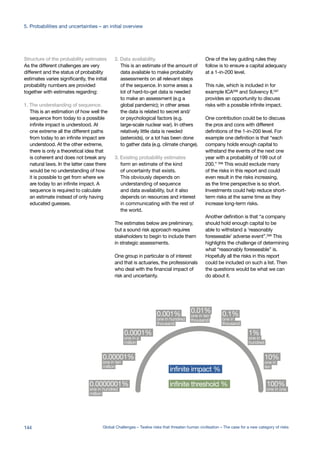
  • 192.
    340 http://en.wikipedia.org/wiki/Impact_event 341 See Jablonski, David,and W. G. Chaloner.: Extinctions in the Fossil Record [and Discussion]. Philosophical Transactions of the Royal Society of London. Series B: Biological Sciences 344.1307 (1994): 11-17. 342 See Collins, Gareth S., H. Jay Melosh, and Robert A. Marcus.: Earth Impact Effects Program: A Web‐ based computer program for calculating the regional environmental consequences of a meteoroid impact on Earth. Meteoritics & planetary science 40.6 (2005): 817- 840. Input data: Projectile Diameter: 5000m, Projectile Density: 2600 kg/m3, Impact Velocity: 17.00 km/s, Impact Angle: 45 degrees. 343 The “Tsar Bomba” at 2x10¹⁷ Joules (source: Adamsky, Viktor, and Yuri Smirnov.: Moscow’s Biggest Bomb: The 50-Megaton Test of October 1961. Cold War International History Project Bulletin 4 (1994): 19-21.). 344 The effects of various sizes of impacts have been estimated in Atkinson, Harry, Crispin Tickell, and David Williams.: Report of the task force on potentially hazardous near-Earth objects. (2000). 345 See for instance Collins, Gareth S., H. Jay Melosh, and Robert A. Marcus.: Earth Impact Effects Program: A Web‐based computer program for calculating the regional environmental consequences of a meteoroid impact on Earth. Meteoritics & planetary science 40.6 (2005): 817-840, Jeffers, S. V., et al.: Near‐Earth object velocity distributions and consequences for the Chicxulub impactor. Monthly Notices of the Royal Astronomical Society 327.1 (2001): 126-132, and Board, Space Studies.: Defending Planet Earth: Near-Earth Object Surveys and Hazard Mitigation Strategies. National Academies Press (2010). A summary of the last paper can be found at The Danger from Asteroid impact. 346 See the NASA press release NASA Spacecraft Reactivated to Hunt for Asteroids. 347 See NASA’s Near Earth Objects Discovery Statistics. 348 See Harris, Alan.: What Spaceguard did. Nature 453.7199 (2008): 1178-1179. 349 http://www.nature.com/nature/journal/v453/n7199/ fig_tab/4531178a_F2.html 350 See Hall, Christopher D., and I. Michael Ross.: Dynamics and control problems in the deflection of Near-Earth Objects. Adv. Astronaut. Sci 67.640 (1997): 1-18. 351 Some are more optimistic than others: “An impact can be predicted in advance in ways that remain imperfect but are much more reliable than predictions of earthquakes or even storms, and the components of technology exist - at affordable costs given the consequences of an actual impact - to move any threatening object away and avoid the disaster altogether.” (source: Chapman, Clark R. “The hazard of near-Earth asteroid impacts on earth.” Earth and Planetary Science Letters 222.1 (2004): 1-15.) See also NASA’s report to Congress “Near-Earth Object Survey and Deflection Analysis of Alternatives“ (2007). 352 See 2013 World Hunger and Poverty Facts and Statistics. World Hunger Education Service (2013). 353 See Maher, Timothy M., and Seth D. Baum.: Adaptation to and recovery from global catastrophe. Sustainability 5.4 (2013): 1461-1479. 354 Report of the Task Force on potentially hazardous Near-Earth Objects. http://spaceguardcentre.com/wp- content/uploads/2014/04/full_report.pdf 355 See Ćirković, Milan M., Anders Sandberg, and Nick Bostrom.: Anthropic shadow: Observation selection effects and human extinction risks. Risk analysis 30.10 (2010): 1495-1506. 356 See NASA’s press release on the meteor, Additional Details on the Large Fireball Event over Russia on Feb. 15, 2013. 357 See Borovička, Jiří, et al.: The trajectory, structure and origin of the Chelyabinsk asteroidal impactor. Nature (2013). 358 See Chyba, Christopher F., Paul J. Thomas, and Kevin J. Zahnle.: The 1908 Tunguska explosion: atmospheric disruption of a stony asteroid. Nature 361.6407 (1993): 40-44. 359 See for instance the Russian reaction: PM Medvedev Says Russian Meteorite KEF-2013 Shows “Entire Planet” Vulnerable. 360 See the Space Research Institute of Russian Academy of Science report Deflecting Hazardous Asteroids from Collision with the Earth by Using Small Asteroids. 361 See for instance Collins, Gareth S., H. Jay Melosh, and Robert A. Marcus.: Earth Impact Effects Program: A Web‐based computer program for calculating the regional environmental consequences of a meteoroid impact on Earth. Meteoritics & planetary science 40.6 (2005): 817-840, and Jeffers, S. V., et al.: Near‐Earth object velocity distributions and consequences for the Chicxulub impactor. Monthly Notices of the Royal Astronomical Society 327.1 (2001): 126-132. 362 See Hall, Christopher D., and I. Michael Ross.: Dynamics and control problems in the deflection of Near-Earth Objects. Adv. Astronaut. Sci 67.640 (1997): 1-18. 363 See NASA’s Asteroid Watch, Asteroid 2013 TV135 - A Reality Check. 364 The effects of various sizes of impacts have been estimated in Atkinson, Harry, Crispin Tickell, and David Williams.: Report of the task force on potentially hazardous near-Earth objects. (2000). 365 See Live Science, The Odds of Dying. 366 See Scientific American, United Nations to Adopt Asteroid Defense Plan. 367 See Brown, P. G., et al.: A 500-kiloton airburst over Chelyabinsk and an enhanced hazard from small impactors. Nature (2013). 368 See Glasstone, Samuel.: The effects of nuclear weapons. US Department of Defense (1964). 369 See NBC’s report Third time’s the charm: SpaceX launches big commercial satellite. 370 See Hall, Christopher D., and I. Michael Ross.: Dynamics and control problems in the deflection of Near-Earth Objects. Adv. Astronaut. Sci 67.640 (1997): 1-18. 371 See NASA News, NASA Announces New Homes for Space Shuttle Orbiters After Retirement. 372 See NASA Report Launching into History. 373 http://en.wikipedia.org/wiki/Supervolcano 374 See Reichow, Marc K., et al.: The timing and extent of the eruption of the Siberian Traps large igneous province: Implications for the end-Permian environmental crisis. Earth and Planetary Science Letters 277.1 (2009): 9-20, and Benton, Michael J., and M. J. Benton.: When life nearly died: the greatest mass extinction of all time. Vol. 5. London: Thames & Hudson (2003). 375 See Shen, Shu-zhong, et al.: Calibrating the end- Permian mass extinction. Science 334.6061 (2011): 1367-1372. 376 Kerr, Richard A.: Mega-Eruptions Drove the Mother of Mass Extinctions. Science 342.6165 (2013): 1424-1424. 377 A partial list can be found on Wikipedia: http:// en.wikipedia.org/wiki/Timetable_of_major_worldwide_ volcanic_eruptions. 378 See Newhall, Christopher G., and Stephen Self.: The Volcanic Explosivity Index (VEI): an estimate of explosive magnitude for historical volcanism. Journal of Geophysical Research: Oceans (1978–2012) 87.C2 (1982): 1231-1238. 379 See Aspinall, W., et al.: Volcano hazard and exposure in GDRFF priority countries and risk mitigation measures-GFDRR Volcano Risk Study. Bristol: Bristol University Cabot Institute and NGI Norway for the World Bank: NGI Report 20100806.2011 (2011). 380 See Mason, Ben G., David M. Pyle, and Clive Oppenheimer.: The size and frequency of the largest explosive eruptions on Earth. Bulletin of Volcanology 66.8 (2004): 735-748. 381 See Stephen Self and Stephen Blake, “Consequences of Explosive Super-eruptions” ELEMENTS , VOL . 4, 41–46: http://chuma.cas.usf. edu/~juster/GLY2030-F09/supervolcanoes-self%20 and%20blake.pdf 382 See Zielinski, G. A., et al.: Potential atmospheric impact of the Toba Mega‐Eruption∼ 71,000 years ago. Geophysical Research Letters 23.8 (1996): 837-840. 383 It is estimated that the largest volcanic eruptions have an energy greater than 1021 Joules (source: Mason, Ben G., David M. Pyle, and Clive Oppenheimer.: The size and frequency of the largest explosive eruptions on Earth. Bulletin of Volcanology 66.8 (2004): 735-748.), while the largest nuclear device ever exploded had a yield of around 2x10¹⁷ Joules (source: Adamsky, Viktor, and Yuri Smirnov.: Moscow’s Biggest Bomb: The 50-Megaton Test of October 1961. Cold War International History Project Bulletin 4 (1994): 19-21.). 384 See Scarpa, Roberto.: Predicting volcanic eruptions. Science 293.5530 (2001): 615-616. 385 Sparks, Stephen. Super-eruptions: Global effects and future threats, report of a Geological Society of London working group. Geological Society, 2005. 386 See 2013 World Hunger and Poverty Facts and Statistics. World Hunger Education Service (2013). 387 Maher, Timothy M., and Seth D. Baum.: Adaptation to and recovery from global catastrophe. Sustainability 5.4 (2013): 1461-1479. 388 See Sparks, S. & Self. S. et al., 2005: Super-eruptions: global effects and future threats: Report of a Geological Society of London working group. http://www.geo.mtu. edu/~raman/VBigIdeas/Supereruptions_files/Super- eruptionsGeolSocLon.pdf 389 http://en.wikipedia.org/wiki/Volcanic_Explosivity_ Index http://volcanoes.usgs.gov/images/pglossary/vei.php 390 See Ćirković, Milan M., Anders Sandberg, and Nick Bostrom.: Anthropic shadow: Observation selection effects and human extinction risks. Risk analysis 30.10 (2010): 1495-1506. 391 See Lane, Christine S., Ben T. Chorn, and Thomas C. Johnson.: Ash from the Toba supereruption in Lake Malawi shows no volcanic winter in East Africa at 75 ka. Proceedings of the National Academy of Sciences 110.20 (2013): 8025-8029. 392 See Zielinski, G. A., et al.: Potential atmospheric impact of the Toba Mega‐Eruption ∼ 71,000 years ago. Geophysical Research Letters 23.8 (1996): 837-840. 393 See Yoichi Nakamura, Shigeo Aramaki and Eisuke Fujita, Japan’s Volcanic Disaster Mitigation Initiatives: Activities of the Commission on Mitigation of Volcanic Disasters, the Volcanological Society of Japan, Technical 190 Global Challenges – Twelve risks that threaten human civilisation – The case for a new category of risks Endnotes
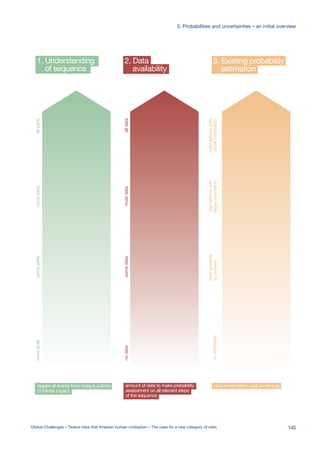
  • 193.
    Note of theNational Research Institute for Earth Science and Disaster Prevention 380 (2013). 394 See Barnes, Gina L.: Origins of the Japanese Islands: The New “Big Picture”. Nichibunken Japan Review (2003): 3-50. 395 See Nakamura, Y., Fukushima, K., Jin, X., Ukawa, M., Sato, T., and Hotta, Y.: Mitigation Systems by Hazard Maps, Mitigation Plans, and Risk Analyses Regarding Volcanic Disasters in Japan. J. Disaster Research, 3-4, (2007) 297-304. 396 See Omer, Haim, and Nahman Alon.: The continuity principle: A unified approach to disaster and trauma. American Journal of Community Psychology 22.2 (1994): 273-287. 397 See Smith, Robert B. et al.: Discoveries and breakthroughs from integrative analysis of Yellowstone science revealing new tectonic-volcanic models and a new assessment of earthquake-volcano hazards. Geological Society of America Abstracts with Programs. Vol. 45. No. 7. 2013. 398 See Earthquake-hazards Scenario for a M7 Earthquake on the Salt Lake City Segment of the Wasatch Fault Zone, Utah. No. 111. Utah Geological Survey (2004). 399 See the Towers Watson poll of global insurance executives on the most worrying extreme risks facing the insurance industry. 400 See Merton, Robert K.: Bureaucratic structure and personality. Social forces 18.4 (1940): 560-568, and Turner, Marlene E., and Anthony R. Pratkanis.: Twenty- five years of groupthink theory and research: Lessons from the evaluation of a theory. Organizational Behavior and Human Decision Processes 73.2 (1998): 105-115. 401 See Kerr, Richard A.: Mega-Eruptions Drove the Mother of Mass Extinctions. Science 342.6165 (2013): 1424-1424. 402 A partial list can be found on Wikipedia: http:// en.wikipedia.org/wiki/Timetable_of_major_worldwide_ volcanic_eruptions. 403 See Reichow, Marc K., et al.: The timing and extent of the eruption of the Siberian Traps large igneous province: Implications for the end-Permian environmental crisis. Earth and Planetary Science Letters 277.1 (2009): 9-20, and Benton, Michael J., and M. J. Benton.: When life nearly died: the greatest mass extinction of all time. Vol. 5. London: Thames & Hudson (2003). 404 See Shen, Shu-zhong, et al.: Calibrating the end- Permian mass extinction. Science 334.6061 (2011): 1367-1372. 405 http://en.wikipedia.org/wiki/Synthetic_biology 406 See Schmidt, Markus, ed.: Synthetic biology: industrial and environmental applications. Wiley- Blackwell (2012). 407 Making Synthetic biology into an “epistemic” risk: the risk might be minute or huge, it’s unclear at present. See Sahlin, Nils-Eric, and Johannes Persson.: Epistemic risk: the significance of knowing what one does not know. Future risks and risk management. Springer Netherlands (1994) 37-62. 408 The decision to lift the moratorium on potentially dangerous gain of function ‘flu research was taken by the researchers themselves (source: Declan Butler: Work resumes on lethal flu strains, Nature News). 409 See Schmidt, Markus.: Diffusion of synthetic biology: a challenge to biosafety. Systems and synthetic biology 2.1-2 (2008): 1-6. 410 See Wilson, Grant.: Minimizing global catastrophic and existential risks from emerging technologies through international law. Available at SSRN 2179094 (2012). 411 See Kelle, Alexander.: Ensuring the security of synthetic biology—towards a 5P governance strategy. Systems and synthetic biology 3.1-4 (2009): 85-90, and Bernauer, Hubert, et al.: Technical solutions for biosecurity in synthetic biology. Industry Association Synthetic Biology, Munich, Germany (2008). 412 Though see some of the suggestions in Garfinkel, Michele S., et al.: Synthetic genomics: options for governance. Industrial Biotechnology 3.4 (2007): 333- 365. 413 See Dennis, Carina.: The bugs of war. Nature 411.6835 (2001): 232-235. 414 See Smith, Bruce D., and Mark Nesbitt.: The emergence of agriculture. New York: Scientific American Library (1995). 415 See Tucker, Jonathan B.: The Current Bioweapons Threat. Biopreparedness and Public Health. Springer Netherlands (2013) 7-16. 416 With corporations targeting each other’s biological products, for instance. 417 A risk the US Government is already taking seriously; see for instance President George W. Bush’s April 2004 Biodefense for the 21st Century initiative. The threat of bioterrorism is also prominent in the 2007 report Mapping the Global Future: Report of the National Intelligence Council’s 2020 Project. 418 The World Health Organization estimates that many countries and institutions lack oversight of such dual use technologies (source: Report of the WHO Informal Consultation on Dual Use Research of Concern, World Health Organization). 419 See Baum, Seth, and Grant Wilson.: The Ethics of Global Catastrophic Risk from Dual-Use Bioengineering. Ethics in Biology, Engineering and Medicine 4 (2013). 420 Attempts at containing such a leak may not be successful; see Merler, Stefano, et al.: Containing the accidental laboratory escape of potential pandemic influenza viruses. BMC medicine 11.1 (2013): 252. 421 See for instance Hwang, In Young, et al.: Reprogramming Microbes to Be Pathogen-Seeking Killers. ACS synthetic biology (2013). 422 Brazil alone is estimated to have over 50 uncontacted tribes (source: Survival International). 423 See Top U.S. Disease Fighters Warn of New Engineered Pathogens but Call Bioweapons Doomsday Unlikely. Global Security Newswire (2005). 424 Maher, Timothy M., and Seth D. Baum.: Adaptation to and recovery from global catastrophe. Sustainability 5.4 (2013): 1461-1479. 425 See the later part of the scenario in Tonn, Bruce, and Donald MacGregor.: A singular chain of events. Futures 41.10 (2009): 706-714. 426 See Guan, Zheng-Jun, et al.: Biosafety Considerations of Synthetic Biology in the International Genetically Engineered Machine (iGEM) Competition. BioScience 63.1 (2013): 25-34. 427 See Wired Magazine’s feature article Genome at Home: Biohackers Build Their Own Labs. 428 Such as Bernauer, Hubert, et al.: Technical solutions for biosecurity in synthetic biology. Industry Association Synthetic Biology, Munich, Germany (2008). 429 See Lenox, Michael J., and Jennifer Nash.: Industry self‐regulation and adverse selection: a comparison across four trade association programs. Business strategy and the environment 12.6 (2003): 343-356. 430 See Butler, Declan.: Work resumes on lethal flu strains. Nature 493.7433 (2013): 459-459. 431 See Imai, Masaki, et al.: Experimental adaptation of an influenza H5 HA confers respiratory droplet transmission to a reassortant H5 HA/H1N1 virus in ferrets. Nature 486.7403 (2012): 420-428, and Herfst, Sander, et al.: Airborne transmission of influenza A/H5N1 virus between ferrets. Science 336.6088 (2012): 1534- 1541. 432 See Butler, Declan.: Fears grow over lab-bred flu. Nature 480 (2011): 421-422. 433 See Fouchier, R. A., et al.: Pause on avian flu transmission research. Science 335.6067 (2012): 400- 401. 434 See Sherrill, Michelle.: Self-Serving Bias. American Psychologist 41: 954-969 (2008). 435 See for instance the London Independent: Leading scientists condemn decision to continue controversial research into deadly H5N1 bird-flu virus. 436 See the Report of the WHO Informal Consultation on Dual Use Research of Concern. 437 See Imai, Masaki, et al.: Experimental adaptation of an influenza H5 HA confers respiratory droplet transmission to a reassortant H5 HA/H1N1 virus in ferrets. Nature 486.7403 (2012): 420-428, and Herfst, Sander, et al.: Airborne transmission of influenza A/H5N1 virus between ferrets. Science 336.6088 (2012): 1534- 1541. 438 See the WHO report Responsible life sciences research for global health security: a guidance document. (2010). 439 See Jackson, Ronald J., et al.: Expression of mouse interleukin-4 by a recombinant ectromelia virus suppresses cytolytic lymphocyte responses and overcomes genetic resistance to mousepox. Journal of virology 75.3 (2001): 1205-1210. 440 See Rosengard, Ariella M., et al.: Variola virus immune evasion design: expression of a highly efficient inhibitor of human complement. Proceedings of the National Academy of Sciences 99.13 (2002): 8808-8813. 441 See Cello, Jeronimo, Aniko V. Paul, and Eckard Wimmer.: Chemical synthesis of poliovirus cDNA: generation of infectious virus in the absence of natural template. Science 297.5583 (2002): 1016-1018. 442 See Tumpey, Terrence M., et al.: Characterization of the reconstructed 1918 Spanish influenza pandemic virus. Science 310.5745 (2005): 77-80. 443 See Gibson, Daniel G., et al.: Complete chemical synthesis, assembly, and cloning of a Mycoplasma genitalium genome. Science 319.5867 (2008): 1215- 1220. 444 See Zhang, Ying, et al.: H5N1 hybrid viruses bearing 2009/H1N1 virus genes transmit in guinea pigs by respiratory droplet. Science 340.6139 (2013): 1459- 1463. 445 The Human Fatality and Economic Burden of a Man- made Influenza Pandemic. 446 See Drexler, K. Eric.: Engines of Creation: the Coming Era of Nanotechnology. Fourth Estate (1990). 447 See Drexler, K. Eric.: Radical Abundance: How a Revolution in Nanotechnology Will Change Civilization. Public Affairs (2013). 448 See Freitas, Robert A., and Ralph Charles Merkle.: Kinematic self-replicating machines. Georgetown, TX: Landes Bioscience/Eurekah. com (2004). 449 See Committee to Review the National Nanotechnology Initiative.: A matter of size: Triennial review of the National Nanotechnology Initiative. (2006). 450 According to the CIA World Factbook. 191Global Challenges – Twelve risks that threaten human civilisation – The case for a new category of risks Endnotes
  • 194.
    451 See Roco, MihailC., and William S. Bainbridge.: Societal implications of nanoscience and nanotechnology: Maximizing human benefit. Journal of Nanoparticle Research 7.1 (2005): 1-13. 452 See the report of the Center for Responsible Nanotechnology,: Dangers of Molecular Manufacturing. 453 See Drexler, K. Eric.: Radical Abundance: How a Revolution in Nanotechnology Will Change Civilization. PublicAffairs (2013). 454 See Barber, Kevin, et al.: Nanotechnology for Uranium Separations and Immobilization. Advances in Materials Science for Environmental and Nuclear Technology: Ceramic Transactions 107 (2010): 177. 455 See Gubrud, Mark Avrum.: Nanotechnology and international security. Fifth Foresight Conference on Molecular Nanotechnology (1997). 456 See Altmann, Jürgen.: Military uses of nanotechnology: perspectives and concerns. Security Dialogue 35.1 (2004): 61-79. 457 See the Oxford Martin School publication by Drexler, K. Eric and Pamlin, Dennis: Nano-solutions for the 21st Century, (2013). 458 See Wilson, Grant.: Minimizing global catastrophic and existential risks from emerging technologies through international law. Available at SSRN 2179094 (2012). 459 See Drexler, K. Eric.: Engines of Creation: the Coming Era of Nanotechnology. Fourth Estate (1990). 460 See Phoenix, Chris, and Eric Drexler.: Safe exponential manufacturing. Nanotechnology 15.8 (2004): 869. 461 See Freitas Jr, Robert A.: Some limits to global ecophagy by biovorous nanoreplicators, with public policy recommendations. Foresight Institute (2000). 462 Such as computer viruses today, which endure despite efforts at eradication, but don’t threaten the system as a whole. 463 See Leary, Scott P., Charles Y. Liu, and Michael LJ Apuzzo.: Toward the emergence of nanoneurosurgery: Part III-Nanomedicine: Targeted nanotherapy, nanosurgery, and progress toward the realization of nanoneurosurgery. Neurosurgery 58.6 (2006): 1009- 1026.. 464 See the later part of the scenario in Tonn, Bruce, and Donald MacGregor.: A singular chain of events. Futures 41.10 (2009): 706-714. 465 See Tetlock, Philip E.: Expert political judgment: How good is it? How can we know? Princeton University Press (2005). 466 See Lewandowski, Bartosz, et al.: Sequence- specific peptide synthesis by an artificial small-molecule machine. Science 339.6116 (2013): 189-193. 467 See Freitas, Robert A., and Ralph Charles Merkle.: Kinematic self-replicating machines. Georgetown, TX: Landes Bioscience/Eurekah. com (2004). 468 Defined by Eric Drexler as a “device able to guide chemical reactions by positioning reactive molecules with atomic precision.” 469 See Vugt, Gert Van.: The Killer Idea: How Some Gunslinging Anarchists Held Freedom of Speech at Gunpoint. Proceedings of the eLaw Conference 3D Printing: Destiny, Doom or Dream (2013). 470 See the report of the Center for Responsible Nanotechnology, Dangers of Molecular Manufacturing. 471 See Excell, John, and Stuart Nathan.: The rise of additive manufacturing. The Engineer (2010). 472 The gun designer, Cody Wilson, who describes himself as a crypto-anarchist, said his plans to make the design available were “about liberty” (source: BBC News). 473 See Drexler, K. Eric.: Radical Abundance: How a Revolution in Nanotechnology Will Change Civilization. PublicAffairs (2013). 474 See Drexler, K. Eric.: Engines of Creation: the Coming Era of Nanotechnology. Fourth Estate (1990). 475 See Nanostart’s presentation at the EuroNanoForum 2013, Dublin: Venture Capital Investments in Nanotech (2013). 476 See Nanostart’s newsletter, A space elevator would be a tremendous benefit for humankind (2012). 477 See Levine, Michael E., and Jennifer L. Forrence.: Regulatory capture, public interest, and the public agenda: Toward a synthesis. Journal of Law, Economics, & Organization 6 (1990): 167-198. 478 See the Congressional Research Service report, Nanotechnology: a Policy Primer (2013). 479 Nano-replicator: A system able to build copies of itself when provided with raw materials and energy 480 http://en.wikipedia.org/wiki/Artificial_intelligence 481 See Armstrong, Stuart, and Kaj Sotala. 2012.: How We’re Predicting AI—or Failing To. In Beyond AI: Artificial Dreams, edited by Jan Romportl, Pavel Ircing, Eva Zackova, Michal Polak, and Radek Schuster, 52–75 482 See Chalmers, David, The singularity: A philosophical analysis. Journal of Consciousness Studies 17.9-10 (2010): 9-10. 483 See Muehlhauser, Luke, and Anna Salamon.: Intelligence explosion: Evidence and import. Singularity Hypotheses. Springer Berlin Heidelberg (2012) 15-42. 484 See Yudkowsky, Eliezer.: Intelligence Explosion Microeconomics. Technical report 2013-1 Berkeley, CA: Machine Intelligence Research Institute (2013). 485 See Wilson, Grant.: Minimizing global catastrophic and existential risks from emerging technologies through international law. Available at SSRN 2179094 (2012). 486 See Omohundro, Stephen M.: The basic AI drives. Frontiers in Artificial Intelligence and applications 171 (2008): 483. 487 See Muehlhauser, Luke, and Louie Helm.: Intelligence Explosion and Machine Ethics. In Singularity Hypotheses: A Scientific and Philosophical Assessment, edited by Amnon Eden, Johnny Søraker, James H. Moor, and Eric Steinhart. Berlin: Springer (2012) 488 Dealing with most risks comes under the category of decision theory: finding the right approaches to maximise the probability of the most preferred options. But an intelligent agent can react to decisions in a way the environment cannot, meaning that interactions with AIs are better modelled by the more complicated discipline of game theory. 489 See Yudkowsky, Eliezer.: Artificial intelligence as a positive and negative factor in global risk. Global catastrophic risks 1 (2008): 303. 490 See Muehlhauser, Luke, and Nick Bostrom.: Why we need friendly AI. Think: Philosophy for Everyone (2014). 491 The balance is currently very uneven, with only three small organisations – the Future of Humanity Institute, the Machine Intelligence Research Institute and the Cambridge Centre for Existential Risk – and focused mainly on the risks of AI, along with some private individuals. 492 See Sandberg, Anders, and Nick Bostrom.: Whole brain emulation: A roadmap. Future of Humanity Institute Technical Report #2008-3, Oxford University (2008). 493 A dangerous AI would be a very intelligent that could acquire great power in the world, and would have goals that were not compatible with full human survival and flourishing. There are a variety of ways of avoiding this. “Friendly AI” projects focus on the AI’s goals directly, and attempt to make these compatible with human survival. The Oracle AI approach attempts to “box” the AI (constrain its abilities to influence the world) in order to prevent it from acquiring power. The reduced impact AI is a novel approach which attempts to construct AIs goals that are not friendly per se, but that motivate the AI to have a very limited impact on the world, thus constraining the potential damage it could do. 494 There are many different designs for AIs, and disagreements about whether they could be considered moral agents or capable of suffering. At one end of the scale is the theoretical AIXI(tl), which is essentially nothing more than an equation with vast computing power; at the other lie whole brain emulations, copies of human minds implemented inside a computer. Suffering for the first design seems unlikely; suffering for the second seems very possible. Determining whether a specific AI design can suffer will be an important part of figuring out what to do with it; it seems unlikely that we’ll have hard and fast rules in advance. 495 The idea behind uploads, also called whole brain emulations, is to take a human brain, copy the position of its neurones and connections to sufficient precision, and then run the emulation forwards according to the laws of physics and chemistry. It should then behave exactly as a human brain in the real world. See http:// www.fhi.ox.ac.uk/brain-emulation-roadmap-report.pdf for more details, which also goes into the requirements and tries to estimate the likelihood off success of such an approach (it depends on certain likely but uncertain assumptions about how the brain works at the small scale; ie that most things below a certain scale can be handled statistically rather than through detailed modelling). 496 There’s two ways there could be diminishing returns to intelligence: first, it might not be possible for an AI to improve its own intelligence strongly. Maybe it could find some ways of better executing its algorithms, and a few other low-hanging fruits, but it’s very possible that after doing this, it will find that the remaining intelligence- increase problems are hard, and that it hasn’t improved itself sufficiently to make them easy (you could analogise this to dampened resonance - initially the AI can improve its intelligence quite easily, and this gives it more intelligence with which to work, allowing it to improve its intelligence still further; but each time, the effect is less, and it soon plateaus). The other way there could be diminishing returns to intelligence is if intelligence doesn’t translate into power effectively. This is more likely with things like social intelligence: it seems plausible that no entity could convince, say, 99% of Britain to vote for their party, no matter how socially intelligent it was. Scientific and technological intelligence could conceivably be limited by creativity (unlikely), constraints on the speed of making experiments, or just the fact that humans have solved the easy problems already. 497 See DARPA’s briefing, DARPA-SN-13-30: Probabilistic Programming for Advancing Machine Learning (PPAML) (2013). 498 See for instance Curtis, Jon, Gavin Matthews, and David Baxter.: On the effective use of Cyc in a question answering system. Proc Workshop on Knowledge and Reasoning for Answering Questions. (2005). 499 See The Rise of Industrial Big Data, GE Intelligent Platforms (2013). 500 Such as Watson’s triumph on “Jeopardy!” (source: Ferrucci, David, et al.: Building Watson: An overview of 192 Global Challenges – Twelve risks that threaten human civilisation – The case for a new category of risks Endnotes
  • 195.
    the DeepQA project.AI magazine 31.3 (2010): 59-79). 501 See the Wired report by Steven Levy, How Ray Kurzweil Will Help Google Make the Ultimate AI Brain (2013). 502 “Soon after [1988] came a period called the ‘AI Winter,’ in which many companies fell by the wayside as they failed to deliver on extravagant promises.” (Source: Stuart, Russell, and Norvig Peter. “Artificial intelligence: a modern approach.” Upper Saddle River, New Jersey: Prentice Hall (2003) pp24). 503 “At its low point, some computer scientists and software engineers avoided the term artificial intelligence for fear of being viewed as wild-eyed dreamers.” (Source: New York Times report by John Markov: Behind Artificial Intelligence, a Squadron of Bright Real People (2005)). 504 See Ferrucci, David, et al.: Building Watson: An overview of the DeepQA project. AI magazine 31.3 (2010): 59-79. 505 See Guizzo, Erico.: How Google’s self-driving car works. IEEE Spectrum Online (2011). 506 See Kurzweil, Ray.: The Age of Spiritual Machines: How we will live, work and think in the new age of intelligent machines. Orion (1999). 507 See Sotala, Kaj and Roman V. Yampolskiy.: Responses to Catastrophic AGI Risk: A Survey. Technical report 2013-2. Berkeley, CA: Machine Intelligence Research Institute (2013) 508 The term AI is now ambiguous, with various “narrow AIs” being produced (such as self-driving cars or stock-trading programmes). An “AGI” returns to the original meaning of AI, that of an artificial being with general intelligence skills. This report will use the term AI interchangeably with AGI, however. 509 See Armstrong, Stuart, and Kaj Sotala. 2012.: How We’re Predicting AI—or Failing To. In Beyond AI: Artificial Dreams, edited by Jan Romportl, Pavel Ircing, Eva Zackova, Michal Polak, Radek Schuster, 52–75 510 See Yudkowsky, Eliezer.: Levels of Organization in General Intelligence. In Artificial General Intelligence, edited by Ben Goertzel and Cassio Pennachin 389–501 (2007). 511 See Bostrom, Nick.: The superintelligent will: Motivation and instrumental rationality in advanced artificial agents. Minds and Machines 22.2 (2012): 71-85, and Armstrong, Stuart.:General purpose intelligence: arguing the Orthogonality thesis.” Analysis and Metaphysics (2013). 512 See the Less Wrong summary post Complexity of value for a discussion on this issue. 513 See Yampolskiy, Roman V.: Leakproofing the Singularity. Journal of Consciousness Studies 19.1-2 (2012): 194-214. 514 See Armstrong, Stuart, Anders Sandberg, and Nick Bostrom.: Thinking inside the box: Using and controlling an Oracle AI. Minds and Machines (2012). 515 See Armstrong, Stuart, Anders Sandberg, and Nick Bostrom.: Thinking inside the box: Using and controlling an Oracle AI. Minds and Machines (2012). 516 See Dewey, Daniel. “Learning what to value.” Artificial General Intelligence. Springer Berlin Heidelberg, (2011). 309-314. 517 See Thomas, Michael SC, and James L. McClelland. “Connectionist models of cognition.” The Cambridge handbook of computational psychology (2008): 23-58. 518 See Yudkowsky, Eliezer.: Artificial intelligence as a positive and negative factor in global risk. Global catastrophic risks 1 (2008): 303, and Omohundro, Steve.: Rational artificial intelligence for the greater good. Singularity Hypotheses. Springer Berlin Heidelberg. (2012) 161-179. 519 See James Barrat.: Our Final Invention: Artificial Intelligence and the End of the Human Era. (2013). 520 See Omohundro, Stephen M.: The basic AI drives. Frontiers in Artificial Intelligence and applications 171 (2008): 483. 521 Directly coding safe behaviour is seen to be an extremely difficult challenge. 522 See Armstrong, Stuart, Bostrom, Nick, and Shulman, Carl.: Racing to the precipice: a model of artificial intelligence development. Technical Report #2013-1, Future of Humanity Institute, Oxford University (2013).: http://www.fhi.ox.ac.uk/wp-content/uploads/Racing- to-the-precipice-a-model-of-artificial-intelligence- development.pdf 523 See Smith, Theresa Clair.: Arms race instability and war. Journal of Conflict Resolution 24.2 (1980): 253-284. http://jcr.sagepub.com/content/24/2/253.full.pdf+html 524 See Rapoport, Anatol.: Prisoner’s dilemma: A study in conflict and cooperation. University of Michigan Press (1965). 525 See the special events on the program of the 23rd International Joint Conference on Artificial Intelligence. http://ijcai13.org/program/special_events_the_impact_ of_ai_on_society 526 See Bostrom, Nick.: Existential Risk Prevention as Global Priority. Global Policy 4.1 (2013): 15-31. 527 See Sherrill, Michelle.: Self-Serving Bias. American Psychologist 41: 954-969 (2008). https://facultystaff. richmond.edu/~dforsyth/pubs/forsyth2008selfserving. pdf 528 See Yudkowsky, Eliezer.: Artificial intelligence as a positive and negative factor in global risk. Global catastrophic risks 1 (2008): 303. http://intelligence.org/ files/AIPosNegFactor.pdf 529 One of the authors of Artificial Intelligence: a modern approach. http://www.amazon.co.uk/ Artificial-Intelligence-Approach-International-Edition/ dp/0130803022 530 See CSER’s list of external advisors on their website. http://cser.org/ 531 See for instance the “X factors” section of Global Risks 2013 - Eighth Edition. World Economic Forum (2013). 532 See Ellis, John, et al.: Review of the safety of LHC collisions. Journal of Physics G: Nuclear and Particle Physics 35.11 (2008): 115004. 533 See S Korean dies after games session, BBC News. 534 See Alex Knapp, Is It Ethical to Make Animals As Smart As People? Forbes. 535 See George Dvorsky, New Project to Message Aliens is Both Useless and Potentially Reckless, io9. 536 See Shanteau, James.: Competence in experts: The role of task characteristics. Organisational behavior and human decision processes 53.2 (1992): 252-266. 537 See Ord, Toby, Rafaela Hillerbrand, and Anders Sandberg.: Probing the improbable: Methodological challenges for risks with low probabilities and high stakes. Journal of Risk Research 13.2 (2010): 191-205. 538 See Ćirković, Milan M.: Small Theories and Large Risks—Is Risk Analysis Relevant for Epistemology?. Risk Analysis 32.11 (2012): 1994-2004. 539 This paper demonstrates the relative ease of moving between galaxies, making the Fermi paradox more problematic: Armstrong, Stuart, and Anders Sandberg.: Eternity in six hours: Intergalactic spreading of intelligent life and sharpening the Fermi paradox. Acta Astronautica (2013). 540 See Bostrom, Nick.: Anthropic bias: Observation selection effects in science and philosophy. Psychology Press (2002). 541 Maher, Timothy M., and Seth D. Baum.: Adaptation to and recovery from global catastrophe. Sustainability 5.4 (2013): 1461-1479. 542 See Wilson, Grant.: Minimizing global catastrophic and existential risks from emerging technologies through international law. Available at SSRN 2179094 (2012). 543 See Maher, Timothy M., and Seth D. Baum: Adaptation to and recovery from global catastrophe. Sustainability 5.4 (2013): 1461-1479. 544 One possible exception could be James Lovelock: The Revenge of Gaia. Why the Earth is fighting back— and how we can still save humanity. (2006). 545 See Tonn, Bruce, and Dorian Stiefel.: Evaluating methods for estimating existential risks. Risk Analysis (2013). 546 For more information about the different methods: Tonn, Bruce, and Dorian Stiefel. “Evaluating methods for estimating existential risks.” Risk Analysis 33.10 (2013): 1772-1787. http://www.ncbi.nlm.nih.gov/ pubmed/23551083 547 See Tonn, Bruce E.: A methodology for organizing and quantifying the results of environmental scanning exercises. Technological Forecasting and Social Change 75.5 (2008): 595-609. 548 See Armstrong, Stuart, and Anders Sandberg.: Eternity in six hours: Intergalactic spreading of intelligent life and sharpening the Fermi paradox. Acta Astronautica (2013). 549 See Webb, Stephen.: If the Universe is teeming with aliens... Where is everybody?: Fifty solutions to the Fermi paradoxandtheproblemofextraterrestriallife.Springer(2002). 550 See Hanson, Robin.: The great filter - are we almost past it? (1998). 551 See Lineweaver, Charles H., Yeshe Fenner, and Brad K. Gibson.: The galactic habitable zone and the age distribution of complex life in the Milky Way. Science 303.5654 (2004): 59-62. 552 http://www.fhi.ox.ac.uk/intergalactic-spreading.pdf 553 See The Philippine Star news report Top conglomerates spearhead creation of private sector disaster response body (2013). 554 See the UNISDR report Private Sector Strengths Applied (2013). http://www.philstar.com:8080/ business/2013/12/10/1266103/top-conglomerates- spearhead-creation-private-sector-disaster-response http://www.unisdr.org/files/33594_ privatesectorstrengthsapplied2013di.pdf 555 http://www.who.int/trade/glossary/story038/en/ 556 There are known effective strategies for poverty reduction. See for instance Ravallion, Martin.: A comparative perspective on poverty reduction in Brazil, China and India. World Bank Policy Research Working Paper Series (2009). 557 See Bostrom, Nick.: What is a singleton? Linguistic and Philosophical Investigations 5.2 (2006): 48-54, and Caplan, Bryan.: The totalitarian threat. (2008). 558 See Tetlock, Philip E.: Expert political judgment: How good is it? How can we know? Princeton University Press (2005). 559 See Tetlock, Philip E.: Thinking the unthinkable: Sacred values and taboo cognitions. Trends in cognitive sciences 7.7 (2003): 320-324. 560 See for instance the multiplicity of values in the World 193Global Challenges – Twelve risks that threaten human civilisation – The case for a new category of risks Endnotes
  • 196.
    Values Survey. Thosecountries with stronger survival, and weaker self expression, values would be presumably more likely to tolerate dictatorships in exchange for reduced casualties. 561 These papers provide an overview of the potential resources for future human generations, hinting at their potential size: Bostrom, Nick.: Astronomical waste: The opportunity cost of delayed technological development. Utilitas 15.03 (2003): 308-314, and Armstrong, Stuart, and Anders Sandberg.: Eternity in six hours: Intergalactic spreading of intelligent life and sharpening the Fermi paradox. Acta Astronautica (2013). 562 See Bostrom, Nick.: Existential Risk Prevention as Global Priority. Global Policy 4.1 (2013): 15-31. http:// www.existential-risk.org/concept.pdf 563 See Oxford Poverty and Human Development Initiative (2013), Multidimensional Poverty Index (MPI) Data Bank. OPHI, University of Oxford. 564 See Ravallion, Martin.: A comparative perspective on poverty reduction in Brazil, China and India. World Bank Policy Research Working Paper Series (2009). 565 See for instance Jeanneney, Sylviane Guillaumont, and Kangni Kpodar.: Financial development and poverty reduction: Can there be a benefit without a cost? The Journal of Development Studies 47.1 (2011): 143-163. 566 See the Guardian’s report, The NSA Files. 567 The reaction was both within the USA and without; see for instance Der Spiegel’s report, Out of Hand: Europe Furious Over US Spying Allegations. 568 Many news stories raised the issue; see for instance the PBS report NSA repeatedly failed to obey court orders on how to conduct surveillance on Americans. 569 See the UNEP press release UNDP-UNEP Poverty- Environment Initiative Launches New Five-Year Phase to Meet Growing Demand from Member States (2013). 570 See the UNEP news report Sharing the waste, sharing the wealth: Uruguay uses the law to catalyse the transition to an inclusive green economy. 571 See the UNEP news report Malawi changes course after analysing the real costs and benefits of policy choices. 572 See Ravallion, Martin.: A comparative perspective on poverty reduction in Brazil, China and India. World Bank Policy Research Working Paper Series (2009). 573 See Dollar, David, and Aart Kraay.: Trade, growth, and poverty World Bank, Development Research Group, Macroeconomics and Growth (2001). 574 World Bank address to a ministerial conference on responses to pandemic threat, 2008, in Background Paper, Pandemic risk, by Olga B. Jonas, The World Bank: http://un-influenza.org/sites/default/files/WDR14_ bp_Pandemic_Risk_Jonas.pdf 575 See Esser, James K.: Alive and well after 25 years: A review of groupthink research. Organizational behavior and human decision processes 73.2 (1998): 116-141 and Kerr, Norbert L., and R. Scott Tindale.: Group performance and decision making. Annu. Rev. Psychol. 55 (2004): 623-655. 576 See Homer-Dixon, Thomas.: The upside of down: catastrophe, creativity, and the renewal of civilization. Island Press (2008). 577 See Turco, Richard P., et al.: Nuclear winter: global consequences of multiple nuclear explosions. Science 222.4630 (1983): 1283-1292. 578 See Jablonski, David, and W. G. Chaloner.: Extinctions in the Fossil Record [and Discussion]. Philosophical Transactions of the Royal Society of London. Series B: Biological Sciences 344.1307 (1994): 11-17. 579 See Zielinski, G. A., et al.: Potential atmospheric impact of the Toba Mega‐Eruption 71,000 years ago. Geophysical Research Letters 23.8 (1996): 837-840. 580 See Jablonski, David, and W. G. Chaloner.: Extinctions in the Fossil Record [and Discussion]. Philosophical Transactions of the Royal Society of London. Series B: Biological Sciences 344.1307 (1994): 11-17. 581 See Hall, Christopher D., and I. Michael Ross.: Dynamics and control problems in the deflection of Near-Earth Objects. Adv. Astronaut. Sci 67.640 (1997): 1-18. 582 See Parmesan, Camille.: Ecological and evolutionary responses to recent climate change. Annu. Rev. Ecol. Evol. Syst. 37 (2006): 637-669. 583 See Epstein, Paul R.: Climate and health. Science 285.5426 (1999): 347-348. 584 See the World Health Organization Global Influenza Programme.: Pandemic influenza preparedness and response: a WHO guidance document. World Health Organization (2009). 585 See Yudkowsky, Eliezer.:Artificial intelligence as a positive and negative factor in global risk. Global catastrophic risks 1 (2008): 303. 586 See Freitas Jr, Robert A.: Some limits to global ecophagy by biovorous nanoreplicators, with public policy recommendations. Foresight Institute (2000). 587 See the report of the Center for Responsible Nanotechnology, Dangers of Molecular Manufacturing. 588 See for instance Imai, Masaki, et al.: Experimental adaptation of an influenza H5 HA confers respiratory droplet transmission to a reassortant H5 HA/H1N1 virus in ferrets. Nature 486.7403 (2012): 420-428. 589 See Drexler, K. Eric.: Radical Abundance: How a Revolution in Nanotechnology Will Change Civilization. Public Affairs (2013). 590 See Drexler, K. Eric.: Radical Abundance: How a Revolution in Nanotechnology Will Change Civilization. Public Affairs (2013). 591 See Sailor, William C., et al.: A nuclear solution to climate change? Science (Washington) 288.5469 (2000): 1177-1178. http://faculty.publicpolicy.umd.edu/sites/ default/files/fetter/files/2000-Science-NE.pdf 592 See Harding, Jim.: Economics of nuclear power and proliferation risks in a carbon-constrained world. The Electricity Journal 20.10 (2007): 65-76. http://www.sciencedirect.com/science/article/pii/ S1040619007001285 593 Morse, Stephen S., et al.: Prediction and prevention of the next pandemic zoonosis. The Lancet 380.9857 (2012): 1956-1965. http://www.thelancet.com/journals/ lancet/article/PIIS0140-6736(12)61684-5/abstract 594 See this text by Nick Bostrom discussing difficulties estimating existential risks.: http://www.nickbostrom. com/existential/risks.html 595 For an explanation of how to calculate probabilities see: http://en.wikipedia.org/wiki/100-year_flood 596 http://www.lloyds.com/the-market/business- timetable/solvency/ica 597 http://en.wikipedia.org/wiki/Solvency_II 598 What is a 1-in-200? Presented at GIRO 2009 by Cameron Heath (Chair), John Campbell, Daniel Clarke, Darren Farr, Gladys Hosken, Gillian James, Andrew Newman, David Simmons, and Hannes Van Rensburg www.actuaries.org.uk/system/files/documents/pdf/1- 200-final-paper.pdf 599 What is a 1-in-200? Presented at GIRO 2009 by Cameron Heath (Chair), John Campbell, Daniel Clarke, Darren Farr, Gladys Hosken, Gillian James, Andrew Newman, David Simmons, and Hannes Van Rensburg www.actuaries.org.uk/system/files/documents/pdf/1- 200-final-paper.pdf 600 http://www.itm.su.se/page.php?pid=1081 601 http://www.ipcc.ch 602 Schaeffer, Michiel; Hare, William; Rahmstorf, Stefan; Vermeer, Martin (2009): Long-term sea-level rise implied by 1.5 C and 2 C warming levels. Nature http://www. nature.com/nclimate/journal/v2/n12/full/nclimate1584. html 603 Sources for the estimates include: Fekete, Hanna; Vieweg, Marion; Rocha, Marcia; Braun, Nadine; Lindberg, Marie; Gütschow, Johannes; Jefferey, Louise; Höhne, Niklas ; Hare, Bill; Schaeffer, Michiel; Macey, Kirsten and Larkin, Julia (2013): Analysis of current greenhouse gas emission trends http://climateactiontracker.org/assets/publications/ publications/CAT_Trend_Report.pdf New, Mark G.; Liverman, Diana M.; Betts, Richard A.; Anderson, Kevin L. and West, Chris C. (2011): Four degrees and beyond: the potential for a global temperature increase of four degrees and its implications http://rsta.royalsocietypublishing.org/content/369/1934. toc Rogelj, Joeri (2013): Risk shifts under changing climate sensitivity estimates, http://global-risk-indicator.net/data/ pdf_01.pdf Schneider, Stephen H. (2005): What is the Probability of ‘Dangerous’ Climate Change? http://stephenschneider. stanford.edu/Climate/Climate_Impacts/ WhatIsTheProbability.html Sokolov, A. P., and Co-authors, 2009: Probabilistic Forecast for Twenty-First-Century Climate Based on Uncertainties in Emissions (Without Policy) and Climate Parameters. J. Climate, 22, 5175–5204. http://journals.ametsoc.org/doi/ abs/10.1175/2009JCLI2863.1 World Bank (2013): Turn Down the Heat: Climate Extremes, Regional Impacts, and the Case for Resilience http://www.worldbank.org/content/dam/Worldbank/ document/Full_Report_Vol_2_Turn_Down_The_ Heat_%20Climate_Extremes_Regional_Impacts_Case_ for_Resilience_Print%20version_FINAL.pdf 604 http://news.stanford.edu/news/2003/september24/ tellerobit-924.html 605 Robock, A., L. Oman, and G. L. Stenchikov (2007), Nuclear winter revisited with a modern climate model and current nuclear arsenals: Still catastrophic consequences, J. Geophys. Res., 112, D13107, doi:10.1029/2006JD008235. http://www.envsci.rutgers. edu/~gera/nwinter/nw6accepted.pdf 606 Sources for the estimates include: Brams, Steven J.;Kilgour, D. Marc; Fichtner, John; & Avenhaus, Rudolf (1989): The Probability of Nuclear War , Journal of Peace Research 26(1): 91–99. http://econ. as.nyu.edu/docs/IO/9397/RR86-24.pdf Helfand, Ira. “NUCLEAR FAMINE: TWO BILLION PEOPLE AT RISK?.” International Physicians for the Prevention of Nuclear War (2013). http://www.psr.org/ assets/pdfs/two-billion-at-risk.pdf Hellman, Martin E. (2008); ”Risk Analysis of Nuclear Deterrence” in THE BENT OF TAU BETA PI http:// nuclearrisk.org/paper.pdf Lugar, Richard G (2005): ”The Lugar Survey On Proliferation Threats and Responses” https://www.fas. org/irp/threat/lugar_survey.pdf 194 Global Challenges – Twelve risks that threaten human civilisation – The case for a new category of risks Endnotes
  • 197.
    Robock, A., L.Oman, and G. L. Stenchikov (2007), Nuclear winter revisited with a modern climate model and current nuclear arsenals: Still catastrophic consequences, J. Geophys. Res., 112, D13107, doi:10.1029/2006JD008235. http://web. kaust.edu.sa/faculty/GeorgiyStenchikov/nwinter/ RobockJgr2006JD008235.pdf Shulman, Carl (2012): Nuclear winter and human extinction: Q&A with Luke Oman http://www. overcomingbias.com/2012/11/nuclear-winter-and- human-extinction-qa-with-luke-oman.html 607 See for example: http://metabiota.com/ and http:// instedd.org/ 608 Sources for the estimates include: Bagus, Ghalid (2008): Pandemic Risk Modeling http://www.chicagoactuarialassociation.org/CAA_ PandemicRiskModelingBagus_Jun08.pdf Broekhoven, Henk van, Hellman, Anni (2006): Actuarial reflections on pandemic risk and its consequences http://actuary.eu/documents/pandemics_web.pdf Brockmann, Dirk and Helbing, Dirk (2013): The Hidden Geometry of Complex, Network-Driven Contagion Phenomena SCIENCE VOL 342 http://rocs.hu-berlin.de/ resources/HiddenGeometryPaper.pdf W. Bruine de Bruin, B. Fischhoff; L. Brilliant and D. Caruso (2006): Expert judgments of pandemic influenza risks, Global Public Health, June 2006; 1(2): 178193 http://www.cmu. edu/dietrich/sds/docs/fischhoff/AF-GPH.pdf Khan K, Sears J, Hu VW, Brownstein JS, Hay S, Kossowsky D, Eckhardt R, Chim T, Berry I, Bogoch I, Cetron M.: Potential for the International Spread of Middle East Respiratory Syndrome in Association with Mass Gatherings in Saudi Arabia. PLOS Currents Outbreaks. 2013 Jul 17. Edition 1. doi: 10.1371/currents. outbreaks.a7b70897ac2fa4f79b59f90d24c860b8. http://currents.plos.org/outbreaks/article/assessing-risk- for-the-international-spread-of-middle-east-respiratory- syndrome-in-association-with-mass-gatherings-in- saudi-arabia/ Murray, Christopher JL, et al.: Estimation of potential global pandemic influenza mortality on the basis of vital registry data from the 1918–20 pandemic: a quantitative analysis. The Lancet 368.9554 (2007): 2211-2218. http:// www.thelancet.com/journals/lancet/article/PIIS0140- 6736(06)69895-4/fulltext Sandman , Peter M. (2007): Talking about a flu pandemic worst-case scenario, http://www.cidrap.umn.edu/news- perspective/2007/03/talking-about-flu-pandemic-worst- case-scenario 609 Sources for the estimates include: Peterson, G. D., S. R. Carpenter, and William A. Brock.: Uncertainty and the management of multistate ecosystems: an apparently rational route to collapse. Ecology 84.6 (2003): 1403- 1411. Butler, Colin D., Carlos F. Corvalan, and Hillel S. Koren.: Human health, well-being, and global ecological scenarios. Ecosystems 8.2 (2005): 153-162.Brook, Barry W., Navjot S. Sodhi, and Corey J A Bradshaw.: Synergies among extinction drivers under global change. Trends in ecology & evolution 23.8 (2008): 453-460. Conversations with Johan Rockstrom, Executive director of the Stockholm Resilience Centre. 610 This is true for all complex systems. E.g. Sage, A.P., Systems engineering: Fundamental limits and future prospects, Proceedings of the IEEE , vol.69, no.2, pp.158,166, Feb. 1981 611 Sources for the estimates include: 612 http://en.wikipedia.org/wiki/Bullwhip_effect 613 See for example Gao, Qin and Ma, Junhai (2009): Chaos and Hopf bifurcation of a finance system and Hommes, Cars, and Florian Wagener (2009): Complex evolutionary systems in behavioral finance. Handbook of financial markets: Dynamics and evolution 614 Sleep, Norman H., et al. (1989): Annihilation of ecosystems by large asteroid impacts on the early Earth. Nature 342.6246 615 http://neo.jpl.nasa.gov/risks/doc/sentry.html 616 https://b612foundation.org/ 617 http://neo.jpl.nasa.gov/risks/ 618 Sources for the estimates include: Jablonski, David, and W. G. Chaloner.: Extinctions in the Fossil Record [and Discussion]. Philosophical Transactions of the Royal Society of London. Series B: Biological Sciences 344.1307 (1994): 11-17. Collins, Gareth S., H. Jay Melosh, and Robert A. Marcus.: Earth Impact Effects Program: A Web‐ based computer program for calculating the regional environmental consequences of a meteoroid impact on Earth. Meteoritics & planetary science 40.6 (2005): 817-840. Monthly Notices of the Royal Astronomical Society 327.1 (2001): 126-132, and Board, Space Studies.: Defending Planet Earth: Near-Earth Object Surveys and Hazard Mitigation Strategies. National Academies Press (2010). http://neo.jpl.nasa.gov/risks/ Neukum, G., and B. A. Ivanov. (1994): Crater size distributions and impact probabilities on Earth from lunar, terrestrial-planet, and asteroid cratering data. Hazards due to Comets and Asteroids 359 Chodas, P., and D. Yeomans. (1999): Orbit determination and estimation of impact probability for near-Earth objects. Chapman, Clark R., and David Morrison. (1994): Impacts on the Earth by asteroids and comets: assessing the hazard. Nature 367.6458 Chapman, Clark R., Daniel D. Durda, and Robert E. Gold. (2001): The comet/asteroid impact hazard: a systems approach. Office of Space Studies, Southwest Research Institute, Boulder CO 80302 619 Sources for the estimations include: 620 E.g. US Government laboratories had 395 incidents that involved the potential release of selected agents between 2003 and 2009, though only seven related infections were reported. The accidents, including animal bites, needle sticks, and other mishaps, are mentioned briefly in an NRC report on the plans for a risk assessment for an Army biodefense lab to be built at Ft. Detrick in Frederick, Md. National Research Council. Review of Risk Assessment Work Plan for the Medical Countermeasures Test and Evaluation Facility at Fort Detrick: A Letter Report. Washington, DC: The National Academies Press, 2011: http://www.nap.edu/catalog. php?record_id=13265 621 Clauset, Aaron, and Ryan Woodard. (2013): Estimating the historical and future probabilities of large terrorist events. The Annals of Applied Statistics 7.4: 1838-1865. http://arxiv.org/pdf/1209.0089v3.pdf 622 Bennett, Gaymon, et al. “From synthetic biology to biohacking: are we prepared?.” Nature Biotechnology 27.12 (2009): 1109-1111. Bostrom, Nick and Sandberg, Anders (2008): Global catastrophic risks survey: civil wars 98.3 http://www.fhi. ox.ac.uk/gcr-report.pdf Mukunda, Gautam, Kenneth A. Oye, and Scott C. Mohr. “What rough beast? Synthetic biology, uncertainty, and the future of biosecurity.” Politics and the Life Sciences 28.2 (2009): 2-26. Russ, Zachary N. “Synthetic biology: enormous possibility, exaggerated perils.” Journal of biological engineering 2.7 (2008). Radosavljevic, Vladan, and Goran Belojevic. “A new model of bioterrorism risk assessment.” Biosecurity and bioterrorism: biodefense strategy, practice, and science 7.4 (2009): 443-451. Tucker, Jonathan B., and Raymond A. Zilinskas. “The promise and perils of synthetic biology.” New Atlantis 12.1 (2006): 25-45. 623 Altmann, Jürgen, and Mark A. Gubrud.: Military, arms control, and security aspects of nanotechnology. Discovering the Nanoscale (2004): 269 http:// nanoinvesting.my-place.us/altmann-gubrud.pdf 624 Quoted in Kaku, Michio: Visions: how science will revolutionize the 21st century. Oxford University Press, 1999 625 Altmann, Jürgen, and Mark A. Gubrud.: Military, arms control, and security aspects of nanotechnology. Discovering the Nanoscale (2004): 269 http:// nanoinvesting.my-place.us/altmann-gubrud.pdf Berube, David M., et al. “Communicating Risk in the 21st Century: The case of nanotechnology.” National Nanotechnology Coordination Office, Arlington (2010). Bostrom, Nick and Sandberg, Anders (2008): Global catastrophic risks survey civil wars 98.3 http://www.fhi. ox.ac.uk/gcr-report.pdf Turchin, Alexey.: Structure of the global catastrophe. Risks of human extinction in the XXI century. Lulu. com, 2008. Williams, Richard A., et al. “Risk characterization for nanotechnology.” Risk Analysis 30.11 (2010): 1671-1679. 626 http://www.fhi.ox.ac.uk/wp-content/uploads/Racing- to-the-precipice-a-model-of-artificial-intelligence- development.pdf 627 Bostrom, Nick and Sandberg, Anders (2008): Global catastrophic risks survey civil wars 98.3 http://www.fhi. ox.ac.uk/gcr-report.pdf Kruel Alexander (2013): Probability of unfriendly and friendly AI, including comments to the blog post http://kruel.co/2013/09/23/probability-of-unfriendly-and- friendly-ai/#sthash.xRhFOGHW.dpbs 628 Bostrom, Nick and Sandberg, Anders (2008): Global catastrophic risks survey civil wars 98.3 http://www.fhi. ox.ac.uk/gcr-report.pdf 629 http://www.who.int/trade/glossary/story038/en/ 630 One of those who led the development of how organisations can become destructive is Philip Zimbardo, Stanford University http://www.lucifereffect. com/ 631 http://www.economist.com/news/briefing/21578643- world-has-astonishing-chance-take-billion-people- out-extreme-poverty-2030-not?fsrc=scn/tw/te/pe/im/ notalwayswithus 632 http://www.worldbank.org/en/news/press- release/2013/10/09/world-bank-sets-interim-poverty- target-at-9-percent-in-2020 633 http://www.worldbank.org/en/news/press- release/2013/10/09/world-bank-sets-interim-poverty- target-at-9-percent-in-2020 634 http://econ.worldbank.org/external/default/ main?pagePK=64165259&theSitePK=469372&piPK=64 165421&menuPK=64166093&entityID=000094946_030 11004010512 635 http://en.wikipedia.org/wiki/History_of_Russia_ 195Global Challenges – Twelve risks that threaten human civilisation – The case for a new category of risks Endnotes
  • 198.
    (1992%E2%80%93present) 636 http://www.brookings.edu/research/interactives/2013/ ending-extreme-poverty 637 http://www.brookings.edu/research/interactives/2013/ ending-extreme-poverty 638 http://www.economist.com/news/briefing/21578643- world-has-astonishing-chance-take-billion-people- out-extreme-poverty-2030-not?fsrc=scn/tw/te/pe/im/ notalwayswithus 639 http://en.wikipedia.org/wiki/Malthusian_catastrophe 640 http://www.worldbank.org/depweb/english/beyond/ global/chapter3.html 641 http://www.worldbank.org/depweb/english/beyond/ global/chapter3.html 642 http://www.worldbank.org/depweb/english/beyond/ global/chapter3.html 643 http://esa.un.org/wpp/Documentation/pdf/WPP2012_ HIGHLIGHTS.pdf 644 http://esa.un.org/wpp/Documentation/pdf/WPP2012_ HIGHLIGHTS.pdf 645 http://esa.un.org/wpp/Documentation/pdf/WPP2012_ HIGHLIGHTS.pdf 646 http://www.worldometers.info/world-population/ 647 http://esa.un.org/unpd/wpp/Documentation/pdf/ WPP2010_Wallchart_Text.pdf 648 http://wwf.panda.org/about_our_earth/all_ publications/living_planet_report/ 649 http://www.worldbank.org/depweb/english/beyond/ global/chapter8.html 650 http://en.wikipedia.org/wiki/List_of_wars_and_ anthropogenic_disasters_by_death_toll 651 Van Evera, Stephen(2013): Causes of war: Power and the roots of conflict. Cornell University Press, 2013. Xu Jin (2006): The Strategic Implications of Changes in Military Technology, Chinese Journal of International Politics 2006 1: 163-193. http://cjip.oxfordjournals.org/ content/1/2/163.full 652 http://www.plosone.org/article/ info%3Adoi%2F10.1371%2Fjournal.pone.0052669 653 http://www.kurzweilai.net/the-law-of-accelerating- returns 654 Lloyd, Seth (2000): Ultimate physical limits to computation, http://arxiv.org/pdf/quant-ph/9908043. pdf?origin=publication_detail http://www.nature.com/nature/journal/v406/n6799/ full/4061047a0.html 655 E.g. Claw E. (1998) The natural limits of technological innovation: http://www.sciencedirect.com/science/ article/pii/S0160791X98000050 656 Nagy, Béla; Doyne Farmer, J.; M. Bui, Quan; E. Trancik, Jessika (2013): A projection of future PV electricity costs from the Photovoltaics2 historical data set (1977–2009) using Moore’s exponential functional form. Figure_6.tif. PLOS ONE. 10.1371/journal. pone.0052669.g006. 657 http://www.itu.int/en/ITU-D/Statistics/Pages/intlcoop/ mdg/default.aspx 658 http://www.un.org/esa/population/publications/ worldageing19502050/pdf/90chapteriv.pdf 659 http://www.un.org/esa/population/publications/ worldageing19502050/pdf/90chapteriv.pdf 660 http://www.un.org/esa/population/publications/ worldageing19502050/pdf/90chapteriv.pdf 661 http://www.un.org/esa/population/publications/ worldageing19502050/pdf/90chapteriv.pdf 662 http://en.wikipedia.org/wiki/Big_data 663 For some examples of visualisation tools: http://www. creativebloq.com/design-tools/data-visualization-712402 664 For a discussion about risk and the importance of probability curves of risk, see Kaplan, Stanley and Garrick, John B., On the Quantitative Definition of Risk, Risk Analysis, Vol. I, No. 1, 1981, in which the authors state (pp. 11–27): “We prefer to say that ‘risk is probability and consequence.’ In the case of a single scenario the probability times consequence viewpoint would equate a low-probability high-damage scenario with a high-probability low-damage scenario – clearly not the same thing at all. In the case of multiple scenarios the probability times consequence view would correspond to saying the risk is the expected value of damage, i.e., the mean of the risk curve. We say it is not the mean of the curve, but the curve itself which is the risk. A single number is not a big enough concept to communicate the idea of risk. It takes a whole curve. Now the truth is that a curve is not a big enough concept either. It takes a whole family of curves to fully communicate the idea of risk.” 665 http://www.ipcc.ch/pdf/supporting-material/ uncertainty-guidance-note.pdf 666 SNRA covers risks such as school shootings, heatwaves and collapses of hydroelectric dams 667 https://www.msb.se/RibData/Filer/pdf/26561.pdf 668 http://www.ipcc.ch/pdf/supporting-material/ uncertainty-guidance-note.pdf 669 Richard Possner has described key elements of such a centre in the book Catastrophe: risk and response. Posner, Richard A. Catastrophe: risk and response. Oxford University Press, 2004. 196 Global Challenges – Twelve risks that threaten human civilisation – The case for a new category of risks Endnotes
  • 199.
    197Global Challenges –Twelve risks that threaten human civilisation – The case for a new category of risks Endnotes
  • 200.
    The Global CatastrophicRisk Insti- tute (GCRI) published a GCR bibliog- raphy compiled in July 2011 by Seth Baum, available at http://gcrinstitute. org/bibliography. This contains 115 entries, emphasising publications surveying the breadth of the risks or discussing other topics of general interest to the study of GCR, with less emphasis on analysis of spe- cific global challenges. It has been updated for this Global Challenges Foundation report and now contains 178 entries. The reason for focusing on general interest publications is because the literature on specific global challeng- es is far too voluminous to cata- logue. It would include, for example, a significant portion of the literatures on climate change, energy, nuclear weapons, infectious diseases and biodiversity, all topics that receive extensive research attention. Thus the full bibliography compiled by GCRI is only a small portion of the total global challenges literature. Publications for the full bibliography were identified in several ways. The bibliography began with publications already known to fit the selection criteria. Additional publications were identified by examining the reference lists of the initial publications. More publications were identified by searching scholarly databases (mainly Web of Science and Google Scholar) and databases of popular literature (mainly Amazon and the New York Public Library) for relevant keywords and for citations of the publications already identified. Several keywords and phrases were searched for in the databases: “existential catastrophe”; “exis- tential risk”; “global catastrophe”; “global catastrophic risk”; “greatest global challenges”; “human extinc- tion”; “xrisk”; and “infinite risk”. The results of these searches were then screened for relevant publications. Many of the results were not rele- vant, because these terms are used in other ways. For example, “existen- tial risk” is sometimes used to refer to risks to the existence of business- es, countries or other entities; “hu- man extinction” is used in the study of memory. The publications that use these terms in the same sense as the bibliography were then further screened for publications of general global challenges interest, not for specific global challenges. The most productive search term for the database searches turned out to be “global catastrophe”. This term produced a relatively large number of hits and relatively few publications on unrelated topics. Further, the term is used by re- searchers from a variety of different backgrounds. This makes it a par- ticularly fruitful term for discovering new global challenges research. One hallmark of the global chal- lenges topic is that it is studied by distinct research communities that have limited interaction with each other. As research communities often develop their own terminology, it can be difficult to discover one commu- nity by searching for another’s terms. For example, “existential risk” is used heavily by researchers studying risk from artificial intelligence and other emerging technologies, but it is rarely used by researchers studying environmental risks. Discovering and connecting the disparate corners of the GCR research is an ongoing challenge for the GCR community. Bibliography searches such as these are an important way to meet this challenge. Bibliography Global Challenges Appendix 1 – 198 Global Challenges – Twelve risks that threaten human civilisation – The case for a new category of risks Appendix 1 – Global Challenges Bibliography
  • 201.
    – Andersen, Ross,2012. We’re under- estimating the risk of human extinc- tion. The Atlantic, March 6. http:// www.theatlantic.com/technology/ archive/2012/03/were-underesti- mating-the-risk-of-human-extinc- tion/253821 – Andersen, Ross, 2013. Omens. Aeon, February 25. http://aeon.co/ magazine/world-views/ross-anders- en-human-extinction – Asimov, Isaac, 1981. A Choice of Ca- tastrophes: The Disasters That Threat- en Our World. New York: Ballantine Books. – Barrett, Scott, 2006. The problem of averting global catastrophe. Chicago Journal of International Law, vol. 6, no. 2, pages 527-552. – Barrett, Scott, 2007. Why Cooper- ate? The Incentive to Supply Global Public Goods. Oxford: Oxford Univer- sity Press. – Barrett, Anthony M., Seth D. Baum, and Kelly R. Hostetler, 2013. Analyzing and reducing the risks of inadvertent nuclear war between the United States and Russia. Science and Global Secu- rity, vol. 21, no. 2, pages 106-133. – Baudiment, Fabienne Goux, 2009. Tomorrow will die. Futures, vol. 41, no. 10 (December), pages 746-753. – Baum, Seth, 2008. Reducing cat- astrophic risk through integrative assessment. Hawaii Reporter, August 25; Daily Camera (Boulder, CO), Sep- tember 2 http://www.amergeog.org/ newsrelease/baum-hawaii08.pdf – Baum, Seth D., 2008. Better to exist: A reply to Benatar. Journal of Medical Ethics, vol. 34, no. 12 (December), pages 875-876. http://sethbaum.com/ ac/2008_BetterToExist.pdf – Baum, Seth D., 2009. Global Cat- astrophic Risks (book review). Risk Analysis, vol. 29, no. 1 (January), pages 155-156. http://sethbaum.com/ ac/2009_Rev-GCR.pdf – Baum, Seth D., 2009. Cost-ben- efit analysis of space exploration: Some ethical considerations. Space Policy, vol. 25, no. 2 (May), pages 75-80. http://sethbaum.com/ac/2009_ CBA-SpaceExploration.html – Baum, Seth D., 2010. Is humanity doomed? Insights from astrobiology. Sustainability, vol. 2, no. 2 (February), pages 591-603. – Baum, Seth D., 2013. Teaching astrobiology in a sustainability course. Journal of Sustainability Education, February (online): http://www.jsed- imensions.org/wordpress/content/ teaching-astrobiology-in-a-sustainabil- ity-course_2013_02. – Baum, Seth D., Timothy M. Maher Jr., and Jacob Haqq-Misra, 2013. Double catastrophe: Intermittent stratospheric geoengineering induced by societal collapse. Environment, Systems, and Decisions, vol. 33, no. 1 (March), pages 168-180. – Baum, Seth D. and Grant S. Wilson, 2013. The ethics of global catastrophic risk from dual-use bioengineering. Eth- ics in Biology, Engineering and Medi- cine, vol. 4, no. 1, pages 59-72. – Beckstead, Nicholas, 2013. On The Overwhelming Importance Of Shaping The Far Future. Doctoral Dissertation, Department of Philosophy, Rutgers University. – Benatar, David, 2006. Better Never to Have Been: The Harm of Coming Into Existence. Oxford: Clarendon Press. – Bloom, Barry, 2003. Bioterrorism and the university: The threats to security – and to openness. Harvard Magazine, November-December, pages 48-52. – Bommier, Antoine and Stéphane Zuber, 2008. Can preferences for catastrophe avoidance reconcile social discounting with intergenerational eq- uity?. Social Choice and Welfare, vol. 31, no. 3 (October), pages 415-434. – Bostrom, Nick 1999. The doomsday argument is alive and kicking. Mind, vol. 108, no. 431, pages 539-550. http://www.anthropic-principle.com/ preprints/ali/alive.html – Bostrom, Nick, 2001. The doomsday argument, Adam & Eve, UN++, and Quantum Joe. Synthese, vol. 127, no. 3, pages 359-387. http://www. anthropic-principle.com/preprints/cau/ paradoxes.html – Bostrom, Nick, 2002. Existential risks: Analyzing human extinction scenarios and related hazards. Journal of Evolution and Technology, 9. http:// www.jetpress.org/volume9/risks.pdf – Bostrom, Nick, 2003. Astronomical waste: The opportunity cost of delayed technological development. Utilitas, Vol. 15, No. 3, pp. 308-314. http:// www.nickbostrom.com/astronomical/ waste.pdf – Bostrom, Nick, 2006. Dinosaurs, dodos, humans?. Global Agenda, January, pages 230-231. http://www. nickbostrom.com/papers/globalagen- da.pdf – Bostrom, Nick, 2011. Existential risk FAQ. http://www.existentialrisk.com/ faq.html – Bostrom, Nick (2013) Existential risk prevention as a global priority. Global Policy 4(1) 15-31. 199Global Challenges – Twelve risks that threaten human civilisation – The case for a new category of risks Appendix 1 – Global Challenges Bibliography
  • 202.
    – Bostrom, Nickand Milan M. Ćirković, 2003. The doomsday argument and the self-indication assumption: Reply to Olum. Philosophical Quarterly, vol. 53, no. 210 (January), pages 83-91. http://www.anthropic-principle.com/ preprints/olum/sia.pdf – Bostrom, Nick and Milan Ćirković, 2008. Global Catastrophic Risks. Oxford: Oxford University Press. http:// www.global-catastrophic-risks.com/ book.html – Bostrom, Nick and Milan Ćirković, 2008. Introduction. In Nick Bostrom and Milan Ćirković (eds), Global Cata- strophic Risks. Oxford: Oxford Uni- versity Press http://www.global-cata- strophic-risks.com/docs/Chap01.pdf – Buchholz, Wolfgang, Michael Schy- mura, 2012. Expected utility theory and the tyranny of catastrophic risks. Ecological Economics, vol. 77, pages 234–239. – Butzer, Karl W., Georgina H. Endfield, editors, 2012. Critical Perspectives on Historical Collapse. Proceedings of the National Academy of Scienc- es (Special Feature), vol. 109, pages 3628-3681. – Cairns, John Jr., 2010. Global Crisis Collaboration: The Key to the Surviv- al of Civilization in the 21st Century. Asian Journal of Experimental Scienc- es, Vol. 24, No. 1, 33-38. – Carpenter, P. A. and P. C. Bishop, 2009. A review of previous mass extinctions and historic catastrophic events. Futures, vol. 41, no. 10 (De- cember), pages 676-682. – Carpenter, P. A. and P. C. Bishop, 2009. The seventh mass extinction: Human-caused events contribute to a fatal consequence. Futures, vol. 41, no. 10 (December), pages 715-722. – Charles, Daniel, 2006. A ‘forever’ seed bank takes root in the Arctic. Science, vol. 312, no. 5781 (23 June), pages 1730-1731. – Chichilnisky, Graciela, 2009. Avoid- ing extinction: Equal treatment of the present and the future. Economics, vol. 3, article 2009-32. http://www. economics-ejournal.org/economics/ journalarticles/2009-32 – Chichilnisky, Graciela, 2009. Avoiding extinction: The future of economics. International Journal of Green Eco- nomics, vol. 3, no. 1, pages 1-18. – Chichilnisky, Graciela, 2009. Cata- strophic risks. International Journal of Green Economics, vol. 3, no. 2, pages 130-141. – Chichilnisky, Graciela and Peter Ei- senberger, 2010. Asteroids: Assessing catastrophic risks. Journal of Proba- bility and Statistics, vol. 2010, article 954750. http://www.hindawi.com/jour- nals/jps/2010/954750 – Ćirković, Milan M., 2002. Cosmo- logical Forecast and its Practical Significance. Journal of Evolution and Technology, xii. http://www.jetpress. org/volume12/CosmologicalForecast. pdf – Ćirković, Milan M., 2007. Evolu- tionary catastrophes and the Goldi- locks problem. International Journal of Astrobiology, vol. 6, no. 4, pages 325-329. http://arxiv.org/ftp/arxiv/pa- pers/0709/0709.2309.pdf –Ćirković, Milan M., 2012. Small Theo- ries and Large Risks—Is Risk Analysis Relevant for Epistemology? Risk Anal- ysis, Vol. 32, No. 11, p. 1994-2004. – Ćirković, Milan, Anders Sandberg, and Nick Bostrom, 2010. Anthropic shadow: Observation selection effects and human extinction risks. Risk Anal- ysis, vol. 30, no. 10 (October), pages 1495-1506. http://www.nickbostrom. com/papers/anthropicshadow.pdf – Cloninger, C. Robert, 2013. What Makes People Healthy, Happy, and Fulfilled In The Face Of Current World Challenges? Mens Sana Monographs 11(1): 16–24. http://www.ncbi.nlm.nih. gov/pmc/articles/PMC3653221 – Coates, Joseph F. et al., 1979. Risks to Humankind. Washington, DC: U.S. Congress, Office of Technology As- sessment, March. – Coates, Joseph F., 2009. Risks and threats to civilization, humankind, and the earth. Futures, vol. 41, no. 10 (De- cember), pages 694-705. – Colebrook, Claire, 2013. Framing the End of the Species: Images without Bodies. symploke, Volume 21, Num- bers 1-2, pages 51-63. – Cooke, Roger M. and Carolyn Kousky, 2009. Climate change and risk management: challenges for insur- ance, adaptation, and loss estimation. Resources for the Future Discussion Paper 09-03. – Coughlan, Sean, 2013. How are hu- mans going to become extinct? BBC News, April 24. http://www.bbc.co.uk/ news/business-22002530 – Curry, Nathan, 2013. Some Cred- ible Scientists Believe Humanity is Irreparably Close to Destruction. Vice Canada. http://www.vice.com/en_ca/ read/near-term-extinctionists-believe- the-world-is-going-to-end-very-soon 200 Global Challenges – Twelve risks that threaten human civilisation – The case for a new category of risks Appendix 1 – Global Challenges Bibliography
  • 203.
    – de Neufville,Robert, 2013. Can the human race survive? Anthropocene, January 31. http://anthropoceneblog. wordpress.com/2013/01/31/can-the- human-race-surviv – Dieks, Dennis, 1992. Doomsday - Or: The dangers of statistics. Philosophical Quarterly, vol. 42, no. 166 (January), pages 78-84. – Draper, John William, 2013. Ex- tinction and Risk. U of Penn Law School, Public Law Research Paper No. 12-24; U of Penn, Inst for Law & Econ Research Paper No. 12-14. Available at SSRN: http://ssrn.com/ abstract=2030241 – Dvorsky, George, 2012. Does a galaxy filled with habitable planets mean humanity is doomed? io9, June 18. http://io9.com/5919110/does-a- galaxy-filled-with-habitable-planets- mean-humanity-is-doomed – Dvorsky, George, 2012. 9 ways humanity could bring about its own destruction. io9, December 12. http:// io9.com/5967660/9-ways-humanity- could-bring-about-our-own-destruc- tion – Dvorsky, George, 2013. Can one single person destroy the entire world? io9, http://io9.com/could-a-sin- gle-individual-really-destroy-the-wor ld-1471212186/1471327744 – Economist, The, 1998. Human ex- tinction: Sui genocide. The Economist, vol. 349, no. 8099 (December 19), pages 130-131. http://www.econo- mist.com/node/179963 – Eckhardt, William, 1993. Probability theory and the doomsday argument. Mind, vol. 102, no. 407 (July), pages 483-488. http://williameckhardt.com. p2.hostingprod.com/yahoo_site_ad- min/assets/docs/William_Eckhardt_-_ Probability_Theory_and_the_Dooms- day_Argument.131122037.pdf – Epstein, Richard J. and Y. Zhao, 2009. The threat that dare not speak its name: Human extinction. Perspec- tives in Biology and Medicine, vol. 52, no. 1 (Winter), pages 116-125. – Faber, M.H., 2010. Critical Issues in the Management of Catastrophic and Global Risks, ISRERM 2010. http:// www.adaptationlearning.net/system/ files/GlobalCatastrophicRisks.pdf – Faber, M.H., 2011. On the govern- ance of global and catastrophic risks. International Journal of Risk Assess- ment and Management, vol. 15, no. 5-6, pages 400-416. – Franck, Thomas M., 2006. Collective security and UN reform: Between the necessary and the possible. Chicago Journal of International Law, vol. 6, no. 2, pages 597-612. – German Advisory Council on Global Change, 1998. World in Transition: Strategies for Managing Global Envi- ronmental Risks. Berlin: Springer – Gott, J. Richard III, 1993. Implica- tions of the Copernican Principle for our future prospects. Nature, vol. 363, pages 315-319. http://www-psych. stanford.edu/~jbt/224/Gott_93.pdf – Grausam, Daniel, 2011. On Endings: American Postmodern Fiction and the Cold War. Charlottesville: University of Virginia Press. – Guterl, Fred, 2012. The Fate of the Species: Why the Human Race May Cause Its Own Extinction and How We Can Stop It. New York: Bloomsbury USA. – Haller, Stephen F., 2002. Apoca- lypse Soon? Wagering on Warnings of Global Catastrophe. Montreal: McGill- Queens University Press. – Hanson, Robin, 1998. Critiquing the doomsday argument. Unpublished manuscript, 27 August. http://hanson. gmu.edu/nodoom.html – Hayne, David M. (ed), 1999. Human Survivability in the 21st Century. Toron- to: University of Toronto Press. Hempsell, C. M., 2004. The investi- gation of natural global catastrophes. Journal of the British Interplanetary Society, vol. 57, pages 2-13. – Hempsell, C. M., 2004. The poten- tial for space intervention in global catastrophes. Journal of the British Interplanetary Society, vol. 57, pages 14-21. – Herz, John H., 2003. On human sur- vival: Reflections on survival research and survival policies. World Futures, vol. 59, no. 3-4 (April-June), pages 135-143. – Horton, Richard, 2005. Threats to human survival: A WIRE to warn the world. Lancet, vol. 365 (15 January), 191-193. – Iklé, Fred Charles, 2006. Annihilation from Within: The Ultimate Threat to Nations. New York: Columbia Univer- sity Press. – Jablonowski, Mark, 2012. Surviving progress: Managing the collective risks of civilization. real-world economics review, 62, p. 121-131. http://www. paecon.net/PAEReview/issue62/Jablo- nowski62.pdf – Jha, Alok, 2011. The Doomsday Handbook - 50 Ways to the End of the World. London: Quercus. 201Global Challenges – Twelve risks that threaten human civilisation – The case for a new category of risks Appendix 1 – Global Challenges Bibliography
  • 204.
    – Jones, AndrewR., 2009. The next mass extinction: Human evolution or human eradication. Journal of Cos- mology, vol. 2, pages 316-333. http:// journalofcosmology.com/Extinc- tion108.html – Jones, Charles I., 2011. Life and growth. Working paper, Stanford University Graduate School of Busi- ness. http://www.stanford.edu/~chadj/ life200.pdf – Jones, Christopher B., 2009. Gaia bites back: Accelerated warming. Futures, vol. 41, no. 10 (December), pages 723-730. – Joy, Bill, 2000. Why the future doesn’t need us. Wired, April, pages 238-262. http://www.wired.com/wired/ archive/8.04/joy.html – Kaplan, Ralph and Harvey Silver- glate, 2006. An urgent cause for philanthropy. Boston Globe, July 23. http://www.boston.com/news/ globe/editorial_opinion/oped/arti- cles/2006/07/23/an_urgent_cause_for_ philanthropy – Kaplan, Ralph and Harvey Silver- glate, 2007. The next generation of threats. The Boston Globe, February 24. http://www.boston.com/news/ globe/editorial_opinion/oped/arti- cles/2007/02/24/the_next_genera- tion_of_threats – Kent, Adrian, 2003. A critical look at risk assessments for global catastro- phes. Risk Analysis, vol. 24, no. 1 (February), pages 157-168. – Kock, R. A., 2013. Will the damage be done before we feel the heat? Infectious disease emergence and human response. Animal Health Re- search Reviews, Volume 14, Issue 2, pp 127-132 – Koopmans, Tjalling C., 1974. Proof for a case where discounting advanc- es the doomsday. Review of Economic Studies, vol. 41, pages 117-120. – Kuznick, Peter J., 2007. Prophets of doom or voices of sanity? The evolv- ing discourse of annihilation in the first decade and a half of the nuclear age. Journal of Genocide Research, vol. 9, no. 3 (September), pages 411–441. – Leggett, Mark, 2006. An indicative costed plan for the mitigation of global risks. Futures, 38, 778-809. Lenman, James 2002. On becoming extinct. Pacific Philosophical Quarter- ly, vol. 83, no. 3 (September), pages 253-269. – Leslie, John, 1989. Risking the world’s end. Canadian Nuclear Society Bulletin, May, pages 10-15. – Leslie, John, 1990. Is the end of the world nigh?. Philosophical Quarterly, vol. 40, no. 158 (January), pages 65- 72. – Leslie, John, 1990. Risking the world’s end. Interchange, vol. 21, no. 1 (Spring), pages 49-58. – Leslie, John, 1992. Time and the anthropic principle. Mind, vol. 101, no. 403 (July), pages 521-540. – Leslie, John, 1992. Doomsday revis- ited. Philosophical Quarterly, vol. 42, no. 166 (January), pages 85-89. – Leslie, John, 1993. Doom and prob- abilities. Mind, vol. 102, no. 407 (July) Mind, vol. 102, no. 407 (July), pages 489-491. – Leslie, John, 1996. The End of the World: The Science and Ethics of Hu- man Extinction. London: Routledge. – Leslie, John, 1997. Observer-relative chances and the doomsday argument. Inquiry, vol. 40, no. 4, pages 427-436. – Leslie, John, 2010. The Risk that Humans Will Soon Be Extinct. Philoso- phy, Volume 85, Issue 04, p. 447-463. – Levin, Josh, 2009. How is America going to end? Slate’s ‘Choose your own apocalypse’ lets you map out the death of the United States. Slate, 7 August. http://www.slate.com/ id/2223285 – Levin, Josh, 2009. How is America going to end? The world’s leading futurologists have four theories. Slate, 7 August. http://www.slate.com/ id/2223962 - Levin, Josh, 2009. How is America going to end? The apocalypse you chose. Plus, the end-of-America social network. Slate, 7 August. http://www. slate.com/id/2224425 - Lisboa, Maria Manuel, 2011. The End of the World: Apocalypse and Its After- math in Western Culture. Cambridge, UK: Open Book Publishers - Lopes, Tobin, Thomas J. Chermack, Deb Demers, Madhavi Kari, Berna- dette Kasshanna, Tiffani Payne, 2009. Human Extinction Scenario Frame- works. Futures, vol. 41, no. 10 (De- cember), pages 731-737. – Maher, Timothy M., Jr. and Seth D. Baum, 2013. Adaptation to and recovery from global catastrophe. Sus- tainability, vol. 5, no. 4 (April), pages 1461-1479. – Mann, Charles C., 2012. State of the species. Orion Magazine, November/ December, pages 16-27. http://www. orionmagazine.org/index.php/articles/ article/7146 202 Global Challenges – Twelve risks that threaten human civilisation – The case for a new category of risks Appendix 1 – Global Challenges Bibliography
  • 205.
    – Martin, James,2007. The Meaning of the 21st Century. New York: Riverhead Penguin. – Mason, Colin, 2003. The 2030 Spike: Countdown to Global Catastrophe. London: Earthscan. – Matheny, Jason G., 2007. Reducing the risk of human extinction. Risk Anal- ysis vol. 27, no. 5, pages 1335-1344. http://jgmatheny.org/matheny_extinc- tion_risk.htm – Matheny, Jason G., undated. Ought we worry about human extinction?. Unpublished working paper, http://jg- matheny.org/extinctionethics.htm – Matson, John and John Pavlus, 2010. Laying odds on the apocalypse. Scientific American, vol. 303, no. 3 (September), pages 82-83. – McGuire, Bill, 2005. Global Ca- tastrophes: A Very Short Introduction. Oxford: Oxford University Press. – Morgan, Dennis Ray, 2009. World on fire: two scenarios of the destruction of human civilization and possible extinction of the human race. Futures, vol. 41, no. 10 (December), pages 683-693. – Ng, Yew-Kwang, 1991. Should we be very cautious or extremely cautious on measures that may involve our de- struction?. Social Choice and Welfare, vol. 8, pages 79-88. – Ng, Yew-Kwang, 2011. Consumption tradeoff vs. catastrophes avoidance: Implications of some recent results in happiness studies on the economics of climate change. Climatic change, Volume 105, Issue 1-2, pp 109-127. – Nordhaus, William D., 2009. An anal- ysis of the dismal theorem. Cowles Foundation Discussion Paper, No. 1686. http://cowles.econ.yale.edu/P/ cd/d16b/d1686.pdf – Norgaard, Richard B. and Paul Baer, 2003. Seeing the whole picture. World Futures, vol. 59, no. 3-4 (April-June), pages 225-239. – Ord, Toby, Rafaela Hillerbrand, and Anders Sandberg, 2010. Probing the improbable: Methodological challeng- es for risks with low probabilities and high stakes. Journal of Risk Research, vol. 13, no. 2 (March), pages 191-205. http://www.fhi.ox.ac.uk/__data/assets/ pdf_file/0006/4020/probing-the-im- probable.pdf – Parson, Edward A, 2007. The big one: A review of Richard Posner’s Ca- tastrophe: Risk and Response. Journal of Economic Literature, XLV (March), pp. 147-164 – Pindyck, Robert S., 2011. Fat Tails, Thin Tails, and Climate Change Policy. Review of Environmental Economics and Policy, 5 (2) 258-274. – Pindyck, Robert S. and Neng Wang, 2011. The economic and policy con- sequences of catastrophes. NBER Working Papers, no. 15373. http:// www.nber.org/papers/w15373. http:// web.mit.edu/rpindyck/www/Papers/ EconDisastersJanuary2011.pdf – Posner, Richard, 2004. Catastrophe: Risk and Response. Oxford: Oxford University Press. – Posner, Richard A., 2005. Cata- strophic risks, resource allocation, and homeland security. Journal of Home- land Security, October. http://www. homelandsecurity.org/journal/Default. aspx?oid=133&ocat=1 – Posner, Richard A., 2006. Efficient responses to catastrophic risk. Chica- go Journal of International Law, vol. 6, no. 2, pages 511-526. – Powell, Corey S., 2000. 20 ways the world could end swept away. Discover, vol. 21, no. 10 (October). – Randers, Jorgen, 2008. Global collapse — Fact or fiction?. Futures, vol. 40, no. 10 (December), pages 853-864. – Rees, Martin, 2003. Our Final Cen- tury: Will the Human Race Survive the Twenty-first Century? Oxford: William Heinemann. – Rees, Martin, 2013. Denial of Cat- astrophic Risks. Science, vol. 339 (8 March), page 1123 – Rees, Martin, 2013. We are in denial about catastrophic risks. Edge. http:// edge.org/response-detail/23864 – Rifkin, Lawrence, 2013. The survival of humanity. Scientific American, Sep- tember 13. http://blogs.scientificamer- ican.com/guest-blog/2013/09/13/ the-survival-of-humanity – Roberts, Patrick S., 2008. Catastro- phe: Risk and Response, by Richard A. Posner. Homeland Security Affairs, vol. 4, no. 1 (January). 203Global Challenges – Twelve risks that threaten human civilisation – The case for a new category of risks Appendix 1 – Global Challenges Bibliography
  • 206.
    – Rockström, Johan,Will Steffen, Kevin Noone, Åsa Persson, F. Stuart III Chapin, Eric Lambin, Timothy M. Len- ton, Marten Scheffer, Carl Folke, Hans Joachim Schellnhuber, Björn Nykvist, Cynthia A. de Wit, Terry Hughes, Sander van der Leeuw, Henning Rod- he, Sverker Sörlin, Peter K. Snyder, Robert Costanza, Uno Svedin, Malin Falkenmark, Louise Karlberg, Robert W. Corell, Victoria J. Fabry, James Hansen, Brian Walker, Diana Liverman, Katherine Richardson, Paul Crutzen, and Jonathan Foley, 2009. Planetary boundaries: Exploring the safe oper- ating space for humanity. Ecology and Society, vol. 14, no. 2, article 32, http:// www.ecologyandsociety.org/vol14/ iss2/art32 – Rockström, Johan, Will Steffen, Kevin Noone, Åsa Persson, F. Stuart III Chapin, Eric Lambin, Timothy M. Lenton, Marten Scheffer, Carl Folke, Hans Joachim Schellnhuber, Björn Nykvist, Cynthia A. de Wit, Terry Hughes, Sander van der Leeuw, Hen- ning Rodhe, Sverker Sörlin, Peter K. Snyder, Robert Costanza, Uno Svedin, Malin Falkenmark, Louise Karlberg, Robert W. Corell, Victoria J. Fabry, James Hansen, Brian Walker, Diana Liverman, Katherine Richardson, Paul Crutzen, and Jonathan Foley, 2009. A safe operating space for humanity. Na- ture, vol. 461 (24 September), pages 472-475. – Russell, Bertrand, Albert Einstein, Max Born, Percy W. Bridgman, Leopold Infeld, Frederic Joliot Cu- rie, Herman J. Muller, Linus Pauling, Cecil F. Powell, Joseph Rotblat, Hideki Yukawa, 1955. The Russell-Einstein manifesto. July 9. http://www.pug- wash.org/about/manifesto.htm – Sandberg, Anders and Nick Bo- strom, 2008. Global catastrophic risks survey. Technical Report 2008/1, Future of Humanity Institute, Ox- ford University. http://www.fhi.ox.ac. uk/Reports/2008-1.pdf – Sandberg, Anders, Jason G. Mathe- ny, and Milan M. Ćirković, 2008. How can we reduce the risk of human extinction?. Bulletin of the Atomic Scientists, September. http://www. thebulletin.org/web-edition/features/ how-can-we-reduce-the-risk-of-hu- man-extinction – Scheffler, Samuel, 2013. The im- portance of the afterlife. Seriously. The New York Times, September 21. http://opinionator.blogs.ny- times.com/2013/09/21/the-impor- tance-of-the-afterlife-seriously – Schild, Rudy, 2009. Asteroids, Meteors, Comets, Climate and Mass Extinctions. Journal of Cosmology (special issue), November. http://jour- nalofcosmology.com/Contents2.html – Seidel, Peter, 2003. Introduction. World Futures, vol. 59, no. 3-4 (April- June), pages 127-128. – Seidel, Peter, 2003. ‘Survival re- search’: A new discipline needed now. World Futures, vol. 59, no. 3-4 (April- June), pages 129-133. – Seidel, Peter, 2009. Is it inevitable that evolution self-destruct?. Futures, vol. 41, no. 10 (December), pages 754-759. – Sevilla, J. P., 2012. On the Underlying Ontology of the View that Extinction is Bad. Available at SSRN: http://ssrn. com/abstract=1755298 or http://dx. doi.org/10.2139/ssrn.1755298 – Shapovalov, Viktor I., Nickolay V. Kazakov, 2013. The fundamental rea- sons for global catastrophes. Natural Science Vol.5, No.6, 673-677. – Shapiro, Robert, 2009. A new rationale for returning to the Moon? Protecting civilization with a sanctuary. Space Policy, vol. 25, no. 1 (February), pages 1-5. – Shuckburgh, Emily, 2008, editor. Sur- vival: The Survival of the Human Race. Cambridge, UK: Cambridge University Press. – Singer, Peter, 2005. ‘Catastrophe’: Apocalypse when? (book review of R. Posner). New York Times, 2 January 2005 http://www.nytimes. com/2005/01/02/books/review/02SIN- GERL.html – Smil, Vaclav, 2005. The next 50 years: Fatal discontinuities. Population & Development Review, 31:201-236 http://home.cc.umanitoba.ca/~vsmil/ publications_pdf.html – Smil, Vaclav, 2008. Global Catastro- phes and Trends: The Next Fifty Years. Cambridge, MA: MIT Press. – Sunstein, Cass R., 2005-2006. Irreversible and catastrophic: Glob- al warming, terrorism, and other problems. Pace Environmental Law Review, vol. 23, no. 1 (Winter), pages 3-19. – Sunstein, Cass R., 2006. Irreversible and catastrophic. Cornell Law Review, vol. 91, no. 4, pages 841-897. – Sunstein, Cass R, 2007. Worst-Case Scenarios. Cambridge, MA: Harvard University Press. – Tännsjö, Torbjörn, 1997. Doom soon?. Inquiry, vol. 40, no. 2, pages 243-252. 204 Global Challenges – Twelve risks that threaten human civilisation – The case for a new category of risks Appendix 1 – Global Challenges Bibliography
  • 207.
    – Taylor, KennethB., 2013. Demise of the Modern Human. World Future Review, vol. 5, no. 2, p. 85-93. – Taylor, Matthew A., 2012. Whither life? Subjectivity (2012) 5, 276–289. – Tegmark, Max and Nick Bostrom, 2005. Is a doomsday catastrophe likely?. Nature, vol. 438 (8 December), page 754. – Thacker, Eugene, 2012. Notes on Ex- tinction and Existence. Configurations, Volume 20, Number 1-2, 137-148 – Tonn, Bruce E., 1999. Transcending oblivion. Futures, vol. 31, pages 351- 359. – Tonn, Bruce E., 2000. Ensuring the future. Futures, vol. 32, pages 17-26. – Tonn, Bruce E., 2002. Distant futures and the environment. Futures, vol. 34, pages 117-132. – Tonn, Bruce E., 2004. Research so- ciety: science and technology for the ages. Futures, 36, 335–346 – Tonn, Bruce E., 2007. Futures sus- tainability. Futures 39, pages 1097- 1116. – Tonn, Bruce E., 2009. Obligations to future generations and acceptable risks of human extinction. Futures, vol. 41, no. 7, pages 427-435. – Tonn, Bruce E., 2009. Beliefs about human extinction. Futures, vol. 41, no. 10 (December), pages 766-773. – Tonn, Bruce, 2009. Preventing the next mass extinction: Ethical obliga- tions. Journal of Cosmology, vol. 2, pages 334-343. – Tonn, Bruce, Don MacGregor, edi- tors, 2009. Human Extinction. Futures (special issue), Volume 41, Issue 10, Pages 673-774. – Tonn, Bruce and Donald MacGregor, 2009. Are we doomed?. Futures, vol. 41, no. 10 (December), pages 673- 675. – Tonn, Bruce and Donald MacGre- gor, 2009. A singular chain of events. Futures, vol. 41, no. 10 (December), pages 706-714. – Tonn, Bruce and Jenna Tonn, 2009. A literary human extinction scenario. Futures, vol. 41, no. 10 (December), pages 760-765. – Tonn, Bruce, Dorian Stiefel, 2013. Evaluating Methods for Estimating Existential Risks. Risk Analysis, Vol. 33, No. 10, pages 1772-1787. – Trisel, Brooke Allen, 2004. Human extinction and the value of our efforts. The Philosophical Forum, vol. 35, no. 3 (September), pages 371-391. – Tudge, C., 1989. The rise and fall of Homo sapiens sapiens. Philosophical Transactions of the Royal Society of London, Series B, vol. 325, no. 1228 (6 November), pages 479-488. – Union of Concerned Scientists, 1993. World Scientists’ Warning To Humanity. Cambridge, MA: Union of Concerned Scientists. – Vikulin, A. V., N. V. Semenets, M. A. Vikulina, 2013. Global disasters: Geodynamics and society. Izvestiya, Atmospheric and Oceanic Physics, Volume 49, Issue 7, pp 691-714 – Waldman, Ronald, 2006. Respond- ing to catastrophes: A public health perspective. Chicago Journal of International Law, vol. 6, no. 2, pages 553-572. - Wells, Willard, 2009. Apocalypse When? Calculating How Long the Human Race Will Survive. Chichester, UK: Springer-Praxis. – Weitzman, Martin L., 2009. Structural uncertainty and the value of statistical life in the economics of catastrophic climate change. Review of Economics and Statistics, vol. 91, no. 1, pages 1-19. – Wiener, Jonathan B., 2005. Review of: Catastrophe: Risk and Response and Collapse: How Societies Choose to Fail or Succeed. Journal of Policy Analysis and Management, vol. 24, no. 4, pages 885-890. – Wilson, E.O., 1993. Is humanity sui- cidal? The New York Times Magazine, May 30, pages 24-28. – Wilson, Grant S., 2013. Minimizing global catastrophic and existential risks from emerging technologies through international law. Virginia Envi- ronmental Law Journal, vol. 31, no. 2. – Wuthnow, Robert, 2010. Be Very Afraid: The Cultural Response to Terror, Pandemics, Environmental Devastation, Nuclear Annihilation, and Other Threats. Oxford: Oxford Univer- sity Press. 205Global Challenges – Twelve risks that threaten human civilisation – The case for a new category of risks Appendix 1 – Global Challenges Bibliography
  • 208.
    Workshop 1 14 January2014, at the Future of Humanity Institute (FHI), University of Oxford: Participants Stuart Armstrong, James Martin Re- search Fellow, FHI, Oxford Seth Baum, Executive Director of the Global Catastrophic Risk Institute Nick Beckstead, Research Fellow, FHI, Oxford Eric Drexler, Academic Visitor, James Martin Research Fellow, FHI, Oxford Madeleine Enarsson, Transformative Catalyst, 21st Century Frontiers Seán Ó hÉigeartaigh, James Martin Aca- demic Project Manager, FHI, Oxford and project manager, Cambridge’s Centre for Study of Existential Risk, Cambridge Patrick McSharry, head of Smith School’s Catastrophe Risk Financing research area. Vincent Müller, James Martin Research Fellow, FHI, Oxford Robert de Neufville, Professional As- sociate, Global Catastrophic Risk Institute Toby Ord, James Martin Research Fellow, FHI, Oxford Dennis Pamlin, Executive Project Manager, Global Challenges Foundation Jules Peck, Founding Partner, Jericho Chambers; Trustee, New Economics Foundation Anders Sandberg, James Martin Re- search Fellow, FHI, Oxford Andrew Simms, Author, Fellow at the New Economics Foundation and Chief Analyst at Global Witness Andrew Snyder-Beattie, Academic Project Manager, FHI, Oxford James Taplan, Principal Sustainability Advisor, Forum for the Future Raj Thamotheram, CEO, Preventable Surprises Agenda 09.30 Welcome 09.35-09.50: Round of introductions 09.50-10.10 Introducing the Global Challenges Foun- dation and the work with the “Global Challenges Report” What is the background for this work, draft structure of the report and agenda for the day? 10.10-10.40 Global Challenges in society today and global risks Who cares about and works with the major global challenges that pose an existential threat and who wants to cancel the apocalypse? In short: In what context will the report be received? 10.40-11.40 Major events during 2013 and links to 2014 Discussing the draft list and structure. What is missing, especially with regards to emerging countries? What could happen during 2014 that we think should be reflected in the report? 11.40-12.30 Infinite impacts How can infinite impacts be defined and presented in ways that make policy mak- ers take them seriously? What models and narratives exist, what coalitions can work with such questions? 12.30-13.30 Lunch 13.30-14.30 Major challenges Probabilities and impacts, discussions regarding the challenges. Who can provide an estimation of the risk and who can continue to work on these? Are there synergies between them? 14.30-15.30 Emerging challenges Probabilities and impacts, discussions regarding the challenges. Who can provide an estimation of the risk and who can continue to work on these? Are there synergies between them and between them and today’s major challenges? 15.30-16.00 Natural challenges and policy challenges How to deal with these challenges that are different, especially policy challenges? 16.00-16.30 Next steps and need for funding Based on the discussion during the day, what are possible next steps? Are there initiatives/work in need of funding? What role could a quarterly Global Challenges/ risk report have? Workshops Appendix 2 – 206 Global Challenges – Twelve risks that threaten human civilisation – The case for a new category of risks Appendix 2 – Workshops
  • 209.
    Workshop 2 15 January2014 at the Munich RE office in London: Participants Oliver Bettis, pricing actuary Mu- nich RE and fellow of the Chartered Insurance Institute and the Institute & Faculty of Actuaries. Madeleine Enarsson, Transformative Catalyst, 21st Century Frontiers Jennifer Morgan, Founder & Co-Con- vener, the finance lab Dennis Pamlin, Executive Project Man- ager, Global Challenges Foundation Nick Silver, director of Callund Con- sulting and founder and director of the Climate Bonds Initiative (CBI) Liang Yin, Investment Consultant at Towers Watson Agenda 11.00-11.05 Welcome 11.05-11.15 Round of introductions 11.15-11.30 The Global Challenges Foundation and a risk report 11.30-12.00 Infinite impacts and global challenges. 12.00-12.15 What risks with a possible infinite impact are on the radar screen of actuaries today (comparing the list from Oxford with current actuary work) and how can “Infinite impacts” be addressed? 12.15-12.45 Relations and overview 12.45-13.00 How can infinite impacts be included in mainstream actuary work? How can thought leaders in the actuarial profes- sion begin to include infinite impacts? 13.00-13.30 What should the report include to be relevant for actuaries/financial sector? 13.30-14.00 Possible ways forward 207Global Challenges – Twelve risks that threaten human civilisation – The case for a new category of risks Appendix 2 – Workshops
  • 210.
    Notes Global Challenges –Twelve risks that threaten human civilisation – The case for a new category of risks208 Notes
  • 211.
  • 212.
    For comments and/orqueries on this report, please contact the co-authors: Dennis Pamlin Executive Project Manager Global Risks Global Challenges Foundation dennis@globalchallenges.org globalchallenges.org Published February 2015 by Global Challenges Foundation globalchallenges.org Global Challenges Foundation Stureplan 4C 114 35 Stockholm Dr Stuart Armstrong James Martin Research Fellow, Future of Humanity Institute, Oxford Martin School & Faculty of Philosophy, University of Oxford stuart.armstrong@philosophy.ox.ac.uk fhi.ox.ac.uk