Codal Analysis
Yasmin Watkins

S
Visual Codes
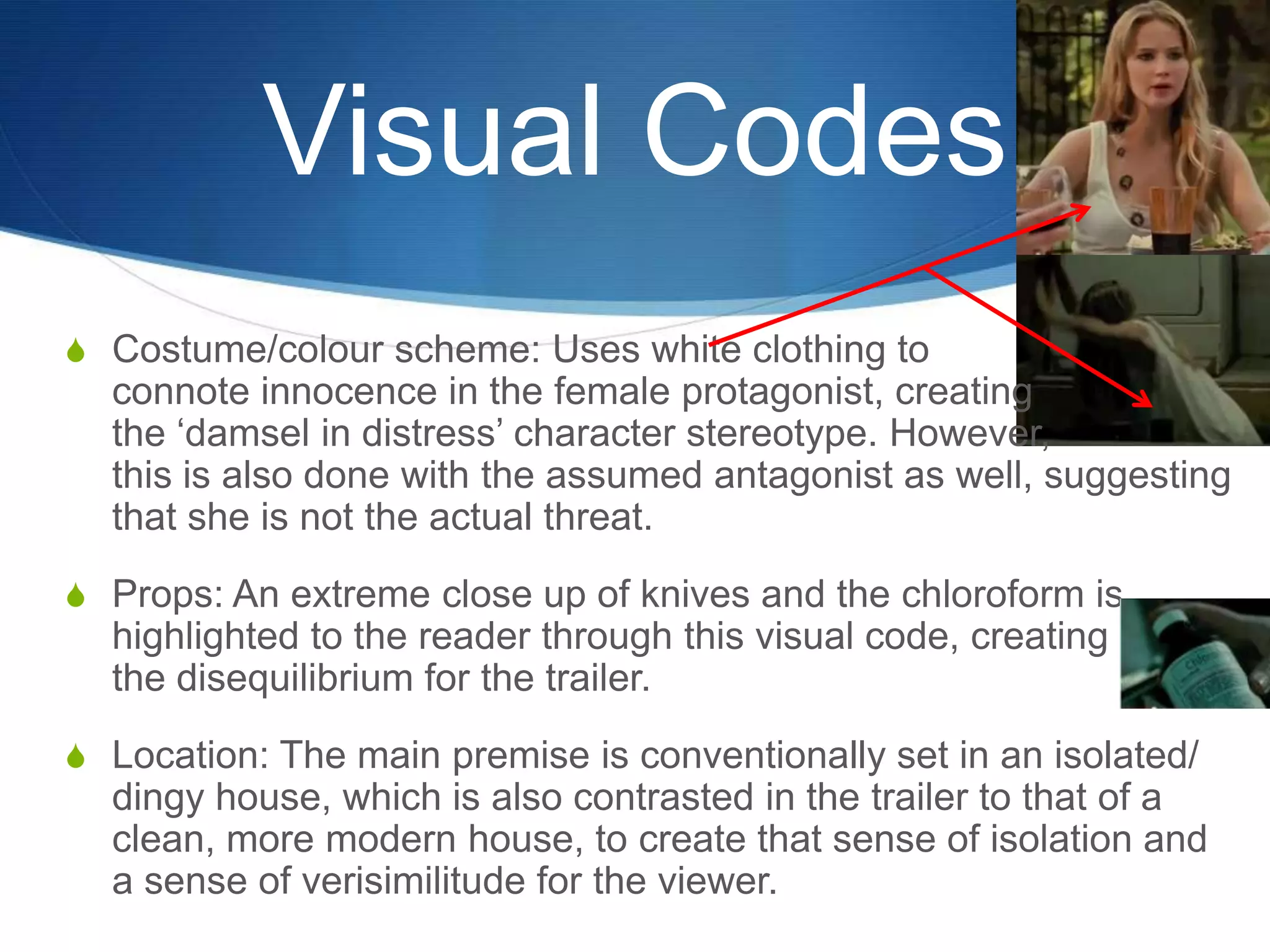
S Costume/colour scheme: Uses white clothing to

connote innocence in the female protagonist, creating
the „damsel in distress‟ character stereotype. However,
this is also done with the assumed antagonist as well, suggesting
that she is not the actual threat.
S Props: An extreme close up of knives and the chloroform is

highlighted to the reader through this visual code, creating
the disequilibrium for the trailer.
S Location: The main premise is conventionally set in an isolated/

dingy house, which is also contrasted in the trailer to that of a
clean, more modern house, to create that sense of isolation and
a sense of verisimilitude for the viewer.
Sound of HATES
trailer

Audio Codes

S Minimal diegetic sounds are used, only those synchronous with

actions that add to the trailer are used, such as the antagonist
climbing out of a cellar.
S Minimal dialogue is used, with mainly the use of a narrative

actually from the film, screams and one-liners which effectively
adds to the pace by only giving the audience snippets of actual
speech from the film.
S Sound track is used in sync with the editing, which fades to black

at regular intervals in the first part of the trailer. The soundtrack
takes away the audience‟s sense of verisimilitude as it suggests
something isn‟t quite right, leading to enigma codes
Narrative Codes
S Tzvetan Todorov‟s simplified narrative theory can be

described as: Equilibrium  Disequilibrium  Renewed
Status Quo
Disruption
Solution
Equilibrium
S This trailer goes: Disruption  Equilibrium  continued

Disruption with a short clip featuring an Equilibrium again. This
was done to follow the non-linear, almost reverse narrative of
the trailer, which also uses enigma codes to an extent.
S Inter-titles are used to inform the audience, and work alongside

the reversal editing-technique
Action Codes
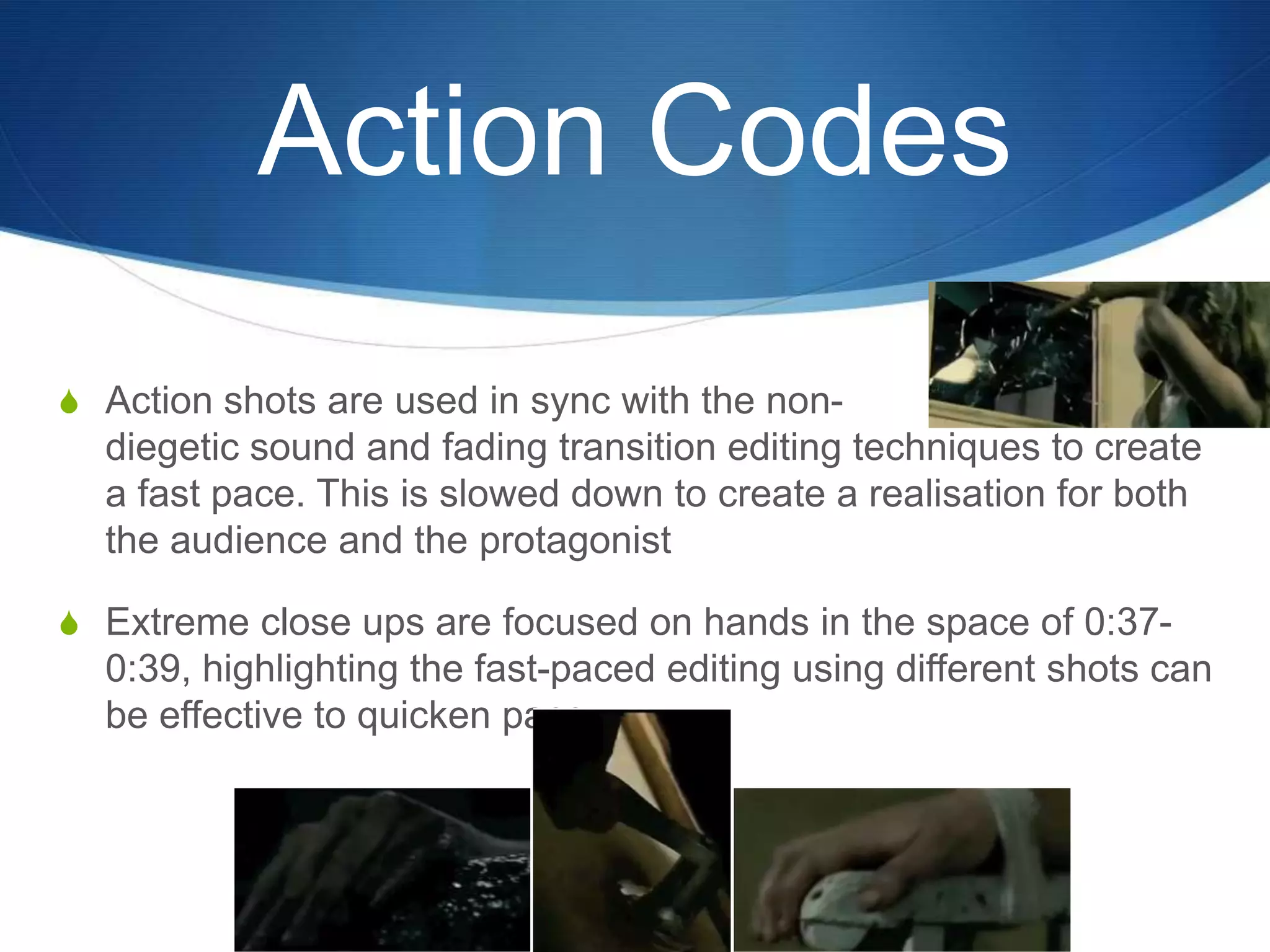
S Action shots are used in sync with the non-

diegetic sound and fading transition editing techniques to create
a fast pace. This is slowed down to create a realisation for both
the audience and the protagonist
S Extreme close ups are focused on hands in the space of 0:37-

0:39, highlighting the fast-paced editing using different shots can
be effective to quicken pace.
Enigma Codes
S The reverse-style narrative used in the trailer has automatically

encoded enigma codes, by creating mysteries for the audience
to naturally want to solve.
S The inter-titles relate to „the pain‟, „the horror‟ and „the

truth‟, without fully explaining what those are.
S The question of why „Carrie Anne killed both her parents‟ is

brought up through dialogue towards the end
S Are there multiple antagonists?
Visual Codes
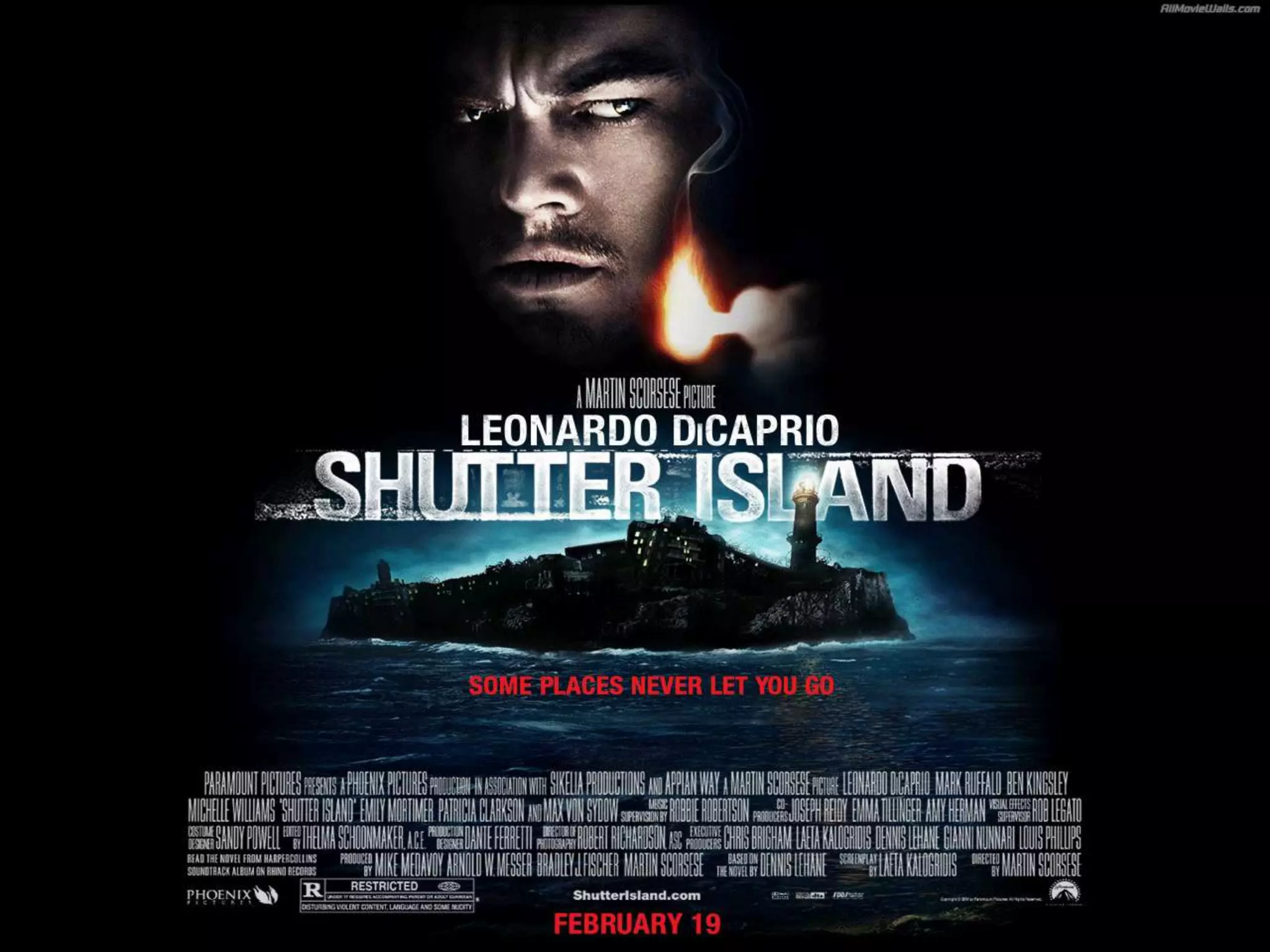
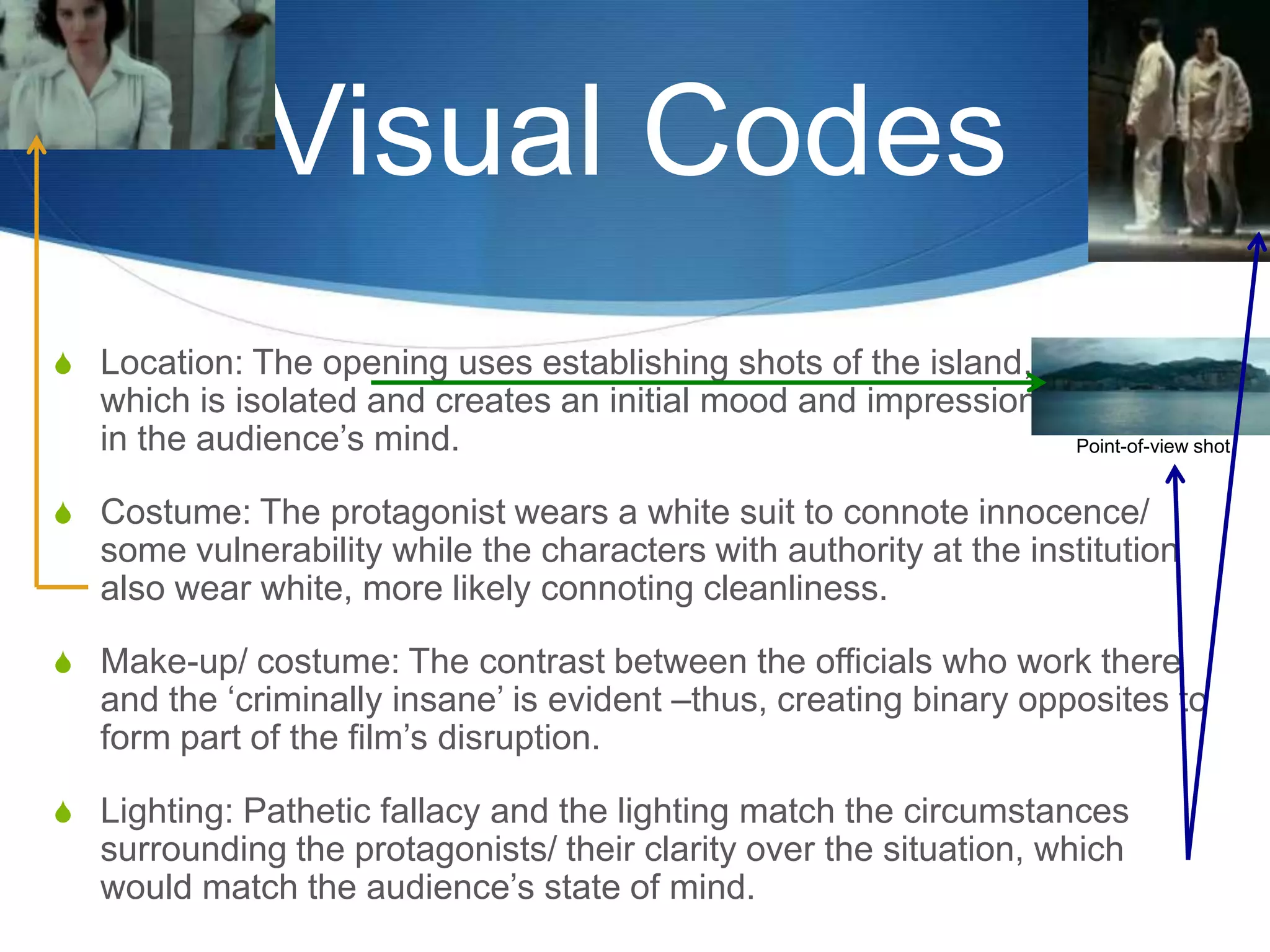
S Location: The opening uses establishing shots of the island,

which is isolated and creates an initial mood and impression
in the audience‟s mind.

Point-of-view shot

S Costume: The protagonist wears a white suit to connote innocence/

some vulnerability while the characters with authority at the institution
also wear white, more likely connoting cleanliness.
S Make-up/ costume: The contrast between the officials who work there

and the „criminally insane‟ is evident –thus, creating binary opposites to
form part of the film‟s disruption.

S Lighting: Pathetic fallacy and the lighting match the circumstances

surrounding the protagonists/ their clarity over the situation, which
would match the audience‟s state of mind.
Audio Codes
S The sound track adapts to the situation, to effectively change

the audience‟s state of mind
S Dialogue is used to establish the story and accompany the

imagery
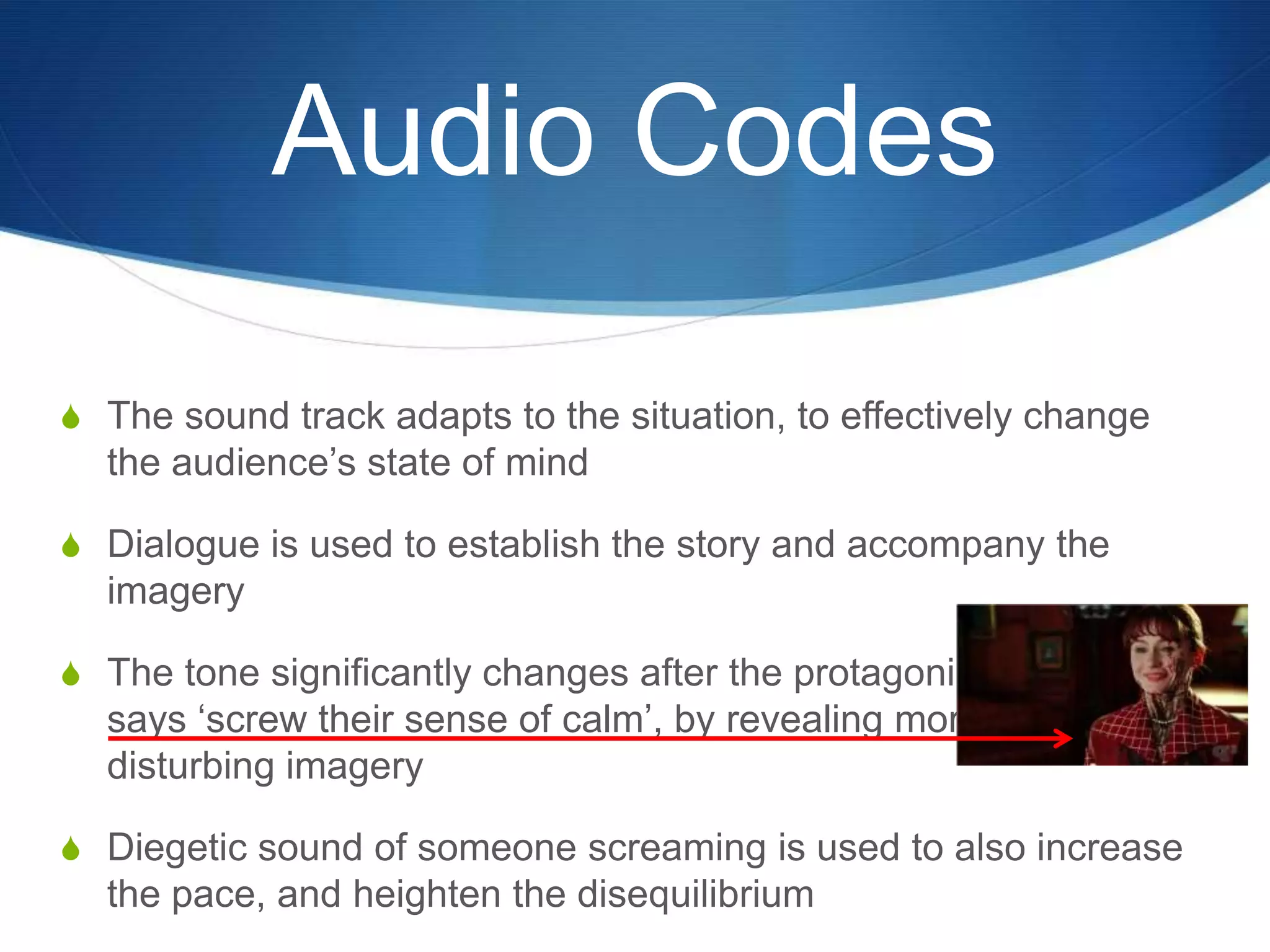
S The tone significantly changes after the protagonist

says „screw their sense of calm‟, by revealing more
disturbing imagery
S Diegetic sound of someone screaming is used to also increase

the pace, and heighten the disequilibrium
Narrative Codes
S Predominantly follows a more linear narrative; Todarov‟s theory

of Equilibrium is used, but is more abstract, as the protagonists
are placed in an unfamiliar situation from the start.
S Disequilibrium follows, with the secrets of the institution starting

to emerge through imagery and the character‟s own
development
S Inter-titles are not used, instead, the characters‟ dialogue is

employed to narrate the trailer
Action Codes
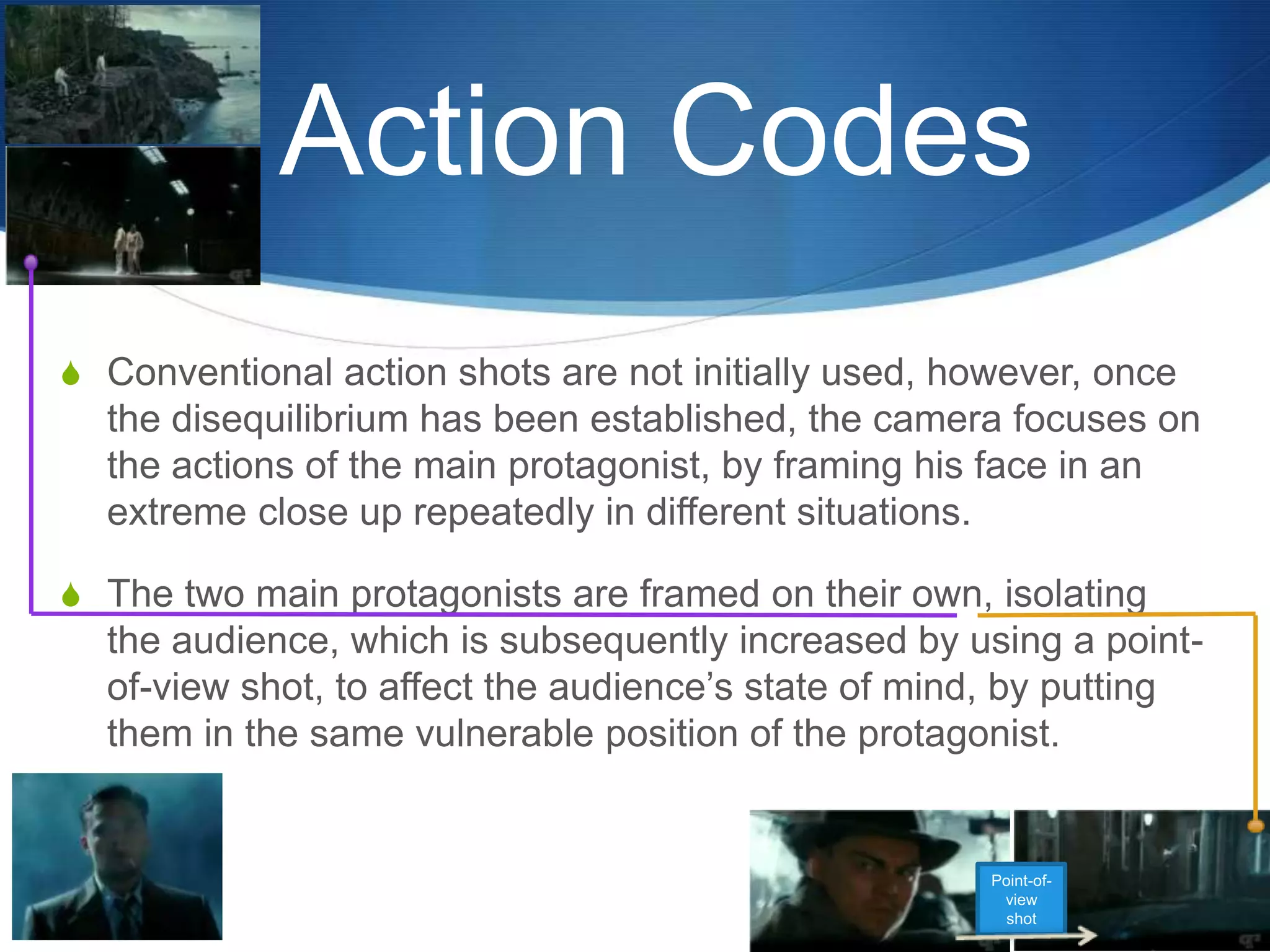
S Conventional action shots are not initially used, however, once

the disequilibrium has been established, the camera focuses on
the actions of the main protagonist, by framing his face in an
extreme close up repeatedly in different situations.
S The two main protagonists are framed on their own, isolating

the audience, which is subsequently increased by using a pointof-view shot, to affect the audience‟s state of mind, by putting
them in the same vulnerable position of the protagonist.

Point-ofview
shot
Enigma Codes
S Only snippets of scenes are shown, causing the audience to

naturally want to resolve these mysteries
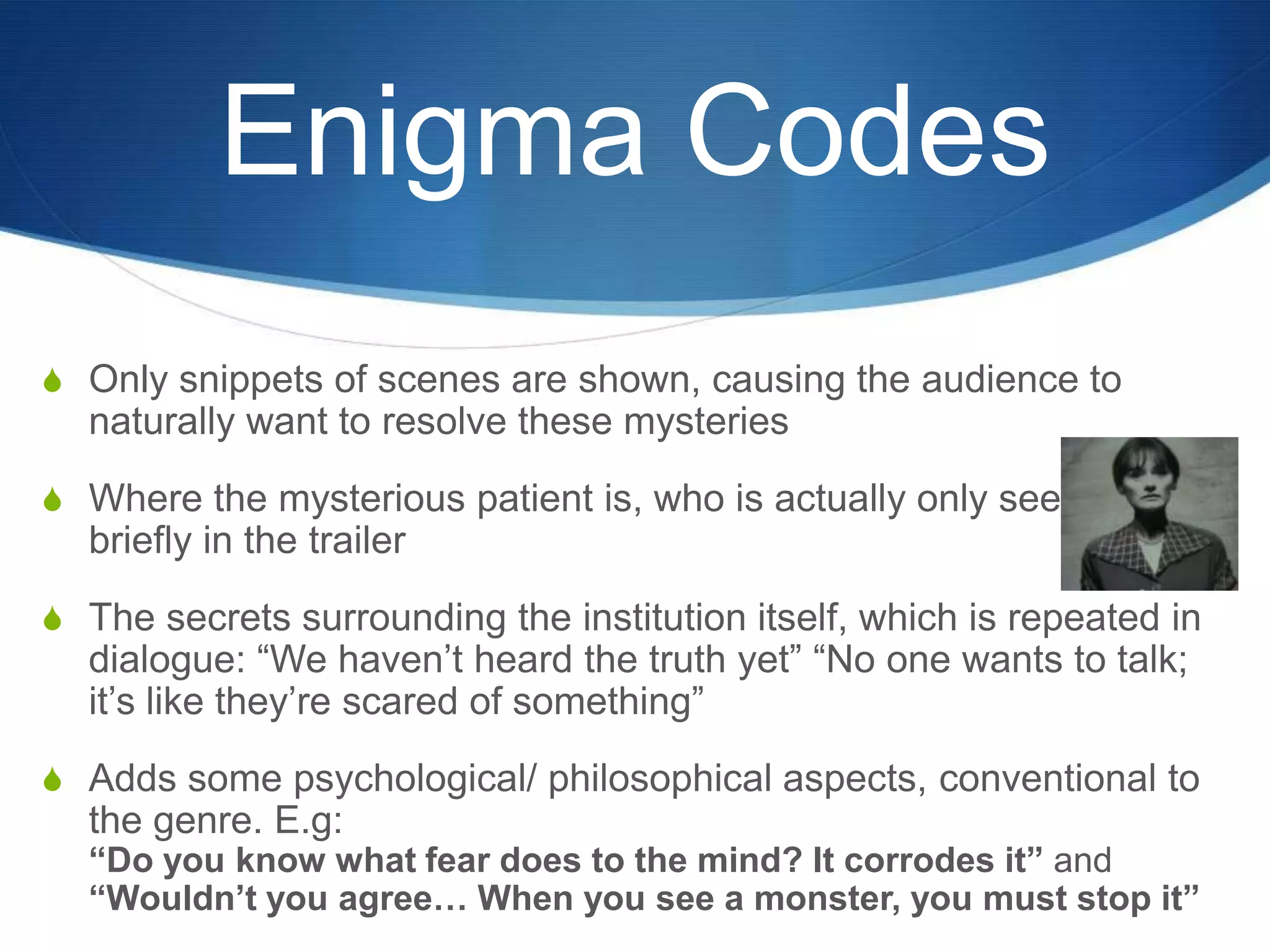
S Where the mysterious patient is, who is actually only seen

briefly in the trailer
S The secrets surrounding the institution itself, which is repeated in

dialogue: “We haven‟t heard the truth yet” “No one wants to talk;
it‟s like they‟re scared of something”

S Adds some psychological/ philosophical aspects, conventional to

the genre. E.g:

“Do you know what fear does to the mind? It corrodes it” and
“Wouldn’t you agree… When you see a monster, you must stop it”
Technical Codes
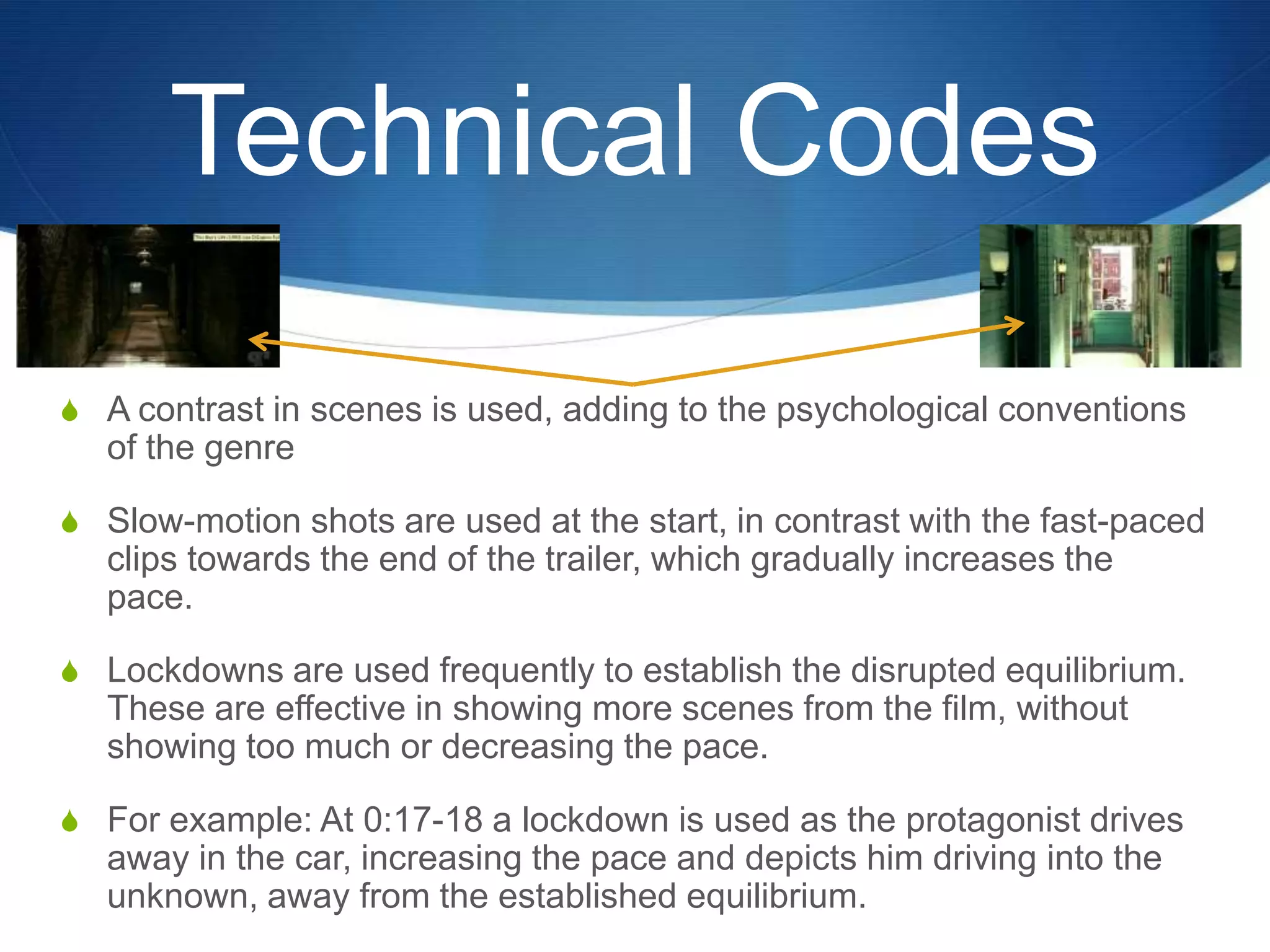
S A contrast in scenes is used, adding to the psychological conventions

of the genre
S Slow-motion shots are used at the start, in contrast with the fast-paced

clips towards the end of the trailer, which gradually increases the
pace.
S Lockdowns are used frequently to establish the disrupted equilibrium.

These are effective in showing more scenes from the film, without
showing too much or decreasing the pace.
S For example: At 0:17-18 a lockdown is used as the protagonist drives

away in the car, increasing the pace and depicts him driving into the
unknown, away from the established equilibrium.
Visual Codes
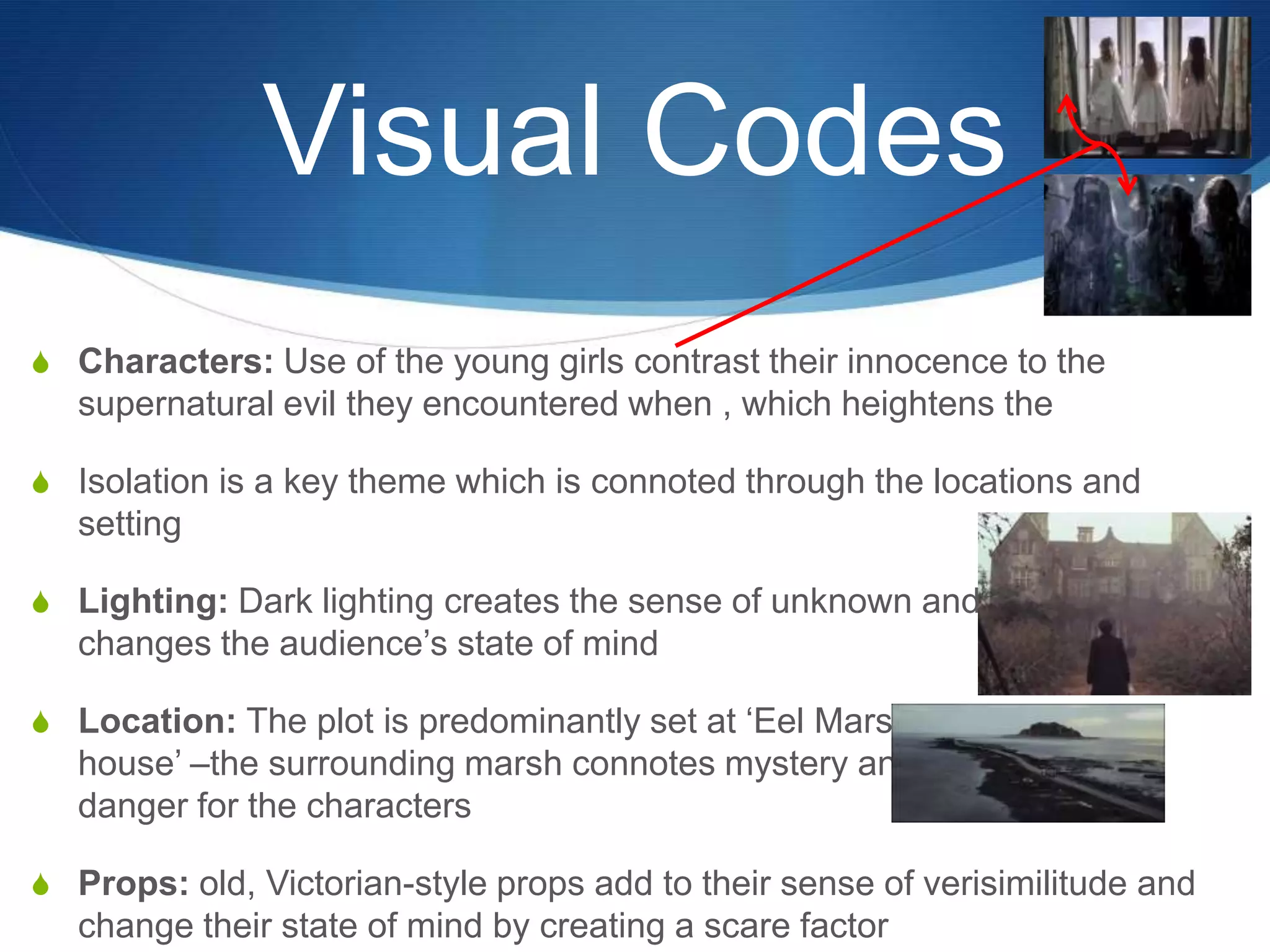
S Characters: Use of the young girls contrast their innocence to the

supernatural evil they encountered when , which heightens the
S Isolation is a key theme which is connoted through the locations and

setting
S Lighting: Dark lighting creates the sense of unknown and

changes the audience‟s state of mind
S Location: The plot is predominantly set at „Eel Marsh

house‟ –the surrounding marsh connotes mystery and
danger for the characters
S Props: old, Victorian-style props add to their sense of verisimilitude and

change their state of mind by creating a scare factor
By listening to the trailer without actually watching it, for these codes, I found:

Audio Codes
0:05-0:23

S Several different non-diegetic soundtracks are used – the

first is mysterious to establish the setting.
S Pace of the soundtrack changes considerably after the 0:23

mark when the protagonist has actually entered the house;
here, a lot of door-creaking and other synchronous diegetic
sound is used once the disequilibrium has been further
established
S Dialogue: The dialogue isn‟t really needed, just there to

give the initial context to the audience and narrate the story
Narrative Codes
S Non-linear narrative is used, as frames are used from the beginning and

end of the film for its intended purpose of giving a scope of the scenes
included in the film
S Todarov‟s theory of disequilibrium is almost immediately established for

the character, as he has come from London.
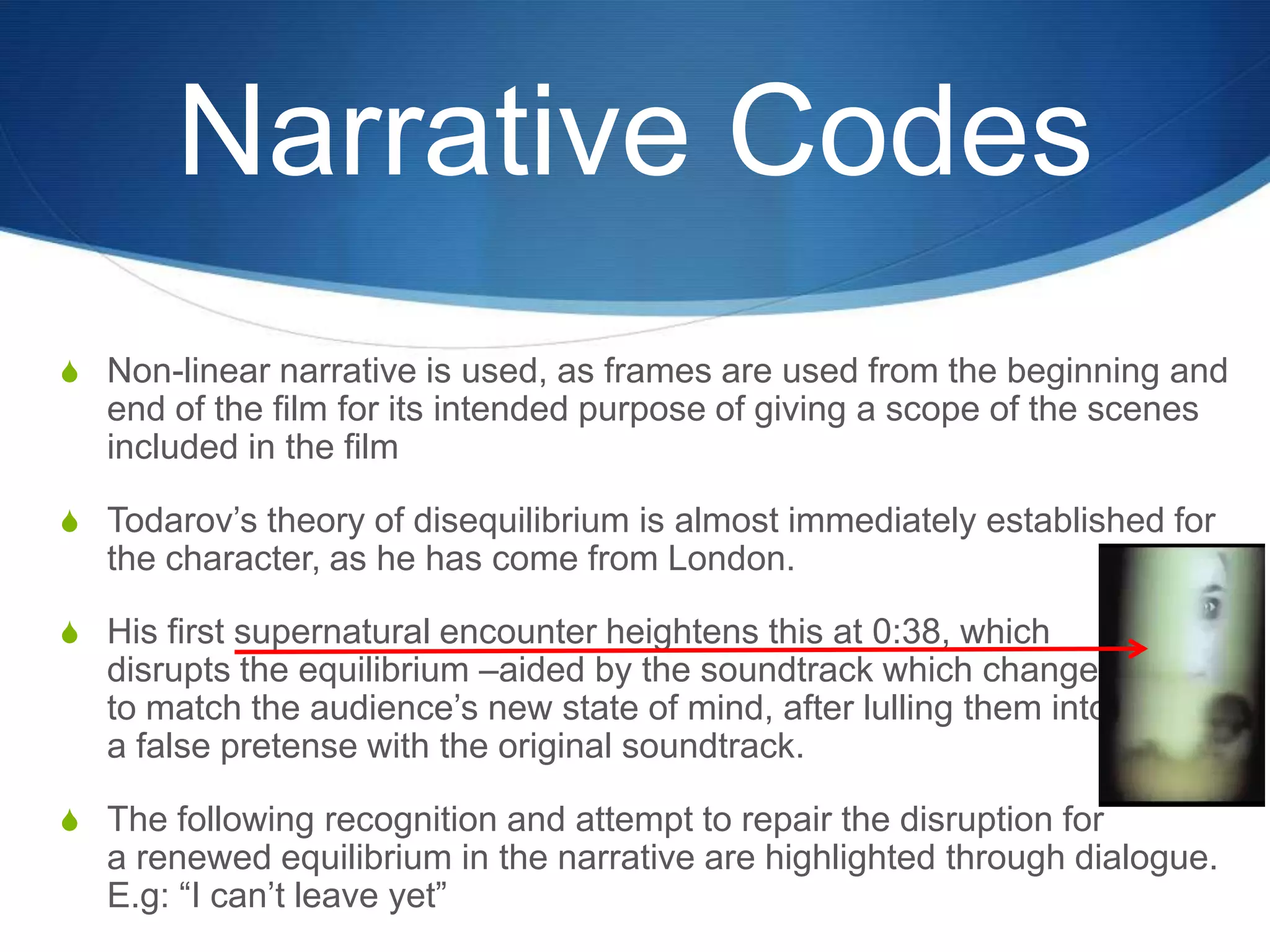
S His first supernatural encounter heightens this at 0:38, which

disrupts the equilibrium –aided by the soundtrack which changes
to match the audience‟s new state of mind, after lulling them into
a false pretense with the original soundtrack.

S The following recognition and attempt to repair the disruption for

a renewed equilibrium in the narrative are highlighted through dialogue.
E.g: “I can‟t leave yet”
Action Codes
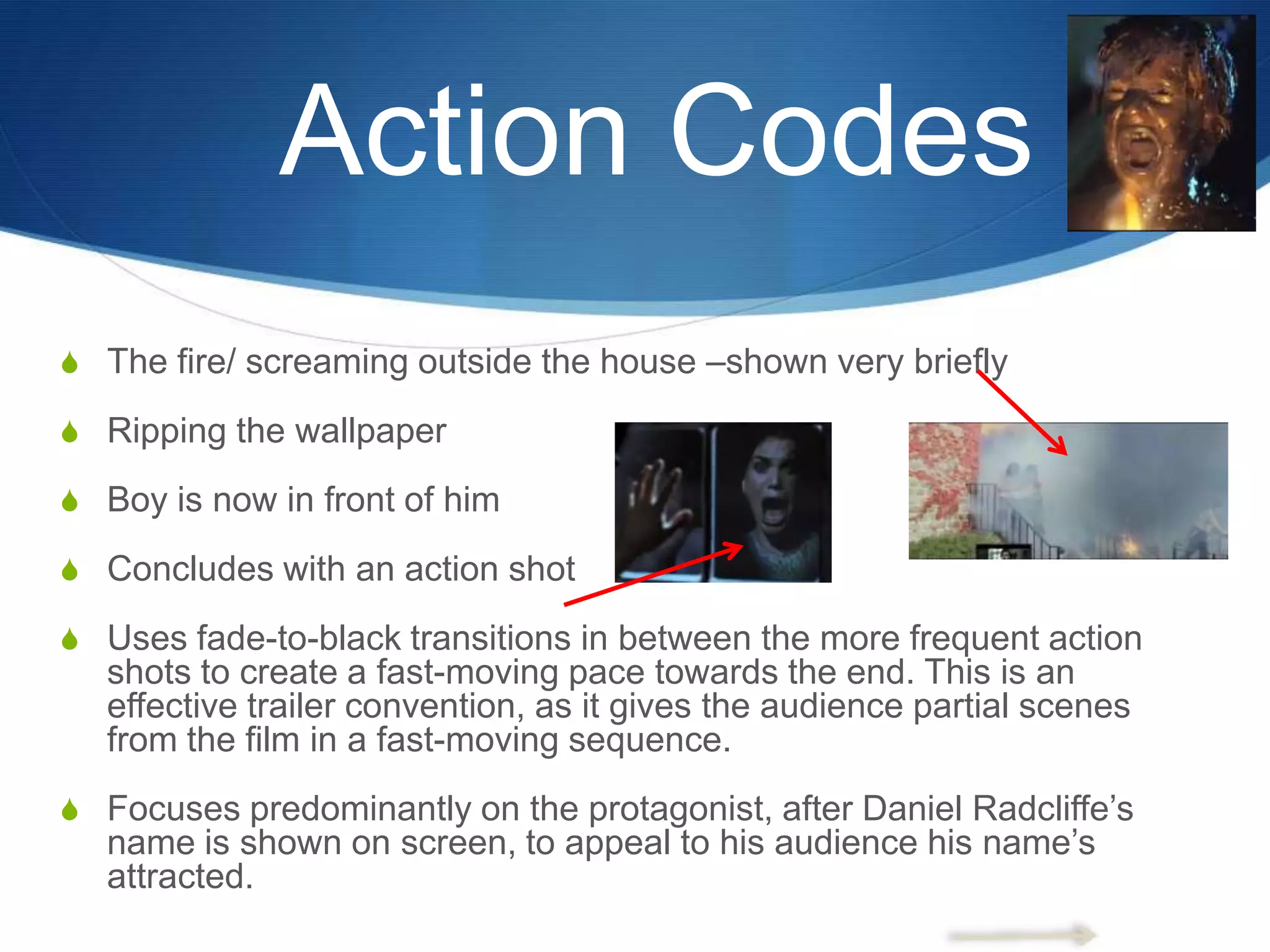
S The fire/ screaming outside the house –shown very briefly
S Ripping the wallpaper
S Boy is now in front of him
S Concludes with an action shot
S Uses fade-to-black transitions in between the more frequent action

shots to create a fast-moving pace towards the end. This is an
effective trailer convention, as it gives the audience partial scenes
from the film in a fast-moving sequence.
S Focuses predominantly on the protagonist, after Daniel Radcliffe‟s

name is shown on screen, to appeal to his audience his name‟s
attracted.
Enigma Codes
S Examples of „She‟s there‟ and „I can‟t leave yet‟ –show people trying to

dissuade the protagonist which will attract the audience to want to resolve
these mysteries.
S The significance of the children shown, and how they

are involved in the storyline
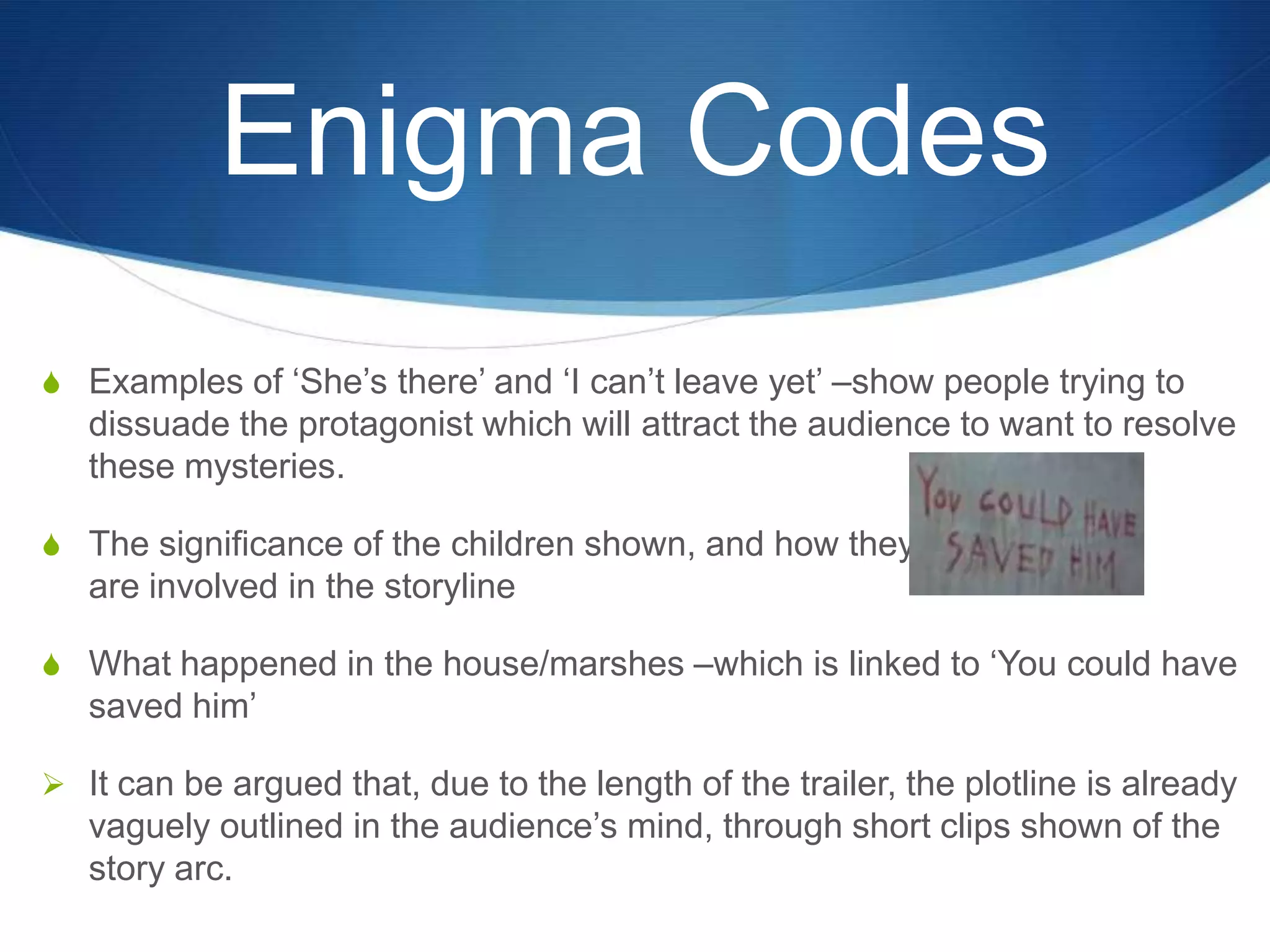
S What happened in the house/marshes –which is linked to „You could have

saved him‟
 It can be argued that, due to the length of the trailer, the plotline is already

vaguely outlined in the audience‟s mind, through short clips shown of the
story arc.
Technical Codes
S Special effects are used to convey the supernatural elements of

the film, and to superimpose the woman in black onto the
frames
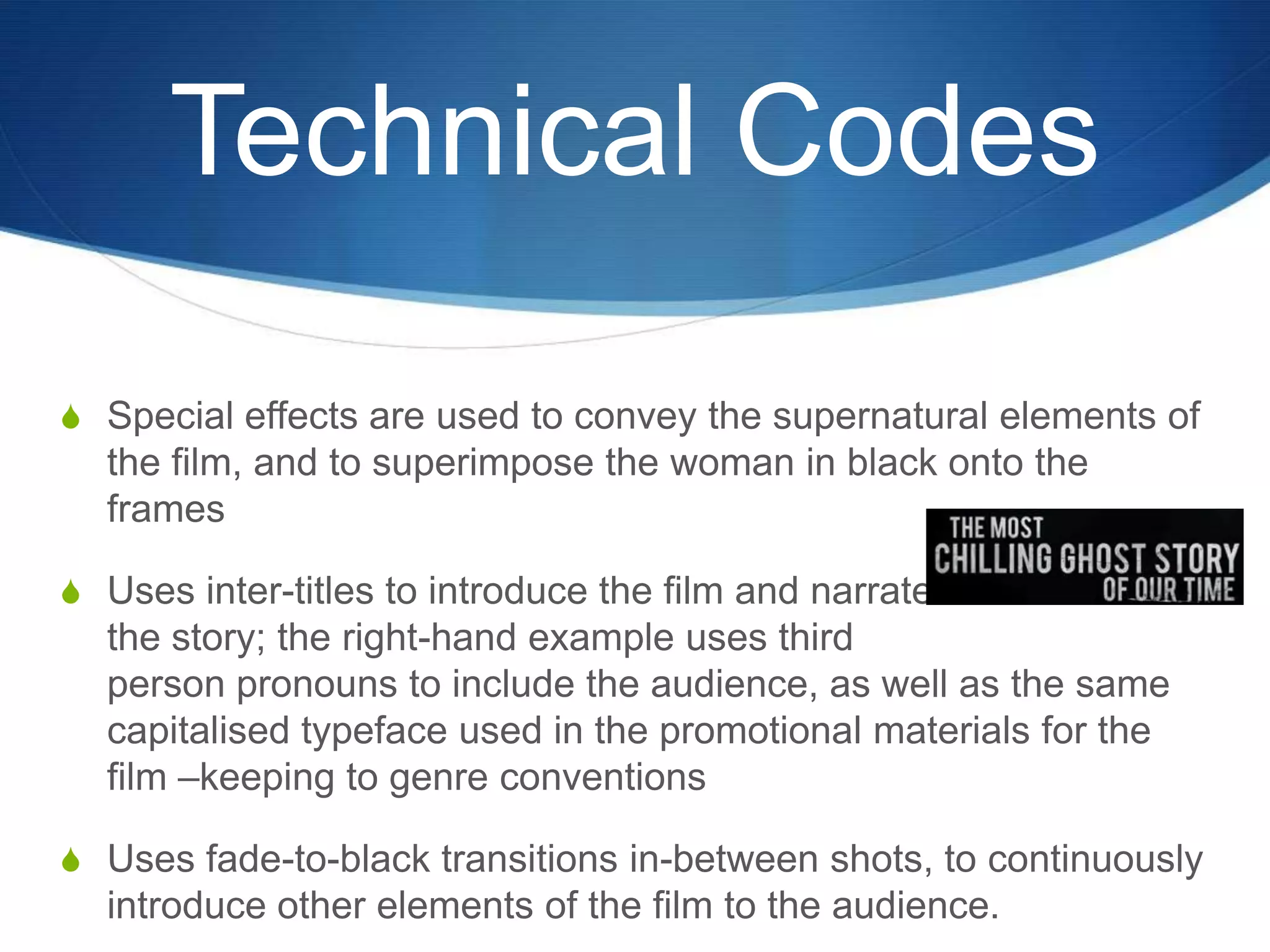
S Uses inter-titles to introduce the film and narrate

the story; the right-hand example uses third
person pronouns to include the audience, as well as the same
capitalised typeface used in the promotional materials for the
film –keeping to genre conventions
S Uses fade-to-black transitions in-between shots, to continuously

introduce other elements of the film to the audience.
Summary:
After analysing all three films, I have found that all three use fadeto-black transitions in-between shots, which effectively increases
the pace, while still giving the audience extracts from the film. All
of them use the horror genre convention of white costume to
connote innocence in certain characters, or cleanliness in others
like in Shutter Island. Furthermore, there is an early disequilibrium
established in all three as the protagonist is placed in a new
environment, experiencing the unknown. E.g a new house, island
and village. Lastly, a community acts as an auxiliary antagonist in
The Woman In Black and Shutter Island

Codal analysis

  • 1.
  • 3.
    Visual Codes S Costume/colourscheme: Uses white clothing to connote innocence in the female protagonist, creating the „damsel in distress‟ character stereotype. However, this is also done with the assumed antagonist as well, suggesting that she is not the actual threat. S Props: An extreme close up of knives and the chloroform is highlighted to the reader through this visual code, creating the disequilibrium for the trailer. S Location: The main premise is conventionally set in an isolated/ dingy house, which is also contrasted in the trailer to that of a clean, more modern house, to create that sense of isolation and a sense of verisimilitude for the viewer.
  • 4.
    Sound of HATES trailer AudioCodes S Minimal diegetic sounds are used, only those synchronous with actions that add to the trailer are used, such as the antagonist climbing out of a cellar. S Minimal dialogue is used, with mainly the use of a narrative actually from the film, screams and one-liners which effectively adds to the pace by only giving the audience snippets of actual speech from the film. S Sound track is used in sync with the editing, which fades to black at regular intervals in the first part of the trailer. The soundtrack takes away the audience‟s sense of verisimilitude as it suggests something isn‟t quite right, leading to enigma codes
  • 5.
    Narrative Codes S TzvetanTodorov‟s simplified narrative theory can be described as: Equilibrium  Disequilibrium  Renewed Status Quo Disruption Solution Equilibrium S This trailer goes: Disruption  Equilibrium  continued Disruption with a short clip featuring an Equilibrium again. This was done to follow the non-linear, almost reverse narrative of the trailer, which also uses enigma codes to an extent. S Inter-titles are used to inform the audience, and work alongside the reversal editing-technique
  • 6.
    Action Codes S Actionshots are used in sync with the non- diegetic sound and fading transition editing techniques to create a fast pace. This is slowed down to create a realisation for both the audience and the protagonist S Extreme close ups are focused on hands in the space of 0:37- 0:39, highlighting the fast-paced editing using different shots can be effective to quicken pace.
  • 7.
    Enigma Codes S Thereverse-style narrative used in the trailer has automatically encoded enigma codes, by creating mysteries for the audience to naturally want to solve. S The inter-titles relate to „the pain‟, „the horror‟ and „the truth‟, without fully explaining what those are. S The question of why „Carrie Anne killed both her parents‟ is brought up through dialogue towards the end S Are there multiple antagonists?
  • 9.
    Visual Codes S Location:The opening uses establishing shots of the island, which is isolated and creates an initial mood and impression in the audience‟s mind. Point-of-view shot S Costume: The protagonist wears a white suit to connote innocence/ some vulnerability while the characters with authority at the institution also wear white, more likely connoting cleanliness. S Make-up/ costume: The contrast between the officials who work there and the „criminally insane‟ is evident –thus, creating binary opposites to form part of the film‟s disruption. S Lighting: Pathetic fallacy and the lighting match the circumstances surrounding the protagonists/ their clarity over the situation, which would match the audience‟s state of mind.
  • 10.
    Audio Codes S Thesound track adapts to the situation, to effectively change the audience‟s state of mind S Dialogue is used to establish the story and accompany the imagery S The tone significantly changes after the protagonist says „screw their sense of calm‟, by revealing more disturbing imagery S Diegetic sound of someone screaming is used to also increase the pace, and heighten the disequilibrium
  • 11.
    Narrative Codes S Predominantlyfollows a more linear narrative; Todarov‟s theory of Equilibrium is used, but is more abstract, as the protagonists are placed in an unfamiliar situation from the start. S Disequilibrium follows, with the secrets of the institution starting to emerge through imagery and the character‟s own development S Inter-titles are not used, instead, the characters‟ dialogue is employed to narrate the trailer
  • 12.
    Action Codes S Conventionalaction shots are not initially used, however, once the disequilibrium has been established, the camera focuses on the actions of the main protagonist, by framing his face in an extreme close up repeatedly in different situations. S The two main protagonists are framed on their own, isolating the audience, which is subsequently increased by using a pointof-view shot, to affect the audience‟s state of mind, by putting them in the same vulnerable position of the protagonist. Point-ofview shot
  • 13.
    Enigma Codes S Onlysnippets of scenes are shown, causing the audience to naturally want to resolve these mysteries S Where the mysterious patient is, who is actually only seen briefly in the trailer S The secrets surrounding the institution itself, which is repeated in dialogue: “We haven‟t heard the truth yet” “No one wants to talk; it‟s like they‟re scared of something” S Adds some psychological/ philosophical aspects, conventional to the genre. E.g: “Do you know what fear does to the mind? It corrodes it” and “Wouldn’t you agree… When you see a monster, you must stop it”
  • 14.
    Technical Codes S Acontrast in scenes is used, adding to the psychological conventions of the genre S Slow-motion shots are used at the start, in contrast with the fast-paced clips towards the end of the trailer, which gradually increases the pace. S Lockdowns are used frequently to establish the disrupted equilibrium. These are effective in showing more scenes from the film, without showing too much or decreasing the pace. S For example: At 0:17-18 a lockdown is used as the protagonist drives away in the car, increasing the pace and depicts him driving into the unknown, away from the established equilibrium.
  • 16.
    Visual Codes S Characters:Use of the young girls contrast their innocence to the supernatural evil they encountered when , which heightens the S Isolation is a key theme which is connoted through the locations and setting S Lighting: Dark lighting creates the sense of unknown and changes the audience‟s state of mind S Location: The plot is predominantly set at „Eel Marsh house‟ –the surrounding marsh connotes mystery and danger for the characters S Props: old, Victorian-style props add to their sense of verisimilitude and change their state of mind by creating a scare factor
  • 17.
    By listening tothe trailer without actually watching it, for these codes, I found: Audio Codes 0:05-0:23 S Several different non-diegetic soundtracks are used – the first is mysterious to establish the setting. S Pace of the soundtrack changes considerably after the 0:23 mark when the protagonist has actually entered the house; here, a lot of door-creaking and other synchronous diegetic sound is used once the disequilibrium has been further established S Dialogue: The dialogue isn‟t really needed, just there to give the initial context to the audience and narrate the story
  • 18.
    Narrative Codes S Non-linearnarrative is used, as frames are used from the beginning and end of the film for its intended purpose of giving a scope of the scenes included in the film S Todarov‟s theory of disequilibrium is almost immediately established for the character, as he has come from London. S His first supernatural encounter heightens this at 0:38, which disrupts the equilibrium –aided by the soundtrack which changes to match the audience‟s new state of mind, after lulling them into a false pretense with the original soundtrack. S The following recognition and attempt to repair the disruption for a renewed equilibrium in the narrative are highlighted through dialogue. E.g: “I can‟t leave yet”
  • 19.
    Action Codes S Thefire/ screaming outside the house –shown very briefly S Ripping the wallpaper S Boy is now in front of him S Concludes with an action shot S Uses fade-to-black transitions in between the more frequent action shots to create a fast-moving pace towards the end. This is an effective trailer convention, as it gives the audience partial scenes from the film in a fast-moving sequence. S Focuses predominantly on the protagonist, after Daniel Radcliffe‟s name is shown on screen, to appeal to his audience his name‟s attracted.
  • 20.
    Enigma Codes S Examplesof „She‟s there‟ and „I can‟t leave yet‟ –show people trying to dissuade the protagonist which will attract the audience to want to resolve these mysteries. S The significance of the children shown, and how they are involved in the storyline S What happened in the house/marshes –which is linked to „You could have saved him‟  It can be argued that, due to the length of the trailer, the plotline is already vaguely outlined in the audience‟s mind, through short clips shown of the story arc.
  • 21.
    Technical Codes S Specialeffects are used to convey the supernatural elements of the film, and to superimpose the woman in black onto the frames S Uses inter-titles to introduce the film and narrate the story; the right-hand example uses third person pronouns to include the audience, as well as the same capitalised typeface used in the promotional materials for the film –keeping to genre conventions S Uses fade-to-black transitions in-between shots, to continuously introduce other elements of the film to the audience.
  • 22.
    Summary: After analysing allthree films, I have found that all three use fadeto-black transitions in-between shots, which effectively increases the pace, while still giving the audience extracts from the film. All of them use the horror genre convention of white costume to connote innocence in certain characters, or cleanliness in others like in Shutter Island. Furthermore, there is an early disequilibrium established in all three as the protagonist is placed in a new environment, experiencing the unknown. E.g a new house, island and village. Lastly, a community acts as an auxiliary antagonist in The Woman In Black and Shutter Island