Supporting Community  in Third Places  with Situated Social Software Joseph F. McCarthy 1 , Shelly D. Farnham 2 ,  Yogi Patel 1 , Sameer Ahuja 3 , William R. Hazlewood 4 ,  Daniel Norman 1 , Josh Lind 5 1 Strands Labs Seattle 2 Waggle Labs,  3 Virginia Tech,  4 Indiana Univ,  5 ReadyDone
In case of excessive speed … http://www.slideshare.net/ gumption (tag:  cct2009 ) View the slides and follow along / catch up later:
Agenda The promise and problems of  third places Situated social software The Strands Community Collage (CoCollage) Study: impact on Trabant Coffee community Neighboring factor of sense of community Dependency factor of place attachment Related, recent & future work Communities, technology, commerce
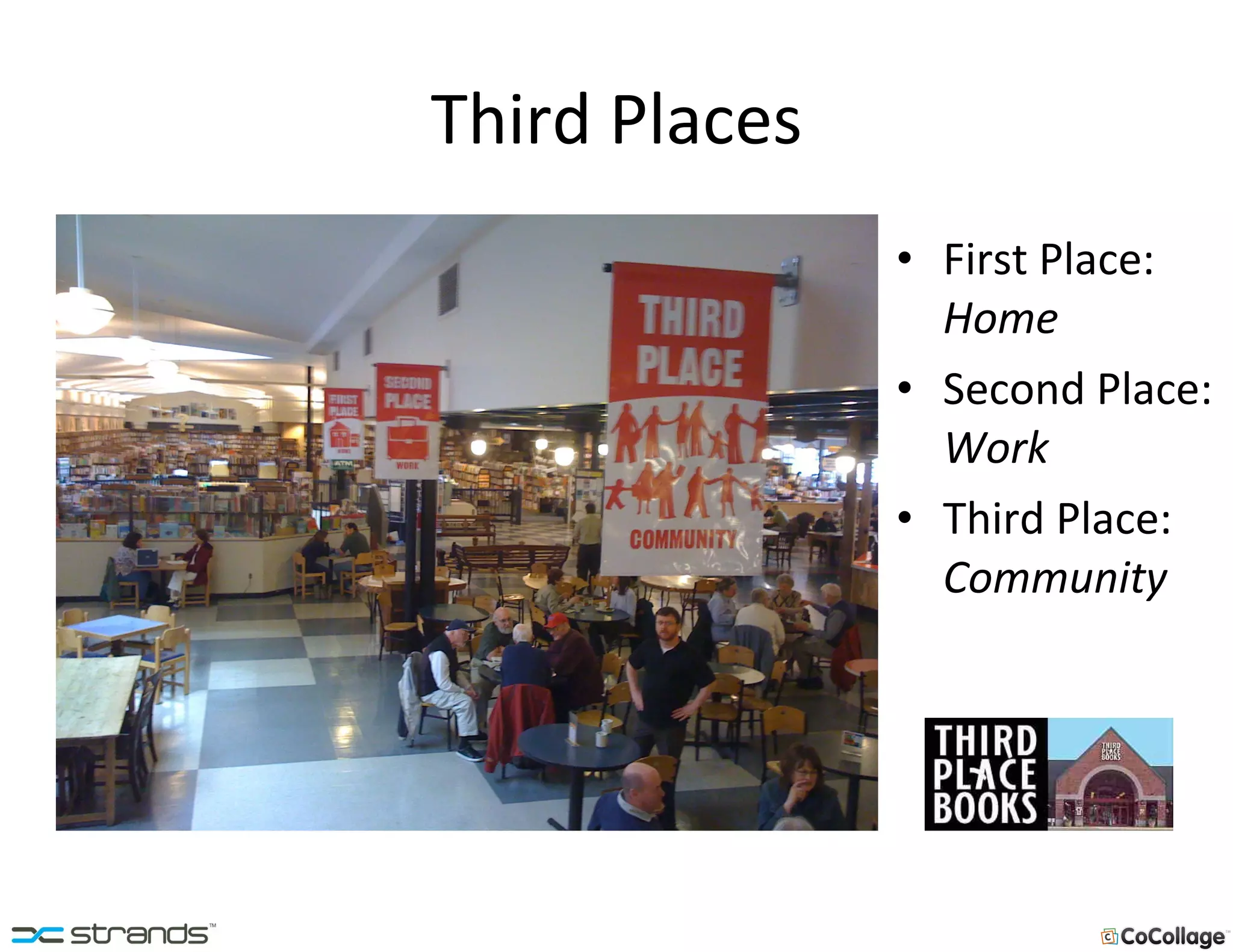
Third Places First Place: Home Second Place: Work Third Place: Community
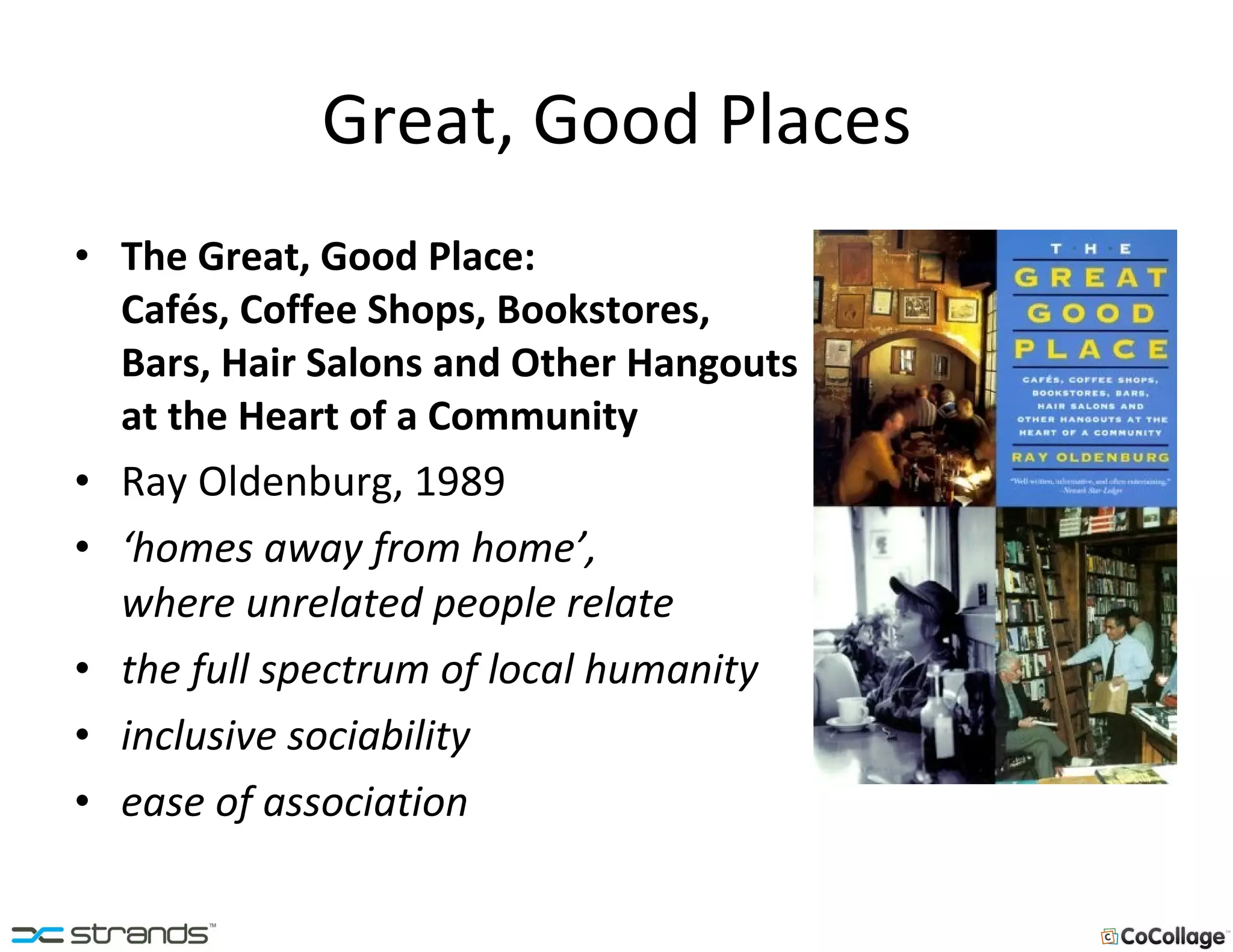
Great, Good Places The Great, Good Place:  Cafés, Coffee Shops, Bookstores, Bars, Hair Salons and Other Hangouts  at the Heart of a Community Ray Oldenburg, 1989 ‘ homes away from home’,  where unrelated people relate the full spectrum of local humanity inclusive sociability ease of association
Characteristics of Third Places On neutral ground A leveler Conversation is main activity Accessibility and accommodation Regulars Low profile Mood is playful Home away from home
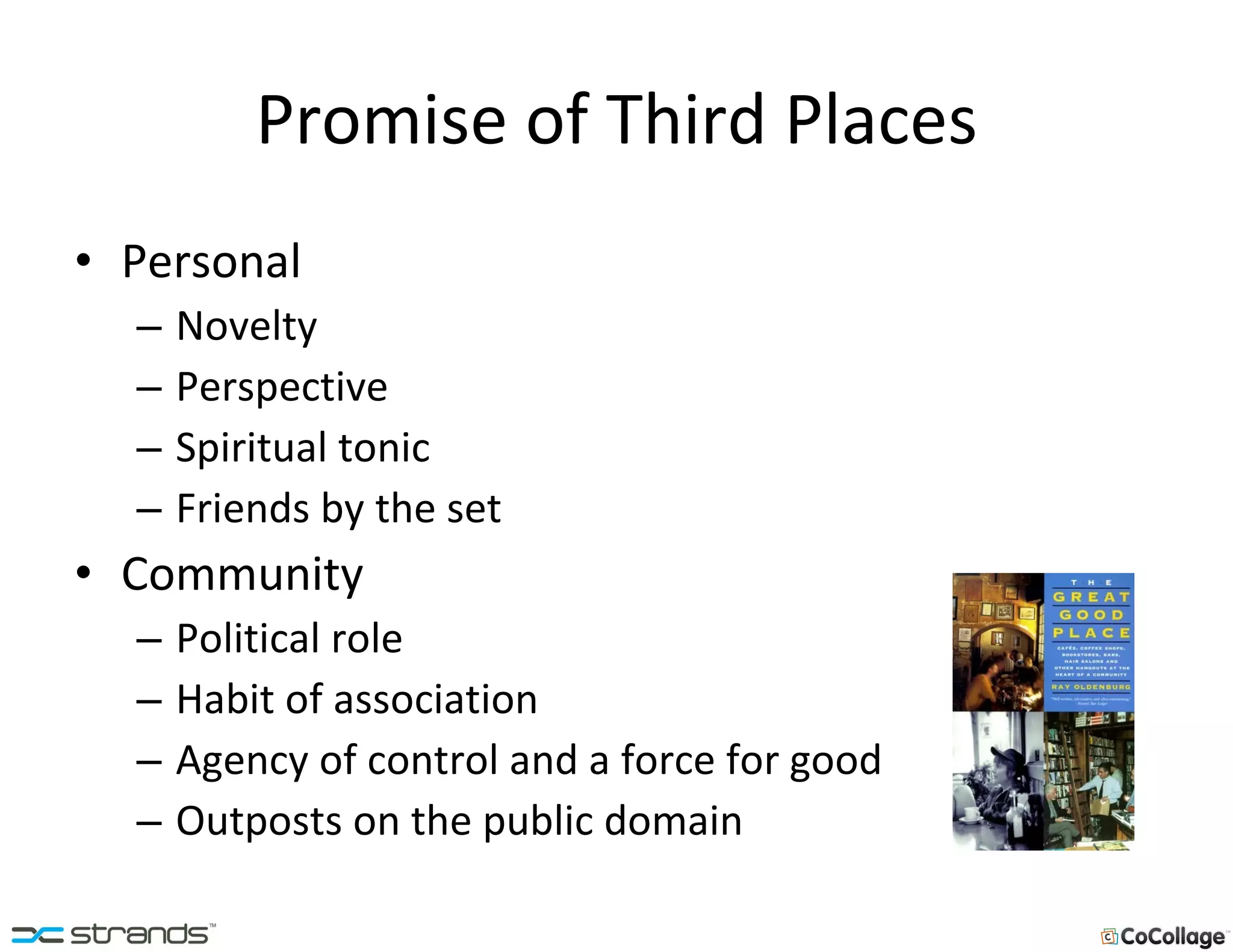
Promise of Third Places Personal Novelty Perspective Spiritual tonic Friends by the set Community Political role Habit of association Agency of control and a force for good Outposts on the public domain
Perils of [technology in] Third Places Cyber-nomads are “ hollowing out ” cafés that offer WiFi, rendering them “ physically inhabited but psychologically evacuated”  leaving people “ more isolated   than they would be if the café were merely empty.” -- James E. Katz, Professor of Communications, Rutgers University “Contextual effects” – Hampton,  et al.
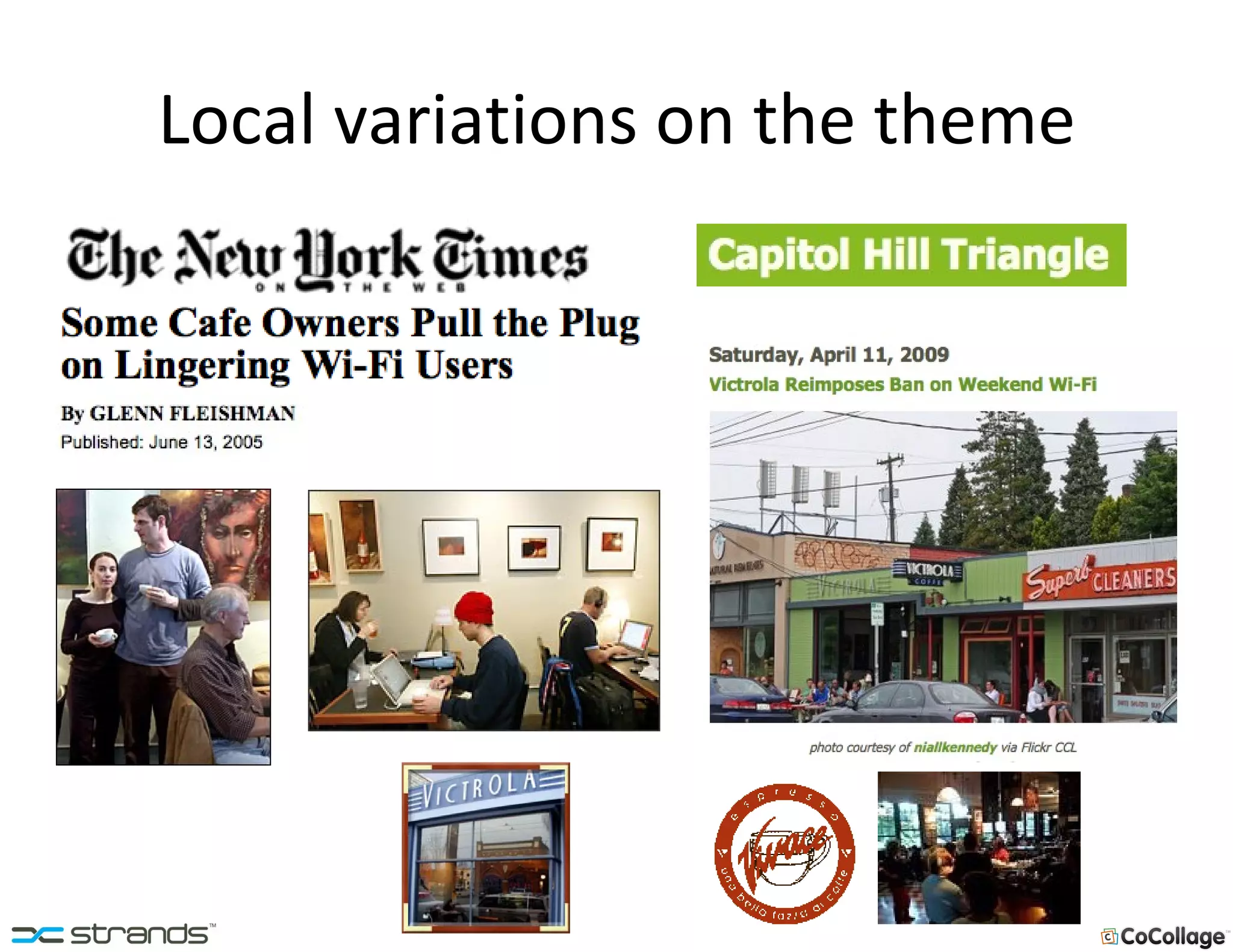
Local variations on the theme
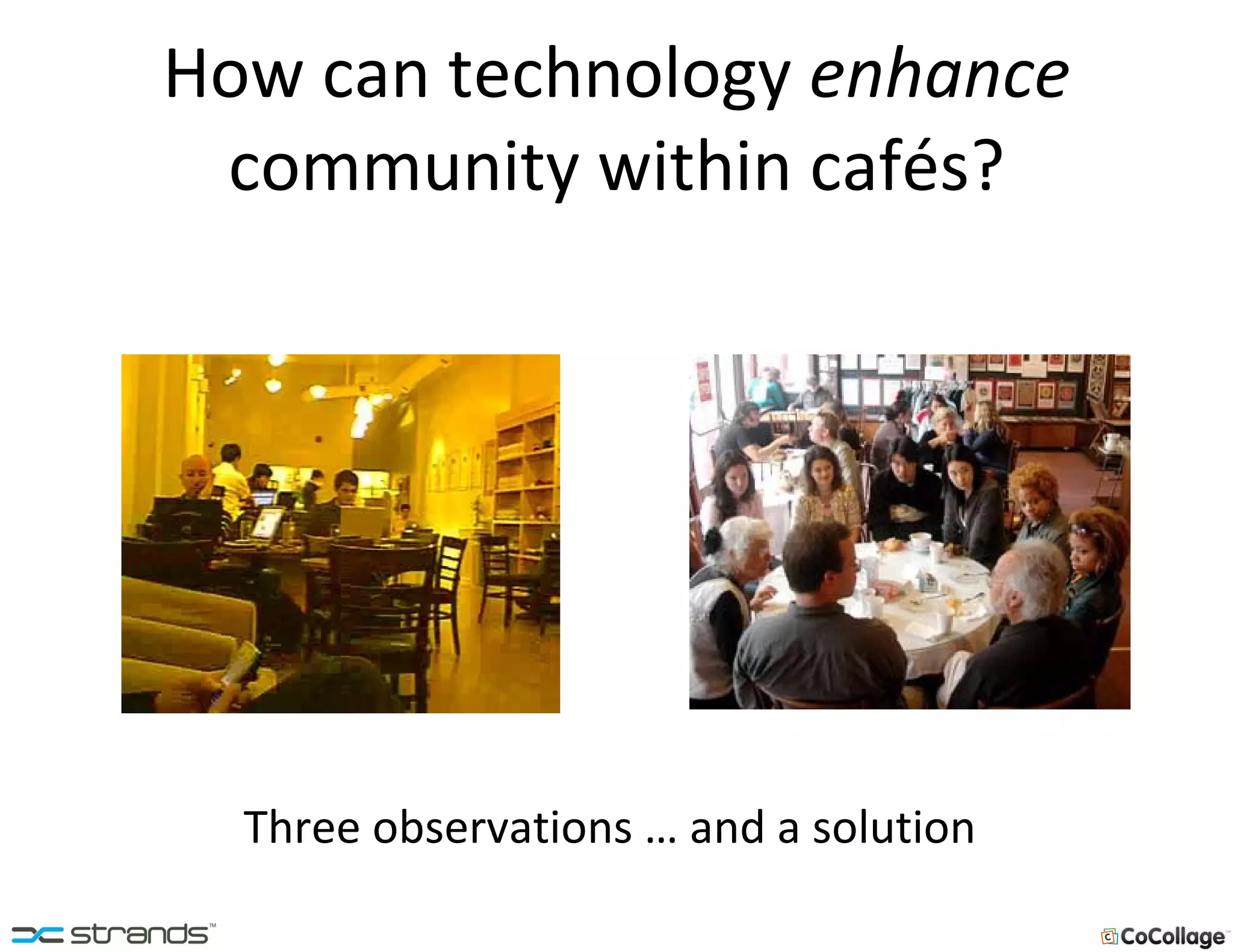
How can technology  enhance community within cafés? Three observations … and a solution
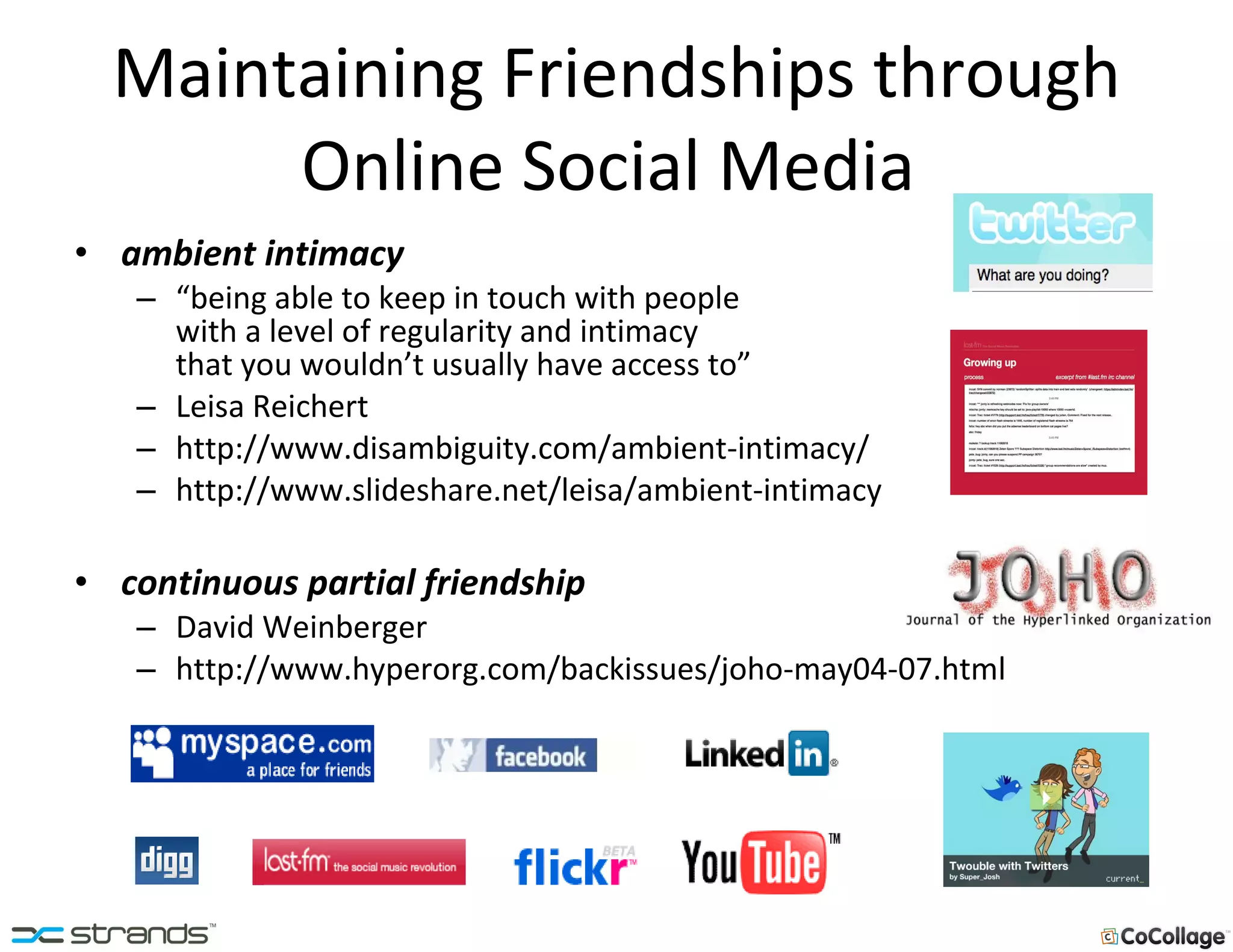
Maintaining Friendships through Online Social Media  ambient intimacy  “ being able to keep in touch with people  with a level of regularity and intimacy  that you wouldn’t usually have access to” Leisa Reichert http://www.disambiguity.com/ambient-intimacy/ http://www.slideshare.net/leisa/ambient-intimacy continuous partial friendship  David Weinberger http://www.hyperorg.com/backissues/joho-may04-07.html
Situated Software Clay Shirky, March 2004 Software designed in and for a particular social situation or context NOT Web School: scalability, generality, and completeness the application must be useful to the community;  the community must be useful to the application http://www.shirky.com/writings/situated_software.html See also:  “ Communities, Audiences & Scale” http://shirky.com/writings/community_scale.html “ What is Social Informatics and Why Does It Matter?” Rob Kling, D-Lib Magazine, January 1999 Socio-technical systems: people, technology, institutional & cultural contexts
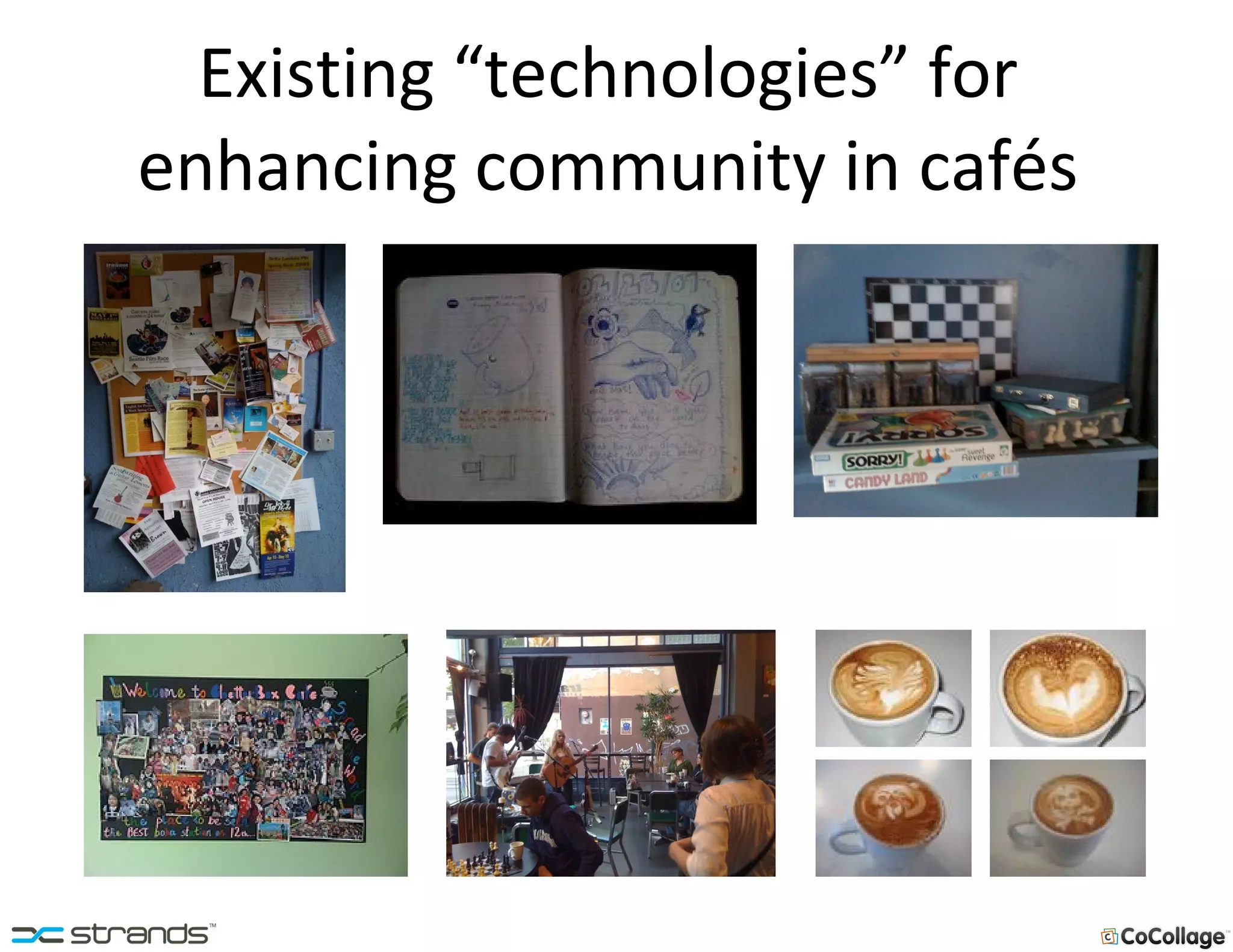
Existing “technologies” for  enhancing community in cafés
What if we could … Leverage the attributes of offline community “technologies” Photos, art, sketches, quotes, flyers Apply situated software design principles Design for the context of a café Bring the richness of online social networking into the physical spaces we share with others Spark conversation & connection in the real world Ambient intimacy in physical spaces
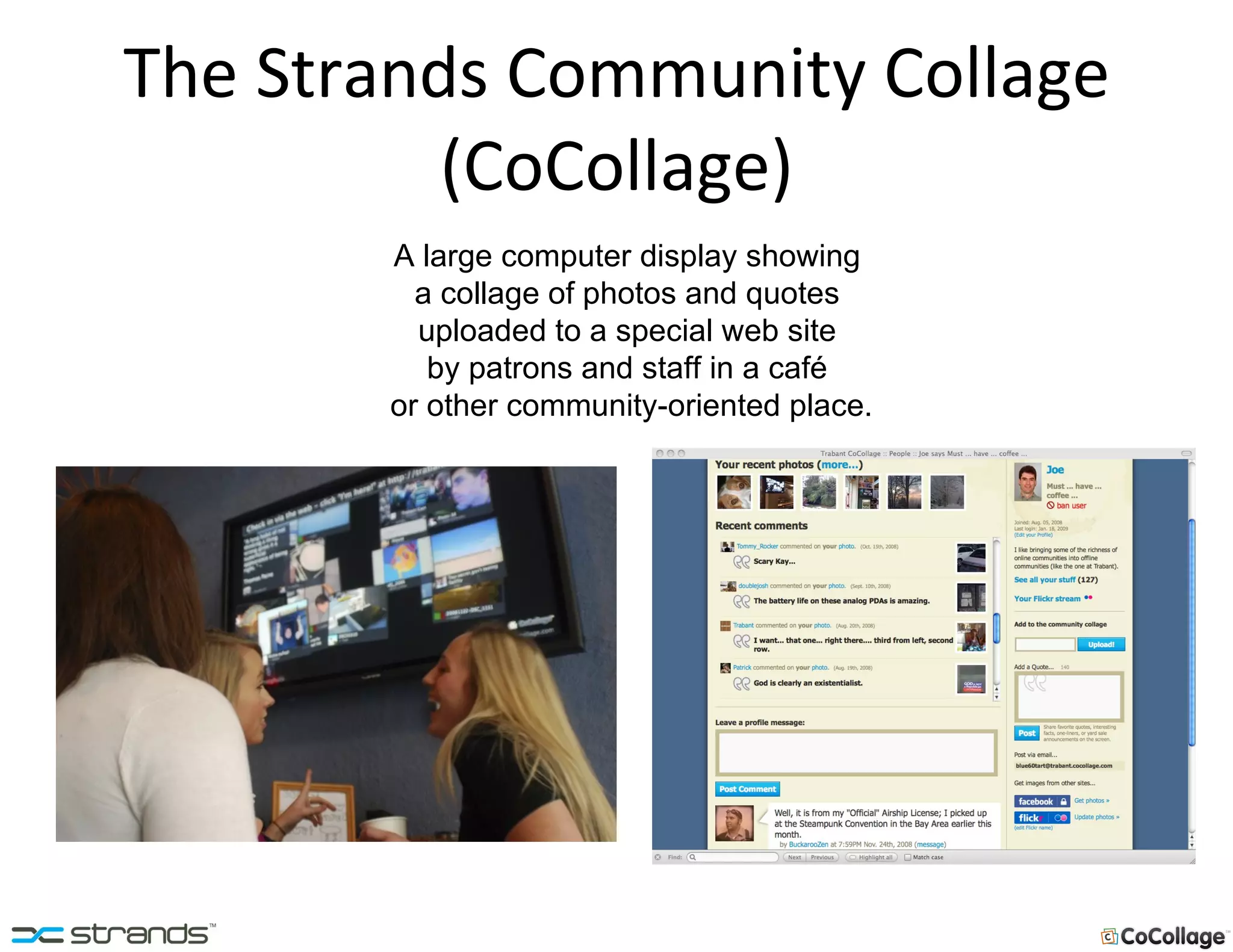
The Strands Community Collage (CoCollage) A large computer display showing  a collage of photos and quotes  uploaded to a special web site  by patrons and staff in a café  or other community-oriented place.
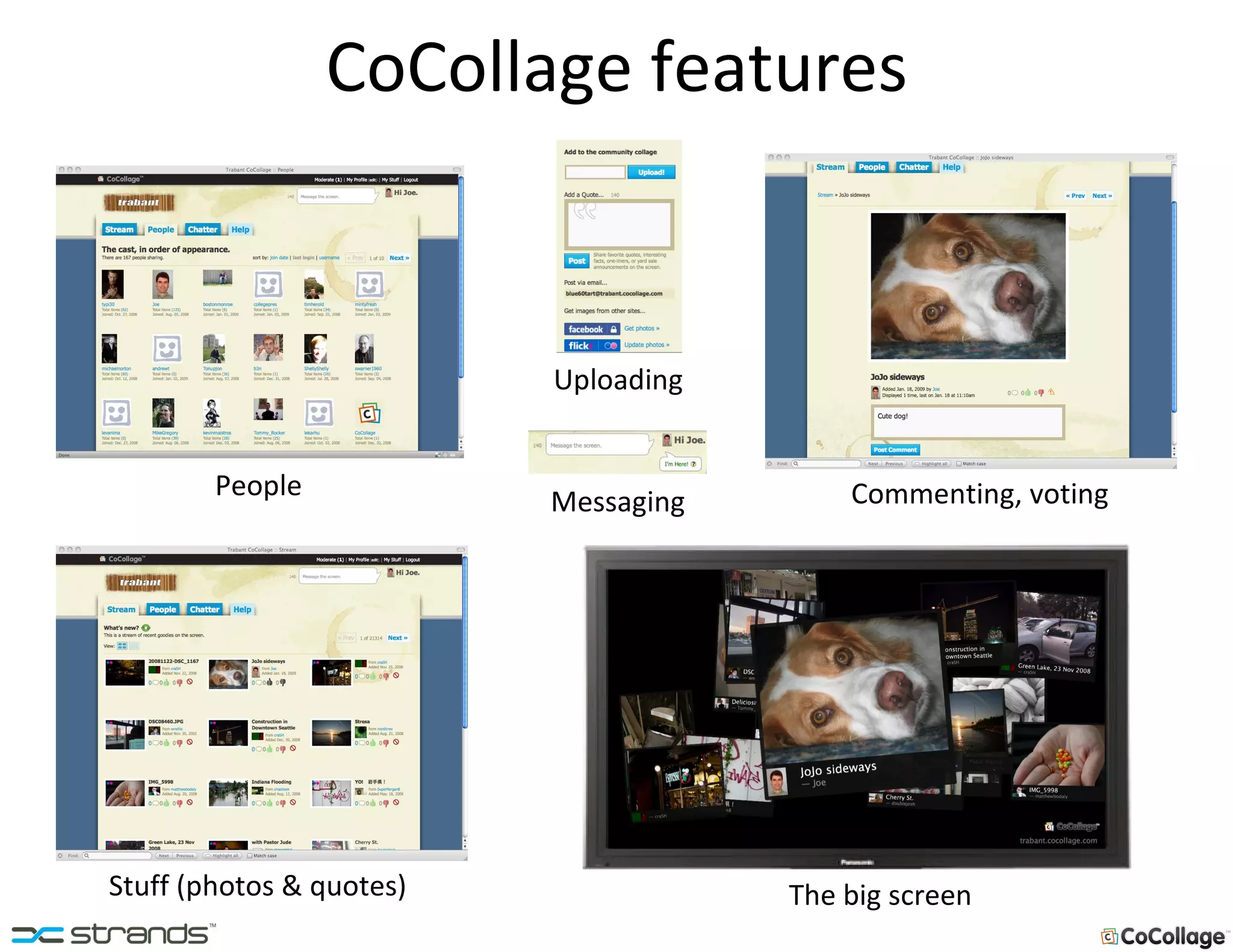
CoCollage features People Stuff (photos & quotes) Commenting, voting Uploading Messaging The big screen
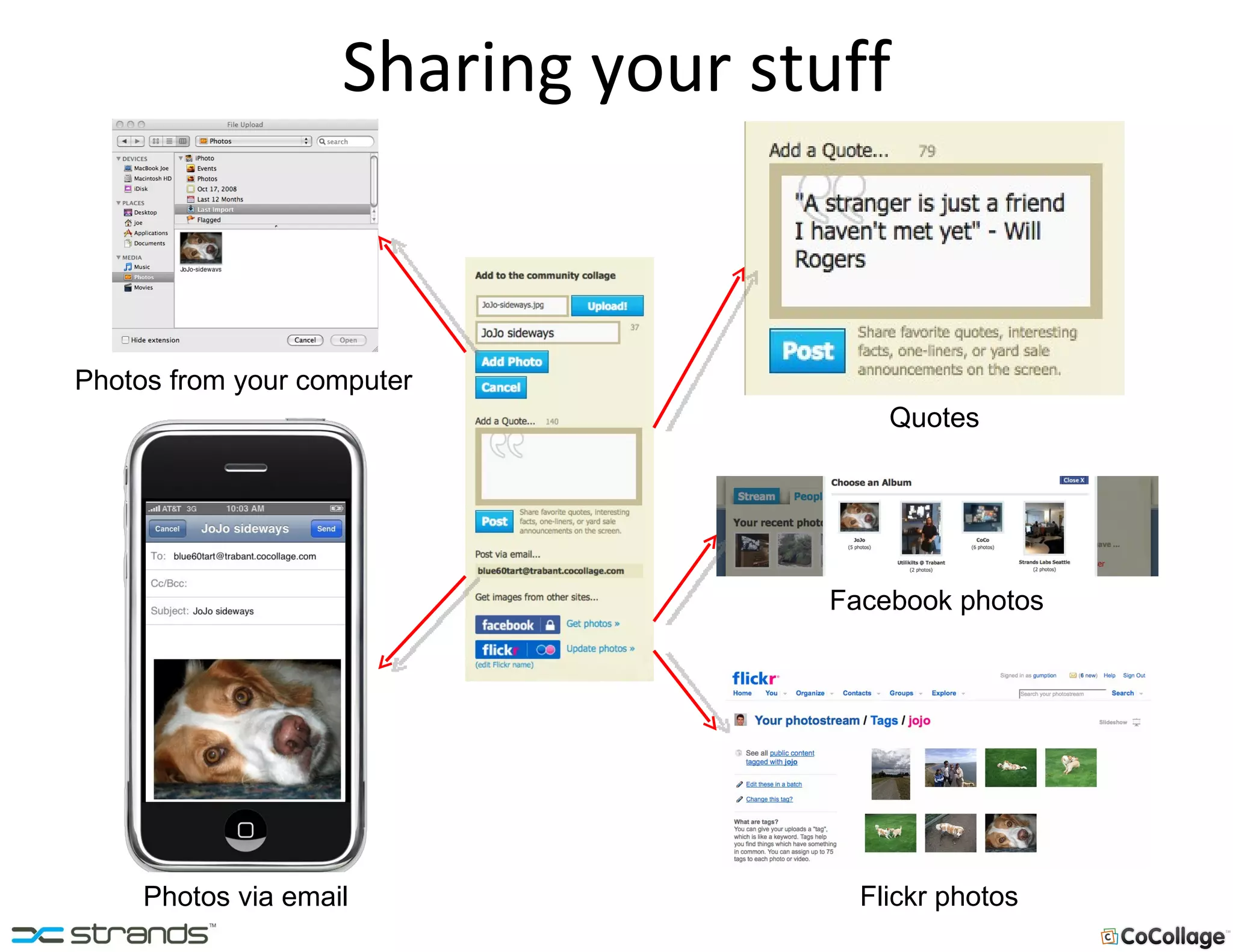
Sharing your stuff Facebook photos Quotes Flickr photos Photos from your computer Photos via email
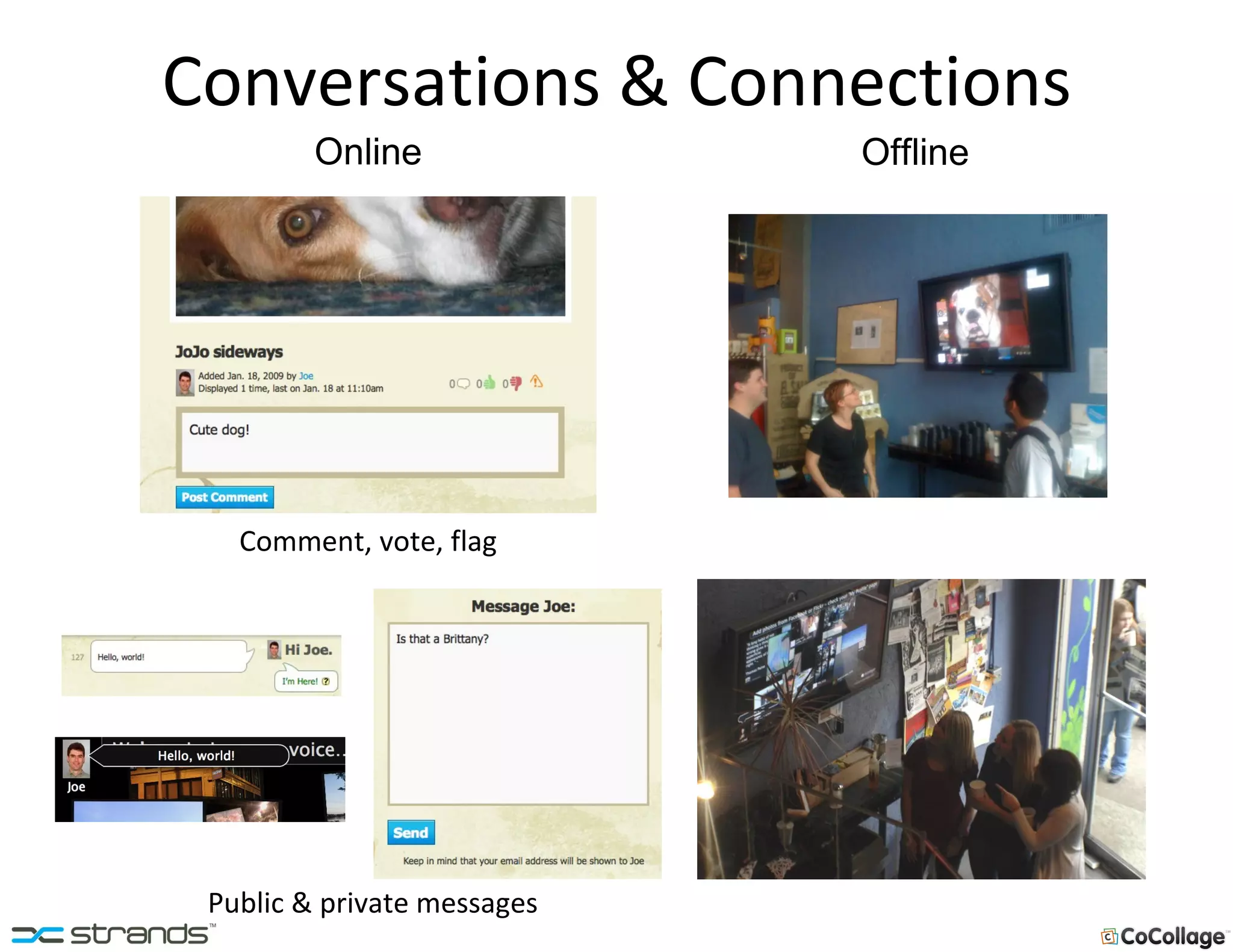
Conversations & Connections Comment, vote, flag Public & private messages Online Offline
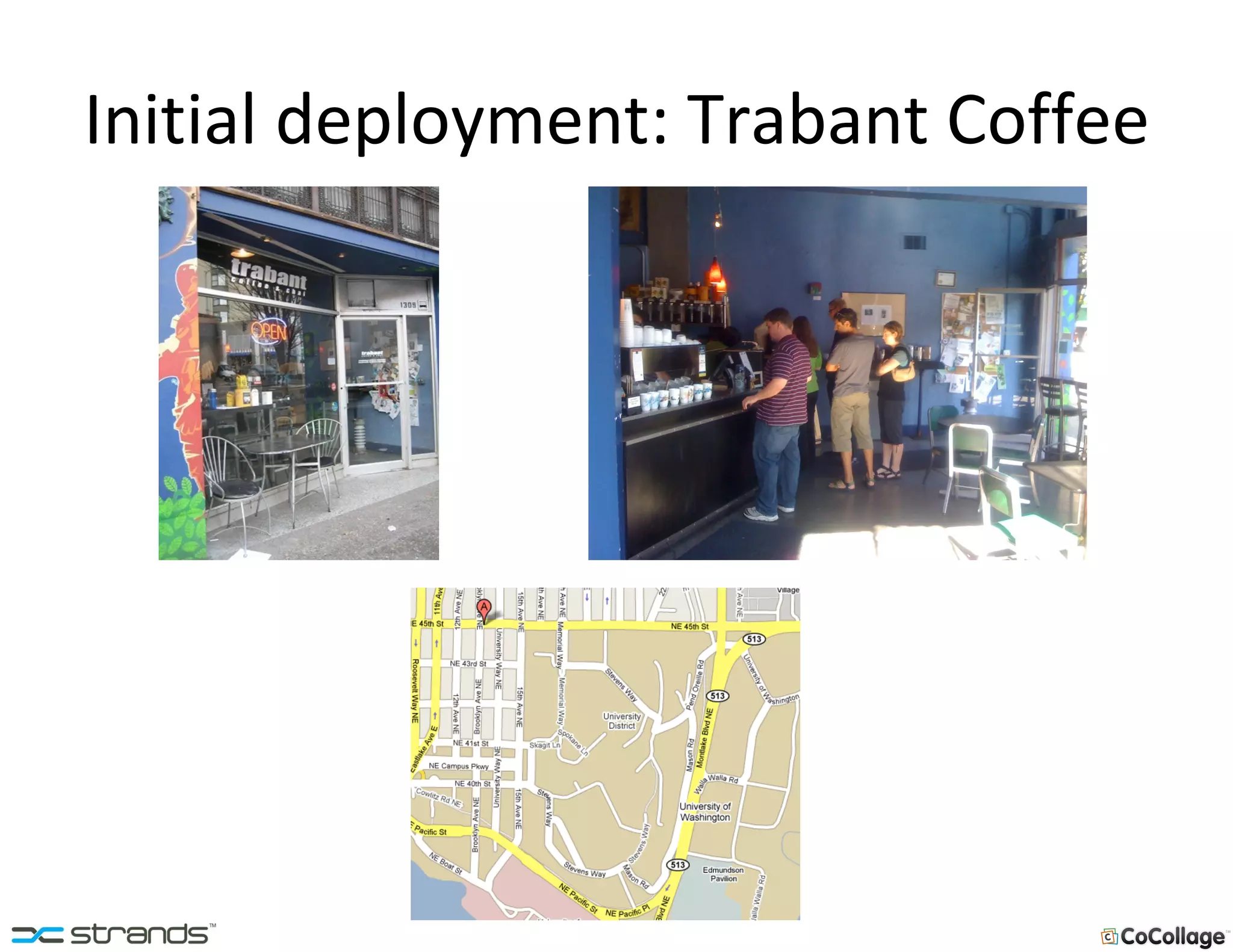
Initial deployment: Trabant Coffee
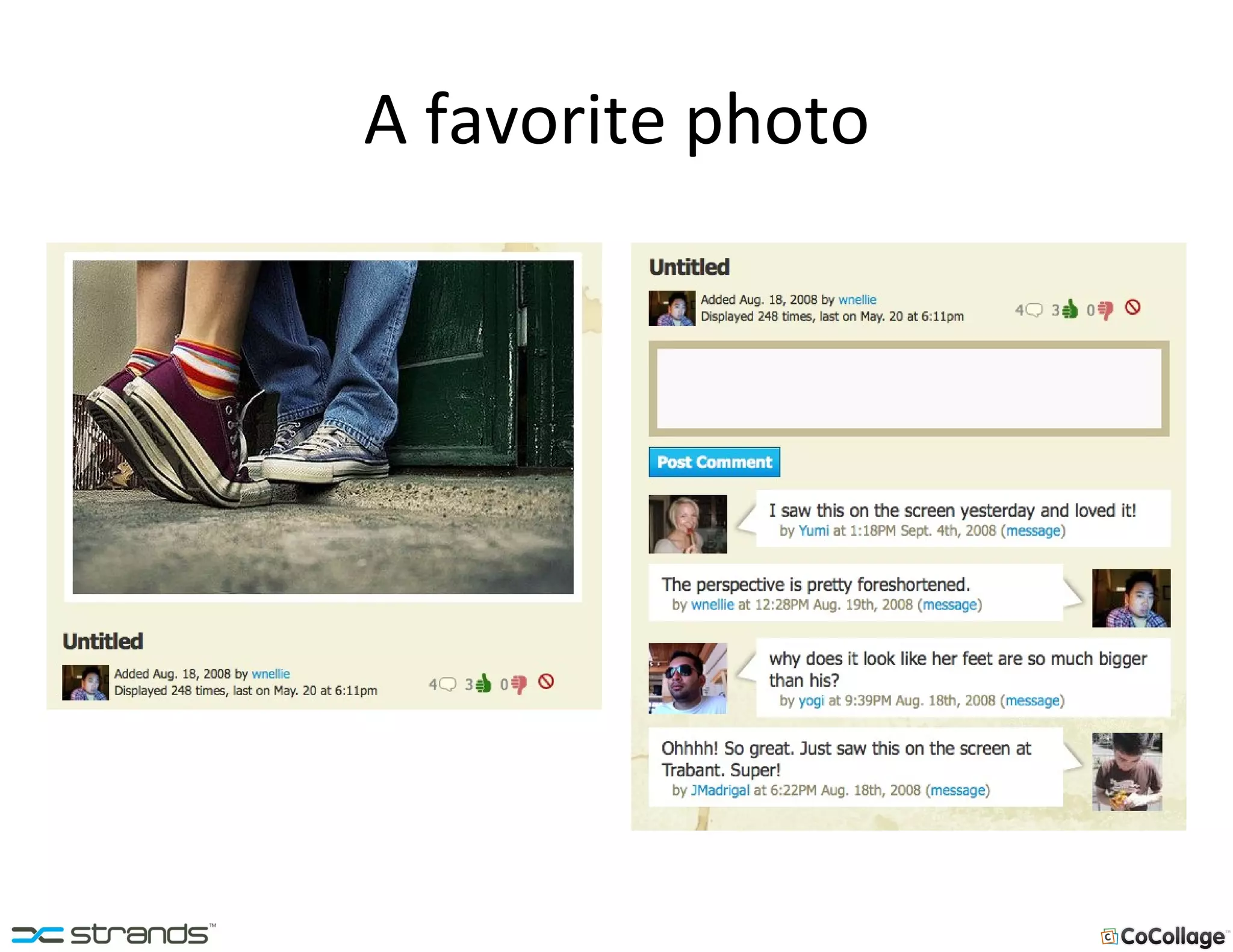
A favorite photo
Study 1 Good pace of adoption in first month 82 out of an estimated 400 regulars joined CoCollage Questionnaire results shows that people who a) are looking to connect with others b) already have a  psychological sense of community  at the café c) already feel  place attachment  to the café, are more likely to join CoCollage and start conversations Psychological  sense of community  for place and  place attachment  are meaningful constructs in predicting adoption of a place-based community technology Measuring the Impact of Third Place Attachment on the Adoption of a Place-Based Community Technology Shelly D. Farnham, Joseph F. McCarthy, Yagnesh Patel, Sameer Ahuja, Daniel Norman, William R. Hazlewood, Josh Lind Proc. of the 27th Int'l. Conf on Human Factors in Computing Systems (CHI 2009) , 2153 - 2156.
Study 2: Impact over time How does CoCollage impact sense of community and place attachment over time? 2 months after initial deployment Semi-structured interview with owners Log analysis Questionnaires Study 1: After 1 week; 24 participants Study 2: After 2 months; 19 participants (10 from study 1) New questionnaire: 15 [mostly non-user] members of community
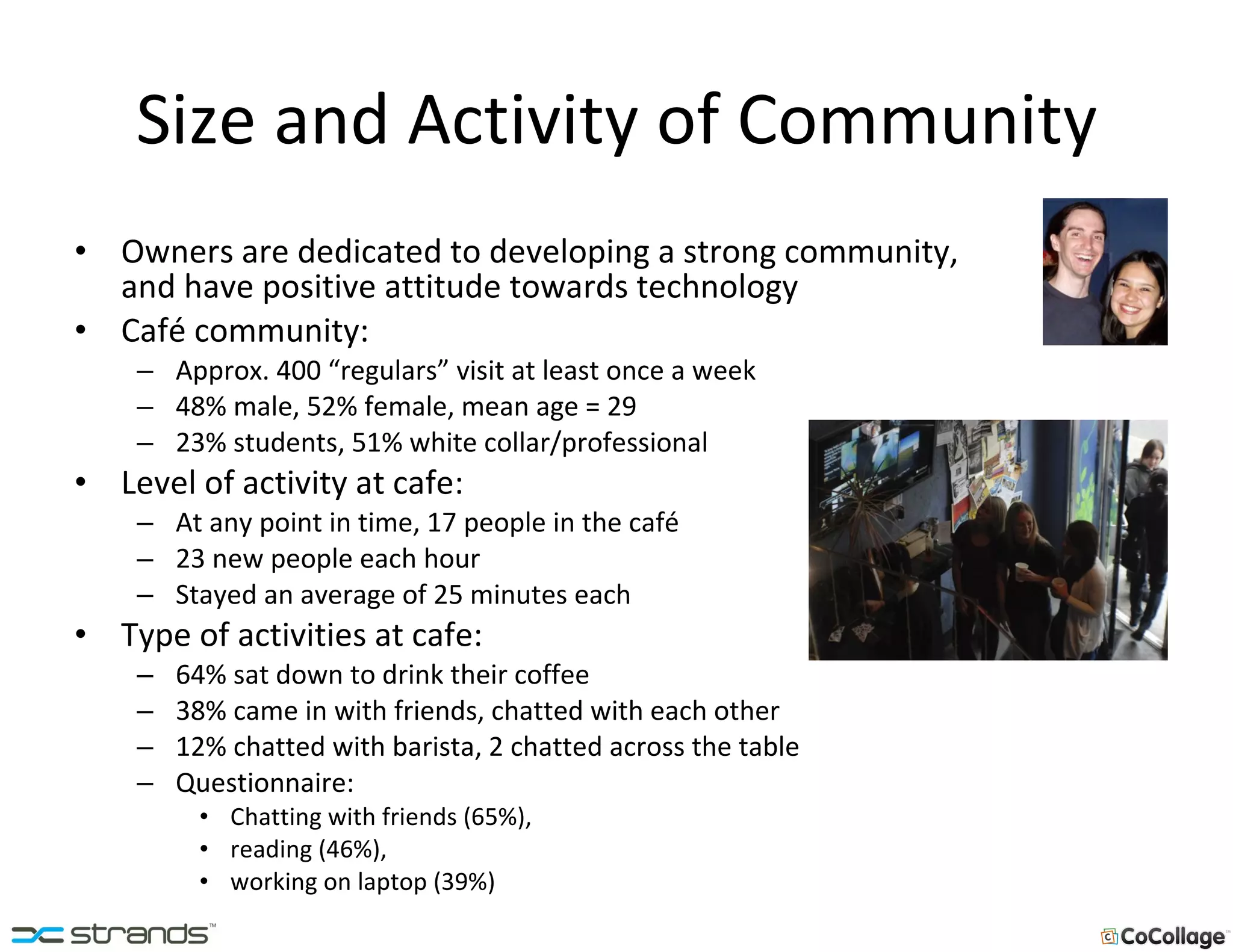
Size and Activity of Community Owners are dedicated to developing a strong community,  and have positive attitude towards technology Café community: Approx. 400 “regulars” visit at least once a week 48% male, 52% female, mean age = 29 23% students, 51% white collar/professional Level of activity at cafe: At any point in time, 17 people in the café 23 new people each hour Stayed an average of 25 minutes each Type of activities at cafe: 64% sat down to drink their coffee 38% came in with friends, chatted with each other 12% chatted with barista, 2 chatted across the table Questionnaire:  Chatting with friends (65%),  reading (46%),  working on laptop (39%)
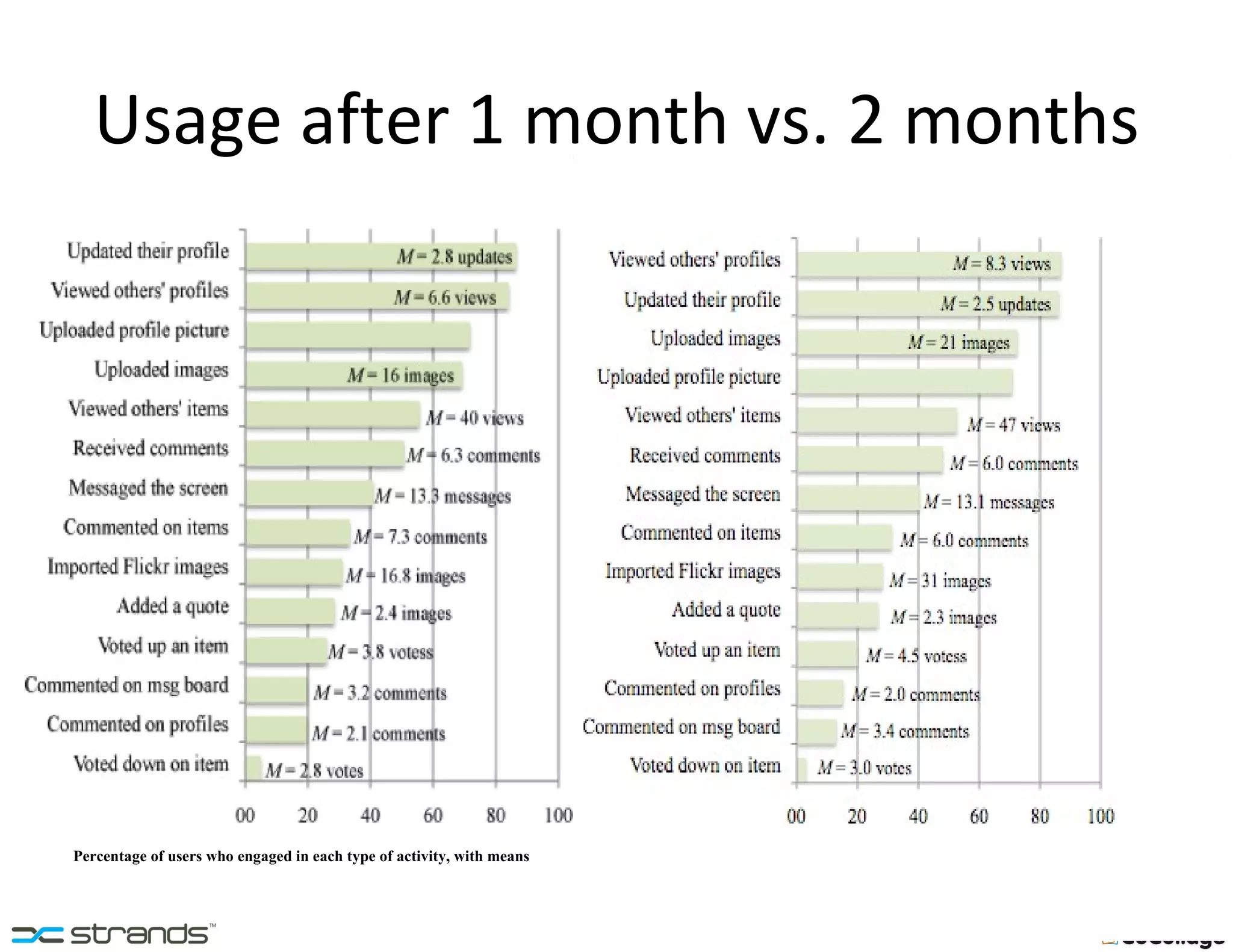
Usage after 1 month vs. 2 months Percentage of users who engaged in each type of activity, with means
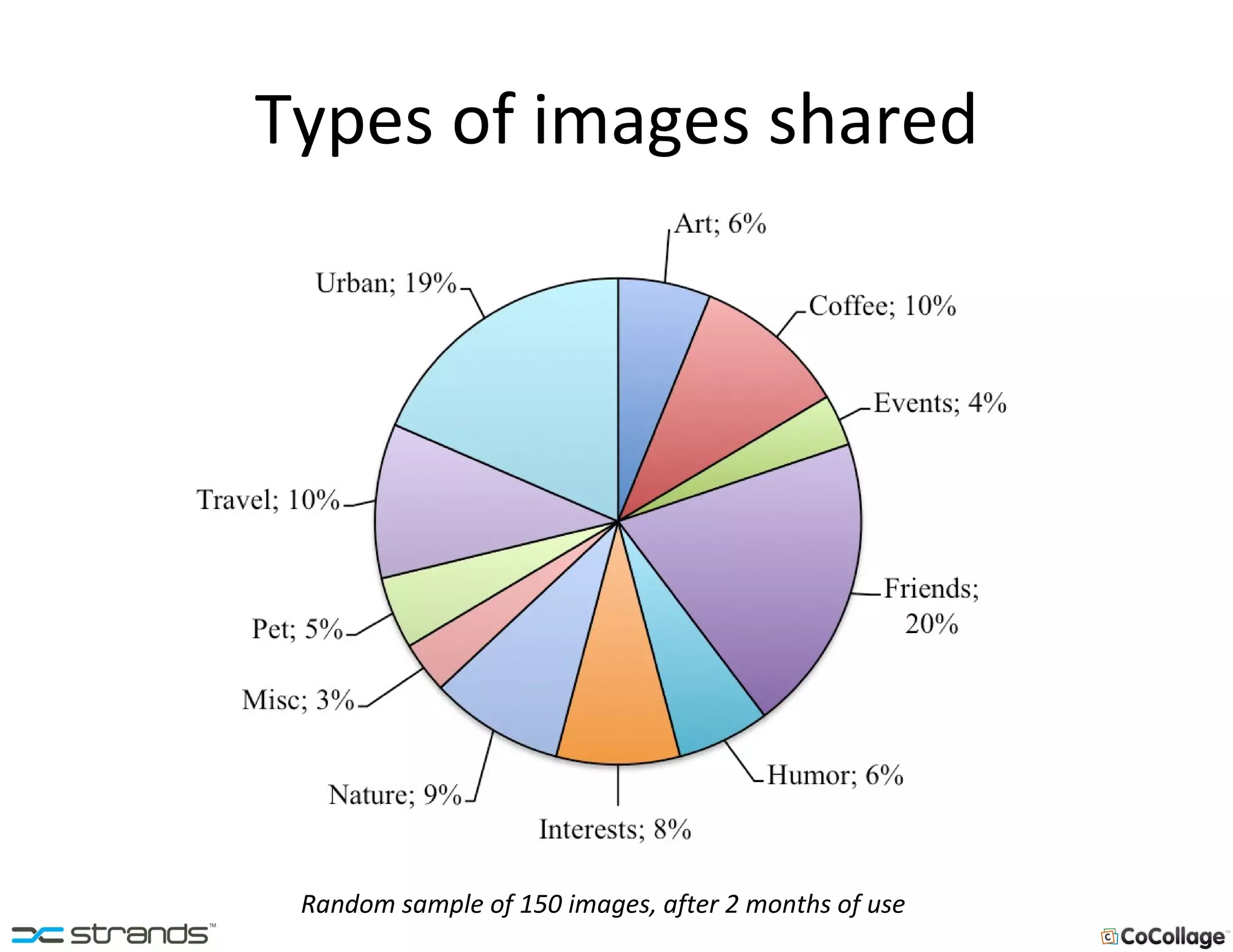
Types of images shared Random sample of 150 images, after 2 months of use
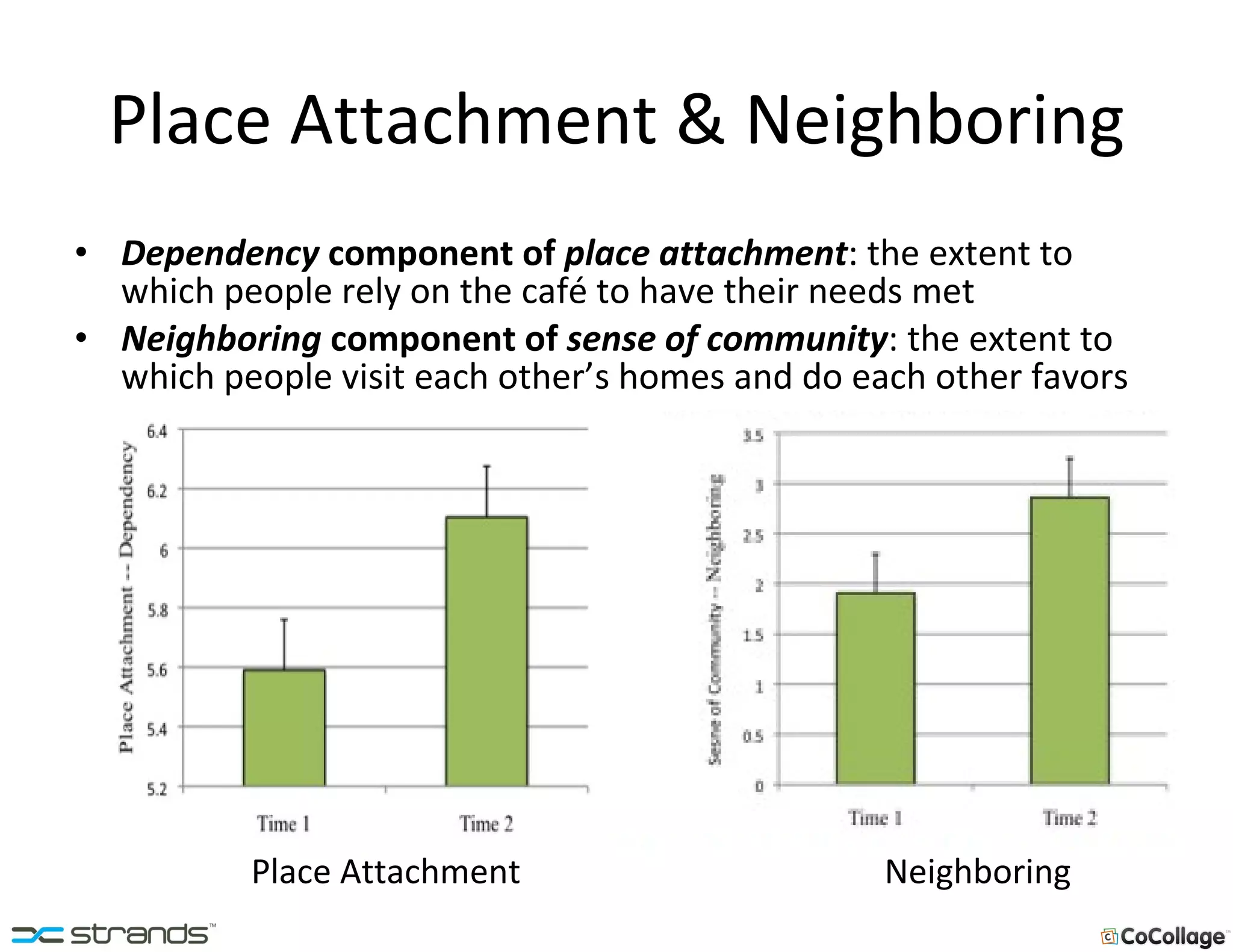
Place Attachment & Neighboring Dependency  component of  place attachment : the extent to which people rely on the café to have their needs met  Neighboring  component of  sense of community : the extent to which people visit each other’s homes and do each other favors  Place Attachment Neighboring
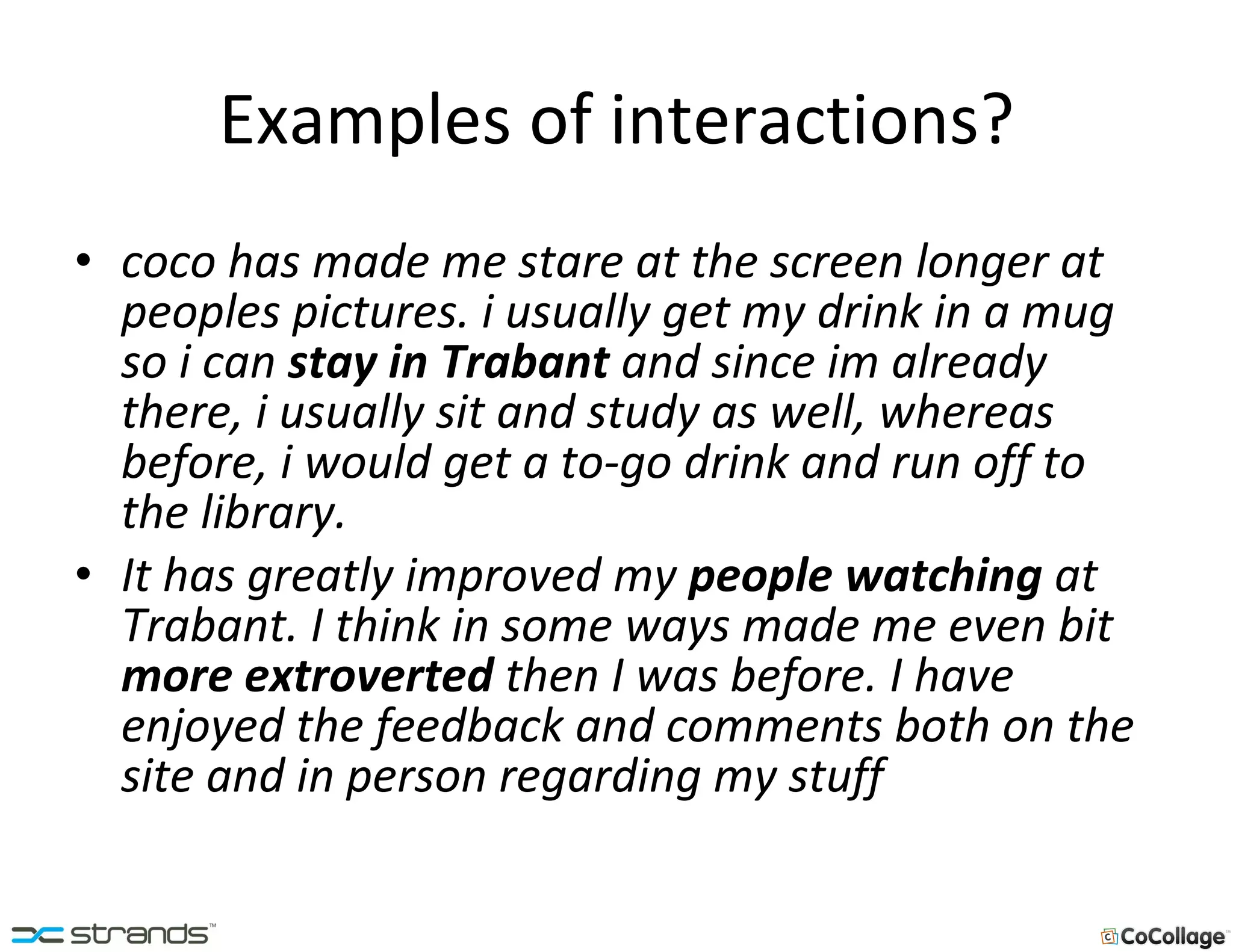
Examples of interactions? coco has made me stare at the screen longer at peoples pictures. i usually get my drink in a mug so i can  stay in Trabant  and since im already there, i usually sit and study as well, whereas before, i would get a to-go drink and run off to the library.  It has greatly improved my  people watching  at Trabant. I think in some ways made me even bit  more extroverted  then I was before. I have enjoyed the feedback and comments both on the site and in person regarding my stuff
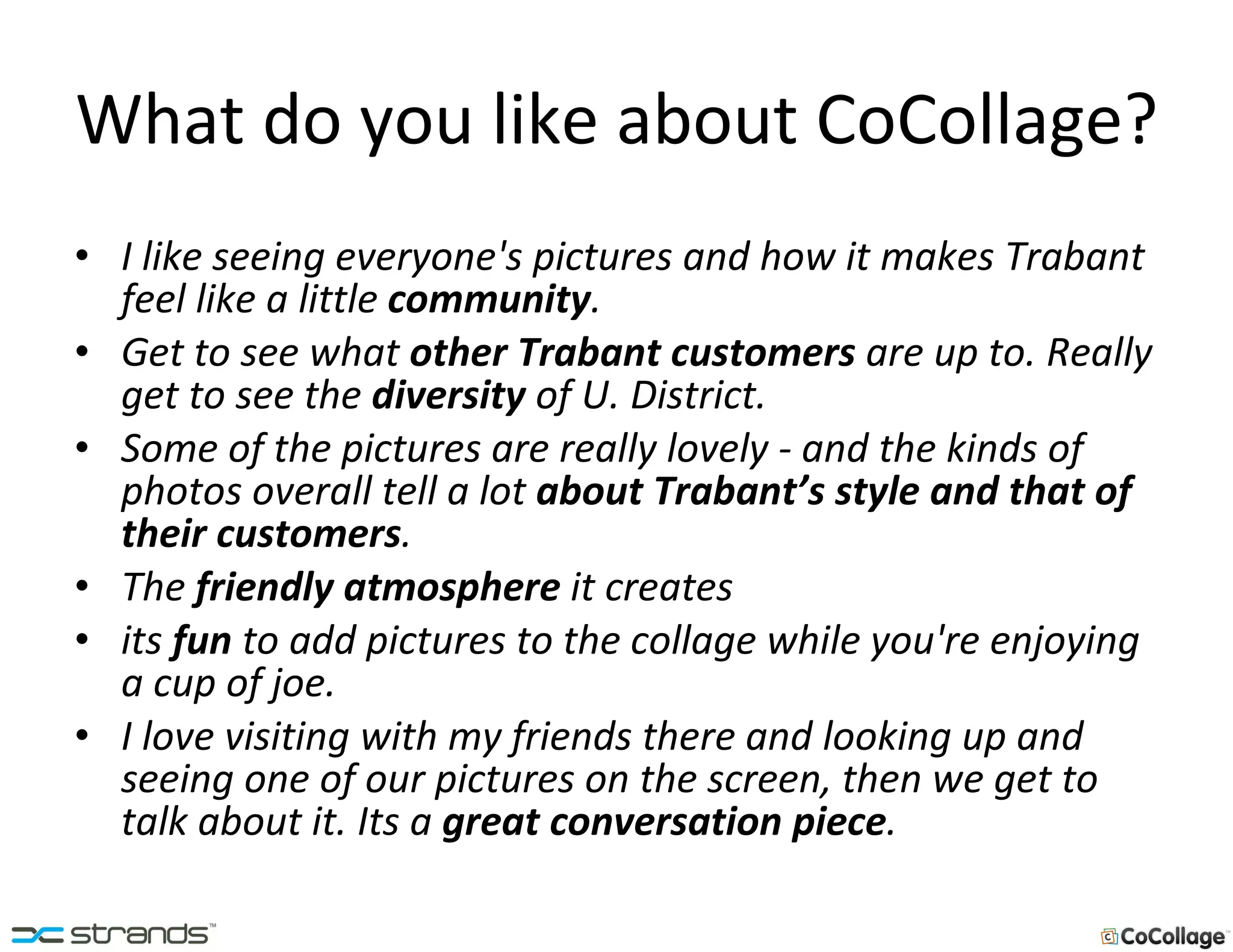
What do you like about CoCollage? I like seeing everyone's pictures and how it makes Trabant feel like a little  community . Get to see what  other Trabant customers  are up to. Really get to see the  diversity  of U. District. Some of the pictures are really lovely - and the kinds of photos overall tell a lot  about Trabant’s style and that of their customers . The  friendly atmosphere  it creates its  fun  to add pictures to the collage while you're enjoying a cup of joe.  I love visiting with my friends there and looking up and seeing one of our pictures on the screen, then we get to talk about it. Its a  great conversation piece .
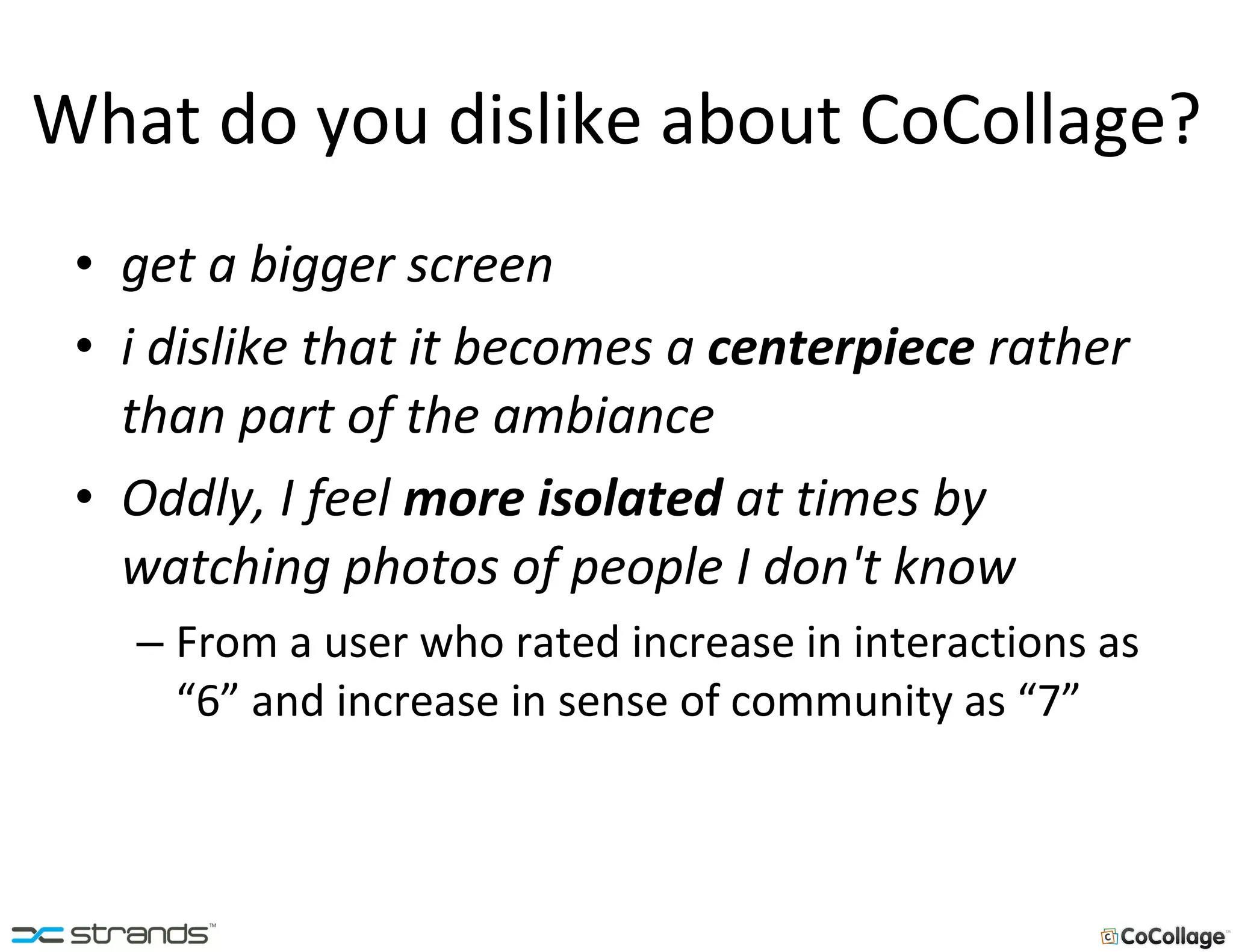
What do you dislike about CoCollage? get a bigger screen i dislike that it becomes a  centerpiece  rather than part of the ambiance   Oddly, I feel  more isolated  at times by watching photos of people I don't know   From a user who rated increase in interactions as “6” and increase in sense of community as “7”
How can we improve CoCollage? I wish I could switch past  ugly, weird or bad photos  and spend more time on the nice ones. I would like rating scale to be able  rank  which pictures and stuff come up more often. Maybe an  rfid card  instead of swipe card to be able to tap and go to login. I would love to see it in  more locations . Be able to rank my items for display .
What is CoCollage? a social networking system bringing web 2.0 interaction to real life by allowing users to upload photos to a public display Picture sharing. Picasa for your local coffee / espresso store [The café]’s Facebook page is playing on a big screen. innovative funky intrusion a tv
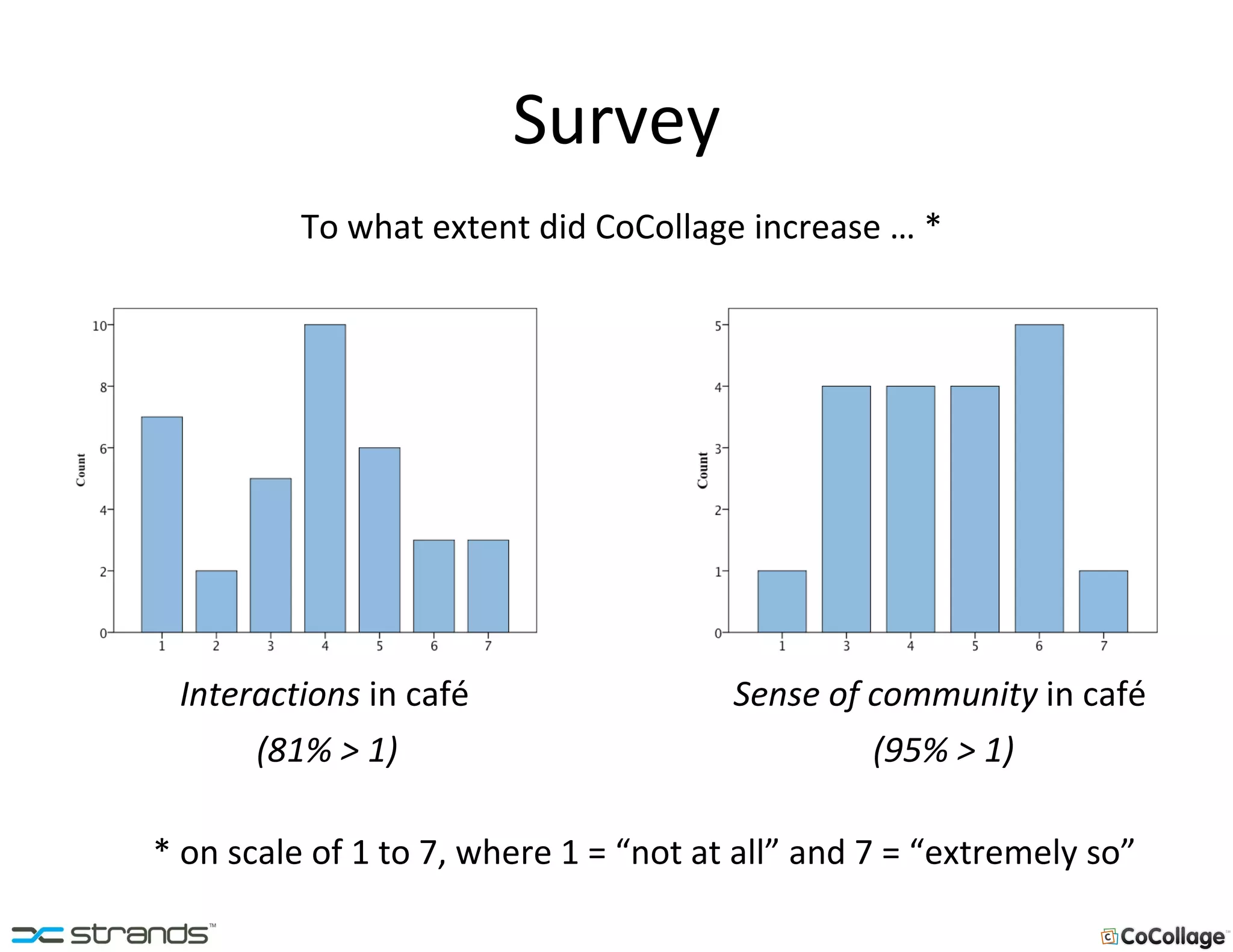
Survey To what extent did CoCollage increase … * Interactions  in café Sense of community  in   café * on scale of 1 to 7, where 1 = “not at all” and 7 = “extremely so” (81% > 1) (95% > 1)
Related Work
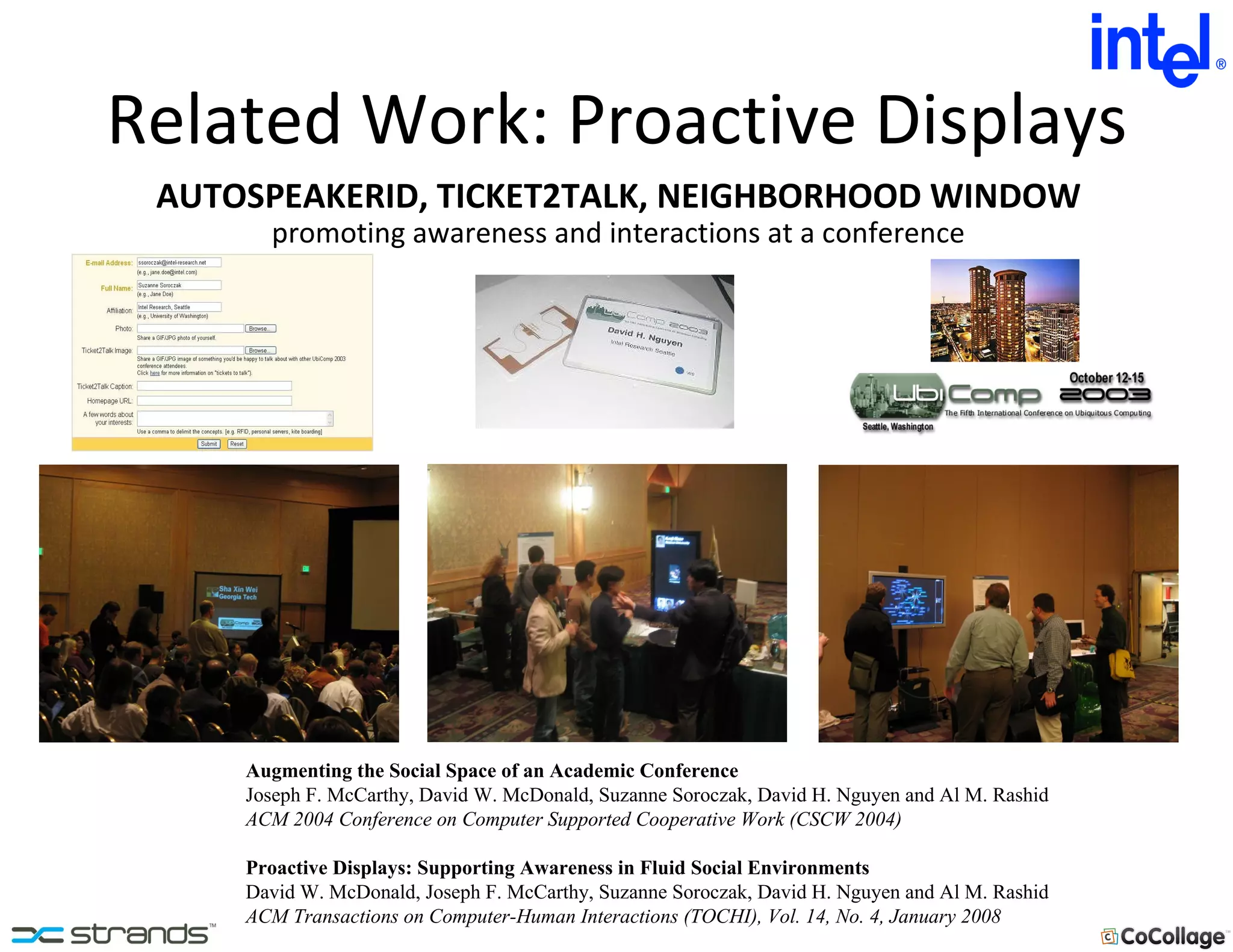
Related Work: Proactive Displays Augmenting the Social Space of an Academic Conference Joseph F. McCarthy, David W. McDonald, Suzanne Soroczak, David H. Nguyen and Al M. Rashid ACM 2004 Conference on Computer Supported Cooperative Work (CSCW 2004) Proactive Displays: Supporting Awareness in Fluid Social Environments David W. McDonald, Joseph F. McCarthy, Suzanne Soroczak, David H. Nguyen and Al M. Rashid ACM Transactions on Computer-Human Interactions (TOCHI), Vol. 14, No. 4, January 2008 promoting awareness and interactions at a conference AUTOSPEAKERID, TICKET2TALK, NEIGHBORHOOD WINDOW
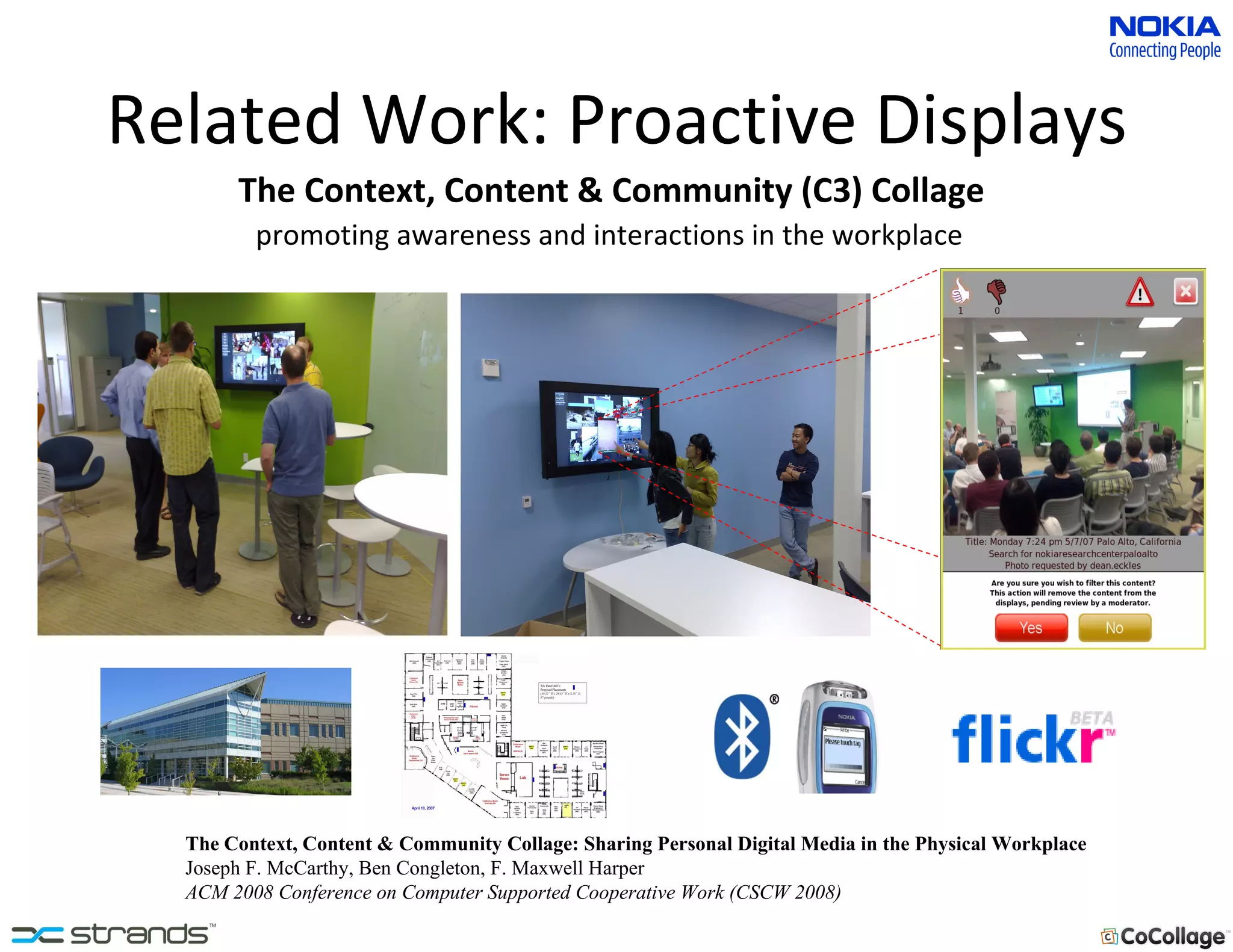
Related Work: Proactive Displays The Context, Content & Community (C3) Collage promoting awareness and interactions in the workplace The Context, Content & Community Collage: Sharing Personal Digital Media in the Physical Workplace Joseph F. McCarthy, Ben Congleton, F. Maxwell Harper ACM 2008 Conference on Computer Supported Cooperative Work (CSCW 2008)
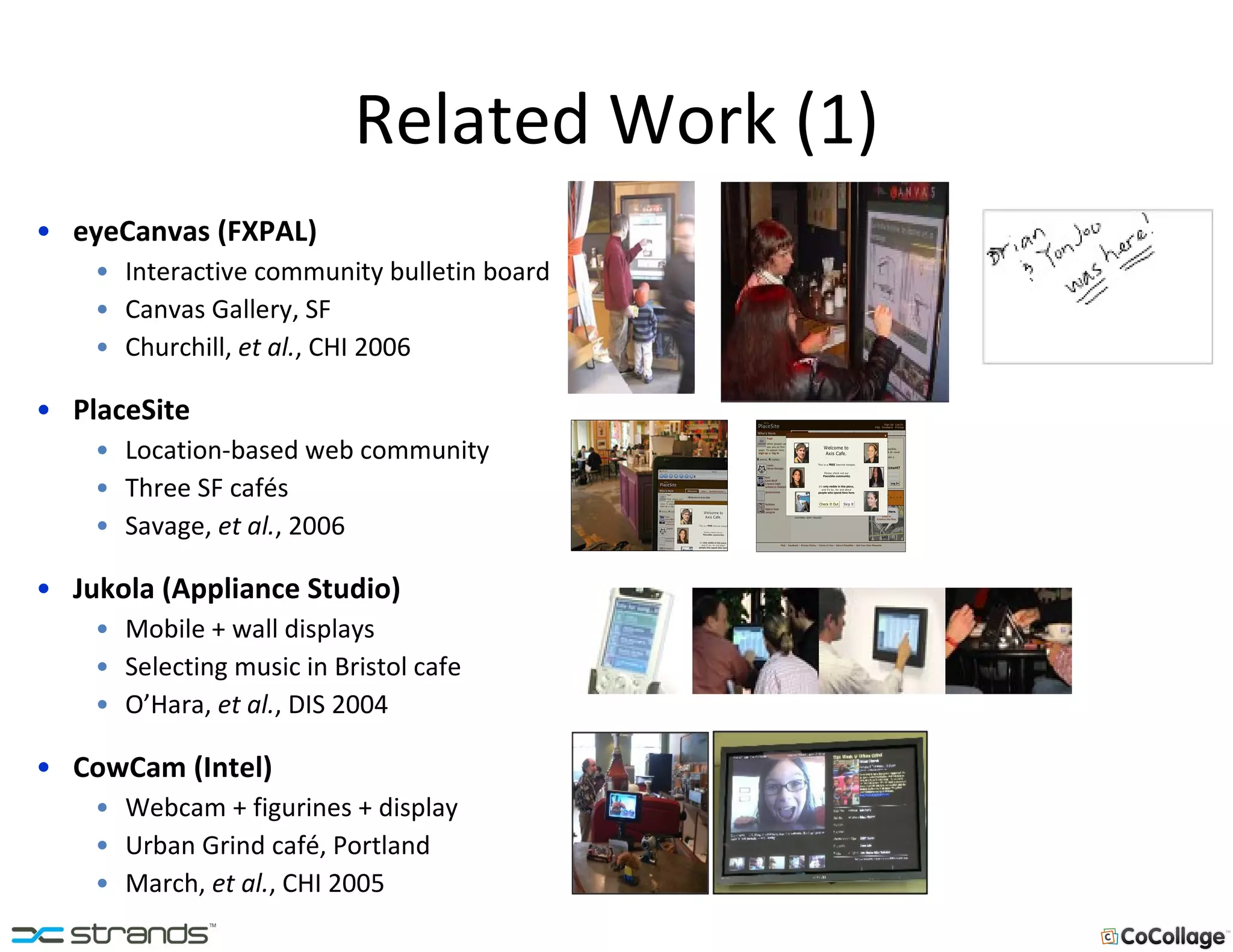
Related Work (1) eyeCanvas (FXPAL) Interactive community bulletin board Canvas Gallery, SF Churchill,  et al. , CHI 2006 PlaceSite Location-based web community Three SF cafés Savage,  et al. , 2006 Jukola (Appliance Studio) Mobile + wall displays Selecting music in Bristol cafe O’Hara,  et al. , DIS 2004 CowCam (Intel) Webcam + figurines + display Urban Grind café, Portland March,  et al. , CHI 2005
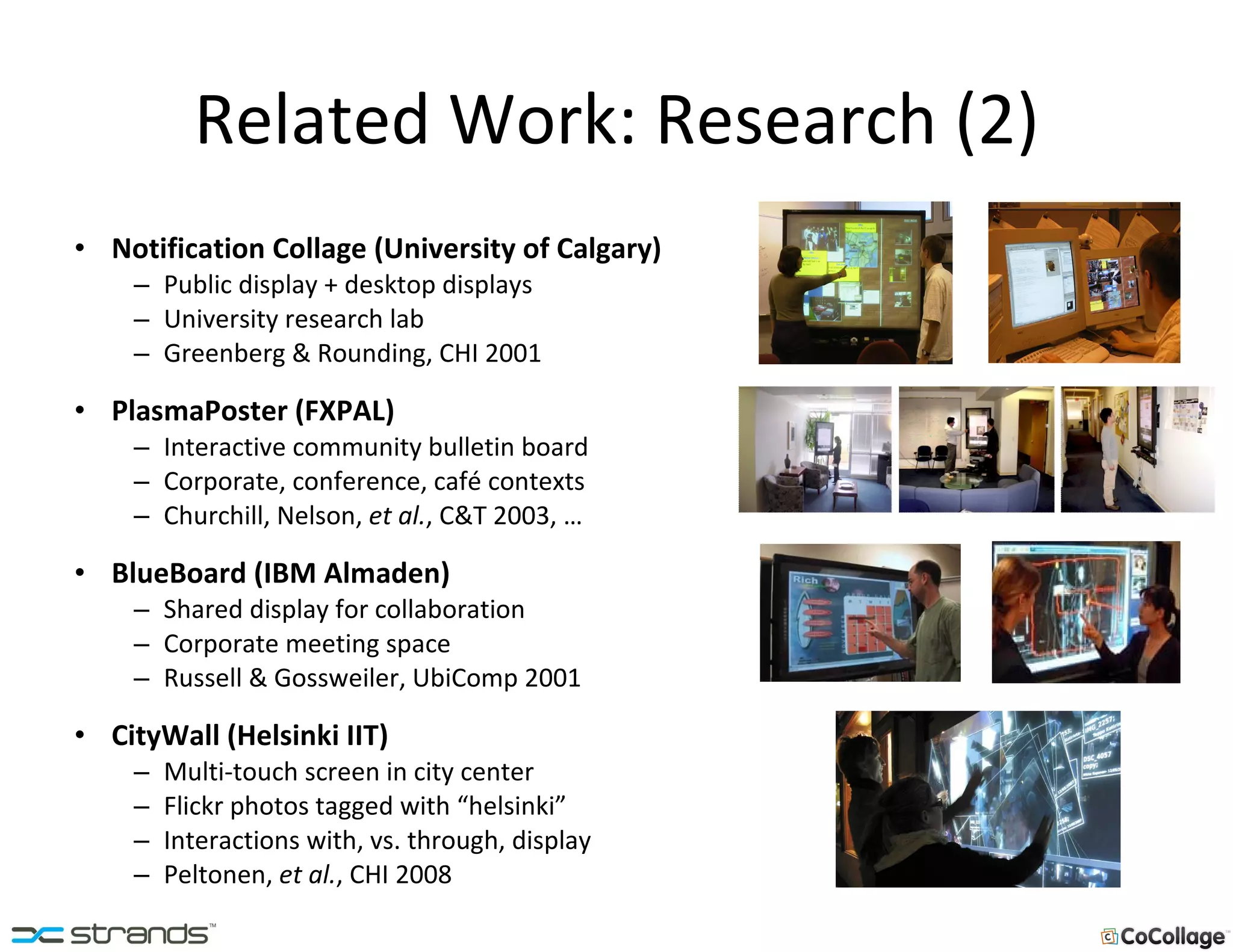
Related Work: Research (2) Notification Collage (University of Calgary) Public display + desktop displays University research lab Greenberg & Rounding, CHI 2001 PlasmaPoster (FXPAL) Interactive community bulletin board Corporate, conference, café contexts Churchill, Nelson,  et al. , C&T 2003, … BlueBoard (IBM Almaden) Shared display for collaboration Corporate meeting space Russell & Gossweiler, UbiComp 2001 CityWall (Helsinki IIT) Multi-touch screen in city center Flickr photos tagged with “helsinki” Interactions with, vs. through, display Peltonen,  et al. , CHI 2008
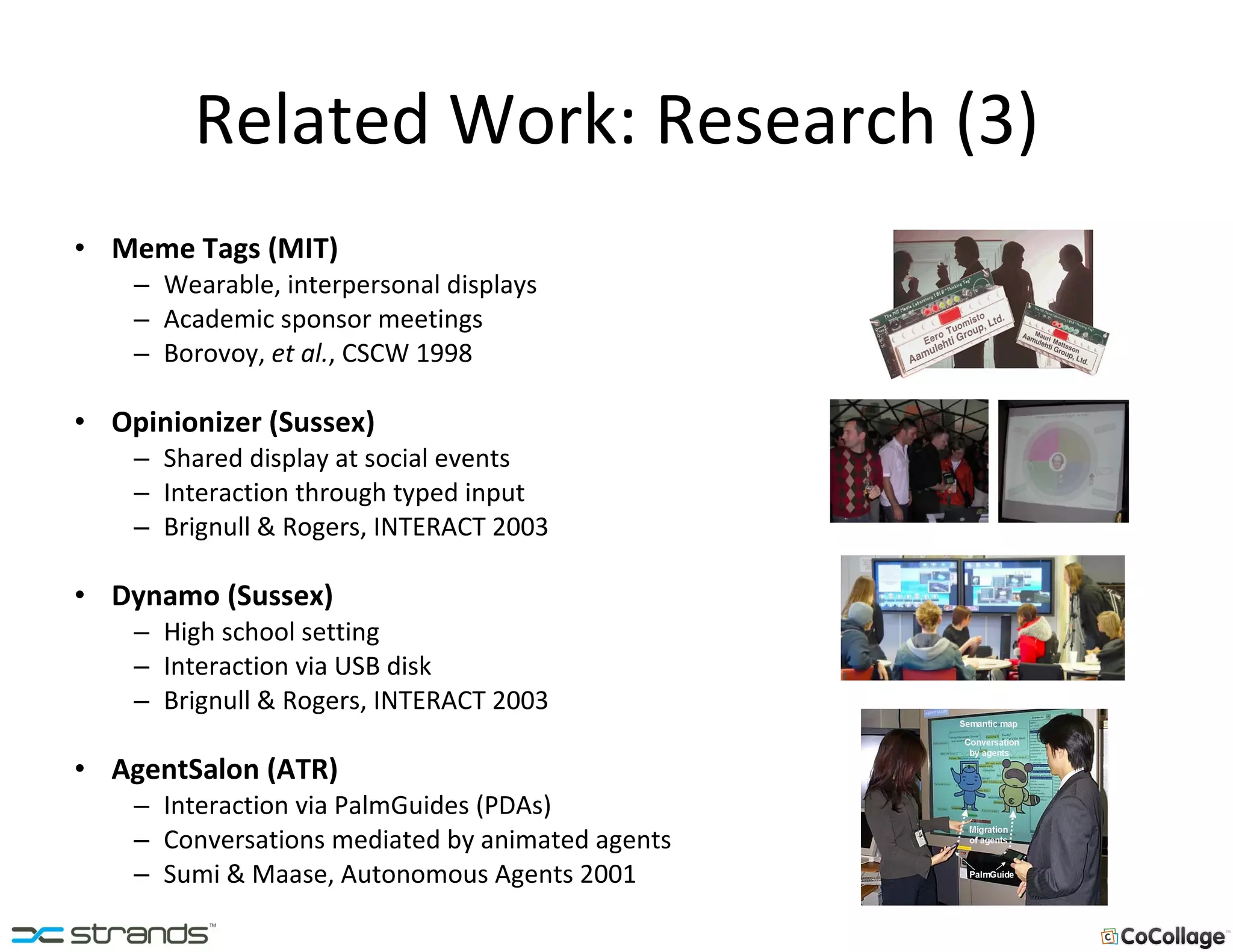
Related Work: Research (3) Meme Tags (MIT) Wearable, interpersonal displays Academic sponsor meetings Borovoy,  et al. , CSCW 1998 Opinionizer (Sussex) Shared display at social events Interaction through typed input Brignull & Rogers, INTERACT 2003 Dynamo (Sussex) High school setting Interaction via USB disk Brignull & Rogers, INTERACT 2003 AgentSalon (ATR) Interaction via PalmGuides (PDAs) Conversations mediated by animated agents Sumi & Maase, Autonomous Agents 2001
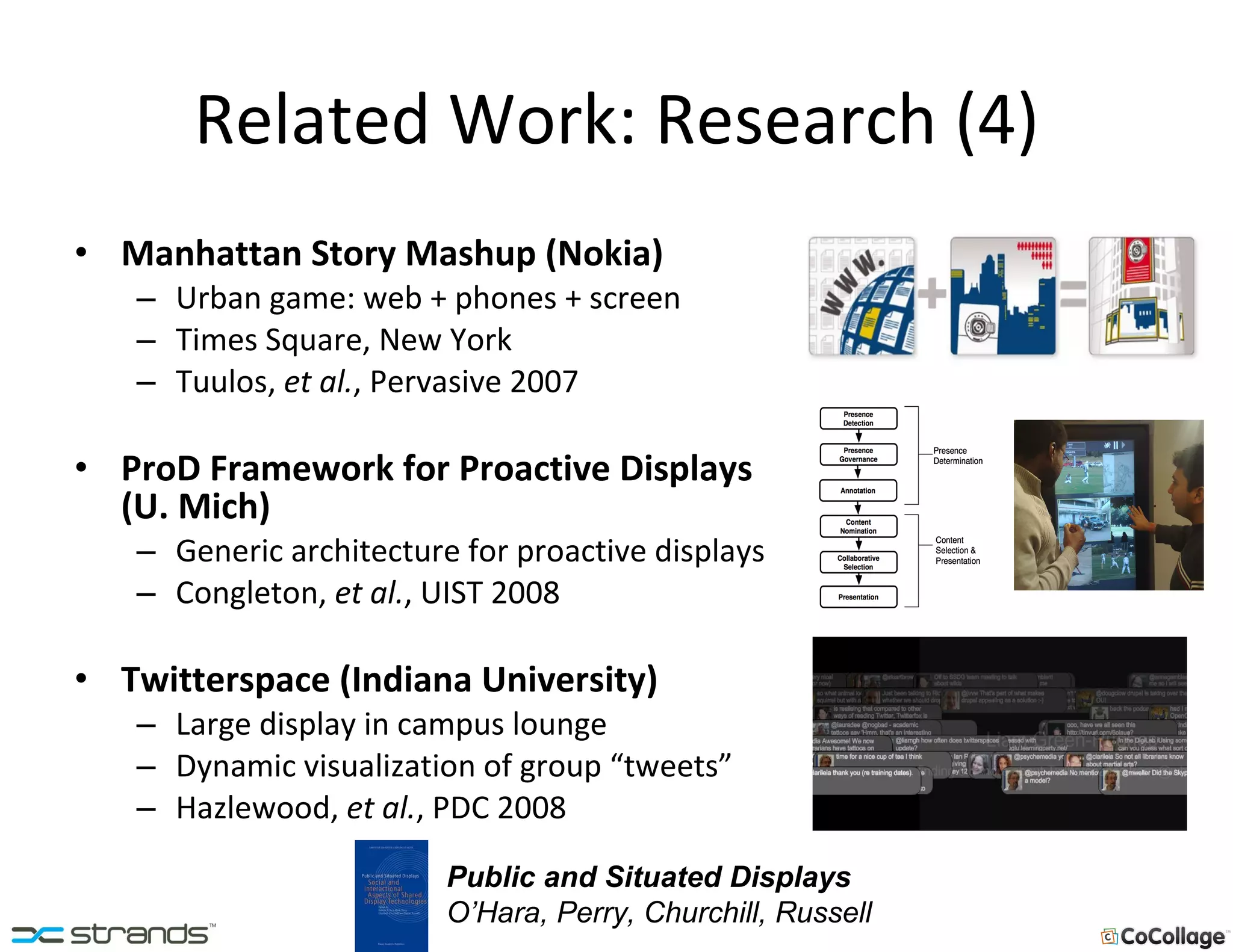
Related Work: Research (4) Manhattan Story Mashup (Nokia) Urban game: web + phones + screen Times Square, New York Tuulos,  et al. , Pervasive 2007 ProD Framework for Proactive Displays  (U. Mich) Generic architecture for proactive displays Congleton,  et al. , UIST 2008 Twitterspace (Indiana University) Large display in campus lounge Dynamic visualization of group “tweets” Hazlewood,  et al. , PDC 2008 Public and Situated Displays O’Hara, Perry, Churchill, Russell
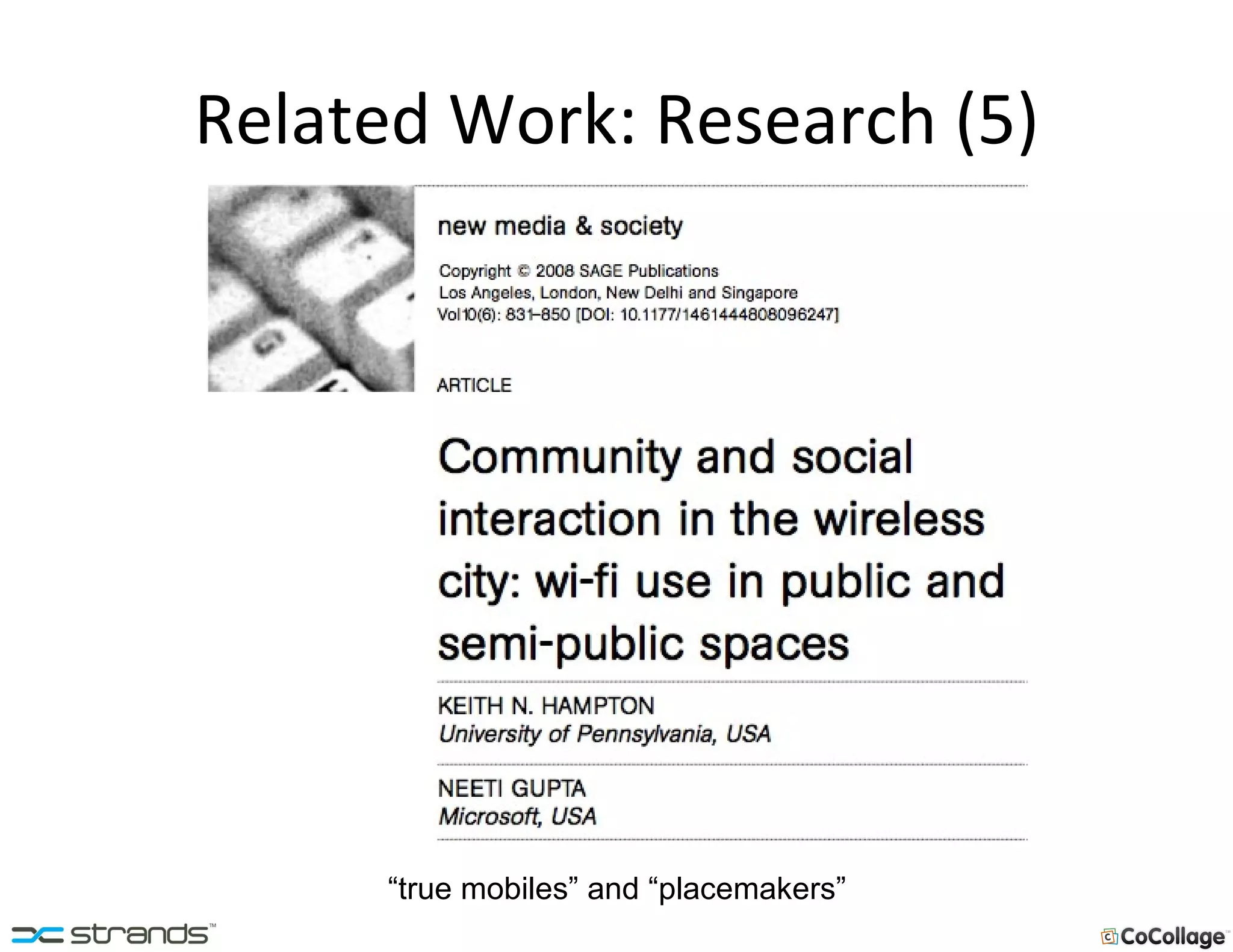
Related Work: Research (5) “ true mobiles” and “placemakers”
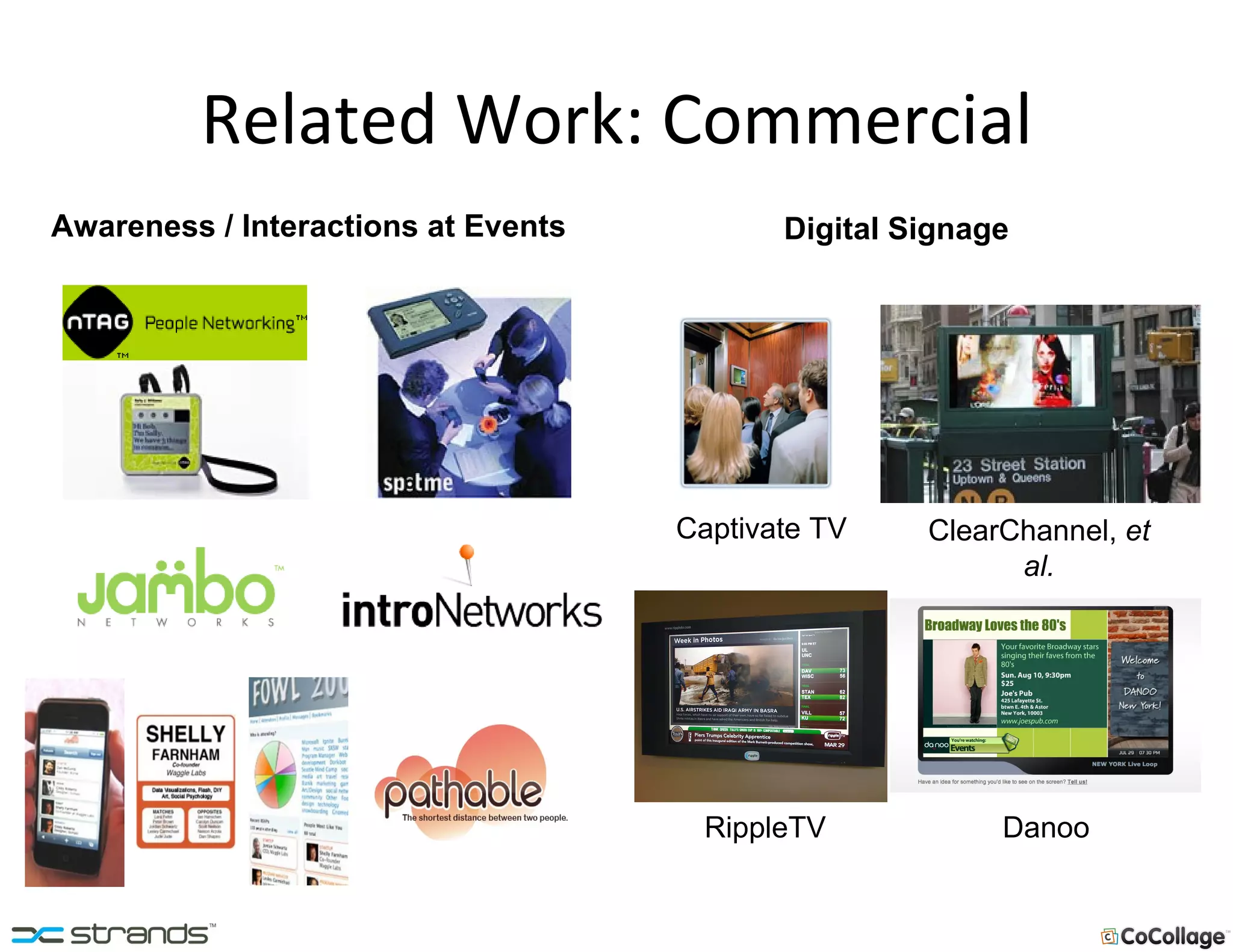
Related Work: Commercial Awareness / Interactions at Events Digital Signage Captivate TV ClearChannel,  et al. RippleTV Danoo
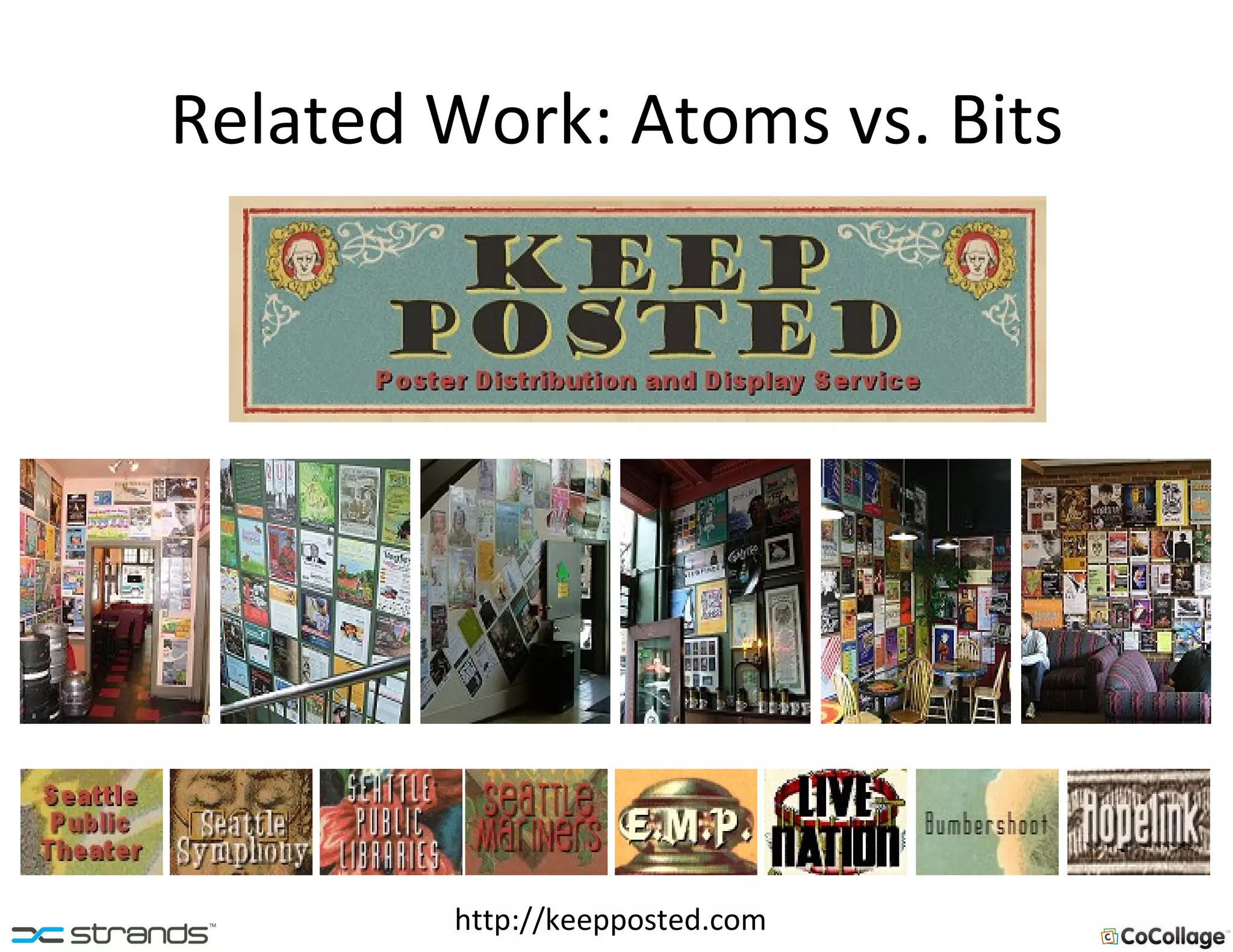
Related Work: Atoms vs. Bits http://keepposted.com
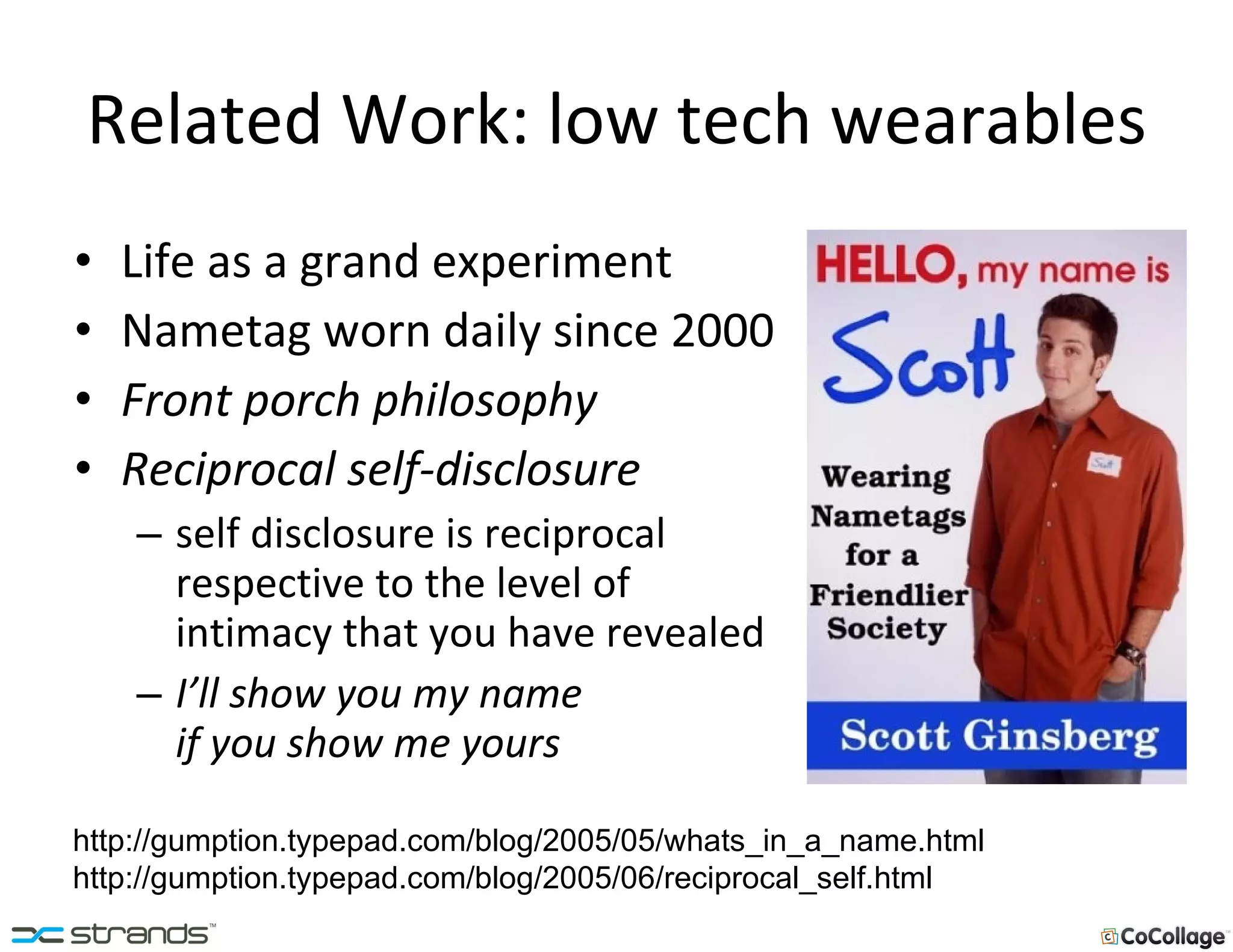
Related Work: low tech wearables Life as a grand experiment Nametag worn daily since 2000 Front porch philosophy Reciprocal self-disclosure self disclosure is reciprocal respective to the level of intimacy that you have revealed I’ll show you my name  if you show me yours http://gumption.typepad.com/blog/2005/05/whats_in_a_name.html http://gumption.typepad.com/blog/2005/06/reciprocal_self.html
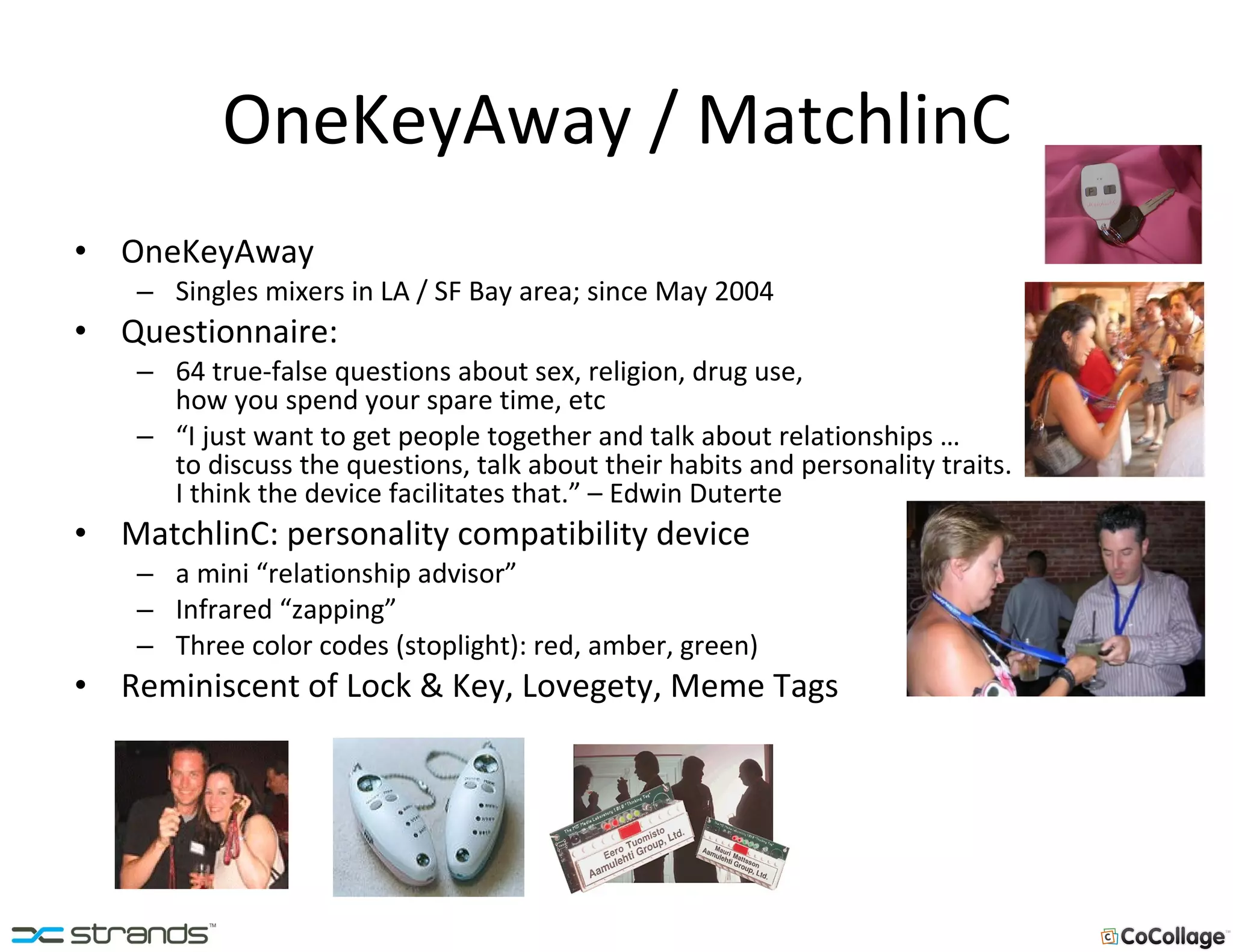
OneKeyAway / MatchlinC OneKeyAway Singles mixers in LA / SF Bay area; since May 2004 Questionnaire: 64 true-false questions about sex, religion, drug use,  how you spend your spare time, etc “ I just want to get people together and talk about relationships …  to discuss the questions, talk about their habits and personality traits.  I think the device facilitates that.” – Edwin Duterte MatchlinC: personality compatibility device  a mini “relationship advisor” Infrared “zapping” Three color codes (stoplight): red, amber, green) Reminiscent of Lock & Key, Lovegety, Meme Tags
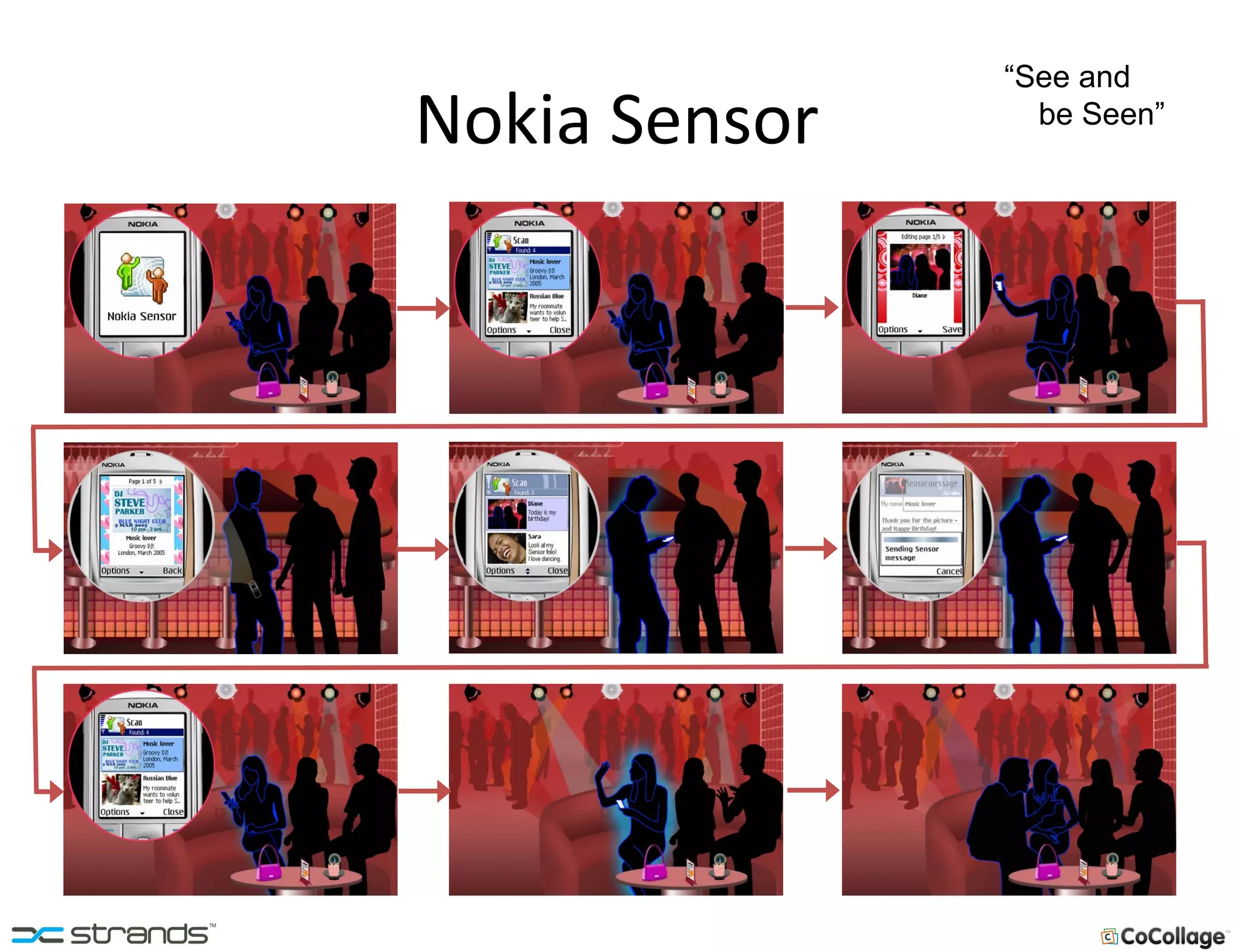
Nokia Sensor “ See and   be Seen”
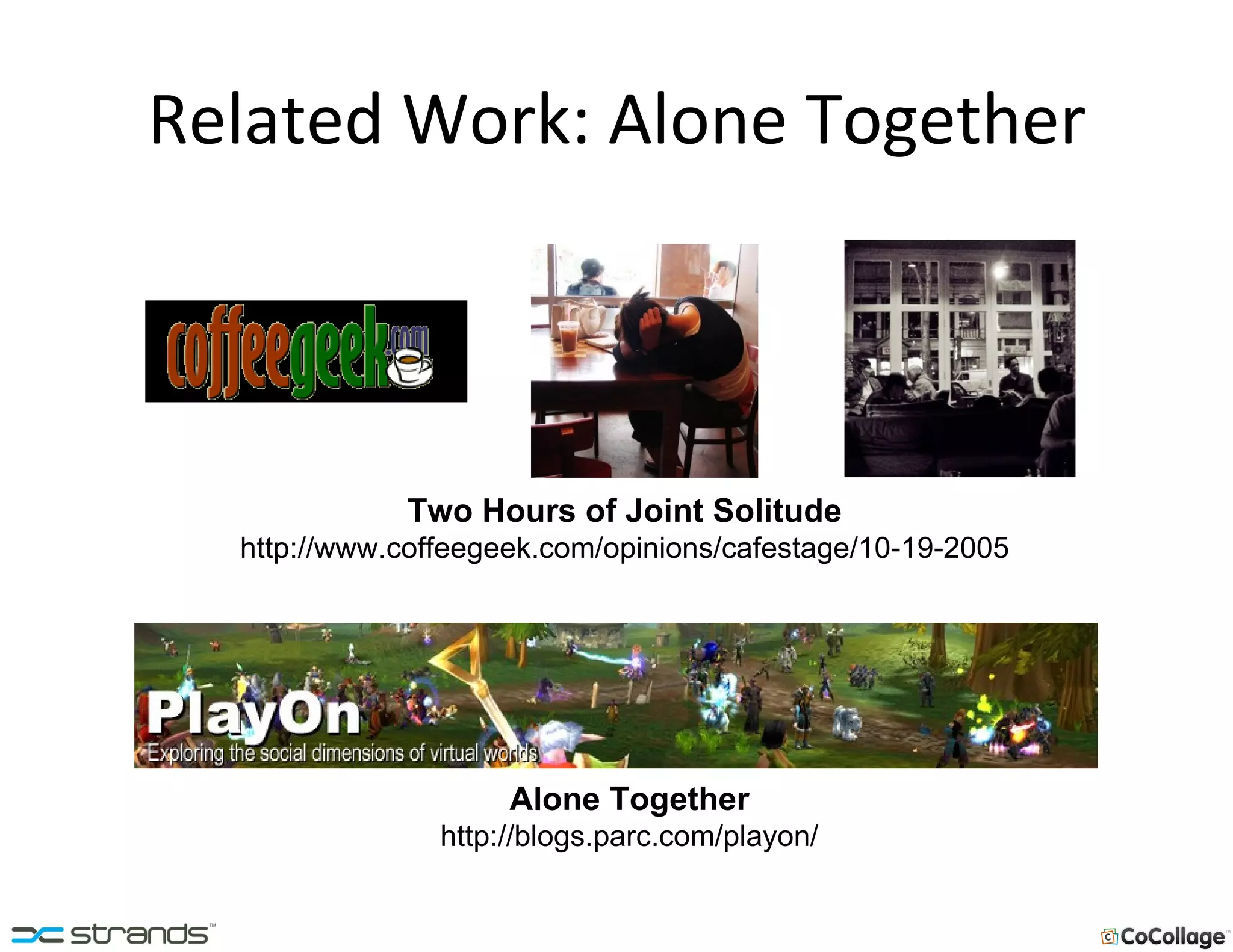
Related Work: Alone Together Two Hours of Joint Solitude http://www.coffeegeek.com/opinions/cafestage/10-19-2005 Alone Together http://blogs.parc.com/playon/
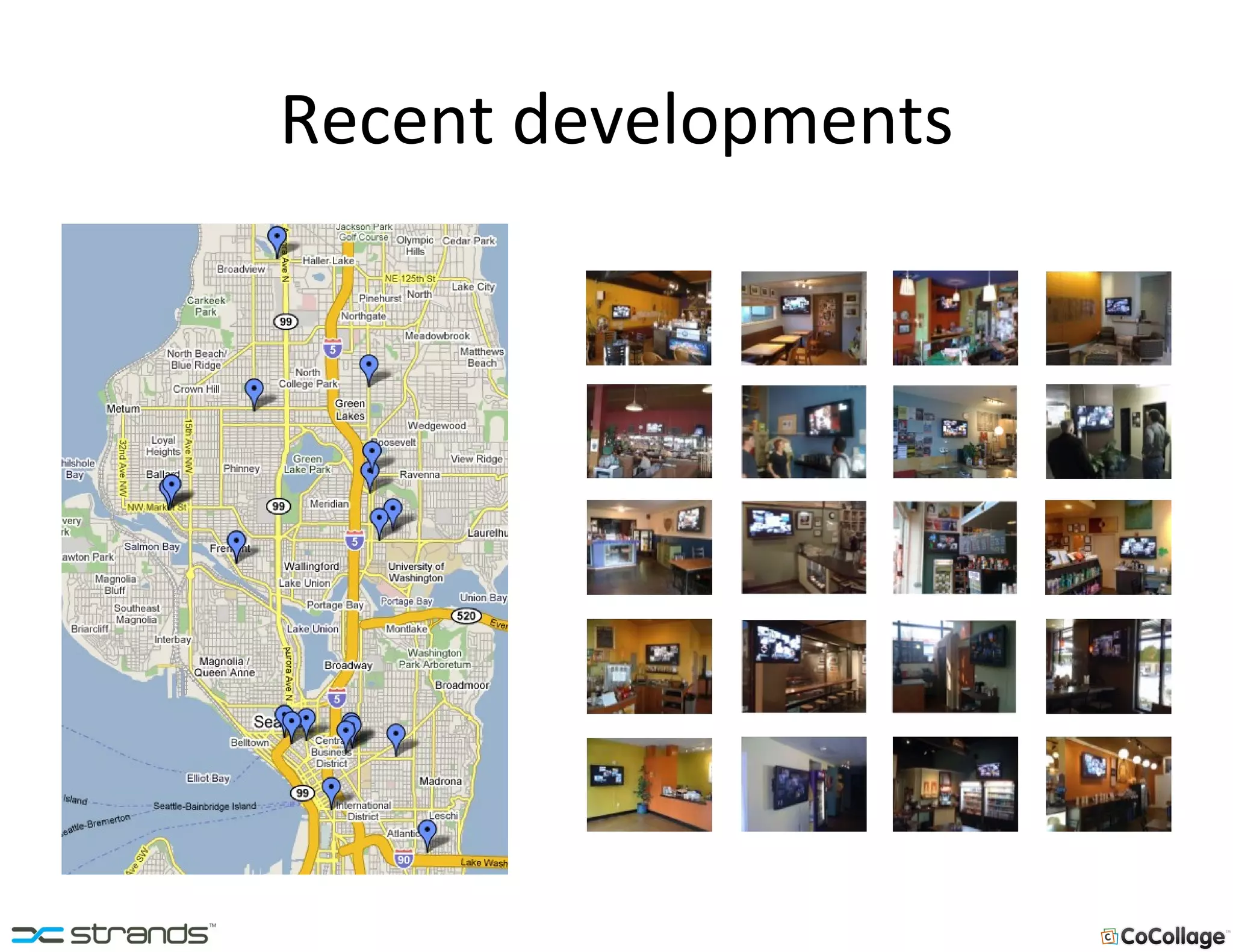
Recent developments
Future Work Community characteristics / success metrics Which types of communities have we been most successful in cultivating? Technology How can we improve CoCollage (better cultivation)? Commerce How do we create an economically sustainable model to support CoCollage?
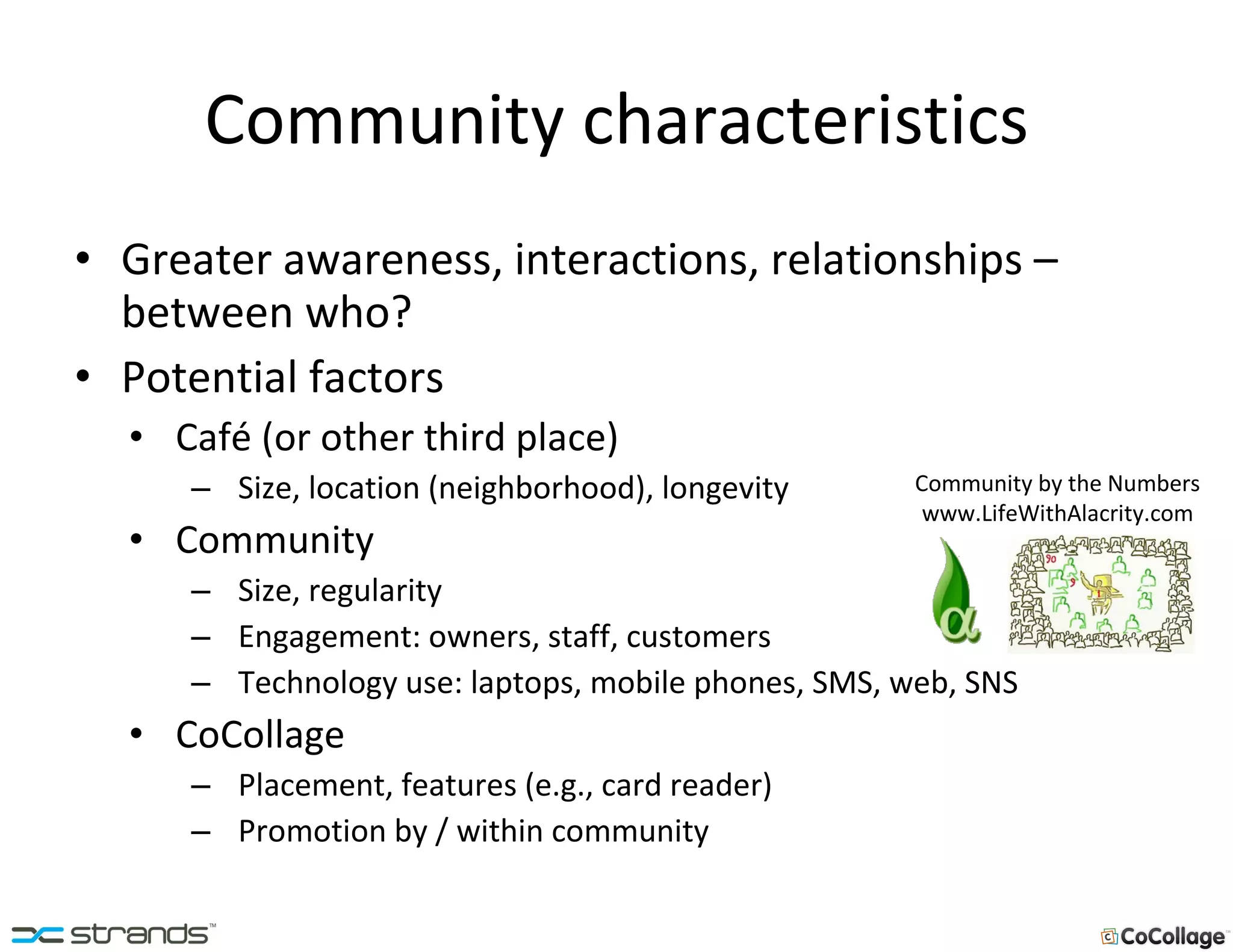
Community characteristics Greater awareness, interactions, relationships – between who? Potential factors Café (or other third place) Size, location (neighborhood), longevity Community Size, regularity Engagement: owners, staff, customers Technology use: laptops, mobile phones, SMS, web, SNS CoCollage Placement, features (e.g., card reader) Promotion by / within community Community by the Numbers www.LifeWithAlacrity.com
Technology How important is presence? Sense & respond paradigm Small group effect (Shirky) Avoiding YASNS syndrome More [engaged] users Walk-up participation: Cammie Community overview Contests
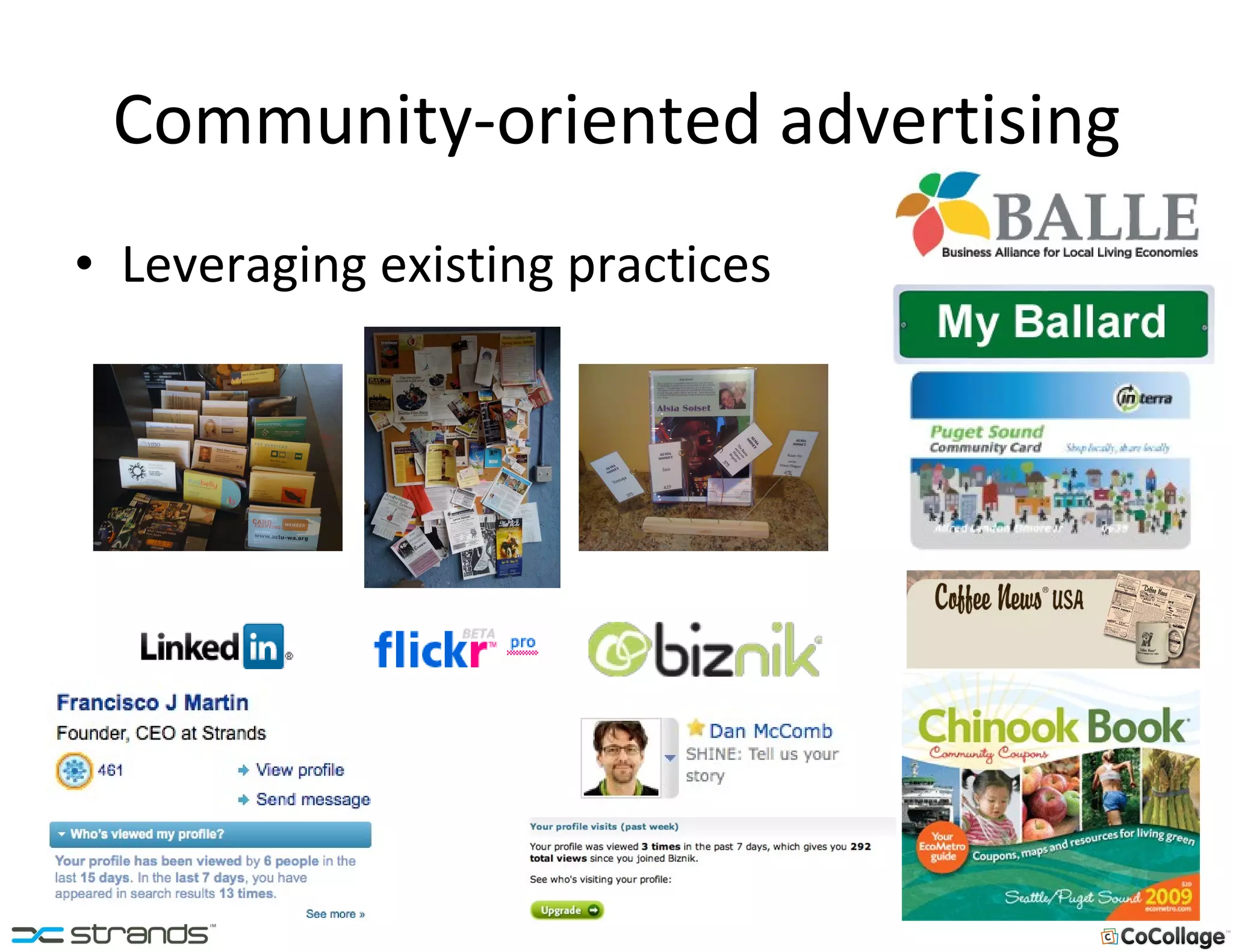
Community-oriented advertising Leveraging existing practices
Markets Are Conversations “ The first markets were filled with people, not abstractions or statistical aggregates; they were the places where supply met demand with a firm handshake. Buyers and sellers looked each other in the eye, met, and connected. The first markets were places for exchange, where people came to buy what others had to sell -- and to talk.” “ Conversation is a profound act of humanity. So once were markets.” “ Conversation may be a distraction in factories that produce replaceable products for replaceable consumers, but it’s intimately tied to the world of craft, where the work of hands expresses the voice of the maker.” “ People are talking in the new market because they want to, because they’re interested, because it’s fun.”
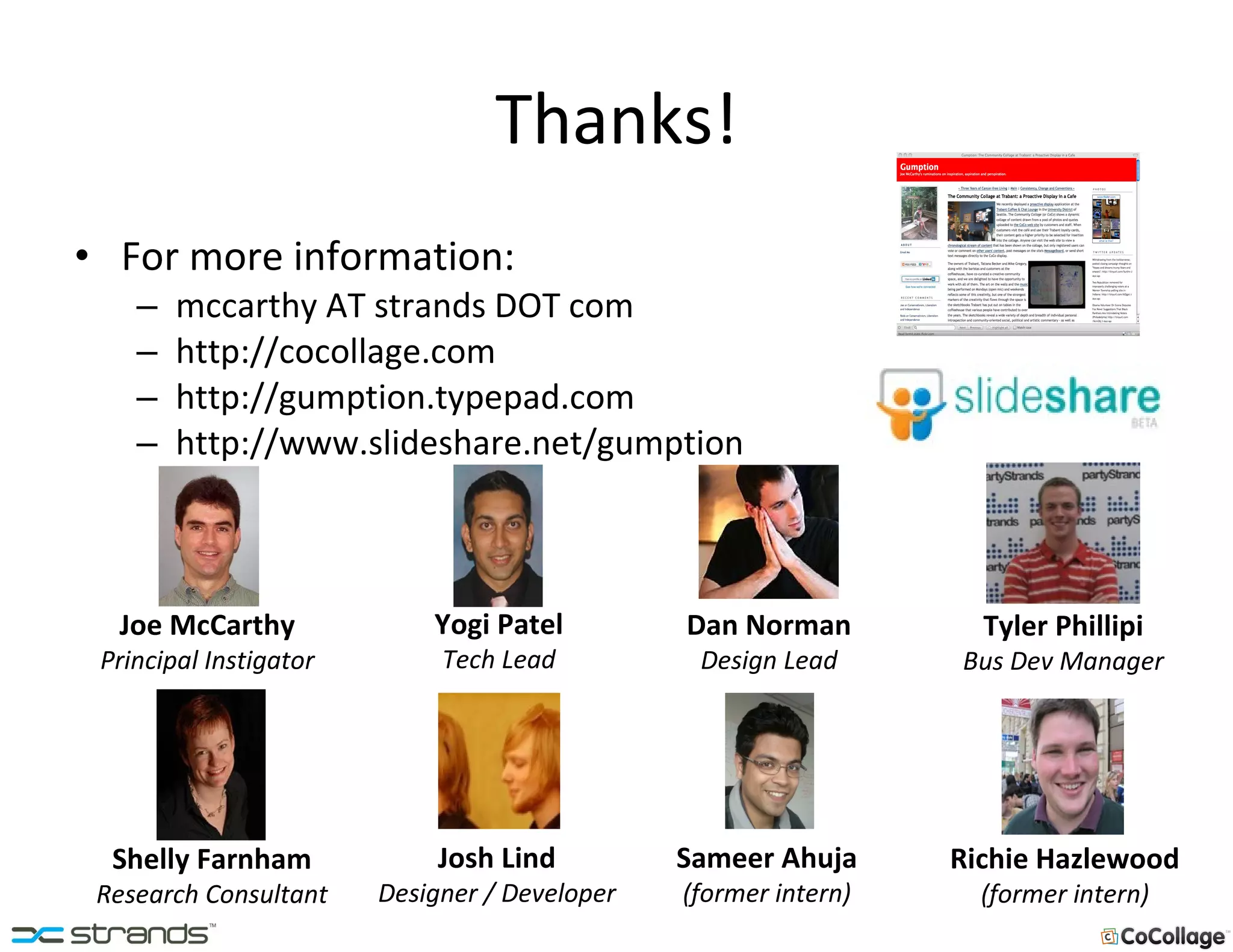
Thanks! For more information: mccarthy AT strands DOT com http://cocollage.com http://gumption.typepad.com http://www.slideshare.net/gumption Yogi Patel Tech Lead Shelly Farnham Research Consultant Joe McCarthy Principal Instigator Josh Lind Designer / Developer Dan Norman Design Lead Sameer Ahuja (former intern) Richie Hazlewood (former intern) Tyler Phillipi Bus Dev Manager

CoCollage C&T2009

  • 1.
    Supporting Community in Third Places with Situated Social Software Joseph F. McCarthy 1 , Shelly D. Farnham 2 , Yogi Patel 1 , Sameer Ahuja 3 , William R. Hazlewood 4 , Daniel Norman 1 , Josh Lind 5 1 Strands Labs Seattle 2 Waggle Labs, 3 Virginia Tech, 4 Indiana Univ, 5 ReadyDone
  • 2.
    In case ofexcessive speed … http://www.slideshare.net/ gumption (tag: cct2009 ) View the slides and follow along / catch up later:
  • 3.
    Agenda The promiseand problems of third places Situated social software The Strands Community Collage (CoCollage) Study: impact on Trabant Coffee community Neighboring factor of sense of community Dependency factor of place attachment Related, recent & future work Communities, technology, commerce
  • 4.
    Third Places FirstPlace: Home Second Place: Work Third Place: Community
  • 5.
    Great, Good PlacesThe Great, Good Place: Cafés, Coffee Shops, Bookstores, Bars, Hair Salons and Other Hangouts at the Heart of a Community Ray Oldenburg, 1989 ‘ homes away from home’, where unrelated people relate the full spectrum of local humanity inclusive sociability ease of association
  • 6.
    Characteristics of ThirdPlaces On neutral ground A leveler Conversation is main activity Accessibility and accommodation Regulars Low profile Mood is playful Home away from home
  • 7.
    Promise of ThirdPlaces Personal Novelty Perspective Spiritual tonic Friends by the set Community Political role Habit of association Agency of control and a force for good Outposts on the public domain
  • 8.
    Perils of [technologyin] Third Places Cyber-nomads are “ hollowing out ” cafés that offer WiFi, rendering them “ physically inhabited but psychologically evacuated” leaving people “ more isolated than they would be if the café were merely empty.” -- James E. Katz, Professor of Communications, Rutgers University “Contextual effects” – Hampton, et al.
  • 9.
  • 10.
    How can technology enhance community within cafés? Three observations … and a solution
  • 11.
    Maintaining Friendships throughOnline Social Media ambient intimacy “ being able to keep in touch with people with a level of regularity and intimacy that you wouldn’t usually have access to” Leisa Reichert http://www.disambiguity.com/ambient-intimacy/ http://www.slideshare.net/leisa/ambient-intimacy continuous partial friendship David Weinberger http://www.hyperorg.com/backissues/joho-may04-07.html
  • 12.
    Situated Software ClayShirky, March 2004 Software designed in and for a particular social situation or context NOT Web School: scalability, generality, and completeness the application must be useful to the community; the community must be useful to the application http://www.shirky.com/writings/situated_software.html See also: “ Communities, Audiences & Scale” http://shirky.com/writings/community_scale.html “ What is Social Informatics and Why Does It Matter?” Rob Kling, D-Lib Magazine, January 1999 Socio-technical systems: people, technology, institutional & cultural contexts
  • 13.
    Existing “technologies” for enhancing community in cafés
  • 14.
    What if wecould … Leverage the attributes of offline community “technologies” Photos, art, sketches, quotes, flyers Apply situated software design principles Design for the context of a café Bring the richness of online social networking into the physical spaces we share with others Spark conversation & connection in the real world Ambient intimacy in physical spaces
  • 15.
    The Strands CommunityCollage (CoCollage) A large computer display showing a collage of photos and quotes uploaded to a special web site by patrons and staff in a café or other community-oriented place.
  • 16.
    CoCollage features PeopleStuff (photos & quotes) Commenting, voting Uploading Messaging The big screen
  • 17.
    Sharing your stuffFacebook photos Quotes Flickr photos Photos from your computer Photos via email
  • 18.
    Conversations & ConnectionsComment, vote, flag Public & private messages Online Offline
  • 19.
  • 20.
  • 21.
    Study 1 Goodpace of adoption in first month 82 out of an estimated 400 regulars joined CoCollage Questionnaire results shows that people who a) are looking to connect with others b) already have a psychological sense of community at the café c) already feel place attachment to the café, are more likely to join CoCollage and start conversations Psychological sense of community for place and place attachment are meaningful constructs in predicting adoption of a place-based community technology Measuring the Impact of Third Place Attachment on the Adoption of a Place-Based Community Technology Shelly D. Farnham, Joseph F. McCarthy, Yagnesh Patel, Sameer Ahuja, Daniel Norman, William R. Hazlewood, Josh Lind Proc. of the 27th Int'l. Conf on Human Factors in Computing Systems (CHI 2009) , 2153 - 2156.
  • 22.
    Study 2: Impactover time How does CoCollage impact sense of community and place attachment over time? 2 months after initial deployment Semi-structured interview with owners Log analysis Questionnaires Study 1: After 1 week; 24 participants Study 2: After 2 months; 19 participants (10 from study 1) New questionnaire: 15 [mostly non-user] members of community
  • 23.
    Size and Activityof Community Owners are dedicated to developing a strong community, and have positive attitude towards technology Café community: Approx. 400 “regulars” visit at least once a week 48% male, 52% female, mean age = 29 23% students, 51% white collar/professional Level of activity at cafe: At any point in time, 17 people in the café 23 new people each hour Stayed an average of 25 minutes each Type of activities at cafe: 64% sat down to drink their coffee 38% came in with friends, chatted with each other 12% chatted with barista, 2 chatted across the table Questionnaire: Chatting with friends (65%), reading (46%), working on laptop (39%)
  • 24.
    Usage after 1month vs. 2 months Percentage of users who engaged in each type of activity, with means
  • 25.
    Types of imagesshared Random sample of 150 images, after 2 months of use
  • 26.
    Place Attachment &Neighboring Dependency component of place attachment : the extent to which people rely on the café to have their needs met Neighboring component of sense of community : the extent to which people visit each other’s homes and do each other favors Place Attachment Neighboring
  • 27.
    Examples of interactions?coco has made me stare at the screen longer at peoples pictures. i usually get my drink in a mug so i can stay in Trabant and since im already there, i usually sit and study as well, whereas before, i would get a to-go drink and run off to the library. It has greatly improved my people watching at Trabant. I think in some ways made me even bit more extroverted then I was before. I have enjoyed the feedback and comments both on the site and in person regarding my stuff
  • 28.
    What do youlike about CoCollage? I like seeing everyone's pictures and how it makes Trabant feel like a little community . Get to see what other Trabant customers are up to. Really get to see the diversity of U. District. Some of the pictures are really lovely - and the kinds of photos overall tell a lot about Trabant’s style and that of their customers . The friendly atmosphere it creates its fun to add pictures to the collage while you're enjoying a cup of joe. I love visiting with my friends there and looking up and seeing one of our pictures on the screen, then we get to talk about it. Its a great conversation piece .
  • 29.
    What do youdislike about CoCollage? get a bigger screen i dislike that it becomes a centerpiece rather than part of the ambiance Oddly, I feel more isolated at times by watching photos of people I don't know From a user who rated increase in interactions as “6” and increase in sense of community as “7”
  • 30.
    How can weimprove CoCollage? I wish I could switch past ugly, weird or bad photos and spend more time on the nice ones. I would like rating scale to be able rank which pictures and stuff come up more often. Maybe an rfid card instead of swipe card to be able to tap and go to login. I would love to see it in more locations . Be able to rank my items for display .
  • 31.
    What is CoCollage?a social networking system bringing web 2.0 interaction to real life by allowing users to upload photos to a public display Picture sharing. Picasa for your local coffee / espresso store [The café]’s Facebook page is playing on a big screen. innovative funky intrusion a tv
  • 32.
    Survey To whatextent did CoCollage increase … * Interactions in café Sense of community in café * on scale of 1 to 7, where 1 = “not at all” and 7 = “extremely so” (81% > 1) (95% > 1)
  • 33.
  • 34.
    Related Work: ProactiveDisplays Augmenting the Social Space of an Academic Conference Joseph F. McCarthy, David W. McDonald, Suzanne Soroczak, David H. Nguyen and Al M. Rashid ACM 2004 Conference on Computer Supported Cooperative Work (CSCW 2004) Proactive Displays: Supporting Awareness in Fluid Social Environments David W. McDonald, Joseph F. McCarthy, Suzanne Soroczak, David H. Nguyen and Al M. Rashid ACM Transactions on Computer-Human Interactions (TOCHI), Vol. 14, No. 4, January 2008 promoting awareness and interactions at a conference AUTOSPEAKERID, TICKET2TALK, NEIGHBORHOOD WINDOW
  • 35.
    Related Work: ProactiveDisplays The Context, Content & Community (C3) Collage promoting awareness and interactions in the workplace The Context, Content & Community Collage: Sharing Personal Digital Media in the Physical Workplace Joseph F. McCarthy, Ben Congleton, F. Maxwell Harper ACM 2008 Conference on Computer Supported Cooperative Work (CSCW 2008)
  • 36.
    Related Work (1)eyeCanvas (FXPAL) Interactive community bulletin board Canvas Gallery, SF Churchill, et al. , CHI 2006 PlaceSite Location-based web community Three SF cafés Savage, et al. , 2006 Jukola (Appliance Studio) Mobile + wall displays Selecting music in Bristol cafe O’Hara, et al. , DIS 2004 CowCam (Intel) Webcam + figurines + display Urban Grind café, Portland March, et al. , CHI 2005
  • 37.
    Related Work: Research(2) Notification Collage (University of Calgary) Public display + desktop displays University research lab Greenberg & Rounding, CHI 2001 PlasmaPoster (FXPAL) Interactive community bulletin board Corporate, conference, café contexts Churchill, Nelson, et al. , C&T 2003, … BlueBoard (IBM Almaden) Shared display for collaboration Corporate meeting space Russell & Gossweiler, UbiComp 2001 CityWall (Helsinki IIT) Multi-touch screen in city center Flickr photos tagged with “helsinki” Interactions with, vs. through, display Peltonen, et al. , CHI 2008
  • 38.
    Related Work: Research(3) Meme Tags (MIT) Wearable, interpersonal displays Academic sponsor meetings Borovoy, et al. , CSCW 1998 Opinionizer (Sussex) Shared display at social events Interaction through typed input Brignull & Rogers, INTERACT 2003 Dynamo (Sussex) High school setting Interaction via USB disk Brignull & Rogers, INTERACT 2003 AgentSalon (ATR) Interaction via PalmGuides (PDAs) Conversations mediated by animated agents Sumi & Maase, Autonomous Agents 2001
  • 39.
    Related Work: Research(4) Manhattan Story Mashup (Nokia) Urban game: web + phones + screen Times Square, New York Tuulos, et al. , Pervasive 2007 ProD Framework for Proactive Displays (U. Mich) Generic architecture for proactive displays Congleton, et al. , UIST 2008 Twitterspace (Indiana University) Large display in campus lounge Dynamic visualization of group “tweets” Hazlewood, et al. , PDC 2008 Public and Situated Displays O’Hara, Perry, Churchill, Russell
  • 40.
    Related Work: Research(5) “ true mobiles” and “placemakers”
  • 41.
    Related Work: CommercialAwareness / Interactions at Events Digital Signage Captivate TV ClearChannel, et al. RippleTV Danoo
  • 42.
    Related Work: Atomsvs. Bits http://keepposted.com
  • 43.
    Related Work: lowtech wearables Life as a grand experiment Nametag worn daily since 2000 Front porch philosophy Reciprocal self-disclosure self disclosure is reciprocal respective to the level of intimacy that you have revealed I’ll show you my name if you show me yours http://gumption.typepad.com/blog/2005/05/whats_in_a_name.html http://gumption.typepad.com/blog/2005/06/reciprocal_self.html
  • 44.
    OneKeyAway / MatchlinCOneKeyAway Singles mixers in LA / SF Bay area; since May 2004 Questionnaire: 64 true-false questions about sex, religion, drug use, how you spend your spare time, etc “ I just want to get people together and talk about relationships … to discuss the questions, talk about their habits and personality traits. I think the device facilitates that.” – Edwin Duterte MatchlinC: personality compatibility device a mini “relationship advisor” Infrared “zapping” Three color codes (stoplight): red, amber, green) Reminiscent of Lock & Key, Lovegety, Meme Tags
  • 45.
    Nokia Sensor “See and be Seen”
  • 46.
    Related Work: AloneTogether Two Hours of Joint Solitude http://www.coffeegeek.com/opinions/cafestage/10-19-2005 Alone Together http://blogs.parc.com/playon/
  • 47.
  • 48.
    Future Work Communitycharacteristics / success metrics Which types of communities have we been most successful in cultivating? Technology How can we improve CoCollage (better cultivation)? Commerce How do we create an economically sustainable model to support CoCollage?
  • 49.
    Community characteristics Greaterawareness, interactions, relationships – between who? Potential factors Café (or other third place) Size, location (neighborhood), longevity Community Size, regularity Engagement: owners, staff, customers Technology use: laptops, mobile phones, SMS, web, SNS CoCollage Placement, features (e.g., card reader) Promotion by / within community Community by the Numbers www.LifeWithAlacrity.com
  • 50.
    Technology How importantis presence? Sense & respond paradigm Small group effect (Shirky) Avoiding YASNS syndrome More [engaged] users Walk-up participation: Cammie Community overview Contests
  • 51.
  • 52.
    Markets Are Conversations“ The first markets were filled with people, not abstractions or statistical aggregates; they were the places where supply met demand with a firm handshake. Buyers and sellers looked each other in the eye, met, and connected. The first markets were places for exchange, where people came to buy what others had to sell -- and to talk.” “ Conversation is a profound act of humanity. So once were markets.” “ Conversation may be a distraction in factories that produce replaceable products for replaceable consumers, but it’s intimately tied to the world of craft, where the work of hands expresses the voice of the maker.” “ People are talking in the new market because they want to, because they’re interested, because it’s fun.”
  • 53.
    Thanks! For moreinformation: mccarthy AT strands DOT com http://cocollage.com http://gumption.typepad.com http://www.slideshare.net/gumption Yogi Patel Tech Lead Shelly Farnham Research Consultant Joe McCarthy Principal Instigator Josh Lind Designer / Developer Dan Norman Design Lead Sameer Ahuja (former intern) Richie Hazlewood (former intern) Tyler Phillipi Bus Dev Manager

Editor's Notes

  • #9 Cafés often already have technology in them: many, if not most, cafés offer wireless Internet access. Unfortunately, many people use this WiFi access to “tunnel out” to their online communities while ignoring the physical community around them. James Katz, Professor of Communications at Rutgers University, had a great way of expressing this phenomenon in a recent article appearing in The Economist: “physically inhabited but psychologically evacuated”. Our goal is to counteract that tendency by designing social technology that reflects the richness of people’s online lives within the coffeehouse, offering a new proactive display application that enables people to share some of that richness with their neighbors in physical space.
  • #14 http://gumption.typepad.com/blog/2008/08/the-community-collage-at-trabant-a-proactive-display-in-a-cafe.html http://www.google.com/search?q=community+collage http://www.trabantcoffee.com/ http://profile.myspace.com/index.cfm?fuseaction=user.viewprofile&friendID=7204859 http://flickr.com/photos/mikegregory/ http://www.thestranger.com/seattle/Content?oid=32308 http://thedaily.washington.edu/2006/4/21/eclectic-space/
  • #35 One context in which a larger group of people who don’t know each other so well gathers for a period of time is a conference. When I moved from Accenture to Intel Research Seattle, I was General Chair of UbiComp 2003, and so we decided to experiment with the idea of proactive displays at the upcoming conference. We again created special-purpose web-based profiles for people (shown in the upper left), in which they could enter their name, affiliation, photo of themselves, a photo representing some area of interest, and their home page. These profiles were associated with RFID tags that could be inserted into their conference name badge sleeves (shown in the upper middle photo), and then RFID antennas mounted near large displays would enable those displays to sense and respond to people in three different ways. The AutoSpeakerID application (lower left photo) showed the name, affiliation and photo of someone detected in front of the microphone stand during the question and answer period after a conference presentation, enabling the audience to see who the person asking the question was (and figure out how to spell their name). Ticket2Talk showed the same information, plus the photo representing a person’s interest, near the coffee break table, giving each person moving through the line 5 seconds of fame, and offering them a “ticket to talk” with each other about the photo of interest. Interestingly, one of the benefits people reported was that, because the person’s name was also shown on the Ticket2Talk display, they could save face by being reminded of a person’s name without having to look at their name tag. The third application, Neighborhood Window, showed a network graph visualization with nodes listing the names and photos of people detected near the display, and a small number of connected nodes that showed words and phrases the people’s home pages had in common, or those that were unique across the entire population, figuring those were the two most likely sets of topics to spark conversations. References: http://interrelativity.com/proactivedisplays/
  • #38 http://grouplab.cpsc.ucalgary.ca/Projects/ProjectNotificationCollage http://www.fxpal.com/?p=PlasmaPoster http://www.richgossweiler.com/projects/BlueBoard/index.html http://citywall.org
  • #39 http://www.cs.uml.edu/~fredm/medialab/memetag/ http://www.informatics.sussex.ac.uk/research/groups/interact/publications/Rogers_ice-breaker.pdf http://www.informatics.sussex.ac.uk/research/groups/interact/papers/pdfs/pervasive_environments_and_ubiComp/Shared_interaction_spaces/brignullrogers'03-interact.pdf http://portal.acm.org/citation.cfm?id=376344 http://books.google.com/books?id=tbJxldxdVJQC&dq=public+and+situated+displays
  • #40 http://www.storymashup.com http://be-n.com/portfolio/ https://eniac.hopto.org/soiaware/twitter_display/
  • #42 http://www.ntag.com http://www.spotme.com/spotmeinfo.html http://www.jambo.net/ http://www.intronetworks.com http://www.pathable.com http://www.captivate.com/ http://www.webpavement.com/public/csNYC.pdf http://www.rippletv.com Also: http://www.wirespring.com/ http://www.mercuryonline.com/ (3M Digital Signage)
  • #45 http://www.onekeyaway.com http://www.thewavemag.com/pagegen.php?pagename=article&articleid=25483
  • #54 http://interrelativity.com/joe http://gumption.typepad.com http://www.slideshare.net/gumption