Jaspreet kaur, Rajneet kaur / International Journal of Engineering Research and Applications
(IJERA) ISSN: 2248-9622 www.ijera.com
Vol. 3, Issue 3, May-Jun 2013, pp.548-550
548 | P a g e
Biomedical Images denoising using Symlet Wavelet with Wiener
filter
Jaspreet kaur*, Rajneet kaur**
*(Student Masters of Technology, Shri Guru Granth Sahib World University, Fatehgarh Sahib, Punjab)
** (HOD and Assistant Professor, Shri Guru Granth Sahib World University, Fatehgarh Sahib, Punjab)
ABSTRACT
Various medical modalities like MRI,
CT scan, Ultrasound Imaging have been widely
used in medical diagnosis. From all these
ultrasound imaging is most popular due to its
non-harmful nature and lost cost. But there is a
problem in ultrasound images that is speckle
noise which effects diagnosis based on the
ultrasound images by disappearing low contrast
lesions in tissues. Many techniques like Filtering,
Morphology, Histogram equalization and
wavelets have been developed. From these
wavelets based techniques performed better and
give superior results. In this paper we discuss
Symlet wavelet with Wiener filter technique to
reduce speckle noise in ultrasound images. This
technique gives better results than previous
techniques by minimizing mean square error.
KEYWORDS- Ultrasound Imaging, Speckle,
Wavelet Transform, Symlet and Wiener filter.
I. INTRODUCTION
Ultrasound imaging plays an important role
in medical diagnosis. It is non-invasive, non-
expansive, fast, forming real time imaging. But it
suffers from a problem that is speckle noise that
degrades image quality [1]. Speckle noise is a
multiplicative noise. It is a random mottling of dark
and bright spots appear in image which effect
diagnosis [2]. But it is difficult to remove speckle
noise because removing speckle may also remove
important information useful in diagnosis [3]. So,
we analyze various techniques among these wavelet
transform provide superior results along with
filtering technique.
II. WAVELET TRANSFORM
In Recent years, many studies have been
made on wavelets. An excellent overview of what
wavelets have brought to the fields as diverse as
biomedical applications, wireless communications,
computer graphics or turbulence, is given in [4].
Image Denoising is one of the most visible
application of wavelets. Wavelet analysis is a
windowing technique with scale and time aspects in
variable- sized regions. Discrete wavelet transform
is one of wavelet transform for which wavelets are
discretely sampled. It has both frequency and
location information. DWT
(Discrete wavelet transform is used for signal
coding. DWT procedure decompose an image into
several Sub-bands like HH, HL, LH, and LL. HH
gives diagonal information, HL gives horizontal
representation, LH gives vertical information and
LL consisting of low frequency components means
important information. In next step, LL is further
divided at the higher levels of decomposition [3].
The level of decomposition in our technique is 3.
III. TECHNIQUES USED FOR SPECKLE
REDUCTION
In this paper we use wavelet family like
Symlet wavelet with wiener filter and level of
decomposition is 3
3.1 Symlet Wavelet: Symlet wavelets are a family of
wavelets. They are a modified version
of Daubechies wavelet with increased symmetry.
The properties of the two wavelet families are
similar. There are 7 different Symlet functions from
sym2 to sym8. In symN, N is the order.
Figure 1: sym2 Wavelet Function Waveform
3.2 WIENER FILTER: Wiener filter is proposed by
Norbert wiener in 1940 and published in 1949. It is
used to reduce noise in signal. When the image is
blurred by a known low pass filter, it is possible
to recover the image by inverse filtering. But inverse
filtering is very sensitive to additive noise. The
Wiener filtering executes an optimal trade-off
between inverse filtering and noise smoothing. It
removes the additive noise and inverts the blurring
simultaneously. The wiener filter minimizes the
mean square error between the estimated random
process and the desired process. It minimizes the
overall mean square error in the process of inverse
filtering and noise smoothing. The Wiener filtering
is a linear estimation of the original image [2].
Jaspreet kaur, Rajneet kaur / International Journal of Engineering Research and Applications
(IJERA) ISSN: 2248-9622 www.ijera.com
Vol. 3, Issue 3, May-Jun 2013, pp.548-550
549 | P a g e
ALGORITHM FLOW CHART
Figure 2 Flowchart of speckle reduction technique
using Symlet wavelet wavelet with wiener filter
IV. RESULTS
Results would be both Qualitative and
Quantitative analyses by obtaining the denoised
version of the input image by DWT Technique and
comparing it with the input image used. Analysis
would be performed by checking attained
Processing Time, Mean Square Error estimation of
the denoised image and PSF.
USING SYMLETS WAVELET AND WEINER
FILTERS
Figure 3: Approximation and Detail Coefficients
using Symlet Wavelet
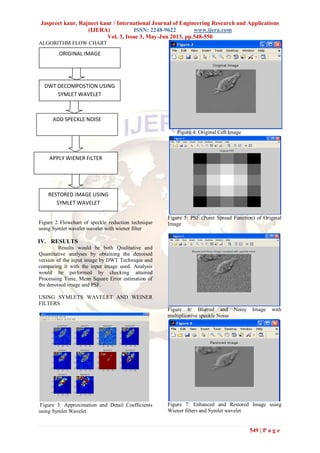
Figure 4: Original Cell Image
Figure 5: PSF (Point Spread Function) of Original
Image
Figure 6: Blurred and Noisy Image with
multiplicative speckle Noise
Figure 7: Enhanced and Restored Image using
Wiener filters and Symlet wavelet
ORIGINAL IMAGE
DWT DECOMPOSTION USING
SYMLET WAVELET
ADD SPECKLE NOISE
APPLY WIENER FILTER
RESTORED IMAGE USING
SYMLET WAVELET
Jaspreet kaur, Rajneet kaur / International Journal of Engineering Research and Applications
(IJERA) ISSN: 2248-9622 www.ijera.com
Vol. 3, Issue 3, May-Jun 2013, pp.548-550
550 | P a g e
Figure 8: PSF of final image
Table 1: VALUES OF MSE AND ELAPSED
TIME
V. CONCLUSION
We concluded that Symlet wavelet with wiener
filter provide superior results than filtering
techniques. This technique minimizes the mean
square error and from PSF we concluded that
restored image is closer to original image. We also
used this technique to reduce another types of noise
like Gaussian noise, salt and pepper noise.
REFERENCES
[1] Sivakumar .R and Nedumaran .D, “
Implementation of Wavelet Filters for
Speckle noise Reduction in Ultrasound
Medical Images: A Comparative Study”
International Conference on Signals,
Systems and Communication, December
21-23, 2009.
[2] Asmaa Abass Ajwad , “ Noise Reduction
of Ultrasound Image Using Wiener
filtering and Haar Wavelet Transform
Techniques” Diyala Journal of Medicine,
Vol. 2, Issue 1, April 2012.
[3] Dhrub Kumar, Maitreyee Dutta, Parveen
Lehana, “ A Comparative Analysis of
Different Wavelets for Enhancing Medical
Ultrasound Images”, International Journal
of Computer Applications (0975 – 8887)
,Volume 66– No.7, March 2013.
[4] N.K. Ragesh, A.R. Anil, DR. R. Rajesh,
“Digital Image Denoising in Medical
Ultrasound Images: A Survey”, IGCST
AIML – 11 Conference, Dubai, UAE, 12-14
April 2011.
[5] R. Sivakumar, D. Nedumaran,
“Comparative study of Speckle Noise
Reduction of Ultrasound B-Scan Images in
Matrix Laboratory Environment”,
International Journal of Computer
Applications, IJCA, Vol. 10 – No. 9,
November 2010.
[6] Haryali Dhillon, Gagandeep Jindal, Akshay
Girdhar, “A Novel Threshold Technique
for Eliminating Speckle Noise in
Ultrasound Images”, International
Conference on Modelling, Simulation and
Control, IPCSIT, vol.10 (2011) IACSIT
Press, Singapore.
[7] R.Vanithamani, G.Umamaheswari,
“Performance Analysis of Filters for
Speckle Reduction in Medical Ultrasound
Images”, International Journal of
Computer Applications (0975 – 8887),
Volume 12– No.6, December 2010.
[8] J. Li and S. Lei, “Rate-distortion optimized
embedding”, in Proc. Picture Coding
Symp., Berlin, Germany, pp. 201-206, Sept.
10-12, 1997.
[9] Rakesh Kumar , B. S. Saini, “Improved
Image Denoising Technique Using
Neighboring Wavelet Coefficients of
Optimal Wavelet with Adaptive
Thresholding”, International Journal of
Computer Theory and Engineering, Vol. 4,
No. 3, June 2012.
[10] Andy Milkowski, MS, Yadong Li, PhD,
David Becker, MS, Syed O. Ishrak, PhD.
“Speckle Reduction Imaging”, GE Medical
Systems Ultrasound.
[11] E. Ordentlich, M. Weinberger, and G.
Seroussi, “A low-complexity modeling
approach for embedded coding of wavelet
coef_cients”, in Proc. IEEE Data
Compression Conf., Snowbird, UT, pp.
408-417, Mar. 1998.
[12] W.A. Pearlman, “Performance bounds for
subband codes”, Chapter 1 in Subband
Image Coding, J. W. Woods and Ed.
Klvwer. Academic Publishers, 1991.
SYMLET
WAVELET
WITH
WIENER
FILTER
MEAN
SQUARE
ERROR
(MSE)
ELAPSED
TIME
0.2359
5.669997
seconds

Co33548550

  • 1.
    Jaspreet kaur, Rajneetkaur / International Journal of Engineering Research and Applications (IJERA) ISSN: 2248-9622 www.ijera.com Vol. 3, Issue 3, May-Jun 2013, pp.548-550 548 | P a g e Biomedical Images denoising using Symlet Wavelet with Wiener filter Jaspreet kaur*, Rajneet kaur** *(Student Masters of Technology, Shri Guru Granth Sahib World University, Fatehgarh Sahib, Punjab) ** (HOD and Assistant Professor, Shri Guru Granth Sahib World University, Fatehgarh Sahib, Punjab) ABSTRACT Various medical modalities like MRI, CT scan, Ultrasound Imaging have been widely used in medical diagnosis. From all these ultrasound imaging is most popular due to its non-harmful nature and lost cost. But there is a problem in ultrasound images that is speckle noise which effects diagnosis based on the ultrasound images by disappearing low contrast lesions in tissues. Many techniques like Filtering, Morphology, Histogram equalization and wavelets have been developed. From these wavelets based techniques performed better and give superior results. In this paper we discuss Symlet wavelet with Wiener filter technique to reduce speckle noise in ultrasound images. This technique gives better results than previous techniques by minimizing mean square error. KEYWORDS- Ultrasound Imaging, Speckle, Wavelet Transform, Symlet and Wiener filter. I. INTRODUCTION Ultrasound imaging plays an important role in medical diagnosis. It is non-invasive, non- expansive, fast, forming real time imaging. But it suffers from a problem that is speckle noise that degrades image quality [1]. Speckle noise is a multiplicative noise. It is a random mottling of dark and bright spots appear in image which effect diagnosis [2]. But it is difficult to remove speckle noise because removing speckle may also remove important information useful in diagnosis [3]. So, we analyze various techniques among these wavelet transform provide superior results along with filtering technique. II. WAVELET TRANSFORM In Recent years, many studies have been made on wavelets. An excellent overview of what wavelets have brought to the fields as diverse as biomedical applications, wireless communications, computer graphics or turbulence, is given in [4]. Image Denoising is one of the most visible application of wavelets. Wavelet analysis is a windowing technique with scale and time aspects in variable- sized regions. Discrete wavelet transform is one of wavelet transform for which wavelets are discretely sampled. It has both frequency and location information. DWT (Discrete wavelet transform is used for signal coding. DWT procedure decompose an image into several Sub-bands like HH, HL, LH, and LL. HH gives diagonal information, HL gives horizontal representation, LH gives vertical information and LL consisting of low frequency components means important information. In next step, LL is further divided at the higher levels of decomposition [3]. The level of decomposition in our technique is 3. III. TECHNIQUES USED FOR SPECKLE REDUCTION In this paper we use wavelet family like Symlet wavelet with wiener filter and level of decomposition is 3 3.1 Symlet Wavelet: Symlet wavelets are a family of wavelets. They are a modified version of Daubechies wavelet with increased symmetry. The properties of the two wavelet families are similar. There are 7 different Symlet functions from sym2 to sym8. In symN, N is the order. Figure 1: sym2 Wavelet Function Waveform 3.2 WIENER FILTER: Wiener filter is proposed by Norbert wiener in 1940 and published in 1949. It is used to reduce noise in signal. When the image is blurred by a known low pass filter, it is possible to recover the image by inverse filtering. But inverse filtering is very sensitive to additive noise. The Wiener filtering executes an optimal trade-off between inverse filtering and noise smoothing. It removes the additive noise and inverts the blurring simultaneously. The wiener filter minimizes the mean square error between the estimated random process and the desired process. It minimizes the overall mean square error in the process of inverse filtering and noise smoothing. The Wiener filtering is a linear estimation of the original image [2].
  • 2.
    Jaspreet kaur, Rajneetkaur / International Journal of Engineering Research and Applications (IJERA) ISSN: 2248-9622 www.ijera.com Vol. 3, Issue 3, May-Jun 2013, pp.548-550 549 | P a g e ALGORITHM FLOW CHART Figure 2 Flowchart of speckle reduction technique using Symlet wavelet wavelet with wiener filter IV. RESULTS Results would be both Qualitative and Quantitative analyses by obtaining the denoised version of the input image by DWT Technique and comparing it with the input image used. Analysis would be performed by checking attained Processing Time, Mean Square Error estimation of the denoised image and PSF. USING SYMLETS WAVELET AND WEINER FILTERS Figure 3: Approximation and Detail Coefficients using Symlet Wavelet Figure 4: Original Cell Image Figure 5: PSF (Point Spread Function) of Original Image Figure 6: Blurred and Noisy Image with multiplicative speckle Noise Figure 7: Enhanced and Restored Image using Wiener filters and Symlet wavelet ORIGINAL IMAGE DWT DECOMPOSTION USING SYMLET WAVELET ADD SPECKLE NOISE APPLY WIENER FILTER RESTORED IMAGE USING SYMLET WAVELET
  • 3.
    Jaspreet kaur, Rajneetkaur / International Journal of Engineering Research and Applications (IJERA) ISSN: 2248-9622 www.ijera.com Vol. 3, Issue 3, May-Jun 2013, pp.548-550 550 | P a g e Figure 8: PSF of final image Table 1: VALUES OF MSE AND ELAPSED TIME V. CONCLUSION We concluded that Symlet wavelet with wiener filter provide superior results than filtering techniques. This technique minimizes the mean square error and from PSF we concluded that restored image is closer to original image. We also used this technique to reduce another types of noise like Gaussian noise, salt and pepper noise. REFERENCES [1] Sivakumar .R and Nedumaran .D, “ Implementation of Wavelet Filters for Speckle noise Reduction in Ultrasound Medical Images: A Comparative Study” International Conference on Signals, Systems and Communication, December 21-23, 2009. [2] Asmaa Abass Ajwad , “ Noise Reduction of Ultrasound Image Using Wiener filtering and Haar Wavelet Transform Techniques” Diyala Journal of Medicine, Vol. 2, Issue 1, April 2012. [3] Dhrub Kumar, Maitreyee Dutta, Parveen Lehana, “ A Comparative Analysis of Different Wavelets for Enhancing Medical Ultrasound Images”, International Journal of Computer Applications (0975 – 8887) ,Volume 66– No.7, March 2013. [4] N.K. Ragesh, A.R. Anil, DR. R. Rajesh, “Digital Image Denoising in Medical Ultrasound Images: A Survey”, IGCST AIML – 11 Conference, Dubai, UAE, 12-14 April 2011. [5] R. Sivakumar, D. Nedumaran, “Comparative study of Speckle Noise Reduction of Ultrasound B-Scan Images in Matrix Laboratory Environment”, International Journal of Computer Applications, IJCA, Vol. 10 – No. 9, November 2010. [6] Haryali Dhillon, Gagandeep Jindal, Akshay Girdhar, “A Novel Threshold Technique for Eliminating Speckle Noise in Ultrasound Images”, International Conference on Modelling, Simulation and Control, IPCSIT, vol.10 (2011) IACSIT Press, Singapore. [7] R.Vanithamani, G.Umamaheswari, “Performance Analysis of Filters for Speckle Reduction in Medical Ultrasound Images”, International Journal of Computer Applications (0975 – 8887), Volume 12– No.6, December 2010. [8] J. Li and S. Lei, “Rate-distortion optimized embedding”, in Proc. Picture Coding Symp., Berlin, Germany, pp. 201-206, Sept. 10-12, 1997. [9] Rakesh Kumar , B. S. Saini, “Improved Image Denoising Technique Using Neighboring Wavelet Coefficients of Optimal Wavelet with Adaptive Thresholding”, International Journal of Computer Theory and Engineering, Vol. 4, No. 3, June 2012. [10] Andy Milkowski, MS, Yadong Li, PhD, David Becker, MS, Syed O. Ishrak, PhD. “Speckle Reduction Imaging”, GE Medical Systems Ultrasound. [11] E. Ordentlich, M. Weinberger, and G. Seroussi, “A low-complexity modeling approach for embedded coding of wavelet coef_cients”, in Proc. IEEE Data Compression Conf., Snowbird, UT, pp. 408-417, Mar. 1998. [12] W.A. Pearlman, “Performance bounds for subband codes”, Chapter 1 in Subband Image Coding, J. W. Woods and Ed. Klvwer. Academic Publishers, 1991. SYMLET WAVELET WITH WIENER FILTER MEAN SQUARE ERROR (MSE) ELAPSED TIME 0.2359 5.669997 seconds