William Stallings
Computer Organization
and Architecture
7th
Edition
Top Level View of Computer
Function and Interconnection
Connecting
• All the units must be connected
• Different type of connection for different
type of unit
—Memory
—Input/Output
—CPU
Computer Modules
‫يقولك‬ ‫ممكن‬
‫أرسمها‬
Memory Connection
• Receives and sends data
• Receives addresses (of locations)
• Receives control signals
—Read
—Write
—Timing
Input/Output Connection(1)
• Similar to memory from computer’s
viewpoint
• Output
—Receive data from computer
—Send data to peripheral
• Input
—Receive data from peripheral
—Send data to computer
Input/Output Connection(2)
• Receive control signals from computer
• Send control signals to peripherals
—e.g. spin disk
• Receive addresses from computer
—e.g. port number to identify peripheral
• Send interrupt signals (control)
CPU Connection
• Reads instruction and data
• Writes out data (after processing)
• Sends control signals to other units
• Receives interrupts
Buses
• There are a number of possible
interconnection systems
• Single and multiple BUS structures are
most common
• e.g. Control/Address/Data bus (PC)
What is a Bus?
• A communication pathway connecting two
or more devices
• Often grouped
—A number of channels in one bus
—e.g. 32 bit data bus is 32 separate single bit
channels
• Power lines may not be shown
Data Bus
• Data Bus is used for Carries(‫)نقل‬ data
(instruction)
—Remember that there is no difference between
“data” and “instruction” at this level
• Width is a key determinant of performance
—8, 16, 32, 64 bit
Address bus
• Identify the source or destination (‫)وجهة‬ of
data
• e.g. CPU needs to read an instruction
(data) from a given location in memory
• Bus width determines maximum memory
capacity of system
—e.g. 8080 has 16 bit address bus giving 64k
address space
Control Bus
• Carries Control and timing information
—Memory read/write signal
—Interrupt request
—Clock signals
What is the difference between an address bus, data
bus, and control bus? (‫امتحان‬ ‫)سؤال‬
• data bus is used for carries(‫)نقل‬ data (instruction) between system units
• Address bus Used to identify the source or destination (‫)وجهة‬ of data, This means it
carries the addresses of memory locations or I/O ports.
• control bus is used for carries Control and timing information
Bus Interconnection Scheme
• What do buses look like?
—Parallel lines on circuit boards
—Ribbon cables
—Strip connectors on mother boards
– e.g. PCI
—Sets of wires
Traditional (ISA)
(with cache)
High Performance Bus
Bus Types
• Dedicated
—Separate data & address lines
• Multiplexed
—Shared lines
—Address valid or data valid control line
—Advantage - fewer lines
—Disadvantages
– More complex control
– Ultimate performance
What is the difference between dedicated bus and
multiplexed bus? (‫امتحان‬ ‫)سؤال‬
Dedicated bus use separate address and data lines, while
multiplexed bus use shared lines for address and data.
Bus Arbitration
• More than one module controlling the bus
• e.g. CPU and DMA controller
• Only one module may control bus at one
time
• Arbitration may be centralised or
distributed
Centralised or Distributed Arbitration
• Centralised
—Single hardware device controlling bus access
– Bus Controller
– Arbiter
—May be part of CPU or separate
• Distributed
—Each module may claim ( /
‫تأخذ‬ ‫)تطالب‬ the bus
—Control logic on all modules
What is the difference between Centralised
Arbitration and Distributed Arbitration? (‫سؤال‬
‫)امتحان‬
In Centralised Arbitration is Single hardware device controlling
bus access, while in Distributed Arbitration Each module may
claim the bus and Each module has control logic.
Control Bus (Control Lines & Timing)
• Memory write: Causes data on the bus to be written into the
addressed location
• Memory read: Causes data from the addressed location to be
placed on the bus
• I/O write: Causes data on the bus to be output to the addressed
I/O port
• I/O read: Causes data from the addressed I/O port to be placed
on the bus
• Transfer ACK: Indicates that data have been accepted from or
placed on the bus
• Bus request: Indicates that a module needs to gain control of
the bus
• Bus grant: Indicates that a requesting module has been granted
control of the bus
• Interrupt request: Indicates that an interrupt is pending (‫قيد‬
‫)االنتظار‬
• Interrupt ACK: Acknowledges that the pending interrupt has
been recognized
• Clock: Is used to synchronize operations
Synchronous Timing Diagram
Asynchronous Timing – Read Diagram
Asynchronous Timing – Write Diagram
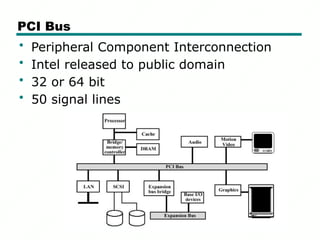
PCI Bus
• Peripheral Component Interconnection
• Intel released to public domain
• 32 or 64 bit
• 50 signal lines
• Typical Server System
PCI Bus (Pins) Lines (required)
• Systems lines
—Including clock and reset
• Address & Data
• Interface Control
• Arbitration
• Error lines
• Interrupt lines
• Cache support
• 64-bit Bus Extension

CO lec.3.pptx ز

  • 1.
    William Stallings Computer Organization andArchitecture 7th Edition Top Level View of Computer Function and Interconnection
  • 2.
    Connecting • All theunits must be connected • Different type of connection for different type of unit —Memory —Input/Output —CPU
  • 3.
  • 4.
    Memory Connection • Receivesand sends data • Receives addresses (of locations) • Receives control signals —Read —Write —Timing
  • 5.
    Input/Output Connection(1) • Similarto memory from computer’s viewpoint • Output —Receive data from computer —Send data to peripheral • Input —Receive data from peripheral —Send data to computer
  • 6.
    Input/Output Connection(2) • Receivecontrol signals from computer • Send control signals to peripherals —e.g. spin disk • Receive addresses from computer —e.g. port number to identify peripheral • Send interrupt signals (control)
  • 7.
    CPU Connection • Readsinstruction and data • Writes out data (after processing) • Sends control signals to other units • Receives interrupts
  • 8.
    Buses • There area number of possible interconnection systems • Single and multiple BUS structures are most common • e.g. Control/Address/Data bus (PC)
  • 9.
    What is aBus? • A communication pathway connecting two or more devices • Often grouped —A number of channels in one bus —e.g. 32 bit data bus is 32 separate single bit channels • Power lines may not be shown
  • 10.
    Data Bus • DataBus is used for Carries(‫)نقل‬ data (instruction) —Remember that there is no difference between “data” and “instruction” at this level • Width is a key determinant of performance —8, 16, 32, 64 bit
  • 11.
    Address bus • Identifythe source or destination (‫)وجهة‬ of data • e.g. CPU needs to read an instruction (data) from a given location in memory • Bus width determines maximum memory capacity of system —e.g. 8080 has 16 bit address bus giving 64k address space
  • 12.
    Control Bus • CarriesControl and timing information —Memory read/write signal —Interrupt request —Clock signals What is the difference between an address bus, data bus, and control bus? (‫امتحان‬ ‫)سؤال‬ • data bus is used for carries(‫)نقل‬ data (instruction) between system units • Address bus Used to identify the source or destination (‫)وجهة‬ of data, This means it carries the addresses of memory locations or I/O ports. • control bus is used for carries Control and timing information
  • 13.
    Bus Interconnection Scheme •What do buses look like? —Parallel lines on circuit boards —Ribbon cables —Strip connectors on mother boards – e.g. PCI —Sets of wires
  • 15.
  • 16.
  • 17.
    Bus Types • Dedicated —Separatedata & address lines • Multiplexed —Shared lines —Address valid or data valid control line —Advantage - fewer lines —Disadvantages – More complex control – Ultimate performance What is the difference between dedicated bus and multiplexed bus? (‫امتحان‬ ‫)سؤال‬ Dedicated bus use separate address and data lines, while multiplexed bus use shared lines for address and data.
  • 18.
    Bus Arbitration • Morethan one module controlling the bus • e.g. CPU and DMA controller • Only one module may control bus at one time • Arbitration may be centralised or distributed
  • 19.
    Centralised or DistributedArbitration • Centralised —Single hardware device controlling bus access – Bus Controller – Arbiter —May be part of CPU or separate • Distributed —Each module may claim ( / ‫تأخذ‬ ‫)تطالب‬ the bus —Control logic on all modules What is the difference between Centralised Arbitration and Distributed Arbitration? (‫سؤال‬ ‫)امتحان‬ In Centralised Arbitration is Single hardware device controlling bus access, while in Distributed Arbitration Each module may claim the bus and Each module has control logic.
  • 20.
    Control Bus (ControlLines & Timing) • Memory write: Causes data on the bus to be written into the addressed location • Memory read: Causes data from the addressed location to be placed on the bus • I/O write: Causes data on the bus to be output to the addressed I/O port • I/O read: Causes data from the addressed I/O port to be placed on the bus • Transfer ACK: Indicates that data have been accepted from or placed on the bus • Bus request: Indicates that a module needs to gain control of the bus • Bus grant: Indicates that a requesting module has been granted control of the bus • Interrupt request: Indicates that an interrupt is pending (‫قيد‬ ‫)االنتظار‬ • Interrupt ACK: Acknowledges that the pending interrupt has been recognized • Clock: Is used to synchronize operations
  • 21.
  • 22.
  • 23.
  • 24.
    PCI Bus • PeripheralComponent Interconnection • Intel released to public domain • 32 or 64 bit • 50 signal lines
  • 25.
  • 26.
    PCI Bus (Pins)Lines (required) • Systems lines —Including clock and reset • Address & Data • Interface Control • Arbitration • Error lines • Interrupt lines • Cache support • 64-bit Bus Extension