Slide 1 CaaS – Capability as a Service in Digital Enterprises
Capability as a Service in Digital
Enterprises
Brief Overview of the CaaS Project for Invited Members of
the Project’s Exploitation Advisory Boad (EAB)
June 26, 2014
Jan-Christian Kuhr ● SIV.AG
jan-christian.kuhr@siv.de
Slide 2 CaaS – Capability as a Service in Digital Enterprises
Purpose and Intended Audience
This document gives a brief overview of the „Capability as a Service“ research project. It takes
the reader on a tour through the project’s motivation, structure, its subject matter, scope, and
intended outcome.
The intended audience is any organization or enterprise that is interested in contributing to the
CaaS initiative, particularly those that are invited to the exploitation advisory board (EAB).
The document contains information about
 motivation and principal approach of capability driven development (CDD)
 project structure and timeline
 use cases
 SIV’s use case
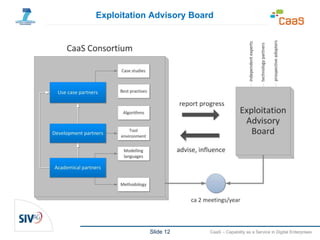
 exploitation advisory board
Confidentiality
This document is confidential material and property of SIV.AG. Its content may not be reproduced
or disclosed without prior written permission by SIV.AG.
© SIV.AG (2014). All rights reserved
Slide 3 CaaS – Capability as a Service in Digital Enterprises
 Acronym CaaS
 Full title Capability as a Service in Digital Enterprises
 Website http://caas-project.eu
 Funded by 7th Framework Programme (FP7) of the European
Commission, ICT Programme
 Project Collaborative research and development project
 Duration Sep 1, 2013 – Aug 30, 2016
 Goal Shift from service-oriented paradigm to a capability
delivery paradigm
 Drivers Use cases from different industries and business
domains
 Consortium 5 partners from industry plus 4 academical partners
Key Facts
Slide 4 CaaS – Capability as a Service in Digital Enterprises
The capabilities of an enterprise represent one factor that often determines
competitive advantage and provides business value. Capabilities refer to essential
functions of the enterprise that link business goals to business processes,
resources and actors. These capabilities are mapped onto IT solutions, such as
software services that in turn are delivered to customers.
Aligning an enterprise’s capabilities to the provision of its services is far from being
a straightforward task, especially nowadays where the dominance and volatility of
the Internet shifts the problem solving focus, from upfront predictable designs to
identifying and capitalising on emerging and instantaneous business opportunities.
Operating in the modern digital business world increases the importance of
business agility. It is essential for modern information systems to have the
capability to constantly deliver business value depending on ever changing context
situations. Examples of such dynamic context are an enterprise’s business model,
business rules, regulation and legislation, location, resource pricing and demand
forecast as well as user preferences and past activities.
Motivation
Slide 5 CaaS – Capability as a Service in Digital Enterprises
The main goal of the CaaS project is to bring about a shift from the service-oriented
paradigm to a capability delivery paradigm. To this end, the CaaS project will
deliver the Capability Driven Development (CDD) approach that will allow digital
enterprises to exploit the notion of capability as a means of both service design and
service operation. CDD will comprise
 modelling languages for representing enterprise designs, context models, and
patterns,
 a methodology for detailing how capabilities may be specified and how these
may be used for designing new services,
 reusable best practices and capability delivery patterns,
 algorithms for dealing with business context awareness and service re-
configuration,
 a tool environment for modelling, design and delivery, and
 a set of case studies demonstrating the applicability of the CDD approach.
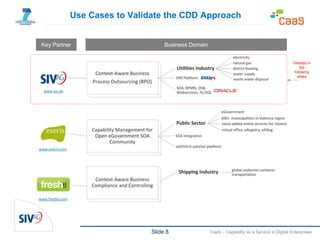
The project is driven by three use cases from different business domains that act as
a means of guiding, validating, and revising the CDD approach.
Motivation cont.
Slide 6 CaaS – Capability as a Service in Digital Enterprises
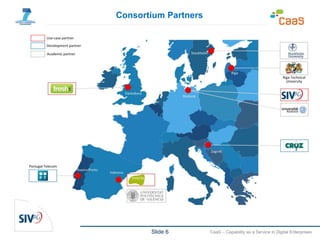
Consortium Partners
Slide 7 CaaS – Capability as a Service in Digital Enterprises
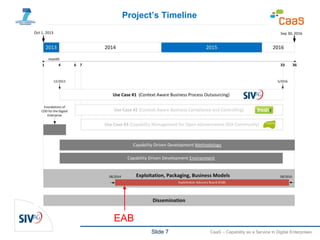
Project’s Timeline
EAB
Slide 8 CaaS – Capability as a Service in Digital Enterprises
Use Cases to Validate the CDD Approach
Key Partner Business Domain
Detailed in
the
following
slides
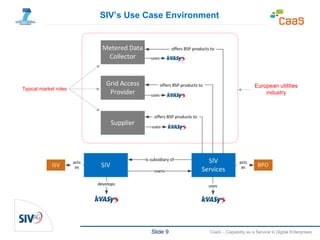
Slide 9 CaaS – Capability as a Service in Digital Enterprises
SIV’s Use Case Environment
Typical market roles
European utilities
industry
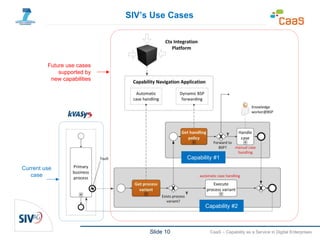
Slide 10 CaaS – Capability as a Service in Digital Enterprises
SIV’s Use Cases
Current use
case
Future use cases
supported by
new capabilities
Capability #2
Capability #1
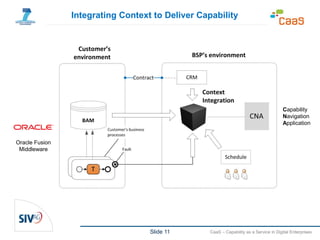
Slide 11 CaaS – Capability as a Service in Digital Enterprises
Integrating Context to Deliver Capability
Capability
Navigation
Application
Oracle Fusion
Middleware
Slide 12 CaaS – Capability as a Service in Digital Enterprises
Exploitation Advisory Board
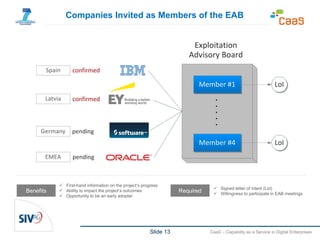
Slide 13 CaaS – Capability as a Service in Digital Enterprises
Companies Invited as Members of the EAB
Benefits
 First-hand information on the project‘s progress
 Ability to impact the project‘s outcomes
 Opportunity to be an early adopter
Required  Signed letter of intent (LoI)
 Willingness to participate in EAB meetings
Slide 14 CaaS – Capability as a Service in Digital Enterprises
SIV.AG
Konrad-Zuse-Str.1, 18184 Roggentin, Germany
Jan-Christian Kuhr • Enterprise Architect • jan-christian.kuhr@siv.de •
Tel +49 381 2524-2836 • Skype: janchristiankuhr
Ulrich Czubayko • Manager Strategic Product Development •
ulrich.czubayko@siv.de • Tel +49 381 2524-1501
Thomas Donath • CEO of SIV.A&T • thomas.donath@arch-tech.de •
Tel +49 381 2524-2801
Contact

CaaS: Explotation Overview

  • 1.
    Slide 1 CaaS– Capability as a Service in Digital Enterprises Capability as a Service in Digital Enterprises Brief Overview of the CaaS Project for Invited Members of the Project’s Exploitation Advisory Boad (EAB) June 26, 2014 Jan-Christian Kuhr ● SIV.AG jan-christian.kuhr@siv.de
  • 2.
    Slide 2 CaaS– Capability as a Service in Digital Enterprises Purpose and Intended Audience This document gives a brief overview of the „Capability as a Service“ research project. It takes the reader on a tour through the project’s motivation, structure, its subject matter, scope, and intended outcome. The intended audience is any organization or enterprise that is interested in contributing to the CaaS initiative, particularly those that are invited to the exploitation advisory board (EAB). The document contains information about  motivation and principal approach of capability driven development (CDD)  project structure and timeline  use cases  SIV’s use case  exploitation advisory board Confidentiality This document is confidential material and property of SIV.AG. Its content may not be reproduced or disclosed without prior written permission by SIV.AG. © SIV.AG (2014). All rights reserved
  • 3.
    Slide 3 CaaS– Capability as a Service in Digital Enterprises  Acronym CaaS  Full title Capability as a Service in Digital Enterprises  Website http://caas-project.eu  Funded by 7th Framework Programme (FP7) of the European Commission, ICT Programme  Project Collaborative research and development project  Duration Sep 1, 2013 – Aug 30, 2016  Goal Shift from service-oriented paradigm to a capability delivery paradigm  Drivers Use cases from different industries and business domains  Consortium 5 partners from industry plus 4 academical partners Key Facts
  • 4.
    Slide 4 CaaS– Capability as a Service in Digital Enterprises The capabilities of an enterprise represent one factor that often determines competitive advantage and provides business value. Capabilities refer to essential functions of the enterprise that link business goals to business processes, resources and actors. These capabilities are mapped onto IT solutions, such as software services that in turn are delivered to customers. Aligning an enterprise’s capabilities to the provision of its services is far from being a straightforward task, especially nowadays where the dominance and volatility of the Internet shifts the problem solving focus, from upfront predictable designs to identifying and capitalising on emerging and instantaneous business opportunities. Operating in the modern digital business world increases the importance of business agility. It is essential for modern information systems to have the capability to constantly deliver business value depending on ever changing context situations. Examples of such dynamic context are an enterprise’s business model, business rules, regulation and legislation, location, resource pricing and demand forecast as well as user preferences and past activities. Motivation
  • 5.
    Slide 5 CaaS– Capability as a Service in Digital Enterprises The main goal of the CaaS project is to bring about a shift from the service-oriented paradigm to a capability delivery paradigm. To this end, the CaaS project will deliver the Capability Driven Development (CDD) approach that will allow digital enterprises to exploit the notion of capability as a means of both service design and service operation. CDD will comprise  modelling languages for representing enterprise designs, context models, and patterns,  a methodology for detailing how capabilities may be specified and how these may be used for designing new services,  reusable best practices and capability delivery patterns,  algorithms for dealing with business context awareness and service re- configuration,  a tool environment for modelling, design and delivery, and  a set of case studies demonstrating the applicability of the CDD approach. The project is driven by three use cases from different business domains that act as a means of guiding, validating, and revising the CDD approach. Motivation cont.
  • 6.
    Slide 6 CaaS– Capability as a Service in Digital Enterprises Consortium Partners
  • 7.
    Slide 7 CaaS– Capability as a Service in Digital Enterprises Project’s Timeline EAB
  • 8.
    Slide 8 CaaS– Capability as a Service in Digital Enterprises Use Cases to Validate the CDD Approach Key Partner Business Domain Detailed in the following slides
  • 9.
    Slide 9 CaaS– Capability as a Service in Digital Enterprises SIV’s Use Case Environment Typical market roles European utilities industry
  • 10.
    Slide 10 CaaS– Capability as a Service in Digital Enterprises SIV’s Use Cases Current use case Future use cases supported by new capabilities Capability #2 Capability #1
  • 11.
    Slide 11 CaaS– Capability as a Service in Digital Enterprises Integrating Context to Deliver Capability Capability Navigation Application Oracle Fusion Middleware
  • 12.
    Slide 12 CaaS– Capability as a Service in Digital Enterprises Exploitation Advisory Board
  • 13.
    Slide 13 CaaS– Capability as a Service in Digital Enterprises Companies Invited as Members of the EAB Benefits  First-hand information on the project‘s progress  Ability to impact the project‘s outcomes  Opportunity to be an early adopter Required  Signed letter of intent (LoI)  Willingness to participate in EAB meetings
  • 14.
    Slide 14 CaaS– Capability as a Service in Digital Enterprises SIV.AG Konrad-Zuse-Str.1, 18184 Roggentin, Germany Jan-Christian Kuhr • Enterprise Architect • jan-christian.kuhr@siv.de • Tel +49 381 2524-2836 • Skype: janchristiankuhr Ulrich Czubayko • Manager Strategic Product Development • ulrich.czubayko@siv.de • Tel +49 381 2524-1501 Thomas Donath • CEO of SIV.A&T • thomas.donath@arch-tech.de • Tel +49 381 2524-2801 Contact