CNN.com - Transcripts
Return to Transcripts main page
QUEST MEANS BUSINESS
A Reluctant Recovery?; U.S. Troops End Combat Mission in Iraq
Aired August 31, 2010 - 14:00:00 ET
THIS IS A RUSH TRANSCRIPT. THIS COPY MAY NOT BE IN ITS FINAL FORM AND MAY BE
UPDATED.
RICHARD QUEST, HOST, QUEST MEANS BUSINESS: It's a reluctant recovery. High
unemployment, weak demand, holding back growth; we have the numbers.
Iraq's political and economic future, U.S. troops ending combat mission.
And Gmail's priority e-mails. Changing the way we tackle the inbox.
I'm Richard Quest. We have an hour together. Put that BlackBerry down, because I mean business.
Good evening.
It is the last day of August. And even as we look forward to the autumn months in the Northern
Hemisphere there is lots of economic news that shows it is going to be a change of economic season
as much as the meteorological one.
Tonight, we will also get the behind the scenes minutes from the U.S. Federal Reserve. The Fed
minutes are due out any time now. They will reflect what policymakers decided on August the 10th,
when they agreed to reinvest the maturing securities back into other securities, to maintain the
monetary stance. They held the interest rates close to zero and the market is over 10,000 in New
York at the moment; 10,000 and change, we'll obviously see as those minutes come out exactly how
the market digests.
But there was a lot of other economic data from different continents that we need to get to grips
with over in the library. For example, start with Euro Zone unemployment, 10 percent, not sign of
recovery on the number. The July number was unchanged. It has been pretty much unchanged now
for the past three or four months. But the core point is the spread of unemployment between those
countries that are doing better, for example, Germany and the Southern European countries, Spain,
over 20 percent and so forth; the U.K. around about 7 or 8 percent. But the overall Euro Zone, E16
is at 10 percent.
Japan made a lot of noise and news as we had the fiscal stimulus plan from the Japanese
government. It followed on from the minor monetary stimulus that we saw from the Japanese central
bank. But the Nikkei, 225, closed down 3.5 percent. Now that is a ringing, if you like, kick in the
teeth amongst other places, to those measures. It clearly implies that not only are we under 9,000 or
10,000 on the Nikkei, but it clearly shows just a lack of enthusiasm at the those measures, and
against the dollar, 84 Japanese yen. The 15-year high is about 83 and change. So it is very close to
that level at the moment. The dollar and the yen remains unrealistically high vis-a-vis the strength of
the Japanese economy. And it is that that is worrying people at the moment. As Andrew Stevens now
reports, from Hong Kong.
(BEGIN VIDEOTAPE)
ANDREW STEVENS, CNN FINANCIAL CORRESPONDENT (voice over): Japan was once the land of
permanent employment, jobs for life. Not now.
IT worker Hiroaki Akao has been looking for the past six months, but no one is hiring.
"Five years ago," says Akao, "it was easy to move around. Not now, though. Companies aren't
recruiting because their sales are weak," he says.
Japan's unemployment rate may not seem bad by Western standards. At 5.2 percent just a little more
than half the U.S., but that masks a dangerous divide.
JEFF KINGSTON, AUTHOR, CONTEMPORARY JAPAN: Maybe 20 million of Japan's 65 million
workers are working on insecure, low-paid jobs, with minimum benefits.
STEVENS: This is Japan's new normal. The industrial powerhouses that once virtually guaranteed
jobs now look for temporary, easy to fire workers because there is less confidence in the future. And
that stops people spending, which in turn triggers falling prices in the shops and that then eats into
corporate profits. A vicious cycle, a deflationary spiral that now grips Japan.
Stimulus packages appear to make little difference in the long run. Some experts believe that Japan,
which has still not recovered from the bursting of the bubble in the late 1980s, is facing another
recession.
KINGSTON: I think that there is certainly a risk here of a double-dip recession. And you know, we
haven't really seen any signs or prospects that Japan is going to rebound. It has been stagnant for
two decades. It is really hard to see the sources of growth.
STEVENS: That is a view shared by business leaders across the board. Soichiro Minami runs a job
recruitment Web site with more than 38,000 job seekers on his books.
SOICHIRO MINAMI, CEO, BIZREACH: The status quo isn't going to get us anywhere. We need some
drastic measures to change or reform this country. There is not much growth left in this country, but
there is definitely a lot of growth outside of Japan, especially in the Asian region.
STEVENS: In 1989 Japan's red hot economy was showing all the signs of a bubble. In the middle of
that year that bubble burst. It led to the so- called lost decade of economic growth. In fact, it has
been two lost decades; 21 years later the stock market is still more than 75 percent below its 1989
high. And property prices are 40 percent below their high.
And if the investor reaction to this week's latest round of stimulus measures is anything to go by,
there is a chance that Japan may be facing a third lost decade.
(END VIDEOTAPE)
QUEST: Andrew Stevens reporting there.
Now, Peter Morici is the professor of international business at the University of Maryland. Peter
joins us now from CNN Washington.
Peter, I have the minutes, of the Fed meeting before me. The vote was-the vote we know was just
one against maintaining the stance and the repurchase of more securities, but if you look at the
detail, and it is very detailed unfortunately.
Peter, there does seem to be internal disagreement within the Fed, over whether or not this is the
right way to proceed, short to medium term.
PETER MORICI, PROF. INT'L. BUSINESS, UNIV. OF MARYLAND: Absolutely. There's real concern
there that all the money the Fed is printing and all the debt Washington is taking on, that inflation
will be the long-term legacy of the Great Recession. So there is some reticence about doing anything
more.
QUEST: What about these data that we're talking about today? The Fed minutes, Japan's minor
stimulus which has had a rousing thumbs down, and European unemployment remaining stubborn at
10 percent. Are we moving into this next phase of the great recession?
MORICI: I believe that we are. You know, the global economy is growing at more than 3 percent a
year. But all the growth is in China, India, places like that, or places where there is a lot of mineral
resources.
The bottom line is, it is not whether the yen is overvalued against the dollar, or the dollar against the
euro, all three of those currencies are terribly overvalued against the Chinese yuan. And what's
more, China is practicing some very nasty mercantilist practices that are hogging all the growth
onto the mainland of Asia, and essentially slowly suffocating the Western economies.
QUEST: But, but, but-
MORICI: It's the wrong thing to worry about.
QUEST: But where does that take us, if you like, on the trans- Atlantic economy? Are we destined, as
the season changes, Peter, are we destined to six months a year, two years, of subpar anemic
growth?
MORICI: Until we redress the trade imbalance with China, yes. All we're talking about is shifting the
unemployment around. You know, Germany is doing well, because we forced austerity on Greece.
But the reality is the Euro Zone as a whole is doing poorly it is just that Germany is the export-
oriented member of the group, so that with a weaker euro it does a little better. But it snatches that
growth out of the American Midwest.
QUEST: Right, but you have been a very vocal critic of the Obama administration's stimulus
package. Even bearing in mind that it is now starting to wear down, surely there is a call for another
package of sorts?
MORICI: Well, what we've seen is that stimulus doesn't work. You know, they say they've lowered
unemployment by 1.5 percentage points. Those calculations are very, very questionable. But even if
they did, does that mean the new normal is 10 percent? I mean, we already have a $1.5, or $1.4
trillion deficit, almost 10 percent of GDP. How much more money is he going to borrow from China
to essentially waist on his hobby horses and fantasies.
QUEST: But you know as well as I do that in these difficult economic times, monetary and fiscal
stimulus is the only game in town if you are not going to go over-
MORICI: That's not true.
QUEST: If you are not going to go over a cliff.
MORICI: That's not true. That is not true. There are three legs to macro policy. There is monetary
policy, which is all played out. There are no more bullets left in the Fed. There is fiscal policy, which
is all played out, 10 percent deficit.
There is the exchange rate, which is not played out. We're in a fixed exchange rate system with
China. Economic theory tells us if you have an overvalued currency in a context like this you will get
deflation. Deflation can be falling prices, or it can be falling output. Right now we're getting more of
a falling output than we're getting of falling prices.
If this president, and if the European leaders, don't get together and stand up to China, China will
continue to grow at 10, 11, even 12 percent a year, while the Western economies suffocate. The
world economy grows from 3 to 4 percent a year most years. The question is where does that growth
go? It is all being selfishly hogged by China, and to a lesser extent India.
QUEST: And we'll talk about India later in the program. It's had a number at 8 percent.
Peter, wonderful to have you in a robust-one thing we can say, our discussions are robust, even if the
economy may not be.
MORICI: Indeed. Indeed, my friend.
QUEST: Nice to see you.
Peter Morici, joining me there.
Now, the stocks at the Europe close and how they finished the day. Modest gains in all the major
indices. Mining shares performed well. Look at that, Rio Tinto, up 2.3 percent. BHP Billiton, 1.8
percent. The drug maker Bayer, top performer on the DAX, 2.4. Study praises its new anti- clotting
drug, rivaroxaban, which I'm sure I've mispronounced. At least since I'm not a user.
Now the end of an era is approaching. Hours away from the end of the United States combat role in
Iraq, we'll be in Baghdad in just a moment.
And those major defense projects? Will they survive austerity?
(DESK BELL CHIMES)
(COMMERCIAL BREAK)
QUEST: In less than three hours from now the United States combat role in Iraq formally comes to
an end. And in the seven years of conflict more than 4,000 U.S. troops have been killed. The U.S.
Department of Defense put the cost of the war effort to the American taxpayer, at $748 billion.
Remember the stimulus package that was introduced ahead of the Great Recession was $787 billion.
Michael Holmes is in Baghdad, the heart of the hand over ceremony.
Michael, one of the things I've not been able-we'll get to the economic issues in a second. But one of
the things I've not been able to gauge in recent days: How much of what we're going to see, and the
decision is symbolic, since there are still 10s of 1,000s of non-combat troops there?
MICHAEL HOLMES, CNN INT'L. CORRESPONDENT: Yes, that is right, Richard. I mean we've been
saying this for a while, too. It was such a big deal, particularly in the U.S. It was the end of the
combat phase of the whole mission. That last combat brigade crossing over into Kuwait. And there
were a lot of people who thought, well, that's it. I've just been out on embed, in the north of the
country, and there are a lot of soldiers there who are a bit annoyed, quite frankly. They're all tooled
up. They are still going out on missions. They are still going out on patrols with Iraqi security forces.
End of combat mission does not mean end of combat.
I was talking to a colonel up there, and he said he fully expects to have more casualties over the next
12 months. They are out there, they are training the Iraqi forces. They are out there; they are able to
carry out unilateral missions, if they feel there is a threat, or something that they need to go after.
Yes, it really is a symbolic thing. Yet, the troops are under 50,000. But that doesn't mean there is not
going to be anymore shooting involving U.S. forces.
QUEST: Now, economically, or at least from what one can see-how-I mean, I know it is difficult to
generalize, but how much of the economy that you have seen and that you have experienced on your
recent visits to Iraq. How much of that is still defense or foreign state related versus any natural
economic activity getting underway, business activity?
HOLMES: Oh, vastly, it has dominated by that. On the local level you see a vibrant economy when it
comes to some of the markets. And the very sort of basic commodities that you see on the streets,
very vibrant, prices are low. In some of the markets prices are high when it comes to things like
bread. You know, it is interesting there is 30 percent unemployment here. That is the government
figure. A lot of people think it is a lot higher, that, in reality.
And a lot of the jobs that are being created, if you like, they are in the security forces. That is the big
business at the moment, the Iraqi army, the Iraq police, recruiting for those services. That doesn't
pay that well, a few $100 a month. You have the infrastructure issues here, which is still when it
comes to things like electricity and sewage systems, woeful. You know, if you are earning a few $100
a month, you want electricity for more than four hours a day, go out and buy yourself a generator.
And you can spend a couple of 100 bucks fueling that generator.
So, you can see that economically things are still very, very dire for a lot of Iraqis. There is money to
be made in reconstruction, of course, the oil industry, of course. Average person on the street, really
struggling, Richard.
QUEST: Michael Holmes in Baghdad, who will be up late this evening to watch that hand over
ceremony.
The international drawdown from Iraq is coinciding with an age of austerity. Consequently many
cash-strapped Western countries, are slashing defense budgets. And the tricky part is maintaining
military might and cutting costs.
Now, take a look, for example, Robert Gates, of the U.S. wants to save $100 billion over the next five
years. He proposes cutting at least 50 generals and admirals and eliminating joint forces. Germany
is cutting 10.5 billion by 2014. Italy, 10 percent, the U.K. is cutting helicopter fleet, thinning the top
ranks. It hopes to slash the budget, well, the numbers could be between 10 and 20 percent. Britain
and France are talking about sharing aircraft carrier capability. The plan could be unveiled by Prime
Minister Cameron and President Sarkozy in November. (UNINTELLIGIBLE) the downgrading of a
$10 billion construction of two royal navy carriers.
On the other big projects, Trident is costed at $30 billion to replace the nuclear submarine fleet.
A400M transporter has cost overruns. Countries are thinking of pulling them back. And the U.S.
refueling tanker fleet is an operation worth $30 to $40 billion. That could also be under question.
Are the world leaders right to cut back their defense budgets. Ian Godden is the executive chairman
of ADS, the trade organization representing the U.K. aerospace, defense security, and space
industry.
IAN GODDEN, EXEC. CHAIRMAN, ADS GROUP: Good evening.
QUEST: Basically, when we look at the spending, and the major projects, they're not all going to
survive the spending rounds are they?
GODDEN: No, I mean, I think it is true that defense has to take its fair share of the austerity
pressure on governments. It is complicated for two reasons and particularly in Europe. The U.S. has
spent considerable money more in the last decade. But Europe has stayed fairly static. And therefore
Europe has still got a big issue about whether it can continue to modernize and continue to develop
its defense industry at the same time as squeeze it.
QUEST: But in many ways spending, even after the recession, has returned to almost 2008 pre-
levels. The graph does show that spending has now returned in many cases.
GODDEN: Well, I think, if you put it in context of GDP and the economy as a whole. The U.K. spends
about 2.2 percent on GDP on defense, whereas the U.S. has about just over 4. And we have been at
that sort of level for the last 20 years. Where other government departments have been increasing
significantly over the last decade. So, I think the context, historical and relative, needs to be proved
(ph).
QUEST: It would be somewhat surprising if you suggested that there should be, you know, swinging
cuts, bearing in mind your home constituency is the defense industry.
GODDEN: Yes.
QUEST: But where do you think the cuts need to come?
GODDEN: Well, there are operational cuts. I think there is some efficiency. Secondly, I think there is
some potential for the government to outsource more and actually make beneficial savings. I think
the industry is ready for that debate. The government must decide it is the right thing to do and
debate about how to do that. And the industry itself needs to cooperate more. I mean, clearly this
Anglo-French initiative that is in the papers at the moment, is an example.
QUEST: But is it realistic for the French to be building carriers? For the U.K. to be building carriers?
For the A400M to be bought in large numbers? Then the joint strike fighter, we could go on, the
Trident replacement-we could go on and on?
GODDEN: No, I mean, something has to give.
QUEST: Something has to give. So what gives?
GODDEN: Well, at the current level I think these are-we are talking about future programs. Clearly
volumes will be looked at very carefully. The capability that each of those big programs provides is
essential for U.K. and Europe. So, it is very difficult to say all these programs can be reviewed and
you can say, well, you can eliminate this one or that one. We need a navy. We need an aircraft
carrier capability. We need military aircraft. We need the Trident, if you assume that sort of security
requirement.
QUEST: So as we head, in the U.K., towards the defense-well, the spending review in October.
GODDEN: Yes.
QUEST: Are you fearful that the swingeing axe will be taken to the defense industry?
GODDEN: Well, the defense, what do you mean by swingeing axe?
QUEST: 20 to 25 percent?
GODDEN: Well, that would be a serious damaging affect, I think, on the industry. Not just for the
industry, itself, but for companies looking at inward investing in the U.K., because the U.K. has a
tremendous record. It is the No. 2 in the world. A tremendous defense exports record. And it's a
capability that is second to none in Europe. But we're No. 1 in Europe. So, that in itself, if that is a
signal of what the U.K. wants to say to the rest of the world about what our industrial base will be
like, then yes, of course, governments can do that. But that is a major signal which I think would be
very damaging for the country and very damaging for industry.
QUEST: Ian Godden, many thanks, indeed.
GODDEN: Thanks very much.
QUEST: Now, when we come back in a moment, a nose for business. Literally how you can go from
clothes to bags to scents. It is the chief executive of the company Guess? And he rang the opening
bell on the New York Stock Exchange. We'll hear from him after the break.
(DESK BELL CHIMES)
Trading stocks in New York pretty much near the flat line; investors are looking at the consumer
confidence numbers. They have just received the Fed minutes from the last meeting on August the
10th. The minutes show that the Fed is divided on the question of the best way forward at the
moment, but agrees that only further action will be taken if there is an appreciable decline in
economic activity. What Ben Bernanke subsequently described as a significant deterioration.
Alison Kosik on the floor of the exchange.
Good, Lord. Alison, your standing in splendid isolation. It is a quiet day on the exchange. Is that an
indication of the market today?
ALISON KOSIK, CNN FINANCIAL CORRESPONDENT: It is. Volume is pretty light today. You know
this is pretty typical the week before the Labor Day holiday, which of course, is next week.
You know talking about the minutes that just came out from the FOMC. You know, we did see a pop
in the markets right when the minutes came out, but we are seeing the Dow now go toward the flat
line. Wall Street not completely convinced about what the Fed members had to say. You know, they
are worried that if there is a second stimulus package taken out and put out into the economy. There
are huge worries about the deficit, of course, Richard.
QUEST: Traditionally, I mean, we leave August behind, never particularly a good month for the
market. We go into September, which is an odd month, and we dread October.
KOSIK: Yes, those are typically, September and October, difficult months, but you know August has
been a really rough month as well. I mean, going into today, the Dow and SP 500 are both down 4
percent. The Nasdaq down almost 6 percent. You know, you compare that to July when the blue
chips gained more than 7 percent. I mean, what you are looking at is a lack of confidence in the
economy. Especially we go back to the same old rules here, jobs. We need to see the number of jobs
increase in this economy, Richard.
QUEST: But I was looking at the-if you look at the Dow from its recent high, to where we are today.
That is a fall of about 10 percent from the high point to where we are today. So, that is a classic
correction, isn't it?
KOSIK: We're getting toward that point. I mean, you know, what really could turn things around,
Richard, is if we get a really good jobs report on Friday. But you know, things aren't looking too
great. You know we are looking at a loss of over 100,000 jobs for the month. We are expecting to see
the unemployment rate tick up a little bit. So you know, that really is going to be the deciding point,
but it could also cause the market to go even further down into negative territory. I mean just today
at the opening bell, we saw the Dow drop below 10,000 only to go back up, just barely. We may end
in the negative today. We're at 10,017 at this point. We may keep going lower, Richard.
QUEST: Well, don't touch any buttons. Don't do any damage and we'll speak to you tomorrow. Many
thanks.
KOSIK: I'll try not to.
QUEST: Please don't.
KOSIK: You got it.
QUEST: Many thanks.
Now, oh dear, sexy florals? Oriental undertones? Could this be the sweet smell of success? We have
the chief exec of Guess?, the founder Maurice Marciano. He rang the bell at the New York Stock
Exchange and we talk to him.
(BEGIN VIDEO CLIP)
MAURICE MARCIANO, CHAIRMAN, FOUNDER, GUESS? INC.: We are doing very well in Europe. I
mean, we are lucky, because the brand there is very exclusive. We are not implanted in Europe as
much as we are here, in the States. And in the States we have the biggest (UNINTELLIGIBLE), we
have the experience is in the United States, where the economy has really slowed down and the
consumer has really not been spending the way they have been spending before.
QUEST: I noticed your margin percentage is down. But at some point, obviously, you'd like to
increase the margins. So, you are having to contain costs and contain prices?
MARCIANO: That is correct. And in order to do that we are-what we are doing is we are
consolidating all of our vendor base in order to have much better costs, protecting the quality all of
the time, of course. But bringing the best value that we can bring to our customers.
QUEST: And in this environment is it wise to continue the expansion in Europe when we know
Europe is about to hit this austerity-this austerity from north to south. So why are you still
continuing that policy?
MARCIANO: For us, our brand, we are very, very luck, maybe blessed. You know that our brand is a
lifestyle brand. And we are established globally. And we have so many products. And the assortment
of product is really bringing a lot of customers in the stores. I think you are in London and we just
opened our new store on Knight's Bridge, just across from Harrod's. And that store is way ahead of
our expectations. So we are very happy about it.
QUEST: You are ringing of the opening bell. You are moving into fragrances. What-is this wise to
move away from a apparel?
MARCIANO: We are not moving away from apparel at all. Apparel still is the mainstay of our
business. But we are just-what we are doing is we are complementing the apparel with the all the
other products which are going well with the apparel. So that is why we have a very strong business
in watches, in handbags, in footwear, in jewelry. I wear all these. They are complementing what I
was mentioning before, the lifestyle of our brand. And now we are, you know, it is the fragrance. We
are all very excited about it, because, Guess? is, you know, our image is all about the sexy woman.
And now we have the fragrance to complement that.
QUEST: Before they decided on the fragrance, did you have to say you liked it?
MARCIANO: I do like it. I, you know, I -- as they were developing it, we were -- we were -- we're
doing that with our fashion (INAUDIBLE). And they -- they've done a fantastic job. And the fragrance
is beautiful. The fragrance is what I would call a sexy floral and with oriental undertones. That's the
fragrance.
(END VIDEO TAPE)
QUEST: If somebody can describe to me a smell, sexy florals and oriental undertones -- when we
come back in just a moment, it does conjure up -- you've got to admit, it's evocative of something. I'm
not sure which.
When we come back in just a moment, the iPhone -- forget -- look, could it replace the stethoscope?
A doctor's calling in just a moment.
And the new cyber tool designed to specify the e-mail box, in just a moment.
Sexy floral undertones.
(COMMERCIAL BREAK)
QUEST: Hello, I'm Richard Quest, QUEST MEANS BUSINESS.
This is CNN. And here, the news always comes first.
Israeli medical sources in the army say four Israelis have been killed in a shooting in the West Bank.
It happened near Hebron. The sources say two men and two women from an Israeli settlement were
killed. One of the women was pregnant. The violence comes just days ahead of long-awaited talks in
Washington between Israeli and Palestinian leaders.
A tavern in Mexico has become a deadly inferno and police are investigating a petro bomb attack
earlier today on a Cancun bar. Eight employees were killed. Four died of burns; the others of
asphyxiation. There are reports the bar was targeted in at least two attempts of extortion by a drug
cartel. The tavern is five kilometers from Cancun's tourist beaches.
In other headlines, the U.S. military's combat mission in Iraq officially ends less than three hours
from now. In an address to the nation, the Iraqi prime minister, Nouri al-Maliki, praised Iraqi
security forces, saying their efforts made the U.S. troop drawdown possible. President Barack
Obama will mark the transition with a televised speech later today from the Oval Office.
Experts from the space agency, NASA, are in Chile now to advise officials on how to keep 33 trapped
miners healthy and content in their cramped shelter. It's expected to take three to four months to
reach them with an escape shaft that's being drilled. Drilling began on Monday. The mining
company says the men are in good spirits and looking forward to receiving first solid fuels.
Dutch officials are expected to decide within days whether to charge or release two Yemeni men
arrested at Amsterdam's Schiphol Airport. They're being held on suspicion of plotting a terrorist act
because of items found in their luggage. Two U.S. officials are downplaying the incident, saying
there's no evidence of terrorism or even that the men knew each other.
And one bit of news just in to CNN, the actress, Zsa-Zsa Gabor has been taken to a hospital in Los
Angeles after her husband discovered her unresponsive on Tuesday morning. There are no further
details on Miss. Gabor's condition. Obviously, when we hear, we'll bring it to you. Zsa Zsa Gabor in
Los Angeles. Those are aerials of her house that are now being broadcast.
A two week strike that crippled South Africa could soon be over. Or there again, maybe not.
Confusion as unions are telling CNN the government has upped its public sector wage increase offer
to 7.5 percent. The union members now will vote on whether they will accept that. The workers are
upset at the amount of money spent on the World Cup. President Zuma has ordered negotiations to
begin from both sides.
Nima Elbagir takes a closer look at the situation.
(BEGIN VIDEOTAPE)
NIMA ELBAGIR, CNN CORRESPONDENT (voice-over): Soccer City -- an icon of South Africa's
triumphant World Cup. The stadium now stands empty. But it's become representative of the
growing tensions between South Africa's government and its workers.
Two weeks into the crippling strikes that are polarizing the country, the trade unions are demanding
to know why, after all that was spent on the World Cup, there's no money left for them.
JOE MPISI, TRADE UNION ACTIVIST: We -- we supported the World Cup. However, the country
should also put the -- the public servants first in their approach. You can understand the anger on
the ground. Currently members are not happy with what they see.
ELBAGIR: But these sentiments go deeper than the masked ranks of disgruntled municipal workers
manning the picket lines. They go right to the heart of the alliance that brought President Jacob
Zuma into power. Casarta (ph), the South African trade union body, had partnered with the ruling
party and supported Zuma. But the mistrust that has grown over the government's handling of these
strikes has led to a noticeable cooling in relations between the president and union bosses.
ZWELINZIMA VAVI, CONGRESS OF SOUTH AFRICA TRADE UNIONS: They obviously are putting
him under pressure. And that may cause strain in the relationship. I really don't care, because I
think it is for his own good. Personal relationships can be damaged in the process. That must be
avoided. But the issue is that the -- the leadership must respond.
ELBAGIR (on camera): What does this mean for the relationship between the alliance and President
Zuma's government?
VAVI: I am disappointed that the government has not in any way demonstrated a sense of urgency.
ELBAGIR (voice-over): And on the picket lines, that disappointment is eroding support for the
president and the ruling party.
MPISI: It's unfortunate. Next year, we're going to the local government elections. Do you think these
workers will be happy to -- to go out if they are not happy?
No, they won't.
ELBAGIR (on camera): And the tensions between the government and the trade unions are running
very high. The government has tabled what they say is their final offer -- over 1 percent less than the
trade unions had hoped for. But even if these negotiations are ultimately successful, the concern in
the corridors of power is the damage these three recent weeks and the relationship between
President Zuma and this central pact of his support base.
Nima Elbagir, CNN, Johannesburg.
(END VIDEO TAPE)
QUEST: Going with the work flow, every day, you and I, we are slaves to the tyranny of the digital --
the e-mails that pour in hour after hour. How to handle them, when we come back in just a moment.
G-mail has some suggestions and we'll give you some tips. It's all about getting on top of things.
(COMMERCIAL BREAK)
QUEST: If you're tired of wading through the daily deluge of e-mails, one of the things that everyone
has been talking about today is a cyber tool that automatically moves the items you really want to
read to the top of your in box. G-mail, of course, from the ubiquitous Google, has high hopes for its
new mind-reading feature. The idea is basically to recognize the source of e-mails that you have
developed or that you think are important and push them to the top of the e-mail list.
Someone who knows a thing or two about managing time and whether this is a good idea is David
Allen.
He's the creator of the Getting Things Done management system. Getting Things Done, GTD, is one
of the most well known ways, David, of -- of dealing with these matters.
You join me now from Southern California.
First of all, before we talk about the ways in which we can handle it, what do you think about any e-
mail program that unilaterally believes it can interpret your -- your -- your important e-mails?
DAVID ALLEN, CHAIRMAN, THE DAVID ALLEN COMPANY: Well, there's -- most of the e-mail
programs out there have some at least minor capability of doing that. You know, you can color code
people. When you get an e-mail from that person, they're in green or they're in blue. And that can be
-- that can be helpful, to know which one to pay what kind of attention to first.
I think if -- if -- what you don't want is dictator-ware, where somebody is forcing you to have to look
at something because of some program that may not be appropriate.
QUEST: Right.
How serious -- we -- we've -- you know, since the e-mail -- I mean it's almost like since man first
walked. But since the e-mail first came along, David, we've been bombarded with the problems of
deluge of e-mails.
Is it a real problem?
ALLEN: It can be if you don't make very quick decisions about what that stuff means and you add it
to what I call the huh stacks. You know, you open it up and you go huh, and you put it back, you
know, that's death. You need to learn how to make very quick decisions about what exactly that
means and what exactly, then, you're going to go do with it.
Then, you know, e-mail, it's a two-edged sword. You know, I love -- I've been on it since 1983. So it...
QUEST: Right.
ALLEN: -- it allows me a huge amount of freedom.
QUEST: So...
ALLEN: But you've got to move fast and make decisions.
QUEST: So the one -- I mean what are the decisions you have to make?
Come on, give me some real tips. I like to keep my e-mail box down to about 300 or 400 in the in
box. I suspect you've probably got about five in yours.
ALLEN: It's zero right now. I think there are probably a few that...
QUEST: Oh...
ALLEN: -- that came in since I did it last.
You know, the -- the real trick is, first of all, you have to decide, look, is there anything I need to do
about this e-mail or not, yes or no?
So it is actionable or not?
That's the first executive decision you need to make. And if it's no action, you have to decide, is it
trash or is it something I just want to review later or I just need to file it as reference.
If there is an action on it, you'd better decide what is that next action and if you can actually take the
action right then, the two minute rule is great -- if you can finish something in two minutes, you
should do it right then.
QUEST: You -- the -- the hole in your argument that I just heard was do I need to think about it and
do something later?
That's the one that devils me, that I just let sit in the e-mail box and for -- for a week or two.
ALLEN: That's the dan -- that's the danger part of it. See, if you actually zeroed out your e-mail every
so often. There's some of them that, sure, I don't need to see, but maybe -- maybe on the weekend or
my brain is toast, then I'll just clean up all those other things. Somebody sent me a link to something
and I may or may not want to go do it right now.
So I think it's actually a good idea if you have some integrity with making sure that you don't let the
stuff lie in there and have land mines that blow up on you later on because you didn't deal with it.
So I think it's appropriate to create different kinds of categories of what things mean to you, as long
as you have the integrity to somehow make that agree with your agreements with yourself.
QUEST: David, can we sum up your theory in one word -- you're ruthless in dealing with all of this
stuff?
ALLEN: Yes, but come on, you're going to have to deal with it at some point anyway. So, you know, I
hate that idea of discipline. You know, it sounds like hard work. What you really have to do is just
allow yourself to make decisions when it shows up instead of when it blows up. And that's the
ruthlessness you really need.
QUEST: Getting things done, David Allen, a legend in the productivity world. And we're very grateful
that you've made time to talk to us today.
We'll have you again...
ALLEN: It was my pleasure.
QUEST: -- to help us understand all these things.
We need to just -- one or two of your Tweets that have come in that we (INAUDIBLE).
Woodpecker039: "Now, it would be great to have my work e-mailed separate and on top. I don't
usually organize my e-mail, though. Maybe it's time you started."
"When I forget something important, if I can't recall what it is, it's not important," says the Common
Project.
"Ignore them. If it's that important. You'll pay dearly for your ignorance by the time you realize,"
says Germinai (ph).
Atrichardquest, quest@cnn.com, where you can join in that debate.
When we come back, we're going to stick in the digital world. The office is very passe. These days,
nomads in the digital world are changing the way we go to work -- a new wave of entrepreneurs in
the office-less world.
(COMMERCIAL BREAK)
QUEST: Hearts are racing over a new app that turns the iPhone into the G.P.'s most basic piece of
kit. And now there's a free version of the Smartphone, Stethoscope. Basically, it literally is you take
the phone and you hold it to your heart and you listen. Well, you don't, I don't. I tried it. It was all
very difficult. Frankly, I couldn't even hear me own heart.
But I spoke to the inventor, Dr. Peter Bentley, a PhD, not a medical doctor, incidentally, who joined
me from the University College London.
(BEGIN VIDEOTAPE)
PETER BENTLEY, COMPUTER SCIENTIST, UNIVERSITY COLLEGE OF LONDON: Initially, it was
like an experiment to -- to see what kind of things you can make a device do and how many people
might want it. So to my surprise, the result of the experiment is a flood of inquiries by cardiologists
who say it works really, really well.
QUEST: But why is it better than the old-fashioned stethoscope?
BENTLEY: Well, it turns out, perhaps because of economies of scale -- you know, there are so many
of these devices made...
QUEST: Right.
BENTLEY: The -- the audio hardware inside them is actually superior to the audio hardware inside
medical digital stethoscopes. So it turns out -- and there are research papers on this -- this works
better.
QUEST: This works better than the old, "the doctor will see you now."
BENTLEY: I'm -- I'm not always -- it doesn't work better than the traditional one, but the -- the digital
stethoscope, which is a new instrument that they're trying to sell doctors right now, actually is
slightly inferior -- it costs a lot more but it's slightly inferior to this.
QUEST: Wouldn't you and me be a little horrified if the doctor popped around and said, now, just a
moment while I get me iPhone out, while I...
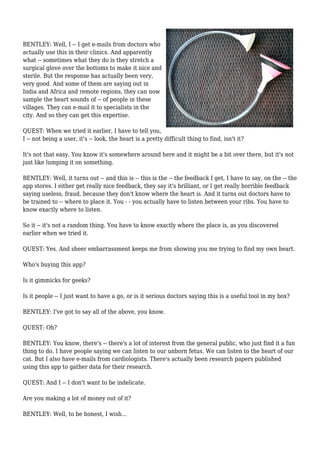
BENTLEY: Well, I -- I get e-mails from doctors who
actually use this in their clinics. And apparently
what -- sometimes what they do is they stretch a
surgical glove over the bottoms to make it nice and
sterile. But the response has actually been very,
very good. And some of them are saying out in
India and Africa and remote regions, they can now
sample the heart sounds of -- of people in these
villages. They can e-mail it to specialists in the
city. And so they can get this expertise.
QUEST: When we tried it earlier, I have to tell you,
I -- not being a user, it's -- look, the heart is a pretty difficult thing to find, isn't it?
It's not that easy. You know it's somewhere around here and it might be a bit over there, but it's not
just like lumping it on something.
BENTLEY: Well, it turns out -- and this is -- this is the -- the feedback I get, I have to say, on the -- the
app stores. I either get really nice feedback, they say it's brilliant, or I get really horrible feedback
saying useless, fraud, because they don't know where the heart is. And it turns out doctors have to
be trained to -- where to place it. You - - you actually have to listen between your ribs. You have to
know exactly where to listen.
So it -- it's not a random thing. You have to know exactly where the place is, as you discovered
earlier when we tried it.
QUEST: Yes. And sheer embarrassment keeps me from showing you me trying to find my own heart.
Who's buying this app?
Is it gimmicks for geeks?
Is it people -- I just want to have a go, or is it serious doctors saying this is a useful tool in my box?
BENTLEY: I've got to say all of the above, you know.
QUEST: Oh?
BENTLEY: You know, there's -- there's a lot of interest from the general public, who just find it a fun
thing to do. I have people saying we can listen to our unborn fetus. We can listen to the heart of our
cat. But I also have e-mails from cardiologists. There's actually been research papers published
using this app to gather data for their research.
QUEST: And I -- I don't want to be indelicate.
Are you making a lot of money out of it?
BENTLEY: Well, to be honest, I wish...
QUEST: Yes. Yes.
BENTLEY: I wish I was making more, but it started out free and, you know, so I -- I could have made
more money. But I do OK out of it.
(END VIDEO TAPE)
QUEST: From PhD candidate in the Google garage to computer kids in the Facebook college room,
fashion entrepreneurs have always found interesting places to launch their empires. We find a new
crop of solutions emerging as designs to help those of us who work on the run.
(BEGIN VIDEOTAPE)
QUEST (voice-over): They are the generation of the office-less. They have nowhere to do their work.
They harbor global ambitions and Richard Leyland is determined to guide them to success.
RICHARD LEYLAND, FOUNDER, WORK SNUG: We'll have a billion mobile workers by the end of
this year. That's one billion mobile workers.
QUEST: And that is a lot of potential users for his app. Leyland's company Work Snug uses
augmented reality -- computer generated images on an app that enhance the world around you. It
shows people the best places to work while on the go. Leyland is part of a new wave of
entrepreneurs hoping to cash in on the office exodus.
LEYLAND: And these days, the city is the office. You can go and work anywhere where you can
connect your laptop and use your phone. So because of that change, there is now a need for a guide
to those places.
QUEST: His app might lead users to a well wi-fi coffee shop or it might take them to a place like this
-- the Hub in London -- another way of capitalizing on these creative nomads. New members join
from $22 per month. Demot Egan founded the Hub in London's Kings Cross in 2008. He wanted a
place where the office-ly challenged could connect and create.
DERMOT EGAN, ENTREPRENEUR: And we're often trying to set up new initiatives and businesses
from their bedrooms and from coffee shops, trying to steal a kind of -- a bit of wi-fi here and there in
kind of random locations. And I think what the Hub is done is it's given them a physical home.
QUEST: In fact, that home has turned into a campus. The Hub brand has been franchised to more
than 20 locations, from San Francisco to Tel Aviv to Johannesburg.
But does it work in practice?
Hugh Carling runs an interaction agency and actually credits the Hub as being good for business.
HUGH CARLING, DIRECTOR, LIVELINE: The Hub enables us to both work remotely with -- with our
freelancers but also to bring them in and so we can all share the same physical space as and when
we need. And the client- based membership of the -- of the Hub enables us to expand and contract
our team according to the projects that we have at any given time, which just means that we can
keep extremely lean.
QUEST: In these lean times, this might be the only instance where workers being out on the street is
actually good for someone's business.
(END VIDEO TAPE)
QUEST: The office-less exodus into the great unknown.
Tropical weather storms are starting to cause some serious issues, hurricanes, typhoons and tropical
storms.
Guillermo Arduino is at the CNN World Weather Center.
Which is the worst and where is it?
GUILLERMO ARDUINO, CNN METEOROLOGIST: It's right here behind me. It's in the Atlantic
Ocean. You see very close to La Hispaniola, this island the Dominican Republic and Haiti share. But
the good thing about this storm is that it's not going to make landfall right now into anywhere,
perhaps in the United States or in Canada we'll see that. Time will tell.
Then we have Fiona behind, a tropical storm, and Danielle here moving into the north. So back to it,
you see it's pretty big. It's a major system. It's a hurricane. You see the winds are very significant.
The question is, is it going to make landfall in the New England states or not?
Well, we don't know. It's a little bit early to say. So we go to the numerical models and they are
suggesting, actually, that it is going to happen. But, of course, as we get into those areas, we -- the
forecast becomes less accurate, you know, according to the numerical models.
When we have to look at Fiona. So far, so good. Bermuda will have to look at it very, very closely.
Again, here are the numerical models.
I don't have any more time, but in Asia, we have three cyclones, Richard, and nice weather in
England, in London, all throughout the week and the weekend.
QUEST: My favorite friend, Guillermo.
Many thanks.
ARDUINO: Thank you.
QUEST: A Profitable Moment is next.
(COMMERCIAL BREAK)
QUEST: Tonight's Profitable Moment.
Ever since e-mail first came along, we've been beset by the tyranny of the digital -- how to handle
the vast and growing number of e-mails that pour in everyday.
Some, like Gali (ph), use complicated colors, stars on prioritizing lists. They use labels to sort out
their e-mails and then they load them into different folders to keep track of them.
Other people spend hours sifting through the barrage, hunched over their computers like battery
chickens.
Then there are those of you who use the ignore method, you know, if it's that important, it will come
back again.
Now, I don't have a system. I just look at the e-mails. I answer some. I ignore others. And I forward
loads to my colleagues. It's called the Richard Quest passing the buck method. It works, a treat.
And that's QUEST MEANS BUSINESS for tonight.
I'm Richard Quest in London.
Whatever you're up to in the hours ahead, I hope it's profitable.
"WORLD ONE" starts now.
END
http://transcripts.cnn.com/TRANSCRIPTS/1008/31/qmb.01.html

CNN.com - Transcripts

  • 1.
    CNN.com - Transcripts Returnto Transcripts main page QUEST MEANS BUSINESS A Reluctant Recovery?; U.S. Troops End Combat Mission in Iraq Aired August 31, 2010 - 14:00:00 ET THIS IS A RUSH TRANSCRIPT. THIS COPY MAY NOT BE IN ITS FINAL FORM AND MAY BE UPDATED. RICHARD QUEST, HOST, QUEST MEANS BUSINESS: It's a reluctant recovery. High unemployment, weak demand, holding back growth; we have the numbers. Iraq's political and economic future, U.S. troops ending combat mission. And Gmail's priority e-mails. Changing the way we tackle the inbox. I'm Richard Quest. We have an hour together. Put that BlackBerry down, because I mean business. Good evening. It is the last day of August. And even as we look forward to the autumn months in the Northern Hemisphere there is lots of economic news that shows it is going to be a change of economic season as much as the meteorological one. Tonight, we will also get the behind the scenes minutes from the U.S. Federal Reserve. The Fed minutes are due out any time now. They will reflect what policymakers decided on August the 10th, when they agreed to reinvest the maturing securities back into other securities, to maintain the monetary stance. They held the interest rates close to zero and the market is over 10,000 in New York at the moment; 10,000 and change, we'll obviously see as those minutes come out exactly how the market digests. But there was a lot of other economic data from different continents that we need to get to grips with over in the library. For example, start with Euro Zone unemployment, 10 percent, not sign of recovery on the number. The July number was unchanged. It has been pretty much unchanged now for the past three or four months. But the core point is the spread of unemployment between those countries that are doing better, for example, Germany and the Southern European countries, Spain, over 20 percent and so forth; the U.K. around about 7 or 8 percent. But the overall Euro Zone, E16 is at 10 percent. Japan made a lot of noise and news as we had the fiscal stimulus plan from the Japanese government. It followed on from the minor monetary stimulus that we saw from the Japanese central bank. But the Nikkei, 225, closed down 3.5 percent. Now that is a ringing, if you like, kick in the teeth amongst other places, to those measures. It clearly implies that not only are we under 9,000 or
  • 2.
    10,000 on theNikkei, but it clearly shows just a lack of enthusiasm at the those measures, and against the dollar, 84 Japanese yen. The 15-year high is about 83 and change. So it is very close to that level at the moment. The dollar and the yen remains unrealistically high vis-a-vis the strength of the Japanese economy. And it is that that is worrying people at the moment. As Andrew Stevens now reports, from Hong Kong. (BEGIN VIDEOTAPE) ANDREW STEVENS, CNN FINANCIAL CORRESPONDENT (voice over): Japan was once the land of permanent employment, jobs for life. Not now. IT worker Hiroaki Akao has been looking for the past six months, but no one is hiring. "Five years ago," says Akao, "it was easy to move around. Not now, though. Companies aren't recruiting because their sales are weak," he says. Japan's unemployment rate may not seem bad by Western standards. At 5.2 percent just a little more than half the U.S., but that masks a dangerous divide. JEFF KINGSTON, AUTHOR, CONTEMPORARY JAPAN: Maybe 20 million of Japan's 65 million workers are working on insecure, low-paid jobs, with minimum benefits. STEVENS: This is Japan's new normal. The industrial powerhouses that once virtually guaranteed jobs now look for temporary, easy to fire workers because there is less confidence in the future. And that stops people spending, which in turn triggers falling prices in the shops and that then eats into corporate profits. A vicious cycle, a deflationary spiral that now grips Japan. Stimulus packages appear to make little difference in the long run. Some experts believe that Japan, which has still not recovered from the bursting of the bubble in the late 1980s, is facing another recession. KINGSTON: I think that there is certainly a risk here of a double-dip recession. And you know, we haven't really seen any signs or prospects that Japan is going to rebound. It has been stagnant for two decades. It is really hard to see the sources of growth. STEVENS: That is a view shared by business leaders across the board. Soichiro Minami runs a job recruitment Web site with more than 38,000 job seekers on his books. SOICHIRO MINAMI, CEO, BIZREACH: The status quo isn't going to get us anywhere. We need some drastic measures to change or reform this country. There is not much growth left in this country, but there is definitely a lot of growth outside of Japan, especially in the Asian region. STEVENS: In 1989 Japan's red hot economy was showing all the signs of a bubble. In the middle of that year that bubble burst. It led to the so- called lost decade of economic growth. In fact, it has been two lost decades; 21 years later the stock market is still more than 75 percent below its 1989 high. And property prices are 40 percent below their high. And if the investor reaction to this week's latest round of stimulus measures is anything to go by, there is a chance that Japan may be facing a third lost decade. (END VIDEOTAPE)
  • 3.
    QUEST: Andrew Stevensreporting there. Now, Peter Morici is the professor of international business at the University of Maryland. Peter joins us now from CNN Washington. Peter, I have the minutes, of the Fed meeting before me. The vote was-the vote we know was just one against maintaining the stance and the repurchase of more securities, but if you look at the detail, and it is very detailed unfortunately. Peter, there does seem to be internal disagreement within the Fed, over whether or not this is the right way to proceed, short to medium term. PETER MORICI, PROF. INT'L. BUSINESS, UNIV. OF MARYLAND: Absolutely. There's real concern there that all the money the Fed is printing and all the debt Washington is taking on, that inflation will be the long-term legacy of the Great Recession. So there is some reticence about doing anything more. QUEST: What about these data that we're talking about today? The Fed minutes, Japan's minor stimulus which has had a rousing thumbs down, and European unemployment remaining stubborn at 10 percent. Are we moving into this next phase of the great recession? MORICI: I believe that we are. You know, the global economy is growing at more than 3 percent a year. But all the growth is in China, India, places like that, or places where there is a lot of mineral resources. The bottom line is, it is not whether the yen is overvalued against the dollar, or the dollar against the euro, all three of those currencies are terribly overvalued against the Chinese yuan. And what's more, China is practicing some very nasty mercantilist practices that are hogging all the growth onto the mainland of Asia, and essentially slowly suffocating the Western economies. QUEST: But, but, but- MORICI: It's the wrong thing to worry about. QUEST: But where does that take us, if you like, on the trans- Atlantic economy? Are we destined, as the season changes, Peter, are we destined to six months a year, two years, of subpar anemic growth? MORICI: Until we redress the trade imbalance with China, yes. All we're talking about is shifting the unemployment around. You know, Germany is doing well, because we forced austerity on Greece. But the reality is the Euro Zone as a whole is doing poorly it is just that Germany is the export- oriented member of the group, so that with a weaker euro it does a little better. But it snatches that growth out of the American Midwest. QUEST: Right, but you have been a very vocal critic of the Obama administration's stimulus package. Even bearing in mind that it is now starting to wear down, surely there is a call for another package of sorts? MORICI: Well, what we've seen is that stimulus doesn't work. You know, they say they've lowered unemployment by 1.5 percentage points. Those calculations are very, very questionable. But even if they did, does that mean the new normal is 10 percent? I mean, we already have a $1.5, or $1.4
  • 4.
    trillion deficit, almost10 percent of GDP. How much more money is he going to borrow from China to essentially waist on his hobby horses and fantasies. QUEST: But you know as well as I do that in these difficult economic times, monetary and fiscal stimulus is the only game in town if you are not going to go over- MORICI: That's not true. QUEST: If you are not going to go over a cliff. MORICI: That's not true. That is not true. There are three legs to macro policy. There is monetary policy, which is all played out. There are no more bullets left in the Fed. There is fiscal policy, which is all played out, 10 percent deficit. There is the exchange rate, which is not played out. We're in a fixed exchange rate system with China. Economic theory tells us if you have an overvalued currency in a context like this you will get deflation. Deflation can be falling prices, or it can be falling output. Right now we're getting more of a falling output than we're getting of falling prices. If this president, and if the European leaders, don't get together and stand up to China, China will continue to grow at 10, 11, even 12 percent a year, while the Western economies suffocate. The world economy grows from 3 to 4 percent a year most years. The question is where does that growth go? It is all being selfishly hogged by China, and to a lesser extent India. QUEST: And we'll talk about India later in the program. It's had a number at 8 percent. Peter, wonderful to have you in a robust-one thing we can say, our discussions are robust, even if the economy may not be. MORICI: Indeed. Indeed, my friend. QUEST: Nice to see you. Peter Morici, joining me there. Now, the stocks at the Europe close and how they finished the day. Modest gains in all the major indices. Mining shares performed well. Look at that, Rio Tinto, up 2.3 percent. BHP Billiton, 1.8 percent. The drug maker Bayer, top performer on the DAX, 2.4. Study praises its new anti- clotting drug, rivaroxaban, which I'm sure I've mispronounced. At least since I'm not a user. Now the end of an era is approaching. Hours away from the end of the United States combat role in Iraq, we'll be in Baghdad in just a moment. And those major defense projects? Will they survive austerity? (DESK BELL CHIMES) (COMMERCIAL BREAK) QUEST: In less than three hours from now the United States combat role in Iraq formally comes to an end. And in the seven years of conflict more than 4,000 U.S. troops have been killed. The U.S.
  • 5.
    Department of Defenseput the cost of the war effort to the American taxpayer, at $748 billion. Remember the stimulus package that was introduced ahead of the Great Recession was $787 billion. Michael Holmes is in Baghdad, the heart of the hand over ceremony. Michael, one of the things I've not been able-we'll get to the economic issues in a second. But one of the things I've not been able to gauge in recent days: How much of what we're going to see, and the decision is symbolic, since there are still 10s of 1,000s of non-combat troops there? MICHAEL HOLMES, CNN INT'L. CORRESPONDENT: Yes, that is right, Richard. I mean we've been saying this for a while, too. It was such a big deal, particularly in the U.S. It was the end of the combat phase of the whole mission. That last combat brigade crossing over into Kuwait. And there were a lot of people who thought, well, that's it. I've just been out on embed, in the north of the country, and there are a lot of soldiers there who are a bit annoyed, quite frankly. They're all tooled up. They are still going out on missions. They are still going out on patrols with Iraqi security forces. End of combat mission does not mean end of combat. I was talking to a colonel up there, and he said he fully expects to have more casualties over the next 12 months. They are out there, they are training the Iraqi forces. They are out there; they are able to carry out unilateral missions, if they feel there is a threat, or something that they need to go after. Yes, it really is a symbolic thing. Yet, the troops are under 50,000. But that doesn't mean there is not going to be anymore shooting involving U.S. forces. QUEST: Now, economically, or at least from what one can see-how-I mean, I know it is difficult to generalize, but how much of the economy that you have seen and that you have experienced on your recent visits to Iraq. How much of that is still defense or foreign state related versus any natural economic activity getting underway, business activity? HOLMES: Oh, vastly, it has dominated by that. On the local level you see a vibrant economy when it comes to some of the markets. And the very sort of basic commodities that you see on the streets, very vibrant, prices are low. In some of the markets prices are high when it comes to things like bread. You know, it is interesting there is 30 percent unemployment here. That is the government figure. A lot of people think it is a lot higher, that, in reality. And a lot of the jobs that are being created, if you like, they are in the security forces. That is the big business at the moment, the Iraqi army, the Iraq police, recruiting for those services. That doesn't pay that well, a few $100 a month. You have the infrastructure issues here, which is still when it comes to things like electricity and sewage systems, woeful. You know, if you are earning a few $100 a month, you want electricity for more than four hours a day, go out and buy yourself a generator. And you can spend a couple of 100 bucks fueling that generator. So, you can see that economically things are still very, very dire for a lot of Iraqis. There is money to be made in reconstruction, of course, the oil industry, of course. Average person on the street, really struggling, Richard. QUEST: Michael Holmes in Baghdad, who will be up late this evening to watch that hand over ceremony. The international drawdown from Iraq is coinciding with an age of austerity. Consequently many cash-strapped Western countries, are slashing defense budgets. And the tricky part is maintaining military might and cutting costs.
  • 6.
    Now, take alook, for example, Robert Gates, of the U.S. wants to save $100 billion over the next five years. He proposes cutting at least 50 generals and admirals and eliminating joint forces. Germany is cutting 10.5 billion by 2014. Italy, 10 percent, the U.K. is cutting helicopter fleet, thinning the top ranks. It hopes to slash the budget, well, the numbers could be between 10 and 20 percent. Britain and France are talking about sharing aircraft carrier capability. The plan could be unveiled by Prime Minister Cameron and President Sarkozy in November. (UNINTELLIGIBLE) the downgrading of a $10 billion construction of two royal navy carriers. On the other big projects, Trident is costed at $30 billion to replace the nuclear submarine fleet. A400M transporter has cost overruns. Countries are thinking of pulling them back. And the U.S. refueling tanker fleet is an operation worth $30 to $40 billion. That could also be under question. Are the world leaders right to cut back their defense budgets. Ian Godden is the executive chairman of ADS, the trade organization representing the U.K. aerospace, defense security, and space industry. IAN GODDEN, EXEC. CHAIRMAN, ADS GROUP: Good evening. QUEST: Basically, when we look at the spending, and the major projects, they're not all going to survive the spending rounds are they? GODDEN: No, I mean, I think it is true that defense has to take its fair share of the austerity pressure on governments. It is complicated for two reasons and particularly in Europe. The U.S. has spent considerable money more in the last decade. But Europe has stayed fairly static. And therefore Europe has still got a big issue about whether it can continue to modernize and continue to develop its defense industry at the same time as squeeze it. QUEST: But in many ways spending, even after the recession, has returned to almost 2008 pre- levels. The graph does show that spending has now returned in many cases. GODDEN: Well, I think, if you put it in context of GDP and the economy as a whole. The U.K. spends about 2.2 percent on GDP on defense, whereas the U.S. has about just over 4. And we have been at that sort of level for the last 20 years. Where other government departments have been increasing significantly over the last decade. So, I think the context, historical and relative, needs to be proved (ph). QUEST: It would be somewhat surprising if you suggested that there should be, you know, swinging cuts, bearing in mind your home constituency is the defense industry. GODDEN: Yes. QUEST: But where do you think the cuts need to come? GODDEN: Well, there are operational cuts. I think there is some efficiency. Secondly, I think there is some potential for the government to outsource more and actually make beneficial savings. I think the industry is ready for that debate. The government must decide it is the right thing to do and debate about how to do that. And the industry itself needs to cooperate more. I mean, clearly this Anglo-French initiative that is in the papers at the moment, is an example. QUEST: But is it realistic for the French to be building carriers? For the U.K. to be building carriers? For the A400M to be bought in large numbers? Then the joint strike fighter, we could go on, the
  • 7.
    Trident replacement-we couldgo on and on? GODDEN: No, I mean, something has to give. QUEST: Something has to give. So what gives? GODDEN: Well, at the current level I think these are-we are talking about future programs. Clearly volumes will be looked at very carefully. The capability that each of those big programs provides is essential for U.K. and Europe. So, it is very difficult to say all these programs can be reviewed and you can say, well, you can eliminate this one or that one. We need a navy. We need an aircraft carrier capability. We need military aircraft. We need the Trident, if you assume that sort of security requirement. QUEST: So as we head, in the U.K., towards the defense-well, the spending review in October. GODDEN: Yes. QUEST: Are you fearful that the swingeing axe will be taken to the defense industry? GODDEN: Well, the defense, what do you mean by swingeing axe? QUEST: 20 to 25 percent? GODDEN: Well, that would be a serious damaging affect, I think, on the industry. Not just for the industry, itself, but for companies looking at inward investing in the U.K., because the U.K. has a tremendous record. It is the No. 2 in the world. A tremendous defense exports record. And it's a capability that is second to none in Europe. But we're No. 1 in Europe. So, that in itself, if that is a signal of what the U.K. wants to say to the rest of the world about what our industrial base will be like, then yes, of course, governments can do that. But that is a major signal which I think would be very damaging for the country and very damaging for industry. QUEST: Ian Godden, many thanks, indeed. GODDEN: Thanks very much. QUEST: Now, when we come back in a moment, a nose for business. Literally how you can go from clothes to bags to scents. It is the chief executive of the company Guess? And he rang the opening bell on the New York Stock Exchange. We'll hear from him after the break. (DESK BELL CHIMES) Trading stocks in New York pretty much near the flat line; investors are looking at the consumer confidence numbers. They have just received the Fed minutes from the last meeting on August the 10th. The minutes show that the Fed is divided on the question of the best way forward at the moment, but agrees that only further action will be taken if there is an appreciable decline in economic activity. What Ben Bernanke subsequently described as a significant deterioration. Alison Kosik on the floor of the exchange. Good, Lord. Alison, your standing in splendid isolation. It is a quiet day on the exchange. Is that an indication of the market today?
  • 8.
    ALISON KOSIK, CNNFINANCIAL CORRESPONDENT: It is. Volume is pretty light today. You know this is pretty typical the week before the Labor Day holiday, which of course, is next week. You know talking about the minutes that just came out from the FOMC. You know, we did see a pop in the markets right when the minutes came out, but we are seeing the Dow now go toward the flat line. Wall Street not completely convinced about what the Fed members had to say. You know, they are worried that if there is a second stimulus package taken out and put out into the economy. There are huge worries about the deficit, of course, Richard. QUEST: Traditionally, I mean, we leave August behind, never particularly a good month for the market. We go into September, which is an odd month, and we dread October. KOSIK: Yes, those are typically, September and October, difficult months, but you know August has been a really rough month as well. I mean, going into today, the Dow and SP 500 are both down 4 percent. The Nasdaq down almost 6 percent. You know, you compare that to July when the blue chips gained more than 7 percent. I mean, what you are looking at is a lack of confidence in the economy. Especially we go back to the same old rules here, jobs. We need to see the number of jobs increase in this economy, Richard. QUEST: But I was looking at the-if you look at the Dow from its recent high, to where we are today. That is a fall of about 10 percent from the high point to where we are today. So, that is a classic correction, isn't it? KOSIK: We're getting toward that point. I mean, you know, what really could turn things around, Richard, is if we get a really good jobs report on Friday. But you know, things aren't looking too great. You know we are looking at a loss of over 100,000 jobs for the month. We are expecting to see the unemployment rate tick up a little bit. So you know, that really is going to be the deciding point, but it could also cause the market to go even further down into negative territory. I mean just today at the opening bell, we saw the Dow drop below 10,000 only to go back up, just barely. We may end in the negative today. We're at 10,017 at this point. We may keep going lower, Richard. QUEST: Well, don't touch any buttons. Don't do any damage and we'll speak to you tomorrow. Many thanks. KOSIK: I'll try not to. QUEST: Please don't. KOSIK: You got it. QUEST: Many thanks. Now, oh dear, sexy florals? Oriental undertones? Could this be the sweet smell of success? We have the chief exec of Guess?, the founder Maurice Marciano. He rang the bell at the New York Stock Exchange and we talk to him. (BEGIN VIDEO CLIP) MAURICE MARCIANO, CHAIRMAN, FOUNDER, GUESS? INC.: We are doing very well in Europe. I mean, we are lucky, because the brand there is very exclusive. We are not implanted in Europe as much as we are here, in the States. And in the States we have the biggest (UNINTELLIGIBLE), we
  • 9.
    have the experienceis in the United States, where the economy has really slowed down and the consumer has really not been spending the way they have been spending before. QUEST: I noticed your margin percentage is down. But at some point, obviously, you'd like to increase the margins. So, you are having to contain costs and contain prices? MARCIANO: That is correct. And in order to do that we are-what we are doing is we are consolidating all of our vendor base in order to have much better costs, protecting the quality all of the time, of course. But bringing the best value that we can bring to our customers. QUEST: And in this environment is it wise to continue the expansion in Europe when we know Europe is about to hit this austerity-this austerity from north to south. So why are you still continuing that policy? MARCIANO: For us, our brand, we are very, very luck, maybe blessed. You know that our brand is a lifestyle brand. And we are established globally. And we have so many products. And the assortment of product is really bringing a lot of customers in the stores. I think you are in London and we just opened our new store on Knight's Bridge, just across from Harrod's. And that store is way ahead of our expectations. So we are very happy about it. QUEST: You are ringing of the opening bell. You are moving into fragrances. What-is this wise to move away from a apparel? MARCIANO: We are not moving away from apparel at all. Apparel still is the mainstay of our business. But we are just-what we are doing is we are complementing the apparel with the all the other products which are going well with the apparel. So that is why we have a very strong business in watches, in handbags, in footwear, in jewelry. I wear all these. They are complementing what I was mentioning before, the lifestyle of our brand. And now we are, you know, it is the fragrance. We are all very excited about it, because, Guess? is, you know, our image is all about the sexy woman. And now we have the fragrance to complement that. QUEST: Before they decided on the fragrance, did you have to say you liked it? MARCIANO: I do like it. I, you know, I -- as they were developing it, we were -- we were -- we're doing that with our fashion (INAUDIBLE). And they -- they've done a fantastic job. And the fragrance is beautiful. The fragrance is what I would call a sexy floral and with oriental undertones. That's the fragrance. (END VIDEO TAPE) QUEST: If somebody can describe to me a smell, sexy florals and oriental undertones -- when we come back in just a moment, it does conjure up -- you've got to admit, it's evocative of something. I'm not sure which. When we come back in just a moment, the iPhone -- forget -- look, could it replace the stethoscope? A doctor's calling in just a moment. And the new cyber tool designed to specify the e-mail box, in just a moment.
  • 10.
    Sexy floral undertones. (COMMERCIALBREAK) QUEST: Hello, I'm Richard Quest, QUEST MEANS BUSINESS. This is CNN. And here, the news always comes first. Israeli medical sources in the army say four Israelis have been killed in a shooting in the West Bank. It happened near Hebron. The sources say two men and two women from an Israeli settlement were killed. One of the women was pregnant. The violence comes just days ahead of long-awaited talks in Washington between Israeli and Palestinian leaders. A tavern in Mexico has become a deadly inferno and police are investigating a petro bomb attack earlier today on a Cancun bar. Eight employees were killed. Four died of burns; the others of asphyxiation. There are reports the bar was targeted in at least two attempts of extortion by a drug cartel. The tavern is five kilometers from Cancun's tourist beaches. In other headlines, the U.S. military's combat mission in Iraq officially ends less than three hours from now. In an address to the nation, the Iraqi prime minister, Nouri al-Maliki, praised Iraqi security forces, saying their efforts made the U.S. troop drawdown possible. President Barack Obama will mark the transition with a televised speech later today from the Oval Office. Experts from the space agency, NASA, are in Chile now to advise officials on how to keep 33 trapped miners healthy and content in their cramped shelter. It's expected to take three to four months to reach them with an escape shaft that's being drilled. Drilling began on Monday. The mining company says the men are in good spirits and looking forward to receiving first solid fuels. Dutch officials are expected to decide within days whether to charge or release two Yemeni men arrested at Amsterdam's Schiphol Airport. They're being held on suspicion of plotting a terrorist act because of items found in their luggage. Two U.S. officials are downplaying the incident, saying there's no evidence of terrorism or even that the men knew each other. And one bit of news just in to CNN, the actress, Zsa-Zsa Gabor has been taken to a hospital in Los Angeles after her husband discovered her unresponsive on Tuesday morning. There are no further details on Miss. Gabor's condition. Obviously, when we hear, we'll bring it to you. Zsa Zsa Gabor in Los Angeles. Those are aerials of her house that are now being broadcast. A two week strike that crippled South Africa could soon be over. Or there again, maybe not. Confusion as unions are telling CNN the government has upped its public sector wage increase offer to 7.5 percent. The union members now will vote on whether they will accept that. The workers are upset at the amount of money spent on the World Cup. President Zuma has ordered negotiations to begin from both sides. Nima Elbagir takes a closer look at the situation. (BEGIN VIDEOTAPE) NIMA ELBAGIR, CNN CORRESPONDENT (voice-over): Soccer City -- an icon of South Africa's triumphant World Cup. The stadium now stands empty. But it's become representative of the growing tensions between South Africa's government and its workers.
  • 11.
    Two weeks intothe crippling strikes that are polarizing the country, the trade unions are demanding to know why, after all that was spent on the World Cup, there's no money left for them. JOE MPISI, TRADE UNION ACTIVIST: We -- we supported the World Cup. However, the country should also put the -- the public servants first in their approach. You can understand the anger on the ground. Currently members are not happy with what they see. ELBAGIR: But these sentiments go deeper than the masked ranks of disgruntled municipal workers manning the picket lines. They go right to the heart of the alliance that brought President Jacob Zuma into power. Casarta (ph), the South African trade union body, had partnered with the ruling party and supported Zuma. But the mistrust that has grown over the government's handling of these strikes has led to a noticeable cooling in relations between the president and union bosses. ZWELINZIMA VAVI, CONGRESS OF SOUTH AFRICA TRADE UNIONS: They obviously are putting him under pressure. And that may cause strain in the relationship. I really don't care, because I think it is for his own good. Personal relationships can be damaged in the process. That must be avoided. But the issue is that the -- the leadership must respond. ELBAGIR (on camera): What does this mean for the relationship between the alliance and President Zuma's government? VAVI: I am disappointed that the government has not in any way demonstrated a sense of urgency. ELBAGIR (voice-over): And on the picket lines, that disappointment is eroding support for the president and the ruling party. MPISI: It's unfortunate. Next year, we're going to the local government elections. Do you think these workers will be happy to -- to go out if they are not happy? No, they won't. ELBAGIR (on camera): And the tensions between the government and the trade unions are running very high. The government has tabled what they say is their final offer -- over 1 percent less than the trade unions had hoped for. But even if these negotiations are ultimately successful, the concern in the corridors of power is the damage these three recent weeks and the relationship between President Zuma and this central pact of his support base. Nima Elbagir, CNN, Johannesburg. (END VIDEO TAPE) QUEST: Going with the work flow, every day, you and I, we are slaves to the tyranny of the digital -- the e-mails that pour in hour after hour. How to handle them, when we come back in just a moment. G-mail has some suggestions and we'll give you some tips. It's all about getting on top of things. (COMMERCIAL BREAK) QUEST: If you're tired of wading through the daily deluge of e-mails, one of the things that everyone has been talking about today is a cyber tool that automatically moves the items you really want to read to the top of your in box. G-mail, of course, from the ubiquitous Google, has high hopes for its new mind-reading feature. The idea is basically to recognize the source of e-mails that you have
  • 12.
    developed or thatyou think are important and push them to the top of the e-mail list. Someone who knows a thing or two about managing time and whether this is a good idea is David Allen. He's the creator of the Getting Things Done management system. Getting Things Done, GTD, is one of the most well known ways, David, of -- of dealing with these matters. You join me now from Southern California. First of all, before we talk about the ways in which we can handle it, what do you think about any e- mail program that unilaterally believes it can interpret your -- your -- your important e-mails? DAVID ALLEN, CHAIRMAN, THE DAVID ALLEN COMPANY: Well, there's -- most of the e-mail programs out there have some at least minor capability of doing that. You know, you can color code people. When you get an e-mail from that person, they're in green or they're in blue. And that can be -- that can be helpful, to know which one to pay what kind of attention to first. I think if -- if -- what you don't want is dictator-ware, where somebody is forcing you to have to look at something because of some program that may not be appropriate. QUEST: Right. How serious -- we -- we've -- you know, since the e-mail -- I mean it's almost like since man first walked. But since the e-mail first came along, David, we've been bombarded with the problems of deluge of e-mails. Is it a real problem? ALLEN: It can be if you don't make very quick decisions about what that stuff means and you add it to what I call the huh stacks. You know, you open it up and you go huh, and you put it back, you know, that's death. You need to learn how to make very quick decisions about what exactly that means and what exactly, then, you're going to go do with it. Then, you know, e-mail, it's a two-edged sword. You know, I love -- I've been on it since 1983. So it... QUEST: Right. ALLEN: -- it allows me a huge amount of freedom. QUEST: So... ALLEN: But you've got to move fast and make decisions. QUEST: So the one -- I mean what are the decisions you have to make? Come on, give me some real tips. I like to keep my e-mail box down to about 300 or 400 in the in box. I suspect you've probably got about five in yours. ALLEN: It's zero right now. I think there are probably a few that...
  • 13.
    QUEST: Oh... ALLEN: --that came in since I did it last. You know, the -- the real trick is, first of all, you have to decide, look, is there anything I need to do about this e-mail or not, yes or no? So it is actionable or not? That's the first executive decision you need to make. And if it's no action, you have to decide, is it trash or is it something I just want to review later or I just need to file it as reference. If there is an action on it, you'd better decide what is that next action and if you can actually take the action right then, the two minute rule is great -- if you can finish something in two minutes, you should do it right then. QUEST: You -- the -- the hole in your argument that I just heard was do I need to think about it and do something later? That's the one that devils me, that I just let sit in the e-mail box and for -- for a week or two. ALLEN: That's the dan -- that's the danger part of it. See, if you actually zeroed out your e-mail every so often. There's some of them that, sure, I don't need to see, but maybe -- maybe on the weekend or my brain is toast, then I'll just clean up all those other things. Somebody sent me a link to something and I may or may not want to go do it right now. So I think it's actually a good idea if you have some integrity with making sure that you don't let the stuff lie in there and have land mines that blow up on you later on because you didn't deal with it. So I think it's appropriate to create different kinds of categories of what things mean to you, as long as you have the integrity to somehow make that agree with your agreements with yourself. QUEST: David, can we sum up your theory in one word -- you're ruthless in dealing with all of this stuff? ALLEN: Yes, but come on, you're going to have to deal with it at some point anyway. So, you know, I hate that idea of discipline. You know, it sounds like hard work. What you really have to do is just allow yourself to make decisions when it shows up instead of when it blows up. And that's the ruthlessness you really need. QUEST: Getting things done, David Allen, a legend in the productivity world. And we're very grateful that you've made time to talk to us today. We'll have you again... ALLEN: It was my pleasure. QUEST: -- to help us understand all these things. We need to just -- one or two of your Tweets that have come in that we (INAUDIBLE).
  • 14.
    Woodpecker039: "Now, itwould be great to have my work e-mailed separate and on top. I don't usually organize my e-mail, though. Maybe it's time you started." "When I forget something important, if I can't recall what it is, it's not important," says the Common Project. "Ignore them. If it's that important. You'll pay dearly for your ignorance by the time you realize," says Germinai (ph). Atrichardquest, quest@cnn.com, where you can join in that debate. When we come back, we're going to stick in the digital world. The office is very passe. These days, nomads in the digital world are changing the way we go to work -- a new wave of entrepreneurs in the office-less world. (COMMERCIAL BREAK) QUEST: Hearts are racing over a new app that turns the iPhone into the G.P.'s most basic piece of kit. And now there's a free version of the Smartphone, Stethoscope. Basically, it literally is you take the phone and you hold it to your heart and you listen. Well, you don't, I don't. I tried it. It was all very difficult. Frankly, I couldn't even hear me own heart. But I spoke to the inventor, Dr. Peter Bentley, a PhD, not a medical doctor, incidentally, who joined me from the University College London. (BEGIN VIDEOTAPE) PETER BENTLEY, COMPUTER SCIENTIST, UNIVERSITY COLLEGE OF LONDON: Initially, it was like an experiment to -- to see what kind of things you can make a device do and how many people might want it. So to my surprise, the result of the experiment is a flood of inquiries by cardiologists who say it works really, really well. QUEST: But why is it better than the old-fashioned stethoscope? BENTLEY: Well, it turns out, perhaps because of economies of scale -- you know, there are so many of these devices made... QUEST: Right. BENTLEY: The -- the audio hardware inside them is actually superior to the audio hardware inside medical digital stethoscopes. So it turns out -- and there are research papers on this -- this works better. QUEST: This works better than the old, "the doctor will see you now." BENTLEY: I'm -- I'm not always -- it doesn't work better than the traditional one, but the -- the digital stethoscope, which is a new instrument that they're trying to sell doctors right now, actually is slightly inferior -- it costs a lot more but it's slightly inferior to this. QUEST: Wouldn't you and me be a little horrified if the doctor popped around and said, now, just a moment while I get me iPhone out, while I...
  • 15.
    BENTLEY: Well, I-- I get e-mails from doctors who actually use this in their clinics. And apparently what -- sometimes what they do is they stretch a surgical glove over the bottoms to make it nice and sterile. But the response has actually been very, very good. And some of them are saying out in India and Africa and remote regions, they can now sample the heart sounds of -- of people in these villages. They can e-mail it to specialists in the city. And so they can get this expertise. QUEST: When we tried it earlier, I have to tell you, I -- not being a user, it's -- look, the heart is a pretty difficult thing to find, isn't it? It's not that easy. You know it's somewhere around here and it might be a bit over there, but it's not just like lumping it on something. BENTLEY: Well, it turns out -- and this is -- this is the -- the feedback I get, I have to say, on the -- the app stores. I either get really nice feedback, they say it's brilliant, or I get really horrible feedback saying useless, fraud, because they don't know where the heart is. And it turns out doctors have to be trained to -- where to place it. You - - you actually have to listen between your ribs. You have to know exactly where to listen. So it -- it's not a random thing. You have to know exactly where the place is, as you discovered earlier when we tried it. QUEST: Yes. And sheer embarrassment keeps me from showing you me trying to find my own heart. Who's buying this app? Is it gimmicks for geeks? Is it people -- I just want to have a go, or is it serious doctors saying this is a useful tool in my box? BENTLEY: I've got to say all of the above, you know. QUEST: Oh? BENTLEY: You know, there's -- there's a lot of interest from the general public, who just find it a fun thing to do. I have people saying we can listen to our unborn fetus. We can listen to the heart of our cat. But I also have e-mails from cardiologists. There's actually been research papers published using this app to gather data for their research. QUEST: And I -- I don't want to be indelicate. Are you making a lot of money out of it? BENTLEY: Well, to be honest, I wish...
  • 16.
    QUEST: Yes. Yes. BENTLEY:I wish I was making more, but it started out free and, you know, so I -- I could have made more money. But I do OK out of it. (END VIDEO TAPE) QUEST: From PhD candidate in the Google garage to computer kids in the Facebook college room, fashion entrepreneurs have always found interesting places to launch their empires. We find a new crop of solutions emerging as designs to help those of us who work on the run. (BEGIN VIDEOTAPE) QUEST (voice-over): They are the generation of the office-less. They have nowhere to do their work. They harbor global ambitions and Richard Leyland is determined to guide them to success. RICHARD LEYLAND, FOUNDER, WORK SNUG: We'll have a billion mobile workers by the end of this year. That's one billion mobile workers. QUEST: And that is a lot of potential users for his app. Leyland's company Work Snug uses augmented reality -- computer generated images on an app that enhance the world around you. It shows people the best places to work while on the go. Leyland is part of a new wave of entrepreneurs hoping to cash in on the office exodus. LEYLAND: And these days, the city is the office. You can go and work anywhere where you can connect your laptop and use your phone. So because of that change, there is now a need for a guide to those places. QUEST: His app might lead users to a well wi-fi coffee shop or it might take them to a place like this -- the Hub in London -- another way of capitalizing on these creative nomads. New members join from $22 per month. Demot Egan founded the Hub in London's Kings Cross in 2008. He wanted a place where the office-ly challenged could connect and create. DERMOT EGAN, ENTREPRENEUR: And we're often trying to set up new initiatives and businesses from their bedrooms and from coffee shops, trying to steal a kind of -- a bit of wi-fi here and there in kind of random locations. And I think what the Hub is done is it's given them a physical home. QUEST: In fact, that home has turned into a campus. The Hub brand has been franchised to more than 20 locations, from San Francisco to Tel Aviv to Johannesburg. But does it work in practice? Hugh Carling runs an interaction agency and actually credits the Hub as being good for business. HUGH CARLING, DIRECTOR, LIVELINE: The Hub enables us to both work remotely with -- with our freelancers but also to bring them in and so we can all share the same physical space as and when we need. And the client- based membership of the -- of the Hub enables us to expand and contract our team according to the projects that we have at any given time, which just means that we can keep extremely lean. QUEST: In these lean times, this might be the only instance where workers being out on the street is
  • 17.
    actually good forsomeone's business. (END VIDEO TAPE) QUEST: The office-less exodus into the great unknown. Tropical weather storms are starting to cause some serious issues, hurricanes, typhoons and tropical storms. Guillermo Arduino is at the CNN World Weather Center. Which is the worst and where is it? GUILLERMO ARDUINO, CNN METEOROLOGIST: It's right here behind me. It's in the Atlantic Ocean. You see very close to La Hispaniola, this island the Dominican Republic and Haiti share. But the good thing about this storm is that it's not going to make landfall right now into anywhere, perhaps in the United States or in Canada we'll see that. Time will tell. Then we have Fiona behind, a tropical storm, and Danielle here moving into the north. So back to it, you see it's pretty big. It's a major system. It's a hurricane. You see the winds are very significant. The question is, is it going to make landfall in the New England states or not? Well, we don't know. It's a little bit early to say. So we go to the numerical models and they are suggesting, actually, that it is going to happen. But, of course, as we get into those areas, we -- the forecast becomes less accurate, you know, according to the numerical models. When we have to look at Fiona. So far, so good. Bermuda will have to look at it very, very closely. Again, here are the numerical models. I don't have any more time, but in Asia, we have three cyclones, Richard, and nice weather in England, in London, all throughout the week and the weekend. QUEST: My favorite friend, Guillermo. Many thanks. ARDUINO: Thank you. QUEST: A Profitable Moment is next. (COMMERCIAL BREAK) QUEST: Tonight's Profitable Moment. Ever since e-mail first came along, we've been beset by the tyranny of the digital -- how to handle the vast and growing number of e-mails that pour in everyday. Some, like Gali (ph), use complicated colors, stars on prioritizing lists. They use labels to sort out their e-mails and then they load them into different folders to keep track of them.
  • 18.
    Other people spendhours sifting through the barrage, hunched over their computers like battery chickens. Then there are those of you who use the ignore method, you know, if it's that important, it will come back again. Now, I don't have a system. I just look at the e-mails. I answer some. I ignore others. And I forward loads to my colleagues. It's called the Richard Quest passing the buck method. It works, a treat. And that's QUEST MEANS BUSINESS for tonight. I'm Richard Quest in London. Whatever you're up to in the hours ahead, I hope it's profitable. "WORLD ONE" starts now. END http://transcripts.cnn.com/TRANSCRIPTS/1008/31/qmb.01.html