IN5350 – CMOS Image Sensor Design
Lecture 3 - Light detection and 4T pixel circuit
principles
Course project
• Project size / scope: 40-60hrs total
• Schedule: see next slide
• Grade: Project report counts 25% of final grade (exam counts 75%)
• Topic&field is flexible/optional. Some suggestions:
– Analog design (e.g. SNR modelling, design&simulate pixel array
and readout circuits, HDR sensor design, GS sensor design)
– Digital design (e.g. RTL design: readout timing and/or ISP
functions such as BLC, DPC, LENC, CI, TM, JPG)
– Algorithm design (Matlab/Python: ISP, AEC, AWB)
• Oblig. deliverables: (i) Project plan, (ii) Project report, (iii) Presentation
• For access to nanolab in 5th floor email your name, username, and card
number to Olav Stanly Kyrvestad <olavky@ifi.uio.no>
• All SW (Cadence, Matlab, etc) available on all machines at IFI, as well as
via remote login from external computer
2
Project schedule
Task/milestone Start Finish
Chose topic and define scope 1-Sep 8-Sep
Create project plan (tasks, milestones, schedule) 8-Sep 15-Sep
MS1 – project plan approved by Johannes 15-Sep 22-Sep
Study literature on the topic (include summary in report) 22-Sep 29-Sep
Design implementation&simulation 29-Sep 13-Oct
Write up prelim report (inc references, design, results) 13-Oct 20-Oct
MS2 – submit preliminary report to Johannes 20-Oct 20-Oct
Design/simulation (fine tuning) 20-Oct 27-Oct
Write up final report (incl references, design, results) 27-Oct 3-Nov
MS3 – Presentation and discussion 3-Nov 3-Nov
MS4 – submit final report to Johannes 10-Nov 10-Nov
Exam 18-Nov 2019
3
References
• Oblig material are these slides and the accompanying exercises
• Recommended books
– Physics of Semiconductor Devices by Simon M. Sze and Kwok
K. Ng (Oct 27, 2006)
– Solid-State Imaging with Charge-Coupled Devices (Solid-State
Science and Technology Library) by Albert J. P.
Theuwissen (Mar 31, 1995)
• Recommended online sources
– Excellent PN junction literature on Wikipedia
– http://pveducation.org/pvcdrom/pn-junction/conduction-in-
semiconductors
4
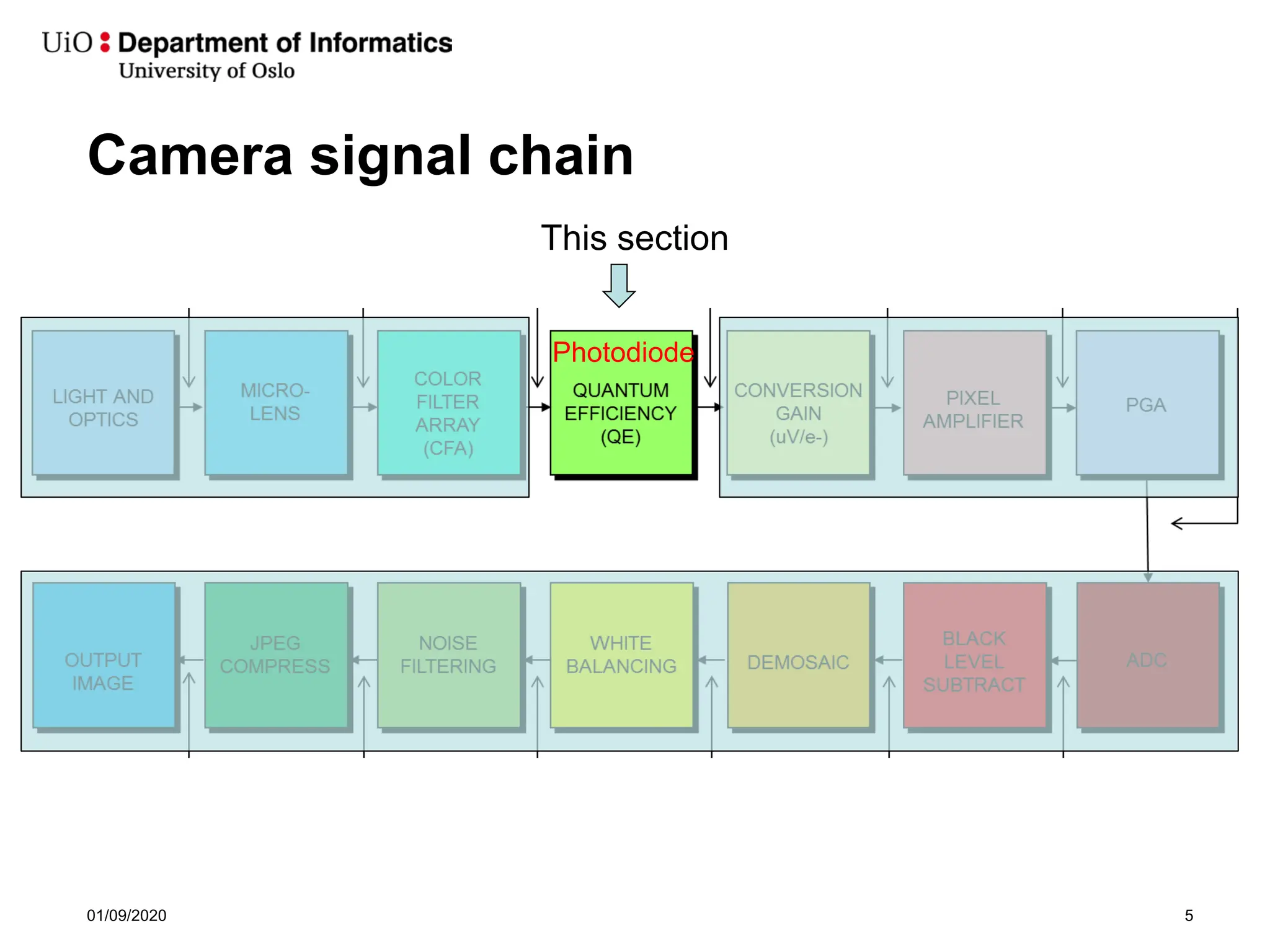
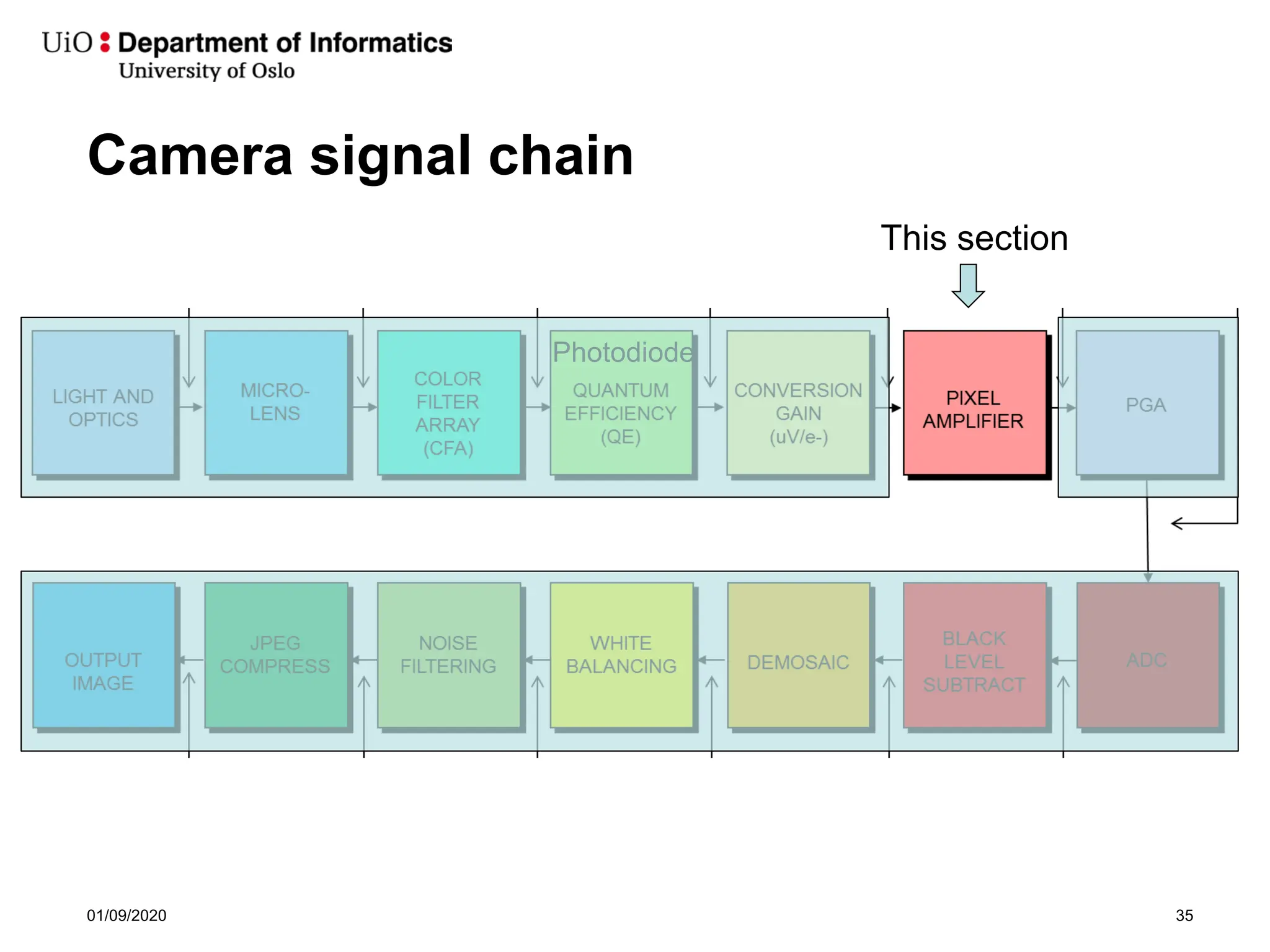
Camera signal chain
01/09/2020 5
Photodiode
This section
Valence band
Conduction band
Intrinsic silicon
01.09.2020 6
Si atom density: 5x1022 cm-3
pi = ni ≅1010 cm-3 at 300K
pi: intrinsic hole concentration (thermally generated)
ni: intrinsic electron concentration (thermally generated)
Electron
energy,
E
EC
EV
Eg=1.12eV at RT
Photoelectric effect in Semiconductors
01.09.2020 7
-
-
- - -
Eg
Conduction band
Valence band
+ + + + +
ν
h
Ev
Ec
Condition for detection :
Band-gap in Silicon:
λcut-off ≈ 1,1 um
Photon energy (Joule) :
λ
ν
c
h
h
E =
=
g
E
h ≥
ν
J
Eg
19
10
8
,
1 −
⋅
≈
g
E
hc
≤
λ
Cut-off wavelength in Silicon :
Energy
level
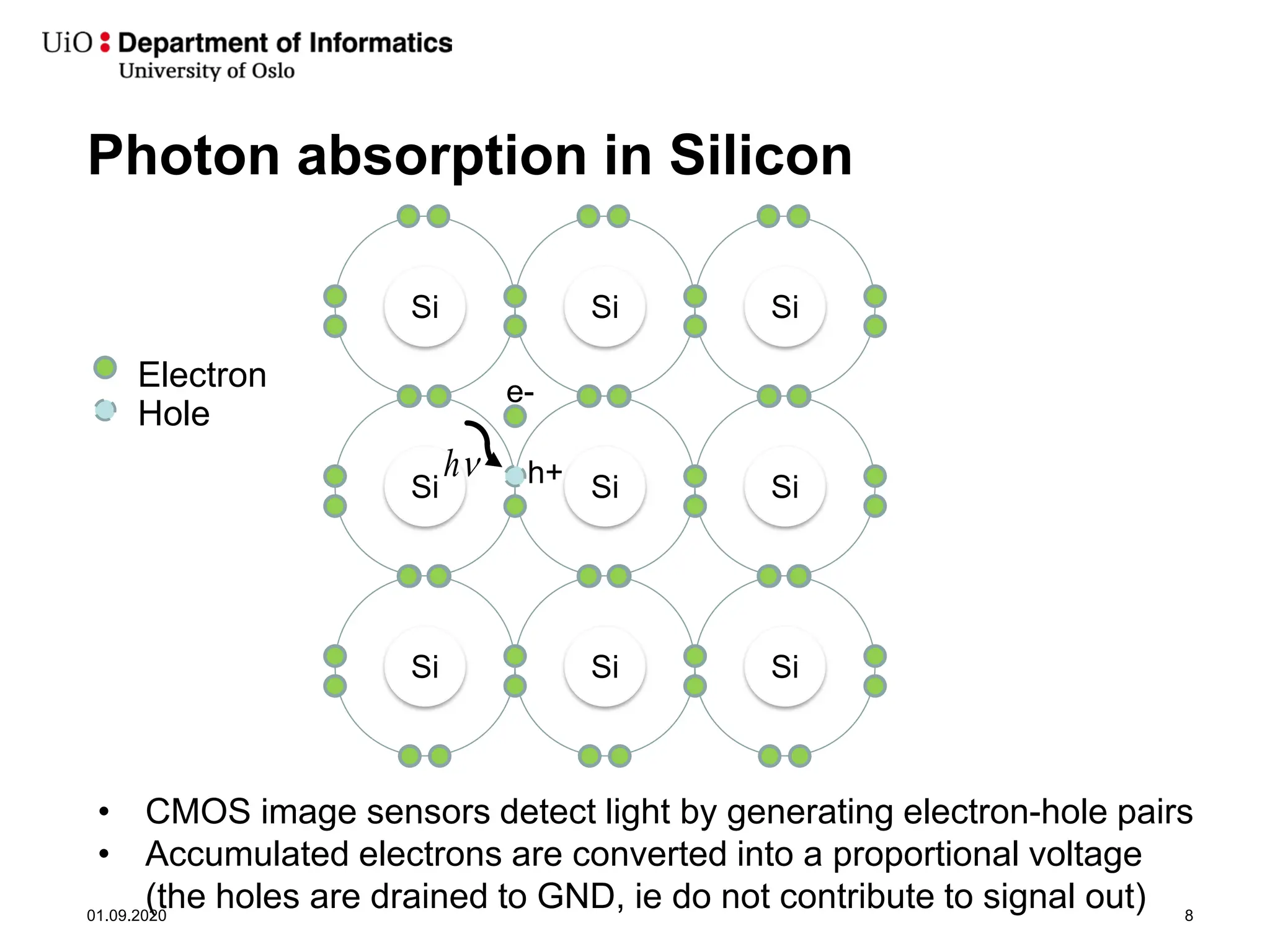
Photon absorption in Silicon
Si Si Si
Si Si Si
Si Si Si
Electron e-
Hole
• CMOS image sensors detect light by generating electron-hole pairs
• Accumulated electrons are converted into a proportional voltage
(the holes are drained to GND, ie do not contribute to signal out)
h+
01.09.2020 8
ν
h
Photoelectric effect remarks
• Occurs in both intrinsic and doped silicon (cf
photodiode)
• Normally one photon creates one electron, only.
– Excess energy goes to heating
– High-energy particles, e.g. X-ray, can create multiple
electrons (as well as damage the Si crystal structure)
• Other semiconductors with smaller bandgap
energy (e.g. SiGe, PtSi) can detect longer
wavelengths, i.e. in the IR spectrum
01.09.2020 9
Quantum efficiency (QE)
01.09.2020
100%
QE
(%)
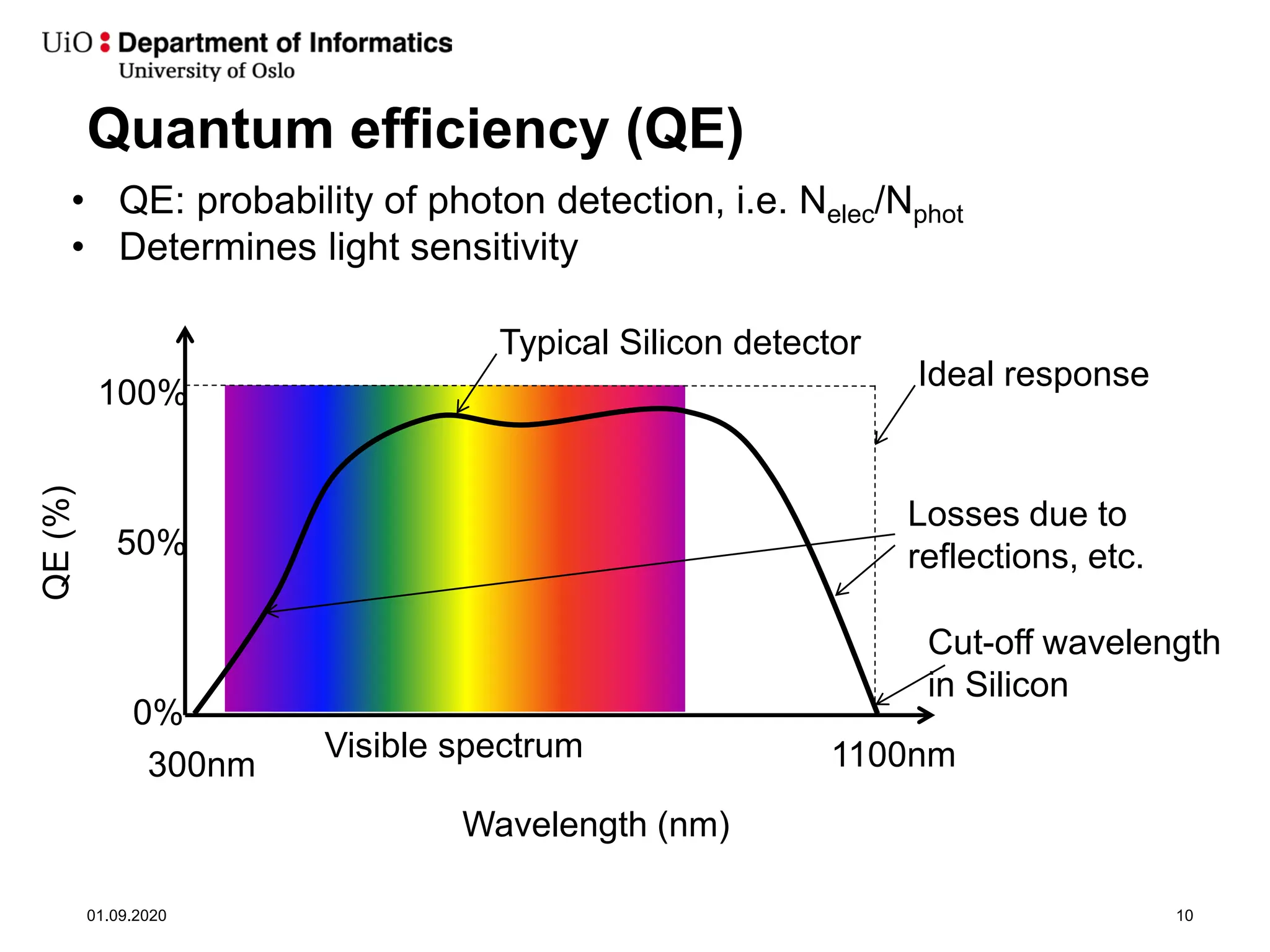
Ideal response
Wavelength (nm)
Losses due to
reflections, etc.
Cut-off wavelength
in Silicon
• QE: probability of photon detection, i.e. Nelec/Nphot
• Determines light sensitivity
50%
0%
300nm 1100nm
Typical Silicon detector
10
Visible spectrum
QE remarks
• Photo-generated charges outside the depletion
layer do not experience any electric field.
Hence, they tend to diffuse in all directions and
may get lost through recombination
• Depending on wavelength, photons can go
several microns deep into silicon before being
absorbed by a Si atom
• Therefore, the larger the depletion layer width
(read: low doping concentration) the better the
QE
01.09.2020 11
Absorption of light in Silicon
12
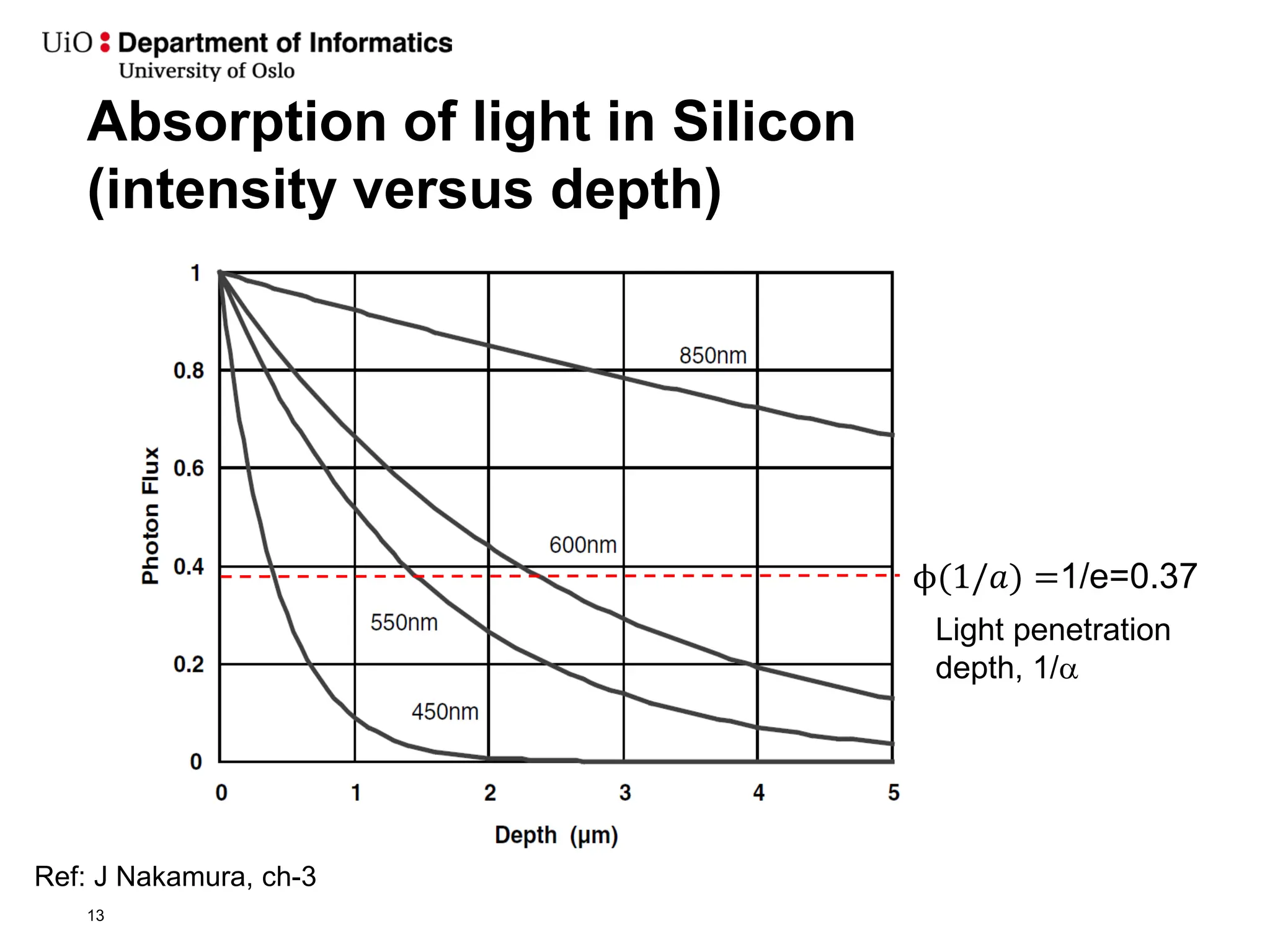
Φ(x) = Φ0𝑒𝑒𝑒𝑒𝑒𝑒(−𝛼𝛼𝛼𝛼)
Φ(x): photon flux, α: absorption coefficient (cm-1)
x: distance from silicon surface (cm)
Absorption of light in Silicon
(intensity versus depth)
13
ϕ(1/𝑎𝑎) =1/e=0.37
Light penetration
depth, 1/α
Ref: J Nakamura, ch-3
QE dependent on Si thickness, ie length
of optical path in silicon
14
100%
QE
Wavelength
Normal substrate
thickness (3-5um)
50%
0%
300nm 1100nm
400nm 700nm
Thick substrate
(>10um)
N-type silicon with Phosphor donors
01/09/2020 15
ND: dopant concentration
n0: free electron concentration
n0 ≅ ND
From n0p0= ni
2 we get p0 ≅ ni
2/ND
Electron
energy,
E
EC
EV
EF
Ei
qɸFn<0
𝜙𝜙𝐹𝐹𝐹𝐹 ≈ −𝜙𝜙𝑡𝑡𝑙𝑙𝑙𝑙
𝑁𝑁𝐷𝐷
𝑛𝑛𝑖𝑖
𝜙𝜙𝑡𝑡 =
𝑘𝑘𝑘𝑘
𝑞𝑞
≈26mV at RT
P-type Silicon with Boron acceptors
01.09.2020 16
NA: dopant concentration
p0 ≅ NA
n0 ≅ pi
2/NA
Electron
energy
EC
EV
EF
Ei
qɸFp>0
𝜙𝜙𝐹𝐹𝐹𝐹 ≈ 𝜙𝜙𝑡𝑡𝑙𝑙𝑙𝑙
𝑁𝑁𝐴𝐴
𝑛𝑛𝑖𝑖
𝜙𝜙𝑡𝑡 =
𝑘𝑘𝑘𝑘
𝑞𝑞
≈26mV at RT
Electric field = ∫(Charge density)
01.09.2020 17
Total charge density (⍴) is sum of all contributions:
𝜌𝜌 = 𝑞𝑞(𝑝𝑝 − 𝑛𝑛 + 𝑁𝑁𝐷𝐷 − 𝑁𝑁𝐴𝐴) (1)
Gauss’s law:
𝑑𝑑𝑑
𝑑𝑑𝑑𝑑
=
𝜌𝜌(𝑦𝑦)
∈𝑠𝑠
(2)
where ℇ(y)=electric field in y-direction
𝜌𝜌(𝑦𝑦)=charge density in y-position
∈𝑠𝑠=permittivity of silicon=ks∈0=11.9 x 8.854E-14 F/cm
PN junction
01.09.2020 18
Zero bias Forward bias Reverse bias
Reverse biased PN junction
01.09.2020 19
Reverse biased PN junction
01.09.2020 20
𝑄𝑄1 = +𝑞𝑞(𝑑𝑑1𝐴𝐴)𝑁𝑁𝐷𝐷
𝑄𝑄2 = −𝑞𝑞(𝑑𝑑2𝐴𝐴)𝑁𝑁𝐴𝐴
𝑄𝑄1 = −𝑄𝑄2
𝑑𝑑1
𝑑𝑑2
=
𝑁𝑁𝐴𝐴
𝑁𝑁𝐷𝐷
Using Gauss’ law, the electric field is the integral of charge
density divided by permittivity. Thus:
ℇ𝑝𝑝𝑝𝑝𝑝𝑝𝑝𝑝 =
𝑞𝑞𝑁𝑁𝐷𝐷𝑑𝑑1
𝜖𝜖𝑠𝑠
=
𝑞𝑞𝑁𝑁𝐴𝐴𝑑𝑑2
𝜖𝜖𝑠𝑠
Integrating the field gives the voltage. Thus:
𝜓𝜓1 =
ℇ𝑝𝑝𝑝𝑝𝑝𝑝𝑝𝑝𝑑𝑑1
2
=
𝑞𝑞𝑁𝑁𝐷𝐷𝑑𝑑1
2
2𝜖𝜖𝑠𝑠
𝜓𝜓2 =
ℇ𝑝𝑝𝑝𝑝𝑝𝑝𝑝𝑝𝑑𝑑2
2
=
𝑞𝑞𝑁𝑁𝐴𝐴𝑑𝑑2
2
2𝜖𝜖𝑠𝑠
𝜖𝜖𝑠𝑠 = 11.7 𝜖𝜖0
𝜖𝜖0 = 8.85 � 10−12𝐹𝐹/𝑚𝑚
ND
NA
Reverse biased PN junction
• Let
• where VR is the reverse bias voltage
• Combining with previous page we get
• where d1+d2 is the total depletion width of the
reverse biased PN junction
01.09.2020 21
𝜓𝜓𝑐𝑐 = 𝜓𝜓1+ 𝜓𝜓2 = 𝑉𝑉𝑅𝑅 + 𝜙𝜙𝑏𝑏
𝑑𝑑1 + 𝑑𝑑2 =
2𝜖𝜖𝑠𝑠
𝑞𝑞
�
𝑁𝑁𝐴𝐴 + 𝑁𝑁𝐷𝐷
𝑁𝑁𝐴𝐴𝑁𝑁𝐷𝐷
� 𝜓𝜓𝑐𝑐
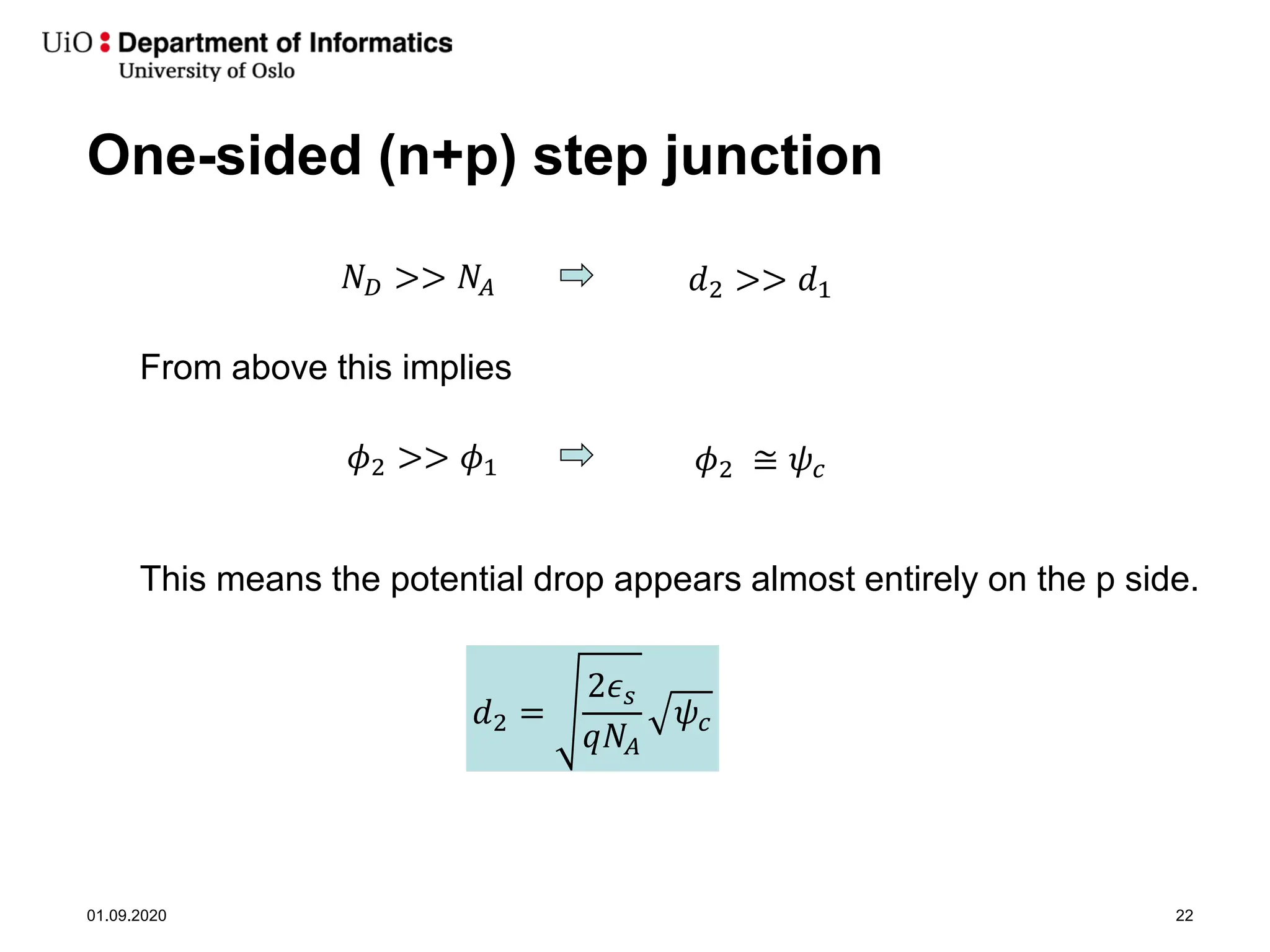
One-sided (n+p) step junction
01.09.2020 22
𝑁𝑁𝐷𝐷 >> 𝑁𝑁𝐴𝐴 𝑑𝑑2 >> 𝑑𝑑1
From above this implies
𝜙𝜙2 >> 𝜙𝜙1 𝜙𝜙2 ≅ 𝜓𝜓𝑐𝑐
This means the potential drop appears almost entirely on the p side.
𝑑𝑑2 =
2𝜖𝜖𝑠𝑠
𝑞𝑞𝑁𝑁𝐴𝐴
𝜓𝜓𝑐𝑐
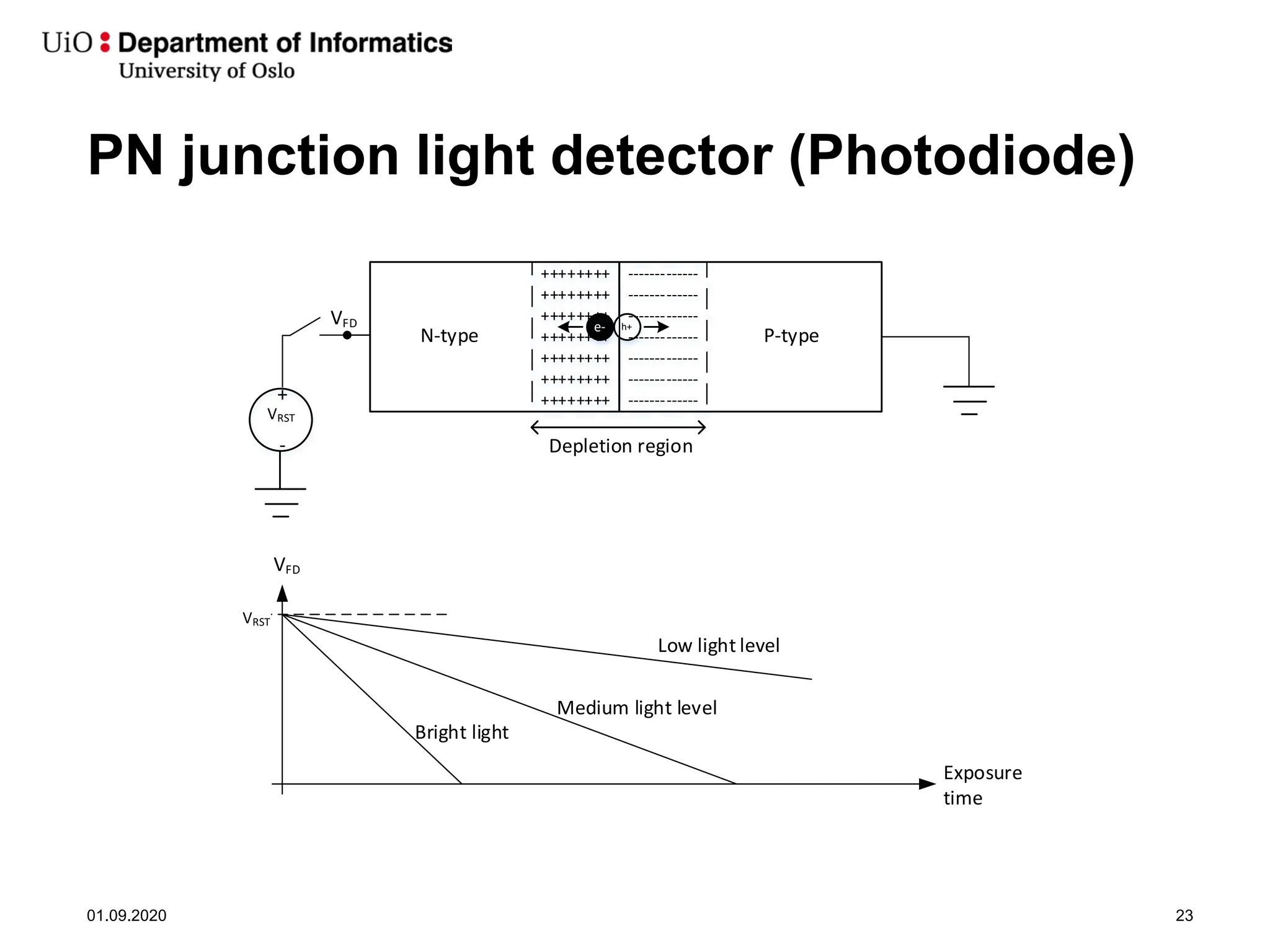
PN junction light detector (Photodiode)
01.09.2020 23
Depletion region
+
-
e- h+
++++++++
++++++++
++++++++
++++++++
++++++++
++++++++
++++++++
-------------
-------------
-------------
-------------
-------------
-------------
-------------
N-type P-type
VFD
VRST
VRST
Exposure
time
VFD
Low light level
Medium light level
Bright light
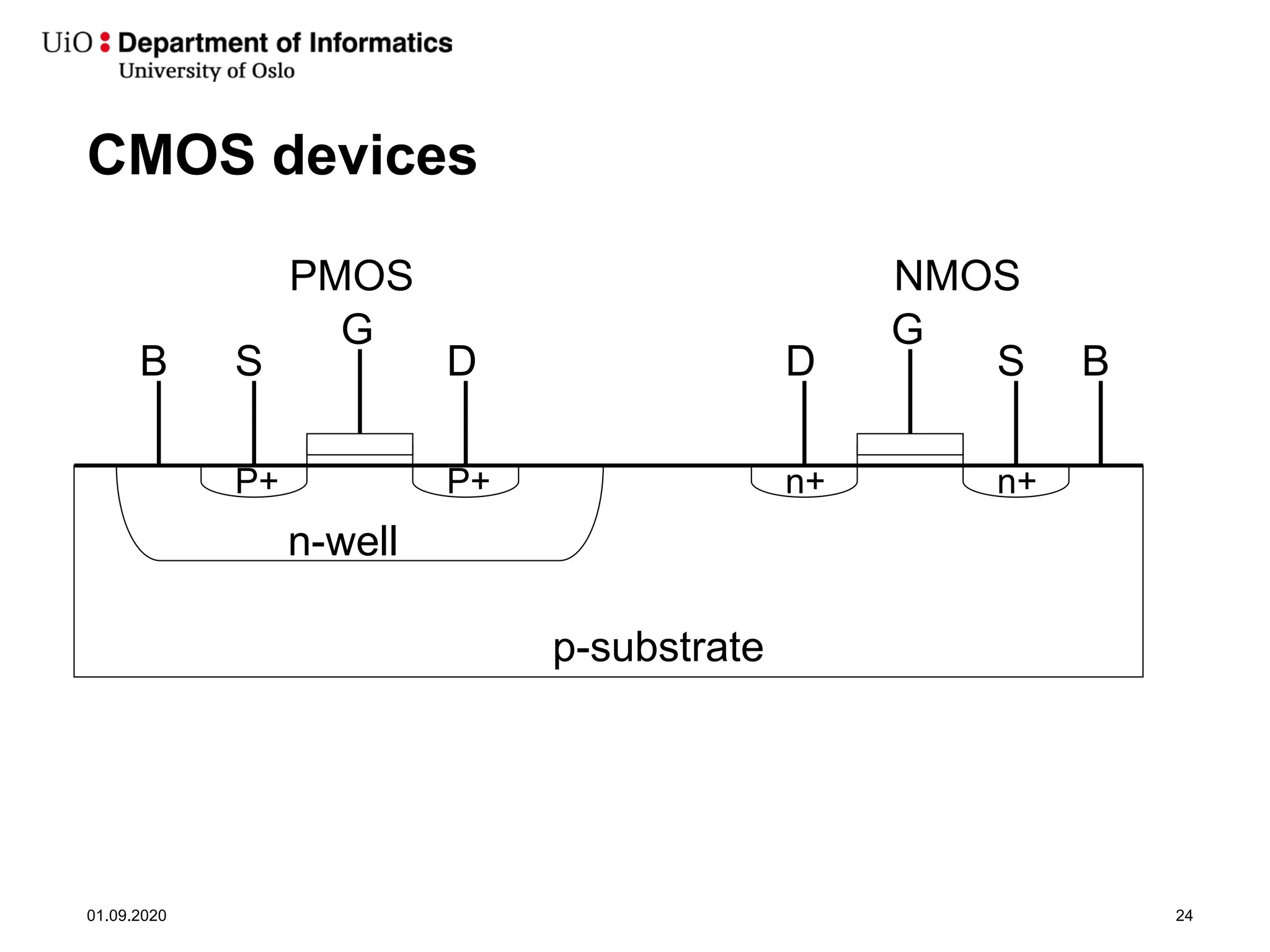
CMOS devices
G
D
S S
D
B B
p-substrate
n-well
P+ P+ n+ n+
G
PMOS NMOS
01.09.2020 24
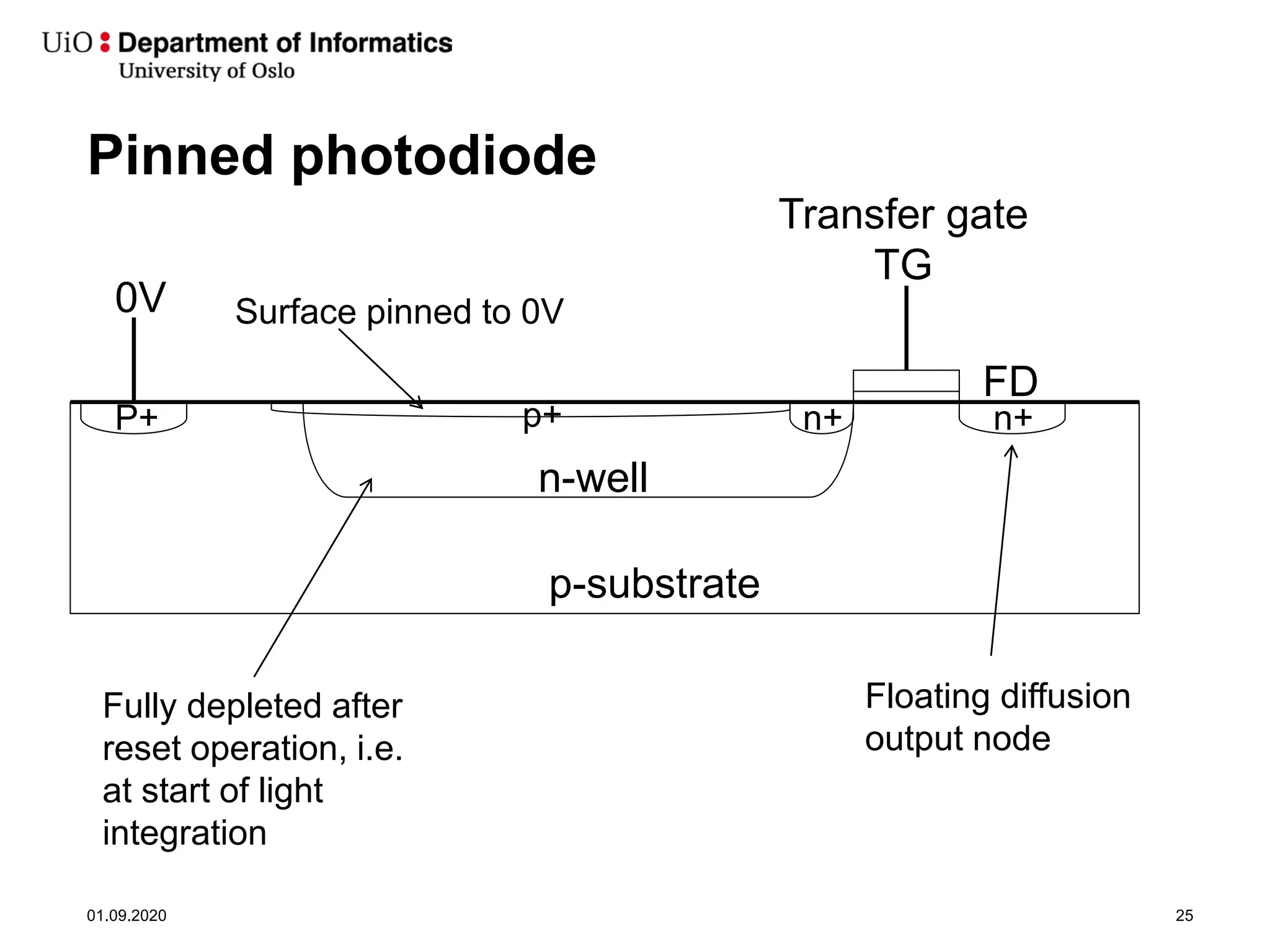
Pinned photodiode
0V
p-substrate
n-well
P+ p+ n+ n+
01.09.2020 25
Floating diffusion
output node
Surface pinned to 0V
Fully depleted after
reset operation, i.e.
at start of light
integration
FD
Transfer gate
TG
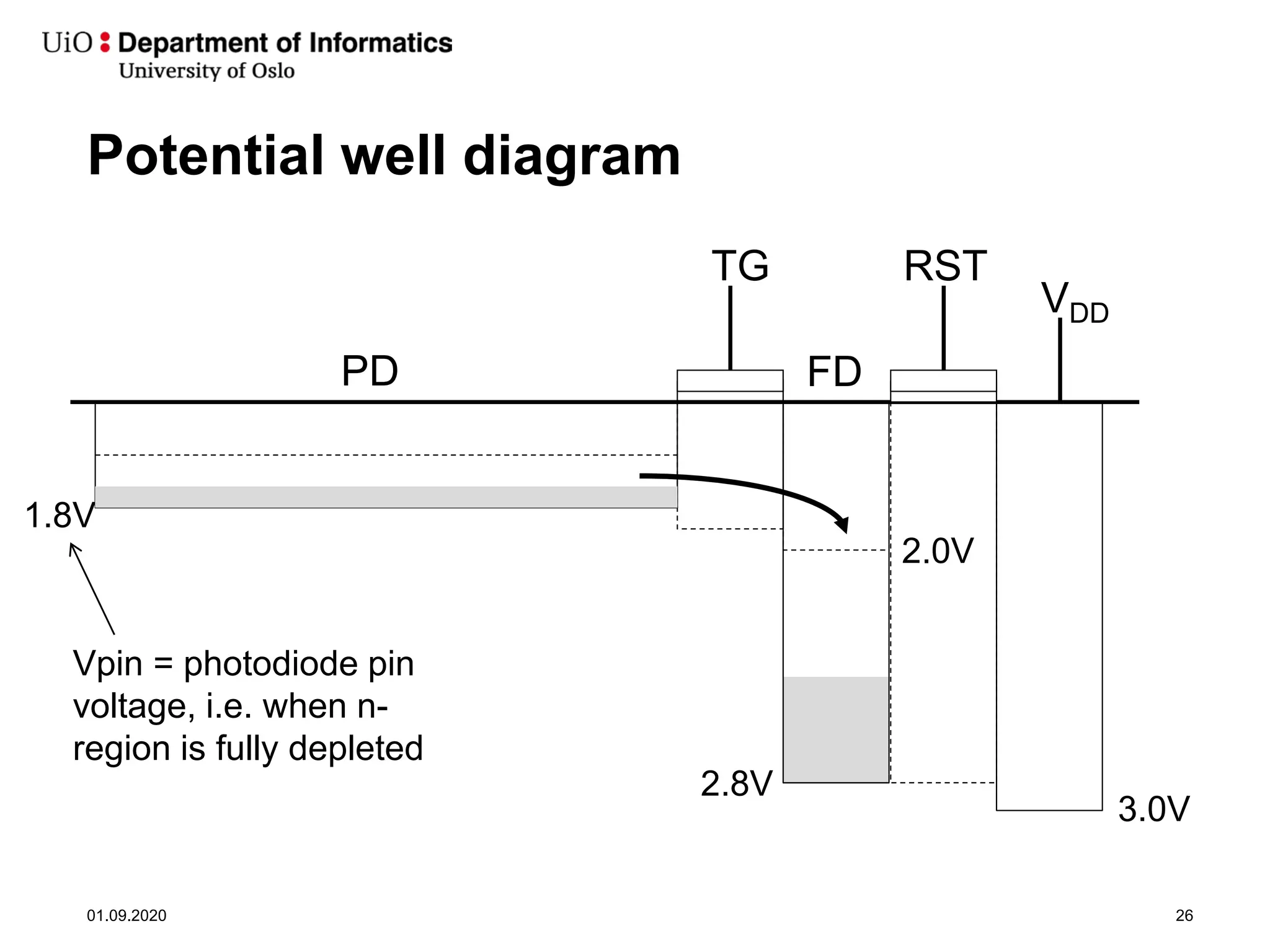
Potential well diagram
TG
01.09.2020 26
RST
VDD
1.8V
2.8V
3.0V
2.0V
PD FD
Vpin = photodiode pin
voltage, i.e. when n-
region is fully depleted
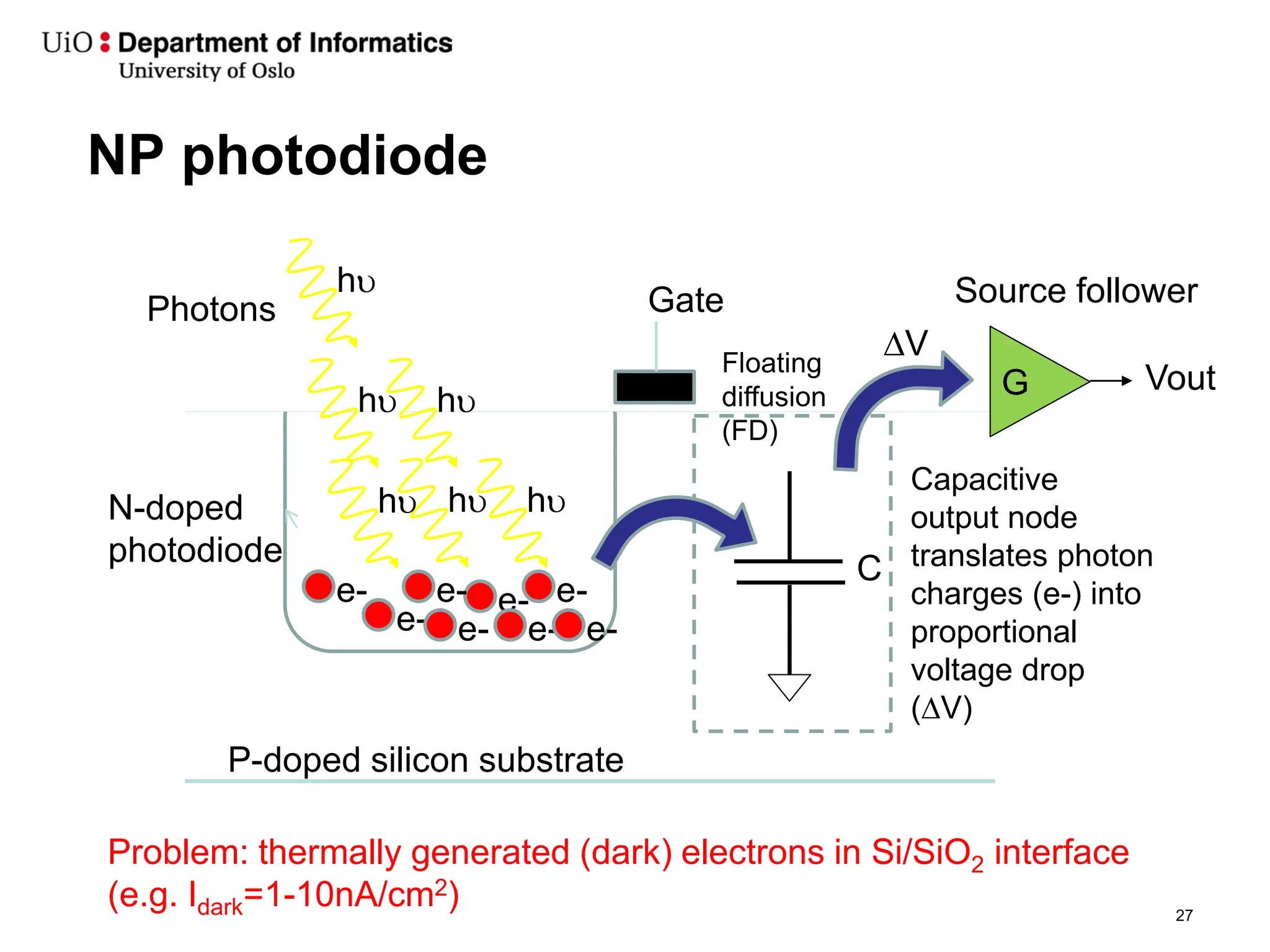
NP photodiode
27
P-doped silicon substrate
N-doped
photodiode
Gate
hυ
e-
e-
e- e-
e-
e-
e-
e-
Capacitive
output node
translates photon
charges (e-) into
proportional
voltage drop
(∆V)
hυ hυ
hυ hυ
hυ
Photons
C
G
Source follower
Vout
∆V
Floating
diffusion
(FD)
Problem: thermally generated (dark) electrons in Si/SiO2 interface
(e.g. Idark=1-10nA/cm2)
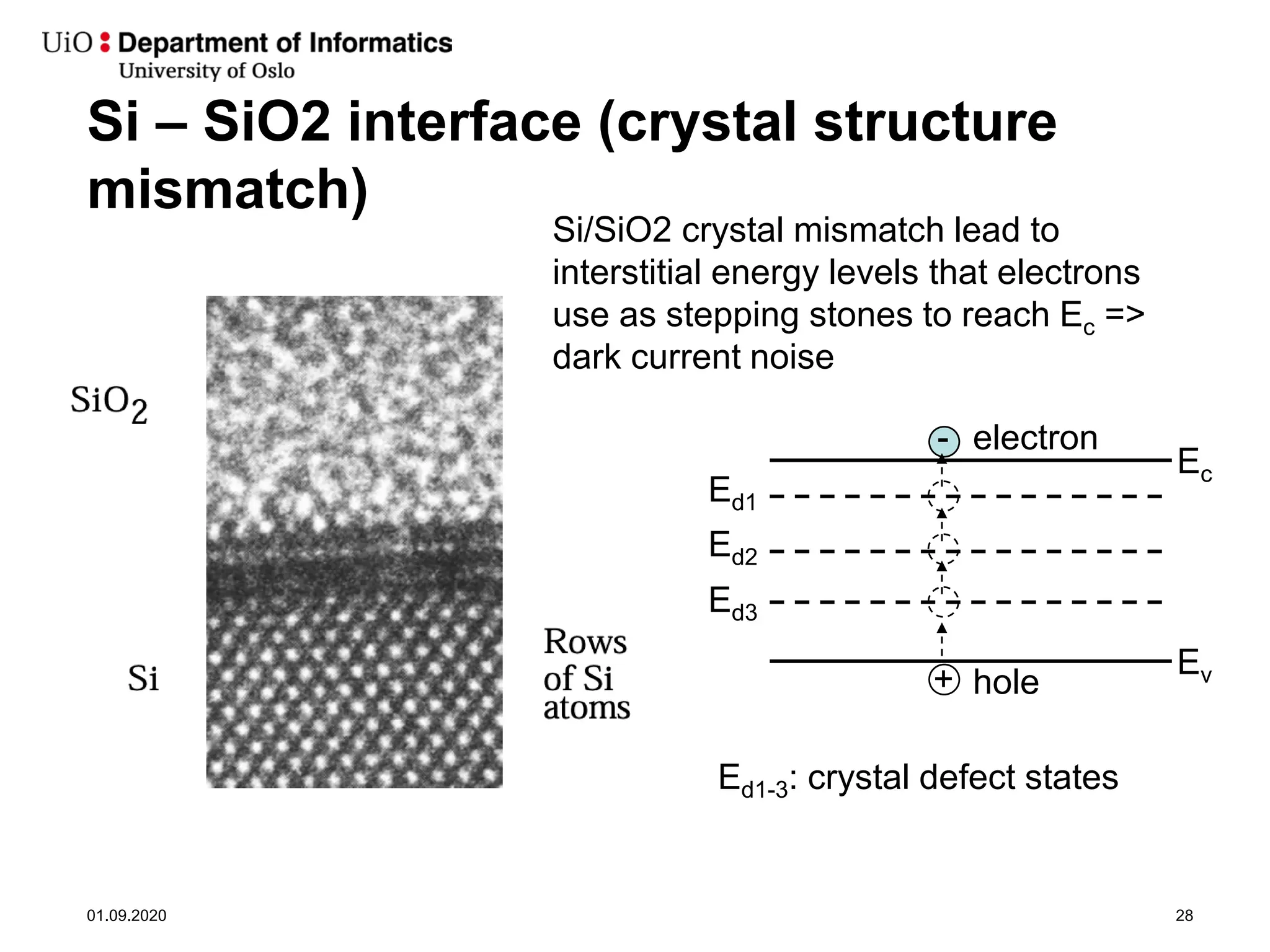
Si – SiO2 interface (crystal structure
mismatch)
01.09.2020 28
+
-
Ev
Ec
electron
hole
Si/SiO2 crystal mismatch lead to
interstitial energy levels that electrons
use as stepping stones to reach Ec =>
dark current noise
Ed1
Ed2
Ed3
Ed1-3: crystal defect states
Pinned photodiode
29
P-sup
N-doped
photodiode
Transfer
gate
Floating diffusion
node (FD)
P+ doped
surface
layer
(pinned at
GND)
absorbs
any dark
electrons
SiO2
Camera signal chain
01/09/2020 30
Photodiode
This section
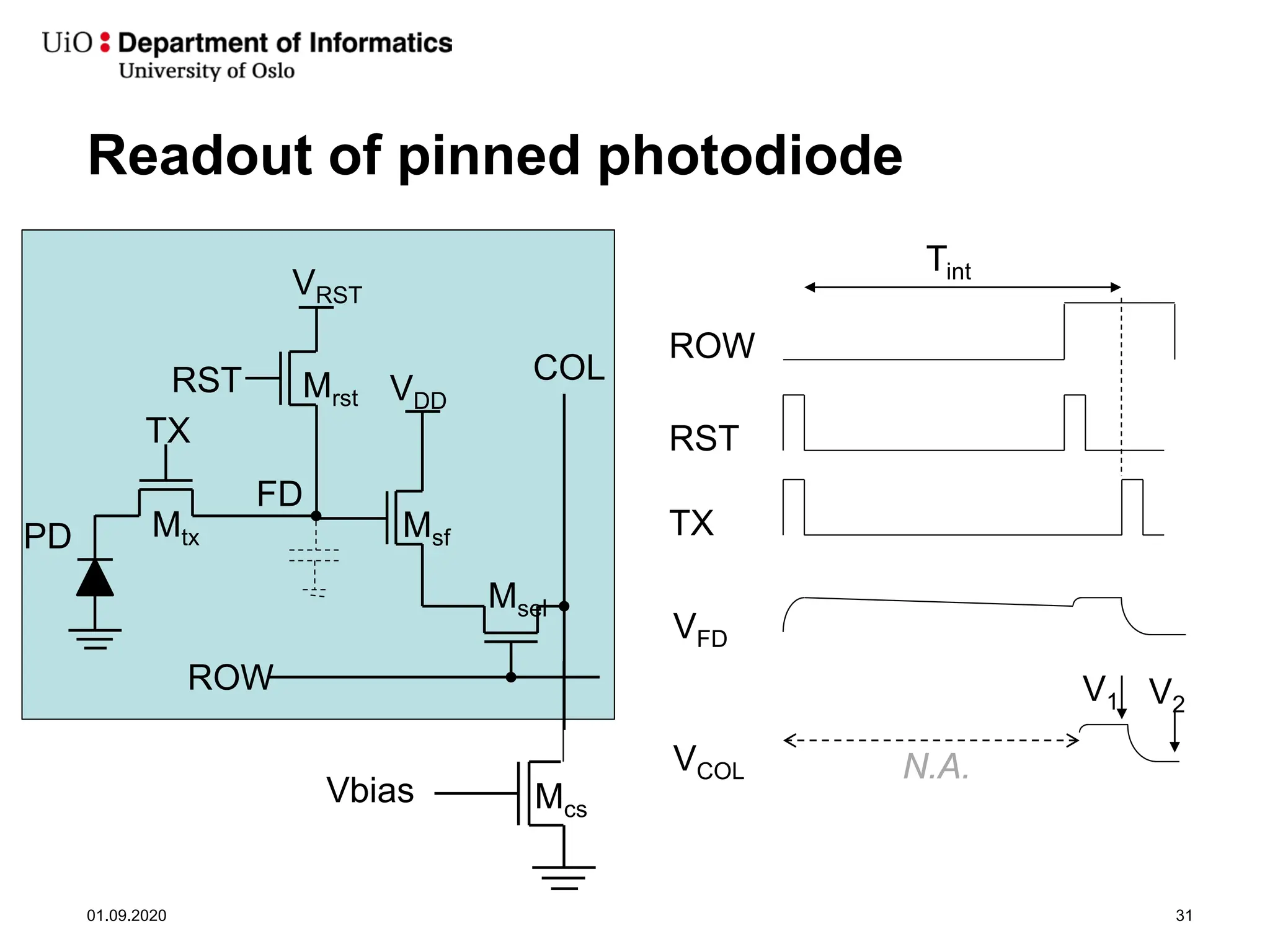
Readout of pinned photodiode
01.09.2020 31
RST
VRST
VDD
Mrst
Msf
Msel
ROW
COL
TX
Mtx
RST
ROW
VFD
Tint
VCOL
V1 V2
N.A.
TX
PD
FD
Mcs
Vbias
Small-Signal Capacitance of reverse
biased PN junction
01.09.2020 32
Cj
+∆Q
-∆Q
∆VR
+
-
If the reverse bias is increased by a small amount, then the
depletion region width must increase on both sides. Hence, charges
must flow on both sides of the diode.
Operating
region
Small-signal capacitance of reverse
biased PN junction
01.09.2020 33
∆𝑄𝑄1= +∆𝑄𝑄 ∆𝑄𝑄2= −∆𝑄𝑄
𝐶𝐶𝑗𝑗 =
∆𝑄𝑄
∆𝑉𝑉𝑅𝑅
𝐶𝐶𝑗𝑗 = −
𝑑𝑑𝑄𝑄2
𝑑𝑑𝑉𝑉𝑅𝑅
𝐶𝐶𝑗𝑗′ =
𝐶𝐶𝑗𝑗
𝐴𝐴
𝐶𝐶𝐶𝑗𝑗 = −
𝑑𝑑𝑄𝑄𝑄2
𝑑𝑑𝑉𝑉𝑅𝑅
𝐶𝐶𝑗𝑗
′
=
2𝑞𝑞𝜖𝜖𝑠𝑠𝑁𝑁𝐴𝐴
2 𝑉𝑉𝑅𝑅 + 𝜙𝜙𝑏𝑏𝑏𝑏
=
𝜖𝜖𝑠𝑠
𝑑𝑑2
One sided: 𝑄𝑄2
′
= − 2𝑞𝑞𝜖𝜖𝑠𝑠𝑁𝑁𝐴𝐴𝜙𝜙2
𝜙𝜙2 = 𝑉𝑉𝑅𝑅 + 𝜙𝜙𝑏𝑏𝑏𝑏
One-sided step junction small-signal
capacitance vs reverse-bias voltage
01.09.2020 34
Note: CMOS pixels use reverse biased diode capacitance (aka
floating diffusion node) to convert photon charge into voltage.
Above voltage dependency can sometimes cause non-linear
response.
Camera signal chain
01/09/2020 35
Photodiode
This section
Introduction
• SF used in almost every digital camera that
exists; used in both CMOS and CCD sensors
• Widely used also in general ASICs as a voltage
buffer which can drive large capacitive loads
• Widely used due to its small size (only one
transistor inside pixel) which maximizes
photodiode area
01.09.2020 36
SF in 4T pixel
01.09.2020 37
RST
VRST
VDD
Mrst
Msf
Msel
ROW
COL
TX
Mtx
RST
ROW
VFD
Tint
VCOL
V1 V2
N.A.
TX
PD
FD
Mcs
Vbias
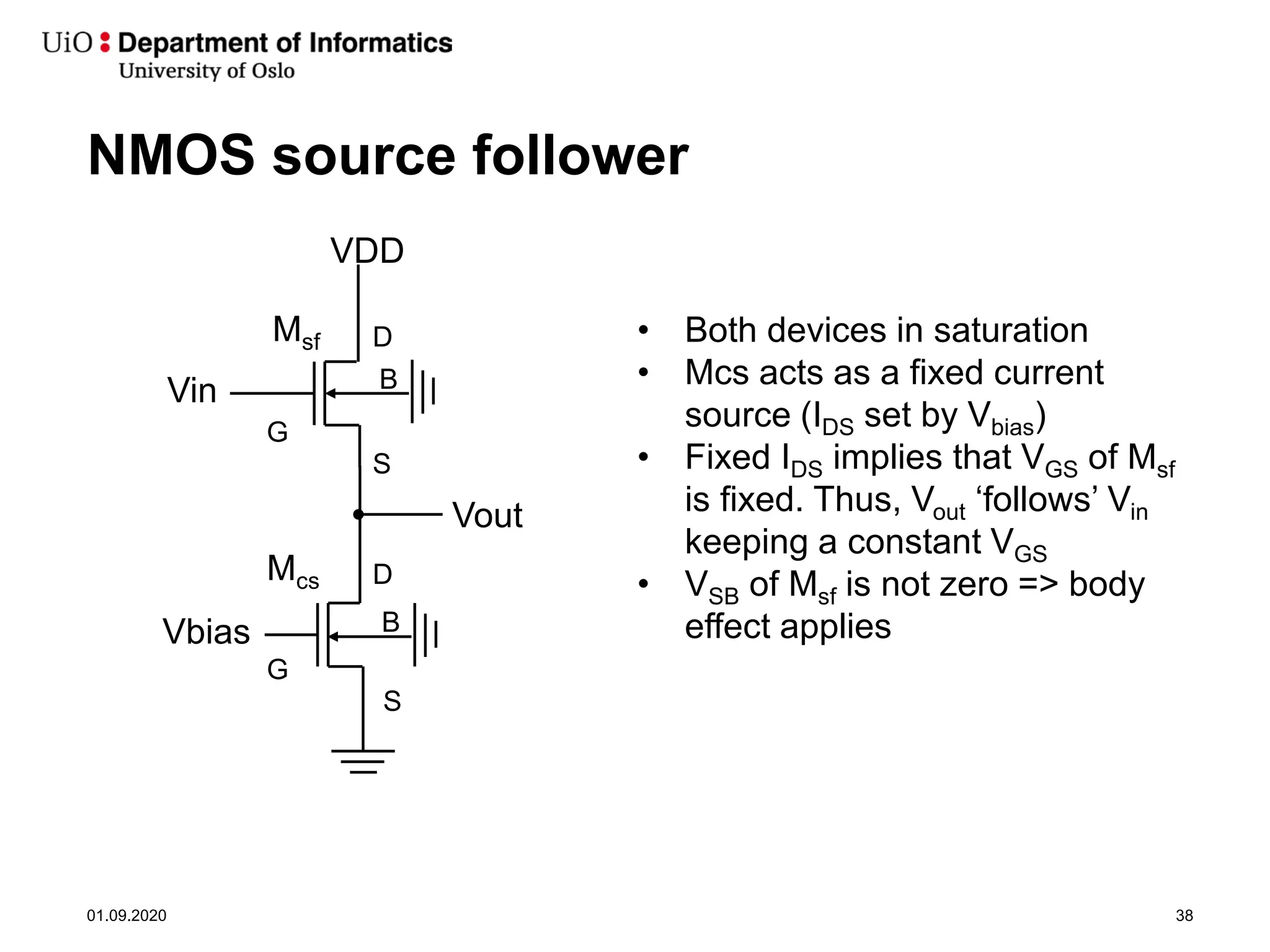
NMOS source follower
01.09.2020 38
Mcs
Vbias
Msf
Vin
Vout
D
G
S
D
G
S
B
B
• Both devices in saturation
• Mcs acts as a fixed current
source (IDS set by Vbias)
• Fixed IDS implies that VGS of Msf
is fixed. Thus, Vout ‘follows’ Vin
keeping a constant VGS
• VSB of Msf is not zero => body
effect applies
VDD
Small signal equivalent circuit of SF
01.09.2020 39
gmvgs
gmbvsb
vgs
vout=vsb
vin
r02
r01
𝐴𝐴𝑣𝑣 =
𝑣𝑣𝑜𝑜𝑜𝑜𝑜𝑜
𝑣𝑣𝑖𝑖𝑖𝑖
=
𝑔𝑔𝑚𝑚
𝑔𝑔𝑚𝑚 + 𝑔𝑔𝑚𝑚𝑚𝑚 +
1
𝑟𝑟01
+
1
𝑟𝑟02
𝑅𝑅𝑜𝑜 =
1
𝑔𝑔𝑚𝑚 + 𝑔𝑔𝑚𝑚𝑚𝑚 +
1
𝑟𝑟01
+
1
𝑟𝑟02
SF remarks
• Msf sources current, Mcs sinks current
– Asymmetric drive capability
– Check both rising and falling edge settling
• Acts as a level shifter where Vout equals Vin
minus approx. Vth
– For PMOS: Vout equals Vin plus Vth
• To keep Mcs in pinch-off (saturation), Vout cannot
go too low => limited useful voltage swing
– Typical requirement: allow max 1% deviation from
the linear (straight line) curve
01.09.2020 40
For hand calculations of devices in
saturation use:
01.09.2020 41
𝑔𝑔𝑚𝑚 = 𝜇𝜇𝑛𝑛𝐶𝐶𝑜𝑜𝑜𝑜
𝑊𝑊
𝐿𝐿
𝑉𝑉𝐺𝐺𝐺𝐺 − 𝑉𝑉𝑇𝑇𝑇𝑇 = 2𝜇𝜇𝑛𝑛𝐶𝐶𝑜𝑜𝑜𝑜
𝑊𝑊
𝐿𝐿
𝐼𝐼𝐷𝐷
𝑟𝑟𝑜𝑜 =
1
𝜆𝜆𝐼𝐼𝐷𝐷
Assume:
gmb<<gm
𝜆𝜆=0.1V-1
𝜇𝜇𝑛𝑛𝐶𝐶𝑜𝑜𝑜𝑜=400uA/V2

CMOS Image Sensor Design_h20_3_photodiode_pixels_1sep2020.pdf

  • 1.
    IN5350 – CMOSImage Sensor Design Lecture 3 - Light detection and 4T pixel circuit principles
  • 2.
    Course project • Projectsize / scope: 40-60hrs total • Schedule: see next slide • Grade: Project report counts 25% of final grade (exam counts 75%) • Topic&field is flexible/optional. Some suggestions: – Analog design (e.g. SNR modelling, design&simulate pixel array and readout circuits, HDR sensor design, GS sensor design) – Digital design (e.g. RTL design: readout timing and/or ISP functions such as BLC, DPC, LENC, CI, TM, JPG) – Algorithm design (Matlab/Python: ISP, AEC, AWB) • Oblig. deliverables: (i) Project plan, (ii) Project report, (iii) Presentation • For access to nanolab in 5th floor email your name, username, and card number to Olav Stanly Kyrvestad <olavky@ifi.uio.no> • All SW (Cadence, Matlab, etc) available on all machines at IFI, as well as via remote login from external computer 2
  • 3.
    Project schedule Task/milestone StartFinish Chose topic and define scope 1-Sep 8-Sep Create project plan (tasks, milestones, schedule) 8-Sep 15-Sep MS1 – project plan approved by Johannes 15-Sep 22-Sep Study literature on the topic (include summary in report) 22-Sep 29-Sep Design implementation&simulation 29-Sep 13-Oct Write up prelim report (inc references, design, results) 13-Oct 20-Oct MS2 – submit preliminary report to Johannes 20-Oct 20-Oct Design/simulation (fine tuning) 20-Oct 27-Oct Write up final report (incl references, design, results) 27-Oct 3-Nov MS3 – Presentation and discussion 3-Nov 3-Nov MS4 – submit final report to Johannes 10-Nov 10-Nov Exam 18-Nov 2019 3
  • 4.
    References • Oblig materialare these slides and the accompanying exercises • Recommended books – Physics of Semiconductor Devices by Simon M. Sze and Kwok K. Ng (Oct 27, 2006) – Solid-State Imaging with Charge-Coupled Devices (Solid-State Science and Technology Library) by Albert J. P. Theuwissen (Mar 31, 1995) • Recommended online sources – Excellent PN junction literature on Wikipedia – http://pveducation.org/pvcdrom/pn-junction/conduction-in- semiconductors 4
  • 5.
    Camera signal chain 01/09/20205 Photodiode This section
  • 6.
    Valence band Conduction band Intrinsicsilicon 01.09.2020 6 Si atom density: 5x1022 cm-3 pi = ni ≅1010 cm-3 at 300K pi: intrinsic hole concentration (thermally generated) ni: intrinsic electron concentration (thermally generated) Electron energy, E EC EV Eg=1.12eV at RT
  • 7.
    Photoelectric effect inSemiconductors 01.09.2020 7 - - - - - Eg Conduction band Valence band + + + + + ν h Ev Ec Condition for detection : Band-gap in Silicon: λcut-off ≈ 1,1 um Photon energy (Joule) : λ ν c h h E = = g E h ≥ ν J Eg 19 10 8 , 1 − ⋅ ≈ g E hc ≤ λ Cut-off wavelength in Silicon : Energy level
  • 8.
    Photon absorption inSilicon Si Si Si Si Si Si Si Si Si Electron e- Hole • CMOS image sensors detect light by generating electron-hole pairs • Accumulated electrons are converted into a proportional voltage (the holes are drained to GND, ie do not contribute to signal out) h+ 01.09.2020 8 ν h
  • 9.
    Photoelectric effect remarks •Occurs in both intrinsic and doped silicon (cf photodiode) • Normally one photon creates one electron, only. – Excess energy goes to heating – High-energy particles, e.g. X-ray, can create multiple electrons (as well as damage the Si crystal structure) • Other semiconductors with smaller bandgap energy (e.g. SiGe, PtSi) can detect longer wavelengths, i.e. in the IR spectrum 01.09.2020 9
  • 10.
    Quantum efficiency (QE) 01.09.2020 100% QE (%) Idealresponse Wavelength (nm) Losses due to reflections, etc. Cut-off wavelength in Silicon • QE: probability of photon detection, i.e. Nelec/Nphot • Determines light sensitivity 50% 0% 300nm 1100nm Typical Silicon detector 10 Visible spectrum
  • 11.
    QE remarks • Photo-generatedcharges outside the depletion layer do not experience any electric field. Hence, they tend to diffuse in all directions and may get lost through recombination • Depending on wavelength, photons can go several microns deep into silicon before being absorbed by a Si atom • Therefore, the larger the depletion layer width (read: low doping concentration) the better the QE 01.09.2020 11
  • 12.
    Absorption of lightin Silicon 12 Φ(x) = Φ0𝑒𝑒𝑒𝑒𝑒𝑒(−𝛼𝛼𝛼𝛼) Φ(x): photon flux, α: absorption coefficient (cm-1) x: distance from silicon surface (cm)
  • 13.
    Absorption of lightin Silicon (intensity versus depth) 13 ϕ(1/𝑎𝑎) =1/e=0.37 Light penetration depth, 1/α Ref: J Nakamura, ch-3
  • 14.
    QE dependent onSi thickness, ie length of optical path in silicon 14 100% QE Wavelength Normal substrate thickness (3-5um) 50% 0% 300nm 1100nm 400nm 700nm Thick substrate (>10um)
  • 15.
    N-type silicon withPhosphor donors 01/09/2020 15 ND: dopant concentration n0: free electron concentration n0 ≅ ND From n0p0= ni 2 we get p0 ≅ ni 2/ND Electron energy, E EC EV EF Ei qɸFn<0 𝜙𝜙𝐹𝐹𝐹𝐹 ≈ −𝜙𝜙𝑡𝑡𝑙𝑙𝑙𝑙 𝑁𝑁𝐷𝐷 𝑛𝑛𝑖𝑖 𝜙𝜙𝑡𝑡 = 𝑘𝑘𝑘𝑘 𝑞𝑞 ≈26mV at RT
  • 16.
    P-type Silicon withBoron acceptors 01.09.2020 16 NA: dopant concentration p0 ≅ NA n0 ≅ pi 2/NA Electron energy EC EV EF Ei qɸFp>0 𝜙𝜙𝐹𝐹𝐹𝐹 ≈ 𝜙𝜙𝑡𝑡𝑙𝑙𝑙𝑙 𝑁𝑁𝐴𝐴 𝑛𝑛𝑖𝑖 𝜙𝜙𝑡𝑡 = 𝑘𝑘𝑘𝑘 𝑞𝑞 ≈26mV at RT
  • 17.
    Electric field =∫(Charge density) 01.09.2020 17 Total charge density (⍴) is sum of all contributions: 𝜌𝜌 = 𝑞𝑞(𝑝𝑝 − 𝑛𝑛 + 𝑁𝑁𝐷𝐷 − 𝑁𝑁𝐴𝐴) (1) Gauss’s law: 𝑑𝑑𝑑 𝑑𝑑𝑑𝑑 = 𝜌𝜌(𝑦𝑦) ∈𝑠𝑠 (2) where ℇ(y)=electric field in y-direction 𝜌𝜌(𝑦𝑦)=charge density in y-position ∈𝑠𝑠=permittivity of silicon=ks∈0=11.9 x 8.854E-14 F/cm
  • 18.
    PN junction 01.09.2020 18 Zerobias Forward bias Reverse bias
  • 19.
    Reverse biased PNjunction 01.09.2020 19
  • 20.
    Reverse biased PNjunction 01.09.2020 20 𝑄𝑄1 = +𝑞𝑞(𝑑𝑑1𝐴𝐴)𝑁𝑁𝐷𝐷 𝑄𝑄2 = −𝑞𝑞(𝑑𝑑2𝐴𝐴)𝑁𝑁𝐴𝐴 𝑄𝑄1 = −𝑄𝑄2 𝑑𝑑1 𝑑𝑑2 = 𝑁𝑁𝐴𝐴 𝑁𝑁𝐷𝐷 Using Gauss’ law, the electric field is the integral of charge density divided by permittivity. Thus: ℇ𝑝𝑝𝑝𝑝𝑝𝑝𝑝𝑝 = 𝑞𝑞𝑁𝑁𝐷𝐷𝑑𝑑1 𝜖𝜖𝑠𝑠 = 𝑞𝑞𝑁𝑁𝐴𝐴𝑑𝑑2 𝜖𝜖𝑠𝑠 Integrating the field gives the voltage. Thus: 𝜓𝜓1 = ℇ𝑝𝑝𝑝𝑝𝑝𝑝𝑝𝑝𝑑𝑑1 2 = 𝑞𝑞𝑁𝑁𝐷𝐷𝑑𝑑1 2 2𝜖𝜖𝑠𝑠 𝜓𝜓2 = ℇ𝑝𝑝𝑝𝑝𝑝𝑝𝑝𝑝𝑑𝑑2 2 = 𝑞𝑞𝑁𝑁𝐴𝐴𝑑𝑑2 2 2𝜖𝜖𝑠𝑠 𝜖𝜖𝑠𝑠 = 11.7 𝜖𝜖0 𝜖𝜖0 = 8.85 � 10−12𝐹𝐹/𝑚𝑚 ND NA
  • 21.
    Reverse biased PNjunction • Let • where VR is the reverse bias voltage • Combining with previous page we get • where d1+d2 is the total depletion width of the reverse biased PN junction 01.09.2020 21 𝜓𝜓𝑐𝑐 = 𝜓𝜓1+ 𝜓𝜓2 = 𝑉𝑉𝑅𝑅 + 𝜙𝜙𝑏𝑏 𝑑𝑑1 + 𝑑𝑑2 = 2𝜖𝜖𝑠𝑠 𝑞𝑞 � 𝑁𝑁𝐴𝐴 + 𝑁𝑁𝐷𝐷 𝑁𝑁𝐴𝐴𝑁𝑁𝐷𝐷 � 𝜓𝜓𝑐𝑐
  • 22.
    One-sided (n+p) stepjunction 01.09.2020 22 𝑁𝑁𝐷𝐷 >> 𝑁𝑁𝐴𝐴 𝑑𝑑2 >> 𝑑𝑑1 From above this implies 𝜙𝜙2 >> 𝜙𝜙1 𝜙𝜙2 ≅ 𝜓𝜓𝑐𝑐 This means the potential drop appears almost entirely on the p side. 𝑑𝑑2 = 2𝜖𝜖𝑠𝑠 𝑞𝑞𝑁𝑁𝐴𝐴 𝜓𝜓𝑐𝑐
  • 23.
    PN junction lightdetector (Photodiode) 01.09.2020 23 Depletion region + - e- h+ ++++++++ ++++++++ ++++++++ ++++++++ ++++++++ ++++++++ ++++++++ ------------- ------------- ------------- ------------- ------------- ------------- ------------- N-type P-type VFD VRST VRST Exposure time VFD Low light level Medium light level Bright light
  • 24.
    CMOS devices G D S S D BB p-substrate n-well P+ P+ n+ n+ G PMOS NMOS 01.09.2020 24
  • 25.
    Pinned photodiode 0V p-substrate n-well P+ p+n+ n+ 01.09.2020 25 Floating diffusion output node Surface pinned to 0V Fully depleted after reset operation, i.e. at start of light integration FD Transfer gate TG
  • 26.
    Potential well diagram TG 01.09.202026 RST VDD 1.8V 2.8V 3.0V 2.0V PD FD Vpin = photodiode pin voltage, i.e. when n- region is fully depleted
  • 27.
    NP photodiode 27 P-doped siliconsubstrate N-doped photodiode Gate hυ e- e- e- e- e- e- e- e- Capacitive output node translates photon charges (e-) into proportional voltage drop (∆V) hυ hυ hυ hυ hυ Photons C G Source follower Vout ∆V Floating diffusion (FD) Problem: thermally generated (dark) electrons in Si/SiO2 interface (e.g. Idark=1-10nA/cm2)
  • 28.
    Si – SiO2interface (crystal structure mismatch) 01.09.2020 28 + - Ev Ec electron hole Si/SiO2 crystal mismatch lead to interstitial energy levels that electrons use as stepping stones to reach Ec => dark current noise Ed1 Ed2 Ed3 Ed1-3: crystal defect states
  • 29.
    Pinned photodiode 29 P-sup N-doped photodiode Transfer gate Floating diffusion node(FD) P+ doped surface layer (pinned at GND) absorbs any dark electrons SiO2
  • 30.
    Camera signal chain 01/09/202030 Photodiode This section
  • 31.
    Readout of pinnedphotodiode 01.09.2020 31 RST VRST VDD Mrst Msf Msel ROW COL TX Mtx RST ROW VFD Tint VCOL V1 V2 N.A. TX PD FD Mcs Vbias
  • 32.
    Small-Signal Capacitance ofreverse biased PN junction 01.09.2020 32 Cj +∆Q -∆Q ∆VR + - If the reverse bias is increased by a small amount, then the depletion region width must increase on both sides. Hence, charges must flow on both sides of the diode. Operating region
  • 33.
    Small-signal capacitance ofreverse biased PN junction 01.09.2020 33 ∆𝑄𝑄1= +∆𝑄𝑄 ∆𝑄𝑄2= −∆𝑄𝑄 𝐶𝐶𝑗𝑗 = ∆𝑄𝑄 ∆𝑉𝑉𝑅𝑅 𝐶𝐶𝑗𝑗 = − 𝑑𝑑𝑄𝑄2 𝑑𝑑𝑉𝑉𝑅𝑅 𝐶𝐶𝑗𝑗′ = 𝐶𝐶𝑗𝑗 𝐴𝐴 𝐶𝐶𝐶𝑗𝑗 = − 𝑑𝑑𝑄𝑄𝑄2 𝑑𝑑𝑉𝑉𝑅𝑅 𝐶𝐶𝑗𝑗 ′ = 2𝑞𝑞𝜖𝜖𝑠𝑠𝑁𝑁𝐴𝐴 2 𝑉𝑉𝑅𝑅 + 𝜙𝜙𝑏𝑏𝑏𝑏 = 𝜖𝜖𝑠𝑠 𝑑𝑑2 One sided: 𝑄𝑄2 ′ = − 2𝑞𝑞𝜖𝜖𝑠𝑠𝑁𝑁𝐴𝐴𝜙𝜙2 𝜙𝜙2 = 𝑉𝑉𝑅𝑅 + 𝜙𝜙𝑏𝑏𝑏𝑏
  • 34.
    One-sided step junctionsmall-signal capacitance vs reverse-bias voltage 01.09.2020 34 Note: CMOS pixels use reverse biased diode capacitance (aka floating diffusion node) to convert photon charge into voltage. Above voltage dependency can sometimes cause non-linear response.
  • 35.
    Camera signal chain 01/09/202035 Photodiode This section
  • 36.
    Introduction • SF usedin almost every digital camera that exists; used in both CMOS and CCD sensors • Widely used also in general ASICs as a voltage buffer which can drive large capacitive loads • Widely used due to its small size (only one transistor inside pixel) which maximizes photodiode area 01.09.2020 36
  • 37.
    SF in 4Tpixel 01.09.2020 37 RST VRST VDD Mrst Msf Msel ROW COL TX Mtx RST ROW VFD Tint VCOL V1 V2 N.A. TX PD FD Mcs Vbias
  • 38.
    NMOS source follower 01.09.202038 Mcs Vbias Msf Vin Vout D G S D G S B B • Both devices in saturation • Mcs acts as a fixed current source (IDS set by Vbias) • Fixed IDS implies that VGS of Msf is fixed. Thus, Vout ‘follows’ Vin keeping a constant VGS • VSB of Msf is not zero => body effect applies VDD
  • 39.
    Small signal equivalentcircuit of SF 01.09.2020 39 gmvgs gmbvsb vgs vout=vsb vin r02 r01 𝐴𝐴𝑣𝑣 = 𝑣𝑣𝑜𝑜𝑜𝑜𝑜𝑜 𝑣𝑣𝑖𝑖𝑖𝑖 = 𝑔𝑔𝑚𝑚 𝑔𝑔𝑚𝑚 + 𝑔𝑔𝑚𝑚𝑚𝑚 + 1 𝑟𝑟01 + 1 𝑟𝑟02 𝑅𝑅𝑜𝑜 = 1 𝑔𝑔𝑚𝑚 + 𝑔𝑔𝑚𝑚𝑚𝑚 + 1 𝑟𝑟01 + 1 𝑟𝑟02
  • 40.
    SF remarks • Msfsources current, Mcs sinks current – Asymmetric drive capability – Check both rising and falling edge settling • Acts as a level shifter where Vout equals Vin minus approx. Vth – For PMOS: Vout equals Vin plus Vth • To keep Mcs in pinch-off (saturation), Vout cannot go too low => limited useful voltage swing – Typical requirement: allow max 1% deviation from the linear (straight line) curve 01.09.2020 40
  • 41.
    For hand calculationsof devices in saturation use: 01.09.2020 41 𝑔𝑔𝑚𝑚 = 𝜇𝜇𝑛𝑛𝐶𝐶𝑜𝑜𝑜𝑜 𝑊𝑊 𝐿𝐿 𝑉𝑉𝐺𝐺𝐺𝐺 − 𝑉𝑉𝑇𝑇𝑇𝑇 = 2𝜇𝜇𝑛𝑛𝐶𝐶𝑜𝑜𝑜𝑜 𝑊𝑊 𝐿𝐿 𝐼𝐼𝐷𝐷 𝑟𝑟𝑜𝑜 = 1 𝜆𝜆𝐼𝐼𝐷𝐷 Assume: gmb<<gm 𝜆𝜆=0.1V-1 𝜇𝜇𝑛𝑛𝐶𝐶𝑜𝑜𝑜𝑜=400uA/V2