CMIS 102 Hands-On Lab Week 8 Overview
FOR MORE CLASSES VISIT
tutorialoutletdotcom
CMIS 102 Hands-On Lab
Week 8
Overview
This hands-on lab allows you to follow and experiment with the critical
steps of developing a program
including the program description, analysis, test plan, and
implementation with C code. The example
provided uses sequential, repetition, selection statements, functions,
strings and arrays.
Program Description
This program will input and store meteorological data into an array. The
program will prompt the user to
enter the average monthly rainfall for a specific region and then use a
loop to cycle through the array
and print out each value. The program should store up 5 years of
meteorological data. Data is collected
once per month. The program should provide the option to the user of
not entering any data.
Analysis
I will use sequential, selection, and repetition programming statements
and an array to store data.
I will define a 2-D array of Float number: Raindata to store the Float
values input by the user. To store
up to 5 years of monthly data, the array size should be at least 5*12 = 60
elements. In a 2D array this will
be RainData[5][12]. We can use #defines to set the number of years and
months to eliminate hardcoding values.
A float number (rain) will also be needed to input the individual rain
data.
A nested for loop can be used to iterate through the array to enter
Raindata. A nested for loop can also
be used to print the data in the array.
A array of strings can be used to store year and month names. This will
allow a tabular display with
labels for the printout.
Functions will be used to separate functionality into smaller work units.
Functions for displaying the data
and inputting the data will be used.
A selection statement will be used to determine if data should be
entered.
Test Plan
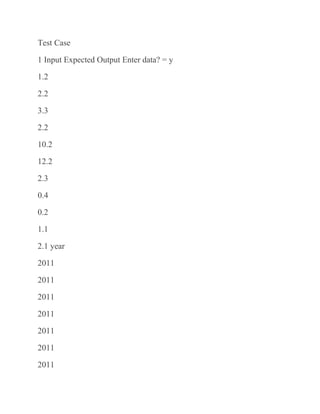
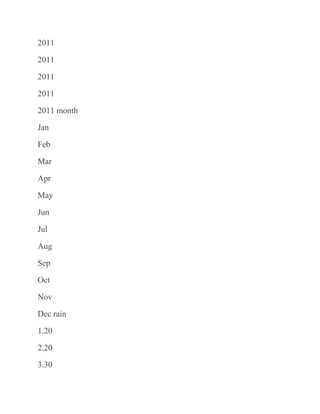
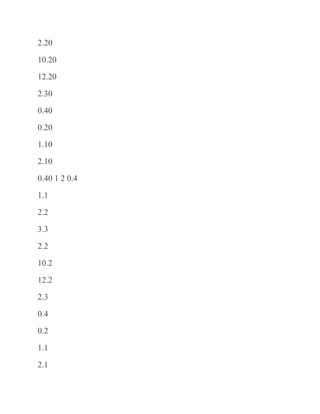
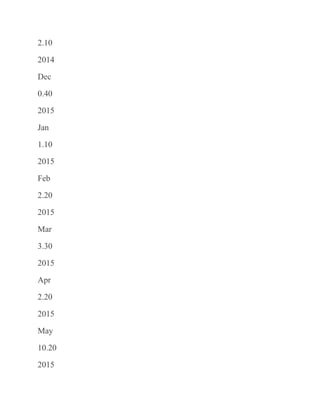
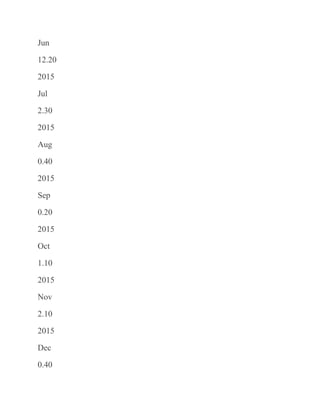
To verify this program is working properly the input values could be
used for testing:
Test Case
1 Input Expected Output Enter data? = y
1.2
2.2
3.3
2.2
10.2
12.2
2.3
0.4
0.2
1.1
2.1 year
2011
2011
2011
2011
2011
2011
2011
2011
2011
2011
2011
2011 month
Jan
Feb
Mar
Apr
May
Jun
Jul
Aug
Sep
Oct
Nov
Dec rain
1.20
2.20
3.30
2.20
10.20
12.20
2.30
0.40
0.20
1.10
2.10
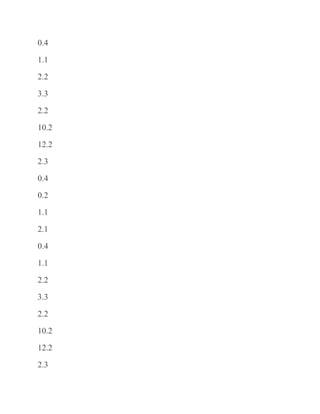
0.40 1 2 0.4
1.1
2.2
3.3
2.2
10.2
12.2
2.3
0.4
0.2
1.1
2.1
0.4
1.1
2.2
3.3
2.2
10.2
12.2
2.3
0.4
0.2
1.1
2.1
0.4
1.1
2.2
3.3
2.2
10.2
12.2
2.3
0.4
0.2
1.1
2.1
0.4
1.1
2.2
3.3
2.2
10.2
12.2
2.3
0.4
0.2
1.1
2.1
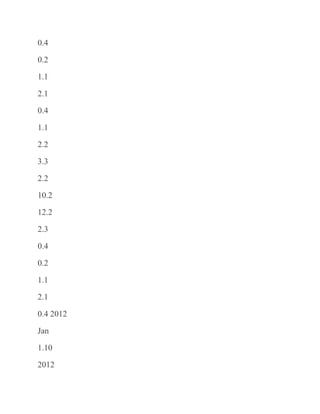
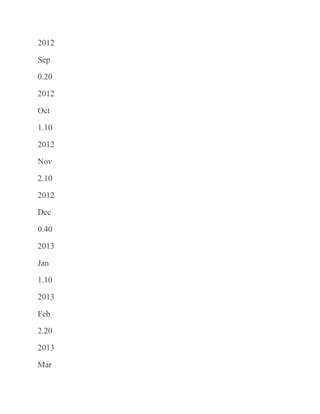
0.4 2012
Jan
1.10
2012
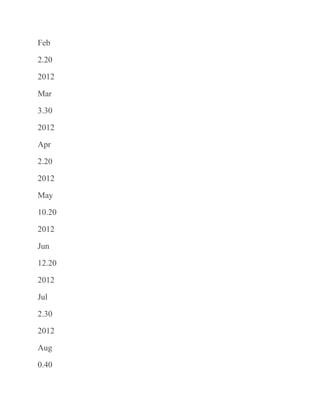
Feb
2.20
2012
Mar
3.30
2012
Apr
2.20
2012
May
10.20
2012
Jun
12.20
2012
Jul
2.30
2012
Aug
0.40
2012
Sep
0.20
2012
Oct
1.10
2012
Nov
2.10
2012
Dec
0.40
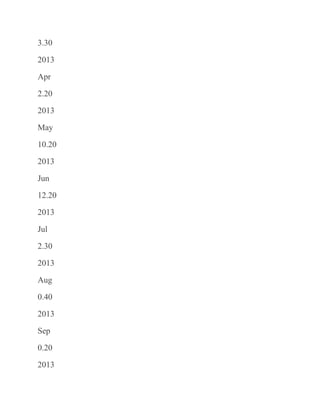
2013
Jan
1.10
2013
Feb
2.20
2013
Mar
3.30
2013
Apr
2.20
2013
May
10.20
2013
Jun
12.20
2013
Jul
2.30
2013
Aug
0.40
2013
Sep
0.20
2013
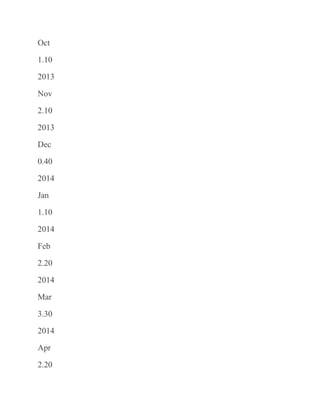
Oct
1.10
2013
Nov
2.10
2013
Dec
0.40
2014
Jan
1.10
2014
Feb
2.20
2014
Mar
3.30
2014
Apr
2.20
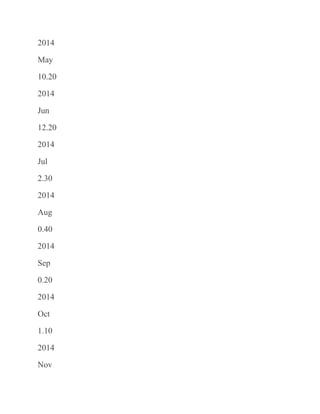
2014
May
10.20
2014
Jun
12.20
2014
Jul
2.30
2014
Aug
0.40
2014
Sep
0.20
2014
Oct
1.10
2014
Nov
2.10
2014
Dec
0.40
2015
Jan
1.10
2015
Feb
2.20
2015
Mar
3.30
2015
Apr
2.20
2015
May
10.20
2015
Jun
12.20
2015
Jul
2.30
2015
Aug
0.40
2015
Sep
0.20
2015
Oct
1.10
2015
Nov
2.10
2015
Dec
0.40
Please try the
Precipitation program
again. Enter data? = n No data was input at
this time. 2 Please try the
Precipitation program
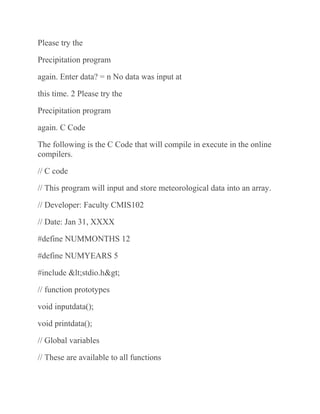
again. C Code
The following is the C Code that will compile in execute in the online
compilers.
// C code
// This program will input and store meteorological data into an array.
// Developer: Faculty CMIS102
// Date: Jan 31, XXXX
#define NUMMONTHS 12
#define NUMYEARS 5
#include <stdio.h>
// function prototypes
void inputdata();
void printdata();
// Global variables
// These are available to all functions
float Raindata[NUMYEARS][NUMMONTHS];
char years[NUMYEARS][5] =
{"2011","2012","
2013","2014","2015"};
char months[NUMMONTHS][12]
={"Jan","Feb","Mar","Apr&q
uot;,"
May","Jun","Jul","Aug",&quo
t;Sep&quot
;,"Oct","Nov","Dec"};
int main ()
{
char enterData = 'y';
printf("Do you want to input Precipatation data? (y for
yes)n");
scanf("%c",&enterData);
if (enterData == 'y') {
// Call Function to Input data
inputdata();
// Call Function to display data
printdata();
}
else {
printf("No data was input at this timen");
}
printf("Please try the Precipitation program again. n");
return 0;
}
// function to inputdata
void inputdata() {
/* variable definition: */
float Rain=1.0;
// Input Data
for (int year=0;year < NUMYEARS; year++) {
for (int month=0; month< NUMMONTHS; month++) {
printf("Enter rain for %d, %d:n", year+1, month+1);
scanf("%f",&Rain);
Raindata[year][month]=Rain; 3 }
}
}
// Function to printdata
void printdata(){
// Print data
printf ("yeart montht rainn");
for (int year=0;year < NUMYEARS; year++) {
for (int month=0; month< NUMMONTHS; month++) {
printf("%st %st %5.2fn",
years[year],months[month],Raindata[year][month]);
}
}
} Setting up the code and the input parameters in ideone.com:
You can change these values to any valid integer values to match your
test cases. 4 Results from running
the programming at ideone.com 5 Learning Exercises for you to
complete
1. Demonstrate you successfully followed the steps in this lab by
preparing screen captures of you
running the lab as specified in the Instructions above.
2. Modify the program to add a function to sum the rainfall for each
year. (Hint: you need to sum for
each year. You can do this using a looping structure). Support your
experimentation with screen
captures of executing the new code.
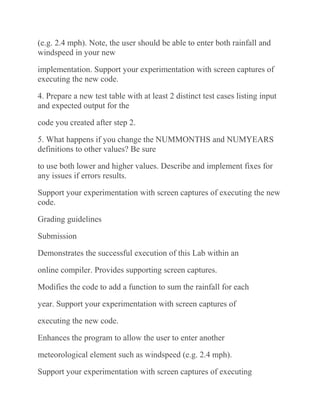
3. Enhance the program to allow the user to enter another meteorological
element such as windspeed
(e.g. 2.4 mph). Note, the user should be able to enter both rainfall and
windspeed in your new
implementation. Support your experimentation with screen captures of
executing the new code.
4. Prepare a new test table with at least 2 distinct test cases listing input
and expected output for the
code you created after step 2.
5. What happens if you change the NUMMONTHS and NUMYEARS
definitions to other values? Be sure
to use both lower and higher values. Describe and implement fixes for
any issues if errors results.
Support your experimentation with screen captures of executing the new
code.
Grading guidelines
Submission
Demonstrates the successful execution of this Lab within an
online compiler. Provides supporting screen captures.
Modifies the code to add a function to sum the rainfall for each
year. Support your experimentation with screen captures of
executing the new code.
Enhances the program to allow the user to enter another
meteorological element such as windspeed (e.g. 2.4 mph).
Support your experimentation with screen captures of executing
the new code.
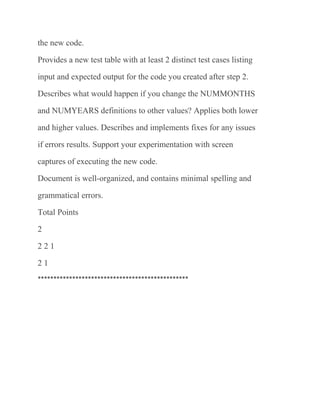
Provides a new test table with at least 2 distinct test cases listing
input and expected output for the code you created after step 2.
Describes what would happen if you change the NUMMONTHS
and NUMYEARS definitions to other values? Applies both lower
and higher values. Describes and implements fixes for any issues
if errors results. Support your experimentation with screen
captures of executing the new code.
Document is well-organized, and contains minimal spelling and
grammatical errors.
Total Points
2
2 2 1
2 1
************************************************

Cmis 102 hands on/tutorialoutlet

  • 1.
    CMIS 102 Hands-OnLab Week 8 Overview FOR MORE CLASSES VISIT tutorialoutletdotcom CMIS 102 Hands-On Lab Week 8 Overview This hands-on lab allows you to follow and experiment with the critical steps of developing a program including the program description, analysis, test plan, and implementation with C code. The example provided uses sequential, repetition, selection statements, functions, strings and arrays. Program Description This program will input and store meteorological data into an array. The program will prompt the user to enter the average monthly rainfall for a specific region and then use a loop to cycle through the array and print out each value. The program should store up 5 years of meteorological data. Data is collected once per month. The program should provide the option to the user of not entering any data. Analysis
  • 2.
    I will usesequential, selection, and repetition programming statements and an array to store data. I will define a 2-D array of Float number: Raindata to store the Float values input by the user. To store up to 5 years of monthly data, the array size should be at least 5*12 = 60 elements. In a 2D array this will be RainData[5][12]. We can use #defines to set the number of years and months to eliminate hardcoding values. A float number (rain) will also be needed to input the individual rain data. A nested for loop can be used to iterate through the array to enter Raindata. A nested for loop can also be used to print the data in the array. A array of strings can be used to store year and month names. This will allow a tabular display with labels for the printout. Functions will be used to separate functionality into smaller work units. Functions for displaying the data and inputting the data will be used. A selection statement will be used to determine if data should be entered. Test Plan To verify this program is working properly the input values could be used for testing:
  • 3.
    Test Case 1 InputExpected Output Enter data? = y 1.2 2.2 3.3 2.2 10.2 12.2 2.3 0.4 0.2 1.1 2.1 year 2011 2011 2011 2011 2011 2011 2011
  • 4.
  • 5.
    2.20 10.20 12.20 2.30 0.40 0.20 1.10 2.10 0.40 1 20.4 1.1 2.2 3.3 2.2 10.2 12.2 2.3 0.4 0.2 1.1 2.1
  • 6.
  • 7.
  • 8.
  • 9.
  • 10.
  • 11.
  • 12.
  • 13.
  • 14.
  • 15.
    Please try the Precipitationprogram again. Enter data? = n No data was input at this time. 2 Please try the Precipitation program again. C Code The following is the C Code that will compile in execute in the online compilers. // C code // This program will input and store meteorological data into an array. // Developer: Faculty CMIS102 // Date: Jan 31, XXXX #define NUMMONTHS 12 #define NUMYEARS 5 #include <stdio.h> // function prototypes void inputdata(); void printdata(); // Global variables // These are available to all functions
  • 16.
    float Raindata[NUMYEARS][NUMMONTHS]; char years[NUMYEARS][5]= {"2011","2012"," 2013","2014","2015"}; char months[NUMMONTHS][12] ={"Jan","Feb","Mar","Apr&q uot;," May","Jun","Jul","Aug",&quo t;Sep&quot ;,"Oct","Nov","Dec"}; int main () { char enterData = 'y'; printf("Do you want to input Precipatation data? (y for yes)n"); scanf("%c",&enterData); if (enterData == 'y') { // Call Function to Input data inputdata(); // Call Function to display data printdata(); }
  • 17.
    else { printf("No datawas input at this timen"); } printf("Please try the Precipitation program again. n"); return 0; } // function to inputdata void inputdata() { /* variable definition: */ float Rain=1.0; // Input Data for (int year=0;year < NUMYEARS; year++) { for (int month=0; month< NUMMONTHS; month++) { printf("Enter rain for %d, %d:n", year+1, month+1); scanf("%f",&Rain); Raindata[year][month]=Rain; 3 } } } // Function to printdata void printdata(){
  • 18.
    // Print data printf("yeart montht rainn"); for (int year=0;year < NUMYEARS; year++) { for (int month=0; month< NUMMONTHS; month++) { printf("%st %st %5.2fn", years[year],months[month],Raindata[year][month]); } } } Setting up the code and the input parameters in ideone.com: You can change these values to any valid integer values to match your test cases. 4 Results from running the programming at ideone.com 5 Learning Exercises for you to complete 1. Demonstrate you successfully followed the steps in this lab by preparing screen captures of you running the lab as specified in the Instructions above. 2. Modify the program to add a function to sum the rainfall for each year. (Hint: you need to sum for each year. You can do this using a looping structure). Support your experimentation with screen captures of executing the new code. 3. Enhance the program to allow the user to enter another meteorological element such as windspeed
  • 19.
    (e.g. 2.4 mph).Note, the user should be able to enter both rainfall and windspeed in your new implementation. Support your experimentation with screen captures of executing the new code. 4. Prepare a new test table with at least 2 distinct test cases listing input and expected output for the code you created after step 2. 5. What happens if you change the NUMMONTHS and NUMYEARS definitions to other values? Be sure to use both lower and higher values. Describe and implement fixes for any issues if errors results. Support your experimentation with screen captures of executing the new code. Grading guidelines Submission Demonstrates the successful execution of this Lab within an online compiler. Provides supporting screen captures. Modifies the code to add a function to sum the rainfall for each year. Support your experimentation with screen captures of executing the new code. Enhances the program to allow the user to enter another meteorological element such as windspeed (e.g. 2.4 mph). Support your experimentation with screen captures of executing
  • 20.
    the new code. Providesa new test table with at least 2 distinct test cases listing input and expected output for the code you created after step 2. Describes what would happen if you change the NUMMONTHS and NUMYEARS definitions to other values? Applies both lower and higher values. Describes and implements fixes for any issues if errors results. Support your experimentation with screen captures of executing the new code. Document is well-organized, and contains minimal spelling and grammatical errors. Total Points 2 2 2 1 2 1 ************************************************