 Reserves memory from a much larger free
 store, or heap

 Gives the programmer a pointer to refer to
 this memory
There are two types of memory management
 operators in C++:

 new
 delete


 These two memory management operators
 are used for allocating and freeing memory
 blocks in efficient and convenient ways.
The new operator in C++ is used for dynamic

storage allocation. This operator can be used

to create object of any type.
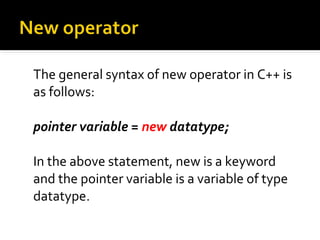
The general syntax of new operator in C++ is
as follows:

pointer variable = new datatype;

In the above statement, new is a keyword
and the pointer variable is a variable of type
datatype.
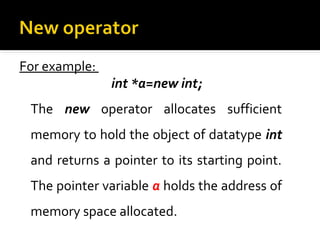
For example:
               int *a=new int;
 The new operator allocates sufficient
 memory to hold the object of datatype int
 and returns a pointer to its starting point.
 The pointer variable a holds the address of
 memory space allocated.
Dynamic variables are never initialized by
the compiler. Therefore, the programmer
should make it a practice to first assign
them a value.
The assignment can be made in either of
the two ways:

int *a = new int;
*a = 20;

or

int *a = new int(20);
Dynamic memory allocation in case of
arrays can be done as following:

int* a = new int[x];

a points to a block of memory
containing x ints
The delete operator in C++ is used for
releasing memory space when the object
is no longer needed. Once a new operator
is used, it is efficient to use the
corresponding delete operator for release
of memory.
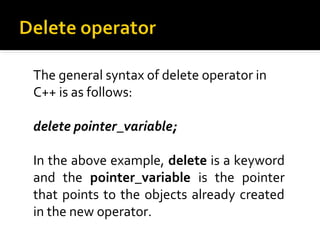
The general syntax of delete operator in
C++ is as follows:

delete pointer_variable;

In the above example, delete is a keyword
and the pointer_variable is the pointer
that points to the objects already created
in the new operator.
 The programmer must take care not to
 free or delete a pointer variable that has
 already been deleted.

 Overloading of new and delete operator is
 possible (to be discussed in detail in later
 section on overloading).
 We know that sizeof operator is used for
 computing the size of the object. Using
 memory management operator, the size
 of the object is automatically computed.

 The programmer must take care not to
 free or delete pointer variables that have
 not been allocated using a new operator.
 Null pointer is returned by the new
 operator when there is insufficient
 memory available for allocation.
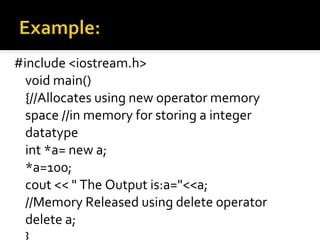
#include <iostream.h>
  void main()
  {//Allocates using new operator memory
  space //in memory for storing a integer
  datatype
  int *a= new a;
  *a=100;
  cout << " The Output is:a="<<a;
  //Memory Released using delete operator
  delete a;
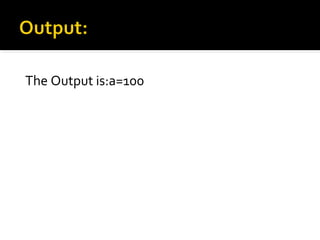
The Output is:a=100
The constructors can also be used to allocate
memory while creating objects. This will
enable the system to allocate the right
amount of memory for each object when the
objects are not of the same size, thus
resulting in the saving of memory. Allocation
of memory to objects at the time of their
construction is known as dynamic
construction of objects. The memory is
allocated with the help of
new operator
# include <iostream.h>
 # include <conio.h>
# include <string.h>
class str
{
char *name;
int len;
public:
str()
{
len=0;
name=new char[len+1];
 }
str(char *s)
 {
len=strlen(s);
 name=newchar[len+1];
 strcpy(name,s);
 }
void show()
{ cout<<"NAME IS:->"<<name<<endl;
 }
void join(str &a,str &b);
};
void str::join(str &a,str &b)
{
    len=a.len+b.len;
    delete name;
    name=newchar[len+1];
    strcpy(name,a.name);
    strcat(name,b.name);
 };
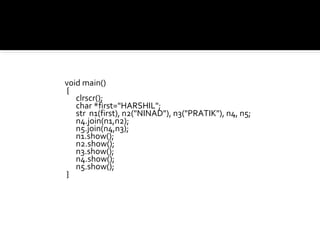
void main()
{
   clrscr();
   char *first="HARSHIL";
   str n1(first), n2("NINAD"), n3("PRATIK"), n4, n5;
   n4.join(n1,n2);
   n5.join(n4,n3);
   n1.show();
   n2.show();
   n3.show();
   n4.show();
   n5.show();
}

16858 memory management2

  • 2.
     Reserves memoryfrom a much larger free store, or heap  Gives the programmer a pointer to refer to this memory
  • 3.
    There are twotypes of memory management operators in C++:  new  delete These two memory management operators are used for allocating and freeing memory blocks in efficient and convenient ways.
  • 4.
    The new operatorin C++ is used for dynamic storage allocation. This operator can be used to create object of any type.
  • 5.
    The general syntaxof new operator in C++ is as follows: pointer variable = new datatype; In the above statement, new is a keyword and the pointer variable is a variable of type datatype.
  • 6.
    For example: int *a=new int; The new operator allocates sufficient memory to hold the object of datatype int and returns a pointer to its starting point. The pointer variable a holds the address of memory space allocated.
  • 7.
    Dynamic variables arenever initialized by the compiler. Therefore, the programmer should make it a practice to first assign them a value.
  • 8.
    The assignment canbe made in either of the two ways: int *a = new int; *a = 20; or int *a = new int(20);
  • 9.
    Dynamic memory allocationin case of arrays can be done as following: int* a = new int[x]; a points to a block of memory containing x ints
  • 10.
    The delete operatorin C++ is used for releasing memory space when the object is no longer needed. Once a new operator is used, it is efficient to use the corresponding delete operator for release of memory.
  • 11.
    The general syntaxof delete operator in C++ is as follows: delete pointer_variable; In the above example, delete is a keyword and the pointer_variable is the pointer that points to the objects already created in the new operator.
  • 12.
     The programmermust take care not to free or delete a pointer variable that has already been deleted.  Overloading of new and delete operator is possible (to be discussed in detail in later section on overloading).
  • 13.
     We knowthat sizeof operator is used for computing the size of the object. Using memory management operator, the size of the object is automatically computed.  The programmer must take care not to free or delete pointer variables that have not been allocated using a new operator.
  • 14.
     Null pointeris returned by the new operator when there is insufficient memory available for allocation.
  • 15.
    #include <iostream.h> void main() {//Allocates using new operator memory space //in memory for storing a integer datatype int *a= new a; *a=100; cout << " The Output is:a="<<a; //Memory Released using delete operator delete a;
  • 16.
  • 17.
    The constructors canalso be used to allocate memory while creating objects. This will enable the system to allocate the right amount of memory for each object when the objects are not of the same size, thus resulting in the saving of memory. Allocation of memory to objects at the time of their construction is known as dynamic construction of objects. The memory is allocated with the help of new operator
  • 18.
    # include <iostream.h> # include <conio.h> # include <string.h> class str { char *name; int len; public: str() { len=0; name=new char[len+1]; } str(char *s) { len=strlen(s); name=newchar[len+1]; strcpy(name,s); } void show() { cout<<"NAME IS:->"<<name<<endl; } void join(str &a,str &b); };
  • 19.
    void str::join(str &a,str&b) { len=a.len+b.len; delete name; name=newchar[len+1]; strcpy(name,a.name); strcat(name,b.name); };
  • 20.
    void main() { clrscr(); char *first="HARSHIL"; str n1(first), n2("NINAD"), n3("PRATIK"), n4, n5; n4.join(n1,n2); n5.join(n4,n3); n1.show(); n2.show(); n3.show(); n4.show(); n5.show(); }