Internet of Things
Analytics
ADVANCES IN DATA SCIENCE AND ARCHITECTURE
TEAM 8
ANKITA SURESH SHANBHAG
VIGNESH KARTHIKEYAN
SRINIKETAN G.S
Problem Statement
We have the weather station data from, for this analysis we have chosen Boston, MA and
weather data from the year 2008 to present. We are going to forecast the weather for the next
few days. Our Web application will display the forecast for the future period and will get
updated every day.
We are forecasting the future weather using the past data so we have used AR + I + MA
modeling (ARIMA) for the forecast as the future data depends only on the past trend. And we
have tried to observe the trend and seasonal components out of our data and the trend
represents the gradual increase in temperature over the year, which might be due to global
warming.
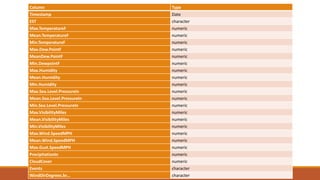
Column Type
Timestamp Date
EST character
Max.TemperatureF numeric
Mean.TemperatureF numeric
Min.TemperatureF numeric
Max.Dew.PointF numeric
MeanDew.PointF numeric
Min.DewpointF numeric
Max.Humidity numeric
Mean.Humidity numeric
Min.Humidity numeric
Max.Sea.Level.PressureIn numeric
Mean.Sea.Level.PressureIn numeric
Min.Sea.Level.PressureIn numeric
Max.VisibilityMiles numeric
Mean.VisibilityMiles numeric
Min.VisibilityMiles numeric
Max.Wind.SpeedMPH numeric
Mean.Wind.SpeedMPH numeric
Max.Gust.SpeedMPH numeric
PrecipitationIn numeric
CloudCover numeric
Events character
WindDirDegrees.br... character
Visualization and Analysis
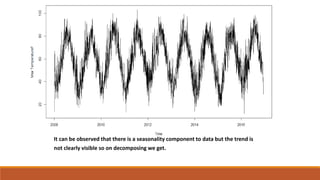
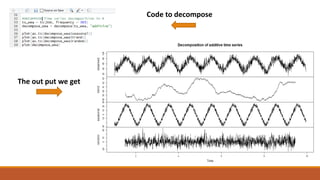
It can be observed that there is a seasonality component to data but the trend is
not clearly visible so on decomposing we get.
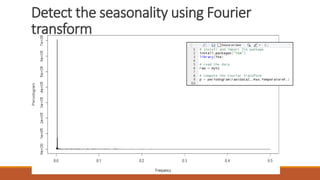
Detect the seasonality using Fourier
transform
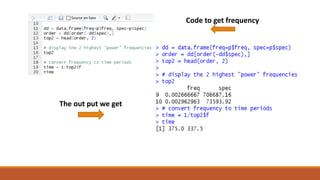
Code to get frequency
The out put we get
Code to decompose
The out put we get
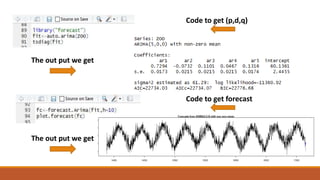
Code to get (p,d,q)
The out put we get
Code to get forecast
The out put we get
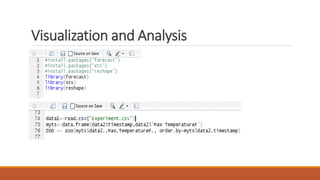
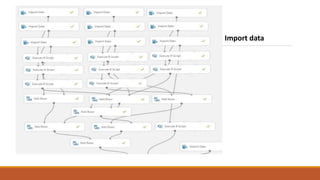
Import data
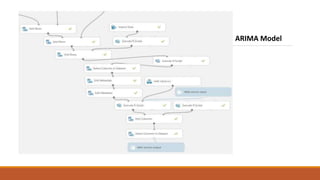
ARIMA Model
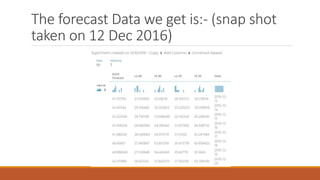
The forecast Data we get is:- (snap shot
taken on 12 Dec 2016)
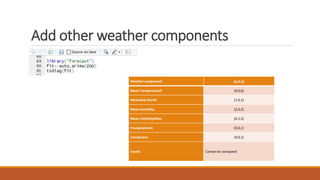
Add other weather components
Weather component (p,d,q)
Mean.TemperatureF (9,0,0)
MeanDew.PointF (1,0,1)
Mean.Humidity (2,0,2)
Mean.VisibilityMiles (0,1,2)
PrecipitationIn (0,0,1)
CloudCover (0,0,1)
Events Cannot be computed
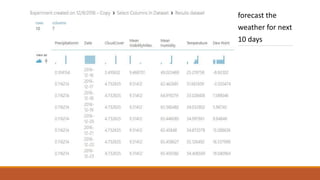
forecast the
weather for next
10 days
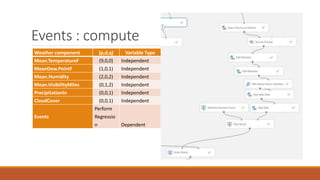
Events : compute
Weather component (p,d,q) Variable Type
Mean.TemperatureF (9,0,0) Independent
MeanDew.PointF (1,0,1) Independent
Mean.Humidity (2,0,2) Independent
Mean.VisibilityMiles (0,1,2) Independent
PrecipitationIn (0,0,1) Independent
CloudCover (0,0,1) Independent
Events
Perform
Regressio
n Dependent
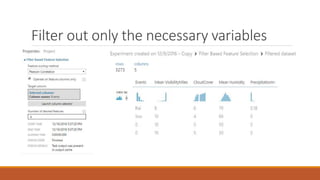
Filter out only the necessary variables
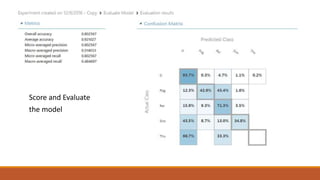
Score and Evaluate
the model
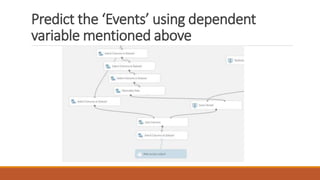
Predict the ‘Events’ using dependent
variable mentioned above
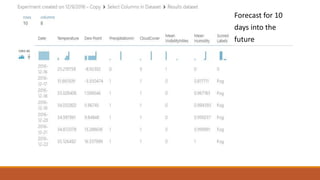
Forecast for 10
days into the
future

Ads final report - Team 8

  • 1.
    Internet of Things Analytics ADVANCESIN DATA SCIENCE AND ARCHITECTURE TEAM 8 ANKITA SURESH SHANBHAG VIGNESH KARTHIKEYAN SRINIKETAN G.S
  • 2.
    Problem Statement We havethe weather station data from, for this analysis we have chosen Boston, MA and weather data from the year 2008 to present. We are going to forecast the weather for the next few days. Our Web application will display the forecast for the future period and will get updated every day. We are forecasting the future weather using the past data so we have used AR + I + MA modeling (ARIMA) for the forecast as the future data depends only on the past trend. And we have tried to observe the trend and seasonal components out of our data and the trend represents the gradual increase in temperature over the year, which might be due to global warming.
  • 3.
    Column Type Timestamp Date ESTcharacter Max.TemperatureF numeric Mean.TemperatureF numeric Min.TemperatureF numeric Max.Dew.PointF numeric MeanDew.PointF numeric Min.DewpointF numeric Max.Humidity numeric Mean.Humidity numeric Min.Humidity numeric Max.Sea.Level.PressureIn numeric Mean.Sea.Level.PressureIn numeric Min.Sea.Level.PressureIn numeric Max.VisibilityMiles numeric Mean.VisibilityMiles numeric Min.VisibilityMiles numeric Max.Wind.SpeedMPH numeric Mean.Wind.SpeedMPH numeric Max.Gust.SpeedMPH numeric PrecipitationIn numeric CloudCover numeric Events character WindDirDegrees.br... character
  • 4.
  • 5.
    It can beobserved that there is a seasonality component to data but the trend is not clearly visible so on decomposing we get.
  • 6.
    Detect the seasonalityusing Fourier transform
  • 7.
    Code to getfrequency The out put we get
  • 8.
    Code to decompose Theout put we get
  • 9.
    Code to get(p,d,q) The out put we get Code to get forecast The out put we get
  • 10.
  • 11.
  • 12.
    The forecast Datawe get is:- (snap shot taken on 12 Dec 2016)
  • 13.
    Add other weathercomponents Weather component (p,d,q) Mean.TemperatureF (9,0,0) MeanDew.PointF (1,0,1) Mean.Humidity (2,0,2) Mean.VisibilityMiles (0,1,2) PrecipitationIn (0,0,1) CloudCover (0,0,1) Events Cannot be computed
  • 14.
  • 15.
    Events : compute Weathercomponent (p,d,q) Variable Type Mean.TemperatureF (9,0,0) Independent MeanDew.PointF (1,0,1) Independent Mean.Humidity (2,0,2) Independent Mean.VisibilityMiles (0,1,2) Independent PrecipitationIn (0,0,1) Independent CloudCover (0,0,1) Independent Events Perform Regressio n Dependent
  • 16.
    Filter out onlythe necessary variables
  • 17.
  • 18.
    Predict the ‘Events’using dependent variable mentioned above
  • 19.
    Forecast for 10 daysinto the future