Maria-Florina Balcan
04/04/2018
Clustering.
Unsupervised Learning
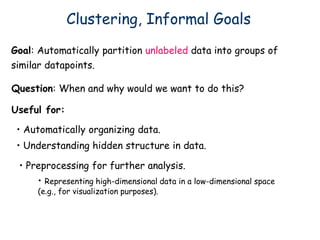
Clustering, Informal Goals
Goal: Automatically partition unlabeled data into groups of
similar datapoints.
Question: When and why would we want to do this?
• Automatically organizing data.
Useful for:
• Representing high-dimensional data in a low-dimensional space
(e.g., for visualization purposes).
• Understanding hidden structure in data.
• Preprocessing for further analysis.
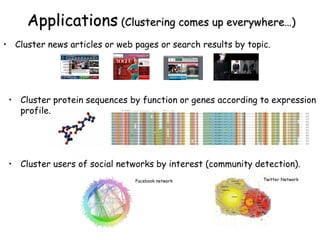
• Cluster news articles or web pages or search results by topic.
Applications (Clustering comes up everywhere…)
• Cluster protein sequences by function or genes according to expression
profile.
• Cluster users of social networks by interest (community detection).
Facebook network Twitter Network
• Cluster customers according to purchase history.
Applications (Clustering comes up everywhere…)
• Cluster galaxies or nearby stars (e.g. Sloan Digital Sky Survey)
• And many many more applications….
Clustering
Today:
• Objective based clustering
• Hierarchical clustering
• K-means clustering
Objective Based Clustering
Goal: output a partition of the data.
Input: A set S of n points, also a distance/dissimilarity
measure specifying the distance d(x,y) between pairs (x,y).
E.g., # keywords in common, edit distance, wavelets coef., etc.
– k-median: find center pts 𝐜𝟏, 𝐜𝟐, … , 𝐜𝐤 to
minimize ∑i=1
n
minj∈ 1,…,k d(𝐱𝐢, 𝐜𝐣)
– k-means: find center pts 𝒄𝟏, 𝒄𝟐, … , 𝒄𝒌 to
minimize ∑i=1
n
minj∈ 1,…,k d2
(𝐱𝐢
, 𝐜𝐣)
– K-center: find partition to minimize the maximum radius
z
x
y
c1
c2
s c3
Input: A set of n datapoints 𝐱𝟏
, 𝐱𝟐
, … , 𝐱𝒏
in Rd
Euclidean k-means Clustering
target #clusters k
Output: k representatives 𝒄𝟏, 𝐜𝟐, … , 𝒄𝒌 ∈ Rd
Objective: choose 𝒄𝟏, 𝐜𝟐, … , 𝒄𝒌 ∈ Rd
to minimize
∑i=1
n
minj∈ 1,…,k 𝐱𝐢 − 𝐜𝐣
2
Input: A set of n datapoints 𝐱𝟏
, 𝐱𝟐
, … , 𝐱𝒏
in Rd
Euclidean k-means Clustering
target #clusters k
Output: k representatives 𝒄𝟏, 𝐜𝟐, … , 𝒄𝒌 ∈ Rd
Objective: choose 𝒄𝟏, 𝐜𝟐, … , 𝒄𝒌 ∈ Rd
to minimize
∑i=1
n
minj∈ 1,…,k 𝐱𝐢 − 𝐜𝐣
2
Natural assignment: each point assigned to its
closest center, leads to a Voronoi partition.
Input: A set of n datapoints 𝐱𝟏
, 𝐱𝟐
, … , 𝐱𝒏
in Rd
Euclidean k-means Clustering
target #clusters k
Output: k representatives 𝒄𝟏, 𝐜𝟐, … , 𝒄𝒌 ∈ Rd
Objective: choose 𝒄𝟏, 𝐜𝟐, … , 𝒄𝒌 ∈ Rd
to minimize
∑i=1
n
minj∈ 1,…,k 𝐱𝐢 − 𝐜𝐣
2
Computational complexity:
NP hard: even for k = 2 [Dagupta’08] or
d = 2 [Mahajan-Nimbhorkar-Varadarajan09]
There are a couple of easy cases…
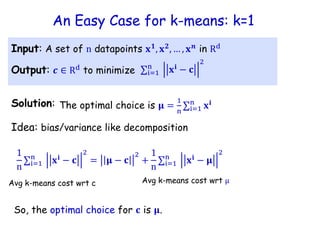
An Easy Case for k-means: k=1
Output: 𝒄 ∈ Rd to minimize ∑i=1
n
𝐱𝐢
− 𝐜
2
Solution:
1
n
∑i=1
n
𝐱𝐢 − 𝐜
2
= 𝛍 − 𝐜
2
+
1
n
∑i=1
n
𝐱𝐢 − 𝛍
2
So, the optimal choice for 𝐜 is 𝛍.
The optimal choice is 𝛍 =
1
n
∑i=1
n
𝐱𝐢
Input: A set of n datapoints 𝐱𝟏
, 𝐱𝟐
, … , 𝐱𝒏
in Rd
Avg k-means cost wrt c Avg k-means cost wrt μ
Idea: bias/variance like decomposition
Another Easy Case for k-means: d=1
Output: 𝒄 ∈ Rd to minimize ∑i=1
n
𝐱𝐢
− 𝐜
2
Extra-credit homework question
Hint: dynamic programming in time O(n2
k).
Input: A set of n datapoints 𝐱𝟏
, 𝐱𝟐
, … , 𝐱𝒏
in Rd
Input: A set of n datapoints 𝐱𝟏, 𝐱𝟐, … , 𝐱𝐧 in Rd
Common Heuristic in Practice:
The Lloyd’s method
Repeat until there is no further change in the cost.
• For each j: Cj ←{𝑥 ∈ 𝑆 whose closest center is 𝐜𝐣}
• For each j: 𝐜𝐣 ←mean of Cj
Initialize centers 𝒄𝟏, 𝐜𝟐, … , 𝒄𝒌 ∈ Rd
and
clusters C1, C2, … , Ck in any way.
[Least squares quantization in PCM, Lloyd, IEEE Transactions on Information Theory, 1982]
Input: A set of n datapoints 𝐱𝟏, 𝐱𝟐, … , 𝐱𝐧 in Rd
Common Heuristic in Practice:
The Lloyd’s method
Repeat until there is no further change in the cost.
• For each j: Cj ←{𝑥 ∈ 𝑆 whose closest center is 𝐜𝐣}
• For each j: 𝐜𝐣 ←mean of Cj
Initialize centers 𝒄𝟏, 𝐜𝟐, … , 𝒄𝒌 ∈ Rd
and
clusters C1, C2, … , Ck in any way.
[Least squares quantization in PCM, Lloyd, IEEE Transactions on Information Theory, 1982]
Holding 𝒄𝟏, 𝐜𝟐, … , 𝒄𝒌 fixed,
pick optimal C1, C2, … , Ck
Holding C1, C2, … , Ck fixed,
pick optimal 𝒄𝟏, 𝐜𝟐, … , 𝒄𝒌
Input: A set of n datapoints 𝐱𝟏
, 𝐱𝟐
, … , 𝐱𝐧
in Rd
Common Heuristic: The Lloyd’s method
Initialize centers 𝐜𝟏, 𝐜𝟐, … , 𝐜𝐤 ∈ Rd
and
clusters C1, C2, … , Ck in any way.
Repeat until there is no further change in the cost.
• For each j: Cj ←{𝑥 ∈ 𝑆 whose closest center is 𝐜𝐣}
• For each j: 𝐜𝐣 ←mean of Cj
Note: it always converges.
• the cost always drops and
• there is only a finite #s of Voronoi partitions
(so a finite # of values the cost could take)
Input: A set of n datapoints 𝐱𝟏, 𝐱𝟐, … , 𝐱𝐧 in Rd
Initialization for the Lloyd’s method
Initialize centers 𝐜𝟏, 𝐜𝟐, … , 𝐜𝐤 ∈ Rd
and
clusters C1, C2, … , Ck in any way.
Repeat until there is no further change in the cost.
• For each j: Cj ←{𝑥 ∈ 𝑆 whose closest center is 𝐜𝐣}
• For each j: 𝐜𝐣 ←mean of Cj
• Initialization is crucial (how fast it converges, quality of solution output)
• Discuss techniques commonly used in practice
• Random centers from the datapoints (repeat a few times)
• K-means ++ (works well and has provable guarantees)
• Furthest traversal
Lloyd’s method: Random Initialization
Example: Given a set of datapoints
Lloyd’s method: Random Initialization
Select initial centers at random
Lloyd’s method: Random Initialization
Assign each point to its nearest center
Lloyd’s method: Random Initialization
Recompute optimal centers given a fixed clustering
Lloyd’s method: Random Initialization
Assign each point to its nearest center
Lloyd’s method: Random Initialization
Recompute optimal centers given a fixed clustering
Lloyd’s method: Random Initialization
Assign each point to its nearest center
Lloyd’s method: Random Initialization
Recompute optimal centers given a fixed clustering
Lloyd’s method: Random Initialization
Get a good quality solution in this example.
Lloyd’s method: Performance
It always converges, but it may converge at a local optimum
that is different from the global optimum, and in fact could
be arbitrarily worse in terms of its score.
Lloyd’s method: Performance
Local optimum: every point is assigned to its nearest center
and every center is the mean value of its points.
Lloyd’s method: Performance
.It is arbitrarily worse than optimum solution….
Lloyd’s method: Performance
This bad performance, can happen
even with well separated Gaussian
clusters.
Lloyd’s method: Performance
This bad performance, can
happen even with well
separated Gaussian clusters.
Some Gaussian are
combined…..
Lloyd’s method: Performance
• For k equal-sized Gaussians, Pr[each initial center is in a
different Gaussian] ≈
𝑘!
𝑘𝑘 ≈
1
𝑒𝑘
• Becomes unlikely as k gets large.
• If we do random initialization, as k increases, it becomes
more likely we won’t have perfectly picked one center per
Gaussian in our initialization (so Lloyd’s method will output
a bad solution).
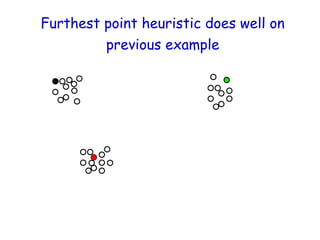
Another Initialization Idea: Furthest
Point Heuristic
Choose 𝐜𝟏 arbitrarily (or at random).
• Pick 𝐜𝐣 among datapoints 𝐱𝟏
, 𝐱𝟐
, … , 𝐱𝐧
that is
farthest from previously chosen 𝐜𝟏, 𝐜𝟐, … , 𝐜𝒋−𝟏
• For j = 2, … , k
Fixes the Gaussian problem. But it can be thrown
off by outliers….
Furthest point heuristic does well on
previous example
(0,1)
(0,-1)
(-2,0) (3,0)
Furthest point initialization heuristic
sensitive to outliers
Assume k=3
(0,1)
(0,-1)
(-2,0) (3,0)
Furthest point initialization heuristic
sensitive to outliers
Assume k=3
K-means++ Initialization: D2
sampling [AV07]
• Choose 𝐜𝟏 at random.
• Pick 𝐜𝐣 among 𝐱𝟏
, 𝐱𝟐
, … , 𝐱𝒏
according to the distribution
• For j = 2, … , k
• Interpolate between random and furthest point initialization
𝐏𝐫(𝐜𝐣 = 𝐱𝐢) ∝ 𝐦𝐢𝐧𝐣′<𝐣 𝐱𝐢 − 𝐜𝐣′
𝟐
• Let D(x) be the distance between a point 𝑥 and its nearest
center. Chose the next center proportional to D2
(𝐱).
D2
(𝐱𝐢
)
Theorem: K-means++ always attains an O(log k) approximation to
optimal k-means solution in expectation.
Running Lloyd’s can only further improve the cost.
K-means++ Idea: D2
sampling
• Interpolate between random and furthest point initialization
• Let D(x) be the distance between a point 𝑥 and its nearest
center. Chose the next center proportional to D𝛼
(𝐱).
• 𝛼 = 0, random sampling
• 𝛼 = ∞, furthest point (Side note: it actually works well for k-center)
• 𝛼 = 2, k-means++
Side note: 𝛼 = 1, works well for k-median
(0,1)
(0,-1)
(-2,0) (3,0)
K-means ++ Fix
K-means++/ Lloyd’s Running Time
Repeat until there is no change in the cost.
• For each j: Cj ←{𝑥 ∈ 𝑆 whose closest center is 𝐜𝐣}
• For each j: 𝐜𝐣 ←mean of Cj
Each round takes
time O(nkd).
• K-means ++ initialization: O(nd) and one pass over data to
select next center. So O(nkd) time in total.
• Lloyd’s method
• Exponential # of rounds in the worst case [AV07].
• Expected polynomial time in the smoothed analysis (non
worst-case) model!
K-means++/ Lloyd’s Summary
• Exponential # of rounds in the worst case [AV07].
• Expected polynomial time in the smoothed analysis model!
• K-means++ always attains an O(log k) approximation to optimal
k-means solution in expectation.
• Running Lloyd’s can only further improve the cost.
• Does well in practice.
What value of k???
• Hold-out validation/cross-validation on auxiliary
task (e.g., supervised learning task).
• Heuristic: Find large gap between k -1-means cost
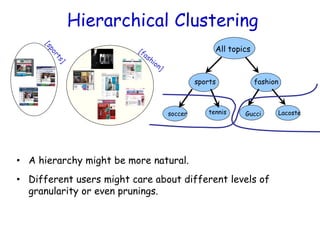
and k-means cost.
• Try hierarchical clustering.
soccer
sports fashion
Gucci
tennis Lacoste
All topics
Hierarchical Clustering
• A hierarchy might be more natural.
• Different users might care about different levels of
granularity or even prunings.
What You Should Know
• Partitional Clustering. k-means and k-means ++
• Lloyd’s method
• Initialization techniques (random, furthest
traversal, k-means++)

clustering unsupervised learning and machine learning.pdf

  • 1.
  • 2.
    Clustering, Informal Goals Goal:Automatically partition unlabeled data into groups of similar datapoints. Question: When and why would we want to do this? • Automatically organizing data. Useful for: • Representing high-dimensional data in a low-dimensional space (e.g., for visualization purposes). • Understanding hidden structure in data. • Preprocessing for further analysis.
  • 3.
    • Cluster newsarticles or web pages or search results by topic. Applications (Clustering comes up everywhere…) • Cluster protein sequences by function or genes according to expression profile. • Cluster users of social networks by interest (community detection). Facebook network Twitter Network
  • 4.
    • Cluster customersaccording to purchase history. Applications (Clustering comes up everywhere…) • Cluster galaxies or nearby stars (e.g. Sloan Digital Sky Survey) • And many many more applications….
  • 5.
    Clustering Today: • Objective basedclustering • Hierarchical clustering • K-means clustering
  • 6.
    Objective Based Clustering Goal:output a partition of the data. Input: A set S of n points, also a distance/dissimilarity measure specifying the distance d(x,y) between pairs (x,y). E.g., # keywords in common, edit distance, wavelets coef., etc. – k-median: find center pts 𝐜𝟏, 𝐜𝟐, … , 𝐜𝐤 to minimize ∑i=1 n minj∈ 1,…,k d(𝐱𝐢, 𝐜𝐣) – k-means: find center pts 𝒄𝟏, 𝒄𝟐, … , 𝒄𝒌 to minimize ∑i=1 n minj∈ 1,…,k d2 (𝐱𝐢 , 𝐜𝐣) – K-center: find partition to minimize the maximum radius z x y c1 c2 s c3
  • 7.
    Input: A setof n datapoints 𝐱𝟏 , 𝐱𝟐 , … , 𝐱𝒏 in Rd Euclidean k-means Clustering target #clusters k Output: k representatives 𝒄𝟏, 𝐜𝟐, … , 𝒄𝒌 ∈ Rd Objective: choose 𝒄𝟏, 𝐜𝟐, … , 𝒄𝒌 ∈ Rd to minimize ∑i=1 n minj∈ 1,…,k 𝐱𝐢 − 𝐜𝐣 2
  • 8.
    Input: A setof n datapoints 𝐱𝟏 , 𝐱𝟐 , … , 𝐱𝒏 in Rd Euclidean k-means Clustering target #clusters k Output: k representatives 𝒄𝟏, 𝐜𝟐, … , 𝒄𝒌 ∈ Rd Objective: choose 𝒄𝟏, 𝐜𝟐, … , 𝒄𝒌 ∈ Rd to minimize ∑i=1 n minj∈ 1,…,k 𝐱𝐢 − 𝐜𝐣 2 Natural assignment: each point assigned to its closest center, leads to a Voronoi partition.
  • 9.
    Input: A setof n datapoints 𝐱𝟏 , 𝐱𝟐 , … , 𝐱𝒏 in Rd Euclidean k-means Clustering target #clusters k Output: k representatives 𝒄𝟏, 𝐜𝟐, … , 𝒄𝒌 ∈ Rd Objective: choose 𝒄𝟏, 𝐜𝟐, … , 𝒄𝒌 ∈ Rd to minimize ∑i=1 n minj∈ 1,…,k 𝐱𝐢 − 𝐜𝐣 2 Computational complexity: NP hard: even for k = 2 [Dagupta’08] or d = 2 [Mahajan-Nimbhorkar-Varadarajan09] There are a couple of easy cases…
  • 10.
    An Easy Casefor k-means: k=1 Output: 𝒄 ∈ Rd to minimize ∑i=1 n 𝐱𝐢 − 𝐜 2 Solution: 1 n ∑i=1 n 𝐱𝐢 − 𝐜 2 = 𝛍 − 𝐜 2 + 1 n ∑i=1 n 𝐱𝐢 − 𝛍 2 So, the optimal choice for 𝐜 is 𝛍. The optimal choice is 𝛍 = 1 n ∑i=1 n 𝐱𝐢 Input: A set of n datapoints 𝐱𝟏 , 𝐱𝟐 , … , 𝐱𝒏 in Rd Avg k-means cost wrt c Avg k-means cost wrt μ Idea: bias/variance like decomposition
  • 11.
    Another Easy Casefor k-means: d=1 Output: 𝒄 ∈ Rd to minimize ∑i=1 n 𝐱𝐢 − 𝐜 2 Extra-credit homework question Hint: dynamic programming in time O(n2 k). Input: A set of n datapoints 𝐱𝟏 , 𝐱𝟐 , … , 𝐱𝒏 in Rd
  • 12.
    Input: A setof n datapoints 𝐱𝟏, 𝐱𝟐, … , 𝐱𝐧 in Rd Common Heuristic in Practice: The Lloyd’s method Repeat until there is no further change in the cost. • For each j: Cj ←{𝑥 ∈ 𝑆 whose closest center is 𝐜𝐣} • For each j: 𝐜𝐣 ←mean of Cj Initialize centers 𝒄𝟏, 𝐜𝟐, … , 𝒄𝒌 ∈ Rd and clusters C1, C2, … , Ck in any way. [Least squares quantization in PCM, Lloyd, IEEE Transactions on Information Theory, 1982]
  • 13.
    Input: A setof n datapoints 𝐱𝟏, 𝐱𝟐, … , 𝐱𝐧 in Rd Common Heuristic in Practice: The Lloyd’s method Repeat until there is no further change in the cost. • For each j: Cj ←{𝑥 ∈ 𝑆 whose closest center is 𝐜𝐣} • For each j: 𝐜𝐣 ←mean of Cj Initialize centers 𝒄𝟏, 𝐜𝟐, … , 𝒄𝒌 ∈ Rd and clusters C1, C2, … , Ck in any way. [Least squares quantization in PCM, Lloyd, IEEE Transactions on Information Theory, 1982] Holding 𝒄𝟏, 𝐜𝟐, … , 𝒄𝒌 fixed, pick optimal C1, C2, … , Ck Holding C1, C2, … , Ck fixed, pick optimal 𝒄𝟏, 𝐜𝟐, … , 𝒄𝒌
  • 14.
    Input: A setof n datapoints 𝐱𝟏 , 𝐱𝟐 , … , 𝐱𝐧 in Rd Common Heuristic: The Lloyd’s method Initialize centers 𝐜𝟏, 𝐜𝟐, … , 𝐜𝐤 ∈ Rd and clusters C1, C2, … , Ck in any way. Repeat until there is no further change in the cost. • For each j: Cj ←{𝑥 ∈ 𝑆 whose closest center is 𝐜𝐣} • For each j: 𝐜𝐣 ←mean of Cj Note: it always converges. • the cost always drops and • there is only a finite #s of Voronoi partitions (so a finite # of values the cost could take)
  • 15.
    Input: A setof n datapoints 𝐱𝟏, 𝐱𝟐, … , 𝐱𝐧 in Rd Initialization for the Lloyd’s method Initialize centers 𝐜𝟏, 𝐜𝟐, … , 𝐜𝐤 ∈ Rd and clusters C1, C2, … , Ck in any way. Repeat until there is no further change in the cost. • For each j: Cj ←{𝑥 ∈ 𝑆 whose closest center is 𝐜𝐣} • For each j: 𝐜𝐣 ←mean of Cj • Initialization is crucial (how fast it converges, quality of solution output) • Discuss techniques commonly used in practice • Random centers from the datapoints (repeat a few times) • K-means ++ (works well and has provable guarantees) • Furthest traversal
  • 16.
  • 17.
    Example: Given aset of datapoints Lloyd’s method: Random Initialization
  • 18.
    Select initial centersat random Lloyd’s method: Random Initialization
  • 19.
    Assign each pointto its nearest center Lloyd’s method: Random Initialization
  • 20.
    Recompute optimal centersgiven a fixed clustering Lloyd’s method: Random Initialization
  • 21.
    Assign each pointto its nearest center Lloyd’s method: Random Initialization
  • 22.
    Recompute optimal centersgiven a fixed clustering Lloyd’s method: Random Initialization
  • 23.
    Assign each pointto its nearest center Lloyd’s method: Random Initialization
  • 24.
    Recompute optimal centersgiven a fixed clustering Lloyd’s method: Random Initialization Get a good quality solution in this example.
  • 25.
    Lloyd’s method: Performance Italways converges, but it may converge at a local optimum that is different from the global optimum, and in fact could be arbitrarily worse in terms of its score.
  • 26.
    Lloyd’s method: Performance Localoptimum: every point is assigned to its nearest center and every center is the mean value of its points.
  • 27.
    Lloyd’s method: Performance .Itis arbitrarily worse than optimum solution….
  • 28.
    Lloyd’s method: Performance Thisbad performance, can happen even with well separated Gaussian clusters.
  • 29.
    Lloyd’s method: Performance Thisbad performance, can happen even with well separated Gaussian clusters. Some Gaussian are combined…..
  • 30.
    Lloyd’s method: Performance •For k equal-sized Gaussians, Pr[each initial center is in a different Gaussian] ≈ 𝑘! 𝑘𝑘 ≈ 1 𝑒𝑘 • Becomes unlikely as k gets large. • If we do random initialization, as k increases, it becomes more likely we won’t have perfectly picked one center per Gaussian in our initialization (so Lloyd’s method will output a bad solution).
  • 31.
    Another Initialization Idea:Furthest Point Heuristic Choose 𝐜𝟏 arbitrarily (or at random). • Pick 𝐜𝐣 among datapoints 𝐱𝟏 , 𝐱𝟐 , … , 𝐱𝐧 that is farthest from previously chosen 𝐜𝟏, 𝐜𝟐, … , 𝐜𝒋−𝟏 • For j = 2, … , k Fixes the Gaussian problem. But it can be thrown off by outliers….
  • 32.
    Furthest point heuristicdoes well on previous example
  • 33.
    (0,1) (0,-1) (-2,0) (3,0) Furthest pointinitialization heuristic sensitive to outliers Assume k=3
  • 34.
    (0,1) (0,-1) (-2,0) (3,0) Furthest pointinitialization heuristic sensitive to outliers Assume k=3
  • 35.
    K-means++ Initialization: D2 sampling[AV07] • Choose 𝐜𝟏 at random. • Pick 𝐜𝐣 among 𝐱𝟏 , 𝐱𝟐 , … , 𝐱𝒏 according to the distribution • For j = 2, … , k • Interpolate between random and furthest point initialization 𝐏𝐫(𝐜𝐣 = 𝐱𝐢) ∝ 𝐦𝐢𝐧𝐣′<𝐣 𝐱𝐢 − 𝐜𝐣′ 𝟐 • Let D(x) be the distance between a point 𝑥 and its nearest center. Chose the next center proportional to D2 (𝐱). D2 (𝐱𝐢 ) Theorem: K-means++ always attains an O(log k) approximation to optimal k-means solution in expectation. Running Lloyd’s can only further improve the cost.
  • 36.
    K-means++ Idea: D2 sampling •Interpolate between random and furthest point initialization • Let D(x) be the distance between a point 𝑥 and its nearest center. Chose the next center proportional to D𝛼 (𝐱). • 𝛼 = 0, random sampling • 𝛼 = ∞, furthest point (Side note: it actually works well for k-center) • 𝛼 = 2, k-means++ Side note: 𝛼 = 1, works well for k-median
  • 37.
  • 38.
    K-means++/ Lloyd’s RunningTime Repeat until there is no change in the cost. • For each j: Cj ←{𝑥 ∈ 𝑆 whose closest center is 𝐜𝐣} • For each j: 𝐜𝐣 ←mean of Cj Each round takes time O(nkd). • K-means ++ initialization: O(nd) and one pass over data to select next center. So O(nkd) time in total. • Lloyd’s method • Exponential # of rounds in the worst case [AV07]. • Expected polynomial time in the smoothed analysis (non worst-case) model!
  • 39.
    K-means++/ Lloyd’s Summary •Exponential # of rounds in the worst case [AV07]. • Expected polynomial time in the smoothed analysis model! • K-means++ always attains an O(log k) approximation to optimal k-means solution in expectation. • Running Lloyd’s can only further improve the cost. • Does well in practice.
  • 40.
    What value ofk??? • Hold-out validation/cross-validation on auxiliary task (e.g., supervised learning task). • Heuristic: Find large gap between k -1-means cost and k-means cost. • Try hierarchical clustering.
  • 41.
    soccer sports fashion Gucci tennis Lacoste Alltopics Hierarchical Clustering • A hierarchy might be more natural. • Different users might care about different levels of granularity or even prunings.
  • 42.
    What You ShouldKnow • Partitional Clustering. k-means and k-means ++ • Lloyd’s method • Initialization techniques (random, furthest traversal, k-means++)